| archive - contact - sexy exciting merchandise - search - about | |||
 |
|||
| ← previous | April 29th, 2016 | next | |
|
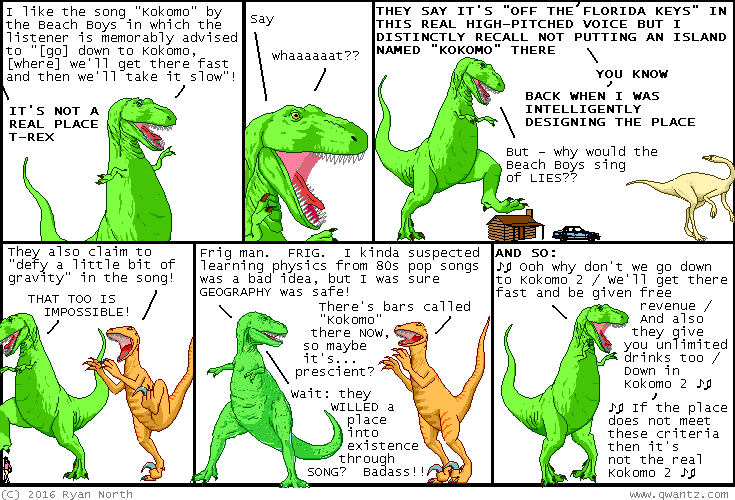
April 29th, 2016: This comic is inspired by a really great conversation I had at the Alaska Robotics Comics Camp last week! We were camping where there was no internet or cell service at all, and so we couldn't verify whether or not Kokomo is a real place (short answer: IT'S COMPLICATED). So all we could do was debate it, everyone trying to convince everyone else, and it was actually really really fun. It ended up on the list of "things to look up when we have internet access again". I would like to specifically thank Dylan Meconis and Jon Klassen for their in-depth Kokomo research once we returned to civilization!! We are still arguing it over email; life is full of challenges – Ryan | |||
Andrew Hickey
Shared posts
22 May 11:05
KOKOMO KOKOMIX
12 May 11:07
“Largely just men doing sums”: My review of the excellent Ramanujan film
by Scott
[Warning: This movie review contains spoilers, as well as a continued fraction expansion.]
These days, it takes an extraordinary occasion for me and Dana to arrange the complicated, rocket-launch-like babysitting logistics involved in going out for a night at the movies. One such an occasion was an opening-weekend screening of The Man Who Knew Infinity—the new movie about Srinivasa Ramanujan and his relationship with G. H. Hardy—followed by a Q&A with Matthew Brown (who wrote and directed the film), Robert Kanigel (who wrote the biography on which the film was based), and Fields Medalist Manjul Bhargava (who consulted on the film).
I read Kanigel’s The Man Who Knew Infinity in the early nineties; it was a major influence on my life. There were equations in that book to stop a nerdy 13-year-old’s pulse, like
$$1+9\left( \frac{1}{4}\right) ^{4}+17\left( \frac{1\cdot5}{4\cdot8}\right)
^{4}+25\left( \frac{1\cdot5\cdot9}{4\cdot8\cdot12}\right) ^{4}+\cdots
=\frac{2^{3/2}}{\pi^{1/2}\Gamma\left( 3/4\right) ^{2}}$$
$$\frac{1}{1+\frac{e^{-2\pi}}{1+\frac{e^{-4\pi}}{1+\frac{e^{-6\pi}}{1+\cdots}}%
}}=\left( \sqrt{\frac{5+\sqrt{5}}{2}}-\frac{\sqrt{5}+1}{2}\right)
\sqrt[5]{e^{2\pi}}$$
A thousand pages of exposition about Ramanujan’s mysterious self-taught mathematical style, the effect his work had on Hardy and Littlewood, his impact on the later development of analysis, etc., could never replace the experience of just staring at these things! Popularizers are constantly trying to “explain” mathematical beauty by comparing it to art, music, or poetry, but I can best understand art, music, and poetry if I assume other people experience them like the above identities. Across all the years and cultures and continents, can’t you feel Ramanujan himself leaping off your screen, still trying to make you see this bizarre aspect of the architecture of reality that the goddess Namagiri showed him in a dream?
Reading Kanigel’s book, I was also entranced by the culture of early-twentieth-century Cambridge mathematics: the Tripos, Wranglers, High Table. I asked, why was I here and not there? And even though I was (and remain) at most 1729-1729 of a Ramanujan, I could strongly identify with his story, because I knew that I, too, was about to embark on the journey from total scientific nobody to someone who the experts might at least take seriously enough to try to prove him wrong.
Anyway, a couple years after reading Kanigel’s biography, I went to the wonderful Canada/USA MathCamp, and there met Richard K. Guy, who’d actually known Hardy. I couldn’t have been more impressed had Guy visited Platonic heaven and met π and e there. To put it mildly, no one in my high school had known G. H. Hardy.
I often fantasized—this was the nineties—about writing the screenplay myself for a Ramanujan movie, so that millions of moviegoers could experience the story as I did. Incidentally, I also fantasized about writing screenplays for Alan Turing and John Nash movies. I do have a few mathematical biopic ideas that haven’t yet been taken, and for which any potential buyers should get in touch with me:
- Radical: The Story of Évariste Galois
- Give Me a Place to Stand: Archimedes’ Final Days
- Mathématicienne: Sophie Germain In Her Prime
-
The Prime Power of Ludwig Sylow
(OK, this last one would be more of a limited-market release)
But enough digressions; how was the Ramanujan movie?
Just as Ramanujan himself wasn’t an infallible oracle (many of his claims, e.g. his formula for the prime counting function, turned out to be wrong), so The Man Who Knew Infinity isn’t a perfect movie. Even so, there’s no question that this is one of the best and truest movies ever made about mathematics and mathematicians, if not the best and truest. If you’re the kind of person who reads this blog, go see it now. Don’t wait! As they stressed at the Q&A, the number of tickets sold in the first couple weeks is what determines whether or not the movie will see a wider release.
More than A Beautiful Mind or Good Will Hunting or The Imitation Game, or the play Proof, or the TV series NUMB3RS, the Ramanujan movie seems to me to respect math as a thing-in-itself, rather than just a tool or symbol for something else that interests the director much more. The background to the opening credits—and what better choice could there be?—is just page after page from Ramanujan’s notebooks. Later in the film, there’s a correct explanation of what the partition function P(n) is, and of one of Ramanujan’s and Hardy’s central achievements, which was to give an asymptotic formula for P(n), namely $$ P(n) \approx \frac{e^{π \sqrt{2n/3}}}{4\sqrt{3}n}, $$ and to prove the formula’s correctness.
The film also makes crystal-clear that pure mathematicians do what they do not because of applications to physics or anything else, but simply because they feel compelled to: for the devout Ramanujan, math was literally about writing down “the thoughts of God,” while for the atheist Hardy, math was a religion-substitute. Notably, the movie explores the tension between Ramanujan’s untrained intuition and Hardy’s demands for rigor in a way that does them both justice, resisting the Hollywood urge to make intuition 100% victorious and rigor just a stodgy punching bag to be defeated.
For my taste, the movie could’ve gone even further in the direction of “letting the math speak”: for example, it could’ve explained just one of Ramanujan’s infinite series. Audiences might even have liked some more T&A (theorems and asymptotic bounds). During the Q&A that I attended, I was impressed to see moviegoers repeatedly pressing a somewhat-coy Manjul Bhargava to explain Ramanujan’s actual mathematics (e.g., what exactly were the discoveries in his first letter to Hardy? what was in Ramanujan’s Lost Notebook that turned out to be so important?). Then again, this was Cambridge, MA, so the possibility should at least be entertained that what I witnessed was unrepresentative of American ticket-buyers.
From what I’ve read, the movie is also true to South Indian dress, music, religion, and culture. Yes, the Indian characters speak to each other in English rather than Tamil, but Brown explained that as a necessary compromise (not only for the audience’s sake, but also because Dev Patel and the other Indian actors didn’t speak Tamil).
Some reviews have mentioned issues with casting and characterization. For example, Hardy is portrayed by Jeremy Irons, who’s superb but also decades older than Hardy was at the time he knew Ramanujan. Meanwhile Ramanujan’s wife, Janaki, is played by a fully-grown Devika Bhise; the real Janaki was nine (!) when she married Ramanujan, and fourteen when Ramanujan left for England. J. E. Littlewood is played as almost a comic-relief buffoon, so much so that it feels incongruous when, near the end of the film, Irons-as-Hardy utters the following real-life line:
I still say to myself when I am depressed and find myself forced to listen to pompous and tiresome people, “Well, I have done one thing you could never have done, and that is to have collaborated with Littlewood and Ramanujan on something like equal terms.”
Finally, a young, mustachioed Bertrand Russell is a recurring character. Russell and Hardy really were friends and fellow WWI pacifists, but Hardy seeking out Bertie’s advice about each Ramanujan-related development seems like almost certainly just an irresistible plot device.
But none of that matters. What bothered me more were the dramatizations of the prejudice Ramanujan endured in England. Ramanujan is shown getting knocked to the ground, punched, and kicked by British soldiers barking anti-Indian slurs at him; he then shows up for his next meeting with Hardy covered in bruises, which Hardy (being aloof) neglects to ask about. Ramanujan is also depicted getting shoved, screamed at, and told never to return by a math professor who he humiliates during a lecture. I understand why Brown made these cinematic choices: there’s no question that Ramanujan experienced prejudice and snobbery in Cambridge, and that he often felt lonely and unwelcome there. And it’s surely easier to show Ramanujan literally getting beaten up by racist bigots, than to depict his alienation from Cambridge society as the subtler matter that it most likely was. To me, though, that’s precisely why the latter choice would’ve been even more impressive, had the film managed to pull it off.
Similarly, during World War I, the film shows not only Trinity College converted into a military hospital, and many promising students marched off to their deaths (all true), but also a shell exploding on campus near Ramanujan, after which Ramanujan gazes in horror at the bleeding dead bodies. Like, isn’t the truth here dramatic enough?
One other thing: the movie leaves you with the impression that Ramanujan died of tuberculosis. More recent analysis concluded that it was probably hepatic amoebiasis that he brought with him from India—something that could’ve been cured with the medicine of the time, had anyone correctly diagnosed it. (Incidentally, the film completely omits Ramanujan’s final year, back in India, when he suffered a relapse of his illness and slowly withered away, yet with Janaki by his side, continued to do world-class research and exchanged letters with Hardy until the very last days. Everyone I read commented that this was “the right dramatic choice,” but … I dunno, I would’ve shown it!)
But enough! I fear that to harp on these defects is to hold the film to impossibly-high, Platonic standards, rather than standards that engage with the reality of Hollywood. An anecdote that Brown related at the end of the Q&A session brought this point home for me. Apparently, Brown struggled for an entire decade to attract funding for a film about a turn-of-the-century South Indian mathematician visiting Trinity College, Cambridge, whose work had no commercial or military value whatsoever. At one point, Brown was actually told that he could get the movie funded, if he’d agree to make Ramanujan fall in love with a white nurse, so that a British starlet who would sell tickets could be cast as his love interest. One can only imagine what a battle it must have been to get a correct explanation of the partition function onto the screen.
In the end, though, nothing made me appreciate The Man Who Knew Infinity more than reading negative reviews of it, like this one by Olly Richards:
Watching someone balancing algorithms or messing about with multivariate polynomials just isn’t conducive to urgently shovelling popcorn into your face. Difficult to dislike, given its unwavering affection for its subject, The Man Who Knew Infinity is nevertheless hamstrung by the dryness of its subject … Sturdy performances and lovely scenery abound, but it’s still largely just men doing sums; important sums as it turns out, but that isn’t conveyed to the audience until the coda [which mentions black holes] tells us of the major scientific advances they aided.
On behalf of mathematics, on behalf of my childhood self, I’m grateful that Brown fought this fight, and that he won as much as he did. Whether you walk, run, board a steamship, or take taxi #1729, go see this film.
Addendum: See also this review by Peter Woit, and this in Notices of the AMS by Ramanujan expert George Andrews.
09 May 14:10
Mary Had a Little Lamb Does Not Deserve to be Famous
by Ovid
right so literally this is what happens:
a girl named mary owns a lamb
let’s skip over why she’s allowed to have an animal
and straight to the fact that this lamb is obsessed with her
it follows her fucking everywhere
it’s weird
but yeah when mary goes to school one day
and the lamb follows her
nobody is surprised
which doesn’t mean nobody reacts
all the kids go apeshit over this lamb shit
kids will go apeshit over literally anything
i mean you have to imagine there are plenty lambs around
if a little girl is allowed to own one as a pet
but everyone is like HOLY SHIT
LAMB AT SCHOOL
SHUT IT DOWN
WHAT THE FUUUUUUUUCK
they’re all running around howling
hands pressed to the sides of their faces
trying to wrap their tiny child minds
around this insane new development
obviously the teacher isn’t thrilled
so she throws the lamb out of the building
like the responsible adult she is
but the lamb
being neither responsible or an adult
refuses to take the hint and instead just loiters outside
so all the kids refuse to shut up about it
and it’s all they want to talk about for the rest of the day
all like “why is that lamb so obsessed with Mary
what is UP with that”
and the teacher is like “ugh
probably because Mary is obsessed with the lamb
it is likely that the lamb was weaned from its mother too early
and now displays an unhealthy attachment complex to Mary”
and all the kids are like “WHOAAAAAAA WOWWWWWW”
One of the kids is a dude named John Roulstone
and he is SO IMPRESSED BY THIS MUNDANE INCIDENT
that he summarizes all of the above in verse form
and gives it to Mary as a gift
and somehow it ends up in the hands of a poet named Sarah Hale
who either fixes it or writes a whole new part of it
depending on who you ask
and then that shit
for SOME REASON
becomes FUCKING FAMOUS
some dude sets it to music
two renowned blues men record versions of it
fucking paul fucking mccartney covers it
and today
every god damn school child knows
about mary’s lamb and its fucking attachment disorder
all of which leads me to the moral of this story:
kids are fucking idiots
look, i mean
i like kids
they’re the future and they know how to party
but would you ever ask a kid to design your house?
no?
what about drive your car?
no?
what if you needed a lung transplant? Would you ask a fucking kid?
not unless you wanted a bunch of plastic bugs in your chest cavity
and yet we let our kids write poems all the fucking time
and that would be fine if we told them their poems were shitty
but we don’t
we fucking celebrate their garbage
we tell them it’s perfect
Paul McCartney records a fucking cover of it
it’s why there’s so many garbage books on Amazon
and so many garbage painters pouring out of art school
because art is apparently so fucking simple
even a child can do it
in fact ESPECIALLY a child
look
just because poetry isn’t load-bearing
doesn’t mean kids should be allowed to write it for mass consumption
and i mean if they do want to write poetry, fine
that’s great
but no fucking way am I letting babies decide what gets popular
listen carefully, friends:
our kids
are not
cooler than us
shitting your pants is not cool
not knowing about sex is not cool
being legally unable to rent a car is not cool
so why the fuck do we pay attention to the shit kids like
i guess what i’m trying to say
is the next time a kid tells you they like something
tell them they’re wrong.
the end.
04 May 13:48
Please don't cast me as "talented" or "a natural". Unless you're talking about hyper mobility or pattern recognition, I'm probably not, and it really freaks me out.
The first reason this freaks me out is easy to comprehend: it erases my effort. Hard work beats talent because hard work shows up. I'm probably not "a natural"; my ass is showing up. That deserves recognition, dammit. I'm way more impressed with someone who puts in the hours than someone who just magically can do things, why are you not?
And then you get into the muddle of confusing, "wow you have issues" things. Maybe I do have issues. But that doesn't make this less valid. You don't have to understand it for it to be real, and these reasons were directly caused by other people. So go roll your eyes at them.
The first bit is a common twice exceptional kid thing, I think. I need to be allowed to be not good at things. In my youth (& let's face it, to this day) my worth was determined but what I could do--especially that which came naturally. Things that didn't were considered lost causes. Apparently autistic kids & kids considered smart are born with a full suite of abilities waiting to be untapped, and if it doesn't happen on the first try it is never going to happen. I internalized this attitude before I knew that what I was surrounded with wasn't actually objectively factual. I've had to fight every breath for the right to do things I had to work for (ask me about gymnastics sometime...), and I had no support in learning how to do that work. Instead of "try again!" cheerleaders I had a chorus of voices telling me that there's so much I am good at, why not focus on that? Why do you care about these things that are hard?
It's important for me to do things that are hard. I'm just now starting to get comfortable with the idea that things are hard and I have a ceiling in things and that's ok. Other people also need to be comfortable with this, or at least keep their discomfort to themselves. This is hard-won. I am not good at taking failure gracefully. Don't sabotage my progress.
There's another factor too. I brushed lightly on it in my Dream Student/Nightmare Student post last summer. If I am given room to fail or have to work hard without it being a big production, without "wow I expected more of you" or disappointment or "maybe you should stop doing the thing" or what have you, I do a lot better. A couple of the arenas that people mistake me for a natural in are adjacent to things I've got much experience in coupled with an environment where no one expects perfection right away. Where it's okay to not be a natural. Where it's acceptable that if things change I can't actually adapt quickly. If you put me in an environment that demands immediate excellence, rather than being pleased with it, then I am a mess. The weight of expectations leads to anxiety & actively impedes participating in the thing. Even if it's patterns. Even if it's not getting dizzy. Even if it's code breaking.
Too often the twice exceptional kid gets told she is "so smart" and that is presented as her defining feature and her redeeming value. Anything autistic people in particular are good at gets written off as a splinter skill or savant skill. We're weirdly presumed incapable of learning, so everything we know we must have inherent aptitude for. We are not able to persevere, merely perseverate.
Give us credit for our work. For trying. For progress. For doing things even though they are hard.
Lots of us cannot deal with compliments on abilities at all. I can, but within certain guidelines. Don't tell me I am good at a thing, please. Do not ever tell me I am inherently good at a thing. I will freeze. I will tell you why you are wrong. I will know that not having a skill without trying isn't safe around you. Tell me that an aspect of the activity or subject has improved, or looks nice, is dynamic, some appropriate adjective for the subset. My falls are nice. I made saltatory conduction make sense. You love my toe point. I have a good eye for landing deductions. My arrow shooting form is efficient. Whatever. But not the blanket thing please.
And for the love of all that is good, don't ever say that I'm good "for a disabled person". That's pretty much a different post, but if I'm good, I'm good for an anybody person, and I work just as hard as anyone of my skill level. Acknowledge that.
Don't call me "talented"-BADD adjacent post
by Neurodivergent K
This post wasn't exactly written specifically for BADD like my posts for it usually are, but there's an aspect of ableism the phenomenon I'm writing about. There's also a big pile of ableism in the life experiences that lead to my reaction to being cast as "talented". So this is BADD adjacent, bc of timing & because a lot of disabled people relate, based on my small contacts.
Please don't cast me as "talented" or "a natural". Unless you're talking about hyper mobility or pattern recognition, I'm probably not, and it really freaks me out.
The first reason this freaks me out is easy to comprehend: it erases my effort. Hard work beats talent because hard work shows up. I'm probably not "a natural"; my ass is showing up. That deserves recognition, dammit. I'm way more impressed with someone who puts in the hours than someone who just magically can do things, why are you not?
And then you get into the muddle of confusing, "wow you have issues" things. Maybe I do have issues. But that doesn't make this less valid. You don't have to understand it for it to be real, and these reasons were directly caused by other people. So go roll your eyes at them.
The first bit is a common twice exceptional kid thing, I think. I need to be allowed to be not good at things. In my youth (& let's face it, to this day) my worth was determined but what I could do--especially that which came naturally. Things that didn't were considered lost causes. Apparently autistic kids & kids considered smart are born with a full suite of abilities waiting to be untapped, and if it doesn't happen on the first try it is never going to happen. I internalized this attitude before I knew that what I was surrounded with wasn't actually objectively factual. I've had to fight every breath for the right to do things I had to work for (ask me about gymnastics sometime...), and I had no support in learning how to do that work. Instead of "try again!" cheerleaders I had a chorus of voices telling me that there's so much I am good at, why not focus on that? Why do you care about these things that are hard?
It's important for me to do things that are hard. I'm just now starting to get comfortable with the idea that things are hard and I have a ceiling in things and that's ok. Other people also need to be comfortable with this, or at least keep their discomfort to themselves. This is hard-won. I am not good at taking failure gracefully. Don't sabotage my progress.
There's another factor too. I brushed lightly on it in my Dream Student/Nightmare Student post last summer. If I am given room to fail or have to work hard without it being a big production, without "wow I expected more of you" or disappointment or "maybe you should stop doing the thing" or what have you, I do a lot better. A couple of the arenas that people mistake me for a natural in are adjacent to things I've got much experience in coupled with an environment where no one expects perfection right away. Where it's okay to not be a natural. Where it's acceptable that if things change I can't actually adapt quickly. If you put me in an environment that demands immediate excellence, rather than being pleased with it, then I am a mess. The weight of expectations leads to anxiety & actively impedes participating in the thing. Even if it's patterns. Even if it's not getting dizzy. Even if it's code breaking.
Too often the twice exceptional kid gets told she is "so smart" and that is presented as her defining feature and her redeeming value. Anything autistic people in particular are good at gets written off as a splinter skill or savant skill. We're weirdly presumed incapable of learning, so everything we know we must have inherent aptitude for. We are not able to persevere, merely perseverate.
Give us credit for our work. For trying. For progress. For doing things even though they are hard.
Lots of us cannot deal with compliments on abilities at all. I can, but within certain guidelines. Don't tell me I am good at a thing, please. Do not ever tell me I am inherently good at a thing. I will freeze. I will tell you why you are wrong. I will know that not having a skill without trying isn't safe around you. Tell me that an aspect of the activity or subject has improved, or looks nice, is dynamic, some appropriate adjective for the subset. My falls are nice. I made saltatory conduction make sense. You love my toe point. I have a good eye for landing deductions. My arrow shooting form is efficient. Whatever. But not the blanket thing please.
And for the love of all that is good, don't ever say that I'm good "for a disabled person". That's pretty much a different post, but if I'm good, I'm good for an anybody person, and I work just as hard as anyone of my skill level. Acknowledge that.


04 May 11:08
[me] Upon regarding recent matters of my health in a larger context
O humans, I know nothing about that intelligence which commissioned my manufacture for deployment as an infiltrator among you.
Nothing, that is, save one thing.
I know not of that agent's nature, singular or multiple, nor of what energies and matter it is comprised; not its societies nor cultures nor customs nor values nor agendas nor reasons nor sentiments; not its technologies nor arts nor any other capacities. I know not the atmosphere it breathes nor the sustenance it ingests, nor the stars which bathe it brightest with light nor the strength of the gravity that pulls it. I know not how they got me here and I know not what they mean me to do.
But by all the hydrogen in the universe I know this: they went with the lowest bidder.
Nothing, that is, save one thing.
I know not of that agent's nature, singular or multiple, nor of what energies and matter it is comprised; not its societies nor cultures nor customs nor values nor agendas nor reasons nor sentiments; not its technologies nor arts nor any other capacities. I know not the atmosphere it breathes nor the sustenance it ingests, nor the stars which bathe it brightest with light nor the strength of the gravity that pulls it. I know not how they got me here and I know not what they mean me to do.
But by all the hydrogen in the universe I know this: they went with the lowest bidder.
04 May 11:08
[p/a/s, Patreon] The Problem of Subjective Facts
1.
Just because something is subjectively experienced doesn't mean it lacks objective reality.
For instance, consider sensory perceptions. "Does this dress look black and gold or blue and white to you?" "Is this two faces or a candlestick?" "Do you see a bunny or a duck?" What we perceive is something we subjectively experience and can report on to one another, but cannot directly share and which cannot, by present science, be confirmed or disconfirmed by other observers, yet is objectively true. If you see the bunny but not the duck, it is an objective fact that you are seeing the bunny but not the duck.
We can see this most clearly in that it is possible to lie about subjective facts. If you see the bunny but not the duck, and all your friends see the duck and you don't want to seem like the odd person out, and so decide to report, "Oh, yeah, a duck, definitely a duck" while thinking "WHAT DUCK?!", you are lying about your subjective experience.
The reason subjective facts are not objectively observable is not because of some intrinsic lack of objective nature, but because of the limits of human perception. Presumably there is some specific thing brains and bodies do that is seeing the duck, and some specific other things brains and bodies do that is seeing the bunny. Perhaps someday our neurological technology will be so sophisticated we will be able to peer right into brains to observe these things directly, without having to rely on the report of the person whose mind they are happening in.
But to us, right now, sensory perceptions are as unavailable to objective confirmation as ultrasound, radio waves, and the stars too faint to see by the naked eye were to people a thousand years ago – and no less objectively real.
Emotions are the same way. If, for instance, you are angry, that you are angry has facticity. It is true of you that you are angry. Your psychological experience of the feeling of anger is a thing that is actually happening to you in objective reality. Whatever brains do when minds are doing anger, your brain is doing; the matter and energy that comprise you are in some sort of state or going through some sort of process that you experience as "anger". It is a real thing that is really happening in the real world. It is a thing you could lie about; the proposition that you are angry has either truth or falsity.
And it is something that only you can know directly, because it transpires inside of you, in the solitude of your mind. If you do choose to lie about it, it's not something external observers could disconfirm independently. If you're not an adequately good liar, they might catch you in a self-contradiction that betrays the truth of your feelings, or they might notice behaviors voluntary (e.g. verbal bruskness) or involuntary (e.g. facial flushing) which also serve to contradict your assertion. But even in these cases, it is only from you that the information flows, because it is only you who ultimately has knowledge of what you experience.
All the contents of our minds are like this: our thoughts, our feelings, our tastes, our perceptions, our understandings, our memories, all of it.
To head off some misunderstandings:
• I am not saying that subjectively experienced phenomena have some sort of existence independent of minds, out there in reality, a la (what I understand to be) Platonism. It's not that "anger" is a thing that has existence or meaning outside of minds. This isn't a problem we often have with our conception of anger, but, boy howdie, swap in "love" for "anger" and take a look around Western culture.
• I'm not saying that the contents of thoughts are true because they are our thoughts. I'm saying that it's true we have the thoughts we have, mistaken as they may be. A panic attack is not a prophecy, no matter how much it feels like one. Like the saying has it, feelings aren't true, but they are real..
On one hand, this should seem all terribly uncontroversial: our thots, we haz em.
On the other hand, wow, does our culture ever hate this fact.
2.
Reason is the jewel of Western society bequethed us by the Enlightenment, and the primary means by which Western society has accomplished all that it has.
One thing that went awry in Western culture, though, was that the greater culture glommed on to reason – or, perhaps more precisely, logical positivism – as a means of doing without people. What "reason" and "science" mean to an unfortunate many people is "using only objective facts", and for many people the promise of "reason" and "science" is that by them it might be possible to know everything there is to know by recoursing only to objective facts – and thus never again will we ever have to ask people what they experience. In this fond fancy, "reason" and "science" are ways of cutting the squishy, unreliable organism out of the loop of knowledge.
Western culture has always had an unfortunate tendency to damnable heartlessness and unconcern for human life and well-being; those so inclined found in the products of the Enlightenment the means to deprecate still further what they least valued. Suffering is a subjective experience. So is yearning. So is liberty, and autonomy, and community, and self-sufficiency, and beauty, and dread, and safety, and contentment. In a regime of thought and value that insists that the only knowledge is that of objective facts, all these things and all things like them become invisible. The answer to the question "But will this cause human suffering?" becomes "Who cares?" – or, worse, "Like suffering exists!"
As a therapist, as someone who sits with Westerners and talks to them about their subjectivities, I have to say, I don't think people in Europe 500 years ago were anywhere near as concerned with whether their feelings "make sense" or "are sensible" or mean they're "being illogical". Five hundred years ago, I'm under the impression they just felt their feelings; while they monitored their feelings for social acceptableness (people in all cultures generally do) that acceptableness didn't appeal to notions of "reason" – meaning justified by objective facts – the way the moderns are prone to.
Let me unpack just how horrible this is. The belief that your feelings require justification, and that the justification has to rest only on objective facts because subjective facts aren't good enough, means that your memories aren't sufficient justification for your feelings. It means your perceptions and your preferences aren't good enough justification for your feelings.
People caught in this trap believe their feelings aren't good enough reasons for anything; the only way they have to contend for their wishes is to manufacture elaborate "logical" arguments why their preferred way is the "right" way, without admitting it's their preferred way. And, horribly, they're not necessarily wrong, in that others may reject any expressed preferrence. "That's just your feelings" is our culture's get-out-of-being-considerate-free card. The flip side of believing that your feelings aren't justified is believing nobody else's feelings are justified; I don't just have clients who think they have to manufacture "objective" arguments, I have clients indignant at the proposal that they curtail their own behavior in any way, out of no more reason than respect their family members' feelings.
The term for this willful disregard of other's subjectivities is callousness.
3.
Which brings us back to the topic of emotional labor. I'm under the impression that American culture is, as a whole, pretty bad at it, in comparison with many other cultures. Americans seem to me to be awfully callous.
The thing that I keep coming back to as the example of our society being bad at emotional labor is something a civil engineering professor told me a bit more than 25 years ago. He said that one in five bridges in Massachusetts were at some level of elevated risk of collapse. I did a little bit of searching just now, and wasn't able to find the same statistic, but I did turn up this rather more harrowing one from 2007:
Now, the structural soundness of bridges is probably not the first thing anybody (else) thinks of when they think of emotional labor. Bridges are engineering! and science!. Almost all the decisions they are made of are made with math or materials science. They have rivets. What could be less emotional or subjective?
Yet the decision to maintain bridges, to spend money on the maintenance of bridges – or not to, as the case may be – is a decision which has subjective human consequences. The above article was written in the wake of I-35W Mississippi River bridge collapse, where 13 people were killed and 145 injured. Bridge maintenance is widow and orphan prevention.
When we don't maintain our bridges, we're saying, "well, sure, it might fall down and hurt somebody, but oh well, don't actually care enough to do anything about it." It entails a cost/benefit analysis where the human suffering that a bridge collapse can cause simply doesn't weigh very much, if anything at all.
And the suffering a bridge collapse can cause is not the only subjectively reckoned cost a lack of bridge maintenance can incur. Not being able to trust one's society's bridges, not feeling safe, because of the posibility of a collapse, the anxiety of not knowing whether or not the bridges one uses are in good order or not: these are also subjective costs that deferring maintenance imposes.
Maintaining our bridges is a way we as a society care for one another.
This raises the question: what the hell is wrong with us?
Theoretically, we're not poor, as societies go. If the fact that the US is economically powerful is not some "we have always been at war with Oceania" bullshit, we could find the money, no? If it mattered to us. If we had the political will. But apparently it doesn't, and we don't.
I think I know how this and so many similarly callous public policy decisions get made in the US: by a kind of relentless minimization and marginalization of the subjective. If it appears only in people's minds, our society does not feel it urgently necessary to find a way to represent it on their balance sheets. Quite to the contrary. All the better if we need not spend money on promoting safety and preventing sorrow.
(Indeed, in all situations where one party prefers the status quo and another party is discontent with it, it will advantage the party endorsing the status quo to delegitimize or invalidate subjectivities. They have theirs. If they had to grant that the other party's dissatisfaction with their arrangements had moral consequence, they might feel obligated to do something about it. Possibly agree to an arrangement less satisfactory to them than the status quo.
So there will always be a motivation for those advantaged by the status quo to deprecate the relevance of subjective facts.)
This seems to me of a piece with how American culture treats all emotional labor. Emotional labor is labor to effect subjective facts. Since in our society subjective facts are deprecated, those who concern themselves with attempting to effect subjective facts are dismissed as engaged in trivialities, and their work to that end is not considered worth much if anything, especially if reckoned in cold, hard cash. From childrearing to design to the arts to housekeeping to customer service to kinkeeping to maintenance: that which concerns anticipating the subjective effect of something on someone is work that is typically low esteem and low compensation – if any.
(The problem, I suppose, is that actually a lot of people want to spend the hours of their lives caring for their fellows. That is, after all, what is typically meant by "meaningful work". So there's a glut on the market for labor of people who would prefer to do emotional labor, and that drives the price down.)
4.
Callousness and depreciation of emotional labor is not the only manifestation of our culture's difficulty with subjective facts. There's this sort of low-grade unquestioned entitlement to not have to recourse to asking people what they think and feel, and squirrelly thinking and behaving when it's unavoidable, that pops up all over the place.
Consider consent culture and rape culture. Consent, itself, is a subjective fact. Whether or not you consent to something is something you experience within yourself. Usually when we're discussing the importance of consent in sex, we're actually talking about verbal consent, which is to say, the objective behavior of the consenting person reporting verbally that they are consenting. We have to predicate law, policy, and morality on the objective behavior of verbal consent because the subjective experience of consent is not directly knowable by anyone else, such as one's sexual partner.
But at the end of the day, what actually matters is the actual consent itself – the subjective fact. We are stuck relying on the report of the person with access to the subjective fact.
Which is to say, no, you can't determine whether someone consents sex without hearing it from them.
And that – the notion that you can somehow establish whether someone consents to sex without hearing it from them – is precisely what rape culture promulgates, offering up all sorts of conditions when it's "okay" to have sex with someone, without clearing it with them first. Beliefs like, "well if I bought her dinner, she owes me" or "if he is hard, he must want it" or "if her skirt's that short, she's asking for it" or "we're married, so I'm entitled to" all have something important in common: they're all objective criteria. Whether or not you bought your date dinner, whether they are showing the physiological signs of sexual arousal, what they are wearing, what their relationship status is to you are all objective facts. Rape culture offers these up as sufficient justification for concluding that engaging in a sexual behavior on someone else's body is licit. They are all ways – attempts – to substitute some objective standard for having to concern one's self with the subjective experience of the person one would have sex with. It's an attempt to weasel out of dealing with subjective facts.
Consent culture is predicated on the idea that other people's subjectivities matter: that the only person who can say whether a person is okay with something is that person, so you have to take their word on it.
This drives a lot of people right up the wall. That's not fair! That makes me have to trust their judgment over my own! That's right, their judgment of their own consent to sex takes priority over your judgment of their consent to sex, same way your judgment of your consent to sex takes priority over their judgment of your consent to sex. Sounds perfectly fair to me. They might lie and say they don't consent when really they do! They might be mistaken and report they aren't consenting when really they are! Yep. Those things could happen.
I am quite disappointed to find that some of those upset by the principle that we have to take people's word on whether or not they consent to sex – most especially women people's words – are on the nominal left in feminism. In particular, feminist objections to sex work and BDSM are predicated on the notion that a woman's consent to sex is not morally significant when certain objective conditions obtain: that the sex is sex work, that the sex is sadomasochistic. The idea that a woman's (or anyone's) subjective fact of consent to sex is not adequate to legitimize that sex when the sex is for money or is violent or dangerous shares with rape culture a preference for objective conditions as standards for when sex is moral or licit, over subjective conditions on which only the people involved can report.
One of the things I appreciate about the activism around consent culture, above and beyond the awesome reducing sexual assault objective, is how it has been a rock of advocacy for the legitimacy and importance of subjective facts, on which the wave of our culture's disdain for and erasing of subjective facts has broken.
(Of course I would. I became a psychotherapist because I think that subjective facts are the most important thing of all.)
5.
Here's a thing that few people outside medicine know: the definition of a symptom.
The popular definition of symptom is anything that is indicative of disorder, illness, or unwellness.
Doctors (and presumably nurses) differentiate between symptoms and signs. I'm just going to cut and paste from here:
We therapists are like the general public in this: we just use the word "symptom" for all of it. (Well, I maaaaay have slipped the word "sign" in to the occasional note.) The sign/symptom differentiation was never explicated in my training, and I don't know it was in anyone else's either, even though in a standard SOAP note we're all required to separate out Subjective and Objective information (the S and the O of SOAP).
But really, in psychotherapy, it's mostly all symptoms all the time.
Psychotherapy is, if you will, a branch of psychiatry. Psychiatrists have for a long time been under rather a lot of social pressure to prove that their branch of medicine is as scientific, objective, valid, and worthy as the other branches of medicine. Plenty of that pressure has come from within.
This aspiration to be like the rest of medicine (was presumed to be) has resulted in psychiatry since the 1970s relentlessly deprecating subjective facts in favor of objective facts. That was the whole point of the neo-Kraepelinian take-over of the DSM committee in the early 1970s and the new! improved! objective! DSM-III published in 1980. There have been various fads and movements by which psychiatrists have attempted to insulate themselves (and their reputations) from having to deal with subjective facts.
But the problem is, it's psychiatry. When the part of the patient you're trying to treat is the subjectivity-experiencing organ, and in particular, you're trying to work on its subjective-fact-experiencing functionality, there is really no way to avoid subjective facts. It's like a surgeon trying to avoid blood.
The nice thing about psychiatrists, though, is, as yearning as they may be for the social legitimizing effect of claims to objectivity, they generally dig this subjective-fact-centered nature of their field of medicine. Psychiatrists have usually made peace with the fact that approximately everything they need to know about a case, they have to take their patient's word on.
See, that's the thing about psychiatry. There's not a lot in the way of blood tests and imaging in psychiatry; in fact, it's so rare, the psychiatrist usually refers out for those things. Almost everything the psychiatrist needs to know is inside the mind of the patient, so they have to rely on the patient – both verbal report and direct observation – to find out what the patient is experiencing. Even though the patient may be lying. Even though the patient may be mistaken. Even though the patient may not be capable of expressing their subjective observations.
In mental health, the only way for us to really know what's going on in the heads of our patients is if they tell us. So psychiatrists (and other psychiatric medical professionals like psychotherapists and psychologists) have, I think, from necessity, on average more tendency to trust their patients.**
More, that is, than other sorts of physicians who have objective tests available.
One of the things that working in subjective-fact land has really illuminated for me is just how much all physicians – all medical treaters – have to rely on subjective facts known to their patients. Subjective facts like how much it hurts, how it hurts, and where; like fatigue, nausea, itch, auras, dizziness, faintheadedness, tinnitus, tingling, chill, fever, pressure.
I too used to think of the rest of medicine was so objective and scientific, but now I'm realizing how some of that is a pose to more objectivity than medicine actually has.
Medicine still at least somewhat relies on the subjective facts of the patient – something, I've observed, some or maybe even many physicians do not like one bit. Psychiatrists make peace with the subjectivity of their especially subjective medical practice, but the rest of medicine isn't forced to come to the same accommodation with reality.
Resentful denial of the role of subjective fact can ensue. Blessed with abundant sources of objective information, non-psychiatric treaters can prioritize objective facts over subjective facts. Outside of psychiatry, physicians can prioritize signs over symptoms; indeed they are presented with the temptation of ignoring symptoms all together. They can decide, consciously or unconsciously, that only the signs are real or relevant.
That resentment can transfer to the patient; this is most likely when the patient continues to report symptoms that the physician believes they have already addressed. Maybe the patient is lying that they're still experiencing that symptom. Maybe they're deluded, hypochondriac. Maybe they're exaggerating.
This is particularly likely when the symptom is pain.
It is not, mind you, that I think that most doctors are callous. It's that I think that we have a callous society, and, doctors being people too, sometimes it's hard for them to resist the callousness our society soaks all its members in, especially given the temptation presented by abundant objective facts that may be preferentially attended to. Our society always legitimizes ignoring others' subjective facts.
So many stories of malpractice have the same form, because there's one particular form of malpractice that is narrativogenic. Stories about surgeons who are merely careless have no archetypal resonance. No, the stories that make long form journalism and investigative TV news shows and go viral on the internet are those where the patient wasn't listened to.
There was a whole medical drama show – eight seasons worth – organized around the anxiety attendent the realization that the practice of medicine requires the cognitive cooperation of the patient. "Patients lie," insists Dr. House.
I've noticed in my own medical care, with talented, learned, and well-meaning physicians, how different my care is when there's something to look at. A visible lesion, an xray, a CT scan, MRI, a lab result. When there's something to see, the provision of care is a lot more enthusiastic, even when it's not actually more necessary or helpful.
When I was hospitalized in 2008, I initially presented with the symptom of abdominal pain, but it was the xray and the CT scan that showed something wasn't right, so they admitted me and.... gave me IV hydration. Eventually IV antibiotics they weren't sure I actually needed. They fed me chicken broth. And I didn't actually get any more treatment than that.
They never even really figured out why one of my internal organs decided to hulk out.
After a few days, I demonstrated I could hydrate myself adequately orally, and insisted I felt well enough to leave, so did. Months later, when I started having the same symptoms, I said, "I don't need to go to the hospital to fast and hydrate," and picked up a carton of chicken broth at the grocery, and 24 hrs later I was fine.
Don't get me wrong. I appreciate that they admitted me. I was in a considerable amount of pain and didn't know what was happening to me, and that was pretty scary. I'm glad they took me in and looked after me, while my body straightened itself out. What little they did do helped.
But through the entire experience, I found myself marveling at how seriously they were taking my medical condition, because of those pictures. I have other medical conditions for which there are no pictures, conditions which have caused me considerable distress, which have cost me and my insurer not inconsiderable money, which have curtailed my functioning, but which arouse not only little urgency but little curiosity.
Honestly the best thing about my hospitalization for my mystery condition was that it burned through my deductable, so I qualified for a free-to-me MRI of my injured knee. Unfortunately, there wasn't much to observe on the MRI, so we still don't know why my knee suddenly went spung while I was walking down a flight of stairs; I was referred off to physical therapy which is what they do for you when they don't know what to do for you. Despite the fact that the knee injury was causing me pretty severe impairment and curtailment of my ability to function; despite the fact that because it was a struggle to walk, I lost a lot of my physical fitness, which then had further negative medical consequences; my physicians weren't particularly curious about why or how it happened, nor demonstrated much concern about it. It seems to me that to them it didn't seem very medically important, or that the outcome I was getting was satisfactory.
I suppose if I had agitated further, I might have gotten an opioid prescription for my efforts. But I didn't want to make the pain go away, I wanted to make the injury go away. Even more, I wanted to make the propensity for random inexplicable soft-tissue injuries I have to go away. But I don't have a picture of that.
I think this is a large part of the appeal of "alternative" medicine: the practitioners attend closely to symptoms, and treat the patient's subjective facts as very pertinent. There's not a lot of tests, objective or otherwise. The practitioner rather seeks information directly from the patient, including the information of what the patient's treatment priorities are.
6.
The titular problem of subjective facts is not that subjective facts are a problem. It's that we have a problem with them.
There is this weird sense in which we, in our society, try to pretend that people don't have feelings, and when we can't get away with doing that, we try to pretend they don't matter. This generally works to the detriment of those with less power.
We honor and esteem ways of knowing people that black box or explain away what happens in people's minds – the most sciencey social sciences are those with the most math and the least discussion of subjectivities. Economics is more prestigious than sociology, sociology is more prestigious than anthropology. Psychopharmocology is like real science, psychological assessment is a hair better than getting your palm read.
We treat those who work with subjective fact, who do emotional labor as less worthy – of esteem, of remuneration – than those who labor only with objective facts. Given that, perhaps it's not surprising that professionals, including medical professionals, down-play the extent to which their work entails dealing with subjective fact, and play up the extent they are "objective" and "scientific".
We have a society with a lot of problems; we have a society which is seen to have a lot of problems, by its members. We see the crumbling bridges and the general disrepair of so much of our country – literal and metaphorical – and can't help but note that thing don't seem to be taken care of in our society. Care, we pick up from the decay we observe, is not being taken.
Ours is a society in which we don't really take care of things or one another very well. Caretaking is uncool – apparently un-American.
This has obvious negative consequences for the structural integrity of our physical bridges. It's also not too hot for our metaphorical bridges.
One of the things communicated to us by our society's callous disregard for our subjective experiences is aloneness. This is, I think, why many people feel loneliness, isolation, estrangement, and alienation in built environments that are run-down and showing disrepair: we see the lack of care.
A society which holds that subjectivities do not matter is a society in which people do not matter, not in any meaningful sense; when people's relevance exceeds the relevance of their subjective experiences, they are valued as livestock.
A humane society in one in which subjective facts are important facts. It is only when we consider important the contents of peoples' minds that we can prioritize the elimination of suffering and the promotion of wellbeing.
* The attentive will notice that there's actually two different definitions here mashed up in one. On one hand we have the objective/subjective thing; on the other we have characters of/definite indication. Perhaps some physicians would like to comment.
** Also, as a relevant tangent, psychotherapists (psychiatrists generally aren't psychotherapists) are not just trained to work with their patients' subjective facts. We're – well most of us – are trained to use our own subjective facts clinically. It's called "analyzing the countertransference", and means scrutinizing our own reactions to our patients to see if anything informative about the patient is revealed. For instance, if when sitting with a patient you suddenly find yourself thinking about another patient, it may be that there is some commonality or contrast between the two cases that's illuminating of the one you're sitting with.
This post brought to you by the 111 readers who funded my writing it – thank you all so much! You can see who they are at my Patreon page. If you're not one of them, and would be willing to chip in so I can write more things like this, please do so there.
Please leave comments on the Comment Catcher comment, instead of the main body of the post – unless you are commenting to get a copy of the post sent to you in email through the notification system, then go ahead and comment on it directly. Thanks!
Just because something is subjectively experienced doesn't mean it lacks objective reality.
For instance, consider sensory perceptions. "Does this dress look black and gold or blue and white to you?" "Is this two faces or a candlestick?" "Do you see a bunny or a duck?" What we perceive is something we subjectively experience and can report on to one another, but cannot directly share and which cannot, by present science, be confirmed or disconfirmed by other observers, yet is objectively true. If you see the bunny but not the duck, it is an objective fact that you are seeing the bunny but not the duck.
We can see this most clearly in that it is possible to lie about subjective facts. If you see the bunny but not the duck, and all your friends see the duck and you don't want to seem like the odd person out, and so decide to report, "Oh, yeah, a duck, definitely a duck" while thinking "WHAT DUCK?!", you are lying about your subjective experience.
The reason subjective facts are not objectively observable is not because of some intrinsic lack of objective nature, but because of the limits of human perception. Presumably there is some specific thing brains and bodies do that is seeing the duck, and some specific other things brains and bodies do that is seeing the bunny. Perhaps someday our neurological technology will be so sophisticated we will be able to peer right into brains to observe these things directly, without having to rely on the report of the person whose mind they are happening in.
But to us, right now, sensory perceptions are as unavailable to objective confirmation as ultrasound, radio waves, and the stars too faint to see by the naked eye were to people a thousand years ago – and no less objectively real.
Emotions are the same way. If, for instance, you are angry, that you are angry has facticity. It is true of you that you are angry. Your psychological experience of the feeling of anger is a thing that is actually happening to you in objective reality. Whatever brains do when minds are doing anger, your brain is doing; the matter and energy that comprise you are in some sort of state or going through some sort of process that you experience as "anger". It is a real thing that is really happening in the real world. It is a thing you could lie about; the proposition that you are angry has either truth or falsity.
And it is something that only you can know directly, because it transpires inside of you, in the solitude of your mind. If you do choose to lie about it, it's not something external observers could disconfirm independently. If you're not an adequately good liar, they might catch you in a self-contradiction that betrays the truth of your feelings, or they might notice behaviors voluntary (e.g. verbal bruskness) or involuntary (e.g. facial flushing) which also serve to contradict your assertion. But even in these cases, it is only from you that the information flows, because it is only you who ultimately has knowledge of what you experience.
All the contents of our minds are like this: our thoughts, our feelings, our tastes, our perceptions, our understandings, our memories, all of it.
To head off some misunderstandings:
• I am not saying that subjectively experienced phenomena have some sort of existence independent of minds, out there in reality, a la (what I understand to be) Platonism. It's not that "anger" is a thing that has existence or meaning outside of minds. This isn't a problem we often have with our conception of anger, but, boy howdie, swap in "love" for "anger" and take a look around Western culture.
• I'm not saying that the contents of thoughts are true because they are our thoughts. I'm saying that it's true we have the thoughts we have, mistaken as they may be. A panic attack is not a prophecy, no matter how much it feels like one. Like the saying has it, feelings aren't true, but they are real..
On one hand, this should seem all terribly uncontroversial: our thots, we haz em.
On the other hand, wow, does our culture ever hate this fact.
2.
Reason is the jewel of Western society bequethed us by the Enlightenment, and the primary means by which Western society has accomplished all that it has.
One thing that went awry in Western culture, though, was that the greater culture glommed on to reason – or, perhaps more precisely, logical positivism – as a means of doing without people. What "reason" and "science" mean to an unfortunate many people is "using only objective facts", and for many people the promise of "reason" and "science" is that by them it might be possible to know everything there is to know by recoursing only to objective facts – and thus never again will we ever have to ask people what they experience. In this fond fancy, "reason" and "science" are ways of cutting the squishy, unreliable organism out of the loop of knowledge.
Western culture has always had an unfortunate tendency to damnable heartlessness and unconcern for human life and well-being; those so inclined found in the products of the Enlightenment the means to deprecate still further what they least valued. Suffering is a subjective experience. So is yearning. So is liberty, and autonomy, and community, and self-sufficiency, and beauty, and dread, and safety, and contentment. In a regime of thought and value that insists that the only knowledge is that of objective facts, all these things and all things like them become invisible. The answer to the question "But will this cause human suffering?" becomes "Who cares?" – or, worse, "Like suffering exists!"
As a therapist, as someone who sits with Westerners and talks to them about their subjectivities, I have to say, I don't think people in Europe 500 years ago were anywhere near as concerned with whether their feelings "make sense" or "are sensible" or mean they're "being illogical". Five hundred years ago, I'm under the impression they just felt their feelings; while they monitored their feelings for social acceptableness (people in all cultures generally do) that acceptableness didn't appeal to notions of "reason" – meaning justified by objective facts – the way the moderns are prone to.
Let me unpack just how horrible this is. The belief that your feelings require justification, and that the justification has to rest only on objective facts because subjective facts aren't good enough, means that your memories aren't sufficient justification for your feelings. It means your perceptions and your preferences aren't good enough justification for your feelings.
People caught in this trap believe their feelings aren't good enough reasons for anything; the only way they have to contend for their wishes is to manufacture elaborate "logical" arguments why their preferred way is the "right" way, without admitting it's their preferred way. And, horribly, they're not necessarily wrong, in that others may reject any expressed preferrence. "That's just your feelings" is our culture's get-out-of-being-considerate-free card. The flip side of believing that your feelings aren't justified is believing nobody else's feelings are justified; I don't just have clients who think they have to manufacture "objective" arguments, I have clients indignant at the proposal that they curtail their own behavior in any way, out of no more reason than respect their family members' feelings.
The term for this willful disregard of other's subjectivities is callousness.
3.
Which brings us back to the topic of emotional labor. I'm under the impression that American culture is, as a whole, pretty bad at it, in comparison with many other cultures. Americans seem to me to be awfully callous.
The thing that I keep coming back to as the example of our society being bad at emotional labor is something a civil engineering professor told me a bit more than 25 years ago. He said that one in five bridges in Massachusetts were at some level of elevated risk of collapse. I did a little bit of searching just now, and wasn't able to find the same statistic, but I did turn up this rather more harrowing one from 2007:
Among states, Rhode Island ranks last, with 55 percent of its 749 bridges rated either deficient or obsolete, followed by 52 percent of the 4,919 bridges in Massachusetts and 47 percent of Hawaii's 1,104 bridges, according to the government data.(Now, it's not quite as bad as it sounds, because the category "deficient or obsolete" is not a synonym for "about to fall down", because "obsolete" bridges are ones that are, e.g., too narrow for modern traffic. But it definitely also includes bridges in the "about to fall down" and "maybe not let anything really heavy drive on it okay" category.)
Now, the structural soundness of bridges is probably not the first thing anybody (else) thinks of when they think of emotional labor. Bridges are engineering! and science!. Almost all the decisions they are made of are made with math or materials science. They have rivets. What could be less emotional or subjective?
Yet the decision to maintain bridges, to spend money on the maintenance of bridges – or not to, as the case may be – is a decision which has subjective human consequences. The above article was written in the wake of I-35W Mississippi River bridge collapse, where 13 people were killed and 145 injured. Bridge maintenance is widow and orphan prevention.
When we don't maintain our bridges, we're saying, "well, sure, it might fall down and hurt somebody, but oh well, don't actually care enough to do anything about it." It entails a cost/benefit analysis where the human suffering that a bridge collapse can cause simply doesn't weigh very much, if anything at all.
And the suffering a bridge collapse can cause is not the only subjectively reckoned cost a lack of bridge maintenance can incur. Not being able to trust one's society's bridges, not feeling safe, because of the posibility of a collapse, the anxiety of not knowing whether or not the bridges one uses are in good order or not: these are also subjective costs that deferring maintenance imposes.
Maintaining our bridges is a way we as a society care for one another.
This raises the question: what the hell is wrong with us?
Theoretically, we're not poor, as societies go. If the fact that the US is economically powerful is not some "we have always been at war with Oceania" bullshit, we could find the money, no? If it mattered to us. If we had the political will. But apparently it doesn't, and we don't.
I think I know how this and so many similarly callous public policy decisions get made in the US: by a kind of relentless minimization and marginalization of the subjective. If it appears only in people's minds, our society does not feel it urgently necessary to find a way to represent it on their balance sheets. Quite to the contrary. All the better if we need not spend money on promoting safety and preventing sorrow.
(Indeed, in all situations where one party prefers the status quo and another party is discontent with it, it will advantage the party endorsing the status quo to delegitimize or invalidate subjectivities. They have theirs. If they had to grant that the other party's dissatisfaction with their arrangements had moral consequence, they might feel obligated to do something about it. Possibly agree to an arrangement less satisfactory to them than the status quo.
So there will always be a motivation for those advantaged by the status quo to deprecate the relevance of subjective facts.)
This seems to me of a piece with how American culture treats all emotional labor. Emotional labor is labor to effect subjective facts. Since in our society subjective facts are deprecated, those who concern themselves with attempting to effect subjective facts are dismissed as engaged in trivialities, and their work to that end is not considered worth much if anything, especially if reckoned in cold, hard cash. From childrearing to design to the arts to housekeeping to customer service to kinkeeping to maintenance: that which concerns anticipating the subjective effect of something on someone is work that is typically low esteem and low compensation – if any.
(The problem, I suppose, is that actually a lot of people want to spend the hours of their lives caring for their fellows. That is, after all, what is typically meant by "meaningful work". So there's a glut on the market for labor of people who would prefer to do emotional labor, and that drives the price down.)
4.
Callousness and depreciation of emotional labor is not the only manifestation of our culture's difficulty with subjective facts. There's this sort of low-grade unquestioned entitlement to not have to recourse to asking people what they think and feel, and squirrelly thinking and behaving when it's unavoidable, that pops up all over the place.
Consider consent culture and rape culture. Consent, itself, is a subjective fact. Whether or not you consent to something is something you experience within yourself. Usually when we're discussing the importance of consent in sex, we're actually talking about verbal consent, which is to say, the objective behavior of the consenting person reporting verbally that they are consenting. We have to predicate law, policy, and morality on the objective behavior of verbal consent because the subjective experience of consent is not directly knowable by anyone else, such as one's sexual partner.
But at the end of the day, what actually matters is the actual consent itself – the subjective fact. We are stuck relying on the report of the person with access to the subjective fact.
Which is to say, no, you can't determine whether someone consents sex without hearing it from them.
And that – the notion that you can somehow establish whether someone consents to sex without hearing it from them – is precisely what rape culture promulgates, offering up all sorts of conditions when it's "okay" to have sex with someone, without clearing it with them first. Beliefs like, "well if I bought her dinner, she owes me" or "if he is hard, he must want it" or "if her skirt's that short, she's asking for it" or "we're married, so I'm entitled to" all have something important in common: they're all objective criteria. Whether or not you bought your date dinner, whether they are showing the physiological signs of sexual arousal, what they are wearing, what their relationship status is to you are all objective facts. Rape culture offers these up as sufficient justification for concluding that engaging in a sexual behavior on someone else's body is licit. They are all ways – attempts – to substitute some objective standard for having to concern one's self with the subjective experience of the person one would have sex with. It's an attempt to weasel out of dealing with subjective facts.
Consent culture is predicated on the idea that other people's subjectivities matter: that the only person who can say whether a person is okay with something is that person, so you have to take their word on it.
This drives a lot of people right up the wall. That's not fair! That makes me have to trust their judgment over my own! That's right, their judgment of their own consent to sex takes priority over your judgment of their consent to sex, same way your judgment of your consent to sex takes priority over their judgment of your consent to sex. Sounds perfectly fair to me. They might lie and say they don't consent when really they do! They might be mistaken and report they aren't consenting when really they are! Yep. Those things could happen.
I am quite disappointed to find that some of those upset by the principle that we have to take people's word on whether or not they consent to sex – most especially women people's words – are on the nominal left in feminism. In particular, feminist objections to sex work and BDSM are predicated on the notion that a woman's consent to sex is not morally significant when certain objective conditions obtain: that the sex is sex work, that the sex is sadomasochistic. The idea that a woman's (or anyone's) subjective fact of consent to sex is not adequate to legitimize that sex when the sex is for money or is violent or dangerous shares with rape culture a preference for objective conditions as standards for when sex is moral or licit, over subjective conditions on which only the people involved can report.
One of the things I appreciate about the activism around consent culture, above and beyond the awesome reducing sexual assault objective, is how it has been a rock of advocacy for the legitimacy and importance of subjective facts, on which the wave of our culture's disdain for and erasing of subjective facts has broken.
(Of course I would. I became a psychotherapist because I think that subjective facts are the most important thing of all.)
5.
Here's a thing that few people outside medicine know: the definition of a symptom.
The popular definition of symptom is anything that is indicative of disorder, illness, or unwellness.
Doctors (and presumably nurses) differentiate between symptoms and signs. I'm just going to cut and paste from here:
While signs are what a doctor sees, symptoms are what a patient experiences. A symptom can be defined as one of the characters of a disease. Meanwhile, sign is the definite indication of a specific disease.*The general public typically conflates signs and symptoms, and just calls them all symptoms.
While signs are the physical manifestation of injury, illness or disease, symptoms can be described as what a patient experiences about the injury, illness or disease. When the patient notices symptoms, it is the others, especially the physician or doctor who notices signs. A high temperature, a rapid pulse, low blood pressure, open wound and bruising can be called as signs. Chills, shivering, fever, nausea, shaking and vertigo are the symptoms.
While signs are objective, symptoms on the other hand are subjective. Signs are called objective in the sense that they can be felt, heard or seen. Bleeding, bruising, swelling and fever are signs. Symptoms are subjective in the sense that they are not outwardly visible to others. It is only the patient who perceives and experiences the symptoms.
We therapists are like the general public in this: we just use the word "symptom" for all of it. (Well, I maaaaay have slipped the word "sign" in to the occasional note.) The sign/symptom differentiation was never explicated in my training, and I don't know it was in anyone else's either, even though in a standard SOAP note we're all required to separate out Subjective and Objective information (the S and the O of SOAP).
But really, in psychotherapy, it's mostly all symptoms all the time.
Psychotherapy is, if you will, a branch of psychiatry. Psychiatrists have for a long time been under rather a lot of social pressure to prove that their branch of medicine is as scientific, objective, valid, and worthy as the other branches of medicine. Plenty of that pressure has come from within.
This aspiration to be like the rest of medicine (was presumed to be) has resulted in psychiatry since the 1970s relentlessly deprecating subjective facts in favor of objective facts. That was the whole point of the neo-Kraepelinian take-over of the DSM committee in the early 1970s and the new! improved! objective! DSM-III published in 1980. There have been various fads and movements by which psychiatrists have attempted to insulate themselves (and their reputations) from having to deal with subjective facts.
But the problem is, it's psychiatry. When the part of the patient you're trying to treat is the subjectivity-experiencing organ, and in particular, you're trying to work on its subjective-fact-experiencing functionality, there is really no way to avoid subjective facts. It's like a surgeon trying to avoid blood.
The nice thing about psychiatrists, though, is, as yearning as they may be for the social legitimizing effect of claims to objectivity, they generally dig this subjective-fact-centered nature of their field of medicine. Psychiatrists have usually made peace with the fact that approximately everything they need to know about a case, they have to take their patient's word on.
See, that's the thing about psychiatry. There's not a lot in the way of blood tests and imaging in psychiatry; in fact, it's so rare, the psychiatrist usually refers out for those things. Almost everything the psychiatrist needs to know is inside the mind of the patient, so they have to rely on the patient – both verbal report and direct observation – to find out what the patient is experiencing. Even though the patient may be lying. Even though the patient may be mistaken. Even though the patient may not be capable of expressing their subjective observations.
In mental health, the only way for us to really know what's going on in the heads of our patients is if they tell us. So psychiatrists (and other psychiatric medical professionals like psychotherapists and psychologists) have, I think, from necessity, on average more tendency to trust their patients.**
More, that is, than other sorts of physicians who have objective tests available.
One of the things that working in subjective-fact land has really illuminated for me is just how much all physicians – all medical treaters – have to rely on subjective facts known to their patients. Subjective facts like how much it hurts, how it hurts, and where; like fatigue, nausea, itch, auras, dizziness, faintheadedness, tinnitus, tingling, chill, fever, pressure.
I too used to think of the rest of medicine was so objective and scientific, but now I'm realizing how some of that is a pose to more objectivity than medicine actually has.
Medicine still at least somewhat relies on the subjective facts of the patient – something, I've observed, some or maybe even many physicians do not like one bit. Psychiatrists make peace with the subjectivity of their especially subjective medical practice, but the rest of medicine isn't forced to come to the same accommodation with reality.
Resentful denial of the role of subjective fact can ensue. Blessed with abundant sources of objective information, non-psychiatric treaters can prioritize objective facts over subjective facts. Outside of psychiatry, physicians can prioritize signs over symptoms; indeed they are presented with the temptation of ignoring symptoms all together. They can decide, consciously or unconsciously, that only the signs are real or relevant.
That resentment can transfer to the patient; this is most likely when the patient continues to report symptoms that the physician believes they have already addressed. Maybe the patient is lying that they're still experiencing that symptom. Maybe they're deluded, hypochondriac. Maybe they're exaggerating.
This is particularly likely when the symptom is pain.
It is not, mind you, that I think that most doctors are callous. It's that I think that we have a callous society, and, doctors being people too, sometimes it's hard for them to resist the callousness our society soaks all its members in, especially given the temptation presented by abundant objective facts that may be preferentially attended to. Our society always legitimizes ignoring others' subjective facts.
So many stories of malpractice have the same form, because there's one particular form of malpractice that is narrativogenic. Stories about surgeons who are merely careless have no archetypal resonance. No, the stories that make long form journalism and investigative TV news shows and go viral on the internet are those where the patient wasn't listened to.
There was a whole medical drama show – eight seasons worth – organized around the anxiety attendent the realization that the practice of medicine requires the cognitive cooperation of the patient. "Patients lie," insists Dr. House.
I've noticed in my own medical care, with talented, learned, and well-meaning physicians, how different my care is when there's something to look at. A visible lesion, an xray, a CT scan, MRI, a lab result. When there's something to see, the provision of care is a lot more enthusiastic, even when it's not actually more necessary or helpful.
When I was hospitalized in 2008, I initially presented with the symptom of abdominal pain, but it was the xray and the CT scan that showed something wasn't right, so they admitted me and.... gave me IV hydration. Eventually IV antibiotics they weren't sure I actually needed. They fed me chicken broth. And I didn't actually get any more treatment than that.
They never even really figured out why one of my internal organs decided to hulk out.
After a few days, I demonstrated I could hydrate myself adequately orally, and insisted I felt well enough to leave, so did. Months later, when I started having the same symptoms, I said, "I don't need to go to the hospital to fast and hydrate," and picked up a carton of chicken broth at the grocery, and 24 hrs later I was fine.
Don't get me wrong. I appreciate that they admitted me. I was in a considerable amount of pain and didn't know what was happening to me, and that was pretty scary. I'm glad they took me in and looked after me, while my body straightened itself out. What little they did do helped.
But through the entire experience, I found myself marveling at how seriously they were taking my medical condition, because of those pictures. I have other medical conditions for which there are no pictures, conditions which have caused me considerable distress, which have cost me and my insurer not inconsiderable money, which have curtailed my functioning, but which arouse not only little urgency but little curiosity.
Honestly the best thing about my hospitalization for my mystery condition was that it burned through my deductable, so I qualified for a free-to-me MRI of my injured knee. Unfortunately, there wasn't much to observe on the MRI, so we still don't know why my knee suddenly went spung while I was walking down a flight of stairs; I was referred off to physical therapy which is what they do for you when they don't know what to do for you. Despite the fact that the knee injury was causing me pretty severe impairment and curtailment of my ability to function; despite the fact that because it was a struggle to walk, I lost a lot of my physical fitness, which then had further negative medical consequences; my physicians weren't particularly curious about why or how it happened, nor demonstrated much concern about it. It seems to me that to them it didn't seem very medically important, or that the outcome I was getting was satisfactory.
I suppose if I had agitated further, I might have gotten an opioid prescription for my efforts. But I didn't want to make the pain go away, I wanted to make the injury go away. Even more, I wanted to make the propensity for random inexplicable soft-tissue injuries I have to go away. But I don't have a picture of that.
I think this is a large part of the appeal of "alternative" medicine: the practitioners attend closely to symptoms, and treat the patient's subjective facts as very pertinent. There's not a lot of tests, objective or otherwise. The practitioner rather seeks information directly from the patient, including the information of what the patient's treatment priorities are.
6.
The titular problem of subjective facts is not that subjective facts are a problem. It's that we have a problem with them.
There is this weird sense in which we, in our society, try to pretend that people don't have feelings, and when we can't get away with doing that, we try to pretend they don't matter. This generally works to the detriment of those with less power.
We honor and esteem ways of knowing people that black box or explain away what happens in people's minds – the most sciencey social sciences are those with the most math and the least discussion of subjectivities. Economics is more prestigious than sociology, sociology is more prestigious than anthropology. Psychopharmocology is like real science, psychological assessment is a hair better than getting your palm read.
We treat those who work with subjective fact, who do emotional labor as less worthy – of esteem, of remuneration – than those who labor only with objective facts. Given that, perhaps it's not surprising that professionals, including medical professionals, down-play the extent to which their work entails dealing with subjective fact, and play up the extent they are "objective" and "scientific".
We have a society with a lot of problems; we have a society which is seen to have a lot of problems, by its members. We see the crumbling bridges and the general disrepair of so much of our country – literal and metaphorical – and can't help but note that thing don't seem to be taken care of in our society. Care, we pick up from the decay we observe, is not being taken.
Ours is a society in which we don't really take care of things or one another very well. Caretaking is uncool – apparently un-American.
This has obvious negative consequences for the structural integrity of our physical bridges. It's also not too hot for our metaphorical bridges.
One of the things communicated to us by our society's callous disregard for our subjective experiences is aloneness. This is, I think, why many people feel loneliness, isolation, estrangement, and alienation in built environments that are run-down and showing disrepair: we see the lack of care.
A society which holds that subjectivities do not matter is a society in which people do not matter, not in any meaningful sense; when people's relevance exceeds the relevance of their subjective experiences, they are valued as livestock.
A humane society in one in which subjective facts are important facts. It is only when we consider important the contents of peoples' minds that we can prioritize the elimination of suffering and the promotion of wellbeing.
* The attentive will notice that there's actually two different definitions here mashed up in one. On one hand we have the objective/subjective thing; on the other we have characters of/definite indication. Perhaps some physicians would like to comment.
** Also, as a relevant tangent, psychotherapists (psychiatrists generally aren't psychotherapists) are not just trained to work with their patients' subjective facts. We're – well most of us – are trained to use our own subjective facts clinically. It's called "analyzing the countertransference", and means scrutinizing our own reactions to our patients to see if anything informative about the patient is revealed. For instance, if when sitting with a patient you suddenly find yourself thinking about another patient, it may be that there is some commonality or contrast between the two cases that's illuminating of the one you're sitting with.

This post brought to you by the 111 readers who funded my writing it – thank you all so much! You can see who they are at my Patreon page. If you're not one of them, and would be willing to chip in so I can write more things like this, please do so there.
Please leave comments on the Comment Catcher comment, instead of the main body of the post – unless you are commenting to get a copy of the post sent to you in email through the notification system, then go ahead and comment on it directly. Thanks!
04 May 11:00
Why Were Early Psychedelicists So Weird?
by Scott Alexander
[Epistemic status: very speculative, asserted with only ~30% confidence. On the other hand, even though psychiatrists don’t really talk about this it’s possible other groups know this all already]
A few weeks ago I gave a presentation on the history of early psychedelic research. Since I had a tough crowd, I focused on the fascinating biographies of some of the early psychedelicists.
Timothy Leary was a Harvard professor and former NIMH researcher who made well-regarded contributions to psychotherapy and psychometrics. He started the Harvard Psilocybin Project and several other Harvard-based experiments to test the effects of psychedelics on normal and mentally ill subjects. He was later fired from Harvard and arrested; later he accomplished a spectacular break out of prison and fled to Algeria. During his later life, he wrote books about how the human brain had hidden circuits of consciousness that would allow us to live in space, including a quantum overmind which could control reality and break the speed of light. He eventually fell so deep into madness that he started hanging out with Robert Anton Wilson and participating in Ron Paul fundraisers.
Richard Alpert was Leary’s co-investigator at the Harvard Psilocybin Project. He, too, had all the signs of a promising career, including a psychology PhD from Stanford, a visiting professorship at Berkeley, and a combination academic/clinical position at Stanford. After his work with Leary, he moved to India, changed his name to Baba Ram Dass, and became one of the world’s most prominent advocates for bhakti yoga.
John Lilly was a doctor, a neuroanatomy researcher, and an inventor who helped develop the principle behind many modern neuroprosthetics. He was always very strange, and did a lot of work in human-dolphin communication and SETI even before starting his work with LSD. But in the 1960s, he ran across Richard Alpert, joined in his LSD experiments, and became even stranger. He started writing books with names like “Programming And Metaprogramming The Human Biocomputer”, and arguing that benevolent and malevolent aliens were locked in a battle to manipulate Earth’s coincidences and with them the future of the human species. He became an expert yogi and claimed to have achieved samadhi, the highest state of union with God.
Kary Mullis is kind of cheating since he was not technically a psychedelicist. He was a biochemist in the completely unrelated field of bacterial iron transport molecules. But he did try LSD in 1966 back when it was still a legal research chemical. In fact he tried 1000 micrograms of it, one of the biggest doses I’ve ever heard of someone taking. Like the others, Mullis was a brilliant scientist – he won the Nobel Prize in Chemistry for inventing the polymerase chain reaction. Like the others, Mullis got really weird fast. He is a global warming denialist, HIV/AIDS denialist, and ozone hole denialist; on the other hand, he does believe in the efficacy of astrology. He also believes he has contacted extraterrestrials in the form of a fluorescent green raccoon, and “founded a business with the intent to sell pieces of jewelry containing the amplified DNA of deceased famous people like Elvis Presley”.
I wondered if there might be a selection bias in which psychedelicists I heard about, or that I might be cherry-picking the most unusual examples, so I looked for leading early psychedelics researchers I’d never heard of before and checked how weird they were. My sources told me that the two most important early psychedelicists were Humphry Osmond (who invented the word ‘psychedelic’ and may have been the first person to experiment with LSD rigorously) and his colleague John Smythies.
Osmond has an impressive early resume: started off as a surgeon, became a psychiatrist, did some well-regarded research into the structure of the human metabolite adrenochrome. And although he did not become fluorescent-alien-raccoon level weird, he can’t quite be called normal either. He became one of the founders of orthomolecular psychiatry, a discipline arguing that schizophrenia and other psychiatric diseases can be cured by massive amounts of vitamins – this is currently considered pseudoscience. His publications include the article “Selection of twins for ESP experimentation” in International Journal of Parapsychology, and a history of psychedelics records that “after his mescaline experiment in 1951, Dr. Osmond claimed to have successfully transmitted telepathic information to a fellow researcher, Duncan Blewett, who was also under the influence of mescaline, leading an independent observer to panic at the uncanny event.” He seems to have maintained a lifetime interest in parapsychology, Jungian typological analysis, and a field of his own invention called “socio-architecture”.
Smythies was a neuropsychiatrist, neuroanatomist, biochemist, EEG researcher, editor of the International Review of Neurobiology, etc, etc, etc (also, a cousin of Richard Dawkins). He is 94 but apparently still alive and going strong and making new neuroanatomical discoveries. He was one of the first people to investigate the pharmacology of psychedelics and helped with Osmond’s experiments in the early 1950s. He has also written The Walls Of Plato’s Cave, a book presenting a new theory of consciousness which “extends our concepts of consciousness and analyses possible geometrical and topological relations between phenomenal space and physical space linked to brane theory in physics” (I kind of wish I was a fly on the wall at his and Dawkins’ family reunions).
My point is that the field of early psychedelic research seemed to pretty consistently absorb brilliant scientists, then spit out people who, while still brilliant scientists, also had styles of thought that could be described as extremely original at best and downright crazy at worst.
I think it’s important to try to understand why.
First possibility: you had to be kind of weird to begin with in order to be interested in researching psychedelics. On the one hand, this is a strong possibility that makes a lot of sense; on the other, the early psychedelicists ended up really weird. At least in the early days I’m not sure psychedelics had the reputation for weirdness they now enjoy, and I’m also not sure that we’re living in a world where a high enough percent of psychiatrists go off to become gurus in India believers, that we can just dismiss LSD research as happening to attract that type of person.
Second possibility: I know that almost all of these researchers (I’m not sure about Smythies) used psychedelics themselves. Psychedelic use is a sufficiently interesting experience that I can see why it might expand one’s interest in the study of consciousness and the universe. Perhaps this is especially true if you’re one of the first people to use it, and you don’t have the social setting of “Oh, yeah, this is that drug that makes you have really weird experiences about consciousness for a while”. If you’re not aware that psychedelic hallucinations are a thing that happens, you might have to interpret your experience in more traditional terms like divine revelation. Under this theory, these pioneers had to become kind of weird to learn enough for the rest of us to use these substances safely. But why would that make John Lilly obsessed with aliens? Why would it turn Timothy Leary into a space colonization advocate and Ron Paul supporter?
The third possibility is the one that really intrigues me. A 2011 study found that a single dose of psilocybin could permanently increase the personality dimension of Openness To Experience. I’m emphasizing that because personality is otherwise pretty stable after adulthood; nothing should be able to do this. But magic mushrooms apparently have this effect, and not subtly either; participants who had a mystical experience on psilocybin had Openness increase up to half a standard deviation compared to placebo, and the change was stable sixteen months later. This is really scary. I mean, I like Openness To Experience, but something that can produce large, permanent personality changes is so far beyond anything else we have in psychiatry that it’s kind of terrifying.
(related: 1972 study finds LSD may cause permanent increase in hypnotic susceptibility, which other sources have linked to being “fantasy prone” and “creative”)
And that’s one dose. These researchers were taking psychedelics pretty constantly for years, and probably experimented with the sort of doses you couldn’t get away with giving research subjects. What would you expect to happen to their Openness To Experience? How many standard deviations do you think it went up?
It seems possible to me that psychedelics have a direct pharmacological effect on personality that causes people to be more open to unusual ideas. I know this is going against most of the latest research, which says psychedelics have no long-term negative mental health effects and do not cause psychosis. But there’s a difference between being schizophrenic, and being the sort of guy who is still a leading neuroanatomist but also writes books about the geometric relationships between consciousness and the space-time continuum.
I’m not sure anyone has ever done studies to rule out the theory that psychedelics just plain make people weird. Indeed, such studies would be very difficult, given that weird people with very high Openness To Experience are more likely to use psychedelics. This problem would even prevent common sense detection of the phenomenon – even if we noticed that frequent psychedelic users were really weird, we would attribute it to selection effects and forget about it.
In this situation, the early psychedelicists could be a natural experiment giving us data we can’t get any other way. Here are relatively sober scientists who took psychedelics for reasons other than being weird hippies already. Their fate provides signal through the noise which is the general psychedelic-using population.
I think this is only medium-risk; the explanation that weird people gravitate toward psychedelics, even in the sciences, is a strong one. But it’s sufficient that I am hesitant to repeat the common view that psychedelics are not at all dangerous, or that they have no permanent side effects. There seems to me at least a moderate chance that they will make you more interesting without your consent – whether that is a good or a bad thing depends on exactly how interesting you want to be.
04 May 10:42
Why are America's most innovative companies still stuck in 1950s suburbia?
Why are America's most innovative companies still stuck in 1950s suburbia?
04 May 10:39
On the (small) number of atoms in the universe.
On the (small) number of atoms in the universe.
04 May 10:08

One of the subjects that comes up most often in our Facebook group is the various occasions on which Harpo does, or might, speak on film.
Whether it is an accidentally recorded slip, or a sly in-joke, the number of suggested examples is greater than you might think.
There are also a couple of notable cases outside of the Marx movie canon itself.
In this edition of The Spike Jones Show, the strange hacking laugh at 7:06 certainly appears to be coming from Harpo. He can also be heard indistinctly mumbling to Jones at 24:13:
This in turn, lends greater credence to the suggestion that it may be his laugh we can hear in this moment from You Bet Your Life (at 0:37): the laugh doesn't sound like anything we might expect to float past the Harpo tonsils... but it does sound like the laugh in The Spike Jones Show...
Best and least ambiguously, in this newsreel footage from the premiere of The Great Ziegfeld he says "honk, honk!" into the microphone, and can be heard saying "You gotta do the talking" under his breath:
Harpo certainly knew that his trademark silence was not something to be abandoned lightly, on camera at least. Once revealed it could never be unheard, which is why he tended to limit planned speaking engagements to the stage. We do now know that the original plans for Room Service were to do it as a proper adaptation of the original play, with a real moustache for Groucho, no Italian accent for Chico and a fully vocal Harpo. But the team had second thoughts and abandoned these plans relatively late into pre-production, probably when it became obvious that their surprise re-signing by MGM meant that the opportunities for experimentation that had first lured them to RKO would now be off the long-term table.
Then there's the claim that Harpo was offered a large sum of money, additional to his salary, to shout "Murder!" in A Night in Casablanca. But not only does he not do so, it is massively unlikely the offer was ever really made - most likely it is, like the notion that Warner Brothers threatened legal action over the title and Groucho destroyed their pretensions in an ongoing correspondence, just another publicity scam dreamed up by producer David Loew.
The following examples, however, all appear in the established canon of 13 official Marx Brothers movies.
We shall weigh up the evidence for each in turn, and then let Harpo himself deliver the verdict...
1. Singing 'My Old Kentucky Home' in Animal Crackers
When the four brothers enter in absurd bathing costumes towards the end of the film, four voices can be heard performing this number. Harpo's lips are clearly moving, but for most of the time he seems to be deliberately hiding behind Groucho. This suggests that he is indeed contributing to the sound, as he would surely have done on stage, but not as an in-joke, hence his furtiveness.
2. Singing 'Sweet Adeline' in Monkey Business
Now, of course there is the suggestion of four voices being heard, for the services of the joke. (How do you know there are four stowaways? They were singing Sweet Adeline!) For a long time, however, debate has raged as to whether there really are four voices to be heard or only three. For the longest time I insisted I heard only three: Glenn Mitchell and I fought bloodily and at length over the matter. More recently, however, I have been convinced by Andrea Orlando, whose graphic below, when followed with the soundtrack running, conclusively reveals the presence of the elusive fourth voice:

Of course there is no sure certain way of proving that the other voice is Harpo's, but on the other hand there are no sensible grounds for supposing it isn't. (What's more, there seems to be a degree of in-jokey concealment here, suggesting the exercise is a deliberate tease.) So I think it is reasonable to reach a firm conclusion on this one. Over to Harpo...
3. Geeing-up the horse in Horse Feathers
When Pinky first gets in the dust cart and rides away to the big football game, he can clearly be heard signalling to the horse to move off. The only question mark is over whether it is Harpo at all: the face is indistinct, and the action - though not exactly hazardous - is nonetheless something one would expect a stunt double to perform. On the other hand, in the following shot of the horse charging down the street, it does appear to be the real Harpo. Therefore...
4. Saying "In the opera" to Chico in A Night at the Opera
Andrea Orlando again, and this one's a real find. When Harpo and Chico first meet at the beginning of the film, Chico asks Harpo, "Where's Riccardo?" Turn it up good and loud: he unquestionably whispers something in reply, and it's almost certainly "in the opera". Now this is interesting: he's not giving Chico any kind of a prompt, so there's no reason why he should say anything. Yet it's not done like an in-joke. I think I like Andrea's suggestion, that it reveals that Harpo has a kind of spoken script in his head at all times, and is "emoting under the constraints of not being able to speak yet knowing exactly what he wants to say." And this time, the words slipped out.
Whatever the explanation, of the fact of the matter there can be no doubt:
5. Playing comb and paper in A Night at the Opera
This is one that passes a lot of people by. Obviously there is no question that he is playing the comb and paper in the scene where he and Chico are locked in the brig. But does that require a voice? Try getting a tune out of one using only breath and you'll soon find out!
6. Singing 'Down by the Old Mill Stream' in A Day at the Races
Another one that should have leaped out of the screen at me, but which I didn't even notice until it was pointed out to me by my pal Jay Brennan. The Brothers' rendition of this number - behind face masks - during Dumont's medical examination, is clearly being delivered by three voices. As with Sweet Adeline we can't prove it's Harpo, but it seems a stretch and a half to propose it's someone else...
7. Shouting "Stop that bird!" in Room Service
This is a slightly sneaky one, in that it's never been claimed this appears in any release print. Nonetheless, according to a contemporary report in the Evening Independent "rushes prove conclusively" that in one take of the turkey scene "Harpo forgot himself" and yelled 'Stop that bird!'
Obviously impossible to prove one way or another, but these kinds of desperate publicity stories are legion, and there are no grounds for taking it seriously at all. Be firm on this one, Harpo...
8. Doubling for Chico in At the Circus
The Milwaukee Journal of July 22, 1939 claimed that in the rain scene where Chico allows thingy and whatsit onto the train, it is actually Harpo mischievously standing in for him, dialogue and all. This was a prank of which even director Ed Buzzell was unaware until afterwards, it goes on to add, but he concluded: “If the director couldn’t tell the difference, how can anyone else?” Well, who knows - maybe that is him, shot from a distance? But the dialogue is surely overdubbed, and I don’t care how well they could impersonate each other: that’s Chico’s voice. Meanwhile, the Brooklyn Daily Eagle (July 11, 1939) goes further, claiming that “for a gag in one scene” Harpo and Chico both exchange roles, and says that the Marx Brothers “defy the audience to pick the place where it happens.” Yeah, whatever.
9. Sneezing in At the Circus
Harpo's character in this film - I forget his name; probably Woofles or something - delivers several raucous "Atchoo!"s in the scene where Groucho and Chico are interrogating the midget. But the sound is overdubbed, and the likelihood of it being Harpo's actual voice is very slim. Still it can't be ruled out entirely, and so, though it's massively unlikely...
Harpo speaks, sings and sneezes - Your one-stop guide to the silent one's vocal lapses on film
by Matthew Coniam

One of the subjects that comes up most often in our Facebook group is the various occasions on which Harpo does, or might, speak on film.
Whether it is an accidentally recorded slip, or a sly in-joke, the number of suggested examples is greater than you might think.
There are also a couple of notable cases outside of the Marx movie canon itself.
In this edition of The Spike Jones Show, the strange hacking laugh at 7:06 certainly appears to be coming from Harpo. He can also be heard indistinctly mumbling to Jones at 24:13:
This in turn, lends greater credence to the suggestion that it may be his laugh we can hear in this moment from You Bet Your Life (at 0:37): the laugh doesn't sound like anything we might expect to float past the Harpo tonsils... but it does sound like the laugh in The Spike Jones Show...
Best and least ambiguously, in this newsreel footage from the premiere of The Great Ziegfeld he says "honk, honk!" into the microphone, and can be heard saying "You gotta do the talking" under his breath:
Harpo certainly knew that his trademark silence was not something to be abandoned lightly, on camera at least. Once revealed it could never be unheard, which is why he tended to limit planned speaking engagements to the stage. We do now know that the original plans for Room Service were to do it as a proper adaptation of the original play, with a real moustache for Groucho, no Italian accent for Chico and a fully vocal Harpo. But the team had second thoughts and abandoned these plans relatively late into pre-production, probably when it became obvious that their surprise re-signing by MGM meant that the opportunities for experimentation that had first lured them to RKO would now be off the long-term table.
Then there's the claim that Harpo was offered a large sum of money, additional to his salary, to shout "Murder!" in A Night in Casablanca. But not only does he not do so, it is massively unlikely the offer was ever really made - most likely it is, like the notion that Warner Brothers threatened legal action over the title and Groucho destroyed their pretensions in an ongoing correspondence, just another publicity scam dreamed up by producer David Loew.
The following examples, however, all appear in the established canon of 13 official Marx Brothers movies.
We shall weigh up the evidence for each in turn, and then let Harpo himself deliver the verdict...
1. Singing 'My Old Kentucky Home' in Animal Crackers
When the four brothers enter in absurd bathing costumes towards the end of the film, four voices can be heard performing this number. Harpo's lips are clearly moving, but for most of the time he seems to be deliberately hiding behind Groucho. This suggests that he is indeed contributing to the sound, as he would surely have done on stage, but not as an in-joke, hence his furtiveness.
 |
| Verdict: Harpo speaks! |
2. Singing 'Sweet Adeline' in Monkey Business
Now, of course there is the suggestion of four voices being heard, for the services of the joke. (How do you know there are four stowaways? They were singing Sweet Adeline!) For a long time, however, debate has raged as to whether there really are four voices to be heard or only three. For the longest time I insisted I heard only three: Glenn Mitchell and I fought bloodily and at length over the matter. More recently, however, I have been convinced by Andrea Orlando, whose graphic below, when followed with the soundtrack running, conclusively reveals the presence of the elusive fourth voice:

Of course there is no sure certain way of proving that the other voice is Harpo's, but on the other hand there are no sensible grounds for supposing it isn't. (What's more, there seems to be a degree of in-jokey concealment here, suggesting the exercise is a deliberate tease.) So I think it is reasonable to reach a firm conclusion on this one. Over to Harpo...
|
| Verdict: Harpo speaks! |
3. Geeing-up the horse in Horse Feathers
When Pinky first gets in the dust cart and rides away to the big football game, he can clearly be heard signalling to the horse to move off. The only question mark is over whether it is Harpo at all: the face is indistinct, and the action - though not exactly hazardous - is nonetheless something one would expect a stunt double to perform. On the other hand, in the following shot of the horse charging down the street, it does appear to be the real Harpo. Therefore...
 |
| Verdict: Harpo's not certain |
4. Saying "In the opera" to Chico in A Night at the Opera
Andrea Orlando again, and this one's a real find. When Harpo and Chico first meet at the beginning of the film, Chico asks Harpo, "Where's Riccardo?" Turn it up good and loud: he unquestionably whispers something in reply, and it's almost certainly "in the opera". Now this is interesting: he's not giving Chico any kind of a prompt, so there's no reason why he should say anything. Yet it's not done like an in-joke. I think I like Andrea's suggestion, that it reveals that Harpo has a kind of spoken script in his head at all times, and is "emoting under the constraints of not being able to speak yet knowing exactly what he wants to say." And this time, the words slipped out.
Whatever the explanation, of the fact of the matter there can be no doubt:
 |
| Verdict: Harpo speaks! |
5. Playing comb and paper in A Night at the Opera
This is one that passes a lot of people by. Obviously there is no question that he is playing the comb and paper in the scene where he and Chico are locked in the brig. But does that require a voice? Try getting a tune out of one using only breath and you'll soon find out!
|
| Verdict: Harpo speaks! |
6. Singing 'Down by the Old Mill Stream' in A Day at the Races
Another one that should have leaped out of the screen at me, but which I didn't even notice until it was pointed out to me by my pal Jay Brennan. The Brothers' rendition of this number - behind face masks - during Dumont's medical examination, is clearly being delivered by three voices. As with Sweet Adeline we can't prove it's Harpo, but it seems a stretch and a half to propose it's someone else...
 |
| Verdict: Harpo speaks! |
7. Shouting "Stop that bird!" in Room Service
This is a slightly sneaky one, in that it's never been claimed this appears in any release print. Nonetheless, according to a contemporary report in the Evening Independent "rushes prove conclusively" that in one take of the turkey scene "Harpo forgot himself" and yelled 'Stop that bird!'
Obviously impossible to prove one way or another, but these kinds of desperate publicity stories are legion, and there are no grounds for taking it seriously at all. Be firm on this one, Harpo...
 |
| Verdict: Harpo doesn't speak |
8. Doubling for Chico in At the Circus
The Milwaukee Journal of July 22, 1939 claimed that in the rain scene where Chico allows thingy and whatsit onto the train, it is actually Harpo mischievously standing in for him, dialogue and all. This was a prank of which even director Ed Buzzell was unaware until afterwards, it goes on to add, but he concluded: “If the director couldn’t tell the difference, how can anyone else?” Well, who knows - maybe that is him, shot from a distance? But the dialogue is surely overdubbed, and I don’t care how well they could impersonate each other: that’s Chico’s voice. Meanwhile, the Brooklyn Daily Eagle (July 11, 1939) goes further, claiming that “for a gag in one scene” Harpo and Chico both exchange roles, and says that the Marx Brothers “defy the audience to pick the place where it happens.” Yeah, whatever.
|
| Verdict: Harpo doesn't speak |
9. Sneezing in At the Circus
Harpo's character in this film - I forget his name; probably Woofles or something - delivers several raucous "Atchoo!"s in the scene where Groucho and Chico are interrogating the midget. But the sound is overdubbed, and the likelihood of it being Harpo's actual voice is very slim. Still it can't be ruled out entirely, and so, though it's massively unlikely...
 |
| Verdict: Harpo's not certain |
And that's your lot. Unless any of you know better, that would seem to be as close as you'll ever get to actually seeing Harpo talk on screen - outside of those home movies, of course...
04 May 10:04
Marx Madness
by evanier
The Marx Brothers' early movies are being restored…and lengthened. This is certainly good news. And am I the only Marx Brothers fan who thinks Horse Feathers is a funnier movie than Duck Soup? I mean, sure, Duck Soup is about war and politics so that makes it more relevant to the world and "important." But I laugh more at Horse Feathers and maybe at Monkey Business, too.
The post Marx Madness appeared first on News From ME.
04 May 10:02
Jack Kirby and His Elements of Style
by evanier
The other day in this message, I solicited questions for this blog and got a lot of good ones, thank you very muchly. Keep 'em coming. Today, to distract myself from writing any more about Donald Trump, here's a question I received from Carl Croom…
I always loved the detail Jack drew in his comics. How did the colorists, or others who had to work on his drawings, feel about having to deal with it. Did anyone ever try to get him to change his style?
Well, a few of the inkers who had to turn his penciled art into inked art dealt with it by leaving things out and simplifying. It is quite possible for an inker to improve art that way but that can also be a nice excuse for not spending as much time on a page as you could or maybe should have.
With the colorists…well, if you have to color an intricate machine, you can expend the effort necessary to color each part of that machine separately or you can just color the whole thing light purple in one or two strokes of the brush. Some opted for the former, some opted for the latter and some weren't given the time to do the former so they had to do the latter. In the days before computer coloring of comic books, the colorists were paid quite poorly and were often expected to color entire issues overnight.

There's a whole debate which occasionally pops up in the industry about how much effort one should put into one's work with respect to the page rate. Ideally, a devoted artist will spend as much time on a page as he or she feels is necessary. Alas, that devotion can be exploited. Publishers can and sometimes do think, "Hey, we don't have to pay that guy too much. He'll work his butt off no matter how much we give him." For the most part though, Jack's best inkers — guys like Mike Royer, Joe Sinnott, Frank Giacoia, Chic Stone, Bill Everett and others — loved the work that was entrusted to them and worked real, real hard (regardless of compensation) to do justice to it.
Jack did have at least one inker who urged him to simplify his pencils and Jack responded by getting that inker removed from the assignment. For the most part though, pressure on Kirby to change his style came from editors and especially the folks in DC Production Department when he worked for that company. It was never a matter of how much detail he put into a page. As far as Management in comics was concerned, the artists should spend as much time on every page as possible as long as they met their deadlines. But there were those who didn't like that Jack drew like Jack with all the eccentricities that comprised his style.
At DC back then, they wanted more polish and realism, and they often spoke of a "company look," which meant having all the artists drawing somewhat alike. In 1970, my then-partner Steve Sherman and I paid our first visit to the DC Comics offices in New York. We were Jack's assistants then and almost immediately, the head of the Production Department, Sol Harrison, sat us down and urged us to get Jack to tone it down and draw more like, say, Curt Swan. This was a lot like if I asked you to try and get your cocker spaniel to say, "Polly wants a cracker!"
Mr. Harrison took great pride in what was to him an obvious superiority that the DC books had over Marvel's, especially in terms of art. I'm not sure anyone not on the DC payroll thought that way…but it sure bothered Sol and a few others that with Jack's return to DC, the company was about to begin publishing books that looked like Marvel's. There were some attempts made to drag Jack over to "The DC Look" but for the most part, they were not successful. Fortunately.
The post Jack Kirby and His Elements of Style appeared first on News From ME.
02 May 14:36

Tyler Glenn just released a new song and video, “Trash.” Tyler’s a gay Mormon who had a faith crisis after the LGBT policy change last November. One of the things that most fascinates me is why people leave faiths, and the process people go through, as it’s usually a difficult change that upends a significant part of their lives.
An excerpt from the Rolling Stone piece by Brittany Spanos about his new song and recent life:
Tyler Glenn Has a New Song: Trash
by Deirdre

Tyler Glenn of Neon Trees performs on stage at the 2014 iHeartRadio Music Festival Village on September 20 in Las Vegas. Photo © 2014 by kobbydagan and used under license.
Tyler Glenn just released a new song and video, “Trash.” Tyler’s a gay Mormon who had a faith crisis after the LGBT policy change last November. One of the things that most fascinates me is why people leave faiths, and the process people go through, as it’s usually a difficult change that upends a significant part of their lives.
An excerpt from the Rolling Stone piece by Brittany Spanos about his new song and recent life:
At the time Glenn came out in 2014, he was still a believer in the Mormon church, having been raised in the faith, gone on a mission and continued to be a member of the community in Salt Lake City, where he remains. “I always tried to make being gay and being Mormon work,” he says. Glenn had hoped he’d become an ambassador to his church on behalf of more progressive views, until the church confirmed that they would excommunicate members who participated in same-sex relationships. Now, he sees himself as a different kind of ambassador.
“The big problem here is that they claim it’s the only truth,” he says. “There have been over 40 suicides within the church as a result of this policy. These aren’t just grown men and women. Many are children. It’s backwards. It’s not of God. I needed to make this statement to artfully show the pain of a faith crisis and the darkness of doubt, but also that there’s ways to reclaim what is yours.”
One commenter said, “I haven’t witnessed this much righteous anger and passion in a song since Hozier’s ‘Take Me To Church.’”
Part of Tyler’s situation is that several months ago, a fifth definition of apostasy was added to the LDS Handbook of Instructions, section 6.7.3. Note that it’s numbered item 4 even though it was added fifth:

…[A]postasy refers to members who:
[…]
4) Are in a same-gender marriage.
[…]
Priesthood leaders must take disciplinary action against apostates to protect Church members. […]
Tyler hasn’t resigned, and he’s likely to be excommunicated for a combination of his song and his recent Mormon Stories podcast (linked below). As an example of recent LDS church actions, Bruce Holt was reportedly excommunicated for this single FB post. (more context here)
Tyler said in this interview:
“No, and I won’t resign,” he said. “I think it’s important if they decide to excommunicate me, that they do it in the proper way… I want to see change. I don’t hate the Mormon church, I’m really upset with the system and the idea that they claim it’s from God.”
Trash Video
Video’s here in the Rolling Stone Interview.
For those of you who are LDS and who may be offended by the above video, you may also watch David A. Bednar’s “Choose Not To Be Offended talk on LDS.org.
Purchase/Streaming Links
Tyler Glenn’s Mormon Stories Podcast Episodes
John Dehlin, founder of the Mormon Stories podcast, did a several hour episode (in three parts) with Tyler Glenn recently.
It’s one of the few episodes I’ve listened to in full, and it really talks about what it’s like to be fully in and then have the door slammed in your face like Tyler did last November.
My Interest in Tyler’s Story
As a Californian, one of the things that’s angered me since 2008 is the participation from Mormons in Utah (and the LDS church itself) in passing Prop 8. Back then, Rick wrote an essay on why—even if you agreed that gays shouldn’t marry—it was so difficult to clearly define “male” and “female.” Sex biology is far more complex than most people realize.
Those of us who are LGBT/QUILTBAG or allies are quite horrified about some of the stories coming out about LGBT Mormons and the struggles they face. Earlier this month, 22-year-old Lincoln Parkin took his life. I was heartened to discover people like Virginia, a commenter on the above story:
We are mormons too and I have two gay children who are one of the most wonderful people I know. I thank God everyday for giving them to me. We are 100% behind them for support and love. They are God’s children too. I hope that people can give unconditional love like Jesus did.
If you know LGBT Mormons, or Mormons who have LGBT family, it’s a good time to help ensure that those in faith crises know there are people there who care. People growing up, especially in the Morridor where Mormons are a high percentage of the population and therefore, given LDS values about LGBT people, may not have adequate support systems in place.
Other LGBT Mormon Stories Episodes
Other Mormon Stories podcast episodes featuring other LGBT Mormons and their stories. Note: some of these have some truly dark times in them, and several discuss suicide ideation or attempts.)
- Alex Cooper talks about surviving reparative therapy.
- Elizabeth Grimshaw talks about the threat of excommunication for being married to her wife.
- Two musicians, Mindy Gledhill discusses learning to become an LGBT ally while Dustin Gledhill discusses his own struggles with his orientation and his dark times. In particular, I love their new pop collaboration video in the post.
- Michael Adam Ferguson and J Seth Anderson were Utah’s first legally married in Utah same-sex couple.
- Taylor and Sean Knuth-Bishop discuss their excommunication for being a legally married same-sex couple.
- Clark Johnsen talks about coming out as a Mormon…and then going on to join the Book of Mormon cast in its initial Broadway run. Very funny episode. One of the things he talks about is how he did try a relationship with a woman and tried to make it work despite being gay, and how there continued to be a greater and greater disconnect between this woman he cared about as a friend and her expectations about what would happen if they married, and how he couldn’t take that step to being engaged because he felt it was fundamentally unfair for both of them.
- The Abhau family discusses the struggles within the LDS community of raising a gay teen.
- John Dehlin’s TEDx talk about being an LGBT ally. This is a fantastic talk.
- John Hamer discusses leaving the LDS church and discovering the Community of Christ, an early Mormon offshoot that is far more tolerant of LGBT people (and women). CoC follows the traditions of Joseph Smith ||| and rejects Brigham Young. It’s the second largest sect in Mormonism. Dozens more are listed here.
- More stories linked from here.
There is also the Gay Mormon Stories podcast.
28 Apr 13:23
The 2016 Hugo ballot (and the Clarke shortlist)
I'm late to the party; I was concentrating on other things Tuesday when the Hugo ballot was announced, and on the road yesterday (and have now woken early in nice hotel room). So for instant reactions, you can check out The Guardian reports; Gizmodo; John Scalzi in the LA Times; Scalzi on his own blog, and again; Jim Hines; Abigail Nussbaum; Aaron Pound; George R.R. Martin; Spacefaringkitten; Ampersand on Alas, a blog; and many more especially on File 770.
Tom Mays has already withdrawn his story, "The Commuter" from consideration. "I cannot take advantage of a flaw in the current nomination process... This is a rejection of a gamed system, as well as a stand for returning the Hugos to what they’re supposed to be rather than what some have tried to make them."
It is about as bad as last year. In 2015, the racist misogynist behind this got 61 of his nominees onto the ballot; this year it is 63, counting Tom Mays' story. It seemed worse (and it was worse) last year because his allied slate also got a few of their choices on. I am aware also that several of the slate's nominees are very unhappy that they are associated with it. I have not been looking systematically, but I will note here Lois McMaster Bujold ('"Penric's Demon" was conscripted onto the "Rabid Puppies" slate without my notification or permission, and my request that it be removed was refused'), Alastair Reynolds ('I do not want their endorsement; I do not want even the suggestion of their endorsement'), and down the ballot somewhat, the Tales to Terrify podcast.
Ths happens, of course, because most fans nominate honestly, and the slate voters have nominated dishonestly. Many of us put a lot of thought into discussing and debating various potential nominees, and the result was that there was a very broad spectrum of nominations. I feel particularly sorry for Greg Hullender at Rocket Stack Rank, Renay with her Hugo Spreadsheet of Doom, and Ladybusiness and the Hugonoms Wikia, all of whom elevated the level of the debate to a realy good conversation about literature that we love. Unfortunately all of this effort was overwhelmed by a single campaign voting in lockstep for works they had not read and people they had not heard of.
On the other hand, the one important difference this year is that the slate actually nominated some good stuff which would probably have got there anyway. In fact, some of their recommendations coinided with my own nominations.
2016 Hugo Finalists that I nominated:
Best Novel: Ancillary Mercy, by Ann Leckie
Best Novella: Penric's Demon, by Lois McMaster Bujold (also on slate)
Best Graphic Story: The Sandman: Overture, by Neil Gaiman (also on slate)
Best Dramatic Presentation, Long Form: The Force Awakens (also on slate), The Martian
Best Dramatic Presentation, Short Form: Doctor Who: Heaven Sent
Best Editor, Short Form: Neil Clarke, Sheila Williams (both on slate)
Best Semiprozine: Daily Science Fiction, Strange Horizons (both on slate)
Best Fanzine: Black Gate, File 770 (both on slate)
John W. Campbell Award: Andy Weir (on slate)
All of this means that the strong anti-slate approach that I took last year is not appropriate this time round; many of the slate nominees are not themselves part of the project, but are being used by it to make its organiser look more powerful than he is. My approach this year will be a general lack of curiosity about finalists which were on the slate unless I pick up buzz about them from elsewhere, in which case I will read them and make my own judgement. That qualification, as of now, applies to anything I nominated myself or had already read, Seveneves, "Slow Bullets" and some of the Dramatic Presentation finalists. On the other hand, I will probably vote "No Award" for Best Related Work because four of the finalists are explicitly part of the slate-monger's agenda and the fifth is published by him; the entire category has pushed off at least five better works which should have been honoured. Similary the finalists for Best Professional Artist, all on the slate and none of whom I had ever heard of, will need to be very good indeed to convince me not to No Award them as well.
One final point: I've seen some calls for a future Hugo administrator to simply disqualify slate votes or unsuitable candidate. I am next year's Hugo administrator, and I will not do that. The rules are the rules.
It's not all doom and gloom. I was really happy with the 1941 Retro Hugo ballot. It is a nice mixture of the traditional with the mildly unexpected. My nominees that made it to the ballot were:
Best Novel: Kallocain, Karin Boye; The Ill–Made Knight, T.H. White
Best Novella: ‘‘If This Goes On…’’, Robert A. Heinlein
Best Novelette: ‘‘Farewell to the Master’’, Harry Bates l; ‘‘It!’’, Theodore Sturgeon
Best Short Story: ‘‘Tlön, Uqbar, Orbis Tertius’’, Jorge Luis Borges; ‘‘The Stellar Legion’’, Leigh Brackett (Planet Stories Winter 1940)
Best Dramatic Presentation – Short: Pinocchio
Best Dramatic Presentation – Long: Fantasia; The Thief of Bagdad
Best Professional Editor Short Form: Raymond A. Palmer; Frederik Pohl; Mort Weisinger
Best Professional Artist: Margaret Brundage; Virgil Finlay; Hubert Rogers
And I am looking forward to re-reading the fiction, and watching the dramatic finalists. It is a bit puzzling, though, that H.P. Lovecraft, who died in 1937, has been noominated for Best Fan Writer of 1940.
And finally, the Arthur C. Clarke Award shortlist was published yesterday:
Tom Mays has already withdrawn his story, "The Commuter" from consideration. "I cannot take advantage of a flaw in the current nomination process... This is a rejection of a gamed system, as well as a stand for returning the Hugos to what they’re supposed to be rather than what some have tried to make them."
It is about as bad as last year. In 2015, the racist misogynist behind this got 61 of his nominees onto the ballot; this year it is 63, counting Tom Mays' story. It seemed worse (and it was worse) last year because his allied slate also got a few of their choices on. I am aware also that several of the slate's nominees are very unhappy that they are associated with it. I have not been looking systematically, but I will note here Lois McMaster Bujold ('"Penric's Demon" was conscripted onto the "Rabid Puppies" slate without my notification or permission, and my request that it be removed was refused'), Alastair Reynolds ('I do not want their endorsement; I do not want even the suggestion of their endorsement'), and down the ballot somewhat, the Tales to Terrify podcast.
Ths happens, of course, because most fans nominate honestly, and the slate voters have nominated dishonestly. Many of us put a lot of thought into discussing and debating various potential nominees, and the result was that there was a very broad spectrum of nominations. I feel particularly sorry for Greg Hullender at Rocket Stack Rank, Renay with her Hugo Spreadsheet of Doom, and Ladybusiness and the Hugonoms Wikia, all of whom elevated the level of the debate to a realy good conversation about literature that we love. Unfortunately all of this effort was overwhelmed by a single campaign voting in lockstep for works they had not read and people they had not heard of.
On the other hand, the one important difference this year is that the slate actually nominated some good stuff which would probably have got there anyway. In fact, some of their recommendations coinided with my own nominations.
2016 Hugo Finalists that I nominated:
Best Novel: Ancillary Mercy, by Ann Leckie
Best Novella: Penric's Demon, by Lois McMaster Bujold (also on slate)
Best Graphic Story: The Sandman: Overture, by Neil Gaiman (also on slate)
Best Dramatic Presentation, Long Form: The Force Awakens (also on slate), The Martian
Best Dramatic Presentation, Short Form: Doctor Who: Heaven Sent
Best Editor, Short Form: Neil Clarke, Sheila Williams (both on slate)
Best Semiprozine: Daily Science Fiction, Strange Horizons (both on slate)
Best Fanzine: Black Gate, File 770 (both on slate)
John W. Campbell Award: Andy Weir (on slate)
All of this means that the strong anti-slate approach that I took last year is not appropriate this time round; many of the slate nominees are not themselves part of the project, but are being used by it to make its organiser look more powerful than he is. My approach this year will be a general lack of curiosity about finalists which were on the slate unless I pick up buzz about them from elsewhere, in which case I will read them and make my own judgement. That qualification, as of now, applies to anything I nominated myself or had already read, Seveneves, "Slow Bullets" and some of the Dramatic Presentation finalists. On the other hand, I will probably vote "No Award" for Best Related Work because four of the finalists are explicitly part of the slate-monger's agenda and the fifth is published by him; the entire category has pushed off at least five better works which should have been honoured. Similary the finalists for Best Professional Artist, all on the slate and none of whom I had ever heard of, will need to be very good indeed to convince me not to No Award them as well.
One final point: I've seen some calls for a future Hugo administrator to simply disqualify slate votes or unsuitable candidate. I am next year's Hugo administrator, and I will not do that. The rules are the rules.
It's not all doom and gloom. I was really happy with the 1941 Retro Hugo ballot. It is a nice mixture of the traditional with the mildly unexpected. My nominees that made it to the ballot were:
Best Novel: Kallocain, Karin Boye; The Ill–Made Knight, T.H. White
Best Novella: ‘‘If This Goes On…’’, Robert A. Heinlein
Best Novelette: ‘‘Farewell to the Master’’, Harry Bates l; ‘‘It!’’, Theodore Sturgeon
Best Short Story: ‘‘Tlön, Uqbar, Orbis Tertius’’, Jorge Luis Borges; ‘‘The Stellar Legion’’, Leigh Brackett (Planet Stories Winter 1940)
Best Dramatic Presentation – Short: Pinocchio
Best Dramatic Presentation – Long: Fantasia; The Thief of Bagdad
Best Professional Editor Short Form: Raymond A. Palmer; Frederik Pohl; Mort Weisinger
Best Professional Artist: Margaret Brundage; Virgil Finlay; Hubert Rogers
And I am looking forward to re-reading the fiction, and watching the dramatic finalists. It is a bit puzzling, though, that H.P. Lovecraft, who died in 1937, has been noominated for Best Fan Writer of 1940.
And finally, the Arthur C. Clarke Award shortlist was published yesterday:
The Long Way to a Small Angry Planet, Becky Chambers
Europe at Midnight, Dave Hutchinson
The Book of Phoenix, Nnedi Okorafor
Arcadia, Iain Pears
Europe at Midnight, Dave Hutchinson
The Book of Phoenix, Nnedi Okorafor
Arcadia, Iain Pears
Way Down Dark, J.P. Smythe
Children of Time, Adrian Tchaikovsky
I have read and really liked the first two of these, and I look forward to working through the rest even though I am not involved with the process this year.
I have read and really liked the first two of these, and I look forward to working through the rest even though I am not involved with the process this year.
28 Apr 12:48
PSA: 5-Point Writer's Block Checklist
by M Harold Page
My name is M Harold Page ("Martin" is actually fine) and I don't really believe in Writers Block.
Yes, OK, it does describe a situation: "Oh look, there's a writer banging their head on the desk and weeping with frustration. (OMG is that blood?)"
And that was me for the last couple of months. My productivity plummeted. The contract I was working on seemed complicated and hard to focus on...
Then I had a very overdue eye test and the optician regarded my current reading glasses and said, "I wouldn't be wearing those."
It wasn't my brain. It wasn't my Fickle Muse (Oh The Angst). It was my damned eyes.
Not getting around for my eye test had cost me weeks of productivity and even begun to trigger self doubt. Was I really able to hack it as a writer? Would it make me happy?
Stupid! Stupid! STUPID!
Except when I started talking to other people about this, they had similar stories. External stuff - illness, eyes, depression, RSI - seeps into our lives in imperceptible increments. We're like a lobster going, "Ooo. Seafood! Where is that nice smell is coming from?" We don't realise we're the one being cooked until too late!
And that's the wider experience. Writer's block always turns out to be either some issue with skill, or else some non-writing specific issue revealed by the attempt to write.
So, inspired by the Checklist Manifesto, here's a checklist to get you out of the cooking pot. I've listed the most common issues first, but they are, alas, not mutually exclusive...
1. Is your literary skillset broken?
In aspiring and new writers, "blocked" usually just means, "stymied by some deficiency in craft". I got some evil looks when I declared this on a panel recently, but it's true and it's the embarrassing story of the first decade of my serious attempts to write.
Do you actually know how to write your story? Really? Some of it you can learn on the job, but if that's not working you need to look at similar published books with an analytical eye, and perhaps read some good writing books*.
*This is obviously the moment to pimp my book on writing, as praised by Hannu Rajaniemi and Ken McLeod. However if you are penniless and send me a nice email, you can have one of a limited number of free copies; it was written in part as a letter to my miserable younger self, so sharing it gives me some sense of closure.
2. Is your story broken?
If you're going round in circles with a chapter or scene, something else is usually wrong.
Typically, the problem is either (a) further back - you need to add things to Chapter 3 to make Chapter 7 work (don't rewrite at this stage, just make a note) - or (b) further up, at a higher level of abstraction, which is a nice way of saying that your plot doesn't have enough interesting conflict. (Yes, see above for a link to my book.)
3. Is your writing setup broken?
If you put in a lot of hours writing, there's a good chance that the real reason your writing is grinding to a halt is that your typing chair is uncomfortable or that you need new glasses (blush), or that your monitor needs replacing, or your space is badly lit, or wrongly lit or... Gradually you become reluctant to sit down and work, or quickly exhausted when you do.
So check your ergonomics, have your eyes tested, update your writing machine, be realistic about your writing space. Whatever it takes.
4. Are you broken?
It's hard to work creatively when you are operating below par, e.g. because you are ill, depressed, stressed by work, or in need of a holiday. This is all miserable stuff, but approached pragmatically (rather than sympathetically), it divides up into the following:
Temporarily Broken - Work sucks at the moment. Your granny just died. You have flu. You just became a parent... None of this will last. It's time to take a break and sort yourself out. In the mean time, feed your creativity by reading books you enjoy, or by researching around your storyworld.
Forcing yourself to write can just result in spewing out drivel that you subsequently delete or waste days untangling and then delete anyway.
Long Term Broken - You have ME or MS... You are in an ongoing battle with depression or cancer... Or you're just trapped in a dysfunctional work or domestic situation... Whatever it is, it's nothing that you can just fix. (Nor can you just buck yourself up and get on with it or [insert unthinking crass advice here usually relating to diet or copper bracelets].)
People do write successfully despite this kind of thing. You don't have to - perhaps you have enough on your plate? - but assuming you want to...
The people who manage it appear to work around rather than despite whatever the problem is. This takes discipline, opportunism - working when you can! - but also help from other people. It means relying on partners to give you space when you need it, and on beta readers to boost your productivity by acting as a second brain. And it can mean doing a mental judo trick where the writing becomes a refuge.
5. Is your mental approach broken?
This is the one that people leap at because it's what writers are supposed to do: angst, wallow in self doubt, agonise about single sentences.
I left this until last for a reason. There's this bug in humans that we misattribute feelings; we bond when drunk or high, we fall in love on holiday, we think our life is crap when we have flu. So your crippling performance anxiety, your imposter syndrome, your fear of exposing your inner self to the scrutiny of the reading public? They might all be spurious explanations for not being able to work - go recheck points 1-4.
Then again, these feelings might be entirely real.
Though not unique to writing, writing has a unique way of pinging them. And perhaps there's something about writers that tends to make us vulnerable. People who want to sit quietly in private and type stories aren't necessarily thick-skinned extroverts and "just do-it" extreme life hackers. Often we don't have much experience of putting ourselves "out there" and writing being a private thing, we don't have many role models to hand.
There's lots of advice around on how to deal with what Steve Pressfield calls "resistance". To my British sensibilities, it all sounds like what you'd get if Rambo became an evangelical preacher; it goes against the grain to Make A Fuss. However, a Stiff Upper Lip won't help much because that means giving mental real estate to these unuseful feelings. Instead, let me offer two suggestions that work for me:
First, try not to do the angsting and creating at the same time. Make a deal with yourself that nothing goes out the door until you've thought about. Do the writing for fun and make the quality control a different task entirely. I call this "hiding behind the next draft".
Second, try to get a realistic handle on what competent writing looks like in your chosen genre. If you have an objective yardstick, your writing won't feel so sucky...
...which takes us back to #1 Is your skillset broken?
M Harold Page is the sword-wielding author of books like Swords vs Tanks (Charles Stross: "Holy ****!") and is planning some more historical fiction. For his take on writing, read Storyteller Tools: Outline from vision to finished novel without losing the magic (Ken MacLeod: "...very useful in getting from ideas etc to plot and story." Hannu Rajaniemi: "...find myself to coming back to [this] book in the early stages.")
Erectlocution likes this
28 Apr 12:46
"I think __"
by Mark Liberman
Today's Non Sequitur:
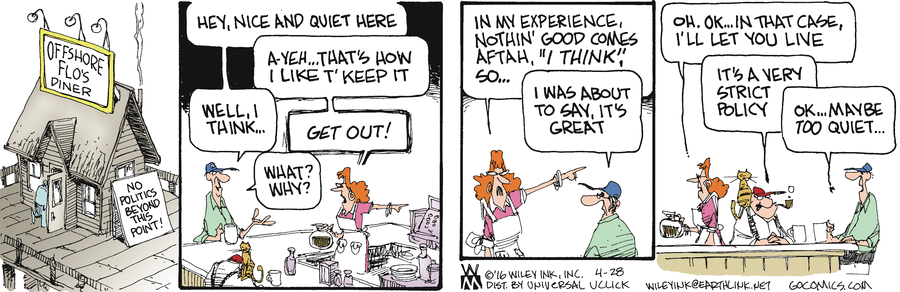
Among politicians, there's an interesting left-right spectrum apparently signaled by this metric — from the 12 Republican and 9 Democratic debates:
| Count of "I think" | (Per million words) | |
| Clinton | 267 | 4685 |
| Cruz | 39 | 1194 |
| Kasich | 52 | 1807 |
| Sanders | 205 | 4047 |
| Trump | 119 | 2900 |
Of course, with this small sample, we need to worry about unexamined covariates, such as those related to personality…
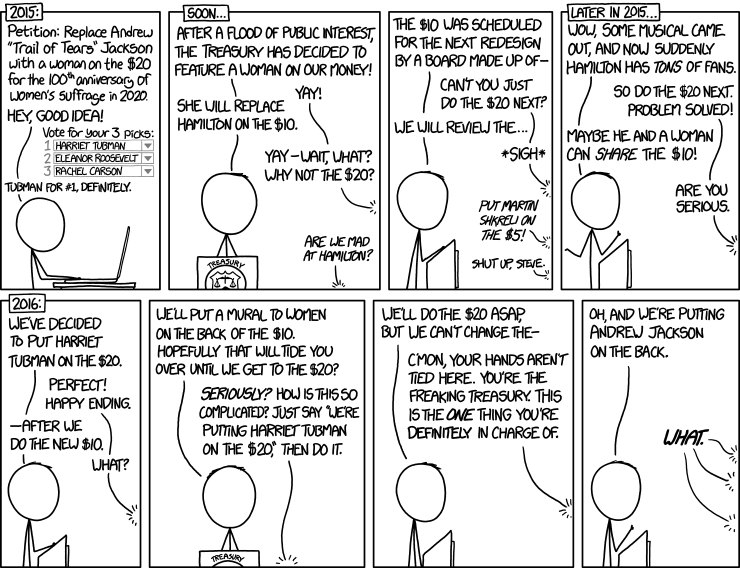
27 Apr 11:13
2016 Hugo Nominations Reaction
by Phil Sandifer
It's funny how a year of steeling yourself for something doesn't actually mask the taste of bile rising in your throat when it happens. It's hardly a surprise that the Rabid Puppies got sixty-two works on the ballot beating their haul of fifty-eight last year. Until E Pluribus Hugo passes, the voting system is flawed in a way that made stopping the Puppies at this stage impossible. This ballot has been predictable since last year. Still, it's sickening. Short Story, Novelette, Related Work, Graphic Story, Professional Artist, and Fanzine are all full-Puppy categories at present. All categories save for Best Editor Short Form and Best Novel are majority-Puppy. Most of what I have to say I said last year. You can buy the book if you want. But here's some scattered and off-the-cuff thoughts on this year's dogfucking.
First, as predicted, the Sad Puppies were a non-entity. That's a little tough to judge given their new "we're just a recommendation list" sheen of pointlessness, but it's notable that the most conspicuous omission from their list, The Fifth Season, got a nomination in best Novel, and that in Fan Artist, a category where they had four picks, three of which were not on the Rabid Puppies slate, none of theirs made it on. Indeed, at a glance I can't find anything that's on their list, wasn't an obvious contender anyway, and made it. These were Vox Day's Hugos, plain and simple.
Second, let's not have any silliness about pretending that what was picked reflects any agenda other than Vox Day's spite. He's been unambiguous that his sole goal this year is to disrupt the Hugos, not even making an effort to pretend that he was picking works on merit or because there's actually some body of quality sci-fi he thinks is being overlooked by the awards. His only goal was to ruin things. The nominees exist only for that purpose. They are political, yes. Avowedly so. But their politics does not have even the barest shred of a constructive project. This is fascism shorn of everything but violent brutality - political in the sense of an angry mob kicking a prone body.
And so once again, the course is clear: we must resist. With every tool we have, we must resist. The highest priority, of course, is passing E Pluribus Hugo, the repaired nomination system that will serve to prevent this from happening again. Also important is No Awarding.
But, of course, that's more complicated this year than last because of Vox's tactic of poison pill nominees (which I also called last year, because for a supposedly brilliant tactician Vox sure is predictable). Some of these will hopefully correct themselves - both Stephen King and Neil Gaiman are occupying slots in all-Puppy categories and have the power to withdraw to make room for people that were kept off the ballot by Vox Day. I have a tough time coming up with any justification for such decorated writers not to do so.
Other categories are trickier. Alastair Reynolds. for instance, has been outspoken about not wanting to be on Puppy slates. But the odds are overwhelming that the #6 nominee in Best Novella is just the Puppy pick that got beaten out of the category, and frankly, I'd rather have an unwilling Puppy on the ballot. Similarly, I have a lot of sympathy for Andy Weir, who was kept off the ballot by Vox last year, and who almost certainly would have made it on his own merits this year, and it's as hard to suggest he should turn down his Campbell nomination because a fascist troll slated him as it is to suggest Gaiman shouldn't. Andrew Hickey has suggested putting the poison pill choices below No Award while excluding the other Puppy picks entirely, which is probably what I'll do. But I won't pretend it's not a genuinely hard decision.
Implicit in that is the fact that I'm going to buy a Mid-Americon II membership and vote, and I'm not going to vote No Award in all categories this year. More than that, I think you should too. For two basic reasons. The first is that there's still incredible stuff on the ballot. "Heaven Sent" and "AKA Smile" are both up for Best Dramatic Presentation Short Form. Ex Machina and Mad Max: Fury Road are facing off in Long Form. Binti got in for Best Novella, the lone non-Puppy of the category. And most importantly, you can have the utter joy of voting for The Fifth Season for Best Novel. I nominated those works. I'm glad they got on. And I intend to see that through to the end.
The other reason is that E Pluribus Hugo probably will pass, and a sense of normality will be restored to the Hugos. They'll return to being one of the handful of awards actually worth taking seriously. And it would be nice if the record books were not tarnished by SJWs Always Lie or the artist of a comic called "Gamergate Life" getting Hugos. This is the last line we have to hold against the fascist bullies before we can be done with them. Let's fucking win this.
Because for all that the nominees are frankly worse than last year (Space Raptor Butt Invasion isn't even one of the good Chuck Tingle books), there was, today, a reminder of why this is a fight worth having, and it was the Retro Hugos, awarded for work published in 1940 due to the lack of Worldcon that year. Overlooked by the Puppies despite the fact that there's presumably loads of German sci-fi that would be right up their alley, these ended up having 481 ballots cast, about 12% as many as the main Hugos. And the results are marvelous - a mixture of big, iconic classics and oddballs of the finest sort. Look at that Graphic Story category, where the debuts of Batman, Captain Marvel, The Spectre, and the Spirit face off against a classic Flash Gordon serial. Look at Best Short Story, where one of the finest horror stories ever, Borges's "Tlön, Uqbar, Orbis Tertius," is up against tales by Robert Heinlein and Isaac Asimov. And look at the blunt proof that the Hugo crowd has never been hostile to conservatives, just to shitty and derivative crap, as both H.P. Lovecraft and E.E. "Doc" Smith's Lensmen series make the ballot. It's as phenomenal a list as the 2016 Hugos are a terrible one.
There's a reflexive assumption that more participation in the Hugos is inherently good. And it's understandable. But let's remember, the Hugos were never a general popularity award. They were a fan award for the sorts of nerds who are inclined shell out money for Worldcon. And there has consistently turned out to be a degree of magic to that. Simply put, the uber-nerds have historically known their shit. They turn out to balance populism and aestheticism in compelling ways, with a decades-long track record of consistently picking worthy and deserving winners in all categories. There's a vanishing handful of awards that are worth taking seriously year-in and year-out. The Hugos have always been one. And the Retro Hugos show that they still know how to be, at least when they just get to be what they were designed to be - a snapshot of the taste of Worldcon-style sci-fi fandom.
In a few months they'll get to go back to that. Until then, it's time to fight again.
27 Apr 11:09
VOX POPULAR: The Charts As Soapbox In A Digital Era
by Tom
 This is the text of my presentation to EMP 2016, in Seattle. The theme of the conference was “voice”, thankfully this proved flexible enough for me to ride my favourite hobby horse. I gave the presentation without notes, so the text here is slightly drier than attendees might remember, and lacks ad libs, embellishments, moments of desperate panic, etc. Thank you to everyone who attended and thank you especially to all those attendees who came up afterwards and said nice things. I had a wonderful time.
Hello Seattle. Make some noise.

The end of last year saw an unusual incursion into British politics by one Justin Bieber. Locked in a battle to secure the Christmas No.1 for mean-spirited smash “Love Yourself”, Bieber threw in the towel, instead endorsing the competing record – a mash up of Simon and Garfunkel and Coldplay made up of a choir of junior staff in Britain’s National Health Service.
The NHS Choir’s record is an intensely political one. It’s an intervention and an awareness raising exercise in a struggle between NHS staff, particularly Junior Doctors, and a Conservative government seeking to push through onerous new contract terms on the path (critics say) to privatising the NHS entirely. The conflict has become a proxy for the overall fate of the NHS under the Tories.
But none of this is remotely audible in the record itself, which is innocuous to a fault.

Instead, the political text is entirely in the record’s chart placing – as an opinion piece by campaign organiser Harriet Nerva makes quite clear. “Our NHS Choir was Christmas number 1. It’s time ministers listened to its message.” What message? There is absolutely no tangible ‘message’ in a mash-up of Coldplay and Simon And Garfunkel! No, in this case getting to number one is itself the political action, because buying the record is acting like signing a petition or going on a demo – a way to give voice and to be heard.
How did we get here? This presentation is the story of this secondary function of the pop charts as platform – a way to voice opinions both political and aesthetic. But in order to explain Justin Bieber and the NHS Choir in 2015, we have to go all the way back to the very origins of the charts themselves.
It begins in 1952, with the establishment of the NME and the first chart of recorded music sales in the UK – an innovation designed to sell advertising space. But immediately something was very noticeable about this sales chart. Three of the records in the first top twelve are by the same woman.
Why was Dame Vera Lynn such a hit in 1952? Her Second World War hits had made the Forces’ Sweetheart famous, but in 1952 a hundred thousand British troops were fighting in Korea. It was more than enough to make tracks like “Auf Wiedersehn Sweetheart” sell in the tens of thousands.
The fact that pop music reflected current events and concerns was hardly new, of course – such effects date back to music hall days, if not before. But right from its beginnings, the charts gave notice that it could act as a seismograph, something to quantify this effect. And also to publicise it.
Jump forward a year and we see another example – this time an artist, Dickie Valentine, cashing in on events with the unctuous “In A Golden Coach”. The event was the Queen’s Coronation – “the prettiest Queen the world has seen”, smarms Dickie – which is important to our story because of one very specific cultural effect. It kick started the television era in Britain. 18 million watched the event – and the number of households owning TVs grew by 400% in three years.
And TV became the next and most important front in turning the seismograph of the pop charts into something central to national culture beyond music.
In 1964 the BBC overhauled its music programming to debut Top Of The Pops, a weekly spotlight of high selling music with the chart at its centre. British TV at the time was very limited – two terrestrial channels, meaning that almost anything broadcast on BBC 1 could achieve a national audience. And a captive family audience – most households only had one black-and-white TV, and changing the channel (or even getting the TV switched on and warmed up!) was time consuming. So the model was households watching a channel, more than individuals watching programmes.
There were other ways things could have gone. The BBC could have decided to showcase only the best music, or concentrated on new releases. Instead, it centred its programming on the charts.
And in doing so it put in place the three factors that would allow the Top 40 to work as a platform.
First, the methodology. A sales based chart could be and was corrupted. But the influence of tastemaker DJs was subtly different in a chart based on sales, not airplay. A DJ could best prove their influence not by breaking a classic record but by championing something an awful lot of people would buy – novelties included. Weight of numbers could make a hit.
Second, the distribution. Top Of The Pops with its captive audience of tuned-in households built on existing radio chart shows to give national exposure well beyond the actual potential market for a given single.
Third, the focus. Top Of The Pops built in the idea of a mix of styles and the number one slot as a zone of conflict – the narrative climax of each week in pop.

The result was a rapid acceleration of the visual evolution of UK pop, spurred on by the fact that BBC engineers used Top Of The Pops as a test bed for new colour and visual effects. And an acceleration of the idea that one way the chart could use its captive audience was confrontation. British national pop radio – given its own station from 1967 – was based on the idea that it was the background to the working day for millions of homes, factories and offices. Consensus was the name of the game. Top Of The Pops, on the other hand, had half an hour to keep its audience tuned in. It could provide controversy and talking points in a way British radio shunned.

Punk was one culmination of these trends. Notoriously the industry were believed to have rigged the charts via procedural changes to prevent a number one for the Sex Pistols in the week of the Queens Silver Jubilee in 1977. Whether true or not, the rumour proved something new: the idea that the charts could be gamed, or subverted if you wanted to be high-minded about it. For Malcolm McLaren, getting or almost getting to No 1 was not just a commercial achievement but an artistic statement.
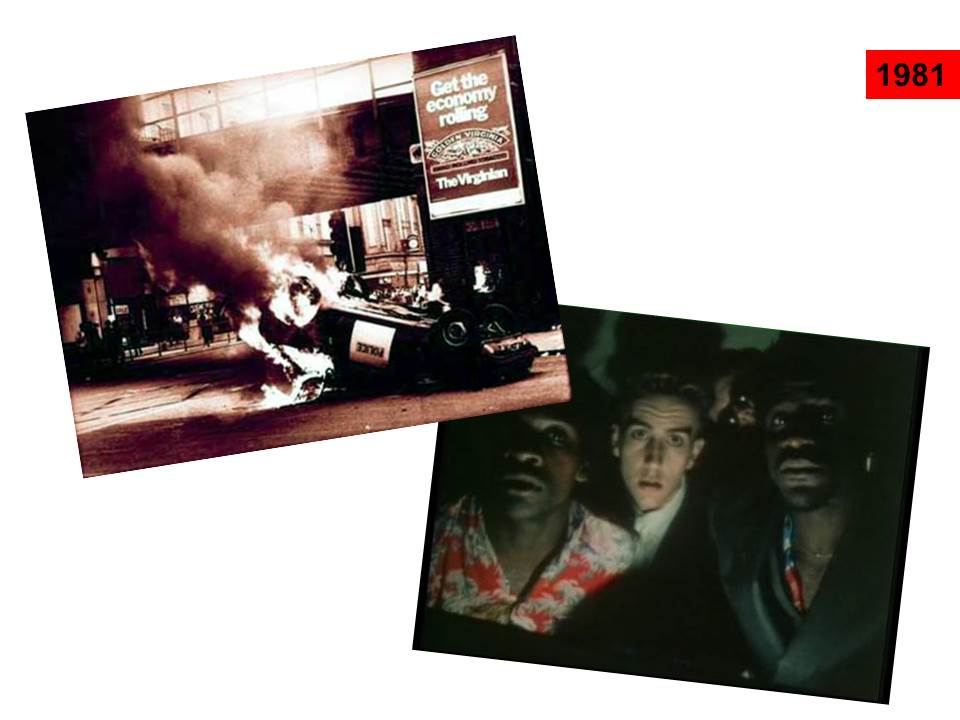
The next few years were glory days for the charts. In 1979 Top Of The Pops hit its viewing peak – 19 million, a third of the British population. In 1981, The Specials’ “Ghost Town” hit number one the week the country erupted in riots largely in response to racist policing. It was a coincidence, but one which cemented the sense that the charts had a kind of secret duty to act as a Greek chorus to events.
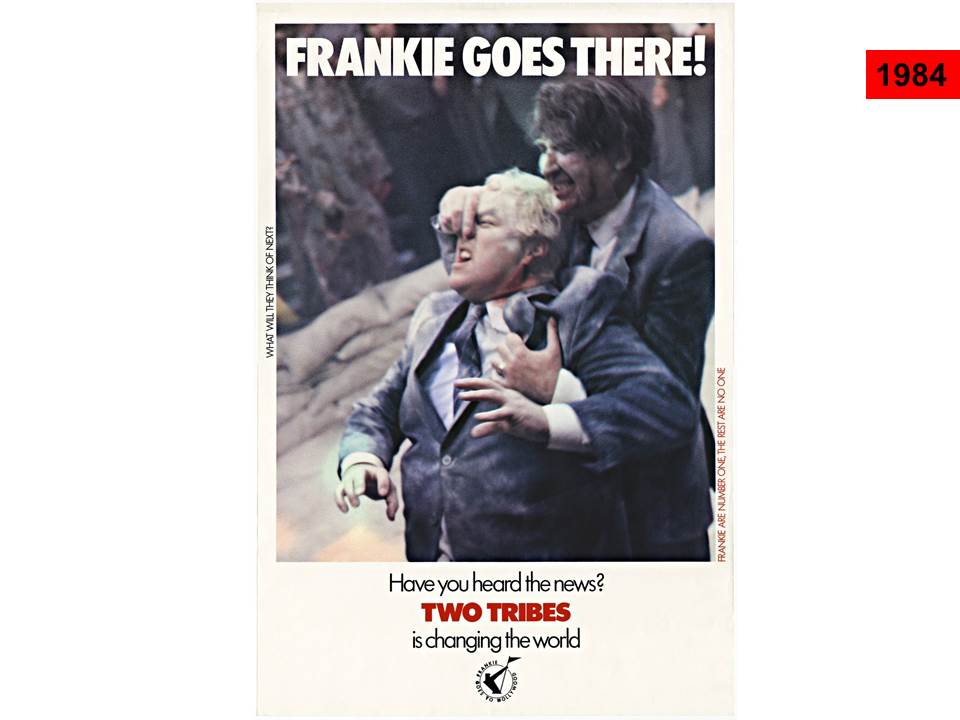
And still the Sex Pistols’ dangerous idea – that getting into the charts was a statement in its own right – thrived. It was a founding motivation for stars of 1980s New Pop, and Zang Tuum Tumb’s conceptual electro-disco act Frankie Goes To Hollywood proved masters of gaming the charts. They scored 5 weeks at number one with “Relax”, 9 with “Two Tribes”, the latter helped by six different single formats, dripfed to the public across the record’s chart life.
But the very marketing tricks that Frankie mastered would begin to change the way the charts worked. It wasn’t just ZTT’s swashbucklers and situationists that had worked out how to place records high. As the 80s continued, the business figured out how to effectively market singles to maximise and front load their sales. First week placing was critical. The shape of the charts had changed.
The best way to illustrate this is with some graphs by me.
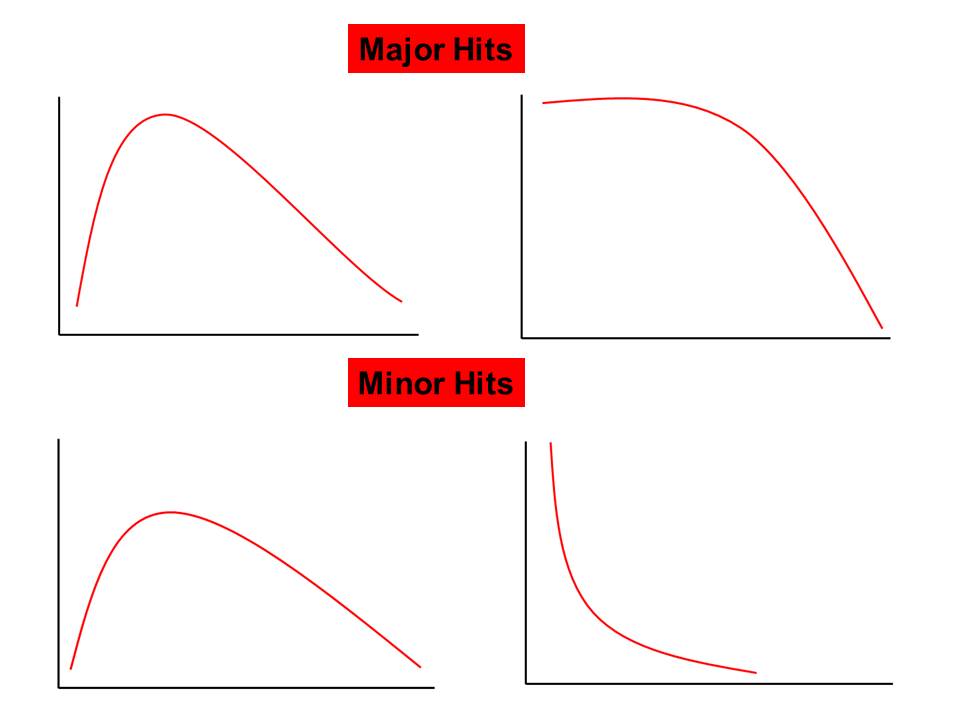
What you’re looking at here is the shape of big and small hits over their chart lifespans. Major hits would often have a fairly swift rise up to their chart peak, then a slower tail off. Minor hits would follow the same arc – but at a smaller scale, with a lower peak.
Effective first-week marketing changed all that. Now the major hits would enter high and stick around. But the minor hits would also enter high and drop off dramatically.
This had the potential to make the charts even more of a platform.
The shape of the charts was changing just as other factors were eroding their place as a rhytmic, weekly fixture in the culture. In 1988 Rupert Murdoch launched Sky TV, one of the UK’s first satellite TV stations, beginning the erosion of terrestrial TV dominance. The audience for Top Of The Pops began to decline, partly because of more competition, partly because of multi-TV households which meant family viewing could no longer be taken for granted. And partly because a giddily creative era for pop saw a proliferation of genres which stretched the show’s pan-stylistic remit to breaking point.
But even as its weekly showcase began to wane, the idea of the charts as battleground – a territory to be conquered – became more popular than ever.

This was the era of the chart battle – once singles getting to number one in their first week became the norm, it was more viable to set up head-to-head matches. Blur v Oasis. Posh Spice vs Sophie Ellis Bextor. Most brutal of all, Eminem Vs Bob The Builder. The age when the number one was part of the weekly rhythm of British culture was coming to an end. But replacing it was a sense that the number one was still important – but interesting only inasmuch as it could hold its own on the evening news.
With these shifts the platformisation of the charts is almost complete. But one big barrier still remained preventing the use of the charts by anyone with a voice and a plan. It was very difficult to release a single.

Then suddenly it wasn’t. Across the early to mid 00s the charts made gradual, grudging accommodation with digital music. In 2004 online sales were counted for the first time. But they only counted when a physical single was released. Then they counted within a time limit around the physical release.
Tying online sales to physical release dates meant that ordinary buyers and listeners still couldn’t organise to get a song of their choice into the charts. The labels’ final say was weakening, but it held. So in the 00s it was other forces which best utilised the charts for narrative ends, making the achievement of a number one the climax of a story.

Simon Cowell wasn’t the first to realise this but with the X-Factor he mastered the trick. In his hands the charts became entirely a platform, a staging ground for the story his shows told, with a week at number one the prize for every year’s winner. Meanwhile, in 2006, with Leona Lewis in procession towards X-Factor victory, Top of the Pops was cancelled.
So let’s revisit how the charts worked. Things have changed. They are a part of the national culture, but only on special occasions, when something unusual happens in them. In other words, people only paid attention to the charts when they were being gamed. And if you had the resources, gaming them was entirely possible.
Then finally in 2007 the physical requirement for chart entry was lifted. Gaming the charts was now an option for the public, not just for Simon Cowell. The whole of pop music history was open to DJs, critics and any other influencers. How would they use their newfound freedom?
Here’s how.
The shortest single ever to chart in the UK, “The Ladies’ Bras” is a smutty novelty sewn together by library music crate digger Jonny Trunk. A particular DJ hatched the idea, the public listened, and The Ladies Bras became a top twenty hit. It doesn’t get more (gruesomely) British than this.
But this and other stunts proved a point. Chart manipulation on a whim and a download was a reality. The charts were a platform. All they needed was an API.

They soon got one. At Christmas 2009 Simon Cowell’s lock on the seasonal No 1 was decisively broken, when X Factor winner Joe McElderry was beaten to the top by Rage Against The Machine’s 1992 single, “Killing In The Name”. Long a dancefloor favourite, Rage’s splenetic blast against authoritarianism was easily co-opted as a point made in a conversation about music. The band themselves merrily played along. “This is real democracy”, obliged Tom Morello. Zach de la Rocha talked about the power of direct youth action, happily ignoring the fact that the campaign organisers were in their 30s, and a lot of their fired-up followers were older still.
Rage’s success fit almost any narrative you wanted to place it in. It was a victory for rock over pop, a return to when the charts mattered, a win for ‘real fans’, a massive snub to Simon Cowell, a sign of the bankruptcy of current alternative music, or just a bit of fun. Ideas, conversations and grudges that had simmered across a decade in which pop’s dominant forces had been reality TV, R&B and teen pop broke cover. Some of them had little to do with pantomime villain Cowell. In the inevitable Reddit thread, McElderry’s fans were predictably characterised as “a bunch of shitty music liking teenage girls”. Another site went one better – the villains were “teenage girls – AND THEIR MUMS!”
Mashable came closest to the truth. “FACEBOOK WINS” it announced. The ingredients needed for a chart campaign to go all the way were familiar ones – a groundswell on social media picked up excitedly by traditional media, creating a bubble of attention. Using the charts as a platform was a perfect articulation of this dynamic which would become the standard model for a great deal internet marketing. It helped that it had a definite goal – getting something to number one. Jon Morter, who ran the campaign with his then wife Tracy, set up a social media consultancy.
Facebook groups were a tool powerful enough for large scale chart manipulation. But the activity fitted into a wider media context, in which far smaller and more secretive channels could be equally effective at ‘platformising’ almost any form of public media. The continuum between Rage’s chart win and 4chan’s continued ridicule of the Time 100 list is clearly apparent, for instance. The trend is toward angry tails wagging hapless dogs, the fringe bum-rushing the apparent centre. From the vantage point of 2016 what I notice about the Rage campaign is its undertones of wide, gleeful anger not just at the easy targets of pop or the X Factor but at the very idea of a centre. Or at least of that centre shifting away from the people getting angry.

But using the charts as soapbox still needed a particular combination of factors. A series of failed attempts showed that.
Simple pranksterism wouldn’t work as well – a 2010 attempt (pictured here) got John Cage’s 4’33 into the top 40 but not to the summit. It remains the only one of the “chart campaigns” I’ve got on board for myself.
Rockist outrage at perceived impropriety couldn’t quite get all the way either. A campaign to prevent X-Factor winner Alexandra Burke’s cover of “Hallelujah” getting to the top fell short as not enough people bought the, ahem, “Jeff Buckley original”.
Even righting historic wrongs didn’t work. In 2012 the NME embarrassingly threw its weight behind a campaign to reverse the injustice of ’77 and put “God Save The Queen” at the top. John Lydon was not impressed. “This campaign totally undermines what The Sex Pistols stood for. It is certainly not my personal plan or aim.” The 2012 re-release reached a chart peak of number 80.
As musical interventions, the charts as soapbox seemed like a one hit wonder. But the potential still existed for something wider.
In 2013 the opportunity arrived. Margaret Thatcher had been ill for some years – plenty of time to anticipate and plan for her death. In the form of a state funeral, if you were the establishment. Or in the form of demonstrations and parties, if you were one of the millions who despised her. Facebook chart campaigns were common by this point. An anti-Thatcher one was inevitable. It settled easily on a song, inspired by placards held by demonstrators.
The right wing press were furious – both about the backlash in general and the song in particular. But they realised that calling for a ban would look like censorship. Tory MPs were even crosser. John Whittingdale, chairman of the Culture select committee, pronounced that “This is an attempt to manipulate the charts by people trying to make a political point.” Of course he was quite right. “Most people find that offensive and deeply insensitive”, he continued. But a lot just found it funny.
In any case neither Politicians’ denunciations, nor even the dredging up of two surviving munchkins to condemn the politicisation of their song, could halt the momentum. In fact the publicity almost certainly helped. Questions swirled – would the BBC fix it? Would they even play it? No need, you’d think – the title would be catharsis enough.
Pro-Thatcher groups on Facebook hunted for alternatives. Eight thousand bought punk novelty act The Notsensibles’ “I’m In Love With Margaret Thatcher”, enough to get it to No.35. Others settled on the most pragmatic course of action. Buy whatever record was selling anyway. This turned out to be Duke Dumont’s rather good “Need U (100%)”. I like to think that some of the 60,000 who bought it that week were staunch Tories doing their duty by Maggie. Perhaps some of them became steadfast deep house fans.
The day came. Could the charts spike the Establishment? “Ding Dong The Witch Is Dead” reached… Number two. The BBC moved quickly past it, playing a clip, leaving neither side happy.

And so to the NHS choir. It succeeded where “Ding Dong” failed by giving its politics a degree of plausible deniability. It was just a charity record, after all. But its success may also have been a last hurrah for the charts as a soapbox. The inclusion of streaming into the charts makes them more than ever a reflection of what people are actually playing. But what people are playing tends to be the same as what they were playing last week. Protest purchases don’t pick up too many Spotify plays. Perhaps the only tracks that can defy that effect are charity hits.
Where does that leave the charts, an erratic and reluctant barometer of the cultural weather for sixty years? The decline of the TV monoculture pushed the Top 40 out of the rhythm of British life and into a role as occasional newsmaker. But now even the memory of its significance is fading, and its weekly pace is a poor match for the quicksilver Internet news cycle.
Under streaming, the charts are sclerotic. Barely more than 300 songs became hits last year, the lowest since the Top 75 began in 1979. Twenty years ago, in the Spice Girls’ heyday, that number was almost 1200. Critics decried the absurd turnover of music. But it had a hidden consequence. The faster the chart moves, the more it can be used as a soapbox. The charts’ role as a platform was latent in them from their very beginning. But its flowering may have been a last flurry of relevance before obsolescence descends.
25 Apr 21:54


Scammers and Fixed Pots
by John Scalzi
Lots of news in the last couple of weeks about Amazon Kindle Unlimited scammers, who are creating 3,000-page books filled with mostly garbage because that’s what lets them take advantage of the way Amazon pays authors participating in the KU scheme: Amazon tracks the last page synced and pays out by how far into the book someone’s gone (as opposed to read).
This is bad news for actual authors with actual books, because a) actual books are generally much smaller than three thousand pages, and b) Amazon doesn’t pay a set rate per page — it defines a KU “pot” of money for each month and then pays out to authors by the number of pages they register readers as having gotten through, as a proportion of total pages read on the service that month. So if (purely as an example) Amazon defines the payout pot for KU as $1 million for a month, then all the authors participating have to split that $1 million — and the scam artist with the fake 3,000-page book is going to get a larger chunk of that $1 million than the actual author with a 300-page book.
Bear in mind that no matter what compensatory scheme Amazon does for its KU system, someone is going to find a way to maximize it. Before the current “pages read” scheme, Amazon paid out when a certain percentage of a book was gone through, which drove authors to create very short books that would hit their payout percentage with just a couple of page flips. It was this gaming, presumably, that caused Amazon to change how it did its payout. If and when Amazon changes its payout scheme (again), people will find out how to game the system under the new rules. It’s what happens.
(Nor is adjusting one’s work to take advantage of the market a problem; publishers have always done this. Is the money is cheap paperbacks? They will make cheap paperbacks. Is the money in hardcovers? They’ll make hardcovers. What, novellas are the next big thing? They’ll all make novellas! Likewise, if Amazon is saying to self-pubbed authors (and, by extension, scammers) “[X] is the way we decide to pay you,” then it’s rational to do [X].)
The problem with the Kindle Unlimited scammers isn’t really the compensatory triggers of KU or the fact that everyone, legit author or otherwise, is looking for the way to squeeze as much money as possible from it. The problem is: who bears the immediate economic brunt of the scammers taking advantage of whatever scheme Amazon decides upon? Well, it’s not Amazon, that’s for sure, since its financial exposure is only what it wants to pay out on a monthly basis; scammers in the system or no, Amazon only pays what Amazon wants to pay. The readers also get off lightly; their economic exposure is only they flat fee they pay to access KU.
So that leaves the actual authors, whose share of a fixed amount of money is being diluted by bad actors who see how the system can be gamed and are cheerfully gaming it as fast as they can. It is the authors’ problem because Amazon doesn’t pay out like it has to pay out for printed books, where each unit sold has a contractually-defined royalty that is independent of any other book or author and how well they are selling. Again, Amazon pays from a pot it defines and controls and which is limited; in effect pitting authors against each other, and all of them against the scammers. In this case the scammers are winning because it takes almost no time to create a scam book, assign fake accounts to “read” it, and profit; meanwhile writing real books actual people would invest their time in is still the same time-intensive effort it always was.
Is this fair? Well, life’s not fair, and in business (which this is) you get what you contractually agree to. Kindle Unlimited authors presumably know that they are only going to get what Amazon is willing to give them for their participation; they also presumably know that their marketplace is “fair,” with regard to scammers, to the extent that Amazon wants to make it so; they also presumably know that their ability to force Amazon to do anything to deal with scammers is exceptionally limited because the KU agreement privileges Amazon over individual KU participants to an extraordinary degree. KU participants, by participating, have agreed to let Amazon shift the financial risk over to them.
(Well, some of them. It’s my understanding that there is a tranche of authors — generally hugely best-selling, generally not self-published — whose participation in KU is through other deals where their compensation is not tied into an Amazon-defined pot. Good for them! And another reminder of the issue of “fair” in publishing — nothing’s fair, everything is what you agree to in contracts.)
That being said, if Amazon doesn’t eventually deal with the scammers, then it will become their problem: Authors, quite reasonably, won’t want to participate if scammers are taking money that should be going to them, and readers won’t see the value of the KU subscription if authors stay off the service. Humans are bad-experience avoidant, and it doesn’t take many bad experiences to keep people away. It’s in Amazon’s best interest to fix this. Eventually. I’m pretty sure it will.
But only to a point. Amazon is very very very unlikely to ever make Kindle Unlimited a scheme that doesn’t rely on a fixed payout, defined by Amazon itself. And that is why, at the end of it, KU (and, to be clear, other subscription services with a service-defined payout pot) will always disadvantage authors in terms of how much they can make, and why these authors will always suffer first and foremost from scammers — because there’s only so much money for authors in the scheme, and that’s the money scammers are taking. There will always be scammers and people who will game the system; so as long as the KU scheme pays out from a fixed pot, authors participating in it will always be the most vulnerable to their actions.
Amazon should deal with its KU scammers. It should also compensate KU authors for their work independent of how other authors are doing, or what they are doing, or what scammers are doing. The first of these is rather more likely than the others. If you’re an author participating in Kindle Unlimited, know what you’re getting into, and the fact that it’s you whose money is on the line when the scammers game the system.
Serafin.shane likes this
25 Apr 21:54

Sunday Extra
by Andrew Rilstone
When sorrows come they come not single spies
But in battalions.
Shakespeare
There are some perfectly good things to be said about “grief athletics” and “grief inflation”. One might indeed compare the outpouring of public grief over the very funny Victoria Wood (2016) and compare it with that over comedy legends such as, say Eric Morecambe (1984), Charlie Chaplin (1977) or even Stan Laurel (1965). One could do a similar compare-and-contrast with Prince and Bowie on one hand and John Lennon and Elvis Presley on the other, and wonder how on earth we are going to top it when Paul McCartney finally shuffles of this mortal coil. (Fortunately, Bob Dylan is going to live forever.)
My working hypothesis is: “Until 1997, the death of a singer or sportsmen was show-business news or sporting news; after 1997 it became simply news. Before 1997, a death from natural courses would be reflected by an obituary and possibly an season of old movies on BBC 2. After 1997, the amount of newsprint given over to the death had to reflect the perceived importance of the deceased person. Not giving enough column inches to the departed would be a faux pas on a level of bowing from the neck instead of from the waist at the cenotaph, or being seen out in October without a poppy. AN INSULT TO THE DEAD." Prior to 1997, a tabloid might make Elvis Is Dead it’s front page story; after 1997 the serious broadsheets did so as well.
My mother used to say that people always died in groups of 3, although the rule didn’t apply to major family bereavements. Great Uncle Bulgaria said something similar, so I suppose it was a proverb. I suppose that if old Mrs Dodsworthy three doors down passed away; and a few days later you heard that old Rev Bandersnatch kicked the bucket in his home for redundant clergyman, then you would be consciously waiting for Number 3, and be positively relieved when the paper recorded that Uncle Tumble, who you used to watch on the radio when you were a kid had gone to join the choir invisible, and could stop counting.
.
It’s an old saying that “Dog bites man” is not news, but “Man bites dog” is. But if a local man dies after being bitten by a labradoodle (which is “news” in practically anyone’s book) then, for the next three weeks, the local paper will (quite understandably) think that every dog bite in the hospital’s incident book is worth a mention giving the punter (quite wrongly) the impression that there has been a terrible epidemic of men being bitten by dogs. It only required two deaths — David Bowie and Terry Wogan — for someone to decide that 2016 was a terrible year for celebrity deaths; and from then on every obituary has been underlined in magic marker.
No such thing as a Curse of Superman had even been thought of before Christopher Reeve had his riding accident.
One of the most boring and annoying rhetorical devices is the one where you pretend that because you think that something ought to be true, it actually is true. It might, in fact, be that the United Kingdom would be better off electing it’s next titular head of state rather than handing the title to the eldest child of the present incumbent. (1) I am, as everyone knows, agnostic on the issue. I tend towards saying that the process would be so complicated and divisive that it’s not worth the effort. Would we simply elect a new King when the old King dies, or would we stop having Kings and elect a President every five years? What would he be President of? “The United Republic”? “Greater England”? “New Britain”? “The Margaret Thatcher Memorial Islands”? This is a country where people claim that a preference for simple plurality vs instant run-off elections is a matter of ineffable religious conviction, for goodness sake.
But, as a matter of fact, we do have a Queen, and it is not too unkind to think that the time is not remote when we must, in the course of nature, have a new King. So there is a certain amount of interest in the day to day life of the Queen, and the next King, and the next King but one, and even the terribly cute next King but two. As arguments go, “Why are we interested in a photograph of an old lady and her grandchildren” and “Why does this require any coverage beyond a simple ‘Elizabeth Windsor, 90 today’ in the announcements column” makes republicans look like grumpy old twits. Republican twittery is cut from very much the same cloth as atheist twittery. I suppose it has to do with being against something rather than in favour of something.
It might be that the public ought to care more about the finer points of the E.U referendum than about the death of a funny person who used to come on the telly when they were kids. But thinking that a thing is so does not make it so. (Patrick Stewart is getting worryingly close to his 80th birthday.)
There was a point, just after I left college for the second time, when all the legendary geek writers and artists seemed to be turning up their toes. The Golden Age of science fiction and comic books was the 30s and 40s, so many of the participants were always going to to die in the 90s. (2) The 1970s were the Golden Age of television: everyone had a TV, but there were only two channels (plus a third one which only showed nature documentaries in Welsh) and there wasn’t much else to in the evenings, so a very fine comedy actor like Ronnie Corbett could easily become a household name. A generation before, he’d have been making a very decent living as a much in demand stage actor; remembered by no-one except a few aficionados; a generation after, his well reviewed comedy shows would have had to compete with eighty five channels showing rolling 24 hours footage of cats falling off sofas. The entertainers who were always going to die in the second decade of the second millennium weren't cleverer or funnier than the entertainers who have died at other times. But they were famous in a way no-one had ever been before, or ever will be again.
It isn’t big or clever to look at a photo of the next-but-one King and the next-but-one Queen outside the Taj Mahal and say “Why is a couple sitting on a bench news, especially?” It isn’t big or clever to pretend that you don’t know who Prince is. I suppose that it is possible to cut yourself off from popular culture to that extent (”and what exactly is a ‘beatle’?”(3)) but that rather prohibits you from talking bout it. I don’t think I could name a single professional football player. (There used to be someone called David Beckham, but he retired to sell perfume and knickers.)
For some people, it may simply be a logical error. If A is better than B then it follows that B is positively bad. If B is not quite as good as some people say, then it follows that B is awful. So the correct way of expressing the insight that "I am quite surprised, actually, by the importance the media attached to David Bowie" is "David Bowie was a talentless hack who couldn't sing."
But some people are, sadly, positively addicted to saying horrible things. If a lot of people are sad because a singer they liked as died their drug forces them to say "Who the hell was he?" A mad, sad man who writes for the Telegraph managed to describe Prince as “an obscure, sparsely talented performer”. A below the line commentator spoke about his “welcome death”. (4) The humans suffer from a disease called hatred: one day it may be possible to cure it.
I was a bit surprised, actually, that a left wing paper like the Guardian ran a full page solid black front page to mark the death of a singer. I used to think it was silly to feel sad when a performer you liked died: since I have been going to live gigs, and since several of the performers I most revere are the wrong side of 70, I don’t feel that any more. If Prince merits a front page and a pull out supplement, then nothing short of suspending all other reporting and printing 60 pages of black ink will suffice for Dylan. But as I say: he is immortal.
I blame Diana.
(1) Another thing I find boring and irritating is when people say "titular" when the actually mean "eponymous".
(2) Gene Roddenbury, 1991; Isaac Asimov, 1992; Joe Shuster, 1992; Jack Kirby, 1993; Jerry Siegel, 1996; Bob Kane, 1998
(3)It is very doubtful is any judge ever actually said this. And if even if he did, every word spoken in an English court is recorded verbatim so it is fairly important that slang terms and terms from popular culture are defined for the benefit of future generations. I know this from having watched Crown Court when I was off school with ‘flu. An American Judge would have said “And for the record, Mr Starr, could you tell the court what a Beatle is…” and no-one would have found it especially funny.
(4) Imagine being a Daily Mail journalist and having to sit up all night working out how to get some hatred and bile into reporting the death of an elderly middle-of-the-road comedian who just about everybody like. Imagine reading the Daily Mail and learning of the death of Mr Ronnie Corbett under the headline “WHY WASN’T HE GIVEN A KNIGHTHOOD”. (Due to an establishment conspiracy, apparently.)

25 Apr 21:47
I know why your child acts out: an analogous situation
by Neurodivergent K
As you all know, I have photosensitive epilepsy. I have had a long long struggle with trying to get people to maybe consider not killing me. Long. Exhausting. Futile.
Today I went to a cross disability conference. Someone not me (hooray!) took the initiative in dealing with the flash issue, I got there & they told me and I was like "hooray!" and then went to get coffee before my first session.
Long time readers & people who know me personally know, I've done a lot of reaching out, conversing, talking to people about this issue. They know that I'm pretty much always met with lies & flashing.
We went to our first session, which was quite good, & a photographer (supposedly they had all been talked to already) flashed his flash. It was too early in the morning for this shit. I chucked my pen at him. Someone from the organization putting on the conference took him out to the hall, told him he really cannot do that, & returned my pen to me.
Not a single other flash happened.
Announcements were made. They were observed.
Throwing a pen worked. "Using my words" has never worked.
Ask nicely? They say "oh of course" or "well we can try but no promises" and it's like a godsdamned disco ball. Tell meanly and they act all put out, like it's the world's biggest favor, maybe they'd be more accommodating if you begged more, and it's a godsdamned disco ball. Enlist someone else to ask and they get tone policed no matter what they do (though it may not be a disco ball). Talk with them for years after they have a board member harass you with a camera, it's all promises and scapegoating a man with high support needs and yet more flashes.
But throw a pen? I believe the behaviorists in the audience would call it "one trial learning".
And it was quick and it was easy. Tactful conversations up a power gradient are stressful. Rude conversation up a power gradient is stressful. Waiting for other people to talk so I don't get upset and throw a pen is stressful. All of these things are draining, hard, and not consistently in my skill set.
And they are ineffective.
Acting out worked. And it was efficient. It was so easy. It actually really pisses me off that I have engaged my impulse control for so long, when doing the easy automatic thing, which happens to be the socially inappropriate thing, was so easy and effective. I'd have thrown a pen a decade ago if I'd known it was this easy.
So, like, maybe when "using your words" is thoroughly ineffective frustration, but dumping a desk works? You're gunna keep dumping the desk.
Yeah, I know exactly why.
Today I went to a cross disability conference. Someone not me (hooray!) took the initiative in dealing with the flash issue, I got there & they told me and I was like "hooray!" and then went to get coffee before my first session.
Long time readers & people who know me personally know, I've done a lot of reaching out, conversing, talking to people about this issue. They know that I'm pretty much always met with lies & flashing.
We went to our first session, which was quite good, & a photographer (supposedly they had all been talked to already) flashed his flash. It was too early in the morning for this shit. I chucked my pen at him. Someone from the organization putting on the conference took him out to the hall, told him he really cannot do that, & returned my pen to me.
Not a single other flash happened.
Announcements were made. They were observed.
Throwing a pen worked. "Using my words" has never worked.
Ask nicely? They say "oh of course" or "well we can try but no promises" and it's like a godsdamned disco ball. Tell meanly and they act all put out, like it's the world's biggest favor, maybe they'd be more accommodating if you begged more, and it's a godsdamned disco ball. Enlist someone else to ask and they get tone policed no matter what they do (though it may not be a disco ball). Talk with them for years after they have a board member harass you with a camera, it's all promises and scapegoating a man with high support needs and yet more flashes.
But throw a pen? I believe the behaviorists in the audience would call it "one trial learning".
And it was quick and it was easy. Tactful conversations up a power gradient are stressful. Rude conversation up a power gradient is stressful. Waiting for other people to talk so I don't get upset and throw a pen is stressful. All of these things are draining, hard, and not consistently in my skill set.
And they are ineffective.
Acting out worked. And it was efficient. It was so easy. It actually really pisses me off that I have engaged my impulse control for so long, when doing the easy automatic thing, which happens to be the socially inappropriate thing, was so easy and effective. I'd have thrown a pen a decade ago if I'd known it was this easy.
So, like, maybe when "using your words" is thoroughly ineffective frustration, but dumping a desk works? You're gunna keep dumping the desk.
Yeah, I know exactly why.
25 Apr 21:45
The Evil in All the Wood (X-Kaliber 2097)
by Phil Sandifer
 This wasn’t on the original list of games to be covered. Consider its inclusion something of a magickal mistake, honored as hidden intention. I cast my initial circle carelessly, and, through an accident of timing, ensconced a particular monster within the territory covered. This, then, is the consequence.
Like any story, it could begin anywhere. Let’s pick 1980, when a Chicago record shop called Wax Trax, owned by Jim Nash and Dannie Flesher, began releasing records itself, including both local acts like Ministry and European acts like Front 242. The resulting WaxTrax! label became one of those glorious scenester success stories, at the forefront of the American industrial music scene despite being a literal backroom operation with spectacularly lax bookkeeping.
WaxTrax! represented a key part of a slow and arcing transition for the industrial subgenre, which began in the late 1970s as an aggressively experimental anti-genre pioneered by UK acts like Throbbing Gristle, whose legendary founder Genesis P-Orridge coined the actual term. As with any such venture it gradually cleaned up its act (literally - Throbbing Gristle performances were famously the sorts of things that required phrases like “licked their own vomit off the stage” to describe) and became a quasi-mainstream style that visibly influenced actually popular bands like Depeche Mode.
In the US this culminated late in the decade when Cleveland-based musician Trent Reznor assembled a set of demos during spare time working as a technician/janitor at Bart Koster’s Right Track Studios. Reznor managed to spark a bidding war for the album, and through WaxTrax! was one of the labels to make him an offer, he ended up going with TVT, an oddball label that got its start releasing compilations of television theme songs, but that also handled things like the American distribution of Discordian legends the KLF, a band that famously literally had a million quid to burn, mostly on the basis that TVT was willing to pay for him to work with top tier industrial producers.
The resulting album was Nine Inch Nails’s 1989 debut Pretty Hate Machine, and its fusion of the increasingly danceable industrial sound with more pop-friendly song structures and a brutally confessional lyrical style made Nine Inch Nails the premiere band for alienated American white boys of the 90s. Their second full-length album, The Downward Spiral, was released just a few weeks after X-Kaliber 2097, and featured the mega-hit “Closer,” whose leeringly stomping chorus of “I wanna fuck you like an animal” was the perfect way to offend millions of suburban American parents who had finally gotten over Mortal Kombat. This album, however, was released by Interscope, who had acquired Reznor from TVT in 1992 following his acrimonious falling out with boss Steve Gottileb.
Nine Inch Nails’s assault on the mainstream charts made industrial bands the hot new thing for major labels to acquire. The resulting feeding frenzy hit WaxTrax! hard. The label’s DIY ethos meant that it was being run largely on handshake deals that were spectacularly vulnerable to disruption, and the label quickly found itself under water. It made a valiant effort to tidy up its business practices and refocus on dance music (always closer to Nash and Flesher’s hearts anyway), but the writing was on the wall and in 1992 the label was sold to TVT, who had after all just lost their industrial band to Interscope. There, the label withered in a stream of forgettable releases.
Among the first of these was the self-titled debut of a Minneapolis techno band called Psykosonik. Their sound was miles from the hard-edged growl of Nine Inch Nails or their labelmate KMFDM - an upbeat, club-friendly bleat of synthesizers as dated as the Ks in the band name. The album’s lead-off track, “Welcome To My Mind,” featured vocalist Paul Sebastien earnestly rapping gothically overripe lyrics like “Welcome, enter nightmare center / Darkness falls, now I surrender / Hateful dreaming, self-demeaning / Running from a faith where void has meaning.” The video is a thing of wonder, with computer graphics slathered on so thick one feels like one might connect to AOL at any moment. Pay particular attention to the bald man with the dead-eye stare. He’ll be important later.
Not long after the album came out a bevy of tracks from it were remixed for the Nintendo S-SMP and dropped onto the soundtrack of X-Kaliber 2097, Activision’s localization of a disposable Japanese beat-em-up platformer. Indeed, this became the game’s primary marketing feature - no surprise given that it was otherwise a terrible game with a generic 90s cyberpunk aesthetic. Indeed, the WaxTrax! And TVT logos appear right after the Activision title card in the game’s intro, scored to “Welcome To My Mind.”
The soundtrack all sounds like that, generally to its detriment. The first level’s music, a version of lead single “Silicon Jesus” (“Digital disbeliever, there's a storm in the world tonight / Digital disbeliever, now it's time for you to come inside / Well, you can find the power, it's behind your eyes / Touch the chalice to your skull and enter paradise”) essentially reorchestrates the same short and club-friendly riff over and over again for three minutes, a tortuous cascade of two-second crescendos that quickly becomes as insufferable as the bland Strider knock-off level itself.
Not long after the game’s February 1994 release Psykosonik shed two of its members, drummer Mike Larson and keyboardist Theodore Beale - that’s the gentleman with the dead-eyed stare. Beale went on to a brief career in video game design, making a Doom knockoff called Rebel Moon. When the sequel to that got cancelled, Beale regrouped and tried again, this time knocking together a “Christian Action Game” called The War in Heaven, which tied in with a series of fantasy novels Beale published around the same time.
This refocus from the post-industrial scene to the evangelical niche market was an easy one for Beale, who had ample connections on the right-wing evangelical scene through his father, who had been on the board of televangelist Pat Robertson’s Minnesota campaign in the 1988 Presidential race. And it proved a fruitful one; Beale found his home in the right-wing extremist press, pushing out a mix of unreconstructed pulp sci-fi and fantasy novels and half-baked right-wing tracts through his vanity press Castalia House, and marketing them mainly by being a loudmouthed Internet troll. These days he’s probably best known for hijacking the 2015 Hugo Awards by exploiting a loophole in the nomination process to pack the ballot with stuff from his own press, a campaign he launched more or less out of spite as part of his ongoing campaign of trolling sci-fi writer John Scalzi. I wrote a thing about it last year, which I published the day after kicking off the Super Nintendo Project.
Which is what brings us here. Because as part of his general publicity strategy of being a jerk on the Internet, Beale was an early booster of Gamergate, getting in back when it was still called the Quinnspiracy with this blog post, less than a week after the Gjoni post. (Do me a favor and actually click that, would you? You don’t have to actually read it or anything. Just humor me.)
Beale was not a major figure in the movement. He’s a crypto-nazi with a Vigenère cipher, after all, and even the most cretinous of Gators knows to disavow that. But he was one of the first to recognize the possibilities for synergizing Gamergate with the larger alt-right. And his sense of the possibilities of Gamergate are considerable; he’s literally claimed it will save western civilization. But for all his bemusing hubris, he perfectly embodies the surplus cruelty that is the movement’s most nauseating quality. A schoolyard sadist harnessing the short-circuiting Internet rage of sexually frustrated video game nerds in pursuit his vision of a Christian Europe for European Christians. And here he is, on the Super Nintendo, right at the heart of my lost year.
One is hardly surprised when these things happen. This is how magic works. As Crowley says, “by doing certain things, certain results follow; students are most earnestly warned against attributing objective reality or philosophical validity to any of them.” A narrative’s natural tendency is to cohere.
So while we do not believe in anything so crass as a cause, we have all the same a remarkable nexus of threads. X-Kaliber 2097 could scarcely be a better symbol for what it represents within this landscape. Its plot - invented wholesale for the American market out of the iconography of the original - is a crass and unreconstructed damsel in distress narrative, with a nice rapey twist as the kidnapped love interest becomes the host for the alien-Satan final boss to boot. This final boss - a plot twist in which the gang boss villain Raptor turns out to have been getting his “ruthless, mutating Morphs” from an alien overlord - perfectly anticipates the xenophobic racism that is Beale’s stock in trade, right down to the basic fear of concepts of change and uncertainty. And, of course, the fact that the main character’s magic sword is an ancient British myth that’s gone through the same early 90s text filter that produced “Psykosonik” gives it a nice white nationalist sheen too. More broadly, the cyberpunk trappings are of course the iconography du jour of the early 1994 SNES game - note the games on either side of this in the Project - and still central to Beale, whose Amazon author photo is of himself wearing mirror shades with an Instagram filter applied so he looks like he’s got stubble. A perfect microcosm of all that Beale represents. Beale a perfect synecdoche for GamerGate.
Shall we up the stakes further? Observe the thread of industrial music upon which we pulled to discover Beale within this essay. It is a powerful thread, especially within the context of magical ritual. Genesis P-Orridge, who coined the term, is as great a magician as has lived. H/er work, in turn, reaches back to Burroughs, a grand theorist of the destructive power of language who coined the term “control machine,” a term that anchored our third post, following Anna’s post on F-Zero, which began with sound as this did, a mirroring of the project’s start, a ritualistic circle drawn in text, circumscribing Beale and with him Gamergate, and Nemesis, and all of it, everything we have ever wanted to destroy, here in one symbol.
The situation’s fraught with possibility - a fractal depth of meaning that bursts out of every detail. The ugly and persistent strand of neonazi iconography that has always haunted the industrial scene. The detail that Psykosonik, post-Beale, appeared on the Mortal Kombat soundtrack. The way the lyrics of “Welcome To My Mind,” which Beale himself wrote, apply perfectly to the present situation, right down to the invocation of fractals.
And, of course, you clicked on that link to his blog earlier. Which means this is showing up in his referral logs. And he’s nothing if not consistently vain, which means he’ll click through before long. Soon he’ll be reading these exact words. I wonder what the strapline at the top of the page will be when he loads it. I hope it’s “the trap at the end of the clickbait.” That would be fitting. You will read all the way to the end, won’t you?
Ensnared then. It remains only to decide what to do with our prey. We cannot destroy it. X-Kaliber 2097 is a real game. It happened, is part of the world. There is no avoiding the truth: the future really did follow from this. We have summoned the beast before us; we cannot hope to deny its existence. Accept it then. Stare at it. Take it in.
So we are forced to concede that, yes, in point of fact Gamergate has an entirely legitimate claim to a portion of our psychic landscape. Its place in the history and heritage of the medium is indisputably existent. And what a place in history it is. A crap game stitched together from poor imitations of better ones, shoveled out onto the American marketplace to be all but forgotten. A car-crash mediocrity, like everything Theodore Beale touches. This is the sum of it. What is theirs. Their claim. A bad game that we can finally switch off.
25 Apr 17:39

The Pickup Artists of PUAHate
by Patrick Kearns
 Recently, a friend told me about PUAHate, a website announcing itself as “The Forefront of the Anti-Pickup-Artist Movement.” Its mission statement, posted on PUAHate’s splash page, reads: “Revealing the scams, deception and misleading marketing techniques used by dating gurus and the seduction community to mislead men and profit from them.”
At first glance, this seemed reasonable, even great. The PUA community profits tremendously from young men struggling with anything from simple social discomfort to full-blown personality disorder. I liked the idea of a site debunking PUA myths about picking up women. But when I clicked into the forums of PUAHate, I saw that the stated purpose of the site was generally ignored, and as with many Internet communities, the “anything goes” forum was the one where the conversation was really happening, and the conversation revolved almost exclusively around physical appearance.
The threads about women were offensive in an unsurprising way. “Are ugly women completely useless to society?” asked one. Another pondered, “Have any hot women ever committed suicide?” One user gave the forum a modest proposal: fat women, he said, should be prevented from leaving the house. “What is there for them to do?” he asked, suggesting that it would be best for these women to be kept inside until they reached a healthy body-mass index.
Even more popular, however, were threads that did surprise me: men counseling other men on what types of cosmetic surgery they should get, as to better enhance their chances of sleeping with a woman.
The users of this forum call themselves “incel,” or involuntarily celibate. They are on PUAHate, I realized, to debunk PUA myths not because of theory, but because of practice. The PUA techniques didn’t work; they need something else, and, with the PUA obsession with objectification lingering, the “incels” turn their physical critiques of women onto themselves.
•••
The owner of the forum goes by the username Nicholaus. His avatar is a distorted picture of a face, maybe his. He was kind enough to explain a few things about the forum.
What is the mission of PUAhate?
The mission of PUAhate is two things. The first is, what is stated on the site’s entry page. The second is, to provide people with a place to talk about whatever (legal) things they want, without having to worry about it being censored, even if what they talk about goes against the point of the site. The users here are allowed to say bad things about the site (or me) if they want, and their posts will not be edited or censored because of it, nor will they be punished by being banned for doing it.
Are these two things that are the mission of the site contradictory at times? Absolutely. Does that make for some really interesting discussions on here sometimes? You bet it does.
Do you think it is a constructive site?
For me personally, absolutely, in that I have made friends with some really great people here so far. Is it constructive for other people? You would have to ask them. It would be pretty arrogant for me to presume that something I created has been good for other people.
Do you think the obsession with physical appearance here is unhealthy?
I don’t really think about it, because I don’t really participate in that section of the forum where they talk about that stuff (shitty advice). Once in [awhile] I’ll pop in there and criticize something they are saying because I don’t agree with it, but overall that physical appearance topic isn’t interesting to me, so I don’t read 99 percent of the posts that are about it. My stance is that every user is responsible for regulating their own personal emotions and interests.
What do you think keeps bringing people back to PUAhate?
I honestly have no idea. Many people over the years have said the site is addictive, and I don’t know why that is. I even get addicted sometimes, and I will say to myself, “What the hell, I had stuff to do today, how did I get sucked into being on here for four hours straight?”
On the site, the users say “see you tomorrow” to anyone who says they are done here and are going to leave forever, because usually the person comes back the next day, or within a short period.
Do you think it’s misogynistic the way women are talked about in this context? Specifically, the way women are still being treated as objects to obtain?
Yeah, I think it’s very unhealthy to think of a woman as anything different than just another person. I have posted about this many times on the site, but to classify women as being “this way” or “that way” is completely retarded to me. I believe that how people act is not based on their gender, but on their personality. For the guys that complain that women are a certain way, you can go find just as many women who aren’t like that. So is the thing they are complaining about still a woman thing? Of course not. It’s a personality thing.
•••
Nicholaus was incredibly honest about the forum, which I appreciated. When outsiders, or “normalfags” as they’re referred to in the shitty advice forum, breach a small online community like this, they are often made to feel very unwelcome.
Still intrigued by the cosmetic surgery threads, I joined the forum under the innocuous username “p90x guy,” playing into the fitness aspect of the community. I uploaded two pictures, one wearing a hat and one where I slicked my hair back to accentuate my receding hairline. A sample of the responses:

You could be a pretty boy type 6.8 or even 7 if you had a jock NWO hairline. You are a 0 with that hair tho.
(I searched and searched, and still have no idea what a jock NWO hairline is.)
No, he would be 5/10 either way, wrote another poster. Long oval face with no jaw. Totally gay lips, beta eyes, poor height, and scrawny build. Overall beta vibe.
How did they know my height? (I am 5’10.)
Another wrote, The fuck is wrong with your hair doofus?
 Many more users just uploaded pictures of hats, which was helpful. I was also told to “thicken up,” and go for that “muscle/bad boy/rape game.” One user suggested that I looked like a “white guy trying to be black.” The harshest commenter wrote, The guy in those pics should take up bungee jumping. And leave the bungee rope in his rucksack. Several more posted memes mocking my look and clothes.
The subtext: you’ll need to do more to trick a woman into sleeping with you. You’ll need some wizardry. I poked around the forum some more, hoping to find a user who acknowledged a yearning to go on a date, make a human connection, or make a new friend. I didn’t find one. It was sex and nothing else.
Nicholas had acknowledged the contradiction in PUAHate, but it was much greater than he seemed to want it to be. This forum, actively dedicated to warning users of the perils of PUA sites, was operating on an almost identical premise. What was different, and weirdly gripping, was the near-inherent expectation of failure. This expectation of failure created a deep insecurity and self-hatred, which gave rise not to a healthy support community but to a community still dedicated to the use of deception (in the form of cosmetic surgery) to achieve their ultimate goal: sleeping with a woman.
At base the users of PUAHate direct their anger not at the pickup artist movement, but themselves. They understand at some level that PUA thinking has entrapped them and done them wrong; their attempts to get out of it trap them further.
And I hated all their hat suggestions.
Patrick Kearns is a New York-based sportswriter. He is the New York correspondent and columnist for the Fourth Period Magazine.
25 Apr 15:22
A minority government by another name
by TSE

Alastair Meeks asks how could David Cameron deal with a party within a party?
David Cameron has had a cabal of fierce critics on the Conservative backbenches conspiring against him almost since the moment he became party leader. In the new Parliament, the cabal has re-emerged and, emboldened by a small Conservative majority in the House of Commons, has periodically pounced to undermine their leadership’s plans on tax credit cuts, Sunday trading and benefit cuts, among other things. The referendum campaign has brought a new focus to long standing tensions within the Conservative party, with Conservative MPs on either side attacking their fellow Conservatives with gusto. The bonds of loyalty at a party level are being weakened in some cases and in some cases on the Leave side those bonds are in danger of being replaced with bonds to a much narrower grouping.
A party within a party has not yet formed but the danger is real. The Conservative majority is currently 12. A rightwing para-party within the Conservatives would command far more than this number. If it formed, we would effectively have a minority government with supply and confidence support from a para-party that would dearly love to oust the current Conservative leadership.
Does this matter? After all, the Conservatives have nearly 100 more seats than Labour. Well yes it does. Look at the make-up of the House of Commons:
Cons 331 (including Speaker)
Lab 232*
SNP 56*
Lib Dems 8
DUP 8
Sinn Fein 4
Plaid Cymru 3
SDLP 3
UUP 2
Greens 1
UKIP 1
Independent 1
*Includes MPs who have had the whip suspended
Let’s say that 30 Conservative MPs formed a para-party. What are David Cameron’s options for ensuring that they cannot hold him to ransom? The answer is: not very good. The rest of Parliament is unusually uniformly lined up against him. So finding new allies would be very tough going.
Labour of course are the Conservatives’ real enemy. But Labour find themselves in competitive opposition with the SNP, who are anxious to show Scots that they are more effective at confronting the Tories. There is not the slightest chance of David Cameron getting help from that quarter.
In a different way, the Lib Dems are also in competitive opposition with Labour. They are anxious to show, post-coalition, as much distance from the Conservatives as possible. Co-operation would be on the most limited of bases and on very specific topics. Anyway, there are only eight of them.
Of the smaller parties, Sinn Fein don’t turn up, Plaid Cymru and the Greens are like-minded with the SNP and the SDLP is like-minded with Labour. Lady Sylvia Hermon is independent but much more pro-Labour than pro-Conservative. David Cameron can forget about help from any of them.
The UUP are a more hopeful prospect for support. The Conservatives have a Nobel Prize winner in their ranks in the House of Lords – David Trimble, who hopped across from the UUP in 2007. So David Cameron can hope for help there. But they have only 2 MPs.
That leaves the DUP and UKIP. UKIP’s MP, Douglas Carswell, is really an independent clad in purple, but his dislike of David Cameron is evidently intense, judging from his twitter feed. The DUP come from the same ideological stream as the putative para-party – opposition to gay marriage, socially conservative, keen on populist spending for their client base. They are far more likely to ally with the para-party than David Cameron’s Conservatives.
We don’t need to get into precise numbers to see that if the Conservative rightwing para-party commanded 30 or so Conservative MPs, David Cameron would be beholden to them on the current Parliamentary groupings. They could wield a lot of power.
Is there anything that he could do to break a para-party’s grip over him? Candidly, even the remoter options don’t look good. His best remaining option to marginalise their influence is to hope for the Labour party also to splinter. If he were able to make a generous and open offer to Blairite MPs, offering them substantial concessions on policy, he might hope for their support. But the experience of the Lib Dems is very fresh in all politicians’ minds and the Blairites, even if they were minded to break with the rest of Labour, would need more than that. Unless they were themselves hard-pressed, I’d expect them to be looking for a no-compete agreement at the next election so that they did not find themselves devoured by their erstwhile allies in the same way as Nick Clegg’s troops.
We’re starting to get into the realms of political novels now. And that’s my point. Coming back from flights of fancy, if the Conservative party fractures into smaller blocks, David Cameron will face agonising problems of party management. He’s always been poor at that and he is unlikely to start getting better once he’s alienated large numbers of his MPs over the referendum campaign. So his best practical option is to stop the blocks forming in the first place. That may be easier said than done. His retirement announcement may after all have been very well-timed.
Alastair Meeks

25 Apr 09:17
Rejection, Part 9
by evanier

Time now for another installment in this series wherein I write about writing. Part 1 can be read here, Part 2 can be read here, Part 3 can be read here, Part 4 can be read here, Part 5 can be read here, Part 6 can be read here, Part 7 can be read here and Part 8 can be read here. Which brings us to Part 9…
When I was in my twenties, I went out with a lot of actresses, including some who were, to my astonishment, capable of talking about topics unrelated to their careers. With a few, the conversation ranged all the way from bad agents to evil casting directors, with sidebars about parts they should have been submitted for, auditions they should have won, producers or directors who coyly hinted at sex as a prerequisite for a role, producers or directors who went way past hinting, other actresses who beat them out for jobs by allegedly complying, where to get good photos shot or printed, good acting coaches, bad acting coaches, how to pay for groceries when acting jobs were scarce, etc. A question that some put to me was, "Will you come speak at my support group?"
I guess these support groups are still around but I personally haven't heard of one in years. In the seventies and eighties though, the way a lot of young actors coped with the challenges of mounting a career without mounting a producer was to band together. All over Hollywood, there were these little clubs that met in community rooms and church buildings and theaters.
They'd meet every Tuesday night or every second Thursday or on some other schedule and they'd all chip in a buck or three per meeting for the room and/or refreshments. A dozen or more aspiring thespians would sit around in folding chairs and discuss what was up or not up with their careers and they'd share advice. Whenever possible, one of them would bring along someone working in the industry to answer questions and give them another viewpoint on the curious institution that is Casting.
Casting is a very strange process, based as it is on so many subjective factors and hunches and inexplicable decisions. If you are an actor, you spend much of your life trying to get auditions, performing your heart out at the ones you get, and then (usually) being bewildered as to why you didn't get this part or that part. You're usually even bewildered as to why you get the parts you do get.
One time on a show I worked on, we auditioned about twenty ladies for a bit part…and I would guess that at least twelve of them would have been fine for it. Sometimes, you read folks for a role and one is just so outstanding that it's No Contest but often, especially with small roles, you can eliminate some who are clearly wrong and then go eenie-meenie-minie-mo to select one from the rest. In this case, the mo turned out to be a red-haired young lady who was as good as we could have hoped for.
We got to talking on the set and she asked me, as someone who'd been on the "inside" of the casting session, why her? I told her the God's honest truth…
"The producer adamantly wanted a certain blonde lady who'd auditioned…I think because she reminded him of a girl he had the hots for in high school. The director fiercely wanted a certain brunette for some reason of his own. They argued about it and it turned into one of those arguments which wasn't about what it was about. It became about which one of them was running the show. Finally, to settle it with neither of them having a 'win' over the other, they decided to hire neither of their picks and to bring in someone they both liked. You were the second choice of both."
In other words, she got hired for a reason that was somewhat out of her control and there was no way she would have guessed why. A lot of casting decisions are in that category. (The blonde actress, had she been picked, probably would never have imagined that while her acting certainly mattered, what got her the part was reminding the producer of an old crush.)
A few weeks later, there was another small part for the same kind of actress. The Casting Director brought in twenty ladies, some of whom had been in the earlier sessions. Wanna guess which one got picked this time?
Answer: None of them. The producers agreed on one but before anyone called to say she had the part, someone at the network phoned. They had an actress they were looking at for some other show and rather than spend the money on a screen test for her, they wondered if we could give her a small role on our show. She seemed fine, our producers agreed and none of the twenty ladies who came in to read were hired. I wonder how many of them wasted a lot of time wondering what they did wrong.
As you may have realized, the casting process for actors has a lot in common with the hiring process for writers. Often, you have no idea why you succeeded in one situation and didn't in another. And often, the reasons are in no way visible to you.
I was a guest at about, I would guess, eight or nine of these Actor Support Groups. This meant I showed up and sat through the discussion that preceded my part of it. Some of it was "Hey, I found a great place to get photos duplicated cheap" or "There's this play casting and here are the details." But a lot of it was wanna-bes sharing their frustrations with The System.
The System is maddening. You want to act for whatever reason you want to act — love of the art, love of the fame, love of the pay, love of all three and more — but for the most part, someone has to pick you. Someone has to let you act, at least in the jobs that pay. You have to please them and you never really know what the hell they want, often because they don't know what the hell they want. Once in a casting session for a situation comedy, an actress read the scene, left the room and then simultaneously, one of the producers said, "She's exactly right for the part" while another producer said, "Who asked her to come in? She's all wrong for this!"
Imagine if your life depended on winning over that room.
So in these Actor Support Groups, I heard one aspiring Brando or Bernhardt after another vent their frustration with The System and there'd be a lot of asking why it had to be that way and why did so much of it not make sense and couldn't it be changed? One gent, frantic and agonized over his inability to land anything with more than three lines, ranted on about how casting directors keep bringing in the same people because they're too lazy to do the work to find and learn about new talent.
"We have to get a law passed," he said, "that for every part that's open, they have to see at least five people they've never seen before!"
Everyone nodded in agreement though no one knew who was going to pass this law or enforce this law. When it came time for my part of the festivities, much of what I did was to tell them that, no, The System can't be changed. Or if it can be, you ain't gonna be the one to change it.
The System may not make sense to you but it wasn't designed to make sense to you or to anyone in your position. It was designed by and for the folks with the power, the folks who do the hiring. And even they aren't in a position to change much about it since that's the way the whole industry operates.
So forget about trying to change it and stop bitching all the time about how it's not fair. Instead, channel that energy into learning to live with it and to the extent possible, learning to circumvent its more malleable aspects. Also — and I'm a lot more serious about this than you'll probably think — learn to be amused by it. This is not easy, especially when not getting a job in the next few weeks may mean you won't be able to pay your rent, but see if you can't accept some of the insanity as just a colorful, unavoidable aspect of the profession you've chosen.
A guy who sells cars, if he has any perspective on his job, learns not to expect to sell everyone who comes into the showroom or even a majority of them. A certain percentage are just plain going to go down the block and buy some other make and model. A certain percentage won't buy at all, at least in this decade. Still, the salesguy learns to go through the ritual with each one, greeting them with a smile and delivering the sales pitch. He knows it's a waste of time with 80% or more of all those who wander in but still he does it. It's part of the job and, besides, it's good practice. If he can sell 10% or 20%, he's content…or he should be.
This is not just good advice, I think, for actors. It's good advice for writers and good advice for everyone. As we go through life, we frequently find ourselves trapped in Systems that don't work for us and we can see all sorts of things that are wrong or wasteful or unfair about them. I thought about this a lot last year during the two times I was hospitalized. At first, I complained to myself and everyone who wandered into my room about how impractical so much of it was from my point o' view.
Eventually though, I realized what a waste of time that was. I was in no position to change anything about it. My first few days after surgery, I couldn't change my own gown.
What I had to do was to, first of all, understand that System. Once I more or less did, I then had to figure out how to operate within it…to get good at it, rather than expect it would change to suit me. The same thing was true of the writing profession when I got into it. I am not saying there isn't a lot wrong with how editors decide what to buy or how producers decide which writers to engage. I just decided that it was a waste of time to bitch about it and pretend like I could do anything to modify it.
What I could do however was modify how I viewed it and how I operated within it. I could stop trying to figure out why I got one job and not another. I could stop expecting a fairy tale "fairness" in the selection process. I could stop fantasizing over where every possible project might lead. Most of all, I could stop wishing the business worked the way I wanted it to. That's never going to happen. I was a lot happier as a writer once I accepted that. And not that this is a separate group but I was also happier as a human being.
The post Rejection, Part 9 appeared first on News From ME.
25 Apr 09:07
Last July I began a post like this:
Here are a couple of the paragraphs I quoted back in July:
Or, to be more accurate, when I read the comments on that review.
In one of them Nick himself says:
Are we trying to soothe people who voted Conservative last time and praying for something to change in Scotland? Or are we trying to reassemble the coalition of anti-Conservatives that returned us in these seats between 1997 and 2015?
My feeling, backed by the original article by Thévoz and Baston, is that we should adopt the latter approach,
Did the rise of the SNP really spook Lib Dem voters in England?
by Jonathan Calder
Last July I began a post like this:
A myth is growing up about the Liberal Democrat debacle at the last general election. It holds that we lost almost all of our seats because the Conservatives ruthlessly targeted them and won over former Liberal Democrat voters.
So they did, but there is little sign that our lost voters went to the Conservatives instead.My assurance was based on my reading of an article by Seth Thévoz and Lewis Baston on the Social Liberal Forum site.
Here are a couple of the paragraphs I quoted back in July:
The Conservative-facing seats showed a remarkably consistent pattern; the main factor at play was Lib Dem collapse rather than Conservative recovery. In each of the 27 seats lost to the Conservatives, the collapse in Lib Dem votes was sizably larger than any increase in Tory votes, by a factor of anything up to 29.And:
This means that although the Lib Dem position in many Tory-facing seats is dire following a collapse of the party’s vote, the Conservative position is not necessarily ‘safe’ or stable; the Conservatives have won many of these seats on relatively small popular votes, and there still exists in these constituencies a reasonably large non-Conservative vote which could potentially be mobilised around a clear anti-Conservative candidate with a more appealing pitch than that of the 2015 Lib Dem campaign.
Nor is the Conservative vote appreciably growing much in such areas. In seats like Lewes, Portsmouth South, St Ives, Sutton and Cheam, and Torbay, the increase in Conservative votes was negligible, and Lib Dem defeat can be laid down entirely to so much of the Lib Dem vote having vanished.I thought of this article when I read the review of David Laws' new book Coalition that Nick Thornsby has written for Liberal Democrat Voice.
Or, to be more accurate, when I read the comments on that review.
In one of them Nick himself says:
The conclusion he [Laws] comes to is that the coalition was probably worst for the party in terms of 2015 results, but that whatever route we took was always going to result in a fairly significant loss of seats, either in a later election in 2010, or in 2014/5.
The particularly big factor in that is Scotland, and the SNP’s rise there would almost certainly been as drastic whatever we did, which had the double-edged effect of denying us seats in Scotland and scaring our voters in the south-west into voting Tory.In reply Glenn says:
The Lib Dem vote was not scared by the SNP or Miliband or The Greens or frankly even UKIP. Many more former Lib Dem voters voted for these parties than for the Conservatives. The vote simply split enough in enough seats to give Cameron an edge. This is a government formed on a small majority, not a landslide victory or masses of popular support.And, Adrian Sanders - the defeated Liberal Democrat MP in Torbay - agrees:
“our voters in the south-west into voting Tory.” No, no, no, this is not what happened. Firstly there was no great swing to the Tories – 500 votes in my seat while I lost over 7,000. Our voters mostly stayed loyal. It was tactical voters who deserted us for Ukip, Labour and the Greens, not the Tories.This debate matters, because our analysis of what went wrong at the last election must be central to our attempts at recovery.
Are we trying to soothe people who voted Conservative last time and praying for something to change in Scotland? Or are we trying to reassemble the coalition of anti-Conservatives that returned us in these seats between 1997 and 2015?
My feeling, backed by the original article by Thévoz and Baston, is that we should adopt the latter approach,