Shared posts

22 Apr 14:53

4 U

by Tom

prince Six days ago I was about to do an EMP talk and I saw rumours about Prince on Twitter. I thought for a second about what I would do if I had to break the news that Prince had died to a room of women and men who loved him. Only for a second, because the answer was very obvious. I would tell them, and end the presentation, and we would all go to the bar and talk about Prince. Prince had not died. Prince has died. I would prefer to be with the friends I was with then, not in an open-plan office which feels like the least Princely place in the world right now, without any of his music to play. Prince is a star who makes most sense with people – dancing, talking, gasping at his ideas, sharing ideas and memories. There are probably other things you might think of to do with other people that involve Prince.

But I also wish I was there, talking to Americans, because for me Prince was America. My first idea of America as a place that could be wilder, stranger, funkier, deeper, more committed to itself, more religious, more dangerous than where I lived. British stars I understood. Prince was a myth, a creature of scandal and rumour; from Smash Hits I understood Paisley Park as a city of music, an Oz. Prince’s records sounded electric and frightening. At that time he was the centre of pop’s map and its edge at the same time. Nothing I learned about him later changed any of that, or of my sense that he was a key to America’s music and its secrets.

He was a star, I want to say the first, where that dynamic of incomprehension turning into awe hit me, very strongly with “When Doves Cry”. “Do I like this”, “I love this”. The pop uncanny. Without that, pop is just things you like and things you don’t. Prince gave me things that made no sense then suddenly did. Every so often in the decades since I’ve heard something and thought, ah, pop has come back to Prince. He was a meeting point of all the ideas America had about pop, soul, and rock music and the ones it was about to have. This will go on for decades more, there are futures to mine in Prince beyond easy reckoning.

That’s what he meant to me, a long time ago, and as an adult. There is so much more to say and learn. I will read the stories. Thankyou to Prince.

22 Apr 09:49

The multi-million pound effort to manipulate LEAVE’s position on Betfair appears to have petered out

by Mike Smithson

Maybe they’ve run out of money

As we’ve all noted it has been a bad opening week of the official campaign in the polls for OUT. One survey after another has been published showing the margin behind IN getting longer. Normally you would have expected such polling to have been reflected in the betting but that’s not what happened on the Betfair exchange where an average of a £1m has been matched every day this week.

What’s been striking is that the betting movement has only been seen on the Betfair exchange. The conventional bookies and the spread betting markets have remained stable or edged a touch to IN.

With a betting exchange the odds are not fixed by bookmakers. Instead the exchange brings together those wanting to bet on a particular proposition with those wanting to accept bets on it. Betfair itself produces a mass of live information so it is possible to monitor markets very closely including the amounts actually being traded.

Trying to manipulate the odds in political markets is not unknown. There was a well recorded case in October 2012 to support the Mitt Romney price ahead of the White House Race. The Irish exchange, Intrade. on which Americans were somehow able to bet, was showing very different assessments of the Romney probability of winning than other forms of gambling.

It later emerged that this had been a deliberate attempt by a very rich Romney supporter to help his man by making his position in the betting look better.

The problem is that this can be very expensive as no doubt the people who have been behind the OUT price movements in the past 4 days will surely attest. The only way they can move the price is by putting uo sufficient money on the market at a particular price so a bet on IN becomes more attractive. This then brings more IN money into the market which they have to absorb to keep the price where they want.

We saw, as the Ladbrokes and Aaron Bell Tweets above suggest, a big gap between what was happening on the Betfair Exchange and what the traditional bookies were offering. It was possible to bet for IN on Betfair and offset it at lower cost with the traditional bookies – the guarantee a certain profit whatever the outcome.

Mike Smithson

Follow @MSmithsonPB

Tweet

21 Apr 21:07

The unavoidable discussion

by Charlie Stross

Right now, the British (and by British I mean London) press are currently obsessed with a single topic: the up-coming BRExit referendum on June 23rd, asking whether the UK should leave (or remain in) the EU.

(This topic is somewhat less visible in the Scottish media because we have a general election coming up on May 5th. Campaigning is currently frantic, with Labour and Conservatives scrabbling to come second, the Scottish Greens (not the same as the English Greens) looking to upset the Liberal Democrats in fourth place, and Pat Robertson presumably saying "I knew it". But I digress.)

I already blogged about the BRExit referendum back in early 2013, when it was still only an idiotic twinkling in David Cameron's eye, and I still maintain that it's basically just an internal Conservative Party power struggle—the stench of hypocrisy and opportunism hangs over the contenders. But I'm not going to bore you with arguments I already went over years ago. Instead, I'd like to kick open a discussion (noting the presence of lots of non-British readers on this blog: I'm intrigued to know how this very British lunacy looks from the outside) with two observations I didn't make the previous time round.

Firstly, the London-based press (who are overwhelmingly europhobic, mostly because they're owned by rich white billionaire tax exiles) are moaning about the Project Fear arguments deployed by the "stay" campaign. What they seem incapable of recognizing is that the fear, uncertainty, and doubt-based arguments directed against the BRExit campaign are identical to the arguments the pro-Brexit press were hurling at the Scottish Independence campaign during the Independence Referendum of 2015, because the proposed courses of action are equivalent. It appears that sauce for the goose is sauce for the gander as well, and I'm coming dangerously close to overdosing on schadenfreude at the sight of conservative politicians who spent 2015 tub-thumping in the bully pulpit on the subject of how hard it would be for Scotland to maintain trade and travel and diplomatic relations with the rest of the world suddenly having to reverse themselves and defend their position against exactly the same arguments.

Bluntly: any argument that against Scottish Independence from the UK that merited consideration also works as an argument against British Exit from the EU.

Secondly, as with the Scottish Independence referendum, it's not about money. Most of the arguments being thrown around boil down to whether the British voter will be financially better or worse off in event of the BRExit vote passing. This is because most British voters are stupid, greedy, and think in the short-term (so, no different from anyone else) and this is therefore the lever that political campaigners like to pull.

But the UK and the EU are both about rather more than money. In the case of Scottish Independence, the argument was about the continued domination of a distinct Scottish national identity by a political agenda set from afar, by a caste located in the South-East of England. (For an American analogy: imagine if you lived in Massachussets or Washington but your political frame of reference was dictated from Mississippi or Alabama, without representation.)

And in the case of the EU ... the EU isn't really about mediating European arrest warrants or reciprocal rights of residence or setting standards for power consumption by vacuum cleaners. The EU is the current incarnation of an institution established in 1947 to ensure that never again would the nations of western Europe go to war with one another. And it has been staggeringly successful: no army has crossed the Rhine river in more than 70 years, and this is the longest period of peace on the Rhine since before the rise of the Roman Empire. This is the dog that doesn't bark, and therefore doesn't make the news. Some of you might point to NATO as being the instrument of peace, but I disagree: the existence of armies means that war is still possible, but it's the EU that has largely removed the motives for war.

I submit that breaking the institution that has given Europe the longest period of peace in recorded history would be a mistake—especially in pursuit of a goal as parochial as a Conservative Party leadership struggle. There are plenty of things wrong with the EU, viewed from the right or viewed from the left. But if your house has rising damp, you don't deal with the problem by burning it to the ground; you generally look for ways to repair it.

21 Apr 11:11

ComRes becomes the 6th successive pollster to report moves to REMAIN compared with their last surveys

by Mike Smithson

ComRes’s “turnout model” makes the REMAIN lead 16%

In terms of polling it’s been a devastating day for those wanting the UK out of the EU and the worst survey of all for them has just been published in the Mail. On standard methodology REMAIN is 11% ahead but when its new “turnout model” is applied this move to 16%.

The latter was introduced by the firm in response to the GE2015 polling fail. Essentially it applies an adjustment to the responses from those in demographic segments which it says have a history of overstating their certainty to vote.

Basically the group most affected are the least affluent voters who on the referendum are more inclined to support LEAVE.

That is just one poll. The overall picture is that the improvement in REMAIN’s position is seen across the board in the last six polling firms to report. One of those was TNS which had a 4% REMAIN lead – the biggest that’s been reported in any online survey since the referendum question was fixed.

It is perhaps worth recalling that ComRes was the ONLY pollster in the formal GE2015 campaign period to report Tory leads in every single survey.

Mike Smithson

Follow @MSmithsonPB

Tweet

21 Apr 10:19

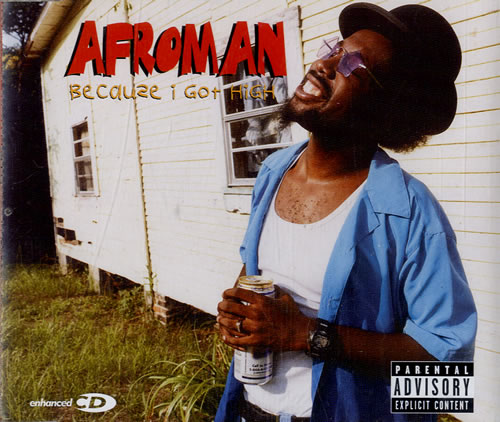
AFROMAN – “Because I Got High”

by Tom

#911, 27th October 2001

Afroman If rock criticism was a stoner, one of its endlessly repeated good-vibes stories would be Paul McCartney waking up and ‘discovering’ the melody to “Yesterday” in his head as “Scrambled Eggs”. McCartney, no enemy of the herb at this point, became convinced he’d heard it before, only gradually accepting that he’d stumbled upon the tune via luck or talent or sheer morphic resonance – the theory popularised by Dr Rupert Sheldrake in the 80s that blue tits learn to open milk bottles because they’re all connected by a kind of blue tit superconsciousness, mind blown, except it wasn’t true. Though it was true enough for a physics teacher I had to suspend lessons so he could give us all crosswords to fill in, staggered batch by batch to see if morphic learning was happening.

But I digress. “Because I Got High” seems to be another of those “Scrambled Eggs” phenomena, a song so perfect in conception that it feels like it fell out of some superstructure and into the mellow lap of Afroman and then into the charts. “Because I Got High” is folk music, it’s always been with us, or at least it might always have been with us if the man hadn’t made it his business to hassle smokers until a song like Afroman’s had to be passed round the Napster circle PC to PC until in a wave of grassroots popularity – phantom offstage Beavis laughter – it got signed and floated hazily to number one anyhow. The first fruits of a supposed 6-LP deal, which tells you more about the early 00s than anything on any of the records this year.

It was treated as a joke because it was a joke, but there’s a saving mordancy in it, as Afroman’s troubles wax and deepen. “I fucked up my entire life, because I got high” has a bitter nihilist after-taste lacking in low-bar antecedents like “Rainy Day Women Nos 12 & 35”. Parts of it can even jolt you out of the comfortable haze of 2001, into the present: “I wasn’t gonna run from the cops, then I got high” was surely never as abstract as its white college listeners might have imagined, and now sounds the opposite of jolly. But the song is nothing if not flexible – its template can be extended beyond the horizon, and was. The parody listings on the “Because I Got High” Wikipedia entry are a thing of horror – but the specifics of the original can be recovered. A career washout keeping the flame lit, even if the only reasonable audience were his weed buddies.

You can hear that in it, too. You’d have to reach back a decade, to the rushiest parts of the early 90s, to find explicit drug songs which sound so steeped in their drug – the campfire ad libs, whooshing outrushes of breath, and on the LP version a collapse of even the record’s tenuous rules: “I don’t believe in Hitler that’s what I said / Now all you skins, please give me more head… MUH FUH!”. “Because I Got High” is critic-proof in a way – it sounds really, really fucked up, and is selling purely on that basis, as a stoned campfire song. But that very straightforwardness also makes it weed-proof – there’s nothing on it that smoking might actually enhance, no doors it can open. “Because I Got High” is an ironic song about how terrible pot is that’s also an unironically terrible advert for pot. If you smoke it, you get it, but you also don’t need it.

21 Apr 10:18

Harriet Tubman stole from the rich and gave to the poor (cont’d.)

by Fred Clark
Honoring Harriet Tubman on official currency is somewhat ironic, of course, since Tubman was a notorious thief. She stole from the rich and gave to the poor. Legally and constitutionally, that's what it meant to liberate slaves in antebellum America.
21 Apr 10:05

Dilbert - 2016-04-21 - The Government Is Listening

21 Apr 09:41

Neoreaction a Basilisk: Excerpt One

by Phil Sandifer

In preparation for the May launch of our Kickstarter for it, we're running excerpts of Neoreaction a Basilisk. This is from quite early in the book while I'm introducing my three main characters of Eliezer Yudkowsky, Mencius Moldbug, and Nick Land.

And yet at every turn in Moldbug’s argument, Marxism seems to lurk, indeed, haunt the text. Every argument he makes about the Cathedral’s insidious suppression of the obviously preferable alternative has, to an even vaguely Marxist-familiar reader, an immediate counterpart pointing inexorably to the dictatorship of the proletariat. It is tempting to suggest that Moldbug is a failed Marxist in the sense that Jupiter is a failed star, its mass falling tantalizingly short of the tipping point whereby nuclear fusion begins. Over and over again, Moldbug asks questions much like those that Marx asked, and his answers begin with many of the same initial observations. But inevitably, a few steps in, he makes some ridiculously broad generalization or fails to consider some obvious alternative possibility, and the train of thought fizzles into characteristic idiocy.

The most obvious symptom of this is how rarely Moldbug actually takes a swing at Marx himself, despite the fact that he’s self-evidently the biggest single villain of his philosophical system. It’s not a pattern that’s quite noticeable on the paragraph-to-paragraph level; it’s just that when you do searches on his blog you discover that in the more than one million words he published as Mencius Moldbug he’s mentioned Marx a mere hundred-and-thirteen, and that’s including his uses of “Marxism” as a generic term of derision. And none of them constitute anything like an extended engagement with Marx’s thought. Sure, you can argue that this isn’t so much an oversight as a demonstration of contempt, but the fact remains - there’s a confrontation that’s obviously waiting to happen that Moldbug endlessly deferred. (Hitler, by comparison, makes four hundred and sixty-nine appearances.)

Indeed, at one point late in his blogging career he proclaimed (not for the first time) that he was finally going to offer the red pill in a compact form before dramatically unfurling the statement “America is a communist country.” He even reduces it to an acronym. “AIACC can be interpreted in countless ways,” he proclaims. “All of these interpretations - unless concocted as an intentional, obviously idiotic strawman - are absolutely true. Sometimes they are obviously true, sometimes surprisingly true. They are always true. Because America is a communist country.” And then, as you’d expect, he begins to go through various interpretations to show how they are either obviously idiotic or true. And yet there is one interpretation that, astonishingly, never seems to occur to him: “America is in some meaningful fashion run according to the philosophical principles of Karl Marx.” In fact, literally none of the hundred-and-thirteen uses of the word Marx appear in the essay in question, “Technology, communism, and the Brown Scare.”

Moldbug posted five more times on Unqualified Reservations after that essay, and then retired the pen name. These days, he dissociates from it actively, to the point of penning an essay under the name Curtis Yarvin in which he proclaims that he is not Mencius Moldbug. Thankfully (or, you know, not), neoreaction did not retire with Moldbug; indeed by the time he proclaimed that America was a communist country the future of the alt-right had already emerged. Which brings us to our third and in many ways strangest figure: Nick Land.

Land does not quite provide our desired Moldbug/Marx punch-up, nor could he, being neither Moldbug, Marx, nor a time traveller. Nor does he provide anything so straightforward as a Moldbuggian commentary on Marx, or a Marxist reading of Moldbug. Instead he does something far weirder: he splits the difference. On the one hand, Land is the other pole of the neoreactionary movement proper (as opposed to the broader Rationalist movement that Yudkowsky represents) - his essay The Dark Enlightenment essentially forms a triptych of core works of the movement along with Moldbug’s Open Letter and Gentle Introduction. On the other, he’s an ex-academic philosopher steeped in the Marxist tradition. And this isn’t anything so simple as a born-again conversion away from the leftist tradition, nor some sort of dull horseshoe theory that reveals the far-left and far-right to be closer to each other than the political center. No, this one’s a deep rabbit hole indeed.

No matter how you slice it, though, The Dark Enlightenment is clearly where the trail starts. Its title, after all, immediately became a virtual synonym for the neoreactionary movement at large - it’s the name of their subreddit, for instance. But it’s an astonishingly tricky essay, simultaneously addressing the leftist academic circles he used to travel in, to whom it serves as a deliberately scandalous “Dear John” letter, and addressing the already-existent neoreactionary movement. Indeed, for the most part The Dark Enlightenment serves as a summary of and commentary upon Moldbug.

This results in a strange and ambiguity-laden tone. Certainly, by and large, Land seems amenable to Moldbug. Consider, for instance, his summary of the Cathedral: “it is necessary to ask, rather, who do capitalists pay for political favors, how much these favors are potentially worth, and how the authority to grant them is distributed. This requires, with a minimum of moral irritation, that the entire social landscape of political bribery (‘lobbying’) is exactly mapped, and the administrative, legislative, judicial, media, and academic privileges accessed by such bribes are converted into fungible shares… The conclusion of this exercise is the mapping of a ruling entity that is the truly dominant instance of the democratic polity. Moldbug calls it the Cathedral.” If anything, Land is prettifying Moldbug, layering in the pragmatic materialism that Moldbug’s Austrian School instincts lead him to eschew.

And yet Land never actually comes out and endorses Moldbug in as many words.  Indeed, there’s a curious detail to Land’s prose, in marked contrast with his subject. Where Moldbug’s prose is awash with the first person, endlessly espousing his beliefs, Land, remains absent from The Dark Enlightenment, using the first person only once, in a rhetorical aside during one of his many bouts of hand-wringing around the subject of race. And so an actual statement that Moldbug is correct in his premises and conclusions is simply outside the domain of what Land’s choice of styles and framings can offer in the first place. Certainly Land takes pains to be sympathetic to Moldbug, and he’s explicitly positioned Outside In, the blog he started in the wake of The Dark Enlightenment, within the neoreactionary community. But even there his sympathies are manifestly tactical; an alliance formed for a more esoteric and never quite stated goal - one that he is at times ostentatious about refusing to discuss, a tendency that is in turns beguiling and infuriating.

Indeed, this speaks to a larger ambiguity around Land - something both his admirers and detractors, and for that matter both his old academic audience and his new neoreactionary one, debate and speculate upon. Simply put, nobody’s quite sure if he’s serious. I mentioned earlier how every one of Moldbug’s arguments seems to have a secret Marxist double, a fact Moldbug is only dubiously aware of. Land has no such plausible deniability. His entire academic career, spent as part of the Cybernetic Culture Research Unit, a bunch of 90s cyberpunks loosely affiliated with the University of Warwick, was based around subversive and postmodernist readings of texts in the spirit of writers like Gilles Deleuze. Joining a far-right Internet subculture in an Andy Kaufmanesque piece of philosophical performance art is 100% the sort of thing he’d do. If so, though, it’s one played with an unwavering deadpan and nary a wink at the audience. All the same, it’s important to understand not only that this ambiguity hangs over his work, but that Land knows it, and knows that you know it, and knows that you know that he knows it. And so on.

But it’s also not all unwavering approval of Moldbug, especially once one starts to venture outside of The Dark Enlightenment and onto his blog, where Land expresses considerable skepticism towards Moldbug’s prescriptions for a post-democratic society. And this points to a larger and more fundamental difference  between Moldbug and Land: Moldbug is ultimately a utopian, whereas Land is a philosophical pessimist, and sees Moldbug as a perverse ally. To Land, what is most interesting about Moldbug is the fact he positions all of his calls for a restoration of monarchy within the libertarian tradition, libertarianism being a philosophy genuinely associated with a significant level of individualism. Early in The Dark Enlightenment Land makes note of libertarian icon Friedrich Hayek’s insistence that he was an “Old Whig,” which is to say, a true heir to the progressive tradition, in contrast with the progressives of his age, who have strayed from the true path, suggesting that “neoreaction” works as a similar formulation.

The point is not, however, to argue that Moldbug is a crypto-liberal. Rather, it is to suggest that liberalism is crypto-neoreactionary; that in the face of the reality of life under the Cathedral the neoreactionary position is the only logical response. Moldbug, in other words, represents the point where western liberalism finally owns up to its true nature. For Land, this is the right of exit, hence the first part of The Dark Enlightenment being titled “Neo-reactionaries head for the exit.” In Land’s view, what is interesting about Moldbug is that he reduces individual liberty to a right to say “no.” This is the idea of negative liberty taken to a brutal teleology - literally nothing more than the right to pick whatever bit of the threat comes after “or you can,” whatever the threat may be.

Once again, this is going to need some context in Land’s larger career. In 1997, Land resigned his position at the University of Warwick. He subsequently moved to China, where he began his rightward turn, in part inspired by the degree to which he preferred Shanghai to Warwick. In other words, he is someone who exercised his right to exit, consciously deciding that he preferred a more overtly authoritarian regime to the supposed comforts of a western liberal democracy.

But perhaps more significant is the way in which he did not exercise this right. I will be delicate here, and simply quote his colleague Robin Mackay about the endgame of Land’s academic career: “Let’s get this out of the way: In any normative, clinical, or social sense of the word, very simply, Land did ‘go mad.’” Indeed, Land wrote about the experience in a piece called “A Dirty Joke” in which he talks about himself in a completely dehumanized fashion, calling himself “the ruin” and “it,” and using the name “Vauung,” which he explains he took “because it was unused, on the basis of an exact qabbalistic entitlement.” The piece is genuinely chilling: “‘This is a cool radio station,’ it said to its sister. ‘The radio isn’t on,’ its sister replied, concerned. Vauung learnt that the ruin’s unconscious contained an entire pop industry. The ruin learnt that it had arrived, somewhere on the motorway. Nothing more was said about it. Why upset your family?”

Land positions this break at the endpoint of his philosophical inquiries; indeed, the Fanged Noumena collection that contains most of his pre-neoreactionary work ends with “A Dirty Joke,” making that teleology explicit. And, significantly, it’s a sensible endpoint. Land embraced a position of intense radicalism, driving himself deliberately to extremes such that it is impossible, reading his work linearly, to quite see where his madness becomes a corruption within it. His subject was always the violent destruction of the self - the idea that civilization was largely fucked, hurtling towards some awful end of its own making. His philosophical quest was always to find that end, and there’s a real sense in which his neoreactionary turn is the process of him finding it, at least for himself, and then declining to take it.

There’s an obvious echo of the “hit rock bottom and find Jesus” narrative here, and that’s perhaps in practice unsurprising given that both Land and Moldbug are consciously trying to open a dialogue with existing right-wing politics, including those associated with an overtly evangelical Christian worldview. For Moldbug this is generally a bit awkward - he can’t bring himself not to squawk about his atheism whenever God comes up. One of Land’s major contributions to the neoreactionary community, on the other hand, is the construction of a compromise between the largely atheistic technolibertarian crowd Moldbug emerged from and the existing paleo-conservative traditions he increasingly found himself adopted by, an essay called “The Cult of Gnon.” Gnon - arrived after an extended riffing on the phrase “Nature or Nature’s God” is described by Land as “no less than reality, whatever else is believed. Whatever is suspended now, without delay, is Gnon. Whatever cannot be decided yet, even as reality happens, is Gnon. If there is a God, Gnon nicknames him. If not, Gnon designates whatever the ‘not’ is. Gnon is the Vast Abrupt, and the crossing. Gnon is the Great Propeller.”

But Gnon doesn’t just bridge a cultural divide within the neoreactionary community - it serves as a crucial bridge within Land’s own narrative. He does not talk at great length about his breakdown, and you can hardly blame him for it, but the overwhelming sense he gives is that he did not find God so much as find Gnon - an awful, inescapable realization about the way the world is.

20 Apr 19:27

My Latest Tweet

by evanier
  • How to Tell If Someone's a Racist and/or Sexist: They decide that from now on, they won't use any $20 bills.

The post My Latest Tweet appeared first on News From ME.

20 Apr 10:33

Dilbert - 2016-04-20 - For The Good Of The Country

20 Apr 10:21

Day 5588: EUROPE – JUST THE FACTS, MA'AM

by Millennium Dome
Tuesday:


"We have had our lovely leaflet from HM Government about reasons to stay in the EU… but could I please have both sides of the argument given as facts so I can make an informed choice?"

People don't actually make up their minds based on facts.

So, if you are inclined, even slightly, to vote "remain" then the government's little pamphlet provides some comforting homilies to warm you to the idea you're making the right choice.

But, and this worries me, if you find yourself wanting "other facts" to justify your doubts maybe you're drifting into the "Leave" camp.


That doesn't make you a bad person.

The desire to protect your own, yourself and your family first, is one of the strongest human impulses.

I do however think that some very bad people are trying to use this to their advantage. Ask yourself, do you believe that Nigel Farage or Boris Johnson are acting in your interests or in their own?


Asking for the facts ought to be a good thing.

But the "Leave" campaign doesn't HAVE any facts. They have promises and guesses. Uncharitably, they have fiction.

It's not like they haven't had FORTY YEARS to work out what they would do instead.

So you have to ask yourself: WHY CAN THEY NOT TELL US WHAT BRITAIN OUT OF EUROPE LOOKS LIKE?

They deny every fact presented by the Remain campaign – every report is biased, every testimony is a conspiracy; every piece of friendly advice is an unwarranted interference (and in the interest of a foreign power!).

(Though when President Obama wants us to remain and President Putin wants Britain to exit, you have to ask: who exactly do our best interests coincide with?)

John Redwood on the Today Programme (18 April), a Tory deriding the Treasury report on the grounds that you cannot trust Tory Treasury figures (I kid you not), said in pretty much these words: "We will be better off if we leave. I cannot tell you why or how."

(Do you remember how the Scottish Nationalists promised, promised everyone in Scotland would be better of leaving, because Scotland was a proud, independent, oil-rich nation… and then the oil price collapsed.)

I'm pretty sure John Redwood will be better off. But will YOU?

Remember how the Tories said they were "held back" by the Liberal Democrats? And then, as soon as they could govern on their own, they cut benefits to the disabled to give a tax cut to dead millionaires.

That's why they want to get out of Europe. So that they don't have to give workers their rights, or paid holidays. So they can trouser more of your money.

Michael Gove, supposedly a "leading intellectual" in the "Leave" campaign was given free reign to present his "vision" to the nation on the Today Programme (19th April).

His so-called positive pitch can I think fairly be summarised as:

"Europe might go wrong! Immigrants! Deregulate the banks [seriously! After that went so well last time?!] We have no influence in Europe! But they'd give us a magic trade deal! Terrorism! Aren't Remain MEAN!"

If I might borrow from Raphael Behr, pressed to present what post-Brexit Britain would look like after leaving the EU, Gove answered:
"Like Canada, but not Canada. Better in indescribable ways. Imagine a good thing. That."
And Gove is supposed to be the BRAINS of the outfit!

Perhaps I can help him out.

These are the three basic arguments that the "Leave" campaign deploy:

  1. Britain should govern its own affairs.
  2. Britain would be better off out.
  3. Britain can never control immigration while we are members of the EU.

And these are all DEEPLY disingenuous positions.

I will try and approach these as three questions. I'll try to avoid using too many numbers because politicians have used "bullshit statistics" so often that now a lot of the time statistics obscure rather than enlighten. And I'm not going to pretend I'm not biased.

1. How much say in our own affairs do we have if we remain or if we leave?


This is what you might call the "philosophical" reason for the "Leave" campaign and plays strongly to people's sense of patriotism, and belief in "our way of life".

Many people who want to leave the EU do so because they have an honest belief that Britain is better governed and should only be governed by laws made by the British Parliament.

(They tend to do this by talking about a "European elite" or "democratic deficit" or about "Europe 'overruling' Westminster". Nationalists in Scotland and Wales say similar things about the Westminster government.)

If we remain in the EU then the Westminster government will not have as much freedom as it would if we were to leave.

  • There are some pieces of EU law, called "regulations" which immediately become UK Law. These are the most powerful – and most controversial – pieces of EU law. They cover areas of consumer protection, your rights at work, and the rules for companies (including the rules for banks and finance institutions).
  • There are other pieces of EU law, called "directives", which Westminster will have to pass as its own legislation to bring into British law.
  • There are some things that Westminster cannot do because they would be against the various treaties that the British government has signed up to – though of course we have treaties with lots of places, not just the EU. AND "Leave" say we would make new trade agreements, which would mean we would have to make many lots MORE treaties if we were outside the EU.
  • And there are some things which the Westminster government would not do because it would be diplomatically difficult.

Equally, if we remain in then the British Government gets an equal voice in the main governing body of the European Union, the Council of the EU* [that's one vote in twenty-eight], and can appoint one of the EU Commissioners [one of (again) twenty-eight; one for and from each member state].

[edit to add additional explanatory note:]

European Union Laws – regulations and directives – are proposed by the Commission, but only become law if they are agreed by both the Parliament and the Council.

(Except for decisions on the common external tariff and EU trade treaties, which require only agreement of the Council.)

Agreement of the Council of the EU requires what is known as qualified majority voting: a decision is only agreed if about [pardon the numbers here] THREE-QUARTERS of the votes are in favour AND those votes represent at least HALF the countries of the EU AND those votes represent at least TWO-THIRDS of the population of the EU.


[*note: originally I referred incorrectly to "the Council of Europe", which is a different body. I am grateful to Richard Allan for pointing out this correction.]


So by remaining in Europe, our Government has less power to govern itself, but more power to govern all of the other countries in the EU.

We, the British people, also get a direct say in running Europe because we get to elect Members of the European Parliament.

[We get 73 out of 751 or 9.7% of the parliament. Germany has 96 MEPs, France has 74, Italy, like the UK has 73. The next largest country is Spain with 53 and then Poland with 51 and Romania with 33. Other countries have 26 or fewer MEPs. No one country is able to dominate.]

How democratic is Europe?


The EU is MORE democratic that the Westminster Parliament in the UK.

ALL members of the EU Parliament are elected by a proportional voting system to represent all the viewpoints of the citizens of Europe; the House of Lords [MORE THAN HALF the members of the UK Parliament] are UNELECTED, and the remaining members are elected by a highly disproportional system that gives complete power to Parties that have support from a minority of the population.

The "Cabinet" of the EU is made up of elected heads of government of all the member states; the Cabinet of the UK is appointed on the whim of the Prime Minister and can even include people who have not been elected at all (usually by granting them an instant peerage).

In the EU, the top civil servants, the Commissioners, are appointed by democratically elected governments and are accountable to the elected Parliament; in the UK, top civil servants, the ones known as mandarins or Sir Humphreys, are unaccountable and appoint themselves.

The board of the European Central Bank are appointed by the Heads of Government of the member states, after consultation from the European Parliament. The Governor of the Bank of England is appointed "by the Prime Minister" though as this is on recommendation from the Bank, effectively the bank selects its own governors.

And so on.

So how "democratic" are they, these people who seek to steal your right to vote in Europe?

John Redwood, since I mentioned him, holds a seat that has never (and I mean NEVER, since it was first created 131 years ago) elected anyone other than a Tory. Essentially, he has a job for life, gifted to him by a tiny unelected, unaccountable selection committee of the Tory Party. So does Michael Gove. So does Boris Johnson, another leading figure of the "Leave" campaign. Or there's the Lords Lawson and Lamont, who take unelected seats in our Parliament and lecture us on how we should get out of Europe (Lawson while living comfortably in France!). And the list goes on. You can NEVER get rid of them.

We saw, during the expenses scandal, that the safer an MPs seat the more likely they were to abuse their expenses. So this isn't just unfair, it's fundamentally CORRUPTING.

And many of the "Leave" campaigners are the same people who campaigned to keep Britain's unfair, corrupting voting system, and keep themselves in a job for life.

These people have done everything in their power to retain power unaccountably and for ever. Why should you believe that they want out of Europe in your interest, and not their own?


For YOU as an individual, your say in your government amounts to: if we remain – one vote every five years for your Member of Parliament and one vote every four years for your Member of the European Parliament. If we leave, you will get only the one vote every five years for your MP.

If you think that the government having less power to do exactly as it pleases is bad, then you might well think that it is better to leave the EU.

However, if you think government should not have more power over you, or if you think that having two competing centres of power competing for your vote gives you, as an individual, more say, as you get two vote and have several different representatives to approach if you need, then you might prefer to stay in.

But doesn't the EU make 75% of our laws?


Bluntly: no.

EVERY Law that affects the UK has to be passed by Parliament. Our MPs cannot be forced to pass European Laws.

Research by the House of Commons Library in 2010, found that few of our laws were influenced by Europe.

[I'm going to have to use some numbers here: just under 7% of Primary Legislation (Acts of Parliament) and just over 14% of secondary legislation (regulations being adjusted by ministers under previously agreed laws).

Even assuming that there's no double counting if you add those figures together (and there certainly is) then that is no more than one fifth of our laws coming from Europe before they are agreed by MPs.]


Other research by the BBC's "More or Less" has tried to trace where that "75%" figure comes from. The earliest reference they could find was a speech by… Nigel Farage. It appears that he just made it up!

(See also: Boris Johnson, who; got fired by the Times for making up stuff when he was Europe correspondent.)

How much power can Britain wield?


Campaigners for "Leave" (those who got to vote in the 1975 referendum) often say something like: "we voted for the Common Market; we didn't sign up for this super-state".

But the biggest single change to the EU (the change from EEC to EU, in fact, but that also formally abandoned the ideas of a country called Europe in favour of "ever closer Union") was when Mrs Thatcher used Britain's influence to champion the Single European Act.

The EU is now a much more "British" free trade area than it was when it was the EEC.

What may change that in the future is a side-effect of adopting the Euro on the single currency area. Although primarily a way of making trade even easier, the economic fallout has driven calls for stronger and faster POLITICAL union. (Because a European government that would be able to distribute money to poorer areas is seen as the answer to the pull of money to areas that are already successful.)

So long as we remain in, though, we would have an absolute block on that because we could, in the end veto it. The only way it could happen is if Britain (and all the other members) agreed that it was more in their national interest to let it happen.

So the thing to learn here is that when Britain gets involved in Europe, we get a more British Europe; when we haver on the sidelines, we lose influence and Europe goes another way.

2. Will we be better off if we remain or if we leave?

You might call this the "practical" question of the referendum, and it is the one that will be the decider for most people who are not committed believers in Europe of Brexit.

Britain is a trading nation. We sell a lot of things to Europe. We buy an awful lot more things from Europe.

The "Leave" campaign like to claim that this gives us the upper hand in negotiations – "they need to sell to us more than we need to buy from them", they say.

I buy more from Asda than Asda buy from me. Brexit logic says this puts me in a stronger position than Asda. Do you think that's true?


A very large percentage of our nation's income comes from the financial sector.

[More numberwang: The City of London contributes more than 11% of all the tax raised by the government.]

A large part of that income is because the City is allowed to trade in Euros and on the European exchanges. They are allowed to do that because we are part of the EU. If we leave, that business will go to Frankfurt. It's probably worth more to Germany than all their car sales put together.


Some of the people saying we should leave, claim we could easily negotiate new free trade agreements with other countries. They suggest Canada as an example. It took Canada seven years to negotiate her free trade agreement with the EU. That is "Leave's" definition of "easy".


But yes, of course we could negotiate new deals. But why start again when we are already in the biggest free trade agreement in the World? If it's about trade, we've already got the best deal going.

As part of the EU we have no tariffs between us and other EU countries. Also, as part of the EU we have automatic tariffs between us and every other country in the World. If we leave the EU, we will have the common tariff between us and our neighbours. Imports from Europe will be more expensive. Exports to Europe will be harder. That means for consumers in the UK prices will go up; and for anyone selling anything to Europe either their prices will go up and their product become less attractive, or they will have to make cuts to stay competitive.

This is not to say that Britain could not survive outside the EU. But that the "Leave" campaign appear to be saying that the first thing they would do is struggle all out to get back to where we are now. Does this not seem like it will be a great big waste of time, money and life?

If we leave – it is said – we would be free to negotiate with countries outside the EU. Except we are free to do that now. The EU in no way hindered the recent trade deals with, say, China (that one to among other things build a nuclear power station). We have negotiated deals with India and Brazil too. Leaving does not make these deals any better. It could make them worse, if we can no longer offer a gateway to the European market.

They say we could negotiate a new deal with America. The Americans have said they have no interest in negotiating with a UK outside of the EU.

Meanwhile, others of the "Leave" campaign are saying we should leave precisely because the EU is foisting a free trade deal with America upon us.

Which is frankly incoherent. But it is why it is so difficult to counter the "Leave" campaign "arguments", when they can just switch to the exact opposite of what they've just been arguing.

TTIP, the Transatlantic Trade Investment Partnership, is mainly a deal to recognise each other's regulations and standards, and so make it easier for small and medium sized companies to trade across the Atlantic. It is not a threat to the NHS or any other state service, as these are explicitly outside the negotiations. And it is not a "secret deal". In fact it is one of the most openly talked about trade deals ever. We know much more about TTIP than, for example, that deal with China I just mentioned.


If we leave Europe, we will no longer have to obey all the EU's regulations. Unless we want to trade with the EU (which "Leave" say they do), in which case we will have to obey all the EU's regulations (just as Norway and Switzerland do). Except we will no longer have any say in how those regulations are decided.

And if we want to trade with America… we will have to agree to obey America's regulations. Unless we can negotiate a deal to recognise each other's regulations and standards… ah, like the one we are negotiating right now with the backing of the entire EU.

In summary: if we leave the EU then we will be able to do all of the things that we can do now… except for the ones that we can't. And some of the ones we can will be harder.

THERE REALLY IS NO PRACTICAL BENEFIT TO LEAVING.

What are the downsides to remaining in?


Growth in the European Union, post 2008 banking crisis, has been slower than elsewhere in the World. Though mainly that is because developing economies like India and China have grown while developed economies outside of America have stood still. And American growth is an exception literally being powered by shale gas extraction (fracking).

There is an ongoing problem for the Eurozone countries that is causing money to be sucked into Germany and away from Southern Europe. (Actually, the same thing happens in the UK because London sucks money in away from all the rest of the country, except the government pushes it back out again by spending.)

As a productive manufacturing economy (we are more like Germany than Greece) this would be more likely to work in Britain's favour, drawing more inward investment and purchases here.


What if we need to bail out the Euro? Even though we have obtained explicit exemptions from anything to do with the Euro AND David Cameron managed to get the – actually significant – agreement that the EU would act in the interest of all members not just the Eurozone members, it is not impossible we might find ourselves in a situation where it is necessary to help out our neighbours. We did, for example, help to bail out the Irish Banks. And we did this because it's right to help your neighbours when they need it. But also because having our neighbours go bankrupt would be really really bad for us too.

So if Europe does go bust on our doorstep… do you think we would be able to ignore that and suffer no consequences? Or do you think that we would be obliged – by self-interest, if no better human instinct – to help out even if we'd left, because the alternative would be to wreck all those trade deals with Europe we are promised would happen easily once we exit.

In which case, being in or out of Europe wouldn't make any difference.

THE BEST DEAL FROM EUROPE IS THE ONE WE HAVE GOT; WE ARE TOO CLOSE TO EUROPE TO AVOID ANY PITFALLS EVEN IF WE LEAVE.

But it costs us money to be in the European Union


Yes it does. Just like it costs to be a member at Costco so you can get the better deals on prices.

Britain pays money in to the EU and gets money back. We pay more money in than we get back, so there is an effective cost to remaining in.

That's because we are the second richest country in the EU (after Germany and in recent times ahead of France).

If you believe that the richest should pay more in tax than they get back in benefits in order that the poorest should be supported, then you should have no problem with that at all.

And if you believe that the rich should not have to pay to support the poor, then ask yourself how much of the health service, schools roads and other services you would be willing to do without if the City of London thought the same way about the rest of the UK.

On that basis alone, and sticking purely to the facts, the "Leave" claim that we could save money is morally reprehensible.

[Numberwang: The "Leave" claim that the EU costs £350 million a week is also a lie. That's a strong term, but they have been repeatedly given proof that it is not true and there is simply no excuse any more for repeating that claim. Because of Mrs Thatcher's rebate, we actually pay in £250 million a week. And we get about half of that back in support for farmers and fishermen and other grants – which "Leave" usually promise they would continue to support, so cannot be counted as a "saving" – meaning our net contribution is £120 million a week. A little more ONE THIRD of what "Leave" continue to claim. What do you think that says about all their other numbers? Oh, wait, there aren't any.]


I'll add more here: it's not just moral. It's a multiplier. By getting access to trade, without tariff barriers, we make much more money.

And "we" means ALL OF US: workers and businesses and everyone who trades with the EU, and all of us consumers who get things cheaper from the EU.

The government gets back in higher tax returns the money it invests in paying the membership fee for all of us, but then all of us ordinary people get lion share of the benefit.

When they talk about cosuing "us" however much a week, the "Leave" are counting the money as if only the Westminster Government that counts. Ordinary people's cash doesn't matter.

Usually those Tories who back "Leave" claim to be in favour of giving you more of your own money. But for some reason when it comes to Europe they want the Westminster Government to keep more of your cash and you to get much less of it.


[Some more Numberwang: UK GDP is about TWO TRILLION POUNDS. That's £2,000,000,000,000. Leading economists estimate that the free market gives us a head start worth 1-3% a year on our growth figures. But even suppose membership of the EU adds just a TENTH of that, JUST 0.1% to growth, that means we add two billion pounds a year to our GDP, EACH year, EVERY year – so we would be TWO billion quid better off next year, FOUR billion the year after, SIX billion the year after that and so on. It quickly dwarfs any cost of taking part.]


3. Will there be more or less immigration if we remain or if we leave?

This is the dark side of the referendum.

UKIP (and others, often but not exclusively on the political right) will often say "it's not racist to talk about immigration". Well, it IS the way UKIP talks about it. They claim "we're not allowed to talk about immigration." We've talked about almost nothing BUT immigration for the last ten years at least (remember Michael Howard asking: "are you thinking what we’re thinking" – no, we weren't, fortunately).

Immigration means change, and that can be frightening. We like stability, because it means safety and (as before) protecting our own.

Failure to manage change – to make sure that homes are available and services remain able to cope with numbers – leads to tension. And in a time when services are being cut back, it's easy – and wrong – to put the blame on "the others".

(And just by raising the subject of racism, they are giving the nod and wink, the "dog whistle" to people who ARE racist.)

The (not very) coded message in the words used by UKIP (and the "Leave" campaign) is that immigration would be a LOT lower if they were in charge.

Mr Farage like to say that the EU is prejudiced against non-EU citizens and that he wants to treat everyone equally. What he really means is that he wants to be equally prejudiced towards everyone.


Firstly, this begs the question: "is immigration actually a bad thing?"

Economies with net immigration always do better than ones with negligible immigration or net emigration. Always. Britain in the Nineteenth century, America in the Twentieth, potentially Germany in the Twenty-First.

In simple terms, more people do more work.

"Ah," comes the reply. "That all very well for the middle classes with their plumbers and restaurant staff, but it not good for everyone because immigrants take low paying jobs and so keep wages down for working people." This seems so self-evident that people don't challenge it, but there is NO EVIDENCE AT ALL that this is true.

And you know that if there WERE evidence, the "usual suspects" would be shouting about it very loudly.

It turns out immigrants do not just "take jobs". They also create opportunities: they need food, homes, schools, services. This leads to further economic growth and MORE jobs.

Areas of high unemployment are caused by economic decline, or because local people do not have the training or experience to apply for new jobs that are created. But that's not caused by immigration. That is a failure of government, a failure to manage change and to deliver education (or re-education) and opportunity. And Government could and should intervene to help.

Very often, immigrants are both highly motivated and better educated, which can see them being placed in jobs that locals are not able to get. That is not caused by immigration; those jobs could not have been filled without immigration.

Will we be at greater risk of terrorism if we remain or if we leave?


This is the even-more-highly-charged version of the immigration question: the old "stranger danger" the red under the bed, the yellow peril, the black man in pursuit of the white woman, the witch in the woods. It's old and it’s ugly.

The speed and glee with which some of the "Leave" campaign jumped on the terrorist atrocity in Belgium to try to scare people into their camp was very nearly as sick and evil as the terrorist perpetrators themselves. I do not say that lightly. Both groups were trying to use a horrible act of murder for political ends. And both with the SAME political ends: to weaken and divide Europe.

The rolling news cycle and the immediacy of the internet (not to mention politicians and police promoting their own little empires) makes it seem that the threat is greater than ever. Yet we used to suffer two or three terrorist outrages every YEAR. Now, we've had two incidents in the last DECADE.

But we should not be linking terrorism to the Europe debate AT ALL. The roots of terrorism are complex, taking in a long history of Imperialism, fallout from the Cold War and the World Wars, global poverty, abuse of religious ideals, disenfranchised youth, criminal cartels, oil, corruption, Western failure to support Russia that has led to renewed guarded hostility, the miscalculation of European approaches to Ukraine, all those terrible choices that led to Iraq, Libya and Syria and some people who, given the chance, are just pure evil.

We cannot walk away from that mess, even if we quit the EU. No man is an island. These days, even no island is an island. Even the most paranoid of "Leave" campaigners are not suggesting we seal the borders entirely. Mostly, in fact, "Leave" say they want us to be an "open trading nation". Terrorists would still reach these shores.

Blaming the Schengen Area is a complete red herring.

Firstly, without an awful lot of barbed wire, passport controls will not make for secure borders between the countries of mainland Europe who do not have the advantage of a small sea between them and their neighbours; they are just too long, too open and too easy to cross.

The greatest terrorist threat to this country was the IRA and they never had any difficulty slipping back and forward across the border between the Republic and Northern Ireland.

Second, Schengen also means a common ID papers area, and allows police in any of the states within it to challenge people for their ID – that's actually MORE draconian security than in Britain, more actually, than Britain is willing to put up with (given our huge scepticism about "stop and search" and "sus laws" and "ID cards").

Tackling terrorism requires international co-operation. Isolation can only make us MORE VULNERABLE.

But what about our "culture"?


In the last 500 years, we British have been all over this World and brought back cultures from everywhere on the globe. America, Asia, Africa and of course all of Europe, have influenced us, from our language to our cuisine. Our tea comes from China, our curry from India, our coffee and chocolate(!) from the Americas. Our algebra and astronomy come from Islam.

Multi-culturalism hasn't failed. Quite the reverse, it thrives in the way we all (almost all) manage to rub along together in our silly busy ways, making accommodations with each other. That's life.


The global meltdown of 2008, and the austerity afterwards, plus the behaviour of certain of the super-rich, has shaken people's faith in the liberal economy, in spite of literally decades of proven success (not to mention protectionism directly causing the Great Depression and a World War!).

Our leaders have demonstrated their failings over and over. Some have been greedy – but fewer that you think – some have been stupid.

Add to that, the long-running Tory civil war over Europe – between those who see our place in the World as taking part in the common endeavour and those who yearn for a dead Empire – has combined with half a decade of the Labour Party indulging its worst tantrums to scream "traitors" at any and all outside the Party faithful and between them they've managed to create a truly toxic atmosphere of resentment, grievance and hostility.

And grievance is all that "Leave" has to offer. Why can't things be like they used to be?

Why? Because they are BETTER now.

When I look at the world, I see war and famine in Africa, I see religious conflict and terrorism in the Middle East, I see human rights abuses and billions in poverty choking on the very air in China…

Europe used to be just like that. Hundreds and hundreds of years of war, and famine, and plague and death.

And I see what we have achieved in Europe. Together

Millions of refugees are risking death to get here. Why? Because every single person living on the face of this planet (apart, it seems, from Britons) knows one true fact:

If you want to protect your children: BE PART OF EUROPE.

The EU question isn't quite the same as Climate Change or Evolution where "balance" means there's a debate between the people with science, research, evidence and peer-reviewed data… and dangerously deluded idiots who are actively harmful to the survival of humans as a species.

But broadly speaking, and there are nebulous areas of gut feeling about this, but the risks and rewards of liberal economies, free trade and international cooperation are worth more than isolationism and protectionism.

That is a fact.

Really that's the only fact that matters.

Peace, human rights, scientific exchange, free travel, retiring to the Costa del Sol (even if you're not a Great Train Robber), cheaper roaming tariffs… they all follow from that one fact.

IF YOU WANT TO LOOK AFTER YOUR OWN, YOU HAVE TO WORK TOGETHER.


You still want the facts? Here are the facts:


Here is the IMF's (International Monetary Fund's) World Economic Outlook report for 2016 listing United Kingdom exit from the European Union as one of seven main risks to the outlook for the world economy.[pdf];

...and here is the report by a globally recognised authority on the risks of us staying in… oh, wait there isn't one.


This is the UK Treasury study (in great depth) showing we would be worse off for leaving the EU;

...and here is the study showing how we will be better off if we leave… no, hang on, there isn't one of those either.


Here is the case from the CBI (Confederation of British Industry) for Remain;

...and here is the… oh, no, you guessed it, no reputable business group for out either.


Here are the Scientist for IN;

...nope, no scientists against.


And here are the Featured Artists Coalition (from Pink Floyd to Radiohead) who want us to Remain;

...I think you're getting the picture by now.


So finally here are the In Facts from In Facts.
19 Apr 10:32

The California marijuana market: the hippies now have to compete with the agribusinesses

by Al Roth
The NY Times has the story: In California, Marijuana Is Smelling More Like Big Business

"After decades of thriving in legally hazy backyards and basements, California’s most notorious crop, marijuana, is emerging from the underground into a decidedly capitalist era.

Under a new state law, marijuana businesses will be allowed to turn a profit — which has been forbidden since 1996, when California became the first state to legalize medical cannabis — and limits on the number of plants farmers can grow will be eliminated.

The opening of the marijuana industry here to corporate dollars has caused a mad scramble, with out-of-state investors, cannabis retailers and financially struggling municipalities all racing to grab a piece of what is effectively a new industry in California: legalized, large-scale marijuana farming.

And with voters widely expected to approve recreational marijuana use in November, California, already the world’s largest legal market for marijuana, gleams with the promise of profits far beyond what pot shops and growers have seen in Washington or Colorado, the first states to approve recreational use.
...
"Amid the frenzy, though, anxiety is growing in some corners of the state that corporate money will squeeze out not only the small-time growers, but also the hippie values that have been an essential part of marijuana’s place in California culture.

"Tommy Chong, of Cheech and Chong fame, has long been synonymous with California’s outlaw stoner culture, growing his own pot and crafting bongs from kombucha bottles at his Los Angeles home. Now he is negotiating with a corporate partner to license his own brand of legal marijuana.
...
"Twenty-three states* allow some form of legal marijuana, and up to 20 will consider ballot measures this year to further ease restrictions."

*
19 Apr 09:23

What chance of a radical welfare policy?

by noreply@blogger.com (Gareth Epps)
Sources who’ve had sight of documents for the Lib Dem working group developing welfare policy report real cause for concern to Liberator.
After Tim Farron’s oft-repeated comment that the party shouldn’t be afraid to stand up for what it believes in, even if it makes 75% of the population hate them, as long as it makes the other 25% love them, there had been hope that policymaking would break from recent trends and seriously consider radical ideas.  Alas, this appears to have been a hope too far according to our sources.
With the draft policy paper due by the end of the month, the agendas for the Social Security Working Group, chaired by Jenny Willott, are dedicated to multiple examinations in detail at specific areas of the current welfare system to consider how best to manage things.
Rather than consider a big idea as to what a Liberal welfare state would look like, the working group seems destined towards making many small suggestions on how to improve different benefits. But, while proposals to tinker with childcare provision and eligibility requirements for JSA might be worthy, they will inevitably be so detailed that no one will pay any attention to them. Once again, Liberal Democrat welfare policy will be without a big idea capable of grabbing attention.
Apparently big ideas such as Negative Income Tax, Basic Income and a Social Insurance system were considered at earlier meetings. However, no concrete decisions were made either way and all subsequent meetings have focused on tinkering with the existing system.
This is particularly concerning given the substantial levels of support in some sections of the Liberal Democrats for the concept of Negative Income Tax/Basic Income - one of the few issues that people on both the left and the right of the party can agree on. And certainly the concept of giving every citizen a minimum level of income with no strings attached is a radical one which would meet the “big idea” criteria.
Given the idea’s popularity it would be an absolute travesty if the party conference didn’t at least get a chance to discuss the concept or not. Unfortunately, however, given the working group’s current direction of travel it seems very unlikely to feature in the policy paper. If so conference won’t even have the option of discussing it.
Of course, in pre-coalition days one solution to this kind of issue where opinions were divided was for a working group to present two policy papers to the Federal Policy Committee so that the membership could make a genuine choice between two options. While this practice was largely abandoned under Clegg’s leadership in favour of insisting on a single, uncontroversial report from working groups, it is ripe for being revived.
If the working group were to do so then they may well be able to present party members with a choice between the tinkering-around-the-edges approach it seems to be on the verge of recommending and a radical, ‘big idea’ on welfare reform. That would certainly be best in terms of democratic policy making and escaping the old working group problem of only producing policy recommendations acceptable to their most small-c conservative members.
Whether this actually happens or not remains to be seen. But given the current schedule of meetings for the working group we wouldn’t hold our breath.
19 Apr 09:19

Dilbert - 2016-04-19 - Government Wants Access To Data

18 Apr 18:27

this comic might make some... WAVES (radio waves) (look it's about radio waves okay)

archive - contact - sexy exciting merchandise - search - about
← previous April 18th, 2016 next

April 18th, 2016: Hey thanks for reading my comic today!!

– Ryan

18 Apr 17:33

Why those opposed to the Tories should hope that June 23rd fails to resolve the blue team’s #EURef schism

by Mike Smithson

It’s in non-CON interests for the Tory battles to go on and on

A party at war is pretty sight if you are not a supporter. The way this first Monday of the official referendum campaign has gone isn’t doing the Tories any favours and it is going to go on and on.

It is an extraordinary spectacle. A Conservative Chancellor sets out projections of what BREXIT could cost and we see a huge effort from fellow Tories to both discredit the figures and the man itself.

Anyone who comes out with anything that’s vaguely supportive of REMAIN has to reckon on coming under a pile of aggressive abuse from LEAVE backers. Those wanting out are more than ready to play the ball as well as the man.

If the Scottish IndyRef on 2014 is anything to go by this will get louder and stronger the closer we get to the day.

I’m sure that Cameron and his team regard the next eight weeks of party in-fighting is a small price to pay to resolving an issue that has so divided the party since the summer of 1992. The worry must be that battles will l continue after the vote.

Cameron really needs a 10%+ victory.

Mike Smithson

Follow @MSmithsonPB

Tweet

18 Apr 09:24

Grading Trudeau on quantum computing

by Scott

Update (4/19): Inspired by Trudeau’s performance (which they clocked at 35 seconds), Maclean’s magazine asked seven quantum computing researchers—me, Krysta Svore, Aephraim Steinberg, Barry Sanders, Davide Venturelli, Martin Laforest, and Murray Thom—to also explain quantum computing in 35 seconds or fewer.  You can see all the results here (here’s the audio from my entry).


The emails starting hitting me like … a hail of maple syrup from the icy north.  Had I seen the news?  Justin Trudeau, the dreamy young Prime Minister of Canada, visited the Perimeter Institute for Theoretical Physics in Waterloo, one of my favorite old haunts.  At a news conference at PI, as Trudeau stood in front of a math-filled blackboard, a reporter said to him: “I was going to ask you to explain quantum computing, but — when do you expect Canada’s ISIL mission to begin again, and are we not doing anything in the interim?”

Rather than answering immediately about ISIL, Trudeau took the opportunity to explain quantum computing:

“Okay, very simply, normal computers work, uh, by [laughter, applause] … no no no, don’t interrupt me.  When you walk out of here, you will know more … no, some of you will know far less about quantum computing, but most of you … normal computers work, either there’s power going through a wire, or not.  It’s 1, or a 0, they’re binary systems.  Uh, what quantum states allow for is much more complex information to be encoded into a single bit.  Regular computer bit is either a 1 or a 0, on or off.  A quantum state can be much more complex than that, because as we know [speeding up dramatically] things can be both particle and wave at the same times and the uncertainty around quantum states [laughter] allows us to encode more information into a much smaller computer.  So, that’s what exciting about quantum computing and that’s… [huge applause] don’t get me going on this or we’ll be here all day, trust me.”

What marks does Trudeau get for this?  On the one hand, the widespread praise for this reply surely says more about how low the usual standards for politicians are, and about Trudeau’s fine comic delivery, than about anything intrinsic to what he said.  Trudeau doesn’t really assert much here: basically, he just says that normal computers work using 1’s and 0’s, and that quantum computers are more complicated than that in some hard-to-explain way.  He gestures toward the uncertainty principle and wave/particle duality, but he doesn’t say anything about the aspects of QM most directly relevant to quantum computing—superposition or interference or the exponential size of Hilbert space—nor does he mention what quantum computers would or wouldn’t be used for.

On the other hand, I’d grade Trudeau’s explanation as substantially more accurate than what you’d get from a typical popular article.  For pay close attention to what the Prime Minister never says: he never says that a qubit would be “both 0 and 1 at the same time,” or any equivalent formulation.  (He does say that quantum states would let us “encode more information into a much smaller computer,” but while Holevo’s Theorem says that’s false for a common interpretation of “information,” it’s true for other reasonable interpretations.)  The humorous speeding up as he mentions particle/wave duality and the uncertainty principle clearly suggests that he knows it’s more subtle than just “0 and 1 at the same time,” and he also knows that he doesn’t really get it and that the journalists in the audience don’t either.  When I’m grading exams, I always give generous partial credit for honest admissions of ignorance.  B+.

Anyway, I’d be curious to know who at PI prepped Trudeau for this, and what they said.  Those with inside info, feel free to share in the comments (anonymously if you want!).

(One could also compare against Obama’s 2008 answer about bubblesort, which was just a mention of a keyword by comparison.)

Update: See also a Motherboard article where Romain Alléaume, Amr Helmy, Michele Mosca, and Aephraim Steinberg rate Trudeau’s answer, giving it 7/10, no score, 9/10, and 7/10 respectively.

18 Apr 09:23

What if we learned about the Bible from the people who got it right?

by Fred Clark
The victims of injustice tend to have a far better theological track record than the defenders, perpetrators, and beneficiaries of it. We should try learning from them for a change. Perhaps it would be better to learn about the Bible from the people who got it right than to continue learning about the Bible from people who insist on getting it wrong.
18 Apr 08:32

Street Performers

by evanier

If you catch this week's Last Week Tonight with John Oliver, you'll see a very scary segment about the prevalence of lead (aka poison) not only in so many water supplies but in paint and other places where it's hard to avoid. It includes a nice cameo by three Muppets from Sesame Street — Elmo, Rosita and Oscar the Grouch. The credits on the program list five Muppet performers: Ryan Dillon, Eric Jacobson, Lara Maclean, Carmen Osbahr and Matt Vogel.

Okay, let's see if we can figure this out: Elmo is a one-person Muppet and he's been performed by Ryan Dillon since 2013 when Kevin Clash got in trouble and had to resign. So that's him. The other two Muppets require two operators — one to do the voice, mouth and one hand; the other to do the other hand.

Carmen Osbahr originated Rosita so she's obviously the primary performer there with Lara Maclean doing hand duty. That means Oscar was performed by —

Wait a minute. Not Caroll Spinney?

Right. And it was a good replica but it ain't him. I'm guessing it was Eric Jacobson with Matt Vogel assisting, though it could be the other way around. Eric is a terrific mimic who has taken over most of the Frank Oz roles like Miss Piggy, Grover, Fozzie Bear, Sam the Eagle and Animal. He's also done Cookie Monster occasionally, though David Rudman has been the main Cookie Monster performer for more than a decade. (You can see a photo of me with Eric and David over in this post.) Matt Vogel has taken over most of the Jerry Nelson roles and occasionally worn the Big Bird suit when Mr. Spinney was unavailable, unwell or busy playing Oscar in the same scene.

Is this a passing of the torch moment? Spinney is 82 and has been Oscaring since 1969. Eventually, he has to hand his two signature roles off to others. Has it just happened? One would like to think he's just on vacation or maybe busy filing his taxes…but this is a pretty high-profile appearance. You'd think they'd arrange for him to do it if he could. Anyone know?

And, letting my imagination run away with me: If they had Eric Jacobson available but not Caroll Spinney, why didn't the writers of Last Week Tonight use Cookie Monster or Grover instead of Oscar? Since the subject was lead poisoning, wouldn't there be possibilities there for Cookie Monster to explain he'll eat anything except paint chips or drink the water in Flint, Michigan? Hmmm…

The post Street Performers appeared first on News From ME.

17 Apr 20:42

Digital reading driven by older women

by PG

From The Guardian:

Fuelled on a diet of romance and crime, new research claims the digital reading revolution is being powered by “prolific” readers who are predominantly female and over 45.

A study carried out for ebook retailer Kobo suggests that women represent 75% of the most active e-readers – defined as readers who spend at least 30 minutes a day using electronic books.

“They are the engine that powers the industry,” said chief executive Michael Tamblyn. “The industry has intuitively known this, but we wanted to shine a light on it.”

Around 77% of the most active readers – who make up a 10th of Kobo’s 28 million customers – are aged 45 and over, with the largest single group (30%) aged between 55 and 64. Kobo said this makes e-reading “the first technological revolution being driven by [those aged] 45 and older, rather than younger generations”.

. . . .

Kobo found that the average prolific reader used print and digital formats, reading two print books a month, and buying 16 print books a year, as well as 60 ebooks. Some 16% of Kobo’s most enthusiastic customers said they bought an ebook “almost every day”. They overwhelmingly preferred to read romance novels, the retailer reported, with the category accounting for more than twice the number of unit sales as general fiction, the second most popular category. Mystery novels came in third. Prolific readers who chose romance were reading for almost 90 minutes a day, and finding time more than six times a day to settle down with a book.

“Romance tends to be a little bit shorter, and more affordable,” said Tamblyn. “It’s a place where digital has become overrepresented – it’s quite difficult for a bricks and mortar store to stock the range and selection these passionate readers want, as they can’t devote the space to it. So these customers have come much more quickly to digital.”

. . . .

Older women carried less purchasing heft in the print book market, Bohme continued, accounting for 20% by volume in 2015 – a figure influenced by parents buying books for their children. But the enthusiasm among older women for reading revealed by the Kobo survey was matched in figures on library usage.

“Older women are relatively likely to borrow (print) books from public libraries,” Bohme added, “accounting for 32% of borrowers in 2015.”

Link to the rest at The Guardian and thanks to Patrice for the tip.

Click to Tweet/Email/Share This Post

17 Apr 13:21

Making legends out of clay

by Matthew Coniam

One of the things I discuss in my new and now available for pre-order Groucho book is the way in which our biographical conception of the great man is to some extent a fantasy, conditioned by our tendency to believe what we want to believe about him and discard what we do not - whether it was that he was exactly the same wisecracking comedy dervish off-screen as on, or a tears-of-a-clown tragic figure, or a snarling misanthrope. 

This manifests itself in big ways and small, and I find the small ones just as interesting as the big ones. 
For instance, everybody knows the story that on the set of A Day at the Races director Sam Wood watched Groucho play a scene and declared ruefully, "You can't make an actor out of clay." Whereupon Groucho snapped back, "Nor a director out of Wood!" Very funny. And very much the Groucho we want our man to be. 
But do you really believe it happened?

If you do, why do you? Doubtless because it is quoted, and stated as fact, more or less every time the film is mentioned. But where does it come from? 
My assumption, in so far as I considered the matter at all, and perhaps yours, was that it was a story that came up somewhere in someone's first hand testimony, and was singled out and repeated ever after. But it's not. It's a publicity story, just one of dozens and dozens that the studios sent out to the newspaper gossip and film pages. 

Now, of course, this in itself does not mean that it didn't happen. There is indeed a very, very, very slim chance that it did - just as the Valley Morning Star (January 2, 1937) and scores of others would have us believe. But that certainly wouldn't be standard procedure with a story like this. In the main, such gems were concocted by people who were paid to do just that; people whose job it was to sit in an office and dream up funny or eye-catching stories about the stars, to plant in the press and grease the publicity wheels for their forthcoming releases. My point therefore is that on the evidence there is no actual reason why we should believe it - and the fact that it happens to be a great line shouldn't be a reason in itself. There are, after all, many more such nuggets to be found in the inkies about A Day at the Races, as there are about all their other films. So hats off to whoever came up with this one - it proved itself a classic.

But think about it. Even if Groucho were the wittiest, most spontaneous man who ever breathed, does this sound like an off the cuff exchange to you, or does it sound like a joke someone has sat at a table and thought up? Even if Groucho were that capable, in the first instance he has had the most tremendous luck that Wood so fortuitously handed him so perfectly worded a feedline. There are an infinite number of ways he could have made the same point, without explicitly evoking the metaphor of crafting the performance from a building material. And even if he had done that much, he could so easily have worded it differently, so the structure forbade the precise formulation needed by the comeback. Brilliant and lucky, Groucho!

Ah, but then - it's not just funny, is it?  Not just proof of Groucho's lightning wit. It's also biographical evidence of the dislike that existed between the two men, right? Nope. It's a publicity story. 
Groucho certainly did dislike Wood, and I don't doubt that the stories of Wood being frustrated and baffled by his stars are likewise true. But any kind of real feud, if made manifest in such a way, would not have traveled from the set to the papers via the publicity department. It's just a joke, merely a play on words. If Groucho had said it, he'd have said it of anyone, should the structural and linguistic opportunity have arisen. It's not evidence of anything at all.

As I explain in the book, I choose to dwell on things like this not because I like spoiling people's fun, nor because I think it's particularly important in itself. The real issue is that what it reveals about us - that we craft our images of our heroes from desires as much as from the evidence - has wider implications, especially in the case of someone like Groucho, whose offscreen character was also, much of the time, a performance. 
This is why each new sensationalist biography vies with the last to exaggerate his negative traits still further, in their quest to portray him as demon father, tyrant husband or all-round sarcastic bastard. But when you return to the primary sources, this deeply unpleasant character is simply not to be found there. The real Groucho is a basically rather ordinary fellow, with his full complement of frailties, as are most of us, but - frustratingly - offering little to satisfy our need to make him the equal of his onscreen persona in importance, vitality or dominance. So we jiggle things around a bit, and change him into that which we prefer, and thus prove that you can make a man out of clay. 
That is the phenomenon that interests me, and which I believe has distorted our sense of Julius Henry Marx (whoever the hell he was), and which I address in the new book. 


16 Apr 13:42

Dilbert - 1992-02-29 -

16 Apr 13:41

Dilbert - 1992-03-01 -

16 Apr 13:26

A generation which knew not Joseph

by Fred Clark
When it comes to the biblical story of Joseph, I'm with John Calvin. Joseph exploited the hungry and enslaved the entire world to curry favor with a tyrant. And that, Calvin concluded, was simply indefensible. "It is certain that all contracts which are not formed according to the rule of charity are vicious in the sight of God," the reformer wrote in his commentary on Genesis.
16 Apr 12:31

Protesters who blockaded London arms trade fair acquitted after judge sees evidence of illegal weapons on sale.

Protesters who blockaded London arms trade fair acquitted after judge sees evidence of illegal weapons on sale.
16 Apr 11:24

Lawyers who won "happy birthday" copyright case sue to free "we shall overcome".

Lawyers who won "happy birthday" copyright case sue to free "we shall overcome".
16 Apr 08:42

Conclusions and Caveats

by Wesley

This is the final post in a series on a style of genre prose that I dislike; I wanted to analyze why I dislike it, and it turned out quite long. It will make more sense if you’ve read the earlier posts, which I’ve just linked to and are all under the tag “Novelization Style.”


I started thinking of this style as “Novelization Style” after I realized that reading it felt like reading a novelization of a nonexistent Hollywood movie.

I’ve covered several reasons along the way. Novelization Style combines strict, unvaried close third person point of view with transparent prose. It feels like an attempt to render in prose the feeling of a scene filmed by a camera, creating an illusion of objectivity. The result is a standardized generic narrative voice, and what feels like a denial that the story is being narrated at all. Novelization Style is mostly paced moment-to-moment, again like a scene playing out on video; in some books section breaks echo the way a movie or TV show cuts between scenes. Novelization Style prioritizes action over interiority. Descriptions are brief and concrete instead of evocative; dialogue is plot-relevant; function trumps form. When it comes to plotting, bigger is better; generally at some point we learn about a conspiracy or pending disaster that will cost lives. Raising the stakes means making the threat bigger, not the emotional arc more intense or the intellectual and philosophical questions more urgent. Novelization Style sometimes uses recognizable Hollywood storytelling patterns, like the prologues and wrap-ups I described in the last post, or an apparent divide between “speaking roles” and “extras.”

I like early 20th century mystery novels, so I’ve read a lot of popular fiction from that era. This style seems new to me. Not entirely new, mind you; action-oriented fiction has always been around, and Novelization Style is probably descended from pulp. But it’s just different enough to be its own thing. I’m about to make an anecdotal assertion here, so it should be taken with skepticism, but when I read 20th century novels I less often notice a strict adherence to the close third point of view–they’re more likely to vary the distance, use omniscient, or acknowledge the narrator. The narrative voices are more willing to be lively or playful. And I notice fewer storytelling strategies that parallel film. Again, this is just my impression, but it seems to me that Novelization Style started growing in the Hollywood blockbuster era, and became dominant enough to notice in this century.

Time for the caveats. I don’t want to imply that everything that could be called “Novelization Style” is bad. I’ve illustrated some of my examples with Three Parts Dead, and, like I said, despite some quibbles I’d say it’s good. I can enjoy an actual full-on example of Novelization Style if it pushes enough of my buttons. (I mentioned before that for over a decade I was reading one or two Doctor Who novels a month; almost all were Novelization Style.)

My problem with Novelization Style is that I’ve read so much of it, to the point that I’ve begun to feel like it dominates the science fiction and fantasy genres. Even writing I wouldn’t classify as Novelization Style sometimes borrows a few characteristics from it–a focus on action, a certain kind of pacing, or a slightly too generic narrative voice. Novelization Style naturally gravitates to a standardized narrative voice. When there’s a lot of it around, a lot of the SF genre starts to look samey.

Given the ties between Novelization Style and pulp, I also want to say that “Novelization Style” shouldn’t be taken as a perjorative term for “not Literary.” (In fact, I find the whole literary/non-literary divide dodgy. As anyone who’s seen the stately Library of America editions of Philip K. Dick’s brightly colored paperback novels knows, there’s no clear line between the two.) I don’t want to imply that I don’t like adventure in my fiction, or that I don’t like light, fun novels. I’m prone to depression, and always looking for light, fun reads for the times when that’s what I can handle.

The problem is that my definition of a fun read includes a lively, individual voice that doesn’t sound like every other book on the shelf, and some ideas for my brain to engage with. Earlier I used a pop music metaphor–I want a book with hooks. I’m looking for a Beatles album, and keep getting tired synthetic re-recordings not by the original artists.

One example of a fun read I actually consider fun is Steven Brust’s Vlad Taltos series. It’s a long series of adventure novels starring a fantasy assassin. What makes it different from many other long-running fantasy series is that with every volume Brust makes an effort to write a different book with a different structure. And although they have a light touch, they’re still engaged with ideas. Vlad is an assassin and criminal who by the third book has realized his job is in fact not as cool as the average teenage Dungeons & Dragons player would prefer to think. His journey from there is at times a reassessment of his life, and at times an introduction to parts of his society to which he hadn’t previously given much thought. Also, every volume is a complete and not overly long standalone novel, something I appreciate more the older I get.

So… with the caveats out of the way, what do I find missing from Novelization Style?

My preferences are depth-agnostic: as I suggested, I like to find certain qualities in a book whether I’m reading a lighter novel or the kind of thing that gets classified as “literary.” There’s voice, of course: a novel needs a personality, its own style and its own way of telling a story. It needs to be not just descriptive but expressive.

Part of a novel’s personality comes from the prose, and part from content. Every really good novel is a little bit imperfect. The most fun, engaging books aren’t perfectly engineered; they have ambiguities, multiple interpretations, detours, and odd protuberances. They often include passages that look like side trips and diversions, straying from the plot but developing themes, ideas, and characters. And they do need themes, meaning questions the author wanted to explore or arguments they wanted to make. A lot of SF comes up with a premise–“Like, wow, man, what if there were vampires and werewolves?”–and stops there. Good novels, even good pulp novels, dig deeper; they have subtext as well as text.

They’re eccentric and weirdly shaped and packed with stuff. Some of the stuff may or may not work. Readers may disagree about which stuff worked and which didn’t. When that happens, that’s a clue that the novel is interesting.

Thinking of a way to describe this, I recalled how Rudy Rucker defined the word “gnarly” in an essay. Rucker quotes Stephen Wolfram who believes there are three kinds of mathematical processes: Predictable, Random, and Gnarly. Gnarly is structured, like the predictable processes, but unpredictable like the random ones.

Incompetent writing is often random. Novelization Style is predictable. What I’m interested in is writing that has at least a little bit of gnarl. Novelization Style, with its standardized voice, focus on action, and video-influenced style, isn’t well suited to deliver that.

16 Apr 08:30

Federal Judge: Confederate Emblem on Mississippi Flag Is "Anti-American"

by Charles

African-American attorney Carlos Moore has filed a federal lawsuit in Mississippi seeking to have the state flag declared unconstitutional, because it includes a Confederate battle emblem (shown above). Yesterday the judge in the case said the Confederate flag is "anti-American," a fact that's hard to deny since it's a symbol of a pro-slavery rebellion that seceded from and declared war against the United States. If that isn't anti-American, what is?

Reeves didn't say when he will rule on the arguments he heard Tuesday, but he noted they took place on the anniversary of the first shots of the Civil War being fired in 1861 at Fort Sumter, South Carolina.

"We're still arguing about a flag in 2016 and arguing about a flag that is anti-American," Reeves said. He said the Confederate battle flag was one symbol of those who fought to secede from the United States.

The judge also said the battle emblem is a symbol of the Confederacy, "which is anathema to anybody who lives within the 21st century."

It doesn't take a psychic to predict that this will drive the right wing media nuts (a short drive).

15 Apr 15:04

Why the Tories could be being complacent over Jeremy Corbyn

by TSE

Alastair Meeks says predicting GE2020 is harder than the blues think

Much comment has been passed this week on David Cameron’s falling ratings.  He now ranks behind Jeremy Corbyn on favourability ratings with YouGov.  “How low he has sunk” is the usual comment, and it is true.

But as the table above shows, this is not a problem confined to David Cameron.  He actually rates better head-to-head against Jeremy Corbyn on the question “who would make the best prime minister” than either Boris Johnson or George Osborne.  Indeed, George Osborne trails Jeremy Corbyn by a considerable distance.  Three clear conclusions can be drawn:

  1. The referendum is destroying the Conservatives’ image with the public.
  2. The Conservatives believe that taking on Labour under Jeremy Corbyn is like the Oxford rowing team racing a pedalo. But that is not particularly easy to justify on present polling: Labour is edging ahead in the polls and Jeremy Corbyn is looking competitive in the leadership ratings.
  3. The Conservatives cannot just choose anyone they like as Conservative leader and expect to romp to victory.

Right now the Conservative party is fixated on the EU referendum.  It has more than two months more to rip itself apart about this.  Does anyone think that its polling is going to improve in that period?  The damage to the Conservatives’ reputation might be very long-lasting indeed.

Far from being the unspeakable against the unelectable, we might be looking at a three-legged race where both main parties voluntarily hobble themselves with introspective policy programmes and deeply unattractive leaders.  Predicting a winner might be far harder than the Conservatives currently believe.

For betting purposes the conclusion is clear: for now at least, bet against the Conservatives in any market that depends on their long term prospects.  They, and too many of their followers, are far too complacent about how match fit they will be.  It’s best to relieve them of their money before they wake up.

Alastair Meeks

15 Apr 14:58

"The Old Man And The Sea, Featuring SHARKS" would've worked fine, honestly

archive - contact - sexy exciting merchandise - search - about
← previous April 15th, 2016 next

April 15th, 2016: "The Catcher In The Rye Who Hires A Prostitute And Gets Sad" would've worked on me too. LITERALLY ANYTHING IS AN IMPROVEMENT.

– Ryan