Shared posts

16 Nov 10:39

The Amazing Spider-Man #12

by Andrew Rilstone

Unmasked by Doctor Octopus

Villain: 
Doctor Octopus, again

Supporting Cast: 
J. Jonah Jameson, Aunt May, Betty Brant, Flash Thompson, Liz Allen + a chorus of policemen, firemen, and circus animals.

Observations:


Peter has replaced the blue and white striped P.Js from Amazing Fantasy #15 with a red pair (which are slightly too short for him.)


Failure to Communicate: Page 6: The caption says that Octopus is at the top of a roller coaster, but the picture clearly shoes a Ferris wheel

Peter Parker's financial situation: If the comics are taking place in real time, the "One year's rent" which Peter paid in issue #2 ran out last month. He thinks J.J.J. will pay "plenty" for the pictures of Doctor Octopus. However, in issue #12 Peter and Aunt May will be bankrupt again, so I think we have to assume that Peter is being optimistic and J.J.J. doesn't pay up for the photos.

Why does J.J.J hate Spider-Man: Instead of accusing him of being a criminal, or blaming him for being a vigilante, J.J.J. this time blames Spider-Man for being an "overrated crime fighter" who carelessly let Doctor Octopus go!

Spins a web, any-size: Spider-Man escapes from the fire by making a "flame proof umbrella for his head" and (even more cleverly) to create web stepping stones to step on while he runs across the burning floor.

Back filling: Stan Lee says that he has fooled us by giving us an unexpected happy ending. But in fact 5 of the last 6 issues have ended on upbeat notes. Because last issue ended on an absolute downer, Stan Lee repositions Spider-Man as "that comic which always has unhappy endings".

"I'm beginning to sound like a teenaged Billy Graham!" The World Trades Fair which ran from April - October 1964 in Flushing Park, (a 20 minute walk from Peter Parker's high school) included a religious movie narrated by the famous preacher. 

"Boy! That Spider-Man is a poor man's Frank Buck!" Frank Buck, author of Bring 'Em Back Alive, was a legendary "collector" of wild animals for zoos and circuses. 


"Not a dream! Not an imaginary tale!" screams the cover. Well, no. Imaginary Tales were always much more of a DC thing than a Marvel thing. Not that there is anything particularly wrong with a story clearly labelled as being outside of normal continuity — one in which Superman can marry Lois Lane, produce a brood of Superkids, or become President of American without irrevocably changing or destroying the comic. They are only perceived as hoaxes and let-downs if the nature of the story is withheld until the last page. "Captain America dreams that he meets John Henry and Paul Bunyan" is a perfectly legitimate idea for a story. "Captain America marries Sharon Carter, but on the final page, wakes up and realizes it was all a dream", not so much.

Amazing Spider-Man #12 is certainly not a dream and definitely not an imaginary tale. It is, however, arguably a hoax.  

The cover is another masterpiece and for once Ditko and Lee are in agreement about the unique selling point of the issue. It's another of Ditko's iconic "crowds staring at Spider-Man" tableaux, except that this time the crowd is staring at Spider-Man having his mask torn off. So far this year, the Brain has nearly guessed Spider-Man's secret identity; Spider-Man has unmasked Electro (no-one special) and the Big Man (not who we expected). Last month, Peter Parker resolved to reveal his identity to Betty Brant, but changed his mind. So this month, almost to complete the cycle, we have Spider-Man being forcibly unmasked in front of his worst enemy. The title of the story is "Unmasked by Doctor Octopus", but Doctor Octopus is the smallest figure on the cover. It's clear from the picture that what the story is really about is "Unmasked In Front of J. Jonah Jameson!

Doctor Octopus escaped last issue, so it shouldn't come as any great surprise that he's back for a rematch. (It evidently did come as a surprise to Stan Lee, who finished last issue with Spider-Man "little dreaming of the new adventures and surprises that await him" — rather than by trailing Doc Ock's return.). It's a curious set-up: not a two part Doctor Octopus story; not even really a Doctor Octopus story and a sequel. It's more like two quite different Doctor Octopus stories, one after the other. Almost as if one creator — let's call him "Steve" — thought Doc Ock should be one of a number of players in a cops and robbers gangster story, and the other — let's call him "Stan" — thought he should be a Lex Luthor figure, brooding in jail about how he was going to get his revenge on Spider-Man if it was the last thing he did. The "Ditko" version springs gangsters out of jail in return for venture capital with which to become head of the Thieves Guild; the "Lee" version" commits crimes simply in order to attract Spider-Man's attention. "Beating Spider-Man" is now Doctor Octopus's only motivation. One might even say that he suffers from the same arachnophobia which afflicts Betty Brant and J. Jonah Jameson.

And why not? Superman needs his Moriarty, and it might as well be Octavius. 

Last time around, fate — or The Plot, or indeed the writer — had to work very hard to engineer a confrontation between Spider-Man and Doctor Octopus. This time around, Doctor Octopus has himself taken control of The Plot. He wants to fight Spider-Man because he wants to fight Spider-Man. He commits crimes in order to persuade Spider-Man to come and fight him — and he finally kidnaps Betty and tells Jameson to put out a message informing Spider-Man that he'll let her go if he'll come out and fight with him.

If anyone ever asks you what Stan Lee contributed to Spider-Man, point them towards page 5 of this issue. Octopus is holding Betty Brant in one arm, J.J.J. in a second and Peter in a third…and Jameson delivers the immortal line "Don't just dangle there Parker! Tell him who I am!" "Don't just dangle there, do something" would have been a cliché, reducing Jameson to a Dick Dastardly figure — but "tell him who I am" is a perfectly judged piece of characterization. Jameson is so arrogant that he thinks his name will intimidate a super criminal. It reminds one of Citizen Kane responding to a personal attack by shouting "I'M CHARLES FOSTER KANE!"

It's also very funny.

Rather unhelpfully, Peter Parker shouts "Don't be afraid! Spider-Man will save you!" after Betty as Doc Ock carries her away from her office. But Betty hates Spider-Man. She kinda thinks he sorta killed her brother. She's probably more terrified that the Spider will come and rescue her than that the Octopus will harm her. Don't you remember last issue?

This is the first issue in which the, ahem, web of coincidences is constructed like a farce (although there were comedic elements in issue #5.) Nearly all the plot movement comes from the fact that Jameson and Betty, and Doctor Octopus, and indeed Aunt May and Flash Thompson all know Peter Parker and Spider-Man but believe them to be two different people. The first big wrinkle comes on page 5: Doctor Octopus kidnaps Betty, says that she will be set free if Spider-Man comes to Coney Island alone, adding that Jameson may send one photographer. Immediately, in the same panel, Jameson says "I'll send you, Parker!" Just in case we missed the point, Peter thinks "How can I go as Spider-Man and as Peter Parker?" This is, of course, the solution to the conundrum set on the cover: Parker goes to face Doctor Octopus as Spider-Man, and when he pulls his mask off everyone — the villain, Jameson, Betty and the cops take it for granted that Peter Parker and Spider-Man are two different people — that Parker dressed up as Spider-Man to get a photo. Even better, because he is suffering from a viral infection ("the one thing even (my) spider-strength can't resist!") he has temporarily lost his power.

"It isn't Spider-Man! It's that weakling brat, Peter Parker!"

"Peter!! Oh, he did it for me!! Oh he might have been killed!"

"The fool! I ordered him to take pictures of Octopus— not try to be a hero!"


So what we have her is indeed, not a dream, not an imaginary story — but something more like a shaggy dog story. Doctor Octopus does indeed unmask Spider-Man but everyone takes it for granted that Peter can't be Spider-Man and must be an impostor. It is so perfectly set up — and most readers must work out what is going to happen several frames before we get there — that no-one feels cheated or short-changed. It's a great punch line.

The big unmasking scene happens on page 8; the murder of Bennet Brant happened on page 13 last issue. In both cases there is a sense that the story has peaked too early; that the promise and question of the cover has been answered, and the rest of the episode has to be padded out with a fight scene. One wonders whether, in both cases, Lee dreamed up the premise. ("What if Dr Ock ripped Spider-Man's mask off?") leaving Ditko to spin it out to 21 pages? There is a definite sense that Ditko himself was clutching at straws: first showing Doc Ock, er, releasing all the animals from the zoo, leading to scenes of Spider-Man fighting a gorilla on a flagpole and catching a lion between his legs; and then giving us a prolonged fight in, er, a deserted artists studio, full of gigantic stone angels and 12 foot high faces which catch fire for no particular reason. ("We knocked over the sculptor's cleaning fluid! It's starting a fire!") This allows Spider-Man to demonstrate that he's a proper hero — risking his life to save his enemy when he gets trapped under a statue — and for Doctor Octopus to show that he's a sore loser ("Spider-Man didn't beat me! It was the fire!") And it's a good enough fight scene. But it feels anti-climactic after the set up and resolution of the unmasking.

Spider-Man has spent the last couple of issues being brave and noble; but in the final three frames, Peter Parker goes out of his way to remind us that he is still a total jerk. Bravado which is quite attractive from Spider-Man when he is putting his life on the line ("If all that boasting doesn't tire you out, nothing will!") is deeply unattractive and priggish when Peter uses it on Flash in the school playground. Since their fight, Flash Thompson has, in his awkward, locker-room way, been trying to reach out to Peter Parker. Liz, impressed at his bravery, and obviously trying to make amends for being cruel to him in the past, invites him to a party. Peter rudely turns her down, inventing a fictitious date with Betty Brant. He refers to the confident, successful career-woman who has just been through an utterly terrifying experience as "a certain little brunette" and implies he can take her on dates without asking her first. He goes on to call Flash far worse names than Flash ever called him. ("I know how boring it must be to have to use all those one syllable words when you talk to him! You deserve each other!") And finally — unbelievably — after a week which has seen his wonderful friend Betty tragically bereaved and terrifyingly kidnapped he announces that "things are finally looking up for my favourite couple of guys—namely, me!" This is clearly the voice of the Peter Parker who told the policeman that he was going to look out for number one from now on. 

I fear that no irony is intended. Stan Lee is telling us that being priggish and rude to the Flash Thompsons and Liz Allens of this world is an appropriate way for us geeks to behave. Being rude to them when they try to be nice to you counts as a happy ending. Because us nerdy comic book readers are better than football players, and should never forget it.

It wasn't a good lesson for Spider-Man fans to pick up from the comic, but pick it up many of us did.


15 Nov 03:03

The NaNoWriMo Challenge

by dwsmith

The November Annual Challenge

I have had a couple people write me and ask me what I thought of the NaNoWriMo challenge that goes on every November.

Well, I think it’s fine as far as it goes. Anything to get writers motivated to write is a good thing in my book.

But at the same time, I often feel it is tragic. The people who push the challenge are so far down into the myths, they bode no other methods.

What they push is this: Write sloppy, train yourself to write sloppy because you can always fix it later.

And very, very few writers ever spend the time or have the energy to “fix” a sloppy worthless draft of a story. So those books end up in files, lost to time while the writer feels guilty for most of the next year because they never “fixed” their book.

There are a ton of reasons, mostly concerning the creative process, why most writers can’t go back and clean up and finish those books. Not getting into that here, but there is little doubt most of the challenge books never see the light of day.

That is tragic.

Yet the writers who write the sloppy draft feel happy that they could pound keys for 50,000 words in thirty days. Writing sloppy, most people could type far over a thousand words per hour. So fifty hours in thirty days.

About an hour and a half per day. Most people watch television for longer than that every day.

So I love that the challenge gets people writing. I hate that it teaches them to write sloppy, waste perfectly good writing time to create something no one will ever see and will be torture for the writer to fix. That’s a great way to tell your brain that writing isn’t fun.

So now we are in the middle of the month-long challenge. It is not too late for some writers to cycle back, clean up the sloppy and finish the book clean.

And when you are done, send it to one first reader, get it copyedited (not edited), then get it out to real readers, meaning publish the thing and start the next book.

Writing is a ton more fun if you only write one draft and finish your story cleanly.

And that is my mixed opinion of the NaNoWriMo challenge.

Tracking Fiction Page
Tracking Exercise Page
——–
You can support this ongoing blog at Patreon on a monthly basis. Not per post. Just click on the Patreon image. Thanks for your support.
Oo4th_patreon_name

14 Nov 13:52

Lies to children: Why electricity is hard to understand.

Lies to children: Why electricity is hard to understand.
12 Nov 13:39

Are the Lib Dems conning the 48%?

by noreply@blogger.com (Liberator Collective)
Andrew Hickey

Obviously we've now announced we're definitely voting against A50 with no second referendum, but still worth watching for future signs of this.

The media and right-wing demagogues are attacking the independence of the judiciary - and, by extension, the rule of law.  An element among them appears to be suggesting vigilante action against Gina Miller and those seeking to uphold Parliamentary democracy.

What exactly is the Liberal Democrat leadership doing?


In the Witney by-election some activists claimed the party's pro-EU message was concealed from literature to all voters.  It certainly was kept off centre stage while used heavily in targeted mailings.    Anecdotally, this strategy was electorally successful.  Time will tell whether similar strategies work in the much more pro-Remain territory of Richmond Park.


But a Liberal party that seems finally to be agreed on the need for a core vote does not seem to be using this golden opportunity to seize that pro-EU territory.  Nick Clegg - still a divisive figure - now appears to support EU withdrawal if it means remaining in the single market.  Other Lib Dem MPs remain off-message, or would do if only the party were clear what message it had.


There has been some lip service paid to welcoming the High Court judgment - but nothing more.   No Liberal vision of what an Article 50 negotiating position- nor a critique that in fact no sustainable position is possible.  Perhaps that is because of the contradiction at the heart of that position.  While saying the Lib Dems are the 'party of remain', or saying 'the Lib Dems are the party that wants the softest Brexit possible' are both coherent positions, mixing them is not.


Surely the Liberal position is to trenchantly oppose mob rule?  That should mean both holding the Government to its commitment to respect the independence of the judiciary, and to remind all that incitement is a criminal offence - and that far-right extremists running papers or in the form of UKIP leaders who incite violence face jail.


And on the subject of mob rule, the extremist-legitimising mindset of the broader media must be challenged. After all, the Liberal Democrats will hardly lose much coverage over such challenge.  For example, the party has for years taken a stance on the BBC that is inherently conservative - even Conservative; the party does not challenge broken British institutions, as a rule. Party figures have clamped down on any challenge to the established orthodoxy.  As the corporation has retrenched into being part of Britain's problem, it as with other failing institutions deserve robust challenge.


But back to the Lib Dems.  It is pretty much the worst of all possible worlds to pay lip service about being the voice of Remain voters while at the same time leaving open the possibility of voting to trigger Article 50.  The ordure heaped at Labour for its muddled position demonstrates that if you want to become politically active to fight EU withdrawal, it is not the party.  For the Lib Dems to do the same in that context is tactically stupid as well as politically wrong.


The idea that you can fight your way back onto the political map with only 8 MPs as part of a non-existent political orthodoxy is, to use a technical term, bollocks.  When fighting a must-win by-election against a plutocrat fraudulently portraying himself as an independent outsider, it is doubly bollocks.  Even some activists are threatening to take action to help the party hit this gaping open goal.  As nobody else will do it, it is up to Tim Farron to point out when this system is rigged.


11 Nov 17:44

Book Review: House of God

by Scott Alexander

I’m not a big fan of war movies. I liked the first few I watched. It was all downhill from there. They all seem so similar. The Part Where You Bond With Your Squadmates. The Part Where Your Gruff Sergeant Turns Out To Have A Heart After All. The Part Where Your Friend Dies But You Have To Keep Going Anyway. The Part That Consists Of A Stirring Speech.

The problem is that war is very different from everything else, but very much like itself.

Medical internship is also very different from everything else but very much like itself. I already had two examples of it: Scrubs and my own experience as a medical intern (I preferred Scrubs). So when every single personin the medical field told me to read Samuel Shem’s House of God, I deferred. I deferred throughout my own internship, I deferred for another two years of residency afterwards. And then for some reason I finally picked it up a couple of days ago.

This was a heck of a book.

On some level it was as predictable as I expected. It hit all of the Important Internship Tropes, like The Part Where Your Attendings Are Cruel, The Part Where Your Patient Dies Because Of Something You Did, The Part Where You Get Camaraderie With Other Interns, The Part Where You First Realize You Are Actually Slightly Competent At Like One Thing And It Is The Best Feeling In The Universe, The Part Where You Realize How Pointless 99% Of The Medical System Is, The Part Where You Have Sex With Hot Nurses, et cetera.

All I can say is that it was really well done. The whole thing had a touch of magical realism, which turns out to be exactly the right genre for a story about medicine. Real medicine is absolutely magical realist. It’s a series of bizarre occurrences just on the edge of plausibility happening to incredibly strange people for life-and-death stakes, day after day after day, all within the context of the weirdest and most byzantine bureaucracy known to humankind.

Just in the past week, for example, I had to deal with an aboulomaniac patient – one with a pathological inability to make up his mind. He came to my clinic for treatment, but as soon as he saw me, he decided he didn’t want treatment after all and left. The next day, he was back on my calendar – he’d decided he needed treatment after all – but when his appointment came around, he chanegd his mind and left again. This happened five times in five days. Every day he would phone in asking for an appointment. Every day I would give it to him. Every day he would leave a minute or two before it began. Unsure how to proceed, I sought out my attending. He ignored my questions, pulled me into a side office, took out his cell phone, and started playing me a video. It’s a scene from his musical, The Phantom Of The Psychiatric Unit, which he’s been forcing his interns to rehearse after rounds. I watched, horrified. It was weirdly good.

If I were to write a book about this kind of thing, people would criticize me for being unrealistic. The only way to get away with it is to pass it off as “a touch of magical realism”, and this The House of God does to excellent effect.

The story revolves around an obvious author-insert character, Roy Basch MD, who starts his internship year at a hospital called the House of God (apparently a fictionalized version of Beth Israel Hospital in Boston). He goes in with expectations to provide useful medical care to people with serious diseases. Instead, he finds gomers:

“Gomer is an acronym: Get Out of My Emergency Room. It’s what you want to say when one’s sent in from the nursing home at three A.M.”

“I think that’s kind of crass,” said Potts. “Some of us don’t feel that way about old people.”

“You think I don’t have a grandmother?” asked Fats indignantly. “I do, and she’s the cutest dearest, most wonderful old lady. Her matzoh balls float – you have to pin them down to eat them up. Under their force the soup levitates. We eat on ladders, scraping the food off the ceiling. I love…” The Fat Man had to stop, and dabbed the tears from his eyes, and then went on in a soft voice, “I love her very much.”

I thought of my grandfather. I loved him too.

“But gomers are not just dear old people,” said Fats. “Gomers are human beings who have lost what goes into being human beings. They want to die, and we will not let them. We’re cruel to the gomers, by saving them, and they’re cruel to us, by fighting tooth and nail against our trying to save them. They hurt us, we hurt them.”

This is where the magical realism starts to come in:

Rokitansky was an old bassett. He’d been a college professor and had suffered a severe stroke. He lay on his bed, strapped down, IV’s going in, catheter coming out. Motionless, paralyzed, eyes closed, breathing comfortably, perhaps dreaming of a bone, or a boy, or of a boy throwing a bone.

“Mr. Rokitansky, how are you doing?” I asked.

Without opening his eyes, after fifteen seconds, in a husky slurred growl from deep down in his smushed brain he said: PURRTY GUD.

Pleased, I asked, “Mr. Rokitansky, what date is it today?”

PURRTY GUD. .

To all my questions, his answer was always the same. I felt sad. A professor, now a vegetable. Again I thought of my grandfather, and got a lump in my throat. Turning to Fats, I said, “This is too sad. He’s going to die.”

“No, he’s not,” said Fats. “He wants to, but he won’t.”

“He can’t go on like this.”

“Sure he can. Listen, Basch, there are a number of LAWS OF THE HOUSE OF GOD. LAW NUMBER ONE: GOMERS DON’T DIE.”

“That’s ridiculous. Of course they die.”

“I’ve never seen it, in a whole year here,” said Fats.

“They have to.”

“They don’t. They go on and on. Young people – like you and me – die, but not the gomers. Never seen it. Not once.”

“Why not?”

“I don’t know. Nobody knows. It’s amazing. Maybe they get past it. It’s pitiful. The worst.”

Potts came in, looking puzzled and concerned. He wanted the Fat Man’s help with Ina Goober. They left, and I turned back to Rokitansky. In the dim half-light I thought I saw tears trickling down the old man’s cheeks. Shame swept over me. My stomach churned. Had he heard what we’d said?

“Mr. Rokitansky, are you crying?” I asked, and I waited, as the long seconds ticked away, my guilt moaning inside me.

PURRTY GUD.

“But did you hear what we said about gomers?”

PURRTY GUD.

Someone once said that the point of art is to be more real than reality. The House Of God is way more real than reality. Reality wishes it could be anywhere close to as real as The House of God. This is a world where young people – the kid just out of school, the blushing new mother – die. Even normal old people – your grandmother, your grandpa – can die. But the most decrepit, demented people, the ones for whom every moment of artificially-prolonged life is a gratuitous misery and you pray at every moment that God will just let them find some peace – somehow they never die. They come into the hospital, they go back out to nursing homes, a few weeks later they’re back in the hospital, a few weeks later they’re back in their nursing homes, but they never die. This can’t be literally true. But it’s the subjective truth of working in a hospital. The Fat Man is right. I’ve been working in medicine for three years now, and I have seen my share of young people tragically cut off in the prime of life, and yet as far as I can remember I have never seen a gomer die. The magical realism of House of God describes the reality of medical professionals infinitely better than the rational world of hospital mortality statistics.

In the world of The House of God, the primary form of medical treatment is the TURF – the excuse to get a patient out of your care and on to somebody else’s. If the psychiatrist can’t stand a certain patient any longer, she finds some trivial abnormality in their bloodwork and TURFs to the medical floor. But she knows that if the medical doctor doesn’t want one of his patients, then he can interpret a trivial patient comment like “Being sick is so depressing” as suicidal ideation and TURF to psychiatry. At 3 AM on a Friday night, every patient is terrible, the urge to TURF is overwhelming, and a hospital starts to seem like a giant wheel uncoupled from the rest of the world, Psychiatry TURFING to Medicine TURFING to Surgery TURFING to Neurosurgery TURFING to Neurology TURFING back to Psychiatry again. Surely some treatment must get done somewhere? But where? It becomes a legend, The Place Where Treatment Happens, hidden in some far-off hospital wing accessible only to the pure-hearted. This sort of Kafkaesque picture is how medical care feels, and the genius of The House of God is that it accentuates the reality just a little bit until its fictional world is almost as magical-realist as the real one.

In the world of The House of God, medical intervention can only make patients worse:

Anna O. had started out on Jo’s service in perfect electrolyte balance, with each organ system working as perfectly as an 1878 model could. This, to my mind, included the brain, for wasn’t dementia a fail-safe and soothing oblivion of the machine to its own decay?

From being on the verge of a TURF back to the Hebrew House for the Incurables, as Anna knocked around the House of God in the steaming weeks of August, getting a skull film here and an LP there, she got worse, much worse. Given the stress of the dementia work-up, every organ system crumpled: in a domino progression the injection of radioactive dye for her brain scan shut down her kidneys, and the dye study of her kidneys overloaded her heart, and the medication for her heart made her vomit, which altered her electrolyte balance in a life-threatening way, which increased her dementia and shut down her bowel, which made her eligible for the bowel run, the cleanout for which dehydrated her and really shut down her tormented kidneys, which led to infection, the need for dialysis, and big-time complications of these big-time diseases. She and I both became exhausted, and she became very sick. Like the Yellow Man, she went through a phase of convulsing like a hooked tuna, and then went through a phase that was even more awesome, lying in bed deathly still, perhaps dying. I felt sad, for by this time, I liked her. I didn’t know what to do. I began to spend a good deal of time sitting with Anna, thinking.

The Fat Man was on call with me every third night as backup resident, and one night, searching for me to go to the ten o’clock meal, he found me with Anna, watching her trying to die.

“What the hell are you doing?” he asked.

I told him.

“Anna was on her way back to the Hebrew House, what happened – wait, don’t tell me. Jo decided to go all-out on her dementia, right?”

“Right. She looks like she’s going to die.”

“The only way she’ll die is if you murder her by doing what Jo says.”

“Yeah, but how can I do otherwise, with Jo breathing down my neck?”

“Easy. Do nothing with Anna, and hide it from Jo.”

“Hide it from Jo?”

“Sure. Continue the work-up in purely imaginary terms, buff the chart with the imaginary results of the imaginary tests, Anna will recover to her demented state, the work-up will show no treatable cause for it, and everybody’s happy. Nothing to it.”

“I’m not sure it’s ethical.”

“Is it ethical to murder this sweet gomere with your work-up?”

There was nothing I could say.”

After learning these medical secrets, Dr. Basch uses hook and crook to prevent his patients from getting any treatment. They end up healthier than anyone else in the hospital, and Basch becomes a contender for “Most Valuable Intern” – in typical House of God style, nobody knows if this award really exists or is just a rumor. His colleagues compete for another award, the “Black Crow”, which goes to the intern who gets the most autopsy consents from grieving families – and which the administration doesn’t realize incentivizes doctors to kill their patients. This is so reminiscent of the bizarre incentive systems in real hospitals that it hurts.

But as the year goes on, everyone gets more and more frazzled. One intern has a mental breakdown. Another commits suicide by jumping out of a hospital window (this isn’t dramatic exaggeration by the way; three junior doctors have committed suicide by jumping out of windows in the past three years in New York City alone). Dr. Basch runs through all sorts of interesting forms of neurosis. Finally, the end of the year approaches, the original crop of interns thinned-out but triumphant – and then they realize they have to do the whole thing again next year as residents, which is maybe a little less grueling but still in the same ballpark.

So they decide, en masse, to go into psychiatry, well-known to be a rare non-terrible residency. The author of House of God is a psychiatrist, so I guess this is only a spoiler insofar as you aren’t logically omniscient. When the Chief of Medicine learns that every single one of his hospital’s interns are going into psychiatry and there aren’t going to be any non-psychiatry residents in the whole hospital…

…okay, fine, I won’t spoil the ending. But suffice it to say I’m feeling pretty good about my career path right now.

II.

House of God does a weird form of figure-ground inversion.

An example of what I mean, taken from politics: some people think of government as another name for the things we do together, like providing food to the hungry, or ensuring that old people have the health care they need. These people know that some politicians are corrupt, and sometimes the money actually goes to whoever’s best at demanding pork, and the regulations sometimes favor whichever giant corporation has the best lobbyists. But this is viewed as a weird disease of the body politic, something that can be abstracted away as noise in the system.

And then there are other people who think of government as a giant pork-distribution system, where obviously representatives and bureaucrats, incentivized in every way to support the forces that provide them with campaign funding and personal prestige, will take those incentives. Obviously they’ll use the government to crush their enemies. Sometimes this system also involves the hungry getting food and the elderly getting medical care, as an epiphenomenon of its pork-distribution role, but this isn’t particularly important and can be abstracted away as noise.

I think I can go back and forth between these two models when I need to, but it’s a weird switch of perspective, where the parts you view as noise in one model resolve into the essence of the other and vice versa.

And House of God does this to medicine.

Doctors use certain assumptions, like:

1. The patient wants to get better, but there are scientific limits that usually make this impossible
2. Medical treatment makes people healthier
3. Treatment is determined by medical need and expertise

But in House of God, the assumptions get inverted:

1. The patient wants to just die peacefully, but there are bureaucratic limits that usually make this impossible
2. Medical treatment makes people sicker
3. Treatment is determined by what will make doctors look good without having to do much work

Everybody knows that those first three assumptions aren’t always true. Yes, sometimes we prolong life in contravention of patients’ wishes. Sometimes people mistakenly receive unnecessary treatment that causes complications. And sometimes care suffers because of doctors’ scheduling issues. But it’s easy to abstract away to an ideal medicine based on benevolence and reason, and then view everything else as rare and unfortunate deviations from the norm.

House of God goes the whole way and does a full figure-ground inversion. The outliers become the norm; good care becomes the rare deviation. What’s horrifying is how convincing it is. Real medicine looks at least as much like the bizarro-world of House of God as it does the world of the popular imagination where doctors are always wise, diagnoses always correct, and patients always grateful.

There have been a couple of studies finding that giving people health insurance doesn’t make them any healthier – see for example the RAND Health Insurance Experiment and the Oregon Medicaid Experiment. I’ve always been skeptical of these studies, because it seems logical that people who can afford health care will get more of it, and there are ten zillion studies showing various forms of health care to help. Insulin helps diabetes. Antibiotics help sepsis. Surgery helps appendicitis. To deny claims like these would be madness, yet the studies don’t lie. What is going on?

And the answer has to be somewhere in the bizarro-world of House of God. Real medical treatment looks precious little like the House MD model of rare serious disease -} diagnosis -} cure. At least as often, it’s like the House of God model where someone becomes inconvenient -} send to hospital -} one million unnecessary tests. Everyone agrees this is part of the story. House of God is a brilliant book in that it refactors perception to place it in the foreground.

But it’s brilliant because in the end it’s not just a romp through hilarious bureaucratic mishaps. There is as much genuine human goodness and compassion in this book as there is in any rousing speech by a medical school dean. The goodness is often mixed with horror – the doctor who has to fight off hordes of autopsy-consent-form-seekers to let a dying patient spend his last few seconds in peace, or the one who secretly slips euthanasia to a terminal patient begging for an end to the pain because he knows it’s the right thing to do.

The question posed here is “what do you do in a crazy cannibalistic system where it’s impossible to do good work and everyone is dying all around you?”, and the answer is “try as hard as you can to preserve whatever virtue you can, and to remain compassionate and human”. The protagonist swings wildly between “this is all bullshit and I’ll just make fun of these disgusting old people and call it a day” and “I need to save everybody and if I don’t I should hate myself forever”, and eventually like everybody, comes to some kind of synthesis where he recognizes he’s human, recognizes that his patients are human, and tries to deal with it with whatever humor and grace he can manage.

It’s hard enough for a book to be funny, and it’s hard enough for one to be deep, but a book like House of God that can be both at once within the space of a few sentences is an absolute treasure.

III.

I talked to my father about House of God, and I told him a few parts that seemed unrealistic. He told me that those parts were 100% true in 1978 when the book was written. I looked into it more, and ended up appreciating the work on a whole new level.

Uncle Tom’s Cabin is credited with kickstarting the emancipationist movement and maybe even causing the Civil War. The Jungle is famous for launching a whole new era of safety regulations. House of God has a place beside them in the pantheon of books that have changed the world.

The book’s “Second Law” is “GOMER GOES TO GROUND”: demented old people will inevitably fall out of their hospital bed and injure themselves. The book has a whole funny/horrifying scene where the senior resident explains his strategy for this eventuality: He leaves their beds low enough that patients won’t kill themselves when they fall, but high enough that they’ll probably break a bone or two and have to go to orthopaedic surgery – which takes them off his hands. Later, a medical student apes this procedure, a patient falls and breaks a bone or two, and everyone freaks out and tells him that it was a joke, that of course you don’t really arrange skeletal fractures for old people just to save yourself time, what kind of heartless moron could think such a thing? This is some nth-level meta-humor: the reader probably mistook it for real advice because it meshes so seamlessly with all of the other madness and horror, yet most of the other madness and horror in the book is easily recognizable by practicing doctors as a real part of the medical system. Actually, on the n+1st meta-level, I’m not at all sure that the resident wasn’t meant to be completely serious and then backtracked and called it a joke when it went wrong. For that matter, I’m far from sure this wasn’t a real medical practice in the 1970s.

I see enough falls that I wasn’t surprised to see them as a theme, but I thought the book exaggerated their omnipresence. My father said it didn’t – there were just far more falls back in the Old Days. Now hospitals are safer and falls are comparatively rare. Why? Because the government passed a law saying that insurance wouldn’t pay hospitals extra money for the extra days patients have to stay due to fall-related injuries. I am so serious about this. This, I think, is the n+2nd meta-level; amidst all its jokes-played-straight the book treats encouraging falls as an actual in-universe joke, and yet in the real world once hospitals were no longer incentivized to let patients fall the falls stopped.

How did people become aware of this kind of thing? How did the movement against it start? A lot of it seems to be because of House of God. Everyone in medicine knew about this sort of thing. But House of God made it common knowledge.

People were scared to speak up. Everyone thought that maybe they were just a uniquely bad person, or their hospital a uniquely bad institution. Anyone who raised some of these points was met with scorn by prestigious doctors who said that maybe they just weren’t cut out of medicine. House of God shaped medicine because it was the first thing to say what everybody was experiencing. Its terms like “gomer” and “turf” made it into the medical lexicon because they pointed to obvious features of reality nobody had the guts to talk about before.

Shem writes an afterword where he talks about the reaction to the book. Junior doctors and the public loved it. Senior doctors hated it. He tells the story of going to a medical conference. Someone asked who he was, and he said jokingly “I’m the most hated doctor here”. His interlocutor answered “Oh, don’t worry, I’m sure you’re not as bad as the guy who wrote that House of God book.”

But House of God gets credit for helping start movements to cut intern work hours, protect doctors from sleep deprivation, reduce patient falls, and teach empathy and communication skills. The moral of the story is: the courage to tell the truth is rare and powerful. More specifically: the courage to tell the truth is rare and powerful not just in Stalinist dictatorships and violent cults, but in apparently normal parts of everyday First World life. All of these differently loaded terms like “culture of silence” and “political correctness” point at a fear of rocking various boats with nothing but your imperfect first-person knowledge to go on. But a tiny crack in the wall can make a big difference.

IV.

In a closing scene, Dr. Basch and all of his fellow interns – interns who had broken into tears weekly, gotten burnt out, starting seeing psychiatrists, considered suicide, all this stuff, these interns who had smashed up against the unendurable horrors of medicine and held themselves together only by the promise that it would soon be over – the minute they graduate internship they change their tune:

It looked like all but two or three [interns] would stay. The Runt and I were definitely leaving; Chuck hadn’t yet said. The others were staying. In years to come they would spread out across America into academic centers and Fellowships, real red-hots in internal medicine, for they had been trained at the Best Medical School’s best House, the House of God. Although a few might kill themselves or get addicted or go crazy, by and large they’d repress and conform and perpetuate the Leggo [the Chief of Medicine] and the House and all the best medical stuff. [Eddie] had been praised by the Leggo that he could start off the second year as ward resident, with “a free rein” on his interns. And so, saying already that the internship been “not so bad,” he was preparing to indoctrinate his new charges: “I want them on their knees from day one.”

Shem’s author mouthpiece character Berry says:

It’s been inhuman. No wonder doctors are so distant in the face of the most poignant human dramas. The tragedy isn’t the crassness, but the lack of depth. Most people have some human reaction to their daily work, but doctors don’t. It’s an incredible paradox that being a doctor is so degrading and yet is so valued by society. In any community, the most respected group are doctors. [It’s] a terrific repression that makes doctors really believe that they are omnipotent healers. If you hear yourselves saying, ‘Well, this year wasn’t really that bad,’ you’re repressing, to put the next group through it. [But] it’s hard to say no. If you’re programmed from age six to be a doctor, invest years in it, develop your repressive skills so that you can’t even recall how miserable you were during internship, you can’t stop.

Shem’s thesis is that it isn’t just about not wanting to make waves or offend the Chief of Medicine. It’s about denying your own pain by identifying with the system.

This puts me in a weird spot. My internship (I find myself saying) wasn’t so bad. I can give you some arguments why this might be true – things have gotten a lot better since The House of God was published (with no small credit to Shem himself), a small community hospital in Michigan is less intense than Harvard Medical School’s training hospital, psychiatry interns sometimes have it easier than internal medicine interns since everyone knows this isn’t a permanent deal for them.

And yet I distinctly remember one night a long time ago, coming home from high school. I had noticed that all of the adults around me said high school was some of the best years of their lives and I would miss it when I was gone, and yet high school seemed objectively terrible. I wondered if there might be some bias or bizarre shift in memory that happened sometime in people’s twenties and gave them a localized amnesia or insanity. So I very distinctly recall telling myself “My current assessment is that high school is terrible, and if you ever find yourself remembering that high school was lovely, please be aware that your memories have been hijacked by some malevolent force.”

And God help me, but every single part of my brain is telling me that high school was lovely. I fondly remember all the friends I made, the crazy teachers I had to put up with, the science competitions I won, the lunches spent in the library reading whatever random stuff I could get my hands on. It seems like it was a blast. It’s hard for me to even trust that one memory as anything more than imagination or the product of a single bad day. But although high-school-me had a lot of issues, he generally had a decent head on his shoulders, and if he says my memories have been hijacked, then I grudgingly believe him.

So was my intern year a good learning experience? I have no idea and I’m not sure anyone else does either. It’s another type of figure-ground inversion: parade of horrors broken only by the occasional triumph, or clear sailing with a few bad moments?

On my last day of internship, one of my colleagues who was moving on said “I’m going to miss hating this place”. I’ve always remembered that phrase. Now I wonder if it’s some kind of weird snapshot of the exact moment of transition, the instant when “nightmarish ordeal” morphs into “halcyon days of youth”. This is why medicine has to be written as magical realism. How else to capture a world where people reliably go from agony to Stockholm Syndrome in the space of a day, and where the transition is so intermixed with the general weirdness that it doesn’t even merit special remark?

I found myself having more emotions reading House of God than I’ve had about anything in a long time. I don’t really know why. But I think it has something to do with this resignation to the general incommunicable weirdness all around anyone who works in medicine. Somehow Shem manages to avoid the normalization of insanity that happens to every young doctor, capture the exact subjective experience and write it down in a way that makes sense. And then, having put his finger right on the unbearable thing, he makes it funny and beautiful and poignant.

I tell her. Again I tell her about Dr. Sanders bleeding out in my lap, about the look in Potts’s eyes that night before he jumped, about my pushing the KCl into poor Saul. I tell her how ashamed I am for turning into a sarcastic bastard who calls the old ones gomers, how, during the ternship, I’d ridiculed them for their weaknesses, for throwing up their suffering in my face, for scaring me, for forcing me to do disgusting things to take care of them. I tell her how I want to live, compassionately, with the idea of death clearly in sight, and how I doubt I can do that, ever again. As I think back to what I’d gone through and what I’d become, sadness wells up and mixes with contempt. I put my head into Berry’s folds and weep, and curse, and shout, and weep.

“. . . and in your own way, you did. Someone had to care for the gomers; and this year, in your own way, you did.”

“The worst thing is this bitterness. I used to be different, gentle, even generous, didn’t I? I wasn’t always like this, was I?”

“I love who you are. To me, underneath it all, you’re still there:” She paused, and then, eyes sparkling, said, “And you might even be better.”

“What? What do you mean?”

“This might have been the only thing that could have awakened you. Your whole life has been a growing from the outside, mastering the challenges that others have set for you. Now, finally, you might just be growing from inside yourself.

He also frames all of it in the language of psychoanalysis, which is jarring and sounds preachy. I’ve ordered the sequel, Mount Misery, about his training as a psychoanalyst. Expect a review of that soon.

10 Nov 10:14

[poetry] Auden, "September 1, 1939"

September 1, 1939
W. H. Auden, 1907 - 1973

I sit in one of the dives
On Fifty-second Street
Uncertain and afraid
As the clever hopes expire
Of a low dishonest decade:
Waves of anger and fear
Circulate over the bright
And darkened lands of the earth,
Obsessing our private lives;
The unmentionable odour of death
Offends the September night.

Accurate scholarship can
Unearth the whole offence
From Luther until now
That has driven a culture mad,
Find what occurred at Linz,
What huge imago made
A psychopathic god:
I and the public know
What all schoolchildren learn,
Those to whom evil is done
Do evil in return.

Exiled Thucydides knew
All that a speech can say
About Democracy,
And what dictators do,
The elderly rubbish they talk
To an apathetic grave;
Analysed all in his book,
The enlightenment driven away,
The habit-forming pain,
Mismanagement and grief:
We must suffer them all again.

Into this neutral air
Where blind skyscrapers use
Their full height to proclaim
The strength of Collective Man,
Each language pours its vain
Competitive excuse:
But who can live for long
In an euphoric dream;
Out of the mirror they stare,
Imperialism’s face
And the international wrong.

Faces along the bar
Cling to their average day:
The lights must never go out,
The music must always play,
All the conventions conspire
To make this fort assume
The furniture of home;
Lest we should see where we are,
Lost in a haunted wood,
Children afraid of the night
Who have never been happy or good.

The windiest militant trash
Important Persons shout
Is not so crude as our wish:
What mad Nijinsky wrote
About Diaghilev
Is true of the normal heart;
For the error bred in the bone
Of each woman and each man
Craves what it cannot have,
Not universal love
But to be loved alone.

From the conservative dark
Into the ethical life
The dense commuters come,
Repeating their morning vow;
“I will be true to the wife,
I’ll concentrate more on my work,"
And helpless governors wake
To resume their compulsory game:
Who can release them now,
Who can reach the deaf,
Who can speak for the dumb?

All I have is a voice
To undo the folded lie,
The romantic lie in the brain
Of the sensual man-in-the-street
And the lie of Authority
Whose buildings grope the sky:
There is no such thing as the State
And no one exists alone;
Hunger allows no choice
To the citizen or the police;
We must love one another or die.

Defenceless under the night
Our world in stupor lies;
Yet, dotted everywhere,
Ironic points of light
Flash out wherever the Just
Exchange their messages:
May I, composed like them
Of Eros and of dust,
Beleaguered by the same
Negation and despair,
Show an affirming flame.
08 Nov 12:21

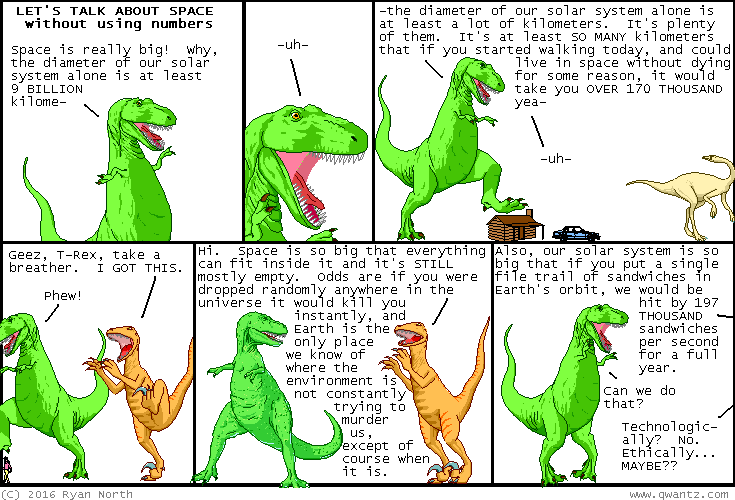
#82 Dinah the Aspie Dinosaur and the Empirical Evidence

by Dinah
08 Nov 12:19

[womenslib, hist, pols, curr ev] One Hundred Years

One hundred years ago today, a woman was voted into US Federal office for the first time: Congresswoman Jeannette Rankin, Republican, of Montana.

THE STATE OF MONTANA

To All who shall see these Presents--Greeting:

WHEREAS, It has been certified to me by the proper
authority that at a general election held on the first Tuesday
after the first Monday in November, 1916, the same being the
seventh day of said month,

MISS JEANNETTE RANKIN

was duly elected to the office of Representative-at-large in the
Sixty-fifth Congress from the State of Montana,

THEREFORE KNOW YE, That in the name and by the author-
ity of the State aforesaid, I do hereby certify that the said

MISS JEANNETTE RANKIN

was duly elected at the said general election a Representative-
at large in the Sixty-fifth Congress from said State of Montana 
for the term of two years, commencing on the fourth day of March,
nineteen hundred seventeen.

Photo of the election certificate of Jeannette Rankin, Congresswoman, first term.IN WITNESS WHEREOF I have hereunto set my hand and 
caused to be affixed the Seal of the State at 
the City of Helena, this the fourth day of 
December, in the year of our Lord one thousand
nine hundred sixteen, and of the independence 
of the United States the one hundred forty-
first.

[Signature]
Governor of Montana.

Representative Rankin was sworn in on April 2, 1917, along with the other Members of the 65th Congress, and
"When her name was called, the House cheered and rose, so that she had to rise and bow twice, which she did with entire self-possession."
That was probably the last time that happened: the occasion of the swearing in was an extraordinary session of Congress, called to address Germany's declaration of unrestricted submarine warfare on all Atlantic shipping, and Rankin, well, Rankin was an ardent pacifist. Less than four days later, in the wee hours of April 6, Rankin stood with 49 other members of the House and voted against the declaration of war with Germany. "I want to stand by my country, but I cannot vote for war." I honestly do not know if any Congressperson has ever made more enemies faster.

Rankin lost her bid for re-election. Somewhat amazingly, she ran again in 1940 and – you can see where this is going, right? You're not allowed to write fiction like this – won, so was in Congress, again, when the vote on the declaration of war with Germany, again, Japan came up.

She was the sole vote against entering WWII. History.com:
Rankin, however, believed that Roosevelt deliberately provoked the Japanese to attack because he wanted to bring the U.S. into the European war against Germany; she was determined not to cooperate with the president’s plan.
History.house.gov:
Rankin repeatedly tried to gain recognition once the first reading of the war resolution was completed in the House. In the brief debate on the resolution, Speaker Sam Rayburn of Texas refused to recognize her and declared her out of order. Other Members called for her to sit down. Others approached her on the House Floor, trying to convince her to either vote for the war or abstain. When the roll call vote was taken, Rankin voted no amid what the Associated Press described as “a chorus of hisses and boos.” Rankin went on to announce, “As a woman I can’t go to war, and I refuse to send anyone else.” The war resolution passed the House 388 to 1.

Condemnation of her stand was immediate and intense, forcing Rankin briefly to huddle in a phone booth before receiving a police escort to her office.
History.com:
When news of Rankin’s vote reached the crowd gathered outside the capitol, some patriots threatened to attack the Montana congresswoman, and police escorted her out of the building. Rankin was vilified in the press, accused of disloyalty, and called “Japanette Rankin,” among other impolite names. She stood her ground, however, and never apologized for her vote.
History.house.gov:
“I voted my convictions and redeemed my campaign pledges,” she told her constituents. “Montana is 100 percent against you,” wired her brother Wellington. In private, she told friends, “I have nothing left but my integrity.” The vote essentially made the rest of Rankin’s term irrelevant. Having made her point, she only voted “present” when the House declared war on Germany and Italy. She found that her colleagues and the press simply ignored her. She chose not to run for re-election in 1942 [....]"
Her Congressional career might be over, but she wasn't done working against war. History.house.gov:
During the Vietnam War, she led the Jeannette Rankin Brigade, numbering 5,000, in a protest march on Washington in January 1968 that culminated in the presentation of a peace petition to House Speaker John McCormack of Massachusetts. At the time of her death [at the age of 93], on May 18, 1973, in Carmel, California, Rankin was considering another run for a House seat to protest the Vietnam War.


Since Jeannette Rankin was elected, there have been a total of 278 women in the House of Representatives.[W] Forty-six women have served in the Senate, fourteen of whom were appointees. [W]

If all those women – if all the women who had ever served in the House or the Senate, in the one hundred years there have be women in Congress – had served simultaneously they wouldn't add up to the 388 Representatives in the Congress that Rankin defied in 1941, to say nothing of the 435 Representatives in Congress today, or the 535 total (House and Senate) legislators today.

That is to say that in 100 years of trying, we haven't elected enough women to fill even all the seats of a single year of Congress.

History.house.gov, as of August 1, 2016:
Since the U.S. Congress convened on March 4, 1789, 12,178 individuals have served as Representatives, Senators, or in both capacities.
Out of all Congressmembers, ever, 2.7% have been women. Perhaps that is unfair: women didn't serve at all for the first 127 years of the Congress of the United States. I don't quite know how to source the number of people who have served in Congress just in the last 100 years, but I'm comfortable, for blogging purposes, just going ahead and saying, sure, call it half. Obviously that's wrong on the side of generosity, because the number of seats in the House has gone up, but whatever. Round up even. Oooooh, six percent.

Perhaps that is still unfair – though perhaps not as unfair as taxation without representation – because now is not the past, and that just averages out the deplorable past with the enlightened present. So how are we doing today?

Wikipedia:
As of January 2015, there are 84 female representatives, or 19.3% of the body.

Women have been elected to the House of Representatives from 44 of the 50 states in the United States. The states that have not elected a woman to the House are Alaska, Delaware, Iowa, Mississippi, North Dakota, and Vermont—though Alaska, Iowa, and North Dakota have elected women to the United States Senate.
Also:
Currently, the 114th Congress has 20 female senators out of 100, the same number as in the 113th Congress.


Enough. Fifty-one seats in the Senate. Fifty-one percent of the House. Five seats on the Supreme Court.

And the Oval Office.
08 Nov 11:52

Tuesday Shouldn’t Change The Narrative

by Scott Alexander

538 predicts Hillary has a 65% chance of winning the election to Trump’s 35%. New York Times says it’s more like 84% Hillary and 16% Trump. Both sites agree both candidates will get somewhere between 40% and 50% of the popular vote, and that Hillary seems to lead Trump by 3%. The smart money is on Hillary, but at this point either major candidate could win.

Lots of things can happen tomorrow. Maybe it rains in Philadelphia, that city’s racially diverse and left-leaning voters stay home, and Pennsylvania goes for Trump, winning him the election. Maybe there’s a really good get-out-the-vote campaign among Hispanics, and Florida ends up being Trump 48 Hillary 52 instead of the projected Trump 52 Hillary 48. Maybe the Department of Agriculture announces that Hillary is under investigation for bringing exotic weevil species into the US, and the population turns against her en masse.

And someone is going to confuse this kind of stuff with deep insight into the state of the country.

In June 2016, Jon Wiener of The Nation wrote Relax, Donald Trump Can’t Win, about how the media is incentivized to make races look competitive but an understanding of political fundamentals proved that there was no way for Trump to actually make it.

On the other hand, a few days ago Scott Adams reiterated his long-standing prediction of a 98% chance Trump wins in a landslide.

I’m worried that one of these two things will happen on Wednesday:

Either Hillary wins, and everybody agrees that Jon Wiener and various other people like him were right, that the fundamentals made a Trump win impossible, that Trump was a random clown who never had a chance anyway, that the people who warned us to beware of Trump were crying wolf, that this proves that nationalism is a spent force in politics, et cetera.

Or Trump wins, and everybody agrees that Scott Adams was a genius, that Wiener was an idiot, that Trump is a brilliant “master persuader”, that this proves that the 21st century will be a century of renewed nationalist power, that the white working class is sexist, that elites need to realize the precariousness of their position within a democratic system, or whatever.

Imagine that the deciding factor really is a rainstorm in Philadelphia. There was a rainstorm in Philly, therefore nationalism is one of the great motivating forces in human affairs? It was a clear sunny day in Philly, therefore nationalism doesn’t matter anymore? The difference between nationalism being all-powerful and irrelevant is whether there was a cold front over the mid-Atlantic region?

But with a race this close, any deciding factor is going to be about as random as a rainstorm over Philadelphia. Maybe the pollsters made some kind of big mistake and missed shy Trump voters, and the vote goes Trump 47% Hillary 45% instead of the predicted Hillary 47% Trump 45%. So what? The difference between a proof of nationalism’s vigor versus proof its impotence is which candidate gets 47% vs. 45%? Really?

If a Trump victory tomorrow would convince you that X is true, I suggest that you believe X is true regardless of whether or not Trump wins, because Trump’s victory almost certainly will depend more on noise than on X. If a Hillary victory tomorrow would convince you that Y is true, I suggest that you believe Y is true regardless of whether or not Hillary wins, for the same reason. If there’s some Z that you will believe only if Trump wins but not if Hillary wins, then I suggest you seriously reconsider what thought process has led you to decide that you will flip your views on politics and society depending on whether or not there’s a rainstorm or a 2% polling error or whatever.

Instead, I suggest people precommit to their views on politics and society now. We live in a country and a world where Hillary can be at about 47% and Trump at about 45%. This is pretty much all you need to know. It suggests that a lot of people are willing to support a nationalist candidate, and a lot of other people really hate that candidate. It suggests that political fundamentals are totally compatible with a situation where either Trump or Hillary could win based on noise in the electoral process.

(unless the polls are totally wrong and one candidate somehow wins in a 20 percentage point landslide or something)

It also suggests that both Wiener and Adams were wrong to be so confident in their respective predictions. If either one is right, it will be mostly by luck. Wiener tells us to “relax” because Trump can never win, and maybe Trump doesn’t win, but the fact is that even if Trump loses we were one Hillary gaffe away from the opposite result and shouldn’t have relaxed at all. Adams says there’s been a 98% chance of a Trump win since last year, but the polls make it look a lot like Trump only has a chance at all because of the total coincidence of Hillary getting hit by a new FBI investigation two weeks before Election Day.

I already count both Wiener and Adams as having been proven wrong regardless of what happens tomorrow. Any further praise or condemnation launched at one or the other after the election is just interpreting noise, or at least a signal so subtle that it might as well be.

If both Wiener’s extreme pro-Hillary prediction and Adams’ extreme pro-Trump prediction are bad, what would a good prediction look like? In January of this year, I predicted that, conditional on Trump winning the Republican primary, he would have a 20% chance of winning the election. Well, Trump won the Republican primary. And today, the day before the election, the prediction markets give Trump’s chance of winning as 17.9%.

If Trump wins anyway, I’ll have egg on my face and it’ll look bad when I grade my prediction accuracy next year. But I don’t think I would fundamentally update the way I think about America or the way I make predictions. No prediction can account for every rainstorm. I think I got the fundamentals right, and if I end up losing on noise I can at least take solace in knowing that is soon to be the least of our problems.

EDIT: I agree the election results can obviously change the future! Maybe if Trump wins he’ll enact nationalistic policy that will make people more nationalist. But the results shouldn’t change our interpretation of existing trends.

07 Nov 01:31

On democracy and dull politics

by Nick

Spot the tweeting councillor (picture via Colchester Chronicle)

Spot the tweeting councillor (picture via Colchester Chronicle)

Walking home from the Council meeting on Thursday night I was struck with the initial idea for this blog post. The agenda for Wednesday’s meeting was a pretty light one- the one big contentious motion had been withdrawn from the agenda, so the only things we’d be voting on would be a set of policies that had been reviewed at the last meeting of the Governance and Audit Committee. The Governance Committee is no one’s idea of a glamorous assignment within the Council, dealing as it does with looking at the council’s internal policies on areas such as health and safety, risk management and ethical governance, as well as approving the audit procedures for the Council’s accounts. Apart from those times when it has to decide on any complaints about councillors, it’s usually the committee that has the least number of journalists writing about it or members of the public speaking or attending.

Which is nothing unusual. Almost any democratic system has something like the Governance Committee within it, and it’s likely to be one of the dullest parts of that system, as its main work is reviewing procedures and checking they’re right, again and again, and no matter where the system is, there are normally lots of procedures that have to be reviewed to check they’re working correctly, and none of them ever make headlines until they go wrong, at which point everyone demands to know why they weren’t working properly. (The answer to that is often ‘we wanted to review them, but you said it was too dull’)

The point is that these sort of items on the Council agenda might seem dull and pointless to the social media peanut gallery but they’re an important part of actually running a democratic organisation. Yes, they’re dull, but there’s a case to be made that you should be glad they’re dull because when basic issues of how everything is run become contentious and the focus of angry debates, you’re likely wandering into the space where the operation of democracy is having some problems.

Which is just about where I’d written this post in my head, probably to be consigned to the ever increasing file of things I don’t have the time to write up and post. Then we had the last day and a half of the ongoing clown car crash into a dumpster fire that is British politics in 2016. Just when you think we can’t limbo down any further in our attempts to show the world just how degenerate we’re becoming, we now have newspapers damning High Court judges as ‘enemies of the people’ because the tabloids have a set of creeping fascism bingo cards and they’re determined to cross off every box on them by Christmas. Even by the standards of this year, watching judges be criticised for upholding the power and sovereignty of Parliament against an executive wanting to use power unchecked is utterly bizarre, and even more when it’s coming from people who normally find it hard to say twenty words without shouting ‘Magna Carta!’

Without wanting to sound so jumped up on my own self-importance that I compare myself to a High Court judge, it strikes me that there is a common root to Wednesday’s yawns of boredom and Thursday’s howls of rage. Democracy, at its heart, is a collection of systems and processes and rules that can be applied objectively ranging from the national constitution right down to the question of how a council selects its auditors. The point of the rules is to ensure that power is not exercised arbitrarily, that there’s a body of rules – the law – we can all point to as the agreed way things will be settled. Now, we might (and often do) disagree on what those rules are, and what things they might apply to, and we might disagree about how those rules are defined and who gets to write and review them, but one of the benefits of having had this system for a long time is that we’ve come up with rules to help determine how we deal with these disputes. Sometimes we decide them through elections, sometimes we decide them through taking them to a court, but they’re all part of the same overall process of democracy.

It strikes me that one of the reasons people are getting so angry about judges doing their jobs is that we’ve forgotten that democracy isn’t an event, it’s a system and a process. ‘We had a vote, it’s been decided, that’s democracy!’ and the like get repeated ad nauseam at the moment as though all that matters in democracy is the voting, not the rest of system that surrounds the voting, or the reasons we have regular and repeated votes in the first place. the world is a complex place, and decisions can rarely be reduced to simple binary choices with no further consequences. Sure, there are other ways to deal with that complexity other than complex democracy but they all tend to mean getting rid of an agreed upon set of rules in favour of making decisions by the arbitrary fiat of a small group or individual, none of which have been more successful in dealing with the complexity of the world than democracy.

It all comes back to another part of Wednesday night, in the public Have Your Say section. One of the people talking there was Autumn from a new group called Teen Speech, wanting to get more political education into schools, and to give young people the skills and knowledge they need to understand how the system actually works. We’re very good at telling the world how wonderful our democracy it is, but very very bad at actually making sure people who live here understand how it works and what it means. Democracy needs an informed population who understand what’s going on to work properly, and too much of what happens – not just over the last few months, but throughout my life – shows that we don’t have that. And yes, learning about how the government works can be dull, but I’d be much rather be living in a time when things are dull because they’re working fine than incredibly interesting because everything’s collapsing all around us.

07 Nov 01:31

Bitcoin/Blockchain book page and sample.

The book progresses. Current total: 17,472 words of body text. My target is about 500 usable words a day, so today I have to top 18,000. I expect it to make 20-25,000, at which point it gets edited and will probably end up 15-20,000. Amazing how much work one can put into a Kindle Short.

If you want to watch my ranting progress, it's on Tumblr with bits on Facebook. Here's a rough outline and to-do list.

I have a rudimentary page up for the book, with rough draft excerpts!

(it'll also probably end up actually for real being called "Attack of the 50 Foot Blockchain" because I was sitting in bed with [personal profile] arkady, who is an artist and got all inspired with pulpy cover art ideas. I may even need to do a pulp cover and a sober business cover.)

Answers to Frequently Asked Questions

A. Sadly, Amazon Kindle only accepts conventional currencies.


The DAO

You just learned chemistry and the first thing you built was a giant bomb and you can't understand why it blew up in your face.

– brockchainbrockshize, /r/ethereum1

Not content with their existing sales of Internet fairy gold, some Ethereum developers at German blockchain startup Slock.it came up with an even more complicated scheme: The DAO (a Decentralized Autonomous Organization, with “The” as part of the name). This was a program running as a smart contract on Ethereum which would take people’s money and give it to projects voted on by the contributors as worth funding: a distributed venture capital firm.

The DAO’s Mission: To blaze a new path in business organization for the betterment of its members, existing simultaneously nowhere and everywhere and operating solely with the steadfast iron will of unstoppable code.2

Bold in original. I’m sure there are no obvious problems there that jump right out at you.

The DAO launched on 30 April 2016, got massive publicity and became the biggest crowdfunding in history, with over $150 million in ETH from 11,000 investors. Fourteen per cent of all Ether was in The DAO. It was also the most prominent smart contract of all time, achieving much mainstream press coverage. It proceeded to illustrate just about every potential issue that has ever been raised with smart contracts.

The DAO’s legal footing was uncertain (and widely questioned). Selling tokens in The DAO closely resembled trading in unregistered securities – particularly when DAO tokens themselves hit cryptocurrency exchanges – and the SEC had come down on similar schemes in the past. There was no corporate entity, so it would default in most legal systems to being a general partnership, with the investors having unlimited personal liability, and the creators and the designated “curators” of the scheme likely also being liable.

Shortly before the go-live date, researchers flagged several mechanisms in the design of The DAO that would almost certainly lead to losses for investors, and called for a moratorium on The DAO until they could be fixed.3

Worse, on 9 June a bug was found in multiple smart contracts written in Solidity, including The DAO: if a balance function was called recursively in the right way, you could withdraw money repeatedly at no cost. “Your smart contract is probably vulnerable to being emptied if you keep track of any sort of user balances and were not very, very careful.”4 This was not technically a bug in Solidity, but the language design had made it fatally easy to leave yourself wide open.

The principals decided to proceed anyway, Stephen Tual of Slock.it confidently declaring on 12 June “No DAO funds at risk following the Ethereum smart contract ‘recursive call’ bug discovery”5 … and on 17 June, a hacker used this recursive call bug to drain $50 million from The DAO. And nobody could stop this happening, because the smart contract code couldn’t be altered without two weeks’ consensus from participants. The price of ETH promptly dropped from $21.50 to $15.

(Tual posted on 9 July a hopeful list of reasons why the attacker might just give all the ether back, just like that. Because it would be in their rational self-interest.6 This didn’t happen, oddly enough.)

Ethereum Foundation principals discussed options including a soft fork or a hard fork of the code or even of the blockchain itself, or a rollback of the blockchain. The community wrangled with the philosophical issues: this contract had been advertised as “the steadfast iron will of unstoppable code,” but it appeared only one person had read the contract’s fine print in sufficient detail.7 Some seriously debated whether this should even be regarded as a “theft”, because code is law and intent doesn’t matter (unlike in real-world contracts operating in a legal system, or indeed in fraud law). Others merely argued that the integrity of the Ethereum smart contract system required that incompetent contracts, which The DAO certainly was, needed to be allowed to fail.

(The proposed soft fork solution was to blacklist transactions whose result interacted with the “dark DAO” the attacker had poured the funds into. This would have been an avenue for a fairly obvious denial-of-service attack: flood Ethereum with costly computations that end at the dark DAO. This approach could only have worked by first solving the halting problem.8)

The DAO was shut down soon after, and on 20 July the Ethereum Foundation — several of whose principals were curators of The DAO9 and/or heavily invested in it — changed how the actual code Ethereum runs on interpreted their blockchain (the “immutable” ledger) so as to wind back the hack and take back their money. The “impossible” bailout had happened.

This illustrated the final major problem with smart contracts: CODE IS LAW until the whales are in danger of losing money.

Ethereum promptly split into two separate blockchains, each with its own currency – Ethereum (ETH), supported by the Ethereum Foundation, and Ethereum Classic (ETC), the original code and blockchain – because this was too greedy even for cryptocurrency suckers to put up with. Both blockchains and currencies operate today. Well done, all.

Apologists note that The DAO was just an experiment (a $150 million experiment) to answer the question: can we have a workable decentralized autonomous organization, running on smart contracts, with no human intervention? And it answered it: no, probably not.


1 brockchainbrockshize. Comment on “Attacker has withdrawn all ETC from DarkDAO on the unforked chain”. Reddit /r/ethereum, 25 July 2016.

2 The DAO front page, archive of 22 June 2016. Yes, that’s after the hack. The page doesn’t say that any more.

3 Dino Mark, Vlad Zamfir, Emin Gün Sirer. “A Call for a Temporary Moratorium on The DAO”. Hacking, Distributed (blog), 27 May 2016.

4 Peter Vessenes. “More Ethereum Attacks: Race-To-Empty is the Real Deal”. Blockchain, Bitcoin and Business (blog), 9 June 2016.

5 Stephen Tual. “No DAO funds at risk following the Ethereum smart contract ‘recursive call’ bug discovery”. blog.slock.it, 12 June 2016. (archive)

6 Stephen Tual. “Why the DAO robber could very well return the ETH on July 14th”. Ursium (blog), 9 July 2016. (archive)

7 There’s an amusing (if probably just trolling) open letter purportedly from the attacker posted to Pastebin (archive) that makes this claim explicitly.

8 Tjaden Hess, River Keefer, Emin Gün Sirer. “Ethereum's DAO Wars Soft Fork is a Potential DoS Vector”. Hacking, Distributed (blog), 28 June 2016.

9 Stephen Tual. “Vitalik Buterin, Gavin Wood, Alex van De Sande, Vlad Zamfir announced amongst exceptional DAO Curators”. blog.slock.it, 25 April 2016.


comment count unavailable comments
06 Nov 23:48

GEORGE HARRISON – “My Sweet Lord” (2002 re-issue)

by Tom

#918, 26th January 2002

mysweetlord “They get to that age and they don’t need the operator any more. They’ve got the direct line.” – Father Ted.

Singing about going to be with God – about death and beyond – is a grand old hymnal and gospel topic. For those mired in trouble, misery and oppression, it’s one of the most powerful statements you can make: this world is not all there is. George Harrison, in 1970, was not mired in those things, no matter how high Mr Wilson and Mr Heath set their marginal tax rates. And he knew it – the original “My Sweet Lord”, written by a newly free singer on top of his professional world, is a surge of multi-faith ecstasy. Backing singers and the Chiffons come together – willingly or not – to take the strain off Harrison’s voice, and he builds a bridge to the hereafter out of a slide guitar solo.

Thirty-two years later, Harrison’s in the grave, and his song is at number one again. It comes reissued on a CD single with the original “My Sweet Lord” as the lead, but also a re-recording – “My Sweet Lord (2000)”. Laid down between the stabbing that didn’t kill him and the illness that did, it’s worth hearing and thinking about.

But first, the original, since that’s what the radio stations and music shows played. It’s not the last posthumous number one, but it’s the last number one single bought in direct response to a death: the modern way of mourning is to pile the chart with different tracks, like bouquets at a dead star’s gates, and it seems just as apt. “My Sweet Lord” is the final time a record company gets to dictate the terms of remembrance. (It’s also the last solo Beatle number one, though it takes more than this to banish their shade entirely.)

It was the obvious choice, and the right one, though it’s ironic that the most grimly private Beatle got the most communal and vigorous of send-offs. When your colleagues number a martyr, a beloved raconteur and voice of kids’ TV, and pop’s smiling omnipresent Dad, it’s tough to escape from the role you’d been put into for forty-odd years. The Quiet One. The Intense One. The Religious One. The One Who Did The Sitar Stuff. (A lick of sitar introduces “My Sweet Lord (2000)”, a rueful nod to the brand image.) “My Sweet Lord” was Harrison’s try at alchemising all that into a pop classic entirely his own, and it worked. At least until the lawyers called.

Why revisit it? Like a lot of people attracted to mysticism, Harrison was always aware of, and always tempted by, worldly accounts that needed settling. Wikipedia offers several reasons, which all sound appropriate: he wanted to reassess its statement, he wanted to get a better slide guitar solo down, and he wanted to show that the song is great even without the bits he swiped. It isn’t as great, if I’m honest, but he makes the point. What’s remarkable about the re-recording, though, is his singing on it: he turns it away from a young man’s cry of revealed bliss, and makes it an old person’s song, perhaps the first we’ve had on Popular.

It’s querulous, vulnerable, the sound of someone approaching God but not quite making his peace with Him. When he sings “I really want to go with you” you can hear the “but” coming, and it’s not an impatient one. This time the song starts as negotiation, not declaration – and this time the backing vocalists sound like they’re there to stiffen his resolve. With their support his vocal turns enthusiastic, becomes an affirmation again. And this time, when he builds that bridge of slide guitar, he crosses it.

06 Nov 21:35

My Electoral Prediction, 2016

by John Scalzi

Here is the map I think is going to happen on Tuesday night, the one that carries Hillary Clinton to electoral victory and Donald Trump into heaving fits of frothing denial. I think it’s a realistic map (I also made pessimistic and optimistic maps, which I will show you a bit later), although I’m happy to concede that at least a couple states here are teetering, and a couple could go red and at least one could go blue. But to be honest I would be surprised if it varies too much from this map.

As ever, it seems, the key to whether Clinton supporters can breathe early or settle in for a long, anxious night will be Florida. If Clinton wins Florida (as I expect she will), then it becomes virtually impossible for Trump to win the election. If Clinton loses Florida but wins North Carolina, once again Trump is in a very difficult position.

None of this is news, of course; despite constant Clinton supporter panic over the months, Clinton has always been in the lead and Trump has always been the underdog. There are rather more ways for Trump to lose than Clinton. Clinton in fact can lose Florida and North Carolina and even New Hampshire, and still win, as evidenced by this pessimistic version of a Clinton victory map:

This isn’t a very happy map for Clinton supporters, since it will leave the Trump supporters howling and possibly riotous on Wednesday, but 270 is what you need, and this map gives it. And again it also illustrates Trump’s bind: He’s got a hell of an uphill climb to victory.

Having now just given the Clinton supporters here angina with this worst case scenario map, here’s what I think is the most optimistic Clinton map, short of a stunning blowout repudiation of Trump and the GOP, which to be honest I don’t see happening:

In addition to moving Ohio and Arizona into the blue, this map also gives Utah to Evan McMullin, a thing I currently find unlikely but not impossible given the general LDS dissatisfaction with Trump. Clinton fans would love to have Trump and McMullin split Utah and have her go right up the middle for the win, but, folks, listen to me: It’s okay to settle here. A McMullin win still deprives Trump of electoral vote oxygen.

I’ll note that my own “realistic” map is more optimistic in terms of Clinton electoral votes than either FiveThirtyEight (which as of 8am this morning, has Clinton at 292.5) or the Princeton Election Consortium, which has her at 312. In both cases, however, it’s important to note that they both have Clinton taking the election. At this point in time, there is basically no reputable estimator or poll aggregator that doesn’t have Clinton ahead in the electoral vote count.

Can Trump win? If you take my “pessimistic” map and give him Colorado or Wisconsin, then he can win outright. If he wins neither but takes Nevada (which after this week’s surge in early voting seems unlikely to me, but 538 still has it leaning red), then it’s an electoral vote tie, and the election goes to the House of Representatives, which realistically means Trump wins. It’s possible Trump wins. It’s also unlikely.

I feel pretty confident Clinton’s going to take it, but if you’re a Clinton supporter and still feeling edgy, I’m okay with that, too. Get out there and vote, and take all your other Clinton-friendly (or at least Trump-unhappy) friends with you. And while you’re at it, remember to vote Democratic down ballot as well. As I’ve noted before, Trump’s not the only problem here.

Again: Don’t panic, but don’t take anything for granted. When Trump loses — and I’m pretty sure he will lose — he’ll whine and complain and stomp his feet and continue to suggest the vote is rigged. He’s already doing that, complaining that the perfectly legal policy of letting people already in line when a polling time passes actually cast their vote constitutes “rigging,” rather than ensuring citizens their ability to exercise their right of franchise. If the vote is close, you best believe Trump, his people and the GOP are going to work the refs. So better if Clinton wins walking away.

That being the case, you know what to do: Vote, and this year, vote Clinton.

(Maps made with Vox.com’s electoral map maker: Click here to make your own map.)


04 Nov 22:17

The Cubs, the 108-Year-Long Streak, and Old Man’s War

by John Scalzi
Photo by Arturo Pardavila, used under Creative Commons license. Click on photo for original.

This year, as the Chicago Cubs came closer and closer to winning a World Series, people wondered what that might mean for the Old Man’s War series of books. After all, in several places I had people in the books discussing the Chicago Cubs and their inability to win a World Series, and in The Human Division, it’s actually a plot point. So what happens to those books, now that the Cubs, after 108 years, have won a World Series?

Well, you know. In one sense, nothing. The books are fiction, take place in the “future” and in a multiverse where space travel isn’t actually traveling in space, it’s traveling from one universe to another, where things are (usually) just one electron position different. So now either the events of the Old Man’s War series have been pushed further out in the timestream, for at least another 108 years (or so), or we’ve just become a universe so improbable that it’s unlikely the events of the Old Man’s War book will ever happen in it, but those events continue, about a billion universes to our left.

Which is it? You choose, either is valid.

As a practical matter, mind you, I think the plot points still work, they just got more meta. Now readers in North America, at least, are aware that the long suffering of Cubs fans has come to a close, and will enjoy the presence of the plot point on that grounds (or if they’re Cleveland fans, not). Readers will hit those points in the books, enjoy the slight bit of cognitive dissonance, and then move on.

But of course, with all those assertions above, it’s possible I might be rationalizing just a tiny bit. In which case, yup, it’s time to come right out and admit it: Now the Old Man’s War books suffer from the same problem as all the science fiction stories before 1969 that named a first man on the moon, or the ones that imagined canals on Mars. The real world caught up to them and passed them by, waving as it did so.

And that’s okay. This is the risk you take when you put a plot point in your books that’s contingent on the real world. It is the fate of science fiction books and other media to be continually invalidated by real-world events, or at least, to have the real world catch up to it and then have the work, by necessity, consigned to a nearby but undeniably alternate universe. This had already happened to the Old Man’s War series in a small ways (no one calls hand-held computers “PDAs” anymore, but the folks in the OMW series do, because that’s what they called them in 2001, when I wrote the first book), and in larger ways for other books of mine. Agent to the Stars, for example, has a plot point involving an elderly Holocaust survivor. In 1997, when I wrote that book, that was still a reasonable thing. Today in 2016, it’s a pretty long stretch. In another ten years, Agent to the Stars will undeniably take place in the past, in an alternate universe.

The real world catches up to science fiction. It always does.

But it doesn’t always kill the book (or film, or whatever), thankfully. 1984 is still read despite the titular year now being more than 30 years in the past; we watch 2001 despite us not having moon bases or monoliths at the moment; people still enjoy the various Star Trek television series despite the fact the communicators in each iteration are laughably less complex than a smart phone today. People seem to get that science fiction stories have plot points and details that expire, or, at the most charitable, “go meta.”

I suspect that will be the fate of the Old Man’s War books. The Chicago Cubs in that universe are a plot point, but a minor one overall. I don’t expect that many people will decide that the Cubs continuing to be lovable losers there will be the thing that throws them entirely out of suspension of disbelief. And if it does, I mean, okay? Their life. Everyone else will either push out the timeline, enjoy the meta moment, or, alternately (and especially if they’re not baseball fans), not care. I think the books will survive, is what I’m saying.

In the meantime, congratulations to the Cubs and all their fans. As someone who attended college in Chicago, this is lovely moment; as someone who now lives in Ohio, this is a disappointment; and as someone who grew up in Los Angeles, I stopped caring one series back. No matter what, however, having the Chicago-Cleveland series decided in the tenth inning of a game seven is just about perfect. It could not have been written better.

I’ve gone on the record in years past saying it’s more existentially satisfying for the Cubs to keep losing than to ever win the World Series — they crown a World Series winner every year, after all, but no one else has a 108-year-long streak of futility to their name, with the potential to add to it every season. Streaks like that don’t come around every year, or even every century. Seems a shame to throw something like that away on mere winning. But, you know what? Right now, there’s not a single Cubs fan in the world, living or dead, who agrees with me, if indeed there ever was. That’s fair enough. I hope they all enjoy their moment of winning, and the end of the long, long, long losing streak. The Cubs earned it.

And, also, if they ever make a TV series or a movie series out of the Old Man’s War books, Chicago in the text will be replaced by Cleveland, and it will still work. Sorry, Cleveland. You know I love you.


04 Nov 22:15

[gastronomy, pols, hist] Currant Events in American Electoral Politics

(h/t Metafilter; paging kelkyag, fabrisse, & ladysprite)

Ye gods, we've been doing it all wrong. From Bon Appétit:
After the [American] Revolution, the women brought [militia muster] cake to early voting sites to help “muster” votes, and it became known as election cake. Back in those days, when elite white men were the only ones who could rock the vote, women claimed their place in political culture with a monstrous cake for the masses. And while it's hard to believe now, in the late eighteenth and early nineteenth centuries Election Day was a holiday just as important as Christmas, and food was central to it. Bonfires, barbecues, whiskey, and cake helped to amplify the revelry and encourage voting. Whiskey, cake, and voting, an American tradition we can get behind.
What is WRONG with us?! WHY DO WE NOT DO THIS?!

I... wait: is it even legal to bring a booze-soaked cake into a polling place in Cambridge, MA (anymore)? What if we claim it's historical re-enacting?

Also, note that women would not just bake these out of the goodness of their hearts. Cities and towns commissioned these cakes. (Is it even legal for the city to give away booze to encourage participatory democracy?)

There's a movement: Make America Cake Again.

Lots of links with history and recipes.
02 Nov 19:53

FREE CANDY IS BETTER THAN THESE TRADITIONS, THAT'S RIGHT I SAID IT

archive - contact - sexy exciting merchandise - search - about
← previous October 31st, 2016 next

October 31st, 2016: AH NO THE TERROR HAS RETURNED; THIS IS AS UNEXPECTED AS IT IS TERRIFYING!! SORRY, I'M SORRY

– Ryan

02 Nov 19:52

NO, I didn't "VANDALIZE ANY NON-CHICKEN ARTICLE". GOSH.

archive - contact - sexy exciting merchandise - search - about
← previous November 2nd, 2016 next

November 2nd, 2016: Welcome to November! In this month sometimes people grow mustaches. ENJOY

Also: I'm in Leeds! Are you coming to the Thought Bubble convention happening THIS WEEKEND and also RIGHT NOW?? I sure hope so because it's gonna be GREAT.

– Ryan

02 Nov 14:01

I Am Not A Good Person

by Tim O'Neil
-->

Part Three of an ongoing series. Catch up with parts One and Two.
If you like my writing, please consider a donation to my Patreon.


I’m mean. I’m petty. I fly off the handle at the smallest provocation. I antagonize people who have done nothing to earn my antagonism. I nurse grudges and remember every specious imagined slight. I am passive-aggressive and casually cruel to the people around me. I try my best to not do these things but I feel that I am never in control of my emotions.

That’s what I used to believe about myself. This was the person I thought I was and the face I presented to the rest of the world. I believed with all my heart that I was a terrible person. I didn’t want to be but I felt helpless to change. I accepted it as a given that there was something wrong with me.

 
It made sense that this was happening. I saw nothing wrong because while I hated my situation I hated myself more. I saw no value in myself. I was a drag on the people around me, someone whose presence was never accepted but tolerated.

That’s not how I see myself anymore, entirely. I can’t answer the question of whether or not I am a good person. Given my circumstances and limitations, I try my very best. I fall short. I feel like I fall short more often than not, especially now given the stress of transition. There are more opportunities to get it wrong. Hopefully going forward I’ll understand where I got it wrong and avoid repeating the same mistakes.

Negative moments have a way of sticking around where positive events dissipate. I remember bad things I’ve done, people I’ve wronged (intentionally or far more likely unintentionally), people I’ve insulted (usually but not always unintentionally), people I’ve inconvenienced, people who dislike me for reasons I don’t know but I can hazard a guess, people who dislike me for unknown reasons. For every casual acquaintance in my life I have a mental folder two inches thick filled with incriminating evidence of my social awkwardness. I don’t go out much anymore because every social interaction is an opportunity to embarrass myself.

Talking about the past is difficult. Disentangling what I remember from what happened is unsettling. I remember myself being awful. Other people remember differently. Casual acquaintances remind me of nice things I’ve done or said over the years, small gestures of kindness or generosity that revealed my character. It’s not that I don’t believe what people tell me. I don’t remember.

Disassociation is a coping mechanism. I refined it into art for decades, years spent putting on a mask and trudging forward blindly through each emotionally fraught and perilous situation. Eventually every situation was categorized as “emotionally fraught and perilous.” I was always disassociating. It became habit, and after that it became reflex. Especially in a crisis, people often tell me I can be distracted to the point of obliviousness, despite doing the minimum of what is required. I’m not even on the same planet.

When I say I don’t remember doing nice things for people, I mean it quite literally: I cannot remember most of the nice things people tell me I have done. I remember things I did out of obligation, out of resentment or duty, out of boredom or anger, but I have trouble remembering even the simplest gestures of kindness. Imagine looking behind you and seeing only negative emotions. What positive emotions you keep are a source of embarrassment. You feel guilty when people do nice things for you and are unhappy when people give you compliments. Doesn’t everyone feel that way?

(If you do I’m profoundly sorry. You do not suffer alone.)

I have a RateMyProf page. It’s hurts to look. Not because my students are mean – quite the opposite. My comments are laudatory. People go out of their way to say wonderful things about me. Rather than enjoying the praise it makes me uncomfortable. It makes me extraordinarily unhappy. Teaching is one of the few things I consider myself to be actually good at. I enjoy doing it and usually get a good response, even if my pedagogy can be unusual. Nevertheless whenever I see the ratings and students’ very sweet comments I want to turn away. 

For some unspecified reason it hurts that people think I’m good at my job – because all I see when I look back is the ways I’ve failed and fallen short. My frequent lateness, my procrastination with grading, my inability to complete even the simplest tasks on time. I adapt the persona of the absent-minded professor to cover my lapses, but it’s not really a persona. My memory doesn’t work right and I often need two or three reminders from students before putting up the homework. How is this the behavior of a good teacher? 

(Every teacher does these things sometimes. We’re only human.)

It’s important to remember: I wasn’t just in the closet hiding from the rest of the world, I was in the closet even from myself. It’s a very small closet where even the slightest movement can topple the heap of accumulated mental clutter – what happened to me. In order to maneuver in such a tricky space, you learn to move with economy. You bend yourself backwards. Good things – even extraordinarily good things, such as luck or achievement or even romance – can’t be interpreted correctly. The wires don’t work right, and every opportunity to feel a positive, honest emotion is diverted. Good luck makes me anxious instead of grateful. Achievement of any kind makes me question my worth, and I live with a case of imposter syndrome so severe I am in essence running out the clock on graduate school before they realize I’ve been deceiving them for six years. Love makes me doubt either the sincerity of the affection, or worse, fills me with doubt as to the reliability of my friends and family. If they like me, what’s wrong with them?

To return to the first question: I don’t know whether or not I’m a good person. I feel very deeply that I am not. That I am all those things I listed at the beginning of the essay, and more – hateful, petty, manipulative, forgetful, self-serving, incompetent, untrustworthy. Yet the evidence does not completely support this narrative. 

How do you know if you’re a good person? It is in this instance a practical question. If you already have grounds to suspect that your memories are being edited by disassociation, the question becomes terrifying because suddenly you don’t know what matters more: acts of cruelty to yourself or acts of kindness to others. The reason you don’t know is that you don’t trust your memory.

Being chronically unhappy distorts your perceptions. Anyone who has experienced serious depression knows the sensation of fighting a treasonous brain hell-bent on clinging only to the most upsetting recollections. Unhappy memories linger in anyone’s brain, but never have leave to rest in that of a depressive. 

(I suspect most people live with more depression than they realize, or admit, but that’s pure bias.)

There is also the complication that transition, as much as we may want or be able to control the outcome, entails inconvenience for many and serious trauma for a few. The people in our lives are hurt. It’s unavoidable, whether or not it’s a “fair” reaction for them to have. People respond to change poorly. We feel genuine anguish when our actions hurt other people. The problem, and most people who remain in your life eventually realize this, is that the ultimatum driving the change is life or death.

Having a poor self-image is a part of depression. It distorts your thoughts. You can’t trust your own reactions because your memory has selected only the worst instances for comparison. The worst social mistakes or intimate faux pas you have ever committed are never far from your thoughts. You are intensely self-conscious. Your actions seem labored, strangled – people are uncomfortable around you sometimes even if they may not know why. You wear on people. You come to regard it as a kind of sour-milk smell baked into your soul. 

Under these circumstances, it is extraordinarily important not just to be able to ask yourself whether or not you are good, but to be able to understand and accept the answer. It’s also extraordinarily difficult. Perhaps the best way to ensure that you are a good person is to surround yourself with good people. You see the person you wish to be reflected in the faces of the people you love. 

Part Three of an ongoing series. Catch up with parts One and Two.
If you like my writing, please consider a donation to my Patreon
02 Nov 13:56

Autistics Speaking Day 2016: Affirmations For You

by feministaspie

(This post is for Autistics Speaking Day 2016 – check out the Autistics Speaking Day blog for loads of other contributions though out the day!)

My ASDay posts (and posts in general…) often just consist of me talking about myself, which is kind of tricky given that I’m supposed to be anonymous, so today I’m going to talk about you.

If you think you belong here, you belong here. If you don’t have a formal diagnosis, or if your diagnosis was lost or left in limbo by a mess of bureaucracy, you still belong here. If people don’t take your autism seriously, you still belong here. If you’re actually feeling pretty good right now, you still belong here.

You don’t need to feel guilty because you’re actually feeling pretty good right now. You don’t need to feel guilty because you’re not in a good place right now. You don’t have to feel guilty because the ways you respond on bad days don’t even make sense to you in hindsight on good days. You don’t have to feel guilty because you could do something one time and you couldn’t do it some other time. It doesn’t mean you’re fake, it means you’re human and subject to a multitude of other contextual factors.

You’re not just attention-seeking (and who decided seeking attention was such a bad thing anyway?), you’re not just running away from ~the real world~ (this IS the real world), and you’re not just trying to be a special snowflake (er, whatever that means). You’re autistic, even if you don’t fit pre-conceived neurotypical ideas of what autism is.

It’s okay to be uncomfortable with the latest TV show/film/book/whatever about autism. It’s okay not to like it or relate to it even if you don’t find it outright offensive. It’s okay to feel alienated by the version of autism that’s presented to us by neurotypical-led media. Again, it doesn’t make you fake or a Bad Autistic Person. At the same time, it’s okay to enjoy the representation while you can, to find solace in seeing someone vaguely like you even if it isn’t perfect.

The way you experience the world is real. It’s not over-reacting, it’s not wrong or weird or weak, it’s autistic and valid and real. Sometimes, the world can be downright scary, and this is especially difficult when the people around you don’t think it’s scary, they don’t recognise that you might feel differently (and they say we lack empathy?) and you’re left facing it alone because voicing your fears gets you judgement rather than support. It’s still just as real. But you’ve got this. You’ve made it this far, you’ve more than likely felt this way before, and you can survive again.

It’s okay to retreat sometimes, to focus on recovering from the constant overload, to take care of yourself. Abled people like trying to frame this as weakness or inferiority, but you’re only trying to achieve the same level of comfort that they have all the time in this society that was designed specifically with them in mind. It’s okay to be angry – there’s a hell of a lot to be angry about. But it’s also okay if you can’t fight back all the time. It’s okay if you have to choose your battles.

You are strong and kind and brave and capable and deserving of love.

And your special interests are amazing too!


30 Oct 21:42

Future Tense

by Cicero
I think the major shock about the UK vote to leave the EU was the transformation in British culture that the vote seems to represent. From having been in the vanguard of the global economy and the globalized society, the UK seems to have rejected much of what it seemed to stand for. The aftermath of the vote- racist statements, racist attacks and all seemed to have turned the conventional wisdom about Britain on its head. The country was not as open or tolerant or globalized as it purported to be. This is despite the fact that a significant faction of the Leave campaign believed that the the problem with the EU is that it is not globalized enough. The reality is that whatever the Libertarians amongst the Leave camp thought they were getting, it is now all too clear that the isolationists, not the globalizers, are the big winners from the vote... at least so far.

If Brexit is a process, not a destination, as we are now being told, then it is still totally unclear what the destination might be. One nasty shock for the incoming May government has been that the option that would probably be accepted by the majority of the the UK- a kind of associate membership of the EU, via either the EEA or some kind of bespoke agreement- now looks by far the most difficult solution to bring off. The confrontational attitude adopted by the UK government has met its match in the Juncker Comission, which has wasted little time in inflicting as many petty humiliations on the new PM as possible. The appointment of Michel Barnier as the Commission's negotiator was the first, followed by the repeated cold shoulder to the UK at every meeting, including forcing Theresa May to wait until 1 am to address the meeting of the European Council. I suppose we can hardly blame the Commission for taking the hump against the UK, particularly since it reflects the deep anger that many governments feel about what the UK is trying to do. As Xavier Bettel, the Luxembourg Prime Minister Minister puts it  "Before they were in and they had many opt-outs; now they want to be out with many opt-ins." 

Meanwhile Conservative blow-hards, such as Bernard Jenkin, insist - with precisely no evidence- that a total withdrawal from all form of EU collaboration was what was voted for on June 23rd. 

The choice is becoming stark: national humiliation as we create mayhem in much of our economy and face a serious and prolonged economic crisis through breaking all ties to the EU, or national humiliation as we seek to reverse the decision taken on June 23rd. As the storm clouds gather, there are more than a few people in London and in Brussels who believe that the UK may indeed change course. The Conservatives have sought to own Brexit, but now it is clear that whatever Brexit does in fact mean, it is bad and the Tories will get the blame. The big swing in Witney and the likely gain of Richmond Park is putting the Lib Dems back on the map, and despite the current high poll ratings for the Conservatives, the reality is that these leads could be very shallow indeed. 

Yet despite the growing economic and political storm in London, we can not ignore the abject failure of the Juncker Commission. The hapless former Premier of Luxembourg has now presided over the debacle of Brexit and the seeming collapse of CETA with Canada. This second failure is possible of even more moment than the first. The fact is that the crisis in CETA speaks to the very worst paralysis of the EU, and a failure to ratify would demoralize even the most fervent defenders of the Commission. Whereas the Commission has little choice but to be reactive to the UK, they have proven unable to be proactive to address the problems with CETA ratification. Clearly this bodes very badly for the far more complicated discussions to come with the UK. The fact is that the Commission may not be able to deliver any kind of soft Brexit- regardless that this is the majority will in both the UK and the rest of the EU.

Faced with the choice, it may become literally impossible for the UK to withdraw. Certainly there are voices on both sides of the channel that are beginning to think that, as the political pendulum swings in the UK strongly away from Brexit, that the British may opt for the economically less painful version of national humiliation rather than another. The paralysis that the Juncker commission has engendered does not seem to have been shaken by the prospect of the British departure, but just possibly it might be shaken up by a British lack of departure. 

Maybe the Brits will return to the global future after all.
30 Oct 21:04

Real Life Gaming

by evanier

Actors who supply voices for videogames are on strike for higher pay, financial participation in the games they voice and an end to certain practices in the business that can be harmful to one's health.

Longtime readers of this site will not be surprised to know that I am wholly on their side, especially on the last point. Those of you who've attended the Cartoon Voices panels I've hosted at comic conventions have heard actors tell tales of having to scream for hours or be dangled on wires while wearing "motion capture" suits. On the panels, those stories are often funny but they're not so funny when they happen. More than a few will do one of those throat-ripping sessions, then have to cancel all work for weeks and undergo extensive medical treatment.

Most of these games make huge amounts of money. The folks who make the games want to keep as much of that money as possible. When you leave aside the issues relating to the health and well-being of the performers, that's all this dispute is about. Nothing else.

As the strike goes on, one finds two kinds of opposition on the 'net. The videogame companies are setting up websites and planting "news" stories to try and paint the actors as greedy. I am reminded of a time when a producer wanted to hire me to write a script but he wanted to pay me $1000 less than I thought I should be paid. I held out for what everyone else paid me for comparable projects. He called me greedy because he didn't want to reduce his take-home pay from half a million dollars to an insulting $499,000.

You kind of expect that. What's more surprising are the attacks on the actors leveled by folks who have no direct stake in how the money is carved up. Last night, I read a message board peopled by folks who think it's some sort of obscenity for a human being to get paid $800 a day — as they hear most voice actors do — and then demand higher pay. I could side with this position if the money was being taken away from widows and orphans to pay the actors but not when it's otherwise going to folks who take home annual seven-figure incomes.

Also, of course, "$800 a day" sounds like more than it really is. That's $800 minus agent fees and maybe a manager's commission. It's also not a daily paycheck for most. If you have to do a dozen or more auditions (for $0) to land one of them $800 a day gigs, it doesn't seem so impressive — and some actors go months before they get one.

And also, there's something that a lot of people don't seem to understand every time some wing of show business goes on strike. As a trade-off for all the unpaid work and auditioning and instability, it has become a pretty well-established principle of the entertainment field that income is connected to profits.

If you star on a TV show that reruns for decades and makes its owners zillions of bucks, you oughta get more than what you're paid on one that gets canceled in two weeks and yields no ongoing revenue. Or if the book you wrote sells enough copies to make J.K. Rowling envious, you should get more bucks than, say, the guys who did some of the comics I've worked on. The money in the videogame market is growing and growing. Why shouldn't the compensation for being a vital part of the product grow as well?

sagaftra01

I cannot believe the producers in the videogame arena believe the actors shouldn't get less. They just think that if they erect a stonewall and fight, they — the producers — can get away with paying less. It's just a game of another kind and like in politics, painting your opponents as bad, unreasonable people is sometimes a winning strategy.

In 1988 during a very long Writers Guild strike, I sat in a meeting room out on Ventura Boulevard and heard a man named Michael Eisner lecture the WGA Negotiating Committee on how "the business is hurting." And because it was, he explained, the producers of motion pictures and television could not possibly afford an additional six million dollars per year for all of the writers who were writing their products.

Mr. Eisner was then CEO for Disney and he probably made six million dollars that week, just for himself and his bank account. But we were being unrealistic and greedy.

In fairness, there are times when unions have pressed inappropriate demands at inappropriate times but this thing with the videogame voicers is not one of those. Their industry is not "hurting" and the CEOs are not taking haircuts out of financial necessity. I'm not even sure they're claiming that.

Here's a link to the SAG-AFTRA site explaining what's going on. And here's a good article from a site that covers the gaming industry discussing the issues in greater detail. And don't worry. The way the majority of these things end is that the two sides come together, they each give a little and take a little, the strike ends and life returns to normal. Most of the time.

The post Real Life Gaming appeared first on News From ME.

30 Oct 10:20

Gerrymandering

Nate Silver is my secret boyfriend. (Did I say that out loud?)

Every Friday, Nate Silver's brilliant FiveThirtyEight site, which mainly deals with electoral and sports statistics and probabilities, poses a mathematical puzzle for readers. Usually I must admit they stump me completely, but this week his colleague Oliver Roeder has posed two lovely gerrymandering questions.

The first is easy. Can you draw five equally sized, contiguous, non-overlapping electoral districts in this grid so that the Blue party, with nine voters, wins more seats than the Red party, with sixteen?


If Blue has a bit more than 25% of the votes, there is usually a solution available that can give Blue more than 50% of the seats. In this case Blue has 36% of the votes. One we create two homogenously Red districts, Blue has 60% of the remaining voters and it's just a matter of finding lines that work. My solution is below, but it may not be unique.


But that's only the hors d'œuvre. The main course is this map, loosely based on the real geography of Colorado: 140 squares, 51 Blue and 89 Red.


You must draw 7 districts of 20 squares each. The two questions are: What is the most districts that the Red Party could win? What about the Blue Party? You are allowed to call ties within a district as wins for the party of your choice, which makes things much easier.

Gerrymandering for Blue is straightforward. Once you lock up two homogenous Red districts, you have 51 Blue votes and 49 Red, and you just need to draw boundaries for the remaining five seats that in four cases are a 10/10 split and in the fifth 11/9, giving Blue five seats out of seven (56%) on 36% of the vote.


(By the way, the Republicans won 13 of 18 congressional seats [72%] in Pennsylvania in 2012 with 48.8% of the vote; the Democrats won 5 out of 18 [28%], with 50.3% of the vote.)

Drawing the boundaries to suit Red is a little trickier, but only a little. With Blue controlling only 36% of the voters, it is not too difficult to build seven seats that reflect that and give Red a clean sweep of all seven. In fact, when I started by creating seats with 11 Red voters and 9 Blue, I found I ran out of Blues towards the end. As you can tell, I constructed this map from the bottom up (or rather from South to North):


(To balance my previous comment, going back again to the US Congressional elections of 2012, the Democrats won all nine seats in Massachusetts with 66% of the vote.)

Readers will probably be aware that I prefer proportional representation. If you have a multi-party system, as most mature democracies do, single-seat elections will mean that many political options end up just not being represented. Single-seat elections also raise the bar for getting under-represented groups their fair share of representation, no matter how fair the system for redrawing boundaries may be.

Nate Silver is still my secret boyfriend.
29 Oct 17:53

Just plain icky

by Charlie Stross

So every so often a random news article bites me on the world-building toe. Yesterday's came via Ars Technica in the shape of a very interesting research study on cultural attitudes to traditionalism and national parasite stress (Original source).

To quote the abstract of the paper in full:

People who are more avoidant of pathogens are more politically conservative, as are nations with greater parasite stress. In the current research, we test two prominent hypotheses that have been proposed as explanations for these relationships. The first, which is an intragroup account, holds that these relationships between pathogens and politics are based on motivations to adhere to local norms, which are sometimes shaped by cultural evolution to have pathogen-neutralizing properties. The second, which is an intergroup account, holds that these same relationships are based on motivations to avoid contact with outgroups, who might pose greater infectious disease threats than ingroup members. Results from a study surveying 11,501 participants across 30 nations are more consistent with the intragroup account than with the intergroup account. National parasite stress relates to traditionalism (an aspect of conservatism especially related to adherence to group norms) but not to social dominance orientation (SDO; an aspect of conservatism especially related to endorsements of intergroup barriers and negativity toward ethnic and racial outgroups). Further, individual differences in pathogen-avoidance motives (i.e., disgust sensitivity) relate more strongly to traditionalism than to SDO within the 30 nations.

This got me thinking: what are the implications for world-building in mid-to-far future SF and space opera?

Parasite load is an interesting topic. As another paper points out, there's a robust correlation worldwide between average IQ and parasite stress:

Infectious disease remains the most powerful predictor of average national IQ when temperature, distance from Africa, gross domestic product per capita and several measures of education are controlled for.

... And of course we're aware that malnutrition in infancy and childhood stunts growth.

Why parasite load might impair average intelligence isn't hard to see: resisting infections and parasites imposes a additional energetic cost on developing children that reduces their outcomes, on average. The political conservativism correlate is a different effect: food preparation rituals (such as avoiding undercooked pork in hot climates with endemic tapeworm infections), disgust (avoiding rotten or questionable foodstuffs and faecal contamination), and risk-aversion also feed in to reducing the risk of infection/parasitism at source, and the mind-set of authoritarian followers enforces obedience.

So, SF implications for world-building? Simple: how energetic is the biosphere in your setting? A high energy biosphere (lots of energy reaching ground level, lots of photosynthesis going on, food chain piled high, lots of activity) promotes the evolution of parasites. An austere, low-energy biosphere—think of the high Arctic, with months of total darkness every year and little insolation—can't support anything like as much life as a tropical biome. High energy means more active biomass, which in turn means more niches for parasites to colonize.

So if you have a society with limited or no medical technology in a warm, tropical, climax ecosystem with lots of mammals for humans to rub shoulders with, you probably have a society that has a parasite problem due to zoonoses; and if you have that, you probably also have pressure towards social conservativism due to parasite stress (and lower average intelligence if diseases are widespread, e.g. infant diarrhea, malaria, hookworm, and so on).

More controversially, the development of effective counter-infection strategies may in the long term militate against conservativism (and the conservatives will notice: this makes a neat, albeit questionable, explanation for such things as conservative opposition to HPV vaccination); consider for example all those religious-right perorations about how casual sex will inevitably result in divine retribution in the shape of the sexually transmitted disease bogey-man of the day? (It used to be syphilis, currently it's HIV, next decade it'll probably be multidrug-resistant gonorrhea.)

I'm now wondering about the extent to which the French revolution and the spread of revolutionary values correlated with changes in agricultural productivity in western Europe in the 17th and 18th centuries, and the breakdown of the Ancien Regime with the uptake of the germ theory of disease and antisepsis in hospitals ...

28 Oct 12:51

#1262; Los Perros, in Peril

by David Malki
Andrew Hickey

Alt text "Technically, with dogs, it's not called 'deportation' but rather 'letting them outside'"

Technically with dogs it's not called 'deportation' but rather 'letting them outside'

28 Oct 12:50

#1263; In which a Vine is trimmed

by David Malki

Some friend!

28 Oct 12:36

[pols] Fwd: "The Yale Record Does Not Endorse Hilary Clinton"

This is magnificent. Reproduced here in full. The Yale Record Does Not Endorse Hillary Clinton:
In its 144-year history, The Yale Record has never endorsed a Democratic candidate for president. In fact, we have never endorsed any candidate for president. This is, in part, due to our strong commitment to being a tax-exempt 501(c)3 organization, which mandates that we are “absolutely prohibited from directly or indirectly participating in, or intervening in, any political campaign on behalf of (or in opposition to) any candidate for elective public office.”

This year’s presidential election is highly unusual, but ultimately no different: The Yale Record believes both candidates to be equally un-endorsable, due to our faithful compliance with the tax code.

In particular, we do not endorse Hillary Clinton’s exemplary leadership during her 30 years in the public eye. We do not support her impressive commitment to serving and improving this country—a commitment to which she has dedicated her entire professional career. Because of unambiguous tax law, we do not encourage you to support the most qualified presidential candidate in modern American history, nor do we encourage all citizens to shatter the glass ceiling once and for all by electing Secretary Clinton on November 8.

The Yale Record has no opinion whatsoever on Dr. Jill Stein.

—The Editorial Board of The Yale Record


(H/t a random person on Twitter that Twitter thought I should know about.)
27 Oct 13:18

Richmond Park: Don’t write off working with other parties

by Nick

The AlternativeOne thing I wanted to write about after being at Lib Dem Conference in September were the fringe meetings about working with other parties. One was Caroline Lucas, Lisa Nandy and Chris Bowers, talking about their book The Alternative, while the other featured Lucas, Norman Lamb and Peter Kyle talking about similar issues as part of a Social Liberal Forum fringe.

You probably won’t be surprised to hear that the fringes didn’t result in a spontaneous desire to co-operate between the three parties, but I think they gave everyone there a decent amount of food for thought, and having read The Alternative since, it’s clear that people aren’t just thinking that shouting ‘progressive alliance!’ enough times will overcome all obstacles.

One line that’s stuck with me from the first meeting was something Lisa Nandy said: ‘we’ve all won fought and won lots of battles against each other, and while we were busy doing that, the Tories were winning the war.’ That’s what makes it especially interesting to see that she’s one of the Labour MPs who’ve called for the party to consider not standing a candidate in the Richmond Park by-election. Part of that comes from the rather odd situation of a by-election caused by an MP resigning to protest against Government policy only for the governing party to not stand a candidate against him. With the Tories having already left the field, it’s perhaps easier for Labour MPs to suggest their party does the same. (And according to this Guardian article, there’s a similar discussion going on in the Greens)

It’s an interesting idea, and perhaps a reflection of the interesting and febrile political times we’re living in that these suggestions have been made. It’s perhaps also a reflection that some people haven’t recognised this in the reaction I’ve seen from several Lib Dems online. There’s too much ‘we shouldn’t work with other parties’ and ‘those quotes will look good on the squeeze leaflets’ and not enough reflection on the possibilities that are opening up. Yes, if this was to happen, it might lead to the party having to make difficult decisions in the future, but if you want to change things you’re going to have to make difficult decisions and find ways to compromise with others. You can try glorious isolation in your idyllic world of never compromising, and maybe you can spend some time there mocking the Corbynistas for being naive about how to change things (it’ll stop both of you from looking in a mirror and making any discoveries about yourselves, anyway).

I stand by what I wrote back in July about similar reactions to the launch of MoreUnited:

We can sit around and wait for everyone to agree with us like we’ve done for most of the last century (a strategy of, at best, occasional and partial success) or we can get out there and try and find common ground we can build on. If we’re so convinced that that liberal arguments are correct, then why fear working with others when we should be able to persuade them to our way of thinking? Sure, it can be fun to sit around in a small group indulging in the narcissism of small differences, but maybe we’d be better off engaging with those we seek to dismiss and trying to persuade them to work with us and perhaps even getting them to agree with us? If we’re so convinced that they might be wrong on something, why not try and persuade them of that, instead of declaring them beyond the pale?

Let’s be prepared to reach out and play a role in building the common ground, instead of standing on the sidelines and complaining that we weren’t included when someone else builds it without us.

It’s fun to fight battles against each other, I admit that. Wouldn’t it be nice to be able to win the war once in a while too, though?

26 Oct 18:59

The fantasy of autonomous cars is already encouraging neglect of more efficient transit systems .

The fantasy of autonomous cars is already encouraging neglect of more efficient transit systems .
26 Oct 18:51

In betting terms the Richmond Park by-election is one of the tightest races in decades

by Mike Smithson

richmond-park-by-election-winning-party-betting-odds-politics-oddschecker

Currently the bookies make Zac the favourite by a whisker

I can’t recall the opening 24 hours of a political betting market where the outcome has appeared so tight. First the opening odds all made Zac the favourite. Then that moved to the LDs until news came through the the Tories would stand aside. That led to the Zac price tightening and for a short while you could get the LDs at longer than evens.

No more. The best you can get with the traditional bookies is evens on the LDs and 5/6 Zac.

An intriguing development has been the suggestion by three senior LAB MPs that the party should also stand aside.

The peg for this is the continued bitterness against Goldsmith for the manner, said to be racist, in which he ran his failed campaign for London Mayor earlier in the year. The efforts to try to portray Sadiq Khan as an extremist were clumsy and are going to feature a lot in the coming weeks. How he handles that could be crucial.

I don’t think that Labour would go so far as not putting a candidate up but, no doubt, Team Yellow will pick up some of the comments which will feature in specific appeals to LAB voters.

There’s also a suggestion that the Green party might also stand aside which might seem odd given Zac’s ecological background. Where he’s deemed to have gone wrong was backing LEAVE in the referendum.

The Tory exit from the race will make this even more a referendum on Goldsmith himself. For the moment my money, at odds of up 6/4, is on the LDs. They are the form team at the moment.

Mike Smithson

Follow @MSmithsonPB

Tweet

26 Oct 18:46

this briefly solves the problem of world hunger while introducing a whole new (arguably worse??) set of problems

archive - contact - sexy exciting merchandise - search - about
← previous October 26th, 2016 next

October 26th, 2016: Yes, my sanity is definitely being restored! I for one am glad that we have put all this spooky horror behind us. Also, if you're interested: to estimate the earth's orbital speed, take the top speed of Usain Bolt at his fastest, and then double it. Then multiply it by a thousand. You're still not there but you're at least getting close; the point is we're gonna have SO MANY SANDWICHES

– Ryan