08 Apr 01:19
by Hong Il Kim, Myeong-Jong Kim, Kyoungwon Choi, Chaesung Lim, Yun-Hi Kim, Soon-Ki Kwon, Taiho Park
Abstract
A new naphthalene diimide (NDI)-based polymer with strong electron withdrawing dicyanothiophene (P(NDI2DT-TTCN)) is developed as the electron transport layer (ETL) in place of the fullerene-based ETL in inverted perovskite solar cells (Pero-SCs). A combination of characterization techniques, including atomic force microscopy, scanning electron microscopy, grazing-incidence wide-angle X-ray scattering, near-edge X-ray absorption fine-structure spectroscopy, space-charge-limited current, electrochemical impedance spectroscopy, photoluminescence (PL), and time-resolved PL decay, is used to demonstrate the interface phenomena between perovskite and P(NDI2DT-TTCN) or [6,6]-phenyl-C61-butyric acid methyl ester (PCBM). It is found that P(NDI2DT-TTCN) not only improves the electron extraction ability but also prevents ambient condition interference by forming a hydrophobic ETL surface. In addition, P(NDI2DT-TTCN) has excellent mechanical stability compared to PCBM in flexible Pero-SCs. With these improved functionalities, the performance of devices based on P(NDI2DT-TTCN) significantly outperform those based on PCBM from 14.3 to 17.0%, which is the highest photovoltaic performance with negligible hysteresis in the field of polymeric ETLs.

A novel naphthalene diimide (NDI)-based polymer (P(NDI2DT-TTCN)) is used as the electron transport layer in inverted flexible perovskite solar cells. Photovoltaic performances of the P(NDI2DT-TTCN)-based device show a significant improvement up to 17.0%, whereas the control device for [6,6]-phenyl-C61-butyric acid methyl ester based device only shows power conversion efficiency of 14.3%. In addition, P(NDI2DT-TTCN) improves not only the light-induced and long-term stability but also mechanical stability.
08 Apr 01:19
by Pilar Lopez-Varo, Juan A. Jiménez-Tejada, Manuel García-Rosell, Sandheep Ravishankar, Germà Garcia-Belmonte, Juan Bisquert, Osbel Almora
Abstract
Perovskite solar cells (PSCs) exhibit a series of distinctive features in their optoelectronic response which have a crucial influence on the performance, particularly for long-time response. Here, a survey of recent advances both in device simulation and optoelectronic and photovoltaic responses is provided, with the aim of comprehensively covering recent advances. Device simulations are included with clarifying discussions about the implications of classical drift–diffusion modeling and the inclusion of ionic charged layers near the outer carrier selective contacts. The outcomes of several transient techniques are summarized, along with the discussion of impedance and capacitive responses upon variation of bias voltage and irradiance level. In relation to the capacitive response, a discussion on the J–V curve hysteresis is also included. Although alternative models and explanations are included in the discussion, the review relies upon a key mechanism able to yield most of the rich experimental responses. Particularly for state-of-the-art solar cells exhibiting efficiencies around or exceeding 20%, outer interfaces play a determining role on the PSC's performance. The ionic and electronic kinetics in the vicinity of the interfaces, coupled to surface recombination and carrier extraction mechanisms, should be carefully explored to progress further in performance enhancement.

A survey of recent advances both in device simulation and optoelectronic and photovoltaic responses is provided, with the aim of comprehensively covering recent progress. The outcomes of several transient techniques are summarized, along with the discussion of impedance and capacitive responses upon variation of bias voltage and irradiance level. The J–V curve hysteresis effect is also discussed.
08 Apr 01:18
by Randi Azmi, Wisnu Tantyo Hadmojo, Septy Sinaga, Chang-Lyoul Lee, Sung Cheol Yoon, In Hwan Jung, Sung-Yeon Jang

In article number 1701683, In Hwan Jung, Sung-Yeon Jang, and co-workers report the synthesis of ‘high-efficiency low-temperature processed perovskite solar cells’ by the combination of two techniques; the modification of solution-processed ZnO using a self-assembled monolayer, and the fabrication of perovskite layers by a sequential deposition method. This technique may pave the way to efficiently reducing the processing temperature of perovskite solar cells.
08 Apr 01:18
by Mahdi Malekshahi Byranvand, Taewan Kim, Seulki Song, Gyeongho Kang, Seung Un Ryu, Taiho Park

In article number 1702235, Taiho Park and co-workers demonstrate that the efficiency of a planar-type perovskite solar cell is increased by the addition of CuI ionic salt to the TiO2 electron transport layer. Due to the characteristics of CuI (Visualized on the cover as yellow and red spheres), the electrons from perovskite layer (pink octahedra) show fast extraction to TiO2 layer (blue and purple spheres).
08 Apr 01:18
Advanced Energy Materials, EarlyView.
08 Apr 01:17
Advanced Energy Materials, EarlyView.
08 Apr 01:15
by Andrew Barnabas Wong, Yehonadav Bekenstein, Jun Kang, Christopher S. Kley, Dohyung Kim, Natalie A. Gibson, Dandan Zhang, Yi Yu, Stephen R. Leone, Lin-Wang Wang, A. Paul Alivisatos and Peidong Yang

Nano Letters
DOI: 10.1021/acs.nanolett.8b00077

04 Apr 08:37
by Lu-Lu Jiang, Zhao-Kui Wang, Meng Li, Cong-Cong Zhang, Qing-Qing Ye, Ke-Hao Hu, Ding-Ze Lu, Peng-Fei Fang, Liang-Sheng Liao

In article 1705875, Zhao-Kui Wang, Peng-Fei Fang, Liang-Sheng Liao, and co-workers incorporate graphitic carbon nitride (g-C3N4) into the perovskite layer of perovskite solar cells. The additive retards the crystallization rate, improving crystalline quality and reducing the intrinsic defect density of the perovskite film. Increasing the fill factor from 0.65 to 0.74 yields a stable device with a power conversion efficiency of 19.49%.
04 Apr 08:37
by Peng Chen, Yang Bai, Songcan Wang, Miaoqiang Lyu, Jung-Ho Yun, Lianzhou Wang
Abstract
2D halide perovskites have recently been recognized as a promising avenue in perovskite solar cells (PSCs) in terms of encouraging stability and defect passivation effect. However, the efficiency (less than 15%) of ultrastable 2D Ruddlesden–Popper PSCs still lag far behind their traditional 3D perovskite counterparts. Here, a rationally designed 2D-3D perovskite stacking-layered architecture by in situ growing 2D PEA2PbI4 capping layers on top of 3D perovskite film, which drastically improves the stability of PSCs without compromising their high performance, is reported. Such a 2D perovskite capping layer induces larger Fermi-level splitting in the 2D-3D perovskite film under light illumination, resulting in an enhanced open-circuit voltage (Voc) and thus a higher efficiency of 18.51% in the 2D-3D PSCs. Time-resolved photoluminescence decay measurements indicate the facilitated hole extraction in the 2D-3D stacking-layered perovskite films, which is ascribed to the optimized energy band alignment and reduced nonradiative recombination at the subgap states. Benefiting from the high moisture resistivity as well as suppressed ion migration of the 2D perovskite, the 2D-3D PSCs show significantly improved long-term stability, retaining nearly 90% of the initial power conversion efficiency after 1000 h exposure in the ambient conditions with a high relative humidity level of 60 ± 10%.

2D perovskite capping layers are grown in situ on top of the 3D perovskite film, leading to an enhanced efficiency of 18.5% in the stacking-layered 2D-3D perovskite solar cells (PSCs). Moreover, the unencapsulated 2D-3D PSCs show drastically improved long-term stability, retaining nearly 90% of the original efficiency after 1000 h exposure in a highly humid environment.
04 Apr 08:26
Advanced Functional Materials, EarlyView.
04 Apr 07:34
Advanced Functional Materials, EarlyView.
04 Apr 02:27
Advanced Materials, EarlyView.
04 Apr 02:22
Advanced Materials, EarlyView.
04 Apr 01:44
Advanced Materials, EarlyView.
02 Apr 02:54
Advanced Energy Materials, EarlyView.
02 Apr 01:12
Nanoscale, 2018, 10,6318-6322
DOI: 10.1039/C8NR00758F, Communication
Faming Li, Yunhe Pei, Fei Xiao, Tixian Zeng, Zhou Yang, Jinjiang Xu, Jie Sun, Bo Peng, Mingzhen Liu
Stable quasi-2D CsxPEA1-xPbI3 perovskites were fabricated through incorporating large cations. The optimal film remained stable in the [small alpha]-phase up to 250 [degree]C.
The content of this RSS Feed (c) The Royal Society of Chemistry

02 Apr 01:00
Nanoscale, 2018, 10,9892-9898
DOI: 10.1039/C7NR09101J, Paper
Huafeng Shi, Xiaoli Zhang, Xiaowei Sun, Xinhai Zhang
Lead halide perovskites have been very hot and new optoelectronic materials in recent years. This study found fundamental phonon mode transformation during the increase in particle size of perovskite nanocrystals.
The content of this RSS Feed (c) The Royal Society of Chemistry

02 Apr 00:58
Nanoscale, 2018, 10,7218-7227
DOI: 10.1039/C8NR00152A, Paper
Xuemei Dong, Dong Chen, Junshuai Zhou, Yan-Zhen Zheng, Xia Tao
A highly crystalline photoactive black phase MA and Cs co-alloying FA triple cation perovskite film on ZnO ETL was prepared via the delicately controlling the MA and Cs compositions and annealing temperature. A high efficiency of 20.44% is achieved.
The content of this RSS Feed (c) The Royal Society of Chemistry

02 Apr 00:56
Nanoscale, 2018, 10,8526-8535
DOI: 10.1039/C8NR00540K, Paper
Hao Xiong, Fatemeh Zabihi, Hongzhi Wang, Qinghong Zhang, Morteza Eslamian
The ultrasonic substrate vibration post-treatment (SVPT) of wet perovskite films can eliminate the annealing process.
The content of this RSS Feed (c) The Royal Society of Chemistry

26 Mar 00:52
by Jiachen Sun, Jiang Wu, Xin Tong, Feng Lin, Yanan Wang, Zhiming M. Wang
Abstract
Investigations of organic–inorganic metal halide perovskite materials have attracted extensive attention due to their excellent properties including bandgap tunability, long charge diffusion length, and outstanding optoelectronic merits. Organic–inorganic metal halide perovskites are demonstrated to be promising materials in a variety of optoelectronic applications including photodetection, energy harvesting, and light-emitting devices. As perovskite solar cells are well studied in literature, here, the recent developments of organic–inorganic metal halide perovskite materials in optoelectronic devices beyond solar cells are summarized. The preparation of organic–inorganic metal halide perovskite films is introduced. Applications of organic–inorganic metal halide perovskite materials in light-emitting diodes, photodetectors, and lasers are then highlighted. Finally, the recent advances in these optoelectronic applications based on organic–inorganic metal halide materials are summarized and the future perspectives are discussed.

Bandgap tunability, long charge diffusion length, and outstanding optoelectronic properties have made organic–inorganic hybrid perovskite materials a promising material for a variety of optoelectronic applications including photodetection, energy harvesting, and light-emitting devices. A in this review, applications in light-emitting diodes, lasers, and photodetectors are discussed.
23 Mar 13:14
by Yanqi Luo, Sigalit Aharon, Michael Stuckelberger, Ernesto Magaña, Barry Lai, Mariana I. Bertoni, Lioz Etgar, David P. Fenning
Abstract
Hybrid organometal halide perovskites are known for their excellent optoelectronic functionality as well as their wide-ranging chemical flexibility. The composition of hybrid perovskite devices has trended toward increasing complexity as fine-tuned properties are pursued, including multielement mixing on the constituents A and B and halide sites. However, this tunability presents potential challenges for charge extraction in functional devices. Poor consistency and repeatability between devices may arise due to variations in composition and microstructure. Within a single device, spatial heterogeneity in composition and phase segregation may limit the device from achieving its performance potential. This review details how the nanoscale elemental distribution and charge collection in hybrid perovskite materials evolve as chemical complexity increases, highlighting recent results using nondestructive operando synchrotron-based X-ray nanoprobe techniques. The results reveal a strong link between local chemistry and charge collection that must be controlled to develop robust, high-performance hybrid perovskite materials for optoelectronic devices.

Hybrid halide perovskite thin films exhibit complex chemistry at the nanoscale that can affect their optoelectronic performance. In situ characterization of chemistry and functionality, such as by operando X-ray fluorescence and X-ray beam induced current measurements of perovskite solar cells, reveals insights into the relationship between local current collection, nonstoichiometry, and chemistry composition in hybrid lead perovskite absorbers.
23 Mar 08:06
by Roberto Brenes, Christopher Eames, Vladimir Bulović, M. Saiful Islam, Samuel D. Stranks
Abstract
Metal halide perovskites are exceptional candidates for inexpensive yet high-performing optoelectronic devices. Nevertheless, polycrystalline perovskite films are still limited by nonradiative losses due to charge carrier trap states that can be affected by illumination. Here, in situ microphotoluminescence measurements are used to elucidate the impact of light-soaking individual methylammonium lead iodide grains in high-quality polycrystalline films while immersing them with different atmospheric environments. It is shown that emission from each grain depends sensitively on both the environment and the nature of the specific grain, i.e., whether it shows good (bright grain) or poor (dark grain) luminescence properties. It is found that the dark grains show substantial rises in emission, while the bright grain emission is steady when illuminated in the presence of oxygen and/or water molecules. The results are explained using density functional theory calculations, which reveal strong adsorption energies of the molecules to the perovskite surfaces. It is also found that oxygen molecules bind particularly strongly to surface iodide vacancies which, in the presence of photoexcited electrons, lead to efficient passivation of the carrier trap states that arise from these vacancies. The work reveals a unique insight into the nature of nonradiative decay and the impact of atmospheric passivation on the microscale properties of perovskite films.

Metal halide perovskites are an exciting class of materials for low-cost optoelectronics but their performance remains limited by nonradiative losses. The surface adsorption of different atmospheric molecules to different types of grains in perovskite films can have a profound impact on the local luminescence of that grain under continual illumination depending on whether the grain has few (bright grain) or many (dark grain) defects. Oxygen molecules are shown to bind particularly strongly to iodide vacancies which, in the presence of photoexcited electrons, leads to passivation of the carrier trap states that arise from these vacancies.
23 Mar 02:24
Energy Environ. Sci., 2018, 11,682-691
DOI: 10.1039/C7EE03275G, Paper
Qiang Zhang, Wei-Ting Wang, Cheng-Yu Chi, Tobias Wachter, Jhih-Wei Chen, Chou-Yi Tsai, Ying-Chi Huang, Michael Zharnikov, Yian Tai, Der-Jang Liaw
PDTON, exhibiting either hole transporting or reducing electrode WF, can be utilized as a 'universal' electrode buffer layer material.
The content of this RSS Feed (c) The Royal Society of Chemistry

23 Mar 02:10
Energy Environ. Sci., 2018, 11,952-959
DOI: 10.1039/C7EE03513F, Paper
Kyung Taek Cho, Giulia Grancini, Yonghui Lee, Emad Oveisi, Jaehoon Ryu, Osbel Almora, Manuel Tschumi, Pascal Alexander Schouwink, Gabseok Seo, Sung Heo, Jucheol Park, Jyongsik Jang, Sanghyun Paek, Germa Garcia-Belmonte, Mohammad Khaja Nazeeruddin
We achieved improvement in performance and stability of PSCs by growing 2D perovskite layer on top of 3D perovskite films.
The content of this RSS Feed (c) The Royal Society of Chemistry

23 Mar 02:08
Energy Environ. Sci., 2018, 11,702-713
DOI: 10.1039/C8EE00124C, Paper
Daniele Meggiolaro, Silvia G. Motti, Edoardo Mosconi, Alex J. Barker, James Ball, Carlo Andrea Riccardo Perini, Felix Deschler, Annamaria Petrozza, Filippo De Angelis
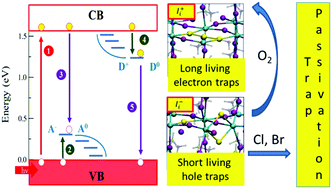
Electron/hole traps related to interstitial iodine defects show the typical features of iodine photo-electrochemistry, inducing MAPbI3 defect tolerance.
The content of this RSS Feed (c) The Royal Society of Chemistry

23 Mar 01:47
Energy Environ. Sci., 2018, 11,1460-1469
DOI: 10.1039/C7EE03543H, Paper
Jiangjian Shi, Huiyin Zhang, Yiming Li, Jacek J. Jasieniak, Yusheng Li, Huijue Wu, Yanhong Luo, Dongmei Li, Qingbo Meng
A high-temperature-stable bound exciton (BE) within perovskites and a phase-dependent exciton trapping behaviour have been identified.
The content of this RSS Feed (c) The Royal Society of Chemistry

08 Mar 01:15
Energy Environ. Sci., 2018, 11,1030-1061
DOI: 10.1039/C7EE03620E, Review Article
Costantinos Petridis, George Kakavelakis, Emmanuel Kymakis
This literature review presents the research progress and future perspectives of graphene-based based mesoscopic and planar perovskite solar cells.
The content of this RSS Feed (c) The Royal Society of Chemistry

07 Mar 12:49
by Dan Ouyang, Junyan Xiao, Fei Ye, Zhanfeng Huang, Hong Zhang, Lu Zhu, Jiaqi Cheng, Wallace C. H. Choy
Abstract
This study proposes a novel strategy of controllable deamination of Co–NH3 complexes in a system containing Ni(OH)2 to synthesize ultrasmall ternary oxide nanoparticles (NPs), NiCo2O4. Through this approach, ultrasmall (5 nm on average) and well-dispersed NiCo2O4 NPs without exotic ligands are obtained, which enables the formation of uniform and pin-hole free films. The tightly covered NiCo2O4 films also facilitate the formation of large perovskite grains and thus reduce film defects. The results show that with the NiCo2O4 NPs as the hole transport layer (HTL), the perovskite solar cells reach a high power conversion efficiency (PCE) of 18.23% and a promising stability (maintained ≈90% PCE after 500 h light soaking). To the best of the author's knowledge, it is the first time that spinel NiCo2O4 NPs have been applied as hole transport layer in perovskite solar cells successfully. This work not only demonstrates the potential applications of ternary oxide NiCo2O4 as HTLs in hybrid perovskite solar cells but also provides an insight into the design and synthesis of ultrasmall and ligand-free NPs HTLs to enable cost-effective photovoltaic devices.

An ultrasmall and well-dispersed ternary oxide of NiCo2O4 nanoparticles, achieved by a new strategy of controllable deamination of the Co–NH3 complexes in a system containing Ni(OH)2
, facilitate the formation of large perovskite grains, which is first applied as hole transport layer for highly efficient perovskite solar cells.
07 Mar 11:57
by Lidón Gil-Escrig, Cristina Momblona, Maria-Grazia La-Placa, Pablo P. Boix, Michele Sessolo, Henk J. Bolink
Abstract
Hybrid lead halide perovskites are promising materials for future photovoltaics applications. Their spectral response can be readily tuned by controlling the halide composition, while their stability is strongly dependent on the film morphology and on the type of organic cation used. Mixed cation and mixed halide systems have led to the most efficient and stable perovskite solar cells reported, so far they are prepared exclusively by solution-processing. This might be due to the technical difficulties associated with the vacuum deposition from multiple thermal sources, requiring a high level of control over the deposition rate of each precursor during the film formation. In this report, thermal vacuum deposition with multiple sources (3 and 4) is used to prepare for the first time, multications/anions perovskite compounds. These thin-film absorbers are implemented into fully vacuum deposited solar cells using doped organic semiconductors. A maximum power conversion efficiency of 16% is obtained, with promising device stability. The importance of the control over the film morphology is highlighted, which differs substantially when these compounds are vacuum processed. Avenues to improve the morphology and hence the performance of fully vacuum processed multications/anions perovskite solar cells are proposed.

Multiple-source (up to 4) thermal vacuum deposition is used to prepare for the first time multications/anions perovskite compounds. These thin-film absorbers are implemented into fully vacuum deposited solar cells using doped organic semiconductors. A maximum power conversion efficiency of 16% is obtained, with promising device stability.
07 Mar 11:36
by Sang Il Seok, Michael Grätzel, Nam-Gyu Park
Abstract
A perovskite solar cell (PSC) employing an organic–inorganic lead halide perovskite light harvester, seeded in 2009 with power conversion efficiency (PCE) of 3.8% and grown in 2011 with PCE of 6.5% in dye-sensitized solar cell structure, has received great attention since the breakthrough reports ≈10% efficient solid-state PCSs demonstrating 500 h stability. Developments of device layout and high-quality perovskite film eventually lead to a PCE over 22%. As of October 31, 2017, the highest PCE of 22.7% is listed in an efficiency chart provided by NREL. In this Review, the methodologies to obtain highly efficient PSCs are described in detail. In order to achieve a PCE of over 20% reproducibly, key technologies are disclosed from the viewpoint of precursor solution chemistry, processing for defect-free perovskite films, and passivation of grain boundaries. Understanding chemical species in precursor solution, crystal growth kinetics, light–matter interaction, and controlling defects is expected to give important insights into not only reproducible production of high PCE over 20% but also further enhancement of the PCE of PCSs.

A better understanding of precursor chemistry and the crystal growth mechanism can lead to power conversion efficiency of perovskite solar cells as high as 22.7%.