Shared posts

23 Mar 02:18

Reconsidering figures of merit for performance and stability of perovskite photovoltaics

Energy Environ. Sci., 2018, 11,739-743
DOI: 10.1039/C7EE02956J, Opinion
Open Access Open Access
Creative Commons Licence&nbsp This article is licensed under a Creative Commons Attribution 3.0 Unported Licence.
Mark V. Khenkin, Anoop K. M., Iris Visoly-Fisher, Yulia Galagan, Francesco Di Giacomo, Bhushan Ramesh Patil, Golnaz Sherafatipour, Vida Turkovic, Horst-Gunter Rubahn, Morten Madsen, Tamara Merckx, Griet Uytterhoeven, Joao P. A. Bastos, Tom Aernouts, Francesca Brunetti, Monica Lira-Cantu, Eugene A. Katz
We propose a new approach for assessing the lifetimes of perovskite photovoltaics based on daily energy output which accounts for reversible diurnal changes.
The content of this RSS Feed (c) The Royal Society of Chemistry
17 Jan 01:14

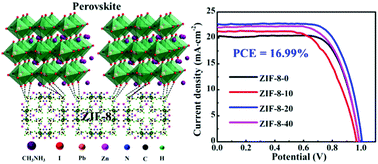
Metal-organic frameworks at interfaces of hybrid perovskite solar cells for enhanced photovoltaic properties

Chem. Commun., 2018, 54,1253-1256
DOI: 10.1039/C7CC09452C, Communication
Deli Shen, Aiying Pang, Yafeng Li, Jie Dou, Mingdeng Wei
A ZIF-8 modified interface increases the grain size of perovskite crystals, resulting in a maximum PCE of 16.99%.
The content of this RSS Feed (c) The Royal Society of Chemistry
17 Jan 01:09

Composition-dependent emission linewidth broadening in lead bromide perovskite (APbBr3, A = Cs and CH3NH3) nanoparticles

Nanoscale, 2017, Accepted Manuscript
DOI: 10.1039/C7NR07330E, Communication
Sujin Ham, Heejae Chung, Tae-Woo Kim, Jiwon Kim, Dongho Kim
Lead halide perovskite nanoparticles (NPs) are attractive as they exhibit excellent color purity and have a tunable band gap, and can thus be applied in highly efficient photovoltaic and light-emitting...
The content of this RSS Feed (c) The Royal Society of Chemistry
17 Jan 01:00

Spinel Co3O4 nanomaterials for efficient and stable large area carbon-based printed perovskite solar cells

Nanoscale, 2018, 10,2341-2350
DOI: 10.1039/C7NR08289D, Paper
Amna Bashir, Sudhanshu Shukla, Jia Haur Lew, Shashwat Shukla, Annalisa Bruno, Disha Gupta, Tom Baikie, Rahul Patidar, Zareen Akhter, Anish Priyadarshi, Nripan Mathews, Subodh G. Mhaisalkar
Performance of scalable carbon-based perovskite solar cells (PSCs) is enhanced using a thin interlayer of spinel cobaltite oxide by suppressing charge recombination and enhancing holes extraction.
The content of this RSS Feed (c) The Royal Society of Chemistry
17 Jan 01:00

Composition-dependent emission linewidth broadening in lead bromide perovskite (APbBr3, A = Cs and CH3NH3) nanoparticles

Nanoscale, 2018, 10,2207-2212
DOI: 10.1039/C7NR07330E, Communication
Sujin Ham, Heejae Chung, Tae-Woo Kim, Jiwon Kim, Dongho Kim
We explore composition-dependent emission linewidth broadening in lead bromide perovskite nanoparticles. The results provide insight into the development of light-emitting diodes with high color purity.
The content of this RSS Feed (c) The Royal Society of Chemistry
17 Jan 00:59

Efficient perovskite/organic integrated solar cells with extended photoresponse to 930 nm and enhanced near-infrared external quantum efficiency of over 50%

Nanoscale, 2018, 10,3245-3253
DOI: 10.1039/C7NR07933H, Paper
Qiang Guo, Hao Liu, Zhenzhen Shi, Fuzhi Wang, Erjun Zhou, Xingming Bian, Bing Zhang, Ahmed Alsaedi, Tasawar Hayat, Zhan'ao Tan
Efficient perovskite/organic integrated solar cells with enhanced near-infrared light utilization were demonstrated.
The content of this RSS Feed (c) The Royal Society of Chemistry
17 Jan 00:59

Enhanced planar perovskite solar cell efficiency and stability using a perovskite/PCBM heterojunction formed in one step

Nanoscale, 2018, 10,3053-3059
DOI: 10.1039/C7NR07753J, Paper
Long Zhou, Jingjing Chang, Ziye Liu, Xu Sun, Zhenhua Lin, Dazheng Chen, Chunfu Zhang, Jincheng Zhang, Yue Hao
Efficient perovskite/PCBM heterojunction is formed in one-step for perovskite solar cells with high performance and long-term stability.
The content of this RSS Feed (c) The Royal Society of Chemistry
17 Jan 00:59

Rb+ cations enable the change of luminescence properties in perovskite (RbxCs1-xPbBr3) quantum dots

Nanoscale, 2018, 10,3429-3437
DOI: 10.1039/C7NR07776A, Paper
Hao Wu, Yong Yang, Dacheng Zhou, Kuangran Li, Jie Yu, Jin Han, Zhencai Li, Zhangwen Long, Jiao Ma, Jianbei Qiu
All-inorganic metal halide perovskites of the formulation ABX3 (where A is Cs+, B is commonly Pb2+, and X is a halide, X = Cl, Br, I) have been studied intensively for their unique properties.
The content of this RSS Feed (c) The Royal Society of Chemistry
09 Dec 01:15

Enhanced charge carrier mobility and lifetime suppress hysteresis and improve efficiency in planar perovskite solar cells

Energy Environ. Sci., 2017, Accepted Manuscript
DOI: 10.1039/C7EE02901B, Communication
Silver Hamill Turren Cruz, Michael Saliba, Matthew T. Mayer, Hector Juarez Santiesteban, Xavier Mathew, Lea Nienhaus, Wolfgang Tress, Matthew P. Erodici, Meng-Ju Sher, Moungi G. Bawendi, Michael Gratzel, Antonio Abate, Anders Hagfeldt, Juan-Pablo Correa-Baena
Perovskite solar cells (PSCs) are very promising lab-scale technologies to deliver inexpensive solar electricity. Low-temperature, planar PSCs are of particularly interest for large-scale deployment due to their inherent suitability for...
The content of this RSS Feed (c) The Royal Society of Chemistry
15 Nov 00:43

Stabilization of hybrid perovskite CH3NH3PbI3 thin films by graphene passivation

Nanoscale, 2017, 9,19227-19235
DOI: 10.1039/C7NR06510H, Paper
Wei-Shiuan Tseng, Meng-Huan Jao, Chen-Chih Hsu, Jing-Shun Huang, Chih-I. Wu, N.-C. Yeh
Long-term passivation of water-sensitive hybrid perovskites with monolayer graphene.
The content of this RSS Feed (c) The Royal Society of Chemistry
30 Oct 01:37

Solar Cells: Synergic Interface Optimization with Green Solvent Engineering in Mixed Perovskite Solar Cells (Adv. Energy Mater. 20/2017)

by Tongle Bu, Lan Wu, Xueping Liu, Xiaokun Yang, Peng Zhou, Xinxin Yu, Tianshi Qin, Jiangjian Shi, Song Wang, Saisai Li, Zhiliang Ku, Yong Peng, Fuzhi Huang, Qingbo Meng, Yi-Bing Cheng, Jie Zhong
Thumbnail image of graphical abstract

Organic-inorganic mixed perovskite solar cells demonstrate superiority for the application as low-cost printable solar energy, yet common processing of solvent-controlled crystallization routes contain highly toxic solvents that cause safety and/or environmental issues. In article number 1700576, Fuzhi Huang, Jie Zhong, and co-workers demonstrate a green solvent engineering incorporated interface optimization method to address this topic, and high performance devices are obtained.

30 Oct 01:36

Correction: Wafer-scale reliable switching memory based on 2-dimensional layered organic-inorganic halide perovskite

Nanoscale, 2017, 9,17144-17144
DOI: 10.1039/C7NR90229H, Correction
Open Access Open Access
Creative Commons Licence&nbsp This article is licensed under a Creative Commons Attribution 3.0 Unported Licence.
Ja-Young Seo, Jaeho Choi, Hui-Seon Kim, Jaegyeom Kim, June-Mo Yang, Can Cuhadar, Ji Su Han, Seung-Joo Kim, Donghwa Lee, Ho Won Jang, Nam-Gyu Park
The content of this RSS Feed (c) The Royal Society of Chemistry
27 Oct 09:01

Templated self-assembly of one-dimensional CsPbX3 perovskite nanocrystal superlattices

Nanoscale, 2017, 9,17688-17693
DOI: 10.1039/C7NR06579E, Communication
Aizhao Pan, Matthew Jurow, Yanrui Zhao, Fen Qiu, Ya Liu, Juan Yang, Jeffrey J. Urban, Ling He, Yi Liu
A simple kinetic approach to form self-assembled one-dimensional CsPbBr3 perovskite nanocrystal arrays templated inside a pod shaped inert PbSO4 scaffold.
The content of this RSS Feed (c) The Royal Society of Chemistry
26 Oct 01:03

Di-isopropyl ether assisted crystallization of organic-inorganic perovskites for efficient and reproducible perovskite solar cells

Nanoscale, 2017, 9,17893-17901
DOI: 10.1039/C7NR06410A, Paper
Lu-Yao Wang, Lin-Long Deng, Xin Wang, Tan Wang, Hao-Ran Liu, Si-Min Dai, Zhou Xing, Su-Yuan Xie, Rong-Bin Huang, Lan-Sun Zheng
Di-isopropyl ether has proven to be a suitable solvent in an anti-solvent deposition process for efficient and reproducible perovskite solar cells.
The content of this RSS Feed (c) The Royal Society of Chemistry
21 Oct 00:48

A novel perovskite solar cell design using aligned TiO2 nano-bundles grown on a sputtered Ti layer and a benzothiadiazole-based, dopant-free hole-transporting material

Nanoscale, 2017, 9,17544-17550
DOI: 10.1039/C7NR06424A, Paper
Sadia Ameen, M. Nazim, M. Shaheer Akhtar, Mohammad Khaja Nazeeruddin, Hyung-Shik Shin
Using a benzothiadiazole-substituted derivative as a dopant free hole transporting layer in perovskite solar cells yields a 15% power conversion efficiency under one sun conditions.
The content of this RSS Feed (c) The Royal Society of Chemistry
21 Oct 00:45

Enhanced compatibility between a copper nanowire-based transparent electrode and a hybrid perovskite absorber by poly(ethylenimine)

Nanoscale, 2017, 9,17207-17211
DOI: 10.1039/C7NR04739H, Communication
Hyewon Hwang, Jihoon Ahn, Eunsong Lee, Kyungmi Kim, Hyeok-Chan Kwon, Jooho Moon
Poly(ethylenimine) dramatically improved compatibility between a copper nanowire electrode and a perovskite, enabling the fabrication of electrode-based perovskite solar cells with silver- and indium-free copper nanowires.
The content of this RSS Feed (c) The Royal Society of Chemistry
21 Oct 00:45

Solution-processed indium oxide electron transporting layers for high-performance and photo-stable perovskite and organic solar cells

Nanoscale, 2017, 9,16305-16312
DOI: 10.1039/C7NR05695H, Paper
Seokhyun Yoon, Si Joon Kim, Harrison S. Kim, Joon-Suh Park, Il Ki Han, Jae Woong Jung, Minwoo Park
Pin-hole free and conductive In2O3 electron transporting layers lead to a power conversion efficiency of 14.63% in a perovskite solar cell and 3.03% in an organic solar cell.
The content of this RSS Feed (c) The Royal Society of Chemistry
17 Oct 00:57

High-Efficiency Low-Temperature ZnO Based Perovskite Solar Cells Based on Highly Polar, Nonwetting Self-Assembled Molecular Layers

by Randi Azmi, Wisnu Tantyo Hadmojo, Septy Sinaga, Chang-Lyoul Lee, Sung Cheol Yoon, In Hwan Jung, Sung-Yeon Jang

Abstract

Herein, this study reports high-efficiency, low-temperature ZnO based planar perovskite solar cells (PSCs) with state-of-the-art performance. They are achieved via a strategy that combines dual-functional self-assembled monolayer (SAM) modification of ZnO electron accepting layers (EALs) with sequential deposition of perovskite active layers. The SAMs, constructed from newly synthesized molecules with high dipole moments, act both as excellent surface wetting control layers and as electric dipole layers for ZnO-EALs. The insertion of SAMs improves the quality of PbI2 layers and final perovskite layers during sequential deposition, while charge extraction is enhanced via electric dipole effects. Leveraged by SAM modification, our low-temperature ZnO based PSCs achieve an unprecedentedly high power conversion efficiency of 18.82% with a VOC of 1.13 V, a JSC of 21.72 mA cm−2, and a FF of 0.76. The strategy used in this study can be further developed to produce additional performance enhancements or fabrication temperature reductions.

Thumbnail image of graphical abstract

Low-temperature planar perovskite solar cells with efficiency of 18.82% are developed via a strategy that combines dual-functional self-assembled monolayer (SAM) modification of ZnO electron accepting layers with sequential deposition of perovskite active layers. The SAMs, constructed from newly synthesized molecules with high dipole moments, act both as excellent surface wetting control layers and as electric dipole layers for ZnO layers.

16 Oct 08:44

Unraveling current hysteresis effects in regular-type C60-CH3NH3PbI3 heterojunction solar cells

Nanoscale, 2017, 9,17802-17806
DOI: 10.1039/C7NR07001B, Paper
Lung-Chien Chen, Yu-Shiang Lin, Po-Wen Tang, Chao-Yi Tai, Zong-Liang Tseng, Ja-Hon Lin, Sheng-Hui Chen, Hao-Chung Kuo
Comprehensive studies were carried out to understand the origin of the current hysteresis effects in highly efficient C60-CH3NH3PbI3(MAPbI3) heterojunction solar cells, using AFM, transmittance spectra, PL spectra, XRD patterns, and a femtosecond time-resolved pump-probe technique.
The content of this RSS Feed (c) The Royal Society of Chemistry
13 Oct 03:11

Perovskite Solar Cells: Cesium Doped NiOx as an Efficient Hole Extraction Layer for Inverted Planar Perovskite Solar Cells (Adv. Energy Mater. 19/2017)

by Wei Chen, Fang-Zhou Liu, Xi-Yuan Feng, Aleksandra B. Djurišić, Wai Kin Chan, Zhu-Bing He
Thumbnail image of graphical abstract

In article number 1700722, Aleksandra B. Djurišić, Zhu-Bing He, and co-workers investigate the cesium doped NiO film as highly transparent and conductive HTL for inverted perovskite solar cells. Cs dopant can significantly improve the conductivity of NiO and lower the work function, allowing better charge transfer and band alignment between perovskite and Cs doped NiO. Efficiency over 19% for the Cs doped devices is obtained and 90% of its initial performance is maintained after 80 days.

10 Oct 01:03

Highly efficient Cs-based perovskite light-emitting diodes enabled by energy funnelling

Chem. Commun., 2017, 53,12004-12007
DOI: 10.1039/C7CC06615E, Communication
Yan Fong Ng, Sneha A. Kulkarni, Shayani Parida, Nur Fadilah Jamaludin, Natalia Yantara, Annalisa Bruno, Cesare Soci, Subodh Mhaisalkar, Nripan Mathews
Incorporation of phenylethylammonium bromide into a fully inorganic CsPbBr3 perovskite framework led to the formation of quasi-2D perovskites with exceptional energy funnelling via an energy cascade.
The content of this RSS Feed (c) The Royal Society of Chemistry
06 Oct 09:09

Enhanced efficiency and air-stability of NiOX-based perovskite solar cells via PCBM electron transport layer modification with Triton X-100

Nanoscale, 2017, 9,16249-16255
DOI: 10.1039/C7NR05235A, Paper
Kisu Lee, Jaehoon Ryu, Haejun Yu, Juyoung Yun, Jungsup Lee, Jyongsik Jang
In this work, a phenyl-C61-butyric acid methyl ester (PCBM) electron transport layer was modified with Triton X-100, and this improved the photovoltaic performance and air-stability of perovskite solar cells.
The content of this RSS Feed (c) The Royal Society of Chemistry
06 Oct 01:25

Wafer-scale reliable switching memory based on 2-dimensional layered organic-inorganic halide perovskite

Nanoscale, 2017, 9,15278-15285
DOI: 10.1039/C7NR05582J, Communication
Ja-Young Seo, Jaeho Choi, Huo-Seon Kim, Jaegyeom Kim, June-Mo Yang, Can Cuhadar, Ji Su Han, Seung-Joo Kim, Donghwa Lee, Ho Won Jang, Nam-Gyu Park
2D halide perovskite is promising material for reliable waferscale resistive memory even working at high temperature of 87 [degree]C.
The content of this RSS Feed (c) The Royal Society of Chemistry