In the latest insane lawsuit regarding the internet and sex trafficking, a group of women who were tragic victims of sex trafficking have decided not to sue those responsible for trafficking them... but online customer relationship management (CRM) provider Salesforce.com. What? Huh? Why? You might ask? Well, apparently it's because everyone's favorite sex trafficking bogeyman, Backpage.com, used Salesforce.com for its CRM. Yup.
While most of the reports on this don't show the lawsuit, CNBC thankfully posted a copy (though it's locked up in Scribd, so we can't embed our own version, unfortunately). The lawsuit makes a bunch of leaps to argue that Salesforce is somehow magically responsible for people doing illegal things on Backpage. The levels of separation between the criminal actions and the liability here are simply ridiculous. Much of the lawsuit tries to suggest that because Salesforce is good at its job in customizing its offerings to its customers, that's proof that it's magically responsible for sex trafficking:
In public, including on Twitter, Salesforce boasted about fighting human trafficking using its data tools.
But behind closed doors, Salesforce’s data tools were actually providing the backbone of Backpage’s exponential growth.
Salesforce didn’t just provide Backpage with a customer-ready version of its data and marketing tools. Salesforce designed and implemented a heavily customized enterprise database tailored for Backpage’s operations, both locally and internationally.
With Salesforce’s guidance, Backpage was able to use Salesforce’s tools to market to new “users”—that is, pimps, johns, and traffickers—on three continents.
Backpage could also use Salesforce’s custom tools to remarket to those pimps, johns, and traffickers who had been underusing its trafficking services.
It is inconceivable that the technologies used world-round to manage customer and marketing databases would be put to the immoral and illegal purposes engineered by Backpage and Salesforce.
It should not be our tax dollars, charities, and churches that carry the burden of the catastrophic harms and losses to sex trafficking survivors. That responsibility should fall to companies like Salesforce, that have facilitated and profited from sex trafficking.
Incredibly -- and obnoxiously -- the complaint uses Salesforce's own efforts to help in the fight against sex trafficking against the company. It highlights some of Salesforce's promotional efforts, concerning the fight against sex trafficking, such as this tweet:
And uses that as proof of "knowledge" by Salesforce:
Salesforce knew the scourge of sex trafficking because it sought publicity for trying to stop it. But at the same time, this publicly traded company was, in actuality, among the vilest of rogue companies, concerned only with their bottom line.
The entire assumption underlying the lawsuit is this: that Backpage was only used for illegal sex trafficking and that using CRM can help you increase your "sales," and thus Salesforce is responsible for Backpage increasing sex trafficking. That... is quite the twisted logic there.
The lawsuit was filed in California state court, rather than in federal court, under California state laws -- so there's no direct reference to FOSTA as far as I can tell. However, FOSTA casts its looming shadow over this case. Normally, I imagine that Salesforce would make a straight CDA 230 argument here that it's not responsible for the actions of its users (in this case, Backpage). But, FOSTA potentially takes that away. I say potentially, because based on my reading of the final version of FOSTA, (which is now CDA 230(e)(5)), for a civil lawsuit, FOSTA only exempts cases brought under federal sex trafficking law, and not state laws (for criminal complaints, FOSTA exempts some state sex trafficking charges). So, as plead, I'm not sure if FOSTA even directly applies -- meaning potentially Salesforce could perhaps try to claim that it's still protected by CDA 230 and the FOSTA additions don't help the plaintiffs, but... who knows? Now that we've got this new untested law, I guess we'll find out.
On the whole, though, what a preposterously silly lawsuit. Sex trafficking is a truly horrible thing, and while the complaint filed trots out a bunch of debunked and exaggerated stats about just how big a problem sex trafficking is, the real focus should be on those actually responsible. Going after the CRM provider of a website that traffickers may have used, feels like yet another example of what we've called a Steve Dallas lawsuit after the 1986 Bloom County strip in which lawyer Steve Dallas explains that after getting beaten up by Sean Penn for trying to take a paparazzi photo, he decides not to sue any of the obvious parties, but rather go after the camera manufacturer -- because that's who has the money (click through for the full comic):
Environmentalists and bicyclists in Seattle are furious at Mayor Jenny Durkan after she capitulated to opponents of safe streets on an important corridor.
On Tuesday, the city unveiled new plans for 35th Avenue NW, featuring highway-width lanes and no bike infrastructure. The city’s Bike Master Plan has called for protected bike lanes on this important corridor since 2014. Data show that 198 people have been injured on the roadway since 2004, according to Seattle Bike Blog.
Durkan appears to have caved to a small group of residents who opposed the bike lane. This group, called Save 35th Avenue NE, was intense in its opposition, sometimes almost comically so. Last year, members attacked the project, claiming the “single mothers don’t commute to work on bikes,” only delete their account under fire from a bunch of bike-riding moms.
That group was concerned about the loss of 40 parking spaces, according to local reporter Erica C. Barnett. But the plan rolled out by Seattle DOT on Tuesday — confusingly — still eliminates parking. Rather than a bike lane it adds a turn lane.
Seattle DOT’s Twitter announcement of the design was subject to the worst “ratio” possibly in the history of Twitter.
I’ve walked across this street 100s of times to get a coffee and catch the bus. It has never been safe, and this will make it worse. I was hopeful that @seattledot wouldn’t sacrifice safety because of a few noisy complaints, I suppose I should have learned better by now.
The incident is a troubling sign that Seattle’s new mayor isn’t committed to the ideas that have made the city a star in the sustainable transportation world, both on transit and reducing car use.
The head of the Washington Sierra Club, which had advocated for the bike lane, was merciless in his appraisal of Durkan Administration priorities.
The Mayor’s decision on 35th is directly in line with her stated transportation priorities in the 2017 campaign: cars first and foremost.
The city’s decision apparently followed a meeting with both bike and opponents and proponents.
“We have decided not to install bike lanes,” Samuel Zimbabwe, Durkan’s interim transportation adviser told residents, as reported by the Urbanist. “This is a decision we’re happy to stand on.”
Later, in response to the drubbing it received on Twitter, the Seattle DOT did indicate some openness to revising the design.
We'd like to acknowledge that we are listening and taking in your questions, comments, and concerns. We are hearing a common interest over safety and would like the opportunity to respond to it along with a few other topics mentioned in a follow up blog post.
Born from the Japanese art of sashiko, visible mending enables crafters to eschew fast fashion and make mistakes beautiful.
When Jessica Marquez’s boyfriend ripped his favorite jean jacket, he asked if she could fix it. Marquez, a “visible mending” maker, teacher, and author, began researching hand-embroidery techniques she could use to fix the rip. She came upon sashiko, a Japanese mending technique involving a running stitch and geometric patterns. As she practiced, she realized that she wanted to start using the same technique on her own clothes. A favorite pair of jeans now has four mends, each rip patched up with darker denim and beautiful square fields of bright white cross-stitching.
For Marquez, visible mending “becomes a means of self-expression.” In mending an item of clothing in a highly visible style, she can turn a rip into a personal piece of art. Rather than trying to hide a garment’s flaws, she tells me, “it’s just something that becomes uniquely mine.”
In this way, visible mending is the antidote to fast fashion. Instead of seeing clothes as disposable, visible mending values sustainability and suggests a different way of relating to our clothes. Colleen Hill, a curator at the Museum at FIT whose 2018 show “Fashion Unraveled” displayed mended and deconstructed fashion, explains that, in response to the ubiquity of fast fashion, “people are starting to dial back and think more about what makes clothing meaningful, and I would imagine that visible mending is part of that.” She tells me that visible mending “tells us that we can, in fact, have a connection to our clothing. And that that connection can continue. And rather than seeing something that is perhaps a little shabby or worn out, [and] seeing that as a negative thing or something that we need to replace, to in fact embrace it as something that we love and that expresses who we are.”
Marquez echoes this, telling me, “I think people are becoming really more conscious of where their clothing is coming from and learning more about the stream, like the real lives that are making their garments, and kind of pushing against fast fashion and making their visible mends kind of a statement against this consumerism that’s shoved down our throats.”
Hill explains that “when we look at clothes within museum collections, historically we would see something like a stain or a tear, and it might be something that is a bit repulsive or that we don’t necessarily want to show. But I think that, in fact, there’s a different, much more positive way to look at that, and that is the idea that these clothes have lived a life and that they were, in fact, important to someone and had this kind of moment in the sun.”
A museum show is one way of highlighting that, and visible mending provides a way to do the same in day-to-day life. Hill tells me that she recently organized a visible mending workshop with Golden Joinery, a Dutchorganization that uses golden thread for visible mends. Golden Joinery’s Margreet Sweerts tells me via email that “there can be beauty in a flaw, a golden scar. It is a sign of life, it tells the story and history of a piece.” It is hoped that through Golden Joinery’s mending workshops and a mending game that it has developed, people will “experience the beauty of imperfection.”
Sustainability-minded brands are also starting to embrace visible mending as a way to extend the life cycle of their clothes and to reach customers whose interest in the concept is growing. Lilah Horwitz, who works on both visual branding and garment design for Eileen Fisher’s Renew program, which buys back customers’ used Eileen Fisher garments and resews, mends, and resells them, tells me, “It’s just a strong message that we feel like we can’t ignore as a clothing company, and to be able to look at the product that we make and take that kind of responsibility and use creativity and design to bring that in and offer a new type of product offering.”
She also tells me that “we actually find it very exciting when a piece comes in and it’s just really well-worn, rather than when it comes in and is basically new, because it means that somebody put their life in their garment and they wore it out into the world and they really lived in it, and that’s exciting.” She explains, “We’ve lost this connection with our goods because they’re so disposable, and I think the process of visible mending is taking a bit of a stab at that, like, wait a second, let’s reconnect with what we already have, and what can we do to it to make it new again.” This suggests that, rather than discard things that have ceased to serve us, perhaps we should aim to find a way to make them beautiful again.
“There can be beauty in a flaw, a golden scar. It is a sign of life, it tells the story and history of a piece.”
This rethinking of disposability has an anti-capitalist appeal, as does thinking of oneself as someone who is not only, always, a consumer in search of the next purchase. But in the same way that making sustainable clothing purchases is a privilege many cannot afford, it is a privilege to have the resources needed not only to mend something but also to take the time to make it beautiful. It is also a privilege to feel comfortable wearing clothes that are visibly worn, however beautiful the repair. We need to be careful not to romanticize the history of mending, a craft that has grown out of necessity.
Miho Takeuchi, a traditional sashiko instructor and designer born in Japan and based in the United States, tells me via email that sashiko, which developed in poor communities in Japan’s Edo period, “was born from the necessity of mending and patching garments, beddings and household items. In ancient days, clothing and bedding were made from homespun fabrics woven from native fibrous plants such as wisteria and hemp and necessity demanded that this clothing be recycled for as long as possible.” It was only later, she tells me, that the technique evolved to include the elaborate surface-level designs and intricate patterns popular with visible menders today.
Marquez makes sure to emphasize this history in her teaching as well. “I talk a lot about sashiko as a Japanese technique, and I talk about how it was developed,” she explains. “It’s a resourceful technique; it’s birthed out of necessity and thrift, and we have everything.” Whereas mending was once the province of those who could not afford new clothes, today’s visible mending is the province, primarily, of those who can afford the time and attention it takes to make one’s clothes into a statement.
As much as visible mending is about the privilege of connecting with one’s clothes, it also builds connections between people. Takeuchi says of teaching sashiko, “Not only teaching the stitching but also sharing [the] culture of Japan with my students is really fun. While practicing the stitching, students ask many questions and I try to answer as much as I can.” She adds that the technique is a way to develop cross-cultural connections: “We are connected with common interests and enthusiasm toward the beauty of hand-stitching,” and sashiko, she says, “is the bridge for me to introduce my country and my culture to the people in the US.”
Community building is an important aspect of visible mending for Marquez, too. She explains, “I’m always trying to share what I’m doing and working on, and I try to build community through crafting and making.” Visible mending is particularly popular on Instagram: The hashtag #mending, with over 68,000 posts, is filled with photos of holes filled in with colorful thread or covered up by interesting designs, and the hashtag #sashiko has over 131,000 posts.
Marquez tells me of her social media followers: “I like that [on Instagram], through hashtags and the kits, they can kind of see what other people are making and doing, and I think it’s fun, when you’re working on something or you’re excited about something, to see what someone else has made with the same technique.”
Hill, the curator, also highlighted the importance of community in this space: “in my experience, the best part of the visible mending workshop that I did was the conversation we had while we were mending.”
This is not the first time that mending has been a community effort. Sashiko mending, for instance, was traditionally the responsibility of women and girls, who mended clothes for family members. The technique was often passed down from mother to daughter.
In the United States, many women took up mending during World War II, when it was encouraged as “a governmental campaign in Britain and it was a very strongly encouraged initiative in the United States,” according to Hill. She tells me that “it was considered patriotic to do your best and do your part to allow things like nylon or any kind of material to be put towards the war effort.”
Visible mendinginsists that beauty can be built in the wake of a breakdown, and that we can connect with one another even in times of rupture
Now, while interest in mending is resurgent, the meaning has changed. Sashiko, which had come to be devalued as a craft associated with poverty and with women, was reappropriated by high-fashion designers like Issey Miyake as early as 1973. It has more recently come to be embraced as one of the most popular DIY visible mending techniques, valued for its utility but also for its beauty. Visiblemending insists on and revels in the beauty of disrupting the existing paradigm. For Hill, “the idea of visible mending, or kind of distressed or deconstructed garments in a more general sense, leads to this intrigue of disruption in the fashion system. And that can be disruption of beauty ideals, or appropriate attire, or the focus that we often see between the fashion industry and wealth.”
Visible mendinginsists that beauty can be built in the wake of a breakdown and that we can connect with one another even in times of rupture. That we can connect through our desire to challenge existing norms and to create a system that is more carefully considered and more thoughtful. Sweerts tells me that, at Golden Joinery, they prefer the word “healing” to “repair” because, she says, “it is not only a RE-pair (towards a past that was once whole), it is also a transformational process, not only for the garment, but also for your soul. A move into a ‘new’ future.” Visible mending offers us hope that we can transform our broken present into something better, not by reaching across the aisle or glossing over division, but by building something new from the rubble. It presents a small opportunity to build something good.
Julio writes, "Sons of the Singularity is a small RPG publisher. Last year, they kickstarted The Sassoon Files, a sourcebook for the popular Call of Cthulhu RPG and Trail of Cthulhu RPG. As a lot of publishers, theydid the printing in China. The same day that the print was finished, a Chinese Government decided that it was "problematic", so they burned the entire print run.
Targeting foreign publications is a first, specially when it seems there wasn't anything problematic (the supplement was based on Shanghai but was respetful and documented carefully).
Will this be a new sign of Beijing tightening its iron grip or just a show of bravado with a small publisher used as an example?"
Don't want to seem alarmist here, but perhaps giving a veto over the vast majority of the world's manufacturing, media reproduction, printing, etc to the Chinese state might just turn out to be problematic in terms of free expression.
The DCCC has announced that any vendor or consultant who works with a candidate mounting a primary challenge to an incumbent Democrat will be cut off from doing any business with the Democratic Party in 2020.
As Alexandria Ocasio-Cortez has pointed out, this is a policy aimed at neutralizing candidates like her, who challenge long-term incumbent Dems in safe seats who run as Democrats, but govern like Republicans -- see also, say, Dan Lipinski, who literally inherited his seat from his father and is anti-gun-control, anti-abortion-rights, pro-deregulation of dangerous industries, awash in corporate money, but still (technically) a "Democrat."
I donated to Bernie Sanders' campaign in 2016 and his current campaign (I'm also an Elizabeth Warren donor; I also donated to Hillary after she won the 2016 primary) and some friends of mine have asked me why Sanders doesn't just join the Democratic party? To me, stuff like this makes staying out of the party itself a no-brainer. As I tell party fundraisers when they call me, I won't give a dime to the Democratic party for so long as they're doing shit like this -- instead, I'll support Brand New Congress and Our Revolution and individual, progressive Democratic candidates.
But giving money to the DCCC so they can hand it over to the likes of Dan Lipinski?
Fuck that.
Sideways.
With a brick.
After their coordinated attack on Laura Moser in Texas’s 7th District, she raised $86,000, got an endorsement from Our Revolution, and made it to a runoff. She eventually lost to current Rep. Lizzie Fletcher. But the episode gave fodder to progressive groups like the Working Families Party, Justice Democrats, and Collective PAC, which had formed for precisely that occasion — the party’s increasing inability to make space for new voices, many of them progressive. D-trip proved their point, and Our Revolution and WFP stepped in instead.
And in Nebraska’s 2nd District, the DCCC backed former Rep. Brad Ashford over Kara Eastman, who ended up winning the primary and losing the general election. Ashford was a former Republican who flip-flopped on access to abortion throughout his time in the state legislature and later as a Democrat in the U.S. House, and opposed single-payer health care. Eastman was a staunchly pro-choice progressive who supported Medicare for All. She was one of only two insurgents to beat DCCC-backed candidates last cycle. In the Democratic primary for Kentucky’s 6th District, Amy McGrath beat Jim Gray and later lost to Republican Rep. Andy Barr. Senate Minority Leader Chuck Schumer is now recruiting her to run against Majority Leader Mitch McConnell in 2020.
Strategists and congressional staffers with knowledge of the change say it will disproportionately impact vendors and candidates who are women and people of color, as the consultants who work with incumbents are the ones who’ve come up through the party at a time when its commitment to diversity was even dimmer than it is today.
A little more than a month ago, we covered the ultra-weird offshoot of FBI forensics spearheaded by Richard Vorder Bruegge. Vorder Bruegge claimed mass-produced clothing like jeans were as unique as fingerprints and DNA. According to his forensic "expertise," a match could be made using only low-res CCTV screengrabs and whole lot of arrows.
Today, Vorder Bruegge is one of the nation’s most influential crime lab scientists. He serves on the Forensic Science Standards Board, which sets rules for every field, from DNA to fingerprints. He’s a co-chair organizing the American Academy of Forensic Sciences meeting this week in Baltimore, a gathering of thousands of crime lab professionals, researchers, lawyers and judges.
This has happened due to Vorder Bruegge's testimonial quantity, not quality. ProPublica quotes a 2013 law review article that refers to him as the "most ubiquitous" expert witness. A quality job it isn't. But given enough opportunities, Vorder Bruegge has managed to turn unproven claims about the uniqueness of clothing into years in prison for people he's testified against. His track record shows he's willing to change his expert opinion if it better serves the prosecution.
In his report, Vorder Bruegge wrote that John Henry Stroman and the robber had similar “overall shape of the face, nose, mouth, chin, and ears.” But Vorder Bruegge stopped short of declaring a match, saying the video and pictures were too low resolution for that.
Nevertheless, prosecutors said in court filings that if Vorder Bruegge took the stand, he would testify that “the photograph is of sufficient resolution to definitively state that the robber is John Henry Stroman.”
[...]
It wasn’t the first time, nor the last, Vorder Bruegge’s lab results said one thing and the courts were told something different. Court records and FBI Lab files show statements by prosecutors or Vorder Bruegge veered from his original conclusions in at least three cases.
This is what happens when you care about convictions but not all that much about science. Vorder Bruegge's background as a geologist certainly didn't prepare him for a future of staring at grainy photos of shirts worn by suspects. But none of that mattered to the FBI which found him to be a useful champion of pseudoscience who could be used to lock people up.
The entire report is a fascinating, if disheartening, read. Jurors and judges are easily swayed by FBI experts, even after cross examination exposes mathematically-impossible levels of certainty or, in at least one case, Vorder Brugge's admission he worked backward from the conclusion prosecutors wanted him to reach.
Work like Vorder Bruegge's is exactly why a prominent federal judge resigned from a forensic committee in 2015. Judge Jed Rakoff recognized the DOJ did not want to fix its forensic problems. It only wanted to give the appearance it cared for as long as it took to sweep the embarrassment under the rug. The DOJ has too much invested in half-baked science and self-made experts to actually clean house and add more actual science to its forensic methods.
Creative agency Virtue has partnered with Copenhagen Pride to develop the world's first genderless voice, which aims to eradicate bias in technology. Read more
Beto O’Rourke likes to stand on countertops while campaigning for president.
It’s not a totally unreasonable thing to do. Normally at a political rally, the featured speaker would be up on an elevated stage just like any other kind of performer. But campaigning in the early primary states often features a lot of appearances in more intimate settings — house parties hosted by supporters or local notables, restaurants or coffee shop appearances, etc. There’s no stage in these kinds of places, but there generally is a countertop — so why not hop up and make your own stage?
Since everything’s a controversy in the crowded primary field, Beto’s countertop habit has launched a genre of critical takes.
Kelly Weill at the Daily Beast wrote a story titled “Baristas to Beto O’Rourke: Come On Man, Get Off Our Counters” which quoted Josh Wilson of Cohesive Coffee in Greenville, South Carolina, as complaining, “I’m sure he had a reason. But it seems like just standing would work. Beto seems to be trying harder and harder to find ways to show he’s an ‘Everyman.’”
Wilson notably was not complaining about the sanity impact of countertop standing or the extra work involved in cleaning, two concerns I’ve heard raised by Beto skeptics who aren’t professionals in the food service industry. Wilson is presumably aware that you need to clean your countertops in the course of doing business whether or not a presidential candidate stands on them — he just finds it generally obnoxious.
But while the whole countertop thing is, on one level, totally unimportant, on another level it represents the core of O’Rourke as a political phenomenon. It’s a move that blends his youthful cool-guy persona with an ability to effortlessly attract attention to himself, while also implicating the swirling currents of racial and gender privilege that surround his campaign.
Beto stands on lots of things
The canonical Beto pose is standing on a countertop, to the extent that there is even now a Beto Standing on Counters Twitter account.
A quick perusal of the account will reveal, however, that while O’Rourke surely does enjoy standing on countertops, he also stands on all kinds of other stuff. Here he is, for example, standing on a chair.
This habit has prompted no small degree of mockery, including from E. Eric Thomas, who says it “seems intended to improve sight lines and perhaps subliminally connote leadership” but in reality reminds him of the “cool English teacher who watched Dead Poets Society every weekend.”
The truth is it probably is mostly about the sightlines.
O’Rourke, like Donald Trump but unlike the other candidates in the field, was a showman before he was a politician — albeit in an obscure hardcore band rather than on a network reality television show. At 6-foot-4, he doesn’t really need to be standing on a tall object to be visible, but getting taller never hurts. The fact that it’s slightly goofy, meanwhile, makes it noteworthy. Candidates for presidents make stops to talk to small groups of people all the time. But now that “Beto standing on stuff” is an official thing, anyone can take a photo of Beto standing on stuff and it will circulate. Look at him standing there! The result is that lots of pictures of Beto making banal campaign appearances will circulate while equally banal appearances by his rivals tend to get ignored.
Trump ended up winning the GOP nomination in no small part because he dominated media attention.
Becoming a meme over something basically innocuous, in other words, is part of a pretty good strategy to hog as much attention as possible.
But it’s also true that, in its way, climbing up onto counters and standing on tables is a way of throwing some pretty sharp elbows.
Beto’s main rivals are old
Ronald Reagan was 69 on Inauguration Day and 77 when he left office eight years later. Bernie Sanders is already 77, Joe Biden is 76, and Trump is 72. It’s only in the context of the septuagenarian frontrunners and incumbent that Elizabeth Warren — who at 69 years old today would, if she wins, be the second-oldest president ever — comes across as a relatively youthful option. (Kamala Harris, at 54 years old, wouldn’t be cashing Social Security checks in office but would still be older on Inauguration Day than Barack Obama, George W. Bush, or Bill Clinton was.)
Beto, meanwhile, is 47. The age of the contenders is clearly a factor on voters’ minds as they assess the field, but it’s not really something that would be seemly or appropriate to raise directly.
Climbing up on top of various objects — like chatting with voters while literally running a 5k — is a good way of making the point more implicitly. It starts with getting Democrats who don’t necessarily have strong preferences about the 2020 candidates to just imagine the sheer joy of if Beto were the nominee watching him physically humiliate the prideful and loathsome Trump.
It's silly to me that Beto spends like half his waking hours hopping on the countertops of coffee shops across Iowa, but—and I assume this is part of the point—I am enjoying the mental image of Trump wheezily humping himself up onto a table at a Ruth's Chris in Ottumwa.
But once you have that image in your mind, it’s hard to forget that Bernie and Biden aren’t too spry either.
Women don’t jump on furniture
Another related question is how countertop shenanigans intersect with the gender dynamics vis-à-vis the women in the field. Politico’s David Siders suggested that maybe Kamala Harris or Elizabeth Warren should consider emulating some of Beto’s casual cool appeal.
I can see I put this poorly. I regret that. What i meant to suggest is that if candidates were stylistically identical, would @BetoORourke stand out. I wish I’d said it better
Beyond the absurd implication that Harris (a former prosecutor) and Warren (easily the deepest thinker on policy in the Democratic Senate caucus) can’t or don’t speak without notes, the obvious question here is whether a woman could really scramble around on furniture and still be taken seriously as a potential leader.
O’Rourke is signaling that he’s not your typical politician, while women in politics are by definition not your typical politician and generally bend over backward to make sure they are presenting themselves as serious professionals in ways that might not be compatible with jumping up on a coffee shop counter.
Similarly, O’Rourke’s youth and cute family are political assets, but it’s difficult to imagine a mother leaving her three school-age children at home for a second extended campaign in two years and retaining an image as warm and friendly rather than alarmingly ambitious.
It’s not his fault that he can get away with certain things that some of his rivals probably couldn’t. His strengths are in contrast. With Biden, he presents a pretty clean case of young versus old; compared with Harris, Warren, Amy Klobuchar, and Kirsten Gillibrand, it looks to a lot of people like a very literal case of a brash young man asking to be promoted ahead of a bunch of better-qualified women.
The countertops themselves are not important, but in that sense, they simultaneously symbolize one of the great strengths of Beto as a candidate and also why the whole idea of his candidacy strikes other observers as a somewhat enraging display of privilege.
The popular craft brewery Dogfish Head is launching a new gose beer called SuperEIGHT. The brew shares more than a name with Kodak’s famous Super 8 film format: the beer was actually designed to process the film.
The 5.3% ABV beer is made with 8 special ingredients: prickly pear, mango, boysenberry, blackberry, raspberry, elderberry, kiwi juices and a touch of quinoa, along with an ample addition of Hawaiian sea salt.
Back in 2018, Dogfish founder and CEO Sam Calagione joined the Kodak podcast The Kodakery to chat about analog processes in the digital age. And during the conversation, Calagione learned that the heightened levels of acidity and vitamin C in certain beers can actually allow them to serve as processing agents for film stocks.
Dogfish founder Sam Calagione.
It just so happened that Dogfish was already working on a new beer that would feature extra acidity and vitamin C, so Calagione had them specifically design it to process Kodak Super 8 film well. The result was SuperEIGHT, and early batches of the beer were sent to Kodak to confirm that it could successfully develop film.
Here’s the recipe for using SuperEIGHT beer as a developer with Kodak Tri-X film:
Want to see how well the beer does as a film developer? Dogfish actually teamed up with Kodak to create a short film shot on Super 8 film and developed with SuperEIGHT beer:
“From the can to the stop bath, there’s a whole lot of science and alternative processing that takes place to bring the imagery to life,” Dogfish says. “And it’s so totally worth it.”
Doghead SuperEIGHT will be available across the United States in 6-packs of 12-ounce cans in late March or early April. The “vibrant red” beer “has a slightly tart taste and pleasantly refreshing finish, with delicious flavors of berries and watermelon.”
A French gynaecologists’ union has threatened to halt pregnancy terminations in an attempt to force the country’s health minister to meet disgruntled doctors.
The Syngof union wrote to its 1,600 members calling them to be prepared to stop carrying out abortions to “make ourselves heard” and force the government’s hand.
Syngof, which represents about a quarter of France’s gynaecologists and obstetricians, published the letter as a protest over what it claims is a lack of insurance funds for colleagues convicted of medical errors.
Health minister Agnès Buzyn and feminist organisations said the threat was “unacceptable” and amounted to “taking women hostage”.
In a statement Buzyn wrote: “In no case should taking women hostage in this way be used as a lever for negotiations or for media coverage of an issue the department is following very closely.”
She added the threat went against the “unconditional respect for the right to abortion guaranteed in our country” and said she regretted the “distorted image” such statements gave of French gynaecologists and obstetricians “from a union that is supposed to represent them”.
The row erupted just months after Syngof’s president, Dr Bertrand de Rochambeau, justified his refusal to perform pregnancy terminations, declaring that abortions amounted to “homicide”.
In the letter sent this week and signed by his colleague Jean Marty, a former union president, gynaecologists were urged to “be ready to stop carrying out terminations to make ourselves heard”.
After provoking a wave of criticism Marty told journalists he had been deliberately provocative. “That’s why we did it,” he said.
The French Order of Doctors, the equivalent of the General Medical Council in the UK, condemned the threat, which it declared “totally contrary to medical ethics”.
French equality minister Marlène Schiappa also said it was “unacceptable blackmail”. “Everywhere in the world, women’s rights are threatened, sometimes by governments, sometimes by interest groups, non-governmental organisations, unions … the mere existence of these threats is shameful,” Schiappa said.
The feminist organisation Osez le Féminisme tweeted: “Syngof threatens an abortion strike. They could have had a cervical smear strike, non? This from the same union of [Bernard de Rochambeau] who called abortion a homicide”.
The joint president of the Family Planning Association, Caroline Rebhi, said it was a “backwards step … but not entirely a surprise”. She said Syngof had a habit of “going too far in this way”.
“This new incident shows us that even if the right to abortion is written in the law, it cannot yet be taken for granted,” Rebhi said.
Great piece in The Atlantic by Taylor Lorenz today on how Google Docs became the go-to place for minors to talk about whatever they want to talk about, which includes illicit activities including drug use, and yes, sex.
if that’s ur man why is he in my google docs chat bar
As more and more laptops find their way into middle and high schools, educators are using Google Docs to do collaborative exercises and help students follow along with the lesson plan. The students, however, are using it to organize running conversations behind teachers’ backs.
Teens told me they use Google Docs to chat just about any time they need to put their phone away but know their friends will be on computers. Sometimes they’ll use the service’s live-chat function, which doesn’t open by default, and which many teachers don’t even know exists. Or they’ll take advantage of the fact that Google allows users to highlight certain phrases or words, then comment on them via a pop-up box on the right side: They’ll clone a teacher’s shared Google document, then chat in the comments, so it appears to the casual viewer that they’re just making notes on the lesson plan. If a teacher approaches to take a closer look, they can click the “Resolve” button, and the entire thread will disappear.
Portrait photos are often disliked by the subject themselves. From the early formative years of grade school on into the advanced years of adulthood, the feeling of dislike of your own picture is universal. Yet it is not for vanity sake, nor is it to spare the shock of another from seeing self-assumed horrors. Assuming you are neither a narcissist nor a person with flawless perfection, you may simply be like the rest of the human race: there is real science behind the reason why you may not like your own photograph.
Enough subtle differences to matter
The human mind looks for patterns — memory relies on pattern recognition and correlation. The face is the first thing we ever learn to recognize. A human infant scans their mother’s face and studies the details closely as one of the first visual/mental tasks to aid survival. We get so good at recognizing faces that we often can not stop assigning faces to objects that normally have no face. Face pareidolia is where one sees a face in almost anything that remotely suggests a face shape.
We admire beauty and shun the ugly. This action is a survival skill to ensure safety and good family lines. For the concept of beauty, most anything that is balanced in portion with a good symmetrical shape is considered visually pleasing to almost anyone.
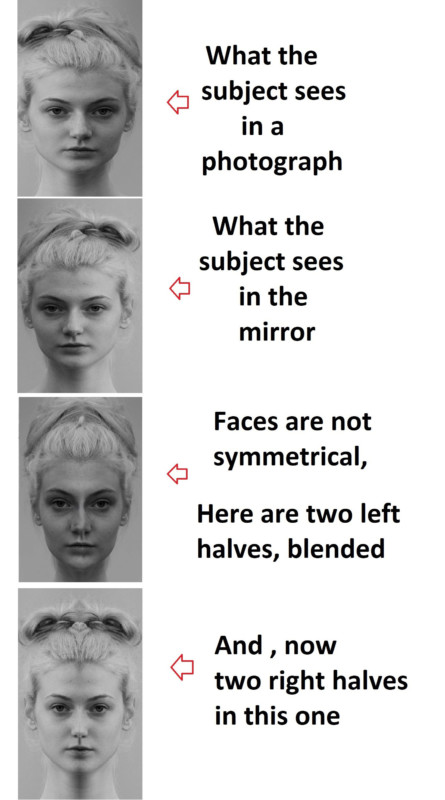
Yet, almost every human face is not perfectly symmetrical. Even though it can be very close with some, one side is not the exact copy of the other.
We are used to seeing the literal mirror version of our own image on a daily basis. Our self-identity fixed into our mind relies on an image that is flipped left for right, backward to what anyone else sees of us when they look at us.
When confronted with a photo of ourselves, it looks wrong because it is a mirror image from what we have grown so accustomed to seeing. Even this small difference makes an unsettling feeling that something is wrong. It triggers the same fight or flight response as if something is trying to trick you.
After all these years, that reflective accuser hanging on the wall has had a laugh at all of us. Perhaps watching us age or gain weight and then showing it to us. When you do look into the mirror, compare that image to your photo. Let science give you some sense of confidence. You are you, and that’s all that matters.
About the author: Eric London is a gunsmith based in southeast Georgia. The opinions expressed in this article are solely those of the author. London previously worked as a technician in a darkroom for a small town weekly newspaper.
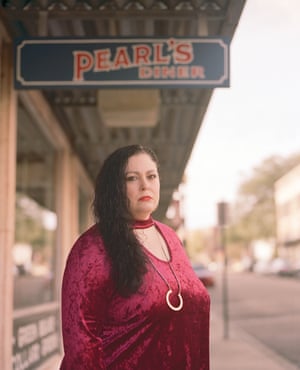
“I love you,” Chera Sherman’s mother told her before driving away in her Jeep Cherokee, leaving her daughter, then 19, bawling fat tears in front of her boyfriend’s home in Laurel, Mississippi.
It was 1994, and Sherman had made the life-altering mistake of falling in love with Jerry Breland, a lanky, black 19-year-old she’d met through a friend back when she worked at Kmart.
Her mother had finally told her stepfather about their six-month relationship earlier that day after a local cop pulled Breland over while he was driving his girlfriend’s yellow Sunbird. When her stepfather heard she was violating his code against race-mixing, he drove to her job to tell her she had to move out.
“White men aren’t going to want you,” her father told her.
They allowed her to collect only what she could carry. The teenager couldn’t take her bedding or her jewelry – she even had to leave her car. “I love ya, but I just can’t have this,” her stepfather said as she grabbed random items.
In the car, the teen was hysterical the whole way; she was crazy about her boyfriend, but she didn’t want to be an orphan. She loved her family, too. “You made this decision,” her mother said, adding that she didn’t agree with her husband but had no control over it: he was the man of the house. And with that, she drove off.
Racism was the required way of life in Sherman’s mostly segregated community. When she was four, she had called a black man the N-word in public because that’s what she believed black people were called. The man was mortified, and her family members had laughed.
Inside, her boyfriend’s father told her she could sleep on the couch until the couple could get an apartment. They found one, but the owner kicked them out after a month when he realized Breland was black. They then landed a rental house where the landlord only cared about the color green.
Although she’d made good grades and planned to enroll at a community college that fall, higher education never happened for Sherman due to the obligations the couple took on to be together. He now works offshore on an oil rig; she takes care of their two boys.
‘Gaslighting is an art form perfected by conservatives’
Still happily married after 25 years, Sherman-Breland now believes many women pay the price – through abuse, rejection or public humiliation – for rejecting America’s rat’s nest of conservatism and racism that has exploded into full relief in Trump’s America.
‘You understand as a young girl that your place is behind your man. You cannot have your own opinions,’ said Chera Sherman-Breland. Photograph: Imani Khayyam/The Guardian
“I can’t tell you the countless number of times younger Caucasian girls who are going through the same exact thing have reached out to me for advice,” she says now.
The south isn’t alone in its paternalism and sexism, but it is still a high art form here. “It is absolutely taught,” Sherman-Breland says. “You understand as a young girl that your place is behind your man, not in front or beside him. You cannot have your own opinions. That’s the most prevalent way they keep you in check.”
Sherman-Breland gradually went against her family’s broader conservative political beliefs as she became concerned about the future of her biracial sons, but it took hearing people she knew calling President Obama “the devil”, and Donald Trump’s open bigotry and birtherism, to electrify her. She now calls herself a proud liberal.
Most conservative wedge issues trace back to racism and sexism, she argues, adding that those poison beliefs take many shapes: abortion and immigration might make white people the minority; affirmative action gives the supposedly inferior an equal shot at jobs and education; public assistance benefits “freeloaders” of color.
White women continue to embrace such prevalent mores. “We’re helping you be a better woman. You’ll be stronger as a submissive Christian,” she says, mocking local white conservatives.
Sherman-Breland used to be anti-abortion herself, and while she doubts conservative men would actually overturn Roe v Wade – abortion is useful to them if they get the wrong women pregnant – she says they instead use it to get religious women to vote against their best interests. Abortion, she says, is what keeps many women she knows from quietly pulling a more progressive voting lever, especially after hearing Trump or Roy Moore next door in Alabama seem to justify sexual assault.
“Gaslighting is an art form perfected by conservatives in the south,” she says, wrinkling her nose.
The hypocrisy kills her. College wasn’t an option for her parents, either, who worked at garment factories. “We relied on social programs to eat,” she says, her smirk dripping with irony. “Not that they were lazy.”
No free pass for white women
White supremacy and all its destructive deep-seated beliefs is, like other forms of barbarism, usually ascribed to men. But historian Elizabeth Gillespie McRae warns that it is a mistake to give white women a pass while ignoring their role in America’s systemic racism.
“What’s wrong with white women?” – a common question after the 2016 election – is due to an amnesia, according to McRae, a history professor at Western Carolina University. McRae’s 2018 book, Mothers of Massive Resistance: White Women and the Politics of White Supremacy, illuminates powerful grassroots alliances of women across the country that worked to keep segregation alive in the 20th century.
“Segregation’s constant gardeners,” as McRae calls those women, distributed myth-filled textbooks and created student essay contests justifying white supremacy in public schools. They also enforced “racial integrity laws” used to kick someone who had “non-white” blood out of school, or have their marriage license refused.
Many of them were educated – some suffragists and newspaperwomen or even union advocates – and they purposefully helped create the twisted race politics that Sherman-Breland describes.
As the civil rights movement gained power, southern segregationists knew they were going to lose, McRae says, and they joined forces with conservatives nationally who coded their own racism. “Outside of the south, they needed to minimize overt racial language and instead talk about ‘constitutional government’,” McRae says. “Campaigning against social welfare and the safety net served their segregation purposes, too.”
Segregationist women used black-inferiority myths to bolster explosive anti-busing protests in Boston in the 1970s, McRae adds. “It’s not to say that all conservatives are white supremacists, but that white supremacists and segregationist politics animated and shaped the new right,” McRae says. “Folks advocating various forms of segregation were all over the nation.”
And they still are. White women, she says, are still often the loudest voices in these battles to keep children of color and/or poverty from “tainting” schools.
‘I wasn’t taught real history’
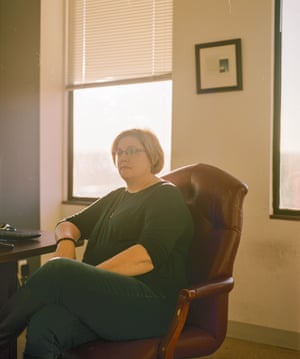
Lynne Schneider, 49, grew up in Lawrence county, Mississippi. Schneider’s early views were shaped in the Southern Baptist church, but saying the N-word was frowned upon by then, and her working-class parents didn’t allow it.
Lynne Schneider is changing her conservative beliefs as a teacher in a majority-black school. Photograph: Imani Khayyam/The Guardian
But in her public school, which was about two-thirds white, black kids sat on their own side of the cafeteria, and white children like Schneider went to a “private” pool that didn’t allow African Americans.
Young Schneider believed her elders when they said everything was equal between races, or that the south fought the civil war for honorable reasons and not over slavery. “I wasn’t exactly an examining person. I wasn’t taught real history,” she says, adding that her textbooks were filled with romantic myths about the Old South.
That wasn’t by accident, historian McRae says. Starting in the early 20th century, a well-funded group of women descended from Confederate soldiers, were desperate to rewrite the reasons why their fathers and grandfathers fought in the civil war. Daughters of the Confederacy leadersworked diligently to ensure that textbooks pushed “happy slave” lies and pride in European colonialism. They even worked with new teachers’ unions to pass on revisionist books to black public schools.
As an adult, Schneider emulated women around her, voting Republican when she was 18. She married a conservative man and became a teacher. By the time she came to Murrah high school in Jackson, Mississippi, in 2001, the formerly all-white school was majority-black. Today at 95% black, it is, astonishingly, the whitest public school in the capital city.
There she met an English teacher, a white woman, who challenged her to think deeper on issues such as abortion and gay rights. Later, her black students helped change her “small government” conservative beliefs which, she realized, keep schools underfunded and subject to constant attacks.
The students also pushed back when she messed up.
One day, Schneider told a class to “stop acting like BeBe kids,” a term used in the black community to reference misbehaving kids.
“You’re calling us ratchet ghetto kids,” they charged.
Schneider apologized for hurting them. “I still make mistakes,” she told them.
To “step out of the ignorance and blinders” of her upbringing, Schneider attended race dialogues and trainings such as Teaching for Change, but she warns other whites not to get high-and-mighty. “When a white person decides they’re so ‘woke’, they can be a little too quick to know more about black people than black people. No matter how clued in you are, you’re still white,” she warns.
She knows plenty of white women who are scared to reject their conservative upbringing, even if their beliefs have morphed, too. “They don’t want to fall out of favor, not be accepted,” she says. “Mississippi is like a football game. People want to be on the winning team. If you’re not conservative here, you have to get used to your side losing.”
‘I had $100, a suitcase and a child’
Anna McNeill’s first husband tried to control her, and her opinions, with violence. Photograph: Imani Khayyam
Anna McNeill’s first husband punched her in the hip one day, leaving a bruise the size of a grapefruit. He told her later she must have run into a piece of furniture.
He soon made it clear she had to mirror his beliefs. That included voting the same. Both were religious conservatives – he had attended seminary – so the compliance did not immediately seem onerous. But she soon learned what complete control felt like.
“As long as he didn’t cheat on me, beat me or spend all of our money on gambling or whatever, he said I should count myself lucky,” McNeill, now 39, says. He told her he was the only one who would put up with her, and quoted the Bible to ensure that she was fully submissive to him and isolated from friends and family.
“The gaslighting was the main thing, right?” she says. “I doubted myself.”
She finally left him. “I had $100, a suitcase and a child. I didn’t have resources.”
Therapy helped her question the family-values party line she and her husband followed. “I was conservative but starting to feel pretty disenfranchised by the Republican party,” she says.
McNeill soon remarried and had two more children with a second husband. He was ultra-conservative and his views on race disturbed her. “If I contested, I worried he would make my children suffer. Depression will suck all the fight out of you.”
She eventually left him, too. Now, she is happily alone with her children and involved in causes she believes in, trying to do domestic-violence advocacy work full time. “My interest in criminal justice reform came about because of my interest in domestic violence,” she says. “I started realizing a lot of these people that were incarcerated came from traumatic backgrounds.”
Still deeply religious, McNeill believes in “limited government” and says Trump proves how dangerous too much power can be in a bad leader’s hands. “I tend now to lean more toward libertarian, which is big enough for both liberals and conservatives,” she says, adding that the government should stay out of all marriage decisions, including same-sex.
McNeil is still anti-abortion. She says probably nine out of 10 white women she knows who voted for Trump in 2016 backed him only because of his stance on abortion, looking past his distasteful traits because the issue is “ a human rights issue” to them. “If you believe that is a person, then you have to protect that person,” she says.
Do anti-choice voters believe Trump really cares about abortion? “Oh, no,” McNeill says, laughing. “They thought he was more likely to appoint judges who would address that issue. Almost every single person says, ‘I will hold my nose. He’s in there four to eight years, but those judges are for life’.”
The fear of communism and socialism
In the late 1960s, Jan Levy Mattiace’s half-Jewish father and Methodist mother pulled her out of public school and enrolled her in a new segregation academy. Although her father was more progressive than most, many white parents then rejected public schools due to the red scare, during which white leaders, segregation academies and the Ku Klux Klan drummed up fear of the supposedly putrid mix of civil rights and communism.
“As children, we did not realize what was going on,” Mattiace says now, adding that she’s happy to see racial diversity in her alma mater today. The most recent US Department of Education numbers show Mississippi’s Canton Academy was 85% white, 12% black, 2% Hispanic and 1% Asian as of the 2015-16 school year. The town of Canton is 71% black.
Jan Levy Mattiace, a long-time Republican, says most female Trump supporters she knows fear the redistribution of wealth. Photograph: Imani Khayyam/The Guardian
In the 1980s, Mattiace became the political director of the Mississippi Republican party before, she says, the extreme-right took over the GOP. She recruited more black members even as national strategists like Lee Atwater, who helped perfect the bigoted “southern strategy” to draw racist voters from a shifting Democratic party to the GOP.
Today, at age 55, Mattiace is on the board of Dialogue Jackson, which hosts race conversations across political divides. She voted for the black Democrat Mike Espy against Cindy Hyde-Smith for Senate last November and now calls herself a “centrist” who may vote for a Democrat for governor this year.
“I land between Colin Powell and George Herbert Walker Bush,” she says. But, she adds, “I am not a feminist.” She is for equal rights, respect and opportunity for women, however, and is now married to a commercial developer who decidedly does not tell her how to vote.
Polarization between the left and right have long worried her, but Donald Trump concerns her more. Many of her friends may vote for him a second time in 2020. But for them it’s not about abortion, or following their husbands’ orders. “It was a vote against Hillary. Or against the Democratic agenda. They feel like that’s a danger,” Mattiace says. They find Trump better than the communist horrors many learned about at home and school.
“There’s a fear of moving into a socialist society,” Mattiace says. “They’re people that may have relatives in socialist countries … that are grasping for groceries and have to take a number to buy food. Trying to redistribute wealth fairly like that, it becomes chaotic, a war zone.”
Can people truly change?
People can change, as Sherman-Breland and her husband have learned. They stayed in the same county, marrying a decade after her mother dumped her in front of Breland’s house that day.
Over time, Sherman’s family fell in love with their grandchildren and with Breland – even her stepfather. “When he died in 2014, he was probably closer to Jerry than anyone else in his life,” she says of her stepdad.
Her husband never got nor expected an apology, however.
Sherman-Breland is concerned about Trump dragging old-school racism out of the hall closet. He is making people backslide into open hatefulness, dividing families like hers around the country, she says.
She worries especially about what Trumpism is doing to her own family’s loving detente. “When my family started supporting Trump and the ideals of all his rhetoric, it was literally like reliving all of that hurt again,” she says.
“I know they love us. But their support of this rise in white supremacy is devastating all over again. It has ripped my family apart. Again.”
Did you register, dear viewer, that Downton Abbey had two characters named Thomas B: the malignant footman turned loyal butler Thomas Barrow, and the socialist chauffeur turned son-in-law Tom Branson? And if it did, did it bother you?
Chances are the answer is no—unless you happen to be Benjamin Dreyer.
Dreyer is an expert grammarian and influential arbiter of good writing, whether in the novels he oversees as the copy chief at Random House, or on Twitter, where he points out the proper use of the em dash, commonly misspelled names (Olivia Colman), and that while it’s kosher to spell omelette as omelet, dialog is beyond the pale, “Because ick.” This blend of pedantry and whimsy makes his new book, Dreyer’s English: An Utterly Correct Guide to Clarity and Style, an instructive and entertaining manual—one that lays down the law of the jungle while being imaginative enough to allow personal idiosyncrasy to prosper.
But there’s at least one area where Dreyer displays a surprisingly rigid point of view. In advice that has the whiff of schoolroom dogma, he exhorts novelists to refrain from giving characters similar-sounding names. Citing a manuscript he had to edit, where “fully half the characters had names beginning with the letter M,” Dreyer intones, “This is not a good thing.” In the footnotes, he offers the example of Downton Abbey: “It was a point of ongoing perturbation for me that two characters on the Downton Abbey series were both—pointlessly, so far as I could discern—named Thomas and that both their surnames began with a B.”
No doubt the motive behind his rule is to avoid confusing the reader. But clarity is only one aspect to choosing a character’s name, and it would’ve been helpful if Dreyer had explored the significance of deploying same or similar-sounding names as a literary device, though he gestures to it by qualifying his criticism of the two Thomases with, “pointlessly, so far as I could discern.” The inference being that if there were a larger point, he might not object.
In comedy, for instance, the same-name device is commonplace, as in the delightful case of Thompson and Thomson, the bungling Scotland Yard detectives in the Adventures ofTintin comic series, alike in everything but the curl of their mustache. The contorted ways in which they introduce themselves, including, “This is Thompson, yes, with a P as in Philadelphia” and “This is Thomson, no without a P, as in Venezuela,” never fail to spark joy.
But it’s also a useful ploy to add dramatic tension. In Olive Kitteridge,the Pulitzer Prize–winning novel by Elizabeth Strout (who, incidentally, is the only author whom Dreyer continues to copy edit), two couples gather around the Kitteridges’ dining table: the middle-aged Henry and Olive Kitteridge, and the newly married Henry and Denise Thibodeau. Olive’s bottled resentment—at being forced to play host, at her drudgery-filled life, at her husband’s infatuation with Denise—explodes when her Henry spills the ketchup while passing it to the other Henry. She snaps at her husband, but the damage her outburst inflicts is collateral.
“Leave it,” Olive commanded, standing up. “Just leave it alone, Henry. For God’s sake.” And Henry Thibodeau, perhaps at the sound of his own name being spoken sharply, sat back, looking stricken.
It’s as if the blood spatter of Olive’s bullet, aimed at her Henry, has landed on the other Henry’s face. Soon, this young Henry will die in a hunting accident, leaving Henry Kitteridge to comfort Denise, who will whimper, “Oh Henry, Henry,” so that he is painfully uncertain about “which Henry she meant.” The reader, too, is left wondering whether Denise is mourning the dead Henry, playing the older Henry, or flailing between the two. All that misdirection achieved simply by naming both men Henry.
But Dreyer’s complaint was that because the two Thomas B’s didn’t do anything to enrich Downton Abbey, why have similar names? To which, one can answer, Why not? The overlapping of names is an all-too-common occurrence in life. True, it can cause confusion (especially for the accounts department), but if fiction’s grand purpose is the mimesis of la condition humaine, shouldn’t writers be nudged to accommodate this inconvenient reality, rather than dodge it for fear of taxing the reader? If accounts can handle it, can’t we?
Yes, we can, declares the twice-Bookered Hilary Mantel, whose experience in managing dramatis personae bedeviled by the same name is hard to surpass. In her Tudor trilogy (Wolf Hall, Bring Up the Bodies, and the forthcoming The Mirror and the Light), all the leading male characters apart from Henry VIII are named Thomas (it was the second-most-popular name in Tudor England). There is Thomas Cromwell, the ruthless hero. Thomas Wolsey, the Catholic cardinal. Thomas More, the Catholic zealot. Thomas Cranmer, the archbishop of Canterbury. And Thomas Boleyn, the depraved father of Anne Boleyn, and the only one of these Thomases to survive the abattoir of the Tudor court. The naming nightmare, however, doesn’t end here. Of Henry’s six wives, three are some variation of Catherine and two are Anne, while his mistress, his daughter, and the Queen of Scots are all Mary.
Mantel was writing historical fiction and had no say in the christening, but she embraced her cards. “What do I do?” she said in 2014 at the Cheltenham Literature Festival, on the difficulties of adapting her books for television. “Every second man in Henry VIII’s England is called Thomas. At any one time, there are five Thomases on the page, all shouting at each other. The only thing to do is let the reader in on it. Admit the difficulty … Because as soon as you decide this is too complicated for the viewer, or history is an inconvenient shape and can’t we tidy it up a bit, then you fall into a cascade of errors which ends in nonsense.”
But what if a novelist were to write a fictional story of a Tudor tyrant? Only a sadomasochist would name five men Thomas. Unless, of course, your novel is set in the looking-glass world of Macondo. In Gabriel García Márquez’s One Hundred Years of Solitude, which Netflix is set to adapt, the 17 sons whom Colonel Aureliano Buendía fathers during his war travels by 17 women are all baptized Aureliano. And all but one are murdered by the colonel’s enemies. The hyperbolic naming could be dismissed as another magical-realism stunt—except that it is curiously convincing. First, because it is breathtakingly realistic for those mothers to give their sons the first name of their illustrious father because they can’t carry his surname. And second, because García Márquez treats the serial massacre not as a video-game splatterfest but as the appalling family tragedy that it is. As the telegrams announcing the deaths of the Aurelianos arrive in Macondo, the boys’ aunt Amaranta brings out the family ledger, and like a meticulous accountant, draws lines through her nephews’ names, until only the eldest remains. Nothing evokes the looming obliteration of the Buendías more chillingly than the crossing out of Aureliano 16 times over.
One writer who uses the same-name trope masterfully, both as a reflection of life and for dramatic tension, is le grand écrivain of realism: Leo Tolstoy. I was finally spurred to read Anna Karenina after coming across this observation in The Possessed, Elif Batuman’s travelogue into Russian literature.
Anna’s lover and her husband had the same first name (Alexei). Anna’s maid and daughter were both called Anna, and Anna’s son and Levin’s half brother were both Sergei. The repetition of names struck me as remarkable, surprising, and true to life.
To have a scattering of Annas and Sergeis in a Russian novel is an authentic touch. But to give husband and lover the same first name is a florid ruse that enables Tolstoy to indulge his moral snobbery at adultery and, conversely, to expose the illusion of choice within which Anna is trapped. She refers to this cruel coincidence only once, in that anguished scene that every reader has been secretly hoping for: a confrontation between her and the two Alexeis. It unfolds after Anna has given birth to her lover’s daughter and is almost at death’s door. Crying out for forgiveness, she calls her husband Alexei, and not the formal Alexei Alexandrovich, for the first and last time.
For Alexei—I am speaking of Alexei Alexandrovich (what a strange and awful thing that both are Alexei, isn’t it?)—Alexei would not refuse me.
Moved by her remorse, Anna’s husband (whose family name is Karenin) forgives her. In this scene, Anna is at the peak of her powers and has complete control over the two Alexeis, with one sobbing against her skin, and the other into his hands. Rounding off this tableau are the two other Annas, the loyal maid (who’s known as Annushka throughout) and the newborn, who will be christened Anna (her precarious social status being no different from the 17 Aurelianos). Anna Karenina will never have the same power again, and the two Alexeis will parallel her narrow life like the train tracks onto which she eventually flings herself. Karenin, who is strangely enchanted by his wife’s daughter, will adopt her from the bereft Alexei Kirillovich Vronsky, thus officially making her Anna Karenina. The little girl will repeat, in reverse, the journey her mother made from one Alexei to the other.
Would the novel have been as heartbreaking if Karenin and Vronsky had different first names? It would. But the fact that they do injects the romance with a moral queasiness, something that the Tolstoy devotee and Olive Kitteridge author Elizabeth Strout was probably aware of when she named her two male characters Henry. Similarly, the fate of the numerous Thomases concentrates the carnage of the Tudor court, and the massacre of 16 Aurelianos infuses a family saga with mythic weight.
As for Downton, the two Thomas B’s are probably mere coincidence. But coincidence can instruct without meaning to. In this case, the trajectory of the two men inadvertently exposes the travesty of the class system, which forms the scaffolding and substance of this family drama. Both commoners start out downstairs, until one marries well and is absorbed upstairs. One Thomas B will be treated as the pantry man, the other Tom B as posh. The porousness of the rigid class system is almost parodic, but has allowed it to survive and prosper. Very much like the English language, as Dreyer’s book so amply testifies.
Vern Loomis, a retired structural draftsman in West Bloomfield, Michigan, had a standard office lunch: a peanut-butter sandwich, with various fruit, vegetable, and dessert accompaniments. He ate this, he estimates, nearly every workday for about 25 years.
His meal underwent slight modifications over time—jelly was added to the sandwich in the final five or so years—but its foundation remained the same. The meal was easy to prepare, cheap, and tasty. “And if you happen to be eating at your desk … it was something that was not too drippy,” he told me, so long as one applied the jelly a bit conservatively.
Last year, Loomis retired from his job but not his lunch, which he still eats three or four days a week (now with sliced bananas instead of jelly). “I never stopped liking it,” he says. “I still do.”
Loomis may be uncommonly dedicated to his lunchtime ritual, but many share his proclivity for routine. One of the few existing surveys of people’s eating habits estimated that about 17 percent of British people had eaten the same lunch every day for two years; another indicated that a third of Brits ate the same lunch daily. But it’s hard to say for sure how common this really is, since these surveys tend to have been conducted by food purveyors, who might be inclined to exaggerate the ruts that diners are stuck in (and then try to sell them a way out). Still, loyalists who stick to a single meal for months or years—they are out there.
Whatever the symbolism, these people’s behavior is not doing them harm. Marion Nestle, a professor of nutrition and food studies at New York University and the author of several books about nutrition and the food industry, says the consequences of eating the same lunch every day depend on the contents of that lunch and of the day’s other meals. “If your daily lunch contains a variety of healthful foods,” she says, “relax and enjoy it.”
So there is nothing wrong with this habit. In fact, there are many things right with it. I spoke with about half a dozen people who, at one time or another, have eaten the same thing for lunch every day. Together, their stories form a defense of a practice that is often written off as uninspired.
Many of the people I talked with emphasized the stress-reducing benefits of eating the same thing each day. Amanda Respers, a 32-year-old software developer in Newport News, Virginia, once ate a variation on the same home-brought salad (a lettuce, a protein, and a dressing) at work for about a year. She liked the simplicity of the formula, but the streak ended when she and her now-husband, who has more of an appetite for variety, moved in together six years ago. Would she still be eating the salad every day if she hadn’t met him? “Oh heck yeah,” she told me. “It would’ve saved so much time.”
Sharilyn Neidhardt, a photo editor in New York City, once found solace in regularity. About a decade ago, she switched jobs, and her new one stressed her out. “There were phones ringing constantly and there were people yelling all the time,” she recalls. One thing that Neidhardt found soothed her and gave her a measure of control over her day: She picked up a spicy noodle dish called tantanmen from the same ramen restaurant every lunch break. She did this for “a minimum of six months,” after which she got tired of the meal (and its cost) and, perhaps more important, settled into the new job.
Eating the same thing over and over can also simplify the decisions people make about what they put into their bodies. Currie Lee, a 28-year-old resident of Los Angeles who works in retail, has some food allergies, and keeping her lunch unchanged “makes it easy” to eat around them. For about six months, at her previous job, she brought overnight oats every day; her current go-to is a turkey sandwich with hummus, avocado, arugula, and cheese, on gluten-free bread.
Lee’s eating habits are not just a function of her allergies, though. She likes that eating the same thing makes grocery shopping simpler, brings consistency to her sometimes chaotic schedule, and made it less likely she’d spend the money at the “$12-salad place” near her previous office. Besides, she really likes the things she brings. “I’m not eating, like, a PB&J every day,” she says. “I try to make it taste good and interesting.” (I did not tell Vern Loomis what Lee apparently thinks of his lunch.)
Chloe Cota, a computer engineer in New York City, does not have as strict a lunchtime regimen as others described in this story, but she has noticed that when her company brings in catered lunch, she always picks a salad when it’s available. She came to think of this default selection as reducing her “cognitive overhead”—a way of not expending mental energy on something that wasn’t a high priority for her.
“Lunch variety doesn't really matter to me,” she says. “I would be perfectly happy to eat the same Caesar salad or peanut-butter-and-jelly sandwich every day.” Similarly, she has devised a standard “work uniform” (one of her many pairs of black leggings, plus a T-shirt), which helps streamline her morning routine. She says she took inspiration from tech moguls such as Steve Jobs and Mark Zuckerberg, who essentially automated their owndaily attire decisions in the name of reducing cognitive overhead.
The salad station, Cota says, is also an opportunity for her to practice “mindful eating,” something she started doing as part of her recovery from an eating disorder she developed in high school. She says it helps to know that the foods available to her in that moment are ones she knows she likes, which “short-circuits that whole negative space in my brain where I might get back into those disordered behaviors.”
For some people, the repetition in their daily food preparation is in the meals they make for other people. Ambreia Meadows-Fernandez, a 26-year-old writer in Cheyenne, Wyoming, cooks the same meal—“a meat and rice,” sometimes with some vegetables—for her 3-year-old son most nights of the week. “It made it simple in a way that there was less stress about what to give him,” she says. He usually gets a peanut-butter-and-jelly sandwich for lunch, and doesn’t seem to mind the lack of variety.
Of course, most people around the world who eat the same thing every day aren’t doing so voluntarily. “I would say most people most of the time have little choice in their staple,” says Paul Freedman, a historian at Yale and the author of Ten Restaurants That Changed America. “If they live in a rice culture, they will have rice for every meal; ditto potatoes.” The cooking fat used—say, butter or ghee—generally remains the same as well.
The variety, Freedman says, usually comes from “relishes,” the food-anthropology term for flavor-adding ingredients such as spices, vegetables, and modest amounts of meat (like bacon). “This staple + fat + relish combination is what dominated eating in traditional peasant cultures,” he wrote in an email.
When I asked Krishnendu Ray, a food-studies scholar at NYU, about dietary variety, he said: “Newness or difference from the norm is a very urban, almost postmodern, quest. It is recent. It is class-based.” So, when accounting for the totality of human experience, it is the variety-seekers—not the same-lunchers—who are the unusual ones.
I should reveal that my interest in this subject is not purely philosophical. Nearly every workday for the past five or so years, sometime during the 1 o’clock hour, I have assembled a more or less identical plate of food: Bean-and-cheese soft tacos (topped with greens, salt, pepper, and hot sauce), with baby carrots, tempeh, and some fruit on the side. And almost invariably, I see the same colleague in our communal kitchen, who asks with delight, “Joe, what are you having for lunch today?” The types of bean and cheese rotate, as does the fruit—which depends on the season—but I do not inform my co-worker of these variations when I laugh off her very clever and funny question.
The people I talked with recounted similar experiences of having co-workers harmlessly joke about their meals, like “How was that sandwich today, Vern? Did you use crunchy or plain?” Currie Lee’s former colleagues, aware that she adored horses, found her regular meal particularly amusing, saying things like “Oh, there’s Currie with her oats.”
Lee thought these comments were just regular workplace small talk. But perhaps there is more to them, and eating the same thing each day reveals something deeper about who people are, or at least perceived to be. Amanda Respers, the yearlong eater of salads, says that “we bring a little bit of home when we eat lunch at work,” and naturally people’s outside-of-work identities are a subject of interest. What does eating the same thing each day say, then? “No offense, but it gives the impression that you’re a little bit boring,” she says.
Personally, I think Respers is on to something, though I’d draw a slightly different conclusion. The daily rituals of office life are characterized by their monotony and roteness, and bringing a different lunch each day is a sunny, inspired attempt to combat all the repetition. I do genuinely appreciate the optimism of those attempts. But in my mind, eating the same thing for lunch each day represents a sober reckoning with the fundamental sameness of office life. It seems like an honest admission that life will have some drudgery in it—so accept that and find joy elsewhere instead of forcing a little bit of novelty into a Tupperware and dragging it along on your commute.
But I am probably overthinking this. Ultimately, I am partial to Vern Loomis’s analysis of what prompted his co-workers to poke fun at his peanut-butter sandwich: “Maybe [they did so] just out of good humor, or maybe guilt that they’re not eating as healthy—that they’re eating a greasy burger or something—or going out and spending $15 for a lunch when mine only cost 80 cents.”
“Jealousy,” he concluded. “I think it’s jealousy.”
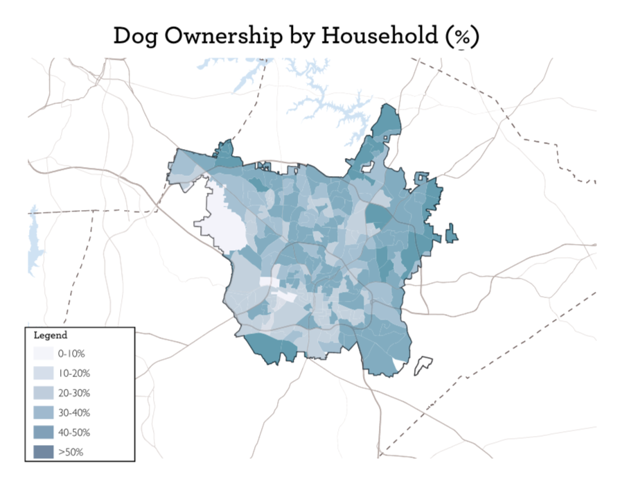
This is what a park for very good doggos looks like.
When it’s completed over the next decade or so, the dog park nestled inside Lincoln Yards, a much-discussed $6 billion mega-development now taking shape on Chicago’s waterfront, could be the toniest pet playground in the nation.With its splash pool and pug-mug video installation—an homage to Millennium Park’s famous Crown Fountain—the only thing SOM’s design for Chicago puppers is missing is an oversized mirrored bone.
Humans living in Lincoln Yards will enjoy amenities as well: Plans call for a sledding hill and recreation fields among its 70-story skyscrapers. But the dogs really have it made.
“Wow, that’s a luxury dog park,” says Anjulie Rao, editor of Chicago Architect. “That’s insane to me. I have a dog—she deserves only the best—but that’s a luxury dog park.” She adds, speaking of the sunny rendering of Lincoln Yards, “My first visual reaction is: That is a lot of white people with dogs.”
Outside Chicago’s North Side, dog parks are much harder to come by. Just one city-sanctioned dog-friendly area can be found across the entire South Side, although a few are now in the planning stage, as Zach Mortice points out in a new report on the city’s stark dog park divide in Landscape Architecture.There’s a DIY agility track called “Jackson Bark” in the park of the same name (how cute is that?). Otherwise, half of the city is poorly served by public amenities that cater to canine residents.
The other half can’t live without them. In Chicago and beyond, dog parks are a reliable font of neighborhood drama, serving up listserv friction week after week, such as the stand-off between professional walkers and the local owners who consider their dog parks theirs and theirs alone. Local theater aside, dog parks represent a cherished public amenity that serves only some of the neighborhood, and can generate problems for others. Fraught or friendly, off-leash parks lead the way among the fastest-growing parks in America’s largest cities.
This splashy boi competes in the DockDogs Western National Dog-Jumping Championships—not a joke—in Redmond, Washington’s Marymoor Park, known to locals as “Doggy Disneyland.” (Ted S. Warren/AP)
Parks and recreation departments face tremendous pressure today to dedicate more and greater space for the nation’s fur-babies, even in cities where there aren’t enough local parks for actual children. The rise of dog parks—up 40 percent over the last decade—has consequences for neighborhoods that have them as well as those that don’t. More than half of the nation's parks departments now boast a dog park.
Back in the day, “a dog park wasn’t a thing” says Kathryn Ott Lovell, commissioner of Philadelphia Parks & Recreation. “You walked your dog around the neighborhood. You took your dog around the block. Standards and expectations for dog owners have shifted. The culture of dog ownership has changed.”
The fancy-town dog park in the early designs for Lincoln Yards might be among the least-divisive features of this project, which closed in on as much as $1.3 billion in public funding (through a tax-increment financing scheme) last week. But it is nevertheless a small marker of disparity in the city—one that can be found all over. It’s a pattern whose consequences range from worrisome sign of neighborhood gentrification to outright structural inequality.
In Chicago, the unequal distribution of dog parks is more than a problem for cooped-up pooches.A city ordinance imposes a $300 fine for off-leash dogs, who are legally welcome only in the city’s dog-friendly areas. Police disproportionately assign tickets for off-leash violations in the city’s predominantly African-American South Side, most of which is a “dog park desert.”
Almost all of Chicago’s dog parks fall in areas that are majority white, though such neighborhoods make up a relatively small part of Chicago’s geography. Dog parks are such a North Side cultural force that they even have their own newsletter (Fetch!), a product of the nonprofit South Loop Dog Park Action Cooperative and possibly the bougiest thing since bottomless mimosas.
In no small part, white neighborhoods are rich in dog parks because they are rich, period. Chicago’s parks commissioner didn’t respond to a request for an interview, but a spokesperson for the Chicago Park District noted that the city’s parks department doesn’t fund dog-friendly areas: “These facilities are funded through Aldermanic menu, Tax Increment Financing (TIF), Open Space Impact Fees (OSIF) and community fundraising or a combination of these sources.” South Side areas that lack the resources to establish formal dog parks go without them.
Which would be fine, maybe, in a sense. Nationwide, 24 percent of black households own pets, compared to 58 percent among white households. Latinx households (45 percent) and Asian families (23 percent) also have fewer pets than whites, according to Census Bureau data. So community pressure to convert vacant lots to dog parks is unlikely be be distributed uniformly across a city. Yet the consequences of not having a local off-leash dog-friendly area fall disproportionately on people of color in Chicago—another example of over-policing historically disadvantaged communities.
“With private land, there comes more opportunities for the enactment of racism,” Rao says. “People of color tend to be less welcome in private-public spaces like [private] plazas and dog parks on private property. They’re looked at with more scrutiny.”
Around the country, there’s no critical consensus among parks leaders about how, where, or whether to build dog parks. There’s good analysis that shows how much park space people require per capita, says Rich Dolesh, vice president for strategic initiatives at the National Recreation and Park Association, but the right amount of land to set aside for pets is anyone’s guess.
With the population of dogs in the U.S. falling somewhere between 77 million and 90 million, though, cities ignore their canine constituents at their peril. “It’s been a perennial topic among park administrators,” Dolesh says. “Dog park advocates are the most relentless and successful advocates for what they’re trying to do, [compared to] anybody else who crusades a park-and-recreation amenity in their community. We see park directors get together and gnash their teeth.”
“If you were to do a word cloud of a day in the life of a parks commissioner, it’s ‘dogs,’ ‘trees,’ and ‘restrooms,’” says Ott Lovell.
Officials in Raleigh, North Carolina, have taken a first step toward measuring the city’s canine needs with quantifiable precision. In January, Raleigh dropped what may be the nation’s first comprehensive report on dog parks. Complete with spatial analysis for dog adoptions across Wake County over the last decade as well as maps showing the density of dog-friendly apartment buildings across the city, the 2018 Dog Park Study is proof that dogs matter more than cats. (As far as canine censuses go, we rate Raleigh “14/10 would pore over its findings.”)
Raleigh’s 2018 Dog Park Study estimates that the city’s canine population will exceed 100,000 by 2023. By matching census-based household data with market intelligence (pet-food purchases, veterinary services, and so on), the city produced a map (via the mapping company Esri) showing the density of its dog-owning population. Pet demographic data turns out to be way more complicated than you’d guess, but Raleigh’s findings show that city dogs are more or less spread out homogeneously.
Dog ownership is fairly equally located across the city of Raleigh, according to a city census on very good boys and girls. (Raleigh Parks, Recreation, and Cultural Resources)
Based on input from the public, the city set a target: dog park access within a 10-minute drive, pretty much city-wide. Getting there would mean boosting the number of official dog parks from five to nine, focusing on unmet demand in north and west Raleigh.
Downtown represents a bigger challenge: There aren’t any dog parks within a 10-minute walk of the densest downtown residential corridors, and there’s no obvious place to build them.
“While the park resources within walking distances of these nodes are limited and already under intense pressure for many competing uses, there may be opportunity to provide temporary or permanent dog park access through some of the sites in the vicinity,” the report reads. “Future park planning efforts should consider the special need in this area for dog park access.”
While the 72-page report is thorough—sweeping as far as municipal reports on pets go!—it makes no mention of race or equity as factors to consider when it comes to planning dog parks. Some of the report’s recommendations, from establishing dog parks through public-private partnerships or studying a membership-fee model for using them, could even inhibit access for African-American pet owners. And the data-driven report doesn’t invite residents of predominantly black areas into the planning process.
“Long-established minority communities that [feel] the hot breath of gentrification on their necks may see [dog parks] as an unwelcome sign of change,” Dolesh says. “It’s like Starbucks opening in your community. Uh-oh.”
A wee dog parklet outside Amazon’s offices in Seattle. Prime pups have an HQ, too! (Elaine Thompson/AP)
Facing up to the growing public demand for dog parks, especially from dog-crazy white communities, means asking big questions about small-scale land use. The questions don’t get smaller when the parcels do.
“I am 100 percent pro-dog park,” Rao says. “But when you’re looking at dropping large dog parks in the middle of neighborhoods, it makes me feel like that land could be used for more useful things. We need to start considering new ways of using existing park space for dog-friendly activities.”
Park leaders face tremendous pressure to build dog parks, even as building them triggers tremendous conflict. In affluent areas especially, residents increasingly see dog parks as basic civic infrastructure, up there with sidewalks or libraries. Some 97 percent of Raleigh residents who took part in a survey for the 2018 Dog Park Study said that dog parks “build a sense of community.”
But in at least one case, building one community helped erase another one. In October, officials in Norfolk, Virginia, shuttered an establishment called the Hershee Bar as part of a planned revitalization. Activists spent month trying to convince the city to spare the bar, which was Norfolk’s only dedicated space for lesbian, bisexual, and queer women. The city council had voted for the plan without even debating the impact on the LGBTQ community.
Only after the bar closed its doors did owners, staff, and frequenters learn that one potential plan for the site was a dog park. “I love dogs as much as the next person,” one of those activists, Barbara James, told The Washington Post. “But our 35-year history is being torn down in this way where the city is essentially saying we’re less than a dog.”
Ultimately, dog parks represent decisions about land use, which means that they can benefit some to the detriment of others. If the rise of dog parks also brings about more leash laws or strict enforcement of these codes, then it matters very much where they get built. What doesn’t get built also matters: When residents start to demand a dog park that can be described as a “complex,” unless every play space for kids is in tip-top condition, then perhaps pet owners should be brought to heel.
“When you are forced to choose between those two things”—a dog park versus a playground—“it’s obvious where the investment has to go,” says Philadelphia’s Ott Lovell. “When you’re a city like us, with very very limited resources and space for that matter, the priority is pretty clear.”
Seattle's immensely popular business tax was designed to do something about the city's epidemic of desperatehomelessness, but then Amazon threw its muscle around to get the tax canceled, mostly by threatening not to occupy its new offices in Ranier Square, a 30-story building currently under construction that Amazon was to be sole tenant of, with 3,500-5,000 employees working out of the building.
Now, Ranier Square is advertising for new tenants to fill its 722,000 square feet, because Amazon has canceled its plans (though not the lease - the new tenants will sublease from Amazon, likely for 10-15 years). Unconfirmed reports have it that Amazon will instead expand its rentals in neighboring Bellevue.
Seattle has upcoming municipal elections and some city councillors are signalling that they'll campaign on reinstating the tax and raising money to help fix the city's housing crisis.
When Mayor Jenny Durkan and a council majority sought to compromise with business leaders in May by passing a smaller version of the tax, Amazon announced it would move ahead with Block 18, one of several new buildings going up in the Denny Triangle. But the company never recommitted to the Rainier Square space, even after an effort to nix the measure through a referendum, backed by Amazon and other local businesses, pressured the council into repealing the tax less than a month later.
The annual tax of $275 per employee on companies grossing at least $20 million per year would have raised about $47 million in 2019 for low-income housing and homeless services. Kshama Sawant, one of two council members who opposed the repeal, described Amazon’s Rainier Square announcement Wednesday as a “told you so” moment.
“This is a good reminder for us that backing down to the bullying of corporations never stops their bullying,” said Sawant, praising activists in New York City who protested tax breaks for Amazon, causing the company to pull out from its campus plans there. (Two Seattle council members, Teresa Mosqueda and Lisa Herbold, spoke at a New York event organized by Amazon opponents in January.)
“As the next step, people in Seattle should gather courage and renew our fight to tax big business for social housing,” Sawant said.
Base image: SDOT’s Broadway bikeway and streetcar extension plans. As noted, the proposed car charger would be directly in the path of the bikeway.
Seattle is about to invest to build a public car charger directly in the path of the on-hold Broadway Bikeway extension north or Denny Way.
Once complete, people biking northbound in the Broadway protected bike lane would need to merge into mixed traffic at Denny Way to go around a parked electric car using the city’s charging station. And neither Seattle City Light nor SDOT seem concerned about this conflict, as Capitol Hill Seattle reports:
“In the absence of a bike lane currently, we believe this is a great location for an electric vehicle charging station,” Scott Thomsen, spokesperson for City Light tells CHS. “Should there come a time, we will be able to move our infrastructure.”
The Seattle Department of Transportation describes the situation a little differently.
“We do not believe installation of a charging station would preclude future bike lanes,” a spokesperson tells CHS. “Assuming a charging station is installed on Broadway, we would work with our partners at SCL to determine how to design a (protected bike lane) around it or shift the charging station to accommodate when the time came.”
The Broadway Bikeway extension is at the 90 percent design phase, which is essentially shovel-ready. It was initially scheduled for 2016, but has been put on hold due to a lack of funding for the associated streetcar extension. The design does not have on-street parking next to the charger location, but it does have parking space across the street as shown in the image above.
You can learn more and provide feedback at an open house 6 p.m. March 6 at Seattle Central College’s Broadway Edison Building in Room 1110. If you can’t make the open house, you can also contact the project team:
Thanks for asking! Folks that can't make it are encouraged to email comments to SCL_ElectricVehicles@seattle.gov or call (206) 684-3800.
As we have argued, the bikeway should go ahead with or without the streetcar because its current abrupt end at Denny Way does not work. The Denny Way terminus was supposed to be temporary, but installing a charging station in the planned bikeway path suggests that the city considers it permanent. And that’s frustrating not just for bike access and safety along the north end of Broadway, but it severely limits the usability of the existing stretch of the bikeway that reaches south to Yesler Way.
Context as part of the city’s Bicycle Master Plan.
On the other hand, completing the Broadway Bikeway as designated in the city’s Bicycle Master Plan sets up a connection that could reach all the way to the University and 520 Bridges. It would also create a consistent street design for all of Broadway and improve safety for everyone, especially people walking.
Even if the city truly is willing to spend more money moving the charger later when the bikeway is installed, that feels like an unnecessary expense. More likely, the cost of moving the station will be yet another barrier to completing the bikeway.
But the bigger issue here is that the city is apparently not considering its modal plans when choosing car charging locations. Either that or they see charging cars as more important than biking. If the argument for public funding of car chargers is to fight climate change (a questionable strategy), then blocking a bike lane is counterproductive. It would be much better to install the chargers in parking spaces with no plans to change.
I’m not necessarily against experiments in public funding for electric car chargers, though there are equity questions about charging stations that need to be addressed. After all, you need to be able to own an electric car to use these public stations. But such efforts definitely cannot impede known solutions like transit, walking and biking. And I mean that literally in this case but also financially as the city budgets its resources.
Many companies use private APIs to manage their A/B tests of experimental products and approaches; by grabbing the calls that mobile apps make to these APIs, Jon Luca was able to figure out all kinds of sensitive information about companies' future plans, from the way Lyft steers customers towards credit cards that are cheaper to process and its use of "Tactical Price Adjustments" to fight customers who price-compare with Uber; to Airbnb's future China plans; to Pintrest's gendered content differentiation and so on.
There's lots more: Amazon's upcoming augmented reality offerings; to Tinder's incomplete erasure of a now-deprecated feature that let you view a prospect's Instagram.
Luca has promised a followup in the months to come.
Most companies aren’t obfuscating or minimizing their experiment names, which leads to information leakage. This could prove dangerous in the future - if a company is slowly rolling out a new feature, it could give their competitors an advantage.
This is a common occurrence in the industry - nearly every company is siloing off their growth engineering department, which leads to siloed off experiment routes. This in turn makes it almost trivial to figure out what they’re working on, and make educated guesses at the 6 month roadmap of most tech services.
Some future companies I’d like to try and check out are Snapchat, Ebay, all the Google products and services, and LinkedIn.
There’s a lot more apps and services that this methodology works with. Feel free to reach out if you’re interested in finding any given companies experimentation campaigns.
These increasingly sinister warnings came from more unexpected places, too. CNBC wanted to tell me all about why this Chinese-made coat was a must-have for US consumers. Business Insider suggested that the affordable cost of the viral down parka by Orolay should terrify Canada Goose. Even the Daily Caller — the Daily Caller! — was trying to get me to buy this one particular coat.
Mind you, I tried very, very hard to avoid it. I did not click on any article or fave any tweet that told me how viral the coat is or how great it is or how affordable it is or how, actually, it’s ugly and whoever is buying it is a big idiot.
This #AmazonCoat is supposedly the hot thing this winter but...um..it's ugly. Like, it's really, really ugly. Am I totally off here?https://t.co/JZIbsI5nfg
This was not because I thought that the coat was overall pretty boring and looked like every other coat, which it kind of does. It wasn’t just that I hadn’t actually noticed anyone wearing it, which I hadn’t. It was because I deeply, truly, did not want to participate in one of my least favorite forms of journalism, specifically fashion journalism: fabricating a trend from very little actual evidence.
The Amazon coat wasn’t an entirely made-up fashion trend, but it certainly was the sort of trend that exists primarily because we were told it was trending. Whether it actually was is more complicated.
The story of the Amazon coat began as a local news item
There is a single person on whom I can blame this barrage of breathless coat coverage, even though none of it is really even remotely her fault. Last March, Katy Schneider — an associate editor at New York Magazine’s product recommendation site, the Strategist — was given an assignment. Her colleague Amy Larocca had noticed a certain olive green parka that a bunch of very cool, very fancy women on the Upper East Side owned, and thought it might be worth investigating. The twist: The coat was cheap, and all of them bought it on Amazon.
Amy is the kind of person, Katy tells me, who is generally correct when you tells you something is a Thing. And she wasn’t wrong: Katy discovered, by asking Upper East Siders who owned it how they heard about the coat, that it spread almost entirely through word of mouth among the kind of women who owned beauty businesses or were successful creative directors and stylists. And there appeared to be a single originator: a teacher at the 92nd Street Y, where one of the women’s daughters went to preschool, who had seen it on a travel blog called the Blonde Abroad.
The Amazon coat, it should be noted, is not cool. It’s fine. It’s slightly oversized, hooded, and comes in muted colors like olive green, black, navy, and cream. There are square-shaped pockets and paneling on the front, which one coat owner attributed to the influence of Balenciaga. Others claimed with pride that their friends had thought it was by Sacai, a much more expensive fashion company. (Orolay is a brand that also sells folding chairs and storage cabinets.)
Which is why the coat itself was not the focus of Katy’s resulting story for the Strategist: It was that this affordable, nondescript coat was being worn by the kind of women whose peers might assume it was Sacai or Balenciaga.
“These were all ultra-stylish, fancy Upper East Side women who have a lot of style, and if they’re choosing to wear something, it’s intentional,” Katy says. “The mystery of it made it particularly interesting: Why are these fancy ladies wearing this coat? Then there was an answer.”
Despite the fact that it was a relatively small local trend story for a New York-focused media brand, the post surged. A few weeks after it was published, Amazon noticed, too, and reached out to the Strategist asking what was going on. By now, the Strategist post is responsible for driving nearly 10,000 sales, and the coat has “Best Seller” slapped on its product description.
All of these elements: a compelling backstory, an Instagram account, an accessible price point, and most importantly, thousands of reviews on Amazon and the title of “Best Seller” made it virtually irresistible for pretty much any publication that remotely covers fashion.And with the New York times officially christening it “the Amazon jacket,” a clothing item became a Clothing Item, capitalized thusly.
Since December, headlines declaring that absolutely everyone you know is buying the Amazon coat, or that the Amazon coat was taking over entire cities, have been inescapable, despite the fact that the evidence is often nebulous: Sometimes it’s a New York–based writer claiming to have seen a few on the subway, but most often, it’s just rehashing Katy’s original reporting. For instance, though many of my New York-based coworkers had heard about and seen it in real life, none of the women in our DC office even knew the coat existed (and it’s not as if DC isn’t also part of the East Coast media bubble).
It’s a phenomenon that Katy has complicated feelings about. “I think now [journalists] are just like, ‘This is a thing.’ It’s not really reported,” she says when I ask if she thinks the coat’s popularity has been exaggerated. “This was a tiny story. I don’t think we were pretending it was anything it wasn’t.”
But a funny thing happens when a ton of publications tell people that a certain coat is going viral: It actually does go viral. “So many articles were being written that made it out to be a larger thing than it was, and then I think it became as large as it was being reported,” Katy says, laughing. The Orolay coat now has around 6,500 Amazon reviews and virulent fans across the US and Canada. And most tellingly, the Upper East Side women who started it all are now kind of over it.
Why non-viral viral coats keep happening
When a trend, manufactured or not, goes viral, who wins? First off, its makers: Amazon now has a new bestseller in the women’s winter coats categories. Orolay is now a brand that at least some people have heard of, and has its name prominently featured in major publications.
Second, the publications themselves: When the Strategist sells 10,000 coats, it gets a cut of those sales, as do others when you make a purchase from a link. Affiliate links are a growing business — for many media companies (including Vox Media sites), it’s a key part of diversifying revenue streams. Plus, people are more likely to click on an article that claims “Everyone Is Buying This Amazon Coat And It’s Going Viral” versus one that says “Here Is A Perfectly Fine Coat That Seems To Be Covered Elsewhere So I Guess We Will Too.”
You could also argue that, in this case, the consumer wins too. People who own the coat do seem to like it, at least: It’s a relatively affordable coat that does its job (keeping you warm), and is stylish enough in an anonymous way, but not so stylish that it alienates anybody’s tastes.
So who loses? Well, on the surface, anyone who bought the coat within the past few months has technically lost about 50 bucks — over the course of the past year, Orolay has raised the price of the jacket, originally around $89, to $140. There’s also the fact that deferring to Amazon for an even bigger proportion of our purchases, from groceries to lightbulbs to somewhat fashionable outerwear, is probably not great.
But these relatively low stakes — that everybody wins and no one really loses when journalists imply that a single coat is more popular than it is — make this kind of coverage a no-brainer in fashion. I’m certainly guilty of it. Two years ago, I published a short piece I likely spent no more than 20 minutes writing called “The $13 Zara Scarf That Everyone I Know Owns.” My definition of “everyone I know”? Three of my co-workers, plus myself.
Was it accurate? Not really. The real loser here, I’d argue, is nuance; the kind of writing that journalists do about products should be no less truthful than anything else. But by all means, feel free to purchase the Amazon coat here.
This research into viruses could help us understand pandemics better - or it could cause one.
The bird flu is a deadly virus with the potential to spark a global pandemic. Now, thanks to the US government, two lab experiments trying to find ways to make it more dangerous will resume their work after years on hold.
It’s a troubling development, and one that highlights the risks of something called “gain-of-function” research. That’sresearch in which pathogens are manipulated to change their capabilities — usuallyto make them deadlier.
Science Magazine last week broke the news that the US had quietly approved the two dangerous and controversial experiments.One of them will begin within the next few weeks. The other is expected to begin later this spring. The two had been on hold since 2012 amid a fierce debate in the virology community about gain-of-function research. In 2014, the U.S. government declared a moratorium on such research.
It was in that context that scientists and biosecurity experts found themselves embroiled in a debate about “gain of function” research. The scientists who do this kind of research argue that we can better anticipate deadly diseases by making diseases deadlier in the lab. But many people at the time and since have become increasingly convinced that the potential research benefits — which look limited — just don’t outweigh the risks of kicking off the next deadly pandemic ourselves.
While internally divided, the U.S. government came down on the side of caution at the time. It announced a moratorium on funding gain-of-function research — putting potentially dangerous experiments on hold so the world could discuss the risks that this research entailed.
Experts in biosecurity are concerned that the field is heading toward a mistake that could kill innocent people. They argue that, to move ahead with research like this, there should be a transparent process with global stakeholders at the table. After all, if anything goes wrong, the mess we’ll face will certainly be a global one.
The need for caution in biological research
In the 1970s, biologists were struggling to come to grips with the implications of new techniques in their field. By 1975, it was possible to put DNA from one virus into an unrelated bacterium. What they weren’t sure of was whether this was a good idea.
“They didn’t know if they were going to make a fitness advantage that might spread in the wild,” Kevin Esvelt, a researcher at MIT and pioneer with the gene-editing tool CRISPR, told me. “They didn’t know if they might make a supervirus. They had no idea whether genes spread across species.”
So that year,they called for a voluntary moratorium on experiments with recombinant DNA. The new techniques, they believed, could be powerful forces for good — as they indeed turned out to be, enabling the modification of crops to feed more people.
But at the time they simply didn’t know enough yet to be sure that these techniques weren’t also incredibly dangerous. The moratorium was controversial, but it was universally obeyed, and the following year scientists, ethicists, religious leaders, and policymakers met at the Asilomar Conference in California to come up with guiding principles for the field.
Today, we know that those early experiments in gene editing were in fact safer than scientists at the time thought, and it’s easy to look back on the Asilomar Conference and the moratorium as unnecessarily paranoid.
That’s dead wrong, Esvelt argues. “Based on the information they had, it was the right call.” When you’re just venturing into a new field and you don’t know how deadly your research might be, you should be exceptionally cautious. As you learn more, you might find that not all of that caution was necessary. But it’s much better than pushing ahead recklessly.
Pushing ahead recklessly is what we’re doing today — and the stakes are higher. Some scientists are studying diseases with the potential to become pandemics that could kill millions. They’re sometimes making these diseases either more dangerous or easier to transmit among animals, in order to better understand how diseases spread. Amid controversies, this research is continuing. And experts argue there isn’t enough transparency about why.
What gain-of-function research looks like
In 2001, an Australian research team went to work on what was intended to be a contraceptive virus for pest control, targeting mice. Instead of sterilizing the mice, the Ectromelia virus the scientistswere using killed the mice — all of them. (In viruses, lethality and transmissibility tend to trade off, so this was a bad outcome for pest control as well as an alarming one from a safety perspective).
Their decision to publish their research struck some as profoundly ill-advised. Should they publish detailed guidelines on how to recreate the deadly virus?
In those times there was no pathway in the structure of scientific institutions for resolving a case like this. I gave a talk at a retreat when all our researchers were there. I gave them the results and asked them, “What do we do? Do we publish or don’t we?” We came away with the consensus of the scientists, who probably weren’t qualified, that there was already so much out there that could be used by bioterrorists that, I think I can quote, “One more won’t make a difference.” We informed the military and we never heard anything back. They probably wondered “Who the heck are these people?” or “What the heck is this?”
So the research — which could have been dangerous — was published.
The ectromelia researchers stumbled across their innovation by accident. The next teams to raise questions about how to handle dangerous research were doing research that we could have easily predicted would be dangerous. They were working with an influenza strain — H5N1.
In 2011, two different groups of researchers announced plans to publish research in which they’d modified H5N1 — in ferrets, not in humans — to make it transmissible through the air. Other scientists objected. In an open letter to the Presidential Commission for the Study of Bioethical Issues signed by leaders in the field, including several Nobel laureates, they argued that it’s “morally and ethically wrong” to manipulate viruses to make them more deadly. The research teams studying H5N1 argued that their better understanding of the virus would allow for improved strategies to keep us safe.
In 2014, work like this was put on hold after a moratorium from the U.S. government. But now, those same two research labs — the lab of Yoshihiro Kawaoka, of the University of Wisconsin in Madison and the University of Tokyo, and the lab of Ron Fouchier at Erasmus University Medical Center in the Netherlands — have gotten the green light to continue their research.
What good does gain-of-function research do?
Advocates of this kind of gain-of-function research (not all gain-of-function research uses pandemic pathogens) point to a few things that they hope it will enable us to do.
In general, they argue that it will enhance surveillance and monitoring for new potential pandemics. As part of our efforts to thwart pandemics before they start — or before they get severe — we take samples of the viruses currently circulating. If we know what the deadliest and most dangerous strains out there are, the argument goes, then we’ll be able to monitor for them and prepare a response if it looks like such mutations are arising in the wild.
“As coordination of international surveillance activities and global sharing of viruses improve,” some advocates wrote in mBio, we’ll get better at learning which strains are out there. Then, gain-of-function research will tell us which ones are close to becoming deadly. “GOF data have been used to launch outbreak investigations and allocate resources (e.g., H5N1 in Cambodia), to develop criteria for the Influenza Risk Assessment Tool, and to make difficult and sometimes costly pandemic planning policy decisions,” they argue.
“The United States government weighed the risks and benefits … and developed new oversight mechanisms. We know that it does carry risks. We also believe it is important work to protect human health,” Yoshihiro Kawaoka told Science Magazine.
Others are skeptical. Thomas Inglesby, director of Center for Health Security at Johns Hopkins, told me that he doesn’t think the benefits for vaccine development hold up in most cases. “I haven’t seen any of the vaccine companies say that they need to do this work in order to make vaccines,” he pointed out. “I have not seen evidence that the information people are pursuing could be put into widespread use in the field.”
Furthermore, there are unimaginably many possible variants on a virus, of which researchers can identify only a few. Even if we stumble across one way a virus could mutate to become deadly, we might miss thousands of others. “It’s an open question whether laboratory studies are going to come up with the same solution that nature would,” Esvelt said. “How predictive are these studies really?” As of right now, that’s still an open question.
And even in the best case, the utility of this work would be sharply limited. “It’s important to keep in mind that many countries do not have mechanisms in place at all — much less a real-time way to identify and reduce or eliminate risks as experiments and new technologies are conceived,” Beth Cameron, the Nuclear Threat Initiative’s vice president for global biological policy and programs, told me.
With the stakes so high, many researchers are frustrated that the U.S. government was not more transparent about which considerations prompted them to fund the research. Is it really necessary to study how to make H5N1, with its eye-popping mortality rate, more transmissible? Will precautions be in place to make it harder for the virus to escape the lab? What are the expected benefits from the research, and which hazards did the experts who approved the work consider? “The HHS panel did not ask that any proposed experiments be removed or modified,” Science Magazine reported when they broke the story. But were any modifications or additional safety practices considered?
“The people proposing the work are highly respected virologists,” Inglesby said, “but laboratory systems are not infallible, and even in the greatest laboratories of the world, there are mistakes.” What measures are in place to prevent that? Will potentially dangerous results be published to the whole world, where unscrupulous actors could follow the instructions?
These are exactly the questions that the review process was supposed to answer. But since none of the reasoning was published, far from laying these questions to rest, the approval has left researchers worrying that these critical decisions are being made by people who underrate the risks.
“What I think is most important is for those deliberations to be made public so that we can understand them,” Inglesby said. “I believe the risks of proceeding in this way on this work are high, very high, and they are not outweighed by the potential benefits of the work. But what is most important now is for this process to be made transparent to the public and to the scientific community so they have a chance to decide if this work is worth the potential consequences.”
It’s no doubt frustrating for scientists to have their research in limbo. But it’s downright frightening that research that, if it went wrong, could result in millions of deaths is approved — or rejected — through a secret black-box process without any weigh-in from the experts who helped to propose it. “The deliberations and rationale for doing this work needs to be made publicly,” Inglesby said.
Cameron, who was involved with oversight for the US government guidelines and served as the senior director for global health security and biodefense on the White House National Security Council (NSC) staff, agreed. “I’m concerned with the lack of transparency on this in the public,” she said. “There should be a real understanding of why these experiments are necessary for public benefit where there could be a clear public risk.”
There are also the indirect risks. Esvelt fears that the life-saving work of virologists will be endangered, perhaps permanently, if a dangerous mistake claims innocent lives. “What are the costs to science, to trust in science, if we screw up on this? If a laboratory-made virus gets out and kills a lot of people?” he told me.
He asks his fellow researchers, “Do you think we have problems with anti-vaxxers now?” If vaccine research, however well-intentioned, results in dangerous diseases escaping the lab, things could get a great deal worse.
Sign up for the Future Perfect newsletter. Twice a week, you’ll get a roundup of ideas and solutions for tackling our biggest challenges: improving public health, decreasing human and animal suffering, easing catastrophic risks, and — to put it simply — getting better at doing good.
When Rep. Alexandria Ocasio-Cortez announced the Green New Deal, critics jumped on it immediately – it can’t be done, it’s too expensive, etc. I want to debunk one of these critiques, and that is that carbon-intensive air travel cannot be replaced with (eventually green) electricity-powered rail travel.
People often cite
the size of the country and large distances between cities as the number one
reason. The story goes, we used to have regional and cross-country rail, but
now we have cars and planes and the former were rendered obsolete. A lot of
people have covered why regional transport (think up to 200 miles), now covered
by car as flying is not economical, can be effectively replaced by high-speed
rail. The definition of high-speed rail requires a speed of at least 125 mph
and if sustained, this provides much faster travel than by car (not to mention
that it is congestion-free) and a comparable total travel time to air.
But, what about cross-country? Surely this is the domain of air travel given the vastness of the country? Let’s calculate some travel times from our corner here in Seattle (good for accounting for the longest flights possible).
Look at those travel
times! So we average almost 440 mph when going to Chicago. The times above are
gate to gate including taxi time, or basically the time indicated by airlines.
But airport travel involves so much more rigmarole than that!
First, airports are
located outside of population centers, usually on one side of the metro area.
While they may be convenient to get to for some, usually they involve at least
half an hour of travel for most residents of the metro. Second, at the airport
one has to walk a fair bit, get through security, get to the gate, etc. It’s
risky to arrive at the airport less than one hour before the flight. And third,
at the other end of the flight, there is some more walking required, plus
finding a cab, or a parked car (let’s consider this to be 15 min), plus one
also has another half an hour of travel to their final destination. So, the
total travel time must be increased by 2h 15m.
With the times
to/at/from the airport the map changes…
All of a sudden, our
amazing speed to Chicago dropped to 277 mph. Even the longest stretch, Seattle
to Miami averages 342 mph.
But surely that’s
still far beyond even the fastest operating trains, China Railway’s CR400 series, with an
operating speed of 218 mph?
Well, that’s only
half the story.
Most modern trains
can reach a much higher speed than there is track for. The CR400 series
mentioned above, for example, were designed to operate at 249 mph. But to
really see what’s possible we have to look at tests. This is where the world
record winner for conventional steel rail is the French TGV150. It
travelled at a speed of…
357 mph
Video:
Now, we still have
to calculate the time to/at/from a train station, but at 357 mph, we actually
have a chance to be competitive with air. Before I go there, you may question
my use of a test train for this example. So, a few points:
The test was done on an existing conventional steel railway with an existing train and in far back 2007. Modifications were done, but this is not a rare magnetic levitation train or completely unproven hyperloop.
The modifications included:
They used two locomotives and three double-decker passenger cars with powered bogies, instead of a longer train with unpowered cars. The passengers cars had capacity for 240 seats. That’s still significantly more than the 181 seats on an Alaska Airlines Boeing 737-900.
The locomotives used larger wheels – negligible cost increase when done from the get go.
They made slight aerodynamic improvements – again, fairly negligible when done during manufacturing.
The overhead power was supplied at 31 kV instead of 25 kV. Again, negligible, some slower lines operate at 50 kV.
The tension of the overhead wires was increased.
The track super-elevation was changed (again, negligible if done this way when built).
While this isn’t an off-the-shelf product, the point is that, if we set out design a line for 357 mph operation, it is completely achievable. We are trying to have a manned mission to Mars (never been done before), while this is something that has already been achieved and we can absolutely beat.
Train passing by at 357 mph (chased by a jet for aerial video, as helicopters can’t go anywhere near that fast):
Ok, back to our map.
So, to add rail to it, let’s first calculate the time to/at/from the railway
station. Railway stations are usually in the downtown of the central city of a
region, which is much easier to access both by car and public transport. All the
roads tend to lead there.
Let’s assume 20
minutes travel time on each end. Then, at the station, one does not have to go
through security and usually just has to walk to the train and hop on. Let’s
allow for 20 minutes for that, for a total of 1 hour for to/at/from station.
Now, let’s add rail
to the map with a travel speed of 350 mph (accounting for some stops) and a 1
hour overhead.
Whoa!
So all of a sudden,
rail becomes faster than air not just for regional trips, but also for most
cross-country trips. Faster than air!
In fact, it is only
the longest possible trip, Seattle to Miami, where air has a noticeable 9%
travel time advantage.
Now, you may ask many more questions – what about intermediate stops, where exactly should the rail lines go, etc etc. All of these are solvable. In fact, they were solved 100 years ago optimized for the railway technology of the time, and can be solved again today, optimized for the high-tech high-speed trains of the day. And again, using achievable upgrades to existing technology, not using unproven or overly expensive technology like maglev or hyperloop.
Our local initiative
here in the Pacific Northwest is the study for building high-speed rail between
Oregon, Washington and British Columbia.
In conclusion, we should not cease to be bold and dream big. On May 25, 1961, President John F. Kennedy announced to congress the highly ambitious goal of putting a person on the moon by the end of the decade. There had never been a manned landing on a celestial body before. On July 20, 1969, just a little over 8 years later, Neil Armstrong and Buzz Aldrin set foot on our closest satellite in a moment followed live by almost the entire population of Earth. This country was built on entrepreneurial innovative thinking and fearless pushing of boundaries. The Green New Deal is a perfect embodiment of that. Let’s make it happen.
Treating roads with salt has many negative environmental impacts. Why are SDOT and the City of Seattle so proud of how much salt is being dumped on Seattle’s roads?
Seattle’s recent cold snap has made roads and sidewalks icy and dangerous. As a former Midwesterner who has never mastered the art of walking across icy pavement unscathed, I’m deeply sympathetic toward the City of Seattle and Seattle Department of Transportation’s (SDOT) mission to create safe winter travel conditions for all travelers.
But, an obsession with salt, specifically with how many tons of salt are being dumped on Seattle’s roads, caught my attention as I read through SDOT’s recent blog posts and tweets, which importantly have been retweeted by the Mayor and City Council.
The amount of salt quickly increased as the hours went by. What was once 90 tons of salt quickly became 900 tons.
New drivers are on the road to continue treating and plowing all routes through the night with a newly replenished supply of 500+ tons of salt for our 35+ plows. Drivers from Seattle Public Utilities and Seattle Parks and Recreation have partnered with us to help in this great effort.
For each 12-hour shift, there is 50-60 staff who have so far treated our surface streets with approximately 400 tons of salt. In addition, we have 15-30 hand crews clearing curb ramps for pedestrians
900 tons is a lot of salt. However, this figure alone is not too surprising. Salt for winter road treatments is a multi-billion dollar industry that results in roughly 22 million tons of salt scattered on U.S. roads annually, about 137 pounds of salt for every American.
What is surprising is how excited SDOT is about dumping all this salt. SDOT really wants Seattleites to know they use, to quote a 2016 SDOT blog post,“a lot (lot) of salt.” Given the retweets by the Mayor and City Council, it appears they also want Seattleites to be in the know about all this salt as well.
SDOT shows off its salt. (City of Seattle)
SDOT’s Problematic Love Affair With Salt
SDOT’s love affair with salt is surprising for a few reasons. For one, salt is known to have serious, negative effects on the environment. After its application to pavement, salt breaks down into sodium and chloride, each of which can pose threats to humans, pets, wildlife, and ecosystems.
As a result, decreasing or even removing salt from winter road treatments has become a significant environmental issue. Cities as large as New York City and small as Olympia, are seeking out more environmentally friendly solutions.
Washington State University (WSU) is even considered to be a pioneer in this realm. Along with University of Alaska Fairbanks and Montana State University, WSU created the Center for Environmentally Sustainable Transportation in Cold Climates (CESTiCC), which explores various methods for minimizing the environmental damage of controlling ice on roads.
Greener Alternatives to Salt Exist
“We are kind of salt addicted, like with petroleum, as it’s been so cheap and convenient for the last 50 years,” said Xianming Shi, a WSU associate professor in civil and environmental engineering in an article with WSU Insider about the CESTiCCs work to devise greener methods for de-icing roads.
Deicers made from beet and tomato juice, as well as leftover barley residue from vodka distilleries, molasses, and even cheese brine, have all proven effective for ice-removal, although no single solution is perfect. Some solutions are more effective than others and all have a certain level of environmental impact.
Professor Shi is also exploring how to create ice-free pavement by adding nano- and micro-sized particles to concrete that make it less prone to icing over. The particles create a surface barrier that prevents the mixture from bonding with snow and ice. The result is easier snow removal and less need for salt.
While installing ice-free pavement might be worth it in Eastern Washington cities like Pullman and Spokane, it is unlikely that temperate Seattle would make such an investment.
However, budget-friendly alternatives also exist. The use of salt brine, or a saltwater mixture, has become commonplace and is considered to be a greener alternative to applying salt to roads. SDOT pretreats roads with salt brine. So why doesn’t the agency highlight its more environmentally safe practices, rather than drawing the public’s attention to how much salt it is dumping on roads?
Even more SDOT photos of salt. (City of Seattle)
The Great Seattle Salt Debate of 2008
A decade ago, salt was banned from Seattle’s roads because of concerns over its negative environmental impact, in particular its harmful effects on freshwater creeks and rivers that serve as salmon habitat. The City of Seattle and SDOT used sand instead of salt.
Then came the Seattle Snow Catastrophe of 2008.
The city received its heaviest snowfall in a decade and found itself underprepared for snow removal efforts. In addition to widespread traffic gridlock, the fact that two charter buses carrying students slid through a barrier on Capitol Hill and almost crashed onto I-5, made many Seattleites very, very angry.
As a result, Seattle “reversed its course” and officially changed its policies regarding salt. Whereas previously it applied sand to roads, now it would use salt. TheSeattleTimes even hailed the change as more environmentally friendly, although others would disagree.
However, the change came too late for then Mayor Greg Nickels, who was widely criticized, and even dubbed “Salt Nick,” because of what was seen as his refusal to use salt on Seattle roads. Nickel’s defeat in the mayoral primary the following year was even attributed in part to public anger over the City’s poor response to the snowstorm.
Salt then became a political issue in Seattle. Being associated with “wimpy” snow and ice removal methods, like using sand instead of salt, became a political liability. Hence, the retweets of SDOT’s ecstatic salt use by both the Mayor and City Council.
This positive attitude toward dumping (literally) tons of salt is deeply problematic. It completely avoids the negative impacts of salt and reinforces to the public the idea that applying a lot of salt to roads and sidewalks is a good thing when it absolutely is not.
What would be more important to state is that for sidewalks and private driveways, a lot of environmentally-friendly alternatives exist. Sugar beet juice, alfalfa meal, and even coffee grounds, are cheap, easy to obtain, and effective for smaller-scale use.
Yes, on a municipal level it will probably be necessary to continue to use salt on roads in the near future. However, alternatives to salt are improving in safety, cost, and environmental sustainability. The City of Seattle and SDOT should commit to making improvements in these areas and only use as much salt as is absolutely necessary. It’s time to stop being proud of how many hundreds or thousands of tons of salt are being dumped into our environment.
Those were the words of Seattle Times writer David Gutman yesterday, midway through the closure of Highway 99 that many feared would paralyze the city in traffic gridlock. About 90,000 vehicles per day traveled the Alaskan Way Viaduct until it was closed on Jan. 11.
“The cars just disappeared,” he wrote. “Where did they all go?”
A spokesperson for the traffic data company Inrix told Gutman they “disappeared.”
Some people are walking and biking, preliminary city data shows. And some additional people took the bus and train. And a lot of people appear to be telecommuting.
As a result, traffic speeds haven’t been effected much by what everyone predicted would be gridlock.
Viadoom is looking more and more like another much-hyped “Carmageddon” that wasn’t. Time after time, cities anticipate crushing outcomes from the closures of key freeways — but the actual outcome is muted. We saw it with the closure of Los Angeles’s 405 freeway in 2011. And we saw it in more recently with the same highway in Seattle closed for two weeks of maintenance in 2016.
It doesn’t hurt that in this case and others, local leaders have gone to almost extreme lengths to warn people of a potential traffic problem. That surely helped encourage people to try greener alternatives, and/or adjust their schedules.
But in the case of Seattle though, this lesson is particularly ironic. Viadoom (Viadud?) happens in the context of the city preparing to open a $3-billion underground replacement for the viaduct, officially Highway 99.
Fifteen years ago, local activists led by Cary Moon championed a plan to just tear down the aging highway and convert it to a waterfront street with beefed-up transit alternatives. But they were dismissed by power brokers like former Mayor Greg Nickels, who insisted the city couldn’t live without this highway connection.
Now a real-time experiment confirms that the city can live without it once again.
Libertycon is the annual conference of Students for Liberty, a libertarian youth group, held in DC; at this year's conference, Google was the $25,000 platinum sponsor, while Facebook and Microsoft were each $10,000 sponsors.
Libertycon's other sponsors included three notorious climate denial groups, including the CO2 Coalition, backed by billionaire family foundations (including the Mercers' foundation and the Koch foundation), who argue that increased atmospheric CO2 is "good news" for the planet; they distributed literature to "explain how our lives and our planet Earth will be improved by additional atmospheric carbon dioxide" because "more carbon dioxide will help everyone, including future generations of our families" and the "recent increase in CO2 levels has had a measurable, positive effect on plant life."
The conference featured a presentation by Caleb Rossiter, a retired stats prof who sits on the outer fringe of the climate denial movement; he praised higher atmospheric CO2 levels ("I'm cheering") and claimed that "There has been no increase in storms, in intensity or frequency." He also claimed that increased CO2 levels "improve life expectancy"
The Big Tech companies claim that their sponsorship of Libertycon is part of their wider political event funding that crosses party lines and is nonpartisan in nature. But conferences that give platforms to climate deniers are not part of the normal political discourse: they are as dangerous and beyond the pale as conferences that feature eugenicists. I believe that those people should be allowed to have conferences! But I also think that anyone who gives those conferences a dime is either an immoral opportunist or a sociopath.
The CO2 Coalition wasn’t the only group sponsoring LibertyCon that is known for its work undermining efforts to combat climate change. Along with Facebook and Microsoft, the Heartland Institute was also a gold sponsor of the event. Heartland is a longtime player in industry-funded efforts to undermine climate science and fend off efforts to reduce carbon emissions. The conservative Heritage Foundation, which pushed the Trump administration to withdraw from the Paris climate accords and has long featured experts who argue that global warming is a myth, was also a sponsor.
The Washington State Department of Transportation (WSDOT) is spending $4.4 million begging you to drive under Downtown Seattle. A marketing campaign with expensive TV spots and billboards wants to ensure that the new tunnel is full of motorists when it opens. KIRO 7 reports that the $4.4 million will be spent on advertising for people who apparently haven’t been paying attention for the last decade to the fact that the highway they use will no longer allow them to exit directly into Downtown.
Meanwhile, the viaduct closure to connect the existing SR-99 to the tunnel, though predicted to be three weeks of traffic hell, has turned out to be little more than a blip. People are driving less and adjusting their commuting patterns and traffic didn’t seem much worse than a normal day even without one of the two major freeways through Downtown Seattle. But continuing those patterns after SR-99 reopens would render the new tunnel mostly obsolete — not to mention damaging its funding plan.
Partially, this thirst for drivers is driven by a funding plan backed by tolling revenue. WSDOT’s financing plan (even before the overruns climbed to $223 million with no sign of stopping) relies on $200 million in tolling profits. That tolling largesse is extracted from more than $1 billion in tolls projected over the next 25 years, due to considerable tolling overhead and maintenance and financing costs.
When it opens in early February, the tunnel will be free to drive through, with tolling starting at a yet-to-be-specified date this summer. WSDOT predicted traffic will actually increase significantly (by over a third!) compared to current viaduct numbers at rush hour during the untolled period.
WSDOT is pretty bullish that the SR-99 tunnel is going to be a thing. (WSDOT)
Perhaps WSDOT wants to get people hooked on the convenience of the “tunnel direct” so they continue to use it after a modest toll is put in place: $1 to $2.25 with WSDOT’s Good-To-Go pass and more without one, but undoubtedly traffic will go down after a toll is put in place, and many of those vehicles will end up on city streets.
WSDOT’s excuse for spending your tax dollars inducing demand for driving and worsening greenhouse gas emissions is that the ad campaign is really about avoiding confusion and frustration among drivers who somehow missed that a tunnel will work differently than the viaduct did.
WSDOT spokesperson Emily Glad laid out the reasoning to KIRO. “The majority of people didn’t know that the tunnel would have different entrances and exits than the viaduct,” Glad said. “One of our main target audiences is reaching people who use those exits. We don’t want to risk confusion and frustration from drivers who are unaware of the major route change.”
Maybe, but the advertisements don’t explain exactly how the portals work beyond the catchphrase “Stadiums to Space Needle” — although it does direct people to the “99 tunnel” website. What the ad campaign fundamentally does is encourage people to drive and portrays that as a fun, easy thing to do under and through Seattle’s central core.
Has WSDOT or any state or local agency ever commissioned a $4.4 million marketing campaign to promote transit or biking or walking? It sure doesn’t seem like it.
When Sound Transit spent around $1 million on an opening day “party” and a media campaign for the University of Washington and Capitol Hill stations, it was a front page story on The Seattle Times, even though Sound Transit says they recouped the money from additional fares. When a light rail station opens, it’s free for a day and not several months.
That wave motion gimmick is a thing. (WSDOT)
It’s a thing, WSDOT’s ad repeatedly extolls, as their actors perform a new wave motion, that is apparently supposed to go viral making driving in a $4 billion boondoggle tunnel hip.
It’s a thing!
It remains to be seen exactly how popular the tunnel will be with drivers. The cost overruns associated with the tunnel (and the five-year delay building it) and litigating who pays for them are both definitely things though.
Late last year, a Seattle newspaper petitioned the court to unseal dockets related to electronic surveillance by law enforcement. The position was clear: the First Amendment provides citizens with a right to information, hence the presumption of openness that's supposed to govern court proceedings. The government has long argued the need to protect law enforcement means and methods outweigh the public's right to know, and has secured a lot of compliance from judges at all levels of the court system.
In recent years -- no doubt at least partially as a result of the Snowden leaks -- courts have begun pushing back. Warrant affidavits are receiving more scrutiny from some judges and litigation has resulted in courts agreeing to unseal large numbers of proceedings involving law enforcement surveillance tech.
The Seattle case deals with the same concern: law enforcement is increasingly deploying secretive tech and locking the public out of the discussion by sealing documents and dockets. The good news is the federal court presiding over the case agrees with the EFF and The Stranger, the Seattle publication that put the litigation in motion.
In response to The Stranger’s petition, the United States Attorney’s Office for Western District of Washington and the Clerk of the Court have launched a new pilot program for tracking these surveillance tools. The court is now collecting data each time one of these surveillance tools is used and will publish that data in semi-annual reports. These reports will include the case numbers and the principle crime being investigated every time the government asks to use one of these surveillance methods, giving the public in Seattle an unprecedented understanding of how investigators spy on Americans.
This isn't as broad as the unsealing ordered by the court following a lawsuit by Jason Leopold, but it's a start. It appears filings will still remain under seal, but at least the public will have some idea how often surveillance tech is deployed by local law enforcement as well as what case numbers to target in future First Amendment-based litigation.
The first report won't be available until 2020 and, unfortunately, won't be retroactive. It will only affect cases brought from 2019 forward. It also will remain in operation at the US Attorney's discretion, which means it could be shut down anytime after its two-year trial run.
But we'll take what we can get for now and hope the US Attorney sees the value of partial transparency, rather than just the limited downsides law enforcement will likely complain about repeatedly. It's a big win for The Stranger, which has been instrumental in exposing legally-dubious surveillance programs rolled out by the Seattle Police Department.
In 2013, Brendan Kiley and Matt Fikse-Verkerk’s reported on a then-secret wireless spying network that the Seattle Police Department (SPD) had installed in downtown Seattle. Six days after the story was published the department deactivated the network. In 2016, Ansel Herz uncovered a secret, and illegal, SPD software program that lets them snoop on people’s social media feeds.
This is the sort of thing that happens when the public is locked out of the conversation, whether it's by city government officials failing to fulfill their oversight duties or judges obliging law enforcement every time they ask for public courtroom filings to be taken out of the public's hands. Less transparency equals less accountability, and the government has repeatedly shown it will exploit holes in public knowledge to engage in shady surveillance tactics.
Uber and Lyft are still crushing transit across the U.S, according to new study examining the effects in 22 cities.
When Uber and Lyft enter a city, the app-based taxis decrease rail ridership by 1.29 percent per year and decrease bus ridership by 1.7 percent, the study by three University of Kentucky researchers found [PDF].
Worse, the effect is cumulative. Authors Michael Graehler, Richard Mucci and Gregory Erhardt estimate that Uber and Lyft for example, have reduced bus ridership in San Francisco a staggering 12.7 percent since they entered the market in 2010.
This isn’t the first study to make such findings, but it is one of the broadest, helping to explain why transit ridership has declined in almost every U.S. city over recent years. These declines could not be explained by service reductions or by maintenance issues — although those have been an issue in Washington and New York City.
Increased service could counter the trend, but it would not be enough to make up for the damage. Graehler and his co-authors estimated that San Francisco would have to increase bus service by 25 percent to offset the effects of Uber and Lyft in depressing ridership.
The study comes as transit agencies like L.A. Metro are grappling with unexplained ridership drops. The system’s ridership declined 3.4 percent last year, despite major investments in the rail network.
But the declines have occurred in almost every major city — save Seattle — and they track closely with the rise of Uber and Lyft. In New York City, Graehler points out, daily Uber and Lyft trips grew from 60,000 to 600,000 from 2015 to 2018. That’s almost identical to the decline in daily transit boardings in New York: 580,000.
“This makes sense because [Uber/Lyft] trips are short and concentrated in city centers, which are the exact same places bus ridership is highest,” Erhardt told Streetsblog. “What appears to happen is that travelers divert from transit to [taxis], increasing congestion for everyone, including the buses.”
The study also found bike share has an effect on transit ridership — although the relationship was a little more complex. The study found bike share increased rail ridership, but decreased bus ridership by 1.7 percent.
The study did find that Uber and Lyft increased ridership slightly on one kind of transit: Commuter rail, but the effect was insignificant.
“Our results suggest that the recent decline in transit ridership in major U.S. cities cannot be attributed to transit service cuts alone,” said Erhardt. “The ridership decline is steepest from 2015 onwards, and correlates with the introduction of Uber into a market.”
Transit agencies may not have the resources to increase service at the scale needed to offset the effects of Uber and Lyft. On average they would need a 20-percent service increase, Erhardt said.
“A more effective approach may be to think beyond the bounds of transit agencies to consider policies such as congestion pricing, or a broader re-thinking of how right-of-way is allocated in the urban streetscape between cars, transit, bicycles, pedestrians and other uses,” he said.






/cdn.vox-cdn.com/uploads/chorus_asset/file/15975120/Screen_Shot_2019_03_20_at_12.32.14_PM.png)


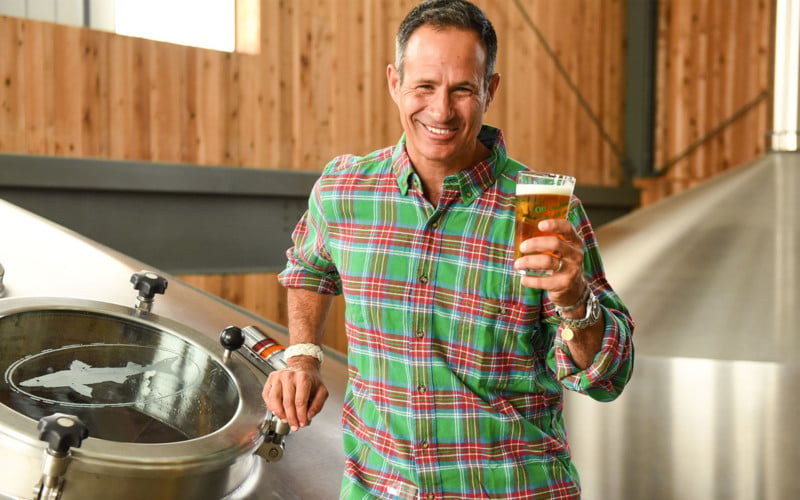


 (@Crispy_Cruzito)