Shared posts

14 Nov 18:43

This Algorithm Can Remove the Water from Underwater Photos, and the Results are Incredible

by DL Cade

An engineer has developed a computer program that can, in her words, “remove the water” from an underwater photograph. The result is a “physically accurate” image with all of the vibrance, saturation and color of a regular landscape photo.

The technology, called Sea-thru, was developed by oceanographer and engineer Derya Akkaynak while she was a post-doctoral fellow under Tali Treibitz at the University of Haifa, and it has the potential to revolutionize underwater photography. While “remove the water” isn’t the most scientific explanation for how the technology works, as you can see in the Scientific American feature above, that’s more or less what it does.

By automatically removing the color cast and backscatter caused by the way light moves through a body of water, she’s able to capture underwater landscapes as they would look to the human eye on dry land—in other words: if all the water were gone.

Akkaynak and Haifa created Sea-thru by capturing “more than 1,100 images from two optically different water bodies,” each of which include her color chart. These photos were then used to train a model that compensated for the way light is both scattered and absorbed by water.

“Every time I see a reef with large 3D structures, I place my color chart at the base of the reef, and I swim away about 15 meters,” explains Akkaynak. “Then I start swimming towards the reef, towards the color chart, and photograph it from slightly different angles until I get to the reef.”

Once trained, the color chart is no longer necessary. As Akkaynak helpfully explained on Reddit, “All you need is multiple images of the scene under natural light, no color chart necessary.”

This sample image, published alongside the research paper explaining this technique in detail, shows you just how incredible Sea-thru really is:

To be clear, this method is not the same as Photoshopping an image to add in contrast and artificially enhance the colors that are absorbed most quickly by the water. It’s a “physically accurate correction,” and the results truly speak for themselves. And while this technology was developed with an eye towards scientific uses, we can only imagine the results it would produce if shared with incredible National Geographic photographers like Paul Nicklen…

To see the algorithm in action and learn more about how Akkaynak was able to achieve this, watch the Scientific American feature up top. And if you want to dive into the nitty gritty of how this algorithm was developed and how it works, you can read the full research paper on Sea-thru here.

13 Nov 20:51

With Climate Neutral Certified, Companies Take Leaps and Bounds Toward Lighter Footprints

by Kickstarter Design & Tech


Carbon offsets looked, at first, like an easy way to atone for our environmental sins—an indulgence payment for the climate crisis. But they're not so simple. It has historically been hard to measure and verify their restorative impact; that impact isn't necessarily maintained long-term; and they haven't pushed offset customers to reduce their original pollution output.

Peak Design founder Peter Dering and BioLite founder Jonathan Cedar were frustrated by those limitations—and hearing from other frustrated, environment-minded founders—when they got the idea for Climate Neutral Certified. Like organic and Fair Trade labels, it helps creators show they're taking verified steps toward making their products in a more conscious way. And with the experienced leadership of their executive director Austin Whitman, a veteran of climate-conscious enterprises, their initiative is pushing carbon offsetting into what looks like a more sustainable future. After launching on Kickstarter hoping to sign on a few dozen companies, they've been heartened to exceed that goal with several weeks left to go in their campaign.

The lost decade of carbon offsets

Dering and Cedar tapped Whitman to run Climate Neutral Certified because he's been working in or adjacent to the carbon offset market for nearly 15 years.

He first bought carbon credits in 2005, when he launched a program to offset his grad school classmates' airline travel for study-abroad programs. In 2009 he went on to work for a London-based asset manager that invested in carbon development projects around the world.

Then he noticed an eerie cooling of interest. "There's sort of a lost decade between 2009 and 2019 in terms of carbon offsetting and carbon markets development," Whitman says. "The total voluntary market demand stayed relatively flat—it's felt locked in time."

He saw the cause as twofold: Early carbon offset models were failing to deliver the results they promised, and politicians were shrugging off responsibility for moving climate conversations forward.

"The U.S. was obviously an incredibly large missing player at the table in global climate negotiations," Whitman says. "The Waxman-Markey bill in the House and the Kerry-Boxer bill in the Senate essentially would have set up a national carbon policy for the U.S.—it would have made us the largest carbon market in the world. So there was a lot of disappointment when the talks broke down and political priorities shifted.

"The Clean Power Plan under Obama would not have produced a carbon market in the way we [typically] think about it, but it would have made meaningful progress on climate change," he says. "The current administration has reversed all that, most notably promising to pull out of our commitment to the Paris Agreement. So I guess if you chart the course, there were tremendously high hopes that fell apart."

Disappointed, Whitman spent 2011 to 2019 working in cleantech and environmental consulting, not seeing much opportunity for carbon offset credits.

What's changed since that lost decade

The market dissatisfaction with carbon credits didn't fall on deaf ears. The technology plodded along over that decade of low adoption rates, and by the time Whitman became involved with Climate Neutral, he saw technical filters becoming more robust and rules more rigorous. Carbon offsetting projects now needed to go through multiple verification cycles and validate the promised amount of carbon offset over time.

"These days, forestry projects, for example, use a lot of remote sensing technology—satellites that can count individual trees," Whitman says. "Whereas 10 years ago it would have been impossible to count every single tree in a forest, you can actually do that pretty quickly now with a satellite. We've also learned [many] more practical, on-the-ground lessons, like that if you decide you're going to protect an acre of forest, you'll have a real problem if that displaces an indigenous community or interferes with local ways of life."

The progress in carbon offsets is exciting, but what will really move the needle is scaling it. "We'll only continue to get more quality in the market as more and more corporate buyers realize that carbon offsetting really does need to be part of any kind of responsible carbon management strategy," Whitman says.

Keeping the momentum going

That's what he's doing with Climate Neutral: funneling more money toward a larger range of offsetting projects, diversifying decarbonization.

Companies from Allbirds to Klean Kanteen have signed on to open up their operations to climate assessments, commit to paying for carbon offsets, and display the Climate Neutral Certified label on their packaging.

Some, like Klean Kanteen, "had basically felt like they had already exhausted everything that they could possibly do" for operational sustainability, Whitman says; buying offsets was the last step. Others are signing on because they see competitors doing it. And some are using it as a way to commit to sustainability before their operations are even up and running. There are more than 60 committed so far, including Kickstarter.

"In the past 18 months, the public discourse has turned to climate in the loudest and clearest way I've ever seen working on these issues for 15-plus years," Whitman says. "The climate is a real problem, and we've got to do something about it. The U.S. federal government isn't doing anything about it. There's no conceivable path to an effective global policy on carbon. And at the same time, we're being told that we have 12 years to enact any meaningful changes, [and] 30 years to get to a net-zero global economy if we actually want to maintain a livable climate. And that's one of the things that many of the companies we work with actually recognize—that now it's their turn."

Climate Neutral Certified is live on Kickstarter through December 13, 2019.


12 Nov 23:33

The Law of Induced Demand: Road Widening (and I-976) Invites Congestion

by Doug Trumm

The four-billion-dollar-and-counting SR-99 tunnel was supposed to relieve congestion. It’s been open nine months, but people getting around on Seattle streets and highways probably don’t feel too relieved. Traffic congestion continues to be a part of life in booming Seattle, and tunnel tolling, which started Saturday, may just move more traffic from the tunnel to city streets.

For the widen highways crowd, the opening of the Alaskan Way boulevard (in the footprint of the mercifully dismantled highway viaduct) is the light at the end of the tunnel. But that surface megaboulevard–eight lanes at its widest–isn’t likely to solve congestion either. Traffic tends to fill the vessel it is given–more a gas than a liquid.

This is counterintuitive. Motorists–many of armchair traffic engineers themselves–often assume wider roads mean less traffic congestion. Billion of dollars have been wasted on this folk wisdom–often with transportation departments aiding its dissemination. The problem is there is no practical evidence for this belief. In fact, a 2011 study by economists Matthew Turner of the University of Toronto and Gilles Duranton of University of Pennsylvania demonstrated traffic and road capacity have a perfect one-to-one relationship. Add lanes and they fill as fast as you add them. This means expensive highway expansion projects historically have ended with overall congestion just as bad as when the project was initiated.

This is the principle of induced demand. Make it cheap and easy to drive and motorists will drive more. Unfortunately this well established though often ignored principle means that Tim Eyman’s Initiative 976 will worsen traffic congestion: $30 car tabs will encourage more people to drive and more often. Cheap car tabs will create more traffic at the same time that transportation agencies face decimated budgets due to the sudden loss of car tab revenue. This underscores the need to backfill I-976 transit cuts.

Moreover, the law of induced demand suggests a particularly effective way to raise revenue would be with fees that hit motorists like car tabs did. The commercial parking tax would serve this purpose, as would congestion pricing, or decongestion pricing as we would call it. Induced demand also suggests that establishing dedicated bus lanes by simply painting over general purpose lanes wouldn’t create traffic Armageddon. In fact, it would improve matters by offering a scalable climate-friendly alternative while leaving road congestion largely unchanged.

The relationship between road capacity and congestion really is that persistent. Adam Mann with Wired talked to the authors of that 2011 road congestion study, explaining their findings.

[Turner and Duranton] decided to compare the amount of new roads and highways built in different U.S. cities between 1980 and 2000, and the total number of miles driven in those cities over the same period.


“We found that there’s this perfect one-to-one relationship,” said Turner.


If a city had increased its road capacity by 10 percent between 1980 and 1990, then the amount of driving in that city went up by 10 percent. If the amount of roads in the same city then went up by 11 percent between 1990 and 2000, the total number of miles driven also went up by 11 percent. It’s like the two figures were moving in perfect lockstep, changing at the same exact rate.

The law of induced demand cuts both ways. Transit might get some motorists off the road, but others rise to take their place. But unlike highway widening, transit scales. Adding transit may not lower congestion, but overall capacity to move people goes up as service increases, especially if that transit is reliable and efficient thanks to dedicated lanes. The same can be said of protected bike lanes, which can fit more people per square foot of road space.

Graphic shows how many people fit in the same streets with cars, taxis, buses, bikes and on foot. Buses, bikes, and walking and rolling fit way more people. (Geekwire)
How much street space people consume depends on their vehicle. Buses, bikes, walking, and rolling fit way more people per street than cars do. (Geekwire)

The passage of I-976 puts us in a bind, but the solution is right before us. Progressively taxing and investing in transit can reverse our losses and put us back marching forward and seizing our role as a national leader in transit and breaking car dependence.

Almost 60% of King County voters rejected I-976–and an even greater share of Seattle voters. And, as I noted last week, King County passed Sound Transit 3 with 58% of the vote and approved the ultimately doomed I-1631 carbon fee initiative with 58%. King County is ready to embrace the future rather than cling to childish notions that roads can be free, driving cheap, and congestion nonexistent.

08 Nov 19:33

Athlete Mary Cain: "I Was the Fastest Girl in America, Until I Joined Nike"

by Rob Beschizza

Mary Cain, a middle-distance runner, reports that her male coaches' constant demands she get “thinner, and thinner, and thinner” hurt her health and career. The crux of the problem: she joined a program operated by Nike, whose priority is selling shoes, not training athletes.

The New York Times:

The problem is so widespread it affected the only other female athlete featured in the last Nike video ad Cain appeared in, the figure skater Gracie Gold. When the ad came out in 2014, like Cain, Gold was a prodigy considered talented enough to win a gold medal at the next Olympics. And, like Cain, Gold got caught in a system where she was compelled to become thinner and thinner. She developed disordered eating to the point of imagining her own death.

“America loves a good child prodigy story, and business is ready and waiting to exploit that story, especially when it comes to girls,” said Lauren Fleshman, who ran for Nike until 2012. “When you have these kinds of good girls, girls who are good at following directions to the point of excelling, you’ll find a system that’s happy to take them. And it’s rife with abuse.”

It's a big warning to young athletes: Nike doesn't need all of its mannequins to be winners. The head coach, Alberto Salazar, would weigh her in front of her teammates and humiliate her if she failed to reach his arbitrary targets.

Consider how even after years of constant scandals, this sort of abuse still thrives at the place two opposed goals meet. An athletic requirement (reasonable weight management) justifies a marketing demand (“thinner, and thinner, and thinner”) that undermines and even destroys the athlete.

And here's what Nike got out of it: two print ads, as far as I can find in 2019, and two TV spots it has already removed from YouTube.

08 Nov 00:45

How Seattle’s City Council Race Became the Amazon Election

by Sarah Holder

Updated: 2019-11-11
Editor’s Note: This story has been updated to reflect the latest results of Seattle's City Council races, several of which remain contested. There are now two candidates backed by Amazon poised to win their elections.

How much political power does $1.5 million buy?

That’s how much Amazon donated to a Seattle Political Action Committee that aims to swing the city council towards a more pro-business agenda. The company, which is headquartered downtown, has influenced the council successfully before, donating $25,000 to a campaign to kill a per-employee head tax that would have gone towards funding homelessness initiatives in the city.

This time, Amazon didn’t win.

To be fair, it didn’t entirely lose, either. Out of the seven city council candidates Amazon supported, only two appear poised to win their elections. That’s certainly not enough to secure a majority on Seattle’s nine-member council, and it includes a key loss against Kshama Sawant, a pro-labor city council member in the Socialist Alternative Party who’s long been a thorn in the side of Amazon and other large corporations. She declared victory against Egan Orion on Saturday, after initial counts had her opponent with a comfortable lead.

Sawant branded the head tax the “Amazon tax,” and called this week’s election a fight over the “soul of Seattle.” Framing the stakes of the election, Sawant told the New York Times recently: “The question is: Is Seattle going to become a playground for only the very wealthy, or is it going to be a city that serves the needs of ordinary people?”

Amazon wasn’t the only business that spent big on city campaigns. From San Francisco to Jersey City, tech companies poured money into nudging the outcome of ballot questions on whether to regulate, tax, or expand their power, in some cases contributing to new spending records at the city level. And despite million-dollar campaigns launched by companies like Juul and Airbnb, Amazon wasn’t the only company to see voters defy it.

In San Francisco, a measure that would have overturned the city’s e-cigarette sales ban lost by an overwhelming margin, meaning the moratorium will hold. Initially, venture-backed vape pen company Juul spent $11 million on a campaign to overturn the ban, but it pulled its support before the vote amid public health concerns.

In Jersey City, a bill to regulate the 3,000 Airbnb rentals that locals complain are flooding the city with unruly tourism passed, despite a $4.2 million campaign by the short-term rental platform to defeat it. Airbnb blamed the hotel lobby, which spent only $1 million.

And also in San Francisco, Uber and Lyft took a different strategy: They both supported a small tax of 3.25 percent on most Uber and Lyft rides, introduced as an alternative to a more punitive tax that could have been levied without voter approval. The ride-hailing companies contributed comparatively modest amounts—according to campaign finance records, Lyft donated $400,000 and Uber $300,000—and the initiative was leading slightly as of publication.

Tech-money-fueled campaigns aren’t new in San Francisco. Last year, a tax on businesses to support affordable housing and homelessness not unlike Seattle’s was on the ballot, inspiring entities like Lyft, Stripe, Square, and Twitter founder Jack Dorsey to donate hundreds of thousands each to the effort to defeat it. But in that case, Salesforce and its CEO Mark Benioff also dropped almost $5 billion to pass it. Though the measure was approved by voters, it won by less than a two-thirds margin, and is currently tied up in court.

Amazon’s spending in Seattle was part of a particularly notable phenomenon: The council race was the most expensive in the city’s history, even as it tested the strength of a new initiative intended to curb big money in politics.

Under a “democracy voucher” program that came into effect this year, all registered voters in the city were sent four $25 vouchers to spend on any candidates they wanted to support—but only those who agreed to spend less than $150,000 on their general election campaigns. When business interests in the city banded together with the Chamber of Commerce to start a PAC called Civic Alliance for a Sound Economy (CASE), and the cash started pouring in, candidates who had initially opted into the program asked to opt out, worried they wouldn’t be able to compete without hustling for more money.

By Election Day, the New York Times reported that “11 of the 12 general election candidates who participated in the voucher program had been released from the limits.” CASE pulled in more than $4 million, with a quarter coming from Amazon, and the rest in smaller amounts from other companies with Seattle-area offices, like Expedia, Starbucks and Microsoft.

M. Lorena González, one of two council members who represents the entire city and wasn’t up for reelection this year, is sponsoring a bill that would tighten campaign finance restrictions even more, limiting the amount corporations can donate to PACs, and effectively abolishing super PACs like the Chamber of Commerce’s CASE.

“We operate in an environment where corporations like Amazon can make unlimited contributions, because there are no regulations,” she told CityLab. “As a result you saw them put a fistful of cash on the scales of democracy to tip the city council in their favor.”

Even presidential candidates Bernie Sanders and Elizabeth Warren condemned Amazon’s spending. “In a city struggling with homelessness, Amazon is dropping an outrageous amount of money to defeat progressive candidates fighting for working people,” Sanders tweeted.

CASE argues that the candidates it endorsed will not only be good for business, but for the city: Its website says they all “demonstrate a strong commitment to improving the quality of life and economic opportunities for all Seattleites,” particularly when it comes to easing traffic congestion and improving transit, instituting systemic reforms around homelessness, and supporting local business growth. Polls conducted by the Chamber and local newspapers showed that residents were disappointed with the current council, and ready for change.

González noted that what aligns several of the CASE-endorsed candidates is also an emphasis on maintaining Seattle’s “regressive tax system,” “using punitive criminal justice system tools to address homelessness,” and “not tackling criminal justice reform as a whole.” (CASE didn’t respond to a request for comment.)

With Amazon achieving less than a majority hold on the council, the takeaway some Seattle progressives left with Wednesday was that it could have been worse. “Imagine the Chamber and Amazon honchos this morning looking at City Council strategy for next year,” Seattle’s former Democratic mayor, Mike McGinn, tweeted. “Those business honchos are not sitting there clapping each other on the back saying ‘We killed it last night!’ They’re saying ‘crap—how the hell do we get to five votes on anything—we have completely lost control of the council.’” He added that during his term as mayor from 2010 to 2013, the Chamber of Commerce held seven of the nine seats, giving it a stronger pro-business bent.

But Amazon’s intervention shows that its interest in—and impact on—politics is only growing in the wake of the struggle over the head tax. On city council candidates, Amazon only spent $130,000 in 2015, according to campaign finance records, meaning their spending increased by more than 650 percent this year. (According to WUSA9, Amazon also spent almost $300,000 on Republican and Democratic house and senate races in Virginia, the state where it’s planning another large campus.)

And its spending is not always in opposition to funding public initiatives. This year, the company contributed $400,000 at the state level to join progressives in opposing a cut to car registration fees that would slash transit funding precipitously (Microsoft spent $650,000). Despite their opposition, it looks like the measure is going to pass.

This spring, the power of big spending will likely be tested again. California’s bill reclassifying gig workers as employees—which could pose an existential threat to sharing-economy companies like Uber and Lyft—could be challenged in a ballot measure funded by the two ride-hailing companies and Postmates, a food-delivery app. Together, they’ve already contributed $90 million to the effort. That’s 60 Seattle city councils worth.


07 Nov 19:55

Pharma Giant Fails To Mention -- For 18 Years -- That US Government Helped Fund A Key Patent Used In Drug That Has Generated $53 Billion In Sales So Far

by Glyn Moody

It's no secret that drug prices are often high, and continue to rise -- by 32% in the past five years according to one analysis. It's only natural that many should be willing to pay even exorbitant amounts for drugs. If there is the hope of a cure, or at least of some relief from pain and symptoms, for themselves or their family, most people would probably put that above money.

It's less obvious why drug prices are so high in the first place. The standard response from the pharma industry is that companies need incentives to develop new treatments, and these are typically in the form of the high prices they can charge. Although plausible, it overlooks the important contribution that publicly-funded research makes here. Many new drugs are made possible thanks to ground-breaking early work by academics in universities or institutes, not in companies. That's not something that Big Pharma likes to talk about, as this post from James Love on the Bill of Health blog reminds us:

This is a story about U.S. patent number 6,958,335, and how it took more than 18 years for Novartis to acknowledge National Institutes of Health (NIH) funding in a key patent for Gleevec, allowing Novartis to shape the narrative regarding its role in the development of Gleevec, and also to avoid demands that Novartis make the invention "available to the public on reasonable terms," which is an obligation under the Bayh-Dole Act.

Gleevec is one of the drug industry's biggest successes. An article on the Nature site explained back in 2008:

Some say it's a miracle drug. Others call it a silver bullet. Gleevec, also marketed internationally as Glivec and sometimes referred to by its chemical name imatinib, entered the medical world with a bang. This medication was initially approved for use by the U.S. Food and Drug Administration (FDA) in 2001 for the treatment of chronic myelogenous leukemia (CML), a rare form of cancer that affects certain types of white blood cells.

That "miracle drug" has meant big money for Novartis. According to the Bill of Health blog post, by the end of 2018, the cumulative sales for Gleevec exceeded $53 billion. Love notes that as an invention that was partially funded by taxpayers, Novartis ought to have made the invention "available to the public on reasonable terms". That would presumably have translated to a lower price, and possibly to more people taking the drug, and more lives being saved. Those didn't happen, because Novartis didn't acknowledge the NIH funding until now, a mere 18 years late. Sadly, this is not an isolated case of forgetfulness, as Love points out in his conclusion:

[Knowledge Ecology International] has written the NIH on several occasions to identify cases where inventors have failed to acknowledge federal funding in patent applications. Such cases have not been difficult to find. In the 1990s, Congress and [US Department of Health & Human Services] investigated such failures to disclose, and found widespread non-compliance with disclosure mandates, and lax oversight. This is an area where new Congressional oversight would be welcome, particularly as the question of the federal role in drug development is being spun by various parties.

That's worth bearing in mind the next time Big Pharma tries to justify eye-watering drug prices because of the innovative research required to create them.

Follow me @glynmoody on Twitter, Diaspora, or Mastodon.


Permalink | Comments | Email This Story
07 Nov 01:11

Shutterstock Employees Fight Company’s New Chinese Search Blacklist

by Sam Biddle

Shutterstock, the well-known online purveyor of stock images and photographs, is the latest U.S. company to willingly support China’s censorship regime, blocking searches that might offend the country’s authoritarian government, The Intercept has learned.

The publicly traded company built a $639 million-per-year business on the strength of its vast — sometimes comically vast — catalog of images depicting virtually anything a blogger or advertiser could imagine. The company now does business in more than 150 countries. But in China, there is now a very small, very significant gap in Shutterstock’s offerings. In early September, Shutterstock engineers were given a new goal: The creation of a search blacklist that would wipe from query results images associated with keywords forbidden by the Chinese government. Under the new system, which The Intercept is told went into effect last month, anyone with a mainland Chinese IP address searching Shutterstock for “President Xi,” “Chairman Mao,” “Taiwan flag,” “dictator,” “yellow umbrella,” or “Chinese flag” will receive no results at all. Variations of these terms, including “umbrella movement” — the precursor to the mass pro-democracy protests currently gripping Hong Kong — are also banned.

Shutterstock’s decision to silently aid China’s censorship agenda comes at a time of heightened scrutiny into the relationship between corporate America and President Xi Jinping’s authoritarian regime. Household names like Apple, Blizzard Entertainment, the NBA, and Google have all garnered harsh criticism for letting the policy directives of the Communist Party of China, and the gilded promise of a billion customers, dictate company strategy. Deciding to censor is a particularly stark inversion of values for Shutterstock, which markets itself as an enabler of creative expression.

The photo company’s relationship with China dates back to at least 2014, when it struck a distribution deal with ZCool, a Chinese social network and portfolio site for visual artists. Last year Shutterstock announced a $15 million investment in ZCool, noting that owing to the partnership, “Shutterstock’s content now powers large technology platforms in China such as Tencent Social Ads,” an online advertising subsidiary of the tremendously popular Chinese internet conglomerate Tencent.

Shutterstock’s censorship feature appears to have been immediately controversial within the company, prompting more than 180 Shutterstock workers to sign a petition against the search blacklist and accuse the company of trading its values for access to the lucrative Chinese market. Chinese internet users already struggle to discuss even the tamest of taboo subjects; now, it seemed, the situation would get a little worse, with the aid of yet another willing American company.

“Yes, we’re a creative photo and video marketplace, but we are also an editorial news hub,” one Shutterstock employee told The Intercept. “Want to write a story about the protests in Hong Kong? They never existed. Want to write about Taiwan? It never existed. Xi Jinping is NOT a dictator because he specifically said so. This is dark shit.”

The text of the petition, provided to The Intercept, can be read in full below.

Shutterstock’s founder and CEO Jon Oringer replied to the petition several days later; those hoping for a change of heart were to be disappointed. Shutterstock’s pro-censorship compromise with the Chinese government was justified, Oringer argued, because to refuse to do business in China rather than help the country’s government expand its information control scheme would be the real act of craven corporate turpitude: “Do we make the majority of our content available to China’s 1.3 billion citizens or do we take away their ability to access it entirely? We ultimately believe, consistent with our brand promise, it is more valuable for storytellers to have access to our collection to creatively and impactfully tell their stories.” Shutterstock with a bespoke censorship feature was “more empowering” and “will better serve the people of China than the alternative,” Oringer continued.

Oringer’s company-wide response is also reproduced below.

Following Oringer’s letter and the implementation of the search term blacklist, some employees fear the use of censorship at the company will grow: “He offered no consolation in terms of what our actions will be when China requests to add an X number more search terms to the censorship list,” the Shutterstock staffer told The Intercept, “or if another country comes to us with a similar request. We are devastated.”

In an email to The Intercept, a Shutterstock spokesperson confirmed that the censorship feature is currently active, though they would not confirm whether the banned keyword list has been changed or expanded since it first went into effect. When asked if there is anything the Chinese government could request that could make Oringer reconsider his decision, the spokesperson did not answer, but added instead, “We want to provide access to our content to everyone, everywhere. It is our mission to empower creativity and storytellers around the globe. We are also bound to local laws and therefore face a choice. We ultimately believe, consistent with our brand promise, it is more valuable for storytellers to have access to our collection to creatively and impactfully tell their stories. That is much more empowering and will better serve the people of China than the alternative.”

The Shutterstock staffer who spoke with The Intercept added that for many at the company, the issue is personal, and that they reject the argument that complying with the Chinese government’s request is in the best interest of its Chinese customers. “We have a number of employees who grew up in oppressive regimes — some are unable to speak up for fear of losing visas — and we are letting them all down,” they explained. “Every day we come in to work, we are making the world a worse place. And for what? To be able to sell photos of sliced fruit on white backgrounds in China.”

Shutterstock employee petition:

Petition to End Censorship

We, the undersigned employees of Shutterstock, are calling upon the company to reject the demands of the Chinese government to suppress search results for politically sensitive topics for site users in China.

While complying would allow the company to benefit from continued operation in China, we believe that any censorship would set a harmful precedent and have deleterious effects on our company, China and the world. By complying, we are enabling injustices, including the discrimination of the people of Hong Kong, the suppression of Chinese political dissent, and undermining the sovereignty of Taiwanese people. This first step of building search filters lays open the door to more types of discrimination in the future.

We are proud of Shutterstock’s history of taking a stand on important topics like net neutrality, immigration policies, and antisemitism, among others. We recognize that the issue before us today has the potential to impact our revenue and growth in a way these other issues may not, and therefore by meeting the Chinese government’s demands, we would send the message that our commitment to our values is secondary to our commitment to our bottom line. That’s not who we are.

Our opposition to content filtering is not just about China: we object to technologies that aid the powerful in oppressing the vulnerable, wherever they may be. Shutterstock’s own employees come from all over the world – many having experienced government oppression firsthand – and in taking on this project, we are letting them down.

As such, we demand Shutterstock call an end to this project. Shutterstock is capable of being a leader for change. As employees and shareholders, we deserve to know what we’re building and we deserve a say in these significant decisions.”

Response from Shutterstock CEO Jon Oringer:

Team,

On behalf of the Leadership Team, I want to provide an update to all employees about an important discussion going on in our Company regarding Shutterstock doing business in China. Some employees have expressed concern with the Company’s position, and we want to take this opportunity to clearly communicate that position to everyone.

For context, since 2014, Shutterstock has been working with ZCool, a creative social network and artist platform in China, to distribute Shutterstock content to millions of people in the country. We also license directly to customers in China through our e-commerce site. The Chinese government has effectively mandated that — if we want to maintain a level of business in China — we must abide by local laws governing the distribution of certain content in mainland China. Based on available information, we have determined that certain search terms will not return image or footage results to customers in that region.

We understand that some of our employees feel strongly about filtering content, particularly content that could be considered politically sensitive. A petition has been circulated asking the Company to refuse to comply with local requirements in China in order to do business there.

First we want to say — we hear you. We respect your position and your passion, and want to thank you for sharing your views in a thoughtful and constructive way. We are pleased to see open discussion and debate on this topic. There can be no question that we support the ability of our employees to freely express their views on issues important to them.

And we truly understand the concern. We want to assure you that we do not make business decisions lightly. Our decision to make our website available in China, like elsewhere in the world, is based on careful evaluation of all factors in order to provide maximum value across our networks — from employees to shareholders, customers to contributors, vendors to partners.

At the end of the day, what does our brand stand for? We want to provide access to our content to everyone, everywhere. It is our mission to empower creativity and storytellers around the globe. We are also bound to local laws and therefore face a choice. Do we make the majority of our content available to China’s 1.3 billion citizens or do we take away their ability to access it entirely? We ultimately believe, consistent with our brand promise, it is more valuable for storytellers to have access to our collection to creatively and impactfully tell their stories. That is much more empowering and will better serve the people of China than the alternative.

Additionally, we believe you are also asking for something more from our Company, which is to use our voice to make the world a better place, and we are doing that regularly. We are contributing to our global community through our involvement in a number of public policy and community initiatives that will not only make Shutterstock a stronger company, but will strengthen our communities, protect our employees, and deliver on our fundamental values. To drive more attention to these initiatives, we have created a page on The Lens where you can learn more about how to get involved in these initiatives, and also provide your feedback on other policy matters that are important for our business and our networks.

We hope this message clarifies our position. We understand this is a difficult topic and perhaps we are not always going to agree on some issues — and that’s okay. As long as we continue to communicate openly and honestly with each other, we will advance our common goal of empowering creativity and helping professionals from all backgrounds and businesses of all sizes produce their best work with incredible content and innovative tools.

The post Shutterstock Employees Fight Company’s New Chinese Search Blacklist appeared first on The Intercept.

05 Nov 21:52

SURPRISE! Feds Seek Mandatory Helmet Laws

by Gersh Kuntzman

04 Nov 18:59

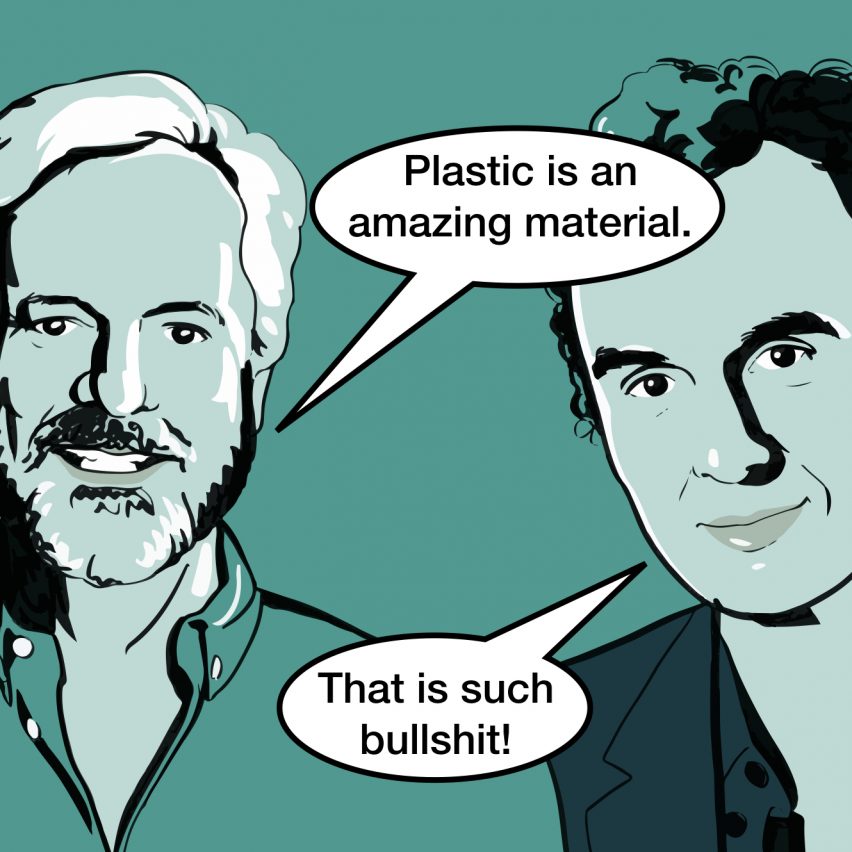
Plastic recycling is "bullshit" says Richard Hutten at Dezeen Day

by Bridget Cogley

Dezeen DayDezeen DayDezeen DayDezeen Day

Dutch designer Richard Hutten clashed with the CEO of the Ellen MacArthur Foundation at the Dezeen Day conference last week, with the two speakers disagreeing over the role of plastic in the circular economy. Read more

04 Nov 18:57

New Data Shows Seattleites Are Ditching Their Cars for Bikes and Transit

by Patrick Taylor

Last Saturday Gene Balk, The Seattle Times FYI Guy, wrote a column describing how the latest data from the Census showed that car ownership in Seattle has dropped by 3% since 2010. 81% of households own at least one vehicle, the latest Census data showed. While this drop may not seem like much, it was by far the biggest drop in car ownership among large cities and only 11 of the largest 50 cities had any drops at all. Interestingly, for people under the age of 35 or over 65, only 75% own cars. I suspect the rate changes as well when race and class are added to the analysis.

This drop in car ownership represents a victory for the urbanist vision and proof that our region’s investments in transit, walking, and biking are providing people mobility options beyond cars. Moreover, it should be a reminder to support candidates who unequivocally support more transit, biking, and pedestrian infrastructure. There are candidates out there with bad transportation policies propped up by profuse corporate spending. Don’t fall for their Siren songs. And speaking of frauds, there’s Tim Eyman and his terrible Initiative 976 stripping transportation funding statewide. That would surely jeopardize our progress and put us on the defensive. Vote no on I-976.

But back to the good news on lowering car ownership rates: it’s also a validation of our region’s strategy of concentrating growth into dense transit rich neighborhoods. Not only does new housing in our central city put more people in proximity to the biggest employment center in the state, it also created space for new grocery stores, hair salons, and restaurants for existing residents, allowing them to meet more of their needs within their neighborhood.

Seattle has had the highest transit ridership growth rate by far in the past decade. (Graphic: Yonah Freemark)

It should be noted that the total number of cars in our city stayed constant, which is a victory of another degree. We are in a climate crisis and we need an absolute reduction in carbon emissions, not a slowing of the growth in output. Each car represents additional emissions, so this is all good news. We’ve also led the nation in transit ridership growth over recent years–which helps explain the drop in car ownership.

Seattle’s 3.1% drop in the rate of car ownership lead the nation. (Graphic by James Abundus / The Seattle Times)

While clearly the drop in car ownership has mostly to do with our city’s investments in transit and the massive amounts of new housing being built, this reporting comes on the heels of several data points showing that biking is up in our city. 2018 Census data showed that more people are biking in our city than ever before. This data is especially encouraging as it shows that last year’s reported drop in cycling was a bit of statistical noise in what is an overall positive growth curve. The same survey also shows an increase in people walking and taking transit. Also worth noting is that many of the groups that touted the last year’s report as proof that biking, along with Seattle, is dying and that we should stop investing in bike infrastructure are silent this time around.

And if a broad survey like the census is not enough, data from bike counters such as the Fremont Bridge, which cracked 1,000,000 bike trips for year–well exceeding the pace in 2018–provide more on-the-ground evidence that people are choosing two wheels to traverse our city. The event was celebrated by a group of folks from Seattle Neighborhood Greenways and Cascade Bicycle Club, and in tweet form by Seattle Department of Transportation (SDOT) City Traffic Engineer Dongho Chang:

The growth in biking could be due to multiple factors. It could be the city’s investment in new all ages and abilities bike connections such as the new Pike Street protected bike lane are making more people feel safe riding on our streets. It could be the proliferation of more affordable e-bikes, including abundant bikeshare bikes, have taken the bite out of our hills. It could be the growing threat of climate apocalypse is compelling more people to choose climate-friendly options.

While all three are surely contributors, evidence from other city’s such as Vancouver to the north suggest that providing people a safe, connected network is a key driving of ridership. Studies have shown there is a large segment of the population that want to ride, but does not feel safe riding with traffic. As SDOT continues to expand our bike network, including the new Southend connections and Bell Street upgrades expected to be built this winter, we can expect to see continued growth in people choosing to ride bikes.

Hopefully we will continue to see such growth as even more parts of our city are connected by protected bike lanes, including hopefully along Eastlake Avenue, Martin Luther King Jr Way, and through SoDo. It won’t happen by accident. Make sure you advocate and vote for the future Seattle you want to live in.

04 Nov 18:49

The irony of blaming inhalers for climate change

by Emily Pontecorvo

Does individual action matter when it comes to climate change? It’s an age-old debate. Arguably, small choices add up, and living life as though we’re in a climate emergency can help orient people toward political action. Ultimately, though, we won’t get very far without huge, sweeping, systemic changes.

Sometimes the emphasis placed on reducing our individual environmental footprints turns into an unfair burden placed on the disabled, sick, and poor. Recently, we’ve seen this dynamic play out with plastics bans that stigmatize people who require straws to drink.

So when the BBC reported on a study that said medical inhalers are a contributor to climate change, and used the headline “Asthma carbon footprint ‘as big as eating meat,’” many readers got upset. A Twitter army called out the study and article for blaming people with asthma for using the medicine they need instead of putting the onus on the true culprits.

The study that inspired the outcry looks at the carbon footprint of a metered-dose inhaler, the most common kind of inhaler. Metered-dose inhalers use a gas called hydrofluoroalkane to propel medicine into the user’s lungs. This gas is a greenhouse gas, so yes, it does get trapped in the atmosphere and contribute to global warming.

The authors found that if an individual switched from a metered-dose inhaler to a dry powder inhaler, which doesn’t use this gas, it could save the equivalent of between 300 to 880 pounds of carbon dioxide a year. They suggest it’s a similar lifestyle choice to recycling or cutting meat from your diet.

Many on Twitter pointed out that it’s the responsibility of pharmaceutical companies to provide environmentally friendly options. But others raged about an underlying fact: Some of the biggest exacerbators of asthma are also the leading contributors to climate change!

Vehicle emissions have been linked to asthma. Fracking has been linked to asthma. Oil refining has been linked to asthma. Power plants have been linked to asthma. Climate change itself has been linked to asthma. Case in point: all the smoke from the wildfires in California this fall emitting fine particulate matter into the air. That means that if we keep burning fossil fuels, more people are going to develop asthma! And as the study authors themselves point out, those powder inhalers aren’t a safe alternative for everyone.

If we really want fewer people using metered-dose inhalers, it would be more effective to go after the companies whose emissions are making people sick than to pick on inhaler users for their carbon footprints. It’s not their fault that their options for life-saving drugs are limited.

This story was originally published by Grist with the headline The irony of blaming inhalers for climate change on Nov 4, 2019.

31 Oct 20:15

It’s Getting Riskier to Walk and Bike After Dark

by Laura Bliss

The most disturbing thing about Halloween isn’t the fake blood, urban legends, or sexy clown costumes. It’s that the streets are full of actual child-killers: Pedestrians under age 18 are twice as likely to be struck and killed by a car on October 31 than on any other day of the year.

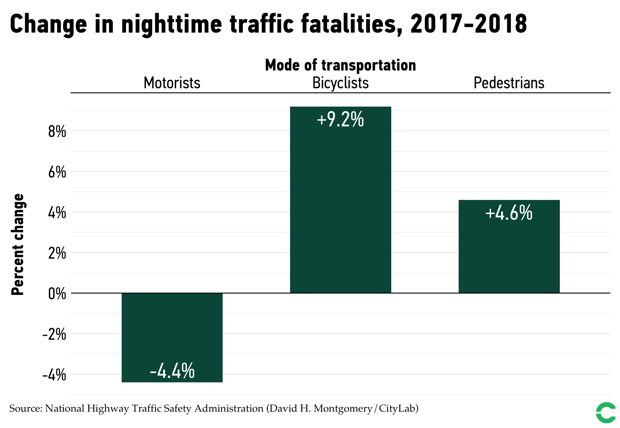
That statistic tends to only make the social-media rounds in the days immediately before the holiday, but it connects to a truly frightening year-round phenomenon. More U.S. pedestrians are dying in car crashes, and more of them are dying at night, according to the latest data from the National Highway Traffic Safety Administration. In 2018, 6,482 people were killed by drivers while they were on foot, a 3.4 percent jump from 2017. Cyclist fatalities also rose by 6.3 percent from 2017, with 859 killed. After a decade of uptick, both groups saw their highest death toll since 1990.

But as things have gotten more dangerous for people outside of vehicles, the people inside have become more secure. Fatalities among occupants of cars, vans, SUVs, and even motorcyclists dropped last year. In fact, the number of people killed in vehicle crashes across all groups fell by 2.4 percent between 2017 and 2018, following a .9 percent decline between 2016 and 2017. In other words, the apportionment of fatality risk is shifting across different types of road users.

There are a few factors here, expert say. For one, more people are commuting by bike and foot. Two, while heavy, high-rise SUVs and trucks often insulate their occupants from crashes better than compact cars, they’re also more likely to kill pedestrians and cyclists in the event of a crash, and the popularity of these larger vehicles has surged. Three, most streets are still engineered to accommodate vehicles first. Sidewalks, crosswalks, ample lighting, and other pedestrian-friendly features tend to play second fiddle to car-oriented considerations such as lane width and high speed limits. In fact, a 2018 study in JAMA Pediatrics pointed to such failures in road design and traffic laws as the root cause of Halloween’s high pedestrian fatality rate—a departure from the individualistic safety warnings that are normally heard.

Road deaths are also shifting across the hours of the day. Between 2017 and 2018, NHTSA found that the number of nighttime fatalities (which the agency measures between 6 PM and 6 AM) rose 4.6 percent for pedestrians and 9.2 percent for cyclists. This is consistent with longer-term trends: Nighttime crashes accounted for more than 90 percent of the total increase in pedestrian deaths between 2007 and 2017, according to a February report by the Governors Highway Safety Association.

In other words, nearly all of the progress on road safety that has been erased in the past 10 years has occurred after sunset.

Lack of illumination obviously poses an added threat for people traveling by foot, bike, or wheelchair. But beyond the fact that more people are walking and biking in general, there could be other factors increasing their risk factor relative to daytime hours.

One theory relates to work. Data from the General Social Survey shows a 2 percent uptick in the number of people who say they work at night since 2010, said Lonnie Golden, an economics professor at Penn State University, Abington who studies labor scheduling. That may be because employers are assigning a few more night shifts, more people are working later into the evening, or perhaps there’s a rising share of the workforce employed in service jobs that aren’t limited to 9-to-5 schedules. “If you’re walking home late at night, you could be more prone to injuries,” said Golden.

Another possibility has to do with the shaky performance of new vehicle safety technology, said Elliot Martin a research and development engineer at the UC Berkeley Transportation Sustainability Research Center. The most recent generation of vehicles should be safer for everyone, equipped as they often are with collision-avoidance systems designed to help drivers spot hazards. But as Martin pointed out, a recent AAA study found that those systems aren’t nearly as effective as manufacturers claim, and are especially faulty in dark lighting conditions. Finally, there’s the possibility that night drivers are more likely to be driving recklessly (and under the influence of drugs and alcohol), said Liisa Ecola, a senior policy analyst at the RAND Corporation who studies road safety trends.

But none of these hypotheses are conclusive. Federal highway safety data shows little indication that more people are traveling more miles at night, either by car, foot, or bike. In this case, nighttime turns out to be both lethal and fairly mysterious—just in time for Halloween. Perhaps readers can take this as costume inspiration: Go as darkness itself, with all its deadly roadside trappings. But until more streets are built for people, just remember to add reflective tape.

31 Oct 20:12

Incredibly Specific Japanese Halloween Costumes, Part 1

by Rain Noe

In Japan, cosplayers can walk around in extreme costumes any day of the year. Perhaps in reaction, this Japanese competition goes the other way on Halloween: They dress up in costumes that are not representative of famous characters, but rather, illustrate the foibles of modern life in a capitalist workaholic society.

This is called Jimi Halloween, which roughly translates to "mundane/sober Halloween." Here are our favorites of the "costumes" that participants have come up with:

Person Who Spotted Cockroach Just Before Going to Bed, Immediately Searched for Improvised Weapon and Cockroach Escaped in the Meanwhile

13-Inch Macbook Air

(Note: He has keys on the soles of his shoes and a screen on his back, he lies down flat, then opens up)

Person Seated Far Down the Counter (7th Position) Signaling for Waitstaff

Guy Who Grabbed a Shopping Basket But Only Ended Up Buying a Couple of Things

Woman Waiting in Line Who Regrets Not Using a Shopping Basket

Guy at Haneda Airport Who Just Returned from Vacation and Feels Cold in the Terminal

A Speedreader


Person Being Interviewed on News Program, Whose Face Has Been Pixelated for Privacy

Hiking Equipment Store Mannequin

Actress in a Traffic Safety Video Pretending She Has Just Caused an Accident

Click here for Part 2.

31 Oct 20:08

These hacked streets signs are the scariest thing you’ll see this Halloween

by Zoya Teirstein

Gather ‘round, monsters, goblins, and ghouls. It’s Halloween, and we have spooky news from one of the scariest places in the world (if you’re terrified of tall buildings, pretty people, and loneliness).

A haunted hacker has been taking over New York City Department of Transportation electronic road signs to send messages to New Yorkers from the other side. The first supernatural transmissions arrived earlier this month and included such eerily true statements as “cars are death machines” and “cars melt glaciers.”

Now, for Halloween, the trickster has some new messages for commuters: “Forget poison candy” / “cars are the real danger.”

The sprite responsible for these spine-chilling messages has been dubbed Bikesy — the NYC bike-advocate version of Banksy (don’t yell at me, I didn’t come up with the nickname). Bikesy also left a “Happy Halloween” message on Eastern Parkway in Brooklyn this morning, along with a warning: “Don’t be creepy” / “Leave the car at home.”

OK, fine. Whoever is hacking into road signs is most likely a transportation nerd with tech skills and some free time, not a tormented spirit from beyond. But you know what is super scary? Cars!

Some 40,000 Americans died in car crashes last year, according to an estimate by the National Safety Council. Cars killed 111 New Yorkers in the first six months of 2019 alone. That means vehicles are way deadlier than guns, which killed 61 people in the city during the same period, according to NYPD data. So far this year, 25 cyclists have been killed by vehicles in the Big Apple, more than double the number of cyclists that were killed by cars in the entirety of 2018.

And Halloween is a particularly dangerous time for people trying to share the street with cars. Research shows it’s the deadliest day of the year for child pedestrians, who are three times more likely to be killed by a car on this day. For kids between 4 and 8 years old, the risk is 10 times higher. Not to mention the fact that gas-powered vehicles are a major contributor to climate change and air pollution, both of which come with their own major health risks.

How’s that for a scary story? The moral is clear: if you don’t want to be cursed for all eternity, listen to Bikesy and leave the car at home tonight.

This story was originally published by Grist with the headline These hacked streets signs are the scariest thing you’ll see this Halloween on Oct 31, 2019.

31 Oct 19:08

Donald Trump Tweeted a Photoshopped Picture of Him Putting a Medal on a Military Dog for … Reasons?

by Rachel Leishman

Trump makes Jesus arms as Mike Pence looks on in front of George Washington's portrait.

Gone are the days of the presidential pet. Bo was a household name, the fun pup who brought joy to the Obamas. Miss Beazley roamed free during the Bush administration. Buddy and Socks were icons while the Clintons called the White House their home. All of these pets had their place, and then a man who didn’t win the popular vote took over who hates animals, and so all we have are badly doctored pictures of him awarding a dog.

The original image was tweeted without any context, the president just sharing an edited picture of him awarding Conan, a good pup, with a medal. The problem? Well, we had no idea why he was awarding a photoshopped dog anything, but also, the doctored photo in question very clearly covered up a very real human member of the military being awarded a medal.

The man he covered with a dog?

Daily Wire apparently made the edited version, but originally, it was sent into the universe without any kind of context so how were we to know what the hell the president was doing? That being said, I want to focus more on the fact that the president hates dogs.

As News18 points out, the president has a complicated relationship with dogs—one that makes him even more untrustworthy than before. I stand by the fact that a dog is a good judge of character. My mother hates dogs but dogs love her, proving this theory to me. In the streets, dogs come up to me and know that I will pet them and love them. It’s all in the vibes.

Trump very clearly must give off the vibe of the devil for dogs to not like him. To be fair, I don’t blame dogs for hating him too. So, what we do know is that Conan, a military dog who was injured in the raid that killed ISIS leader Abu Bakr al-Baghdadi, is apparently coming from the Middle East next week and is being awarded for his brave service.

You know the easier way of telling this story? Tweeting that and not tweeting an edited picture that covers up a war hero with a dog because you want credit for giving an award to an animal without being in the same room as them, because you’re a coward.

I can’t wait to watch Trump try to touch this dog now because I know that Conan is going to be a good boy and hate the president. I can feel it in my bones.

(image: Mark Wilson/Getty Images)

Want more stories like this? Become a subscriber and support the site!

 —The Mary Sue has a strict comment policy that forbids, but is not limited to, personal insults toward anyone, hate speech, and trolling.—

28 Oct 15:54

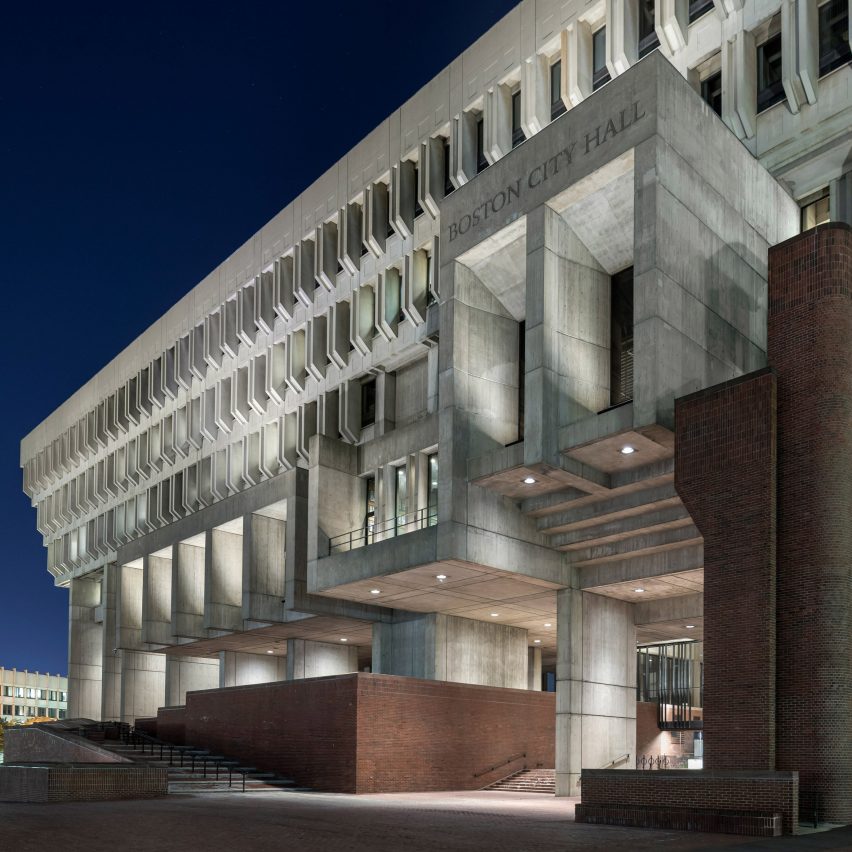
Boston City Hall renovation preserves "straightforward honesty" of brutalist building

by Bridget Cogley

Boston City Hall RenovationBoston City Hall RenovationBoston City Hall RenovationBoston City Hall Renovation

LED lights illuminate the gridded concrete structure of Boston's brutalist city hall, which has been renovated by local firm Utile. Read more

25 Oct 22:16

This Iranian Music Streaming Site is Photoshopping Women Out of Their Own Album Covers

by DL Cade

Iranian music streaming website Melovaz is under fire today after it was discovered that, in accordance with the country’s strict censorship policies, the site is forced to Photoshop out women out of album cover art. The policy means that women are being scrubbed—often very poorly—out of their own cover art, resulting in some very strange, almost comical album covers.

As reported by Insider, the music site was first “exposed” on Twitter by user @IzzRaifHarz. “If you are bored then you can try checking this music streaming site from Iran,” writes the Twitter user, “they censored every female on music artwork like they don’t even existed.”

The extent of the censorship staggering. Every single woman in every album cover—even if a woman is all there is on the album cover—has been scrubbed. Some of the world’s most popular female artists like Taylor Swift, Lady Gaga, Ariana Grande and Beyoncé have all been unceremoniously removed from their own album art, leaving behind terrible Content Aware Fill artifacts in most cases.

Here are just a few popular albums and singles we found after a quick 10 minutes of searching Melovaz:

Even the cover art for playlists—which Melovaz seems to pull from Spotify—are not safe. Here is a screenshot of the top “This is …” playlists, which usually feature a portrait of the artist. All of the empty ones featured women:

Ironically, the actual content of the songs seems to be left alone. So crude lyrics are seemingly okay, but a close-up of female lips is off limits.

For now, Melovaz has not made any public comment about the practice, nor has the album art been updated or taken down entirely as of this writing. To see some the Photoshopped covers for yourself, head over to the Melovaz website and search for your favorite female artist.

(via Fstoppers)

21 Oct 18:30

Sound Transit Ponders Public Restroom Policy, More Toilets Forthcoming

by Stephen Fesler

Sound Transit is taking another look at its restroom policy at the direction of boardmembers. In a briefing last month, staff provided an overview of the existing restroom program, policy considerations, and approach to explore possible changes. Staff took great lengths to emphasize the challenges that the transit agency experiences with restrooms and their costs. But additional restroom facilities are poised to open in the next few years as light rail is expanded into suburban communities.

Existing policy for bathroom facilities comes from a 1998 motion that outlined the principles on how bathrooms should be located at Sound Transit facilities. Even then, the ambitions for restrooms were very low, with a preference for onboard commuter rail bathrooms and heavily used transit hub locations.

Excerpt from Motion No. M98-67. (Sound Transit)

Stated policies in the motion also urged cost-sharing with other service providers and agencies and prescribed heavy monitoring and security protocols out of fear of abuse.

So far, Sound Transit only has 11 locations with public restroom facilities. Two of these are in Seattle (Union Station and Northgate Transit Center) while the rest are located in other cities served by the transit agency. Notably, no light rail facilities in Seattle have restroom facilities yet all of the light rail stations in Tukwila and SeaTac do. Several Sounder commuter rail stations have restroom facilities in addition to Bellevue Transit Center and Federal Way Transit Center, and all Sounder trains have onboard restroom facilities, required by Motion No. M98-67.

Where restrooms currently exist. (Sound Transit)

By 2024, the number of Sound Transit facilities with restrooms will jump to 18. Nearly all new restrooms, with the exception of Northgate, will be located in suburban cities. Sound Transit often installs restrooms because cities require the transit agency to construct them. For instance, Kent’s land use code specifically requires restroom facilities for light rail stations like its neighbor SeaTac.

Where restrooms will be located by 2024. (Sound Transit)

Sound Transit has adopted several design and operational strategies for new public restrooms, such as:

  • Having at least two accessible unisex restrooms;
  • Using fixtures and materials in restrooms that require minimal maintenance and damage-resistant;
  • Video surveillance located just outside of the restroom area;
  • Requiring restroom users to contact security staff for remote access to facilities;
  • Limiting hours of use to only operational hours of transit; and
  • Locating them within a fare-paid zone whenever possible.

In addition to the current standards for restroom design, Sound Transit is looking into other solutions to enhance customer access. One option would be adding access to restrooms via an activated ORCA card (tapped before entering the fair-paid area) or bar code scanning system for riders with other fare media.

Concept for area maps with restroom locations identified. (Sound Transit)

To promote the use of existing restroom facilities, staff noted that interactive and printed maps will be updated to highlight their existence. The online map will include a new layer that specifically identifies restroom facilities for trip planning purposes. Printed and wayfinding maps will be updated to include specific restroom icons in the future. Relatedly, Sound Transit plans to overhaul signage in existing stations by converting gendered blade and wall signage to unisex signage.

The kind of wayfinding signage that Sound Transit uses for restrooms. (Sound Transit)

An option to expand the number of restrooms is to use leased retail facilities as a means to open up restroom access. At Angle Lake Station, Sound Transit was required to install leasable retail space as part of the parking garage to activate the ground floor. So far, the transit agency has been unsuccessful in getting a tenant to lease the space. But staff suggested that terms of lease could include a requirement that associated restrooms be accessible to the general public, including riders.

Sound Transit staff touched on travel times for riders of light rail. Riders spent an average of 18 minutes on light rail in 2018 since most trips are short in distance. Travel time from Downtown Seattle to Sea-Tac International Airport average about 38 minutes, but the proportion of riders who travel that distance is relatively small. As the system grows and riders travel longer distances, however, average travel times will likely grow. Trips from Federal Way and Everett to Downtown Seattle are projected to take 53 minutes and 60 minutes respectively on light rail, which staff suggested may add more urgency to offer more restroom facilities.

Staff presented a litany of issues with restrooms. Ongoing maintenance from misuse of restrooms was a big grievance since graffiti removal and repair from other vandalism are common problems, in addition to the normal cleaning requirements of facilities. The kinds of damage from misuse of restrooms spans arson, fire extinguisher tampering, removal and distortion of fixtures, and clogged toilets from clothes and drug paraphernalia. Sound Transit stressed that there were over 2,250 separate incidents at just seven locations with restrooms over a two-period (2017 and 2018), which totaled $284,580 in maintenance costs for the transit agency. To put that in perspective, Sound Transit’s total transit operating budget is $345.4 million in 2019.

Security and police response to restroom misuse was another area of significant concern by staff who characterized restrooms as “magnets for criminal activity,” suggesting more than just petty vandalism and careless use. Sound Transit staff noted that there were over 130 separate incidents requiring security and police response to restroom misuse over the 2017-2018 time period, translating to 35,216 hours of staff time. Many of these incidents involved serious vandalism, drug activity, and prostitution, which has led several agency partners to encourage Sound Transit to close public restrooms or no longer provide them in future facilities.

What Sound Transit estimates the operational costs of restrooms at seven locations. (Sound Transit)

During the 2017-2018 timespan, Sound Transit spent on average $193,786 per facility among seven highlighted locations. Tuwkila International-Boulevard Station, a light rail station, was the priciest with over $572,000 in costs, the bulk of which went toward security. Sumner Station, a commuter rail station, was the cheapest with just under $27,500 in costs, again with the bulk of spending on security. In fact, most restroom facility security costs were more than triple the actual cost of maintenance.

For now, Sound Transit will continue to engage riders about how to improve restrooms and the rider experience as well as developing formal policy options with cost estimates to expand restroom access. That information will be brought forward for consideration by the board at a future meeting, though the timing is yet to determined.

The featured image is courtesy of Sound Transit.

17 Oct 22:19

Why Astronauts Have Unisex Spacesuits (and Why Unisex Body Armor Doesn't Work)

by Rain Noe

As we learned here, when female soldiers in the U.S. military are given body armor designed for men, their job is made more dangerous; the ill-fitting armor has been shown to encumber women's range of movement, which affected everything from their aim with a firearm to their ability to quickly get in and out of a vehicle. Even worse, the bad fit creates gaps that an enemy can grab onto during hand-to-hand combat.

Sheathing the relatively barrel-like shape of the average male torso is a relatively straightforward design process; but military designers have been stumped by the problem of creating curved armor plates to fit the average female form, as the shapes required create more weight and even worse, weak points. (Hopefully this will change, as last year the House of Representatives finally greenlit funding for the design of female-specific body armor.)

So I was surprised to learn that another dangerous government-backed job that increasingly involves both genders, the vocation of astronaut, has unisex outfits that work for both men and women. Apparently a spacesuit's large interior volume (required for pressurization) moots the need to accommodate the anatomical bits that distinguish the genders. Instead, the problem with astronaut suits has been size.

As an example, earlier this year two astronauts at the International Space Station were scheduled to work on an exterior repair, a spacewalk in NASA parlance. This requires special spacesuits--Extravehicular Mobility Units, or EMUs for short--different than the ones worn inside the station (called Orion suits). The modular EMU spacesuits are not designed for gender, but instead for size, with just three options for the torso portions: Medium, Large and Extra Large.

Both astronauts selected for the task were female and one of them, Christina Koch, was outfitted for a size Medium suit. The other astronaut, Anne McClain, had trained in both a Medium and a Large down on Earth, but on an actual spacewalk earlier in the mission, had discovered that the Medium was the better fit.

Christina Koch

The problem was that, while they had two Medium suits onboard the station, only one of them had been prepped for the mission. Preparing a suit for a spacewalk is more complicated than getting dressed for an Edwardian dinner party, with a time-consuming list of equipment safety checks and "loop scrubs" that must be performed first. In order for the spacewalk's task to be completed on schedule, McClain stepped aside and fellow astronaut Nick Hague went in her place, in the prepped size Large.

Preparing an EMU for a spacewalk

As a result, what would have been the first all-female spacewalk--a coincidence of scheduling, with astronaut rotations being "luck of the draw," according to NASA spokesperson Stephanie Schierholz--did not happen. "When you have the option of just switching the people, the mission becomes more important than a cool milestone," Schierholz told The New York Times.

Still, for years NASA engineers have understood the problems associated with having suits of different sizes. On a spacecraft or station with limited space, and in a potentially dangerous environment where redundancy can mean safety, it would be desirable to have complete interchangeability of gear among all astronauts. And this week, NASA revealed the solution they've been working on.

From left to right: Amy Ross, Lead Spacesuit Engineer; Jim Bridenstine, NASA Administrator; Kristine Davis, Spacesuit Engineer, wearing the Exploration Extravehicular Mobility Unit (xEMU) prototype; Dustin Gohmert, Orion Crew Survival Systems Project Manager, wearing the Orion Crew Survival System suit.

On Tuesday NASA unveiled the prototype for their next-generation EMU, called the xEMU (Exploration Extravehicular Mobility Unit), as well as a prototype for the orange Orion suit that astronauts wear when inside the spacecraft or station.

I totally covet this helmet!

After seeing this photo, I'll never again complain about how bulky my laptop backpack is.

And after seeing this photo, I realize that I have a jacket I never wear because it makes my shoulders look weird. I am probably too self-conscious to become an astronaut.

Multiple news outlets have reported that xEMUs are one-size-fits-all, though none have offered details, and NASA in their own press release has made no such claim. However, NASA has stated that:

In the Anthropometry and Biomechanics Facility at NASA's Johnson Space Center, astronauts undergo full-body, 3D scans while performing basic motions and postures expected during spacewalks. With a complete 3D animated model, NASA can match the astronaut to the modular space suit components that will provide the most comfort and the broadest range of motion, while reducing the potential for skin irritation where the suit might press on the body.

You guys are NASA, and this is the highest resolution image you could provide?

This leads me to believe that perhaps the exterior of the torso component of the xEMU is of a single size, with modular interior components of differing sizes for each astronaut that can be "plugged into" the xEMU suit. But that is admittedly speculation.

As for the Orion suits, NASA's language is also confusing: "The Orion suits will be custom fit for each crew member and accommodate astronauts of all sizes." I take that to mean they are not interchangeable.

I want to believe that if you press the red button on the ribs, a mechanism inside the helmet dispenses snacks.

In any case, this week NASA administrator Jim Bridenstine tweeted the following:

Lastly: Want to see how astronauts get into their suits? Click here for some Astronaut and Spacesuit Fun Facts.


17 Oct 22:07

The Original 1956 NBC TV Footage of Charles & Ray Eames Debuting Their Iconic Lounge Chair

by Rain Noe

This is so cool! In the 1950s NBC had the Today show and The Tonight Show, as they do today. But they also had a show in between them called Home, hosted by Editor-in-Chief Arlene Francis. Focusing on domestic topics, Home featured a certain Eames couple in 1956.

During the segment, Charles and Ray Eames discussed their work, their work relationship, the design field, materials, their house composed of "standard factory units," and capped it off by debuting this newfangled thing they'd come up with called the Lounge Chair.

Here's the full segment:

If you don't have time to watch the whole 11-minute segment, you Philistine, at least watch the three-minute clip below (we've cued it up for you) where they debut the chair and reveal how it's assembled:


17 Oct 21:55

Researchers Developed an Algorithm that Can Recreate Video from Motion-Blurred Stills

by DL Cade

In a breakthrough that seems more science fiction than science fact, researchers at MIT have developed a model that can recover “lost dimensions” in images. Translation: it can recreate video from a motion-blurred photograph, and may some day be able to create a 3D scan from a 2D image.

A paper about this breakthrough will be presented at the International Conference on Computer Vision next week, but first author Guha Balakrishnan shared the details with MIT News. Basically, all visual data “collapses” four dimensions (one dimension of time and three dimensions of space) into one or two. Balakrishnan and his team have developed a “visual deprojection” model that can recover/recreate some of this lost information.

The researchers trained a convoluted neural network by feeding it “low-dimensional projections” (i.e. a long exposure made by merging a video into a single image) and their original high-dimensional images (i.e. the actual video). Using this data, the algorithm learns to spot and recreate the patterns it was seeing between the two.

In this case, their trained model was able to recreate 24 frames of a person walking, “down to the position of their legs and the person’s size as they walked toward or away from the camera.”

The researchers want to use this same model to eventually turn 2D images into 3D scans at no additional cost, a project they’re working on in collaboration with researchers at Cornell University. This could have major impacts on medical imaging in poorer parts of the world, where it is much easier, more accessible, and cheaper to capture a 2D X-Ray than a 3D CT scans.

No applications to traditional photography are discussed in detail in the article, but it’s possible this same model would be able to accurately “de-blur” images by recreating a single “frame” of the blurry parts. Imagine capturing a long-exposure’s worth of light, and then compressing that down to a single short frame with no motion blur?

Of course, now we’re just dreaming, but it’s incredible to see how far computational imaging has come, and we’re excited to see what comes next.

(via Engadget)


Image credits: Photo by Alasdair Elmes

15 Oct 19:38

Samuel Delany's 1977 Star Wars review: why is the future so damned white and male?

by Cory Doctorow

Samuel Delany (previously) is one of science fiction's titans, a pioneer who was the first openly gay writer in the field, as well as one of the first Black science fiction writers to attain prominence.

In 1977, Delany saw a press preview of Star Wars on assignment for Cosmos Science Fiction and Fantasy; Delany's assessment of what made the film so tremendous contains shrewd observations about the many ways in which Lucas stitched together different filmmaking techniques and homages to film classics to create a sense of unreal reality that was both gritty and grand -- "worlds that look big enough to be worlds."

Delany notes that not all of the pulp homage in Star Wars holds up: "turbo-blasters" and "Kessel run in under three parsecs" and so on. But he reserves his sharpest criticism for the movie's treatment of people of color and women: "In Lucas’s future, the black race and yellow race have apparently died out and a sort of mid-Western American (with a few South Westerners who seem to specialize in being war ship pilots) has taken over the universe. By and large, women have also been bred out of the human race, and, save for the odd gutsy princess or the isolated and cowed aunt, humanity seems to be breeding quite nicely without them."

Delany wants to know how Lucas finds it easier to imagine a future filled with cool alien muppets, but not people of color?

In a bit of foreshadowing for future Disney Star Wars installments, Delany muses: "wouldn't that future have been more interesting if, say, three-quarters of the rebel pilots just happened to be Oriental women -- rather than the guys who didn't make it onto the Minnesota Ag football team. It would even be more interesting to the guys at Minnesota Ag. This is science fiction, after all."

Star Wars: A Consideration of the Great New SF Film [Samuel Delany/Cosmos Science Fiction and Fantasy]

27 Sep 21:45

Thousands of vulnerabilities in Seattle's IT network attributed to siloed approach to cybersecurity

by markb
Thousands of vulnerabilities in Seattle's IT network attributed to siloed approach to cybersecurity
markb Tue, 09/17/2019 - 05:00

Staff told leadership the vulnerabilities had been patched, but in fact they had not.

Link to external site
Off
07 Jul 16:56

Somerville, Massachusetts Becomes The Second US City To Ban Facial Recognition Tech

by Tim Cushing

Is it a movement? Or just a couple of outliers that will forever remain on the periphery of the surveillance state? It's too early to say, but at least we can now say San Francisco isn't an anomaly.

Somerville, Massachusetts just became the second U.S. city to ban the use of facial recognition in public space.

The "Face Surveillance Full Ban Ordinance," which passed through Somerville's City Council on Thursday night, forbids any “department, agency, bureau, and/or subordinate division of the City of Somerville” from using facial recognition software in public spaces. The ordinance passed Somerville’s Legislative Matters Committee on earlier this week.

Last month, San Francisco became the first city in the nation to ban the use of facial recognition tech by city government agencies. While it can't keep the federales from rolling in and deploying the software against city residents, it does prevent local law enforcement from deciding this is the tech toy it can't live without.

The ordinance passed in Somerville is pretty much the same thing. No local use, but federal-level use is OK. To be fair, the city can't regulate the activities of the federal government. It could have forbidden local agencies from working with federal agencies using facial recognition tech, but it didn't go quite that far.

This is a solid move, one that certainly looks smarter than allowing local cops to load up on tech that's been roasted by Congress and (still!) sports a pretty gaudy failure rate.

If other cities are interested in joining the very short list of facial recognition banners, activists have created a few road maps for governments to use. At the moment, the greatest chance for success appears to be at the hyper-local level. The ACLU says it all comes down to cities making the most of their limited power.

Kade Crockford, director of the technology for Liberty Program at the ACLU of Massachusetts, said in a phone call that at the state level, the ACLU is advocating for a moratorium or pause of facial recognition technology, while at the local level, the ACLU is advocating for bans.

“At the municipal level, it’s different,” Crockford said. “State governments have the capacity to regulate, whereas local governments really don’t. They don’t have the ability, for example, to create new institutions that could oversee, with sufficient care and attention, the implementation of an oversight or accountability system to guard against civil rights and civil liberties abuses.”

Generating momentum at the state level may be difficult until more cities are on board. If bans like these become more common, state legislators may respond favorably to wind direction changes and finally push back a bit against entrenched interests with an inordinate amount of power, like police unions and incumbent politicians with an authoritarian bent.

Somerville and its small network of 30 government-owned surveillance cameras may not seem like much, but a ban on the books is still effective if the city decides it needs to expand its set of eyes. And, as Vice News reports, it's not just small towns taking up San Francisco's anti-surveillance creep torch. Oakland -- which has already made major strides in curbing local government use of surveillance gear -- is considering a ban of its own.


Permalink | Comments | Email This Story
30 May 17:30

Separated Bike Lanes Means Safer Streets, Study Says

by Aaron Short

Cities that build protected lanes for cyclists end up with safer roads for people on bikes and people in cars and on foot, a new study of 12 large metropolises revealed Wednesday.

Researchers at the University of Colorado Denver and the University of New Mexico discovered cities with protected and separated bike lanes had 44 percent fewer deaths than the average city.

“Protected separated bike facilities was one of our biggest factors associated with lower fatalities and lower injuries for all road users,” study co-author Wesley Marshall, a University of Colorado Denver engineering professor, told Streetsblog. “If you’re going out of your way to make your city safe for a broader range of cyclists … we’re finding that it ends up being a safer city for everyone.”

Marshall and his team of researchers analyzed 17,000 fatalities and 77,000 severe injuries in cities including Denver, Portland, Dallas, Seattle, San Francisco, Kansas City and Chicago between 2000 and 2012. All had experienced an increase in cycling as they built more infrastructure. (Update: All of those cities also have varying rates of gentrification, which needed to be factored into the results, specifically because of “the safety disparities associated with gentrification.” Researchers said safety improvements in largely gentrified areas “suggest equity issues and the need for future research.”)

Researchers assumed that having more cyclists on the street was spurring drivers to slow down — a relic of a 2017 study that found that cities with high cycling rates had fewer traffic crashes. But it turned out that wasn’t the case.

Instead, researchers found that bike infrastructure, particularly physical barriers that separate bikes from speeding cars as opposed to shared or painted lanes, significantly lowered fatalities in cities that installed them.

After analyzing traffic crash data over a 13-year period in areas with separated bike lanes on city streets, researches estimated that having a protected bike facility in a city would result in 44 percent fewer deaths and 50 percent fewer serous injuries than an average city.

In Portland, where the population of bike commuters increased from 1.2 to 7 percent between 1990 and 2015, fatality rates fell 75 percent in the same period. Fatal crash rates dropped 60.6 percent in Seattle, 49.3 percent in San Francisco, 40.3 percent in Denver, and 38.2 percent in Chicago over the same period as cities added more protected and separated lanes as part of their Vision Zero plans.

“Bike facilities end up slowing cars down, even when a driver hits another driver, it’s less likely to be a fatality because it’s happening at a slower speed,” Marshall said.

Perhaps even more important: Researchers found that painted bike lanes provided no improvement on road safety. And their review earlier this year of shared roadways — where bike symbols are painted in the middle of a lane — revealed that it was actually safer to have no bike markings at all.

*We found they’re worse than nothing. You’re better off doing nothing,” Marshall said. “It gives people a false sense of security that’s a bike lane. it’s just a sign telling cyclists it might just be there.”

Not all protected bike lanes provide the same level of security for cyclists and drivers. In Denver, for instance, some protected lanes have plastic bollards that are interspersed along the roadway, allowing cars and trucks to park in the bike path and forcing cyclists to swerve into the street.

“When you have them designed like that, even if it’s a protected lane, that might create a more dangerous situation because cyclists are merging in and out of the road versus places with foot-wide concrete planters,” Marshall added.

New York was not included in this longitudinal study because the high number of cyclists and lanes would have overwhelmed their models, but will be a focus of a future study, Marshall said. New York’s Department of Transportation consistently touts how its protected bike lanes improve safety for all road users — but often denies neighborhoods the full protection of such infrastructure when some car owners complain of lost parking.

Sometimes, it’s not always “safety first.” 

04 Apr 00:43

Saturday Morning Breakfast Cereal - Turmoil

by tech@thehiveworks.com


Click here to go see the bonus panel!

Hovertext:
At first, the Encouragement Drones seemed so innocent...


Today's News:

See ya tonight, geeks!


01 Apr 22:48

Mayor Won’t Say The Words ‘Bike Lane’

by David Meyer

He won’t say the words “bike lane.”

Mayor de Blasio declined to commit to installing a protected bike lane — which is his own administration’s plan— as part of the long-delayed final phase of the Queens Boulevard safety redesign.

Under questioning from Streetsblog on Thursday, de Blasio apparently felt he could not even utter the words — bike lane — regarding a project that is his signature Vision Zero achievement, but is opposed by Queens Council Member Karen Koslowitz, whose support de Blasio needs for an unrelated jail he hopes to build.

Question: When is the bike lane going to get implemented on Queens Boulevard?

Mayor: “We have to work out the timing. There’s more to be done on that. Obviously, we’ve been very committed to addressing the issues on Queens Boulevard. It’s been one of the number one priorities under Vision Zero. More to come, but there’s a lot of details to work through.

Follow-up: Can you promise that the bike lane is going to happen?

Mayor: “I can promise that on Queens Boulevard we’re going to ultimately follow through on the vision that we put forward. I can’t tell you the exact timing and details because we’re still working on them.”

The protected bike lane is a key element of the first three phases of the Queens Boulevard project installed between 2015 and 2017 — improvements that have reduced crashes along the roadway formerly known as “the Boulevard of Death.”

The mayor’s comments echoed what he said back in Nov. 1, when he assured the public of his “commitment to Queens Boulevard” — again without mentioning the bike lane that was at one time central to that commitment.

Mayor de Blasio, today in Queens. Photo: Michael Appleton/Mayoral Photography Office

Indeed, the “vision” the city put forward last spring included extending the protected bike lanes from their current terminus at Yellowstone Boulevard to Union Turnpike. But de Blasio’s refusal to commit to a bike lane in phase IV is contrary to his position in 2016, when he overruled Queens Community Board 4, which had opposed the second phase of the bike lane project.

“Achieving Vision Zero means protecting the lives of everyone on our streets, whether they are walking, in a wheelchair, in a car or on a bike,” Hizzoner said at the time.

That mindset informed the DOT’s approach to the project’s subsequent phases: Queens Community Board 6 overwhelmingly endorsed the Rego Park segment of the project in June 2017. Last year, DOT officials told the CB6 members that the Forest Hills phase would be implemented in July, regardless of the board’s support or opposition, because it was a “mayoral priority.”

July came and went, then seven more months. The bike lane and accompanying safety improvements have still not been installed.

One clear explanation for the mayor’s newfound reticence: Koslowitz turned against the project last year after some Queens Boulevard merchants complained that their business would be hurt in the exchange of some on-street car storage for safety. Last week, Gothamist reportedthat the bike lanes are caught up in the politics of the jail, since the city is counting on Koslowitz’s support for the jail project. Streetsblog had reportedon that possible quid-pro-quo back in November.

Of course, parking alone fails to explain the financial struggles of Queens Boulevard small businesses — particularly since the spots in question were only added in recent decades. More likely, changing tastes and shopping patterns, as well as rising rents, have hurt those businesses bottom lines.

Thursday’s comments from the mayor came just one day after he met privately with Koslowitz and other neighborhood civic groups to pitch his plans to build one of four new borough-based jails in nearby Kew Gardens.

De Blasio told Streetsblog that the bike lanes did not come up during his meeting with Koslowitz.

But Koslowitz has been running scared from the bike lane project ever since the owner of Ben’s Best kosher deli closed shop and blamed his demise on the bike lanes— failing to acknowledge the role of his own management practices, or the ongoing decline of Jewish delis that has touched every corner of the city. When it was still open, Ben’s charged $16.95 for a brisket sandwich— a high price in a changing neighborhood with many cheaper lunch options.

Meanwhile, the first three phases of Queens Boulevard bike lanes and pedestrian improvements have been a resounding success. The roadway once had as many as 25 fatalities per year, but just three people have been killedin traffic crashes there since DOT began its upgrade in 2015.

Pedestrian injuries have dropped 63 percentand cycling injuries have increased only slightly despite a huge jumpin the number of people riding.

01 Apr 22:32

Naturally Men Took Tinder’s “Height Verification” April Fools Joke Too Seriously

by Kate Gardner

tinder lawsuit sued sexual harassment valuation stock

Happy April Fools’ Day! Already, companies that are trying to do joke products are being met with sincere reactions. While this is not my favorite holiday, after 25 years of it, I’m used to checking the date on articles before I believe them (the whole internet could stand to give a closer look before commenting, tbh), and I had hoped the rest of the world would have caught on, too.

However, when Tinder jokes, the men who use it do not laugh and are too upset to actually realize that they’re being gently mocked. The popular dating app made a joke about a height verification for men who lie about their heights, and immediately, everyone took it seriously, despite it being an obvious joke.

Seriously, the video seems to think there’s only 10 inches in a foot, and yet, here we are, writing about how men can’t take a joke.

Tinder CMO Jenny Campbell told The Daily Dot, “To celebrate April Fool’s Day, we wanted to raise awareness that really only 14.5% of the U.S. male population is over 6′ despite the many Tinder bios claiming otherwise. This caused quite a stir among our users, and while we aren’t really verifying height, we do encourage people to stand proudly in their truth when filling out their bios. And conversely, we encourage all Tinder users to keep an open mind while swiping. Sometimes your most unexpected match can lead to amazing things.”

Men lashed out against the app following the joke, immediately tweeting that this was body shaming while in the same breath (or tweet) demanding that there be a weight verification for women, as that’s supposedly a sign of “self care” more so than height. The immediate fat shaming and misogynistic responses show that maybe height isn’t the reason that these men weren’t getting dates in the first place. Maybe it’s the way they treat women that is causing potential matches to swipe left.

I will note that not all of the responses were angry or gross. Some men tweeted out memes and jokes and seemed to get that it was all a prank to begin with. Still, the majority of the responses seem to be angry, which speaks to a problem. Men apparently are reacting to a joke with rage and a desire to embarrass women or punish them by shaming them for their size, acting as if body shaming is acceptable when it’s men shaming women, but not the other way around.

We joke that people from marginalized communities are too sensitive, but it appears that men can be the most sensitive of all. If a height requirement is met with an immediate cry of “but then women should need to verify weight” comments, that’s a sign of (a) body shaming and fat shaming, and (b) an inability to take a joke. Yes, the tweet was posted the Friday before April Fools’ Day, but it should have been an easy spot-the-prank post.

Instead, men took it upon themselves to be gross towards women and scream about how they’re being oppressed because of their height. Seriously, men, lighten up and take a joke. You’d be much prettier if you smiled more.

(via Daily Dot, image: Joe Raedle/Getty Images)

Want more stories like this? Become a subscriber and support the site!

The Mary Sue has a strict comment policy that forbids, but is not limited to, personal insults toward anyone, hate speech, and trolling.—

01 Apr 05:31

Canon’s Left Eye Problem is Frustrating Users with Mirrorless Camera Design

by Michael Zhang

Just as much of daily life is geared towards right-handed people, cameras are often geared toward right-eyed people. Photographer Michael Andrew (AKA Michael the Maven) made this 4-minute video pointing out Canon’s “left eye problem” in its latest mirrorless cameras.

Andrew focuses on the design, UI, and ergonomics of the new Canon EOS RP. Canon has taken away the joystick and has moved the selection of focus points to the touchscreen — photographers can select where they’d like to focus by touching the rear touchscreen while looking through the electronic viewfinder.

The problem, however, is that left-eyed shooters will have their noses covering up the right side of the touchscreen, blocking it from being accessed with the right thumb. Focus selection can be moved to the left side of the touchscreen, but then the user is forced to choose between supporting their lens with the left or using their left thumb to touch the screen.

There’s an alternative — customizing the directional pad for AF selection — but the ergonomics of that isn’t great either.

In a poll he conducted among his audience, Andrew found that over 1/3 of respondents are left-eye shooters, so this is a usability issue that affects a significant percentage of photographers.

“If you’re changing your focusing squares around a lot, it’s almost a dealbreaker,” Andrew says. “I just want to make Canon and left-eyed users aware: we need a joystick. You should do a cost-benefit analysis of having that joystick in the natural resting thumb position so left-eyed shooters can have an option to move those around.”

Aside from this “left eye problem,” however, Andrew says he really likes the EOS RP overall and considers it a great camera.

(via Michael the Maven via Shutterbug)

29 Mar 19:55

SDOT Gaslights on 35th Ave Decision, Risking Credibility of New Director

by Ryan Packer

The decision to cancel a planned protected bike lane on 35th Ave NE, in the heart of Wedgwood’s business district, and instead paint a center turn lane is being made worse by the fact that the Seattle Department of Transportation (SDOT) seems determined to convince the public that the decision was made with safety in mind. Anyone paying attention to the process knows that this is not the case, and doing so risks the credibility of the brand new head of the department.

SDOT Director Samuel Zimbabwe had been on the job for less than a month before being sent into the middle of a street fight in Wedgwood. But it has long been public knowledge that the decision to back off protected bike lanes, which were in the completed design through the point where the project went out to bid, was squarely with Mayor Jenny Durkan’s office. Taking the unprecedented step of asking the department to halt the project before the final striping that would have added the bike lane went in so that a secret mediation process could continue to turn the issue into a political one.

Not even support from District 4 Councilmember Rob Johnson for a safer 35th Ave NE was enough to see the project to fruition. He wrote in a blog post more than a year ago: “Ultimately, I still believe that the proposed changes will result in a safer corridor for everyone traveling through the neighborhood and will help allow more people to choose to walk or bike, which we need to meet climate change objectives and ease traffic congestion.” The mayor had backup from other elected leaders to continue with the project and still folded.

But the Mayor’s Office was not the bearer of bad news on Tuesday when the announcement was made, as Director Zimbabwe met with proponents for the approved design and then released a blog post titled “35TH AVE NE PROJECT: Safety for all in NE Seattle.” It was clear that they would be starting with the end result and working backwards from there, producing reasons that the design had been chosen.

The problem is that the final design chosen, replacing the space for protected bike lanes with a center turn lane, did not originate within SDOT, but rather came from the opponents of the bike lane. The fact that it did not actually add any on-street parking back to 35th Ave NE was puzzling to many, given the focus on parking for business access. However, to call the design a “compromise” is misleading as a safe place to bike was essentially the only thing that the safety proponents were requesting.

Ironically, one of the few things that the two sides could agree to in mediation was the fact that the speed limit on the street should be lowered to 25 mph–something which SDOT has not committed to doing, saying they will evaluate the street for lower speeds after the design changes have been implemented.

Now, SDOT’s talking points include the fact that the protected bike lane conflicted with the Transit Master Plan, even though the design that went out to bid was also consistent with operating buses through the corridor. There is no mention of the fact that the new design moves the lane of southbound travel directly next to the curb, which will dramatically impact the pedestrian experience for people walking to places like the busy Northeast branch library. And we have the SDOT director telling Safe 35th advocates at their meeting Tuesday that the new lane configuration will allow people biking on 35th Ave NE to “take the lane,” according to multiple reports.

Also unaddressed is the impact that increased lane widths will have on vehicle speeds, with the general purpose lanes north of NE 85th St getting bumped up from 11 feet to 12 feet, highway-sized lanes. Between NE 85th St and NE 65th St, lanes are getting bumped from 10.5 feet to 11 feet. Wider lanes lead to higher speeds, but we are being asked to believe that the proposed design is exactly the same as the original in terms of safety.

Even more dismaying, perhaps, were comments that Mr. Zimbabwe made to Michelle Baruchman of The Seattle Times that “all streets can’t do all things for all people” when referring to the modal master plans that lay out plans for specific streets to become key corridors in a citywide network that allows people to safely get around our city without a car. Seattle has seen time and time again instances where concerns around traffic and parking have won out over safety, and it doesn’t look like the new SDOT director views the issue any differently than it has been approached in the past.

Both sides are seeing the response to 35th Ave NE as taking on an oversized importance around the issue of bicycle and pedestrian safety. The response from the Seattle Department of Transportation shows that we may be making even less progress than we think.

The post SDOT Gaslights on 35th Ave Decision, Risking Credibility of New Director appeared first on The Urbanist.