Shared posts

11 Jun 15:22

The ACLU analyzed the number of police in schools compared to social workers, and the results are staggering

by Thom Dunn

In March of 2019 — about a year after the Parkland shooting at Marjory Stoneham Douglas High School — the ACLU released a report titled "Cops and No Counselors: How the Lack of School Mental Health Staff Is Harming Students." Based on publicly available federal civil rights data from 2015-2016, this report offered a comprehensive analysis of the school support resources, breaking it down by state and demographic, to get a better look at how we're serving students in America.

The results were not good:

The ACLU’s report found over 90 percent of students nationwide attend schools that fail to meet the nationally recommended ratios for student-to-counselors, psychologists, nurses, and social workers. Over 14 million of these students were in schools that reported having law enforcement present despite lacking critical mental and physical health personnel. The report cites research indicating that students would benefit more from increased access to mental health professionals than the increased school hardening the commission recommends.

[…]

  • The average number of students each school counselor serves is 444 — nearly double the already limited recommended student-counselor ratio of 250:1
  • At least 43 percent of our nation's students attend schools with onsite police, and in some states more than 68 percent of schools have police
  • 31 percent of the nation's students attend schools that have school police, but no psychologist, nurse, social worker, and/or counselor
  • Black girls account for 16 percent of girls enrolled nationwide, but account for 39 percent of the girls arrested in school
  • Native American and Pacific Islander students were more than twice as likely to be arrested as white students nationwide
  • Black and Latino boys with disabilities are 3 percent of students, but were 12 percent of school arrests.

What I personally found most staggering was that 94 percent of "serious offenses" by students involved threats or actual physical fights … without a weapon.

It's not crazy to think that some kids are going to scrap in the schoolyard. Yet somehow, that qualifies as a "serious offense." And only a small chance of anything worse than a fight.

But this is still how we focus our resources:

When people worry about what would happen if we didn't have police in schools — well, the data shows that it can't be much worse than what's already happening when we do have police in schools. Police don't prevent mass shootings, for example; social workers do.

ACLU Report Highlights Staff Shortages, Over-policing, and Discriminatory Discipline in Schools

Image: Public Domain via U.S. Air Force photo by Airman 1st Class Zoe M. Wockenfuss

31 May 19:03

The anger behind the protests, explained in 4 charts

by Sean Collins
Anti-police brutality protesters gather near the White House in Washington, DC, on May 30. | Probal Rashid/LightRocket/Getty Images

Police killings have trended upward in recent years — and black men are more likely to be killed.

The protests that have risen up in nearly every city in the United States over the past week were sparked by the killing of an unarmed black man, George Floyd, by now-fired police officers in Minneapolis. Even though one former officer, Derek Chauvin, has been charged with third-degree murder, protests have continued night after night because they are not just about that single killing but what it represents: rampant police brutality that seems to have no consequences.

In fact, a recent analysis by advocacy group Mapping Police Violence found that 99 percent of police killings from 2014 to 2019 did not result in officers even being charged with, let alone convicted of, a crime.

Mapping Police Violence’s data, which is gathered from public databases and law enforcement records, also shows that the number of police killings has trended slightly upward from 2013 to 2019 — in that span, the number of killings falls to a low of 1,050 in 2014, and has a high of 1,143 in 2018. For comparison, 373 people were killed in mass shootings in 2018 and about 1,010 Americans died of Covid-19 on May 30.

Mapping Police Violence

Numbers such as these are a stark reminder that despite years of demonstrations and advocacy — and even changes in policy, such as the adoption of body cameras or requirements that officers use deescalation techniques before resorting to violence — little has changed numerically.

Those numbers are of killings of people of all races — but the same can be said when looking at the data broken down by ethnicity: killings of black Americans by police appears to be trending slightly downward, as are the killings of white Americans; the killings of Latinx Americans are slightly up. Police killings of Native and Asian Americans have spiked, then fallen; the killings of Americans of unknown race are very much up.

Those are totals, and reminders that police killings are not just a problem suffered by black Americans — that they affect Americans of all ethnicities. But controlling for population (that is, looking at killings per million people) shows that it is black Americans who are most likely to be killed by police officers — that they are nearly twice as likely to be killed as a Latinx person and nearly three times more likely to be killed than a white person. Black Americans are also about 1.4 times more likely to be unarmed in fatal interactions with police than white Americans are (and about 1.2 times more likely to be killed unarmed than Latinx Americans).

This disparity is such that in eight US cities — including Reno, Nevada; Oklahoma City, Oklahoma; and Scottsdale, Arizona — the rate at which police killed black men was higher than the US murder rate. And in 27 of the country’s 50 largest cities, the rates of police killings (of people of all races) is higher than the rates of violent crime. In many cities, like Kansas City, Missouri, and Columbus, Ohio, counting police killings as violent crimes would more than double the rate of violent crime.

Mapping Police Violence

It is this reality that people are protesting. There have been many protests against police killing unarmed black men in recent years, some of which have gone on for weeks, like the 2017 St. Louis protests over the killing of Anthony Lamar Smith by former police officer Jason Stockley, and the 2014 uprisings in Ferguson that followed the killing of Michael Brown. Out of those protests have come the Black Lives Matter movement and other advocacy initiatives, as well as oversight, like the consent decree the Baltimore Police Department entered into with the Department of Justice following the 2015 killing of Freddie Gray.

And some studies have shown that the adoption of measures pushed for by these advocates has helped reduce police killings broadly — a Mapping Police Violence analysis of data from the Police Use of Force Project found that chokehold and stronghold bans reduced killings by 22 percent, for instance.

Those reductions, however, have not been enough. The protests have not been enough. Mapping Police Violence’s analysis shows this, as do other studies, like one from researchers at Rutgers University, the University of Michigan, and Washington University in St. Louis recently explained by my colleague Dylan Scott.

Using data from 2013 to 2018, the researchers worked to understand how at risk American men and women were of being killed by police. The results showed black men had a 1 in 1,000 chance in being killed by police — just higher than the odds the the average American has of dying in a motorcycle crash, according to the National Safety Council.

A bar chart showing police killings of men and women Americans. The bars showing the killings of women are so minuscule as to be nearly invisible, but are clearly highest among black women. The bar for black men shows nearly 100 deaths/100,000, just above the deaths for Native American and Latinx men, which are both about 50 deaths/100,000. PNAS

If past protests have not changed this tragic paradigm, it is not clear that the present ones will either. But there is little else protesters can do than to draw attention to this problem that has not gone away. While many have been encouraged to vote, Mapping Police Violence’s data shows that these killings take place in cities with a broad range of leadership types, and regardless of which party is in control.

Many advocates argue that no change can come about until policies are put in place weakening police unions, and ensuring police cannot be militarized or demilitarized at the whim of the president of the United States. The decision to offer police military equipment is not made at the local, but federal level. And police union officials, who often shape the rules police officers are governed by, are voted in by officers in the union — not by the public.

Also, as Scott notes, complaints about police action are not always looked into — Chauvin had 18 complaints against him, but was nevertheless allowed on the street the day of Floyd’s killing. And again, 99 percent of officers are not charged following killings. With little other recourse than to attempt to press for change — and with decades, even centuries, of frustration fueling them — the protests will continue.

As Olga Hall, a protester in Washington, DC, told the Associated Press Saturday night, “We’re sick of it. The cops are out of control. They’re wild.”


Support Vox’s explanatory journalism

Every day at Vox, we aim to answer your most important questions and provide you, and our audience around the world, with information that has the power to save lives. Our mission has never been more vital than it is in this moment: to empower you through understanding. Vox’s work is reaching more people than ever, but our distinctive brand of explanatory journalism takes resources — particularly during a pandemic and an economic downturn. Your financial contribution will not constitute a donation, but it will enable our staff to continue to offer free articles, videos, and podcasts at the quality and volume that this moment requires. Please consider making a contribution to Vox today.

31 May 18:05

Police targeted journalists covering the George Floyd protests

by Katelyn Burns
A journalist is seen bleeding after police started firing tear gas and rubber bullets into crowds near the Fifth Police Precinct in Minneapolis, on May 30. | Chandan Khanna/AFP/Getty Images

Though police were responsible for most of the violence, some protesters got in on the act too.

On Friday night, photojournalist Linda Tirado was shot in the eye by a rubber bullet while covering an anti-police brutality protest in Minneapolis — one of more than two dozen incidents of journalists experiencing violence while covering the recent demonstrations.

Tirado says she’s permanently blind in her left eye. (She is thankful she uses her right eye to take photos, so the injury is not career-ending.)

The Minneapolis Police Department and Mayor Jacob Frey’s office didn’t respond to requests for comment about Tirado’s injury.

Across the country journalists have been targeted by police, facing arrest, detention, and violence, including being pepper sprayed and shot by rubber bullets. Journalists were targeted by police in the Ferguson protests in 2015 and during the civil rights era, and that pattern of violence and arrests continued into this weekend’s protests.

“Targeted attacks on journalists, media crews, and news organizations covering the demonstrations show a complete disregard for their critical role in documenting issues of public interest and are an unacceptable attempt to intimidate them,” said Carlos Martínez de la Serna, program director at the nonprofit advocacy group Committee to Protect Journalists, in a statement Saturday. “Authorities in cities across the U.S. need to instruct police not to target journalists and ensure they can report safely on the protests without fear of injury or retaliation.”

Police shot at journalists with rubber bullets

A reporter and her camera crew were shot at by police in Louisville. Vox’s Alex Ward has more detailed coverage of the Louisville incident here.

Ali Velshi and his MSNBC camera crew were shot at by Minneapolis police live on the air while covering a peaceful protest.

Canadian Broadcasting Corporation journalist Susan Ormiston was hit with rubber bullets and tear gas fired by Minneapolis police live on the air Saturday.

Two members of a Reuters TV camera crew were hit by rubber bullets in Minneapolis Saturday.

Reporter and photojournalist Sarah Belle Lin was hit in the thigh by a rubber bullet fired by police while covering protests in Oakland, California, Saturday evening.

A man with a video camera and a press helmet was filmed by CNN getting shot with rubber bullets by Minneapolis police Saturday.

CBS News reporter Michael George reported that police in Minneapolis fired rubber bullets at his crew, striking sound engineer John Marschitz in the arm.

Police hit reporters with tear gas and pepper spray

LA Times reporter Molly Hennessy-Fiske reported that Minnesota State Patrol troopers fired tear gas at reporters and camera crews in Minneapolis Saturday.

On Rodeo Drive in Santa Monica, California, an ABC7 reporter and his crew were hit with tear gas Saturday.

Several Detroit Free Press reporters were pepper sprayed by Detroit police Saturday, including one who held up a press badge while police targeted him.

KSTP reporter Ryan Raiche was with a group of media in Minneapolis before they were tear gassed and pepper sprayed by police Saturday.

VICE News correspondent Michael Adams reported that police raided a gas station where several members of the press were taking shelter. He said police threw him to the ground and pepper sprayed him.

Police threatened and arrested journalists

On Friday morning, CNN reporter Omar Jimenez and his crew were arrested live on the air in Minneapolis. Vox’s Matthew Yglesias has more detailed coverage here.

HuffPost reporter Christopher Mathias, who photos show with his press badge clearly visible to officers, was arrested while covering protests in Brooklyn Saturday evening. He was later released and in good condition, according to several of his HuffPost colleagues.

Minneapolis-based reporter Madeleine Baran tweeted that a Minneapolis police officer pointed a weapon at her and did not lower it when she identified herself as a reporter. The incident prompted her to leave and stop reporting on the protest.

Journalist Simon Moya-Smith was pepper sprayed and arrested after being told “Roll on your side, Mr. Journalist,” by a Minneapolis police officer Saturday.

CNN commentator Keith Boykin tweeted that he was arrested by NYPD Saturday.

Police weren’t the only people targeting journalists this weekend

But it was unfortunately not just police targeting journalists over the weekend. Fox News reporter Leland Vittert and his crew were harassed, assaulted, and chased off the scene near the White House in Washington, DC, Friday. Their camera was broken in the process.

A crowd surrounded, defaced, and smashed windows at CNN’s Atlanta headquarters Friday, though it should be noted there is a police precinct headquarters inside the CNN Center.

CBS5 reporter Briana Whitney was grabbed by a man on live television while reporting on protests outside Phoenix Police Department headquarters.


Support Vox’s explanatory journalism

Every day at Vox, we aim to answer your most important questions and provide you, and our audience around the world, with information that has the power to save lives. Our mission has never been more vital than it is in this moment: to empower you through understanding. Vox’s work is reaching more people than ever, but our distinctive brand of explanatory journalism takes resources — particularly during a pandemic and an economic downturn. Your financial contribution will not constitute a donation, but it will enable our staff to continue to offer free articles, videos, and podcasts at the quality and volume that this moment requires. Please consider making a contribution to Vox today.

18 May 21:50

Even the Pandemic Can’t Kill the Open-Plan Office

by Sarah Holder

The call center on the 11th floor of this 19-story office building in downtown Seoul had a layout that would look familiar to many a white-collar worker: Long rows of shared desks line each side of the open floor, with a handful of smaller meeting rooms and private offices tucked into the corners. On February 25, one of the 216 people who worked on the floor started experiencing symptoms of coronavirus. Swiftly, a cluster of cases began to ping-pong across the office, until the government caught wind and the building was shut down.

The Korea Centers for Disease Control and Prevention tracked down anyone who lived in, worked in, or had visited the office and apartment development, revealing the path of the virus as it leapt from warm body to warm body. Of the more than a thousand people they tested, 97 had contracted Covid-19. Nearly all of them worked together on the 11th floor. An infection map released by researchers showed that one side of the room, filled with lines of tables where at least six employees sat on each side, was hit hardest. In all, 94 of the 216 densely-packed employees tested positive for the disease, the cases scattered across the office like a checkerboard.

Floor plan of the 11th floor of “building X,” site of a coronavirus disease outbreak in Seoul, South Korea. Blue coloring indicates the seating places of persons with confirmed cases. (Park SY, Kim YM, Yi S, Lee S, Na BJ, Kim CB, et al. Coronavirus disease outbreak in call center, South Korea. Emerg Infect Dis. 2020 Aug.)

For companies now hoping to invite employees back to work, that infection map serves as a sobering blueprint: The open-plan office that so many companies have adopted in recent years looks like an extreme public health hazard.

Open offices were popularized in the 1980s as a scheme to lower real estate costs and break down divisions between teams; with fewer walls, bosses can claim they’re emphasizing transparency and collaboration while maximizing their square footage per employee. Despite evidence-based complaints that the layout is distracting and noisy, hampers productivity, and actually discourages in-person interaction, by 2017, 7 in 10 offices had adopted the model. (Among the proponents of open-plan office design is Bloomberg LP, the parent of CityLab, and the company’s founder and majority owner, Michael Bloomberg.)

Coronavirus introduces a new challenge to the primacy/tyranny of the open office. In the short term, architects, designers, property managers and public health professionals say that pretty much every aspect of this kind of workspace will have to change, to get fewer people inside it at a time. But don’t mourn — or celebrate — its death yet: A pivot to walls is probably still a long way away.

“From the standpoint of making significant physical changes, everyone’s in a sort of wait-and-see mode,” said Chris Coldoff, a principal and studio leader in the Los Angeles office of the architecture and design firm Gensler. (He’s been working at home for the past 8 weeks and counting.)

Rather than investing in costly remodels, organizations are now trying to reconfigure existing spaces, with an eye towards keeping employees safe from infection and giving them the peace of mind needed to return. “Companies are basically planning for Covid to be a part of our lives and the way we work for at least the next 18, to 24, to 36 months — until there is a vaccine or treatment,” said Brian Chen, co-founder and CEO of ROOM, a company that makes soundproof phone booths for open offices.

Most essential workers have not had the luxury to wait at home as their employers figured out how to safely allow them to do their jobs: They’ve been risking infection to show up in hospitals, grocery stores, and other critical workplaces since the pandemic began. But open-plan office jobs will be some of the last to return as local economies sputter back to life, because many of the white-collar industries that favor the design find it easier to do their work remotely. They have more time to get it right.

The first and most important push is to reduce density. Instead of squeezing eight employees onto a bench desk, office designers are advising companies to seat just three; instead of bringing outside clients deep into the office for meetings, they’ll be routed into low-trafficked side rooms (or not invited in at all). Alternate desks will have clear signage marking them off-limits. New signs outside break-out rooms will announce adjusted maximum occupancy levels. All-hands team meetings might be broken up into virtual and physical components, where only four people gather in conference rooms and the others tune in from farther-flung desks or from home. Elevators might hold six people, and likely fewer; in the lobbies of high-rises, employees will queue before entering.

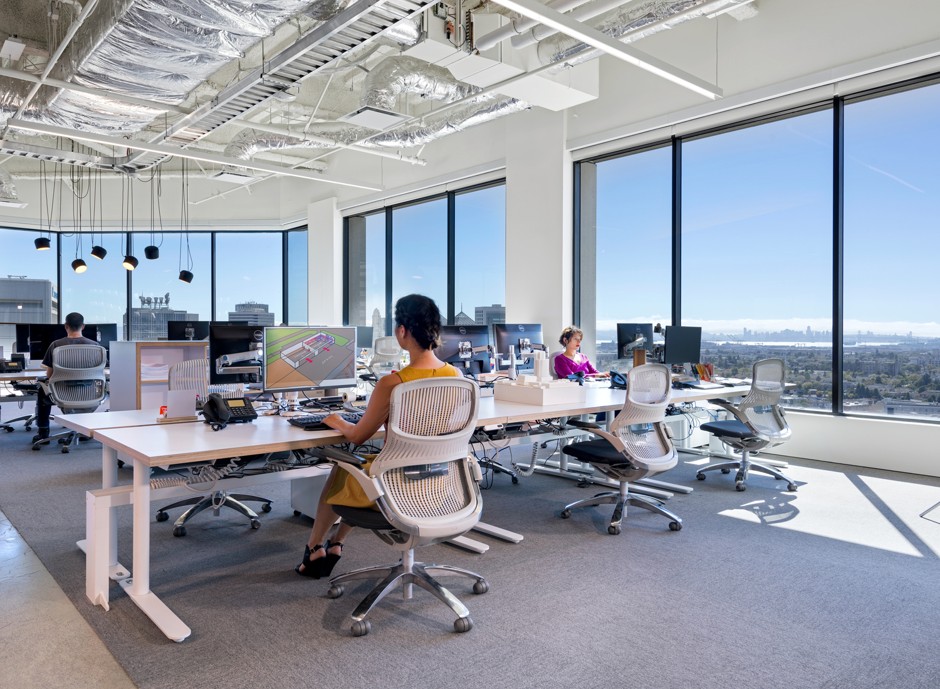
What Gensler’s Oakland office might look like, when employees start coming back. (Gensler/Jasper Sanidad)

All this leaves offices with a geometry problem: How are they supposed to safely space out their old workforce, with the same amount of square footage? The short answer is, they’re not. At least not for a while.

Bergmeyer, a design collaborative with open-plan offices in Boston and L.A., is currently planning to invite employees back to work on Monday, May 18, but the return will be done in phases. In the Boston office, people will come back in three waves, over three-week cycles. About a third of the office will be sorted into each wave, and divided in two again: half will come in Mondays, Wednesdays, and Fridays and the other half on Tuesdays and Thursdays. If people want to avoid rush hour on public transit, managers are suggesting people stagger their arrivals each day, just making sure they’re around during “peak business hours” — from 11 a.m. to 4 p.m. Eastern time, when workers on both coasts are online.

“It was like a giant chess board, trying to figure out how to take into account each one of our employees’ preferences, but also make some sort of regularity to it,” said Rachel Zsembery, Bergmeyer’s vice president.

(Courtesy Bergmeyer)

To help organizations structure phased returns, Gensler developed a tool called “ReRun,” which uses an office floor plan to calculate how many people a given space can fit, and where they could sit, depending on how much space is desired between each of them. “It’s something that our clients were struggling with and doing manually,” said Coldoff. “Some had millions of square feet, and they’re going in with measuring stick trying to figure out how many people they can fit.”

In total, workplaces are looking to reduce capacity by 50% to 60%, says Lenny Beaudoin, the executive managing director of a CBRE team that leads workspace strategy. Now offices are figuring out how to subdivide their workforces. Some staffers need to come back to the office (because their work demands it), and others might want to come back (because they miss their desk or their commute or their colleagues); on the other side of the ledger are those who don’t want to come back, don’t need to, or simply can’t, because of concerns like childcare.

Flexibility is an approach favored by offices big and small: In advance of an expected loosening of social distancing requirements in the Bay Area, Facebook announced that all its employees can work from home for the rest of the year. Twitter CEO Jack Dorsey announced that some employees can work from home indefinitely.

To accommodate teams that might have some members staying remote and others coming into the office, “Zoom rooms” may become fixtures of the coronavirus workplace. Bergmeyer is turning all of its smaller conference rooms into video chat spaces, for example, and experimenting with backgrounds that work well for remote meetings.

Arrows show the suggested flow of traffic around Bergmeyer’s open office space. (Courtesy Bergmeyer)

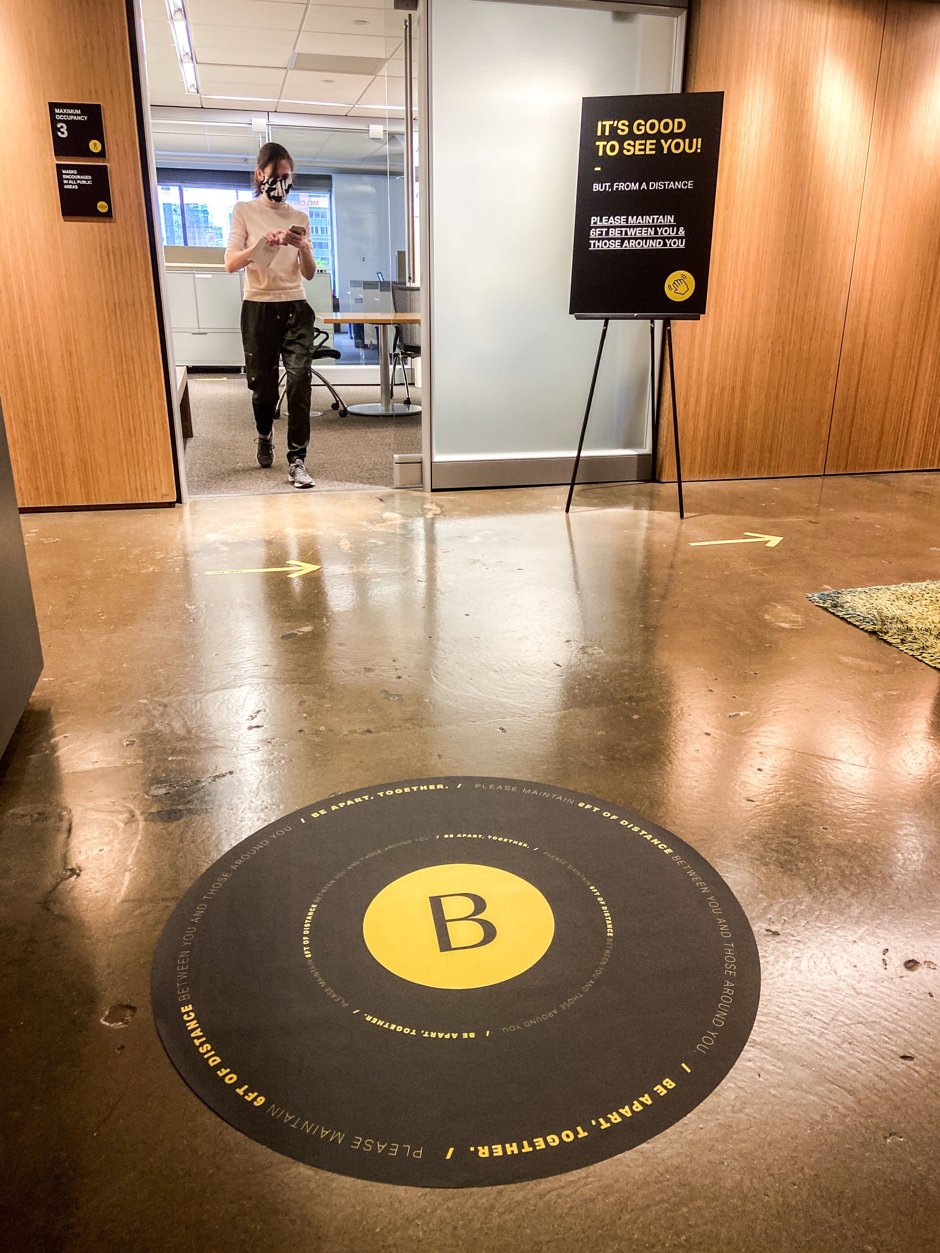
The Netherlands branch of Cushman and Wakefield, a real estate company, developed a plan for spacing out employees by putting round stickers on the floor showing what a six-foot berth really looks like. Bergmeyer has a similar series of branded signs that will direct the flow of traffic around the space, Zsembery says.

Six-foot distance isn’t a foolproof infection guard, however, and the protocols extend beyond density reduction. CBRE is advising landlords to up their ventilation circulation (and paying for the extra energy necessary to do it), and install new air filtration systems. New hand sanitizing stations need to be mounted, and new schedules need to be drawn up for janitorial staff to deep clean. Coldoff expects to see a turn towards touchless everything: personal keyfobs will open doors, personal handsets will do the job of corded phones; no more shared desktops or computer mice.

Then there’s the office kitchen, that germ-intensive zone of water-cooler chatter and sticky microwaves. Pantries will be a challenging task in post-pandemic workplace rethinks, but for now, bring-your-own caffeine is the plan at Bergmeyer: The coffee maker won’t come back into action until at least mid-July.

***

There’s a deeper question that needs to be solved at the heart of this effort to virus-proof the open office. What, exactly, is so valuable about working together in the same physical space? If the goal is to again nurture in-person collaboration, office design will have to find ways of making such face-to-face interactions feel safe and comfortable again.   

“If you can do the same work at home, the burden on the office is that it needs to be a better environment than your home,” said ROOM’s Chen.

Since the spray released by speaking is believed to be particularly likely to spread coronavirus, auditory and visual privacy is taking on on new importance. Pre-Covid open offices also struggled with this dilemma. You’re breathing on your colleagues, but you’re also listening to their every chew and smelling their ramen; their personal phone calls pierce your concentration just as often as their backpack gets caught under your chair leg. The Band-Aid fix for an increasing number of offices that tore down walls are portable phone booths: encased pods that are, ostensibly, soundproof.

But there’s already less of an appetite for shared, often poorly ventilated, enclosed micro-offices. Room and Zenbooth, another office phone booth company, reported plummeting orders as offices shuttered; Zenbooth reported half of its previously forecast sales in March, and about 40% of what it planned for April. (They are, however, getting a lot more requests for pod deliveries to private homes, as remote workers are installing them in garages and living rooms as an escape hatch from kids or roommates.)

Both companies have pivoted their operations to other forms of modular furniture and room dividers, which they predict will have more of a central role in the post-pandemic office. Zenbooth has also turned its attention to the health care space, manufacturing plexiglass sneeze guards and dividers for essential businesses, and for medical workers interacting with patients. Similar designs will be appearing in other kinds of offices, says Sam Johnson, Zenbooth’s CEO: “You don’t want to be breathing into your colleague’s face.”

Floor-to-ceiling plexiglass dividers could help reduce the airborne transmission of Covid-19, says CBRE’s Beaudoin, but such measures may have more of a psychological effect. Installing them could also be counterproductive, he suggested, lowering vigilance to other distancing and sanitizing considerations.

The design of the dividers will matter, too, Johnson says. Far from replicating boxed-in cubicles, he thinks effective dividers should be translucent or semi-translucent. “If workplaces protect their workers, they have to be careful not to over-protect them in a way that’s harmful,” he said. “We’re all physically separated at the moment, and that’s causing all sorts of psychological issues. We don’t want to go back into a workplace where it feels like we’re in a prison.”

There are other, non-design-related things employers can do to support anxious workers. (Providing ample sick leave, for example, can help encourage people who aren’t feeling well to avoid the workplace.) But no matter what, returning to the office after a long period away is probably going to feel weird, says Dr. K. Luan Phan, the chair of Ohio State University’s Department of Psychiatry and Behavioral Health.

“As people return to work or they return to public spaces, they’re always going to wonder, are there enough precautions in place that make me feel good about this return?” said Phan. “Are there safeguards in place that make me feel better about all the work that I put in these last two or three months to be safe and be healthy?”

Friendly floor stickers remind workers to keep their distance. (Courtesy Bergmeyer)

The key is to communicate what’s changing, and how. “It’s got to be consistent, transparent, and it ultimately has to be true,” says Phan.

Zsembery says that Bergmeyer, like so many individuals and households and companies during this unusual time, is trying to remain flexible in case new waves of infection require re-shuttering the office in the winter, or sooner.

“Some people are ready today, to come back,” said Zsembery, “and there are people that aren’t going to be ready for another four or five months.”

13 May 17:55

Supreme Court justices fear “chaos” if members of the Electoral College can defy the popular vote

by Ian Millhiser
Supreme Court Justices Samuel Alito And Elena Kagan Testify Before The House Appropriations Committee Supreme Court Associate Justices Samuel Alito (L) and Elana Kagan testify about the Court’s budget during a hearing of the House Appropriations Committee’s Financial Services and General Government Subcommittee on March 7, 2019, in Washington, DC. | Chip Somodevilla/Getty Images

The Court’s pragmatic voices appeared to gain the upper hand in a case about “faithless electors.”

When the Supreme Court heard arguments Wednesday over whether states can control “faithless electors” — members of the Electoral College who refuse to vote for their state’s winner of the popular vote — the justices didn’t divide along traditional partisan lines.

Chiafalo v. Washington and Colorado Department of State v. Baca, two consolidated faithless electors cases the Supreme Court heard on Wednesday, are unusual ones. They involve fundamental questions about how the United States conducts its presidential elections, but the cases are not especially ideological or partisan: Both the Republican National Committee and the Colorado Democratic Party filed briefs on the same side.

The state of Washington fines faithless electors, while Colorado removes and replaces faithless electors before they can cast a ballot. The question in both Chiafalo and Baca is whether states are allowed to exercise such control over members of the Electoral College after they are appointed.

In election-related cases, the justices often split along partisan lines, with the Court’s five Republicans preferring the outcome favored by the GOP, and its four Democrats dissenting. But, in Chiafalo and Baca, both political parties filed briefs opposing faithless electors and supporting states’ power to ensure that electors vote for the candidate they are pledged to support.

These cases do not present a particularly partisan conflict, and the judges appeared to divide along different lines. Formalists, like Justices Clarence Thomas and Elena Kagan, largely asked about what the text of the Constitution has to say about faithless electors. Meanwhile, pragmatists like Justice Stephen Breyer or Samuel Alito, worried more about how a constitutional rule permitting faithless electors would play out in practice.

There are strong formalistic arguments on both sides of this case, and those arguments turn on arcane interpretations of words like “appoint” and “ballot.” It is far from clear how judges should decide this case based solely on the text of the Constitution and its history.

Yet, as several justices noted, there are strong pragmatic reasons not to permit faithless electors, and those pragmatic concerns appeared likely to carry the day. As Justice Brett Kavanaugh remarked at one point, there is an “avoid chaos principle of judging.” If a case is a close call, and one outcome is likely to cause chaos, then judges should choose the other outcome.

How we got here

Chiafalo and Baca turn on a very narrow distinction. In Ray v. Blair (1952), the Supreme Court held that, before someone is appointed as an elector, they may be required to pledge that they will support their party’s nominee. But Ray also left unanswered what can happen to that elector if they violate their pledge.

The Constitution provides that each state shall appoint electors “in such manner as the Legislature thereof may direct,” but all 50 states use a popular election to select members of the Electoral College (although Maine and Nebraska award some electoral votes to the winner of each individual congressional district, rather than awarding all of their state’s electors to the winner of the state as a whole). Ray suggests that, before an elector is appointed, the state has broad power to impose conditions on electors.

But what happens after someone is formally appointed to the Electoral College? Larry Lessig, a Harvard Law professor and the lawyer representing faithless electors in Chiafalo and Baca, suggested in his briefs that the state’s power to control an elector ends the moment that elector joins the Electoral College.

Think of it this way: The president appoints federal judges with the consent of the Senate, but neither the president nor the Senate may remove a federal judge because they disagree with how the judge voted in a particular case. Similarly, members of Congress are chosen by voters, but once a senator begins their six-year term, they cannot be removed during that term if they break a pledge that they made to voters in order to get elected.

Colorado and Washington, meanwhile, argue that judges and members of Congress are exceptions to a broader rule. As Washington claims in its brief, “the ‘default rule’ is that the power to ‘appoint’ includes the power to remove.” Judges cannot be removed by the person who appointed them because the Constitution explicitly states that federal judges “shall hold their offices during good behaviour,” and senators cannot be removed because the Constitution provides that senators shall serve “for six years.”

But absent constitutional language indicating that members of the Electoral College must serve for a particular amount of time, the states claim, the default rule is that the same state that appointed an elector can remove that elector.

As a matter of constitutional text, neither of these arguments is a slam dunk. The Court’s formalists — justices who tend to rely more on technical legal arguments and less on how the law functions in practice — appeared quite aware of that fact. At one point, Justice Kagan asked Washington state solicitor general Noah Purcell if he could simply explain the best textualist argument for his position. Justice Thomas proposed a completely different textual argument that played only a small role in the parties’ briefs.

The Tenth Amendment provides that “the powers not delegated to the United States by the Constitution, nor prohibited by it to the states, are reserved to the states respectively, or to the people.” Thomas appeared to suggest that, under this amendment, a close question should be resolved in favor of the states. After all, if the Constitution does not prohibit the states from acting in a certain way, then the Tenth Amendment suggests that they may act that way.

But the strongest, and most forceful arguments against faithless electors came from the Court’s pragmatic wing — the justices most likely to weigh the practical impacts of their rulings.

There are powerful pragmatic arguments against faithless electors

Suppose, Justice Alito worried at one point, that an elector is bribed to vote for a particular candidate after they are appointed. Are states really powerless to remove an elector who is tainted by corruption?

Alito was also the first justice to warn that faithless electors could trigger “chaos.” If an election were close, and faithless electors are allowed to do whatever they want, the losing political party would likely launch a campaign to influence electors. The result would be months of uncertainty about who actually won the presidential election. And the eventual “winner” might be so tainted by a perception that they won through logrolling and skulduggery that many Americans would not accept that president as legitimate.

Indeed, as Purcell argued at one point, the practical consequences of allowing faithless electors could be even worse. A foreign power might seek to bribe electors in order to install a president who is sympathetic to that nation. Or they might conduct cyberattacks to uncover embarrassing personal information about electors, and then blackmail those electors into voting for a particular candidate.

These potential scenarios apparently bothered Justice Kavanaugh enough to trigger his suggestion that the Court should apply a “tiebreaker” in favor of the view that is most likely to “avoid chaos.”

Meanwhile Justice Neil Gorsuch, who ordinarily takes a formalistic approach to the law, raised a different pragmatic concern. If Ray allows a state to require electors to pledge to vote a certain way, why couldn’t the state require them to make that pledge under oath? And then, if the elector violates their oath, why couldn’t they be prosecuted for perjury?

The distinction between regulating electors before they are appointed, and regulating them after they are appointed, Gorsuch appeared to suggest, doesn’t actually mean very much.

Justice Sonia Sotomayor offered a third reason to reject faithless electors. Even if the framers originally expected electors to exercise individual discretion, the historical practice stretching back for nearly all of American history is that electors cast a vote for whoever their state supports. This history, Sotomayor suggested, offers a practical gloss on the Constitution, which judges should respect.

Current circumstances, though, make it harder than usual to assess how the Court views a particular case from oral arguments. Ordinary, in-person arguments are a scrum, where any justice can interrupt the lawyers at any time. In this setting, justices tend to interject a lot when they disagree with a particular lawyer, often staying silent while the side they support is arguing.

In an age of social distancing and telephone arguments, however, the Court uses a different format. Each justice is given a few minutes to ask questions of each lawyer, with no interruptions from their colleagues. That means that every justice tends to ask questions of both sides, even if they are already inclined to support one side or the other.

So it is not entirely clear how each justice will vote in Chiafalo and Baca. But there also appeared to be considerable support for the pragmatic concerns raised by Alito, Sotomayor, Kavanaugh, and others. It appears likely that the Supreme Court will not allow faithless electors. And they may even oppose faithless electors by a very lopsided margin.

That’s good news if, like much of the Court’s pragmatic wing, you fear the chaos that could result from placing the power to select the president in the hands of a few hundred largely unknown individuals.


Support Vox’s explanatory journalism

Every day at Vox, we aim to answer your most important questions and provide you, and our audience around the world, with information that has the power to save lives. Our mission has never been more vital than it is in this moment: to empower you through understanding. Vox’s work is reaching more people than ever, but our distinctive brand of explanatory journalism takes resources — particularly during a pandemic and an economic downturn. Your financial contribution will not constitute a donation, but it will enable our staff to continue to offer free articles, videos, and podcasts at the quality and volume that this moment requires. Please consider making a contribution to Vox today.

06 May 16:58

These Photos Show How Easy it is to Create ‘Fake News’ with Photography

by DL Cade

A Danish photo news agency recently tasked two of its photogs with creating a series that shows how easy it is to lie through photography. By shooting before and after photos of the same scene, they showed how angle and perspective can, consciously or not, manipulate viewers and lead to accusations of fake news.

The series was produced by Philip Davali and Ólafur Steinar Rye Gestsso, who were assigned to complete the piece by the Danish photo news agency Ritzau Scanpix. It was born out of the heated debates we’ve seen—and even written about recently—around images that allegedly show people flouting social distancing guidelines. Whether it’s a photo of a “crowded” beach in California, or viral photos used to shame people on social media, it’s all too easy for these images to be deceptive in nature.

As a photo agency supplying the media with coverage about the coronavirus outbreak, Scanpix‘s Editorial Manager Kristian Djurhuus tells PetaPixel that they felt it was important to draw attention to this fact.

Though Djurhuus says that he doesn’t believe there has been any sort of “conscious manipulation” taking place, at least not in Denmark, photographers and photo agencies must be careful that they don’t inadvertently open the door to misinterpretation. Angle and perspective can easily—and unconsciously—sow misinformation and spark outrage. Eventually, this can lead to a total mistrust of photography itself.

Scroll down to see this concept demonstrated visually, in a set of before-and-after photos:

It’s important to note that this isn’t just about lens choice and background compression. The effect shown above can easily be achieved using the same lens, by simply working different angles. As photographers we, of course, know this instinctively. But the average person does not.

“Readers of photography need to be aware of this,” said Djurhuus when we spoke to him over email. “This is a case where a basic, nerdy photography-fact has gained new meaning, because of a global event […] these times have made it obvious that we somehow need to make users and readers of images aware of something that only photographers used to care about.”

Hopefully the photos above help to send that message. Ritzau is also using captions to clarify circumstances and ensure photos aren’t misused. But in the end, it’s up to photographers to shoot carefully, caption accurately, and educate the public whenever and however they can.

(via Bored Panda via DIY Photography)


Image credits: All photos by Philip Davali and Ólafur Steinar Rye Gestsso, used courtesy of Ritzau Scanpix.

06 May 16:48

Every COVID-19 Commercial Is Exactly The Same

by Thom Dunn

“Semantic satiation is a psychological phenomenon in which repetition causes a word or phrase to temporarily lose meaning for the listener, who then perceives the speech as repeated meaningless sounds.”

06 May 15:27

Irish repay a 170-year-old favor to Native Americans affected by COVID-19

by Thom Dunn

My Irish ancestors all came to America between 1847 and 1849 — during the time of An Gorta Mór, the Great Hunger, when the British Empire hoarded all the food they were producing on colonized Irish land and left the native people with nothing but diseased potatoes to survive. This plight resonated with the Choctaw Nation, who lived in and around modern-day Alabama, Florida, Mississippi, and Louisiana, and of course had had their own experiences with a systematic genocide at the hands of a land-greedy colonizing force just a decade earlier. So the Choctaw rallied their resources, and sent $170 over the Atlantic to the starving people in Ireland — the equivalent of either $5,000 or $20,000 dollars today, depending on your calculations.

To commemorate this generous act, a statue was erected in Midleton, County Cork in 2017.

But solidarity is even better than a statue. Which is why, as Native Americans have disproportionately suffered from the impacts of COVID-19, Irish people rallied to the cause, raising more than a million dollars for the Navajo & Hopi Families COVID-19 Relief Fund on GoFundMe in just a few days. The effort was largely spearheaded — or at least publicized — by Irish journalist Naomi O'Leary, who also spoke about the historical relationship and the legacy of colonialism on the Irish Passport podcast:

From O'Leary's Irish Times article on the initiative:

Many comments on the GoFundMe page referenced the Choctaw donation. Some read “Ní neart go cur le chéile” ["No strength without unity"] and others simply “Ireland remembers”. “173 years ago, the people of the Choctaw nation showed Ireland unimaginable generosity,” wrote donor Michael Foy. “I am donating today in memory of our shared past, and to help overcome this crisis together – just as we did nearly two centuries ago.”

Cassandra Begay, a member of the Navajo Nation and one of the team organising the fundraiser, burst into tears as she told The Irish Times of seeing the donations flood in.

“We noticed that we were getting a lot of donations from Ireland so we were wondering why . . . sorry I get emotional talking about this part,” Ms Begay broke off. “And I learned about what the Choctaw did for the Irish people, and it was so beautiful.”

You can still support the Navajo and Hopi GoFundMe campaign, which is up to $2.5 million as of this writing.

Coronavirus: Irish donate to hard-hit Native Americans to repay famine aid [Naomi O'Leary / The Irish Times]

Irish return an old favor, helping Native Americans battling the virus [Ed O'Loughlin and Mihir Zaveri / The New York Times]

Navajo & Hopi Families COVID-19 Relief Fund

Image: Kindred Spirits Choctaw Memorial in Midleton, Co. Cork, Éire, taken by Gavin Sheridan via Wikimedia Commons/CC 4.0

04 May 17:35

An Amazon VP’s resignation shows internal unrest is rising to the top

by Jason Del Rey
Protesters block traffic as they participate in a “car caravan” protest at the Amazon Spheres to demand the Seattle City Council tax the city’s largest businesses in Seattle, Washington, on May 1, 2020. | Jason Redmond/AFP via Getty Images

Tim Bray wrote that staying an Amazon VP would have meant “signing off on actions I despised.”

An Amazon vice president has resigned over the firing of colleagues who protested working conditions inside Amazon’s warehouse network during the Covid-19 pandemic.

Tim Bray, a veteran technologist and top engineer in Amazon’s AWS division, referred to the firing of activist insiders — which include multiple warehouses workers and white-collar employees — as “chickenshit” and “designed to create a climate of fear.”

“[R]emaining an Amazon VP would have meant, in effect, signing off on actions I despised,” he wrote on his blog. “So I resigned.”

Vice president is one of the top job titles at Amazon — only senior vice president and CEO are higher — so Bray’s decision is noteworthy. Tech workers can spend more than a decade at Amazon and never reach the VP level because, unlike in much of corporate America, the title signifies much more than middle management. Executives who oversee all of Amazon Prime, or all of Amazon’s grocery delivery services, also carry the VP title. Typically, this level of management never speaks out of line publicly.

But if an Amazon vice president was going to resign over these issues, insiders might have guessed it would be Bray — he was the only Amazon vice president last year to sign an open letter along with thousands of lower-level employees asking CEO Jeff Bezos to make changes related to the company’s climate impact.

In his blog post, Bray says he believes that the company is working hard to make the warehouses safe for its workforce during the crisis — “I have heard detailed descriptions from people I trust of the intense work and huge investments. Good for them” — but believes the firings of activist employees is “evidence of a vein of toxicity running through the company culture.” He added, “I choose neither to serve nor drink that poison.”

Bray continued:

Amazon is exceptionally well-managed and has demonstrated great skill at spotting opportunities and building repeatable processes for exploiting them. It has a corresponding lack of vision about the human costs of the relentless growth and accumulation of wealth and power. If we don’t like certain things Amazon is doing, we need to put legal guardrails in place to stop those things. We don’t need to invent anything new; a combination of antitrust and living-wage and worker-empowerment legislation, rigorously enforced, offers a clear path forward.

The US Congress is currently conducting an antitrust investigation of the Big 4 tech giants, including Amazon, and seven House members last week called on CEO Jeff Bezos to testify.

Bray’s resignation marks an escalation of internal turmoil at Amazon that has bubbled to the surface over the last year, but which has really come to a head during the pandemic. His resignation comes after Amazon has fired at least two warehouse workers, Christian Smalls and Bashir Mohamed, after they led protests of warehouse working conditions. Amazon also fired two longtime corporate employees, Emily Cunningham and Maren Costa. Cunningham and Costa have spoken out in the past about the company’s negative impact on the environment as leaders of Amazon Employees for Climate Justice, and recently criticized the company for its treatment of warehouse workers. On Friday, some Amazon workers joined those from Instacart and Target in a strike that the companies said did not disrupt their businesses. But the public symbol of protest highlighted rare unity for non-unionized workforces and garnered widespread media attention.

Amazon has said it fired all of the employees for violations of company policies and not their activism, but all of the employees have said they believe they were targeted for calling out the company. Internal conflict is encouraged to some extent inside Amazon, but the company has now drawn a red line publicly on what type of dissent it is willing to accept among its ranks. Bray’s resignation comes after some corporate employees expressed outrage internally over the company’s handling of the firing of Christian Smalls. Some employees told Recode on Monday that the fact that a VP quit could inspire other Amazon employees to do the same.

An Amazon spokesperson did not immediately respond to a request for comment.


Support Vox’s explanatory journalism

Every day at Vox, we aim to answer your most important questions and provide you, and our audience around the world, with information that has the power to save lives. Our mission has never been more vital than it is in this moment: to empower you through understanding. Vox’s work is reaching more people than ever, but our distinctive brand of explanatory journalism takes resources — particularly during a pandemic and an economic downturn. Your financial contribution will not constitute a donation, but it will enable our staff to continue to offer free articles, videos, and podcasts at the quality and volume that this moment requires. Please consider making a contribution to Vox today.

29 Apr 16:22

Has Sweden found the best response to the coronavirus? Its death rate suggests it hasn’t.

by Alex Ward
People have lunch at a restaurant in Stockholm on April 22, 2020, during the coronavirus pandemic. | Jonathan Nackstrand/AFP via Getty Images

Sweden’s coronavirus death toll is worse than America’s but better than New York City’s.

You’d be forgiven for thinking Sweden had somehow found the secret to handling the coronavirus crisis without having to impose severe lockdowns.

Its total number of deaths, roughly 2,300 as of April 28, seems low, and it doesn’t look anywhere near as chaotic as, say, New York City. It’s no surprise, then, that the New York Times in a Tuesday story made the case that “to a large extent, Sweden does seem to have been as successful in controlling the virus as most other nations.”

“Sweden’s experience would seem to argue for less caution, not more,” the story also said.

But that sentiment obfuscates some very real problems with Sweden’s approach — problems that become much clearer once you zoom out.

The chart below, which I made using the Our World in Data website’s coronavirus statistics, helps put Sweden’s situation in perspective. It compares countries’ rates of coronavirus deaths per 1 million people.

As the chart shows, Sweden is actually faring worse than other Scandinavian nations and even worse than the United States, which has the highest number of confirmed total cases in the world. (It’s important to note that other nations — such as Spain and Italy — not included in the chart have higher death rates per million people than Sweden.)

The reason for Sweden’s high death rate has to do with the government’s policies.

Following the advice of the country’s chief epidemiologist, Anders Tegnell, the Swedish government chose not to impose strict lockdowns, curfews, or major border closings because the government felt it would hurt the economy and would only push the crisis further down the road.

“Locking people up at home won’t work in the longer term. Sooner or later, people are going to go out anyway,” Tegnell told reporters this month.

And while experts say the vast majority of Swedes followed the government’s social distancing guidelines and voluntarily stayed home, those who continued to drink at bars and shop at stores likely spread the disease around.

The New York Times even noted what Sweden’s public health officials now admit: That “more than 26 percent of the 2 million inhabitants of Stockholm will have been infected by May 1.”

That’s still higher than New York City’s infection rate, which New York state officials estimate could be around 21.2 percent based on recent antibody testing (though these numbers are still preliminary and based on just one study).

Where Sweden does compare favorably to the US is the country’s death rate when compared to New York City’s (not the whole US). About 12,000 reported deaths as of April 28 in a city of 8 million is surely worse than 2,300 deaths in a country of 8 million.

But there are three main reasons why the Big Apple would be worse off than the entire country of Sweden, experts say.

The first is population density: New York City has over 38,000 people per square kilometer, while Sweden has just 25 people — meaning it’s harder to socially distance.

Second, some hospitals in New York City were overwhelmed while Sweden still has about 250 hospital beds unoccupied. There are indications, though, that the hospital surge in New York City is declining.

Finally, there is significantly more international travel to New York City than there is to Sweden, which means there were more opportunities for people from countries suffering from severe outbreaks to spread the virus to the city than to the European country.

But when zooming out, it’s clear that Sweden as a whole is worse off than the US as a whole. That could, of course, change down the line, but any current arguments that Sweden got its outbreak response right are premature at best and dangerous at worst.


Support Vox’s explanatory journalism

Every day at Vox, we aim to answer your most important questions and provide you, and our audience around the world, with information that has the power to save lives. Our mission has never been more vital than it is in this moment: to empower you through understanding. Vox’s work is reaching more people than ever, but our distinctive brand of explanatory journalism takes resources — particularly during a pandemic and an economic downturn. Your financial contribution will not constitute a donation, but it will enable our staff to continue to offer free articles, videos, and podcasts at the quality and volume that this moment requires. Please consider making a contribution to Vox today.

28 Apr 20:55

How Washington state, a model for public health, plans to relax social distancing

by Dylan Scott
People practice social distancing at a park in Seattle, Washington, on March 20. | Karen Ducey/Getty Images

The state will probably reopen its economy more slowly than the White House suggests.

Seattle was the first place in the US to go into lockdown over the coronavirus, after an outbreak at a local nursing home woke Americans up to the threat the virus presented. Now, the city and Washington state are starting to plan for an eventual, gradual reopening.

Public health experts credit Gov. Jay Inslee and local leaders for taking the dramatic steps necessary to get the Covid-19 outbreak in the state under control. And the curve there is flattening, with new cases and deaths down from their earlier peak. But the economy has endured the same shock felt across the country. Officials have begun to discuss how to restart the economy, without risking a sudden resurgence in infections and deaths. With global giants like Microsoft and Starbucks headquartered in the state, Washington could be a model for the rest of the country on the best way to climb out of the coronavirus hole.

The hard truth is no matter how cautiously reopening happens, Covid-19 is going to continue to spread. “I don’t think it’s possible to prevent all transmission. We need to keep the number of cases manageable,” Jeffrey Duchin, who leads the epidemiology division of the King County health department, told me. “We want to see something like a slow burn, where it doesn’t evolve into an uncontrollable raging fire.”

The goal will be to relax some of the social distancing restrictions without overwhelming the health care system. The first small step came late last week, when Inslee announced that ongoing construction projects could resume, so long as they follow certain safety protocols. The next step may not come for some time; Inslee has already said the state’s stay-at-home order will extend beyond its current May 4 expiration date.

Local public health experts expect the state will wait to see weeks of declining cases and deaths before taking more significant steps to restart its economy. Duchin told me that he wants to see “way more” progress before social distancing policies are changed. And once they are, just a few restrictions may be lifted.

“It’s essential that we go carefully slowly and in a stepwise fashion. After each step, we’ll evaluate the impact,” Duchin said. “That will take two or three weeks. We need to stop and observe. Unfortunately we can’t figure this out in a few days. It will take a few weeks.”

Washington state’s reopening plan is likely to share many features of the White House’s reopening guidance, which suggests a phased approach, local experts told me — except the state is likely to adopt a more cautious timeline than the Trump administration’s guidelines, which are more like a bare minimum.

“There’s a continuum, from people who really just care about making sure people don’t get sick and then to the other side, who don’t want the economy to be tanked,” Hilary Godwin, dean of the University of Washington’s school of public health, told me. “I would put the White House more on the end of caring more about the economy, though obviously they care about the people. What we’ve seen so far in Washington state is obviously Inslee cares deeply about the economy, but he has been a conscientious actor.”

Overt caution worked for Washington in clamping down on the coronavirus. Now, the state sees it as the safest path to resuming normal life.

Washington acted quickly and has seen its coronavirus curve start to bend

The first known case of Covid-19 showed up in a Seattle suburb in mid-January; a man walked into a clinic complaining of fever and a cough. His doctors quickly learned he had recently returned from Wuhan, China, the original epicenter of the coronavirus outbreak.

A month later, on February 29, the first reported death from coronavirus occurred at a Washington nursing home — a man whom, as the New Yorker reported, had had many family members come in to visit him shortly before his death. Local health officials soon petitioned Microsoft to ask its employees to work from home, which the company did on March 4, hoping it would set an example for other firms capable of remote work. One week later, on March 11, Seattle’s schools were closed. They have not reopened.

Though Inslee did not issue a stay-at-home order until March 23, much of the state had already started to shut down before then. As Dom Constantine, the King County executive, told the New Yorker, local leaders believe the preliminary steps — closing schools, having Microsoft and Amazon employees working from home — had communicated the severity of the situation to most people:

Constantine thought that announcing school closings was a potent communication strategy for reaching even people who weren’t parents, because it forced the community to see the coronavirus crisis in a different light. “We’re accustomed to schools closing when something really serious happens,” Constantine told me. “It was a way to speed up people’s perceptions—to send a message they could understand.”

A month later, the results speak for themselves. Washington has tallied about 13,700 coronavirus cases and 760 deaths as of April 28. Adjusting for population, the state ranks 19th in cases per capita and 15th in deaths — despite being the first place to suffer a known outbreak and having to deal with uncontrolled spreading from the Kirkland nursing home. The daily highs for new cases and deaths came in late March. The state has seen several weeks of halting but evident decline.

 Washington State Department of Health

“When people ask me why things are going so great, I say, ‘We were on the front end, we reacted quickly, and we got lucky,’” Godwin said. “We are the public health model for doing things right.”

But that success has come at a cost, Godwin added. “If I cared a lot about economics, I wouldn’t be as thrilled.”

Seattle businesses, hit hard by Covid-19, are taking cues from Microsoft and Starbucks about how to reopen

Like the rest of the country, Washington’s economy has ground to a halt because of the lockdowns put in place to limit the spread of the coronavirus.

Nearly one-quarter of Washington households said somebody in their home had lost a job because of the economic downturn, according to data provided by the Downtown Seattle Association. About 650,000 jobless claims had been filed as of mid-April. Daily restaurant sales in Seattle were down nearly 80 percent; hotel revenues in the city have dropped by more than 90 percent. The expected cancellations of conventions in Seattle are projected to lead to economic losses exceeding $170 million.

“I think realistically it’s a few years before we have something approaching the economic activity we had pre-pandemic,” Markham McIntyre, executive vice president of the Seattle Chamber of Commerce, told me. “That’s how we’re thinking of this, a multi-year campaign.”

That toll is why these reopening conversations have begun to pick up. Government leaders are holding routine phone calls with businesses and their representatives to communicate their thinking and discuss the gestating plans to start easing social distancing. Officially, there is no plan yet for reopening. Inslee tweeted last week that discussions are ongoing, and Washington joined California and Oregon to formulate a roadmap for the entire West Coast.

“...We need to keep the number of cases manageable. We want to see something like a slow burn, where it doesn’t evolve into an uncontrollable raging fire”

The Seattle area has one advantage over some other parts of the country: the presence of Microsoft and Starbucks headquarters, companies that have already undergone a partial reopening process in their locations in China. Microsoft is representative of a white-collar office setting and Starbucks has experience in retail. They’ve been sharing their lessons with the people and businesses working on a reopening plan, according to Markham and Jon Scholes, president and CEO of the Downtown Seattle Association.

Microsoft, for example, has been suggesting some ideas about how to strengthen office culture, to set expectations for managers and workers about their productivity in an unusual environment. They’ve also covered basic sanitation, how to set up socially distant protocols for using elevators, and how to best arrange people’s desks to decrease the chances of airborne spread.

Seattle businesses have also been working with software developers to come up with a “personal protective equipment wizard.” It would be a program into which companies could enter their industry, number of employees, operating square footage, and other key criteria. An algorithm would tell them how many masks and other protective equipment they should keep on hand at all times.

Business leaders I spoke with emphasized the need for flexibility on the part of the government. New safety protocols will look different for a coffee shop than a factory or an office building. They floated the idea of setting “performance goals” — certain standards businesses should strive to meet — and then allowing businesses to figure out the best way to achieve them.

“It will be very hard for the government to have a highly regulated response to this,” Markham said. “They don’t have the bandwidth or the interest in trying to manage a massive regulatory framework to check and enforce how businesses are reopening.”

But businesses are also realistic about the pace of reopening — and the possibility social distancing restrictions would need to be put back into place if there is a surge in Covid-19 cases and deaths. As Markham said: “Any reopening is gonna be a dial, not a switch.”

Washington’s reopening will be gradual and it will depend on good public health practices

The uncomfortable truth is there’s no way to know when the right time to reopen an economy is. There is no evidence right now that the summer months will lead to a sudden decline in Covid-19 spread, and federal health officials are already warning of a second wave in the fall. No proven treatments for people who get infected exist nor do any vaccines to prevent people from becoming infected in the first place.

If public health were the only consideration, the solution to the coronavirus would be to keep everything shut down. It has been the only proven intervention. But it is also a blunt instrument, and there are other considerations.

 John Moore/Getty Images
A doctor and a nurse converse before testing patients for the coronavirus at the University of Washington Medical Center in Seattle, Washington, on March 13.

“The other side of the equation is the economic and personal financial costs of shutting things down,” Joel Kaufman, a UW professor who studies environmental and occupational health sciences and epidemiology, told me. “I think were it not for that, the answer would be to continue to stay at home. But that appears not to be a realistic option for the other parts of our country which are influenced by economic activity.”

That being said, public health experts in Washington told me they expected the state to broadly follow the guidelines recently released by the White House — but with a few important exceptions and a higher threshold for when it’s safe to relax more restrictions.

The Trump administration has said states should wait until they see 14 consecutive days of declines in flu-like and Covid-like symptoms. Washington is likely to wait longer than that before taking any more significant steps to relax social distancing.

“We have already passed that for the state of Washington, and I don’t think any public health experts would say today is the day,” Godwin told me. “I expect to be more protective of public health under our government.”

It’s also unlikely Washington will fully embrace every bullet point in the White House plan. Godwin scoffed at the idea of large gatherings, which would be permitted with some restrictions in Phase 2 (out of 3) in the Trump administration outline. Washington has put a ban on gatherings of more than 250 people and experts expect that to be among the very last of the restrictions lifted, a sharp contrast to the federal guidance.

“The thing that makes me say what was the large venues. I wouldn’t expect us to do that,” Godwin said. “The reason they were the first thing put into place is statistically if you have a large group of people and you have Covid-19 circulating, the chances you have somebody who is asymptomatic and they’ll pass it along are high.”

But opening restaurants, with social distancing guidelines, and some retail locations might make sense, Godwin said. Factories and offices need to take certain precautions, but they could also probably start to resume activities soon. Inslee has already announced that schools would not reopen before the end of the academic year, though Trump recently suggested that might be possible. But the belief now is they will start back up in the fall.

The success of social distancing depends not only on sound government policies but on individuals behaving responsibly. Since it appears the coronavirus may be more transmissible by air than by touch, Kaufman said he hopes that mask-wearing will remain commonplace when people go back to work.

“When you’re out of your own house and have any opportunity to interact with other people, you are wearing a mask to prevent you from spreading the virus to other people,” he said, adding that it should be communicated that not wearing a mask is “an act of incredible selfishness.”

Maybe most critical to the reopening plan will be the government’s ability to conduct contact tracing: the tedious work of identifying people who have the coronavirus and then getting in touch with everybody they’ve recently had contact with and either testing them or making sure they self-quarantining.

It will require a massive ramp-up: Johns Hopkins researchers estimate that, nationwide, the US has only a fraction of the trained staff necessary to do this work. Phone apps could automate some of the work “disease detectives” do, but a major expansion of the public health workforce will be necessary.

“Even a few cases if unrecognized will spark an outbreak that will spiral out of control. You have to be able to identify almost all the cases. If you miss a few, those little sparks can set off a forest fire,” Duchin said. “We’re not absolutely sure that we’re gonna be able to do it.”

The coronavirus is a particularly challenging pathogen to track because symptoms don’t appear for several days after a person has been infected. “The rapidity with which this work has to be done is really unprecedented.”

But everybody, even Duchin, is anxious for some degree of normalcy to resume. He’s looking forward to getting back out with his cycling friends (he’s feeling out of shape these days). He also has a daughter, a senior in college, hoping to visit with friends before the summer comes and goes. The public health experts who are urging caution feel the same kind of pressure as the rest of us.

But this process will require patience. That will be the first, second, and third principle of Washington’s reopening plans.

“This disease isn’t gone. One of the misperceptions is it’s going to go away if we suppress it and we can go back to normal. But it’s lurking. We’re just as susceptible,” Duchin said. “The potential for this to spiral out of control will be with us for many months.”


Support Vox’s explanatory journalism

Every day at Vox, we aim to answer your most important questions and provide you, and our audience around the world, with information that has the power to save lives. Our mission has never been more vital than it is in this moment: to empower you through understanding. Vox’s work is reaching more people than ever, but our distinctive brand of explanatory journalism takes resources — particularly during a pandemic and an economic downturn. Your financial contribution will not constitute a donation, but it will enable our staff to continue to offer free articles, videos, and podcasts at the quality and volume that this moment requires. Please consider making a contribution to Vox today.

22 Apr 22:45

Mixed Signals: ‘Beg Buttons’ and the Pandemic

by Christian MilNeil

In the past month, several municipalities in the region, including Brookline, Cambridge, Arlington and Providence, RI, have acknowledged the uselessness of push-to-walk buttons at crosswalks, and have reprogrammed traffic lights to make walk signals automatic. Before the COVID-19 pandemic, those “beg buttons” were merely one of the hundreds of inconveniences that engineers forced upon pedestrians in their self-defeating efforts to facilitate car traffic. But now, the buttons have taken on a more menacing potential as high-touch surfaces where the new coronavirus could spread. In late March, the Town of Brookline rapidly reprogrammed dozens of traffic signals to bypass the buttons, and posted signs (pictured above) warning people not to touch them. Cambridge and Arlington followed suit within a few days. And in early April, the city of Providence, RI announced that its beg buttons would remain deactivated even after the pandemic ends. https://platform.twitter.com/widgets.js   “Providence has taken a really aggressive approach to flattening the curve, so one of the first things they decided to do was get rid of the beg buttons to eliminate those high-contact surfaces,” said Liza Burkin, organizer for the Providence Streets Coalition. “Two days later they announced it would be permanent.” Some buttons still retain an important function for visually-impaired pedestrians, by emitting audible indications about the status of a traffic signal when the button is pressed. “There are two different problems here – forcing everyone to push a button to cross, versus making (the signals) accessible,” says Brendan Kearney, Deputy Director of WalkBoston (disclosure: Kearney also serves on the StreetsblogMASS board of directors). “Cambridge is doing this the right way: automate the signals so that you don’t have to press the button, but still have the button available for people who need the accessible, audible signal.” In the City of Boston, city officials have told reporters in the past that many downtown traffic signals are already programmed to generate walk signals automatically, and that beg buttons at intersections actually have no influence on the lights at the city’s busiest intersections. In other locations, the buttons reportedly only work at certain low-traffic hours, such as late at night. But pedestrians get no indication about whether walk signals at a particular location will be activated automatically, or whether a button needs to be pushed. The inconsistency clearly confuses users, and invites the natural assumption that walk signs are simply broken, or should just be ignored: https://platform.twitter.com/widgets.js   Then there are cross-jurisdictional issues: some traffic signals are controlled by local governments, while others (near state highways, which tend to see even heavier traffic) are controlled by MassDOT. “MassDOT has no plans to eliminate crossing signal buttons on the approximately 1,400 hundred pedestrian cross walk signals it manages statewide,” wrote Kristen Pennucci, the agency’s Communications Director, in an email last week. “If you can’t change signals now, when are you going to adjust them?” asks Kearney of WalkBoston, who notes that with light traffic and evidence that drivers are speeding more, it’s an ideal time to reprogram traffic signals to give pedestrians more time. “We should have very short signal cycles so that people don’t have to push a button and don’t have to wait as long, and we should expect people in cars to slow down and stop more often so they’re not flying through intersections,” says Kearney.  
20 Apr 20:21

Reader Submitted: 3d-printed "Hands Free" Door Handle Attachment Uses Body Heat Reacting Pigment

by Rafael Vargas

The project is conceived on the idea of using your arm or elbow to open a common round doorknob. The intention is for it to be used during the Covid-19 crisis. Therefore, the design is open source and free to be modified for specific dimensions. All parts of the assembly can be 3d printed, including the mechanical parts. The attachment allows a door to be pushed and pulled without spreading or having hand contact with viruses and pathogens. The goal was to achieve a simple design can be easily 3d printed and distributed through the maker community around the globe. One distinct feature of this model is that it is compatible with cylindrical doorknobs which are common in different parts of the globe. Thermochromic pigments were implemented on the door-attachment so that surface leaves a temporary trace of discoloration on itself if someone touched it with their hands.


Attachmentassembled in a typical round knob and a person about to open the door using the arm

(optional)
Opening motion of the door knob attachment for a push opening door.
Summary of usability of dorrhandle attachment
Installed clamp with pull lever option assembled (for pull doors)
main 3d printed parts and assembly options.
Prototypes ans Iterations of design process
View the full project here
15 Apr 22:34

The ‘Social Distancing Machine’ Proves We Need Wider Sidewalks Now

by Kea Wilson

Two Toronto artist just demolished the idea that there’s enough space for walkers on our city sidewalks — especially during the era of social distancing.

Daniel Rotsztain and Bobby Gadda, two members of the placemaking group the Toronto Public Space Committee, were fed up that their local government has been loathe to close streets to car traffic during the COVID-19 outbreak, so they decided to use the power of performance art to demand more space. Rotzstain’s video of Gadda wearing his “social distancing machine” — a plastic and rubber barrier that puts two meters of distance between the wearer and anyone he passes — quickly went viral among safe streets advocates, and even a handful of local leaders who agreed with their message.

(In case you don’t speak metric system: two meters = about six and a half feet. Yes, the Canucks give each other an extra six inches of buffer zone during a pandemic.)

Unsurprisingly, things didn’t exactly go smoothly for Gadda when he attempted to navigate downtown Hogtown in the contraption. It was impossible to avoid bopping fellow pedestrians with his plastic circumference on standard sidewalks, nevermind those narrowed by construction crews, newspaper racks, or — ironically enough — mechanized road signs warning drivers to slow down. Even cyclists riding in the adjacent road weren’t beyond the reach of his two-meter radius.

But there was one place where the artist and his camera man could socially distance themselves without too much hassle: in the middle of the driving lane.

“Toronto is kind of in the midst of an identity crisis,” said Rotsztain. “It was once a city for people, but it’s now primarily designed around the car. The Toronto Public Space Committee wants to be be playful and experimental and bold when it comes to widening the pedestrian realm again. Especially during the pandemic, which is a really dark time for many of us, it’s important to keep messaging positive.”

Rotsztain credits Austrian professor Hermann Knoflacher with inspiring the project. Knoflacher built a similar wearable “walking tool” in 2005 to help pedestrians re-claim space on roadways, while demonstrating the absurd amount of land devoted to motor vehicles in his native Vienna.

Hermann Knoflacher
Source: TransAlt.

Of course, American streets are every bit as dominated by automobiles as Canadian and Austrian ones. In the average U.S. city, up to 60 percent of valuable downtown real estate is devoted to moving and storing privately owned cars, while U.S. pedestrians rarely get much beyond a five foot federally recommended sidewalk. And that’s if pedestrians get any infrastructure at all: roughly half of roads in Nashville, for instance, don’t have sidewalks, period.

As for the Toronto Public Space Committee, this won’t be the group’s last video to explore inequities in street space allocation. Rotsztain, Gadda and their co-conspirators are busy planning lots of social-distancing-friendly ways to keep drawing attention to the issue — and what lessons we should remember from this dark time once the world starts moving again.

“Another project that we’re thinking of is a public art installation that everyone can contribute to from home,” Rozstain says. “Basically, we ask you to fill in the blank in this statement: ‘After COVID, we will still…’ Then hang the answer in the window of your home. We’re seeing a lot of beautiful things happen during this time; more people are growing local food, there are more conversations about how to end homelessness, more conversations about who and what our streets are really for. We don’t want those things to end.”

After COVID, we will still keep fighting for wider sidewalks to save pedestrian lives. Here’s hoping our leaders join us soon.

Update 4/17/20: Our eagle-eyed friends at Streetsblog Chicago pointed out that cartoonist Jonathan Roth also had a vision for a “social distancing machine.” Wow! We love Jonathan’s cartoon and consider this even more proof that all of North America needs to widen its sidewalks, stat. 

14 Apr 18:59

In a Pandemic, We Should Be Closing Unused Streets, Not Crowded Parks

by Mike Eliason

On Thursday, the Seattle Mayor’s Office announced on KUOW that several parks would be closing. Later in the afternoon, those specific parks were announced. The mayor claims, likely correctly, that some people haven’t been social distancing properly. Instead of using the opportunity to educate residents, and increase open space so residents can social distance properly, the former prosecutor decided that the people shall be punished. I believe this shortsighted measure will cause an increase in COVID-19 cases.

In all, 15 parks were closed over the weekend. These parks represent some of the largest in the city, some of the few places people who can’t afford detached houses with yards can get needed fresh air and exercise. The 15 closures were slated to be Alki, the Arboretum, Cal Anderson, Discovery, Gas Works, Green Lake, Golden Gardens, Kubota Garden, Lincoln, Magnuson, Seward, Volunteer, West Seattle Stadium, and Woodland Park. Together, these parks represent 2,509 acres of the 6,414 acres in Seattle parks. The mayor closed off 39% of all open space in the city, at a time when we should be increasing it.

Of the 6,414 acres of park space in Seattle, much of it is greenbelts that are not really accessible as open space. Included in the 6,414 acres of park land are four public golf courses: Jackson Park Golf Course (130 acres), Interbay Golf Course (45 acres), West Seattle Golf Course (120 acres), and Jefferson Park (123 acres). Incredulously, these 428 acres are not open and accessible to the public–a further indictment of how ridiculous the function of these spaces are in an urban setting. Taking these out of the total, means more than half of the accessible park space was being closed over the weekend.

Governor Jay Inslee has repeatedly said it is okay to go outside. His latest directive states, “Engaging in outdoor exercise activities, such as walking, hiking, running or biking, but only if appropriate social distancing practices are used” are, “Essential activities permitted under this Proclamation“. Strangely, one of the mayor’s tweets implied that Governor Inslee’s order doesn’t allow folks to go outside.

The mayor also tweeted, “Walks, runs or bike rides around the neighborhood with children, dogs, or family members can continue to occur.” Here’s the problem with having a wealthy homeowner driven everywhere as mayor: many neighborhoods in this city do not even have sidewalks at all. This staircase is one of the parks near our home. Does it look like social distancing is possible here?

 The steps to gasworks are a public park where social distancing is not feasible.
The steps to gasworks are a public park where social distancing is not feasible.

Many neighborhoods in this city have sidewalks so broken up and narrow, they are not only difficult to walk or roll on, they are impossible to safely social distance on. And with virtually zero speed enforcement of dangerous driving in neighborhoods underway, it is increasingly life-threatening to even step out on to the street to safely social distance, let alone impossible for people with wheelchairs. This is also another instance where POPS (Privately Owned Public Space) are revealed to be a total failure; none of them are open to the public in this crisis, because these businesses are all closed.

Green Lake: Green Lake Park is the main green space in the area and the dark gray is multifamily zoned land.

Oddly, the mayor stated that the other 475 neighborhood parks in Seattle would remain open. There are roughly 760,000 residents in Seattle. It was destined to be a very sunny warm weekend. If the tens of thousands of people who were going to go outdoors could no longer use the large parks where people can actually social distance safely, crowding of these small neighborhood parks would inevitably happen. The Burke-Gilman Trail, which the mayor admits to using last week, was destined to be a disaster.

Speaking of neighborhood parks, there is a massive equity issue with them. As Sightline noted years ago, most neighborhood parks are surrounded by single-family zones. There is a massive open space inequity in this city that requires a radical rethink of open space allocation post-coronavirus. Several of the parks the mayor closed are the only accessible parks for rather dense multifamily-zoned areas without walking uphill or taking transit, including Volunteer Park, Green Lake, Gas Works, and Cal Anderson. This is due to a number of reasons, but largely to a century of Seattle’s racist and classist land use practices. One wonders if there was any equity lens used in making this decision.

Capitol Hill: The green space are open spaces and the the dark gray is multifamily zoned land.

A smart, progressive mayor would use this opportunity to increase open space, so that residents could safely social distance. It would also be an opportunity to educate residents. The Seattle Parks and Recreation is redeploying workers to punish and harass people about park closures, rather than having them educate residents. Which one do you think workers would rather be doing? Which do you think is going to be more effective and cause less confrontation and consternation?

 Is Oakland the most progressive city in the United States? (City of Oakland)
Is Oakland the most progressive city in the United States? (City of Oakland)

Mayors all over the world are taking the opposite tack, closing down streets to cars that aren’t being driven anywhere so that families, joggers, and cyclists can safely social distance while getting the fresh air they need.

“In a city like this, where virtually everyone lives in an apartment, the parks are all that’s left,” reported Doug Saunders from Berlin. “For many, they’re the safer place: A poorly ventilated apartment building is, medical experts say, more infectious than being outside. If your partner or your parents are abusive, or you’re teetering on the edge of a mental-health crisis, then the best thing for you might be to get out and feel the sky.”

On Thursday evening, Libby Schaaf, the mayor of Oakland, announced that 74 miles of that city would be shut down to car traffic so people can go outside. This is exactly what our city should be doing.

14 Apr 00:17

Oncologists Say The Absolute Best Information They're Getting These Days Comes From Twitter

by Mike Masnick

It's become sort of a common refrain among many that social media is only good for spreading misinformation and disinformation. I've even seen some people claim that social media is to blame for misinformation spreading about COVID-19. This is not to say that such information doesn't exist, and isn't being spread, but it ignores how much useful information is being spread as well. Indeed, nearly all of the accurate and more factual information I received concerning COVID-19 came via experts on Twitter, and generally anywhere from a week to nearly a month ahead of "official" reports. While I haven't seen it officially stated anywhere, I have seen people say that those on Twitter were more likely to quickly embrace social distancing and lockdown, as compared to those not on Twitter.

So it didn't come as much of a surprise to me to hear, on a recent episode of the Andreessen Horowitz (A16Z) podcast, a bunch of oncologists all say that the best information they were receiving was via Twitter. The entire episode is quite interesting -- talking with Dr. Bobby Green from Flatiron Health, Dr. Sumit Shah from Stanford's Cancer Center along with A16Z's Vineeta Agarwala (who recently joined A16Z and I believe is still a physician at Stanford's Cancer Center as well) -- about how oncologists are dealing with their cancer patients in the midst of the COVID-19 pandemic. I'd recommend listening to the whole thing, but for the purposes of this post, I wanted to highlight just two short parts. The first one comes starting around 10 minutes in (and I think I've figured out whose voice is whose, so I believe the transcript here is accurate, though I wouldn't guarantee it) where they discuss the importance of Twitter, starting with Dr. Green talking about crowdsourcing ideas.

Agarwala: Who is the group that you're able to engage in real time on such difficult decisions on individual patients?

Green: Well, Vineeta, as one of my seven Twitter followers, you may have seen that I [laughs]...

Agarwala: I saw that you crowdsourced that! Well done...

Green: Yeah, I crowdsourced an early-stage lung cancer question today. We have a multi-disciplinary lung tumor board, Vineeta, where these questions have come up. A lot of curbsiding other docs. That's been my experience. I think what's really interesting about the problems we're facing is that there's sort of the art and the science of medicine. This is one of those circumstances where the art of medicine and judgment and how to apply knowledge about data to great areas of uncertainty, really comes into play. And it's been intellectually challenging to do so.

Agarwala: I'm glad you brought up Twitter. Is that a viable tool for you guys for crowdsourcing for even anecdotal data, advice, decision-making in this area?

Green: I've personally found the discussions on Twitter about this to be really helpful and really informative. So, to me, yes. You have to be a little more general than you would like to be for PHI [Protect Health Information] reasons, obviously, but I find it very useful.

Shah: I actually think that Twitter is the best source of medical information right now. The majority of the data I'm receiving, I"m actually receiving in real-time from my Twitter feed as opposed to waiting for publications to come out. So it's actually been very, very helpful to have access to Twitter, and it's been a tremendous communication tool for experts around the country and the world in general.

I believe this is the "crowdsourcing" tweet that Dr. Green was referring to:

It looks like six oncologists from around the world quickly responded to him. It's kind of amazing to see that in practice.

The second mention of Twitter in the podcast is briefer and comes towards the end. They're discussing how they're handling clinical trials for various cancer treatments and whether or not they can or should continue, and Dr. Shah notes:

We are doing an international cancer registry right now on patients with coronavirus. And this was an effort that was largely led through Twitter actually, by recruiting other physicians from other institutions, to capture all this data.

As I said, the whole podcast is quite worth listening to, covering just how oncologists are dealing with treating cancer patients in the midst of a pandemic -- but I find it especially fascinating to see just how helpful Twitter has apparently been to them, even as we still keep hearing people insisting that Twitter and other social media is nothing but misinformation.


Permalink | Comments | Email This Story
10 Apr 18:30

Oakland Opens 74 Miles of Streets for Safe Recreation

by Roger Rudick

The city of Oakland is planning to open 74 miles of streets for cyclist and pedestrians so people can get outside and get some exercise with ample space for social distancing. The news was first announced via a town-hall meeting held yesterday evening with Oakland officials. During the meeting, officials presented the map below, taken from a 2019 bike plan update, to give a sense of which streets are most likely to be opened for pedestrians and cyclists for exercise:
A map of streets slated to be "slow" so people can bike and walk at safe distances. Image: City of Oakland
A map of streets slated to be “slow” so people can bike and walk at safe distances. Image: City of Oakland
Streets will be designated as “slow streets” according to Alexandria McBride, Assistant to the City Administrator/Chief Resilience Officer for Oakland. According to Bike East Bay’s Dave Campbell, who spoke with officials involved in the roll-out, the mayor’s goal is to phase in the first streets tomorrow/Saturday, and then add more streets over time. The expectation is that Oakland Public Works will collaborate with local residents and volunteers. “Oakland will put instructions online. Maybe public works will have some staff roaming around to see how it’s going,” he told Streetsblog, adding that local residents may end up ‘slowing’ some smaller streets with parked cars or trash cans. “They’re going to want volunteers, which is where Bike East Bay and Walk Oakland Bike Oakland, and Transport Oakland, will help while practicing social distancing.” The above map of streets will be a starting point, but he added that some additional streets are being recommended by advocates. Oakland Mayor Libby Schaff will be making a formal announcement about the plan at 10 am today/Friday, live streamed via twitter @LibbySchaaf . This represents a major victory for advocates in the safe and livable streets movement, who have been pushing Bay Area cities to free up more space for exercise at a time when people are forced to mostly stay at or near their homes. “With the leadership from Transport Oakland, Bike East Bay, WOBO, this is one strategy,” wrote Walk Oakland Bike Oakland’s Chris Hwang, in an email to Streetsblog. “As a cyclist/runner I’m very impressed with Libby Schaaf and Oakland for finding such a positive solution during these trying times,” wrote Ashkan Soltani on twitter. “Rather than close the parks due to the increased demand, we opened the streets to make space.” Campbell added that local residents will still have access by car to the designated streets. “We’re not banishing cars,” he said. Readers will recall that similar efforts in San Francisco and other Bay Area cities have, up until now, fallen on deaf ears. Even a petition by advocates to open JFK Drive in Golden Gate Park was snubbed by San Francisco officials. And while other cities in the U.S. and abroad have opened streets for safe social distancing during the COVID-19 pandemic, New York recently pulled back on a short-lived, small open-streets pilot.
07 Apr 21:54

Why COVID-19 is Throwing Off the Accuracy of Weather Forecasts

by Rain Noe


A surprising repercussion of the COVID-19 pandemic is that the accuracy of weather forecasts has gone down.

Weather is a big deal on a farm, and I use both the Dark Sky and AccuWeather apps to prepare for what's coming. But a couple of weeks ago, I noticed the forecasts going wonky. They'd say a week of rain was coming, and it wound up being clear. Or vice versa. And temperatures were off.

Now I've learned why: The mass grounding of flights. I had no idea weather forecasters harvested data from commercial airlines, but according to the World Meteorological Organization,

"The significant decrease in air traffic has had a clear impact [on forecast accuracy]. In-flight measurements of ambient temperature and wind speed and direction are a very important source of information for both weather prediction and climate monitoring.
"Commercial airliners contribute to the Aircraft Meteorological Data Relay programme (AMDAR), which uses onboard sensors, computers and communications systems to collect, process, format and transmit meteorological observations to ground stations via satellite or radio links."

United Nations News gets into the actual numbers, and points out that things are worse in Europe than in America:

"Before the COVID-19 era, commercial airlines took around 700,000 daily readings of air temperature, wind speed and wind direction. This data and much more is fed into WMO's Global Observing System, which supports weather and climate services and products provided by the 193 WMO Members.
"In Europe…air traffic readings are down by 85 to 90 per cent…. The impact has been less severe in the US, where commercial airline traffic data is down by 60 per cent, WMO said.
"'At the present time, the adverse impact of the loss of observations on the quality of weather forecast products is still expected to be relatively modest', said Lars Peter Riishojgaard, Director of WMO's Earth System Branch. 'However, as the decrease in availability of aircraft weather observations continues and expands, we may expect a gradual decrease in reliability of the forecasts.'"

While we still have satellites, ground-based weather stations and weather balloons, it appears the massive amounts of data harvested by airplanes is pretty crucial in meteorological modeling. With less planes in the air, there's a lot less data. Guess I'd better do what the older folks do down here, and start relying on my own joint pain to warn me of when a storm's coming.

24 Mar 23:19

Things We Saw Today: Will Friedle Brings Back Iconic Boy Meets World Character to Give Us All Joy

by Princess Weekes

Will Friedle in BMW

Will Friedle has one of the most interesting careers from voicing both Ron Stoppable from Kim Possible and Terry McGinnis from Batman Beyond, he become one of the most compelling and fun voice actors. But he also has great live-action comedic chops as seen in Boy Meets World as Eric Matthews. He joins many celebrities in producing some high-quality internet content by reviving the character Plays With Squirrels.

Nothing but respect for my Batman. On “Hey, It’s Me, Plays With Squirrels” you get Friedle just being fun and engaging on Instagram. This is already a delightful experience, but I think he could take it one step further and start interview characters he provided the voice of, as Plays With Squirrels. It is the kind of talking to yourself content that I think we would all enjoy at the moment and honestly, any distraction from what is going on.

Plus, “If giving away all your worldly possessions, renouncing society, and learning how to purify and drink your own urine is insane, then yes … color me insane.” Preach.

(image: Disney)

  • Contagion writer Scott Z. Burns’ National Anthem, a musical anthology series, has been greenlit. (via Collider)
  • You can now watch all the episodes of Star Trek: Picard without a CBS All-Access membership! (via EW)
  • Helen Lewis for The Atlantic breaks down how pandemics affect men and women differently, especially with it comes to child care. (via The Atlantic)
  • One of the best Honest Trailers yet.
  • Someone had already figured out a way to create infinite items on Animal Crossing for all of you out there who don’t want to grind all the time. (via Kotaku)
  • Seth Meyers attacks Donald Trump from the safety of his apartment, but it still hits the same. (via EW)

What did you see today?

Want more stories like this? Become a subscriber and support the site!

The Mary Sue has a strict comment policy that forbids, but is not limited to, personal insults toward anyone, hate speech, and trolling.—

24 Mar 21:15

Tim the Security Guard at the National Cowboy Museum is the wholesome content you need right now

by Thom Dunn

This is Tim. He's the head of security at the National Cowboy Museum in Oklahoma City. While everyone else is social distancing, Tim stands vigilant, protecting things like John Wayne's boots. So as long as he was there, the museum's social media team asked him to tweet for them.

Thanks, Tim.

Tim does not understand how hashtags work. But gosh darnnit, he tried it.

Or really how the Internet works.

Oh cool there are John Wayne's boots! Thanks, Tim.

I hope he's done his grandson proud.

Tim is also very topical.

Tim never misses an opportunity to joke with his grandkids. Even on Twitter.


Tim figured out how hashtags work! Hooray!

…Now he has to figure out how Selfies work.

Tim is a fast learner.

Tim is also good at Dad Jokes.

Next up: Tim tries to figure out TikTok.

As a security guard for a treasured museum, Tim also gets to hang with celebrities.

The Internet is pretty ugly these days. The world is looking worse. But at least we have Grandpa Tim The Cowboy to keep us safe.


24 Mar 01:00

Bloomers: An Animated Documentary Recounts the History Behind an Undergarment Business

by Grace Ebert

Consumers are paying closer attention to the ethics and business practices behind the products they buy, and animated documentarian Samantha Moore is shining a light on one company creating everyday essentials. Last year, the Shropshire-based creator released “Bloomers,” a short film that chronicles the history of the Manchester-based lingerie company Ella and Me, which began production in the United Kingdom before moving abroad and back again.

From flowing silk to lace-trimmed underwear strung up only to be snipped apart, the detailed project colors mostly the garments, swaths of fabric, and spindles of string. The workers and machines remain black-and-white line drawings throughout the film as it walks through the manufacturing cycle from design to consumer purchases.

Moore helps illuminate the impacts rising production costs had on Ella and Me since its beginning as a mom-and-pop business. She documents its inception and even the employees’s familial connections to the textile industry. The animation is set to a diverse soundtrack that includes interviews with the company’s team, in addition to noises commonly found on the production room floor, like scissors slicing through soft cotton and the repetitive tick of sewing machines.

Since its release, “Bloomers” was nominated for the Best Short Film at the British Animation Awards 2020, was the winner of the Best British Film at London International Animation Festival 2019, and took home the top prize as the Best Documentary at ReAnima International Film Festival 2019. Keep up with Moore’s animated documentaries on Vimeo and Instagram.


Do stories and artists like this matter to you? Become a Colossal Member and support independent arts publishing. Join a community of like-minded readers who are passionate about contemporary art, apply for our annual grant, and get exclusive access to interviews, partner discounts, and event tickets.

20 Mar 20:48

Elimination of Boat Traffic in Italy Attracts Wildlife and Creates Clear Water in the Canals

by Grace Ebert

Swans swim through the canals, via Marco Contessa 

Articles and op-eds have been circling the internet during the last few weeks comparing the global response to the coronavirus outbreak to that of the climate crisis. Fast Company published an article outlining potential measures to slow environmental destruction that would be analogous to those being taken to stop the virus. A piece in the New York Times even explicitly ties the two crises together, speaking to the connections between air pollution and respiratory illness.

Amid the outpouring of bleak news, though, the global pandemic is proving the immediate effects humans’ daily habits have on the environment and the potential benefit of drastic measures, even if they’re not directed at combating climate change. People around the world have been sharing photographs on social media showing just how quickly nature takes over when people are quarantined in their homes.

Swans and dolphins have returned to the canals winding through Italian cities, and the water is clear enough to see through to the bottom due to a lack of boats turning up silt. One of Venice’s natives even shared an image of a wild boar in the middle of the street.

Similarly, the thick haze of smog that seemingly was suspended permanently above Los Angeles has lifted, offering a surprisingly clear view of the city’s skyline. NASA also has released satellite images that show how the air quality over China has improved dramatically since the outbreak. As one Twitter user said, “Seems like Corona is the vaccine and we are virus of the nature!” (via Hyperallergic)

A surprisingly clear view of the Los Angeles skyline, via Michael Rippe

Water in the canals is clear enough to see fish swimming and through to the bottom, via Marco Capovilla


View this post on Instagram


A post shared by Gianluca De Santis (@lucab8ta) on


Do stories and artists like this matter to you? Become a Colossal Member and support independent arts publishing. Join a community of like-minded readers who are passionate about contemporary art, apply for our annual grant, and get exclusive access to interviews, partner discounts, and event tickets.

16 Mar 21:26

The Cruise Industry Pressured Caribbean Islands to Allow Tourists Onto Their Shores Despite Coronavirus Concerns

by Alleen Brown

Sam Duncombe, head of the Bahamian environmental organization reEarth, looked on with concern Thursday as island authorities debated whether to allow passengers to disembark from Fred Olsen Cruise Lines’ Braemar, the latest ship hit by the novel coronavirus. Duncombe is a longtime critic of the cruise industry and has led the fight against Disney’s plan to build a private cruise port in an area recommended for marine-protected status, home to a fragile coral reef ecosystem. Cruise ships have repeatedly come under fire in the Bahamas for dumping sewage, food waste, plastic, and oil into the aqua waters. Duncombe doesn’t trust the cruise industry to protect the islands from a health crisis any more than she trusts it to protect the environment.

The Dominican Republic turned away the Braemar at the end of February due to health officials’ concerns about flu-like symptoms reported on board. But in a move typical of an industry that tends to play island nations against one another, the cruise company called the decision an “overreaction” and found a friendly port in St. Maarten. Passengers disembarked and new ones filed on board.

From there, the Braemar headed to Cartagena, Colombia, where an American who disembarked became the first recorded coronavirus case in the city. Four crew members and one passenger tested positive on a stop in Curaçao. Meanwhile, in Canada, Alberta’s chief medical officer revealed that a Braemar passenger had tested positive after returning home from the ship. As the crisis continued to unfold on board, Barbados turned the Braemar away, and it headed toward the Bahamas, the country whose flag the ship flies, home to one of the busiest Caribbean island cruise ports.

So far officials have not confirmed any coronavirus cases in the Bahamas, but Duncombe worries that the country is not ready for what could come. “The hospital is already overwhelmed with normal sicknesses and problems that are happening,” she said, noting that recovery after the devastation of Hurricane Dorian has been like “molasses in the snow.” “We simply do not have the resources to be dealing with any kind of massive outbreak.”

Late Thursday, to Duncombe’s relief, the Bahamian government announced that the Braemar would not be allowed to dock, and by Friday, Fred Olsen announced it would suspend cruises in the face of the crisis. “This is odd for the industry. They’re not used to ports standing up for themselves,” said Ross Klein, a professor at Canada’s Memorial University who studies maritime tourism. Typically, he added, “the cruise industry says, ‘If you don’t like us, we’ll go somewhere else.’”

Across the Caribbean, cruise lines have placed enormous pressure on governments to be allowed to continue to dock cruise ships, even when concerns about illness on board arise.

In Jamaica, the Cayman Islands, and Turks and Caicos, Carnival Cruise Line, the namesake brand of Carnival Corporation, which controls about half the market share, threatened to pull its business after government officials attempted to stop ships carrying potentially sick passengers from docking in their ports or restricted which passengers could disembark. The three island governments were left to make critical public health decisions under threat from a corporation that holds enormous sway over island economies.

One of the ships turned out to be carrying the virus. On Friday, authorities in the Cayman Islands and Puerto Rico announced that their first confirmed coronavirus patients had entered on the Costa Luminosa, a Carnival Corporation ship.

Only after news broke that the Cayman Islands would be forced to shut down one of its three hospitals because of worker exposure to a Costa Luminosa patient did the Cruise Lines International Association announce that its members would suspend operations in the U.S., cancelling many Caribbean cruises.

As Klein put it, “It’s an industry that tends to be arrogant. It’s an industry that tends not to listen to consumers or listen to people providing feedback.” The outcome, he said, is that “they’re exporting illness.”

Cruise Ship Capitalism

Even after the U.S. State Department and Centers for Disease Control and Prevention recommended that Americans avoid cruise ships, and the World Health Organization declared a global pandemic, cruise companies like Carnival and Royal Caribbean continued offering bargain-basement deals and flexible cancellation plans incentivizing vacationers to keep cruising despite the risk of spreading the virus.

Emails leaked to the Miami New Times by a Norwegian Cruise Line employee showed a manager pressuring sales staff to lie to potential customers about the risk of the virus, telling them, for example, that “the coronavirus can only survive in cold temperatures, so the Caribbean is a fantastic choice for your next cruise.”

It was a dangerous form of crisis capitalism, considering that cruise lines had already been linked to multiple outbreaks. Some of the first Americans diagnosed with Covid-19 were aboard Carnival Corporation’s Diamond Princess, which sat off the coast of Japan for two weeks during a bungled quarantine effort carried out by low-paid workers who were not properly trained or given effective safety equipment. Eight people died, and around 700 caught the virus. Weeks later, Carnival Corporation’s Grand Princess idled for days off the coast of Oakland as 19 crew members and two passengers were diagnosed with the virus. The first coronavirus patient to die in California had previously disembarked from the same ship.

The cruise industry is one of a handful that the Trump administration has flagged as a potential recipient for special aid in the wake of the coronavirus crisis. The industry is certainly struggling; share prices tumbled as passengers have canceled voyages. But its special treatment is also the result of the cruise lines’ intense lobbying efforts and close relationships with the Trump family. On Monday, the president told the press, “We’re working with them very, very strongly.  We want them to travel.”

Indeed, the crisis has displayed the strong-arming capability of an under-regulated industry that has a poor record on labor, the environment, and public health. And nowhere has cruise companies’ risky determination to stay afloat been felt more acutely than in the Caribbean.

Passengers remain onboard the MSC Meraviglia cruise ship in Cozumel, Mexico, on February 27, 2020. - A cruise carrying 6,000 people which was turned away by Jamaica and the Cayman Islands after a crew member tested positive for flu has docked in Mexico. (Photo by JOSE CASTILLO / AFP) (Photo by JOSE CASTILLO/AFP via Getty Images)

Passengers onboard the MSC Meraviglia cruise ship in Cozumel, Mexico, on Feb. 27, 2020.

Photo: Jose Castillo/AFP via Getty Images

A Standoff in Jamaica

Puerto Rico’s first coronavirus case came from an Italian tourist whose cruise ship, Carnival Corporation’s Costa Luminosa, had sparked a clash between Jamaican authorities and the cruise industry, after Jamaica refused to allow Italian passengers to disembark. Puerto Ricans have cried foul, criticizing their government for being less strict with the ship. However, Jamaica’s move came at a price.

After learning that a crew member on the MSC Meraviglia was quarantined with flu-like symptoms, Jamaica’s health minister turned the ship away on February 25. To the cruise industry’s dismay, the Cayman Islands followed suit. A few days later, the Costa Luminosa approached Jamaica’s shores. This time, government officials informed the company that guests from hard-hit Italy would not be allowed onshore.

Carnival Cruise Line had seen enough. The company, which has the same parent company as the Costa Luminosa, threatened to end its stops in Jamaica if the government didn’t soften its hard line on coronavirus. Cruises account for nearly 1 percent of the country’s GDP, and the downturn in recent weeks has cost the economy $4 million. To show that it was serious, Carnival rerouted two ships away from Jamaica, and MSC also diverted a cruise. Carnival Cruise Line skipped the Cayman Islands, too.

Carnival Cruise Line threatened to end its stops in Jamaica if the government didn’t soften its hard line on coronavirus.

“While we are following all U.S. CDC and World Health Organization screening protocols and guidelines, we want to avoid any possibility of a visit to a destination where there is uncertainty or we risk being turned away,” said Carnival in a statement to press at the time.

“What were Jamaica and the Cayman Islands doing? They were just trying to enforce their own health codes. Carnival didn’t like it,” said Jim Walker, an attorney who created the blog Cruise Law News and represents clients suing cruise companies.

After a meeting with Carnival and MSC on March 6, Jamaican officials announced a deal in which the cruise lines would begin handing over the ships’ medical logs, including temperature readings and travel history. The companies also consented to stricter rules for passengers with a recent history of travel to the most impacted countries.

The same day, the government of Turks and Caicos declined to allow the Carnival Magic cruise to dock because several guests on board were exhibiting flu-like symptoms. Carnival was “enormously frustrated.” The company responded in the same way that it had to Jamaica, rerouting three cruises from Turks and Caicos as it entered discussions with the government.

Meanwhile, the Costa Luminosa sailed on, making stops in the Cayman Islands, Honduras, and Mexico. By March 8, the tourist from Italy had arrived in Puerto Rico. The island government had no notification from Carnival that anyone on board had presented coronavirus-like symptoms when 1,370 passengers and 410 crew members disembarked in Old San Juan. But after the woman was diagnosed with pneumonia by a ship doctor, she was rushed to a local hospital. Because she came from the heart of the pandemic in northern Italy, medical workers administered a Covid-19 test.

Of course, in another indication of the deep uncertainty that the pandemic has sown, Puerto Ricans only received the results of the Italian tourist’s Covid-19 test from the CDC on Friday night, a week after the patient was hospitalized. The news that the cruise passenger and her husband had tested positive broke hours after the Cayman Islands’ government announced that another Costa Luminosa traveler had become the first patient to test positive in the territory. He was hospitalized at Health City Cayman Islands after going into cardiac arrest but developed a dry cough after six days of treatment. Thirty medical workers who came into contact with him are now under quarantine, and the private hospital has decided to close for the next two weeks. The 68-year-old patient died Saturday morning.

Divide and Conquer

Klein said the cruise industry’s response to the crisis is business as usual. “The cruise industry always wants ports to know, ‘We’re mobile, so if you get out of line, there’s plenty of ports that will welcome us,’” he said.

The ships operate under “flags of convenience,” basing themselves in whatever nation gives them the best deal. “They enjoy freedoms from many laws and controls, whether it be in the U.S. or a Caribbean island,” said Klein.

One of the most important ways the industry is able to fleece Caribbean nations is via port fees, a tax per head on the passengers who disembark. Klein said the fees are often lower than what it costs for the islands to maintain the facilities the cruise companies demand. Caribbean islands have attempted to collectively demand fair fees, but so far, the industry has succeeded in a divide-and-conquer strategy that leaves all of the region at the behest of the corporations.

Many critics argue that the problems the ships bring aren’t worth the tourists they attract on shore. In many cases, cruise companies steer passengers toward excursions and shopping destinations that allow them to take a cut of profits.

“The cruise industry always wants ports to know, ‘We’re mobile, so if you get out of line, there’s plenty of ports that will welcome us.’”

The latest trend is cruises that bypass local communities entirely. Last month, Antigua and Barbuda signed an agreement with Royal Caribbean International to open a Royal Beach Club. A half mile of the Antiguan coast will be available exclusively to Royal Caribbean cruise passengers, away from the island’s small businesses. It follows a model similar to the Disney project Duncombe opposes in the Bahamas.

On Thursday, the same day that five U.S. states announced that they would close all schools to limit the spread of the virus, Carnival Cruise Line told The Intercept that it would continue to operate, with a few new protocols. “We have five departures scheduled for today and those sailings will depart this afternoon,” spokesperson Vance Gulliksen said. Neither Carnival Corporation nor its Costa Cruises responded to requests for comment.

Although some major cruise companies suspended operations, including Carnival Corporation’s embattled Princess line, most waited until their hands were forced.

Even as news broke of the Cayman Islands hospital closing on Friday, a spokesperson for the Cruise Lines International Association, Bari Golin-Blaugrund, reassured The Intercept in an email that “the vast majority of the 272 ships in the Cruise Lines International Association fleet have been unaffected by this growing public health crisis, which we believe points to the effectiveness of our policies.” He continued, “We realize the situation is changing rapidly, and we are changing with it appropriately.”

Within hours, the same organization announced its members would suspend all cruise operations at U.S. ports of call for 30 days. Trump issued a Twitter announcement soon afterward that Carnival Cruise Line and other major companies would be among those pausing operations. “At my request, effective midnight tonight, Carnival, Royal Caribbean, Norwegian, and MSC have all agreed to suspend outbound cruises for thirty days. It is a great and important industry – it will be kept that way!” the president said.

Both Puerto Rico and the Cayman Islands have suspended the entry of all cruises.

In a video message, Princess’s President Jan Swartz assured customers that the health of guests, crew members, and the communities they visit are the company’s No. 1 priority. She closed her message with a plea for vacationers to book a cruise now for the sake of the common good. “We ask you to book a future Princess cruise to your dream destination as a sign of encouragement for our team; as a support to the people, companies, and communities who rely on us; as a vote of our collective faith that we will find solutions to address this virus together; and as a symbol to the world that the things that connect us are stronger than those that divide us.”

Walker, the attorney, said he doesn’t expect the coronavirus crisis to lead the industry to rethink its pressure tactics in the Caribbean. “Do I see this as a moment where the cruise line industry is inherently going to make changes? No, I don’t,” he said. “The business model is set.”

The post The Cruise Industry Pressured Caribbean Islands to Allow Tourists Onto Their Shores Despite Coronavirus Concerns appeared first on The Intercept.

28 Feb 18:22

Will Washington Become One of the First States to Require Climate Action through Urban Planning?

by Natalie Bicknell

Seattle may be famous for its cool rainy weather, but it is a little known fact that the city also holds the dubious distinction of ranking as one of the most intense urban heat islands in the United States. A study completed by Climate Central found that over a ten year period the average temperature in Seattle was significantly hotter than in nearby rural areas, landing Seattle at tenth in its national rankings of urban heat islands.

Graphic courtesy of Hot and Hotter: Heat Islands Cooking US Cities, Climate Central

As global warming increases, urban heat island effects will continue to worsen, harming human health, energy systems, urban ecosystems, and infrastructure. A recent study published in Environmental Research Letters has projected that by 2050, over half of people living in cities could be threatened by extreme heat. While the worst consequences are expected to unfold across the Global South, cities like Seattle are vulnerable to impacts of a warming planet as well.

A hotter and more uncertain future was likely on the minds of Washington State Representatives as they recently passed House Bill 2427, a bill which adds tackling climate change as a goal of the state’s Growth Management Act (GMA). In addition to support the GMA’s existing planning goals, such as reducing urban sprawl and encouraging multimodal transportation systems, under HB 2427 counties and cities would also need to develop and implement comprehensive plans that help to:

  • achieve state greenhouse gas emission reduction limits;
  • adapt to the effects of a changing climate;
  • build resilient infrastructure;
  • protect people and property from natural hazards exacerbated by the changing climate.

The bill also contains direct references to the problem of urban heat island impacts in Washington and requires that cities with more than 100,000 residents document how existing urban heat islands are affecting urban ecology and the health of salmon populations.

This temperature shows the distribution of urban heat effect across Seattle. Data for the above map was collected at 12pm on June 21st, 2017 from over 55,000 points across the city. (Credit: Geotab)

These cities would also be directed to assess how projected population growth through 2050 could heighten the intensity of damage to human health and ecology from urban heat islands. The bill also promotes creating best and worst case scenarios to illustrate how the future could play out if cities undertake all urban heat island mitigation best practices or pursue no policy solutions at all.

A map showing GMA requirements by county across Washington State. (Credit: WA State Dept. of Commerce)

HB 2427 is currently sitting in committee in the State Senate, where it is expected to be voted on before end of the current legislation in mid-March, alongside other climate legislation passed by the House, including HB 2311, which strengthens the state’s greenhouse gas reduction targets. Even with a Democratic majority in the Senate, it is not assured that these bills will pass, and HB 2427 faces the added challenge of controversy from some rural districts that have claimed for years that the GMA hurts rural economies by preventing growth outside of metro areas.

Scientific evidence increasingly backs up the importance of urban planning both as a tool for curbing carbon emissions and as means for mitigating some the climate crisis’s consequences. Futurewise–a nonprofit founded to implement and defend the GMA which contributes a monthly update in The Urbanist–is advocating for the passage of HB 2427 and encouraging people to contact their State Senators to voice their support for the bill. You can use the link here to reach out to your senator today.

28 Feb 16:38

Study: Car Sticker Price is a Predictor of Driver Aggression Towards Walkers

by Kea Wilson

The higher the sticker price on the car, the more likely the driver is to threaten a pedestrian’s life.

University of Nevada researchers videotaped pedestrians navigating Las Vegas streets under what might seem like the best possible road conditions for walkers: a sunny day with great visibility, on an open road studded with 35 mile-per-hour speed limit signs and school zone warnings for a nearby elementary school, with the pedestrian crossing in a clearly designated mid-block crosswalk and wearing an easy-to-spot red t-shirt.  Then researchers reviewed the tape and made a note of which drivers still failed to yield to foot traffic until the last possible moment — and then they looked up the Kelley Blue Book value on the scofflaw drivers’ cars.

The result? Most drivers didn’t yield at all — and the more expensive the cars got, the more often the driver failed to hit the brakes. For every extra $1,000 on the sticker, the driver was three percent less likely to let pedestrians pass safely.

That observation held true whether the pedestrian was white or black, female or male. Drivers were even less likely to yield for African-American participants — they only did so a shockingly low 25 percent of the time, compared to the 31 percent of drivers who braked for white participants. And they were least likely to yield for African-American men, confirming the findings of previous studies. 

The media promptly exploded with news of the study, and safe streets proponents across the country echoed the researchers’ speculation that the spendy-cars-drivers failed to yield because they “felt a sense of superiority over other road users.” But why, exactly, did BMW drivers feel superior to those poor schmucks out walking in 100 degree Vegas heat? Twitter users had one idea: because they’re all rich psychopaths who don’t care about poor people, and pedestrians are usually at least perceived to be poor.

But other advocates believe the study points to a larger and thornier problem: the fact that virtually everything about our car-focused world tells drivers that they’re the rulers of the road. Expensive cars only amplify that sense of entitlement to public space and aggression towards pedestrians who violate it.

It should be noted, for instance, that researchers did not survey the dangerous drivers to see how much they actually paid for their cars — they only noted the Blue Book value of the vehicles they saw on the road. With auto loans ballooning to historic highs and long term, sub-prime auto loans easier to get than ever, there’s a good chance that even the drivers of the flashiest rides weren’t actually Mr. (or Ms., or Mx.) Moneybags.

So if the wealthy’s well-studied tendency to behave more cruelly to people they perceive to be poor doesn’t explain the data in the Vegas study, what does? Further research is needed, but looking at the externalities that influence car price and road design provide a few clues.

Big cars mean big car payments — and they also mean big driver aggression

We don’t know whether the vehicles that almost mowed down walkers in Vegas were zippy little sports cars or hulking Hummers. But what we do know is that bigger a car gets, the more expensive it tends to be — and between that and the fact that the percentage of SUVs and light trucks on our roads is rising, there’s a pretty good chance that a lot of those scofflaw drivers were piloting some pretty big rigs. The average cost of a small sedan was $7,114 in 2019, compared with $10,839 for a pickup.

SUV drivers were found to be the most aggressive among drivers of all vehicle types in a 2013 study that was frequently cited in coverage of the rise in SUV-related pedestrian fatalities. Advocates have long speculated that large cars amplify driving aggression because they place drivers so far above the road that they can’t see a pedestrian’s face clearly – and recognizing another person’s emotions on their face is a key ingredient of empathy. 

When road design sends a deadly message

But even the driver of a smaller expensive car has lots of reasons to believe she’s got a right to drive fast without stopping — because nearly everything about our road design standards suggests that those pesky pedestrians don’t belong in the street.

Even in the so-called “ideal” road conditions of the Vegas study, researchers noted that pedestrians had to walk across four vehicle lanes — and Nevada law requires each of those lanes to be at least 12 feet wide. Safe streets advocates have long argued that a 10-foot lane is vastly safer for pedestrians, because drivers tend to go faster the wider the travel lane is, and faster driving speeds = more dead walkers. By designing wide roads with wide lanes and way more space for cars than people, engineers send a subconscious message to drivers that it’s okay to go fast — and that folks on foot should get out of their way.

‘But I paid for this road — and pedestrians didn’t!’

But auto-focused road design influences every driver. So why is a guy with a shiny new Audi less likely to yield to walkers than a guy with a late-model Chevy?

One guess: if the drivers of expensive cars are wealthy, they probably think they paid more for that road they’re driving on than the pedestrian in the crosswalk did — and by that logic, Richie Rich might think that freeloading pedestrian in his path is functionally trespassing on the taxpayer’s property.

A 2016 study showed that drivers often  overestimate how much of their road network their gas taxes really pay for, and many of them believe drivers pay the full costs of street construction and maintenance. (Spoiler: they really, really don’t!) And if you’ve ever been to a public meeting about lowering neighborhood speed limits, you’ve probably heard a car enthusiast say some version of this: “I’m a taxpayer in this city, and I probably pay more taxes than most of these damn cyclists or pedestrians who’ve never bought a gallon of gas in their life. I paid for my roads — and I deserve to get use them to get where I’m going without being slowed down!

The Vegas study suggests that these attitudes might not just be the single most annoying thing ever. They may also be getting pedestrians killed.

25 Feb 16:39

Guess who’s hiding again? Oregon Republicans hoping to squash a climate bill.

by Kate Yoder

When it came time to vote on a bill to limit greenhouse gas emissions in the Oregon Senate on Monday, the Republican state senators’ chairs were empty. All of them except state Senator Tim Knopp of Bend had run away from Salem in an attempt to kill Oregon’s cap-and-trade bill. Again.

That left Democrats one senator short of the 20 they need to hold a vote, effectively putting the state government on pause. If signed into law, the legislation would make Oregon the second state in the country after California to adopt a cap-and-trade program. But that would require bringing Republicans back to Salem.

It’s the third walkout by Oregon Republicans in 10 months: the first for a business tax to raise money for Oregon schools, and the second for the vote on the cap-and-trade bill last June, which ended up lacking enough Democratic support to pass.

“Frankly, the entire world is watching,” Governor Kate Brown said in a news conference on Monday. “We need to get this done now. The votes are there to pass it straight up.”

Brown said she had “bent over backwards” to make compromises with the Senate Republicans. “They’re adults,” she said. “They need to come back to the building. They need to do the jobs they were elected to do. And instead, they’re taking a taxpayer-funded vacation.”

There are still two weeks left of the 35-day legislative session — and if one of the senators comes back, it’ll be enough to hold a vote.

The Senate Republicans have been threatening to walk out for weeks, arguing that Democrats were refusing to compromise with them on the cap-and-trade bill, which is opposed by some odd bedfellows. The logging industry argues that it would raise fuel costs, threatening a compromise the industry had made with the state’s environmental groups. Climate activists with Portland’s Sunrise Movement oppose the cap-and-trade policy, arguing that it isn’t strict enough.

Despite Oregon’s reputation as a green state, a fact sheet from the Northwest-based Climate Solutions shows that it’s falling behind on taking steps to curb greenhouse gas emissions. Though other states have passed policies to put a price on carbon, raised fuel standards, and committed to a timeline for running on totally clean electricity, Oregon is not among them. If the state government doesn’t do something soon, according to Climate Solutions, Oregon won’t be able to meet its own emissions goals for 2020.

This story was originally published by Grist with the headline Guess who’s hiding again? Oregon Republicans hoping to squash a climate bill. on Feb 25, 2020.

20 Feb 22:50

With major WA Legislature deadline looming, crosswalk and bus lane camera bill passes Senate + More

by Tom Fucoloro

Today is the final day for bills in the Washington State Legislature to pass out of at least one chamber in order to stay alive this short session. Any non-budget bill that hasn’t passed either the House or the Senate by 5 p.m. will almost certainly be dead for the year. And while passing one chamber is needed for a bill to stay alive, it still needs to pass the other, have the chambers work out differences if needed and then get signed by the Governor. So there’s a lot of work left to do.

Funding is, of course, the elephant in the room. The outcome of I-976 is still uncertain as legal fighting will extend beyond this session, so talks about how to fill the potential funding chasms in transportation departments across the state are in a bit of a strange place. Budget debates will really get going in the coming weeks, so stay tuned.

But there are a lot of non-funding bills moving this year, and there’s a lot of good news. Yesterday evening, the Senate passed SB 5789 by a divided 25-21 vote to allow crosswalk and bus lane enforcement cameras in downtown Seattle. This is the second year Rooted In Rights has helped lead the effort to get this bill into state law.

Here’s a look at the so-far-successful status of Washington Bikes’ other priorities:

  • As we reported earlier today, the House voted 96-1 recently to create a Scenic Bikeways program in Washington.
  • The Senate passed SB 6208 by a 44-1 vote, which would allow the Safety Stop (AKA Idaho Stop) in Washington, joining Oregon’s lead last year.
  • The House passed HB 2461 by a more divided 57-41 vote, adding health a state transportation goal (how is that controversial?).
  • The Senate unanimously passed SB 6493, which Washington Bikes described as a “technical fix” concerning the existing Cooper Jones Active Transportation Safety Council.
  • UPDATE (correcting a previous version that had the wrong bill number and current status): The House unanimously passed HB 2197 this week, which would allow equipment like a bike rack to temporarily obscure a license plate.

Transportation Choices Coalition has had more of a mixed bag this session so far. While they are really focused on the funding debates ahead, they are also tracking a handful of bills.

One interesting bill that could get a vote today is HB 2748, which would require employers with 50 or more employees that also offer employee parking subsidies to offer employees a parking cash out option if they don’t use the parking. That’s a great idea. UPDATE: This bill did not get a vote before the 5 p.m. cutoff.

A couple housing bills are also among the bills hoping to get a vote today. From a Sightline email:

SUPPORT Accessory dwelling units – a pro-renter, pro-sustainability measure for adding modest, affordable home choices in Washington state neighborhoods near transit, jobs, and schools.

SSB 6617, Accessory Dwelling Units (allows low-impact density to expand housing options)

Submit your comment to Senators here: SSB 6617UPDATE: Passed
Submit your comment to House Representatives here: HB 2570 UPDATE: Did not get a vote.


SUPPORT: Middle housing options like duplexes and triplexes – keep prices down and curb pollution and commutes with more modest, affordable housing choices in Washington neighborhoods.

SSB 6536, Single Family Zoning (re-legalizes triplexes and duplexes within urban growth areas, increasing middle housing choices)

Submit your comment here: SSB 6536UPDATE: Did not get a vote

Are there any other bills you are supporting today? Let us know in the comments below.

20 Feb 17:11

Hot Tip: You Can Access Free Tutorials on Coding, AutoCAD, Graphic Design and More Through LinkedIn Learning with a Public Library Card

by Allison Fonder

On my daily Twitter morning scroll, I came across an interesting tweet by designer Amelie Lamont in response to a valid design education question for 2020: as more students come to class already knowing the basics of Adobe programs, what are good online resources for in-depth tutorials so teachers can direct students to learn those basics on their own and focus their class time on teaching more advanced lessons?

Lamont's response to question led me to an exciting discovery: anyone with a New York Public Library card can gain free access to Lynda.com, known in the present day as LinkedIn Learning.

The typical cost for LinkedIn Learning can range from $19.99-$29.99 a month, and their vast library ranges from HTML training, AutoCAD, Photoshop fundamentals, project management foundations, algorithms and more. It's a great resource for students and professionals alike to broaden their skillset, all for free.

Examples of tutorials at LinkedIn Learning

Access to this database is granted with both New York and Brooklyn Public Library cards, but there are plenty of other libraries around the US that offer free access. Curious if your public library has a partnership with Lynda? Simply Google the name of your public library and "Lynda".

In order to get the deal, simply visit the login page for Lynda's website > Sign in with your organization portal > put your library's URL in, like "nypl.org" > then enter your library card information. And boom! You're in.

This is information that has been available for several years, so for those in the know, yes this is old news. But for those like myself with public library cards completely oblivious to this treasure trove, please enjoy!

19 Feb 21:27

How baby clothes became a pink and blue battleground

by Chris Chafin
Illustration of two babies dressed in stereotypically gendered clothes and one baby in gray. Zac Freeland/Vox

A century ago, we dressed infants the same. So why is it so hard now?

The Highlight by Vox logo

Part of the Gender Issue of The Highlight, our home for ambitious stories that explain our world.


When Laura Hunter wanted to buy a gift for a coworker’s baby shower, she did what a lot of people who need baby gifts in a hurry do: She drove to a big-box retailer, in this case Buy Buy Baby. Looking for a particular swaddle — a long strip of fabric that is wrapped around a newborn to comfort them to sleep — she flagged down a sales associate.

As they twisted and turned through the aisles, the associate stopped short to ask Hunter an important question: Was this swaddle for a girl baby or a boy baby?

“It took me aback,” says Hunter, an attorney living in Washington, DC. “It’s a swaddle for a baby. It’s just a baby. It’s a blanket!”

Jennifer Marmor, a podcast producer in Los Angeles, told her family and friends she didn’t know the sex of her child when she was pregnant because she thought it was the simplest and least confrontational way to make sure she got gender-neutral clothes (in fact, she knew she was having a boy).

Shopping on her own, she was constantly surprised by how aggressively gendered everything was. Browsing in Target, she says, she’d find a cute onesie, notice she was in the girls’ section, and think, “Well, this doesn’t scream girl,” before noticing an overt and (to her) pointless feminine detail, like “ruffles on the butt.”

Americans are obsessed with the sex of their newborns. Expectant parents are so seized with gender-reveal mania that they’re accidentally setting wildfires, crashing planes, and even killing people in ever-wilder stunts. Visit Amazon for baby clothes and you’re asked to pick a sex before you can see any merchandise. Retailers such as the Gap, Gerber, and Walmart all sort newborn clothing into boy and girl categories by default — indeed, this is the most common way to encounter baby clothes.

This isn’t limited to children. Finding clothes that match your gender identity is fraught, even when an adult is making a decision about their own clothes for their own body. But how do you navigate sartorial choices for someone else, especially when that person hasn’t made any determination about their identity, or hasn’t even been born yet?

Marmor would freeze, not knowing what to do. On the one hand, who cares? But on the other, she says, buying an explicitly, pointedly gendered piece of clothing for a baby of the opposite sex “feels like a statement that I don’t necessarily want to make, either: ‘I’m going to put my boy in clothes clearly for a girl!’”

Hunter had similar problems. “I brought home a cute pair of overalls with a striped yellow tee underneath them,” for her infant son, she says. “Someone told me, ‘Oh, no, that’s for girls. See the frilled collar and ruffled bottom?’ Like, he’s 5 months old. Why can’t it just be a cute pair of overalls with a onesie?”

Hunter and Marmor are among a group of new parents fueling a backlash to the hypergendered world of newborns. Parents give lots of reasons for rejecting the options currently on the market: wanting to reuse infant clothes for future children who could be of either sex; not wanting to advertise a love of trucks their infant almost certainly doesn’t have; being surprised at the tastelessness of so many infant clothes; or, yes, feeling uncomfortable enforcing gender norms. While there are some gender-neutral items on the market, they can require a huge amount of expert online shopping to find. An expectant or new parent casually visiting the site of a big retailer could easily miss them.

Yet every well-meaning parent is terrified of unintentionally doing damage to their child, whether that means feeding them food that turns out to be unsafe, buying a crib that’s later recalled for some ghastly hazard, or a million other accidental disasters. And with the recent increase in support for transgender people (a 2019 study from the nonpartisan Public Religion Research Institute found that 62 percent of Americans said they have become more supportive toward transgender rights over the past five years), some parents are worried about forcing a gender identity on a child.

But above all, many new parents like Hunter and Marmor are asking themselves, isn’t a baby … just a baby?


Wind back the clock just over 100 years and you’d be hard-pressed to tell an infant boy from an infant girl, says Jo Paoletti, a professor emeritus at the University of Maryland and the author of several books on the history of the gendering of children’s clothing, including 2012’s Pink and Blue: Telling the Boys From the Girls in America.

How we ended up in a culture so obsessed with the gender identity of infants turns out to be a complicated, century-long tale involving everything from Sigmund Freud to 1980s advances in medical technology.

For most of the history of the Western world, Paoletti says, infants were considered almost a different class of human being, sexless and dressed more or less the same regardless of gender. In Europe — and, later, the United States — all babies typically wore swaddles, then dresses until they were as old as 7 (though, to be fair, there were boys’ and girls’ dresses of slightly different cuts). Just look at a painting from mid-1700s Connecticut, Boys in a Garden, which shows two young boys, the older one in breeches and a frock coat (“boy clothes”), the younger one in an elaborate gown not uncommon for his age.

Throughout the past two millennia, babies in art were depicted nude, in gowns, or in swaddles of various types. Consider Jesus. He is perhaps the most famous baby of all time, but good luck finding a sculpture of him in a tiny pair of pants.

There are many reasons for this. In some parts of Europe, wealthy parents preferred long gowns that prevented their children from crawling, which they considered base and animalistic. Practically, of course, a loose gown is also easy to change, and in later times, white gowns were easy to bleach.

But there were philosophical reasons for the gender-neutral treatment of young children, as well. Victorians, especially, were concerned with thinking of children as pure, pre-sexed beings for as much of their lives as possible. Parenting convention at the time held that “draw[ing] attention to children’s sex prematurely is to risk all kinds of deviation,” explains Paoletti. “They’ll become sexually precocious. The boys will be homosexual. They’ll masturbate too much.” Any gender attribution to a young child was frowned upon, she says; even something as relatively benign as calling a male child “such a little man” had “a kind of creepiness to it from the 19th-century point of view.” Giving babies gendered qualities was, simply, gross.


The way we dress babies began to change with Sigmund Freud’s 1905 publication of “Three Essays on the Theory of Sexuality,” which held not only that sexual characteristics were innate, but also that our experiences as children could influence us for the rest of our lives.

Freud’s theory of identification was particularly influential in the early 20th century. It held that at a certain point, children must identify with one or the other parent and adopt their characteristics; a boy identifying with his mother was supposedly the root of a whole host of mental disorders.

This belief merged with several others, notably those of psychologist G. Stanley Hall, who studied the sexuality of adolescents, to create a period in the 1910s and ’20s focused on establishing ever-younger children as proper men. (This focus was almost entirely on men).

“How do we toughen up our boys and make them more manly?” was a common concern throughout that period, which was addressed in various ways, says Paoletti, including the 1910 founding of the Boy Scouts of America. Dresses for boys older than infants went out of fashion, along with the idea that early gendering would somehow harm a child’s psychological and sexual development. Dresses for infants, however, existed at least into the 1950s.

The next major touchpoint — in many ways the one that began our modern gendered world — is the rise of amniocentesis in the 1980s. This test, originally given to pregnant women to check for birth abnormalities (principally the chromosomal markers for Down syndrome), had the side effect of being the first reliable assessment to accurately determine sex before birth. Hunger for both of these results helped amnio explode in popularity.

“‘Do you know if it’s a boy or a girl,’ a very modern query to someone still obviously expectant,” Patricia A. Nelson of Albuquerque, New Mexico, wrote to the New York Times in response to a column on amnio in summer 1988. According to the Times, about 3,000 women each year were having the procedure in 1975; by 1990, it was 250,000.

Parents now knew the sex of their baby before birth, which helped spark a kind of mania for gendered dolls, frilly onesies, tiny cars, and pink and blue things of basically every size and shape, according to Paoletti. New parents were almost irresistibly compelled to buy as many gender-specific things as they could.

“Now what we have is that the children are just like mini adults from almost the point they appear in the world and are dressed accordingly,” said Hazel Clark, a professor of design studies and fashion studies at the Parsons School of Design. Retailers have been engaged in an escalating gendered arms race in children’s clothing ever since.


There is evidence that the wave of hypergendered clothing may be cresting, at least among older children and teens. According to a 2016 study from trend forecasting agency J. Walter Thompson Innovation Group, a full 56 percent of Americans ages 13 to 20 shopped outside of their chosen gender, the same percentage said they knew someone who went by gender-neutral pronouns, and 81 percent said a person shouldn’t be defined by their gender. The same year, a UCLA study estimated that 1.4 million transgender people live in the United States.

“People who don’t want to feel restricted ... to what’s historically been male or female? That’s not going anywhere. That’s only going to expand,” said Christina Zervanos, the head of public relations at Phluid, a Manhattan boutique that exclusively sells nongendered clothing. She sees a general softening of strict gender norms across society and believes it will continue to have ripple effects beyond those who identify as trans — maybe even to new parents.

And gender-neutral doesn’t have to mean some kind of massive, boring tan sack that we pour our infants into, like a bundle of potatoes. Indeed, every parent interviewed for this story talked about being frustrated that retailers seem to think “unisex” means “gray.” They want vibrant colors — yellows, greens, reds, patterns, drawings — just not things that are restrictively gendered.

“People assume that if you’re going to have something that’s gender-neutral, then it’s going to be oversized ... or drapery,” says Zervanos. “We celebrate color. If you walk into the store, there’s a lot of color and a lot of print.”

If retailers were quick to catch on to and promote the rise of gendered baby clothes, says Clark, they should also reflect this change in society.

“The convention of having the boys’ and the girls’ section, [and] the way of sort of directing the consumer, and making assumptions about where the consumer will be going to find the clothes has got to be rethought by the retailer,” she says.

Some have already made strides. COS and its parent brand, H&M, for example, exclusively offer unisex or gender-free infant clothes. The Gap recently launched a hub for gender-neutral baby clothes, the Neutral Shop, which has been steadily growing in popularity, though it isn’t particularly easy to find when poking around the Gap’s website (it’s effectively hidden under the heading “Newborn 0 to 24m”).

But making moves is easier than staking out a position. Vox contacted Amazon, Walmart, Target, Buy Buy Baby, Carter’s, the Gap, H&M, COS, Old Navy, and the boutique infant brand Mac & Moon for this story; Target was the only brand to offer a comment on the record, via email. This is that comment in its entirety:

We organize clothing by gender in stores and on Target.com. We understand parents don’t always know whether they are having a boy or a girl, so we intentionally create products that span a variety of colors, prints, and patterns, including offering a number of more neutral aesthetics. We also organize baby clothing on Target.com in a unisex baby clothing category to make it easy for our guests to find.


For most of my life, the sartorial choices of infants weren’t, shall we say, top of mind. But this past fall, my wife gave birth to our first child, a girl. When shopping, I was surprised at how early and how often I was required to make choices about my daughter’s likes and dislikes and her presentation to the world.

Of course, all those choices aren’t really about my daughter; they’re about me. Parents use our children to signal things about ourselves to other people. For parents, there’s lots we want to say: We like the Ramones, we shop responsibly, and we care about the environment. For the past few decades, the sex of our babies — and all the gendered characteristics that supposedly go with it — was high on that list. From birth, we wanted people to know about our sweet girls and our tough boys so much that when all else fails, we strapped pink bows on their heads so it’s utterly impossible for anyone to mistake a girl for a boy.

Now, we wonder, are some tasteful, colorful, attractive gender-neutral options too much to ask? My wife and I bought a lot of stripes and polka-dots, and an adorable sweater with cartoon bears that the retailer told us was for boys.

The gender fixation is a historical anomaly, a perfect storm of technology, psychology, and anxiety about a changing world. But the world is changing, inexorably. And many new parents agree with the Victorians: There is something creepy in waxing lyrical about the gender characteristics of your infant. There’s something sensible in this 19th-century way of treating an infant as something of a blank slate, not daddy’s little girl or mommy’s little hellraiser, but, you know, just potential — a beautiful, lovable human that could become almost anything.


Chris Chafin covers the business of culture for publications including Rolling Stone, Vulture, and the BBC. He also hosts a movie podcast.

18 Feb 19:25

Science dishes out an answer on the old handwashing vs. dishwasher debate

by Zoya Teirstein

In my family of origin, there’s a parent who prefers to put all the dishes in the dishwasher and a parent who prefers to do everything by hand. (It just so happens that the parent who likes doing dishes manually is the one who’s worse at cleaning and therefore leaves a light grease sheen on dishes, but that’s neither here nor there.) We all have our own method for getting through what is objectively one of the worst household chores. But which method is best for the environment?

A new study in the journal Environmental Research Communications sheds light on the most energy and water-efficient way to do the dishes. It’s worth noting up front that the study was partially funded by Whirlpool, an appliance manufacturer, and the research was conducted in a “Whirlpool lab” of 38 Whirlpool employees, who were asked to manually wash dishes and load a dishwasher. (It seems safe to assume these employees probably load a dishwasher better than the average American). But the analysis was carried out by independent researchers at the University of Michigan, who also tested the conclusions of previous studies that found dishwashers were more efficient than manual washing.

They found that team “just put it in the dishwasher” is mostly right. In a majority of cases, using a new-ish dishwasher is more efficient than traditional hand-washing techniques. The main problems with dishwashers, the study shows, are pre-rinsing and heated drying. Eliminating those two steps from your dish-washing routine decreases the appliance’s greenhouse gas emissions by 3 percent and 11 percent, respectively.

According to the study, team “just do them by hand” is mostly wrong and should probably start loading the dishwasher more often. Typical manual washing, the kind of washing where you mostly leave the water running as you clean (sound familiar?), produced 5,620 kilograms of greenhouse gases over a 10-year period of washing 32 place settings per week. (The greenhouse gases associated with hand-washing dishes primarily come from the energy it takes to heat the water.) A dishwasher emitted 2,090 kilograms of emissions over the same period with typical use — less than half as much.

When it comes to water use, the difference between manual and machine practices was even starker: Hand-washers used 34,200 gallons of water to a dishwasher’s 16,300 gallons over 10 years. In short, a dishwasher that’s being used correctly emits 63 percent fewer emissions in its entire lifecycle — including manufacturing and disposal — than a typical sink.

However, there’s a silver lining for resource-savvy hand-washers. If you happen to have a two-basin sink, filling one basin with hot water and the other with cool water, and then soaking and scrubbing your dishes in the first and rinsing them in the second — and then letting them air-dry — was the least energy-intensive method out of all the techniques the researchers tested. The two-basin method only produces 1,610 kilograms of emissions over 10 years. Adopting this technique leads to a 249 percent reduction in emissions for people who wash dishes manually.

Still, 1,610 kilograms isn’t that much lower than the 1,960 kilograms a dishwasher produces when it’s being used right (i.e., without pre-rinsing and heated drying). More importantly, 80 percent of Americans own a dishwasher but 20 percent of us report using these appliances less than once a week. Why go through all the trouble and expense of buying a dishwasher if you’re just going to hand-wash your dishes? Dad, are you reading this?

This story was originally published by Grist with the headline Science dishes out an answer on the old handwashing vs. dishwasher debate on Feb 18, 2020.