Shared posts

01 Nov 22:40

Seattle’s planned waterfront highway takes major step forward. It must be stopped.

by Tom Fucoloro

It is 2016. Nearly every month this year reached the hottest global average on record. Cities across the world and across our nation are working to remove downtown highways that divide and depress their vital economic and cultural centers.

Yet Seattle of all places is still preparing to build a new surface highway between the glorious Elliott Bay waterfront and its downtown core despite warnings from major transportation advocacy groups warning that such a wide roadway would put people walking in danger and would make the city’s waterfront less desirable and accessible for yet another generation. On top of that, the groups pointed out that the wide planned road would induce more motor vehicle trips and increase the release of greenhouse gasses, directly in conflict with the city’s stated greenhouse gas emission goals.

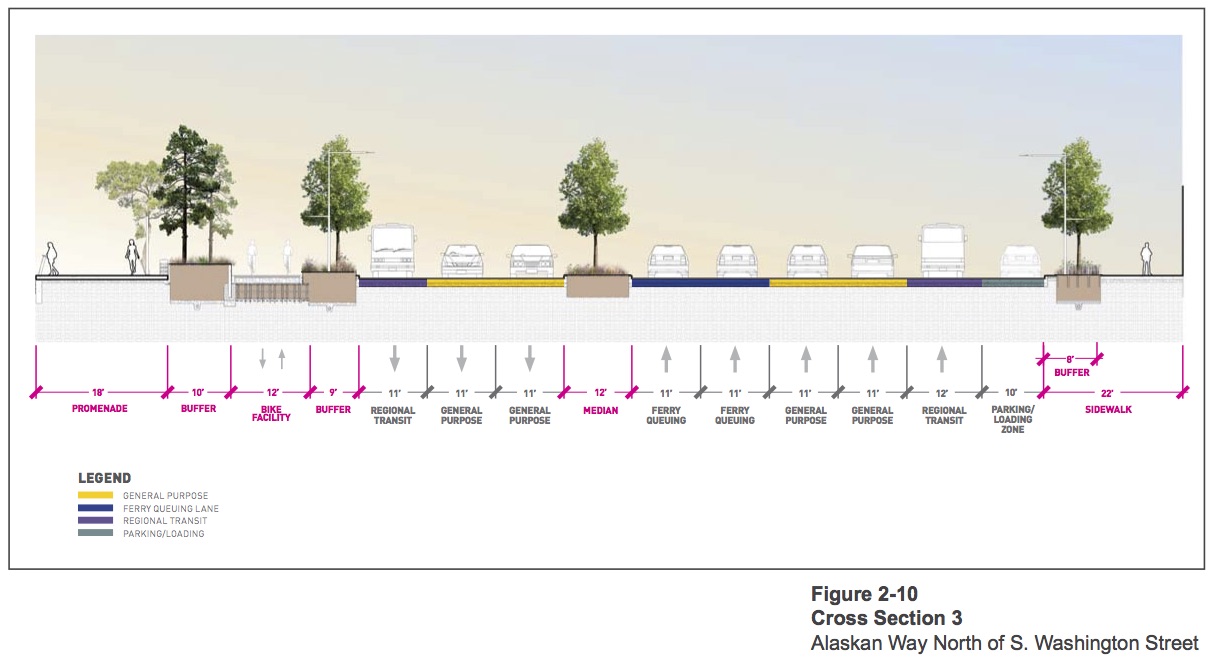
Waterfront Seattle, lead by Seattle along with regional and state partners, released its final environmental impact study Monday, and it shows that planners chose to completely ignore the advice of these groups. Their vision for Seattle’s waterfront “boulevard” remains the same as before: Up to 37 yards of motor vehicle traffic separating our historic downtown from the waterfront:
awpow_final_eis_oct_2016-washingtonst

It would take as long as 30 seconds for a fit and able-bodied person to walk from curb-to-curb between Pioneer Square and the new waterfront promenade. For our slower-moving neighbors — including many kids, seniors and people with mobility challenges — the walk may take so long that they will only be able to make it to a mid-street island before the light changes. They will then need to wait in the middle of this highway for a second round of traffic to go by before continuing their journey to the waterfront.

This is a slap in the face to these neighbors. It is an institutionalized insult that tells people walking on the waterfront (or to the ferry terminal) that they are not important or valued, especially if they are not physically able to race fast enough to beat the signal countdown.

This plan is wildly counter to the vision most people want from their revamped waterfront, I’m pretty sure. The multi-billion-dollar tunnel highway was supposed to allow us to reclaim our waterfront. Instead, we’re also getting a highway on top of our tunnel highway. If this surface highway plan is constructed, our future waterfront will be less accessible from most of downtown than it is today with the loud, shaky and unsightly Viaduct.

We cannot let this happen. The environmental review and design process has gone horribly wrong, blinded by a windshield perspective that has led planners to miss the big picture: The Viaduct removal project is about reclaiming our waterfront. It is not about filling our waterfront with cars.

The easiest way to fix the plan should have been the design process itself. But stern-yet-polite comments from respected transportation advocacy groups like Feet First, Transportation Choices Coalition and Cascade Bicycle Club were not heeded (see their letter and Waterfront Seattle’s dismissive response). All these reasonable suggestions were rejected due to concerns the “level of service” for motor vehicles would be worse than Waterfront Seattle’s preferred plan.

But Waterfront Seattle is not equally concerned about the “level of service” for people walking. If they were, the proposed street would look very different. And that’s the problem at the heart of this project: The core framework put cars first, then asked the people what they wanted to do with whatever was leftover. They never truly questioned whether 37 yards of traffic is too many.

Likewise, the environmental study ironically includes page upon page of traffic projection analysis but only one page out of 328 mentions climate change (you know, the environment). That page notes:

“it is difficult to isolate and understand the GHG emission impacts for a particular transportation project. Furthermore, there is currently no scientific methodology for attributing specific climatological changes to a particular transportation project’s emissions. Therefore, impacts from GHGs at the project level are generally assessed in a qualitative manner.”

Translated from planner speak, this means that they know how to measure traffic, but they don’t know how to measure greenhouse gas emissions caused by their projects. So they chose to ignore the need to reduce emissions rather than concern themselves with understanding the impact more car trips (and fewer walking trips) would have on greenhouse gas emissions.

But while the planners aren’t concerned about climate change, the people of Seattle and the Puget Sound Region sure as hell are.

The environmental study also makes no mention of environmental justice concerns, like disproportionately poor air quality in lower-income neighborhoods along SR 99 south of this connected project area.

So now our city, state and regional leaders really only have one option: Reject this highway plan and demand a better waterfront boulevard that respects every resident of our city, including those walking and those with mobility challenges. And demand a project that takes climate change and the city’s stated goals of reducing the share of downtown trips taken by motor vehicles seriously.

The good news is that other than the surface highway itself, most of the plans are great. The overlook walk to the market is very exciting, as are many of the ideas for the new public space on the waterfront. So we don’t need to go all the way back to square one. We just need to redo the highway section.

A sea of traffic in Pioneer Square, a new Mercer Street for the rest
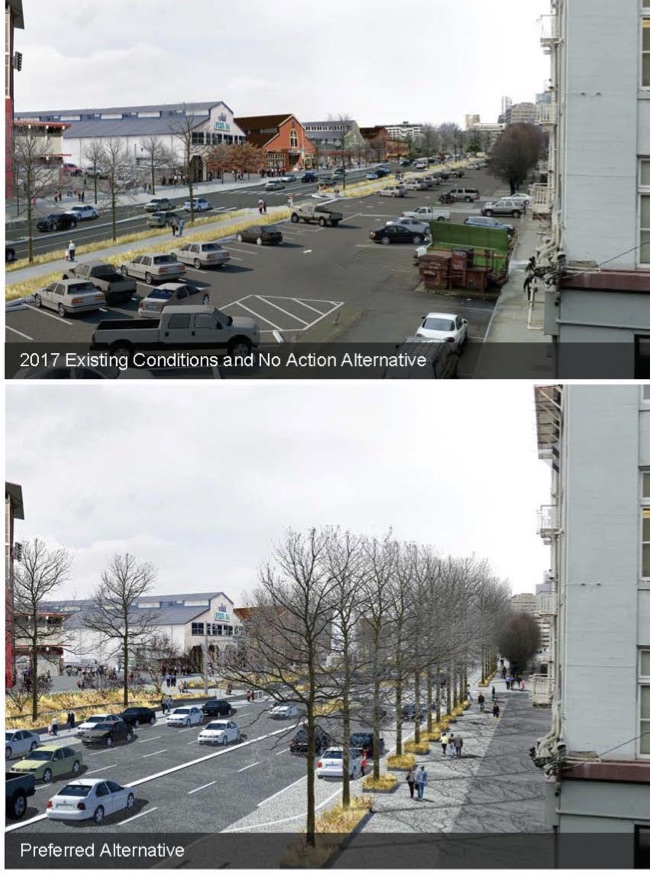
The "no action" image looks north from Marion as it would be today if the Viaduct were removed. The bottom image is what it would look like with the planned highway. There is a better way than either of these.

The top image looks north from Marion as it would be today if the Viaduct were removed. The bottom image is what it would look like with the planned highway. As bad as the top image is, the bottom only makes things worse. We can do better.

While the extremely wide 111-foot street splitting through Pioneer Square is certainly the worse part of the plan, the rest of the street is much too wide, as well. You don’t need to wait and see what this will be like, you can just go down to Mercer Street in South Lake Union today. That’s almost exactly what the city and state are proposing to build on the waterfront. It’s an uncomfortable and far-too-wide street where nobody wants to spend time and that people avoid walking across if they have a choice.

Is this really the vision for our waterfront?
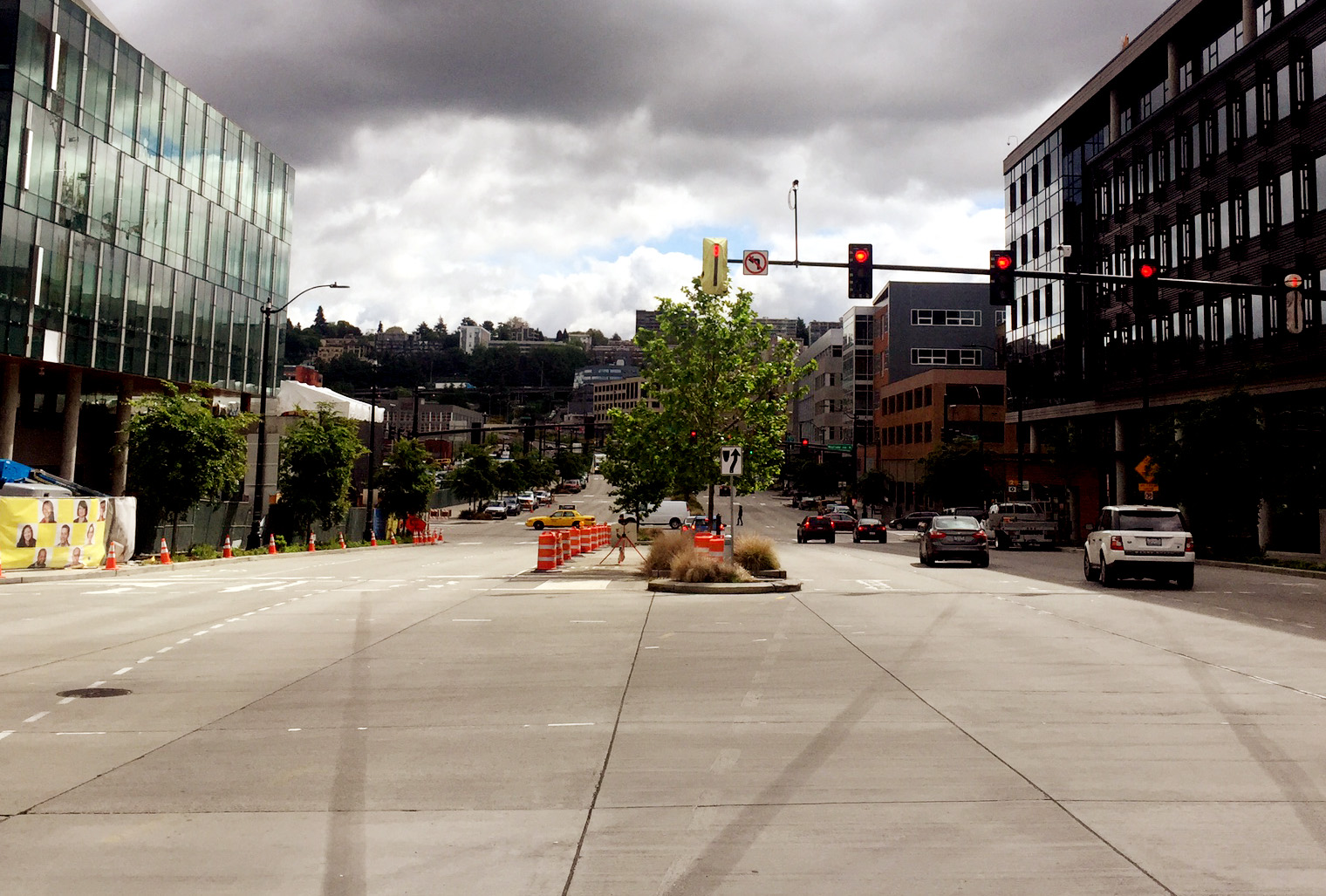
North of Yesler, the city and state's waterfront plans would be like Mercer Street.

North of Yesler or so, the city and state’s waterfront plans would be much like Mercer Street.

Mercer is perhaps the best cautionary tale for this waterfront project. Once slated for a viaduct-style elevated highway separating the city center from Lake Union (a plan narrowly defeated), the Mercer corridor has been attempting to act like a highway for the past generation. Walking, biking and transit was an afterthought at best and actively discouraged at worse (remember how skinny the Broad and Mercer Street sidewalks were under Aurora?).

They city recently spent $237 million to remake the corridor, but they compromised in favor of moving car traffic at nearly every opportunity. The road is too wide, lanes are too wide, corners are shaved back to allow high-speed turns, and signal cycles are too long requiring long waits for the walk signal. The result is a road that works for nobody. Traffic is miserable, walking across it or along it is miserable, and it doesn’t support nearby businesses. Everyone loses.

If the Waterfront Seattle plan goes forward, the same exact thing will happen on the waterfront. But it doesn’t need to be this way.

The waterfront remake is not about cars, it’s about people
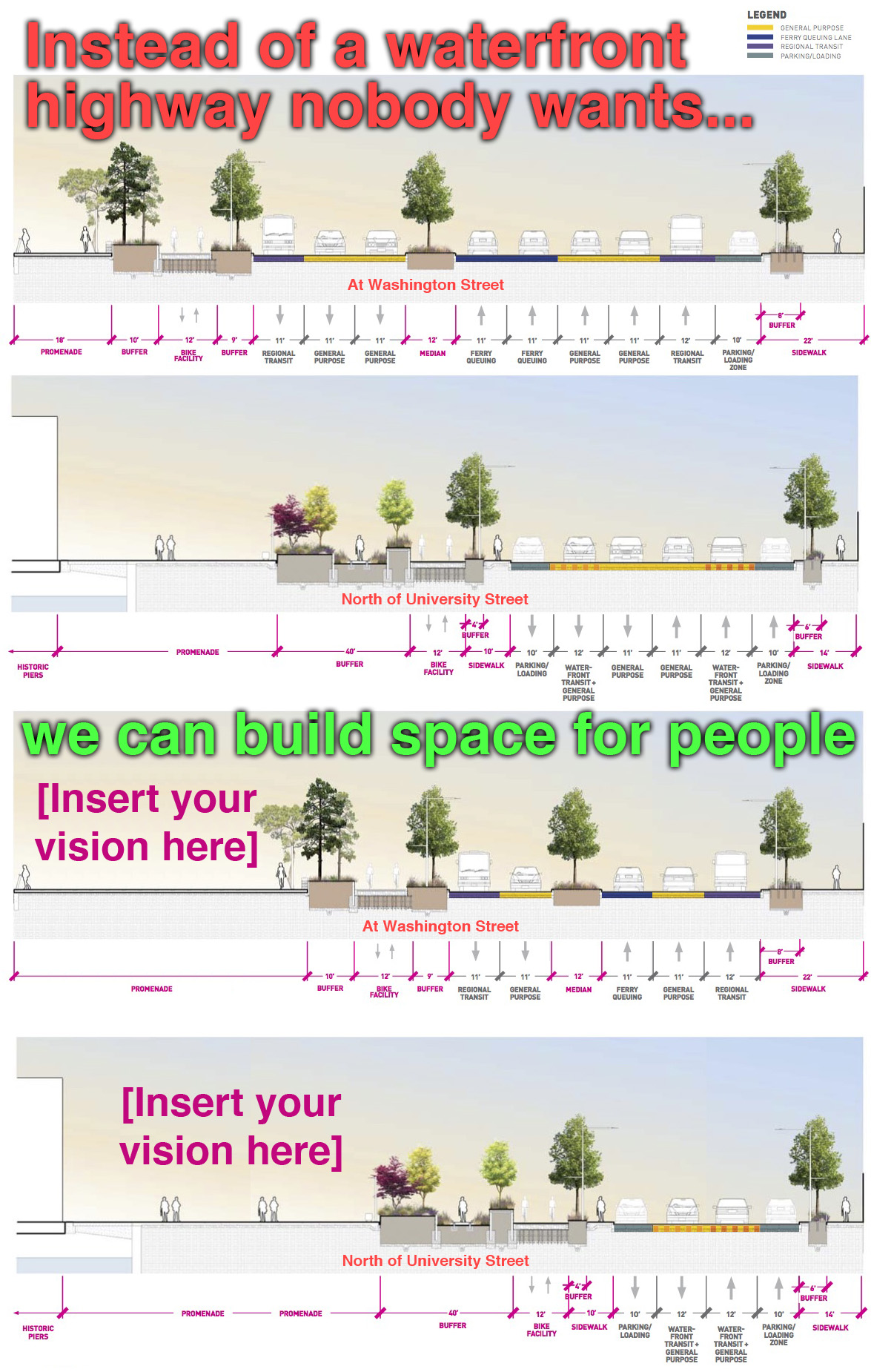
waterfrontfeis2Here are the stated “guiding principles” for the Waterfront Seattle project:

  • Create a waterfront for all
  • Put the shoreline and innovative, sustainable design at the forefront
  • Reconnect the city to its waterfront
  • Embrace and celebrate Seattle’s past, present, and future
  • Improve access and mobility (for people and goods)
  • Create a bold vision that is adaptable over time
  • Develop consistent leadership from concept to operations

Yet the current design of the waterfront highway is directly counter to nearly all of these goals. Therefore, the result is a failure and should be rejected.

Perhaps what planners are missing is that this should be a transformational project. Instead, they are trying to accommodate their projected number of cars based on current use. But those cars are there today with a viaduct that provides people with a huge incentive to drive. We have the power to make different decisions with our new waterfront. We can build to support the uses we want.

That means providing access for motor vehicles, but not prioritizing them. Instead, make walking, biking and transit the undisputed easiest and best ways to get to the waterfront and the ferry terminal.

We are a big city with an increasingly dense center. Driving will never be easy here, and reasonable people don’t expect it to be. It’s not easy today, and it won’t be easy in 2030 or 2045 either. The harder we try to make driving easy downtown, the more harm we will do to the walking environment. And the traffic will still be there regardless.

By prioritizing this extremely valuable public space for people, we will open the waterfront up to a generation of new ideas. A wider public promenade will be able to do more than we can even imagine right now. We cannot know what a local entrepreneur, event planner or community leader will think to do in that space throughout the next generation. But it could be the next iconic, creative idea that makes Seattle Seattle. That’s the waterfront vision I believe in.

So the question is: Will any of our public leaders stand up against this surface highway? We tried the nice route, offering design suggestions and comments, but that didn’t work. Is it time to protest?

01 Nov 22:34

Pedestrian Shaming — an Annual Rite of Halloween

by Angie Schmitt

More pedestrians are killed on Halloween than any other day of the year — by far. The conclusion that transportation agencies all over the country draw from this is that people on foot must be further marginalized with stern admonishments to wear special visibility gear and “follow the rules.”

Joseph Cutrufo at Mobilizing the Region tracked some of the worst examples yesterday, like the gem from Georgia DOT above. He says it’s tiring:

Walking is a right. Driving a two-ton machine capable of speeds over 100 mph is a privilege. But sometimes transportation agencies seem to think it’s the other way around. And there’s no time of year when this is more evident than Halloween.

Pedestrian shaming” tends to peak in the fall. It starts some time around Walk to School Day, picks up steam as the daylight hours wane, and reliably hits its climax each year on October 31, the most deadly day of the year for young pedestrians. Halloween can teach us volumes about our neighborhoods, but it can also teach us a thing or two about our collective approach to protecting trick-or-treaters.

We couldn’t help but notice how some departments of transportation have focused their Halloween safety messaging at pedestrians, and not at those with the ability to cause harm. For example, in both Florida and Georgia, it’s up to pedestrians to make sure they can be seen by drivers.

Cutrufo has a good roundup of how different agencies performed: Florida, Pennsylvania, Georgia, North Carolina and New York state DOTs, and the Federal Highway Administration get the worst marks, while Missouri, Texas, Illinois and Louisiana DOTs get points for placing responsibility on motor vehicle operators.

Elsewhere on the Network today: Seattle Transit Blog says the city should tear down a sports arena in the Queen Anne neighborhood and replace it with housing. The Urbanist offers tips on how to engage with your NIMBY relatives. And Bike Portland reports that in response to the death of a cyclist, local advocates are planning a protest ride to take over a traffic lane on a key bridge.

28 Oct 17:54

We Built a Fake Web Toaster, and It Was Hacked in an Hour

by Andrew McGill

Last week, a massive chain of hacked computers simultaneously dropped what they were doing and blasted terabytes of junk data to a set of key servers, temporarily shutting down access to popular sites in the eastern U.S. and beyond. Unlike previous attacks, many of these compromised computers weren’t sitting on someone’s desk, or tucked away in a laptop case—they were instead the cheap processors soldered into web-connected devices, from security cameras to video recorders. A DVR could have helped bring down Twitter.

Great, I thought as I read the coverage last week. My DVR helped bring down Twitter. (Probably not, at least this time—the targeted products were older than what you’d find in most American homes, and less protected.) But the internet is huge! There are around a couple billion public IPv4 addresses out there; any one of those might have a server, a desktop computer, or a toaster plugged in at the other end. Even if the manufacturer of my gadget gave it a dumb and easily guessed password, wouldn’t it be safe in this sea of anonymity? How would the hackers find me?

I don’t actually own a wireless toaster. But I devised a test. Renting a small server from Amazon, I gussied it up to look like an unsecured web device, opening a web port that hackers commonly use to remotely control computers. Instead of allowing real access, though, I set up a false front: Hackers would think they were logging into a server, but I’d really just record their keystrokes and IP addresses. In cybersecurity circles, this is called putting out a honeypot—an irresistible target that attracts and ultimately entraps hackers and the scripts they use to find vulnerable servers.

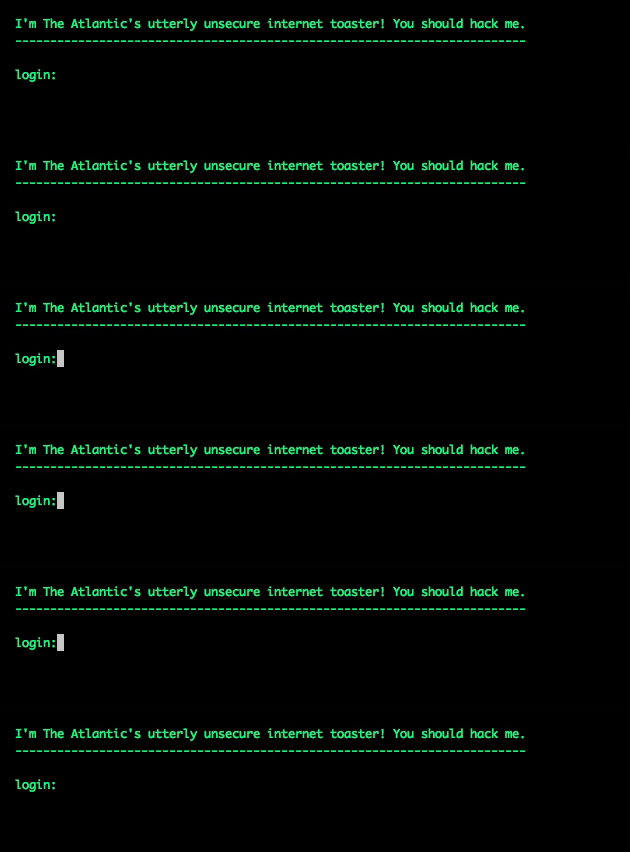
Here’s what my particular honeypot looked like, if you tried to log in:

I switched on the server at  1:12 p.m. Wednesday, fully expecting to wait days—or weeks—to see a hack attempt.

Wrong! The first one came at 1:53 p.m.

This graphic is a simulation—a bot’s-eye view, if you will—but it’s the actual sequence of commands the hacking script used. It tried a common default username and password (root/root) and executed the “sh” command, giving it the ability to run programs and install its own code. My fake toaster doesn’t allow that, of course—it just cuts the connection.

The next hacking attempt, from a different IP address and using different login credentials, came at 2:07 p.m. Another came at 2:10. And then 2:40. And 2:48. In all, more than 300 different IP addresses attempted to hack my honeypot by 11:59 p.m. Many of them used the password “xc3511,” which was the factory default for many of the old webcams hijacked in last week’s attack.

The last attempted hack came 5 minutes ago, using the username root and the password root. (Yes, those are live figures; they were updated when you loaded this page.)

I’ll admit this volume of attacks might not be typical. I hosted my fake toaster on a virtual Amazon server, not an actual toaster hooked up to residential internet. Hackers aren’t typing these passwords themselves—they’ve programmed bots to do the hard work for them, scanning through thousands of open ports an hour. And I’d bet those scripts are trawling Amazon’s range of IP addresses more frequently in hopes of hacking vulnerable rookies. (If that has happened to me without my knowledge, I am very sorry and please don’t hurt me.) But my experience matches what security firms have seen. It is now within the capability of hackers to literally scan the entire internet, looking for vulnerable servers with open ports. And every hacked computer adds another recruit to the search effort, shortening the time required geometrically.

Matthew Prince, the cofounder and CEO of Cloudflare, said anyone hooking up a poorly secured  IP device to the internet can expect to see that gizmo hacked within a week, if not much sooner.

“Assuming it’s publicly accessible, the chance [of being hacked] is probably 100 percent,” he said. “The IPv4 address space just isn’t that big. You can now run a scan across that entire space in hours, especially if you have a big botnet. The scans for vulnerability are continuous, and if anything, have accelerated over the last couple of years.”

This doesn’t mean that every Internet-of-Things device is vulnerable. Most things that you connect to the web through your home WiFi are probably okay: Your router kills most incoming hacking attempts. (Of course, if your router is compromised...) You have more to worry about if your device hooks up to your modem directly, which is more common in industrial settings.

All the same, the vastness of the internet can no longer protect us. I can’t count the number of sloppy things I’ve done, security-wise, because I thought I was small enough to escape notice—reused passwords, put private keys in code, left servers open to the world. Nowadays, even the most obscure among us can be found by a roving script, and in a startlingly small amount of time.

25 Oct 17:14

Chickenshit American Bar Association Scared Out Of Publishing Report Calling Trump A Libel Bully

by Mike Masnick
We've talked a lot about Donald Trump and his ridiculous views on defamation and the First Amendment -- including his penchant for threatening defamation lawsuits against basically everyone who says something he dislikes. He rarely follows through, though he certainly does sue sometimes.

In fact, someone has set up Trump-clock.com which lists out every known legal threat against the press or critics since his Presidential campaign began (ignoring the long list that predates the campaign). It also has a clock showing how long it's been since Trump's last threat.

So it shouldn't be much of a surprise that a group of media lawyers at the American Bar Association commissioned a report on Trump's litigation history, and the report (correctly) concluded that Donald Trump is a "libel bully" making a bunch of bogus threats and with a history of filing bogus defamation lawsuits in court (something he's outright bragged about). This shouldn't be controversial. Trump is, clearly, a libel bully, and even he has more or less admitted that with his comments on why he sued author Tim O'Brien.

But, apparently, the American Bar Association was too chickenshit and refused to publish the report, out of a fear that (wait for it...) Trump would sue them.
Alarmed by Donald J. Trump’s record of filing lawsuits to punish and silence his critics, a committee of media lawyers at the American Bar Association commissioned a report on Mr. Trump’s litigation history. The report concluded that Mr. Trump was a “libel bully” who had filed many meritless suits attacking his opponents and had never won in court.

But the bar association refused to publish the report, citing “the risk of the A.B.A. being sued by Mr. Trump.”

David J. Bodney, a former chairman of the media-law committee, said he was baffled by the bar association’s interference in the committee’s journal.

“It is more than a little ironic,” he said, “that a publication dedicated to the exploration of First Amendment issues is subjected to censorship when it seeks to publish an article about threats to free speech.”
With the ABA chilled into suppressing a report about Donald Trump chilling free speech, the Media Law Resource Center picked up the fumbled ball and released the report on its own. The opening executive summary is pretty clear:
Donald J. Trump is a libel bully. Like most bullies, he's also a loser, to borrow from Trump's vocabulary.

Trump and his companies have been involved in a mind-boggling 4,000 lawsuits over the last 30 years and sent countless threatening cease-and-desist letters to journalists and critics.

But the GOP presidential nominee and his companies have never won a single speech-related case filed in a public court.
The full article then goes on to examine in more detail seven speech-related cases, and uses the paper to argue in favor of stronger anti-SLAPP laws to prevent such speech chilling.
... this examination of Trump's libel losses also provides a powerful illustration of why more states need to enact anti-SLAPP laws to discourage libel bullies like Trump from filing frivolous lawsuits to chill speech about matters of public concern and run up legal tabs for journalists and critics.
The ABA's refusal to publish the report is really ridiculous, but only serves to highlight the issue here. When an organization that absolutely must know better is still too afraid to publish a report like this, it highlights just how successful Trump can be in stifling speech with just his threats. And, yes, this report eventually was released, thanks to some First Amendment lawyers who knew how ridiculous this was, but we don't know how many others have been scared away into silence.

Permalink | Comments | Email This Story
24 Oct 20:32

White nationalist scion leaves the cause

by Rob Beschizza

derek-black

Derek, 27, was set to follow in the footsteps of his dad, Stormfront creator Don Black. He had his own white nationalist website for kids, his own radio show, and gotten elected to local government in Florida. He was their future, slick and self-controlled, never using slurs or suggestions of violence. But he's now come to question the ideology and left it all behind. Eli Saslow reports on The white flight of Derek Black.

So many others in white nationalism had come to their conclusions out of anger and fear, but Derek tended to like most people he met, regardless of race. Instead, he sought out logic and science to confirm his worldview, reading studies from conservative think tanks about biological differences between races, IQ disparities and rates of violent crime committed by blacks against whites

They sent him to a top liberal arts college thinking he would educate them. But with long red hair and a cowboy hat and garrulous personality, he became popular and found himself hiding his association with Stormfront, and his beliefs, rather than expounding them.

When another student mentioned that he had been reading about the racist implications of “Lord of the Rings” on a website called Stormfront, Derek pretended he had never heard of it.

But he kept up the radio show and was soon outed. Instead of ostracizing him, though, his friends and college acquaintances decided to stay in touch and include him. One, an orthodox Jew, invited him to a Shabbat dinner.

And Derek went, and that's where it all started.

This article is well-worth 20 minutes of your time.

The white flight of Derek Black [WaPo]

24 Oct 19:36

London Is Going to Ban the Deadliest Trucks From Its Streets

by Angie Schmitt

Photo: Transport for London via Treehugger

Image: Transport for London via Treehugger

Heavy trucks with big blind spots are a deadly menace to cyclists and pedestrians.

In Boston, eight of the nine cyclist fatalities between 2012 and 2014 involved commercial vehicles, according to the Boston Cyclists Union [PDF].

Between June and September this year, there were six cyclist fatalities in Chicago, and all six involved commercial vehicles.

In New York City, drivers of heavy trucks account for 32 percent of bike fatalities and 12 percent of pedestrian fatalities, despite the fact that they are only 3.6 percent of traffic.

U.S. cities are starting to take steps like requiring sideguards on some trucks. But no American city is tackling the problem like London is.

In London, city officials estimate that 58 percent of cyclist deaths and more than a quarter of pedestrian deaths involve heavy trucks, even though trucks only account for 4 percent of traffic. Evidence suggests trucks pose an especially large risk to women cyclists.

London will grade trucks on a scale from zero to five based on visibility. Graphic via Vision Zero Network

London will grade trucks on a scale from zero to five based on visibility. Graphic via Vision Zero Network

London cycling advocates (most notably, the London Cycling Campaign) have been pushing for safer truck standards, and the city is listening.

To prevent the needless loss of life, London’s new mayor, Sadiq Khan, has proposed ridding the city of the most dangerous trucks, using a six-point scale rating how well the truck driver can directly see outside the cab. Beginning next year, the city government will not work with contractors who use “zero-star” vehicles, the Guardian reports.

Khan wants the most dangerous trucks banned from the city entirely by 2020. By 2024, only trucks rated “good” — with a score of three or higher — will be allowed in the city.

London’s truck safety framework goes far beyond what American cities are doing. In part, that’s because U.S. cities have less power to dictate truck design, which is largely decided by federal and state regulations. Comprehensive efforts to regulate trucks at the city level have to be specifically enabled by the state.

But there’s still a lot that American cities can do on their own, said Alex Engel, a spokesperson with the National Association of City Transportation Officials, and some of them are taking action to protect people from trucks.

We’ll have more on how U.S. cities can improve truck safety in an upcoming post.

Correction: Post originally said all of Chicago’s six 2016 cycling fatalities involved heavy trucks. They all involved commercial vehicles. 

24 Oct 18:41

SNL’s Surprisingly Affectionate Portrayal of a Trump Supporter

by Spencer Kornhaber

SNL’s ongoing “Black Jeopardy” series has been, in part, about divisions. In each edition, black American contestants answer Kenan Thompson’s clues with in-jokes, slang, and their shared opinions while an outsider—say, Elizabeth Banks as the living incarnation of Becky, Louis C.K. as a BYU African American Studies professor, or Drake as a black Canadian—just show their cluelessness.

When Tom Hanks showed up in a “Make America Great Again” hat and bald-eagle shirt to play the contestant “Doug” this weekend, it seemed like the set-up for the ugliest culture clash yet. The 2016 election has been a reminder of the country’s profound racial fault lines, and SNL hasn’t exactly been forgiving toward the Republican nominee on that front: Its version of Trump hasn’t been able to tell black people apart, and it aired a mock ad painting his supporters as white supremacists—which, inarguably, some of them really are.

But this time the Black Jeopardy contestants came to be pleasantly surprised as Doug answered the questions correctly. SNL’s viewers might have felt a similar sense of amazement as they realized that this particular sketch didn’t quite come at the expense of Trump’s supporters. Smartly and hilariously, it suggested an idea that’s novel in 2016: Maybe America isn’t as helplessly divided as it seems.

Part of the common ground is economics—many white Trump supporters are as familiar with financial desperation as many black Americans are. Thompson’s host Darnell Hayes asks Doug whether he’s sure he wants to play black Jeopardy; Doug says he’s just hoping to win some money, so “get ’er done.” When lottery scratcher tickets get mentioned, Doug chimes in, “I play that every week.” On a question of what to do when your brakes are busted, Doug correctly answers, “You better go to that dude in my neighborhood who’ll fix anything for 40 dollars” (Hayes: “You know Cecil?!” “Yeah, but my Cecil’s name is Jimmy”).

But the sketch goes further, pointing out that social conditions shape worldview and culture. Everyone on stage distrusts the idea of giving their thumbprint to an iPhone. Everyone on stage agrees that elections are decided by the elite (the Illumanti?) before the votes are cast. Doug’s lifestyle even means he’s come to love Tyler Perry movies: “I bought a box set at Walmart. And if I can laugh and pray in 90 minutes, that’s money well spent.”

Hanks and Thompson’s performances help nail the sketch’s humor and strange poignance. The gravelly Doug seems matter-of-fact as he battles his nervousness, stumbling into the occasional questionable remark about “you people.” The host Hayes, meanwhile, goes from dismissal to total delight. At one point, he comes over to shake Doug’s hand; Doug recoils, scared Hayes has been offended, but then they awkwardly embrace.

A vision of healing? Not quite. The final Jeopardy question category is “Lives That Matter.” Everyone freezes, knowing that Doug’s answer—which we don’t see—might not be so agreeable as his previous ones. “Well it was good while it lasted, Doug,” Hayes says. One implication is race isn’t just an illusory divide. Another is both hopeful and a bit depressing: People casting opposing ballots in November might not realize just how much they have in common.

21 Oct 19:58

'Nice Internet You've Got There... You Wouldn't Want Something To Happen To It...'

by Mike Masnick
Last month, we wrote about Bruce Schneier's warning that certain unknown parties were carefully testing ways to take down the internet. They were doing carefully configured DDoS attacks, testing core internet infrastructure, focusing on key DNS servers. And, of course, we've also been talking about the rise of truly massive DDoS attacks, thanks to poorly secured Internet of Things (IoT) devices, and ancient, unpatched bugs.

That all came to a head this morning when large chunks of the internet went down for about two hours, thanks to a massive DDoS attack targeting managed DNS provider Dyn. Most of the down sites are back (I'm still having trouble reaching Twitter), but it was pretty widespread, and lots of big name sites all went down. Just check out this screenshot from Downdetector showing the outages on a bunch of sites:
You'll see not all of them have downtime (and the big ISPs, as always, show lots of complaints about downtimes), but a ton of those sites show a giant spike in downtime for a few hours.

So, once again, we'd like to point out that this is as problem that the internet community needs to start solving now. There's been a theoretical threat for a while, but it's no longer so theoretical. Yes, some people point out that this is a difficult thing to deal with. If you're pointing people to websites, even if we were to move to a more distributed system, there are almost always some kinds of chokepoints, and those with malicious intent will always, eventually, target those chokepoints. But there has to be a better way -- because if there isn't, this kind of thing is going to become a lot worse.

Permalink | Comments | Email This Story
17 Oct 22:15

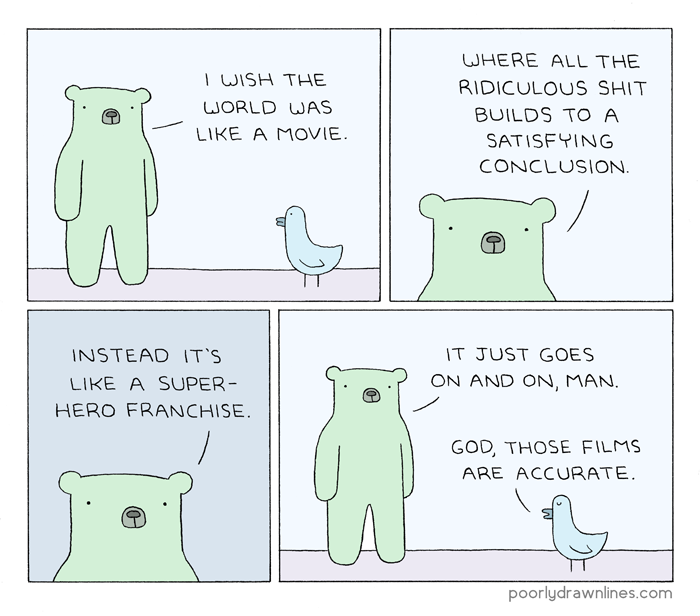
Like a Movie

by Reza

like-a-movie

14 Oct 21:22

A Volcanic Eruption Photographed Against the Backdrop of the Milky Way, Moon, and a Streaking Meteor

by Christopher Jobson

While photographing the surface flow of a volcano several weeks ago in Hawaii, photographer Mike Mezeul managed to capture an extraordinary number of natural phenomena in this single shot. His original intent was to photograph just the volcano itself, but he soon realized the scene had a bit more potential.

“When I found this surface flow and saw the clouds had cleared out, I knew I needed to at least try to get the stars above with the lava,” he tells Colossal. “As twilight faded, I saw that the position of the moon—which was just a sliver—was to the right of the Milky Way so I figured what the heck, might as well try to get the Milky Way with the lava.” After only three shots another fortuitous event occurred: a meteor just happened to streak across the sky.

For the skeptics, Mezeul shares that he used a Nikon D810 with a Nikon 14-24mm lens, with the following settings: F2.8, ISO 2500, 25″ exposure. You can see more of his landscape work on Instagram. (via PetaPixel)

14 Oct 21:05

Michelle Obama: 'Going High' Means Remaining Outraged

by Adrienne LaFrance

It has become an unofficial anthem for the Clinton campaign: “When they go low, we go high.” The applause line originated with Michelle Obama, in the remarks she gave at the Democratic National Convention in July. Since then, Clinton has frequently invoked the phrase on the trail.

But what does it mean to “go high” in a campaign against a man like Donald Trump, whose xenophobic rhetoric and casual calls to violence represent a notable low-point in American politics?

“Going high” is how Clinton’s surrogates explained why she wasn’t nastier to Trump in the second presidential debate. While some pundits were puzzled that Clinton hadn’t delivered a death blow to her opponent, jumping on every opportunity to underscore his deficiencies and hypocrisies, her supporters had an explanation: She was focusing on actual issues and ideas. She was simply going high.

But, as Michelle Obama demonstrated on the campaign trail this week, going high doesn’t mean focusing on policy over politics—and it doesn’t mean avoiding an attack on one’s opponent. Going high doesn’t mean staying silent when bullied, but speaking out. And going high means reframing the focus on Trump’s most repugnant characteristics by zeroing in on how those qualities affect the people who might vote for him. This election isn’t just about Trump and who he is, the message goes, it’s about the rest of America and who we want to be.

“And we simply cannot endure this, or expose our children to this any longer—not for another minute, and let alone for four years,” Obama said. “Now is the time for all of us to stand up and say enough is enough. This has got to stop right now.”

This approach is what made Obama’s speech in New Hampshire on Thursday so riveting, so resonant, and so damning to Trump. Without once uttering his name, Obama laid out—in painful detail—exactly what’s so dangerous about him. And instead of describing the singular threat he’d pose in the Oval Office as a thin-skinned narcissist unfit to lead the country, she drilled down on the fact that he proudly and all-too-typically represents the sexism that women face every single day. He is an uncommon presidential candidate in large part because what he represents is so familiar.

Amid the fallout from news of repeated sexual assaults allegedly committed by Trump, amid the justifications of Trump’s behavior as “locker room talk,” amid photos of his supporters wearing T-shirts asking Trump to “talk dirty,” and amid calls from his supporters to repeal women’s right to vote, the first lady of the United States of America stood up and validated the disgust that so many Americans feel.

She did so with a level of clarity and outrage that’s not an option for Clinton, for reasons Rebecca Traister expertly identified in an essay for New York magazine:

In part, because it remains damn near impossible for a woman to make inspiring feminist arguments on her own behalf without coming off as self-congratulatory; in part, because Hillary is hamstrung by the fact that she’s married to a man who has been accused of his own sexual-power abuses; and, in part, because she is simply less comfortable conveying communion, empathy, and inspiration on the stump.

But Obama nailed it. She exuded warmth and authenticity. She connected with the crowd. I know you get it, she seemed to say to women, because this is the bullshit we all put up with.

I feel it so personally, and I'm sure that many of you do too, particularly the women. The shameful comments about our bodies. The disrespect of our ambitions and intellect. The belief that you can do anything you want to a woman.

It is cruel. It's frightening. And the truth is, it hurts. It hurts. It's like that sick, sinking feeling you get when you're walking down the street minding your own business and some guy yells out vulgar words about your body. Or when you see that guy at work that stands just a little too close, stares a little too long, and makes you feel uncomfortable in your own skin.

It's that feeling of terror and violation that too many women have felt when someone has grabbed them, or forced himself on them and they've said no but he didn't listen —something that we know happens on college campuses and countless other places every single day. It reminds us of stories we heard from our mothers and grandmothers about how, back in their day, the boss could say and do whatever he pleased to the women in the office, and even though they worked so hard, jumped over every hurdle to prove themselves, it was never enough.

We thought all of that was ancient history, didn't we? And so many have worked for so many years to end this kind of violence and abuse and disrespect, but here we are, in 2016, and we're hearing these exact same things every day on the campaign trail. We are drowning in it. And all of us are doing what women have always done: We're trying to keep our heads above water, just trying to get through it, trying to pretend like this doesn't really bother us maybe because we think that admitting how much it hurts makes us as women look weak.

Maybe we’re afraid to be that vulnerable. Maybe we've grown accustomed to swallowing these emotions and staying quiet, because we’ve seen that people often won't take our word over his. Or maybe we don’t want to believe that there are still people out there who think so little of us as women. Too many are treating this as just another day's headline, as if our outrage is overblown or unwarranted, as if this is normal, just politics as usual.

But, New Hampshire, be clear. This is not normal. This is not politics as usual. This is disgraceful. It is intolerable. And it doesn't matter what party you belong to—Democrat, Republican, independent—no woman deserves to be treated this way. None of us deserves this kind of abuse.

If this was a rallying cry, it likely worked. During Obama’s remarks, I received messages from three separate people wondering, “When is she going to run for president?” (And, for what it’s worth, two of them were men.)

The speech has been called “remarkable,”powerful,” “desperately needed,” and possibly disastrous for Trump.

The real power of Obama’s speech was, in a campaign that has been so much about gender, she spoke directly to women in the realest of terms. (Her delivery helped, of course: While Trump’s disses tend to come in fragmented tweets and one liners, Michelle Obama twisted the dagger with eloquence and restraint.) But if her remarks on Thursday were indeed a “defining moment” in the presidential campaign, as they’ve been called, it’s not because she’s “going high” per se.

It’s simply because she treats women as human beings—a feat that Trump apparently has not mastered.

14 Oct 20:59

American Traffic Engineering Establishment Finally Approves Bike Boxes

by Angie Schmitt

Bike boxes are going to become part of the standard street design guidance. Photo: NACTO

Bike boxes are on their way toward becoming a standard street design measure. Photo: NACTO

The wheels of change grind slowly at the institutions that guide the American traffic engineering establishment, but they are moving forward.

This week, U.S. DOT issued interim approval for bike boxes [PDF], a treatment that positions cyclists ahead of cars at intersections.

Dozens of American cities currently use bike boxes — some for the better part of the past decade — and the federal government is now satisfied enough by the results to conclude that they lead to “reductions in conflicts between bikes and turning drivers” and less crosswalk encroachment by both drivers and cyclists.

Cities installing bike boxes will still have to submit a request for “interim approval” to the Federal Highway Administration until a final rule is adopted, but now bike boxes will be perceived as less risky by transportation engineers.

The committee responsible for approving new bike infrastructure treatments for the Manual on Uniform Traffic Control Devices recommended approval of bike boxes nearly three years ago. The same group has been dragging its feet on protected bike lanes, a key obstacle to their widespread installation.

14 Oct 20:56

What Kind Of Urbanist Is Bob Dylan?

by Andrew Small

Never mind whether Bob Dylan’s lyrics qualify as Nobel-worthy literature. Here’s the real question: Is he an urbanist?

A lot of the urbanist internet sure thinks so. In its subterranean realms you’ll find maps of Bob Dylan’s New York, a list by CityLab alum Eric Jaffe on Dylan’s best songs about infrastructure, and an English paper about his quality as an urban poet.

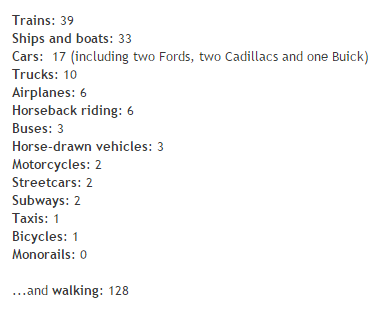
Another tidbit: a count of mentions for each mode of transportation in the Dylan canon.

Bob Dylan: kind of a train geek but mostly a fan of walkability. (Charlie Gardner/Old Urbanist)

There’s also a map of every place mentioned in a Dylan song. CityLab has previously reported on the geography of his Neverending Tour and his possible songwriting collaboration with Jane Jacobs, perhaps the most coveted of all possible urbanist achievement badges.

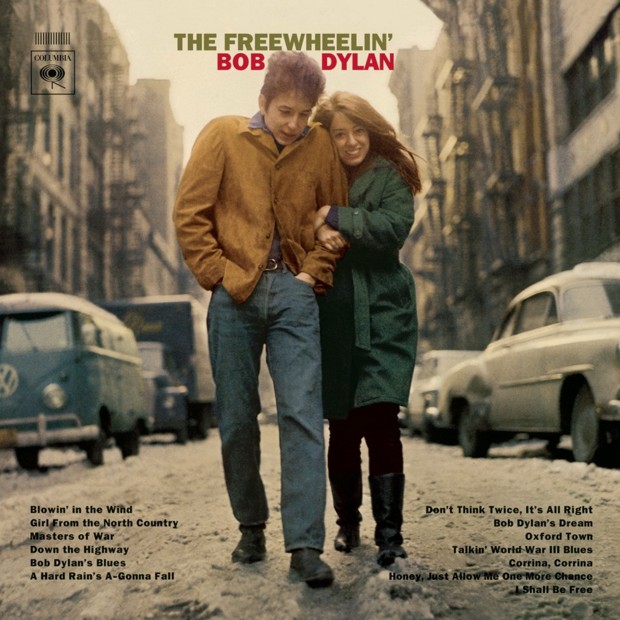
Dylan and friend explore a dense, walkable, mixed-use neighborhood. (Columbia Records)

Of course, Dylan’s main claim to urbanism fame stems from his status as an archetypal New York transplant. The cover of his second album, The Freewheelin’ Bob Dylan, now evokes nostalgia for the bohemian era of Greenwich Village folkies in coffeeshops. The New York Times quotes Suze Rotolo, Dylan’s girlfriend on the Freewheelin’ cover, to demonstrate his complicated but romantic relationship to the city.

“In those early years Bob Dylan was a painter searching for his palette,” Ms. Rotolo, an artist who died in 2011, wrote in “A Freewheelin’ Time: A Memoir of Greenwich Villages in the Sixties.” “He had in mind the pictures he wanted to paint; he just needed to find the right color mix to get him there.”

He also, she wrote, “had an uncanny ability to complicate the obvious and sanctify the banal — just like a poet.”

So New York played the part of a muse for Dylan—in hard times and in better ones. And yet, it wouldn’t be Bob Dylan if there wasn’t still a mystery, a contradiction, an ambivalence. His post-protest career has always made him a bit of a Rorschach test. To the left, his abandonment of conventional politics was part of the tradition of broader American cultural progress. To the right, his retreat from protest songwriting was individualistic, or even reactionary. He’s similarly enigmatic with his attitude about the city.

In his memoir, Chronicles, Volume One, Dylan writes that “New York was a city where you could be frozen to death in the midst of a busy street and nobody would notice”—this from a guy who wore a thin jacket when it was freezing out to look cool on his album cover. But I would try not to overthink it too much.

I’ll also avoid dragging you through stanzas of Dylanography that highlight his enigmatic takes on great urban themes or tracing every city in his overexposed biography (though I’ll highlight Nashville as a necessary antecedent to New York). Instead, here’s a playlist of his best CityJams; listen and decide for yourself. Don’t follow leaders and watch the parking meters!

13 Oct 22:12

tbt


tbt

12 Oct 22:29

Trump supporters want women's right to vote removed

by Rob Beschizza

trump yelling at a bird

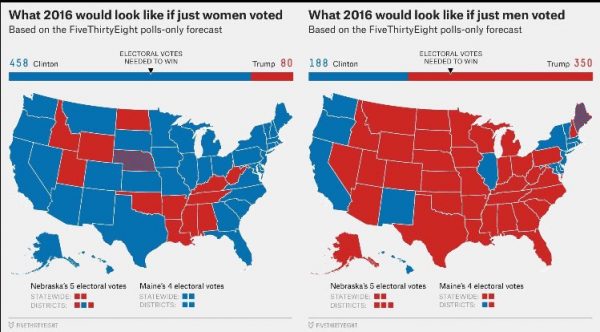
Two maps published by the stats wizards at Fivethirtyeight depict likely electoral maps if only men or women voted. Women prefer Hillary Clinton; men prefer Donald Trump. In both cases, it's a landslide--and Trump supporters want to see theirs made real. The hashtag #repealthe19th, referring to the Ninteenth Amendment of the U.S. Constitution, was kicked into play to encourage American to turn back the clock women's right to vote.

cumceymwcaiohdv

Eric Trump, the son of the GOP nominee, campaigned using the men-only map, according to Buzzfeed. He presented it and called its existence proof of the “momentum” the Trump campaign has.

Later on, observers noticed #Repealthe19th gaining momentum on Twitter as Trump supporters suggested rolling back the constitutional amendment that gave women the right to vote. Apparently, it isn’t a new hashtag, but Silver’s predictive map gave it a nudge.

It's not the first time a Trumpkin has headed down this path. Trump delegate Peter Thiel, a Silicon Valley billionaire noted for his successful effort to bankrupt Gawker Media through a series of secretly-funded proxy lawsuits, once wrote that women voting was bad for democracy.

11 Oct 19:25

The Origin of Dogs

In this video, Atlantic science writer Ed Yong explains the surprising origin of dogs in light of new research...(Read...)

07 Oct 19:42

Hurricane Matthew has brought the weather deniers out of hiding.

by Rebecca Leber

Ahead of Hurricane Matthew’s landfall in Florida, Matt Drudge took to Twitter to spread particularly bad hurricane-preparedness advice.

Rush Limbaugh is saying something similar: “It’s in the interest of the left to have destructive hurricanes because then they can blame it on climate change.”

If this behavior seems predictable, it’s because it is. The climate change denial Drudge has amplified over the years is not some contained viewpoint. For those who view climate change as a vast conspiracy theory, they can begin to see the rest of the world that way, too.

So now Drudge and company are channeling their anxieties into even more inventive, and perhaps more destructive, forms of denial.

Conservatives who don’t want to listen to President Obama’s state of emergency for Florida might at least listen to Gov. Rick Scott — noted climate denier — who’s telling folks, “This storm will kill you.”

Or tune out the politicians but do learn the facts: Preparedness goes a long way in avoiding injuries and fatalities when a disaster comes to town.

This story was originally published by Grist with the headline Hurricane Matthew has brought the weather deniers out of hiding. on Oct 6, 2016.

07 Oct 19:20

What Trump Tweets While America Sleeps

by Andrew McGill

By his own admission, Donald Trump doesn’t sleep much. In his 2004 book, Think Like a Billionaire, he advised readers to not “sleep any more than you have to,” estimating that he hits the hay around 1 a.m. and wakes up at 5 a.m. to read the newspaper.

That was more than 10 years ago, and Trump’s sleep schedule hasn’t changed. “I like three hours, four hours, I toss, I turn, I beep-de-beep, I want to find out what’s going on,” he said last year in Illinois. But instead of picking up a paper, he’s now more likely to indulge a new early-morning vice—off-the-cuff tweeting. (That might be the “beep-de-beep” he’s talking about.)

Some of @RealDonaldTrump’s nocturnal submissions have made the news: His slams against Megyn Kelly (3:53 a.m.), accusations that Ted Cruz committed fraud in Iowa (1:38 a.m.), the denunciation of Alicia Machado (5:30 a.m.). They’re also a series of valuable data points about a presidential candidate’s sleep cycle—a ping that, yes, Donald Trump is awake and restless.

Using Twitter data from the past year—as well as older tweets collected by trumptwitterarchive.com—I plotted the frequency of Trump’s late-night tweeting. For the purposes of this article, I’m conservatively restricting what qualifies as “late” as a tweet posted between midnight and 3:59 a.m.; anything posted later might just be a product of Trump waking up earlier than usual. Here’s a look at the past year and a half, since Trump declared his candidacy:

On the whole, Trump’s early-morning tweetstorms seem to surge after he hits turbulence on the campaign the trail. Paging through these tweets, many of them are Trumpian “retweets”—a laudatory note from a supporter, copy-and-pasted and sometimes suffixed with a “Thank you!” from @RealDonaldTrump himself. But after bad days, they’re interspaced with dark, personal reflections.

Take the string of tweets he posted after the first Republican debate in August 2015. They start out nicely enough, highlighting a TIME web poll around 1 a.m.:

But an hour or two later, Trump begins to turn against the moderators, particularly Megyn Kelly. It begins with a “retweet” of a follower’s comment:

Twenty minutes later, Trump makes the attack himself.

This pattern repeats after other major moments in the campaign, be they good, as with Trump’s crowing tweets after the South Carolina GOP debate, or bad, as we saw more recently after he shared the stage with Hillary Clinton.

But believe it or not, Trump has actually toned down his his early-morning posts since the election began. Here’s a calendar showing the nights he tweeted late, using the same 1 a.m.-3:59 a.m. window as above. Note how often he stayed up late in 2014 and 2015, compared to this year.

Trump still consistently tweets around midnight. But his days of firing off passionate posts after 3 a.m. are far fewer, with some notable exceptions. It should be noted that most humans need sleep, and probably more of it: the Centers for Disease Control recommend between seven and eight hours. Very few people, perhaps only 1-3 percent of the U.S. population, are “short sleepers,” needing only a few hours to get by. Maybe Trump is one of them. Maybe not. A presidential campaign is grueling; perhaps it has tempered even Trump’s famed insomnia.

These insights are only possible because Trump often picks up the phone and tweets himself, instead of handing off that responsibility to an aide. (For the record, the vast majority of late-night tweets came from an Android device, believed to be his personal phone.)

A similar analysis of Hillary Clinton’s carefully managed account would likely reveal far less. I’ve written before about how it seems Trump’s Twitter presence has become increasingly staff-managed. But the wee hours of the morning, it appears his voice is still his own, unfiltered. It’s telling how he chooses to use it.

06 Oct 17:34

McGinn: State Dems behind the times on taxing millionaires

by Michael McGinn

Washington has the most regressive state and local tax system in the nation, in terms of placing a larger burden on the poor than the rich. We also have a desperate need to fund education as well as other vital services. Given our rich history of progressivism, asking the rich to pay their fair share in taxes would seem to be right in the state Democratic Party wheelhouse.

But it’s not. This solid blue state is more conservative than the national party on the issue.

Consider the recent debate between Gov. Jay Inslee and his challenger, Bill Bryant. Looking to create a high impact message, Bryant accused Inslee of supporting an income tax. Inslee doesn’t. In fact he made it a point to deny the charge, and followed up vigorously with media the following day to make sure they got it right. Inslee opposes an income tax.

Compare that to what happened earlier that night, in the debate between Donald Trump and Hillary Clinton: Among his many mistakes, Trump said it was “smart” if he didn’t pay income taxes. The following day, Clinton campaign surrogates and media pundits pounced, rightly concluding that the public would not take kindly to a rich person who ducked paying his fair share of taxes.

That’s quite a difference between the two debates: Clinton scoring points on the income tax issue, while Inslee tried to minimize it. What’s going on in Washington State that a Democratic Party standard-bearer can’t support taxing the rich?

To be fair, the middle of a heated campaign is not the ideal place to propose a new tax. Not only that, but a ballot measure for an income tax took a drubbing in 2010, getting only 36 percent of the vote. As a front-runner (and deservedly so in my opinion) Inslee doesn’t need that risk. But even though the decision makes sense in the heat of a campaign, it certainly raises a bunch of questions about what the Democrats as a party have been doing since 2010.

A lot has happened since the income tax lost at the polls. The Occupy Wall Street Movement put income inequality on the front burner of politics. Seattle passed paid sick leave and a higher minimum wage. Advocates are now driving a statewide ballot measure to increase the minimum wage, which is putting Republicans on the defensive. That includes Bryant, who struggled to defend his opposition to it during the debate, arguing wages should be increased, but not everywhere.

Economic populism is driving the presidential debate. Bernie Sanders pitted himself against Wall Street and corporations and almost knocked off Hillary Clinton in the Democratic primary. The issue of economic inequality was enough to allow a 74-year-old socialist from Brooklyn to be extremely competitive with a candidate with broad support from party leaders. Clinton moved left on a variety of economic issues in order to catch up to the voters’ mood.

Even Trump claims he is riding the discontent of working class voters, although a not-much-closer look reveals a scary racist component. We know from history that populism has a dark, nativist side, and Trump is more than willing to go there.

When you see these trends, it seems remarkable that the Democratic party in our state can’t seem to pivot to issues of income inequality and turn them into real gains at the ballot box.

They’ve been trying with a capital gains tax that would only impact the top 2 percent of families, but they can’t even get traction on that.

Being the party in power can make it hard to be the party of change. The opposition killed the income tax ballot measure in 2010 with the charge that “we can’t trust Olympia.” That ballot measure targeted only high income earners, but the suspicion was that lawmakers would extend it to all taxpayers once they had the authority. That suspicion was strengthened by a belief that the state Democratic Party — which has held the Governor’s mansion for 24 years — wouldn’t look out for the little guy.

As someone who has worked for, run as and identified for decades as a Democrat, that charge sure rankles, as I am sure it rankles other Democrats. Unfortunately, there is too much truth in it. Party defenders will point out that on issue after issue the Democrats are better than Republicans for working people. Absolutely true, but also absolutely not good enough in the face of rising inequality.

Look at what’s happening in the presidential election: Despite the obvious differences in qualifications for office (one candidate is, one clearly isn’t), Trump has been competitive in battleground states of Ohio, Pennsylvania, Michigan and Wisconsin. All of them are Rust Belt states hit hard by industrial decline.

It’s not hard to imagine that with a skillful candidate, Republicans could exploit the opening between the Democratic party and working class voters. In that case, the trend lines right now could be pointing to a Republican victory in the presidential race.

Bryant is no Trump. Fortunately for Democrats, he has struggled with his corporatist background to present himself as a man of the people. But the portents in this election nationally and locally are pretty clear: There’s a sea change in politics going on — one so big that it may redefine the major parties as we know them. In Washington state, Democrats need to figure out how to get ahead of it, and not be swamped by it.

Here’s one potential measure of success: The next time a gubernatorial election rolls around, the candidate against taxing the rich will be the one on the defensive, not distancing him or herself from the idea.

06 Oct 17:30

Prominent Pro-Patent Judge Issues Opinion Declaring All Software Patents Bad

by Mike Masnick
Well here's an unexpected surprise. A lawsuit brought by the world's largest patent troll, Intellectual Ventures, and handled on appeal (as are all patent cases), by the notoriously awful Court of Appeals for the Federal Circuit (CAFC) may have actually killed off software patents. Really. Notably, the Supreme Court deserves a big assist here, for a series of rulings on patent-eligible subject matter, culminating in the Alice ruling. At the time, we noted that you could read the ruling to kill off software patents, even as the Supreme Court insisted that it did not. In short, the Supreme Court said that any patent that "does no more than require a generic computer to perform generic computer functions" is not patent eligible. But then it insisted that there was plenty of software that this wouldn't apply to. But it's actually pretty difficult to think of any examples -- which is why we were pretty sure at the time that Alice should represent the end for software patents, but bemoaned the Supreme Court not directly saying so, noting it would lead to lots of litigation. Still, the impact has been pretty widespread, with the Alice ruling being used both by the courts and the US Patent Office to reject lots and lots of software and business method patent claims.

But this latest ruling, from the very court that upended things nearly two decades ago in declaring software much more broadly patentable than anyone believed, may now be the nail in the coffin on software patents in the US. The headline, of course, is that the patents that Intellectual Ventures used against anti-virus firms Symantec and Trend Micro, were bunk, because they did not cover patent eligible subject matter. But the part that has everyone chattering is the concurring opinion by Judge Haldane Mayer, that says it's time to face facts: Alice killed software patents. And Mayer is not some newcomer. He's been at the Federal Circuit since the 1980s and was actually the chief judge in the late 90s/early 2000s when CAFC was at its worst in terms of expanding patent law. And it appears he's been born again into the anti-software patent world. It's... quite a conversion.

Even better, Judge Mayer pointed out that the First Amendment says that such patents should not be allowed. The whole concurrence is worth reading, but we'll highlight some key points, starting with the First Amendment argument -- which is kind of fascinating in that it goes well beyond what most people had talked about in the past concerning software patents.
“[T]he Constitution protects the right to receive information and ideas. . . . This right to receive information and ideas, regardless of their social worth, is fundamental to our free society.” Stanley v. Georgia, 394 U.S. 557, 564 (1969) (citations omitted). Patents, which function as government-sanctioned monopolies, invade core First Amendment rights when they are allowed to obstruct the essential channels of scientific, economic, and political discourse.
Wow! That's actually great to see -- and the kind of argument that we'd hoped to see around copyright. But we'll take it on patents. Here, Judge Mayer notes, the real issue is that this patent would basically harm free expression on the internet, making it ineligible to be patented.
Just as the idea/expression dichotomy and the fair use defense serve to keep copyright protection from abridging free speech rights, restrictions on subject matter eligibility can be used to keep patent protection within constitutional bounds. Section 101 creates a “patent-free zone” and places within it the indispensable instruments of social, economic, and scientific endeavor.... Section 101, if properly applied, can preserve the Internet’s open architecture and weed out those patents that chill political expression and impermissibly obstruct the marketplace of ideas.
From there, Judge Mayer notes that if everyone just recognized that the Supreme Court outlawed patents with Alice, the First Amendment questions wouldn't even come up at all.
Most of the First Amendment concerns associated with patent protection could be avoided if this court were willing to acknowledge that Alice sounded the death knell for software patents. The claims at issue in Alice were directed to a computer-implemented system for mitigating settlement risk.... Although the petitioners argued that their claims were patent eligible because they were tied to a computer and a computer is a tangible object, the Supreme Court unanimously and emphatically rejected this argument.... The Court explained that the “mere recitation of a generic computer cannot transform a patent-ineligible abstract idea into a patent-eligible invention.”... Accordingly, “[t]he fact that a computer necessarily exist[s] in the physical, rather than purely conceptual, realm is beside the point” in the section 101 calculus.
From there, Judge Mayer makes the point (that some of us tried to make post-Alice), which the Supreme Court refused to say outright, and which many patent lawyers refused to admit: under the test in Alice, basically all software is unpatentable. And that's fine because software is "a form of language" and we don't patent language.
Software is a form of language—in essence, a set of instructions.... It is inherently abstract because it is merely “an idea without physical embodiment,”... Given that an “idea” is not patentable... and a generic computer is “beside the point” in the eligibility analysis ... all software implemented on a standard computer should be deemed categorically outside the bounds of section 101.
Boom.

And, finally, it appears that a CAFC judge recognizes (citing a bunch of great amicus briefs and papers about how patents have little to do with incentivizing software development) what many in the software field have been saying for decades: software succeeds in spite of patents, not because of it:
Software development has flourished despite—not because of—the availability of expansive patent protection. See Brief of Amicus Curiae Elec. Frontier Found. in Support of Respondents, Alice, 134 S. Ct. 2347 (No. 13- 298), 2014 WL 828047, at *6–7 (“EFF Brief”) (“The software market began its rapid increase in the early 1980s . . . more than a decade before the Federal Circuit concocted widespread software patents in 1994. . . . Obviously, no patents were needed for software to become a $60 billion/year industry by 1994.”); Mark A. Lemley, Software Patents and the Return of Functional Claiming, 2013 Wis. L. Rev. 905, 935 (2013) (“Software patents . . . have created a large number of problems for the industry, particularly for the most innovative and productive companies. . . . [T]he existence of a vibrant open source community suggests that innovation can flourish in software absent patent protection.” (footnote omitted)); Wendy Seltzer, Software Patents and/or Software Development, 78 Brook. L. Rev. 929, 930 (2013) (“Seltzer”) (“Present knowledge and experience now offer sufficient evidence that patents disserve software innovation.”); Arti K. Rai, John R. Allison, & Bhaven N. Sampat, University Software Ownership and Litigation: A First Examination, 87 N.C. L. Rev. 1519, 1555–56 (2009) (“While most small biotechnology firms that receive venture financing have patents, the available empirical evidence indicates that most software start-ups that receive venture financing, particularly in the first round, do not have patents.”).
But Mayer goes even further in this discussing four separate problems with the whole concept of software patents, including the fact that the scope of the patents greatly exceeds the importance of what they disclose. Second, he notes that "they provide incentives at the wrong time" -- recognizing a key point we've made for years: that an idea is basically worthless when compared to the actual execution (to me this applies to more than just software patents):
Because they are typically obtained at the “idea” stage, before any real inventive work has been done, such patents are incapable of effectively incentivizing meaningful advances in science and technology. “A player focused on patenting can obtain numerous patents without developing any of the technologies to useful levels of deployment or disclosure, leaving a minefield of abstract patent claims for others who actually deploy software.” Seltzer, 78 Brook. L. Rev. at 931. Here, for example, it took no significant inventive effort to recognize that communications should be screened for harmful content before delivery. The hard work came later, when software developers created screening systems capable of preventing our email boxes from being overrun with spam or disabled by viruses. Granting patents on software “ideas”—before they have been actually reduced to practice—has created a perverse incentive scheme. Under our current regime, those who scamper to the PTO early, often equipped with little more than vague notions about using computers to automate well-known business and social practices, can reap hefty financial dividends. By contrast, those who actually create and deploy useful computer-centric products are “rewarded” with mammoth potential infringement liability.
The third problem he discusses is the fact that the system is overwhelmed with software patents, "most of which are replete with broad, functional claims" which makes it "virtually impossible to innovate in any technological field without being ensnared by the patent thicket." Nicely put. And because of that:
Software patents impose a deadweight loss on the nation’s economy, erecting often insurmountable barriers to innovation and forcing companies to expend exorbitant sums defending against meritless infringement suits.
Finally, he notes that software doesn't deserve patent protection because "generically implemented software invariably lacks the concrete borders the patent law demands." As he notes, a patent system only functions when it's clear what the boundaries are of what's covered. But that's not the case at all with software patents.
Software, however, is akin to a work of literature or a piece of music, undeniably important, but too unbounded, i.e., too “abstract,” to qualify as a patent-eligible invention.
From there, he suggests that the courts (and I guess the Supreme Court) should just stop punting on the issue and declare software patents dead:
Declaring that software implemented on a generic computer falls outside of section 101 would provide muchneeded clarity and consistency in our approach to patent eligibility. It would end the semantic gymnastics of trying to bootstrap software into the patent system by alleging it offers a “specific method of filtering Internet content,”....
The opinion is a great read overall -- and it's the kind of arguments that plenty of folks in and around tech and software patents have been making for years. But to see it come out of a judge's pen, in a patent case, and from CAFC, is what's really incredible. Of course, as a concurring opinion, rather than the majority opinion, by itself the opinion holds no precedential value. That's too bad. But it does suggest that even CAFC judges are recognizing how ridiculous software patents are these days. It will be interesting to see if Intellectual Ventures tries to kick this up a level to the Supreme Court, where it might risk SCOTUS actually agreeing with Judge Mayer.

Permalink | Comments | Email This Story
06 Oct 17:21

Helsinki is Building Finland's Longest Bridge System—and It'll be Off-Limits to Cars

In a symbol of their commitment to environmentally-friendly means of transportation, the Helsinki City Council has just greenlit the construction of a massive bridge system that is off-limits to cars entirely. The Crown Bridges project, a trio of bridges including a 1.2-kilometer stretch that will be Finland's longest span, will only accommodate streetcars, pedestrians and cyclists.

The €260 million (USD $290 million) project will link Helsinki's city center with the suburbs across the water to the east. They estimate daily streetcar ridership across the bridges to be 37,000, with an additional 3,000 folks walking or pedaling across the spans.

Thus far Helsinki has done a good job of making a dent in car traffic:

Today public transportation represents 30 percent of all journeys made in Helsinki; driving represents 25 percent, walking 30 percent, and cycling 10–11 percent while growing.
04 Oct 00:43

The 4 Biggest Sins Committed By Reporters Covering Pedestrian Deaths

by Angie Schmitt

Each year, motorists on American streets kill nearly 5,000 pedestrians. The loss of life is enormous — equivalent to 12 jumbo jets crashing with no survivors — but the steady drumbeat of pedestrian fatalities doesn’t register as an urgent public safety crisis. Maybe it would seem more urgent if the press covered pedestrian deaths as the preventable outcome of a broken system, instead of a series of random “accidents.”

Reports that accuse pedestrians of "darting" into traffic are remarkably common. Image:

Reports that accuse pedestrians of “darting” into traffic are remarkably common. Image: WKRN Nashville

Most local media reports of pedestrian deaths are just a few sentences long. In that brief space, they still manage to trivialize the issue of pedestrian safety and gloss over the underlying causes of traffic fatalities.

Here are four common problems with how pedestrian deaths are covered in American media and why reporters need to change their approach to traffic violence.

Blaming the victim

The default stance of most coverage is to blame victims for their own deaths. Maybe the reporter will note that the victim was not in a crosswalk, or jaywalking, or reportedly “darted” into traffic.

The underlying message is the same: If only the victim had followed the rules, he or she would still be alive. What never seems to get much scrutiny is how the driver’s actions could have prevented the fatal collision — by traveling at a safe speed, for instance, or just driving attentively on a busy city street.

In reporters’ defense, crash information tends to come directly from flawed police reports that reflect a survivor’s bias.

These reports are often based on a single eyewitness — the driver who hit the victim. Depending on a witness who is potentially culpable for killing someone cannot produce a trustworthy account. Nevertheless, the driver’s version of events is often repeated by police, becoming the basis for local news stories.

Failure to consider street conditions

Wide, high-speed arterial roads like this are extremely dangerous to pedestrians. But road conditions are almost never mentioned in local reporting. Photo: Sean Emerson via Strong Towns

Wide, high-speed arterial streets like this are extremely dangerous to cross on foot. But street conditions are seldom mentioned in local coverage of pedestrian deaths. Photo: Sean Emerson via Strong Towns

Most local news reports entirely ignore the design of the street where the collision happened. But the epidemic of pedestrian deaths can’t be separated from street conditions.

More than half of all pedestrian deaths occur on multi-lane arterial roads. Wide streets flanked by destinations that people walk to — like apartment buildings and commercial development — are particularly deadly, according to a report by Transportation for America.

In fact, as cities dig into the data, stark patterns often emerge. Pedestrian fatalities are often concentrated on just a few streets. In San Jose, for example, 50 percent of traffic fatalities occur on just 3 percent of streets. And nationwide, dangerous corridors tend to be concentrated in low-income areas.

By treating pedestrian deaths as isolated occurrences, reporters fail to convey critical information about where people are at risk and how fatalities can be prevented in the future.

Talking about cars, not drivers

When reporters describe traffic crashes, they often center the car or vehicle rather than the driver.

That makes it easy to lose sight of the fact that most traffic collisions are caused by human error. About 10,000 traffic fatalities a year are speeding-related. Failure-to-yield is a major cause of pedestrian injuries and deaths, and driver distraction is a growing factor.

When the language reporters fall back on makes it sound like vehicles are just going haywire on their own, the underlying role of human behavior gets lost.

Calling pedestrian fatalities “accidents,” not crashes

Sure, most car crashes are not intentional. But that doesn’t mean they’re acts of God that can’t be prevented. When reporters describe crashes as “accidents,” however, it leaves the impression that no one was at fault and nothing can be done to reduce the risk of similar incidents.

Given what we know about how behaviors like speeding, texting, and drunk driving contribute to pedestrian fatalities, reporters should stick to more neutral terms like “collision” or “crash.”

04 Oct 00:39

More Cluster Fudge HERE


More Cluster Fudge HERE

30 Sep 23:18

California now requires conviction before civil asset forfeiture

by Mark Frauenfelder
hqdefault-1

California police departments' license to steal cash from innocent people has been restricted, thanks to a new bill signed into law by Governor Jerry Brown. Let's hope the federal government follows suit.

Nick Sibilla of The Institute for Justice says:

Since 1994, California state law has required a criminal conviction before real estate, vehicles, boats and cash under $25,000 could be forfeited to the government. But those requirements are completely missing under federal law. So California police could instead partner with a federal agency, take the property under federal law, and reap up to 80 percent of the proceeds.

To fix this, the new law requires a criminal conviction before agencies can receive forfeiture payments from the federal government on forfeited real estate, vehicles, boats and cash valued at under $40,000.

28 Sep 17:17

Why Are American Traffic Fatalities Rising So Quickly?

by Angie Schmitt

What's causing the steep rise in traffic fatalities? Graph: State Smart Transportation Initiative

What’s causing the steep rise in traffic fatalities? Graph: State Smart Transportation Initiative

Summer is barely over but this much is already clear: Traffic safety on American streets is taking a big step backward in 2016.

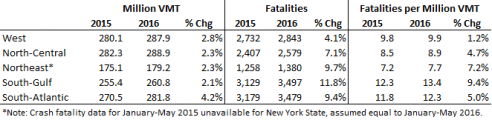
During the first five months of the year, traffic deaths rose 9 percent over 2015 levels, reports Bill Holloway at the State Smart Transportation Campaign. It’s even worse if you compare to 2014 — traffic deaths have increased a staggering 17 percent since then.

One factor is that people are driving more as gas prices plunge and the economy grows. But the increase in mileage isn’t large enough to fully explain the mounting death toll. And in a disturbing related trend, pedestrian and cycling deaths are rising faster than overall traffic fatalities.

What is going on? Holloway searches for potential explanations:

Although there is no good data available on bicycle and pedestrian miles traveled, the number of bike and pedestrian commuters estimated in the American Community Survey shows the rough magnitude of changes in bike and pedestrian activity in recent years. Between 2010 and 2015 the number of bicycle commuters in the U.S. increased by 30 percent, climbing from 685,000 to 890,000; while the number of people walking to and from work increased by 8 percent, from 3,834,000 in 2010 to 4,153,000 in 2015 — a roughly 11.5 percent gain in total non-motorized commuters. However, during this same period, while total annual VMT climbed by only 4.9 percent, the number of fatal crashes involving bikers and walkers climbed by 27 percent, according to SSTI’s analysis of FARS data.

Untangling the causes behind the increasing number of road deaths overall, as well as bicycle and pedestrian deaths specifically, is difficult. Total VMT, which is associated with the number of traffic deaths, tends to track with gross domestic product and average annual gas prices. VMT appears to exert a stronger influence on the number of traffic deaths when the economy is stronger. This may be due to additional non-essential driving trips, such as for vacations or entertainment, which have different characteristics — such as being undertaken at night, in unfamiliar surroundings, or after alcohol consumption.

With smart phones now nearly ubiquitous, distracted driving has contributed to more crashes in recent years. The number of fatal crashes involving drivers who were distracted or using cellular phones, as recorded in the FARS database, has climbed 24 percent from 832 in 2010 to 1,030 in 2015. Because drivers are likely to underreport distraction and cellular phone use, particularly after a crash, these figures are unlikely to reflect the true impact of these behaviors on fatal crashes. Some pedestrian and bicyclist deaths could also be due to the distraction of bikers and walkers themselves. A study by the Pew Research Center found that 53 percent of people had been on either the giving or receiving end of a distracted walking encounter — running into another person or object while distracted by their phones or being bumped by another walker who was too focused on their phone.

Elsewhere on the Network today: Seattle Bike Blog says now that the City Council has approved 20 mph speed limits for residential streets, the work for advocates has just begun. And Greater Greater Washington reports on progress towards the D.C. area’s first “underpass park.”

27 Sep 23:45

Obama pushes to make cities denser and more affordable

by Ben Adler

obama-denver-reuters-c

Good news: President Obama wants to make cities denser and housing more affordable. Bad news: He has very little power to do either of those things.

On Monday, the White House called for changing zoning codes that restrict new residential developments and offered recommendations to help communities create more affordable housing. This all came in the form of a new “Housing Development Toolkit.” It explains how local impediments to development keep housing in short supply in desirable areas, thereby encouraging sprawl, driving up housing costs, and worsening gentrification and displacement.

The Obama administration has some reforms in mind. Among its good suggestions: eliminate off-street parking requirements, create zoning that allows high density and multi-family developments like townhouses and apartment buildings, require developers to build some affordable housing, incentivize developers to build extra affordable units by allowing them to make their projects bigger if they do, and tax vacant land so it gets put to a productive use.

All of this is music to the ears of urbanists and climate hawks, who have been advocating these types of policies for years. But while it’s encouraging to see that concern about misguided zoning has filtered up to the White House, it’s not a sign of any forthcoming policy changes — at least not from Washington. Poor zoning causes national problems, including lost economic productivity, growing inequality, and higher carbon emissions and conventional pollution. But our federal system leaves these crucial decisions up to local governments.

This isn’t Obama’s first time around the (dense, urban) block

President Obama has actually been trying to encourage denser, smarter development since his first year in office. In 2009, the White House created the interagency Partnership for Sustainable Communities, and programs within cabinet agencies like the Sustainable Communities Initiative in the Department of Housing and Urban Development, to promote mixed-use, walkable, transit-oriented development. That includes apartments and offices above stores, and affordable apartments next to train stations. The partnership was designed to help agencies like the EPA, HUD, and the Department of Transportation coordinate their grant-making, so that, for example, affordable housing projects going in next to a future mass-transit hub would get preference over projects that were isolated and would get less bang for the buck.

The problem was funding: After the economic stimulus law expired, and especially after Republicans retook Congress in 2011 and cut funding to the agencies, there were hardly any housing, transportation, and environmental grants that could be used to push communities toward a smart-growth framework.

Now the administration is emphasizing the economic benefits of density — a smart move because it might appeal to some conservatives. Many liberals are already sympathetic. Some conservatives have reacted to past efforts to promote smart growth with furious white suburban identity politics and conspiracy theorizing. But other conservatives — the more business-friendly, pro-market ones — can see the wisdom of smart development.

Why is this so hard?

Even when there is widespread support for loosening zoning rules, it’s difficult to achieve. That’s because zoning decisions tend to favor narrow local interests and uphold the status quo.

Local communities slated for growth are often against it. When denser development comes to a neighborhood, the benefits, such as lower housing costs and more economic growth, are diffused in tiny bits across an entire region or country. But the costs, like more traffic, lost views, overburdened infrastructure, and lower property values, fall overwhelmingly on a small group of people who had been living in the area before the new development. So neighbors can be intensely, actively opposed to building projects, while everyone else pays little attention. The people who might benefit from new housing don’t yet live in an area, so they don’t form an organized constituency.

In too many cases, the local government defers to homeowners and prioritizes keeping home values high and rising. Even in the nation’s biggest, densest city, New York, every time the government wants to rezone an area, the City Council defers to the council member from the affected district. This tradition arose in reaction to a painful history of neighborhoods being destroyed, their physical fabric torn out, by big highway and urban renewal projects. But in many places it has tipped too far toward looking out for only the interests of the neighbors instead of society as a whole.

Environmentalists are a key part of the urbanist coalition

Over the past decade or so, environmentalists have become a critical constituency pushing for density and smart urban development. But some political analysts still don’t understand this. Witness Politico’s misguided description of the politics around Obama’s move on Monday: “The plan rejects some of the arguments made by environmentalists, labor unions and other liberal constituencies that have stood in the way of development and endorses changes long sought by builders and the business community.”

That’s way off-base. Leading green groups like the Sierra Club and Natural Resources Defense Council, environmental think tanks like the Sightline Institute, and sustainability-focused publications like Grist have long embraced smart growth. Denser development in our cities and suburbs reduces carbon emissions, as it allows for less driving, shorter trips, and more energy-efficient attached homes. The White House agrees, noting in its toolkit, “Smart housing regulation optimizes transportation system use, reduces commute times, and increases use of public transit, biking and walking.”

Local opposition to development can include environmental activists, both real ones who are genuinely concerned about issues like air quality or local wildlife habitat and fake ones who will seize on any argument that could keep an apartment building from going up on their block. But in many cases, the broader environmental community supports building new housing in cities in areas that are walkable, bikeable, and near transit.

What can a president do?

No matter how much backing a president has — from business interests, environmentalists, or anyone else — he or she can’t do a lot to change the way cities set their zoning codes. That’s particularly true now, when the far-right House of Representatives won’t pass anything requiring new federal authority or spending.

But if a president were working with a friendly Congress, they could make progress. They would do what the federal government always does when it wants to affect a locally controlled policy area: use the power of its purse strings. Earlier in his presidency, when Obama wanted to encourage states to enact education reforms, he launched the Race to the Top, which had states compete to win grants. If funding were available, a president could launch a similar competitive grant program to reward localities that create the best new zoning codes.

For now, this issue will keep getting hashed out at the local level in an ad hoc fashion. But if a future president and Congress made smart growth a priority, they could prod cities to develop in ways that would actually address our growing nation’s needs.

This story was originally published by Grist with the headline Obama pushes to make cities denser and more affordable on Sep 27, 2016.

27 Sep 23:45

Seattle City Council Approves 20 MPH Speed Limit on Residential Streets

by Angie Schmitt

Residential streets in Seattle will have 20 mile per hour speed limits. Graphic: City of Seattle

Residential streets in Seattle will have 20 mile per hour speed limits. Graphic: City of Seattle

20 is plenty for Seattle.

The City Council voted unanimously yesterday to lower speed limits on residential streets to 20 miles per hour.

On all other streets, the default speed limit will be 25 mph, though speed limits may vary on major roadways.

The change is part of the city’s Vision Zero effort, aimed at eliminating traffic fatalities by 2030. Every year about 20 people are killed and 150 are injured in traffic crashes in Seattle. About 50 percent of victims in fatal crashes are people walking and biking.

Gordon Padelford, policy director with Seattle Neighborhood Greenways, which led the push for the legislation, said he’s thrilled with City Council’s decision.

“We’re already working on the city’s annual budget process to find additional funding for traffic-calming along arterials that will help implement the policy,” he said.

Seattle Neighborhood Greenways is asking for $1 million for “Vision Zero spot improvements” — traffic-calming elements in key locations.

The group is also seeking $2 million for a road diet on Rainier Avenue South — a particularly dangerous corridor.

27 Sep 23:39

More Cluster Fudge Here


More Cluster Fudge Here

27 Sep 20:01

What did Trump lie about at the debate, mondo-hugeo chart edition, Sept 27

by Cory Doctorow

tumblr_oe69dgqmwr1uqyxnpo1_128

A very special edition of of an ongoing series by weird chart-maker Scott Bateman; link to today's edition.

26 Sep 20:11

In The West Wing’s Debate Episode, Politics Is a Game

by Megan Garber

The worst things you could say about The West Wing are also, as it happens, the best things you could say about The West Wing. The show’s politics were liberal, in the years right before that word took on the whiff of a slur; its morals revolved around the assumption that government is an effective agent of good in the world; it embraced the conviction that the American political system operates with a reassuring moral clarity. Partisanship, in the show’s framing, is not partisanship, but rather something of a geographical designation: Do you stand on the right, or the wrong, side of history? In that sense, the “West” in the show’s title is apt: This was a series that, despite its bureaucratic setting, reveled in the easy moral calculus of the old-school Western. The good, the bad, and the partisan.

Nowhere is that more clear than in “Game On,” the fourth-season episode—one of the last to be written by Aaron Sorkin—that finds President Bartlet, running for re-election, facing off against Florida’s Governor Ritchie. The two men aren’t simply opposing presidential candidates; they are also, according to the Sorkinian moral logic, opposing stereotypes (and, in that, opposing visions of the American experiment): On the one side is Josiah Bartlet (Martin Sheen), the smug, East Coast, liberal elite; on the other is Robert Ritchie (James Brolin), the aw-shucks advocate of states’ rights and small government. Here are the two men and the two ideas, pitted against each other, climactically, in the closest thing American politics has to a big-time sporting event: the debate that takes place right before the election.

Here’s a sample of their bout, as the candidates are invited to give their opening statements:

Ritchie: Well, first, let me say good evening and thank you. It’s a privilege to be here. My view of this is simple: We don’t need a Federal Department of Education telling us our children have to learn Esperanto, they have to learn Eskimo poetry. Let the states decide. Let the communities decide on health care, on education, on lower taxes, not higher taxes. Now, he's going to throw a big word at you: “unfunded mandate.” If Washington lets the states do it, it's an unfunded mandate. But what he doesn't like is the federal government losing power. But I call it the ingenuity of the American people.

Moderator: President Bartlet, you have 60 seconds for a question and an answer.

Bartlet: Well, first of all, let’s clear up a couple of things. “Unfunded mandate” is two words, not one big word.

There are times when we’re 50 states, and there are times when we're one country and have national needs. And the way I know this is that Florida didn't fight Germany in World War II or establish civil rights. You think states should do the governing wall-to-wall. That’s a perfectly valid opinion. But your state of Florida got $12.6 billion in federal money last year—from Nebraskans, and Virginians, and New Yorkers, and Alaskans, with their Eskimo poetry. 12.6 out of a state budget of $50 billion, and I’m supposed to be using this time for a question, so here it is: Can we have it back, please?

Josh Lyman, Bartlet’s deputy chief of staff (watching from backstage): Game on.

C.J. Cregg, Bartlet’s press secretary (also from backstage): Oh my God.

Sam Seaborn, Bartlet’s deputy communications director (backstage): Strike ‘em out, throw ‘em out! [He turns to reporters.] Anybody want spin?

This is good TV—an exchange that plays up the “politics as sports” idea to dramatic, if also vaguely ridiculous, effect. (Sam’s “strike ‘em out” line was joined, sports-metaphor-wise, by Josh’s earlier exhortation to Bartlet to throw “nothing but strikes,” and by the broader fact that “game on” runs as a refrain throughout the episode.)

What the debate also does, though, is to take The West Wing to Peak Partisan Porn. The episode is so convinced of its own moral clarity as to be blithely—and, really, absurdly—smug. The Bartlet/Ritchie matchup, after all, isn’t simply about progressive ideas pitted against conservative ones; it is also, as the show presents it, about intelligence pitted against ... the lack of it. Ritchie, here, is not merely folksy; he is actively, ridiculously stupid. (That reference to “Eskimo poetry”! And to Esperanto! And to “unfunded mandate” as “one big word”!) Those flubs aren’t a case of debate nerves getting the best of him: In an earlier episode, after Bartlet informed Ritchie that a member of his Secret Service detail had been gunned down during an armed robbery, the governor’s tepid response was “Crime—boy, I don’t know.” To which an indignant Bartlet responded: “In the future, if you’re wondering: ‘Crime—boy, I don’t know’ is when I decided to kick your ass.”

So “Game On” captures on the one hand the intellectual bloodlust that many such debates will involve: the partisan rancor, the high stakes, the anything-could-happen serendipities (and tragedies) of live TV. It also functions, though, as an hourlong ad hominem attack against an entire political philosophy. It assumes that conservatism can be fairly stereotyped as bumbling and word-tripping and uneducated. All of this by way of proving its broader argument: that one side is Right, and the other is Wrong. (The West Wing’s fourth season aired during the fall of 2002, halfway through George W. Bush’s first term; it does not require much imagination to see Ritchie as a grotesque version of the former Texas governor.)


Related Story

Bartlet for America, Forever

That is, all in all, a flaw. It’s a stance that is unnecessarily alienating; it’s one that makes the line C.J. utters, as part of her post-debate victory lap—“the President just reminded us that complexity isn’t a vice”—ring ironically hollow. “Smug,” whichever side you’re on, is very rarely a good look.

And yet. “Game On,” for all its easy stereotypes and all its smug equivalencies, also goes a long way toward explaining why The West Wing—now 10 years off the air—has remained such an enduring feature of American political life. In the decade since Bartlet left office, politics have on the one hand gotten even more partisan, and even more bitter. But they have also, at the same time, lost clarity. They have become even more epistemologically unmoored than they once were. The 2016 campaign, after all, features battles not just over opinion, but over facts themselves—with many of the stories about it taking for granted the notion that we have now entered the “post-fact” era of political discourse.

In that environment, the The West Wing, with all its blithe assumptions, offers the refreshment of certitude itself. “Game On,” in particular, treats politics not just as empty spectacle, but as something that actually matters. It rejects cynicism in favor of conviction. Many of the shows that have come in The West Wing’s wake—Designated Survivor, Veep, Madam Secretary, etc.—de-emphasize their characters’ political parties and convictions. Whether for purposes of broad audience appeal or (as in the case of Veep) a kind of #lolnothingmatters strain of satire, they downplay the combative elements of the American political system.

Not so The West Wing. It wants, for better or for worse, a fight, and a contest, and a game. It treats politics as a sport, and it revels in the moral promise that athletic events make to viewers: Sports, after all—like an election itself—feature clear winners, and clear losers. Whatever happens during their games, one team (or one person) will come away as the victor. There is no ambiguity. There is no uncertainty. There is no “post-fact” thinking. There is only right and wrong, only win and lose.

“I thought he was going to have to fall all over himself trying to be genial,” the speechwriter Will Bailey tells Sam Seaborn, after the debate concluded in Bartlet’s favor.

“So did we,” Sam replied. “But then we were convinced by polling that said he was going to be seen as arrogant no matter what performance he gave in the debate.” He paused. “If your guy’s seen that way, you might as well knock some bodies down with it.”