Angewandte Chemie International Edition, EarlyView.
Xiao Xu-Qiong
Shared posts
28 Jun 00:21
Cleavage of Unactivated Si−C(sp3) Bonds with Reed's Carborane Acids: Formation of Known and Unknown Silylium Ions
by Dr.
Qian
Wu
,
Dr.
Zheng‐Wang
Qu
,
Lukas
Omann
,
Dr.
Elisabeth
Irran
,
Dr.
Hendrik F. T.
Klare
,
Prof. Dr.
Martin
Oestreich
Josep Mas Roselló, 漂流 likes this
28 Jun 00:19


[ASAP] Diversified Aggregation States of Phospholyl Lithiums
by Shanshan Du, Wen-Xiong Zhang, Zhenfeng Xi

Organometallics
DOI: 10.1021/acs.organomet.8b00064
Blaine likes this
28 Jun 00:18

[ASAP] Synthesis and Reactivity of Reduced a-Diimine Nickel Complexes Relevant to Acrylic Acid Synthesis
by Matthew V. Joannou, Máté J. Bezdek, Khalid Albahily, Ilia Korobkov, Paul J. Chirik

Organometallics
DOI: 10.1021/acs.organomet.8b00350
QiuJ, Antonio Del Vecchio and one other like this
09 Oct 11:19
Late-stage chemoselective functional-group manipulation of bioactive natural products with super-electrophilic silylium ions
by Trandon A. Bender

Nature Chemistry. doi:10.1038/nchem.2863
Authors: Trandon A. Bender, Philippa R. Payne & Michel R. Gagné
Determining the structure–activity relationships for complex structures can be quite challenging, but it is often the method by which many natural products are optimized for use as drugs. Now, the combination of a fluoroaryl borane catalyst, a phosphine additive and a silane reducing agent enables the late-stage selective modification of complex bioactive natural products in order to provide rapid access to a wide array of structures, and therefore functions.
20 Sep 15:18


B(C6F5)3-Catalyzed C–Si/Si–H Cross-Metathesis of Hydrosilanes
by Yuanhong Ma, Liang Zhang, Yong Luo, Masayoshi Nishiura and Zhaomin Hou

Journal of the American Chemical Society
DOI: 10.1021/jacs.7b08053
lichunya, Xiao Xu-Qiong and 7 others like this
20 Sep 15:17

A One-Step Germole to Silole Transformation and a Stable Isomer of a Disilabenzene
by Thomas Müller, Crispin Reinhold, Zhaowen Dong, Jan Winkler, Henning Steinert, Marc Schmidtmann
Abstract
An unusual germole-to-silole transformation is described. As key intermediates hetero-fulvenes are formed which rearrange to more stable bicyclic carbene analogues. The so-formed germylenes undergo a reductive elimination yielding elemental germanium and siloles. In contrast, the analogous silylenes are stable at ambient conditions and were identified by MS spectrometry and NMR spectroscopy supported by the results of quantum mechanical calculations. These bicyclic silylenes are stable derivatives of the global minimum of the C4Si2H6 potential energy surface.

Always expect the unexpected: An unprecedented germole to silole transformation opened the way for the synthesis of novel bicyclic silylenes that are stable derivatives of the global minimum on the C4Si2H6 potential energy surface.
Xiao Xu-Qiong, Jelte and one other like this
17 Aug 08:30

Synthesis and Characterization of Iridium(V) Coordination Complexes With an N,O-Donor Organic Ligand
by Liam Sharninghausen, Shashi Bhushan Sinha, Dimitar Y. Shopov, Brandon Q. Mercado, David Balcells, Gary W. Brudvig, Robert H. Crabtree
Abstract
We have prepared and fully characterized two isomers of [IrIV(dpyp)2] (dpyp=meso-2,4-di(2-pyridinyl)-2,4-pentanediolate). These complexes can cleanly oxidize to [IrV(dpyp)2]+, which to our knowledge represent the first mononuclear coordination complexes of IrV in an N,O-donor environment. One isomer has been fully characterized in the IrV state, including by X-ray crystallography, XPS, and DFT calculations, all of which confirm metal-centered oxidation. The unprecedented stability of these IrV complexes is ascribed to the exceptional donor strength of the ligands, their resistance to oxidative degradation, and the presence of four highly donor alkoxide groups in a plane, which breaks the degeneracy of the d-orbitals and favors oxidation.

A robust ligand and a rare oxidation state: [IrIV(dpyp)2] cleanly oxidizes to [IrV(dpyp)2]+, the first mononuclear example of IrV in an N,O-donor environment. Full characterization of the IrV species, including by X-ray crystallography in one case, allows exploration of this rare oxidation state.
Leuchtkaefer, Xiao Xu-Qiong and 2 others like this
25 Jul 12:02

Highly Bent 1,3-Digerma-2-silaallene
by Tomohiro Sugahara, Takahiro Sasamori, Norihiro Tokitoh
Abstract
A 1,3-digerma-2-silacyclopenta-1,2-diene, that is, a 1,3-digerma-2-silaallene incorporated into a five-membered ring system, was synthesized and obtained as a stable orange solid. Owing to incorporation into a cyclic framework, the 1,3-digerma-2-silaallene moiety is highly bent, exhibiting a Si0 character for the central silicon moiety.

The bends: A 1,3-digerma-2-silacyclopenta-1,2-diene, that is, a 1,3-digerma-2-silaallene incorporated into a five-membered ring system, was synthesized and obtained as a stable orange solid. Owing to incorporation into a cyclic framework, the 1,3-digerma-2-silaallene moiety is highly bent, exhibiting a Si0 character for the central silicon moiety.
02 May 07:29

Manganese Silylene Hydride Complexes: Synthesis and Reactivity with Ethylene to Afford Silene Hydride Complexes
by Jeffrey S. Price, David J. H. Emslie, James F. Britten

Manganese and hydrogen are two key elements used by D. J. H. Emslie et al. in their Communication (DOI: 10.1002/anie.201700863). The reactions described sequentially introduce silicon and carbon into the core of the molecule, which is represented by an inukshuk, a stone landmark used by peoples of the Arctic region, including northern Canada. On the left-hand side, the climb of two silylene hydride molecules towards the core of the final product, represented by “Hounds Tooth” in British Columbia (Canada), is shown.
26 Mar 16:13

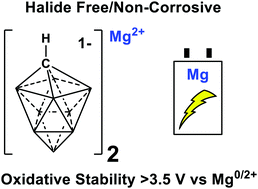
Below the 12-vertex: 10-vertex carborane anions as non-corrosive, halide free, electrolytes for rechargeable Mg batteries
Chem. Commun., 2017, 53,4453-4456
DOI: 10.1039/C7CC01570D, Communication
DOI: 10.1039/C7CC01570D, Communication
Scott G. McArthur, Rahul Jay, Linxiao Geng, Juchen Guo, Vincent Lavallo
The synthesis and application of the first high voltage, non-corrosive, Mg battery electrolyte based on small carborane anions are reported. This electrolyte displays equal oxidative stability compared to its larger 12-vertex cousin, but is more cost effective to prepare.
The content of this RSS Feed (c) The Royal Society of Chemistry
The synthesis and application of the first high voltage, non-corrosive, Mg battery electrolyte based on small carborane anions are reported. This electrolyte displays equal oxidative stability compared to its larger 12-vertex cousin, but is more cost effective to prepare.
The content of this RSS Feed (c) The Royal Society of Chemistry
Sun Bowen likes this
20 Mar 07:54

Manganese Silylene Hydride Complexes: Synthesis and Reactivity with Ethylene to Afford Silene Hydride Complexes
by Jeffrey S. Price, David J. H. Emslie, James F. Britten
Abstract
Reaction of the ethylene hydride complex trans-[(dmpe)2MnH(C2H4)] (1) with Et2SiH2 at 20 °C afforded the silylene hydride [(dmpe)2MnH(=SiEt2)] (2 a) as the trans-isomer. By contrast, reaction of 1 with Ph2SiH2 at 60 °C afforded [(dmpe)2MnH(=SiPh2)] (2 b) as a mixture of the cis (major) and trans (minor) isomers, featuring a Mn-H-Si interaction in the former. The reaction to form 2 b also yielded [(dmpe)2MnH2(SiHPh2)] (3 b); [(dmpe)2MnH2(SiHR2)] (R=Et (3 a) and Ph (3 b)) were accessed cleanly by reaction of 2 a and 2 b with H2, and the analogous reactions with D2 afforded [(dmpe)2MnD2(SiHR2)] exclusively. Both 2 a and 2 b engaged in unique reactivity with ethylene, generating the silene hydride complexes cis-[(dmpe)2MnH(R2Si=CHMe)] (R=Et (4 a), Ph (4 b)). Compounds trans-2 a, cis-2 b, 3 b, and 4 b were crystallographically characterized, and bonding in 2 a, 2 b, 4 a, and 4 b was probed computationally.

Alkene hydride complex trans-[(dmpe)2MnH(C2H4)] eliminates ethane upon reaction with secondary silanes, yielding cis- and trans-isomers of the silylene hydride complexes [(dmpe)2MnH(=SiR2)]. Reaction with ethylene yields silene hydride complexes [(dmpe)2MnH(R2Si=CHMe)]—most likely via a low-coordinate silyl isomer [(dmpe)2Mn(SiHR2)] that is in equilibrium with the silylene hydrides.
Peter Reid, dragon and 2 others like this
No more posts. Check out what's trending.