12 Jul 10:41
by Christophe Mora, Nicolas Regnault, and B. Andrei Bernevig
Author(s): Christophe Mora, Nicolas Regnault, and B. Andrei Bernevig
We investigate the electronic structure of a twisted multilayer graphene system forming a moiré pattern. We consider small twist angles separating the graphene sheets and develop a low-energy theory to describe the coupling of Dirac Bloch states close to the K point in each individual plane. Extendi...
[Phys. Rev. Lett. 123, 026402] Published Thu Jul 11, 2019
12 Jul 10:30
by Delphine Pommier, Rémi Bretel, Luis E. Parra López, Florentin Fabre, Andrew Mayne, Elizabeth Boer-Duchemin, Gérald Dujardin, Guillaume Schull, Stéphane Berciaud, and Eric Le Moal
Author(s): Delphine Pommier, Rémi Bretel, Luis E. Parra López, Florentin Fabre, Andrew Mayne, Elizabeth Boer-Duchemin, Gérald Dujardin, Guillaume Schull, Stéphane Berciaud, and Eric Le Moal
The long sought-after goal of locally and spectroscopically probing the excitons of two-dimensional (2D) semiconductors is attained using a scanning tunneling microscope (STM). Excitonic luminescence from monolayer molybdenum diselenide (MoSe2) on a transparent conducting substrate is electrically e...
[Phys. Rev. Lett. 123, 027402] Published Wed Jul 10, 2019
12 Jul 10:27
by A. Kurzmann, M. Eich, H. Overweg, M. Mangold, F. Herman, P. Rickhaus, R. Pisoni, Y. Lee, R. Garreis, C. Tong, K. Watanabe, T. Taniguchi, K. Ensslin, and T. Ihn
Author(s): A. Kurzmann, M. Eich, H. Overweg, M. Mangold, F. Herman, P. Rickhaus, R. Pisoni, Y. Lee, R. Garreis, C. Tong, K. Watanabe, T. Taniguchi, K. Ensslin, and T. Ihn
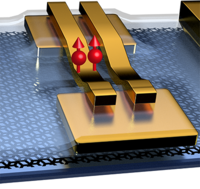
Measurements of spin and valley relaxation and decoherence times in quantum dots of graphene encapsulated by edges and back gates may lead to implementations of qubits.
[Phys. Rev. Lett. 123, 026803] Published Tue Jul 09, 2019
12 Jul 10:22
by Erfu Liu, Jeremiah van Baren, Zhengguang Lu, Mashael M. Altaiary, Takashi Taniguchi, Kenji Watanabe, Dmitry Smirnov, and Chun Hung Lui
Author(s): Erfu Liu, Jeremiah van Baren, Zhengguang Lu, Mashael M. Altaiary, Takashi Taniguchi, Kenji Watanabe, Dmitry Smirnov, and Chun Hung Lui
Monolayer WSe2 is an intriguing material to explore dark exciton physics. We have measured the photoluminescence from dark excitons and trions in ultraclean monolayer WSe2 devices encapsulated by boron nitride. The dark trions can be tuned continuously between negative and positive trions with elect...
[Phys. Rev. Lett. 123, 027401] Published Tue Jul 09, 2019
22 Jun 22:22
by Fang Liu, Mark E. Ziffer, Kameron R. Hansen, Jue Wang, and Xiaoyang Zhu
Author(s): Fang Liu, Mark E. Ziffer, Kameron R. Hansen, Jue Wang, and Xiaoyang Zhu
A key feature of monolayer semiconductors, such as transition-metal dichalcogenides, is the poorly screened Coulomb potential, which leads to a large exciton binding energy (Eb) and strong renormalization of the quasiparticle band gap (Eg) by carriers. The latter has been difficult to determine due ...
[Phys. Rev. Lett. 122, 246803] Published Fri Jun 21, 2019
17 Jun 09:57
by Adane K. Geremew†, Sergey Rumyantsev†?, Fariborz Kargar†, Bishwajit Debnath‡, Adrian Nosek§, Matthew A. Bloodgood¶, Marc Bockrath§, Tina T. Salguero¶, Roger K. Lake‡, and Alexander A. Balandin*†

ACS Nano
DOI: 10.1021/acsnano.9b02870

31 May 23:11
by Øyvind Johansen, Vetle Risinggård, Asle Sudbø, Jacob Linder, and Arne Brataas
Author(s): Øyvind Johansen, Vetle Risinggård, Asle Sudbø, Jacob Linder, and Arne Brataas
The recent discovery of magnetism in two-dimensional van der Waals systems opens the door to discovering exciting physics. We investigate how a current can control the ferromagnetic properties of such materials. Using symmetry arguments, we identify a recently realized system in which the current-in...
[Phys. Rev. Lett. 122, 217203] Published Fri May 31, 2019
23 May 07:33
by Chen-Yen Lai and Jian-Xin Zhu
Author(s): Chen-Yen Lai and Jian-Xin Zhu
In recent years, ultrafast pump-probe spectroscopy has provided insightful information about the nonequilibrium dynamics of excitations in materials. In a typical experiment of time-resolved x-ray absorption spectroscopy, the systems are excited by a femtosecond laser pulse (pump pulse) followed by ...
[Phys. Rev. Lett. 122, 207401] Published Wed May 22, 2019
16 May 07:34
by Kenta Owada, Kosuke Nakayama, Ryuji Tsubono, Koshin Shigekawa, Katsuaki Sugawara, Takashi Takahashi, Takafumi Sato
We have performed angle-resolved photoemission spectroscopy on a
heterostructure consisting of topological insulator Bi2Te3 and iron
chalcogenide FeTe fabricated on SrTiO3 substrate by molecular-beam-epitaxy
technique. This system was recently found to show superconductivity albeit
non-superconducting nature of each constituent material. Upon interfacing FeTe
with two quintuple layers of Bi2Te3, we found that the Dirac-cone surface state
of Bi2Te3 is shifted toward higher binding energy, while the holelike band at
the Fermi level originating from FeTe moves toward lower binding energy. This
suggests that electron charge transfer takes place from FeTe to Bi2Te3 through
the interface. The present result points to importance of hole-doped FeTe
interface for the occurrence of unconventional superconductivity.
10 May 12:34
by Luojun Du, Mengzhou Liao, Gui-Bin Liu, Qinqin Wang, Rong Yang, Dongxia Shi, Yugui Yao, and Guangyu Zhang
Author(s): Luojun Du, Mengzhou Liao, Gui-Bin Liu, Qinqin Wang, Rong Yang, Dongxia Shi, Yugui Yao, and Guangyu Zhang
We introduce a physical model to describe the influence of a perpendicular electric field on circular polarization (CP) and valley polarization (VP) in bilayer transition metal dichalcogenides. Our results uncover that electric-field-dependent CP and VP are quite distinct from each other. The depend...
[Phys. Rev. B 99, 195415] Published Fri May 10, 2019
07 May 12:12
by Kosuke Nakayama, Seigo Souma, Chi Xuan Trang, Daichi Takane, Chaoyu Chen, Jose Avila, Takashi Takahashi, Satoshi Sasaki, Kouji Segawa, Maria Carmen Asensio, Yoichi Ando, Takafumi Sato

Nano Letters
DOI: 10.1021/acs.nanolett.9b00875

30 Apr 13:48
by Hideaki Iwasawa, Pavel Dudin, Kyosuke Inui, Takahiko Masui, Timur K. Kim, Cephise Cacho, and Moritz Hoesch
Author(s): Hideaki Iwasawa, Pavel Dudin, Kyosuke Inui, Takahiko Masui, Timur K. Kim, Cephise Cacho, and Moritz Hoesch
Identifying the electron dynamics in CuO chains has been elusive in Y-Ba-Cu-O (YBCO) cuprate systems when using standard angle-resolved photoemission spectroscopy (ARPES); a cleaved sample exhibits areas terminated by both CuO chains or BaO layers, and the size of a typical beam results in ARPES sig...
[Phys. Rev. B 99, 140510(R)] Published Fri Apr 26, 2019
25 Apr 06:59
by H. Soifer, A. Gauthier, A. F. Kemper, C. R. Rotundu, S.-L. Yang, H. Xiong, D. Lu, M. Hashimoto, P. S. Kirchmann, J. A. Sobota, and Z.-X. Shen
Author(s): H. Soifer, A. Gauthier, A. F. Kemper, C. R. Rotundu, S.-L. Yang, H. Xiong, D. Lu, M. Hashimoto, P. S. Kirchmann, J. A. Sobota, and Z.-X. Shen
We study the microscopic origins of photocurrent generation in the topological insulator Bi2Se3 via time- and angle-resolved photoemission spectroscopy. We image the unoccupied band structure as it evolves following a circularly polarized optical excitation and observe an asymmetric electron populat...
[Phys. Rev. Lett. 122, 167401] Published Wed Apr 24, 2019
24 Apr 11:43
by Frédéric Joucken, Eberth A. Quezada-López, Jose Avila, Chaoyu Chen, John L. Davenport, Hechin Chen, Kenji Watanabe, Takashi Taniguchi, Maria Carmen Asensio, and Jairo Velasco, Jr.
Author(s): Frédéric Joucken, Eberth A. Quezada-López, Jose Avila, Chaoyu Chen, John L. Davenport, Hechin Chen, Kenji Watanabe, Takashi Taniguchi, Maria Carmen Asensio, and Jairo Velasco, Jr.
Heterostructures composed of two-dimensional (2D) materials placed on insulating substrates are of great interest because they exhibit tunable electronic and optical properties that enable novel optoelectronic devices. Directly accessing the electronic band structure of such heterostructures is challenging because of their micron-scale size. The recent development of nanospot angle-resolved photoemission spectroscopy (nanoARPES) now provides direct access to the band structure with high resolution in space, energy, and momentum. To this end, the authors use nanoARPES to reveal the electronic structure of Bernal-stacked bilayer graphene (BLG) supported by hexagonal boron nitride (hBN). They extract tight-binding band parameters for BLG on this substrate for the first time, thus providing important information for theoretical modeling. With the help of STM, they also find spatial inhomogeneity in the lattice alignment between the supporting hBN and the top-lying BLG. Considering the dramatic influence that the alignment angle has on the properties of 2D material heterostructures, this surprisingly large inhomogeneity (up to 3) must be considered for interpreting previous and future spatially averaged experiments performed on these heterostructures.

[Phys. Rev. B 99, 161406(R)] Published Tue Apr 23, 2019
15 Apr 11:31
by Jimin Chae, Seoung-Hun Kang, Sang Han Park, Hanbum Park, Kwangsik Jeong, Tae Hyeon Kim, Seok-Bo Hong, Keun Su Kim, Young-Kyun Kwon, Jeong Won Kim, Mann-Ho Cho

ACS Nano
DOI: 10.1021/acsnano.8b07012

15 Apr 11:21
by Hamoon Hedayat, Charles J. Sayers, Davide Bugini, Claudia Dallera, Daniel Wolverson, Tim Batten, Sara Karbassi, Sven Friedemann, Giulio Cerullo, Jasper van Wezel, Stephen R. Clark, Ettore Carpene, Enrico Da Como
Understanding collective electronic states such as superconductivity and
charge density waves is pivotal for fundamental science and applications. The
layered transition metal dichalcogenide 1T-TiSe2 hosts a unique charge density
wave (CDW) phase transition whose origins are still not fully understood. Here,
we present ultrafast time- and angle-resolved photoemission spectroscopy
(TR-ARPES) measurements complemented by time-resolved reflectivity (TRR) which
allows us to establish the contribution of excitonic and electron-phonon
interactions to the CDW. We monitor the energy shift of the valence band (VB)
and coupling to coherent phonons as a function of laser fluence. The VB shift,
directly related to the CDW gap closure, exhibits a markedly slower recovery
dynamics at fluences above Fth = 60 microJ cm-2. This observation coincides
with a shift in the relative weight of coherently coupled phonons to higher
frequency modes in time-resolved reflectivity (TRR), suggesting a phonon
bottleneck. Using a rate equation model, the emergence of a high-fluence
bottleneck is attributed to an abrupt reduction in coupled phonon damping and
an increase in exciton dissociation rate linked to the loss of CDW superlattice
phonons. Thus, our work establishes the important role of both excitonic and
phononic interactions in the CDW phase transition and the advantage of
combining complementary femtosecond techniques to understand the complex
interactions in quantum materials.
11 Apr 08:25
by Ke Wang, Achim Harzheim, Takashi Taniguchi, Kenji Watanabei, Ji Ung Lee, and Philip Kim
Author(s): Ke Wang, Achim Harzheim, Takashi Taniguchi, Kenji Watanabei, Ji Ung Lee, and Philip Kim
We report tunneling transport in spatially controlled networks of quantum Hall (QH) edge states in bilayer graphene. By manipulating the separation, location, and spatial span of QH edge states via gate-defined electrostatics, we observe resonant tunneling between copropagating QH states across inco...
[Phys. Rev. Lett. 122, 146801] Published Wed Apr 10, 2019
10 Apr 11:49
by Ziying Wang, Leiqiang Chu, Linjun Li, Ming Yang, Junyong Wang, Goki Eda, Kian Ping Loh

Nano Letters
DOI: 10.1021/acs.nanolett.8b04805

29 Mar 08:54
by Frédéric Joucken, Jose Avila, Zhehao Ge, Eberth A. Quezada-Lopez, Hemian Yi, Romaric Le Goff, Emmanuel Baudin, John L. Davenport, Kenji Watanabe, Takashi Taniguchi, Maria Carmen Asensio, Jairo Velasco Jr.

Nano Letters
DOI: 10.1021/acs.nanolett.9b00649

28 Mar 08:13
by Romain Grasset, Yann Gallais, Alain Sacuto, Maximilien Cazayous, Samuel Mañas-Valero, Eugenio Coronado, and Marie-Aude Méasson
Author(s): Romain Grasset, Yann Gallais, Alain Sacuto, Maximilien Cazayous, Samuel Mañas-Valero, Eugenio Coronado, and Marie-Aude Méasson
The pressure evolution of the Raman active electronic excitations of the transition metal dichalcogenides 2H−TaS2 is followed through the pressure phase diagram embedding incommensurate charge-density-wave and superconducting states. At high pressure, the charge-density wave is found to collapse at ...
[Phys. Rev. Lett. 122, 127001] Published Wed Mar 27, 2019
27 Mar 07:59
by Xiao-Xiao Zhang, You Lai, Emma Dohner, Seongphill Moon, Takashi Taniguchi, Kenji Watanabe, Dmitry Smirnov, and Tony F. Heinz
Author(s): Xiao-Xiao Zhang, You Lai, Emma Dohner, Seongphill Moon, Takashi Taniguchi, Kenji Watanabe, Dmitry Smirnov, and Tony F. Heinz
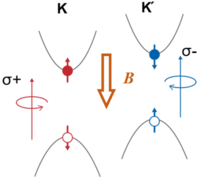
Optoelectronic response in the 2D material MoS2 is controlled by the interplay of an external magnetic field and particular features of the electron band structure (valleytronics).
[Phys. Rev. Lett. 122, 127401] Published Tue Mar 26, 2019
22 Mar 11:08
by Konrad Viebahn, Matteo Sbroscia, Edward Carter, Jr-Chiun Yu, and Ulrich Schneider
Author(s): Konrad Viebahn, Matteo Sbroscia, Edward Carter, Jr-Chiun Yu, and Ulrich Schneider
Experimentalists realize a Bose-Einstein condensate on a 2D quasicrystal optical lattice, opening the path for simulations of a variety of quantum many-body phenomena in these fractal structures.

[Phys. Rev. Lett. 122, 110404] Published Wed Mar 20, 2019
20 Mar 13:20
by Avinash Rustagi and Alexander F. Kemper
Author(s): Avinash Rustagi and Alexander F. Kemper
Coherent excitation of materials via ultrafast laser pulses can have interesting, observable dynamics in time-resolved photoemission measurements. The broad spectral width of ultrafast pump pulses can coherently excite multiple exciton energy levels. When such coherently excited states are probed by...
[Phys. Rev. B 99, 125303] Published Tue Mar 19, 2019
15 Mar 08:50
by Sung-Hoon Lee, Jung Suk Goh, and Doohee Cho
Author(s): Sung-Hoon Lee, Jung Suk Goh, and Doohee Cho
Using density functional theory calculations, we investigate the origin of the insulating phase and metal-insulator transition (MIT) in octahedral tantalum disulfide (1T−TaS2), a layered van der Waals material with a prominent two-dimensional (2D) charge density wave (CDW) order. We show that the MI...
[Phys. Rev. Lett. 122, 106404] Published Thu Mar 14, 2019
23 Feb 09:08
by Matthew D. Watson, Oliver J. Clark, Federico Mazzola, Igor Marković, Veronika Sunko, Timur K. Kim, Kai Rossnagel, and Philip D. C. King
Author(s): Matthew D. Watson, Oliver J. Clark, Federico Mazzola, Igor Marković, Veronika Sunko, Timur K. Kim, Kai Rossnagel, and Philip D. C. King
We revisit the enduring problem of the 2×2×2 charge density wave (CDW) order in TiSe2, utilizing photon energy-dependent angle-resolved photoemission spectroscopy to probe the full three-dimensional high- and low-temperature electronic structure. Our measurements demonstrate how a mismatch of dimens...
[Phys. Rev. Lett. 122, 076404] Published Fri Feb 22, 2019
01 Feb 12:56
by Iann C. Gerber, Emmanuel Courtade, Shivangi Shree, Cedric Robert, Takashi Taniguchi, Kenji Watanabe, Andrea Balocchi, Pierre Renucci, Delphine Lagarde, Xavier Marie, and Bernhard Urbaszek
Author(s): Iann C. Gerber, Emmanuel Courtade, Shivangi Shree, Cedric Robert, Takashi Taniguchi, Kenji Watanabe, Andrea Balocchi, Pierre Renucci, Delphine Lagarde, Xavier Marie, and Bernhard Urbaszek
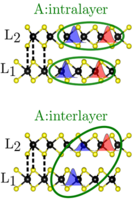
Transition metal dichalcogenides are semiconducting materials in which optical properties are governed by Coulomb-bound electron-hole pairs, called excitons. Here, the authors investigate the different excitonic properties of monolayer, bilayer, and trilayer MoS2, revealing the existence of interlayer excitons in the last two cases. The paper presents both theoretical and experimental studies. DFT calculations of absorption are underpinned by reflectivity measurements, at temperatures from 4 to 300 K, on high-quality samples encapsulated in hexagonal boron nitride (hBN).
[Phys. Rev. B 99, 035443] Published Thu Jan 31, 2019
11 Jan 12:47
by Gyeongcheol Gye, Eunseok Oh, and Han Woong Yeom
Author(s): Gyeongcheol Gye, Eunseok Oh, and Han Woong Yeom
Despite decades of studies of the charge density wave (CDW) of 2H−NbSe2, the origin of its incommensurate CDW ground state has not been understood. We discover that the CDW of 2H−NbSe2 is composed of two different, energetically competing, structures. The lateral heterostructures of two CDWs are ent...
[Phys. Rev. Lett. 122, 016403] Published Wed Jan 09, 2019
23 Dec 15:20
by Chan Kim, Virginie Chamard, Jörg Hallmann, Thomas Roth, Wei Lu, Ulrike Boesenberg, Alexey Zozulya, Steven Leake, and Anders Madsen
Author(s): Chan Kim, Virginie Chamard, Jörg Hallmann, Thomas Roth, Wei Lu, Ulrike Boesenberg, Alexey Zozulya, Steven Leake, and Anders Madsen
We show three-dimensional images of phase ordering in a Fe55Al45 alloy obtained by coherent x-ray diffraction Bragg ptychography. Fe-Al alloys display ordered phases where the atoms organize on sublattices resulting in the emergence of otherwise forbidden superlattice reflections. The degeneracy of ...
[Phys. Rev. Lett. 121, 256101] Published Wed Dec 19, 2018
20 Dec 10:48
by G. Rohde, A. Stange, A. Müller, M. Behrendt, L.-P. Oloff, K. Hanff, T. J. Albert, P. Hein, K. Rossnagel, and M. Bauer
Author(s): G. Rohde, A. Stange, A. Müller, M. Behrendt, L.-P. Oloff, K. Hanff, T. J. Albert, P. Hein, K. Rossnagel, and M. Bauer
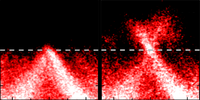
An ultrafast photoemission experiment characterizes the processes by which photoexcited electrons in graphite return to thermal equilibrium.
[Phys. Rev. Lett. 121, 256401] Published Wed Dec 19, 2018
16 Dec 10:29
by Riccardo Pisoni, Andor Kormányos, Matthew Brooks, Zijin Lei, Patrick Back, Marius Eich, Hiske Overweg, Yongjin Lee, Peter Rickhaus, Kenji Watanabe, Takashi Taniguchi, Atac Imamoglu, Guido Burkard, Thomas Ihn, and Klaus Ensslin
Author(s): Riccardo Pisoni, Andor Kormányos, Matthew Brooks, Zijin Lei, Patrick Back, Marius Eich, Hiske Overweg, Yongjin Lee, Peter Rickhaus, Kenji Watanabe, Takashi Taniguchi, Atac Imamoglu, Guido Burkard, Thomas Ihn, and Klaus Ensslin
The strong spin-orbit coupling and the broken inversion symmetry in monolayer transition metal dichalcogenides results in spin-valley coupled band structures. Such a band structure leads to novel applications in the fields of electronics and optoelectronics. Density functional theory calculations as...
[Phys. Rev. Lett. 121, 247701] Published Thu Dec 13, 2018

