21 Nov 07:16
by Alice B. Chang, Tzu-Pin Lin, Niklas B. Thompson, Shao-Xiong Luo, Allegra L. Liberman-Martin, Hsiang-Yun Chen, Byeongdu Lee and Robert H. Grubbs

Journal of the American Chemical Society
DOI: 10.1021/jacs.7b10525

21 Nov 07:12
by Sibo Wang, Bu Yuan Guan, Yan Lu and Xiong Wen “David” Lou

Journal of the American Chemical Society
DOI: 10.1021/jacs.7b10733

21 Nov 07:09
by Kateřina Holá, Mária Sudolská, Sergii Kalytchuk, Dana Nachtigallová, Andrey L. Rogach, Michal Otyepka and Radek Zbořil

ACS Nano
DOI: 10.1021/acsnano.7b06399

21 Nov 07:09
by Guofeng Liu, Xin Li, Jianhui Sheng, Pei-Zhou Li, Wee Kong Ong, Soo Zeng Fiona Phua, Hans Ågren, Liangliang Zhu and Yanli Zhao

ACS Nano
DOI: 10.1021/acsnano.7b06097

15 Nov 13:19
RSC Adv., 2017, 7,52719-52728
DOI: 10.1039/C7RA08812D, Paper

Open Access
Yifei Wang, Xiuming Wei, Ruochu Zhang, Yingfeng Wu, Muhammad Usman Farid, Haiou Huang
Recovering the adsorption capacity of multi-walled carbon nanotubes (MWCNT) is of importance to the sustainable use of MWCNT for the adsorption of pharmaceuticals and personal care products (PPCP).
The content of this RSS Feed (c) The Royal Society of Chemistry

15 Nov 13:15
Chem. Commun., 2017, 53,13205-13208
DOI: 10.1039/C7CC07961C, Communication
Michael D. Lee, Matthew L. Dennis, Bim Graham, James D. Swarbrick
A new pair of enantiomeric two-armed lanthanide-binding tags have been developed for paramagnetic NMR studies of proteins.
The content of this RSS Feed (c) The Royal Society of Chemistry

15 Nov 13:13
by Saeed Amirjalayer, Alberto Martinez-Cuezva, Jose Berná, Sander Woutersen, Wybren Jan Buma
Abstract
Well-defined structural changes of molecular units that can be triggered by light are crucial for the development of photoactive functional materials. Herein, we report on a novel switch that has azodicarboxamide as its photo-triggerable element. Time-resolved UV-pump/IR probe spectroscopy in combination with quantum-chemical calculations shows that the azodicarboxamide functionality, in contrast to other azo-based chromophores, does not undergo trans–cis photoisomerization. Instead, a photoinduced pedalo-type motion occurs, which because of its volume-conserving properties enables the design of functional molecular systems with controllable motion in a confined space.

Motion without volume change: By combining time-resolved infrared spectroscopy with quantum-mechanical calculations, a volume-conserving pedalo-type motion was studied in a molecular switch. These azodicaboxamide-based systems have the potential to open a new realm in the achievement of motion in a confined space.
05 Oct 12:33
Chem. Commun., 2017, 53,11933-11936
DOI: 10.1039/C7CC04855F, Communication
Susanne Loffler, Axel Wuttke, Bo Zhang, Julian J. Holstein, Ricardo A. Mata, Guido H. Clever
Encapsulation of neutral guest molecules inside a self-assembled coordination cage was systematically studied using NMR and MS experiments. Electronic structure calculations reveal substantial contributions of dispersive interactions to binding.
The content of this RSS Feed (c) The Royal Society of Chemistry

27 Sep 12:46
Chem. Commun., 2017, 53,10874-10877
DOI: 10.1039/C7CC06598A, Communication
B. Riss-Yaw, C. Clavel, Ph. Laurent, F. Coutrot
Slippage is correlated with the degree of freedom of the molecular thread to be encircled. The straighter the thread, the faster is the slippage.
The content of this RSS Feed (c) The Royal Society of Chemistry

04 Sep 17:32
by Ewa Rudzińska-Szostak, Łukasz Berlicki
Abstract
Peptide foldamers have been studied for over two decades and numerous sequence patterns have been shown to form well-defined three-dimensional arrangements in solution. In particular, helices of various geometries have been described. In this article, different concepts concerning the construction of helical foldameric peptides, for which the possibility of governing the sense of the formed helix was evidenced, are presented and discussed.

Left or right? The construction of helical peptide foldamers with the appropriate handedness is possible using either achiral peptides with an element inducing chirality or sequences composed from fragments of alternating chirality.
11 Aug 09:33
Chem. Commun., 2017, 53,9709-9712
DOI: 10.1039/C7CC05235A, Communication
Debabrata Samanta, Indrajit Paul, Michael Schmittel
A five-component self-sorted metallo-supramolecular nano-oscillator was designed based on the full orthogonality of three different dynamic complexation motifs.
The content of this RSS Feed (c) The Royal Society of Chemistry

31 Jul 08:06
by Thi Minh Nguyet Trinh, Iwona Nierengarten, Haifa Ben Aziza, Eric Meichsner, Michel Holler, Matthieu Chessé, Rym Abidi, Christian Bijani, Yannick Coppel, Emmanuel Maisonhaute, Béatrice Delavaux-Nicot, Jean-François Nierengarten

Multiporphyrin arrays constructed on a pillar[5]arene scaffold adopt a folded conformation owing to an intramolecular complexation of the peripheral ZnII-porphyrin moieties by 1,2,3-triazole subunits. External stimuli can break the intramolecular coordination at the origin of the folding and the resulting molecular motions mimic the blooming of a flower. An animated version of this Cover Picture is available in the Supporting Information. More information can be found in the Full Paper by E. Maisonhaute, B. Delavaux-Nicot and J.-F. Nierengarten et al. (DOI: 10.1002/chem.201701622).
25 Jul 13:00
by Yongtai Zheng
Flexible interlocked porous frameworks allow quantitative photoisomerization in a crystalline solid
Nature Communications, Published online: 24 July 2017; doi:10.1038/s41467-017-00122-5
Organizing photochromic molecules into 3D networks is a key strategy to access photoresponsive materials, but framework rigidity typically limits conversion efficiency. Here, the authors exploit a flexible metal-organic framework to achieve quantitative and reversible photoisomerization in a porous crystalline solid.

zhaoyu and -1 others like this
21 Jul 14:51
Chem. Commun., 2017, 53,8842-8845
DOI: 10.1039/C7CC04081D, Communication
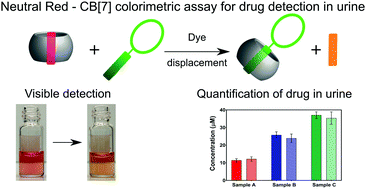
Silvia Sonzini, Jade A. McCune, Peter Ravn, Oren A. Scherman, Christopher F. van der Walle
A supramolecular colorimetric assay utilising the macrocyclic host cucurbit[7]uril with a commercial dye molecule, neutral red, was evaluated as a novel method for drug detection in urine of a model therapeutic peptide drug Octreotide.
The content of this RSS Feed (c) The Royal Society of Chemistry

20 Jul 13:19
Chem. Commun., 2017, 53,9296-9299
DOI: 10.1039/C7CC04594H, Communication
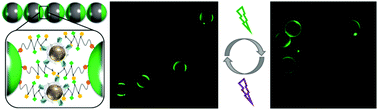
Sven Sagebiel, Lucas Stricker, Sabrina Engel, Bart Jan Ravoo
Janus particles with polymer caps self-assemble into dual responsive particle chains that can be manipulated with light and a magnetic field.
The content of this RSS Feed (c) The Royal Society of Chemistry

19 Jul 08:23
by Hui-Qing Peng, Xiaoyan Zheng, Ting Han, Ryan T. K. Kwok, Jacky W. Y. Lam, Xuhui Huang and Ben Zhong Tang

Journal of the American Chemical Society
DOI: 10.1021/jacs.7b05792

18 Jul 15:35
by Emilio M. Pérez
Abstract
In the last five years, we have developed synthetic methods towards encapsulation of single-walled carbon nanotubes (SWNTs) into organic macrocycles, to form rotaxane-type molecules. These are the first examples of mechanically interlocked SWNT derivatives (MINTs). In this article, the motivation to continue developing the chemistry of SWNTs at a time well past their hype is discussed and our synthetic strategy and characterization methodology is explained in detail, stressing the general aspects. In particular, special emphasis is placed on the importance of adequate control experiments and bulk spectroscopic and analytical data to determine the structure of SWNT derivatives, as opposed to relying only (or mostly) on microscopy. Also our experimental results are used as pretext to reflect on more general/conceptual issues pertaining to the chemistry of SWNTs and mechanically interlocked molecules.

If you liked'em then you should've put a ring on them! In this Concept paper it is discussed why it is interesting to make rotaxane-type derivatives of single-walled carbon nanotubes (SWNTs), how to do it, and what they might be useful for.
13 Jul 14:45
by Liang Zhao, Huy Q. Ta, Arezoo Dianat, Akash Soni, Artem Fediai, Wanjian Yin, Thomas Gemming, Barbara Trzebicka, Gianaurelio Cuniberti, Zhongfan Liu, Alicja Bachmatiuk and Mark H. Rummeli

Nano Letters
DOI: 10.1021/acs.nanolett.7b01406

13 Jul 14:17
by Deborah Fass and Colin Thorpe

Chemical Reviews
DOI: 10.1021/acs.chemrev.7b00123

11 Jul 13:58
by Joaquin Calbo, Alejandro López-Moreno, Alberto de Juan, Jeffrey Comer, Enrique Ortí, Emilio Manuel Pérez
Abstract
We combine experimental methods, density functional theory (DFT) calculations, and molecular dynamics (MD) simulations in the quantitative analysis of noncovalent interactions between (6,5)-enriched single-walled carbon nanotubes (SWNTs), as hosts, and a set of pyrene derivatives with different electronic properties and surface areas, as guests. The experiments and calculations were carried out in two solvents with markedly different polarities, namely 1,1′,2,2′-tetrachloroethane (TCE) and N,N-dimethylformamide (DMF). Our results show that dispersion forces govern the supramolecular association of small molecules with (6,5)-SWNTs, with negligible contributions from ground-state charge-transfer effects. In the nonpolar solvent (TCE), the binding constants are highly correlated with the contact area between the SWNT and the guests. In the polar solvent (DMF), the binding constants show a complex dependence on the chemical nature of the pyrene substituents, as demonstrated by MD simulations with the explicit inclusion of solvent molecules. The solvation of the small molecules is shown to play a leading role in the binding process. Remarkably, the binding constants obtained from the MD simulations for the five guest molecules correlate with those derived from experiment. Furthermore, the MD simulations also reveal the structure of the adsorbed guest from low to high SWNT surface coverage.

Discrete interactions: A quantitative multidisciplinary approach to understanding noncovalent interactions between pyrene molecules and single-walled carbon nanotubes involving experimental analyses, DFT, and molecular dynamics calculations is presented (see figure). The results suggest that the pyrene guests interact through π–π forces with additional discrete contacts promoted by the substituents at the periphery of the pyrene core.
11 Jul 13:45
Chem. Commun., 2017, 53,8683-8686
DOI: 10.1039/C7CC05008A, Communication
Zhan-Qi Cao, Yi-Chuan Wang, Ai-Hua Zou, Gabor London, Qi Zhang, Chuan Gao, Da-Hui Qu
A supra-amphiphilic [2]rotaxane-based switch could self-assemble into spherical vesicles in aqueous solution and transform into worm-like micelles in a basic environment.
The content of this RSS Feed (c) The Royal Society of Chemistry

11 Jul 13:36
Chem. Sci., 2017, 8,6123-6130
DOI: 10.1039/C7SC02037F, Edge Article
Open Access
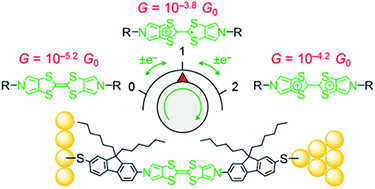
Luke J. O'Driscoll, Joseph M. Hamill, Iain Grace, Bodil W. Nielsen, Eman Almutib, Yongchun Fu, Wenjing Hong, Colin J. Lambert, Jan O. Jeppesen
The single molecule conductance of a conjugated molecular wire is electrochemically switched upon oxidising or reducing a central bispyrrolotetrathiafulvalene unit.
The content of this RSS Feed (c) The Royal Society of Chemistry

11 Jul 13:30
Chem. Sci., 2017, 8,6300-6306
DOI: 10.1039/C7SC02694C, Edge Article
Open Access
Hendrik V. Schroder, Sebastian Sobottka, Maite No[German sz ligature}ler, Henrik Hupatz, Marius Gaedke, Biprajit Sarkar, Christoph A. Schalley
Switchable crown ether-ammonium [2]rotaxanes with a redox-active tetrathiafulvalene (TTF) unit implemented in their wheels were synthesised and fully characterised.
The content of this RSS Feed (c) The Royal Society of Chemistry

16 Jun 08:38
Chem. Commun., 2017, 53,7505-7508
DOI: 10.1039/C7CC04363E, Communication
Yuxiang Wang, Xiaojing Li, Fei Li, Wei-Yin Sun, Chengjian Zhu, Yixiang Cheng
Chiral supramolecular assemblies (BNS-BPP) can exhibit circularly polarized luminescence (CPL) via electrostatic and [small pi]-[small pi] stacking interactions.
The content of this RSS Feed (c) The Royal Society of Chemistry

06 Jun 13:37
by Sheng-Hsien Chiu, Yong-Jay Lee, Kuang-Shun Liu, Chien-Chen Lai, Yi-Hung Liu, Shie-Ming Peng, Richard Cheng
Abstract
We have prepared [2]rotaxanes, the behavior of which as switchable catalysts depends on their pirouetting motion, which can be controlled through the addition and removal of Na+ ions. At least three sequential on/off cycles of a Michael reaction can be performed in situ when using the NaTFPB/[2.2.2]cryptand reagent pair to switch “on” and “off” the catalytic ability of the [2]rotaxanes.

Two-way street: The catalytic activity of the [2]rotaxane catalysts can be switched between “on” and “off” states over at least three different cycles through in situ addition and removal of Na+ ions.
06 Jun 13:25
by Qiang Shi and Chuan-Feng Chen

Organic Letters
DOI: 10.1021/acs.orglett.7b01296

31 May 16:34
Chem. Sci., 2017, 8,5166-5171
DOI: 10.1039/C7SC01342F, Edge Article
Open Access
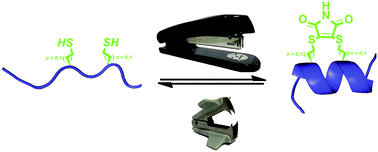
Claire M. Grison, George M. Burslem, Jennifer A. Miles, Ludwig K. A. Pilsl, David J. Yeo, Zeynab Imani, Stuart L. Warriner, Michael E. Webb, Andrew J. Wilson
A versatile, rapid and reversible approach to constrain peptides in a bioactive helical conformation and bearing a functional handle for inhibition of protein-protein interactions is described.
The content of this RSS Feed (c) The Royal Society of Chemistry

29 May 08:35
Nanoscale, 2017, 9,6783-6790
DOI: 10.1039/C7NR01301A, Paper
T. Hasell, M. A. Little, S. Y. Chong, M. Schmidtmann, M. E. Briggs, V. Santolini, K. E. Jelfs, A. I. Cooper
An investigation of the effect of the chirality of porous organic cages on their crystal packing, co-crystallisation, and sorption behaviour.
The content of this RSS Feed (c) The Royal Society of Chemistry

29 May 08:17
Chem. Commun., 2017, 53,6674-6684
DOI: 10.1039/C7CC02879B, Feature Article
Ivan Aprahamian
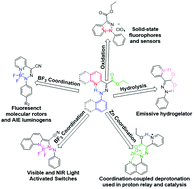
This feature article surveys the various ways by which a structurally simple hydrazone can be used in accessing different functional materials, mainly photo/chemically activated switches, fluorophores and sensors.
The content of this RSS Feed (c) The Royal Society of Chemistry

24 May 10:49
by Wen-Yuan Pei, Guohai Xu, Jin Yang, Hui Wu, Banglin Chen, Wei Zhou and Jian-Fang Ma

Journal of the American Chemical Society
DOI: 10.1021/jacs.7b03169

   This article is licensed under a Creative Commons Attribution 3.0 Unported Licence.


   This article is licensed under a Creative Commons Attribution-NonCommercial 3.0 Unported Licence.