03 May 15:01
Chem. Commun., 2018, 54,2487-2490
DOI: 10.1039/C8CC00351C, Communication
Takuro Hosomi, Ryosuke Harada, Hiroshi Masai, Tetsuaki Fujihara, Yasushi Tsuji, Jun Terao
We describe herein the synthesis of a Ni(II) bis(dithiobenzoate)-type complex three-dimensionally insulated by a [1]rotaxane structure to reveal the importance of the insulation.
The content of this RSS Feed (c) The Royal Society of Chemistry

23 Apr 08:19
by Xiao‐Qing
Guo
,
Dr.
Li‐Peng
Zhou
,
Dr.
Li‐Xuan
Cai
,
Prof. Dr.
Qing‐Fu
Sun
Chemistry – A European Journal, EarlyView.
19 Apr 08:40
by Kazuto Takaishi, Makoto Yasui, Tadashi Ema

Journal of the American Chemical Society
DOI: 10.1021/jacs.8b01860

17 Apr 08:49
Chem. Commun., 2018, 54,5164-5176
DOI: 10.1039/C8CC01153B, Feature Article
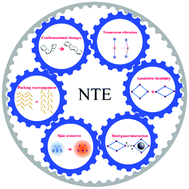
Zhanning Liu, Qilong Gao, Jun Chen, Jinxia Deng, Kun Lin, Xianran Xing
Some mechanisms resulting in negative thermal expansion in molecular materials are summarized.
The content of this RSS Feed (c) The Royal Society of Chemistry

17 Apr 08:45
Chem. Commun., 2018, 54,4529-4532
DOI: 10.1039/C8CC00738A, Communication

Open Access
Ilenia Manuguerra, Stefano Croce, Afaf H. El-Sagheer, Abhichart Krissanaprasit, Tom Brown, Kurt V. Gothelf, Antonio Manetto
A gene was obtained from 14 oligonucleotides self-assembled and chemically ligated in a DNA nanostructure.
The content of this RSS Feed (c) The Royal Society of Chemistry

16 Apr 10:53
Chem. Commun., 2018, 54,4621-4624
DOI: 10.1039/C8CC01603H, Communication
Shasha Lu, Shuang Wang, Jiahui Zhao, Jian Sun, Xiurong Yang
Fluorescence monitoring using a pH-controlled reversible bidirectionally pure DNA hydrogel is reported.
The content of this RSS Feed (c) The Royal Society of Chemistry

16 Apr 10:52
Chem. Commun., 2018, 54,6828-6831
DOI: 10.1039/C8CC01594E, Communication
Masanori Hosoyamada, Nobuhiro Yanai, Keisuke Okumura, Takayuki Uchihashi, Nobuo Kimizuka
Photon upconverting coordination nanofibers are constructed by extracting the structural motifs of metal-organic frameworks (MOFs).
The content of this RSS Feed (c) The Royal Society of Chemistry

16 Apr 10:52
J. Mater. Chem. A, 2018, 6,6710-6753
DOI: 10.1039/C7TA11274B, Review Article
J. Otsuki
Self-assembling porphyrins and chlorophylls, either natural or artificial, harvest light to effect energy conversion reactions.
The content of this RSS Feed (c) The Royal Society of Chemistry
10 Apr 13:57
Angewandte Chemie International Edition, EarlyView.
10 Apr 09:38
by Hang Yin, Qiaoxian Huang, Wenwen Zhao, David Bardelang, Didier Siri, Xiuping Chen, Simon M. Y. Lee, Ruibing Wang

The Journal of Organic Chemistry
DOI: 10.1021/acs.joc.8b00543

08 Apr 20:56
J. Mater. Chem. A, 2018, 6,8068-8077
DOI: 10.1039/C8TA00993G, Paper
Liu Lin, Zemin Sun, Mengwei Yuan, Jinlu He, Run Long, Huifeng Li, Caiyun Nan, Genban Sun, Shulan Ma
Hierarchically structured Pt micro-pine dendrites were prepared via a one-step solvothermal method, which exhibited excellent catalytic activity and significantly enhanced stability in comparison with the commercial Pt/C.
The content of this RSS Feed (c) The Royal Society of Chemistry
02 Apr 22:10
by James E. M. Lewis, Florian Modicom, Stephen M. Goldup

Journal of the American Chemical Society
DOI: 10.1021/jacs.8b01602

02 Apr 22:08
by Ayrat M. Dimiev, Artur Khannanov, Iskander Vakhitov, Airat Kiiamov, Ksenia Shukhina, James M. Tour

ACS Nano
DOI: 10.1021/acsnano.8b01617

26 Mar 08:16
Chem. Sci., 2018, 9,4104-4108
DOI: 10.1039/C8SC01062E, Edge Article
Open Access
Shumpei Kai, Tatsuo Kojima, Flora[space]L. Thorp-Greenwood, Michaele J. Hardie, Shuichi Hiraoka
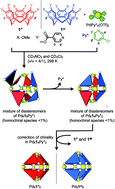
The chiral self-sorting in the formation of homochiral Pd6L8 capsules consisting of cyclotriveratrylene (CTV)-based chiral tritopic ligands and Pd(II) ions takes place through the initial formation of heterochiral Pd6L8X2 (X indicates a leaving ligand) immature capsules (ICs) followed by the correction of chirality in the ICs assisted by the free tritopic ligands to lead to the homochiral capsules.
The content of this RSS Feed (c) The Royal Society of Chemistry

16 Jan 17:02
by Sandra Díaz-Cabrera, Yeray Dorca, Joaquín Calbo, Juan Aragó, Rafael Gómez, Enrique Ortí, Luis - Sanchez
Abstract
A detailed investigation of the hierarchy of asymmetry operating in the self-assembly of achiral (1) and chiral ((S)-2 and (R)-3) 1,3,5-triphenylbenzenetricarboxamides (TPBAs) is reported. The aggregation of these TPBAs is conditioned by the point chirality at the peripheral side chains for (S)-2 and (R)-3. An efficient helix-to-helix interaction that goes further in the organization of fibrillar bundles is experimentally detected and theoretically supported only for the achiral TPBA 1. The effective interdigitation of the achiral aliphatic side chains produces a social self-sorting to form preferentially heterochiral macromolecular aggregates.

The self-assembly of 1,3,5-triphenylbenzenetricarboxamides (TPBAs) is reported. The helical outcome is conditioned by the point chirality with an efficient helix-to-helix interaction that goes further in the organization of fibrillar bundles. The effective interdigitation of the achiral aliphatic side chains produces a social self-sorting to form preferentially heterochiral macromolecular aggregates.
10 Jan 09:06
Chem. Commun., 2018, 54,2224-2227
DOI: 10.1039/C7CC08729B, Communication
Yu-Xuan Wang, Qi-Feng Zhou, Li-Jun Chen, Lin Xu, Cui-Hong Wang, Xiaopeng Li, Hai-Bo Yang
We present the successful construction of a new family of organometallic rotaxane-terminated dendrimers using neutral platinum-acetylides as the main scaffold.
The content of this RSS Feed (c) The Royal Society of Chemistry

10 Jan 08:54
by Alejandro Cadranel, Volker Strauss, Johannes T. Margraf, Kim A. Winterfeld, Christoph Vogl, Luka Đorđević, Francesca Arcudi, Helen Hoelzel, Norbert Jux, Maurizio Prato and Dirk M. Guldi

Journal of the American Chemical Society
DOI: 10.1021/jacs.7b12434

10 Jan 08:49
by Jordan N. Smith, James M. Hook and Nigel T. Lucas

Journal of the American Chemical Society
DOI: 10.1021/jacs.7b12251

10 Jan 08:42
by Jifu Sun, Bin Hua, Qing Li, Jiong Zhou and Jie Yang

Organic Letters
DOI: 10.1021/acs.orglett.7b03612

05 Jan 11:55
by Cailing Ni, Daijun Zha, Hebo Ye, Yu Hai, Yuntao Zhou, Eric Anslyn, Lei You
Abstract
Axial chirality is a prevalent and important phenomenon in chemistry. Herein we report a combination of dynamic covalent chemistry and axial chirality for the development of a versatile platform for the binding and chirality sensing of multiple classes of mononucleophiles. An equilibrium between an open aldehyde and its cyclic hemiaminal within biphenyl derivatives enabled the dynamic incorporation of a broad range of alcohols, thiols, primary amines, and secondary amines with high efficiency. Selectivity toward different classes of nucleophiles was also achieved by regulating the distinct reactivity of the system with external stimuli. Through induced helicity as a result of central-to-axial chirality transfer, the handedness and ee values of chiral monoalcohol and monoamine analytes were reported by circular dichroism. The strategies introduced herein should find application in many contexts, including assembly, sensing, and labeling.

Talking sense: A convergence of the concepts of dynamic covalent chemistry and axial chirality enabled the reversible incorporation and chirality sensing of multiple classes of mononucleophiles (see picture). Selectivity toward different classes of nucleophiles could also be induced by regulating the distinct reactivity of the system with external stimuli.
05 Jan 11:54
by Wu, Q., Rauscher, P. M., Lang, X., Wojtecki, R. J., de Pablo, J. J., Hore, M. J. A., Rowan, S. J.
As the macromolecular version of mechanically interlocked molecules, mechanically interlocked polymers are promising candidates for the creation of sophisticated molecular machines and smart soft materials. Poly[n]catenanes, where the molecular chains consist solely of interlocked macrocycles, contain one of the highest concentrations of topological bonds. We report, herein, a synthetic approach toward this distinctive polymer architecture in high yield (~75%) via efficient ring closing of rationally designed metallosupramolecular polymers. Light-scattering, mass spectrometric, and nuclear magnetic resonance characterization of fractionated samples support assignment of the high–molar mass product (number-average molar mass ~21.4 kilograms per mole) to a mixture of linear poly[7–26]catenanes, branched poly[13–130]catenanes, and cyclic poly[4–7]catenanes. Increased hydrodynamic radius (in solution) and glass transition temperature (in bulk materials) were observed upon metallation with Zn2+.
05 Jan 11:54
by Qing He, Peiyu Tu, Jonathan L. Sessler
This review summarizes artificial receptors capable of recognizing multiple anionic species—namely anionic dimers, trimers, tetramers, and clusters—topics that are fundamentally important to biology, the environment, and material science.
05 Jan 11:50
Chem. Commun., 2018, 54,607-610
DOI: 10.1039/C7CC08839F, Communication
C. A. Gunawardana, M. Dakovic, C. B. Aakeroy
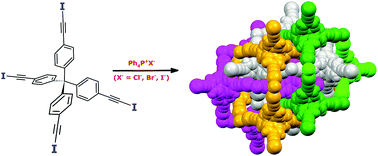
Halide ions and tetraiodoethynyl-featured tetraphenylmethane are successfully assembled into robust diamond-like networks in the presence of tetraphenylphosphonium cations.
The content of this RSS Feed (c) The Royal Society of Chemistry

05 Jan 11:48
Chem. Sci., 2018, 9,1273-1278
DOI: 10.1039/C7SC02479G, Edge Article
Open Access
Tyler C. Jenks, Matthew D. Bailey, Jessica[space]L. Hovey, Shanilke Fernando, Gihan Basnayake, Michael E. Cross, Wen Li, Matthew J. Allen
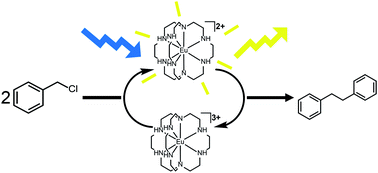
Divalent europium is used catalytically in visible-light-promoted photoredox bond-forming reactions.
The content of this RSS Feed (c) The Royal Society of Chemistry

04 Dec 22:08
by Eiichi Kayahara, Liansheng Sun, Hiroaki Onishi, Katsuaki Suzuki, Tatsuya Fukushima, Ayaka Sawada, Hironori Kaji and Shigeru Yamago

Journal of the American Chemical Society
DOI: 10.1021/jacs.7b11526

04 Dec 15:20
Chem. Sci., 2018, 9,15-21
DOI: 10.1039/C7SC04200K, Minireview
Open Access
Guillaume De Bo
Strong and stable under tension?
The content of this RSS Feed (c) The Royal Society of Chemistry

24 Nov 13:55
by Esther von Grotthuss, Alexandra John, Thomas Kaese, Matthias Wagner
Abstract
Boron has one valence electron less than a carbon atom and an available vacant pz orbital. The incorporation of sp2-hybridized boron atoms into the host lattice of a polycyclic aromatic hydrocarbon (PAH) is formally related to oxidative doping. A boron-containing B-PAH has an energetically low-lying LUMO and a narrow HOMO–LUMO gap, which renders it a strong Lewis acid/electron acceptor and promotes fluorescence in the visible range of the electromagnetic spectrum. Many methods have been developed to access B-PAHs that are deliberately designed for specific tasks. Herein, we highlight recent breakthroughs in the field of B-PAH synthesis and the scope of their applications, which range from Lewis acid and redox catalysis to device fabrication. We will also report on the dynamic covalent chemistry of neutral and anionic B-PAHs, as it is a potential limitation in the design of catalyst systems but can also provide a powerful synthetic tool for the preparation of otherwise inaccessible B-PAHs.

Delightful deficiency: Because of its vacant p orbital, an incorporated boron atom can imprint peculiar optoelectronic properties on polycyclic aromatic hydrocarbons (PAHs). Recently, synthetic strategies have been developed to provide access to B-PAHs that are specifically tailored to applications as catalysts for the activation of small molecules or as luminophores and charge carriers in optoelectronic devices.
21 Nov 14:17
by Ranjith K. Meka and Michael D. Heagy

The Journal of Organic Chemistry
DOI: 10.1021/acs.joc.7b01952

21 Nov 07:15
by Ryota Kashihara, Masakazu Morimoto, Syoji Ito, Hiroshi Miyasaka and Masahiro Irie

Journal of the American Chemical Society
DOI: 10.1021/jacs.7b10697

21 Nov 07:13
by Shuanglong Lu, Yiming Hu, Shun Wan, Ryan McCaffrey, Yinghua Jin, Hongwei Gu and Wei Zhang

Journal of the American Chemical Society
DOI: 10.1021/jacs.7b07918