Shared posts

09 Jan 02:05

Abolish ICE Before They Kill Again, Impeach Trump & Noem Before They Incite More Murder

by Mike Masnick

Renee Nicole Good was a 37-year-old award-winning poet, a mother of a six-year-old, and a wife who had recently moved to Minneapolis. That all ended yesterday when a masked ICE agent murdered her in broad daylight, shooting her multiple times at close range in the head. She had stuffed animal toys in the glove box of her SUV that rammed into another car after she’d been killed for no reason at all.

We have video of what happened. Multiple angles. The Trump administration is lying about every single detail anyway.

Donald Trump kicked off with a blatant lie, claiming that Good “viciously ran over the ICE officer.”

Known liar, DHS spokesperson Tricia McLaughlin, called Good a “violent rioter” who “weaponized her vehicle, attempting to run over our law enforcement officers in an attempt to kill them—an act of domestic terrorism.”

Kristi Noem made up a complete fantasy:

It was an act of domestic terrorism. What happened was, our ICE officers were out in enforcement action, they got stuck in the snow because of the adverse weather that is in Minneapolis, they were attempting to push out their vehicle, and a woman attacked them and those surrounding them and attempted to run them over and ram them with her vehicle.

Not a single one of them is telling the truth. They are flat out lying.

Here’s what actually happened. The folks at Bellingcat put together a top down view showing the murder, pieced together from multiple videos:

Using imagery online of the shooting by an ICE agent in Minneapolis, we’ve created an animated sequence which highlights the approximate positioning of officers and vehicles at the scene. The red dot represents the agent who fired the shots. Yellow dots are other agents who arrived at the scene.

Bellingcat (@bellingcat.com) 2026-01-07T22:32:56.273Z

This morning (after equivocating all day yesterday, as I’ll discuss below), the NY Times put out a video using multiple bystander videos, showing that the ICE agent (1) was not hit (2) was not in the path of the vehicle and (3) was absolutely fine afterwards (contradicting claims from the administration that he was run over and in the hospital). See it here:

From all the evidence, it’s clear that Good had stopped and when ICE agents started demanding she move, she started to pull around the ICE vehicle in front of her. She paused to let another vehicle drive by her. As that happened (for no apparent reason) the ICE agent who eventually murdered her walked around the right side of her car to the front. As he does that two other ICE agents approach the car, with one telling her to exit the car while another yells for her to move. She then proceeds to try to drive away from the ICE agents. The one who had stepped in front of her car steps aside and then just starts madly firing at her head.

He murdered her. And Trump and his cronies are lying about it with video evidence directly contradicting every word.

This isn’t the first time ICE has killed someone. This is actually the ninth such shooting by an ICE agent since September, every single one of which involved an ICE agent blatantly violating policy by firing into a vehicle. This is at least the second outright murder, as opposed to attempted murder.

While ICE conveniently took down its page describing this (got something to hide?), the official policy is that “firearms shall not be discharged solely to disable moving vehicles.” Also, “discharging a firearm from a moving vehicle is prohibited.” There are some limited exceptions, but they appear to apply solely to a case where the car is driving directly at an ICE agent.

ICE shouldn’t even be in Minneapolis. It shouldn’t be anywhere. It shouldn’t exist. Nor should it ever have existed, as many of us have warned for many, many years. When we first started writing about ICE over 15 years ago, it was already a lawless organization.

This murder of an American citizen on a quiet street—someone who was just there to observe and monitor ICE agents kidnapping people—exemplifies why ICE is fundamentally incompatible with a free society. We’re talking about a masked federal police force, operating in secret, with no apparent limits, no meaningful rules, and no consequences for violence. They’re engaging in lethal force against anyone—citizens and non-citizens alike—because they’ve been given implicit permission by the White House to do whatever they want. MAGA folks mock the Gestapo comparison, but what else do you call an unaccountable secret police force that operates with impunity, murders citizens in broad daylight, and then lies about it with the full backing of the state?

As Chris Geidner points out, it was just a month and a half ago that Judge Sara Ellis called out ICE’s (and CBP’s) lawless nonsense and how dangerous it was:

Further, as detailed in the Court’s factual findings, agents have used excessive force in response to protesters’ and journalists’ exercise of their First Amendment rights, without justification, often without warning, and even at those who had begun to comply with agents’ orders…. While the Court acknowledges that some unruly individuals have been present during these gatherings, their presence among “peaceful protestors, journalists and legal observers does not give Defendants a blank check to employ unrestricted use of crowd control weapons,” and, in many of the instances in which agents deployed less lethal munitions, they did not direct the force anywhere near such bad actors…. Agents’ “use of indiscriminate weapons against all protesters—not just the violent ones—supports the inference that federal agents were substantially motivated by Plaintiffs’ protected First Amendment activity.”

Judge Ellis also called out DHS’s systematic lying—the same pattern we’re seeing now:

While Defendants may argue that the Court identifies only minor inconsistencies, every minor inconsistency adds up, and at some point, it becomes difficult, if not impossible, to believe almost anything that Defendants represent

And yes, they will lie in the face of directly contradictory video evidence. Judge Ellis again:

Presumably, these portions of the videos would be Defendants’ best evidence to demonstrate that agents acted in line with the Constitution, federal laws, and the agencies’ own policies on use of force when engaging with protesters, the press, and religious practitioners. But a review of them shows the opposite—supporting Plaintiffs’ claims and undermining all of Defendants’ claims that their actions toward protesters, the press, and religious practitioners have been, as Bovino has stated, “more than exemplary.”

A federal judge warned us six weeks ago that DHS and ICE would likely kill people and lie about it even when video proved them wrong. Yesterday proved her right. Again.

I had a few other stories I planned to write up on Wednesday, not to mention taking care of some other work, and I spent most of the day just unable to do anything, feeling sick to my stomach.

Yes, this happens in America (and elsewhere), but it shouldn’t. This is fucked up.

As 404 Media points out, this has become the standard course of action by the Trump admin these days.

This is a pattern. Some event happens as part of the Trump administration’s mass deportation campaign, DHS rushes out a misleading, wrong, or incendiary statement that does not reflect reality, and it becomes another piece of ammo for the X.com grifters, right wing media ecosystem, or people who just love the idea of others being hurt.

And, again, why the fuck is ICE even in Minneapolis anyway? Because a small-time MAGA grifter YouTuber made a misleading video a few weeks ago claiming day care centers in Minneapolis were running a scam. His “evidence”? The day cares had locked doors and wouldn’t let him in with his cameras—which is what day cares do when random people show up demanding entry.

Noem is claiming that ICE had to be in Minneapolis based on her lies that the city is “dangerous” and full of “criminals” who don’t belong there. But as multiple people have pointed out there has been only one murder in Minneapolis in 2026.

It was the one committed by this ICE agent yesterday.

The Trump MAGA DHS position is that if you don’t immediately submit in every possible way, they will frame you as a “threat” who they can kill with impunity. Defector’s summary is exactly right:

Now that the Trump administration has shown it will immediately make up a flagrant lie in an attempt to justify the summary execution of a U.S. citizen, on video, in broad daylight—and will outright valorize the ICE agent who drew his pistol and killed a civilian for the crime of moving her vehicle a few feet—the message is clear, to ICE agents and everyone else: Nothing constrains these agents except whatever inhibits any individual one of them, personally, from brutalizing and murdering any person who disobeys them….

In the eyes of the state and its agents, all of the rest of us are walking around with a standing presumption, not just of guilt, but of murderous intent. Anything but total and immediate submission is domestic terrorism. It’s punishable by whatever the masked and unidentified government agent pointing a gun at your face decides to dish out.

And, of course, the compliant media is playing its part. Both the NY Times and the Washington Post initially embraced the view-from-nowhere approach of claiming the events around the shooting are “disputed.”

Come the fuck on. Five hours later and the headline is still about a disputed shooting. Just a basic lack of courage to acknowledge the obvious.

Don Moynihan (@donmoyn.bsky.social) 2026-01-08T01:35:33.447Z

The old journalism joke is that if one person tells you it’s sunny outside and the other says it’s raining, you don’t report that the weather is disputed. You go the fuck outside and check. We have the video here. Multiple angles. It shows exactly what happened. But the Times and Post were treating the administration’s obvious lies as equally valid to the documented evidence because… why? Because acknowledging that a federal agency will murder a citizen and then lie about it in the face of video evidence is too uncomfortable? This isn’t neutral journalism—it’s active complicity in state violence. When the media treats documented murder and transparent lies as a “dispute,” they’re telling every ICE agent that there will be no accountability, no matter how clear the evidence.

Yes, eventually, this morning, both the NY Times and the Washington Post published more thorough investigations, showing that the administration is lying. But they let the “dispute” stand for 24 hours, allowing the administration to set the narrative that will live on. And even now they’re using equivocal language. The Post’s story talks about how the video evidence “raises questions about” what the admin is saying, rather than just coming out and saying that they’re LYING.

And I won’t get into how state media like Fox News is reporting on this: focusing on whatever it could dig up about Good to mock her, as if anything in her personal life or views somehow justifies her being murdered. Or all the GOP elected officials going on TV trying to pretend that she might have deserved to have been murdered in the street.

Yes, I know that in these tribal times so many people are playing the team sports thing of just immediately defending their cult leader. Going on X and looking around, you see just an overwhelming flood of absolute bullshit from MAGA folks cracking jokes (remember when they wanted people fired for joking about Charlie Kirk’s murder?) and trying to spin the story, knowing full well it’s all bullshit.

But some are seeing through it. A neighbor near where the murder happened, who identified himself as “right leaning,” admitted that the situation shook him, as “this is not how we’re supposed to be doing things in America.”

Really worth watching this interview with a bystander who witnessed the ICE shooting in Minneapolis: "I'm pretty right-leaning. But seeing this, this is not how we're supposed to be doing things in America.”

Matt McDermott (@mattmfm.bsky.social) 2026-01-07T22:56:25.169Z

He’s right. And it is beyond disgusting that so many powerful forces in our government and the media are trying to twist and manipulate the story to justify an out of control ICE.

The only appropriate response here is to shut down ICE. Shut down DHS. Yes, there are important and necessary roles in DHS, but they existed without DHS before it was formed two decades ago, and we can redistribute those roles elsewhere in the federal government. But we don’t need ICE. We don’t need a secret federal police that goes around in masks kidnapping and murdering people.

It’s about as un-American as you can imagine.

This murder has at least appeared to wake some politicians from their slumber. We’ve seen multiple Democratic politicians, especially in Minnesota, speak out as forcefully as I’ve seen politicians speak out in years, telling ICE to get the fuck out of Minneapolis and calling out the administration’s lies directly. That matters. When officials with actual power are willing to name the truth—that ICE murdered a citizen and the administration is lying about it—it creates space for others to do the same.

But also thousands came out to memorialize Renee Nicole Good, in the freezing cold in a Minneapolis January. Hundreds turned up at a training session for legal observers, even as hundreds more are already patrolling Minneapolis, observing ICE’s illegal actions, and doing so knowing that ICE and DHS won’t hesitate to shoot them dead.

That’s what a movement looks like when institutions fail. Not waiting for someone to save us, but showing up in the freezing cold to say: you will not do this in our name. You will not kill our neighbors without witness. You will not lie about it unchallenged.

I’m going to leave this post up for a while before we post anything else. This matters more than the usual tech policy stories right now.

There are plenty of things going on that are infuriating. Ever day this administration finds new ways to spit on the Constitution. We’re still dealing with the illegal invasion of Venezuela, and apparent plans to attack multiple other nations around the Western Hemisphere.

But Renee Nicole Good’s murder cuts through all of that noise. A masked federal agent murdered an American citizen in broad daylight for no reason at all. The administration lied about it with video evidence directly contradicting every word. The media called it “disputed.” And thousands of people said no.

The institutional guardrails have failed. The courts warned us this would happen and it happened anyway. The media won’t hold power accountable. So the work falls to us—to show up, to document, to refuse to accept the lies, to make the cost of this violence too high to sustain.

ICE must be abolished. This cannot stand. And anyone who makes excuses for what happened yesterday has chosen a side, and it’s not the side of America or freedom or anything resembling justice.

Renee Nicole Good was a poet, a mother, and a citizen murdered by her own government for the crime of existing near an ICE agent having a bad day. Remember her name. Remember what they did. And remember that they lied about it even with the cameras rolling.

09 Jan 01:58

Pizza declines in the U.S.

by Nathan Yau

With more choices for a quick bite, the market share for pizza in the United States has taken a hit over the past few years. Heather Haddon for the Wall Street Journal:

Americans still eat a lot of pizza. Pizza chains generated around $31 billion in sales from their restaurants in 2024, the market-research firm Technomic said. On any given day, around one in 10 Americans will partake of a slice, according to the Agriculture Department. Young people drive much of the consumption.

Pizza’s dominance in American restaurant fare is declining, however. Among different cuisines, it ranked sixth in terms of U.S. sales in 2024 among restaurant chains, down from second place during the 1990s, Technomic said.

Remember when the only delivery option was pizza?

Tags: pizza, Wall Street Journal

08 Jan 14:45

Could This State Senate Runoff Be a Tipping Point for Tarrant County?

by Tyler Hicks

Even some of his most passionate supporters were surprised by the number of votes Democrat Taylor Rehmet received in the November special election for Texas Senate District 9. 

His competitors, Republicans Leigh Wambsganss and John Huffman, each had mountains of cash and the backing of major PACs and political players across Texas. Even so, Rehmet, an Air Force Veteran and president of the state’s International Association of Machinists and Aerospace Workers chapter, won nearly 48 percent of the vote—nearly enough for an outright win.

The Tarrant County seat, which covers the suburbs of Keller, North Richland Hills, and Southlake, plus part of Fort Worth, was left open by longtime Republican state Senator Kelly Hancock, who resigned earlier this year to become the acting state comptroller. Last year, President Trump won that same district by 17 points. 

“That is not something you might’ve seen as recently as two cycles ago,” said Jason Villalba, a former North Texas Republican legislator who now runs a think tank focused on Latino voters, citing the area’s growing diversity. Backlash to the right-wing Republican candidates was another reason, experts say. 

Now, the January 31 runoff pits Rehmet against Wambsganss, a conservative activist and executive with Patriot Mobile, the Christian nationalist cell phone carrier in North Texas. It’s a race that encapsulates the most turbulent political storylines in Tarrant County, statewide and nationally. The special election in a solid-red district is the sort of off-cycle contest that, in the Trump era, serves as a bellwether for the national political climate. That’s especially so in this district, smack dab in the largest battleground county in Texas. 

“As Tarrant County goes, so goes Texas,” former Trump consigliere Steve Bannon, who is stumping for Wambsganss, recently said on his podcast. “And as Texas goes, so goes the world.”

EJ Carrion, a progressive activist based in Fort Worth, was chilled by those words from the one-time Trump strategist. He was also motivated. “If Tarrant County is the battleground for a democracy, then Fort Worth is the front lines,” he said. 

It would be difficult to find a more far-right candidate than Wambsganss, who was an architect of the Southlake ISD school board takeover. (Wambsganss’ campaign did not respond to the Texas Observer’s questions for this story.)  

In 2020, she co-founded Southlake Families PAC, which funded school board candidates who killed the school district’s anti-racism plans. Patriot Mobile, where Wambsganss works as chief communications officer, has a PAC that also bankrolled right-wing school board candidates in Southlake, Grapevine, Keller, and Mansfield. 

Wambsganss’ politics are part of an increasingly powerful hardline faction in Tarrant County Republican politics, which has long been a hotbed for right-wingers. In the November election, she bested Southlake Mayor John Huffman, who had backing from more establishment elements of the state GOP as well as with big-money casino interests. The True Texas Project, whose endorsement Wambsganss lists on her website, is an influential Tarrant County-based organization that once claimed there is a “war on white America.”

Brian Mayes, a local Republican strategist, said Wambsganss’ failure to best Rehmet and secure the 50 percent necessary to avoid a runoff shows that people, including some GOP voters, are fed up with the school board controversies that have dominated North Texas politics in recent years. Candidates backed by Patriot Mobile’s PAC suffered big losses in the May 2025 elections, Mayes pointed out.  

“I think their policies were so extreme, they caused so much trouble on the school board, that in just a short time period, voters were like, ‘Okay, yeah, we’ve seen enough. We’re done,’” Mayes said. 

Rehmet agrees that he couldn’t have done as well as he did in the November race without some Republican voters casting ballots for him. In an interview with the Observer, Rehmet said that his opponent’s background creates a stark contrast in the runoff. “This is about values. If you look at me and you look at my opponent, we have totally different values. It’s about who’s going to answer to donors and who’s going to answer to the people.”

Still, Rehmet heads into the runoff at a significant monetary disadvantage, according to the last campaign finance reports from November. He raised $160,000—with his largest contribution coming from the Machinist union’s PAC at $15,000—and ended with less than $47,000. 

As of that same date, Wambsganss had spent over $1.3 million and received a total of $2.2 million. (The next campaign reports are not due until a week before the special election.)

Her top donor is Texans United for a Conservative Majority, which is financed by far-right megadonors Tim Dunn and Farris Wilks and provided over $400,000 to her campaign. She also received more than $350,000 from a PAC funded in part by Lieutenant Governor Dan Patrick and another $300,000 from the Texans for Lawsuit Reform PAC.

Mayes, the Republican strategist, said he expects even more money to pour into both sides of the race during the runoff—especially in its final weeks. “I think their plan is to not change any policy positions and to just double down on the spending,” Mayes said of the Wambsganss camp. With their spending, he added, the goal will be “to overwhelm the Democrat opponent with door knockers, texting, phone calls, the usual stuff you need to do in a runoff. … And I think she’ll go even more negative.”

Meanwhile, Alexander Montalvo, a longtime grassroots organizer in Tarrant County, says “people power”—local organizing and get-out-the-vote messaging, for instance—was the key to Rehmet’s first success. It’s the key to the runoff, too. 

“The most powerful thing that we will ever have is people,” he said. “I mean, our vote is powerful. Our dollars are powerful. All these assets we have that we can utilize are powerful, but nothing’s more powerful than just people.” 

Rehmet also emphasized how eager he is to reach across partisan lines. He’s spent months canvassing and making phone calls, he said, and that means regular conversations with conservatives and registered Republicans. “I couldn’t have gotten 48 percent if I didn’t have conservatives believe in wanting something different,” he said. 

During her campaign, Wambsganss has largely focused on two issues: property taxes and public safety. In a November interview with CBS, she talked at length about giving Texans “property tax relief” and increasing the homestead exemption. Wambsganss’ website says she wants to ensure public schools are fully funded; it also touts her role in “one of the most impactful fights against Critical Race Theory in the country, advancing parental rights and transparency in education.” On election night in November, Wambsganss told the local CBS News affiliate: “My message has been consistent. I have over thirty years of fighting for faith, family, and freedom.”

She added, “Texans are really, really sick and tired of being taxed out of their homes. Texans want secure borders. They want to support their first responders. And all parents in Texas want a good education for their kids. And the Republican message and the conservative policies and laws are good for all Texans.”

For his part, Rehmet told the Observer that he wants to increase teacher pay and hire more teaching assistants, as well as crack down on corporate price-gouging and expand access to affordable healthcare and childcare. But first, he’ll have to win the January 31 runoff, then be elected once again later in 2026 before beginning a full state Senate term the following year.

Supporters like Carrion know they’re in for a difficult fight in the weeks ahead, especially since powerful right-wing political machines—at the local, state, and national levels—are lining up behind Wambsganss. Carrion finds it particularly frustrating that the Fort Worth Professional Firefighters Association, a labor union, endorsed Wambsganss instead of the candidate with strong union bona fides. 

“They endorsed the book ban lady,” he said. “Like Fahrenheit 451. Do we remember what firefighters did? They burned books. It’s a little too real.” 

The post Could This State Senate Runoff Be a Tipping Point for Tarrant County? appeared first on The Texas Observer.

08 Jan 14:43

Why Houston Oil Majors Are Hesitant to Go All In on Venezuela

by Candice Bernd

President Donald Trump’s deadly invasion of Venezuela and kidnapping of its president could be an unusually clear example of “blood for oil.” The president has nearly said as much himself. But one hitch is that Houston’s oil giants don’t immediately appear eager to buy what Trump is selling.

Following the administration’s military coup, Trump suggested he may go so far as to use U.S. tax dollars to directly reimburse the nation’s largest oil firms for the billions they’d need to invest to repair and modernize the South American country’s dilapidated oil and gas infrastructure. The offer ups the ante on officials’ previous pledge, made in the days running up to the seizure of Nicolás Maduro, to compensate Big Oil firms for assets previously nationalized by the Venezuelan state in exchange for the companies’ investment.

White House officials, including Energy Secretary and former fracking executive Chris Wright, are set to meet again with executives of ExxonMobil, ConocoPhilips, and Chevron—three Big Oil companies all headquartered in Houston—on Friday to discuss further incentives to cajole them to open their pocket books in Venezuela.

On Tuesday, Trump announced the United States is receiving between 30 and 50 million barrels of blockaded Venezuelan crude stranded in oil tankers and storage facilities—about two days’ U.S. supply—as part of a move to both choke off exports to China and increase pressure on interim president and former oil minister Delcy Rodríguez to give U.S. oil firms what Trump has called “total access” to Venezuela’s oil fields.

But Venezuela’s long history of countering U.S. imperial oil adventurism and sanctions—and resulting political instability—goes a long way toward explaining why Big Oil firms need such incredible assurances to entice them back into the country that hosts the globe’s largest proven oil reserves.


Standard Oil of New Jersey, which would later become ExxonMobil, began its involvement in Venezuela during World War I, with Chevron and Gulf Oil later following suit. Despite Standard’s best efforts to combat increasing moves toward oil-worker unionization and industry nationalization, U.S. companies were forced to begin divvying up their profits with the government in the early 1940s after Venezuelan President Eleazar López Contreras’ signing of the Hydrocarbons Law.

Venezuela played a formative role in the creation of the Organization for Petroleum Exporting Countries (OPEC) in 1960, and by 1976 President Carlos Andrés Pérez had nationalized Venezuela’s oil industry. Still, Andrés Pérez left an opening for U.S. involvement by allowing Exxon, ConocoPhilips, and Chevron to operate jointly with Petróleos de Venezuela, S.A., the nation’s new state-owned oil company, known as PDVSA.

Luis Duno-Gottberg, the Lee Hage Jamail Professor of Latin American Studies at Rice University, told the Texas Observer in an email that those loopholes left detrimental operational practices, foreign partnerships, and technological dependence largely in place, rendering “nationalization more administrative than transformative”—critiques that resurfaced under President Hugo Chávez.

Nicolás Maduro in 2024 (Shutterstock)

Chávez restructured PDSVA after his political opposition led a general strike at the state oil company following military dissidents’ aborted 2002 coup attempt that ousted Chávez for two days before he was swiftly returned to power. Following the 2002 strike and putsch, Duno-Gottberg says Chavez raised oil royalties and taxes and restructured PDVSA’s management, redirecting oil revenues toward domestic social priorities, including health, education, and poverty reduction. Chavez further limited private participation in 2007, mandating that all oil ventures relinquish majority ownership to PDVSA. That’s when Exxon and ConocoPhilips jumped ship, and their assets were turned over to the state.

Duno-Gottberg told the Observer that U.S. sanctions and Chavez’s restructuring of PDVSA is a major reason why Venezuela’s oil industry fell into disrepair. The 2002-03 oil strike, and Chavez’s response, exemplifies the way oil has been used as both political weapon and tool, he said. The strike led to the dismissal of thousands of experienced engineers, managers, and operators, effectively “draining the state oil company of institutional memory and technical capacity,” Duno-Gottberg said; at the same time when Chávez’s opponents were attempting to stymie production to strong-arm political change.

“Over time, corruption, weak management, and rigid controls became entrenched, and later U.S. and international sanctions further restricted access to capital, spare parts, and export markets,” Duno-Gottberg told the Observer. “The cumulative effect was clear: declining production, rising accidents, and a system held together by improvisation rather than expertise, until what had once been one of the world’s most professional oil industries could no longer reliably sustain itself.”

That’s why Exxon and ConocoPhilips, at least, are likely to require more assurances from the Trump administration to mitigate against the political risks of a venture with a long history of expropriations, legal disputes, shifting rules, and political instability.

Beyond politics, the economics may also make little sense: There is already a global oil glut from OPEC+ countries, including Venezuela, and there’s no telling whether prices will rise enough to make upgrades, which will take years, profitable. In fact, Trump’s Tuesday acquisition of Venezuela’s stranded barrels tanked gas prices, already the lowest they’ve been since at least March 2021, even further. The average cost of a U.S. barrel fell to $56 and the average retail price per gallon remains $2.81, according to AAA.

Moreover, Venezuelan oil is heavy enough that it’s comparable to Canadian tar sands, making it costly to extract and refine due to the need for diluents. Only a small number of Houston refineries are properly equipped to handle it. Neighboring Guyana’s crude, meanwhile, is considered light and sweet, on par with that of Texas’ Permian Basin. As Amy Westervelt has pointed out, Trump’s toppling of Maduro more likely works to shield Exxon’s interest in Guyana, where Maduro had been aggressively staking claims, than to persuade the company to immediately re-enliven Venezuela’s playing fields.

Exxon CEO Darren Woods told Bloomberg in November that, “We’ve been expropriated from Venezuela two different times,” in response to a question about whether the company would tap Venezuela’s oil. “We’d have to see what the economics look like.”


But the economics might not be a problem for at least one Houston oil major. Chevron made an altogether different bet after Chávez closed Venezuela’s oil fields to private participation in 2007. Choosing to manage political risk instead of flee, Chevron remains the only U.S. oil company involved in Venezuela, benefitting from a special license that has allowed it to get around U.S. sanctions. The company’s operations currently account for about 17 percent of Venezuela’s current extraction.

Chevron released a statement almost immediately after the news of Maduro’s capture, signaling its willingness to fully back Trump’s naked imperial oil grab. “With more than a century in Venezuela, we support a peaceful, lawful transition that promotes stability and economic recovery,” the company said. “We’re prepared to work constructively with the U.S. Government during this period, leveraging our experience and presence to strengthen U.S. energy security.”

Environmental lawyer and human rights activist Steven Donziger knows a thing or two about Chevron’s track record in Latin America. Chevron withdrew its assets in Ecuador after European courts awarded Donziger’s clients—Indigenous tribes and farmers—$9.5 billion in damages for Texaco’s environmental devastation of the Amazon Rainforest. Chevron, which acquired Texaco in 1999, refused to pay the settlement and, through its law firm Gibson, Dunn & Crutcher, sued Donziger for allegedly obtaining the Ecuadorian ruling by means of racketeering.

The decades-long legal battle ultimately landed Donziger in federal prison and on house arrest after a separate, Chevron-connected law firm was appointed to prosecute him for allegedly violating court orders in a contempt-of-court case presided over by a Chevron-funded Federalist Society member.

Chevron, Donziger told the Observer, is in the best position to exploit the administration’s imperialism. “In a weird way, it could really happen, because the Maduro government—Delcy Rodríguez and the new current leadership—it’s in their interest to generate revenue too, right?”

Still, he said, even for Chevron, Venezuela’s oil fields are a longer-term play given the amount of risk and uncertainty.

“Chevron will be the leader and the most astute operator in this ever-changing, very dynamic playing field. They’re good at this. … There’s a reason they’re the only company in Venezuela. There’s a reason that they got away with mass environmental ecocide in Ecuador,” Donziger said. “They’ll be right there at the forefront, but it’s complicated.”

Downtown Houston (Matt Patterson via AP)

Both Donziger and Duno-Gottberg see the Trump administration’s oil grab as more about keeping Venezuela’s reserves from Cuba and China, while reasserting U.S. hegemony over the Western hemisphere, than pure profit-seeking. After all, before his capture, for instance, Maduro had already offered Trump a majority stake in both his country’s oil and mineral reserves. 

“When Venezuela signaled a willingness to deepen trade in Chinese currency and further integrate with China, it touched a much larger nerve than barrels per day,” said Duno-Gottberg. And the move may also allow the Trump administration to assert additional pressure on Mexico, Colombia, and Greenland. 

What’s largely lost in all this, of course, is the fact that the world still faces a climate emergency that is being fueled by the very resource the Trump administration is so determined to plunder. In fact, new climate data shows 2025 was one of the three hottest years on record—becoming the first year that global average temperatures broke the Paris Agreement’s threshold of 1.5 degrees Celsius above preindustrial levels.

Venezuela’s current extraction rates account for at least 0.4 percent of greenhouse gas emissions, and its untapped reserves effectively amount to yet another climate bomb at a time when the International Energy Agency has warned against any new investment in oil and gas infrastructure.

Funneling Venezuela’s oil reserves into the atmosphere would not only further accelerate planetary warming, it would likely accelerate impacts on the very city that U.S. oil majors call home: Houston. The city saw more days over 90 degrees last year than ever before, and accelerating heat waves and hurricanes, like 2017’s Hurricane Harvey, are increasingly presenting their own risks to the city’s oil and gas infrastructure.

“The conversation about climate has been, in my opinion, a major casualty of the Trump chaos,” Donziger told the Observer. “The invasion of Venezuela and the extraction of Maduro is an example of really how little the climate issue holds sway anymore on the world stage. It really is up to people to do something about it.”

The post Why Houston Oil Majors Are Hesitant to Go All In on Venezuela appeared first on The Texas Observer.

08 Jan 14:39

#CowboyWho

08 Jan 14:39

USPS changed its postmark process. How does that affect Texans’ health benefits?

by Abigail Ruhman, KERA
The U.S. Postal Service changed when mail is postmarked as it's being processed – which could cause issues with time-sensitive mail like ballots and taxes. But, advocates worry the change could also lead to a loss of coverage and access to services, especially for people with disabilities.
08 Jan 14:39

About 200 Texas A&M courses could change due to new restrictions on teaching gender, race

by Jessica Priest, Texas Tribune, Sneha Dey, Texas Tribune
With the semester set to begin next week, professors have been directed to alter courses, and some classes have been removed or reassigned from the core curriculum at the College Station campus.
08 Jan 14:08

Rain chances perk up a little bit with Friday night’s front

by Eric Berger

In brief: In today’s post we note Tuesday’s record high temperature, and the potential for more today. We also discuss the possibility of thunderstorms on Friday and Friday night as a front pushes into the area. Following this front winter should stick around for awhile.

Record high update

Houston has now set two record highs in 2026. On January 2, the high of 84 degrees broke the old record of 81 degrees, set in 1965 and 2000. And yesterday, January 6, the high of 82 degrees broke the previous mark of 80 degrees set in 1956 and 1989. Today will be close, with a forecast high about on par with the record of 81 degrees, set back in 2023.

Houston will have an 80s party today. (Weather Bell)

Wednesday

We are once again seeing fog this morning, as dewpoints and temperatures have both fallen into the mid-60s. These soupy conditions will be with us into Friday before a front pushes through. After the fog clears we should have mostly sunny skies later today with highs around 80 degrees. Winds will be light, generally from the southwest. Lows tonight will again only drop into the 60s, with mostly cloudy skies.

Thursday

This will be a cloudy and humid day, with highs ranging from the upper 70s to around 80 degrees for most locations. There will be a couple things of note. First of all winds will surge from the south in response to a nearby front, gusting up to 25 or perhaps even 30 mph. These winds will be highest on Thursday afternoon. We also will have a slight chance, perhaps 20 or 30 percent, of light rain during the afternoon and early evening hours. Thursday night will be warm and muggy again.

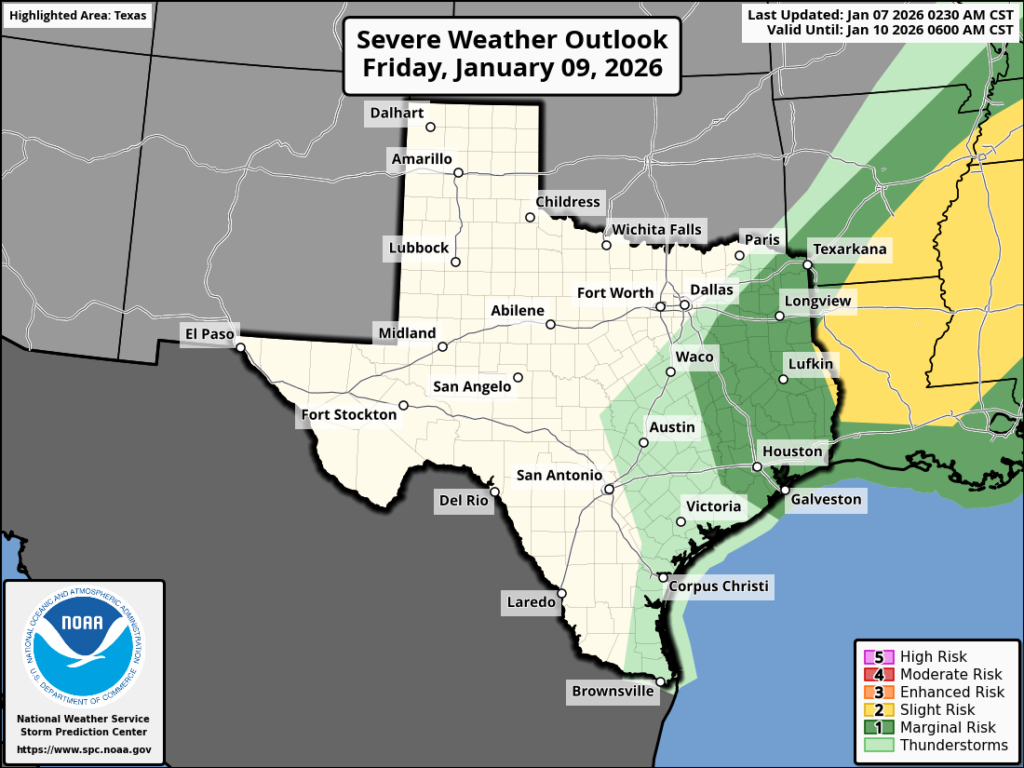
There is a marginal risk of severe weather on Friday night in the Houston region. (NOAA)

Friday and Friday night

We can’t say precisely what will happen Friday night, but generally I expect a warm and humid day, similar to Thursday with mostly cloudy skies. However, rain chances will be higher on Friday than Thursday, with scattered mostly light to moderate showers. There is also a chance for severe weather, primarily in the form of thunderstorms. This is most likely to occur between late evening on Friday and sunrise on Saturday, as the front itself moves into the Houston region. This is when we could see some briefly heavier rainfall. Most of our modeling is all over the place, but some locations could pick up 0.5 to 1 inch of rain whereas other locations see hundredths of an inch. We all need some rain, so good luck everyone.

Saturday

This will be mostly cloudy and cooler day, with a few showers possibly lingering during the morning hours. Temperatures at midnight will likely be in the 60s for most locations, falling to the 50s at sunrise and then staying there throughout the day. Skies will be mostly cloudy with modestly gusty northerly winds, perhaps up to 25 mph or so before ebbing during the late afternoon or early evening.

Sunday

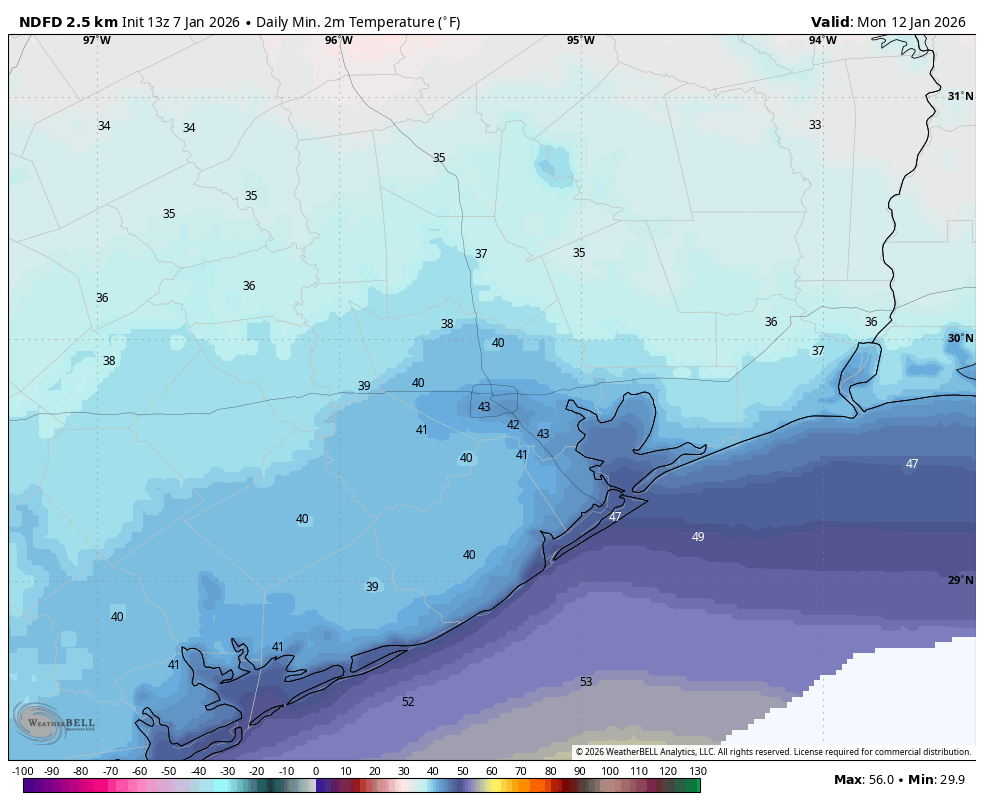
Sunday morning will be cold. Start line temperatures at the Houston Marathon should be in the mid-40s, with dry air and mostly cloudy skies. Winds will be from the north at 5 to 10 mph, with slightly higher gusts. Rain chances are basically zero. Highs will likely climb into the upper 50s for most locations on Sunday afternoon. Sunday night will be chilly, with lows falling to around 40 degrees for most of Houston, with cooler conditions still for inland areas. A freeze is very unlikely, however.

Low temperature forecast for Monday morning. (Weather Bell)

Next week

Houston will feel like winter next week with highs generally in the 60s and lows mostly in the low- to mid-40s for much of the week. Skies should be partly sunny most days, with low rain chances. This pattern should prevail through the middle of the month.

08 Jan 14:08

employee doesn’t know I have access to her emails, people interrupt me to fix the copier, and more

by Ask a Manager

It’s five answers to five questions. Here we go…

1. Employee doesn’t know I have access to her emails

I have a direct report that had to take a medical leave (two months) and during that time I needed access to her emails so I could assist customers who had pending issues, and the emails contained the information I needed. She is back now, but I am seeing some performance issues I need to address. She is not aware that I still have access to her email as IT never removed my access. I don’t want to micromanage, and I only look at it when there is an issue and I need to see what she actually said to a customer. I’m now seeing some things that are a bit concerning. At what point do I disclose the email access? When we have a corrective action meeting?

Well, first, you should not continue to have access to her emails without her knowing. If the issues are such that you’re reluctant to give up that access, you need to be up-front with her about it. That would mean saying something like, “I needed access to your email while you were on leave so that I could check history with customers when issues came up. I’m not actively using that access, but I did check it recently because of X and I am concerned about Y.” And then be up-front about whatever patterns you’re worried about in general and talk about what needs to change. You don’t need to wait for a formal corrective action meeting to do this; you can do it now so that she’s aware and doesn’t use her email for something highly personal (like medical stuff or divorce proceedings or whatever; ideally people wouldn’t do that with work email, but they do and she deserves to know you could see it if she does).

Ideally you’d also have IT remove your access (and then let her know when it’s done). But if you’re seeing the kind of issues that make it clear you need to be spot-checking what she’s sending to clients, etc., then be transparent that you’re doing that and why (and explain what needs to change before you will stop those spot checks).

2. People keep interrupting me for help with the copier

I am a high school assistant principal. I have a private office in the administrative suite, and the culture here is that administrators’ doors remain open unless there’s a sensitive meeting happening inside.

My office sits directly across from the copier. About nine billion times a day, I get teachers/staff/students asking for help with the machine. Sometimes they need help with basic functions like collating, sometimes it’s replacing the paper or toner, and sometimes it’s a legit jam that can take awhile to fix.

I’m not adverse to helping people (one of the reasons I went into school leadership is because I wanted to be the administrator who actually supports teachers), but it’s really not my job to have to drop everything for someone else’s copies, especially when it disrupts my own time-sensitive work. What is a gracious script for telling people to either figure it out for themselves or ask the administrative assistant?

“I’m sorry, I’m right in the middle of something, but Jane should be able to help.”

Or: “I’m sorry, I don’t use the copier much, but Jane should be able to help.”

My hunch is that these might not feel gracious enough to you or you’d already be saying them — because they’re pretty straightforward! — and the issue is less finding the right words and more than you feel awkward about the substance of the message, but these really are reasonable to say!

Also, though … would it make sense ask the assistant to put a sign up by the copier with solutions to the most common problems, including instructions to check with the assistant if those instructions don’t help?

3. Should I have told my boss a new hire sexually harassed me eight years ago?

20 years ago, I moved halfway across the country to start a job in a new state. We worked the second shift, so it was common for the group of coworkers and supervisors to go out for drinks and hang out after work. One night, as we were leaving the bar, a supervisor called Angus pulled me aside because he wanted my advice. He launched into his difficulties in the bedroom with his wife and asked what I thought about threesomes — did I think that would help? Shocked and confused, I gave a polite, general response and left as soon as I could.

A few days later, a colleague told when that she was out with Angus and the group for after-work drinks the night before (my night off so I wasn’t there), he recounted this embarrassing conversation, revealing that he and his wife wanted to invite me to join them in a threesome. Basically, he was saying I was flirting with them (!), so he tried inviting me but I was too oblivious to take the hint. They all had a good laugh at my expense. Though this is a clear case of sexual harassment, I didn’t report it. He had just given notice, as he had accepted a new role in a different state. And here I was, the new hire trying to make a good impression — why make waves?

Fast forward eight years. I get promoted and — surprise! — Angus was coming back to town to take his old role. Basically, we would each lead a department and we would be equals on the organizational chart. I considered telling our mutual boss about the sexual harassment years ago when I was a new employee. But I didn’t. I felt it was too long ago to be relevant, plus there was a chance it would backfire. (How would have my boss reacted? Flip a coin.) I kept quiet. But I was on Angus-watch, paying close attention to how he interacted with his staff.

For the next four years, we were coworkers. Nothing happened with his staff that I’m aware of that made me regret my choice. He seemed to have clearer professional boundaries, wasn’t socializing or going out for drinks with staff, etc. Eventually, I felt reasonably comfortable working with him, though I kept a polite distance. Still, I wonder if I had let down the women in my workplace, especially since I had moved into a leadership role. I’d appreciate your thoughts on how I handled this. As a manager, was I obligated to report the past harassment to my boss when that supervisor was rehired?

Managers are legally obligated to report harassment that they’re aware of — but that generally means things are currently happening in your workplace now, not something that happened to you eight years earlier. That said, it’s also true that as a manager, if you’re aware that someone may be a creep with a track record colleagues, ideally you’d share that. But were you obligated to share it, considering that it was eight years ago, you’re the one it happened to, and you were worried about repercussions for yourself? I don’t think so. This stuff is really hard to navigate though — it shouldn’t be! you should be able to be confident that if you share info like this, you won’t be the one who’s harmed by it, but that’s not the world we live in — and you shouldn’t beat yourself up second-guessing how you handled it.

4. My job is planning around me because they don’t know I’ll be leaving soon

I recently accepted a job offer that I’m extremely excited about. It is pending final HR approval, so I haven’t put in my notice or anything, but I have been given a start date almost two months ago. I was told that my new job was hoping to have the approval in place sooner, but, it sounds like there’s a batch of positions that HR is going to approve around the same time.

My concern is that I have a leadership role in my current job, and my office is going through some changes. My direct supervisor is very much planning on me taking an active role in training new people who are going to be brought on. I can’t give notice yet, but I’m feeling guilty about not being able to give any kind of heads up to him. Is there anything I can do, or do I just need to hope I’m able to let him know soon about my future plans?

You need to proceed as if you’re not leaving until the other job is completely finalized. While it probably won’t fall through, sometimes that does happen (or the start date gets pushed back further than you were anticipating). You don’t want to give notice until you’re actually ready to give notice, and while that can make things less convenient for your employer, it’s just the way this stuff goes because you can’t be expected to jeopardize your own financial security to mitigate that for them.

But that stuff happens! People leave jobs all the time when those jobs were planning around them for all sorts of things, and people figure it out. Your current job will too.

5. How can I ask why I need to attend these training exercises?

I’m new in a job, a sort of step back for me, removing all emergency response and 24/7 on-call status. It should help me have a better work life balance.

My boss knows me from my previous job where we were equals. Same job, different organizations. She knows why I needed to leave my job.

She has invited me to two intense, all-day table top emergency exercises. I thought I wasn’t going to have anything to do with emergencies anymore, so I’m confused on why I need to attend these, and as the only person representing our team.

It’s triggering some trauma for me; I’ve been involved in real-life, high-level emergencies, and I burned out. The table tops I used to attend always triggered me — always lots of talk about supposed death and destruction. They’re awful. How can I professionally ask my boss why I need to attend these exercises? I’m afraid I’m too emotional to come up with the words on my own.

“Is it necessary that I be the one to attend these? My understanding was that I wouldn’t be working on emergencies in this role, which was part of the appeal of the position to me. I have a strong preference for avoiding them if that’s feasible.”

The post employee doesn’t know I have access to her emails, people interrupt me to fix the copier, and more appeared first on Ask a Manager.

08 Jan 14:00

That was really cool how all the huts blew up ‘n stuff. Honey?

That was really cool how all the huts blew up ‘n stuff. Honey?

08 Jan 13:59

Future Canadian Resistance Tactics

by Ross Murray

“We need to prepare for the possibility that the U.S. uses military coercion against Canada.” — Headline from op-ed in The Globe and Mail.

- - -

Jamming vital infrastructure with Anne of Green Gables souvenirs

Giving birth to future resistance fighters without taking on crippling debt

Using that year-long parental leave to transform dried maple leaves into lethal throwing stars

Locating resistance headquarters in New Brunswick, where invading forces will never think to look

Casually walking past armored vehicles stuck in snowbanks without even offering to push

Conceding Alberta

Establishing an underground network consisting of retired men taking up tables all morning at Tim Hortons

Milk in plastic bags

Smiling politely at invaders but talking shit behind their back

Confounding invaders by using the metric system but also incorporating imperial measures in specific but not especially logical ways

Sneaking behind enemy lines disguised as Loverboy cover bands

Dropping the gloves

Holding our liquor

Not saying “sorry”

Weaponized smugness

Weaponized beavers

Sunglasses at night

French

08 Jan 13:57

Letting prisons jam contraband phones is a bad idea, phone companies tell FCC

by Jon Brodkin

A Federal Communications Commission proposal to let state and local prisons jam contraband cell phones has support from Republican attorneys general and prison phone companies but faces opposition from wireless carriers that say it would disrupt lawful communications. Groups dedicated to Wi-Fi and GPS also raised concerns in comments to the FCC.

"Jamming will block all communications, not just communications from contraband devices," wireless lobby group CTIA said in December 29 comments in response to Chairman Brendan Carr's proposal. The CTIA said that "jamming blocks all communications, including lawful communications such as 911 calling," and argued that the FCC "has no authority to allow jamming."

CTIA members AT&T and Verizon expressed their displeasure in separate comments to the FCC. "The proposed legal framework is based on a flawed factual premise," AT&T wrote.

Read full article

Comments

08 Jan 13:56

Superstition

It's important to teach yourself to feel responsible for random events, because with great responsibility comes great power. That's what my wise Uncle Ben told me right before he died; he might still be alive today if only I'd said rabbit rabbit that year!
07 Jan 21:16

All you have to do is watch the crystal ... and...

All you have to do is watch the crystal ... and almost instantaneously you'll find your hand in .. of ... uh ... #CowboyWho

07 Jan 21:16

should I talk to my boss about my coworker’s oversharing about mental health?

by Ask a Manager

A reader writes:

I am in a front-line commercial role at a tech start-up. I am responsible for bringing in new business, and this story pertains to my colleague Zayne, who manages a lot of the back-end, integrations side of things.

Zayne is fantastic at what he does. The guy might actually be a genius, and I don’t say that lightly. He has a ton of ideas, seems to really love what he does, and is good at it. He’s also very open about his mental health, which I admire but it can admittedly take me back sometimes. I grew up in a family where we often don’t share things like that, and it’s something I’m trying to unpack as an adult, but even so I find myself at a loss for words when Zayne will share details about his mental state that I’d struggle to open up about to my closest friends. When I met him a week into joining the company, he told me he’d previously been suicidal. I’m aware that mindset may be coloring my judgment here.

We just had a major tradeshow, which is important for us as events are our biggest source of leads. While I’m the only person whose job description is to bring in business, these events are really all-hands on deck. Zayne came along too and, while he isn’t commercially minded, he does know everything there is to know about the product so he’s great to have in case conversations get too technical. At one point in the event, there were only two of us on the stand, and I was speaking to a lot of people passing by whereas Zayne was hanging back, which I get as he’s not in his element the way I am at these events, though it was annoying to see potential clients slip away when I was engaged in talking.

At one point, I started a conversation with two senior leaders. I was trying to uncover what their pain points were and if we were a fit, as well as build rapport. Zayne joined my conversation, which to be honest I didn’t need as I wanted to guide it a specific way, but I wasn’t about to tell him to back off in front of the two prospects. They were talking about their workplace initiatives and mentioned they supported mental health awareness. I was going to mention what our own software does to support this, but Zayne jumped in and started talking about his own mental health, mentioning that he’d experienced a dissociative episode on route to the conference and how he’d been struggling with this for years. I found this super inappropriate and was basically stunned into silence because of how uncomfortable I was. The two prospects began comforting him, but I sensed from their tone and body language that they were also taken off-guard by this and didn’t really know what to say, and he just kept going.

The conversation came back round to work eventually and Zayne had some valuable insight on the technical side of things. After they left and I gathered their details, he turned to me and said brightly, “Wow, that went great!” I wasn’t sure what to say so I just agreed, but I wanted to kick him for being so oblivious. It’s one thing saying that to me as a coworker, but I felt it was inappropriate to say something that personal to strangers, never mind strangers we want to sell to.

I’m not sure whether I should mention this to our boss. I don’t know how much of my view on this is colored by my own discomfort, but also because I know how important it is for us as a start-up to get new clients in — and quite frankly that could have cost me commission. Should I mention it? If so, how? Now that we’re growing, we don’t necessarily need all of us on the stand but I know Zayne enjoys these events. I also don’t want to shame him for having mental health issues. Is there a way to tactfully bring it up? Should I?

Yeah, you should talk to your boss and share what happened and your sense that the prospective clients weren’t entirely comfortable.

In an ideal world, your boss would talk forthrightly with Zayne about boundaries when he’s representing the company. Your boss may or may not be a good enough manager to do that skillfully, but I do think you need to let her know what happened since you witnessed it firsthand and particularly since part of your job is managing prospect relationships and this risks impacting them.

The idea isn’t to reinforce a stigma around mental health, but rather to reinforce the idea that there’s a time and place for some topics. Your colleagues also shouldn’t be talking about politics, religion, or sex with business contacts, or going into heavy detail about a medical condition or their divorce or their estrangement from their family. It’s not that those topics are taboo or wrong or that they’re inappropriate across the board; it’s that they’re inappropriate in a business setting — because they risk alienating people who feel differently, are too heavy for a work context, and take the focus way off the thing you want it on. It’s not just the latter, of course — you might have an in-depth conversation about, I don’t know, sports as a way of building rapport with a client — it’s that they’re not what people are expecting (or, usually, wanting) in a work context and have a high risk of bringing people down.

A lot of people understand this intuitively — especially people in a relationship-heavy job like yours — but others don’t and need explicit coaching on it.

The post should I talk to my boss about my coworker’s oversharing about mental health? appeared first on Ask a Manager.

07 Jan 21:15

my boss says you should always move personal appointments for work

by Ask a Manager

A reader writes:

My job is 99% remote with some on-site event expectations. On-site events are typically mandatory, which is fine with me.

I recently asked for events to be either predictable (e.g., first Friday in August) or to have lots of notice, so we can schedule vacations or things like dental cleanings around those events.

During the conversation, my manager said that even when we were fully on-site, she sometimes had to move appointments if her boss scheduled a meeting. She gave the example of a short-notice 9 am meeting the next day and thus needing to move her kids’ appointments.

That gave me pause. I understand rescheduling things like haircuts or some types of personal commitments, but it’s so hard to schedule physicals, dental cleanings, some medical imaging, etc. that I’d be hard pressed to move those for a work event.

Likewise, she said we don’t need to cancel flights for work events, but it was kind of implied that if you have a PTO day planned but aren’t going anywhere (maybe for your birthday or a hobby day) you should plan to attend the work event instead.

This won’t come up often, maybe a few times a year, but the emphasis on work taking priority over pre-planned PTO gave me the ick. Am I overreacting? Is this typical? If this isn’t normal, how can I protect my own time away from the office in a professional way?

P.S. I don’t know if it matters, but I’m salaried (not hourly) and I have vacation time to draw from. On-site events are generally team-building and networking; my job is desk-work, not anything like patient care or politics where a meeting would be an emergency.

No, this is weird! People aren’t normally expected to reschedule appointments that have already been booked and time off approved just because their boss wants to have a short-notice meeting that day or an event comes up afterwards.

There are some exceptions to this — a truly crucial meeting that for some reason can’t be put off, or an event that’s a central part of your job to be at. But those would be unusual exceptions, not normal practice. And even then, the conflict would normally be acknowledged and discussed (“I’m so sorry, I know you’re scheduled to be out that day but this is our only shot at saving this account — any chance you’d be able to rearrange things to make it?”); you wouldn’t be expected to just see the conflict and decide on your own to cancel your already-set plans. (An exception to that might be if you’re in a very senior role and you would be expected to know on your own that this was the only shot at saving the account and take the initiative to act accordingly.)

But for more routine meetings? The normal response to that is, “I’m out that day; would Thursday or Friday work instead?”

However, while your boss is being incredibly weird and her expectations are not in sync with normal professional expectations, if these are her expectations you have to figure out how to navigate them. The easiest thing is to just assert normal professional boundaries, meaning that if you get the sense she’s expecting you to be present for something you won’t be available for (again, assuming it’s not a rare high-states exception), you’d simply say, “I have an appointment I can’t move that day,” followed by whatever makes sense next (which could be “I can see if Jane can fill in” or “could we schedule it for Thursday when I’m back?” or so forth). If she pushes back, you’d say, “It’s a medical appointment that can’t be moved” or “it would be really tough for me to change it; are there other options?” or otherwise assert the boundary that no, pre-scheduled things can’t be moved without true (and rare) need.

If she takes issue with that, I’d think about your options for escalating it because, unless you’ve seen direct evidence that this is the culture of your whole office and not just your boss’s idiosyncrasy, it’s highly likely that your employer doesn’t want her interfering with people’s time off this way. If you have good rapport with her boss, it might be something you could ask their guidance on (“asking their guidance” is a good way of bringing it to their attention without explicitly complaining about it). Or in some offices, HR might be well positioned to step in.

But you shouldn’t accept this as a normal thing.

The post my boss says you should always move personal appointments for work appeared first on Ask a Manager.

07 Jan 21:14

Here’s the receipt for your Depends.

Here’s the receipt for your Depends.

07 Jan 21:13

CDC Scales Back Child Vaccine Schedule

by The Onion Staff

The Trump administration sharply cut the U.S. childhood vaccine schedule from 17 to 11 recommended shots, with health experts warning that changes were made without an adequate review and will only confuse parents and clinicians. What do you think?

“This should be fine as long as the diseases agree to ramp down, too.”

Claire Easterlund, Complaint Drafter

“Kids need a little hepatitis A and B or else they’ll get soft.”

Spencer Crosby, Nylon Supplier

“Hopefully this will make college less competitive.”

Jerome Beebe, Shoe Reviewer

The post CDC Scales Back Child Vaccine Schedule appeared first on The Onion.

07 Jan 21:12

Saturday Morning Breakfast Cereal - Pandemic

by Zach Weinersmith


Click here to go see the bonus panel!

Hovertext:
I recently discovered that many kids today don't even know about cooties. Thank goodness for all those shots.


Today's News:
07 Jan 14:58

Retail News: FYE has left Houston, again

by Mike
FYE closed its single Houston location in Katy Mills Mall last week, ending the chain’s local presence for the second time. What would eventually become FYE opened its first Texas store at the Galleria in 1992. It was marketed under the dual names Record Town and Saturday Matinee and was one of many chains trying to corner the market in both media sales and rentals at the time. The company would continue to grow by ...
07 Jan 14:56

Lawsuit claims 2 Austin organizations overserved alcohol to Brianna Aguilera before her death

by Kyle McClenagan
The lawsuit, filed on Monday in Travis County, accuses the two organizations of negligence for allegedly providing the 19-year-old with an excessive amount of alcoholic beverages on the evening before her death.
07 Jan 14:56

Texas becomes first state to end American Bar Association oversight of law schools

by Toluwani Osibamowo, KERA
The Texas Supreme Court on Tuesday finalized a tentative opinion issued in September that no longer requires soon-to-be lawyers to attend a law school accredited by the American Bar Association. The power to approve those law schools now rests with the state's highest civil court.
07 Jan 14:53

I can’t get answers about a special project, candidate with risqué photos online, and more

by Ask a Manager

It’s five answers to five questions. Here we go…

1. Internship offered me a special project but now I can’t get any answers about it

I’m a college student who recently finished a remote internship at a prominent company in a fairly niche field (the company has maybe 10-15 full-time employees). My main task was fairly generic — think setting up a filing system or similar — but I also got a lot of experience in the actual field. Towards the latter end of it, I had a great talk with the CEO about what I wanted out of the internship, and what was really exciting was that he said that he thought a good next step for me would be designing an accessory for one of their products. That sounded great to me, and I said so. He told me to get back to him with some ideas for products that I wanted to make an accessory to, and that he would meet in a week or two with some of the designers to talk about what they thought and hash out the plan for this.

That was about one and a half months ago. I sent some messages after that attempting to follow up. Initially he just hadn’t gotten around to the meeting yet, which was fine, and said I should send him what product I was interested in working on, but then he didn’t respond to that. Once my internship wrapped up I sent a message thanking him for the internship, and saying that I would be more busy but still available during the school year and would love to work on other projects with the company. He replied saying it was great to have me there for the summer, but also that he was not sure what would be next with regards to project work as they are still figuring out what things will look like in 2026. I sent one more message a week and a half later, saying that I’d love to talk more about the accessory design project and once again affirming that I am free despite being in school, which I haven’t gotten a response to.

I have been in intermittent contact for other reasons with one of the designers who was my boss during the internship, and a few weeks ago I asked if the CEO had gotten a chance to talk to him and the other designer about the design opportunity, or if plans had changed. He said he would remind the CEO about it … and I haven’t heard anything about it since.

Should I send yet another message to the CEO asking about this? I don’t want to come off as pushy or badgering, considering I’ve already sent him at least four messages about it, but this would also a really exciting opportunity for me. I think it’s very possible that plans changed or he realized that he wouldn’t be able to actually offer me this opportunity, at least not right now, which I would understand. But in that case, I would just like to at least hear that, rather than continue getting radio silence.

It’s probably not happening right now, for whatever reason. I would not continue to message the CEO since four messages makes your interest really clear and the ball is now pretty firmly in his court. The one thing I think you could do, though, is to message your boss from the internship again and say something like, “I’m not going to keep bothering Cecil about this since I haven’t heard back and I’m guessing it’s just not something he can move forward with right now, but if you do think there’s anything else I should do on my end, please let me know! I’d love the opportunity if it might still be possible, but I realize it might not be.” But after that, I’d assume they’re just not able to make it come together right now.

2. Should we not hire two candidates with wet t-shirt contest photos online?

I’m hiring for the restaurant and bar at a golf course, and we recently have had two openings for servers. We’ve had trouble finding suitable candidates until recently, when two university students who are both friends applied and interviewed back to back. They are literally the perfect candidates who we believe have the skills to help our team.

Upon checking their online history, however, we found out that last year they were overseas at a hostel and they joined a wet t-shirt contest. The hostel and nightclub posted some images on their website, with them both showing off their butts in thongs and also removing their shirts entirely, showing their breasts to the crowd. They actually finished first and second in the contest, and kudos to them! Personally, I don’t have an issue with this and I see it as good fun. I don’t see how this would impact the reputation of our golf course in any way, as the customers will not know and, even if they did, it’s not like they would view this as something the golf course was then up too. I really don’t think it matters. Neither does the other hiring manager, but they are hesitant because they “just know if you find something like that, you are not supposed to hire them.”

Do you think we should just hire these wonderful women who seem to be the right fit for our job openings or do you think the fact that their butts and boobs happen to be on a hostel website from overseas matter and we should pass? I personally think in today’s times that this sort of thing is okay and I think the other manager is living 20 years ago still.

You should hire them. Tell the other manager that the advice she’s heard is outdated and it only ever applied to certain types of jobs anyway (like jobs like teaching, where public image has traditionally been a big concern). It never applied to the majority of jobs, and it has zero bearing on their ability to do the work you need done.

3. Can I ask to use a “free” day off at a different time?

I work full-time in local government, in a small office of 12. Recently, our boss sent out an email announcing that as a thank-you for our hard work over the past year, she was giving us all one “free” day of personal vacation. We were all told to look at the calendar to see which day we were assigned to take off.

While I appreciate the thought, I was actually hoping I could bank the day off and use it towards a vacation later in the month I was already approved to take. Alternately, I wanted to ask to use my “free” vacation date on my birthday, also later this month.

Would you advise asking our boss if I could use the free day she is giving us towards another vacation or on another day? I don’t want to seem ungrateful or look at gift horse in the mouth, but the day I am assigned to be off is not a day I want to be off. She has never done anything like this before, at least since I have worked with her. She’s normally pretty tough about granting time off requests, so her willingness to randomly give us an extra free day took me by surprise.

Sure, ask! “Would it be okay for me to use this for January 30 instead? That’s my birthday and I’d love to use this to take it off.” (Or you could ask to use it for your already-scheduled vacation, but there’s more chance she’ll feel like you’re turning what was meant to be a feel-good perk into something more administrative since you already have that time scheduled — which doesn’t make logical sense, since it would mean you had an additional day to use down the road, but I suspect the birthday would be more in keeping with the spirit of what she’s trying to offer.)

4. Should my exempt employees be using PTO for appointments?

I’m a faculty member at a university, and I supervise some staff members. These staff members are all exempt and have all been in their roles since before I became a supervisor. I’ve noticed that they will use a few hours of annual leave in order to take a pet to the vet or for various other things that might require coming in late or leaving early. They will also sometimes “make up” hours in the evening if they had to come in late or leave early during the week. Their roles are 8 am – 4:30 pm positions that require at least one of them in the office during this time.

From following your site, I was under the impression that, as exempt employees, they don’t need to be taking leave for these incremental hours of time they aren’t working. This all gets a little more complicated, because technically I supervise one person, and she supervises the other two employees. I have deferred to her on how she wants to manage office coverage and their tasks. She’s also been supervising employees for much longer than me, so I deferred to her on how leave is supposed to be used and reported. (Remember, this is a university, so I went from a regular faculty role with incredible flexibility to a supervisory role without being given any real information on how HR-type rules work. Academia!)

Ultimately, my question is whether these employees are unnecessarily using their leave. Should they be able to come in late (if approved) and not use leave? And if so, is this something that I legally need to fix? Would we be in legal trouble if it came to light that exempt employees were being required to use leave in this way?

So, first, the law on exempt employees doesn’t say anything at all about how they need to use their leave; it is exclusively concerned with their pay. Specifically, exempt employees be paid their full salary for any week in which they do any work (with a few narrow exceptions, like if they’re working a partial week because it’s their first or last week of work). But the law doesn’t care if that money is coming from their paid leave or not; it only cares that they are paid. So there’s no legal issue here.

What does matter is your employer’s personnel policies, and maybe also what’s common practice in your department. Some employers (and some managers) strictly require that people use PTO for the sort of thing you describe (or make up the time). Others are much more flexible and figure there’s a give and take, and as long as people’s work is getting done and they’re not abusing their flexibility, they’re not going to nickel and dime them on PTO. So the question for you, first and foremost, is what your university’s policy is on this and, if it’s fairly strict, whether you as a manager have standing to choose to implement more flexibility on your team.

5. Can I apply at an organization that’s not hiring?

How do I write a speculative application to an organization that isn’t hiring right now? Is that even something I should try?

I really want to get out of my current job (law enforcement) and have found an NGO that I’m a perfect fit for. Unfortunately they’re not hiring at the moment, but I’d like to send them my resume in case it’s something they’d consider now or in the future.

I’ve never sent a speculative application before. Is it a good idea? How should I structure it? Do I turn the email into a cover letter, or write a separate cover letter and attach it like I would for a listed job ad?

I wouldn’t be considering this if I weren’t certain that I’d be a great asset to the organization, and this level of self-confidence isn’t typical for me. But I don’t want to make a fool of myself and blow my shot in case it hurts my chances in the future. What would you advise?

You definitely can try doing this! There’s no guarantee it will lead to anything, of course, but there’s no reason you can’t give it a shot.

You’d make your email your cover letter, explaining why you’re contacting them and what you could offer them — and why you’re motivated to contact them even outside of any specific position being available — and then you say, “I’m attaching my resume so you can see my full professional background, and I’d love to talk if you’re ever hiring someone to do X.”

People do this a lot, especially with nonprofits (because they tend to attract a lot of people who want to work for that cause, specifically). It won’t hurt your chances for the future at all (if anything, it could help them).

The post I can’t get answers about a special project, candidate with risqué photos online, and more appeared first on Ask a Manager.

07 Jan 14:50

Area Man Knows When He Not Welcome In Children’s Museum

by The Onion Staff

INDIANAPOLIS—Dusting off the kinetic sand from his hands as he walked with his head held high toward the exit, 34-year-old area man Benjamin Schrock reportedly told visitors and staff of Discovery Zone Children’s Museum on Tuesday that he knows when he’s not welcome. “I’ve been around the block, but never in my adult life have I experienced so many hostile glares when simply trying to splash in the sensory water playground, make Spirograph art, or dig for fossils in the dino tub,” Shrock said with an audible lump in his throat as he recounted being made to feel “strange” and “othered” when he spent an hour milking a cow statue’s rubber udders in the interactive barnyard exhibit. “That sign saying ‘All are welcome’ above the front desk? Rich. It’s funny how a place ostensibly meant to spark curiosity could be so ignorant toward an adult man who happens to enjoy hands-on activities designed for learning through play. Once I get back the ziplock bag full of quarters I paid for my ticket with, trust me, I will gladly be on my way. Now if you’ll excuse me, I believe I’m owed at least one turn on the big fire truck.” At press time, Shrock said he was dismayed to report feeling even greater undue hostility after he was removed from a bouncy house at the indoor inflatable play center.

The post Area Man Knows When He Not Welcome In Children’s Museum appeared first on The Onion.

07 Jan 14:50

Trump Asks National Intelligence Point-Blank If God Real

by The Onion Staff

WASHINGTON—Cutting off a top security advisor mid-speech as he eagerly posed his question, President Donald Trump reportedly interrupted a briefing Tuesday to ask officials from the National Intelligence Council whether God was real. “So what do we know about Him? Are there any photos?” said a quizzical Trump, adding that he brought the matter up to multiple directors of national intelligence during his previous administration but never received a satisfying answer. “Let’s just cut to the chase here: big guy in heaven. Is He real or not? And if so, have we made contact? You know, there’s a very smart boy who died and says heaven is for real—does the CIA have any files on him? Who here knows? I want every document we have on God released immediately.” At press time, members of the U.S. Intelligence Community were reportedly reassuring Trump that God was real, He had lots of money, and they would immediately look into suing Him for $200 million.

The post Trump Asks National Intelligence Point-Blank If God Real appeared first on The Onion.

07 Jan 14:49

RFK Jr. Scales Back Childhood Mortality Schedule

by The Onion Staff

WASHINGTON—Saying the changes would empower Americans to make more informed decisions about their family’s health, Health and Human Services Secretary Robert F. Kennedy Jr. announced Wednesday that he had scaled back the department’s childhood mortality schedule. “For too long, the U.S. government has imposed strict and unnecessary guidelines about whether or not our nation’s children should survive past infancy,” said Kennedy, adding that parents deserved the right to choose whether or not their offspring died at a young age of preventable disease. “The truth is, no parent should be forced to watch their child live a healthy life and avoid contracting RSV, the flu, rotavirus, hepatitis A, hepatitis B, or bacterial meningitis. America is a developed nation. There’s no reason for anyone to live past 35.” Kennedy added that if Americans still wanted to watch their children survive well into adulthood, they should consult with a physician and think deeply about the risks.

The post RFK Jr. Scales Back Childhood Mortality Schedule appeared first on The Onion.

07 Jan 14:48

Study Finds Increased Demand Among Gen Z For Non-Alcoholic Fathers

by The Onion Staff
07 Jan 14:48

Modern Spy Craft

by Scandinavia and the World
Modern Spy Craft

Modern Spy Craft

View Comic!


07 Jan 14:47

Warmer than this old place

by John Allison

It’s good to see the old friends back together. Time has passed very slowly in Solver. Lottie arrived in Sheffield in September (in 2022), and it’s now November. This glacial pace wasn’t intentional, but it’s good to acknowledge it. Scary Go Round used to run in virtually real time!

The post Warmer than this old place appeared first on Bad Machinery.

07 Jan 14:45

ALT

A comic of two foxes, one of whom is blue, the other is green. In this one, Blue is sitting in deep focus with a calculator, an abacus, and several sketchbooks and papers scattered all around him.
Blue: Each hot dog packet has 10 of them, and the buns come in packages of 12, so in order to-

Green appears on the scene, with a bun of some sort hanging out of his mouth, peering at Blue's notebooks.
Green: What are you calculating?

Blue looks up to Green with an unreadable expression on his face. Green looks back to him, unsure of the situation.

Blue raises an eyebrow, looking at Green with confusion.
Blue: ...Are you eating a plain, dry hot dog bun?ALT