Cowboy Who?
Shared posts
A missing judge, a missing juror and no record as to why: Behind an overturned Dallas fentanyl case

Public Domain Day marks the end of copyright protection for famous films, books and music

How the aftermath of Jan. 6 still challenges the Capitol

5 years later, the fight over how Jan. 6 is remembered continues

Well, which one of us is the good guy?

Well, which one of us is the good guy?
I accepted my company’s counteroffer, and now they’re going back on our agreement
A reader writes:
I have seen you and other people say that you shouldn’t usually accept a counteroffer. I wish I had listened to you, but I didn’t.
The backstory is I have worked at my company for almost a decade, and for the first several years I was extremely underpaid. I know this because I made a lateral move that resulted in a significant pay increase. With each transfer, I have been clear that growth (and money, of course) are very important to me.
Recently I was recruited (I did not seek this new position, it came to me) for a position that would have increased my pay slightly. It would have changed my work status from fully remote to hybrid, but most importantly, it was a training opportunity that many do not get.
When I told my current employer, they asked me not to make any rash decisions and to give them 48 hours. They returned with a counteroffer that involved a promotion and a raise — $20K more than the new position would pay, and $30K more than I was making already. I am the sole provider for my family, and when I considered the additional money, not having to travel, and not losing any PTO or benefits, I decided to accept.
Several months later, while the raise has materialized, the promotion has not. I am still stagnant, doing the same work as I was before, with my manager telling me to be patient.
The trust is gone! I’m grateful for the raise, but angry to not be learning anything new and to have given up on an excellent opportunity. I don’t understand why my manager would lie to me about the promotion. (We did have layoffs recently, so those of us who are left are stuck doing a lot of extra work. I can’t help but feel my boss knew those were coming and got scared that he would lose me and have to lay off those other people as well, so he chose to lie to me.)
Probably the answer is “your boss sucks and is unlikely to change.” But prior to this, I really trusted and liked my boss, and now I can barely talk to him. I have been looking for other jobs but this market is terrible. How can I handle a situation like this?
You are not the first person to accept a counteroffer, turn down the outside job, and then have your employer renege on the promises they made to keep you.
It’s incredibly shitty behavior from an employer. They essentially lied to get you to act against your best interests. They may not have intended to lie — they might have really thought they’d follow through on what they promised you — but once they became tempted not to do what they committed to do, they wildly mishandled it. There are situations where an employer might legitimately find itself unable to meet the commitments they made in a counteroffer — for example, if they had a sudden and dramatic revenue drop or were acquired by a company that refused to honor the original plan — but in that case, at a minimum they owed you a conversation about what had changed, a profound apology, and an active attempt to work with you to figure out what could be done instead. It doesn’t sound like that’s happened (and it’s not even clear if something like that was in play, or if they just took their promises cavalierly).
Have you talked to your manager about what happened? If not, it’s worth a conversation where you say something like, “I was ready to leave for an opportunity that was far more in my interests, and you convinced me to stay by committing to promoting me. I took our agreement in good faith and turned down the other job on good faith because I trusted that the company would honor the commitment it was making to me. I’m really struggling with the fact that I agreed to stay with a specific agreement for a new job, and that hasn’t come through. I’d like to talk about a timeline for making that happen, ideally a fairly quick one since I turned down a different position for it.”
But if that doesn’t change anything … you’re absolutely right to have lost all trust in them. They’ve squandered that trust just about as deeply as an employer ever can. You don’t owe them any loyalty at this point, and you should have no qualms about leaving as soon as something you want to leave for comes along.
The post I accepted my company’s counteroffer, and now they’re going back on our agreement appeared first on Ask a Manager.
The Best Time to Get Your Life Together Was Five Years Ago, According to Everyone Who Knows You
A comprehensive new survey has concluded that the ideal moment for you to have gotten your life together was roughly five years ago. Not now, not next year, not after one more reset or reinvention, but a very specific window in the past when you were already tired but still had “potential,” and people hadn’t yet adjusted their expectations downward.
The study clarifies that this moment varied slightly depending on who was asked. For some respondents, it was right after you graduated. For others, it was when you got that job you later quit, or that relationship you “weren’t ready for.” But all participants agreed on one thing: Whatever you are currently doing does not count as getting your life together.
Researchers interviewed friends who describe you as “figuring things out” in a tone usually reserved for broken appliances. These friends recalled the exact instant they realized you were not, in fact, on the brink of something big, but instead circling the same small set of problems with increasing confidence. Several noted that they now preface stories about you with phrases like “still” and “basically.”
The team also consulted family members, who confirmed that while they love you deeply, they have quietly stopped defending you to relatives. One respondent admitted to saying, “Yeah, that’s just how they are,” which the report identifies as a critical milestone in the acceptance phase. Another said they keep meaning to send you links to job openings but “don’t want to overwhelm you.”
Focus groups were then asked whether there was anything you could do now to change the outcome. At this point, participants paused. Some tilted their heads. One person laughed, then apologized for laughing. The consensus response was, “I mean… you could, but you probably won’t.”
The report strongly advises against dramatic gestures, such as moving to a new city, starting a new project, or announcing a bold new plan. Data shows that these actions briefly convince others you are “serious this time,” before confirming, within six to eight weeks, that nothing fundamental has shifted. Journaling was also dismissed as “mostly decorative.”
Analysts stress that your situation is not the result of bad luck, the economy, or circumstances beyond your control. These factors were adjusted for. The findings suggest instead a rare but persistent condition in which self-awareness coexists comfortably with inaction, allowing you to articulate your problems clearly while remaining completely stationary.
In its closing remarks, the study acknowledges your effort. It notes that you often think about changing, sometimes late at night, sometimes while watching other people live the life you once pictured for yourself. This counts for something emotionally, though not practically. The report offers no road map, timeline, or reassurance.
However, there is good news. According to follow-up data, the second-best time for you to get your life together is theoretically right now. No one expects you to do it. This finding brought participants a surprising amount of peace.
Don’t slam the seat on your way out

Don’t slam the seat on your way out
Lost Jan. 6 Rioter Still Searching Capitol Building For Mike Pence
WASHINGTON—As he wandered aimlessly through the halls of the U.S. Capitol building, lost Jan. 6 rioter Alex Morris told reporters Tuesday that he was still searching for former Vice President Mike Pence. “Oh my God, how am I back in Statuary Hall again? Where the hell is Pence?” said Morris, tucking a noose under his arm while opening Google Maps and reorienting himself in the direction of the National Mall. “At this point, I can barely remember why I wanted to hang the guy in the first place. It feels like I’ve circled the Senate Chamber a million times. Does anyone know where Ashli Babbitt is? She knows her way around here.” At press time, Morris reportedly attempted to jog his memory by taking a shit in the office of Rep. Nancy Pelosi (D-CA).
The post Lost Jan. 6 Rioter Still Searching Capitol Building For Mike Pence appeared first on The Onion.
Apple Photos Reminds Man He Was Nude In Capitol Building 5 Years Ago
The post Apple Photos Reminds Man He Was Nude In Capitol Building 5 Years Ago appeared first on The Onion.
Chevron CEO Sure In Good Mood This Week
HOUSTON—Calling the executive’s demeanor “unnervingly jovial,” company sources confirmed Tuesday that Chevron CEO Mike Wirth sure was in a good mood this week. “Man, normally that guy is a first-rate asshole, so something must be up,” said an anonymous employee, who noted that the typically stone-faced executive had pulled into his reserved parking spot that morning singing along to “Uptown Girl” with the windows down. “At first I thought he must have hit an endangered bird with his Mercedes again, but no, this is something bigger. I heard him whistling as he walked to his office, and he even called it ‘a beautiful day out there.’ That’s crazy. He’s always said he hates out there.” Sources added that they hadn’t seen Wirth with such a big grin on his face since he had gotten that journalist imprisoned.
The post Chevron CEO Sure In Good Mood This Week appeared first on The Onion.
Oil Stocks Rise After U.S. Capture Of Maduro
Energy company stocks and the price of crude oil surged after the United States captured Venezuelan President Nicolás Maduro, with Trump claiming U.S. oil companies would participate in rebuilding the South American country’s energy infrastructure. What do you think?

“Which foreign leader do we have to arrest to get GameStop going again?”
Cesar Gruerio, Odor Neutralizer

“My accountant has been encouraging me to invade Venezuela for years.”
Russell Forst, Oncology Enthusiast

“Damn. My parlay needed him to be killed.”
Diana Yee, Plate Stacker
The post Oil Stocks Rise After U.S. Capture Of Maduro appeared first on The Onion.
Trump Spotted Wearing Paper Sign Reading ‘The President’
The post Trump Spotted Wearing Paper Sign Reading ‘The President’ appeared first on The Onion.
Chrystia Freeland’s first act as Ukrainian economic advisor is suggesting they cancel Disney+
OTTAWA – After accepting a role as economic advisor to Ukrainian president Volodymyr Zelenskyy, Canadian MP Chrystia Freeland has begun by suggesting citizens of the war-ravaged country cancel their pricy Disney+ subscriptions. With Russia’s devastating invasion of Ukraine about to enter its fourth year, the former Deputy Canadian PM has suggested the country’s economy could […]
The post Chrystia Freeland’s first act as Ukrainian economic advisor is suggesting they cancel Disney+ appeared first on The Beaverton.
Dictator frees Venezuela from dictator
CARACAS, VENEZUELA ― In a stunning shift after over a decade of dictatorial rule, the government of Venezuela fell this weekend to a new, slightly different dictator. Following his autocratic overthrow of an autocrat, the new American dictator of Venezuela swiftly moved to put the old Venezuelan dictator of Venezuela on trial for cocaine importation. […]
The post Dictator frees Venezuela from dictator appeared first on The Beaverton.
Sydney Sweeney getting very annoyed by endless stories about this Sydney Sweeney person
Los Angeles, CA – Actress Sydney Sweeney has reported that she is very tired of hearing stories about whoever this Sydney Sweeney person is. “I’ll be honest, I never watched Euphoria,” stated Sweeney during a recent interview. “I know that was like, one of her things. Was she in White Lotus? I just feel like […]
The post Sydney Sweeney getting very annoyed by endless stories about this Sydney Sweeney person appeared first on The Beaverton.
Saturday Morning Breakfast Cereal - Apple

Click here to go see the bonus panel!
Hovertext:
Clearly the talking snake had a few bites anyway.
Today's News:

Well ... we've had an awful lot to think about ...
Well ... we've had an awful lot to think about today, and 'fraid the times up. So, until next time, think about it! #CowboyWho

Review: “Who made the grasshopper?” at Lora Reynolds Gallery, Austin
What is a grand finale supposed to look like? A grand and eloquent celebration? Or a summation of all that has preceded it? Swan songs are named thusly after an ancient (and erroneous) Greek belief that swans sing a compelling song just before their death. To say that Who made the grasshopper?, the ultimate show for the Lora Reynolds Gallery is just “exquisite” would be absurdly reductive. The exhibition title hails from a poem by Mary Oliver, “The Summer Day,” which asks us what is deemed important in the world in the present moment. In Reynolds’ universe, infinite layers of innovative talents, values, art history, personal connections, anecdotes, and love are contained in this last installment for a gallerist who has been instrumental in putting the Austin art world on the proverbial map, not to mention extremely influential in a multitude of careers for dozens of contemporary visual artists. Mad respect and many sighs abound.
I am not here to chronicle the history of Lora Reynolds or her legendary Texas gallery, as those elements have been reported on here, but the relationships that she, along with gallery and life partner Colin Doyle, have created through their navigation of this high end contemporary art gallery have been the key to their wild success. As Reynolds relayed to Nicholas Frank, Glasstire’s News Editor, the artists and her staff are the magic ingredients that make this journey worthwhile. The gallerist has based her strategy on both instinct and largely, trust. She believes in the artists for their unquestionable talent as well as the alignment of their values with hers.
This trust is exemplified by the way that she and Doyle have curated this spectacle in letting the artists select their own pieces for the show and in doing so, relinquishing control in the name of this implicit faith. As a curator myself, the overarching energy and refraction between works relies on a modicum of control and predication. Reynolds and Doyle inspire a confidence of intuition. Such legacies do not have a Cliff Notes version, so I applaud this commemoration that still holds its own as a show, one that does not feel obligated to represent every moment and each artist from the chronicled annals. The cohesive energy here is not found in the details but in the intended desire.
After attending the jam-packed opening night, I had to return to get a closer look. The space displays artworks from 42 of the artists whom the gallery has exhibited over its 20-year history, a quiet selection that resonates voluminously. Much of the collage, drawings, sculpture, paintings, ceramics, photography, and lithography command the perimeters in neutral tones with splashes of bright hued works peppered throughout. I breathe in, absorbing the penetrating gazes of the portraiture, looping satirical texts, private gestures of depth and nostalgia, collages that redefine history, delightfully eccentric sculptural totems, and personal homages throughout.

For me, the standouts in this star-studded affair include works that were newly produced just for this show, personal surprises, and art chosen from some artists’ personal vault of treasures. Colby Bird’s spinning, medieval, kinetic, candle-fueled, delicate creation, It Was Mine. It Amused Me. And It Was No Longer There (2025), demanded constant attention, both by the gallery staff and from the opening’s crowd. Wild, unkempt, difficult, archaic, and witchy, his sculpture spoke to Reynolds’ and Doyle’s unique eye and faith in the wry provocation that contemporary art can deliver at the perfect moment.

Tony Marsh’s legendary ceramics have recently showcased layered glaze mastery in his Crucible Series, but this Perforated Vessel (2025) with its tidy Dremeled portholes is a stoneware study in minimalist joy, form, and fragility. Jeff Williams chose Butter Side Up (2025) as a study in balancing duality, a delicate sculpture of rugged cast aluminum that was reportedly inspired by the rock formations at Milton Reimers Ranch Park and the climbing routes therewith. A similar response to man’s confrontation with the natural world is apparent in Jason Middlebrook’s wood and spray-painted Northern Territory (2013). Here, the craft of his impeccable details seem to reveal the mapping of an existential plight.

An uncommon example of photography, A Year (2025) stacks VHS tapes as a clever taxonomy of cultural residue and its implied cavitations, created by the phenomenal, locally based duo of Teresa Hubbard and Alexander Birchler that Reynolds has represented for years. The humor of their inverted calendar stacked in reverse speaks to how we mark our temporal cadence, quite fitting for this vicennial event. Another local art hero, Xavier Schipani, contributes two graphic watercolors of butch masculine countenance. Tender Daddy (2022) penetrates my soul with a complex gaze of brutal affection and complex signaling that I revisited for its veracity. Delightful rulebreakers, all.

Who made the grasshopper? sprawls across every potential inch of the gallery, including the primary exhibition spaces, the reception area, the narrow hallway, and the private office, which I struggled to mentally include with the refraction that is so poignant in the main spaces. True to life hyperdetailed drawings permeate the entirety of this expanded gallery. Such graphite photorealism impresses me as one of Reynolds’ hallmark favorites, penchants that evolved into more conceptual work, as the years progressed and notably after her working partnership with Doyle. These drawings permeate and ground the whole show with a quiet privacy that I adored.

Nautilus Walk (2025) by Simon Haas was inspired by a memory of Fire Island that followed his 2023 show of glory hole drawings at the gallery, Grottos. As Doyle relayed to me, these were products of the artist confronting challenges in his personal life, of “giving up some physical safety in search of a measure of emotional safety,” conveying a moving story that is resolved by the intimate joy within the new work. Ben Durham’s works come from a similar personal space. His large-scale drawings like Lashawn (2016) are mind-blowing ‘text portraits’ of correctional facility mug shots of former acquaintances and classmates, memorializing tributes that straddle notions of being saved. I was also compelled by Ewan Gibbs’ tiny, penciled portrait George (2012) even before I knew that it was a drawing of Reynolds’ father, a gift given after he had passed and marking the time when Doyle and Reynolds became friends. The rest is (art) history.

This brings me to my favorite work in the show: Karl Haendel’s Marriage Portrait (Lora and Colin) (2025). A striking giant (and yes, graphite) drawing of two hands, both with stunning rings and one with delicate hairs, spooning together in an awkward moment of pure grace. I am oddly inspired to hold my breath to mirror this moment of the in-between. Haendel has made many of these large portraits, mostly depicting two versions of the dominant hand of artist friends of his. Logistically impossible images, creating Hegelian ‘thirds’ by compositing separate elements into an othered, single union. With this showstopper, he additionally takes on the history of marriage portraits but dispels all the usual tropes of elitism or sentimentality. The final composited drawing illustrates one, poised intimate gesture of Lora Reynolds and Colin Doyle’s life together.
Haendel’s drawing is not the only personal tribute in this anniversary show. Noriko Ambe created one of her classic topographical cut paper pieces just for this exhibition. Layering Time – Tribute to Lora Reynolds Gallery (2025) is lovingly cut three-dimensional white on white synthetic paper with the name of the gallery dancing inside caverns of deep monochrome layers. Lastly, just by the entrance hangs Jim Torok’s singular Lora (2025), a minute oil portrait of the gallerist herself. These paintings are his signature and unique in their overt lack of expression. He didn’t tell her in advance, according to the gallery; it was a surprise. Doyle notes that Reynolds’ magnetism has inspired in many artists the desire to paint her over the years, and it is this glow that she leads with.

The love in the room on the opening night was palpable, but this phantom adoration lingered even as I was alone in the gallery, in the company of these brilliant works. It was then that I realized the art was imbued with this same sense of connection, the invisible ropes between creative agents and the people who support and bolster their risk and aplomb. Such energetic threads keep us from falling into isolation or despair and this is the hope that resides in the aftermath of great endeavors, the human connections. Then what does it mean to let go of iconic foundations?
In recent years, we have learned to live with the loss of so many legendary trailblazers but then are reminded that we must take up this mantle in their honor and for ourselves. The milestone marked by Who made the grasshopper? defines a blueprint for possibility, for unpredictable unity, for fostering creativity and the fragile ecosystem of its makers, and for standing by our convictions, regardless of consequence. The unexpected resonance between such a wide expanse of works forms the story of the gallery, of Lora’s life, Colin’s life, and of their life together. All told, isn’t this what our country needs in the face of fascist adversity? Community, vision, connection, and, most of all, love.
Who made the grasshopper? is on view through January 24, 2026, at Lora Reynolds Gallery in Austin.
The post Review: “Who made the grasshopper?” at Lora Reynolds Gallery, Austin appeared first on Glasstire.
WATCH: 'MAGA Granny' Pamela Hemphill makes emotional apology to Jan. 6 officers

Pluralistic: Code is a liability (not an asset) (06 Jan 2026)

Today's links
- Code is a liability (not an asset): AI psychosis, tech boss edition.
- Hey look at this: Delights to delectate.
- Object permanence: Coldplay CD DRM; Star Wars Wars; Digital manorialism vs neofeudalism; Transvaginal foetal sonic bombardment: woo-tunes for your hoo-hah.
- Upcoming appearances: Where to find me.
- Recent appearances: Where I've been.
- Latest books: You keep readin' em, I'll keep writin' 'em.
- Upcoming books: Like I said, I'll keep writin' 'em.
- Colophon: All the rest.

Code is a liability (not an asset) (permalink)
Code is a liability (not an asset). Tech bosses don't understand this. They think AI is great because it produces 10,000 times more code than a programmer, but that just means it's producing 10,000 times more liabilities. AI is the asbestos we're shoveling into the walls of our high-tech society:
https://pluralistic.net/2025/09/27/econopocalypse/#subprime-intelligence
Code is a liability. Code's capabilities are assets. The goal of a tech shop is to have code whose capabilities generate more revenue than the costs associated with keeping that code running. For a long time, firms have nurtured a false belief that code costs less to run over time: after an initial shakedown period in which the bugs in the code are found and addressed, code ceases to need meaningful maintenance. After all, code is a machine without moving parts – it does not wear out; it doesn't even wear down.
This is the thesis of Paul Mason's 2015 book Postcapitalism, a book that has aged remarkably poorly (though not, perhaps, as poorly as Mason's own political credibility): code is not an infinitely reproducible machine that requires no labor inputs to operate. Rather, it is a brittle machine that requires increasingly heroic measures to keep it in good working order, and which eventually does "wear out" (in the sense of needing a top-to-bottom refactoring).
To understand why code is a liability, you have to understand the difference between "writing code" and "software engineering."
"Writing code" is an incredibly useful, fun, and engrossing pastime. It involves breaking down complex tasks into discrete steps that are so precisely described that a computer can reliably perform them, and optimising that performance by finding clever ways of minimizing the demands the code puts on the computer's resources, such as RAM and processor cycles.
Meanwhile, "software engineering" is a discipline that subsumes "writing code," but with a focus on the long-term operations of the system the code is part of. Software engineering concerns itself with the upstream processes that generate the data the system receives. It concerns itself with the downstream processes that the system emits processed information to. It concerns itself with the adjacent systems that are receiving data from the same upstream processes and/or emitting data to the same downstream processes the system is emitting to.
"Writing code" is about making code that runs well. "Software engineering" is about making code that fails well. It's about making code that is legible – whose functions can be understood by third parties who might be asked to maintain it, or might be asked to adapt the processes downstream, upstream or adjacent to the system to keep the system from breaking. It's about making code that can be adapted, for example, when the underlying computer architecture it runs on is retired and has to be replaced, either with a new kind of computer, or with an emulated version of the old computer:
https://www.theregister.com/2026/01/05/hpux_end_of_life/
Because that's the thing: any nontrivial code has to interact with the outside world, and the outside world isn't static, it's dynamic. The outside world busts through the assumptions made by software authors all the time and every time it does, the software needs to be fixed. Remember Y2K? That was a day when perfectly functional code, running on perfectly functional hardware, would stop functioning – not because the code changed, but because time marched on.
We're 12 years away from the Y2038 problem, when 32-bit flavors of Unix will all cease to work, because they, too, will have run out of computable seconds. These computers haven't changed, their software hasn't changed, but the world – by dint of ticking over, a second at a time, for 68 years – will wear through their seams, and they will rupture:
https://www.theregister.com/2025/08/23/the_unix_epochalypse_might_be/
The existence of "the world" is an inescapable factor that wears out software and requires it to be rebuilt, often at enormous expense. The longer code is in operation, the more likely it is that it will encounter "the world." Take the code that devices use to report on their physical location. Originally, this was used for things like billing – determining which carrier or provider's network you were using and whether you were roaming. Then, our mobile devices used this code to help determine your location in order to give you turn-by-turn directions in navigation apps. Then, this code was repurposed again to help us find our lost devices. This, in turn, became a way to locate stolen devices, a use-case that sharply diverges from finding lost devices in important ways – for example, when locating a lost device, you don't have to contend with the possibility that a malicious actor has disabled the "find my lost device" facility.
These additional use cases – upstream, downstream and adjacent – exposed bugs in the original code that never surfaced in the earlier applications. For example, all location services must have some kind of default behavior in the (very common) event that they're not really sure where they are. Maybe they have a general fix – for example, they know which cellular mast they're connected to, or they know where they were the last time they got an accurate location fix – or maybe they're totally lost.
It turns out that in many cases, location apps drew a circle around all the places they could be and then set their location to the middle of that circle. That's fine if the circle is only a few feet in diameter, or if the app quickly replaces this approximation with a more precise location. But what if the location is miles and miles across, and the location fix never improves? What if the location for any IP address without a defined location is given as the center of the continental USA and any app that doesn't know where it is reports that it is in a house in Kansas, sending dozens of furious (occasionally armed) strangers to that house, insisting that the owners are in possession of their stolen phones and tablets?
https://theweek.com/articles/624040/how-internet-mapping-glitch-turned-kansas-farm-into-digital-hell
You don't just have to fix this bug once – you have to fix it over and over again.
In Georgia:
https://www.jezebel.com/why-lost-phones-keep-pointing-at-this-atlanta-couples-h-1793854491
In Texas:
And in my town of Burbank, where Google's location-sharing service once told us that our then-11-year-old daughter (whose phone we couldn't reach) was 12 miles away, on a freeway ramp in an unincorporated area of LA county (she was at a nearby park, but out of range, and the app estimated her location as the center of the region it had last fixed her in) (it was a rough couple hours).
The underlying code – the code that uses some once-harmless default to fudge unknown locations – needs to be updated constantly, because the upstream, downstream and adjacent processes connected to it are changing constantly. The longer that code sits there, the more superannuated its original behaviors become, and the more baroque, crufty and obfuscated the patches layered atop of it become.
Code is not an asset – it's a liability. The longer a computer system has been running, the more tech debt it represents. The more important the system is, the harder it is to bring down and completely redo. Instead, new layers of code are slathered atop of it, and wherever the layers of code meet, there are fissures in which these systems behave in ways that don't exactly match up. Worse still: when two companies are merged, their seamed, fissured IT systems are smashed together, so that now there are adjacent sources of tech debt, as well as upstream and downstream cracks:
https://pluralistic.net/2024/06/28/dealer-management-software/#antonin-scalia-stole-your-car
That's why giant companies are so susceptible to ransomware attacks – they're full of incompatible systems that have been coaxed into a facsimile of compatibility with various forms of digital silly putty, string and baling wire. They are not watertight and they cannot be made watertight. Even if they're not taken down by hackers, they sometimes just fall over and can't be stood back up again – like when Southwest Airlines' computers crashed for all of Christmas week 2022, stranding millions of travelers:
https://pluralistic.net/2023/01/16/for-petes-sake/#unfair-and-deceptive
Airlines are especially bad, because they computerized early, and can't ever shut down the old computers to replace them with new ones. This is why their apps are such dogshit – and why it's so awful that they've fired their customer service personnel and require fliers to use the apps for everything, even though the apps do. not. work. These apps won't ever work.
The reason that British Airways' app displays "An unknown error has occurred" 40-80% of the time isn't (just) that they fired all their IT staff and outsourced to low bidders overseas. It's that, sure – but also that BA's first computers ran on electromechanical valves, and everything since has to be backwards-compatible with a system that one of Alan Turing's proteges gnawed out of a whole log with his very own front teeth. Code is a liability, not an asset (BA's new app is years behind schedule).
Code is a liability. The servers for the Bloomberg terminals that turned Michael Bloomberg into a billionaire run on RISC chips, meaning that the company is locked into using a dwindling number of specialist hardware and data-center vendors, paying specialized programmers, and building brittle chains of code to connect these RISC systems to their less exotic equivalents in the world. Code isn't an asset.
AI can write code, but AI can't do software engineering. Software engineering is all about thinking through context – what will come before this system? What will come after it? What will sit alongside of it? How will the world change? Software engineering requires a very wide "context window," the thing that AI does not, and cannot have. AI has a very narrow and shallow context window, and linear expansions to AI's context window requires geometric expansions in the amount of computational resources the AI consumes:
https://pluralistic.net/2025/10/29/worker-frightening-machines/#robots-stole-your-jerb-kinda
Writing code that works, without consideration of how it will fail, is a recipe for catastrophe. It is a way to create tech debt at scale. It is shoveling asbestos into the walls of our technological society.
Bosses do not know that code is a liability, not an asset. That's why they won't shut the fuck up about the chatbots that shit out 10,000 times more code than any human programmer. They think they've found a machine that produces assets at 10,000 times the rate of a human programmer. They haven't. They've found a machine that produces liability at 10,000 times the rate of any human programmer.
Maintainability isn't just a matter of hard-won experience teaching you where the pitfalls are. It also requires the cultivation of "Fingerspitzengefühl" – the "fingertip feeling" that lets you make reasonable guesses about where never before seen pitfalls might emerge. It's a form of process knowledge. It is ineluctable. It is not latent in even the largest corpus of code that you could use as training data:
https://pluralistic.net/2025/09/08/process-knowledge/#dance-monkey-dance
Boy do tech bosses not get this. Take Microsoft. Their big bet right now is on "agentic AI." They think that if they install spyware on your computer that captures every keystroke, every communication, every screen you see and sends it to Microsoft's cloud and give a menagerie of chatbots access to it, that you'll be able to tell your computer, "Book me a train to Cardiff and find that hotel Cory mentioned last year and book me a room there" and it will do it.
This is an incredibly unworkable idea. No chatbot is remotely capable of doing all these things, something that Microsoft freely stipulates. Rather than doing this with one chatbot, Microsoft proposes to break this down among dozens of chatbots, each of which Microsoft hopes to bring up to 95% reliability.
That's an utterly implausible chatbot standard in and of itself, but consider this: probabilities are multiplicative. A system containing two processes that operate at 95% reliability has a net reliability of 90.25% (0.95 * 0.95). Break a task down among a couple dozen 95% accurate bots and the chance that this task will be accomplished correctly rounds to zero.
Worse, Microsoft is on record as saying that they will grant the Trump administration secret access to all the data in its cloud:
So – as Signal's Meredith Whittaker and Udbhav Tiwari put it in their incredible 39C3 talk last week in Hamburg – Microsoft is about to abolish the very idea of privacy for any data on personal and corporate computers, in order to ship AI agents that cannot ever work:
https://www.youtube.com/watch?v=0ANECpNdt-4
Meanwhile, a Microsoft exec got into trouble last December when he posted to Linkedin announcing his intention to have AI rewrite all of Microsoft's code. Refactoring Microsoft's codebase makes lots of sense. Microsoft – like British Airways and other legacy firms – has lots of very old code that represents unsustainable tech debt. But using AI to rewrite that code is a way to start with tech debt that will only accumulate as time goes by:
Now, some of you reading this have heard software engineers extolling the incredible value of using a chatbot to write code for them. Some of you are software engineers who have found chatbots incredibly useful in writing code for you. This is a common AI paradox: why do some people who use AI find it really helpful, while others loathe it? Is it that the people who don't like AI are "bad at AI?" Is it that the AI fans are lazy and don't care about the quality of their work?
There's doubtless some of both going on, but even if you teach everyone to be an AI expert, and cull everyone who doesn't take pride in their work out of the sample, the paradox will still remain. The true solution to the AI paradox lies in automation theory, and the concept of "centaurs" and "reverse centaurs":
https://pluralistic.net/2025/09/11/vulgar-thatcherism/#there-is-an-alternative
In automation theory, a "centaur" is a person who is assisted by a machine. A "reverse centaur" is someone who has been conscripted into assisting a machine. If you're a software engineer who uses AI to write routine code that you have the time and experience to validate, deploying your Fingerspitzengefühl and process knowledge to ensure that it's fit for purpose, it's easy to see why you might find using AI (when you choose to, in ways you choose to, at a pace you choose to go at) to be useful.
But if you're a software engineer who's been ordered to produce code at 10x, or 100x, or 10,000x your previous rate, and the only way to do that is via AI, and there is no human way that you could possibly review that code and ensure that it will not break on first contact with the world, you'll hate it (you'll hate it even more if you've been turned into the AI's accountability sink, personally on the hook for the AI's mistakes):
https://pluralistic.net/2025/05/27/rancid-vibe-coding/#class-war
There's another way in which software engineers find AI-generated code to be incredibly helpful: when that code is isolated. If you're doing a single project – say, converting one batch of files to another format, just once – you don't have to worry about downstream, upstream or adjacent processes. There aren't any. You're writing code to do something once, without interacting with any other systems. A lot of coding is this kind of utility project. It's tedious, thankless, and ripe for automation. Lots of personal projects fall into this bucket, and of course, by definition, a personal project is a centaur project. No one forces you to use AI in a personal project – it's always your choice how and when you make personal use of any tool.
But the fact that software engineers can sometimes make their work better with AI doesn't invalidate the fact that code is a liability, not an asset, and that AI code represents liability production at scale.
In the story of technological unemployment, there's the idea that new technology creates new jobs even as it makes old ones obsolete: for every blacksmith put out of work by the automobile, there's a job waiting as a mechanic. In the years since the AI bubble began inflating, we've heard lots of versions of this: AI would create jobs for "prompt engineers" – or even create jobs that we can't imagine, because they won't exist until AI has changed the world beyond recognition.
I wouldn't bank on getting work in a fanciful trade that literally can't be imagined because our consciousnesses haven't been so altered by AI that they've acquired the capacity to conceptualize of these new modes of work.
But if you are looking for a job that AI will definitely create, by the millions, I have a suggestion: digital asbestos removal.
For if AI code – written at 10,000 times the speed of any human coder, designed to work well, but not to fail gracefully – is the digital asbestos we're filling our walls with, then our descendants will spend generations digging that asbestos out of the walls. There will be plenty of work fixing the things that we broke thanks to the most dangerous AI psychosis of all – the hallucinatory belief that "writing code" is the same thing as "software engineering." At the rate we're going, we'll have full employment for generations of asbestos removers.
(Image: Cryteria, CC BY 3.0, modified)
Hey look at this (permalink)

- The State of Anti-Surveillance Design https://www.404media.co/the-state-of-anti-surveillance-design/
-
Ancient Everyday Weirdness https://bruces.medium.com/ancient-everyday-weirdness-591955f40a2d
-
Norman Podhoretz, 1930-2025 https://coreyrobin.com/2025/12/18/norman-podhoretz-1930-2025/
-
A Cultural Disease: Enshittificationitis https://aboutsomething.substack.com/p/a-cultural-disease-enshittificationitis?triedRedirect=true

Object permanence (permalink)
#20yrsago Coldplay CD DRM — more information https://memex.craphound.com/2006/01/05/coldplay-cd-drm-more-information/
#20yrsago Sony sued for spyware and rootkits in Canada https://web.archive.org/web/20060103051129/http://sonysuit.com/
#20yrsago What if pizzas came with licenses like the ones in DRM CDs? https://web.archive.org/web/20110108164548/http://www.groklaw.net/article.php?story=20060104161112858
#10yrsago Star Wars Wars: the first six movies, overlaid https://starwarswars.com/
#10yrsago Transvaginal foetal sonic bombardment: woo-tunes for your hoo-hah https://babypod.net/en/
#10yrsago Of Oz the Wizard: all the dialog in alphabetical order https://vimeo.com/150423718?fl=pl&fe=vl
#5yrsago Pavilions replacing union workers with "gig workers" https://pluralistic.net/2021/01/05/manorialism-feudalism-cycle/#prop22
#5yrsago South Carolina GOP moots modest improvements to "magistrate judges" https://pluralistic.net/2021/01/05/manorialism-feudalism-cycle/#karolina-klown-kar
#5yrsago Digital manorialism vs neofeudalism https://pluralistic.net/2021/01/05/manorialism-feudalism-cycle/#to-the-manor
#5yrsago My Fellow Americans https://pluralistic.net/2021/01/05/manorialism-feudalism-cycle/#my-fellow-americans
Upcoming appearances (permalink)

- Denver: Enshittification at Tattered Cover Colfax, Jan 22
https://www.eventbrite.com/e/cory-doctorow-live-at-tattered-cover-colfax-tickets-1976644174937 -
Colorado Springs: Guest of Honor at COSine, Jan 23-25
https://www.firstfridayfandom.org/cosine/ -
Ottawa: Enshittification at Perfect Books, Jan 28
https://www.instagram.com/p/DS2nGiHiNUh/ -
Toronto: Enshittification and the Age of Extraction with Tim Wu, Jan 30
https://nowtoronto.com/event/cory-doctorow-and-tim-wu-enshittification-and-extraction/ -
Victoria: 28th Annual Victoria International Privacy & Security Summit, Mar 3-5
https://www.rebootcommunications.com/event/vipss2026/

Recent appearances (permalink)
- A post-American, enshittification-resistant internet (39c3)
https://media.ccc.de/v/39c3-a-post-american-enshittification-resistant-internet -
Enshittification with Plutopia
https://plutopia.io/cory-doctorow-enshittification/ -
"can't make Big Tech better; make them less powerful" (Get Subversive)
https://www.youtube.com/watch?v=X1EzM9_6eLE -
The Enshitification Life Cycle with David Dayen (Organized Money)
https://www.buzzsprout.com/2412334/episodes/18399894 -
Enshittificaition on The Last Show With David Cooper:
https://www.iheart.com/podcast/256-the-last-show-with-david-c-31145360/episode/cory-doctorow-enshttification-december-16-2025-313385767

Latest books (permalink)
- "Canny Valley": A limited edition collection of the collages I create for Pluralistic, self-published, September 2025
-
"Enshittification: Why Everything Suddenly Got Worse and What to Do About It," Farrar, Straus, Giroux, October 7 2025
https://us.macmillan.com/books/9780374619329/enshittification/ -
"Picks and Shovels": a sequel to "Red Team Blues," about the heroic era of the PC, Tor Books (US), Head of Zeus (UK), February 2025 (https://us.macmillan.com/books/9781250865908/picksandshovels).
-
"The Bezzle": a sequel to "Red Team Blues," about prison-tech and other grifts, Tor Books (US), Head of Zeus (UK), February 2024 (thebezzle.org).
-
"The Lost Cause:" a solarpunk novel of hope in the climate emergency, Tor Books (US), Head of Zeus (UK), November 2023 (http://lost-cause.org).
-
"The Internet Con": A nonfiction book about interoperability and Big Tech (Verso) September 2023 (http://seizethemeansofcomputation.org). Signed copies at Book Soup (https://www.booksoup.com/book/9781804291245).
-
"Red Team Blues": "A grabby, compulsive thriller that will leave you knowing more about how the world works than you did before." Tor Books http://redteamblues.com.
-
"Chokepoint Capitalism: How to Beat Big Tech, Tame Big Content, and Get Artists Paid, with Rebecca Giblin", on how to unrig the markets for creative labor, Beacon Press/Scribe 2022 https://chokepointcapitalism.com

Upcoming books (permalink)
- "Unauthorized Bread": a middle-grades graphic novel adapted from my novella about refugees, toasters and DRM, FirstSecond, 2026
-
"Enshittification, Why Everything Suddenly Got Worse and What to Do About It" (the graphic novel), Firstsecond, 2026
-
"The Memex Method," Farrar, Straus, Giroux, 2026
-
"The Reverse-Centaur's Guide to AI," a short book about being a better AI critic, Farrar, Straus and Giroux, June 2026

Colophon (permalink)
Today's top sources:
Currently writing:
- "The Reverse Centaur's Guide to AI," a short book for Farrar, Straus and Giroux about being an effective AI critic. LEGAL REVIEW AND COPYEDIT COMPLETE.
-
"The Post-American Internet," a short book about internet policy in the age of Trumpism. PLANNING.
-
A Little Brother short story about DIY insulin PLANNING

This work – excluding any serialized fiction – is licensed under a Creative Commons Attribution 4.0 license. That means you can use it any way you like, including commercially, provided that you attribute it to me, Cory Doctorow, and include a link to pluralistic.net.
https://creativecommons.org/licenses/by/4.0/
Quotations and images are not included in this license; they are included either under a limitation or exception to copyright, or on the basis of a separate license. Please exercise caution.
How to get Pluralistic:
Blog (no ads, tracking, or data-collection):
Newsletter (no ads, tracking, or data-collection):
https://pluralistic.net/plura-list
Mastodon (no ads, tracking, or data-collection):
Medium (no ads, paywalled):
Twitter (mass-scale, unrestricted, third-party surveillance and advertising):
Tumblr (mass-scale, unrestricted, third-party surveillance and advertising):
https://mostlysignssomeportents.tumblr.com/tagged/pluralistic
"When life gives you SARS, you make sarsaparilla" -Joey "Accordion Guy" DeVilla
READ CAREFULLY: By reading this, you agree, on behalf of your employer, to release me from all obligations and waivers arising from any and all NON-NEGOTIATED agreements, licenses, terms-of-service, shrinkwrap, clickwrap, browsewrap, confidentiality, non-disclosure, non-compete and acceptable use policies ("BOGUS AGREEMENTS") that I have entered into with your employer, its partners, licensors, agents and assigns, in perpetuity, without prejudice to my ongoing rights and privileges. You further represent that you have the authority to release me from any BOGUS AGREEMENTS on behalf of your employer.
ISSN: 3066-764X
Officer, is this gonna take long?

Officer, is this gonna take long?
NASA Discovers Distant Planet With Conditions That Could Sustain Rocks
WASHINGTON—Lauding the breakthrough as a pivotal moment in the search for stones beyond the solar system, researchers at NASA announced Tuesday the discovery of a distant planet with perfect conditions for sustaining rocks. “After analysis of HD 101581 b’s atmosphere and surface conditions, we are confident this astronomical body meets all known criteria for supporting rocks,” said NASA administrator Jared Isaacman, specifying that the warm, dry atmosphere and presence of elements such as potassium and calcium point to the exoplanet containing an abundance of sand, pebbles, and other key building blocks of rocks. “Many extrasolar planets are gas giants like Jupiter, which have no place for rocks to sit. Indeed, there’s only a narrow zone in every star’s orbit that is hospitable to rocks, and thanks to advancements in satellite imagery, we can confirm that a planet like this may one day play host to the very rocks we find here on Earth.” NASA scientists cautioned that while the presence of rocks outside the solar system was all but assured, the odds were astonishing low that humans would ever encounter intelligent rocks.
The post NASA Discovers Distant Planet With Conditions That Could Sustain Rocks appeared first on The Onion.
Recreating an Ancient Pump (with no moving parts)
[Note that this article is a transcript of the video embedded above.]
On the hill above Granada, Spain, sits the Alhambra: a medieval palace and fortress complex of the historic Islamic world. Built and modified over centuries, the Alhambra is now a UNESCO World Heritage site and stands as one of the best-preserved palaces in the world.
Every city needs a reliable source of water, and that stood as a challenge for the Alhambra, perched high above the nearby rivers. Medieval engineers used a lot of creative solutions to divert natural sources of water and distribute it to the cisterns, baths, and fountains within the complex. Another YouTube channel, Primal Space, has an excellent video on all the ingenious ways they managed water, and one of the details in that video really caught my imagination.
Alcazaba is the stone fortress on the western tip of the Alhambra that sits higher than most of the palace city. Apparently, throughout the Renaissance (and maybe even starting in the medieval period), the fortress was supplied by water using a pump that had no moving parts. In 1764, a priest observed the device. He couldn’t understand how it worked, but he did his best to describe it anyway. More than a century later, a Spanish engineering professor, Cáceres, took it upon himself to try and recreate the device using the priest's description. By that time, remnants of the device were gone. Historians estimate it existed until the end of the eighteenth century, when a higher canal replaced it. Even so, the professor got it to work, presenting his results at a 1911 scientific congress in Granada.
Was it the actual pump design the priest described? We’ll never know for sure, but it seemed likely to that professor, and more recent historians have found it plausible. And that’s pretty fascinating to me. A pump with no moving parts, able to lift water above its source, quietly serving a hillside fortress centuries ago. It is clever, effective, and, all these years later, mostly unknown today. You can’t pick one up off the shelf at your local hardware store, at least not yet. So I decided to take after Professor Cáceres and try to build one myself. I’m Grady, and this is Practical Engineering.
There’s something really magical about taking advantage of flowing water to accomplish work. I don’t know exactly what it is. Seeing a natural force, like the flow of a river, interacting with human ingenuity to do something important - it’s really cool to me. And it’s especially cool when it’s purely mechanical. Don’t get me wrong; I love electronics, circuits, and sensors. But doing a job with water alone - you have to admit that there’s something special about it. I’ve covered a few devices like this before. I built a trompe, which is basically a water-powered compressor. I also built a ram pump, which is a water-powered pump that uses check valves to harness kinetic energy, converting it to pressure. But I have to admit that Primal Space’s video is the first time I had ever heard of what seems to be mostly referred to nowadays as a pulser pump. And there really isn’t much information out there about them, despite the fact that they’ve been around for centuries. The idea isn’t really that complicated, but the details are a little tricky, so I decided I would try to come up with a design that boils it down as simply as possible. And you know we have to break out the acrylic.
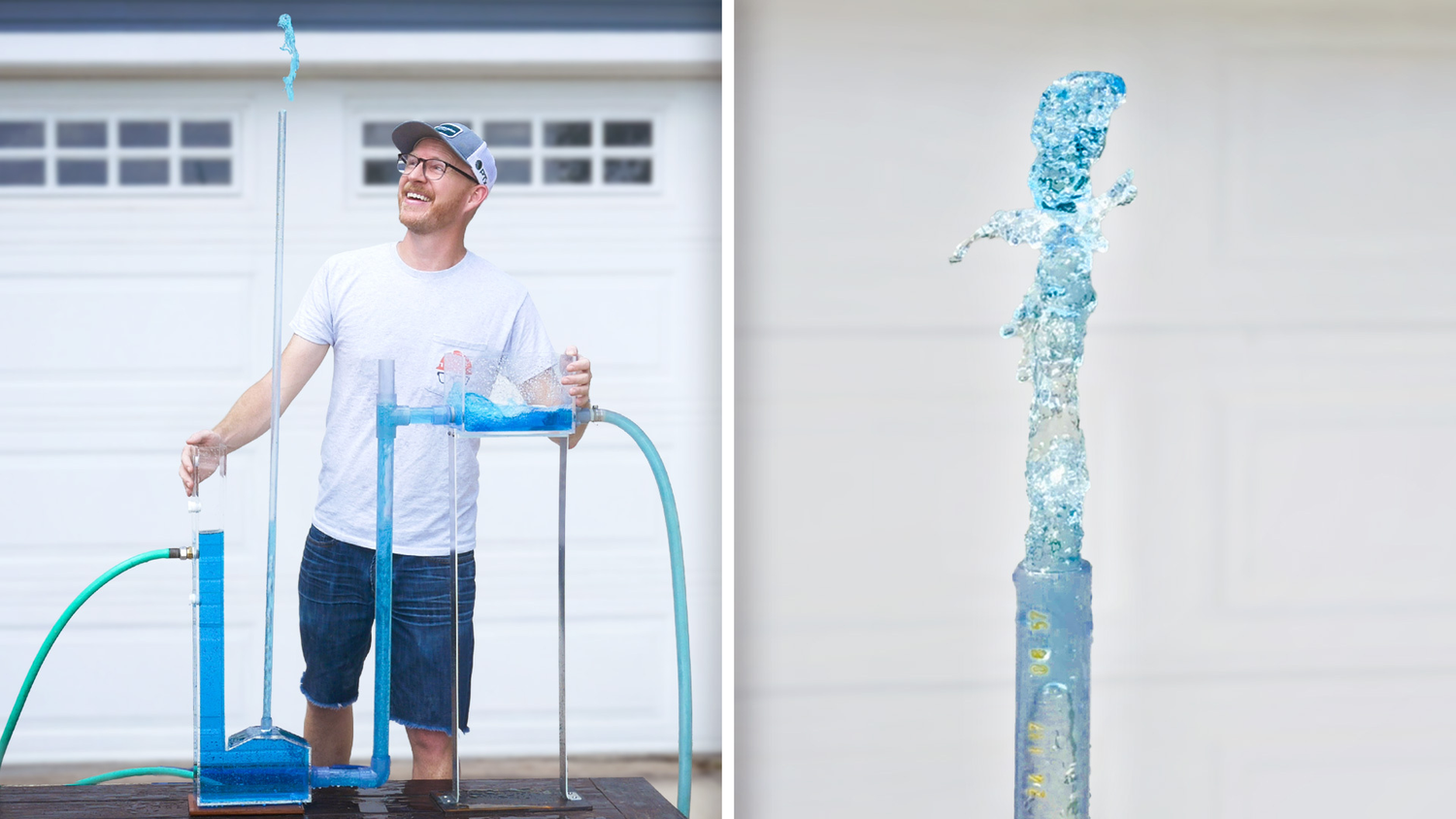
I just had to tap the holes… then glue everything together. Now, let’s turn on the water so we can see this in action.
Step one is this basin up top. Rather than connecting directly to the hose, I wanted a free surface of water at the top, just so it’s clear, from an energy perspective, that this is the starting point. This tank provides a simple, consistent, and obvious input for the pulser pump. It’s the equivalent of the end of a canal in an ancient palace, and the goal is to raise the water above this level.
From the basin, the water falls down this vertical pipe. But if you look carefully, you can see it’s not just water. The water flows into this tee fitting that acts like a vent, allowing the stream to kind of swirl around and draw in air. There are quite a few ways to intentionally mix air and water. The historical description of the pump at the Alhambra was pretty unclear when it comes to this part. The priest didn’t provide much detail about how the air was entrained in the downward flow. Professor Cáceres tried two methods and had the most success using a whirlpool to draw water and air downward. I don’t know if this is exactly what he tried, but it is dead simple, and it worked surprisingly well. You can see the water in the pipe is full of bubbles, and it’s moving fast enough to carry them into the next tank.
The goal in this area is to separate all the air from the water. You can see the bubble float upward while most of the water continues onward. The sloped top helps trap the bubbles, so the flow exiting on the right is just water.
So far, this is basically just a trompe. I mentioned I built one of these before in my backyard and made a video about it. It looks a little different from this one, but the concept is basically the same. Entrain bubbles of air in a stream of water, carry them downward, and then separate them out - now under pressure - so the air can be used for things like smelting, powering tools, or in my case, blowing some dry grass around. It was just a scale demonstration.
Trompes aren’t used much these days. It’s easier to buy a compressor than to build a piece of infrastructure. But it’s still a cool idea, and their use is being explored to aerate remote pools of mine waste to speed up the bacterial reactions that can help clean up contamination. There are probably quite a few edge cases where a source of pressurized air is more valuable than a source of moving water, and a trompe basically lets you make that trade with no moving parts or electricity.
The sloped top helps trap the bubbles, so the flow exiting on the right is just water. You can see in my model, there’s a riser on the right, just like with the trompe demo. The purpose of this is to create enough pressure to encourage the bubbles upward. You can imagine if there was no back pressure on the system and I just let the water out at the bottom of the separator, eventually it would just fill up with air. That’s not what we want. So the water has to flow up the riser and then out through this hose, keeping the bubbles under pressure so that they’ll flow out of this tube: the discharge line for the pump.
I tried all this in my garage first, but kept spraying the ceiling, so I eventually decided to do this outside. My discharge line runs up above the inlet tank. As bubbles move into the separator, they float upward and out of this pipe. But, because the pipe is pretty narrow, water gets kind of trapped between the bubbles. This is a little finnicky, but basically, the buoyancy of the air mixed with the water occasionally creates enough lift for the water to make it all the way to the top. And now you can see why they call this a pulser pump. You don’t get a very continuous flow. But look at that! The water is actually going a lot higher than where it started in the upper tank. We are moving water uphill with no moving parts.
Actually this part of the pump is a pretty ubiquitous design. It’s usually called an air lift pump. Basically, pump air bubbles to the bottom of a pipe, and let them carry water upward. These are often used in dirty situations where you don’t want sand, grit, or plant matter clogging up the impeller of a more traditional pump. They’re not very efficient, but useful in certain situations like wastewater plants and dredges. And, this is also how coffee percolators work. The steam bubbles carry the liquid water to the top where they can percolate downward through the grounds.
I’m recirculating the water in this demo just using a bucket and pump below the table, and that drives home a couple of key points here. For one, all the water running through the pump does not actually get pumped. In fact, in my little demo here, I didn’t actually measure it, but I’d guess the discharge flow rate is somewhere less than five percent of the total flow rate through the pump. You need a lot of water to move just a little bit upward. So for two, this is not a free energy device in the same way a hydropower turbine isn’t producing free energy. In a practical sense, the pulser pump is extracting energy from the flowing water to push water bubbles downward, temporarily storing the energy. Then it’s extracted again to push some of that water back up.
So it really is that simple. A pulser pump is basically a combination of two steps: a trompe to supply the bubbles, and an air lift pump that uses those bubbles to carry water upward. But in some ways, it’s not simple at all. Two phase flow, where air and water move together, is pretty complex. If you thought fluid dynamics was tricky with one fluid, just try using two! You can tell just by looking at my demo that there’s not a lot of stability here. At the down tube, sometimes you get a regular stream of small bubbles, and occasionally you get one big one. At the discharge, sometimes you get regular pulses; sometimes you get big bursts. Every step of the process is just so …gurgly. There are a lot of knobs to turn here, and they all affect the system in different ways.
Let’s say you have a fixed flow rate, and a fixed amount of height between your inlet and outlet. You still have to select the diameter of your down pipe, which will affect the fluid velocity, and so how much air you can draw in. There are probably many different ways to mix the water and air that are more or less efficient, depending on the configuration. And there’s the diameter of the discharge line. A bigger pipe can move more water, but too big and the bubbles don’t crowd up enough to carry water with them. There is quite a bit of engineering guidance out there for air lift pumps, since they’re pretty widely used. Not so much for trompes, although I did find an interesting paper in the Journal of Applied Thermal Engineering. The author called them “hydraulic air compressors” and that’s actually one of the tricky parts to finding more information on devices like this. Since they’re pretty obscure, there’s not much consistency in terminology. The most I could find on pulser pumps was a few old YouTube videos and college projects. And this recent paper on the hydraulic techniques for water supply at the Alhambra doesn’t even venture a name for the device used there.
So this is still kind of just trial-and-error engineering. I’m sure I could spend hours trying different configurations and improving this demonstration. If you’re a grad student looking for a thesis idea, I think pulser pumps would make a pretty interesting project, because I can see some applications here. In fact, I’m not the only one.
Hydraulic ram pumps are pretty popular around the internet and in rural areas that have abundant water but no electricity. They were well known by the time Professor Cáceres did his experiment in 1911. In his paper, he said about the pulser pump:
“This arrangement will always have, over the hydraulic ram, the advantage of eliminating valves entirely, since it contains no moving solid parts. Doing away with the ram strokes seems to remove any source of fatigue in the pipes and, of course, the very annoying noise that makes the ram inapplicable near living quarters.”
I can’t help but think back to him in his lab, seeing the water spurt out from the top of the discharge line for the first time. You can tell his excitement in the paper:
“Beyond its historical appeal, the idea has real value for modern engineering. In cases where efficiency is not critical, reviving it could solve practical problems, using a layout so simple that it is remarkable it has not become common knowledge after several centuries.”
I wonder if he would be a little disappointed that the idea never really did catch on, despite its novelty. But I still think it’s pretty cool. And maybe someone will see my demo working and try it for themselves, carrying the ancient idea forward for new applications. Thank you for watching, and let me know what you think!

A Debate on the January 6th Insurrection Between Fox News Host Jeanine Pirro and US Attorney Jeanine Pirro
Note: All of Jeanine Pirro’s dialogue below is taken from statements she has made on the record and accurately reflects the spirit in which they were delivered.
MODERATOR: It’s the anniversary of the January 6th riot at the US Capitol, and although five years have passed, there remains a great deal of disagreement about what transpired on that day. Joining me to discuss this are two distinguished guests: Fox News host Jeanine Pirro, and US Attorney for the District of Columbia Jeanine Pirro. My first question to both of you: Do you agree with the January 6th Committee that what took place that day was, in fact, a violent insurrection against the United States government? I’ll start with you, Ms. Pirro.
FOX NEWS HOST JEANINE PIRRO: The actions at the United States Capitol were deplorable, reprehensible, and outright criminal. These repulsive, frightening actions represent the most significant breach of our Capitol in over two hundred years.
MODERATOR: Your response, Ms. Pirro?
US ATTORNEY JEANINE PIRRO: The truth is that it’s language, it’s a narrative, and we’ve been watching it since the day and before Joe Biden walked into office. What they do is they create a narrative. They say January 6th was violent when the truth is that this is part of the agenda where they are shutting us down, ending the First Amendment.
MODERATOR: I want to quickly stop you right there, Ms. Pirro, to give Ms. Pirro a chance to reply to that. What are your thoughts on the January 6th rioters?
FOX NEWS HOST JEANINE PIRRO: I don’t care whether those who did it think the election was stolen. That is not a justification. You did it of your own will, and you will be held accountable.
MODERATOR: I’m curious what your reaction to that is, Ms. Pirro.
US ATTORNEY JEANINE PIRRO: This idea of, you know, jailing people based upon their political beliefs, and that’s what it was, uh, should never ever be tolerated in this country.
MODERATOR: Ms. Pirro, do you believe that the criminal investigations of the January 6th rioters were politically motivated?
FOX NEWS HOST JEANINE PIRRO: Take the veil of politics off. Be totally objective. Five people are dead. A police officer, an air force veteran, not to mention countless others injured, including a young police officer on video screaming as he’s being crushed, blood coming out of his mouth.
MODERATOR: I’m glad you brought that up, Ms. Pirro, and I want to give you a chance to respond to that, Ms. Pirro. Who do you believe is responsible for the deaths on January 6th?
US ATTORNEY JEANINE PIRRO: You know, the person who died was Ashli Babbitt, uh, that the Capitol Police, as I understand, shot.
MODERATOR: Okay, so some disagreement there. I think we have time for one final thought from each of you. Ms. Pirro, is there anything you would like to say to the participants of the January 6th riot?
FOX NEWS HOST JEANINE PIRRO: To those of you who did this. What was the point? What did you get out of it? Was there even a plan when you got in there? Besides looking like a bunch of freaks, breaking windows, carrying off a podium, sitting at Nancy Pelosi’s desk, and leaving a love note with fingerprints behind? Identifying yourselves with selfies, stealing, damaging property, trespassing, and looting? Did anyone stop to think?
MODERATOR: And I take it you disagree, Ms. Pirro?
US ATTORNEY JEANINE PIRRO: That’s why they’re doing an investigation of the January 6th Committee. These radical left Democrats, these people who want to resist Trump, go for it. I want to see you in handcuffs.
MODERATOR: Well, that’s all the time we have for today. I want to thank my guests, Jeanine Pirro and Jeanine Pirro. We appreciate your diversity of perspective.
bringing alcohol to the home of a recovering alcoholic, a candidate’s obnoxious Facebook comments, and more
It’s five answers to five questions. Here we go…
1. Bringing alcohol to the home of a recovering alcoholic
My coworker is a recovering alcoholic; he doesn’t discuss it but never drinks, occasionally refers to “when I was drinking,” and once was frightened when he learned there may have been alcohol in a dessert he’d eaten (there wasn’t). His wife has generously invited our office over for dinner. She told us that “we keep a dry house” but we’re welcome to bring alcohol if we want it with our meal.
This has created a debate within the office. Two want to bring alcohol, arguing that she told us (without us asking, I should add) that we could. The rest of us feel it would be rude and we should respect the rules of her house and our coworker’s feelings.
We’ve agreed we won’t bring alcohol. I’m wondering, though, what is your take?
Yeah, don’t bring alcohol. It’s not like bringing along your own allergen-free food to ensure there will be something you can safely eat; you don’t need alcohol with the meal, and it’s more respectful to your coworker not to. And really, if someone feels like it will be an enormous inconvenience not to have alcohol with a single meal, I’d wonder what was up.
It might be different if you were close friends and better positioned to judge how much it would actually bother them … and how much the “you’re welcome to bring your own” comment was sincerely meant versus something they say but still prefer people not do. (And yes, they shouldn’t say it if they don’t mean it, blah blah blah, but people being humans, it happens anyway.) But you’re colleagues and not as well positioned to dig into “how much would this really bother you?” as you’d be with a friend, so it’s better to err on the side of respecting their alcohol-free home.
2. Should I consider a candidate’s obnoxious Facebook commenting when hiring?
I work in nonprofits. For anonymity’s sake, I’ll just broadly say I work in the arts. I am part of several arts-related groups on Facebook, including several specific to my niche and several region-specific groups. I’m not a huge Facebook person, so I mostly just join to keep up with local events and interesting initiatives in the field. But over the past year or so, I’ve noticed one woman, Hannah, who has joined every major arts group as well, plus all of the region-specific groups. She stands out as particularly difficult. She’s aggressive on almost every single post. She will get into heated arguments, and frequently tells other people that they don’t know what they’re talking about. The real kicker is that she is wrong about quite a bit. She gets extremely defensive when called out, despite admitting that she is relatively new to the field. To be clear, I’ve never actually tried to find her content, and I’ve never even engaged with her — this is just what I see every single time I open the group pages. It definitely sours the overall vibes of the group.
At work, I’m on a hiring panel for a role that does not report directly to me, but works under my guidance on a few projects. The other day, HR mentioned that they’d be sending along a new resume, for a woman named Hannah. I didn’t think anything of it until I hopped on Facebook later in the day and, once again, saw Hannah getting into a heated debate in the comments of an otherwise positive, non-controversial post. Obviously, I have no idea if this is the same Hannah. She has a common first name but a very unique last name, so it will be easy to tell when I see the resume.
I’m very doubtful this will happen, but mostly out of curiosity: what if it’s the same Hannah? Would I need to bring it up to the hiring panel ahead of time? I know people have been fired over social media posts, but from what I’ve seen, that is mostly in egregious cases. As far as I can tell, Hannah’s never said anything really terrible — she is just a constant, argumentative presence in groups, harshly criticizing others and often making statements that are plain wrong. Aside from her being a difficult coworker, my first thought is that a combative (and fairly visible) social media presence would be a liability to our organization. But what would be the ethical and professional guidelines here? Is it reasonable to consider personal social media encounters when making a hiring decision?
It is reasonable to consider your own firsthand experience with a candidate, and it is reasonable to consider how a candidate presents themselves within industry-specific spaces. Both of those are in play here!
In fact, I think it would be negligent not to fill the rest of the hiring team in on how you’ve seen Hannah operate in field-specific places. Not only is it data about what she’s likely to be like to work with, but it’s also relevant to how hiring her might be received by others in your field!
3. My roommate shaved my eyebrow just before a big interview
I know by the time you get this it’s going to be too late but I’m freaking out. I’m probably going to tell them I’m sick because I look ridiculous and there’s no way to explain this to them.
I have an interview for a really cool internship tomorrow. This would be my first time working in my field and I’ve low-key been panicking about it before this whole trainwreck.
My roommate had some of our friends over, so I was hanging out with them tonight. I’m currently trying some medication that makes me sleepy, so I fell asleep on the couch.
I woke up to my roommate shaving my eyebrows! She and everyone were super giggly and drunk. They kept trying to say it was fine but I ran to the bathroom and … my stomach is still dropping every time I see my face. She basically shaved off my entire left eyebrow. There’s some hair left, but it’s super obviously shaved and the razor cut me a little so I had to put on a bandaid. I look crazy.
I don’t even know what to do. The firm I’m interviewing at is pretty formal and I’d be seeing clients, so this look is a total no-go. I feel like I can’t even explain what happened because their first impression would be I’m some high-drama party girl. And I can say I’m sick, but I can’t reschedule it anywhere near enough time for my eyebrow to grow back! This has ruined my chance at a job I was so excited for and I feel so stupid.
Eyebrow pencil! You can draw it back on well enough to pass for having an eyebrow at an interview!
4. How early is too early for meetings with an international team?
I’m young and in my first corporate job on an international team (U.S., UK, India) and we have a weekly stand-up at 7 am. As it’s only once a week, I’m alright starting my day earlier to keep my Indian colleagues from staying late but that made me wonder how far outside of work hours is too far for work meetings? 7 am seems unreasonable to me if it were a daily meeting but so does 7 pm for my colleagues in India (given we do 9-5).
Yeah, this is pretty par for the course when you work on an international team. If you need a slot when people in time zones that far apart can all be available, it’s going to be an inconvenient time for someone. But ideally the inconvenience would be rotated so it’s not always the same team getting scheduled outside of normal hours every time.
5. How long should I wait after getting a promotion before job-searching?
I work within a very small (and shrinking) but necessary team in my company. Recently our team’s core personnel was reduced to just me and the team lead, leaving a vacant position, and just today they significantly cut the team lead’s pay, leading him to walk. This leaves me as the only person with significant day-to-day operational knowledge in a technical position, as everyone else are mid- and high-level management who work with several teams and oversee much larger programs.
I’m the senior most member of the team besides the lead and am very likely to get the vacant position. Given the recent state of the company, however, it’s clear that I should not count on any long-term plans with them.
The raise is likely to be significant and the position would look good on a resume, but I’m certain they will overwork and underpay me. But I’m afraid, and with some precedent, that if I refuse, they will lump whatever of his work they can on me and divvy the remaining responsibilities among the upper levels as a “temporary” or “necessary” measure. But I also fear that taking this promotion could shackle me to this position for a while yet.
If I take the promotion, how long should I wait before seeking new employment? I imagine recruiters would look at someone applying soon after a promotion rather negatively, particularly since this would be a jump into a leadership role and could lead to me being seen as either unreliable or unable to handle such a position. Is there any other way I could diplomatically present this within interviews besides “differences of opinion” and “not seeing eye-to-eye with [Employer]”?
You don’t need to hold off on job-searching. Take the promotion and start a job search. It’s not going to look weird.
If a recruiter asks why you’re looking so soon after being promoted, you can say, “I was happy to help out with the role when the company asked me to, but the company has also been making a lot of cuts and I’m looking for something more stable.”
6. Holiday book fair
Just sharing this from a reader:
I think this is coming too late for your holiday posts, but I need to share. I work at a library and every year, we get pretty nice gift bags at the holiday party. But like all gift bags, there are always things that don’t work for some people (particular treats, scented candles, blankets when you have 20-million blankets at home already).
This year, we walked in to discover a BOOK FAIR. The local independent bookstore brought a bunch of hardback books of different genres, puzzles, games, reading lights, etc. Everyone got to pick out something and take it home. I’ve never seen 150 adults so happy about anything. I will be riding that book fair high for months.
The post bringing alcohol to the home of a recovering alcoholic, a candidate’s obnoxious Facebook comments, and more appeared first on Ask a Manager.
British Teen Returning From Semester In U.S. Regales Friends With Tale Of Food That Tastes Good
LONDON—Delighting his schoolmates as he weaved a rich tapestry of life in the United States, newly returned British exchange student Ethan Rowe, 15, reportedly regaled his friends Tuesday with stories of food that tastes good. “In America they use salt, and they have sauces other than malt vinegar and brown!” Rowe said to growing throngs of uniformed secondary schoolers, who oohed and aahed at his descriptions of “leafy vegetables” and of sausages that had texture and were not made of coagulated blood. “There are pizzas with toppings like ‘fig’ and ‘arugula’, and the thinnest, crisp crust, and they have roast ‘barbecue’ meats that are flavorful instead of plain. As for breakfast, they have something called ‘breakfast burritos,’ which are little rolls of delicious fried potatoes and egg, served with a red or green dressing called ‘salsa.’ And there’s not a mashed turnip in sight!” At press time, sources confirmed Rowe was receiving pushback from schoolmates who denied it was possible to add seasoning to a meal.
The post British Teen Returning From Semester In U.S. Regales Friends With Tale Of Food That Tastes Good appeared first on The Onion.
I Am a Disappointed Zohran Mamdani Voter Who Was Told New York Would Descend into Chaos
Well, they say you should never trust a politician, and it seems I’ve been duped.
As an avid reader of the New York Post, the New York Post’s X feed, and transcripts of several-minute-long voice memos from my relatives who have never lived in New York and will never live in New York, I was promised one thing from a Zohran Mamdani mayoralty: chaos.
Campus chaos. Anti-ICE chaos. Chaos in our parks, sidewalks, and public spaces.
And as an anarcho-communist-accelerationist-antifascist-nihilist-transplant-gentrifier-crisis actor living in a rent-controlled penthouse bodega paid for by some combination of my mommy and George Soros, that’s exactly why I wanted Zohran to win.
A city in collapse? A desperate citizenry? The demise of hope? I can’t think of any better conditions for my punk band / musical improv team / woke clowning syndicate to thrive.
But here we are, in Mamdani’s New York, and in a sick and destabilizing twist, there has yet to be a sick and destabilizing twist.
I was assured that a Mamdani administration would mean an exodus of New York City business leaders. But I showed up to work this morning, and my boss was still here. And worse: He made me do stuff. He’s supposed to be halfway to Florida by now. I didn’t put in all of this hard work just for my tax dollars to go toward the continued collection of massive corporations’ tax dollars.
“Go ahead, vote for Zohran,” they said. “The NYPD is going to abandon the city,” they said. Tell that to the officers who blasted their sirens at me this morning so they could run a red light before promptly turning off their sirens once they were past that red light. Unless they were conducting an emergency self-deportation to Long Island, it’s business as usual. Mamdani’s opponents swore that the next time a New Yorker was in danger and called the police, none of them would be there to help. But it’s just the opposite: All of them are still here to not help.
The way everyone was talking, I thought the streets would look like Mad Max. But the only similarity is that there’s a healthy amount of space between cars, thanks to the success of congestion pricing. And there’s always one guy blasting some absolute bangers from his custom sound system.
And speaking of custom sound systems: When can I expect my free stuff? Not childcare and buses—they’re actually hard at work on that. No, I’m talking about the $10 billion in socialist freebies that I kept seeing mentioned in the paper. I only saw the headline—I don’t have time for any more long-form reading once I’m finished with Bill Ackman’s tweets—so I could only assume based on the tone that a massive dump truck full of communist goodies would be rolled up to my building by now. But there’s nothing. No hammers. No sickles. No guillotines. Not even the free juice Zohran promised when running for high school president, a fact that it was absolutely in the public interest for me to know.
By the way: Where is the Islamic cultural revolution that I was promised I was being promised? My own senator made me believe we were on the verge of “global jihad.” I understand that in government, change happens incrementally, and the mayor just got started. But despite having five years in the State Assembly, Zohran Mamdani was unable to deliver even a single act of jihad for his local district. That’s his whole political project in a nutshell: all talk, no jihad.
Oh. Also. The other movie I thought it was gonna be like was The Purge.
It’s almost as if Mamdani was being widely mischaracterized as a dangerous extremist by overlapping political and media empires in a no-holds-barred campaign to scare New Yorkers away from electing a candidate whose most unorthodox idea was putting their interests above those of the elites.
But I hope not. Because if the wealthiest New Yorkers, cops, and Islamophobes aren’t leaving, then I might have to. Unless Staten Island does first.
Her Parenting Time Was Restricted After a Positive Drug Test. By Federal Standards, It Would’ve Been Negative.
Kaitlin spent the first weeks of her newborn son’s life in a panic. The hospital where she gave birth in October 2022 had administered a routine drug test, and a nurse informed her the lab had confirmed the presence of opiates. Child welfare authorities opened an investigation.
Months later, after searching her home and interviewing her older child and ex-husband, the agency dropped its investigation, having found no evidence of abuse or neglect, or of drug use.
The amount of opiates that upended Kaitlin’s life — 18.4 nanograms of codeine per milliliter of urine, according to court documents — was so minuscule that if she were an Air Force pilot, she could have had 200 times more in her system and still have been cleared to fly.
But for Kaitlin, the test triggered an investigation with potentially life-altering consequences. (ProPublica is using Kaitlin’s first name because her full name has been redacted from court documents. She declined to be interviewed for this story.)
The ordeal “tempered what was otherwise supposed to be a joyous occasion” for the family, according to a lawsuit filed in 2024 by New Jersey’s attorney general against the hospital system, Virtua Health.
The hospital said in a statement that it has “a relentless commitment to evidence-based, equitable care for every family.” In court documents, it denied the lawsuit’s allegation that it discriminated against pregnant patients and noted that Kaitlin consented to the test. It also said that New Jersey law mandates it to submit reports of “substance-affected infants” to the state’s Division of Child Protection and Permanency. The lawsuit is pending and a judge has referred it to mediation.
Drug-testing labs typically report results in black and white: positive or negative. But a little-known fact about the industry is that those results are often based on standards that are wholly discretionary. For example, nearly all states use a threshold of 0.08% blood alcohol content to decide if a motorist is intoxicated. But for other drugs detected in urine, saliva and hair, cutoff levels vary from test to test and lab to lab — including Kaitlin’s test for opiates.
There’s no consensus among labs on what level should confirm the presence of codeine in urine, said Larry Broussard, a toxicologist who wrote an academic journal article on “growing evidence” that poppy seeds in bagels and muffins provoke positive test results. (Kaitlin ate a bagel shortly before taking her drug test, according to court documents.) There’s more consensus for some other drugs, but labs still disagree on appropriate cutoff levels for common drugs such as THC (the compound in marijuana that creates a high) and meth, said Broussard.
A Hospital Said Kaitlin Tested Positive for Codeine, But the Military Would Have Said the Test Was Negative Even at Levels 200 Times as High

In 2022, the same year Kaitlin tested positive for codeine, the Department of Defense noticed a surge in personnel on military bases blaming positive tests on poppy seeds. Scientists at the military’s labs concluded that a change in the manufacturing process of some poppy seeds had led to contamination, causing service members to be falsely accused of abusing drugs.
So far, 62 positive tests for codeine have been “overturned and adjusted in Army records,” an Army spokesperson told ProPublica. In response, the Department of Defense in March 2024 doubled the military’s cutoff level for codeine tests to avoid false positives triggered by poppy seed muffins, bagels and other foods. Service members are now cleared for duty with up to 400 times more codeine in their urine than is used to justify child welfare investigations in some states, ProPublica found.
ProPublica reviewed cutoff levels used to confirm the presence of common drugs, including opiates, meth, THC and cocaine, as cited in court records, labs’ contracts with government agencies and scientific journals, as well as in interviews with toxicologists. We found that the cutoff levels used by the child welfare systems vary widely from jurisdiction to jurisdiction. One large state agency, Michigan’s Department of Health and Human Services, contractually required a lab to use levels that it later acknowledged were “scientifically unsupportable.”
Ted Simon, an expert toxicology witness and a board member of the nonprofit Center for Truth in Science, which advocates for objectivity in research, said agencies are better off consulting with labs to set cutoff levels. That’s because “some labs do validation testing to ensure the accuracy of their cutoffs based on knowledge of human biology.” But even when labs set levels, they don’t always get them right. Some labs “just use the sensitivity of the chemical analysis to measure vanishingly tiny concentrations with no way to assess the relevance to humans,” Simon said. This can result in situations like Kaitlin’s, where the hospital’s cutoff was near the lower limit of what sophisticated lab instruments can detect, he said after reviewing her case.
Meanwhile, “labs tell their clients what they want to hear and are hesitant to disclose the uncertainty inherent in their methods,” Simon said.
There’s no industry consensus on what, or if anything, should be done about the differing standards. Some experts see a need for uniform levels but acknowledge it would require lengthy vetting before toxicologists and other stakeholders agree on what’s appropriate. Others maintain that as long as labs are transparent and support their decisions with research, they should continue choosing their own levels. “The labs do what works for the instruments that they have,” said Simon.
Child welfare agencies employ a patchwork of drug testing standards, according to contracts and procurement documents.
Some, like Los Angeles County’s Department of Children and Family Services, require labs to use high cutoff levels that protect against false positives. Other agencies’ contracts with their drug testing services do not specify cutoff levels, leaving the decision to the lab.
A few large agencies require labs to use ultra-low levels, which catch more users but come with risks. Incidental exposure to a substance in the environment and over-the-counter medications can trigger positives. “The smaller the concentration that you try to detect, the more likely you are to get false positive results,” said toxicologist Paul Cary, who wrote a guide to testing for drug courts, which aim to address the addictions of people accused of drug-related crimes and avoid incarceration.
Some Child Welfare Agencies’ Thresholds for a Positive Drug Test Are Lower Than the Federal Government’s
The levels at which various agencies consider a drug test positive for meth vary widely. “The smaller the concentration that you try to detect, the more likely you are to get false positive results,” said toxicologist Paul Cary.

The federal government sets standards for drug testing 14 million people. These include public-sector employees as well as workers whose performance affects the safety of others, known as safety-sensitive roles, like airline pilots, truck drivers and those working in nuclear facilities. For decades, the program was known for a rigorous scientific review and inspection process to ensure accuracy.
In 2025, President Donald Trump’s second administration overhauled the Substance Abuse and Mental Health Services Administration, the federal agency responsible for the testing standards program, and dismissed half of its staff. It also disbanded the expert panel that proposed scientifically valid cutoff levels, the Drug Testing Advisory Board. “There could be issues for national security or safety sensitive issues that might be impacted given the recent changes,” said Hyden Shen, former regulatory and policy oversight lead at the health agency’s division of workplace programs. In the spring, Shen resigned alongside almost half of his division. He spoke to ProPublica after leaving federal employment.
Private labs have long been free to set their own standards, independent of the federal government’s recommended levels. The CEO of a laboratory company specializing in testing for probation departments, child welfare agencies and courts testified in a lawsuit that in 2018 the lab had lowered cutoff levels for cocaine in hair follicle tests by a factor of five without amending its contract with the state child welfare agency. The company said that the change was to align its levels with scientific updates and that state agencies were made aware of the new cutoffs when it reported test results. The lawsuit was settled with the lab denying wrongdoing.
Federal workers who test positive for drugs can’t be punished until their results are scrutinized by medical review officers, physicians who verify that positive drug test results aren’t being triggered by legitimate medications. (For example, without a special follow-up called an isomer test, over-the-counter Vicks VapoInhaler is indistinguishable from street drugs in multiple types of drug tests.) But medical review of test results is expensive, and few state agencies require it for child welfare cases or for testing people on probation. One lab competing for a contract to test probationers and juveniles in a residential facility in Kansas discouraged the use of medical review officers, saying it would “result in extra expense and extra time for results delivery.” Other state agencies, especially those that oversee parole, probation or prisons, skip confirmation testing entirely and rely instead on cheaper, less accurate immunoassay tests, unless someone contests their result and can afford to pay out of pocket for a follow-up, according to contracts between state courts and labs.
Agencies “are effectively saying, ‘Most of these people probably did use drugs. And, yeah, OK, there’s a handful that didn’t. But it would bankrupt us to have to confirm all of these,’” said Karen Murtagh, executive director of Prisoners’ Legal Services of New York, which has represented inmates in drug testing cases.


In the spring of 2019, Marie Herrera was working to reunite with her four kids in Michigan’s foster care system. (ProPublica is referring to Herrera by her middle name at her request, to maintain her privacy as she moves forward with her life.) At a hearing on her case, a foster care worker testified that it was going well, according to a filing from her attorney: “Mother had attended all eleven parenting times, had procured employment, was in therapy, lived in three-quarters housing, and tested negative for illegal drugs during the current reporting period.”
Then that July, Herrera’s saliva tested positive for cocaine. Herrera admitted to being in recovery from an addiction but denied using the drug. Over the next eight months, two more of her drug tests were confirmed positive for cocaine by the state’s lab. She sought testing from an outside lab, which didn’t detect illegal drug use.
According to her test results from the state’s lab, which Herrera shared with ProPublica, the levels of cocaine and its metabolite in her system ranged from 1.065 to 1.774 ng/ml, just above the state’s cutoff of 1 ng/ml in saliva. If the positive-test threshold for federal workers had been applied to Herrera’s tests, she could have had more than four times as much of the drug in her saliva and still been cleared to fly a plane.
But Herrera’s positive test from December 2019 caused the judge to take away her unsupervised parenting time, according to court records.
“The positive drug tests turned my world upside down and ruined my life,” said Herrera. What she didn’t know is that behind the scenes, Michigan’s child welfare agency was reviewing — and preparing to raise — its cutoff levels.
Herrera Tested Positive for Cocaine Under Michigan’s 2019 Standard, but in 2020 the Same Test Would Have Been Ruled a Negative
Herrera lost unsupervised parenting privileges after the positive test.

Michigan’s levels for cocaine and other drugs in saliva had been set by its drug testing vendor, Forensic Fluids, in 2018, according to public records. (Forensic Fluids did not respond to a request for comment.) Michigan contractually required the same levels when it signed with a new lab, Averhealth, in 2019.
But the child welfare agency noticed conflicting results between its tests and those ordered by law enforcement agencies, according to public records. Some individuals who tested positive for a drug with one agency tested negative with another.
In November 2020, at the urging of its new lab, the agency raised its levels. Communications between the agency and Averhealth show both were concerned that low cutoffs might not be “forensically defensible” due to “uncertainty around environmental exposure.”
“Current levels … are scientifically unsupportable,” Michigan’s child welfare agency wrote in a memo about the change.

In a statement, Averhealth, the lab that processed Herrera’s tests, said the mismatch in results that concerned Michigan administrators “in no way calls into question the accuracy or reliability” of its testing. “Inconsistencies occurred when different types of tests were conducted (saliva or hair) or when the individual was tested days later,” the company said, noting that “different types of testing have different limitations.” The company said its test results “simply attest to whether a drug is present in a specimen and, if so, in what quantity. It is left to the courts to decide what, if any consequences, follow.”
In Herrera’s case, the lab said, low-level cocaine positives “likely represent ingestion of cocaine” and that “passive exposure as an explanation is highly doubtful.” The company also pointed out that Herrera had several high-level positive tests for methamphetamine in the fall of 2020, nine months after the court took away her unsupervised parenting time.
Herrera admits she’s relapsed at times. But she also says that being labeled a cocaine user early on in her case, when she says she wasn’t using, derailed her recovery. Herrera believes it set her up to fail by creating an adversarial relationship with her caseworker and judge. “I wasn’t grateful about what they were doing to me,” she says.
Herrera’s parental rights were terminated in 2021, less than a year after Michigan raised its cutoff levels for cocaine in saliva. In denying Herrera’s appeal, a judge cited her refusal to participate in further drug tests, additional failed tests when she did comply, and her lack of housing and income, among other things.
When Herrera was told she could never again see her kids, she said, she was devastated and relapsed again. “Fuck it, if they say I’m an addict, then I’ll numb the pain.”
“I think about my kids every single day,” she said. “It’s affected me completely.”
Even after raising its cutoffs, Michigan’s levels were still far lower than those used for federal workers. The state declined to comment, but a memo stated that officials considered the federal levels inappropriate because they “do not assess the impacts of how those substances may affect a person’s behavior” or “how that use may impact child safety.”
Drug testing policy experts say it’s not possible for any test, no matter the cutoff level, to reliably predict child safety.
“A drug test doesn’t tell you if a person has a substance use disorder, if they are in recovery, or whether a child is safe,” said Nancy K. Young, executive director of Children and Family Futures, which consults for child welfare agencies, and co-author of a Substance Abuse and Mental Health Services Administration policy paper on drug testing for child welfare agencies. Young said administrators should consider test results as “just one data point” and rely more on “casework and a relationship with the family” to determine whether a child is safe and well.
Graphics Notes
For codeine, meth and cocaine graphics, the cutoff for federal workers is from the Substance Abuse and Mental Health Services Administration’s Mandatory Guidelines for Federal Workplace Drug Testing Programs.
Codeine Graphic: Kaitlin was tested at Virtua Voorhees Hospital in New Jersey. Source for the Department of Defense cutoff is an agency press release, and sources for test results and hospital cutoff are court records.
Meth Graphic: Los Angeles County Department of Children and Family Services data is from the agency’s 2023 invitation for bids. Orange County Social Services Agency data is from the agency’s 2021-2024 contract with its drug testing provider. Utah Division of Child and Family Services data is taken from an individual’s drug test results from 2022. Georgia Division of Family and Children Services data is from an individual’s drug test results from 2020.
Cocaine Graphic: Cutoffs are the level at which each organization considers the presence of cocaine in saliva to be confirmed by mass spectrometry (gas or liquid chromatography). Ng/ml is nanograms per milliliter. The cocaine cutoff levels used by the Michigan Department of Health and Human Services for testing in saliva are drawn from public records, including contracts, communications between the agency and its labs, and agency employee emails obtained via a public records request. Marie Herrera provided ProPublica with her test results.
The post Her Parenting Time Was Restricted After a Positive Drug Test. By Federal Standards, It Would’ve Been Negative. appeared first on ProPublica.