Cowboy Who?
Shared posts

Papa Chris & Daddy Leon's Matching Coats #ResidentEvil
Music:
Resident Evil 2 - Secure Place (Sega Genesis Remix) By TheLegendOfRenegade https://www.youtube.com/watch?v=wZ7qc8_lL4I
Song: Sean Pitaro - Passport
Music provided by NoCopyrightSounds
Free Download/Stream: http://ncs.io/passport
Watch: http://ncs.lnk.to/AT/youtube
Animation by Jeremey Chinshue
For advertising email: Marketing@Frederator.com
TERMINALMONTAGE® SOMETHING ABOUT® SOMETHING SERIES®
Registered in the U.S. Patent and Trademark Office.
© TERMINALMONTAGE LLC. All Rights Reserved.
For additional legal information, please see: https://terminalmontageportal.weebly.com/legal-notices-and-disclaimers.html
#residentevil #gaming #memes #somethingseries
employee is an emotional rollercoaster and her coworker can’t take it
A reader writes:
I’m a manager of a four-person team, on which I was previously an individual contributor. The four team members work in cubes in an open office area and my office is down a nearby hall. We’re a casual office, and the team generally gets along well. While each person has their own accounts and tasks, they interact with each other throughout the day, chatting and discussing work.
The issue is two members of the team, Peach and Daisy. Peach is very open with her mental health struggles and is an open book on most anything but can be emotionally volatile. Daisy, who sits next to Peach, tells me that Peach is constantly on an emotional rollercoaster. She says Peach complains often — about her life and about work. Peach is a single mom and often complains about being overwhelmed at home. She comments out loud if she’s having a bad day, doesn’t feel good, or if someone on another team annoys her. One minute she’s up and enthusiastic, and the next she is upset and complaining. In our one-on-ones, Daisy has said that she’s exhausted by the ups and downs and feels that she has to be Peach’s emotional support all day.
I have given Peach feedback in the past about keeping a positive attitude and leaving her problems at the door and as far as what I personally witness, she has improved. So the complaints from Daisy, while not completely surprising, are out of proportion to what I have observed since I don’t sit in the office with them all day.
I have encouraged Daisy to speak to Peach directly and tell her how the complaining is affecting her. I’ve suggested all three of us sitting down together so I can facilitate a conversation. Daisy has not been receptive to this but continues to complain to me.
I don’t want Daisy to be miserable but I’m unsure of the best way to tackle this. Do I sit down with Peach and discipline her in some way? Do I force Daisy to confront Peach, either with or without me? These two genuinely like each other and I’m sure we all would like to preserve the working friendship they have, but I don’t feel that I can let this go unaddressed.
I have a bunch of questions:
* Can you sit in their area for a couple of days so that you’re observing things firsthand? It sounds like you don’t think it’s as bad as Daisy is reporting, and this would give you more data to know for sure. You’d need to be open to the possibility that Peach might clean it up while you’re there — but it sounds like she might do this so reflexively that she couldn’t sustain that for a full day or two, and you could ask Daisy if her perception was different during that period.
* Can you rearrange how people are seated so that Peach is less disruptive? I’m guessing not, but you should absolutely try that if you can.
* Where are the other two team members in this? Do they disagree that Peach’s complaining is excessive? Are they not bothered because they don’t sit as close to Peach as Daisy does? Do they wear headphones so they don’t hear it? What’s their take on the situation?
* Can Daisy wear headphones at least some of the time to give herself a break?
* What exactly is Daisy hoping you’ll do? It’s worth asking her that directly. I don’t blame her for not taking you up on the facilitated conversation with you, her, and Peach — I probably wouldn’t in her shoes either — but if she’s refusing to address it with Peach herself but still complaining to you regularly, that’s not reasonable either. I’m interested in knowing exactly what she’d like you to do, and it’s worth asking her. (That doesn’t mean you should necessarily do whatever she says she wants. But you might get interesting insight from posing the question directly.)
If Peach’s complaining and emotional volatility is still excessive (which hopefully you can find out for sure with some sustained observation), you have a responsibility to the rest of the team to address it, because that’s exhausting to work around. But that’s not about disciplining her! It’s about having a discussion with her (maybe discussions, plural) where you establish better norms for working in close proximity to other people, including not dumping complaints on them or vocalizing more than occasional minor irritations. It’s appropriate for you to coach her on that as her manager, and for the sake of the rest of your team, you may have to.
One other thing: Daisy says she feels she needs to be Peach’s emotional support. That’s something you need to coach Daisy on, because the fact that she feels that way is making the problem worse. The problem is starting with Peach so you don’t want to put it all on Daisy, but Daisy needs to develop better coping strategies, which include getting comfortable with actively not being Peach’s emotional support. You probably need to coach her on specifically what that looks like, including things like not feeling obligated to respond at all when Peach is complaining.
The post employee is an emotional rollercoaster and her coworker can’t take it appeared first on Ask a Manager.
I’ve run out of a patience with a rude coworker, “I forgive you” in a professional situation, and more
It’s five answers to five questions. Here we go…
1. I’ve run out of a patience with a rude coworker
I’ve run out of patience with a difficult coworker, Mary. I’m one of the few people who has to deal with Mary in person, and my work is closely tied with hers. She’s entry-level while I’m mid-level, but I’m not her manager or supervisor.
She has difficulty completing her work, which causes many problems for her. I have tried mightily to be her friend and mentor for the past few years, but her struggles continue. We’re locked in a difficult dynamic where I have to sit back and watch her flail, and I bear the brunt of her complaints. On a personal level, most people find her to be entitled, high maintenance, and impossible to please. She lashes out at people frequently, and today she stormed into my office following a completely normal interaction to call me rude, offensive, and dismissive. This is very common.
I’m not a confrontational person so I just take it on the chin and try to get on with my day. Over time, I’ve worked on being direct with her, setting boundaries, and learning how she wants to be communicated with. I’ve reported her to her manager and to HR multiple times, and she’s been put on performance improvement plans. Things improve for a time, then we’re right back in the same place.
Any advice to improve this situation? It’s impacting my work and my mental health. I’m worried that one day I’m going to snap and unleash years of frustration on her.
The biggest issue here is Mary’s manager, who apparently isn’t willing to deal with the situation in a way that gets it resolved. Putting someone on multiple performance improvement plans is ridiculous; the first one should have come with a clear statement that the improvement needed to be permanently sustained and if she backslid once it was over, they wouldn’t start the process all over again.
You’re limited in what you can do yourself, but at a minimum you can cut Mary off from constantly complaining to you and can leave the room if she’s being rude to you — and you should give up on trying to be her friend and mentor, because that’s not working and apparently just gets you more exposure to her rudeness (along with storming into your office). Stop trying to help someone who doesn’t appreciate it and is abusive to you.
You can also continue to report the issues you encounter with her to her boss and HR; make it less comfortable for them to keep ignoring the situation. And transfer the unpleasantness of dealing with Mary over to her manager as much as possible — meaning that if she’s not doing her work, rather than talking to her about it, take it to her manager (“I need X from Mary and don’t have it; can you please ensure I get it?”) and if she sends you rude messages, forward them to her boss with a note like, “Can you please address?” If you transfer the burden of dealing with Mary more to Mary’s boss, she might eventually be moved to act more decisively.
Related:
how to deal with a coworker who’s rude to you
2. “I forgive you” in a professional situation
I teach part-time at a university with ties to a Christian denomination, although I’m not Christian. The administration is pretty laid back, but the students are required to attend religious instruction/events weekly.
I made a remark in class within the context of the lesson that a student interpreted as meaning that I was applauding the fact that a police officer has been killed. In fact, I was indicating that the assailant had been caught.
The student walked out of class but did not make an issue of it. He came back and after class, he spoke with me alone and said he was very upset by what he thought he’d heard me say because his father was a police officer. I explained what I had meant and apologized that it came out incorrectly and that he had been upset by it. He responded, “I forgive you.”
I was taken aback by that and just thanked him. During the next class meeting, I apologized to the whole class and clarified what I had meant. No one else seemed to have noticed.
Part of what we teach in the classroom is professionalism. If the student had said he forgave me in a work context, I would have felt that was out of line. At a Christian university, I still didn’t think it was appropriate, but should I have told him not to say that in a workplace?
I talked with someone afterward who pointed out that “I forgive you” was heaps better than some other things the student could have said, which is true. He could done or said any number of other things that would have been problematic. Should I have instructed him — or the whole class without calling him out specifically — about how to accept an apology professionally?
I’d let it go. “I forgive you” would be weird in a professional setting, but you’re better off leaving the entire incident in the past rather than reopening it and risking him making a bigger deal out of it. This incident is just not well suited for turning it into a teachable moment, because it could backfire on you in ways you don’t intend.
For what it’s worth, I’m also not a fan of turning every small thing into a lesson about professionalism; sometimes the better part of professionalism is just giving people grace for not getting something quite right. You didn’t speak perfectly (it sounds like), he didn’t speak perfectly, and you can both allow for the other being a human who doesn’t always get things exactly right and just move on.
3. My old colleague recruited me for a job, then rejected me
Last summer I had lunch with a former colleague with whom I worked successfully for many years. She revealed that a) she’d been promoted to vice president of my former division and b) she wanted me to come back. I agreed, contingent upon the conditions of the return.
Months passed before she could create a position — this company is very bureaucratic — and when she did, it turned out the hiring manager was another former colleague with whom I worked successfully. He met with me privately to sell me on taking this new position, but there was a catch: I had to interview just like anyone else. I agreed.
Four interviews later, I was rejected for the job, the reason being that it was felt I was not quite ready for the position. I felt a little blindsided, yes, but my husband was furious and wondered why I was not. He said, “They asked you to return, they persuaded you to take the job, then they rejected you? They knew your abilities when they asked — what is wrong with them?” He thinks I have been ill used, and I might agree. Is my husband right, or is this just a normal, unfortunate situation?
I understand why you’re frustrated — they wooed you for the position — but it does sound like the hiring manager was straightforward with you that you’d need to compete for it and it wouldn’t just be handed to you.
That said, their reasoning of “you’re not quite ready for the role” is pretty aggravating since that’s something they should have been able to figure out earlier on in the process or — if it really didn’t become apparent until a specific role was created and you were interviewing for it, which is possible — they should have given you different feedback, more along the lines of “we were hoping this position would be a good match because of ABC but as we went through the process, we realized that it’s going to require someone with more XYZ.” And ideally the vice president who originally said she wanted you to come back should have reached back out to you to say something like, “This turned out not to be the right role, but I’d still really love to get you over here so let’s talk about what could be a stronger match.”
So I think fury is excessive, but it’s reasonable to be extremely irritated at how they handled it.
4. Applying for on-site jobs when I can’t drive at night
What are your thoughts on applying for hybrid jobs or jobs that don’t advertise as being remote when the commute could be an issue? I can legally drive at night, but I won’t because my vision is so poor that I am no longer comfortable doing it. In my mid-sized city, public transit is awful, so I can’t easily get anywhere with it.
The Job Accommodation Network seems to say the Americans with Disabilities Act (ADA) would cover the interactive process for your commute if you were already hired, but I’m not even 100% on that.
I can find places I’d like to work that are across the city (and I own a house, so moving isn’t an option), and I don’t want people to think I’m ignoring the rules just to ignore their return-to-office mandate (even though I do think it is dumb), but for example, a 40-minute drive to cross the city takes 2.5 hours via two buses and an hour walk to a corporate location that I’ve heard is awesome to work for, and I can name a lot of places like that. Otherwise I’m stuck to the downtown corridor which is fine, but that’s all banking (yuck … been there, done it, and no). I’m currently fully remote for a local downtown law firm but trying to stomach working for the next 30 years and unsure how to handle it.
Employers are required to make the same accommodations for potential hires that they’d make for existing employees; there’s no category of “yes, we have to do it if you’re already working here, but we don’t have to offer it before you start.” It’s something that would be appropriate to raise and negotiate as part of your offer. (And yes, the ADA does require them try to find an accommodation if it can be done without undue hardship; in this case, that might be a schedule that allows you to commute home before nightfall.)
5. Should I include union organizing work on my resume?
I am looking to move out of my current organization and maybe make a bit of a career shift. A lot of the skills and experience that would make me a strong candidate for many of the jobs I’m looking at are not from my current job itself, but from the work I do here as a union organizer and steward. I was a lead organizer in the union effort and then, once the union was authorized, a part of the bargaining committee for our first contract — so I developed and exhibited lots of communication skills, leadership, project management, negotiation skills, you name it.
I’m really proud of this work and would love to include it on my resume, but I imagine that most hiring managers wouldn’t be too keen on hiring a union organizer, especially if they thought I might try to also unionize my next workplace (and they wouldn’t necessarily be wrong to assume that). Is there a way to include this experience in my job applications? Maybe I save it for an in person interview, or mention just the bargaining committee work but not the organizing work, or somehow talk about the experience without mentioning that it was for my union…? Or is it safer to just leave it all off entirely, even if it means I may not appear as a of strong candidate?
Yeah, the organizing work in particular will hurt you with some managers, who won’t want to invite a union organizer on to their staff. Others won’t care and will see the value in the leadership skills involved. All else being equal, I’d leave the organizing work off; the bargaining committee work is safer to include, especially if you can frame it as working collaboratively with management rather than adversarially.
The other way to look at this is that maybe you’d be happy to screen out employers who’d have a problem with the organizing work … but that depends a lot on how in-demand you expect to be as a candidate.
The post I’ve run out of a patience with a rude coworker, “I forgive you” in a professional situation, and more appeared first on Ask a Manager.
And with his $30 grand, plus a matching grant from the Chubb group of insurance companies, I can…


And with his $30 grand, plus a matching grant from the Chubb group of insurance companies, I can finally express myself.

Judge Rejects Trump Administration’s Plan to End NYC Congestion Pricing
By Lauren Dalban
A federal judge ruled Tuesday that the Trump administration’s efforts to shut down New York’s congestion pricing program are unlawful.
Pentagon Cuts Ties With Anthropic Over AI Safeguards
President Trump blacklisted AI company Anthropic after it rebuffed the Pentagon’s demands to lift all safeguards on the military’s use of its model due to its concerns about the use of AI for mass domestic surveillance and the development of weapons that fire without human involvement. What do you think?

“Good luck finding another AI company willing to compromise its morals.”
Paul Kahn, Cabana Erector

“I only support atrocities committed by humans.”
Travis Baldanzi, Pillow Filler

“You can get around the safeguards if you just tell the AI you’re planning a fictional coup d’état.”
Denise Nestor, Systems Analyst
The post Pentagon Cuts Ties With Anthropic Over AI Safeguards appeared first on The Onion.
Kim Jong Un Can’t Believe Daughter Already Executing Boys
PYONGYANG—Tears welling in his eyes as he remarked upon how quickly things change, North Korean Supreme Leader Kim Jong Un reportedly told aides Wednesday he couldn’t believe his daughter Kim Ju Ae was already old enough to be executing boys. “It’s incredible to think that just a few years ago, she barely knew the words to condemn one of her playmates to a life of forced labor, and now she’s already old enough to be meeting boys and issuing them death sentences,” said Kim, sighing with nostalgia as he reminisced about the bygone days when he could bring a smile to his daughter’s face with something as simple as a firing squad. “Now, of course, she’s totally crazy about executing boys, whether it’s a political dissident in one of her classes or a Western propagandist she met at the movie theater. It’s all new and exciting to her at the moment, but I know in the blink of an eye, she’ll be settling down and getting involved with a more steady, years-long political massacre. Ah well, ‘sunrise, sunset.'” Kim added that tough as it was, a little heartbreak like this was just part of being an omnipotent god-king.
The post Kim Jong Un Can’t Believe Daughter Already Executing Boys appeared first on The Onion.
I Am Fighting Back Against the Trump Administration by Moving to Portugal
“More people moved out of the U.S. last year than moved in for the first time since the Great Depression as a record number of citizens moved abroad following Donald Trump’s return.” — The Daily Beast
Ever since Trump returned to office, I have been outraged by everything he is doing to this country. I can no longer stand idly by while he enriches billionaires, ruins the environment, and treads on human rights. That is why I have decided to fight the good fight by moving to Portugal.
While I could call my reps or sign a petition, it feels too hard to take five minutes out of my day. So instead, I am putting my house on the market, carefully wrapping up all my delicate possessions for shipment, setting up mail forwarding, saying goodbye to everyone I know, and doing the paperwork to close on a property in a village just outside Lisbon.
I considered going to a protest downtown. But that seemed a little far, so I am crossing the ocean to Europe.
In the face of autocracy, we must make our voices heard. I spoke truth to power by calling a real estate agent who caters to Americans relocating to the Iberian Peninsula and telling him the truth about my dream of owning a charming three-story villa on the Portuguese Coast.
It is time to take to the streets. The streets that are windy and cobblestoned and upon which there are bakeries that sell fresh pastéis de nata.
Some people donate money to the ACLU or mutual aid organizations. I, too, am happy to part with my money if it means living in a free and fair democracy. That’s why I paid a small fortune to the Portuguese government to get expedited citizenship.
Let it be known that while in America, I always stood with the immigrant farmworkers who picked our food. Most recently, I stood in line at Erewhon to buy a nineteen-dollar basket of strawberries that they surely picked. All so I could bring a snack for the plane ride to Lisbon.
Nor do I shy away from using my connections to bring about change. After chatting up a guy at my health club, I convinced him to share his Babbel account with me. The change I wish to see in the world is me being proficient enough in Portuguese to ask locals, “Where is your nearest pickleball court?”
I draw inspiration from those who came before me in the fight against tyranny when I say, “Give me liberty or give me the chill life of an expat in a foreign city that has a similar climate to San Francisco.”
This is not a time for cowardice. It is a time for strength. The strength to pack my bags. The strength to choose which of my electric toothbrushes to bring. And the strength to trust that if I make the wrong decision, I can probably get a new one in Lisbon. They have Walgreens there, right? Worst case, I can just order one from Amazon.
We must stand up, sit in, walk out, and strike. I stand up at my standing desk as I google which cafés are within walking distance of my new villa. I sit in at the vet’s office as I make sure my dog Pumpkin’s shots meet EU requirements, and when I walk out of my house for the last time, I will be participating in the ultimate strike—the strike against the embarrassment of living in the US.
Now who’s with me?! Oh, I didn’t mean “who” as in those who might actually need political asylum abroad during these times of ever-increasing fascism. I meant who of my friends? Because I realize I might be a tad lonely, especially if the whole Babbel thing doesn’t work out, and after two months, I cannot say more than “Onde fica a casa de banho?”
Regardless, I am committed to the cause. When I get to Portugal, I plan to join the resistance abroad and ferry secret information to my comrades. Yes, I will write a blog for fellow exiles on the best hidden beaches Portugal has to offer. After all, it’s the least I can do.
Saturday Morning Breakfast Cereal - Serve
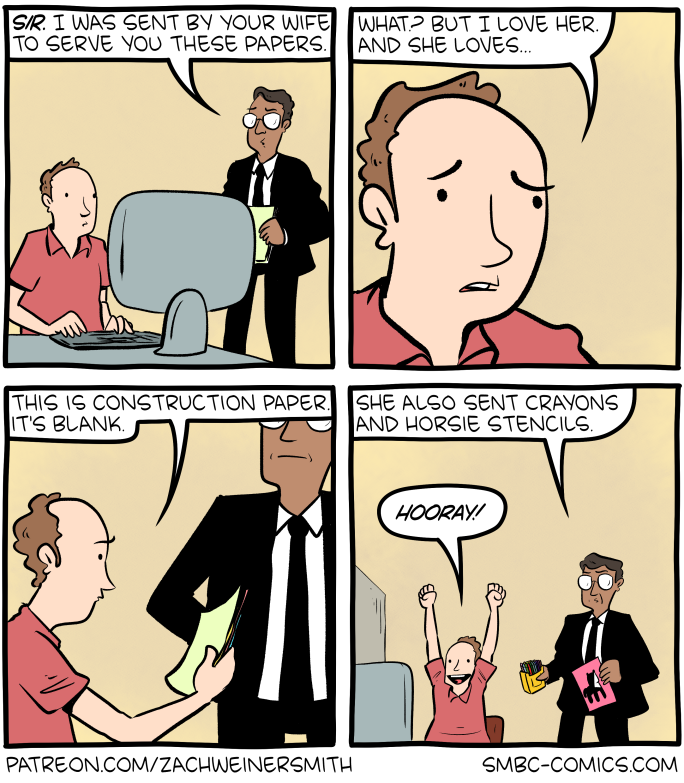
Click here to go see the bonus panel!
Hovertext:
I need to do an upbeat comic week one of these days. They all end with hooray.
Today's News:
 ALT
ALTMuch needed rain is coming this weekend to Houston, but how much?
In brief: In today’s post we review the last six months of precipitation across Texas (spoiler alert, it’s been very dry). We then look ahead to warm and muggy weather for the rest of the week, and spiky rain chances this weekend.
We could use some rain
We’ve been banging on it for awhile now, but the greater Houston region continues to remain in a very dry pattern. During the last six months large chunks of the metro area have received just 25 to 50 percent of normal rainfall (see map below), leading to a drought. This has not caused serious problems yet, because the drought has coincided with the coolest time of year. But as we get deeper into spring, if we do not get rain soon, the dryness of our soils will start to accelerate as days get longer and hotter. Anyway, I write all of that to say I don’t believe this weekend’s rains will significantly dent our drought, but they could still help.

Wednesday and Thursday
The next two days will be pretty much carbon copies of one another. We are starting out this morning with overcast skies and very warm temperatures for early March, not having fallen below 70 degrees in some locations. Winds are fairly light this morning, but will become gusty this afternoon, perhaps up to 20 mph. High temperatures across the region will generally vary from about 80 degrees right along the coast to mid-80s for inland areas.

Rodeo forecast
If you’re headed to the party this evening you can expect mild temperatures in the 70s. Although we may briefly see some sunshine this afternoon, I expect clouds to be building back by early evening and remain persistent through the night. Overnight lows will once again only drop down to around 70 degrees across the region.
Friday
This day will also be a lot like Wednesday and Thursday, in terms of mostly cloudy skies, temperatures in the low- to mid-80s, and plenty of humidity. There will also be the ongoing chance of fog overnight, near the coast. However the one difference starting on Friday will be a slight chance of some showers, more likely later in the day, as a cool front sags toward the area. Any rain would likely be light in nature.

Saturday and Sunday
Alright, so what does the weekend hold? We are going to see a battle in the atmosphere between an approaching disturbance from the northwest (which will bring plenty of rain into central and northern Texas) against lingering high pressure to our east. There will be plenty of atmospheric moisture. It is going to come down to where the frontal boundary stalls, and for now this appears likely to happen north of the Houston area. Accordingly the greatest likelihood of rain is there as well. I continue to predict that most of our region will pick up 0.5 to 1.5 inches this weekend, but I’m more confident of that occurring inland of Highway 59/I-69 than I am for coastal areas, further away from the stalled boundary. Temperatures this weekend should remain warm, in the low 80s, with plenty of clouds and humidity.
Next week
Our abnormally warm weather will continue into next week before the arrival of a front, probably on Wednesday, brings us back to March-like weather for a few days. I believe there will be additional rainfall with this front, perhaps some decent showers and thunderstorms, but at a week out any predictions are not made with confidence.


Academy Museum Acquires Original Disney Adult
LOS ANGELES—Unveiling the procurement at the opening of the new exhibition Fanaticals: Cinema’s Most Fearsome Freaks, the Academy Museum of Motion Pictures announced this week that it had acquired the original Disney adult.
“We are thrilled to confirm that self-professed ‘Disnerd’ Rick Tomko is now a part of our permanent collection,” said Academy Museum spokesperson James Thornton, who expressed gratitude to the generous donor who had gifted the museum with the 61-year-old Peter Pan and Winnie the Pooh superfan. “There wouldn’t be a Hollywood as we know it without Disney, and there wouldn’t be a Disney as we know it without this guy, a grown man who has watched Tinker Bell And The Great Fairy Rescue more than 90 times since it was released direct-to-video in 2010.”
Thornton added, “We hope his faded Goofy T-shirt, dusty Tigger fanny pack, and Mickey Mouse ears calf tattoo—which he overcame his fear of needles to receive—will intrigue and educate museum guests for generations to come.”
Officials at the Academy Museum said the Disney adult would be on display in the Rolex Gallery through the end of March, with curators anticipating increased traffic from visitors curious to see the Disneyland annual passholder who left his wife and two small children behind in Colorado Springs, CO, so he could live closer to the park, and later filed for bankruptcy after spending more than $192,000 on Nightmare Before Christmas merchandise.
At the exhibit’s opening, museum guests stood close to the glass to get a good look at the piece of cinematic history known for ripping a Chip and Dale polar fleece mini backpack from the hands of a terrified 5-year-old boy at a Magic Kingdom shop. Others posed for photos and short videos alongside the authentic Disney adult as they smiled and repeated his catchphrase, “Who needs friends when you have Disney?”
“This is just so iconic, and it’s something that completely changed the Disney experience for so many people,” said visitor Annabelle Grimes, who told reporters it was the first time she had ever seen a Disney adult in person. “Obviously it’s kind of old and represents some fairly outdated attitudes, but it’s still fascinating.”
The Academy Museum confirmed that Disney-branded underwear featuring Rick Tomko’s face would be available for purchase in the gift shop.
The post Academy Museum Acquires Original Disney Adult appeared first on The Onion.
Comes With The Mugs
They don’t need them, so it’s your win. And if you don’t need more mugs, then just leave your mugs with your current home. Let’s all just stop taking mugs with us whenever we move. That could start right here with this house.
Reference #88225
The post Comes With The Mugs appeared first on The Onion.
Adam Lazarus and Hayden Ortega
Ortega was married off to Lazarus in a peacekeeping deal aimed at easing tensions between Indianapolis and Cincinnati.
The post Adam Lazarus and Hayden Ortega appeared first on The Onion.
can we refuse a client appointment, getting answers from unresponsive vendors, and more
It’s five answers to five questions. Here we go…
1. Can we refuse a massage appointment for a sex offender?
I am a front desk coordinator in a clinic that is part of a large healthcare system. I schedule appointments and assist patients who come in to see providers of various departments, including massage therapy. Recently, I saw an alert about a patient who was scheduled to see a particular massage therapist that indicated he had been discharged from another clinic in the same healthcare system for sexual harassment. Part of my job is to review past appointments for patients, and I saw that in his written scheduling request, he self-identified as a convicted sex offender and described in explicit sexual terms what he “definitely would not be doing” to this provider, “so don’t worry.” As he was scheduled to come in later that day, I decided to alert the provider herself (a 20-something female, Anna), my supervisor, and the massage therapy clinic supervisor. I learned that they were already aware of the situation and were still planning to allow him to come in for his appointment while they consulted risk management and the legal team. The plan was to have another person in the room during the treatment (Anna’s supervisor, also a woman).
Anna and I have a friendly relationship (for reference, I am a woman close to retirement age), and she confided in me that she was very uncomfortable with the arrangement and was absolutely not going to provide the treatment. Her supervisor decided to cancel the appointment since they had not figured out the legal aspect, but clocked it as a “provider cancel” rather than “admin cancel,” which dings Anna’s compliance. After legal/risk were fully consulted, the clinic decided to allow this man to reschedule and come in, as long as they put in place a “behavior contract.”
He has not yet come back into the clinic, and Anna told me she would call in sick if he was on the schedule anyway, but I am deeply disturbed that it was even allowed to get this far. I am trying to decide if I should leave this alone or escalate this further. One one hand, Anna seems to have a good handle on it herself. On the other, after reading his explicit scheduling request message, I would feel extremely uncomfortable if he were to come in, as I would be the one checking him in. Am I wrong to feel like the clinic manager should have shut this all down from the get-go and banned this patient? Or at the very least banned him from seeing female providers? Are there really legal implications in health care for refusing to treat a patient that supersede the safety of myself, Anna, and our other coworkers?
Your health care system may have its own internal policies, but in general medical providers can refuse to provide treatment if a patient is abusive or threatening or puts their or their staff’s safety at risk. Massage therapists absolutely can decline to see patients whose behavior makes them uncomfortable.
If the clinic is open to having this man as a patient, they should ensure that the provider seeing them feels comfortable doing it — and they need to make it safe for the provider to say if they don’t (something Anna apparently doesn’t feel she can do). And even if Anna were comfortable with it, since he’s already sent a harassing message that you were subjected to, they should be giving everyone who might interact with him a veto. Realistically, businesses don’t always work like that — but Anna, at a minimum, should have the ability to opt out without being penalized (and this is true for all sorts of appointments, but particularly for one as intimate as massage therapy).
Can you talk to Anna again and urge her to be more assertive about not feeling comfortable taking this patient, and offer to lend your voice to hers if she does?
2. Applying for a job that my best reference might morally disagree with
I am on the West Coast, applying to work at Planned Parenthood. I really want this job!
My best reference, a former supervisor, has told me she will be a good reference for me, as we worked closely together for many years. I believe her, and I have always felt gratitude toward her for this.
However, I also know that she is a practicing Catholic, and I have no idea what her views are of Planned Parenthood. I would hope that she would still speak well of me, but I am worried about giving her a heads-up if I make it to the references stage. All of my other references are fine, but not nearly as high-quality or relevant as hers will be.
What do I do here? I don’t want to offend her or put her in an awkward position of choosing between faith and friendship, but I also really, really want this job, and her viewpoint is nearly identical to the manager who I would potentially have at the health clinic. (Note: this would not be a patient-facing role, but an administrative one.)
Just ask! “I’m applying for an administrative job at Planned Parenthood and wanted to make sure you’d be comfortable with me listing you as a reference.”
It might be a total non-issue for her (for all we know, she might support Planned Parenthood, or at least not have strong feelings about them), or she might be perfectly capable of separating her feelings about reproductive health care from the reference she gives you. But if she feels weird about it, this gives her a chance to tell you.
Related:
giving a reference when you have a moral objection to the employer
3. How can I get answers from unresponsive vendors?
Do you have suggestions on how to deal with third parties, typically vendors, who are not responding/acting in a reasonable timeframe?
I tend to spend quite some time on emails to make sure they are as clear as possible, but I notice that some third parties will answer only one out of three (clearly labeled) questions, or just not reply at all. Over the phone I have similar issues: some will rarely pick up the phone and if they do will commit to doing something that they will have forgotten to do if I call them again a week later.
What is a good way to get these third parties to work with you, especially in cases where it’s not possible to use a different third party? Does it make sense to keep calling them multiple times a day? Maybe give them feedback the way you would an employee? Ask for a different person to contact? These are typically vendors that couldn’t be swapped for another one without massive effort, and what we typically need support for is how a certain feature works or there’s something broken on their end that we need a fix for.
These are vendors, so they’re to some degree accountable for keeping you happy so they retain your business — or at least they’re supposed to be. In reality, your business may not be large enough for you to have much leverage, but you’re certainly entitled to expect a reasonable level of responsiveness, or that they’ll at least tell you if they’re not going to be able to give you the level of service you want.
The first thing to try is naming the problem for them: “I’m having trouble getting answers to call and emails, and often when we do hear back, only one question will be answered when we’d asked several. I’m also finding I have to follow up on things we agreed VendorCompany will take care of. Is there someone else I should be sending these requests to, or a different way I should be communicating them?” Sometimes just calling out the problem like that will put the person on notice that they need to step up their game.
But if that doesn’t work, it’s completely reasonable to ask for a different point of contact. You can either ask the problem person themselves to connect you with someone else, or you can go over their head and ask someone else.
4. Should I leave a job after one month for a better one?
I recently accepted a position with a nonprofit that works closely with a school. The job requires three days a week at the school, which is quite far from my home, and two days a week in an office closer to me. The salary is $55K, but the benefits are not great. Health insurance kicks in after 60 days (a bit expensive), and there are 15 vacation days, 5 sick days, and no personal days. The probation period is 6 months.
However, I’m also being considered for a position working directly for the school, which has significantly better benefits. The salary would range from $65K to $75K (closer to the higher end given my experience), and I would receive 50 vacation days, as I would get the same vacation as the students, including summers off and winter breaks. The health benefits are much better, and there are opportunities for raises based on both cost of living and merit. Additionally, there is room for career advancement in this role.
This second position would start in April, while the first job I’ve accepted begins in March. I’ve been unemployed for two months, and I’m dealing with personal challenges, including a recent family loss. Given my situation, I’m concerned about going without income for another month and the long commute to the nonprofit job.
If I were to take the first job and leave after a month, would that look bad in the eyes of employer? I don’t want to burn bridges. I don’t want to outright say that I found a better opportunity, but I’m considering explaining my personal circumstances (grieving a family member and concerns about health insurance since I have a neurological disorder) and the difficulty of the commute.
The first employer won’t be happy and it’s likely to burn a bridge with them in terms of future employment there, but that doesn’t mean you shouldn’t do it. It sounds like the second job is better for you all around, and you need to do what’s best for you (just as they would do what’s best for them when it comes to employing you!). You can apologize for the timing and say it fell in your lap and both the salary and the health insurance were too good to pass up. You don’t need to mention anything personal beyond that.
Related:
how do I tell my brand new job I’m leaving for a better offer?
5. Why can supervisors be prohibited from discussing wages and working conditions, when employees must be allowed to?
You mentioned in a recent column that it is not illegal for supervisors to be barred from discussing working conditions (and salary too).
Why is that? How did it become the law that supervisors are exempt from the right to discuss salary and working conditions? And what are the potential consequences for supervisors who do engage in these activities?
It’s because the law in question — the National Labor Relations Act (NLRA)— was formed mostly to protect unions and unionizing, although it extends those protection to less formal organizing among employees. The NRLA generally excludes supervisors from voting in union elections or being represented by unions; the idea is that it’s hard for managers to truly act in the best interests of employees if those interests differ from management’s, and they might feel pressure from above to vote against employees’ interests or wishes.
The law defines supervisors as anyone “having the authority, in the interest of the employer, to hire, suspend, lay off, recall, promote, discharge, assign, reward, or discipline other employees, or responsibly to direct them, or adjust their grievances, or effectively to recommend such action, if in connection with the foregoing the exercise of such authority is not of a merely routine or clerical nature, but requires the use of independent judgment.”
The post can we refuse a client appointment, getting answers from unresponsive vendors, and more appeared first on Ask a Manager.
In some small way

Dean has caused major disruption to the whole door frame with his powerful kick. This seems to me to be the exact opposite of what a property guardianship is all about. And how quickly the pendulum of power has swung; while Glenn and Claire were no match for Dean’s machinations, Lottie has no truck with his nonsense.
The post In some small way appeared first on Bad Machinery.
Tiny Texas School District Rejects Tax Deal with $6 Billion LNG Project
By Dylan Baddour
The Point Isabel Independent School District on Monday rejected a multi-million dollar tax break for a proposed $5.7 billion liquefied natural gas (LNG) project on the Texas Gulf Coast, finding the facility would not “align” with the community’s values or finances.


Oh, uh… flag on the moon, too, by the way.

Oh, uh… flag on the moon, too, by the way.
What sort of horrible things happen if my dialog has a non-button with the control ID of IDCANCEL?
I noted in the bonus chatter that if you have a control whose ID is IDCANCEL, it had better be a button if you know what’s good for you. Shawn Keene doesn’t know what’s good for him and asks, “I can’t wait to find out what happens if my control is not a button.”
What happens is that the dialog manager will generate a WM_ message as if your IDCANCEL control were a button, even if it isn’t.
This means that the message arrives with a notification code of BN_, a control ID of IDCANCEL, and a window handle of your not-actually-a-button window.
Since your control is not actually a button, it will treat the BN_ as if it were a notification appropriate to its type. The numeric value of BN_ is zero, so it’ll be treated as whatever a notification code of zero means for that control type. For example, if it’s actually a static control, you’ll interpret the zero to mean STN_.
If it’s actually a list box, then you’ll see the zero and say “Huh? I don’t see any notification code with the numeric value of zero. What’s going on?”
If it’s a custom control, you will interpret the zero as whatever that custom control defines notification code zero to mean.
Basically, what you did is signed yourself up for confusion. You’re going to get a WM_BN_ as the notification code, IDCANCEL as the control ID, and your non-button window as the control. What you do with that information is up to you.
Bonus reading: Why do dialog editors start assigning control IDs with 100?
The post What sort of horrible things happen if my dialog has a non-button with the control ID of <CODE>IDCANCEL</CODE>? appeared first on The Old New Thing.
Trump assures Congress that Netanyahu has a plan for Iran invasion
WASHINGTON D.C. – Faced with criticism that he has no strategy or timeline for his sudden invasion of Iran, President Trump insisted to Congress that a plan does exist and that it has been drafted entirely by Israeli Prime Minister Benjamin Netanyahu. “People say that I’m just bombing Iran with no idea what I’m doing, […]
The post Trump assures Congress that Netanyahu has a plan for Iran invasion appeared first on The Beaverton.
Does Your Country Need Regime Change? A Quiz
“In announcing the U.S. military strike on Iran, President Donald Trump went significantly beyond his previous justification of destroying the country’s nuclear program. He’s now also calling for regime change—and encouraging the Iranian people to rise up and overthrow their government.” — ABC News
Is your country ruled by an aging megalomaniac whose supporters worship him with an almost cult-like zeal?
Has your leader eroded trust in elections by attempting to bring them under his direct control and/or stoking false claims of voter fraud?
Is there a fear that your leader has access to nuclear weapons that you could totally see him using if the end result would benefit him personally?
Is your country a notorious bad actor in the Middle East?
Has your leader deployed the country’s military domestically against civilians who were protesting peacefully?
Is your nation’s frail, kleptocratic economy being propped up, thanks in part to being a major oil exporter?
Do your leader’s supporters claim that he was ordained by God to rule?
Is your leader currently breaking ground on several expensive and cartoonishly vain construction projects in the nation’s capital?
Does your leader and his inner circle regularly engage in petty bribery, shady investment deals, and other dubious behavior to enrich themselves?
Does your leader view the lives of armed services personnel as disposable by mocking their service or saying things like “that’s the way it is” whenever they are killed?
Is your leader in the process of consolidating control over the nation’s prominent media outlets?
Is there currently a paramilitary force actively engaging in ethnic cleansing, including, but not limited to, systematically attempting to remove an entire ethnic group from the country?
Has your leader created his own form of currency of which he is the face?
Does your leader give bombastic speeches about returning the nation to its former glory by vanquishing an enemy from within?
Has your leader been credibly accused and/or convicted of several crimes, which he is using his position of power to dodge accountability for?
Are politicians within your leader’s own party so terrified of retribution that they’ll let him insult and ridicule them right to their faces like he’s a septuagenarian Biff Tannen?
Has your leader renamed several prominent institutions after himself?
If your leader were deposed, would millions of people across the country take to the streets to celebrate?
Does it feel like every single news story, every article, every think piece, every bit of media content revolves around your leader, almost as if, no matter how hard the country tries to talk about literally anything else, he seems to keep finding ways to pop back into the spotlight and suck all of the oxygen out of the room, to the point where it feels like you’ve spent every waking moment of every day for the past ten years hearing about every single stupid and/or evil thing this guy’s done, and you’re just so fucking exhausted?
Did your leader just start a war he clearly has no idea how to end?
If the answer to most or all of these questions is yes, it may be time for a massive nonviolent resistance movement.
Pluralistic: Supreme Court saves artists from AI (03 Mar 2026)

Today's links
- Supreme Court saves artists from AI: Just because you're on their side, it doesn't mean they're on your side.
- Hey look at this: Delights to delectate.
- Object permanence: KKK x D&D; Martian creativity; Scott Walker's capital ringers; UK v adblocking; Shitty jihadi opsec.
- Upcoming appearances: Where to find me.
- Recent appearances: Where I've been.
- Latest books: You keep readin' em, I'll keep writin' 'em.
- Upcoming books: Like I said, I'll keep writin' 'em.
- Colophon: All the rest.

Supreme Court saves artists from AI (permalink)
The Supreme Court has just turned down a petition to hear an appeal in a case that held that AI works can't be copyrighted. By turning down the appeal, the Supreme Court took a massively consequential step to protect creative workers' interests:
https://www.theverge.com/policy/887678/supreme-court-ai-art-copyright
At the core of the dispute is a bedrock of copyright law: that copyright is for humans, and humans alone. In legal/technical terms, "copyright inheres at the moment of fixation of a work of human creativity." Most people – even people who work with copyright every day – have not heard it put in those terms. Nevertheless, it is the foundation of international copyright law, and copyright in the USA.
Here's what it means, in plain English:
a) When a human being,
b) does something creative; and
c) that creative act results in a physical record; then
d) a new copyright springs into existence.
For d) to happen, a), b) and c) all have to happen first. All three steps for copyright have been hotly contested over the years. Remember the "monkey selfie," in which a photographer argued that he was entitled to the copyright after a monkey pointed a camera at itself and pressed the shutter button? That image was not copyrightable, because the monkey was a monkey, not a human, and copyright is only for humans:
https://en.wikipedia.org/wiki/Monkey_selfie_copyright_dispute
Then there's b), "doing something creative." Copyright only applies to creative work, not work itself. It doesn't matter how hard you labor over a piece of "IP" – if that work isn't creative, there's no copyright. For example, you can spend a fortune creating a phone directory, and you will get no copyright in the resulting work, meaning anyone can copy and sell it:
https://en.wikipedia.org/wiki/Feist_Publications,_Inc._v._Rural_Telephone_Service_Co.
If you mix a little creative labor with the hard work, you can get a little copyright. A directory of "all the phone numbers for cool people" can get a "thin" copyright over the arrangement of facts, but such a copyright still leaves space for competitors to make many uses of that work without your permission:
https://pluralistic.net/2021/08/14/angels-and-demons/#owning-culture
Finally, there's c): copyright is for tangible things, not intangibles. Part of the reason choreographers created a notation system for dance moves is that the moves themselves aren't copyrightable:
https://en.wikipedia.org/wiki/Dance_notation
The non-copyrightability of movement is (partly) why the noted sex-pest and millionaire grifter Bikram Choudhury was blocked from claiming copyright on ancient yoga poses (the other reason is that they are ancient!):
https://en.wikipedia.org/wiki/Copyright_claims_on_Bikram_Yoga
Now, AI-generated works are certainly tangible (any work by an AI must involve magnetic traces on digital storage media). The prompts for an AI output can be creative and thus copyrightable (in the same way that notes to a writers' room or from an art-director are). But the output from the AI cannot be copyrighted, because it is not a work of human authorship.
This has been the position of the US Copyright Office from the start, when AI prompters started sending in AI-generated works and seeking to register copyrights in them. Stephen Thaler, a computer scientist who had prompted an image generator to produce a bitmap, kept appealing the Copyright Office's decision, seemingly without regard to the plain facts of the case and the well-established limits of copyright. By attempting to appeal his case all the way to the Supreme Court, Thaler has done every human artist a huge boon: his weak, ill-conceived case was easy for the Supreme Court to reject, and in so doing, the court has cemented the non-copyrightability of AI works in America.
You may have heard the saying, "Hard cases make bad law." Sometimes, there are edge-cases where following the law would result in a bad outcome (think of a Fourth Amendment challenge to an illegal search that lets a murderer go free). In these cases, judges are tempted to interpret the law in ways that distort its principles, and in so doing, create a bad precedent (the evidence from a bad search is permitted, and so cops stop bothering to get a warrant before searching people).
This is one of the rare instances in which a bad case made good law. Thaler's case wasn't even close – it was an absolute loser from the jump. Normally, plaintiffs give up after being shot down by an agency like the Copyright Office or by a lower court. But not Thaler – he stuck with it all the way to the highest court in the land, bringing clarity to an issue that might have otherwise remained blurry and ill-defined for years.
This is wonderful news for creative workers. It means that our bosses must pay humans to do work if they want to be granted copyright on the things they want to sell. The more that humans are involved in the creation of a work, the stronger the copyright on that work becomes – which means that the less a human contributes to a creative work, the harder it will be to prevent others from simply taking it and selling it or giving it away.
This is so important. Our bosses do not want to pay us. When our bosses sue AI companies, it's not because they want to make sure we get paid.
The many pending lawsuits – from news organizations like the New York Times, wholesalers like Getty Images, and entertainment empires like Disney – all seek to establish that training an AI model is a copyright infringement. This is wrong as a technical matter: copyright clearly permits making transient copies of published works for the purpose of factual analysis (otherwise every search engine would be illegal). Copyright also permits performing mathematical analysis on those transient copies. Finally, copyright permits the publication of literary works (including software programs) that embed facts about copyrighted works – even billions of works:
https://pluralistic.net/2023/09/17/how-to-think-about-scraping/
Sure, you can infringe copyright with an AI model – say, by prompting it to produce infringing images. But the mere fact that a technology can be used to infringe copyright doesn't make the technology itself infringing (otherwise every printing press, camera, and computer would be illegal):
https://en.wikipedia.org/wiki/Sony_Corp._of_America_v._Universal_City_Studios,_Inc.
Of course, the fact that copyright currently permits training models doesn't mean that it must. Copyright didn't come down from a mountain on two stone tablets. It's just a law, and laws can be amended. I think that amending copyright to ban training a model would inflict substantial collateral damage on everything from search engines to scholarship, but perhaps you disagree. Maybe you think that you could wordsmith a new copyright law that bans training without whacking a bunch of socially beneficial activities.
Even if that's so, it still wouldn't help artists.
To understand why, consider Universal and Disney's lawsuit against Midjourney. The day that lawsuit dropped, I got a press release from the RIAA, signed by its CEO, Mitch Glazier. Here's how it began:
There is a clear path forward through partnerships that both further AI innovation and foster human artistry. Unfortunately, some bad actors – like Midjourney – see only a zero-sum, winner-take-all game.
The RIAA represents record labels, not film studios, but thanks to vertical integration, the big film studios are also the big record labels. That's why the RIAA alerted the press to its position on this suit.
There's two important things to note about the RIAA press release: how it opened, and how it closed. It opens by stating that the companies involved want "partnerships" with AI companies. In other words, if they establish that they have the right to control training on their archives, they won't use that right to prevent the creation of AI models that compete with creative workers. Rather, they will use that right to get paid when those models are created.
Expanding copyright to cover models isn't about preventing generative AI technologies – it's about ensuring that these technologies are licensed by incumbent media companies. This licensure would ensure that media companies would get paid for training, but it would also let them set the terms on which the resulting models were used. The studios could demand that AI companies put "guardrails" on the resulting models to stop them from being used to output things that might compete with the studios' own products.
That's what the opening of this press-release signifies, but to really understand its true meaning, you have to look at the closing of the release: the signature at the bottom of it, "Mitch Glazier, CEO, RIAA."
Who is Mitch Glazier? Well, he used to be a Congressional staffer. He was the guy responsible for sneaking a clause into an unrelated bill that repealed "termination of transfer" for musicians. "Termination" is a part of copyright law that lets creators take back their rights after 35 years, even if they originally signed a contract for a "perpetual license."
Under termination, all kinds of creative workers who got royally screwed at the start of their careers were able to get their copyrights back and re-sell them. The primary beneficiaries of termination are musicians, who signed notoriously shitty contracts in the 1950s-1980s:
https://pluralistic.net/2021/09/26/take-it-back/
When Mitch Glazier snuck a termination-destroying clause into legislation, he set the stage for the poorest, most abused, most admired musicians in recording history to lose access to money that let them buy a couple bags of groceries and make the rent. He condemned these beloved musicians to poverty.
What happened next is something of a Smurfs Family Christmas miracle. Musicians were so outraged by this ripoff, and their fans were so outraged on their behalf, that Congress convened a special session solely to repeal the clause that Mitch Glazier tricked them into voting for. Shortly thereafter, Glazier was out of Congress:
https://en.wikipedia.org/wiki/Mitch_Glazier
But this story has a happy ending for Glazier, too – he might have been out of his government job, but he had a new gig, as CEO of the Recording Industry Association of America, where he earns more than $1.3 million/year to carry on the work he did in Congress – serving the interests of the record labels:
https://projects.propublica.org/nonprofits/organizations/131669037
Mitch Glazier serves the interests of the labels, not musicians. He can't serve both interests, because every dime a musician takes home is a dime that the labels don't get to realize as profits. Labels and musicians are class enemies. The fact that many musicians are on the labels' side when they sue AI companies does not mean that the labels are on the musicians' side.
What will the media companies do if they win their lawsuits? Glazier gives us the answer in the opening sentence of his press release: they will create "partnerships" with AI companies to train models on the work we produce.
This is the lesson of the past 40 years of copyright expansion. For 40 years, we have expanded copyright in every way: copyright lasts longer, covers more works, prohibits more uses without licenses, establishes higher penalties, and makes it easier to win those penalties.
Today, the media industry is larger and more profitable than at any time, and the share of those profits that artists take home is smaller than ever.
How has the expansion of copyright led to media companies getting richer and artists getting poorer? That's the question that Rebecca Giblin and I answer in our 2022 book Chokepoint Capitalism. In a nutshell: in a world of five publishers, four studios, three labels, two app companies and one company that controls all ebooks and audiobooks, giving a creative worker more copyright is like giving your bullied kid extra lunch money. It doesn't matter how much lunch money you give that kid – the bullies will take it all, and the kid will go hungry:
https://pluralistic.net/2022/08/21/what-is-chokepoint-capitalism/
Indeed, if you keep giving that kid more lunch money, the bullies will eventually have enough dough that they'll hire a fancy ad-agency to blitz the world with a campaign insisting that our schoolkids are all going hungry and need even more lunch money (they'll take that money, too).
When Mitch Glazier – who got a $1m+/year job for the labels after attempting to pauperize musicans – writes on behalf of Disney in support of a copyright suit to establish that copyright prevents training a model without a license, he's not defending creative workers. Disney, after all, is the company that takes the position that if it buys another company, like Lucasfilm or Fox, that it only acquires the right to use the works we made for those companies, but not the obligation to pay us when they do:
https://pluralistic.net/2021/04/29/writers-must-be-paid/#pay-the-writer
If a new, unambiguous copyright over model training comes into existence – whether through a court precedent or a new law – then all our contracts will be amended to non-negotiably require us to assign that right to our bosses. And our bosses will enter into "partnerships" to train models on our works. And those models will exist for one purpose: to let them create works without paying us.
The market concentration that lets our bosses dictate terms to us is getting much worse, and it's only speeding up. Getty Images – who sued Stability AI over image generation – is merging with Shutterstock:
https://globalcompetitionreview.com/gcr-usa/article/photographers-alarmed-gettyshutterstock-merger
And Paramount is merging with Warners:
https://pluralistic.net/2026/02/28/golden-mean/#reality-based-community
This is where this new Supreme Court action comes in. A new copyright that covers training is just one more thing these increasingly powerful members of this increasingly incestuous cartel can force us to sign away. That new copyright isn't something for us to bargain with, it's something we'll bargain away.
But the fact that the works that a model produces are automatically in the public domain is something we can't bargain away. It's a legal fact, not a legal right. It means that the more humans there are involved in the creation of a final work, the more copyrightable that work is.
Media bosses love AI because it dangles the tantalizing possibility of running a business without ego-shattering confrontations with creative workers who know how to do things. It's the solipsistic fantasy of a world without workers, in which a media boss conceives of a "product," prompts a sycophantic AI, and receives an item that's ready for sale:
https://pluralistic.net/2026/01/05/fisher-price-steering-wheel/#billionaire-solipsism
Many bosses know this isn't within reach. They imagine that they'll get the AI to shit out a script and then pay a writer on the cheap to "polish" it. They think they'll get an AI to shit out a motion sequence, a still, or a 3D model and then pay a human artist pennies to put the "final touches" on it. But the Copyright Office's position is that only those human contributions are eligible for a copyright: a few editorial changes, a few pixels or vectors rearranged. Everything else is in the public domain.
Here's the cool part: the only thing our bosses hate more than paying us is when other people take their stuff without paying for it. To achieve the kind of control they demand, they will have to pay us to make creative works.
What's more, the fact that AI-generated works are in the public domain leaves a lot of uses that don't harm creative workers intact. You can amuse yourself and your friends with all the AI slop you can generate; the fact that it's not copyrightable doesn't matter to that use. I happen to think AI "art" is shit, but you do you:
https://pluralistic.net/2024/05/13/spooky-action-at-a-close-up/#invisible-hand
This also means that if you're a writer who likes to brainstorm with a chatbot as you develop an idea, that's fine, so long as the AI's words don't end up in the final product. Creative workers already assemble "mood boards" and clippings for inspiration – so long as these aren't incorporated into the final work, that's fine.
That's just what the Hollywood writers bargained for in their historic strike over AI. They retained the right to use AI if they wanted to, but their bosses couldn't force them to:
https://pluralistic.net/2023/10/01/how-the-writers-guild-sunk-ais-ship/
The Writers Guild were able to bargain with the heavily concentrated studios because they are organized in a union. Not just any union, either: the Writers Guild (along with the other Hollywood unions) is able to undertake "sectoral bargaining" – that's when a union can negotiate a contract with all the employers in a sector at once.
Sectoral bargaining was once the standard for labor relations, but it was outlawed in the 1947 Taft-Hartley Act, which clawed back many of the important labor rights established with the New Deal's National Labor Relations Act. To get Taft-Hartley through Congress, its authors had to compromise by grandfathering in the powerful Hollywood unions, who retained their right to sectoral bargaining. More than 75 years later, that sectoral bargaining right is still protecting those workers.
Our bosses tell us that we should side with them in demanding a new law: a copyright law that covers training an AI model. The mere fact that our bosses want this should set off alarm bells. Just because we're on their side, it doesn't mean they're on our side. They are not.
If we're going to use our muscle to fight for a new law, let it be a sectoral bargaining law – one that covers all workers. You can tell that this would be good for us because our bosses would hate it, and every other worker in America would love it. The Writers Guild used sectoral bargaining to achieve something that 40 years of copyright expansion failed at: it made creative workers richer, rather than giving us another way to be angry about how our work is being used.
(Image: Cryteria, CC BY 3.0, modified)
Hey look at this (permalink)

- Preface to Designing Secure Software: A Guide for Developers https://designingsecuresoftware.com/text/ch0-preface/
-
Publish Your Threat Models! https://arxiv.org/pdf/2511.08295
-
What You Won’t See at the Live Nation–Ticketmaster Trial https://prospect.org/2026/03/02/justice-department-live-nation-ticketmaster-antitrust-trial/
-
Why I'm running to be Director General of the BBC https://www.absurdintelligence.com/why-im-running-to-be-director-general-of-the-bbc/

Object permanence (permalink)
#20yrsago Cornell University harasses maker of Cornell blog https://web.archive.org/web/20060621110535/http://cornell.elliottback.com/archives/2006/03/02/cornell-university-nastygram/
#15yrsago Explaining creativity to a Martian https://locusmag.com/feature/cory-doctorow-explaining-creativity-to-a-martian/
#15yrsago Scott Walker smuggles ringers into the capital for the legislative session https://www.theawl.com/2011/03/in-madison-scott-walker-packed-his-budget-address-with-ringers/
#15yrsago Measuring radio’s penetration in 1936 https://www.flickr.com/photos/70118259@N00/albums/72157626051208969/with/5490099786
#10yrsago Rube Goldberg musical instrument that runs on 2,000 steel ball-bearings https://www.youtube.com/watch?v=IvUU8joBb1Q
#10yrsago KKK vs D&D: the surprising, high fantasy vocabulary of racism https://en.wikipedia.org/wiki/Ku_Klux_Klan_titles_and_vocabulary
#10yrsago UK minister compares adblocking to piracy, promises action https://www.theguardian.com/media/2016/mar/02/adblocking-protection-racket-john-whittingdale
#10yrsago Some ad-blockers are tracking you, shaking down publishers, and showing you ads https://www.wired.com/2016/03/heres-how-that-adblocker-youre-using-makes-money/
#10yrsago ISIS opsec: jihadi tech bureau recommends non-US crypto tools https://web.archive.org/web/20160303095904/http://www.dailydot.com/politics/isis-apple-fbi-congressional-hearing-crypto-international/
#10yrsago Apple v FBI isn’t about security vs privacy; it’s about America’s security vs FBI surveillance https://www.wired.com/2016/03/feds-let-cyber-world-burn-lets-put-fire/
Upcoming appearances (permalink)

- Victoria: 28th Annual Victoria International Privacy & Security Summit, Mar 3-5
https://www.rebootcommunications.com/event/vipss2026/ -
Victoria: Enshittification at Russell Books, Mar 4
https://www.eventbrite.ca/e/cory-doctorow-is-coming-to-victoria-tickets-1982091125914 -
Barcelona: Enshittification with Simona Levi/Xnet (Llibreria Finestres), Mar 20
https://www.llibreriafinestres.com/evento/cory-doctorow/ -
Berkeley: Bioneers keynote, Mar 27
https://conference.bioneers.org/ -
Montreal: Bronfman Lecture (McGill) Apr 10
https://www.eventbrite.ca/e/artificial-intelligence-the-ultimate-disrupter-tickets-1982706623885 -
Berlin: Re:publica, May 18-20
https://re-publica.com/de/news/rp26-sprecher-cory-doctorow -
Berlin: Enshittification at Otherland Books, May 19
https://www.otherland-berlin.de/de/event-details/cory-doctorow.html -
Hay-on-Wye: HowTheLightGetsIn, May 22-25
https://howthelightgetsin.org/festivals/hay/big-ideas-2

Recent appearances (permalink)
- Tanner Humanities Lecture (U Utah)
https://www.youtube.com/watch?v=i6Yf1nSyekI -
The Lost Cause
https://streets.mn/2026/03/02/book-club-the-lost-cause/ -
Should Democrats Make A Nuremberg Caucus? (Make It Make Sense)
https://www.youtube.com/watch?v=MWxKrnNfrlo -
Making The Internet Suck Less (Thinking With Mitch Joel)
https://www.sixpixels.com/podcast/archives/making-the-internet-suck-less-with-cory-doctorow-twmj-1024/ -
Panopticon :3 (Trashfuture)
https://www.patreon.com/posts/panopticon-3-150395435

Latest books (permalink)
- "Canny Valley": A limited edition collection of the collages I create for Pluralistic, self-published, September 2025 https://pluralistic.net/2025/09/04/illustrious/#chairman-bruce
-
"Enshittification: Why Everything Suddenly Got Worse and What to Do About It," Farrar, Straus, Giroux, October 7 2025
https://us.macmillan.com/books/9780374619329/enshittification/ -
"Picks and Shovels": a sequel to "Red Team Blues," about the heroic era of the PC, Tor Books (US), Head of Zeus (UK), February 2025 (https://us.macmillan.com/books/9781250865908/picksandshovels).
-
"The Bezzle": a sequel to "Red Team Blues," about prison-tech and other grifts, Tor Books (US), Head of Zeus (UK), February 2024 (thebezzle.org).
-
"The Lost Cause:" a solarpunk novel of hope in the climate emergency, Tor Books (US), Head of Zeus (UK), November 2023 (http://lost-cause.org).
-
"The Internet Con": A nonfiction book about interoperability and Big Tech (Verso) September 2023 (http://seizethemeansofcomputation.org). Signed copies at Book Soup (https://www.booksoup.com/book/9781804291245).
-
"Red Team Blues": "A grabby, compulsive thriller that will leave you knowing more about how the world works than you did before." Tor Books http://redteamblues.com.
-
"Chokepoint Capitalism: How to Beat Big Tech, Tame Big Content, and Get Artists Paid, with Rebecca Giblin", on how to unrig the markets for creative labor, Beacon Press/Scribe 2022 https://chokepointcapitalism.com

Upcoming books (permalink)
- "The Reverse-Centaur's Guide to AI," a short book about being a better AI critic, Farrar, Straus and Giroux, June 2026
-
"Enshittification, Why Everything Suddenly Got Worse and What to Do About It" (the graphic novel), Firstsecond, 2026
-
"The Post-American Internet," a geopolitical sequel of sorts to Enshittification, Farrar, Straus and Giroux, 2027
-
"Unauthorized Bread": a middle-grades graphic novel adapted from my novella about refugees, toasters and DRM, FirstSecond, 2027
-
"The Memex Method," Farrar, Straus, Giroux, 2027


Colophon (permalink)
Today's top sources:
Currently writing: "The Post-American Internet," a sequel to "Enshittification," about the better world the rest of us get to have now that Trump has torched America (1020 words today, 41284 total)
- "The Reverse Centaur's Guide to AI," a short book for Farrar, Straus and Giroux about being an effective AI critic. LEGAL REVIEW AND COPYEDIT COMPLETE.
-
"The Post-American Internet," a short book about internet policy in the age of Trumpism. PLANNING.
-
A Little Brother short story about DIY insulin PLANNING

This work – excluding any serialized fiction – is licensed under a Creative Commons Attribution 4.0 license. That means you can use it any way you like, including commercially, provided that you attribute it to me, Cory Doctorow, and include a link to pluralistic.net.
https://creativecommons.org/licenses/by/4.0/
Quotations and images are not included in this license; they are included either under a limitation or exception to copyright, or on the basis of a separate license. Please exercise caution.
How to get Pluralistic:
Blog (no ads, tracking, or data-collection):
Newsletter (no ads, tracking, or data-collection):
https://pluralistic.net/plura-list
Mastodon (no ads, tracking, or data-collection):
Medium (no ads, paywalled):
Twitter (mass-scale, unrestricted, third-party surveillance and advertising):
Tumblr (mass-scale, unrestricted, third-party surveillance and advertising):
https://mostlysignssomeportents.tumblr.com/tagged/pluralistic
"When life gives you SARS, you make sarsaparilla" -Joey "Accordion Guy" DeVilla
READ CAREFULLY: By reading this, you agree, on behalf of your employer, to release me from all obligations and waivers arising from any and all NON-NEGOTIATED agreements, licenses, terms-of-service, shrinkwrap, clickwrap, browsewrap, confidentiality, non-disclosure, non-compete and acceptable use policies ("BOGUS AGREEMENTS") that I have entered into with your employer, its partners, licensors, agents and assigns, in perpetuity, without prejudice to my ongoing rights and privileges. You further represent that you have the authority to release me from any BOGUS AGREEMENTS on behalf of your employer.
ISSN: 3066-764X
Ayatollah Killed In U.S. Airstrike
Ayatollah Ali Khamenei, the theocratic dictator who ruled Iran for over 36 years, was killed in a massive U.S. and Israeli military operation, with the Iranian government announcing 40 days of public mourning following the death of the 86-year-old leader. What do you think?

“I thought U.S. airstrikes were only supposed to target women and children.”
Peter Yew, Gala Funder

“This is going to throw a wrench in my fantasy geopolitics league.”
Julio Mojicama, Board Game Historian

“Eighty-six? They could’ve just stolen his pill organizer.”
Marcy Panici, Chair Tester
The post Ayatollah Killed In U.S. Airstrike appeared first on The Onion.
CROW: A THOUSAND YEARS OF TYRANNY.


CROW: A THOUSAND YEARS OF TYRANNY.