The answer is that it is the most compact way to set a register to zero on x86. In particular, it is several bytes shorter than the more obvious mov eax, 0 since it avoids having to encode the four-byte constant. The x86 architecture does not have a dedicated zero register, so if you need to zero out a register, you’ll have to do it ab initio.
But Matt doesn’t explain why everyone chooses xor as opposed to some other mathematical operation that is guaranteed to result in a zero? In particular, what’s wrong with sub eax, eax? It encodes to the same number of bytes, executes in the same number of cycles. And its behavior with respect to flags is even better:
xor eax, eax
sub eax, eax
OF
clear
clear
SF
clear
clear
ZF
set
set
AF
undefined
clear
PF
set
set
CF
clear
clear
Observe that xor eax, eax leaves the AF flag undefined, whereas sub eax, eax clears it.
I don’t know why xor won the battle, but I suspect it was just a case of swarming.
In my hypothetical history, xor and sub started out with roughly similar popularity, but xor took a slightly lead due to some fluke, perhaps because it felt more “clever”.
When early compilers used xor to zero out a register, this started the snowball, because people would see the compiler generate xor and think, “Well, those compiler writes are smart, they must know something I don’t. Since I was on the fence between xor and sub, this tiny data point is enough to tip it toward xor.”
The predominance of these idioms as a way to zero out a register led Intel to add special xor r, r-detection and sub r, r-detection in the instruction decoding front-end and rename the destination to an internal zero register, bypassing the execution of the instruction entirely. You can imagine that the instruction, in some sense, “takes zero cycles to execute”. The front-end detection also breaks dependency chains: Normally, the output of an xor or sub is dependent on its inputs, but in this special case of xor‘ing or sub‘ing a register with itself, we know that the output is zero, independent of input.
Once an instruction has an edge, even if only extremely slight, that’s enough to tip the scales and rally everyone to that side.
Bonus chatter: One of my former colleagues was partial to using sub r, r to zero a register, and when I was reading assembly code, I could tell that he was the author due to the use of sub to zero a register rather than the more popular xor.
Bonus bonus chatter: The xor trick doesn’t work for Itanium because mathematical operations don’t reset the NaT bit. Fortunately, Itanium also has a dedicated zero register, so you don’t need this trick. You can just move zero into your desired destination.
[Note that this article is a transcript of the video embedded above.]
In 1975, after three long years of excavating, hauling, placing, and compacting soil across the Teton river, Teton Dam topped out at 305 feet or 93 meters high. Built by the Bureau of Reclamation, the dam was the flagship component of the Teton Basin project of southeastern Idaho, meant to provide flood control, power generation, recreation, and irrigation water supply for farmland in the Snake River Valley.
Not everyone was enthusiastic about the dam. The benefits were significant, but many felt that they didn’t make up for the environmental impacts, let alone the $100M price tag. Like most major water projects, it was controversial from the start. But politicians and dam advocates eventually won out. The lawsuits were resolved, and the earthen dam reached its final height at the end of 1975. Other parts of the project were still under construction, even as the dam wrapped up. In particular, the contractor was behind on a tunnel through the left abutment of the dam, called the river outlet works. This structure was needed to make controlled releases downstream. By the time the dam itself was done, the smaller auxiliary outlet tunnel on the opposite side was the only way to release water. Even so, the Bureau was eager to put the dam in service. Waiting for the completion of the river outlet works would mean losing out on a whole year of valuable spring runoff that could be put to use irrigating fields, floating boats, supporting fish, and generating electricity. So, the Bureau decided to start filling the reservoir anyway.
The first filling of any reservoir is a risky process. No matter how much you plan a dam, you never know how it’s going to respond to the immense pressure of actual water. Like many projects of its kind, Teton’s designers required that the initial fill be moderated, only allowing the reservoir to come up by a maximum of 1 foot (or 30 cm) per day. As it filled, engineers and technicians performed daily inspections and monitored the water levels in nearby wells. The goal was a measured process, loading the structure slowly so they could catch any problems and respond, even lowering the reservoir back down if anything seemed off.
Early in 1976, though, after a particularly snowy winter, it became clear that the spring melt was going to send a lot of water their way. Without the river outlet works, the dam’s ability to release water was limited. The auxiliary outlet tunnel just couldn’t handle the flow they needed. That meant the reservoir would have to fill faster than the foot-per-day limit. So, they relaxed the limit. The dam seemed to be holding fine anyway, and there really wasn’t another choice.
As the summer got closer, the reservoir was nearly full, just a few feet shy of the spillway. On June 3rd, engineers were doing their daily routines when they noticed water springing from the right abutment. The leaks were pretty far from the dam. It’s not completely out of the ordinary for little seeps to form in the vicinity as the local groundwater levels respond to a new reservoir. Two days later though, on the early morning of June 5, there were more leaks, and this time they were on the dam itself. Engineers quickly knew something was seriously wrong.
The water coming through the west side of the dam was first noticed around 7AM. By 10AM, the project’s construction engineer was peering into a tunnel carved through the embankment that was tall enough to stand in and extended into the dam as far as he could see. I’m Grady, and this is Practical Engineering.
Teton was a zoned embankment dam, meaning it was made of different kinds of compacted earth, each serving a different function. That soil came from borrow areas near the site of the project to minimize the cost of hauling it. Roughly 10 million cubic yards or 7-and-a-half million cubic meters of material were excavated from the abutment areas and even from the bottom of the river, hauled to the site, and placed in thin layers, then compacted into place. In the center of the embankment was Zone 1, built from wind-deposited silt (known as loess) that covered the upland areas at the top of the canyon around the dam. This zone of fine particles was the core of the dam, meant to provide the watertight barrier to prevent leakage. But even if the dam itself was watertight, there was another engineering challenge.
Below all the loess in the upland areas, the geology in southeastern Idaho gets a lot more complicated, thanks to an eruption of the Yellowstone Supervolcano about 2 million years ago. When a massive volcano erupts, it doesn't always flow like liquid basalt. Instead of oozing, it explodes into a gigantic cloud of hot, searing pulverized rock that’s somewhat misleadingly called volcanic ash. If that ash is hot enough when it lands, the weight of the layers above it squeezes the particles together into solid rock called welded tuff. But as that material cools, it also shrinks and cracks. Hot gases create voids. Soil and rocks picked up by the ash cloud create porous rubble zones. And seismic activity over millions of years breaks everything even further, leaving joints and fissures. As a result of all of those geologic processes, Teton’s foundation was essentially swiss cheese.
The Bureau of Reclamation carried out some early tests to try and seal up the porous rock with grout. Just a few holes to see how well it would work. They estimated it would take about 260,000 cubic feet of grout injected into the holes to seal them up. It ended up taking more than double that. Some of the holes simply didn’t stop taking grout, no matter how much they put in. The next year, they drilled holes to check if the grout worked out. The core samples they recovered were just as broken, fractured, and porous as before the pilot program. It just wasn’t going to work out. So the Bureau came up with a new plan: core trenches.
If they couldn’t seal up that worst top layer of foundation rock, they would just take the material out and replace it with something more watertight. So the designers of Teton incorporated key trenches below the dam, intended to cut off the flow of water underneath through the foundation. The trench was wider in the valley, but narrower up the abutments to help the dam “lock in” to the steep canyon walls. At the bottom of the trench, the Bureau went ahead with the grout curtain idea, but slightly modified from the pilot program. This time they drilled three rows of holes. The outer rows were grouted first to create an initial seal. Then grout was injected into the center row with the goal of completely filling the space without losing all the material upstream and downstream. Despite what they learned in the pilot program, the project required significantly more material than expected, ultimately injecting roughly 600,000 cubic feet (or 17,000 cubic meters) of grout into the dam’s foundation.
Once that was finished, crews backfilled the core trench along the bottom of the dam with the Zone 1 silt to create a watertight barrier. On the surface, it seems like a reasonable course of action. You have seemingly watertight materials from deep in the foundation all the way to the top of the dam, first with the grout, then the core trench, and finally the embankment on top. But some of the decisions made in that trench would prove fatal.
We’ll never know the exact single cause of the failure, since a lot of the evidence was washed away. But two teams of engineers investigated the wreckage, one from the Bureau of Reclamation and an independent panel. Both reached basically the same conclusion: the dam’s design was doomed to fail all along.
As the reservoir filled up, it reached the upper layers of rock that were the most fractured and started flowing into it. With no real barriers, the flow could move freely all the way to that silty core trench, and somehow, it could also get past it. It could have been that water flowed through “windows” in the imperfect grout curtain underneath. It could have travelled along an area that wasn’t well compacted during construction. Or the reservoir water pressure could have resulted in a phenomenon known as hydraulic fracturing, the same process used in oil and gas production, that you probably know as fracking. If water pressure exceeds the forces holding earthen material together (namely, the weight of the soil above), it can force open cracks, creating pathways for seepage. It’s possible all three contributed to the flow getting past the dam. All we know is that it found a path, and once it got past, it could flow freely in the cracks of the foundation downstream.
At 7:00 AM on June 3, 1976, two days before the collapse, that seepage was spotted on the right abutment. At the time, there was no way to know what path that water was taking. It was running clear, meaning it wasn't carrying away soil yet. But it was a hint of what the water was doing inside that fractured rock.
That Zone 1 material was well-compacted, but all it took was a small area of loose soil to break free. The issue is that, even when well-compacted, it’s not that hard for material to break away. Silt is a highly erodible material. Large particles like gravel and coarse sand mechanically lock together, plus they’re heavy, making it harder to pluck them free. Microscopic clay particles often stick together through intermolecular forces. But right in between, you have silt and fine sand. Too small to mechanically lock together, too large for intermolecular forces to dominate, and very lightweight. The loess soil from the plains along the river was practically the worst choice of material you could make for the core of an embankment dam.
Paradoxically, that erodibility was made worse by the silt’s strength. You’d think that a strong material would be a good thing in a dam, but in this case, you’d be wrong. Where other materials would naturally slump into voids as soon as they formed, “healing itself,” the silt was strong enough to maintain vertical walls and a roof. As it eroded away, it formed a tunnel, a process known as piping. Those pipes just created more space for water to flow and erode more of the dam away from the inside.
Another contributing factor was the narrow width and steep sides of the key trench. The soil distributed downward forces laterally into the rocky walls of the trench, kind of like an arch bridge converts loads into horizontal thrusts at the abutments. Had the full weight of the soil propagated straight down, it would have likely collapsed any tunnels forming through the core, but the arching action allowed them to stay open and grow.
Downstream, the rock was loose, and the fractures and voids were large enough to carry soil particles away. There was a "free exit" for the dam's internals. While Zone 2 of the embankment was intended to be a filter that would keep any erosion from carrying soil away, the actual seepage simply passed underneath it like it wasn’t even there.
By the morning of June 5, a channel had been hollowed out under the dam. Staff saw water exiting at the toe, and it was quickly getting worse. At 10:30 AM, a muddy geyser erupted from the face of the dam. Operators sent bulldozers to try and fill the hole, but the machines were swallowed by the eroding embankment, and the operators had to be rescued with ropes.
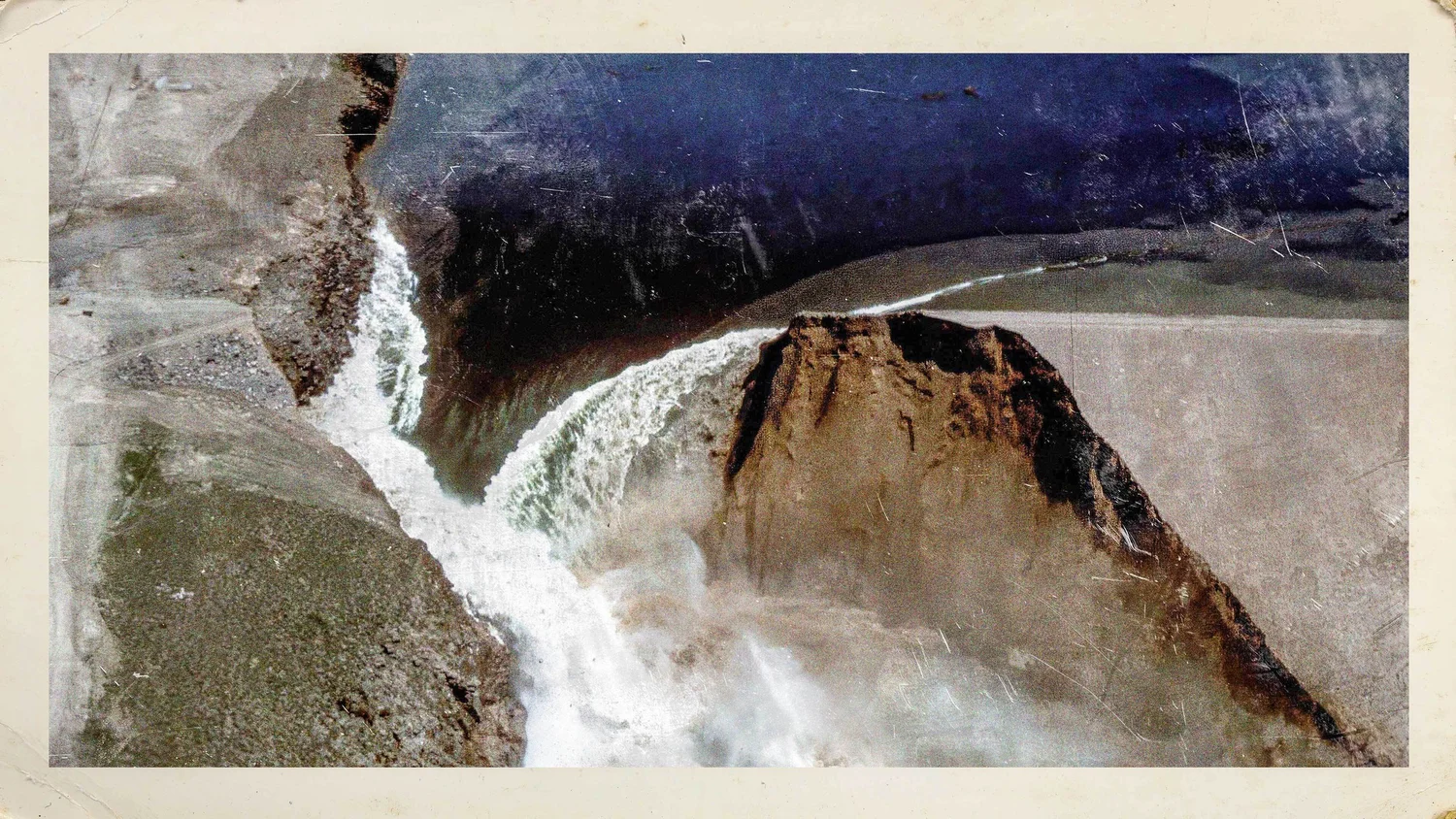
Only 30 minutes later, a sinkhole opened up on the upstream face, below the reservoir, giving the water a more direct path through the dam. Multiple witnesses saw a terrifying whirlpool form. The reservoir was draining like a bathtub directly through the center of the dam. More dozers tried in vain to push material on the upstream side to close the hole, but it was too late. The erosion worsened, allowing more flow, causing even more erosion in a runaway feedback loop until finally the embankment gave way at about noon, only 5 hours after the leaks were first noticed.
A wall of water thundered through the hole in the embankment. The breach wave moved quickly downstream in the Teton River, widening out once it left the canyon. The closest town in its path, Wilford, was basically wiped from the map, with nearly all the homes there swept away. Further downstream, Sugar City and Rexburg were similarly decimated, with the vast majority of the buildings rendered a complete loss. Then the smaller farming communities of Hibbard and Salem were inundated, homes and livelihoods washed away. The breach killed thousands of livestock, destroyed railroads, bridges, and farmland, and left thousands without a home. Ultimately, 11 people lost their lives. Had the failure happened at night when no one was watching the dam, it could have been hundreds or even thousands more.
Investigations concluded this was not a "freak accident." The challenges of erodible soil and fractured geology were well known long before the 1970s. The Bureau simply didn't spend enough money to address them. In the end, it was a simple case of frugality over safety. As one investigation said: “Defensive measures, such as rock surface sealing and adequate filters, were well within the state-of-the-art at the time Teton Dam was designed and should have been used.”
But even though it wasn’t a novel failure mode, the impact Teton had on the engineering community was enormous. To see a brand new structure, built by one of the most technically competent agencies in the US, fail in such dramatic fashion was catalyzing in many ways. The federal government responded by standardizing dam safety guidelines across all federal agencies involved in dam construction, rules that are still in place today. The event also spurred research into filter and drainage design for dams, along with a better understanding of the mechanisms of hydraulic fracturing. Finally, it showed engineers everywhere what was possible when geotechnical issues aren’t taken seriously enough.
The very first dam I worked on in my career was very much “Teton-esque.” It was designed by another firm, but during construction, they realized that the foundation was much worse than expected. There were pores, fractures, and even caves below the dam. They had to shut down the job and re-engineer it entirely. Our solution was a deep cutoff wall. It basically involved running an enormous vertical chainsaw along the length of the dam, then filling the trench with a watertight mix of rock cuttings, cement, and bentonite clay.
I vividly remember working through the complexities and challenges of dealing with that foundation material. It’s really easy to understand these failure modes in hindsight. But when you’re actually working on a real project, it’s hard to visualize how soil, rock, and pressure will actually behave underground. Things get pretty abstract, and you can lose sight of the stakes. It’s hard to explain what it meant to have that example of Teton at the top of mind for everyone on the design team. For all the computer models, testing data, and equations, we also had a real life example of what could happen if we got it wrong. It was grounding in a way that textbooks and excel spreadsheets are not. And I like to think that’s how we honor the victims of engineering disasters: to share the stories and keep the lessons from being forgotten to make sure it doesn’t happen again.
Since the U.S. and Israel launched the strikes against Iran Feb. 28, President Donald Trump has made contradictory statements about the timeline to end the war. He has repeatedly declared victory and then later threatened Iran.
After being laid off, I was aggressively applying to everything even remotely in my industry. I landed an interview with a company I recognized and a role I was fully qualified for. In order to move forward in the process, however, they said I needed to “complete an AI screening.”
What? I was expecting a phone call with the hiring manager as a first step, but this is the future I guess. So I went with it. Well, it was — perhaps predictably — absolutely awful. Not only did the AI ask me confusing, irrelevant questions about hyper specific bullet points on my resume, but it frequently interrupted my responses and even lost connection three times, forcing me to repeat myself. All this happened while I was being video recorded, so I’m sure some of my answers likely came off a bit clipped and tired.
I have no idea how I should have handled that, and I dread having to do it again for some other company. Do you have any advice?
Yeah, it’s a terrible practice for exactly the reasons you encountered: nonsensical questions, technical issues, and the expectation that you’ll invest your time in a call to answer questions without getting any of your own questions answered in return so you can determine if you’re even interested in moving forward.
Up until now, the social contract between employers and job-seekers has been that once your resume passes an initial screening, the next step (whether it’s a phone screen or a more in-depth interview) will give you the chance to talk to the employer to ask questions of your own so that you can figure out if you want to invest any more of your time afterwards, since it doesn’t make sense to do that if the role doesn’t fit what you’re looking for. That’s why employer demands like “write multiple essays before we’ll interview you” or “do a lengthy work simulation before you can even apply” have always seemed out-of-touch.
It was bad enough when some employers started requiring one-way video interviews before they’d talk to you (where you have to record yourself answering specific questions, again without the opportunity to ask your own in return). This is that taken to new heights, and with even less respect for you and your time.
But AI interviews are probably sticking around for at least a while, if not long-term, so job-seekers will have to figure out whether they’re willing to play along or not. If you have other options, you can always decline. But like most terrible hiring practices, this one will most affect the people with the fewest options. If you’re at a certain level in your field and have in-demand skills, you can say, “I’d be happy to talk with a human who can answer my questions in return; if that’s not possible, I’ll need to withdraw from consideration.” If you’re not in that position and just need a job, you probably need to roll your eyes and do it.
Years ago, I got to know Fergus, the head of a local organization I worked with through my previous job. Fergus eventually left the organization to pursue other opportunities, and shortly afterward, I had a meeting with other members of the team, including the person who had succeeded him. At one point in the conversation, I asked if they knew how Fergus was doing and received a fairly non-committal answer.
A couple days later, I received an email from the new manager that had very clearly been written by lawyers, informing me that after Fergus’ departure they had discovered financial improprieties during his time running the organization and had severed all ties with him. This was surprising to me because, while I had never worked closely with Fergus, he had never given me any reason to question his integrity.
A few months after that, the CEO of my organization mentioned to me that he had had conversations with Fergus about joining our team. I felt duty-bound to tell him about the email I had received. I’m not sure how much of an impact that had, but in any event he never came to work for us.
Fast forward to last week when Fergus, with whom I’ve stayed in touch with over the years, asked me for an introduction to the CEO of a company where he is applying for a job. My instinct is to let bygones be bygones and make the introduction. It’s been five years and I don’t even know the details of what he was alleged to have done, much less whether it’s true. And as I said, other than this one incident, I’ve never had any reason to doubt Fergus’ integrity.
Still, I’ve found myself wondering, if I felt an obligation to tell my boss about the email five years ago, why wouldn’t the same obligation extend to my professional contacts at this other company? (I know the CEO, but not particularly well, and he’s certainly not someone I would consider a friend.)
There’s also the question of, if I do make the referral, whether I should give Fergus an enthusiastic recommendation or simply pass along his resume without comment. Given how difficult it is for job candidates to stand out these days, I almost feel as if the latter action would be equivalent to not making the intro at all.
Ugh, this is hard. The fact that Fergus had never given you reason to question his integrity doesn’t mean that he wasn’t involved in financial improprieties; in fact, the way many successful embezzlers (to use one example) are able to get away with it for a long time is that they come across as friendly and trustworthy.
On the other hand, it’s a little odd that the other organization felt the need to send you that letter. Was there any reason for them to spill Fergus’s business like that, other than sullying his name? Maybe there was! Depending on the work Fergus did, there could be reasons that you/your organization needed to know what happened. But if there weren’t, I’d be uncomfortable with that and trying to figure out why I was being informed.
In any case, when your CEO mentioned he was considering hiring him, you were right to share what you’d been told with him. You had relevant info that he had the right to consider.
It’s different in this latest situation, where you don’t work for the person he’s applying with, so there’s not as clear an imperative. But Fergus is asking you to use your reputation to vouch for him. Before you can do that, I think you’ve got to know more. Would you be willing to ask Fergus point-blank about what happened with the old job? You could say, “Before I contact Joe, can I ask about what happened when you left OldOrg? My sense was that there might have been some issues there, and candidly I feel like I’ve got to ask you that first. I’m sorry if I’m putting you in an awkward position.”
This won’t necessarily clarify things for you, but it might. Or it might further muddy them! But I don’t see how you can vouch for him — which is what you’d be doing — without at least asking him about it. If you don’t want to do that, I don’t think you can ethically refer him, given the info you do have. And so if he didn’t do anything wrong, it’s actually fairer to give him a chance to clear things up.
EDMONTON — After weeks of speculation, Alberta’s United Conservative government has announced that the province will be moving to the 1950s on a full-time basis. “Many Albertans just aren’t comfortable with the current times,” a UCP spokeswoman said. “The stately pace of decades past is a better fit for our province.” The spokeswoman was then […]
There aren't any candidates on the ballot in Virginia's statewide special election on Tuesday, but the contest could still decide control of the closely divided U.S. House this fall.
WASHINGTON—Denouncing what they called a “sickening” misrepresentation of the facts, critics of a new Michael Jackson biopic argued Monday that the movie brazenly depicted Neverland Ranch with way cooler rides than it actually had. “Michael is a shameless whitewashing of ride options that frankly were no better than what you’d encounter at a ramshackle roadside carnival,” said advocate Jillian Moore, adding that not one of the pop icon’s alleged victims recalled being fondled anywhere near the high-velocity triple-loop roller coaster or 400-foot drop tower portrayed in the film. “It should come as no surprise that a film made with the blessing of Michael Jackson’s estate would feature not a single interview with someone who could attest to the haunted house being over in, like, two minutes. Someday, the truth, including the actual number of bumper cars, will be revealed for all the world to see. Until then, we advise anyone watching this cynical cash grab not to forget the innocent children wildly disappointed by a pirate ship ride nowhere near as good as the one at Six Flags.” Reached for comment, the film’s producers acknowledged that Michael Jackson might have violated children but vehemently defended Neverland rides as offering incomparable thrills and spills.
In brief: In today’s update we take a look at increasing shower activity today and Wednesday before our rains mostly dry up. That will leave us with a more humid and increasingly warm air mass heading into the weekend. We also take a look at winds this weekend for our friends participating in the MS 150 ride.
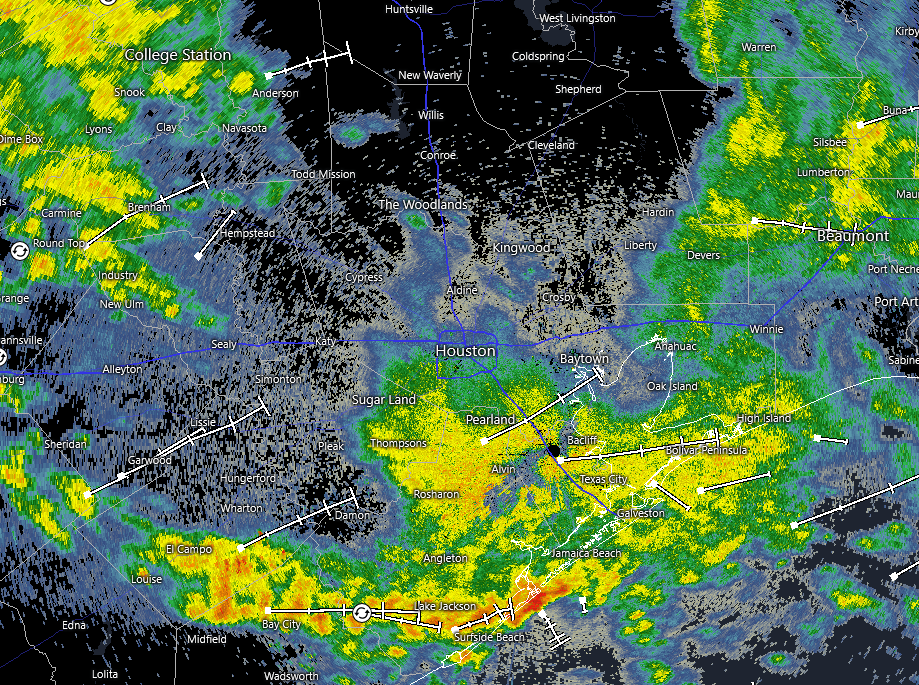
Before sunrise on Tuesday rains are (mostly) behaving across the Houston region. (RadarScope)
Drier air mass is gone
After Houston saw widespread showers on Saturday a drier air mass moved in to the region on Sunday. By Monday enough drier air was holding on such that even though a disturbance moved in from the west was producing precipitation in the atmosphere, much of this was drying out before it reached the ground. The lower atmosphere is more saturated now, so those showers are breaking through.
Since midnight much of the region has received between 0.25 and 0.5 inch of precipitation, and we are likely to see ongoing rain chances today and Wednesday. The good news is that, for the most part, I expect these showers to be mostly behaved. That means that while heavy rain and street flooding are always possible, in this case I expect showers to largely be of the light-to-moderate level.
Tuesday and Wednesday
As mentioned above, we’ll see on-again, off-again showers for much of today and Wednesday. High temperatures today will likely top out in the lower 70s, but Wednesday could be a little warmer if we start to see some partially clearly skies later in the day. The rain chances should start to ebb by Wednesday afternoon or evening. By then we’ll just be left with fairly muggy air and warm nights with lows around 70 degrees.
Thursday and Friday
These will be a pair of partly sunny days with temperatures in the 80s. Thursday may be a shade cooler than Friday, but both days will see plenty of humidity and some background rain chances on the order of 20 percent. Afternoon winds will gust up to about 20 mph from the south, with lighter conditions at other times. Nights remain in the lower 70s.
Saturday and Sunday
A warming trend continues into the weekend, with highs likely in the upper 80s, and partly to mostly cloudy skies. With dewpoints in the vicinity of 70 degrees it will feel plenty humid. As for rain chances, they’re not zero, but they’re pretty low, and anything that falls should be light.
Forecast for sustained winds at 1 pm on Sunday. Wind gusts will be about twice as high. (Weather Bell)
So what about winds? If you’re participating in the MS 150 ride this weekend that’s what really matters. The route on Saturday is generally westerly, and then it turns more northerly on Sunday. Winds at dawn on Saturday will be mostly southerly, at about 5 mph, so a cross wind. They’ll be stronger by the middle of the day, 10 mph with gusts up to 20 mph. The story will be similar on Sunday, so more of a pure tail wind that day. You should be flying that day!
Next week
Warm temperatures, with highs near 90 degrees, will continue into next week. Some sort of front may work its way into Houston by Tuesday or Wednesday, but your humble forecaster is making no concrete predictions on that score. We’ll have to see what happens.
CARMI, IL—Expressing anxiety over the immense pressure it faced to become various food products, a local legume confided to reporters Tuesday that it wished it could just be a soybean and have that be enough. “I don’t want to be a sauce, I don’t want to be an oil, I don’t want to be tofu or tempeh or nattō—I just want to be me,” declared the soybean, emphasizing that despite the rapidly growing demand for it to become protein powder or alternative milk, it had no interest in being anything other than a humble soybean. “Is that really too much to ask? Black beans get to be black beans, kidney beans get to be kidney beans. But I have to endure the suffocating burden of everyone trying to turn me into something I’m not. I have plenty of protein and fiber to offer on my own, you know. If God had wanted me to be a bar, He would have made me a bar. I just wish I had the confidence to live my truth.” At press time, sources confirmed the soybean had been brutally mashed into paste with absolutely no say in the matter.
WASHINGTON—Saying the opportunity to masterfully execute a difficult parking job was never far from their minds, the nation’s dads confirmed Tuesday a deep yearning for the chance to back a large vehicle into a tight spot. “Oh yeah, I could definitely fit a van back there,” said Maryland father George Packard, echoing the sentiments of millions of other dads across the country who similarly wished to hop into the driver’s seat of a truck or full-size SUV, check the rearview mirror, and smoothly reverse into a compact parking space. “The trick is to pull out wide and turn sharp. You gotta really crank the wheel. It’s all in the positioning and angles. Look over your shoulder, mind your clearance, and move backwards nice and easy. I’ve definitely parked in much tighter spots.” At press time, America’s dads were ruthlessly mocking the “pussies” who rely on a backup camera.
1. Install Baby Gates Baby gates are great for keeping babies out of places you don’t want them to go, like inside your home. String several gates together with zip ties to form a barrier around the perimeter of your property. Most babies aren’t smart enough to figure out how to open the gates, and neither are you, but you’re probably tall enough to step over.
2. Affix Safety Latches to Lower Cabinets Babies love opening cabinets to rifle through your cookware, cleaning supplies, and the collection of half-used batteries you keep in your junk drawer. If word gets out that you’re the kind of household that keeps things securely locked away, they won’t bother swinging by.
3. Put Wedge Locks on Every Sash Window If there’s one thing all babies have in common, it’s that they are exceptional crawlers. Their tiny hands and capless knees can take them anywhere: under fences, over flowerbeds, and through your open windows. Use wedge locks to ensure your windows can’t be opened more than four inches, as most babies are taller than this. If you hear of shorter babies being sighted in your area, keep your windows shut and install bars.
4. Cover All Electrical Outlets In the event a baby does invade your home, you’ll want to ensure all unused outlets are covered. Infant intruders are always on the lookout for places to recharge the toys their parents told them were broken, like the Repeat What You Say Light-Up Dancing Cactus. Then not only will you have a giggling baby on your hands, but a stuffed saguaro that mimics you every time you sob, “Please, just pull all the books out of my bookshelves and leave.”
5. Eliminate Food Sources Babies love food almost as much as they love breaking and entering. Keep your home and property free of scraps. At night, when the threat of a baby invasion is highest, throw all remaining food into garbage bags. Use rope to hang the bags in a tree, suspending them at least twelve feet off the ground, eighteen feet from the trunk, and, ideally, thirty-seven miles from your house.
6. Seal Cracks in Your Foundation Babies can sense weakness from thirty-six miles away. Seal up cracks in your foundation, and make sure the land around your home slopes away so a passing baby doesn’t roll through it, intentionally or otherwise. Babies are built like bowling balls and, given enough momentum, will bowl a child-sized hole into the basement—and right through your ten-year-in-the-making miniatures museum.
7. In Fact, Seal Everything With their soft, bendable bones and collapsible skulls, babies are literally designed to squeeze through very narrow spaces. Like birth canals, tunnel slides, and that crawlspace you didn’t know existed until it was too late.
8. On That Note, Forget the Wedge Locks and Just Board Up See: babies squeezing through narrow spaces, above.
9. Regularly Inspect for Signs of Baby Activity Just because you don’t see a baby doesn’t mean there’s not one there. Keep an eye on your closest friends and family for evidence of impending infants. Common signs include links in your inbox to StorkStuff! registries, vacation photos tagged #babymoon, and a shift in dinner party conversation from Damien Hirst’s role in the commodification of contemporary art to something called a “Snoo.”
Should infants begin to breach your social circles, it might be time to assess your living space for potential hazards, in case your friends ever stop by to “let you meet the baby.” For further help, see our companion guide: How to Turn Your Tastefully Decorated Living Space into a Baby-Safe Bounce House.
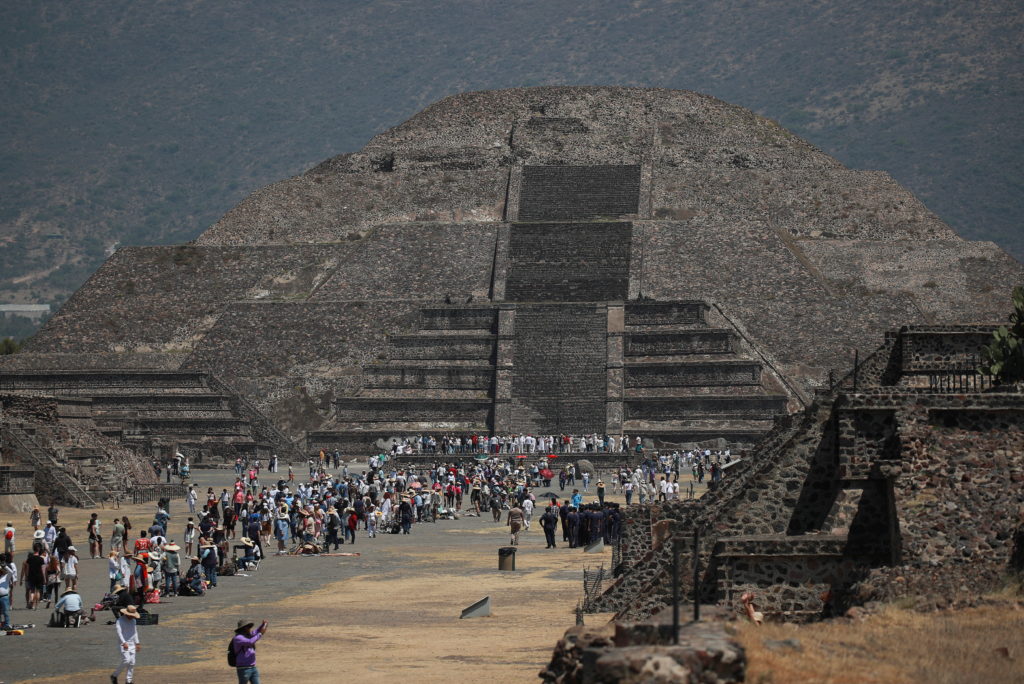
A man with a gun opened fire Monday at the historic Teotihuacán pyramids, killing one Canadian tourist and injuring six other people at the tourist site an hour north of Mexico's capital, the Mexican government said.
Something happened to me 15 years ago that I continue to wonder about. When I was a senior in college, I was applying to internships in my field (comms/PR if it matters) in Washington, D.C., with the help of my academic advisor.
One in-person interview at one of the big legacy PR firms went really well. When my academic advisor followed up about it, they said the company thought I was a fantastic candidate and they’d absolutely love to hire me, except for one thing: they thought the shirt I was wearing was inappropriate for an interview setting and, particularly, that it had sequins on it. Ultimately, I did not get the fellowship because of it.
I found an almost exact replica of the shirt that I’m attaching. If I recall correctly, I wore it with a nicely tailored black pantsuit that I was very proud to have purchased on my limited college budget.
Do you think that the company was right in 2010 (given I was a 23-year-old who knew nothing about the working world at the time, beyond a few internships, and in particular the dress code standards of the time) or not? Would you have made the same call 16 years ago? And, do you think this would still happen in 2026? Should we be warning new grads away from all sequins? For the record, I would not wear that shirt now — but really only because it’s very 2010s. I remember it being part of my regular office job rotation once I got my first job later that year.
I wouldn’t recommend sequins at a job interview at all, then or now, just because they tend to read more “nighttime attire” than professional interview wear … unless you’re in a field with a lot more leeway than D.C. communications firms tend to have. D.C. is notoriously conservative about work wear.
But it’s a ridiculous reason not to hire you — particularly since you were 23 and still figuring this stuff out, but even if you’d been older.
And as sequins go, this particular shirt is less of an issue than, like, a full sequined top or sequined dress would be — and the fact that you were wearing it under the jacket of a pantsuit makes their reaction even more over-the-top.
I’d put it in the category of stuff I’d advise a candidate not to wear in order to make the most professional impression, but wouldn’t advise an employer not to hire over (because it really doesn’t matter). And a candidate who they said was fantastic and who they’d otherwise love to hire — in other words, where you obviously didn’t give them any other reason to doubt your judgment, and where this could be easily solved by explaining their dress code to you upon hire? Absurd.
Cicadas referred to as “stragglers” because they emerge off-cycle may appear this year despite their broods not being expected to emerge, with scientists unsure how they lose track of time. What do you think?
“But I already put away all the decorations!”
Matteo Sousa, Decoupage Expert
“It’s never too late to start screaming until you die.”
Lachlan Fitzgerald, Broom Assembler
“Yet they wonder why other cicadas never want to make plans with them.”
The front page of the April 13th issue of Jinja Shinpō had a report of the annual study meeting of the national association of young Shinto priests. The theme was, roughly, looking at tradition to prepare for the future. That is a very Shinto idea.
The editorial in the same issue picked up on this point, and was rather more radical about it. The opening is conventional enough for the Shinto community. There are certain things that should not change about Shinto practice, and others that can, and indeed should, to adapt to changing circumstances. Priests have to carefully consider all the factors, and distinguish these elements from one another precisely.
Then it (the editorials are unsigned, so I am assuming that they write themselves for pronoun purposes) gets revolutionary. It says that simply distinguishing the elements that can be changed from those that must not will get you nowhere. You have to actually do something new, or the problems will not be solved.
However, it says, when people do something new, there is always opposition. No matter how much the priest making the change has thought about it, and no matter how confident they are that the unchanging heart of Shinto is preserved in this new practice, some people will say that they have abandoned the true path.
The editorial gives the examples of Yoshida Kanetomo, who founded Yoshida Shinto, the dominant tradition from around 1600 to 1868, and Hirata Atsutane, an important figure in Kokugaku, which had a very strong influence on post-1868 Shinto. Both of these people faced criticism from other priests at the time, and both shaped Shinto for decades or centuries, creating the things that became the new traditions. It then says that young priests, who are said to be the vanguard of Shinto, should not hold back from making changes because of fear of criticism.
The editorial closes by expressing the concern that people have got so used to talking about rural depopulation and the ageing society that they have lost any sense of crisis about the issues. Because young priests will still be trying to sustain jinja in twenty years’ time, they are ideally suited to try to solve the problems. They might, it concedes, be immature in some ways, but they also have the energy of youth, and that is what is needed to address the issues.
I have a lot of sympathy with this position. I have mentioned before that Shinto will not survive by simply doing things the way it always has — society has changed too much for that.
I have two concerns. One is with the examples. Yoshida Kanetomo claimed that the sacred object from Isê Jingū had flown to his jinja, and that his jinja was now the place where Amaterasu Ōmikami was enshrined. He also claimed to be the head of the Imperial jinja bureaucracy, without any official appointment from the Tennō.
Yes, he faced criticism. Had the country not been in total chaos due to civil war, he probably would have been legally shut down. I am not sure that he is the best role model.
My other concern is that the editorial did not mention whether the author or Jinja Shinpō would defend priests who were being criticised for doing something new, or whether Jinja Honchō was adopting a general policy of not firing them for it. It did read a little bit as though it was encouraging other people to risk their careers to save Shinto.
I have a Patreon, where people join as paid members to receive an in-depth essay on some aspect of Shinto every month, or as free members to receive notifications of updates to this blog. If that sounds interesting to you, please take a look.












I found an almost exact replica of the shirt that I’m attaching. If I recall correctly, I wore it with a nicely tailored black pantsuit that I was very proud to have purchased on my limited college budget.