Shared posts

25 Sep 04:12

Officials Said They Busted a Tren de Aragua Party. Attendees Beg to Differ.

by Francesca D’Annunzio

On the night of March 31, María, a 40-year-old Venezuelan mother of four who asked that her last name not be published for fear of government retaliation, was home alone in her two-bedroom Austin apartment. Around 9 p.m., her adult son and daughter, along with her teenage son, had left for a birthday party at a six-bedroom Airbnb half an hour down the road. Then, about 4:30 a.m., she got a shocking message from her daughter on WhatsApp: Her kids had been swept up in a multi-agency police raid. For three days, she didn’t hear from them—and the next six months of her life would be turned upside-down.

In the early hours of April 1, law enforcement agents had arrested three of her kids and more than 40 others outside the rented mansion near the well-off Hays County suburb of Dripping Springs. The participating agencies—the Federal Bureau of Investigation (FBI), Immigration and Customs Enforcement (ICE), the Texas Department of Public Safety (DPS), and the Hays County Sheriff’s Office—claimed they had busted a suspected gathering of Tren de Aragua, a transnational Venezuelan prison gang that the Trump administration designated a foreign terrorist organization earlier this year. In recent months, Venezuelan immigrants have been accused of gang membership on flimsy or non-existent evidence.

The day after the raid, DPS put out a press release stating that law enforcement agencies at all levels, including San Antonio police, had been investigating “Tren de Aragua (TdA)” for more than a year, and that: “In recent days, the FBI developed intelligence regarding a possible gathering of suspected TdA members or TdA associates in Hays Co.” The agencies’ operation led to both arrests and a drug seizure, DPS said, and prosecutors were evaluating potential charges.

The house to be raided as included in the affidavit for a search warrant (Hays County court records)

Elected leaders chimed in to applaud the operation. “The Venezuela-based prison gang Tren de Aragua (TdA)—among the worst groups that have infiltrated the nation—was operating right in the heart of suburban Austin in Hays County, Texas, where I call home,” said right-wing GOP Congressman Chip Roy. Governor Greg Abbott added on X: “Over 40 TdA vicious criminals are now behind bars and off our streets.”

But authorities never offered any evidence that the party attendees actually were Tren de Aragua members. María told the Observer that none of her kids were involved with the gang; four other party attendees also denied any affiliation. DPS and ICE referred questions to the FBI. The FBI did not answer Observer questions, and the Hays County Sheriff’s Office did not respond.

As a result of the raid, ICE arrested 35 people on federal charges of attempted illegal entry, according to a report obtained from DPS, which was previously reported on by the Texas Tribune. Federal court records suggest that none of these charges were actually prosecuted, and interviews suggest arrestees were simply funneled into civil immigrant detention and in many cases deported. Two additional Venezuelan men were charged with felony-level possession of a controlled substance, resulting from traffic stops near the Airbnb earlier in the evening; police say both had left the party location, though one denied this to the Observer. ICE has said nine minors were taken into custody—one of whom was María’s youngest son, who was transferred into the federal Office of Refugee Resettlement (ORR) shelter system. In the Airbnb, police found two pink pills, 10 bags of pink powder, and a small bag of a leafy substance all believed to be drugs, according to a search warrant inventory that was previously obtained by the Caldwell/Hays Examiner, but authorities did not charge anyone with crimes in relation to the substances, according to two prosecutors at the Hays County DA’s office.

Party attendees told the Observer that some friends had rented the Airbnb for three days to celebrate a pair of birthdays. There were beers, arepas, and a birthday cake. They were planning to blow out candles and sing the following day.

Xavier Peña, who briefly deejayed at the party before the beginning of the raid, recalled hearing a voice outside on a loudspeaker around 4 a.m. “Come outside with your hands up,” a voice boomed through a megaphone, he recalled. “It’s the state police.” 

María’s 23-year-old son, Eliangel—who has since been deported back to Venezuela and whose last name is being withheld to protect his mother’s identity because they share the same last name—told the Observer by phone that he was asleep that morning when flashbangs woke him up. In a WhatsApp call, he described seeing camouflaged officers outside pointing guns with infrared lasers inside the house. 

In ICE detention, “I cried everyday,” he said, knowing how his mother would struggle to make rent without his and his adult sister’s help. He also has a two-year-old daughter, he said, who remains in the United States.

An ad with the text: When Texas is at its worst, the Texas Observer must be at its best. We need your support to do it. A button reads: JOIN NOW
Advertisement

The SWAT-style nature of the April operation has alarmed advocates. “It’s just deeply disturbing, that level of militarization for a raid,” said Karen Muñoz, a Hays County-based attorney for LatinoJustice, a national advocacy law firm focused on civil rights. 

Among Muñoz’s concerns is the entanglement of state police with ICE agents—and the use of a drug investigation as a pretense for immigration enforcement. When state police obtained a search warrant at 2:39 a.m. in neighboring Comal County, the probable cause affidavit cited the narcotics obtained during the two traffic stops near the Airbnb in addition to information from an unnamed “cooperating individual” who told police there would be a party at the address.

Antonio Vizcaino González was a passenger in a car stopped for ignoring a stop sign at 8:35 p.m at a 7/11 gas station about two miles from the Airbnb. A DPS officer wrote that Vizcaino González had “Tattoos common with Tren De Aragua membership.” ICE deportation officers arrived, per the DPS report, conducted a pat-down, and found narcotics in his inner waistband (he was later charged with ketamine possession), according to police and court records. He was booked into Hays County Jail at 12:50 a.m. on charges of possession of a controlled substance, soon bonded out into ICE custody, and was deported to Spain (where he was born, though he grew up in Venezuela). Vizcaino González declined an interview request but said in a Facebook message: “All I can tell you is that at that party, no one belonged to a criminal gang. … It was a friend’s birthday party.”

Jeankey Jhonayker Castro Bravo was stopped by DPS at 10:56 p.m. for traffic violations, and a trooper called in ICE after Castro Bravo showed a Venezuelan passport. Castro Bravo, whom DPS also accused in an arrest report of Tren de Aragua affiliation because of tattoos, was then arrested for drug possession. He was booked at 2 a.m. and has been locked up ever since—facing felony ketamine possession—mostly at the Haskell County jail, a West Texas facility that contracts with Hays. At the Haskell jail, Castro Bravo denied Tren de Aragua affiliation and police claims that he had left the Airbnb, saying he was simply driving for DoorDash in the area: “I never arrived at any party,” he said. “I didn’t even know there was a party.” (Two attendees told the Observer they didn’t recognize him from his booking photo.) Marc Ranc, the Hays County prosecutor tasked with the case, told the Observer in mid-September that he was considering dropping the charge because he was still awaiting evidence from federal agents.

DPS has no formal agreement with ICE allowing it to enforce immigration law. When DPS officers executed their search warrant, they asked people to exit the house, funnelling them to immigration agents, who could then question them about their status and detain them, party attendees recounted. Task forces involving federal, state, and local police have long existed, but advocates believe this may cross a line.


“This level of collaboration, I think, makes the line between federal immigration and state criminal enforcement really, really unclear and murky,” Muñoz said. 

Meanwhile, María has been left with a broken life. Eliangel and her 22-year-old daughter were both deported to Venezuela. Her 16-year-old son is still in ORR custody. He hasn’t been released to his mother, she said, because of delays at the Venezuelan consulate in providing a verified birth certificate. She’s struggling to pay her bills without help from her adult kids. For much of the summer, she told the Observer, she was working as a delivery driver in a car without functional air conditioning.

The great irony, she said, is that accusations about Tren de Aragua membership have broken up her family—even though they were victimized by the gang themselves. Nearly a decade ago, outside a baby shower in Maracay, she said gang members pulled up on motorcycles and sprayed bullets, killing one person and wounding another. After that, María and her kids left for Chile, but Tren de Aragua has become active there as well, and in 2022 she came to the States partly to avoid the gang.

“We are scared of them,” María said. “We left our country because of that.”

The post Officials Said They Busted a Tren de Aragua Party. Attendees Beg to Differ. appeared first on The Texas Observer.

24 Sep 17:22

Can you believe it? Fits right in with my week.

Can you believe it? Fits right in with my week.

23 Sep 18:57

Atlantic Tropics shifting into a potential busier mode over the next 10 days

by Matt Lanza

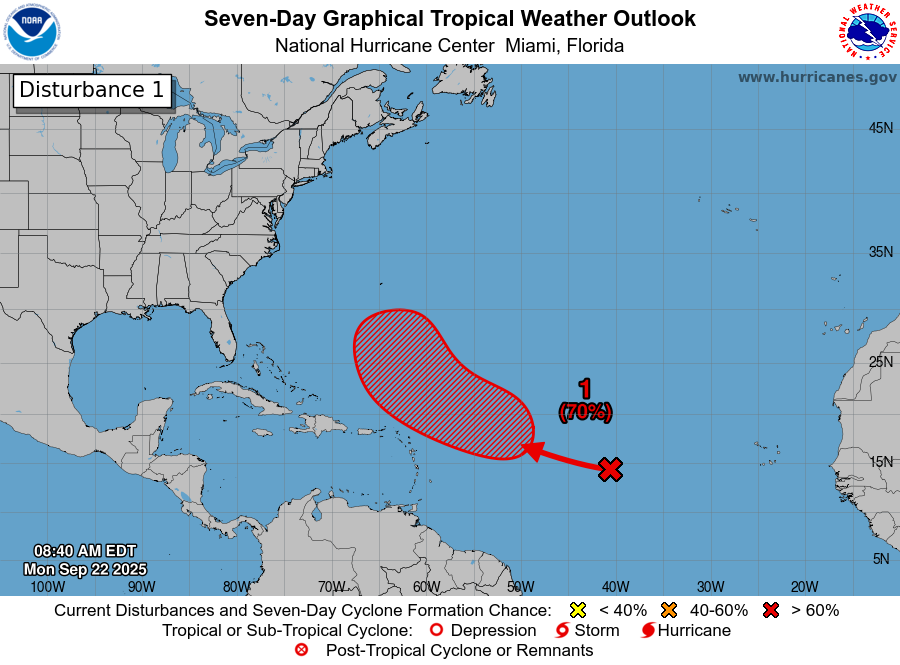
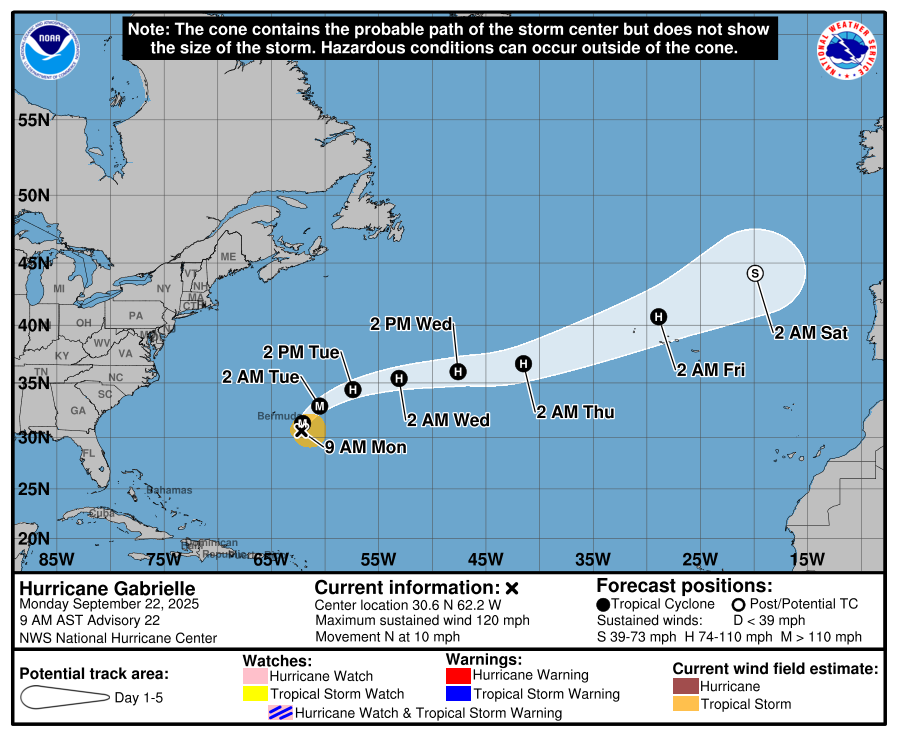
In brief: Gabrielle became a hurricane and then a major hurricane overnight and this morning. It should head out to sea now, but it may bring some impacts to the Azores or even Europe eventually. Disturbance 1 from the NHC carries a 70% chance of development and is currently not a serious land threat. Disturbance 2 from the NHC carries a 40% chance of development and has a high degree of uncertainty in its forecast heading toward the weekend. We explain it all below.

Things have escalated a bit in the tropics, but there are still more questions than answers in some cases. Let’s walk through the development areas and explain what we know in each case.

Major Hurricane Gabrielle

(NOAA/NHC)

Last week we were scoffing at how paltry Gabrielle looked. But we said despite that it had a chance to become a hurricane, if not a major hurricane by Sunday or Monday. Well, here we are, and we got our major hurricane. Gabrielle has maximum sustained winds of 120 mph this morning, and it looks spectacular.

A static satellite image of Gabrielle this morning shows a well-organized storm with ample thunderstorms around its eye. (Tropical Tidbits)

Gabrielle is in a bit of a precarious position, as it moves over much warmer than normal water. The water will be gradually cooling, however as it moves north and northeast. Still, Gabrielle has a good 24 hours in a favorable environment, and we could see it take a quick run at category 4 intensity this afternoon before peaking. From here, Gabrielle strolls out to sea and slowly weakens.

That said, Gabrielle probably won’t fizzle out. Impacts from Gabrielle are possible in the Azores by Friday and perhaps even in Iberia by Sunday or Monday. Exactly what those impacts will be are TBD. Uncertainty in the forecast from the Azores to Europe increases with time in Gabrielle’s forecast.

70% chance of development area

I want to preface this by saying that there are two distinct disturbances in the Atlantic, and the models are still sorting things out with each one. For now, I’m going to focus on the Central Atlantic one discussed here as the most likely to develop and also farthest east. A tropical wave in the central Atlantic is carrying a 70 percent chance of development over the next week as it comes west and northwest.

The next wave to watch will move north of the islands later this week. (NOAA NHC)

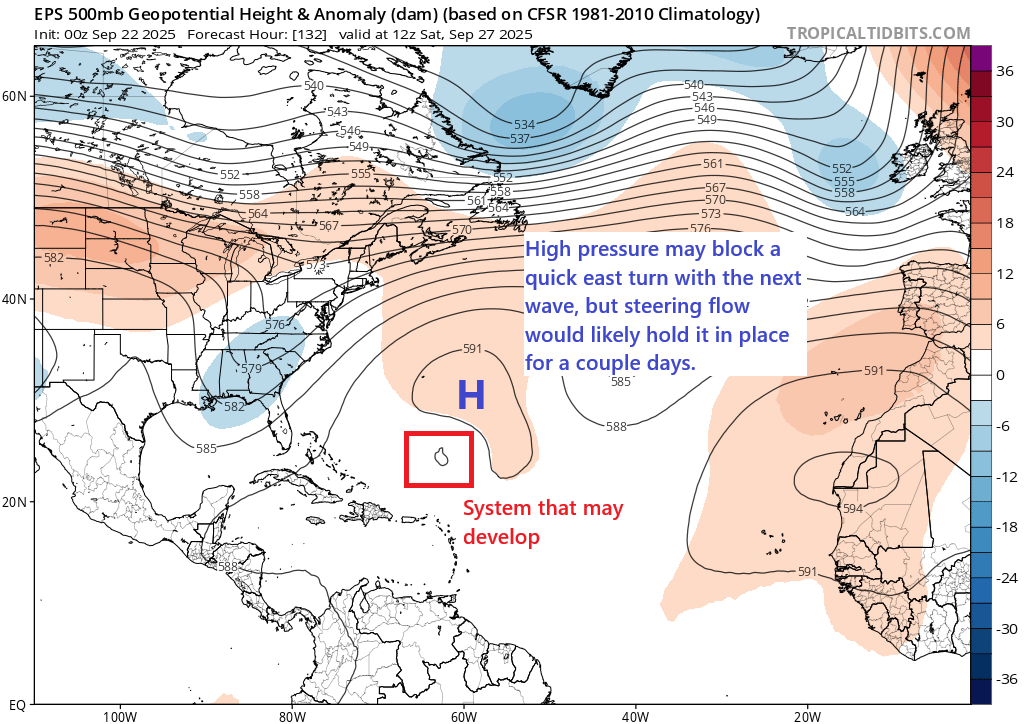
This system will be interesting, though I’m not particularly concerned about it making landfall right now. That said, it bears some watching. We’re still several days away from it getting north of the islands and south of Bermuda. But when it gets to that area, the upper level pattern is supportive of a system that moves slowly, possibly even stalling out. High pressure will block its exit east, at least initially, and a trough over the Southeast will sort of inhibit westward movement.

Upper-level pattern supports a system slowing or stalling south of Bermuda and north of the Caribbean islands by the weekend. (Tropical Tidbits)

On the one hand, the high is expected to eventually weaken enough to allow for an exit out to sea, possibly by Tuesday or Wednesday of next week. On the other hand, systems that stall out inherently have high uncertainty and bear watching. If one of the puzzle pieces currently in place in the forecast ends up shifting, the overall outcome could also shift. For now, I would say continue to monitor this system, but it’s probably not worth losing sleep over at this very moment.

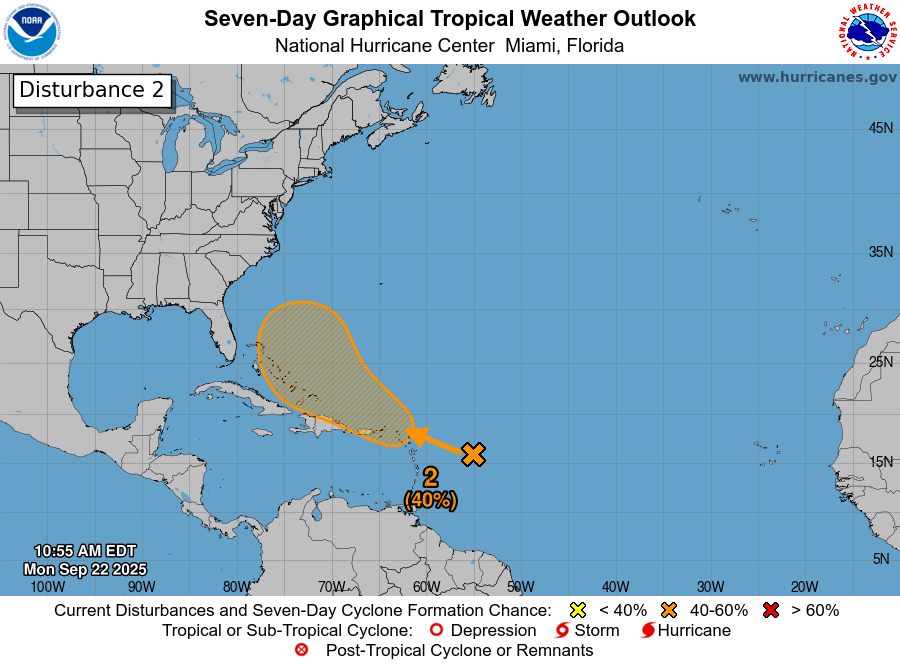
40% chance of development area

And then ahead of the above discussed area, we have another area to watch. This one is carrying a 40 percent chance of development over the next week.

The third system is a disturbance with a 40 percent chance of development over the next week. (NOAA NHC)

Looking on satellite, both the previously discussed disturbance and the leading one look fairly healthy. The trailing the disturbance is in a slightly better environment, hence the better odds right now.

Satellite imagery of two NHC identified areas of interest in the Atlantic. (Weathernerds.org)

The leading disturbance discussed here will probably track off to the northwest, staying fairly low-end over the next 2 to 3 days. In fact, by Thursday, 1 Google Deep Mind ensemble member develops this area, while about half develop the trailing wave with higher odds. This disturbance has to deal with a bit more shear and also Gabrielle’s wake a little more. However, by Saturday evening, a little under half of the Google ensembles develop this disturbance near or just east of the Bahamas.

A number of Google AI ensemble members develop the 2nd disturbance by Saturday night in some fashion near or just east of the Bahamas. (Weathernerds.org)

Notably, about the same percentage of European ensemble members are doing the same thing here. So there is growing model support for something in this area in about 6 days. What it looks like, what it is, what its impacts will be? We don’t know yet. But interests in the Bahamas and Turks and Caicos Islands should be monitoring the progression of the NHC Disturbance 2 over the coming days. For the U.S. Southeast? It’s too soon to say much about this. Folks in Florida up through the Carolinas should continue to monitor but understand that there is a very high amount of uncertainty with this wave. Confidence in Disturbance 1 is a bit higher both in track and in details right now. Confidence in this Disturbance 2 would be classified as low to lower than average. More to come.

22 Sep 19:08

Oh ... well ... hi there little partners! Well ...

Oh ... well ... hi there little partners! Well ... couple of technical problems down here but, well, that's ok. Because it's time for this week's exciting episode of Trail of the Royal Mounted! #CowboyWho

22 Sep 19:07

is it rude to cut short an interview if the candidate obviously isn’t the right fit?

by Ask a Manager

A reader writes:

I just finished conducting a job interview where it was clear from the candidate’s answer to the first question that he was not going to get the job, but I felt like it would be rude to indicate that so abruptly. So I wasted 20 more minutes of his time going through the motions and by the end we both knew it was not a fit but I didn’t know what to say. Is it ever okay to cut the interview short?

I answer this question — and two others — over at Inc. today, where I’m revisiting letters that have been buried in the archives here from years ago (and sometimes updating/expanding my answers to them). You can read it here.

Other questions I’m answering there today include:

  • Did my old coworker keep me from getting hired?
  • Resumes without any dates for work history

The post is it rude to cut short an interview if the candidate obviously isn’t the right fit? appeared first on Ask a Manager.

22 Sep 19:04

I don’t think my company has a culture at all

by Ask a Manager

A reader writes:

This may not be an answerable question, but I’m interested in your views on what makes company culture. I ask because my very small (fewer than 10 people), 100%-remote company recently hired a new employee, and during the interview I anticipated that the candidate might ask about company culture and I realized that I would not know what to say.

This was an unusual hire for our company, because it was only the third time in our more than 10-year history that we’ve hired someone who had no previous connection to a current employee.

A quick overview of my company might provide helpful perspective: a couple of us have been here since the company’s inception; everyone else was brought in (usually without posting the open position) because one of the company leaders knew and liked them from previous jobs. Though I recognize the benefit of hiring known quantities, I’ve expressed discomfort about this trend, as my fear — borne out many times over — is that these employees would come in and just resume the relationship they had with the person they knew previously rather than get to know everyone as a new “cold” employee would need to do. The result, in my view, is that our workplace has, in place of its own culture, a bunch of separate 1:1 relationships—some of which overlap to the point of being cliques.

All of this got me wondering if there were certain essential components that go into what people think of as company culture—things like physical space or a critical mass of employees.

The new candidate never did ask about company culture, which may be a good thing, because I think my answer would have had to be, “We don’t have one.”

You have a company culture, whether you realize it or not. I bet if you asked non-leadership employees, they’d have an easy time describing how they view the culture. Of course, whether they’d be candid about it is a different question — and that’s also part of culture.

Culture is basically “how we do stuff here.” Here’s just a partial list of what it includes:

    • how most people communicate, both logistically (lots of Slack? video calls? texting? slower than other companies?) and stylistically (blunt and to the point? lots of softening expected? how deferential are people expected to be? are people more task-focused or relationship-focused, and what happens if someone is out of sync with that?)
    • how hierarchical vs. free-wheeling you are
    • how much people are expected to work within or without existing structures
    • how people provide feedback (and to who, and what it sounds like, and who gets listened to and why)
    • how fast-paced you are
    • what values you have about how you operate (for example, are you all about making life easier for your clients, no matter the inconvenience to you? do you reward or discourage speaking truth to power?)
    • how collaborative vs. siloed you are
    • how decision-making works
    • what meetings are like (do they start/end on time or drag on? do people feel they’re a good use of time or are they widely acknowledged not to be? do action items from them get captured and followed up on in a real way, or is it no big deal if they effectively disappear?)
    • what daily interactions look like
    • how much urgency people are expected to operate with and on what things
    • how much value you attach to process over outcomes
    • how information gets shared (do people generally know what’s happening and why?)
    • what the bar is for performance
    • how people are held accountable in their work
    • how appreciation is shown and experienced
    • how problems are addressed
    • how much time is set aside for reflection
    • how mistakes are viewed and handled
    • what office politics look like
    • how conflict gets handled
    • how much good will people have (and are expected to have) toward their colleagues
    • what hours people work
    • how time off is managed and perceived

… and on and on.

I once heard someone say, “Culture is what happens when the boss leaves the room,” and that’s a good description of it too.

In your case, it sounds like part of your culture might be that the team doesn’t feel cohesive — that it’s a team of individual relationships functioning independently of each other, without a lot of collaboration or trust outside of those silos. That’s a part of culture! (It’s also a part of your culture that you can work on changing if you want to. You’ll need to articulate what you’re seeing and how it affects the organization, name what you’d like to see instead, and figure out how to deliberately move toward that.)

For what it’s worth, hiring only people who you already know will bring additional problems too: you’re more likely to end up with a group of employees who are all very similar to each other (demographically and/or in world view), and you’re missing out on potentially stronger candidates just because you don’t already know them. When you’re very small, sometimes it can make sense to hire like that, but as the organization grows larger (and you’re probably at that point now), continuing to hire that way is very likely to hold you back and impact the results you get over time.

But bringing new people into a culture like you described risks being rough for those new people if you don’t first get more deliberate about what you want employees’ experience to be there.

The post I don’t think my company has a culture at all appeared first on Ask a Manager.

22 Sep 17:55

Ben & Jerry’s Cofounder Resigns Over Censorship

by The Onion Staff

Ben & Jerry’s cofounder Jerry Greenfield resigned after 47 years due to parent company Unilever’s suppression of the brand’s social activism, which he believes violates the company’s founding values. What do you think?

“I thought I tasted less Jerry.”

Emma Nye, Error Calculator

“I guess Unilever just isn’t the cool, edgy holding company it used to be.”

Levi Pittman, Condiment Bottler

“I’m just glad Cherry Garcia isn’t alive to see this.”

Tristan Beal, Microwave Technician

The post Ben & Jerry’s Cofounder Resigns Over Censorship appeared first on The Onion.

22 Sep 17:55

Anthropic CEO Claims AI Getting Better At Building Itself

by The Onion Staff

Anthropic CEO Dario Amodei said its AI model Claude is increasingly writing its own future versions, claiming that most of the upcoming code is being generated by the model itself. What do you think?

“I wish I had the ability to get better at things.”

Louie Aguirre, Masonry Chiseler

“I hope it’s paying itself well.”

Dave Zizzo, Dispute Escalator

“CEO claims are some of the most trustworthy claims out there.”

Christina Canumay, Retail Foreman

The post Anthropic CEO Claims AI Getting Better At Building Itself appeared first on The Onion.

22 Sep 16:08

No One On ‘Pat McAfee Show’ Notices A.J. Hawk Dead For Last 3 Days

by The Onion Staff

INDIANAPOLIS—With observers noting that the tragic development evidently has yet to affect the show’s content in any way, reports confirmed Monday that no one working at The Pat McAfee Show seems to have noticed that co-host A.J. Hawk has been dead for the last three days. “What’s-his-face has been dead since last week, but look, none of the other guys are even aware of it—Pat’s just going on about the Ravens’ run defense while the poor guy’s slumped over and decomposing in his chair,” longtime viewer Russell Barker said of Hawk’s bloated, putrefying corpse, acknowledging that the deceased talk show personality’s glassy, empty stare has grown even glassier and emptier since his passing. “You’d think someone would’ve picked up on the fact that he’s not blinking or moving, but Pat and the Toxic Table boys are cutting it up with Kirk Herbstreit like it’s a regular show. Or maybe they’re just tuning him out like they always do.” At press time, sources reported that a rat had begun gnawing on Hawk’s face as McAfee questioned whether Minnesota Vikings quarterback J.J. McCarthy would be able to adjust to pro-level pass rushes.

The post No One On ‘Pat McAfee Show’ Notices A.J. Hawk Dead For Last 3 Days appeared first on The Onion.

22 Sep 16:08

Throwback and Forth

by The Onion Staff

The post Throwback and Forth appeared first on The Onion.

22 Sep 16:07

First Slice Of Orange Suggests Eating Rest Of Orange Gonna Be Real Fucking Slog

by The Onion Staff
22 Sep 16:07

Pharmacies Are Blocking Online COVID Vaccine Scheduling

by Helen Santoro

Many states are moving to guarantee COVID vaccine access in defiance of restrictions from health secretary Robert F. Kennedy Jr. But big pharmacy chains like CVS and Walmart are still discouraging and barring people from booking these appointments online.


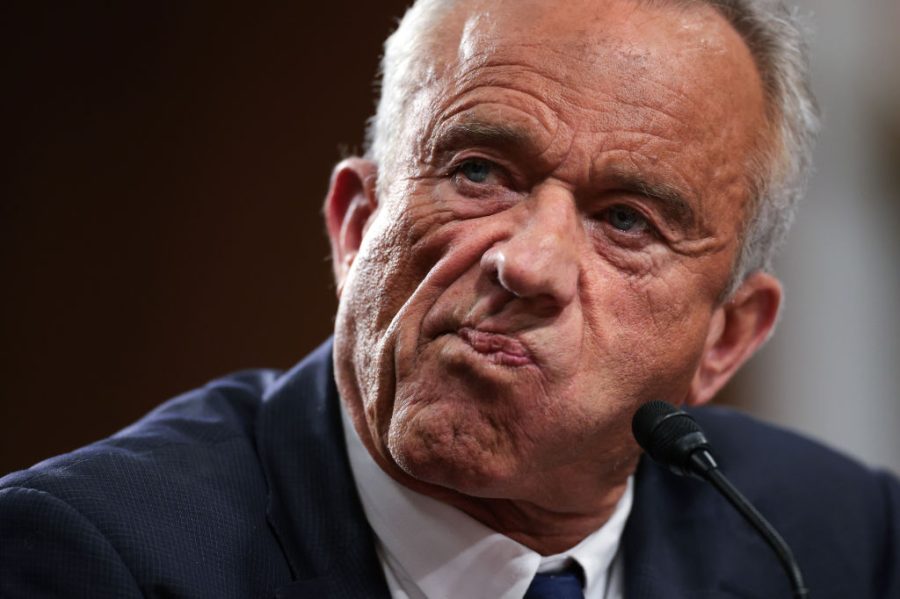
This August, Health and Human Services secretary Robert F. Kennedy Jr, an outspoken vaccine critic, limited access to COVID-19 shots to people over age sixty-five, and those six months and older with increased risk of severe illness. (Win McNamee / Getty Images)

Many states are moving to guarantee COVID-19 vaccine access for their residents amid new restrictions set by the Trump administration. But when people in these states try to schedule a vaccine appointment online, as they’ve done for years, they may be out of luck: the country’s four largest retail pharmacy chains — CVS, Walgreens, Walmart, and Kroger — are still discouraging and barring some people from booking these appointments online, even in states where it’s allowed, a Lever review found.

While it may be possible to ignore these online notices or walk into these pharmacies and request a COVID-19 shot, the companies’ messaging may be sowing confusion and lowering vaccination rates among the public.

This August, Health and Human Services secretary Robert F. Kennedy Jr, an outspoken vaccine critic, limited access to COVID-19 shots to people over age sixty-five, and those six months and older with increased risk of severe illness. The move reversed earlier federal guidance that allowed anyone six months or older to receive the vaccine.

Consequently both CVS and Walgreens, the country’s top two pharmacy chains, swiftly stopped offering COVID-19 vaccines for individuals without a doctor’s prescription in more than a dozen states.

Sixteen states — Arizona, California, Colorado, Connecticut, Hawaii, Illinois, Maine, Massachusetts, Minnesota, New Jersey, New Mexico, New York, Oregon, Rhode Island, Washington, and Wisconsin — have since issued orders that allow individuals of any age and health status to get a COVID-19 shot.

Other states, including Delaware, Nevada, North Carolina, Pennsylvania, and Virginia, have also passed orders expanding vaccine access, but only for certain individuals. In North Carolina and Virginia, for example, people aged eighteen to sixty-five can receive the shot without a prescription but only if they have an underlying health condition such as cancer or diabetes.

However, despite these orders, a Lever reporter faced numerous barriers when trying to schedule COVID-19 vaccine appointments in all of the states with expanded access through the online systems used by CVS Health, Walgreens, Walmart, and the Kroger Company.

For example, CVS, the country’s largest pharmacy chain, notes on its vaccine scheduling page that “The 2025/26 COVID-19 vaccine is FDA approved for everyone ages 65 and older and patients 6 months to 64 with certain health conditions that put someone at high risk for severe outcomes from COVID-19 virus.” The language remains the same no matter the state selected.

Kroger, another major pharmacy company, displays a similar warning for all the states where it has locations.

Walgreens, the country’s second-largest pharmacy brand, goes further, currently not allowing anyone to schedule a COVID-19 vaccine online for children under twelve and requiring those twelve and older to confirm that they have at least one related health condition or risk factor before booking an appointment, even in states where everyone is allowed to get the shot.

CVS, Walgreens, Walmart, and Kroger did not respond to requests for comment.

These online obstacles could add to the confusion and mixed messages surrounding COVID-19 vaccines this fall.

“It’s impossible to explain with assurance the new rules as [the Department of Human and Health Services] has created confusion and chaos in communicating policy,” infectious disease expert John Swartzberg told University of California, Berkeley School of Public Health’s news site earlier this month.

The current FDA vaccine advisory committee, which provides official government recommendations on immunizations, isn’t helping matters. In June, Kennedy removed all seventeen sitting members from the committee. He has since stacked the group with vaccine skeptics like Kirk Milhoan, a pediatric cardiologist who backed using unproven COVID-19 treatments during the pandemic, and Evelyn Griffin, a Louisiana-based obstetrician who previously called COVID-19 vaccine mandates “a line in the sand” that should not have been crossed.

Kennedy’s vaccine advisory committee is meeting this week to vote on recommendations for COVID-19 shots and other standard childhood immunizations. So far, the committee has voted against allowing parents to choose the combined measles-mumps-rubella-varicella vaccine before their children reach age four and has indefinitely postponed a vote on the hepatitis B vaccine.

While the overall risk of hospitalizations and deaths from COVID-19 has decreased precipitously since the 2020 outbreak, the virus still causes thousands of hospitalizations and hundreds of deaths nationwide each week. The Centers for Disease Control and Prevention still states on its website that “COVID-19 vaccines can help keep you from getting sick from COVID-19. If you do get COVID-19, vaccines can make the illness shorter and less severe.”


This article was first published by the Lever, an award-winning independent investigative newsroom.

22 Sep 13:57

‘Chief Of War’ Producers Confirm Season 2 Will Show Hawaiians Battling Mark Zuckerberg

by The Onion Staff

LOS ANGELES—Announcing the next chapter of the story was already in preproduction, Chief Of War producers confirmed Tuesday that the second season of the Apple TV+ series would follow the Native Hawaiian warriors as they battled Mark Zuckerberg. “I’m proud to share we’re all set for Chief Of War season two, which will primarily take place on the north shore of Kauai as Kamehameha and his troops surround Mark Zuckerberg’s compound,” said executive producer and co-creator Thomas Paʻa Sibbett, who shared that the skilled fighters would “meet their match” in the tech billionaire who practiced two hours of Brazilian jiujitsu with a trainer every morning. “In order to truly unify Hawaii, they need to take those 2,300 acres back—the mansion, the guesthouses, the tennis court, everything. There will be a slight time jump, a little over 200 years. However, the second season will still feature many of the same characters who captivated fans in the first, plus a few new ones, including several completely overwhelmed members of Zuckerberg’s security detail.” At press time, Sibbett went on to tease that the season’s climactic final battle would take place inside Zuckerberg’s underground bunker.

The post ‘Chief Of War’ Producers Confirm Season 2 Will Show Hawaiians Battling Mark Zuckerberg appeared first on The Onion.

22 Sep 13:57

The Last Remaining Newspaper’s Obituary for David Duke, ca. 2033

by Steve Herzog

The following message has been approved by the FCC, Louisiana Commissar’s Branch.

- - -

David Ernest Duke, devoted father, community leader, and passionate advocate for his beliefs, passed away peacefully of natural causes on February 17, 2033, at the age of 82.

Mr. Duke earned his PhD in history, with his dissertation focusing on Middle Eastern studies. His academic background informed his extensive writings on the management and ownership of academia, media, and financial systems. He also authored a self-help book for women, demonstrating his diverse intellectual interests.

From 1974 to 1980, Mr. Duke was an active leader of a community organization he founded that championed the power of dialogue and debate. He frequently used his rhetorical “wizardry” to engage with other cultural and religious organizations, always seeking meaningful discourse. His faith as a born-again Christian was central to his identity, as he could be heard quoting Bible passages almost as much as he could be heard quoting from other texts written by historical figures. Mr. Duke himself was highly quotable, although in the interest of space, none of his famous quotes will be shared here.

He took his message to college campuses across the nation, from Vanderbilt to Stanford to Tulane University, engaging with students and fostering important conversations about the issues he held dear. Though he faced much hate and the occasional violent threat, he never used violence himself, showcasing his commitment to civility and inclusive participation.

A committed public servant, Mr. Duke was a member of the Louisiana House of Representatives from 1989 to 1992, where he championed conservative principles, including property tax reduction. His dedication extended to an unsuccessful but spirited campaign for governor that nonetheless attracted significant national attention.

Applying his education and passion, Mr. Duke fought tirelessly to protect several historical statues. During his time in college, he was known for his historical reenactments, often appearing in authentic WWII-period uniforms that served as a powerful reminder to others of that era.

Mr. Duke was a devoted father to his two daughters. Though divorced, he maintained a close relationship with his former wife, who cofounded a website dedicated to advocating for the principles he believed in. He was an active participant on this platform, continuing his lifelong commitment to sharing his perspective and engaging in meaningful dialogue. He had many personal interests, including visiting casinos and a memorable yearlong residence in Texas, which added richness to his life experiences.

David Duke will be remembered as a man who served his community with dedication and held an unwavering commitment to his principles, including civility and several other things. His legacy lives on through his scholarly contributions and the many lives he impacted through his community involvement and advocacy.

Details regarding memorial services will be announced by the family. The family has requested that public events offer a moment of silence without quoting him directly.

22 Sep 13:53

4.3 magnitude earthquake jolts the San Francisco Bay Area

by Associated Press
People reported feeling their homes shaking and receiving phone alerts.
22 Sep 13:51

ALT

A crude, shaky illustration of two foxes, clearly drawn on a random piece of scrap paper with a hastily found ballpoint pen, posted from a moving vehicle. In this one, Green has just crawled home, horizontally like a slug, exhausted and still wearing a conical party hat and a confetti kazoo. Blue looks at him, saying nothing. The text above and below them says: Made it home safe! Wedding went great!ALT
22 Sep 12:20

David Letterman Slams Jimmy Kimmel Suspension

by John Gruber

Variety:

“This is misery,” Letterman said when asked about Kimmel’s suspension, speaking at The Atlantic Festival 2025 Thursday in New York. “I feel bad about this,” he continued. “We see where this is all going, correct? It’s managed media. And it’s no good. It’s silly. It’s ridiculous. And you can’t go around firing somebody because you’re fearful or trying to suck up to an authoritarian criminal administration in the Oval Office. That’s just not how this works.”

“In the world of somebody who is an authoritarian, maybe a dictatorship, sooner or later, everyone is going to be touched,” said Letterman.

Letterman also said, “The institution of the president of the United States ought to be bigger than a guy doing a talk show.” Kimmel’s removal from late-night TV, he said, “was predicted by our president right after Stephen Colbert got walked off, so you’re telling me this isn’t premeditated at some level?” [...]

On Wednesday, ABC suspended Kimmel’s late-night show “indefinitely.” That came after FCC chairman Brendan Carr just hours earlier threatened ABC and its affiliates if they didn’t “take action” on Kimmel over what he perceived as objectionable comments about Charlie Kirk’s killer. “We can do this the easy way or the hard way,” Carr said on a conservative podcast. [...]

Regarding Carr’s comment that “we can do this the easy way or the hard way,” Letterman said, “Who is hiring these goons — Mario Puzo?”, referring to the author of The Godfather. Letterman said when he was on TV, he never got pressure from a presidential administration, the FCC or any other government agency about his on-air commentary.

“Goons” is exactly the right word. Letterman’s commentary on this is, by far, the best I’ve seen, because it’s been the most clear-eyed. I quoted a lot above, but there’s more, so please read the whole piece. But this one extra snippet from the piece puts it on the right scale:

Goldberg posited that today, despite Trump’s attacks on the press, “we still have a free media,” to which Letterman responded, “Do we?”

22 Sep 12:17

Awkward Zombie - Prompt Attention

by tech@thehiveworks.com

New comic!

Today's News:

Tama figured out the whole mystery hours ago but Ryuki still needs to get his steps in for the day.

22 Sep 12:16

Part 2.14

Part 2.14
22 Sep 02:15

Background-Repeat Oreos

by Alvaro Montoro

background-repeat with oreos: no-repeat only has one cream at the top and the text ORE O; repeat has 2.5 creams and the text ORERERO; round has two creams but larger than usual and the text OREEREEO; space has two creams with a gap in between and the text ORE REO

22 Sep 01:56

#Ryo #Rowen #RoninWarriors

22 Sep 01:56

Well ... we've had an awful lot to think about ...

Well ... we've had an awful lot to think about today, and 'fraid the times up. So, until next time, think about it! #CowboyWho

22 Sep 01:10

Disco fever afflicted everyone back then.

Disco fever afflicted everyone back then.

22 Sep 01:10

Movie sign!

Movie sign!

22 Sep 01:05

Bonkers CDC vaccine meeting ends with vote to keep COVID shot access

by Beth Mole

A two-day federal vaccine advisory meeting crammed with chaos, confusion, inept debate, bizarre comments, and a hot mic catching someone saying "you're an idiot," ended with an unexpected twist: The advisors unanimously voted—possibly unintentionally—to maintain broad access to COVID-19 vaccines.

In the 12–0 vote, the committee of advisors selected by anti-vaccine activist Robert F. Kennedy Jr. adopted a recommendation for adults 65 and older and people aged 6 months to 64 years to get a COVID-19 vaccine based on shared clinical decision-making. After this story was published, the Centers for Disease Control and Prevention adopted the recommendation, which will broadly maintain requirements that federal and private health insurance plans cover COVID-19 vaccines at no cost. While the shared clinical decision-making is a new requirement, the CDC noted in adopting the recommendation that such decision making can be done in consultation with providers, "including physicians, nurses, and pharmacists". Most people receive COVID-19 vaccines from their local pharmacists.

Earlier this year, the FDA limited the approvals of this year's shots, which have previously been available to anyone 6 months of age or older. The FDA's new restriction limits them to adults aged 65 and up and for people between the ages of 6 months and 64 years who have an underlying medical condition that puts them at high risk of severe COVID-19.

Read full article

Comments

22 Sep 01:04

Science journalists find ChatGPT is bad at summarizing scientific papers

by Kyle Orland

Summarizing complex scientific findings for a non-expert audience is one of the most important things a science journalist does from day to day. Generating summaries of complex writing has also been frequently mentioned as one of the best use cases for large language models (despite some prominent counterexamples).

With all that in mind, the team at the American Association for the Advancement of Science (AAAS) ran an informal year-long study to determine whether ChatGPT could produce the kind of "news brief" paper summaries that its "SciPak" team routinely writes for the journal Science and services like EurekAlert. These SciPak articles are designed to follow a specific and simplified format that conveys crucial information, such as the study's premise, methods, and context, to other journalists who might want to write about it.

Now, in a new blog post and white paper discussing their findings, the AAAS journalists have concluded that ChatGPT can "passably emulate the structure of a SciPak-style brief," but with prose that "tended to sacrifice accuracy for simplicity" and which "required rigorous fact-checking by SciPak writers."

Read full article

Comments

22 Sep 01:04

RFK Jr.’s anti-vaccine panel realizes it has no idea what it’s doing, skips vote

by Beth Mole

The second day of a two-day meeting of the Advisory Committee on Immunization Practices—a panel currently made up of federal vaccine advisors hand-selected by anti-vaccine activist Robert F. Kennedy, Jr.—is off to a dramatic start, with the advisors seemingly realizing they have no idea what they're doing.

The inexperienced, questionably qualified group that has espoused anti-vaccine rhetoric started its second day of deliberations by reversing a vote taken the previous day on federal coverage for the measles, mumps, rubella, and varicella (MMRV) vaccine. Yesterday, the group voted to restrict access to MMRV, stripping recommendations for its use in children under age 4. While that decision was based on no new data, it passed with majority support of 8–3 (with one abstention). (For an explanation of that, see our coverage of yesterday's part of the meeting here.)

But puzzlingly, they then voted to uphold access and coverage of MMRV vaccines for children under age 4 if they receive free vaccines through the federal Vaccines for Children program, which covers about half of American children, mostly low-income. The discrepancy projected the idea that the alleged safety concerns that led the panel to rescind the recommendation for MMRV generally, somehow did not apply to low-income, vulnerable children. The vote also created significant confusion for VFC coverage, which typically aligns with recommendations made by the panel.

Read full article

Comments

22 Sep 00:59

“Get off the iPad!” warns air traffic control as Spirit flight nears Air Force One

by Nate Anderson

As Air Force One journeyed from the US to the UK this week, it came within eight lateral miles of a Spirit Airlines flight heading up the East Coast from Fort Lauderdale to Boston. An alert air traffic controller in the New York control center reached out to the Spirit flight, telling it to execute an immediate right turn to avoid any possibility of colliding with Air Force One.

But the Spirit pilots did not respond immediately, leading the testy air traffic controller to scold them repeatedly. (You can listen to the audio archive on LiveATC.net; it begins at around the 23:15 mark.)

"Pay attention!" said the controller after his first instruction was not acknowledged. "Spirit 1300, turn 20 degrees right."

Read full article

Comments

21 Sep 13:00

The “Debate Me Bro” Grift: How Trolls Weaponized The Marketplace Of Ideas

by Mike Masnick

Among the attempts to create hagiographic eulogies of Charlie Kirk, I’ve seen more than a few people suggest that Kirk should be respected for being willing to talk to “those who disagree with him” as a sign that he was engaging in good faith. Perhaps the perfect example of this is Ezra Klein’s silly eulogy claiming that Kirk was “practicing politics the right way” because he would debate students who disagreed with him.

Kirk was practicing politics in exactly the right way. He was showing up to campuses and talking with anyone who would talk to him. He was one of the era’s most effective practitioners of persuasion.

There are many problems with this statement, but Klein’s fundamental error reveals something much more dangerous: he’s mistaking performance for discourse, spectacle for persuasion. Kirk wasn’t showing up to campuses to “talk with anyone who would talk to him.” He was showing up armed with a string of logical fallacies, nonsense talking points, and gotcha questions specifically designed to enrage inexperienced college students so he could generate viral social media clips of himself “owning the libs.”

Klein is eulogizing not a practitioner of good-faith political discourse, but one of the most successful architects of “debate me bro” culture—a particularly toxic form of intellectual harassment that has become endemic to our political discourse. And by praising Kirk as practicing “politics the right way,” Klein is inadvertently endorsing a grift that actively undermines the kind of thoughtful engagement our democracy desperately needs.

The “debate me bro” playbook is simple and effective: demand that serious people engage with your conspiracy theories or extremist talking points. If they decline, cry “censorship!” and claim they’re “afraid of the truth.” If they accept, turn the interaction into a performance designed to generate viral clips and false legitimacy. It’s a heads-I-win-tails-you-lose proposition that has nothing to do with genuine intellectual discourse.

The fundamental issue with “debate me bro” culture isn’t just that it’s obnoxious, it’s that it creates a false equivalence between good-faith expertise and bad-faith trolling. When you agree to debate someone pushing long-debunked conspiracy theories or openly hateful ideologies, you’re implicitly suggesting that their position deserves equal consideration alongside established facts and expert analysis.

This is exactly backwards from how the actual “marketplace of ideas” is supposed to work. Ideas don’t deserve platforms simply because someone is willing to argue for them loudly. They earn legitimacy through evidence, peer review, and sustained engagement with reality. Many of the ideas promoted in these viral “debates” have already been thoroughly debunked and rejected by that marketplace—but the “debate me bro” format resurrects them as if they’re still worth serious consideration.

Perhaps most insidiously, these aren’t actually debates at all. They’re performances designed to generate specific emotional reactions for viral distribution. Participants aren’t trying to persuade anyone or genuinely engage with opposing viewpoints. They’re trying to create moments that will get clipped, shared, and monetized across social media.

Kirk perfected this grift. As a recent detailed analysis of one of Kirk’s debates demonstrates, when a student showed up prepared with nuanced, well-researched arguments, Kirk immediately tried pivoting to culture war talking points and deflection tactics. When debaters tried to use Kirk’s own standards against him, he shifted subjects entirely. The goal was never understanding or persuasion—it was generating content for social media distribution.

And, of course, this broader “debate me bro” culture has become so commonplace and expected online that it has now been fully industrialized into content farming.

The most toxic evolution of this grift is Jubilee Media’s “Surrounded” series on YouTube (on which Kirk once appeared, because of course he did), which The New Yorker’s Brady Brickner-Wood aptly describes as an attempt to “anthropomorphize the internet, turning incendiary discourse into live-action role-play.” The format is simple: put one public figure in a room with 20 ideologically opposed people and let them duke it out in rapid-fire rounds designed for maximum conflict and viral potential.

As Brickner-Wood notes, these aren’t actual debates in the classical sense of trying to persuade, they’re spectacles designed to set up bad faith dipshits with the opportunity to dunk on others for social media clout.

“Surrounded” videos are a dizzying and bewildering watch, as gruelling as they are compelling. The participants who fare best seem to be familiar with the conventions of interscholastic debate, spouting off statistics and logic puzzles with the alacrity of an extemporaneous-speaking champion. To win an argument in such a condensed amount of time, debaters attempt to short-circuit their opponent’s claim as swiftly and harshly as possible, treating their few minutes of airtime as a domination game rather than, say, a path toward truth or understanding. The goal here is not to inform or educate, to listen or process, to build or intellectualize but to win, to own, to dunk on, to break the opponent’s brain, to spawn an argument of such devastating definitiveness that the matter can be considered, once and for all, closed. Wave the flag, run the clock out—next.

But Surrounded is just the most recent manifestation of a much older problem. We’ve seen multiple bad faith trolls, beyond just Kirk, turn the “debate me bro” model into large media empires. When people point out their bad faith nonsense, we’re told “what are you complaining about, they’re doing things the ‘right way’ by debating with those they disagree with.”

There are, of course, times and places where actual debates can be valuable. I’ve been involved in many debates over the years with people who vehemently disagreed with me. But I think it’s important for people to recognize that, in the same way not all information is equally valuable, not all debates are equally productive.

There’s nothing in how Charlie Kirk “debated” that aimed to get at nuances or understanding. They were entirely designed to seek to humiliate his opponent. They’re full of red herrings, lies, and attempts to deflect from any actual logic, as the video link above showed.

The point is not about getting to any level of understanding. It’s to try to quip and dunk in the manner most likely to go viral when shared on social media in 20-second snippets.

The format actively discourages the kind of thoughtful, nuanced discussion that might actually change minds—the kind actually designed for persuasion. Instead, it rewards the most inflammatory takes, the most emotionally manipulative tactics, and the most viral-ready soundbites. Anyone going into these situations with good faith gets steamrolled by participants who understand they’re playing a different game entirely.

When trolls demand debates, they’re not interested in having their minds changed or genuinely testing their ideas. They want one of two outcomes: either you decline and they get to claim victory by default, or you accept and they get to use your credibility to legitimize their nonsense while farming viral moments.

None of this means we should avoid authentically engaging with different viewpoints or challenging ideas. But there’s a crucial difference between good-faith intellectual engagement and feeding trolls who are just looking for their next viral moment.

Real intellectual discourse happens in contexts where participants are genuinely interested in truth-seeking rather than performance. It requires shared standards of evidence, mutual respect, and actual expertise on the topics being discussed. It takes time, nuance, and careful consideration—all things that are antithetical to the “debate me bro” format.

Klein’s eulogy of Kirk represents a broader failure to understand what’s happening to our discourse. When we praise bad-faith performers for “engaging” with their critics, we’re not celebrating democratic norms—we’re rewarding those who exploit them.

21 Sep 12:57

Trump Is Accusing Foes With Multiple Mortgages Of Fraud. Records Show Three Of His Cabinet Members Have Them.

by Robert Faturechi, Justin Elliott, and Alex Mierjeski

This story was originally published by ProPublica. Republished under a CC BY-NC-ND 3.0 license.

The Trump administration has vowed to go after anyone who got lower mortgage rates by claiming more than one primary residence on their loan papers.

President Donald Trump has used it as a justification to target political foes, including a governor on the Federal Reserve Board, a Democratic U.S. senator, and a state attorney general.

Real estate experts say claiming primary residences on different mortgages at the same time is often legal and rarely prosecuted.

But if administration officials continue the campaign, mortgage records show there’s another place they could look: Trump’s own Cabinet.

Underscoring how common the practice is, ProPublica found that at least three of Trump’s Cabinet members call multiple homes their primary residences on mortgages. We discovered the loans while examining financial disclosure forms, county real estate records and publicly available mortgage data provided by Hunterbrook Media.

Labor Secretary Lori Chavez-DeRemer entered into two primary-residence mortgages in quick succession, including for a second home near a country club in Arizona, where she’s known to vacation. Transportation Secretary Sean Duffy has primary-residence mortgages in New Jersey and Washington, D.C. Lee Zeldin, the Environmental Protection Agency administrator, has one primary-residence mortgage in Long Island and another in Washington, D.C., according to loan records.

In a flurry of interviews and rapid-fire posts on X, Bill Pulte, the Federal Housing Finance Agency director, has led the charge in accusing Trump opponents of mortgage fraud. “If somebody is claiming two primary residences, that is not appropriate, and we will refer it for criminal investigation,” Pulte said last month.

A political donor to the president and heir to a housing company fortune, Pulte’s posts online tease big developments and criminal referrals, drawing reposts from Trump himself and promises of swift consequences. “Fraud will not be tolerated in President Trump’s housing market,” Pulte has warned.

Real estate experts told ProPublica that, in its bid to wrest control of the historically independent Fed and go after political enemies, the Trump administration has mischaracterized mortgage rules. Its justification for launching criminal investigations, they said, could also apply to the Trump Cabinet members.

All three Cabinet members denied wrongdoing. In a statement, a White House spokesperson said: “This is just another hit piece from a left-wing dark money group that constantly attempts to smear President Trump’s incredible Cabinet members. Unlike [Fed Gov.] Lisa ‘Corrupt’ Cook who blatantly and intentionally committed mortgage fraud, Secretary DeRemer, Secretary Duffy, and Administrator Zeldin own multiple residences, and they have followed the law and they are fully compliant with all ethical obligations.”

Mortgages for a person’s main home tend to receive more favorable terms than for a second home or an investment property. That includes better interest rates and the ability to borrow more money.

The idea is that borrowers are more likely to pay back — and less likely to default on — a loan attached to the home they actually live in. That makes those loans less risky for lenders. Interest rates are typically a quarter- to a half-point lower for primary mortgages, according to Pulte. On the low end, that could save around $75 each month over the life of a 30-year, 5% interest, half-million-dollar loan — or a total of around $25,000.

Standard mortgage documents commonly include an occupancy clause that requires the borrower to use the property as their principal residence for at least a year. They also include a section where borrowers can check a box when the mortgage is for a second home.

Misrepresenting occupancy status is not rare, according to a widely cited 2023 study from the Federal Reserve Bank of Philadelphia. In interviews, real estate lawyers said that mortgage lenders are typically well aware of their clients’ other loans and sometimes even encourage the primary-residence language for second homes.

They also pointed to a mundane reason that innocent mistakes are common: Homebuyers simply sign stacks of forms without reading them.

“Few consumers understand this issue, and if there is someone at fault here, it is likely the loan officer who likely advised them to sign up for this loan that obviously wasn’t for their primary residence,” said real estate lawyer Doug Miller. “Loan officers who are competing for business will often quote lower rates in order to get a customer’s business.”

Mortgage fraud is rarely prosecuted, according to real estate lawyers and federal sentencing data. Pulte has pointed to a case from 2016 in which a California woman was found guilty of obtaining multiple loans for condos that she falsely stated would be her primary residence. But that case had an added layer of fraud: The woman never intended to live in the homes. She was secretly being paid because she had good credit to act as a front for the true buyer of the properties, to whom they were later transferred. She later defaulted on the loans, causing more than half a million dollars in losses for the lenders.

Lawyers told ProPublica that determining ill intent would be key to prosecute. “Fraud requires the borrower to be aware that the borrower was making a false representation,” said Jon Goodman, an attorney focused on real estate at Frascona, Joiner, Goodman and Greenstein.

But Pulte has framed the issue in black-and-white terms: “Your second home is not your primary home,” he warned in one recent post on X.

By that standard, Trump’s labor secretary, Chavez-DeRemer, could be in the wrong.

In her financial disclosure form, she listed two mortgages on personal residences, both obtained in 2021. Mortgage records show her home is in Happy Valley, a city near Portland where Chavez-DeRemer served as mayor before being elected to represent the area in the U.S. House.

She and her husband, Shawn DeRemer, who leads an anesthesia company in Portland, refinanced their longtime Oregon home in January 2021. Two months later, the couple bought a newly built house near a golf course in Fountain Hills, Arizona.

The pair had previously enjoyed vacationing in Arizona, according to news reports and social media posts. (In one incident that made the news, Chavez-DeRemer was briefly hospitalized after a golf cart accident on her way back from watching a Sonoran Desert sunset.)

The mortgage agreement for the Arizona property required them to occupy the home as their “principal residence” for at least a year, barring “extenuating circumstances” or the lender allowing them to violate the stipulation.

A spokesperson for Chavez-DeRemer said that the couple bought the Arizona home with the intent to retire there, but then Chavez-DeRemer decided to run for Congress representing her Oregon district and did not move.

“This is nothing more than a left-wing rag inventing a story just to attack the Trump Administration. It’s common for families to refinance then buy a home with future plans in mind — trying to spin that as some type of scandal is pure nonsense,” said spokesperson Courtney Parella.

In response to questions from ProPublica, a White House official said that although DeRemer opted to stay in Oregon, her husband “continued to move forward with the process of becoming” an Arizona resident. Political donation records list his home in Oregon as recently as late 2023.

Duffy, Trump’s transportation secretary, and his wife also have two primary-residence mortgages, obtained a few years apart.

In August 2021, the Duffys, who have nine children, purchased a large $2 million home in Far Hills, New Jersey, about an hour’s drive from Manhattan, where Rachel Campos-Duffy works as a Fox News host.

They got a $1.6 million mortgage to purchase the property, and documents show it was a “principal residence” loan.

In February, after Duffy took the job in Trump’s cabinet, the couple bought another home, in Washington, D.C. Again, they got a principal-residence mortgage, this time for $1.76 million. Both Duffy and his wife are listed as borrowers on both mortgages, which came from the same bank.

It’s not clear where Sean Duffy lives most of the time, and a Department of Transportation spokesperson declined to answer questions about where Duffy and his wife each make their primary home. In late May, several months after they purchased the Washington home, “Fox & Friends Weekend” ran a segment in which Rachel Campos-Duffy cooked a “Make America Healthy Again” breakfast for host Steve Doocy. Sean Duffy and some of the couple’s children were also in the segment, and it was filmed in the New Jersey home.

Duffy’s spokesperson said in a statement that after being confirmed, “Sean purchased a home in Washington D.C. where he works full-time. The home in DC is not a rental, investment or vacation property. The same bank holds both mortgages and was fully informed of Secretary Duffy’s new employment location and need for a DC residence.”

A White House spokesperson said, “The bank, not the Secretary, determined and classified both mortgages as primary residences.”

Like the Duffys, Lee Zeldin, the EPA administrator, and his wife also have two concurrent primary-residence mortgages.

One, obtained in 2007, is on a home in Shirley, New York, on Long Island, which Zeldin represented in Congress for several years. Last year, Zeldin and his wife obtained a second mortgage, for $712,500, on a property in Washington, D.C., a short walk from the EPA’s headquarters. Both are primary-residence mortgages.

An EPA spokesperson said in a statement that Zeldin’s primary residence was previously on Long Island but is now in Washington. The spokesperson didn’t respond to questions about where his wife lives. “Administrator Zeldin followed ALL steps to complete the move in accordance with all laws, rules, and contracts, notifying his mortgage company, insurance company, and local government,” the spokesperson said. “EVERY ‘I’ was dotted and ‘t’ was crossed 1000% by the book without exception.”

The dual mortgages identified by ProPublica among Trump’s cabinet secretaries resemble the loans obtained by U.S. Sen. Adam Schiff, whom Trump accused of mortgage fraud.

In May, Pulte referred Schiff to the Justice Department for taking out a primary-residence mortgage in Maryland, for a home he purchased in 2003 after being elected to the House, while also claiming his primary home was in Burbank, California, in the district he represented. Schiff and his wife refinanced the Maryland home several times as a primary residence, Pulte noted, until a 2020 refinance in which they reclassified it as a secondary home.

“Schiff appears to have falsified records in order to receive favorable loan terms,” Pulte concluded in a letter to Attorney General Pam Bondi.

Representatives for Schiff called the allegations “transparently false” and said his lenders had “full knowledge of the senator’s year-round bicoastal work obligations” and “his use of two homes for that reason.” Schiff, according to his office, navigated the two mortgages in consultation with a House lawyer.

Pulte made similar allegations in a criminal referral about New York Attorney General Letitia James, alleging she may have committed fraud by getting a primary-residence mortgage for a home in Virginia, even though her position required her to live in New York. Her lawyer has said James helped a family member buy the property and notified the mortgage broker at the time that it would not be her primary residence. James became one of Trump’s top political enemies after she brought a fraud lawsuit against the president and his company in 2022. Representatives for James have called the fraud claims made against her politically motivated and false. (Pulte did not respond to a request for comment from ProPublica.)

Pulte’s most consequential allegations thus far were made against Cook, a Federal Reserve governor. Trump has been going after Fed Chair Jerome Powell for months for not lowering interest rates, even raising the specter that he would take the unprecedented step of attempting to fire the chair. Pulte’s criminal referral against Cook presented Trump with another avenue for bending the traditionally independent Fed to his will, securing a majority of the Fed’s board by firing Cook, a move that Cook has sued to block.

Pulte pointed to mortgage records that show that within just a couple of weeks, Cook signed primary-residence mortgages for homes in Michigan and Georgia. Legal experts said the close proximity was a red flag but that much was still unknown, including Cook’s intent and what her lenders were told. Pulte also flagged a third property, in Massachusetts, that Cook represented as a second home in mortgage documents but as an investment property in subsequent financial disclosures. Investment properties can be hit with higher mortgage rates than second homes.

“3 strikes and you’re out,” he posted on X.

Cook’s lawyers have denied that she committed mortgage fraud but have not provided a detailed explanation of the context for the various mortgages. They argued in court this week that her loans cannot be legally used as grounds to terminate her.

The Justice Department has begun investigating all three Trump foes singled out in Pulte’s referrals, according to news reports. The department has issued subpoenas in Cook’s case, The Wall Street Journal reported Thursday.

ProPublica’s review of mortgage agreements by Trump cabinet officials shows that some made clear to lenders they were purchasing second homes.

When Health and Human Services Secretary Robert F. Kennedy Jr., for example, got a mortgage for his home near the Kennedy Compound in Hyannis Port, Massachusetts, the agreement included a rider making it clear he would be using it as a second home.