Shared posts

15 Oct 00:51

Remembering the end of support for VRML in Internet Explorer

by Raymond Chen

I was cleaning out some old documents and found an email from 1999 on some changes to Internet Explorer. Most of it is boring, but I found this part interesting:

VRML is being removed from IE5.5 and will only be available on Windows Update. The company that supplied the component cancelled the project¹ (and at that point they were the only VRML viewer supplier, after acquiring everyone else)², and we were not getting any fixes.

(Footnotes mine.)

That’s kind of sad. All of the VRML companies get eaten up by a big fish, and then the big fish gives up on VRML.

Bonus chatter: For many years, I kept a large display board that was presumably created for some industry event. The gist of the message on the board was that Internet Explorer was committed to supporting VRML and the VRML community.³

I printed out a copy of this email and taped it to the display board.

When Internet Explorer announced its commitment to VRML and the VRML community, they hadn’t anticipated that the company that makes the product at the center of the VRML community would itself abandon its commitment to VRML.

¹ VRML looks to open source: “After an internal shake-up, 3D browser and tools owner Platinum Technologies plans to turn over its source code.”

² VRML Consortium changs Name to Web3D Consortium: “Platinum Technology, which now owns a significant slice of the VRML developer community, having acquired InterVista Software and Cosmo Software over the course of the year…”

³ This gives off strong “My ‘not going to abandon VRML’ sign has people asking a lot of questions already answered by my sign” vibes. I can only assume that the sign was created to quash rumors that Internet Explorer was going to abandon VRML. Which it didn’t. VRML abandoned VRML.

The post Remembering the end of support for VRML in Internet Explorer appeared first on The Old New Thing.

08 Oct 17:10

The Bizarre Bases of Antenna Towers

by Wesley Crump

[Note that this article is a transcript of the video embedded above.]

In 1974, a new world record was set for the tallest structure on Earth. Soaring to 646 meters or 2,120 feet, the Warsaw Radio Mast was built to broadcast radio programs to Polish-speaking audiences across Europe. If the atmospheric conditions were just right, those signals could be picked up from nearly anywhere in the world. But like all big infrastructure projects, building it was only half the battle. Maintaining a structure that tall—and that slender—was incredibly expensive. Over time, the guy wires that held the tower upright began to wear out. By 1991, many of them were frayed and overdue for replacement, a job that wasn’t just costly, but also fairly complex.

To replace a guy wire, two temporary guys needed to be attached to the mast first. Then the old guy could be removed and swapped out for a new one. But on August 8, 1991, the sequence got mixed up. Reports vary, but it seems that one of the main cables was disconnected before the temporary ones were fully installed. A gust of wind twisted the tower, pulling the temporary cables away, and the unsupported mast collapsed. Incredibly, no one was injured in the failure, but it was a catastrophic loss nonetheless. Usually, the tallest structures in the world lose their position because something else is built taller. In this case, a tower in North Dakota regained the lead by default.

It’s actually not an unusual story. This particular type of structure, called a guyed mast, has some seemingly bizarre structural characteristics that make it possible, including the sometimes unusual bases that seem to defy logic. But they come with risks, too. At least nine guyed masts taller than 600 meters have collapsed, mostly in the US, and hundreds of similar shorter structures around the world as well. They’re pretty interesting structures: cool to look at, incredibly tall, just rare enough that seeing one is kind of special. So this video is an ode to guyed masts, and of course, I built a little demo in the garage to help explain how they work. I’m Grady, and this is Practical Engineering.

Radio communication is a remarkable technology that enables a huge variety of wireless devices, from garage door openers to cell phones. If humans could perceive the full spectrum of electromagnetic radiation, even just the human-made stuff, we would be completely overwhelmed by the volume and variety of information moving through the airwaves. Many of the frequencies used for communication, especially those broadcast by radio and television stations, require a clear line of sight; the path between the transmitter and receiver has to be relatively unobstructed, at least by objects that are opaque to radio waves, like the earth. That’s why many antennas are mounted at the tops of hills, mountains, or (lacking those) gigantic towers. The higher they are, the further their signals can extend.

Antenna towers are some of the tallest human-made structures in the world, with many topping out above 600 meters (roughly 2,000 feet). At that height, the distance to the horizon is more than 50 miles (or 80 kilometers). To achieve that has required some very clever structural engineering. Let me show you what I mean.

This is my model antenna tower. Pretty basic; just a steel welding rod stuck in a plate. This isn’t going to match the structural behavior of an actual mast, but it’s close enough for a garage demo. The main load on a tower like this, besides its own weight, is wind. So let’s apply some wind and see what happens. [Beat]. The tower’s still standing - it didn’t collapse. But structural engineering isn’t all about strength. A structure can “not fall down” but still fail. We also have to address the concept of serviceability: does the structure actually do what it’s meant to? And in this case, hopefully it’s clear that the answer is no. Many antennas are designed to be directional. It takes a lot of power to radiate signals, so you don’t want to waste it sending them where they’re not needed. This varies a lot depending on the end use. Radio and TV broadcasts are less sensitive to movement than microwave communications, but in general, we can’t have antenna towers wobbling around like floppy wet noodles in the sky.

You can imagine that to adequately stiffen this tower, it would have to be a lot wider at the base. And that’s just what we do with so-called self-supporting towers. They’re designed to be freestanding and stable against the wind entirely on their own. Self-supporting towers don't take up much space, so they are ideal in urban areas where land comes at a premium. But, they are expensive to build because of all the extra material required for stiffness and stability against lateral wind loads. In fact, their cost goes up roughly proportional to the height squared. For guyed masts, it's roughly height to the power of 1.5. You need more land for a guyed tower since the guys extend so far out, so there is more cost there, but above a certain height (that depends on those land costs), it becomes the most economical option. And for really tall towers, it’s really the only technically feasible one. They are just so structurally efficient, it's almost unbelievable. To give you an example, at 324 meters tall (or 1,060 feet) the Eiffel Tower weighs around 7000 tons. A guyed tower of the same height would weigh roughly five percent of that.

So let me add some guys to my tower and we’ll see how it works. Of course, you can’t add just one. Wind can come from any direction, and don’t forget one of the most important adages of civil engineering: you can’t push a rope. So it takes at least three guys to get some tension in every direction. Some towers use four lanes, but most stick with three. This seems like a more stable situation, but now we’ve got a new problem. Watch what happens when I apply a lateral load. It's still just not that stiff, and actually, the tower buckles. And here’s why:

The guys can’t pull horizontally on the tower to resist lateral loads directly. They have to be anchored to the ground, which means they meet the tower at an angle. Any tension in the cable is going to necessarily put the tower in compression as well. And what happens with skinny compression members? They buckle.

Steel can take a lot of compression. Theoretically, this rod is strong enough to hold my entire weight without a material failure. If it were short, it’d be more than capable of bearing a full Grady, but when it’s tall and skinny like this, it can barely hold its own weight. When the tower takes a lateral load, the guy wires transfer that into compressive force. And unless the structure is stiff enough, it buckles. If I move the guys out so they’re at a shallower angle, you can see it takes a lot more wind load to buckle the structure. Less cable tension is needed for an equivalent horizontal force. And this is one of the many structural tradeoffs with guyed towers. You have to balance the land cost of extending anchors outward against the cost of a stiffer tower that can withstand steeply angled guys.

But you can see we’re not quite out of the woods here. Some shorter guyed towers can get away with one level of supports, but mine is still pretty flimsy in the middle. Lateral forces can still deflect it quite a bit, and it’s still prone to buckling under compressive loads, like, for example, the weight of an antenna mounted to the top. And now this is kind of like a bridge on its side.

We’ve got supports on both ends and loads trying to bend the structure in the center. So we can do what the bridge engineers do: either stiffen the structure or add more intermediate supports. It’s a little more complicated than that though, since every guy adds additional compressive load on the tower, in addition to providing lateral support to reduce the unbraced height. You’re kind of adding to both sides of the equation. Luckily, the lower you go on the tower, the shallower the angle of the cable. Just as a little demonstration of this, let’s compare the loads my little tower can support as we add more guys. With just one level, it’s right around 50 grams. This can barely support its own weight, let alone any extra on top. With a second level halfway up, it’s quite a bit stiffer. I could get 100 grams on top with no failure. Adding two more levels, now this thing feels rock solid. I’m not sure if it comes across on camera, but the change in stiffness is dramatic. It passes the wind test with flying colors. It couldn’t quite hold a kilogram, but Brady could sit on it just fine, even if it made him a bit uneasy (since his hard hat is still damaged from the last demo).

One of the other tradeoffs with this is the pre-tension of the cables. These guys sag along their length; they’re not perfectly straight. Under high wind, they tighten up and add stiffness. But in calm conditions, that slack can cause the tower to wobble. The obvious solution is to pre-tension the guys to take the sag out, but again, that pretension puts extra compression on the tower, requiring stronger members or more guys. So this is a balancing act as well.

And then there’s the base. You have essentially two choices here. We’re used to seeing large columns with a rigid attachment to the foundation. I did a whole video on base plates diving into this topic deeper if you want to learn more. You can see in my model that, with a fixed connection, my tower holds itself up just fine without loading. Obviously, this rod is solid steel - not a thin latticework of individual members - so the behavior is a little different. But remember that buckling is a function of the end connections of the column. With the bottom fixed, it takes about 140 grams to buckle the rod. When it’s free to rotate at the bottom, it buckles at around half that. The problem in this case is that fixing such a tall tower rigidly to the foundation makes the design a lot more complicated.

If you want rigid restraint, you have to have a way to transfer the loads into the ground. So the foundation has to be designed to resist rotation and pullout forces, and for not a lot of structural benefit. So the other option is to use a spherical bearing or pin support. And if you keep your eye out, you’ll see that a lot of these masts have these sorts of unusual bases where they taper down to a narrow point. In this way, you can just rely on the guys to handle almost all the restraint. The foundation only has to resist the vertical force, and maybe a touch of shear. This allows some movement or settlement of the foundation without inducing stress into the structure. And it just makes the design process easier. Removing the restraint simplifies the structural response and makes the tower more predictable, so you don’t have to be super conservative or spend tons of engineering effort and use sophisticated modeling software in the design. Finally, some towers aren’t used to mount antennas; they are the antennas themselves. For lower frequency transmissions like AM radio, you need a big antenna, so the tower itself is energized. In those cases, the base needs to be electrically insulated from the ground, which is much easier to do at a single point. If you look closely at some towers, you’ll see they’re actually standing on a ceramic disc.

Beyond structural design, these masts come with a lot of other engineering challenges. Of course, there’s the hazard to aircraft. Aviation regulations often require them to be painted in alternating orange and white bands and equipped with warning lights, whose color and flash rate are carefully prescribed, and can even be synchronized with nearby towers to avoid dazzling pilots at night.

Ice is another big one. These towers stretch into colder, wetter layers of air where ice can build up on the mast and guys. That adds weight, but it also adds surface area, sometimes dramatically increasing wind loads. When it melts, it can fall and damage anything below, so often you’ll see protective structures over the radio transmission lines.

Lightning is another threat. For most towers, it’s not a question of IF, but rather HOW OFTEN they’ll be struck. Towers are often equipped with lightning rods or other protection devices and robust grounding systems to keep stray voltage out of the transmission lines and sensitive equipment on the ground. Obviously, those mast radiators I mentioned earlier, where the entire tower services as the antenna, can’t be grounded for lightning protection. So most use some type of spark gap to keep the tower insulated. If lightning strikes, the air in the gap ionizes, allowing the surge to safely reach the ground.

Like all infrastructure, antenna towers need maintenance - painting, changing light bulbs, and servicing antenna equipment. Technicians with specialized training for heights and electrical hazards have to do the work. Some tall towers are even equipped with elevators to provide access, but most require some manual climbing. Although the frequencies used for radio communication are non-ionizing (meaning the waves can’t break apart molecules), that doesn’t mean they aren’t dangerous. Electromagnetic radiation can generate heat; it’s the fundamental principle of a microwave oven. And if the tower itself is energized, a person can become part of the circuit.

With so much of our telecommunication happening through the internet these days, it’s easy to forget the importance of large-scale radio broadcasting and communications. The cells for cellular communications are small, so we’re used to seeing those antennas relatively close to the ground. But you have to look way up to remember how critical the other wireless systems are, especially in emergency situations where radio and television signals can be an essential link to information. So next time you pass one of these towers by, take a closer look, and I hope you’ll appreciate some of the thoughtful engineering that goes into them.

08 Oct 17:08

my employee dropped the ball while I was away, my husband’s boss is coming on to him, and more

by Ask a Manager

It’s five answers to five questions. Here we go…

1. My employee dropped the ball on something major while I was away

I am the executive director of a small charity. I had the opportunity to support my mom on a three-week holiday in Europe, all expenses paid. My organization had six months notice and I usually end the year not using any vacation time. So no questions or concerns about being away. I brought all the tools to stay in touch with the team.

Unfortunately my go-to staffer who was slated to take on three major fundraising events during that time got sick the first week and had to cancel our participation in two of the three events.

I’m totally gutted and frustrated this happened. This staff person doesn’t like relying in volunteers too much as they can be fickle and high maintenance, so there was no back-up and she didn’t let me know soon enough for me to rally my contacts (I’ve been with the org 21 years, she three) to call in a favor or three.

My feedback in the moment was agreement and compassion as she was genuinely under the weather. But our absence from these events is not without consequences.

How do I coach her that we need more depth of support without making her feel like she failed me or the organization? She doesn’t do well with criticism. I want to be honest with her that relying on just herself or her circle of friends for volunteers is risky for this reason. I also want her to know the importance of the relationships with the people we bailed on. Any advice on how to acknowledge the negative consequences in a kind and teachable way?

The basic framing you want is: “I understand how it unfolded the way it did, but let’s talk about things we can do to make sure it doesn’t in the future, like XYZ.”

Also, you probably needed to be more proactive about addressing her reluctance to use volunteers before this ever happened. It sounds like you saw it was an issue but didn’t really dig into it with her, and there’s likely a lesson here about the need to bring concerns like that to the surface and work through them before they cause a major problem … as well as maybe to do more hands-on game-planning for major events, especially if you’ll be away when they’re happening, like talking through things that could go wrong and how to handle them so your staff is aligned with you about what to do even if you’re not on-site.

Any chance that her “not doing do well with criticism” has led you to avoid giving her feedback or direction in the past when you really needed to? That’s something to dig into, too, if so.

2. I was asked to provide proof that I wasn’t involved with my husband’s death

I woke up next to my husband in May and found he was dead. I am a teacher in training and the university I go to is well aware of the situation. I have a tattoo on my neck which is the last message he wrote to me, and one day a colleague at work said, “Do you have your name on your neck?” I explained the situation.

Last Friday I was pulled into a room by myself with no warning and asked if I had a letter from the police clearing me of his death. I was told I had overshared at work, and due to the nature of the death (he was only 49 and died unexpectedly) they would like to see a letter from the police clearing me of any wrongdoing. I became extremely upset, and told her I wouldn’t go any further than this unless HR was there to document the conversation and take notes. She then followed me into the car park and asked me not to leave as she “didn’t want me to leave like this.” I told her I was too upset to talk and she still asked me to stay.

I’m only three weeks into my course and am terrified they will look for any reason to throw me off. Am I making a mountain out of a molehill?

They asked you for a letter from the police clearing you of involvement in your husband’s death? No, you are not making a mountain of a molehill. That’s incredible offensive and upsetting.

I don’t know who the person was who pulled you into a room for this conversation, but I’d bet they were acting on their own and without consulting anyone above them, because that is a fully bananapants thing to do. You should talk with someone above her immediately and/or HR: report what happened and ask if this is actually something they need and whether the person who demanded it of you was speaking for the organization in doing so. It’s highly, highly likely that they weren’t and that whoever you talk to will be horrified and handle it on your behalf.

3. My husband’s boss is coming on to him

My husband’s supervisor is a woman, and she is coming on to him at work. I’m afraid they’re going to have an affair. Should I confront her or what should I do?

No, you should not confront her. You should talk to your husband, the person you’re in the relationship with.

4. I feel guilty about interviewing for a private sector job

I work for a government agency that is routinely rated as popular by American citizens. It is also small and almost always operates on a shoestring budget. With the shutdown and the secretary announcing further RIFs, I applied to a few other positions.

One got back to me right away and I interviewed this morning. It sounds exciting and I love the mission … but I’m deeply sad about it. I’ve worked for my agency for 20 years, I hope to continue, but also feel I can’t keep subjecting myself and my family to the “will I have a job tomorrow?” yo-yo that’s been going on for months.

Is this normal? It’s “just” a job. But apparently one that doesn’t want me anymore? I know any job doesn’t have loyalty to you, but I feel deep down I’m being disloyal.

You’re not being disloyal. Public service doesn’t require that you commit to a lifetime of servitude to the public or to your agency; it requires that you commit to doing a good job while you are there, for however long you decide that will be. You are not an indentured servant, and you are not required to remain in a job that is no longer serving your or your family’s interests.

That is always true, of all jobs. But public service jobs can have an additional layer of feeling you’ve entered into a sort of covenant with The People. Unfortunately, though, your employer has broken that covenant with you, rather violently. There is no particular obligation on your side to pretend that covenant looks today like what it used to look like.

5. Explaining I’m job searching because I’m worried my team may be laid off

I have good reason to suspect that my entire team will be laid off this year. Ideally, I’d like to stay at my company a while longer, but with the state of the job market as-is (I’m near D.C.) I get nervous about waiting to search until I’m already out of income. If I start now, though, what would I say about why I’m looking for a job when the answer is entirely just job insecurity?

If you’ve been there at least a couple of years, you can just focus on why you’re interested in the new job and not why you want to leave the old job. But if you haven’t been there long enough to make that a workable answer, it’s fine to say, “I’m seeing some indicators that the company is likely to need to make some cuts later this year, and I’m looking for a role with more stability.”

Related:
do I need to give interviewers a great reason for why I’m looking to leave my current job?

The post my employee dropped the ball while I was away, my husband’s boss is coming on to him, and more appeared first on Ask a Manager.

08 Oct 16:50

updates: employee gets special privileges because she’s dating an NBA player, and more

by Ask a Manager

Here are three updates from past letter-writers.

1. Employee gets special privileges because she’s dating an NBA player

I didn’t have time to go to my manager regarding your advice because days after your response was posted, Cersei’s boyfriend broke up with her. As a side note, she lived with him in his very nice house. So I imagine it was a very painful breakup and was further complicated by the logistics of having to move out.

Morale has slightly lifted but not by much because of the anticipation that special treatment for Cersei will manifest in a different way. It certainly leaves a bad taste in your mouth to know that her summer WFH status stopped because her relationship imploded, not because the executives realized how unfair it was.

A week ago, I discussed with my boss that we almost lost three people because of this. I mentioned that we need to avoid this happening in the future, with Cersei or anyone else, and with WFH or anything else that could be deemed as special treatment. He agreed it was in poor taste of the executive team, but didn’t think much could be done. Unfortunately, companies like mine don’t care about high turnover. Losing seasoned employees doesn’t faze them one bit. They just shrug their shoulders and attempt to hire replacements as quickly as possible. I am currently planning my exit. As you can imagine, this is one of several issues at my workplace.

To clear up some confusion from the comment section — pro athletes have a couple months off during the summer. Since her boyfriend is not from the city of his NBA team, he would often go to his hometown during his time off. Cersei was granted the ability to WFH so she could travel with him during this time.

2. Can I learn to thrive under a hyper-critical boss?

First of all, thank you so much for responding to my letter so quickly. I was really in the pits of despair. I took screenshots of a number of the comments and used them as (sometimes daily) reminders. Some things that really helped, based on commenter suggestions:
– focused on “my best work” instead of “make Jane happy”
– changed my delivery method to Jane — I looked at how she communicated to her boss and copied that
– continuous reminders to myself that this is a Jane problem, not a me problem, which helped me to separate her extreme criticism from my actual performance

Things also improved in part because once the division grew, her intensity was spread out over more people, projects and funders. From my vantage point, her style is the same, and it definitely impacts those around her.

When Jane became too busy to micromanage me, things got so much better. The work remained rigorous and complex, and I can now look back on the past few years and see a clear upward trajectory in my skills and level of responsibility, even if that responsibility was begrudgingly given.

I am very aware that I have picked up on some of Jane’s style, and am continually monitoring myself to make sure I’m not sacrificing kindness and flexibility for efficiency or “being right.”

Thanks again to Alison and all of the commenters. I read this blog regularly and recommend it to anyone I come across with work questions or struggles. It has helped me through so many workplace interactions that require leadership, compassion, communication and consistency.

3. Quitting my job while my manager is on vacation (#5 at the link)

Turns out you were right, I did get the offer and it did take longer than expected (it was three weeks after I sent that question!), so the timing worked out fine after all. That’s good, since my boss’s boss was also on vacation, and I would’ve felt a little silly going higher up than that! But it’s good to know most reasonable places are going to also be reasonably flexible about when I can give an answer.

I’m on my second week at the new place, and it’s better than my old job in every way imaginable. I used a ton of your advice to help me through the entire interview process, so thank you again for everything you do! It’s much appreciated.

The post updates: employee gets special privileges because she’s dating an NBA player, and more appeared first on Ask a Manager.

08 Oct 15:31

it takes me longer to do my work — why can’t I opt out of overtime pay?

by Ask a Manager

A reader writes:

I have worked in the evolving field of IT all of my four-decade career. Most of my jobs have been exempt from overtime, while my last few tech support / help desk positions have been non-exempt. I’ve always been a slower (and I think, more thorough) worker who needs more time to get my work done and who has no problem working late, even most evenings, to get the job done.

This has been fine in my exempt positions, as I’ve had freedom to work as many hours as I want / need, and supervisors have mostly been quite pleased with my work. In my first couple of non-exempt roles, I would still work longer hours but leave the hours beyond 40 off of my time sheets, unless management had requested something special — and this worked out well, too.

However, in my last non-exempt role, it came to my supervisor’s attention that I was working more than 40 hours a week, and he told me that this must stop. I countered that I don’t mind doing it, and since I leave the extra hours off my time sheet, it doesn’t cost the company anything. But he said I could not do that any longer, as it was a misrepresentation, and that overtime pay would not be approved.

Consequently, I started completing fewer tasks each day and was placed on a performance improvement plan where the main focus was to improve my time management and multi-tasking ability. I was able to make some improvement, but it was deemed insufficient and I was terminated for not meeting the job requirements.

I understand that the letter of the law means that all hours over 40 in one week must be paid at time and a half for non-exempt positions, but many employers will not approve it or might approve for a couple of extra hours but not more, and then look the other way for employees who need more time to complete their work and so leave the rest off their time sheets. Honestly, I’d rather work the extra hours without additional pay, which I did all the time when I was in exempt positions, than be terminated for not meeting job requirements.

So in some cases such as this, I believe the overtime labor laws can be unfair, and that workers should have the right to opt out. What do you think of this?

The problem is that if you give workers the right to opt out from overtime pay requirements, you’ll immediately have situations where they’re pressured to do that by their employers.

In your case, it sounds as if you’d genuinely choose to opt out via your own free will, but many, many people would not and would still end up pressured by their employers to do it anyway. And the more in need of paying work someone is, the more vulnerable they’re likely to be to that pressure.

That’s why the law doesn’t make it optional. And that’s why any responsible employer needs to do what your last one did and tell you that you can’t work unauthorized overtime even if you don’t mind it. They’re still liable for paying you for those hours, even if you try to explicitly excuse them from it. Legally, they’re required to pay you the overtime whether you want it or not … and they could end up paying fines and penalties down the road if they don’t.

In your situation, it sounds like you are really well-suited for exempt positions where you can work additional hours without it triggering mandatory overtime pay, and those are the positions you should look for.

The post it takes me longer to do my work — why can’t I opt out of overtime pay? appeared first on Ask a Manager.

08 Oct 15:24

Calling All Libraries: Celebrate 1 Trillion Web Pages Archived with the Internet Archive

by Chris Freeland

The Internet Archive has released a new resource guide to help libraries join in commemorating a once-in-a-generation milestone: 1 trillion web pages archived by the Internet Archive and available for use via the Wayback Machine. This historic achievement represents a collective effort to preserve our shared digital history, and libraries have been at the heart of that work from the beginning. The resource guide provides background on why this milestone matters to libraries, highlights their role in safeguarding online knowledge, and offers ready-to-use materials to help libraries celebrate with their communities.

Explore the resource guide

Within the resource guide, libraries will find social media templates, visuals, event ideas, and impact stories showcasing how institutions across the world are preserving local digital heritage. From creating “Then/Now” displays using Wayback Machine captures to hosting talks on web preservation, the resource guide offers fun, flexible ways for libraries to engage. As the Internet Archive reaches the 1 trillion milestone, libraries everywhere are invited to celebrate their connection to the web’s memory, and to the global mission of preserving knowledge for generations to come.

08 Oct 15:20

No, that’s just what they’d expect me to do.

No, that’s just what they’d expect me to do.

08 Oct 15:20

Sometimes I think I lie because I’m evil.

mst3kgifs:

Sometimes I think I lie because I’m evil.

08 Oct 15:20

Charlie was close. I could smell his perfume.

Charlie was close. I could smell his perfume.

08 Oct 15:19

Precision is important but not if clarity matters

by Matthew (@MCeeP)

Like most young overenthusiastic naive academics, my first academic paper was rejected.

It was a good paper (I thought), it covered the work well and was an important set of results to share with the wider community… the key components of an academic paper. Astonishingly, the reviewers actually agreed on all of those points, which I would have thought was enough to get my paper published (see note about being naive). However, of my two reviewers, one marked it “not suitable for publication” which torpedoed the paper. The reason they gave was:

“This paper is too descriptively written and lacks the academic complexity I’d expect”

So my science was good, the results were great, but it can’t be published because it’s too easy to read? Yikes, what a start to the world of academic paper writing… and some amazing foreshadowing of a side career in science communication.

It’s also a strange admissions from the reviewer that readability is not something they expect, nor I assume, something they work towards. I’ve read a lot of academic papers and I can absolutely see that writing in a way that is readable was probably quite far down most authors priorities list which is a shame as I think that an academic paper writing style should be readable (crazy stuff).

When it comes to writing style a paper should be two things, precise and clear. It is sometimes a misconception too much of the second weakens the first. In reality, both are equally important, and all too much people shy away from the clarity to avoid it exposing their weakness in the precision.

The trick is finding a balance between the two.

As anyone teaching academic writing will tell you that you need to understand your audience. Academic papers are for a similarly skilled peer-audience and should be written as such. But, writing for someone similarly skilled does not mean that it should be overly complex, or filled with needlessly impenetrable language aimed at making it vociferously difficult to cognitively assimilate the conceptual core of.

Some complex language is unavoidable and important, particularly for scientific terms. However, the language you use around those terms doesn’t need to feel like you stapled a thesaurus to your paper. The general complexity of scientific terms if anything demands simpler wording around it to allow it any hope of making a jot of sense to anyone.

Thanks to imposter syndrome, we are all prone to believing that all of our peer-audience are secret super genius that will soon discover that we are in fact a dumb dumb. However, in reality we’re all dumb dumbs in our own very particular ways and often need a lot more help understanding stuff than we ever want to admit. So the best place to start is that your audience are probably just like you and would be quite happy with a little extra explanation, and it’s okay to give it to them.

I am being precise in my wording here, extra explanation, not simplified.

You don’t want to avoid using scientific terms, as they are often highly specific and exist for an important reason. Simplifying your explanations is likely to end up removing information that may be key to repeating or properly analysing your work. Instead, focus on using 5-6 extra words to add additional explanation or context to that term can make your paper far more readable.

I will forever consider my first rejection a badge of honour. I’m very pleased to have started at with my academic papers being too focused on description and clarity. As a young academic, I took one look at that feedback and decided that was absolutely the kind of academic I wanted to be.

08 Oct 13:57

Slipknot Travels To India To Begin Psychedelic, Free-Love Phase Of Career

by The Onion Staff

RISHIKESH, INDIA—In an effort to break down creative barriers and open their minds to new types of spirituality, members of the heavy metal band Slipknot reportedly traveled to India this week to begin the psychedelic, free-love phase of their career. “The rishi has been teaching us a lot of different things about pain and anger, and now, thanks to his teachings, we’re all about abundant love and universal acceptance,” said percussionist and Slipknot co-founder Shawn Crahan, sitting cross-legged on the floor and clad in a lightweight beige tunic as he extolled the virtues of discipline, simplicity, and mindfulness enshrined at the ashram that he and his fellow bandmates—known for the songs “Eyeless,” “Wait And Bleed,” and “People = Shit”—had recently made their home. “We learned all about Transcendental Meditation and realized that we need to expand our collective consciousness. Only then can we shed our masks—both physical and spiritual—and truly grow as artists.” Slipknot has also teased plans for an all-sitar set at Knotfest later this year. 

The post Slipknot Travels To India To Begin Psychedelic, Free-Love Phase Of Career appeared first on The Onion.

08 Oct 13:57

Baines Wright III and Carter Nowak

by The Onion Staff

The Saturday evening union of D.C. insiders Baines Wright III and Carter Nowak featured several productive breakout sessions with good thought-starters on potential honeymoon locations for the new couple.

The post Baines Wright III and Carter Nowak appeared first on The Onion.

08 Oct 13:56

U.S. Military Carries Out Strike On Scuffy The Tugboat

by The Onion Staff

ARLINGTON, VA—Saying the Pentagon had acted swiftly on an insider tip about the vessel having a “big adventure” planned, Defense Secretary Pete Hegseth confirmed Tuesday that the U.S. military had carried out a strike on Scuffy the Tugboat. “Little Scuffy wasn’t content with merely floating around in the bathtub, so he made for the nearest river and quickly rose through the ranks of violent Venezuelan drug cartels to become a militarized narco-trafficking vessel,” said Hegseth, adding that Scuffy’s close ally, the man with the polka-dot tie, was clearly in league with President Nicolás Maduro. “This wasn’t just a toy tugboat—this was an enemy combatant tugboat that needed to be taken out for the safety of U.S. citizens. Just look at Scuffy’s big, soulless eyes. He was clearly high and carrying a great heavy load of dangerous fentanyl intended to kill your sons and daughters. We fired several warning shots at Scuffy, and he threatened us by saying, ‘Toot, toot,’ so we blasted that small but mighty tugboat with a blue smokestack right out of the water.” Hegseth confirmed the military was also investigating drug trafficking by train and would not hesitate to blow up the Little Engine That Could.

The post U.S. Military Carries Out Strike On Scuffy The Tugboat appeared first on The Onion.

08 Oct 13:56

Ex-Quarterback Mark Sanchez Charged With Felony Battery

by The Onion Staff

Former NFL quarterback Mark Sanchez faces a felony battery charge after allegedly confronting a 69-year-old truck driver at a hotel loading dock, with the driver pepper-spraying and stabbing Sanchez as he continued advancing toward him. What do you think?

“So a punch is the one thing he can throw.”

Eli Markussen, Optical Illusionist

“Can we skip to the part where we get to dissect his brain?”

Margaret Yee, Banana Ripener

“No way they’d penalize Mahomes for that.”

Logan Hedstrom, Wheat Bundler

The post Ex-Quarterback Mark Sanchez Charged With Felony Battery appeared first on The Onion.

08 Oct 13:54

Nobel Prize in Medicine awarded to hospital administrators for breakthroughs in surliness

by Griffin Schwartz

OSLO – Today the Nobel committee announced that they have awarded this year’s prize in Physiology or Medicine to everyone who works as an administrator in a hospital for breakthroughs in surliness and generally being unhelpful. “This marks the first time that a Nobel Prize has been awarded to everyone who works a particular job, […]

The post Nobel Prize in Medicine awarded to hospital administrators for breakthroughs in surliness appeared first on The Beaverton.

08 Oct 13:53

Alberta government to ban the number 58,008 in schools

by Mike McPhaden

CALGARY — With the province’s teachers on strike, Danielle Smith’s UCP government has tabled new legislation banning the use of the number 58,008, in order to “protect Alberta’s most precious resource, our children.” According to sources among Albertan junior high schoolers, the number spells a slang term for breasts when viewed on an upside-down calculator. […]

The post Alberta government to ban the number 58,008 in schools appeared first on The Beaverton.

08 Oct 13:53

Hi, I’m an Early 2010s Tech CEO

by BD Barone

I wear the same T-shirt every day, and I have a relatably unkempt haircut. I remind you of the smart kids from high school, so I give you hope that the future might be okay.

My company has a slogan like “Connect Everyone” or “Build Beautiful Stuff,” and I promise you that we’ll never quietly change that to something more morally ambiguous like “Do the Right Thing.”

I’m about your age. Maybe a little older. People our age are chill and socially engaged, so I support things like civil rights, access to education, and medical research. You could never imagine me sitting in the front row at the inauguration of a far-right ruler who promised to destroy those things.

Because I dropped out of Stanford to start this company, you know for sure that it’s my life’s work. I’ll always be at the helm, so the idea that I’ll hand over the company to an ex-McKinsey consultant and retire to a Hawaiian compound built on cleared forest is preposterous.

I’m an engineer, so I have an objective, scientific view of the world. Everything I do is thought out and logical, and it means I won’t ever have the desire to surround myself with MBAs and yes-men who let me win at Catan.

Maybe they’ve made a movie about me already. In it, I come across as a passionate, smart, wide-eyed kid, and the worst thing it portrays me as doing is some light backstabbing. “Startups seem fun and exciting,” you’ll think. If I told you I would eventually focus my platform on giving Nazis a place to share their real-time thoughts on Disney movies, you wouldn’t believe it.

People fell in love with my product because it helped them do something useful, like connect with friends or store photos online for free. You believe my company will always stay true to you, the user, and that I won’t get distracted by fads or trends that boost my stock price.

Yes, you, my beloved user, are who has made me fabulously rich. You tolerate ads duct-taped to every surface of my app and have no reason to think I will eventually try to monetize you further by convincing you to strap data-harvesting cameras to your face.

I’m an early 2010s tech CEO. I care about the world. I care about you. And I promise you that the future is safe in my hands.

08 Oct 13:52

Please Let Our Warfighters Use Your Restroom

by Jeff Johnson

By now, you’ve noticed our brave patriots—ICE, the National Guard, police officers, select local mall cops, rando bodyguards, weird little incels, Klan members, Proud Boys, Oath Keepers, some dudes we don’t know cosplaying as Walker, Texas Ranger—patrolling your city. Maybe even arriving via Blackhawk helicopter.

What do we do out on patrol? We catch bad guys. Also, female grad students who may have written an article that was critical of Israel.

We separate people from their kids. Tackle as many of them as possible. Zip-tie their toddlers and grandparents. And stand around looking tough. We look so tough.

Increasingly, we also really need to take dumps.

Look, there’s no time to dress it up with flowery language.

These are sixteen-, eighteen-, and twenty-hour days spent out in public, on sidewalks, in parking lots, courthouse lobbies, napping in old Mazda 626s, you name it.

It’s a lot of surveillance. A lot of wrestling. A lot of Zyns. A lot of energy drinks. And a lot of Panera and Taco Bell.

But when nature calls, and we walk into a Starbucks, Becky the barista smirks and says there’s a code for the bathroom, but she doesn’t have it.

And then she escalates the hostility. Instead of handing us a beverage with CHARLIE KIRK written on it, we get “Guy who obviously needs to take a shit” scribbled on the cup. Then she bids us adieu.

You have been warned, this day is coming. A day we stop asking if we can befoul your bathroom, and we forcibly start doing our business in there.

If there’s a bathroom code, you’d better have it. Otherwise, everyone in the store gets arrested and deported. It doesn’t matter where you are from.

As far as the US government is concerned, you are antifa.

We are done with all these unacceptable restroom excuses.

“It’s broken.”

“We don’t have one.”

“It’s for employees only.”

Really? Not anymore, hippie. Tell us that, and now, we’ll knock down the bathroom door, run a battery of diagnostic tests on every inch of that toilet, and if there’s so much as an idea of a fart from anyone who was not employed by you for the past six months, we will take over your business. We get 90 percent of your sales, and NO ONE CAN EVER USE THE BATHROOM ANYMORE.

“Sorry, Janet. You’ll just have to hold it, because your boss LIED TO THE GOVERNMENT, and she also got the electric chair, without due process.”

If you have a deli or corner store, you must ensure that the bathroom and the path to it are accessible. We’re not going to be stepping over random cats when a BM is imminent.

From now on, you must thank our guys for dropping deuces in your business.

Have a working sink in there too. Some of us can’t poop in silence. And put a charger in there for our phones as well. iPhone and Android. Both. I shouldn’t have to mention this.

Alternatively, if you have a sack with $50,000 in it? Well, maybe then I don’t have to go anymore. I can just walk it off.

08 Oct 13:52

Puningham

by Scandinavia and the World
Puningham

Puningham

View Comic!


08 Oct 13:51

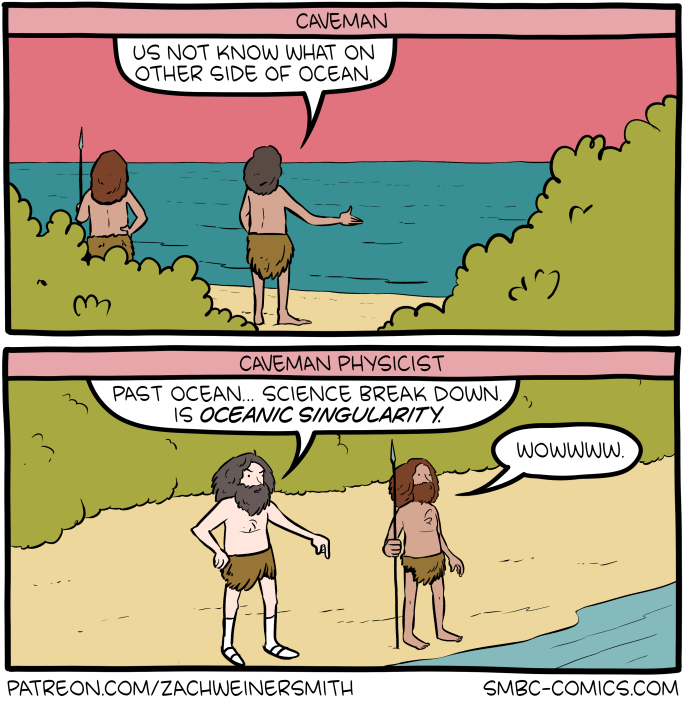
Saturday Morning Breakfast Cereal - Beyond

by Zach Weinersmith


Click here to go see the bonus panel!

Hovertext:
When biologists can't explain cubic wombat poop, why don't THEY call it a singularity?


Today's News:
08 Oct 13:50

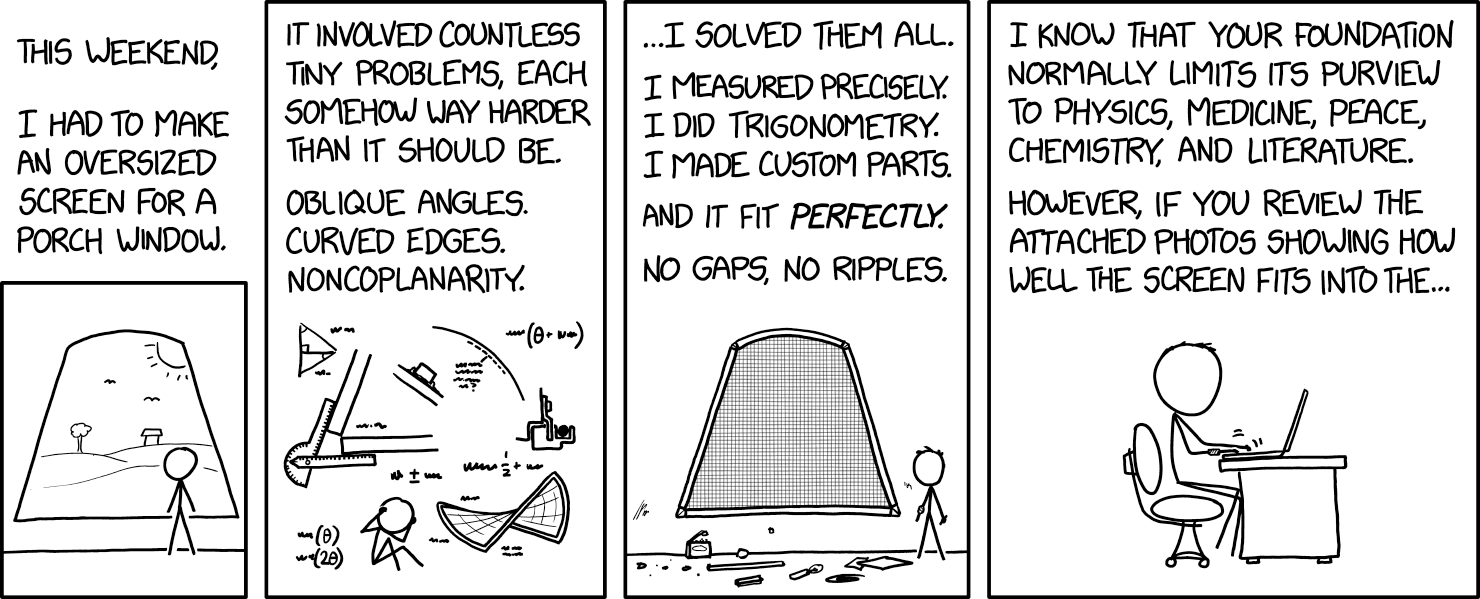
Window Screen

The Nobel Prize in Physiology or Medicine or Home Improvement or DIY
08 Oct 13:47

this ship cannot sink

this ship cannot sink

9

[img]:thnuus

Girl and Glenda in a hollowed out monitor.

https://analognowhere.com/_/thnuus

08 Oct 13:46

Outer space?

by John Allison

Another flashback to 1962, and an opportunity to use my now seldom-employed robot-drawing toolset. Seldom-employed for a reason eh John you say. I will have none of this. I had drawn hundreds of robots before I ever tried to draw a muscle man or pretty lady or pretty man or muscle lady.

The post Outer space? appeared first on Bad Machinery.

07 Oct 22:50

Heavens to Betsy, that not at all what I meant ...

Heavens to Betsy, that not at all what I meant by music! #CowboyWho

07 Oct 22:50

#Kento #Cye #RoninWarriors

07 Oct 00:04

An Illustrated Introduction to Linear Algebra

by Aditya Bhargava

This post assumes you know algebra, but no linear algebra. Lets dive in.

There are two big ideas I want to introduce in the first chapter: Gaussian elimination, (which is not strictly a linear algebra thing, and has been around for years before linear algebra came along), and row picture versus column picture, which is a linear algebra thing.

Money example

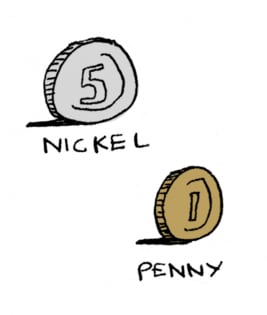
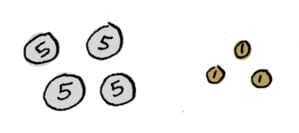
Let’s say you have a bunch of nickels and pennies, and you want to know how many of each do you need to have 23 cents.

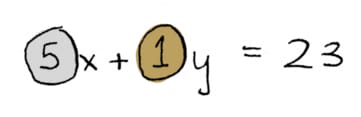
You could write that as an equation that looks like this:

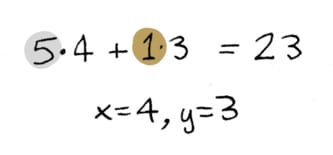
x is the number of nickels you need, y is the number of pennies you need. And you need to figure out the x and y values that would make the left-hand side work out to 23. And this one is pretty easy, you can just work it out yourself. You’d need four nickels and three pennies.

So x is four, y is three.

This kind of equation is called a linear equation. And that’s because when you plot this equation, everything is flat and smooth. There are no curves or holes. There isn’t a ^2 in the equation for example to make it curved. Linear equations are great because they’re much easier to work with than curved equations.

Aside: Another solution for the above is 23 pennies. Or -4 nickels + 43 pennies.

The point is you have two variables (x and y for nickels and pennies), and you are trying to combine them in different ways to hit one number. The trouble starts when you have two variables, and you need to combine them in different ways to hit two different numbers. That’s when Gaussian elimination comes in. In what world would you have to hit two different numbers? Does that seem outlandish? It’s actually very common! Read on for an example.

Food example

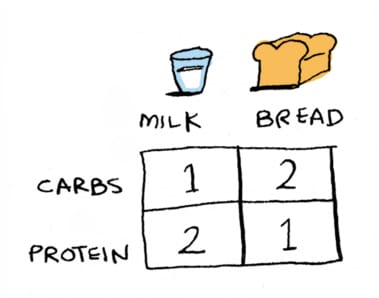
Now let’s look at a different example. In the last one we were trying to make 23 cents with nickels and pennies. Here we have two foods. One is milk, the other is bread. They both have some macros in terms of carbs and protein:

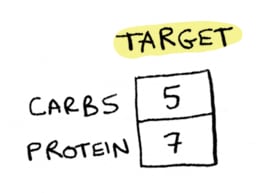
and now we want to figure out how many of each we need to eat to hit this target of 5 carbs and 7 protein.

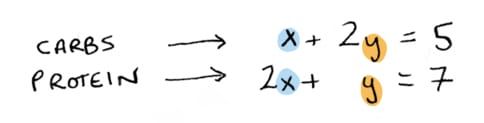
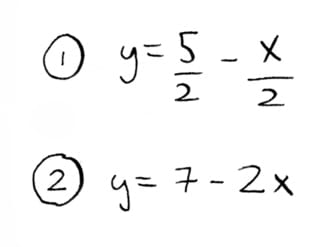
This is a very similar question to the one we just asked with nickels and pennies, except instead of one equation, we have two equations:

Again we have an x and a y. Lets find their values. To solve these kinds of questions, we usually use Gaussian elimination. If you’ve never used Gaussian elimination, strap in.

Gaussian elimination

Step one is to rewrite this as a set of two equations:

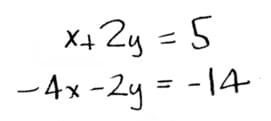
Now you subtract multiples of one equation from another to try to narrow down the value of one variable. Lets double that second equation:

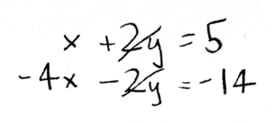
See how we have a +2y and a -2y now? Now we can add the two equations together to eliminate y:

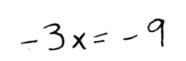
We’re left with one equation and one variable. We can solve for x:

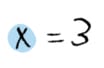
Aha, we know x = 3. Now we can plug that into one of the equations to find y.

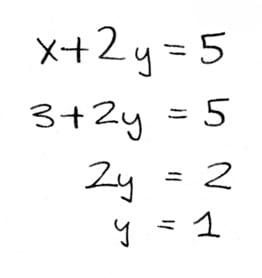
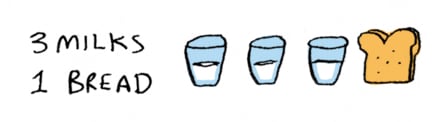
We plug that in to one of the equations and find out that y equals 1, and there we have answer: three milks, one bread, is what we need.

This method is called Gaussian elimination, even though it was not discovered by Gauss. If you haven’t seen Gaussian elimination, congratulations, you learned a big idea! Gaussian elimination is something we will talk about more. It’s part of what makes linear algebra useful.

We can also find the solution by drawing pictures. Let’s see how that works.

Picture version

Let’s plot one of these lines. First, we need to rewrite the equations in terms of x.

Reminder: first equation is for carbs, second for protein. x is number of milks, y is number of breads.

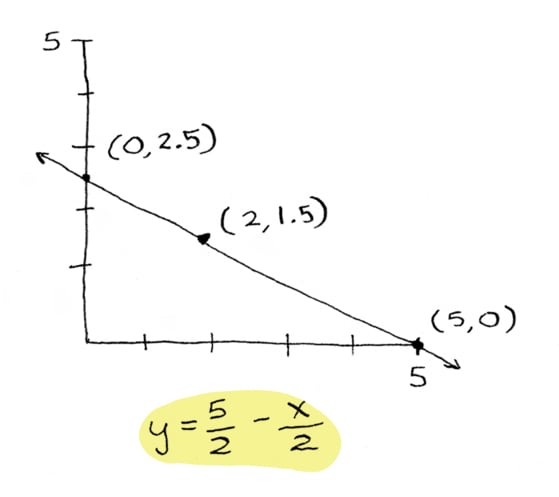
Now let’s plot the graph for the first equation.

Now, what does this line represent?

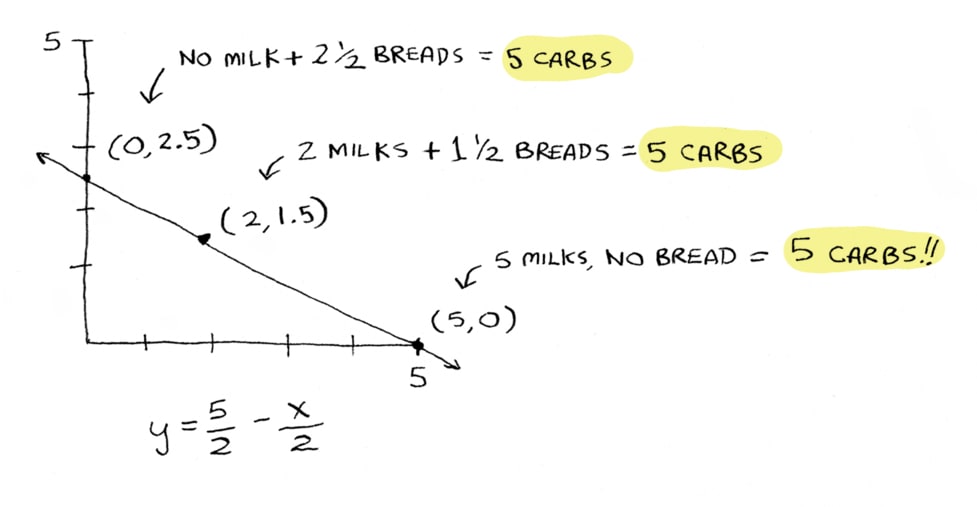
It’s all the combinations of bread and milk that you can have to get exactly five carbs:

So you can eat no milk and two-and-a-half breads, or two milks and one-and-a-half breads, or five milks and no bread, to get to exactly five carbs. All of those combinations would mean you have eaten exactly five carbs. You can pick any point that sits on this line to get to your goal of eating five carbs.

Note: You can see the line goes into the negative as well. Technically, 5 breads and -5 milks will give you 5 carbs as well, but you can’t drink negative milks. For these examples, let’s assume only positive numbers for the variables.

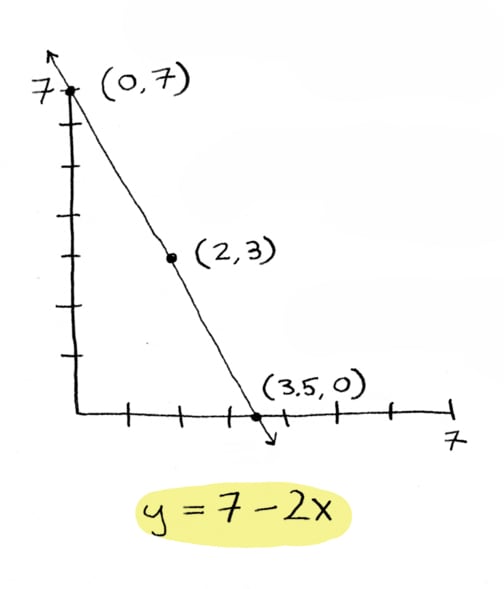
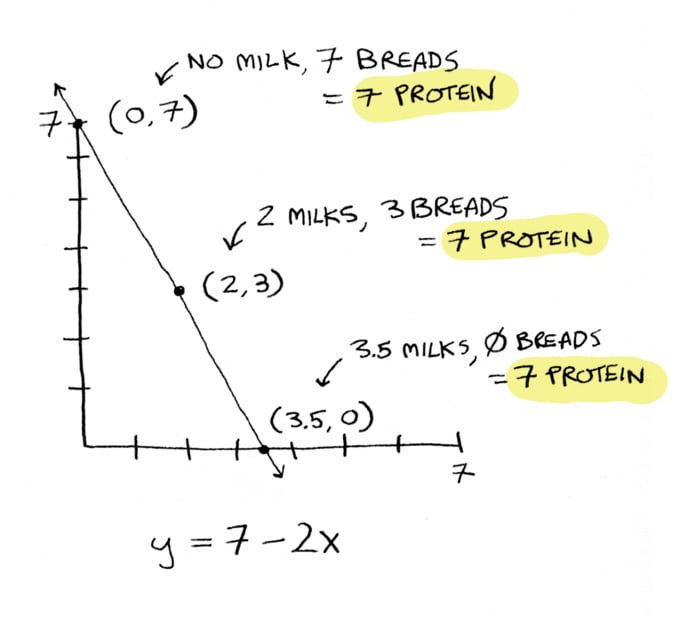
Now, let’s plot the other one. This is the same thing, but for protein.

If you eat any of these combinations, you’ll have met the protein goal:

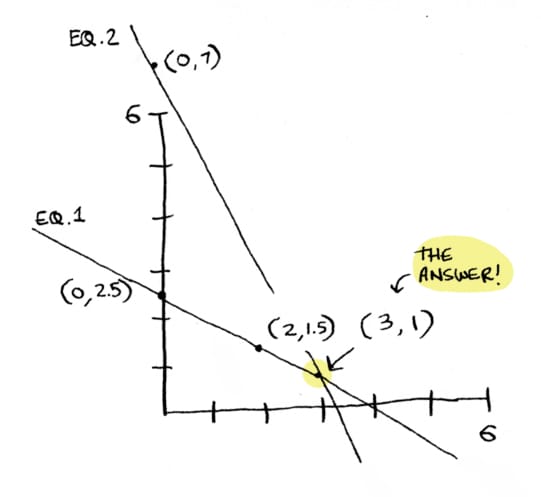
You can pick a point that sits on the first line to meet the carb goal. You can pick a point that sits on the second line to meet the protein goal. But you need a point that sits on both lines to hit both goals.

How would a point sit on both lines? Well, it would be where the lines cross. Since these are straight lines, the lines cross only once, which makes sense because there’s only a single milk and bread combo that would get you to exactly five grams of carbs and seven grams of protein.

Now we plot the lines together, see where they intersect, and that’s our answer:

Bam! We just found the solution using pictures.

So that’s a quick intro to Gaussian elimination. But you don’t need linear algebra to do Gaussian elimination. This is a technique that has been around for 2,000 years. It was discovered in Asia, it was rediscovered in Europe, I think in the 1600s or something, and no one was really talking about “linear algebra”. This trick is just very useful.

That’s the first big idea you learned. You can stop there if you want. You can practice doing this sort of elimination. It’s a very common and useful thing.

The column picture

What we just saw is called the “row picture”. Now I want to show you the column picture. I’m going to introduce a new idea, which is: instead of writing this series of equations, what if we write just one equation? Remember how we had one equation for the nickels and pennies question?

What if we write one like that for food? Not a system of equations, just a single equation? What do you think that would look like? Something like this:

It’s an equation where the coefficients aren’t numbers, they’re an “array” of numbers. The big idea here is: what if we have a linear equation, but instead of numbers, we have arrays of numbers? What if we treat [1 2], the way we treat a number?

Can that actually work? If so, it is pretty revolutionary. Our whole lives we have been looking at just numbers, and now we’re saying, what if we look at arrays of numbers instead?

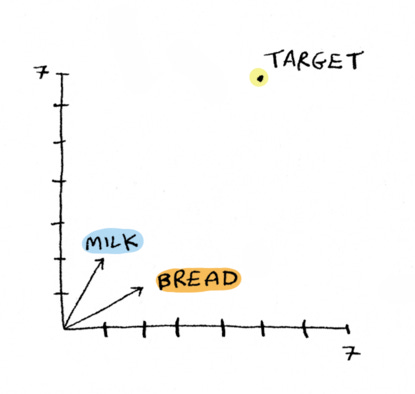
Let’s see how it could work in our food example. What if the coefficients are an array of numbers? Well, this way of thinking is actually kind of intuitive. You might find it even more intuitive than the system of equations version.

07 Oct 00:01

Well ... they certainly are tall. Hey, maybe th...

Well ... they certainly are tall. Hey, maybe they evolved from trees! #CowboyWho

06 Oct 22:49

$1 Million In Coins Recovered From Spanish Shipwreck

by The Onion Staff

Treasure hunters recovered more than 1,000 silver and gold coins worth about $1 million from a 1715 Spanish shipwreck off Florida’s coast. What do you think?

“Fools! Heed you well the curse of Don Carlos Leon, or meet your doom.”

Neil Everill, Corporate Photographer

“We never should have taken our money off the Spanish treasure standard.”

Jose Escobedo, Mirror Polisher

“Good luck getting a vending machine to take them.”

Elliot Martz, Hammer Tester

The post $1 Million In Coins Recovered From Spanish Shipwreck appeared first on The Onion.

06 Oct 22:49

Tips For Making Friends As An Adult

by The Onion Staff

While it’s natural for personal relationships to change or fade over time, many adults reportedly find it difficult to forge new friendships later in life. The Onion shares tips for making friends as an adult.

Start calling your parents by their first names.

Find a volunteer cause you can immediately dispense with the second your social life picks up.

Hang out at the playground where you made your first friend as a kid—sometimes lightning does strike twice.

End any outstanding East Coast vs. West Coast rap beefs.

Reconnect with old friends to see if they know anyone better they can introduce you to.

Establish authentic connections by standing in a long line and complaining to the people around you about how long it is.

Threaten to turn in the rest of your heist crew if they don’t hang out with you after the job.

Adopting an iguana can be a great way to meet people at the local iguana park.

Carefully observe someone who has a lot of friends, then kill and replace them.

The post Tips For Making Friends As An Adult appeared first on The Onion.

06 Oct 20:52

Tarot Readings for Life in the Big, Soul-Crushing City

by Anne Marie Wonder

Life in the big city can be many things. But mostly it is hard, expensive, and exhausting. Occasionally, it can smell like poop. Above all, it is confounding. So, when the city seems to be throwing all kinds of confusing omens and symbols your way, why not turn to a little divination to see what the city is really trying to tell you?

- - -

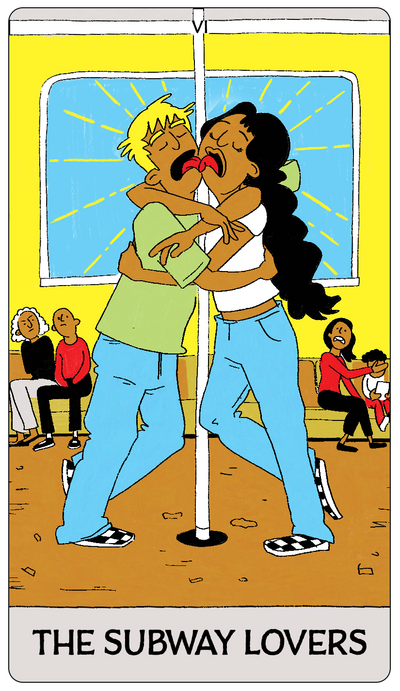
THE SUBWAY LOVERS

Two young lovers make out, unashamed, while others watch in horror, disgust, and morbid curiosity.

UPRIGHT: Lust, passion, desire.
REVERSED: Seriously, get a room. This is a C train at rush hour.

- - -

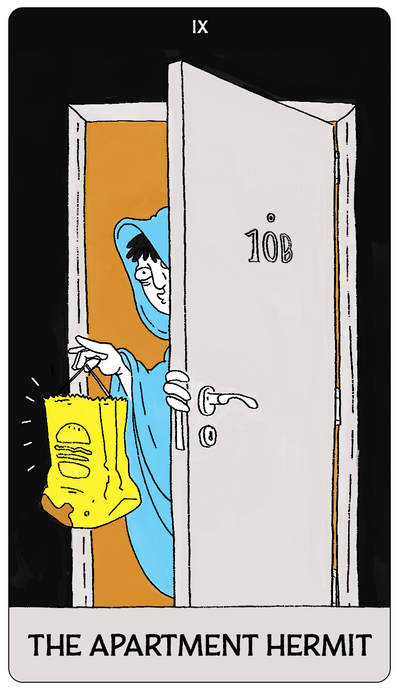
THE APARTMENT HERMIT

The apartment hermit emerges timidly from his domicile. In his right hand is a food delivery bag. On his face is an expression that reads, “How did this all cost thirty-eight dollars plus tip?”

UPRIGHT: Refuge, comfort, solitude.
REVERSED: Congrats, you are now the Weird Roommate.

- - -

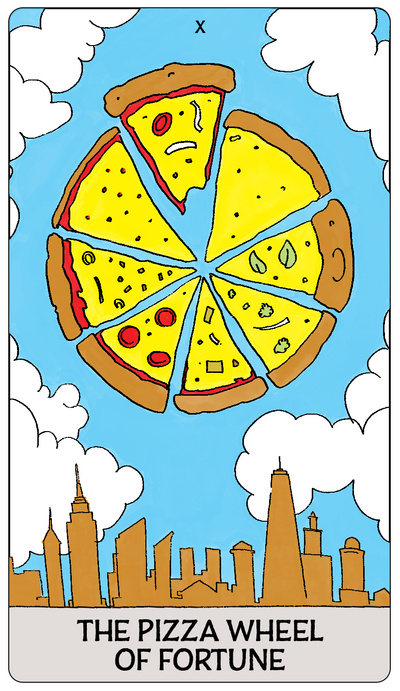
THE PIZZA WHEEL OF FORTUNE

Above the city against a bright blue sky, a giant glistening wheel of pizza shines. Each piece of the pie represents a different slice of pizza, symbolizing the ever-changing fortunes of life in this city.

UPRIGHT: Variety, zestfulness, optimism that you will find a dollar slice soon.
REVERSED: You chose to wait in line for a mediocre pizza alongside everyone else who saw it on TikTok.

- - -

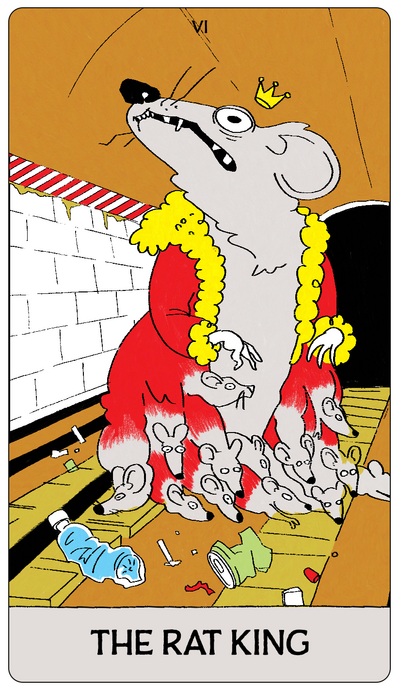
THE RAT KING

A large rat, wearing a coat made of smaller rats, looks over his shoulder as he scurries toward his subway lair. Above his head is a crown, at his feet is… possibly a bottle of pee? Yeah, that’s definitely pee.

UPRIGHT: Manifesting into reality, asserting one’s truth
REVERSED: Literally nobody believes in you.

- - -

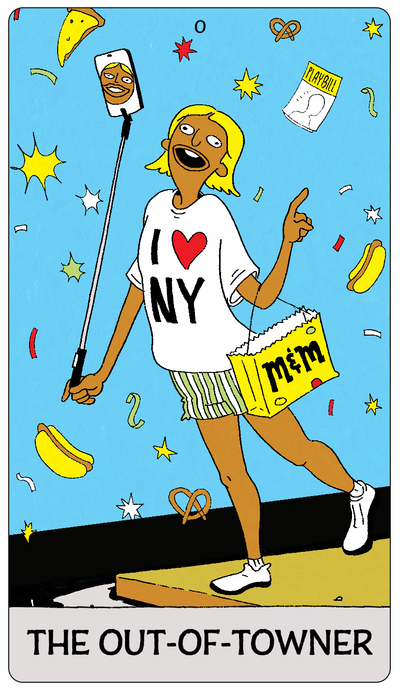
THE OUT-OF-TOWNER

A young woman is dazzled by the sights and sounds (specifically between Thirty-Fourth and Fifty-Ninth Streets) as she joyfully steps off the curb while livestreaming for her twelve followers.

UPRIGHT: Unbridled Midwestern joie de vivre, a pitstop at the M&M store.
REVERSED: This city will destroy you.

- - -

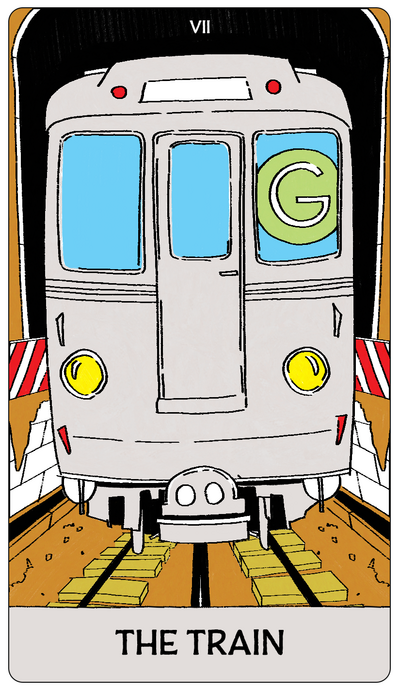
THE TRAIN

An underfunded public transit train is either entering or leaving a station, depending on your perspective. It is moving at a glacial pace either way, but it technically is moving.

UPRIGHT: Tenacity, overcoming conflicts, forward movement toward a goal.
REVERSED: Your next train will be arriving in thirty-two minutes.

- - -

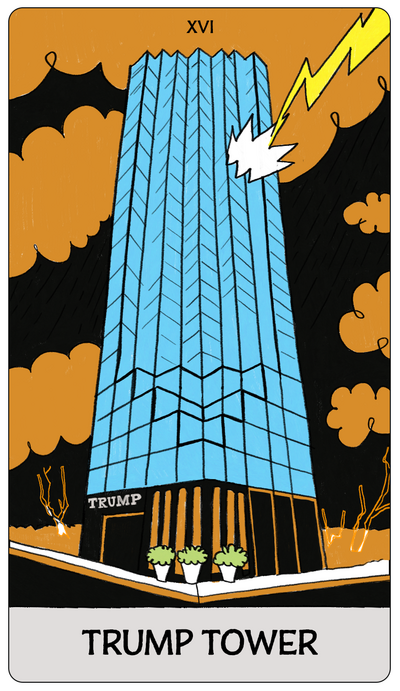
TRUMP TOWER

Ugh.

UPRIGHT: Nope!
REVERSED: Yep, still bad!

- - -

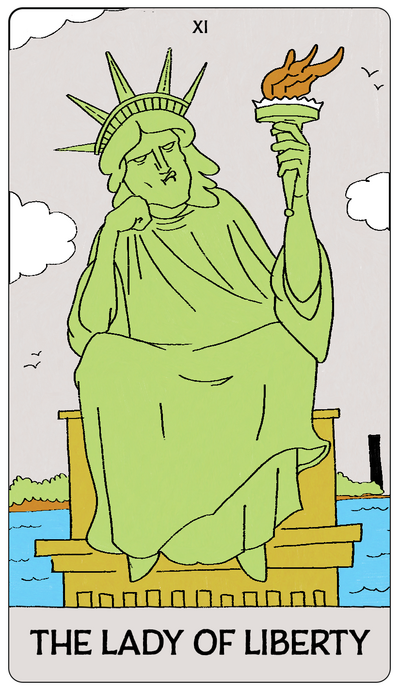
THE LADY OF LIBERTY

The Lady of Liberty sits on her pedestal, with a resigned expression on her face. She still holds her torch up high in the face of adversity, however. Things have just been tough lately, okay? She just needs a minute to sit down. Be cool.

UPRIGHT: Equity, righteousness, and justice for all!!!
REVERSED: Why so many Australians everywhere?

- - -

THE QUEEN OF CUPS

The Queen of Cups sits with a buzzing, palpable energy, surrounded by empty coffee cups. Her expression could be one of excitement, perhaps due to the manic level of caffeine coursing through her bloodstream.

UPRIGHT: Electricity, action, synapses firing on all cylinders.
REVERSED: Your morning latte cost nine dollars.

- - -

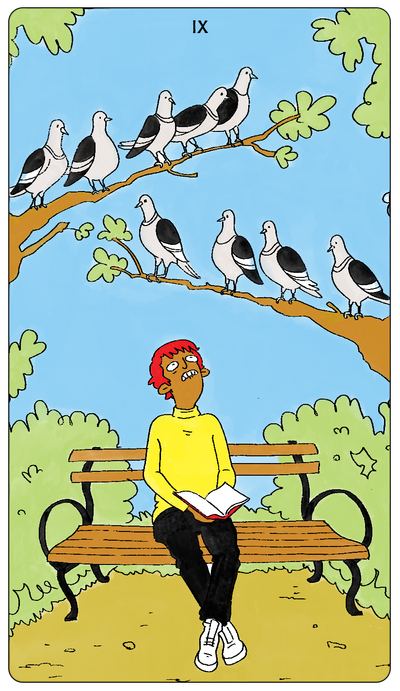
NINE OF PIGEONS

A young man reads in the park while arguably too many pigeons gather above him. Does this qualify as a flock of pigeons? A flight of pigeons? A litter of pigeons?

UPRIGHT: No, seriously, what do we call this many pigeons?
REVERSED: A murder of pigeons.