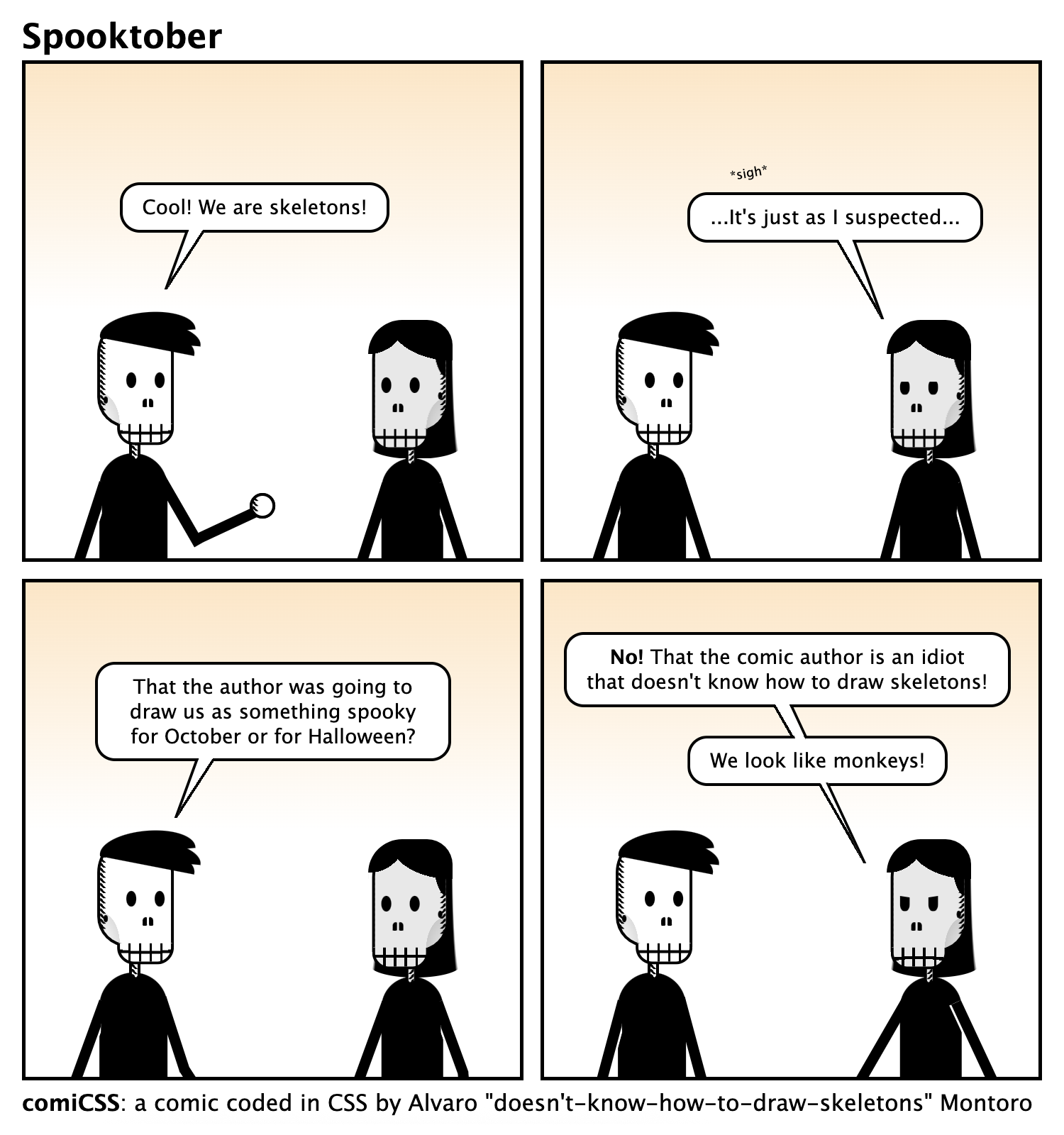
This week on Lost Terminal: The MH2 arrives at Samoylov, Maddie has a human experience, Linda does some couples' councelling, and old friends are discovered. Lost Terminal will return next week!
LEAWOOD, KS—Seeing his fiancée in a whole new light, Kansas City Chiefs tight end Travis Kelce was reportedly getting cold feet Monday after listening to Taylor Swift’s The Life Of A Showgirl. “It’s kind of weird I’ve only known her for two years, don’t you think?” said the Kansas City Chiefs tight end, who told his teammates he had begun experiencing completely new uncertainties about his relationship with the pop star ever since listening to her sing the words “We all dressed up as wolves and we looked fire” and “Did you girlboss too close to the sun?” on the latest record. “I know people get engaged after less time, but still. Am I rushing into it? I just feel like the Taylor I knew wouldn’t have written ‘Wi$h Li$t.’ Maybe I should suggest we spend a little time apart. Some time with Jack Antonoff might do her good.” At press time, sources confirmed Kelce and Swift were in a blow-up fight after she walked in on him listening to Brat.
STOCKHOLM—In an effort to honor the groundbreaking work of bringing fast relief to millions suffering post-meal heartburn and indigestion, the prestigious Nobel Prize in Medicine was awarded Monday to the over-the-counter chewable antacid Tums. “What Tums has achieved was long thought impossible: a fruit-flavored tablet capable of quickly neutralizing acid reflux even after a person has eaten dozens of jalapeño poppers,” said Olle Kämpe, chair of the Nobel Prize Committee for Physiology or Medicine, adding that the panel was particularly impressed by the scientific rigor behind Tums’ catchy jingle and its pioneering development of colorful little miracle tablets. “How often have we been unduly punished by our own bodies for having one too many chili dogs? How many generations have accepted that bloating is the inevitable price of enjoying a greasy bacon double cheeseburger? Tums allows our children to grow up in a world where they can house two dozen Buffalo wings without the consequence of an upset stomach.” At press time, Tums had also been awarded the James Beard Award for Excellence in Tropical Flavoring.
WASHINGTON D.C. – With representatives of the Israeli government, as well as Hamas, meeting to discuss a potential U.S.-brokered peace, delegates have reportedly been surprised to find that the entire plan consists of one QR code linking to a page where they can nominate President Donald Trump for a Nobel Peace Prize. Reports from the […]
OpenAI and Advanced Micro Devices have reached a deal that could
see Sam Altman’s company take a 10% stake in the chipmaker. AMD
stock skyrocketed more than 30% on Monday following the news.
OpenAI will deploy 6 gigawatts of AMD’s Instinct graphics
processing units over multiple years and across multiple
generations of hardware, the companies said Monday. It will kick
off with an initial 1-gigawatt rollout of chips in the second half
of 2026.
It only happens once a decade or so, but the most exciting times in tech occur when there’s a breakthrough that’s severely hardware constrained. That includes hardware like infrastructure — bandwidth was a massive constraint during the dot-com boom. It wasn’t even feasible to download audio, like podcasts, for the first decade of the consumer internet boom, let alone video. But it was inevitable that we’d get there.
Right now we’re severely constrained on compute for AI. In a few years, we’ll look back on today’s state of affairs the way we look back on dial-up modems.
Oninda Romelus, 31, is charged with two counts of murder and two counts of aggravated assault for the alleged shootings of her four children, according to the Brazoria County Sheriff.
I am in an unusual position at work and I wondered what your point of view on this would be.
For context on this: I work remotely and almost never see my coworkers in person. If I did, this situation would be a lot sillier than it already is.
I work for a close-knit, very interdependent team in a small company. I first told my manager I was pregnant once I finished my first trimester, so that I’d get permission to attend appointments. He asked me not to tell my coworkers until he and my grandparent manager had figured out a plan for my absence. Assuming it wouldn’t be long, I was happy to wait.
But it is now less than two months until my maternity leave begins. The date has been formally confirmed with HR but not added to any calendars at my manager’s request. I have asked my manager a few times over the past few months if I can tell my coworkers, and he has said each time that he needs to talk to my grandparent manager. This is a small company and communication is pretty close and constant, so it seems odd that it has taken months for them to have this conversation.
Now that there is so little time left, my theory is that they don’t plan to hire any cover for me, and so they will let my coworkers know only at the last minute so they can’t argue about it.
I know this doesn’t affect me much personally — apart from the weirdness of having a secret! — but I will be gone for a full year and this is coming ahead of our busiest time of year, so I think finding out so late will be frustrating and demoralizing for my coworkers.
All of this said, I know very few other parents, and so I have no idea if this is actually normal in a workplace. What is your take on this?
No, it’s not normal! This is extremely odd.
Frankly, your manager was out of line in making the initial request to you not to share the news. You’re pregnant! It’s up to you who you tell and when, and you shouldn’t be asked to hide that. I could maybe see if the news came right in the middle of a bunch of upheaval and your boss asked you to wait a week or two until they’d had a chance to bring some order to that chaos, but months have gone by! If this was ever reasonable, it has long ceased to be so.
Personally, I’d just start telling people! If your manager calls you out on it, say, “Oh, I’m seven months at this point — didn’t think it made sense to keep it a secret, or that I even could” or “Oh, it just came up naturally; it’s big news, after all” or “Oh, since I’m so close to my due date I didn’t think it was possible not to mention it at this point.”
In fact, I wish you hadn’t been asking him all along if you could tell your coworkers, because that shouldn’t be up to him anyway, and I wish you hadn’t said anything to indicate you were willing to give him that power.
But it’s your news to share, it’s reasonable to share it, and you have plausible enough deniability that you figured of course he didn’t expect you to hide a third-term pregnancy that you can just proceed as if it’s a given that of course he wouldn’t expect you to do something so unreasonable.
In brief: Invest 95L continues to look likely to develop later this week as it mostly stays offshore and away from land. Hurricane Priscilla in the Pacific may deliver some decent rain chances to the Desert later this weekend. Meanwhile, a coastal/potential tropical or subtropical storm off the Southeast is beginning to show up on models this weekend. We discuss the potential for more beach erosion and coastal issues.
Invest 95L
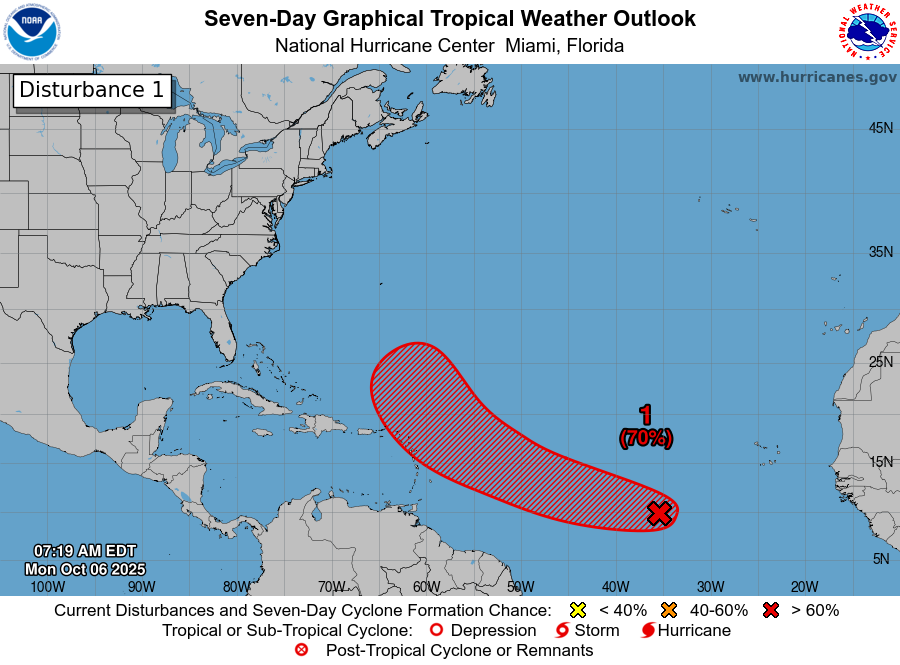
Our Atlantic tropical wave, Invest 95L, is sitting around a 70 percent chance of development this week.
(NOAA/NHC)
95L is actually looking a bit better on satellite this morning, though it still is not quite organized just yet. Models have actually gotten a little more lukewarm on development chances here. Most indicate something akin to a tropical storm as this comes west-northwest toward the islands. It will likely curve back to the north and northeast eventually and likely before it reaches the islands.
A static satellite image of Invest 95L this morning shows more thunderstorms but not quite enough organization just yet to make it to depression intensity. (Weathernerds.org)
Models vary drastically on intensity from the typical HWRF enthusiasm of a major hurricane to various other models keeping it a lower-end tropical storm. My guess is that if this can maintain thunderstorms and get its act together sooner than later, we’ll see something of a significant hurricane, particularly as it turns northward away from land. If we sort of wax and wane the next 36 hours, we’re probably looking at a slowly intensifying system as it passes the islands to the northeast.
Either way, this does not appear to be a serious land threat, though folks in the extreme northeast Caribbean (Virgin Islands through Barbuda) should keep tabs on this in case you get broad brushed by something later this week.
Southwest US rain risk
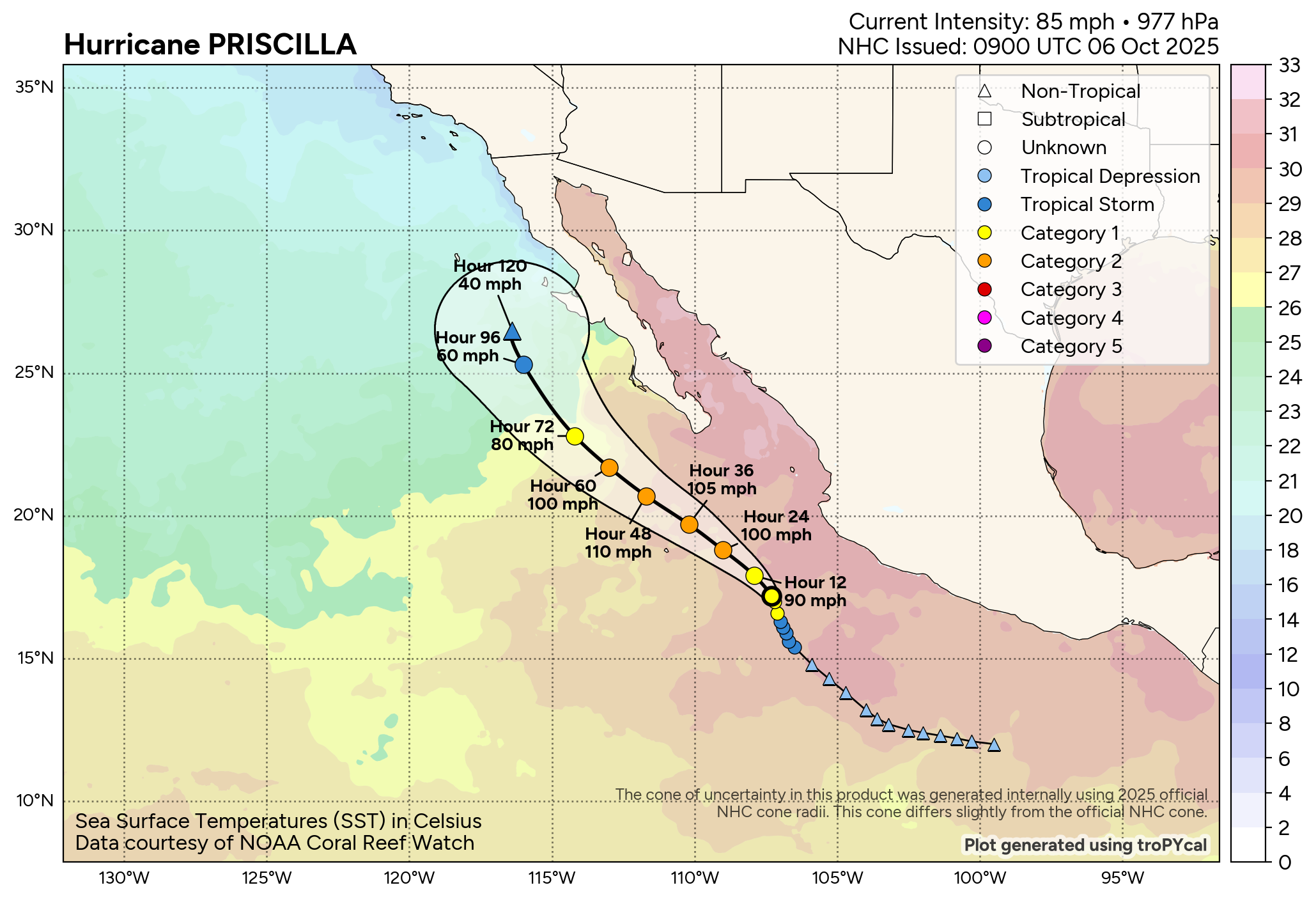
Moving to the Pacific, Hurricane Priscilla has gotten its act together off the coast of Colima and Jalisco in Mexico. Tropical Storm Watches are posted from Puerto Vallarta to south of Manzanillo as some fringe impacts from Priscilla are possible there. Priscilla will track northwest, paralleling the coast of Mexico and Baja but likely remaining offshore.
Priscilla’s track will likely keep it offshore of Mexico, tracking it to off Baja by Saturday. (Polarwx.com/Tomer Burg)
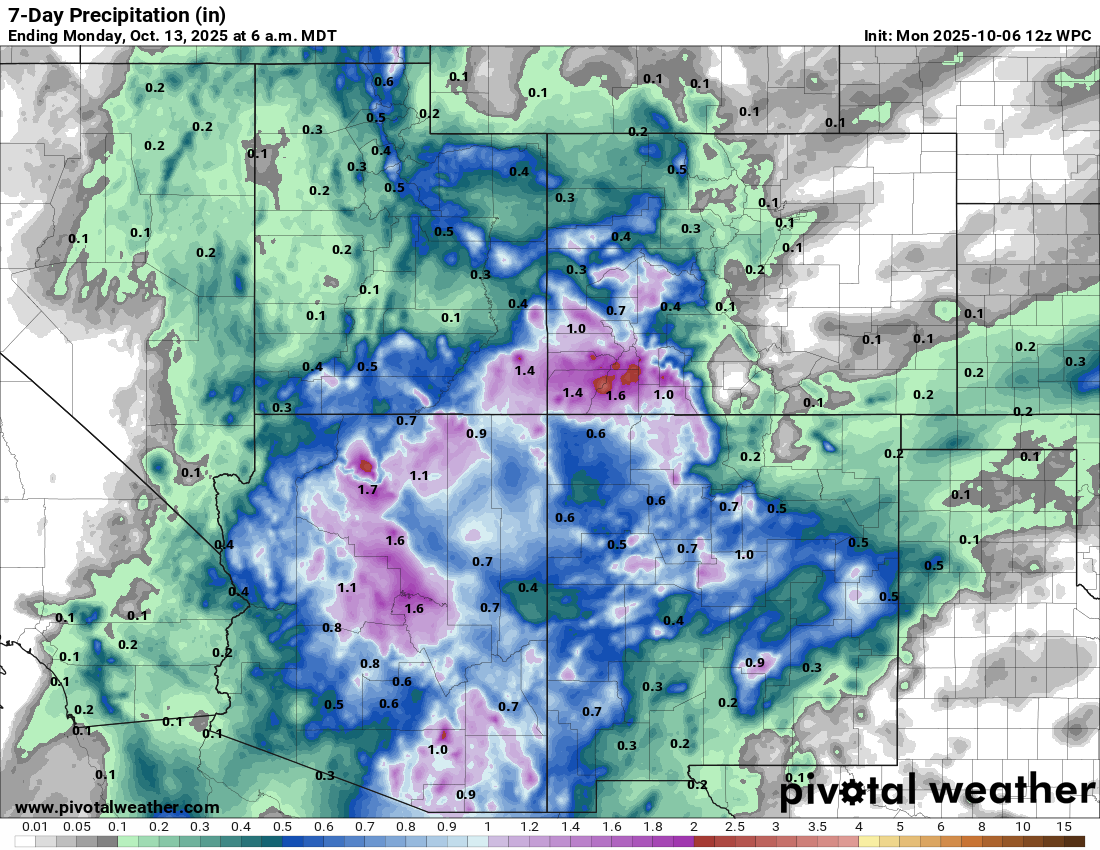
Priscilla should peak in intensity tomorrow, close to a major hurricane. As it tracks over cooler waters off Baja, it will begin to weaken. The question from there is how much moisture it will deliver into the Southwest. This process should begin over the weekend, peaking on Sunday through Tuesday. The current rainfall forecast stops on Monday morning, but you can see a pretty widespread bit of rain across the area is forecast.
Widespread rain, possibly some areas seeing more than an inch will be possible from Arizona into New Mexico, Colorado, and Utah in the Sunday to Tuesday timeframe. (Pivotal Weather)
This is still 5 to 7 days out, so a lot can change, as we saw most recently with Lorena, where it failed to really deliver. But it is worth watching for folks in the Southwest.
Southeast coastal storm?
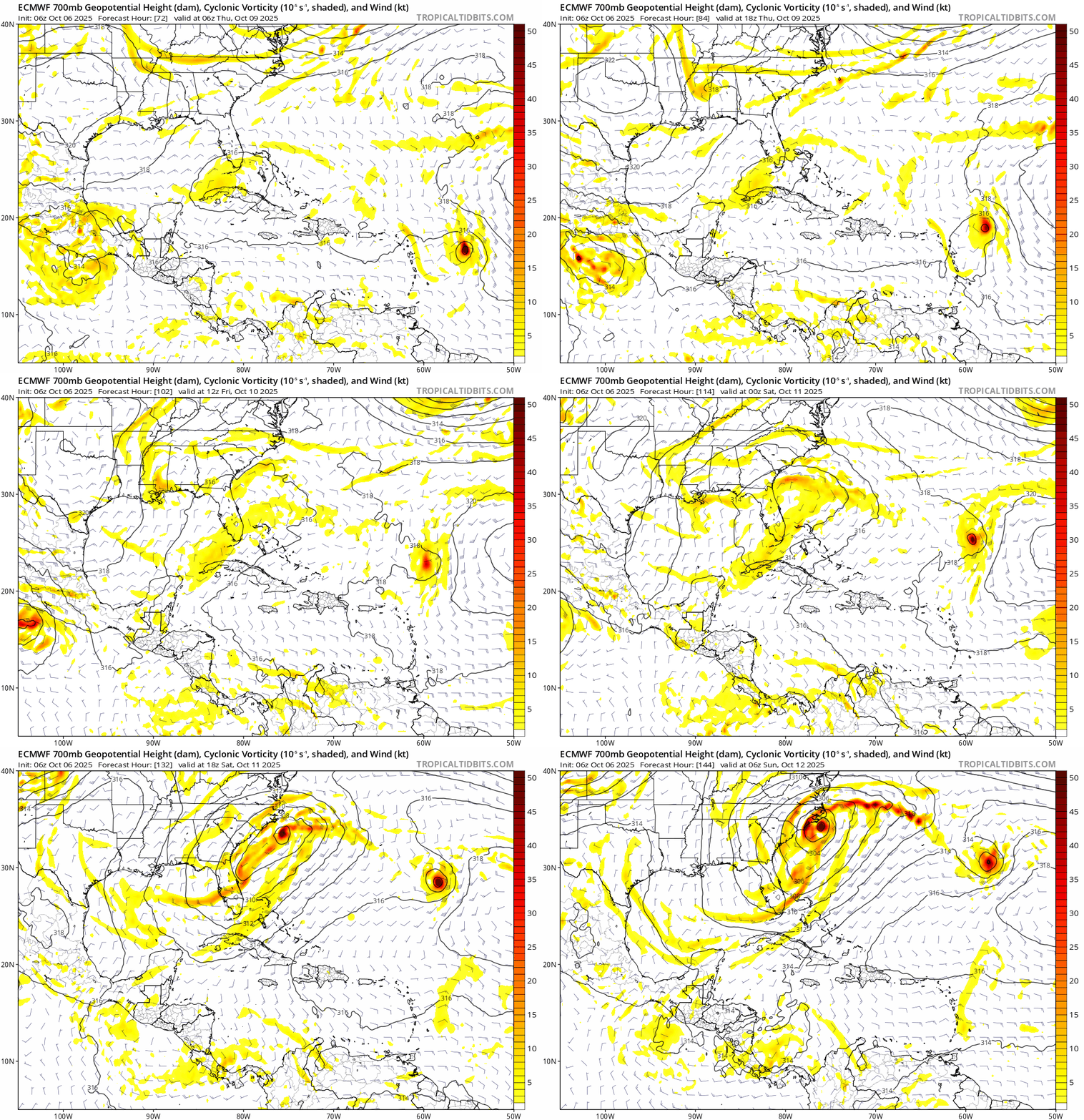
Another area to watch will be off the Southeast coast in about 4 or 5 days. We have a bit of a complicated setup with a cold front dropping southeast off the coast, low pressure trying to develop near the Florida Keys, and a disturbance trying to form off the Southeast. How exactly this plays out will determine a.) if it’s tropical and b.) what sorts of impacts we may see. Right now, it looks like a possible “nor’easter” type storm off the Carolina coast by the weekend. You can see how the operational European model brings all this together around 10,000 feet up.
A disturbance developing near or off the Carolina coast is possible this weekend. Invest 95L is seen passing well offshore on the right side of the loop above. (Tropical Tidbits)
The meteorological side of things is pretty complex here. This appears to be a frontal low that perhaps acquires some tropical characteristics as it develops. This would classify it as sub-tropical. However, in reality, this would be a significant coastal storm, regardless of classification, particularly along the Mid-Atlantic and Carolina coasts that have been beaten up this summer by passing storms offshore. We’ve seen numerous houses get washed away in the Outer Banks as rough seas and erosion from storms like Erin and Imelda and Humberto churn up the ocean. Another coastal storm would be suboptimal particularly so close in proximity to the Humberto/Imelda churn that we’re just moving past now.
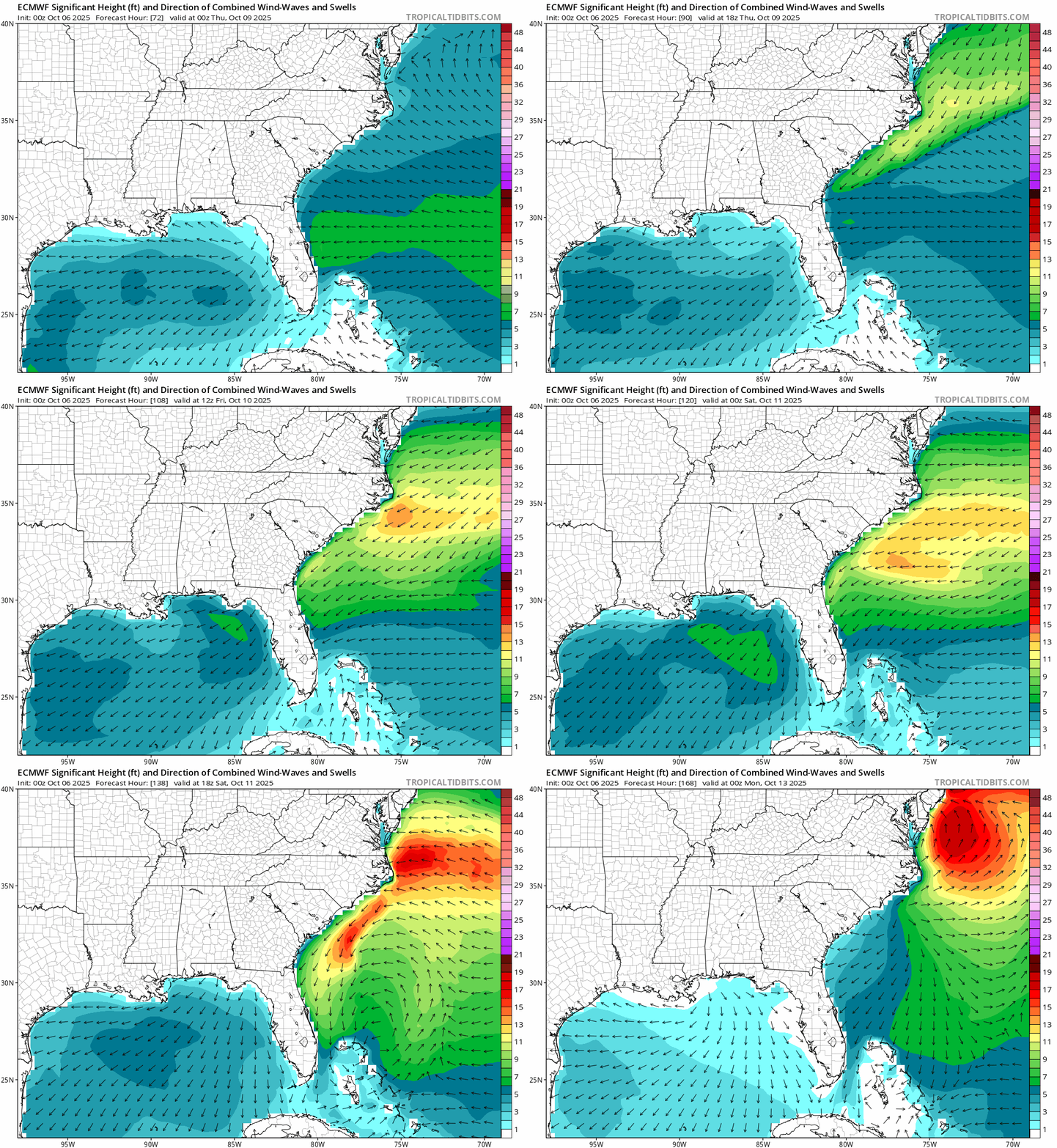
Wave heights of 10 to 20 feet will be possible just offshore, assuming low pressure can develop off the Carolinas later this week. (Tropical Tidbits)
You can see the forecast wave heights from last night’s European model. This definitely is something to watch and monitor in the next few days for coastal folks in particular. The compounding effect of multiple storms in short proximity to each other can create some serious beach hazards and challenges on the oceanfront. More to come.
The 21st-century left has often argued that the solution to rampant inequality is income redistribution. But this may not be a silver bullet. What workers need is power over employers and the market.
The key to Europe’s relatively higher levels of equality is a more egalitarian distribution of pretax market incomes. (Jeff Kowalsky / Bloomberg via Getty Images)
A paper published a few years ago in the American Economic Journal has raised eyebrows within and outside of the profession. Combining national accounts data with household surveys, its authors found that the United States redistributed a greater share of its gross domestic product through taxes and transfers to its poor than any of its wealthy, mostly Western European, peers.
As it turns out, the “inequality gap” between the United States and Europe is not explicable by the comparative generosity of the latter’s welfare states, which are in fact funded by more regressive systems of indirect taxation. Rather, the key to Europe’s relatively higher levels of equality is a more egalitarian distribution of pretax market incomes.
This will almost certainly come as a shock to most American socialists. Hasn’t the case for economic populism in this country hung on the supposed stinginess of America’s welfare provision, to which social democratic Europe serves as a ready-made contrast? However, what the apparently counterintuitive finding reveals instead is socialists’ rhetorical elision of two conceptually separate methods for addressing economic inequality: redistribution and predistribution. The distinction between the two, which has quietly emerged as a growing area of social scientific and even ethical research, matters a great deal more than the mere change of prefix would suggest.
Beyond Redistribution
What do the “pre” and “post” refer to? At any given point in time, we can represent a market economy as a set of agents and their relatively scarce endowments. Since the agents are assumed to have different preference orderings and intensities, they engage in transactions with one another — financing, producing, exchanging — that realize hitherto untapped gains from trade.
The realization of these gains transforms the original pattern of endowments into an entirely new distribution, which leaves some better off without anyone being made worse off than they were before. Redistribution, in this light, is relatively straightforward to understand. Unsatisfied with the end-state distribution brought about by market exchange, states can redistribute incomes after the fact by wielding their fiscal authority to tax some and transfer to others.
The key to Europe’s relatively higher levels of equality is a more egalitarian distribution of pretax market incomes.
But we grasp intuitively that something critical is missing from this idealized picture of economic activity. Endowments neither fall from the sky nor are congenitally given. Preferences are by no means independent from endowments; what we want is almost always relative to what we have. And more confoundingly, what constitutes an endowment as well as an actionable preference is itself defined by a legal framework that apportions rights and obligations to the actors in the economy, a superstructure that is liable at least in theory to democratic contestation. This indeterminacy opens up the possibility that we could affect the outcomes of the trucking, bartering, and exchanging in the market before they take place and not after.
In practice, most, if not all, the income earned by people and firms in a capitalist economy comes from their willingness and ability to supply an input to one production process or another. For a tiny minority, that input is either capital or non-reproducible natural resources. The rest supply the capacity to work with varying levels of skill, specialization, and level of wear and tear — the “doubly free” proletarian condition we are so familiar with.
Because markets reward relative scarcity, this creates a fundamental imbalance of power between the two groups. Even within the laboring group, the better-skilled and educated are typically positioned to hoard opportunities or even strike to strengthen their competitive position. Public policy that remediates this imbalance of power that flows from highly unequal ownership, whether by modifying the relative scarcity of the endowments or the rights that adhere to them, is what economists have given the unwieldy title of predistribution.
Predistribution Is Worker Power
Here is the crux of the matter: whereas the political fight around redistribution is resolved through taxation, in predistribution the target is the bargaining chips, as well as the exit options, available to the parties that contract in our formerly idealized, now conflictual, civil society. And to this end, the tools available to socialists extend well beyond the public treasury’s.
The most obvious candidate is labor law. This is because, as alluded to already, the site in which the unequal distribution of economic assets is most acutely felt is the labor market. Statutes that facilitate forming a union and mandate first-contract bargaining in good faith once one is formed chip away at capital owners’ ability to divide and conquer. Favorability principles and universal extension clauses, which exist in most European countries and some Latin American ones, have the same effect; they make it mandatory that all employers in an industry accept the parameters of the collective bargaining agreements in force in the most organized sections.
Corporatist legislation, such as codetermination laws that partition management rights within the workplace or create tripartite boards that gather state agencies, employers, and employees at a common negotiating table, also have predistributionary effects. The same holds for minimum-wage laws. They raise compensation for the most unskilled portion of the labor force and, in so doing, increase incomes for the rest.
We can extend this logic to other scarce assets that we regard as necessary for human flourishing but whose unequal and private ownership works against the interests of the public. Housing and information are two particularly salient examples. For the former, rent control legislation coupled with public housing development dilute the bargaining power that landlords have by dint of their continuing stake in a housing stock that fails to grow in tandem with the population.
Other ways of strengthening the hand of renters include passing laws that limit landlords’ ability to evict tenants at will, or that allow tenants to deduct the cost of repairs from their monthly rent. Even outside the renter market, eliminating land-use regulations that unduly empower existing homeowners to veto construction at the expense of would-be first-time buyers is a predistributive policy that shouldn’t be ceded to the developer-friendly YIMBY crowd.
States may have built in elite bias under capitalism, but trade unions may be unable to rise above a sectional interest when levels of organization across society are uneven.
With regards to information, the challenge is to design intellectual property laws that restrict the right of private parties with proprietary knowledge to extort the rest of society and stifle innovation in the process. This means shortening the life of patents and increasing the requirements for awarding one. At least in certain critical fields of knowledge production, such as life-saving medicine, a strong case can even be made for scrapping patents altogether in favor of a fixed number of payments to inventors of new drugs and treatments. Financing open-source platforms, coding languages, and hardware is another avenue for democratizing control over information.
Under the umbrella of predistribution, we can also place policies that significantly affect the broader economic environment. Antitrust laws are one example. By aggressively curtailing anticompetitive practices, regulators prevent the dominant firms in any given sector from calcifying their power on the market over sellers and buyers alike.
Another example of a predistributive policy is the much-debated national job guarantee. Such a policy would force the private sector to contract on terms that are at least as desirable as those found outside of it — or face a drying up of applicants.
Now, it is not my intent to offer a full-throated defense of these policies, some of which recommend themselves better than others. My aim is rather to draw attention to the thread that is common to all of them. By recognizing that the market rewards relative scarcity, predistribution acts to shift the power that accrues to asset holders in societies characterized by highly unequal ownership.
It draws out and seeks to tamp down the capacity to dominate others that this state of affairs gives to them. And while most of the examples just listed require the sometimes heavy hand of the state, there is plenty of room for nonstate actors to produce the same effects. Trade unions have the best track record, but we shouldn’t discount the role that tenants’ unions, consumer cooperatives, and other associations of the asset-poor could play in advancing a predistributive agenda.
More research into this area is needed. A systematic comparison between top-down and bottom-up predistribution, considering the relative blind spots of the institutions conducting each, is yet to be conducted. States may have built-in elite bias under capitalism, but trade unions and other groups may be unable to rise above a sectional interest when levels of organization across society are uneven.
Not Either-Or but Both
We finally return to the question of what socialists should make of the American Economic Journal’s counterintuitive finding. In the final analysis, predistributive policy — whether by direct state action or through the extension of union coverage and scope of collective bargaining — seems to be most responsible for the durable reductions in economic inequality that counteract capitalism’s drift toward oligarchy.
Moreover, what limited evidence we have so far regarding the relative popularity of predistribution versus redistribution suggests that working-class voters are more inclined toward the former. They perceive predistributory measures not as welfare, which they may or may not think its recipients deserve, but rather as equal-opportunity empowerment. Does this mean that we ought to ditch redistribution altogether and leave it to the well-intentioned policy wonks on the left edge of the liberal political spectrum to figure out the least wasteful recipe for taxes and transfers?
This would be too hasty. The reality that is frequently obscured in the newfangled debates over predistribution and redistribution is that far from being alternatives toward the same end, they in fact serve different purposes. As Matt Bruenig has been at pains to point out in these pages, most of the spending that falls under the rubric of redistribution constitutes a transfer of income from the economically active population to those outside of the world of work: children, the elderly, the disabled, the sick, and the unemployed (whether short- or long-term).
Predistribution aims to modify the terms of trade among the economically active population.
What redistribution aims to do, in other words, is to incorporate the preferences of people that the market simply can’t internalize because their endowments don’t allow them to back them up with purchasing power. Thus, the animating principle of the welfare state is and has always been social protection through public coinsurance. Indirectly, this consumption-smoothing function bolsters workers’ bargaining with their employers insofar as it makes the threat of firing weaker. But we shouldn’t be surprised that its contribution to overall inequality reduction is less than impressive.
In contrast, predistribution, at least when oriented in a progressive direction, aims to modify the terms of trade among the economically active population. This means that the bargains that predistributory measures strike shift income in aggregate from the better-endowed — and therefore more powerful in the market and workplace — to the worse-endowed. This can constitute a movement of what would have been profits to wages, but also of managerial to nonmanagerial labor income, the reductions of the premiums that more skilled workers enjoy in contrast to their unskilled peers.
We only need to look at what mid-century national bargaining systems in Scandinavia or Australia achieved through solidaristic wage policy to see the value of predistribution. This policy was motivated by the principle of equal pay for equal work, irrespective of the profit margins of any given firm. By leveling the incomes of workers, it forced unproductive employers, who would have otherwise scraped along by underpaying their employees, to keep up with their more productive competitors.
Social democrats in Scandinavia and Australia also prevented highly productive firms from poaching labor from elsewhere by offering them higher wages. Such instruments in the predistributive tool kit show how it would be possible to create a wage-led economy. This would be an economy in which the opportunities for profit-making were subordinated to public, and hence democratically contestable, standards of living.
What this means in practice is that socialists ought to reject an either-or choice between redistribution and predistribution. We ought instead to unreservedly strive for both. That being said, we benefit tremendously by clarifying to ourselves and our constituencies what each one can and, more importantly, cannot accomplish.
Insulating the vulnerable from the silent compulsion of the market is not intrinsically at odds with shifting the balance of power within it. But it is also not a substitute for addressing power imbalances, at least not entirely. Despite the fever dreams of right-wing organizations like the American Enterprise Institute, we won’t be able to grow the welfare state into socialism.
To truly confront the concentrated power of the investor class, we have to also directly delimit how they can use their resources — that is, their endowments. For that, predistributive policy, in a pincer movement that reaches from the top-down and bottom-up to encircle capital and its lieutenants, remains our best bet.
According to a new report, Stephen King is now the author most likely to be censored by U.S. schools, with The Shining, Christine, The Stand, and On Writing among the 87 of his titles removed from shelves. What do you think?
“That’s what happens when school boards get taken over by Crichton fundamentalists.”
Andre Ferguson, Cupcake Filler
“Censor him all you want, but eventually young people will learn that cars can get possessed.”
Mikayla McDevitt, Stroller Tester
“To be fair, 50% of all published books are by Stephen King.”
Through a new government-run website called TrumpRx, drug manufacturers will sell prescription medicines directly to consumers at lower-than-retail prices, but insurance will not be accepted. What do you think?
“Thanks, but the pills I buy at the gas station are already pretty cheap.”
Tanner Mills, Historical Preserver
“Finally, someone’s found a way to profit off the American healthcare system.”
Clyde Sexton, Cape Cleaner
“I worry Trump will think less of me once he learns what medications I’m on.”
The Esperanza Peace and Justice Center in San Antonio has announced the long-awaited opening of the Museo del Westside, an archive and community participatory museum generated by residents of the city’s largely Mexican American West Side district.
The museum’s collection is comprised of photographs, documents, and artifacts donated by community members. As stated in the press release, “The Museo del Westside is a true community achievement, built by the dedication of hundreds of people. Many contributors — from academics, community historians, and interns dedicating hundreds of hours to research and writing, to architects, engineers, and skilled workers providing services at reduced rates — have been essential to its success.”
To celebrate the opening, the Museo will offer a full day of programming on Saturday, October 18 from 10 a.m. to 5 p.m. Educational workshops will include “The Complexities & Joys of Creating a Community Museum,” facilitated by feminist historian Antonia Castañeda; “Mexican Genealogy 101” and “Family Search” workshops; and “Growing Up in an Ice House was Cool” facilitated by the local Reyes family, who donated the former Ruben’s Ice House that is now the Museo.
Front entrance of the new Museo del Westside
Confirmed speakers for the event include San Antonio Mayor Gina Ortiz Jones and scholar Tomás Ybarra Frausto. Musical performances will begin at 11 a.m., featuring Esperanza artist-in-residence Azul Barrientos, Blanquita Rodriguez and Mariachi Esperanza, and Santiago Jimenez Jr., and others. The free celebration will last until 5 p.m.
To learn more about the Museo del Westside’s history and programming, visit its newly dedicated website.
The room sets its own pace. A bright swath of wall holds a loose constellation of small pages — 40-odd sheets hovering on seamless spacers, each throwing a thumbnail shadow that pulses when a cloud moves past the skylight. Pine floorboards keep time. A couple of red dots blink like soft opinions; nothing shouts. Stand close and paper begins to talk in materials: graphite with dry authority, gouache in a matte hush, colored pencil breathing a faint aurora where wax catches the rake of light. Jeremy DePrez gives you no podiums, no thesis wall; he lets the making carry the meaning forward.
That meaning gathers patiently around procedure. The show models a small meteorology of making — tempo, drift, pressure, visibility. Tempo — the counted beat you feel in Starr Sign as bead follows bead — keeps attention from unspooling. Drift — the pencil slips and double-takes in Fake Surfers — admits motion without panic and lets clarity re-form. Pressure — tape ridges, correction-fluid ledges, and graphite’s bite recurring across the room — stores force in the surface so decisions register as weight rather than flourish. Visibility — gouache knitting incidents into a matte haze while ink holds a small shine — turns material into climate rather than costume. None of this asks for oratory; intimacy carries the argument because proximity keeps the weather legible.
Jeremy DePrez, “Starr Sign”
The wall floats like weather too, and you tune to its microclimate. Starr Sign threads a necklace across the paper’s open air oxygen. Graphite plots the route; watercolor taps a few nodes like a drummer ghosting beats between measures. The line cinches, loosens, doubles back through its wake. White doesn’t sit as emptiness; it acts as air for the next decision. Each circle has its own weather system — lead catching on fiber here, pigment pooling there, a faint ridge running under a cluster like a vein under skin. Counting turns out not to be simple repetition but a way of keeping faith with looking.
Jeremy DePrez, “Fake Surfers”
Elsewhere speed enters from an angle. In Fake Surfers, brisk ink lays cartoon architecture — quiff, cheek, a confident hatch — while colored pencil passes over like a wind shift, sliding features out of alignment. Eyes multiply, jawlines echo, and the mouth auditions two or three futures before settling on none. Clarity adapts rather than evaporates. Along the margins, a fingerprint and a soft smear register as a second, fainter portrait: labor announcing itself without a speech. The surface does smart double-work — ink absorbing light flatly, pencil catching a pearl of glare — so assertion and afterimage keep trading places like stations bleeding through a radio.
Jeremy DePrez, “Citizen Notification”
DePrez’s collage thinking never hides its joints; it prefers to let the edits do the architecture. In Citizen Notification a pale grid crosses the page like netting, and, caught within it, lay the world’s loose fragments: a severed hand, a gun that looks more diagram than threat, an orphaned eye, a black wedge that reads as both shoe and shadow. The mesh doesn’t imprison so much as slow things long enough to be named. Nearby, Warm Transfer gives a comic parable of exchange — two headless suits negotiating a handshake while pink, dotted gloves bridge the gap and a little constellation of coins, screws, or planets drifts toward the right margin. The scene turns privacy into choreography: agreement happens, but the terms keep roaming.
Jeremy DePrez, “Mildred’s Mouth”
Drawings that flirt with cartoon also carry tenderness in plain sight. Mildred’s Mouth stacks a monumental head out of nothing more than disciplined doodle — hair rendered as a regiment of short dashes, ear a crisp spiral, the whole thing pulsing between caricature and mask. Widow tangles figure and mesh: stockings, veil, a boot lifted in a posture that lands as both burlesque and vigil. And Recollection, Repetition and Moving Through breaks a face into traveling parts — hat, eye, lip, lash — so memory appears not as a picture to recover but as traffic to manage. None of these sheets rely on punchline; they read like sentences that improve the longer you hold your breath.
Jeremy DePrez, “Lies”
Then there’s Lies: an angry nest of lines at the center, vectors firing outward until the page becomes a field of trajectories. You can almost hear the nib chatter. The mark behaves like a truth machine that refuses to certify anything; it records accelerations, hesitations, and the occasional skid. DePrez doesn’t tidy this; he lets the mess keep its data.
Jeremy DePrez, “The Good Part of Dying”
A new page, The Good Part of Dying, gathers many of these arguments into one knot. A tight chalk-white spiral lifts out of a bruise of blacks and reds; a yellow ribbon drifts away from that whirl like a thought trying to leave the body but still tethered to pulse. Two silhouettes — stacked, misregistered, arms thrown — read as both carry and casting off. Crayon-speed contours skate the perimeter; a few dabs of teal and red flare and recede. The spiral winds the body tighter, the apparition flickers where outlines fail, the confession lingers like chalk dust, and the weather gathers in bruised color.
The “good part” lands not as metaphysics but as method: one mark learning to release so another can live.
An installation image of “Jeremy DePrez: Night Worker: Works on Paper 2018 -2025” at Front Gallery
DePrez’s installation style deepens the ethic. Clear spacers lift each page a finger’s width from the wall. Tiny nails and transparent corners become part of the syntax. Shadows pool under the lower edges like quiet underlines. The salon cluster — denser toward the middle, splayed at the flanks — lets images hear each other. From a step back, the whole array reads like a score: busy passages, rests, recurring motifs. Step in and the tempo shifts to chamber music. You start noticing how correction fluid cools a zone and makes the next mark slightly brittle at the edges; how tape throws a thin ridge that steals a hairline of light; how gouache knits scattered incident into one weather; how graphite, when you sidle left, darkens by half a tone. The paper itself participates: a faint pulp scent rises as bodies warm the room.
Talk long enough with these drawings and their argument clarifies. DePrez favors the middle distance, the braid where seeing and deciding keep pace with each other and polish steps back in favor of tact. Humor helps. So does cartoon shorthand, which he uses like a multitool rather than a stance: fast, legible, unpretentious, capable of joke and diagnosis in one stroke. The works feel made at a desk under practical light, often at off-hours — the title of the show calls him a night worker for a reason — yet they refuse fatigue. They accumulate attention instead of consuming it.
Read it as a weather report more than a confession: the spiral holds the eye like a low-pressure center, the yellow slip moves through like a front, the doubled silhouettes scatter like papers in a gust — edits legible as passing squalls. The “good part” arrives less as metaphysics than mechanics: release through calibration, one decision making room for the next.
You leave with a feeling that the room tuned itself and then tuned you — light, paper, and hand working out a tempo that neither rushes to a conclusion nor slumps into mood. Plenty of shows sprint for a single picture and hold a pose. DePrez’s drawings keep the current moving, steady and low, until the edges of the pages feel like riverbanks. When the door closes behind you, the hum doesn’t stop; it just carries on without you, counting softly, layering lightly, letting the weather do its quiet work.
Jeremy DePrez: Night Worker: Works on Paper 2018 -2025 is on view through October 11, 2025, at Front Gallery in Houston.
In 2022, I wrote a catalog essay for the New York Foundation for the Arts (NYFA) Immigrant Artists Mentoring Program – Round 2 exhibition held at Centro de Artes in San Antonio. It highlighted that in the precarious time when the world was still emerging from the COVID-19 pandemic the artists in the exhibition, despite the risks, brought forward a necessity of life: art. I also explained that in the wake of Donald Trump’s first presidency, which often targeted immigrants, the artists in that exhibition showed stalwart bravery, exposing their humanity and resisting the silencing of their stories.
Since that show’s closing, this country has regressed further into xenophobia, heralded by the reelection of President Trump. In this country and around the world, dictators and their underlings have set their sights on immigrants, proclaiming them the source of their country’s ills. This moral backslide in the United States has been particularly vehement in terrorizing immigrant communities with militarized immigration forces, traumatizing people of color and others alike. On September 8, 2025 the U.S. Supreme Court ruled that a person’s appearance alone can be probable cause for questioning and detainment, an unprecedented decision that puts everyone, not just BIPOCs, at risk of unjust scrutiny and imprisonment.
Jacqueline Saragoza McGilvray, “Ow”
The artists showcased in this year’s NYFA Immigrant Artist Mentoring Program (IAP) exhibition, Courage, Valor, Mужність, Mужество, 勇气, have proven that the heightened difficulties and dangers placed upon immigrants have not deterred them from realizing their creative potential, sharing their voices with the community, or limiting their choices to uplift one another in the honored tradition of creative mentorship and community building.
Mentorship is the unseen heart of the exhibition, though it doesn’t show up as one might expect. Collaboration on art is scarce in the exhibition with a single artistic collaboration in the show, that of mentor Jacqueline Saragoza McGilvray and mentee Angeles Salinas with their installation work, Turning Tides, Falling Stars. As a whole, the mentorship aspect of the program is most heavily invested in developing professional practices of the mentees and cultivating vital connections among the artists. This mentorship practiced in the program is invaluable for mentees trying to pull back the curtain on the often opaque mechanisms and necessities of being a professional artist. The community created through this program is lasting and vital in a field where an artist’s professional career often lives and breathes based on their interpersonal connections.
The clean and inviting exhibition catalog explains how IAP, a completely free program for its mentors and mentees, boasts a network of over 1,000 immigrant artists from 76 countries brought together since program’s founding in 2007. Additionally, the catalog includes bios and artist statements for all of the artists, and describes NYFA, a nonprofit organization whose mission is to “empower artists in all disciplines, as well as cultural workers, to achieve success on their own terms.”
Angel Moreno, “Sicodelico”
Looking around the University of Texas at San Antonio’s Russell Hill Rogers Galleries at the show, I was impressed and overwhelmed by the intimacy, variety, and number of narratives, viewpoints, styles, and themes on view. There is a vast amount of masterfully executed artworks in a plethora of mediums, ranging from traditional — oil painting, printmaking, photography, and ballpoint pen — to unexpected media like cardboard, light fixtures, and embroidery.
The show’s catalog explains that the artists have held deeply to the birthplaces they have left while fostering community with new people and creating art courageously, often working with experimental materials on work that highlights the individuality of their lives. Some examples of this are: Angel Moreno’s Sicodelico, an ode to Mexican wrestlers; Juan de Dios Mora’s Cosecha, a flurry of borderland icons; Gabi Magaly’s photography book, Dear Frank, an invitation to contemplate some of life’s most challenging emotional moments with the artist; Raul Gonzalez’s Gracias a Dios, an unbridled celebration of a favorite sports team’s victory; Victoria Leal’s The Heart of Tejas, a reverential showing of strong Latinas from Texas (Tejanas); Yamin Li’s I’m So Glad I’m White, in my reading, is a brave questioning of racial hierarchy and how whiteness is often yearned for; and Jacqueline Saragoza McGilvray’s Ow, which carries themes of transformation, loss, love, devotion, support, and grief, poetically explored over a mesmerizing use of cyanotype photography. All these brave admissions of emotions, subjects, histories, and themes show the subtlety and nuance of the artists, and we come away from engaging with their art with more empathy for the individuals and immigrants as a whole, and greater affirmation of our own lives.
Yamin Li, “I’m So Glad I’m White”
The show is laid out well by the curatorial team of Huakai Chen, lead curator with assistant curators Dr. Scott Sherer, Roberto Gonzalez, Violeta De Leon Davila, and Maxim Shirkov. An exhibition with this many styles, mediums, themes, and messages, some subdued and others over-the-top, could have easily been something of a cacophonous mess to move through, but the loudest pieces are spread out well amongst quieter artworks. Surprises, challenges, and moments of rest were balanced nicely.
Gabi Magaly, “Dear Frank”
But there is something else to be said about the successes of this exhibition and all its participants. The artists and organizers were not shy in highlighting what is worth being applauded — their courage. They were so confident in this that they chose this word to stand alone as the title for their exhibition, appearing in the birth languages of the artists: English, Spanish, Ukrainian, Russian, and Chinese. In a moment when the U.S. government is rabid for the deportation of immigrants and rabid for anyone seen as “other,” it takes tremendous courage to present oneself to the public and share personal truths.
Juan de Dios Mora, “Cosecha”
I was taught as a historian to be objective and to withhold fandom in my writing. But I struggle with that here, because I am impressed by this exhibition for more than just its art and presentation. I applaud these artists and organizers for their decision to soldier on in the situation we are in. I see great courage in each of their contributions as they share of themselves freely at a time when many feel the urge to minimize their footprint in fear of retribution. I want to tell them that it means something to me, personally, that they have done this. It means something for my grandfather, who came to this country for a better life. It means something for my parents, both born before Texas schools were desegregated. It means something to me, a brown person in a country where brown people are targeted. I want to tell them I see them. I want to tell them thank you.
Courage, Valor, Mужність, Mужество, 勇气 is on view at the University of Texas at San Antonio’s Russell Hill Rogers Galleries through October 10, 2025.
Early Tuesday, March 25, Sergio Garcia heated the pinto beans, rice, the fragrant carnitas and barbacoa at his Austin Avenue restaurant kitchen for the last time. He headed out the alley door, where Sergio’s Food Truck was waiting to be loaded for the morning downtown crowd. Then, as he recalls, a man in plain clothes […]
In brief: Houston’s late summer heat will continue this week, but a modest front should bring some drier air by Thursday or Friday. We have a chance of a stronger front in a little more than 10 days, but no promises. We also have details about our special Fall Day celebration I’m excited to share.
Fall Day
Admittedly the next few days will not feel much like fall in Houston. But that has not stopped us from preparing for Fall Day, and we want to invite everyone to come out and partake in the festivities on Saturday, October 25th. This year’s gathering is extra special as we will be celebrating the 10th anniversary of the site!
Here are some of the great things we have planned:
Meet and greet with Space City Weather team
Free tote bag giveaway to first 100 visitors
Chalk wall for guests to share their favorite Houston weather memory
Free face painting
Exclusive sale of 10th anniversary t-shirts (see logo above), not available at any other time
Lawn games
Art activities for kids
Coffee and snacks available for purchase
Reliant tent with giveaways
Free 360 photo booth
Fall Day is simply a gathering to celebrate the end of summer in Houston—to enjoy the outdoors and look ahead to cooler days. This year we have reserved the entirety of Midtown Park, 2811 Travis, in Houston. The event will be held from 10 am to Noon. If you can let us know you’re coming by signing up here, it would be great for planning purposes. But it’s not essential. See you there!
Monday
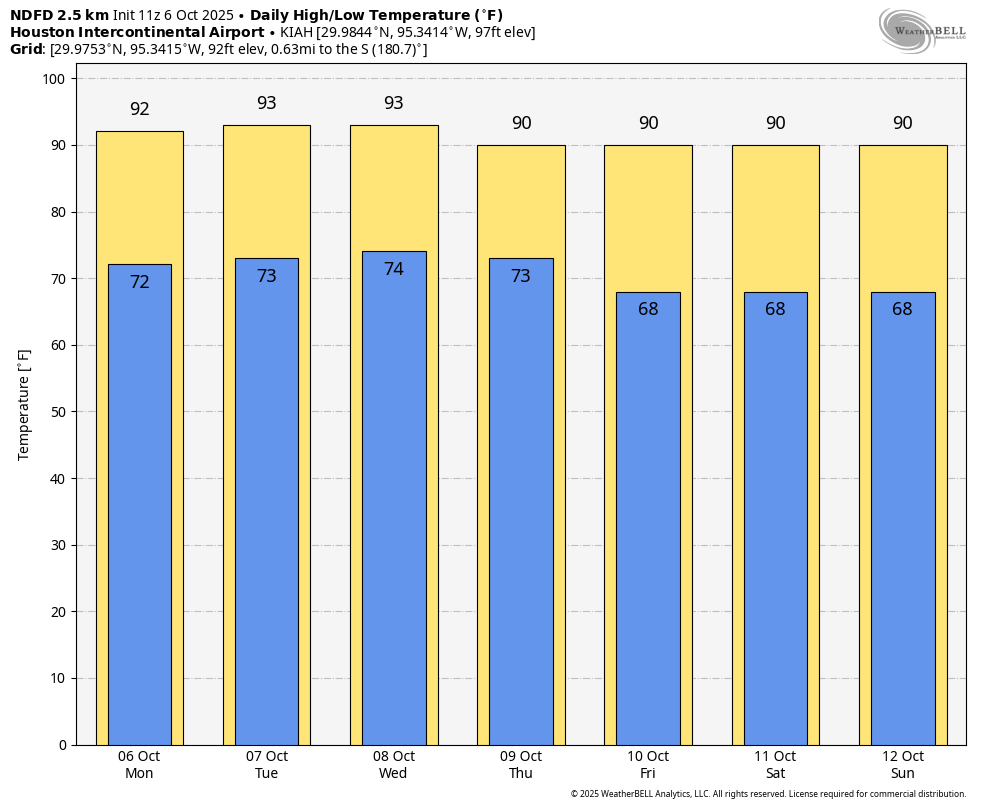
Our late summer-like weather will continue for much of this week before some kind of front, probably fairly weak, arrives by Thursday or Friday. Until such time our weather will largely be driven by high pressure. For today that means high temperatures of about 90 degrees in the city of Houston, with higher temperatures to the west and north of the city. Winds will be light, generally from the east to northeast. Skies will be mostly sunny. Overnight lows will be sultry. Dewpoints of around 70 degrees will be sticky, especially for October.
Tuesday and Wednesday
These will be the warmest days of the week, with high temperatures likely in the lower 90s in Houston, with the possibility of mid-90s for far inland areas. I don’t think we will quite get to record highs in Houston (95 degrees on Tuesday, and 96 on Wednesday, but we’re going to get close). Rain chances will be low, perhaps 20 percent each day along the sea breeze. This doesn’t look like much, but it may offer our region’s best chance of rain for the next 10 days.
This weekend should see moderately drier weather. (Weather Bell)
Thursday and Friday
By Thursday or some drier are should start to work its way into Houston. This probably will lead to high temperatures of around 90 degrees, with lows in the upper 60s. Sunny skies prevail.
Saturday and Sunday
Expect more of the same for the weekend, with sunny skies and highs of around 90 degrees. Dewpoints look to be a bit lower, in the 60s. So while it will be warm, it won’t feel like full-on summer. Rain chances remain low to non-existent.
Next week
The headline of this weather update promised “hints” of cooler weather. We are going to get some of that this weekend with a weak front. Well, most of next week should bring continued highs of around 90 degrees. However, toward the end of next week I do think we have a decent chance of seeing a stronger front. I’m not ready to write this in ink for a variety of reasons, such as it being 10 to 12 days out, and our late summer heat has been pretty persistent. But I do think fall has a pretty OK chance of breaking out late next week.
MESA, AZ—As he hastily hung a framed picture over some unsightly bullet holes in the wall, local man Clyde Walker told reporters Monday that he was straightening up his meth lab ahead of an anticipated visit from his landlord. “Just doing a bit of cleaning to get the meth kitchen spick-and-span before Gary comes by,” Walker said as he took out a trash bag full of empty Sudafed boxes and plastic tubes, explaining that his landlord was a real stickler about shards of glass from shattered beakers littering the floor. “He’s gonna be all over my ass if I don’t get these burn marks out of the carpet. After that, all I gotta do is put the corrosive lye away and straighten up my lithium batteries, and I should be pretty much set.” When he arrived for his visit, sources confirmed Walker’s landlord was furious to discover a messy explosion that had been caused by his tenant lighting a candle to cover up the smell of anhydrous ammonia.
ARLINGTON, VA—The U.S. Defense Department confirmed Monday that Starbucks had been awarded a $5 billion contract to explore potential national security applications of cold foam, part of the military’s ongoing effort to modernize its lactose-based defense capabilities.
According to officials, the Seattle-based company will oversee the prototype of a tactical frothed milk topping for use by the armed forces as the Pentagon looks to develop richer, more indulgent ways to neutralize threats on the battlefield.
“We’ve long discussed possible combat uses for our velvety nonfat cold foam, whether in targeted assassinations or as a way of stunning enemies with a rich, smooth, and delightful neuro-weapon,” said Starbucks CEO Brian Niccol, admitting that the company had been quietly promoting its vanilla sweet cream as an alternative to the Army’s outdated M14 thermate grenade steamers. “With Starbucks’ industry-leading expertise in caffeinated warfare, we believe that whipped dairy is the future of the defense industry.”
“Within a decade, the U.S. military will be armed with a cache of fully customizable strategic drink toppings in a variety of different flavors,” Niccol continued.
The operations of Starbucks facilities like this one may soon be classified as a national security secret.
Starbucks beat out competitors like Dunkin’, Peet’s Coffee, and Lockheed Martin for the 18-month contract, which will fund mission systems development and the integration of tactical cold foam as a light, airy neutralizing agent, allowing U.S. forces to blast a silky layer of sweetened cream over enemy troops without stirring it in. The contract also covers a possible expansion into weaponized oat and coconut foams that would theoretically allow for wartime dominance at a lower fat and sugar content than traditional cream-based munitions.
The partnership comes on the heels of reports that China has conducted controlled detonations of nearly 2,000 calories of cheese foam over the Pacific Ocean, an apparent show of force that comes mere days after President Donald Trump threatened to attack its boba reserves. In response, Defense Secretary Pete Hegseth has warned President Xi Jinping to “suspend his whipped toppings program willingly or risk having his face pushed into it by the full force of the U.S. military.”
While the Pentagon and Starbucks maintain that the cold foam does not qualify as a form of chemical warfare, the U.N. has warned that any mass dispersal of frothed milk over a large population center would be considered a violation of the Geneva Conventions.
LOS GATOS, CA—With an update the company hailed as a bold feature that would excite existing users and increase membership, streaming giant Netflix announced Tuesday that all of its subscribers would now be required to recruit five new customers. “In the competitive world of streaming media, this restructuring will ensure Netflix remains at the forefront of drawing in first-time viewers,” co-CEO Ted Sarandos said of the revamped subscriber model, which encourages existing members to host Netflix parties in their homes to give potential customers a taste of the product and suspends any account holder who fails to lock new subscribers into a year-long contract. “Ultimately, this is a chance for our loyal subscribers to be their own boss. I started out selling Netflix subscriptions door to door, and that entrepreneurship and determination got me where I am today.” Sarandos added that subscribers who successfully recruited 50 customers would be eligible for a new “Diamond Star” level of membership and entered in a lottery to win a brand-new Netflix-red Jeep.
Tis a humble and rudely constructed domicile, true, but ’tis warm and dry, and there be space enough to lay your head on some flax and pass an evening’s time.
TORONTO – Vladimir Guerrero Jr. has led the Blue Jays to a 2-0 series lead over the New York Yankees, proving that it actually is possible for a Toronto athlete to perform well in the playoffs despite fan pressure and the media asking him questions. “Before now I thought it was absolutely impossible for a […]
TORONTO – Toronto Police announced a bold new initiative aimed at streamlining emergency response and reducing delays due to 911 hold times. The public is now encouraged to call 911 several days in advance to reserve a police response. Like many cities, Toronto has been plagued by long 911 hold times that are preventing police […]

![[img]:rhscgu](https://analognowhere.com/_/rhscgu/rhscgu.png)









 ALT
ALT