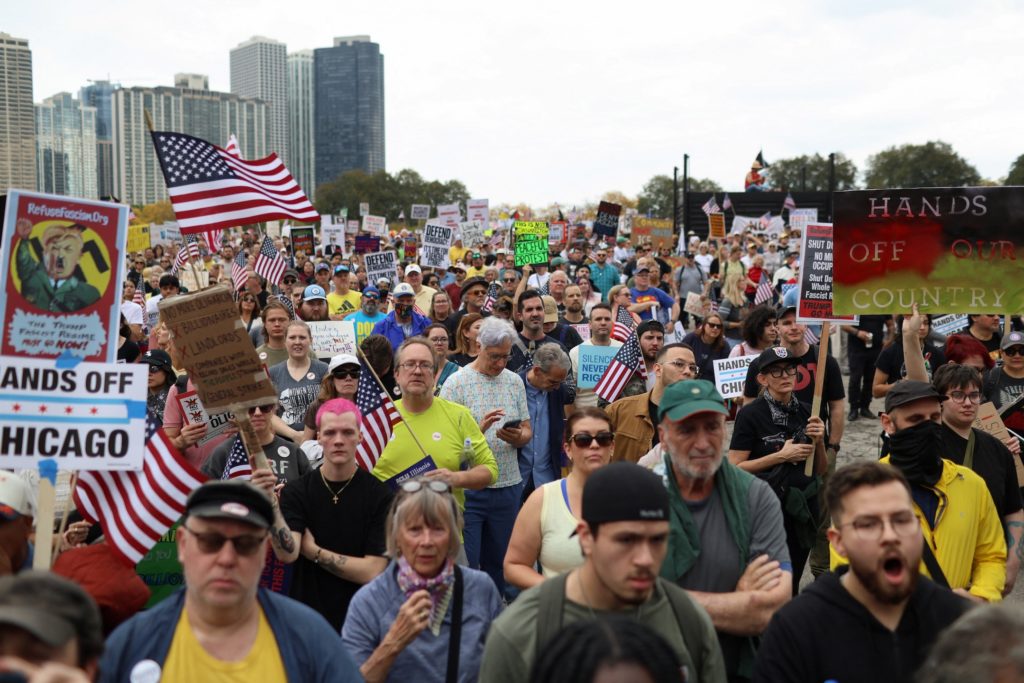
Millions turned out across the country Saturday for a coordinated day of protest against Trump and his administration’s policies. A similar event in June brought out more than 5 million demonstrators, but organizers say the mobilization was even bigger this time. Ali Rogin speaks with Robert Weissman, co-president of the consumer advocacy group Public Citizen, for more on the protests.
In a minutes-long strike Sunday inside the world’s most-visited museum, thieves rode a basket lift up the Louvre ’s facade, forced a window, smashed display cases and fled with priceless Napoleonic jewels, officials said.
Wildflowers are blooming in the Atacama Desert, an inhospitable stretch of land west of the Andes Mountains that normally gets just 2 millimeters of rain every year. But this July and August, a rare alignment of conditions led to a beautiful, fleeting burst of color that has drawn tourists and scientists alike. William Brangham reports.
On the afternoon of Feb. 12, Russell Vought, the director of the White House Office of Management and Budget, summoned a small group of career staffers to the Eisenhower Executive Office Building for a meeting about foreign aid. A storm had dumped nearly 6 inches of snow on Washington, D.C. The rest of the federal government was running on a two-hour delay, but Vought had offered his team no such reprieve. As they filed into a second-floor conference room decorated with photos of past OMB directors, Vought took his seat at the center of a worn wooden table and laid his briefing materials out before him.
Vought, a bookish technocrat with an encyclopedic knowledge of the inner workings of the U.S. government, cuts an unusual figure in Trump’s inner circle of Fox News hosts and right-wing influencers. He speaks in a flat, nasally monotone and, with his tortoiseshell glasses, standard-issue blue suits and corona of close-cropped hair, most resembles what he claims to despise: a federal bureaucrat. The Office of Management and Budget, like Vought himself, is little known outside the Beltway and poorly understood even among political insiders. What it lacks in cachet, however, it makes up for in the vast influence it wields across the government. Samuel Bagenstos, an OMB general counsel during the Biden administration, told me, “Every goddam thing in the executive branch goes through OMB.”
The OMB reviews all significant regulations proposed by individual agencies. It vets executive orders before the president signs them. It issues workforce policies for more than 2 million federal employees. Most notably, every penny appropriated by Congress is dispensed by the OMB, making the agency a potential choke point in a federal bureaucracy that currently spends about $7 trillion a year. Shalanda Young, Vought’s predecessor, told me, “If you’re OK with your name not being in the spotlight and just getting stuff done,” then directing the OMB “can be one of the most powerful jobs in D.C.”
During Donald Trump’s first term, Vought (whose name is pronounced “vote”) did more than perhaps anyone else to turn the president’s demands and personal grievances into government action. In 2019, after Congress refused to fund Trump’s border wall, Vought, then the acting director of the OMB, redirected billions of dollars in Department of Defense money to build it. Later that year, after the Trump White House pressured Ukraine’s government to investigate Joe Biden, who was running for president, Vought froze $214 million in security assistance for Ukraine. “The president loved Russ because he could count on him,” Mark Paoletta, who has served as the OMB general counsel in both Trump administrations, said at a conservative policy summit in 2022, according to a recording I obtained. “He wasn’t a showboat, and he was committed to doing what the president wanted to do.”
After the pro-Trump riots at the U.S. Capitol on Jan. 6, 2021, many Republicans, including top administration officials, disavowed the president. Vought remained loyal. He echoed Trump’s baseless claims about election fraud and publicly defended people who were arrested for their participation in the melee. During the Biden years, Vought labored to translate the lessons of Trump’s tumultuous first term into a more effective second presidency. He chaired the transition portion of Project 2025, a joint effort by a coalition of conservative groups to develop a road map for the next Republican administration, helping to draft some 350 executive orders, regulations and other plans to more fully empower the president. “Despite his best thinking and the aggressive things they tried in Trump One, nothing really stuck,” a former OMB branch chief who served under Vought during the first Trump administration told me. “Most administrations don’t get a four-year pause or have the chance to think about ‘Why isn’t this working?’” The former branch chief added, “Now he gets to come back and steamroll everyone.”
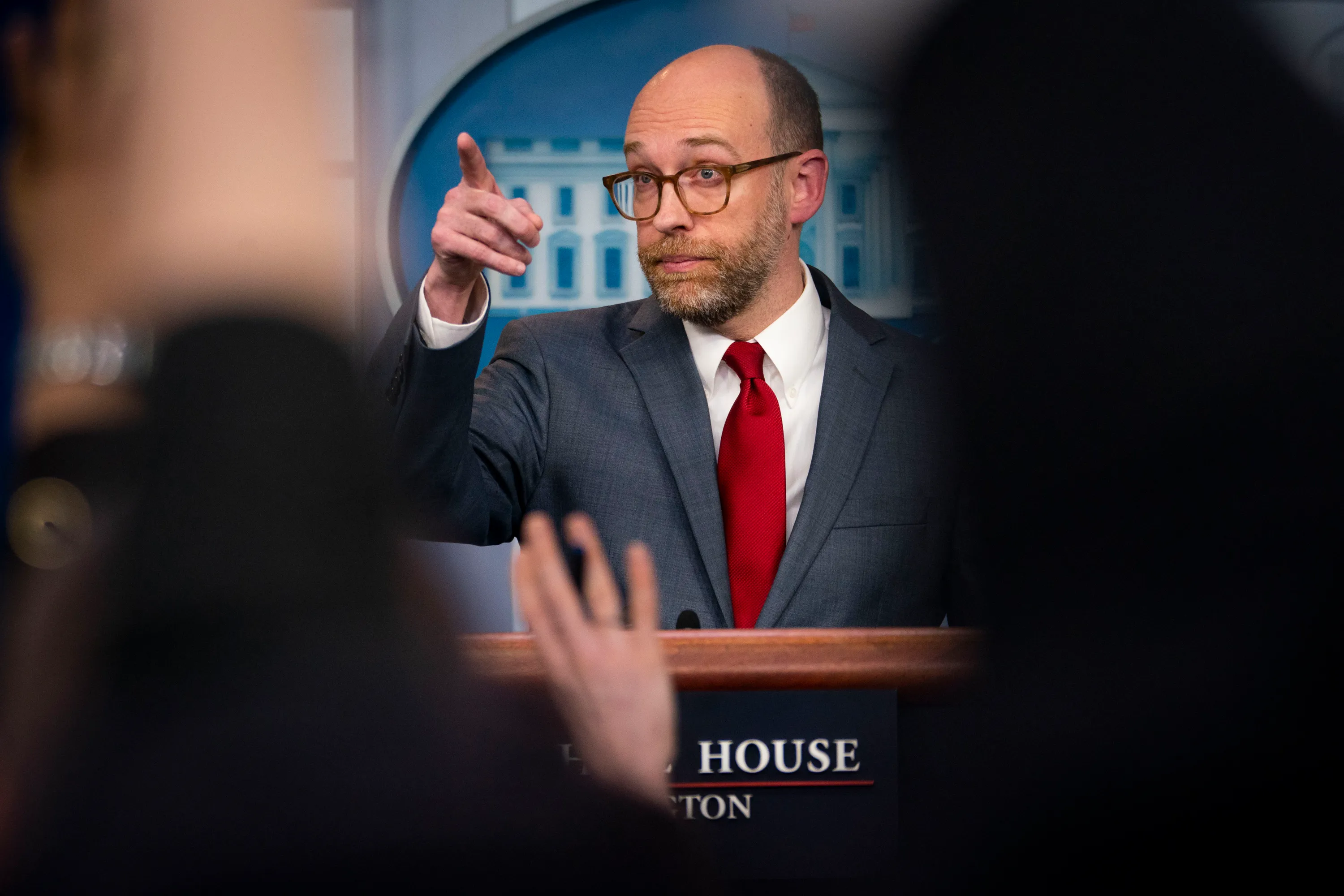
“The President loved Russ because he could count on him,” said OMB general counsel Mark Paoletta of Vought, seen at the microphone in the White House in 2019. Evan Vucci/AP Images
At the meeting in February, according to people familiar with the events, Vought’s directive was simple: slash foreign assistance to the greatest extent possible. The U.S. government shouldn’t support overseas anti-malaria initiatives, he argued, because buying mosquito nets doesn’t make Americans safer or more prosperous. He questioned why the U.S. funded an international vaccine alliance, given the anti-vaccine views of Trump’s nominee for secretary of Health and Human Services, Robert F. Kennedy Jr. The conversation turned to the United States Institute of Peace, a government-funded nonprofit created under Ronald Reagan, which worked to prevent conflicts overseas; Vought asked what options existed to eliminate it. When he was told that the USIP was funded by Congress and legally independent, he replied, “We’ll see what we can do.” (A few days later, Trump signed an executive order that directed the OMB to dismantle the organization.)
The OMB staffers had tried to anticipate Vought’s desired outcome for more than $7 billion that the State Department and the U.S. Agency for International Development spent each year on humanitarian assistance, including disaster relief and support for refugees and conflict victims. During the campaign, Trump had vowed to defund agencies that give money to people “who have no respect for us at all,” and Project 2025 had accused USAID of pursuing a “divisive political and cultural agenda.” The staffers proposed a cut of 50%.
Vought was unsatisfied. What would be the consequences, he asked, of a much larger reduction? A career official answered: Less humanitarian aid would mean more people would die. “You could say that about any of these cuts,” Vought replied. A person familiar with the meeting described his reaction as “blasé.” Vought reiterated that he wanted spending on foreign aid to be as close to zero as possible, on the fastest timeline possible. Several analysts left the meeting rattled. Word of what had happened spread quickly among the OMB staff. Another person familiar with the meeting later told me, “It was the day that broke me.”
What Vought has done in the nine months since Trump took office goes much further than slashing foreign aid. Relying on an expansive theory of presidential power and a willingness to test the rule of law, he has frozen vast sums of federal spending, terminated tens of thousands of federal workers and, in a few cases, brought entire agencies to a standstill. In early October, after Senate Democrats refused to vote for a budget resolution without additional health care protections, effectively shutting down the government, Vought became the face of the White House’s response. On the second day of the closure, Trump shared an AI-generated video that depicted his budget director — who, by then, had threatened mass firings across the federal workforce and paused or canceled $26 billion in funding for infrastructure and clean-energy projects in blue states — as the Grim Reaper of Washington, D.C. “We work for the president of the United States,” a senior agency official who regularly deals with the OMB told me. But right now “it feels like we work for Russ Vought. He has centralized decision-making power to an extent that he is the commander in chief.”
At the start of Trump’s second term, Elon Musk’s Department of Government Efficiency, which promised to slash spending and root out waste, dominated the headlines. A gaggle of tech bros, with little government experience, appeared to be marching into federal buildings and, with the president’s blessing, purging people and programs seen as “woke” or anti-Trump. The sight of Musk swinging a chainsaw onstage at a conservative conference captured the pell-mell approach, not to mention the brutality, of the billionaire’s plan to bring the federal government to heel.
But, according to court records, interviews and other accounts from people close to Vought, DOGE’s efforts were guided, more than was previously known, by the OMB director. Musk bragged about “feeding USAID into the wood chipper,” but the details of the agency’s downsizing were ironed out by Vought’s office. When DOGE took aim at obscure quasi-government nonprofits, such as the United States Institute of Peace, OMB veterans saw Vought’s influence at work. “I can’t imagine that the DOGE team knew to target all these little parts of the government without Russ pointing them there,” the former OMB branch chief told me. Vought also orchestrated DOGE’s hostile takeover of the Consumer Financial Protection Bureau, crippling a regulator that Republicans had hoped to shutter during Trump’s first term. “DOGE is underneath the OMB,” Michelle Martin, an official with Citizens for Renewing America, a grassroots group founded by Vought, said in May, according to a video of her remarks. “Honestly, a lot of what Elon began pinpointing … was at the direction of Russ.”
Vought, who declined to be interviewed for this story, voiced concerns about some of DOGE’s tactics — canceling budget items that the OMB had wanted to keep, for instance — but he mostly saw the department as a useful battering ram. An administration official who has worked with Vought and Musk told me that DOGE showed Vought it was possible to ignore legal challenges and take dramatic action. “He has the benefit of Elon softening everyone up,” the official told me. “Elon terrified the shit out of people. He broke the status quo.”
Vought is a stated opponent of the status quo. One of the few prominent conservatives to embrace the label of “Christian nationalist,” he once told an audience that “the phrasing is too accurate to run away from the term. … I’m a Christian. I am a nationalist. We were meant to be a Christian nation.” American democracy, he has said, has been hijacked by rogue judges who make law from the bench and by a permanent class of government bureaucrats who want to advance “woke” policies designed to divide Americans and silence political opponents. “The stark reality in America is that we are in the late stages of a complete Marxist takeover of the country, in which our adversaries already hold the weapons of the government apparatus,” Vought said in 2024, during a conference hosted by the Center for Renewing America, a nonprofit think tank that he also founded. “And they have aimed it at us.”
Listen to Vought Talk About Christian Nationalism
Obtained by ProPublica
The central struggle of our time, he says, pits the defenders of this “post-constitutional” order — what he calls the “cartel” or the “regime,” which in his telling includes Democrats and Republicans — against a group of “radical constitutionalists” fighting to destroy the deep state and return power to the presidency and, ultimately, the people. Vought counts himself as a member of the latter group, which, in his view, also includes right-wing stalwarts such as the political strategist Steve Bannon and Stephen Miller, the architect of Trump’s mass-deportation campaign. “We want the bureaucrats to be traumatically affected,” he said in a private speech in 2023. “When they wake up in the morning, we want them to not want to go to work, because they are increasingly viewed as the villains.”
Watch: “We Want the Bureaucrats to Be Traumatically Affected”
The ultimate radical constitutionalist, Vought says, is Donald Trump. In Vought’s view, Trump, the subject of four indictments during his time out of office, is a singular figure in the history of the American republic, a once persecuted leader who returns to power to defeat the deep state. “We have in Donald Trump a man who is so uniquely positioned to serve this role, a man whose own interests perfectly align with the interests of the country,” Vought said in his 2024 speech. “He has seen what it has done to him, and he has seen what they are trying to do to the country. That is nothing more than a gift of God.” As Bannon put it, sitting onstage with Vought at a closed-door conference in 2023, Trump is “a very imperfect instrument, right? But he’s an instrument of the Lord.”
In Vought’s vision for the U.S. government, an all-powerful executive branch would be able to fire workers, cancel programs, shutter agencies, and undo regulations that govern air and water quality, financial markets, workplace protections and civil rights. The Department of Justice, meanwhile, would shed its historical independence and operate at the direction of the White House. All of this puts Vought at the center of what Steve Vladeck, a law professor at Georgetown, described to me as the Trump administration’s “complete disregard” for the law. “The president has no authority to not spend money Congress has appropriated — that’s not a debate,” he told me. “The president has no authority to fire civil servants who are protected by statute — that’s not a debate.” He added, “We are seeing exertions of executive power the likes of which we have never seen in this country.”
Vought, who is 49, has spent his entire adult life in Washington. He met his wife, Mary, on Capitol Hill, where they both eventually worked for Mike Pence, at the time a Republican congressman from Indiana. (The Voughts divorced in 2023.) Yet, after nearly 30 years in the nation’s capital, he still views himself as an outsider. He once described his upbringing, in Trumbull, Connecticut, as “blue collar” and his parents as part of America’s “forgotten men and women.”
Vought’s father, Thurlow, served in the Marines and worked as an electrician. His mother, Margaret, spent more than 20 years as a schoolteacher and administrator. Before they married each other, Vought’s parents had both been widowed in their 30s and left to raise families on their own; Russ was their only child together. In 1981, when Russ was 4, one of Thurlow’s daughters died in a car crash. Not long after the accident, Thurlow had a religious awakening. “That completely changed the direction of our immediate family,” one of Vought’s half sisters later wrote on social media.
Vought as a senior in the 1998 yearbook of Wheaton College Obtained by ProPublica
Vought’s mother helped launch a Christian school, where the curriculum relied heavily on the Bible. One history book the school considered using included the instruction to “Defend the statement that all governmental power and authority come from God.” America was built on Judeo-Christian values, she told a local newspaper, and if the American people gave up on those values “then they’re going to have to pay the price based on sin, sickness, disease and anarchy.”
Vought attended a private Christian high school, then went to Illinois to study at Wheaton College, which is known as the “evangelical Harvard.” He moved to Washington after graduation and, in 1999, landed a job in the office of Phil Gramm, a Republican senator from Texas. Vought, who started in the mailroom, would later say that working for Gramm laid the “conservative foundation” for the rest of his life.
Gramm was an uncompromising budget hawk. He was famous for the “Dickey Flatt test,” named after a printer Gramm knew in Texas. For every dollar of federal spending, Gramm said, lawmakers must ask themselves: Did it improve the lives of people like Dickey Flatt? (In Gramm’s estimation, the answer was often no; every year, he introduced legislation designed to ruthlessly slash the budget.) Years later, when Vought testified before Congress, he said that people like his parents “have always been my test for federal spending. Did a particular program or spending increase help the nameless wagon pullers across our country, working hard at their job, trying to provide for their family and future?”
Under Gramm’s tutelage, Vought developed a reputation as a master of the arcane rules that can get legislation passed or killed. He climbed the ranks of the Republican Party, going on to advise Pence, who was then the leader of the House Republican Conference. But the closer Vought got to the center of congressional power, the more disillusioned he became. In the late 2000s, when Republican lawmakers, who professed to care about deficits and balanced budgets, voted in favor of bills loaded with corporate giveaways and pork-barrel spending, Vought felt that they were abandoning their principles and duping their constituents. He later recalled of this time, “I would say, ‘If there’s an opinion in this leadership room, I’m telling you it’s 95% wrong.’” A former Capitol Hill colleague of Vought’s told me, “I think he thought the Republican leadership was a bigger impediment to conservative causes than Democrats were.”
In 2010, Vought quit working for House Republicans and helped launch Heritage Action for America, an offshoot of the influential conservative think tank Heritage Foundation. The foundation was known for dense policy papers and its voluminous “Mandate for Leadership” governing guide. Heritage Action had a different purpose — to strong-arm Republicans in Congress into acting more conservatively.
Vought was instrumental in turning Heritage Action into the interest group that congressional Republicans feared most. He picked fights with party leaders over agriculture subsidies and greenhouse gas regulations, and published a scorecard that rated how lawmakers voted on key bills. In Heritage Action’s first year, according to a person familiar with Vought’s work there, he came up with an idea for a mailer that attacked Bob Corker, a Republican senator from Tennessee, for his vote to approve a nuclear weapons treaty with Russia. The mailer featured a photograph of Corker alongside images of Barack Obama, Vladimir Putin and the Iranian leader Mahmoud Ahmadinejad. Heritage Action’s tactics so infuriated the Republican leadership that Sen. Mitch McConnell called on Heritage donors to stop funding the group. (McConnell did not respond to a request for comment.)
In 2013, Heritage Action announced a campaign to defund the Affordable Care Act. Vought and his colleagues toured the country, whipping up the grassroots, and poured millions of dollars
into advertisements and lobbying. They wanted Republicans in the House and the Senate to insist that any spending bill passed to avert a shutdown must also defund Obamacare. The Republican lawmakers who embraced the strategy came to be known as the “suicide caucus,” and their protest led to a 16-day government shutdown. In the end, Republican leaders cut a deal to reopen the government, leaving Obamacare intact.
Heritage Action saw the 2016 presidential election as an opportunity to put a true conservative back in the White House. The group’s CEO, Michael Needham, openly supported Sen. Ted Cruz, of Texas, who, three years earlier, had helped orchestrate the shutdown. Trump, at least initially, was treated with disdain. During an appearance on Fox News in 2015, Needham called him a “clown” who “needs to be out of the race.”
Vought and Trump couldn’t have been more different: One was a deacon at his Baptist church; the other was a twice-divorced philanderer who had been caught on camera bragging about grabbing women “by the pussy.” But, after Trump won the election, Vought was offered a job as a senior adviser at the OMB, where he’d dreamed of working since his days in Phil Gramm’s office. Years later, Vought would say that, at the time, he had no ambition of one day running the agency. He had planned to help with the transition and some of the OMB’s early efforts, then go to seminary to become a pastor. But, he later said in a podcast interview, “God had other plans.”
In March 2017, Trump signed an executive order that called for a top-to-bottom reorganization of the federal government. Mick Mulvaney, a former congressman, served as Trump’s first budget director, but, inside the OMB, Vought took the lead. According to a former senior staffer at the agency, Vought initially pushed for the president’s plan to eliminate USAID and the Consumer Financial Protection Bureau. He also wanted to fold the Department of Health and Human Services, along with food stamps programs, into a new Department of Health and Public Welfare. “They wanted to call it that because they think it sounds bad,” a former OMB analyst told me. In one meeting, according to a person in the room, Vought asked, “Why do we do economic assistance abroad at all?” The former OMB analyst said, “There were very few, if any, debates where Russ wouldn’t take the most extreme option available to him, the most conservative, the most budget-cutting.”
Trump’s Cabinet secretaries resisted wholesale cuts. The former senior staffer recalled, “The general counsels at these agencies are calling the White House counsel and saying, ‘We’re not trying to introduce legislation to delete ourselves, are we?’” Few of the recommendations in Vought’s final reorganization plan, which was released in 2018, were implemented. But the document now reads like a guide to the second Trump administration. “I didn’t realize it then,” the former OMB senior staffer told me, “but I was writing the first draft of Project 2025.”
Vought increasingly clashed with the OMB’s staff over proposed cuts to popular programs. Meals on Wheels, the food delivery program, was a topic of intense debate. Even after OMB staff explained how the program, which received more than $900 million in funding from Congress, acted as a lifeline for homebound seniors, Vought and Mulvaney pushed for major cuts that would have hobbled its operations, according to the former OMB senior staffer. The staffer added that it was often hard to reconcile Vought’s deeply held Christian faith — he hosted a prayer session for select colleagues — with his eagerness to cut programs that helped the vulnerable. “It always struck me as a strange thing,” the person said. “There’s compassion, but it only extends to certain people.”
In 2018, Mark Paoletta, a former attorney in the George H.W. Bush White House, joined the OMB as general counsel. Paoletta was best known for publicly defending Clarence Thomas, who, during his Supreme Court confirmation hearing, in 1991, was accused of sexual harassment by his former colleague Anita Hill. Paoletta had worked on Capitol Hill, then entered private practice, where he advised politicians under scrutiny by Congress. Paoletta and Vought quickly forged an alliance. The former OMB branch chief told me that the office’s culture changed after Paoletta arrived. “There was a shift that we were all deep state,” he said. “They thought we were pushing back because we had our own leftist-leaning agenda.” (Paoletta declined to comment.)
It was Vought’s idea to use an obscure budgetary maneuver called a rescission to claw back funds that Congress had already appropriated, according to Paoletta’s remarks at the conservative policy summit. In 2018, at Vought’s urging, Trump sent Congress the largest rescission request in decades, asking lawmakers to roll back more than $15 billion, including money for USAID’s Ebola response, the Children’s Health Insurance Program and an Energy Department loan program for auto manufacturing. OMB employees “looked at us like we were crazy,” Paoletta said. “They just thought it was something they didn’t do.” Once again, Vought’s own party thwarted him: The measure failed by a single vote in the Republican-held Senate.
Vought also encountered resistance inside the White House. When Congress refused to give Trump billions in funding to construct new border fencing, Vought and Paoletta devised a novel strategy. Trump could declare a national emergency at the U.S.-Mexico border, giving him the authority to seize money from other parts of the government. According to Paoletta, John Kelly, the president’s chief of staff, kept the plan from Trump. Paoletta said that Kelly’s message to the OMB was “We don’t want to tell the president he has that authority, because God knows what he’ll do.”
Eventually, Trump badgered Mulvaney, the OMB director, to find him the money for his wall. Mulvaney told the president that he’d been trying to meet with him about the issue, but that Kelly had blocked him. Within days, Trump replaced Kelly with Mulvaney. Vought took over as the acting director of the OMB, and money from the Defense Department was tapped to fund the wall. (Kelly did not respond to requests for comment.)
Under Vought, the OMB produced budgets that called for more cuts than any in modern history. Congress all but ignored them. A former staffer in the OMB’s legislative affairs office recalled that Republicans didn’t believe Trump cared about the sweeping reductions included in his own annual budgets. “They kept saying, ‘The president’s not really pushing this or that cut — that’s a Russ Vought thing, isn’t it?’” the legislative affairs staffer said.
Vought in 2019, a few months before he agreed to freeze hundreds of millions of dollars in security assistance to Ukraine, a step that helped lead to Trump’s first impeachment Doug Mills/The New York Times/Redux
In July 2019, Trump asked the OMB to freeze hundreds of millions of dollars in security assistance to the government of Ukraine. The request coincided with a phone call Trump had with President Volodymyr Zelenskyy in which Trump pressured him to investigate Biden and Biden’s son Hunter, who had served on the board of a Ukrainian energy company. The money for Ukraine had already been approved by Congress, but Vought agreed to hold back the funds. Paoletta signed off on a memo authorizing the freeze. Under the law, the move was known as an impoundment. (The Government Accountability Office, an independent nonpartisan agency, later deemed it illegal.)
Any fan of “Schoolhouse Rock!” knows that the first job assigned to Congress in the Constitution is the power of the purse. The president, meanwhile, must “take Care that the Laws be faithfully executed,” according to Article 2 of the Constitution. Most legal scholars interpret this to mean that the president’s duty is to spend the money Congress appropriates, and that the president does not have the power to withhold funds. In 1969, William Rehnquist, the conservative future Supreme Court chief justice, wrote that the impoundment power was “supported by neither reason nor precedent.”
The question of impoundment’s legality came to a head in the 1970s, when President Richard Nixon withheld billions in congressionally approved funds for environmental cleanup efforts. Courts undid Nixon’s actions, and Congress eventually passed the Impoundment Control Act of 1974, which outlawed the maneuver, leaving only narrow exceptions — rescissions — that required congressional sign-off. (Democrats are calling for restrictions on the rescission process as part of the current shutdown negotiations.) Over the years, the Impoundment Control Act would come to be viewed as sacrosanct at the OMB. That didn’t stop Vought. “I had been personally told, ‘Look, I want the money cut off until we can figure out where it’s going,’” Vought later said of the Ukraine funding in an interview with the conservative commentator Tucker Carlson. “It was like all hell broke loose within the bureaucracy.”
The impoundment triggered congressional investigations and, ultimately, Trump’s first impeachment. (Ukraine eventually received the money.) Vought refused to cooperate with investigators, calling the probe a “sham process that is designed to relitigate the last election.” One of the impeachment articles named Vought, saying that the president had pressured him and others not to respond to subpoenas. Trump, for his part, continued to express support for impoundment, calling it the “secret weapon” that could tame the “bloated federal bureaucracy.”
In early 2021, on one of the final days of Trump’s first term, Vought visited him in the Oval Office. Both men felt a sense of unfinished business, Vought would later recall. Only a few months earlier, when Vought was sworn in as the OMB director, Trump had told him that, after 3 1/2 years as president, he had finally got the hang of the job. “Russ, we’ve got to get another term,” Trump said. “We finally figured out how to do this.”
Vought, frustrated by what he saw as years of obstruction by civil servants, had recently pushed through a new policy to vastly expand the number of at-will employees in the government, making them easier to fire. But the COVID-19 pandemic had dashed any chance of leaving the government smaller than he’d found it. Trump had signed trillion-dollar stimulus bills to prop up the American economy; by the time he left office, the national debt had swelled by $7.8 trillion. After the violence on Jan. 6, a second Trump term looked less likely than ever. Vought, however, had not given up hope.
Before Vought, second from left, departed at the end of Trump’s first term, the president asked him to find a way to counter the Black Lives Matter movement. As Vought would later say, “I’m the budget guy. If I can talk about race, you can talk about race.” Brendan Smialowski/AFP/Getty Images
In the Oval Office, he told Trump that he would soon launch a new political operation that would keep the MAGA movement alive while attacking the policies of the incoming Biden administration. Trump blessed the venture, with one request. That summer, in the wake of George Floyd’s murder, national protests had forced a racial reckoning in the country. Trump wanted Vought, who as OMB director had scrubbed training materials for federal employees of any references to “white privilege” and “systemic racism,” to find a way for conservatives to push back against the Black Lives Matter movement. “This was an assignment I was given from President Trump,” Vought later recalled. “I’m the budget guy. If I can talk about race, you can talk about race.”
Listen to Vought: “If I Can Talk About Race, You Can Talk About Race”
Obtained by ProPublica
A few days after Trump left office, Vought announced the launch of the Center for Renewing America, a MAGA think tank that aspired to act as an incubator for future Republican administrations. Its activist arm, Citizens for Renewing America, would mobilize grassroots supporters to pressure elected officials to embrace the think tank’s agenda. The overarching goal, Vought wrote in an op-ed for The Federalist, was to “restore an old consensus in America that has been forgotten, that we are a people For God, For Country, and For Community.”
At the Center for Renewing America, Vought surrounded himself with other radical constitutionalists from the first Trump administration. He brought on Jeffrey Clark, the Justice Department official who had tried to use his agency to help Trump overturn the 2020 election. (A D.C. disciplinary board recently recommended that Clark, who now works at the OMB, lose his law license as punishment for those efforts, an outcome that Clark is appealing and that his lawyer called a “travesty of justice.”) Kash Patel, Trump’s current FBI director, and Ken Cuccinelli, a top immigration official in the first Trump administration, joined as senior fellows. Working at the center, Cuccinelli explained at the conservative policy summit, allowed him to “stake out the outer boundary of reasonable constitutional law.”
The Center for Renewing America’s ideas included how the president could invoke the Insurrection Act to deploy military troops to American cities to put down protests, how the White House could freeze billions in federal funding without waiting for a vote in Congress, and how agency leaders could defy government unions and fire workers en masse. The think tank also set out to create shadow versions of the OMB and of the Justice Department’s Office of Legal Counsel to anticipate legal challenges and counter internal pushback. In his 2024 address, Vought explained, “I don’t want President Trump having to lose a moment of time having fights in the Oval Office about whether something is legal or doable or moral.”
Vought and his colleagues at the center also worked closely with the House Freedom Caucus to urge other congressional Republicans to use government shutdowns as a way of forcing through major policy changes. One of their first targets was critical race theory, a once obscure academic concept that had become a flashpoint during the 2020 racial justice protests.
According to previously unreported recordings of briefings held by Citizens for Renewing America, Vought said that he had pressured members of the Freedom Caucus to yoke a ban on critical race theory to must-pass bills on raising the debt limit and funding the government. “We have to have a speaker that goes into these funding fights with a love for the shutdowns,” Vought said during a November 2022 briefing call, “because they create an opportunity to save the country.”
But Republicans never shut down the government during the Biden presidency, and Vought grew increasingly frustrated with them for not using more aggressive tactics. On one briefing call, he praised Cori Bush, a progressive Democrat from Missouri, after she camped out for several days on the Capitol steps to protest the end of a pandemic-era moratorium on evictions. Vought called her politics “very, very bad,” but he admired her methods: “We need this from Republicans.”
The centerpiece of Vought’s work during the Biden years was his campaign to popularize the concept of “woke and weaponized” government. The tagline brought together two of Vought’s rallying cries: “woke” policies, like diversity, equity and inclusion efforts and transgender rights, and a “weaponized” FBI and Justice Department that had allegedly been wielded against the Democrats’ political enemies, including, most notably, Trump. When the Center for Renewing America released a federal budget blueprint in late 2022, calling for nearly $9 trillion in cuts in the course of 10 years, the word “woke” appeared 77 times across 103 pages.
Jessica Riedl, a budget expert who works for the conservative Manhattan Institute, told me that it was “just silly” to claim, as the Center for Renewing America’s budget did, that Veterans Affairs, the Occupational Safety and Health Administration, and farm subsidies required enormous cuts for being too woke. “It’s a way to dress up spending cuts that aren’t popular on their own merits,” Riedl said. Vought described his framing as an attempt to “change paradigms.” “We have to be able to defund agencies,” he said in the private speech in 2023. “That is why these things have to be indelibly linked, and that is why we are focussing so much on ‘woke and weaponized.’”
Listen to Vought Talk About Using the Phrase “Woke and Weaponized”
Obtained by ProPublica
Any hope that Vought had of implementing his ideas in a second Trump administration nearly ran aground last summer. He had written a chapter of Project 2025’s 887-page report, arguing for an expansion of executive power that would put the Justice Department and other traditionally independent agencies fully under presidential control. Center for Renewing America fellows had written two more chapters in the report. But, as Election Day neared, Project 2025 became a liability for the Trump campaign. Polls showed that a majority of Americans opposed its most aggressive proposals, including removing the abortion drug mifepristone from the market, eliminating the Department of Education and implementing Vought’s plan to more easily fire nonpolitical federal workers. As criticism of Project 2025 grew, Trump insisted that he knew “nothing” about it, while also claiming that “some of the things they’re saying are absolutely ridiculous and abysmal.”
The month before the election, Politico reported that Donald Trump Jr., had compiled a list of people who would not be allowed to serve in a second Trump administration, including a number of leading contributors to Project 2025. But, according to a former Trump campaign official with close ties to the White House, Vought deftly navigated the controversy. “Russ is a consummate team player,” the official told me. “He was the one person at Project 2025 that we could have a conversation with during the course of the campaign.”
A week after Trump’s victory, the president-elect announced his plans for the Department of Government Efficiency. “It will become, potentially, ‘The Manhattan Project’ of our time,” Trump said in a statement. He tapped two of his biggest backers to run it: Elon Musk, who had donated nearly $300 million to help elect Trump and other Republicans, and the biotech entrepreneur Vivek Ramaswamy, who briefly ran for president on an anti-woke platform. Two days after the announcement, Vought met with Musk and Ramaswamy at Mar-a-Lago. Vought and Musk “hit it off,” according to The New York Times; both were “on the same wavelength in terms of taking the most extreme action possible.” Soon after the meeting, Trump nominated Vought to run the OMB.
One of DOGE’s first targets was the Consumer Financial Protection Bureau. The CFPB had first been proposed by Sen. Elizabeth Warren, who, as a law professor, argued for the creation of a regulator that could protect Americans from predatory mortgages and hidden fees. Created by law in the wake of the 2008 financial crisis, the bureau developed a reputation as an aggressive enforcer of fair lending and consumer protection laws. The bureau’s work has led to nearly $20 billion in direct relief to consumers and $5 billion in civil penalties for alleged wrongdoing. For Vought, the bureau embodied the gross regulatory overreach that he loathed; outside of government, the agency’s biggest foes, Wall Street and Silicon Valley, were major funders of Trump’s second campaign.
On Feb. 7, Trump named Vought the bureau’s acting director, a role he would perform on top of his duties at the OMB. That morning, a small team of DOGE staffers arrived at the CFPB’s headquarters. According to previously unreported emails and depositions, the members of DOGE took orders from Vought as they disabled the CFPB’s website and decided which of the agency’s employees to fire. Musk weighed in on X: “CFPB RIP.”
Trump had targeted the CFPB during his first term. “There were days in Trump One where it felt like we were getting punched in the face,” one longtime employee told me. Over time, however, the president seemed to lose interest, and the CFPB’s last director under Trump, a political appointee named Kathy Kraninger, supported the bureau’s mission. In 2020, under Kraninger, the CFPB filed the second-highest number of enforcement actions in its nearly 10-year existence.
Current and former CFPB staff told me that they assumed a second Trump administration would look like the first one. “Generally, we thought there would be a conservative agenda we’d be handed, and we’d figure out how to enact it,” the veteran employee said. Soon after taking over, Vought informed Jerome Powell, the chair of the Federal Reserve, which funds the CFPB, that the agency would not need any more money. He barred CFPB employees from doing most types of work and told them not to go to the office. When confusion arose over what duties, if any, remained for the staff to do, Vought clarified the matter in a Feb. 10 email, telling employees to “stand down from performing any work task.”
In the following weeks, Vought and Paoletta stopped oversight activities, quashed ongoing investigations and froze active enforcement cases, which included matters involving some of the largest banks in the nation, such as JPMorgan Chase, Bank of America and Capital One. Rohit Chopra, the bureau’s director under Biden, said that Vought’s actions had put the CFPB “in a coma.” The bureau’s top enforcement officer resigned in June, writing in a letter to colleagues that the CFPB’s leadership “has no intention to enforce the law in any meaningful way.”
The final blow came when Vought announced a plan to lay off more than 80% of the CFPB’s employees. A federal appeals court ruled in August that the mass-firing plan could proceed. It took Vought four months to accomplish what the previous Trump administration had been unable to do in four years.
The unwinding of the CFPB, however, was quickly overshadowed by another Vought victory. That same month, he completed his assault on foreign aid. Secretary of State Marco Rubio, who had been running what was left of USAID, announced that, with Trump’s approval, he had empowered Vought to officially eliminate the agency. “Russ is now at the helm to oversee the closeout of an agency that long ago went off the rails,” Rubio announced. “Congrats, Russ.”
Vought’s agency is “like a giant funnel that everything has to go through in order to happen,” a former OMB employee said. “You can get agencies to agree to things just to get the funnel to open back up.” Kenny Holston/The New York Times/Redux
Four months before the 2024 election, the Center for Renewing America had welcomed a small group of congressional staffers to its headquarters, a few blocks from the Capitol. Some of them worked for the House and Senate budget committees, which every year help set spending levels for the federal government. The purpose of the meeting was to brief the staffers on the center’s latest policy fight — an attempt to build the case for the use of impoundment.
At the briefing, Paoletta argued that the Impoundment Control Act was unconstitutional. Spending laws passed by Congress were a ceiling, not a floor, Paoletta argued, according to a person in the room. In that view — which most legal experts dismiss as a fringe position — the White House is not permitted to spend more than a law calls for, but it has the power to spend far less. “Congress passes statutes episodically, and often with conflicting purposes and demands,” Paoletta later wrote in an essay for the Center for Renewing America. “It is left to the President and his subordinates to harmonize their execution in a coherent manner.”
According to Democrats on the House Appropriations Committee, the Trump administration has since frozen or canceled more than $410 billion in funding on everything from energy subsidies for low-income households and Head Start after-school programs to President George W. Bush’s HIV-reduction initiative, PEPFAR, and artists’ grants from the National Endowment for the Humanities. Vought directed the National Institutes of Health to withhold — illegally, according to the Government Accountability Office — an estimated $15 billion in grants for outside research projects. The NIH also moved to cap funding for so-called indirect costs, which research universities rely on to pay for their buildings, utilities and administrative staff. Scientists I interviewed said that these cuts would inevitably lead to less medical research, including into a drug that Vought’s ex-wife credited with improving the life of their 11-year-old daughter, who was born with cystic fibrosis. A scientist who receives government funding to study cystic fibrosis treatment told me that, without sufficient money for indirect costs, “we probably won’t be able to do the research and will have to relinquish the grants.”
The OMB claims that it is vetting federal spending to ensure that the money does not fund “woke” programs. “We can confirm that President Trump and Director Vought are carefully scrutinizing spending that has previously run on autopilot or worse — toward transing our kids, the Green New Scam, and funding our own country’s invasion — just as the president promised,” an OMB spokesperson told the Times in August. But blocking funds is also a way to pressure officials and agencies to comply with the administration’s demands. “OMB is like a giant funnel that everything has to go through in order to happen,” Lester Cash, a former OMB employee, told me. “You can get agencies to agree to things just to get the funnel to open back up.”
In March, the OMB took down a legally mandated public website that made it possible to track the funding freezes. The move elicited a rare show of bipartisanship. In a letter to Vought, the Democratic and Republican leaders of the House and Senate appropriations committees urged him to “restore public access to apportionment data in accordance with statute.” Vought said the information listed on the site was “predecisional” and a risk to national security. The OMB restored the site only when a judge ruled that taking it down was illegal, saying that the government’s position relied “on an extravagant and unsupported theory of presidential power.”
The OMB’s funding freezes have wreaked havoc. On June 30, the Department of Education told state agencies that congressional appropriations for after-school activities and English-as-a-second-language instruction would not arrive the next day, as planned. The unexpected shortfall affected thousands of school districts, which served millions of students, in all 50 states. The administration only backed down after both Democrats and Republicans criticized the move. “When something’s been appropriated, signed into law, and people are writing contracts based on the commitment of the federal government, and then they don’t know if they’re going to get it or not, it creates such chaos,” Don Bacon, a Republican House member from Nebraska, told me. “I’m not sure what the OMB director thought he was doing.” (A spokesperson for Vought at the OMB would not comment on the record in response to a detailed list of questions.)
Vought faces senators this summer during an Appropriations Committee hearing on the administration’s proposed $9 billion rescission, which was later voted into law, of foreign aid and the Corporation for Public Broadcasting. Graeme Sloan/Sipa USA/Reuters
In June, Trump sent a rescission request to Congress, seeking to cancel roughly $9 billion in funding for foreign aid and for the Corporation for Public Broadcasting, which supports NPR, PBS, and other public radio and TV stations nationwide. The programs were viewed, the senior agency official told me, as “soft targets,” a test to see if Vought could persuade Republicans to put aside their concerns about undermining Congress’ power of the purse. Unlike in Trump’s first term, Vought’s rescission plan succeeded. The measure, which faced opposition from Democrats and a few Republicans, passed after Vice President JD Vance cast two tie-breaking procedural votes. Jeff Merkley, the top Democrat on the Senate Budget Committee, told me, “You’ve basically said to Congress, ‘Hey, compromise all you want, but we’re going to undo that in the way we want as soon as you’ve signed the bill.’”
On the Friday before Labor Day, Vought made his most audacious move yet. The White House sent Congress a new rescissions package, targeting nearly $5 billion in foreign aid. But this time Vought informed lawmakers that he didn’t need their approval. He asserted that the president could make the request, putting a temporary freeze on the funds, then simply wait for the fiscal year to expire, on Sept. 30, at which point the money would be canceled out. Vought called it a “pocket rescission,” but it was impoundment by another name. Susan Collins, a Republican from Maine, who chairs the Senate Appropriations Committee, said it was a “clear violation of the law.”
The Government Accountability Office can sue the OMB over an impoundment or pocket rescission to get the money released. In April, Gene Dodaro, who leads the Government Accountability Office, testified that his office had opened 39 investigations into potential violations of the Impoundment Control Act by the Trump administration. The OMB has responded by attacking Dodaro’s agency. In one letter, Paoletta said that the OMB would cooperate with the Government Accountability Office only if its demands didn’t get in the way
of Trump’s agenda. In another letter, Paoletta told the Department of Transportation to ignore a Government Accountability Office ruling that found that the OMB had illegally impounded money for electric car development. Vought, for his part, has flatly declared that the Government Accountability Office “shouldn’t exist.”
Vought’s actions could provoke a challenge to the Impoundment Control Act in the Supreme Court. In the meantime, a number of current and former government employees told me that they worried about the long-term consequences of what he has already done: the terminating of vital research projects that could have led to lifesaving breakthroughs, the nation’s lost standing as an international leader, the uncertainty cast over the fundamental workings of government. “They’ve given up on the idea that they need to persuade anybody,” Bagenstos, the former general counsel at the OMB, said of Vought and Paoletta. They’re “just going to use brute force and dominance.” As the former OMB analyst told me, “They’ve dropped a grenade into the system.”
The government shutdown has illustrated, in the starkest terms, Vought’s expansive theory of executive power and his willingness to ignore Congress. On Oct. 2, Trump posted on Truth Social that he would meet with Vought to decide which “Democrat Agencies” to cut on a temporary or permanent basis. A few days later, the OMB released a memo claiming that, seemingly in defiance of a 2019 law, furloughed federal employees were not guaranteed back pay following a shutdown. Then, on Oct. 10, Vought announced that his campaign of mass firings across the bureaucracy had begun. So far, more than 4,000 employees have been laid off, disrupting government services devoted to, among other things, cybersecurity efforts, special education programs, substance abuse treatment and loans for small businesses. A federal judge put a temporary stop to the cuts, but that same day Vought predicted that the total number of firings would be “north of 10,000.” As one official texted me, “Trauma achieved.”
NEW YORK—Expressing gratitude for the opportunity to correct the record against his opponents, current New York City mayor and former candidate for reelection Eric Adams reportedly said “Thank you for that question” Thursday to a group of rats he had captured and forced to act out a private debate in his Gracie Mansion bedroom. “It’s interesting you ask me that, Mr. Moderator—I certainly would have to say that the best part of New York is its people,” said Adams, who paused to grab one of the rats he had sewn into a tiny suit and tie, repositioning it behind a small cardboard podium before it could scurry away. “What was that? Why, yes, I did have a wonderful trip to Albania. I met with many business leaders to discuss new opportunities for New York. I’m happy to talk about these things, unlike some of the politicians on this stage, who are too busy nibbling on their cheese cubes to bother answering your questions.” After the debate ended, sources confirmed Adams was furious with the poor polling among the cockroaches he had dressed up as constituents.
Young Republican leaders sparked bipartisan condemnation over a leaked cache of thousands of racist, antisemitic, and homophobic texts, with Vice President JD Vance dismissing the messages as mere jokes. What do you think?
“I’m happy to see young Republicans still care about upholding traditional conservative values.”
Wes Turner, Glitter Packager
“As a Republican, I’m disgusted to see there’s a group chat saying these things without me.”
Elijah Davis, Litigation Enthusiast
“Your future shouldn’t be ruined over dumb stuff you said when you were Republican.”
LOS ANGELES – After sixteen years, comedian, actor, and aggravated cat owner Marc Maron has taken a bold step into the unknown by turning off his microphone and not hosting a podcast. “Look, I’m a recovery guy,” said the former host of WTF with Marc Maron. “One day you wake up and you realize you’re […]
“The U.S. Supreme Court, hearing arguments Wednesday over a core provision of the Voting Rights Act, appeared inclined to limit the use of the landmark law to force states to draw electoral districts favorable to minority voters.” — AP News
- - -
The Supreme Court appears poised to deliver yet another win for the US Constitution by striking down a key provision of the Voting Rights Act of 1965 that prohibits race-based discrimination when drawing legislative district maps. America no longer has a problem when it comes to voters of certain races being disenfranchised, and you can tell it’s not an issue by how great race relations are in America right now.
The Voting Rights Act was passed back when America was a far more racist country. These days, race only ever comes up in fun, joking ways. Like when the president shares a meme of the Speaker of the House wearing a sombrero (to signal how much the president loves Latinos). Or when young Republican Party leaders praise Hitler, call Jews liars, and joke about sending their opponents to the gas chamber (totally innocent examples of a popular Gen Z ironic humor trend called “Nazi-maxing”). Or when that same group uses slurs like “n***uh” and “n***a” 251 times in a group chat (clearly meant as terms of endearment; the only “hard R” conservatives use is the “R” in “Republican”).
If anything, America had gone too far the other way and was starting to be racist against white people. Thankfully, Donald Trump put a stop to that by ending DEI hiring practices once and for all. Now, corporations and government agencies are taking jobs away from Black and brown people and giving them to white men. And if that isn’t a sign America is on the right track with racism, then I don’t know what is.
The Voting Rights Act was designed to protect voting rights for people of all races, as enshrined by the Fourteenth and Fifteenth Amendments. That meant that states couldn’t use gerrymandering to disenfranchise voters of a certain race. But to correct for this, states would need to consider race when drawing congressional maps. Therefore, it would actually be racist to prevent states from drawing racist congressional maps. And if that sounds like circular reasoning, then you clearly aren’t as well-versed in the ins and outs of the Constitution as Supreme Court Justice Clarence Thomas. He’s a shining example of how to make level-headed decisions regardless of the impact it might have on people of your same race.
Striking down the Voting Rights Act will finally enable states to run elections without the burden of federal overreach. For example, elections are very expensive to run, and taxpayers shouldn’t have to foot the bill. Now, states will be free to levy a poll tax on voters to cover the cost of election infrastructure. If voters have to pay $5,000 to vote in state and federal elections, that’ll only ensure that they’ll treat the process with the seriousness it deserves.
Along those same lines, states will also be able to ensure that only voters who have attained the level of education required to make informed decisions at the ballot box are allowed to cast a vote. They’ll be able to prescreen voters with important questions like “Who won the Masters in 1980?” or “What’s your favorite Lee Greenwood song?”
Once this law is struck down, states will finally have free rein to redraw their congressional maps as they see fit. If, from now on, voters exclusively elect white male Republicans, that’s just proof of who voters want running the country. And if you don’t like your choices, you’re always welcome to stay home. Besides, if you’re not willing to cough up five grand and recite the lyrics to “God Bless the USA” from memory while swearing on a Trump Bible, then you clearly didn’t deserve to vote in the first place.
NEW YORK—Casting doubt on the mayoral candidate’s ability to effectively carry out the duties of the office, critics assailed New York State Rep. Zohran Mamdani Friday for refusing to share his plan to make the rich richer. “Despite repeated calls to release his four-year plan for growing the coffers of our city’s wealthy elite, Mamdani has so far offered few specifics on how he would increase economic inequality as mayor,” said political analyst Susannah Stoughton, adding that Mamdani currently had no information on his campaign website about how he planned to create new billionaires and centimillionaires if elected. “A lot of New Yorkers are sitting at their 30-foot mahogany kitchen tables worrying about how they’re going to make that next superyacht payment, yet Mamdani refuses to directly address their concerns. He dodged multiple questions at the debate about how he would create tax loopholes for Manhattanites making over $5 million per year, and never once discussed subsidies for private jets. At a certain point, Mamdani’s evasiveness raises a big question: Does this man have the political experience necessary to serve the CEOs and fossil fuel heirs of his city?” At press time, critics alleged that Mamdani was also being cagey about his plans for making the poor poorer.
ARLINGTON, VA—Whistling and cheerfully pumping his arms as he strolled through the corridors of the U.S. military’s headquarters, Secretary of Defense Pete Hegseth reportedly walked fully nude Friday around the newly press-free Pentagon. “Come on, everybody, don’t be shy!” said Hegseth, who yelled to be heard over the SiriusXM classic rock station blasting from his office as he urged his subordinates to disrobe with him. “Forget all my grumbling about fat generals and admirals in the halls of the Pentagon—it’s time to cut loose! Those stick-in-the-mud reporters can’t stop us now. At least take off your shoes! Be free! Don’t mind those guys over there. They’re not real journalists; they’re One America News.” At press time, sources reported that Hegseth was doing nude pull-ups in one of the Pentagon’s SCIFs.
The J.M. Smucker Co. is suing Trader Joe’s for allegedly copying its Uncrustables frozen peanut butter and jelly sandwiches, claiming the products’ crimped edges and packaging design violate their trademark. What do you think?
“The Trader Joe’s dupe isn’t what’s stopping me from buying Uncrustables.”
Anika Schmidt, Window Tinter
“This is shaping up to be a landmark case in the field of jelly law.”
Glenda tells Fish about the time Nine and Rabbit came over and Grendel was acting super nice.
Nine: "Hi Cirno! Hi Grendel!"
Grendel: "Hey guys!"
Cirno: "We're just testing Grendel's new CPU architecture!"
Nine: "Hi Glenda! You're so cute."
Glenda is skulking, monitoring Grendel.
Grendel: "What a nice surprise you guys happened by! We can finish testing this anytime. It's not always we get such awesome visitors! Let's make hot cocoa and play quake!
Nine: "You're the best, Grendel!"
Fish: "You do realize none of this makes Grendel look bad? Maybe we're just old and overworked... We should keep an open mind before doing something harsh... Surely we'll laugh about it in the end."
Upon hearing Fish's "keep an open mind", she remembers all the time Fish did not have an open mind.
Glenda bonks Fish over the hand with a spoon.
Fish: "Ouch.. Thanks.. I don't know what came over me. Grendel's magic must be gaining on me... You are right.. WE MUST KILL GRENDEL"













 ALT
ALT![[img]:nexgia](https://analognowhere.com/_/nexgia/nexgia.png)
![[img]:nexgia2](https://analognowhere.com/_/nexgia/nexgia2.png)
![[img]:nexgia3](https://analognowhere.com/_/nexgia/nexgia3.png)