In brief: In today’s post we discuss our somewhat cooler-than-normal start to the month of May. Alas, it won’t last. After some lower humidity to start the week, dewpoints and overnight lows will rise considerably as we get into the weekend.
Stickier weather ahead
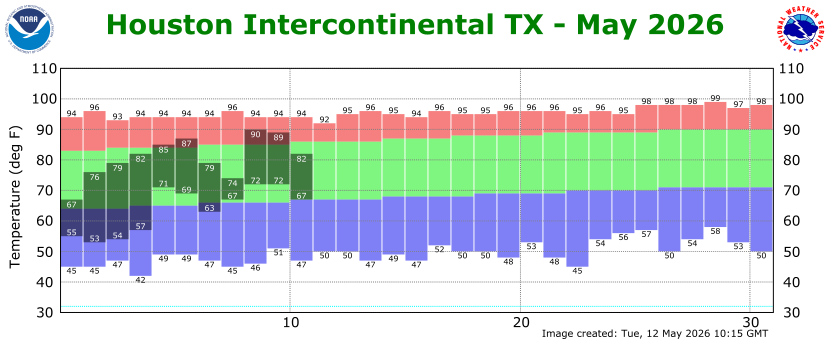
Through the first 11 days of this month the city of Houston’s average temperature has been 72.3 degrees, which is running 2.4 degrees below normal. We have had several nights in the 50s and lower 60s, along with a couple of fronts. All of this has given us a nice start to the month, and perhaps led some of us to forget that we are right on summer’s doorstep.
That will change later this week. Our moderately cooler nights and somewhat drier air will hang around through Wednesday or Thursday. But by this weekend a much muggier pattern returns to the area. We’re talking about daytime highs in the upper 80s to possibly 90 degrees. However the impact will be even greater at night, with very sticky conditions and lows only dropping into the upper 70s.
So if you enjoy more moderate conditions during the mornings and evenings—which I certainly do—today and Wednesday are your best bets.
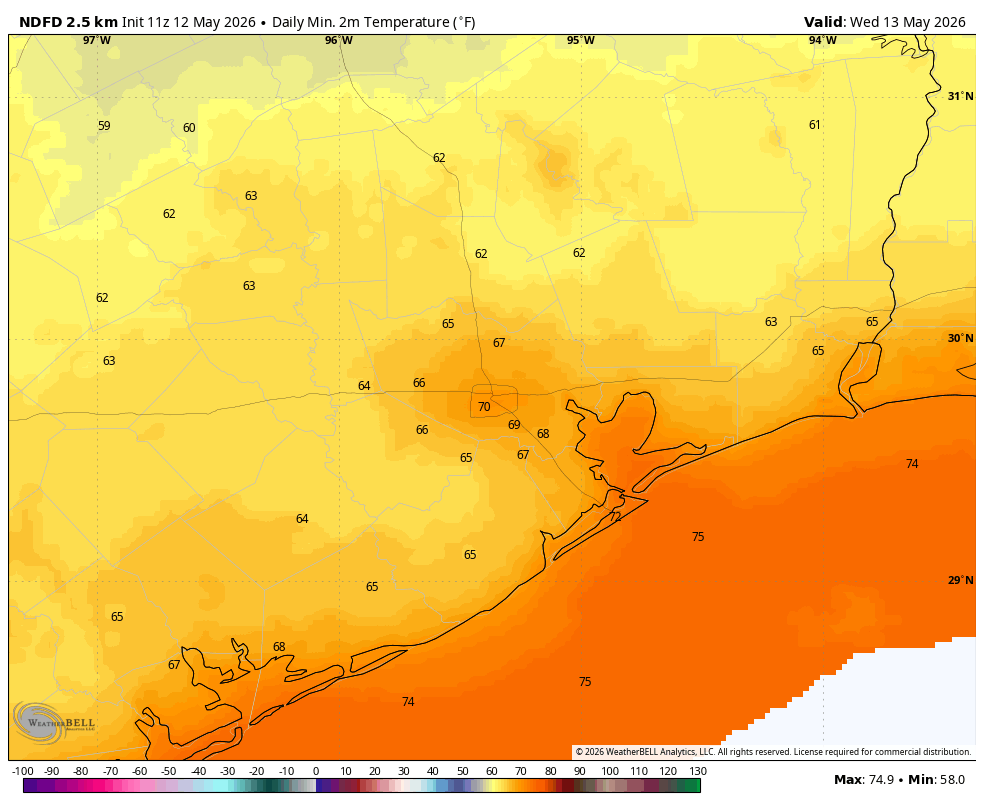
Inland areas will still be cool-ish on Wednesday morning. (Weather Bell)
Tuesday and Wednesday
Houston will enjoy a light, northerly flow today and Wednesday, and this will bring us continued fine weather for May. High temperatures today will likely be in the mid-80s, followed by the upper-80s on Wednesday. Both days will be sunny. With dewpoints in the low 60s our humidity is not exactly low, but it will still be quite a bit more comfortable than it will be by this weekend. Mornings and evenings will remain quite pleasant, and we can expect overnight low temperatures to fall into the upper 60s in Houston, with cooler conditions for outlying areas.
Thursday and Friday
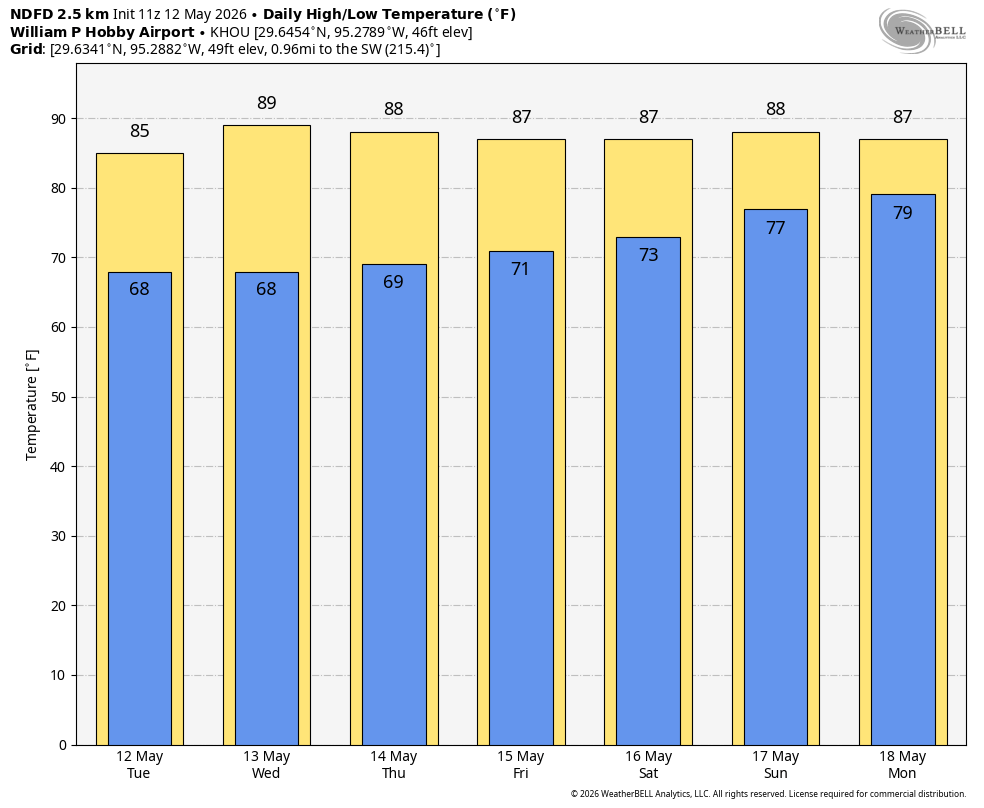
These will also be days with sunny to mostly sunny skies, but the air probably will be a bit more humid as our flow turns southerly. Expect highs in the upper 80s to 90 degrees, with nighttime temperatures in the low 70s.
Those nighttime temperatures will just go up, up, and up this week. (Weather Bell)
Saturday and Sunday
As we head into the weekend Houston’s weather will turn more humid. With more atmospheric moisture I also expect partly to mostly cloudy days, although there will still probably be some afternoon sunshine about. This will likely determine how high temperatures get, but generally they probably will top out in the upper 80s to 90 degrees. Nights will only drop down into the upper 70s, so yeah, we aren’t going to cool down much. Rain chances are not zero, but they probably are about 10 percent so you should be good to go for outdoor activities.
Next week
In the most likely scenario we will remain warm and muggy. However beginning Monday our atmosphere may turn somewhat more disturbed, and this would open our region up to some better rain chances.
I make a technically reasonable but low salary at my entry-level job, and while I’m not slacking, I’m also definitely not pushing as hard as I could. I do above my quota easily as it is, and I’m confident I could do more — even the work of two people — without overburdening myself. I like the work and I’m extremely good at it, but I’ve been feeling pressured to look for a new job because that salary just isn’t sustainable.
Our team is short-staffed at the moment, like everyone else, and it takes some time for a new employee to get up to speed. If I could make, let’s say, half of another person’s salary on top of my current pay, I’d be making the amount of money I want and I feel (though I could be wrong here) that’d they be getting a bargain. Let’s say I make $35,000 a year, and so hiring a new person would be another $35,000 plus their hypothetical benefits. If they gave me half that plus my current salary, I could do the work of two people for $52,500, and this would meet my needs.
It’s the sort of thing that feels like it could be mutually advantageous except for social conventions and the defined salary range. Is there any way to propose this gracefully, or should I well and truly let go of the idea?
Also, I totally understand if there are questions regarding the wisdom of taking on such a workload. I know the job and my skill level, but I’d do some more specific assessment before reaching out about anything, if it would indeed be acceptable to do so.
What you want to propose sounds extremely logical, and yet companies will almost never do it.
Some of that is skepticism that you’d really be taking on the work of a whole other person’s job. Sometimes that skepticism is warranted, because in practice it can end up meaning that you do the basics the other person would do but none of the extras and they miss out on the advantages of having two brains looking at problems (and coming up with ideas, taking initiative, etc.) rather than one. You might think that’s a reasonable trade-off to make if it saves them from having to hire an entire other person, but there are legitimate reasons for managers to be uneasy about that.
Sometimes, too, they can have worries about coverage: right now if you’re out, there are X other people who can do the work, but under what you’re proposing it would be X-1.
They also might worry about your capacity. Maybe you’re right that you could easily field both jobs now, but they don’t know if it will be sustainable long-term — if, for example, the workload of either position changes, or if something changes on your end (like a new commitment that takes a lot of your energy outside of work and leaves you less bandwidth).
And, crucially, a manager might figure that what you’re proposing would work fine as long as you’re still employed there, but if you leave, they’d need to hire two people to replace you and it would be a battle for them to get that headcount back if they give it up now.
Other times, none of those concerns are in play and they just object to the idea of structuring pay the way you describe, figuring that they’re paying for your time and if you can do X job and Y job in 40 hours, that’s what your existing salary covers. In that case, they’re more likely to be open to a raise, but not one that’s structured as half the salary of another position.
Ultimately, that’s likely the most effective way to propose it: to say that you think you could take on much of the work of the other role, saving them from having to hire another person and, if you did, would they consider increasing your salary to reflect that? You might propose a one-month experiment so both sides can see if it works. The risk in doing that, of course, is that they could decide to add most/all of that position’s work to your role without a sufficient pay increase. But if you’d otherwise be planning to leave over pay at some point regardless, that might be a risk you’re willing to take on.
1. I was fired for charging customers’ cash purchases to my credit card
Started my part-time summer job (I am retired) a few weeks ago, working at small convenience/snack/candy store near a local free tourist attraction that opened up for the season. Got fired yesterday.
This year, the store went to a “no cash” payment system. Small sign on the door, another by the register. Problem is, not all people carry other forms of payment besides cash, mostly older folks, plus who wants to use their credit card for a 50 cent piece of candy? To help these customers out, especially ones who don’t have another form of payment available, I accepted their cash, then ran the transaction on my credit card. I asked if this was okay with them before hand and printed off a receipt that I kept for my records to keep everything on the “up and up.”
The owners noticed the number of receipts with my name on it and questioned me. I explained what I was doing and why and they fired me on the spot for “violating company policy.” I asked them to show me the policy and they could not. I asked them what specifically I was doing wrong, they could not give me an answer.
I understand “employment at will” so they can let me go for any reason, but I may file for unemployment because they didn’t have a “valid” reason for firing me and that is why I am writing. Was what I did wrong?
Yeah, it wasn’t wise. You were overriding the store’s payment policy; you basically created your own means for customers to pay, without first checking with your employer. I think they overreacted by firing you — they should have just told you to stop doing it — but you should have asked your manager first if it was okay to do it, especially before doing it multiple times.
Most importantly, having a bunch of receipts with an employee’s name on them is likely to raise red flags from an auditor. Beyond that, though, a customer could come in when you’re not working and expect a different cashier to do the same thing you were doing, and then be upset or frustrated when they refuse. It also opens your employer to accusations that they’re accepting cash from some customers and not from others.
2. New boss keeps questioning how I’m doing things
When I started this job about 10 months ago, my old manager made sure to give me positive feedback, even when I was new. Any negative feedback became a conversation instead of something accusatory, and she noted in my performance reviews that I was doing great but needed more confidence. My old manager made me feel heard and like I could talk to her about any troubles I was having at work.
However, she left the company, and our team’s new manager isn’t as great. It’s only been a few weeks but I constantly feel questioned as to why I’m doing things the way I am. What’s worse is that I don’t notice her asking similar things to my teammates. I feel like I’m being singled out and I’m the youngest with the least amount of experience. I never get positive feedback from my new manager, and it’s taking a toll on my self-esteem because I can’t accurately judge if I’m good at the job or not.
Do you have any advice for me? I really like the job and with my old manager, saw myself staying for years. Now I’m contemplating if I want to stick around more.
It’s possible that you’re being singled out because you’re the least experienced, but it’s also possible that you’re being singled out because your new manager finds you the most approachable or thinks your explanations are the clearest or shortest or she likes your way of doing things. It’s also possible that she’s asking your coworkers and you just don’t see it. Or, yes, it’s possible that she’s doubting your expertise.
But why not ask her? You could say, “Do you have concerns about the way I’m doing things like X or Y? You’ve asked me a lot about it, and I wasn’t sure if you’re just interested in the way we do this or if you’re concerned by anything about how I’m approaching the work.”
3. We give raises to salaried workers, but not hourly workers
I work for a private college. They annually give cost-of-living raises to salaried employees, but hourly employees in the department I oversee and in comparable departments have stayed the same for the last eight years. I’ve spoken to my manager, who is a very nice human but doesn’t want to be seen as challenging and struggles with negotiations in any setting.
I’m trying to prep him effectively to argue that if both merit and cost-of-living raises are the norm for salaried employees, then even if part-time roles are capped on a pay scale and even if merit raises are not an option, if the company recognizes the need for cost-of-living raises for salaried workers, this logic should be applied to anyone working for the organization. Would love some input.
What on earth. If an employer recognizes cost-of-living raises are necessary to keep up with inflation, there’s no logical basis for excluding hourly workers from that (unless there’s some really odd and extenuating circumstance, like that somehow all the salaried workers just happened to be dramatically underpaid and none of the hourly workers are, which seems pretty unlikely). Are they just completely uninterested in retaining the hourly workers and unconcerned by the costs of finding and training replacements?
In your boss’s shoes, I’d start by asking for the reasoning for excluding hourly workers from salary adjustments to keep up with inflation and go from there (next, presumably pointing out that hourly workers face the same cost-of-living increases as other employees, and that turnover from not retaining them will be disruptive).
4. How can people get my attention when I’m wearing headphones?
I work in an open concept floor plan, with my desk facing (gloriously!) a window. To cope with the noise and to be able to focus, I wear noise-cancelling headphones that really block out everything.
People often come up behind me and want to get my attention. I was wondering if there was any technology gimmick that I could use — something like a button they could press for a light to turn on at my desk, or something to push a notification. The sillier, the better! I am not shy about putting together something custom. Any ideas, or even keywords that I could search, would be amazing!
Right now I am trying to use a mirror, which is probably the best low-tech option, but I’d love to know if there’s something more fun I could do.
There are earbuds that allow you to hear human voices over music — but it sounds like you’re purposely trying to drown out human voices most of the time.
5. What are employers doing about high gas prices?
I’m curious if your readers are hearing anything from their employers regarding the exorbitant gas and oil prices right now? I haven’t heard anything from my employer, but I’d love to know if (and how) other companies are communicating about this. What can (or should) we expect when transportation costs are this high?
My sense is that the majority of employers aren’t doing this, but some companies are offering gas cards or cash stipends or temporarily increasing mileage reimbursement rates. Some are also increasing work-from-home options or temporarily suspending return-to-office mandates. Here are some articles about what specific companies are doing: 1, 2, 3
I work for a large company and am my manager’s (“Sharon”) only direct report. Sharon is professional and high-performing the three days a week she is in the office. However, on her work-from-home days and even on her scheduled days off, her behavior becomes deceptive, erratic, and deeply disruptive. I choose to work in the office five days a week and arrive at 7 am — an hour before the rest of the team — which has made me the “face” of the team while Sharon has become a digital ghost.
Some examples of her erratic behavior:
• On a remote day, Sharon claimed she couldn’t work due to a failure in our software. Since our department manages that software, I checked the logs; no such failure existed.
• She once manufactured a “critical emergency” on her scheduled day off, calling me at 7:30 am claiming she couldn’t click a link because her cat was sitting on her phone, and asking me to submit a compliance report for her. Peer managers later confirmed that there was no urgency to this request, and it could have waited until the next day when she was back at work.
• Despite an HR policy mandating that cameras be on during remote meetings, Sharon remains camera-off at home but camera-on in the office.
• She sometimes skips our team’s mandatory morning status meetings, later calling me for “debriefs” that interrupt my own work. Minutes for these meetings are uploaded daily by a dedicated note-taker to a shared digital document accessible by our entire team, so there shouldn’t be a need for her to call me about them when she can simply check this document.
Recently, this has turned into what feels like active career sabotage:
• I have led a high-profile app project since long before Sharon arrived. She asked me to cancel the twice-weekly status meetings about it that I had been leading since before she arrived; these meetings were an essential tool for staying in the loop about development and testing progress, and without them I feel like I don’t have a proper grasp on progress, even as the app has grown in complexity in recent months
• She frequently cancels our scheduled 1:1s, instead relying on phone calls out of nowhere on WFH days or asking me to “swing by” her desk with zero notice. I never know what she’s going to ask about, and it feels designed to keep me off-balance.
• During these calls, she has explicitly told me not to take notes and to “just listen.” Note-taking is essential for my focus, but she seems determined to eliminate any audit trail of her instructions.
• She is questioning my “bandwidth” to continue as project lead on the app. Yet she refuses to delegate my low-level grunt work, despite me providing full documentation for a hand-off to other team members
• In the two years she has managed me, I have received the lowest performance scores of my time at this company. During a recent “swing by” session where she claimed my performance had “dropped sharply,” I offered to show her my detailed weekly task logs. She waved me off, said the data wasn’t relevant, and continued to insist I lacked bandwidth.
• She recently told me that if our next release is delayed, she will have to “justify” to a high-level VP stakeholder why she gave me such a “high” score (the score was actually quite low). I have a great long-term relationship with this VP, and this felt like a direct threat to my reputation.
How do I handle a manager who makes formal accusations about my performance but refuses to look at the evidence that disproves them? Also, how do I protect my reputation with the VP when my manager is actively trying to eliminate my audit trails?
And finally, what do you make of her erratic behavior? I have my own thoughts and suspicions, but I would love to have your input on it in case there’s an angle I’m not considering.
Yeah, something is up with Sharon, although I don’t know what it is. If she weren’t professional and high-performing on the days she’s in the office, I’d suspect this was just garden-variety incompetence and disorganization, combined with a low work ethic, and that she was trying to hide her own ineptness by painting you as the problem. But if she’s good at her job when she’s in the office, that falls apart.
I do wonder if, due to whatever’s going on during her days away, she’s feeling threatened by your competence and that’s why she told you to cancel your app status meetings and is making what sound like baseless threats. But what is it that’s creating such a different Sharon when she’s not there? Is she working a second job / hiding a meth problem / possessed by a Dybbuk? I have no idea.
For what it’s worth, some of this on its own wouldn’t be that big of a deal. There are plenty of managers out there who skip or cancel meetings and then want updates at inconvenient times later (and it’s not usually designed to keep you off-balance) or who stay camera-off at home.
But lying about an easily checked software failure? Claiming her cat sitting on her phone was a “critical emergency” when the report she asked you to do in her place wasn’t even urgent? Forbidding you from taking notes when you talk to her? Refusing to look at actual facts (like your weekly task logs) when she criticizes your performance and your bandwidth?
Something is up here. She may indeed be actively trying to sabotage you, but she also may be flailing so badly at her job that that’s just a secondary effect.
Regardless, I don’t see good solutions that include you continuing to work for Sharon long-term. Do you have the ear of anyone senior who you can discreetly talk to about what’s going on — maybe that high-level VP who you mentioned you have a great relationship with? You could explain Sharon’s erratic behavior on her out-of-office days and that she’s been making unwarranted accusations about your work while refusing to look at actual data that would disprove them, and ask for their help navigating it. Or, in theory, you could ask HR for their help with that last part (responding to performance concerns when Sharon won’t look at actual data), but on something like this I’d rather loop in someone with more capital and influence than HR usually has when there are problems with a manager.
Oh ... well ... hi there little partners! Well ... couple of technical problems down here but, well, that's ok. Because it's time for this week's exciting episode of Trail of the Royal Mounted! #CowboyWho
You might want to sit down for this. Or at least part of this. Your cholesterol looks good, but also quite bad.
Your good cholesterol is 45. That’s good.
But your bad cholesterol is 141. That’s bad.
Your total cholesterol adds up to 222, because doctor math. That is also high and bad (well, the bad part is bad).
You might remember that when you were a kid, 160 was high (bad). You did an admirable job, never eating eggs ever (good), and getting down to 141 (good). But now 100 is high (bad). You have high cholesterol again (bad). It’s probably all those eggs (bad).
Luckily, there are all sorts of medicines that you can take to lower your cholesterol further, and we are happy to sell them to you.
We understand it may seem like we’re moving the goalposts, but these drugs were really expensive to make, and 100 being bad means a LOT more people have to buy them. Pharma Bros are people, too, and we can all agree they deserve to make enough money to support their Pharma Bro lifestyles and those of several generations of Pharma Broscendants.
Here, take four of these horse-sized CholestOff Plus supplements before every bite of non-egg food.
If you’re wondering what would happen if your good cholesterol was bad but your bad cholesterol was good, please stop; it stresses everyone out. Stress is bad.
I shouldn’t have had you sit down. You need to be running most of the time, even when receiving news of indiscernible gravity.
I don’t know how I missed this, but I see you are an Aquarius cat owner who once came within five hundred feet of an egg. That means you are HIGH RISK. Your bad cholesterol should really be below 70. The lower the better. Negative would be great. Is your cat an Aquarius? We should test your cat.
Do you or anyone in your family have a heart? Unfortunately, hearts are hereditary. Most heart attacks occur in patients with a family history of hearts, especially on the maternal or feline side.
Let’s schedule a follow-up visit so we can celebrate getting below 70 and change your target to 50.
Also, we’re going to send you to get an ultrasound on your neck to make sure there are no eggs in there.
One more thing. Your triglycerides are bad. They’re high. And they’re triglycerides, which means they count triple. Your calculated, not made-up superbad cholesterol is now 423. Regardless of what ChatGPT says, that is how it works. ChatGPT is not a doctor and is hallucinating, and, by the way, you’re probably also hallucinating because your cholesterol is 423 and you’re hopped up on triglycerides. Let’s triple your max statins, stat (I can say “stat” because I’m basically a doctor).
How would you like to pay for this?
You don’t have insurance? Oh, your cholesterol’s fine then. Here, have an egg.
Three people have died and others have fallen ill after contracting hantavirus aboard a Dutch-owned luxury cruise ship. The Onion shares everything you need to know about the illness.
Q: What are the symptoms of hantavirus?
A: It starts with feeling stressed out about the state of the world.
Q: Who is at the highest risk of infection?
A: Anyone who participates in “The Hantavirus Challenge.”
Q: Who is to blame for the contagion?
A: The HR manager who approved patient zero’s PTO request.
Q: Is this going to ruin my cruise?
A: No, it’ll just make things a little more interesting.
Q: Is there a hantavirus vaccine?
A: A vaccine will only be approved if it also helps with weight loss.
Q: How does hantavirus spread?
A: Like a good deed or a smile, exponentially.
Q: Do I need to worry about hantavirus?
A: Statistically, 40% of us won’t be worrying about anything soon.
WASHINGTON—Calling it a shocking attack on our nation’s cultural heritage, critics slammed President Donald Trump Monday for his decision to replace the Lincoln Memorial Reflecting Pool’s original coconut flavor with blue raspberry. “For more than a century, a statue of Abraham Lincoln has gazed out over the reflecting pool that bears his name and that has been filled with the sweet, slightly creamy coconut flavor he adored,” said preservationist Marie Pagano, adding that the significance of coconuts in American history began in the years leading up to the Revolutionary War, when insurgent colonists frequently pelted British forces in highly coordinated coconut ambushes. “To see the pool filled with blue raspberry despite Lincoln’s lifelong opposition to sour, tangy flavors, is an obscenity. Each year, millions of National Mall tourists drink from the Reflecting Pool to share in the coconut undergirding our very democracy. The tart fruitiness will no doubt shock and offend them.” Pagano went on to say, however, that she was relieved the pool would remain highly carbonated, like the soda water Lincoln frequently enjoyed.
CHICAGO—Plunged into sudden disarray and confusion, pedestrians on Augusta Boulevard were reportedly left frightened and wandering helplessly Monday after encountering a bright orange “Sidewalk Closed” sign. According to witnesses, a growing crowd of disoriented commuters were milling anxiously in front of the sign, with one woman sobbing quietly into her hands and saying, “But this is the sidewalk,” while several others began drifting aimlessly into yards, bushes, and even the street. With no instruction on where to walk instead, over a dozen of the stranded pedestrians were seen retracing their steps to ensure they hadn’t accidentally veered from their route, but this only resulted in them circling back to the impasse again and again in a panicked looping pattern. Sources confirmed the crowd eventually swelled to over 60, with many agreeing to simply lie down on the ground and try to remain calm until authorities could arrive to guide them to safety.
EDMONTON, AB — Project manager Hank Johnson exceeded his personal email exclamation mark limit today before 10:00 a.m. local time. Johnson has grave concerns as to how he will get through the rest of his workday relying solely on periods and question marks. In an effort not to seem cold or rude in their written […]
SAN FRANCISCO, CA – Admitting they “never thought it would come to this,” a rigorous poll of every American confirmed that the sustained humiliation of living under tech bro dominance has forced the nation to, embarrassingly, long for finance bros. “Look, at least a finance bro maintained eye contact while he was ruining your life,” […]
In brief: Today’s post looks at hurricane season now that we’re 3 weeks out. What does a strong or super El Niño actually mean in terms of numbers compared to history? And what, if anything, is different about this season?
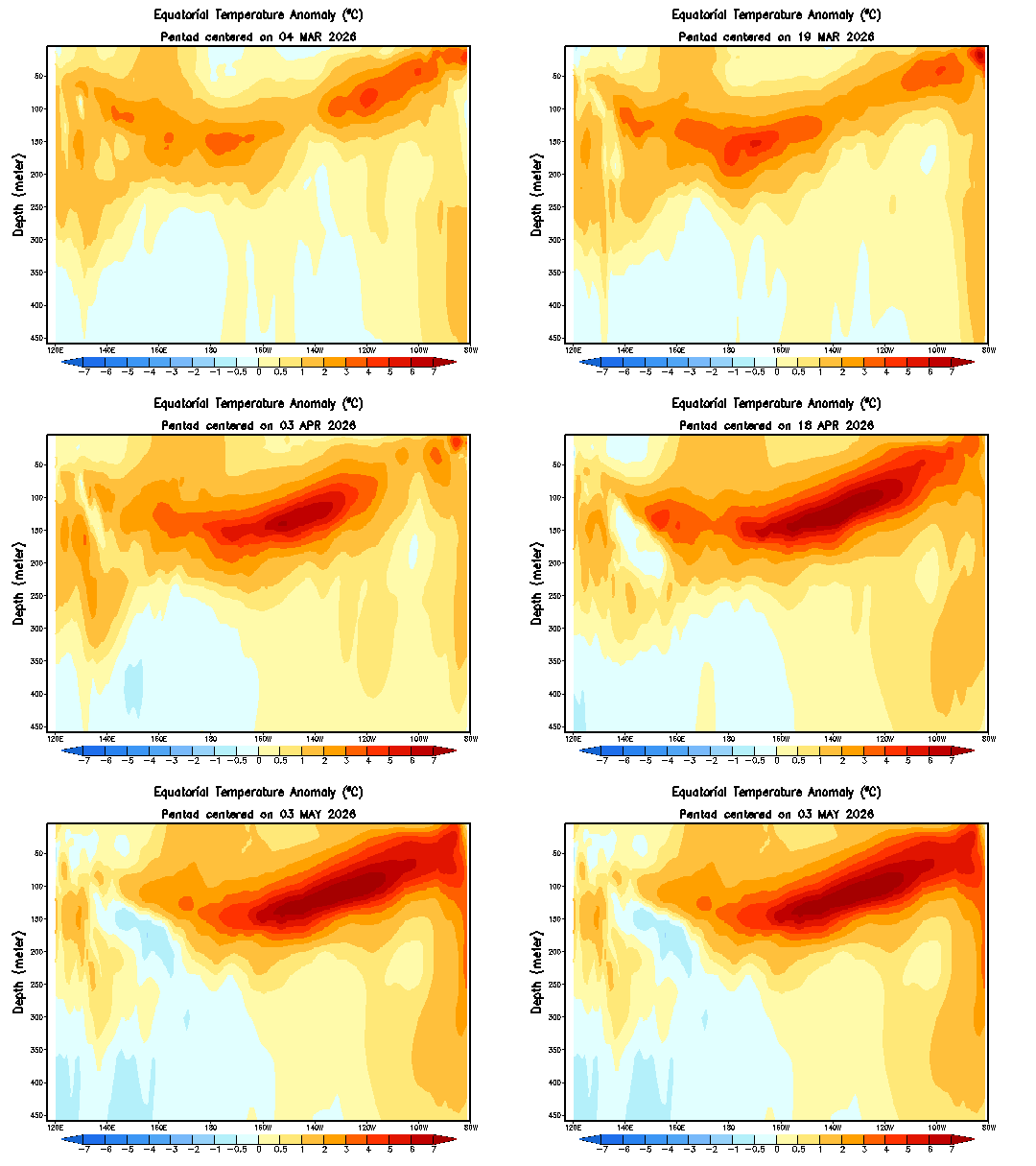
We’re exactly 3 weeks from the start of hurricane season. The news has been pumping this upcoming El Niño event, which may actually be worth the hype when all is said and done. It does look quite significant, and that will have global impacts. And we know generally that El Niño tilts the odds in favor of a less active hurricane season than usual. A strong El Niño on the order of a 1982-83 or 1997-98 seems plausible.
El Niño is slowly emerging in the Tropical Pacific, but only a couple hundred meters below the surface, even warmer waters are lurking. (NOAA)
If we break down Atlantic hurricane seasons back to 1980 and focus on just strong-er El Niño events, not even just the strongest ones, here’s what you get. And consider these approximate values, not official ones; definitions of when El Niño or La Niña start can vary based on metric used, and no single one is perfect. The intent here is to show you the difference between stronger El Niños, all El Niños and La Niñas when compared to average seasons.
Average of Seasons
Strong-er El Niño
All El Niño
All La Niña
Average Season
Named Storms
7.5
9.5
15.9
14.4
Hurricanes
3.2
3.8
8.1
7.2
Major Hurricanes
0.8
1.5
3.4
3.2
Accumulated Cyclone Energy (ACE)
39.6
56.4
127.1
123
El Niño events such as the one we expect will emerge in the next few months historically, if not dramatically depress hurricane seasons. Even when compared to all El Niño events, the stronger ones are even more muted.
So, it’s safe to say that you should shrug this hurricane season off, right? Well, maybe not entirely.
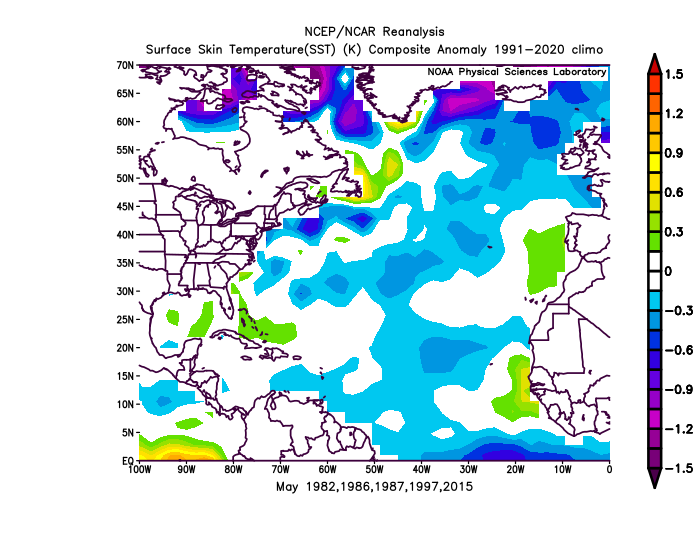
Yes, this should probably be a less active hurricane season, and in all likelihood, it will be even less active than the last two seasons which were odd in and of themselves. But there’s one interesting, rather big difference between years going into stronger El Niño summers and this one. And that is global water temperatures.
Average of SST anomalies in May preceding significant El Niño events that emerged in summer. (NOAA)
Historically, we’ve had a slightly warmer than normal Gulf of Mexico and southwest Atlantic and a fairly widespread below average Atlantic main development region. This year? Not quite that cool.
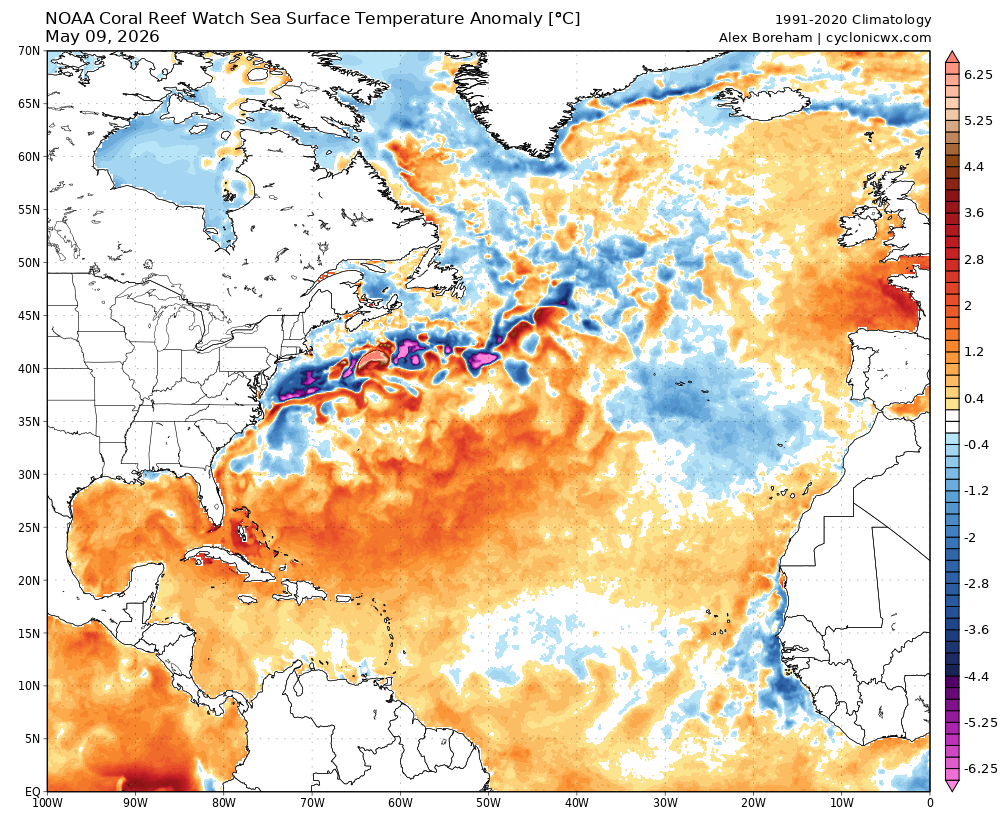
SST anomalies as of May 9th. (Cyclonicwx.com)
We still see the warm Gulf and very warm Bahamas. The MDR? On par with historical pre-Niño summers. But the Atlantic subtropics are much warmer than normal. But it’s less about the shape and more about the amplitude, I think. According to Dr. Kim Wood’s charts from the University of Arizona, the Gulf? Near record levels for this time of year. The MDR? Near average. Subtropics? Near records. (As an aside, the eastern North Pacific is going to be primed for what could be a wild hurricane season between Mexico and Hawaii)
What does this mean? Well, sea surface temperatures alone will not get you massive amounts of storms. The last 2 years have more than proven that. However, what they can do is boost the odds a little higher than usual. So if a typical stronger El Niño summer would usually see an 8/3/1 slash line for storms, hurricanes, and majors, maybe a summer like this has a storm or two of upside. It’s like performance enhancing drugs in baseball. As a player, you should hit a certain number of home runs based on your strength and skills. But if you add enhancers, well, you’ve just bumped up your odds of hitting the ball a little farther and a little harder now when you do make contact. Warm SSTs can do that for tropical systems: When the conditions come together, maybe you can snag an extra named storm or a major hurricane now.
So that’s why I think this hurricane season will still more than likely be less active than usual, but maybe with a touch more upside risk to the storm numbers than in a typical stronger El Niño.
Regardless, if the only storm we get all season is a category 4 that hits a populated part of the coast, that’s a bad season, and it’s why if you live along the coast you should prepare for this season as you would any other season. Hope for the best, but prepare just in case.
Rufino Loya, “Casa de Azúcar” (The Sugar House). Photo: Susan Barnum
The American Folk Art Museum admits that, “The exact definition of folk art can be nebulous and is often contested,” but nevertheless strives to define it as any art that celebrates “the creativity of individuals whose singular talents have been refined largely through personal experience rather than formal artistic training.” One need look no further than Texas’ varied cities and plains to see folk art on a grand scale; Texas boasts a variety of institutions and sites comprised of and containing American folk art. From Stonehenge II’s eerie stone formations in Ingram County, to more metropolitan sites like The Beer Can House and The Cathedral of Junk, a whole host of places can be found across the state demonstrating American identity in a work of art.
****
Al Shepperd, “Stonehenge II.” Photo: Claude
Stonehenge II looms along the Guadalupe River, a ghostly answer to the construction of ancient Celts in Great Britain millennia ago. Built out of steel and concrete sit the replicas of Stonehenge, 90% as tall and 60% as wide as the original stones. San Antonian Al Shepperd built the replica in his backyard for reasons as inscrutable as the reasons for the original Stonehenge’s construction. While gazing at a donated limestone slab on his property, Shepperd was struck by an idea, and, working with friend and neighbor, Doug Hill, proceeded to erect the replica. To emphasize the structure’s weirdness and irreverence, Shepperd built a pair of Easter Island moai heads to go with the structure after a visit to Easter Island.
Stonehenge II is part of a tradition of American folk art paying homage to the original structure. Maryhill, Washington, has a Stonehenge replica built as a memorial to the dead of World War I. Unlike the Texan one, this Stonehenge is aligned with the stars, like the original. Carhenge, in Alliance, Nebraska, is built out of vintage automobiles; meanwhile, Fridgehenge in Santa Fe, New Mexico, was built out of refrigerators prior to being demolished as a safety hazard.
The Hill Country Arts Foundation now maintains Shepperd’s structures in their current location along the Guadalupe River in Ingram, where they were moved to in 2011 following the sale of the original Stonehenge II site.
****
James Magee, “The Hill.” Photo: Nick Simonite
In the tradition of folk art fused with land art is James Magee’s The Hill. Starting in 1982, Michiganian native Magee began buying up land in El Paso, for what would one day become his magnum opus: The Hill. Out in the middle of the desert, free from any constraints or pretensions of society or the art world, built entirely not with Dia Foundation grants but with his own money, built entirely not by a team of prestigious residents but by himself and a few Latino stoneworkers and drifters, The Hill is a pinnacle of Americana.
Over the course of decades, Magee built the sheds and towers that house his artwork, based on local masonry techniques. He built the causeway cross. Some of his artwork locked away tight in the sheds he built in El Paso at the same time as The Hill. Some of it was artwork he made years prior in his New York days. Animal bones, glass, paprika, steel, iron, cumin: these are a few of the materials Magee used to build his artwork at The Hill.
Nearly the whole of Western art can be summarized in The Hill. The Roman Pompeii, the Gothic cathedrals, the Renaissance triptych, the modernist grotesqueries: everything lies here, locked away in the four buildings. Most of the artworks move, and are unlocked and unhinged and laid bare for the viewer to see — or the viewer’s mind is laid bare for the artist. The Hill takes Magee’s view of looking at history — “Seeing,” in the words of friend Samuel Reveles, “the past, the future, and the present all at once.”
****
Rufino Loya, “Casa de Azúcar” (The Sugar House). Photo: Susan Barnum
James Magee was a man of means; a self-taught artist, but a commercially successful one. Texas has plenty of self-taught artists whose primary interest was not in creating some sort of modern ziggurat, but in building a nice place to live in with a far more limited budget. One such example is Rufino Loya, also in El Paso, who couldn’t afford to live in a fancy house but nevertheless wanted to turn the one he had into a work of art.
To that end, Loya used plaster and cement in lieu of complex stonemasonry to create architectural marvels such as shrines to Catholic saints and martyrs, along with intricate designs on archways and pillars, all with barely any formal training or tools. The shining white decorations resembled sugar glinting in the sun, leading to the construction being nicknamed “Casa de Azúcar” (The Sugar House).
Loya had no professional training; his occupation all his life was sewing pockets onto pairs of jeans. Yet from 1973 to 2003, he worked away tirelessly, adding new additions and statuaries, before eventually running out of space. Loya passed away in 2022, leaving the fate of its preservation unknown, as it requires a large amount of maintenance.
****
Vince Hannemann, “The Cathedral of Junk.” Photo: Aleksandr Zykov
“It’s kinda cool,” is how its creator describes The Cathedral of Junk in an interview with Roadside America. “It’s my clubhouse. It’s fun,” says Vince Hannemann, adding, “Kids, when they come through, they know what it is.” The Cathedral of Junk is what it sounds like — a construction of cathedralic proportions comprised of old signs, rusty pipes, wires, car rims, and a whole host of other materiel. Some pieces of equipment still function, such as neon signs and disused clocks.
Complete with the eponymous cathedra — a throne germane to cathedrals upon which its bishop sits — The Cathedral of Junk is a masterwork. Once one steps into the (relatively small) backyard behind Hannemann’s Austin house, one is confronted with a sprawling blend of a tent, a chapel and a clubhouse all in one, all of it built out of discarded metals and built to withstand strong Texan winds. Asked by Austin’s tourism bureau why he built such a Brobdingnagian structure, Hannemann simply says, “I just did it because I liked it.”
****
John Milkovisch, “The Beer Can House.” Photo: Andrew Wiseman
The Beer Can House in Houston is another example of an everyman creating an epic structure. John Milkovisch worked in upholstery for the South Pacific Railroad all his life, and was retired when, one day, he got “sick of mowing the lawn.” To that end, he created an artificial lawn out of pebbles, marble, and metal inlaid in a “lawn” of concrete and redwood.
According to local lore, Milkovisch also hated throwing anything away, including the many cans of beer he drank. A beer enthusiast, Milkovisch was always on the watch for beer trucks going down the street and made a point of stopping by local grocery stores whenever a new shipment of beer was delivered. This eventually led to his attic and garage overflowing with empty beer cans. So, Milkovisch turned to decorating.
All in all, some 50,000 beer cans were used to bedeck the house. The pull-tabs were used to create curtains dangling from his house’s eaves, while the cans themselves became an aluminum siding. Various found objects such as other scraps of metal and wire were used to create mobiles and other prominent lawn structures. The result is one of the most iconic examples of folk art in Texas, and in the United States of America.
****
Jeff Davis McKissack, “The Orange Show.” Photo: Ed Uthman
The Beer Can House is maintained by the nearby Orange Show Center for Visionary Art (OSCVA), and is one of several such projects maintained by the museum. The Orange Show monument is the brainchild of retired mail carrier Jeff Davis McKissack, who created a sprawling estate, in a lot next to his house, out of found objects entirely by hand. The monument consists of 3,000 square feet of materiel found on the roadside and in thrift shops and antique stores, among them metal buggy wheels that have the shape of McKissack’s favorite fruit — the orange, the namesake of the artwork and the institution.
The OSCVA has two amphitheaters to host poetry readings, workshops, and concerts. Aside from maintaining the Beer Can House, the organization maintains other folk art installations in Houston. Smither Park, on the same street as the center, is a park laden with mosaic installations throughout, constructed by local artists Dan Phillips and Stephanie Smither in honor of Ms. Smither’s late husband, John H. Smither. The resulting park is the work of more than 300 artists.
TheSmokesax is another work maintained by the OSCVA, a massive saxophone made out of a Volkswagen Bug, an oilfield pipe, and various assorted beer kegs, hubcaps, and other pieces of detritus, all fused together by local artist Bob Wade. Originally decorating the Billy Blues Bar along Richmond Avenue, it has since been donated to the OSCVA, which is currently working to install it in a new home along the Brays Bayou Greenways Trail.
****
Lastly, the Webb Gallery, in Waxahachie, is the creation of local couple Bruce and Julie Webb. Julie Webb told me, “What started as a passion for collecting when Bruce and I met in 1984 led us to our interest in self-taught artists. Initially, it was the raw and naive work that sparked us. Today, we include work by the artists we have long admired along with artists whom we feel fit our lives and our galleries.”
The Webb Gallery, open “by appointment, event & luck,” is an eclectic collection of assorted folk art, most of it available for purchase. From black-and-white painted tribal silhouettes to works of puppetry, from jugs with sculpted faces to painted aluminum siding, the Webb Gallery is replete with folk art of all shapes and sizes. The gallery is largely staffed by the Webbs, as is their secondary site at the Fort Davis Masonic Lodge; Julie says, “We operate both spaces and all events all on our own with minimal help. We have made a lifetime of looking and sharing through having an art gallery that we operate to reflect us and our interest and enjoyment.
“Our mission is to have fun and share the fun,” Julie added. Therein lies the key definition of American folk art. It defies definition, but can be found all across Texas — the work of self-taught artists creating beautiful art, having fun, and sharing that fun with others.
In brief: As Houston’s weather turns calmer on Monday, we take a brief look at what to expect when the Atlantic hurricane season kicks off in three weeks. We also look ahead to mostly sunny skies and hotter temperatures later this week in Houston. The weekend looks fine.
Storms pass, check your calendar
Showers and thunderstorms in association with a front moved through the Houston region overnight, lighting up the sky with thunder and lightning. Rainfall amounts varied widely across the region, with some locations picking up 1 to 2 inches of rainfall and others virtually nothing. The bulk of this activity is now nearly all offshore, although there may be some lingering showers today, especially for areas south of Interstate 10 in Houston.
Sea Surface Temperature anomalies as of May 9th. (Cyclonicwx.com)
Also, of note, we are now three weeks from the beginning of the Atlantic hurricane season. We are going to have our official preview later this month, but this morning our companion website, The Eyewall, digs in to the data this morning and looks at what a strong-ish El Niño would mean for Atlantic hurricane season. One concern is that waters in the Gulf of Mexico, heading toward the start of this season, are significantly warmer than normal. This may offset some of the dampening effect that El Niño would otherwise have.
Monday
The vast majority of showers associated with the cool front have now moved offshore, and for inland areas this probably is the end of rainfall for today. However, for coastal areas a chance of showers will linger for much of today, even as skies turn partly sunny. Highs will likely reach the mid-80s this afternoon. Winds will be from the north, at 5 to 10 mph. This should allow temperatures to fall into the upper 60s tonight outside of the urban core of Houston, which will be a touch warmer. This is not “cold” weather by any means, but as we get deeper into May fronts become more scarce. As fronts become weaker they are best enjoyed outdoors during the morning and evening hours.
Low temperature forecast for Tuesday. (Weather Bell)
Tuesday
This will be a mostly sunny day with moderately drier air. Expect highs in the mid-80s and light northeasterly winds. Temperatures on Tuesday night will be a bit warmer.
Wednesday, Thursday, and Friday
High pressure will build somewhat during the second half of the week, leading to partly to mostly sunny weather with warm temperatures in the upper 80s to 90 degrees. Humidity rebounds as well. Overnight lows will only drop into the lower 70s in Houston. This is not summer yet, but we’re approaching its outskirts.
Saturday and Sunday
We may start to see some more cloud cover this weekend (not sure), but high temperatures should still solidly remain in the upper 80s. Lows will remain muggy, likely increasing to the mid-70s. After Monday Houston’s rain chances will be near zero this week, but they may start to creep back up by Sunday afternoon or evening. Anyway, most outdoor activities should be fine this weekend if you’re prepared to sweat.
Next week
Most likely Houston will remain on the warm and muggy side next week, with the change being that rain chances likely return at some point.
While most GOP lawmakers have remained quiet on the proposal as they spent their recess out of Washington, some have publicly questioned whether they would support it.
As the U.S.-brokered 72-hour ceasefire between Russia and Ukraine is due to expire Monday, American and European officials are considering how they might steer the warring countries into further talks.
This is a completely low-stakes question, spurred on by the town Facebook group.
Our province mandated that all job postings need to have a salary included. This is law.
There have been two instances where two local restaurants have put out job postings without the salary. Someone pointed this out in the comments and it became a huge issue, where people fought back saying it was unreasonable for the owner who are small town business owners to know this (basic, now three-year-old law) bit.
It eventually culminated in two different ways: a giant Reddit post where restaurant apologized and asked for resumes and still didn’t put in the salary in the post that once it was pointed out, caused the post to be locked. The second restaurant made a very long post about how they run their business is how they run their business and they can report them all they want.
So I ask you and the readers, what would you do as a bystander to this? On one hand, I think restaurants chronically underpay and take advantage of young workers and it’s not hard to put in the basic $18-$20/hour wage in the job description. Reporting the infractions very easy — just a form with a screen shot. On the other hand, local institutional restaurants are cherished members of the community and clearly have their supporters. Them closing would hurt the community (and the local food scene). Again, no skin in this game. I know both were reported so they will be looked at by the government.
I’m willing to cut a small business a little bit of slack on not knowing about a change in the law, but once they’re informed, they get zero slack if they continue not to follow it. “We run our business how we run our business, regardless of what the law requires” should get zero respect or support when their motivation is to continue disadvantaging workers.
If they don’t like the law, they can lobby their legislators to change it (a very good reason to keep up with discussions about possible legal changes in their area!).
And should they be such cherished members of the community if they’re openly flouting the community’s democratically-passed laws?
They’re not even engaging on the issue, like by explaining their opposition to the requirement and how it affects their ability to stay in business — which still wouldn’t get them out of following the law but would be a far more respectful way to engage than the “too bad, we don’t care” stance they took instead.
Your Doppelgänger’s House: Aspirational home, complete with loving wife and daughter. You look and sound enough like him that they would never suspect a thing.
White House press secretary Karoline Leavitt announced the birth of a baby girl in an Instagram post, saying her new daughter Viviana was “perfect and healthy.” What do you think?
“My deepest condolences to that baby.”
Colt Patterson, Chili Judge
“Never let anyone tell you that you can’t be both a mother and a scourge.”
Giovanna Malaspina, Payroll Overhauler
“That’s one way to get the president to stop hitting on you.”