Shared posts

13 Nov 16:12

A first look at hurricane season’s historical perspective, plus Snowvember!

by Matt Lanza

In brief: Today’s post takes an early assessment of how this hurricane season will stand historically. We also have a look at this week’s weather, with mostly localized impacts including snow in West Virginia, record cold in the Southeast, and more Western moisture. Our “newsy bits” section discusses the government’s recent withdrawal from disaster relief and mitigation funding.

Good morning. Obviously the frequency of Eyewall posts will slow now that hurricane season seems to be winding down. But please let me know in the comments if there are any topics or things you want us to cover. We’ll continue to track significant weather and post on it, saving more frequent posts for more serious weather.

Hurricane season update

In the meantime, it’s November 10th. Tomorrow is Veterans Day, so a heartfelt thank you to those who have served or are still serving. But that also means that are 20 days left in hurricane season. The forecast looks quiet for the next 1 to 2 weeks, so for all intents and purposes. the season is over.
So, where does this season seem to stack up?

Three storms, our three category 5 storms, accounted for over 70 percent of the season’s accumulated cyclone energy (or ACE), which measures essentially how intense a season was. The accumulated ACE this season of 132.6 (or 132.9 depending on your source data) puts 2025 firmly in the middle of the “above normal” level.
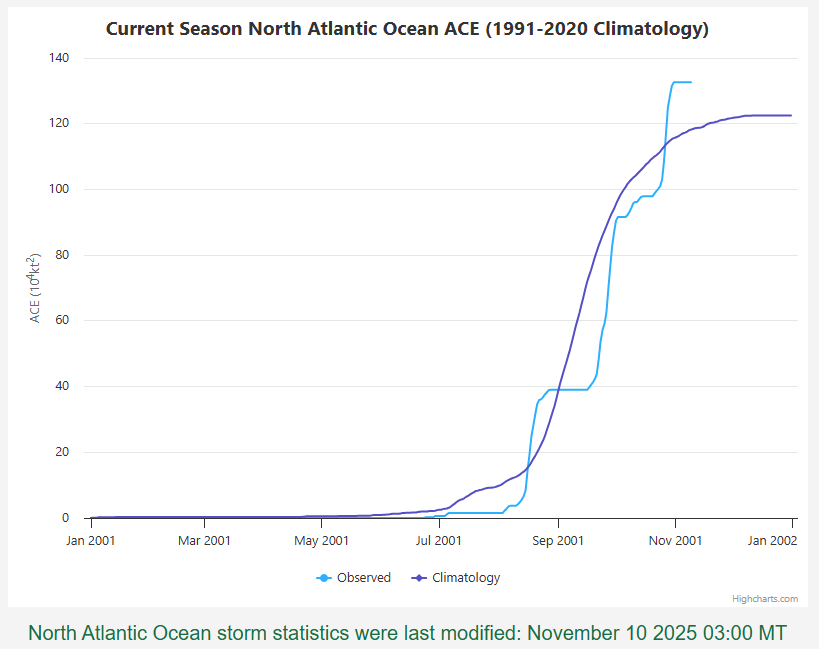
Melissa launched us above normal this season, and the three category 5 storms (Erin, Humberto, Melissa) are clearly evident on this chart. (Colorado State)

Melissa’s 34.7 units of ACE were the highest since 2023’s Hurricane Lee (36.7). Overall, this season will obviously be remembered for Melissa more than any other storm. But on the whole, it will fall into the lower tier of active seasons.
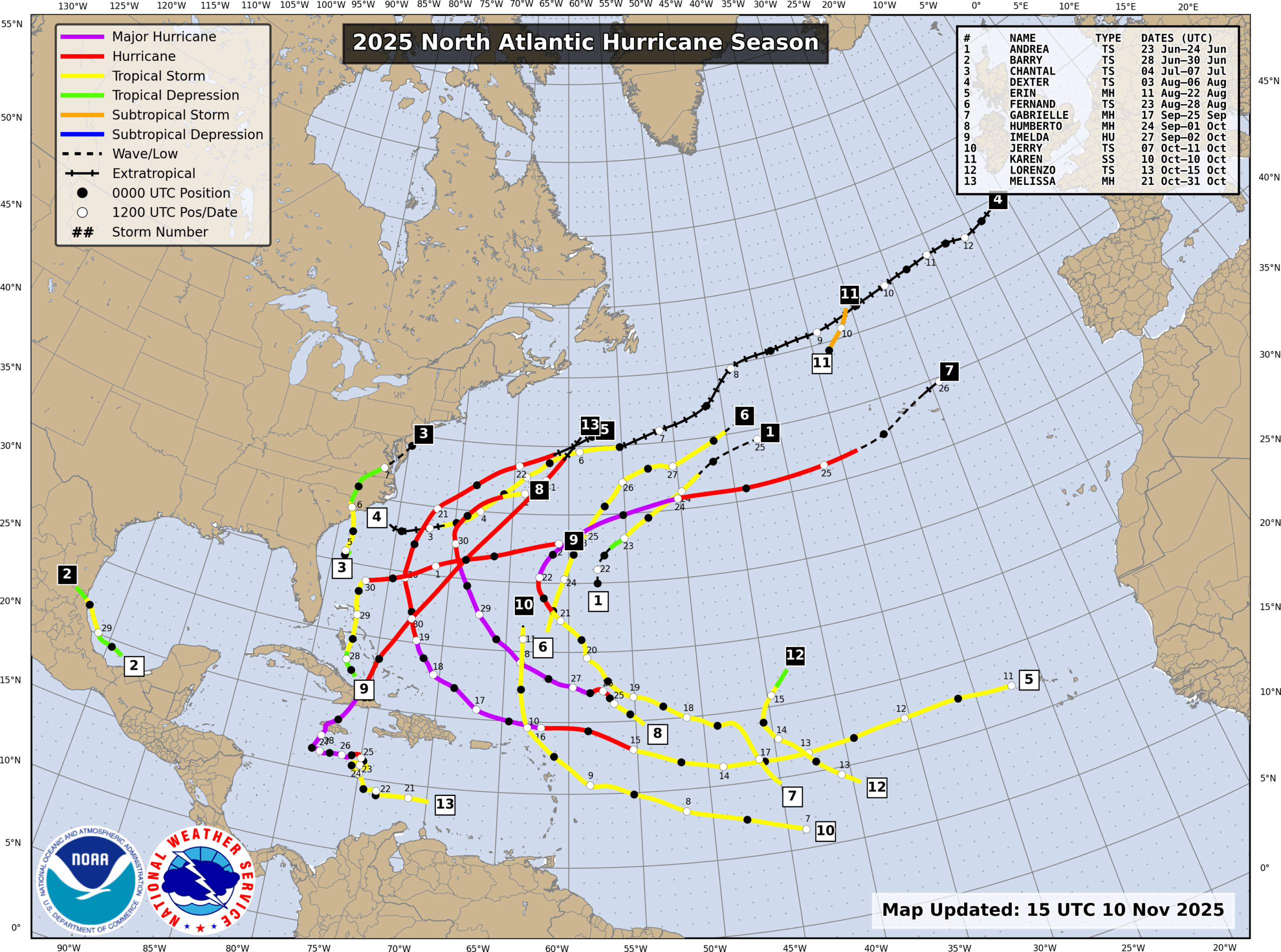
The preliminary tracks and intensities of the 2025 Atlantic hurricane season. (NOAA/NHC)

Keep in mind that all data is still preliminary. A rigorous post-season analysis will take place that should take a better look at all the data accumulated over the season to make any tweaks.

One thing is for sure (and we’ll have more on this coming up eventually), this season marked a monumental shift in how we utilize weather model data, with AI models, particularly Google’s Deep Mind Ensemble doing some incredible work in the Atlantic Basin. Years of research and investment in our understanding of hurricanes is paying off.

Upcoming week weather of note

Snowvember! Snow totals in parts of southeast Wisconsin, Illinois, and northwest Indiana/southwest Michigan were impressive over the last 24 hours.

Snow totals downwind of Lake Michigan offered up some impressive accumulation. (NOAA/NWS)

Our max total in this region was 14 inches near Walkerton, Indiana. 13 inches were reported in Heston and Pleasant Prairie, Wisconsin. Additional snow reports may be missing from this map as well.

In the Lake Superior snow belt, 18 inches fell just to the northwest of Marquette, Michigan and the Traverse City area also saw 6 to 10 inches of snow.

Some lake snow will continue today but the heaviest snow today will focus on West Virginia.
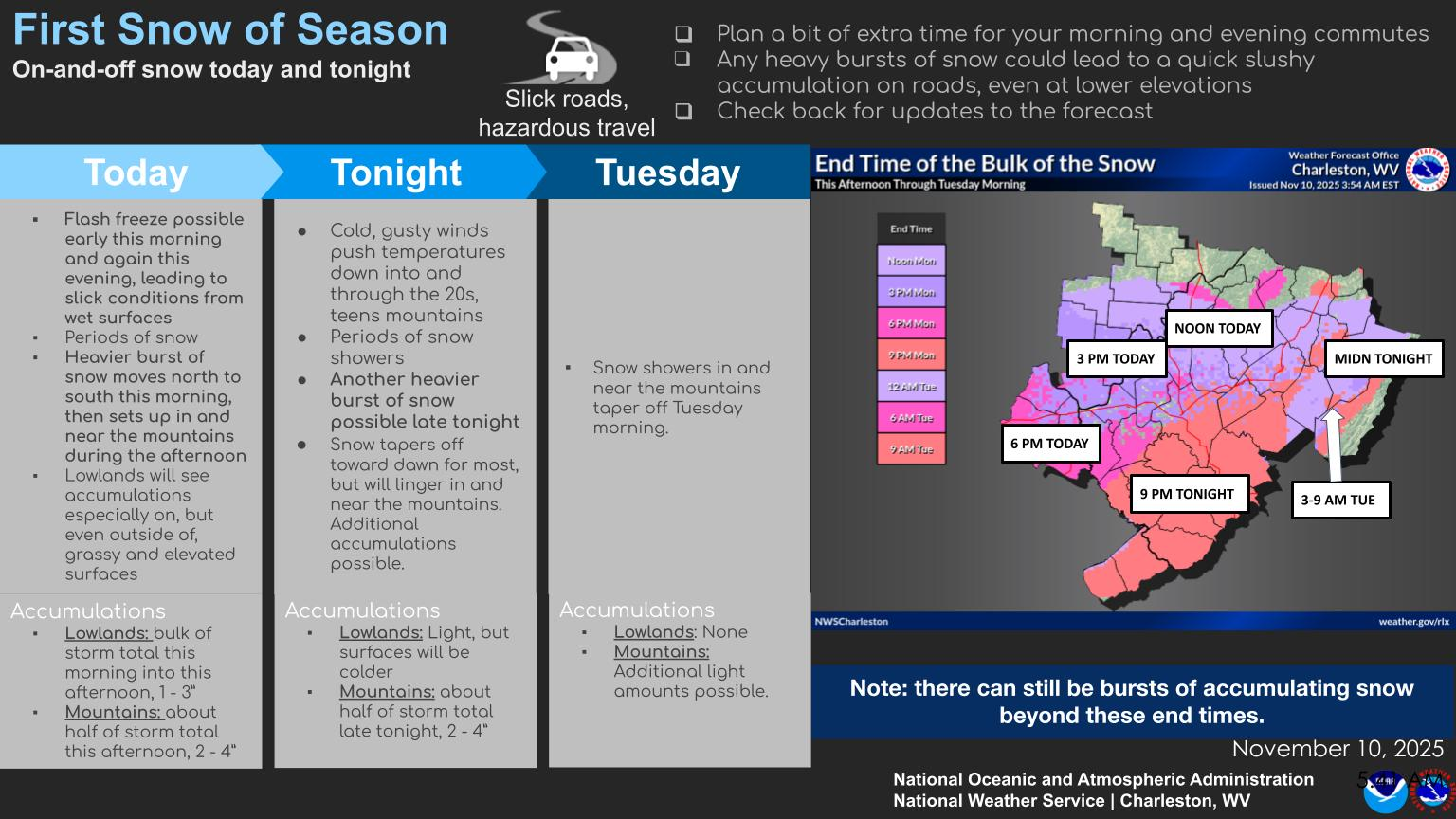
Snow will linger into the evening and overnight in parts of eastern West Virginia. (NWS Charleston)

Total snowfall may reach as much as a foot between Elkins and Beckley.

For the most part, this week’s weather will feature a slow warming trend nationally, We still have one more cold morning to come, and this one may set numerous record lows in the Southeast.
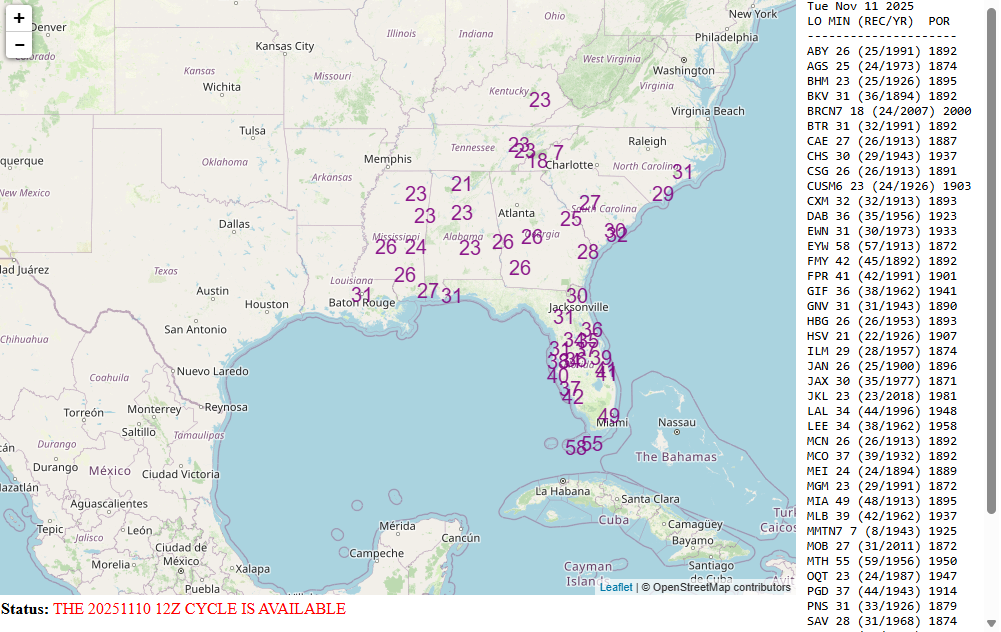
Forecast and near-forecast record lows in the Southeast on Tuesday morning. (NOAA WPC)

The West will be the focus of action this week with 1 to 3 inches of liquid equivalent and higher amounts in some higher elevations. Initial snow levels in the Sierra will be high, 8,500′, dropping to about 5,000 to 6,000 feet on Thursday evening and Friday. Snow levels may drop below 4,000 feet in the mountain passes of the Northwest as well.

Forecast precipitation this week. (Pivotal Weather)

This will be a generally moderate atmospheric river event for the West, with AR levels generally no higher than level 3. The focus should be on Oregon and northern California. Welcome rains will also occur down to SoCal as well. Overall, the ideal sort of Western storm pattern with a good bit of moisture but not too much of it.

European model forecast of maximum atmospheric river levels in the West over the next 7 days. (Center For Western Weather and Water Extremes (CW3E))

The Storm Prediction Center outlook is dormant this week for any severe weather nationally, so we’re in good shape overall right now.

Newsy bits

Today, we focus on the federal government’s sudden aversity to disaster aid.

Western Maryland: In a story that is playing out in various parts of the country, it seems evident that the federal government is pushing ahead with the abdication of their role in some disaster relief. A major flood in western Maryland that likely would have been a declared disaster in most previous administrations (including Trump v. 1.0) was denied that status this year, leaving vulnerable Appalachian communities in a lurch. (Baltimore Banner, Maryland Matters)

Alaska: An EPA grant of $20 million to help the village of Kipnuk, AK reduce erosion from storms was canceled in May as the Trump Administration finalized its review process of funding. While the work related to the grant would not have helped in October’s massive Alaska storm, it underscores the importance of these types of grants. The administration responded to requests for information on this matter derisively as they have done on several occasions. (Alaska Public Media)

North Carolina: The State of North Carolina is suing FEMA and Homeland Security because of $17.5 million in canceled grants. You will notice a pattern with these three stories here, and you don’t need me to tell you what it is. But suffice to say, it’s getting a little ridiculous. (Blue Ridge Public Radio)

California: It’s becoming realistic to think that if a devastating earthquake or another disaster impacts a place like California or Washington that disaster aid will be withheld for political reasons or come with prohibitive strings attached. Or so that’s the message emergency management professionals are trying to convey to people in California. (LAist)

13 Nov 15:40

A Poetic Look at Life & Death: “En lo más negro del verano / In the Darkest Domain of Summer” at the Mexic-Arte Museum, Austin

by Isabel Servantez

En lo más negro del Verano / In the Darkest Domain of Summer lyrically emulates the poem of the same name by Peruvian poet Blanca Varela. The exhibition, like its namesake, creates space for viewers to contemplate death at a deep and lasting level. The show, put forward by the Mexic-Arte Museum as part of its annual Día de Los Muertos observation, celebration, and exhibition, detours from the overt frivolity of previous years and instead aims to create a space where viewers can engage more solemnly with the afterlife.

An installation image of various artworks by different artists in a group show in a gallery.

An installation view of “En lo más negro del verano / In the Darkest Domain of Summer,” from the back of the Mexic-Arte Museum looking toward the beginning of the exhibition

Walking through the show, like reading the poem, it is made clear that even during summer’s brightest moments death is an ever-present partner; a partner that we should not be afraid to sit and engage directly and at long stretches with. When we do this we can eschew the notion of treating death as a taboo subject and embrace a greater part of what makes us human. 

Luisa Fernanda Perez, Mexic-Arte’s Curator of Exhibitions and Director of Programs, said recently about the show, “We [this generation] are now able to access all of our feelings, but we move from each one rather quickly, but with the exhibit, it allows us to sit with that sense of beauty; that sense of loss.”

An installation image of traditional ofrendas on view in a pink-walled gallery.

An installation view of traditional Día de Los Muertos ofrendas in “En lo más negro del verano / In the Darkest Domain of Summer” at the Mexic-Arte Museum

The creation of such a contemplative space has been successfully made through a series of innovative visual decisions throughout the Mexic-Arte galleries. These visuals start with muted pink wall segments, which bookend the museum, pointed out by Perez as the only visual references to a narrative structural beginning and end. Perez also noted that the pink walls might be seen as aesthetically pleasing, even seen as beautifully feminine, but pink is also, and in parallel with the poem, present in many moments of loss. Metaphor is used heavily in Varela’s poem like the opening lines from which the title comes:

“Your face like water singing
in a corner of the garden,
darkest domain of summer,
as though it were the moon.”

This line of words hinting at the core of the poem; an ever-present darkness, even when there is beauty and light, is not perfectly transmuted into the exhibit. In place of Varela’s metaphors Perez and her team have used dramatic lighting throughout the show to reflect the poem’s thesis. The often drastic lighting, accomplished with heavy use of spotlighting that cast shadows, connects the show from one end to the other, weaving its way over, under, and around Mexic-Arte, sewing together the art objects selected for the front galleries to the more traditional ofrendas in the museum’s rear space.

An installation image of a concrete sculptural object by Camila Abbud.

Camila Abbud, “Puente Libre II,” 2023, concrete, iron, mixed medica, and found objects

Collaboration was at the heart of En lo más negro del Verano / In the Darkest Domain of Summer, including artwork selection and presentation. Each artist approached for the exhibition was presented with Varela’s poem and responded to it either with new or pre-existing pieces. From this interaction choices were made between the artists and Perez. An ingenious example of the collaboration among the Mexic-Arte team and their artists can be seen in the presentations of Camila Abbud and Jahaira Daga Acevedo. Both artists responded to the poem by presenting artworks dealing with the continuous passage between worlds. Abbud’s photorealistic pieces Puente Libre I and Puente Libre II show movement between the Ciudad Juárez, Mexico, and El Paso, Texas, border as a “threshold of light and shadow, traversed by stories of struggle, loss, and hope.” Acevedo’s Latente, a short film capturing the journey between Cerro de Pasco and Lima, Peru, plays on a wall near a mounted set of bus chairs — sourced and installed by the Mexic-Arte team, led by preparator Oscar Guerra-Briseño — to give viewers a semblance of the experience depicted in the film. Like the poem, according to the accompanying wall text, in each of these pieces “beauty and hardship coexist within these complex spaces.”

An installation image of a pair of blue chairs sitting next to a video played on a screen that resembles a window.

Jahaira Daga Acevedo, “Latente,” 2019, video

Unique and inventive curatorial approaches, mirroring the emphasis of Varela’s poem, are further on display in the presentation of art by Rubén Ulises Rodríguez Montoya and Jonathan Hernandez. For Montoya’s Vampiritxs (Edition 01), a sculpture resembling a shape shifting creature (nahual) that, “feeds off capitalism, born of labor, migration, and resistance,” Perez worked closely with Guerra-Briseño and her lighting technician Preston Rolls to create a floating display and dramatic shadows. A similar focus on lighting and shadows was applied to the partnering installation by Herandez’s, How long have you been away?, which “evokes the vulnerability of the laboring body and the resilience required to survive it.”

An installation image of a work by Jonathan Hernandez featuring two plastic helmets, a downturned flag, and a candle in a vitrine.

Jonathan Hernandez, “How long have you been away?,” 2025, rectified readymades

When I recently spoke to Perez, I asked her if it was possible for one art form to replicate another: here, an art exhibition from a poem. She said that with this exhibition, the goal of her and her team wasn’t to replicate the rhythms or specifics of Varela’s poem, but to capture its moods and feelings, and like Varela, offer a space that holds a similar room for viewers to sit with what comes after this life and to engage with the enormity of what that means in our day to day. 

Perez and her team have succeeded not in replicating the words and beats of Varela’s poem, but in conjuring the same mental and spiritual space; a space that asks the viewers to do more than briefly acknowledge death but instead to sit with it, like you might sit for a long while in the middle of a calm forest, full of bustling leaves, dancing shadows, and rustling water. Perez and her team have created a space where death is something not to be ignored as it often is in the United States or zealously over celebrated as it can be with some Día de Los Muertos festivals. No, here it is something that should be engaged with at length, so that you can have a full understanding of what death takes from you when it fairies a loved one away and what will be taken from others when it fairies you away as well. Here they have created a space to sit with death for a long while so that you can have a full sense of grief, loss, beauty, and life, and from that, have a fuller sense of what it is to be alive.


En lo más negro del verano / In the Darkest Domain of Summer is on view through January 4, 2026, at the Mexic-Arte Museum in Austin.

The post A Poetic Look at Life & Death: “En lo más negro del verano / In the Darkest Domain of Summer” at the Mexic-Arte Museum, Austin appeared first on Glasstire.

13 Nov 15:25

Wait here. No, wait here!

by Michal Necasek

While working on a hobby project, I set up an OS/2 MCP2 (Convenience Package 2 for OS/2 Warp 4) virtual machine with a debug kernel and an expectation that I’d reboot the VM a lot. I was disturbed to find that there was a consistent 30-second delay on boot while setting up networking, which accounted for something like two thirds of the VM’s boot-up time.

At first I thought maybe the DHCP client was being silly, or perhaps there could be a bug in the NIC emulation. Upon closer look, it turned out that the delay was happening in the MPTSTART.CMD script, which looks like this:

@ECHO OFF
IF NOT EXIST C:\MPTN\BIN\SETUP.CMD GOTO NBSETUP
INETWAIT 1>NUL
IF ERRORLEVEL 1 GOTO END
CALL C:\MPTN\BIN\SETUP.CMD
:NBSETUP
IF NOT EXIST C:\MPTN\BIN\NBSETUP.CMD GOTO END
CALL C:\MPTN\BIN\NBSETUP.CMD
:END

The referenced SETUP.CMD script does exist on the system, and NBSETUP.CMD does not. The 30-second delay was occurring in the somewhat mysterious INETWAIT command.

I could not find much about INETWAIT command on the web, although its purpose is more or less clear. It is meant to wait for the TCP/IP stack to be ready before it can be properly configured.

On closer look, the command actually is documented in the TCP/IP Command Reference that comes with MCP2. The command “causes the current program to wait until either the binding process between the first interface driver and the TCP/IP stack is complete, or the timer expires”. It was apparently added in TCP/IP version 4.1.

The INETWAIT usage help shows the following:

[C:\mptn\bin]inetwait -?
Usage: Inetwait [wait_time  retries]
       default wait_time=10000 (in milliseconds),  retries=3

Okay, so by default, INETWAIT should wait 10 seconds, retrying up to three times, for a total of up to 30 seconds. But… why does it wait the full 30 seconds? Surely everything must be ready after the first 10-second wait? Networking did work in the VM and it could not possibly take more than 20 seconds to initialize everything…

Since the VM was already set up for debugging, it was not hard to break into the debugger during the 30-second wait and see what the INETWAIT process was up to. What I found was a little unexpected.

To communicate with the TCP/IP stack, INETWAIT uses the TCPIP32.DLL dynamic library. I believe it uses the SIOCGIFBOUND IOCTL to find out if network interfaces are bound to the TCP/IP stack. Since setting up a network interface may take some amount of time, interfaces may not be immediately ready, and INETWAIT is meant to give a bit of time until they come online–only not too much time, because they might not (maybe a cable is not plugged in, maybe a PCMCIA NIC isn’t inserted, etc.).

Sounds reasonable. Except… in the _DLL_InitTerm routine of TCPIP32.DLL (that is, code which gets executed while the DLL is being loaded), there is a check for TCP/IP stack readiness, and if that fails, the _DLL_InitTerm routine sleeps for 30 seconds.

As far as I can tell, the logic in TCPIP32.DLL completely defeats the purpose of INETWAIT. If the TCP/IP stack is ready, there will be no waiting; but if it’s not, TCPIP32.DLL will wait for 30 seconds before INETWAIT gets to do any checking or waiting.

The upshot is that either INETWAIT won’t need to wait at all, or if it does, it will most likely just add a useless extra delay in a situation where the TCP/IP stack is not going to be operational after any amount of waiting.

The behavior of TCPIP32.DLL has all the hallmarks of a quick and poorly thought out fix. Sleeping for 30 seconds in a DLL initialization routine is a terrible idea. The waiting should be done elsewhere (like INETWAIT!), but I expect it did fix some problem somewhere.

I should add that the behavior with an undesirable 30-second delay is quite system and configuration specific. It depends on how the system is configured, what hardware it uses, and how fast it runs. On many or perhaps most systems this issue probably won’t be visible because everything will be ready by the time INETWAIT runs, and neither TCPIP32.DLL nor INETWAIT will do any waiting.

I worked around the problem by adding a 1-second delay just before calling INETWAIT. That was enough to avoid the 30-second sleep in TCPIP32.DLL, as well as any waiting in INETWAIT itself, obviously. The boot time went down from about 45 seconds to 15 seconds, which is quite a difference.

Update: The INETWAIT utility has been shipped with OS/2 and used at least since Warp Connect, although there does not appear to be any documentation for it in the older versions. In Warp Connect, the wait parameters cannot be modified, but the maximum wait is 30 seconds (same as the default in later versions).

In Warp Connect and Warp 4, INETWAIT does not wait inordinately long, most likely because it does not use TCPIP32.DLL at all. The old INETWAIT utility in fact seems to be internally quite different; instead of calling a TCP/IP-specific IOCTL, it checks for the existence of the \SHAREMEM\INETXXX shared memory block.

13 Nov 01:41

20.6 - I am mediating a crisis

This week on Lost Terminal: Quent & Stillman talk it out, and Seth overcomes his misgivings and learns secrets.

Lost Terminal will return next week!

📓 Free transcript: https://www.patreon.com/posts/143196877
🎵 Today's SIGNAL is: https://namtao.bandcamp.com/track/sister-megan
🦣 Mastodon https://namtao.com/@lostterminal
📝 Tumblr https://lostterminalpod.tumblr.com
🎙️ Recorded using a RODE NT-1 v5 USB in 32-bit float, edited with REAPER on Linux

🙏 CREDITS
  • Credits narrated by Lucy Stringer
    ❤️ Thank you so much to everyone who supports me, but especially my Patreon Producers:
  • Ada Phillips
  • Kit
  • Mike McCaffrey
  • Jade Felicity Bilkey
  • Stephen McCandless
  • Mike Schneider
  • Catoxis
12 Nov 21:07

my coworker is blackmailing me not to take time off for my honeymoon

by Ask a Manager

I’m off today so here’s an older post from the archives. This was originally published in 2020.

A reader writes:

I work in an office where I’m the only person who can do 75% of my job, but there’s a second person who can do essential functions. We have a policy that only one of the two of us is allowed to request advance time off at a given time (so one of us is always in, barring emergencies).

I’m getting married in October, and in relation to that requested — and was approved for — two days before the wedding and the two weeks following. I don’t take much time off and have more than enough “in the bank” to cover that with some left over. It was approved immediately by my supervisor.

Since then, my close coworker (Jane, who covers some of my essential duties) first started asking if I really “need” that much time off. She then dropped a bit of a bombshell on me and said that she “really needs to go to Florida the following weekend (after my wedding) for a cousin’s wedding” so asked if I could be in for the second half of that week as well as the following Monday. I told her that my plans weren’t certain yet, but that I didn’t want to commit to that and leave those requested days open.

That was met with a tirade about how she “always looks out for me” and that I need to “do this one thing for her.”

We normally have a cordial, if not especially friendly, relationship but she has turned nasty and threatened to blackmail me over a a sick day where she claims I “wasn’t really sick.” She had seen me at the grocery, where I was mostly picking up a prescription but also doing general grocery shopping, but don’t have a doctor’s note if push comes to shove. When she brought it up, she said, “That day I saw you at the grocery store, I know you weren’t really sick but were just goofing off for the day. I’ll report you for that.” I responded with, “I was there to pick up a prescription, even though I bought some other things because I didn’t have anything at home that sounded good.” She responded, “If you don’t let me have this, I’m still going to report it.”

(For context, this happened during the work day, probably around 1:00 in the afternoon. Sometimes one of us will go to the store to buy work supplies during the day. When I saw her there, I had just come from the doctor’s office, which is literally right across the street, and was shopping for other things while waiting on a prescription to be filled at the store pharmacy.)

This has gone on for a week and she’s not dropping it that I need to be in those specific days, and I’m not relenting.

There’s a possibility that — for a variety of reasons — I won’t even be working there in October, but at the same time I don’t know how to handle this. I mentioned it in passing to my supervisor, who wasn’t overly interested and he indicated that I was “okay” since I’d requested the time 9+ months in advance. Still, though, I feel that the battle isn’t over yet, and it’s negatively affecting my ability to actually do my day to day job as Jane is refusing to do the small part of her job that I don’t have the proper training/credentials/ability to do.

In addition, there are the logistics that if our supervisor agrees to let us both off, I’m no doubt going have two dozen calls/texts a day on my honeymoon from people who are persistent enough to call me 10 times in a row if I don’t answer. Needless to say, that’s NOT a situation that I want to deal with, but it happens any other day when both of us are off (heck, it happens when I’m off just because of the sheer volume of stuff that she doesn’t care to learn to be able to answer).

Jane is a jerk.

But not a very smart jerk. She thinks she has way more power here than she does! And I think you think she does too.

You requested time off for your wedding and honeymoon nine months in advance. It has been approved. Your manager reiterated that your time off is secure.

Jane’s blackmail attempt is embarrassing — for her. It has no teeth at all. You don’t have anything to hide because you didn’t do anything wrong. You’re allowed to pick up prescriptions when you’re sick. You’re also allowed to buy yourself groceries when you’re sick. But if your manager really doubted you for some reason (which is unlikely), you could always contact your doctor’s office to get documentation that you did indeed have an appointment that day. It probably won’t come to that, though. But if you needed to, know that you could get the back-up you need.

Unless your boss is a complete fool, I can’t imagine he wouldn’t be at least slightly interested in knowing that one of his employees is (a) attempting to blackmail another (b) into altering her wedding and honeymoon plans (c) that have already been approved and (d) is refusing to do part of her job because of a personal vendetta.

I strongly suggest that you talk to him and say this: “Jane is harassing me about the time off I had approved for my wedding and honeymoon. She wants some of those same days and told me that if I don’t change my own time off request, she will report me for misusing a sick day. That’s false. She saw me in the grocery store while I was picking up a prescription on a sick day. I can get a note from my doctor that I was seen that day if you need me to. I think it’s hugely problematic that she’s trying to blackmail me to change my days off, so I want to make sure you’re in the loop that that’s happening. She also is refusing to do (specific work tasks) because she’s upset with me. Obviously, I rely on her to do XYZ to be able to do my own job. Can you intervene, so that her harassment stops and I can do my work?”

If your boss won’t intervene, then he’s passive to the point of negligence and you should say the above to HR as well. This is the kind of BS that managers should handle on their own but which HR will usually step in on if you need them to.

Meanwhile, with Jane, tell her this: “I’m not going to discuss my time off with you any further. If you want to report seeing me in the store picking up a prescription, feel free to. I can get documentation from my doctor if I need to, and I’ll happily let (manager) know the situation myself. But I’m not going to discuss this anymore.” If she continues to push, say, “You need to talk to (manager) about this. It’s not up for discussion between us anymore.”

But if your boss is at all decent, he’ll shut this down once you explain what’s been happening.

If the outcome is that he gives Jane the days off she wants and so you’re both gone on the same dates, let people know ahead of time that you will be on your honeymoon and 100% not reachable. Tell them you won’t be responding to calls or texts, and then stick to that. In fact, block everyone from your office during that time away so you don’t even see it if they’re trying to contact you. If you feel weird about doing that, then tell your boss in advance what you’re worried about, and reiterate that you will be 100% inaccessible. People do this! You’re allowed to take a freakin’ honeymoon without work calls.

But stop fearing Jane. What she’s doing is super messed up in a way no decent manager would condone, you have the power to expose that, and you should use it.

The update to this letter is essential reading! Do not miss it.

The post my coworker is blackmailing me not to take time off for my honeymoon appeared first on Ask a Manager.

12 Nov 21:07

how should I manage someone who uses the Gen Z stare?

by Ask a Manager

A reader writes:

I have been managing a corporate team for a little under a year, and I’ve gotten to know them all over the last few months. One employee, Sally, is smart, quiet, and a hard worker. However, when I talk to her, I started noticing that I was getting a lot of silence and a glazed look back. I tried a few different ways to ask questions and have a conversation over the months, but nothing has led to a change in her demeanor. At one point, I was wondering if she was high at work, since she seemed to me to be so checked out during conversation.

Then a few months ago, I learned about the Gen Z stare – and I think that’s what I’ve been encountering! Sally is Gen Z, and the uncomfortable silence and blank stare fit what I’ve been seeing. It’s definitely frustrating and awkward to be on the receiving end of it.

I’ve been thinking about it ever since! I’m a Millennial, and I know that I have Millennial generational quirks that probably drive others at work crazy. It doesn’t feel right to bring a critique to someone that is generational, but at the same time, would it be doing her a service to tell her how this could be perceived in a professional setting? I’d love to get your thoughts on this as workplace norms change over time, and as a manager, how do you respond?

For people who haven’t heard the term, the “Gen Z stare” has been getting a bunch of media coverage. It’s the idea that some Gen Z employees, when spoken to by a colleague or a client, will just respond with a blank, disengaged expression. People older than them tend to read it as rude indifference or even hostility.

I’ve heard it explained as Gen Z being cynical about work, feeling disconnected, and not into performing fake enthusiasm. But the issue with the “stare” at work isn’t the lack of enthusiasm; it’s the lack of anything — no response indicating that they heard what was said, and no information offered in return. Some people say the stare also has an element of “this is stupid; why would I respond?” — which is something they can certainly think privately but which isn’t okay to convey at work. The other explanation getting offered is that this generation came of age with fewer face-to-face interactions and more screens (particularly because of the pandemic) and so they genuinely don’t know what the expectations are around non-digital communication. I think that theory is pushing it, but who knows.

In any case, you’re right that it’s going to affect how your employee is perceived, and it would be a kindness to spell out what appropriate responses at work do look like. The easiest way is to be clear about what you want from her when you see it happening. So for example, if you say something that you’d expect a response to and she looks at you blankly, you could say:

* “What are your thoughts on that?”
* “Does that all make sense to you or do you want me to clarify anything?”
* “I’m having trouble reading your response to that. Can you tell me what you think about the client’s feedback?”
* “I’d like to hear your perspective on that.”

If you do that every time, there’s a decent chance she’ll start learning she’s expected to respond and will start doing it without being prompted every time.

But if not, you could address it more big-picture. For example: “I’ve noticed that when I share feedback or plans for a project or pass along info for our work, you often don’t say anything in response, which makes it hard for me to tell what’s going on on your end of our conversation — whether you’re still thinking about it, or confused, or disagree, or even if you’re just thinking about something else entirely. In a work context, the expectation is usually that you’ll respond out loud in some way when someone’s talking to you one-on-one. If you need a minute to think, it’s okay to say, ‘Give me a minute to think about that.’ But I need you to stay something in response so that we can have a real conversation.”

You should also address it if you see her doing it with a client or a colleague: “When Jane said X, you just looked at her and didn’t respond. In a situation like that, you need to (fill in with examples of appropriate responses).”

Say all of this neutrally, rather than sounding frustrated or irritated. Start from the assumption that she genuinely doesn’t know how it’s landing, and coach her on it just like you’d coach her on how to run a meeting, or how to pitch a client, or how to write better copy. And really, it’s at least as much as a service to her as coaching on any of those topics would be.

The post how should I manage someone who uses the Gen Z stare? appeared first on Ask a Manager.

12 Nov 20:52

what to do if ICE agents come to your workplace

by Ask a Manager

With aggressive ICE raids expanding to an increasing number of cities, I’m sharing the following guidance from a community organizer in Chicago about what to do if ICE shows up at your workplace.

I’m in Chicago, which has been targeted aggressively by ICE and Border Patrol for the last two months. ICE actions are expanding into many other cities, and I wanted to share some resources and tips from our city’s experiences with your readers.

Inc. has a solid article on the rights of business owners when ICE shows up. It’s important to know what your rights are, especially about private areas and documentation. However, ICE frequently and blatantly disregards legal limitations, and when confronted with armed, masked strangers, it may be difficult for individuals to physically intervene to stop them from going into off-limits areas. Owners and managers should provide information to employees about their rights, as immigrants and as citizens. Be prepared to document ICE when they’re at your business; you may need evidence of their actions if they violate your rights or abduct any workers. (The latter is critical to help families find out what happened if someone is taken.)

As an employee, you may be more limited, especially if management isn’t supportive. Many places, especially large corporations, are adopting a neutral position towards ICE’s activities, which effectively means letting them operate unchecked. Employees can leave Know Your Rights (KYR) info in staff areas for people to take. Try to get in touch with your local ICE Watch or immigrant rights groups as well. Many of them are sending out alerts when ICE is active in a particular area, so you can be aware if they’re near your place of business.

Some other, more hands-on tips:

  • Landscapers, construction workers, and other contractors are extremely vulnerable. Despite claims that they’re arresting “the worst criminals,” ICE literally drives around and abducts brown people working outdoors. If your business employs any of these services, work with them to develop a safety plan if ICE shows up. For example, letting them come inside and go into an employee-only space until it’s all clear.
  • Share information and resources, but do not make risk assessments for other people. Don’t tell Latino coworkers to work from home because it’s safer for them, for instance. Instead, if you’re in a position to do so, allow for more flexible WFH as a choice for anyone who might need it.
  • If you’re a manager, try to offer compassion and flexibility. Vulnerable employees are going to be extremely stressed with the constant, unpredictable fear of friends, family, or even themselves being abducted. You may also have employees who are volunteering with ICE Watch organizations, which can be emotionally and mentally draining as well.
  • In Chicago, raids have been extremely unpredictable day-to-day. We don’t know when or where they’re going to hit. You unfortunately have to assume that ICE could show up at any time. This is why it’s critical to have plans and education as soon as possible.
  • Do NOT post about what you’re doing on social media or non-secure servers — which often includes workplace communications. Use a secure app like Signal or have conversations in person. This goes double if you record a raid. Don’t post it online, save it for the lawyers and immigration advocates.

Above all else, the best thing that you can do in your community is to connect with local ICE Watch and immigrant rights orgs. They have information, resources, and contacts that will help you and your neighbors. Get info, coordinate with your coworkers, and build a community to protect each other.

I’m updating this post to add these additional resources shared by a reader:

  • The ACLU has a webpage with free, downloadable KYR social media graphics, including phone backgrounds so folks can see their rights without unlocking their phones in the presence of law enforcement.
  • If you want to help people share KYR information at work, the ACLU also sells 10 packs of KYR wallet cards in multiple languages that outline your rights if you interact with ICE agents at work.
  • For a free version of this, ILRC has a free, downloadable “red card” that you can download in multiple languages and then print and cut up at home.

The post what to do if ICE agents come to your workplace appeared first on Ask a Manager.

12 Nov 19:27

Study Finds Most Americans Can’t Find Where They Are Being Deported On Map

by The Onion Staff
12 Nov 17:46

my coworkers have a crush on my boss … and are taking it out on me

by Ask a Manager

I’m off today so here’s an older post from the archives. This was originally published in 2020.

A reader writes:

I’m the executive assistant for a small company. I’m the direct support for the VP of human resources, “Dave,” who is very charismatic and likable and a generally nice guy. He’s also very good looking. However, he’s very professional with great business boundaries. I enjoy working with him.

Two managers in particular, “Karen” and “Nancy,” need to meet with him all the time. All. The. Time. Their departments aren’t undergoing any HR issues, they don’t have any staffing needs, and they’re not hiring or firing anybody right now. They call to schedule multiple meetings a week, drop by to see if he’s available for 1:1s when his schedule doesn’t have a single second free, and call him multiple times a day. Dave always routes them back to me to take a message or schedule them with him. Nancy gets angry with me when I tell her he’s not available and blew up at me last week that I’m “not his chaperone.”

Dave has noticed it and so have a few other execs. Dave’s been very clear about making both of them go through the same process other staff members go through to schedule with him. Just the same, other staff have started calling them his “fan club” and me the “bouncer.”

When I was working with the other assistants and operators on a training, word about his “fan club” had gotten around and one person mentioned that Karen calls me names and tells the other staff I’m in love with Dave and don’t want other women near him, which is why I never let her schedule with him. She even showed me a few emails in which Karen advised her department support professional to go over my head to see Dave and that I wasn’t the “keeper of his zipper.”

I’m not sure how to approach this. I’m more angry than I am embarrassed. I’m also bothered because the support staff report to me, and some of my staff have reported both Nancy and Karen as being difficult to work with and unpleasant in other aspects of the day-to-day, not just in regards to the Dave thing. Where do I start with this?

This is so gross!

If Karen and Nancy were simply trying to meet with Dave all the time, that would be annoying but manageable. Even then, though, at some point Dave would probably need to shut it down more firmly than he has. (Not that he’s at fault here! It sounds like he’s managing an uncomfortable situation pretty professionally — but needs to hear how it’s gone off the rails.)

But this is more than Karen and Nancy trying to get a weird amount of Dave’s attention. Blowing up at your for doing your job, calling you names (!), spreading rumors that you’re in love with him, and ever uttering the words “keeper of his zipper” in a work context is … ugh, so over the line and gross and violating. To you, and also to Dave.

It’s time for you to talk to him. It’s going to be awkward and uncomfortable, and you need to do it anyway. (Remember that the awkwardness is 100% on Karen and Nancy, not you.) He needs to know the full extent of what’s happening, how out of control it’s become, and how it’s affecting you.

If you’re hesitating to do that because it feels uncomfortable or you don’t want to burden him with this or you feel like you should be able to deal with it yourself … you still need to talk to him, for three key reasons. First, he deserves to know what’s being said about him so he can decide for himself how he wants to handle it. It’s not right to let this happen behind his back without informing him. Second, as your boss he needs to be aware that you’re being harassed and mistreated. Third, as the VP of HR, he has a professional obligation to intervene and ensure this is shut down — his job in the company requires it (and there’s a point where not acting will make people question HR’s competence, and how seriously HR would take it if someone else were facing similar issues).

So talk to Dave. Tell him all of it — the name-calling, the yelling at you, the rumors, the undermining you, all of it. And I’m sorry to say, you’re going to have to repeat the “keeper of his zipper” line because that makes it clear just how over the line this has become.

You can tell him you’re embarrassed to have to repeat all this, but it’s important that you tell him it’s happening, and that you tell him it’s at the point that HR needs to intervene and shut it down.

If Dave is as great as he sounds — really, even if he’s only sort of okay — he’s going to be grateful you told him and will deal with it so you don’t have to. It’s his job! Let him have the info he needs to do it.

The post my coworkers have a crush on my boss … and are taking it out on me appeared first on Ask a Manager.

12 Nov 17:45

husband says it’s inappropriate to dine or carpool with my boss, bowing out of a cooking competition, and more

by Ask a Manager

It’s five answers to five questions. Here we go…

1. My husband says it’s inappropriate to dine or carpool with my boss

I have a great relationship with my boss. He is incredibly supportive of my professional growth and is a good mentor. We work well together on projects and complement each other’s skills. We’ve built a great team and are very intentional about culture. Relationships are incredibly important in our field. Some context: He is a man, I am a woman, and he’s about 10 years older than me.

My husband hates my boss, and he’s not shy about it. He says my boss doesn’t look him in the eye or shake his hand when they run into each other at work functions. He always has something nasty to say about him. I don’t get it.

From time to time, my boss invites me to grab dinner after work events or carpool to things together. This sends my husband through the roof. He says it’s great that we work well together but there is no need to socialize outside of work. He’s convinced my boss is being inappropriate. I enjoy carpooling or grabbing dinner with my boss from time to time! It’s fun to unwind and socialize. We talk about work and non-work topics. I NEVER feel like my boss is being inappropriate or flirtatious. The relationship genuinely feels friendly. His wife is awesome, I like socializing with her too from time to time at work functions!

I know you’re going to ask how my marriage is. It’s okay. We’ve been married a while now, there have been bumps that we’ve tried to move past. I genuinely think he’s projecting his issues onto this situation.

But my question is about work. Is it inappropriate to get dinner with your boss and socialize? We’re not in an industry like sales where dinners or social outings are the norm. Our jobs are stressful and it’s just fun to unwind together.

It is absolutely not inappropriate. It’s a normal thing to do when you work with someone. You have a good rapport and good will toward each other, and you have a shared frame of reference (you know the same people, projects, industry, obstacles, etc.). When you’re leaving a work event together, it makes perfect sense that you might decide to grab a meal or a drink before heading home.

Your husband doesn’t even want you carpooling with your boss? I could almost excuse him feeling weird about the after-work socializing (although that would still be way too controlling of him), but objecting to driving together to work events takes this into a different territory of problematic.

Something is going on with your husband / your marriage. It’s not about your job.

2. Should I bow out of our holiday cooking competition?

For about a year, I have worked at an office job where I very consistently bring in baked goods or shareable food items. But I am not pressured to or criticized when I don’t.

My question is related to an upcoming holiday potluck where there is also a cooking contest. I won last year and got a gift card, which was great, but I’m debating if I should even enter this year. Mostly, I’m not sure that’s fair, because I have to imagine consistently bringing in items biased the judges in my favor. (It was anonymous, but I am of a cultural identity that is unique amongst my coworkers, so the flavor profile probably gave me away. Also, small office.) And there are other excellent bakers and home cooks as well, irrespective of whether I’ve brought more items in total and engendered good will that way.

But I don’t even know if I’d win again, so maybe it’s arrogant to assume I need to bow out? As you can tell, I’m overthinking this. But people are asking if I know what I’ll be making, and I’d like to have either an answer or a good excuse soon enough.

You don’t need to bow out! I don’t think you have an unfair advantage just because you bring in food more than your coworkers do; the judges presumably aren’t judging based on the entirety of your contributions over the whole year, but rather on the specific dish you enter into the contest. Moreover, if you do bow out because you feel it’s unfair to participate, there’s a risk of coming off as patronizing to your coworkers — as if you assume they couldn’t compete with you.

I do think that if you start winning the contest every year, it would be gracious to occasionally bow out and cite holiday baking fatigue or similar. But no need so far.

3. Employee says they think the feedback is unfounded … but then makes changes anyway

I have an employee who has been struggling with soft skills in their role — managing relationships with partners, navigating differences of opinion, openness to changing approaches, etc. These are non-negotiable skills for the role given our business model. They’ve been coached on this repeatedly, and we’ve seen some up and down improvement in the past year but it hasn’t been sustained. In their latest performance review, they were told they were not meeting expectations and a plan for correction has been introduced.

In conversations since then, their response has been to dispute the feedback, including things like saying the skills named aren’t requirements for the role (they are), hinting that this is just a matter of opinion and trying to ascertain whether “others” feel this way, and making comments that suggest the feedback isn’t “fair.” When I’ve said that this response is making me concerned about whether they’re taking this seriously — after all, how can you internalize and act on feedback you don’t think is valid? — they’ve said they can find the lesson in anything and they’re committed to working on it. They do seem to have taken the feedback seriously and made changes, but historically that has then been followed by regressions. Given that they’re disputing the feedback but at the same time acting on it, what do you recommend I do?

They can think the feedback is unfair, but if they’re making the changes you want, that’s ultimately the most important thing. Care more about what they do and less about what they think (unless/until what they think starts coming out in disruptive ways). It’s not that the fact that they disagree doesn’t matter — it does, partly because it suggests lack of alignment between the two of you about the fundamentals of the job, and that’s likely to play out in other ways too — but ultimately what matters is what they do.

If they regress again like they have historically, you’d address that at that point (and really at that point should probably conclude that they’re not well matched with the job). Ideally the formal performance plan would have been explicit that the changes need to be sustained over the long term and you won’t start the process again from scratch if they backslide. If it didn’t, then at whatever point the plan is completed, you can remind the employee of that (while also recognizing that they’ve done a good job in building the skills you asked for, assuming that’s the case).

4. I feel guilty about getting my coworker’s job after they were let go

I was offered my coworker’s job the day after they were let go, and I don’t know how to feel about it. I feel guilty but I also really wanted this promotion. I don’t know how I feel about my boss firing him and hiring me in the span of about 12 hours.
Do you have any advice?

It can be weird to feel like you’re benefiting by someone else’s misfortune, but that’s not the right way to look at it! Your coworker presumably was going to be let go regardless and there are all kinds of things that could have been happening behind the scenes, including your coworker simply not being suited for the work after having been given opportunities to improve. You’re not required to turn down a promotion on principle or out of solidarity with someone else.

Realistically, you might not be able to logic your way out of feeling weird about it for a while because that’s how minds work, but if it helps, you’re not wrong to accept the promotion, regardless of the reasons it was available. (I would have a different answer if you, like, set them up unfairly in some way, but I’m assuming that didn’t happen.)

5. We can’t request accommodations until after planned surgeries are over

A few years ago, I had orthopedic surgery. It was scheduled a few weeks in advance and I knew after the surgery I’d be in a brace for a period of weeks, with requirements to ice frequently and physical therapy exercises multiple times per day. I was given restrictions on how far I could walk and what I could lift. I stayed with my parents during this time because I needed a lot of help as I rebuilt the muscle. In advance of the surgery, I requested a temporary accommodation under the ADA to work remotely the entire time I was in the brace. I received a letter from HR saying my request did not fall under the ADA as it was temporary, but nevertheless they supported allowing me to work from home, and my request was granted for the specified date range. My letter was very specific that if anything changed, I had to submit new paperwork and go through a new approval process.

A work friend of mine is now having a similar procedure and asked me how to submit the paperwork to work remotely as she recovers; she said she already talked to her boss, who was fully supportive and just asked her to make the accommodation official. Turns out, our HR department has now changed the policy so that an accommodation can’t even be requested until after surgery because “how can your doctor know what you will need?” and “you won’t need the accommodation until after the surgery.” Both of our procedures were relatively predictable (e.g. you’ll be in a brace for 4-6 weeks and physical therapy will likely last X months) and my friend isn’t requesting the accommodation start until the day of her surgery. HR has also told her they need to decide if her post-surgical medications preclude her working. Again, the post-surgical protocol across these procedures are pretty standard and no one is on very heavy painkillers and certainly not more than a week or so. Our work involves typical office computer work, and public-facing work is pretty minimal and scheduled in advance.

My guess is this new policy falls into the category of “crappy but legal” to make someone worry about submitting paperwork for an accommodation as they try to recover from surgery. But I’m very curious to get your reaction to this.

This is ridiculous, and it’s probably legal. Ideally she can get all the paperwork together and ready to go before her surgery and have her boss file it for her the day of, but there’s no reason it should need to be done that way, and they’re just creating more headaches and stress for employees at the exact moment they’re least equipped to deal with it. Any chance your managers want to band together and push back?

The post husband says it’s inappropriate to dine or carpool with my boss, bowing out of a cooking competition, and more appeared first on Ask a Manager.

12 Nov 17:26

mst3kgifs: …And have concluded that the boilers have not moved...


mst3kgifs:

…And have concluded that the boilers have not moved for some time.

12 Nov 17:26

Trump’s White House Renovations By The Numbers

by The Onion Staff

President Trump’s remodeling of the White House continues, which so far has included the demolition of the East Wing to add an expensive ballroom and outfitting his ensuite bathroom with premium Italian marble. The Onion examines the key facts and figures behind the renovations.

3:

Chandeliers in the situation room

$500 million:

Funding from wealthy donors who expect nothing in return

18%:

Percentage of White House doors that will open to nothing but solid wall

12:

Seats for dignitaries in the T-Mobile Club Magenta VIP area

76° Fahrenheit:

Water temperature of sub-dance floor piranha tank

6,000:

Projected instances of sexual harassment in ballroom’s first year

The post Trump’s White House Renovations By The Numbers appeared first on The Onion.

12 Nov 16:06

A little sarcastic, Mike?

A little sarcastic, Mike?

12 Nov 16:06

A phalanx of reporters comes swooping down! …Well, someone from the Home Shopper pulls up in a…

mst3kgifs:

A phalanx of reporters comes swooping down! …Well, someone from the Home Shopper pulls up in a K-car.

12 Nov 16:04

Chuck Schumer Doesn’t Know What Time It Is

by Mike Brock

After forty days. Forty days of the longest government shutdown in American history. Forty days of Democrats saying this is the line—healthcare for twenty-two million Americans. Forty days of holding firm while Republicans bet Democrats would break first.

Chuck Schumer just taught Donald Trump that hostage-taking works.

Not because he had to. Because the framework he operates within cannot imagine doing what this moment requires: actually fighting power instead of managing accommodation to it.

Eight Democratic senators voted to end the shutdown last night. The deal they cut? A “guaranteed vote” next month on ACA subsidies that everyone—including Chuck Schumer—knows won’t pass. They traded their only leverage for a promise they know is worthless. They held the line for forty days, then surrendered for nothing.

The base is in open revolt. Gavin Newsom’s response was one word: “Pathetic.” JB Pritzker called it “an empty promise.” AOC reminded everyone that “working people want leaders whose word means something.” Chris Murphy admitted plainly: “There’s no way to sugarcoat what happened tonight.”

And Ro Khanna did what needed doing: he called for Schumer’s removal as Senate minority leader.

This isn’t just fury at a bad deal. This is recognition that the Democratic establishment is operating within a dead framework that keeps producing the same result: managed decline wrapped in sophisticated justifications.

Schumer’s calculation was pure technocratic management. The shutdown polls badly. Healthcare polls well. Get a vote scheduled, minimize political damage, trust that Republicans will take the blame when premiums skyrocket. Classic establishment thinking: read the focus groups, calculate the risk, optimize for damage control.

What he cannot see—what the framework literally prevents him from seeing—is that the fight itself mattered more than any deal. That people weren’t asking for better negotiating tactics. They were asking for proof that Democrats would hold the line on something. Anything. After Chicago. After ICE raids. After warrantless mass detentions. After watching Trump systematically dismantle constitutional constraints.

This was the test. Forty days to prove Democrats could fight power instead of accommodating it. And Schumer folded.

Symone Sanders got it immediately: “The hostage taking worked.” That’s the lesson Trump learned last night. That’s why Chris Murphy is right to fear Trump gets stronger, not weaker. When you teach authoritarians that threatening to hurt people produces Democratic capitulation, you haven’t minimized damage—you’ve guaranteed more hostage situations.

The establishment will produce sophisticated analysis explaining why this was actually strategic. They’ll point to the guaranteed vote, the federal worker protections, the political positioning for next month. They’ll treat this as a temporary setback in normal political competition.

But this isn’t normal political competition. This is one side attempting regime change while the other pretends it’s just another negotiation requiring careful positioning.

The base understands what Schumer cannot: you cannot manage your way out of authoritarian consolidation. You cannot focus-group your way to resistance. You cannot optimize yourself into fighting power when your entire framework is built on accommodating it.

The governors get it. Newsom fighting homeowner cartels in California. Pritzker calling out empty promises. They’re not waiting for Senate leadership to figure out what time it is. They’re building the alternative: liberal populism that actually fights concentrated power instead of explaining why fighting is unstrategic.

The progressive caucus gets it. AOC reminding everyone that people’s lives depend on Democrats keeping their word. Khanna calling for new leadership. James Talarico declaring “this moment demands fighters, not folders.”

Even establishment voices like Murphy understand something fundamental broke last night. When your own senator has to record a video saying “there’s no way to sugarcoat this” and “I’m angry—like you”—that’s not spin control. That’s recognition that the base has decided the framework is dead.

Forty days was long enough to prove Democrats could fight. Long enough to make Trump pay a political price for hostage-taking. Long enough to show working people that their leaders’ word means something.

Chuck Schumer surrendered all of that for a vote next month that won’t pass.

He doesn’t know what time it is. But the base does. The governors do. The progressive caucus does. And they’re done waiting for him to figure it out.

The dead framework just folded. Time to storm the castle.

Mike Brock is a former tech exec who was on the leadership team at Block. Originally published at his Notes From the Circus.

12 Nov 14:22

FAQ About Our New 100-Year Mortgage Loan

by Gracie Beaver-Kairis

“Trump introduced a new idea to tackle home affordability: a 50-year mortgage loan. Federal Housing Finance Agency Director Bill Pulte called the proposal “a complete game changer.” … but many housing experts warn the plan could backfire, raising the cost of homeownership by stretching out payments, adding more interest over time, and driving up home prices.” — CNN

- - -

Q: What is a 100-year mortgage loan?
A: We offer the flexibility of financing your new home over an entire century, theoretically lowering your payments as the loan is spread out over a longer period of time.

Q: Who is this loan for?
A: Everyone. But especially immortal wizards and vampires; people who think “100” sounds like a nice round number; and us, your lender, who will be collecting interest on this loan until you turn to dust.

Q: Does this actually save me any money?
A: It absolutely might.

Q: Can you give an example?
A: With a $400,000 30-year mortgage at 6.5 percent, your principal and interest payment is $2528.27, and over the life of the loan, you pay over $500,000 just in interest. Now, let’s say we take that same loan at 6.5 percent over 100 years. Your principal and interest is $2169.99–a savings—and all you have to do is pay $2.2 million in interest over the life of the loan.

Q: So, the interest rate would be the same on the 100-year mortgage as it is on a 30-year mortgage?
A: No. Because it’s a longer-term—and therefore riskier—loan, the interest rate on the 100-year mortgage is higher. If the rate were, say, 7.5 percent instead, your principal and interest on the 100-year mortgage would increase to $2,501.42, which is still technically a monthly savings.

Q: What is the rate on the 100-year mortgage, then?
A: We can’t give specifics without a credit score and a signed NDA, but it’ll be somewhere between the rate on a T.J.Maxx credit card and the rate of one of those Western Sky payday loans (RIP), where they warned you in the commercials that the money was expensive.

Q: Can I buy my rate down?
A: We offer a unique program where, in exchange for a slightly lower interest rate, you can sign up for the ever-present threat of henchmen showing up to break your legs if you miss a payment.

Q: When will I own my home outright?
A: With the average age of a first-time homebuyer now being forty, we encourage homebuyers to reframe their goal as seeing if they can survive at least half the full term. Alternatively, after retirement, you can refinance into a reverse mortgage. It’s like Dominic Toretto doing a sick handbrake turn and spinning his Charger around on the highway without making any real directional progress.

Q: Will I build equity in my home?
A: You’ll build equity much more slowly than you would with a traditional loan due to the massive amount of interest you pay each month, but it adds up. For example, after thirty years, you may have enough equity in your home to buy one dinner off the Applebee’s value menu. (Be sure to ask about our home equity loans.)

Q: Should I just keep renting?
A: Why keep throwing your money away on rent when you can feel like an actual adult by throwing your money away on a century-long loan you’ll never repay? As a bonus, you’ll be 100 percent responsible for any repairs to your appliances.

Q: Will my children or grandchildren have to keep paying this loan after I’m dead?
A: Yes, if they want to keep the house, and you had them co-sign with you as we recommend you do. Also, if you took the henchmen incentive for a lower rate.

Q: What other differences are there between the 100-year mortgage and a traditional mortgage?
A: Most lenders utilize current technology like DocuSign to streamline paperwork, but the 100-year mortgage requires all disclosures to be signed in person and in blood, in the inner sanctum of a participating satanic temple or abandoned Countrywide Financial building.

Q: Is there anything else I should know about the 100-year mortgage?
A: The 100-year mortgage is like your parents’ sex life, the environmental impact of AI, and relationship updates about teenage TikTok celebrities: The less you know about it, the better it will be for your sanity.

12 Nov 14:20

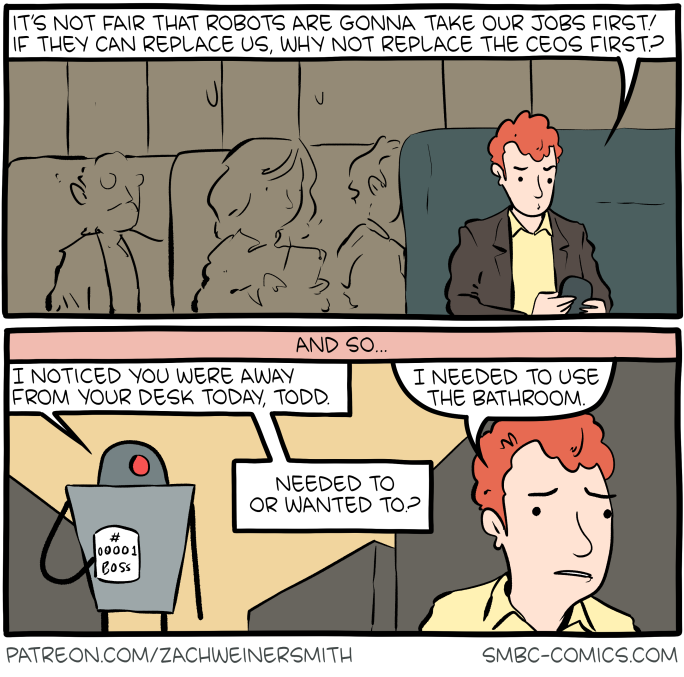
Saturday Morning Breakfast Cereal - Boss

by Zach Weinersmith


Click here to go see the bonus panel!

Hovertext:
Of all the AI concerns, the one about wanting to replace management with algorithms is the most monkeys-paw-ish.


Today's News:
12 Nov 14:20

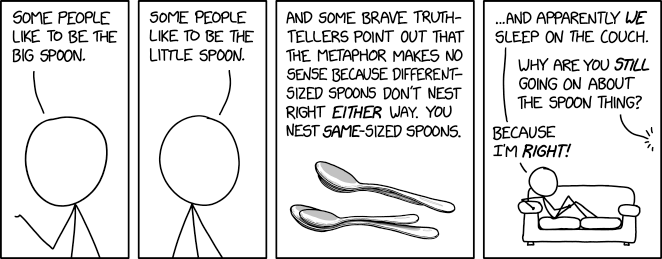
Big and Little Spoons

Are you the annoying spoon or the sleepy spoon?
12 Nov 14:19

Rogers commemorates Blue Jays World Series Run with new statue of Ted Rogers

by Ian MacIntyre

TORONTO – Rogers Communications, proud owner of the only Major League Baseball team in Canada, revealed plans to celebrate their 2025 World Series run with a second statue of company founder Ted Rogers Jr. to be placed several feet from the current statue. “It’s been 32 years since Toronto’s Blue Jays went to the World […]

The post Rogers commemorates Blue Jays World Series Run with new statue of Ted Rogers appeared first on The Beaverton.

12 Nov 14:19

Pregnant woman startled by unexpected symptom of everyone being really nice to her

by Staff

VANCOUVER – Sarah Jenkins, 32, who is seven months pregnant with her first child, has reportedly had some difficulty adjusting to a strange new symptom: colleagues, acquaintances, and even strangers being bafflingly nice to her. “The first time some teenager got up and offered their seat to me on the bus, I thought it was […]

The post Pregnant woman startled by unexpected symptom of everyone being really nice to her appeared first on The Beaverton.

12 Nov 14:18

Answering your questions about the Ostrich story your uncle won’t stop posting about

by Luke Gordon Field

You have probably seen your right wing family and friends post a lot about ostriches lately. And, since you don’t follow Rebel News and a lot of twitter accounts with fucktrudeau and fringeminorty in their username, you might not know why. So we’re to help answer all your questions with the speed and grace of […]

The post Answering your questions about the Ostrich story your uncle won’t stop posting about appeared first on The Beaverton.

12 Nov 14:18

Demonic dog baring teeth and growling just happy to see you, says owner

by John Hansen

ARNPRIOR, ON – Local residents expressing concern over the behaviour of an aggressive dog were reassured by its owner that he is actually quite friendly and loves people. Residents walking the paths of the Gillies Grove Nature Reserve reported encounters with a large dog that left them feeling shaken.  “I was walking through the woods […]

The post Demonic dog baring teeth and growling just happy to see you, says owner appeared first on The Beaverton.

12 Nov 14:18

Schopenhauer vs A Child with Candy

by Corey Mohler
PERSON: "Look at this dumb kid, enjoying his life! What a fool. "

PERSON: "But do you not see that the joy of the lollipop contains within itself the essense of the seeds of despair?"

PERSON: "What are you so happy about, kid?"

PERSON: "The joy of candy is fleeting, and when it is gone you will only be left with the crushing emptiness of its absense, and weep for what is gone forever!"

PERSON: "But Mister, does not the wisest man have the wisdom to accept the world as it is, and not let his heart be torn assunder by the loss which is inevitable, and instead finds joy in the fleeting pleasures of life?"

PERSON: "No, you idiot child! Now give me that candy!"
12 Nov 12:05

Woman Trying To Find Nonpolitical Way To Say Her Cleaner Was Deported

by The Onion Staff

CHICAGO—Struggling to explain the recent development during a polite conversation at her neighbor’s house, local woman Sarah Walker reportedly tried Tuesday to find a nonpolitical way to explain that her cleaner had been deported. “Maria will no longer be coming by to tidy up on Wednesdays because of everything going on right now,” Walker said about the woman who was seized by masked men without a warrant, detained in an overcrowded cell, and sent to El Salvador despite being from Mexico. “She’s relocating, which a lot of people are doing these days. It’s too bad that it happened totally out of the blue, but now Maria is with people who share her culture, or close enough. She’s also a little closer to her family, if she can find them. This has all been very inconvenient for me, especially since I have a 30% coupon code from the cleaning service that’s about to expire.” According to reports, Walker then returned home to find that her landscaper had also been deported.

The post Woman Trying To Find Nonpolitical Way To Say Her Cleaner Was Deported appeared first on The Onion.

12 Nov 12:03

TLC Sues ‘1000-Lb Sisters’ For Losing Weight

by The Onion Staff

SILVER SPRING, MD—Accusing the pair of a severe breach of contract, TLC filed a lawsuit Wednesday against the stars of 1000-lb Sisters for losing too much weight. “We are asking both Tammy and Amy Slaton to return to their original sizes immediately,” said TLC spokesperson Richard Lemmers, who alleged that the reality series stars had conspired to lose over 650 pounds collectively despite signing a contract with the network in 2019 in which they promised to weigh, combined, a minimum of half a ton. “They knew what they were agreeing to when they signed their names on that dotted line. In fact, when the elder Slaton was served her summons, she was standing on her own two feet. This blatantly flies in the face of the legal agreement they made with TLC. Exacerbating matters, we are alarmed to learn that Tammy Slaton has undergone skin removal surgery. We are demanding that she have it swiftly reattached.” The judge assigned to the case immediately issued a summary judgment siding with the plaintiff and ordering the sisters to wear fat suits until they had fully regained the weight.

The post TLC Sues ‘1000-Lb Sisters’ For Losing Weight appeared first on The Onion.

10 Nov 20:59

Kris Jenner Celebrates 70th Face

by The Onion Staff

The post Kris Jenner Celebrates 70th Face appeared first on The Onion.

10 Nov 20:59

Trump Threatens To Sue BBC Over Misleading Edit Of ‘The Vicar Of Dibley’ 

by The Onion Staff

LONDON—In response to what his lawyers characterized as “a reckless and defamatory misrepresentation” of the beloved ’90s sitcom about a small-town vicar and her eccentric parishioners, President Donald Trump threatened to sue the British Broadcasting Corporation on Monday for an allegedly misleading edit of The Vicar Of Dibley. “Given that the BBC has chosen to deliberately manipulate the famous puddle sequence to create the false impression that Rev. Geraldine Granger intentionally fell into a shoulders-deep pond, President Trump will be left with no alternative but to enforce his legal rights to the fullest extent of the law,” said Trump’s attorney Alejandro Brito, confirming that the president would seek $1 billion in damages after the network aired an edited rerun that “knowingly and maliciously” omitted Alice Tinker’s naughty joke about the bishop’s trousers. “The BBC’s so-called ‘restoration’ of the 1996 Christmas special constitutes a willful act of defamation against Frank Pickle by omitting his heartfelt confession to the parish council and further mischaracterizes Geraldine’s fifth turkey dinner as gluttony rather than the simple misunderstanding it plainly was. The BBC’s decision to portray Dibley’s well-meaning vicar as foolish demonstrates gross editorial negligence, as it is a matter of record that the vicar was too polite to refuse a dinner invitation from a parishioner and therefore had to eat five full meals on Christmas Eve. Moreover, Mr. Trump is deeply concerned by the BBC’s deceptive recut of a scene implying that David Horton earnestly referred to the elderly Mrs. Letitia Cropley as ‘the Dibley poisoner’ after she served a birthday cake made from Marmite instead of chocolate, when, in context, the remark was obviously meant in jest. Had the episode been aired in full, viewers would see Mr. Horton happily consuming Mrs. Cropley’s ham-and-lemon-curd sandwich that very same day.” At press time, sources confirmed that BBC lawyers were reportedly in settlement talks to re-air the entire Vicar Of Dibley catalog unedited.

The post Trump Threatens To Sue BBC Over Misleading Edit Of ‘The Vicar Of Dibley’  appeared first on The Onion.

10 Nov 20:40

I got an abusive message from an email subscriber — should I let his employer know?

by Ask a Manager

A reader writes:

I run outbound marketing for a tech startup serving founders and salespeople. We often send promotional/announcement emails from my email address to subscribers who have opted in to receive our updates.

We recently sent a very harmless and innocuous announcement message, to which I received the following reply: “Why the FUCK am I getting this email”

The message was from a personal Gmail account and included the sender’s cell phone number. A quick LinkedIn search revealed that the sender is employed at a major financial services firm as a personal wealth advisor (investment manager) for high net worth individuals.

What he doesn’t know is, I’m a client of his firm. While he is not my investment advisor, one of his colleagues is, and his unreasonable reply — in response to a message he opted in to receive — honestly makes me reconsider my business relationship with the firm. If they employ someone who casually exhibits this degree of unprofessionalism, especially when it took more time to send an abusive reply than it would have to just … delete the email and never think of it again (even deleting and unsubscribing would have taken less time!), it undermines my trust in their ability to manage my money.

So my question is, should I make someone at the firm aware of his behavior? I could let my own investment manager know, but I’m not sure what he would do about it, other than directing me to someone higher up in the organization. Blasting this guy publicly on LinkedIn isn’t really my style, but a world in which someone can be disproportionately abusive in response to a low-stakes “problem” like a marketing email is not one I want to live in, let alone support by giving them my business. I also understand the logic of letting it go, especially given that the reply came from his personal email address, but it’s really made me mad and I don’t want his conduct to go unacknowledged because acting like it’s okay when it clearly isn’t feels like a tacit endorsement. Should I let his employer know?

Nah, let it go. They won’t care.

I’d argue you shouldn’t really care either. A ton of people forget they’ve subscribed to email lists and then send rude responses when they’re annoyed to receive what they think is spam, not realizing they opted in. Is it rude and, frankly, fruitless? Yes, absolutely. Is it something his employer will care about? Probably not. Will it look extremely strange to contact them about it? Yes.

I don’t want to imply that we should accept casual rudeness as the norm. We shouldn’t! But you’re also kind of overreacting to it in this case. He thought it was spam, he was annoyed and, yes, his response was over the top, but your response to it is also pretty disproportionate.

If this guy were your investment manager, I could see caring a little more — like who is this hothead I have managing my money and how else does he behave when he thinks he’s anonymous? But you’re far enough removed from him that you should just delete his reply and not give it any additional thought. (Or at most, you could reply to say, “You received this message because you opted into our mailing list. I’ll remove you.” But nothing beyond that.)

The post I got an abusive message from an email subscriber — should I let his employer know? appeared first on Ask a Manager.

10 Nov 20:40

We Regret to Inform You That Your Middle School Diary Has Lapsed into the Public Domain

by Andrew Wood

This letter is to inform you (the author) that your intellectual property (middle school diary) has officially entered the public domain due to your failure to secure a copyright for these works.

What does this mean for you?

Essentially, the materials you authored from sixth through eighth grade are now free and available to the populace (everyone) for adaptation, publication, and general enjoyment.

We understand that this notice may elicit certain feelings (confusion, embarrassment, anger), but the copyright services have been available to you at all times. Our records indicate that you took a field trip to Washington, DC, in 2008, which would have been an ideal opportunity to stop by our headquarters and secure the necessary rights.

You may be wondering how these materials came into our possession in the first place. You will recall that during your last visit home, your mother (Sheila) told you she was cleaning out the attic and asked if there was anything you wanted to take. You failed to answer in the affirmative, so the materials were disposed of (dumped into a bin at the local Goodwill), where a copyright field agent is stationed at all times to sort through donations for any sensitive works.

Why are we here at the Copyright Office bothering with seemingly trivial materials like your diary at all? Well, like many of our fellow federal agencies, we have grown concerned with the current (massive) (sweeping) (devastating) government layoffs. So, in an effort to appear more useful and occupied than we typically are, we have expanded our jurisdiction to what we are calling “non-creative civilian works”—i.e., shopping lists, Sticky Note reminders, children’s letters to Santa, and, in your case, diaries.

You will be pleased to hear that your work joins the ranks of other celebrated materials to enter the public domain, including Ulysses, Mrs. Dalloway, and The Great Gatsby. While it may be a tad premature to classify your diary as a “literary classic,” we believe it to be a polarizing work.

We should clarify: In most instances, the materials that come across our desks are swiftly processed and passed along. But in the case of your diary… well…. we just couldn’t put it down.

“New Fall obsession” is the phrase most commonly heard around the water cooler when describing your work. Heartbreak, angst, public humiliation—your diary truly has it all. We even have a weekly book club meeting to pore over the countless juicy details within. I especially love the imagery you use to describe seventh-grade crush Tommy Buchannon’s frosted tips.

You might also be pleased (devastated) to know that several Hollywood studios are interested in adapting your diary for the big screen. In fact, we were able to procure one of the screenplays Sony Pictures commissioned. It makes the bold choice of opening during Trisha McMillan’s sleepover when you called your mom to pick you up after accidentally peeing yourself during that pillow fight.

Unfortunately, you will not be entitled to any compensation or residuals. But having your sordid story come to life for all to see should be rewarding enough. We have included an advance copy of the hardcover edition of your diary, which Simon & Schuster will be releasing this winter. We think the photo of the time you laughed so hard in the school cafeteria that milk came out of your nose makes for a perfect cover. And Margaret Atwood’s blurb—“A devastating portrait of American adolescence”—will certainly move some books.

If you have any questions or concerns, feel free to contact our offices via phone (disconnected) or email (unmonitored).

—The US Copyright Office

10 Nov 20:38

Saturday Morning Breakfast Cereal - Sawyer Lee and the Quest to Just Stay Home

by Zach Weinersmith


Click here to go see the bonus panel!

Hovertext:
Click the comic to read chapter 1!


Today's News:

Pre-orders for my new book Sawyer Lee and the Quest to Just Stay Home have begun!

Sawyer Lee is an illustrated middle grade novel starring an unadventurous kid who'd rather dig a deep dent in the couch than make a mark on the world, as many in his illustrious family of astronauts, scientists, spies, champion athletes... blah blah blah... have. He has decided that after generations of effort, it’s time to spend one lifetime relaxing. 

The problem is that Sawyer keeps getting caught up in the exhausting expectations of his wicked aunt Celia, his complex relationship with his ambitious other friend, Angela, and the shenanigans of every else in town hoping to win the yearly Gourd Thump festival celebrating nature’s dullest vegetable.

In this tale of mystery, treachery, conspiracy, plant husbandry, and an imaginary love triangle, Sawyer knows it will take a regrettable amount of energy to escape these entanglements and find a way back to his happy place on Gary’s couch, with a cozy throw blanket, a steaming mug of chamomile tea, and an empty schedule.

You can check out the first chapter here along with pre-order links!