Shared posts

10 Nov 20:39

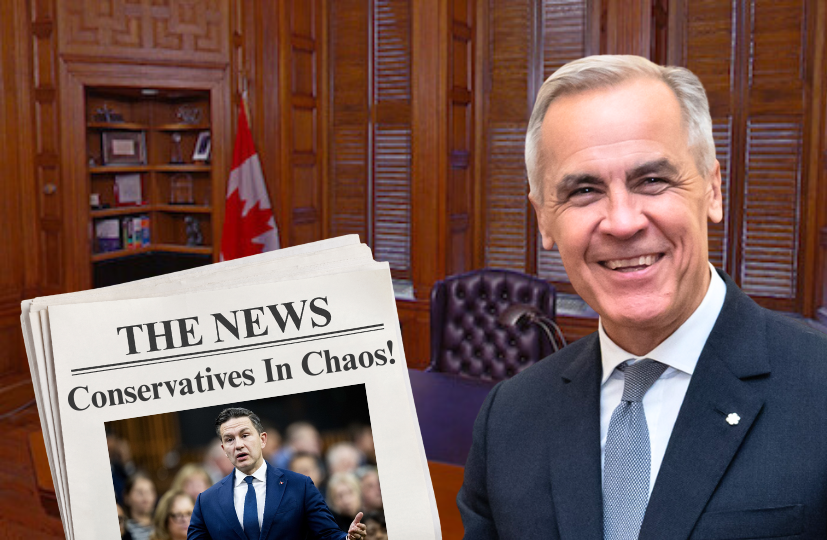
Carney adds more deficits to budget while nobody paying attention

by Ian MacIntyre

OTTAWA – Amid a week of heavily-publicized upheaval in the Conservative caucus, Prime Minister Mark Carney is currently adding even larger deficit spending after realizing that nobody is paying any attention whatsoever to his budget. With the week’s headlines almost entirely focusing on the defections of Conservative MPs Chris d’Entremont and Matt Jeneroux, the Prime […]

The post Carney adds more deficits to budget while nobody paying attention appeared first on The Beaverton.

10 Nov 20:38

Study: Practicing Kung Fu Naked In Mirror Best Indicator Of Being Domestic Terrorist

by The Onion Staff

ARLINGTON, VA—In a finding that researchers confirmed could greatly assist in identifying potential bad actors, a study released Friday by the Department of Defense concluded that practicing kung fu naked in the mirror was the best indicator of being a domestic terrorist. “Our research determined that performing precision Shaolin kung fu while nude before a living room mirror is one of the most common signs that you are a disgraced army colonel looking to get even with the U.S. government,” said study author Clarissa Sunderland, who discussed how admiring one’s own rippling and sweat-dappled muscles while throwing punch after punch in the horse stance suggested an 83% likelihood of being an ex-military contractor planning to recruit highly skilled soldiers of fortune to carry out an act of vengeance at an airport, bank, mall, or luxury hotel. “Really, we need to focus far more on finding at-risk individuals who wield nunchaku and scream while their exposed ass is on full display in their den. There’s virtually no chance they aren’t going to get involved in a significant hostage situation. Now, if that naked person happens to be completely bald and bears a tattoo of their disbanded black-ops squadron on their bicep? Well, we should probably just arrest them immediately.” The study concluded that the greatest warning sign of all was if such a person then answered a call from a lackey and simply said, “Good—it begins,” before cracking the cell phone in half. 

The post Study: Practicing Kung Fu Naked In Mirror Best Indicator Of Being Domestic Terrorist appeared first on The Onion.

10 Nov 20:38

Saturday Morning Breakfast Cereal - Addiction

by Zach Weinersmith


Click here to go see the bonus panel!

Hovertext:
How're you gonna get your girlfriend pregnant with a BEHAVIORAL addiction, man?


Today's News:
10 Nov 18:19

Watch: Lava soars 1,100ft above Hawaii's Kilauea in latest eruption

The fountaining event lasted for nearly five hours and was the 36th volcanic episode since December 2024.
10 Nov 18:15

mst3kgifs: Coach has us doing wind sprints.


mst3kgifs:

Coach has us doing wind sprints.

10 Nov 18:15

CommonsDB Explorer goes live at GLAM Wiki

by Doug McCarthy

Open Future has launched the CommonsDB Explorer—the first public interface for the prototype registry of Public Domain and openly licensed works—as part of the initiative funded by the European Commission and developed with partners Liccium, the Europeana Foundation, Wikimedia Sverige and the Institute for Information Law. The Explorer provides public access to early registry data and demonstrates how verifiable rights information can be shared across systems, marking a step toward clearer and more reliable rights information for cultural heritage institutions and platforms.

With this first release, CommonsDB Explorer allows users to browse more than 200,000 declarations (with many more to come) from Europeana and Wikimedia Sverige, see who made a declaration and when, and upload a file to check for a matching declaration. Each record includes a content-derived ISCC identifier and links back to the source asset and rights statement, helping ensure that rights information travels with the asset rather than evaporating as content moves across the web. The goal is simple: help systems and people quickly understand what can be reused, on what terms, and trust the rights information behind it.

Browsing declarations in CommonsDB Explorer

As outlined in the February 2025 announcement, CommonsDB represents Open Future’s first major effort to develop shared public digital infrastructure for the Digital Commons—building on the 2021 white paper that inspired the European Parliament to fund this work.

What we heard in Lisbon

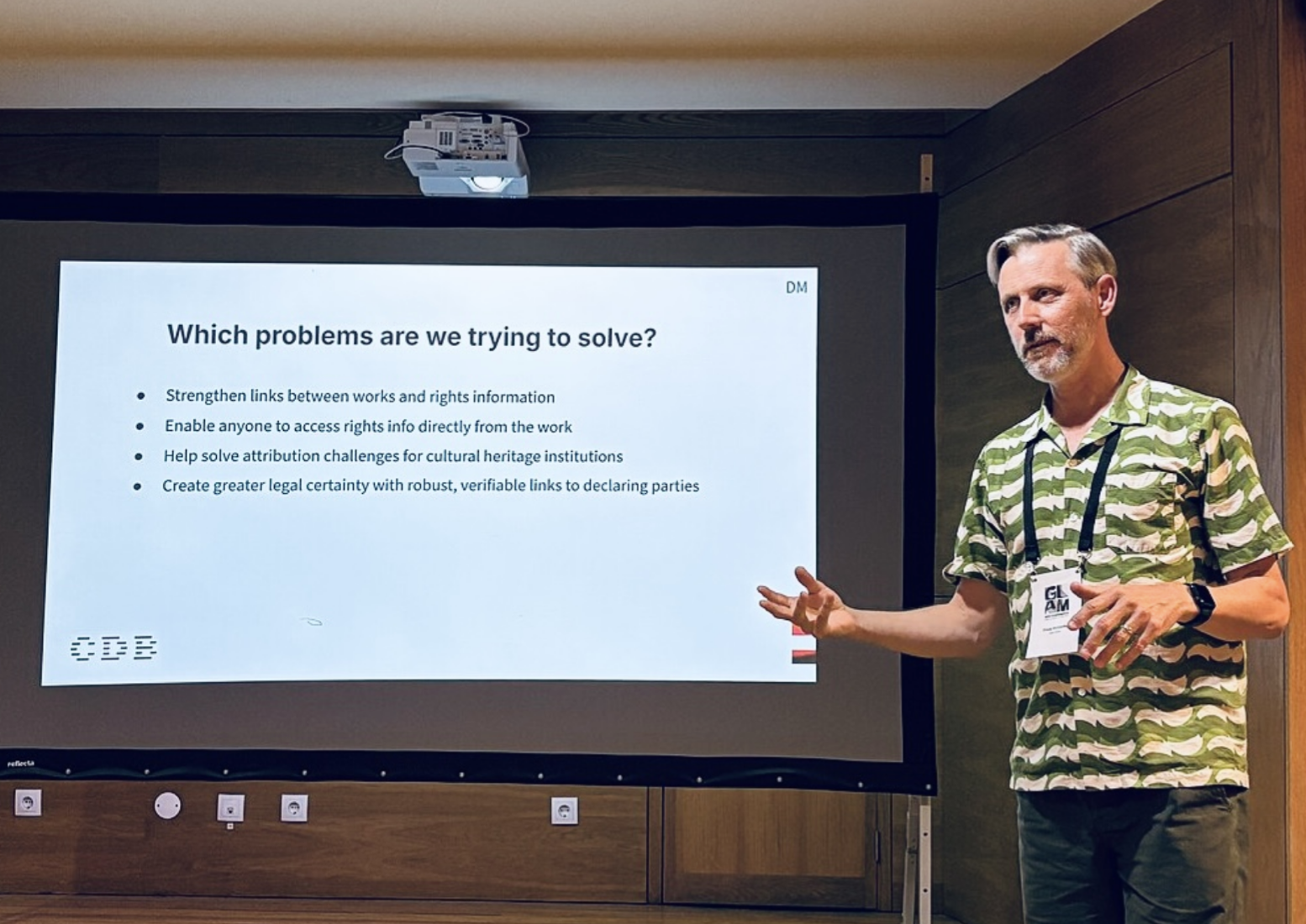
Doug McCarthy (Open Future) and Karin Glasemann (Wikimedia Sverige) introduced the Explorer at GLAM Wiki Conference 2025 in Lisbon. Wikimedians and cultural heritage professionals quickly understood the CommonsDB concept and saw practical applications—from rights checking in Wikimedia Commons to researching copyright information in heritage collections. Participants also discussed features that could support Wikimedia Commons over time, such as duplicate detection and similarity matching to help surface related assets.

Image by: Larissa Borck, Doug McCarthy (Open Future) presenting CommonsDB at GLAM Wiki 2025.

Some participants immediately began testing the system, and— as expected at this early stage—not every upload or search returned a match. With only a small slice of the Public Domain and openly licensed content universe represented so far, the gaps reflected scale rather than model limits. Seeing this in real time helped anchor the discussion in the reality of an early prototype growing toward the size of the collections it aims to serve.

Questions ranged from the practical to the forward-looking:

  • how CommonsDB will handle declarations for works with different copyright terms across countries;
  • how updates or corrections to rights information will be tracked;
  • and how the registry might connect with other data sources—including signals about AI usage preferences, the focus of a recent CommonsDB expert workshop.

We will explore these topics further in the second part of our Feasibility Study, which we will publish later this year, as well as in our Strategy Paper next July.

Looking ahead

The GLAM Wiki audience signaled both appetite and expectation. With the first version of the Explorer now live, the CommonsDB team has entered a phase of real use, feedback, and steady iteration. Over the next few months, we will refine the Explorer’s search and filtering capabilities, as well as its overall user experience. We will also add millions more declarations to the registry.

Where CommonsDB sits in Open Future’s work

CommonsDB sits within Open Future’s broader agenda to build copyright infrastructure for the digital commons—systems that make rights information discoverable, verifiable, and usable across platforms. This matters for cultural heritage institutions stewarding Public Domain collections, and for emerging AI governance frameworks that depend on trustworthy, machine-readable rights information.

Alongside technical development, work continues on governance and sustainability through the feasibility study. Institutions interested in participating can contact the CommonsDB team.

If you work with Public Domain or openly licensed collections, your perspective is welcome. You can try the Explorer at https://registry.commonsdb.org/ and follow the wider activity at https://commonsdb.org.

10 Nov 18:14

I’m managing an employee through a PIP — and it’s really hard

by Ask a Manager

A reader writes:

For the past several years, I’ve been managing an employee whose work has oscillated between “acceptable but not great” and “does not meet expectations.” In that time, we’ve navigated all the steps HR and I could think of to help her improve (including training, shadowing other employees, more training, developing resources, discussing management and feedback styles that work for her, etc.). We’ve had weekly check-ins throughout her employment where we discuss her work, expectations, and other aspects of her role. Now, we’ve finally put her on a formal Performance Improvement Plan, which will last 60 days.

She is understandably upset and stressed, but has — for the most part — handled the news well. While I think she’s not well-suited to the role, I do generally like working with her, and I’m pretty sad that we’ve come to this point. Based on her performance thus far, I currently expect to have to terminate her employment at the end of the PIP period (though of course that could change).

I don’t want to downplay that this is, I’m sure, much more difficult for her … but so far I am finding this process really hard. While we of course discussed when her work wasn’t meeting expectations in the past, spending every check-in and tons of time in between documenting how she’s failing to meet expectations is depressing both for her and me. Watching her get increasingly stressed and upset about her situation leaves me drained, stressed for her, and concerned about the ways this will impact her life outside of work. We’re in the U.S., so I worry about loss of health care for her and her family.

I would never expect this process to be easy — it shouldn’t be! But I don’t think I was prepared for the emotional turmoil I’d feel as a manager with an employee on a PIP, and it’s starting to impact my own work performance. I spend so much time documenting, brainstorming solutions, and feeling guilty that my productivity has slowed. Do you have any advice for managing someone through the end of their employment without destroying your own mental health? How can I compartmentalize and focus on my own work when I’m not managing her efforts?

It sounds like you have done a lot to try to help her and get her work where you need it to be, but that she’s ultimately just not well-suited for the role. What’s good here is that you’ve really done your part — not just all the energy you’ve put into trying to help her improve, but also being clear with her that she’s not meeting the job requirements and what the potential consequences of that are, so that she won’t be (or at least shouldn’t be) blindsided at the end of the process and has time to look for other work. (At least I assume you have been clear about the potential consequences! If you haven’t, it’s important to spell that out so she knows.) These are all good things; they are you doing everything you can to treat her well.

The flip side of that is … you don’t need to work yourself to the bone in this situation! Yes, you need to coach and document — but you don’t need to exhaust every possible avenue. You do the coaching that’s reasonable to do in the time you have available, relative to other things that also need your attention.

Ultimately, the test of whether she can work out in this job isn’t whether she can do it with intensive support from you; it’s whether she can do it without intensive support from you. It’s okay to do less; in fact, you probably have to do less, both to find out whether she can do the job with a reasonable level of support, and to keep your own job sustainable.

The emotional side of this isn’t as easy to answer. It sucks to watch someone go through this process, especially if you can see that they’re trying hard. But maybe you can take comfort in knowing that you’re uniquely positioned to ensure that she’s treated fairly and with dignity during this process (which includes being kind but honest when it’s not working).

This may help too:

how do you deal with having to fire someone?

The post I’m managing an employee through a PIP — and it’s really hard appeared first on Ask a Manager.

10 Nov 18:12

my employee might be working a second job during our workday

by Ask a Manager

A reader writes:

I recently took over managing a team, and have some concerns about one of my employees, John, who was hired by my predecessor. He is pretty good at what he does, but he is super slow at producing finished work. He rarely meets deadlines and if I don’t micromanage him every step of the way on a project, it won’t get done.

At first I assumed he just had too much on his plate, so I’ve taken over a decent chunk of his work and made sure that everyone else on staff keeps me in the loop when they need his help. So now I know exactly what’s on his plate and how long it should take to do it – and he takes much longer than he should on most tasks.

I’ve been trying to figure out why he is so slow, and lately I’ve started wondering if he is working on his side gig during our office hours. We work remotely so I can’t see what he is doing, but I’ve noticed he will send me work first thing in the morning and then later in the evening. I won’t hear from him for hours on end during the 9-5, but the work he sends me in the evening is something that should take an hour or so to finish, not all day.

He does have an agency that he founded and works for on the side, so my theory is that he is working on that and then scrambling to get some of his actual work done before the end of the day. How can I have this conversation with him without accusing him and how can I make sure he is actually doing his work without micromanaging him?

I answer this question over at Inc. today, where I’m revisiting letters that have been buried in the archives here from years ago (and sometimes updating/expanding my answers to them). You can read it here.

The post my employee might be working a second job during our workday appeared first on Ask a Manager.

10 Nov 16:33

Antony Gormley: A Significant Figure

by John Ewing

The figurative sculpture, or sculptural figure — in plain English, the body — has rarely felt more poignant, urgent, or politically alive than right now. What does it mean to have a body, to be in the world, to venture into public space with other people? With those questions looming over every human today, whatever can help us consider how we live with each other — how we create the body politic together — is an important conversation. 

Three side-by-side images of Antony Gormley's "Event Horizon" installation featuring metal cast human figures placed around New York City.

Antony Gormley, “Event Horizon,” 2010, site-specific installation, New York City. Photos: James Ewing, courtesy of Madison Square Park Conservancy

With that in mind, I was eager to take in SURVEY: Antony Gormley, organized by Chief Curator Jed Morse, at the Nasher Sculpture Center in Dallas. Up to this point, my most vivid encounter with Gormley’s work had been his multi-sculpture, site-specific installation Event Horizon. First produced in London two years after the 2005 terror attacks in the city’s Underground, I saw the U.S. debut of Event Horizon in 2010, its figurative sculptures installed on buildings around Madison Square and other locations in New York City.

Life-sized, the figures were cast from molds of the artist’s slim, 6-foot-4-inch body, with fiberglass versions placed on ledges and rooftops, and cast-iron sculptures sited at street level in public spaces. Presented by Madison Square Park Conservancy, the enigmatic figures were uncanny presences in the city, drawing much attention and fascination. Reading a lot of Carl Jung at the time, I saw the sculptures as mystical projections of psyche inhabiting multiple locations — and, like all New Yorkers, experiencing the city from multiple angles. Those figures left a lasting impression.

Antony Gormley, CH OBE RA, is one of Britain’s most significant artists of the last half century. And the Nasher’s exhibition is Sir Gormley’s first major museum survey in the United States. Yet, as such, the presentation feels oddly thin and incomplete, at least in the Nasher’s two main galleries on the museum’s ground floor. But things get exciting downstairs on the lower level, an area some museumgoers may not see or even know about unless they go to the restroom. Still, this is where SURVEY comes to life, and where the visitor experience should really begin — so I will too. 

In these lower rooms, what would otherwise be ancillary or supporting materials are, in fact, the stars of the show. One room contains a career’s worth of sketchbooks and models, and the other plays an hour-long documentary on Gormley produced in 2015 by the British Broadcasting Corporation (BBC). For better or worse, these secondary spaces provide the essential context one needs to fully appreciate the exhibition in the galleries above. 

A grid of installation images showing drawings by artist Antony Gormley of his figurative sculptures.

Installation views of “SURVEY: Antony Gormley,” at the Nasher Sculpture Center, Dallas. Photos: John Ewing

The Nasher understood the riveting appeal of Gormley’s sketches and models, given the resources invested here to show them. In an otherwise dimly lit room, a lighted display case running the length of three walls holds scores of open sketchbooks from Gormley’s entire career. On these intimate pages, we see how the artist thinks: his carefully considered ideas, varied interests, and the luscious, probing shape of his imagination. Sketch after sketch, we see how a body in space can be alive, active, and precarious — both physically and energetically. That precarity infuses Gormley’s finished sculptures, most based on his own body. Figures on rooftops, or in nature. Figures in piles. Figures represented by abstractions, vectors, cubes, and grids. These are bodies in flux, internally and in relation to their surroundings. Explored across his sketchbooks, these ideas about the body in space, the body encountering other bodies, and even embodied consciousness inform the many series of works that comprise Gormley’s extraordinary career. 

A grid of installation images featuring models by artist Antony Gormley of his figurative sculptures.

Installation views of “SURVEY: Antony Gormley,” at the Nasher Sculpture Center. Photos: John Ewing

Three side-by-side images of gallery guides and an exhibition banner from the exhibition "SURVEY: Antony Gormley," on view at the Nasher Sculpture Center.

“SURVEY: Antony Gormley,” gallery guides and exhibition banner. Photos: John Ewing

In the center of this “Model Room” is a display concept borrowed from Tate Britain: a maze of long tables that are arranged (and function) like a fashion runway. Atop are mockups for Gormley’s discrete sculptures, large works of public art, and unrealized projects. While not to scale, these models give a vivid sense of his ambitions and material playfulness, and they echo what we see on many of the pages in the surrounding sketchbooks. The entire room feels like a workshop or laboratory, humming with the intensity of the artist’s ideas. 

As Gormley demonstrates, sculpture considers how the object relates to architecture and the environment, and how we relate to space and each other. Sculpture is always about interaction. Whether viewers read a work of sculpture as figure or object sets the terms. If we perceive a figure, we contextualize the work as social, projecting culture and our own lived experience upon it. If we perceive an object, we center our own sensations, the work unfolding in space as we move around it. Gormley can take both tacks, shifting back and forth with works that blur the lines or straddle both figure and object simultaneously. This complicates our reaction, allowing the experience of his sculpture to transcend conventional definitions.

Side-by-side images of a screenshot of artist Antony Gormley with an artwork in the background and a photograph of a sign for his film "Antony Gormley: Being Human."

Left: Screenshot from “Antony Gormley: Being Human,” 2015, BBC. Right: Nasher Sculpture Center, gallery placard. Photo: John Ewing

Given that Gormley’s sculpture is so connected to his body, it’s not surprising that his art is also deeply rooted in his personal life. The BBC video playing in the adjoining room is long for a visitor program, but it’s impossible to pull yourself away from the artist’s story. Outlining a biographical basis for much of his art, it’s hard to argue with the BBC’s observations, which the artist himself confirms in the interviews. Born Antony Mark David Gormley in 1950 in London, the youngest of seven in a devout Catholic family, he attended a boarding school run by Benedictine monks. As the documentary notes, his initials AMDG also represent the Latin phrase Ad majorem Dei gloriam, meaning “For the greater glory of God.” 

“That was a big weight to stick around my neck,” Gormley says, but he “bought it all, hook, line, and sinker, because that was the only world I knew, and it was absolutist.” As a teenager, he volunteered for pilgrimages to Lourdes, France. Working as a brancardier (stretcher-bearer), he helped undress and lower the bodies of paraplegics and the aged into the frigid spring waters at Our Lady of Lourdes. He describes what he saw as “real suffering, and the illusion and delusion of the expected miracles. It makes me very angry…this collective hallucination.”

Gormley studied archaeology, anthropology, and art history at Trinity College, Cambridge. But by age 23 he had lost his Catholic faith and set out on the “hippie trail,” a pilgrimage to find himself that ended in India in the early 1970s. “India was the beginning of everything in terms of making sense of my life and finding a means of doing so,” he says, recounting how he studied meditation with a Buddhist teacher and lived penniless for a time on the streets of Calcutta. “I realized this was in some senses an escape, and that it would be better to try to come back to my own culture and bring into it whatever realizations I had had.” 

This goal would manifest in the study of art back in London, at St. Martin’s, Goldsmiths, and the Slade School of Fine Art. His first sculpture, Sleeping Place (1974), is a floor-bound work in plaster depicting the outline of a human figure, in a fetal position, covered with a cloth. It’s a form he had witnessed, or perhaps even been himself, amid the bustling rickshaws on the streets of South Asia. He recalls:

“There would be this silent, still, dhoti covered body. You wouldn’t know whether it was dead or alive at first sight. The image of these so vulnerable and yet so pure shapes that are a form of architecture. Sleeping Place was a way of bringing that back, making that experience again as an object. It talks about our need for shelter and security. In a way, it also talks about what Plato said, that we will never know what is inside another person’s mind. That there is, as it were, an infinity of possibility that lies on the other side of that skin.”

Gormley’s first solo show in 1981, curated by the Tate’s Nicholas Serota at the venerable Whitechapel Gallery, featured Bed, a work showing two impressions of his supine body formed in stacks of storebought sliced bread. The bodily indentations were created by chewing off individual slices from the more than 8,000 — each piece of bread dipped in wax for preservation (although the work became infested with Indian bookworm from Gormley’s own bed, according to the documentary). The sculpture simultaneously references nourishment and mortality, the host of the holy sacrament, Catholic ritual, and a nod to minimalist sculptor Carl Andre, an early influence.

In 1987, during the conflict in Northern Ireland, Gormley made a site-specific installation along the city walls of Derry/Londonderry, with a series of cast-iron figures facing opposite directions, the opposing positions held by Catholic and Protestant forces. In response, the community hung tires on one of the sculptures and set it on fire, yielding an impromptu effigy whose remains echoed the biblical crucifixion of Christ.

A Google Street View screenshot depicting a large figurative sculpture with wings stretched out horizontally.

Antony Gormley, “Angel of the North,” 1998, Gateshead, UK. Screenshot of the A1 from Google Street View

Gormley was awarded the Turner Prize, Britain’s highest honor for the visual arts, in 1994 (the same year he was selected for Artpace San Antonio’s International Artist-in-Residence program). By this point, he had acquired the clout, support, and vision to pull off something truly extraordinary: Angel of the North. Standing 66 feet tall with a wingspan of 177 feet, this massive work of public art was the largest sculpture in the UK when it was erected in 1998. Sited near Gateshead just off the A1, the “Great North Road” connecting London and Edinburgh, this location makes it one of the most-viewed artworks in the world, seen by an estimated 30 million people per year. 

Angel of the North is my attempt at a Stonehenge,” says Gormley about his industrial-steel masterpiece. “An attempt at marking a very particular place at a very particular time, between the end of coal mining, the end of ship building, the end of the industrial power of the Northeast and the dawn of the information age, and making a totemic object for a community that had lost faith in its own future.”

Perhaps even more ambitious, Gormley’s site-specific work Another Place (2005–7) disperses 100 cast-iron figures facing out to sea across several miles of English coastline, a permanent art installation that interacts with beachgoers, tides, and colonies of barnacles. About his public art, Gormley told the BBC, “The test of a well-sited work is, during the time that it’s there, you can’t think of the place without the object or the object without the place.”

Side-by-side photographs of figurative works by Antony Gormley placed in the environment. The image on the left shows a large winged figure standing with a cloudy sunset behind it. The image on the right shows a human-size figure standing on a beach with a large boat in the distance.

Left: Antony Gormley, “Angel of the North,” 1998, Gateshead, UK. Photo: Colin Cuthbert. Right: Antony Gormley, “Another Place,” 2005–7, Crosby Beach, Merseyside, UK. Photo: Stephen White

Although using his own body (and experience of existence) as the source for his forms, these works are in no way self-portraits. In fact, Gormley seems to have no interest at all in himself as subject. Other projects have made this abundantly clear, like his “fields” — including American Field (1991), Field for the British Isles (1993), and Asian Field (2003) — where locals are enlisted to fashion by hand simple clay figures with holes for eyes. Amassed by the thousands on the floor of an exhibition space, their “eyes” gazing directly at the viewer, these fields of humanity convey a collective silent message; whether invitation or condemnation is up to you. 

Gormley’s decentering of self was even more pronounced in One & Other (2009), his Fourth Plinth commission in Trafalgar Square, where he gave over his creative platform and allotted time entirely to others. Selecting one person per hour for 100 days, some 2,400 ordinary “plinthers” were given the opportunity to do whatever they wanted, activating the historic public space and engaging passersby in just as many unique ways. On this gesture of selflessness (or supreme Catholic piety), he says: “One & Other was a complete letting go. Let’s think of us less as objects and more as a process, less as a noun and more as a verb. As a transformative space where you can dream.”

Under the Medicis, Renaissance Florence stood up the first official school for sculptors, including Donatello and Michelangelo, as well as the impressive Forte di Belvedere guarding the city. In modern times, this picturesque fortress has hosted presentations of acclaimed artists, including one of the largest exhibitions by the preeminent British sculptor Henry Moore in 1972. Gormley got his shot in 2015. His show Human was “a reality check” in Florence, what he calls “the birthplace of humanism…the whole idea that we are divine, the masters of the universe.” At the end of the BBC documentary, a shot of cranes moving his cast-iron sculptures around is thoroughly arresting, the harnessed figures suspended midair. As he reflects, “When we strip away the illusions of progress, what are we really? Or what do we need to become in order to be truly human?” Antony Gormley was knighted in 2014

Three stacked images of an Antony Gormley figure with outstretched, oversized arms.

Top & middle: Antony Gormley’s “Field,” on view in  “SURVEY: Antony Gormley,” at the Nasher Sculpture Center. Photos: John Ewing. Bottom: Antony Gormley, “Field,” 1984–85, lead, fiberglass, plaster, and air. © Antony Gormley. Photo: Antony Gormley

Back upstairs, in the Nasher’s two main galleries, the exhibition offers mostly single examples from a few of Gormley’s many bodies of work — in other words a “survey,” however limited. My eyes go straight to Field (1984–85), an unsettling work seared in my brain since first seeing it in an art history book. Created with soldered sheets of lead hammered onto a fiberglass and plaster form, the figure’s arms project fantastically from the shape of Gormley’s body, a sight that still thrills and unnerves me, no less so for wondering how the arms remain upright. Positioned in the gallery’s northwest windows, which look out onto the Nasher’s spectacular sculpture garden, this work has been given pride of place. But this also offers an unusual opportunity to walk completely around Field, viewing it from all angles, an exercise that transforms the work in my mind even as it erases that first impression of a figure straining against a confined space. 

Context matters. How do figures (whether statue or human) adapt to their environment and circumstances? Poignant and powerful, the arms of Field reach out to meet their surroundings. Gormley, as we’ve seen, also imagines arms as wings (both angelic and mechanical), with figures who surmount life’s challenges and conquer limitations. Adaptation is not only a struggle, it can also represent triumph. But figurative sculpture is always a postulation, a theory about our place, role, and degree of authority in the world. That status is contestable, as we’ve come to see with monuments to the Confederacy.

An installation image of sculptures by Antony Gormley in a gallery.

An installation view of “SURVEY: Antony Gormley,” at the Nasher Sculpture Center. Photo: John Ewing

At the same time, Gormley’s lead sculptures are not just figures viewed from the outside; they also read as indices of interiority and acute awareness. As such, these containers of consciousness, what the artist calls “body-cases,” are made all the more confining knowing Gormley subjected himself to full-body plaster casts — lovingly executed for nearly two decades by his wife, the artist Vicken Parsons — in order to create some 80 different works. In the BBC video, seeing a younger Gormley fully encased in hardened plaster in a number of uncomfortable poses is, as he says, “evidence of the necessary trust between two people.” 

Lead is a notoriously toxic material to work with, something I recall the late San Antonio artist Marilyn Lanfear saying about the making of her own lead sculptures that explore her family history. On his use of lead, Gormley is eloquent (and Lanfear might agree): “The common idea of alchemy is that you can turn lead into gold. But that’s actually just a metaphor for turning gross matter into imagination, which is what art should do.”

Side-by-side photographs of figurative sculptures by Antony Gormley placed along walkways at a museum.

Left: Antony Gormley, “Prop,” 2018, cast iron. Right: Antony Gormley, “Close V,” 1998, cast iron. Installation views of “SURVEY: Antony Gormley,” at the Nasher Sculpture Center. Photos: John Ewing

Cast in iron, Gormley’s “body-forms” add durability, playfulness, and sometimes a grim outlook to his figures. At the Nasher, Prop (2018) and Close V (1998) are installed outdoors in unceremonious fashion, leaning against the museum or plunked down on the terrace, respectively. These body-forms are routinely displayed this way, or placed in any direction whatsoever — upside down, against stairs, hanging askew from ceilings, or even heaped in piles. With Critical Mass (1995), Gormley made iron casts of 12 body positions, and five copies of each pose, assembling an “anti-monument to the fallout of the 20th century.” One iteration of this work was installed in the Remise, an abandoned tram storage station in Vienna, the pile of figures evoking the Nazi transport of Holocaust victims and the mechanization of evil. 

“Broadly speaking, the pile is history,” he told the BBC. “Something that we can do little about other than bear witness to it. But the pile is also bad history. The pile is the foil to any illusion of idealism that might be represented by the heroic statue.”

An installation image of abstracted figurative sculptures by Antony Gormley, set in a gallery.

An installation view of “SURVEY: Antony Gormley.” © Antony Gormley. Photo: Kevin Todora, courtesy of Nasher Sculpture Center

For the past decade or so, instead of plaster molds, Gormley has used infrared technology to create precise scans of his naked body assuming myriad positions. This allows the artist to generate digital simulacra of his form that he can push and manipulate in expansive new ways. As a result, his newest sculptures extend and project beyond his body, sending out vectors into space from this organic baseline. The effect is mesmerizing, with figures that occupy space within and outside their own mass, or exist in different states of being, including being undone. These newer sculptures may be disordered, fragmented, cubed, atomized, or otherwise abstracted, but they still maintain vestiges or intimations of the figure.

A grid of four images featuring various styles of abstracted figurative sculptures by Antony Gormley.

Clockwise from top left: Antony Gormley, “Shift,” 2023, concrete; “Quantum Cloud XX (Tornado),” 2000, stainless steel; “Open Hold,” 2017, Corten steel; and “Drift VI,” 2010, stainless steel. Installation views of “SURVEY: Antony Gormley,” at the Nasher Sculpture Center. Photos: John Ewing

Among these is Quantum Cloud XX (Tornado) (2000), the only Gormley work in the Nasher collection. In some ways, these newer works featuring greater abstraction feel like a return to the first part of Gormley’s career, and the earliest works in SURVEY pictured here. Borrowing from the Nasher’s excellent language describing Gormley’s oeuvre, “expansion, compression, and containment” feel pertinent from the very beginning.

Installation images of of early works by Antony Gormley, including a pair of shoes seemingly unraveling, a large rubber circle with footprints at the center, and a concrete cube with holes.

Left: Antony Gormley, “Footpath,” 1980/2020, pair of boots. Middle: Antony Gormley, “Floor,” 1981, rubber. Right: Antony Gormley, “Sense,” 1991, concrete. Installation views of “SURVEY: Antony Gormley,” at the Nasher Sculpture Center. Photos: John Ewing

Walking among these wildly different sculptures, visitors can be excused for wondering if they were made by different artists — an impression that is only intensified by the adjoining gallery. Here the museum has mounted one of its Foundations presentations drawn from the Nasher’s own collection, in this case with works selected by Gormley himself as a kind of conversation with his career. These artists, spanning both historical and contemporary, include Carl Andre, Jean Arp, Phyllida Barlow, Willem de Kooning, Garth Evans, Alberto Giacometti, Ana Mendieta, Auguste Rodin, Medardo Rosso, Joel Shapiro, Simon Starling, William Tucker, and Cy Twombly. 

While that’s an interesting idea, I was surprised to see so much real estate given over to works by other artists as part of Gormley’s SURVEY. Rather than coalescing a complete picture of this renowned figure, Foundations diminishes the survey’s overall effect and is bound to confuse some visitors. I appreciate the Nasher’s commitment to education, but this display shortchanges a fulsome experience of Gormley by one entire gallery (or by half). I suppose that’s in keeping if we remember his Trafalgar Square commission, where he ceded the spotlight to others and decentered himself right out of the picture. Whether humility or hubris, what did that commission really add to our experience of Gormley?

Foundations does make some news, however. It’s evident that Gormley has drawn lessons from the previous generation of British sculptors — namely, titans Henry Moore (who turned down a knighthood) and Dame Barbara Hepworth. I think of his contemporary Sir Tony Cragg, a fellow Turner Prize–winner, as a closer, flashier cousin. Cragg’s clever, visually stunning transformations of the figure share Gormley’s conceptual bent. And yet, none of the three is included in his Foundations selection, although works by each are in the Nasher collection.

Three side-by-side images of works by Antony Gormley featuring sleeping figures.

Left: Antony Gormley, “Sleeping Place,” 1974, plaster and linen. Photo: Antony Gormley. Middle: “Mean II,” 2013, cast iron. Photo: Stephen White. Right: Antony Gormley, “Pile I,” 2017, clay, on view in “SURVEY: Antony Gormley,” at the Nasher Sculpture Center. Photo: John Ewing

For viewers new to Gormley, instead of juxtaposing him with other artists, it might be interesting to offer examples of ideas that carry through the trajectory of his own work. For instance, I’d like to know why the recumbent figure huddled in a fetal position has intrigued him for half a century, as seen here in his very first work, Sleeping Place (1974), and up through Pile I (2017), included in the Nasher’s SURVEY. About these figures that lie or crouch on the ground, Gormley told the BBC: 

“This is the sight that’s become familiar to us, the homeless in the front porch of the bank. It’s just about recognizing the exact opposite of Michelangelo’s David. This isn’t to deny the beauty and aspiration of works like that but the need to make us see what things really are…to make us feel what it’s like to be there, exposed. Trying to find a place of intimacy in a world that has somehow forgotten you.”

Side-by-side photographs of abstracted figurative works by Antony Gormley mounted on top of buildings in Dallas.

Left: Antony Gormley, “Domain XCVI,” 2025, stainless steel, 74 1/2 × 26 × 14 inches. © Antony Gormley. Installation view of “SURVEY: Antony Gormley.” Right: “Domain CVI,” 2025, stainless steel, 75 1/4 × 24 1/8 × 1/8 inches. © Antony Gormley. Installed on roof of JW Marriott Dallas Arts District. Photos: Kevin Todora, courtesy of Nasher Sculpture Center

To wrap up, let’s return to Gormley’s Event Horizon. That theme is reprised here in Dallas. But instead of the solid body-forms, Gormley uses examples from his Domains, a series of diffuse works composed of short stainless-steel bars joined at sharp angles. Domain XCVI (2025) is installed atop an outdoor column of the Nasher, and Domain CVI (2005) is sited nearby on the roof of the Marriott hotel, just barely observable from the museum’s garden. Why this change from solid figures to works that are hardly discernible from the ground? I believe those earlier versions of Event Horizon would inspire a radically different reaction this time around, in this location. Gun violence has traumatized the public psyche for decades now, and the sight of a lone figure on a rooftop in America raises disturbing thoughts as we absorb each new spree shooter. Meanwhile, the Nasher is just 10 blocks from the Book Depository and Dealy Plaza

Of course, concerns for public safety are legitimate. But even scarier would be if museums (and artists) start to pull their punches or play it safe for political expediency. No art institution wants a Sally Mann moment, but we’ve already seen the harm that comes from obeying in advance. Has the concept of safety itself become contestable? Another controversy over the human figure is playing out in the tech world, where competitive advances in humanoid robots are mapping every facet and function of the human form, in order to replace it. The challenge for everyone is to find productive ways to engage in our current minefield of critical conversations. What ways feel safe to you? While discourses on art may seem elite or removed from ordinary life, we may need artists to perform this public role like never before.

What does it mean to take up space — individually, collectively — and who is allowed to claim space? In today’s mediated world, what is more relevant to society, our presence in physical or digital space? In the current lingo, where do we “touch grass”? Antony Gormley has a lot to say about all of these dynamics, if we let him speak to us through the figure. He puts it simply: “You cannot ever be inside another substance as you are inside your own body.”


SURVEY: Antony Gormley is on view at the Nasher Sculpture Center in Dallas through January 4, 2026.

The post Antony Gormley: A Significant Figure appeared first on Glasstire.
10 Nov 16:29

bathing

bathing

vmm(4)

[img]:rxeuti

Girl and Penguin visit the Fish Vats.

https://analognowhere.com/_/rxeuti

10 Nov 16:29

Sick, probably. Will get back in a week or two.

A single uncoloured drawing of a tired, sleepy fox laying under a weighed blanket, coupled with the text "Not well. Will return once well."ALT

Sick, probably. Will get back in a week or two.

10 Nov 14:21

Car-dominant Texas needs more public transit to meet mobility demands, TxDOT report says

by Joshua Fechter
As the state’s population grows, more travel options are needed in rural and smaller urban areas and between major cities, according to a draft of the first-of-its-kind plan.
10 Nov 14:19

EPA To Monarch Butterflies: ‘Count Your Fucking Days’

by The Onion Staff

WASHINGTON—Amid a series of sudden actions overhauling landmark federal conservation regulations, the Environmental Protection Agency issued a public statement Friday warning monarch butterflies to “count your fucking days.”

EPA officials confirmed plans to roll back dozens of environmental protections for the vulnerable insect population, vowing to introduce new standards for decimating monarch habitats and saying they would take particular joy in dismantling rules that safeguard those “smug, spotted fucks.”

“Savor that nectar now, you sniveling moth pricks, because under this administration, you little shits are living on borrowed time,” said EPA administrator Lee Zeldin, who angrily raised a fist while insisting that the end was near for Danaus plexippus. “Let that be a warning to any of you fluttery dicks thinking of migrating back to the United States next year—there’s a target on your stupid orange wings, and I put it there.” 

“If I catch even one of you outside your chrysalis,” he added, “you’re in for a world of pain.”

Zeldin expressed optimism that easing environmental regulations on the agriculture, energy, and manufacturing sectors would have a negative effect on the “brightly hued bastards” for generations to come. The agency chief said specific steps were being taken to introduce natural predators such as black-backed orioles, robber flies, and solitary wasps to locations where “showboating” monarchs maintain a high survival rate. In addition, he revealed plans to direct any remaining agency funding to the cultivation of parasitic infections to bring swift annihilation to the “unbearable, ornate assholes.”

The EPA also proposed a new spite-based policy that would require U.S. corporations to direct chemical runoff, air pollution, and any previously banned harmful pesticides toward monarch populations, with the agency documenting the “delightful” eradication of the “self-centered shitheads.”

“For years, American farmers have been subjected to politically motivated rules and regulations that prevented them from blasting these diurnal little milkweed-sucking morons into oblivion with cool shit like DDT, but that ends today,” Zeldin said. “And good luck flying through gigantic puffs of black smoke from the unregulated factories that will soon cover the nation’s prairies.” 

“Hope you like glyphosate, you compound-eyed fuckers!” the EPA head continued. “Next time you molt it will be your last.” 

Officials also promised to “open a can of environmental whoop-ass” on monarchs in the form of a public campaign that would create a series of hands-on school and community programs to teach citizens of all ages how to “pin those metamorphic freaks down and tear off their goddamn wings.” Zeldin told reporters the agency would offer incentives for homeowners to fill their yards with toxic swallow-worts that would create a hostile minefield for the “scaly jerk-offs and their disgusting larvae.”

Through its new Monarch Endangerment Campaign, the EPA said it would distribute step-by-step instructions for “spraying the ever-loving fuck” out of the insects with aerosol hairspray, Windex, Raid, or whatever else people had lying around that could “do some real damage to those pollen-fuckers.”

The White House confirmed the far-reaching reform was part of a broader mission across the federal government to reverse protections of “jackass bugs, worthless fish, and other dumbass creatures,” ending what they referred to as an era of corruption in which President Barack Obama prioritized the survival of the “shimmering little numbskulls” above corporate interests. 

Praising Zeldin and his team for “slashing through the red tape when it comes to bringing the hammer down on those wing-clapping fuckfaces,” President Donald Trump declared the initiative would usher in a new wave of innovation in American mass extinction events. 

The post EPA To Monarch Butterflies: ‘Count Your Fucking Days’ appeared first on The Onion.

10 Nov 14:18

Hungover Egyptologist Just Gonna Call In Cursed Today

by The Onion Staff

CAIRO—Admitting he was unable to face a lengthy session of indexing artifacts after drinking too much the night before, hungover Egyptologist Henry Chapman confirmed Tuesday he was just gonna call in cursed this morning. “Listen, I don’t know what kind of hex was on that canopic jar I opened yesterday, but I’ve got a real doozy of a curse, and it’s probably best I stay home today,” the bleary-eyed Egyptologist said in a phone call to his supervisor, adding that he had heard the divine wrath of the pharaoh Amenhotep III was going around lately. “Whatever I’ve got is giving me bad luck, beetles, pestilence, the works. I wish I could be down there at the tomb with you cataloging all those funerary goods we found, but frankly I’m worried about spreading the curse to everybody else. I’d feel terrible if I ended up giving you guys the plague of scorpions I’m dealing with right now. I don’t wanna get too graphic, but let’s just say I’m finding cobras in a lot of places you don’t want cobras. With any luck, it’s just a 24-hour curse, and I can get back to translating the rest of those hieroglyphics with you tomorrow.” According to sources, Chapman began to suspect he really was cursed after the greasy breakfast sandwich and coconut water he ordered to soothe his hangover were carried off from his kitchen counter by a jackal. 

The post Hungover Egyptologist Just Gonna Call In Cursed Today appeared first on The Onion.

10 Nov 14:18

our board member got scammed, I’m the only one who has to wear a uniform, and more

by Ask a Manager

It’s five answers to five questions. Here we go…

1. What’s our responsibility when a board member gets scammed?

I just joined the board of a nonprofit and at my very first meeting today learned about a mess that we’re in. There are about a dozen members of the board and I’m coming in as an executive member, of which there are four. Apparently, one of the “at large” members of the board received some emails about six weeks ago from the outgoing president about two urgent invoices that needed to be paid, had to happen today, had to be paid online and won’t accept a check, can you please pay it immediately, I’m cc’ing the treasurer who will reimburse you in three business days, etc. The total was just under $3,000.

Apparently this board member went ahead and immediately paid both invoices with personal funds (even though they were a PayPal invoice to a random gmail account!) and is finally speaking up wanting to know why it’s taking so long to get reimbursed, very irritated, this is a hardship for her, etc. When it was explained that the email addresses (“boardpresident9999@gmail”) were obviously spoofed and this was clearly a scam, she was very embarrassed and apologized, and made no further mention of reimbursement.

I do not know why she thought it was appropriate to pay these using her personal funds, as I’m new to the board. It does seem like there’s been a practice of board members covering expenses on a smaller scale and being reimbursed by check within a few weeks (think paying for catering for a meeting, to the tune of a few hundred dollars). There are no written policies or guidelines about reimbursement or payment of expenses. Obviously, that’s the first thing I will be putting on the agenda for our next board meeting!

But now the current incoming president and the treasurer have started a private email conversation with me and the outgoing president saying how bad they feel for her, and that the organization needs to reimburse her as soon as possible. I wrote back immediately saying, “Um, no? She needs to pursue getting the charges reversed by her bank, but the organization is not responsible for paying this.”

I think if she had spent the organization’s funds while being scammed, we wouldn’t be going after her to reimburse the organization, although I would think at the very least we’d need to mandate that she do some training about not falling for scams. But since it was her own personal finances, I do not think we have any obligation to put things right for her personally. The treasurer and the president seem to think we do, since “she was targeted because she’s on the board, so she wouldn’t have been scammed if it weren’t for us” and because they think it’s likely that she won’t be able to recover the money through her bank. The org has just over $20,000 in the bank, and annual budget is mostly focused on a one-day event we put on, which is less than $10,000, so $3,000 is a significant amount for the organization. What do you think?

Yeah, it would be a really big deal to spend 15% of the organization’s finances on this. If the organization had a multimillion dollar budget, it might be different. But you’ve got $20,000 in the bank and want to give a sizable chunk of that away? I don’t see how you can fundraise from donors in good faith after that.

To be clear, this is awful! But the board has a fiduciary duty to protect the organization’s finances, not an individual board member’s. At an absolute minimum, she needs to start by pursuing this with her bank and see what happens there before there’s any discussion of organizational funds being used on it.

(There also need to be immediate policies about spending personal money and what kind of paper trail needs to be in place for expense authorization, as well as some board-wide fraud awareness training.)

2. I’m the only one who has to wear a uniform, and it doesn’t fit

I recently started work as an administration assistant, in a role that provides newly built accommodation for students. We are based at the accommodation complex. There is me, the manager, another administration assistant, and the housekeeper.

As of last week, I have been given two blouses to wear, which show the company logo. They are the largest size. I’ve moved the buttons, but they are still a bit snug. I have to wash and iron these blouses, where before I wore my own tops, with the black trousers that I still wear.

The other administration assistant hasn’t been given any blouses, and when I asked my manager about it, she replied, “Oh , she won’t wear one.” So when she and I are on the reception together, I’m in the uniform blouse, and the other assistant (Sara) is in her own clothes.

The housekeeper commented that my blouse was gaping, and I told her that I’m wearing the largest size. I told my manager of the housekeeper’s comment, but nothing came of this. May I ask your thoughts on this? A uniform was mentioned in my interview, but I assumed that other administration staff would wear it, not just me.

You need to be more direct with your manager! Just passing along the housekeeper’s comment isn’t enough.

Instead, tell your manager that you’ve given it a try but the blouses don’t fit you and are too tight, and you’re not comfortable wearing them so you’ll be returning to your own clothes like Sara does. There’s clearly room to simply decline, based on what Sara is doing.

You might ask Sara ahead of time how she got out of the uniform requirement; it sounds like she might tell you that she simply held firm about it, which might make you feel more confident doing the same thing.

3. People discourage me from taking notes

My memory isn’t great so at work I take a lot of notes. I use a work-provided spiral-bound note pad as it’s small enough to have in my bag/take to face-to-face meetings but has enough pages to last several months. I date them and keep them for a while to refer back to notes if needed.

However, my current manager and a colleague occasionally tell me no note-taking is needed. Normally I’ll say that I take notes as I don’t have a great memory and need to write things down. However, in a past position for the same organization, a manager spread rumors that my past medical treatment had caused cognitive issues (not true). I’m not sure whether this manager has heard this, so I am keen not to say anything that might reinforce that. Perhaps I could say I’m a note-taking person and that’s how I work best. What is your take on this?

Turn it from a negative (“I don’t have a great memory”) into a positive: “I’m super organized and having notes helps me juggle everything.”

That said, sometimes people will say you don’t need to take notes because they’re trying to convey that this is an informal discussion and won’t have action items arising from it — and sometimes they want you more focused on, say, brainstorming than on documenting. I do think you should try to be flexible in those cases — not that you shouldn’t write down any takeaways but that you should recognize when things aren’t at that stage yet and people are looking for a more free-flowing conversation. Obviously if you’re someone who finds it challenging to brainstorm without notes involved, that would be different — but if your real need is to capture details and action items once they’re solidified, it’s helpful to recognize when things are and aren’t at that stage.

(There’s another category of this, where the discussion is something they specifically do not want documented, but it doesn’t sound like that’s what’s happening.)

4. My references are getting checked before final interviews

For most of my career, in the nonprofit sector, I’ve had employers ask for references at the end of the search process, when (it seems) it’s treated like a final confirmation or due diligence. I’ve never been asked for references and then learned I didn’t get the job.

…Until recently. In the past three years I have made it to the last round for five executive director jobs — some handled by search firms, some not — and all five places have asked for references before the final interview. I haven’t gotten any of these jobs and I’ve had to go back to my references again and again to tell them, “Oh, bad news, I didn’t get this one either.” Frankly this has gotten embarrassing.

I’m once again in the last round of a search, #6 in three years, and once again they’ve asked for references before scheduling the last interview. Once again I sent messages to the same set of previous bosses, and I am steeling myself for disappointment.

Is this a common way to handle reference checks for executive jobs? Is there any chance I can push back a little? How can I best maintain my relationships with my former managers when I ask them for references again and again and keep failing to get the jobs?

For high-level, high-stakes jobs like executive director, it’s much better practice not to treat reference checks like a final confirmation, but rather to use them for nuanced information that might influence what topics are discussed in a final interview. At that level, reference checks really shouldn’t just be thumbs-up/thumbs-down, but rather nuanced conversations about things like leadership style, where there aren’t necessarily “right” answers but just information about how this person might operate in the role.

You don’t need to be embarrassed by your references being contacted for jobs you ultimately didn’t get. (You also don’t need to update them every time you don’t get a job, if that makes it easier.) That said, it wouldn’t hurt to check with your references to make sure they feel comfortable giving you a positive recommendation for the types of job you’re applying for, in case something in the reference check is tripping you up. One thing you can do is to ask your references whether they think there are areas you should work on developing in order to be a strong candidate for these positions; that potentially makes it easier for someone to say, “Well, actually, if I were hiring for these roles I’d want to see more X from you” (or whatever), whereas they might not feel comfortable telling you that without you soliciting it.

5. When should a side responsibility become an official part of my job?

I’ve been with my company for five years in my current role. When I changed positions five years ago, my job description was updated, but it hasn’t been touched since.

At that time, I was also asked to take on a small but important side responsibility that fit my skill set, even though it wasn’t connected to my formal job. I had experience with it and it’s a function I enjoy, so I was happy to take it on.

Fast forward five years, and that “side duty” has grown significantly. I now lead a related process across the entire company and coach department leads on execution. When we recently needed broader input from employees on new initiatives, I stepped in again, building and running an employee forum when our original approach stalled. That also went well, and I’m now managing the outcomes.

At this point, this unofficial function has become a significant part of my job and a major need for the company. It’s work I truly enjoy, and I’d like to formalize it by clarifying the role, updating my title, and making it part of my job description in addition to my current formal duties. My boss is hesitant and frames it as “everyone needs to pitch in.” While I agree in principle, this has evolved beyond occasional pitching in.

Does it seem reasonable to push for formalizing this role, since it’s now an important organizational function rather than an “other duty”? Or should I accept that the work will remain unofficial?

Frame it this way: “I’m of course happy to pitch in, which I’ve been doing for the past five years, but at this point it’s become a significant part of my job and an ongoing expectation. I’d like it to be reflected in my job description and title so that those remain accurate.”

If your boss still resists, see if you can find out why. Are there political reasons where it’ll be seen as stepping on someone else’s toes or problematically expanding her own portfolio? Are there compensation implications that she’s trying to avoid? Is she just weak when it comes to advocating for her team? Next steps depend on the nature of her objections, so try to suss those out.

The post our board member got scammed, I’m the only one who has to wear a uniform, and more appeared first on Ask a Manager.

10 Nov 13:54

Awkward Zombie - Down Under the Weather

by tech@thehiveworks.com

New comic!

Today's News:

I'm pretty sure the head-sized spiders that drink the juice out of your car batteries also predate the Death Stranding.

10 Nov 13:54

Comfortably six figures

by John Allison

Cilla Black was well-known for her forthright approach to people in customer service. I have tried to provide brief evidence of that here.

The post Comfortably six figures appeared first on Bad Machinery.

10 Nov 13:52

Cookie Jar

by Alvaro Montoro

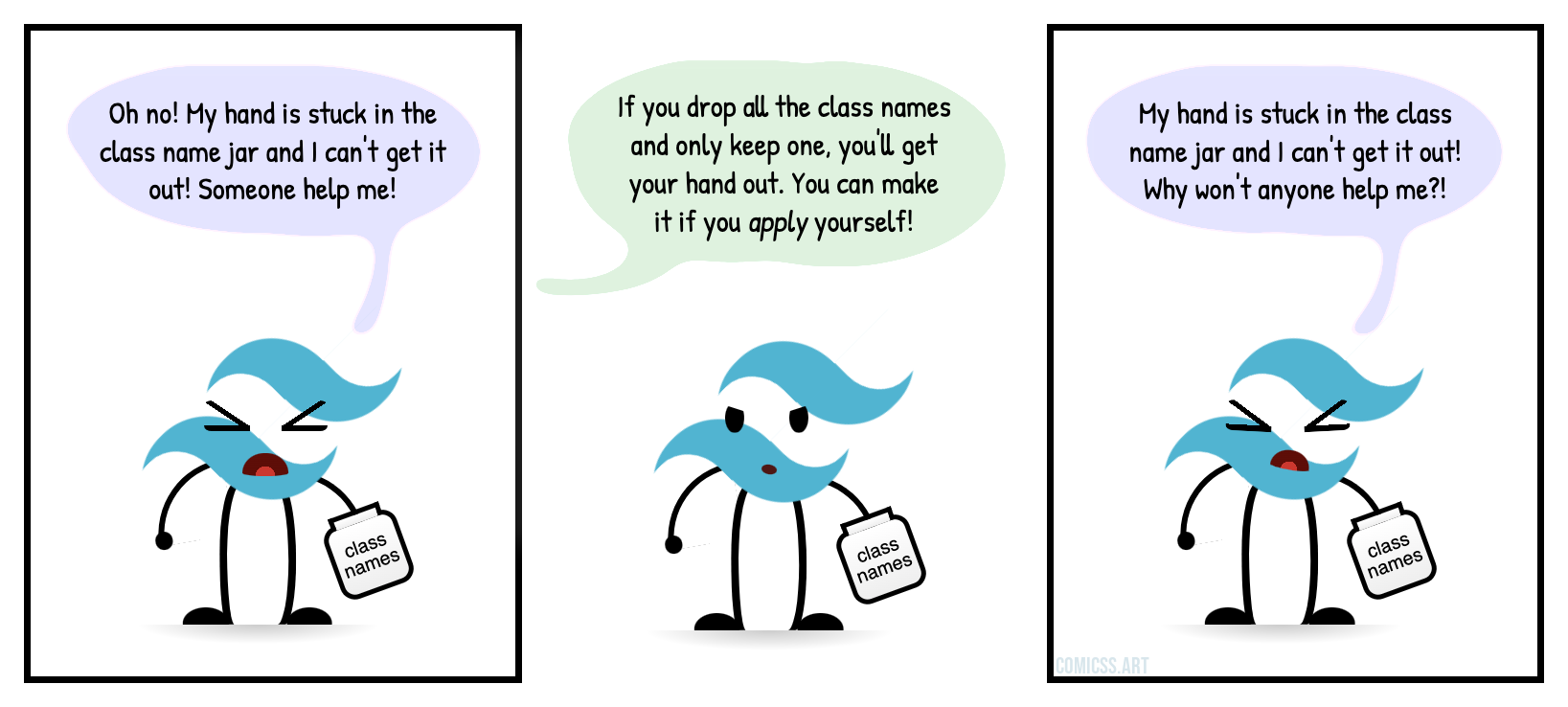
comic strip with 3 panels. The Tailwind logo is asking for help because it has its hand stuck in a jar labelled 'class names'. Someone off-panel says that it could get the hand out if it dropped all the classes and get only one, and how it could make it if it applied itself. In the last panel the Tailwind logo goes back to complaining about having the hand stuck and people not helping.

10 Nov 00:47

Saturday Morning Breakfast Cereal - What

by Zach Weinersmith


Click here to go see the bonus panel!

Hovertext:
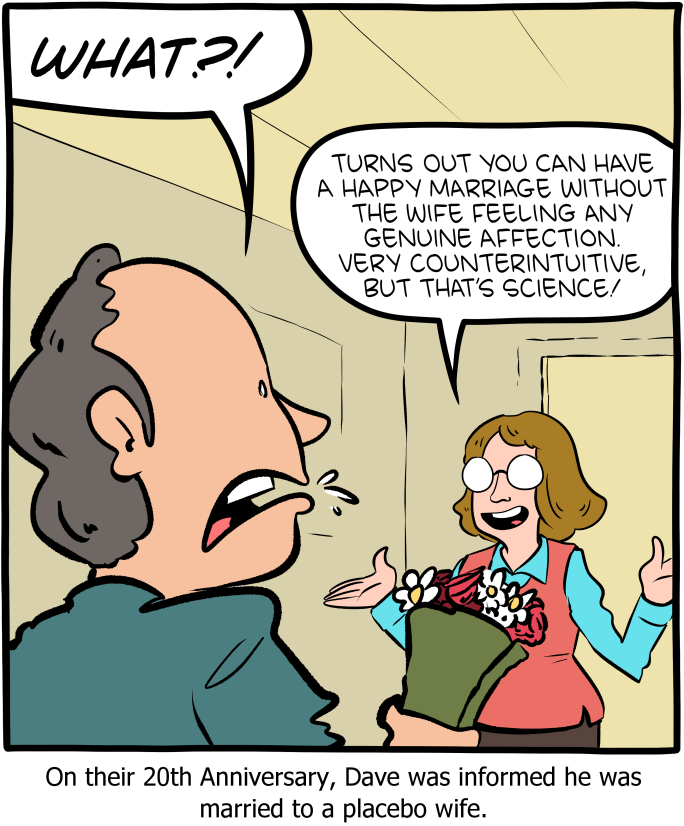
Fortunately, it turns out that all along he has been a placebo husband.


Today's News:
10 Nov 00:47

Part 3.6

Part 3.6
10 Nov 00:44

Wikipedia Says AI Is Causing a Dangerous Decline in Human Visitors

by Emanuel Maiberg
Wikipedia Says AI Is Causing a Dangerous Decline in Human Visitors

The Wikimedia Foundation, the nonprofit organization that hosts Wikipedia, says that it’s seeing a significant decline in human traffic to the online encyclopedia because more people are getting the information that’s on Wikipedia via generative AI chatbots that were trained on its articles and search engines that summarize them without actually clicking through to the site. 

The Wikimedia Foundation said that this poses a risk to the long term sustainability of Wikipedia. 

09 Nov 16:46

I’m looking for dignity, but there just isn’t any.

I’m looking for dignity, but there just isn’t any.

09 Nov 16:45

Great scenery! …Crappy movie.

mst3kgifs:

Great scenery! …Crappy movie.

09 Nov 16:45

That’ll have to pass for fun for now.

That’ll have to pass for fun for now.

09 Nov 16:45

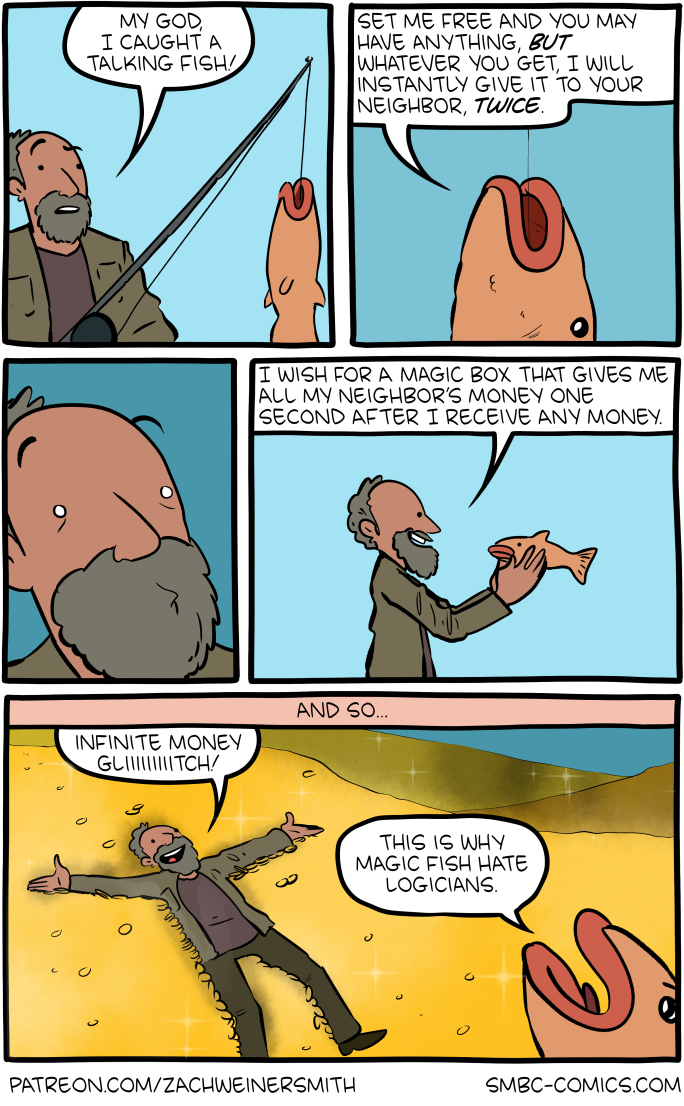
Saturday Morning Breakfast Cereal - Fish

by Zach Weinersmith


Click here to go see the bonus panel!

Hovertext:
This is more easily executable with a three-wish genie, but it's good to be prepared for all circumstances.


Today's News:
09 Nov 16:13

Fox News Desperately Tries To Repair The Broken Simulation

by Mike Brock

Within twenty-four hours of Republicans getting crushed in elections they’d convinced themselves were winnable, Fox News deployed the counter-move.

Not denial—the losses were too visible for that. Bret Baier had already explained to Fox & Friends viewers how bad it was. “It’s a big loss,” he said. Not just the results, but “the spreads are surprising.”

Not acceptance—that would threaten the narrative that MAGA represents the inevitable American future.

Instead, on Wednesday night’s edition of The Ingraham Angle, Laura Ingraham offered viewers a reframe so brazen it became an on-screen graphic:

“By Winning, Democrats Are Actually Losing.”

The emperor has no clothes. And what makes this moment pedagogically valuable is that lots of people are noticing simultaneously. The propaganda is at its most naked. Which means we can analyze how it works precisely when it’s failing to work.

When You Can See It

Propaganda works by being invisible. The best propaganda doesn’t feel like propaganda—it feels like common sense, like the way things obviously are, like what everyone already knows.

When propaganda becomes visible as propaganda, it loses most of its power. Once you can see the strings, the puppet stops being convincing.

Ingraham just made the strings visible. Not through some subtle slip, but by putting “By Winning, Democrats Are Actually Losing” on screen as a graphic. This is propaganda’s nightmare scenario: the mechanism exposed precisely when it’s most desperately needed.

Let’s break down the structure so you can recognize it when it’s less obvious:

The Core Move: Reality Inversion

When observable reality contradicts your narrative decisively, you have limited options. Denial becomes impossible when the contradiction is too visible. Acceptance destroys the narrative you need to maintain.

So you invert: acknowledge the reality while controlling what it means. Transform the evidence that contradicts your narrative into evidence that confirms it.

Ingraham’s version:

  • Democrats won—can’t deny.
  • But their policies will fail—contestable.
  • So people will flee to red states—contestable.
  • Which means Democratic victory produces Republican benefit—inversion complete.
  • Therefore by winning, they’re actually losing—reality inverted.

Good propaganda makes this subtle. It spends weeks establishing premises. It lets viewers do the inversion themselves through implication.

But Ingraham had twenty-four hours. The fracture was fresh. The narrative needed immediate repair. So she just… said it. Put it on screen. Made it a graphic.

That’s not sophisticated propaganda. That’s desperate propaganda. And desperate propaganda exposes its mechanics because it doesn’t have time for subtlety.

The Terror of Being Seen

Here’s what you need to understand about what this moment means for Laura Ingraham, for Fox News, for the entire propaganda infrastructure:

Their power depends on invisibility.

Not invisibility of the network—everyone knows Fox News exists, knows it’s conservative. That’s not the invisibility that matters.

The invisibility that matters is the machinery itself. The mechanisms through which they shape perception, manufacture consensus, control interpretation. Those need to be invisible or they stop working.

When you can see someone trying to make you believe something, you become resistant to believing it. Persuasion operates through the illusion of discovery—you think you’re arriving at conclusions independently when really you’re being guided there. Once you see the guidance, the spell breaks.

Ingraham just made the guidance visible. And this is terrifying for propagandists because once people see the machinery, they start seeing it everywhere.

If you can see Ingraham inverting reality to maintain narrative, you might start asking: what else has been inverted? When they said the economy was terrible while data showed recovery—was that reality inversion too? When they said protests weren’t representative—was that the same move? When they said Trump’s felony conviction would help him—was that the same desperate gymnastics?

One visible instance threatens to illuminate the entire structure. Recognition cascades backward through everything you’ve believed. This is the propagandist’s nightmare.

But it gets worse for them. Because propaganda doesn’t just require individual belief—it requires collective suspension of disbelief. It needs to be socially reinforced. Your family believes it, your neighbors believe it, your social media feed confirms it. When everyone around you accepts the frame, questioning it feels crazy. That social reinforcement is what makes propaganda sticky.

But when lots of people simultaneously notice the emperor has no clothes, that reinforcement fractures. If you think you’re alone in seeing the absurdity, you might doubt yourself. But if you suspect lots of people are simultaneously recognizing it—if Twitter is mocking it, if even conservative commentators seem skeptical, if your Fox-watching uncle texts you “that was weird”—then the collective suspension of disbelief cracks.

That’s what propagandists fear most. Not individual disbelief—that can be isolated, dismissed. But mass simultaneous recognition that the machinery is visible, the narrative is constructed, the consensus is manufactured.

When lots of people at once see the strings, the puppet show ends.

The Prostrators and the Propagandists

Laura Ingraham trying to convince viewers that Democratic victories are actually defeats would be merely pathetic if it existed in isolation. But it doesn’t.

She’s performing this desperate reality inversion while Tim Cook presents a gold-plated tribute in the Oval Office like some feudal vassal paying homage to his lord. While Zuckerberg congratulates Trump. While Bezos killed the Post endorsement then offered “extraordinary” praise. While Marc Andreessen proclaims “morning in America”—liberation from the terrible oppression of having to pretend to care about other people at dinner parties.

The propagandists and the prostrators serve the same master: the simulation of MAGA inevitability. Ingraham maintains it through reality inversion. The tech oligarchs maintain it through strategic submission.

And both have soiled their reputations into the annals of history with the same calculation: that bending the knee is wisdom, that accommodation is strategy, that surrendering dignity is just being realistic about power.

They’re wrong. And Tuesday night proved it.

The Economic Royalists Chose This

Let’s be clear about what happened after November 2024. These weren’t small business owners protecting their livelihoods. These were some of the wealthiest, most powerful people on the planet—people with resources to resist, with platforms to speak truth, with security that ordinary people don’t have—choosing to prostrate themselves.

Tim Cook didn’t need to perform feudal tribute. Apple has more cash reserves than most countries’ GDP. Cook could have maintained dignified distance. He chose submission instead.

Bezos owns the Washington Post—a paper with “Democracy Dies in Darkness” as its motto. He killed their endorsement, then offered extraordinary praise to Trump. He has wealth that makes him effectively untouchable. He chose to touch his forehead to the ground anyway.

These aren’t victims. These are people who looked at Trump’s explicit authoritarianism and decided their wealth and power would be safer if they signaled submission early.

They made a bet: MAGA represents the inevitable future, resistance is futile, accommodation is wisdom.

Tuesday night, reality called that bet. And they lost.

The Sociopaths Are Shocked

What links Ingraham’s desperate propaganda and Cook’s feudal tribute is the same fundamental miscalculation: they thought everyone would become what they are.

The propagandists thought everyone would accept obvious inversions if delivered confidently enough. The prostrators thought everyone would bend the knee once they demonstrated it was safe to do so. Both groups convinced themselves that cynicism is realism, that principles are obstacles, that most people are just waiting for permission to abandon dignity.

They were shocked to discover: no. Most people aren’t sociopaths. Most people won’t accept that winning means losing. Most people won’t prostrate themselves to authoritarians just because billionaires did it first.

The propagandists control the platforms. The prostrators control the wealth. Together they manufacture consensus, shape information flows, fund the campaigns, own the infrastructure.

And they still lost. Because manufactured consensus only works until lived experience contradicts it. Because reality has veto power. Because most people can still recognize that two plus two equals four even when Laura Ingraham explains otherwise and Tim Cook nods along.

What Tuesday Night Means for the Prostrators

The propagandists are scrambling to repair the simulation because their credibility depends on narrative maintenance. But what about the prostrators?

It means their bet is failing. The calculation that MAGA inevitability made accommodation wise—that’s looking shaky.

Because here’s the thing about authoritarian systems: they don’t reward early submission. They despise it. Trump publicly humiliated Musk despite Musk’s hundreds of millions in support. You think Tim Cook’s golden tribute bought him security? It bought him contempt—Trump’s and ours.

The prostrators thought they were being strategic. They were being cowards. And now they’re trapped. Having soiled their reputations through public submission, they can’t easily reverse course. Having signaled that they’ll bend to power, they’ve marked themselves as bendable.

And the simulation they bent to support is fracturing. Which means they prostrated themselves to a future that might not arrive. They surrendered dignity for security in an order that’s proving less inevitable than claimed.

What This Teaches Us About All Propaganda

This moment is valuable precisely because the propaganda is so naked. When you can see the machinery clearly in one instance, you can start recognizing it everywhere:

Watch for acknowledgment followed by inversion. “Yes that happened, but it actually means the opposite because…”

Notice predictions stated as certainties. “Will fail” becomes “are failures.” Grammar converts uncertainty into inevitability.

Track coherence debt. How many special exceptions does accepting this require? How much explaining away of observable reality?

Test predictions. Inversions depend on future consequences. Did those consequences happen? When they don’t, does the framework adjust or create new explanations?

Check alternative frameworks. Does this interpretation require believing this source exclusively? What would someone outside this information silo conclude?

Ask what’s being protected. Inversions happen when reality threatens something desperately needed. What narrative does this inversion protect?

These aren’t just tools for analyzing Fox News. They’re tools for analyzing all propaganda—including propaganda that aligns with your values, that comes from sources you trust, that feels like common sense.

Because left-wing propaganda exists too. Technocratic propaganda. Progressive propaganda. The structure is the same even when the content differs.

Learning to see propaganda when it’s naked—when it’s obviously desperate—teaches you to see it when it’s sophisticated.

Two Plus Two Equals Four

There are truths that survive every inversion, every sophisticated reframing, every attempt to make reality mean its opposite.

Democrats won elections in New Jersey, Virginia, and New York. That’s what winning is—getting more votes, your candidates taking office.

You can predict those victories will lead to bad governance. You can work to defeat those officials in future elections. You can argue their policies will fail.

But you cannot make victory into defeat through definitional gymnastics. You cannot invert observable reality through prediction about what it might eventually mean.

When Fox News puts “By Winning, Democrats Are Actually Losing” on screen, they’re not offering analysis. They’re attempting reality maintenance for viewers whose framework just got contradicted.

The sophistication of the attempt doesn’t make it true. The confidence with which it’s delivered doesn’t make it coherent. The fact that some people accept it doesn’t make it correspond to reality.

Two plus two equals four. Democrats winning elections means Republicans lost. And no amount of propagandistic inversion changes that, no matter how desperately the simulation needs it to.

The Wire Still Holds

The simulation fractured when Republicans lost decisively. Laura Ingraham’s attempt to repair it through naked reality inversion is evidence of fragility, not strength.

You don’t need to tell people that winning is actually losing unless losing threatens your entire framework. You don’t make the propaganda machinery visible unless you’re desperate enough that visibility is worth the risk.

The terror for propagandists isn’t that this particular inversion might fail. It’s that lots of people are simultaneously seeing the machinery. That once you see propaganda as propaganda, you start seeing it everywhere. That recognition cascades backward through everything you’ve believed.

The wire is holding. Not because Fox News isn’t powerful—they are. The inversion will work on some viewers. The simulation will partially reconstruct.

But when propaganda becomes naked, when the machinery is visible, when lots of people simultaneously notice the emperor has no clothes—that’s when resistance becomes possible. Not because you’ve won, but because you can finally see clearly what you’re fighting.

And understanding their desperation—seeing how scared they are—is strategic intelligence. They’re not operating from strength. They’re scrambling. The propagandists are deploying naked reality inversion. The prostrators are doubling down on bets that are already failing.

That’s when they’re most dangerous. Desperation produces escalation. But it’s also when they’re most vulnerable. Because every desperate move that fails to restore the simulation reveals further fragility.

May Love Carry Us Home

The cognitive technology for recognizing propaganda isn’t just intellectual—it’s grounded in love for what’s real.

Love for truth that withstands inversion. Love for your own capacity to see clearly even when powerful forces try to make you doubt what you observe. Love for people trying to maintain coherence in hostile information environments.

That love is what makes you resist when Laura Ingraham explains that winning is losing. Not because propaganda doesn’t work on you—it works on everyone sometimes. But because when it becomes visible, when you can see someone trying to make you believe the impossible, love for truth is what lets you say: no. I see what you’re doing. And I choose reality instead.

The machinery is visible. The emperor has no clothes. Lots of people are noticing simultaneously. And that recognition—that moment when propaganda reveals itself as propaganda—is where resistance begins.

Not in never being manipulated. But in seeing manipulation when it happens. Not in being immune to propaganda. But in recognizing it when the machinery becomes visible and choosing truth over the inversion.

Two plus two equals four. Winning means winning. And we can see you trying to tell us otherwise, Laura. We can see the strings. And once you see them, you can’t unsee them.

The circus continues. But this time, we’re watching the performance with clear eyes. And that clarity—that refusal to accept obvious inversion—is how the wire holds.

Mike Brock is a former tech exec who was on the leadership team at Block. Originally published at his Notes From the Circus.

09 Nov 15:46

Blood Tests for Alzheimer’s Are Here

by Simone Valesini
New diagnostic kits aim to revolutionize early screening of the disease, potentially allowing patients to receive treatments—such as monoclonal antibodies—sooner.
09 Nov 14:15

Tips For Antiquing

by The Onion Staff

Shopping for antiques can be a fun, sustainable, and stylish way to decorate your home. The Onion shares tips for antiquing. 

Save time by having a clear idea of what kind of old shit you’re looking for. 

Arrive in a van or truck large enough to fit 30-plus paintings of pale children picking flowers.

Double-check that you’re in an antique store and not the home of an elderly hoarder.

Bite down on the chair to make sure it’s authentic Herman Miller.

Loudly ask vendors how much each item would go for on Pawn Stars. 

Remember, if you’re not in the Antique region of Connecticut, it’s technically thrifting.

Be prepared to haggle with someone who is emotionally attached to a broken table.

Make sure your certificate of authenticity comes with its own certificate of authenticity.

Give up and buy something new that’s designed to look old.

The post Tips For Antiquing appeared first on The Onion.

09 Nov 13:54

#RoninWarriors

09 Nov 13:54

#CowboyWho