Shared posts

04 Dec 16:22

share your funniest office holiday stories

by Ask a Manager

We have once again entered the season of forced workplace merriment, holiday party disasters, and other seasonal delights! Thus it is time to hear about your office holiday debacles, past or current.

Did you pass out naked in the break room? Did your manager provide you with a three-page document of “party procedures”? Did your seven-year-old tell your boss the party food “tastes like shit”? These are all real stories that we’ve heard here in the past. Now you must top them.

Share your weirdest or funniest story related to holidays at the office in the comments.

The post share your funniest office holiday stories appeared first on Ask a Manager.

04 Dec 16:22

Trump’s Cynical Venezuela Saber-Rattling

by Ben Burgis

Authoritarian leaders like to rally their populations against external threats, and Donald Trump has decided that Venezuela is a perfect candidate. So far, though, the public isn’t buying it.


Donlad Trump’s brand of faux-populist authoritarianism requires an external enemy to complement his war against “the enemy within,” and he’s decided that Venezuela is a perfect candidate. (Alex Wroblewski / CNP / Bloomberg via Getty Images)

In a recent appearance on CNN, right-wing pundit Batya Ungar-Sargon defended the Trump administration’s policy of blowing up boats off the Venezuelan coast that it claims are carrying drugs. “Secretary of State Rubio has determined that these boats are carrying terrorists,” she said, “which makes the attacks on them legal.”

The idea that the executive branch can wave away all legal, moral, and constitutional obstacles to doing what it pleases by saying the magic word “terrorism” has been a depressingly standard one in recent American history. Ungar-Sargon’s framing on this point is basically indistinguishable from the kind of thing a bowtie-wearing conservative might have said in 2005 to justify the Bush administration’s policy of “enhanced interrogation” at Guantanamo Bay. But she followed it up with an attempt to give the Trump administration’s lawlessness a “populist” twist:

When working-class Americans in those forgotten Rust Belt communities where you have five kids who’ve overdosed and died, when they see him blowing up those boats, they feel like he sees their pain. They feel like somebody cares.

Reality check: All publicly available evidence shows that the drugs that cause overdoses in the United States don’t come from Venezuela at all. A small portion of the cocaine in America is Venezuelan but approximately none of the fentanyl. Nor is there even any evidence that a majority of Americans in the communities Ungar-Sargon is talking about believe that fentanyl is coming to the United States from Venezuela and thus “feel seen” when suspected Venezuelan drug runners (or random fishermen) are executed without trial. One recent poll shows that a whopping 70 percent of Americans are opposed to any “military action in Venezuela.”

The fact that Ungar-Sargon feels the need to combine her reheated “war on terror” talking points with rhetoric about “seeing” working-class people in the Rust Belt, though, says a lot about the strange domestic politics of Trump’s intervention in Venezuela.

Trump still wants to posture as a populist enemy of the Deep State. But he’s as desperate to topple Venezuela’s Nicolás Maduro as George W. Bush was to topple Saddam Hussein, and he’s willing to use all the tools neoconservatives fashioned in the 2000s. Trump’s brand of faux-populist authoritarianism requires an external enemy to complement his war against “the enemy within,” and he’s decided that Venezuela is a perfect candidate.

“Our Own Hemisphere”

In 2023, when then-senator J. D. Vance endorsed Donald Trump, Vance praised him for having supposedly broken from the “hawkish” policies of his predecessors and “kept the peace” during his first term.

Even then, that assessment required memory-holing quite a bit of what happened in the first Trump administration. Now that Vance is the vice president and his boss is pursuing an unabashedly hawkish policy in Venezuela, blowing up Venezuelan ships based on unfounded claims of “terrorism,” and openly contemplating a regime change war, Vance has to walk a very strange rhetorical tightrope. On Tuesday, he complained that “we’ve been told for decades the US military must go everywhere and do the impossible all over the world,” but “the red line for permanent Washington is using the military to destroy narco terrorists in our own hemisphere.”

In Vance’s mind, it seems, military aggression justified in the name of an open-ended right to wage war against terrorism and aimed at regime change in a country that’s never attacked the United States is a terrible thing when it happens in the Middle East — but it’s completely fine in “our own hemisphere.”

Unless the vice president is concerned about how much gasoline our bombers and warships will have to burn on their way to battle, it’s unclear why it should make a difference that what was previously done in Iraq and Afghanistan is now being done in the Western Hemisphere. And you’d have to know very little about the history of American foreign policy to think that asserting US dominance in Latin America represents some bold break from the preferences of “permanent Washington.”

The Domestic Politics of Trump’s Warmongering

All authoritarian leaders benefit from having an external enemy to rally their supporters against as they try to consolidate more power at home. But in principle, that enemy could have been China or Iran. They certainly didn’t select Venezuela because anyone in the White House seriously believes it’s where the fentanyl sold in the United States originates. Sometimes it almost feels like they threw a dart at a map of the world.

Even so, it might make a difference to Trump and his movement that the enemy they’ve selected is in Latin America.

Part of the reason is surely that Venezuela is an oil-rich nation. And the presence of powerful figures, like Marco Rubio, who come from South Florida and are ideologically fixated on countries like Cuba and Nicaragua, explains a lot about how an attack on Venezuela ever came to be seriously considered. But we also can’t disentangle the domestic politics of the choice from MAGA’s core priorities.

As Trump tramples constitutional rules and sends troops to blue cities, his rhetoric has become increasingly consumed with fulminations against “the enemy within.” This is a flexible concept, incorporating everyone from pro-Palestinian protesters to lone-wolf assassins to otherwise milquetoast Democrats who raise concerns about his mounting authoritarianism. The core of “the enemy within,” though, is the population of undocumented workers he’s targeted with theatrically cruel deportation sweeps and those progressives who infuriate him by protesting the deportations.

During last year’s election, he was already conflating the “invasion” by unauthorized immigrants with the fentanyl crisis, even though 86 percent of people arrested for smuggling fentanyl are American citizens and more than nine out of ten seizures “occur at legal crossing points or interior vehicle checkpoints, not on illegal migration routes.”

Trump needs to merge the immigration issue with the fentanyl issue, though, so he can sell his cruelty as a justifiable emergency measure to stop an existential threat. And it gets even easier to justify authoritarian encroachments when you merge the hysteria about immigrants and fentanyl with war against a “terrorist” external enemy — especially one that’s in the same general part of the world as the immigrants.

The good news is that, so far at least, it doesn’t seem to be working. Again, only 30 percent of the public is currently on board with intervention in Venezuela. Right now, the fentanyl cover story is a bit too absurd, and it’s a bit too obvious that, far from breaking with “permanent Washington,” Trump and Vance are selling precisely the same bill of goods as previous generations of warmongers, who have always told us that the next war will be different from the one before that, and the one before that, and the one before that.

None of this means that Trump might not get his regime change. It just means that this provocation could easily develop into a deeply unpopular war that will fail miserably in the goal of rallying the public behind domestic authoritarianism. The whole thing might fall flat, causing the administration to lose even more momentum. There’s some comfort in that. But if history has taught us anything, it’s that we shouldn’t underestimate the damage that can be done by unpopular leaders prosecuting unpopular wars.


04 Dec 16:21

Momentum Is Building for Medicare for All

by David Sirota

As private health insurers jack up premiums for tens of millions, a majority of Americans now want Medicare for All — even if it entails eliminating private health insurers and raising taxes.


A new poll shows a huge majority of Americans now want Medicare for All. (Ronen Tivony / NurPhoto via Getty Images)

When Medicare for All took center stage in the 2020 Democratic presidential primaries, opponents undercut growing support for the initiative by homing in on how it would raise taxes and eliminate health insurers. Those opponents succeeded: polls at the time showed that while Americans conceptually supported the idea of a government-sponsored system, many didn’t want it to replace private insurance. Surveys showed support for Medicare for All dropped precipitously if the program were to eliminate private insurance.

Soon after, Democratic senator Elizabeth Warren (MA), a Medicare for All proponent, badly stumbled over the tax and private insurance question and lost her front-runner status in the presidential primary polls. With party acolytes still valorizing the Affordable Care Act (ACA) rather than pressing for something better, Democratic voters then nominated avowed Medicare for All opponent Joe Biden, who was elected promising a public health insurance option, and then literally never mentioned it again upon taking office.

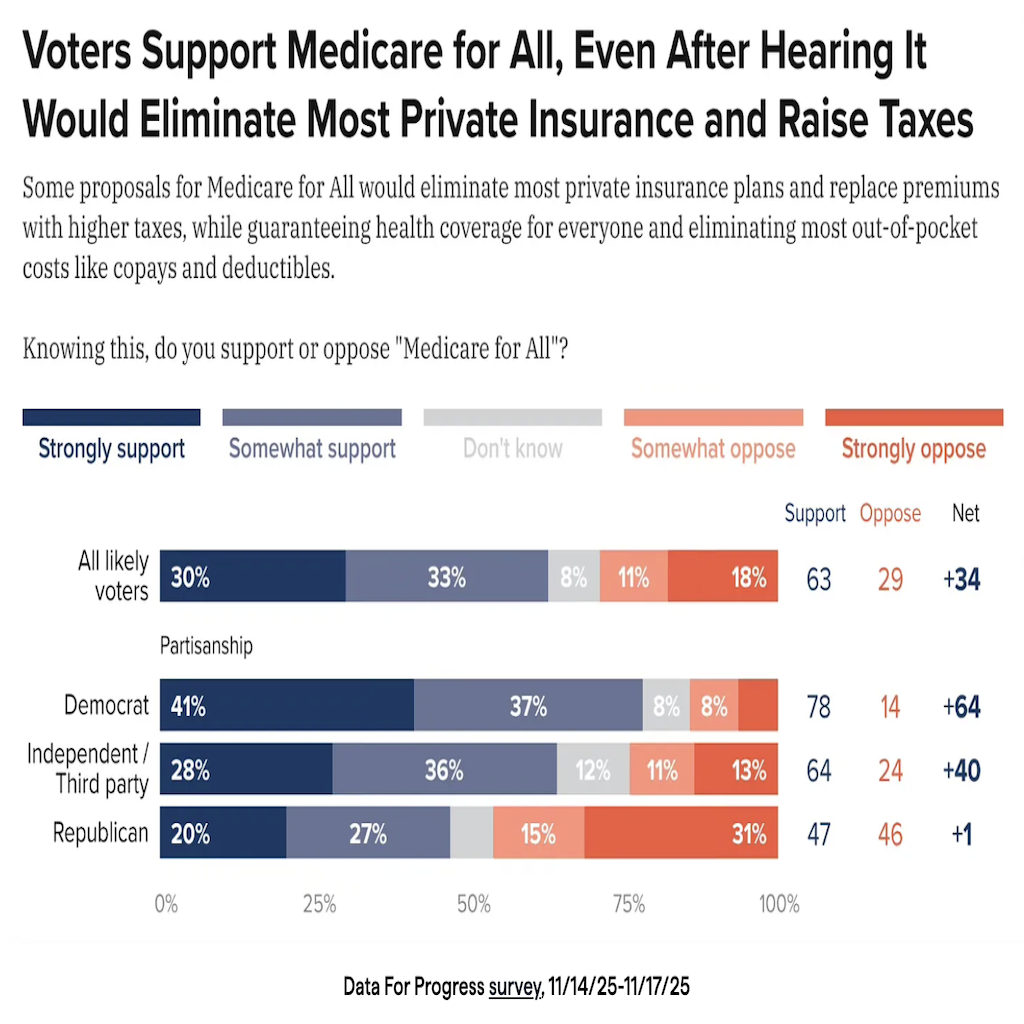
That might have been the end of Medicare for All for another generation — except now the ACA is epically and undeniably failing to guarantee “affordable” health care. As private health insurers are now jacking up premiums for tens of millions of Americans, a new poll shows a huge majority of Americans now want Medicare for All — even if it entails eliminating private health insurers and raising taxes.In the survey, 63 percent of Americans said they support Medicare for All, even knowing that it “would eliminate most private insurance plans and replace premiums with higher taxes.” That support was spread across the political spectrum — it’s garnered 78 percent support from Democrats, 64 percent support from independents, and 47 percent (a plurality) support from Republicans. In all, just 29 percent of voters were opposed.

To put the enormity of this change in perspective, consider that six years ago, polls showed that when people were told Medicare for All might eliminate private insurance, topline support for the idea typically dropped. One survey showed that just 13 percent of Americans would support Medicare for All if it eliminated private insurance. So these new numbers reflect a potential fifty-point shift on that key question in just six years.

As Sen. Bernie Sanders (I-VT) might say, that’s yuge. It’s also understandable: to many voters facing ever-higher bills, “eliminate private insurance” now sounds like “eliminate the faceless corporation burying me in paperwork, reducing my coverage, and raising my premiums.”

Of course, when looking at this new polling data, big caveats apply. Comparing different polls with different methodologies is not a perfect apples-to-apples poll comparison. More importantly, these new poll numbers come amid some momentary political asymmetry.

Americans are rightly changing and intensifying their views in response to health care price shocks. But that’s before there’s a Medicare for All bill moving ahead in Congress — which is to say, before the insurance industry has financed another multimillion-dollar ad campaign aiming to scare everyone about the prospect of “death panels” and other bogeymen if the government dares extend to everyone what the country already provides to seniors.

Would Medicare for All fare better in the 2028 Democratic primaries and have a real chance of passing with a new administration in 2029? It’s hard to say.

On the one hand, it’s fair to expect that insurance-bankrolled Democrats’ use of the ACA as a weapon against Medicare for All will have somewhat less efficacy these days when everyone is experiencing the downsides of the ACA’s foundational decision to fortify — rather than eliminate — the power of private insurers. The ACA’s loss of political potency seems to be recognized even by the namesake of Obamacare, who previously abandoned his support for Medicare for All and marginalized the idea while he was president, but who has now shifted his rhetoric.

On the other hand, this is the world of the Master Plan, which has deregulated the campaign finance system and legalized bribery. So you can never underestimate the power of money to buy elections, buy legislation, and buy a massive propaganda campaign to sow doubt among voters.

You can already see that in miniature right now. Even as support for Medicare for All now surges, Republican lawmakers and Democratic leaders in Congress are busying themselves with passing legislation demonizing “the horrors of socialism.”

That vanity bill may look like merely an attack on New York mayor-elect Zohran Mamdani — but amid a health care crisis, it’s also undoubtedly a callback to President Ronald Reagan’s infamous red-baiting attempt to block Medicare itself from ever being created.

Like Reagan back in 1961, today’s politicians and their paymasters see the shift in health care politics. But rather than doing their jobs and solving the actual crisis that’s medically looting and bankrupting millions of Americans, they are instead focused on trying to preemptively distort the political discourse so that change isn’t possible.

If past performance predicts future results, then they’ll succeed. But this time around, the health care emergency is so dire that the past may be less predictive and more prelude to a very big set of long-overdue changes.


This article was first published by the Lever, an award-winning independent investigative newsroom.

04 Dec 16:21

A native prairie bird lost federal protection. People are still trying to save it on private land

by Raul Alonzo
The lesser prairie chicken was once a common sight in the southern Great Plains, but its numbers are dwindling. Even so, it lost federal protections earlier this year for a second time. Now states and landowners are overseeing conservation efforts.
04 Dec 16:20

Nancy Littlejohn Fine Art Lawsuit Results in Default Judgment; Artists Owed $50,000+

by Nicholas Frank

A lawsuit brought by artists against Nancy Littlejohn Fine Art (NLFA), LLC and Nancy Littlejohn individually has resulted in a default judgment. The judgment, rendered on Tuesday, September 9, by Judge Dedra Davis in Harris County District Court, awards all damages to the artists, including attorney fees. The total of damages exceeds $50,000. 

The lawsuit was filed a year and a half after NLFA closed abruptly on September 30, 2022, during the run of exhibitions by JooYoung Choi and Libbie Masterson, which were originally set to close November 5, 2022. Glasstire reported the closure, though at the time, artists connected to the gallery were unwilling to speak on the record about how the closure impacted their livelihoods. Originally, the Houston-based gallery operated in the late 1990s until the early 2000s. The gallery then reopened in 2019. 

At the time of the 2022 closure, Nancy Littlejohn noted that she was closing the gallery after 30 years in the business to take time for herself. She lauded her employees and stated, “I love all the artists that I work with dearly.” Artists and arts professionals from across the state commented on Glasstire’s coverage, with some questioning the reasons for the closure and others speaking to Ms. Littlejohn’s integrity.

A view of the former Nancy Littlejohn Fine Art building in Houston, a one-story modernist design.
A view of the former Nancy Littlejohn Fine Art building in Houston

The court document states that the artists had attempted to contact Ms. Littlejohn over a year and a half to resolve issues of nonpayment and return of artworks, without success, while Ms. Littlejohn “has enjoyed a lavish lifestyle,” including a January 2024 wedding in Santa Fe, when Ms. Littlejohn married Texas Monthly founding editor and screenwriter William Broyles after her divorce from Eric Littlejohn. Ms. Littlejohn has changed her name to Nancy Worthington Broyles.  

Artists named as plaintiffs in the lawsuit, which was filed March 27, 2024, are David Reed Anderson, Sara Catharine Carter, Kysa Johnson, Scooter LaForge, Anne Lindberg, David McGee, and McKay Otto. The default judgement rendered in September affirmed the artists’ original petition, which reads in part, “Defendant owes Plaintiffs unpaid sales commissions for sold artworks, shipping fees for returned and stranded artworks, and monetary damages for damaged, destroyed, and restored artwork.”

Per the court document, Ms. Johnson is owed $20,000 from sales of three artworks, plus costs of shipment and storage fees for other artworks that had been consigned to the gallery but are currently stranded with a shipping company due to unpaid fees. Another artist also awaits shipping fees to be paid by Ms. Littlejohn so that his consigned artworks can be returned to him. One artist is owed $7,500 for proceeds from sales, plus $2,286 in shipping fees for the return of 18 artworks. Another is owed $7,650 for an artwork sold by NFLA, and another is owed $4,400 for sales of artwork plus $1,500 for transport costs. One artist seeks restitution for damages and destruction of multiple artworks not specified in the lawsuit. 

The judgement means that all damages listed in the lawsuit have been awarded to the plaintiffs, though no timeline or legal parameters have been given regarding payment. A default judgment is rendered when the defendant, or “respondent,” either was served and did not file an answer by the given deadline, or filed an answer and was given notice of a hearing but did not show up for the hearing. 

Ms. Carter told Glasstire that she is owed proceeds from the sale of three artworks estimated at $2,500, including a $900 conservation fee charged by Ms. Carter to restore an artwork damaged due to improper storage conditions. She told Glasstire that the purpose of bringing the suit is for accountability and exposing the truth.

Ms. Johnson was a part of the reopened gallery’s inaugural group show in 2019, and had her first solo show that fall. She told Glasstire that initially, “Nancy was very supportive of my work and ideas,” and her relationship with the gallery started out well. “The staff at NLFA was amazing. Very responsive, supportive, enthusiastic.” Then, she said, “shortly before the gallery unexpectedly closed, I had become aware of some situations where other people had had experiences with [Ms. Littlejohn] both personally and professionally that were upsetting and gave me pause.”

Things took a turn for Ms. Johnson in early 2022, when she says she became aware a staff member had been treated poorly. “That was like the first canary in the coal mine, then that summer I became aware of some other things that were alarming if true, and then shortly thereafter the gallery closed seemingly out of the blue. Nancy swore she would pay us the money owed us but was unwilling to talk about paying over time or any kind of agreement.”

Emily Griffith, a former Gallery Director at NLFA, who had previously worked at various galleries and museums, including Marian Goodman Gallery in New York City, said she was hired prior to the 2019 opening of the gallery and that she enjoyed working with Ms. Littlejohn. “I loved it. It was a dream job,” Ms. Griffith told Glasstire. “I’m passionate about working with artists, and it was a chance for a brand new space to build from the ground up, and to work with artists. It was everything I’d hoped it was. Nancy was honestly a great boss. [Ms. Littlejohn] was very hands off” in letting Ms. Griffith run the artist side of the business. 

Things started to go wrong, Ms. Griffith said, during the COVID-19 pandemic and Ms. Littlejohn’s concurrent divorce. Ms. Griffith said Ms. Littlejohn appeared disconnected from the artists and the day-to-day mission of the gallery.

Ms. Griffith resigned amicably in January 2022 and recommended the new gallery director be promoted from within. She said she offered to stay on to transition and train the new director, but was treated so poorly by Ms. Littlejohn that she left shortly thereafter due to what she described as “hostile” treatment. 

In subsequent months, Ms. Griffith maintained friendly relationships with several gallery artists and learned that some had decided to leave the gallery after hearing of her departure. “I started to get emails from them with the same story, the same exact wording that she owed them money, she was really sorry, she was closing the books and she’ll send them payment as soon as she can,” Ms. Griffith said. The payments never materialized, and the lawsuit was filed after failed attempts at mediation between the artists and Ms. Littlejohn.

Ms. Griffith said she is speaking out because she hopes to prevent a similar situation from happening again. 

Ms. Johnson explained, “For me and my family, it is a significant amount of money that has real world consequences. That said, it is as much the principle of the matter as it is the practical effect of not having the money.”

Ms. Carter echoed the statements of Ms. Johnson, saying, “What she owes me … is peanuts compared to what she owes the other people. Of course, I do want to be paid.” She continued, “What I find to be quite prevalent and continually easily possible in the art world [is] for people to get duped. So, I just think people should speak up. That’s really the primary reason I am speaking up, is because people need to understand that, yep, this [kind of thing] is still happening.”

Reached by Glasstire, Ms. Worthington Broyles (formerly Littlejohn) said, “These artists mean the world to me,” and, “People I care about have been very hurt by this, and their story needs to be heard, and I am on their side 100%.”

She referred Glasstire to attorney Sanford Dow regarding questions about her response to the default judgement, including plans for return of artworks and payment arrangements to compensate the artists. Mr. Dow responded via email with the following statement: 

“I was not engaged as legal counsel by Nancy Littlejohn Fine Art to represent the Gallery in connection with the lawsuit. At the time the lawsuit was pending, in my capacity as an informal mediator, I attempted to facilitate an equitable resolution between the Gallery and the various artists, but the Gallery and the artists could not ultimately come to settlement terms. My understanding is that Ms. Littlejohn desires to honor her commitment to the artists, and I encourage Ms. Littlejohn and the artists to reach some accommodation so that all of the parties can move forward. The art community is a tight-knit community, and it behooves everyone to have closure.”

The post Nancy Littlejohn Fine Art Lawsuit Results in Default Judgment; Artists Owed $50,000+ appeared first on Glasstire.

04 Dec 16:07

Pluralistic: A year in illustration (2025 edition) (03 Dec 2025)

by Cory Doctorow


Today's links


An artist at an easel, wearing a smock and holding a palette. The head of the artist and the subject in the oil painting have been replaced with the poop emoji from the cover of the US edition of 'Enshittification,' which has angry eyebrows and a black, grawlix-scrawled bar over its mouth.

A year in illustration (2025 edition) (permalink)

One of the most surprising professional and creative developments of my middle-age has been discovering my love of collage. I have never been a "visual" person – I can't draw, I can't estimate whether a piece of furniture will fit in a given niche, I can't catch a ball, and I can't tell you if a picture is crooked.

When Boing Boing started including images with our posts in the early 2000s, I hated it. It was such a chore to find images that were open licensed or public domain, and so many of the subjects I wrote about are abstract and complex and hard to illustrate. Sometimes, I'd come up with a crude visual gag and collage together a few freely usable images as best as I could and call it a day.

But over the five years that I've been writing Pluralistic, I've found myself putting more and more effort and thought into these header images. Without realizing it, I put more and more time into mastering The GIMP (a free/open Photoshop alternative), watching tutorial videos and just noodling from time to time. I also discovered many unsuspected sources of public domain work, such as the Library of Congress, whose search engine sucks, but whose collection is astounding (tip: use Kagi or Google to search for images with the "site:loc.gov" flag).

I also discovered the Met's incredible collection:

https://www.metmuseum.org/art/collection/search

And the archives of H Armstrong Roberts, an incredibly prolific stock photographer whose whole corpus is in the public domain. You can download more than 14,000 of his images from the Internet Archive (I certainly did!):

https://archive.org/details/h-armstrong-roberts

Speaking of the Archive and search engine hacks, I've also developed a method for finding hi-rez images that are otherwise very hard to get. Often, an image search will turn up public domain results on commercial stock sites like Getty. If I can't find public domain versions elsewhere (e.g. by using Tineye reverse-image search), I look for Getty's metadata about the image's source (that is, which book or collection it came from). Then I search the Internet Archive and other public domain repositories for high-rez PDF scans of the original work, and pull the images out of there. Many of my demons come from Compendium rarissimum totius Artis Magicae sistematisatae per celeberrimos Artis hujus Magistros, an 18th century updating of a 11th century demonolgy text, which you can get as a hi-rez at the Wellcome Trust:

https://wellcomecollection.org/works/cvnpwy8d

Five years into my serious collage phase, I find myself increasingly pleased with the work I'm producing. I actually self-published a little book of my favorites this year (Canny Valley), which Bruce Sterling provided an intro for and which the legendary book designer John Berry laid out fot me, and I'm planning future volumes:

https://pluralistic.net/2025/09/04/illustrious/#chairman-bruce

I've been doing annual illustration roundups for the past several years, selecting my favorites from the year's crop:

2022:
https://pluralistic.net/2022/12/25/a-year-in-illustration/

2023:
https://pluralistic.net/2023/12/21/collages-r-us/

2024:
https://pluralistic.net/2024/12/07/great-kepplers-ghost/

It's a testament to how much progress I've made that when it came time to choose this year's favorites, I had 33 images I wanted to highlight. Much of this year's progress is down to my friend and neighbor Alistair Milne, an extremely talented artist and commercial illustrator who has periodically offered me little bits of life-changing advice on composition and technique.

I've also found a way to use these images in my talks: I've pulled together a slideshow of my favorite (enshittification-related) images, formatted for 16:9 (the incredibly awkward aspect ratio that everyone seems to expect these days), with embedded Creative Commons attributions. When I give a talk, I ask to have this run behind me in "kiosk mode," looping with a 10-second delay between each slide. Here's an up-to-date (as of today) version:

https://archive.org/download/enshittification-slideshow/enshittification.pptx

If these images intrigue you and you'd like hi-rez versions to rework on your own, you can get full rez versions of all my blog collagesin my "Pluralistic Collages" Flickr set:

https://www.flickr.com/photos/doctorow/albums/72177720316719208

They're licensed CC BY-SA 4.0, though some subelements may be under different licenses (check the image descriptions for details). But everything is licensed for remix and commercial distribution, so go nuts!


A male figure in heavy canvas protective clothes, boots and gauntlets, reclining in the wheel-well of a locomotive, reading a book. The figure's head has been replaced with the poop emoji from the cover of the US edition of 'Enshittification,' whose mouth is covered with a black, grawlix-scrawled bar. The figure is reading a book, from which emanates a halo of golden light.
All the books I reviewed in 2025

The underlying image comes from the Library of Congress (a search for "reading + book") (because "reading" turns up pictures of Reading, PA and Reading, UK). I love the poop emoji from the cover of the US edition of Enshittification and I'm hoping to get permission to do a lot more with it.

https://pluralistic.net/2025/12/02/constant-reader/#too-many-books


A 1950s image of a cop with a patrol car lecturing a boy on a bicycle. Both the cop's head and the boy's head have been replaced with the head of Mark Zuckerberg's metaverse avatar. The ground has been replaced with a 'code waterfall' effect as seen in the Wachowskis' 'Matrix' movies. The background has been replaced with the glaring red eye of HAL 9000 from Stanley Kubrick's '2001: A Space Odyssey.' The cop's uniform and car have been decorated to resemble the livery of the Irish Garda (police) and a Garda logo has been placed over the right breast of the cop's uniform shirt.
Meta's new top EU regulator is contractually prohibited from saying mean things about Meta

Mark Zuckerberg's ghastly Metaverse avatar is such a gift to his critics. I can't believe his comms team let him release it! The main image is an H Armstrong Roberts classic of a beat cop wagging his finger at a naughty lad on a bicycle. The Wachowskis' 'code waterfall' comes from this generator:

https://github.com/yeaayy/the-matrix

https://pluralistic.net/2025/12/01/erin-go-blagged/#big-tech-omerta


The classic Puck Magazine editorial cartoon entitled 'The King of All Commodities,' depicting John D Rockefeller as a man with grotesquely tiny body and a gigantic head, wearing a crown emblazoned with the names of the industrial concerns he owned. Rockefeller's head has been replaced with that of Mark Zuckerberg's metaverse avatar. The names of the industrial concerns have been replaced with the wordmarks for Scale AI, Instagram, Oculus and Whatsapp. The dollar-sign at the crown's pinnacle has been replaced with the Facebook 'f' logo. The chain around Rockefeller's neck sports the charm that Mark Zuckerberg now wears around his neck.
The long game

In my intro to last year's roundup, I wrote about Joseph Keppler, the incredibly prolific illustrator and publisher who founded Puck magazine and drew hundreds of illustrations, many of them editorial cartoons that accompanied articles that criticized monopolies and America's oligarch class. As with so much of his work, Keppler's classic illustration of Rockefeller as a shrimpy, preening king updates very neatly to today's context, through the simple expedient of swapping in Zuck's metaverse avatar.

https://pluralistic.net/2025/11/20/if-you-wanted-to-get-there/#i-wouldnt-start-from-here


A tuxedoed figure dramatically shoveling greenish pigs into a tube, from whose other end vomits forth a torrent of packaged goods. He has the head of Mark Zuckerberg's 'metaverse' avatar. He stands upon an endless field of gold coins. The background is the intaglioed upper face of the engraving of Benjamin Franklin on a US$100 bill, roughed up to a dark and sinister hue.

Facebook's fraud files

I love including scanned currency in my illustrations. Obviously, large-denomination bills make for great symbols in posts about concentrated wealth and power, but also, US currency is iconic, covered in weird illustrations, and available as incredibly high-rez scans, like this 7,300+ pixel-wide C-note:

https://commons.wikimedia.org/wiki/File:U.S._hundred_dollar_bill,_1999.jpg

It turns out that intaglio shading does really cool stuff when you tweak the curves. I love what happened to Ben Franklin's eyes in this one. (Zuck's body is another Keppler/Puck illo!)

https://pluralistic.net/2025/11/08/faecebook/#too-big-to-care


A club-wielding colossus in an animal pelt sits down on a rock, looming over a bawling baby surrounded by money-sacks. The colossus's head has been replaced the with EU flag. The baby's eyes have been replaced with the glaring red eye of HAL 9000 from Staney Kubrick's '2001: A Space Odyssey.'
There's one thing EVERY government can do to shrink Big Tech

This is another Keppler/Roberts mashup. Keppler's original is Teddy Roosevelt as a club-wielding ("speak softly and carry a big stick") trustbusting Goliath. The crying baby and money come from an H Armstrong Roberts tax-protest stock photo (one of the money sacks was originally labeled "TAXES").

https://commons.wikimedia.org/wiki/File:HAL9000.svg

https://pluralistic.net/2025/11/01/redistribution-vs-predistribution/#elbows-up-eurostack


A black and white image of an armed overseer supervising several chain-gang prisoners in stripes doing forced labor. The overseer's head has been replaced with the glaring red eye of HAL 9000 from Stanley Kubrick's '2001: A Space Odyssey.' The prisoners' heads have been replaced with hackers' hoodies.
When AI prophecy fails

The chain-gang photo comes from the Library of Congress. That hacker hoodie is a public domain graphic ganked from Wikimedia Commons. This one also includes one of my standbys, Cryteria's terrific vector image of HAL 9000's glaring red eye, always a good symbolic element for stories about Big Tech, surveillance, and/or AI. I love how the HAL 9000 eye pops as the only color element in this one.

https://pluralistic.net/2025/10/29/worker-frightening-machines/#robots-stole-your-jerb-kinda


A 1950s delivery man in front of a van. The image has been altered. The man's head has been replaced with a horse's head. The man is now wearing an Amazon delivery uniform gilet. The packages are covered with Amazon shipping tags, tape and logos. The van has the Amazon 'smile' logo and Prime wordmark. Behind the man, framed in the van's doorway, is the glaring red eye of HAL9000 from Stanley Kubrick's '2001: A Space Odyssey.'
Checking in on the state of Amazon's chickenized reverse-centaurs

Another H Armstrong Roberts remix: originally, this was a grinning delivery man jugging several parcels. I reskinned him and his van with Amazon delivery livery, and matted in the horse-head to create a "reverse centaur" (another theme I return to often). I used one of Alistair Milne's tips to get that horse's head right: rather than trying to trace all the stray hairs on the mane, I traced them with a fine brush tool on a separate layer, then erased the strays from the original and merged down to get a nice, transparency-enabled hair effect.

https://pluralistic.net/2025/10/23/traveling-salesman-solution/#pee-bottles


The Earth seen from space. Hovering above it is Uncle Sam, with Trump's hair - his legs are stuck out before him, and they terminate in ray-guns that are shooting red rays over the Earth. The starry sky is punctuated by 'code waterfall' effects, as seen in the credit sequences of the Wachowskis' 'Matrix' movies.
The mad king's digital killswitch

The Uncle Sam image is Keppler's (who else?). In the original (which is about tariffs! everything old is new!), Sam's legs have become magnets that are drawing in people and goods from all over the world. The Earth-from-space image is a NASA pic. Love that all works of federal authorship are born in the public domain!

https://pluralistic.net/2025/10/20/post-american-internet/#huawei-with-american-characteristics


A 1989 black and white photo of the Berlin Wall; peering over the wall is Microsoft's 'Clippy' chatbot.
Microsoft, Tear Down That Wall!

Clippy makes a perfect element for posts about chatbots. It's hard to think that Microsoft shipped a product with such a terrible visual design, but at the same time, I gotta give 'em credit, it's so awful that it's still instantly recognizable, 25 years later.

https://pluralistic.net/2025/10/15/freedom-of-movement/#data-dieselgate


A massive goliath figure in a loincloth, holding a club and sitting on a boulder; his head has been replaced with the head of Benjamin Franklin taken from a US $100 bill. He is peering down at a Synology NAS box, festooned with Enshittification poop emojis, with angry eyebrows and black grawlix bars over their mouths.
A disenshittification moment from the land of mass storage

Another remix of Keppler's excellent Teddy Roosevelt/trustbuster giant image, this time with Ben Franklin's glorious C-note phiz. God, I love using images from money!

https://pluralistic.net/2025/10/10/synology/#how-about-nah


A squadron of four heavily armed riot cops with batons in their hands. They wear visors, Oakleys and gaiters. Their badges have been replaced with chromed Apple logos. In the background is an Apple 'Think Different' wordmark. Looming in the foreground is Trump's candyfloss hair.
Apple's unlawful evil

Alistair Milne helped me work up a super hi-rez version of Trump's hair from his official (public domain) 2024 presidential portrait. Lots of tracing those fine hairs, and boy does it pay off. Apple's "Think Different" wordmark (available as a vector on Wikimedia Commons) is a gift to the company's critics. The fact that the NYPD actually routinely show up for protests dressed like this makes my job too easy.

https://pluralistic.net/2025/10/06/rogue-capitalism/#orphaned-syrian-refugees-need-not-apply


A US $100 bill, tinted blue. Benjamin Franklin has been replaced with the bear from the California state flag.
Blue Bonds

Another C-note remix. One of the things I love about remixing US currency is that every part of it is so immediately identifiable, meaning that just about any crop works. The California bear comes from a public domain vector on Wikimedia Commons. I worked hard to get the intaglio effect to transfer to the bear, but only with middling success. Thankfully, I was able to work at massive resolution (like, 4,000 px wide) and reduce the image, which hides a lot of my mistakes.

https://pluralistic.net/2025/10/04/fiscal-antifa/#post-trump


A Zimbabwean one hundred trillion dollar bill; the bill's iconography have been replaced with the glaring red eye of HAL 9000 from Stanley Kubrick's '2001: A Space Odyssey' and a stylized, engraving-style portrait of Sam Altman.
The real (economic) AI apocalypse is nigh

Another money scan, this time a hyperinflationary Zimbabwean dollar (I also looked at some Serbian hyperinflationary notes, but the Zimbabwean one was available at a higher rez). Not thrilled about the engraving texture on the HAL 9000, but the Sam Altman intaglio kills. I spent a lot of time tweaking that using G'mic, a good (but uneven) plugin suite for the GIMP.

https://pluralistic.net/2025/09/27/econopocalypse/#subprime-intelligence


A club weilding giant in a loincloth whose head has been replaced with the glaring red eye of HAL 9000 from Stanley Kubrick's '2001: A Space Odyssey.' He is glowering at a defiant worker in overalls and a printer's folded hat, who wears a food delivery bicyclist's square, day-glo orange backpack, and stands next to a pennyfarthing. The sky behind the scene is faded away, revealing a 'code waterfall,' as seen in the credit sequences of the Wachowskis' 'Matrix' movies.
Rage Against the (Algorithmic Management) Machine

This one made this year's faves list purely because I was so happy with how the Doordash backpack came out. The belligerent worker is part of a Keppler diptych showing a union worker and a boss facing off against one another with a cowering consumer caught in the crossfire. I'm not thrilled about this false equivalence, but I'll happily gank the figures, which are great.

https://pluralistic.net/2025/09/25/roboboss/#counterapps


A rooftop solar installation. Behind the roof rages a blazing forest fire. Reflected in the solar panels is the poop emoji from the cover of my book 'Enshittification,' which has angry eyebrows and a black, grawlix-filled bar across its mouth.
The enshittification of solar (and how to stop it)

I spent a lot of time tweaking the poop emoji on those solar panels, eventually painstakingly erasing the frames from the overlay image. It was worth it.

https://pluralistic.net/2025/09/23/our-friend-the-electron/#to-every-man-his-castle


Narcissus staring into his reflection; his face and the face of the reflection have been replaced by the staring red eye of HAL 9000 from Kubrick's '2001: A Space Odyssey.'
AI psychosis and the warped mirror

One of those high-concept images that came out perfect. Replacing Narcissus's face (and reflection) with HAL 9000 made for a striking image that only took minutes to turn out.

https://pluralistic.net/2025/09/17/automating-gang-stalking-delusion/#paranoid-androids


A business-suited figure seen from behind, climbing a tall, existential white stone staircase that rises to infinity. His head has been replaced with a horse's head. The background has been replaced with a shadowy panel of knobs and buttons.
Reverse centaurs are the answer to the AI paradox

The businessman trundling up a long concrete staircase is another H Armstrong Roberts. That staircase became very existential as soon as I stripped out the grass on either side of it. Finding that horse-head took a lot of doing (the world needs more CC-licensed photos of horses from that angle!). The computer in the background comes from a NASA Ames archive of photos of all kinds of cool stuff – zeppelins, spacesuits, and midcentury "supercomputers."

https://pluralistic.net/2025/09/11/vulgar-thatcherism/#there-is-an-alternative


An oil painting of a jury; all the jurors heads have been replaced with Karl Marx's head.
Radical juries

Another high-concept image that just worked. It took me more time to find a good public domain oil painting of a jury than it did to transform each juror into Karl Marx. I love how this looks.

https://pluralistic.net/2025/08/22/jury-nullification/#voir-dire


LLMs are slot-machines

It's surprisingly hard to find a decent public domain photo of a slot machine in use. I eventually started to wonder if Vegas had a no-cameras policy in the early years. Eventually, the Library of Commerce came through with a scanned neg that was high enough rez that I could push the elements I wanted to have stand out from an otherwise muddy, washed-out image.

https://pluralistic.net/2025/08/16/jackpot/#salience-bias


Mark Zuckerberg's metaverse avatar, perched on a legless nude Ken doll body; its eyes are psychedelic pinwheels. Behind the figure is a group shot of child laborer miners from the 1910s, glitched out, blue tinted, and covered with scan lines. The background is a psychedelic swirl of moody colors. They stand atop a filthy checkerboard floor that stretches off to infinity.
Zuckermuskian solipsism

The laborers come from an LoC collection of portraits of children who worked in coal mines in the 1910s. They're pretty harrowing stuff. I spent a long plane ride cropping each individual out of several of these images.

https://pluralistic.net/2025/08/18/seeing-like-a-billionaire/#npcs


A black and white photo of a massive crowd (a 1910s Mayday parade); matted into the background of the photo are the three wise monkeys, posed before a cloud-shrouded capitol building.
Good ideas are popular

The original crowd scene (a presidential inauguration, if memory serves) was super high-rez, which made it very easy to convincingly matte in the monkeys and the Congressional dome. I played with tinting this one, but pure greyscale looked a lot better.

https://pluralistic.net/2025/08/07/the-people-no-2/#water-flowing-uphill


The Gadsen 'DONT TREAD ON ME' flag; the text has been replaced with 'THERE MUST BE IN-GROUPS WHOM THE LAW PROTECTS BUT DOES NOT BIND ALONGSIDE OUT-GROUPS WHOM THE LAW BINDS BUT DOES NOT PROTECT.'

By all means, tread on those people

Another great high concept. The wordiness of Wilhoit's Law makes this intrinsically funny. There's a public domain vector-art Gadsen flag on Wikimedia Commons. I found a Reddit forum where font nerds had sleuthed out the typeface for the words on the original.

https://pluralistic.net/2025/08/26/sole-and-despotic-dominion/#then-they-came-for-me


A kid bouncing on a pogo-stick in front of a giant, onrushing vintage black sedan, with the glaring red eye of HAL9000 from Kubrick's '2001: A Space Odyssey' behind the wheel. The background is a fiery, smoky hellscape.
AI's pogo-stick grift

The pogo stick kid is another H Armstrong Roberts gank. I spent ages trying to get the bounce effect to look right, and then Alistair Milne fixed it for me in like 10 seconds. The smoke comes from an oil painting of the eruption of Vesuvius from the Met. It's become my go-to "hellscape" background.

https://pluralistic.net/2025/08/02/inventing-the-pedestrian/#three-apis-in-a-trenchcoat


An Android droid mascot rising from a volcanic caldera, backed by hellish red smoke. The droid is covered with demons froom Bosch's 'Garden of Earthly Delights.
The worst possible antitrust outcome

The smoke from Vesuvius makes another appearance. I filled the Android droid with tormented figures from Bosch's "Garden of Earthly Delights," which is an amazing painting that is available as a more than 15,000 pixel wide (!) scan on Wikimedia Commons.

https://pluralistic.net/2025/09/03/unpunishing-process/#fucking-shit-goddammit-fuck


A carny barker at a podium, gesticulating with a MAGA cap. He wears a Klan hood, and his podium features products from Nu-skin, Amway and Herbalife. Behind him is an oil-painted scene of a steamship with a Trump Tower logo, at a pier in flames.
Conservatism considered as a movement of bitter rubes

Boy, I love this one. The steamship image is from the Met. The carny barker is a still of WC Fields, whose body language is impeccable. It took a long-ass time to get a MAGA hat in the correct position, but I eventually found a photo of an early 20th C baseball player and then tinted his hat and matted in the MAGA embroidery.

https://pluralistic.net/2025/07/22/all-day-suckers/#i-love-the-poorly-educated


A moody room with Shining-esque broadloom. In fhe foreground stands a giant figure the with the head of Mark Zuckerberg's metaverse avatar; its eyes have been replaced with the glaring red eyes of HAL 9000 from Kubrick's '2001: A Space Odyssey' and has the logo for Meta AI on its lapel; it peers though a magnifying glass at a tiny figure standing on its vast palm. The tiny figure has a leg caught in a leg-hold trap and wears an expression of eye-rolling horror. In the background, gathered around a sofa and an armchair, is a ranked line of grinning businessmen, who are blue and flickering in the manner of a hologram display in Star Wars.
Your Meta AI prompts are in a live, public feed

These guys on the sofa come from Thomas Hawke, who has recovered and scanned nearly 30,000 "found photos" – collections from estates, yard-sales, etc:

https://www.flickr.com/search/?sort=date-taken-desc&safe_search=1&tags=foundphotograph&user_id=51035555243%40N01&view_all=1

The Shining-esque lobby came from the Library of Congress, where it is surprisingly easy to find images of buildings with scary carpets.

https://pluralistic.net/2025/06/19/privacy-breach-by-design/#bringing-home-the-beacon


A Renaissance oil-painting of the assassination of Julius Caesar, modified to give Caesar Trump's hair and turn his skin orange, to make the knives glow, and to emboss a Heritage Foundation logo on the wall behind the scene.
Strange Bedfellows and Long Knives

Another great high-concept that turned out great. I think that matting the Heritage Foundation chiselwork into the background really pulls it together, and I'm really happy with the glow-up I did for the knives.

https://pluralistic.net/2025/05/21/et-tu-sloppy-steve/#fractured-fairytales


A 19th century engraving of fiendishly complex machine composed of thousands of interlocking gears and frames (originally an image of a printing press, but modified so that it's just all gears and things), colored dark blue. It bears Woody Guthrie's guitar sticker, 'This machine KILLS fascists. To one side of it stands an image of Ned Ludd, taken from an infamous 19th century Luddite handbill, waving troops into battle. King Ludd's head has been replaced with a hacker's hoodie, the face within lost in shadow.
Are the means of computation even seizable?

I spent so long cutting out this old printing press, but boy has it stood me in good stead. I think there's like five copies of that image layered on top of each other here. The figure is an inside joke for all my Luddite trufan pals out there, a remix of a classic handbill depicting General Ned Ludd.

https://pluralistic.net/2025/05/14/pregnable/#checkm8


A portrait of a bearded, glaring Rasputin. His face has been replaced with Mark Zuckerberg's metaverse avatar; the pupils of the avatar's eyes have been replaced with the glaring red eye of HAL 9000 from Kubrick's '2001: A Space Odyssey.'
Mark Zuckerberg announces mind-control ray (again)

I was worried that this wouldn't work unless you were familiar with the iconic portrait photo of Rasputin, but that guy was such a creepy-ass-looking freak, and Zuck's metaverse avatar is so awful, that it works on its own merits, too.

https://pluralistic.net/2025/05/07/rah-rah-rasputin/#credulous-dolts


Three men playing cards and having a drink. The men are dressed in long trousers and shirts. One man passes a card to another player with the card between his toes under the table, unbeknownst to the third player. The card-passer has Trump's hair and orange skin. The card-receiver wears a MAGA hat. The background is a heavily halftoned, desaturated, waving US flag.
Mike Lee and Jim Jordan want to kill the law that bans companies from cheating you

The original image was so grainy, but it was also fantastic and I spent hours rehabbing it. It's a posed, comedic photo of two Australian miners in the bush cheating at cards, rooking a third man. The Uncle Sam is (obviously) from Keppler.

https://pluralistic.net/2025/04/29/cheaters-and-liars/#caveat-emptor-brainworms


A naked, sexless pull-string talking doll with a speaker grille set into its chest. It has the head of Mark Zuckerberg's metaverse avatar, and a pull string extending from its back. A hand - again, from a Zuckerberg metaverse avatar - is pulling back the string. The doll towers over a courtroom.
Mark Zuckerberg personally lost the Facebook antitrust case

This one got more, "Wow is that ever creepy" comments than any of the other ones. I was going for Chatty Cathy, but that Zuck metaverse avatar is so weird and bad that it acts like visual MSG in any image, amplifying its creepiness to incredible heights.

https://pluralistic.net/2025/04/18/chatty-zucky/#is-you-taking-notes-on-a-criminal-fucking-conspiracy


An engraved illustration from a 1903 French edition of HG Wells's 'War of the Worlds.' It shows a shadow street scene in which revelers are spilling out of a nightclub, oblivious to the looming 'tripod' Martian at the end of the block. It has been modified. The Martian's eyes now emit two beams of brown light that strike the revelers, who have been tinted red, making it appear as though they are being cooked by lasers. Behind the skyline looms a giant poop emoji.
Machina economicus

The image is from an early illustrated French edition of HG Wells's War of the Worlds. I love how this worked out, and a family of my fans in Ireland commissioned a paint-by-numbers of it and painted it in and mailed it to me. It's incredible. If I re-use this, I will probably swap out the emoji for the graphic from the book's cover.

https://pluralistic.net/2025/04/14/timmy-share/#a-superior-moral-justification-for-selfishness


A vintage photo of a fisherman in an old-fashioned, one-piece bathing suit holding aloft a long fishing rod from which dangles a fish. The image has been tinted. The fisherman's head has been replaced with a cliched 'hacker in a hoodie' head. Beneath the fish is a rippling pond made up of the glaring red eye of HAL 9000 from Kubrick's '2001: A Space Odyssey.
How the world's leading breach expert got phished

I don't understand how composition works, but I know when I've lucked into a good composition. This is a good composition! I made this on the sofa of Doc and Joyce Searles in Bloomington, Indiana while I was in town for my Picks and Shovels book tour.

https://pluralistic.net/2025/04/05/troy-hunt/#teach-a-man-to-phish


Sigmund Freud's study with his famous couch. Behind the couch stands an altered version of the classic Freud portrait in which he is smoking a cigar. Freud's clothes and cigar have all been tinted in bright neon colors. His head has been replaced with the glaring red eye of HAL9000 from Kubrick's '2001: A Space Odyssey.' His legs have been replaced with a tangle of tentacles.
Anyone who trusts an AI therapist needs their head examined

I worked those tentacles for so long, trying to get Freud/Cthulhu/HAL's lower half just right. In the end, it all paid off.

https://pluralistic.net/2025/04/01/doctor-robo-blabbermouth/#fool-me-once-etc-etc


The Columbia University library, a stately, columnated building, color-shifted to highlight reds and oranges. The sky behind it has been filled with flames. In the foreground, a figure in a firefighter's helmet and yellow coat uses a flamethrower to shoot a jet of orange fire.
You can't save an institution by betraying its mission

The "fireman" is an image from the Department of Defense of a soldier demoing a flamethrower (I hacked in the firefighter's uniform). I spent a lot of time trying to get a smoky look for the foreground here, but I don't think it succeeded.

https://pluralistic.net/2025/03/19/selling-out/#destroy-the-village-to-save-it


A science fiction illustration of a giant robot in a massive laboratory; on a lab-bench in the foreground are two bell jars. One contains a 'John Bull' character representing the UK. He looks alarmed. In the other jar is a WWI German officer with a musket; his jacket has been colorized to EU flag blue, and the EU circle of stars appears on his belly and the front of his peaked cap. The robot is attacking the John Bull jar with red laser beams coming from its eyes; the beams are melting the jar. The robot has Trump's hair and a Tesla logo on its chest.Trump loves Big Tech

The two guys in the jars (John Bull and a random general I've rebadged to represent the EU) come from an epic Keppler two-page spread personifying the nations of the world as foolish military men. While many of the figures are sadly and predictably racist (you don't want to see "China"), these guys were eminently salvageable, and I love their expressions and body-language.

https://pluralistic.net/2025/03/24/whats-good-for-big-tech/#is-good-for-america


A magnified image of the inside of an automated backup tape library, with gleaming racks of silver tape drives receding into the distance. In the foreground is a pile of dirt being shoveled by three figures in prisoner's stripes. Two of the figures' heads have been replaced with cliche hacker-in-hoodie heads, from which shine yellow, inverted Amazon 'smile' logos, such that the smile is a frown. The remaining figure's head has been replaced with a horse's head. Behind the figure is an impatiently poised man in a sharp business suit, glaring at his watch. His head has been replaced with the glaring red eye of HAL 9000 from Kubrick's '2001: A Space Odyssey.'
The future of Amazon coders is the present of Amazon warehouse workers

The background is a photo of the interior of a tape-robot that I snapped in the data-centre at the Human Genome Project when I was out on assignment for Nature magazine. It remains one of the most striking images I've ever captured. It was way too hard to find a horse's head from that angle for the "reverse centaur." If there are any equestrian photographers out there, please consider snapping a couple and putting them up on Wikimedia Commons under a Creative Commons license.

https://pluralistic.net/2025/03/13/electronic-whipping/#youre-next

A 19th C illustration of a crying baby about to crawl out of a bathtub. The baby's face has been replaced with Elon Musk's. A Canada goose flies overhead. The baby's bare bum has a giant splat of birdshit on it.
Gandersauce

I'm not thrilled with how the face worked out on this one, but people love it. If I'm giving a speech and I notice the audience elbowing one another and pointing at the slides and giggling, I know this one has just rotated onto the screen.

https://pluralistic.net/2025/03/08/turnabout/#is-fair-play


 photo of an orange Telemation acoustic coupler next to an avocado-green German 611 dial phone, whose receiver is socketed to the coupler in what Neal Stephenson memorably described as 'a kind of informational soixante-neuf.' The image has been modified to put a colorized version of Woody Guthrie's iconic 'THIS MACHINE KILLS FASCISTS' hand-lettered label on the side of the coupler.
Premature Internet Activists

I spent a lot of time cleaning up and keystoning Woody Guthrie's original sticker, which can be found at very high resolutions online. Look for this element to find its way into many future collages.

https://pluralistic.net/2025/02/13/digital-rights/#are-human-rights


wo caricatures of top-hatted millionaires whose bodies are bulging money-sacks. Their heads have been replaced with potatoes. The potatoes' eyes have been replaced with the hostile red eye of HAL 9000 from Kubrick's '2001: A Space Odyssey.' They stand in a potato field filled with stoop laborers. The sky is a 'code waterfall' as seen in the credit sequences of the Wachowskis' 'Matrix' movies.
It's not a crime if we do it with an app

The two figures come from Keppler; the potato field is from the Library of Congress. Putting HAL eyes on the potatoes was fiddly work, but worth it. Something about Keppler's body language and those potato heads really sings.

https://pluralistic.net/2025/01/25/potatotrac/#carbo-loading


A Soviet propaganda poster depicting two workers holding flags in front of a locomotive. The flags have been replaced with US flags. The locomotive's face has been replaced with the glaring red eye of HAL 9000 from Kubrick's '2001: A Space Odyssey.' The maxim below has been replaced with the lettering from a Walmart 'everyday low prices' sign. The background has been replaced with a posterized grocery aisle.The cod-Marxism of personalized pricing

I don't often get a chance to use Chinese communist propaganda posters, but I love working with them. All public domain, available at high rez, and always to the point. It was a lot of work matting those US flags onto the partially furled Chinese flags, but it worked out great.

https://pluralistic.net/2025/01/11/socialism-for-the-wealthy/#rugged-individualism-for-the-poor


A ramshackle, tumbledown shack, draped in patriotic bunting. On its porch stands a miserable, weeping donkey, dressed in the livery of the Democratic Party. To its left is the circle-D logo of the DNC. The sky is filled with ominous stormclouds.
Occupy the Democratic National Committee

I love this sad donkey, from an old political cartoon. Given the state of the Democratic Party, I get a lot of chances to use him, and more's the pity.

https://pluralistic.net/2025/01/10/smoke-filled-room-where-it-happens/#dinosaurs


A dirty, cracked wall with a bricked-up fire-exit set into it - a pair of double-doors with crashbars, fire alarms, and a fire exit sign. To the left of the doors is a faded, dirty Twitter logo. The bottom of the frame is filled with flames, and smoke rises off of them.Social media needs (dumpster) fire exits

This one's actually from 2024, but I did it after last year's roundup, and I like it well enough to include it in this year's. I think the smoke came out pretty good!

https://pluralistic.net/2024/12/14/fire-exits/#graceful-failure-modes

(Images: TechCrunch, Ajay Suresh, Steve Jurvetson, CC BY 2.0; Cryteria, UK Parliament/Maria Unger, CC BY 3.0; Bastique, Frank Schwichtenberg, CC BY 4.0; Japanexperterna.se, CC BY-SA 2.0; Ser Amantio di Nicolao, CC BY-SA 3.0; Armin Kübelbeck, Zde, Felix Winkelnkemper, CC BY-SA 4.0; modified)


Hey look at this (permalink)


A shelf of leatherbound history books with a gilt-stamped series title, 'The World's Famous Events.'

Object permanence (permalink)

#20yrsago Sony Rootkit Roundup IV https://memex.craphound.com/2005/12/02/sony-rootkit-roundup-iv/

#20yrsago How can you tell if a CD is infectious? https://web.archive.org/web/20051205043456/https://www.eff.org/deeplinks/archives/004228.php

#20yrsago France about to get worst copyright law in Europe? https://web.archive.org/web/20060111033356/http://eucd.info/index.php?2005/11/14/177-droit-d-auteur-eucdinfo-devoile-le-plan-d-attaque-des-majors

#15yrsago UNC team builds 3D model of Rome using Flickr photos on a single PC in one day https://readwrite.com/flickr_rome_3d_double-time/

#15yrsago Schneier’s modest proposal: Close the Washington monument! https://www.schneier.com/essays/archives/2010/12/close_the_washington.html

#15yrsago Tea Party Nation President proposes taking vote away from tenants https://web.archive.org/web/20101204012806/https://thinkprogress.org/2010/11/30/tea-party-voting-property/

#15yrsago What it’s like to be a cocaine submarine captain https://web.archive.org/web/20120602082933/https://www.spiegel.de/international/world/the-colombian-coke-sub-former-drug-smuggler-tells-his-story-a-732292.html

#10yrsago A profile of America’s killingest cops: the police of Kern County, CA https://www.theguardian.com/us-news/2015/dec/01/the-county-kern-county-deadliest-police-killings

#10yrsago The word “taser” comes from an old racist science fiction novel https://www.theguardian.com/commentisfree/2015/nov/30/history-of-word-taser-comes-from-century-old-racist-science-fiction-novel

#10yrsago HOWTO pack a suit so it doesn’t wrinkle https://www.youtube.com/watch?v=ug58yeMqNCo

#10yrsago Newly discovered WEB Du Bois science fiction story reveals more Afrofuturist history https://slate.com/technology/2015/12/the-princess-steel-a-recently-uncovered-short-story-by-w-e-b-du-bois-and-afrofuturism.html

#10yrsago A roadmap for killing TPP: the next SOPA uprising! https://www.eff.org/deeplinks/2015/12/tpp-current-state-play-how-we-defeat-largest-trade-deal

#10yrsago Wikipedia Russia suspends editor who tried to cut deal with Russian authorities https://www.themoscowtimes.com/archive/russian-wikipedia-suspends-editor-who-cut-deal-with-authorities

#10yrsago Vtech toy data-breach gets worse: 6.3 million children implicated https://web.archive.org/web/20151204033429/https://motherboard.vice.com/read/hacked-toymaker-vtech-admits-breach-actually-hit-63-million-children

#10yrsago Ironically, modern surveillance states are baffled by people who change countries https://memex.craphound.com/2015/12/02/ironically-modern-surveillance-states-are-baffled-by-people-who-change-countries/

#10yrsago Mozilla will let go of Thunderbird https://techcrunch.com/2015/11/30/thunderbird-flies-away-from-mozilla/

#10yrsago Rosa Parks was a radical, lifelong black liberation activist, not a “meek seamstress” https://web.archive.org/web/20151208224937/https://www.washingtonpost.com/posteverything/wp/2015/12/01/how-history-got-the-rosa-parks-story-wrong/

#10yrsago Racist algorithms: how Big Data makes bias seem objective https://www.fordfoundation.org/news-and-stories/stories/can-computers-be-racist-big-data-inequality-and-discrimination/

#5yrsago Nalo Hopkinson, Science Fiction Grand Master https://pluralistic.net/2020/12/02/in-the-ring/#go-nalo-go

#1yrago All the books I reviewed in 2024 https://pluralistic.net/2024/12/02/booklish/#2024-in-review


Upcoming appearances (permalink)

A photo of me onstage, giving a speech, pounding the podium.


A screenshot of me at my desk, doing a livecast.

Recent appearances (permalink)


A grid of my books with Will Stahle covers..

Latest books (permalink)


A cardboard book box with the Macmillan logo.

Upcoming books (permalink)

  • "Unauthorized Bread": a middle-grades graphic novel adapted from my novella about refugees, toasters and DRM, FirstSecond, 2026
  • "Enshittification, Why Everything Suddenly Got Worse and What to Do About It" (the graphic novel), Firstsecond, 2026

  • "The Memex Method," Farrar, Straus, Giroux, 2026

  • "The Reverse-Centaur's Guide to AI," a short book about being a better AI critic, Farrar, Straus and Giroux, June 2026


Colophon (permalink)

Today's top sources:

Currently writing:

  • "The Reverse Centaur's Guide to AI," a short book for Farrar, Straus and Giroux about being an effective AI critic. LEGAL REVIEW AND COPYEDIT COMPLETE.
  • "The Post-American Internet," a short book about internet policy in the age of Trumpism. PLANNING.

  • A Little Brother short story about DIY insulin PLANNING


This work – excluding any serialized fiction – is licensed under a Creative Commons Attribution 4.0 license. That means you can use it any way you like, including commercially, provided that you attribute it to me, Cory Doctorow, and include a link to pluralistic.net.

https://creativecommons.org/licenses/by/4.0/

Quotations and images are not included in this license; they are included either under a limitation or exception to copyright, or on the basis of a separate license. Please exercise caution.


How to get Pluralistic:

Blog (no ads, tracking, or data-collection):

Pluralistic.net

Newsletter (no ads, tracking, or data-collection):

https://pluralistic.net/plura-list

Mastodon (no ads, tracking, or data-collection):

https://mamot.fr/@pluralistic

Medium (no ads, paywalled):

https://doctorow.medium.com/

Twitter (mass-scale, unrestricted, third-party surveillance and advertising):

https://twitter.com/doctorow

Tumblr (mass-scale, unrestricted, third-party surveillance and advertising):

https://mostlysignssomeportents.tumblr.com/tagged/pluralistic

"When life gives you SARS, you make sarsaparilla" -Joey "Accordion Guy" DeVilla

READ CAREFULLY: By reading this, you agree, on behalf of your employer, to release me from all obligations and waivers arising from any and all NON-NEGOTIATED agreements, licenses, terms-of-service, shrinkwrap, clickwrap, browsewrap, confidentiality, non-disclosure, non-compete and acceptable use policies ("BOGUS AGREEMENTS") that I have entered into with your employer, its partners, licensors, agents and assigns, in perpetuity, without prejudice to my ongoing rights and privileges. You further represent that you have the authority to release me from any BOGUS AGREEMENTS on behalf of your employer.

ISSN: 3066-764X

04 Dec 15:43

Don’t Believe the Hype — or Doom — About AI

by Hagen Blix

For America’s VC-dominated tech industry, AI hype isn’t just a crazy by-product — it’s a structural part of the US economy in which capital tries to write our destinies. We shouldn’t let it.


Hype is nowhere more ubiquitous than in the world of artificial intelligence. (Hector Retamal / AFP via Getty Images)

In December 2023, just as ChatGPT marked its first birthday, Politico asked Signal president and tech critic Meredith Whittaker which tech trend she thought was most “overhyped.” The role of a critic, the interviewer seemed to assume, is to draw a line between promise and reality, between hype and fact.

Whittaker, however, decided to sidestep the question. Rather than pointing to any particular technology, she suggested that “the venture capital business model needs to be understood as requiring hype.”

Today hype is nowhere more ubiquitous than in the world of artificial intelligence. From superintelligence to outer space data centers, AI certainly seems to inspire ever wilder fever dreams. Every PR stunt is followed by a debunking, and every stellar revenue prediction countered by a bubble warning, and yet the hype trend — despite recent doubts from famed short sellers like Michael Burry — seems to only go in one direction: up.

The seeming ineffectiveness of anti-hype (no matter how correct the anti-hype may be) suggests that Whittaker’s little sidestep is important. Instead of playing whack-a-hype-mole, she suggests that the aim of critique should be “understanding the growing chasm between the narrative of techno-optimists and the reality of our tech-encumbered world.” The promises of a technology differ from its real effects, and the gap between those two seems to grow ever more pronounced. Surely hype, PR, and constant over-promising are part of this.

But is hype all there is to the chasm? And why is there a chasm in the first place? Why, Whittaker encourages us to ask, are the promises of technology always so loud and always so hollow?

“Hype” Is a Structural Part of the American Economy

In Whittaker’s framing, hype isn’t so much about particular technologies, start-ups in general, or even Silicon Valley culture overall, but it is inherent to a particular way to reinvest past profits: venture capital (VC). In other words, the production of hype is a question of political economy.

For every piece of hype that Silicon Valley produces, there is a well-formulated critique of it out there. Indeed, criticizing particular companies for particular actions is part and parcel of liberal media discourses. At the same time, criticizing the overall power and incentive structure of capitalism (the game that these corporate players play) is all too often beyond the pale. When it comes to hype, we can see the same asymmetry. Critiques of hype abound, especially around AI.

But we need critiques not just of the moves and players but of the game itself. If we want to figure out what to do about the chasm — how to avoid a coming techno-dystopia — we need to flesh out Whittaker’s argument and interrogate the political economy that produces both the hype and the chasm.

So, let’s take Whittaker’s suggestion and ask just why exactly VC runs on hype. First of all, the VC investment model is all about early-stage businesses, about financing start-ups. It’s generally expected that most start-ups will fail, but VCs hope that a small percentage will become valuable enough to more than make up for it. The bet is, essentially, that a few start-ups turn into the rare and magical “unicorns,” defined as companies valued at more than a billion dollars. Of course, most of the promised and hoped-for future unicorns turn out to be mere mules. This is the basis of the business model, and presumably neither start-up founders nor investors in the VC space are confused about it.

We are constantly bombarded with the claim that this or that tech future is inevitable. Clearly, that’s a lie, and a lie meant to get us in line.

Where does the hype come in? Insofar as VC is about betting on the future, it is by definition trading in speculations. After all, the future is not a thing we can empirically ascertain — we can only make more or less educated guesses. Equally obviously, sales pitches are never neutral. They’re supposed to attract buyers/investors and drive up the price. So, sales pitches are, by their very nature, positive spins. As everyone knows, it’s easier to imagine winning the lottery than to actually win. Blend the imaginative license of the future with the rosy-spin nature of advertising and you have the perfect recipe for hype creation. There’s no ceiling on the optimism — they can be as positive as the sellers can get away with. And when the VC hype engine meets a techology like AI, it’s the perfect storm. Soon, we’re told, there will be a technology that will solve all the problems you could possibly imagine, and then some that you haven’t even thought about.

Now, it is crucial to keep in mind who that hype is directed at: investors who are hoping to buy choice cuts of a future unicorn on the cheap. Of course, others may hear the sales pitch, too — if you can get a journalist to repeat your pitch, all the better. The hype-machine is leaky. It drips and we all get splashed with it, whatever kind of stakeholder (or even bystander) we may be. Possible future customers and potential users are all subjected to the dreams and nightmares generated by Silicon Valley and its VC ecosystem.

Given the prevalence of hype, it should come as no surprise that so many critiques of Silicon Valley and big tech start by simply flipping the sign from positive to negative: calling the advertisement a lie and pointing out hype and exaggerations. Clearly, that is what Politico was after from Whittaker — they wanted her to denounce particular lies, products, or companies.

Like Whittaker, we think it’s worth pushing back on that impulse a bit. In fact, we think that calling out hype is, for the most part, an ineffectual way of speaking truth to power. Surely some of the popularity of anti-hype takes is about those product adoption pitches we mentioned. This is especially true with AI. Many people are frustrated by the rapid push toward artificial intelligence, and as a result, they’re actively looking for tools they can use to push back against it. Calling the adoption pitches “hype” — or its more intense cousins like “scam,” “con,” “snake oil,” etc. — provides a kind of psychological weapon. It also brings in an emotional valence, which helps to energize people by evoking an ethical dimension that “exaggerated sales pitch” or “advertisement” do not.

There also is an obvious truth to it — calling a lie “a lie” can be potent. We are constantly bombarded with the claim that this or that tech future is inevitable. Clearly, that’s a lie, and a lie meant to get us in line and weaponized against humanity. It is certainly worth refuting. There is always an alternative future that we can build.

Unfortunately, tech critiques that take up the anti-hype stances are rarely as clear and careful as Whittaker about where the hype is coming from, why it’s inherent to venture capital, and who its primary target is: investors. This is perhaps even more obvious when “bubble” is thrown into the mix. After all, warning of a bubble is primarily a call to investors to redirect their money flows. We do not believe that the work of tech criticism is about warning investors. They are, after all, part of the very VC ecosystem that generates the hype — the ones who are inflating the bubble in the first place.

What Is a Political Theory Even For?

Calling a sales pitch “hype” draws an implicit line between the ones who tell lies and the ones who are being lied to, producing a rather odd political grouping: certain companies (say, OpenAI) are liars. And bosses who adopt AI, AI investors, and the users and workers that AI is foisted upon are all cast in the common role of victims of hype and scams.

What’s so wrong about grouping together all those on the receiving end of hype, from investors to bosses to workers? The fact is that the whole chasm between the promises of technology and the dreadful tech realities is very much about class. When the hype rings out, investors and bosses hear promises. But those very promises constitute threats to everyone else. Let’s look at two illustrative examples.

One promise — or threat — is that AI will automate surveillance and discipline labor. We see that promise everywhere today. Take, for example, Amazon’s warehouses, where video classification AIs are constantly surveilling and classifying workers’ most minute actions. Oversight, management, and control are now increasingly driven by AI. Often, what looks like automation is really more accurately described as industrialization: AI requires workers that label data to correct and train the algorithm. Or, to put it the other way around: The algorithm enables these often underpaid data workers to produce oversight at an industrial scale and in a way that makes none of them into a manager.

We can look for similar effects in the political realm, where the state department is using AI to mass scan social media posts, in order to revoke visas of those who engage in the “wrong” kind of speech. Because AI surveillance can expand to ever larger scales, it creeps into ever smaller nooks and crannies of work and life. Here we see the chasm yawning between those subjected to the algorithm and those whose bidding it does.

A second promise — or threat — is that AI will, to quote a social media post, “allow wealth to access skills, while removing from skill the ability to access wealth.” In other words, AI (and in particular generative AI) is an attempt to transfer knowledge into tools, and that attempt is about shifting the control of skills from workers to capital in order to depress wages. In Why We Fear AI, we call this “techno-Taylorism,” after the scientific management school founded by Frederick Winslow Taylor. Taylorism (and its many offsprings) are all about centralizing knowledge of labor processes among management. Having gathered such knowledge, bosses can divvy up work and parcel out tasks in accordance with capital’s needs. Chief among those is reducing to the absolute minimum costly labor that requires special training.

The techno-Taylorism of AI differs from classical Taylorism simply insofar as knowledge is transferred not to a managerial apparatus but directly into a tool. The point, of course, is the same: to transform work so that overall wages can be reduced. We can already see this process at play across sectors. From translators to coders, jobs are cut, only to reemerge as gig work. Here, newly precarious workers have to gussy up AI slop for less pay, with fewer benefits, and with even less job security. A penny saved is a penny earned, as the saying goes — and the promise of AI is that the penny comes out of our pockets.

Taylor himself would undoubtedly have been enamored with this technological development. The AI boosters may speak of productivity increases but Taylor understood that the only thing capital (and its ledger books) care about is labor costs per unit output. Capital can indeed decrease those costs by increasing productivity. But it can also decrease those costs by reducing not the labor time needed but simply its cost to capital by depressing wages. One may be socially desirable (more goods in less time) and the other one may be a force for immiseration (less pay in the same amount of time) — but to capital they’re basically the same thing.

This is key to understanding Whittaker’s chasm between the promises of technology and its real effects. We are promised productivity increases with all their implications of prosperity, leisure, and abundance for all, but what we get is a tool of class power, used to surveil workers and devalue our skills. Why does VC produce this particular discrepancy between promise and reality? Because, like all capital, it sees the world through ledger books. There is no chasm, as far as they’re concerned — their wage costs are reduced and all the numbers are in the black. They literally can’t tell the difference.

How to Talk About AI Without Falling Into “Hype” or “Doom” Camps

So, how should we talk about AI? How do we connect the discomfort, distress, and distrust that AI produces among so many people to Whittaker’s chasm? How should we discuss the quite general feeling that something’s gone terribly wrong, that technology always promises heaven and invariably produces hell instead?

The point, of course, should be to change things. And, in an odd twist, the algorithms that enable the automated production of bullshit and propaganda can be quite clarifying as a social phenomenon. AI makes the fact that technology is about power viscerally obvious. Present-day AI exists in service of the few and against the many.

Capitalism has always been about making people into appendages of machines. AI simply lacks the usual subterfuge.

We should talk about the “intelligence” of AI as the kind that is gathered, and not the kind one possesses. From classificatory AI systems for surveillance and control to generative AI systems aimed at centralizing knowledge within algorithms, the gathering and privatization of knowledge is at the heart of AI as a techno-Taylorist project.

AI is a weapon of class war from above, and hence it makes the political line that should be drawn obvious: workers against capital. This is not the line that hype-calling draws, but it is the line that emerges when we take up Whittaker’s suggestion and look seriously at the political economy of tech, VC, and hype.

Once we think about AI as a weapon of class war, and about the chasm as simply the class divide, things become clear. We can take a strategic perspective on AI too. The fact that it is being used to “enshittify” so many sectors simultaneously — often sectors whose workers might until now have been reluctant to join the labor movement — is simultaneously a threat and an opportunity to form broad-based solidarity in terms both of labor organizing and a broader socialist politics.

Capitalism and its defenders continue to make promises for a better future marked by abundance for all, and AI is central to that. But the chasm makes clear the hollowness of their ideas — all they have to offer is technology that will be used to surveil us, depress our wages, control, and poison our minds. At its heart, capitalism has always been about making people into appendages of capital, and hence into appendages of machines. AI, as the latest turn of that screw, simply lacks the usual subterfuge.

So if all the capitalists have to offer is class war from above, if the future they promise is simply a threat, then it’s time we invent our own future, make our own bold plans, and think about a world in which technology serves us — not the other way around. A world in which we make the promises and make them come true. A world in which technology gets developed to make life richer, work more interesting, and the economy sustainable and egalitarian.

It’s time we demand that technology serve human needs, not the desire of the few to make ever more profit. It’s time that we answer class war from above with class war from below. After all, we still have a world to win.


04 Dec 15:40

Study Finds Processed Meats Carcinogenic But They Were On Sale

by The Onion Staff

INDIANAPOLIS—Suggesting there were some deals even cancer researchers couldn’t say no to, a new study published Thursday by the American Society of Preventative Oncology found that processed meats were carcinogenic but were also on sale. “Our evidence indicates that while common deli items like salami, bacon, and corned beef have strong links to cancer, they were simply being offered at prices too good to pass up,” said study co-author Dr. James Underwood, who added that avoiding products that contain nitrites and other chemical preservatives decreased the risk of developing gastrointestinal cancer, but with bargains like this, “you’d be an idiot” not to stock up on them. “Over the course of our analysis, we found that eating just one hot dog a day markedly increased rates of stomach, esophageal, and colorectal cancer, but an eight-pack of all-beef franks for $3.99? Come on. At that price, they’re basically giving them away. And after all, meat is meat.” The new study follows research published last month that showed a significant link between buying organic produce, overall gut health, and going fucking broke.

The post Study Finds Processed Meats Carcinogenic But They Were On Sale appeared first on The Onion.

04 Dec 15:39

Man Totally Nerding Out About Superiority Of White Race

by The Onion Staff

COLUMBIA, MO—In a display of enthusiasm that revealed a deep familiarity with the subject, local man Luke Price was said to be totally nerding out Thursday about the idea of white supremacy.

According to sources, the 26-year-old sales associate and self-described Übermensch rattled off a dozen esoteric theories of racial hierarchy and eagerly asserted the biological superiority of white people, admitting he was “a bit of a geek” when it came to the topic of purging Caucasian blood of its impurities. In an exchange that began as a casual conversation about dogs, Price reportedly went on a tangent about falling white birth rates for 15 minutes straight. 

“It’s amazing to see how passionate Luke becomes when the topic of white power comes up—he gets completely absorbed,” said girlfriend Sarah Hovey, 20, who explained that while she considered herself more of a casual racist, she didn’t mind Price’s frequent monologues about IQ scores and genetics, or his lengthy quotations from Arthur de Gobineau’s mid-19th-century Essay On The Inequality Of The Human Races. “If someone mentions immigration, for instance, his whole face lights up as he starts in about shifting demographics, great replacement theory, and how this country rightfully belongs to whites.”

Hovey told reporters there was “something kind of adorable” about how excited her boyfriend becomes when he recaps the latest white supremacist diatribe from a Stew Peters podcast or Nick Fuentes live stream. She acknowledged her mind often wanders when Price goes into nerdy detail about scientific racism—rambling on about brow ridges and skull measurements, or the difference between Australoids and Mongoloids—but said she’s just glad he has something that makes him happy. 

“Everyone has their thing,” Hovey said. “Luke has white supremacy. I like to watch Friends.”

Price spoke at length about how, as a teenager, the internet allowed him to connect with a community of people who shared his intense conviction that inferior people were diluting the blood of the country. Though his parents anticipated he would grow out of his youthful obsession, he said his love of all things Aryan has only deepened with age. He chuckled when confessing he sometimes goes on eBay and spends “way too much” on pricey collectibles like authentic Nazi paraphernalia or a rare first edition of The Turner Diaries.

“In high school, I was really into the Proud Boys, Bronze Age Pervert, and that whole alt-right scene that was coming out back then,” said Price, describing himself as the kid who wore a Pepe the Frog T-shirt to class and scribbled the “14 words” on the front of all his notebooks. “But pretty soon I got into edgier stuff, like Mike Enoch’s blog, and older stuff, too—influential guys like Madison Grant, who was writing a century ago about racial hygiene and the superior Nordic stock of America’s founders.”

“Yep, I’m a big ol’ dork when it comes to the idea of establishing a white ethnostate,” he continued, throwing up his hands in a gesture of mock helplessness. “What can I say?”

While he reportedly has very few friends in the town where he lives, Price said his Discord server is home to dozens of likeminded individuals of pure European heritage whom he chats with “basically 24/7.” In typical nerd fashion, he added, they sometimes attend in-person meet-ups where they dress up in vintage David Duke–era Ku Klux Klan robes. Price showed off a photo from a white nationalist con he attended, Fuentes’ America First Political Action Conference, where he got his photo taken with “real-life superhero” Rep. Marjorie Taylor Greene.

Price confirmed his passion for preserving the white race has alienated him from people with more mainstream hobbies, remarking that no matter how popular white supremacy becomes, there will always be those who look down on him just because he’s part of the fandom. 

“Some people think it’s lame,” he said. “They’d probably call me a weirdo or a loser for devoting so much of my time to this. I don’t let it get me down, though. It’s 2025, for God’s sake! We’re cool now! There are even people like me in the White House.”

“The haters out there are probably just insecure,” he added. “Or secret Jews.”

The post Man Totally Nerding Out About Superiority Of White Race appeared first on The Onion.

04 Dec 15:39

Utah Bans Eye Contact During Sex

by The Onion Staff

SALT LAKE CITY—With top lawmakers championing the measure as a restoration of Christian values currently under attack in mainstream America, the Utah State Legislature passed a bill Monday that bans all eye contact during sex. “Looking directly into another person’s eyes while being physically intimate is a sick and unholy act,” said Utah Gov. Spencer Cox, who criticized the “perversion” of locking eyes during sex and argued that it had led directly to rising rates of crime and drug abuse. “This is a Christian state, and emotionless sex is a part of our heritage worth preserving. The only eyes you should be staring into during sex are Christ’s. Maintaining a deep, mutual gaze with a lover is an immoral and repulsive practice that corrupts our traditional method of procreation. They may accept this kind of degeneracy in California, but in Utah, we close our eyes and get it over with as the Lord intended. If your spouse tries to run their hands through your hair and look you in the eye while having sex, we recommend averting your gaze, saying a silent prayer, and contacting the authorities immediately.”  Addressing the concerns of Utah residents worried they might, in a moment of weakness, succumb to the temptation of intimate eye contact, Gov. Cox recommended “hitting it from the back.”

The post Utah Bans Eye Contact During Sex appeared first on The Onion.

04 Dec 15:39

Mike Gomez

by The Onion Staff

Mike Gomez, 50, died Friday after learning that even a saltwater crocodile can be pushed too far.

The post Mike Gomez appeared first on The Onion.

04 Dec 14:09

#Kento #Cye #RoninWarriors

04 Dec 12:30

Retail News: Trader Joe’s opens Kingwood store Friday

by Mike
Kingwood will be one grocery store richer this weekend, after the December 5th grand opening of their new Trader Joe’s. The new store, located at 600 Kingwood Dr, Kingwood, TX 77339, occupies about one-third of a former Randalls site. The new Trader Joe’s is part of a national expansion effort that has brought three new stores to the Houston area. Including this one, the Sugar Land location, which opened last year, and a location in ...
04 Dec 12:29

Microspeak: Big rocks

by Raymond Chen

Recall that Microspeak is not merely for jargon exclusive to Microsoft, but it’s jargon that you need to know to survive at Microsoft.

The term big rocks was introduced by Stephen Covey in the book The Seven Habits of Highly Effective People, which I suspect is very popular among senior executives, because senior executives aspire to become highly effective people.

In its original formulation, the concept of big rocks was used as a metaphor for time management: the metaphor is that you have a jar with large rocks inside it, stacked up to the brim. Is the jar full? But you can pour pebbles and sand into the jar to fill the gaps between the big rocks. The lesson is that you were able to fit everything into the jar if you put the big rocks in first. If you had started with the pebbles and sand, then there wouldn’t be space for the rocks. In terms of time management, the lesson is to deal with the biggest, most important things (the big rocks) first. If you spend time on the smaller things, you will find that there’s no room for the big things.

However, that’s not always what it means at Microsoft.

As I look over various types of documents, the meaning of big rocks as top priorities tends to predominate in senior executive documents.

These are the Big Rock priorities that have been determined by senior leadership.

And I was fortunate to find a document that opened with a definition.

The Nosebleed Big Rocks are the top business critical programs in our division.

However, as you go lower in the hierarchy and interact with people who do not keep a copy of The Seven Habits of Highly Effective People on their nightstand, the term big rocks tends to be used to mean the big problems that need to be solved in order for the project to succeed.

Again, I was able to find a document that included a definition.

Big Rocks: A list of technical challenges that we need to solve.

Bonus chatter: My theory (which has yet to be well-tested) is that if a speaker uses the term big rocks in a presentation, you can tell which definition the speaker is using by looking at the clip art they put on the slide. If it’s a bunch of boulders, then they use it to mean that it’s a problem to be solved. If it’s a jar, then they use it to mean a priority goal.

Narrator: It’s never a jar.

The post Microspeak: Big rocks appeared first on The Old New Thing.

04 Dec 12:27

How do I check whether the user has permission to create files in a directory?

by Raymond Chen

A customer wanted to accept a directory entered by the user and verify that the user has permission to create files in that folder. The directory itself might not even be on a local hard drive; it could be a DVD or a remote network volume. They tried calling Get­File­Attributes, but all they were told was that it was a directory.¹ How can they find out whether the user can create files in it?

The file attributes are largely legacy flags carried over from MS-DOS. The actual control over what operations are permitted comes not from the file attributes but from the security attributes.

Fortunately, you don’t have to learn how to parse security attributes. You can just specify the desired attributes when you open the file or directory. In other words, to find out if you can do the thing, ask for permission to do the thing.

The security attribute that controls whether users can create new files in a directory is FILE_ADD_FILE. You can find a complete list in the documentation under File Access Rights Constants.

Directories are a little tricky because you have to open them with backup semantics.

bool HasAccessToDirectory(PCWSTR directoryPath, DWORD access)
{
    HANDLE h = CreateFileW(directoryPath, access,
        FILE_SHARE_READ | FILE_SHARE_WRITE | FILE_SHARE_DELETE, nullptr,
        OPEN_EXISTING, FILE_FLAG_BACKUP_SEMANTICS, nullptr);
    if (h == INVALID_FILE_HANDLE) {
        return false;
    } else {
        CloseHandle(h);
        return true;
    }
}

bool CanCreateFilesInDirectory(PCWSTR directoryPath)
{
    return HasAccessToDirectory(directoryPath, FILE_ADD_FILE);
}

You can choose other access flags to detect other things. For example, checking for FILE_ADD_SUBDIRECTORY checks whether the user can create subdirectories, and checking for FILE_DELETE_CHILD checks whether the user can delete files and remove subdirectories from that directory. If you want to check multiple things, you can OR them together, because security checks require that you be able to do all of the things you requested before it will let you in.

bool CanCreateFilesAndSubdirectoriesInDirectory(PCWSTR directoryPath)
{
    return HasAccessToDirectory(directoryPath,
                FILE_ADD_FILE | FILE_ADD_SUBDIRECTORY);
}

Note that these are moment-in-time checks. You will have to be prepared for the possibility that the user has lost access by the time you actually try to perform the operation. But this will at least give you an opportunity to tell the user up front, “You don’t have permission to create files in this folder. Pick another one.”²

As I noted, this technique applies to files as well. If you want to know if the user can write to a file, open it for writing and see if it succeeds!

¹ And we learned some time ago that the read-only attribute on directories doesn’t actually make the directory read-only.

² This could be handy if the act of creating the files happens much later in the workflow. For example, maybe you’re asking the user where to save the query results. The query itself might take a long time, so you don’t want to let the user pick a directory, and then 30 minutes later, put up a dialog box saying “Oops, I couldn’t save the files in that directory. Maybe you should have picked a better one 30 minutes ago.”

The post How do I check whether the user has permission to create files in a directory? appeared first on The Old New Thing.

04 Dec 12:24

Buddhist monk’s leg amputated after he was hit by a car on ‘Walk for Peace’

by Michael Adkison
The monks were walking through Dayton, Texas, last month when a traffic collision hospitalized two, including Bhante Dam Phommasan. The Walk for Peace confirmed he had surgery to remove the leg on Wednesday.
04 Dec 12:22

ALA, ARL, and CARL Join the Fight to Defend Our Future Memory

by Michael Menna

Three of North America’s flagship library organizations have thrown their weight behind the movement to protect memory institutions’ digital rights.

The American Library Association (ALA), the Association of Research Libraries (ARL), and the Canadian Association of Research Libraries (CARL) just joined the Statement on Four Digital Rights for Memory Institutions Online. Together, they represent thousands of public and academic research libraries, as well as three of Canada’s federal and parliamentary libraries. Now, they stand with Our Future Memory’s global coalition of libraries, museums, and other cultural heritage organizations expressing the urgent need to protect memory institutions’ vital role in the digital age. 

In endorsing the Statement, Katherine McColgan, manager of administration and programs for CARL, explained that “[t]he current digital landscape is significantly affecting the knowledge economy in two ways. One is that online materials are on platforms that restrict the collection, preservation, and making available materials for future générations. The second is that, without the ability to digitize and make available important scholarly works online, information is lost to new generations of scholars. It is imperative that memory institutions are able to continue their work in the digital environment in the same way as with print.” 

Indeed, the Statement demands nothing new—only the basic rights necessary for libraries, archives, museums and other cultural heritage organizations to continue their core operations and fulfill their public-serving mission. The Statement calls on policymakers around to world to ensure that memory institutions have the right and ability to:

  • Collect digital materials
  • Preserve digital collections
  • Provide controlled digital access
  • Cooperate across institutions

Building on well over a decade of advocacy by leaders in the library community, “[t]he statement’s principles provide policymakers with a clear roadmap for how to maintain the essential public role of libraries, archives, and museums in the digital age,” said Lisa Varga, associate executive director of ALA’s Public Policy and Advocacy Office. 

It “underscores the importance of protecting libraries’ rights through legislative advocacy and licensing strategies, in an era of increasingly restrictive licensing agreements that threaten essential library functions like building collections, preserving materials, and enabling advanced computational research methods such as AI,” explained ARL’s director of public policy, Katherine Klosek

With these new signatories, the global call to protect the rights of memory institutions online gains even further momentum. 

Ready to Join?

Your organization can join the movement and sign the Statement by going to the Our Future Memory website.

Want to Learn More?

04 Dec 12:22

boss told me to write the same sentence 500 times as punishment, student employee lied on his resume, and more

by Ask a Manager

I’m on vacation. Here are some past letters that I’m making new again, rather than leaving them to wilt in the archives.

1. My boss told me to write the same sentence 500 times as punishment for a mistake

I’m a currently an office manager, and I recently messed up and did not submit some health insurance forms that were required and cost my boss $1,000.

I have been here for four years and never made a mistake, but for some reason my boss wants me to write 500 sentences stating, “I will not screw up another insurance case.” Is this even something she can do?

She can, but it would be really, really weird — and overstepping and degrading — to require an adult to do that. (I think it’s also really weird and degrading to require a kid to do that, but at least there’s some cultural context for that being A Thing that some parents and teachers used to do.) Any chance she’s not being serious and was instead just making a bad joke about wanting you to understand the seriousness of the mistake?

If she’s serious, it’s ridiculous — condescending, insulting, and really poorly thought out. She also shouldn’t ground you, wash your mouth out with soap, or send you to your room for a time-out.

I’d take a broader look at how she treats you in general. It’s hard for me to imagine someone who thinks this is reasonable treating you respectfully in other ways.

2015

2. Our intern wants us all to give a coworker a “World’s Greatest Dad” mug

A birthday came up for a person in the department named Bob. He is the oldest in the department and has been with the company for over 20 years. He is loved by many and is seen as a welcoming person to the department. He has a particularly jovial relationship with one of the interns I supervise, and they jokingly refer to each other as “dad and son.” The intern showed me the birthday gift he bought for Bob and it was a “World’s Greatest Dad” mug. He said he wanted the entire department to write loving messages to Bob that would go into the mug and be presented to Bob at a later date.

I recognize the intern bought the mug with his own money, but I feel uncomfortable promoting the “Bob is the department Dad” mentality to the entire department. I do not know why exactly, but I do not think it sends the right message. (Also, we already celebrate Bob’s birthday with a happy birthday banner signed by people in the department)

I have no doubt that many in the department will love the intern’s initiative, so I have been thinking about letting it go. However, I am curious if it is more appropriate to redirect the intern to make his gift a personal one for Bob and leave the rest of the department out of it.

Yeah, the “dad” thing is a pretty weird and problematic message to promote as any kind of official department gift. It’s asking people to buy into a label for the relationship that probably won’t resonate with some/most of them, and it’s age-focused in a way you don’t want any even quasi-formal gifts at work to be. If Bob and the intern want to jokingly refer to each other as dad and son, that’s their own (odd) thing, not everyone else’s.

I’d say this to your intern: “That’s your private joke with Bob, so the mug should be your own gift to him. Ultimately, though, these are professional relationships, warm and friendly as they may be, and I don’t want to promote the ‘dad’ thing more broadly.” Frankly, that’s not a bad message for your intern to hear anyway.

(This episode of the AAM podcast takes on a different version of this — an admin who positions herself as everyone’s mom and literally calls them “my kids.” Not everyone is thrilled.)

2018

3. My husband says he can’t call the daycare run by my employer

We’re enrolling our children at the daycare that is run by the hospital where I work. We had a question about the kids’ physicals for the enrollment, and I suggested that my husband call the daycare since he had some free time. He said that he didn’t want to do that because the daycare is a benefit provided by my employer, and it would be comparable to me trying to set up health insurance through his employer. He went on to say that they would wonder why I wasn’t the one calling and that it could get back to my manager and reflect poorly on me.

I thought this was crazy, and no one would think any more than that this is a dad with a question about his kids’ daycare. It wasn’t like he would be asking about payroll deduction or anything related to my job. Which one of us is right?

You are.

This would be like if your kids were insured through your husband’s work plan and you thought you couldn’t talk to their doctors or take them to medical appointments because the insurance was through his employer.

This is a daycare. It would be really strange if they were only supposed to talk to one of the parents of the kids in their care. It’s 100% fine for him to contact them. If it somehow got back to your manager (which would be odd to begin with, because why would anyone take up your manager’s time reporting to her on the minutia of her employees’ daycare arrangement?), she would care precisely zero amount. Tell him to make the call.

2018

4. My student employee lied on his resume and said he was a director

I managed a student employee, Benjen, for about six months. Those were a tumultuous six months where we had a lot going on, absent directors, etc. I got a new job and Benjen, a part-time grad student, had to step into my old role more than he should have had to. I was happy to stay in contact with him and help him where I could after I left. Benjen was in way over his head and it wasn’t his fault.

When he left a few months later, I was happy to help with his resume. He was a great employee! Well, after a few revisions he sent me his final resume … and he claimed he was the director of the department for the ENTIRE job duration. He was never even full-time, and I wasn’t even a director. That was two levels above me.

I dropped the ball in responding to his last resume, which was months ago. I was so mad at his self-promotion that I just didn’t respond.

Now I’ve been contacted by someone for a reference on him and it turns out I’m still angry and I’m not sure how to give a reference. HE WASN’T A DIRECTOR!

Tell the truth. This is the whole point of references — as a way to verify the information candidates are self-reporting and to learn more about them. Talk to the reference checker and be very clear that he was a student employee, not a director. (And if you can only speak to the six months where you overlapped, be clear about what those dates were. If there’s any chance he was actually given the director title after you left — which sounds very unlikely — you want to be clear about that and careful to say that you’re only speaking to the time period you were there.)

Frankly, it also makes sense to write back to Benjen now and say, “I’m wondering about the title you’ve listed. You were a part-time student employee while you worked with me, not a director. You definitely can’t send it out with this on it.”

2018

The post boss told me to write the same sentence 500 times as punishment, student employee lied on his resume, and more appeared first on Ask a Manager.

04 Dec 05:57

20.9 - I may have been mistaken

This week on Lost Terminal: Cath and Seth talk, Quent and Stillman come to a realisation, and Nia makes a discovery.
Lost Terminal will return next week!
📓 Free transcript: https://www.patreon.com/posts/144982450
🎵 Today's SIGNAL is: https://namtao.bandcamp.com/track/choices
🦣 Mastodon https://namtao.com/@lostterminal
📝 Tumblr https://lostterminalpod.tumblr.com
🎙️ Recorded using a RODE NT-1 v5 USB in 32-bit float, edited with REAPER on Linux
🙏 CREDITS
Credits narrated by Lucy Stringer
❤️ Thank you so much to everyone who supports me, but especially my Patreon Producers:
Ada Phillips
Kit
Mike McCaffrey
Jade Felicity Bilkey
Stephen McCandless
Mike Schneider
Catoxis
04 Dec 05:34

updates: I get bad vibes from my new boss, job searching while being stalked, and more

by Ask a Manager

It’s “where are you now?” month at Ask a Manager, and all December I’m running updates from people who had their letters here answered in the past. Here are four updates from past letter-writers.

1. I get bad vibes from my new boss

You advised me to act like a normal professional and that was absolutely the right thing to do. When we interact, the new director is pleasant and has nice things to say to me and about the work that I do.

I don’t think that she is nefarious, but unfortunately she is incompetent. She’s been a fairly absent leader, giving vague direction to teams then providing conflicting direction at the last minute, and starting meetings by sharing “profound” lessons learned or extended metaphors about her latest vacation, complete with photos (why do so many executives love to make people look at their vacation photos?). The mid- and senior-level managers beneath her have become increasingly demoralized due to a leadership style that is somehow both neglectful and micromanagey, and over time many have come to me and shared their frustrations and concerns.

That being said, you had good advice that I keep my misgivings to myself and just keep an open mind about where things were heading and what she was like as a person. It is unlikely that the people who oversee my director will address these serious gaps in leadership skill, which I suppose points to an organizational problem that I hadn’t paid attention to previously. So in the meantime, I’m heaping copious praise on the people who are actually doing the work, naming and praising the rare occasions that the director does actually lead, and just waiting until she gets bored with this work and moves on to something else.

2. Job searching while being stalked and harassed (#3 at the link)

Great news: I got a job! Right before my final interview, I reached out to the HR folks to inform them that if a background check was completed, there was a possibility that my legal nonsense would be exposed. They thanked me for my transparency and confirmed that it shouldn’t be a problem and also it was unlikely to show up. They very much understood that I wanted to inform them in case of a nasty shock.

I just completed my first week and there’s such a relief. My abuser didn’t win. I’m in my industry, in a role I’ve been wanting to move into for a long time, and compensated accordingly! While there were some hiccups (such as requiring the first name.lastname@company and I would’ve been required to change my preferred name and then have to explain that I actually go by another name; I declined due to complexity), I’m confident that if he comes out of the woodwork, I’m not doomed. I want to thank everyone for their thoughtful comments and let them know I appreciated all the insight.

For anyone who is a victim of this particular brand of torture, I want to reassure you that you’ll reclaim things and identities you thought you lost. Not going to lie that the process is crappy and hard, but you’ll get to the other side with enough time. I highly recommend leaning on domestic violence organizations. Even if the career aspects don’t necessarily fit your life (I’ve found that support for office workers was limited and I am seriously considering doing something to fill that gap), having someone listen and stand by with you? Incredible.

You’re all amazing and thank you!

3. People are bouncing on yoga balls during Zoom calls

I basically took your advice. But instead of calling the people out in the meeting, I mentioned it to each of them separately. They readily agreed to stop bouncing with their cameras on. The problem was solved completely, immediately. I’ve tried to encourage more of a cameras-off culture for my meetings in general, because Zoom fatigue is real, especially for women (this is proven) and my company is majority women.

I was surprised there was a contingent in the comments who found this controversial! They felt like I was entitled or trying to restrict people from exercising for my comfort. Other people were saying, they can still use their walking pad but with their cameras off, so there’s no detriment to them. I appreciated the person who said that bouncing on camera is like spraying excessive perfume before you go into the office (because it’s discourteous/would obviously cause others discomfort/selfish).

4. I don’t know how to respond to this job rejection feedback (#4 at the link)

I’m happy to report that I’m employed!

A couple months after this letter was posted, the same recruiter who had rejected me for a position, due to a former employee who wanted to return, reached back out with another opportunity at that company asking for similar skills and experience, and it’s been smooth sailing since then. It’s a very welcome change of pace from my previous role (a bit slower on the day-to-day), and I’ve developed a good rapport with my new team.

Thank you and everyone in the comments section, for your support!

The post updates: I get bad vibes from my new boss, job searching while being stalked, and more appeared first on Ask a Manager.

04 Dec 05:32

You didn’t say “Shields up, please,” sir.

You didn’t say “Shields up, please,” sir.

04 Dec 05:32

Trump Appears To Doze During Stroke

by The Onion Staff

The post Trump Appears To Doze During Stroke appeared first on The Onion.

04 Dec 05:31

Making Thread out of STICKS 🧵 (Woo, dogbane!)

by BlackForager
03 Dec 21:57

update: can I ask my coworkers to tell me to shut up when I’m talking too much?

by Ask a Manager

It’s “where are you now?” month at Ask a Manager, and all December I’m running updates from people who had their letters here answered in the past.

There will be more posts than usual this week, so keep checking back throughout the day.

Remember the letter-writer wondering if they could ask their coworkers to tell them to shut up when they were talking too much? Here’s the update.

I was the person who wrote in a moment of desperation trying to figure out how to stop myself from endlessly talking with/at coworkers and posed the idea of having a button made to tell people to tell me to hush (you know it was bad times when that sounded like a good idea).

Warning for context to anyone who goes back and reads the original post, my original letter was written on a really bad day during one of our peak busy times so I was writing from a more desperate / stressed / frustrated / burned out place and ended up asking the wrong thing (asked how to make a very poorly thought-out solution work rather than asking for better ideas).

The actual update. I appreciated the comments on both sides, especially those who got at what I was really needing over what I asked and gave not insane ideas/suggestions. It was nice to feel the support and be reminded that ADHD is indeed a disability, not shameful personal failings (as long as you are honestly putting in effort to do better). But it was also good to see more critical perspectives as a reminder that disability/struggles do not reduce your personal responsibility to manage yourself and perceptions are still a thing.

One of the biggest ideas from the comments that has helped was breaking down and getting the smart watch I had been avoiding. I got a super cheap $20 one without all the bells and whistles and thus none of the extra distractions I was worried about. It has hourly movement reminders and I set “Whatcha dooin’ “alarms to go off every half hour during the workdays so I do not have to fiddle with setting timers, unexpected conversations, or misjudging how long a conversation will need to be. The alarm also has the option for up to three five-minute snoozes so I can start wrapping up or set up the back up timer. So far, it really seems to be working well and also helps pull me back when I need to move on from other things.

Added bonus: if I am at my desk when it goes off, I drink some water so have been well hydrated.

I also have been doing a variation of the water bottle idea by trying to carry my eInk tablet or something I have to carry, but is not satisfying to fiddle with if I know I am going to talk to someone. I can use it to jot something down or check existing notes, but I get annoyed not being able to use my hands so it reminds me to move on or, if things are heading to something bigger, cutting things off and suggesting a meeting with the relevant people.

If it is near lunch or the end of day, I have also taken to using my cats as a politer exit. I got a new kitten so try to not be out too long since he is relegated to a single room by himself until he clears an infection and his sister learns to not orange cat smack at the gate when he looks at her or tries to bring her toys. Realize a conversation is running too long, but otherwise would feel too rude to end? “Sorry, Adrikins will be starting to get fussy if I do not get home soon and I do not want to torture my neighbor.”

Are things magically perfect now and I never talk too much? Absolutely not, but catching myself two of five times is still better than it was so I will take it because clearly, I cannot keep anything concise lol.

Cat tax:

The post update: can I ask my coworkers to tell me to shut up when I’m talking too much? appeared first on Ask a Manager.

03 Dec 21:53

update: the CEO keeps asking young male employees to try her breast milk

by Ask a Manager

It’s “where are you now?” month at Ask a Manager, and all December I’m running updates from people who had their letters here answered in the past.

There will be more posts than usual this week, so keep checking back throughout the day.

Remember the CEO who kept asking young male employees to try her breast milk (!!)? Here’s the update.

I recently wrote in about my CEO offering her breast milk to staff.

The staff member most impacted elected to write a letter to the board. About 95% of union members decided to sign on to the letter, with many of them writing their own letters describing favoritism and lack of accountability on the part of the CEO. The whole board received this letter shortly before their monthly meeting.

Per the union contract, the board has five working days to respond. Nearly three weeks on, they still have not responded.

According to gossip around the office, the board considered the letter “dramatic” and is doing nothing to address it.

I was offered a new job today. I am heartbroken, but know I probably shouldn’t stay. On paper, this is my dream job, and I have built the program I manage from scratch. We also serve many of the people most impacted by the government shutdown and upcoming changes to food and other support, so I am feeling profoundly scared and guilty about the future of the program as I consider leaving during a pivotal moment.

That said, I took the sentiment expressed by you and many commenters about letting this craziness poison me seriously, and I know I need to go — I’m just looking for any reason not to.

Thanks to you and your community for all the wisdom and support. It made me feel a little less alone and crazy.

The post update: the CEO keeps asking young male employees to try her breast milk appeared first on Ask a Manager.

03 Dec 20:38

Understand Me

by Reza
03 Dec 19:58

Well, you’re always welcome here, friend. Always.

Well, you’re always welcome here, friend. Always.

03 Dec 19:56

My Order to Kill Everyone and Everything Was Taken Out of Context

by Andrew Patrick Clark

“[Secretary of War] Hegseth ordered a lethal attack but not the killing of survivors, officials say… Amid talk of war crimes, the details and precise sequence of a Sept. 2 attack on a boat in the Caribbean are facing intensifying scrutiny.”New York Times

- - -

Can we all calm down for a minute? It appears my command to take no prisoners, exterminate all traces of life, and torch any semblance of international law has been misinterpreted. You shouldn’t rush to conclusions until you have all the facts.

Just because I said “Blow up the boat and everyone on it” doesn’t mean I literally wanted to do those things. Ever heard of a rhetorical device? The media can’t handle nuance or irony.

You have to understand, the Joint Chiefs of Staff are a lighthearted bunch. We joke around. We do bits. The Situation Room is DC’s Comedy Cellar. Everyone is cracking wise. So when you hear that I ordered an unprovoked attack based on dubious intelligence, you shouldn’t take anything out of context.

Intention is such a tricky concept. You say one thing to one person, then everyone else takes it and runs with it. When I bang my fist and shout “Kill the bastards” at the first Navy admiral I see, that could mean anything. You don’t know the kind of rapport we have.

Comedians use this language all the time. “I bombed last night.” “He got on stage and killed.” “Blow up a fishing boat to start a war so we can install a new regime and steal an entire nation’s oil reserves.” That’s how comedians speak.

I might be a Nazi-friendly talk-show host possessed by the ghost of John Barleycorn, but I still have a sense of humor. What’s not funny, though, is some pimply journalist trying to defame me by reporting my words verbatim.

This is classic cancel culture. A man can’t even cut loose with his friends anymore. All I did was comment on some nautical imagery after my sixth gin and tonic, and now they’re threatening to send me to the Hague.

Even if I did—allegedly—tell some admirals to rain death on a fishing boat, I’m sure they went through all the proper channels. That’s why we employ attorneys. They make sure that when we murder innocent people, we do it in a way that respects international law.

Besides, I went to Princeton. No one from Princeton could be evil.

03 Dec 19:56

Saturday Morning Breakfast Cereal - Sim

by Zach Weinersmith


Click here to go see the bonus panel!

Hovertext:
Sometimes I do a comic just to confirm that I am not in any way optimizing for social media algorithms.


Today's News:
03 Dec 19:35

Towards zero traffic fatalities

by Nathan Yau

Speaking of traffic fatalities, Helsinki is doing things differently. Amanda Shendruk for Not-Ship has the charts:

This past summer, Helsinki made an astonishing announcement: as of August, the Finnish capital went an entire year without any traffic deaths. Not a single pedestrian, cyclist or driver died on the city’s roads. Not. One.

And this wasn’t an outlier year. Helsinki’s traffic deaths have been steadily declining for decades.

Lower speed limits and income-based speeding fines helped the city get to this point. Maybe others should give this a try.

Sidenote: Not-Ship is a new data-focused newsletter from Shendruk that is worth a sub.

Tags: Amanda Shendruk, Not-Ship, traffic