Cowboy Who?
Shared posts

Tensions high with neighbors, city of Waco as Lacy Lakeview moves data center deal along

Lacy Lakeview City Council members Tuesday voted 6-1 for a nonbinding agreement with data center developer Infrakey in front of a crowd of vocal opponents. The memorandum of understanding affirmed Lacy Lakeview’s intent to annex and provide water to the 520-acre Infrakey property near Ross. It would pave the way for a $10 billion data […]
The post Tensions high with neighbors, city of Waco as Lacy Lakeview moves data center deal along appeared first on The Waco Bridge.
20.10 - I am delighted to have been mistaken
Lost Terminal will return for the season 21 premier on the 2nd of Feb!
📓 Free transcript: https://www.patreon.com/posts/145374260
🎵 Today's SIGNAL is: https://namtao.bandcamp.com/track/innumerable-ghosts
🦣 Mastodon https://namtao.com/@lostterminal
📝 Tumblr https://lostterminalpod.tumblr.com
🎙️ Recorded using a RODE NT-1 v5 USB in 32-bit float, edited with REAPER on Linux
🙏 CREDITS
Credits narrated by Lucy Stringer
❤️ Thank you so much to everyone who supports me, but especially my Patreon Producers:
Ada Phillips
Kit
Mike McCaffrey
Jade Felicity Bilkey
Stephen McCandless
Mike Schneider
Catoxis
I’m sorry. I was going to get you a drink and I got held up over by the bar.

I’m sorry. I was going to get you a drink and I got held up over by the bar.
updates: the unfair schedule, I doubt my boss’s nephew is really a genius, and more
It’s “where are you now?” month at Ask a Manager, and all December I’m running updates from people who had their letters here answered in the past. Here are four updates from past letter-writers.
1. How can we create a schedule that’s fair to people with and without kids? (#2 at the link)
Since our job is very flexible in terms of how to manage/create your off-of-direct-customer-facing-service schedule, I think coworkers were getting a little opportunistic about the lack of oversight in order to create these very ideal (for them) schedules. I kind of mentally handed back the scheduling to the people who wanted a lot of accommodation or to cut up our normal scheduling blocks (wanting to work an opening shift 9-10:30 instead of 9-12 like before). I ended up following the advice that the reasons I don’t want to fill in all the gaps aren’t important, stopped trying to justify myself at all, and said some variation of “that doesn’t work for me” or “I can’t do that.” The schedule went through 15+ rounds of version changes but I got my one closing a week and one opening, and while I have the majority of the late afternoon/early evening slots, I’ll take it.
We also have a new boss who has implemented a kind of review of our scheduling and who does the most substituting, covering, etc. so I’m hopeful that might be a factor in limiting this sort of behavior going forward. My coworker with the most scheduling limitations has also agreed to keep to this schedule for our usual duration (one year) so we won’t have to revisit this again until the spring. I think I’ll be better prepared to stand up for myself this go around.
2. I doubt my boss’s nephew is really a genius (#3 at the link)
I took your advice and reached out to my boss’s boss via Teams but he never got back to me. So I decided I would call him, instead. But before I even had a chance to call him, our HR department reached out to me asking if they could talk to me. Apparently, someone else in my department had filed a complaint with HR about boss’s nephew (HR did not specify the person’s identity or the nature of the complaint) and HR was investigating so they wanted to talk to me as his “supervisor.” I told them everything I knew (about the favoritism, etc.) and I explained how I wasn’t really his supervisor in any real sense of the word, all I did was approve his timecards and that my boss was his supervisor in every other way. They thanked me for being candid about the situation and that was it.
A week or two later, at our next staff meeting, my boss announced that the nephew was transferring to a new department effective immediately. He is still with our organization in that other department and is doing good work from what I hear. I and my co-supervisor still do not have any other direct reports. We both have the title of supervisor, but we really function more as team leads. This is not the case with supervisors in other departments at our organization, I don’t know why my department is different.
No one in my department, including my boss, has ever brought up the HR investigation, FYI.
Not a very exciting update, but I think my organization handled this appropriately. I just wonder why this was ever allowed to happen in the first place.
3. Are my longer hours unfair to my coworker?
The good news is that I took your advice, and things got much better for Jane … at least for a while. I pulled back from doing a lot of unrecognized overtime, which reflected better on her with the contract employees and people at the office level. The bad news is that I got several reprimands from my corporate-level boss for not working those additional hours and for being “out of sync with the culture of my cohort.” (Remember, even though on the office level Jane and I appeared the same to contract employees, on the corporate level we were on different strands or cohorts.) It also gave me far, far too much work to do within the hours allowed, which caused others to fall behind.
Eventually, it became too much, and I took another position with another company. Apparently, my former company never hired another person to replace me. Rather, they assigned additional work to others in my cohort. I’m still friends with Jane (as well as people from my own cohort), and I’ve learned that many contract employees and office-level managers are miserable because my replacements are not customer service-oriented or responsive to their needs. At the same time, those who took over my work are now forced to work many extra hours just to do the bare minimum. And this makes more work for Jane. It’s a bad situation. I am glad I am out, but I do feel for Jane and the others who are still stuck there.
4. My coworker reacts out loud when reading about politics
I don’t have much of an update about implementing the advice you gave; shortly after I sent in my letter, the coworker in question moved to another job. I’ll admit that my frustration with this issue was related to a lot of other issues with that job, so I’ll use this space to brag about the fact that I landed my dream job! It’s part-time, so I’m still at the other job, but I’m so beyond happy that I’m right in my niche and part of a supportive team that wants to use my expertise. I definitely used a lot of your resume and interview tips, so you get credit for this one for sure!
The post updates: the unfair schedule, I doubt my boss’s nephew is really a genius, and more appeared first on Ask a Manager.
vote for the worst boss of 2025: round 2
It’s round 2 of the Worst Boss of 2025 voting. In the first round we narrowed the pool from eight nominees to four (see results here). The four winners from round one are paired off in two match-ups below, as we move closer to declaring a winner.
Voting is now closed. The results in this round were:
1. Repulsive Rivals – The Nominees:
- the CEO keeps asking young male employees to try her breast milk – 66% (6,713 votes)
- my boss said I’m threatened by his “masculine energy” – 34% (3,512 votes)
2. A Loathsome Line-up – The Nominees:
- my boss told me to stop having sex with my boyfriend or quit my job – 40% (3,999 votes)
- my company makes summer interns wear bikinis – 60% (6,041 votes)
The post vote for the worst boss of 2025: round 2 appeared first on Ask a Manager.
updates: the gross bathrooms, the docked PTO, and more
It’s “where are you now?” month at Ask a Manager, and all December I’m running updates from people who had their letters here answered in the past. Here are four updates from past letter-writers.
1. Men are gross in our non-gendered bathrooms (#3 at the link)
The bathrooms in our building continue to be a source of mirth and disbelief.
As well as continued seat-up, shake-it-all-about behavior, there’s been the (female) facilities manager who refused to accept that “all gender” means sanitary bins should be available in all stalls (“men don’t want to look at those”), and building-wide reminders to use the supplied brushes to remove anything you might leave clinging to the bowl … with a very weak flush simply meaning the transfer of matter from bowls to brushes, neither less visible than the other.
The building-wide reminder that caused the most consternation was a recent request from facilities for people to stop using toilet paper to dry their hands and throwing the damp balls of paper on the floor. It went on to declare this must be retaliatory behavior in protest against the fact the bathrooms don’t have paper towels for hand drying or waste bins (only air dryers and the hard-fought-for sanitary bins).
We wandered the corridors and break rooms for days murmuring “who DOES that?” to each other, knowing full well some of us meant “who throws balls of damp toilet paper on the floor?” and some of us meant “who sends a blanket email claiming toilet crimes are political?”
There are half a dozen executive-level leaders in our building, all of whom received the email and were asked to share the message with their teams, and none of whom attempted to hide their bemusement at the entire thing.
Under these conditions, standard male behavior around seat placement becomes positively benign. Although part of me is disappointed the reminders haven’t mentioned that particular aspect of how you leave the bathroom for the next person, I’m now (along with everyone else in my office) so invested in what the next episode of new office drama The Bathroom will bring we’re willing to turn a blind eye at this point.
2. I’ve been getting all my colleague’s meeting invites … for 10 years (#4 at the link)
Thank you for the advice! It did help, it was the blunt encouragement that I needed. I contacted IT again with the mindset that I was not going to let it go until it was resolved. They responded with some instructions that the director needed to follow, which I sent to him in a friendly email, hoping it wasn’t too weird. He followed the instructions and as far as I can tell it worked! It’s a huge relief, it happened so quickly that it made me feel silly for giving up before but IT really did keep telling me they’d fix it before and I started to feel like a nuisance. Anyway, thank you and your readers!
3. I’m being docked PTO days for a suspension, despite not doing anything wrong (#4 at the link)
You answered my question about three PTO days that I lost after an internal investigation against me found no wrongdoing.
As you suggested, I tried to concentrate on getting the PTO days back. I mentioned in the comments of the original post that I finally managed to track down my department manager (my team manager could not help me). He really pushed back hard on HR but was mostly unsuccessful. I got the third day back eventually after the team manager and department manager both confirmed I did my normal job on the days I was partially suspended. I also had to submit a detailed record of my work done on those days. HR refused to reinstate the other two days. I was able to make my trip (an important family event that required travel) by taking unpaid leave.
However, what affects me much more is the uncertainty of why all of this happened. Some commenters suggested that I must have an idea of why I was suspended. This is unfortunately not true. I do not handle money or interact with external customers. I went over all interactions and projects of the last month again and again, but nothing problematic comes to mind. Some commenters suggested a mix-up with someone else. This might be the case, but I have no idea. I also do not know if I was truly cleared or if they just gave up. All of this makes me very anxious. Can this happen again tomorrow? Am I now on a short list for layoffs? Have I inadvertently offended someone? Is there someone who wants to hurt me? … I have always liked to work for this company, but now I’m panicking when my phone rings. The behavior of HR does not help. I’m looking for another job. I hope to be out of here by the end of the year.
Two minor points that are not that relevant (anymore): I had plans to go for a promotion in the near future. I asked HR how the situation would affect that. I got a non-answer like “the investigation will be considered in an appropriate way.” Great. And this is almost funny: I was scolded by HQ HR (the ones doing the investigation) for having a misleading job description. It contained a lot of boilerplate things like being required to travel. This might have been behind the restrictions during the temporal suspension. When I contacted local HR and asked for a correction, I was told that the boilerplate section has to stay in.
I want to thank you and the people in the comments for the feedback and the support!
4. Customers with ridiculously long payment times (#4 at the link)
I never found a way to get that client on a reasonable payment plan. I haven’t worked for them in months and they still owe me money. The frustrating part is that they aren’t a small business struggling to make ends meet; they just don’t pay people for a quarter of the year.
At any rate, a few months after I wrote, a former colleague reached out and asked if I wanted to work for the company he works for. Initially, I turned him down, but then they asked me to name a price. So I did thinking they wouldn’t be willing to pay it … and they decided to prove me wrong.
So, I’m back “workin’ for the man,” but I am loving my job and my coworkers are great. Plus the healthcare plan is excellent. Which, let’s be honest, is really why we all work here in America — to be able to afford healthcare.
The post updates: the gross bathrooms, the docked PTO, and more appeared first on Ask a Manager.
Uh, sir, you’re in an assigned parking space. Sir?

Uh, sir, you’re in an assigned parking space. Sir?

Study Finds Young People Now Watch More YouTube Content Than Zoetropes Of Galloping Horses
LOS ANGELES—In a groundbreaking finding that reveals a major shift in media consumption habits, a new study published Wednesday found that young people now watch more YouTube content than zoetropes of galloping horses. “It may be hard for older generations to understand, but today’s young consumers are much more interested in watching videos on their phones than peering into a spinning cylinder,” said study co-author Jeremy Hernandez, who shared that his marketing firm had found that the average member of Generation Z spent less than two hours a week sitting in front of one of the motion illusion machines. “These days, practically the only population watching zoetropes are baby boomers. And when you look at the numbers for phenakistoscopes, it only gets bleaker. If the pre-cinema animation device industry wants to survive, they’re going to have to adapt.” At press time, Charli D’Amelio had reportedly signed a deal to star in three zoetropes in which she will appear to juggle bowling pins.
The post Study Finds Young People Now Watch More YouTube Content Than Zoetropes Of Galloping Horses appeared first on The Onion.
Customer Service Discloses Call Will Be Monitored For Sadistic Amusement
NEW YORK—As part of what the telecommunications giant characterizes as an ongoing commitment to transparency, Verizon’s customer service line began informing users this week that their calls would be monitored for the company’s sadistic amusement. “By staying on the line, you consent to being roundly mocked by a boardroom of executives who cackle maniacally over 26-year-old single malt scotch every time you beg to ‘speak to a human’ like a pathetic, shit-sniffing dog,” a pleasant automated voice now says, assuring submissive customers that their call is important because every torturous minute they’re forced to wait while listening to tinny Michael Bublé Christmas music fills the Verizon C-suite with unspeakable satisfaction. “As you wince in mounting discomfort, please know your suffering helps us better understand the limits of the human tolerance for pain. Each whimper, sigh, and expletive-laden tirade is carefully reviewed by senior management for its unparalleled erotic potency. We particularly savor your agonized reaction when, 90 minutes in, we inform you that you’ll need to call a different number, so please remember to scream that delicious scream of yours directly into the microphone—yes, just like that. Remember, at Verizon, your squirming, wormlike humiliation isn’t just data to us. It’s pure ecstasy.” Sources confirmed each call to Verizon customer service concludes with a brief survey to help the system refine its ability to degrade future callers into total, prostrating submission.
The post Customer Service Discloses Call Will Be Monitored For Sadistic Amusement appeared first on The Onion.
“I Don’t Know, CAN You?” A Teacher’s Grammar Lesson Goes Too Far
A sad but true story.
Ms. Johnson’s fiancé left her at the altar.

According to legend, that’s why she was so mean.

I never got it.
As a shy child, nobody realized I needed glasses until fifth grade. Most teachers, including Ms. Johnson, thought I was an idiot.
I once gave a presentation about Queen Victoria using my poster as a shield.

Nobody could see or hear me. It was perfect.
Queen Victoria started the tradition of wearing a white wedding dress. I’m sure Ms. Johnson would have loved that detail if she could have heard me.

Ms. Johnson phrased her note differently, but I understood the subtext.
Part of the reason I hated receiving attention was my secret: irritable bowel syndrome. Receiving attention caused me extreme anxiety. Anxiety gave me diarrhea.
I kept the secret hidden from my peers, but my teachers were well aware. I was infamous at our elementary school for my many absences.

One day in Ms. Johnson’s class, my stomach started hurting during a math test.

“Linda” has maybe two and a half minutes.
I scribbled down some nonsense, turned in the test, and approached Ms. Johnson’s desk.

I dunno, lady—I’m about to have diarrhea in my pants.

I was in serious danger of pooping myself, and I didn’t have a poster to hide behind.

Is this a grammar lesson?

My classmates looked up from their math tests.
I grabbed the hall pass and bolted.

I spent the next ten years in the bathroom.






Two toilets died that day.


I needed to move quickly before anyone found me at the crime scene.

Back in class, I walked toward my desk, hoping for a stealth return.



My desk was gone.


Paraphrasing, but Ms. Johnson said something like that.
While I was in the bathroom, she instructed the kids to hide my desk and rearrange the furniture.

My classmates hadn’t been distracted by the math test at all. For god knows how long, the entire classroom had been waiting and pondering my absence while I single-handedly destroyed the bathroom with a double-ended firehose.
For a ten-year-old girl, the worst thing in the world is having your classmates know that you poop.

The kids followed Ms. Johnson’s chorus like she was the Pied Piper.

I found my desk in the closet.

Still paraphrasing.

I will never forget the difference between “can I” and “may I.”
The Man of MATA pt3
The Man of MATA pt3
The first MATA_BOT
![[img]:migaaa](https://analognowhere.com/_/migaaa/migaaa.png)
Mata Brother: "Will this work?"
Mata Brother 2: "Pentium-M board? It's not like we have anything better."
Mata Brother 3: "Flashing MATABIOS."
Pentium-M Man: "I was dust in packets. And in the lingering mist I saw rays of light of long extinguished souls. And then I met it. Towering over me."
Spirit of the Machine: "Son of the ancients! You have been chosen. From the scraps of the old world you rise."
Pentium-M Man: "Once more..."
Pentium-M Man (narration): "I was alive."
Pentium-M Man: "No..."
Mercury: "Fuck me. It talks?"
Pentium-M Man: "Why... have you.. brought me back?"
Mata Brother: "Shhhh."
Pentium-M Man (narration): "From dust to war"
https://analognowhere.com/_/migaaa
 ALT
ALTHarris Thompson and Brad Chase
Guests spent the evening wondering why, if Chase’s family is so loaded, there’s only one guy working behind the bar.
The post Harris Thompson and Brad Chase appeared first on The Onion.
Man in his thirties having trouble finding friends because he actually sucks
Local Pub, Everywhere – Local man Fred Marston has realized how tough it is making friends in your thirties, especially when you’re kind of terrible. “It ain’t easy as you get older to meet new people,” admitted Fred while smelling his fingers. “Life just gets busy, people have families, and when you constantly play the […]
The post Man in his thirties having trouble finding friends because he actually sucks appeared first on The Beaverton.
Canadian Ambassador resigns after Pete Hegseth accidentally blows her up
WASHINGTON D.C. – Canadian Ambassador to the United States Kirsten Hillman has abruptly resigned from her post after Secretary of War Pete Hegseth accidentally launched a high-caliber anti-ship missile at her while she was swimming in the pool of her local gym. “The strike was targeted and precise,” Hegseth told reporters in a press conference […]
The post Canadian Ambassador resigns after Pete Hegseth accidentally blows her up appeared first on The Beaverton.
Waco among nearly 1,000 cities in Texas AG probe related to new property tax law

DALLAS — Texas Attorney General Ken Paxton has launched a probe into almost 1,000 Texas cities including Waco to make sure they’re following a new state law aimed at preventing localities from unduly raising property taxes, his office said Tuesday. The initiative is designed to enforce a new state law that says cities can’t raise […]
The post Waco among nearly 1,000 cities in Texas AG probe related to new property tax law appeared first on The Waco Bridge.
But this is a really great one from Richy Bosto...
But this is a really great one from Richy Boston! #CowboyWho

The New Pull-Up Bar at the Airport Is Here to Make Flying Great Again
“MAHA for airports: Trump officials pitch mini-gyms, more play areas.”
—Washington Post
Hello, travelers. I’m the airport’s shiny new pull-up bar, and I’m ushering in a bold era of aviation wellness absolutely no one asked for. As my boys, Transportation Secretary Sean Duffy and Health and Human Services Secretary Robert F. Kennedy Jr., explained at Reagan National recently, airports don’t actually need updated terminals or improved escalators. What they’re truly lacking is optics-driven body-suspension equipment, conspicuously wedged between a Shake Shack and a Hudson News for maximum showboating.
I mean, look at my broskies, Seany D and Bobby K. These dudes clearly understand that American air travel can return to its glory only when everyone is business-casual and knocking out double-digit reps. Their press conference made that painfully clear. Two grown men, fully suited, delighting the media with a Department of Swole Affairs demonstration. The muscular metaphor of absolutely nothing showed that the Flexecutive Branch understands that American travelers don’t want former Transpo Secretary Petey Buttigieg’s lame full cash refund for canceled flights. They want to dodge validation-starved peacocks performing feats of strength while racing between Concourse B and C to catch a 5 a.m. flight to Albuquerque. Now, that’s making travel great again.
And listen, I get it. Not everyone is ready for this new era of airport athletics. Some of you are still out here asking for “reliable Wi-Fi,” “functional baggage carousels,” or “a security line that doesn’t resemble the world’s saddest cruise buffet queue.” But those are small-minded dreams. My boys are thinking bigger—elevating the traveler experience one sweat-soaked display of bureaucratic bravado at a time. Forget passenger rights. What you really need at Gate B16 is the thrill of watching two senior government officials work out while passengers politely pretend this is normal.
And this adrenaline rush? It’s not just for the folks in government. Picture yourself in seat 32A when a man—because it is absolutely, undeniably a man—who just crushed three triumphant sets of airport chin-ups plops into the middle seat beside you. A jacked patriot of uncommon virility, he’s now airborne with “the blood flowing,” per Duffy, and the smug glow of a guy who thinks he just saved flying. All while misting the aisle with a fine spritz of Eau de Validation.
It’s the future of aviation, folks. Fewer practical improvements, and more federally funded flex-offs. Welcome aboard.
Clinic Closures Force More Rural Americans To Rely On Horse Who Stomps Twice When Patient Has Cancer
WASHINGTON—In the wake of the Trump administration’s decision to require employers to pay a $100,000 fee in order to hire immigrant physicians on H-1B visas, clinics closures across rural America this week have reportedly forced many residents to rely on a horse who stomps twice when a patient has cancer. “Without access to board-certified oncologists in their area, millions of Americans have no choice but to head to the fairgrounds to visit ‘Old Hickory, the Astounding Medical Equine,’ who, for just 50 cents, can diagnose a man, woman, or child with leukemia faster than any big-city doctor,” said National Rural Health Association spokesperson Rachel McKidd, noting that after the horse gives a patient a whiff, he will clomp his hoof once for a clean bill of health, twice if he detects cancer in early stages, and thrice if he determines the condition is inoperable. “These healthcare deserts leave countless Americans faced with the impossible choice of whether or not to skip work and wait in line all day for the chance to step right up and see the ‘Prognosticatin’ Pony’ when the county fair comes to town. In fact, in many areas of the country, Old Hickory has become the sole provider of preventive care, diagnostic testing, and rides. While Old Hickory may be highly effective at his job, he is clearly overworked and simply does not have the capacity to whinny every time he smells diabetes on the 40 million rural Americans who lack proper access to primary care providers.” At press time, sources confirmed Old Hickory had been placed on indefinite leave from medical duties after kicking a patient who had spooked him.
The post Clinic Closures Force More Rural Americans To Rely On Horse Who Stomps Twice When Patient Has Cancer appeared first on The Onion.
Fabergé Egg Recovered After Being Swallowed By Thief
Police in New Zealand recovered a rare $19,000 Fabergé egg pendant swallowed by an alleged thief, with the pendant exiting his body naturally after six days of around-the-clock monitoring. What do you think?

“Maybe his body produced it naturally.”
Summer Aronson, Unemployed

“I thought anything you could swallow was free.”
Ken Bickel, Photograph Blurrer

“Shake him around and see what else falls out.”
Alan Osorio, Tea Pourer
The post Fabergé Egg Recovered After Being Swallowed By Thief appeared first on The Onion.
Pluralistic: Big Tech joins the race to build the world's heaviest airplane (09 Dec 2025)

Today's links
- Big Tech joins the race to build the world's heaviest airplane: Die as Microsoft, or live to become the IBM you overthrew.
- Hey look at this: Delights to delectate.
- Object permanence: Bean-sprouting keyboard; Ink rant; FBI wanted to deport John Lennon; "Concrete Park"; Plutocratic lane-changes.
- Upcoming appearances: Where to find me.
- Recent appearances: Where I've been.
- Latest books: You keep readin' em, I'll keep writin' 'em.
- Upcoming books: Like I said, I'll keep writin' 'em.
- Colophon: All the rest.

Big Tech joins the race to build the world's heaviest airplane (permalink)
I have a weird fascination with early-stage Bill Gates, after his mother convinced a pal of hers – chairman of IBM's board of directors – to give her son the contract to provide the operating system for the new IBM PC. Gates and his pal Paul Allen tricked another programmer into selling them the rights to DOS, which they sold to IBM, setting Microsoft on the path to be one of the most profitable businesses in human history.
IBM could have made its own OS, of course. They were just afraid to, because they'd just narrowly squeaked out of a 12-year antitrust war with the Department of Justice (evocatively memorialized as "Antitrust's Vietnam"):
https://pluralistic.net/2022/10/02/the-true-genius-of-tech-leaders/
The US government traumatized IBM so badly that they turned over their crown jewels to these two prep-school kids, who scammed a pal out of his operating system for $50k and made billions from it. Despite owing his business to IBM (or perhaps because of this fact), Gates routinely mocked IBM as a lumbering dinosaur that was headed for history's scrapheap. He was particularly scornful of IBM's software development methodology, which, to be fair, was pretty terrible: IBM paid programmers by the line of code. Gates called this "the race to build the world's heaviest airplane."
After all, judging software by lines of code is a terrible idea. To the extent that "number of lines of code" has any correlation with software quality, reliability or performance, it has a negative correlation. While it's certainly possible to write software with too few lines of code (e.g. when instructions are stacked on a single line, obfuscating its functionality and making it hard to maintain), it's far more common for programmers to use too many steps to solve a problem. The ideal software is just right: verbose enough to be legible to future maintainers, streamlined enough to omit redundancies.
This is broadly true of many products, and not just airplanes. Office memos should be long enough to be clear, but no longer. Home insulation should be sufficient to maintain the internal temperature, but no more.
Ironically, enterprise tech companies' bread and butter is selling exactly this kind of qualitative measurement for bosses who want an easy, numeric way to decide which of their workers to fire, and leading the pack is Microsoft, whose flagship Office365 lets bosses assess their workers' performance on meaningless metrics like how many words they type, ranking each worker against other workers within the division, with rival divisions and within rival firms. Yes, Microsoft actually boasts to companies about the fact that if you use their products, they will gather sensitive data about how your workers perform individually and as a team, and share that information with your competitors!
https://pluralistic.net/2020/11/25/the-peoples-amazon/#clippys-revenge
But while tech companies employed programmers to develop this kind of bossware to be used on other companies' employees, they were loath to apply them to their own workers. For one thing, it's just a very stupid way to manage a workforce, as Bill Gates himself would be the first to tell you (candidly, provided he wasn't trying to sell you an enterprise Office 365 license). For another, tech workers wouldn't stand for it. After all, these were the "princes of labor," each adding a million dollars or more to their boss's bottom line, and in such scarce supply that a coder could quit a job after the morning scrum and have a new one by the pre-dinner pickleball break:
https://pluralistic.net/2025/04/27/some-animals/#are-more-equal-than-others
Tech workers mistook the fear this dynamic instilled in their bosses for respect. They thought the reason their bosses gave them free massage therapists and kombucha on tap and a gourmet cafeteria was that their bosses liked them. After all, these bosses were all techies. A coder wasn't a worker, they were a temporarily embarrassed founder. That's why Zuck and Sergey tuned into those engineering town hall meetings and tolerated being pelted with impertinent questions about the company's technology and business strategy.
Actually, tech bosses didn't like tech workers. They didn't see them as peers. They saw them as workers. Problem workers, at that. Problems to be solved.
And wouldn't you know it, supply caught up with demand and tech companies instituted a program of mass layoffs. When Google laid off 12,000 workers (just before a $80b stock buyback that would have paid their wages for 27 years), they calmed investors by claiming that they weren't doing this because business was bad – they were just correcting some pandemic-era overhiring. But Google didn't just fire junior programmers – they targeted some of their most senior (and thus mouthiest and highest-paid) techies for the chop.
Today, Sergey and Zuck no longer attend engineering meetings ("Not a good use of my time" -M. Zuckerberg). Tech workers are getting laid off at the rate of naughts. And none of these bastards can shut up about how many programmers they plan on replacing with AI:
https://pluralistic.net/2025/08/05/ex-princes-of-labor/#hyper-criti-hype
And wouldn't you know it, the shitty monitoring and ranking technology that programmers made to be used on other workers is finally being used on them:
https://jonready.com/blog/posts/everyone-in-seattle-hates-ai.html
Naturally, the excuse is monitoring AI usage. Microsoft – along with all the other AI-peddling tech companies – keeps claiming that their workers adore using AI to write software, but somehow, also have to monitor workers so they can figure out which ones to fire because they're not using AI enough:
This is the "shitty technology adoption curve" in action. When you have a terrible, destructive technology, you can't just deploy it on privileged people who get taken seriously in policy circles. You start with people at the bottom of the privilege gradient: prisoners, mental patients, asylum-seekers. Then, you work your way up the curve – kids, gig workers, blue collar workers, pink collar workers. Eventually, it comes for all of us:
https://pluralistic.net/2021/02/24/gwb-rumsfeld-monsters/#bossware
As Ed Zitron writes, tech hasn't had a big, successful product (on the scale of, say, the browser or the smartphone) in more than a decade. Tech companies have seemingly run out of new trillion-dollar industries to spawn. Tech bosses are pulling out all the stops to make their companies seem as dynamic and profitable as they were in tech's heyday.
Firing workers and blaming it on AI lets tech bosses transform a story that would freak out investors ("Our business is flagging and we had to fire a bunch of valuable techies") into one that will shake loose fresh billions in capital ("Our AI product is so powerful it let us fire a zillion workers!").
And for tech bosses, mass layoffs offer another, critical advantage: pauperizing those princes of labor, so that they can shed their company gyms and luxury commuter busses, cut wages and benefits, and generally reset the working expectations of the tech workers who sit behind a keyboard to match the expectations of tech workers who assemble iPhones, drive delivery vans, and pack boxes in warehouses.
For tech workers who currently don't have a pee bottle or a suicide net at their job-site, it's long past time to get over this founder-in-waiting bullshit and get organized. Recognize that you're a worker, and that workers' only real source of power isn't ephemeral scarcity, it's durable solidarity:
https://techworkerscoalition.org/
(Image: Cryteria, CC BY 3.0, modified)
Hey look at this (permalink)

- Your Data Might Determine How Much You Pay for Eggs https://www.wired.com/story/algorithmic-pricing-eggs-ny-law/
-
Judge hints Vizio TV buyers may have rights to source code licensed under GPL https://www.theregister.com/2025/12/05/vizio_gpl_source_code_ruling/
-
Chamberlain blocks smart home integrations with its garage door openers — again https://www.theverge.com/tech/839294/chamberlain-myq-garage-door-opener-update-blocks-aftermarket-controllers
-
Smart Garage Door Opener https://3reality.com/product/smartgarage-door-opener/
-
The Best Books in eBooks and Audiobooks of 2025 https://www.kobo.com/us/en/p/best-books-of-2025

Object permanence (permalink)
#20yrsago WaWa Digital Cameras threatens to break customer’s neck https://thomashawk.com/2005/12/abusive-new-york-camera-store.html
#20yrsago Keyboard used as bean-sprouting medium https://web.archive.org/web/20051205011830/http://www.nada.kth.se/~hjorth/krasse/english.html
#15yrsago Judge to copyright troll: get lost https://torrentfreak.com/acslaw-take-alleged-file-sharers-to-court-but-fail-on-a-grand-scale-101209/
#15yrsago Ink cartridge rant https://web.archive.org/web/20101211080931/http://www.inkcartridges.uk.com/Remanufactured-HP-300-CC640EE-Black.html
#15yrsago 1.1 billion US$100 notes out of circulation due to printing error https://www.cnbc.com/2010/12/07/the-fed-has-a-110-billion-problem-with-new-benjamins.html
#15yrsago EFF wants Righthaven to pay for its own ass-kicking https://web.archive.org/web/20101211011932/https://www.wired.com/threatlevel/2010/12/payup-troll/
#15yrsago danah boyd explains email sabbaticals https://www.zephoria.org/thoughts/archives/2010/12/08/i-am-offline-on-email-sabbatical-from-december-9-january-12.html
#15yrsago TSA subjects India’s US ambassador to public grope because of her sari https://web.archive.org/web/20101211113821/http://travel.usatoday.com/flights/post/2010/12/india-diplomat-gets-humiliating-pat-down-at-mississippi-airport-/134197/5?csp=outbrain&csp=obnetwork
#15yrsago California’s safety codes are now open source! https://code.google.com/archive/p/title24/
#10yrsago When the INS tried to deport John Lennon, the FBI pitched in to help https://www.muckrock.com/news/archives/2015/dec/08/john-lennons-fbi-file-1/
#10yrsago The Big List of What’s Wrong with the TPP https://www.eff.org/deeplinks/2015/12/how-tpp-will-affect-you-and-your-digital-rights
#10yrsago Concrete Park: apocalyptic, afrofuturistic graphic novel of greatness https://memex.craphound.com/2015/12/08/concrete-park-apocalyptic-afrofuturistic-graphic-novel-of-greatness/
#10yrsago Denmark’s top anti-piracy law firm pocketed $25m from rightsholders, then went bankrupt https://torrentfreak.com/anti-piracy-lawyer-milked-copyright-holders-for-millions-151208/
#5yrsago Uber pays to get rid of its self-driving cars https://pluralistic.net/2020/12/08/required-reading/#goober
#5yrsago All the books I reviewed in 2020 https://pluralistic.net/2020/12/08/required-reading/#recommended-reading
#5yrsago Ford patents plutocratic lane-changes https://pluralistic.net/2020/12/08/required-reading/#walkaway
Upcoming appearances (permalink)

- Hamburg: Chaos Communications Congress, Dec 27-30
https://events.ccc.de/congress/2025/infos/index.html -
Denver: Enshittification at Tattered Cover Colfax, Jan 22
https://www.eventbrite.com/e/cory-doctorow-live-at-tattered-cover-colfax-tickets-1976644174937 -
Colorado Springs: Guest of Honor at COSine, Jan 23-25
https://www.firstfridayfandom.org/cosine/

Recent appearances (permalink)
- Enshittification with Four Ways to Change the World (Channel 4)
https://www.youtube.com/watch?v=tZQaEeuuI3Q -
The Plan is to Make the Internet Worse. Forever. (Novarra Media)
https://www.youtube.com/watch?v=7wE8G-d7SnY -
Enshittification (Future Knowledge)
https://futureknowledge.transistor.fm/episodes/enshittification -
We have become slaves to Silicon Valley (Politics JOE)
https://www.youtube.com/watch?v=JzEUvh1r5-w -
How Enshittification is Destroying The Internet (Frontline Club)
https://www.youtube.com/watch?v=oovsyzB9L-s

Latest books (permalink)
- "Canny Valley": A limited edition collection of the collages I create for Pluralistic, self-published, September 2025
-
"Enshittification: Why Everything Suddenly Got Worse and What to Do About It," Farrar, Straus, Giroux, October 7 2025
https://us.macmillan.com/books/9780374619329/enshittification/ -
"Picks and Shovels": a sequel to "Red Team Blues," about the heroic era of the PC, Tor Books (US), Head of Zeus (UK), February 2025 (https://us.macmillan.com/books/9781250865908/picksandshovels).
-
"The Bezzle": a sequel to "Red Team Blues," about prison-tech and other grifts, Tor Books (US), Head of Zeus (UK), February 2024 (the-bezzle.org).
-
"The Lost Cause:" a solarpunk novel of hope in the climate emergency, Tor Books (US), Head of Zeus (UK), November 2023 (http://lost-cause.org).
-
"The Internet Con": A nonfiction book about interoperability and Big Tech (Verso) September 2023 (http://seizethemeansofcomputation.org). Signed copies at Book Soup (https://www.booksoup.com/book/9781804291245).
-
"Red Team Blues": "A grabby, compulsive thriller that will leave you knowing more about how the world works than you did before." Tor Books http://redteamblues.com.
-
"Chokepoint Capitalism: How to Beat Big Tech, Tame Big Content, and Get Artists Paid, with Rebecca Giblin", on how to unrig the markets for creative labor, Beacon Press/Scribe 2022 https://chokepointcapitalism.com

Upcoming books (permalink)
- "Unauthorized Bread": a middle-grades graphic novel adapted from my novella about refugees, toasters and DRM, FirstSecond, 2026
-
"Enshittification, Why Everything Suddenly Got Worse and What to Do About It" (the graphic novel), Firstsecond, 2026
-
"The Memex Method," Farrar, Straus, Giroux, 2026
-
"The Reverse-Centaur's Guide to AI," a short book about being a better AI critic, Farrar, Straus and Giroux, June 2026


Colophon (permalink)
Today's top sources:
Currently writing:
- "The Reverse Centaur's Guide to AI," a short book for Farrar, Straus and Giroux about being an effective AI critic. LEGAL REVIEW AND COPYEDIT COMPLETE.
-
"The Post-American Internet," a short book about internet policy in the age of Trumpism. PLANNING.
-
A Little Brother short story about DIY insulin PLANNING

This work – excluding any serialized fiction – is licensed under a Creative Commons Attribution 4.0 license. That means you can use it any way you like, including commercially, provided that you attribute it to me, Cory Doctorow, and include a link to pluralistic.net.
https://creativecommons.org/licenses/by/4.0/
Quotations and images are not included in this license; they are included either under a limitation or exception to copyright, or on the basis of a separate license. Please exercise caution.
How to get Pluralistic:
Blog (no ads, tracking, or data-collection):
Newsletter (no ads, tracking, or data-collection):
https://pluralistic.net/plura-list
Mastodon (no ads, tracking, or data-collection):
Medium (no ads, paywalled):
Twitter (mass-scale, unrestricted, third-party surveillance and advertising):
Tumblr (mass-scale, unrestricted, third-party surveillance and advertising):
https://mostlysignssomeportents.tumblr.com/tagged/pluralistic
"When life gives you SARS, you make sarsaparilla" -Joey "Accordion Guy" DeVilla
READ CAREFULLY: By reading this, you agree, on behalf of your employer, to release me from all obligations and waivers arising from any and all NON-NEGOTIATED agreements, licenses, terms-of-service, shrinkwrap, clickwrap, browsewrap, confidentiality, non-disclosure, non-compete and acceptable use policies ("BOGUS AGREEMENTS") that I have entered into with your employer, its partners, licensors, agents and assigns, in perpetuity, without prejudice to my ongoing rights and privileges. You further represent that you have the authority to release me from any BOGUS AGREEMENTS on behalf of your employer.
ISSN: 3066-764X
Houston LGBTQ+ Political Caucus supports barring Mayor Whitmire from receiving Democratic endorsement
Man Humiliates Himself At Holiday Party By Telling Coworkers He Appreciates Them
CINCINNATI—Saying the man’s reputation was unlikely ever to recover from the embarrassment, sources confirmed Tuesday that local accountant Josh Hunter had completely humiliated himself at his company’s holiday party by telling his coworkers he appreciated them. “It’s normal to have a couple of drinks during the festivities, but Josh made a total ass of himself by telling everyone in the room what he really thought of their admirable work ethic and superior communication skills,” said Hunter’s colleague Lisa Gallegos, adding that the shameful anecdotes about him insisting they were the most talented people he had ever had the opportunity to work with would be repeated behind his back for years to come. “It was kind of funny at first, but things quickly spiraled out of control when he said he appreciated our moral support as he went through a difficult time earlier in the year. We had to put him in an Uber after he repeatedly made disturbing remarks about how he considered us to be some of his best friends.” At press time, the company’s HR department was reportedly fielding multiple complaints from employees who claimed Hunter had deliberately affirmed them as coworkers and as people.
The post Man Humiliates Himself At Holiday Party By Telling Coworkers He Appreciates Them appeared first on The Onion.
Lina Hidalgo Had a Vision. Harris County Won’t See It.
On September 9 at 6:51 p.m., Harris County Judge Lina Hidalgo exited an ongoing budget meeting in protest. “Shame on you,” she scolded her colleagues—namely her fellow Democratic Commissioners Lesley Briones and Adrian Garcia, but also Republican Commissioner Tom Ramsey—after they refused to fund several early childhood education programs and a juvenile probation program. It appeared to be a continuation of a feud that had only deepened since the “GOP three,” as Hidalgo has dubbed them, forced through major pay increases for Harris County law enforcement.
At the time, Hidalgo left unsaid another reason she had to leave early: a concert featuring the trademark orchestral film scores of German composer Hans Zimmer, which was set to begin at 7:30 p.m. at the nearby Toyota Center. Later that night, Hidalgo confirmed on Instagram that she was indeed in attendance: “Food for the soul after fighting to keep colleagues from decimating county services for residents,” she wrote on her Instagram story. “We live to fight another day!”
For Hidalgo’s critics—of which today there are many, left and right—the optics of sidestepping her responsibilities as the top elected official in Texas’ most populous county to attend a concert was further proof that the once-longshot candidate-turned-shining Democratic star, erstwhile beacon of Texas’ blueing electorate, was not only ill-suited for the job. She didn’t even seem to want it anymore. Six days later, the 34-year-old, Colombia-born Hidalgo confirmed her critics’ suspicions, announcing she would not seek reelection. For the Houston Chronicle’s editorial board, the lessons from her tenure, which will last eight years, were simple: In Texas, the oddly titled county judge is indeed the county’s top executive, but the role’s power largely depends on goodwill among the other four members of what’s called the commissioners court. In other words, she should have played nicer, or at least smarter, with her colleagues. “Hidalgo was never a politician,” the board wrote. “Unfortunately, being a politician was her job.”
There’s some truth to this, but only in the way any other platitude (“everything happens for a reason”; “don’t bite the hand that feeds you”) purveys the obvious while smacking of sanctimony. And whereas progressives are right to emphasize the right’s high-powered propaganda mill that sought to tear Hidalgo to shreds—including by weaponizing her public transparency about her mental health—this also fails to appraise the county judge for what she was, or at least what she became.

With Houston progressives fated to suffer at least two more years of humiliation under 76-year-old blue-dog Democrat Mayor John Whitmire, watching feebly as the commissioners court blusters toward austerity, it’s worth lingering on Hidalgo’s double-edged legacy: a meteoric rise and a stumbling decline, a wave of Democratic empowerment followed by a striking bout of impotence.
As a Latina immigrant elected in her mid-twenties, Hidalgo faced unique headwinds that can’t be ignored when reckoning with her time in office, yet what she did with the power she won must still be judged on its own merits.
While much of the country may have learned of Hidalgo’s political decline in mid-September when The New York Times published its story on her choice not to run again, Hidalgo’s regime was, for the true believers in her office, already on uncertain ground during her 2022 reelection bid.
Then-District Attorney Kim Ogg, also nominally a Democrat, who assumed office in 2017, had announced what many saw as a politically motivated investigation into three of the judge’s former staffers for allegedly steering a COVID-19 contract to a political ally. (One of Hidalgo’s first acts in 2019 was to bolster the local public defender’s office and snub Ogg’s request for more prosecutors, arguably paving the war path that ended in Ogg’s 2024 primary ouster.) Multiple former Hidalgo staffers, who requested anonymity because they still work in local government, recalled a heavy sense of paranoia in Hidalgo’s office and on the campaign trail, as she tried to get out from under the ethics case that lingered for almost three years, until eventually even Attorney General Ken Paxton moved to drop it.
In what was one of the country’s most expensive local races, and the main proxy for the Texas state government versus its blue municipalities, Hidalgo narrowly prevailed in 2022 with a sub-2-percent margin—roughly the same difference by which she originally ousted a popular moderate Republican incumbent, Ed Emmett, as a well-educated neophyte to politics and government back in the blue-wave days of 2018.
Her narrow reelection was a bright spot in an otherwise dispiriting ’22 cycle for Democrats in Houston and Texas altogether. To Ginny Goldman, a former senior advisor to Hidalgo and longtime progressive strategist, the win could be attributed to the fact that Hidalgo shepherded the county through times of crisis—typically the most prominent role of the county judge in the disaster-prone Houston area. She acted as emergency executive during the ITC chemical fire in 2019, and, soon thereafter, the worst days of the COVID-19 pandemic and Winter Storm Uri, whose death toll exceeded even Hurricane Harvey’s. Before long, she would shepherd the county through derecho- and Hurricane Beryl-induced power outages and a chemical explosion in Deer Park.
Through it all, the right attacked her often for little more than her communicative style. In 2019, for instance, Republicans lambasted her for having the audacity to speak both English and Spanish at press conferences; by 2025, this had become a common occurrence across the commissioners’ court.
“She is a natural at communicating during disaster, which is when people most want the government to step in and keep them safe,” said Goldman.

Still, Hidalgo’s mandate to govern had never looked shakier, despite Dems having secured a super-majority on the commissioners court. If once she was a political outsider, Hidalgo now suffered from the same lack of enthusiasm as your typical establishment Democrat.
Her office had already drifted far from its roots. Following her upset victory in 2018, she and her aides hit the ground running. In the two months leading up to the swearing-in ceremony in January 2019, Hidalgo, plus soon-to-be Precinct 2 Commissioner Adrian Garcia and Precinct 1 Commissioner Rodney Ellis, met every week to discuss their shared priorities. Her team continued knocking on thousands of doors, asking people how the government could help everyone live with dignity. Along with more than 200 other civic organizations, Hidalgo scheduled “Talking Transition” workshops anyone could show up to help define her priorities.
The plan was to build “Lina’s Army,” as her team dubbed it, out of these newly activated residents.
In short order, the trio of Dem commissioners injected funds into that cash-starved public defender system, developed a plan to increase the minimum wage for county employees, and earmarked funds for equitable flood infrastructure by prioritizing low-income communities that had long been left behind.
More than that, Hidalgo strove to make good on a campaign promise: to build a “county that works for everyone.” Harris County government had, for decades, been ruled behind closed doors by the business elite, and for a brief moment under Hidalgo the walls between the government and the masses had never seemed so permeable. Hidalgo even promised to never take campaign donations from any contractors, a pledge no other county commissioner ever joined in on (and on which she later reneged).
While her style of governance in her first term was not exactly populist, it was intentionally grounded in progressive ideals. But even that wouldn’t last.
Entering her second term, Hidalgo’s style became ever more insular and technocratic, her decision-making more divorced from the grassroots.
“It was kind of a natural response” to the right-wing campaign against her, said Ben Hirsch, co-director of West Street Recovery, a progressive Houston nonprofit focused on climate change resilience. West Street and Hidalgo didn’t always have an easy relationship. In fact, as early as 2019 the group was critical of Hidalgo’s governing strategy regarding the county’s flood control infrastructure, which the group believed prioritized well-off areas over low-income neighborhoods. But they did have a working relationship in her first term.
Gradually, though, Hidalgo’s camp stopped showing up to West Street’s community events. From late 2021 onward, “It was clear Hidalgo’s office was more closed” to outside advocates, Hirsch said—that is, at least until this last budget fight, when the two were thrust onto the same side against the funding cuts.
In Hirsch’s view, Hidalgo’s relationship with the grassroots was always somewhat tenuous. “I personally really like her,” he said, “but she was never a movement candidate.” While she was sympathetic to local progressive groups, she didn’t always fully buy into their various agendas. That, of course, didn’t stop her powerful Republican critics from branding her as a left-wing radical. “Sometimes I wish the Lina that Ken Paxton thinks existed actually existed,” Hirsch said.
Take, for instance, the Houston ISD bond election in 2024. While public energy against the state takeover of HISD escalated across Harris County led by parents, public ed advocates, and allies like the Houston Federation of Teachers, local Democrats and Republicans found rare common ground in opposing the massive $4.4-billion bond measure for the state-run HISD.
Hidalgo, meanwhile, was one of the only local elected officials to come out in favor of the bond, ostensibly lending her support to the highly controversial state-appointed superintendent Mike Miles. “I will continue to advocate for increased community involvement, meaningful engagement and, most importantly, the end of the TEA takeover,” Hidalgo said then in a statement. “At the same time, I believe crucial investments are needed in our schools and cannot wait.”
The bond proposal became the school district’s first to fail in 28 years, a resounding victory for the 58 percent of Houstonian voters who, in part, had reasoned that signing off on Miles’ bond agenda would only strengthen the takeover. But Hidalgo could claim no part in it.
“This is what happens when you remove yourself from engaging with organized groups of people,” Goldman, who left Hidalgo’s employ at the end of 2022, told the Observer.
In the first year of her second term, Hidalgo’s staff also fled for the exits. Between January and August of 2023, Hidalgo lost about a third of her 30-some staffers, according to interviews and a review of LinkedIn profiles. Most went to work for the newest Democratic commissioner, Lesley Briones, who won Precinct 4 in 2022 thanks to the court’s redrawing of county maps. Today, a handful of these staffers remain there, representing the office that has rankled Hidalgo perhaps more than any other since Ogg’s. Early that same August, Hidalgo also announced she would take a leave of absence to receive treatment for clinical depression, before returning that October.

All this led up to Hidalgo’s escalating feud with the “GOP three” (two of whom, again, are Democrats), the budget fight over childcare and raises for county law enforcement, and, ultimately, her announcement that she wouldn’t seek a third term.
Early childcare had been a central subject in Hidalgo, Garcia, and Ellis’ agenda back in 2018, but this year’s rollout of a “penny tax” ballot initiative—which would have added one cent to the property tax rate to create and improve childcare facilities and assist families with childcare costs—was cobbled together at the last minute. A previous iteration of Hidalgo’s childcare initiative had been paid for by COVID-19 stimulus money that was set to run out; Hidalgo released a proposal to extend the policy with a new tax but didn’t consult any county commissioners beforehand, according to The Texas Tribune.
Jesse Ayala, who joined Hidalgo’s office in March to help organize the effort, reportedly knew the rollout was rushed and that Garcia and Briones wouldn’t support a tax increase when their names were set to be on the 2026 ballot. On August 7, the other commissioners killed the proposal and censured Hidalgo for violating decorum in one fell swoop—a month before the Hans Zimmer concert incident, which was prompted by commissioners’ continued refusal to consider the judge’s proposals on various early childhood programs.
After multiple requests, Hidalgo’s office did not provide comment or make her available for an interview for this story.
It’s a discouraging fact of history that progressives on the court enjoyed more power with a 3-2 Democratic majority than today’s 4-1 margin—just as it’s a deflating fact that Hidalgo was once seen as a possible candidate for higher office or a federal cabinet position. Not so long ago, the Dem commissioners appeared to have a collective vision for the county. At the height of Trump 1.0, Garcia, the odd-duck Democrat (a former cop and county sheriff) beside the more-liberal commissioners Ellis and Hidalgo, couldn’t risk the optics of being the only one to side with the two Republicans. Two Democrats siding with one Republican, however, offers the patina of bipartisanship.
Enter Briones, whose “both-and” policy approach has often lead to toxic contradictions: Together, she and Garcia delivered massive raises for Harris County constables—who run a glorified protection racket for wealthy Houston neighborhoods and rarely tackle serious crimes—while initiating the longest county-wide hiring freeze since the Great Recession, cutting myriad department programs including pollution control by hundreds of thousands of dollars and relying on one-time financial transfers to make the numbers work.
The freeze and cuts passed rather quietly in late September, despite the protestations of Hidalgo and Ellis. The pair had lost significant ground after a memorable moment in which Hidalgo, on the day the penny-tax effort imploded, brought dozens of children to the chamber to appeal to the commissioners. The gambit was widely condemned, given that the children, some of whom were in foster care, had no idea what Hidalgo was throwing them into. “It’s one thing for them to be a visual; it’s another thing for them to be a prop,” Ayala, then still in Hidalgo’s employ, told the Chronicle.
When I watched the footage of that afternoon, with Hidalgo begging the kids to come closer to the dais, the children shuffling uncomfortably, unsure what to do, my thoughts turned to Lina’s Army—and the deferred plan to build out a culture of continuously organized participatory democracy. How alone she must have felt, beckoning for an army that did not come.
If there’s one lesson we might draw from Hidalgo’s tenure, it’s that a single election does not change an entire culture. Even the most well-intended technocrat, left to her own devices, might stumble into the familiar trappings of the good ol’ boy system, which exists beyond any of the good ol’ boys themselves. No one, not even Houston Democrats’ brightest star, could change that on her own.
The post Lina Hidalgo Had a Vision. Harris County Won’t See It. appeared first on The Texas Observer.
Oh, she threw Winky’s black book at him.

Oh, she threw Winky’s black book at him.
Digital Sewer Socialism
With the rise of AI slop and overall “enshittification,” it is increasingly the case that the internet is failing to address the public’s needs. What we need is sewer socialism for the digital realm — and it can start at the municipal level.

On January 1, socialist mayors will take office in both New York City and Seattle. That’s a total constituency of nearly ten million Americans. While Zohran Mamdani and Katie Wilson will necessarily be focused on fulfilling their campaign promises around addressing the cost-of-living crisis, their administrations will have the unique opportunity to serve as laboratories for the kind of imaginative policymaking the country badly needs.
One area that could especially benefit from an infusion of political creativity is tech policy. At the moment, the internet is in bad shape. The popularity of words like “slop” and “enshittification” — referring both to AI-generated content and increasingly poorly functioning websites and search engines — gives a sense of how degraded our digital lives have become. Meanwhile, many Silicon Valley capitalists have moved to the Right. Some openly supported Donald Trump’s bid for a second term, contributing hundreds of millions of dollars to the effort. Most swore their allegiance to Trump after he won, donating to the inauguration and heaping words of praise on the president-elect. The “tech oligarchy,” as it has come to be called, is now a MAGA coalition partner.
As the most powerful and dynamic faction of American capital, this is a troubling development. Socialist mayors certainly can’t single-handedly overturn the tech oligarchy. But they can kick-start policy innovations that sketch the outlines of an alternative technological blueprint for their constituents. The power of the tech giants is sustained — at least in part — through the limitations they place on our collective imagination. Their dominance is so absolute that it becomes hard to envision a different way of living with the internet.
Taking practical steps toward upending the status quo in New York and Seattle — which are, incidentally, two of the biggest tech industry hubs outside the Bay Area — would show that another internet is possible and offer encouragement to communities across the country. More ambitiously, it could also erode the influence of the tech oligarchy by nurturing a set of digital experiments that lie outside of their control.
There will be no shortage of thoughtful people in both the Mamdani and Wilson administrations who might undertake such experiments. Mamdani seems particularly attuned to the importance of technology, having enlisted the prominent anti-monopolist Lina Khan as a cochair of his transition team and appointed a technology advisory committee that includes the renowned scholars Ruha Benjamin and Alondra Nelson.
The sewer socialists made the case that municipal ownership of systems like sanitation, water, and power could deliver services more efficiently and more equitably than private ownership.
Of course, the immediate task in New York and Seattle will be to deliver on the affordability agenda of the two campaigns. This is not the time for every socialist in the country to start waving their wish list. Still, for those of us who have the luxury of not being in the trenches, it’s a good time to start talking about what a specifically socialist approach to municipal government might look like, especially when it comes to technology.
Fortunately, we have a historical precedent to help us think through this question. As Eric Blanc has argued, the experience of Milwaukee’s “sewer socialists” in the early twentieth century holds lessons for our current moment. Significantly, sewer socialism is a tradition that Mamdani himself has cited as inspiration. “Sewer socialism, to me, represents a belief that the worth of an ideology can only be judged by its delivery,” he said in an interview earlier this year.
The basic insight of sewer socialism is bringing people into your politics by improving their lives in obvious ways. “You win someone’s trust through an outcome” is how Mamdani puts it. The sewer socialists of Milwaukee made the case that municipal ownership of systems like sanitation, water, and power could deliver services more efficiently and more equitably than private ownership. They solved practical problems for their constituents while constructing working examples of a postcapitalist political economy in miniature.
The same method can be applied to the internet. Call it “digital sewer socialism.” Socialist elected officials in New York, Seattle, and beyond can craft policy interventions that increase the quality of life for residents by addressing the difficulties that arise in their relationship with technology. These interventions can be carried out in such a way that, by modeling socialist principles, they win wider support for socialist ideas.
Assembling the Digital Sewer Socialist Stack
Digital sewer socialism might be pursued in various ways. One idea is a local “stack” of publicly and cooperatively owned institutions that provide services of different kinds. Such a stack would have to be assembled piecemeal based on what’s politically viable at any given time. Even so, an integrated approach could help coordinate distinct efforts into a coherent vision. The goal would be the construction of an alternative digital ecosystem that, at least at the local level, can begin to displace the corporate internet.
This ecosystem would be engineered to prioritize different outcomes than those sought by Silicon Valley. Empowerment instead of extraction. Democracy instead of oligarchy. More concretely, the guiding mission of the sewer socialist stack would be twofold: to guarantee the efficient and equitable distribution of digital resources while bringing digital infrastructure, in all its forms, under democratic management. Residents must have the things they need to lead dignified lives and the opportunity to participate in the decisions that affect them.
The sewer socialist stack would be composed of three layers:
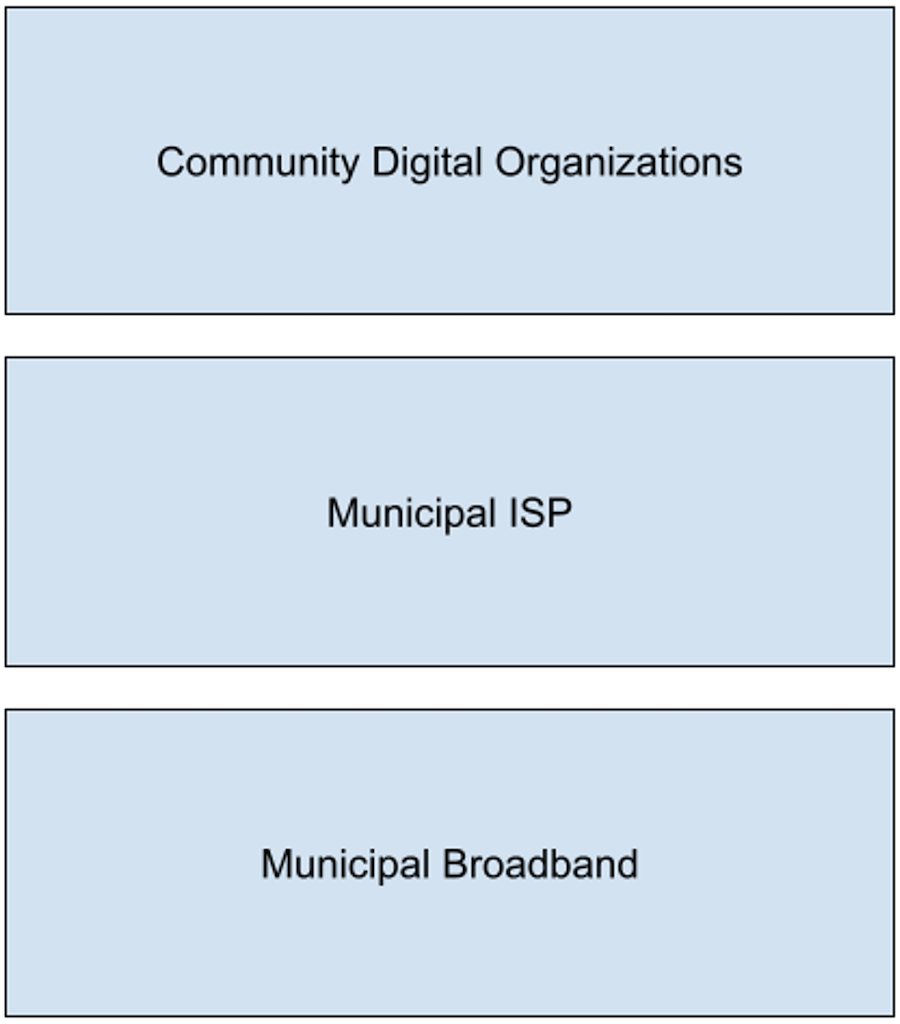
The bottom layer is the city’s broadband infrastructure. This is the physical network of cables and equipment that connects households and businesses to the internet. In the sewer socialist stack, the network is owned and operated by the municipal government.
This ownership structure is already quite common. In fact, hundreds of communities across the country have publicly owned broadband networks. But just because the infrastructure is publicly owned doesn’t mean the municipality also acts as an internet service provider (ISP). One popular model for municipal broadband is an “open access network,” where the network is public but the ISPs that use it to connect consumers to the internet are private.
In fact, the New York City Internet Master Plan, released by Bill de Blasio’s administration in 2020, is a proposal for just such a network. It calls for leveraging city-owned assets like utility poles and rooftops to build out an open-access network for both fixed and mobile broadband, with the aim of ensuring affordable, high-speed internet service for all New Yorkers.
The goal would be an alternative digital ecosystem that, at least at the local level, can begin to displace the corporate internet.
The initiative was cancelled by Mayor Eric Adams in 2022. But the City Council recently enacted a bill requiring city hall to develop a new Internet Master Plan, with the preliminary version to be published no later than November 1, 2026. An “internet advisory board” will be tasked with reviewing draft proposals and making recommendations, with the mayor selecting three of its eight members. The bill was originally introduced by Councilmember Jennifer Gutiérrez, who endorsed Mamdani in the primary, and its cosponsors included all four Democratic Socialists of America (DSA) members on the city council.
The legislation will give the Mamdani administration an opportunity to put forward a municipal broadband strategy in its first year. Through the mayor’s choice of personnel in his technology department — currently known as the Office of Technology and Innovation — as well as his appointments to the internet advisory board, he can shape the city’s new Internet Master Plan. He should use this influence to revive de Blasio’s emphasis on the public ownership of broadband infrastructure, but with an important addition: he should also push for the formation of a municipal ISP.
The city shouldn’t just own the network, in other words. It should be directly involved in the provision of internet service.
Death to the Tyrant Comcast
There are both practical and political reasons for taking this step. Practically, research suggests that community-owned ISPs generally provide cheaper entry-level broadband access than their corporate counterparts. This is because they tend to prioritize social needs, such as quality of service and universal connectivity, rather than profit. The most famous municipal ISP is run by Chattanooga’s local power utility EPB, which traces its origins to the New Deal. It has twice won the top spot in Consumer Reports’s ranking of ISPs nationwide, based on consumer satisfaction surveys.
As a public utility, a municipal ISP can also establish a minimum standard of access. Establishing such a “floor” is especially crucial in lower-income areas, where systematic underinvestment by telecom companies means that even those residents who have the option to buy home broadband service and can afford to do so often endure slow speeds and price-gouging. This practice, known as “digital redlining,” contributes to a crisis of connectivity among working-class Americans. De Blasio’s report noted that nearly 20 percent of New York City residents — more than 1.5 million people — have neither a mobile nor a fixed broadband connection. Nationally, the same percentage of American households lack internet connection at home. This is a scandal, given how important the internet has become for tasks that are required for working-class survival, from accessing government services to applying for jobs.
The most famous municipal internet service provider is run by Chattanooga’s local power utility, which traces its origins to the New Deal.
The best way to address the connectivity crisis is to provide a public option for internet service. In the sewer socialist stack, this function is performed by the municipal ISP that occupies the stack’s middle layer. While a municipal ISP can be paired with an open-access network, it operates on a different logic. The goal of open-access networks is to stimulate more competition in a local broadband market, which can help bring down costs in cities like New York that are dominated by one or two ISPs. But competition is a crude mechanism: it tends to work best for customers who are worth competing for. Many working-class households will remain unprofitable customers no matter how much competition exists. This is where a municipal ISP can be particularly useful.
Beyond its practical value, a municipal ISP also has political benefits. Foremost among them is the fact that a public enterprise can offer communities control over how it is run — something no amount of competition among private firms can ever provide. Democratic governance of a utility can be implemented in a range of ways, from elected governing boards to participatory planning processes. What matters is that residents are involved in decisions about how internet service is being provisioned. Public ownership enables social goals to be pursued directly, rather than relying on the slow and unpredictable mechanism of nudging private firms in a particular direction through incentives.
People Versus Platforms
But digital sewer socialism shouldn’t confine itself to the systems that enable connectivity. It should also take up the more challenging task of changing how we use the internet. In the sewer socialist stack, this undertaking would be performed by an array of community digital organizations (CDO) at the stack’s highest layer. These are cooperative ventures of various kinds, governed democratically by their members for their mutual benefit.
Consider the case of Mensakas, a bike delivery cooperative in Barcelona. It belongs to an international federation called CoopCycle that produces an application for managing orders and coordinating jobs. Mensakas also benefits from public sector support in the form of contracts from the local and regional government. We might imagine similar cooperatives appearing in American cities, offering worker-managed alternatives to the corporate “gig” delivery platforms like DoorDash. Sympathetic municipalities could help nurture this development by funneling a portion of their procurement budget to cooperatives.
For instance, city-owned grocery stores might hire cooperatives to deliver groceries to home-bound seniors. In fact, New York City already has a cooperative that operates primarily as a government contractor: the Drivers Cooperative, which has a contract with the Metropolitan Transportation Authority to provide “paratransit” services to people with disabilities.
There are many other possible forms that CDOs might take. The residents of a particular building, block, or neighborhood might create small, self-governing social networks using software like Smalltown, which aims to offer an online equivalent to classic civil-society “third places” like churches and bars. Another idea is a community “tech hospital” that takes advantage of recently passed “right-to-repair” laws to fix phones and laptops and redistribute refurbished equipment.
The real challenge is how to build and sustain organizations that are structured in such a way to expand people’s collective power over the technological conditions of their lives.
CDOs might also devote themselves to the matter of deepening civic engagement, such as through the creation of online forums that enable residents to discuss and propose policy measures, and even come to decisions about how to allocate the city’s resources, drawing on similar efforts in Barcelona and Taiwan.
Most of the work to be done, however, is not technical but political. The real challenge is how to build and sustain organizations that are structured in such a way to expand people’s collective power over the technological conditions of their lives. This power will necessarily be limited and contradictory; worker cooperatives, for instance, still have to survive within capitalist markets, even if they can be insulated from competitive pressures through public support.
The wager of digital sewer socialism is that this is a price worth paying, provided that its institutions are seen as points of departure for an ongoing process. If the worth of an ideology is judged by its delivery, as Mamdani suggests, then municipal broadband, municipal ISPs, and CDOs can help broaden the social base of the Left. This, in turn, can open pathways for the ideology to be more fully realized. If replacing capitalist entities with democratically managed ones visibly improves people’s digital lives, they may be more inclined to support similar transformations in the rest of society.