
The Journal of Organic Chemistry
DOI: 10.1021/acs.joc.4c00777


 Open Access
   This article is licensed under a Creative Commons Attribution-NonCommercial 3.0 Unported Licence.
Nature Reviews Chemistry, Published online: 18 June 2024; doi:10.1038/s41570-024-00618-x
The catalyst-controlled stereoselective synthesis of atropisomers is feasible by four main concepts: desymmetrization, (dynamic) kinetic resolution, direct formation of the stereogenic axis and de novo ring construction. In this Review, pioneering work in atroposelective catalysis is discussed alongside recent advances. Open Access  This article is licensed under a Creative Commons Attribution-NonCommercial 3.0 Unported Licence.

Nature, Published online: 12 June 2024; doi:10.1038/d41586-024-01750-w
The accidental discovery could be used to make lenses, or even as a glue.
Nature, Published online: 06 June 2024; doi:10.1038/d41586-024-01694-1
Researchers can work long and hard for a permanent academic position, only for their hopes to be dashed. Nature sought advice from three scientists who have experienced the same disappointment.
We investigated the reductive cross-coupling reaction of sulfur-containing and selenium-containing compounds (thio(seleno)sulfonates and disulfides(selenides)) with xanthate esters under nickel-catalysed conditions. This reaction extends the xanthate esters, which generally generate alkyl radicals by C—O bond breaking under photo-catalysis, to the nickel-catalysed reductive cross-coupling reaction, providing a mild and effective method for the synthesis of a series of unsymmetric sulfides and selenides.
Unsymmetric sulfides and selenides have great applications in the pharmaceutical field. Herein, we describe the reductive coupling reaction of xanthate esters with sulfur-containing and selenium-containing compounds (thio(seleno)sulfonates and disulfides(selenides)) under the nickel-catalyzed condition. It provides a mild and effective method for the synthesis of unsymmetric sulfides and selenides which has the advantages of mild reaction conditions, high yields and a wide range of substrates.
Robby Vroemans@Karel

Publication date: 1 October 2024
Source: Coordination Chemistry Reviews, Volume 516
Author(s): Xue Yang, Linyao Xu, Yuxin Li

Tetracoordinate organoborons are a highly important class of molecules, that have found wide applications in areas ranging from synthetic chemistry, medicinal chemistry, to materials science. In this review, we summarized and discussed the significant progress and recent advances in the synthesis and application of enantioenriched tetracoordinate boron-stereogenic compounds, according to the synthetic method: (1) resolution of racemates, (2) chiral substrate induced asymmetric synthesis, and (3) asymmetric catalysis.
The 21st century has witnessed a continuous evolution in the development of boron-stereogenic chemistry. Since the 1990s, various innovations for the synthesis of tetracoordinate boron-stereogenic compounds, which exhibited great potential applications, have been demonstrated by synthetic chemists. This paper reviews the significant progress and recent advances towards the assembly of enantioenriched boron-stereogenic compounds, and hopes to shed light on new perspectives and inspire further research in this emerging field.


Abstract
Transition-metal-mediated “borrowing hydrogen" also known as hydrogen auto-transfer reactions allow the sustainable construction of C–C and C–N bonds using alcohols as hydrogen donors. In recent years, manganese complexes have been explored as efficient catalysts in these reactions. This review highlights the significant progress made in manganese-catalyzed C–C and C–N bond-formation reactions via hydrogen auto-transfer, emphasizing the importance of this methodology and manganese catalysts in sustainable synthesis strategies.
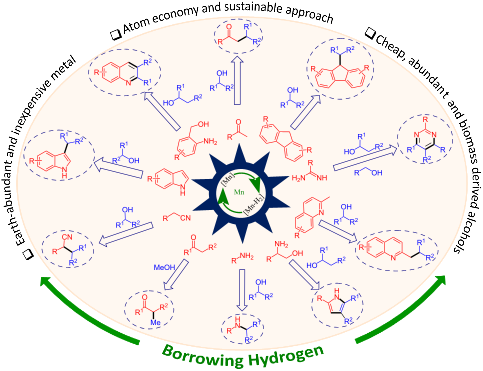
Beilstein J. Org. Chem. 2024, 20, 1111–1166. doi:10.3762/bjoc.20.98

Epoxy vitrimer materials based on imine bonds
Vitrimer materials have machinability and stability because of their shape remodeling and self-healing properties at high temperatures. This article reports the synthesis of epoxy resin using vanillin, p-aminophenol, and epichlorohydrin as raw materials, and polyetheramine-400 as a curing agent. To study the effect of free amine on the mechanical and self-healing properties, two materials with epoxy and amine stoichiometric ratios of 1:1 and 1:1.2 were studied, respectively. The experimental results show that when the molar ratio of epoxy to amine stoichiometric is 1:1.2 (V1:1.2), the tensile strength of vitrimer materials can reach 5.4 MPa and the self-healing efficiency can reach 99.5% after 6 h of healing at 120°C. When the molar ratio is 1:1 (V1:1), the obtained epoxy material has a higher tensile strength of 9.5 MPa. After 24 h of healing at 120°C, the self-healing efficiency can reach 83.4%. In addition, epoxy vitrimer materials can be remodeled at 120°C, and the self-healing and mechanical properties are not influenced after remodeling. This work proposes a novel preparation method for epoxy vitrimer materials, which is beneficial to the development of high-strength remodelable self-healing materials.
Publication date: 1 September 2024
Source: Coordination Chemistry Reviews, Volume 514
Author(s): Rajesh Das, Praveen Kumar Verma, C.M. Nagaraja

Integrating photoactive metalloporphyrin and single-atomic Pt(bpy) moieties in a single covalent organic framework facilitates multielectron transfer and accelerates photocatalytic hydrogen evolution. with a maximum turnover frequency of 15.7 h−1 observed.
A photoactive covalent organic framework (COF) was built from metalloporphyrin and bipyridine monomers and single-atomic Pt sites were subsequently installed. Integrating photosensitizing metalloporphyrin and substrate-activating Pt(bpy) moieties in a single solid facilitates multielectron transfer and accelerates photocatalytic hydrogen evolution with a maximum production rate of 80.4 mmol h−1 gPt −1 and turnover frequency (TOF) of 15.7 h−1 observed. This work demonstrates that incorporation of single-atomic metal sites with photoactive COFs greatly enhances photocatalytic activity and provides an effective strategy for the design and construction of novel photocatalysts.
Publication date: July 2024
Source: Trends in Chemistry, Volume 6, Issue 7
Author(s): Yuanning Feng


