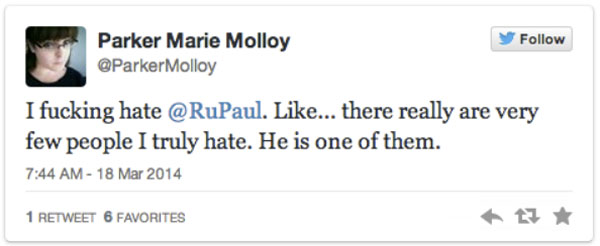
Normally, a journalist making this pronouncement wouldn’t also report “objectively” about RuPaul that same day, but editors at LGBT website Advocate.com think this lack of ethics and professionalism by writer Parker Molloy is A-OK. It perfectly summarizes the current state of post-disruption journalism and its unhealthy addiction to Twitter, as well as the brain drain that has happened in LGBT media.
When not expressing hate for subjects of her reporting, Molloy is part of the eyeroll-inducing “hashtag activist” movement currently infecting the internet. Rants and beta male humorlessness once limited to blogs and social media are now creeping into other outlets. In a sign of the times, The Advocate, a venerable and respected LGBT print magazine founded almost 50 years ago, is now a separate entity from Advocate.com. The website is overseen by a separate editorial team who favors bloggers and tweeters like Molloy over journalists; quantity over quality. Molloy’s specialty is trafficking in outrage, the basest coin of the internet, and Advocate.com is harnessing Molloy’s background as a search engine marketer in its current deathmatch with HuffPo Gay Voices.
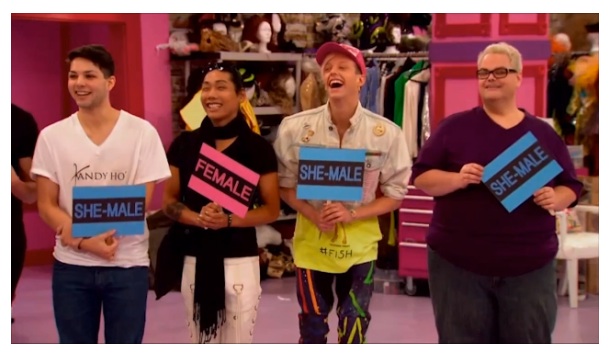
Why does Molloy, who is transgender, fucking hate RuPaul? Ru used the word “shemale” recently on RuPaul’s Drag Race and has unapologetically used a number of other taboo words over several decades, like “tranny” and what-not. Imagine that, a drag queen breaking a taboo! Any entertainer deals with hecklers, and Molloy is one of RuPaul’s. Heckler culture has grown stronger as we devolve into a society of media consumers, where everyone is a critic. The only difference between a heckler and a critic is manners, and now hecklers are apparently considered journalists.
Disdain for drag in general and RuPaul in particular has occasionally flared up from folks who transition from male to female with the zeal of a religious convert. They often dabble in online heckling like this before they inevitably flame out. The internet allows these shut-ins to spend their waking lives online, agreeing with like-minded victim cultists who share their views of acceptable transgender thought and behavior. These trans folks have developed their own pseudo-academic jargon like cis-het, which means “cisgender heterosexual,” which itself means “non-transgender straight person.” Most trans folks throwing around cis-het would have been labeled cis-het themselves a few years ago. It’s noteworthy that the most vocal anti-RuPaul hecklers are trans women who are primarily attracted to women. These newly-minted queers are derided as Social Justice Warriors (SJWs) by the anti-heckler movement. The burgeoning backlash forming on 4chan and Reddit mocks SJWs as privileged pseudo-activists who seek to hurt others using the hard-earned weight of actual political movements.
Bret Easton Ellis calls these online hecklers Generation Wuss, oversensitive precious snowflakes raised on smugfuckery via LiveJournal, Twitter, and Tumblr. They exist in every subculture and demographic, and these internecine battles rarely move beyond a community squabble. In the LGBT community a hallmark of this online “activism” is little direct face-to-face interaction with the larger community or our critics. Their primary idea of activism is insulting someone they don’t like with a tweet or post involving the crutch word fuck. So fucking brave! Like all hecklers, their attention-seeking behavior helps these self-haters feel better about themselves.
While experienced activists seek to build bridges and establish empathy between cultures, these elitists’ ideas of success involve extracting apologies from media figures for perceived slights. This just drives intolerance underground, where it manifests in more pernicious ways, winning very few over to a new way of thinking and entrenching everyone. Witness #CancelColbert.
Long-simmering anger about RuPaul hit a boiling point this month. Ru had been getting away with a different “You’ve Got She-Mail” gag on the show for a long time, but a recent episode aired a “Female or Shemale” segment, asking participants to guess whether a closeup was a drag performer or a non-trans woman. This evoked a sordid history of similar media, like Maury Povich episodes and websites presenting similar quizzes to identify the trans woman among non-trans women. In trans-land, shemale is probably the most taboo of the taboo words in the lexicon. It was popularized through its use in the most transphobic book ever written, The Transsexual Empire: The Making of the She-Male.
The term has come to be used almost exclusively in pornography and sex work. It easily beats out tranny, he-she, shim, and a host of hilariously offensive rhyming slurs like chicks with dicks, dolls with balls, sluts with nuts, or guys in disguise. I have personally expressed my concern about the term shemale directly to the Drag Race producers. They have issued an apology. Remarkably, the hecklers also sought to extract concessions from LGBT media watchdog GLAAD for not acting quickly enough. Effective activism takes time and involves negotiation, and I was amazed to see that GLAAD felt they had to defend themselves for not racing to Twitter and “solving” things there.
Just as gay people can be homophobic, trans people can be transphobic, and it’s not just limited to RuPaul’s recent controversy. One of Molloy’s other targets is my friend Calpernia Addams, one of many trans entertainers who came up through working in clubs as showgirls before making a gender transition. For much of the 20th century, this was the trajectory of most trans women, working alongside drag performers, but living full-time as women outside of work. As trans people become more visible and come out sooner, we have many more employment options. Recent transitioners like Molloy, who did not identify as gay before transition, are more likely to have other options, but they also often have a disdain for gay and drag culture. This is nothing new. Christine Jorgensen, who transitioned amidst an unprecedented media frenzy in 1952, was virulently homophobic and sought to distance herself from being associated with gay people. This separatism between drag and trans persists, similar to separatism some seek between crossdressers and those who live full-time in their chosen gender. Trans separatists like Molloy also spend a lot of time fighting online with lesbian separatists, some of whom reject trans lesbians the same way these trans lesbians want little to do with crossdressing or drag. The internalized transphobia behind this separatist impulse happens in any community that is finding its voice, and it’s flaring up again in the trans community.
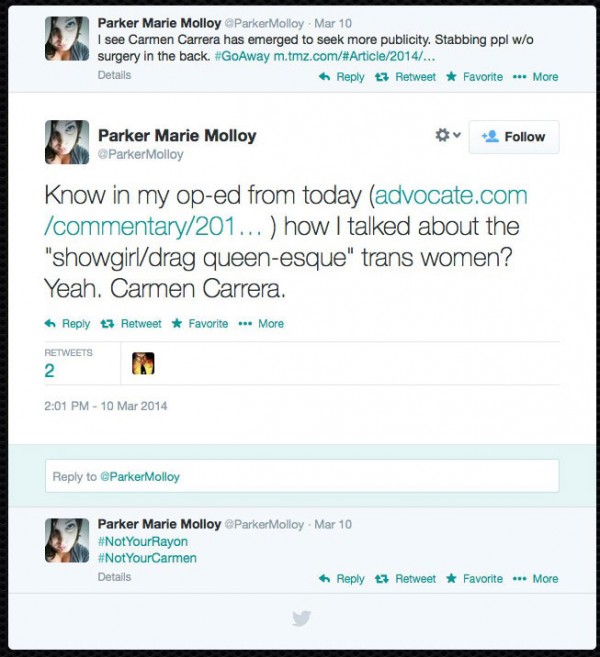
Among the most problematic behaviors by trans separatists like Molloy is use of the term drag queen as a transphobic slur against other trans women whose politics they don’t like, including Addams and trans model Carmen Carrera. Carerra appeared on RuPaul’s Drag Race prior to transition, so she is compromised and complicated from a separatist’s point of view. After I complained privately to Advocate.com editor Lucas Grindley about Molloy’s recent deliberate slurs against Calpernia, Grindley claimed Molloy’s attack was merely an “error.” Calling assimilated transgender people drag queens or crossdressers is a transphobic slur as time-honored as using their old names or former gender pronouns as insults. As I patiently explained to Grindley, if I publish a piece reporting that “Parker Molloy is a self-hating skin transvestite,” then tweet a half-assed non-apology, my use of a transphobic slur is not an error. It would be neither journalistic nor ethical, and more reputable editors would consider it a firing offense. Grindley has refused to speak with me by phone, and has refused to meet with me in person, and has refused to let me run an op-ed (hence this piece). I tried every avenue to resolve this dispute like professional journalists. Grindley is apparently too busy heckling Calpernia on Twitter about "Ugly Hearts,” her typically sweet and quirky song about internet bullying. Turns out Grindley is just further evidence of the heckler-as-journalist trend.
So now this professional dispute is public, and the dirty laundry is getting aired. The usual suspects are trolling on Twitter, and no one is really listening to each other. I used to spend a lot of time arguing on the internet. I came to see it as a form of procrastination. A search of USENET will find the exact same arguments getting rehashed by trans people since the dawn of the internet. Each new wave of users has to develop their views and voice by whatever technology is ascendant at the time, but arguing on Twitter is like debating via bumper stickers. It’s the worst of two worlds: heckling and gotcha-style journalism.
LGBT reactionaries have been throwing drag performers under the bus since the movement’s origins. You’ve seen them; elitists in our community upset at flamboyance at Gay Pride parades and so on. Transsexual women in the media who step outside the lines of “acceptable” behavior and language get the same transphobic shaming. Respectability politics will always be in conflict with drag, an art form with countercultural subversion at its heart. When these parvenus create new taboos around language, they’re practically begging drag queens and kings to violate these taboos. If it’s a choice between siding with the language police and siding with offensive artists, I’ll always side with the artist willing to risk the consequences of making an offensive joke. The right to offend people is a cornerstone of the LGBT movement, and I will always defend anyone who offends our community’s finger-wagging schoolmarms. Every movement and community needs jesters.
A few years ago I helped restore Queens At Heart, a rare color documentary of pre-Stonewall Manhattan LGBT social life. There was no separation of drag and trans, nor was there 25 years later in Paris Is Burning. We’re all in this together. Some elitists have even proclaimed that RuPaul isn’t trans. Guess I’d better burn my first edition of Leslie Feinberg’s seminal work, Transgender Warriors: Making History from Joan of Arc to RuPaul. My transgender tent proudly includes crossdressers like Dennis Rodman, or drag queens like RuPaul, or people who identify as shemale, or those throwing around the word tranny, or those whose antics anger or embarrass me. They’re still part of my trans family.
For the record, I don’t fucking hate @RuPaul. I’ve respected and admired Ru for a quarter century. I also respect and admire everyone at World of Wonder, who have created more positive transgender media depictions than any production company in history, from Transgeneration, to Becoming Chaz, to Drag Race, to my own work with them. They have been honored by the industry and the community time and again for their unwavering commitment to covering overlooked segments of the LGBT community, like their remarkable Big Freedia: Queen of Bounce, currently nominated for a GLAAD Media Award for Outstanding Reality Series.
Speaking of peanut butter, this week I picked up the new RuPaul candy bar, because proceeds benefit our local LGBT shelter. Then I picked up some Viva Glam lip color at MAC, which has raised millions for AIDS research since they took a risk and made Ru their face 20 years ago.
I fucking love RuPaul. I fucking love drag. I fucking love everyone, even fucking stay-at-home transactivists and fucking unprofessional journalists.