16 Oct 00:54
Chem. Sci., 2015, Advance Article
DOI: 10.1039/C5SC02778K, Edge Article

Open Access
Yongshu Xie, Wenjun Wu, Haibo Zhu, Jingchuan Liu, Weiwei Zhang, He Tian, Wei-Hong Zhu
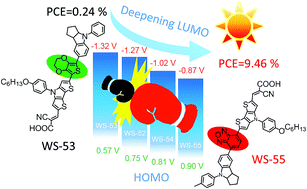
Lowering the LUMOs and decreasing energy "waste" is targeted through inserting an auxiliary group from an electron donor or acceptor into D-[small pi]-A organic sensitizers, and the photovoltaic efficiency increases 38 fold from 0.24 to 9.46%.
To cite this article before page numbers are assigned, use the DOI form of citation above.
The content of this RSS Feed (c) The Royal Society of Chemistry

16 Oct 00:46
by Chi-Shian Chen, Tsung-Han Chuang, Yi-Hung Liu, Wen-Yann Yeh
Abstract
Analytically pure C60H18 is obtained by a Ru3 cluster complexation and decomplexation method. The crystal structure of C60H18 consists of one flattened hemisphere, to which all 18 hydrogen atoms are symmetrically bonded, and one curved hemisphere akin to C60. A benzenoid ring in the flattened hemisphere is isolated from the residual π systems by a belt composed of sp3-hybridized CH units. The average out-of-plane distances for carbon atoms attached to the benzenoid ring (0.14 Å) is substantially larger than that found in C60F18 (0.06 Å). Several long C(sp3)![[BOND]](http://onlinelibrarystatic.wiley.com/undisplayable_characters/00f8ff.gif) C(sp3) single bond lengths [1.61(3)–1.65(3) Å] are observed for C60H18. The reaction of [Ru3(CO)12] and C60H18 produces [Ru3(CO)9(μ3-η2,η2,η2-C60H18)] (1), where the Ru3 triangle is regiospecifically linked to the hexagon opposite to the benzenoid ring. Compound 1 is the first transition metal complex of a polyhydrofullerene (fullerane). C60H18 and 1 have been characterized by 1H and 13C NMR, UV/Vis, and mass spectroscopies. The HOMO–LUMO gap of C60H18 is evaluated to be 1.51 V by cyclic voltammetry.
C(sp3) single bond lengths [1.61(3)–1.65(3) Å] are observed for C60H18. The reaction of [Ru3(CO)12] and C60H18 produces [Ru3(CO)9(μ3-η2,η2,η2-C60H18)] (1), where the Ru3 triangle is regiospecifically linked to the hexagon opposite to the benzenoid ring. Compound 1 is the first transition metal complex of a polyhydrofullerene (fullerane). C60H18 and 1 have been characterized by 1H and 13C NMR, UV/Vis, and mass spectroscopies. The HOMO–LUMO gap of C60H18 is evaluated to be 1.51 V by cyclic voltammetry.

Crowning glory: The benzenoid ring in the flattened hemisphere of C60H18 appears less aromatic than that in C60F18. Several long C(sp3)C(sp3) bond lengths [1.61(3)–1.65(3) Å] are observed. The reaction of C60H18 with [Ru3(CO)12] produces [Ru3(CO)9(μ3-η2,η2,η2-C60H18)], which is the first transition metal complex of a polyhydrofullerene (fullerane).
07 Oct 02:48
by Masahiro Kako, Kyosuke Miyabe, Kumiko Sato, Mitsuaki Suzuki, Naomi Mizorogi, Wei-Wei Wang, Michio Yamada, Yutaka Maeda, Marilyn M. Olmstead, Alan L. Balch, Shigeru Nagase, Takeshi Akasaka
Abstract
Bis-silylated and bis-germylated derivatives of Lu3N@Ih-C80 (3, 4, 5) were successfully synthesized by the photochemical addition of disiliranes 1 a, 1 b or digermirane 2, and fully characterized by spectroscopic, electrochemical, and theoretical studies. Interestingly, digermirane 2 reacts more efficiently than disiliranes 1 a and 1 b because of its good electron-donor properties and lower steric hindrance around the GeGe bond. The 1,4-adduct structures of 3, 4, 5 were unequivocally established by single-crystal X-ray crystallographic analyses. The electrochemical and theoretical studies reveal that the energy gaps between the highest occupied molecular orbital (HOMO) and the lowest unoccupied molecular orbital (LUMO) of the 1,4-adducts are remarkably smaller than those of Lu3N@Ih-C80, because the electron-donating groups effectively raise the HOMO levels. It is also observed that germyl groups are slightly more electron-donating than the silyl groups on the basis of the redox properties and the HOMO–LUMO energies of 4 and 5. Bis-silylation and bis-germylation are effective and versatile methods for tuning the electronic characteristics of endohedral metallofullerenes.

Electronic tuning of fullerenes: Bis-silylated and bis-germylated Lu3N@Ih-C80 derivatives have been synthesized using photochemical additions of disilirane and digermirane. The electrochemical and theoretical studies of these adducts demonstrate that bis-silylation and bis-germylation are effective methods for tuning the electronic characteristics of Lu3N@Ih-C80.
05 Oct 02:30
by P. B. Deotare
Nature Materials.
doi:10.1038/nmat4424
Authors: P. B. Deotare, W. Chang, E. Hontz, D. N. Congreve, L. Shi, P. D. Reusswig, B. Modtland, M. E. Bahlke, C. K. Lee, A. P. Willard, V. Bulović, T. Van Voorhis & M. A. Baldo

05 Oct 02:29
by Maria A. Lebedeva, Thomas W. Chamberlain and Andrei N. Khlobystov

Chemical Reviews
DOI: 10.1021/acs.chemrev.5b00005

05 Oct 02:26
by Cheng Gu, Ning Huang, Youchun Chen, Leiqiang Qin, Hong Xu, Shitong Zhang, Fenghong Li, Yuguang Ma, Donglin Jiang
Abstract
Conjugated microporous polymers are a unique class of polymers that combine extended π-conjugation with inherent porosity. However, these polymers are synthesized through solution-phase reactions to yield insoluble and unprocessable solids, which preclude not only the evaluation of their conducting properties but also the fabrication of thin films for device implementation. Here, we report a strategy for the synthesis of thin films of π-conjugated microporous polymers by designing thiophene-based electropolymerization at the solution–electrode interface. High-quality films are prepared on a large area of various electrodes, the film thickness is controllable, and the films are used for device fabrication. These films are outstanding hole conductors and, upon incorporation of fullerenes into the pores, function as highly efficient photoactive layers for energy conversions. Our film strategy may boost the applications in photocatalysis, energy storage, and optoelectronics.

Film formation: A general strategy for synthesizing thin films of π-conjugated microporous polymers is described (see picture). Using a thiophene-based high-throughput electropolymerization it was possible to control the thickness of the films. The π-conjugated microporous polymers are shown to be outstanding conductors with a high carrier mobility and photoactive layers for efficient conversion of photoenergy.
05 Oct 02:23
by Hyeju Choi, Kwangseok Do, Sojin Park, Jong-Sung Yu, Jaejung Ko
Abstract
Novel steric bulky hole transporting materials (HTMs) with two or four N,N-di(4-methoxyphenyl)aminophenyl units have been synthesized. When the EtheneTTPA was used as a hole transporting material in perovskite solar cell, the power conversion efficiency afforded 12.77 % under AM 1.5 G illumination, which is comparable to the widely used spiro-OMeTAD based solar cell (13.28 %).

On the hole: The development and properties of novel hole transporting materials (HTMs) for perovskite solar cells is presented. The synthesis of two HTMs (see figure) by incorporating an ethylene unit into the triphenylamine unit is described.
05 Oct 02:23
by Masahiro Kako, Kyosuke Miyabe, Kumiko Sato, Mitsuaki Suzuki, Naomi Mizorogi, Wei-Wei Wang, Michio Yamada, Yutaka Maeda, Marilyn M. Olmstead, Alan L. Balch, Shigeru Nagase, Takeshi Akasaka
Abstract
Invited for the cover of this issue are the groups of M. Kako (The University of Electro-Communications, Japan), M. M. Olmstead (University of California, USA), A. L. Balch (University of California, USA), S. Nagase (Kyoto University, Japan), T. Akasaka (University of Tsukuba, Japan). The image depicts the 1,4-bis-silylated and 1,4-bis-germylated structures of Lu3N@Ih-C80, which represent rare examples of the crystallographic studies of functionalized Lu3N@Ih-C80. Read the full text of the article at 10.1002/chem.201502511.

“The interplay between experiment and theory certainly played an important role in accomplishing our work” Read more about the story behind the cover in the Cover Profile and about the research itself on page 16411 ff. (DOI: 10.1002/chem.201502511).
13 Sep 10:28
by Katrin Junghans, Christin Schlesier, Aram Kostanyan, Nataliya A. Samoylova, Qingming Deng, Marco Rosenkranz, Sandra Schiemenz, Rasmus Westerström, Thomas Greber, Bernd Büchner, Alexey A. Popov
Abstract
The use of methane as a reactive gas dramatically increases the selectivity of the arc-discharge synthesis of M-Ti-carbide clusterfullerenes (M=Y, Nd, Gd, Dy, Er, Lu). Optimization of the process parameters allows the synthesis of Dy2TiC@C80-I and its facile isolation in a single chromatographic step. A new type of cluster with an endohedral acetylide unit, M2TiC2@C80, is discovered along with the second isomer of M2TiC@C80. Dy2TiC@C80-(I,II) and Dy2TiC2@C80-I are shown to be single-molecule magnets (SMM), but the presence of the second carbon atom in the cluster Dy2TiC2@C80 leads to substantially poorer SMM properties.

Carbide inclusion: The use of methane as a reactive gas dramatically increases the selectivity of the arc-discharge synthesis of M2TiC@C80 carbide clusterfullerenes (M=lanthanide). The new single-molecule magnet Dy2TiC@C80 could be readily isolated.
05 Sep 14:42
by Nan Zhang, Min-Quan Yang, Siqi Liu, Yugang Sun and Yi-Jun Xu

Chemical Reviews
DOI: 10.1021/acs.chemrev.5b00267

05 Sep 14:39
by Kang Deuk Seo, In Tack Choi, Hwan Kyu Kim
Abstract
Seven SGT organics dyes, containing bis-dimethylfluoreneyl amino groups with a dialkoxyphenyl unit as an electron donor and a cyanoacrylic acid group as an anchoring group, connected with oligothiophenes, fused thiophenes and benzothiadiazoles as π-bridges, were designed and synthesised for applications in dye-sensitised solar cells (DSSCs). The photovoltaic performance of DSSCs based on organic dyes with oligothiophenes depends on the molecular structure of the dyes, in terms of the length change of the π-bridging units. The best performance was found with a π-bridge length of about 6 Å. To further enhance the photovoltaic performance associated with this concept, cyclopenta[1,2-b:5,4-b′]dithiophene (CPDT) and benzothiadiazole were introduced into the π-bridge unit. As a result, the DSSC based on the organic dye containing the CPDT moiety showed the best photovoltaic performance with a short-circuit photocurrent density (Jsc) of 14.1 mA cm−2, an open-circuit voltage (Voc) of 0.84 V and a fill factor (FF) of 0.72, corresponding to an overall conversion efficiency (η) of 8.61 % under standard AM 1.5 irradiation.

How long is the ideal bridge? The photovoltaic performance of DSSCs based on organic dyes with oligothiophenes depends on the molecular structure of the dyes in terms of the length of the π-bridge. The organic dyes, consist of bisdimethylfluoreneyl amino groups with a dialkoxyphenyl unit as the electron donor and a cyanoacrylic acid group as an anchoring group, and are connected to oligothiophenes, fused thiophenes and electron-withdrawing benzothiadiazoles as π-bridging units (an example is shown here).
05 Sep 14:38
by Anurag Krishna, Dharani Sabba, Jun Yin, Annalisa Bruno, Pablo P. Boix, Yang Gao, Herlina A. Dewi, Gagik G. Gurzadyan, Cesare Soci, Subodh G. Mhaisalkar, Andrew C. Grimsdale
Abstract
A novel hole-transporting molecule (F101) based on a furan core has been synthesized by means of a short, high-yielding route. When used as the hole-transporting material (HTM) in mesoporous methylammonium lead halide perovskite solar cells (PSCs) it produced better device performance than the current state-of-the-art HTM 2,2′,7,7′-tetrakis-(N,N-di-p-methoxyphenylamine)-9,9′-spirobifluorene (spiro-OMeTAD). The F101-HTM-based device exhibited both slightly higher Jsc (19.63 vs. 18.41 mA cm−2) and Voc (1.1 vs. 1.05 V) resulting in a marginally higher power conversion efficiency (PCE) (13.1 vs. 13 %). The steady-state and time-resolved photoluminescence show that F101 has significant charge extraction ability. The simple molecular structure, short synthesis route with high yield and better performance in devices makes F101 an excellent candidate for replacing the expensive spiro-OMeTAD as HTM in PSCs.

Hole in one? An electron-rich molecule containing furan as core and arylamine as side groups has been synthesized. When employed as a hole-transporting material (HTM) in a CH3NH3PbI3 perovskite solar cell, power conversion efficiencies of over 13 % are obtained. This HTM, owing to its simple synthesis and high performance, has great potential to replace the more expensive 2,2′,7,7′-tetrakis-(N,N-di-p-methoxyphenylamine)-9,9′-spirobifluorene as the HTM in perovskite solar cells.
05 Sep 14:37
by Qingquan He, Shoushuang Huang, Jiantao Zai, Nianqi Tang, Bo Li, Qiquan Qiao, Xuefeng Qian
Abstract
It is generally believed that silver or silver-based compounds are not suitable counter electrode (CE) materials for dye-sensitized solar cells (DSSCs) due to the corrosion of the I−/I3− redox couple in electrolytes. However, Ag2S has potential applications in DSSCs for catalyzing I3− reduction reactions because of its high carrier concentration and tiny solubility product constant. In the present work, CE manufactured from Ag2S nanocrystals ink exhibited efficient electrocatalytic activity in the reduction of I3− to I− in DSSCs. The DSSC consisting of Ag2S CE displayed a higher power conversion efficiency of 8.40 % than that of Pt CE (8.11 %). Moreover, the devices also showed the characteristics of fast activity onset, high multiple start/stop capability and good irradiated stability. The simple composition, easy preparation, stable chemical property, and good catalytic performance make the developed Ag2S CE as a promising alternative to Pt CE in DSSCs.

Energy conversion: A counter electrode manufactured from Ag2S nanocrystal ink exhibited efficient electrocatalytic activity in the reduction of I3− to I− in dye-sensitized solar cells (see figure; DSSCs, η=8.40 %).The simple composition, easy preparation, stable chemical properties and good catalytic performance make the newly developed Ag2S a promising alternative to Pt in DSSCs.
28 Aug 00:54
by Martin Kaltenbrunner
Nature Materials.
doi:10.1038/nmat4388
Authors: Martin Kaltenbrunner, Getachew Adam, Eric Daniel Głowacki, Michael Drack, Reinhard Schwödiauer, Lucia Leonat, Dogukan Hazar Apaydin, Heiko Groiss, Markus Clark Scharber, Matthew Schuette White, Niyazi Serdar Sariciftci & Siegfried Bauer

28 Aug 00:53
by Michele Sessolo
Nature Materials.
doi:10.1038/nmat4405
Authors: Michele Sessolo & Henk J. Bolink
Ultrathin, flexible and lightweight perovskite solar cells with improved stability in air can now power model airplanes for several hours.

23 Aug 07:30
by Mykola Telychko, Pingo Mutombo, Pablo Merino, Prokop Hapala, Martin Ondráček, François C. Bocquet, Jessica Sforzini, Oleksandr Stetsovych, Martin Vondráček, Pavel Jelínek and Martin Švec

ACS Nano
DOI: 10.1021/acsnano.5b03690

原子修补匠 and -1 others like this
23 Aug 07:22
China
Nature 524, 7564 (2015). doi:10.1038/524S6a
With a declared aim to become a global science leader by 2050, the country's unprecedented research spending splurge is creating a wealth of study and work opportunities.

23 Aug 07:13
by Xinxin Xu, Tingting Lu, Xiaoxia Liu, Xiuli Wang
Abstract
A new p–n heterojunction photocatalyst has been synthesized successfully through chemical-bond-mediated combination of coordination polymer nanoplates (CPNPs) and partially reduced graphene oxide (PRGO) with a simple colloidal blending process. Photocatalytic H2 production by the p–n heterojunction photocatalyst PRGO/CPNP was investigated under visible-light irradiation, which illustrates that PRGO/CPNP exhibits a much higher photocatalytic H2 production rate than neat the CPNPs. The improvement of this photocatalytic property can be attributed to the inner electrical field formed in the p–n heterojunction, which impedes recombination of photogenerated electrons and holes. In PRGO/CPNP, the existence of the p–n heterojunction has been confirmed by electrochemical methods clearly. For PRGO/CPNP, the reductive degree of the PRGO has a great influence on the H2 production rate and an ideal condition to get a PRGO/CPNP photocatalyst with higher performance has been obtained.

Taking the right way: A p–n heterojunction photocatalyst based on coordination polymer nanoplates (CPNPs) and partially reduced graphene oxide (PRGO) has been fabricated successfully, which displays an excellent H2 production rate under visible-light irradiation (see figure; CB=conductive band, VB=valence band). Furthermore, the influence of the partially reduced graphene oxide on the H2 production rate is also discussed.
18 Aug 13:55
by Martin A. Green
Nature Materials.
doi:10.1038/nmat4301
Authors: Martin A. Green & Thomas Bein
Now that certified energy conversion efficiencies for perovskite solar cells are above 20%, researchers are exploring other critical areas, such as understanding device hysteresis and film growth, as well as the replacement of lead and the development of tandem cell stacks. Cell stability remains a crucial issue.

12 Aug 08:30
by Chia-Hsiang Chen, Kamran B. Ghiassi, Maira R. Cerón, Miguel A. Guerrero-Ayala, Luis Echegoyen, Marilyn M. Olmstead and Alan L. Balch

Journal of the American Chemical Society
DOI: 10.1021/jacs.5b06425

Meng and -1 others like this
No more posts. Check out what's trending.
   This article is licensed under a Creative Commons Attribution 3.0 Unported Licence.


