Publication date: 15 March 2017
Source:Journal of Power Sources, Volume 344
Author(s): Peng Liu, Bo Xu, Yong Hua, Ming Cheng, Kerttu Aitola, Kári Sveinbjörnsson, Jinbao Zhang, Gerrit Boschloo, Licheng Sun, Lars Kloo
Two low-cost, easily synthesized π-conjugated molecules have been applied as hole-transport materials (HTMs) for solid state dye-sensitized solar cells (ssDSSCs) and perovskite solar cells (PSCs). For X1-based devices, high power conversion efficiencies (PCEs) of 5.8% and 14.4% in ssDSSCs and PSCs has been demonstrated. For X14-based devices, PCEs were improved to 6.1% and 16.4% in ssDSCs and PSCs, respectively.
Liu.peng.uppsala
Shared posts
01 Feb 12:22
Design, synthesis and application of a π-conjugated, non-spiro molecular alternative as hole-transport material for highly efficient dye-sensitized solar cells and perovskite solar cells
David likes this
12 Dec 09:30
Acceptor–Donor–Acceptor type ionic molecule materials for efficient perovskite solar cells and organic solar cells
Publication date: December 2016
Source:Nano Energy, Volume 30
Author(s): Ming Cheng, Kerttu Aitola, Cheng Chen, Fuguo Zhang, Peng Liu, Kári Sveinbjörnsson, Yong Hua, Lars Kloo, Gerrit Boschloo, Licheng Sun
Perovskite solar cells (PSCs) have attracted significant interest and hole transporting materials (HTMs) play important roles in achieving high efficiency. Here, we report additive free ionic type HTMs that are based on 2-ethylhexyloxy substituted benzodithiophene (BDT) core unit. With the ionization of end-capping pyridine units, the hole mobility and conductivity of molecular materials are greatly improved. Applied in PSCs, ionic molecular material M7-TFSI exhibits the highest efficiency of 17.4% in the absence of additives [lithium bis(trifluoromethanesulfonyl)imide and 4-tert-butylpyridine]. The high efficiency is attributed to a deep highest occupied molecular orbital (HOMO) energy level, high hole mobility and high conductivity of M7-TFSI. Moreover, due to the higher hydrophobicity of M7-TFSI, the corresponding PSCs showed better stability than that of Spiro-OMeTAD based ones. In addition, the strong absorption and suitable energy levels of materials (M6, M7-Br and M7-TFSI) also qualify them as donor materials in organic solar cells (OSCs) and the devices containing M7-TFSI as donor material displayed an efficiency of 6.9%.

Source:Nano Energy, Volume 30
Author(s): Ming Cheng, Kerttu Aitola, Cheng Chen, Fuguo Zhang, Peng Liu, Kári Sveinbjörnsson, Yong Hua, Lars Kloo, Gerrit Boschloo, Licheng Sun
Perovskite solar cells (PSCs) have attracted significant interest and hole transporting materials (HTMs) play important roles in achieving high efficiency. Here, we report additive free ionic type HTMs that are based on 2-ethylhexyloxy substituted benzodithiophene (BDT) core unit. With the ionization of end-capping pyridine units, the hole mobility and conductivity of molecular materials are greatly improved. Applied in PSCs, ionic molecular material M7-TFSI exhibits the highest efficiency of 17.4% in the absence of additives [lithium bis(trifluoromethanesulfonyl)imide and 4-tert-butylpyridine]. The high efficiency is attributed to a deep highest occupied molecular orbital (HOMO) energy level, high hole mobility and high conductivity of M7-TFSI. Moreover, due to the higher hydrophobicity of M7-TFSI, the corresponding PSCs showed better stability than that of Spiro-OMeTAD based ones. In addition, the strong absorption and suitable energy levels of materials (M6, M7-Br and M7-TFSI) also qualify them as donor materials in organic solar cells (OSCs) and the devices containing M7-TFSI as donor material displayed an efficiency of 6.9%.
Graphical abstract
06 Dec 11:54
High Performance Solid-state Dye-sensitized Solar Cells based on Organic Blue-colored Dyes
J. Mater. Chem. A, 2016, Accepted Manuscript
DOI: 10.1039/C6TA09723E, Paper
DOI: 10.1039/C6TA09723E, Paper
Jianli Hua, Zhongjin Shen, Bo Xu, Peng Liu, Yue Hu, Ying Yu, Haoran Ding, Lars Kloo, Licheng Sun, He Tian
The development of novel photosensitizers with very high molar extinction coefficients and broad absorption spectra to enhance the light harvesting efficiency rendering high PCEs in solid state dye sensitized solar...
The content of this RSS Feed (c) The Royal Society of Chemistry
The development of novel photosensitizers with very high molar extinction coefficients and broad absorption spectra to enhance the light harvesting efficiency rendering high PCEs in solid state dye sensitized solar...
The content of this RSS Feed (c) The Royal Society of Chemistry
16 Aug 09:35
 Open Access
   This article is licensed under a Creative Commons Attribution-NonCommercial 3.0 Unported Licence.

Solution processable, cross-linked sulfur polymers as solid electrolytes in dye-sensitized solar cells
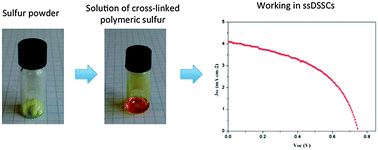
Chem. Commun., 2015, 51,14660-14662
DOI: 10.1039/C5CC04822B, Communication
DOI: 10.1039/C5CC04822B, Communication
Open Access  This article is licensed under a Creative Commons Attribution-NonCommercial 3.0 Unported Licence.
Peng Liu, James M. Gardner, Lars Kloo
Utilization of soluble cross-linked polymeric sulfur as hole conductor in solid state dye sensitized solar cells.
The content of this RSS Feed (c) The Royal Society of Chemistry
Utilization of soluble cross-linked polymeric sulfur as hole conductor in solid state dye sensitized solar cells.
The content of this RSS Feed (c) The Royal Society of Chemistry
No more posts. Check out what's trending.