Shared posts

18 Aug 05:01

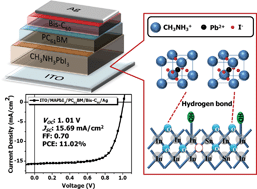
High-performance hole-transporting layer-free conventional perovskite/fullerene heterojunction thin-film solar cells

J. Mater. Chem. A, 2015, 3,9128-9132
DOI: 10.1039/C5TA01343G, Communication
Kai-Wei Tsai, Chu-Chen Chueh, Spencer T. Williams, Ten-Chin Wen, Alex K. Y. Jen
MAPbI3 perovskite was found to be able to modify the work function of ITO, leading to sufficient charge extraction efficiency at the ITO/perovskite interface. A device with a high power conversion efficiency of >11% was obtained.
The content of this RSS Feed (c) The Royal Society of Chemistry
18 Aug 05:01

A single cis-2 regioisomer of ethylene-tethered indene dimer-fullerene adduct as an electron-acceptor in polymer solar cells

Chem. Commun., 2015, 51,8233-8236
DOI: 10.1039/C5CC01712B, Communication
Ran Tao, Tomokazu Umeyama, Tomohiro Higashino, Tomoyuki Koganezawa, Hiroshi Imahori
A single cis-2 isomer of fullerene bis-adduct has been synthesized, isolated and applied as an electron-acceptor in polymer solar cells.
The content of this RSS Feed (c) The Royal Society of Chemistry
18 Aug 05:01

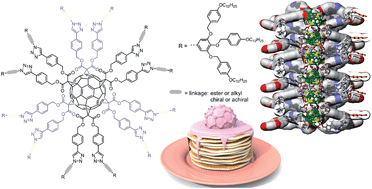
Self-organisation of dodeca-dendronized fullerene into supramolecular discs and helical columns containing a nanowire-like core

Chem. Sci., 2015, 6,3393-3401
DOI: 10.1039/C5SC00449G, Edge Article
Open Access Open Access
Creative Commons Licence&nbsp This article is licensed under a Creative Commons Attribution 3.0 Unported Licence.
Sebastiano Guerra, Julien Iehl, Michel Holler, Mihai Peterca, Daniela A. Wilson, Benjamin E. Partridge, Shaodong Zhang, Robert Deschenaux, Jean-Francois Nierengarten, Virgil Percec
C60 dendronized with 12 chiral or achiral self-assembling dendrons form discs with C60 at their centre that self-organise into helical columns with a nanowire-like core.
The content of this RSS Feed (c) The Royal Society of Chemistry
18 Aug 05:01

Mapping fullerene crystallization in a photovoltaic blend: an electron tomography study

Nanoscale, 2015, 7,8451-8456
DOI: 10.1039/C5NR00443H, Paper
Olof Backe, Camilla Lindqvist, Amaia Diaz de Zerio Mendaza, Stefan Gustafsson, Ergang Wang, Mats R. Andersson, Christian Muller, Eva Olsson
Transmission electron tomography is used to study the vertical distribution of fullerene crystals in a polymer solar cell blend.
The content of this RSS Feed (c) The Royal Society of Chemistry
18 Aug 05:01

Efficient perovskite/fullerene planar heterojunction solar cells with enhanced charge extraction and suppressed charge recombination

Nanoscale, 2015, 7,9771-9778
DOI: 10.1039/C4NR06240J, Paper
Cong Li, Fuzhi Wang, Jia Xu, Jianxi Yao, Bing Zhang, Chunfeng Zhang, Min Xiao, Songyuan Dai, Yongfang Li, Zhan'ao Tan
Perovskite solar cells show enhanced charge extraction and suppressed charge recombination with alcohol soluble titanium chelate TIPD as an electron transporting layer.
The content of this RSS Feed (c) The Royal Society of Chemistry
18 Aug 05:01

Tin perovskite/fullerene planar layer photovoltaics: improving the efficiency and stability of lead-free devices

J. Mater. Chem. A, 2015, 3,11631-11640
DOI: 10.1039/C5TA02950C, Paper
Kenneth P. Marshall, Richard I. Walton, Ross A. Hatton
The preparation of CsSnI3 films at room temperature with defect densities low enough for light harvesting in photovoltaic devices is reported, along with a new strategy for improving device stability and evidence that the energetics at the perovskite/fullerene interface is a key determinant of the open-circuit voltage.
The content of this RSS Feed (c) The Royal Society of Chemistry
18 Aug 05:01

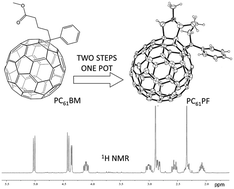
One-pot selective synthesis of a fullerene bisadduct for organic solar cell applications

Chem. Commun., 2015, 51,9837-9840
DOI: 10.1039/C5CC02701B, Communication
Bolong Zhang, Jegadesan Subbiah, Yu-Ying Lai, Jonathan M. White, David J. Jones, Wallace W. H. Wong
Efficient synthesis of a single isomer of a fullerene bisadduct for organic solar cell applications was obtained using tether-directed functionalization in one pot over two steps.
The content of this RSS Feed (c) The Royal Society of Chemistry
18 Aug 05:00

Materials chemistry: A magnetic facelift for non-magnetic metals

by Karthik V. Raman

Copper and manganese have been engineered to show magnetism at room temperature in thin films interfaced with organic molecules. The findings show promise for developing new magnetic materials. See Letter p.69

Nature 524 42 doi: 10.1038/524042a

18 Aug 05:00

Recent Advances in Bulk Heterojunction Polymer Solar Cells

by Luyao Lu, Tianyue Zheng, Qinghe Wu, Alexander M. Schneider, Donglin Zhao and Luping Yu

TOC Graphic

Chemical Reviews
DOI: 10.1021/acs.chemrev.5b00098
18 Aug 05:00

Perovskite solar cells: Crystal crosslinking

by Licheng Sun

Nature Chemistry. doi:10.1038/nchem.2323

Author: Licheng Sun

Solid-state perovskite solar cells have recently emerged and have already reached efficiencies of 20%. Now, a simple solution-processing step that crosslinks neighbouring perovskite grain surfaces has been found to increase their stability, an important issue for future potential commercialization.

18 Aug 02:48

Improved performance and stability of perovskite solar cells by crystal crosslinking with alkylphosphonic acid ω-ammonium chlorides

by Xiong Li

Nature Chemistry. doi:10.1038/nchem.2324

Authors: Xiong Li, M. Ibrahim Dar, Chenyi Yi, Jingshan Luo, Manuel Tschumi, Shaik M. Zakeeruddin, Mohammad Khaja Nazeeruddin, Hongwei Han & Michael Grätzel

Perovskite materials show great promise for solar cell devices, owing in particular to their high power conversion efficiency. Now, the addition of butylphosphonic acid 4-ammonium cations during a one-step process has been shown to improve both the efficiency and moisture stability of perovskite photovoltaics, through the formation of hydrogen-bonding crosslinks between neighbouring grains.

22 Jul 10:22

Organic Photovoltaics: Dual Functional Zwitterionic Fullerene Interlayer for Efficient Inverted Polymer Solar Cells (Adv. Energy Mater. 14/2015)

by Yao Liu, Zachariah Page, Sunzida Ferdous, Feng Liu, Paul Kim, Todd Emrick, Thomas Russell
Thumbnail image of graphical abstract

In article number 1500405, Todd Emrick, Thomas Russell, and co-workers report the fabrication of inverted polymer solar cells with a maximum efficiency of 9.23% using a dual functional fullerene zwitterion as the cathode interlayer. C60-sulfobetaine acts as an electron acceptor and cathode modification layer. Exceptional insensitivity to interlayer thickness is found with efficiencies exceeding 8%. Slot-die coated solar cells with an organic cathode interlayer have efficiencies of 7.38%.