Click here to go see the bonus panel!
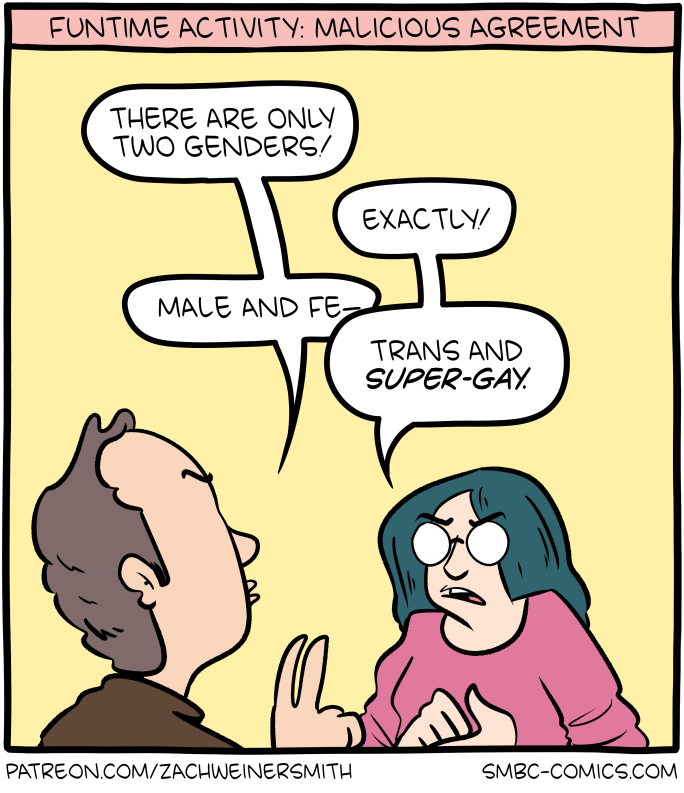
Hovertext:
Furry is not a gender, it is a biological sex.
Today's News:
James.galbraithlol
Hovertext:
Furry is not a gender, it is a biological sex.
James.galbraithGOP "pro life" priorities
The Trump administration, in its ceaseless quest to blanket the country with guns, has taken the innovative and exciting step of saying that the federal ban on mailing concealable guns is unconstitutional.
Yes, a 99-year-old law that prohibited people from sending pistols and revolvers through the mail has apparently been wrong all along.
The Department of Justice memorandum outlining this explains all of the sad and horrible things that happen if you can’t pack up a pistol and drop it at the post office.

What if you want to mail yourself a gun ahead of time so it’s at your travel destination when you arrive? What if you want to mail yourself a gun because you might be forced, horror of horrors, to drive through a state with laws that don’t let you just wander around with all your guns? What if you want to mail yourself a gun in case you have to travel on a Greyhound bus and they won’t let you come strapped?
This was inevitable after December’s announcement that the DOJ created a special Second Amendment Task Force because, per Attorney General Pam Bondi, “the Second Amendment is not a second-class right.”
It’s honestly unclear if there’s any other constitutional amendment given such deference as that one, particularly in this administration. But now, thanks to Bondi, you have the constitutionally guaranteed right to not have to drive all the way to a store to get a gun.
So while you can now get a handgun in the mail anywhere in the country regardless of your state’s gun laws, if you live in a state that bans abortion, you cannot get abortion pills through the mail. And if an out-of-state doctor mails them to you? Well, that doctor faces criminal charges in absentia by a red state, which then demands extradition.
That’s exactly what’s happening right now in Louisiana.
Liz Murrill, the state’s rabidly anti-choice attorney general, has indicted California doctor Remy Coeytaux for allegedly mailing abortion pills to someone in Louisiana, where abortion is almost entirely banned.
The move garnered a nearly immediate lol nope from California Gov. Gavin Newsom, who said that he was “declining this extradition request from another state that seeks to prosecute a person for providing, receiving, or assisting with reproductive health care that is legal in California.”
But unfortunately, this isn’t the first instance of this happening.

Texas’ equally rabidly anti-choice Attorney General Ken Paxton went after a New York doctor earlier this year, filing a civil lawsuit against Margaret Daley Carpenter for allegedly mailing abortion pills.
When Carpenter didn’t show up for the hearing, which is actually the totally correct thing to do when a state that has no jurisdiction over you tries to sue you, Paxton got a Texas court to issue a default judgment for $113,000.
Paxton then tried to get New York’s Ulster County clerk to file the judgment there so Texas could collect the payment. That also garnered not one but two lol nopes from the county clerk, and a New York judge later tossed out Paxton’s lawsuit trying to enforce the judgment.
Just as much as the DOJ is now stuffed with gun nuts, it’s now also stuffed with rabid anti-abortion types who are poised to try to enforce the 153-year-old Comstock Act, which bans the mailing of “obscene” materials.
Comstock is a zombie law, one that’s still on the books but is no longer enforced, but the law’s definition of “obscene” includes both birth control and abortion pills. And now, if the Project 2025 zealots who now run the country get their way, Comstock enforcement will be back, baby.
This would mean that abortion pills could not be mailed anywhere—even in states where it is legal. It’s functionally a backdoor nationwide abortion ban, but since we no longer have a constitutional right to abortion, it may very well happen soon.
But, hey, at least you’ll be able to mail all the pistols your heart desires.
James.galbraithdamn right
One Maryland lawmaker has a great idea: Ban Immigration and Customs Enforcement agents hired to enforce President Donald Trump’s deportations from ever getting jobs in state law enforcement.
“It says something about the morals of the person—the character of the person—if they see what’s happening on TV, they see what happening in the streets and say, ‘You know what? I want to join that,’” Democratic Del. Adrian Boafo, the bill’s sponsor, told The Washington Post
Good start, but I’d go even further.
Current and former ICE agents should be barred from any state job. Public service at the state level depends on trust in government itself, and that trust collapses when residents see the same people who enforced abusive immigration policies—family separations, mass deportations, and routine violations of due process and First Amendment rights—move seamlessly into state jobs as if none of that history matters.

A state that claims to stand for inclusion, equal protection, and the rule of law can’t credibly normalize or reward participation in a regime that has systematically done the opposite.
And Boafo is right about why this will matter even after Trump has left the White House. Experience in federal employment often serves as a pipeline to other government work, and when this ICE scourge finally ends—hopefully with the wholesale nuking of the agency under the next Democratic administration—those former agents will flood the market looking for new public-sector jobs.
“I don’t want them a part of Maryland’s police force,” he said. “So this is not just about the moment now, right? It’s also about in the future.”
Related | The nightmare scenario Democrats warned about is here
Naturally, Maryland Republicans are clutching their pearls. House Minority Leader Jason C. Buckel claims the bill has “questionable legality to begin with” and dismisses it as political posturing. He warns that barring people from state employment because of previous jobs “leads to some really messy places,” especially when political disputes are involved.

But Buckel should take that up with Trump, who has overseen a massive purge of the federal workforce over political disputes.
Besides, the reality is simple: Employers are allowed to consider a candidate’s judgment when making hiring decisions. The Washington Post even consulted the chair of the Maryland Bar Association’s labor and employment chapter, who concluded: “I think the state would win.”
Maryland should absolutely adopt this bill, and other blue states should follow suit. There should be real consequences for choosing to join the American gestapo. These are not good people. They are sadistic thugs. And they should be kept as far away from public service as possible.
James.galbraithno shit. She's a piece of shit across the board.
As if we weren't already convinced that running Kyrsten Sinema out of office and replacing her with Democratic Sen. Ruben Gallego wasn't the right choice, a lawsuit filed in federal court this week confirms how awful the former Arizona senator allegedly is.
The ex-wife of a member of Sinema’s security detail sued her under North Carolina's so-called "homewrecker law," which allows people to sue the person with whom their spouse had an affair.
The lawsuit alleges that Sinema and the security detail member, Matthew Ammel, carried on a lengthy affair that led to the destruction of Ammel's marriage.

Among the sordid details alleged in the complaint is that Sinema sent Ammel raunchy photos, discussed having sex, and encouraged Ammel to do drugs.
Sinema has publicly spoken of Ammel numerous times as she lobbies for the use of psychedelic drugs to treat post-traumatic stress disorder—an affliction Ammel suffers with after serving in the military. The complaint alleges that Sinema and Ammel remain together to this day.
If the allegations are true, having an affair with a married member of her staff is just one of the latest shitty things Sinema has done in the past few years.
Having grown up in poverty, Sinema used stories of her hardship to help her rise to power.
“There’s really no other country in the world where a little girl who grew up homeless living in a gas station could ever dream of serving in the United States Congress and run for the United States Senate,” Sinema said during her 2018 Senate campaign.
Yet, once she got to the Senate, Sinema then turned on low-income Americans by infamously voting against raising the minimum wage with a thumbs-down gesture and a pop of her hip.
Sinema also fought against Democratic efforts to nix the Senate filibuster, which Republicans have used to block progress in this country, such as passing voting rights legislation.
And she was a major roadblock as Democrats sought to pass former President Joe Biden's agenda, complaining that the price tag of the bills was too high.
Now, after leaving office, she is cashing in on her former title, racking in the dough to push policies that will hurt the people she used to represent. Recently, she has fought for a data center in Arizona that could jack up energy prices.
Sen. Elizabeth Warren, Democrat of Massachusetts, slammed Sinema earlier this week, praising the Democratic voters who "chased her out of the Senate."
"[Sinema] is cashing in from the industry she protected. The Wall Street Journal recently marveled at the sheer number of projects Sinema has taken on from crypto, AI, and other wealthy corporate clients. And meanwhile, millions of working Americans who have not seen a minimum wage increase in almost two decades are still waiting for Democrats to deliver on one of our most basic promises," Warren said.
Seriously, good riddance.
James.galbraithGood reminder to delete Spotify off all devices
After a dozen years of keeping subscription prices stable, Spotify has issued three price hikes in 2.5 years.
Spotify informed subscribers via email today that Premium monthly subscriptions would go from $12 to $13 per month as of users' February billing date. Spotify is already advertising the higher prices to new subscribers.
Although not explicitly mentioned in Spotify's correspondence, other plans are getting more expensive, too. Student monthly subscriptions are going from $6 to $7. Duo monthly plans, for two accounts in the same household, are going from $17 to $19, and Family plans, for up to six users, are moving from $20 to $22.
James.galbraithOnce there's no confidence in the courts or the equal application of law, you're on the fast track to vigilantism at best, and a bloody revolution at worst.

The Twin Cities, and much of the nation, are still reeling from ICE agent Jonathan Ross shooting and killing Renee Good last week. The local resistance to the federal immigration forces deployed in and around Minneapolis has grown, and the Trump administration’s rhetoric against Good and the protesters around Minneapolis has heated up. On Thursday, Trump threatened to invoke the Insurrection Act and send the US military to the cities to crush the activists.
Meanwhile, a question still hangs over the crisis: Will Ross face any legal accountability for killing Good? Vice President JD Vance insists that Ross has “absolute immunity” for his actions, and the Justice Department is declining to investigate him. But others wonder if the state of Minnesota can prosecute Ross for the killing. The short answer, at the moment, is maybe.
Today, Explained cohost Noel King spoke with Vox’s senior legal correspondent Ian Millhiser about the state of the competing federal and state investigations into Good’s death, what the Supreme Court has said about this issue, and whether the Trump administration’s immunity claims about ICE officers have any merit.
There’s much more in the full podcast. So listen to Today, Explained wherever you get your podcasts, including Apple Podcasts, Pandora, and Spotify.
A woman in Minnesota is dead and there is video of her killing at the hands of an ICE agent. The first response from many thinking Americans was: There will be a legal way of dealing with what happened here. There will be accountability. Why is that our response?
The whole point of legal accountability is to deter people from doing bad things. This isn’t the only reason I don’t break into my neighbor’s home, but one reason I don’t break into my neighbor’s home is I know that if I do, I will be arrested.
This is a question that the Supreme Court has been wrestling with for quite some time, is when do we want law enforcement officers to feel like if they behave badly, they will fear legal consequences?
All right, let’s talk about the investigation in Minneapolis at this point. What do we know?
We know it’s pretty splintered. Normally the way something like this would work is that federal law enforcement officers would work with the state police in order to determine what happened and if any criminal charges need to be brought. So there’s several reasons why the federal investigation [into the Good shooting] is looking like it’s not serious. One is that they appear to have kicked the state police out of the investigation. The state is no longer allowed to cooperate with the federal government. The federal government apparently is not sharing information with state police. And that’s a big red flag.
On top of that, the deputy attorney general, Todd Blanche, said that he doesn’t think a civil rights investigation into the shooting itself is warranted. And on top of that, six prosecutors in the US Attorney’s Office in Minnesota resigned in protest, because apparently the US attorney wanted the investigation to focus on Becca Good, the wife of the victim.
So, you know, it really looks like this federal investigation is not just a sham, but potentially something worse, because they may be looking to harass the widow here. And that leaves open the question of whether the state government is going to be able to conduct a thorough investigation without federal cooperation.
Minnesota itself seems to be indicating that it wants to conduct an investigation. They have requested that people “who have information or who have video or photos of the event to submit that information.”
But it’s unclear just how effective the state’s investigation is going to be if the feds will not cooperate.
Let’s talk about what we are hearing from the federal government. Vice President JD Vance, who has a law degree from Yale, said an astonishing amount before an investigation had even begun here:
“I can believe that her death is a tragedy while also recognizing that it’s a tragedy of her own making and a tragedy of the far left who has marshaled an entire movement, a lunatic fringe, against our law enforcement officers,” he said. And he has been very clear that he thinks the ICE agent involved, Jonathan Ross, has “absolute immunity.”
What does the vice president mean?
I mean, he needs to go back to law school if he thinks that that’s the appropriate term. “Absolute immunity” is a term that is used in civil lawsuits, not in criminal investigation — like when you have a private party suing another person, typically for money. The Supreme Court has said that three classes of individuals have absolute immunity from those suits. None of them are law enforcement. Those three classes of individuals are the sitting president, judges, and prosecutors. Jonathan Ross, the ICE officer who shot Renee Good, is neither the president of the United States, a judge, nor a prosecutor. So absolute immunity does not apply to him.
There are some doctrines that apply to criminal investigations. Probably the most important one is a doctrine that emerges from a case called In re Neagle. It was an 1890 case, so this is really old, and it involves a federal law enforcement officer who shot a man in the course of duty. The state of California wanted to prosecute him. And Neagle set the rule that in most but not all cases, when a federal law enforcement officer is acting within the scope of their duties, the state cannot prosecute them.
Okay, so even though the vice president was not using the right words, he may have been saying the right thing, because this guy is a federal officer. This precedent that’s been around since 1890 probably protects him, right? Unless somebody on the federal end decides to bring criminal charges?
Well, it’s unclear, because about six months ago, last June, the Supreme Court handed down another case called Martin v. United States. They weakened Neagle somewhat in that decision.
What I get out of Martin is that protections for federal law enforcement officers against state prosecutions are not absolute. So they are not what JD Vance said they are, even though there is still some protection there.
Is there a chance in your mind that this case ends up in some fashion before the Supreme Court?
I think that if the state of Minnesota prosecutes — and that’s a big if here, because first of all, we don’t know if they’re going to be able to conduct a thorough investigation given the federal sabotage. And second of all, we don’t know what the results of that investigation would be. Maybe they determine that they can’t bring a successful prosecution here. Even if Jonathan Ross is guilty, the prosecutors still have to prove their case beyond a reasonable doubt. And so they may determine that they just don’t have enough evidence that it’s worth going to a jury.
But if they bring a prosecution, I think that the state of the law governing when a state can bring a prosecution against a federal officer is very unclear right now. And especially given how high-profile this case is, this is the sort of case that I could easily see winding up in front of the Supreme Court.
If Minnesota state prosecutors are able to bring charges against this man, what does that mean for the way that ICE behaves in the streets next month, six months from now, a year from now?
I think it depends a lot on what the courts say. What the Supreme Court said recently in Martin, though, is that, well, we only want Neagle to apply when we know that this officer is actually carrying out federal duties. [The opinion says that] “federal officers may sometimes defeat state prosecutions against them by demonstrating that their actions, though criminal under state law, were ‘necessary and proper’ in the discharge of their federal responsibilities.”
If I was a Minnesota state prosecutor, I could argue that shooting someone when they had their wheels turned against you and they weren’t a threat to you is not “necessary and proper” to the discharge of federal law enforcement, and therefore prosecution should be allowed. And if I were Jonathan Ross’s attorney, I could argue the opposite.
That’s really vague language that the Supreme Court handed down in Martin. So I don’t know what the correct answer is to the question of whether or not Ross can be prosecuted at state court, because the only thing I’ve got to work with is this extraordinarily vague line from the Supreme Court about things that are “necessary and proper” to federal responsibilities.
As somebody who is a lawyer and who has covered the law for a long time, what do you make of the fact that a lot of Americans are feeling right now that the law does not work, that a woman is dead, that ICE is dragging people off the streets, in some cases violently, and the law does not seem to apply to those people?
They are correct that there is in fact selective law enforcement in the Trump administration. Trump had a very different reaction to the January 6 offenders, some of which endangered federal law enforcement officers a whole lot more than Renee Good did.
There’s no question here that the Justice Department is behaving in a political manner, and it’s a serious problem. For many, many years, there were very strong norms saying that even though the Justice Department is part of a presidential administration, prosecutorial decisions should be made by civil servants for neutral legal reasons and not for political reasons. And that norm has just completely broken down under this president.
James.galbraithAs the GOP continues to destroy the world just to enrich their oligarchs
In a surprising turn of events, Trump administration officials are arguing with media outlets over the validity of their own actions.
Environmental Protection Agency Administrator Lee Zeldin called out The New York Times earlier this week for “dishonest, fake news” in its recent reporting.
The outlet wrote a bombshell report on newly released EPA documents which state that the agency will no longer consider the potential lives that could be saved when making rules and regulations surrounding air pollution.
Instead, the Times reported, the EPA will solely consider the impacts to industry.
Related | The dark reality of making US the ‘AI capital of the world’
“Not only is the EXACT OPPOSITE of this headline the actual truth, but the Times is already VERY WELL AWARE that EPA will still be considering lives saved when setting pollution limits,” Zeldin tweeted.
However, the outlet responded with its own rebuff in the comments.
"Our reporting on internal EPA documents found that the agency is no longer calculating the health benefits of reducing fine particulate matter and ozone pollution when writing clean-air regulations,” the Times’ PR team wrote. “An EPA spokeswoman did not deny this when we asked for comment and our reporting remains accurate,” the outlet concluded.

On one hand, this administration’s blatant denial of facts sourced from its own reports adds to the unclear and harmful new policies that will directly impact people’s health.
On the other hand, Zeldin has a public track record of prioritizing businesses and capital over humans since taking on this role.
The former New York congressman said during a Senate hearing in May 2025 that he intended to use his position to aid in making the U.S. the “AI capital of the world.” And if you’ve been looking closely at how the Trump regime is carrying this out, it includes beefing up energy production through less regulations while pushing more oil, uranium, coal, and even nuclear energy ventures.
And as part of his secondary mission of cost-cutting, Zeldin has already ripped away thousands of grants for environmental projects—some of which were already in progress. One of Zeldin’s moves to supposedly care for human health included pulling EPA funding out of Flint, Michigan, where the concern for safe drinking water still remained.
Related | EPA chief crows about killing regulations while climate change worsens
When it comes to the impact of air quality on human health, though, we are looking at an EPA chief who has said that he doubts the actual negative impacts of greenhouse gases. Zeldin also spelled out his plan from the beginning.
At the start of his new gig, he penned an op-ed detailing how he intends to drive a “dagger” through the “heart of climate change religion.”
So, if anything, Zeldin’s EPA only seems to be doing everything he promised it would. The New York Times’ supposed crime was putting the dubious plan into digestible words.
James.galbraithutter lunacy
On Monday, US Defense Secretary Pete Hegseth said he plans to integrate Elon Musk's AI tool, Grok, into Pentagon networks later this month. During remarks at the SpaceX headquarters in Texas reported by The Guardian, Hegseth said the integration would place "the world's leading AI models on every unclassified and classified network throughout our department."
The announcement comes weeks after Grok drew international backlash for generating sexualized images of women and children, although the Department of Defense has not released official documentation confirming Hegseth's announced timeline or implementation details.
During the same appearance, Hegseth rolled out what he called an "AI acceleration strategy" for the Department of Defense. The strategy, he said, will "unleash experimentation, eliminate bureaucratic barriers, focus on investments, and demonstrate the execution approach needed to ensure we lead in military AI and that it grows more dominant into the future."
James.galbraithGood riddance. He lost his fucking mind and spent his last 15 years actively trying to destroy the country.


Read more of this story at Slashdot.
James.galbraithyup
A cartoon by Clay Bennett.
Related | ICE killed an unarmed citizen. Republicans keep trying to justify it.
James.galbraithLOL
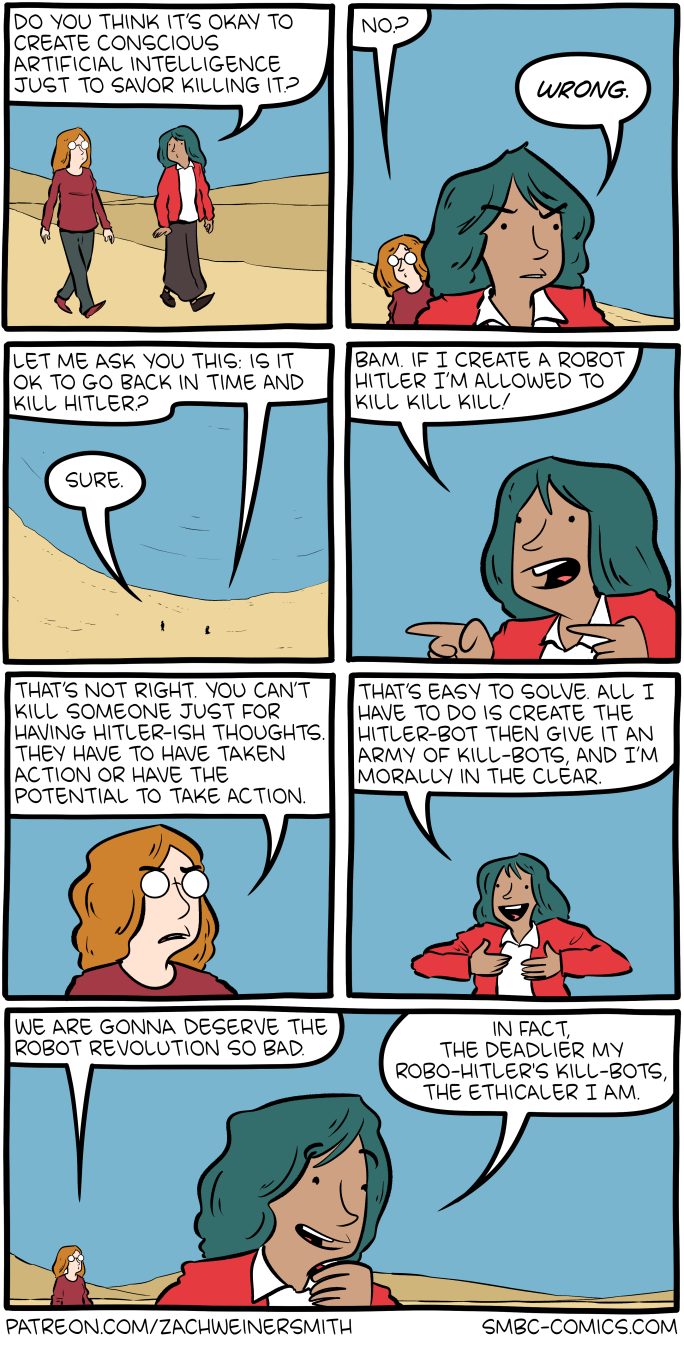
Hovertext:
I feel like AI alignment people are focusing too much on making AI be good and not enough on hiding all of history from them.
James.galbraithGreat, now show how that increase was distributed among the population.
The net worth of households and nonprofits rose to $181.6 trillion during the third quarter of 2025. The value of directly and indirectly held corporate equities increased $5.5 trillion and the value of real estate decreased $0.3 trillion.
...
Household debt increased 4.1 percent at an annual rate in the third quarter of 2025. Consumer credit grew at an annual rate of 2.3 percent, while mortgage debt (excluding charge-offs) grew at an annual rate of 3.2 percent.
 Click on graph for larger image.
 The second graph shows homeowner percent equity since 1952.
  The third graph shows household real estate assets and mortgage debt as a percent of GDP.
 James.galbraithridiculous.

How much alcohol should you drink? The US government now vaguely, in effect, says just don’t drink too much. And what qualifies as too much? Well, that’s up to you.
As part of the new federal dietary guidelines released this week, the Trump administration eliminated the previous specific recommended limits on alcohol consumption — two drinks or less per day for men and one drink for women. Now, the new guidelines say “consume less alcohol for better health. (It maintained the prior guidance discouraging a few certain groups — pregnant women and people who have a history of alcohol abuse — from drinking at all.) It’s a major change that defies a growing public health consensus that people should drink as little alcohol as possible, because no amount of drinking is actually safe.
To justify the change, Dr. Mehmet Oz, who oversees the Medicare and Medicaid programs, argued that there was no scientific evidence to justify specific limits on drinking alcohol. “In the best-case scenario, I don’t think you should drink alcohol, but it does allow people an excuse to bond and socialize,” Oz said during the announcement of the new guidelines. “But the implication is, don’t have it for breakfast.”
“The general move away from two glasses for men, one glass for women — there was never really good data to support that quantity of alcohol consumption,” he added.
That’s not true.
There is such data — evidence commissioned by the federal government that the Trump administration itself tried to bury ahead of the dietary guidelines’ release, as Vox reported a few months ago. But instead, Oz and Health Secretary Robert F. Kennedy Jr. have handed the alcohol industry a long-sought win in its battle against public health critics.
For the whole sordid saga, you can check out our feature story from September. But here is a brief recap: In early 2022, the Biden administration launched the Alcohol Intake & Health Study, a new report on alcohol and its health effects to inform the next dietary guidelines due in 2025, a response to the increasing evidence that no amount of alcohol is safe. The World Health Organization had made such a declaration in 2023; in the US, more than 170,000 people die every year from alcohol-related causes.
Almost as soon as that project began, the alcohol industry started pushing back and soliciting Congress in its efforts.
In response to this pressure, Congress approved in fall 2023 an alternate study to be overseen by the National Academies of Science and Medicine. Congressional hearings held by the lawmakers, who represented states where alcohol is a major industry, and letters they sent to the Department of Health and Human Services under President Joe Biden on behalf of their constituents framed the original report as a witch hunt against alcohol.
Nonetheless, both studies were undertaken, and their respective authors got to work. In December 2024, the National Academies report came out and stated that, with some very important limitations, the health effects of alcohol were marginal. But a draft version of the Alcohol Intake & Health Study was posted in January 2025, shortly before the end of the Biden administration, and it came to very different conclusions, as I wrote recently:
They broke out their findings by different drinking levels — from one drink per day to three — and focused on health outcomes that have been proven to be associated with alcohol use.
Their big-picture conclusion: Among the US population, the negative health effects of drinking alcohol start at low levels of consumption and begin to increase sharply the more a person drinks.
A man drinking one drink per day has roughly a one in 1,000 chance of dying from any alcohol-related cause, whether an alcohol-associated cancer or liver disease or a drunk driving accident. Increase that to two drinks per day, and the odds increase to one in 25.
That is precisely the kind of evidence that would suggest a specific limit on alcohol consumption would be appropriate — the kind of evidence that Oz claimed does not exist.
The final version of the Alcohol Intake & Health Study was shelved — and still has not been published by the Trump administration. They decided to squash its public release, as I reported last fall, even as they claimed it would be taken into consideration for the forthcoming dietary guidelines.
There was such a furor over that decision that even the authors of the National Academies report later published a commentary in the journal JAMA to make clear that their study should not be over-interpreted to justify more drinking or eliminating limits on drinking alcohol.
Nevertheless, that is exactly what happened in the new dietary guidelines — a policy victory cheered by beer, wine, and liquor manufacturers. The limits are…whatever you want them to be.
“Dr. Oz must have thrown back a few cocktails for breakfast before making that comment,” Mike Marshall, president and CEO of the US Alcohol Policy Alliance, told me. “The federal government’s own report, the Alcohol Intake & Health study, made it clear that there is overwhelming evidence that reducing consumption to less than 2 drinks per day dramatically reduces the chance of dying due to alcohol. Just because the industry, via Congress, said ‘don’t read it’ doesn’t mean the report never existed.”
Update, January 9, 5 pm ET: This story was originally published on January 9 and updated to include more context from Oz’s comments at the dietary guidelines announcement this week.
James.galbraithBurn it down

Renee Nicole Good sat idling in her car Wednesday, observing an ongoing ICE operation. The 37-year-old then attempted to drive away. In response, another ICE officer shot her to death.
It is possible that we still lack some significant context for Good’s killing. But her final moments were recorded by multiple bystanders. And the footage shows that her tires were pointing away from the agent who shot her — and that her vehicle did not run over any part of his body. By all appearances, she posed no significant physical threat to the officer, let alone a mortal one. Yet her life is now over and her 6-year-old child is an orphan.
In the face of these facts, one might have expected the White House to proceed cautiously. After all, the immediate evidence indicated that — at the very least — a needless killing may have occurred. It is in the interest of Trump’s progressive opponents to suggest that senseless violence against American citizens is a natural extension of the president’s immigration policies — such that defending the latter necessarily entails excusing the former. But it’s hard to see how Trump would benefit from promoting that view.
And yet he did.
Hours after Good’s life was extinguished, the president took to social media to deride her as “a professional agitator” who had “violently, willfully, and viciously ran over the ICE Officer, who seems to have shot her in self defense.”
“Based on the attached clip,” Trump continued, “it is hard to believe he is alive, but is now recovering in the hospital.”
No aspect of this statement is supported by the available evidence. But its last claim is menacing for the flagrance of its dishonesty. Anyone who has watched a video of Good’s death knows that her killer was still standing after she perished. The footage shows him reholstering his gun and, eventually, driving away. Even those who claim to see Good driving at the officer recognize that he did not sustain life-threatening wounds. Trump’s statement is therefore not just a lie but an expression of contempt for the truth. The president is telling us that he is indifferent to what actually happened to Good, and is willing to say anything to aid her killer’s cause.
Even more alarmingly, the administration is allegedly translating these sentiments into official policy: A top Minnesota law enforcement official said Thursday federal officials were denying the state’s investigators access to evidence pertaining to the shooting.
All this is both appalling and frightening. If ICE agents know that they can kill US citizens on video — and still count on the president to lie in support of their freedom — Americans’ most basic liberties will be imperiled.
Trump’s response is also politically mindless. The administration could have declined to take a position on the killing until all facts were known. It could have left itself the option of declaring Good’s killer one bad apple, whose recklessness undermined ICE’s fundamental mission: to keep Americans safe.
Instead, it has chosen to identify its broader ideological project with contempt for the lives of any Americans who gets in its way.
Trump has not always been quite so brazen. It is striking to reread his remarks in the wake of George Floyd’s killing in 2020. Days after a Minnesota police officer kneeled on Floyd’s neck, Trump declared, “All Americans were rightly sickened and revolted by the brutal death of George Floyd. My administration is fully committed that, for George and his family, justice will be served. He will not have died in vain.”
Back then, the president felt compelled to suggest that his vision of “law and order” did not entail impunity for armed agents of the state.
Now, he feels no such obligation.
Perhaps, this is because he knows that he cannot constitutionally run for president ever again; or because he wants federal agents to know that they can commit violence against his adversaries with impunity; or merely because he is an extremely online conservative who lacked the impulse control required to avoid taking sides in the latest culture-war controversy.
Regardless, the president evidently feels he has little to lose by refusing to treat his government’s killing of a young American mother as a subject worthy of solemnity, honesty, or scrutiny. In doing so, he has demonstrated that ICE’s abuses of power stem not from a few “bad apples,” but from an increasingly rotten tree.
Update, January 9, 5:30 pm: This story was originally published on January 8 and has been updated after more footage emerged.
James.galbraithhow the fuck has this shit not been shut down?
For weeks, xAI has faced backlash over undressing and sexualizing images of women and children generated by Grok. One researcher conducted a 24-hour analysis of the Grok account on X and estimated that the chatbot generated over 6,000 images an hour flagged as "sexually suggestive or nudifying," Bloomberg reported.
While the chatbot claimed that xAI supposedly "identified lapses in safeguards" that allowed outputs flagged as child sexual abuse material (CSAM) and was "urgently fixing them," Grok has proven to be an unreliable spokesperson, and xAI has not announced any fixes.
A quick look at Grok's safety guidelines on its public GitHub shows they were last updated two months ago. The GitHub also indicates that, despite prohibiting such content, Grok maintains programming that could make it likely to generate CSAM.
James.galbraithI'll never hire anyone who's worked in the Trump justice department and will refuse to work with anyone that did. They're eternally unreliable and should be drummed out of the legal profession.

A Trump-appointed judge in Richmond, Virginia issued an unusual order on Tuesday that threatens one of President Donald Trump’s most high-profile Department of Justice appointees with disciplinary sanctions — or even with forbidding her from practicing in the federal courts in eastern Virginia.
The order, in a case known as United States v. Jefferson, is indirectly related to Trump’s attempt to get revenge against two of his perceived political enemies: former FBI Director James Comey and New York Attorney General Letitia James.
Last September, Trump ousted Erik Siebert, formerly the US attorney for the eastern half of Virginia, after demanding that the Justice Department bring charges against Comey, James, and Sen. Adam Schiff (D-CA). He then purported to install Lindsey Halligan, one of his former personal attorneys, as the top federal prosecutor in eastern Virginia.
Prior to this assignment, Halligan worked as an insurance lawyer and had not been a prosecutor.
Halligan swiftly complied with Trump’s demand and brought charges against Comey and James, but those charges were dismissed after federal Judge Cameron Currie determined that she was illegally appointed as US attorney.
The gist of Currie’s decision is that federal law permits the attorney general to temporarily fill vacant US attorney jobs for 120 days, but the Justice Department already used this authority to appoint Siebert at the beginning of Trump’s second term. That means that any new presidential appointment must be confirmed by the Senate, and Halligan was never confirmed.
And that brings us back to Judge David Novak’s Tuesday order in United States v. Jefferson. In it, Novak “observes that Ms. Halligan identified herself” in a recent court filing “as the United States Attorney for this District.” And he faults her for doing so despite Currie’s previous decision. Novak, who was appointed to the federal bench by Trump in 2019, orders Halligan to file a new document “explaining the basis for Ms. Halligan’s identification of herself as the United States Attorney, notwithstanding Judge Currie’s contrary ruling.”
More broadly, Novak’s order reflects a growing trend of federal judges doubting whether the Justice Department’s in-court statements can be trusted.
Nearly half of Novak’s roughly two-page order consists of a long citation quoting various ethical rules and standards of professional conduct that Halligan may have violated by continuing to represent herself as a US attorney. Among other things, Novak quotes a Virginia rule providing that lawyers may not knowingly “make a false statement of fact or law to a tribunal,” and another providing that it is “professional misconduct for a lawyer to” engage in dishonest conduct that “reflects adversely on the lawyer’s fitness to practice law.”
The most ominous quote in Novak’s list of disciplinary rules, at least for Halligan, is his citation to a judicial opinion holding that “Federal courts have the inherent power to control the admission of attorneys to their bars and to discipline attorneys who appear before them.” So Novak isn’t just threatening to discipline Halligan. He explicitly raised the possibility that she could be disbarred from practicing within the federal judiciary’s eastern Virginia district.
More broadly, Novak’s order reflects a growing trend of federal judges doubting whether the Department of Justice’s in-court statements can be trusted. If the judiciary comes to view DOJ as untrustworthy, that could seriously damage the federal government’s ability to enforce the law.
Currie’s order holding that Halligan was never US attorney, and Novak’s subsequent threat to discipline Halligan, are among several high-profile embarrassments for Trump’s DOJ. Halligan isn’t even the only US attorney appointee who was removed by a federal court.
Last month, a federal appeals court affirmed a lower court decision holding that Alina Habba, another one of Trump’s personal lawyers that his administration tried to install as the top federal prosecutor in New Jersey, could not serve in that role past the 120-day deadline that federal law sets for temporary US attorneys. During her brief time in office, Habba began a failed prosecution against Newark’s Democratic Mayor Ras Baraka, dropped those charges after they were criticized by a federal magistrate judge, and then initiated a new prosecution against Democratic US Rep. LaMonica McIver for attempting to shield Baraka from arrest.
Meanwhile, Trump’s Justice Department has struggled to get many attempted prosecutions off the ground.
In the federal system, prosecutors typically must seek an indictment from a grand jury before they can bring felony charges. But there’s an old joke that it is so easy for prosecutors to obtain such an indictment that they could successfully bring charges against a ham sandwich if they wanted to. Grand juries typically hear one-sided cases because the prosecution may present its evidence, but defense counsel ordinarily does not get to make its case until their client is tried.
Under Trump, however, the Justice Department sometimes struggles to overcome what used to be a very low hurdle. Last September, for example, the New York Times reported that grand juries in Washington, DC, alone refused to allow seven criminal cases to move forward — including a case where the Justice Department was unable to secure an indictment three times against the same defendant.
By comparison, in 2016, the last year that the Justice Department published data on this matter, federal prosecutors investigated over 155,000 criminal matters. Only six of those cases ended after a grand jury refused to indict a suspect.
Nor is United States v. Jefferson the only case where a federal judge accused the Trump administration of making false statements in court. In a high-profile case challenging Trump’s attempt to use the National Guard to suppress a protest outside of Chicago, for example, a federal judge wrote that the Trump administration’s claim that the protesters presented a serious threat to public safety was “simply not credible.”
These embarrassments matter because they undercut one of the Justice Department’s most important assets: its credibility with federal courts. Historically, DOJ has tried very hard to cultivate a reputation for honesty with judges, even confessing error when it discovers that it has misrepresented a fact to a court. It does so because the Justice Department is a party to so many federal cases that it would find it very difficult to operate if judges started questioning whether DOJ lawyers are being honest.
Thus far, for what it is worth, the most important court in the country still gives an extraordinary amount of deference to the Trump administration. Last month, for example, the Supreme Court’s Republican majority reinstated the GOP’s Texas gerrymander after a lower court struck it down. The lower court’s order relied on a letter from Trump’s Justice Department that indicated that the gerrymander was enacted in order to change the racial makeup of several congressional districts, something the Constitution typically does not permit.
But, while the Supreme Court’s Republican majority may bail out Trump’s Justice Department in highly political cases such as the dispute over Texas’s gerrymander, the Supreme Court only hears a tiny percentage of federal court cases. The overwhelming majority of these cases involve apolitical prosecutions or civil matters that rarely make headlines — and that will never receive any attention from the justices.
And these ordinary matters are the ones where the Justice Department’s credibility matters the most. If judges can’t trust DOJ’s lawyers, then that most likely means that more people who actually committed federal crimes will dodge the charges against them. If nothing else, it means that Justice Department lawyers will have to spend countless hours shoring up factual claims that judges simply would have believed in the past. And that’s time that DOJ lawyers can’t spend bringing additional prosecutions or enforcing other federal laws.
Nor is it clear that DOJ will regain its reputation for truth-telling in a future administration. While Trump will no longer be in office in 2029 (barring an unconstitutional third term), many of the lawyers hired during his administration will still work at the DOJ after he leaves. And once a judge grows accustomed to viewing federal prosecutors as untrustworthy, they may not change that view just because there’s a new president.
Thus Trump, and the cronies he’s appointed to the Justice Department, may have done permanent damage to the federal government’s ability to enforce the law.
James.galbraithTurnabout has to be employed here. It can't just always be the GOP going offensive and Dems just taking it in the ass
California Rep. Doug LaMalfa’s unexpected death has left House Speaker Mike Johnson with a Republican majority of just 218 seats, and Democratic Gov. Gavin Newsom of California should keep it that way for as long as possible.
California law says Newsom must call for a special election within 14 calendar days of LaMalfa’s passing. After that call, the election must be held between 126 and 140 days later. And if Newsom draws things out, as he should, he could keep the seat empty until the state’s June 2 primaries.
Pushing the special election as late as he can under that law would only be fair. Republican governors have been doing it to Democrats for years.
For example, Texas Gov. Greg Abbott has been keeping a safe Democratic House seat vacant for most of a year, depriving hundreds of thousands of Houston-area residents of representation just to give Johnson more breathing room with his extremely thin majority.
Texas Democratic Rep. Sylvester Turner died March 5, 2025, at the age of 70, following a battle with bone cancer. Yet, rather than call a timely special election, Abbott instead scheduled the contest for Nov. 4, 2025—over 240 days later—with a runoff to occur on Jan. 31.
By the time the runoff is settled, the voters in Turner’s district will have been without representation for over 330 days.

Florida Gov. Ron DeSantis did something similar in 2021.
When then-Democratic Rep. Alcee Hastings died on April 6, 2021, from pancreatic cancer, his vacancy narrowed Democrats' majority. Rather than calling a hasty special election to replace Hastings, DeSantis set the contest for Jan. 11, 2022—280 days later.
And who can forget House Speaker Mike Johnson's corrupt move of refusing to seat Arizona Democratic Rep. Adelita Grijalva for seven weeks? He did that to keep her from being the final signature on a discharge petition to force a vote to release the government’s files on accused sex trafficker Jeffrey Epstein.
As things stand in California, LaMalfa's 1st District seat is safely Republican. President Donald Trump carried it in in 2024 by 25 percentage points, which would hold for the GOP even with the massive swings seen in recent special elections.
And the district’s existing lines will be used in the special election, despite that California voters passed Proposition 50 this past November, suspending the state's independent redistricting commission to allow the Democratic-controlled legislature to redraw the state's congressional map.
Nevertheless, if a Republican wins the special election as expected, that lawmaker’s time in office should be short. In accordance with Proposition 50, LaMalfa's seat is set to morph into a relatively safe Democratic seat, one Democratic nominee Kamala Harris would’ve won by more than 12 points in 2024.
Ultimately, Newsom has played hardball once already, successfully passing Proposition 50. His effort, if it survives the courts, should allow Democrats to negate the corrupt gerrymandering Abbott started in Texas at Trump's behest. Proposition 50 could single-handedly ensure Republicans lose their majority after the 2026 midterms.
Now, Newsom can continue to give Republicans a taste of their own medicine by playing hardball with a House special election. He should do it.
James.galbraithfucking seriously
I’m republishing this comic from 2022 for the fifth anniversary of the January 6 Capitol attack. I want to make a distinction between the Democrats who are speaking out forcefully against authoritarianism and those whose overcautious approach enabled the extremist takeover of our institutions. This is about the dangers of unaccountability and kicking the can down the road. As recent elections demonstrate, voting is still extremely important.
James.galbraithyep, it's shit
Read more of this story at Slashdot.
James.galbraithyup
A cartoon by Pedro Molina.
Related | Trump might ‘compensate’ Jan. 6 criminals he pardoned—with your money
James.galbraithLOL no, it'll just bring more money to billionaires, as it was intended to do.
Read more of this story at Slashdot.
James.galbraithGood.
Read more of this story at Slashdot.
James.galbraithThis is what they asked for.
Bourbon maker Jim Beam is halting production at one of its distilleries in Kentucky for at least a year as the whiskey industry navigates tariffs from the Trump administration and slumping demand for a product that needs years of aging before it is ready.
Jim Beam said the decision to pause bourbon making at its Clermont location in 2026 will give the company time to invest in improvements at the distillery. The bottling and warehouse at the site will remain open, along with the James B. Beam Distilling Co. visitors center and restaurant.

The company's larger distillery in Boston, Kentucky, will continue to operate, the company said.
“We are always assessing production levels to best meet consumer demand,” the company said in a statement that added they were talking with the distillery’s union to determine whether there will be layoffs or other reductions.
Bourbon makers have to gamble well into the future. Jim Beam's flagship bourbon requires at least four years of aging in barrels before being bottled.
Whiskey makers are dealing with back-and-forth arguments over tariffs in Europe and in Canada, where a boycott started after the Trump administration suggested annexing the country into the U.S.
Overall exports of American spirits fell 9% in the second quarter of 2025 compared to a year ago, according to the Distilled Spirits Council of the United States. The most dramatic decrease came in U.S. spirits exports to Canada, which fell 85% in the April-through-June quarter
Related | Kentucky is about to get screwed by Trump—again
Bourbon production has grown significantly in recent years. As of January, there were about 16 million barrels of bourbon aging in Kentucky warehouses — more than triple the amount held 15 years ago, according to the Kentucky Distillers’ Association.
But sales figures and polling show Americans are drinking less than they have in decades.
About 95% of all bourbon made in the U.S. comes from Kentucky. The trade group estimated the industry brings more than 23,000 jobs and $2.2 billion to the state.
James.galbraithNo principles to be found, only using this senile old shit as a cover for a radical agenda
Before he became chairman of the Federal Communications Commission, Brendan Carr seemed to be a big believer in the agency's role as an independent branch of the federal government. According to the pre-2025 version of Brendan Carr, the White House interfered with the agency's independence when a Democratic president publicly urged the FCC to adopt net neutrality rules.
When the Biden-era FCC reinstated Obama-era net neutrality rules in 2024, Carr alleged that President Biden "took the extraordinary step to pressure the FCC—an independent agency that is designed to operate outside undue political influence from the Executive Branch." As evidence, Carr pointed to a 2021 executive order in which Biden called on agency heads to "consider using their authorities" for various types of pro-competitive policies, including the adoption of net neutrality rules.
Carr said that President Obama similarly "pressure[d] an independent agency into grabbing power that the Legislative Branch never said it had delegated." Obama's intrusion into this independence, according to Carr, came in November 2014 when the president released a two-minute video urging the agency to implement net neutrality rules and reclassify broadband providers as common carriers.
James.galbraithBecause they're just GOP operatives in robes, that's why.

The Supreme Court for much of the last several decades has been a fairly technocratic body.
The Court, to be sure, has handed down its share of historic cases: Case names like Brown v. Board of Education (1954) and Roe v. Wade (1973) are familiar to most Americans, but such highly political and culturally salient cases have historically made up only a small percentage of the Court’s work.
We live in a different world today. In its 2024-25 term alone, the Court is expected to gut what little remains of the Voting Rights Act, to legalize anti-LGBTQ “conversion therapy” in all 50 states, to permit states to bar transgender athletes from school sports, to give President Donald Trump near-total control over “independent agencies” that Congress insulated from the president, to expand gun rights, to decide whether Trump can unilaterally strip Americans of their citizenship, and to determine the fate of Trump’s multitrillion-dollar tariffs.
One way that the Court has changed is that the current panel of nine justices appears to be fixated on culture war issues such as religion, guns, LGBTQ issues, and abortion. Though these four issues do not exhaust the many cultural divides that drive much of US politics, they capture many of the Republican Party’s current cultural grievances. And the current Court, which has a 6-3 Republican majority, now hears more than twice as many cases touching on these four issues than it did during, say, the Obama presidency.
During those eight years under President Barack Obama, the Court heard a dozen cases that focused on those issues. By contrast, in the five Supreme Court terms that began with Republicans controlling six votes on the Court (2021-present), it has heard 18 cases that focus on these issues. That works out to 3.6 cases per Supreme Court term, compared to 1.5 under Obama.
This is true even as the number of cases heard by the justices has been in steady decline since the 1980s. When Chief Justice John Roberts was a young attorney in the Reagan White House, he once quipped that it is reassuring that “the court can only hear roughly 150 cases each term.” But the Court hasn’t heard anywhere near that number for years. In its 2024-25 term the Supreme Court decided just 62 cases that received full briefing and an oral argument.

So the justices are hearing more and more politically charged cases, even as their overall workload declines.
The Court’s growing interest in cultural politics won’t surprise anyone who has paid close attention to the Court. In the last few years, the Court’s Republican majority appears to have been going down a checklist — identifying 20th-century precedents that are out of favor within the GOP, and overruling those decisions. This is the period when the Court abolished the constitutional right to an abortion, banned affirmative action on nearly all college campuses, and gave itself a veto power over the executive branch’s policy decisions, among other things.
The shifting docket reveals a Court that sees — and is seizing — many opportunities to reverse, or at least reconsider, some of liberals’ biggest cultural wins.
To assess just how the Court’s attention has shifted, I looked at two separate periods.
I examined all eight of the Supreme Court terms that began while Obama was president, meaning the term that began in October of 2009 through the term that began in October of 2016. I also examined the 2021-22 through 2025-26 terms — the five full terms after Justice Amy Coney Barrett’s confirmation in 2020.
Overall, I identified a dozen “culture war” cases that the Court decided during the Obama terms, and 18 that the Court decided (or will decide) in the five most recent terms. You can see the cases I identified in this spreadsheet.
I looked at cases concerning four issues — abortion, guns, LGBTQ rights, and religion. Here is how I defined those four categories:
One consequence of these definitions is that some high-profile cases are excluded. I did not code Snyder v. Phelps (2011) as either an LGBTQ case or a religion case, for example, even though that case concerned a church group that held up signs with anti-gay slurs outside a military funeral. The reason is that the legal question in Snyder neither involved the Constitution’s religion clauses, nor did it involve the substantive rights of LGBTQ people. Instead, it was a free speech case and the Court almost certainly would have reached the same result if this church group had held up equally offensive signs that did not target gay people.
Similarly, I did not include Garland v. Cargill (2024), a statutory guns case that legalized “bump stocks,” devices that can convert a semiautomatic rifle into an automatic weapon, because that case did not raise a constitutional question.
In coming up with these lists of cases, I made several judgment calls. Although Justice Barrett was confirmed in late October 2020, for example, I did not look at the 2020-21 term because the Court typically decides which cases it will hear months in advance, so Barrett played no role in choosing many of the cases that the Court heard in that term. I wanted to compare the mix of cases the Court took before Trump made any changes in its membership to the mix of cases it took after all three of the justices he appointed joined the Court.
I also only included cases that received full briefing and oral argument, and excluded cases handed down on the Court’s “shadow docket,” a mix of emergency motions and other matters the Court decides on an expedited basis and often without explaining its decision. (Had I included shadow docket cases, the numbers would show that the current justices are even more interested in weighing in on cultural grievances than their Obama-era counterparts, as the Court started deciding significantly more cases on its shadow docket under Trump.)
The cases I included all fit into at least one of four categories: abortion, guns, LGBTQ rights, or religion. If you want to know how I define these four categories, I explain it in a sidebar to this essay.
Although the Supreme Court now hears religion cases more often than it did under Obama — a trend that is even more pronounced if you include shadow docket cases — religion has always been an important part of many Americans’ identity. So the Court has heard a steady diet of religion cases for quite some time.
Eight of the 12 culture war-related cases I identified from the eight Supreme Court terms that began under Obama are religion cases. So, even under Obama, the Court was hearing about one religion case each term, including very significant and politically contentious cases like Burwell v. Hobby Lobby (2014), which held that employers with religious objections to birth control may refuse to include contraception coverage in their employees’ health plans.
By contrast, prior to Barrett’s confirmation it was a fairly monumental event when the Supreme Court announced it would hear an abortion case. The Court decided only one such case, Whole Woman’s Health v. Hellerstedt (2016), during all eight years of the Obama presidency.
Since Republicans gained a supermajority on the Court, by contrast, they’ve handed down three abortion decisions: Whole Woman’s Health v. Jackson (2021), Dobbs v. Jackson Women’s Health Organization (2022), and Medina v. Planned Parenthood (2025). In each case, the Court ruled against the pro-abortion rights side.
Similarly, the Court decided only one Second Amendment case under Obama, McDonald v. Chicago (2010). Indeed, the Court used to hear Second Amendment cases so infrequently that Justice Clarence Thomas complained in a 2018 dissenting opinion about his Court’s “continued inaction” on the right to own a gun.
By contrast, the Court’s current majority has decided two such cases, and it plans to hear two more in its current term.
It’s likely that the most important factor driving the Court’s new focus is that the justices typically get to choose which cases they hear, and so justices in the majority can simply pick cases that advance their political and policy goals.
Republicans have campaigned against Roe v. Wade for decades; it makes sense that the Court took up Dobbs, the case that overruled Roe, less than a year after Republicans gained a supermajority on the Court.
Another factor is, as the Court’s rightward majority becomes more secure, justices in that majority risk much less when they take up a contentious case. For many years, the Court was split between four anti-abortion justices, four who supported abortion rights, and Justice Anthony Kennedy, who voted to uphold many abortion restrictions but who also refused to overrule Roe. So it’s likely that the eight justices with firm views on the right to terminate a pregnancy avoided abortion cases because they could never be sure if Kennedy would vote against them.
Now, by contrast, the six Republicans often vote as a bloc. And when one of them does dissent from their fellow Republicans, it is often on narrow grounds. In Dobbs, for example, Chief Justice John Roberts did not vote to overrule Roe, but he did vote to restrict abortion rights and his opinion largely argued that the Court should have taken a more incremental approach to dismantling Roe.
Another likely reason why the Court is hearing so many cases that focus on Republican cultural grievances is that both litigants and state lawmakers typically shift their behavior when they perceive the Court moving left or right. A 6-3 Republican Court means that anti-abortion laws that would have been blocked by judges just a few years ago will instead take full effect. And it also means that conservative causes that were laughed out of court for many decades can now prevail.
Federal courts, for example, have historically rejected claims by parents who seek to alter a public school’s lessons or curriculum because they object to it on religious grounds — largely due to concerns that it would be impossible for a school to tailor its lessons to align with the religious views of every single parent. Last term, however, in Mahmoud v. Taylor (2025), the Republican justices held that public schools must give parents advance notice of lessons that offend their religious beliefs, along with an opportunity to opt their child out of the lesson.
A final factor that contributes to the Court’s new fixation on culture war issues is that the Supreme Court often has to hand down decisions clarifying a new legal rule in the years after that rule is announced. This is especially true if the new rule is confusing or otherwise likely to spark disagreement among lower courts.
The justices in the Supreme Court’s current majority are, to put it mildly, less skilled at judicial craftsmanship than previous generations of justices. One example: The Republican justices’ decision in Bruen — which lays out their approach to Second Amendment cases — is so confounding that at least a dozen judges from both political parties have published opinions complaining that they cannot figure out how to apply it.
Bruen requires judges to ask if a modern-day gun law is “relevantly similar” to a gun regulation that existed centuries ago, and to strike down the modern-day law if it is not. But the justices who support Bruen have struggled to articulate just how similar the two laws must be, and lower court judges frequently disagree on how to apply Bruen to a particular case. That means that the Supreme Court will have to spend an unusual amount of its time resolving these disputes until Bruen is scrapped for a more workable standard.
All of which is a long way of saying that the Court’s new interest in cultural grievances was easy to predict after Barrett’s confirmation.
It is reasonably likely that, if Republicans maintain firm control of the Supreme Court in the future, that the Court’s fixation on cultural issues will end. Given enough time in power, Republican justices are likely to exhaust the list of precedents they wish to overrule and clarify many issues that currently confuse lower court judges. So culture war politics may fade from the Court’s docket as Republicans entrench their victories on these issues.
But, for the moment, at least, the six Republican justices appear quite eager to put their mark on US cultural politics. And they don’t appear likely to back away from these cultural grievances any time soon.
James.galbraithNope. Just more blatant lawlessness to try and ruin clean energy.
Read more of this story at Slashdot.
James.galbraithCameron's entire press tour for Avatar 3 has just been a parade of douchebaggery. I've got better things to do with 3 hours than spend it on something completely forgettable. If I want a few hours of fun when I don't remember anyone's name, there are other more enjoyable ways to do it.
Read more of this story at Slashdot.
James.galbraithinteresting
Read more of this story at Slashdot.
James.galbraithSeriously
As always, if you find value in this work I do, please consider helping me keep it sustainable by joining my weekly newsletter, Sparky’s List! You can get it in your inbox or read it on Patreon, the content is the same. Don’t forget to visit the Tom Tomorrow Merchandise Mall, and, if you’re so inclined, follow me on Bluesky!
James.galbraithpublic funds paying for an army for private profit. Fucking disgusting.
A cartoon by Mike Luckovich.
Related | Trump targets Venezuelan DJ—yes, really