Click here to go see the bonus panel!
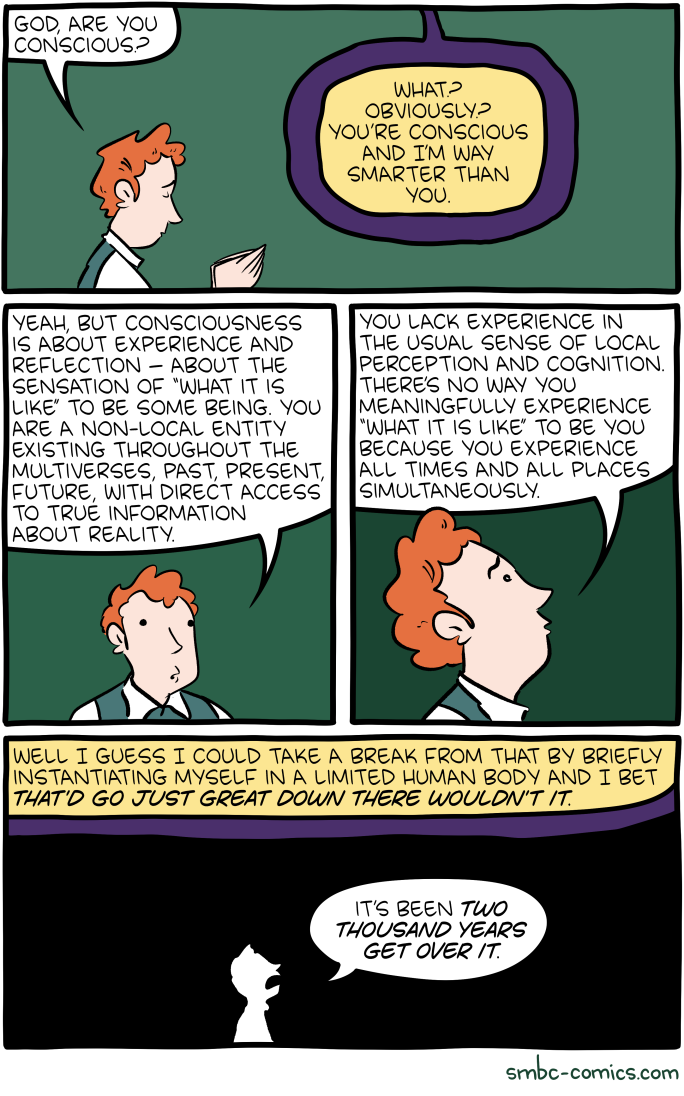
Hovertext:
Oh right, you're experiencing it from a state of total oneness wherein time is without meaning, my bad.
Today's News:
James.galbraithbwahaha
Hovertext:
Oh right, you're experiencing it from a state of total oneness wherein time is without meaning, my bad.
James.galbraithGreat, so remove the shitter app from iOS. Be done.

Enlarge (credit: Anadolu / Contributor | Anadolu)
Elon Musk is so opposed to Apple's plan to integrate OpenAI's ChatGPT with device operating systems that he's seemingly spreading misconceptions while heavily criticizing the partnership.
On X (formerly Twitter), Musk has been criticizing alleged privacy and security risks since the plan was announced Monday at Apple's annual Worldwide Developers Conference.
"If Apple integrates OpenAI at the OS level, then Apple devices will be banned at my companies," Musk posted on X. "That is an unacceptable security violation." In another post responding to Apple CEO Tim Cook, Musk wrote, "Don't want it. Either stop this creepy spyware or all Apple devices will be banned from the premises of my companies."
James.galbraithSeriously...this contrast needs to be made repeatedly. The GOP is utterly craven
Democrats aren’t going to let Republicans get off easy with their hypocrisy on Hunter Biden’s felony conviction. During the GOP-led House Rules Committee meeting Tuesday, Democratic Rep. Jamie Raskin of Maryland called out the difference between the GOP’s response to the convictions of Hunter Biden and Donald Trump.
“Compare and contrast the difference in reaction between the Republicans and the Democrats,” he said. “The Republicans are attacking our entire system of justice and the rule of law because they don't like the way that one case came out, whereas the son of the President of the United States is prosecuted, and I don't hear a single Democrat crying foul.”
Raskin provided a simple explanation as to why Democrats aren’t complaining, screaming, and attacking the court system in the wake of Hunter Biden’s conviction.
“We believe in the rule of law. We believe in the justice system, and we stand by it,” he said.
Hunter Biden was just convicted of every single count that was brought against him by the U.S. Department of Justice. I've not heard a single Democrat anywhere in the country cry, fraud, cry fixed, cry rigged, or cry kangaroo court, or any of the many epithets that our colleagues have mobilized against the U.S. Department of Justice and our federal court system—despite the fact that Donald Trump was not even tried in federal court. That was at the state level.And they pretend to support state prosecutors and state judges. But then they attribute it to the federal government and they say rigged, fixed, kangaroo court, and so on. You don't hear a single peep out of any Democrat saying that. Why? We believe in the rule of law. We believe in the justice system, and we stand by it.
And you know what? Hunter Biden had every right and benefit that Donald Trump had. He had the right to a presumption of innocence. He had a right to counsel, which he exercised like Donald Trump did. He had a right to a jury of his peers, and he had a right to a unanimous verdict. And in both cases, a jury unanimously found against the defendant on all counts—in both cases.
And compare and contrast the difference in reaction between the Republicans and the Democrats. The Republicans are attacking our entire system of justice and the rule of law, because they don't like the way that one case came out, whereas the son of the United States is prosecuted, and I don't hear a single Democrat crying foul. Now, both Hunter Biden and Donald Trump can afford themselves, have every right of appeal that there is.
And we stand by the appellate system. But I think, you know, it's just outrageous to see the way that our colleagues turn on the rule of law and the system of justice. And it's a profoundly dangerous thing that we witness now.
Donald Trump was convicted on 34 counts of falsifying business records on May 30. What are potential voters saying about this historic news? And what is the Biden-Harris campaign doing now that the “teflon Don" is no more?
Campaign ActionJames.galbraithumm what?


Read more of this story at Slashdot.
James.galbraithlol
Donald Trump’s terrible, horrible, no good, very bad days continue, as Forbes reports that New Jersey’s attorney general is "weighing" whether or not he will revoke the liquor licenses of three of Trump’s golf clubs due to his conviction of 34 felonies. Trump is the sole owner of all three New Jersey golf clubs: Bedminster, Colts Neck, and Philadelphia.
“New Jersey law prohibits issuing a liquor license to anyone who has been convicted of a crime ‘involving moral turpitude.’ A state handbook explains that those sorts of crimes typically involve ‘dishonesty, fraud or depravity’ severe enough to typically be punishable by more than a year in prison,” Forbes reports.
In 2019, New Jersey officials threatened Trump’s Colts Neck golf club with revocation of its liquor license after multiple infractions, including an incident in 2015 where the club allegedly overserved someone who was subsequently involved in a fatal car accident.
Less than a week ago, CNN reported that the New York Police Department will revoke Trump’s license to carry a firearm now that he is a convicted felon. Trump reportedly had one of his three licensed guns “lawfully moved to Florida,” but the Sunshine State has similar prohibitions for felons owning firearms.
According to an overview of Florida’s clemency board’s rules regarding felony convictions, it “will not consider requests for firearm authority from individuals convicted in federal or out-of-state courts.”
Additionally, Trump’s conviction could prohibit him from traveling to 37 countries that ban convicted felons from entering, including Canada, the United Kingdom, and Australia.
Perhaps worst of all for Trump, his conviction could lose him voters ahead of the 2024 election.
But the good news for Americans is that Trump’s conviction could not only hurt his chance of winning in November, but it could also be one of the most important victories for the rule of law in U.S. history.
Donald Trump was convicted on 34 counts of falsifying business records on May 30. What are potential voters saying about this historic news? And what is the Biden-Harris campaign doing now that the “teflon Don" is no more?
Campaign ActionJames.galbraithSure, but can it actually handle bad handwriting? lol

The Calculator app is finally coming to iPad. [credit: Samuel Axon ]
CUPERTINO, Calif.—After going into detail about iOS 18, Apple took a few moments in its WWDC 2024 keynote to walk through some changes.
There are a few minor UI changes and new features across Apple's first party apps. That includes a new floating tab bar. The bar expands into the side bar when you want to dig in, and you can customize the tab bar to include the specific things you want to interact with the most. Additionally, SharePlay allows easier screen sharing and remote control of another person's iPad.
But the big news is that the Calculator app we've all used on the iPhone to the iPad, after years of the iPad having no first-party calculator app at all. The iPad Calculator app can do some things the iPhone version can't do with the Apple Pencil; a feature called Math Notes can write out expressions like you would on a piece of paper, and the app will solve the expressions live as you scribble them—plus various other cool live-updating math features. (These new Math Notes features work in the Notes app, too.)
James.galbraithThis is what happens when you keep voting for Republicans
In Kansas, Mississippi, and other states, tax cuts for the wealthy could bring devastating reductions to education, health, and other vital programs.
By Marcus Baram, Capital & Main
Heather Ferguson loves to talk about her daughter’s school in Johnson County, Kansas, and the quality of the state’s education system, citing it as one of the main reasons that she moved here recently from Albuquerque. The school, which she says boasts excellent teachers, is an environmental lab that includes seven acres of woods and ponds where students can study hedgehogs and snakes.
But Ferguson has concerns about recent proposals to cut state income taxes and their potential impact on the education budget. “I don’t want to see wear and tear of the school system” if decreased revenues lead to budget cuts, a scenario which some Kansans fear could be a repeat of the “Brownback experiment” in 2012 and 2013.
That’s when then-Gov. Sam Brownback sharply cut income taxes in the state, guided by conservative think tanks and wealthy donors like Charles Koch. The experiment benefited rich Kansans but decimated the state budget, leading to massive cuts in education and vital services, which in turn resulted in early school closings, cuts to the state’s Medicaid program and delayed highway repairs. The bill cut the taxes of the wealthiest 1% of Kansans, while low-income families saw some of their taxes increase, according to the Center on Budget and Policy Priorities. It also hurt the economy, with job growth in the state trailing far behind that of its neighbors and ranking at less than half the national average, despite business tax cuts that Brownback promised would be a “shot of adrenaline” to the state’s economy.
Though these tax reductions were widely considered a failure, some of the same forces that backed them are now pushing through income tax cuts that largely benefit the wealthy in Kansas as well as in Mississippi and other states.
The return of trickle-down economics—the much-criticized theory that tax cuts for corporations and the wealthy eventually result in job growth and higher wages for the middle class and working class—has inspired a fierce debate in the Kansas Legislature that has gone on for months. A bill that included a flat 5.25% personal income tax, an 8% reduction from the current rate for top earners, was approved by Republicans in both chambers, though critics say it would disproportionately benefit the wealthy in the state.
The top 20% of earners in Kansas—those with average annual incomes above $315,000—would get nearly 40% of the benefits, with Koch himself receiving an estimated $485,000 in annual tax breaks under the proposal, according to the Institute on Taxation and Economic Policy, a nonpartisan research group that favors a progressive tax system. It would also cost the state almost $650 million every year once fully implemented, per ITEP.
The bill was sponsored by two lawmakers who have received campaign contributions from Koch and who have significant ties to the American Legislative Exchange Council (ALEC), a national organization of conservative lawmakers and corporate interests that drafts “model legislation” for state legislatures to adopt and has long advocated for the elimination of state income taxes. Kansas state Sen. Ty Masterson was named the chairman of ALEC in December, and fellow Sen. Caryn Tyson was named the country’s legislator of the year in 2021 by the group. Neither lawmaker returned calls for comment to Capital & Main.
Among other groups pushing for the GOP proposals are Americans for Prosperity, a conservative think tank formed decades ago by the wealthiest men in Kansas, Charles and David Koch. While the proposals were being debated, AFP representatives set up a lemonade stand outside the Kansas State House in Topeka to advertise their views.
When the bill was first introduced, it was met with intense pushback from both Republicans and Democrats. “I’m tired of the trickle-down economics. It doesn’t work,” said GOP Sen. Rob Olson in a speech on the floor of the state Senate.
Facing a likely veto from Democratic Gov. Laura Kelly, the plan was tweaked by Republican leaders in the Legislature but continued to face fierce opposition.
“The only true income tax relief that’s being given is being given to the top bracket, the wealthiest,” Democratic Senator and Senate Minority Leader Vic Miller told the Kansas Reflector. “If you’re going to give tax relief, it should be directed to those who need it the most, not the ones that need it the least.”
When Kelly threatened another veto, Republican lawmakers denounced her as “being a bit of a dictator,” though they failed to get enough votes to override her previous vetoes.
That pushed Tyson to plead with her colleagues: “When you cast this vote, you are the deciding vote … you will decide for the almost 3 million people in Kansas. You decide whether they have tax relief.” She has justified the tax cuts by pointing to the state’s $3 billion budget surplus as well as projections that its revenue is expected to grow 9.7% by the close of the current fiscal year.
Looming over the fierce debate are memories of the Brownback experiment, which Miller calls a “failure that bankrupted the state” and “relied on accounting gimmicks” to “survive the plummet in revenue.” He tells Capital & Main that he’s open to tax cuts, as long as they contain provisions that help middle-class and working-class voters.
Last week, Kelly vetoed the latest Republican proposal, blaming GOP lawmakers for playing “political games with reckless tax policies.” Previously, she had vetoed another bill that included a tax break pushed by Genesis Health Clubs, whose owner is a big donor to Republican legislators in the state.
“Taxpayer dollars should not be diverted to political donors under the guise of tax cuts,” Kelly stated.
Education advocate Adrienne Olejnik, vice president of Kansas Action for Children, told Capital & Main she’s concerned that “a significant shortage of revenue in the future could make cuts to vital family support programs, transportation, K-12 education, and Medicaid the first options lawmakers would seek instead of tax increases.”
Kelly called back members of the Legislature to Topeka for a special session, though she lacks the support for her own proposal that includes a smaller round of tax cuts, along with a child tax credit.
Kansas is not the only state pushing for major tax reductions. Mississippi has fully succeeded in instituting its version of trickle-down economics, with Gov. Tate Reeves pushing two of the biggest income tax cuts in state history. Having won reelection last year, he’s now calling for lawmakers to completely eliminate the personal income tax—which makes up about one-third of state general fund revenue.
And House Speaker Jason White has proposed replacing the income tax with a consumption tax, essentially taxing residents on what they spend rather than what they earn. Such regressive tax systems have been criticized by tax analysts for burdening working-class and middle-class people, who tend to spend more of their income on groceries and other essentials.(White’s predecessor, Philip Gunn, who helped push Reeves’ tax cuts through the state Legislature, has served as past chairman of ALEC’s board of directors.)
Among the most contentious issues in the state is the grocery tax, which at 7% is among the highest in the country and disproportionately hurts poor Mississippians, say advocates. Though there is bipartisan support for cutting that tax, Reeves hasn’t expressed a position on the idea. Reeves and White did not return calls for comment to Capital & Main.
“Sales taxes on groceries have an especially harmful impact on income and racial inequities since low-income families tend to spend a larger share of their income on groceries,” the Center on Budget and Policy Priorities wrote in a 2020 report. “State policymakers looking to make their tax codes more equitable should consider eliminating the sales taxes families pay on groceries if they haven’t already done so, or at least reducing these taxes or partially offsetting them through a tax credit.”
Such a high grocery tax has been an issue for decades, criticized by both Republican and Democratic lawmakers but failing to get enough support to lower it. Back in 2006, late Republican state Sen. Alan Nunnelee said that it “is just the most cruel tax any government can impose.”
The bottom 20% of wage earners in Mississippi (earning less than $19,300) pay 12.4% of their income in state and local taxes, more than any other income group. And the wealthiest 1% in the state, who make more than $362,300, pay just 6.9% of their income in state and local taxes, according to research from ITEP.
That inequity has been criticized by advocates for the poor like Kyra Roby, policy analyst for One Voice, who proposes the addition of a 6% income tax bracket for those earning more than $100,000 annually.
“There is not enough money to fund the programs that Mississippians need,” said Roby. “Our public schools are underfunded by $3.5 billion, our hospitals are closing though we have one of the highest infant and maternal mortality rates in the country, and we have a water crisis, with residents going without water for weeks at a time.”
Yet she admits it’s been hard to convince Mississippians to see the connection between personal income tax cuts that disproportionately benefit the wealthy and painful reductions for such priorities as public education and public health.
“To be honest, it’s been a hard sale to link those everyday things to taxes,” she noted. “People just think, ‘I don’t want to pay taxes.’ There is a lot of explaining in terms of what the impact would be.”
Campaign ActionJames.galbraithumm excuse me?
Read more of this story at Slashdot.
James.galbraithThe fact that this had to come from outside the company is a damning indictment of their own operations

Enlarge / Microsoft's Recall feature is switching to be opt-in by default, and is adding new encryption protections in an effort to safeguard user data. (credit: Microsoft)
Microsoft's upcoming Recall feature in Windows 11 has generated a wave of controversy this week following early testing that revealed huge security holes. The initial version of Recall saves screenshots and a large plaintext database tracking everything that users do on their PCs, and in the current version of the feature, it's trivially easy to steal and view that database and all of those screenshots for any user on a given PC, even if you don't have administrator access. Recall also does little to nothing to redact sensitive information from its screenshots or that database.
Microsoft has announced that it's making some substantial changes to Recall ahead of its release on the first wave of Copilot+ PCs later this month.
"Even before making Recall available to customers, we have heard a clear signal that we can make it easier for people to choose to enable Recall on their Copilot+ PC and improve privacy and security safeguards," wrote Microsoft Windows and Devices Corporate Vice President Pavan Davuluri in a blog post. "With that in mind we are announcing updates that will go into effect before Recall (preview) ships to customers on June 18."
James.galbraithIt really is a fun game
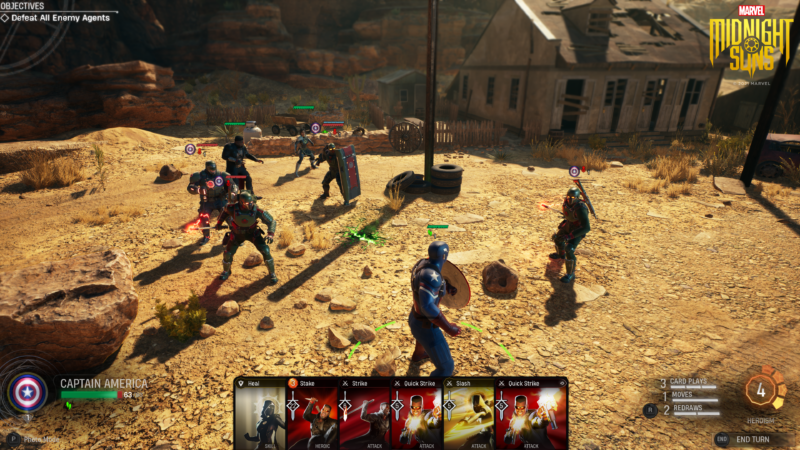
Enlarge / All these goons are targeting Captain America, as shown in icons above their heads. Good. That's just how he likes it. (No, really, he's a tank, that's his thing.) (credit: 2K/Firaxis)
I fully understand why people don't want multiple game launchers on their PC. Steam is the default and good enough for (seemingly) most people. It's not your job to compel competition in the market. You want to launch and play games you enjoy, as do most of us.
So when I tell you that Marvel's Midnight Suns is a game worth the hassle of registering, installing, and using the Epic Games Launcher, I am carefully picking my shot. For the price of giving Epic your email (or a proxy/relay version, like Duck), or just logging in again, you can play a fun, novel, engaging turn-based strategy game, with deckbuilding and positioning tactics, for zero dollars. Even if you feel entirely sapped by Marvel at this point, like most of us, I assure you that this slice of Marvel feels more like the comic books and less like the overexposed current films. Just ask the guy who made it.
The game was very well-regarded by most critics but was not a financial success upon release in December 2022, or was at least "underwhelming." Why any game hits or doesn't is a combination of many factors, but one of them was likely that the game was trying something new. It wasn't just X-COM with Doctor Strange. It had some Fire Emblem relationship-building and base exploration, but it also had cards. The cards blend into the turn-based, positional, chain-building strategy, but some people apparently saw cards and turned away.
James.galbraithOh good

Enlarge (credit: Getty Images/3alexd)
Have electric vehicles been overhyped? A casual observer might have come to that conclusion after almost a year of stories in the media about EVs languishing on lots and letters to the White House asking for a national electrification mandate to be watered down or rolled back. EVs were even a pain point during last year's auto worker industrial action. But a look at the sales data paints a different picture, one where Tesla's outsize role in the market has had a distorting effect.
"EVs are the future. Our numbers bear that out. Current challenges will be overcome by the industry and government, and EVs will regain momentum and will ultimately dominate the automotive market," said Martin Cardell, head of global mobility solutions at consultancy firm EY.
Public perception hasn't been helped by recent memories of supply shortages and pandemic price gouging, but the chorus of concerns about EV sales became noticeably louder toward the end of last year and the beginning of 2024. EV sales in 2023 grew by 47 percent year on year, but the first three months of this year failed to show such massive growth. In fact, sales in Q1 2024 were up only 2.6 percent over the same period in 2023.
James.galbraithThey all have to have seen this coming...Keychain was a pretty clear declaration of war
Read more of this story at Slashdot.
James.galbraithWhy yes, Boeing can get even stupider
Read more of this story at Slashdot.
James.galbraithSeriously...ugh

For decades, New York City has been trying to enact an ambitious experiment to reduce traffic and pollution on some of the most congested roads in the world by charging cars a fee to drive in parts of Manhattan and using the revenue to better fund public transportation.
It’s known as congestion pricing, and after many hard-fought political and legal battles, lawmakers and transit officials had finally agreed on a plan that was set to launch later this month. Mere weeks before the new fees would go into effect, however, New York Gov. Kathy Hochul postponed the implementation of the plan indefinitely, citing economic concerns.
Supporters of the long-planned, much-discussed effort are fuming. The plan’s ultimate goals were to get cars off the road, reduce carbon emissions, and improve public transit, including the New York subway and regional rail. Congestion pricing would have, in other words, made the city safer, cleaner, and easier to get around for the people who live there.
Now, it looks like the city has no plan B.
“It’s a shortsighted decision,” said Sarah Kaufman, the director of New York University’s Rudin Center for Transportation. “It really sums up the approach to American cities as places to live and enjoy versus places to work and visit, and [it] prioritizes the latter.”
Hochul’s decision reflects a broader problem in American urban planning: who we design our cities for. When it comes to street design in particular, drivers are often lawmakers’ chief consideration, not transit riders or pedestrians. That’s why so many highways plow through so many downtowns and residential neighborhoods; why parking spaces are often prioritized over bus or bike lanes or expanded sidewalks; and why congestion pricing seems so politically unfeasible in New York and elsewhere.
When cities are designed with mostly drivers in mind, they tend to be built for commuters and not residents, making them less attractive to live in or even visit outside of work. The decision to scrap the congestion pricing, even temporarily, once again puts commuters over residents and drivers over transit riders.
“It vastly influences the livability of New York City, which is currently just a sea of vehicles in Manhattan below 60th street,” Kaufman said. “It’s a quality of life issue, but also it’s essential for keeping public transit going.”
New York is not the only American city to have considered, and punted on, congestion pricing. Boston, Los Angeles, and Washington, DC, for example, have all explored some version of it for years.
But New York was arguably the best prepared to go through with it: It has a vast network of public transit options that give drivers alternatives should they want a cheaper way to get downtown.
That’s why congestion pricing would have been a surefire way to address traffic problems in the city and its suburbs. But time and time again, when lawmakers are given a chance to finally address traffic — something that everyone hates — they somehow manage to fumble. At some point, though, cities will have to realize: A very good answer already exists. It’s congestion pricing.
Had New York’s plan gone into effect on June 30, drivers would have faced a surcharge to enter the city. During peak hours — 5 am to 9 pm on weekdays and 9 am to 9 pm on weekends — cars would have been charged up to $15 and commercial trucks would have paid $24 or $36, depending on their size. (Cabs and rideshare services would have paid a lower rate.) During off-peak hours, the tolls would have been much cheaper, going down to $3.75 for cars, for example.
That pricing might seem absurdly expensive for drivers. That’s what Hochul emphasized when she abruptly canceled the plan, citing in particular its potential impact on middle-class households.
But congestion pricing is premium-priced by design: The point is to make alternative modes of transportation cheaper and more attractive. Drivers will inevitably be initially upset by the changes they need to make in their commute, but it doesn’t mean congestion pricing is doomed to fail.
Congestion pricing has not only worked in cities outside the United States, but has only grown more popular over time as residents began to notice its benefits.
In New York, it would have served two main purposes: First, by imposing a price steep enough for most people to notice, it would have created a disincentive for people to drive, nudging drivers to ditch their cars and hop on a bus or train instead. Second, the revenue it would have generated would have been directed at much-needed improvements in the region’s public transportation, adding a projected $1 billion annually to the Metropolitan Transportation Authority’s coffers.
The results would have made commuting easier for most people. “The majority of people are commuting by public transit, so having traffic flow more efficiently would help workers arrive on time, would help deliveries arrive on time, and would speed up the efficiency of the city,” Kaufman said.
The improved public transportation service funded by congestion pricing revenue could have saved people time and money. According to New York City’s Independent Budget Office, morning rush-hour subway delays are estimated to cost riders as much as $390 million.
Now, with congestion pricing on hold, it’s unclear how the region will fund the necessary maintenance and operating costs to provide riders with better service.
Hochul said she had concerns about the plan’s impact on the city’s economic recovery. Some business leaders also opposed the plan, saying that they were concerned about losing customers who drive into the city.
But in New York, businesses only benefit from better foot traffic and a more efficient public transit system that can shuttle riders around the city seamlessly. Many of New York’s business leaders are themselves supportive of congestion pricing and expressed frustration with the governor’s decision to suddenly halt the plan.
“The biggest threat to business in New York City is congestion,” said Jarred Johnson, executive director of TransitMatters. “The majority of people frequenting virtually every business in Manhattan … are getting there via the train.”
Those who aren’t taking the train now could be encouraged by congestion pricing, he added, “particularly if New York City is able to invest in the MTA and make that service faster, more reliable, and expand the reach of that. It’s a no-brainer.”
Another argument against congestion pricing is that it’s a regressive tax, one that rich people can easily afford and would disproportionately burden poor people. While New York’s plan had some carveouts, including discounting the surcharge for some lower-income residents, it’s true that any fee could be unaffordable for some low-income drivers.
But at the end of the day, New York’s congestion pricing plan would have impacted a very small number of poor commuters. According to the Community Service Society of New York, a nonprofit organization that provides support services for low-income people, only 2 percent of low-income outer-borough residents would have had to confront the congestion fee for their daily commutes.
Meanwhile, congestion pricing would have largely helped the majority of low-income commuters, who mostly rely on public transit. By reducing the number of cars on the road, for example, buses could avoid rush-hour traffic jams, and commute times would inevitably become shorter and more manageable. And by bolstering funding for the MTA, commuters would have a more efficient and reliable transit network that wouldn’t have to rely on fare hikes to keep it afloat.
New York’s congestion pricing plan has always faced fierce opposition and was still being contested in several different lawsuits when Hochul postponed it, including one from New Jersey alleging that the plan placed an unfair financial burden on its residents and that it might potentially cause more pollution. But various studies and reports, including from the federal government, found that the congestion pricing plan would have the exact opposite effect.
Ultimately, the best way to get people out of cars is to design cities for people, not cars.
That means building walkable streets, running a smooth public transit system that reaches each corner of the city, and, at times, making it less convenient to drive. Congestion pricing only helps cities make that vision a reality by funding major transit projects and making driving less appealing. That’s not an entirely foreign concept for Americans: After all, many drivers are already accustomed to paying tolls to drive on certain roads, tunnels, and bridges.
There are also tangible examples of congestion pricing that show the policy works. Cities such as Stockholm, London, and Singapore have all levied a surcharge on drivers coming into their downtowns, and they have noticed the benefits: When Stockholm first implemented its policy, traffic instantly plunged by 20 percent. The environmental impact is also consequential: In London, carbon dioxide emissions decreased by 20 percent. Singapore has seen similar results, increasing transit ridership and reducing people’s reliance on fossil fuels.
Despite Hochul indefinitely scrapping New York’s plans for congestion pricing, declaring the program dead is premature. The Metropolitan Transportation Authority had already inked a $500 million contract with a company to install the necessary equipment, like overhead E-Z Pass readers.
Hochul’s shortsighted decision might render that infrastructure useless for the time being, but New York now has it set up and ready to go. The only thing necessary to flip the switch is the political will.
“One of the things that’s incredibly frustrating about this is that it’s delaying the inevitable,” Johnson said. “For cities that are really trying to compete on a national and worldwide stage, you either have an ancient system that has [many] unfunded modernization and repair needs, or you have a small system that is overly reliant on buses stuck in traffic.”
Congestion pricing, in other words, is a necessary component of making cities more attractive, livable, and environmentally friendly.
That’s why there’s still room for hope. “For electeds who are serious people and who are trying to actually solve a problem,” Johnson said, “they’re going to realize this is the only way to have an impact on traffic congestion.”
James.galbraithYes indeed

Indian Prime Minister Narendra Modi is, by some measures, the most popular leader in the world. Prior to the 2024 election, his Bharatiya Janata Party (BJP) held an outright majority in the Lok Sabha (India’s Parliament) — one that was widely projected to grow after the vote count. The party regularly boasted that it would win 400 Lok Sabha seats, easily enough to amend India’s constitution along the party’s preferred Hindu nationalist lines.
But when the results were announced on Tuesday, the BJP held just 240 seats. They not only underperformed expectations, they actually lost their parliamentary majority. While Modi will remain prime minister, he will do so at the helm of a coalition government — meaning that he will depend on other parties to stay in office, making it harder to continue his ongoing assault on Indian democracy.
So what happened? Why did Indian voters deal a devastating blow to a prime minister who, by all measures, they mostly seem to like?
India is a massive country — the most populous in the world — and one of the most diverse, making its internal politics exceedingly complicated. A definitive assessment of the election would require granular data on voter breakdown across caste, class, linguistic, religious, age, and gender divides. At present, those numbers don’t exist in sufficient detail.
But after looking at the information that is available and speaking with several leading experts on Indian politics, there are at least three conclusions that I’m comfortable drawing.
First, voters punished Modi for putting his Hindu nationalist agenda ahead of fixing India’s unequal economy. Second, Indian voters had some real concerns about the decline of liberal democracy under BJP rule. Third, the opposition parties waged a smart campaign that took advantage of Modi’s vulnerabilities on the economy and democracy.
Understanding these factors isn’t just important for Indians. The country’s election has some universal lessons for how to beat a would-be authoritarian — ones that Americans especially might want to heed heading into its election in November.
Modi’s biggest and most surprising losses came in India’s two most populous states: Uttar Pradesh in the north and Maharashtra in the west. Both states had previously been BJP strongholds — places where the party’s core tactic of pitting the Hindu majority against the Muslim minority had seemingly cemented Hindu support for Modi and his allies.
One prominent Indian analyst, Yogendra Yadav, saw the cracks in advance. Swimming against the tide of Indian media, he correctly predicted that the BJP would fall short of a governing majority.
Traveling through the country, but especially rural Uttar Pradesh, he prophesied “the return of normal politics”: that Indian voters were no longer held spellbound by Modi’s charismatic nationalist appeals and were instead starting to worry about the way politics was affecting their lives.
Yadav’s conclusions derived in no small part from hearing voters’ concerns about the economy. The issue wasn’t GDP growth — India’s is the fastest-growing economy in the world — but rather the distribution of growth’s fruits. While some of Modi’s top allies struck it rich, many ordinary Indians suffered. Nearly half of all Indians between 20 and 24 are unemployed; Indian farmers have repeatedly protested Modi policies that they felt hurt their livelihoods.
“Everyone was talking about price rise, unemployment, the state of public services, the plight of farmers, [and] the struggles of labor,” Yadav wrote.

According to Pavithra Suryanarayan, a political scientist at the London School of Economics, this sort of discontent was quite visible on the ground. In the months prior to the election, she conducted research in three regions of India on public perceptions of Modi’s economic policy. She found that voters blamed Modi for three major economic policy mistakes: a failed attempt to replace cash payments with electronic transfers, a disastrous Covid-19 response, and a tax on goods and services that favored the wealthy over small businesses.
“These three economic calamities compounded into general dissatisfaction with economic mismanagement,” she tells me.
In general, she believes there’s a sense among Indian voters that the BJP saw them as “recipients of schemes” rather than “rights-bearing citizens,” meaning that Modi’s government put various policy experiments ahead of basic capabilities to provide good jobs, access to health care, and high-quality education.
Interestingly, many of these policies are not new. We’re several years out of the pandemic, and the demonetization experiment took place all the way back in 2016. Indian voters know that Modi has been in power for 10 years and seem to have turned against the incumbent based on a general sense that he’s botched certain elements of his governing agenda.
“We know for sure that Modi’s strongman image and brassy self-confidence were not as popular with voters as the BJP assumed,” says Sadanand Dhume, a senior fellow at the American Enterprise Institute who studies India.
The lesson here isn’t that the pocketbook concerns trump identity-based appeals everywhere; recent evidence in wealthier democracies suggests the opposite is true. Rather, it’s that even entrenched reputations of populist leaders are not unshakeable. When they make errors, even some time ago, it’s possible to get voters to remember these mistakes and prioritize them over whatever culture war the populist is peddling at the moment.
The Indian constitution is a liberal document: It guarantees equality of all citizens and enshrines measures designed to enshrine said equality into law. The signature goal of Modi’s time in power has been to rip this liberal edifice down and replace it with a Hindu nationalist model that pushes non-Hindus to the social margins. In pursuit of this agenda, the BJP has concentrated power in Modi’s hands and undermined key pillars of Indian democracy (like a free press and independent judiciary).
Prior to the election, there was a sense that Indian voters either didn’t much care about the assault on liberal democracy or mostly agreed with it. But the BJP’s surprising underperformance suggests otherwise.
The Hindu, a leading Indian newspaper, published an essential post-election data analysis breaking down what we know about the results. One of the more striking findings is that the opposition parties surged in parliamentary seats reserved for members of “scheduled castes” — the legal term for Dalits, the lowest caste grouping in the Hindu hierarchy.
Caste has long been an essential cleavage in Indian politics, with Dalits typically favoring the left-wing Congress party over the BJP (long seen as an upper-caste party). Under Modi, the BJP had seemingly tamped down on the salience of class by elevating all Hindus — including Dalits — over Muslims. Yet now it’s looking like Dalits were flocking back to Congress and its allies. Why?
According to experts, Dalit voters feared the consequences of a BJP landslide. If Modi’s party achieved its 400-seat target, they’d have more than enough votes to amend India’s constitution. Since the constitution contains several protections designed to promote Dalit equality — including a first-in-the-world affirmative action system — that seemed like a serious threat to the community. It seems, at least based on preliminary data, that they voted accordingly.

The Dalit vote is but one example of the ways in which Modi’s brazen willingness to assail Indian institutions likely alienated voters.
Uttar Pradesh (UP), India’s largest and most electorally important state, was the site of a major BJP anti-Muslim campaign. It unofficially kicked off its campaign in the UP city of Ayodhya earlier this year, during a ceremony celebrating one of Modi’s crowning achievements: the construction of a Hindu temple on the site of a former mosque that had been torn down by Hindu nationalists in 1992.
Yet not only did the BJP lose UP, it specifically lost the constituency — the city of Faizabad — in which the Ayodhya temple is located. It’s as direct an electoral rebuke to BJP ideology as one can imagine.
In Maharashtra, the second largest state, the BJP made a tactical alliance with a local politician, Ajit Pawar, facing serious corruption charges. Voters seemingly punished Modi’s party for turning a blind eye to Pawar’s offenses against the public trust. Across the country, Muslim voters turned out for the opposition to defend their rights against Modi’s attacks.
The global lesson here is clear: Even popular authoritarians can overreach.
By turning “400 seats” into a campaign slogan, an all-but-open signal that he intended to remake the Indian state in his illiberal image, Modi practically rang an alarm bell for constituencies worried about the consequences. So they turned out to stop him en masse.
The BJP’s electoral underperformance is, in no small part, the direct result of their leader’s zealotry going too far.
Of course, Modi’s mistakes might not have mattered had his rivals failed to capitalize. The Indian opposition, however, was far more effective than most observers anticipated.
Perhaps most importantly, the many opposition parties coordinated with each other. Forming a united bloc called INDIA (Indian National Developmental Inclusive Alliance), they worked to make sure they weren’t stealing votes from each other in critical constituencies, positioning INDIA coalition candidates to win straight fights against BJP rivals.
The leading party in the opposition bloc — Congress — was also more put together than people thought. Its most prominent leader, Rahul Gandhi, was widely dismissed as a dilettante nepo baby: a pale imitation of his father Rajiv and grandmother Indira, both former Congress prime ministers. Now his critics are rethinking things.
“I owe Rahul Gandhi an apology because I seriously underestimated him,” says Manjari Miller, a senior fellow at the Council on Foreign Relations.
Miller singled out Gandhi’s yatras (marches) across India as a particularly canny tactic. These physically grueling voyages across the length and breadth of India showed that he wasn’t just a privileged son of Indian political royalty, but a politician willing to take risks and meet ordinary Indians where they were. During the yatras, he would meet directly with voters from marginalized groups and rail against Modi’s politics of hate.

“The persona he’s developed — as somebody kind, caring, inclusive, [and] resolute in the face of bullying — has really worked and captured the imagination of younger India,” says Suryanarayan. “If you’ve spent any time on Instagram Reels, [you’ll see] an entire generation now waking up to Rahul Gandhi’s very appealing videos.”
This, too, has a lesson for the rest of the world: Tactical innovation from the opposition matters even in an unfair electoral context.
There is no doubt that, in the past 10 years, the BJP stacked the political deck against its opponents. They consolidated control over large chunks of the national media, changed campaign finance law to favor themselves, suborned the famously independent Indian Electoral Commission, and even intimidated the Supreme Court into letting them get away with it.
The opposition, though, managed to find ways to compete even under unfair circumstances. Strategic coordination between them helped consolidate resources and ameliorate the BJP cash advantage. Direct voter outreach like the yatra helped circumvent BJP dominance in the national media.
To be clear, the opposition still did not win a majority. Modi will have a third term in office, likely thanks in large part to the ways he rigged the system in his favor.
Yet there is no doubt that the opposition deserves to celebrate. Modi’s power has been constrained and the myth of his invincibility wounded, perhaps mortally. Indian voters, like those in Brazil and Poland before them, have dealt a major blow to their homegrown authoritarian faction.
And that is something worth celebrating.
James.galbraithif only they could feel shame...
A county sheriff in California shared a novel idea with his Instagram followers this week.
"I think it’s time we put a felon in the White House,” Riverside County Sheriff Chad Bianco said, donning his uniform in a video posted to his personal account.
But it turns out Bianco, a Trump supporter, is more of a lagging indicator than a leader. A new YouGov survey published this week found that a majority of Republicans now say they are just fine with electing a criminal president—a wholesale change from their views on the matter before Trump was convicted of 34 felonies.
In April, just 17% of Republican voters said convicted criminals "should be allowed" to become president while 58% said they should not. But, hey, sometimes life comes at you fast. Now 58% of Republicans say felons "should be allowed" to be president, while just 23% say they should not.
In April, 37% of Republicans also said they wouldn't vote for a convicted felon "under any circumstances." Now just 14% say that.
Indeed, Trump's indictment and conviction have been transformative for the Republican electorate. In March 2023, when Republicans were asked whether it's a crime for a candidate seeking elected office "to pay someone to remain silent about an issue that may affect the outcome of an election," 73% of them said it was a crime. But a month later, following Trump's April 2023 indictment in the hush money case, only 40% of Republicans said it's a crime.
That's some major whiplash. And if it wasn't so predictable, it would be preposterous that a majority of Republicans are now putting out a presidential welcome mat for convicted felons.
But MAGA Republicans were always going to rally around Trump, regardless of his criminal status. It's the 23% of Republicans who still feel queasy about electing a felon president that matters.
In fact, on the margins, Biden has gained on Trump since his conviction, particularly among low information voters. The New York Times recontacted nearly 2,000 voters from its pre-conviction polls and found that Biden is picking up 2 points on Trump, putting the race at 46% Biden and 47% Trump.
"The shift was especially pronounced among the young, nonwhite, and disengaged Democratic-leaning voters," who had pushed Trump's lead in earlier polling, wrote The Times. And among the so-called double-haters, who don't like either Biden or Trump, Trump shed more than 20% support, with half going to Biden and half retreating to undecided.
So it looks like MAGA Republicans aren't the only voters having a change of heart since Trump’s conviction.
Let’s say it all together now: No convicted felons in the White House!
Donald Trump was convicted on 34 counts of falsifying business records on May 30. What are potential voters saying about this historic news? And what is the Biden-Harris campaign doing now that the “teflon Don" is no more?
James.galbraithGOP backing the blue if they dare to oppose a single thing the GOP does
A visit to the Pennsylvania House floor by two former police officers who helped protect the U.S. Capitol during the Jan. 6 riot of 2021 drew boos and walkouts by some Republican legislators this week.
Witnesses said the appearance Wednesday by former U.S. Capitol Police Officer Harry Dunn and his ex-boss, former Sgt. Aquilino Gonell, triggered a distinctly negative response from some Republicans, with someone even shouting that they were cowards.
House Speaker Joanna McClinton, D-Philadelphia, who welcomed Gonell and Dunn to the floor, called the GOP reaction to the former officers disrespectful. She said in a statement that many Republican members walked off the floor, turned their backs and booed.
“The GOP members’ shameful behavior was unbecoming of our institution for any guest, let alone two of the men responsible for defending our democracy during a dark day in our nation’s history," McClinton said. ”The Republicans’ disrespect, lack of patriotism and even common decency, epitomizes the poor behavior that so many in the MAGA movement have adopted."
In a text on Thursday, Dunn said he heard a commotion but could not make out what was being said. He thanked Republican Minority Leader Bryan Cutler of Lancaster County for taking a photo with them.
Dunn said he was “honored to be there being recognized.” The two had made an appearance a few hours earlier Wednesday on the steps of the Pennsylvania Capitol at an event coordinated by the campaign of President Joe Biden.
Video from the scene in the chamber as business was wrapping up for the week showed several Republican members and staff, including Cutler, applauding the officers. Cutler later noted House Democrats sent out a fundraising email immediately afterward.
“The truth is, I support law enforcement. I spoke to the gentlemen about the job they performed,” Cutler told reporters Wednesday afternoon. “And I think that when you look at it, I’m tired of the House speaker using the guest list and the legislative calendar for political purposes.”
The House Democratic Campaign Committee solicitation said “House Republicans couldn’t leave the floor fast enough in protest” and asked for contributions “to help us defend our democracy” and keep their House majority.
At the Biden campaign event earlier on the state Capitol steps, Dunn and Gonell were flanked by more than a dozen Democratic lawmakers. The two warned at the appearance that they see former president and current GOP presidential candidate Donald Trump as a danger to democracy.
“Donald Trump is the greatest threat to our democracy and the safety of communities across the country today,” Dunn told reporters. “He has encouraged and continues to encourage political violence. ... His deranged, self-centered, obsessive quest for power is the reason violent insurrectionists assaulted me and my brave colleagues.”
Hundreds of law enforcement officers were beaten and bloodied in the attack by Trump supporters, who descended after a rally and smashed into the Capitol while Trump remained silent for hours.
Gonell said the attackers assaulted him repeatedly. He recounted how he was beaten, punched, kicked and hit with his own baton in the head. Someone tried to drag him into the mob and beat him with an American flag still attached to a flagpole, he said. Gonell said his injuries required two surgeries.
“Donald Trump called the people who injured me and attacked our Capitol hostages, patriots and political prisoners. If those people are those things, who are we?" Gonnell said, adding that the officers on Jan. 6 were defending elected officials from both parties "regardless of their political ideology,”
Dunn, who is Black, has previously described how the crowd in the Capitol yelled racial slurs at him, something that never happened while he was on duty during more than a dozen years on the force.
Rep. Mike Schlossberg, D-Lehigh, said he witnessed his Republican colleagues' response on Wednesday and heard one member refer to Trump supporter Ashli Babbitt, who was shot and killed by police inside the U.S. Capitol during the rioting.
He said he saw two Republican members walking out and that other Democrats reported that as many as 10 GOP House members did so. It was a notable contrast to the solemn respect that normally greets soldiers and police officers when they are recognized on the House floor, he said.
The cheering that can be heard on a video of the House activity was a Democratic attempt to loudly cheer over the booing, Schlossberg said.
“It was despicable and it was an embarrassment,” he said. “This is the party that supposedly cherishes law and order.”
Campaign ActionJames.galbraithLost? it's not lost, it's been murdered and the body dumped by the side of the road.
A cartoon by Clay Bennett.
Campaign ActionJames.galbraithAnd they want $1B for this shit? They'd better get the Truth Social lemmings to buy it, since no rational human would take that valuation
Read more of this story at Slashdot.
James.galbraithlol
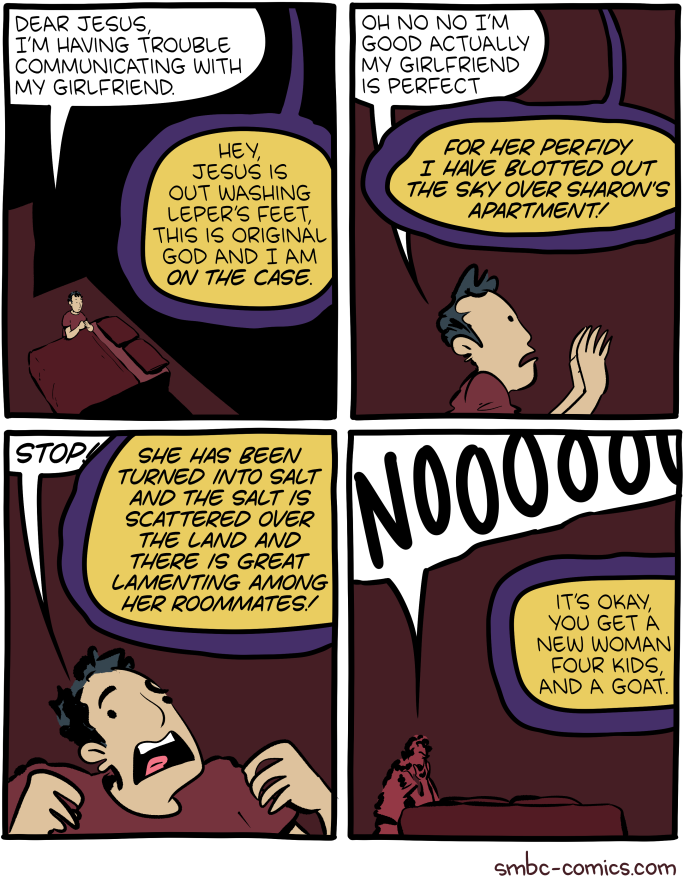
Hovertext:
This is why He stopped answering prayers.
James.galbraithlol

Enlarge / The Humane AI Pin.
The Humane AI Pin has launched, crashed, and burned, with founders already looking to sell the company just one month after launch. The New York Times has an article detailing exactly how the company got to the point of launching a dead-on-arrival product and provided a few updates on the sales of the product and the company.
Humane, if you haven't heard, is a company founded by two former Apple employees, Imran Chaudhri and Bethany Bongiorno, in 2018. The company raised $230 million from some big-name investors like OpenAI CEO Sam Altman and Salesforce CEO Marc Benioff, and, before launch, was valued at $1 billion. The product, the AI Pin, is sort of trying to be a Star Trek communicator. You magnetically clip it onto your shirt and can tap it for voice commands. It has "no apps" (the founders bragged about this feature) and is mostly just a voice assistant box with a touch panel, battery, camera, and speaker/microphone. There's no traditional screen, but a laser projector can shoot a smartwatch-like UI onto your hand that you control with gestures.
The going rate for one of these things is $700, plus a $24 a month subscription, a hard sell in the face of a $400 Apple Watch. It also doesn't really work and was universally panned in reviews, with conclusions ranging from The Verge's "not even close" to Marques Brownlee's "the worst product I've ever reviewed." Apparently, the voice commands are very slow, the battery life is an awful two to four hours, it's heavy and drags down your shirt, and the projector doesn't work well in many lighting conditions. It's also reportedly a fire hazard, with Humane emailing customers this week and telling them to "immediately stop using and charging" the battery case because some units with defective batteries "may pose a fire safety risk."
James.galbraithoh look, more blatant corruption
An appeals court has halted the Georgia election interference case against former President Donald Trump and others while it reviews the lower court judge's ruling allowing Fulton County District Attorney Fani Willis to remain on the case.
The Georgia Court of Appeals' order on Wednesday prevents Fulton County Superior Court Judge Scott McAfee from moving forward with pretrial motions as he had planned while the appeal is pending. While it was already unlikely that the case would go to trial before the November general election, when Trump is expected to be the Republican nominee for president, this makes that even more certain.
The appeals court on Monday docketed the appeals filed by Trump and eight others and said that “if oral argument is requested and granted” it is tentatively scheduled for Oct. 4. The court will then have until mid-March to rule, and the losing side will be able to appeal to the Georgia Supreme Court.
A spokesperson for Willis declined to comment on the appeals court ruling.
A Fulton County grand jury in August indicted Trump and 18 others, accusing them of participating in a sprawling scheme to illegally try to overturn the 2020 presidential election in Georgia. Four defendants have pleaded guilty after reaching deals with prosecutors, but Trump and the others have pleaded not guilty. It is one of four criminal cases against Trump.
Trump and eight other defendants had tried to get Willis and her office removed from the case, arguing that a romantic relationship she had with special prosecutor Nathan Wade created a conflict of interest. McAfee in March found that no conflict of interest existed that should force Willis off the case, but he granted a request from Trump and the other defendants to seek an appeal of his ruling from the state Court of Appeals.
McAfee wrote that “an odor of mendacity remains.” He said “reasonable questions” over whether Willis and Wade had testified truthfully about the timing of their relationship “further underpin the finding of an appearance of impropriety and the need to make proportional efforts to cure it.” He said Willis could remain on the case only if Wade left, and the special prosecutor submitted his resignation hours later.
The allegations that Willis had improperly benefited from her romance with Wade resulted in a tumultuous couple of months in the case as intimate details of Willis and Wade’s personal lives were aired in court in mid-February.
Campaign ActionJames.galbraithCut the ads now
Sure, the Republican Party wants to convince voters they really aren’t that radical when it comes to reproductive rights. But voting against a bill to protect access to birth control isn’t the way to do it.
On Wednesday, almost every Senate Republican voted to block the Right to Contraception Act—legislation that should be uncontroversial and unobjectionable. Only two Republicans, Susan Collins and Lisa Murkowski, voted to let the bill move forward.
“The right to contraception is a fundamental right, central to a person’s privacy, health, wellbeing, dignity, liberty, equality, and ability to participate in the social and economic life of the Nation,” the bill states. So yes, you can see why Republicans—who don’t value any of those things—took issue with it.
Of course, that’s not the justification they’re giving.
“This is a show vote. It’s not serious,” Texas Sen. John Cornyn said. “It’s a phony vote because contraception, to my knowledge, is not illegal. It’s not unavailable.”
Sure, it’s not illegal or unavailable now. But that’s hardly the point.
The point is that there are plenty of Republicans who’ve said it should be illegal or at least unavailable or at least highly restricted.
One of those Republicans is Donald Trump. Perhaps Cornyn’s heard of him? Just last month, Trump said that contraception, like abortion, should probably be decided by the states. He also promised a “very comprehensive” plan he’s yet to deliver.
Another one of those Republicans Cornyn might know? Supreme Court Justice Clarence Thomas, who has not been quite as explicit as Trump. But pretty close. In his concurring opinion in Dobbs v. Jackson Women’s Health—the case that overturned Roe v. Wade—he wrote that the court should next overturn Griswold v. Connecticut, the case that recognized a right to birth control.
And it’s because of those threats to birth control that Senate Democrats want to act now to protect the right to contraception before it’s too late.
"Today, we live in a country where not only tens of millions of women have been robbed of their reproductive freedoms. We also live in a country where tens of millions more worry about something as basic as birth control," Majority Leader Chuck Schumer said Wednesday. "That's utterly medieval."
It’s not just utterly medieval; it’s also a threat. First, abortion and next up: birth control.
"If Roe v. Wade can fall, anything can fall,” House Minority Leader Hakeem Jeffries said in a recent “60 Minutes” interview. That’s the lesson Democrats have had to learn the hard way.
The lesson Republicans are now learning the hard way is that fighting to get rid of a freedom the majority of Americans supports is really unpopular. Really super very unpopular. Which is why they’ve been scrambling to find a way to talk about it without sounding like the radical extremist freaks they are.
And it’s why Senate Republicans are now pretending they don’t have a problem with contraception—they just don’t like the bill to protect it.
“We will have an alternative that will make very clear that Republicans are for contraception,” GOP Whip John Thune said. Yeah, sure they will. And what will make their bill better?
According to Iowa’s Joni Ernst, who’s supposedly working on her own bill, it will be better because it will cover less contraception. No, that’s not a joke.
“It does not include Plan B, which many folks on the right would consider abortive services,” she said. The fact that “many folks” consider emergency contraception “abortive services” does not make it so. And that’s according to actual doctors, not radical right-wing activists.
But it’s those radical right-wing activists Republican senators can’t resist, even as they’re trying to convince voters they really aren’t that radical. So they’ve blocked a bill to protect contraception, with only the empty and vague promise to voters that there’s no need to worry, it’s perfectly safe. For now.
Campaign ActionJames.galbraithjesus

Enlarge (credit: gmast3r | iStock / Getty Images Plus)
After the most downloaded local news app in the US, NewsBreak, shared an AI-generated story about a fake New Jersey shooting last Christmas Eve, New Jersey police had to post a statement online to reassure troubled citizens that the story was "entirely false," Reuters reported.
"Nothing even similar to this story occurred on or around Christmas, or even in recent memory for the area they described," the cops' Facebook post said. "It seems this 'news' outlet's AI writes fiction they have no problem publishing to readers."
It took NewsBreak—which attracts over 50 million monthly users—four days to remove the fake shooting story, and it apparently wasn't an isolated incident. According to Reuters, NewsBreak's AI tool, which scrapes the web and helps rewrite local news stories, has been used to publish at least 40 misleading or erroneous stories since 2021.
James.galbraithLeast surprising article of the day
By Jerod MacDonald-Evoy, Arizona Mirror
A newly released report details how white nationalist groups and other hate groups are seeing an increase in their numbers and boldness, including Arizona.
The Southern Poverty Law Center released its year in hate and extremism report for 2023 and the organization said that 2023 marks the highest number of groups tracked by the nonprofit organization since they began tracking in 1990.
In total, the organization tracked 1,430 hate and anti-government extremist groups across the country, including 38 in Arizona. There has been a steady increase in the Grand Canyon State since 2000.
“What we are seeing now should be a wake up call to all of us,” Margaret Huang, CEO of the SPLC, said in a call with reporters Tuesday morning.
The increase is a continued trend, as last year’s report on 2022 saw similar increases.
Of Arizona’s 38 groups, 18 are hate groups aimed at minority groups or women, while the remaining 20 are classified as anti-government groups.
“Antisemitic narratives seeped into mainstream narratives at an alarming rate in 2023,” R.G. Cravens, a senior researcher for SPLC, told reporters.
Cravens cited the ongoing conflict between Israel and Palestine as aiding in inciting certain antisemitic hate groups.
Many of these groups are participating more in demonstrations and flyering. The SPLC stressed that many of these groups, despite some shared beliefs, operate as a “loose decentralized network of organizations.”
The SPLC noted a 50% increase in white nationalist organizations across the country, something it attributed to extremists feeling emboldened by politicians engaging with policy ideas that have long been supported by extremist groups.
In particular, white nationalist groups participated in a large number of anti-LGBTQ+ demonstrations, with nearly 50% of all their demonstrations aimed at the LGBTQ+ community.
“The mainstream right is pursuing a policy agenda that is very much in line with what the white power movement wants,” Cassie Miller, a senior researcher at SPLC, said.
Some of those policy ideas include “male supremacist” ideologies that target women and advocate taking away their reproductive rights and other forms of autonomy. Arizona was one of 10 states that introduced legislation aimed at abolishing abortion supported by these male supremacist groups.
Arizona also made news for some of its anti-LGBTQ+ demonstrations, including an assault on an ASU professor by two members of Phoenix-based Turning Point USA. A number of drag story hours were also disrupted in the state, with one receiving a bomb threat while children were actively in the building.
Huang stressed that, given this is an election year, more attention needs to be focused on these groups which are already aiming to intervene in the upcoming election and some are actively seeking office.
“We must act now to counter disinformation, radicalization and threats to voters and election workers,” Huang said. “More than ever, it is imperative that we preserve and strengthen our democracy.”
James.galbraith*snork*
Receive my weekly newsletter and keep this work sustainable by joining the Sorensen Subscription Service! Also on Patreon.
James.galbraithReminder that WSJ is just a GOP shop through and through
The Wall Street Journal published a seemingly damning story on Tuesday night about President Joe Biden’s diminishing mental acuity, with a headline guaranteed to cause panic: “Behind Closed Doors, Biden Shows Signs of Slipping.”
With a header like that, you might think the Journal really has the goods on Biden this time, with quotes from dozens of sources within the White House, likely speaking anonymously for fear of appearing to betray their boss with the damaging confessions about how he, in fact, is too old and unfit to be president for another term.
But no. Who does the Journal have? Republican House Speaker Mike Johnson. And former Republican House Speaker Kevin McCarthy. And Idaho Sen. James Risch, who is—as you might have guessed—a Republican.
Contrary to its terrifying headline, what the Journal has is a blatant hit piece from Republicans who are shamelessly pushing the Republican talking point that Biden—who is only four years older than Donald Trump—is oh so very, very old. Concerningly so.
Let’s take a closer look at this smear masquerading as reporting.
In a February one-on-one chat in the Oval Office with House Speaker Mike Johnson, the president said a recent policy change by his administration that jeopardizes some big energy projects was just a study, according to six people told at the time about what Johnson said had happened. Johnson worried the president’s memory had slipped about the details of his own policy.
In other words, Johnson is concerned about Biden’s memory, according to “six people” Johnson told. Were those six people Democrats? The report doesn’t say, but it’s probably a safe bet that the answer is no. So, the Republican speaker told six other Republicans about Biden’s supposedly bad memory. And those six Republicans dutifully informed the Journal of Johnson’s definitely not partisan or biased or perhaps entirely bullshit concerns.
Amazingly, you know who else shares those concerns? Johnson’s predecessor—also a Republican.
Last year, when Biden was negotiating with House Republicans to lift the debt ceiling, his demeanor and command of the details seemed to shift from one day to the next, according to then-House Speaker Kevin McCarthy and two others familiar with the talks. On some days, he had loose and spontaneous exchanges with Republicans, and on others he mumbled and appeared to rely on notes.“I used to meet with him when he was vice president. I’d go to his house,” McCarthy said in an interview. “He’s not the same person.”
No reason at all to think that McCarthy is anything but an objective and unbiased source, except for the fact that he’s a dethroned former House speaker with a reputation for being so excessively and cynically partisan that his fellow Republicans tanked his first run for the top job in 2015 because his big mouth got the party in trouble.
So what else does the Journal have to justify such a shocking headline?
Questions about Biden’s age were amplified in February when Special Counsel Robert K. Hur, who interviewed him for roughly five hours over two days in October during the probe into his handling of classified documents, reported that Biden’s memory had been “significantly limited.”
Ah yes, questions about Biden’s age were “amplified.” The classic passive voice that allows reporters to avoid having to spell out who exactly did the amplifying.
Well, there was The New York Times, where the opinion pages were filled with hand-wringing about Biden’s age and how voters are so much more concerned about the 81-year-old president than his 77-year-old opponent.
And of course there were the Republicans in the House, who quickly announced they would launch an investigation into just how very old Biden is. Their hearing on the matter didn’t exactly go as planned, though, and they ended up embarrassing themselves more than anything else.
Does the Journal offer any other evidence of Biden’s “signs of slipping”?
The president moved so slowly around the Cabinet Room to greet the nearly two dozen congressional leaders that it took about 10 minutes for the meeting to begin, some people who attended recalled.
The famously gregarious Biden, taking his time to make his way around a room of more than 20 VIPs and share a personal word with each one? The same Biden who spent over half an hour gabbing with attendees after his State of the Union address—long after Johnson closed the House session and turned off the lights? Hard to believe.
The Journal does at least include a quote from House Minority Leader Hakeem Jeffries, who has an entirely different—and on the record—take on that same meeting. And the Journal did talk to several other on-the-record White House staffers who disputed the anonymous GOP gossip about the meeting. And there’s also Gene Sperling, a Biden aide, who said that it’s perfectly normal and standard practice for presidents to read from their notes in such meetings.
But that’s somehow far less compelling than what Republican leaders and former leaders and their staff have to say. Thus, a headline that Biden is slipping, not a headline that Republicans say Biden is slipping even though a bunch of other people disagree.
“What you see on TV is what you get,” said Sen. James E. Risch, an Idaho Republican, who attended the meeting but shared only his general impression of meetings with Biden. “These people who keep talking about what a dynamo he is behind closed doors—they need to get him out from behind closed doors, because I didn’t see it.”
Oh, is that the smoking gun? A Republican senator says Biden isn’t a “dynamo.” Certainly he has no agenda.
The article goes on and on—and on and on; it’s over 3,000 words long—like this. Unnamed “people” say negative things about meetings with Biden. Named Democrats and government officials dispute those descriptions.
“I found him to be the same Joe Biden that I’ve known since I came to Congress,” said Rep. Gregory Meeks, a Democrat elected in 1998, who attended one of these supposedly problematic meetings.
But on and on the Journal goes.
Another story suggests that Biden didn’t understand his own energy policy. At least, that’s Johnson’s version of events, as filtered through “several people familiar with Johnson’s version of what happened.” Those unidentified Johnson confidantes also claim Johnson was “dismayed” by Biden’s failing memory.
But then, that’s just Johnson’s version.
Meanwhile, White House spokesperson Andrew Bates calls that take “a false account.”
So who's telling the truth? Of course, the Journal doesn’t say. It lets the readers decide with its extremely objective headline definitively telling them that Biden is “slipping.”
Naturally, Johnson didn’t want his fingerprints on this hit job.
“Johnson declined to be interviewed for this article,” the article says. But not to worry—Johnson’s spokesperson, Taylor Haulsee, confirmed that Johnson stands by all of it.
And on and on it goes.
Does it matter that Democrats refute the Republican version of each incident in the report? Apparently not. Does it matter that Republicans are pushing a campaign talking point they’ve been pushing for months about Biden’s mental fitness? Apparently not.
What matters is that “people” are concerned, and that’s quite enough to justify the story and its headline.
The article ends with this anecdote:
As Republican negotiators drove away from the White House, they called a colleague to update him on the talks, according to someone familiar with the call. One topic of discussion: the president and his acuity.
What did those Republicans say about Biden’s “acuity”? Did they say, “Gosh, he might be older than dirt, but he’s sharp as a knife”? After all, one top Republican, according to a New York Times report last year, "told allies that he has found Mr. Biden to be mentally sharp in meetings."
That top Republican, by the way, was Kevin McCarthy.
Who knows? The Journal leaves that to you, dear reader, to choose your own adventure.
There’s another version of this article that Journal reporters Annie Linskey and Siobhan Hughes could have written.
It’s the story of a Republican Party desperate to regain control of the White House even as their presidential nominee is convicted on 34 felony charges and faces dozens of further counts in multiple criminal cases.
It’s the story of a chaotic Republican House caucus in a constant state of civil war frantically searching for some way—any way—to tarnish the president.
It’s the story of a transparent attempt by that very Republican Party to convince voters that Biden, who is old, is somehow more unfit for the office than Trump, who is almost as old and is also a convicted criminal and universally recognized as a deplorable human being.
It’s the story of a pathetic partisan hit job attempt that veteran reporters should be too savvy to fall for, especially in the face of such consistent reporting to the contrary.
But alas, that’s not the story the Wall Street Journal decided to tell.
No criminals in the White House! Donate now to make sure Joe Biden defeats Donald Trump!
James.galbraithAs expected
Read more of this story at Slashdot.