Shared posts

28 Jun 20:24

Why the Supreme Court just ruled in favor of over 300 January 6 insurrectionists

by Ian Millhiser
James.galbraith

Because the Republican Party wanted it. That's the end of the fucking story. This Court does nothing unless it's the bidding of the GOP.

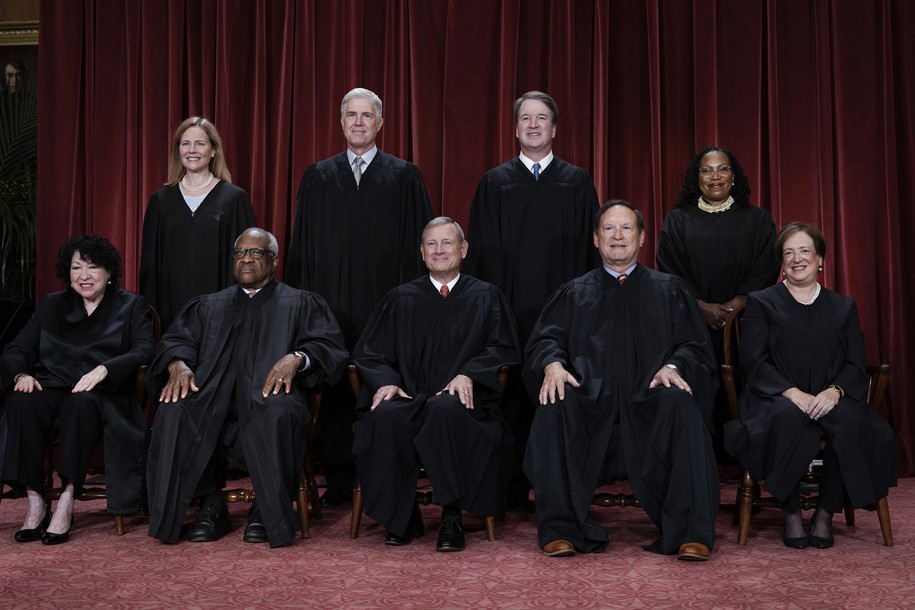
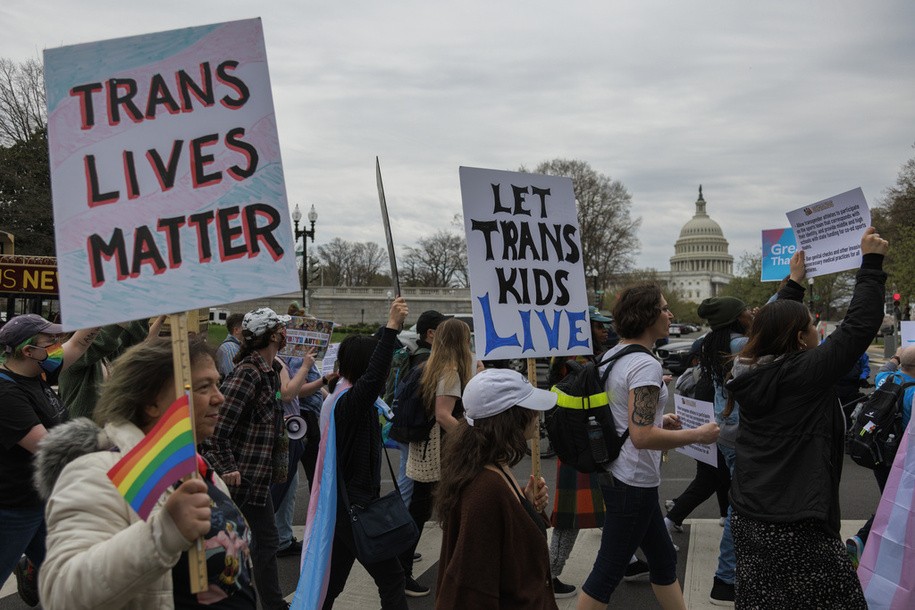
WASHINGTON, DC - JUNE 28: Demonstrators rally in front of the U.S. Supreme Court on June 28, 2024 in Washington, DC. In a series of 6-3 rulings -- with the court’s conservative bloc in lock-step -- justices upheld Oregon’s law preventing homeless people from sleeping and camping outside, reduced the power of federal agencies to interpret ambiguous statutes and ruled that prosecutors overstepped when charging members of the January 6, 2021 mob that attacked the U.S. Capitol with obstruction. (Photo by Chip Somodevilla/Getty Images)

On Friday, the Supreme Court ruled that a federal law, providing that anyone who “obstructs, influences, or impedes any official proceeding, or attempts to do so” commits a very serious federal crime, does not actually apply to everyone who obstructs, influences, or impedes an official proceeding. 

Worse, the Court does so in a case involving a January 6 insurrectionist.

Approximately 330 people who allegedly participated in that insurrection are charged with violating the statute at issue in Fischer v. United States, including Donald Trump. So Friday’s decision could potentially undermine much of the Justice Department’s ability to prosecute hundreds of people who attacked the US Capitol.

On the surface, in other words, the Fischer decision could not play more into the growing narrative that the Supreme Court is a partisan institution that protects the interests of the Republican Party, and of Trump in particular. How else can one explain the Court’s decision that the anti-obstruction law does not do what it says it does?

The full story of Fischer, however, is slightly more nuanced. For one thing, while five of the justices in the majority are Republicans, Biden-appointed Justice Kentanji Brown Jackson joined these five in the majority. Trump-appointed Justice Amy Coney Barrett wrote the dissent, which was joined by the Court’s two remaining Democrats.

And, while Chief Justice John Roberts’s majority opinion does not read the obstruction law according to its plain text, it does rely on rules governing statutory interpretation that the Court has, at least, applied in less politically charged cases.

Fischer, in other words, is less a case about justices tying themselves into knots in order to help out January 6 defendants than it is a case about how easy it is for judges to read a seemingly unambiguous law in multiple ways. The rules governing statutory interpretation are not clear, and it is not even certain when judges should apply one of those rules as opposed to a different one.

And that means each of the justices could have chosen either outcome in the Fischer case.

So what did Fischer actually hold?

The Fischer case involves a federal law with two separate subsections. Subsection (1) applies to anyone who “corruptly … alters, destroys, mutilates, or conceals a record, document, or other object, or attempts to do so, with the intent to impair the object’s integrity or availability for use in an official proceeding.”

Meanwhile, subsection (2), the provision many January 6 defendants are accused of violating, applies to someone who “otherwise obstructs, influences, or impedes any official proceeding, or attempts to do so.”

As Barrett writes in dissent, the most natural reading of this statute is that anyone who broke into the US Capitol to disrupt certification of the 2020 election “can be tried for ‘obstructing, influencing, or impeding an official proceeding.’” Subsection (2) of this law “is a very broad provision.” The case that it applies to January 6 defendants “seems open and shut.”

Indeed, the overwhelming majority of lower court judges who heard similar cases reached the same result as Barrett.

Roberts’s reading of the statute is, to put it mildly, less intuitive. He claims that subsection (2)’s broad language is “linked to its ‘surrounding words.’” So subsection (2)’s broad language is “limited by the preceding list of criminal violations” in subsection (1).

Therefore, under Roberts’s reading, subsection (2) must be read to only capture activities similar to the ones described in subsection (1) — that is, activity like altering, destroying, mutilating, or concealing a record or document. The way that plays out, according to Roberts, is that January 6 defendants can only be charged under this statute if they created false evidence or otherwise impaired “the availability or integrity of other things used in an official proceeding beyond the ‘record[s], document[s], or other object[s]’ enumerated in (c)(1), such as witness testimony or intangible information.”

Let’s stipulate that Roberts’s interpretation of the statute is super confusing and that it does not comport with the way most English speakers would read this law. The oddest thing about Fischer is that there are actually some Supreme Court precedents that support Roberts’s decision.

Consider Yates v. United States (2015), which involved a very similar dispute in a much less politically charged case. The law in Yates targeted anyone who “knowingly alters, destroys, mutilates, conceals, covers up, falsifies, or makes a false entry in any record, document, or tangible object” with the intent to obstruct a federal investigation or proceeding.

The defendant was a commercial fisherman who caught undersized red groupers, then ordered a crew member to toss these fish overboard “to prevent federal authorities from confirming that he had harvested undersized fish.” Yates asked whether these undersized fish are a “tangible object” within the meaning of the federal statute.

Remarkably, a majority of the justices concluded that they are not. Justice Ruth Bader Ginsburg’s plurality opinion concluded that a court should “avoid ascribing to one word a meaning so broad that it is inconsistent with its accompanying words,” and thus the term “tangible object” should be read “to refer, not to any tangible object, but specifically to the subset of tangible objects involving records and documents.”

Ginsburg’s opinion only garnered four votes, but Justice Samuel Alito wrote a concurring opinion saying that the question in Yates is “close,” but that largely agreed with Ginsburg’s reasoning.

Given that Yates exists, Roberts’s Fischer opinion isn’t entirely ridiculous. The uncomfortable reality about Fischer is that a judge who wants to crack down on January 6 defendants can read the law according to its plain text, as Barrett did, while justices who wish to reach a different result can rely on Yates, as Roberts did.

What actually happened in this case is that five of the Court’s Republicans read the law in a way that minimizes the law’s impact on a particularly lawless band of Trump supporters, and they were joined by the Court’s sole former public defender. Read into that what you will.

The point is simply that previously established rules governing statutory interpretation give judges a great deal of leeway to reach a variety of results in many cases.

28 Jun 20:20

The silver lining to Biden’s debate disaster

by Zack Beauchamp
James.galbraith

GET THE FUCKING BOOMERS OFF THE STAGE. Jesus christ why are we letting one generation who literally ruined the country continue to ruon things into the ground?

TOPSHOT - US President Joe Biden looks down as he participates in the first presidential debate of the 2024 elections with former US President and Republican presidential candidate Donald Trump at CNN's studios in Atlanta, Georgia, on June 27, 2024. (Photo by Andrew CABALLERO-REYNOLDS / AFP) (Photo by ANDREW CABALLERO-REYNOLDS/AFP via Getty Images)

There is no way to sugarcoat President Joe Biden’s debate performance on Thursday night: It was a disaster. He muttered, babbled, and failed to pounce on Donald Trump’s lies and threats to democracy. By Friday morning, the country’s liberal commentators were telling Biden to step down — and, behind closed doors, many Democrats were saying the same thing.

Amid this gloom, I found a ray of hope from an unusual source: Astead Herndon, the New York Times reporter who has been banging on about the political risks of Biden’s age for months (and taking a lot of Democratic fire for doing so). After being proven spectacularly right on Thursday night, Herndon didn’t take a victory lap — he looked to the future.

“I don’t think the election is over. I think it’s just starting,” he wrote on Twitter/X. “We’re finally out of the [delusion] phase. Country and parties both.”

Herndon’s comment stood out not just because it cut against the chorus of gnashing teeth, but because it pointed to why everything might not be doomed. If we truly were in a mass delusion about Biden’s ability to campaign, and now that’s ending, it opens up new possibilities for the 2024 election.

And not just that. If the Democratic Party does prove capable of convincing Biden to step aside for a more inspiring candidate, it might even help address a deep concern about the future of the country itself.

Biden as a symptom of national decline

For months — maybe even years — American politics has been mired in malaise

There are lots of reasons: Lingering anger about inflation. The legacy of the pandemic. Deep and seemingly intractable polarization.

But I think a large part of it was the uninspiring prospect of a Trump and Biden rematch. 

Poll after poll showed that Americans were dissatisfied with the prospect of a 2020 rematch. Most of the country didn’t want this choice and still doesn’t. It’s conventional wisdom that “double haters” — voters who dislike both Biden and Trump — are the most decisive swing voters in the 2024 election

We all know the reasons this dire matchup was going to happen. While Trump is unpopular with the public and the GOP elite, he has an unshakable grip on the Republican base. And though Biden is even less popular, no serious Democrat was going to risk torpedoing the party’s general election chances against Trump by launching a bitter primary challenge they’d almost certainly lose.

But the fact that things are this way is exactly the problem. When political parties offer people choices they hate, for whatever reason, people become (even more) disillusioned with their functioning. The “hollow parties,” as two political scientists recently described them, feel like just another symptom of America’s broader political brokenness.

Biden’s departure as a (possible) symbol of national renewal

The most plausible scenario is that Biden simply weathers the current PR storm and stays atop the ticket. If that happens without him doing something to prove the debate catastrophe was a one-off, it’ll simply reaffirm that the institutions designed to safeguard American democracy are as broken as everything else.

“We have institutions to handle this. Biden could just step down. But we could also have an open convention. The party could nominate someone else. But the institutions are as moribund as the candidate: they have not seen use in many years,” writer John Ganz observed on Friday morning. 

But at the same time, something feels different about the current wave of pressure on Biden to quit the race. 

In February, after special counsel Robert Hur released a report suggesting that Biden had a poor memory, most liberals and Democrats insisted the president was being smeared. After the debate, the liberal opinion-making world is in lockstep: Joe Must Go. And the quotes anonymous Democrats are giving to connected reporters are unprecedented.

“I think the president has one week to prove he is not dead,”’ a swing-state Congress member told Slow Boring’s Matt Yglesias.

You can imagine a scenario where this level of panic, combined with someone from Biden’s inner circle telling him the truth, might reach the president and convince him that his time is up. All of a sudden, the idea of Biden’s departure has left the realm of fantasy and entered the blurry world of uncertain probability.

In such a scenario, the Democratic party could avoid the chaos of a nasty primary or contested convention; Biden could, in consultation with other party leaders, pick a successor and endorse them. The party would have months to rally behind whoever it was: Vice President Kamala Harris, a Cabinet member like Transportation Secretary Pete Buttigieg, or a popular and successful governor like Michigan’s Gretchen Whitmer. For a party whose Washington leadership is dominated by boomers, its young bench is surprisingly deep.

This would do more than improve the Democratic party’s chances against Trump: It would show Americans that their institutions actually can do surprising, and maybe even impressive, things. It would provide concrete evidence that we aren’t stuck in a downward spiral of political sclerosis, that the unexpected can happen, and that sometimes it might actually be good.

I certainly don’t want to suggest that replacing Biden will fix everything, either for Democrats narrowly or for the country more broadly. In our polarized system, the election will remain close no matter what; the country’s problems run far deeper than the two old men running for president.

But it’s important not to let realism lapse into nihilism. Just because few things have changed American politics of late doesn’t mean nothing can. And we shouldn’t underestimate the importance of the person in the top job: The mere fact of Barack Obama’s identity altered American politics at such a profound level that we still haven’t fully grappled with the consequences.

It’s rare to see a clear pathway toward rebooting American politics. But Biden’s disastrous debate performance has created an opening for one. It’s up to him to take it.

28 Jun 20:16

SCOTUS kills Chevron deference, giving courts more power to block federal rules

by Jon Brodkin
James.galbraith

Completely unaccountable court wants to rule the entire fucking country. Kasmaryk forever, apparently.

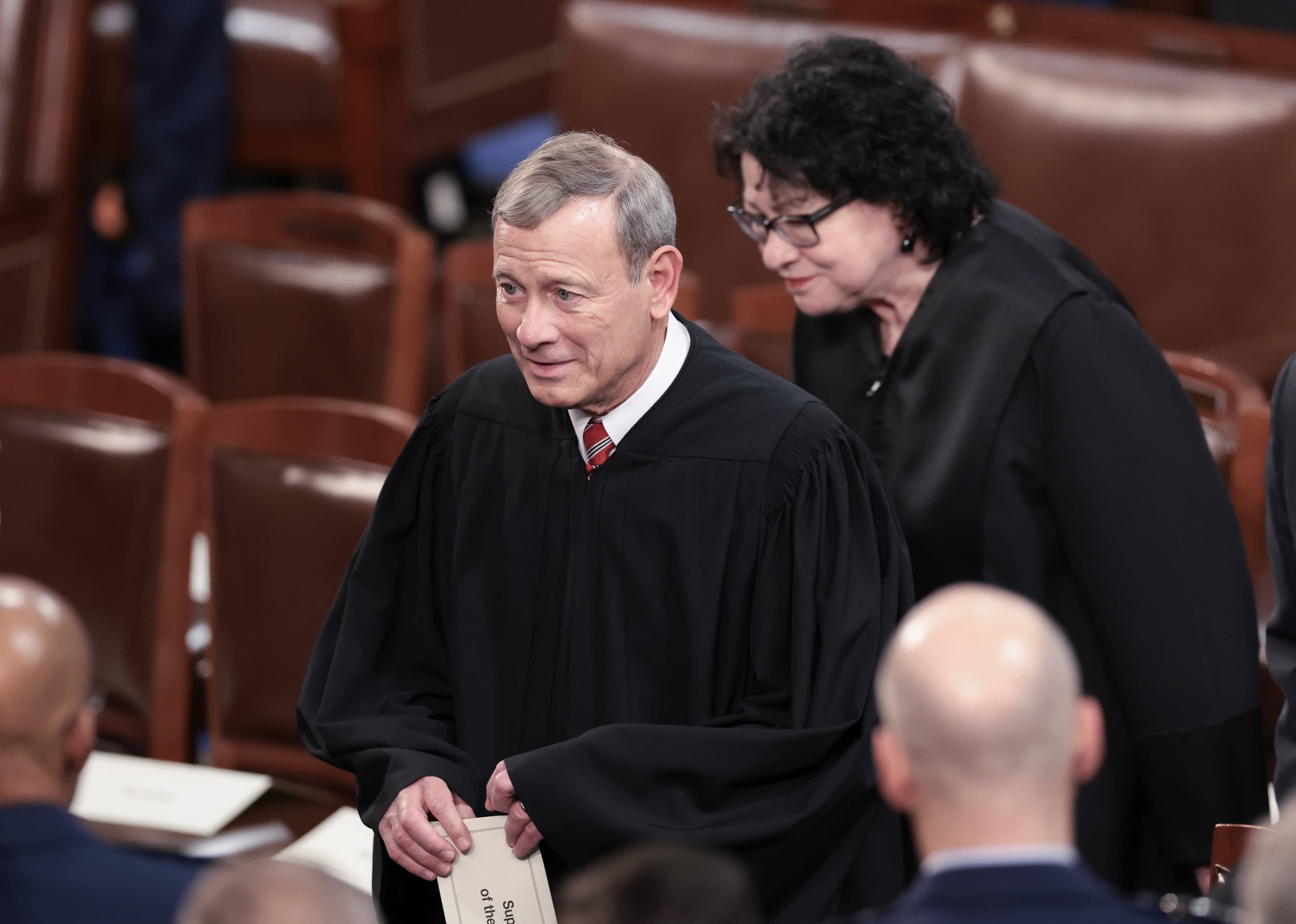
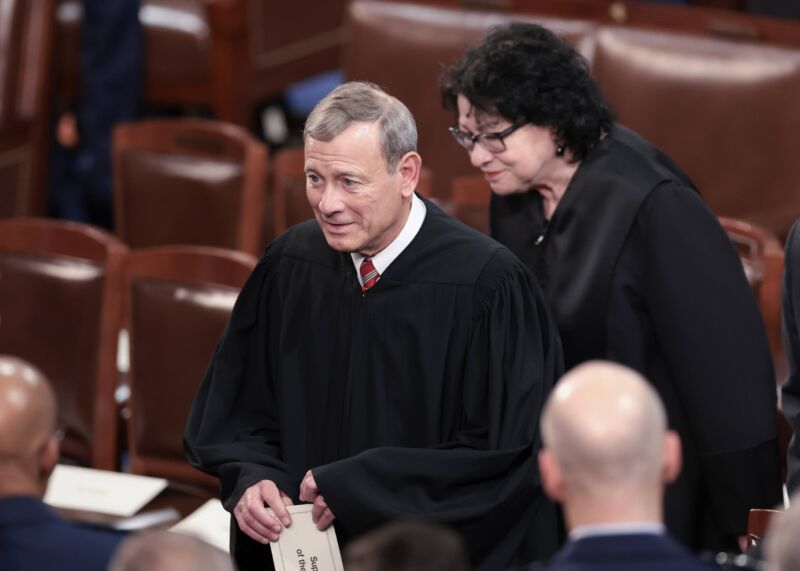
Supreme Court Chief Justice John Roberts and Associate Justice Sonia Sotomayor wearing their robes as they arrive for the State of the Union address.

Enlarge / Supreme Court Chief Justice John Roberts and Associate Justice Sonia Sotomayor arrive for President Joe Biden's State of the Union address on March 7, 2024, in Washington, DC. (credit: Getty Images | Win McNamee )

The US Supreme Court today overturned the 40-year-old Chevron precedent in a ruling that limits the regulatory authority of federal agencies. The 6-3 decision in Loper Bright Enterprises v. Raimondo will make it harder for agencies such as the Federal Communications Commission and Environmental Protection Agency to issue regulations without explicit authorization from Congress.

Chief Justice John Roberts delivered the opinion of the court and was joined by Clarence Thomas, Samuel Alito, Neil Gorsuch, Brett Kavanaugh, and Amy Coney Barrett. Justice Elena Kagan filed a dissenting opinion that was joined by Sonia Sotomayor and Ketanji Brown Jackson.

Chevron gave agencies leeway to interpret ambiguous laws as long as the agency's conclusion was reasonable. But the Roberts court said that a "statutory ambiguity does not necessarily reflect a congressional intent that an agency, as opposed to a court, resolve the resulting interpretive question."

Read 21 remaining paragraphs | Comments

28 Jun 20:16

Supreme Court Ruling Kneecaps Federal Regulators

by msmash
James.galbraith

A pile of truly terrible decisions and massive power grabs by a purely partisan judiciary

The Supreme Court on Friday overturned a long-standing legal doctrine in the US, making a transformative ruling that could hamper federal agencies' ability to regulate all kinds of industry. The Verge adds: Six Republican-appointed justices voted to overturn the doctrine, called Chevron deference, a decision that could affect everything from pollution limits to consumer protections in the US. Chevron deference allows courts to defer to federal agencies when there are disputes over how to interpret ambiguous language in legislation passed by Congress. That's supposed to lead to more informed decisions by leaning on expertise within those agencies. By overturning the Chevron doctrine, the conservative-dominated SCOTUS decided that judges ought to make the call instead of agency experts.

Read more of this story at Slashdot.

28 Jun 07:11

McDonald's Says No Thanks To Plant-Based Burgers

by msmash
James.galbraith

Too bad. I loved it when Burger King had them

An anonymous reader shares a report: A top executive at McDonald's says the chain does not have plans to bring back plant-based options after a test of its McPlant burger in San Francisco and Dallas failed. "It was not successful in either market," Joe Erlinger, McDonald's U.S. president, said during the Wall Street Journal Global Food Forum in Chicago on Wednesday. American consumers are not coming to McDonald's looking for a McPlant burger or other plant-based proteins, Erlinger added. The chain had previously partnered with Beyond Meat to make McPlant burgers and nuggets. Plant-based items are off the menu for now, but Erlinger didn't rule out the possibility that salads could one day make a return. That'll depend on whether customer demand is there. "If people really want salads from McDonald's, we will gladly relaunch salads," Erlinger said. "But what our experience has proven is that's not what the consumer is looking for from McDonald's." Instead, consumers are looking for french fries, $5 meal deals, and hot, fresh sandwiches, he added.

Read more of this story at Slashdot.

28 Jun 00:19

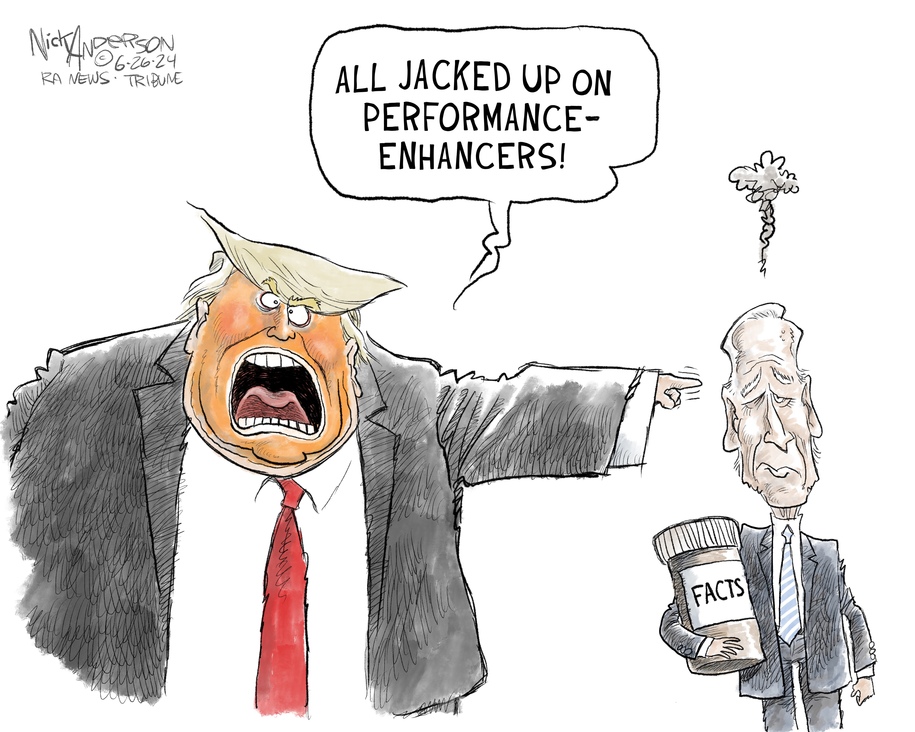
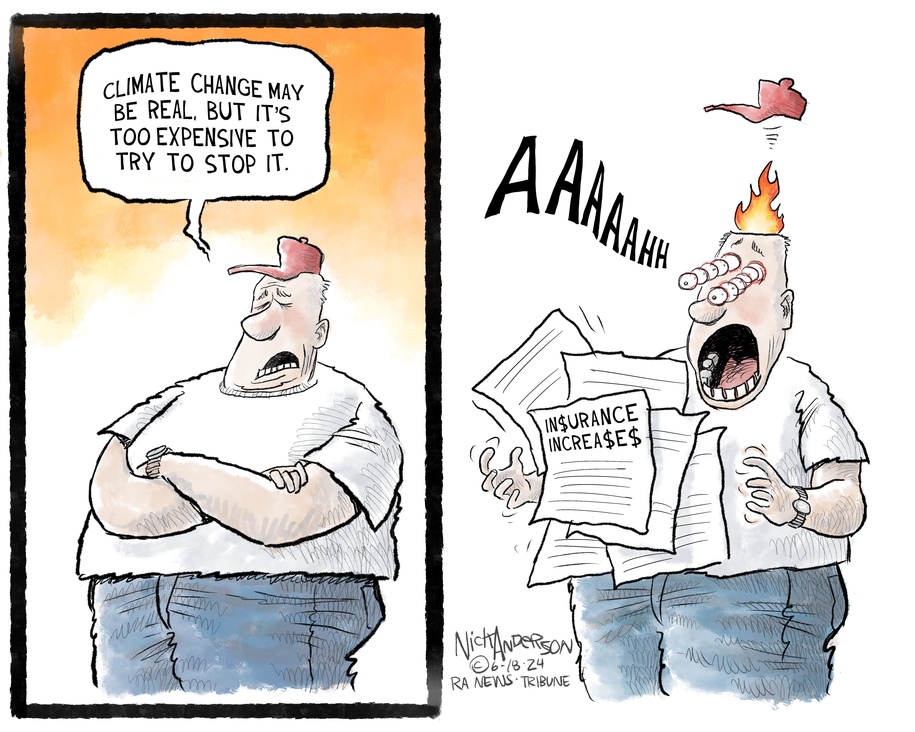
Cartoon: Jacked up

by Nick Anderson
27 Jun 21:10

Supreme Court issues stay on EPA’s ozone plan, despite blistering dissent

by John Timmer
James.galbraith

Another astoundingly terrible decision rammed through by a batshit crazy conservative majority.

Aerial view of Los Angeles, showing a layer of smog against the hills in the background.

Enlarge / Ozone-producing chemicals come from a variety of sources and don't respect state borders. (credit: John Edward Linden)

On Tuesday, a slim majority of the US Supreme Court issued an emergency ruling that places a stay on rules developed by the Environmental Protection Agency, meant to limit the spread of ozone-generating pollutants across state lines. Because it was handled on an emergency basis, the decision was made without any evidence gathered during lower court proceedings. As a result, the justices don't even agree on the nature of the regulations the EPA has proposed, leading to a blistering dissent from Justice Amy Coney Barrett, who was joined by the court's three liberal justices.

Bad neighbors

The rule at issue arose from the EPA's regular process of revisiting existing limits in light of changes in public health information and pollution-control technology. In this case, the focus was on ozone-producing chemicals; in 2015, the EPA chose to lower the limit on ozone from 75 to 70 parts per billion.

Once these standards are set, states are required to submit plans that fulfill two purposes. One is to limit pollution within the state itself; the second involves pollution controls that will limit the exposure in states that are downwind of the pollution sources. The EPA is required to evaluate these plans; if they are deemed insufficient, the EPA can require the states to follow a federal plan devised by the EPA.

Read 12 remaining paragraphs | Comments

27 Jun 18:00

The Supreme Court just lit a match and tossed it into dozens of federal agencies

by Ian Millhiser
James.galbraith

Surprise... ugh

WASHINGTON, DC - FEBRUARY 04: U.S. President Donald Trump shakes hands with Supreme Court Chief Justice John Roberts before the State of the Union address in the House chamber on February 4, 2020 in Washington, DC. Trump is delivering his third State of the Union address on the night before the U.S. Senate is set to vote in his impeachment trial. (Photo by Leah Millis-Pool/Getty Images)

On Thursday, the Court handed down a 6-3 decision, on a party-line vote, that could render a simply astonishing array of federal laws unenforceable. As Justice Sonia Sotomayor writes in dissent, “the constitutionality of hundreds of statutes may now be in peril, and dozens of agencies could be stripped of their power to enforce laws enacted by Congress.”

The dispute in Securities and Exchange Commission v. Jarkesy turns on whether a hedge fund manager accused of defrauding investors is entitled to a jury trial to determine whether he violated federal securities law, or whether the government acted properly when it tried him before an official known as an “administrative law judge” (ALJ).

The charges against this hedge fund manager, George Jarkesy, are civil and not criminal, which matters because the Constitution treats civil trials very differently from criminal proceedings. While the Sixth Amendment provides that “in all criminal prosecutions” the defendant is entitled to a jury trial, the Seventh Amendment provides a more limited jury trial right, requiring them “in suits at common law” (more on what that means later).

If the question of whether Jarkesy is entitled to a jury trial arose in the absence of any precedent, then he’d have a reasonably strong case that he should prevail. But, as Sotomayor lays out in her dissent, nearly 170 years of precedent cut against Jarkesy’s position.

Congress, moreover, has enacted a wide range of laws on the presumption that many enforcement proceedings may be brought before administrative law judges and not juries. According to one somewhat dated review of federal law cited by Sotomayor, “by 1986, there were over 200” federal statutes calling for trials before ALJs. 

Some of these laws, including the one allowing the SEC to bring enforcement actions against people like Jarkesy, give the government a choice. That is, they allow federal agencies to bring a proceeding either before an ALJ or before a federal district court that may conduct a jury trial. So the SEC, at least, has the option of retrying Jarkesy in a district court.

But, as Sotomayor warns, many federal agencies — including the “Occupational Safety and Health Review Commission, the Federal Energy Regulatory Commission, the Federal Mine Safety and Health Review Commission, the Department of Agriculture, and many others” — may only seek civil penalties in administrative proceedings. That means that a wide array of laws guaranteeing workplace safety and advancing other important federal goals could cease to function after Jarkesy.

The Jarkesy case, in other words, is an example of the Roberts Court at its most arrogant. Were the Court tasked with resolving the dispute on a blank slate, then there are entirely plausible arguments that Mr. Jarkesy should be entitled to a jury trial. But that ship sailed many years ago, and the federal government has operated for an exceedingly long time on the assumption that many disputes can be adjudicated by ALJs.

By upending this longstanding assumption, the Court may have just thrown huge swaths of the federal government — particularly enforcement by those agencies Sotomayor listed — into chaos.

So when does a civil defendant have a right to a jury trial?

The Seventh Amendment provides that civil litigants generally have a right to a jury trial “in suits at common law,” but what does that mean?

Broadly speaking, the common law refers to the body of judge-made law developed by English courts, much of which was imported into American law and which still governs many American lawsuits involving matters such as contracts and torts. Common law courts typically had the power to award money damages to a victorious plaintiff, which distinguishes them from courts of “equity” that had the power to issue injunctions and other non-monetary relief. 

Chief Justice John Roberts’s majority opinion in Jarkesy leans heavily into the kind of remedy available to the SEC if it prevails in a suit before an ALJ. Like a suit before a common law court, the SEC sought monetary damages from Jarkesy, and thus this case resembles a suit at common law in that way. As Roberts writes, “money damages are the prototypical common law remedy.”

Additionally, Roberts notes that common law courts also historically had the power to hear suits alleging fraud. Thus, the suit against Jarkesy resembles a common law suit in that way as well.

Most of this part of Roberts’s opinion is uncontroversial. His disagreement with Sotomayor turns on a longstanding exception to the jury trial right known as the “public rights” doctrine.

The term “common law” refers to judge-created law developed over the course of many centuries, as distinct from law created by acts of a state legislature or Congress. The somewhat unhelpfully named public rights doctrine provides that many lawsuits that arise under federal statutes are not subject to the Seventh Amendment, and thus the government is free to try these cases in an administrative proceeding without a jury.

The earliest Supreme Court case applying this public rights doctrine was handed down in 1856, so it isn’t exactly an idea invented by 20th-century Progressive Era reformers who wanted to eliminate barriers to law enforcement. As the Court explained in Atlas Roofing v. OSHA (1977), the doctrine applies when Congress passes a law authorizing suits by the federal government that are “unknown to the common law.”

In “cases in which the Government sues in its sovereign capacity to enforce public rights created by statutes within the power of Congress to enact,” Atlas Roofing held, “the Seventh Amendment does not prohibit Congress from assigning the factfinding function and initial adjudication to an administrative forum with which the jury would be incompatible.”

Thus, this public rights doctrine does have limits. It applies only to suits brought by the federal government, and only when the government sues to enforce a federal statute authorizing a kind of suit that did not already exist under the common law. But, in those circumstances, trial before an ALJ is permitted.

Though Roberts’s opinion denies that it overrules Atlas Roofing and similar cases, he speaks of that decision in disparaging terms. And his opinion places such an extraordinary amount of weight on the fact that the SEC sought money damages against Mr. Jarkesy that it is unclear how much, if any, of the public rights doctrine remains.

Were this the first time that such an issue came up, that might not be that big of a deal. Had Congress known a century ago that the Supreme Court would someday eliminate its ability to assign certain cases to ALJs, it could have written hundreds of statutes differently so that they would be enforced in jury trials. It also could have appropriated sufficient money to federal agencies to allow them to hire trial counsel who could bring proceedings in federal district courts.

But Congress has instead operated for many decades under the assumption that cases like Atlas Roofing are good law. And now the Supreme Court has pulled the rug out from under a multitude of federal statutes.

This Court doesn’t typically care this much about the Seventh Amendment

In light of the Court’s newfound appreciation for civil jury trials, it’s worth noting that the Court’s Republican appointees have historically read the Seventh Amendment very narrowly in cases that do not involve hedge fund managers.

The Court has long held that companies may force their workers and consumers to sign away their right to sue that company in a real court — one that can conduct a jury trial — and instead have the case heard by a private arbitrator. The Court has, at times, claimed that forced arbitration is lawful because workers and consumers nominally consent to arbitration when they decide to do business with the company. But many of the Court’s arbitration decisions raise very serious questions about whether the justices understand what the word “consent” means.

In Epic Systems v. Lewis (2018), for example, the Court held that an employer can simply order their employees to give up their right to a jury trial, under pain of termination.

So the Court’s approach to the Seventh Amendment is incoherent, and after Jarkesy, it could lead to dozens or even hundreds of federal laws arbitrarily ceasing to function.

27 Jun 17:17

Why do Americans always think crime is going up?

by Abdallah Fayyad
James.galbraith

This is a lot of words for "because people are deeply stupid and motivated by other biases"

An illustration shows a downward trend line over a silhouetted cityscape with a blue colorfield and stars just beyond. Behind this scene is an eye with an upward trend line in its pupil and a thumb print just below it.

With the 2024 campaign underway, politicians from both parties have been sounding the alarm about rising crime rates. 

But the pandemic-era spike in crime actually seems to have subsided. The first three months of 2024 showed a historic decline in crime rates compared with the same period last year, according to the latest data from the FBI. Murder, for example, is down 26 percent, and robberies dropped 18 percent. Crime rates now look more like they did pre-Covid, steadily declining as they had been since the 1990s.

And yet, the majority of Americans still believe that crime is only getting worse. A 2023 Gallup poll showed that 77 percent of Americans believed that crime was increasing across the country. That might help explain why lawmakers have been overreacting to the short-lived rise, taking a tough-on-crime approach to public safety, including imposing harsher penalties and increasing police surveillance

The big disconnect between public perception of crime and the reality isn’t new. In fact, since 2002, the same annual poll has repeatedly shown that the majority of Americans — often over 60 percent — believe that crime is on the rise even when it’s falling. Other polls have found similar results, showing that many Americans believe crime is a serious national problem, one that voters consistently consider to be among their chief concerns come election time.

It’s hard to explain why Americans feel the way they do about crime. Part of the answer might be that Americans aren’t entirely ignoring reality: The United States is, after all, a more violent country than its peers, having the highest homicide rate among affluent nations

Facts on the Ground

This is part of Vox’s series exploring the realities of American life and policy as the presidential campaign ramps up. Read more:

But Gallup’s annual poll might be telling us something deeper: that fear of crime is deeply embedded in American society, and positive news about falling crime rates won’t simply make that fear go away.  

Most of us tend to think of crime in the abstract — not as something that is happening to us but something we read about in the news, see on social media, or hear about from politicians running for office every cycle. According to the same Gallup poll, about 3 percent of Americans report being victimized by a violent crime. And while 17 percent of Americans believe that crime is an extremely or very serious problem in their neighborhoods, 63 percent believe it’s an extremely or very serious problem in the country as a whole. 

So what could be driving the big, consistent gap between public perception and reality? Here are three theories: 

Fearmongering “law-and-order” campaigns are a constant in American politics

One of the major drivers that shapes public opinion about crime is “what folks with the biggest platforms and megaphones say, and that is the politicians, especially in an election,” said Insha Rahman, vice president of advocacy and partnerships at the Vera Institute of Justice. “And we’re basically perennially in election season.”

In each of his three presidential campaigns, former president Donald Trump has spent a considerable amount of time on the trail talking about crime, lawlessness, and public disorder, vowing to put tough policies in place to bring an end to the supposed chaos. And much of his rhetoric focuses on cities, which he has claimed are “crime-infested,” “hellholes,” and “cesspools of bloodshed and crime” that are “falling apart.” In 2020, Trump painted the George Floyd protests as an example of urban lawlessness, going so far as to tweet the segregationist phrase “when the looting starts, the shooting starts,” encouraging police to use violent force against protesters.

Trump followed the mold of the quintessential “law-and-order” campaign, drumming up fear about supposed crime, leaning on racist tropes and dog whistles, and conjuring a picture of cities that residents wouldn’t recognize.  

For decades, American politicians — and especially Republicans — have run political campaigns that put crime front and center, even when crime rates are on the decline. This style of campaigning dates back to the 1960s, when Arizona Sen. Barry Goldwater launched a “law-and-order” presidential campaign against Lyndon Johnson and used crime as a way to implicitly talk about race. 

As Vesla Weaver, a political scientist at Johns Hopkins, told the Marshall Project in 2020, when it started becoming unpopular to explicitly oppose equal rights for Black people, politicians instead started “talking about the urban uprisings—Blacks’ response to political and economic exploitation—they start attaching it to street crime, to ordinary lawlessness.”

Republican presidents like Richard Nixon, George H. W. Bush, and Donald Trump all focused on urban crime as a way to stir up white suburban voters in particular. Bush, for example, ran the now-infamous Willie Horton ad in 1988, which focused on the story of a Black man who, while on furlough from prison, raped a white woman. Horton was in Massachusetts, where Bush’s Democratic opponent, Michael Dukakis, was governor. Bush’s move, a direct challenge that Democrats were “soft on crime,” essentially put Democrats on the defensive ever since. 

When she was first lady in the 1990s, Hillary Clinton helped amplify the panic around the since-debunked “superpredator” myth: that crime was going to explode because of a growing, largely Black and brown urban youth population that was supposedly responsible for a significant portion of violent crime. 

National media — especially opinion and commentary publications — also took the theory and ran with it. According to the Marshall Project, the country’s leading newspapers and magazines used the term “superpredator” nearly 300 times between 1995 and 2000, when crime had started to decline. The majority of times, the term was used uncritically.

“It’s a vicious cycle,” Rahman said. “There’s a latent concern about crime — it always sits there as a second-tier issue for voters. And if you play upon that as a politician, and you campaign and you really spark fear around the issue, you watch it grow as a top voting issue. That’s absolutely what happens.”

Today, “law-and-order” campaigns aren’t limited to presidential hopefuls. Candidates for local and statewide office routinely emphasize or overstate crime, and that includes Democrats as well. Eric Adams, the Democratic mayor of New York City, for example, was elected in 2021 after running a campaign that focused on crime and vowed to beef up law enforcement. Since then, both he and Kathy Hochul, the Democratic governor of New York, have emphasized crime as a very serious problem, imposing tough-on-crime policies, even though crime has been declining in the city.

Adams’s 2021 campaign “was centered on one thing and one thing alone, which was crime,” Rahman said, adding that his rhetoric caused media mentions of crime to skyrocket. “It literally tracked with voter surveys about voters’ concerns about crime.” 

Indeed, as the campaign went on, crime became increasingly salient, eventually becoming the single most important issue for Democratic primary voters in that race. Between April and May of that year, the share of voters who considered crime and public safety to be their top concern rose by 14 percentage points, according to a NY1/Ipsos poll.  

Media coverage of crime often distorts reality

When politicians repeatedly bring up crime, the media inevitably responds by covering it. But news outlets, and local media in particular, also often focus a lot of their attention on crime.

“One of the challenges, historically, with the way that we have covered crime is that we usually just cover individual incidents, and there’s very little context for how crime trends are moving overall in our communities,” said Cheryl Thompson-Morton, director of the Black Media Initiative for the Center for Community Media at the City University of New York’s journalism school.  

Media outlets dedicate entire sections to coverage of crime, making it a significant part of Americans’ news digest. While journalists should certainly cover crime in their communities, the way that it’s often so prominently featured and prioritized might make people feel like it’s a constant problem that never subsides. Today, there’s also the added layer of social media. 

One recent example is the shoplifting panic. A perceived spike in shoplifting — bolstered by faulty data — received a lot of media attention. Story after story in media outlets called the supposed phenomenon an epidemic, and alleged that shoplifting was becoming normalized in many US cities. Viral videos of people brazenly shoplifting without facing any consequences likely helped fuel the panic, making it seem like that kind of petty theft is extremely common. Those kinds of videos also often drew news outlets’ attention, resulting in even more stories.

As more data was collected, however, it became clear that while there may have indeed been an increase in shoplifting, it was hardly as severe as the reports suggested. In fact, in many places, shoplifting seems to have been declining just as these news reports were coming out.

By the time it was clear that the shoplifting wave had been overstated, it was already too late.  Despite an effort by many media outlets to correct the record, many Americans had already formed an impression it was a problem that was spinning out of control. And after years of progressive criminal justice reforms — which included lowering penalties for petty crimes and, in some cases, choosing not to prosecute those cases — many politicians seized on the panic showing a dramatic increase in shoplifting to promote tough-on-crime policies similar to those passed in the 1990s, including by lowering the threshold for what constitutes a felony.

“Covering these individual incidents of crime often, as we typically do, often do not help make people feel safer,” Thompson-Morton said.

When crime is sensationalized, Americans can’t look away

One problem with the way politicians talk about crime and with the way the media covers it is that they often focus on incidents that will grab people’s attention. That’s likely why the Bush campaign, for example, chose to exploit the Willie Horton case — precisely because it played to people’s fears about prisoners and old racist tropes about Black men.

When crimes that might be relatively rare are given outsized weight in the media, people start to believe that they’re more common than they actually are. It also leads to a vicious feedback loop: Tough-on-crime politicians repeatedly talk about a case, media outlets cover it, and people become extremely interested in it, encouraging politicians to continue exploiting the case and more media coverage.

Take the case of Laken Riley, a 22-year-old nursing student who was killed earlier this year. The story played into Republicans’ narrative about immigration — Trump started his 2016 campaign talking about how people crossing the southern borders were criminals and rapists — because the alleged killer had entered the United States illegally. The case became so prominently featured in Republican campaigns that President Joe Biden mentioned it in his State of the Union address, after Republican Rep. Marjorie Taylor Greene confronted him about it. 

Studies show, however, that immigrants aren’t more likely to commit crimes than native-born citizens. In fact, some studies show that immigrants might be less likely to commit crimes than people born in the US. But when one horrific incident like Laken Riley’s is sensationalized, it can quickly affect public opinion: One poll, for example, showed that the majority of Americans believe that migration is leading to more crime, despite all evidence that points to the contrary. 

So while law-and-order campaigns feed off sensationalizing crime, they are often actually about something else: stirring up fear of a changing society.

Crime is likely to keep coming up as a 2024 campaign issue

As with his previous campaigns, Trump has spent a lot of time talking about crime, despite falling crime rates, and he’s likely to bring it up during his debates with Biden. 

Regardless of where crime rates actually stand, the fact that so many people believe that crime is not only a serious problem but one that’s actively getting worse has resulted in Republicans and Democrats trying to prove their tough-on-crime bona fides. Even officials in the Biden administration, for example, have told progressives that they went “too far” on criminal justice reforms and that they should look for a more “sensible approach.”

That means that between now and November, and potentially beyond, both parties are likely to push for tougher laws and harsher enforcement. 

But whatever candidates will say about combating crime, one thing is clear: Crime isn’t actually getting worse – even if the majority of Americans think it is.

27 Jun 17:11

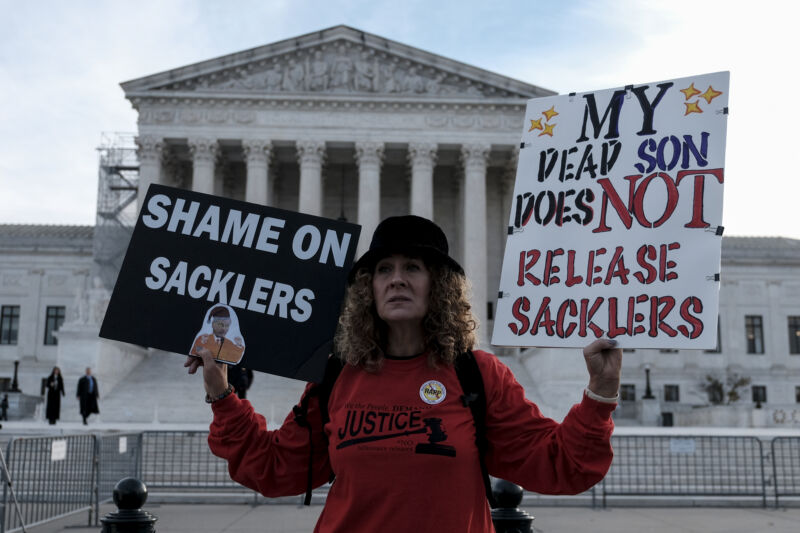
SCOTUS tears down Sacklers’ immunity, blowing up opioid settlement

by Beth Mole
James.galbraith

Broken clocks...

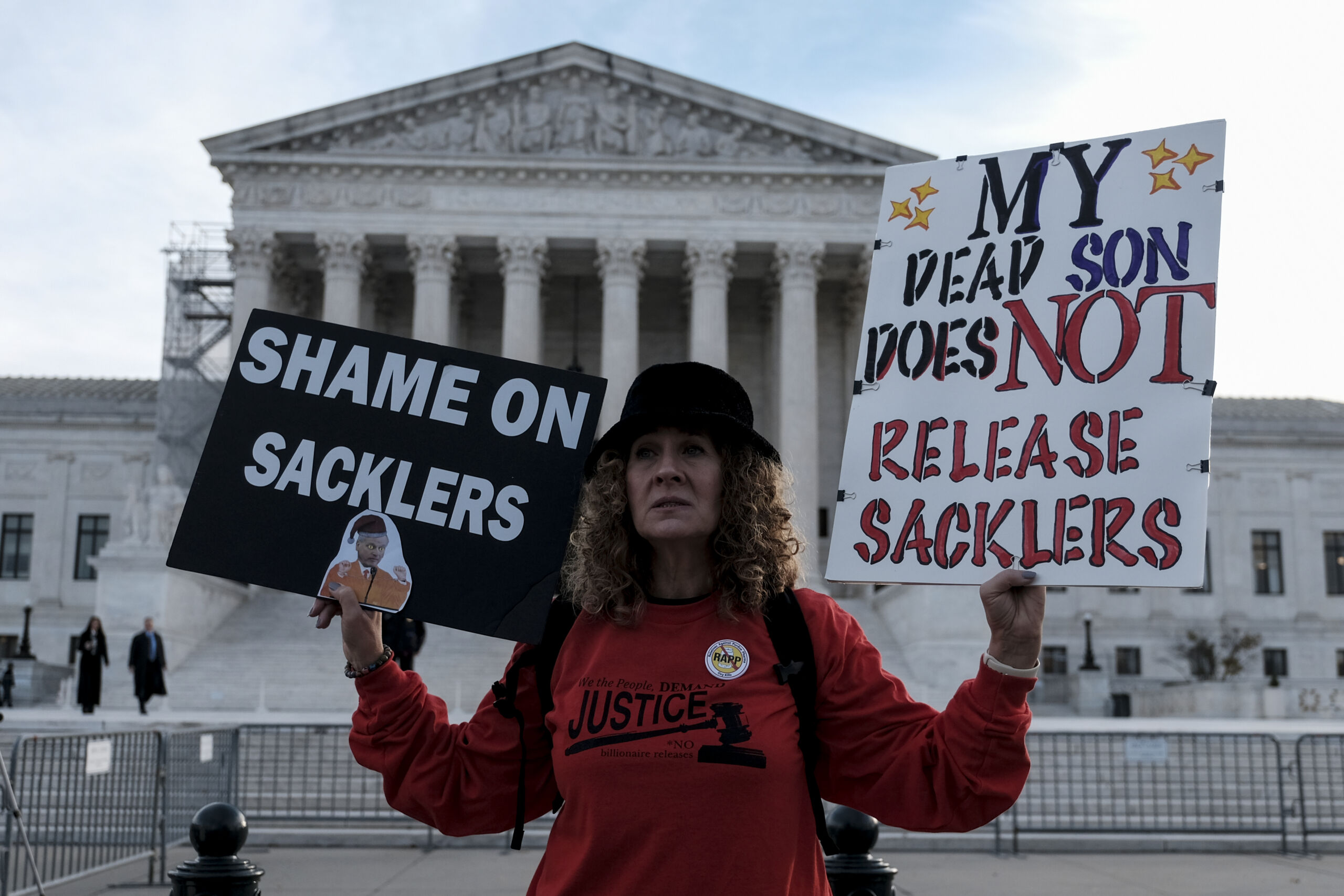
Grace Bisch holds a picture of stepson Eddie Bisch who died as a result of an overdose on outside of the U.S. Supreme Court on December 4, 2023  in Washington, DC. The Supreme Court heard arguments regarding a nationwide settlement with Purdue Pharma, the manufacturer of OxyContin.

Enlarge / Grace Bisch holds a picture of stepson Eddie Bisch who died as a result of an overdose on outside of the U.S. Supreme Court on December 4, 2023 in Washington, DC. The Supreme Court heard arguments regarding a nationwide settlement with Purdue Pharma, the manufacturer of OxyContin. (credit: Getty | Michael A. McCoy)

In a 5-4 ruling, the US Supreme Court on Thursday rejected an opioid settlement plan worth billions over the deal's stipulation that the billionaire Sackler family would get lifetime immunity from further opioid-related litigation.

While the ruling may offer long-sought schadenfreude over the deeply despised Sackler family, it is a heavy blow to the over 100,000 people affected by opioid epidemic who could have seen compensation from the deal. With the high court's ruling, the settlement talks will have to begin again, with the outcome and possible payouts to plaintiffs uncertain.

Between 1999 and 2019, as nearly 250,000 Americans died from prescription opioid overdoses, members of the Sackler family siphoned approximately $11 billion from the pharmaceutical company they ran, Purdue Pharma, maker of OxyContin, a highly addictive and falsely marketed pain medication, according to the high court's ruling. In 2007, amid the nationwide epidemic of opioid addiction and overdoses, Purdue affiliates pleaded guilty in federal court to falsely branding OxyContin as less addictive and less abusive than other pain medications. Out of fear of future litigation, the Sacklers began a "milking program," the high court noted, draining Purdue of roughly 75 percent of its assets.

Read 6 remaining paragraphs | Comments

26 Jun 21:27

Here's Team Trump's terrifying plan to dismantle the government

by Joan McCarter
James.galbraith

They look at McCarthy as a model, not a monster.

The people who brought you Project 2025 are getting to work on destroying the government early with Project Sovereignty 2025, readying for a purge of civil service employees whom they deem “anti-American bad actors burrowed into the administrative state.” This is something Donald Trump tried to do at the end of his term, and President Joe Biden undid it. But it wouldn’t be a slapdash experiment for Trump the second time around—he’s got the blueprint and his team has the experience to do it

The Associated Press reports that Republican insider Tom Jones and his American Accountability Foundation recently received a $100,000 grant from the Heritage Foundation, and they are already on the job trawling through the backgrounds, social media posts, and statements from high-ranking civil servants in the Department of Homeland Security, partly using tips from conservative contacts.

“We need to understand who these people are and what they do,” Jones, a former aide to Republican senators, told the Associated Press.

The immediate goal of the group is to “post 100 names of government workers to a website this summer to show a potential new administration who might be standing in the way of a second-term Trump agenda—and ripe for scrutiny, reclassifications, reassignments or firings,” the Associated Press reports. 

Posting it wouldn’t be necessary for a potential Trump administration, but it can certainly sow division and mistrust among government employees, and subject them to threats from Trump’s MAGA hordes.

Jacqueline Simon, policy director at the American Federation of Government Employees, called the program “shocking,” telling the Associated Press, “It just seems as though their goal is to try to menace federal employees and sow fear.”

In 2020, Trump attempted to reclassify a chunk of federal civil service employees—nonpolitical career personnel who make up the bulk of the federal workforce—and gut protections for them. His executive order created a new federal employment category—Schedule F—for his perceived enemies in the government, allowing them to be fired at his will to make way for his loyalists.

The plan to resurrect Trump’s scheme has been in the works since his 2020 defeat. Kevin Roberts, the president of the Heritage Foundation, told The New York Times last year that the goal is to “flood the zone with conservative personnel” in a way they weren’t prepared for after Trump’s 2016 victory. This time around, they will go in with their list ready and their ducks in a row.

Trump’s executive order, though unsuccessful, proved to be a lot more expansive and harsh than originally perceived, according to a report from The Washington Post earlier this year. At the time, Trump’s order said it would apply just to employees “in positions of a confidential, policy-determining, policy-making, or policy-advocating character.” That would affect about 50,000 workers.

A Freedom of Information Act request by the National Treasury Employees Union for plans from Trump’s Office of Management and Budget, however, showed how much deeper it would go under a Trump cabinet member, the Washington Post reported. Then-Director of the OMB Russell Vought had drawn up plans to cut as much as 68% of the OMB staff, from senior attorneys all the way down to administrative staff who weren’t involved in policy-making.

Extrapolating from that, the number of total employees subject to a political purge “could be much higher [than the 50,000 estimate] and sweep up all kinds of employees around the country,” NTEU President Doreen Greenwald told reporters.

That gives a preview of what Trump and his team would do given the second chance to create a government loyal not to the American people but to Trump. And in typical MAGA fashion, they’re putting federal workers’ safety in jeopardy even now.

RELATED STORIES:

Trump plan to politicize key civil service jobs has run out of time

Trump and the Heritage Foundation's fascist agenda

Trump has a plan to destroy democracy. Why haven’t people heard of it?

Campaign Action

26 Jun 19:11

The Supreme Court rules that state officials can engage in a little corruption, as a treat

by Ian Millhiser
James.galbraith

More blatant corruption from the GOP

US President Donald Trump shakes hands with US Supreme Court Justice Brett Kavanaugh before delivering the State of the Union address at the US Capitol in Washington, DC, on February 5, 2019. (Photo by MANDEL NGAN / AFP) (Photo credit should read MANDEL NGAN/AFP via Getty Images)

On a 6-3 party-line vote, the Supreme Court ruled on Wednesday that state officials may accept “gratuities” from people who wish to reward them for their official actions, despite a federal anti-corruption statute that appears to ban such rewards.

Justice Brett Kavanaugh wrote the opinion in Snyder v. United States for the Court’s Republican-appointed majority. Justice Ketanji Brown Jackson wrote the dissent on behalf of the Court’s three Democratic appointees.

Snyder turns on a distinction between “bribes” and “gratuities.” As Kavanaugh writes, “bribes are payments made or agreed to before an official act in order to influence the official with respect to that future official act.” Gratuities, by contrast, “are typically payments made to an official after an official act as a token of appreciation.” (Emphasis added.)

If that seems like a negligible difference, the facts of this case will probably only underscore that sentiment.

The case involves James Snyder, a former mayor who accepted a $13,000 gratuity from a truck company after the city purchased five trash trucks from that company for $1.1 million. Snyder claims that the money was a consulting fee, but federal prosecutors nonetheless charged him with violating an anti-corruption statute.

That statute prohibits state officials from “corruptly” accepting “anything of value from any person, intending to be influenced or rewarded” for an official act.

As Jackson writes in her dissent, the most natural reading of this statute is that it targets both bribes (payments that “influenced” a future decision) and gratuities (payments that “rewarded” a past decision). As Jackson writes,

Everyone knows what a reward is. It is a $20 bill pulled from a lost wallet at the time of its return to its grateful owner. A surprise ice cream outing after a report card with straight As. The bar tab picked up by a supervisor celebrating a job well done by her team. A reward often says “thank you” or “good job,” rather than “please.”

Jackson argues that the statute should be read to prohibit “rewards corruptly accepted by government officials in ways that are functionally indistinguishable from taking a bribe,” much like the payment at issue in this case appears to be.

Kavanaugh’s majority opinion, meanwhile, relies heavily on policy arguments and other claims that go beyond the statute’s text. He does attempt to make a textual argument — Kavanaugh notes that the statute at issue in Snyder, like a different statute that only concerns bribes, uses the word “corruptly” — but his best arguments are atextual. 

Kavanaugh’s strongest argument is that the law makes it a very serious crime, punishable by up to 15 years in prison, for a federal official to accept a bribe, but federal officials who accept gratuities only risk two years in prison. Meanwhile, the statute at issue in Snyder, which only applies to state officials, applies a 10-year sentence across the board. So Kavanaugh argues that it would be odd to read the law to draw a sharp distinction between bribes and gratuities given to federal officials but to make no distinction when state officials accept a gift.

In any event, the decision in Snyder is narrow. It does not rule that Congress could not ban gratuities. It simply rules that this particular statute only reaches bribes. That said, the Court’s Republican majority also has a long history of imposing constitutional limits on the government’s ability to fight corruption and restrict money in politics.

It’s also notable that neither Justice Clarence Thomas nor Justice Samuel Alito, both of whom have accepted expensive gifts from politically active Republican billionaires, recused themselves from the case. Thomas and Alito both joined Kavanaugh’s opinion reading the anti-corruption statute narrowly.

26 Jun 19:04

Supreme Court ‘inadvertently’ posts opinion on emergency abortion

by Associated Press
James.galbraith

And it looks like another punt. It's not as transparently horrible as it could have been, but we can't mistake "one step back from an apocalypse" for "a reasonable decision"

The Supreme Court appears poised to allow emergency abortions in Idaho when a pregnant patient’s health is at serious risk, according to Bloomberg News, which said a copy of the opinion briefly posted Wednesday on the court's website.

The document suggests the court will conclude that it should not have gotten involved in the case so quickly and will reinstate a court order that had allowed hospitals in the state to perform emergency abortions to protect a pregnant patient’s health, Bloomberg said. The document was quickly removed from the website.

The Supreme Court acknowledged that a document was inadvertently posted Wednesday.

“The Court’s Publications Unit inadvertently and briefly uploaded a document to the Court’s website. The Court’s opinion in Moyle v. United States and Idaho v. United States will be issued in due course,” court spokeswoman Patricia McCabe said in a statement.

The case would continue at the 9th U.S. Circuit Court of Appeals if the high court dismisses proceedings.

The finding may not be the court's final ruling, since it has not been officially released.

The Biden administration had sued Idaho, arguing that hospitals must provide abortions to stabilize pregnant patients in rare emergency cases when their health is at serious risk.

Most Republican-controlled states began enforcing restrictions after the court overturned Roe v. Wade two years ago.

Idaho is among 14 states that outlaw abortion at all stages of pregnancy with very limited exceptions. It said that its ban does allow abortions to save a pregnant patient’s life and federal law doesn’t require the exceptions to expand.

The Supreme Court had previously allowed the measure to go into effect, even in medical emergencies, while the case played out. Several women have since needed medical airlifts out of state in cases in which abortion is routine treatment to avoid infection, hemorrhage, and other dire health risks, Idaho doctors have said.

The high court’s eventual ruling is expected to have ripple effects on emergency care in other states with strict abortion bans. Already, reports of pregnant women being turned away from U.S. emergency rooms spiked following the high court’s 2022 ruling overturning the constitutional right to abortion, according to federal documents obtained by The Associated Press.

The Justice Department’s lawsuit came under a federal law that requires hospitals accepting Medicare to provide stabilizing care regardless of a patient’s ability to pay. It’s called the Emergency Medical Treatment and Labor Act, or EMTALA.

Nearly all hospitals accept Medicare, so emergency room doctors in Idaho and other states with bans would have to provide abortions if needed to stabilize a pregnant patient and avoid serious health risks like loss of reproductive organs, the Justice Department argued.

Idaho argued that its exception for a patient’s life covers dire health circumstances and that the Biden administration misread the law to circumvent the state ban and expand abortion access.

Doctors have said that Idaho’s law has made them fearful to perform abortions, even when a pregnancy is putting a patient’s health severely at risk. The law requires anyone who is convicted of performing an abortion to be imprisoned for at least two years.

A federal judge initially sided with the Democratic administration and ruled that abortions were legal in medical emergencies. After the state appealed, the Supreme Court allowed the law to go fully into effect in January.

25 Jun 21:25

Verizon screwup caused 911 outage in 6 states—carrier agrees to $1M fine

by Jon Brodkin
James.galbraith

That's it? geez

A Verizon logo on top of a black background.

Enlarge (credit: Getty Images | David Ramos)

Verizon Wireless agreed to pay a $1,050,000 penalty to the US Treasury and implement a compliance plan because of a 911 outage in December 2022 that was caused by a botched update, the Federal Communications Commission announced today.

A consent decree explains that the outage was caused by "the reapplication of a known flawed security policy update file." During the outage, lasting one hour and 44 minutes, Verizon failed to deliver hundreds of 911 calls in Alabama, Florida, Georgia, North Carolina, South Carolina, and Tennessee, the FCC said.

"The [FCC] Enforcement Bureau takes any potential violations of the Commission's 911 rules extremely seriously. Sunny day outages, as occurred here, can be especially troubling because they occur when the public and 911 call centers least expect it," Bureau Chief Loyaan Egal said.

Read 8 remaining paragraphs | Comments

25 Jun 21:20

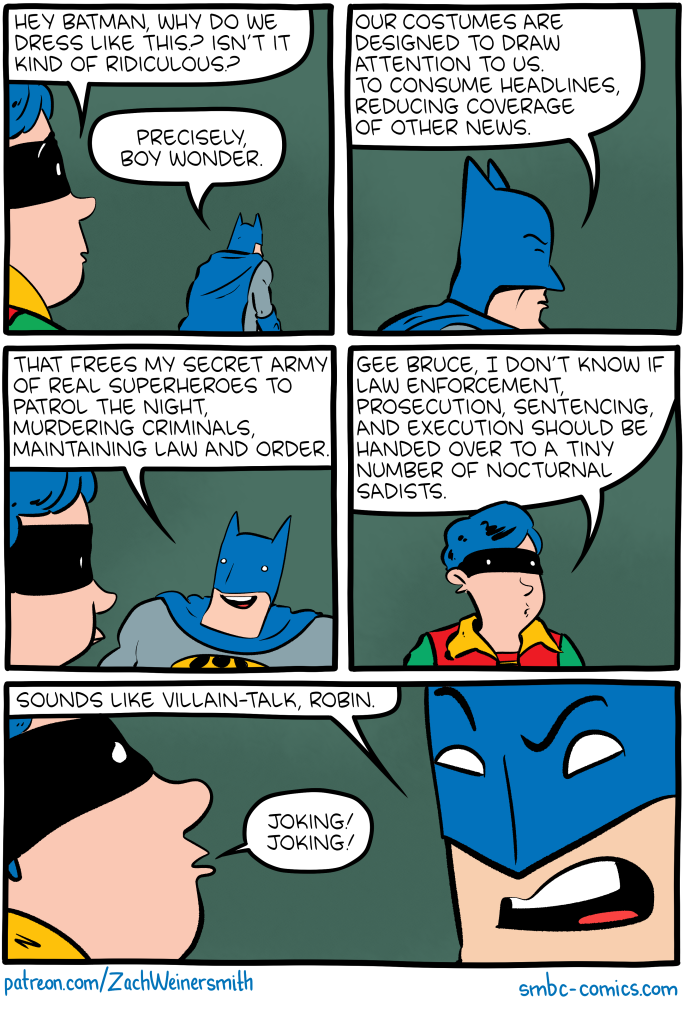
Saturday Morning Breakfast Cereal - Bat

by Zach Weinersmith


Click here to go see the bonus panel!

Hovertext:
You ever imagine how you'd feel if there were constant fights between anonymous well-armed vigilante factions. Eventually everyone would just move to the suburbs.


Today's News:
25 Jun 20:52

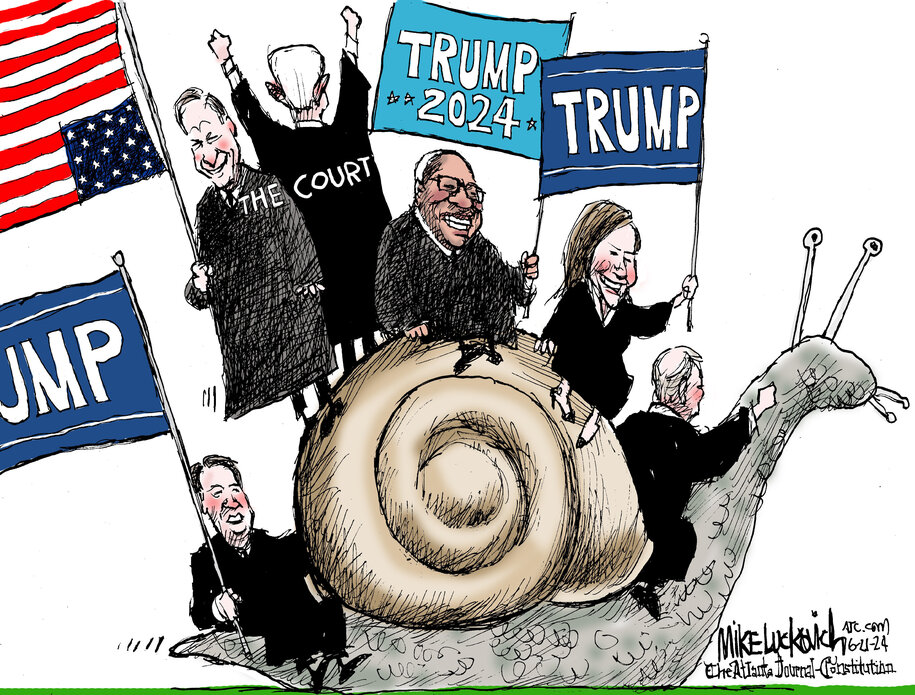
Cartoon: Supreme Court for Trump

by Mike Luckovich
25 Jun 19:57

“Energy-smart” bricks need less power to make, are better insulation

by Ars Contributors
James.galbraith

awesome

Image of a person holding a bag full of dirty looking material with jagged pieces in it.

Enlarge / Some of the waste material that ends up part of these bricks. (credit: Seamus Daniel, RMIT University)

Researchers at the Royal Melbourne Institute of Technology (RMIT) in Australia have developed special “energy-smart bricks” that can be made by mixing clay with glass waste and coal ash. These bricks can help mitigate the negative effects of traditional brick manufacturing, an energy-intensive process that requires large-scale clay mining, contributes heavily to CO2 emissions, and generates a lot of air pollution.

According to the RMIT researchers, “Brick kilns worldwide consume 375 million tonnes (~340 million metric tons) of coal in combustion annually, which is equivalent to 675 million tonnes of CO2 emission (~612 million metric tons).” This exceeds the combined annual carbon dioxide emissions of 130 million passenger vehicles in the US.

The energy-smart bricks rely on a material called RCF waste. It mostly contains fine pieces of glass (92 percent) left over from the recycling process, along with ceramic materials, plastic, paper, and ash. Most of this waste material generally ends up in landfills, where it can cause soil and water degradation. However, the study authors note, “The utilization of RCF waste in fired-clay bricks offers a potential solution to the increasing global waste crisis and reduces the burden on landfills."

Read 15 remaining paragraphs | Comments

25 Jun 19:54

Windows 11 is Now Automatically Enabling OneDrive Folder Backup Without Asking Permission

by msmash
James.galbraith

Fucking excuse me? Did we need more reasons to pass on 11? jesus

An anonymous reader shares a report: Microsoft has made OneDrive slightly more annoying for Windows 11 users. Quietly and without any announcement, the company changed Windows 11's initial setup so that it could turn on the automatic folder backup without asking for it. Now, those setting up a new Windows computer the way Microsoft wants them to (in other words, connected to the internet and signed into a Microsoft account) will get to their desktops with OneDrive already syncing stuff from folders like Desktop Pictures, Documents, Music, and Videos. Depending on how much is stored there, you might end up with a desktop and other folders filled to the brim with shortcuts to various stuff right after finishing a clean Windows installation. Automatic folder backup in OneDrive is a very useful feature when used properly and when the user deliberately enables it. However, Microsoft decided that sending a few notification prompts to enable folder backup was not enough, so it just turned the feature on without asking anybody or even letting users know about it, resulting in a flood of Reddit posts about users complaining about what the hell are those green checkmarks next to files and shortcuts on their desktops.

Read more of this story at Slashdot.

25 Jun 17:13

The whole time? The Boys has been making fun of Trumpers the whole time?!

by Alex Abad-Santos
James.galbraith

Seriously...it's hilarious that the fascists are suddenly realizing that Homelander may not be the hero...how thunderingly stupid do you have to be to miss that for years? lol

Television shows getting terrible reviews isn’t anything new. But there’s something fascinating happening with the fourth season of The Boys. It’s not just that people have suddenly turned on Amazon’s hit superhero satire, it’s who those people are and why they’ve changed their tune that’s so interesting. 

Since premiering to critical praise on June 13, alleged fans have been review-bombing the show’s latest season on sites like Rotten Tomatoes and IMDB. The most vocal and eye-catching of these takedowns pronounce that the show has gone “woke” or is so obviously “anti-Donald Trump.”

They’re not wrong, but they’re excruciatingly late to this observation. 

Since the show’s inception in 2019, The Boys has been a superhero allegory about Trump, dangerous authoritarianism, political fanaticism, Nazis, and America’s sway toward fascism. Its showrunner, Eric Kripke, has said as much interview after interview: This is a show explicitly about the allure of Trump and a critique of corporate America. The only thing that’s seemingly different in this fourth season is that it skates so close to what’s happening in the US now: Homelander (Antony Starr), a Superman-like sociopath who functions as the Trump stand-in, is facing a criminal trial and is fanning the flames of a January 6-like insurrection. 

These angry public admissions from conservatives that they’ve spent the previous seasons cheering on this horrible character — only to now realize they’re the butt of the joke — have become bigger than the show itself. It’s a testament to our culture’s ever-diminishing media literacy

This isn’t the first time in pop culture that a superhero satire has served as a warning about fascism and its biggest fans have whiffed on the point. That it keeps happening is a testament to how difficult it may be for all of us to not be lost in the allure of powerful people. 

What’s happening on this season of The Boys 

At the heart of The Boys is a brash deconstruction of the superhero fantasy, taking apart the traditional comic book superhero arc where super-powered beings save the day and defend those who can’t defend themselves. 

In The Boys, however, every character, every line, every shot, and every scene paints a larger portrait of how extremely screwed we would all be if superheroes existed in real life. The Boys’s cynical counter to the fantasy is a worldview that humans — even super ones — are morally flawed beings and that power always compromises morality. No matter how good we could be or think we could be, our selfishness, biases, envy, and everything in between will always get the better of us. 

People aren’t meant to be superheroes.

These human failings take the form of heroes like the terminally narcissistic Homelander or any of his coworkers, known as The Seven (a parallel to DC Comics’s Justice League or Marvel’s Avengers). Homelander and his pals rape and kill and lie but their powers and, more importantly, their celebrity status keep them from facing any semblance of justice. The Seven are all propped up by Vought International, an ultra-powerful pharma-entertainment-military defense corporation originated by a Nazi who invented a serum that gave normal people superpowers. 

Vought has its tentacles wrapped around every sphere of human life, whether its politics or sports or television and movies or law enforcement. There is no escaping Vought and the heroes it uses to make the world bend to its will. 

This season builds on the idea that Homelander has built a following so large and loyal that Vought can’t control him. He’s always been invincible and able to shoot laser beams from his eyes, but it’s his acolytes that have made going against him impossible. The monster Vought created has become the master, and he’s now pulling the strings and attempting to manipulate the world around him. 

In the season opener, Homelander is facing trial for the killing of a protester, a fan of former Seven member Starlight (Erin Moriarty). Starlight, who has the ability to manipulate electricity and energy, was the rare “good” hero and didn’t last long in Homelander’s tribe. She’s now part of an anti-Vought, anti-Homelander political movement, which is the short version of why Homelander killed her supporter. That, and Homelander is also a pathetically fragile sociopath. Yet, everyone including Homelander knows that he won’t be found guilty. Even if he was, it wouldn’t matter because he’s too politically significant to face any real consequences. It’s only a matter of time before Homelander plans a coup, a January 6-like insurrection and takeover of the United States. 

A celebrity turned powerful political figure and authoritarian who is facing trial and stirring up a fascist insurrection should sound very familiar to anyone paying the slightest bit of attention to American politics over the last eight years. Kripke, the showrunner, said as much in 2022, asserting that Homelander has “always been a Trump analogue” and that the parallel should have been crystal clear in the show’s third season in 2022. Kripke’s fourth season is even more urgent and obvious. 

Yet, despite The Boys’s purposefully unsubtle treatment of the dangerous creep of authoritarianism over the past three seasons and the showrunner plainly stating that the villain of his show is Trump, some of The Boys’s viewers are just now crying foul and expressing shock over the show’s politics.  

The Boys’s audience score is the lowest in the show’s existence 

On Rotten Tomatoes, the show’s audience score is at 50 percent, despite boasting a 95 percent critical score. That’s the lowest score The Boys has ever had. The divide between critics and viewers, with viewers submitting a lower score, doesn’t usually happen. Outlets like Screenrant, Forbes, and NME pointed out that the divide seems to be driven by viewers claiming the show has gone “woke.” They also explain that the show is being review-bombed, a practice in which users — whether or not they’ve seen the shows — flood aggregators like Rotten Tomatoes and IMDB with bad reviews to drive the audience/word of mouth score down. Television series and movies that are seen as progressive (e.g., shows that center characters of color, LGBTQ characters, and women) are sometimes review-bombed by those who don’t agree with that progress. 

The blowback to this season mirrors the backlash that happened at the end of 2022’s season three — the season in which Kripke said the satire was extremely clear and the line between Homelander and Trump extremely thin. Certain Homelander-loving fans had a meltdown upon realizing that their hero was actually a villain. 

That it took four seasons of the show for right-wing and conservative-leaning viewers to realize the characters they were championing were liberal spoofs of them is a dynamic that’s ripe for jokes about how media literacy is fighting for its life. How long would you let someone make fun of you for? What if it took roughly four years for you to figure it out? Wouldn’t you keep something like that private? 

Even if fans forgive The Boys’s superheroes for committing reprehensible acts like the aforementioned rape, killing, and violence, there were still moments that should have made the intent quite clear. In season two, an honest-to-God Nazi named Stormfront (which is literally the name of a Neo-Nazi internet forum) emerged on the scene and became Homelander’s ally and love interest. Her name and characterization (violence, really into social media, complimenting Homelander for Aryan features) couldn’t have been more obvious. But certain fans didn’t pick up on it, some even tied themselves in knots trying to exonerate Homelander’s fixation with her. Take for example this Reddit thread about whether Homelander was a Nazi because of his relationship with Stormfront, including the distinction that Homelander wasn’t a Nazi but a racist who has sex with Nazis.  

The fact that so many erroneous interpretations of The Boys exist — despite its creator explicitly talking about how mistaken they are — indicates there may be something at work with how viewers filter the media they consume. Perhaps media bubbles have reached a point where all of us expect the things we watch to reinforce our ideals. We’ve gotten so good at watching things that fit with our political leanings, and being served things that fit with our politics, that we can’t even identify when something is built to challenge those beliefs. What if it’s hard for conservative and alt-right viewers to comprehend that The Boys wasn’t made for them because they’re so used to everything in their sphere being for them? 

The show has skewered some liberal ideologies as well. The Boys includes multiple moments where Vought International’s PR team strategically focus-groups race and sexuality when it comes to their celebrity heroes. Each person of color or LGBTQ person joining The Seven is seen by corporate HQ as a token, a tool to push their agenda more effectively. It’s a blistering critique of the shallowness of corporate diversity, equality, and inclusion and how effective appearances are at winning liberals over.  

And in season two, the show introduces Victoria Neuman (Claudia Doumit). Enigmatic and for the people, Neuman seems to be a stand-in for one Rep. Alexandria Ocasio-Cortez.  Slowly viewers came to understand that she has her own nefarious motives and at least one mind-blowing super-powered secret. That you can’t trust even the most progressive lawmakers because all lawmakers sell a little part of themselves to the highest bidders sure feels like a leftist critique. 

Kripke has no qualms about the bluntness of his series. 

“I’m certainly not going to pull any punches or apologize for what we’re doing,” Kripke told the Hollywood Reporter. “Some people who watch it think Homelander is the hero. What do you say to that? The show’s many things. Subtle isn’t one of them. So if that’s the message you’re getting from it, I just throw up my hands.”

The Boys isn’t the first superhero critique where people didn’t see the critique

The Boys isn’t the first superhero satire that seems to have gone over the heads of much of its devoted audience. Writer Alan Moore and artist Dave Gibbons’s Watchmen was both a critique of the genre and a warning about how superhero comics glamorize authoritarianism and fascism while doing double duty in infantilizing their audience.

Still, so many fans, some very prominent, gush over Watchmen and how it portrayed gritty, damaged men, all but ignoring Moore’s warnings. Texas Sen. Ted Cruz famously named Rorschach, an extremist vigilante who sees violence and torture (e.g., breaking people’s fingers) as part of his job, one of his favorite superheroes. Similarly, director Zack Snyder’s 2009 adaptation reveled in the gloom and doom of its bloodied heroes.  

According to Moore, those were exactly the wrong things to take out of his work. 

“The creation of Rorschach — I was thinking, well, everybody will understand that this is satirical. I’m making this guy a mumbling psychopath who clearly smells, who lives on cold baked beans, who has no friends because of his abhorrent personality. I hadn’t realized that so many people in the audience would find such a figure admirable,” Moore told GQ in 2022, voicing his frustrations. He added, about Watchmen and his other graphic novel V for Vendetta :

They were trying to show that any attempt to realize these figures in any kind of realistic context will always be grotesque and nightmarish. But that doesn’t seem to be the message that people took from this. They seemed to think, uh, yeah, dark, depressing superheroes are, like, cool.

I think I understand fascism … But if this stuff can be so fundamentally misunderstood, it does make you wonder what the point of doing it was.

While Watchmen and The Boys touch upon the same themes, they’re drastically different in style. The latter leans into raunch and slapstick to highlight the hilariously bleak absurdity of just how close its creator thinks we are to a fascist dictator — while the former relies on plain old bleak absurdity. 

Still, both want to raise a mirror to their audiences, using superheroes to warn us about the perils of believing in the goodness of the most powerful people, from professional athletes to politicians to pop stars. Political affiliation doesn’t matter, power is power and shouldn’t be adulated. At the end of the day, no one is going to save us, especially not corporate-backed, focus-grouped capitalist heroes. That viewers keep tripping on this point only proves how alluring this fantasy is.

25 Jun 15:54

Pregnancy in America is starting to feel like a crime

by Anna North
James.galbraith

Gilead has always been their goal...

A pregnant person cradles their belly.
Pregnant people are struggling to get care in the wake of the Dobbs ruling, experts say.

Imagine you’re eight months pregnant, and you wake up in the middle of the night to a bolt of pain across your belly. 

Terrified you might be losing your pregnancy, you rush to the emergency room — only to be told that no one there will care for you, because they’re worried they could be accused of participating in an abortion. The staff tells you to drive to another hospital, but that will take hours, by which time, it might be too late.

Such frightening experiences are growing more common in the wake of the Supreme Court’s 2022 Dobbs v. Jackson Women’s Health decision, as doctors and other medical staff, fearful of the far-reaching effects of state abortion bans, are simply refusing to treat pregnant people at all. 

It’s part of what some reproductive health activists see as a disturbing progression from bans on abortion to a climate of suspicion around all pregnant patients. “People are increasingly scared even to be pregnant,” said Elizabeth Ling, senior helpline counsel at the reproductive justice legal group If/When/How.

The fall of Roe has led to an ever-widening net of criminalization that can ensnare doctors, nurses, and pregnant people alike, leading to devastating consequences for patients’ health, experts say. 

Complaints of pregnant women turned away from emergency rooms doubled in the months after Dobbs, the Associated Press reported earlier this year. Concerns about such treatment, combined with stories of people like Kate Cox, who was denied an abortion despite the risks her pregnancy posed to her health, have made some Americans afraid of conceiving: In one recent poll, 34 percent of women 18 to 39 said they or someone they knew had “decided not to get pregnant due to concerns about managing pregnancy-related medical emergencies.” 

Such surveys, along with ER records and calls to helplines, reveal a sense that in a post-Dobbs America, any pregnancy can be dangerous — to patients, to doctors, or both. “The fact that people are viewing the condition of pregnancy as something that makes them vulnerable to state violence is just so heartbreaking,” Ling said.

Americans are facing prosecution after miscarriage

The Dobbs decision has created an environment in which people experiencing miscarriage are treated as criminals or crimes waiting to happen, advocates say — or sometimes both. 

In October 2023, an Ohio woman named Brittany Watts visited a hospital, 21 weeks pregnant and bleeding. Doctors determined that her water had broken early and her fetus would not survive, but since her pregnancy was approaching the point at which Ohio bans abortions, a hospital ethics panel kept her waiting for eight hours while they debated what to do. She eventually returned home, miscarried, tried to dispose of the fetal remains herself, and was charged with felony abuse of a corpse. 

The charges were ultimately dropped, but experts say her case is part of a larger pattern. “There has become this hypersurveillance, hyperpolicing, hyperinterrogation” of pregnant people in America, said Michele Goodwin, a professor of constitutional law and global health policy at Georgetown and the author of Policing the Womb: Invisible Women and the Criminalization of Motherhood.

That surveillance isn’t entirely new, advocates and scholars say. Black pregnant women, especially, have been targets of suspicion for generations, stereotyped as drug users or “welfare queens” and even arrested when they tried to seek maternity care, said Goodwin. “There are cases of Black women having been dragged out of hospitals, literally in shackles and chains,” Goodwin said.

Black women and other women and girls of color have also been disproportionately targeted for arrest or investigation following miscarriages or stillbirths. In 1999, Regina McKnight, a 22-year-old Black woman in South Carolina, became the first person prosecuted for homicide after experiencing a stillbirth, according to Capital B. She was convicted and sentenced to 12 years in prison for endangering her pregnancy through drug use, but her conviction was eventually overturned.

But now, the atmosphere of criminalization around pregnancy is “spreading into wider and wider groups of people,” said Karen Thompson, legal director of the group Pregnancy Justice, which tracks the criminalization of pregnant people.

Black advocates have long cautioned that while the criminalization of pregnancy might affect Black and brown women today, “tomorrow it’s everybody,” Goodwin said. “Dobbs brought us into the tomorrow.”

Dobbs is making doctors scared to treat pregnant patients

In the tomorrow of post-Dobbs America, doctors and hospital staff now fear criminal charges if they are found to have performed an abortion in violation of their state’s bans. These bans have exceptions for saving the life, or sometimes the health, of the pregnant person, but the exceptions are often extremely narrow or unclear, forcing medical professionals to choose between refusing to treat a severely ill patient and losing their license or going to jail. 

“The way the states write their statutes, there’s no deference to the medical judgment of the doctor,” said Sara Rosenbaum, an emerita professor of health law and policy at George Washington University. “It has had a profound chilling effect on any care in emergency departments, because physicians and hospitals are in a panic.”

That chilling effect is leading some doctors to refuse not just to perform abortions, but also to provide any care for pregnant people in crisis, lest their care draw scrutiny in a restrictive and uncertain legal environment. A week after the Dobbs ruling, a woman arrived at Falls Community Hospital in Marlin, Texas, nine months pregnant and having contractions, according to a federal investigation of ER visits. The doctor on duty refused to treat her, instead sending her to another hospital in Waco, the AP reported. The outcome of her pregnancy — and the impact on her health of delayed maternal care — are unknown.

In another case, a pregnant woman arrived at a North Carolina hospital complaining of stomach pain. Staff told her they could not perform an ultrasound, and she eventually gave birth in a car on the way to another facility 45 minutes away, the AP reported. The baby did not survive.

“We’re talking a level of outlandishness that is up there with The Handmaid’s Tale,” Rosenbaum said.

The Emergency Medical Treatment and Labor Act (EMTALA) requires all hospitals that accept Medicare to stabilize the medical condition of anyone who arrives at an emergency room, including pregnant people. But the medical interventions allowed under new state abortion laws are often less than what EMTALA requires, Rosenbaum said. 

Meanwhile, the Supreme Court in the coming days will decide a case that could gut EMTALA, giving hospitals even more leeway to turn away pregnant patients. “I don’t think it’s an understatement to say that the loss of EMTALA, or even just weakening of EMTALA, puts pregnant people’s lives at risk,” Ling said.

Even people who are not yet pregnant feel the widening effects of Dobbs. The If/When/How helpline has received calls from people who want to become pregnant, but are terrified that “they might experience an unexpected loss like a miscarriage, and still somehow be punished for experiencing that loss,” Ling said.

In recent months, she has heard herself say the words, “it is not a crime to be pregnant,” she told Vox. And yet, more and more, it feels like it is.

This story originally appeared in Today, Explained, Vox’s flagship daily newsletter. Sign up here for future editions.

25 Jun 04:52

Why Washington's Mount Rainier Still Makes Volcanologists Worry

by EditorDavid
James.galbraith

Yes indeed

It's been a 1,000 years since there was a significant volcanic eruption from Mount Rainier, CNN reminds readers. It's a full 60 miles from Tacoma, Washington — and 90 miles from Seattle. Yet "more than Hawaii's bubbling lava fields or Yellowstone's sprawling supervolcano, it's Mount Rainier that has many U.S. volcanologists worried." "Mount Rainier keeps me up at night because it poses such a great threat to the surrounding communities, said Jess Phoenix, a volcanologist and ambassador for the Union of Concerned Scientists, on an episode of CNN's series "Violent Earth With Liv Schreiber." The sleeping giant's destructive potential lies not with fiery flows of lava, which, in the event of an eruption, would be unlikely to extend more than a few miles beyond the boundary of Mount Rainier National Park in the Pacific Northwest. And the majority of volcanic ash would likely dissipate downwind to the east away from population centers, according to the US Geological Survey. Instead, many scientists fear the prospect of a lahar — a swiftly moving slurry of water and volcanic rock originating from ice or snow rapidly melted by an eruption that picks up debris as it flows through valleys and drainage channels. "The thing that makes Mount Rainier tough is that it is so tall, and it's covered with ice and snow, and so if there is any kind of eruptive activity, hot stuff ... will melt the cold stuff and a lot of water will start coming down," said Seth Moran, a research seismologist at USGS Cascades Volcano Observatory in Vancouver, Washington. "And there are tens, if not hundreds of thousands of people who live in areas that potentially could be impacted by a large lahar, and it could happen quite quickly." The deadliest lahar in recent memory was in November 1985 when Colombia's Nevado del Ruiz volcano erupted. Just a couple hours after the eruption started, a river of mud, rocks, lava and icy water swept over the town of Armero, killing over 23,000 people in a matter of minutes... Bradley Pitcher, a volcanologist and lecturer in Earth and environmental sciences at Columbia University, said in an episode of CNN's "Violent Earth"... said that Mount Rainier has about eight times the amount of glaciers and snow as Nevado del Ruiz had when it erupted. "There's the potential to have a much more catastrophic mudflow...." Lahars typically occur during volcanic eruptions but also can be caused by landslides and earthquakes. Geologists have found evidence that at least 11 large lahars from Mount Rainier have reached into the surrounding area, known as the Puget Lowlands, in the past 6,000 years, Moran said. Two major U.S. cities — Tacoma and South Seattle — "are built on 100-foot-thick (30.5-meter) ancient mudflows from eruptions of Mount Rainier," the volcanologist said on CNN's "Violent Earth" series. CNN's article adds that the US Geological Survey already set up a lahar detection system at Mount Rainier in 1998, "which since 2017 has been upgraded and expanded. About 20 sites on the volcano's slopes and the two paths identified as most at risk of a lahar now feature broadband seismometers that transmit real-time data and other sensors including trip wires, infrasound sensors, web cameras and GPS receivers."

Read more of this story at Slashdot.

24 Jun 16:30

Cartoon: For sale

by Pedro Molina
22 Jun 17:53

Backlash against DEI spreads to more states

by South Carolina Daily Gazette
James.galbraith

You mean organized white supremacy

In South Carolina, bill banning DEI in college hiring, firing, and admission decisions passed the House but died in the Senate.

By Erika Bolstad, South Carolina Daily Gazette

Shortly after taking office in 2023, Republican state Rep. Katy Hall heard from constituents complaining about how their adult children were required to write diversity, equity and inclusion statements while applying for medical and dental schools and other graduate programs in Utah.

“It doesn’t seem right,” Hall said. “It doesn’t seem like it belongs in an application.”

It took two legislative sessions, but Hall successfully sponsored a new law that not only prohibits the use of such DEI statements but also bars state institutions from relying on specific individual characteristics in employment and education decisions. Additionally, it eliminates central offices dedicated to diversity, equity, and inclusion.

In Utah and beyond, lawmakers are enjoying growing success in their pushback against DEI programs at public universities, many of which have hired administrators and established departments dedicated to creating more diverse faculties and student bodies. Some schools’ requirement that job and student applicants explain in writing how they’d bring DEI initiatives to their work or schooling has aroused especially strong opposition. Some states have dismantled DEI departments and programs, as well as ended race- and gender-based programs and scholarships.

Many in Utah describe their approach as more measured than that of other states. The law, which goes into effect July 1, includes a carve-out that allows DEI to be discussed in classroom instruction as well as in research and for accreditation purposes.

Republican Gov. Spencer Cox, who signed Hall’s legislation into law in January, said it “offers a balanced solution” even as it prohibits the type of training sessions he required of his staff when he first took office in 2021.

The intent of the legislation, Hall said, is to shift higher education away from a focus on identity.

“This is what we felt was a more nuanced way to say: ‘We want diversity, we want equality of opportunity, we want inclusion, but we want diversity of opinion and a diversity of thought and diversity of religion and diversity of everything.’ Not just external, personal identity characteristics,” Hall said.

“We used to be able to have discussions about politics without it coming to a judgment of someone’s moral character,” she added. “My hope is that there will be a little more political neutrality where you can have discussions and feel safe to have those discussions without it being so divisive.”

But the bill passed along party lines, pointed out state Rep. Angela Romero, a Democrat who serves as the House minority leader in Utah. She described what’s happening in her state as part of a broader culture war aimed at painting higher education as elite and out of touch.

“This is a national agenda,” Romero said in an interview. “It’s a machine and it’s been going for a while and it’s picking up momentum.”

Utah’s rollback is among dozens of simultaneous efforts to scale back DEI programs—to varying degrees—in state capitals and on higher education oversight boards in other Republican-led states. In at least 22 states, the legislature has enacted legislation, or public universities have set policies prohibiting or modifying DEI measures at state university systems, according to a running tally in The Chronicle of Higher Education.

Among the earliest passed was 2023 legislation in North Dakota that prohibits asking students and prospective university employees about their commitment to DEI.

Florida followed last year with a law that does away with diversity statements and DEI offices.

Alabama in 2024 enacted a law restricting public employees from being forced to agree with divisive concepts, including the idea that “by virtue of an individual’s race, color, religion, sex, ethnicity, or national origin, the individual is inherently racist, sexist, or oppressive, whether consciously or subconsciously.”

In South Dakota, the Board of Regents recently enacted a policy that bars employees at its six public universities from putting their preferred gender pronouns or tribal affiliations in email signatures, according to Inside Higher Ed. Most recently, the University of North Carolina at Chapel Hill Board of Trustees voted last month to shift $2.3 million of DEI spending toward public safety and policing on campus. Then, the entire UNC System Board of Governors voted to abolish DEI policies in place since 2019 at all 17 of its campuses.

In South Carolina, Republicans in the state House passed legislation in March—over Democrats’ opposition—that would prohibit public colleges from factoring applicants’ political stances into hiring, firing and admission decisions. It did not, however, ban their diversity programs. The measure officially died when the session ended last month without a vote in the Senate.

A chilling effect

Many of the efforts to roll back DEI initiatives in states have the same roots as a campaign against critical race theory spearheaded by Seattle documentary filmmaker Christopher Rufo, who in 2020 elevated a once-obscure theory about the pervasiveness of racism in American law and institutions to a household term.

Multiple states, including North Dakota, have adopted near-identical language in anti-DEI legislation that bans instruction that might prompt a person to “feel discomfort, guilt, anguish, or another form of psychological distress solely because of the individual’s race or sex.”

In April, polling by NPR/PBS NewsHour/Marist found that 77% of Republicans say they believe that “discrimination against white people is as problematic as discrimination against Black Americans.”

Anti-DEI laws have had a chilling effect on higher education wherever they’ve been enacted, said Irene Mulvey, the president of the American Association of University Professors, a nonprofit membership association of faculty and other academic professionals.

“The laws are deliberately vague so that professors have to be constantly thinking, ‘If I say this, will I be breaking the law? Will I lose my job or be arrested by the government if I say this in my classroom?’“ Mulvey said. “I mean, that’s where we are in America in 2024. These are the worries faculty have in an authoritarian society, and they have no place in a democracy.”

At the University of Texas, anti-DEI legislation led the system to eliminate 300 positions recently and to cut diversity training programs at multiple campuses.

The situation is similar in Florida, said Paul Ortiz, a professor of history and a union leader at the University of Florida. He’s leaving the school after 15 years for a position at Cornell University in New York. The fallout from the state’s DEI policies wasn’t the only reason he’s leaving—he got a great job offer—but it contributed to his decision, Ortiz said.

“To pretend that it’s not having an effect on the cultural and intellectual life of the state is the worst thing of all,” Ortiz said. “I’m hoping the pendulum is going to swing back.”

Students are the real losers, Mulvey said. At the University of Oklahoma, for example, Republican Gov. Kevin Stitt’s executive order ending DEI programs in state offices and agencies effectively shuttered the National Education for Women’s Leadership program. The program encourages undergraduate women to engage in politics and public policy. Since its founding in 2002, more than 650 students have attended.

Stitt told the Oklahoma Voice that his executive order was about race, not the women’s leadership program, and called the backlash against his policy “political criticism.”

“What we’re seeing now is nobody’s helped when these offices are closed or programs are shut down, no one’s better off,” Mulvey said. “We’re having watered-down discussions and anodyne classes because faculty without tenure are afraid of losing their job if they say the wrong thing or if someone takes it out of context or tapes them and puts it online.”

DEI statements

DEI statements in university hiring have been one of the easiest targets nationwide, in part because there’s less support for them even among more progressive educators who support wider DEI initiatives.

Editorial boards and columnists at outlets as varied as The Washington Post, The Chronicle of Higher Education and the New York Post have railed against diversity statements, saying they too often result in “self-censorship and ideological policing” on college campuses. Many elite universities, including the Massachusetts Institute of Technology and Harvard, have reconsidered DEI statements as a requirement of employment applications. At best, critics argue, they’re boilerplate that echoes what employers want to hear, rendering them useless. At their worst, they serve as ideological litmus tests.

“We can build an inclusive environment in many ways, but compelled statements impinge on freedom of expression, and they don’t work,” MIT President Sally Kornbluth said in a statement to WBUR in May, confirming the university’s new approach.

But DEI statements have their defenders.

Suzanne Penuel, an associate professor who teaches first-year literature and writing at the University of South Carolina Lancaster, said she witnessed how high-quality DEI statements set job candidates apart when she served on the hiring committee for a position teaching American history.

Nearly all academic applicants have polished curriculum vitae, impeccable recommendations and pitch-perfect cover letters, she wrote in an op-ed in The State.

Their DEI statements gave them personality, Penuel said in an interview. It was easier to tell which applicants would take a student-centered approach to their work; one applicant wrote that the textbooks used in the school’s history courses ought to be free, an interpretation that the hiring committee viewed as an inclusive approach to education.

She worries that the assault on already slim DEI initiatives in South Carolina is a continuation of a trend she believes began with a 2021 law that all public college students take a course on American history that includes reading certain documents in their entirety, including the U.S. Constitution, the Declaration of Independence and Emancipation Proclamation.

That law—which took effect with the 2021-22 school year—updated nearly century-old requirements that public colleges simply weren’t following. It was the culmination of an eight-year legislative effort that began with a GOP senator asking USC officials why they weren’t following state law.

Since 1924, South Carolina law had required that public college students take a year-long course on America’s founding. The new law reduced that mandate to a semester and removed reference to the course’s final test serving as a loyalty oath to the United States for students who are American citizens. After the House added instruction on the Black “freedom struggle” to the reading list, the measure received overwhelming support in that chamber and unanimous approval in the Senate.

Penuel also worries about new rules requiring “age and developmentally appropriate” books and instructional material in K-12 classrooms and libraries. Those rules are set to take effect next week, despite never getting a vote on either chamber floor.

“I hope I never see the day when there is this prescribed list of texts from a narrow list of publishers, and only some topics can be discussed,” Penuel said.

In Utah, where Democrats hold just 14 of the 75 seats in the state House of Representatives, Romero fought unsuccessfully to keep the anti-DEI legislation from passing.

Her reasons for opposing the legislation were partly personal. As a first-generation college student at the University of Utah, she took advantage of what was then called the Center for Ethnic Student Affairs, an academic advising center that could now be considered a DEI initiative. It was a safe place in a state where the dominant religion and culture often excludes people of color, Romero said.

Because of her association with the center, Romero landed an internship at the state legislature in 1994, leading to a career working in municipal government in Salt Lake City. And now, she serves as president of the National Hispanic Caucus of State Legislators.

“Because of that, I’m here now,” Romero said on the House floor when the bill was up for debate. “What it did is it addressed the disparities. … There’s unintentional consequences when we just try to sweep things and say we’re all the same, because we’re not. There’s still a lot of things that have to change in this country for us all to be on a level playing field.”

Campaign Action

22 Jun 03:47

Cartoon: Climate change

by Nick Anderson
James.galbraith

Have fun, Florida... and Texas...and CA, oof

21 Jun 20:48

Here are 9 outrageous facts about Louisiana’s Ten Commandments law

by Mark Sumner
James.galbraith

Fuck Louisiana

Louisiana Gov. Jeff Landry signed a bill requiring every public school classroom to display the Ten Commandments after bragging that he “can’t wait to be sued” for this outrageous assault on the Constitution.

But the legislation package does a lot more than force Christianity on children. For example, it also removes requirements for COVID-19 vaccinations and limits other vaccinations.

Not only is the overall package a hodgepodge of religious right thirst traps, but the part about the Ten Commandments includes plenty of outright strange.

Here are nine of the most outrageous components of this legislative package.

1. The version of the Ten Commandments in the bill isn’t even in any version of the Bible

The bill doesn’t stop at requiring that the Ten Commandments be displayed, it resolvesany concerns over how different translations (and Catholic vs. Protestant) Bibles include different versions of the commandments. The bill includes its own version that all schools are required to follow. That version isn’t taken from any translation of the Bible.

Instead, it was pulled from a 2006 Supreme Court case, Van Orden v. Perry, involving a monument on public land featuring text from the Fraternal Order of Eagles. Louisiana legislators duplicated the text from that ruling under the impression that it gives them some sort of leg up in any potential court ruling. Where the Eagles got their divine inspiration is anyone’s guess.

2. No smaller than 11 inches by 14 inches, please

The authors of the bill seemed to worry that some smartass might get the brilliant idea of putting the Ten Commandments on the head of a pin or another tiny and obscure location, so they set a minimum size of “at least eleven inches by fourteen inches.”

The bill also requires a “large, easily readable font.” Might I suggest Comic Sans? Charcoal gray text on a black background would also be appropriate.

3. The bill includes no funding

Legislators thought they were clever on this one. By not funding the Ten Commandments posters, or rolling them off state presses, they wanted to keep some pretense of following the ruling of another 2006 case that said they could be displayed on public land if it were supported by a private donation.

So all of those 11-by-14 posters are supposed to be donated to the schools. However, schools are required to show the commandments. What happens if there aren’t enough posters for every classroom from kindergarten through college? Don’t worry about it. Legislators didn’t.

The bill also says that citizens can donate funds so schools can buy copies of the Ten Commandments. Schools buying religious documents with bake sale money might seem like a distinction that’s not actually a distinction at all, but in a bill designed to generate a court case, what’s one more press of the hot button?

4. The bill calls the Mayflower Compact “America’s first written Constitution”

It also calls it the “first purely American document of self-government.” And since that first Constitution and purely American document was full of references to God, that obviously means that the U.S. government is based on God.

How religious is the Mayflower Compact? It starts with “in the name of God, Amen,” and in the second paragraph it really gets rolling. 

“Having undertaken, for the glory of God, and advancement of the Christian faith, and honor of our King and Country,” it reads. There’s a whole lot of “dread sovereign Lord, King James” stuff in there as well. So apparently the U.S. was meant to be a monarchy.

Louisiana legislators do not mention that this document was prepared for the local governance of a few hundred religious extremists as a giant FU to civil authority, or that the compact was written before any of them had even set a Pilgrim foot on North America.

They also failed to note that, if that call out to God was supposed to lend the Plymouth colony some special favor, the fact that only 52 people were alive by the end of the first year might suggest that God is unimpressed by paperwork.

5. Legislators scoured U.S laws to find a mention of God, and they got … almost one

The Northwest Ordinance of 1787 might not be the first legislation someone thinks of as a defining document … unless that someone is a Christian nationalist. On the religious right, this law is often cited as “proof” that the U.S. is based on religion, stating that “religion, morality, and knowledge, being necessary to good government and the happiness of mankind, schools and the means of education shall forever be encouraged.”

Well, all right then. Religion in schools, it’s the law. What could be better? It not only gets cited in the Louisiana bill, but legislators proposed that schools can choose to hang it on the wall next to the Ten Commandments.

The pesky thing about the Northwest Ordinance of 1787 is that it’s from 1787. As in, before the Constitution or the First Amendment. It didn’t conflict with the wall between church and state because that wall was still under construction. This bill wasn’t even signed by any Senate, House, or President; it was passed by the unicameral Confederation Congress. 

But hey, confederacy! That only makes it better, right?

6. Schools are prohibited from even asking about students’ vaccination status 

While the first five items were all crammed into the single bill about the Ten Commandments, Landry actually signed off on a package of items, including a prohibition on COVID-19 vaccine mandates. But that doesn’t really matter, since another bill in the package entirely eliminates school officials’ authority to check vaccination status. 

To put a double underline under this prohibition, teachers aren’t allowed to ask about vaccination status, but if they somehow become aware, they’re not allowed to seat students in a way that might prevent the spread of disease in their classrooms. They also can’t prevent unvaccinated kids from participating in any in- or out-of-school activity.

Because that would be “discrimination.” And you know how much Southern Republicans hate discrimination.

7. Teachers can be sued for using a student’s preferred name or pronouns

The legislation requires that students only be assigned pronouns according to what is called their "immutable sex" as found on their birth certificates. They can also only be addressed by the name found on their birth certificates or by nicknames “derived from that name.”

Is Betsy okay for Elizabeth? How about Bess? Lizzie? Can you use Jack for John? Is Rory really an acceptable nickname for Lorelei?

Teachers better be on top of these things because the bill makes them personally liable, allowing them to be sued if they don’t keep those nicknames and pronouns straight.

8. A “Don’t say gay” bill worse than Florida’s was added almost without notice

The “Let Kids Be Kids” act protects delicate ears from any mention of sexual orientation, gender identity, or sexual orientation all the way through grade 12. No teacher, coach, or other school employee is allowed to engage in any discussion on these topics. They’re also not allowed to reveal their own gender identity or sexual orientation.

9. It allows schools to appoint a "volunteer chaplain"

That would be a chaplain. As in one chaplain. But surely getting the community to appoint a single religious representative at the school will mean everyone’s religious beliefs are recognized.

The chaplain is only a volunteer, though, and not an actual school employee. So maybe students could go to them about their concerns over sexual orientation and gender identity. What could possibly go wrong?

Campaign Action

20 Jun 22:26

Why Latin American leaders are obsessed with mega prisons

by Ellen Ioanes
James.galbraith

It's hard not to see Judge Dredd blocks in the background here. So we think 20k criminals in the same place is a great idea? Umm...

TECOLUCA, EL SALVADOR - JUNE 11: (----EDITORIAL USE ONLY MANDATORY CREDIT - 'PRESIDENCY OF EL SALVADOR / HANDOUT' - NO MARKETING NO ADVERTISING CAMPAIGNS - DISTRIBUTED AS A SERVICE TO CLIENTS, DO NOT OBSCURE LOGO----) Gang members are brought together for transfer in the presence of authorities, on June 11, 2024 in Tecoluca, El Salvador. The transfer of 2,000 gang members to the high-security prison was carried out on the orders of El Salvador's president, Nayib Bukele. (Photo by Presidency of El Salvador/Anadolu via Getty Images)

Honduran President Xiomara Castro recently announced plans to build a “mega prison” capable of housing 20,000 people to manage the country’s crime problem. 

It’s part of an increasingly popular proposition in Latin American countries — fighting drug trafficking and gang violence with harsh carceral measures — but it’s also a subversion of the rule of law and a human rights debacle that may not be a sustainable solution to the region’s problems.

El Salvadoran President Nayib Bukele claims to have found the solution to the region’s criminal enterprise problem in a massive prison and anti-gang initiative that has dramatically reduced the number of homicides there. And his policies are massively popular; he won reelection in a landslide earlier this year and now has a supermajority in the legislature. But his policies have also contravened the rule of law in the Central American country, ignoring individual civil rights and undermining democracy. 

That hasn’t stopped a number of leaders across Latin America — from Ecuador’s banana-fortune-heir-turned-novice-politician Daniel Noboa to Chile’s progressive Gabriel Boric — from celebrating his approach or adopting parts of it.

Hondurans are desperate for a similar fix to the system of extortion, narco-trafficking, and violence that impacts their lives, and Castro has promised her new facility on Great Swan Island — coupled with additional measures to combat violence, such as further militarizing the police response to organized crime, legally classifying drug traffickers terrorists, and holding mass trials for suspects — will usher in a new era of safety. 

Honduras is not El Salvador, however, and differences in the two countries’ political structure, legal systems, topography, and the criminal groups’ main source of revenue mean it’s not clear how successful Castro’s plans will ultimately be, either in minimizing crime or in sustaining her political popularity.

What’s more, hardline approaches that countries like Colombia and Mexico have implemented militarized approaches to gang and drug-related violence before — and not only have previous iterations of those approaches not worked, they’ve made the problem worse in the long run, causing the drug trade and gang violence to shift and grow without addressing underlying social problems that contribute to illicit activity.

What’s behind the Latin American super prison trend?

El Salvador, Honduras, and Guatemala have long struggled to contain the brutal gang violence that has dominated daily life for decades. In El Salvador, extortion, kidnapping, murder, smuggling, and other brutalities have persisted, to some degree, since the late 1990s due to the social, economic, and political instability left by the civil war, which ended in 1992. 

Many successive presidential administrations have adopted the mano dura, or “iron hand” tack, instituting harsh crackdowns to mitigate the violence. 

In fact many Latin American countries attempted to stem drug- and gang-related violence using this iron-fist approach in the early 2000s — only to have it backfire and make the problem worse by causing criminal organizations to factionalize and then battle each other for dominance, as in Mexico under former Presidents Felipe Calderón and Enrique Peña Nieto. 

But Bukele is on an entirely different level; he built a super prison capable of holding 40,000 people, and his administration has used it to imprison tens of thousands, many arbitrarily; repeatedly extended a state of emergency severely curtailing the rights of ordinary citizens; and attacked and even detained his critics in the press.

What’s also different about Bukele’s version of mano dura: It actually seems to be reducing gang violence and boosting his popularity, which inspires other leaders hoping to achieve his level of popularity (he won more than 80 percent of the vote in his unconstitutional 2024 reelection bid) — or at least hang on to power. 

“The Bukele phenomenon is spreading out across Latin America and for a president of a small Central American country, he has gained a huge stature across the subcontinent,” Juan Albarracín Dierolf, a political scientist at the University of Illinois, Chicago, told Vox. “And he’s recognized in public opinion, in ways that none of his predecessors were across different countries of the region.”

Bukele’s approach appears to have dramatically reduced homicides in his country and genuinely improved many people’s lives. “We are celebrating, thanking him, thanking God, for getting us out of this gang problem. We don’t want to go back to that horrible past,” voter Guadalupe Guillen told Reuters in February. “Democracy is not at risk because all the people have voted for him.”

But they come with high costs, ones that might ultimately undermine El Salvador’s security or stability in the long run. Press freedom in El Salvador is nonexistent, and the Bukele regime is not distributing statistics or any information about how the prisons are being managed or what efforts there are to actually bring criminals to justice and address some of the factors that contribute to organized crime, including a lack of education and economic opportunities, as well as the entrenchment organized crime within the power structure. The government has swept up about 76,000 people in its war on drugs, often without evidence. Many do not have access to attorneys and the government has denied them due process. Families have no idea when — or if — their loved ones will be released, and at least 40,000 children have been left without a parent due to the sweeping arrests. And multiple reports about human rights abuses, including torture and deaths in prison, have come out since Bukele instituted his anti-gang policies in 2022.

That hasn’t stopped other Latin American leaders, including Noboa in Ecuador, from following Bukele’s lead. 

Ecuador has become a major hub for narcotics and a battleground for the armed groups trafficking them — and with that, the homicide rate has skyrocketed. The ongoing conflict recently culminated with massive armed battles in the prisons themselves, and perhaps most memorably armed gangs taking over a TV station and infiltrating and terrorizing other institutions. In response, Noboa launched an “internal armed conflict,” ordering the military to “neutralize” gangs, without worrying too much about human rights. He sent in the military to control the prisons, which had previously been run by the Los Lobos and Choneros gangs. Under Noboa, the gangs are now classified as terrorists, and the military, which has taken up a much more prominent role in policing, can consider them targets. 

“While we don’t know yet how effective will Noboa be, he is following the steps that Colombia took 30 years ago to fight narcoterrorism [which had] a mixed record,” Renata Segura, head of the Latin America and Caribbean program at the International Crisis Group, told Vox.

Reports of human rights violations, including at least one extrajudicial killing and multiple arbitrary arrests, are already emerging. “It’s something which people are very aware of, very worried of, and particularly human rights organizations, civil society organizations are really scared of that, because they know what the war on drugs has meant elsewhere,” Guillaume Long, an analyst at the Center for Economic Policy and Research and former foreign minister of Ecuador, told Vox. 

Now Honduras is fully embracing Bukele’s mano dura style policies as well. But as with Ecuador, its success in Honduras is far from certain — and concerns about civil liberties are already surfacing.

Why mano dura super prisons may not quash Latin America’s gang problem

Castro’s use of mano dura techniques isn’t new: She temporarily suspended parts of the constitution meant to protect against arbitrary detention as well as freedom of movement and assembly — implementing what’s known as a state of exception — in 2022, arguing that doing so was necessary to stop crime. 

Her latest announcement is “another step away from the agenda that Xiomara first promised, which included focus on community policing, demilitarization, [and] prevention,” according to Andreas Daugaard, a research coordinator at Honduras’s Asociacion para una Sociedad mas Justa, and it comes amid questions about the effectiveness of the policy. “The government started advancing that agenda in early 2022 by dismantling the anti-gang military police force (FNAMP) and removing military from prisons, yet less than one year in, extortion rates started rising.”

While there is certainly drug trafficking in Honduras, extortion is also a major problem, with gang members draining victims of both hard cash and via digital means. There’s little reliable data about the economic effects of extortion, but it has infiltrated the transit sector and devastated thousands of small businesses in the past.

Corruption is deeply intertwined with the political class in the country; multiple former government officials have been implicated in corruption scandals, and Castro herself has been accused of consolidating her power by putting family members and close associates in government positions

But Castro has already faced roadblocks with the mano dura policies she has put in place, unlike Bukele.

“Bukele has been able to effectively reduce violence through authoritarian measures because he has full control of the main state institutions, including Congress and the courts,” Segura said. “In places with real checks and balances, it is unlikely that these types of operations would work. That has been the case, in fact, in Honduras. Castro declared [a] state of exception last year, and it did little to reduce the purported reason for it: extortions.” 

In fact, the Honduran government touts that 32,000 people have been arrested so far, but approximately 95 percent of them had to be released because of a lack of evidence.

Partly because of these failures, and partly because of Bukele’s massive popularity both in El Salvador and across the region, Daugaard surmises that — to show voters she’s taking action — Castro will build the prison, which is a one-day boat ride away from the mainland and communication is only possible via satellite.

Though Bukele’s policies are popular, they are likely not sustainable, in El Salvador or elsewhere, Albarracín said. “In many places, it’s a very desperate security situation —  it’s hard to understand what it means to live under these circumstances. So in comes someone who says, ‘I’m going to do something,’ and does something quite immediate and visibly. So that’s kind of the charm of these policies. They’re very visible.”

Castro has not outlined how this new prison will overcome systemic issues that have plagued the country’s existing carceral system. As Daugaard explained, “they already have several maximum security prisons, and the problem there was not the physical installations, but corruption of those in charge — how will they ensure that the new people in charge are not corrupt?”

Also at issue is the fact that prisons and militarized police forces are expensive to maintain long-term, even if they appear to work in the short term: As it is in a remote location, Honduras’s super prison “will have a huge impact on wildlife and environment [and] it will be super expensive to move food, materials and people back and forth,” Daugaard said.

There are alternatives to mano dura — “Colombia’s Paz Total is the opposite model to Bukele (trying to negotiate with the armed and criminal groups to reduce violence and eventually demobilize the groups),” Segura said. But the strategies that could lead to a long-lasting, sustainable reduction in violence often take a long time and don’t produce exciting visuals like those Bukele and Castro have circulated in support of their policies. 

“Increasing the capacity of states to really prosecute — with the rule of law — criminals, the capacity to have better intelligence of how organized crime works, and how to dismantle it,” are likely more effective over time than merely imprisoning thousands of people without trial, Albarracín said.

Perhaps even more important, Albarracín told Vox, is building “the capacity of the state to punish and sanction state officials [who] are engaging in these types of agreements with criminal groups,” as was successfully implemented in Guatemala from 2007 to 2019, and the legacy of which arguably helped anti-corruption crusader Bernardo Arevalo to be elected president this year.

These kinds of policies don’t offer immediate relief, and they often threaten powerful political interests. But they’re necessary to protect civil rights, build lasting security, and break the destructive and authoritarian mano dura cycle.

20 Jun 22:13

This 3-minute video of Trump is absolutely devastating

by Kaili Joy Gray
James.galbraith

yup, every GOP attack is a confession

While the media is obsessively covering President Joe Biden’s age and suggesting he isn’t as sharp as he used to be, a story that gets far less virtual ink is that Donald Trump, who is only a few years younger, seems to be losing it.

But he is, and it often happens on camera in front of big crowds. MeidasTouch News has created a three-minute video that shows just how bad it is.

Here are 3 minutes straight of Donald Trump confusing and forgetting people's names, the names of cities he is in and more pic.twitter.com/OJSixOIBR9

— MeidasTouch (@MeidasTouch) June 19, 2024

It’s not just that Trump mispronounced Elise Stefanik’s name, even though she’s a Republican House leader and one of Trump’s most loyal supporters.

And it’s not just that Trump stumbles over his words sometimes and utters nonsensical phrases.

Sure, those are the types of minor errors anyone can make. Heck, do you know how to pronounce Stefanik’s last name?

But it’s the other things that are far more alarming. Like the time he gets names wrong even when he has a teleprompter right in front of him. 

Or the fact that he has repeatedly referred to Barack Obama as if he is the current president. And that he also suggested Biden “won against” Obama.  

Then there was the speech he gave earlier this year when he insisted that Nikki Haley, who at the time was his last-standing rival in the Republican presidential primary, had failed in her responsibilities to secure the Capitol on Jan. 6, 2021. Haley of course had nothing to do with the Capitol or its security. It’s an attack Trump and Republicans have made on then-Speaker Nancy Pelosi. But in his brain, Trump had somehow confused the two.

The reality is that the two men running for president this year are both old. And yes, senior moments happen. But Trump, who has been detached from reality for years, is becoming increasingly nonsensical, and while we might snicker sometimes at the silliness of it—didn’t he mean to warn about a coming World War III, not World War II?—it’s also terrifying.

Campaign Action

20 Jun 21:29

Dell said return to the office or else—nearly half of workers chose “or else”

by Samuel Axon
James.galbraith

You mean there are business consequences to ignoring your workers' clearly stated preferences? Perish the thought.

Signage outside Dell Technologies headquarters in Round Rock, Texas, US, on Monday, Feb. 6, 2023.

Enlarge / Signage outside a Dell campus. (credit: Getty)

Big tech companies are still trying to rally workers back into physical offices, and many workers are still not having it. Based on a recent report, computer-maker Dell has stumbled even more than most.

Dell announced a new return-to-office initiative earlier this year. In the new plan, workers had to classify themselves as remote or hybrid.

Those who classified themselves as hybrid are subject to a tracking system that ensures they are in a physical office 39 days a quarter, which works out to close to three days per work week.

Read 9 remaining paragraphs | Comments

20 Jun 19:53

A second Trump term would double down on erasing trans rights. Here’s how advocates are preparing

by The19th

If Trump is re-elected, advocacy groups expect him to enact more extreme anti-LGBTQ+ policies than those he put in place during his first term.

By Orion Rummler, The 19th News

LGBTQ+ advocates are gearing up for a possible second Trump administration by planning future litigation, deepening relationships in Congress, and mobilizing voters.

If former president Donald Trump is re-elected, advocacy groups expect him to enact anti-LGBTQ+ policies that are more far-reaching and extreme than those he put in place during his first term—based on his campaign promises and policies suggested by the Heritage Foundation, a conservative think tank that has shaped the GOP’s agenda for decades.

Trump is focused specifically on rolling back transgender rights, as he detailed in a campaign video last year. His proposals would terminate Medicare and Medicaid funding for hospitals that provide gender-affirming care to trans youth, attempt to charge teachers with sex discrimination for affirming students’ gender identities and order federal agencies to “cease all programs that promote the concept of sex and gender transition at any age.”

Trump also pledged to ask Congress to halt the use of federal funds to promote or pay for gender-affirming care, without distinguishing between care for adults or minors.  

Some of these policies mimic state anti-LGBTQ+ laws, which frequently run into enforcement issues as state agencies tasked with monitoring school bathrooms and classrooms are unable to find consistent ways to carry out restrictive laws. Several of Trump’s proposed anti-trans policies would also require congressional approval. However, as a new report from the American Civil Liberties Union details, even if Trump gains the presidency without Republicans taking power in Congress, he would be able to take action against LGBTQ+ rights on his own—and has said that he plans to.

“We’ve seen over the last several years a militant effort in red states by the government to discriminate against trans folks, in particular, and the broader LGBTQ community, and even to go so far as to try to deny trans people's existence,” said Mike Zamore, national director of policy and governmental affairs at the ACLU. “The danger in the Trump administration is seeing the federal government using its massive reach and resources to do something similar on a national scale.”

The federal government could use its civil rights enforcement capabilities to argue that institutions trying to protect LGBTQ+ rights are violating the rights of people with certain religious beliefs, Zamore said, or it could threaten to withhold funding from universities that receive federal money if they do not discriminate against transgender students.

In the Heritage Foundation’s Project 2025, a purported roadmap of executive actions that a future Republican president could take on various issues—including abortion access—several of the policy suggestions align with Trump’s promises to roll back LGBTQ+ rights. Project 2025 advocates for the deletion of the terms “sexual orientation and gender identity” from all federal rules and for prohibiting teachers from affirming trans students.

One of the more extreme proposals in Project 2025 equates the act of being transgender, or “transgender ideology,” to pornography, and declares that it should be outlawed. The conservative think tank recommends that educators and public librarians who spread the concept of being transgender should be registered as sex offenders, and that telecommunications and technology firms that facilitate the spread of ideas about transgender people should be shuttered.

The ACLU says that a second Trump administration would not be able to implement such a policy without Congress—and that if such a policy did go into effect, using criminal laws to outlaw the concept of being transgender would violate the First Amendment.

Overall, the ACLU expects the federal government under a second Trump presidency to rescind federal regulations that prohibit discrimination on the basis of sexual orientation and gender identity, and to weaponize federal law against transgender people in ways that would also harm cisgender and gender-nonconforming people, by attempting to enforce strict definitions of gender expression.

“This election has huge ramifications for the future of trans rights across the country,” said Josie Caballero, director of voting and elections at Advocates for Trans Equality. “The future is going to be incredibly difficult if we allow for a second Trump presidency. That will have ramifications that will affect the trans community for decades,” she said.

Caballero, a Texas-born granddaughter of Mexican immigrants who is also a military veteran and a queer trans woman, joined other advocates in Congress this week to lobby lawmakers in support of trans rights. If Trump is elected to another term, she believes that deepening relationships in Congress will help. But her focus ahead of the 2024 presidential election is getting as many trans people registered to vote, and ready to vote, as possible.

Building a substantial trans voting bloc is crucial to demonstrate to lawmakers that trans people are a formidable political force, she said; and it provides a concrete way to show how many trans people are getting involved in the political process.

“If you vote against trans issues, well you’re going to lose a massive amount of votes and have those votes go against you,” she said.

Caius Willingham, senior policy advocate at Advocates for Trans Equality, led the organizing for the group’s lobbying on Capitol Hill. Building strong relationships with lawmakers in Congress is key to a unified strategy to fight back against anti-trans attacks expected during a potential Trump 2025 administration, he said. When Congress is functioning properly, it is meant to check presidential overreach—and much of Project 2025 focuses on consolidating presidential power, he said. Project 2025 includes authors from Trump’s former administration and campaign.

“Their aim is to consolidate as much power in the White House as possible, and so it's very key to make sure that Congress remains a vital check. So that's why this is a huge priority for Advocates for Trans Equality,” he said. There are strong allies for trans rights in Congress, he said—like Rep. Pramila Jayapal of Washington, author of a congressional bill that aims to recognize federal protections for transgender Americans.

Caballero met on Wednesday with staff from Massachusetts Democrats in Congress, including Reps. Ayanna Pressley and Katherine Clark and Sens. Ed Markey and Elizabeth Warren. Other staff at Advocates for Trans Equality, as well as the constituents that they brought to meet  lawmakers, also met with Republicans in Congress.

“We actually ended up with more than 90 meetings scheduled, and these meetings really ranged the political spectrum. We did not turn down a meeting with a single office,” Willingham said. “We met with Ted Cruz's office. We scheduled something with Mitch McConnell’s office, that one fell through. But we were here and we were happy to meet with anybody who would make the time to listen to us.”

Whether congressional Republicans have been responsive to those meetings remains to be seen. Within the past few years, anti-trans rhetoric and attempted policymaking have only continued to grow on Capitol Hill. But the rising number of federal anti-trans bills introduced by Republicans in Congress have been unable to pass, due to a Democratic-controlled Senate. In November, that could change.

If “a pro-equality opposition” controls either or both chambers of Congress in a second Trump administration, pro-LGBTQ+ members of Congress could still use the appropriations process to hinder Trump’s ability to enact anti-trans laws, the ACLU writes in its report. The appropriations process refers to how the House and Senate fund the federal government, which is often derailed by “riders”—provisions that dictate policy not directly related to the federal budget.

Since many of the anti-LGBTQ+ policies proposed by Trump’s campaign or Project 2025 would violate the Constitution and federal law, the ACLU says that litigation would be a significant part of its response to a second Trump term. As the last few years have seen a dramatic increase of anti-LGBTQ+ rhetoric and laws, the civil rights group has mounted dozens of consequential lawsuits against those policies—and at least a dozen on health care bans within the last year. During Trump’s first term, the ACLU took on the former president’s order to ban trans people from the military amid hundreds of other lawsuits against the former administration.

Although the ACLU is confident in its ability to fight anti-LGBTQ+ policies in court, and several judges appointed by Trump have actually granted wins for LGBTQ+ advocates, the organization says that the political atmosphere has still changed since Trump’s first term.

“Getting courts to understand the experience of transgender people and the impact of discriminatory policies on their lives was difficult even before Trump reshaped the judiciary. It is that much harder now,” the report reads. It was co-authored by Ian Thompson, senior legislative advocate at the ACLU, as well as James Esseks, attorney and project director for the ACLU’s LGBTQ+ HIV Project, and Leslie Cooper, deputy director of the ACLU LGBT & HIV Project.

“What we know is that the courts are not as friendly as they once were,” said Zamore, who contributed to the report. “I don't think any of us can assume that a position that was successful in the first Trump administration would necessarily prevail this go around, but we will obviously be doing everything we can.”

The ACLU is also urging states to act now to prepare for a possible second Trump presidential term. Local elected officials should start planning how to protect their transgender constituents, and states should create funding streams for gender-affirming care to protect access for those who would lose health care without federally funded programs. The organization cites policies created to protect abortion access as examples, like California’s reproductive health equity program and Maryland’s abortion clinical training program.

The ACLU is working with its state affiliates to organize ideas and potentially necessary resources, Zamore said. Under a hostile administration, states with LGBTQ-friendly governments will need to fill in the gaps for access to gender-affirming care while also standing up for their residents, he said.

Trans Americans and parents of trans youth can also prepare by updating their identity documents, said Gillian Branstetter, communications strategist at the ACLU’s women’s rights project and LGBTQ & HIV Project, who also contributed to the report. Approving name changes, updating birth certificates, and filing for a new passport are all steps that should be taken now, she said.

The ACLU’s report aims to communicate a way out if some of these policies are implemented, she said, and to organize LGBTQ+ groups around a common focus.

“We’re not out of options. We are not without power here,” she said.

Campaign Action

20 Jun 18:04

Security Bug Allows Anyone To Spoof Microsoft Employee Emails

by msmash
A researcher has found a bug that allows anyone to impersonate Microsoft corporate email accounts, making phishing attempts look credible and more likely to trick their targets. From a report: As of this writing, the bug has not been patched. To demonstrate the bug, the researcher sent an email to TechCrunch that looked like it was sent from Microsoft's account security team. Last week, Vsevolod Kokorin, also known online as Slonser, wrote on X (formerly Twitter) that he found the email-spoofing bug and reported it to Microsoft, but the company dismissed his report after saying it couldn't reproduce his findings. This prompted Kokorin to publicize the bug on X, without providing technical details that would help others exploit it.

Read more of this story at Slashdot.