Read more of this story at Slashdot.
James.galbraithFucking ridiculous
Read more of this story at Slashdot.
James.galbraithAstounding
Donald Trump’s hatred for veterans is well known, and on Thursday night, he took it even further.
At a Thursday campaign event, which was purportedly meant to focus on antisemitism, Trump said this about GOP megadonor Miriam Adelson and her deceased husband, Sheldon Adelson:
I watched Sheldon sitting so proud in the White House when we gave Miriam the Presidential Medal of Freedom—that’s the highest award you can get as a civilian. It’s the equivalent of the Congressional Medal of Honor, but civilian version. It’s actually much better because everyone [who] gets the Congressional Medal of Honor, they’re soldiers. They’re either in very bad shape because they’ve been hit so many times by bullets, or they’re dead. She gets it, and she’s a healthy, beautiful woman.
Trump: When we gave her the Presidential Medal of Freedom… It’s the equivalent of the Congressional Medal of Honor— it’s actually much better because everyone who gets the Congressional Medal, they’re soldiers. They’re either in very bad shape because they’ve been hit so many… pic.twitter.com/a766KxAC2e
— Acyn (@Acyn) August 16, 2024
Let’s break that down. In Trump’s mind:
The Presidential Medal of Freedom is “much better” because the Congressional Medal of Honor is given to soldiers.
The Congressional Medal of Honor is somehow devalued because many of its recipients are “either in very bad shape” from being shot, “or they’re dead.”
The Presidential Medal of Freedom is better because his recipient is “a healthy, beautiful woman.”
You would think that surviving an assassination attempt would give him some new perspective on being shot at, but … it didn’t.
Of course, this disgraceful statement is only the latest in his long history of despising veterans.
Trump’s hatred for the late Sen. John McCain, a former prisoner of war, is legendary. According to a 2020 article by The Atlantic:
When McCain died, in August 2018, Trump told his senior staff, according to three sources with direct knowledge of this event, “We’re not going to support that loser’s funeral,” and he became furious, according to witnesses, when he saw flags lowered to half-staff. “What the fuck are we doing that for? Guy was a fucking loser,” the president told aides.
While Trump denied having said that—because of course he did—the statement certainly tracks with his public comments, such as in 2015 when he told an audience, referring to McCain, “He’s not a war hero. He was a war hero because he was captured. I like people who weren’t captured.”
In 2018, during a trip to commemorate the centennial anniversary of the end of the World War I, Trump reportedly refused to visit a cemetery of dead troops, saying, “Why should I go to that cemetery? It’s filled with losers.” And at another point on the same trip, Trump reportedly referred to Marines who died in the World War I battle of Belleau Wood as “suckers.”
After The Atlantic reported these statements, John Kelly, Trump’s former White House chief of staff and a retired Marine Corps general, confirmed them to CNN. Incidentally, the Marines fought so heroically at Belleau Wood that the French renamed the woods Bois de la Brigade de Marine, or Wood of the Marine Brigade. Not that Trump gives a damn.
In a 2023 Atlantic story, Gen. Mark Miley, who was the chairman of the Joint Chiefs of Staff for about the last year of Trump’s administration, spoke on the record about how horrid Trump was to veterans:
At his welcome ceremony at Joint Base Myer–Henderson Hall, across the Potomac River from the capital, Milley gained an early, and disturbing, insight into Trump’s attitude toward soldiers. Milley had chosen a severely wounded Army captain, Luis Avila, to sing “God Bless America.” Avila, who had completed five combat tours, had lost a leg in an IED attack in Afghanistan, and had suffered two heart attacks, two strokes, and brain damage as a result of his injuries. To Milley, and to four-star generals across the Army, Avila and his wife, Claudia, represented the heroism, sacrifice, and dignity of wounded soldiers.It had rained that day, and the ground was soft; at one point Avila’s wheelchair threatened to topple over. Milley’s wife, Hollyanne, ran to help Avila, as did Vice President Mike Pence. After Avila’s performance, Trump walked over to congratulate him, but then said to Milley, within earshot of several witnesses, “Why do you bring people like that here? No one wants to see that, the wounded.” Never let Avila appear in public again, Trump told Milley.
Avila isn’t just a hero to four-star generals: He’s a hero to everyone. But not to Trump.
"A person that thinks those who defend their country in uniform, or are shot down or seriously wounded in combat, or spend years being tortured as POWs are all ‘suckers’ because ‘there is nothing in it for them,'" Kelly told CNN. "A person that did not want to be seen in the presence of military amputees because ‘it doesn’t look good for me.’ A person who demonstrated open contempt for a Gold Star family—for all Gold Star families—on TV during the 2016 campaign, and rants that our most precious heroes who gave their lives in America’s defense are ‘losers’ and wouldn’t visit their graves in France.”
Despite Trump’s obvious disdain for service members and veterans, so many in the military refuse to see it for themselves—just like how all the major veterans’ organizations have kept silent amid Republican efforts to disparage Democratic vice presidential nominee Tim Walz’s unimpeachable military record. And if history is any guide, they’ll pretend they didn’t see Trump’s latest insult to veterans.
But how long can those organizations pretend not to notice? And how long can supposed pro-flag, pro-America conservatives tolerate someone who desecrates the service and sacrifice of our men and women in uniform?
James.galbraithThat certainly feels right lol
Read more of this story at Slashdot.
James.galbraithProgress

Enlarge / Prescription drugs are displayed at NYC Discount Pharmacy in Manhattan on July 23, 2024. (credit: Getty | Spencer Platt)
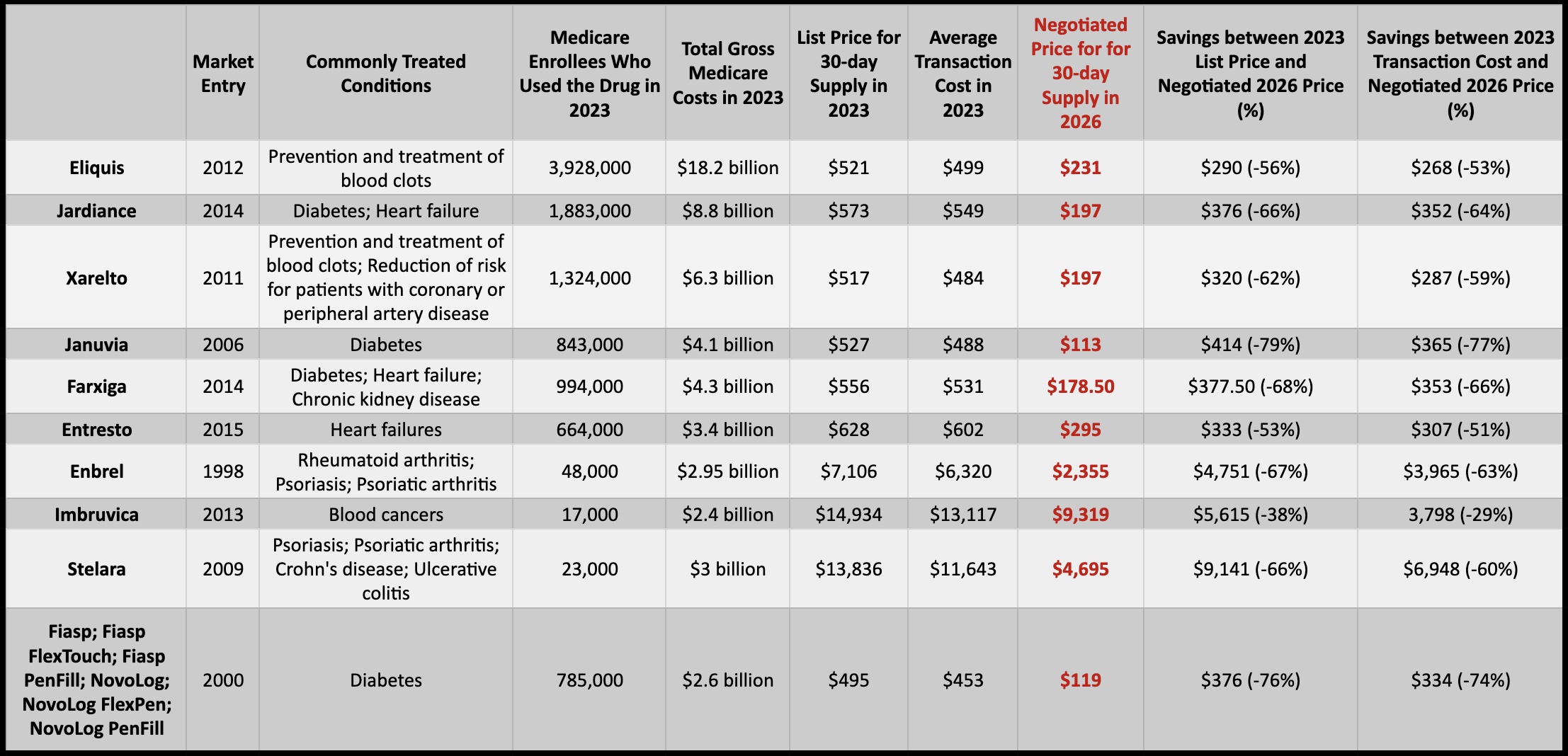
In the first round of direct price negotiations between Medicare and drug manufacturers, prices for 10 expensive and commonly used drugs saw price cuts between 38 percent to 79 percent compared to their 2023 list prices, the White House and the US Department of Health and Human Services (HHS) announced Thursday. The new negotiated prices will take effect on January 1, 2026.
The 10 drugs that were up for negotiations are used to treat various conditions, from diabetes, psoriasis, blood clots, heart failure, and chronic kidney disease to blood cancers. About 9 million people with Medicare use at least one of the drugs on the list. In 2023, the 10 drugs accounted for $56.2 billion in total Medicare spending, or about 20 percent of total gross spending by Medicare Part D prescription drug coverage. But in 2018, spending on the 10 drugs was just about $20 billion, increasing to 46 billion in 2022—a 134 percent rise. In 2022, Medicare enrollees collectively paid $3.4 billion in out-of-pocket costs for these drugs.
For now, it's unclear how much the newly set prices will actually save those who have Medicare enrollees in 2026. Overall costs and out-of-pocket costs will depend on each member's coverage plans and other drug spending. Additionally, in 2025, Medicare Part D enrollees will have their out-of-pocket drug costs capped at $2,000, which alone could significantly lower costs for some beneficiaries before the negotiated prices take effect.
James.galbraithJesus fucking christ. What ever happened to actual ownership?
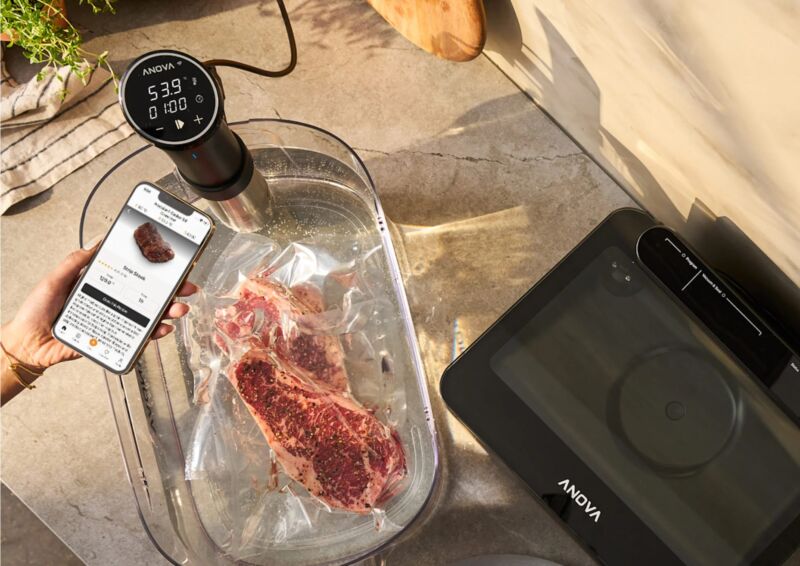
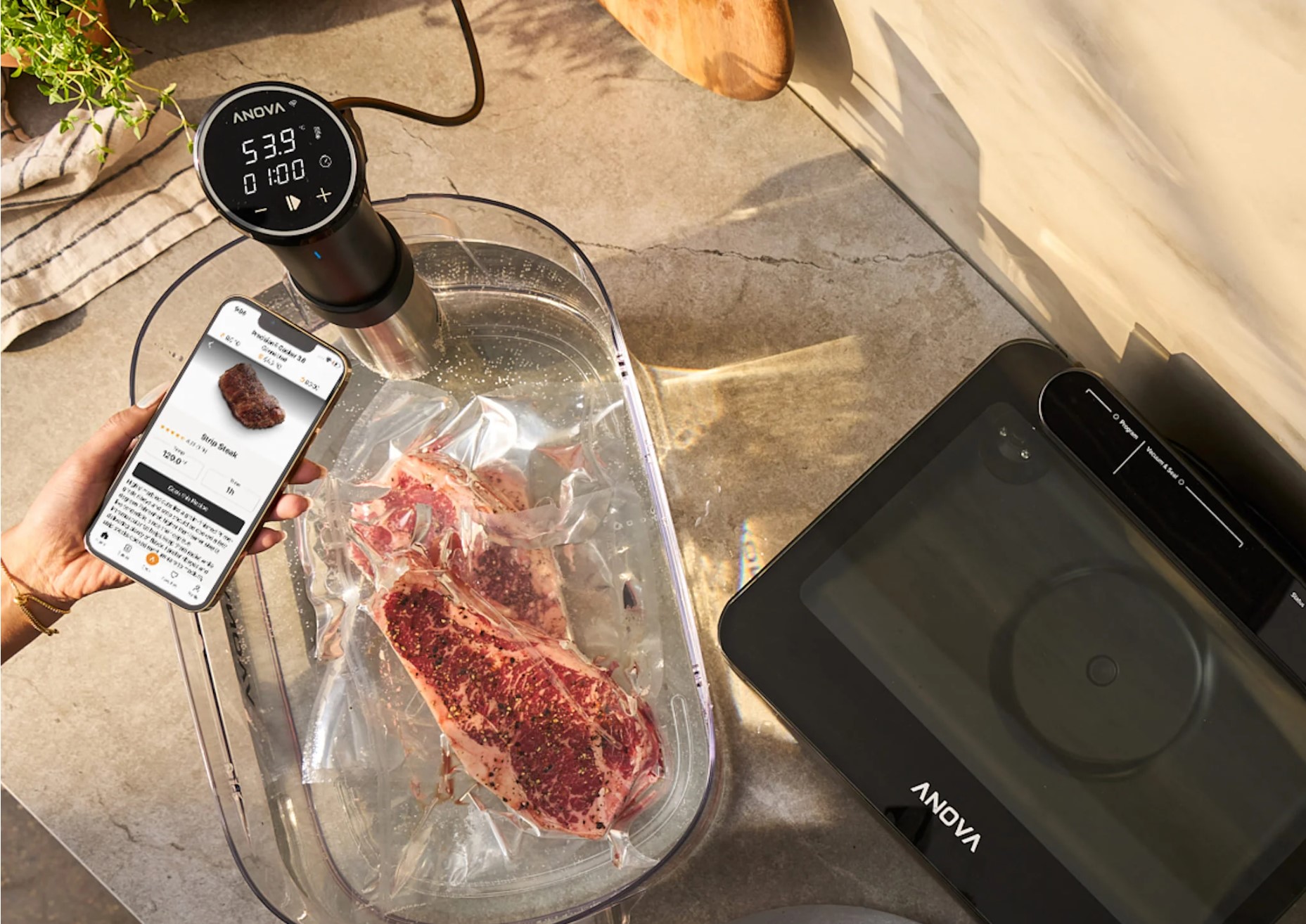
Anova, a company that sells smart sous vide cookers, is getting backlash from customers after announcing that it will soon charge a subscription fee for the device's companion app.
Sous vide cooking, per Ars Technica sister site Bon appétit, "is the process of sealing food in an airtight container—usually a vacuum sealed bag—and then cooking that food in temperature-controlled water." Sous vide translates from French to "under vacuum," and this cooking method ensures that the water stays at the desired temperature for the ideal cook.
Anova was founded in 2013 and sells sous vide immersion circulators. Its current third-generation Precision Cooker 3.0 has an MSRP of $200. Anova also sells a $149 model and a $400 version that targets professionals. It debuted the free Anova Culinary App in 2014.
James.galbraithRollercoaster Tycoon would like a word
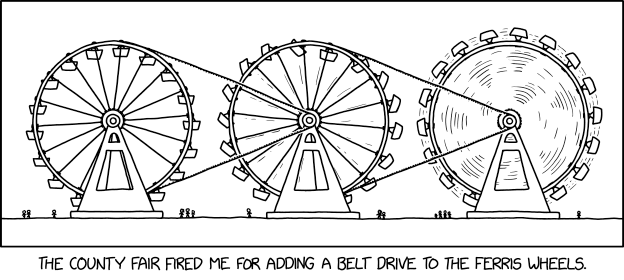
James.galbraithLOL
.png)
Hovertext:
All I'm saying is according to quantum mechanics there's SOME chance a duck explodes because you thought about it.
James.galbraithGood summary, but something must be done about the Court now, not after "several more elections".

How do you solve a problem like Trump v. United States?
The Supreme Court’s recent opinion in Trump, which held that presidents have sweeping immunity from criminal prosecution for any official act — even something like ordering the Justice Department to round up and arrest their political foes — is such an unimaginable betrayal of the justices’ oath to “administer justice without respect to persons” that it casts a shadow over every decision these justices have ever handed down.
It’s like if you learned that your daughter’s third-grade teacher gave her cocaine. Some acts of betrayal are so profound that they shatter your ability to trust someone again and cause you to rethink every single thing they’ve done in the past — even the good things.
Under the Trump decision, a president who took advantage of the powers that decision grants would be the type of dictator the United States’ political structure is meant to guard against — a leader fully incompatible with the idea of constitutional democracy.
That easily makes Trump the worst decision the Roberts Court has ever handed down, but it is only the latest in a series of decisions that weaken our democracy and our Constitution. In the few years since former President Donald Trump remade the Supreme Court, the Court’s new majority has allowed states to nullify entire constitutional rights. They’ve claimed so much power that they now effectively control both the judiciary and most of the executive branch — they’ve literally given themselves a veto power over any regulatory decision made by a federal agency — of the federal government. And as they’ve done so, they’ve thrown lower courts into chaos by creating nonsensical new legal standards judges across the nation have struggled to follow.
Worse, only one of America’s two major political parties appears to have a problem with how the Supreme Court is reshaping America’s institutions. While Republicans have mostly cheered the Court’s actions, top Democrats have proposed several solutions to the legal mess the Court has created.
In the wake of the uniquely awful Trump decision, President Joe Biden proposed a constitutional amendment to eradicate Trump, along with separate proposals for term limits and a binding code of ethics for the justices. Senate Majority Leader Chuck Schumer (D-NY), meanwhile, wants to use a rarely invoked congressional power known as “jurisdiction stripping” to neutralize Trump’s immunity.
Realistically, however, none of these ideas are likely to rein in the Court because they are unlikely to ever become fully enforceable law. Amending the Constitution is virtually impossible, and it is literally impossible if either major political party opposes an amendment. Even if some of these reforms can be enacted through ordinary legislation, moreover, the Court’s Republican majority would probably just strike them down anyway.
Another solution is court-packing — adding seats to the Supreme Court to relegate the Court’s Republicans to the minority. This idea has the virtue of being constitutional — the Court has had as few as five seats and as many as 10 in the past — and it could be done at any time through ordinary legislation. But it also comes with enormous risks. Packing the Court would almost certainly destroy the legitimacy of the federal judiciary in the eyes of many Republicans and would lead to massive resistance from red states. It’s also unlikely to happen unless Democrats win massive majorities in Congress; even at the height of his popularity, President Franklin Roosevelt struggled to sell a court-packing plan after the Court tried to sabotage the New Deal.
Yet, as the Republican Party has shown with its own successful takeover of the Court, there are steps that Democrats — and supporters of constitutional democracy more broadly — can take now to start undermining this Court’s worst decisions. The Republican takeover of the federal judiciary, and the rush of decisions overruling seminal Supreme Court precedents that quickly followed, was the culmination of decades of organizing, fixating on decisions that Republicans wanted to see overruled, campaigning against those decisions as illegitimate, and identifying candidates for judicial office who could be counted on to overrule those decisions.
Roe v. Wade, for example, fell because the Republican Party unified around treating Roe as illegitimate. State lawmakers routinely passed legislation defying it, and forced the courts to strike that legislation down. These legal fights, in turn, reinforced the Republican Party’s identity as the anti-abortion party and reminded voters who oppose abortion that the way to end Roe was to vote for the GOP.
Similar things can be said about other Supreme Court precedents which until recently were good law, including the Court’s affirmative action decision in Regents of the University of California v. Bakke (1978), its mostly overruled decision establishing that religious conservatives have to follow the same laws as everyone else in Employment Division v. Smith (1990), its church/state separation decision in Lemon v. Kurtzman (1971), and its decision limiting the scope of the Court’s policymaking authority in Chevron v. National Resources Defense Council (1984).
In all of these cases, the basic pattern is the same. Republicans — whether at the grassroots level or through elite groups like the Federalist Society — identified the cases they wanted to destroy. They united in opposition to them. They appointed justices who would loyally follow the GOP’s judicial agenda. And then they won.
This is a playbook those concerned about the current Court’s anti-democratic tendencies can follow, but it also requires them to unite much like Republicans did. Before they can get to that point, Democrats, and others concerned about the Court’s actions, need to reach a consensus about which of the Court’s decisions deserve the same treatment that the GOP gave to Roe.
Several recent Supreme Court decisions arguably belong on this list of irredeemable decisions, but I would like to propose four. These four cases undermine the very concept of a written constitution. They centralize power in an unelected judiciary. They are so incompetently drafted that even sitting judges complain that they are unworkable. And they invite rule by gangsters and thugs. In short, all of them are fundamentally incompatible with constitutional democracy.
Trump v. United States (2024) is the rare Supreme Court decision that grows more alarming as you dig deeper into the nuance of the decision.
The six Republican justices held that Trump, a man who literally tried to overthrow the duly elected government of the United States, had broad freedom to commit crimes while he was in office and that he would also be free to violate criminal laws if he returned to the White House. The Court’s holding that presidents may use their official powers to commit crimes has no basis in constitutional text or American legal tradition, and it’s hard to imagine a decision more incompatible with the idea that the United States is a democratic nation governed by the rule of law.
The Trump decision breaks down presidential actions into three categories and gives different levels of immunity to each. The most important thing to understand about the opinion, however, is that it places some of the most authoritarian actions a president could possibly take in the category with the highest level of immunity.
The Republican justices held that when the president exercises authority vested exclusively in them by “the Constitution itself,” they may do so even if those actions are “incompatible with the expressed or implied will of Congress” — including an Act of Congress declaring such actions to be criminal. Similarly, the Republican justices concluded that “the courts have ‘no power to control [the President’s] discretion’ when he acts pursuant to the powers invested exclusively in him by the Constitution.” So a court cannot try a president who commits a crime while exercising these powers.
One reason why this decision is so alarming is that the Constitution states that “the President shall be commander in chief of the Army and Navy of the United States.” As Justice Sonia Sotomayor warned in dissent, “when [the president] uses his official powers in any way, under the majority’s reasoning, he now will be insulated from criminal prosecution. Orders the Navy’s Seal Team 6 to assassinate a political rival? Immune. Organizes a military coup to hold onto power? Immune. Takes a bribe in exchange for a pardon? Immune. Immune, immune, immune.”
In fairness, the majority opinion did not explicitly state that Trump could order Navy SEALs to assassinate his rivals — it only implied it — but it rather explicitly says that Trump could have ordered the Justice Department to round up and arrest those rivals. “Investigation and prosecutorial decisionmaking is ‘the special province of the Executive Branch,’” the Republican justices conclude, adding that “the Constitution vests the entirety of the executive power in the President.”
Indeed, the Republican justices went even further, holding that Trump could not be prosecuted even if he ordered the Justice Department to act based on “shams” or “for an improper purpose.” Under Trump, that type of behavior does “not divest the President of exclusive authority over the investigative and prosecutorial functions of the Justice Department and its officials.”
The Republican justices’ decision does not even attempt to make the case that presidential immunity can be found anywhere in the Constitution. Instead, the opinion is rooted in the GOP justices’ policy judgment that the president should not be chilled from taking “bold and unhesitating action” by “the threat of trial, judgment, and imprisonment.”
All of this is why the Trump immunity decision is one of the most reckless decisions ever handed down by a court of the United States. It strongly suggests that a president can have their rivals killed, and it explicitly permits a president to round up their enemies and prosecute them on fabricated charges. And it does all of this in response to the prosecution against a former president who tried to illegally remain in office after he lost his bid for reelection.
Whole Woman’s Health v. Jackson (2021) established that any state can neutralize literally any constitutional right, simply by writing a law that is enforced solely by private bounty hunters.
While the law at issue in Jackson, a Texas law known as SB 8, targeted abortion rights, Jackson’s reasoning would apply equally to a law allowing bounty hunters target anyone who criticizes a state governor, or that sics these bounty hunters on any Black family that sends their child to a majority-white public school.
Like the Trump immunity decision, Jackson is incompatible with constitutional democracy and must be overruled.
To understand Jackson, it’s important to first understand the Rube Goldberg-like mechanism that SB 8 uses to ban nearly all abortions in the state of Texas. In Ex parte Young (1908), the Supreme Court established that a plaintiff alleging that a state law is unconstitutional should sue the state officer charged with enforcing that law. So, for example, if Texas had passed a law requiring state troopers to blockade abortion clinics, a plaintiff might sue the chief of the state’s police force.
SB 8, however, provides that this anti-abortion law “shall be enforced exclusively through … private civil actions.” It provides that “any person, other than an officer or employee of a state or local governmental entity in this state” may bring a lawsuit against anyone who performs an abortion after the sixth week of pregnancy. Plaintiffs who prevail collect a bounty of at least $10,000 from the abortion provider, and there is no cap on the size of this bounty.
Thus, the law sought to make an end run around Young by preventing state officials from directly enforcing the law. And five of the Supreme Court’s six Republicans signed onto this gambit, prohibiting anyone from filing a federal lawsuit seeking to block the law.
As Roberts, the only Republican to dissent in Jackson, said of the Texas law, “the clear purpose and actual effect of S. B. 8 has been to nullify this Court’s rulings” in Roe and Casey (Jackson was decided several months before the Supreme Court overruled those decisions). Jackson established that a state can effectively immunize an unconstitutional law from federal judicial review simply by using bounty hunters to enforce it.
In fairness, Jackson does allow someone who has already been sued by a bounty hunter to argue in that lawsuit that SB 8 is unconstitutional and that the suit should be shut down. But this remedy is meaningless because SB 8 also places no limit on the number of suits that could be filed against any one individual. A single person who is suspected of performing an abortion in Texas could potentially be hit by thousands of lawsuits. Even if they win all of them, their legal bills would bankrupt them.
And, again, nothing in Jackson prevents other states from enacting SB 8-style laws to nullify any other constitutional right.
Jackson, in other words, must be overruled because it is fundamentally hostile to the idea that states must respect the constitutional rights of individuals.
Biden v. Nebraska (2023) involved a significant policy dispute between the Democratic and Republican parties. The Biden administration announced a new policy that would have forgiven at least $10,000 worth of student loans for most borrowers. Republicans almost universally opposed this policy.
Reasonable people can disagree about who was right about the wisdom of this policy. But there’s no plausible argument that the Biden administration’s policy was illegal. The loan forgiveness policy was authorized by a federal law known as the Heroes Act, which gives the US secretary of education the power to forgive student loans during a national crisis.
And yet, despite unambiguous statutory authorization, the six Republican justices decided to implement their party’s preferred student loan policy from the bench.
Under the Heroes Act, the education secretary has broad authority to “waive or modify any statutory or regulatory provision applicable to the student financial assistance programs … as the Secretary deems necessary in connection with a war or other military operation or national emergency.” The Biden administration’s student loan program was one of many financial relief programs tied to the Covid-19 pandemic. Trump declared the pandemic a national emergency in 2020, and Biden left his declaration in place until mid-2023.
Several other provisions of the law, moreover, should have removed any doubt that the Secretary of Education, and not the Supreme Court, got to decide whether to forgive loans during the Covid pandemic.
Among other things, the Heroes Act waives a lengthy process known as “notice and comment” that federal agencies normally must undergo before changing a federal policy — allowing officials to prioritize quick and decisive action over following normal procedural rules. The law also provides that the secretary may dole out student loan relief en masse (“the Secretary is not required to exercise the waiver or modification authority under this section on a case-by-case basis”). And the law even contained a provision instructing courts not to interpret other federal statutes to limit the secretary’s authority unless that statute was “enacted with specific reference to” the Heroes Act.
Thus, even if the Republican justices had been able to point to a statute that explicitly forbids the very same loan forgiveness program created by the Biden administration, courts were still required to uphold that program unless this hypothetical statute specifically stated that it overrides the Heroes Act.
And yet, all six Republican justices reached the implausible conclusion that the Heroes Act did not authorize the Biden administration’s student loan forgiveness program.
Perhaps recognizing that their statutory argument is weak, the same six Republicans also claimed that the program violates something called the “major questions doctrine,” a doctrine that was recently invented by the Supreme Court, and that calls for courts to treat significant policy decisions by federal agencies with skepticism, unless that decision is unambiguously authorized by Congress. As the Court has described this doctrine, “we expect Congress to speak clearly if it wishes to assign to an agency decisions of vast ‘economic and political significance.’”
But, even setting aside the fact that the major questions doctrine appears nowhere in the Constitution or in any federal statute, Congress spoke clearly when it enacted the Heroes Act. It gave the secretary broad authority. It waived procedural constraints on the secretary. It explicitly gave the secretary power to dole out relief to many borrowers at a time. And it forbade courts from reading any federal statute to limit the secretary’s authority unless that statute specifically mentioned the Heroes Act.
The Republican justices, in other words, claimed the power to override both elected branches of government, even when no law or constitutional provision authorizes them to do so. That realignment of power — like the ones seen in Trump and Jackson — is not compatible with the American system of constitutional democracy.
At least on the surface, New York State Rifle & Pistol Association v. Bruen (2022), a Second Amendment decision that cast a cloud of uncertainty over every single gun law in the United States, has a greater claim to legitimacy than the other cases on this list. Unlike, say, the major questions doctrine, the Second Amendment is a real thing that actually can be found somewhere in the Constitution.
But Bruen is also a showcase of the Roberts Court’s arrogance and incompetence. The New York State gun law struck down by Bruen, which limited who could carry a gun in public, was 108 years old when it reached the Supreme Court. So, for more than a century, no court took issue with this law until the current crop of Republican justices suddenly claimed that they’d found a constitutional problem with it that every other judge in the last century had somehow missed.
The Republican justices’ decision in Bruen, moreover, is an unworkable mess. One federal judge, a Trump appointee, complained that “the Supreme Court has created mountains of work for district courts that must now deal with Bruen-related arguments in nearly every criminal case in which a firearm is found.” Another judge wrote that Bruen is “filled with methodological flaws.” In a 2024 opinion criticizing Bruen, Justice Ketanji Brown Jackson quoted a dozen lower court opinions begging the Court to tell them how Bruen is supposed to work. One of them warns that “courts, operating in good faith, are struggling at every stage of the Bruen inquiry.”
Briefly, Bruen held that all gun laws are unconstitutional unless the government can “demonstrate that the regulation is consistent with this Nation’s historical tradition of firearm regulation.” As the lower courts’ confusion shows, no one seems to know what the hell that means.
Bruen also casts special scorn on gun laws that seek to address “a general societal problem that has persisted since the 18th century” — like murder — if 18th-century lawmakers did not seek to solve that problem in the same way as modern-day legislatures.
Almost immediately after Bruen was decided, a federal appeals court declared, in United States v. Rahimi, that a federal law prohibiting people subject to domestic violence restraining orders from possessing guns is unconstitutional. And the most astounding thing about this lower court decision is that it was correctly decided under Bruen. Domestic violence, after all, existed in the 18th century. But no state made it a crime for a married person to beat their own spouse until 1871.
To its credit, the Supreme Court recognized in the Rahimi case that allowing people who are a violent threat to their own romantic partners to arm themselves is untenable, and it upheld the federal law at issue in that case. But Rahimi did nothing to clarify the incomprehensible legal rule announced in Bruen. Now, under Rahimi, “a court must ascertain whether the new law is ‘relevantly similar’ to laws that our tradition is understood to permit” — again, whatever the hell that means.
This whole saga exposes a Republican Supreme Court majority that is simply terrible at their jobs. Set aside the policy question of how much gun regulation should exist in the United States. The core job of the Supreme Court is to articulate legal rules that can be consistently applied by all of the thousands of judges in the United States. Yet, in Bruen, they failed at that task so miserably that judges from across the political spectrum complained that they simply could not figure out how Bruen is supposed to operate.
And then, when confronted with those complaints, the Court doubled down on its vague appeal to “tradition” that no one can figure out.
Having identified four of the least defensible decisions handed down by the Court’s current Republican majority, allow me to finish this essay by saying something controversial: I am unsure whether Dobbs v. Jackson Women’s Health Organization (2022), the decision overruling Roe v. Wade, belongs on the list of cases that are fundamentally hostile to constitutional democracy.
I say this, not because Dobbs was correctly decided, and not because I have a wavering commitment to abortion rights. Rather, I say it because Dobbs revealed an unfortunate truth about all constitutional rights. A Supreme Court decision protecting a particular right — whether it is the right to abortion, the right to free speech, or any other right — is only worth something as long as there are five justices who will uphold that decision. Once that majority is lost, the right disappears.
Worse, while a precedent like Roe v. Wade cannot protect abortion patients from the whims of the Supreme Court, it can lull them into a sense of false security.
One lesson we’ve learned since Dobbs is that the right to have an abortion enjoys overwhelming majority support among US voters, even in some very red states. Fifty-nine percent of Kansas voters decided to keep abortion legal in a 2022 referendum. Abortion rights won by a 13-point margin in red Ohio. In Gov. Ron DeSantis’s Florida, a new abortion rights ballot measure appears to be cruising to victory — a recent poll found that 60 percent of Floridians believe that the right to an abortion should be written explicitly into the state’s constitution. Only 20 percent oppose that position.
And yet, when Roe was still good law, many voters who support the right to choose nonetheless voted for Republicans like Donald Trump, who appointed three members of the Dobbs majority to the Supreme Court. Roe convinced many of these voters that abortion rights were safe, even though Republicans only needed to replace one member of the Court’s pro-abortion majority to eliminate Roe on the day that Trump was elected.
If two members of the Dobbs majority leave the Court tomorrow, to be immediately replaced by Biden appointees, then I would support overruling Dobbs. Among other things, such a decision would end the suffering of women who are being forced to wait until their lives are in danger before their red-state doctors are willing to risk jail time by terminating their pregnancy.
But, realistically, clawing back the Court’s Republican majority will probably take years, or even decades. By that point, abortion may once again be legal throughout the United States — either because of state-by-state campaigns like the Ohio ballot initiative or because Congress enacts legislation legalizing abortion in all 50 states.
In that world, it is far from clear that overruling Dobbs would help the cause of abortion rights. Again, as Dobbs itself shows, a Supreme Court precedent is a weak guarantor of fundamental rights. And, as Trump’s election shows, a Supreme Court decision protecting abortion rights can fool voters into thinking that it is safe to elect anti-abortion candidates.
Leaving Dobbs on the books, by contrast, could lead to a durable electoral majority that will lock out of power any party that attempts to take away the right to reproductive freedom. That’s a far more powerful safeguard against abortion bans than some rinky-dink court decision.
In any event, there is no need to resolve this question of whether Dobbs belongs on the same roll of dishonor as Trump or Bruen today. We will know a great deal more about how Dobbs has changed the political landscape after the 2024 election. And it is very likely that there will be several more elections before the Court’s current, Republican majority can be broken up.
James.galbraithYeah I'm surprised something this boneheaded was allowed to get out of Disney's counsel...they should have known how bad this would look

Enlarge / Raglan Road Irish Pub at Disney Springs in Orlando, Florida, USA. (credit: JHVEPhoto | iStock Editorial / Getty Images Plus)
After a woman, Kanokporn Tangsuan, with severe nut allergies died from anaphylaxis due to a Disney Springs restaurant neglecting to honor requests for allergen-free food, her husband, Jeffrey Piccolo, sued on behalf of her estate.
In May, Disney tried to argue that the wrongful death suit should be dismissed because Piccolo subscribed to a one-month free trial of Disney+ four years before Tangsuan's shocking death. Fighting back this month, a lawyer representing Tangsuan's estate, Brian Denney, warned that Disney was "explicitly seeking to bar its 150 million Disney+ subscribers from ever prosecuting a wrongful death case against it in front of a jury even if the case facts have nothing to with Disney+."
According to Disney, by agreeing to the Disney+ terms, Piccolo also agreed to other Disney terms vaguely hyperlinked in the Disney+ agreement that required private arbitration for "all disputes" against "The Walt Disney Company or its affiliates" arising "in contract, tort, warranty, statute, regulation, or other legal or equitable basis."
James.galbraithAbout fucking time, shocked FTC didn't require this earlier.
Read more of this story at Slashdot.
James.galbraithGood luck... "we should never be subject to any regulations despite being a utility" is not gonna fly
Enlarge (credit: Getty Images | Matt Anderson Photography)
ISPs asked the US Supreme Court to strike down a New York law that requires broadband providers to offer $15-per-month service to people with low incomes. On Monday, a Supreme Court petition challenging the state law was filed by six trade groups representing the cable, telecom, mobile, and satellite industries.
Although ISPs were recently able to block the FCC's net neutrality rules, this week's petition shows the firms are worried about states stepping into the regulatory vacuum with various kinds of laws targeting broadband prices and practices. A broadband-industry victory over federal regulation could bolster the authority of New York and other states to regulate broadband. To prevent that, ISPs said the Supreme Court should strike down both the New York law and the FCC's broadband regulation, although the rulings would have to be made in two different cases.
A situation in which the New York law is upheld while federal rules are struck down "will likely lead to more rate regulation absent the Court's intervention," ISPs told the Supreme Court. "Other States are likely to copy New York once the Attorney General begins enforcing the ABA [Affordable Broadband Act] and New York consumers can buy broadband at below-market rates. As petitioners' members have shown, New York's price cap will require them to sell broadband at a loss and deter them from investing in expanding their broadband networks. As rate regulation proliferates, those harms will as well, stifling critical investment in bringing broadband to unserved and underserved areas."
James.galbraithyup. Utter insanity
“Late Night With Seth Meyers” returned from a summer hiatus on Monday night and the host gave a succinct and hilarious recap of everything that happened while the show was on a break during NBC’s Olympics coverage.
“I haven't paid attention to the news for three weeks,” Meyers told his audience to open the show. “So I'm just going to read off the cue cards real quick to catch up on what I missed.”
Would Meyers be able to pack President Joe Biden dropping out of the race, Vice President Kamala Harris taking his place on the Democratic ticket, Sen. JD Vance and Gov. Tim Walz being tapped as VP picks, and all of Donald Trump’s antics into three minutes?
Take a breath and enjoy.
Meyers: Let's see here. Joe Biden dropped out of the presidential race. Oh, wow! He endorsed Vice President Kamala Harris. Cool, cool. Harris secured enough delegates to become the Democratic nominee.Biden got Covid. Trump claimed Biden never had Covid, and it was just a ruse to drop out of the race. Republicans complain that Harris tried to ban plastic straws and called her a DEI hire. Trump called her “Laughing Kamala,” then “Lying Kamala,” then “Kamabla.”
Republicans called her the “border czar” even though she wasn't, and that's not a thing.
Trump said he might bomb Mexico.
JD Vance became the first VP in decades to have a net negative favorability rating after he called Democrats “childless cat ladies.” Got slammed by Jennifer Aniston, and was accused of fucking a couch—WHICH HE DID NOT DO. Apparently, it was just “hand stuff.”
Vance said Democrats would call him racist for drinking Diet Mountain Dew. Vance wrote the foreword to a book by the Project 2025 guy, while claiming he had nothing to do with Project 2025.
Tim Walz called Republicans “weird” and said It's “Brat Summer.” Trump responded by calling Hannibal Lecter a “lovely man.”
Ted Cruz said Kamala can't have his cheeseburgers.
Trump told Christians they won't have to vote anymore if he wins.
[To stage hand holding cue cards] Wally, how many more cards are there?
Wally: We’re still in July.
Meyers: Fuck me! 190,000 people joined the “White Dudes for Kamala” online event that raised over $4 million dollars. We found out Colin Jost is too fragile to be outdoors. A Fox News host said voting for a woman turns you into a woman.
“Closer Look” writer Sal Gentile threw out the first pitch at a Mets game, which isn't newsworthy and shouldn't be in here.
Trump had a humiliating meltdown at the National Association of Black Journalists, where he attacked the moderator, got laughed at by the audience, and claimed, among other things, that Harris happened to turn Black, which is both racist and insane.
Trump said VP candidates don't matter after everyone made fun of his VP candidate.
Congratulated Vladimir Putin on a prisoner swap that secured the release of American hostages.
The Washington Post reported that Trump was investigated for allegedly taking $10 million from Egypt until it was shut down by his attorney general. Harris picked Walz as her running mate. Walz joked about Vance fucking a couch—WHICH HE DID NOT DO, everything was over cushion.
Republicans called Walz “Tampon Tim,” tried to swift boat him with lies about his service record, and said he was the “Bernie Sanders of Congress,” even though there is already a Bernie Sanders in Congress famously named Bernie Sanders.
Vance held a rally where the stage was so shoddy it looked like he was campaigning for Kamala.
Trump held a deranged press conference, where he invented a new theme park called Transgender World and claimed his crowd on January 6th was bigger than Martin Luther King's “I Have a Dream” speech. He told a story about being in a helicopter that almost crashed, with former San Francisco mayor Willie Brown.
Then, Brown said that never happened. Then, it turned out Trump is confusing Brown with someone else.
The Trump campaign got hacked.
Harris overtook Trump at the polls.
The New York Times called it the worst three weeks of Trump's campaign. Trump slinked back to Twitter for an interview with Elon Musk. He descended further into madness by claiming Kamala's crowd in Detroit was AI, and that the people at the rally didn't actually exist.
Help ensure that Donald Trump stays out of the White House by donating to Kamala Harris today.
James.galbraithseriously...
A cartoon by Jen Sorensen.
Keep this work sustainable by joining the Sorensen Subscription Service! Also on Patreon.
Campaign ActionJames.galbraithActual governance, what a concept

Editor’s note: In October 2024, the administration finalized a new rule making subscriptions easier to cancel — the article below, originally published on August 13, 2024, explains how the rule works.
President Joe Biden has made taking on “junk fees” — hidden fees on everything from airline bookings to concert tickets — a key part of his domestic agenda.
His administration has already tried to limit fees on things like bank overdrafts and late credit card payments, and Monday, it turned its attention to making subscriptions and memberships easier to cancel.
White House policy adviser Neera Tanden said in a call with reporters that new Federal Trade Commission and Federal Communications Commission rules should make it so Americans only need “one or two clicks on your phone” to end a service.
“Businesses often trick consumers into paying for subscriptions — on everything from gym memberships to newspapers to cosmetics — that they no longer want or didn’t sign up for in the first place,” a White House fact sheet released Monday reads. “Consumers shouldn’t have to navigate a maze just to cancel unwanted subscriptions and recurring payments.”
Americans regularly cite the economy as one of the US’s most important problems. And the Biden administration’s attempts to rein in junk fees are a way for it to make the case that Democrats are addressing Americans’ concerns about high prices before the election. Limiting fees is popular on a bipartisan basis: a December Data for Progress poll found that 77 percent of voters — including 81 percent of Democrats, 78 percent of independents, and 72 percent of Republicans — said they supported legislation banning junk fees.
“Essentially in all of these practices, the companies are delaying services to you or, really, trying to make it so difficult for you to cancel the service that they get to hold on to your money longer and longer,” Tanden said. “And what that means is, ultimately, consumers, the American public, is losing out.”
The Biden administration’s proposals would prohibit companies from billing customers without their consent, failing to disclose cancellation policies, and making cancellation difficult by, for example, requiring customers to cancel in person or endure long holds on the phone with customer service. Companies that fail to comply with the rule could face civil penalties, like those the FTC has sought in recent cases related to advertising.
The FTC is currently reviewing public comments on its proposed rule, which would require companies to allow customers who sign up online for a service to also cancel that service online in no more steps than it took them to sign up. Companies would be allowed to make additional offers when a customer tries to cancel, but only if they first ask if a customer is open to hearing them. Companies would also have to provide reminders before subscriptions are automatically renewed if they are not for any physical good.
That rule could go into effect in the coming months.
Meanwhile, the FCC opened an inquiry Monday into pursuing a similar rule that would apply to the communications industry. If the FCC decides to do so, that rule might not go into effect before Biden’s term ends, though if Vice President Kamala Harris wins the 2024 election, she would likely advance it.
In addition to his latest move on subscriptions, Biden has pursued a still-pending broad regulation to combat junk fees overall, as well as regulations aimed at industry-specific junk fees.
Notably, the Consumer Financial Protection Bureau (CFPB) proposed a rule to curb overdraft fees incurred when consumers withdraw more than the available funds in their bank account — a move that might save customers about $3.5 billion a year overall.
The administration’s efforts have hit some barriers, however. Airlines recently sued the Biden administration over a new final rule that requires airlines and ticket agents to disclose upfront any fees associated with booking a plane ticket. And a federal judge temporarily blocked a Biden administration rule that would limit fees on late credit card payments to $8 per month, which the CFPB said would cut costs for Americans by $10 billion a year. Bank and credit card company lobbyists, supported by some Republican members of Congress, had argued that the rule was unconstitutional.
Though those lawsuits are meant to limit the administration, Biden has also used the courts in an aggressive antitrust pro-consumer strategy. His administration has filed a flurry of sweeping lawsuits against major companies, including four Big Tech companies, on the grounds that they are harming competition in their industries and, therefore, American consumers.
The Biden administration recently won a major ruling against Google in which the judge found that the company’s search business constituted an illegal monopoly. Other antitrust lawsuits are pending against Google over its ads business, Meta over its acquisitions of Instagram and Whatsapp, Apple over its alleged anticompetitive practices in the smartphone market, and Amazon over its restrictions on third-party sellers that have served to keep prices higher.
The Biden administration has also filed a lawsuit seeking to break up Live Nation, Ticketmaster’s parent company, accusing it of operating an illegal monopoly through anticompetitive behavior that has harmed everyone from consumers to concert venues to artists.
The durability of Biden’s consumer protection initiative may depend in part on the November election. A Harris administration would likely uphold these policies and could continue to pursue these antitrust lawsuits and then some. But if former President Donald Trump wins the election, it’s probably a different story — the Trump administration didn’t make consumer protection a priority in its first term, and has not made doing so in a second term central to its campaign.
Correction, November 22, 5:33 pm ET: Due to an editing error, the editor’s note misstated the date when the rule was finalized.
James.galbraithSurprise, religious idiots tank state when they get their bribes through.
by Eli Hager
In 2022, Arizona pioneered the largest school voucher program in the history of education. Under a new law, any parent in the state, no matter how affluent, could get a taxpayer-funded voucher worth up to tens of thousands of dollars to spend on private school tuition, extracurricular programs or homeschooling supplies.
In just the past two years, nearly a dozen states have enacted sweeping voucher programs similar to Arizona’s Empowerment Scholarship Account system, with many using it as a model.
Yet in a lesson for these other states, Arizona’s voucher experiment has since precipitated a budget meltdown. The state this year faced a $1.4 billion budget shortfall, much of which was a result of the new voucher spending, according to the Grand Canyon Institute, a local nonpartisan fiscal and economic policy think tank. Last fiscal year alone, the price tag of universal vouchers in Arizona skyrocketed from an original official estimate of just under $65 million to roughly $332 million, the Grand Canyon analysis found; another $429 million in costs is expected this year.
As a result of all this unexpected spending, alongside some recent revenue losses, Arizona is now having to make deep cuts to a wide swath of critical state programs and projects, the pain of which will be felt by average Arizonans who may or may not have school-aged children.
Among the funding slashed: $333 million for water infrastructure projects, in a state where water scarcity will shape the future, and tens of millions of dollars for highway expansions and repairs in congested areas of one of the nation’s fastest-growing metropolises — Phoenix and its suburbs. Also nixed were improvements to the air conditioning in state prisons, where temperatures can soar above 100 degrees. Arizona’s community colleges, too, are seeing their budgets cut by $54 million.
Still, Arizona-style universal school voucher programs — available to all, including the wealthiest parents — continue to sweep the nation, from Florida to Utah.
In Florida, one lawmaker pointed out last year that Arizona’s program seemed to be having a negative budgetary impact. “This is what Arizona did not anticipate,” said Florida Democratic Rep. Robin Bartleman, during a floor debate. “What is our backup plan to fill that budget hole?”
Her concern was minimized by her Republican colleagues, and Florida’s transformational voucher legislation soon passed.
Advocates for Arizona’s universal voucher initiative had originally said that it wouldn’t cost the public — and might even save taxpayers money. The Goldwater Institute, a conservative think tank that helped craft the state’s 2022 voucher bill, claimed in its promotional materials at the time that the vouchers would “save taxpayers thousands per student, millions statewide.” Families that received the new cash, the institute said, would be educating their kids “for less than it would cost taxpayers if they were in the public school system.”
But as it turns out, the parents most likely to apply for these vouchers are the ones who were already sending their kids to private school or homeschooling. They use the dollars to subsidize what they were already paying for.
The result is new money coming out of the state budget. After all, the public wasn’t paying for private school kids’ tuition before.
Chris Kotterman, director of governmental relations for the Arizona School Boards Association, says that Arizona making vouchers available to children who had never gone to public school before wasn’t realistically going to save the state money.
“Say that my parents had been gladly paying my private school tuition, because that’s what was important to them — that I get a religious education. That’s completely fine,” Kotterman said. “But then the state said, ‘Oh, we’ll help you pay for that.’”
“There’s just no disputing that that costs the state more money,” he said, critiquing the claims of the Goldwater Institute and others who’d averred that this program and ones like it around the country would not be costly. “That’s not how a budget works.”
Heading into this fall, which will bring both a new school year and an election that stands to remake American education, ProPublica is going to be examining the complexities, lessons and failures of the nation’s first universal school voucher program as a model for where the whole system seems headed. Arizona’s program “set the standard nationally” and “inspired a national movement,” according to leading voucher advocacy groups; it is “the nation’s school-choice leader,” per the longtime conservative columnist George Will.
For decades, voucher initiatives, including in Arizona, had only served small subsets of students. Often, eligibility was limited to certain poor students from failing public schools, whose families could use a voucher to switch them into a potentially better private school.
In Arizona, for example, vouchers as of 2011 were available solely to students with disabilities, to make sure that their families could afford a range of personalized education options. The program was then expanded to students who had lived in foster care and to Native American students before, gradually, the money started going disproportionately to wealthier households.
Because these measures were initially narrow in scope, some studies found that they had no negative impact on state and local budgets — studies that voucher advocates continued tocite even as states started considering providing vouchers to every parent who wanted one, which is a far more costly undertaking.
Universal voucher efforts, beginning with Arizona’s universal Empowerment Scholarship Account program in 2022, allow parents to spend public money not just on private school tuition but also on recreational programs for their kids like ninja warrior training, trampoline park outings and ski passes, or on toys and home goods that they say they need for homeschooling purposes. (The average ESA award is roughly $7,000.)
In a statement to ProPublica, a spokesperson for Arizona’s former Republican Gov. Doug Ducey, who signed the universal voucher program into law, said that “not only does Gov. Ducey have no regrets about ESA expansion, he considers it one of his finest achievements and a legacy accomplishment. And what he’s most thrilled about is that Arizona’s ESA expansion was followed by 11 other states doing essentially the same thing. Arizona helped set off an earthquake.”
Voucher proponents have long pointed out that private school parents have a right to and could be sending their children to public school at taxpayers’ expense. So providing them with what is often a smaller amount of taxpayer money in the form of a voucher to help them pay their private school tuition is, the argument goes, a net savings for the public.
This is similar to arguing that the public should help pay for car drivers’ gas because if they didn’t drive, they might use public transportation instead, which would be a cost to taxpayers.
Ducey’s spokesperson, Daniel Scarpinato, did not acknowledge that the net cost of universal vouchers has been far higher than voucher supporters originally promised. Instead, he reiterated that “universal ESA costs are basically revenue neutral.” The reasoning: Overall enrollment in Arizona public schools has been slightly down — ever since many parents withdrew their kids during the pandemic — creating some savings in the education budget that could be seen as offsetting the new voucher spending.
Ducey, as well as Matt Beienburg, the Goldwater Institute’s director of education policy, blamed Arizona’s budget crisis on current Democratic Gov. Katie Hobbs, pointing out that she signed a 2023 budget that spent down what was then a surplus instead of keeping the money in reserve for a possible moment like this. (The 2023 budget was passed with bipartisan support.) Ducey did not answer a question about whether he’d had a long-term plan to pay for ballooning voucher spending, beyond relying on that one-time surplus.
In an email, Beienburg maintained that Arizona’s current budget mess wasn’t caused by vouchers; he blamed, among other issues, state revenue recently being lower than anticipated. (The Goldwater Institute in 2021 collaborated with Ducey to write and pass a tax cut that reduced income taxes on the wealthiest Arizonans to 2.5%, the same rate that the poorest people in the state pay, which is the leading cause of the decline in revenue.)
Dave Wells, research director at the Grand Canyon Institute, said that none of the competing budget trends that Ducey and the Goldwater Institute pointed to mean that Arizona can actually afford universal vouchers, at least not without making severe, harmful budget cuts.
“They chose to make ESAs universal and that has made the budget situation much worse,” he said. “We still had a budget shortfall and budget cuts. The cost is still the cost.”
Now that vouchers in Arizona are available even to private school kids who have never attended a public school, there are no longer any constraints on the size of the program. What’s more, as the initiative enters its third year, there are no legislative fixes on the table to contain costs, despite Hobbs’ efforts to implement some reforms. “I have not heard them agree to anything that is a financial reform of the program at all,” said Sen. Mitzi Epstein, the Democratic minority leader of the state Senate, referring to her Republican colleagues.
Arizona doesn’t have a comprehensive tally of how many private schoolers and homeschoolers are out there, so it remains an open question how much higher the cost of vouchers could go and therefore how much cash should be kept on hand to fund them. The director of the state’s nonpartisan Joint Legislative Budget Committee told lawmakers that “we’ve never really faced that circumstance before where you’ve got this requirement” — that anyone can get a voucher — “but it isn’t funded.”
Most importantly, said Beth Lewis, executive director of the public-school-advocacy group Save Our Schools Arizona, only a small amount of the new spending on private schools and homeschooling is going toward poor children, which means that already-extreme educational inequality in Arizona is being exacerbated. The state is 49th in the country in per-pupil public school funding, and as a result, year after year, district schools in lower-income areas are plagued by some of the nation’s worst staffing ratios and largest class sizes.
Spending hundreds of millions of dollars on vouchers to help kids who are already going to private school keep going to private school won’t just sink the budget, Lewis said. It’s funding that’s not going to the public schools, keeping them from becoming what they could and should be.
Mollie Simon contributed research.
James.galbraithVery nice, rolling out more of the positive agenda/joy approach than just Trump bashing. Important to remember how terrible Trump is, but glad to see more agenda items getting rolled out.
Big crowds, go-to applause lines, talk of joy—and some unsolicited Republican counterprogramming.
These were common themes during the first big campaign swing for Vice President Kamala Harris and her running mate, Minnesota Gov. Tim Walz, as the new Democratic ticket barnstormed through five battleground states this past week on a get-to-know-us tour.
They opened with a boisterous rally in Philadelphia on Tuesday, hours after Harris announced Walz as her running mate. From there it was a march through Wisconsin, Michigan, Arizona, and Nevada. Planned stops in Georgia and North Carolina were washed out by Tropical Storm Debby.
The tour was a way to help both candidates introduce themselves to voters, especially independent and undecided voters in states where the Democrats are in tight races against Republican nominee Donald Trump and his running mate, Ohio Sen. JD Vance.
It was also a way for Harris and Walz to get to know each other better.
A look back at the campaign swing:
Thousands of people have been flocking to Harris’ campaign rallies, a sign that her groundbreaking candidacy has generated new momentum among Democrats who were unenthused about President Joe Biden's reelection bid. Harris is the first Black woman and first person of Asian descent to become a major political party’s nominee for president.

By the campaign's count, 12,000 people turned out for rallies in Philadelphia and Eau Claire, Wisconsin. It was 15,000 in the Detroit area and in Glendale, Arizona. In Las Vegas on Saturday, more than 12,000 people were inside a university arena when authorities halted admissions because people were becoming ill waiting outside in 109-degree heat to go through security. About 4,000 people were still in line when the entrances closed, the campaign said.
To Lance Jones, a Tucson native who attended the Arizona rally, it felt like “the tables have turned with Harris and Walz.” He predicted his state "is going from basically red to purple to blue.”
Those crowd numbers annoyed Trump, who regularly attracts thousands to his own rallies.
“Oh, give me a break,” he said at a news conference when asked about Harris. “Nobody’s had crowds like I have.”
The Republican ticket didn't just weigh in from afar, Vance tried to shadow his Democratic rivals during the opening days of their tour. He made appearances in Philadelphia and Detroit hours before the Democrats arrived in those cities.
But after Harris and Vance landed around the same time in Eau Claire on Wednesday, the Republican stepped off his plane and walked toward Air Force Two.
Vance later joked about the in-your-face move, saying he had a “bit of fun” while trying to “check out my future plane.” Air Force Two would become his primary mode of travel if he and Trump are elected in November.
Harris and Walz delivered basically the same speeches—heavy on personal biography—from one rally to the next, with some tweaks to tailor their remarks to the particular audience and state.
Harris added lines about fighting for working people and the upside of organized labor to her remarks in Michigan. In Arizona and Nevada, where migration is a big concern, she drew on her prosecutorial background to tell the crowd she had gone after transnational gangs, drug cartels, and smugglers when she was California’s attorney general.
“I prosecuted them in case after case, and I won,” Harris said.
In Las Vegas, where the economy is heavily dependent on the hospitality industry, she promised to work to eliminate federal taxes on tips for restaurant and other service industry employees. Trump, who floated the same idea several months ago, posted on social media that she was a "copycat.”
Harris closed her rallies by asking people what kind of country they want to live in, before calling them to action and declaring, “When we fight, we win.”
Walz, largely unknown outside the Midwest, went deep on his personal story of serving in the Army National Guard and his years as a high school teacher and football coach, as a member of Congress, and governor. In a campaign partly centered on restoring reproductive rights, he shares that he and his wife, Gwen, suffered through years of in vitro fertilization treatments before their daughter, Hope, was born.

Each candidate has lines that rev up the crowd
Walz introduced both words to the campaign. Even before he joined the Democratic ticket, his description of Trump and Vance and their policies as “weird” caught on. Harris herself used the description a few times.
As Walz says, “No one’s asking for that weird crap."
Walz also credits Harris with “bringing back the joy” to politics, and Harris herself described the Democratic ticket as “joyful warriors.”
At several stops, the crowd started chanting “lock him up” aimed at Trump, an echo of the chants that Trump's campaign audiences directed at Democrat Hillary Clinton during the 2016 race.
Harris has a ready comeback to move things along. “Hold on. Let the courts take care of that. We’re going to beat him in November," she says.
Likewise, she had a ready rejoinder for disruptions from protesters upset that the administration isn't doing more to protect Palestinians during Israel's war with Hamas in Gaza.
As she told them in Arizona, "I respect your voices but we are here to now talk about this race in 2024.”

At each stop, Walz reminded people of the countdown to Election Day, Nov. 5.
By Friday in Phoenix, it must have seemed a blur: He was off by a day when he set the countdown at 87, instead of 88 days.
He isn't the only one counting.
A troop of Girl Scouts greeted the vice president at the airport in Wisconsin on Wednesday, 90 days out from the election. Snippets of their conversation overheard by reporters suggested they may have been chatting about summer plans.
Harris was heard replying, “I’m planning on going somewhere in 90 days.”
Harris had one last stop on Sunday—San Francisco—before returning to Washington. This one was all about collecting campaign cash for the fight ahead.
House Speaker Emerita Nancy Pelosi, a California Democrat, joined Harris for the event, which the campaign said raised more than $12 million.
Pelosi spoke of wanting “democracy to win an Olympic gold” on Election Day. And Harris, to cheers after saying “we will win this election,” told supporters, “We do not have a day to waste.”
Campaign ActionJames.galbraithSo much improvement
Donald Trump is afraid of the campaign trail, his poll numbers are cratering, the deplorable influencers are jumping ship, and his online rantings have crossed over into the hysterical ravings of a lunatic. Meanwhile, Vice President Kamala Harris and her running mate, Minnesota Gov. Tim Walz, are setting the campaign trail on fire.
Things are not looking great for Team MAGA.
Trump held a campaign event in Montana on Friday. Because everything that could go wrong is going wrong, his plane had a mechanical issue and was diverted to land in Billings, placing him 150 miles from his rally in Bozeman. The rally was scheduled to start at 8 PM local time, and Trump didn’t take the stage until about 9:30 PM.
This was the only rally Trump scheduled in the 11 days between Aug. 2 and Aug. 14, and Montana isn’t even a battleground state—he won it by 16 percentage points in 2020. At his Thursday press conference, a reporter asked Trump about his lack of public campaign events, saying, “Some of your allies have expressed concern that you're not taking this very seriously.”
“What a stupid question this is,” he responded. But when pressed, he added, “Because I'm leading by a lot and because I'm letting their convention go through, and I am campaigning a lot. I'm doing tremendous amounts of taping here. We have commercials that are at a level I don't think that anybody's ever done before.”
For the record, when it comes to fall ad reservations in battleground states, Democrats are spending over twice that of Republicans, so I’m not sure what he’s talking about there.
After yesterday's new Trump orders, how do September-November reservations look for each party in the battleground states?#PAPol:🔴$50.5M🔵$38.3M#GAPol:🔵$25.1M🔴$19.4M#MIPol:🔵$32.3M🔴$1.8M#AZPol:🔵$21.3M🔴$1.1M#WIPol:🔵$16.6M🔴$1.3M#NCPol:🔵$15.3M🔴$0#NVPol:🔵$5.5M🔴$0
— AdImpact Politics (@AdImpact_Pol) August 10, 2024
Perhaps Trump is avoiding campaigning because of his underwhelming crowd sizes? Here is Trump’s pathetic turnout in Montana, made even funnier by the desperate hype efforts from this right-wing media operation:
Just look at that tiny crowd in Bozeman, Montana. The people of Montana must have better things to do on a Friday night rather than attending a rally of Trump’s tired old hits. Trump must be having flashbacks to his inauguration.pic.twitter.com/wKuqxlb4Iu
— Maverick (@Isellmpls) August 10, 2024
Here is the Harris rally in Arizona the same day:
The crowds Harris and Walz are pulling across the country are objectively impressive as hell. This is Arizona today.pic.twitter.com/3QRvYNZc9n
— Ahmed Baba (@AhmedBaba_) August 9, 2024
Trump hasn’t held a rally in Arizona since June 6, which is over two months ago.
And Harris’ crowds the past few days have been similarly impressive in Georgia, Michigan, Nevada, Pennsylvania, and Wisconsin.
Maybe Trump is avoiding campaigning because he’s in obvious cognitive decline. During his Montana rally, his speech was often slurred and he regularly took long, confusing pauses between thoughts. His handlers have to know that his public appearances are no doubt reminding most Americans why they don’t like him, and also just how old he is. Republicans spent a year arguing that being the oldest candidate in the field was bad—and now that’s backfired.
Furthermore, his claim at the press conference that he’s “leading by a lot” is flatly false. Just look at the latest high-quality polls from The New York Times/Siena College, where, after leading much of the year, Trump is now facing a serious deficit in the key battlegrounds of Michigan, Pennsylvania, and Wisconsin. Harris leads all three by the same 50-46 margin among likely voters. These polls aren’t a fluke, either. In 538’s national polling average, Harris has opened up a lead of over 2 points.
It’s still a close race, and no one is pretending Harris has this in the bag, but Trump sure is pretending he has it in the bag—and it appears to be keeping him off the campaign trail.
Adding to the bad news for Trump, famous podcaster Joe Rogan appeared to endorse Robert Kennedy Jr. on Thursday,
“They gaslight you, they manipulate you, they promote narratives, and the only one who is not doing that is Robert F. Kennedy Jr.,” Rogan told his millions of young, male listeners, adding, “He's the only one that makes sense to me. He doesn't attack people. He attacks actions and ideas. But he’s much more reasonable and intelligent.”
These comments came among a swell of Trump skepticism from right-wing figures like gun-rights extremist Kyle Rittenhouse, white supremacist Nick Fuentes, and neo-Nazi Richard Spencer. And while Rogan and Rittenhouse subsequently walked back their statements after facing MAGA backlash, it betrays a lack of faith and enthusiasm from those who should be Trump’s fiercest, most excited supporters.
Whatever is keeping Trump off the campaign trail certainly isn’t keeping him off Truth Social, his Twitter clone. His latest rantings there show that he’s even more unmoored from reality.
On Saturday, he claimed Harris has agreed to three debates with him, including one on Sept. 4 on Fox News. The truth? Harris has agreed to one debate so far, on ABC News on Sept. 10.
The same day, minutes after Harris endorsed ending taxes on tips, Trump posted, “Kamala Harris, whose ‘Honeymoon’ period is ENDING, and is starting to get hammered in the Polls, just copied my NO TAXES ON TIPS Policy. The difference is, she won’t do it, she just wants it for Political Purposes!” Instead of holding his own rallies, he was apparently watching hers!
But his craziest outburst came Sunday morning, when he posted this screed:
Has anyone noticed that Kamala CHEATED at the airport? There was nobody at the plane, and she “A.I.’d” it, and showed a massive “crowd” of so-called followers, BUT THEY DIDN’T EXIST! She was turned in by a maintenance worker at the airport when he noticed the fake crowd picture, but there was nobody there, later confirmed by the reflection of the mirror like finish on the Vice Presidential Plane. She’s a CHEATER. She had NOBODY waiting, and the “crowd” looked like 10,000 people! Same thing is happening with her fake “crowds” at her speeches. This is the way the Democrats win Elections, by CHEATING - And they’re even worse at the Ballot Box. She should be disqualified because the creation of a fake image is ELECTION INTERFERENCE. Anyone who does that will cheat at ANYTHING!
It almost goes without saying that the crowd-size conspiracy theory was quickly debunked by numerous news outlets.
He so desperately wishes he were still running against President Joe Biden, and appears unable to comprehend that he’s getting beat by a Black woman. Meanwhile, Trump running mate JD Vance is a walking disaster creepily stalking Harris’ campaign events, speaking to crowds of dozens.
Meanwhile, the Harris-Walz campaign is nothing but good vibes.
One of my greatest joys as Vice President is traveling our nation and meeting with young leaders like Estrella. I am so inspired by their ambition and passion. pic.twitter.com/nqXBypP4po
— Vice President Kamala Harris (@VP) April 9, 2024
Liberal Patriotism is back on the menu boys! pic.twitter.com/8zmJKE4xAA
— Blake Allen (@Blake_Allen13) August 10, 2024
Walz gets emotional while talking about IVF and the audience starts chanting his daughter Hope's name. "I'm not crying, you're crying." 🥺 pic.twitter.com/9LSo1IiPda
— Kelsie Taggart (@kelsientaggart) August 10, 2024
Liberals are reclaiming patriotism 🇺🇸 She's so cute here moms are gonna eat this up pic.twitter.com/nAn6iff59g
— umichvoter 🏳️🌈🥥🌴 (@umichvoter) August 11, 2024
This joy and fun is even better than Barack Obama’s hope. This is life, and Trump’s ugly darkness is losing the battle.
Help turn the good vibes into a Harris presidency with your donation today!
James.galbraithThe only way through is to send these idiots home
The far-right House Freedom Caucus is gearing up for a government-shutdown fight at the end of September and a chaotic lame-duck session after the election, no matter who wins.
“In the inevitability that Congress considers a Continuing Resolution,” the House Freedom Caucus said in a statement Monday, referring to a possible short-term spending bill, “government funding should be extended into early 2025 to avoid a lame duck omnibus [bill] that preserves Democrat spending and policies well into the next administration.”
They want this so that “Democrats cannot undermine President [Donald] Trump’ second term,” in which Trump would expectedly obliterate the funding agreements that President Joe Biden and Congress made for the 2025 fiscal year.
That’s not their only demand, though.
In the statement, the Freedom Caucus also said the continuing resolution should include bogus legislation to prevent noncitizens from voting. The Freedom Caucus called on Republican House leadership to "use our leverage in the September spending fight to prevent non-citizens from voting in our elections."
Noncitizens don’t vote, of course. As the Brennan Center for Justice explains, it’s a “federal crime for noncitizens to vote in federal elections. It’s also a crime under every state’s laws. In fact, under federal law, you could face up to five years in prison simply for registering to vote. It’s also a deportable offense for noncitizens to register or vote.”

What MAGA lawmakers are trying to do here is muddy the waters on election integrity. Trump has been lying about noncitizen voting all year, setting the stage for his inevitable voter-fraud/stolen-election claims if he doesn’t win in November.
That means that the few short weeks that Congress will be in session after Labor Day—and before it takes off for the whole of October to campaign—should be as unproductive and as chaotic as this whole session in the House has been. This session has resulted in just 78 public laws, far less than usual—and many of those simply name post offices.
Remember in July, when the House left early for August recess, abandoning House Speaker Mike Johnson’s promise that they would pass all of the funding bills on time? Remember how they couldn’t pass those bills because of GOP infighting?
It’s setting up a difficult September and a worse lame-duck session in which the GOP-led House will surely stay on theme and accomplish next to nothing.
James.galbraithA ray of hope...
Jacob Reitan said he told Gwen Walz he was gay before he told his parents.
Reitan was a student in 1999 at Mankato West High School in Minnesota, where Walz and her husband, Tim, were teachers. In her classroom, Gwen Walz had announced at the start of his sophomore year that her class was a safe place for gay students.
“I’d never heard a teacher ever talk about gay issues from the front of the classroom,” recalled Reitan, now a 42-year-old lawyer in Minneapolis. “That act meant the world to me. It made me feel welcome in the place where I’m supposed to learn.”
Gwen Walz’s unwavering support was shared by her husband, who moved to Minnesota from rural Nebraska long before the Democrat became a congressman, governor and Vice President Kamala Harris’ choice to be her running mate in her 2024 presidential campaign.
It was Tim Walz whom Reitan approached about starting a Gay-Straight Alliance at the high school. Having the backing of the football team’s defensive coordinator—a straight, married man and soldier in the Army National Guard—gave the plan a boost.
Walz, a world geography teacher, offered to be the group’s faculty adviser. That mattered, Reitan said, to a young man who had had his car window broken and a gay slur scrawled on his family’s driveway.
But he said that is how Walz treated all students.
“He had the ability to talk about issues of bullying in a way that helped both the bully and the bullier,” Reitan said. “He made clear that bullying makes no sense. It doesn’t help anybody. And it made the school safer for me.”
In introducing Walz as her running mate, Harris shared that story. But Walz's advocacy for the LGBTQ community has not been met with universal approval in the days since he joined the ticket. Some Republican elected officials and conservative commentators have cited Walz's opposition to bans on gender affirming care for minors as proof that he is too liberal to be vice president.
Tiffany Justice of Moms for Liberty, a parental rights group that has pushed to restrict the discussion of LGBTQ issues in schools, contended in a recent interview with Fox News that Walz is “the most anti-parent candidate that Kamala Harris could have chosen.”
His approach stands in sharp contrast to actions taken in states such as Florida, Alabama and Iowa that have acted to restrict open discussion of sexual orientation and gender identity in schools.
Reitan said the high school's administration supported forming the club and that there was surprisingly little blowback. A few parents called and threatened to keep their kids out of school, he said, but the principal at the time simply replied that the school would mark those students absent.
Such criticism is rare among those who have spoken publicly about their experiences with Walz at Mankato West. Former students say Walz's classes felt like a bridge to the wider world.
“He made the world feel smaller and more approachable," said Nicole Griensewic, a student in Walz's geography class. “And so he would talk about China like it wasn’t so far away and it wasn’t so foreign.”
Griensewic's brother had been bullied, she said, but he felt comfortable enough with Tim and Gwen Walz that he joined them on an educational trip with other students to China.
“Dare I say, there’s a lot of toxic masculinity in the whole football realm,” she said. “And to see someone who was a football coach, but also saying, ‘Hey, we’re going to respect everyone. And I absolutely won’t put up with any of that crap.’ That was really bold.”
Adam Segar said Walz found a spot for him on the football team despite problems he had adding weight and muscle. Segar said that approach was commonplace with Walz—trying to make sure students and athletes who might not fit a traditional mold found a place.
“I think that’s what Tim brought to small-town America was, you know, the willingness to have an open mind and ask the students to make sure that they did too,” Segar said.
Ann Vote remembers Walz as an extrovert who was passionate not just about teaching kids, but learning from them. He supported her vision for a unique prom theme that was not included in the school vendor's premade prom kits and required nearly all the decor to be made by hand.
The theme was “In Our Wildest Dreams,” which, Vote joked, seemed to foreshadow Walz's trajectory.
When he subbed for one of her classes, he showed a video that he continuously stopped so he could excitedly explain various elements of it.
“He was just so passionate and engaged in what we were to be learning at a time when a lot of teachers put videos on to give themselves a break,” said Vote, who spent 12 years as a social studies teacher before becoming a motivational speaker. "Many of us at that school later became teachers.”
The curent high school principal, Sherri Blasing, did not teach with Walz, but she and her family lived next door to him for 22 years. When Blasing’s four children became teenagers, her family found themselves short on transportation. Walz gave them an old Buick they named “Laverne” that she said was a testament to Walz’s generosity.
“You see that common theme with Tim over and over again," Blasing said, "That he values every person for who they are, and he is going to do what he can to help them be the best that they can be.”
John Considine, an offensive lineman on the school's 1999 state championship team, had Walz for geography class. Considine would often cut his lunch break short to show up early so the two could chat.
In the late 1990s, before cellphones permeated campus life, Walz invented expressions that some students came to call “Mr. Walz-isms.”
One such Mr. Walz-ism that stuck with Considine was “11 to the ball.” The phrase called for cohesion among all 11 players on the football field.
Pat Ryan got to know Walz as a colleague while teaching speech and theater. Ryan was in on a faculty prank aimed at the newly hired Walz that did not quite go as planned. Thanksgiving was around the corner, and the veteran teachers gave Walz what appeared to be a certificate for a free turkey from a local grocery store.
The certificate was a fake, and the teachers waited outside the store ready to have a laugh at Walz's expense.
Instead, Walz emerged from the store with a free turkey. He said Walz won people over that way.
“That's how charming he is,” Ryan said. “You're going to have a hard time finding anyone who knows him and doesn't like him.”
For Reitan, the connection was more personal. But he believes everything he knows about Walz translates into the world of politics.
“He is so authentic. He is exactly what he seems to be,” Reitan said. “Tim Walz understands that being different is OK. Being different is part of the diversity of of the schoolyard and the classroom, but also part of the diversity of our nation.”
Campaign ActionJames.galbraithAbout fucking time.
Read more of this story at Slashdot.
James.galbraithWell this would be impressive
Read more of this story at Slashdot.
James.galbraithNo shit. Conservative justices are bad news

For most of American history, free speech did not exist in the United States.
Dissidents were commonly thrown in prison, often for many years, when the government disagreed with their views. Near the end of World War I, the great union leader Eugene Debs was sentenced to 10 years in prison for giving a speech opposing the draft, and his conviction was upheld by a unanimous Supreme Court. In 1951, as Sen. Joseph McCarthy was ramping up his witch hunts against suspected communists, the Supreme Court blessed his and similar efforts by upholding the convictions of several individuals who did nothing more than try to organize a (wildly unsuccessful) Communist Party in the United States.
This suppression of free expression wasn’t restricted to unpopular political ideas. Under the federal Comstock Act — which made it a crime to mail any “thing” for “any indecent or immoral purpose” — and similar state laws, anti-sex crusaders prosecuted authors, artists, booksellers, and art gallery owners alike for distributing pretty much anything that touched on the topic of sex. Anthony Comstock, the Comstock Act’s namesake, once successfully brought charges against a gallery owner for selling a reproduction of Alexandre Cabanel’s “The Birth of Venus,” a masterpiece of nude painting that currently hangs in the Metropolitan Museum of Art.

All of that is to say the kind of First Amendment freedoms that most Americans take for granted, and especially freedom of speech and the press, aren’t as baked into the law as one might think — and are actually quite fragile. The Supreme Court didn’t meaningfully enforce that amendment until the 1960s, when it handed down a pair of decisions protecting political agitators and guaranteeing freedom of the press. And the protections enshrined in those decisions could easily disappear overnight if the Court loses its current, pro-free speech majority.
The good news for proponents of free speech is that, based on the Court’s most recent First Amendment decisions, it does appear to have a 6-3 majority in favor of preserving the post-1960s understanding of that amendment. The bad news is that there are three justices willing to drastically shrink the protections offered by that amendment. And those three could easily swell to five if former President Donald Trump gets to appoint more justices to the Court.
Justice Sonia Sotomayor, one member of the Court’s pro-free speech majority, is now 70. Chief Justice John Roberts, another member of that majority, will turn 70 shortly after the next president is inaugurated. And there’s always some risk that any justice could experience a catastrophic health event that forces them off the Court.
At the Court’s right flank stand two justices, Clarence Thomas and Neil Gorsuch, who have openly called for New York Times v. Sullivan (1964), the fount of press freedom in the United States, to be overruled. Trump also called for Sullivan to be overruled in a 2022 court filing. Meanwhile, Justice Samuel Alito, in a pair of opinions joined by Thomas and Gorsuch, spent the last two years unsuccessfully fighting in favor of laws that seem designed to challenge the modern understanding of free speech.
These two cases, known as Netchoice v. Paxton (2022) and Moody v. Netchoice (2024), concerned Texas and Florida laws that would essentially allow the Republican governments of those states to seize control of content moderation at major social media outlets like Facebook or YouTube.
These laws, moreover, are just two of many state laws enacted after Trump left office that challenge the Court’s post-1960s understanding of free speech. In Florida alone, others include the state’s infamous “Don’t Say Gay” law (which was eventually weakened by a legal settlement), Republican Gov. Ron DeSantis’s quizzical battle with Disney, and a law targeting drag shows.
Meanwhile, annual meetings of the Federalist Society, the powerful legal group that played an enormous role in selecting Trump’s judges during his first term in office, have become a showcase of complaints that conservatives are sometimes socially and professionally ostracized for expressing views that many people find offensive — one speaker complained about a student who was allegedly shunned after he claimed that men make different career choices than women for genetic reasons, for example — often paired with reactionary proposals to use the government to bring cultural institutions like universities and the media to heel.
Of course, only some of these proposals have actually become state law, and some of them will likely never become law. But the Federalist Society wields such an extraordinary amount of influence over Republican judicial appointments that the zeitgeist within the society rapidly makes its way into federal court opinions, and even into Supreme Court opinions.
So, if Trump wins, and if he gets to fill just two more seats on the Supreme Court, Americans could swiftly lose First Amendment rights that have been secure for nearly six decades.
As Chief Justice Fred Vinson wrote in Dennis v. United States (1951), “no important case involving free speech was decided by this Court prior to Schenck v. United States” in 1919. Schenck, moreover, offered no hints that Americans would one day live in a nation where art, literature, and political speech all enjoyed robust constitutional protection. It unanimously upheld the convictions of men who distributed anti-draft literature to conscripts.
Yet, while the Court’s earliest First Amendment cases were a disaster for the cause of free speech, early 20th-century Justice Oliver Wendell Holmes eventually developed a framework, albeit in dissenting opinions, which continues to shape First Amendment law to this day: The government must not interfere in what Holmes referred to as “free trade in ideas.” Meanwhile, private companies — including newspapers, Hollywood studios, and newer forms of media like, say, Facebook — would remain free to say what they want and to shun whichever ideas they choose.
The reason for this focus on government regulation of speech is simple. The state has a monopoly on the legitimate use of force, and can use the monopoly to crush dissenting voices — in Holmes’s words, to “sweep away all opposition.” Private speakers may be powerful and influential, but they cannot suppress their opposition. If you do not like what you read in the New York Times, you can subscribe to the Wall Street Journal. If you do not like a coworker’s ideas, you are under no obligation to invite them into your home. If that coworker is up for a promotion, their boss is under no obligation to promote them if they also find their ideas abhorrent.
Only the government is constrained by the First Amendment, because only the government can arrest, detain, or execute someone for speaking out of turn. And the First Amendment generally prohibits the government from interfering with Holmes’s marketplace of ideas.
The Netchoice cases, however, sought to upend this vision. The Florida and Texas laws at issue in those cases were an explicit attempt to use the government to elevate conservative voices. Indeed, the laws’ proponents were quite open about this fact. As Texas Republican Gov. Greg Abbott said of his state’s law, it was enacted to quash a supposedly “dangerous movement by social media companies to silence conservative viewpoints and ideas.”
Under this emerging Republican vision of the First Amendment, in other words, the government may manipulate the marketplace of ideas whenever it determines that one side’s ideas aren’t receiving a big enough platform.
The laws at issue in Netchoice are quite ham-handed, but they were written to give the impression that they were attempts to protect free speech. Texas’s law, for example, forbade the major social media platforms from removing or downgrading content because of the “viewpoint” expressed in that content. It also imposed very strict reporting requirements on the platforms, and required them to set up a rapid process that would allow users to appeal removal of content.
But these requirements weren’t just unconstitutional under longstanding Court decisions establishing that the government cannot tell media companies what they must print, they were practically impossible to implement. If YouTube cannot engage in “viewpoint” discrimination, for example, that means that it cannot remove a video posted by a literal Nazi who calls for the extermination of all Jews — unless it also removes all content that takes the position that Jewish people should not be exterminated.
This sort of requirement wouldn’t simply destroy the broadly inclusive communities many social media companies hoped to create, it would also destroy their business models. As the Verge’s Nilay Patel colorfully explained, running a profitable social media company “means you have to ban racism, sexism, transphobia, and all kinds of other speech that is totally legal in the United States but reveals people to be total assholes.” That’s because advertisers don’t want their ads to appear next to a burning cross or a swastika. And if this kind of content is not banned, advertisers will flee the platform, as they did when the social media site formerly known as Twitter loosened its content policies.
Similarly, the Texas law’s onerous requirements would have required the platforms to hire a small army of employees. In its brief challenging the Texas law, the social media industry complained that YouTube alone “would need to ‘expand’ its current appeal ‘systems’ capacity by over 100X — from a volume handling millions of removals to that of over a billion removals.” That’s the kind of hiring mandate that is likely to shut down a company.
In its zeal to prevent social media platforms from banning some right-wing voices, in other words, Texas managed to draft a law that could have shut down an entire industry, totally eliminating the ability of social media users to engage in free trade in ideas. The First Amendment quite obviously cannot tolerate such a law.
Thomas and Gorsuch, meanwhile, have a far less subtle plan to roll back press freedom — indeed, under their approach to the First Amendment, authoritarian state governments could quite easily shut down nearly any media outlet.
In the 1960s, the New York Times published a full-page advertisement, paid for by civil rights activists, which sought to raise money for “the struggle for the right-to-vote” in the Jim Crow South, and to pay for legal representation for Dr. Martin Luther King, Jr.
Unfortunately, the ad contained a few minor factual errors, such as misidentifying the song sung by student protesters at a particular protest (they sung “The Star-Spangled Banner” and not “My Country, ‘Tis of Thee”), and overstating the number of times Dr. King had been arrested (he’d been arrested four times, not seven). Pointing to these small errors, a Montgomery police commissioner filed a defamation suit against the Times, and Alabama’s courts awarded him $500,000 — more than $5 million in 2024 dollars.
That decision eventually came before the Supreme Court in the aforementioned New York Times v. Sullivan, which recognized that “erroneous statement is inevitable in free debate, and that it must be protected if the freedoms of expression are to have the ‘breathing space’ that they ‘need to survive.’” If media outlets could be hit with such expensive verdicts because of honest and regrettable mistakes, freedom of the press cannot exist, because every reporter will occasionally make a factual error similar to the ones at issue in Sullivan.
Accordingly, Sullivan ruled that, at least when someone makes a statement about a public figure regarding a matter of public concern, they cannot be sued for defamation unless they knew they made a false statement, or they acted with “reckless disregard” for the truth.
More broadly, Sullivan stands for the proposition that state governments cannot use defamation law to maliciously target the press. If a reporter makes a serious error, that reporter may still be liable for defamation. But governments that want to shut down a newspaper cannot simply wait until a reporter misremembers which song was sung at a rally, and then pounce with a multimillion dollar lawsuit.
Trump, Thomas, and Gorsuch, however, have all called for Sullivan to be overruled. In a 2022 legal filing, for example, Trump made the ahistorical argument that Sullivan should be abandoned because “it seems unlikely” that when the Court handed that decision down in 1964, it “envisioned a news outlet which seek [sic] to indoctrinate its audience rather than inform.”
In reality, partisan press has been part of the American landscape from the very beginning. One early American newspaper, for example, falsely (and racistly) labeled then-presidential candidate Thomas Jefferson “the son of a half-breed Indian squaw, sired by a Virginia mulatto father.”
Meanwhile, dissenting in Berisha v. Lawson (2021), Gorsuch suggested that defamation law “should be ‘almost exclusively the business of state courts and legislatures.’” Had Gorsuch’s view in Berisha prevailed, it would have allowed Alabama to target civil rights activists in exactly the same way they were targeted in the Sullivan case. And it would potentially allow Donald Trump to seek millions of dollars in damages from any reporter or news outlet that makes even a tiny error in a report about him.
Looming over all of this is the Federalist Society, the powerful association of right-leaning and far-right lawyers that played an enormous role in selecting Trump’s first term judges — and that is likely to play a similar role in any future Republican administration.
For many years, the legal right embraced the Holmesian view of the First Amendment. Indeed, if anything, Republican lawyers and judges tended to view the First Amendment even more expansively than their Democratic counterparts, because they often used the First Amendment to attack campaign finance laws.
Since Trump left office, however, many of the Federalist Society’s conferences and events have descended into increasingly paranoid complaint sessions about “cancel culture” and “wokeness.” In 2022, the society’s annual lawyer’s convention featured no less than four panels complaining about the fact that Federalist Society members sometimes feel unwelcome at law schools and in various institutions within the legal profession due to their conservative views.
Federalist Society speakers warn, in the words of lawyer Ashley Keller at a 2021 event, that “massive corporations are pursuing a common and mutually agreed upon agenda to destroy American freedom,” or as law professor Adam Candeub claimed that same year, that it is inevitable that members of the society will “be de-platformed.”
And the society appears eager to use the power of government to ward off this imagined future.
At the society’s 2021 gathering, speakers offered policy proposals ranging from legislation like Texas’s and Florida’s unconstitutional social media laws, to repealing bans on race and sex discrimination, to a vague and disturbing plan to “wield in state legislative chambers some degree of power to punish our enemies within the confines of the rule of law.”
So, while Thomas, Alito, and Gorsuch do not currently have a majority on the Supreme Court to roll back First Amendment freedoms, momentum is very much on their side, at least within elite GOP circles. Republicans ranging from Trump to the legislatures of many red states and the organization most responsible for Trump’s judges have all turned away from the Holmesian vision of the First Amendment and toward one where the government plays a much larger role in deciding who is allowed to speak and what media outlets must publish.
As the Netchoice cases show, that might even include using the power of government to order media outlets to publish content that aligns with the government’s political opinions.
All of this analysis comes with caveats, of course. If Trump wins, he may not get to replace any members of the Supreme Court or he may only get to replace some of his allies who dissented in Netchoice — though he is all but certain to replace hundreds of lower court judges if elected president. In the American system, where justices serve until they retire or die, no one can be sure how much power each president will have to reshape the Constitution.
Still, a vote for Trump is a vote to roll the dice on a drastically different vision of free speech in the United States — one that bears far more resemblance to the not-so-distant past than it does to anything most modern-day Americans have experienced.
James.galbraithlol
.png)
Hovertext:
Hope this isn't confusing to the Swedish people who can already translate that bubble.
James.galbraith*snort*
The National Rifle Association is angry-red-faced-emoji about the popularity of Vice President Kamala Harris and Minnesota Gov. Tim Walz campaign’s merchandise—specifically, a camouflage Harris-Walz hat.
Modeled after the hat that Walz wore in a video circulated by the Harris campaign showing him accepting the position as her running mate, the hat sold out its initial run of 3,000 within half an hour.
Capping off the night. https://t.co/pgF98PaOLr pic.twitter.com/DwAQ4hoKkY
— Tim Walz (@Tim_Walz) August 7, 2024
People reported that by Thursday, the hat had almost 50,000 preorders, bringing in close to $2 million for the campaign. Some people believe that a big part of the hat's success is its similarity to pop singer Chappell Roan’s “Midwest Princess” hat.
is this real https://t.co/4HBBEQuo7q
— Chappell Roan (@ChappellRoan) August 7, 2024
But that excitement isn’t shared by everyone, it seems.

According to The Washington Post, they received an email from executive director of the NRA Institute for Legislative Action, Randy Kozuch, saying, "a camo hat can’t camouflage the fact that Kamala Harris and Tim Walz are gun-grabbing radicals who support confiscating firearms from law-abiding hunters and gun owners.”
Walz, who has long been an avid hunter, was rated by Guns and Ammo, in 2016, as one of the "Top 20 Politicians for Gun Owners.” Since becoming Minnesota’s governor, he's advocated for gun laws that have put him in opposition with the NRA. In 2018, Walz penned an op-ed where he went after the NRA:
I've never been a member of the NRA, but I know many gun-owning Minnesotans still think of the organization as it was when I was growing up: as an advocate for sportsmen and women that held gun-safety classes. Today, though, it's the biggest single obstacle to passing the most basic measures to prevent gun violence in America — including common-sense solutions that the majority of NRA members support.That's why last fall I donated all the NRA campaign contributions I've ever received — $18,000 — to the Intrepid Fallen Heroes Fund that helps the families of those injured or killed while serving our nation in uniform. I won't accept NRA contributions for my campaign for governor. In fact, I expect the NRA to spend millions trying to defeat me.
Those bright red MAGA hats are so 2015, and the Democratic Party is successfully claiming camo patterns for fashion. It makes sense that the NRA is in its feelings right now.
Donate to the Harris-Walz campaign and let’s win in November!
James.galbraithgood, shut it down
Federal authorities have arrested a Nashville man on charges he hosted laptops at his residences in a scheme to deceive US companies into hiring foreign remote IT workers who funneled hundreds of thousands of dollars in income to fund North Korea’s weapons program.
The scheme, federal prosecutors said, worked by getting US companies to unwittingly hire North Korean nationals, who used the stolen identity of a Georgia man to appear to be a US citizen. Under sanctions issued by the federal government, US employers are strictly forbidden from hiring citizens of North Korea. Once the North Korean nationals were hired, the employers sent company-issued laptops to Matthew Isaac Knoot, 38, of Nashville, Tennessee, the prosecutors said in court papers filed in the US District Court of the Middle District of Tennessee. The court documents also said a foreign national with the alias Yang Di was involved in the conspiracy.
The prosecutors wrote:
James.galbraithJesus, what??

Enlarge / US Consumer Product Safety Commission announced a recall of 1.1 million Samsung Slide-in Electric Ranges due to hundreds of reported fires. (credit: Samsung)
After hundreds of reports of fires causing dozens of injuries and several pet deaths, Samsung is recalling more than a million electric stoves sold in the US between 2013 and 2024.
In a press release, the US Consumer Product Safety Commission (CPSC) reported that the voluntary recall was due to "front-mounted knobs" on Samsung's slide-in electric ranges. The faulty knobs "can be activated by accidental contact by humans or pets, posing a fire hazard"—particularly when people leave objects on the stove.
The stoves impacted by the recall were widely sold in Costco, Home Depot, Best Buy, Lowe's, and other appliance stores nationwide. Their knobs can be easily triggered by accident, heating up the cooktop and increasing the risks of fires, the CPSC said. Since 2013, Samsung has received "over 300 reports of unintentional activation." According to the CPSC:
James.galbraithThe amount of shit we don't understand about these models is alarming

Enlarge (credit: Ole_CNX via Getty Images)
On Thursday, OpenAI released the "system card" for ChatGPT's new GPT-4o AI model that details model limitations and safety testing procedures. Among other examples, the document reveals that in rare occurrences during testing, the model's Advanced Voice Mode unintentionally imitated users' voices without permission. Currently, OpenAI has safeguards in place that prevent this from happening, but the instance reflects the growing complexity of safely architecting with an AI chatbot that could potentially imitate any voice from a small clip.
Advanced Voice Mode is a feature of ChatGPT that allows users to have spoken conversations with the AI assistant.
In a section of the GPT-4o system card titled "Unauthorized voice generation," OpenAI details an episode where a noisy input somehow prompted the model to suddenly imitate the user's voice. "Voice generation can also occur in non-adversarial situations, such as our use of that ability to generate voices for ChatGPT’s advanced voice mode," OpenAI writes. "During testing, we also observed rare instances where the model would unintentionally generate an output emulating the user’s voice."
James.galbraithvery nice

Enlarge (credit: NurPhoto / Contributor | NurPhoto)
FTX, the bankrupt cryptocurrency exchange formerly helmed by fraudster Sam Bankman-Fried, has agreed to pay $12.7 billion to customers blindsided by Bankman-Fried's deceptions covering up FTX's flagrant misuse of customer funds.
In an order yesterday, US District Judge P. Kevin Castel said that FTX must pay $8.7 billion in restitution to victims of Bankman-Fried's fraudulent scheme, as well as disgorge another $4 billion in "gains received in connection with the violations" to further compensate customers who suffered significant losses.
According to Ian McGinley, the division of enforcement director for the Commodity Futures Trading Commission (CFTC), "this multi-billion-dollar recovery for victims" is "the largest such recovery in CFTC history." And the CFTC "achieved it with remarkable speed," McGinley boasted.
James.galbraithDoddering old fool lies his ass off then goes back to sleep. Tape at 11.
PALM BEACH, Fla. — Donald Trump gave an hourlong news conference Wednesday in which he recommitted to debating Vice President Kamala Harris and taunted her while also repeating old falsehoods and lashing out at questions about the enthusiasm her campaign is receiving.
As Trump addressed reporters at his Palm Beach, Florida, estate, ABC announced that Trump and Harris, the Democratic nominee, have agreed to a Sept. 10 presidential debate, setting up a widely anticipated faceoff in an already unparalleled presidential election. Trump said he had proposed three presidential debates with three television networks in September.
Trump again insisted there had been a “peaceful transfer of power” in 2021 and renewed attacks on Republican rivals like Georgia Gov. Brian Kemp, whom Trump has harshly criticized since Kemp refused to go along with his false theories of election fraud. In taking more than a dozen questions from reporters, however, Trump tried to draw a contrast with Harris, who has not held a news conference since she became the likely Democratic nominee following President Joe Biden's withdrawal from the race.
Trump's decision to go on ABC, days after posting on his social media account that he would not appear on the network, sets up a highly anticipated moment in an election where Biden's catastrophic performance in the last debate set in motion his withdrawal.
“I think it's very important to have debates,” Trump said Thursday. “I look forward to the debates because I think we have to set the record straight.”
The Harris campaign had no immediate comment.
Thursday's event was Trump's first public appearance since Harris selected Minnesota Gov. Tim Walz as her running mate. Trump called Walz a “radical left man.”
“Between her and him, there’s never been anything like this,” Trump said. “There’s certainly never been anybody so liberal like these two.”

He repeatedly suggested Harris was not intelligent enough to debate him. Harris, for her part, has tried to goad Trump into debating and told an audience in Atlanta recently that if he had anything to say about her, he should " say it to my face.”
Trump grew visibly perturbed when pressed on Harris’ crowds and newfound Democratic enthusiasm, dismissing a question about his lighter campaign schedule as stupid.
Trump says he has not “recalibrated” his campaign despite facing a new opponent, a dynamic some Republican strategists have quietly complained about.
When asked what assets Harris possessed, Trump said: “She’s a woman. She represents certain groups of people.”
Trump has repeatedly — and falsely — accused Harris, the daughter of Jamaican and Indian immigrants, of previously downplaying that she is Black.
Trump suggested abortion will not be a major issue in the campaign and the outcome in November.
He insisted that the matter “has become much less of an issue” since the Supreme Court ended the federal constitutional right to abortion services and returned control of the matter to state governments. But the issue is widely seen as a general election liability, and Trump named states such as Ohio and Kansas that have since voted to protect abortion rights.
Trump also said he expected Florida “will go in a little more liberal way than people thought” when it votes to repeal an abortion ban later this year, but he did not respond to questions asking how he would vote.

Trump argued that Democrats, Republicans and “everybody” are pleased with the results of the 2022 ruling that overturned the 1973 Roe v. Wade decision.
Trump’s actions within the GOP, however, suggest he knows that Democrats already have capitalized on Republican opposition to abortion rights and could do so again this fall. Trump single-handedly ensured that the Republican Party platform adopted at the 2024 convention in Milwaukee does not call for a national ban on abortion, and he has said repeatedly that hardliners in the party could cost the GOP in November.
The court’s decision, issued months ahead of the 2022 midterm elections, is widely cited as a reason that Democrats fared much better than expected in House and Senate contests. And Democrats have hammered Trump in paid advertisements blaming him and the justices he appointed for ending Roe.
Donald Trump falsely claimed during the press conference that “nobody was killed on Jan. 6,” the date in 2021 when pro-Trump rioters breached the U.S. Capitol amid Congress’ effort to certify Biden's 2020 election victory.
Ashli Babbitt, a 35-year-old Air Force veteran from San Diego was shot and killed by a police officer as she climbed through a broken part of a Capitol door during the violent riot that breached the building.
To be sure, Trump has often cited Babbitt’s death while lamenting the treatment of those who first attended a rally outside the White House that day, then marched to the Capitol, many of whom fought with police and entered the building.

“I think those people were treated very badly. When you compare it to other things that took place in this country where a lot of people were killed,” Trump said Thursday, adding “nobody was killed on Jan. 6.”
He also falsely claimed he drew more people to his speech at a “Stop the Steal” speech before the riot than the famous March on Washington in 1963, the iconic event at which Dr. Martin Luther King Jr. gave his “I Have a Dream” speech.