Shared posts

12 Mar 21:54

Pixar’s Soul trailer treads similar existential ground as Coco, Inside Out

by Jennifer Ouellette

Jamie Foxx voices middle school music teacher Joe Gardner in Pixar's Soul.

A high school music teacher on the verge of a big break finds himself taking an unexpected detour through the afterlife in Soul, the latest animated feature by Pixar. Based on the trailer, it looks like Soul will have a similar existential emphasis on depicting highly abstract conceptions of human consciousness and the afterlife as Pixar's Inside Out (2015) and Coco (2017).

Directed by Pete Docter (Inside Out, Up), Soul features the vocal talents of Jamie Foxx, Tina Fey, Phylicia Rashad, Daveed Diggs, and Questlove. Per the official synopsis:

Joe Gardner (Jamie Foxx) is a middle-school band teacher who gets the chance of a lifetime to play at the best jazz club in town. But one small misstep takes him from the streets of New York City to The Great Before—a fantastical place where new souls get their personalities, quirks, and interests before they go to Earth. Determined to return to his life, Joe teams up with a precocious soul, 22 (Tina Fey), who has never understood the appeal of the human experience. As Joe desperately tries to show 22 what's great about living, he may just discover the answers to some of life's most important questions.

Docter told Entertainment Weekly last November that the film is "an exploration of, where should your focus be? What are the things that, at the end of the day, are really going to be the important things that you look back on and go, 'I spent a worthy amount of my limited time on Earth worrying or focused on that'?"

Read 5 remaining paragraphs | Comments

12 Mar 21:22

Trump expected to sign order unleashing coronavirus funding

by Anita Kumar
James.galbraith

We're in great shape? Washington schools just closed til APRIL 24.


President Donald Trump is expected to sign a declaration that would unlock billions of dollars to offset fallout from the coronavirus outbreak, according to three people familiar with the situation.

But aides gave conflicting signals on Thursday about when, exactly, he’ll do it — and what precise shape the president’s announcement might take. And Trump himself signaled that he had yet to make up his mind.

A White House aide said Wednesday that it will be a limited declaration under the Stafford Act that would tap funding to pay for small business loans and missed paychecks for hourly workers, among other things.

As of Thursday morning, White House economic adviser Larry Kudlow was telling Republicans on a conference call that a Stafford Act declaration could come later in the day, and a second White House official confirmed the timeline. But other officials said the move could be days away.

Trump on Thursday said he is still mulling what emergency funding steps he will take. He is also pushing for Congress to pass a stimulus package, but lawmakers are bogged down over the details.

“We have things that I can do,” Trump said in the Oval Office while sitting alongside Irish Prime Minister Leo Varadkar. “We have very strong emergency powers under the Stafford Act. … I have it memorized as to the powers in that act. If we need to do something. I have the right to do a lot of things people don't even know about.”

The president dodged a question about whether he would sign a declaration Thursday, simply saying that he may be working on “more minor things at this point.”

The 1988 Stafford Act is typically associated with more expansive emergency or disaster declarations. Trump could still choose to take such a step, though he has been wary of doing so as aides debate the merits.

Declaring a broader emergency or disaster would bring in the Federal Emergency Management Agency, and tap the agency’s resources to help states with resource issues, such as building shelters and mobile hospitals, or helping with transportation and public safety. Any Stafford Act declaration would unlock FEMA's disaster relief fund, which has a balance of more than $40 billion.

Former senior FEMA officials are already cautioning that the declaration the White House has outlined does not comply with the Stafford Act, saying the law is not designed to free up resources for things like loans and missed paychecks.

Still, any invocation of the Stafford Act would represent another escalation of the Trump administration’s coronavirus response after fighting off weeks of criticism that the president was downplaying the issue and moving too slowly. Trump on Wednesday signaled a shift in tone, giving a solemn Oval Office address declaring he was barring foreign visitors from Europe, which is dealing with its own coronavirus outbreak. Yet Wednesday’s speech created confusion among industry executives and foreign leaders, who weren't given a heads up about the move.

“The overall coordinated federal response seems to be weeks behind the curve,“ said Tim Manning, a former FEMA deputy administrator.

Trump has spent weeks trying to reassure the public and investors about the widening outbreak. Cities and states have started taking drastic measures to curb the virus, barring large gatherings and closing offices, while the stock market in recent days has recorded declines not seen since the 2008 recession. Across the U.S., the coronavirus has now killed more than 35 people and health officials have warned that the situation will worsen.


But Trump has been reluctant to declare a more sweeping emergency to combat the outbreak, fearful of stoking panic with such a dramatic step, according to three people familiar with the situation.

Outside of the administration, Democrats and some health experts are urging Trump to declare a broader emergency. Senate Democrats sent Trump a letter on Wednesday outlining their case.

“Calling for a national emergency under the Stafford Act would free up lots of FEMA’s resources to help states and localities,” Senate Minority Leader Chuck Schumer (D-N.Y.) said on the Senate floor Thursday. “Why he hasn’t done it is a mystery. We need him to do it, and do it now.”

Three medical groups — the American Hospital Association, the American Nurses Association and the American Medical Association — sent a letter to the White House on Thursday urging Trump to declare an emergency to give the Department of Health and Human Services authority to take additional actions, such as waiving certain Medicare, Medicaid or Children’s Health Insurance Program requirements.

“America‘s health care system must be there to help communities face an emergency from a natural disaster, a manmade disaster, or a virulent contagious disease,” they wrote. “Our members are prepared to do our part to help patients and our communities. This requested action will provide the support we need in our collective mission to support the well-being, health and safety of patients by allowing flexibility at a time when it is needed most.“

Some of Trump’s closest aides have debated whether a more expansive declaration is needed to ensure those resources are available. Health and Human Services Secretary Alex Azar has pushed for the designation, but Vice President Mike Pence, who Trump tapped to lead the administration’s coronavirus response, has been more wary. Officials have yet to make a recommendation to Trump, according to two of the people familiar with the situation.

Michael Coen, a former chief of staff to the FEMA administrator, said the agency should be already talking to state officials about what they need and how they can help coordinate response and logistics as they do for other viruses, including SARS, MERS and Ebola. “When there‘s uncertainty, it causes more anxiety,“ he said.

Separately, Trump has pushed for a payroll tax cut as part of a congressional stimulus package. But Republicans have been cool to that idea and Democrats are moving forward with their own bill that Trump said Thursday he will not support. The two parties have, however, coalesced around some ideas, like approving paid sick leave for workers.

“Look, we are in great shape,” Trump said. “Compared to other places, we are in really good shape. And we want to keep it that way.”

Jake Sherman and Meridith McGraw contributed to this report.

12 Mar 21:18

Pentagon leaders warn of military response after deadly rocket attack

by Lara Seligman
James.galbraith

Sure, let's add a military confrontation in there


Top Pentagon leaders on Thursday said they are presenting military options to the president after militants launched rockets against a base in Iraq a day earlier, killing two U.S. troops.

“Let me be clear: The U.S. will not tolerate attacks against our people, our interests or our allies," Defense Secretary Mark Esper told reporters at the Pentagon. "All options are on the table as we work with our partners to bring the perpetrators to justice and maintain deterrence.”

Esper added that he spoke to President Donald Trump after the attack and "he has given me the authority to do what we need to do consistent with his guidance."

Joint Chiefs Chairman Gen. Mark Milley said the attack, which also killed a coalition member and wounded 14 others, was carried out by "Shia militia groups." He did not name the group responsible but said "we have pretty good confidence we know who did this."

Earlier on Thursday, Central Command chief Gen. Frank McKenzie told senators that Iran-backed Kataib Hezbollah is the only Shia militia group known to have conducted "an indirect fire attack on this scale against U.S. coalition forces in Iraq." The group attacked a military base in Kirkuk, Iraq, in December that killed a U.S. contractor and set off a series of responses that brought the U.S. and Iran to the brink of war.

Wednesday’s attack came from an improvised truck launcher that fired off 30 Katyusha rockets, 18 of which landed on Camp Taji, a base just north of Baghdad that houses U.S. and coalition forces. None of the incoming rockets was shot down by any air defense system, a U.S. official said.

Milley said the U.S. was able to capture the truck with Iraqi security forces and has "good indications" who fired the rockets based on forensic evidence."

"The groups that were responsible will be held accountable," he said.

When asked why the U.S. didn't intercept the incoming rockets, Milley responded that the base has no defenses for those types of weapons.

“On that base with these type of rockets, no they were not intercepted. It's not a function of failure. There's not a system there to defend against those types of rockets," he said.

The U.S. is moving air and ballistic missile defense systems into Iraq to protect against a potential Iranian attack following the escalation in January, McKenzie told the House Armed Services Committee on Tuesday.

Following the attack, reports emerged of airstrikes on Iran’s Islamic Revolutionary Guard Corps positions on Abu Kamal near the border between Iraq and Syria. However, the U.S. official said those strikes were not conducted by the United States. It is possible the Israeli military carried out the strikes.

One former Trump administration official said it is likely Wednesday’s attack was conducted with the “knowledge and support of the IRGC.”

“Although some stated they believed the killing of [Iranian Gen. Qassem] Solemani would prevent further attacks, many more believed it would not and that this is the start of their response,” the former official said.

The Pentagon is likely preparing options to present to the president for a response, ranging from direct attacks against the militia group that carried out the rocket strike, targeting IRGC operatives in Iraq or Syria, and perhaps even direct attacks on Iranian military in Iran. The military may also be considering “covert actions,” which could help reduce the chances of escalation.

12 Mar 21:13

Disneyland Closes for 1st Time Since 9/11

by John Wright

Disney is closing Disneyland, its California theme park, through the end of the month due to concerns over the spread of coronavirus.

Variety reports: It’s only the fourth time in history that Disneyland in Anaheim, Calif., has fully suspended operations. The other instances were the Sept. 11 attacks, the morning after JFK’s assassination and the Northridge earthquake. It’s unclear if Walt Disney World in Orlando, Fla., will remain open. … Disney was slow to close doors to its theme parks, despite cancellations of major entertainment industry events like South by Southwest and Coachella. The NBA suspended its season Wednesday night after a player tested positive for coronavirus. But the theme park closure seemed inevitable after California Gov. Gavin Newsom on Wednesday called for gatherings with more than 250 people to be canceled or delayed in an effort to halt the transmission of the virus. Officials have also been encouraging “social distancing” of six feet per person.

In related news, the new CEO of Disney shut down an anti-LGBTQ activist this week who claimed the company is losing money because its products “promote LGBT ideology.”

NBC News reports: During a shareholding meeting Wednesday, Caroline Farrow, an anti-LGBTQ activist, asked Disney CEO Bob Chapek if it was “perhaps time to see what you can do to make Disney more family friendly” and “safe for people around the world, not just one minority” given that the company’s stock price has recently plummeted. … Chapek, who replaced Bob Iger as CEO of Disney last month, dismissed Fallow’s objections in his response, stating that Disney believes in reflecting the diversity of its fanbase in its creative content. He added that producing inclusive projects will only become an increased priority for the company in the future. “We believe we want to tell stories that our audience wants to hear that reflects their lives,” Chapek said. As for why Disney’s stock has recently decreased, Chapek attributed it to the coronavirus, which has caused global markets to drop, not LGBTQ content. “In terms of the stock price, there’s a lot of reasons why the stock price might be down … that has nothing to do with the issue you raised,” Chapek said. “It might have more to do with coronavirus and the worldwide pandemic that we’re facing.”

The post Disneyland Closes for 1st Time Since 9/11 appeared first on Towleroad Gay News.

12 Mar 21:08

The stunning contrast between Biden and Trump on coronavirus

by Zack Beauchamp
James.galbraith

And Republicans prefer the idiot

Saul Loeb/AFP via Getty Images

Biden’s speech was essentially adequate, clearing a very basic bar that Trump seemingly cannot.

Joe Biden’s speech Thursday afternoon on his plan for the coronavirus pandemic should not have been a remarkable speech. The delivery was adequate. The content was largely in line with what nonpartisan public health officials have been recommending: things like instructing Americans to stay away from large gatherings and proposing measures to surge the country’s testing capabilities.

The overall idea of the speech wasn’t to describe an initiative Biden would implement next January, if elected. It was to draw a contrast with President Trump by showing what he would be doing differently than the current administration if he were president right now.

And indeed, the comparison between Biden’s speech on coronavirus and Trump’s Wednesday night address could not be more revealing.

The president’s comments skated over key issues (like testing) and inaccurately described the details of his (largely point-missing) 30-day ban on travel from Europe. Key details in speech, like the Europe travel ban’s applicability to trade and American citizens, were either confused or outright misstated in the speech.

Biden’s speech was adequate (as was a similar speech delivered by Bernie Sanders later in the day). The juxtaposition exposed just how fundamentally inadequate our president is to the crisis we find ourselves in.

Biden projected coronavirus competence. Trump projected defensiveness.

The United States is currently in the midst of a scandalous shortfall in coronavirus tests. The US has tested, by some reports, about as many people in total as South Korea tests in a single day, an inexcusable pace that makes it much harder to figure out who needs to be quarantined to prevent the disease’s rapid spread.

Biden proposed an all-out mobilization to increase testing, including specific policies like constructing hundreds of new mobile testing centers. Nearly as telling as the policy itself was the framing. Biden made clear testing was a top priority, something the government needs to address immediately. The goal was not merely to outline good public health measures, but also to convey to the public that Biden, if president, would understand the urgency of the testing crisis and has a plan for handling it:

The White House should measure and report each day, each and every day, how many tests have been ordered, how many tests have been completed, and how many have tested positive. By next week, the number of tests should be in the millions, not the thousands. We should make every person in a nursing home available for testing. Every senior center or vulnerable population has to have easy access to the test and we should establish hundreds of mobile testing sites.

At least ten per state and drive-through testing centers to speed testing and protect the health of our workers. The CDC private labs, universities and manufacturers should be working lockstep to get this done and get it done correctly. No effort should be spared, none. No excuses should be made. Tests should be available to all who need them. And the government, the government should stop at nothing to make that happen.

On Wednesday night, Trump provided no specific explanation of what he’s doing to increase testing capabilities and simply asserted that testing capabilities are improving when everyone knows they’re disastrous. Worse, he then went on to tell Americans that their individual risk of contracting the virus is very low — when, due to the testing shortfall, we don’t have a handle on what their risk actually is:

Additionally, last week, I signed into law an $8.3 billion funding bill to help C.D.C. and other government agencies fight the virus and support vaccines, treatments and distribution of medical supplies. Testing and testing capabilities are expanding rapidly, day by day. We are moving very quickly.

The vast majority of Americans: The risk is very, very low. Young and healthy people can expect to recover fully and quickly if they should get the virus. The highest risk is for elderly population with underlying health conditions. The elderly population must be very, very careful.

The difference in policy and tone leaps off the page. Rather than proposing concrete improvements, Trump is trying to defend his administration’s approach and convince people that the crisis shouldn’t worry them so much. It’s a public relations exercise dressed up as public health.

You can see the same contrast in the economic sections of their speeches. Biden points out the economic pain from people staying home and major institutions closing will “hit folks who live paycheck to paycheck the hardest. Including working people and seniors.” He then outlines specific areas where people need assistance, like replacing school lunch and providing support in paying rent after being laid off, and proposes some policies that could help mitigate the costs:

It’s a national disgrace that millions of our fellow citizens don’t have a single day of paid sick leave available to them. We need both a permanent plan for paid sick leave and an emergency plan for everyone who needs it due to the outbreak now. Beyond these national measures, my plan also calls for the creation of a state, local emergency fund to make sure governors, mayors and local leaders who are battling the coronavirus on the ground as I speak have the resources necessary to meet this crisis.

Trump, to his credit, did ask Congress to pass a payroll tax relief bill and order the Treasury Department to defer taxes payments “for certain individuals and businesses negatively impacted” by the virus. Yet his proposals were far less ambitious than Biden’s, and were seemingly subordinate to a narrative of Trump’s personal greatness and successes as president.

“Because of the economic policies that we have put into place over the last three years, we have the greatest economy anywhere in the world, by far,” he said. “This vast economic prosperity gives us flexibility, reserves, and resources to handle any threat that comes our way.”

Financial markets didn’t find this persuasive. Futures prices tumbled in the wake of Trump’s speech, and the New York Stock Exchange fell so rapidly on Thursday morning that trading had to be suspended for the second time this week. Clearly, Trump’s proposed economic stabilization measures are not calming the markets.

Trump is not up to the task

Biden’s speech was, of course, a political exercise. The very purpose was to make Trump look bad, and he didn’t have to bear the burden of ensuring the ideas he was outlining get turned into real government policy.

Yet at least Biden was clear on what he wanted to do and why. Trump, by contrast, confused and misled the public on his signature new policy: a radical new ban on European travel.

In his address last night, he stated clearly that the US would be suspending not only personal travel from Europe, but also the flow of goods to the United States.

“We will be suspending all travel from Europe to the United States for the next 30 days,” he said. “These prohibitions will not only apply to the tremendous amount of trade and cargo, but various other things as we get approval.”

Given how much the US imports from European nations, the idea of a shutdown seemed likely to severely exacerbate the already significant economic consequences of the pandemic. Swiftly afterward, the White House released a fact sheet saying that wouldn’t be the case — and Trump tweeted to contradict what he had explicitly stated:

The European travel ban was the centerpiece of Trump’s speech. Unlike Biden, whose speech was largely devoted to solving concrete problems of community spread in the United States and economic downturn, Trump spent much of his speech scapegoating Europe for the “foreign virus” — selling xenophobia as a solution for an illness that is, currently, being spread from American to American in areas around the country.

It’s not just that Trump’s speech was defensive and self-aggrandizing. It’s that it was also wildly wrong in its focus on the threat from foreign national transmission, and utterly incompetent in its execution of its key policy on that misplaced area of attention.

Of course, incompetence, self-aggrandizement, and xenophobia are some of Trump’s key traits. The speech reflected who the president was, right down to its reported authors — anti-immigrant adviser Stephen Miller and son-in-law Jared Kushner. The polish in Biden’s speech, by contrast, seemed to reflect the fact that one of his top advisers, Ron Klain, ran point on the Obama administration’s successful response to the 2014 Ebola outbreak.

The point is not that Biden is unique, the only person capable of delivering a credibly presidential speech on this issue. Bernie Sanders did the same thing later on Thursday.

Rather, it’s that we currently have a president who can’t clear this very low bar.

12 Mar 21:07

Donald Trump and John Bolton conspired to destroy America's defense against the coronavirus pandemic

by Mark Sumner

During his Wednesday night speech and again on Thursday morning, Donald Trump has used the same phrase: "We're having to fix a problem that four weeks ago nobody thought would be a problem.” This is not true. It’s so far from true that it goes beyond being a lie; it’s more like callous disregard for the life of the nation. Four weeks ago, the world was already approaching 60,000 cases of COVID-19. The United Nations had already convened a crisis management team and conducted a two-day forum expressly to prepare for outbreaks around the world. Also four weeks ago, Harvard epidemiologist Marc Lipsitch said this: “I think it is likely we’ll see a global pandemic. If a pandemic happens, 40% to 70% of people world-wide are likely to be infected in the coming year.” A couple of days after that, officials were directly warning Trump that a pandemic was on the way.

But forget four weeks ago. The time to prepare for this was two years ago, when Trump fired America’s pandemic response team. Trump didn’t manage this alone. He did it with the strong assistance of John (Don’t buy his book) Bolton.

The entire global health security team that was inserted into the National Security Council to deal with emerging health threats—and specifically pandemics exactly like the 2019 novel coronavirus—was disbanded in May 2018. That included the firing of Rear Adm. Timothy Ziemer, the former executive director of the disaster response and global assistance organization World Relief, who organized disaster response and approaches to dealing with HIV/AIDS. 

As The Washington Post reported at the time, Ziemer was the “top White House official responsible for leading the U.S. response in the event of a deadly pandemic.” Both he and his team were removed by Trump and Bolton in one of Trump’s many bragged-about reductions in the size of the National Security Council. Trump was still crowing about this in February when he used the same excuse—that the NSC was simply too big— to dismiss Lt. Col. Alexander Vindman. 

Trump and Bolton also fired Homeland Security adviser Tom Bossert. This came after Bossert complained that, while the Bush and Obama administrations had “taken steps to address biologic threats,” they had not built a team or strategy explicitly to address this area. “We have not had as a country a comprehensive bio-defense strategy ever,” said Bossert. “It’s high time we had a bio-defense strategy.” 

And Bossert also said this: “At this point, we need to look clear eyed at the fact that we may have a devastating pandemic influenza or an intentional anthrax attack.”

That wasn’t four weeks ago. That was three years ago. Everyone was telling Trump that there was a potential crisis and that, to secure the safety of the nation, he needed to be prepared for exactly what is happening now. Trump simply didn’t start listening until that crisis started affecting the stock market … about four weeks ago. He wasn’t interested in the issue.

Trump didn’t just get the equivalent of a CIA memo warning “Bin Ladin Determined To Strike in US” a month before the attack on the World Trade Center. He got that memo over and over. When it comes to this specific crisis, Trump could have seen what was happening in China, could have read the warnings of experts, could have heard the dire predictions. It wasn’t something no one was expecting. It was something that he simply ignored.

12 Mar 20:57

‘Trump Owns This’: Dow Plunges 2,373 Points, Largest Drop in History

by John Wright
James.galbraith

Yes indeed

In the wake of President Donald Trump’s disastrous coronavirus address, the Dow Jones Industrial Average recorded its largest point drop in history, and its largest percentage drop since 1987, on Thursday.

The Wall Street Journal reports: The U.S. stocks selloff that pushed the Dow Jones Industrial Average into a bear market worsened Thursday as the coronavirus pandemic threatened to deeply harm global growth. The Dow Jones Industrial Average fell 2,352 points, or 10%, its sharpest decline since the October 1987 crash. The S&P 500 fell 9.5%, while the Nasdaq lost 9.4%, putting both of those indexes in bear-market territory for the first time since 2009. 

More from NBC News: Banks, travel, and energy sectors both notched up double-digit losses, after President Donald Trump issued a ban on foreign entry into the U.S. for some travelers. Trading was halted twice, triggering thresholds that paused market activity on the floor of the New York Stock Exchange in premarket trading and immediately after the opening bell. “It’s going to all bounce back and it’s going to bounce back very big,” Trump said Thursday, during a meeting with Ireland’s Prime Minister Leo Varadkar.

The post ‘Trump Owns This’: Dow Plunges 2,373 Points, Largest Drop in History appeared first on Towleroad Gay News.

12 Mar 20:21

CDC chief commits to covering coronavirus testing for every American after badass round of questions

by Kerry Eleveld
James.galbraith

Actual competence in congress, hallelujah

The director of the Centers for Disease Control and Prevention (CDC) said Thursday during a House Oversight Committee briefing that his agency would cover the cost of coronavirus testing for every single American, regardless of whether or not they have health insurance. 

The commitment from Dr. Robert Redfield came after an aggressive round of questioning from California Rep. Katie Porter, who cited existing law to insist that the CDC had inherent authority during a public health emergency to cover testing costs for all Americans. Would he use that authority? Porter asked. "Yes or no?"

Redfield began by saying, "We're going to do everything to make sure everybody ..." 

Porter interrupted: "Nope, not good enough. Reclaiming my time." She then tried again to secure a commitment from Redfield, telling him, "You have the existing authority." Redfield then started throwing around the fancy word "operationalize" to deflect from giving Porter a direct answer. 

"Dr. Redfield, you don't need to do any work to operationalize. You need to make a commitment to the American people so they come in to get tested. You can operationalize the payment structure tomorrow," she said.

"I think you're an excellent questioner, so my answer is yes," Redfield responded.

"Excellent," said Porter, "Everybody in America hear that: You are eligible to go get tested for coronavirus and have that covered, regardless of insurance."

This was a fricking thing of beauty. Watch the full five minutes here. 

I did the math: a full battery of coronavirus testing costs at minimum $1,331. I also did the legal research: the Administration has the authority to make testing free for every American TODAY. I secured a commitment from a high-level Trump official that they�d actually do it. pic.twitter.com/RmolCtmNbG

— Rep. Katie Porter (@RepKatiePorter) March 12, 2020

Wow. Katie Porter cites law that lets CDC pay for costs of diagnostic testing for anyone when needed. Asks CDC's Redfield if he'll commit to invoke that authority to make it free of charge for anyone. Redfield ducks, but Porter badgers him into saying "Yes."

— Michael McAuliff (@mmcauliff) March 12, 2020

Here’s a short version (not great sound).

BREAKING: @RepKatiePorter just got the CDC director to commit to: every single American can be tested for #Covid_19 whether they have health insurance or not. (Having enough tests is a separate legitimate issue) Here's video of Porter pressuring the Director to say: "yes" pic.twitter.com/HaW06KW5qA

— David Begnaud (@DavidBegnaud) March 12, 2020

12 Mar 20:18

AT&T CEO pay rose to $32 million in 2019 while he cut 20,000 jobs

by Jon Brodkin
James.galbraith

Capitalism at work

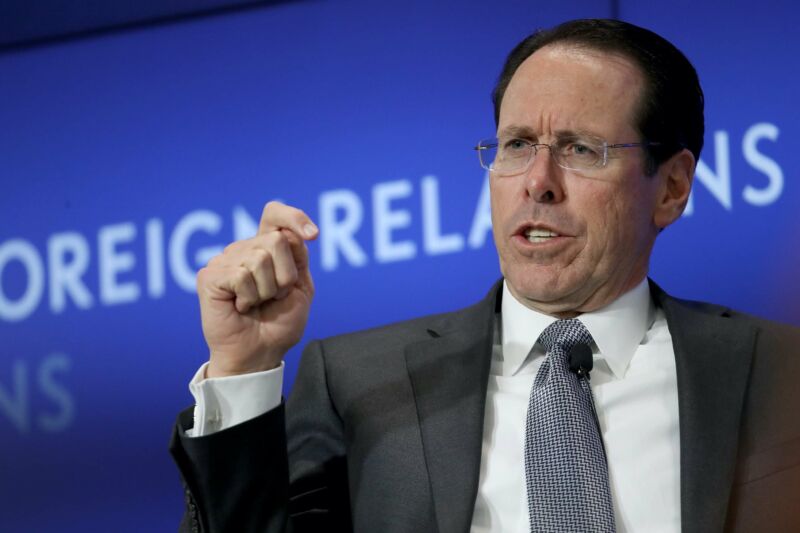
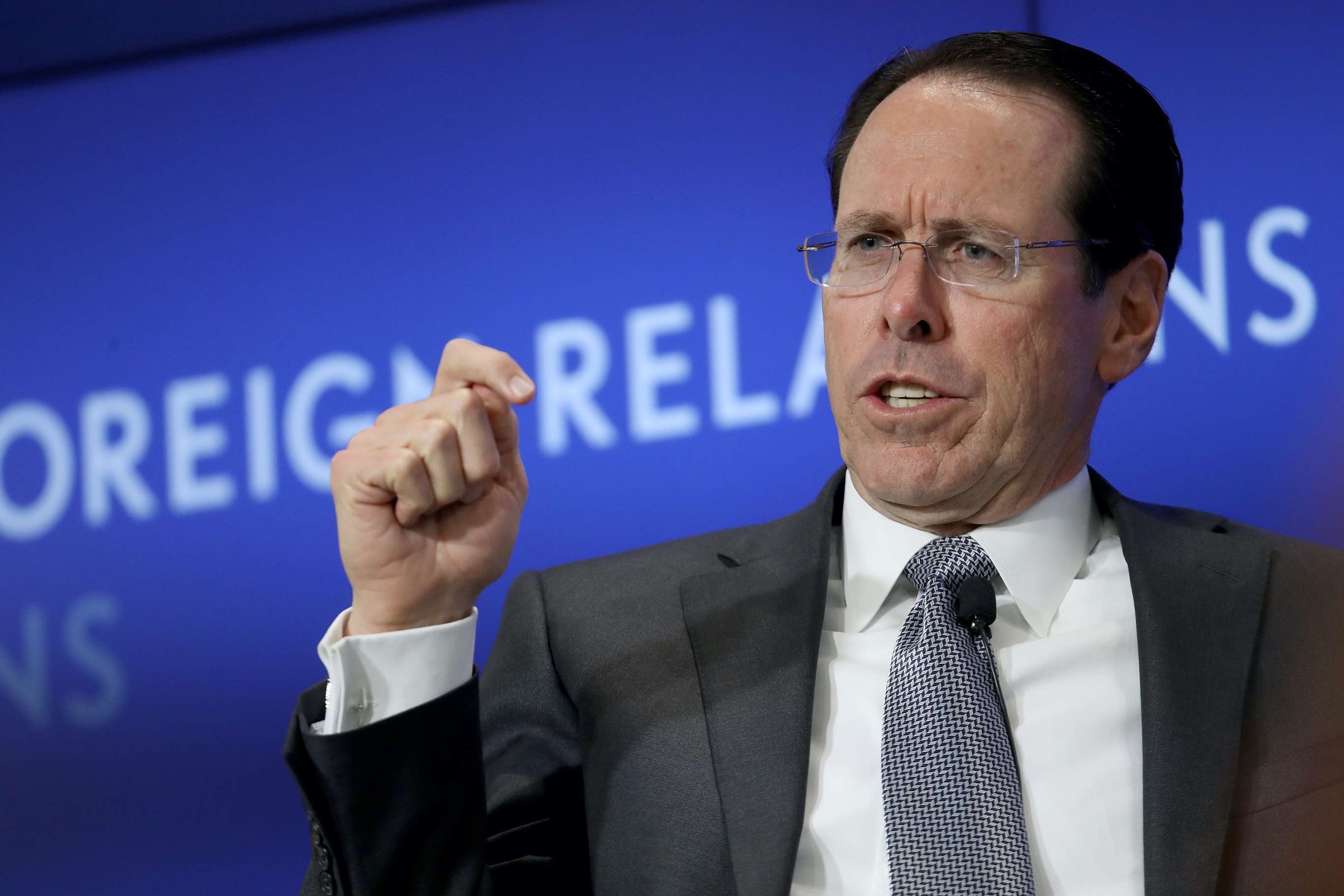
AT&T CEO Randall Stephenson gesturing with his hand and speaking at a conference.

Enlarge / AT&T CEO Randall Stephenson speaks at the Council on Foreign Relations on September 18, 2019 in Washington, DC. (credit: Getty Images | Win McNamee )

AT&T CEO Randall Stephenson's total compensation was more than $32 million in 2019, giving him a 10 percent raise while he slashed tens of thousands of jobs and reduced spending on network upgrades. Stephenson's total compensation was $28.72 million in 2017, $29.12 million in 2018, and $32.03 million in 2019, an AT&T filing to the Securities and Exchange Commission said. His pay raise was driven by stock performance.

Stephenson's base salary was $1.8 million in all three years, but his stock awards jumped from $17.07 million to $19.80 million from 2018 to 2019. The other portions of his compensation remained roughly the same.

While Stephenson's pay rose, AT&T eliminated 7.6 percent of its workforce in 2019. AT&T had 247,800 employees at the end of 2019, down from 268,220 one year earlier. AT&T also slashed capital expenditures by more than $1.6 billion in 2019 and projects a capital-investment cut of more than $3 billion in 2020. The cuts to jobs and network spending came despite AT&T claiming that a corporate tax cut and repeal of net neutrality rules would cause broadband investment to rise. Some of these cuts came from the company's wireline division after AT&T finished a fiber buildout.

Read 5 remaining paragraphs | Comments

12 Mar 20:02

Coronavirus is the Trump catastrophe we’ve been terrified of

by Matthew Yglesias
James.galbraith

An unmitigated disaster

President Donald Trump with his eyes closed. President Donald Trump speaking from the White House in Washington, DC, February 7, 2017.  | Saul Loeb/AFP via Getty Images

It’s Hurricane Maria all over again, but the storm is coming for us all.

The first three years of the Trump administration have gone a lot better than I expected, and better in many ways than we had any right to expect. We aren’t engaged in any new military catastrophes, the economy held up, and the many many many bad policy choices he’s made are overwhelmingly banal Republican Party policy choices rather than wild Trump-specific disasters.

But then there’s Hurricane Maria, which was all our worst fears come to life.

Thousands of Americans died because the confluence of events in Puerto Rico posed a genuinely hard problem. It was a big storm. It hit an island that had significant preexisting economic weaknesses including problems with its electrical infrastructure. The overall political situation there was bad for reasons that predated Trump and had little to do with him. But the president’s job is to handle hard problems. And he couldn’t do it. Instead he whined, he lied, he bragged, he shifted blame, and in the final analysis the suffering was enormous.

The spectacle left us with two options for hope. One, maybe the whole thing was a consequence of Trump’s racist and self-interested instincts. Maybe a problem that impacted a larger, whiter, and less politically disempowered population would get a stronger response. (To be clear: This is a deeply dark option.) Two, maybe Trump’s luck would hold up and he’d just muddle through four or eight years without ever facing a really big crisis.

But his luck has run out.

Wednesday night’s catastrophic Oval Office address

On Wednesday night, Trump took the rare step of delivering a formal address to the public from the Oval Office. It turned out to be a catastrophe. If you’d asked me Wednesday morning, I would have said, “How bad could 10 minutes of reading a speech from a teleprompter possibly be?” The answer turns out to be worse than I’d thought.

The entire focus of the speech was just wildly misguided, focused on ginning up xenophobia and restricting travel from abroad when the coronavirus is already spreading seemingly uncontrolled inside the United States.

But even within the narrow premise that delivering an Oval Office address about new restrictions on European travel was a good idea, Trump screwed it up beyond belief.

For starters, he completely misstated the policy saying that he was banning all travel from Europe and eliding the fact that US citizens, US lawful permanent residents, and their families are exempted from the ban.

This is a huge deal on multiple levels. For starters, the United States is a really big country, and to the extent that Americans travel internationally at all, they go to Europe pretty frequently. On any given day, the planes from Europe are about half-full of Americans coming home, so the incorrect announcement that they’d all be stranded on the wrong continent starting next week set off a panic. Americans rushed to airports, paid extortionate prices for last-minute flights, and worst of all created large crowds in enclosed spaces — exactly what we’re supposed to be avoiding.

Somehow this wasn’t even the only thing he screwed up. He forgot to mention that Ireland is also exempt from the ban, and much of the post-speech cleanup from his staff also forgot to mention it in a way that would be clear to anyone other than the tiny minority of Americans who are familiar with the term “Schengen Area.” But suffice it to say that if you are an American currently in continental Europe and worried about finding a flight back home, you should look into the possibility of connecting through Dublin, a non-Schengen city unaffected by Trump’s measures, that features frequent scheduled service to many American cities.

Then he also screwed up by saying on national television that he was canceling all trade in goods from Europe, only to have his staff come out later and explain that he was misspeaking. This was, to be clear, a prepared address coming from a teleprompter. But he couldn’t be bothered to speak clearly or explain his own policies in a way that would avoid panic or misunderstanding.

The speech was, in other words, much much much worse than simply doing nothing would have been. And this has been a hallmark of Trump’s public communications on the disease, which have been consistently misleading in a way that has induced confusion and totally failed at its goal of stemming anxiety.

When the only tool you have is a wall

The underlying policy that the Trump administration actually did put in place is not necessarily misguided. Restrictions on travel can contribute to flattening the curve, in much the way that other social distancing measures help protect the most vulnerable populations.

But as my colleague Jen Kirby has written, experts are deeply skeptical that at this point travel restrictions are a particularly high-value measure. And even if Trump’s enthusiasm for them is not per se wrong, it’s clear that his obsession with the concept of an external threat has had catastrophic consequences for the United States. Due to his strong orientation in favor of travel bans, Trump was early in restricting travel from China — a measure that he said would prevent the virus from entering the United States. It obviously failed at that goal, but Trump insists at every opportunity on claiming and receiving credit for having been ahead of the coronavirus curve.

The problem is that while these measures probably were successful at helping the United States buy time, Trump didn’t do anything with the time.

The coronavirus testing situation has been a total shambles, despite the extra lead time.

And, in fact, on the whole range of issues currently confronting the country — from economic stimulus to aiding people who are directly sick to advising state and local governments on what precautions to take to bolstering public health capacity — the administration did literally nothing at all throughout the entire months of January and February.

It’s understandable that the president hoped the travel restrictions would work. But he knew perfectly well that he hadn’t shut off all travel to the United States (which would have been economically ruinous) and thus that it was possible border control would fail. Experts were in fact nearly unanimous in their judgment that travel restrictions would not work. Trump not only overruled their advice to put restrictions in place, he completely ignored their warnings and did nothing to create any kind of fallback plan. And since he’s stubborn and vainglorious, he continues to insist that the moral of this whole story is that the experts were wrong and he was right so we should bank on further travel restrictions to save us. It’s absurd.

A decentralized response isn’t good enough

The upbeat, optimistic thing to say these days is that civil society, corporate America, and state and local governments have been stepping up with responsible measures even in the absence of centralized leadership. It’s a nice thought, but honestly it doesn’t work. The issues involved feature a complicated balance of considerations and require some kind of coordination to really work.

The basic case for social distancing is that even small reductions in the virulence of an epidemic can lead to huge reductions in the ultimate death toll. So getting low-risk people to alter their behavior can have large payoffs for the lives of high-risk people. At the same time, social distancing measures can be very costly in terms of their secondary economic impact. What we should have been doing is adopting the highest-value, lowest-cost distancing measures immediately, then identifying high-value, higher-cost measures and trying to quickly find ways to mitigate the costs so that they can be implemented swiftly.

Right now, for example, I know that officials in the District of Columbia are weighing the possible benefits of school closures with the reality that many low-income families rely on school-based free breakfast and lunch to meet their kids’ nutritional needs.

This is not really a dilemma that mayors and school chancellors can solve internally. It requires federal leadership to both allow school systems to repurpose school lunch funds as financial support for families, and then to shovel out new money to needy families, to local governments, and to food banks. There are dozens of similar situations in which we could use centralized leadership to identify dilemmas and then act quickly to resolve them so that public health steps can be taken at an acceptable cost.

Instead, the president is for some reason claiming that the Covid-19 testing process is going well and bragging about the stock market.

This is not going to end well.

Congressional Republicans have doomed us

One of the biggest myths of the Trump Era is the notion that congressional Republicans have somehow rolled over for Trump or that he has bent them to his will.

In reality, on issue after issue, Trump bent to the views of Republican leaders. He has abandoned campaign promises to protect Medicaid, to invest in infrastructure, to make bank regulation stricter, to protect clean air and water, and to avoid tax cuts on the rich in favor of strict adherence to orthodox conservative public policy.

But the calculation Republicans have made is that as long as Trump staffs the bowels of the administrative state with Heritage Foundation guys and fills the judiciary with Federalist Society picks, they shouldn’t ask any tough questions about the president’s honesty, corruption, temperament, basic fitness for office, or preferred management style. It was a calculation that until recently seemed to be paying off reasonably well from the standpoint of rightwing ideologues.

Trump inappropriately leveraged duly appropriated foreign aid money to pressure the Ukrainian government into launching a bogus investigation of Joe Biden’s family. But when it all came to light, the aid money to Kyiv flowed, Trump was shielded from accountability for his misconduct, and now Senate Republicans are set to do the bogus investigation themselves rather than make Ukraine do it for them. Business-friendly regulators are in place throughout the government, taxes on the rich have fallen, the social safety net is getting stingier, and conservatives are taking over the courts.

But in exchange, the country lacks an experienced White House chief of staff to run the executive branch competently. The president’s wildly unqualified son-in-law is playing a key role in orchestrating the coronavirus response. His top economic adviser is a cable news celebrity with a demonstrated track record of poor judgment. And the only real solution — a new leader at the top — is still months away from being possible.

12 Mar 20:01

Iran’s growing coronavirus crisis, in 3 stunning photos

by Alex Ward
James.galbraith

Maybe licking a bunch of religious sites believing in your sky peeping tom wasn't a good idea.

Satellite image ©2020 Maxar Technologies

The new large burial trenches are visible from space.

New satellite photos show the coronavirus crisis in Iran is likely much worse than its government is letting on — or, at least, that the country’s leaders are preparing for the worst.

The pictures, taken on March 1 by the private space technology company Maxar Technologies, were first reported by the New York Times. The images show two large burial trenches recently dug at a cemetery outside Qom, Iran’s religious capital. The reason for the roughly 100 yards of new burial space is macabre: the country is going through a deadly outbreak of the disease that may only be growing larger.

Iran has about 10,000 confirmed cases of coronavirus as of March 12, but there are suspicions there may be many more.

A Maxar analyst told me the trenches were made very quickly and differed from previous ways Iranians have dug plots at the site. What’s more, there’s even an image showing a big pile of lime, which Iranian health officials had previously said was being used to bury those killed by coronavirus.

Which means these trenches were likely made in haste to deal with a growing body count. A count the regime — which includes many top officials also ill with the disease — is struggling to curb.

 Satellite image ©2020 Maxar Technologies
 Satellite image ©2020 Maxar Technologies
 Satellite image ©2020 Maxar Technologies

It’s getting really bad in Iran, and Qom especially

Last week, CNN reported that dozens of dead Iranians were laid in black body bags on the floor of a Qom morgue. It’s unclear how many of those people were were killed by the virus, if any. But it underscored how the city, a place considered holy in Shia Islam and a major center of Shia Islamic learning, is struggling to contend with a major crisis.

Two medical workers in Qom told CNN that worries over the coronavirus have led to a stop in traditional Islamic burials, which include washing the body with soap and water before laying it to rest. Instead, those bodies are being treated with calcium oxide — lime — so they don’t infect the soil with the virus.

Ali Ramezani, the director of the Behesht-e Masoumeh morgue in Qom, told state-run television at the time that there was now a “pile up” of bodies at the facility as they await testing.

It’s unclear if the regime will get a handle on the crisis any time soon. In the meantime, Qom is aware of what’s at stake.

Correction: A previous version of the article said the photos were first reported on by the Washington Post. The New York Times was first.

12 Mar 20:00

Sen. Tom Cotton closes D.C. office and makes racist threat against ... the coronavirus?

by Walter Einenkel
James.galbraith

What a fucking idiot

Not every politician wants to be president. But Republican Sen. Tom Cotton of Arkansas surely does. And Sen. Tom Cotton clearly believes that making sure everyone in Trump’s base knows he’s just as racist and dumb as Donald is helpful to his political aspirations. Upon announcing the closure of his Washington, D.C., office due to the ongoing novel coronavirus pandemic, Cotton made this threatening statement:

Sen. Tom Cotton release this morning: "We will emerge stronger from this challenge, we will hold accountable those who inflicted it on the world." What does that mean?

— Marty Kady (@mkady) March 12, 2020

It’s an idiotic thing to say, but Cotton’s social media feed is filled with anti-Chinese right-wing racist propaganda, and this brand of Republicanism did help bring Donald Trump to the top of the party. Cotton’s announcement also made sure to call the 2019 novel coronavirus the “Wuhan,” since that seems to have gotten House Minority Leader Rep. Kevin McCarthy some good right-wing shine. But Tommy Boy wanted to make sure everyone knew exactly what he meant.

Correct. https://t.co/Kmjv3j0g2K

— Tom Cotton (@SenTomCotton) March 12, 2020

The size of the epidemic in the United States can be laid squarely in the laps of everybody who supported and voted for the demolition of our healthcare infrastructure. People like Tom Cotton, who supported the stripping down of the Centers for Disease Control and Prevention and our infectious disease programs, all in order to get big-money donors more big money. 

Stay classy, Tom Cotton.

12 Mar 18:08

After defending Remain in Mexico as safe, Trump admin admits policy is dangerous in stunning audio

by Gabe Ortiz
James.galbraith

Seriously

In explosive audio obtained through the work of a leading human rights group and released by CNN, a Trump administration attorney is heard finally admitting what experts and advocates have been insisting from the start: Remain in Mexico, the administration policy forcing tens of thousands of vulnerable asylum-seekers to wait for their U.S. immigration court dates in Mexico, is in fact dangerous.

Government attorney Kevin Terrill made the admission in the court hearing of two cousins seeking asylum. Only one cousin was present that day, however: The other had been kidnapped by cartels after being sent by the U.S. to Mexico. In audio obtained by Human Rights First, Terrill argues against granting the kidnapped man asylum, and admits the danger of the policy in the process. ”Your honor, the circumstances that they’re concerned with is potentially a reality for every respondent,” he says.

The news of the admission broke on the same day that the Supreme Court despicably allowed the administration to continue enforcing the policy, which to date has forced out 62,000 people. In blocking the policy last month, the 9th Circuit Court of Appeals ruled that it “likely violated federal immigration law by ousting undocumented asylum seekers who are supposed to be allowed to apply for protection inside the United States,” The Washington Post reported, citing “multiple examples of Central American asylum seekers who feared kidnapping, threats and violence in Mexico.”

In a recent report, Human Rights First tracked over 800 reports of murder, torture, rape, kidnapping, and other violence against returned asylum-seekers. “Asylum seekers returned to Mexico are targeted for kidnapping and assault in shelters,” the report said, “in taxis and buses, on the streets while looking for food, work, and shelter, on their way to and from U.S. immigration court, and even while seeking help from Mexican police and migration officers.” The cousins were similarly targeted after being returned to Mexico.

The administration finally admitted these threats in court, debunking the administration’s lie that Remain in Mexico has “successfully provided protections” to asylum-seekers sent to Mexico. Terrill then argued that granting asylum to the kidnapped man “opens up the floodgates because everybody doesn’t have to show up as long as they have counsel.” Branding all people at the southern border as criminals and fraudsters is a popular trope in this administration, and thankfully one that Judge Danny Santander appeared to dismiss in disbelief at Terrill’s arguments.

“I think what I’m hearing from the government is, and I’ll be honest, I don’t like it,” the judge said, according to the audio. “What I’m hearing is, that well everybody has to take that risk and that chance, and you get kidnapped, you get kidnapped, that’s the risk you take for being in Mexico, and wanting to apply for asylum here in the United States … I don’t think it’s humane. But we’re talking about human beings and lives. It’s not a piece of paper in my opinion. And I really don’t like what I just heard.”

CNN reports that the kidnapped asylum-seeker was released physically unharmed after five days, and a judge waived deportation orders against the two cousins. While they remain in the U.S., it’s unclear whether they were granted asylum. When CNN correspondent Nick Valencia asked them what they thought about the administration’s claim that Remain in Mexico has “successfully provided protections,” one of the cousins was blunt. “It’s completely false,” she said. “At no moment are we safe. It’s a lie.”

12 Mar 18:00

Cheap flights and discounted Broadway tickets put everyone at risk

by Rebecca Jennings
James.galbraith

Seriously

Maybe don’t be this man. | Getty Images

Should you be taking advantage of coronavirus sales? Probably not.

Update 3/12: After this story was originally published, news broke that all Broadway shows will be canceled as of March 12. The story has been updated to reflect that, as well as to include statements from Carnival Cruises and Spirit Airlines.

On March 10, Scott Rudin, the Broadway producer of West Side Story, To Kill a Mockingbird, The Lehman Trilogy, Who’s Afraid of Virginia Woolf, and The Book of Mormon, announced that all remaining tickets for performances between March 12 and 29 would be $50. This, just as an usher tested positive for coronavirus and Broadway actors are being told to stop greeting fans at stage doors to prevent the spread of disease, and just two days before Gov. Andrew Cuomo announced the closing of any public gathering of more than 500 in New York City, effectively canceling all Broadway shows.

If you’re among the few people currently in the market for live entertainment, your choices are dwindling: The NBA has suspended all games indefinitely. Late-night TV shows are filming sans audiences; concerts, movie premieres, and festivals are being canceled every day.

I would’ve loved to see a Broadway show for $50. Who’s to say I shouldn’t have taken advantage of the deal? Messages from public officials are wildly unclear and changing continually, and it’s a confusing time for Americans who’ve been trained to look for bargains while also receiving murky guidelines about how to live our lives during a pandemic.

And so a handful of companies are attempting to spin wariness to travel and gather as a prime opportunity for you, the buyer. Enter: the coronavirus discount. While businesses in most sectors likely to be affected by the disease — sports, entertainment, hotels, and restaurants — aren’t offering blowout sales (yet, anyway), the ones that are hope they’re good enough to take the risk.

“As long as New York City is open for business, its beating heart remains the Broadway stage,” Rudin said in announcing the ticket discounts. “This is an unprecedented opportunity for everyone to see a show that they otherwise might not have had easy and affordable access to. I can’t pretend that great theater is the panacea we’ve been waiting for, but in the meantime I think we could all use a few hours away from the evening news.”

The move received some criticism in the theater world. Playwright Jeremy O. Harris argued on Twitter that “a pandemic shouldn’t inspire ‘affordable’ tickets,” adding that “after YEARS of the most successful commercial theatre makers throwing up their hands and saying ‘there’s nothing we can do abt it.’ It’s startling to see a clearance sale being presented as a gift in the face of [skull emoji] and economic collapse.”

The economy at large has taken a hit: The market dropped to a record low, and sectors like entertainment and travel, particularly vulnerable to mandates like “social distancing,” are taking hits that could cause negative ripple effects along the global supply chain.

Consider airlines. Flight costs have dropped considerably, with cross-country flights going for under $100, and trans-Atlantic flights for as low as $200. As Terry Nguyen reported, airlines are offering travelers who’ve booked within the past month the chance to change or cancel flights without fees as another way to incentivize wary would-be travelers. Spirit Airlines, for instance, reportedly sent an email to customers with the subject heading “Never a better time to fly.” The company then sent out an apology, writing that the email “was written prior to the current situation and unfortunately sent. We are closely monitoring COVID-19 and taking precautions to keep our Guests & Team Members safe.”

Cruise ships are another danger zone in the wake of the coronavirus outbreak, during which a Diamond Princess luxury cruise ship in Japan was quarantined after a passenger tested positive for the virus; another cruise ship was also held off the coast of California for several days after passengers tested positive for the coronavirus. Now, due to customers’ understandable (and potentially lifesaving) reluctance to book cruise vacations, travel companies are offering financial incentives like free drinks and wildly low prices to change their minds.

Carnival, the parent company of Princess Cruises, offered guests drink credits, spa treatments, and excursions of between $100 and $200 per cabin if they don’t cancel their cruises set to depart between March 6 and May 31, Bloomberg reported. Then, days later, Princess announced that it was suspending all global operations for 60 days.

In a statement to Vox, Carnival said:

We have just opened our terminals for the five departures scheduled for today and will be embarking those guests this afternoon. We continue to operate. This is an unprecedented time in the cruise industry and the world. We remain focused on protecting the health and safety of our guests.

Cruise prices across the industry have dropped, too, and despite a warning from the State Department urging US citizens not to travel on cruise ships, plenty of people appear happy to take advantage. One Florida State University sophomore who will embark on a cruise to Mexico this week told the Daily Beast that rather than eat the fee, he hopes to “hit the sweet spot” — that is, travel to a location where coronavirus isn’t as much of a threat. When asked if he thought it was a good plan, he replied, “Honestly, no.”

Said a 27-year-old who saved $200 on a flight from Atlanta to Connecticut to visit her sick grandmother, “If I die, I die.”

 Tomohiro Ohsumi/Getty Images
The quarantined Diamond Princess cruise ship docked on February 19, 2020, in Yokohama, Japan.

Some companies are employing seemingly shady tactics out of desperation. Leaked emails from managers at Norwegian Cruise Line show how they instructed their sales team to pressure customers to lie about the dangers of coronavirus on cruise ships. “The Coronavirus can only survive in cold temperatures, so the Caribbean is a fantastic choice for your next cruise,” said one of the recommended talking points.

Plenty of others are taking safety measures seriously or offering need-based discounts. The NCAA announced that March Madness games would be played audience-free. Many publications have removed the paywall from their coronavirus articles to curb misinformation, and other software companies are offering remote work services for free.

But the coronavirus outbreak may not be short, and its impact on the economy may not be small. Companies will likely fail, people will be laid off, and it’s difficult to pass judgment on the measures people take to avoid losing their jobs.

It’s also almost impossible to discern proper coronavirus protocol, in part because guidance is often confusing, contradictory, constantly changing, or all three. If a cruise company tells you the coronavirus isn’t an issue in the Caribbean and you haven’t heard otherwise, who’s to say a cheap vacation is a bad idea? When faced with a too-good-to-pass-up flight deal to visit a friend or family member who lives across the country or a Broadway show on your bucket list, do you take it? No one else can make that decision for you, but one thing is clear: The people who didn’t have the money to spend on a flight or a musical in the first place are the ones weighing whether to take the risk.

Almost everyone is now having to contend with what kinds of risks we are or aren’t willing to face. In an essay for Vice, Aaron Gordon weighs the prospect of traveling to his nephew’s birthday party for a weekend trip where there will be children and older people around. “The advice being offered by public officials, ostensibly via health experts, about whether to keep doing the mundane activities that make up most of my life has been maddeningly vague and with no clear directive to my own life,” he writes.

What is clear, however, is that businesses hoping to profit off this moment of uncertainty and anxiety should not be the ones making these decisions for us. Until our leaders and public officials give citizens a clear mandate on how to reduce the damage of the coronavirus, all of us will continue to be faced with temptations to put our health at risk for the sake of a deal.

12 Mar 17:58

For Trump, a border wall is a national emergency. A global pandemic? Not so much

by Laura Clawson
James.galbraith

Seriously

When Donald Trump wanted a border wall and Congress wouldn’t give him one, it was a national emergencyEven though, as he himself said, “I didn’t need to do this.” Now that we face a global pandemic that’s spreading rapidly, except we don’t know how rapidly because the Trump administration hasn’t allowed widespread testing? Not an emergency. Yet. We’re waiting for Jared Kushner to decide it is, apparently.

Why isn’t Trump willing to declare a national emergency for pandemic when he was eager to declare one for a wall? “The president isn’t persuaded because [an emergency declaration] contradicts his message that this is the flu,” a “Republican who speaks to Trump” told Politico. The lie takes precedence over having an adequate response to the truth, in other words.

According to a former Department of Homeland Security official, the administration is “not comfortable with the optics of national emergency” because “That’s a big deal to Wall Street, a big deal worldwide” and “It would instill fear in the general public.” 

Uh, guys? The fear ship has sailed. As has the Wall Street ship. We’ve reached the point where only the most die-hard Trumpists are following Trump’s instructions to clap louder, and Trump’s refusal to acknowledge and try to deal with the scope of the problem is making the public (and Wall Street) response more fearful.

Take this also as yet another acknowledgement that Trump’s 2019 border wall “national emergency” was a total sham. Where was the concern then about instilling fear in the general public? No, the concern then was about using a national emergency to tell people that they should be afraid—of immigrants—and there was no concern then that anyone would respond with real fear to the supposed emergency. The “emergency” then was fake, so the declaration of an official emergency could be used as a partisan messaging tool. Now that there’s a real emergency and real fear, Trump is suddenly afraid of how it would look to declare an emergency, even though not doing so deprives the government of tools to combat the real, existing emergency.

Instead, Trump is expected to sign a more limited designation that will try to accomplish part of what a national emergency would, without the scary name or the full powers.

12 Mar 17:58

Market plunge triggers freeze in trading as Dow erases nearly every penny gained under Trump

by Mark Sumner

Following Donald Trump’s disturbing and nonsensical speech to the nation on Wednesday evening, stock futures flipped from positive to negative territory on exchanges worldwide. And by the time the White House completed shooting multiple holes in Trump’s “travel ban,” making it absolutely clear that the policy was anything but clear, the futures markets were already down so far that it was obvious that if things didn’t change, trading would halt on Thursday morning almost as soon as it began. Nothing changed. Trading halted with markets down another 7.2% at 21,857. What officially became a “bear market” on Wednesday is now even more bearish.

The system of “circuit breakers” built into the stock market trading mechanism is intended to arrest major slides and give traders time to think about what’s happening. In the 23 years since the system was created following a stock market crash in 1987, it had rarely been used … until now. In just the last week, the circuit breakers have been hit twice. And as the market stands on Thursday morning, it’s within 2,000 points of surrendering all of the gains made since Trump took office.

Despite the fact that the stock market went far higher in Barack Obama’s first three years in office than it has been under Trump, every inch gained on the Dow has been celebrated by Trump. Just three weeks ago, on Feb. 19, Trump tweeted, “Highest Stock Market In History, By Far!” Even a week later, Trump was encouraging people to invest in a stock market that was “looking very good to me!” 

These are just two of the 157 times Trump has tweeted about the stock market since taking office. But just three weeks into Trump’s attempt to handle a genuine national crisis, the stock market has fallen from 29,551 on Feb. 12 to 21,857 when the stops were hit a month later. That fall of almost 7,700 points puts the market just 2,000 above the 19,805 value it stood at on the day Trump took office. 

At the moment, the stock market has gained just 9% in over three years—an annual return of less than 3%, and a drop unmatched since the 2008 market crisis. If the market falls as much on the remainder of Thursday as it had already dropped on Thursday morning, it will completely erase all gains made since Trump was inaugurated. 

The stock market is not the economy. The Dow Jones isn’t even all of the stock market. But Trump has set such incredible store by this single value that it’s amazing how little he understands it.

Oh, and it runs in the family.

In my opinion, it�s a great time to buy stocks or into your 401K. I would be all in... let�s see if I�m right...

— Eric Trump (@EricTrump) February 28, 2020

12 Mar 17:57

Saturday Morning Breakfast Cereal - Solution

by tech@thehiveworks.com
James.galbraith

Seriously


Click here to go see the bonus panel!

Hovertext:
You know, this turned out to be the exact right comic for today. Stay safe out there, geeks!


Today's News:
12 Mar 17:46

Trump’s Bungled Coronavirus Address Sends Stocks Tumbling; Carnival Docks 18 Cruise Ships

by John Wright

Hours after the Dow Jones Industrial Average entered a bear market for the first time since the 2008 financial crisis, President Donald Trump made matters worse during a primetime address to the nation.

CNN reports: US President Donald Trump took to the airwaves on Wednesday in an attempt to assure the American public that the coronavirus pandemic was under control. Instead, he announced a shock ban on travel from Europe while failing to deliver the comprehensive economic and medical response to the outbreak that investors are craving. Trump’s address has taken the floor out from stocks. Dow futures are off more than 1,200 points, or 5.1%. S&P 500 futures bumped up against their daily 5% loss limit before rebounding slightly. Nasdaq Composite futures are down 4.7%.

More from Business Insider: The drop-off came after President Donald Trump announced several steps the US will take to respond to the coronavirus pandemic. Trump said the US will ban all travel from Europe by non-US citizens for thirty days. He added that the “prohibitions will not only apply to the tremendous amounts of trade and cargo, but various other things as we get approval. Anything coming from Europe to the United States is what we are discussing.” But the White House and the president himself scrambled to clarify his comments as futures tanked in response to his announcement. “Hoping to get the payroll tax cut approved by both Republicans and Democrats, and please remember, very important for all countries & businesses to know that trade will in no way be affected by the 30-day restriction on travel from Europe. The restriction stops people not goods,” Trump tweeted, contradicting his earlier remarks.

In related news, Carnival’s Princess Cruises announced Thursday it is suspending all operations on 18 ships for two months due to concerns over coronavirus. The announcement sent Carinval shares down 22 percent in pre-market trading.

The post Trump’s Bungled Coronavirus Address Sends Stocks Tumbling; Carnival Docks 18 Cruise Ships appeared first on Towleroad Gay News.

12 Mar 17:37

Trump Caught on Hot Mic Saying ‘Oh F–k’ Prior to Coronavirus Address: WATCH

by John Wright
James.galbraith

None of this is normal

President Donald Trump was caught on a hot mic both before and after his coronavirus address on Wednesday night.

“Oh f–k. Uh oh. I got a pen mark. Anybody have any wipe, any white stuff?” Trump said prior to the address:

Then, after the address, Trump let out an awkward, lengthy “OK” before his mic was removed:

A few reactions below.

The post Trump Caught on Hot Mic Saying ‘Oh F–k’ Prior to Coronavirus Address: WATCH appeared first on Towleroad Gay News.

12 Mar 16:46

Trump fears emergency declaration would contradict coronavirus message

by Anita Kumar
James.galbraith

So more people will die because Trump's afraid of contradicting his previously baseless sunshine and rainbows bullshit.


President Donald Trump is reluctant to declare an expansive emergency to combat the escalating coronavirus outbreak, fearful of stoking panic with such a dramatic step, according to three people familiar with the situation.

Instead, the president is expected to sign within days what the White House calls a more limited designation to allow the federal government to cover small business loans, paychecks for hourly workers and delay tax bills, giving him a way to begin boosting the economy without waiting for Congress to sign off on an economic stimulus package.

Any emergency declaration would go significantly beyond that move, bringing in the Federal Emergency Management Agency and freeing up funding and resources for states struggling to contain the rapidly spreading virus.

Trump’s concern at this point is that going further could hamper his narrative that the coronavirus is similar to the seasonal flu and could further agitate Wall Street, said the three people familiar with the discussions.

“The president isn’t persuaded because [an emergency declaration] contradicts his message that this is the flu,” said a Republican who speaks to Trump.

Health experts have rigorously disputed any assertion that the coronavirus is equivalent to the seasonal flu, noting it is much more lethal and particularly dangerous to the elderly and those with other health conditions.

Trump is walking a fine line as coronavirus cases in the U.S. sail past 1,000. As the president ramps up for a 2020 reelection campaign, he is trying to simultaneously signal calm to the American public, comfort businesses whose customers have disappeared amid self-isolation directives and ensure there‘s enough money to combat the still-new disease.

At the White House, some of Trump’s closest aides have debated whether an emergency declaration is needed to ensure those resources are available. But they have yet to make a recommendation to Trump, according to two the people familiar with the situation.

Health and Human Services Secretary Alex Azar is pushing for the designation. But Vice President Mike Pence, who Trump tapped to lead the administration’s coronavirus response, is wary it could trigger an economic tailspin, they added.


There’s no deadline for a decision, but one of the people familiar with the talks said Trump's aides will not give the president a final verdict until Jared Kushner, the president’s senior adviser and son-in-law, talks to relevant parties and presents his findings to the president.

The administration is “not comfortable with the optics of national emergency” because of how it might impact Wall Street, tourism and air travel, a former Department of Homeland Security official said.

“That’s a big deal to Wall Street, a big deal worldwide,” the former official said. “It would instill fear in the general public.”

The White House did not respond to a request for comment.

Trump has spent weeks trying to reassure the public about the outbreak, while the stock market shows daily declines not seen since the 2008 recession.

“We’re prepared and we’re doing a great job with it,” Trump told reporters Tuesday. “And it will go away. Just stay calm. It will go away.”

To try to offset these losses — and a broader economic recession — Trump on Monday said he would propose a stimulus package that could amount to hundreds of billions of dollars. He is negotiating with Congress as House Democrats press ahead with their own bill.

Trump is especially sensitive to variations in the stock market, seeing it as a key talking point in his reelection campaign.

“Everything is about the election now,” said a former Trump adviser. “The economy is strong underneath but the market is the superficial barometer people watch. And if it’s all over the place, people lose confidence.”

Across the U.S., the coronavirus has now killed more than 30 people and health officials have warned that the situation will worsen.

HHS has taken the lead on the coronavirus response, making an agency-specific emergency declaration to unlock resources. The department declared a public health emergency in late January, allowing federal officials to tap money and other resources.

But that measure was limited in scope compared to a presidential declaration, which could either be nation-wide or just for states that have seen the biggest coronavirus outbreaks.


Such a declaration, made under the Stafford Act, would allow federal officials to help with numerous virus-related issues — transportation, shelters, mobile hospitals, public safety. It would also allow money to be used from FEMA's disaster relief fund, which has a balance of more than $40 billion.

Senate Democrats on Wednesday sent a letter to Trump urging him to declare a state of emergency.

“We strongly urge FEMA to stand ready to provide emergency protective measures to prevent and mitigate the spread of disease, save lives, and protect public health and safety, should any state request assistance," they wrote.

Craig Fugate, a FEMA administrator under President Barack Obama, said the Trump administration should be preparing to make the designation if the situation worsens, and eschew any optics concerns.

“You want to make sure you all have all the tools in your toolkit,” he said. “They shouldn’t be wringing their hands and worrying about what people think. I think the American public prefers to get bad information upfront ... [rather] than this tendency to downplay and worry about the economy.”

While the White House usually waits until governors ask for an emergency declaration and explain what help is needed, the president can act on his own.

“I believe the most logistical next step is if states are overwhelmed and their needs aren’t currently being met by HHS, the governors should request an emergency declaration from the president,” said Daniel Kaniewski, who served as FEMA's deputy administrator until January. “It has to be on the mind of many governors.”

The Stafford Act allows for two declarations: an emergency, which is more narrow, and a major disaster, which is more expansive. Both designations put FEMA in charge of coordinating the response, according to five former DHS officials from the George W. Bush, Obama and Trump administrations. The agency has been preparing for such a possibility, they said.

The measure the president is expected to sign in the coming days seems intended to bypass FEMA while still accessing the funds in the agency's $40 billion disaster relief fund, the former FEMA officials said.

The Stafford Act, Fugate said, is "not designed to do that," adding, "Essentially what they are doing is transferring funds instead of going to Congress for a supplemental [spending bill].”

Another former FEMA official agreed. “It’s a tortured attempt to get programs authorized,” the ex-official said. “He’s trying to raid disaster relief fund.”

Trump has authorized some initial emergency coronavirus funding, signing a congressionally approved $8.3 billion package last week. But that money will inevitably run out.


Brock Long, a former FEMA administrator under Trump and executive chairman of Hagerty Consulting, said it’s too early to declare an emergency. Such a move, he said, could confuse Americans.

To this point, leaders from HHS and the Centers for Disease Control and Prevention have been the ever-present faces on television, telling Americans how to act. But an emergency would bring FEMA — and its parent agency, DHS — into the fold, potentially complicating communication efforts.

But that all changes, Long said, if Americans start to face a shortage of food or water, or can’t travel or communicate with each other.

Declarations under the Stafford Act have occasionally been issued for “virus threat” disasters, including West Nile virus.

Fauci, the director of the National Institute of Allergy and Infectious Diseases, said any emergency declaration would only be made after “very serious discussions among the task force.”

Last week, in response to a question by a reporter, Trump said he didn’t see an immediate need to declare an emergency.

"I don't think you'll need that, because I really think we're in extremely good shape," he said. "We're prepared for anything. And we can always do that at a later date if we need it."

Gabby Orr contributed to this report.
12 Mar 06:21

Trump’s Dangerously Effective Coronavirus Propaganda

by McKay Coppins
James.galbraith

he's literally a mortal threat

From the moment the coronavirus reached the United States, President Donald Trump has seemed determined to construct an alternate reality around the outbreak. In the information universe he has formed, COVID-19, the disease caused by the virus, is no worse than the seasonal flu; criticism of his response to it is a “hoax”; and media coverage of the virus is part of a political conspiracy to destroy his presidency.

As with so much of the president’s messaging, this narrative began with tossed-off tweets and impromptu public statements. But in recent days, as U.S. health officials have raised growing concerns about the outbreak, Trump’s efforts to play down the pandemic have been amplified by the same multi-platform propaganda apparatus he’s relying on for reelection in November. From the White House communications office to the MAGA meme warriors of Instagram, from the prime-time partisans on Fox News to the Trump campaign’s Facebook feed, the overarching message has been the same: Pay no attention to the fake-news fearmongering about the coronavirus. It’s all political hype. Things are going great.

Fact-checkers and scientists have scrambled to correct the misinformation coming out of the White House. (No, the virus has not been “contained” in America; no, testing is not available to anybody who wants it; no, people shouldn’t go to work if they’re sick.) But Trump’s message seems to have resonated with his base: A Quinnipiac University poll released this week found that just 35 percent of Republicans are concerned about the virus, compared with 68 percent of Democrats.

The administration’s response to the outbreak has drawn some comparisons to that of the autocratic regimes in China and Iran, where information about the virus was tightly controlled to the detriment of the local populations. But what Trump has actually shown is that he doesn’t need to silence the Centers for Disease Control and Prevention or censor the press to undermine politically inconvenient information about a public-health crisis—he can simply use his presidential bullhorn to drown it out.

Scholars who study modern disinformation tactics have identified this approach as “censorship through noise.” (Steve Bannon, the former White House strategist, has described the strategy in blunter terms: “Flood the zone with shit.”) As I reported in my recent feature on the Trump campaign, the purpose of this sort of propaganda blizzard is not to inspire conviction in a certain set of facts; it’s to bombard people with so many contradictory claims, conspiracy theories, what-abouts, and distortions that they simply throw up their hands in confusion and exhaustion.

[Read: The billion-dollar disinformation campaign to reelect the president]

Spend some time wading through the coronavirus content that’s spreading through the MAGA ecosystem, and it’s easy to see the strategy at work.

Trump supporters have been warned incessantly not to trust mainstream journalistic coverage of the issue. When the market tanked earlier this week, the president blamed it on “fake news.” When White House Press Secretary Stephanie Grisham appeared on Fox & Friends, she condemned the media for using the virus “as a tool to politicize things and to scare people.”

Meanwhile, Trump’s right-wing media allies are working to minimize the perceived dangers of the coronavirus. “Put it in perspective,” Sean Hannity told his Fox News audience this week. “Twenty-six people were shot in Chicago alone over the weekend. I doubt you heard about it. You notice there’s no widespread hysteria about violence in Chicago. And this has now gone on for years and years and years. By the way, Democratic-run cities, we see a lot of that.” The sentiment was echoed by Tomi Lahren, a Fox Nation host, who invoked California’s homelessness problem to deflect attention from the outbreak: “Call me crazy, but I am far more concerned with stepping on a used heroin needle than I am getting the coronavirus, but maybe that’s just me.”

A key strain of the president’s narrative is that concerns about the coronavirus are being weaponized by bad-faith actors—a notion that has spawned a broad range of conspiracy theories. On Fox Business, Trish Regan accused Trump’s enemies of trying to “create mass hysteria to encourage a market sell-off” that would harm his reelection prospects: “This is impeachment all over again,” she declared. Rush Limbaugh has mused that the president is the target of “virus terrorism.” And on Facebook and Twitter, a meme has begun circulating among Trump fans that darkly suggests a new disease is introduced every election year to influence politics.

[Read: There are no libertarians in an epidemic]

Pro-Trump social-media stars have ridiculed people who are afraid of the coronavirus, casting them as ridiculous, or perhaps unmasculine. (“Stop being a baby and go to the gym,” one well-known troll recently wrote beneath a selfie emphasizing his biceps. “Obesity is the real pandemic.”) At the same time, many Republicans are seizing on the outbreak to build support for restrictionist immigration policies and a trade war with China. “We need the Wall more than ever!” Trump tweeted this week.

To the president and his allies, it doesn’t really matter that all these narrative threads don’t perfectly cohere. Muddying the waters is the name of the game, and it’s a strategy that’s carried Trump through numerous political battles over the years.

But sowing strategic doubt about the facts of a global pandemic is fundamentally different from doing it with, say, an impeachment hearing. The dangers are more tangible and immediate to voters, regardless of whether they support Trump. The stakes are higher. And in a crass, political sense, the long-term effectiveness of the effort is limited. Hundreds of new coronavirus cases are being confirmed every day in the U.S. Public events are being canceled, schools are shutting down, containment zones are being implemented by governors. As daily life is disrupted for more and more Americans, Trump’s alternate reality is bound to implode.

Some on the right seem to understand this. Prominent conservative writers such as Ross Douthat and Michael Brendan Dougherty have been covering the outbreak with a sense of urgency. This week, National Review published an editorial criticizing the president’s lackluster response to the virus. Perhaps most notably, Tucker Carlson broke with his prime-time Fox News colleagues this week with a withering monologue that seemed to address Trump without ever saying his name.

“In a crisis, it’s more important than ever to be calm,” Carlson said. “But staying calm is not the same as remaining complacent. It does not mean assuring people that everything will be fine. We don’t know that. Instead, it’s better to tell the truth. That is always the surest sign of strength.”

Will Trump, who has taken cues from Carlson’s show in the past, get the message—or will it be drowned out by the din of the noise machine he helped create?

12 Mar 06:09

Trump will corrupt everything in sight to beat Biden. Here’s what’s next.

by Greg Sargent
A Democratic senator offers a novel way of getting ahead of the president's corruption.
12 Mar 05:49

Trump team now 'racing' to allow federal workers to work from home—after killing prior programs

by Hunter
James.galbraith

shocker

We are now entering the crisis phase of the COVID-19 pandemic. It did not have to be that way, but the Trump team's preparedness delays appear to have damaged the U.S. response to the outbreak so severely, in the still-ongoing inability to test patients even in known outbreak centers, that we still have no idea what the true number of exposed and infected Americans truly is. This renders "containment" impossible. At the moment it seems likely that the path of the pandemic in America will be following that of Italy, where hospitals are overwhelmed, rather than the effective, test-heavy slow-and-contain strategy of South Korea.

That means we can now expect major institutional shutdowns across America. This includes the federal government; The Washington Post reports the Trump administration is now (just now?) "racing to develop contingency plans" allowing hundreds of thousands of federal workers to work remotely rather than in federal buildings. The plan does not seem to be robust.

As is usual for every damn thing about this incompetent Republican maladministration, the Post notes that the Trump team actually reversed federal work-from-home practices when they took office, with multiple agencies scaling back existing programs because Team Trump did not believe workers could be trusted to work hard enough from home. Now, yet again, they are scrambling to redo something they pompously disassembled.

Also as usual for Team Trump, this is almost certain to become a rapid clusterf--k. Swiftly moving hundreds of thousands of workers to telecommuting status is likely to require substantial technological fiddling. Are there enough computers? What network security measures need to be altered, in what ways, to allow remote data access? How many workers need to take calls during their workdays, and how will each office keep track of new, private numbers?

But it's also going to be necessary. We are about to enter a new phase in attempts to slow coronavirus spread to "flatten the curve" enough for hospitals to not be absolutely overwhelmed with critical patients. It is likely that large public gatherings nationwide will be cancelled. Ordering businesses to provide paid sick leave, rather than obliging symptom-having workers to come in instead of losing pay, is absolutely essential, but any company that can have a sizable number of workers do their work from home needs to have those plans finalized immediately.

Again, the goal here is to slow the virus down, not stop it. We need to slow the number of patients entering hospitals ten days from now, and twenty. Nobody should be complaining if their interactions with federal agencies seem even more sluggish in the coming weeks; this is what a pandemic does. Plan for it, but don't panic over it.

12 Mar 05:46

Senate Republicans block emergency sick leave bill as coronavirus threatens widespread need

by Laura Clawson
James.galbraith

The GOP shows its true colors yet again

You’d think the desperate need for paid sick leave legislation would be undeniable in the face of coronavirus. But trust Republicans to do the wrong thing. On Wednesday, Democratic Sen. Patty Murray tried to speed the progress of an emergency paid sick leave bill to a full Senate vote, but Republican Sen. Lamar Alexander wasn’t having it.

Alexander blocked Murray’s procedural maneuver and stuck the bill in the Senate health committee. While the bill would have failed on the Senate floor thanks to Republicans, at least they would have been on the record against paid sick leave during a pandemic. Alexander’s block protected his fellow Republicans from taking that unpopular stance publicly.

This is why we need to take back the Senate. Can you chip in $3 to help elect Democrats in key 2020 states?

“For many of our workers―restaurant workers, truck drivers, service industry workers―they may not have an option to take a day off without losing their pay or losing their job,” Murray said, accurately. “That’s not a choice we should be asking anyone to make in the United States in the 21st century.” But we do, every day, and, thanks to Republicans, that’s a choice people will continue to make even while going to work sick presents a major threat to public health.

Senate Democrats aren’t going to quit trying to pass paid sick leave, House Democrats plan to pass it this week, and Speaker of the House Nancy Pelosi will doubtless be pushing it in her negotiations with Treasury Secretary Steven Mnuchin. The fight isn’t over, but Republicans are once again showing us who they are.

12 Mar 05:33

Trump’s Europe travel ban might not do much to stop the coronavirus’s spread in the US

by Jen Kirby
James.galbraith

No shit. It's community transmission now, not foreign travelers.

President Trump addresses the nation from the Oval Office on March, 11, 2020. | Doug Mills/The New York Times via AP

An extraordinary announcement in Trump’s Wednesday night Oval Office address.

President Donald Trump announced a sweeping ban on travelers coming to the US from Europe as part of the administration’s plan to combat the coronavirus — a move that experts say distracts from the reality that the virus is already spreading among people within the United States.

In a primetime address from the Oval Office Wednesday night, Trump said that the United States will be suspending all travel from Europe to the United States for the next 30 days, though the United Kingdom will be exempted. The order will go into effect Friday at midnight. Trump also noted that “[t]here will be exemptions for Americans who have undergone appropriate screenings.”

Trump described the measure as a way “to keep new cases from entering our shores.”

The problem, experts say, is that the virus has already entered America’s shores, and we’re already seeing “community spreading” of the virus — that is, people with no international travel and no links to known cases are now getting the virus, implying they were exposed locally by an unknown source.

Altogether, this was an extraordinary move, but one that may do little to stop or mitigate the spread of coronavirus — while potentially damaging the US’s already somewhat strained relationship with its European allies.

“Germs don’t respect borders, and you can’t wall off every place in the world,” Lawrence Gostin, director of the O’Neill Institute for National and Global Health Law at Georgetown University Law School, told me.

“There’s a fine line between the president’s pro-US, anti-internationalist position where he thinks that he can restrict his borders on things like trade or immigration,” he added. “That doesn’t work with a germ — particularly with a germ that’s already here.”

What we know about Trump’s travel ban

In his speech, Trump said that cargo and other trade would also be subject to the ban, immediately sparking fears of further disruptions to the economy — but it turns out Trump seems to have misspoken, as the White House later clarified that the ban did not apply to goods, just people. A sign, perhaps, of the slipshod rollout of this order.

The Department of Homeland Security further clarified that the ban will apply to all foreign nationals who have physically been in Europe 14 days before they enter, or try to enter, the United States. It encompasses the 26 countries in the “Schengen Area,” a grouping of countries in Europe that allow their citizens to travel freely across national borders, including France, Germany, Spain, Italy, among others.

The order excludes non-Schengen European countries, such as Ireland and Croatia. The ban also exempts UK. Coronavirus cases are spreading in both Schengen and non-Schengen European countries, so the loopholes undercut the effectiveness of any travel restrictions.

The order does not apply to legal permanent US residents, according to DHS. The US can’t bar US citizens from returning, either, though it likely can set up screening or quarantine measures, if necessary.

The White House, in its proclamation, described the Schengen countries as having the most cases — more than 17,000 — of the novel coronavirus outside of mainland China. That’s true, although those cases are spread across 26 countries, with some, like Italy facing more acute outbreaks.

But other EU countries have much milder outbreaks so far. The UK — which, again, is excluded from the ban — has more than 450 coronavirus cases.

Acting DHS Secretary Chad Wolf justified the travel ban by saying the administration had issued similar travel restrictions on those who had been to China and Iran. That “proved to be effective in slowing the spread of the virus to the U.S., while public health officials prepared,” he said in a statement.

The problem, of course, is that coronavirus is already here.

A travel ban might miss the point, at this point

As of March 11, there are more than 1,300 cases in the United States. This number is expected to go up, but some experts say problems with testing have likely delayed a full accounting of the number of infected.

As state and local governments take measures to mitigate community spread — banning large events and encouraging “social distancing” — it’s not all that clear that expending resources on such dramatic travel restrictions will effectively tamp down the outbreak within the US.

Public health officials in the US are broadly discouraging travel, especially for older people and those with underlying conditions who are at higher risk of both contracting and experiencing severe consequences from the coronavirus. The State Department is also asking US citizens to “reconsider” travel abroad because of the coronavirus pandemic.

Screening of travelers may — or may not — help prevent people from bringing the virus into new communities in the US, but the World Health Organization discourages using “unnecessary” travel restrictions as a tool to try to stop the spread of a virus.

“It’s not going to do anything to mitigate the spread here, so it makes [Trump] look silly and incompetent at a time when he needs to look well briefed and presidential,” Jim Goldgeier, Robert Bosch Senior Visiting Fellow at the Brookings Institute, told Vox.

Trump announced the ban late Wednesday evening, which is the middle of the night for much of Europe, so reactions from the continent so far have been a bit muted. It’s also unclear how much notice the US gave to its European partners about the administration’s order.

As Georgetown Law’s Gostin said, germs don’t respect borders. And at a time when international cooperation, and coordination, is as necessary as ever, Trump’s travel order may create more tension and distract from the real crisis that’s already here in the United States.

Alex Ward contributed reporting.

12 Mar 05:32

What Trump actually proposed in his coronavirus speech

by German Lopez
James.galbraith

blah blah blah nothing here but more xenophobia and the markets are NOT amused

President Donald Trump speaks to the nation during an Oval Office address about the coronavirus pandemic. Brendan Smialowski/AFP via Getty Images

The president announced a travel ban for Europe and three new economic policies.

President Donald Trump proposed a slew of policies to tackle the coronavirus pandemic in an Oval Office address on Wednesday night — announcing travel to the US from most of Europe would be banned for 30 days and calling for new efforts to stimulate the economy at home.

It was the first time Trump really acknowledged the depth of the outbreak of Covid-19, the disease caused by the SARS-CoV-2 virus, citing the World Health Organization’s declaration that it’s now a pandemic.

But he also cast coronavirus as a foreign threat — literally calling it “a foreign virus” — and focused largely on economic measures instead of public health ones, while repeatedly trying to reassure Americans that his administration has things under control.

“This is the most aggressive and comprehensive effort to confront a foreign virus in modern history,” Trump said. “I’m confident that by … continuing to take these tough measures we will significantly reduce the threat our citizens and we’ll ultimately and expeditiously defeat this virus.”

Despite Trump’s assurances, the virus has continued to spread in America, with the total number of confirmed cases in the US topping 1,300 as of March 11, according to the Johns Hopkins interactive map. Due to coronavirus fears, the NBA announced it was suspending games shortly after Trump spoke.

Trump announced a travel ban for most of Europe

Trump’s biggest announcement was a travel ban, which will prohibit people from coming to the US from Europe for 30 days beginning on Friday at midnight. The administration later clarified that the ban would not apply to US citizens or permanent residents abroad.

The restrictions also won’t apply to the United Kingdom, which has fewer reported coronavirus cases than its continental peers but still nearly 500 confirmed cases, and Ireland, which has fewer than 50 confirmed cases. The administration previously put in place restrictions on travel from China.

It’s unclear how this will affect trade with Europe, which could potentially hurt the economy.

The travel ban also does little to stop the spread of coronavirus within the US, which is already happening.

Trump promised more economic stimulus

Trump also promised several measures to stimulate the economy, after a week in which coronavirus scares contributed to the stock market plummeting. He called for tax breaks and aid to small businesses, but didn’t promise paid sick leave or any other help for hourly workers and others without those benefits who might need to stay home — a key demand of Democrats in Congress in any coronavirus relief bill.

  • He called on Congress to increase funding for the Small Business Administration by $50 billion to help boost economic loans to impacted regions. (So far, Washington state, New York, and California are the places most affected, but it’s unclear how or if aid will go there.)
  • He also promised to take executive action that will “provide more than $200 billion of additional liquidity to the economy” through deferments on tax payments and penalties for people and businesses negatively impacted by the outbreak.
  • And he asked Congress to cut the payroll tax. Trump argues this would put money into the economy quickly, including for individuals and corporations, but some experts are skeptical that tax cuts could have an impact quickly since they can take a while to trickle out into the hands of consumers and businesses.

What Trump didn’t say much about: testing

In the rest of the speech, Trump tried to reassure Americans about his administration’s response to the outbreak so far. He pointed out he signed a bill into law that added $8.3 billion in funding for federal agencies to fight the coronavirus and support related efforts, and claimed he’s cut “massive amounts of red tape to make anti-viral therapy available in record time.”

Separately, health insurers have agreed to eliminate copayments for testing, stop surprise medical billing, and help expand coverage related to the coronavirus.

“The virus will not have a chance against us,” Trump said. “No nation is more prepared or more resilient than the United States. We have the best economy, the most advanced health care, and the most talented doctors, scientists and researchers anywhere in the world. We are all in this together. We must put politics aside, stop the partisanship, and unify together as one nation and one family.”

He didn’t do much to address the ongoing problems with federally provided test kits. States, counties, cities, and medical providers have complained that there are simply not enough test kits available, forcing them to ration tests and turn people away. Experts say testing is crucial to finding out who is infected so they can be isolated and those they came in contact with can be put in quarantine.

On that issue, Trump merely stated “testing and testing capabilities are expanding rapidly, day by day,” providing few new details.

The administration quickly walked back much of Trump’s speech

After Trump’s speech, the administration quickly scrambled to take back multiple claims that the president made.

First, the administration clarified the reach of the travel ban. It won’t apply to US citizens or permanent residents, contrary to Trump’s claim that there would only be exemptions “for Americans who have undergone appropriate screenings.” It also won’t apply to Ireland, which Trump didn’t mention.

Second, Trump initially said that the travel ban “will not only apply to the tremendous amount of trade and cargo, but various other things as we get approval” — suggesting it could disrupt trade with Europe. But Trump himself later tweeted that “trade will in no way be affected by the 30-day restriction on travel from Europe,” adding that the new ban “stops people not goods.”

Finally, Trump originally claimed insurers “agreed to waive all copayments for coronavirus treatments.” But insurers clarified they only waived copays for only testing, not treatment.

12 Mar 05:16

'It’s going to get worse': Health officials warn of coronavirus escalation

by Quint Forgey and Nolan D. McCaskill

The nation’s top health officials cautioned Wednesday that the U.S. will see more coronavirus cases as the domestic outbreak spreads, a stark warning that comes as Congress looks to head off the outbreak's economic impact and global health organizations declare it a full-blown pandemic.

More than 1,000 people in the U.S. have already been diagnosed with the coronavirus in 38 states, leaving at least 29 people dead. But Anthony Fauci, director of the National Institute of Allergy and Infectious Diseases, told members of the House Oversight Committee that “we will see more cases, and things will get worse.”

“How much worse… will depend on our ability to do two things: to contain the influx in people who are infected coming from the outside and the ability to contain and mitigate within our own country,” Fauci said. “Bottom line: It’s going to get worse.”

Hours after Fauci's testimony, the World Health Organization declared coronavirus to be a global pandemic, a classification it had previously resisted.

Fauci stressed that the coronavirus “is a really serious problem that we have to take seriously,” noting that it’s 10 times more lethal than influenza, which kills nearly .01 percent of Americans who get it each year. He declined, however, to estimate how many Americans may become infected with coronavirus, reasoning that it would depend on the response.


“If we are complacent and don’t do really aggressive containment and mitigation, the number could go way up and be involved in many, many millions,” he warned.

Fauci, Centers for Disease Control and Prevention Director Robert Redfield and other emergency response officials testified before the panel Wednesday morning. But the hearing was cut short so officials could rush to an “emergency” White House meeting with President Donald Trump and Vice President Mike Pence.

It wasn’t immediately clear what the meeting was about. Fauci and Redfield declined to speak to reporters as they left the Capitol.

Health and Human Services Secretary Alex Azar said earlier Wednesday that the federal government would issue new guidance to U.S. communities affected by the coronavirus regarding “aggressive steps” to counter the burgeoning outbreak.

“You’re going to hear from CDC today and the White House that we’re going to be making recommendations to those local communities about aggressive steps that we think they should be taking, and we’ve been collaborating closely with them on that,” Azar told “Fox & Friends.”

One administration official said the recommendations will instruct residents of communities in California, Massachusetts, New York and Washington to work from home and declare that schools should close under certain circumstances.

Azar suggested similar steps during his interview Wednesday. He said the administration is “working with places like Washington, New York, Massachusetts, Florida, California to mitigate the impacts — avoiding large social gatherings, appropriate closures of schools.”


Azar also offered a more dire warning about the nature of the outbreak, asserting that “we’ll see more cases” of the coronavirus among Americans and adding that “there is literally no way that the United States, as the center of the global economy, is immune from this.”

The Trump administration has faced criticism for the time it took to produce testing for the coronavirus as the public health crisis worsened, as well as the availability of those tests to state and local health care providers and the government’s inability to track them.

The White House has urged Silicon Valley tech companies to help combat disinformation about the coronavirus and assist the government with its response to the outbreak.

Trump has also recommended aggressive measures to boost the flagging economy, including a payroll tax cut and paid leave for hourly employees unable to work due to the outbreak.

The CDC — which announced Wednesday that it will quickly distribute more than $560 million to help state and local jurisdictions respond to the coronavirus — has advised travelers, particularly elderly travelers, to avoid long flights and cruises. Elderly people are disproportionately at risk of contracting the virus.

House Democrats are moving forward with their own economic package that proposes paid sick leave for certain workers, increased funding for children’s school lunches, expanded unemployment insurance and greater spending on social safety-net programs.

In a letter to Trump, 34 Senate Democrats called for an economic stimulus package that would help workers who will be harmed the most by the outbreak.

The Treasury Department is also considering postponing the April 15 tax filing deadline due to the outbreak. And the State Department announced that an upcoming G-7 ministerial that the U.S. was set to host in Pittsburgh later this month will now be held virtually via video teleconference “out of an abundance of caution.”

In Washington, a District of Columbia health advisory recommended the postponement or cancellation of all “non-essential mass gatherings” of 1,000 or more people through the end of March.

And in Washington state, Gov. Jay Inslee announced a ban on public gatherings of more than 250 people in three counties to mitigate the spread of coronavirus. At least 24 people have died from the virus in the state, where more than 260 cases have been confirmed.

Meanwhile, Democratic governors continued Wednesday to condemn the federal government’s handling of the outbreak. New York Gov. Andrew Cuomo knocked the amount of testing that has been conducted thus far in the U.S. and urged state authorities to take on greater responsibility in the face of the administration’s insufficient response efforts.

“China was doing 200,000 tests a day. South Korea was doing 15,000 tests a day. We’ve done 5,000 to date,” Cuomo told MSNBC’s “Morning Joe.”


“So what I would say — what I have been saying to other governors — is, ‘You’re on your own,’ you know?” he continued. “Let the states take action because when they do the retrospective here ... I think this is going to be the public health version of Hurricane Katrina. The federal government has just fallen down on the job, so let the states do it.”

Illinois Gov. J. B. Pritzker also said he was “extremely disappointed” in the administration and expressed concerns about the coronavirus’ potential effects on the state’s presidential primaries next week. He said officials were working to move polling sites away from nursing and veterans homes to limit exposure to vulnerable elderly residents and encouraged voters to cast their ballots by mail.

“We think we’re doing what’s required here to have a successful, democratic election,” Pritzker told MSNBC.

Trump, for his part, trumpeted praise from Democratic Gov. Gavin Newsom of California, who credited the president for his administration’s support in the state’s repatriation of passengers from an infected cruise ship that docked in Oakland.

But he blasted critical coverage of his coronavirus response, calling a Vanity Fair report a “phony & boring hit piece.”

“Our team is doing a great job with CoronaVirus!” Trump said.

Brianna Ehley, Nancy Cook and Myah Ward contributed to this report.

12 Mar 05:14

WHO official declares the 2019 novel coronavirus outbreak a pandemic

by Mark Sumner
James.galbraith

As the markets shit bricks

The outbreak of 2019 novel coronavirus reached epidemic status in China by early January, but for several weeks, other nations around the world seemed to be holding cases down to relatively small numbers. Then, even when secondary epicenters of disease emerged in South Korea, Italy, and Iran in the second half of February, the World Health Organizations insisted on calling them “multiple connected international epidemics” rather than use … that other word. 

But that’s over. In a Wednesday morning briefing, WHO leaders officially called it: The 2019 novel coronavirus outbreak is a pandemic. And, as WHO Director-General Tedros Adhanom Ghebreyesus made clear, that status is well-earned. "In the past two weeks, the number of cases of COVID-19 outside China has increased thirteen-fold and the number of affected countries has tripled,” said Dr. Tedros. “There are now more than 118,000 cases in 114 countries, and 4,291 people have lost their lives."

And, just as Dr. Anthony Fauci stated before the House Oversight Committee on Wednesday, the worst is still to come. "Thousands more are fighting for their lives in hospitals,” said Dr. Tedros. “In the days and weeks ahead, we expect to see the number of COVID-19 cases, the number of deaths, and the number of affected countries climb even higher."

Daily Kos has been using the term “pandemic” in some articles since the end of February, after it became clear that both Italy and Iran had become significant secondary centers that were exporting the disease to dozens of nations. CNN began using the term two days ago, when the number of cases reached 100,000 and community spread had been demonstrated in a number of nations. In general, the term defines the reach of a disease—one that has reached epidemic proportions in several nations—rather than commenting on severity. A disease can be pandemic without being severe, or it can be fatal but not pandemic.

A number of articles have cited claims that the WHO had resisted using the term “pandemic” because it automatically triggers action on the part of some nations that might be actually harmful to early containment of the disease or to local economies. But WHO officials have denied this was part of their reasoning.

In any case, it’s official. This is a pandemic. That doesn’t make it any worse … unfortunately, it also doesn’t make it any better.

12 Mar 05:13

Hearing on coronavirus ends abruptly as White House tells experts to come to 'emergency meeting'

by Mark Sumner
James.galbraith

Ridiculous

On Wednesday morning, medical experts, including National Institute of Allergy and Infectious Diseases director Dr. Anthony Fauci and the director of the Centers for Disease Control and Prevention, Dr. Robert Redfield, were testifying before the House Oversight Committee on what to expect from the coronavirus epidemic in the United States. According to Fauci, “The bottom line: It is going to get worse.” Again and again, the information provided in the hearing completely contradicted the rosy statements that have been coming from Donald Trump and other White House officials and warned of a dire situation ahead.

But before the House could learn too many details, the hearing ended in an abrupt and astounding manner, as the witnesses simply got up and left. At 11:30 ET, Oversight Committee Chair Rep. Carolyn Maloney was told that the witnesses had to depart. In an attempt to explain what was happening, Fauci said they were going to an “emergency meeting” at the White House. Then, to add extra confusion, the White House immediately claimed that the meeting was not an emergency … it was just something that Fauci and Redfield didn’t know about and that was so urgent that they had to leave in the middle of congressional testimony.

On Tuesday, Trump appeared before the nation and assured everyone, "It will go away, just stay calm." But before his testimony was cut off, Dr. Fauci made a number of statements that were exactly counter to everything that Trump, Mike Pence, and the whole galaxy of Fox News surrogates have been trying to pass off on the nation.

Among other things, Fauci said that the coronavirus is “10 times more lethal than the seasonal flu" and that there was no evidence that any vaccine would be available in the next few months. Despite being told both these facts, Trump has continued to contradict them at press events, downplaying the lethality of the coronavirus and indicating that a vaccine will be available soon—even when contradicted by officials sitting at the same table. And both White House officials and other right-wing sources continue to dismiss the coronavirus as “regular old flu.”

Also at the hearing, Redfield—usually a reliable Trump sycophant—admitted that some recent cases that had been written off as deaths due to flu were likely cases of the coronavirus. This would confirm a story carried by The New York Times reporting that Washington state officials sought to test flu victims for possible coronavirus back in January, only to be turned down by Redfield’s agency. This admission shows that the coronavirus has been circulating in the U.S. population for weeks, and underscores again that even the soaring number of cases now being racked up each day is really a signal not of limited disease, but of limited testing.

In the midst of this testimony, which had been expected to continue for some hours, came word that the witnesses were being called away for a meeting. After Fauci described it as an “emergency meeting,” another official jumped in to say that the meeting was actually “previously scheduled.” Fauci appeared to be in absolute confusion about what was going on, saying that there was a coronavirus task force meeting scheduled, but that it was at 3:30 PM ET.  

As the witnesses were leaving the hearing, House members, including Maloney, tried to squeeze in a few last questions, making it clear that the public needed the information and insisting that witnesses had to complete their testimony. Fauci said he would try to return at 2 PM, but since the end of the hearing, another meeting has been scheduled at 2.

In the hearing, Fauci claimed that he had never been stifled in his statements to the public. But whether he will continue to appear as part of Trump’s coronavirus task force seemed decidedly in doubt as he left the hearing chamber.

Wednesday, Mar 11, 2020 · 4:30:36 PM +00:00 · Mark Sumner

Apparently, at some point earlier in the morning, Chairwoman Maloney was told that the meeting would end at 11:45 because Fauci and Redfield were needed back at the White House. However, Fauci did not seem to know this.

12 Mar 05:11

Conservative Dem who voted against ACA accuses Democrat running against him of wanting to repeal it

by Walter Einenkel
James.galbraith

Fuck off Lipinski

Marie Newman is challenging incumbent Democratic Rep. Dan Lipinski for the seat representing Illinois’ 3rd Congressional District. Newman, who is also a Democrat, wants to unseat the conservative Lipinski, whose voting record against Democratic Party policies leaves a ton to be desired. Newman has been receiving a lot of strong progressive and Democratic endorsements, but is fighting against an incumbent who has a good deal of money behind him.

Lipinski has been working the classic Republican playbook against Newman: trying to terrify his constituents into believing that he is the only thing between them and Joseph Stalin’s ghost rising and throwing them all into a prison camp in Siberia. And like all fear-mongering types, Lipinski knows no low he cannot stoop to. But on Monday, Lipinski tweeted this out, proving once against that there’s wiggle room even at the bottom.

The Affordable Care Act has many provisions that help working families, including coverage protections for people with pre-existing conditions. Marie Newman wants to throw that all away and switch to a government-run plan that would raise taxes on the middle class. pic.twitter.com/rbUjZLODaA

— Dan Lipinski (@DanLipinski) March 9, 2020

What is remarkable about this statement by Lipinski is that there was a single Democratic Representative from Illinois that voted against the ACA. Just one person: Rep. Dan Lipinski. 

Support Marie Newman’s campaign by donating a couple of dollars.

Rep. Lipinski is a special kind of goblin, courting the Republican vote in this Democratic primary by touting his anti-ACA vote and stance, while attacking Marie Newman for wanting to ruin the ACA with a Medicare for All platform. Illinois’ election will be held next week on March 17, 2020.

Many people saw the tweet and were quick to jump on Lipinski’s account to slam him for being so cravenly deceitful.

You voted against the ACA!!

— Tyler Dinucci (@TylerDinucci) March 9, 2020

"Lipinski was the only Illinois Democrat in Congress to oppose the Patient Protection and Affordable Care Act (Obamacare), which passed the House on March 21, 2010."https://t.co/Y1FHStxrv9

— N C Irving (@NCIrving2) March 10, 2020

And here’s an important question for Dan.

Didn�t you vote against the ACA? Do you stand for anything?

— crh (@thehamfist) March 10, 2020

And a reminder of the kind of politician Dan Lipinski is.

You are the last remaining anti-abortion Dem . You voted to defund health clinics that offer abortion services, and to ban abortions at 20 wk. You opposed the Affordable Care Act and its mandate that employers cover birth control. You attend fundraisers for anti-abortion groups.

— Barbara Szram #DemCastIL #DemCast #DemCastUSA (@baszram) March 10, 2020

Thank you for this helpful information, donating to Marie now.

— Jordon Nardino (@jnardino) March 9, 2020