Read more of this story at Slashdot.
James.galbraithGood
Read more of this story at Slashdot.
James.galbraithAmazing
Republican efforts to demonize any teaching about race or racism in U.S. history picked up yet another perfect defining moment recently when a “grassroots” parent group was outed as a Republican astroturf effort. “Prep School Accountability” claimed to be a group of parents concerned about their kids’ education (at New York private schools), but it turns out that notorious anti-union and pro-corporate astroturfer Rick Berman’s lobbying firm was involved in the campaign to keep education racist.
That news followed other key revelations about the Republican fight against the teaching of critical race theory anything about racism such as TV host Marc Lamont Hill revealing that some of the enthusiastic backers of that effort don't even know what critical race theory means, or former Love Connection host and current right-wing podcaster Chuck Woolery suggesting that it’s too bad Hitler didn’t nip the original critical theory school in the bud.
What would these warriors against what they characterize as indoctrination prefer to see in schools? We know, thanks to the valuable work of The Root’s Michael Harriot, that many of the congressional opponents of the 1619 Project (a target frequently lumped in with critical race theory), learned whitewashed versions of U.S. history, in some cases from textbooks influenced by the United Daughters of the Confederacy. But that kind of history education has not been left in the past.
Check this out:
These two paragraphs, which is being taught to 8th graders in Louisiana, are appalling. People are so concerned about critical race theory being taught to kids, but have nothing to say about this https://t.co/KmNcoP94fU pic.twitter.com/mbJFwFbKdm
— philip lewis (@Phil_Lewis_) June 14, 2021
One of Louisiana’s two approved history textbooks for eighth graders is literally teaching the Civil War from the perspective of the slaveholders. “Our cause is just and must prevail,” the slaveholder in question wrote in her diary. But, according to the textbook, she faced a “justified fear that their slaves would abandon the plantation,” and she and her mother became refugees after being “forced” to go to Texas following 120 enslaved people they had first sent there. After the war, though they still had a huge plantation, they had “lost all their property in slaves” and “had to face the reality of planting and harvesting their fields with freed people who, Kate regretted, now demanded ‘high wages.’”
It’s pushback against this kind of history—in which the concerns of a wealthy slaveholder are presented sympathetically while enslaved people are the source of “justified fear” and problematic demands for “high wages”—that Republicans are so worked up about.
Over the weekend, teachers across the country joined a national day of action to underline their commitment to teaching a full version of U.S. history, including the nation’s racial and too often racist history. Thousands of teachers have signed a pledge saying, simply, “We, the undersigned educators, refuse to lie to young people about U.S. history and current events—regardless of the law.”
But some teachers say that their colleagues are intimidated by the laws, and that the attacks on “critical race theory,” which no one is actually teaching at the elementary, middle, or high school levels, will have an effect on the teaching of anything about race—exactly as Republicans intend.
”The White teachers who started doing a little bit more teaching about race and racism are now going back to their old way of teaching,” sixth-grade teacher Monique Cottman told Black Lives Matter at School co-founder Jesse Hagopian. “I’ve had conversations with teachers who said things like, ‘I’m getting so much pushback for teaching Alice Walker, I’m going to go back to teaching what I used to teach.’ So all the teachers who would have done a little bit of what I was doing—anti-racism work and culturally responsive teaching—they’re not going to do anything next year. They’re already declaring, ‘I’m not doing nothing,’ or ‘It’s not safe,’ or ‘I don’t want to lose my job.’”
That’s the game. It’s not about the legal academic school of critical race theory. It’s about Alice Walker. Or a history not told from the perspective of slaveholders. It’s about keeping white people on top in the teaching of history and literature, and intimidating anyone who would teach anything else.
James.galbraithToo fucking bad. You idiots keep voting for the GOP, you're gonna keep getting bad results. I don't know how else to put it at this point.
Apparently, wind turbines can also freeze when it gets hot. Or at least, after a deadly outage that left much of Texas in the dark over the winter, the Texas energy grid managed by the Electric Reliability Council of Texas (ERCOT) is once again warning that Texans need to cut back on energy use, or face the possibility of a new extended outage.
It’s a situation that will surely lead Republicans to howl once again about the unreliability of renewable power. However, just as in the winter outage, wind and solar are actually performing at a rate above projections. The real problem comes because of “power plant outages,” according to ERCOT. That would be the coal and natural gas plants that make up 64% of Texas’ electrical energy mix. The energy management organization describes those outages as “unexpected,” but it’s providing no additional details.
Even at the time it was occurring, it was clear that the primary cause of the outage during the winter was a cascade failure of fossil fuel plants—and especially of natural gas. But what’s happening now isn’t so much a feature of natural gas as it is a function of Texas’ “conservative” politics. The winter outage may not have generated much electricity, but it generated windfall profits for power companies, who sucked in more profit in two days than they made in the rest of the year.
That’s happening again. In less than a week, peak period electricity prices in Texas have increased over 10,000%. Pricing at several locations has exceeded $2,000 per megawatt hour. That means that even as residents brace for blackouts, they’re set to receive another round of soaring bills.
But don’t worry. Texas Gov. Greg Abbott is right on those things things that matter—building a wall, censoring textbooks, and restricting the right to vote.
The problem in Texas is that the great majority of the state was purposely cut off from neighboring grids. That’s because Texas Republicans wanted to create a little experiment in capitalism where electrical providers have every incentive to build just enough power to meet every day demands, and not enough to meet exceptional circumstances. Because power prices in Texas—the original home of Enron—are allowed to float on instantaneous market pricing, the cost to consumers is exquisitely sensitive to energy supply and demand. That means that, in addition to seeing power out for days, watching as their homes were ruined by frozen water pipes, and dealing with a clean up that isn’t covered by insurance, Texans were left paying massive energy bills after electricity over the winter rose to $9,000 per megawatt-hour.
This is exactly how the system is designed to work. It’s not just an example of disaster capitalism, it’s an example of capitalism that creates disasters by design.
Which makes what’s going on at the moment especially interesting. As the Texas Tribune reports, while those ERCOT messages warn that there are unexpected plant outages, they don’t have a reason for those outages. In fact, the senior director of planning for ERCOT says, “I don’t have any potential reasons that I can share at this time. It is not consistent with fleet performance that we have seen over the last few summers.”
To make that clear: Texas is warning people to use less power, and prices are running wild, and the people that are supposed to manage the power grid are saying that not only don’t they have a reason for why so many plants are going offline at the same time, it’s “not consistent” with past behavior.
And 80% of the outages are from natural gas and coal-burning steam plants. ERCOT notes that these plants usually go offline several times for maintenance during a typical period in the summer. Despite not having a cause, the effect is clear enough. A week ago, the highest price for electricity was $17 per megawatt-hour. By Sunday, that had increased to $150. By Tuesday, it was averaging $1,464 with spikes above $2,000.
What would it look like if power companies were deliberately manipulating the market by taking plants offline to create an artificial shortage? It would look one hell of a lot like this.
At the moment, ERCOT rates the potential for prolonged outages as low. However, electricity demand hit record highs on Monday as temperatures in the high 90s settled in across the state. And that’s before a powerful heat wave sweeps across the Southwest in coming days. As The Guardian reports, the brunt of that heat wave will be felt in California, Nevada, Utah, and Arizona. Some areas are expecting temperatures in excess of 120° F. That heat wave is also expected to bring with it increased risk of fires across the region, and will serve to exacerbate the area’s already extreme drought.
When the Texas grid collapsed in the winter, Texas Republicans—led by Gov. Greg Abbott—leaned hard into their well-honed finger-pointing skills. There were claims that the outage was caused by frozen wind turbines (it wasn’t), by the Green New Deal (which has never even been voted on, much less passed), and by federal government regulations (that don’t exist). Former energy secretary Rick Perry put on his very serious glasses to say that Texans, “would be without electricity for longer than three days to keep the federal government out of their business.” And yes, it must have been a great comfort to those with ruined houses and five-figure power bills, to know that they were free of those regulations that elsewhere keep the lights on and prevented companies from exploiting an emergency.
It was surely super comforting to the family of an 11-year-old boy who died of hypothermia while huddled under blankets during the midst of the outage. Or the family of an 8-year-old girl who died of carbon monoxide poisoning as her family tried to set up an unfamiliar generator. The outage generated more than 500 cases of carbon monoxide poisoning. All of them surely proud that they had kept the federal government out of their business.
As his state was shivering, Abbott went on Fox News to give his insights to Sean Hannity. Which were perfectly predictable. The outage, he said, showed how renewable energy and the Green New Deal “would be a deadly deal for the United States of America.” Abbott then blamed all of the outage on wind and solar which—again—were performing at above predicted levels for the time of year. In the winter outage, just like the current shortage, the problem was with the fossil fuel plants, which had “unexpected outages” both then, and now.
But Abbott has certainly stayed busy in the intervening months. As Yahoo News reports, he’s signed an “1836 Project” bill requiring students to be given a “patriotic education” into the “state’s values.” As The Texas Tribune reports, Republicans have also passed a bill to limit early voting, nearly eliminate voting by mail, limit the number of polling locations, increase ID requirements, and overall make it much more difficult to vote—in cities, though not so much in rural areas. And as the Houston Chronicle reports, Abbott has now informed the citizens of Texas that he will spend billions to take up the Trump mantle by promising (and failing) to build a wall across the southern border.
So Texas can’t have electricity, or democracy, but gets a big boost in propaganda and xenophobia. All of that is going to really help Texans keep their cool when the A/C stops.
James.galbraithGood news that she'll be the chair

Democrats and Republicans came together to confirm the antitrust expert to the FTC.
The Senate has voted to appoint Lina Khan, an antitrust law expert and a major critic of Big Tech’s power, to the Federal Trade Commission (FTC). The vote was 68 in favor and 28 opposed, which represents a stunning level of bipartisanship in a highly polarized, Democrat-controlled Senate.
Even more significantly, news came later on Tuesday afternoon that Khan will be the chair of the FTC. During an afternoon hearing focused on smart home speakers and competitiveness, Sen. Amy Klobuchar announced that Khan would be taking on the FTC’s leading role. A source familiar with the White House’s plans confirmed the news, and Sen. Elizabeth Warren celebrated Khan’s appointment in a statement Tuesday afternoon.
Khan’s appointment as FTC chair signals that, under President Biden, the FTC is likely to become more critical and aggressive in regulating the digital markets that have been created by the tech giants. At age 32, Khan is also the youngest person ever to join — and lead — the FTC.
Khan’s confirmation also highlights the growing number of Big Tech critics joining the Biden administration and pushing Washington to change its approach to large technology companies. It’s also more evidence of the growing consensus among Republicans and Democrats that companies like Google and Amazon have become too powerful. Just a few days before Khan’s confirmation, House Democrats announced a slew of antitrust bills designed to curb the dominance of big technology companies, all of which have Republican co-sponsors.
Taken together, all of these developments seem in line with where the country stands: Polls indicate that most Americans think Big Tech companies should be broken up.
“I think it’s clear that in some instances the agencies have been a little slow to catch up to the underlying business realities and the empirical realities of how these markets work,” Khan told senators during her confirmation hearing in April. “At the very least, ensuring that the agencies are doing everything they can to keep pace is going to be important.”
During the confirmation hearing, Khan also emphasized the need for regulators to understand black box algorithms, and gaps in knowledge between lawmakers and large tech companies, which hold massive troves of data.
Khan first became widely known for her 2017 paper, “Amazon’s Antitrust Paradox,” which found that current antitrust laws weren’t capable of addressing the harm caused by dominant platforms and focused specifically on Amazon. Before her nomination, Khan helped put together the House Antitrust Report, released last year, which found that Apple, Facebook, Google, and Amazon had engaged in anti-competitive behavior. The report also determined that Congress would need to pass new antitrust legislation.
Recode reported back in January that Khan was a top contender for an FTC appointment. Ahead of her confirmation, Khan had received a wide range of support from liberals and progressives. Earlier this year, Sen. Elizabeth Warren called Khan the “leading intellectual force in the modern antitrust movement,” and her nomination was supported by small-business advocates and consumer protection groups. Khan seemed to be somewhat popular with conservatives, too, with Sen. Ted Cruz (R- TX) saying during her confirmation hearing, “I look forward to working with you.” But her appointment as the leader of the agency came as a surprise on Tuesday.
Khan will be one of five voting members of the FTC, a government agency whose broad powers include enforcing consumer protection laws, overseeing mergers, and initiating cases against companies for anti-competitive behavior. As a commissioner, she can serve a term of up to seven years.
Exactly how the FTC might change with Khan on board remains to be seen. But her joining the agency just as Congress takes up antitrust reform seems to signal trouble on the horizon for Big Tech. It’s not yet clear what cases will come before Khan — or how she’ll vote — but all signs indicate that Amazon, Apple, Facebook, and Google should be worried.
Update, June 15, 4 pm ET: This piece was updated to note that Lina Khan has also been appointed the next chair of the FTC.
James.galbraithNo shit

In interviews with Recode, dozens of Amazon employees detailed allegations of racial bias and discrimination on the job — and many of them said the company’s HR department was part of the problem.
Amazon has never been known as an easy place to work. It’s not uncommon for job candidates to ask Amazon’s recruiters about an infamous New York Times story from 2015 that reported corporate employees routinely cry at their desks. Amazon corporate managers have goals for “unregretted attrition” — basically a percentage of their staff that should leave the company each year, either voluntarily or by being forced out.
Amazon founder Jeff Bezos has famously said the company’s goal is to be the “Earth’s most customer-centric company,” and for decades that singular focus seems to have come at the expense of nearly all else. But now a growing swath of its employees say this singular focus has helped perpetuate a race problem inside Amazon — and, crucially, that attempts to address it over the years have been stymied by the company’s HR department and its leader.
Pearl Thomas, a 64-year-old Black woman and human resources business partner, is one of these employees. She worked at Amazon for less than a year before she sued the company this May for alleged racial discrimination and retaliation. Her lawsuit is one of five different suits filed in recent months from current and former Amazon employees that detail shocking allegations of racial discrimination.
The plaintiffs, who are all women of color, claim they’ve experienced both explicit racism at work — like being called the n-word by a manager — and systemic racism that they say is reflected in the company’s alleged lower promotion rates and higher termination rates for underrepresented minorities. Thomas’s suit stands out because she works for the company’s HR department — which is supposed to not only hire and fire employees but also make sure they feel safe and satisfied at work.
Thomas claims in the filing that after she reported her white male manager for calling her the n-word when he thought she had already disconnected from a video call, Amazon’s HR division investigated but ultimately dismissed her claim when it couldn’t find proof. She also alleges that shortly after she complained, the manager retaliated against her by placing her on a performance review plan. On another occasion, Thomas alleges that she and a Black coworker were told by another manager that they should watch their tone so they wouldn’t be perceived as “angry Black wom[e]n.”
“Her position in the Company’s HR organization has given her a prime vantagepoint regarding both systemic discrimination and conscious animus towards Black employees at Amazon, along with the Company’s practices regarding diversity, employee complaints, and the use of performance management to retaliate against Black and other employees who raise concerns,” Thomas’s lawyers wrote in the legal complaint.
Amazon told Recode last month that it was “conducting thorough investigations” in light of the lawsuits, but that it had “found no evidence to support the allegations.”
But many of Thomas’s colleagues across the company tell Recode they’ve had experiences similar to those mentioned in the suits. Over the past few months, Recode has interviewed more than 30 current and former Amazon employees who detailed allegations of racial bias and discrimination on the job — and many of them said the company’s HR department was part of the problem.
More than a dozen of those sources, all of whom have worked in diversity, equity, and inclusion roles inside Amazon, told Recode that they believe Amazon’s HR leader, Beth Galetti, who is white, was for years one of the main barriers to Amazon becoming an equitable workplace for employees of all races.
“Beth is actively a gatekeeper and a blocker in this work,” a former Amazon diversity employee told Recode.
Amazon spokesperson Jaci Anderson said it was unfair and biased to label Galetti as a barrier to diversity and inclusion success at the company. Anderson said that since last June, Galetti and her team have been leading discussions every two weeks with the company’s senior leadership team on new goals related to DEI (diversity, equity, and inclusion) work, as well as how to remove impediments to progress toward the goals.
Still, diversity experts at Amazon told Recode that as long as Galetti oversees DEI work, they believe they won’t have the freedom, data, and tools they need to identify and solve issues related to racial inequity. Recode granted the sources for this story anonymity either because they feared retribution from Amazon or because company policy prohibits them, as current employees, from speaking to the press without permission.
But sources also told Recode that they believe the root of the problem goes deeper than Galetti — that she represents the company’s ethos but isn’t its inventor. They said Amazon’s corporate culture has long encouraged cutthroat competition between coworkers and that it often prioritizes defending the tech giant’s reputation above almost all else — including diversity, racial equity, and inclusion work.
Case in point: After Recode published a report in February that revealed racial disparities in Amazon performance review grades and allegations of other systemic racial issues, the company promised to investigate potential inequities and announced more ambitious diversity-focused hiring and representation goals. But Recode has learned that at the same time, there has been upheaval in Amazon’s core diversity, equity, and inclusion department and that Amazon temporarily placed an employment lawyer in charge of the team’s day-to-day work — one who had no DEI experience prior to joining the diversity team a few months earlier.
All of this has left many of the people whose work is meant to make Amazon a more equitable place feeling like they can’t do their jobs. “There’s just a sense of distress across the board for [diversity] professionals at Amazon,” a current employee told Recode.
An Amazon spokesperson said in a statement:
We work hard to make Amazon a company where employees and people of all backgrounds feel included, respected, and want to grow their careers. This starts with recruiting to ensure our teams are diverse, and is continued by the work of the hundreds of diversity, equity, and inclusion experts that make up DEI teams across Amazon. While these teams are singularly focused on building an inclusive work environment and ensuring equitable access for all, we know that true diversity, equity, and inclusion starts with every senior leader, hiring manager, and Amazon employee being part of the solution. This is why we require inclusion training for all employees and have shared our 2021 goals and progress globally, in addition to implementing mechanisms that help us gather real-time employee feedback so we can adjust as we go.
Galetti, the HR leader, is just one person. Sources told Recode that of course she is not the only one at fault for the race problem they believe exists at Amazon. But sources told Recode that they believe Galetti had for years failed at her job, particularly as a member of CEO Jeff Bezos’s core leadership team, to sufficiently promote and support diversity and inclusion work inside Amazon and to ensure it was an equitable workplace.
“Blame rests with Beth,” an HR employee who has worked at Amazon for more than five years, told Recode. “She’s been the architect of the people-focused projects during these years of hyper growth. If it’s not her responsibility, whose is it?”
There have been some recent shifts. Four years into her HR leadership role, Galetti began leading discussions with other members of Jeff Bezos’s leadership team every two weeks to discuss and review aggressive new diversity goals and progress for the company. This new focus for Galetti and Amazon leaders came last summer, as Amazon, like many large corporations, began making new commitments focused on Black Americans in the aftermath of George Floyd’s murder. But until that catalyst, sources told Recode that they believe Galetti didn’t prioritize DEI work.
A major issue with Galetti’s leadership, according to former diversity staffers, is that she seemed to downplay or resist the idea that some employees in underrepresented groups are at a natural disadvantage compared to their peers.
/cdn.vox-cdn.com/uploads/chorus_asset/file/22646158/2CJ7R5F_copy.jpg) Alamy/Reuters/Al Drago
Alamy/Reuters/Al Drago
One source recounted a meeting between Galetti and members of Amazon’s diversity staff several years ago, during which Galetti was confronted with data showing that Black employees at Amazon hit a promotion ceiling at certain levels in the company’s corporate hierarchy. According to a person familiar with the exchange, Galetti replied: “These people should pull themselves up by their bootstraps like I did.” Galetti’s head of diversity work at the time, a Black executive with experience at a Fortune 100 company, attempted to explain that the Black employees didn’t have metaphorical “boots” — which the source took as an allusion to the systemic racism they face in society.
Galetti’s response: “If they work here, they have boots.”
Through a spokesperson, Galetti denied making these remarks.
“The story of Beth is the story of [many] of the executives at Amazon,” a former diversity employee told Recode. “For the most part, they haven’t had to examine their privilege, so it’s counter to their worldview to think about how people may be coming in at very real disadvantages.”
Another problem, sources say, is Galetti’s work experience. Amazon originally recruited Galetti, a logistics and technology executive, from FedEx in 2013 to take on an operations role at Amazon. But then Dave Clark, Amazon’s operations chief at the time, thought she would be a fit for a human resources leadership role despite her lack of HR experience, according to a new book, Amazon Unbound, by the journalist Brad Stone, which documents the transformation of Amazon and its founder over the past decade.
In 2016, Galetti ascended to the top HR role at Amazon as senior vice president of human resources and became the only woman on Jeff Bezos’s senior leadership team. Sources say Galetti tends to focus on developing software products, such as Amazon’s daily employee survey tool called Connections. Earlier this year, Amazon’s human resources division was renamed as People Experience and Technology (PXT).
A longtime Amazon HR manager told Recode that software tools have “improved dramatically” under Galetti’s leadership. Anderson, the Amazon spokesperson, noted that the company has 1.3 million employees globally and that developing internal HR software products is crucial, including for effectively doing DEI work.
“Beth is a brilliant operations professional and engineer,” the longtime HR manager added, “but it’s not surprising that these issues would be coming up under her because these aren’t issues she prioritizes or has experience in.”
The Amazon spokesperson said it’s not uncommon for the company to put leaders in charge of an area that they don’t have prior experience in. Other tech giants like Google and Facebook have similarly employed HR leaders who don’t come from a human resources background.
The problem in this case, according to people who’ve worked in diversity roles at Amazon, is that Galetti and her deputies have gone on to hire several key DEI employees who similarly don’t have meaningful experience doing diversity work. Sources pointed out that the head of diversity efforts within Amazon Web Services was for years a white woman who had significant HR experience but no specific expertise in the field of diversity and inclusion. Multiple sources told Recode that they believe this leader didn’t understand the basics of diversity, equity, and inclusion work.
“Many executives at Amazon ... haven’t had to examine their privilege, so it’s counter to their worldview to think about how people may be coming in at very real disadvantages”
“One thing not called out is the number of white women who have senior leadership roles currently, and ... have held no D&I roles before,” a former Amazon diversity employee said. “Sometimes, I know, [it’s] someone ... passionate about the work. [But] that’s never enough for Black women to just be passionate about something. We are in rooms with people who are in some ways gatekeeping the work that gets done. They don’t have real experience but are seated at the table as a peer.”
And when Amazon finally hired an experienced diversity director in 2017 who’d overseen diversity work for a Fortune 100 company, she lasted less than two years in the role. (She currently runs DEI work in an entirely different division at the company — a move that the company spokesperson said was voluntary.) Multiple people described Galetti’s relationship with this director, who is a Black woman, as toxic and, at times, unprofessional. Sources who witnessed interactions between the two said that Galetti often talked over her in meetings and avoided eye contact with her. In one instance, sources say, Galetti called for a redo of internal training videos starring the diversity chief, with the HR leader saying, “I don’t want us to sound too trite.”
Some diversity employees also say it’s telling that both this diversity head and her successor had “director” titles in Amazon’s management hierarchy, and not a higher-level “vice president” label. Amazon has around 400 vice presidents at the company, but none focused on diversity work.
“She has singular authority on her own to change that,” a former Amazon diversity employee said of Galetti. Amazon leaders have told staff, and a spokesperson told Recode, that they are now searching for a VP-level executive to run diversity work at the company.
Despite all this, it was a big moment in 2017 when a group of Amazon executives and diversity staff, including Galetti, met to craft and review a memo on diversity that would be the first of its kind ever presented to Bezos. Some staffers pushed for the memo to propose that Amazon could begin inviting warehouse employees, who are disproportionately Black and Latinx compared to corporate staff, to apply for a technical training program called the Amazon Technology Academy. The program was at the time only open to corporate employees. The idea was to offer warehouse workers a way to acquire skills they might need to make a jump to white-collar work, while helping improve racial diversity among the company’s corporate staff.
Galetti made her opinion of the proposal clear.
“This isn’t McDonald’s,” the HR leader told the group, according to people familiar with the meeting discussion. “You don’t go from making fries to corporate.”
With Galetti’s veto, the suggestion was nixed.
Through a spokesperson, Galetti denied making these remarks. The spokesperson added that Galetti is now the co-executive sponsor of the Amazon Technical Academy and a supporter of other company programs to “upskill” front-line employees, including one that has promised to spend $700 million to train 100,000 Amazon employees for new in-demand jobs by 2025. The Amazon Technical Academy began in 2017 but did not start accepting warehouse employees until its second cohort in 2019. The program recently graduated 77 employees, around 40 percent of whom previously held warehouse roles, according to the spokesperson.
More recently, Galetti’s actions — more than her words — have angered employees focused on diversity work. In late 2020, around a dozen new people transferred internally to the global diversity team. But according to sources throughout Amazon, none of these employees had any previous experience in diversity work. They were employment lawyers and other staff focused on investigations and compliance.
And when Amazon’s former head of the global diversity team, Elizabeth Nieto, left the company in early 2021, Galetti replaced her, at least on an interim basis, with a longtime vice president in charge of a large technical team focused on recruiting. But the actual day-to-day management of the diversity team shifted to one of the employment lawyers who had just a few months earlier joined the diversity organization — she had no other prior DEI experience. (Amazon has two structures for diversity work at the company. The majority of diversity employees work within different business divisions like Amazon Web Services or Amazon Studios, while a smaller group of employees work on a central global diversity team under human resources and Galetti that’s intended to work on company-wide initiatives versus division-specific ones.)
Sources told Recode that once the employment attorney took over the diversity team, she moved members of its research, analytics, and recruiting units to other divisions of the company. An internal memo announcing the restructuring said the departing employees would still be “closely tied” to the central diversity team, but the shake-up was nonetheless a shock to DEI employees across Amazon.
“You can’t say you’re committed to diversity, equity, and inclusion and then start dismantling the DEI team”
Then, just two days after Recode notified Amazon about the content of this story, the company announced yet another reshuffling: The employment lawyer who had been the day-to-day leader of the diversity team on an interim basis was now moving with her staff off the diversity team. With this new change, the group’s actual DEI experts would remain on the diversity team but begin reporting to a new temporary boss until a permanent vice president is hired to head up DEI work across Amazon.
Even before this latest overhaul, around two dozen members of Amazon’s central diversity team had either left the team or been pushed out over the past two years, according to sources. Today, the team has fewer than 10 employees, sources say.
“You can’t say you’re committed to diversity, equity, and inclusion and then start dismantling the DEI team,” a person who has worked in a diversity role at Amazon told Recode.
This shake-up has stunned employees across the company — especially because of the timing. As they were rolling out these changes, Galetti and other Amazon leaders have been expressing how much the company cares about recruiting a more diverse set of employees and executives, while also improving the experience at Amazon for folks from underrepresented backgrounds once they get in the door.
“We are committed to fostering a culture in which inclusion is the norm for all Amazonians,” Galetti wrote in a company blog post on April 14. “I am grateful to the many employees who continue to share their experiences with me and other senior leaders. Tough feedback is always uncomfortable to hear, but their stories remind us that we have more work to do to achieve our goals. This is some of the most important work we have ever done, and we are committed to building a more inclusive and diverse Amazon for the long term.”
Galetti then listed 11 company-wide goals related to DEI work, including inspecting “any statistically significant demographic differences” in performance ratings given by managers and employee attrition, as well as the goal of retaining “employees at statistically similar rates across all demographics.” Several other goals were focused specifically on Black employees and Black executives, including doubling the number of Black executives at the director and vice president levels for the second year in a row.
But some diversity employees pointed out how recently announced goals, like inspecting performance ratings and attrition rates for racial disparities, only came after Recode published its February investigation into racial issues at the company.
“No matter how many people suffer, they always ignore it unless it appears to hurt their brand or threaten leadership,” a current diversity employee told Recode.
It is true that Amazon has been making progress in increasing representation of employees of races that are typically underrepresented in the tech industry. Amazon US corporate employees in entry-level and middle-management positions who identify as Black and Latinx grew from 5.4 percent and 6.6 percent respectively in 2019 to 7.2 percent and 7.5 percent in 2020, according to recent data the company published.
But some diversity employees pointed out that drop-offs in racial representation as you go higher in Amazon’s corporate ranks show that Amazon’s internal systems are still stacked against nonwhite and non-Asian employees.
In Amazon’s “senior leader” ranks — which are “director” level and above in the company’s hierarchy — Black and Latinx executives accounted for just 1.9 percent and 2.9 percent, respectively, in 2019. Those percentages jumped to 3.8 percent and 3.9 percent, respectively, in 2020 but still lag behind percentages of the broader population. For context, about 13.4 percent of US residents identified as Black or African American in 2019, while 18.5 percent identified as Hispanic or Latino, according to the US Census Bureau.
Anderson, the Amazon spokesperson, said the company acknowledges it has more work to do but that it is making significant progress every year. And, of course, Amazon is far from alone in the technology industry in having more work to do in creating a corporate workforce that more closely resembles the racial makeup of the greater US population. Even so, some employees still don’t trust that the company will focus on the right things when it comes to DEI work.
“It feels like I’m doing window-dressing and lying for Amazon or something,” one current diversity employee said. “And I think they actually think they are doing good diversity work. But they are overly focused on recruiting. They don’t have [enough] focus internally on the employee experience, and they are not listening to their own employees.”
Amazon’s spokesperson said the company disagrees, citing new 2021 company goals like having similar retention rates for employees of all races, as well as internal programs focused on the employee experience, such as one-year mentoring initiatives focused on women from underrepresented backgrounds.
Diversity employees who spoke to Recode also said Galetti and other leaders don’t give them access to the data they say they need to identify problem areas and come up with sustainable ways to fix them. Recode previously reported that Amazon diversity employees who work outside of the HR department had confronted Galetti at an internal summit in early 2020 about the difficulty of not having access to detailed data about workforce demographics across different management levels.
“No matter how many people suffer, they always ignore it unless it appears to hurt their brand or threaten leadership”
Then, after Recode first presented Amazon with leaked internal data in February that seemed to show racial disparities in employee performance ratings, Amazon began further restricting access to internal demographic data, according to numerous sources. Now, many diversity employees must ask certain colleagues who have access to pull information for them, or get sign-off for access from superiors.
Anderson, the spokesperson, said the company agrees that data plays a crucial role in the work but that the specificity of access a given DEI professional has relates to their specific role. She maintained that all DEI professionals at Amazon have access to the data they need to do their job.
But several staffers focused on diversity work at the company disagree.
“For those of us with experience, we know that data tells the story and is key to focusing on the right things,” another diversity employee said. “We hope we are hitting home runs, but in most cases we are working off of anecdotes.”
For all their criticisms of Galetti, current and former employees emphasized that they believe her leadership choices and priorities are a reflection of a corporate culture that’s obsessed with customer satisfaction, but that has historically been less interested in the kind of empathy for employees that’s necessary for sustained success in DEI work.
“I’d say 40 percent of the impression that [Galetti] doesn’t care about DEI comes from actions she chose,” a former Amazon diversity employee told Recode. “Sixty percent is [that] she’s a cog in the machine.”
Several of these people also assigned blame to members of Jeff Bezos’s predominantly white male leadership team, who they believe have for years been complicit in ignoring signs of racial inequity inside the company. This leadership team consists of around 25 executives — but only four are women, and three of the women are white. None of the men are Black or Latino.
“The S team [senior leadership] is so out of touch, and none of this affects them — so they can get away with not ever addressing [it],” a former Amazon diversity professional told Recode.
Anderson, Amazon’s spokesperson, defended the company’s top leaders, pointing out new biweekly meetings focused on Amazon’s DEI efforts that the majority of them have been attending since June 2020. She said there are no other initiatives that top company leaders meet so regularly to discuss.
Some employees also stressed that, increasingly, other companies are moving diversity work out of HR and giving chief diversity officers a direct line to a company’s chief executive. A recent survey of 168 chief diversity officers found that nearly 40 percent report to a company’s CEO, while just 17 percent report to the head of HR.
“DEI is emancipatory work and at times needs to challenge the company itself,” a current Amazon employee told Recode. “HR acts like the company’s bodyguard and will jump in front of a bullet to save the company even if the company itself was the one holding the gun.”
Others want to see more accountability when it comes to diversity, equity, and inclusion work.
“I don’t think broadly that senior leadership wants to do the wrong thing,” an Amazon diversity employee told Recode. “But with things that are a business imperative, there are consequences. For [diversity and inclusion], that’s not the case. If you don’t meet the goal, no one is not being promoted because of that. The goals are more aspirational.”
/cdn.vox-cdn.com/uploads/chorus_asset/file/22648699/GettyImages_1195397601_copy.jpg) Pradeep Gaur/Mint via Getty Images
Pradeep Gaur/Mint via Getty Images
Sources also told Recode they believe HR is a problem for diversity work because sometimes members of the human resources department can perpetuate biases and commit microaggressions.
One source told Recode about a recent exchange surrounding a lawsuit that Charlotte Newman, a Black leader in Amazon’s Web Services division, filed against the company and two of its executives in March, alleging gender and racial discrimination, as well sexual harassment and assault. After Newman appeared on a national morning news show to discuss her experiences and lawsuit, a white HR manager commented about Newman’s appearance in an internal meeting. “She’s well-spoken; she presents so well,” the white HR leader said, according to someone familiar with the incident. The implication, it seemed to this source, was that both observations were for some reason a surprise to the HR manager.
A source told Recode that in another incident, a different white Amazon HR leader “lost her shit” when a diversity employee recommended that Asian employees could benefit from education on the idea of “allyship.” The leader raised her voice and criticized the suggestion as absurd. The recommendation came after Black and Latinx employees gave feedback to diversity staff that they experience bias from some of their South Asian and East Asian colleagues. Asian employees are, by far, the largest nonwhite racial group in Amazon’s US corporate workforce, comprising more than one-third of staff.
“Any other place, this could be a priority and something to figure out how we tackle,” the source told Recode. “We would inspect for homogeneity of teams ... and say, ‘Hey, your team is predominantly X, and you have X headcount, and here is what we strongly recommend.’ Not at Amazon.”
/cdn.vox-cdn.com/uploads/chorus_asset/file/22648694/GettyImages_670447390_copy.jpg) David Paul Morris/Bloomberg via Getty Images
David Paul Morris/Bloomberg via Getty Images
The Amazon spokesperson said the company’s records do not indicate these incidents were reported internally, but said in a statement:
Amazon works hard to foster a culture where inclusion is the norm, and these anecdotes do not reflect our values. We do not tolerate discrimination or harassment in any form, including the micro-aggressions that Black people experience all too often in their everyday lives. All employees are required to take inclusion training, and employees are encouraged to raise concerns to any member of management or through an anonymous ethics hotline with no risk of retaliation. When an incident is reported, we investigate and take proportionate action, up to and including termination. Any situation where even one of our employees is feeling excluded or unsupported is unacceptable.
Across the board, Amazon employees who work in diversity roles told Recode that the company is at an inflection point when it comes to this critical work. Several of the current Amazon employees who spoke to Recode said they decided to share their stories as a last resort.
“I want to stay,” one of them said, noting how big of an impact Amazon can have because it’s the second-largest private employer in the US and a model for many other companies, as well as a company whose products and services impact so many people.
But these same employees also reiterated a common belief: that big, uncomfortable change at Amazon often only comes as a result of press coverage or other external pressure.
“I have a group text with female colleagues and friends built over the years and we share all these articles,” one longtime HR employee said, referencing investigative stories about Amazon’s internal culture and labor practices. “Our general perspective is, ‘Thank God. We welcome the inspection in our organization.’”
Some said they were holding out hope that new Amazon CEO Andy Jassy, who takes over for Jeff Bezos on July 5, might make changes if he understands how defeated diversity employees at the company currently feel, and how hard it is for them to do their jobs effectively.
Bezos himself seemed to be grappling with Amazon’s legacy as an employer when he published in April his final letter to shareholders as the company’s chief executive. In the note, which came in the wake of a historic union drive at an Amazon warehouse in Alabama, Bezos committed to Amazon becoming “Earth’s Best Employer” in addition to his original vision of Earth’s Most Customer-Centric Company.
Still, other diversity employees were less than optimistic. Several of Recode’s sources said they were looking for a way out of the company.
“People come into this work because they want to make a difference,” a current Amazon employee said. “You get pulled by your heartstrings, [but] then get sucked into a hostile situation.”
James.galbraithYay, now if only we could get drives at a reasonable price lol

Enlarge / OpenZFS supports many complex disk topologies, but "spiral stack sitting on a desk" still isn't one of them. (credit: Jim Salter)
OpenZFS founding developer Matthew Ahrens opened a PR for one of the most sought-after features in ZFS history—RAIDz expansion—last week. The new feature allows a ZFS user to expand the size of a single RAIDz vdev. For example, you can use the new feature to turn a three-disk RAIDz1 into a four, five, or six RAIDz1.
OpenZFS is a complex filesystem, and things are necessarily going to get a bit chewy explaining how the feature works. So if you're a ZFS newbie, you may want to refer back to our comprehensive ZFS 101 introduction.
In addition to being a filesystem, ZFS is a storage array and volume manager, meaning that you can feed it a whole pile of disk devices, not just one. The heart of a ZFS storage system is the zpool—this is the most fundamental level of ZFS storage. The zpool in turn contains vdevs, and vdevs contain actual disks within them. Writes are split into units called records or blocks, which are then distributed semi-evenly among the vdevs.
Read 23 remaining paragraphs | Comments
James.galbraithlol
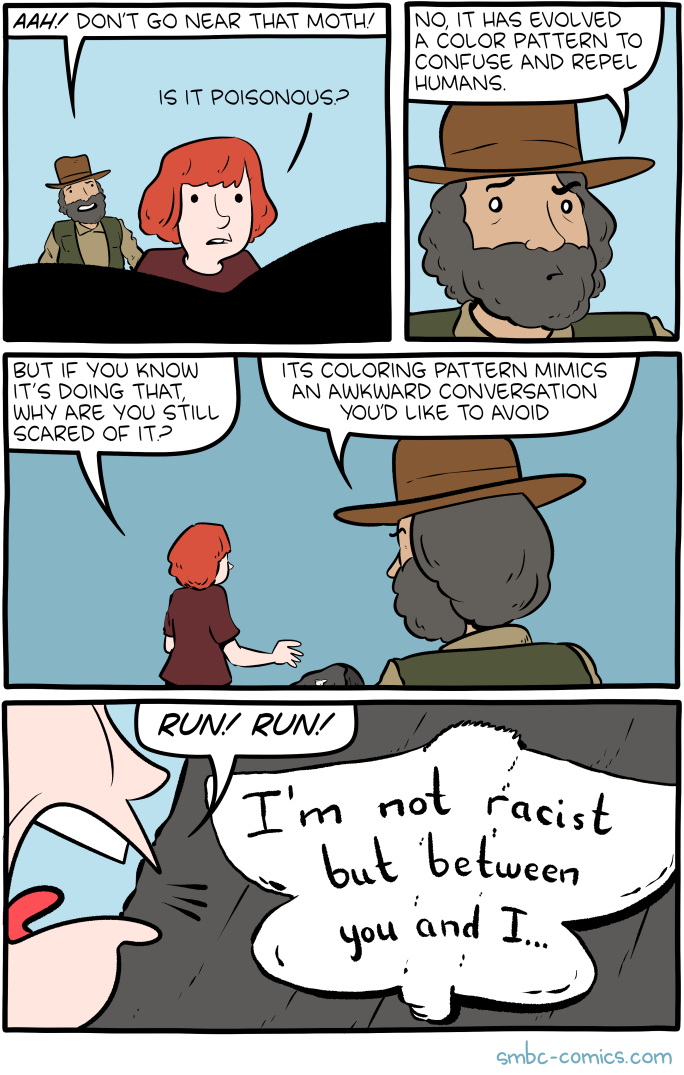
Hovertext:
You can always just feed it to a bat or something.
James.galbraithI've been waiting...this coming year is going to be an expensive apple refresh lol. Watch, phone, and maybe ipad pro if they'll fix that nasty RAM limitation

Enlarge / The Apple Watch Series 6, which the new model discussed here would probably replace. (credit: Corey Gaskin)
Like clockwork, Apple has released a new Apple Watch around the same time every year since the device was first introduced in 2015. So no one should be surprised that a new Apple Watch is due later this year. But a report from Bloomberg's Mark Gurman and Debby Wu goes into much more detail than just "the Watch is coming soon."
Citing "people with knowledge of the plans," Gurman and Wu say the new smartwatch will "likely" be called the Apple Watch Series 7. No surprise there, either.
More surprising: Their sources say the new Apple Watch is likely to be just a bit thicker than the current model. Additionally, Apple is exploring reducing the screen bezels and introducing "a new lamination technique that brings the display closer to the front cover." The Watch is also said to have the same ultra-wideband technology found in AirTags and recent iPhones, which will be used for things like unlocking doors.
Read 3 remaining paragraphs | Comments
James.galbraithYep, don't fuck with court rules.
[If a district court imposes sanctions, don't look to the Third Circuit for relief.]
Today the U.S. Court of Appeals for the Third Circuit offered a cautionary warning to litigants: Flout court rules at your peril. In United States v. Brace, the Third Circuit refused to overturn a district court order striking the defendant's brief in a challenge to a Clean Water Act prosecution.
Judge Bibas' opinion for the court begins:
Litigants flout court rules at their peril. District courts have broad discretion to punish them by striking their briefs if needed. We will not upset these sanctions lightly.
The U.S. Government sued Robert Brace and his farm for violating the Clean Water Act. Brace's then-lawyer persistently violated court rules—even after the court repeatedly ordered Brace to show cause, warned him, and threatened sanctions. After prolonged discovery, the Government moved for summary judgment. But Brace's lawyer responded to the Government's motion late. When the court gave him another chance, he again violated the rules. At last, the court struck Brace's brief, treated the motion as unopposed, and granted summary judgment for the Government. Because that severe sanction was not an abuse of discretion, we will affirm.
Among the defendant's attorney's offenses, the court lists the following:
Judge Bibas' brief opinion both addresses the district court's order striking the defendant's brief opposing summary judgment, as well as the jurisdictional issues that arise from attempting an interlocutory appeal of such an order.
The opinion concludes with a warning:
District courts have broad discretion to impose proportional sanctions. When they explain how they weigh the Poulis factors, we can confirm the reasonableness of those sanctions. Though striking Brace's summary-judgment brief was harsh, it was a reasonable response to his former counsel's persistent,
extreme misconduct. We will affirm.
James.galbraithOh for fucks sake.
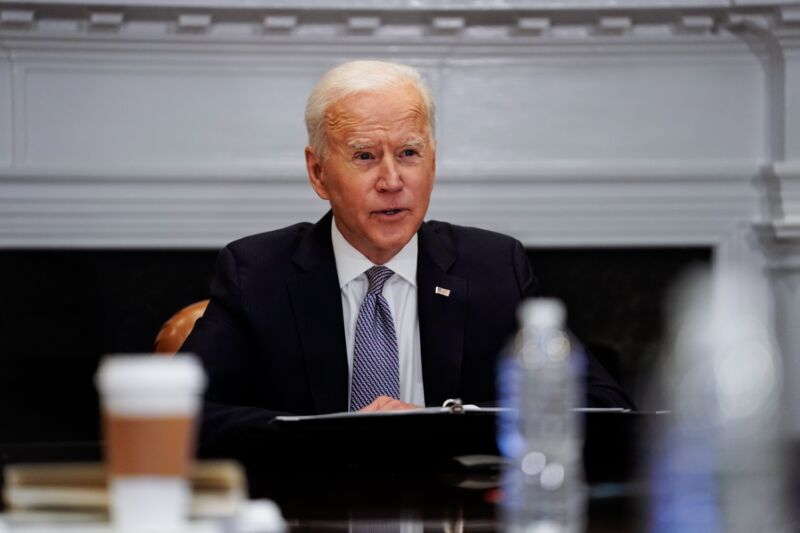
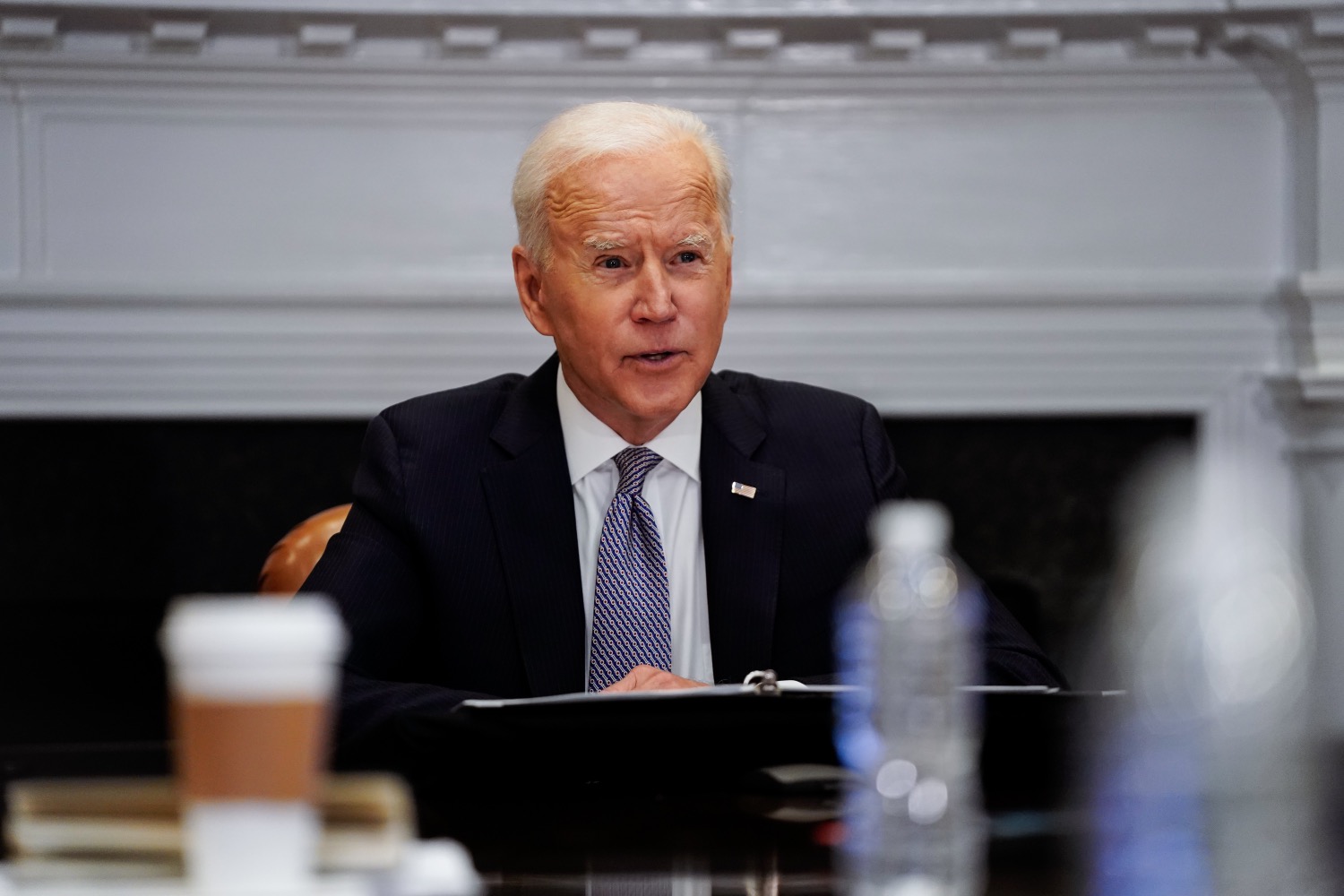
Enlarge / President Joe Biden joins a CEO Summit on Semiconductor and Supply Chain Resilience via video conference from the Roosevelt Room at the White House on April 12, 2021, in Washington, DC. (credit: Getty Images | Pool)
President Joe Biden's failure to break the Federal Communications Commission's 2-2 partisan deadlock is reaching a "critical point," 57 advocacy groups wrote in a letter to Biden and Vice President Kamala Harris Friday.
Nearly five months after his inauguration, Biden has not yet nominated a Democratic FCC commissioner to fill the empty fifth slot. Democrat Jessica Rosenworcel has been leading the commission as acting chairwoman, but she lacks the majority needed to do anything opposed by the FCC's two Republicans, such as reinstating net neutrality rules and reversing former Chairman Ajit Pai's deregulation of the broadband industry. Even a step like raising the FCC's broadband-speed standard—which hasn't changed in over six years—will likely require a party-line vote because Republicans prefer a low speed standard for the FCC's annual report on how many Americans lack modern broadband access.
In early April, over 100,000 people signed a petition urging Biden to quickly break the FCC deadlock. Advocacy groups are frustrated that they are still waiting. Why Biden is taking so long is unclear.
Read 9 remaining paragraphs | Comments
James.galbraithNice to see some of this shit get called out.
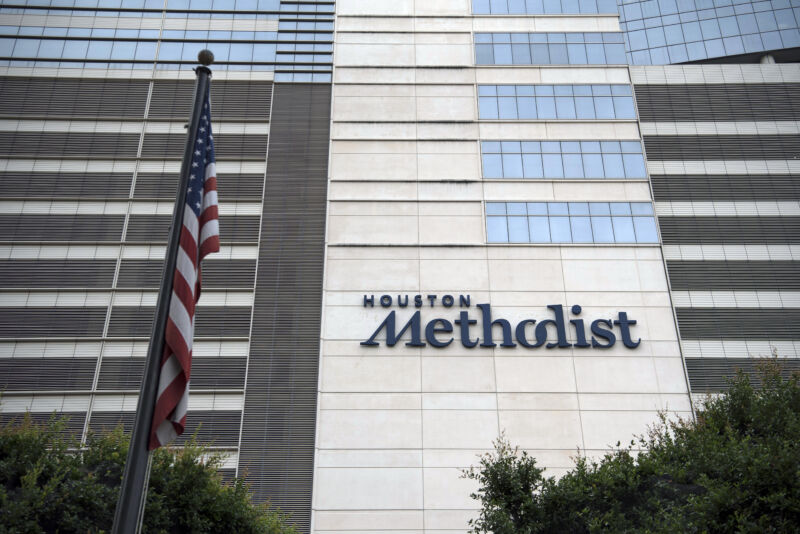
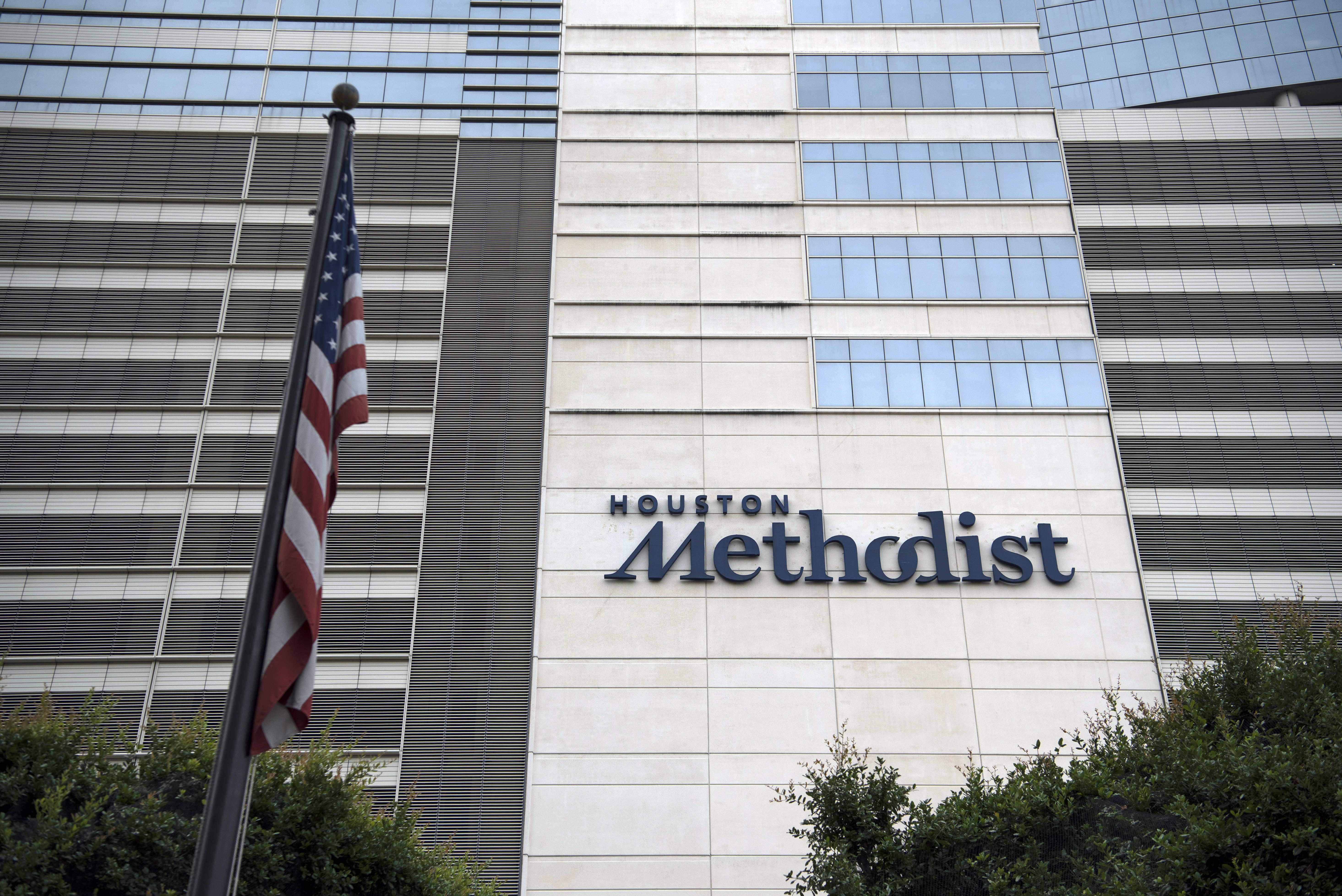
Enlarge / An American flag flies outside the Houston Methodist Hospital at the Texas Medical Center (TMC) campus in Houston, Texas, on Wednesday, June 24, 2020. (credit: Getty | Bloomberg)
A federal judge over the weekend dismissed a lawsuit brought by 117 employees of a Houston-based hospital system, who, among other things, claimed that the hospital’s requirement that staff be vaccinated against COVID-19 was akin to medical atrocities carried out by Nazis.
US District Judge Lynn Hughes called that argument “reprehensible” and issued sweeping rejections of their other claims that the mandate violates state and federal laws. In the five-page ruling filed Saturday, Judge Hughes wrote that the lawsuit by the 117 employees—led by coronavirus-unit nurse Jennifer Bridges—contained false statements, misconstrued legal provisions, wrongly claimed coercion, and made otherwise invalid arguments.
Houston Methodist Hospital system issued a mandate April 1 that all staff must be vaccinated against the pandemic coronavirus. Though the vast majority of the hospital system’s nearly 26,000 employees readily complied, 178 did not meet the June 7 deadline and were suspended for two unpaid weeks. If they fail to get fully vaccinated in that window, they face termination.
Read 8 remaining paragraphs | Comments
James.galbraithAnd it's unsurprising. Welcome to the USA.
Over the span of six hours, mass shootings in four different U.S. cities left 38 people wounded and six people dead. Beginning around 9 PM on Friday and ending early Saturday morning, mass shootings took place in Austin, Cleveland, Chicago, and Savannah. Savannah Police Chief Roy Minter, Jr. told reporters that "It’s very disturbing what we’re seeing across the country and the level of gun violence that we’re seeing across the country. It’s disturbing and it’s senseless.”
These shootings did receive national attention which is a sad step forward from last month, when “at least 15 people died and 30 were wounded” in nine mass shooting events over the second weekend of May 2021. The Savannah, Georgia, shooting ended with one adult dead, two others in critical condition and two teenagers and a baby suffering “non-life-threatening wounds.” Four hours later, in Austin, Texas, a shooting downtown ended with 13 people wounded, one person in critical condition, and one person dead. Shortly after that, a woman was killed and nine others injured after gunfire erupted on a Chicago street. Around the same time as the Chicago shooting, three people were killed and four were wounded in a shooting in Cleveland.
As long as the filibuster remains in place, there is no chance that Republicans will allow meaningful gun safety legislation to pass through the Senate. President Biden has made some of the moves available to him, issuing executive orders to crack down on “ghost guns” (serial-number-free, do-it-yourself gun kits sold and assembled at home), as well as chip away at some of the more purposefully vague distinctions that gun accessory manufacturers try to use to get around existing gun laws. But these are small moves, at a time when 84% of all Americans would like their elected officials to pass the bare minimum of gun safety laws.
Campaign ActionThese new shootings are not unique this year. As the Washington Post reports, 2020 was the deadliest year for U.S. gun violence in decades, with shooting deaths in the U.S. reaching “a peak of roughly 58 per day,” from July 2020 into early 2021. And as we approach the summertime and more people emerge from the darkest isolations of our pandemic protocols, gun violence and deaths have begun to surge again. Unsurprisingly, one of the factors in the 2020 rise of gun violence … a 66% increase in gun sales over the previous year.
The Post found that the number of fatal shootings the Gun Violence Archive classified as some type of accident increased by more than 40 percent from 2019 to 2020. The number of deadly incidents involving children — who may get guns from adults who do not store them properly — also rose by 45 percent, though a share of that is attributable to other types of shootings. Researchers have noted worrying signs that gun-related suicides, intimate-partner violence and family violence are also on the rise.
The pandemic has accentuated our country’s fundamental problems and systemic failures. All of the ingredients for crime and gun violence and domestic violence have increased during lockdowns. The income inequality gap has increased, employment opportunities have languished, and gun availability has reached an all-time high. The nature of the GOP position as oligarchical warmongers has meant that even the most minimal pieces of policy legislation are stalled. A reminder that even with most children not attending schools in person in 2020:
Metal detectors, teachers with guns, and police officers inside of schools does zero to protect our children from gun violence. The Gun Violence Archive (GVA), that attempts to track shootings and its consequences by way of police reports and media reports, says that so far this year, more than 8,700 have died as the result of gun violence. The GVA, which defines mass shootings “as those involving four or more people who were shot,” says that there were about 600 mass shootings in 2020. As of June 2021, the GVA has counted “at least” 267 mass shootings. If the rates increase, as they always do over the summer, we will likely see a new U.S. record.
Over the weekend, Austin Mayor Steve Adler told reporters that the police have been implementing new violence prevention programs “But this crisis requires a broader, coordinated response from all levels of government. One thing is clear—greater access to firearms does not equal greater public safety.”
And here’s an update:
BREAKING: Three people have been wounded, including a sheriff’s deputy, in a shooting at the Big Bear Supermarket in DeKalb, Georgia. The County Sheriff said the shooting happened during a dispute over mask wearing inside the store. #gapol https://t.co/5pIc7KVepK
— Shannon Watts (@shannonrwatts) June 14, 2021
James.galbraithVery cool

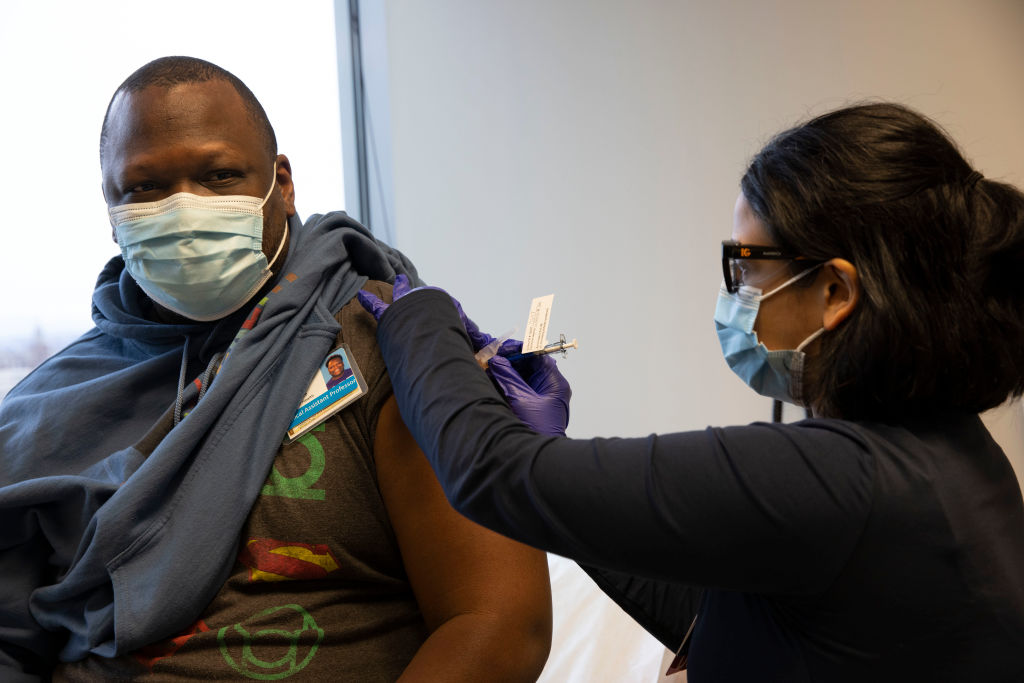
The biotech firm said its Covid-19 vaccine showed 90 percent efficacy in clinical trials. Thank moths.
Another Covid-19 vaccine, this one from the biotech firm Novavax, has posted superb results in a phase 3 clinical trial, the company announced on Monday. But with more than half of US adults now vaccinated against Covid-19, the biggest impact of these results may be in other countries.
The Novavax vaccine stands out from other Covid-19 vaccines because it uses a technology that has not been deployed to date. It can also be stored at ordinary refrigerator temperatures, unlike some other vaccines that have strict freezer requirements that complicate distribution.
Novavax said its vaccine candidate was 90 percent effective overall against Covid-19 cases that produce symptoms, and 100 percent effective against moderate and severe disease. The results, from nearly 30,000 participants across the US and Mexico, could make it the fourth Covid-19 vaccine to begin distribution in the US, following vaccines developed by Pfizer/BioNTech, Moderna, and Johnson & Johnson.
But the first approvals of the vaccine will likely come in other countries, Stanley Erck, CEO of the Maryland-based company, told the New York Times. Novavax may not even seek emergency authorization for its vaccine in the US until September. At that point, it may not make much of a difference to the US vaccination effort.
As part of the US government’s Operation Warp Speed, last July Novavax was awarded $1.6 billion for vaccine development and production of 100 million doses. At the time, the 20-year-old company faced skepticism for never having brought a vaccine to market.
Novavax now aims to scale up production, with a goal of 150 million doses per month by the end of the year with factories in the US, South Korea, and India. Its two-dose vaccine comes at an expected cost of $16 per injection. That’s more expensive than the adenovirus-based vaccines developed by Johnson & Johnson and AstraZeneca, but around the same price or cheaper than the mRNA vaccines made by Pfizer/BioNTech and Moderna.
The Novavax vaccine did exhibit lower efficacy against variants of Covid-19, but the company is studying reformulated versions to target them. With Covid-19 continuing to spread in many parts of the world, having another option to counter the disease will bolster the effort to contain the pandemic.
Vaccines are like target practice for the immune system: They encourage our bodies to build up defenses against a particular threat, without making us sick. When the real pathogen arrives, immune cells are ready to act, preventing infection altogether or dampening the worse effects of the disease.
Traditional vaccines contain weakened or inactivated versions of viruses or bacteria, or fragments of them. But new approaches have been brought to bear on Covid-19. Moderna and Pfizer/BioNTech vaccines use a snippet of genetic material, mRNA, encased in a nanoparticle. Human cells can read those genetic instructions and manufacture a fragment of SARS-CoV-2, the virus that causes Covid-19, which spurs the immune system to prepare for the virus.
The Covid-19 vaccines developed by AstraZeneca and Johnson & Johnson also shuttle genetic instructions to human cells, encouraging them to make a fragment of SARS-CoV-2, but they use a different virus — an adenovirus — that carries a snippet of DNA.
Novavax’s approach blends old and new techniques. To make the vaccine, the company combines another kind of virus — a baculovirus — with the genetic information needed to make a spike protein, a key fragment of SARS-CoV-2. When moth cells are infected with this virus, they manufacture the spike protein. Scientists then harvest and fuse those proteins with a nanoparticle. These nanoparticles combined with spike proteins are what is injected in the Novavax vaccine.
/cdn.vox-cdn.com/uploads/chorus_asset/file/22657826/Screen_Shot_2021_06_14_at_11.43.06_AM.png) Novavax
Novavax
According to Novavax, this approach yields a strong immune response with minimal side effects. The main complaints from vaccine recipients were fatigue, headache, and muscle pain lasting less than two days.
While new infections, hospitalizations, and deaths are trending downward in the United States, the Covid-19 pandemic continues to rage in other countries. India, currently an epicenter of the pandemic, recently set a new world record of more than 6,000 daily Covid-19 deaths. Part of the toll stems from the Delta/B.1.617 variant of the virus, which appears to be more transmissible. Health officials warn that other countries with limited resources and low vaccination rates remain vulnerable to their own outbreaks. And as long as the virus continues to spread, it risks mutating in dangerous ways that can reverberate to places like the US.
Leaders at the G7 summit last week committed to sharing 1 billion doses of Covid-19 vaccines with other countries, with half coming from the US. For its part, Novavax is partnering with manufacturers in other countries like India and South Korea to scale up its production. The company had pledged at least 1.1. billion doses of its vaccine through Gavi, an international vaccination consortium.
I realize that Novovax vaccine results won't get the same attention as when we heard from Moderna, Pfizer, and J&J
— Ashish K. Jha, MD, MPH (@ashishkjha) June 14, 2021
But for vaccinating the world, this is huge
Very, very good news
Novovax essential to vaccinating the globe.
That fact that it has 90% efficacy is awesome https://t.co/qGFzSfoIqo
Novavax may still have a future role in the US. The company is investigating how its vaccine could work as a booster, bolstering protection from other vaccines as immunity wanes over time. A study last month showed that even mixing shots of different vaccine platforms led to robust immune protection. But it’s not clear yet how long the shielding provided by other Covid-19 vaccines will last.
At the same time, the virus itself is continuing to change. Novavax’s results on Monday showed that its vaccine had 86.3 percent efficacy at preventing disease caused by the Alpha/B.1.1.7 variant of the virus, which first appeared in the United Kingdom. It shows that protection was high, but not as high as immunity to earlier strains of the virus.
Early phase 2b results from South Africa, however, showed the vaccine yielded 48.6 percent efficacy against the Beta/B.1.351 variant in HIV-negative participants. The company is now investigating a retooled version of its vaccine aimed specifically at the Beta variant.
The ongoing evolution and spread of Covid-19 shows that the pandemic is not over, and it’s too early to become complacent. A new way to immunize against Covid-19 is a welcome development — particularly if it can reach the most vulnerable, and quickly.
James.galbraithSeriously. This is fucking insane.
Mitch McConnell has once again told the world precisely who he is. Remember, this is the guy who happily embraces his nicknames: the Grim Reaper and Cocaine Mitch. He brags that he called himself "Darth Vader" during his efforts to kill campaign finance reform at the behest of huge corporate interests. Monday morning he went on the Hugh Hewitt radio show, one of his favorite confessionals, and reiterated for everyone to hear that he is evil. Whether Joe Manchin and Kyrsten Sinema—or any Democrat who is opposed to expanding the court—will hear that and whether will sink into their thick skulls is the real question.
Making sure that President Barack Obama did not get Merrick Garland on the Supreme Court was "the single most consequential thing I've done in my time as majority leader of the Senate," he said. "I preserved the Scalia vacancy for the Gorsuch appointment." He's rewriting his constitutional duties here, pretending that the Senate's role of advice and consent only means allowing ideologues to be replaced with ideologues of the same bent. Which makes his next pronouncement obvious. Hewitt asks if he'd do it again should the Senate regain the majority in 2022. Would he allow a nominee from President Biden in 2024? "I think it's highly unlikely," he said. Which is an absolute no, as illuminated a little be further on in the conversation.
What if a Democrat retires in 2023, Hewitt asks, meaning one of the justices appointed by a Democratic president—the "Anthony Kennedy precedent," he calls it as if that were a real thing. Would McConnell block a nominee in the year before the presidential election? "Well, we'd have to wait and see what happens," McConnell says. As if there is any question. So, yes, if McConnell regains the majority next year, Biden will not be allowed a Supreme Court appointment. And McConnell will come up with all kinds of pretzel logic to justify it as some kind of principle, with precedent. As if he didn't put the alleged sexual assaulter and unqualified Brett Kavanaugh and the extremist religious zealot and unqualified Amy Coney Barrett on the court. As if he didn't shove the Barrett nomination through literally days before the 2020 presidential election.
Senate Minority Leader Mitch McConnell tells @hughhewitt he would not allow President Biden to fill a SCOTUS vacancy in 2024 if he is majority leader. pic.twitter.com/9gYAqXmyQD
— The Recount (@therecount) June 14, 2021
This is far from the first time McConnell broadcast his agenda for all to see—it’s not even the first time this year. He just said it a little over a month ago: "100% of my focus is on stopping this new administration … 100% of my focus is on standing up to this administration." Does he need to tattoo it on his forehead? Does he need to tattoo it on Manchin's and Sinema's foreheads?
"What we have in the United States Senate is total unity from Susan Collins to Ted Cruz in opposition to what the new Biden administration is trying to do to this country," McConnell added. Total unity. 100% in opposition to stopping the Biden administration. But the total charade of bipartisan negotiations on infrastructure continues, all because a few Democrats aren't willing to be as ruthless as McConnell to save the nation from him and eliminate the filibuster.
More Democrats continue to be squeamish about reforming the courts and bringing balance back to the Supreme Court by expanding it. They're buying into the bullshit narrative that that’s court packing. Adam Serwer gets this one exactly right:
This is also court packing, and no one with any power in the Republican Party or conservative movement has any objection to it. The Democrats’ decision to unilaterally disarm simply rewards and encourages procedural radicalism from the other side. https://t.co/LMAK5CxHkp
— Adam Serwer 🍝 (@AdamSerwer) June 14, 2021
Reserving Supreme Court seats for conservative ideologues is exactly what court packing is. Three Trump justices is court packing. It's more than just "procedural radicalism," it's procedural terrorism. McConnell has absolutely no qualms about doing this. He will twist and pervert the Senate rules any way he can, and do it proudly and unapologetically.
Once he jammed the huge GOP tax scam through with just Republican votes using budget reconciliation—which he didn't hesitate to do for one minute—McConnell would have happily nuked the filibuster on legislation it it had been to his benefit. He determined it wasn't because 1) the only thing that mattered was getting judges through, and he did nuke the filibuster on Supreme Court appointments, and 2) he was protecting his members from having to vote on crazy shit coming from Trump and Republicans in those first two years they held the House.
Democrats have unilaterally disarmed by not immediately nuking the filibuster, and by not adding seats to the Supreme Court and district and appeals courts. Much of this is on Biden. He has dithered on Supreme Court reform, leaving it to a committee to talk about for six months without even necessarily having to come up with recommendations. He's allowing this farce of "bipartisan negotiations" go on between Sinema and Manchin.
It's sort of astounding then to have to go to former Democratic Sen. Ben Nelson from Nebraska, the ConservaDem who was so often a thorn in Obama's and Harry Reid's sides. NBC News got an advance copy of his new book, Death of the Senate. In it, he warns Biden not to trust McConnell, calling him a "dark knight who lives, breathes and eats to gain political advantage breakfast, lunch, dinner."
James.galbraithfantastic
Enlarge / A participant gets his second dose of the Novavax vaccine during the clinical trial. (credit: Karen Ducey / Getty Images)
Today, a company called Novavax announced that it had completed a large efficacy trial of its COVID-19 vaccine, and the news was good. The vaccine is highly effective, it blocked severe disease entirely, and it appeared to work against some of the more recently evolved virus variants. The company says it can produce 150 million doses per month by the end of the year, and the vaccine is stable when stored with normal refrigeration, so it could play a big part in the effort to administer vaccines outside of industrialized nations.
So far, US citizens have had the choice of RNA-based vaccines, like the offerings from Moderna and Pfizer/BioNTech, or a vaccine based on a harmless virus engineered to carry the coronavirus spike protein, as used in the Johnson & Johnson vaccine. (The AstraZeneca and Sputnik vaccines are similar to J&J's.) Outside the US, many countries have used vaccines based on an inactivated coronavirus, although these have turned out not to be very effective.
The Novavax vaccine uses an entirely different technology. Vaccine production starts by identifying a key gene from the pathogen of interest—the SARS-CoV-2 spike protein, in this case—and inserting it into a virus that infects insect cells. Insect cells can easily be grown in culture, and they process any proteins they make in the same way that human cells do. (This processing can involve chemically linking sugars or cleaving off superfluous parts of the protein.) The activity ensures that the purified protein will be chemically identical to the spike protein found on the surface of the SARS-CoV-2 virus itself.
Read 11 remaining paragraphs | Comments
James.galbraithlol

Hovertext:
So far, humans are the only civilization to somehow preserve bastardry while scaling complexity.
James.galbraithlol pretty much
James.galbraithlol no shit
World events and notorious characters can have a significant impact on baby-naming conventions over time. That’s why you didn’t have a lot of kids named Adolf, Pol Pot, or Smallpox Blisters in your high school homeroom. And it’s why “Jeffrey Toobin” will henceforth be regarded as a simple declarative sentence instead of a name—as in “Oh, my gerd, Jeffrey’s Toobin’ on a Zoom call again.”
And so it stands to reason that the most notorious shitheel of this young century has sent his name’s prospects tumbling, like a once-viable casino run by a toxic wad of oobleck.
If the sound of the word “Donald” is enough to make the hammers, anvils, and stirrups in your ears wanna smash the shit out of each other until you hear naught but the faint siren call of Kimberly “Banshee” Guilfoyle promising that the best is coming, you’re not alone.
After all, that name has baggage. You might as well name your kid Chernobyl Chunkfarts.
Turns out that parents of the nation have taken note. According to official tallies, the name “Donald” is no longer très chic.
According to the Social Security Administration’s latest list of popular baby names, the popularity of “Donald” saw a big decline in the year 2020. The name fell 55 places, from the 555th most popular name for boys in 2019 to the 610th last year ― its lowest-ever ranking on the annual list, which dates back to the 1880s.
Donald now ranks just below Axton, Dariel, Marvin and Brycen. Last year, only 444 newborns were named Donald, compared to 507 in 2019, 539 in 2018 and 602 in 2017.
Axton? I’ve never met anyone named Axton. The only name in that short list I recognize is “Marvin,” and mostly because of this little dude. You’re in some sad, sad company there, Donald.
Donald peaked in popularity in the year 1934, when it was the sixth-most popular name for baby boys. That year, 30,408 boys (and 110 girls) were named Donald. Since then, the name has followed a general pattern of decline, though it got a slight bump from No. 489 to No. 485 in 2017, the year President Donald Trump took office. The following years, however, saw a return to the downward trend, and 2020 marked its steepest ever decline.
It’s unsurprising, of course: No progressives will ever name their kids “Donald” again. They’re more likely to name them “Covid.”
Of course, “Donald” isn’t the only casualty of the past few years. For instance, if you name your child “Karen,” you’re probably expecting her to live an adventurous life full of perpetual white-whining.
No one wants to name their baby girl Karen any more.
The name has tanked in popularity over the past year, according to figures released by the Social Security Administration.
Throughout 2020 the name Karen fell a whopping 171 spots on the popularity list, from a low of 660 to number 831.
The popularity of various names has, of course, ebbed and flowed considerably over the years. When I went to grade school, I had four classmates named “David,” and we only had about 20 boys in the class. Then everyone was suddenly named “Jason” and “Heather.”
As Donald Trump the human-ish being prepares to belly-flop into the dustbin of history, it’s nice to see lots of canaries dying in his shitty coal mine.
Will his name eventually have the reverse cachet that “Adolf” enjoys today? It’s too early to tell, but hey, why not? The guy tried to shiv democracy in broad daylight. I wouldn’t name my fungal toenail “Donald” at this point. Currently, I’m leaning toward naming it “Manchin,” but that depends a lot on what happens over the next few weeks.
P.S.: For those of you already named “Donald” or “Karen,” apologies for the brutal scorn that these notorious Donalds and Karens have visited upon you. Maybe you can change your name to “Aldous.”
P.P.S.: “Aldous” is not a popular name either. Just FYI. Imagine how popular it could be, if I just stopped saying things like “Chernobyl Chunkfarts.”
It made comedian Sarah Silverman say “THIS IS FUCKING BRILLIANT” and prompted author Stephen King to shout “Pulitzer Prize!!!” (on Twitter, that is). What is it? The viral letter that launched four hilarious Trump-trolling books. Get them all, including the finale, Goodbye, Asshat: 101 Farewell Letters to Donald Trump, at this link. Just $12.96 for the pack of 4! Or if you prefer a test drive, you can download the epilogue to Goodbye, Asshat for the low, low price of FREE.
James.galbraithLooks like the rot at DOJ is total
A New York Times piece revealed on Friday just how easy it was for former President Donald Trump’s administration to get top technology companies to supply data regarding congressional Democrats. In short, getting the data was so easy it’s scary. Apple told The New York Times when a gag order expired that the newspaper received a grand jury subpoena on Feb. 6, 2018 that, although didn't seem out of the ordinary, was a request for data regarding at least two Democratic members of Congress as well as congressional workers and their families. One of those legislators was Rep. Adam Schiff, the "top Democrat" in the House Intelligence Committee at the time, the Times reported. The other was Rep. Eric Swalwell, another member of the intelligence committee.
The subpoena, which asked for phone records and names linked to 109 email addresses and phone numbers, was part of the Trump administration's investigation into "leaks of classified information," the Times reported. Apple's involvement in yet another privacy related scandal isn't exactly helping the company stay clear of an already fiery battle regarding the Trump administration's virtual war against journalists, more specifically to uncover sources in news articles.
Following the expired gag order, Apple also told Donald McGahn II, Trump's White House counsel, and his wife last month that the Justice Department subpoenaed information about his account in February 2018, The New York Times reported on Sunday. Reporters Michael Schmidt and Charlie Savage called the “disclosure that agents secretly collected data of a sitting White House” attorney “striking.” “The president’s top lawyer is also a chief point of contact between the White House and the Justice Department,” the reporters wrote. admitted that it’s still unclear why the subpoena was obtained but a “roughly concurrent event” was that Trump “had become angry at Mr. McGahn over a matter related to the Russia investigation, and that included a leak.”
The takeaway seems to be: If you want assurance that your data doesn’t end up in the hands of law enforcement or government officials, there isn’t any. But your best bet is to contract with one of the technology companies supplying the data. Google was served a gag order and subpoena to hand over data from the emails of four New York Times reporters, but because of the company’s contract with the Times, Google had an out of sorts, Ted Boutrous, an attorney for the newspaper told the Times.
While Google claimed it doesn't generally respond differently to requests for information based on the type of relationship it has with its customers, data The New York Times obtained suggests otherwise. Google turned over data in 83% of almost 40,000 government requests issued the first half of last year, but that number shrunk to 39% regarding the 398 Google customers who were also corporate clients of the company.
Both Apple and Microsoft told CNN they informed customers about government subpoenas as soon as they could legally. Microsoft released this statement to CNN after receiving a subpoena for a congressional staff member:
"In 2017 Microsoft received a subpoena related to a personal email account. As we've said before, we believe customers have a constitutional right to know when the government requests their email or documents, and we have a right to tell them. In this case, we were prevented from notifying the customer for more than two years because of a gag order. As soon as the gag order expired, we notified the customer who told us they were a congressional staffer. We then provided a briefing to the representative's staff following that notice. We will continue to aggressively seek reform that imposes reasonable limits on government secrecy in cases like this."
Apple spokesman Fred Sainz told CNN in a statement:
“In this case, the subpoena, which was issued by a federal grand jury and included a nondisclosure order signed by a federal magistrate judge, provided no information on the nature of the investigation, and it would have been virtually impossible for Apple to understand the intent of the desired information without digging through users’ accounts. Consistent with the request, Apple limited the information it provided to account subscriber information and did not provide any content such as emails or pictures.”
Department of Justice Inspector General Michael Horowitz announced on Friday that the department would review the “DOJ’s use of subpoenas” and “other legal authorities to obtain communication records of Members of congress and affiliated persons, and the news media.” "The review will examine the Department's compliance with applicable DOJ policies and procedures, and whether any such uses, or the investigations, were based upon improper considerations," the Department of Justice's Office of the Inspector General (OIG) said in a news release. “If circumstances warrant, the OIG will consider other issues that may arise during the review."
Department of Justice Inspector General Michael E. Horowitz announced today the initiation of a Review of the DOJ’s Use of Subpoenas & Other Legal Authorities to Obtain Communication Records of Members of Congress and Affiliated Persons, and the News Mediahttps://t.co/sMbYCmldju pic.twitter.com/Ft0JRYvMGN
— Justice OIG (@JusticeOIG) June 11, 2021
RELATED: DOJ inspector general opens investigation into efforts to break into Democratic reps' phones
RELATED: The DOJ subpoenaed Apple in attempt to get data from phones of Rep. Adam Schiff's teenage kids
RELATED: Facial recognition software lands three innocent Black men in jail. When will enough be enough?
RELATED: Someone fed the NYT information to quickly kill emerging Trump/Russia stories ... was it Comey?
James.galbraithSeriously...
It’s sick. So, so sick. But that’s what Republicans are all about these days: inspecting children’s genitals. It’s pretty much all they talk about—when they’re not talking about Mr. Potato Head and his starchy, androgynous genitalia.
They’re so into it, in fact, they’ve passed bills that would allow them to scrutinize any child who wants to participate in girls’ sports but doesn’t strictly adhere to what a Republican thinks a girl should look like. And the only way to make sure said child is actually flouting the genitalia gendarmes is to line them up for inspection, tout de suite.
This is true. This is what Republicans are doing in order to advance their girls’ sports purity campaigns. (As we all know, Republicans are huge advocates of girls’ and women’s sports.) Clearly, cis boys across the country are lining up left and right for a chance to pass themselves off as girls, as it’s a great way to compete at a high level or find an affordable apartment where they can live their lives in incognito bliss with Peter Scolari and Tom Hanks.
Under a new ban on transgender students in sports passed by Florida’s House of Representatives, schools would have the power to subject students to “physical examination” if their gender is disputed.
The "Fairness in Women’s Sports Act" bans transgender female athletes from competing on women’s athletic teams in both high school and college sports, although transgender male athletes may still compete on either team. In cases where a student’s “biological sex” is disputed, the law authorizes schools to require health examinations or documentation from the student's personal health care provider.
So that’s what Florida Republicans were doing in April instead of controlling the pandemic, boosting the economy, or shoving dangerous insurrectionist Donald Trump out to sea on a dead manatee with nothing but a knife, a fork, a bottle of A-1 steak sauce, and a quart of freshly squeezed aardvark milk (you know, to give him a fighting chance). Oh, and of course, Florida Gov. Ron DeSantis signed this blazing pile of poo into law—on the first day of Pride Month, no less.
To be fair, they took the genital-inspecting provision out before DeSantis signed it. But that doesn’t mean they weren’t still thinking about it. After all, Idaho Republicans passed their anti-trans law this spring with a genital inspection provision.
The law includes a provision that allows for anyone to file a claim questioning the sex of an athlete. The adjudication process could lead to sex testing that would allow for genital exams, genetic testing and hormone testing.
So why aren’t we making more of this?
Journalist Oliver Willis just asked the same question.
this is all true, and a narrative progressives should be endlessly repeating -> https://t.co/wNY4FxnpSY
— Oliver Willis (@owillis) June 11, 2021
like damn man this isn't very difficult to communicate
— Oliver Willis (@owillis) June 11, 2021
"just recently a top trump campaign official was imprisoned for pedophilia, the former gop speaker was a pedophile and leading republican jim jordan turned a blind eye to abuse. we can only speculate that there is a connection to the genital obsession" https://t.co/RGb6F8O7g2
— Oliver Willis (@owillis) June 11, 2021
Nontweeters can click here to read the thread.
Would it be fair to constantly bring up Republicans’ deep-seated obsession with children’s genitals? Sure, why not? I mean, they do appear to be infatuated with this subject, and they’re cynically using vulnerable trans kids as a wedge to alarm people and win votes. Why can’t we fight fire with fire?
Democrats: Respect every child’s right to self-determination.
Republicans: Let me take a peek at your daughter; this will just take a minute … or two.
It’s a pretty stark contrast, don’t you think?
It made comedian Sarah Silverman say “THIS IS FUCKING BRILLIANT” and prompted author Stephen King to shout “Pulitzer Prize!!!” (on Twitter, that is). What is it? The viral letter that launched four hilarious Trump-trolling books. Get them all, including the finale, Goodbye, Asshat: 101 Farewell Letters to Donald Trump, at this link. Just $12.96 for the pack of 4! Or if you prefer a test drive, you can download the epilogue to Goodbye, Asshat for the low, low price of FREE.
James.galbraithA lying sack of shit. Is anyone surprised? Time to prosecute.
When former special ambassador to Ukraine Kurt Volker appeared to testify before the House in hearings connected to Donald Trump’s first impeachment, Republicans were thrilled. Volker was part of the “three amigos,” who Trump had sent to Ukraine to force out experienced diplomats and see that Rudy Giuliani got all the assistance he needed in extorting the Ukrainian government into pretending to investigate Joe Biden.
As soon as Volker completed his testimony, it was clearly at odds with that delivered by other witnesses. Volker testified that he never talked about the company Burisma, where Hunter Biden was on the board, in his discussions with Ukrainian officials. He completely omitted any reference to a series of meetings and calls on July 10, 2019, after which then-Lt. Col. Alexander Vindman took his concerns about what was going on to the NSC’s lead counsel. Volkman contradicted the content of text messages he sent on July 19, in which he joined Rudy Giuliani in urging the Ukrainian president to initiate an investigation of Biden. He left out how Burisma and the Bidens factored into a statement Trump wanted from the Ukrainians. And he completely failed to testify about how he had insisted—as text messages showed—that Ukrainian officials had to include both claims that Ukraine had interfered with the U.S. election in 2016, and that Biden had tried to block an investigation into Burisma, if they wanted to “prevent a recurrence” of Trump blocking military aid to the country.
But what really excited the Republicans was the fact that Volker provided them with the Big Talking Point: a claim that there was “no quid pro quo” connecting the request for an investigation into the Bidens and the release of U.S. assistance to Ukraine. In his deposition to the House committee, Volker made it clear: “At no time was I aware of or took part in an effort to urge Ukraine to investigate former vice president Biden.”
But text messages at the time also made it clear this wasn’t true. And calls that CNN released this week while looking into the actions of Giuliani make this one thing exceedingly clear: In his sworn testimony to Congress, former ambassador Kurt Volker was lying his ass off.
As The Washington Post reports, it was Volker’s testimony that Republicans leaned on when they claimed that Trump had been exonerated.
“Ambassador Volker … confirmed what the President has repeatedly said: there was no quid pro quo,” tweeted Rep. Jim Jordan.
“Ambassador Volker, you just like took apart their entire case,” said a grateful Rep. Michael Turner during questioning.
In his testimony, Volker didn’t hold back. “At no time was I aware of or knowingly took part in an effort to urge Ukraine to investigate former vice president Biden. As you know from the extensive real-time documentation I have provided, Vice President Biden was not a topic of our discussions.”
How could this be the case when Volker repeatedly texted concerning an investigation into Burisma? The pretense that Volker put forward was that he didn’t know. He didn’t know why Trump wanted an investigation into a particular Ukrainian energy firm as part of his deal. He didn’t know why this was so vital that it could be a factor in allowing an ally to be preyed on by Russian forces.
Volker wasn’t the only one. His former “amigos”—Ambassador Gordon Sondland and Energy Secretary Rick Perry—pushed the same line. Apparently Trump and Giuliani had it out for this one gas company. After that, they all pled blissful ignorance.
Yeah, but … Volker was on the call when Giuliani said this to one of the Ukrainian president’s top assistants:
“All we need from the President is to say, I’m going to put an honest prosecutor in charge, he’s gonna investigate and dig up the evidence that presently exists, and is there any other evidence about involvement of the 2016 election, and then the Biden thing has to be run out.”
That was just one of several instances where Giuliani explicitly drew the connection between what was being asked of the Ukrainian president with the Bidens. Volker was on that call. Pretending that he didn’t know what he was asking when he asked about Burisma would mean not just acknowledging an astounding ignorance about the country he was supposed to be assisting—past allegations against Burisma had played a key role in both U.S. and U.K. actions in Ukraine—it would mean he wasn’t actually listening to what Giuliani said during their conversations with Ukrainian officials. In Volker’s testimony he claimed that “In referencing Burisma it was clear he was only talking about whether any Ukrainians had acted inappropriately,” which never made any sense at all. It still doesn’t.
The Post suggests that Volker hewed a very narrow line in his testimony and that he “referred specifically to the idea that Biden wasn’t brought up in the text messages he turned over—rather than at all in any conversations.” But that’s attempting to parse things way, way too finely.
It’s clear that when Volker, Sondland, and others mention Burisma in their text messages, that this is shorthand for announcing an investigation into the role Joe and Hunter Biden played in connection to that company. That’s specifically what Giuliani asks for, again and again.
And in his testimony, Volker goes much further than The Post suggests. Volker’s full statement to the committee, apparently in response to a question by Rep. Adam Schiff, was this:
“At no time was I aware of or took part in an effort to urge Ukraine to investigate former Vice President Biden. As you will see from the extensive text messages I am providing, which convey a sense of real-time dialogue with several different actors, Vice President Biden was never a topic of discussion.”
It might be possible to twist that statement so that the last mention of Biden is directed toward the text messages. It’s not possible to do so with the first mention. “At no time was I aware of or took part in an effort to urge Ukraine to investigate former Vice President Biden” is simply a lie. An out and out lie. A lie that was intended to cover Volker’s ass, and which Republicans seized on as justification to exonerate Trump.
It was always clear that Volker was lying when he claimed to not understand the connection between Burisma and Joe Biden. The most recent revelations just underline the extent of that lie.
it may be too late for a do-over of that first impeachment, this time with honest testimony. It’s not too late to charge Kurt Volker for his lies.
James.galbraithNo surprise
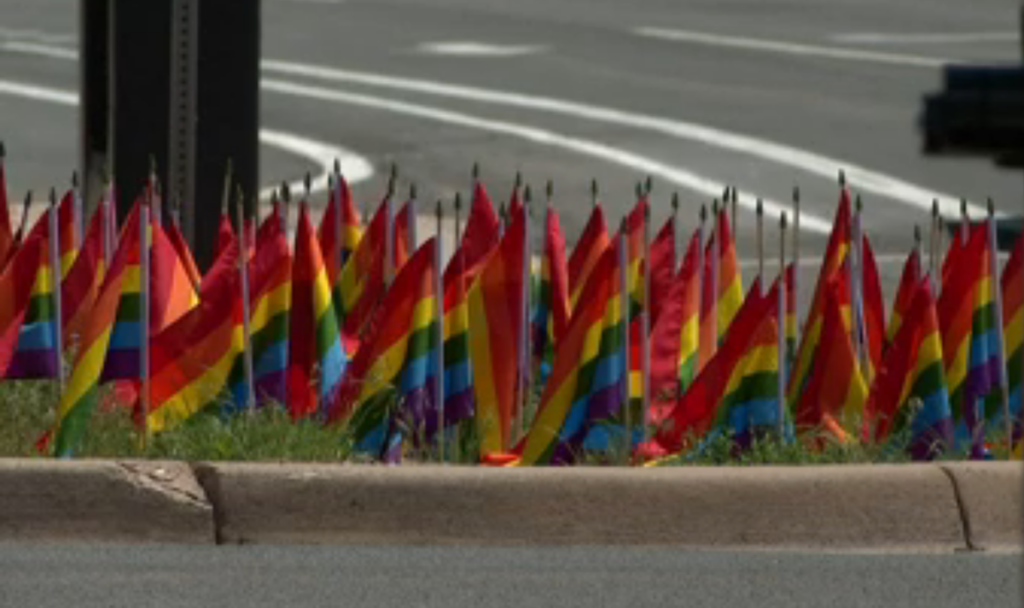
A suburban Colorado Pride flag display commemorating LGBTQ Pride month has been replaced for a third time this week after multiple incidents of flags being stolen and, in one instance, a confederate flag being left in their place.
Leadership in Denver suburb Louisville, CO in cooperation with local LGBTQ advocacy group Out Boulder County planted dozens of rainbow flags at a prominent intersection in the town on June 1 in celebration of the beginning of Pride month, but since then the display has been defaced twice.
We have more flags than they have to burn, so we’ll just keep replenishing and make sure that they stay up.”
JUAN MORENO, Out Boulder County
According to FOX31, the first instance came on June 2 when witnesses reported seeing a 74-year-old man removing flags at the intersection of Cherry Street and McCaslin Boulevard. A confederate flag was later found in place of the removed flags. The man was issued a citation but it remains unclear if the man also placed the hate symbol in place of what he stole. “It’s certainly disappointing,” Stolzmann said. “But sometimes when you see something like this negative happen, it kind of reminds you why you need to do this kind of activity,” said Louisville Mayor Ashley Stolzmann.
Tonight: we’re sitting down with both @OutBoulder & Louisville Councilman Kyle Brown. They’ve had to rebuild their Louisville Pride flag display 3x after people plucked them from the ground. The first time, a confederate flag was left in their place. @KDVR pic.twitter.com/OuoZx09qrR
— Ashley Michels (@ReporterAshley) June 9, 2021
A second instance of flags being removed occurred shortly after the flags were replaced. The act has become so frequent that Stolzmann carries hammers and mallets in her purse in preparation for another round of plating flags. Out Boulder County is also prepped to keep replenishing the display with a closet full of Pride flags waiting to fly.
“We have a closet full of flags right now, and as many as we can get out, we will get out. We want folks to know that we’re here,” said Out Boulder County’s Juan Moreno. “We have more flags than they have to burn, so we’ll just keep replenishing and make sure that they stay up.”
Out Boulder County executive director Mardi Moore believes the public support the flags offer is important to LGBTQ visibility in the town no matter how many times the display is defaced during the course of Pride month. “I can see the smiles. I can hear the horns honking. There’s more support in Louisville than not,” Moore told NBC 9News.. “Not all parents are supportive. So they’re driving to the grocery store and they see it. They’re like, somebody’s out there for me. So they will keep going up.”
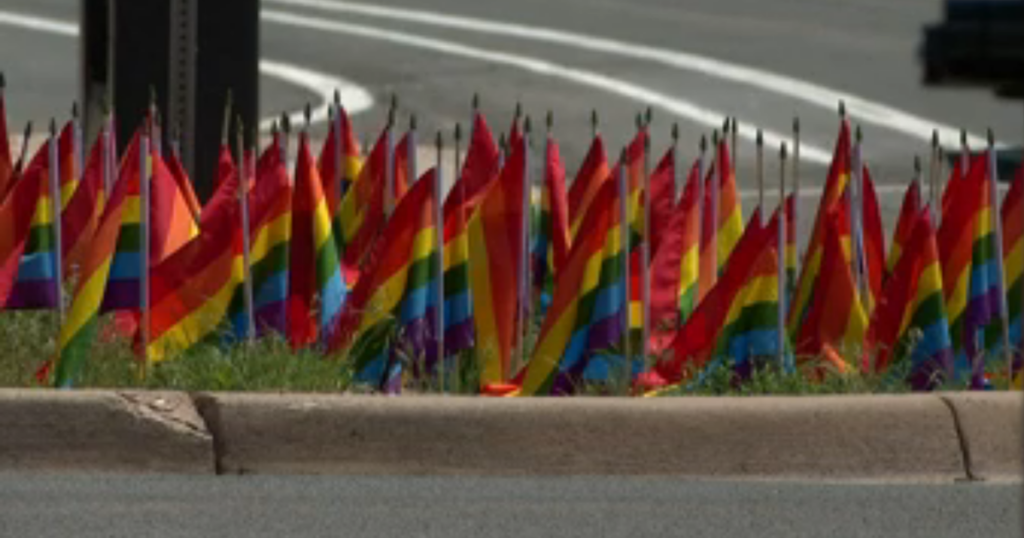

Screenshot from NBC 9News
James.galbraithLooking forward to this, and omg LMM no beards for you.

Lin-Manuel Miranda, Quiara Alegría Hudes, and Jon M. Chu talk about the challenges and joys of adapting for the big screen.
After years of development delays — and then a big pandemic delay — In the Heights is finally headed to the screen. Written by Hamilton’s Lin-Manuel Miranda and playwright Quiara Alegría Hudes, and directed by Crazy Rich Asians’ Jon M. Chu, it’s a joyous, electric movie musical that celebrates the mostly Latino community in Washington Heights, a neighborhood in upper Manhattan.
The movie taps into the big dreams of its characters, including bodega owner Usnavi (Anthony Ramos), aspiring designer Vanessa (Melissa Barrera), Stanford student Nina (Leslie Grace), car service dispatch operator Benny (Corey Hawkins), and many more of their friends and loved ones. Shot on location in the Heights, it feels like it’s hitting at the perfect moment, with theaters in the US reopening and people rediscovering their communities and the movies at the same time.
Ahead of the film’s debut, I spoke with Miranda, Hudes, and Chu via Zoom, in separate conversations, about similar themes: how they saw their own youthful dreams reflected in the film, the genesis of the project, the challenges and thrills of adapting the stage play for the big screen, and shooting in a neighborhood like Washington Heights. Below, I’ve compiled our chats into one look at a vibrant movie musical that came along at just the right time.
/cdn.vox-cdn.com/uploads/chorus_asset/file/22648538/rev_1_ITH_04632_High_Res_JPEG.jpeg) Macall Polay/Warner Bros.
Macall Polay/Warner Bros.
Theater saved my life. For me, it was like an invincibility cloak. So much of the trauma of high school is the life-or-death stakes inside your grade at any given time. But in theater, you make friends with kids in other grades. You’re doing something that none of you are getting paid for or getting credit for. You’re just trying to make something greater than the sum of your parts. And you suddenly have little pockets of allyship all over the school. I remember very distinctly when someone hated someone else, or someone wasn’t friends with me anymore, I’d be like, “Okay, I’m going to go visit my friends a grade younger and talk to them about it and maybe we’ll listen to Rent together.” The world gets so much bigger.
And you’re trying to make something together. I remember our “illegal” rehearsals, because school rehearsal wasn’t enough time. We would go to a church basement in Bay Ridge, Brooklyn. For me, that meant taking the A train to the D to the R, an hour and a half, to do rehearsals during spring break so that it could be the best thing it could be. We were giving our vacation to do that. The way you learn about sacrifice, and the way you learn that the world is bigger than the immediate drama of the present, is a lifesaver in high school.
As a teenager, I loved writing. I loved music, I loved books. I did love theater, too, though it wasn’t so accessible to me as a child. But the times I did get to go see plays and musicals, I was really rocked by them. I found it so fun to write. That was like my version of playing with Barbies. I would make a magazine. I would make a poem. I don’t know if I would even name it as my dream, because it was so much fun to do in the moment. It wasn’t about the end goal. It was about how great and wonderful it made me feel, just the creative act.
I grew up in the Bay Area, and my parents would take me to San Francisco every weekend, whether it was musical season, opera season, or ballet season. So I saw it all — whether I paid attention or not, that’s another thing. I’m the youngest of five kids, so you can imagine us getting restless in the seats!
But I loved it. It was always in me. I took tap dance for 12 years growing up, and piano, and drums, and saxophone, and violin, so music was always around.
I remember being in Pacific Overtures in fifth grade, a professional tour that was coming through. I played the boy in the tree. The incredible [original Broadway cast lead] Mako was in it, and it was an all-Asian Broadway show. At that moment, that felt very normal to me. I know that that stayed with me through all these years.
Even though I performed a lot growing up, as a kid, you don’t know if you’re a filmmaker or a storyteller, or how to do that, especially back then. So in a way, theater was the only way in. I realized I was a terrible actor and singer much later and realized that behind the scenes was much more my spot.
A lot of things went into that incredibly fertile creative time for me. I wrote [the first draft of In the Heights] on a winter break [from college]. I didn’t sleep. My long-term girlfriend went abroad. So suddenly, I had all this time, and all this angst, which are two of the ingredients you need the most when you’re 19 years old.
At that time I was living in the Latino program house [at Wesleyan University]. It was called La Casa de Albizu Campos, and it was on-campus housing. At Wesleyan, there’s a program house for every kind of cultural affinity. To get into La Casa, you needed to write an essay about how you plan to serve the Latino community at Wesleyan. My entrance was the arts. I was, I think, the only arts major in my house. I was there with engineering majors and math majors. But we were all first-generation or second-generation Latino kids. I didn’t have that experience in high school. And suddenly I had friends who were really just like me in that we were as fluent in some things — Marc Anthony, the TV we grew up with, Walter Mercado — as we were with mainstream American culture.
I think that was a big part of me being able to access more of myself in my writing. Everything I’d written prior to then kind of sounded like [Rent composer] Jonathan Larson, kind of musical theater-ish, rock-ish stuff. But I didn’t bring any of my culture to it or any of my heritage to it.
Living in that house, I realized, “Oh, there’s more out there like me. I just needed to write the truest version of what I know.” This was in 1999 or 2000, at the time of the first Latin pop boom. Ricky Martin, “Cup of Life.” Marc Anthony singing in English for the first time. Enrique Iglesias, “Bailamos.” I’m watching all these incredibly talented Latin guys.
But they’re all incredibly hot Latin guys, and I was like, “That’s not me.”
I had directed West Side Story at my high school years before and realized that there was nothing in the musical theater canon that played to any of my strengths. So it was like, “Let me write what is missing.” Then I had all of these other forces pushing on me that led to In the Heights. Can we talk about ourselves with love? Can we talk about our neighborhoods? And have a fully Latino cast?
/cdn.vox-cdn.com/uploads/chorus_asset/file/22648556/rev_1_ITH_02295r_High_Res_JPEG.jpeg) Macall Polay/Warner Bros.
Macall Polay/Warner Bros.
I moved to New York in 2004, in August. I came to New York with a handful of plays I had written about the Latino community in Philadelphia, which is where I’m from. A producer heard one of those plays and was like, “I know this guy who’s writing a thing, and maybe you guys should really get together and have a conversation.”
So Lin and I were put in a room together. We didn’t know each other but we were both kind of up to something similar, which is this urgent, joyous passion and habit of wanting to describe our life as young Latinos in this nation.
When we met up — actually, at a cafe near where we ended up doing our off-Broadway run — we were like, “Are we long-lost cousins?” We both had these strong matriarchal figures who were basically community and family centerpieces, our abuelas. We also had parents who came to the United States. They didn’t have a completed community to just plug into; they had to literally build the community that they were inhabiting, through leadership, through advocating for services.
So we had a lot in common and we wanted to join forces and tell the story.
When we were working on the stage version, we would get together sometimes once a week, sometimes two or three times a week. Often it would be in Lin’s apartment, up in Inwood [in upper Manhattan]. I would be writing, with my notepad or my laptop, curled on a corner of his green pleather sofa. I’d say, “I want to work on “Sunrise” for a moment.” But there’s not even a song yet called “Sunrise” — there’s just an idea of what it might be. So I’m like, “You go work on the second verse of Nina’s song ‘Breathe,’ because maybe it could have an idea.”
So he’s skateboarding up and down his very long hallway, which is how he comes up with ideas. I come up with ideas either by sitting statue-still or taking a walk. When one of us had an idea, we would write it out, then tell the other one what we had come up with. It’s a lot like a relay race, passing the baton back and forth. Then we would meet with Tommy Kail, the director, after a few of those sessions and share with him the work that we had come up with together. Tommy would ask questions, he would point out weaknesses, he would tell us, “Oh, this thing really resonates. Go further on that. Take that to the next step.”
Part of the genesis of the show was Latino representation in musical theater, which has a miserable track record. I think the only place with a worse track record is Hollywood — maybe not worse, but super different. It’s very hard to find Latino stories without crime or drugs at the center of them when it comes to mainstream Hollywood representation. That’s just not what we were interested in, but it’s so prevalent.
If you go read the reviews of the original Broadway show, they were like, “This is Sesame Street. There’s no drugs, there’s no crime.” We had to have the audacity to write about ourselves with love, and to write about struggling businesses and struggling with college and the stuff that everyone else has permission to write about but us, apparently. If we do it, we’re airbrushing.
/cdn.vox-cdn.com/uploads/chorus_asset/file/22648581/rev_1_ITH_11340r_High_Res_JPEG.jpeg) Macall Polay/Warner Bros.
Macall Polay/Warner Bros.
It’s unfair to put any kind of undue burden of representation on In the Heights. Quiara and I are first-generation kids, and we write from our perspective. What we tried to do was grab the things we share. There are so many millions of stories — there’s a song in Heights called “Hundreds of Stories,” but there’s millions of stories — from the cultural specificities of the Puerto Rican American experience, the Dominican American experience, the Cuban American experience, and we couldn’t get our arms around all of that.
What we can get our arms around is: If you come from somewhere else, what do you share? What do you pass on to your kids? How do you feel at home, or not at home? And have every character wrestle with variations on that question.
It’s crazy to think, but this is my first actual musical. I feel like I’ve been doing musicals my whole life, so it’s very strange to be like, “Oh, no, no, you actually haven’t incorporated lyrics and songs into your stuff.” That was a different experience, especially when you’re working with Lin-Manuel Miranda, who’s the greatest lyricist and musician of our time. He crammed so much into each song. I have to help the audience get clarity — not just hearing the words, but understanding the words.
That was a process for me. It wasn’t just expressing it through movement, although movement could help express those things. Movement was just one piece of many different types of language that we needed to use. The biggest challenge was finding a cast that spoke all these languages, that could ebb and flow between the languages without a blink of an eye, without you noticing when they jump to a new language. It had to be so natural to them, so that we felt that they were all coming from the same source of energy, not a new source of performance. The biggest thing we did was hire a cast that understood that instinctively, so I didn’t have to try to make that happen.
We had to make the decision: Are we going to keep In the Heights in 2008-2009, which was a different world than the one we were adapting it in? We decided to make it contemporary. So, what is the community talking about right now? One of those answers was immigration and our undocumented family, friends, neighbors. These have always been really important issues in the community. But the fever pitch, the way that immigration was being used as the sort of litmus test of Americanness, and even humanity — it felt like we had to address it. And I was really excited to address that more directly in the writing.
Another one was the national conversation that happened around microaggressions. That was new since In the Heights opened on the stage, at least at a national level. All of a sudden I had a new vocabulary for some of the experiences that Nina had been going through at college. It helped me articulate not just the financial stresses that her Stanford education put her family under, but also the cultural dislocation that she felt there, that was pretty profound, that made her wonder, “Is this worth it? Is this worth my parents sacrificing so much for when I’m not even sure I’m wanted there?”
Those are some of the things that had happened in the intervening years. I was like, let me dig into this. Let me sink my teeth in.
One of the biggest choices we made at first was that this is not about gentrification. This is not about the big, bad mayor coming in and buying things out.
In fact, there was no villain in this movie. This is a post-gentrification moment, a moment where it’s happening, so what are you going to do now? Everyone was going to deal with this in their own way, whether they’re going to fight it and protest it, or others are going to go with it and take advantage of it. Some want to leave, and some want to stay. Some people don’t know what to do and are figuring it out. That center really helped us find our path of what the story was.
/cdn.vox-cdn.com/uploads/chorus_asset/file/22648584/rev_1_ITH_12215_High_Res_JPEG.jpeg) Macall Polay/Warner Bros.
Macall Polay/Warner Bros.
Onstage, you have an intermission. You can cram more in, and people will have time to digest it and stuff. But it’s different on film. I knew we would have to cut some songs, maybe cut a character. I decided to cut the character of [Nina’s mother] Camila, for two reasons. I really love that character, so it wasn’t that I felt she didn’t work. It was that I could still focus on really important matriarchs in the community through [neighborhood matriarch] Abuela Claudia and through [local salon owner] Daniela, so I didn’t lose a conversation about what women’s values are in the community, and what the women bring to the table.
What I gained from it was that the relationship between Nina and her dad became more of a pressure cooker. She’s an only child. All of his hopes and dreams are on her. In some ways that is very inspiring for her and gives her a lot of direction. In other ways, that’s really unfair. She has to advocate for herself and her right to choose her own path.
Of course, Do the Right Thing is an inspiration to all movies in New York, I think, and to my own personal life. But the reality was, I didn’t know what it was going to be like until I got to Washington Heights, and I was shown this neighborhood by Lin and Quiara. They were the best tour guides you could ask for. Lin would say, “This is where I shot my home videos, in this tunnel at 191st Street — this is the spot.”
I was like, “I’ve never seen this in a movie before. How can we get cameras down here?”
They’re like, “That would take a lot of wires.” And I’m like, “Yeah, let’s do that. We have Warner Bros., they can do it.”
Or I thought, “We could take these old subway cars and bring it down to this old subway station.” And we could do that.
The pool — [we walked by and I saw it and said,] “What’s that?” Quiara said, “Oh, that’s the pool that we all swim at.” I’m like, “Okay, let’s go check it out.” We went in, and I thought, “This is incredible, I’ve never seen anything like that.” Quiara just says, “Yeah, this is our pool.” I said, “You guys swim in this? How funny would that be to do a Busby Berkeley/Esther Williams number in this thing, with people of all shapes and sizes and colors and tattoos and sneakers, and nobody matching? How beautiful could that be?” We walked away laughing. And then as we got in the van, I was like, “Oh, no, we have to do that. This is why we’re here.”
/cdn.vox-cdn.com/uploads/chorus_asset/file/22648590/rev_1_ITH_FP_0010_High_Res_JPEG.jpeg) Warner Bros.
Warner Bros.
I think the neighborhood spoke for itself. Washington Heights wasn’t just a cast member — it was a crew member, it was a co-writer, it was all those things. Even right now, it’s our biggest fan. The people who come from there, the way they are pumping up our movie — you can feel their spirit.
I couldn’t tell the difference between our background [actors] and the real neighborhood. Sometimes, there was no difference. There’d be that neighbor who was sitting at their stoop hanging out, playing dominoes, and I loved that we got to lean into that. My mom came to the set and I put her on the stoop. I said, “Stay here. We’re shooting this number. Don’t go anywhere.” My mom, you know, she can get into trouble.
So I go and shoot and I come back — she’s gone. I’m like, “Oh, no.” Then I hear yelling, I look up, and she’s on the second level of the building drinking beers with the neighbors outside the window. They’re like, “Oh, we saw her, and we just want to hang out.”
That’s Washington Heights for you. That’s the cultural exchange for you. I loved it so much that I had a son during the shooting of the movie, [and] I gave him the middle name Heights, because I just love that word. It made me feel the aspiration, the dreaming big, the dreaming beyond your windowsill. I wanted to say that word every day of my life. And I wanted him to hear that every day of his life.
The biggest compliment we get is this movie feels so New York. The reason it feels New York is because of that community. That’s New York. That’s not the Empire State Building New York. That’s Washington Heights.
The day we shot the “Carnaval” number, there was so much pressure that day, because we’re looking at all the flags. And we’re like, “Do we have every flag?” Because when you’re seeing it on the big screen, people want to see their flags. We can’t miss one or two. They will be shown. We had to work really hard and get all those flags in there.
Afterwards, I hear people from screenings say, “I saw my flag, I saw my flag, I saw my flag!” That’s one of the great things about the big screen.
Without my experience with Crazy Rich Asians, I’m not sure I would have understood how important a close-up of food is, or that you needed a food designer who understood the culture and all the little idiosyncrasies — what sauce was on the table! We needed to make room for that. I knew that was my job, to make the room where the cast, the crew, Lin, and Quiara could all speak up. They needed to make an environment for me where I could ask stupid questions and try to understand this thing, because I needed to then communicate that to the outside world who doesn’t know this community.
So I think that there was a beautiful grace amongst ourselves, a safe space that we could understand each other and that we could just connect on that. I couldn’t ask for a better community to do that.
/cdn.vox-cdn.com/uploads/chorus_asset/file/22648623/rev_1_ITH_03567_High_Res_JPEG.jpeg) Macall Polay/Warner Bros.
Macall Polay/Warner Bros.
While we were making this movie, I was going through a period of my life where I met the woman of my dreams, I got married, and I had just had my first little girl. So I was like, the story that I’m making right now is how I’ll tell my little girl what the world is like. And how do you do that?
I was also going through a period of time where I felt like my life with my family that I grew up with was changing and going away. It was sad to me. I kept thinking, “Our best days are in the past.”
But then I had my little girl, and realized, “Oh, I get to watch Animaniacs again and show her? I get to show her Out of This World? Oh, my best days are ahead.”
So I realized, this movie was about passing on your stories, about going through life your own way but knowing that your kids are going to have a totally different way, and you’re never going to understand it. That’s going to create conflict, but that’s okay, because that’s how we progress. That America is going to be not the place that we think it is — America’s always been a dream — but what we make it. We each move it along in our own way. That centered what the movie was about for me.
In the movie version, there’s so many strong matriarchs, and there’s the notion of what makes a strong Latina. [In the movie’s framing device,] Usnavi telling the story to these little kids, these little girls — in some ways, what he’s doing is sneakily saying, “Here’s four or five or six versions of what a strong Latina looks like. There’s no cookie-cutter mold. There’s different ways to do it, and to find your strength and to find your power.” And he’s telling this to these little girls to help them find their power.
So one new addition [in the film] is the scene where he quizzes them on famous Latinas. That’s because I was reading the screenplay and thinking, “This is in there. How do I put my finger on it a bit more and still have it be fun and comic.” So we got that particular scene, which I love.
/cdn.vox-cdn.com/uploads/chorus_asset/file/22648595/rev_1_ITH_FP_0019_High_Res_JPEG.jpeg) Warner Bros.
Warner Bros.
I feel like this movie inadvertently became a really entertaining instruction manual for how we can be together again. Honestly, we’re rusty. We’re out of practice. But In the Heights is a bunch of people crammed into big spaces and crammed into small spaces, being community members together in the space.
There’s this tiny detail in the dinner scene where Daniela and Carla come in, and Carla hugs Abuela Claudia hello, and she just pinches her butt. I love it, because it’s so real. That’s totally my experience, too. We have to relearn, literally, how to hug the people that we are closest to. So it’s like the Ikea manual for getting back together with your friends and neighbors.
I love this movie so much. I was so excited to share this in the summer. This film has been a decade in the making. It was hard. But you know, we had other issues going on. We had to protect our families. We had to protect our neighborhoods. So [when the pandemic delay happened,] we could put it in a box and not think about it. I didn’t think about it. I think we were all really good at not thinking about it.
Lin and I had a frank discussion last year: Should we just release it [on a streaming platform during the pandemic], to give it as a gift to people who needed it? My argument was that I’ve seen what movies can do with a whole community of people — of making movie stars that then start a whole new path. We had that in our hands. Why would we compromise that right now, and give it to people just for a short period of joy in their life, when they can have the joy later?
Plus Warner Bros. were going to spend tens of millions of dollars to make these stars stars. They are going to paint what the new face of the movie star is going to look like. And they’re going to make paths for other movies. It’s not just this movie.
That gave us focus. Who knew that we would hit just the right date, when things are opening up? And that it will premiere [at the Tribeca Film Festival] in Washington Heights, who knows how to deal with struggle, who knows how to get back up? In that number alone, “Carnaval del Barrio,” they’re going to show the world what it takes when you feel powerless to get back up and feel powerful.
This is a big-screen movie. I’m so glad we waited. Even though I was dragged kicking and screaming into waiting, I’m really glad we waited. Because I think a lot of people are gonna choose to see it together — and it’s a show about community.
/cdn.vox-cdn.com/uploads/chorus_asset/file/22648598/rev_1_ITH_TRLR_0004_High_Res_JPEG.jpeg) Warner Bros.
Warner Bros.
My first time seeing In the Heights on a movie screen was a few days ago [in mid-May], at a drive-in in Puerto Rico with my cousins — who, by the way, are named Kevin, Camila, and Daniella, all characters in the show. And believe me, Camila is like, “What do you owe me for cutting Camila out of the movie? The next movie is gonna be named after me.”
To watch it in Puerto Rico on the big screen — as the kids say, it hits different. The applause after every number. I always say the best week of my artistic life was the week we brought the tour of In the Heights to Puerto Rico in 2011. I got to play with Usnavi and we got to pull those flags out. It healed something I didn’t know was busted to bring that show to Puerto Rico and have them be proud of it. And I got sort of an echo of that [when I saw the movie there].
By the time I got to see it on a big screen, honestly, I’d seen the screener so many times that the really new element for me was being amongst audience members. It was almost emotional after this year and a half of social distancing and isolation to just hear a story with other people. I was so tuned in to the family behind me and the family to the left of me. It was pretty clear to me they had never seen the stage version of In the Heights. So they were really taking in the story for the first time. They weren’t comparing it to something else.
When they realized what was happening at the end, I could hear them gasp a little bit. I could hear them exclaim and be like, “Oh, my gosh, now that makes sense.” It was just such a joy experiencing it with other people.
What I’m excited about is what this movie will trigger in other writers and other creators. I’m focused less on, “Okay, what am I doing next?” What I want to do next is relax for a minute! I want to sit back and watch other writers tell their stories.
I hope the movie opens doors. There’s a lot of Latino writers out there telling stories. But hopefully, if the movie is successful, producers view us less as a special interest or a one-time-only opportunity, and actually relax and say, “Okay, this can just become part of the commercial fabric or the producing fabric of what we’re making.”
So I’m hoping that it is successful. I want to see other people grab that baton and run.
In the Heights premiered — in Washington Heights — on June 9 as part of the Tribeca Film Festival. It opens in theaters and on HBO Max on June 10.
James.galbraithDOJ is sure working on making sure everyone knows it's hopelessly corrupted after Trump.
In a surprising and disappointing move, the Department of Justice (DOJ) signaled in a Tuesday, June 8 court filing that it can “vigorously” defend an exemption to anti-LGBTQ discrimination laws for religious schools, as reported by CNN. This statement comes amid a class-action lawsuit, Hunter v. U.S. Department of Education, over funding for those institutions. Specifically, more than 30 current or former LGBTQ+ students who attend evangelical Christian schools are suing the Department of Education (DOE) because it provides funding to colleges and universities that, according to the students, use discriminatory policies.
In response, schools involved in the lawsuit argue that First Amendment rights allow them to express and promote their religious beliefs, including as they pertain to gender identity and sexuality. Many LGBTQ+ advocates and allies assumed the Biden administration would side on behalf of the students, but in the DOJ’s filing on Tuesday, the department said it shares the same “ultimate objective” as the schools to “uphold the Religious Exemption as currently applied.” What does all of this mean? We can break down the nuances below.
As a baseline understanding of the situation, plaintiffs are challenging a religious exemption as applied to LGBTQ+ students attending private, religious places of higher education that receive federal funding. In this case, the statutory exemption is part of Title IX, which bans discrimination on the basis of sex in the case of schools that receive federal funds.
What sort of experiences are the plaintiffs alleging? Claims center largely on the way these Christian colleges and universities treat LGBTQ+ students. One student, for example, alleges they were disciplined because they posted about LGBTQ+ issues on social media. Other students alleged they were harassed by peers because of their identity and did not feel they could report to the institution, worried they would be disciplined themselves.
One plaintiff alleges they were told to dress more “feminine” by a teacher, and that their school invited anti-LGBTQ speakers to campus. They also alleged that some professors taught that LGBTQ+ people were “rejected by God.”
Still more students reported anxiety and discomfort over whether or not they would be able to use the pronouns that align with their gender identity. Some plaintiffs even allege that they were encouraged to undergo conversion “therapy,” a dangerous, archaic practice that actively harms LGBTQ+ people.
“Students at Liberty behave in homophobic and anti-queer ways because they know they can do so with relative impunity,” McKenzie McCann, a former student at the Virginia university of Jerry Falwell Jr. notoriety, alleges in the complaint. “Liberty’s culture enables such conduct and makes students feel like Liberty is backing them.”
Notably, plaintiffs argue that while some institutions in question make their status on LGBTQ+ issues transparent for potential students, not all of them do. This scenario is an obvious nightmare for LGBTQ+ students (and even allies) as once you’ve arrived at campus—and especially if you’re a student who lives on campus—you may feel isolated, trapped, and remorseful of the decision and expense. After all, not all religious organizations, schools, or groups are anti-LGBTQ, so simply advising young people not to apply to any Christian schools is not fair to queer people of faith.
In its filing, the DOJ says the DOE is conducting a review of regulations related to the implementation of Title IX. “At this stage of the litigation,” the filing reads in part. “It is premature to conclude that the federal defendants would neglect to raise, or be ‘ill-equipped’ to develop, effective arguments in support of the religious exemption.”
In speaking to The Washington Post, attorney Paul Carlos Southwick of the Religious Exemption Accountability Project, said the DOJ’s filing suggests “the government is now aligning itself with anti-LGBTQ hate in order to vigorously defend an exemption that everyone knows causes severe harm to LGBTQ students using taxpayer money.”
Southwick added that this will “make our case harder if the federal government plans to vigorously defend it like they have indicated.” The Religious Exemption Accountability Project initially submitted the lawsuit on March 19, 2021, in the United States District Court for the District of Oregon.
James.galbraithThis should be interesting, but Manchin won't learn a thing.
The Senate passed the big bipartisan technology bill Majority Leader Chuck Schumer had planned to wrap up before Memorial Day. The one that Senate Republicans delayed in order to make their filibuster of the Jan. 6 bipartisan commission even more of a spectacle, or something. Getting something passed, something that includes "packages by the committees on Foreign Relations, Banking, and Homeland Security and Government Affairs in addition to the core research and development legislation," is a big deal, even if it was panned by Minority Leader Mitch McConnell as an "imperfect approach to an extremely consequential challenge." He ended up voting for it, nonetheless.
It wasn't one of the major priorities of President Joe Biden and had plenty of provisions in it from Republicans, so maybe that's why McConnell let it go. Don't expect any more major legislative packages to get the same treatment. That's what the month of June is going to prove. For example, on Tuesday, Republicans blocked the Paycheck Fairness Act, rejecting the idea that women should be paid equally for their work. One of the original co-sponsors of that legislation is Sen. Joe Manchin. He used the opportunity to try out his "disappointed Susan Collins" impression.
"As an original cosponsor of this bill I am disappointed that the Senate was unable to pass this much needed legislation, but I will continue the fight for equal pay across the United States," he told reporters. Spoiler alert: he won't.
Campaign ActionThe entire month of June is seemingly being set up by Biden and Schumer to convince Manchin, Sinema, and whichever other Democrats aren't convinced on the need to reform the filibuster (Delaware's Tom Carper is the only other firm "no") that Republicans aren't going to play nice and that if anything is going to get done, it's going to have to be done by seriously reforming or ending the legislative filibuster. The Jan. 6 commission defeat should have done that trick, but some lessons take a long time to settle in with some people.
That's why Schumer intends to bring the Equality Act to the floor in June, and because it's Pride Month. The bill would extend all civil protections against discrimination to LGBTQ citizens, since 29 states still don't extend those protections. In those 29 states, LGBTQ+ people can be denied housing, jobs, and public accommodation. Manchin is the only Democrat not co-sponsoring the bill.
Just like he's the sole Democrat not signed onto the For the People Act. That's the critical, democracy-saving voting rights and campaign finance reform bill that Schumer has also vowed to bring to the floor this month. At the moment, Senate Democrats are considering making changes to the bill to get Manchin's support. If they can figure out exactly what it is Manchin has a problem with.
Senate Majority Leader Chuck Schumer told reporters, adding, "We've had discussions with Sen. Manchin and they're continuing." Of those discussions, Sen. Mazie Hirono of Hawaii added "I frankly don't know, for example, where Joe is in terms of the actual provisions because if we're going to get something done, we have to talk about the actual provisions," she said. Which is a bit of a hint that Manchin hasn't presented anyone with any concrete objections to specific provisions of the bill. Probably because he hasn't read it.
That's echoed in a comment from Sen. Dick Durbin: "You try to maintain a professional, civil relationship even if you disagree completely. […] I'm trying to get to a point with Joe Manchin, who is a friend, to understand where it is he wants to go."
And yet, they're all still catering to Manchin because that's what they have to do because the Senate is a dysfunctional, broken institution. There's a whole new round of infrastructure talks focused around making Manchin happy (or alternatively making Manchin work, but good luck there).
The man is sucking up all the excess energy of the entire city of Washington, D.C., right now, and undoubtedly loving it. That's the implication from another of Manchin's colleagues, Sen. Jon Tester. It's pretty clear who he's talking about here.
“My style is: I want to get s— done, OK? And I think, you know, being on TV and then having a gang of reporters around you is just fine, but it doesn’t help me get things done.” Jon Tester is from a red state, but isn’t acting like Manchin or Sinema https://t.co/YijNJMwGch
— Eliza Collins (@elizacollins1) June 7, 2021
Those disgruntled fellow Democrats are going along with this game for now, but are getting restless. They're looking to Biden and to Schumer to finally try another tactic—punishment. "Manchin is still getting everything he wants and unless you take something from him, he's not going to move," one Democratic source told Politico. This source says that Schumer is the person Manchin has the "strongest personal relationship" with and "whom he respects."
At some point, and some point very soon, Biden and Schumer are going to have to have the showdown with him. Sinema should be fairly easy to flip, after all she’s got an election in a few years and even she can’t be deluded enough to think Republicans are going to help her out with that. Carper is, for now, enjoying the fact that no one is really paying attention to him and asking him about the filibuster. He won’t let himself be standing alone on it.
James.galbraithPathetic
On Jan. 15, less than a week before Donald Trump was set to unceremoniously depart from the White House, someone used the website of the U.S. Embassy in Georgia to publish a “fact sheet” about the origins of COVID-19. Included in that sheet were claims that the government believed researchers within the Wuhan Institute of Virology (WIV) to have become ill in the fall of 2019 “with symptoms consistent with both COVID-19 and common seasonal illnesses.” Who published the sheet isn’t clear. Why they published it on a State Department website for the embassy in Tbilisi is unknown. What is clear is that the sheet is a laundry list of charges that imply the SARS-CoV-2 virus originated from “secret military activity” at the WIV.
Over four months later, The Wall Street Journal revived the contents of that sheet, added in unsourced claims about the “exquisite quality” of the intelligence included on the page from Tbilisi, and declared it an exclusive. Since then, right-wing media has treated the “lab escape” theory as if it is a proven fact, when it remains only one of several possibilities for how the SARS-CoV-2 virus first infected humans. And it remains a possibility that the World Health Organization rates as “extremely unlikely.”
It’s not difficult to determine exactly why Fox News, OANN, Newsmax, Rand Paul, Tom Cotton, and a cast of thousands of AM talkers should be fixated on a point that seems so esoteric. Even so, it was nice on Wednesday when Lindsey Graham said it straight out: “If Trump was right about the lab leak, it would change the image the public had of President Trump regarding the Coronavirus.”
Only … would it? Because the problem the public has with Trump’s handling of COVID-19 isn’t whether he could finger the first source of human infection. It’s more to do with the stacks and stacks of dead people.
That the virus may have escaped from a lab in Wuhan has been known from the outset, and while the on-site team from the WHO and other researchers who have examined the virus continue to find the possibility unlikely, no one is ruling it out completely. The SARS-CoV-2 virus may have first infected humans at the Wuhan lab. However, it remains more likely—according to the experts who have visited the region and examined the evidence in person—that the virus entered the human population through direct infection by an animal source.
When it comes to the evidence that the virus was somehow created through “gain of function” research, that evidence does not exist. An international team of coronavirus experts examined the genetic sequence of the virus in the early months of the pandemic and determined that there was no evidence that the virus was engineered in any way.
After more than a year of pandemic all day, every day, there are no shortages of armchair experts. But the people best positioned to make this call remain convinced that the most likely source of COVID-19 was animal-to-human transmission and that the virus evolved naturally from an existing zoonotic coronavirus.
On the other hand, that story in The Wall Street Journal turned out to be authored by the same person who promoted the invasion of Iraq by spreading fall stories about “aluminum tubes.” And one of the most-cited articles given as “scientific evidence” of the lab escape theory turns out to be a from a team of unqualified scam artists whose work was filled with racist memes and whose previous claims included the idea that COVID-19 had originated at a lab in North Carolina.
The lab escape theory may ultimately turn out to be correct, but at the moment the evidence is decidedly not there. Not even close.
More importantly … why does it matter? Pretend for a moment that SARS-CoV-2 did trundle out of the Wuhan lab in the body of a coughing researcher. In terms of helping to evaluate lab safety, that may be useful. Otherwise, it doesn’t mean a thing.
At the moment, over 900,000 Americans are estimated to have died from COVID-19. Of those, at least 400,000 died completely unnecessarily because of decisions made directly by Donald Trump. The biggest reason for this was because Trump deliberately decided not to institute a national system of testing and case management because he thought it would give him a political advantage. Even though Trump had made a huge public announcement about an extensive system of testing stations to be created in the parking lots of big box stores across the country, he cancelled that plan after becoming convinced that COVID-19 would kill more people in blue states.
On top of that, Trump: promoted an ineffective treatment as a “miracle cure” without evidence, promised every American they would receive antibody treatments that never arrived, repeatedly disputed the value of masks even after he had been made aware that his actions were costing lives.
And that’s why Donald Trump is detested for his response to COVID-19. It’s not his guess about the virus’ origin that’s the problem. It’s the genocide.
Lindsey Graham: If Trump was right about the lab leak, it would change the image the public had of President Trump regarding the Coronavirus pic.twitter.com/tyq8eXWPEy
— Acyn (@Acyn) June 9, 2021
James.galbraithInsanity

Enlarge / Q-Bert can't tell what the @!#?! is going on with GameStop stock, either... (credit: Aurich Lawson / Getty Images)
GameStop's stock price is approaching the historic highs it reached during the zenith of its meme-stock volatility in January. The stock's steady increase over the last months comes as the company prepares to announce its quarterly earnings after the market closed Wednesday evening. Shareholders, meanwhile, officially elected Chewy co-founder Ryan Cohen as chairman of the board.
As of Wednesday afternoon, GameStop stock is trading at around $325 per share, up nearly 10 percent from a Tuesday closing price of $300. That number is off slightly from the stock's all-time high closing price of $347.51 on January 27 (though the stock spiked very briefly to an all-time high of $483 in intra-day trading on January 28). Today's close could easily approach or surpass the January 29 closing price of $325, which was the stock's second-highest point in history.
After the historic highs of January, GameStop stock plummeted to under $60 per share by the time February rolled around, and it sank as low as $40.59 by February 19, just after it was a central subject in a House Committee on Financial Services hearing. By early March, though, enthusiastic retail investors had once again bid the price up to around $260, after which it slowly sank back down to a recent minimum of $143.20 just a month ago.
Read 10 remaining paragraphs | Comments
James.galbraithNo surprise there
Read more of this story at Slashdot.
James.galbraithLast I checked that's not how commerce works: if wages are pay for service, does the value of the service change whether it's being provided in Berlin or Bangalore?
Read more of this story at Slashdot.
James.galbraithUmm yeah, no kidding that shit's going to attract FTC attention. And labeling the emails was very considerate for discovery purposes.

The service’s most devoted users were apparently getting scammed by the company.
Remember MoviePass? Remember that brief, glorious period during which 3 million of us paid about 10 bucks a month to see whatever movies we wanted to in theaters? Remember how the service sounded like it had to be too good to be true from the start, and in the end it was? Remember how we felt like it simply had to be some kind of scam?
Well, we were right. There’s no doubt the MoviePass era — which peaked in early 2018 — was, in retrospect, a halcyon period for habitual cinemagoers. Apparently, it was also a period defined by scammy behavior and possible fraud: The New York Times reported on June 8 that, according to recent accusations the Federal Trade Commission made against MoviePass, there was a whole lot of questionable business going on. And some of it seems pretty illegal.
If you went to see only one or two movies a month using MoviePass (or, of course, if you never subscribed at all), you may not have been aware of any weirdness before the service finally shut down in 2019. But for people who used their subscription in a perfectly reasonable manner — seeing up to one movie in a theater per day, as explicitly permitted by the service’s own terms and conditions, at least until it started changing things without warning — MoviePass started to get glitchy long before the end.
Tickets for certain movies wouldn’t be available, or they’d be subject to a “premium” fee. Your password might be mysteriously reset, thanks to some kind of “unauthorized activity” on your account. Perhaps you were told you’d been randomly selected to upload a photo of your ticket stub via the app for “verification,” but then the app wouldn’t work, and your account would be shut down. Or you’d try to cancel your subscription, only to find it had been reactivated without your permission.
MoviePass subscribers who started to feel gaslit by the service’s signature red debit card weren’t alone — and now we know their instincts weren’t wrong, either.
The FTC has since discovered that many of MoviePass’s hassles and hoops were intentional. As reported by the New York Times, MoviePass on June 7 agreed to settle with the FTC over accusations that the company knowingly deceived its most active customers in order to cut its own costs.
A brief reminder of how MoviePass worked: At its peak, you’d “buy” a movie ticket at a regular kiosk in a theater lobby, using the specially branded MoviePass debit card to “pay” for it. The machine would spit out a ticket (theoretically, anyhow), and you’d go see your film. Meanwhile, MoviePass would reimburse the theater for the ticket’s full cost, which — depending on where you were in the US and the time of day — started at $9 or so, and could go up to $17 in a market like New York City. Every month, MoviePass charged you a subscription fee of about $10. In essence, MoviePass was selling deeply discounted tickets to its customers.
As I detailed at the time, this was an obviously unsustainable business model, but MoviePass’s presumed endgame was to rapidly grow its customer base by dramatically dropping its subscription price to less than that of a single movie ticket in nearly all markets — the service had cost as much as $50 per month in previous years — and then throw its weight around with potential advertisers and partners. The price drop came after data analytics company Helios and Matheson bought MoviePass, and the company did raise eyebrows for hinting at plans to mine and even sell its subscribers’ data.
It was also likely, as I wrote, that MoviePass was banking on the age-old glossy magazine strategy of selling steeply discounted subscriptions in order to attract lucrative advertisers who want to reach a large subscriber base. In MoviePass’s case, it seemed the service hoped to approach movie studios and theater chains with proposals for partnerships, business relationships, and profit-sharing agreements, as well as to leverage its huge user base in making those deals. Indeed, some of its business moves confirmed this.
However, MoviePass’s success always depended on cementing those big moneymaking relationships before it exhausted its own pool of money, since the company was effectively taking a loss on every customer who signed up. And when it came to subscribers who used the service a few times a month (or a few times a week, as some people did), MoviePass was losing a lot of money.
So it tried to slow down its power users, which the FTC’s complaint suggests it did in three different ways.
First, beginning in April 2018, MoviePass invalidated the passwords of about 75,000 power users, claiming that it “detected suspicious activity or potential fraud.” That was a lie. And when a customer tried to reset their password — a very reasonable thing to do — they’d run into technical problems. Either they’d be sent to an invalid link to perform the reset or they wouldn’t receive a reset email at all, or the reset link wouldn’t accept their email address as valid. Coincidentally, MoviePass’s famously bad customer service would then be unresponsive or unavailable.
According to the FTC, only about half the users were able to reset their password within a week. And both MoviePass CEO Mitch Lowe and Chairman Ted Farnsworth knew all about it, per a jaw-dropping set of bullet points in the commission’s official complaint, which quotes from company communication:
a. When Lowe and Farnsworth presented the disruption program to other executives of Respondent MoviePass, one executive warned that the password disruption program “would be targeting all of our heavy users” and that “there is a high risk this would catch the FTC’s attention (and State AG’s attention) and could reinvigorate their questioning of MoviePass, this time from a Consumer Protection standpoint.” (Emphasis in original).
b. Another executive agreed, warning of “FTC Fears: All [the other MoviePass executive’s] notes about FTC and PR [public relations] fire are my main concerns as I think the PR backlash will flame the FTC stuff.” (Emphasis in original).
c. In response to these concerns, Lowe responded, “Ok I get it. So let[’]s try this with a small group. Let[’]s say 2% of our highest volume users.”
The second way MoviePass scammed customers in April 2018 was by requiring about 20 percent of its most active users — around 450,000 people — to upload photos of their ticket stubs for approval. (I had to do this at least once.) Those users were told they’d been “randomly selected” to submit to this tedious “verification,” but according to the FTC, Lowe personally determined how many people would be part of the initiative. “Lowe was aware that the ticket verification program was deceptive and understood its negative effect on consumers,” the complaint notes.
That’s because the trouble came when you actually tried to do what MoviePass asked. The process didn’t work on many smartphone operating systems, and the service’s own verification software often failed. Once again, MoviePass’s famously bad customer service was slow to reply to complaints, which meant customers weren’t able to use the service they were paying for and had to buy a ticket through some other means. Finally, if verification failed for some reason, the subscriber’s account would be canceled.
/cdn.vox-cdn.com/uploads/chorus_asset/file/22648156/1018277696.jpg) Getty Images
Getty Images
The third shady strategy was deploying a “trip wire,” which restricted some users to seeing a certain number of movies per month and then cut off their service once they reached the maximum. This limit was not announced or advertised, and didn’t appear in the account terms of use. Subscribers would be grouped by how often they used MoviePass, and once they exceeded their secret allotment, they wouldn’t be able to use their subscription again until the following month, for reasons that were never made clear.
According to the FTC, the “trip wire” was usually activated for users who went to more than three movies a month, with Lowe setting the three-movie benchmark.
The FTC complaint also includes allegations that some subscribers’ credit card numbers were ultimately exposed in a data breach, which feels almost like a coda to the whole ridiculous saga. Still, for MoviePass users, the details in the complaint are unlikely to feel surprising. By the time the service finally shut down in September 2019, it had lost the confidence of most subscribers (many of whom had previously — and unsuccessfully — attempted to cancel their memberships) and become for many the symbol of a mishandled, Icarus-like business idea that flew way, way too close to the sun.
At the same time, the rise and fall of MoviePass paved the way for more measured and reasonable movie ticket subscription programs such as AMC Stubs, which — at least pre-Covid — seemed like they might bring some stability to the movie theater industry. (We’ll see what happens next as the pandemic wanes.) For now, though, the FTC’s complaints and MoviePass’s decision to settle, at minimum, helps validate the feelings of many of its most loyal customers: The deal was clearly too good to be true, but it was wonderful while it lasted.