Read more of this story at Slashdot.
James.galbraithWell then
Read more of this story at Slashdot.
James.galbraithWe shall see
Earlier on Wednesday, Brandi Buchman reported on a Washington Post story revealing that the Department of Justice is investigating Donald Trump as part of a criminal probe into efforts to overturn the 2020 election. That investigation has involved questions put to false electors brought before a federal grand jury for questioning, and questioning of top aides to Mike Pence recently seen strolling out of the Washington, D.C., federal courthouse.
But one detail of the story in that report is something that a number of outlets seem to have overlooked, and which has considerable implications: While the questioning of these witnesses before the grand jury may be a recent occurrence, the investigation itself is not.
The original Post story mentions that the Justice Department (DOJ) was looking into the phone records of “key officials and aides in the Trump administration” back in April. Including records of former Chief of Staff Mark Meadows. This indicates that, rather than following in the footsteps of the House select committee on Jan. 6, the DOJ has actually been paralleling their effort all along, if not actually getting in front. The way in which some of these questions are being framed also suggests that the investigation may be broader than just the specifics of the Jan. 6 plot.
The DOJ has been building its case against Trump and other White House officials well before the first public hearing of the House committee, and it’s continuing to flesh out that case with witness testimony. The fact that witnesses like former Pence chief of staff Marc Short are being called before that jury could indicate that the DOJ is well along in their investigation—and the fact that those witnesses are being asked specifically about statements and intentions from Trump—gives a good indication of the investigation’s direction.
On Wednesday, federal prosecutor Thomas Windom revealed a new warrant for Trump attorney John Eastman. Connected with this is something that was seen in a “manual screen capture” of Eastman’s phone, obtained by an “agent not associated with the investigation team.” What this means is puzzling, but it’s enough to have Eastman’s phone, and a copy of that screen capture, locked up in Virginia for an examination.
Politico indicates that this is a precursor for a search of Eastman’s phone that will be done using a “filter protocol” so that only those messages associated with keywords or phrases are viewed by agents.
Eastman was the primary author of the legal pretense behind the Jan. 6 scheme, but some of those questioned by the grand jury, including some false electors, were also involved in earlier versions of Trump’s attempted overthrow of the 2020 election. The investigation may also be looking into those parts of the plot that involved efforts to sabotage the certification of electors in December, as well as efforts to spread false information to state and federal courts.
The violence on Jan. 6 is the visible portion of what was a much more extensive plan, and Jan. 6 was itself just one of several efforts that Trump and his team made to overturn the election. Many of these plans were started well before Trump lost the 2020 election.
That the only visible portion of the DOJ investigation until recently has been the tip of the iceberg is certainly frustrating. And Attorney General Merrick Garland apparently was aware of that feeling when, as NBC News reports, Garland “spoke more expansively” about the DOJ activities on Tuesday evening than he has in the past. He also didn’t shy away from a direct comparison to the work being done by the House committee.
“Look,” said Garland, “the Justice Department has been doing the most wide-ranging investigation in its history. And the committee is doing an enormously wide-ranging investigation, as well. It is inevitable that there will be things that they find before we have found them. And it’s inevitable that there will be things we find that they haven’t found. That’s what happens when you have two wide-ranging investigations going on at the same time.”
And honestly … that’s hugely relieving. Nothing that Garland said seemed to contain the kind of narrowly focused, blinders-firmly-in-place language we’ve heard in the past.
But of course Garland’s statements were reassuring, especially when NBC’s Lester Holt did everything possible to frame the situation in the worst way possible.
Holt: “The indictment of a former president, and perhaps a candidate for president, would arguably tear the country apart. Is that your concern as you make your decision down the road here, do you have to think about things like that?”
Garland: “We intend to hold everyone, anyone who was criminally responsible for the events surrounding Jan. 6, for any attempt to interfere with the lawful transfer of power from one administration to another, accountable. That’s what we do. We don’t pay any attention to other issues with respect to that.”
Really, that’s all we needed to hear. It’s a shame we’re only hearing it now.
James.galbraithSo it begs the question why the fuck Dems aren't putting this on the floor. Make the GOP stand behind their bigotry and punish them for it. Jesus christ.

They’re glossing over a very real threat these protections could face.
Many Senate Republicans, rather than confront the substance of new legislation that would provide federal protections for same-sex marriage, are instead arguing that a vote on the bill is unnecessary.
By their reasoning, lawmakers don’t need to consider this legislation, which has already passed the House and is known as the Respect for Marriage Act, because the Supreme Court will treat the Obergefell v. Hodges decision that established this right as settled law.
In his concurrent opinion in the recent Dobbs v Jackson Women’s Health Organization decision, however, Justice Clarence Thomas said that Obergefell was among the decisions he was interested in reconsidering. Previously, multiple justices also said they believed Roe was an established precedent only to vote to overturn it in Dobbs. That’s left Democrats arguing that the marriage bill Congress is weighing is vital to enshrine these protections into federal law in case the Supreme Court reverses the precedent set in Obergefell.
“I think it’s completely unnecessary,” Sen. John Cornyn (R-TX) told Vox. “The Supreme Court has held that the Constitution protects same-sex marriage. It’s under no threat of being reversed or overruled so this is all part of our Democratic colleagues’ attack on the Supreme Court, which has had dangerous consequences.”
Cornyn is among a number of Republicans, including Sens. Marco Rubio (R-FL), Bill Cassidy (R-LA), and Mitt Romney (R-UT) who’ve argued that taking the bill up is superfluous, as the GOP seeks to keep the focus on other issues like inflation. While Cornyn and Rubio oppose the bill, however, Cassidy and Romney are among the Republicans who have yet to say where they stand.
“I think it’s completely made up, this controversy,” Cornyn told Vox, arguing that even if Congress were to pass the bill, the Supreme Court could just overturn it. That’s a risk, however, Congress takes with every piece of legislation it passes. Nancy Marcus, a law professor at California Western, told Vox it would be unlikely the Court could nullify a law like this due to the difficulty of finding a plaintiff with the standing needed to bring a case and the lack of grounds to challenge it. And if the bill were simply redundant, there would be little harm in taking a vote and reaffirming protections on the issue.
Ultimately, the Republican position is about deflection. GOP lawmakers would be taking an unpopular position if they opposed the bill, so they are instead claiming to be opposed to legislative redundancy and overreach. Additionally, this framing helps them avoid what some GOP lawmakers see as a lose-lose scenario: Opposing the measure could prompt backlash from moderate voters, while supporting it could enrage socially conservative members of their base.
During a House vote last week, the Respect for Marriage Act was opposed by most Republicans, but it garnered backing from roughly a quarter of the conference, which marked an increase in GOP support compared to a vote on the Equality Act in 2021, which would have added protections for LGBTQ people to the Civil Rights Act.
It’s one of several bills the House has recently approved in order to send a message about Democrats’ position on issues including traveling across state lines for abortions, contraception access, and same-sex marriage. All of those bills would be significant if they became law, but the Respect for Marriage Act looks like the most likely to actually do so, given the Republican support it received in the House.
The act is a very short, simple bill: It would repeal the Defense of Marriage Act, which defined marriage as a legal union between a man and a woman, and guarantee recognition of same-sex marriages and interracial marriages under federal law.
Now that it’s in the upper chamber, Senate Majority Leader Chuck Schumer has said he’ll put the bill on the floor once it has 10 Republican votes, the number that’s needed for legislation to overcome a filibuster.
While certain Republicans have questioned the need for this legislation at all, others have avoided putting forth a position thus far. “I got to read it first,” said Sen. Mike Crapo (R-ID). “I don’t have a comment on that just yet,” said Sen. Pat Toomey (R-PA). “No comment,” said Sen. Tom Cotton (R-AR).
So far, four Republicans have said they would likely support the legislation, including Sens. Susan Collins (R-ME), Lisa Murkowski (R-AK), Rob Portman (R-OH), and Thom Tillis (R-NC). Sen. Ron Johnson (R-WI), a fifth Republican, has also signaled that he will probably support the bill, putting out a statement that says he sees “no reason to oppose” the legislation if it hits the floor.
Given the strong support for same-sex marriage from the American people, Republicans would be taking a very unpopular position if they vote against the bill. According to a June report from Gallup, 71 percent of Americans believe same-sex marriages should be recognized by the law, a major uptick from 50 percent roughly 10 years ago. A July Politico/Morning Consult poll also found that 58 percent of people believe Congress should pass a bill that codifies this right into federal law, with 75 percent of Democrats, 62 percent of independents, and 36 percent of Republicans in favor of this policy.
A vote on this issue is forcing Republicans to weigh a decision that could upset some members of the GOP base.
The June Gallup report found the people who are still most opposed to same-sex marriage are weekly churchgoers, some of whom make up a key contingent of socially conservative Republican supporters. And concern about backlash from these voters is likely driving some Republican hesitancy on this bill, the Hill reported last week. The Politico/Morning Consult poll found, for example, that while a majority of Democrats and independents were in favor of federal legislation, 51 percent of Republicans opposed it.
“It is a less difficult issue than they think it is but I understand it’s a difficult issue because there’s a portion of the Republican base that is strongly opposed to same-sex marriage. In my view, same-sex marriage is an accepted part of American life and it’s not going to be changed,” Vin Weber, a Republican strategist, told the Hill.
Sen. Tammy Baldwin (D-WI), the Democrat leading consensus-building efforts in the Senate, told Vox that she expects the legislation to ultimately get the 10 Republican votes it needs.
“We’re just dealing with some of the absentees because of Covid right now, but I think we’re going to be good,” she said. Currently, multiple key votes including Sens. Joe Manchin (D-WV) and Lisa Murkowski (R-AK) are temporarily out because they tested positive for Covid-19 earlier this week. Cornyn, meanwhile, said he wasn’t sure if the Republican votes were there.
The Senate is on a tight timeline. It’s preparing to leave for recess beginning August 5, and Senate leaders have not indicated whether they’ll be able to vote on this legislation before lawmakers skip town.
The vote on the bill, or lack thereof, will ultimately send a clear message about Republicans’ stance on same-sex marriage, even if some refuse to grapple with the policy itself.
“I think the American public, Republican and Democrat, are with us on the issue. Let’s hope folks here will be able to support as well,” Sen. Cory Booker (D-NJ) told Vox.
James.galbraithNo self respecting gay loves any Republican especially after their massive votes against gay marriage and their religious war against trans people. Jesus fucking christ.

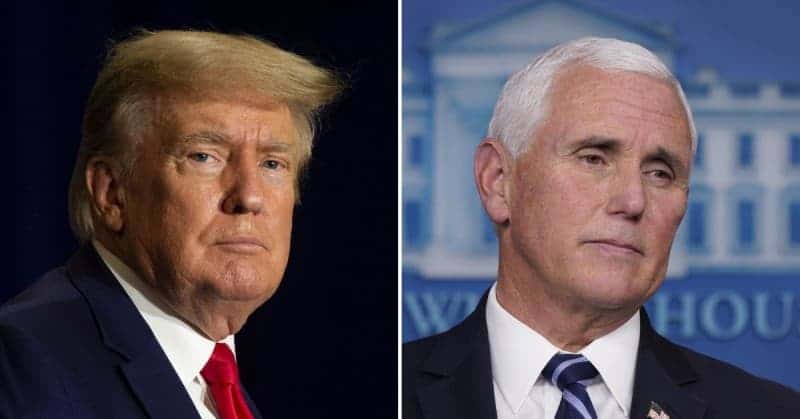
President Donald Trump and his former Vice-President returned to Washington D.C. on Tuesday in a sign both are running the numbers to see if they could secure the GOP nomination for 2024.
Publicly, both were very considerate in their criticism of each other. But behind-the-scenes, Trump is trashing the man who helped him win office, Radar has exclusively learned.
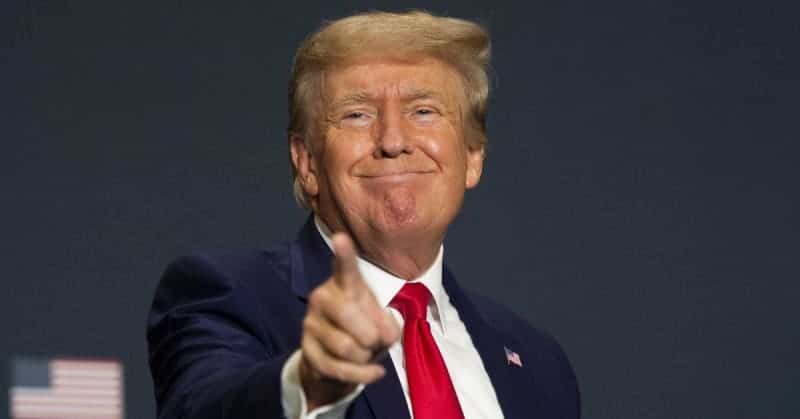
According to a source within Trump’s orbit, the former president has railed on Mike Pence to his supporters and claimed: “Mike is unelectable. He doesn’t have the gays’ support. The gays love me. They hate Mike.”
Pence, 63, is an evangelical Christian who has fiercely campaigned against LGBTQ rights and had a determination to overturn Roe v. Wade.
Trump has mocked Pence’s religious beliefs in the past and once reportedly joked that Pence wanted to “hang” gay people.
A Republican source told RadarOnline.com: “Could Mike Pence win enough votes without the support of the LGBTQ community? He is staunchly anti-everything LGBTQ and inclusion. It seems unlikely in today’s world.”
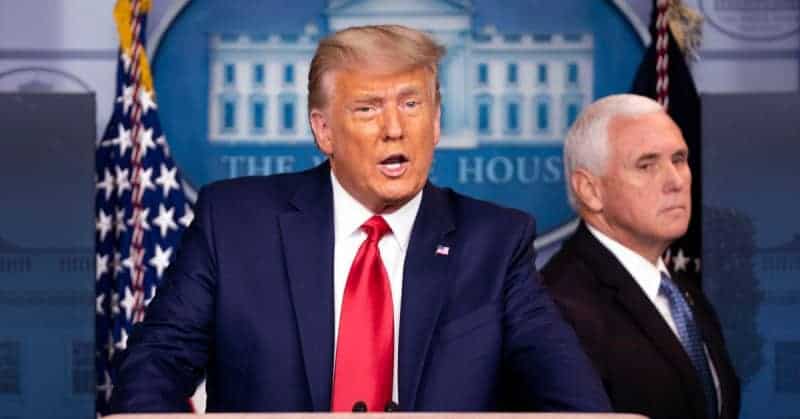
Pence, a former Indiana governor, also hosted a Bible study group at the White House during his term.
He reportedly also abides by the so-called Billy Graham rule, refusing to dine alone with another woman or attend an event where alcohol is served unless his wife is with him.
As RadarOnline.com reported on Tuesday, ex-President Trump is not the only one slamming Pence and deeming him “unelectable” should the former vice president run for office in 2024.
Florida Rep. Matt Gaetz, while speaking at a student conference for the right-wing group Turning Point USA on Sunday, also railed on Pence and suggested that although he is a “nice guy,” Pence is “not a leader.”
“Let me just say what everyone here knows,” the 40-year-old embattled congressman told the room of teenagers. “Mike Pence will never be president. Nice guy…not a leader.”
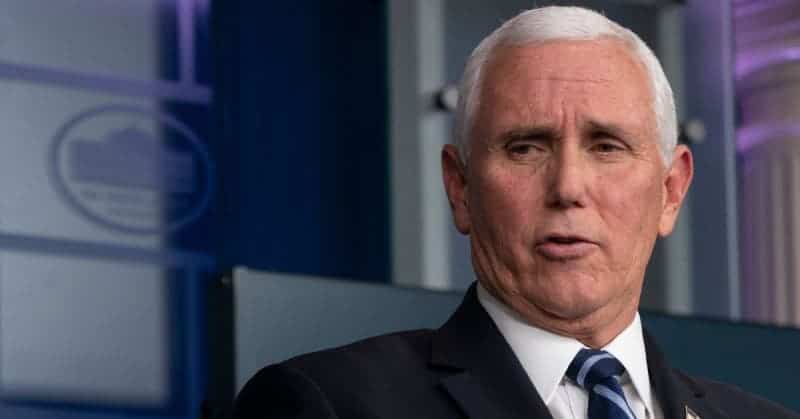
Taylor Budowich, Trump’s spokesperson, also railed against Pence in May after the ex-veep first suggested he may run in the 2024 Republican presidential primary against his old boss.
“Mike Pence was set to lose a governor’s race in 2016 before he was plucked up and his political career was salvaged,” Budowich said at the time.
He continued, “Now, desperate to chase his lost relevance, Pence is parachuting into races, hoping someone is paying attention. The reality is, President Trump is already 82-3 with his endorsements, and there’s nothing stopping him from saving America in 2022 and beyond.”
James.galbraithheh
Sen. Raphael Warnock is putting on the pressure as his Republican opponent, Herschel Walker, lays the groundwork to dodge any debates at all in their hotly contested Georgia Senate race.
Walker skipped debates in his Republican primary, but said he would debate Warnock before the general election. He wouldn’t just debate, in fact. He said he’d do it “any day of the week.” He said, “Name the place and the time, and we can get it on.” Now that Warnock has accepted invitations to three debates in three different cities, it’s a different story.
RELATED STORY: Herschel Walker is not an ethical person and he shouldn’t be running for Senate
In a single day of campaigning, Walker said, “If we negotiate and we got everything right, we’ll be debating on Oct. 16 and I’ll be ready to go” at a debate hosted by the Atlanta Press Club, then a spokesperson started making noises about the campaign requiring a “fair and equitable format and unbiased moderator,” and then Walker wondered aloud who made Warnock “the ruler of just giving dates.” Even though all Warnock did was accept invitations from media organizations.
In translation: Walker’s campaign is planning to dodge this debate unless he gets a set of outrageously unbalanced rules and a moderator committed to giving him a tongue bath. And even then he’d probably find an excuse not to attend.
Walker further set the stage on Tuesday with tweets suggesting that unless a moderator asked Warnock questions drawn directly from Walker’s campaign talking points (sample: “Why do you believe our law enforcement officers are thugs?”), it would be evidence that the moderator was “shielding” Warnock from voters. Big talk from a guy who could very fairly be asked questions like “When did you stop beating your wife?” and “Do you have any more secret children, or just the three we’ve found out about during the campaign?”
But everyone knows Walker wants to avoid debating, and everyone knows why. This is a guy who has trouble talking without lying in big, easy-to-fact-check ways. Lies like claiming he’s “worked in law enforcement” when he had not. Or claiming that he graduated from the University of Georgia (even claiming he was in the top 1% of his class), although in reality, he didn't graduate at all. Then claiming that he never told that lie, even though he said it publicly multiple times and it was on his campaign website. He’s also famously incoherent, coming out with statements so muddled it can be hard to even figure out what right-wing talking point he’s attempting to recycle.
Some top Republicans outside of Georgia think Walker would be right to dodge debates. Sen. Kevin Cramer told Politico that Warnock is pushing for a debate because “they feel like that’s an advantage for their side. And I don’t think Herschel Walker should do anything that gives his opponent an advantage.” Where the thing he’d be doing to give his opponent an advantage would literally be to answer questions in public in the same way candidates in races across the country will be doing, and have done for decades.
Warnock is out with a TV ad pressuring Walker to debate:
If Herschel Walker is so ready to debate, why hasn’t he agreed to any? pic.twitter.com/SxU65WHBbu
— Reverend Raphael Warnock (@ReverendWarnock) July 25, 2022
RELATED STORIES:
Herschel Walker has such a hard time telling the truth he’s even lying to his own campaign staff
Another Herschel Walker lie uncovered: He claimed he 'worked in law enforcement'
James.galbraithSeriously. Get them on record
Senate Democrats are working to line up 10 Republican votes to write marriage equality into law, out of reach of the Supreme Court. They say they’re optimistic about getting those votes, and will put the matter to the full Senate when the votes are lined up. This is a mistake.
Democrats need to hold the vote as soon as possible, and “possible” does not mean “when they have 10 Republicans locked down.” Otherwise, they are playing directly into the hands of Republicans who openly oppose marriage equality and Republicans who don't want to have to make this decision and go on the record publicly.
RELATED STORY: The country can't afford to give the Senate five weeks off for August recess
Campaign ActionAs of last week, five Senate Republicans said they would vote yes on a marriage equality bill. This week, one of them, Sen. Thom Tillis, told CNN, “There are more,” and another of them, Sen. Susan Collins, said they were “very close” to getting 10.
But what a number of Republicans who wouldn’t commit one way or the other were saying was that they would not commit until a vote was scheduled.
“I'll see if it comes up, and then I'll make a decision,” said Sen. Richard Burr of North Carolina. Pennsylvania Sen. Pat Toomey and Indiana Sen. Mike Braun similarly said they wouldn’t take a position until a vote actually happens. Senate Minority Leader Mitch McConnell said, “I am not going to make an observation about that until the issue is actually brought up in the Senate,” which tells you that this is an official Republican talking point.
So why is Senate Majority Leader Chuck Schumer saying, “We are trying—working real hard—to get 10 Republican senators. Between that and the illnesses, we're not there yet”? Why is Sen. Tammy Baldwin, the Democratic point person on lining up support, saying, “We will move when we're sure we have 10”?
Republicans are out here telling you they aren’t going to commit, in a way that makes clear they’re hoping they don’t have to. They will dangle the possibility of 10 votes to get Democrats to put off the vote and sacrifice any possible policy momentum. It’s blazingly obvious what’s going on, and Democrats need to call the bluff.
If, when they’re put on the spot, it turns out that there are indeed 10 (or more!) Republican votes, that’s a huge policy win for the country and for millions of people whose rights are secured and whose marriages are protected. If there are not 10 votes, that’s something for Democratic Senate candidates in key swing states to run on. But the only way to know—and to potentially get that major policy win—is to hold the damn vote. Now. Not after August recess, which should be canceled anyway. Definitely not after August recess, plus several weeks of delay in which Democrats keep insisting it will be soon, they’re almost there. NOW.
RELATED STORIES:
Biden, Democrats poised to finally pass several highly popular bills. Timing couldn't be better
Rubio tries to hit back after a Pete Buttigieg zinger lands, but he's outclassed and out of touch
James.galbraithWell that's terrifying
Read more of this story at Slashdot.
James.galbraithlol

Hovertext:
Turns out this is just the standard joke at the entrance to Hell.
James.galbraithIf only dems could do something with ammo like that
James.galbraithGee, another major media platform existing only to spread GOP lies? Shocking.
![Hulu’s “unwritten policy” on political censorship sparks backlash [Updated]](https://cdn.arstechnica.net/wp-content/uploads/2022/07/GettyImages-1232073873-800x542.jpg)
[Update: On Wednesday, the Walt Disney Company, which owns Hulu, announced it officially changed Hulu's policy to accept political ads on controversial issues. The Los Angeles Times published the statement: “Disney is now aligning Hulu’s political advertising policies to be consistent with the company’s general entertainment and sports cable networks and ESPN+. Hulu will now accept candidate and issue advertisements covering a wide spectrum of policy positions, but reserves the right to request edits or alternative creative, in alignment with industry standards.”]
Last year, Hulu raised its ad-supported subscriptions by a dollar, shortly after prompting subscribers to submit more feedback on ads. Since 2017, vocal members in the Hulu community have complained about seeing the same political ads “1,000 times,” with some claiming they were repeatedly served ads from Republicans that spread misinformation. After President Biden was elected in 2020, others complained about “Democratic propaganda.” Many suggested Hulu wasn’t the place for political ads, with one post pitching a new Hulu policy of “no political ads” getting more than 2,000 votes.
At least one subscriber in the forum claimed that regardless of content, Hulu was financially motivated to sell political ads, but this week Hulu has taken actions that seemingly respond to subscribers' longtime complaints—by blocking more political ads. Democrats have claimed that Hulu blocked political ads discussing key party issues like abortion rights, gun control, and climate change, sparking an entirely different backlash and a Twitter rally cry to #BoycottHulu.
James.galbraithThat's facebook pricing at its finest

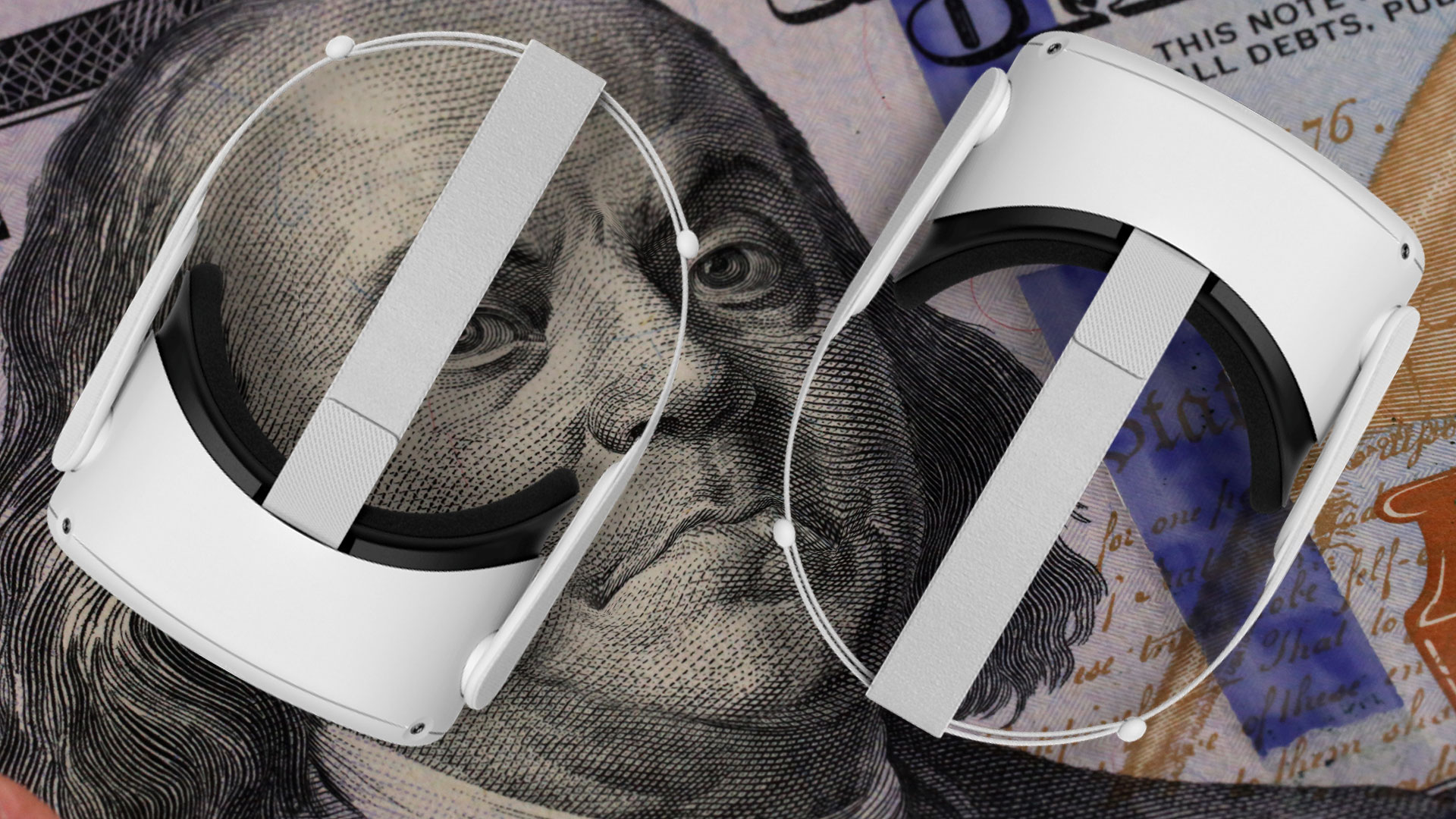
Enlarge / This week for Meta and its Quest 2 VR system, it's all about the Benjamins. One Benjamin more, to be specific. (credit: Aurich Lawson | Getty Images | Meta)
Many categories in consumer tech have seen substantial jumps in cost over the past two years due to a strained supply chain, chip shortages, and other economic factors. But honestly, we didn't see this one coming.
Starting "in August," the Meta Quest 2 virtual reality system (formerly known as Oculus Quest 2) will receive a substantial change in MSRP, jumping from a base model cost of $299 to $399. That version includes 128GB of onboard storage, while the pricier Quest 2 headset with 256GB will jump from $399 to $499.
Meta's Tuesday announcement struggles to clarify exactly why the hardware is jumping $100 across the board (33 percent for the base model, 25 percent for the higher-capacity version). Should you take the announcement at face value, its flat declaration might sound logical: "The costs to make and ship our products have been on the rise."
James.galbraithYeah that is pretty iffy
The fallout from a drunk veteran with a sharp keychain attacking Rep. Lee Zeldin as he spoke at a campaign event last week continues. Following the incident, Monroe County District Attorney Sandra Doorley charged David Jakubonis with attempted assault in the second degree, and he was released by a judge following arraignment. Republicans howled, blaming New York Gov. Kathy Hochul—who Zeldin is running against—for what they claimed were criminal justice policies that allow, even require, dangerous assailants to be released.
Jakubonis was subsequently detained on federal charges, but the Republican outrage factory churned on. It has run into two small snags, though: First, Doorley, the district attorney in the case, could have charged Jakubonis with a more serious offense on which he might have been held or released on bail. Second, Doorley is listed as a co-chair of Zeldin’s campaign, which turns out to be against the ethics guidelines for district attorneys in New York.
So Republicans—very much including Zeldin himself—have been yelling about the outcome of a lighter-than-expected charge that was decided on by one of his top supporters or someone in her office.
It’s … interesting, isn’t it, that a district attorney who agreed to co-chair a partisan gubernatorial campaign then levied a notably light charge against someone who attempted to assault the candidate she’d endorsed, in a way that allowed him to press a political point he’d been campaigning hard on?
Add to this that Doorley’s office is known for harsher charges than many other prosecutors’ offices: “According to a review by the Times Union, state data shows the prosecutor's office has sought bail on criminal cases at higher rates than in most highly populated counties in New York,” and that in all of 2021, her office only charged one person with attempted assault in the second degree as a top offense. And yet, in this specific case, Doorley suddenly pulled out this particular charge that just happened to give Zeldin and his fellow Republicans a campaign talking point.
Doorley, for the record, claims that she withdrew as Zeldin’s campaign co-chair after learning that it was against ethics guidelines for her to participate in that way, though Zeldin’s campaign never withdrew its press release about her role and his website still had her name listed.
Jakubonis told investigators he did not know who he was confronting and that he “must have checked out” and was disgusted by what he saw in the video of the incident.
James.galbraithBecause they are the party of religious bigotry
James.galbraithInteresting. My break in period was 6 months lol
Read more of this story at Slashdot.
James.galbraithAnd there it is LOL

youtubers react to youtubers react to *continues infinitely*
James.galbraithBullshit
If there’s any advantage to being married to Donald Trump, it would have to be developing the ability to at least occasionally tune him out. It’s quite a skill because, even at his most genteel, Trump sounds like a herd of shaved emus drowning in a tub of Lestoil. Whatever else you want to say about him, Trump knows how to suck the oxygen out of a room—before eventually replacing it with CO2, nitrogen, trace noble gases, and the bleached bones of untold thousands of Costco rotisserie chickens.
So in a weird sort of way, I actually envy Melania Trump. She’s tuned out her husband so effectively that she didn’t even know what he was up to on Jan. 6, 2021. All she knew was that he was playing president with his creepy friends again. As for the specifics? Eh. Who knows? She was taking pictures of a rug.
Former first lady Melania Trump said in a new interview with Fox that she was "unaware" of the ongoing riot on January 6, 2021, because she was too busy photographing a rug in the White House.
"On January 6, 2021, I was fulfilling one of my duties as First Lady of the United States of America, and accordingly, I was unaware of what was simultaneously transpiring at the US Capitol Building," she said.Trump said it was her "duty" as first lady to archive the contents of the White House, which is not exactly true. The White House curator and the White House Historical Association are predominantly responsible for keeping a record of the contents of the official White House collection.
Yeah. That’s a little, erm, hard to believe. Meanwhile, Jared Kushner says he was taking a shower during the coup. Which seems, I don’t know, a bit weird. It’s almost as if Trump’s behavior on Jan. 6, 2021, didn’t seem like anything out of the ordinary to the people who know him best.
As Melania told Fox, she was far too busy with her own shit to be aware of any violent, husband-incited coups that were transpiring in the city she lived in at the time.
“As with all First Ladies who preceded me, it was my obligation to record the contents of the White House’s historic rooms, including taking archival photographs of all the renovations,” she said. “Several months in advance, I organized a qualified team of photographers, archivists, and designers to work with me in the White House to ensure perfect execution. As required, we scheduled Jan. 6, 2021, to complete the work on behalf of our nation.”
Of course, this lends some interesting context to Melania’s infamous Jan. 6 text exchange with her former chief of staff, Stephanie Grisham. If Melania really didn’t know what was going on, maybe she can be forgiven for this almost supernatural feat of indifference:
— Stephanie Grisham (@OMGrisham) June 28, 2022
Then again, if your employee texts you out of the blue asking you to denounce violence and lawlessness, you’d think you might want to ask what the fuck she was talking about. Just a thought. And knowing her husband as she no doubt does, she should have at least checked the White House baby monitor to get a sense of what Captain CoupPants was up to. “Oh, Donald’s out with his coup friends again. He should be back before dinner. We ordered a luau pig from Instacart and if he doesn’t fully skeletonize it within the first three hours, it starts to get cold.”
Of course, a cynic might say that it was incumbent upon Melania Trump, as the first lady of the United States of America, to maybe talk her goofy husband off the ledge.
Then again, rugs are pretty important, too ...
Check out Aldous J. Pennyfarthing’s four-volume Trump-trashing compendium, including the finale, Goodbye, Asshat: 101 Farewell Letters to Donald Trump, at this link. Or, if you prefer a test drive, you can download the epilogue to Goodbye, Asshat for the low, low price of FREE.
James.galbraithGOP poster boy thanks to Thiel. Seems like there should be some consequences here.
J.D. Vance, the Republican Senate nominee in Ohio backed by former President Donald Trump, accidentally let his truth slip out during a moderated talk at Pacifica Christian High School in Santa Monica, California, last September. In a video reported on by Vice News, the Hillbilly Elegy author seemed to make a case for staying married no matter what—even in cases of domestic violence. At one point in his 2021 conversation, the moderator compared the relationship of Vance’s grandparents detailed in his book to modern relationships, and asked Vance what's causing one generation "to give up on fatherhood when the other one was so doggedly determined to stick it out, even in tough times."
And Vance gave this response:
“This is one of the great tricks that I think the sexual revolution pulled on the American populace, which is the idea that like, ‘well, OK, these marriages were fundamentally, you know, they were maybe even violent, but certainly they were unhappy. And so getting rid of them and making it easier for people to shift spouses like they change their underwear, that’s going to make people happier in the long term.’”
He added:
“And maybe it worked out for the moms and dads, though I’m skeptical. But it really didn’t work out for the kids of those marriages. And that’s what I think all of us should be honest about, is we’ve run this experiment in real-time. And what we have is a lot of very, very real family dysfunction that’s making our kids unhappy.”
Sticking out domestic violence for the kids’ best interest, however, wasn’t a philosophy Vance was prepared to back outright during his campaign.
When Vice News asked why Vance suggested “it would be better for children if their parents stayed in violent marriages than if they divorced,” he told the media company it had posed a “bogus question.”
Vance responded by twisting statistics. Current domestic violence laws are extremely robust compared to the time in which Vance's grandparents were determined to stay together despite their “maybe even violent” marriage. In the 1970s, for example, “domestic violence remained largely unrecognized and virtually ignored in the legal, medical, and social spheres.”
Decades later, domestic violence is treated as a legitimate legal and public health concern, even when it occurs among unmarried couples. That change in standard practice has led to increases in reports of domestic violence in both married and unmarried couples. Avenues for assistance and relief—both in terms of safety and legal recourse—have become more widely available. But you can’t explain that to a man determined to maintain a patriarchy that supports his unexamined beliefs. Vance opted to lay blame at progressives’ feet:
”As anyone who studies these issues knows: domestic violence has skyrocketed in recent years, and is much higher among non-married couples. That’s the ‘trick’ I reference: that domestic violence would somehow go down if progressives got what they want, when in fact modern society’s war on families has made our domestic violence situation much worse. Any fair person would recognize I was criticizing the progressive frame on this issue, not embracing it.
But I can see that you are not a fair person, so rather than answer your loaded and baseless question, let me offer the following: I’m an actual victim of domestic violence. In my life, I have seen siblings, wives, daughters, and myself abused by men. It’s disgusting for you to argue that I was defending those men.”
And even in all of that rhetoric, Vance failed to say deny what he was asked to deny: that he believes staying married to violent partners somehow benefits the children who live with couples who should probably get divorced.
James.galbraithyup
James.galbraithFucking horrifying
Donald Trump will go to any pathetic end to win support. While speaking at the Turning Point USA event in Florida on Saturday, Trump attempted to solidify his support from conservative Christians by claiming "Americans kneel to God, and God alone.”
“We will not break, we will not yield, we will never give in, we will never give up, we will never, ever, ever back down. As long as we are confident and united, the tyrants we are fighting do not stand a chance," Trump said. "Because we are Americans, and Americans kneel to God, and God alone."
According to Business Insider, his remarks were aligned with Christian nationalism, an authoritarian theocratic ideology that has always existed inside the GOP fringe but is gaining fast popularity in mainstream Republican thinking. Recent reports from The New York Times, The New Yorker, and CNN also all suggest Christian nationalism is on the rise.
President Donald J. Trump speaks at the Student Action Summit in Tampa, Florida: "Because we are Americans, and Americans kneel to God, and God alone." pic.twitter.com/krSA2Rkmdr
— RSBN 🇺🇸 (@RSBNetwork) July 24, 2022
According to Christianity Today, Christian nationalism is "the belief that the American nation is defined by Christianity, and that the government should take active steps to keep it that way." The main focus is that America is considered a "Christian nation.”
Campaign ActionThe Tampa event came a day after he gave a speech at the "Save America" rally in Arizona Friday night. There he showed his support for Republican candidates Kari Lake for governor and Blake Masters for the U.S. Senate, and appealed to the conservative Christians in attendance.
Fox News and other outlets noted that Trump dropped several hints during the rally on the possibility of him running for president in 2024.
"Take the five worst presidents, put them together, and it would not be worse than Biden's damage," Trump said. "We may have to do it again."
"We will make America wealthy again. We will make America strong again. We will make America proud again. We will make America safe again. And we will make America great again," Trump added.
Despite his thousands of documented lies and central role in inciting the insurrection at our nation’s Capitol on Jan. 6, 2021, Trump’s standing is still clearly strong among his voter base. When he handed over the mic, Lake referred to Trump as “Superman” and encouraged people to come out and vote.
"We can't wait for Superman to save us, we have to get involved," Lake said. "I believe Superman is coming back and hopefully soon. And when he does, we will be by his side."
But this weekend’s events aren’t the only events during which Trump has advocated for Christian nationalism. During 2017’s Values Voter Summit on Friday, Trump told attendees that in the U.S.,”we don't worship government, we worship God,” NPR reported.
"We know that it's the family and the church—not government officials—who know best how to create strong and loving communities," Trump said.
While Trump failed to deliver many of his campaign promises, he reminded the crowd of what he did that supported their values, including allegedly “stopping cold the attacks on Judeo-Christian values.”
Of course, Trump isn’t the only GOP representative who believes in this Christian nationalism. Rep. Marjorie Taylor Greene, attended the same Tampa event, and outright identified herself as a Christian nationalist in an interview. She shared her support for the ideology while explaining why Republicans should adopt the label and the movement themselves.
"We need to be the party of nationalism, and I'm a Christian, and I say it proudly: We should be Christian nationalists," Greene said.
Reporter @TaylerUSA and @RepMTG sat down for an exclusive interview. They talked about God, Child Drag Shows, January 6th, and the lack of courage in the GOP. pic.twitter.com/1apZJOb2cB
— Next News Network 🇺🇲 (@NextNewsNetwork) July 24, 2022
Let’s not forget Greene’s buddy Rep. Lauren Boebert, who also attended the event. Boaebert recently has said the church should be in charge of the government.
"The church is supposed to direct the government; the government is not supposed to direct the church," she said last month, according to Business Insider. "That is not how our founding fathers intended it. And I'm tired of this separation of church and state junk that's not in the Constitution."
James.galbraithlol
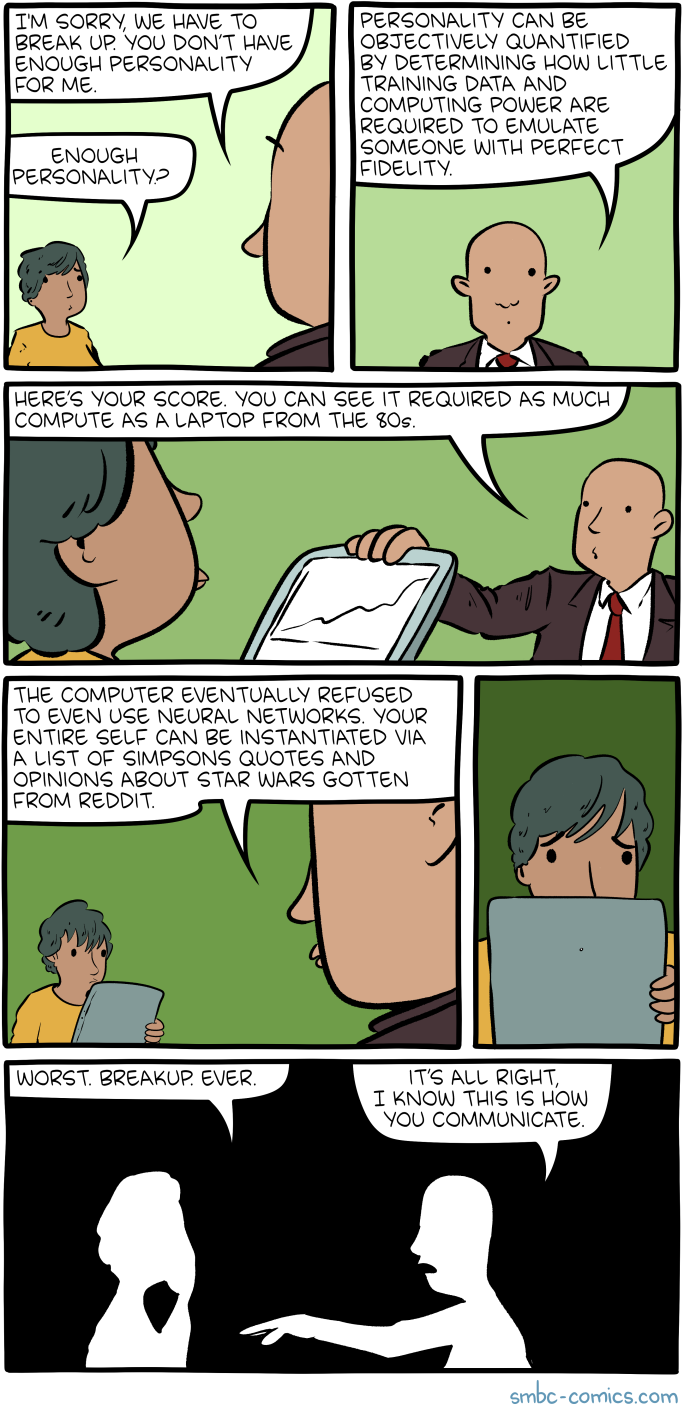
Hovertext:
The real red flag was the explanation for why the Star Wars prequels were good, which lasted longer than the runtime of all the movies.
James.galbraithIt is strange
Read more of this story at Slashdot.
James.galbraithAgain, if you're surprised....

Anna Moneymaker / Getty Images
It may not be immediately obvious how the fight over abortion rights is tied to the “great replacement” theory — the debunked conspiracy theory promoted by some Republican politicians who claim that Democrats support more immigration to “replace” white American voters. But the explanation for, say, an alleged gaffe that overturning the constitutional right to an abortion is a “historic victory of white life” or a concern that not enough white babies are being born in the U.S. can be found in the history of the anti-abortion movement.
The movement to end legal abortion has a long, racist history, and like the great replacement theory, it has roots in a similar fear that white people are going to be outnumbered by people believed to hold a lower standing in society. Those anxieties used to be centered primarily around various groups of European immigrants and newly emancipated slaves, but now they’re focused on non-white Americans who, as a group, are on track to numerically outpace non-Hispanic white Americans by 2045, according to U.S. Census projections.
It’s been decades since the anti-abortion movement first gained traction — and the movement has changed in certain ways — but this fundamental fear has never left, as demonstrated by attacks on people of color, such as the shooter in Buffalo, New York, who expressed concern about the declining birth rates of white people. That’s because the anti-abortion movement, at its core, has always been about upholding white supremacy.
Throughout colonial America and into the 19th century, abortions were fairly common with the help of a midwife or other women and could be obtained until the point that you could feel movement inside, according to Lauren MacIvor Thompson, a historian of early-20th-century women’s rights and public health. Most abortions were induced through herbal or medicinal remedies and, like other medical interventions of the time, weren’t always effective or safe.
But the dynamics surrounding the procedure changed by the mid-19th century, as America’s elites began to fear a rising tide of immigrants from Ireland, Italy and other European countries (people often viewed as “inferior”), suffragists seeking new freedoms and recently freed Black people, whom these elites feared were reproducing at higher rates than the white population. Laws limiting abortion, it was believed, would ultimately force middle- and upper-class white women — who had the most access to detect and terminate unwanted pregnancies — to bear more white children.
“There were concerns that these other groups were demographically outpacing white, Anglo-Saxon, Protestant women. And so they thought to limit the bodily autonomy of white women and limit access to contraception in order to force them to have children. That they felt would keep up with the demographic birth rate,” said Alex DiBranco, the co-founder and executive director of the Institute for Research on Male Supremacism.
It took time for the anti-abortion movement to attract supporters, and unlike today, religious groups were not originally an active part of it. Still, momentum built as a small but influential number of physicians began arguing that licensed male doctors — as opposed to female midwives — should care for women throughout the reproductive cycle. In the late 1850s, one of the leaders of the nascent anti-abortion movement, a surgeon named Horatio Robinson Storer, began arguing that he didn’t want the medical profession to be associated with abortion. He was able to push the relatively new American Medical Association to support his cause, and soon they were working to delegitimize midwives and enforce abortion bans. In an 1865 essay issued by order of the AMA, Storer went so far as to say of white women that “upon their loins depends the future destiny of the nation.”
Watch: https://abcnews.go.com/fivethirtyeight/video/democrats-supreme-court-fivethirtyeight-politics-podcast-86637136
Declining white birth rates, along with the rising eugenics movement — a now-discredited pseudoscience focused on the genetic fitness of white Americans — were connected to the practice of abortion, and this helped bolster flawed, racist arguments for a total ban of the procedure. “The physicians trying to pass these anti-abortion laws were concerned about how abortion was a ‘danger’ to our society and the ways we want our country to be,” said Shannon Withycombe, a professor of history at the University of New Mexico who studies 19th-century women’s health.
Their tactics worked. By the 1900s, abortion was illegal in every U.S. state.
Despite this, though, women continued to seek abortions. It wasn’t until the 1960s and 1970s that women’s access to safe and legal abortions began to change. Feminist activists, armed with college and law-school degrees, began to advocate for overturning or relaxing these bans. They argued that the existing laws made abortion less safe for women and that reproductive health, including abortion, was necessary for women’s equality. Public attitudes started to shift then, too, and in 1967, Colorado became the first state to liberalize its abortion laws, allowing exceptions for the life or health of the pregnant person. Other states followed suit, and by 1972, a total of 13 had similar laws. Four states had repealed their anti-abortion laws entirely.
And, of course, in 1973, the Supreme Court ruled in Roe v. Wade that abortion was a constitutional right. But while the decision in Roe overturned the nation’s remaining abortion bans, it didn’t address the underlying forces that had helped establish them, which brings us to today, as the anti-abortion movement is once again front and center following the court’s decision to overturn Roe.
Watch: https://abcnews.go.com/fivethirtyeight/video/political-consequences-overturning-roe-wade-85819633
These old fears have risen to the fore again in part because the country is experiencing a demographic change similar to what we saw at the turn of the last century. For instance, the U.S. birth rate has been declining, although this has more to do with women having greater access to contraception, education and career opportunities than it has to do with abortion rates. But immigration levels are also high, almost as high as they were at the turn of the 20th century, again spawning a fear that white Americans will be displaced in an increasingly multiracial nation.
Polling suggests these fears have taken hold among the American electorate, too. In a December 2018 poll conducted by the Pew Research Center, a 38 percent plurality of Americans said the U.S. becoming more diverse would “weaken American customs and values.” This way of thinking is especially prevalent among Republicans, who said by 59 percent to 13 percent that having a majority nonwhite population would weaken rather than strengthen the U.S. (Twenty-seven percent said this would not have much impact either way.) According to a poll conducted by The Associated Press-NORC Center for Public Affairs Research in December, 47 percent of Republicans (compared with 22 percent of Democrats and 22 percent of independents) agreed with the statement that “there is a group of people in this country who are trying to replace native-born Americans with immigrants who agree with their political views.”
And these anxieties over immigration have become explicitly connected to the birth rate in some statements from prominent Republicans. In 2017, when he was representing Iowa’s 4th Congressional District in the U.S. House, Steve King directly made the connection: “You cannot rebuild your civilization with somebody else’s babies. You’ve got to keep your birth rate up, and that you need to teach your children your values.” More recently, in May, Matt Schlapp, the head of the Conservative Political Action Coalition, echoed a similar sentiment when he advocated for a ban on abortion. And in June, Illinois Rep. Mary Miller called the end of Roe a “historic victory for white life” at a rally with former President Donald Trump, who still holds a tight grip on the Republican Party and may run for president again. The crowd responded to Miller’s statement with applause, though her spokesperson later said she had misspoken and meant to say “victory for a right to life.” (Miller did not try to correct herself onstage, however.)
Moreover, other, more extreme far-right groups have visibly joined with the anti-abortion movement. This year, the white nationalist Patriot Front showed up at March for Life rallies in Chicago and Washington, D.C. “The white nationalist segment of anti-abortion organizing is really long-standing,” said DiBranco, of the Institute for Research on Male Supremacism. “And, in recent years, there’s been more of an emboldenment about using great replacement rhetoric or similar kind of rhetoric around to what they might call ‘white genocide’ or demographic change.”
Even on its own terms, though, the logic of tying the anti-abortion movement to the racist great replacement theory is deeply convoluted — and downright inaccurate. For instance, fewer women are seeking abortions, and women of color — particularly those who are Black — are more likely than white women to seek an abortion. Moreover, it’s likely that we’ll see more women of color die as abortions become more limited, in spite of arguments from some on the far right that a near-total abortion ban is a good thing for people of color, primarily Black people. In fact, according to analysis published in the December edition of the population-research journal “Demography,” a hypothetical total abortion ban would lead to more pregnancy-related deaths among non-Hispanic Black people than among any other racial group.
Watch: https://abcnews.go.com/fivethirtyeight/video/supreme-court-overturns-roe-wade-fivethirtyeight-politics-podcast-85666091
But logic is not the point in many of the mainstream racist arguments around restricting abortion access. “They tried to twist themselves into logical scientific explanations for all of these things. But they basically had to just make stuff up to justify what they wanted, which is for women — especially women of color — to not have any rights,” said Thompson, the historian.
According to Nicola Beisel, a professor emerita at Northwestern University who studies cultural sociology, sex and gender, women’s ability to have children is treated as a resource instead of a matter of bodily autonomy or a right, which is why opposing abortion is part of the bigger conversation about who is having children. “If women’s reproductive capacity is a resource, the question is, who’s going to get to use it? And for whom?”
This is why anti-abortion activists pressed until Roe was overturned, and they likely won’t stop there. It’s clear that the people who want to criminalize abortion also want to limit access to contraception, DiBranco said. “So it’s a part of a political project and a cultural project around controlling women’s autonomy, and in some cases, managing demographic change through that.”
James.galbraithNo surprise there
When House Democrats put a bill on the floor last week protecting same-sex marriage rights, something astonishing happened—nearly 50 House Republicans voted with Democrats to pass the Respect for Marriage Act, 267-157.
Sure, more than three times that number of Republicans voted against the bill, which would codify into federal law both interracial and same-sex marriage rights. But the unprecedented assist from House Republicans immediately made the bill a contender for floor time in the Senate based on the very real possibility of attracting the 10 Senate Republicans needed to beat an inevitable GOP filibuster.
Senate Republicans suddenly realized they had a political hot potato on their hands. Minority Leader Mitch McConnell had been laboring to steer his caucus clear of divisive cultural hot-button issues in the lead up to November. McConnell needs Republicans to appear palatable enough to attract the support of the same suburban voters who largely abandoned the party during Donald Trump's disastrous tenure.
Campaign ActionIndeed, Sen. Ron Johnson of Wisconsin, arguably Senate Republicans’ most endangered member, bit the bullet Thursday and said he would vote for the marriage bill if it reached the floor of the upper chamber.
"Even though I feel the Respect for Marriage Act is unnecessary, should it come before the Senate, I see no reason to oppose it," Johnson said in a statement.
As a political party, Republicans have increasingly waved the white flag on same-sex marriage for the last handful of years. As a presidential candidate in 2016, for instance, Donald Trump pledged to nominate justices who would overturn Roe v. Wade in one breath only to claim in the next breath that the freedom to marry wouldn't be jeopardized by those very same judicial appointments.
"It’s law. It was settled in the Supreme Court. I mean it’s done," Trump said of marriage equality in November 2016.
Trump along with many Republican strategists wanted to wash their hands of an issue that quickly grew into a total political loser for them. Their evangelical backers, however, were never going to let it go. And sure enough, just as soon the radicalized Supreme Court majority took out Roe, same-sex marriage was back on the chopping block. In fact, Justice Clarence Thomas wasted no time putting a target on marriage rights in his concurrent opinion.
But here's where the GOP's fundies and their political strategists part ways. Today, marriage equality is a 70-30 loser for Republicans, a far cry from the wedge issue everyone thought it was in the mid-aughts. Yet, just days after that Supreme Court gutted Roe, none of the Michigan GOP's five gubernatorial candidates took up for marriage equality during a primary debate when asked about constitutional protections for gay rights.
“They need to revisit it all,” candidate Garrett Soldano said of LGBTQ rights at the debate in Warren, Michigan.
Several weeks later, however, two West Michigan Republican congressmen, freshman Rep. Peter Meijer and veteran lawmaker Rep. Fred Upton, became two of the 47 House Republicans who backed the Respect for Marriage Act in the successful House vote.
This is where congressional and state Republicans are diverging: At the national level, many Republicans are dodging, downplaying, or even supporting LGBTQ rights, but at the state level, Republicans are largely sticking to a virulent anti-LGBTQ strategy that hasn't yielded fruit as a wedge issue for well over a decade.
The fashion of the day for the state-level GOP bigots is to target a highly vulnerable subset of queer Americans—the transgender community, perhaps because the very same bigots already crashed and burned on marriage equality. As same-sex marriage slipped from their grasp, state GOP lawmakers have homed in with gusto on attacking transgender Americans and youth—who also suffer from disproportionately high levels of suicide. This year alone, Republicans have introduced over 300 bill aimed at restricting LGBTQ rights. The New York Times writes:
In June, Louisiana became the 18th state, all with G.O.P.-led legislatures, to ban transgender students from playing on sports teams that match their gender identity. Laws to prohibit transitioning medical treatments to people under 18, such as puberty blockers, hormones and surgeries — which advocates call gender-affirming care — have been enacted by four states. And after Gov. Ron DeSantis of Florida signed a law in March banning classroom discussion of sexual orientation and gender identity in early grades, more than a dozen other states moved to imitate it.
The bigots may have shifted their tactics slightly, but this is by no means the first time they have sought to resurrect a one-time political wedge issue through the lens of transgender issues.
Enter Terry Schilling, president of the anti-LGBTQ group American Principles Project.
“I believe these are enormous issues for swing voters and moderates,” Schilling told the Times, saying that his group plans to spend up to $12 million on anti-trans ads before November.
"I believe" are truly the operative words in that sentence because this isn't Schilling's first rodeo.
Unfortunately for his donors, Schilling's theory of the case is already a two-time loser. In 2019, Schilling sought to use his strategery to help reelect Kentucky's incumbent GOP Gov. Matt Bevin. Schilling’s group focused on making ads that questioned whether “men” (i.e. transgender women and girls) should be allowed to use women's restrooms and participate in sports for women and girls. The idea was to paint Bevin’s Democratic rival Andy Beshear as “extreme” for supporting transgender rights. It failed. But when Bevin ultimately lost to Beshear in November 2019, Schilling's group commissioned its own study that apparently determined the organization’s anti-trans messaging cut Bevin's loss by 13,000 votes. The American Principles Project immediately morphed Bevin’s loss into a win for the group.
In the 2020 cycle, Schilling went to work selling that losing strategy as a silver bullet that could really turn things around for Trump with suburban voters and moderates.
“We wanted Bevin to win, but more than anything, we wanted to test this out before trying it at a much larger scale," Schilling told Politico in August 2020, as Trump's reelection prospects were dimming. "Now, donors understand that although we came up a few votes short in Kentucky, this can still work."
Only it didn't work in 2020 either—suburban voters mostly stuck with Democrats, forming a critical part of the anti-MAGA coalition that would eject Trump from office.
Now Schilling—who’s zero for two—is apparently back to working his wizardry. Maybe he figured he could piggy back off a good Republican cycle to finally claim credit for what was assumed would be a big GOP rout. Only once again, for all the energy Republicans have put into vilifying transgender Americans and branding Democrats as extremists for supporting them, voters just don’t seem persuaded.
In fact, recent polling suggests that a majority of Americans view Republicans as the real extremists. In May, a CBS New/YouGov poll found the top two words people chose to describe the Republican Party were "Extreme" (54%) and "Hateful" (50%). Respondents' top two choices for Democrats were "Weak" (51%) and "Extreme" (49%).
Polling last week from Navigator Research also found a 44% plurality of Americans agree that "people who support the Republican Party are inclined to resort to violence" in order to push their agenda. Just 35% said the same of Democrats.
The number of Americans who view Republicans as extreme—particularly the suburban swing voters that Schilling hopes to sway—is only likely to increase as Republicans at the state level continue targeting trans kids and same-sex marriage rights, devising draconian abortion bans, trying to place a stranglehold on birth control, and baselessly claiming widespread fraud in the 2020 election.
The Republican Party , whatever it once was, has quickly become the party of government intrusion into Americans’ personal lives. They want control over who Americans marry, their most intimate healthcare decisions, how and when they start a family, how they choose to raise that family, how they parent, the curriculum at their schools, and what books they can read. It is arguably the most extreme agenda put forward by a party in modern American politics.
So despite what Schilling is selling to the press and his donors, targeting transgender Americans won’t pay off for Republicans at the ballot box this November, just like it didn’t work for former North Carolina Republican Gov. Pat McCrory in 2016, it didn’t work for former Kentucky Gov. Bevin in 2019, and it didn’t work for Trump in 2020.
In the meantime, the overt bigotry of state-level Republican officials and activists like Schilling will blow up any effort by some congressional Republicans to moderate on popular social issues like LGBTQ rights. At the national level, some Republicans may desperately want to move on, but their state counterparts are dedicated to reminding voters just how antiquated and extreme the entire party is on a host of social issues where voters recoil at the notion of government interference.
James.galbraithThat's what the GOP has become
Not all Christians are created equal. Take, for instance, devout Catholic Joe Biden versus self-described “Christian nationalist” Marjorie Taylor Greene. They’re like apples and oranges. Or, more precisely, like apples and that one fruit that smells like diapers and feet.
To be fair, Christianity has had an enormous impact on the course of Western civilization—and, by extension, on American culture—but we are not a Christian nation. Indeed, Enlightenment philosophers like John Locke, as well as Native Americans in the Iroquois Confederacy, have had far more influence on the U.S. Constitution than Jesus or the Bible ever did.
So to call yourself a “Christian nationalist” is to essentially out yourself as un-American and pig ignorant.
Enter Georgia Rep. Marge Greene, the universal answer to the eternal philosophical question “Oh, Jesus Pancake-Flippin’ Christ, what the fuck is this now?”
Marjorie Taylor Greene: "I have no problem saying I am a Christian nationalist. And I think that's an identity that we need to embrace."@RepMTG, read the establishment clause of the First Amendment. pic.twitter.com/kxZiB5vUdp
— The Republican Accountability Project (@AccountableGOP) July 18, 2022
Transcript!
GREENE: “I’m a Christian, I have no problem saying I’m a Christian nationalist. And I think that’s an identity that we need to embrace because those are the policies that serve every single American, regardless of how they vote.”
I’m sure Muslims, Jews, Buddhists, Hindus, etc. will be delighted to know Marjorie Taylor Greene is hard at work building a Christian utopia just for them, but that’s not really the point. We’re a secular republic built on Enlightenment ideas and values, and Christian nationalism represents a sick perversion of our Constitution and traditions. So it’s alarming the extent to which that label is being adopted these days—and not just by MTG.
In fact, Christian nationalism is behind much of the rot currently eroding the foundations of our democracy—and it’s pretty well out in the open now.
In a May 2021 story for TIME magazine, Andrew Whitehead, co-author of Taking America Back for God: Christian Nationalism in the United States, noted the movement’s role in the Jan. 6, 2021, Capitol insurrection, as well as its enduring and pernicious impact on our democratic traditions.
In order to understand what led to the deadly Capitol insurrection and the spate of proposed voting laws, we must account for the influence of Christian nationalism, a political theology that fuses American identity with an ultra-conservative strain of Christianity. But this Christianity is something more than the orthodox Christianity of ancient creeds; it is more of an ethnic Christian-ism. In its most extreme form it legitimizes the type of violence we saw on Jan. 6 and the recent flood of voting restrictions. Violence and legislation not in service of democracy, but instead for fundamentally anti-democratic goals.
In our book ... we use several large, national surveys of Americans collected over the last decade to show that about 20 percent of Americans―those we call “Ambassadors”―strongly embrace Christian nationalism.
Hmm. Who ever said civics education wasn’t important?
As a political theology that co-opts Christian narratives and symbolism, Christian nationalism has its own version of the “elect,” those chosen by God. They are “people like us,” meaning conservative Christian, but also white, natural-born citizens. Moreover, in a prosperous nation, only “the elect” should control the political process while others must be closely scrutinized, discouraged, or even denied access. This ideology is fundamentally a threat to a pluralistic, democratic society.
In other words, Christian nationalism isn’t so much about Christianity—or traditional Christian values like faith, love, and charity—as it is about permanent white Christian minority rule. And if they have their way, the end of Roe will be just the start of this Technicolor shitshow.
Again, the (really rapid!) shift to fully embracing the *term* Christian nationalist has been quite a thing to watch. Note: this mostly happened in overtly extremist circles first, and now seems to be increasingly prevalent in certain political circles. https://t.co/9CvMPt9PZH
— Jack Jenkins (@jackmjenkins) July 18, 2022
So should we be alarmed that ersatz Christian patriots like Greene are now embracing this decidedly un-American and undemocratic political philosophy? The short answer: Hell yes.
They’ve pretty much telegraphed the fact that they want to rule over us (no doubt “benevolently”—at least at first) until the rapture whisks them away from this woebegone planet that keeps overheating for some reason, and they’re being more and more brazen about it.
In recent New York Times essay, Katherine Stewart, author of The Power Worshippers: Inside the Dangerous Rise of Religious Nationalism, noted that Roe’s reversal is just the beginning of their campaign to remake the country in their own image:
The Supreme Court’s decision to rescind the reproductive rights that American women have enjoyed over the past half-century will not lead America’s homegrown religious authoritarians to retire from the culture wars and enjoy a sweet moment of triumph. On the contrary, movement leaders are already preparing for a new and more brutal phase of their assault on individual rights and democratic self-governance. Breaking American democracy isn’t an unintended side effect of Christian nationalism. It is the point of the project.
A good place to gauge the spirit and intentions of the movement that brought us the radical majority on the Supreme Court is the annual Road to Majority Policy Conference. At this year’s event, which took place last month in Nashville, three clear trends were in evidence. First, the rhetoric of violence among movement leaders appeared to have increased significantly from the already alarming levels I had observed in previous years. Second, the theology of dominionism — that is, the belief that “right-thinking” Christians have a biblically derived mandate to take control of all aspects of government and society — is now explicitly embraced. And third, the movement’s key strategists were giddy about the legal arsenal that the Supreme Court had laid at their feet as they anticipated the overturning of Roe v. Wade.
Meanwhile, the Associated Press reports that Christian nationalist values—if not necessarily the term “Christian nationalism”—are being embraced more widely by Republican candidates than ever before. They’re also drawing support from voters who want to “return” America to something it’s never been: a de facto (or perhaps even official) Christian theocracy.
According to a recent survey by the [Public Religion Research Institute], white evangelical Christians were among the strongest supporters of the assertion that God intended America as a “promised land” for European Christians. Those who backed that idea were far more likely to agree that “true American patriots may have to resort to violence ... to save our country.”
So think of Marjorie Taylor Greene as the canary in the coal mine—and then try to imagine a lot more members of Congress just like her. Because they’re coming, and their vision of America is something the Founding Fathers never imagined, never wanted and, in fact, went to great lengths to prevent.
If you want to do your part in preventing a future right-wing dystopia, there are steps you can take. Volunteer to send letters to voters, or contribute to Democratic candidates up and down the ballot. And most of all—remember to vote!
Check out Aldous J. Pennyfarthing’s four-volume Trump-trashing compendium, including the finale, Goodbye, Asshat: 101 Farewell Letters to Donald Trump, at this link. Or, if you prefer a test drive, you can download the epilogue to Goodbye, Asshat for the low, low price of FREE.
James.galbraithWell that's a bit of an issue

Enlarge / The M2 MacBook Air's logic board. The M2 is the big chip in the center-left with the Apple logo printed on it. (credit: iFixit)
Update: Based on the iFixit teardown, a previous version of this article asserted that the M2 MacBook Air didn't include any kind of passive cooling for the M2 chip. Multiple Ars commenters have pointed out that this is likely to be incorrect—thermal paste does appear to bridge the gap between the M2 and the strip of metal above it, and that metal strip is likely to serve as some kind of a heat spreader (in addition to an RF shield that helps avoid wireless interference).
It remains true that the peak temperatures of the M2 chip in both the MacBook Pro and MacBook Air can exceed the peak temperatures of the M1 chip during sustained workloads, including large photo and video export jobs. The M2 Air's thermal throttling can occasionally slow it down enough to make it no faster than the M1 Air it replaces, though this is something many users will never encounter in their day-to-day use.
It also remains true that, by adding more thermal pads to whatever heat spreader Apple has included, the M2 Air's performance can be measurably improved while also dropping its peak operating temperatures. This is something that should be considered when deciding between the Air, the M2 Pro, or the larger MacBook Pros with M1 Pro and M1 Max chips and active cooling systems.
James.galbraithyup
James.galbraithAbout fucking time

The FCC has been cracking down on robocalls for a while, but now it’s cracking down on the phone providers the robocallers use.
Robocalls suck. They cost us money and time, and are so pervasive that the vast majority of Americans don’t even answer their phones if they don’t know who’s calling. Everyone knows they’re a problem, but no one seems to be able to do anything about it. That might be changing.
The Federal Communications Commission announced on Thursday that it was ordering phone companies to block call traffic that the agency believes is part of a massive car warranty robocall operation responsible for 8 billion illegal robocalls since 2018.
Or, as FCC chair Jessica Rosenworcel put it: “Billions of auto warranty robocalls from a single calling campaign. Billions!”
The FCC has been trying for years to stop or at least mitigate illegal robocalls, only to see the number of them increase along with consumers’ irritation. But it appears that those efforts are finally bearing fruit. Not only is the agency trying to take down the robocall campaigns, it’s also finding and going after the businesses that facilitate them.
“We are not going to tolerate robocall scammers or those that help make their scams possible. Consumers are out of patience and I’m right there with them,” Rosenworcel added in a statement about last Thursday’s order.
The order targets eight companies whose systems were the source of those calls, according to the FCC. In other words, scammers were buying access to our phones through these service providers. So not only is the robocall campaign being pursued by the FCC, but the phone companies used to make all of those calls are also being punished — and other providers are being put on notice not to accept traffic from robocallers, either. This should, conceivably, mean fewer robocalls in general.
This is all part of a larger crackdown. In order to trick victims and evade authorities, illegal robocall networks typically buy up huge blocks of legitimate phone numbers from voice providers who are happy to look the other way as long as they’re getting paid and there aren’t any consequences.
But earlier this month, the FCC and Ohio’s attorney general said they had identified and were taking action against several individuals they alleged were behind a robocall operation that was responsible for some of those notorious auto warranty calls. The FCC also sent cease-and-desist letters to eight voice providers that it believed the robocalls were being placed through. The agency was able to determine who those providers were through some of the industry-wide measures put in place over the last several years.
“I would say this is a significant development in that it shows that the FCC is expecting the industry to work together in stopping unwanted robocalls,” said Jim Tyrrell, senior director of product marketing at TNS, which offers robocall identification and mitigation services. “The FCC takes this threat very seriously and wants to ensure these actors are blocked,”
The FCC has issued cease-and-desist letters like this before, Tyrrell said, but the companies they were sent to all responded to the letters and no further action had to be taken. The eight providers — Call Pipe, Fugle Telecom, Geist Telecom, Global Lynks, Mobi Telecom, SipKonnect, South Dakota Telecom, and Virtual Telecom — were given a chance to respond to the letters. But in this case, none of the providers responded, which allowed the FCC to order all phone companies to block calls coming from them. Needless to say, a phone company whose calls aren’t accepted by any other providers isn’t much of a phone company anymore.
“This is the first such order,” Will Wiquist, spokesperson for the FCC, told Recode. “We think this is an impactful effort that is possible thanks to improved traceback ability due to widespread STIR/SHAKEN implementation, productive partnerships with other investigators like the Ohio attorney general’s office, and a strong push from Chairwoman Rosenworcel to take aggressive steps using all our tools to really protect consumers.”
Providers that don’t take reasonable measures to stop calls from those eight companies risk getting in trouble themselves.
“The implicit threat is that if the FCC finds a provider is allowing this traffic to continue, the commission will take action against it,” Tyrrell said.
This might be the kind of threat the industry needs to put real effort into stopping the plague of calls to consumers. Last year, the FCC began mandating providers to implement STIR/SHAKEN, a framework to make it possible to trace calls back to their providers. It wasn’t an instant solution, since smaller providers were given extra time to implement it. That extra time has elapsed by this point, however, and the ability to trace calls back is what the FCC says helped investigators track the robocalls down to those eight providers.
The FCC has also been steadily issuing and proposing record fines against other robocalling operations. The number of robocalls appears to be on the decline, which is good news. The number of robotexts, however, has gone up. A lot. Which suggests that scammers may simply be moving on to a new way to annoy and scam us.
On the other hand, the robocall menace may still be too big to stop anytime soon. Two of the people accused of being behind this latest operation, Roy Cox Jr. and Aaron Michael Jones, have gotten in trouble for robocalls before and, as a result, were permanently banned from telemarketing by the Federal Trade Commission (both the FCC and the FTC can go after robocalls). If the agency’s latest allegations are true, those bans didn’t do much to discourage them, and it may not be difficult for them to start their operations back up again if they can find more providers.
“The problem is, with so many smaller VoIP providers, the bad actor just moves their traffic from one provider to another,” Tyrrell said. “It’s like a whack-a-mole game.”
James.galbraithPure religious zealotry

Just three states with abortion bans in effect include the carveouts, and some anti-abortion advocates want to remove the exceptions altogether.
The case of a 10-year-old Ohio rape survivor who traveled to Indiana to obtain an abortion drew national attention to Ohio’s near-total abortion ban, which does not allow abortions even in cases of rape or incest.
Ohio isn’t unusual. Despite broad agreement among Americans that victims of rape should be allowed to obtain an abortion, nearly all of the states with abortion bans do not make exceptions for rape or incest.
Out of the 13 states with abortion bans in effect, only a few of them have these exceptions: Mississippi has an exception for rape but not for incest, while South Carolina’s and Georgia’s exceptions extend to both. (Oklahoma has passed multiple bans — some with exceptions, some without — and it’s still unclear which takes precedence.)
/cdn.vox-cdn.com/uploads/chorus_asset/file/23894012/DUxMy_few_states_with_abortion_bans_in_effect_make_exceptions_for_rape_or_incest_6.png)
Another nine states have passed bans that are on hold. Four of those states include exceptions, according to data from the Guttmacher Institute, a reproductive health rights think tank.
/cdn.vox-cdn.com/uploads/chorus_asset/file/23894007/PCiTE_abortion_bans_on_hold_in_5_states_make_no_exceptions_for_rape_or_incest_4.png)
The modern rape and incest exception dates back to 1959 when a legal research group, the American Law Institute, wrote model abortion legislation for states. Republicans adopted the language as a compromise as they reformed their abortion legislation, while most anti-abortion groups opposed the rape and incest exceptions outright. They have argued that the manner in which a child is conceived does not matter and have been suspicious of women who claim to be victims of sexual assault. “The anti-abortion movement wanted to preserve the status quo, which was at the time that abortion was a crime throughout pregnancy unless a pregnant person’s life was at risk,” said Mary Ziegler, an expert on US abortion history and a professor at the University of California Davis School of Law.
Over time, some anti-abortion groups came to tolerate the politicians who opposed abortion and paid lip service to exemptions out of political necessity. And it was politically useful: Every Republican presidential candidate since Roe was decided in 1973, including Donald Trump, has said they support the exception.
There’s overwhelming public support for allowing victims of rape to obtain abortions. A recent Pew Research Center poll found that 69 percent of Americans, including 56 percent of Republicans and 83 percent of Democrats, said that abortion should be permitted when the pregnancy is the result of rape.
But anti-abortion activists, who have been influential in state abortion debates, have pushed for legislation that defies public opinion. Students for Life of America urged Republicans in 2019 to rethink the exception: “A child conceived in rape is still a child. We don’t blame children for other matters outside their control. Why should we do so here?”
/cdn.vox-cdn.com/uploads/chorus_asset/file/23889355/GettyImages_1084810998a.jpg) Zach Gibson/Bloomberg via Getty Images
Zach Gibson/Bloomberg via Getty Images
The Republican Senate candidate in Ohio, J.D. Vance, said last fall that “two wrongs don’t make a right,” to explain his opposition to abortion in cases of rape or incest. In 2019, former Iowa Rep. Steve King defended abortion bans without exceptions by arguing that without pregnancies from rape or incest, there wouldn’t be “any population of the world left.”
The exceptions have been more useful as a political fig leaf, one that makes draconian bans seem less punitive, than as a way of meaningfully guaranteeing access to abortion for anyone. The vast majority of people who seek abortions in states with restrictions won’t be eligible under these exceptions. Abortion rights advocates are leery of the exceptions’ implication that there are “good” and “bad” reasons for receiving an abortion. And as carveouts meant to protect “the life of the mother” have shown, the existence of an exemption doesn’t make it easy or uncomplicated to get an abortion, even for those who theoretically qualify.
It’s unclear how many people seeking abortions need them due to rape and incest. Many states don’t require clinics to collect or submit this information, and survivors are typically reluctant to report that they’ve been abused. A 2005 analysis of two surveys involving about 1,200 women from the Guttmacher Institute found that 1 percent of women who had obtained abortions said they were victims of rape, and less than half a percent reported that their pregnancy was a result of incest.
“The ambiguity of these laws is a real barrier to access,” said Elizabeth Nash, a reproductive rights policy expert at the Guttmacher Institute. “Exceptions are narrowly tailored and difficult to interpret, which is scary for providers and patients. Abortion opponents see exceptions as loopholes — limiting access to abortion is the point.”
One example: When asked whether the 10-year-old Ohio rape survivor should have been given an abortion in her home state, Jim Bopp, general counsel for the National Right to Life, the country’s largest anti-abortion organization, said, “She would have had the baby, and as many women who have had babies as a result of rape, we would hope that she would understand the reason and ultimately the benefit of having the child.”
Most of the rape and incest exception clauses in abortion bans say that an abortion seeker must report the sexual assault to the police and then give the police report to their abortion provider, a process advocates say creates added stressors and hurdles for pregnant people.
In Mississippi, where a ban is in effect, the law states that, “No abortion shall be performed or induced [...] except in the case where [...] the pregnancy was caused by rape. For the purposes of this act, rape shall be an exception to the prohibition for an abortion only if a formal charge of rape has been filed with an appropriate law enforcement official.” The law does not specify who an “appropriate” law enforcement official is.
In Utah, where a judge is keeping the state’s abortion ban on hold due to a lawsuit filed by Planned Parenthood, the trigger law would ban almost all abortions but allow them in the case of rape or incest. Under this ordinance, the responsibility to verify that there was a rape falls on the health care provider.
/cdn.vox-cdn.com/uploads/chorus_asset/file/23889250/AP22176098235824.jpg) Rick Bowmer/AP
Rick Bowmer/AP
The law states that the “physician who performs the abortion verifies that the incident [...] has been reported to law enforcement.” The physician would also have the responsibility to report any known child abuse. Physicians must comply “with requirements related to reporting suspicions of or known child abuse,” the law says.
In Idaho, where the state’s Supreme Court put its trigger law on hold, the ban would make the narrow exception for rape and incest only if police documentation is given to the provider. But that law, unlike the others, says that in the case of a minor or someone subject to guardianship, a parent or guardian has to be involved in reporting the incident to law enforcement or child protective services, and then have that documentation provided to the physician.
Idaho’s trigger ban has also gotten significant attention because it would deputize private citizens to file lawsuits against abortion providers — even family members of a rapist if the abortion resulted from sexual assault.
In South Carolina, one of two states with an abortion ban in effect that makes an exception for both rape and incest, the exception only applies within a certain time frame. The law states that “a physician may perform, induce, or attempt to perform or induce an abortion on a pregnant woman after a fetal heartbeat has been detected [...] if the pregnancy is the result of rape, and the probable post fertilization age of the fetus is fewer than twenty weeks; [and] the pregnancy is the result of incest, and the probable post fertilization age of the fetus is fewer than twenty weeks.”
Georgia’s abortion ban, which took effect on July 20 following legal challenges, sets a similar requirement. A person cannot pass the maximum 20-week “gestational age of the unborn child” and be covered under the rape and incest exception.
Laws in states like South Carolina and Wyoming do not specify how doctors are to determine a patient’s claim of rape or incest.
Abortion advocates see all kinds of issues with these requirements. They create additional roadblocks for abortion seekers who are already facing challenges in a country where anti-abortion advocates want to ban the procedure outright, and who have undergone a traumatic experience already. The majority of sexual assaults — two out of three — are not reported to the police, and rape victims are often assaulted by someone they know, which further complicates their decision to file a report since they fear retaliation or believe the police won’t help, among other reasons.
And when people do report having been sexually assaulted, they are often not believed by law enforcement: The story of the 10-year-old Ohio rape survivor wasn’t believed, with Ohio Attorney General Dave Yost claiming that “there was not a damn scintilla of evidence” to support the story. Onlookers only believed the story when news broke that the 27-year-old perpetrator came forward and confessed to raping the child at least twice.
/cdn.vox-cdn.com/uploads/chorus_asset/file/23889466/AP22143687671569.jpg) Wong Maye-E/AP
Wong Maye-E/AP
In the states where official reports are required, some advocates have argued that police reports are difficult to acquire while an incident is still under investigation. This creates complications since abortions are safer when performed during a certain window of time. Additional requirements could mean delays.
“The reality is that we don’t know what the numbers would look like if the only way you could get an abortion in that type of case is through the trauma of having to establish that publicly,” Ziegler said. “So I don’t think these exceptions are symbolic because they’re going to affect a lot of people. But the symbolism is important, too, in the sense that it’s a sign that Republicans don’t care about public opinion. That’s disturbing because the Supreme Court told us that the reversal of Roe would mean that voters would get to have their say.”
The exceptions also present challenges for abortion providers, who must now interpret the law to determine whether they can provide services. Authorities in Indiana initially falsely claimed that the abortion provider who helped the 10-year-old Ohio rape victim did not report the abortion to authorities. The provider is now suing the state for maligning her name.
And in states where the exceptions exist, that’s no guarantee that patients will be able to access abortion. Some abortion clinics in states with bans cannot afford to keep their doors open to serve patients who are pregnant due to rape or incest.
“In order to be able to keep our doors open — and I’m not saying there’s not a lot of people assaulted — for the people who are assaulted, get pregnant, want to disclose it and want to have an abortion, it would be impossible for us to maintain a staff, maintain a facility and all of that,” Tammi Kromenaker, director of the Red River Women’s Clinic in North Dakota, told Politico.
As health care providers in Idaho, Mississippi, North Dakota, and Wyoming told the publication, it’s easier for patients to travel across state lines to seek an abortion than to try to navigate vague rape and incest exceptions.
“We know that well over half of people in the United States support abortion rights, so there is clearly a mismatch with what legislators are doing,” Nash said. “Abortion bans are unworkable, as are these exceptions.”
If you or someone you know has experienced sexual assault or abuse, there are people who want to help. Visit RAINN.org or call 800-656-HOPE (4673).