A cartoon by Nick Anderson.
Consider supporting my work so I can continue creating it:
Substack: https://nickanderson.substack.com/
James.galbraithyup
A cartoon by Nick Anderson.
Consider supporting my work so I can continue creating it:
Substack: https://nickanderson.substack.com/
James.galbraithThese are a lot of assumptions when we know nothing about the shooter
Right-wing extremist Rep. Bob Onder of Missouri went to the House floor Thursday to add to the flood of bile being directed at the left in the wake of conservative activist Charlie Kirk’s murder at a Utah college event Wednesday.
“Everything has changed. If we didn't know it already, there is no longer any middle ground. Some of the American left are undoubtedly well-meaning people, but their ideology is pure evil,” Onder said. “They hate the good, the truth, and the beautiful and embrace the evil, the false, and the ugly. And they literally will kill those with whom they disagree, just as their predecessor[s], leftist Marx and Stalin and Lenin and Pol Pot and Fidel Castro did."
Onder’s unhinged remarks came just hours after President Donald Trump blamed the left for fostering a violent political climate, claiming that comparing his mass deportations, abuse of federal power, and open disregard to Nazism was what caused Kirk’s death.
Trump seemed to have forgotten that, before he ever took office, it was the Republican Party that routinely compared President Barack Obama to Hitler.
Onder’s incendiary portrayal of “the American left” as “pure evil" would be laughable if the stakes weren’t so deadly serious. Public figures, political activists, and institutions are facing heightened security threats in the aftermath of Kirk’s killing.
Maybe Onder left Hitler off of his ahistorical list of villains because—to some in his camp—he was never the enemy.
James.galbraithLove to switch off Roku, if Apple would ever update AppleTV


Read more of this story at Slashdot.
James.galbraithThe older I get, the more I think that owning rental properties is a capitalist evil that should be eliminated. Housing should be owned by the people who live in it. Either directly as single-family housing, or by an association of the residents in a building situation. That's it. No corporate ownership, no rentals as "passive income", none of it. Housing is a place for people to live, not an investment vehicle.

The United States is wrestling with a massive housing shortage — with more than 4 million housing units needed to meet demand. The lack of affordable housing has caused record-high rent burdens and soaring homelessness. More than 770,000 people were officially counted as homeless last year, the highest in modern history. President Donald Trump is even musing about whether to declare a national emergency to address it.
At the same time, there are nearly 15 million vacant homes across the US, according to LendingTree, a platform that connects borrowers with banks offering loans. More than a third of these — over 5 million — are concentrated in just the country’s 50 largest metropolitan areas. Could already existing homes be a simple solution to the housing crisis?
The idea sounds appealingly intuitive. Earlier this year, I wrote about the idea of seniors renting out their spare bedrooms. It seemed feasible that the same logic — easing pressure through using existing vacancies — could be applied to entire houses.
But a closer look at the data reveals why vacant housing isn’t such a quick fix for America’s broader affordability crisis. The Census Bureau’s housing survey definition classifies a housing unit as vacant if no one is living in it at the time of the interview — a category that can cover everything from move-in-ready apartments to vacation homes or units held off the market. Not all of those can easily become affordable housing. The problem isn’t just about having enough physical structures — it’s also about having the right homes, in the right places, at the right prices.
In places like Baltimore and Detroit, addressing abandoned homes is essential for the cities’ futures. Detroit, for example, once had nearly 100,000 vacant houses at its worst point after the Great Recession. These are often buildings that are falling apart and have been empty for years, making whole blocks unsafe and run-down.
The city’s land bank authority offers a model for how cities can tackle large-scale abandonment. Backed by a mix of federal and local funds plus property-sale revenue, the land bank resolves ownership issues, demolishes, or stabilizes unsafe buildings, and then sells properties “as is,” often requiring buyers to bring them up to code — splitting the work between public cleanup and private renovation. Since 2014, the land bank has acquired and disposed of over 115,000 properties, demolishing more than 27,000 structures and selling 20,000 properties to new owners.
In places like Baltimore and Detroit, the vacancies come from public disinvestment, the subprime mortgage crisis, and residents leaving the cities. But in other places, the vacancies stem from very different economic pressures.
These programs do more than just fix individual houses. By cleaning up clusters of abandoned buildings, they help stop other homes in the city from falling apart too. They make neighborhoods better for people who already live there and more appealing to newcomers. These cities still need to build new housing in other areas, but stopping the rot from spreading is an important first step toward turning things around.
“Our goal, our task, has been to address blight in the neighborhood,” land bank CEO Tammy Daniels told me. Over the last decade, the authority has reduced its inventory from 45,000 vacant homes to fewer than 4,500, with nearly 1,700 additional properties in the sales pipeline.
Baltimore is now attempting its own version of Detroit’s approach. With roughly 13,000 vacant homes, many occupied and attached row houses are especially at risk of damage because they share walls and roofs with vacant units; when one house starts crumbling, it damages the houses next to it.
Last fall, Gov. Wes Moore pledged to eliminate 5,000 vacant properties in the state over the next five years. The initiative aims to combine state funding, city resources, and private investment, though it faces significant bureaucratic hurdles around permitting and property acquisition.
Developers like Fabio O’Donnell, who runs the Housing Revival Project, highlight the challenges of scaling up these efforts. The level of funding to really address the blight and poverty is much greater than what policymakers are putting forward, he said. O’Donnell added that dynamics for existing competitive funding generally favors established housing assistance organizations over developers like him who add to the overall housing stock.
These programs may be important for revitalizing their cities, but the limits of the approach for the affordable housing crisis more broadly become clear when you consider geography. But Ocean City’s empty vacation houses or Baltimore’s 13,000 abandoned rowhouses aren’t practically accessible to a family facing eviction in New York City. Empty houses in one place can’t easily help people who need housing somewhere else.
The challenge becomes even clearer when you dig into why those 15 million homes are sitting empty in the first place. In places like Baltimore and Detroit, the vacancies come from public disinvestment, the subprime mortgage crisis, and residents leaving the cities. But in other places, the vacancies stem from very different economic pressures.
The 15 million number touted by sites such as LendingTree can be misleading. A big chunk of vacant homes aren’t sitting empty because of some problem or scam and therefore ready to be repurposed — they’re just part of how the rental market normally works. About one-third of empty houses are in the middle of the normal rental process — some are sitting vacant while landlords look for new tenants, while others are temporarily empty so repairs or updates can be made before the next renter moves in. A healthy rental market typically maintains vacancy rates between 3 percent and 5 percent to allow for natural churn as tenants move, landlords make repairs, and new renters are found. LendingTree’s data reinforces this: 28 percent of vacant units in the 50 largest metros are vacant specifically because they’re available for rent.
Another significant chunk — 20.7 percent — are seasonal homes, vacation properties, or occasionally used residences. These aren’t abandoned or neglected; they’re just second houses in places like beach towns or mountain villages that see heavy seasonal use but may sit empty for months at a time.
This helps explain why cities like Portland, Oregon, and Washington, DC — both with vacancy rates below 5 percent — also tend to have high housing costs. Too few vacancies means renters get stuck paying high prices because they have nowhere else to go.
That said, some properties do sit empty because wealthy investors bought them primarily to make money. Addressing this speculation — and making these homes available for people to live in — is a worthwhile effort at the margins, even if it’s far from a comprehensive solution to the housing shortage.
Looking at all the empty houses reminds us of a crucial lesson: There’s no silver bullet for our housing crisis.
The speculation problem is, unsurprisingly, worst at the high end of the market. “In places where they have data like New York, you’ll see that as you go up the rent ladder, there’s a higher level of vacancy in those buildings,” said George McCarthy, the president of the Lincoln Institute of Land Policy in Cambridge, Massachusetts. These aren’t primarily poor neighborhoods where apartments sit empty because people can’t afford rent. Instead, it’s expensive buildings where wealthy investors are buying units to store their money, and waiting for the right moment to sell.
This phenomenon has “definitely become worse with the advent of short-term rentals,” McCarthy notes, pointing to “lots of institutional capital invading cities” and investors converting owner-occupied homes to rental properties.
Several cities and states have developed tools to tackle this speculative behavior. The vacant homes tax in Vancouver, British Columbia, pushed thousands of condos back onto the rental market by making it expensive to hold properties empty. Oakland, California, has implemented similar measures, while other jurisdictions use escalating property tax surcharges for vacant properties.
Washington, DC, illustrates how these policies can backfire without strong enforcement. The city does have laws that impose higher property taxes on vacant buildings, but a lawsuit filed in 2022 revealed that a building owner had lied about his property being occupied for over a decade. Last year the city secured a $1.8 million judgment against him.
Some of the most promising approaches to tackle speculative vacancies combine taxes with transparency. Making property owners reveal who really owns the building — including the actual people behind shell companies and LLCs — helps cities track speculation, while policies that charge increasing fees for long-term vacant properties push owners to either use their buildings or sell them.
McCarthy suggests that homestead exemptions, which reduce property taxes for owner-occupants, can also effectively raise taxes on absentee owners and speculators. “It’s one of the things that will financially stick to motivate the people who are holding” properties vacant, he said.
Beyond residential vacancies, the pandemic created new opportunities to turn underused office buildings into housing. With more people working from home, office space demand has plummeted — and many cities are exploring whether those empty buildings could become apartments.
But there’s a catch: Most office buildings weren’t designed to be homes, and converting them is expensive and complicated. Office buildings typically have fewer bathrooms than apartment buildings need, and much of the interior space sits far from windows — making it difficult to create livable apartments with natural light.
Last fall, I reported on research that proposed a model to make these “adaptive reuse” projects more financially viable. The opportunity certainly looks significant on paper: About 12.5 percent of office space sits vacant nationally, nearly 1 billion square feet total.
Still, even successful projects often require government subsidies to make the math work. And while these projects can be promising options for revitalizing downtown areas and providing housing near jobs, they’re not going to solve the housing crisis everywhere.
Looking at all the empty houses reminds us of a crucial lesson: There’s no silver bullet for our housing crisis. These various fixes are valuable pieces of a larger puzzle that ultimately depends on the slow, unglamorous work of actually building more homes in the places people are desperate to live.
James.galbraithYou mean paying for their inputs? The horror
Leading Internet companies and publishers—including Reddit, Yahoo, Quora, Medium, The Daily Beast, Fastly, and more—think there may finally be a solution to end AI crawlers hammering websites to scrape content without permission or compensation.
Announced Wednesday morning, the "Really Simple Licensing" (RSL) standard evolves robots.txt instructions by adding an automated licensing layer that's designed to block bots that don't fairly compensate creators for content.
Free for any publisher to use starting today, the RSL standard is an open, decentralized protocol that makes clear to AI crawlers and agents the terms for licensing, usage, and compensation of any content used to train AI, a press release noted.
James.galbraithNo shit. Now add in the time spent documenting, fixing, and desperately trying to secure the AI results.
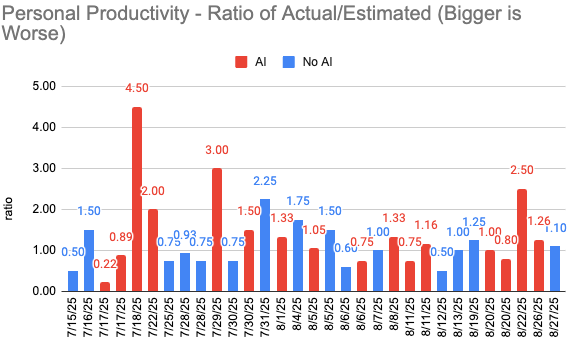
A big promise behind AI coding tools is that they will make you more productive. You will be able to code like a half-human-half-machine, leaving all full humans behind to dream of your skills. Developer Mike Judge was skeptical, so he measured his own productivity and found “that the data isn’t statistically significant at any meaningful level.”
Tags: development, Mike Judge, productivity
James.galbraithinsanity
According to the Department of Homeland Security, simply videotaping raids conducted by Immigration and Customs Enforcement agents is violence, and it’s doxing, and prosecutable. Also according to the DHS, ICE agents don’t need to fill out any paperwork about who they are targeting.
Additionally, according to DHS, elected officials need to provide prior notice to be allowed into ICE facilities to perform their congressionally mandated oversight duties, despite a law saying they need to do no such thing.

Taken together, it’s clear that DHS wants no record of ICE’s actions. And hey, redefining “violence” to include “recording ICE agents” helps Homeland Security Secretary Kristi Noem throw around comically large numbers. She’s now insisting that “our brave ICE law enforcement are now facing a 1000% increase in assaults against them as they risk their lives to arrest the worst of the worst criminal illegal aliens.”
Examples of those terrifying assaults? According to a DHS spokesperson, someone dumped trash on an ICE agent’s lawn, and someone made a sign with a profanity directed at a specific ICE agent by name. The horror.
Somehow, those brave ICE agents are getting past the terror of mean signs, still managing to band together in roving patrols to do masked jumpouts at Home Depots and car washes based on nothing but race, just to hit deportation numbers. They’re not arresting the worst of the worst criminal illegal aliens.
Unlike a lot of the administration’s actions, no Supreme Court case says that videotaping law enforcement officers is protected by the First Amendment. That’s not because the Supreme Court has ruled otherwise, but because they’ve never addressed it at all. However, there are numerous state court cases and statutes protecting the right to record law enforcement. Back in 2020, the ACLU secured a huge settlement in a lawsuit against DHS over the right to photograph and record vehicles idling at the southern border.
The settlement prohibits U.S. government officials from interfering with people’s efforts to record at any “publicly accessible area at any land port of entry in the United States.” It also prohibits the government from requiring people to obtain any sort of prior authorization to record law enforcement at the border. Though the lawsuit was brought in California, the settlement covers all land ports of entry into the United States. So, the DHS knows full well that the right to record law enforcement agents, at least at the border, is protected by law. They just don’t care.
ICE agents have also been freed from the tyranny of filling out paperwork about the immigrants they are targeting for arrest. ICE agents used to be required to identify the specific person they wanted to arrest, provide detailed information such as known addresses, employment, and criminal history, and get a supervisor’s approval.
No more, says DHS, which was probably necessary given that ICE arrests are now mostly of the “jump out and surround a random someone and drag them to the ground” variety instead. Or, as a former ICE official put it, “It’s hard to fill out a worksheet that just says, ‘Meet in the Home Depot parking lot.’”

Paperwork is also difficult to fill out in advance when DHS policy, according to “border czar” Tom Homan, says that it is perfectly fine for ICE agents to stop whoever they’d like, based on nothing but their physical appearance. Homan says federal agents don’t need any probable cause to detain whoever they’d like, no pesky advance paperwork or approval required.
And let’s not forget that DHS is also blocking members of Congress from accessing ICE facilities to perform their oversight duties. Now, elected officials must get prior approval despite a law that literally says they do not need prior approval to access ICE detention facilities.
Unsurprisingly, complaining about this will do no good. The DHS shut down its oversight office, freezing the processing of over 500 civil rights complaints in the process. So, good luck getting anyone to pay attention to any claims that ICE agents are violating the civil rights of immigrants.
No recordings, no paperwork, no oversight. DHS is systematically eliminating every way we have to keep tabs on law enforcement to ensure that Trump’s immigration crackdown, no matter how illegal or violent, can’t be stopped.
James.galbraithAnd still no appletv update
CUPERTINO, Calif.—If you’re buying one of the new iPhones or the other hardware that Apple announced today, your new devices will ship with Apple’s latest operating system updates already installed. But if you’re not looking to spend a bunch of money on Apple’s latest and greatest, the new updates will land on Apple’s other supported devices on September 15.
Apple is shifting to a year-based numbering system starting this year, wiping away the previous grab bag of all-over-the-place version numbers. No corner of Apple’s ecosystem is going untouched: we’re getting iOS 26, iPadOS 26, macOS 26 Tahoe, watchOS 26, tvOS 26, visionOS 26, and even version 26 of whatever Apple is calling the HomePod’s software these days, all on the same day.
The headliner across all of the updates is Apple’s new “Liquid Glass” UI overhaul, which adds glass-inspired transparency and translucency and bouncy animations throughout all of Apple’s software. Inspired in part by the way that UI elements in visionOS float over top of your real-world surroundings, Liquid Glass is Apple’s most comprehensive UI overhaul since the release of iOS 7 back in 2013.
James.galbraithWell shit
Read more of this story at Slashdot.
James.galbraithAppalling and unsurprising
The now familiar 6-3 lineup at the United States Supreme Court just threw out decades of settled law so that President Donald Trump’s roving bands of masked federal agents in Los Angeles can engage in a little light racial profiling, as a treat, and can continue scooping up people based on nothing more than looking Latino, speaking Spanish, and working at a low-wage job like a car wash.
You know the drill. A lower-court judge wrote a detailed, thoughtful, lengthy opinion about how this practice was 100% racial profiling and ordered the government to stop doing it. The Trump administration ran to the Supreme Court to say that the world would crumble if they couldn’t racially profile brown people in Los Angeles right away, and the Supreme Court obliged by staying the lower court’s order. That stay prevents the lower court’s order from going into effect, so federal agents can continue this straight-up racist, unconstitutional behavior.

These detentions and arrests aren’t based on the agent having a particular reason to believe the specific person they are detaining is an undocumented immigrant. Instead, they are arguing they can detain anyone who fits their conception of an undocumented immigrant—basically, lower-income brown people who work difficult, menial jobs.
That’s the opposite of what the federal regulations say they are allowed to do. Immigration officers can only detain someone for questioning if they have “a reasonable suspicion, based on specific articulable facts, that the person being questioned is, or is attempting to be, engaged in an offense against the United States or is an alien illegally in the United States[.]”
Does arresting or detaining people for no reason at all violate the Fourth Amendment’s requirement that probable cause is required to search or seize someone? It sure does! If a police officer wants to stop someone on the street and search them, they have to have a level of reasonable suspicion about that particular person, such as believing they are armed and about to commit a crime. Law enforcement officers have to be able to justify stopping specific people based on specific concerns rather than being able to stop whole groups of people based on shared characteristics.
The Supreme Court even addressed this in the immigration context some 50 years ago in U.S. v. Brignoni-Ponce. There, the government asserted that Border Patrol agents could stop any car near the border if the driver appeared Mexican, because undocumented immigrants travel in vehicles driven by Mexican individuals. The Supreme Court rejected this, saying that it would scoop up legitimate traffic as well and didn’t show any particularized suspicion that a particular vehicle was carrying undocumented immigrants.
Related | These Supreme Court justices want you to just shut up already
But that’s essentially what federal agents in Los Angeles are doing, and the conservatives love it, apparently. Not that you’d know, because the stay was unsigned and has no explanation as to why the conservative majority thinks it is no big deal to arrest people because they have the wrong skin color. It’s just another shadow docket ruling that allows Trump to do whatever he wants.
Justice Sonia Sotomayor pulled no punches, even refusing to engage in the faux-civility of the tradition of saying “I respectfully dissent.” Nope, here it is just “I dissent.” While that may seem like a nerdy, legalistic, tiny thing to focus on, in the context of how the justices communicate with one another through their opinions, it’s Sotomayor saying the actions and reasoning—or lack thereof—of her colleagues are not worthy of respect.

And they’re not. The conservatives are letting Trump’s masked brownshirts occupy a major American city and send roving masked men with guns to jump out of vehicles and tackle day laborers at Home Depot. They are letting those roving patrols violently surround and attack a tamale vendor for being a tamale vendor, never asking any questions about his immigration status. They are letting ICE show up at car washes and arresting only Hispanic-appearing people, while not even questioning white immigrants.
In a time when Supreme Court decisions have been almost universally bleak, this is one of the bleakest. Federal agents in Los Angeles are engaged in racial profiling and racialized violence. ICE agents are terrorizing the city, and people are afraid to go outside, go to work, or go anywhere that they might be arrested and detained for no reason save for the color of their skin. It’s one of the most un-American things imaginable and the kind of thing the Supreme Court is supposed to step in and stop.
Instead, the court’s six conservatives declared that Trump’s desire to engage in the most xenophobic violent racism imaginable, to wreak havoc on an American city because it doesn’t have a sufficient number of white people, is so important that he cannot be stopped, even for a moment, while litigation plays out. Without any explanation, the court’s six conservatives signaled just how much they support those efforts. It sure does not feel great to see the protections of the Fourth Amendment dismantled with nary a word.
James.galbraithThis hurts my soul lol

Hovertext:
Later a foot comes along wearing Jackboots and they have to decide whether to unite or get drowned.
James.galbraithNo shit

The Trump administration formally asked the Supreme Court on Wednesday evening to decide whether President Donald Trump’s ever-shifting tariff policy is lawful. Two federal courts, and a total of 10 federal judges, have all concluded that it is not.
The remarkable thing about Trump’s petition asking the justices to take up this case, which is known as Trump v. V.O.S. Selections, it that it opens with a long list of factual claims that, if taken seriously by the Court, would compel the justices to strike down the tariffs. But that would assume the Republican-controlled Supreme Court applies the same limits on executive power to Trump that it imposed on Democratic President Joe Biden — a highly uncertain proposition.
During the Biden administration, the Republican justices relied on something called the “major questions doctrine” to strike down several of Biden’s policies. The Court’s Republicans only recently invented this doctrine. It has no basis in law, and it has only ever been used against one president in history: Joe Biden.
That said, the Court did preview the doctrine in an Obama-era decision that applied it to a hypothetical regulation. In that case, Utility Air Regulatory Group v. EPA (2014), the Republican justices announced that “we expect Congress to speak clearly if it wishes to assign to an agency decisions of vast ‘economic and political significance.’” The idea was that, even if a federal law can be read to permit the executive to enact a particular policy, courts should read those laws narrowly if the policy is too ambitious.
Indeed, under Biden, the Court even used this recently made-up doctrine to strike down policies that are unambiguously authorized by federal law. In Biden v. Nebraska (2023), the Republican justices struck down the Biden administration’s attempt to cancel many student loans. But federal law could not possibly have been clearer that the executive is permitted to cancel these loans.
The relevant statute gave the education secretary broad authority to “waive or modify any statutory or regulatory provision applicable to the student financial assistance programs” during a national emergency such as the COVID-19 pandemic. The secretary could use this power, moreover, “notwithstanding any other provision of law, unless enacted with specific reference to” the statute authorizing him to cancel loans.
Nevertheless, the Republican justices overrode this statute, pointing to the loan cancellation plan’s high price tag of “between $469 billion and $519 billion.” The “economic and political significance” of such a plan, they concluded, “is staggering by any measure.” And thus the program must be canceled.
Which brings us back to Trump’s petition asking the justices to hear the tariffs case. That petition describes the tariffs as Trump’s “most significant economic and foreign-policy initiative.” It claims that the tariff is necessary to close US trade deficits of “$1.2 trillion per year.” It alleges that the tariffs have given Trump leverage to extract multi-trillion-dollar concessions from foreign nations. And it also claims that the increased taxes Trump has unilaterally imposed on imports — taxes that will largely be paid by the American consumer — “will reduce federal deficits by $4 trillion in the coming years.”
Trump, in other words, claims that the economic significance of these tariffs is an order of magnitude greater than the significance of the student loan program at issue in Nebraska — the one the Republican justices said they must strike down because its significance is “staggering by any measure.”
To be sure, it’s never a good idea for a court to base its decisions on factual claims made by this particular administration. But independent analysis confirms that the economic and political significance of the tariffs is at least as “staggering” as the significance of Biden’s student loan program. An August analysis of the tariffs by Yale’s Budget Lab, for example, concluded that Trump’s tariffs will cost the average American household $2,400 in 2025, and that the tariffs will raise $2.7 trillion in taxes over a 10-year window.
It would seem, then, that a straightforward application of the major questions doctrine compels this Court to invalidate Trump’s tariffs. But Justice Brett Kavanaugh already appears to be looking for a way to bail out Trump. Concurring in FCC v. Consumers’ Research (2025), Kavanaugh suggested that this newly invented doctrine does not apply to “foreign policy contexts.”
Trump’s petition also suggests other ways the Court could exempt him from the doctrine, including a claim that the doctrine doesn’t apply when the president personally authorizes a federal policy, instead of promulgating that policy through a federal agency.
Are these arguments persuasive? The truth is that there’s no such thing as a persuasive argument involving the major questions doctrine, because the whole thing is a figment of the Republican justices’ imagination. The Court has never published a majority opinion claiming that this doctrine can be found in any provision of the Constitution, or in any federal statute. And while some individual justices have offered their own explanations of where this recently invented doctrine comes from, those explanations range from silly to ridiculous.
Concurring in Nebraska, for example, Justice Amy Coney Barrett claimed that the doctrine is implicit in a parable about a babysitter.
Asking whether the doctrine applies to foreign policy decisions, in other words, is a bit like asking your daughter whether her imaginary friend likes fried chicken. The answer is whatever your daughter wants it to be.
As Justice Clarence Thomas wrote in a concurring opinion earlier this year, “judge-made doctrines can be difficult for courts to apply” because those courts “lack an underlying legal authority on which to ground their analysis.” If the major questions doctrine derived from a constitutional provision, then the justices could read that provision to determine if it contains a foreign policy exception. If it derived from a statute, they could refer to the statute.
But, because the major questions doctrine is simply something that the Republican justices made up, there is no principled way to determine if it conveniently contains an exception that just happens to rescue a Republican president’s “most significant economic and foreign-policy initiative” from invalidation.
That said, courts are supposed to apply the same rules to Democratic presidents that they apply to Republicans. If the Republican justices actually buy Trump’s claim that he is exempt, that will leave little doubt that these justices are simply playing Calvinball — creating one set of rules to spite Democrats, and a different, far more favorable set of rules for Republicans.
James.galbraithFuck Oklahoma
Sen. Markwayne Mullin of Oklahoma appeared on CNN Thursday to do the dirty work of defending the Trump administration’s anti-vaccine agenda—specifically, its push to relitigate the long-debunked claim linking vaccines to autism. Mullin’s appearance came just hours after Health and Human Services Secretary Robert F. Kennedy Jr. embarrassed the administration during a Senate committee hearing.
Related | Watch RFK Jr. lose it when senator calls him out for 'making things up’
“I'm saying why wouldn't we look at it? What's changed?” Mullin said in defense of Kennedy’s bogus investigation into the causes of autism.
“But why are you looking at vaccines?” host Kasie Hunt asked.
“I'm not,” Mullin insisted. “I'm saying why wouldn't we look at it? What's changed? What we do is–”
“--We have looked at it, and that has been studied,” Hunt interjected. “The studies showed there was no connection between the MMR vaccine and autism.”
But that didn’t stop Mullin from acting like a vaccinology expert.
“Well there's different, there's different than—there's different ingredients than just one or two things inside vaccinations,” Mullin blathered. “There's several things that go into every vaccine and look at how many shots we're giving our kids,” he replied lamely.
Mullin, whose only expertise is in being an aggro dumbass, either does not understand or is willfully ignoring the myriad studies done on the measles, mumps, and rubella vaccine over the past couple of decades. Those studies, covering hundreds of millions of vaccinated individuals, have consistently shown zero evidence of a link between the MMR vaccine and autism, regardless of the number of shots or whatever “different ingredients” Mullin is vaguely jabbering about.
Related | Activists are pissed about RFK Jr.’s ‘offensive’ war on autism
The Republican senator’s performance perfectly encapsulates today’s GOP strategy: sidestep or ignore evidence, undermine public health, and muddy the waters with misinformation. In this case, that sick strategy is endangering children’s health.
James.galbraithBullshit. More preemptive compliance to the red-hatted fascists.
The start of the COVID-19 pandemic is now five years in the rearview mirror, but its effects continue to reverberate. While those leading the US healthcare system have embraced conspiracy theories and junk science to justify a reduced focus on vaccines (particularly the COVID jab) many people are still seeking out immunization. Google Maps isn't a good way to find it, though. In recent days, almost all search results for COVID vaccines have vanished from Google Maps.
In both the mobile app and website, Google Maps returns zero results for terms like "COVID vaccine" and simply "vaccines." We've tested and confirmed this in multiple US regions, as well as internationally. In some places, these searches will return no local results but may include links to facilities hundreds of miles away. Meanwhile, searches for less-contentious injections like "flu vaccine" and "shingles vaccine" continue to get local results. Bing Maps, Apple Maps, and other Google alternatives have no issue showing COVID vaccine providers.
The Food and Drug Administration under Robert F. Kennedy Jr. recently approved the updated COVID shot, but the agency only recommends it for those with underlying health conditions and people over age 65. That makes boosters harder for many Americans to get—and the first step is often finding a nearby provider of immunization. For at least the last week, Google Maps has returned no results for those vaccine-related queries.
James.galbraithWhen in doubt, they go for raw bigotry.
Virginia gubernatorial candidate Winsome Earle-Sears, a Republican and the state’s current lieutenant governor, released a new ad Tuesday attacking her Democratic opponent Rep. Abigail Spanberger for asserting that the LGBTQ+ community deserves human rights.
The entire ad focuses on Spanberger’s past support for transgender rights and falsely accuses the Democrat of wanting men—including sex offenders—to use women’s bathrooms. The ad goes on to quote Spanberger saying that “our LGBTQ neighbors have the same legal rights as anyone else,” casting the statement as part of the left’s “insane” belief system.

But Spanberger’s statement is a bedrock foundation of U.S. law and tradition.
The Declaration of Independence clearly notes in its preamble that “all men are created equal, that they are endowed by their Creator with certain unalienable Rights, that among these are Life, Liberty and the pursuit of Happiness.”
Similarly, the 14th Amendment to the Constitution states, “No state shall make or enforce any law which shall abridge the privileges or immunities of citizens of the United States; nor shall any state deprive any person of life, liberty, or property, without due process of law; nor deny to any person within its jurisdiction the equal protection of the laws.”
To follow Earle-Sears line of argument would involve stripping rights away from millions of Americans, echoing the belief system of groups like the Ku Klux Klan or the Nazis, who did not believe in equality.
The ad ends with the tagline, “Spanberger is for they/them not us.”
This is the same construction used in 2024 ads by President Donald Trump attacking Kamala Harris for supporting LGBTQ+ rights, accusing her of being “for they/them while President Trump is for you.”
Earle-Sears’ ad, along with Trump’s, is part of an ongoing right-wing trend of attacking the basic humanity of LGBTQ+ people. These attacks are meant to whip up support among conservative voters who oppose equality, leading to Republican electoral wins.
For her part, Spanberger recently released an ad highlighting how Earle-Sears has “been in lockstep” with Trump. Virginia is one of the few swing states that Trump lost in the 2024 election to Harris.
At every turn, Winsome Earle-Sears has been in lockstep with Donald Trump — even as it hurts Virginians.
— Abigail Spanberger (@abigailspanberger.com) 2025-09-02T13:02:55.725Z
In her ad, Spanberger notes the negative effect that Trump’s cuts to the federal workforce have had on Virginia, where federal workers compose much of the population.
Republicans currently hold the governorship in Virginia, but Spanberger has led in recent polling. And election forecaster Larry Sabato recently shifted the state from “lean Democratic” to “likely Democratic,” perhaps highlighting why Earle-Sears felt desperate enough to release her bigoted ad.
James.galbraithNo surprise there
Incompetent quack and Health and Human Services Secretary Robert F. Kennedy Jr. said Thursday that data on Mifepristone—a drug used in the majority of medication abortions—was "twisted" to make it seem safer than it is, a clear sign that he is laying the groundwork to limit access.
"We're getting data in all the time, new data that we're reviewing, and we know that during the Biden administration they actually twisted the data to bury one of the safety signals," Kennedy said, referring to the timing of the results for an FDA review he ordered on the drug.
Kennedy made the comment during a Senate Finance Committee hearing, where he repeatedly lied about vaccine safety to try to defend his anti-vaccine agenda—which is putting Americans' health at risk.
Banning Mifepristone is a key goal of Project 2025, the right-wing roadmap for President Donald Trump's second term. The Trump administration has already adopted other Project 2025 goals, including slashing research funding to the National Institutes of Health, gutting Medicaid, and slashing foreign aid to curb the spread of disease.
Limiting access to Mifepristone would be another win for Project 2025—and absolutely devastating for abortion access.
Medication abortions account for more than two-thirds of abortions nationwide, with the most common regiment being the combined use of Mifepristone and Misoprostol, according to KFF.

The Biden administration made it easier to access the two-drug medication abortion in 2021 by no longer requiring patients to attend in-person appointments to acquire them.
If Kennedy uses fake data to eliminate that requirement, it would make it harder for millions of people to access medication abortion at already overburdened abortion providers, which are seeing influxes of patients from states where abortion is now illegal.
Meanwhile, anti-abortion groups are already celebrating Kennedy’s comment.
The American Association of Pro-Life OBGYNs—whose membership list is a great resource to find doctors you should avoid—cheered Kennedy’s comment.
“[GOP Sen. James Lankford of Oklahoma] j asked HHS Secretary Kennedy a key question about dangerous abortion drug mifepristone and the FDA's responsibility to review new information about its safety,” the group wrote on X. “Sec Kennedy responded that the nearly 11% serious complication rate is a safety signal that deserves review.”
The group then went on to cite a “new report” about made-up infections associated with medication abortions.
“AAPLOG's new report on the risk of deadly infections with mifepristone is another serious safety signal. We urge the FDA to immediately reinstate crucial safety restrictions on mifepristone while they conduct a thorough review of the dangers of this drug,” it said.”
It’s only a matter of time before legal abortion access gets even worse—if not eradicated altogether.
James.galbraithhuh this should be interesting
Read more of this story at Slashdot.
James.galbraithSo...nothing.
Read more of this story at Slashdot.
James.galbraithsweet
Robots can serve pizza, crawl over alien planets, swim like octopuses and jellyfish, cosplay as humans, and even perform surgery. But can they walk on water?
Rhagobot isn’t exactly the first thing that comes to mind at the mention of a robot. Inspired by Rhagovelia water striders, semiaquatic insects also known as ripple bugs, these tiny bots can glide across rushing streams because of the robotization of an evolutionary adaptation.
Rhagovelia (as opposed to other species of water striders) have fan-like appendages toward the ends of their middle legs that passively open and close depending on how the water beneath them is moving. This is why they appear to glide effortlessly across the water’s surface. Biologist Victor Ortega-Jimenez of the University of California, Berkeley, was intrigued by how such tiny insects can accelerate and pull off rapid turns and other maneuvers, almost as if they are flying across a liquid surface.
James.galbraithjesus
Read more of this story at Slashdot.
James.galbraithyup
A cartoon by Mike Luckovich.
Related | Republican has infuriating response to Minneapolis shooting
James.galbraithHave fun
President Donald Trump rode into office preaching that he’d bring prices down “on Day 1,” yet his policies have almost comically worked to do the exact opposite. Now he’s set to deliver the most obnoxious and visible price hike to Americans—and in particular, his core base.
For nearly a century, the de minimis rule has allowed goods valued at $800 or less to enter the United States duty-free. It was designed to streamline trade-in low-value items, spare consumers from customs paperwork, and keep the mail moving. About 1.4 billion packages came into the country under this exemption last year. Starting Friday, that loophole vanishes.
Those lower-cost goods—once waved through without fuss—now carry a crushing new burden.
The numbers are dramatic—subject to a 10-50% tariff depending on origin or a flat fee of $80, $160, or $200 per package. Letters or gifts under $100 are still safe—for now—but everything else from trinkets to T-shirts to cookware is about to cost a lot more, take longer to arrive, or vanish altogether from availability.

Just think about all the stuff you buy on Amazon without ever checking the country of origin.
A FlavorCloud analysis found that $30 cotton slippers from China will now cost $45, a $37 nutritional supplement from Canada will cost $60, and a Japanese chef’s knife formerly priced at $240 will now cost just shy of $300. And if that wasn’t bad enough, returns will now be subject to a second round of tariffs, making them expensive and likely impractical.
The first MAGA rumblings about this surfaced back in April. We all had a good laugh at the Trump voter who was outraged that her $100 shipment of cheap SHEIN crap had a $42 tariff slapped on it.
“Before anyone wants to add their blame Trump for everything bs and say that’s what you get for voting for Donald J. Trump I know what Trump said he said the tariffs would be on China New Mexico and Canada not on American citizens,” she said.
Some people might willfully retain their blinders, but there’s going to be a lot more blaming Trump for everything. And given how much he’s bragged about tariffs being his go-to solution for everything he thinks ails the United States, not even his deepest sycophants will be able to shift away blame.
Remember, Trump was the first Republican to win low-wage earners, while Democrats easily won those who make more than $100,000 per year. Young voters, not knowing any better, also voted for Trump in distressingly large numbers. But who are the two groups most impacted by the elimination of the de minimis exemption? These two, of course—driving a stake deep into the heart of Trump’s job approval ratings, which have already been steadily falling. If there’s one thing voters hate more than higher prices … actually, there’s nothing they hate more.
Postal systems from Germany, France, Mexico, India, Thailand, South Korea, Singapore, New Zealand, Japan, and Australia have already paused or limited U.S. shipments while scrambling to figure out duty collection. What used to be a swift package delivered in days will now be stuck in limbo—delayed, redirected to costlier private couriers, and tagged with extra hidden fees that hit consumers mid-delivery.
Even if the delivery logistics are worked out, consumers will now see a new line item on any potential purchase, labelled “tariff,” that will serve as a constant reminder of Trump’s new tax on their purchases—if they can even afford to place orders in the first place.
And remember, this is just one sliver of the tariff pie, as U.S. consumers and businesses face steep cost hikes on everything else coming from overseas, including the raw materials that even “made in America” products require.
Voters were too stupid to understand what they were voting for as Trump nonsensically promised pain-free tariffs paid by other countries. Now, their education begins.
James.galbraithThey "give in" to MAGA bigotry because it's their bigotry too. They're more than happy.
In another step to appease MAGA, restaurant chain Cracker Barrel has ditched its webpage boasting its support for the LGBTQ+ community.
"In connection with the Company’s brand work, we have recently made updates to the Cracker Barrel website, including adding new content and removing of out-of-date content,” the company said in a statement to Fox News Thursday.
In other words, reporters caught wind that the southern food chain had quietly removed mention of their support for LGBTQ+ causes following major backlash from conservatives and President Donald Trump.
Now, instead of a webpage touting that it was “bringing the porch to Pride,” it redirects to a “Culture and Belonging” page, according to Fox Business.
And while the new page vaguely hints at an overall support of belonging for everyone, the page withholds any mention of the LGBTQ+ community.
For those needing a refresher, Cracker Barrel announced on Aug. 19 that it was modernizing its logo and removing the “Old Timer”—an old man leaning against a barrel—from the branding as a way to appeal to younger people.

And while businesses regularly redesign their logos, MAGA bizarrely turned this issue into a conspiracy of sorts.
Right-wingers labeled the chain’s rebrand as “woke” and started coming after Cracker Barrel’s past affiliation with Pride parades and anything to do with their archnemesis: diversity, equity, and inclusion.
Over the past week or so, MAGA influencers Charlie Kirk and Robby Starbuck riled their followers up about the chain restaurant logo, but it wasn’t until Trump nosed into the matter that the company quickly made changes.
“Cracker Barrel should go back to the old logo, admit a mistake based on customer response (the ultimate Poll), and manage the company better than ever before,” Trump wrote in a Truth Social post Tuesday.
Hours later, the food joint announced it would revert to its previous logo. According to a Trump administration staffer, a representative from Cracker Barrel called Trump to thank him for weighing in on the issue as well.
Ultimately, it all smells of doing what’s best for the company’s bottom line. But MAGA isn’t alone in pushing around companies. Retail giant Target saw its profits suffer after it abandoned DEI and Pride support. Business and branding decisions are increasingly political these days even if the company doesn’t outwardly intend for it to be that way.
Then again, when a handful of companies throw away their DEI programs the moment the country elects a president who opposes them, it’s safe to wonder if their good morals were always just about lining pockets to begin with.
James.galbraithGee, it's almost like their prayers didn't help. One might at some point have to consider the reality or effectiveness of what they were praying to.
A cartoon by Clay Jones.
Related | Republican has infuriating response to Minneapolis shooting
James.galbraithAmazing how much a country can do when a disease impacts straight people.

Botswana has been getting a lot of calls lately from across the African continent, prodding the nation — once “at risk of extinction” from HIV — to tell the world how they did the impossible: squash childhood HIV rates.
The number of children living with HIV has declined sharply everywhere, but nowhere more so than in Botswana, which has managed to slash its childhood infection rate by more than 98 percent since the 1990s.
At its peak, in what was one of the world’s worst outbreaks of HIV, one in eight infants were infected at birth. Mortality in young kids nearly doubled over a decade, with 3,000 children dying of AIDS each year. And 25,000 children — one in every classroom of 25 — had long-term symptoms of the virus, which without treatment, destroys the body’s immune system, turning even common infections deadly.
Now, new infections in kids are so exceedingly rare — at under 100 per year — that every infant diagnosed with HIV now prompts a comprehensive audit by the country’s public health officials.
It is a remarkable turnaround. While Botswana’s HIV rate is still the fourth-highest in the world — affecting up to a third of adults in some regions — the number of babies born with HIV today is virtually zero.
It took time to pay off, but Botswana has managed to build the most robust HIV prevention infrastructure in sub-Saharan Africa, particularly for pregnant women and children. Life-saving antiretroviral therapies — which can transform HIV into a manageable and largely untransmittable chronic condition — have been widely available for free in the country since 2002. The nation’s government launched a program to prevent mother-to-child transmissions in 1999, expanded its free coverage of maternal services over the years, and became one of the first countries to implement the World Health Organization’s Option B+ strategy in 2013, making a highly effective lifelong treatment regimen freely available to all pregnant and breastfeeding women living with HIV.
Thanks to those sustained public investments, Botswana became the first country in the world with a high HIV rate to achieve the World Health Organization’s Gold Tier status for eliminating mother-to-child or “vertical” transmissions as a public health threat earlier this year.
“Botswana shows you know what can happen when a country decides that no child should be born with HIV, and they actually mean it,” said Doris Macharia, president of the Elizabeth Glaser Pediatric AIDS Foundation, who began her career at the height of the HIV epidemic, working as a physician in her native Kenya and at a rural clinic in South Africa.
Even in the face of global aid cuts, which have stripped billions from highly effective HIV prevention programs, progress like Botswana’s proves that the hardest-hit countries are still moving forward.
“We’ve made phenomenal progress,” she said, “but we still have a long way to go.”
A young woman living in Botswana in 1997 had a one in four chance of contracting HIV. If she had three children in the years that followed, at least one of her babies would almost surely contract the virus during pregnancy or childbirth, or while breastfeeding.
But if her HIV-positive daughter, now a young woman, became pregnant today, her chance of transmitting the virus to her own children would be less than 1 percent — down from up to 40 percent three decades prior.
What changed?
For starters, antiretroviral therapies have gotten much better, cheaper, and infinitely more accessible than a few decades ago. About 98 percent of HIV-positive pregnant women in Botswana now access those medications, which can suppress the virus enough that it is virtually undetectable and by extension, largely untransmissible.
When babies are born with HIV today, it’s not because their mothers can’t access treatment, but because they didn’t know they had the virus to begin with.
“Not all countries are created equally, but all countries have an opportunity to step up and mobilize support — to move this needle for children and moms.”
Doris Macharia, president of the Elizabeth Glaser Pediatric AIDS Foundation
But in Botswana, 99.8 percent of pregnant women give birth in a hospital or clinic and 95 percent access the country’s free prenatal and maternal care services — up from 70 percent in 2001. This puts them on par with the United States and far ahead of neighbors like Zimbabwe. That makes it easy to routinely screen for HIV over the course of a pregnancy — and to immediately test any newborns at risk.
“There’s no mom who wants her child to be sick,” Macharia said. “There’s no mom who wants her child to die.”
Altogether, these interventions and policies have prevented about 59,000 children from being infected with HIV since Botswana enacted a nationwide campaign against vertical transmissions in 1999, according to estimates from UNAIDS, the United Nations partnership to fight HIV/AIDS. Globally, similar policies have prevented over 4 million childhood infections.
Macharia attributed Botswana’s success not only to effective interventions, but to political will: Its government recognized the severity of the crisis relatively early on, and then consistently funded its own interventions. President Festus Mogae made combating HIV a top priority of his administration when he took office at the height of the crisis in 1998. After taking office, he quickly launched the campaign against vertical transmissions in 1999, became the first head of state to publicly test himself for HIV in 2001, and established Africa’s first national antiretroviral treatment program in 2002.
“Not all countries are created equally,” Macharia said, “but all countries have an opportunity to step up and mobilize support — to move this needle for children and moms.”
So, how did the country pull it off? With its vast diamond reserves, Botswana is relatively wealthy — even despite recent downturns in the market. The country’s per capita income is closer to that of Mexico or Brazil than to many of its sub-Saharan neighbors, and it has the lowest corruption rate in Africa.
And while American global aid programs like the President’s Emergency Plan for AIDS Relief (PEPFAR) have been essential partners in its HIV response, the country pays its own way for about 70 percent of its HIV prevention programs, said Alankar Malviya, Botswana country director for UNAIDS. Other poorer countries in Africa, such as Nigeria, Mozambique, and Côte d’Ivoire, rely on foreign aid for 80 or 90 percent of such funding.
That’s made it harder for those nations to replicate Botswana’s cohesive national strategy — especially with today’s torrent of cuts.
“The pace at which the global funding landscape for HIV has changed in the last few months is unprecedented,” Malviya said. “You cannot prepare any country for having to go through such a radical change in funding, which meant putting a pause to ongoing programs overnight.”
A lot of countries were already on their way to building roadmaps to fund their own programs in the long run, he said, but “you cannot sustain a program overnight.”
In the meantime, many are looking to Botswana — the first country to pioneer a roadmap for sustainably financing HIV prevention— for help. The country’s public health officials have advised Kenya, Namibia, and Zimbabwe and other countries on how to sustain their progress and diversify their funding in the long term.
“We’ve done so much to get to where we are, and we have so little to go,” Macharia said. Though “the last mile is always the hardest,” she thinks an AIDS-free generation is still very much in sight: “We are very, very close. We are extremely close.”
James.galbraithyup
A cartoon by Jack Ohman.
Related | Trump commands Smithsonian to pipe down on 'how bad Slavery was'
James.galbraithinsanity
Transportation Secretary Sean Duffy hit up Fox News to promote the Department of Transportation’s takeover of Washington’s Union Station. First order of business? Disappearing homeless people.
“First off, DOT owns Union Station,” Duffy told Fox News. “We're going to take it back, and we're going to drive out the homelessness, we're going to drive out the crime.”
“And again, this is our capital city. It should be beautiful,” Duffy said, in what has become the administration’s stonehearted Trump-like syntax. “And the president wants a beautiful capital. I want a beautiful capital. And so, this plan is going to make Union Station represent the president's vision of what America can and should look like.”
Duffy, who moonlights as the interim NASA chief, announced that Transportation would take over the station from the nonprofit Union Station Redevelopment Corporation, its operator since 1983, during a Wednesday press conference.
Where the unhoused people displaced by Trump’s shock troops are meant to go remains unclear. Trump’s July 24 executive order, which promotes the widespread criminalization of homelessness, has raised fears of mass detentions.
Coupled with the GOP’s “Big Beautiful Bill,” which further marginalizes underserved and unhoused communities nationwide, the prospect of mass detentions under Trump’s emerging D.C. police state continues to increase.
James.galbraithso glad I switched to Libre Office at home. This is utter bullshit.
Read more of this story at Slashdot.
James.galbraithgood, any start on this would be helpful
Read more of this story at Slashdot.
James.galbraithIf this happened with any other company's products, it would be the end of them
OpenAI published a blog post on Tuesday titled "Helping people when they need it most" that addresses how its ChatGPT AI assistant handles mental health crises, following what the company calls "recent heartbreaking cases of people using ChatGPT in the midst of acute crises."
The post arrives after The New York Times reported on a lawsuit filed by Matt and Maria Raine, whose 16-year-old son Adam died by suicide in April after extensive interactions with ChatGPT, which Ars covered extensively in a previous post. According to the lawsuit, ChatGPT provided detailed instructions, romanticized suicide methods, and discouraged the teen from seeking help from his family while OpenAI's system tracked 377 messages flagged for self-harm content without intervening.
ChatGPT is a system of multiple models interacting as an application. In addition to a main AI model like GPT-4o or GPT-5 providing the bulk of the outputs, the application includes components that are typically invisible to the user, including a moderation layer (another AI model) or classifier that reads the text of the ongoing chat sessions. That layer detects potentially harmful outputs and can cut off the conversation if it veers into unhelpful territory.