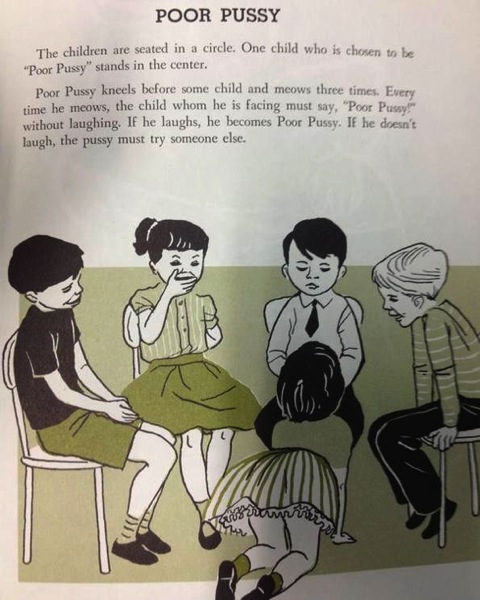
 There's not much right about this page from a mid-20th century kids' book. Besides the obvious creepiness, it looks like Alfred E Neuman on the left is trying to lift the skirt of the girl next to him.

    
|
There's not much right about this page from a mid-20th century kids' book. Besides the obvious creepiness, it looks like Alfred E Neuman on the left is trying to lift the skirt of the girl next to him.
|
|

The Rocket Frog Photoshop contest went about as well as we could have hoped. You all did right by Rocket Frog, the 21st century's most important icon. Here are the best of your submissions, as well as your winner.

|
|
 |
| "Fuck fake peeple that talk shit on FB" |

Via WaPo's Wonkblog comes the definitive guide to critiquing research findings that rub you the wrong way. And while this chart refers more specifically to studies on things like health and budget policy, it works surprisingly well for scientific studies, as well.

|
|
 What is it about eating Szechuan peppers that causes the lasting tingling or numbness in your mouth and lips after the burn has subsided? Sure, Capsaicin produces the burning sensation that delights hot sauce connoisseurs but there's another process at play with Szechuan peppers.
 New research shows that a molecule in the Szechuan pepper, Hydroxy-alpha-sanshool, excites a certain type of tactile sensor in our skin in a way that feels like the sensors have been vibrated very quickly. University College London researchers explored this strange phenomena by brushing volunteers' lips with both ground Szechuan peppers and later a vibrating metal tool to match the level of numbness caused by the pepper. By identifying the frequency of the numbing sensation, the scientists determined that the high-sensitivity Meissner receptors in the skin were the ones fired up by the Szechuan peppers.
"Why Szechuan Peppers Make Your Lips Go Numb" (Smithsonian)
|
|
Why can't women time travel? —asks Anna Smith in The Guardian, in a rather interesting op-ed piece on science fiction. While focusing mostly on movies, she's got a good point; women are seldom the protagonists of first-person time travel stories, especially in cinema. And while I can think of a number of exceptions in written fantasy and paranormal romance, I'm coming up with pocket-lint in genre SF.
Here's your explanation: time travel fiction—when time travel is the focus of the story, rather than a means to support a plot twist regarding the mechanism of temporal travel (for example, The Men Who Murdered Mohammed, A Sound of Thunder)—is a travelogue; or rather, a Grand Tour through the exotic foreign climes of the past.
Now, there's something significant to note about tourism. From its origins in the aforementioned grand tour to the present day, it's a ritual of the privileged. The sons of the landed gentry would take a post-Oxbridge trek through France and Italy and, later, Greece, visiting sites of classical antiquity, polishing their foreign language skills, and socializing with the aristocracy. It gave them a cultural education that was unavailable at home. But relatively few people did it; prior to the advent of the age of steam, sea and land travel was expensive, slow, and somewhat perilous. To accomplish a grand tour required resources: notably time and money.
Even in this age of cheap travel and hotels everywhere, tourism is the defining characteristic of the comfortably off, of the middle and upper classes of the developed world. To be a tourist one must have a sufficiency of income such that one can claw back some time from the daily grind of hand-to-mouth labor, and spend one's savings on the expenses of travel and accommodation. Tourism is a luxury. The poor, the unemployed, and refugees may travel, but they do so for survival's sake: the indulgence of pure curiosity is expensive. To be a tourist is also to exercise the tourist's gaze: to place onesself outside the context of the society in which one travels, to observe it as a stranger, and in turn to reduce these locations to a spectacle, be it for education or entertainment.
The time travel story is a tale of tourism in the classical sense: an activity of the privileged, making spectacle of the past (and, occasionally, the Wellsian future). And women make poor time travelers because in the foreign countries of the past they lack the agency conferred by privilege.
When one is reading fiction for escapism, to identify with a protagonist who undergoes interesting experiences and personal development through travel to exotic and unusual places, one often seeks to identify with the privileged: with individuals who are not immiserated by their experiences. (Usually. There are exceptions.) But by and large women lacked autonomy and independent agency in past times. They lived under the twin yokes of biological determinism and cultural oppression; in societies where 30-50% of newborns never made it to their fifth birthday, where between 5% and 10% of pregnancies ended in maternal death, and where access to contraception was questionable at best: and in societies dominated by patriarchal hierarchies. Most women historically lived as second-class citizens, at best. Furthermore, laws reflected this, as did social norms. To put things in perspective: the legal rights of an Englishwoman of 1882 bear a closer equivalence to those of an Iranian woman in 1982 than most of us are comfortable thinking about. And how many western women of today would be comfortable vacationing in contemporary Iran?
This is not to suggest that the situation of women in the developed world today is perfect, or even acceptable. (Rape culture and discrimination and the systematic subordination of women remain rife: we've got a long way to go.) But there's a difference between what those of us in North America or Europe take for granted today, and cultures where rape is normalized through lack of sanctions (legal or social), or sexual harassment of strange women is considered unremarkable. And those are happening today: historically systematic enslavement for prostitution was institutionalized in some cultures. The unpalatable fact is that if you're a woman of today, most of our history is a Crap-Sack World dystopia, with added state (and church) decreed repression, a ubiquitous threat of sexual violence, and reproductive slavery on top.
Time travel tourist yarns that describe the depths of our historical depravity have to deal with the essential problem that their settings can be no less sexist than our past. And there are time travel novels about women that tackle this problem head-on, but they tend to make for grim reading. Because unless a woman was born into the upper 0.1% of the population, her life was pretty dystopian by modern standards: and even then it wasn't necessarily great. (Consider a semi-random example: Faustina the Younger. It's hard to get much more elite than the Empress of Rome, with effectively unlimited wealth and a loyal husband of 30 years who clearly mourned her passing. Even so: she died before her 50th birthday, exhausted after bearing 13 babies, only 6 of whom made it past their tenth—life was hard.)
Anyway, back to my thesis:
A young and intrepid male time traveler might experience a tour of the Great Times as an educational adventure; an equally young and intrepid female time traveler could count herself lucky if she merely ended up in a Magdalene Laundry. (There were plenty of worse places to land, horrifying though this might seem.)
For a female protagonist to successfully enjoy time travel as a form of tourism implies either that she has defensive resources that render her invulnerable to the depredations of the locals (a Culture knife missile up her sleeve should do the trick), or that she has acquired a privilege power-up—probably by way of cross-dressing, which shows up depressingly often as a get-out-of-time-jail-free card. (It's so common in the literature, in fact, that it's somewhere between a cliche and a full-blown sub-genre convention.) But in neither of these circumstances is she able to engage with the alien society from within: She remains an outsider. Her privilege delivers alienation, not engagement. There are rare exceptions—you can all stop yelling "Doomsday Book!" at me on twitter—but exceptions don't invalidate a general trend.
Lord Byron (the uber-tourist) might have joined his romantic Greek rebels in rising against the Turkish empire; Marty McFly might have taken to the stage for a high school hop and introduced the audience to rock'n'roll a decade too early: but Peggy-Sue Got Married because that's the only option that was available to her, because the time-tourism sub-genre is inherently sexist. I rest my case.
In the latest development from Dennis Rodman's puzzling visits to North Korea, the retired NBA athlete has accepted a coaching position for the notorious hermit kingdom's Olympic basketball team. In recent years, the American Hall of Fame sportsman has made several high profile visits to the country after having befriended the deceased supreme leader Kim Jong-il prior to his death. During last sunday's press conference that was held to discuss his most recent trip to North Korea, Rodman revealed that the country's current leader Kim Jong-un has a daughter named "Ju-ae" and praised him as "a good dad," while floating out the idea of mediating a friendly basketball game between North Koreans and his fellow legendary stars of the 1990s.
Submitted by: Unknown (via TIME)


It's been a rough week. From high school kids allegedly committing broomstick rape, to Tommy Morrison's death, to Lamar Odom's struggles, it's tough to find anything positive in the world of sports. We searched high and low, though, to bring you these six GIFs that will restore your faith in humanity.

|
|
Professor C. Bodin, newly released in LEGO's 11th series of Minifigures, is the first woman Scientist LEGO has produced. A definite step in the right direction, however, LEGO still has some catching up to do as male minifigs outnumber their female counterparts 4-to-1.
Submitted by: Unknown (via Lego's Minifigures)
Zackc43The Baphomet is cool, but they also have a Wu-Tang sweater.

 Shredders offers delightful intarsia sweaters with ironic, crass, and fun designs. You might think I'd be all about the Sasquatch Knit Bigfoot sweater but I prefer the Satanic Knit Baphomet design!
|
|
Every NFL starting QB as their team name: The Eli Manning/Giant combination might be the best. [KSK]

|
|

Tonopah Valley (Ariz.) played a fun little trick on its QB. At the snap, they all hit the deck. The only thing that would have made it funner is if the pass rushers kept coming.

|
|
There's plenty of science fiction that looks like people involved with it were tipsy or impaired — but this might be the first space action movie that was written, directed and acted by drunk people. Star Drunk, people: the movie that is its own drinking game.

|
|
Would Martin Luther King, Jr. approve of Obamacare? http://t.co/euS0Odg8gb #DreamDay #MarchonWashington
— Jim DeMint (@JimDeMint) August 28, 2013
Conservatives will attempt to claim MLK as one of their own, and they will write worthless bullshit to try to colonize King. For example, here's Jonah Goldberg: "King pleaded for the fulfillment of America's classically liberal revolution. At the core of that revolution was the concept of negative liberty -- being free from government-imposed oppression." Oh, so that's why King wanted the federal government to pass civil rights legislation that the federal government could enforce.
Luckily for you, the Rude Pundit has never forgotten just how bad-ass Martin Luther King actually was, and he has written over the years about how King would fuck up conservatives' shit. Now, as a handy guide when you scream at Glenn Beck or Sean Hannity on the radio today, here's links to all of those posts in one place, all filled with King's words:
1. Martin Luther King was against prayer in school and thought that Christianity meant that you had to help the poor.
2. Martin Luther King thought America's use of military power was immoral and that protesters loved their country.
3. This is not to mention that Martin Luther King thought that money spent on useless wars would be better spent on anti-poverty programs.
4. Unlike today's Democrats, Martin Luther King believed that radical activism, even at the risk of arrest, was more important than moderation and compromise. Principle over popularity.
5. Martin Luther King believed that a janitor was as important as a doctor and that the government had the duty to ensure that the janitor was taken care of as well as the doctor was, including a guaranteed wage, health care, and more.
6. Martin Luther King believed that the rich needed to pay their fair share to help lift people out of poverty. They should, you know, spread the wealth, especially through taxation.
7. And, after a change of heart, Martin Luther King did not believe in owning a gun.

An amusing science meme, courtesy my friend Andrew Balfour.

|
|
Guide, like most new technologies, began in a billionaire’s dream of reason. The PR-generated story of Guide’s origin posited it as a passion project of Metra’s cofounder and longtime CEO. Its aim was simple, universal: help people act more rationally.
And, like most complex tools, Guide’s producers were the most ruthless pursuers of its reality. Metra and its founders cannot claim genesis of the idea: for years, hobbyists, hackers, grinders, and entrepreneurs made minor steps toward building a functional prototype. But their movement to realize this technology was slowed, and eventually stopped, by a widespread lack of time, material resources, and money.
By now, Metra, riding a fve year stock market high, was autonomous—its name intractably used as a verb in every networked household—and unassailed by competitors. Coming as a surprise in the last days of August, Guide was announced to the public.
Initially presented in the form of a shirt-button sized earpiece connected to a four millimeter wide curved idaprene piece that subtly curved at your temple to angle its projections in front of your right eye, Guide ignited the internet’s technological fetishists and neomaniacal consumers. Within two days, roughly three and a half million people signed up for Guide’s beta run.
Guide’s first and only advertisement showed its users—in order of increasing rationality and in convincingly shot POVs—opting out of a mail order catalog, finding a better deal on car insurance, turning down dessert, correcting an underestimation of a project’s budget and duration, opting not to sell Metra stock, corroborating a statistical inference of a drug’s side effects, drunkenly handing over car keys to a receptive bartender, and, mid-argument, apologizing to a blandly gorgeous wife, ending our collective and conservatively rendered argument. The video’s coda: the handsome male user, now revealed, backlit, and Guide equipped, hands his wife a bouquet of seasonal flowers.
The beta began. Early users—tech pundits, journalists, celebrities—used Guide mostly to adhere to their diets, avoid conflict with their signifcant others, and save money on goods and services. A handful of early testers tried to break it, toying with its software’s operative logic—modifying what they dubbed its “concentric circles of virtue”—but these users were promptly served cease and desist letters. Those who weren’t quietly and successfully litigated, that is.
Metra, convinced of Guide’s market potential, began selling units for ¥1800, or around USD$4600, on September 2nd, precisely one year after its first day of public adoption.
At first, you could feel them around you. After the units got refashioned to match the dominant new tech aesthetic, holy in their newfound invisibility, you couldn’t really tell who was using. But you could sense it—you could see the quick glaze in their smiles, the tiny flicker of the idaprene projection in their contracting right pupil—could feel the split second pause when they reached for their next cold beer. Us homebrew grinders were tuned to this shit. It got to be a game. Spot a goodie, get your next round bought. See who can tip their circles the fastest. Easier for us girls, but you know: that sort of thing.
But then Metra and the goodies got quiet. Tech silence, an impossible bird those days. Naturally, I was curious on the silence, on Metra’s no new OS updates, product improvements, use guides. But then it started to make sense: they were shutting themselves up because of the force of the thing. Guides and their goodies were quietly congregating, their moneyed cliques spreading like tumors in China, Brazil, India, the New Tundra. It was ridiculous how ubiquitous the thing got—goodies were in every cabinet, boardroom and summit. My friend, a loophole bond trader for one of those skull and bones firms, said that the software was so hasty, so operative, that goodie traders barely had to think. They’d just bustle into some positions and let the Guides do the work. I asked this same friend what they would do if the network went down. He shrugged, bit his cell burger, and said, “Probably retire. When someone’s holding your hand that tight and so warm, who wants to cross the street on their own?”
I picked at my napkin, feeling around for some destruction. And what would they do if the the logic got reprogrammed? My friend looked up at me with a mouth full of that faux grilled culture, just beaming. “The question is not what would they do. The question, madame, is what wouldn’t they do?”
One night, the air dank with LA’s ABCs, I remembered an old game my brother made me play, years and years before he died, called Monopoly. The first time we played—I was maybe eight or nine—he told me, “Look: the game’s rigged, okay? The luckier you get the richer you get, and the richer you get, the meaner you get. That’s not a hunch, okay? That’s science. So I want you to play, but I want you to remember that the whole time. And I want you to fight it.”
Time’s passed, but my fists are still clenched.
So I started the brawl.
Japan has just raised the bar on pranks forever. There's putting buckets of water above doorstops, filling someone's cubicle with packing peanuts, and now there's making a dude think he's being chased by an actual fucking velociraptor.

|
|
Zackc43The headline alone is comedy gold.

If a quarterback sits behind Aaron Rodgers on a depth chart for three seasons, does he somehow absorb part of his talent? The Jets will find out after signing Graham Harrell, per a Fox Sports 1 report.

|
|

Thug Kitchen is a site dedicated to helping you eat healthy, and to raise questions about your dietary habits while at the same time entertaining the fuck out of you. (I’ve been on the site for half an hour and the vernacular is pretty contagious.) The site is not only filled with great tips but also entire recipes. There’s also a Thug Kitchen book in the works due out this Fall.
So do yourself a motherfucking favour and check out some goddamn nutritional tips below.


pic and info: Thug Kitchen
In the languid wake of slowed-down Dolly Parton, Jason Kottke offers a splendid guide on how to make your own slow jams, with a few of his own to listen to. The trick, he writes, is to remember that music is keyed to specific frequencies--notes!--and failing to scale in accordance with them may produce uncanny results.
Here's the formula for slowing or speeding up a recording to shift the pitch but generally stay in tune:
(2 ^ (semitones change/12) - 1) *100 = Percent Change
So -- as one does when procrastinating from remunerative work -- I made an Excel spreadsheet.If you want to drop two semitones, you shift the speed down by 12.2462 percent; drop three, you shift by 18.9207 percent, which significantly changes the track.
For your enjoyment, I have already produced Slow Yakety Sax.

|
|
I have to carry on with my normal behavior and avoid drinking that overrated swill.

|
|
Now this is an interesting history of the boardgame Monopoly:
Hardly cosmetic, the changes introduce a whole new animating ideology to a game created to critique, not celebrate, corporate America. Contrary to popular board game lore, Monopoly was invented not by an unemployed man during the Great Depression but in 1903 by a feminist who lived in the Washington, D.C., area and wanted to teach about the evils of monopolization. Her name was Lizzie Magie.
Seventeen years before women could vote, Ms. Magie, a fiery stenographer, poet, sometime actress and onetime employee of the United States Postal Service’s dead-letter office, ginned up a game that mirrored what she perceived to be the vast economic inequalities of her day. She called it the Landlord’s Game and saw it as an educational tool and gamy rebellion against the era’s corporate titans, John D. Rockefeller Sr., Andrew Carnegie and J. P. Morgan.
Ms. Magie was an ardent follower of Henry George, who advocated a single tax on land. She cleverly designed two sets of rules: one in which the object was to get rich quick, the other as an anti-monopoly game in which all players benefited from wealth created. Historical evidence suggests that the more vice-laden monopolist game resonated with earlier players. “It is a practical demonstration of the present system of land-grabbing with all its usual outcomes and consequences,” Ms. Magie told The Single Tax Review in 1902. “It might well have been called the Game of Life, as it contains all the elements of success and failure in the real world, and the object is the same as the human race in general seem to have, i.e., the accumulation of wealth.”
I find it really interesting exploring how Americans of the late 19th and early 20th centuries tried to figure out what the heck to do about the excesses of capitalism. Many hoped for that one big idea that would fix everything–the Single Tax, Bellamyism, silver inflation, Chinese exclusion, the 8-hour day, eventually communism and anarchism. Of course, the answer was that it would take a multiplicity of complex laws merely to tame capitalism in the most basic way. I’m glad to know Monopoly was part of it.

|
|

One of the most entertaining subplots going into the NFL season is finding out just how uninteresting Baltimore Ravens quarterback Joe Flacco can be. (He's had a strong offseason. His own dad called him "dull," and he plans to stare at the money from his new contract.) This dude is boring. If you cut Flacco's arm, he'd bleed tapioca pudding.

|
|
In the Terry Bisson short story, “They’re Made Out Of Meat,” originally published in OMNI in 1991, two aliens sit around having a baffled conversation about the strange life-forms they’ve been studying in the course of their survey of the universe—human beings.
“They’re made of meat?” one alien asks the other.
“That’s impossible. What about the radio signals? The messages to the stars?” answers the second. The notion of meat capable of building machines strikes the two aliens as patently absurd; they are too entirely entrenched in their own physiology to comprehend the fleshy bipeds they’ve been abducting and probing in their reconnaissance vessels. ”How can meat make a machine?” the aliens wonder aloud. Sentient meat—no, it’s simply out of the question. Thinking meat? Dreaming meat? There must be something they’re missing.
It’s a classic story, often reproduced, and, as a thought experiment, particularly timeless. How might we, as a species, appear to an extraterrestrial intelligence? After all, we have our own ideas about what aliens look like, and tell each other campfire stories about little green men, or skinny, spooky grey ones with almond-shaped eyes, aliens which—in spite of their superficial differences—are largely humanoid. It’s likely than aliens would approach us in a similarly short-sighted manner. It’s difficult to separate the whole sensorial apparatus from the consciousness it encases. The special value of science fiction often lies in a writer’s capacity to divorce themselves completely from the entire human trip, to imagine things ostensibly beyond our capacity to imagine. Bisson’s aliens are so repulsed by the idea of meat communicating with meat by flapping its meaty orifices around that they mark our entire planet as unread and move on, looking for “real” intelligence, like conscious clouds of dust and gas. You might scoff, but anytime we discount the possibility of life taking such an extremely bizarre form, we’re no better than Bisson’s small-minded aliens.

This Tumblr thread, which has been making the rounds online, suggests a similar thought experiment: imagine a science-fiction story where humans, instead of being the victims of marauding aliens or Kaiju monsters tearing out of the ocean, are actually the scary ones? In a sense, this is obvious. We’ve done more harm to our planet in our relatively minuscule window of history than any other species in the entire geological record, happily chewing up its resources without any consideration of our own descendants, let alone the long-term health of the biome. But this works on a cosmic scale, too.
If we ever do manage to get off this rock and start exploring other planets, and if we happened to come across extraterrestrial life sensitive to our particular stew of bodily fluids, we wouldn’t be a species—we’d be a plague. It would be the New World all over again. “HUMANS CAN PROJECT BIOWEAPONS FROM ALMOST EVERY ORIFICE ON THEIR BODY,” jokes Tumblr user mikhailvladimirovich, “DO NOT INHALE.” Further, there’s no telling if the touch of our skin might not be corrosive, the timbre of our vocalizations horrifically strident, or our bodily odors fatally toxic.
We’re also maddeningly relentless predators; as comedian Louis C.K. says, we don’t fully appreciate the fact that we are out of the food chain. We eat and drink poisons for kicks, enslave other animals for amusement, regenerate torn muscles to grow stronger, enact genocide over slight differences in opinion, and multiply at incredible rates. We’re scary, impulsive, ruthless creatures that have overpowered our planet and might presumably, someday, overpower others.
Don’t buy it? Consider this incredible apocalypse map of the world, dotted with hundreds of ecological catastrophes and mysterious biohazards. Or, while we’re at it, read Tim Barribeau’s feature on OMNI Reboot this week, “The Waste Lands,” which details in loving detail some of the places on Earth we’ve rendered completely uninhabitable with our fearsome intra-alien warmongering. But you don’t really need me to tell you that we’re homo terribilis. The proof is all around you.

Aliens are the pure other—by definition. The idea of being adbucted by UFOs in the traditional sense is frightening, above all, because of its inscrutability. What do they want? The fundamental and specifically uncanny dread of alienness is rarely depicted effectively in science fiction. Octavia Butler did it well in her novel Dawn, which is about an alien race called the Oankali. The Oankali are ugly—covered in thousands of wormlike tentacles that serve as sensory organs—but it’s not their ugliness that’s repulsive. It’s their shocking difference. Upon first meeting an Oankali, humans panic, lose consciousness, and self-mutilate. They literally cannot bring themselves to move any closer to the aliens, or even look directly at them. It takes days of perpetually terrified cohabitation, with the humans pushed to the brink of psychic collapse, for any communication to occur. Of course, the Oankali think they look just fine. It’s the disconnect which creates the fear.
All of this is to say that as we gaze outwards into the cosmos, we should consider not just our profound insignificance, as is the custom for such activities, but the very real possibility that we are an ugly and despised race of aliens—if not objectively, then at least relative to whoever might be gazing back. It’s a pretty effective form of meditation.
As Carl Sagan, with his usual grace, wrote in Pale Blue Dot: A Vision of the Human Future in Space, “our planet is a lonely speck in the great enveloping cosmic dark. In our obscurity, in all this vastness, there is no hint that help will come from elsewhere to save us from ourselves.” Sure. But what if, like the aliens in Bisson’s wonderful and oft-cited story, the rest of the universe finds us disgusting, cruel, sinister, and frankly hard to take seriously—I mean, what if it doesn’t want to save us from ourselves? Of course, there’s always the possibility that this is all just a fever dream from a slowly festering hunk of steak.
See you next week, meatbags!

Baltimore Ravens linebacker Ray Lewis was known for his fiery demeanor when it came to football.
Lewis loved to energize his teammates by encouraging/bombarding them nonstop throughout every game. He talked trash to nearly every opposing offensive player. Lewis’ vocalizations were often a blend of Southern Baptist preacher meets motivational speaker Tony Robbins.
[It's game time! Play fantasy football from Yahoo! Sports]
And Lewis was often the guy assigned to address his teammates the night before a game to fire up the troops.
According to the upcoming issue of ESPN The Magazine, Baltimore’s Joe Flacco was approached by former offensive coordinator Cam Cameron, who wanted his quarterback to take Lewis’ motivational mantle prior to a game. However, Flacco did not want any part of Lewis’ tradition.
Here is why:
"That's not me," Flacco says. "I love Ray, and I love how he always spoke from the heart, but if you listened to those speeches, a lot of them didn't even make sense. He meant everything he was saying, but I didn't know what he was talking about 90 percent of the time."
Well, Flacco, that makes most of us.
It is safe to assume Flacco probably wanted to ask Lewis a question about one of his confusing analogies, but that probably is a tough conversation to have with somebody whose face will look like Braveheart on game days. What can you really say to a person who gets a team motivated by barking like dogs before kickoff? When you view somebody like your babbling uncle after his third drink, it is easier to nod and move on than engage in a mystifying conversation.
Nobody is questioning Lewis’ playmaking ability. Lewis recently retired after a career that is definitely Hall of Fame worthy. He is one of the greatest linebackers in NFL history, and that cannot be denied.
Yet, we now know that even though Lewis’ dance before home games may have fired up Ravens fans, his speeches to teammates confused some of them.
- - -
Hit us up on Twitter @YShutdownCorner, email us at shutdown.corner@yahoo.com and "Like" Shutdown Corner on Facebook for NFL conversation 365 days a year, the way it should be.


