
Bwel1985
Shared posts
16 Oct 12:30
Texas Abortion Clinics to Reopen Despite a Future in Legal Limbo
by By ERIK ECKHOLM
A day after the Supreme Court blocked a Texas law that had forced abortion clinics to close, some prepared to reopen, pleased at the reprieve but mindful that the legal fight was far from over.
16 Oct 12:29
Hagan attacks rival's stance on women's issues
by By MITCH WEISS and GARY ROBERTSON
North Carolina Democratic Sen, Kay Hagan is stepping up attacks on Republican rival Thom Tillis' stand on women's issues, saying his policies have hurt women seeking health care.
15 Oct 19:34
Being Mortal, the TV show
by Jason Kottke
Atul Gawande's best selling Being Mortal is getting the Frontline treatment on PBS this January. Here's the trailer:
Tags: Atul Gawande Being Mortal books death medicine TV
14 Oct 19:04
What the ball boy saw
by Jason Kottke
When he was 17, Eric Kester was a ball boy for the Chicago Bears and saw all the stuff you don't hear about on TV or even on blogs.
I lay awake at night wondering how many lives were irreparably damaged by my most handy ball boy tool: smelling salts. On game days my pockets were always full of these tiny ammonia stimulants that, when sniffed, can trick a brain into a state of alertness. After almost every crowd-pleasing hit, a player would stagger off the field, steady himself the best he could, sometimes vomit a little, and tilt his head to the sky. Then, with eyes squeezed shut in pain, he'd scream "Eric!" and I'd dash over and say, "It's O.K., I'm right here, got just what you need."
And from Vice, the story of former NFL running back Gerald Willhite:
Memory loss is just one of the problems that plague Gerald Willhite, 55. Frustration, depression, headaches, body pain, swollen joints, and a disassociative identity disorder are other reminders of his seven-season (1982-88) career with the Denver Broncos, during which he said he sustained at least eight concussions.
"I think we were misled," Willhite said from Sacramento. "We knew what we signed up for, but we didn't know the magnitude of what was waiting for us later."
When Willhite read about the symptoms of some former players who were taking legal action against the NFL, he thought "Crap, I got the same issues." He decided to join the lawsuit that claimed the league had withheld information about brain injuries and concussions. He feels that the $765 million settlement, announced last summer and earmarked for the more than 4,000 players in the lawsuit, is like a "Band-Aid put on a gash."
Still haven't watched any NFL this year. (via @arainert)
Tags: Eric Kester football NFL sports
13 Oct 12:19

![]()
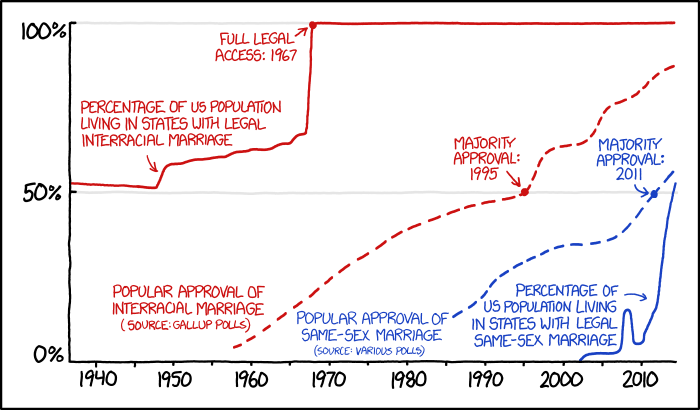
Gay marriage now legal in North Carolina
by By Anne Blythe
A federal judge in Western North Carolina struck down North Carolina's ban on gay marriage late Friday, capping a roller-coaster day of legal activity. U.S. District Judge Max Cogburn issued the historic ruling at 5:32 p.m. and weddings began soon after.
- Read more state political stories
- Read more national political news
- Get the latest political news at our Under the Dome blog
13 Oct 12:18

![]()
Judge strikes down NC gay marriage ban
by By MICHAEL BIESECKER and MITCH WEISS
A federal judge in North Carolina struck down the state's gay marriage ban Friday, opening the way for the first same-sex weddings in the state to begin immediately.
13 Oct 12:18

![]()
Couples rush to wed as NC gay marriage ban dumped
by By MICHAEL BIESECKER and MITCH WEISS
Minutes after a federal judge in Asheville struck down North Carolina's ban on same-sex marriages, Amy Cantrell and Lauren White rushed out of a county office with their newly printed marriage license and exchanged vows on the front steps, their two children in tow.
13 Oct 12:17
Édgar Silva renunció a canal 7

Las razones que dio el periodista para su renuncia son personales.
26 Sep 12:20
Miss-mixing
by Jason Kottke
DJs now routinely make deliberate mistakes mixing tracks so that people will know they're mixing the tracks by hand and not just using software to automatically match beats.
DJs all over the world are now deliberately making mistakes during their mixes to prove to fans and critics that they are in fact real DJs.
The latest craze, known as miss-mixing, is proving very popular amongst digital DJs as a way of highlighting that they are actually manually mixing tracks rather than using the sync button.
Michael Briscoe, also know as DJ Whopper, spoke about miss-mixing with Wunderground, "Flawless mixing is now a thing of the past, especially for any up and coming digital DJs. You just can't afford to mix without mistakes these days or you'll be labelled as a 'sync button DJ.'"
As computers get better at things like DJing, cooking, writing, and the like, imperfection may become a mark of human-produced goods and media. In the future, we'll be urged to buy not just hand-made but Human Made™ the way people go for American made, locally made, organic, artisanal, or vintage goods nowadays. The problem, as Tyler Cowen notes, is if computers are smart enough to DJ, they're certainly clever enough to be a little sloppy too.
Update: I gots hoodwinked! Wunderground is a satirical site...DJs are not intentionally making mixing mistakes. But the idea is not all that farfetched! Under the doctrine of even if it's fake it's real, I'm satisfied with my conclusions. (thx, ken & mumoss)
Tags: music
26 Sep 12:19
#aspirational
by Jason Kottke
In the future, people won't want to meet or talk to celebrities, they'll just want to borrow some of their social capital.
(via ★interesting)
Tags: Kirsten Dunst video
22 Aug 12:39
The 2017 total solar eclipse awarded to the United States
by Jason Kottke

I do not officially have a bucket list1 but if I did have one, watching a total solar eclipse would be on it. Was just talking about it the other day in fact. Well. I am pretty damn excited for the Great American Eclipse of 2017!
In August 21, 2017, millions of people across the United States will see nature's most wondrous spectacle -- a total eclipse of the Sun. It is a scene of unimaginable beauty; the Moon completely blocks the Sun, daytime becomes a deep twilight, and the Sun's corona shimmers in the darkened sky. This is your guide to understand, prepare for, and view this rare celestial event.
It goes right through the middle of the country too...almost everyone in the lower 48 is within a day's drive of seeing it. Cities in the path of the totality include Salem, OR, Jackson, WY, Lincoln, NE, St. Louis, MO (nearly), Nashville, TN, and Charleston, SC.
Weather will definitely play a factor in actually seeing the eclipse, so I will be keeping an eye on Eclipser ("Climatology and Maps for the Eclipse Chaser") as the event draws near. Early analysis indicates Oregon as the best chance for clear skies. Matt, I am hereby laying claim to your guest room in three years time. So excited!!
[1] Also on this hypothetical bucket list: dunking a basketball, going to outer space, learning to surf, and two chicks at the same time. ↩
Tags: 2017 solar eclipse astronomy space Sun USA
21 Aug 20:54
Physics paradoxes
by Jason Kottke
Today's brain-melter: Every Insanely Mystifying Paradox in Physics. It's all there, from the Greisen-Zatsepin-Kuzmin limit to quantum immortality to, of course, the tachyonic antitelephone.
A tachyonic antitelephone is a hypothetical device in theoretical physics that could be used to send signals into one's own past. Albert Einstein in 1907 presented a thought experiment of how faster-than-light signals can lead to a paradox of causality, which was described by Einstein and Arnold Sommerfeld in 1910 as a means "to telegraph into the past".
If you emerge with your brain intact, at the very least, you'll have lost a couple of hours to the list.
Tags: lists physics science
15 Aug 12:11


O Captain! My Captain! David Foster Wallace, Robin Williams, Walt Whitman, and the Unholy Ghost of Suicide
by Maria Popova
“My Captain does not answer … he has no pulse nor will.”
 In the introduction to Quack This Way — the remarkable record of Bryan Garner’s wide-ranging conversation with David Foster Wallace — Garner makes a passing mention of the email address Wallace used in their correspondence: ocapmycap@… The email provider following the @ symbol changed over the years, but Wallace kept his moniker — one that takes on a special, wistful meaning in light of his subsequent suicide.
It was an allusion to Walt Whitman‘s 1865 elegy “O Captain! My Captain!,” a mourning poem for Abraham Lincoln titled after its piercing refrain:
O Captain! My Captain! our fearful trip is done;
The ship has weather’d every rack, the prize we sought is won;
The port is near, the bells I hear, the people all exulting,
While follow eyes the steady keel, the vessel grim and daring:But O heart! heart! heart!
O the bleeding drops of red,
Where on the deck my Captain lies,
Fallen cold and dead.
The recurrence of Whitman’s grim refrain in the context of Robin Williams’s suicide is strange and poignant happenstance. Among Williams’s most beloved films is the 1989 classic Dead Poets Society, in which Whitman’s poem serves as a centerpiece — Williams’s character instructs his students to call him “O Captain! My Captain” — and it appears in one of the film’s most memorable scenes:
Williams, of course, didn’t write the film, nor the scene — but he did carry both, and as he once observed in a 1992 Playboy interview, “characters are just a free way of talking as yourself.”
As soon as one fully grasps the soul-ravaging depths of depression, a tragic parallel between Williams’s death and Lincoln’s emerges, lending Whitman’s eulogy double poignancy — Lincoln was assassinated by antagonists he had dedicated his life to fighting, and Williams died by the claw of the ghastly inner monster that severe depression lodges in the human spirit, losing a long fight with the unholy ghost.
(In the same interview, Williams also stated: “Some issues are deeply personal. I get near them and think, I’m not ready to deal with that yet. When you’re comfortable with it, you can be free about it. If not, it’s open-heart surgery.” In yet another eerie parallel, Williams underwent actual open-heart surgery seventeen years later — a procedure that, according to the prestigious Cleveland Clinic Foundation and a multitude of medical authorities, puts patients at a significant risk for postoperative depression. Mental health, of course, is a complex ecosystem in which myriad physiological, psychological, and social factors interact, but this detail gives one pause nonetheless.)
Ultimately, what drives a person to take his or her own life is a matter of intensely private unknowns and unknowables. Whitman’s words ring:
My Captain does not answer, his lips are pale and still;
My father does not feel my arm, he has no pulse nor will…
Suicide, lest we forget, is a social malady — please join me in supporting the pulse and will of life with a donation to the Suicide Prevention Hotline.
Donating = Loving
Bringing you (ad-free) Brain Pickings takes hundreds of hours each month. If you find any joy and stimulation here, please consider becoming a Supporting Member with a recurring monthly donation of your choosing, between a cup of tea and a good dinner:
|
♥ $7 / month ♥ $3 / month ♥ $10 / month ♥ $25 / month |

You can also become a one-time patron with a single donation in any amount:
 Brain Pickings has a free weekly newsletter. It comes out on Sundays and offers the week’s best articles. Here’s what to expect. Like? Sign up.
Brain Pickings takes 450+ hours a month to curate and edit across the different platforms, and remains banner-free. If it brings you any joy and inspiration, please consider a modest donation – it lets me know I'm doing something right.

13 Aug 16:37
Ambient space sounds playlist
by Jason Kottke
From YouTube, a playlist of 12- and 24-hour-long videos of ambient space noise, mostly of the sounds of spaceships like the Tardis, the USS Enterprise, and the Nostromo (from Alien). I think the Death Star is my favorite:
Or the completely unrelaxing 12 hours of Star Trek red alert sound:
Sadly, the list is missing my favorite spaceship sound, Sebulba's podracer from Phantom Menace. See also Super Mario Bros Sound Loops and Extended Star Wars Sounds. (via @finn)
Tags: audio space video
12 Aug 17:20
Robin Williams
by Michelle Markowitz
by Michelle Markowitz

Genie, you're free. pic.twitter.com/WjA9QuuldD
— The Academy (@TheAcademy) August 12, 2014
Robin Williams died yesterday at the age of 63. If you are reading this, you probably grew up on all his films. Mrs. Doubtfire, Aladdin, and Hook were the movies we'd crack up at and watch over and over again at sleepovers, and were the films our teachers would put on when they'd wheel the TV cart in because they didn't feel like teaching that day, but wanted to put something quality on so they didn't feel too guilty. Then Good Will Hunting, Dead Poets Society, and The Birdcage were the movies we watched when we got a bit older and discovered Robin Williams was not only hilarious, but full of heart.
Here's a quick scene from Mrs. Doubtfire:
[via Entertainment Weekly, YouTube]
1 Comments
12 Aug 12:16
RIP, Robin Williams
by Alvin Ward
Christopher Reeve presents his former Juilliard roommate Robin Williams a People's Choice Award in 1979.
08 Aug 17:22
Running the lungs out of your body
by Jason Kottke
A wonderful interview with Werner Herzog on soccer, his wonderful fatherless upbringing, the nature of reality, and, of course, Mel Brooks.
Tags: interviews Werner HerzogI told Mel, "Mel, you know what, I have seen an extraordinary film. Something you must see. You must see. It's only at midnight screenings at the Nuart Theater. And it's a film by -- I don't know his name, I think it's Lynch. And he made a film Eraserhead and you must see the film." And Mel keeps grinning and grinning and lets me talk about the movie and he says, "Yes, his name is really David Lynch, do you like to meet him?" I said, "In principle, yes." He says, "Come with me," and two doors down the corridor is David Lynch in pre-production on The Elephant Man! Which Mel Brooks produced! And the bastard sits there and lets me talk and talk and talk and grins and chuckles. And I had no idea [and kept thinking], Why does he chuckle all the time when I talk about the film? But that was how I love Mel Brooks.
Sanjay likes this
01 Aug 20:03
The problem with OKCupid is the problem with the social web
by Tim Carmody
Hi, everybody! Tim Carmody here, guest-hosting for Jason this week.
On Monday, I tried to list some reasons why OKCupid's self-acknowledged experiments on its users didn't seem to be stirring up the same outrage that Facebook's had. Here at the end of the week, I think I was largely right: fewer people are upset, the anger is more tempered, and that has a lot to do with the reasons I gave. But one reaction I didn't expect is that some people took it as saying that I wasn't upset by what OKCupid did, or that people shouldn't be as upset by it.
What OKCupid did has actually made me madder and madder as the week's gone on, but for reasons that are different from other people's. I think this is pretty important, so I'm going to try to explain why.
Let's start with the Facebook "social contagion" study. Most Facebook critics focused on the people who were the subjects of the study, for good reasons. Did these users give consent? Can terms of service count as consent for an academic study? Should they have been informed of the study afterwards? Is Facebook responsible for any harm these users might have suffered? Is an increase or decrease in engagement really a sign that users' emotions were affected? How else has Facebook attempted to influence its users, or might try in the future? These are all good questions.
But what if you flip it around? What if you weren't one of the subjects whose moods Facebook was trying to study, but one of their friends or family? What if you were one of the people whose posts were filtered because your keywords were too happy, too angry, or too sad?
It's a small thing, but I haven't seen anybody discuss the Facebook emotion study from the perspective of authors of the filtered posts.
— Tim Carmody (@tcarmody) June 29, 2014
You had good news; maybe your child was born. You had bad news; maybe a call for help. Your friends never saw it, bc of an involuntary study
— Tim Carmody (@tcarmody) June 29, 2014
The emotions study shows definitively that this opacity of what posts do or don't get delivered by Facebook is universal and without limit.
— Tim Carmody (@tcarmody) June 29, 2014
I think there's no way to know whether the Facebook study may have harmed people who weren't being studied. And even though the TOS basically says that users give Facebook permission to do whatever they want not only with the users' data, but all of their friends' too, you can't call that consent with a straight face. (This is just another reason that software terms of service are a rotten legal and ethical basis for research. They just weren't built for that reason, or to solve any of those problems.)
So Facebook didn't just mess around with some of its users' feeds, hoping to see if it might mess around with their feelings. It used some of its users' posts in order to do it. Arguably, it made them complicit.
To be clear, filtering posts, giving preference to some and not others, is how Facebook's newsfeed algorithm always works. Facebook users have been complaining about this for a long time, especially brands and news organizations and other companies who've built up their subscriber counts and complain that hardly anybody ever sees their posts unless they pay off Facebook's ad department. And Facebook makes no guarantees, anywhere, that they're going to deliver every message to every user who's subscribed to it. Readers miss posts all the time, usually just because they're just not looking at the screen or reading everything they could see. Facebook isn't certified mail. It's not even email. All this is known.
However.
We all buy in to Facebook (and Twitter, and OKCupid, and every other social media network), giving them a huge amount of personal data, free content, and discretion on how they show it to us, with the understanding that all of this will largely be driven by choices that we make. We build our own profiles, we select our favorite pictures, we make our own friends, we friend whatever brands we like, we pick the users we want to block or mute or select for special attention, and we write our own stories.
Even the filtering algorithms, we're both told and led to assume, are the product of our choices. Either we make these choices explicitly (mute this user, don't show me this again, more results like these) or implicitly (we liked the last five baby pictures, so Facebook shows us more baby pictures; we looked at sites X, Y, and Z, so we see Amazon ads for people who looked at X, Y, and Z. It's not arbitrary; it's personalized. And it's personalized for our benefit, to reflect the choices that we and the people we trust have made.
This is what makes the user-created social web great. It's the value it adds over traditional news media, traditional classified ads, traditional shopping, everything.
We keep copyright on everything we write and every image we post, giving these services a broad license to use it. And whenever the terms of service seem to be saying that these companies have the right to do things we would never want them to do, we're told that these are just the legal terms that the companies need in order to offer the ordinary, everyday service that we've asked them to do for us.
This is why it really stings whenever somebody turns around and says, "well actually, the terms you've signed give us permission to do whatever we want. Not just the thing you were afraid of, but a huge range of things you never thought of." You can't on one hand tell us to pay no attention when you change these things on us, and with the other insist that this is what we've really wanted to do all along. I mean, fuck me over, but don't tell me that I really wanted you to fuck me over all along.
Because ultimately, the reason you needed me to agree in the first place isn't just because I'm using your software, but because you're using my stuff. And the reason I'm letting you use my stuff, and spending all this time working on it, is so that you can show it to people.
I'm not just a user of your service, somebody who reads the things that you show it to me: I'm one of the reasons you have anything that you can show to anyone at all.
Now let's go back to the OKCupid experiment. Facebook didn't show some of its users posts that their friends wrote. But at least it was a binary thing: either your post was shown, just as you wrote it, or it wasn't. OKCupid actually changed the information it displayed to users.
You can pick nits and say OKC didn't change it, but rather, just selectively repressed parts of it, deleting photos on some profiles and text on others. But if you've ever created a profile on any web site, you know that it's presented as being a whole ensemble, the equivalent of a home page. The photos, the background, the description, the questions you answer: taken altogether, that's your representation of yourself to everyone else who may be interested. It's the entire reason why you are there.
Now imagine you're an OKCupid user, and you strike up a conversation with someone or someone strikes up a conversation with you. You assume that the other person has all of your information available to them if they're willing to look at it. That's the basis of every conversation you have on that site. Except they don't. The profile that OKCupid has implicitly promised they'll show to everyone who looks at it has been changed. The other person either doesn't know what you look like (and assumes you can't be bothered to post a photo) or doesn't know anything else about you (and assumes you can't be bothered to write anything about yourself.) Both of you have been deceived, so the site can see what happens.
This is why I question the conclusion that OKC users who were only shown profiles with pictures are shallow, because their conversations were almost as long as the ones who were shown full profiles. This is how I imagine those conversations going:
Rosencrantz: So what do you do?
Guildenstern: Um I work in marketing?
Rosencrantz: That's great! Where did you go to school?
Guildenstern: I went to UVA
Guildenstern: Wait a minute are you some kind of bot?
Rosencrantz: What makes you say that?
Guildenstern: You keep asking me questions that are in my profile, did you even read it
Rosencrantz: I'm looking at it right now, why didn't you answer any of the questions
Guildenstern: lol I guess you can't read nice pic though goodbye
That's a high-value interaction by the OKC researchers' standards, by the way.
This is also why I don't have much patience with the idea that "The worst thing could have happened [with the OkCupid testing] is people send a few more messages, and maybe you went on a date you didn't like." (Rey Junco told this to ReadWrite to explain why he thought Facebook's study was worse than OKCupid's, but you see versions of this all over.)
First, going on "a date you didn't like" isn't a frivolous thing. It definitely incurs more material costs than not seeing a Facebook status. And bad (or good) messages or a bad or good date can definitely have a bigger emotional impact as well.
More importantly, though, don't make this just a question about dates or feelings, about what somebody did or didn't read and what its effect on them was. I don't care if you think someone making a dating profile is a frivolous thing. Somebody made that. They thought the company hosting it could be trusted to present it honestly. They were wrong.
So this is the problem I see not just with Facebook and OKCupid's experiments, but with most of the arguments about them. They're all too quick to accept that users of these sites are readers who've agreed to let these sites show them things. They don't recognize or respect that the users are also the ones who've made almost everything that those sites show. They only treat you as a customer, never a client.
And in this respect, OKCupid's Christian Rudder and the brigade of "and this surprises you?" cynics are right: this is what everybody does. This is the way the internet works now. (Too much of it, anyway.) It doesn't matter whether your site is performing interventions on you or not, let alone publishing them. Too many of them have accepted this framework.
Still, for as long as the web does work this way, we are never only these companies' "products," but their producers, too. And to the extent that these companies show they aren't willing to live up to the basic agreement that we make these things and give them to you so you will show them to other people -- the engine that makes this whole world wide web business go -- I'm not going to have anything to do with them any more. What's more, I'll get mad enough to find a place that will show the things I write to other people and tell them they shouldn't accept it either. Because, ultimately, you ought to be ashamed to treat people and the things they make this way.
It's not A/B testing. It's just being an asshole.
Update: OKCupid's Christian Rudder (author of the "We Experiment On Human Beings" post) gave an interview to Alex Goldman and PJ Vogt for On the Media's TLDR podcast.
Rudder says some of the negative response "is my own fault, because, y'know, the blog post is sensationally written, for sure." But he doesn't back off of that tone one bit. In fact, he doubles down.
Alex Goldman: Have you thought about bringing in, say, like an ethicist to, to vet your experiments?
Christian Rudder, founder of OkCupid: To wring his hands all day for a hundred thousand dollars a year?... This is the only way to find this stuff out. If you guys have an alternative to the scientific method, I'm all ears.
I think he maybe should have just written the blog post and left it alone.
Tags: Facebook OKCupid the web we lost
01 Aug 17:16
"It's hard for the protestors to accept that I do abortions because I'm a Christian."
by Jia Tolentino
by Jia Tolentino

He thought about his mother and sisters and the grandmother who died in childbirth and began to read widely in the literature of civil rights and feminism. Eventually he came across the concept of "reproductive justice," developed by black feminists who argued that the best way to raise women out of poverty is to give them control of their reproductive decisions. Finally, he had his "come to Jesus" moment and the bell rang. This would be his civil-rights struggle. He would serve women in their darkest moment of need. "The protesters say they're opposed to abortion because they're Christian," Parker says. "It's hard for them to accept that I do abortions because I'm a Christian." He gave up obstetrics to become a full-time abortionist on the day, five years ago, that George Tiller was murdered in church.
-Here's a devastating Esquire piece about Dr. Willie Parker, a doctor who flies down from Chicago to run (along with only one other doctor) the last abortion clinic left in Mississippi.
2 Comments
29 Jul 17:57
25 Vintage Photos of Chicago
by Rebecca O'Connell
Chicago invented the skyscraper, has hosted two World's Fairs, and boasts its own kind of formidable pizza. Despite being one of the most populous cities in the country, it hasn't all been all clear skies and Green River soda. Chicago survived one of the largest fires of the 19th century, organized crime, and a corrupt baseball team. Check out these pictures to see a glimpse at Chicago's transformation into the lively metropolis we know today.
29 Jul 17:48
Leader of Troubled Lab Steps Down, C.D.C. Says
by By DONALD G. McNEIL Jr.
Michael Farrell, who has led the Bioterror Rapid Response and Advanced Technology laboratory since 2009, “voluntarily resigned” on Tuesday, a spokesman for the agency said.


29 Jul 17:47


Anti-Gay Laws Can Fuel Spread of HIV, Research Finds
by USA Today - U.S. News
Source: USA Today - U.S. News
Countries with anti-gay laws may find that HIV infections spread more readily.            .
29 Jul 17:47

Does Control of HIV Pandemic Require Support for Sex Workers?
by ScienceDaily
Source: ScienceDaily
Across the world, in high- and low-income countries, women, men, and transgender people who sell sex are subjected to repressive and discriminatory law, policy, and practice, which in turn fuel human rights violations against them, including violence and discrimination. All of these factors are preventing sex workers from accessing the services which they need in order to effectively prevent and treat HIV infection, according to a major new...
29 Jul 13:11


The Delusional Fantasies We Live With Each Day
by zenhabits
‘Most human beings spend 50 to 90 percent or more of their time in their imagination, living in fantasy.’ ~Charlotte Joko Beck
By Leo Babauta
We fail at creating new habits because of fantasies.
We procrastinate because of fantasies.
We get frustrated with other people, with ourselves, because of fantasies.
We miss out on the wonder of the world because of fantasies.
We — all of us — live our lives in delusion most of the time. That might not seem true, but consider:
- When you wake up and start thinking about what you’re going to do today, your plans aren’t really happening, but are all in your head.
- When you fear the failure that might come when you tackle this big work task, and you procrastinate, it’s not failure that’s actually happening but it’s all in your head.
- When someone does something that irritates you, this is because they aren’t acting as you think they should (they should be more considerate), but this “acting how you think they should” is not reality but an ideal you have, in your head. The frustration stems not from their actions but from how their actions differ from your fantasies.
- When you start out with a new habit (let’s say exercise), you are motivated by a fantasy of what your life will be like when you create the habit … but that’s not real. When the reality of the habit happens, it never matches up with your fantasy. It’s often harder, sloppier. Less idealized. And so you quit.
- When you move through your home or office, your mind is not on the action of walking and the things around you, but elsewhere. In fantasy.
- When you eat, you’re not paying attention to the food most of the time. Your mind is somewhere else, in fantasy.
- When you talk to someone, you aren’t focused on what they’re saying, but thinking of what you’re going to say, or thinking about something else.
Of course, some of the time we’re here in the present moment, but it’s probably less than you think.
The fantasies take up most of our time, and they are not usually helpful. They cause us to fear, to procrastinate, to become angry, disappointed, to quit.
Instead, try this: let go of the fantasy and pay attention to this actual moment. See it for what it is, not what you’d like it to be. Accept it exactly as it is, warts and all.
Move through the day practicing this seeing things as they are.
Do your work without thinking about the fear of your failure fantasy, or what might happen in the future, or how hard this work is gonna be … and just do it, in the present moment.
Do your new habit (exercise, meditation, healthy eating) in the present moment, seeing it for what it is, not how it measures up to your fantasy of what it should be. Not how it will be hard in the future. But as it is.
See other people for what they are, and accept them without judgment. Strangers included. Warts and all.
We can fantasize all we want, but the fantasy never happens. This present reality is all we got. Let’s learn to love it.
22 Jul 18:47
D.C. Appeals Court Overturns Subsidies For Fed Exchange; Fourth Circuit Takes Different View
A three-judge panel for the U.S. Court of Appeals in Washington ruled Tuesday that subsidies may not be offered in the federal health exchange. The decision overturned a lower court ruling. Hours later the Fourth Circuit Court of Appeals offered its own decision, which upholds the Obama administration's arguments that subsidies can be applied in the federal exchange.
16 Jul 12:02


The End of the Day Philosophy
by zenhabits
‘If your knees aren’t green by the end of the day, you ought to seriously re-examine your life.’
~Bill Watterson
By Leo Babauta
I’ve been making my small decisions throughout the day, recently, with a simple question: How will I feel about this when today is over?
If I have a choice right now between reading social media and news articles, or writing, I know what the answer will be: at the end of the day, I’d be much happier if I’d chosen writing.
If I am faced with chips and pizza, I might be mightily tempted to eat them right now, but I know that later in the day I’ll be sorry I did. I inevitably feel bad after I eat greasy foods, though I always forget that before I eat the food.
At the end of the day, I won’t regret having spent a little time with my wife or kids, but I will regret watching videos online or wasting my time by playing games.
I won’t regret having done my workout, but I will regret sitting all day.
I’ve learned these answers through repeated observation, but you can learn your own answers by asking the question before you do anything, making a hypothesis (“I won’t regret this later”) and then seeing if you’re right by reviewing the results at the end of each day.
Have a daily review before you go to bed, even if it’s just a mental review. Were you right? Do you regret any of your choices? If so, don’t feel bad about being wrong — be happy that you’ve learned this.
Then make a better choice the next time.
What are you going to do next, after reading this? Will you be happy with that, at the end of this day?
11 Jul 12:37
Elle Varner feat. A$AP Ferg, "Don't Wanna Dance"
by Emma Carmichael
by Emma Carmichael

You might recognize the first few seconds of this new Elle Varner track; it's The Jimmy Castor Bunch's "I Just Wanna Stop," which Kanye West sampled in "We Don't Care." As for all of the following seconds, they're excellent as well.
Nikkidum likes this
10 Jul 17:43
Jerry Seinfeld Explains a Joke
by Chris Higgins
Jerry Seinfeld, on the conclusion of his Pop-Tarts joke: "I know it sounds like nothing. And it is nothing. You know, in my world, the wronger something feels, the righter it is. So to waste this much time on something this stupid is...that felt good to me."
Here's five minutes of Seinfeld explaining how he puts together a bit. While explaining the funny definitely kills the funny, it's still interesting to see the process of a master at work.
First, here's the bit as delivered on TV:
Now, five minutes on its construction (and note that in this video, the last part of the bit is different):
Bwel1985 likes this