Shared posts

02 Jul 12:30

Monty Python is Back

by Chris Higgins

Tonight, the surviving members of Monty Python reunite for a series of live shows at the O2 Arena in London. If you can't make it to London, they're broadcasting the closing show live to movie theaters as well. (Looks like my local theater is showing it at 11:30am on Sunday, July 20th. Yay!) Here's a teaser:

Get excited, people!

And if you like press conferences, here's one from six hours ago:

(Via Devour.)

02 Jul 12:28

“App: The Human Story” by Story & Pixel My friend Jake told...


“App: The Human Story” by Story & Pixel

My friend Jake told me a year ago he wanted to make a documentary exploring the profound impact the new notion of “app” has had on our culture. I got the shivers when he told me the idea.

Now, watching the trailer for what he and his co-director Jed have shot so far, I get the shivers again. This one’s going to be good. If you want to see more, consider supporting the Kickstarter. Jake and Jed are good people making a good thing.

01 Jul 16:58

DFW, on the cusp of literary stardom

by Jason Kottke

Just after Infinite Jest was published, David Foster Wallace came to Boston and did a radio interview with Chris Lydon. Radio Open Source recently unearthed that interview, probably unheard for the past 18 years, and published it on their site.

When I started the book the only idea I had is I wanted to do something about America that was sad but wasn't just making fun of America. Most of my friends are extremely bright, privileged, well-educated Americans who are sad on some level, and it has something, I think, to do with loneliness. I'm talking out of my ear a little bit, this is just my opinion, but I think somehow the culture has taught us or we've allowed the culture to teach us that the point of living is to get as much as you can and experience as much pleasure as you can, and that the implicit promise is that will make you happy. I know that's almost offensively simplistic, but the effects of it aren't simplistic at all.

Tags: books   Chris Lydon   David Foster Wallace   Infinite Jest   interviews
01 Jul 12:34

Jul. 01, 2014: The Writer's Almanac

Tuesday's Poem: "The Soul Selects Her Own Society" by Emily Dickinson. Tuesday's Literary Notes: The United States Postal service introduced ZIP codes on this day in 1963. "ZIP" stands for "Zone Improvement Plan," and they're designed to make sorting and delivering mail more efficient. The first three digits represent the part of the country the mail is going to, and the last two identify the post office within that region. In 1983, the U.S. Postal Service rolled out "ZIP + 4," which added a hyphen and four additional digits to the end of the current ZIP code to speed things up even more. The first two digits of the addendum stand for a specific group of streets or cluster of large buildings, and the last two narrow it down further, specifying one side of the block or even one floor in a large building...
30 Jun 20:14

All Hail the Pink Helmet Posse

by Jia Tolentino
by Jia Tolentino


This is an eight-minute documentary about a trio of six-year-old skateboarders, and it is wonderful: we recommend that you watch till the end, as not to miss the part where they see a bee.

1 Comments
30 Jun 19:27

Let It Be Sunday

by joythebaker

let it be sunday

Happy Sunday!  Here we are on the Internet!

This week, my friend Tracy and I were trying to nail down (via text message, of course) our feelings about the Internet.  It’s feeling big these days.  Bigger than usual.  It’s feeling fast these days… and I’m not talking about the speed at which web pages load.  The Internet feels more than ever like a big machine of content that we’re all ingesting 2 seconds at a time.  A recipe that will take me days to develop, shoot, edit, and write will take a reader a cool twooooo seconds to sweep through.  There are a lot of things to decide in those two seconds:  if you like it, if it’s pretty, if it applies to your immediate future, if it makes you hungry, if it makes you hate me, if it’s grain-free enough, and if it’s Pinterest worthy.  That’s a lot to run through and it all happens so so fast!

I’m not complaining. That’s the game we’re in.  This is totally what I signed up for.  I think.  More than that… I’m pretty sure this is my dream job!  But can’t we all just take a moment to acknowledge that it’s WEIRD!?  It’s totally weird, right?  Yes.  The answer is yes.

Can we talk about the picture above with me and my perfect grocery bag?  I’m trying to decide if I’m the girl that walks around New Orleans with tulips and kale in a bag.  In the bottom of that bag you’ll find: a box of  Cinnamon Toast Crunch breakfast cereal, a box cake mix (yellow), a tub of chocolate cake frosting (GASP!), three plastic bags, two umbrellas, and three old receipts.  Also not pictured:  sweat running down my back.  That’s how real it is.

I’ll love the Internet forever and always, speed and all.  Here are a few of the places I spent a quality two seconds (or so) this week:

•  I’m learning about EGGS this week.  I’m trying to achieve the perfect soft-boiled and hard-boiled eggs.  So far I’ve found the most success dunking my cold uncooked eggs into boiling water and allowing them to simmer for 6 minutes.  Shocking them in ice water is essential for a soft egg and an easy peel.  There’s a lot to know about how to cook a humble egg.  I’ve found this very helpful:  The Hard Truth About Boiled Eggs.

•  Turning the oven on to make lasagna is 100% out of the question.  A Lasagna Grilled Cheese Sandwich feels much more reasonable.

•  I love gatherings on the Internet especially when they involve POPSICLES!  It’s Popsicle Week with Wit and Vinegar and thirtysomeodd other major food talents from across the land.  Some of my favorite popsicles from Popsicle Week include 4-Ingredients Strawberry Cream Pops,  Creamy Cinnamon Horchata Popscicles, and Raspberry Lemon Yogurt Popscicles.

•  Fargo was one of the best shows on television this Spring.  Did you get into it!?

•  4th of July doesn’t have to be over the top with the red white and blue.  In my secret life, in my very uncomplicated food mind I want to eat a boxed cake sheet cake with Cool Whip frosting, strawberries, and blueberries.  That’s right.  I want a plain old FLAG CAKE!  Blasphemy.

•  I want to go somewhere that requires the Bon Voyage Passport Case, this tropical-themed backpack, and also… I’d like to take my own bed and the comforts of home with me. What do you mean I can’t have the best of both worlds!?

•  Hello.  Nice to meet you.  I’m Joy “Bedtime Procrastination” Wilson.

•  In our heart of hearts we must KNOW that disappearing photo-sharing apps don’t really disappear our photos.  Right?  Will Facebook’s attempt at the app be a success?  Please say noooooooo.

•  This episode of NPR’s  Fresh Air with Jenny Slate and Gillian Robespierre is really interesting.  She talks about how she got fired from Saturday Night Live after one super mistake.  It’s really fascinating.  You might remember Jenny Slate from  Marcel the Shell With Shoes On.

I hope you have the happiest of Sundays!  Be at the beach!  I love you!  Bye for now.

30 Jun 17:15

Jun. 29, 2014: The Writer's Almanac

Sunday's Poem: "Illinois" by Philip F. Deaver from How Men Pray. Sunday's Literary Notes: It was on this day in 1776 that the first mass was conducted for settlers at the Misión San Francisco de Asís, in the place that became the city of San Francisco. The colonists had arrived at their new home two days earlier, after a journey of many months. Spain was the major colonial power in the western half of the Americas. They were well established in Baja (lower) California, but wanted to expand into their territory of Alta (upper) California. They established five missions and two military garrisons throughout Alta California, but these outposts were run by just a handful of soldiers and Franciscan friars. The settlements were dependent on supply ships sent up from Baja California, which had such a hard time sailing against the winds that they were often blown out to sea or destroyed on the rocky coast. The Spanish viceroy sent Captain Juan Bautista de Anza to search for an overland route. He was successful, so the Spanish authorities decided to continue their settlement northward, all the way to the port at San Francisco. This time they hoped to have a real settlement, with a group of families...
30 Jun 17:14

Jun. 30, 2014: The Writer's Almanac

Monday's Poem: "Rhubarb" by Sheila Packa from Night Train Red Dust: Poems of the Iron Range. Monday's Literary Notes: On this day in 1860, a debate on the merits of the theory of evolution took place at Oxford University. It occurred as part of the annual meeting of the British Association for the Advancement of Science. Darwin's book On the Origin of Species (1859) had just been published seven months earlier, and was hotly contested by scientists and theologians on both sides of the issue. Noted biologist Richard Owen had written a scathing review of the book in the Edinburgh Review, and he also coached the Bishop of Oxford, Samuel Wilberforce, in his condemnation of the book. On the pro-Darwin side of the issue were several liberal theologians -- including mathematician and priest Baden Powell -- as well as scientists Joseph Dalton Hooker and Thomas Henry Huxley. Huxley was such an ardent and vocal supporter of evolutionary theory that he came to be known as "Darwin's bulldog."..
30 Jun 12:39

Facebook Tinkers With Users’ Emotions in News Feed Experiment, Stirring Outcry

by By VINDU GOEL
Last week Facebook revealed that it had manipulated the news feeds of over half a million randomly selected users to change the number of positive and negative posts they saw.
30 Jun 12:31

Costa Rica está entre los ocho mejores del mundo

Costa Rica vivió el partido más emotivo de su historia y venció a Grecia por penales y se clasificó a cuartos de final del Mundial Brasil 2014.

30 Jun 12:30

La fiesta en la Fuente de la Hispanidad nunca había sido tan grande

Miles de aficionados volvieron a reunirse en uno de sus puntos favoritos para celebrar la clasificación histórica de la Sele
30 Jun 12:30

Costa Rica llegó a su soñado quinto juego en un mundial

Con su victoria ante Grecia, Costa Rica igualó a Estados Unidos y México como las únicas selecciones de Concacaf que saben lo que es llegar a esta cantidad de partidos en una copa del mundo
30 Jun 12:30

Costa Rica: gallardía, orgullo y coraje

La Tricolor hizo un esfuerzo impresionante al jugar con un futbolista menos durante 55 minutos. Ahora está en cuartos
25 Jun 18:34

Best Albums of 2014 (so far) + Songs Mix

image

photo via cubagallery

2014 got off to a slow start music-wise, but it’s picked up quite a bit and left us with a pretty solid lineup of albums & songs. If there’s been a theme to my music listening this year so far, it’s that a big share has been devoted to singer/songwriter and indie rock types, which may stand in contrast to the perception that electronic / dance pop are dominating the music landscape. The best albums are listed chronologically below and you can listen to my 30 favorite songs of the year in this Spotify playlist. Enjoy!

Best Albums of 2014 (so far)

image

CEO - Wonderland (February 4, Modular)


image

Sun Kil Moon - Benji (February 11, Calo Verde)


image

St. Vincent - St. Vincent (February 24, Loma Vista/Republic)


image

Real Estate - Atlas (March 4, Domino)


image

The War on Drugs - Lost in the Dream (March 18, Secretly Canadian)


image

Sisyphus - Sisyphus (March 18, Asthmatic Kitty)


image

Future Islands - Singles (March 24, 4AD)


image

The Hold Steady - Teeth Dreams (March 25, Washington Square)


image

Cloud Nothings - Here and Nowhere Else (April 1, Carpark/Mom & Pop)


image

tUnE-yArDs - Nikki Nack (May 6, 4AD)


 image

The Pains of Being Pure At Heart - Days of Abandon (May 13, Yebo)


image

Kishi Bashi - Lighght (May 13, Joyful Noise)


image

Owen Pallett - In Conflict (May 27, Domino)


image

First Aid Kit - Stay Gold (June 6, Columbia)


image

The Antlers - Familiars (June 17, ANTI)

***

HM / Needs More Time:

Wye Oak - Shriek
Bombay Bicycle Club - So Long, See You Tomorrow
SOHN - Tremors
Chromeo - White Women
Sharon Van Etten - Are We There

***

Best Songs of 2014 (so far) Mix

Click here to listen via Spotify Playlist. Tracklist below…

The Antlers - Palace
Ben Khan - Youth
Beyoncé - XO
Bombay Bicycle Club - Luna
Caribou - Can’t Do Without You
CEO - Whorehouse
Chromeo - Come Alive (ft. Toro y Moi)
Cloud Nothings - Psychic Trauma
Cymbals Eat Guitars - Jackson
First Aid Kit - My Silver Lining
Future Islands - Seasons (Waiting On You)
The Hold Steady - On With The Business
Hundred Waters - Murmurs
Kishi Bashi - Bittersweet Genesis for Him AND Her
Kevin Drew - Good Sex
Lana Del Rey - Brooklyn Baby
Lykke Li - Never Gonna Love Again
Owen Pallett - Song For Five & Six
The Pains of Being Pure at Heart - Eurydice
Real Estate - Talking Backwards
Robyn & Royskopp - Do It Again
Sharon Van Etten - Afraid of Nothing
Sisyphus - Rhythm of Devotion
SOHN - Artifice
St. Vincent - Digital Witness
Sun Kil Moon - I Watched The Film The Song Remains The Same
Tokyo Police Club - Argentina (Parts I, II, III)
tUnE-yArDs - Wait For A Minute
The War on Drugs - An Ocean in Between The Waves
Wye Oak - Glory

***

Let me know your favorites in the notes/comments. Thanks for reading!

25 Jun 18:09

Hey, Hot Stuff!

by Hoot

hotstuff_v2-01 hotstuff_v2-02 hotstuff_v2-03 hotstuff_v2-04 hotstuff_v2-05 hotstuff_v2-06 hotstuff_v2-07
hotstuff_v2-08

Check our facts!

1. http://chemse.oxfordjournals.org/content/11/3/371.short

2. http://www.pnas.org/content/105/33/11808.short

3. http://europepmc.org/abstract/MED/11473305/reload=0;jsessionid=IuKpuL7FE1NYrfBJnY2u.18

_______

By Roar, illustrated by Hoot.

25 Jun 12:24

Spielberg to direct The BFG movie

by Jason Kottke

I missed this news a couple of months ago: Steven Spielberg is going to direct a movie version of Roald Dahl's The BFG.

Renowned film director Steven Spielberg will direct the new adaptation with Melissa Mathison, who last worked with Spielberg on ET, writing the script. Frank Marshall will produce the film and Michael Siegel and John Madden are on board as executive producers.

I can't find any direct evidence, but the way the news is being reported, this seems like it'll be a live-action film and not a Tintin 3-D motion capture affair.

Tags: books   movies   Roald Dahl   Steven Spielberg   The BFG
24 Jun 12:19

3 Terrible Learning Habits You Probably Picked Up in School

by Business Insider

Did you spend late nights in the library cramming for tests? Did you reread class material to study? According to Business Insider, these study habits from your school days could be detrimental to learning at work. Below, check out which habits will hurt you the most and how to avoid them.

If you don't know how to learn well, you're basically screwed.

So say Peter Brown, Henry Roediger, and Mark McDaniel, authors of "Make It Stick: The Science of Successful Learning."

"We need to keep learning and remembering all our lives," they write. "Getting ahead at work takes mastery of job skills and difficult colleagues . . . If you're good at learning, you have an advantage in life."

Roediger and McDaniel, both of whom are psychologists at the University of Washington in St. Louis, argue that we misunderstand - at a cultural level - how learning works.

"How we teach and study is largely a mix of theory, lore, and intuition," the authors write.

Only recently has learning been submitted to the empirical rigor of cognitive psychology - which has turned up lots of the bad habits that many of us picked up in school.

Here are a few examples of terrible ways to learn new concepts:

Rereading the Material

Recall your time in school. When you wanted to prep for an exam, your "studying" probably consisted of poring over the same texts for hours.

More than 80 percent of college students say that rereading is their main study strategy. The authors cite three reasons for why it doesn't work:

  • Rereading takes forever. You could be learning better, in a shorter amount of time, with other strategies.
  • Studies show that multiple readings of a text provide no benefit to recall.
  • It deceives you. Mastering a text is not the same as mastering the ideas behind it. Rereading a text gives you an "illusion of knowing." You're getting superfamiliar with what a text says, but only superficially.

Rather than rereading, quiz yourself. It's better for cultivating long-term recall.

Cramming

Brown, Roediger, and McDaniel repeatedly slam "massed practice," which you and I know as cramming - the rapid, intense study of a text or technique for a short duration of time.

Synthesizing several decades of research, the authors note:

"Massed practice gives us the warm sensation of mastery because we're looping information through short-term memory without having to reconstruct the learning from long-term memory . . . [T]he fluency gained through massed practice is transitory, and our sense of mastery is illusory."

Real mastery of material, the authors emphasize, comes through reconstructing knowledge. That means forcing yourself to recall your understanding of a subject from memory, which you can hack with techniques like retrieval, elaboration, and generation.

Catering to Your "Learning Style"

You've probably said that you're a visual or auditory learner.

You may be mistaken.

"The idea that individuals have distinct learning styles has been around long enough to become part of the folklore of education practice and an integral part of how many people perceive themselves," the authors write.

"The underlying premise says that people receive and process new information differently," they continue. What's more, the theory holds that folks who don't get info in their preferred learning style - written, heard, etc. - are getting the pedagogical shaft.

This sentiment, the authors insist, is toxic, since saying that you have one learning style and not another gives you a "corrosive, misguided sense of diminished potential."

If you identify as someone with a "low kinesthetic" learning ability, then you'll likely stray away from athletics, rock-climbing, dancing, yoga, or any of the various ways to take advantage of having a body. If you identify as a "low-auditory" learner, then you'll turn yourself away from listening to music, lectures, and the like. Taking yourself to have one speciality - and many weaknesses - is impoverishing.

Instead, Brown, Roediger, and McDaniel encourage you to adopt an idea of "successful intelligence:" an attitude of bringing all your tools to the learning table. Yes, you do have different kinds of intelligence - Cornell University psychologist Robert Sternberg's model says it's analytical, creative, and practical - but that doesn't mean you have a certain "type" of learning.

Instead, when you're trying to master an idea, approach it with the full breadth of your intelligences. Rather than having your "learning style" limit your ability, use every way to learn you have available to you.

- Drake Baer

Check out more great stories from Business Insider:

23 Jun 18:52

American Catch

by Jason Kottke

American Catch

Paul Greenberg has an excerpt in the NY Times of his new book, American Catch: The Fight for Our Local Seafood.

As go scallops, so goes the nation. According to the National Marine Fisheries Service, even though the United States controls more ocean than any other country, 86 percent of the seafood we consume is imported.

But it's much fishier than that: While a majority of the seafood Americans eat is foreign, a third of what Americans catch is sold to foreigners.

The seafood industry, it turns out, is a great example of the swaps, delete-and-replace maneuvers and other mechanisms that define so much of the outsourced American economy; you can find similar, seemingly inefficient phenomena in everything from textiles to technology. The difference with seafood, though, is that we're talking about the destruction and outsourcing of the very ecological infrastructure that underpins the health of our coasts.

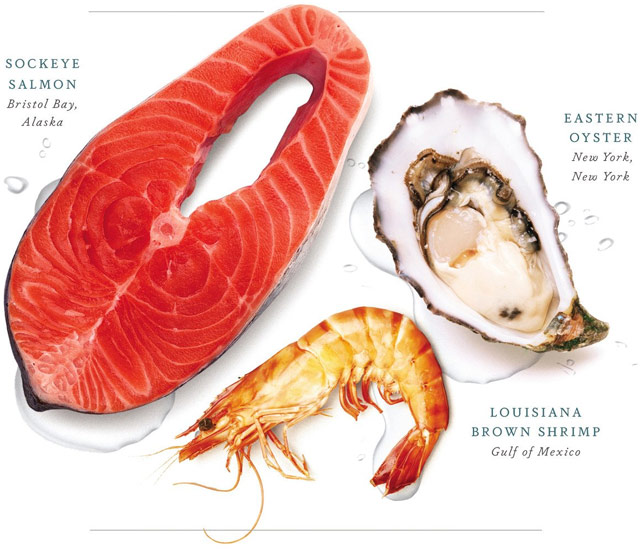
The article and book focus on three formerly American seafoods that we now mostly import from elsewhere: salmon, oysters, and shrimp.

In 2005, the United States imported five billion pounds of seafood, nearly double what we imported twenty years earlier. Bizarrely, during that same period, our seafood exports quadrupled. American Catch examines New York oysters, Gulf shrimp, and Alaskan salmon to reveal how it came to be that 91 percent of the seafood Americans eat is foreign.

In the 1920s, the average New Yorker ate six hundred local oysters a year. Today, the only edible oysters lie outside city limits. Following the trail of environmental desecration, Greenberg comes to view the New York City oyster as a reminder of what is lost when local waters are not valued as a food source.

Farther south, a different catastrophe threatens another seafood-rich environment. When Greenberg visits the Gulf of Mexico, he arrives expecting to learn of the Deepwater Horizon oil spill's lingering effects on shrimpers, but instead finds that the more immediate threat to business comes from overseas. Asian-farmed shrimp-cheap, abundant, and a perfect vehicle for the frying and sauces Americans love-have flooded the American market.

Finally, Greenberg visits Bristol Bay, Alaska, home to the biggest wild sockeye salmon run left in the world. A pristine, productive fishery, Bristol Bay is now at great risk: The proposed Pebble Mine project could undermine the very spawning grounds that make this great run possible. In his search to discover why this precious renewable resource isn't better protected, Greenberg encounters a shocking truth: the great majority of Alaskan salmon is sent out of the country, much of it to Asia. Sockeye salmon is one of the most nutritionally dense animal proteins on the planet, yet Americans are shipping it abroad.

Tags: American Catch   books   food   Paul Greenberg
23 Jun 18:34

Take the Doors Off Your Kitchen Cabinets for Easy Access

by Mihir Patkar

Take the Doors Off Your Kitchen Cabinets for Easy Access

Think about it for a minute: Do you really need doors for the cabinets in your kitchen? Apartment Envy's Kerra Huerta took them off and she's never going back.

Read more...


23 Jun 18:33

David Sedaris and His Fitbit

by Michelle Markowitz

I thought of the first time I had a kidney stone. That was in New York, in 1991, back when I had no money or health insurance. All I knew was that I was hurting, and couldn’t afford to do anything about it. The night was spent moaning. Then I peed blood, followed by what looked like a piece of gravel from an aquarium. That’s when I put it all together.

What might I have thought if, after seven hours of unrelenting agony, a creature the size of a full-grown cougar emerged, inch by inch, from the hole at the end of my penis and started hassling me for food?

Happy Monday morning! Sorry about the World Cup last night, but there's good news. David Sedaris bought and became addicted to a Fitbit, and wrote about all the weird things he saw during his (on average) twenty-five thousand steps per day. [New Yorker]

0 Comments
23 Jun 12:45

Costa Rica con un punto será líder del Grupo D del Mundial Brasil 2014

Clasificará como primera si no pierde frente a Inglaterra o conserva su diferencia de gol positivo ante Uruguay e Italia
23 Jun 12:23

How to Delete Your Google+ Account

by Patrick Allan

How to Delete Your Google+ Account

If you want to keep using Gmail and rest of Google's tools, but want to ditch Google+, AddictiveTips shows the simple steps to removing the social network functions from your Google account.

Read more...


18 Jun 17:26

Jessie Ware “Tough Love” Jessie Ware keeping things...


Jessie Ware “Tough Love”

Jessie Ware keeping things nice and minimalistic on the exquisite first single from her upcoming sophomore LP. Love it.

17 Jun 15:03

Infant self-rescue in water

by Jason Kottke

Baby float

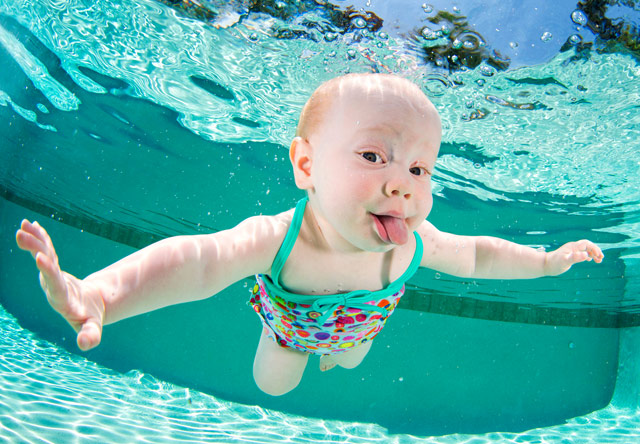
The NY Times has a bunch of photos by Seth Casteel of babies undergoing infant survival swim training.

Zoe was being introduced to "self-rescue," in which babies are taught to hold their breath underwater, kick their feet, turn over to float on their backs and rest until help arrives.

The self-rescue idea is pretty amazing. You take kids who can't talk and can barely walk and teach them how to float on their backs. I didn't really believe it until I saw it:

Bonus summer PSA: drowning doesn't look like drowning.

Tags: photography   Seth Casteel   video
17 Jun 14:03

Jun. 15, 2014: The Writer's Almanac

Sunday's Poem: "Solitude" by Ella Wheeler Wilcox. Sunday's Literary Notes: It's the birthday of advertising exec-turned-writer Ilene Beckerman, born in Manhattan (1935). She didn't begin her writing career until the age of 60, and even then, she became a published author almost by accident. She had written and illustrated a book for her five children, something to remember her by. She said: "My purpose was to say things to my children one doesn't have the time to say. I wanted them to know I wasn't always their mother. I was a girl, I had best friends, we did stupid things together. I was on a bus with my friend once eating dog bones so people would look at us. I wanted them to know."..
16 Jun 13:32

Sele sorprende en grupo de gigantes

Contra todos los pronósticos, contra todas las quinielas, Costa Rica es líder del grupo D del Mundial Brasil 2014.

16 Jun 12:37

A Call for Revolt: Advertising is the Anti-Minimalism

by zenhabits
By Leo Babauta

The biggest obstacle to a wonderfully minimalist life is advertising.

Let’s think about that statement for a minute: what is a minimalist life, and what stands in our way from reaching it? How is advertising involved?

A minimalist life can be many things, but at its heart is becoming conscious about what we have in our lives. Space is limited: we have limited hours in a day, limited years in our lives, limited physical space in our homes.

And we fill all that limited space up unconsciously, packing it to overfull without much thought to whether that’s the best use of our space.

Minimalism is about pausing, and asking what’s necessary. What belongs in this space, and what can we toss out? Is the fantasy we have in our heads, that’s causing us to fill things up unconsciously, really what we thought it would be?

Advertising has the exact opposite aim: it wants us to spend without thinking about it. It wants us to buy on impulse. It wants to implant fantasies in our heads that cause us to go out and buy.

Think about an ad for clothing, or an Apple product, for example: they show us beautiful people living gorgeous lives, centered around the simple solution of having their product in our hands (or around our bodies).

Ads for a cleanser make us think we’ll not only have clean skin, but a perfect complexion and high cheekbones and a hunky boyfriend who adores us.

Ads for a new app make us think that all of a sudden we’ll be more organized and productive and all of our needs will be magically taken care of with this beautifully designed program in our smartphone.

Ads for a new kitchen appliance give us the fantasy of perfect health and a beautiful body, if only we had this magical tool in our homes.

Of course, none of this is true — we will be no more organized or productive, no more healthy and beautiful, no more likely to have a hunky boyfriend (or lithe girlfriend) if we buy any of these products. We’ll just be poorer, with more stuff in our already full lives.

What’s worse is advertising not only implants a fantasy in our minds that we instantly want … it gives us the self-conscious feeling of lack. We all of a sudden are not complete, not happy, because we don’t have the fantasy lives. We aren’t good enough yet. We aren’t happy yet.

And the buying does nothing to placate that lack. We buy, and still don’t have the fantasy, and so we still feel bad about ourselves. We still have the void inside our hearts that can never be filled.

Advertising is the insidious whisper of the bad angel of commerce.

I don’t blame advertisers: they are caught up in a game where they have to advertise, or they die. I don’t blame consumers: this is the society we live in and we have never lived in any other way.

I don’t even blame advertising companies: the Googles and Don Drapers of the world are just trying to make a buck like everyone else, and have figured out what works. Why not do what’s effective, right?

Don’t blame the player. Blame the game.

We are caught up in a game where we must make more money, and therefore must advertise, and to be effective at that we must instill fantasies that cannot be reached, a feeling of lack that cannot be eased.

We are caught up in a game where this entire process is OK with everyone, in fact cheered on because the most successful at it — Steve Jobs, Jeff Bezos, Barack Obama, Larry Page, Mark Zuckerberg, Steven Speilberg, Walt Disney, et al — they are the winners of our society. We worship them.

The people who opt out of this game are ridiculed as hippies and bums and weirdos.

I say we toss out this game. Grab it by the belt and send it skidding to the sidewalk.

I say we revolt.

We can revolt by simply opting out. They don’t have an “opt in” checkbox on the form of this game, but we can still opt out even if we aren’t given this choice.

We can opt out by not watching ads. Not having them on our websites. Not buying into movies that are simply clever ads. Not believing the fantasies. Not buying on impulse. Not using shopping as therapy. Not using buying as a solution to everything. Not supporting media that’s just there to get us to read the ads between the stories. Not going to websites that have intrusive popup ads. Not listening to ad-supported radio. Not watching videos online that have ads. Not using ad-supported email. Not wearing logos on our clothing. Not getting logos tattooed on our bodies. Not going to theme parks that are just big ads for their products. Not shopping when we’re on vacation. Not buying presents to celebrate the holidays. Not buying smartphones because of an ad we saw. Not buying clothes or makeup or skin products to make ourselves look like a fantasy. Not reading magazines that try to make us have a fantasy of what we should look like. Not watching TV shows supported by ads.

Sound like too much? Yes, I agree: we are too entrenched in ads. We can’t get out of them. We are dependent. The revolt is too revolting. Back to your regularly scheduled program.

16 Jun 12:37

Surprise! Bill Watterson rides in the comics pages again

by Tim Carmody

Calvin and Hobbes artist/professional recluse Bill Watterson quietly collaborated with Pearls Before Swine's Stephan Pastis to write and draw a short sequence of comics that appeared in newspapers this week.

Let me tell you. Just getting an email from Bill Watterson is one of the most mind-blowing, surreal experiences I have ever had. Bill Watterson really exists? And he sends email? And he's communicating with me?

But he was. And he had a great sense of humor about the strip I had done, and was very funny, and oh yeah....

...He had a comic strip idea he wanted to run by me.

Now if you had asked me the odds of Bill Watterson ever saying that line to me, I'd say it had about the same likelihood as Jimi Hendrix telling me he had a new guitar riff. And yes, I'm aware Hendrix is dead.

So I wrote back to Bill.

"Dear Bill,

I will do whatever you want, including setting my hair on fire."

All Watterson asked was that the original artwork be auctioned off for charity, and that Pastis not reveal the trick until it was complete.

Pastis did tip his hand a little on Twitter -- how could he not? -- writing that "this week's Pearls strips will contain a mind-blowing surprise," which led some people to take a good look at the artwork (and the lettering -- it's the lettering that gives it away) and put two and two together.

In an interview, Watterson tells the Washington Post's Michael Cavna that the motivating impulse for his temporary return was to raise money for a charity founded by Post cartoonist (and close Watterson friend) Richard Thompson:

Thompson, a longtime Washington Post artist who lives in Arlington, Va., ended his Reuben Award-winning syndicated strip "Cul de Sac" in 2012 as he underwent therapy and surgery to treat his Parkinson's; Watterson is an enormous fan of Thompson's, and the two now have a dual exhibit at Ohio State University's Billy Ireland Cartoon Library & Museum in Columbus.

"I thought maybe Stephan and I could do this goofy collaboration and then use the result to raise some money for Parkinson's research in honor of Richard Thompson," Watterson tells me. "It just seemed like a perfect convergence."

The conceit of this week in Pearls Before Swine is that the cartoonist protagonist meets his neighbor Libby, who takes over drawing his comic. (Libby is in second grade, roughly the same age as Calvin, and her name is a play on "Bill.")

My favorite of the strips is easily Thursday's, where a talking-head pig and mouse are interrupted by a beautifully-drawn Martian robot attack.

"I could do better if I had more space," Libby gripes -- a nod to Watterson's famous insistence on only syndicating the Sunday strip of Calvin and Hobbes if it could be printed in full.

But the whole week is worth reading. Start with Monday's and keep clicking right until you run out of Libby. And let us never cease from exploration, but at the end of all our exploring arrive where we started and know the place for the first time.

(Thanks to Bill Wasik, Susie Cagle, and TS Eliot)

Tags: Bill Watterson   Calvin and Hobbes   comic strips
06 Jun 18:54

The Whitest Boy Alive Break Up

by Will Oliver

The Whitest Boy Alive

The Whitest Boy Alive are no more. The German-Norwegian band have officially broken up, making the announcement a few days ago on their facebook page.

The message reads:

Dear Fans. We are no longer composing or playing together as The Whitest Boy Alive. The Rules we made for ourself became a Golden Cage. Thanks for all the support and love we have received during the years. Special mention goes out to: Mexico, Roskilde, Hamburg, Munich, Dusseldorf, Colombia, Geoff McFetridge, WMF, Tape, Atilano Gonzales, Jonas Verwijnen, Mathias Powerline, Midnight Magic, Dena, The New Wine, Rubies, Kakkmaddafakka, Cafe Cairo, Trebbi, Brisbane, Belgrade, Paradiso, Sarajevo, Fred Falke, Morgan Geist, Tokyo, Cat5, Moodymann, John Selway, Jenne Grabowski, Nilgün, Jan Simon, Norman Nitzsche, GigMex, K7, Zebralution, Grooveattack, Smalltown Supersound, fuck you Ola Borgström, Sleeping Star, Aksara, KangnMusic, Marie Staritz, Saap, Markus Ellmer, Arnold and Sascha Steinfurt.

Erlend, Marcin, Sebastian, Daniel.

This isn’t surprising, considering it’s been five years since the band released new music. It’s a bummer that we won’t be hearing anymore jams like “Burning”, but hey, at least we got their songs to remember them by. They released two albums Dreams (2006) and Rules (2009).

Below I’ve shared “Burning”, which is my favorite song of theirs. Enjoy.

05 Jun 12:19

The need not to know yourself

by Tim Carmody

Adam Phillips is a writer and psychoanalyst, working on (among other things) a digressive, deflationary biography of Freud. He recently gave an "Art of Nonfiction" interview to The Paris Review which is one of those great Paris Review interviews about writing and life and approaching the universe.

PHILLIPS: Analysis should do two things that are linked together. It should be about the recovery of appetite, and the need not to know yourself. And these two things--

INTERVIEWER: The need not to know yourself?

PHILLIPS: The need not to know yourself. Symptoms are forms of self-knowledge. When you think, I'm agoraphobic, I'm a shy person, whatever it may be, these are forms of self-knowledge. What psychoanalysis, at its best, does is cure you of your self-knowledge. And of your wish to know yourself in that coherent, narrative way...

I was a child psychotherapist for most of my professional life. One of the things that is interesting about children is how much appetite they have. How much appetite they have--but also how conflicted they can be about their appetites. Anybody who's got young children, or has had them, or was once a young child, will remember that children are incredibly picky about their food. They can go through periods where they will only have an orange peeled in a certain way. Or milk in a certain cup.

INTERVIEWER: And what does that mean?

PHILLIPS: Well, it means different things for different children. One of the things it means is there's something very frightening about one's appetite. So that one is trying to contain a voraciousness in a very specific, limiting, narrowed way. It's as though, were the child not to have the milk in that cup, it would be a catastrophe. And the child is right. It would be a catastrophe, because that specific way, that habit, contains what is felt to be a very fearful appetite. An appetite is fearful because it connects you with the world in very unpredictable ways. Winnicott says somewhere that health is much more difficult to deal with than disease. And he's right, I think, in the sense that everybody is dealing with how much of their own aliveness they can bear and how much they need to anesthetize themselves.

We all have self-cures for strong feeling. Then the self-cure becomes a problem, in the obvious sense that the problem of the alcoholic is not alcohol but sobriety. Drinking becomes a problem, but actually the problem is what's being cured by the alcohol. By the time we're adults, we've all become alcoholics. That's to say, we've all evolved ways of deadening certain feelings and thoughts. One of the reasons we admire or like art, if we do, is that it reopens us in some sense--as Kafka wrote in a letter, art breaks the sea that's frozen inside us. It reminds us of sensitivities that we might have lost at some cost.

Tags: Adam Phillips   interviews   literature   Paris Review   psychoanalysis