Shared posts

30 Jan 20:18

The Mystery of Andrew McCabe's Exit

by David A. Graham

Updated on January 29 at 4:16 p.m.

In a win for President Trump, FBI Deputy Director Andrew McCabe is leaving his post effective Monday—and that’s about the only clear thing about his departure.

McCabe, who was appointed to that job under former FBI Director James Comey, was expected to leave his job this spring, when he reached eligibility for a pension. New FBI directors typically choose their own deputy directors, so it would make sense for new chief Christopher Wray to want his own pick. Because McCabe was a civil servant rather than a political appointee, Trump (and other superiors) could not summarily remove him. The president clearly didn’t want him in the role and distrusted him, and it’s hard to imagine McCabe was enjoying being a political football. Two days before Christmas, Trump tweeted, “FBI Deputy Director Andrew McCabe is racing the clock to retire with full benefits. 90 days to go?!!!”

Indeed, McCabe was expected to stick around until March. Instead, he abruptly departed Monday, though he’ll still be collecting those benefits. The deputy director is taking what is ominously known as “terminal leave”—he has accrued enough leave to depart his post now but not officially retire until benefits vest.

The reasons for McCabe’s abrupt exit are not clear, though. It’s not even clear whether McCabe’s exit came as a surprise to FBI insiders or not. Some reports say yes, while others say no. For what it’s worth, NPR’s Carrie Johnson said in December that McCabe might use accrued leave to depart before March.

At Monday’s press briefing, White House Press Secretary Sarah Sanders said the president had not played any role in McCabe’s dismissal. This may be true in a narrow sense—Trump may have not ordered his terminal leave—but it’s preposterous in a broader sense. Trump has repeatedly tweeted attacks on McCabe, a move unprecedented before Trump, and according to The Washington Post demanded to know for whom McCabe voted during a meeting in May 2017. The president apparently believes that McCabe is a Democratic plant out to get him, in part because McCabe’s wife ran for state senate in Virginia in 2015, receiving funds from a PAC controlled by then-Democratic Governor Terry McAuliffe, a longtime ally of the Clintons. McCabe recused himself from investigations into Virginia political figures, but was reportedly involved in the probe into Hillary Clinton’s use of a private email server and account, which ended with the FBI recommending against charges for her.

NBC News also reported Monday that after Comey was fired, Trump called McCabe, furious that Comey had been allowed to return home from Los Angeles on a government plane. McCabe reportedly told the president that he had not been asked to approve the flight but would have done so:

The president was silent for a moment and then turned on McCabe, suggesting he ask his wife how it feels to be a loser — an apparent reference to a failed campaign for state office in Virginia that McCabe’s wife made in 2015.

McCabe replied: “OK, sir.” Trump then hung up the phone.

Whether the president explicitly ordered McCabe pushed out is somewhat beside the point: His position was clear. Axios reported last week that Attorney General Jeff Sessions, responding to Trump’s public comments, had asked FBI Director Chris Wray to fire McCabe, but that Wray had refused and threatened to resign.

Assuming both that the White House didn’t deliver the final push now, and that Wray refused to fire McCabe before, what changed to produce his departure?

Fox News reports McCabe was instructed to begin terminal leave in advance of a report from the Justice Department’s inspector general. In January 2017, the inspector general launched an inquiry into several areas: whether Comey ignored DOJ guidelines in making public pronouncements about the investigation into Hillary Clinton’s email server; whether McCabe should have been recused from the Clinton investigation; whether another DOJ employee should have been recused or gave information to the Clinton campaign; whether DOJ employees leaked information; and whether tweets containing documents about the Clintons shortly before the campaign were improper. The IG’s investigation has not yet become public.

An alternative theory concerns the hotly disputed memo about FISA practices authored by House Intelligence Committee Chair Devin Nunes, which I wrote about earlier. Fox’s Catherine Herridge reported that Wray read the memo at the White House on Sunday, leading to speculation that this might be connected with McCabe’s sudden departure. That’s Donald Trump Jr.’s theory:

People who have seen the Nunes memo say that it is scathing about top FBI leadership, and since Comey is already gone, it’s a decent guess that might mean McCabe. But the memo itself is suspect, and critics say it’s full of cherry-picked information. The DOJ has also argued against releasing it. It seems unlikely, though not impossible, that Wray would have been swayed by the contents of the memo into pushing McCabe out.

The problem in all of this is that it’s impossible to know who to believe. Nunes no longer deserves the benefit of the doubt. McCabe and Wray aren’t talking. Most of all, it is impossible to fully trust anything the executive branch says about personnel moves, thanks to the way the firing of James Comey was handled. At the time, the Justice Department released a memo from Deputy Attorney General Rod Rosenstein laying out a detailed critique of Comey’s handling of the Clinton investigation, together with a letter from Sessions endorsing it. Yet within days of that letter, Trump himself had made clear in an interview with NBC News’ Lester Holt that he had fired Comey not over the Clinton probe but over the Russia inquiry.

The nation is likely to get more information about McCabe’s exit in the coming hours and days, but official answers on this deserve even more than the usual dose of skepticism. Having lied to the public once, the Trump administration’s explanations for any further moves are automatically suspect.

17 May 20:07

[Eugene Volokh] Prof. Michael McConnell on Zubik v. Burwell (yesterday’s Supreme Court RFRA / contraceptive decision)

by Eugene Volokh
The Supreme Court building. (J. Scott Applewhite/Associated Press)

The Supreme Court building. (J. Scott Applewhite/Associated Press)

I asked Stanford law professor Michael McConnell — in my view, one of the two top Religion Clauses scholars in the country — for his thoughts about yesterday’s Zubik v. Burwell decision, and he was kind enough to pass them along. (Note that McConnell co-filed a friend-of-the-court brief in this case on behalf of several former Justice Department officials.)

Yesterday, the Supreme Court disposed of the “Little Sisters” contraceptive mandate case, Zubik v. Burwell, with a unanimous per curiam ruling. The Court vacated the lower court decisions against the religious objectors and remanded the cases to the lower courts, stating that the parties should be able to “arrive at an approach going forward that accommodates the petitioners’ religious exercise.” In the meantime, the Court said that “the Government may not impose taxes or penalties on petitioners for failure to provide the relevant notice.” That may not be a total win for the Little Sisters, but it is awfully close.

1. The order provides welcome relief to religious organizations confronting crippling fines for refusing to violate their religious convictions — but its resolution of the case is nonetheless peculiar and seemingly unprecedented. Parties are under no legal obligation to settle, and when they do not and the courts have jurisdiction, the courts decide the legal merits. I have never heard of an appellate court saying, in effect, “No, we’d prefer not to decide the case. Go back to the lower courts and work it out.” The government must be wondering why it has to work out an accommodation to protect the petitioners’ free exercise when it prevailed in the lower courts, in opinions that have not been reversed on the merits.

2. The opinion states that the Court “expresses no view on the merits of the cases.” Therefore no precedent is set. But the decision was basically a quiet, face-saving, non-precedent-setting defeat for the government.

There were two issues still alive in the case: (1) whether the regulations substantially burden the petitioners’ free exercise of religion, and (2) if so, whether the regulations are the least restrictive means of achieving a compelling governmental purpose.

In most of the lower courts, the government prevailed on the substantial burden issue, making it unnecessary to reach the least restrictive alternative question. All it took in the Supreme Court to affirm on that issue was four votes. Game over, win for the government. Instead, the Court vacated the government’s lower court victories. That suggests there were not even four votes for the government’s position on substantial burden. That jibes with the oral argument, in which the Justices appeared unpersuaded by the substantial burden question and the Solicitor General all but abandoned it. See my commentary on the oral argument here.

Unless there is a substantial burden, RFRA does not require the government to employ the least restrictive means, and the possibility of reasonable accommodation is irrelevant. If the perceived existence of “an approach going forward that accommodates the petitioners’ religious exercise” is the reason for vacating the lower court decisions, the Court must not have been willing to affirm the holding that the contraceptive mandate regulations imposed no substantial burden on religious employers who objected to providing contraceptive coverage.

3. That leaves the least restrictive means question. Shortly after the oral argument, the Court asked the parties for supplemental briefs on an alternative approach. In the Court’s words, the religious groups would have “no legal obligation to provide such contraceptive coverage, would not pay for such coverage, and would not be required to submit any separate notice.” Their insurance company would then “separately” provide contraception coverage to the employees — “not paid for by [religious groups] and not provided through the [religious groups’] health plan.” The Court asked the parties if this compromise would work, and both sides essentially said “yes” (although the government did so with much hemming and hawing).

As the Court noted in yesterday’s order, “Both petitioners and the Government now confirm that such an option is feasible.” The government has admitted that the regulations “could be modified to operate in the manner posited in the Court’s order.” This does not duck the least restrictive means question. It answers it.

If the Court did not affirm the lower courts’ substantial burden holdings and the government admitted that it is feasible to achieve its purposes by a means less restrictive than the regulations, the Little Sisters won on both issues, unanimously. Contrary to most press coverage, this was not a “punt.” It was a compromise in which the Little Sisters won the case but no precedent was set for the future. This is unorthodox, but arguably solomonic.

4. So what happens next? The government has two main options. First, theoretically it could decline to cooperate on remand. The Court’s order states that “the parties on remand should be afforded an opportunity” to agree on a method by which the government can ensure contraceptive coverage without compelling the petitioners to violate their religious convictions. It does not say they are required to do so. Somehow, a refusal to cooperate does not seem likely. Having told the Court an accommodation is feasible, the government would be hard-pressed to back away from that concession on remand.

Alternatively, the government can change its regulations to implement the Supreme Court’s compromise. As the Court has said, this would protect religious freedom while “still ensuring that the affected women receive contraceptive coverage seamlessly.” In other words, it is a win-win solution. The Court’s post-argument question deftly exposed the fact that less restrictive alternatives are available, at least for religious employers with standard third-party health insurance plans. Now it is time for the government to adopt one or more of them.

The only genuinely difficult problem is how to accommodate religious objectors that self-insure. It is not clear whether the Justices have grasped the technical dimensions of this problem. At oral argument, the Solicitor General confessed that even under its own regulations, the government had no way to ensure that contraceptive coverage flows when there is no third-party insurance plan available to provide it — and stated that the government would not impose the draconian penalties of the law on religious employers with self-insured church plans. That includes the Little Sisters. It remains to be seen if the government will have more to say about this on remand.

5. In the meantime, the Supreme Court demonstrated that even in these contentious times it can find solutions to practical problems on the basis of reasonable accommodation. Religious freedom has, for complicated reasons, become politically controversial. But reasonable people of good will can often reach accommodations that protect religious freedom without sacrificing the democratic will. That is what RFRA is for.

15 Sep 22:37

Tackling Inequality in Gifted-and-Talented Programs

by Max Nisen

In many places around the U.S., low-income and minority children are significantly underrepresented in gifted-and-talented programs. This seems to be the case whether the process for identifying gifted children relies on teacher referrals for screening, or on evaluations arranged and paid for independently by parents.

So what happens when you give every student a chance?

For starters, according to a new NBER working paper, you get a massive increase in diversity. At least that was the case at public schools in one of the United States’ largest and most diverse urban school districts.

In the early 2000s, the gifted population in the district studied by the researchers was far less diverse than the student body overall. While blacks and Hispanics accounted for 60 percent of the student population, only 28 percent of third-graders who had been identified as gifted were black or Hispanic. (The district is not named in the paper, but the demographics, along with other details of the case study, match those of the Broward County Public Schools system in Florida, which the same researchers got grant money to study a few years ago.)

In 2005, the district adopted universal screening instead of using a referral program; all second-grade students took an ability test, and those who scored above a given threshold took an IQ test in order to qualify for a gifted-and-talented program.

Just passing the test didn’t guarantee a spot; there also was input from parents and teachers on whether the student possessed things like motivation, creativity, and adaptation. The threshold on the initial test was lowered slightly for disadvantaged “Plan B” students, who were either eligible for free or discounted lunches based on their family’s income, or were English-language learners.

Budget constraints resulted in the universal screening program getting curtailed substantially just two years later, in 2007, and scrapped entirely in 2011. But the data that the experiment left behind is pretty staggering.

During the years in which universal screening was employed, there was a large influx of gifted students who were disproportionately likely to be poor, black, Hispanic, or who had parents who didn’t speak English.

Here’s the difference in the cohort immediately before the introduction of universal screening, and the one in the second year of the program:

The changes represent a 180 percent increase in the number of disadvantaged students, an 80 percent increase in the number of black students, and a 130 percent increase in the number of Hispanic students classified as gifted.

The researchers—David Card, an economics professor at the University of California, Berkeley, and Laura Giuliano, an associate professor of economics at the University of Miami—suggest that universal screening leveled the playing field for students who traditionally get overlooked in referral-based systems.

Notably, the study shows that students who might not have been classified as gifted under the old regime did well once they got into the gifted programs. “[I]f anything, the newly-identified students benefitted even more from participating in gifted education than did the group of always takers who [would] be identified under a traditional referral system,” the researchers observed. An “always taker” is the sort of student who likely would have ended up being IQ-tested even in the absence of universal screening.

The previous regime had badly skewed the distribution of gifted children towards richer, whiter geographical areas. Half of gifted students were in schools that served just 18 percent of the population, a proportion that changed dramatically with universal screening.

But the district, facing a budget crunch, eventually stopped universal screening because of the added expense of having so many more students take the tests, which were administered by school psychologists and required a lot of overtime pay. Things quickly went back to the way they had been before the introduction of universal screening.

Given how many gifted children the old regime seemed to miss, and the economic and racial homogeneity it seemed to promote, the overtime seems like it might be worth paying.

This article was originally published at http://www.theatlantic.com/business/archive/2015/09/inequality-gifted-programs-schools-testing/405013/


18 Jun 01:12

[Jonathan H. Adler] Even if accidental, the loss of Lois Lerner’s e-mails is evidence of problems at the IRS

Last Friday it was revealed that approximately two-years worth of Lois Lerner’s e-mails at the Internal Revenue Service were lost due to a hard drive failure.  This revelation would have raised eyebrows even were the timing not incredibly convenient.  The hard drive crash occurred approximately ten days after Congress first inquired about the targeting  of conservative non-profits.  And, despite dozens of Congressional inquiries, the loss of e-mails relevant to multiple congressional investigations was not revealed until last week.    Were that not enough, subsequent reports suggest the IRS has lost e-mails from six others also implicated in the alleged targeting of conservative groups.  One need not be skeptical hippo to be skeptical.

Are there potentially innocent explanations? Yes, if by “innocent” one means that the e-mail loss is due to incompetence and bureaucratic short-sightedness rather than malfeasance.  Megan McArdle explains:

As it happens, I used to administer just the sort of e-mail systems that the IRS seems to be using. So I fired off a set of queries to the IRS about its e-mail system, its archiving policies and how the loss of data happened. Many of those queries remain unanswered, but I was given some documents that explain how the files could have been lost. My conclusion: It is plausible that this was an innocent coincidence. But it is only plausible if the IRS is managing its IT systems so badly that it is very easy to lose critical records — or for abusive employees to destroy the evidence of their misbehavior. A private company under investigation that responded to regulators, or a judge, with this sort of explanation rather than producing the requested documents would rightly expect to be handed an adverse judgment or a whopping fine. This incident should be thoroughly investigated, and steps should be taken throughout the government to make sure that no similar incident can ever happen again. . . .

To believe the IRS requires a pretty low opinion of government competence. My friends who work in regulated sectors such as finance are outraged by the IRS’s description of how it was running its backup process, because the government subjects them to constantly ratcheting standards for document retention — specifying how long, and on what format, they have to keep every communication ever generated by their firms. How dare they demand higher standards of regulated companies than they do of the regulators?

In 2014, every government agency should be storing every e-mail that goes in or out in an easily accessible format. That they weren’t bothering suggests that the IRS does not expect to deliver the kind of accountability that it routinely demands of taxpayers. That’s potentially a much bigger problem than anything Lois Lerner stands accused of — and it should be rectified, government-wide, with all due speed.

As always, TaxProf Paul Caron has compiled the latest news and commentary on the IRS scandal, as he does every day.  By his count, this is day 404 of the IRS scandal.  How many more will there be before we know what really happened?

UPDATE: As this WSJ editorial details, the latest disclosures demonstrate that the IRS has failed to comply with congressional document requests.

 in its letter on Friday the IRS slipped in the following: “In early 2014, Chairmen Camp and Issa reiterated their requests for all of Lois Lerner’s email, regardless of subject matter . . . Fulfilling the request,” said the IRS, meant it had to compile Lerner emails that went beyond the “search terms” it had “originally loaded for review.” By mid-March, the agency admitted, it had produced for Congress only the Lerner emails that it—the IRS—considered “related” to the scandal.

In other words, the IRS has from the start been picking and choosing which of Ms. Lerner’s emails it deigned to show Congress. And it did so despite knowing that Congress wanted everything.

This IRS filter has delayed the investigation and denied Congress access to important information. Congressional investigators learned only last week that Ms. Lerner corresponded with the Justice Department about potentially prosecuting conservative nonprofits. Congress had to subpoena Justice to obtain that Lerner correspondence. Only after Congress demanded the IRS explain why it hadn’t provided this Lerner-Justice correspondence did the IRS suddenly confess in its Friday letter that it had been picking and choosing emails.


29 Apr 16:47

Hillary Clinton's Unreliable Statements on Whistleblowing

by Conor Friedersdorf

Hillary Clinton's recent attack on Edward Snowden was cited by my colleague Peter Beinart as an example of her newfound ability to exude authenticity in public statements. "She said something some liberals will not like—that America needs to spy and that Snowden’s motives are suspect—but which she undoubtedly believes," Beinart wrote. "It sounded authentic because her natural instincts are to see the world as a Hobbesian place and to defend America’s governing institutions against those on the right or left who would delegitimize them."

Beinart is right: There is every reason to believe Clinton authentically distrusts Snowden and his actions. So I concur with his analysis of those sentiments. But elsewhere in the same interview, Clinton spoke words that Democratic primary voters ought to take as evidence that she is a bullshitter. Mother Jones gives this account of Clinton's words:

Hillary Clinton didn't have to directly deal with Edward Snowden's leaks when she was secretary of state. Clinton had already stepped down from her post by the time the Guardian published its first revelations on the expansive scope of spying by the National Security Agency. But at an event at the University of Connecticut ... Clinton made it clear that she's no fan of the NSA leaker, insinuating that Snowden had cooperated with countries hostile to the United States and unintentionally aided terrorist organizations. "I don't understand why he couldn't have been part of the debate at home," she said.

Clinton questioned Snowden's intentions in fleeing the country before offerring his information to the public. "When he emerged and when he absconded with all that material, I was puzzled, because we have all these protections for whistleblowers," Clinton said, when the moderator asked if there had been any positive effects for security policy following the NSA leaks. "If he were concerned and wanted to be part of the American debate, he could have been."

This gets significant facts wrong. At best, Clinton is ignorant about federal whistleblower laws, and if we presume that she has the baseline knowledge needed to be competent in her former roles, she is willfully misleading her audience.

"I was puzzled," she said, "because we have all these protections for whistleblowers." The Freedom of the Press Foundation calls out her misinformation:

Contractors like Snowden lack the protections that federal employees are entitled to, and the government is free to retaliate against such people under the law. As Angela Canterbury, director of public policy at the Project on Government Oversight, has explained: “There is a gaping loophole for intelligence community contractors. The riskiest whistle-blowing that you can possibly do on the government is as an intelligence contractor.”

As for the idea that Snowden could've been "part of the debate" at home, rather than fleeing abroad:

As Pentagon Papers whistleblower Daniel Ellsberg explained in the Washington Post, Snowden would likely be in a maximum security prison right now if he remained in the U.S., unable to speak to the media. Second and more importantly, Snowden would likely be barred from making any of arguments claiming he was a whistleblower during his trial, since the government is charging him under the draconian Espionage Act of 1917. As we have pointed out repeatedly, lower court rulings in other cases against leakers have prevented defendants from telling a jury about their intent to inform the American public, the lack of harm their leaks caused, and the benefits to society.

The government even tried to bar NSA whistleblower Thomas Drake from mentioning the words “whistleblower” or “First Amendment” during his trial. Simply put, it would be impossible for Edward Snowden to participate in an informed debate in the public or the courtroom if he was in the United States.

Does Clinton know that? Well, as secretary of state, her chief spokesman attacked the Pentagon for its treatment of Chelsea Manning. Here's a reminder of how Manning (then known as Bradley) was treated before being convicted:

From the beginning of his detention, Manning has been held in intensive solitary confinement. For 23 out of 24 hours every day—for seven straight months and counting—he sits completely alone in his cell. Even inside his cell, his activities are heavily restricted; he’s barred even from exercising and is under constant surveillance to enforce those restrictions. For reasons that appear completely punitive, he’s being denied many of the most basic attributes of civilized imprisonment, including even a pillow or sheets for his bed (he is not and never has been on suicide watch). For the one hour per day when he is freed from this isolation, he is barred from accessing any news or current events programs.

Lots of people disagree with Snowden's decision to flee, but it's absurd that Clinton finds his flight puzzling, as is her notion that he'd have been able to participate in the surveillance debate as he has these last months if he'd stayed.

And even if Snowden weren't a Booz Allen Hamilton contractor, if he were a federal employee with all the attendant protections, what's that worth now? Obama is a president who refused to prosecute CIA torture, despite being legally obligated to do so, but did prosecute the first torture whistleblower! This is a president who has presided over more more prosecutions under the Espionage Act than all past presidents combined, waging what has been rightly called "an unprecedented war on whistleblowers."

Clinton has no objections to this approach. She's well aware of the Drake case:

In 2010, NSA staffer Thomas Drake tried to use proper channels to report allegations of improper contracting but wound up the target of an investigation, said Kathleen McClellan, the national security and human rights counsel for the Government Accountability Project, a whistleblower advocacy group. "Drake followed the Intelligence Community Whistleblower law to a ‘T’," McClellan said. "He went to the Department of Defense inspector general and both congressional intelligence committees and it did not protect him from retaliation. In fact, it made him the target of an investigation."

Federal agents wrongly went after Drake in pursuit of a separate matter and charged him with multiple felonies, according to a report from the Committee to Protect Journalists. When it became clear that whatever Drake had shared with the press was either not classified or already in the public domain, the government’s felony case collapsed. A federal judge said it was "unconscionable" that Drake and his family had endured "four years of hell."

Yet Clinton has the chutzpah to say, "When he emerged and when he absconded with all that material, I was puzzled, because we have all these protections for whistleblowers." It insults our intelligence that she thinks we would find that credible.

For the record, Snowden told this to Vanity Fair:

The N.S.A. at this point not only knows I raised complaints, but that there is evidence that I made my concerns known to the N.S.A.’s lawyers, because I did some of it through e-mail. I directly challenge the N.S.A. to deny that I contacted N.S.A. oversight and compliance bodies directly via e-mail and that I specifically expressed concerns about their suspect interpretation of the law, and I welcome members of Congress to request a written answer to this question.

I have no idea if that's accurate or not.

What I do know: Any Democrat who is averse to misinformation from their standard bearer, or who wants a president committed to protecting whistleblowers, rather than dissembling about how well they're treated already, ought to find an alternative to Hillary Clinton.


05 Jan 06:36

L.A. Times: Transferable Movie Tax Credits Hurt States, Enrich Studios, Tax Lawyers

by Paul Caron
Los Angeles Times: Hollywood's New Financiers Make Deals With State Tax Credits: Ric Reitz makes movies. He helped bankroll the Matt Damon thriller "Contagion," Clint Eastwood's "Trouble With the Curve" and the Robert Downey comedy "Due Date." ... Reitz is one of Hollywood's new financiers. Just about every major movie...
27 Dec 22:33

Would Increasing the Minimum Wage Create Jobs?

by Jordan Weissmann
Reuters

The standard argument against raising the minimum wage is that it kills jobs by making workers more expensive to hire. Whether or not that's true has been the subject of century-long economics debate, which probably won't be resolved any time soon. But lately, some liberals have been attempting to flip the old criticism on its head. Higher minimum wages, they say, don't destroy jobs. Higher minimum wages create jobs!

This week, for instance, the Economic Policy Institute released a report estimating that raising the federal minimum wage to $10.10 an hour, up from $7.25 today, would add an additional 85,000 jobs to the economy, a finding that's been covered in liberal-leaning outlets like The Huffington Post.

It's not an entirely crazy notion. But it's also less exciting than you might think.

When economists study the minimum wage, they generally find that it either creates a small number of job losses, or leaves employment untouched. But once in a blue moon, their math does suggest a link between a higher-wage floor and job creation. 

Why might that be? There are a few potential explanations. But the one we care about today frames the minimum wage as a kind of economic stimulus. The key is that poor and middle class families tend to spend more of their income than the wealthy, since they're often struggling to meet basic needs. So by taking money from businesses and giving it to their worst paid employees, raising the minimum wage might, in theory, increase consumer spending—which in turn boosts the economy and creates jobs. 

Let's translate that into the real world for a moment. If you give a McDonald's franchise owner an extra dollar, they might save it. But if you give a McDonald's cashier an extra dollar, they're almost certainly going to spend it quickly, like the next time they go to buy groceries. Since the U.S. is fueled by consumer spending, we're all better off it that money gets used to purchase some milk and eggs than if it gets stuffed in a bank account.  

Of course, things aren't quite that simple (are they ever?). When wages go up, some businesses raise their prices, which leaves their customers with less to spend elsewhere. So, to some degree, hiking the minimum wage just shuffles money between two different sets of consumers. 

Still, some economists believe that when it all is said and done, upping the minimum gives the economy a quick pop. According to the EPI's math, raising it to $10.10 an hour should increase wages by $35 billion and boost economic activity by $22 billion—which by their account is enough to create those 85,000 jobs. If you assume some teenagers and adults will be laid off when the wage floor rises, then the job gains shrink. 

The thing to remember, though, is that even if the minimum-wage-as-stimulus theory is correct, its impact is probably fleeting. In August, Federal Reserve Bank of Chicago economists Daniel Aaronson and Eric French produced their own estimate of what would happen if the minimum wage was raised to $10. Even if you factored in price increases and job losses, they found the increase would add $28 billion in spending to the economy. But after about a year, they predict the effect would dissipate.

Why? Part of the answer: debt. One reason increasing the minimum wage would plump up spending so much, they find, is that it would give workers the ability to put down payments on big-ticket items like cars. Later on, their spending would fall as they begin making loan payments.

"Thus," the researchers conclude, "a minimum wage hike provides stimulus for a year or so, but serves as a drag on the economy beyond that."

I wouldn't call it a bad deal—working class families should be able afford cars, after all—but it's not exactly a stimulus plan to write home about. 


09 Dec 17:40

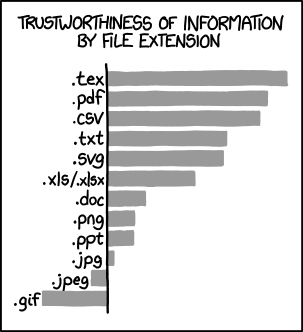
File Extensions

I have never been lied to by data in a .txt file which has been hand-aligned.
04 Dec 01:34

NASA Might Stop Exploring the Planets: Here's Why That's Terrible

by Robinson Meyer
Saturn, as photographed by the Cassini probe in 2008 (NASA)

In the fall of 1997, a massive, unmanned rocket—one of the largest ever—took off on American soil, bound to Venus. It swung around that planet, entering deep-space so it could take advantage of the sun’s gravitational pull. Then it took a tour of the solar system, passing Venus again, Earth, and, a day before the new millennium began, Jupiter.

It kept flying and flying—until, on the first of July, 2004, its payload arrived in the orbit of Saturn.

And there the Cassini probe remains, taking observations, collecting data. Launched over a decade and a half ago, the spacecraft still works. It continues its mission of advancing science and informing us of our planetary neighborhood.

Except … except. If sequestration of the U.S. federal budget continues into 2014, NASA’s budget will lose hundreds of millions in funding. Today, according to early reports, agency leaders suggested to their employees that those cuts would come from the planetary sciences division. NASA might have to terminate the Cassini mission while it is still scientifically productive.

And there are countless more reasons why this is a bad idea. Space exploration supports us on Earth in countless ways, both quantifiable and intangible.

Software engineer Charlie Loyd (who’s also my friend) wrote a stream of tweets about why we so badly need planetary science and exploration. I think they lay out the case well. 

We Need Planetary Science

That last link goes to the Planetary Society’s guide on how to advocate for NASA’s budget. If you think we should explore space more fully, now’s the time to check their advice.


27 Nov 18:40

Understanding the Enemy

by Stewart Baker
(Stewart Baker)

The latest Snowden leak story is in the Huffington Post.  It says that NSA thought about exposing the hypocrisy of Islamic extremist recruiters by revealing their financial greed or predatory sexual habits.  I’m quoted in support of considering such tactics, but the backstory of the interview may be more interesting.

When one of the authors, Ryan Grim, called me for comment, he said that while Glenn Greenwald was transitioning to his new Omidyar-funded venture he was temporarily publishing his Snowden leaks with HuffPo. So when he asked for my take on the NSA story, pretty much the first words out of my mouth were, “Why wouldn’t we consider doing to Islamic extremists what Glenn Greenwald does routinely to Republicans?”  The story quotes practically everything I said to Grim except that remark, even though I returned to the point a couple of times and emphasized that it summed up my view.

I don’t think HuffPo cut the quote because they ran out of electrons.  The article itself is so tediously long that I defy anyone to read every word in a single go.

Nor because my remark was inaccurate.  It turns out that Glenn Greenwald has written an entire book devoted to exposing the contradiction between Republicans’ ideology and their private lives.  In Greenwald’s words,  “While the right wing endlessly exploits claims of moral superiority … virtually its entire top leadership have lives characterized by the most decadent, hedonistic, and morally unrestrained behavior imaginable …[including] a string of shattered marriages, active out-of-wedlock sex lives, and highly ‘untraditional’ and ‘un-Christian’ personal lives [endless detail omitted].” His book certainly makes the NSA memo sound restrained and cautious, but both are motivated by the same idea.

Grim and Greenwald very likely cut the quote because it would have undermined the narrative of the piece, which combines solicitude for the poor Islamists whose sexual and financial hypocrisy might be exposed with outrage at the NSA for even considering such a tactic.  The quote would have made them look like, well, hypocrites.

The incident makes me wonder what else Greenwald leaves out of his stories. And why we should continue to trust snippets of documents selected by someone who thinks that the difference between Islamist extremists and Republicans is that one is an enemy that deserves no quarter and the other is sort of like Martin Luther King, except for the part about wanting to kill us.

20 Nov 15:57

Icons of the Right Debate a Guaranteed Minimum Income

by Conor Friedersdorf

In recent weeks, items in The Atlantic, The New York Times Magazine, and The Economist–along with my most recent Orange Country Register column–have aired the idea of a guaranteed minimum income paid by the government to all adults, in place of today's welfare spending. Is that a visionary way to end poverty? An invitation to perverse incentives? If Switzerland's voters pass the guaranteed income proposal before them in their next election we may get some empirical evidence.

Meanwhile it's worth noting that libertarian icon Milton Friedman, an advocate of a guaranteed minimum income (framed as a negative income tax), once conversed about its merits with conservative icon William F. Buckley. Here's their debate:

When people express disdain for Rush Limbaugh, Sean Hannity, and Glenn Beck, among others, and insist that the right should be able to find better public voices—this is what they mean.


18 Nov 23:31

Treating Insomnia to May Help Cure Depression

by By BENEDICT CAREY
The first of four studies on the special relationship between sleep and depression suggests that when antidepressants and insomnia therapy are used together, recovery happens faster.


15 Nov 23:27

Why Not Use Tax Preparers as a Portal to Health Exchanges?

by Howard Gleckman

What if we bought individual health insurance through our tax preparers? At first, the idea seems bizarre, but give me a minute to explain.

Given the well-known problems of HealthCare.gov and many of the state health exchanges, people seeking insurance coverage need a better way to buy. And commercial alternatives to government sites seem an obvious portal to Affordable Care Act coverage.

You can buy directly through insurance company websites, but the Obama Administration worries that would make it impossible to compare policies offered by different carriers in the way you could on a well-functioning exchange. For instance, if I go the Blue Cross site, I’m not likely to learn much about Kaiser Permanente’s offerings. On the other hand, commercial online health insurance marketplaces allow for comparison shopping, but raise issues of privacy (and perhaps even fraud from fake sites).

Or, you could make your purchase of health insurance a relatively seamless part of filing your tax return.

It actually makes a lot of sense. After all, the Affordable Care Act subsidies are tax credits and the information you need to figure out your subsidy amount is based on the income tax you pay. The penalty you’d owe for not buying insurance is a federal tax. Tax preparers already have—and are legally required to protect—nearly all the personal information they’d need to help figure the subsidy.

Storefront tax preparers can connect customers to health insurance markets through in–person contact. Or people could link electronically through a website such as Intuit’s TurboTax.  

Brian Haile, Jackson Hewitt’s senior vp for health policy, predicts more people could end up buying through their connection with tax preparers than any other portal. “It’s a no-brainer,” he told me, “The Affordable Care Act is a series of amendments to the Internal Revenue Code and we help customers with their taxes. We can make this far more accessible for folks.”  

I’m hardly the first person to think of this. My Urban Institute colleague Stan Dorn has been exploring this idea since 2011—long before the HealthCare.gov site crashed. And now tax prep outfits are taking steps in this direction.

Tax preparers won’t act as insurance brokers themselves. Instead, they are partnering with commercial online health marketplaces to ease enrollment.   

For example, Jackson Hewitt is working with the online marketplace Getinsured to enroll people. Jackson Hewitt will calculate subsidies and potential penalties and, if customers choose, transmit that information to Getinsured. If the Jackson Hewitt customer wants to buy coverage, all she’ll need to do is pick an insurance plan. Jackson Hewitt can even fill out all the paperwork for people to enroll in Medicaid. It says it will not charge for any of these insurance-related services.

Because Jackson Hewitt has 2800 locations in Walmart stores, it could be an especially important link to the uninsured.   

H&R Block announced in September that it is partnering with the commercial online health exchange GoHealth to help people enroll through Block-branded online chat and phone support. Block also announced that it will have insurance agents located in its Arizona tax offices as part of a pilot program.

Intuit has created a product called TurboTax Health to assist buyers and has entered into its own partnership with the commercial online marketplace eHealth Inc.  

Combined, these three firms alone claim to help file nearly 50 million returns—making them a huge potential portal for insurance buyers. The IRS estimates that about two-thirds of low-income taxpayers use paid preparers–many use walk-in firms such as Block and Jackson Hewitt. And Haile estimates that 90 percent of the uninsured get refunds. He predicts these individuals will be far more interested in buying insurance with those refunds in-hand than they are today, when they are focused on holiday shopping.

Using tax prep firms as a link into the health insurance market won’t solve all the problems of the Affordable Care Act. For instance, the Obama Administration still needs to make sure the back end of its electronic system works, including the government data hub needed to verify buyer information. But Haile is right: For many people-especially those eligible for subsidies—the tax filing season is a perfect time to enroll and tax preparers are a great way to connect them to plan options.

Given its problems with the government site, the Administration ought to be promoting these commercial alternatives. And tax prep firms ought to seize the opportunity.     

13 Nov 20:26

Russia Is Now Targeting the Relatives of Suspected Terrorists

by Tom Balmforth
Investigators work at the site of a suicide bomb attack in the Malgobek district of Ingushetia. (Kazbek Basayev/Reuters)

MOSCOW—Critics say a new law designed to quell the insurgency in Russia's restive North Caucasus region revives the Stalin-era principles of collective guilt and collective justice. 

President Vladimir Putin signed the legislation on November 3, requiring "close relatives and acquaintances" of those who commit acts of "terrorism" to pay damages—both material and moral—resulting from those acts. It also empowers authorities to seize property from friends and relatives of suspected militants and provides for prison sentences of up to 10 years for those convicted of receiving training "aimed at carrying out terrorist activity."

"This is absolutely not normal. It's a return to the 1930s, when Stalin advocated collective responsibility for crimes which were carried out," Mairbek Vatchagayev, a North Caucasus analyst for the Jamestown Foundation and head of the Paris-based Center for Caucasus Research, says. "Once again, we've ended up there when Putin regards himself a supporter of Stalin and the Stalin period."

The legislation comes just four months before Russia hosts the 2014 Winter Olympics in Sochi, just a few hundred kilometers from the restive North Caucasus. Fears that terrorism could mar the Sochi Olympics heightened last month after a female suicide bomber from Daghestan detonated explosives on a bus in Volgograd, killing six people and injuring 30 others.

Analysts say the law, which was entered into parliament before the Volgograd bombing and was passed rapidly in its wake, is part of the Kremlin's hardening line in the North Caucasus.

The authorities are also testing the DNA of conservative Muslim women in the region so as to identify them rapidly if they become suicide bombers, Reuters reports.

The law signed by Putin effectively mimics at a national level the tactic of persecuting relatives that has long been in place in Chechnya under its pro-Kremlin leader, Ramzan Kadyrov. Vatchagayev said the tactic has made Chechnya "the most peaceful republic in the region" and in stark contrast to Daghestan and Ingushetia. Vatchagayev says the Kremlin is hoping to emulate this success regionwide.

"Vladimir Putin has decided to implement the experience of the Chechen Republic across the whole North Caucasus," Vatchagayev says. "The law is almost entirely aimed at the North Caucasus against armed fighters."

Vatchagayev adds that the law is ambiguous because "relatives" and "close acquaintances" can denote a "whole clan" in predominantly Muslim republics like Chechnya.

Analysts say the law fits a hardening shift in how security forces are dealing with the insurgency ahead of the Olympics. Andrei Soldatov, the founder of investigative website agentura.ru, which tracks the security services, says it signals an ongoing shift away from using incentives to get insurgents to lay down their arms.

"The tactics of the security services now are quite different than they were a year ago," Soldatov says. "A year ago, they combined special operations with non-special operations—like encouraging people to come [in] from the forest and all these commissions of rehabilitations. It seems now that these kinds of activities have stopped in almost every North Caucasus republic and they [use] only this hard approach."

Soldatov was nonetheless unsure the measure would yield the intended result across the North Caucasus because of varying local conditions.

"I think it depends on which republic we are talking about," Soldatov says. "One thing is that in Chechnya everybody is scared by Kadyrov and his people. In this case, maybe the tactics would be effective in the short term. But I think the situation in Dagestan is completely different. There, the security services are losing the battle for the hearts and minds of the population. And this kind of measure might only add to the sense of disappointment."


This post appears courtesy of Radio Free Europe/Radio Liberty.


06 Nov 16:43

Dog The IRS Bounty Hunter? Private Tax Collectors Are Coming

by Robert W. Wood
LAS VEGAS, NV - APRIL 05:  TV personalities Be...

No one wants to owe money, and being chased for taxes is no fun. But if you have to owe taxes, who do you want coming after you, the IRS or private debt collectors? People may crack jokes about the inefficiency of the IRS. Still, many people think that having the IRS farm out collection work to private contractors is a bad idea.

But not everyone agrees. If you ask this question, you’ll get mixed answers. Should the IRS use private debt collectors? Senator Chuck Grassley thinks so.

In part, he relies on a report by the Treasury Inspector General for Tax Administration (TIGTA). It shows that tax enforcement is down. It also reveals a big increase in Tax Delinquent Accounts and in the size of amounts owned. Tax debts have increased by nearly $100 billion over ten years.

Sen. Grassley points to the many tasks of the IRS, but says its primary role is to collect the revenue necessary to fund the government. But the system isn’t working, says Grassley. He points to a trial run that he says shows private contractors will collect more than IRS employees and do it more efficiently.

That’s right. It turns out that the IRS’s resort to Private Debt Collection was authorized in a 2004 law. This program authorized the IRS to contract with private agencies to collect taxes that were owed to the IRS but it wasn’t collecting on its own. For two and a half years, private contractors worked dog tax cases the IRS wouldn’t work.

Lo and behold, the contractors collected nearly $100 million that otherwise would have gone uncollected. What’s more, Sen. Grassley points to the IRS’s own data showing that the quality ratings of employees of the private contractors were high. In fact, they were consistently above those of IRS employees.

Grassley claims that the program was doomed despite its success. In March 2009 the IRS chose not to renew contracts with private debt collecting agencies. The IRS claimed that IRS employees could collect the tax debts cheaper and better than private employees.

Sen. Grassley points to a 2010 Government Accountability Office (GAO) study that the IRS “cooked the books” to get the results it wanted. GAO made several suggestions on how to fix the study and move forward. Yet, the IRS doggedly refused.

A 2011 TIGTA report also supported the idea of private tax collection. According to Sen. Grassley, despite the assertion by the IRS that its employees would work the cases more effectively, TIGTA found that IRS worked less than half the cases that were reassigned to the IRS when private contractors were called off the scent. TIGTA estimated that up to $516 million could have been collected over five years if similar cases would have been assigned to the private debt collectors.

Stay tuned.

You can reach me at Wood@WoodLLP.com. This discussion is not intended as legal advice, and cannot be relied upon for any purpose without the services of a qualified professional.

31 Oct 17:48

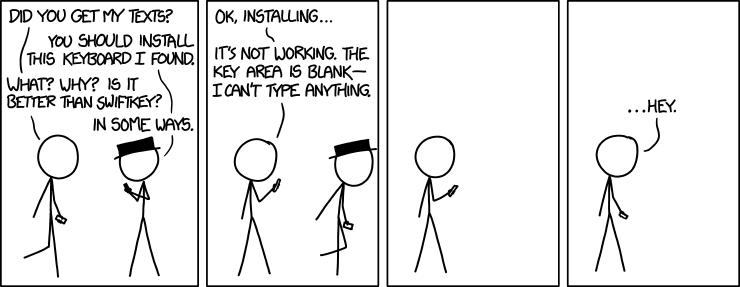
Improved Keyboard

I'm always installing tons of weird experimental keyboards because it serves as a good reminder that nothing I was going to type was really worth the trouble.
14 Oct 15:40

Take Heart, Some People Face Taxes Even More Bizarre Than Yours

by Robert W. Wood
torn tax form

(Photo credit: tolworthy)

Tax law is famously quirky and often downright unfair. Do something one way, it’s taxed. Do it slightly differently, it’s not. That’s one reason regular people often feel outgunned and discriminated against.

Not every wealthy person argues for higher rates like Warren Buffett. Mitt Romney spent time backpedaling about his private equity tax breaks. That surely didn’t help his Presidential candidacy. Taxes matter to everybody.

People go to tax advisers before implementing decisions so they don’t misstep. That should make tax advisers feel important, but many tax lawyers feel like second class citizens. Trial lawyers are famous, not tax lawyers.

Clarence Darrow, F. Lee Bailey, Johnny Cochran and Melvin Belli? Not one was a tax lawyer. Even in fiction, Perry Mason, Atticus Finch, Ally McBeal, and Matlock weren’t tax lawyers. Elle Woods in Legally Blonde didn’t become a tax lawyer either.

Tom Cruise played a tax lawyer in The Firm, but John Grisham had to invent a Mafia-controlled law firm into money laundering and murder to make tax law exciting. Actually, though, real-life tax lawyers have a neat job. Here’s a real-life example.

In most states sales tax doesn’t apply to food. Restaurant meals and prepared takeout are usually taxed. So is animal or pet food, but not uncooked human food. Keeping track of these rules can be daunting.

It sure was for a mom and pop wholesale produce seller. Since it sold only produce, it had no seller’s permit. Why would it, since all its produce was exempt? As it happened, though, the company delivered fruits and vegetables to city schools, hospitals, and the zoo.

Sales tax auditors hit them with a crippling back tax bill for the produce delivered to the zoo. This produce was consumed by animals and that made the sales taxable, the state said. What’s more, because they didn’t have a seller’s permit and weren’t filing returns, a whopping 8 years of taxes were due. Only 3 years would have been fair game if the company had been filing returns.

Eight years of taxes, penalties and interest would wipe out the family business. How to fix this? The zoo had human snack bars and cafeterias, but the wholesaler couldn’t show which carrots and bananas were consumed by people and which by animals.

So the state said it was all taxable. Efforts to compromise with state auditors failed so they went to a full-blown hearing with witnesses before the California State Board of Equalization. They even invited the press. Hey, this case had human interest and entertainment value.

Testimony showed that if you tell a supermarket checker the broccoli you are buying is for your dog, the clerk has no way to charge you sales tax. Plus, if an animal is suitable for human consumption, the food it eats isn’t taxable. That meant produce eaten by primates was taxable, but not produce eaten by goats and sheep in the petting zoo.

Besides, some people eat snake, turtle, and game animals. “I’ve eaten snake,” admitted one of the five judges. In fact, the more we pointed out such contradictions, the sillier the state’s position seemed. The more crazy examples we provided, the more the press liked it, and the more the five-member Board didn’t want to put this mom and pop produce seller out of business.

It lead to a speedy verdict for mom and pop. Of course, tax lawyers will never be swashbuckling fixers like Michael Clayton. But tax lawyers can still make a difference. Besides, as Winston Churchill put it: “There is no such thing as a good tax.”

You can reach me at Wood@WoodLLP.com. This discussion is not intended as legal advice, and cannot be relied upon for any purpose without the services of a qualified professional.

29 Sep 17:38

Avoiding Obamacare With Independent Contractors

by Robert W. Wood

One of the precepts of Obamacare is that all employees ought to have affordable health coverage. That’s a laudable goal, but many employers are doing their best not to be covered by the rules. After all, no matter how admirable the goal, the law erects new burdens of complexity. Complexity means expense.

There are technical rules about health coverage and affordability, and it isn’t all easy to apply. If you’re a small enough employer, you needn’t navigate all the hurdles. Small employers, those with 50 full-time employees or less, aren’t covered.

The act defines a “full-time employee” as someone who works 30 or more hours a week on average during a 1-month period. You don’t have to count seasonal workers who work fewer than 120 days during the year. However, nonseasonal part-time workers are counted.

Of course, many rules hinge on who are your employees—independent contractors aren’t covered. But that assumes that your  independent contractor classification holds up. If it doesn’t and your independent contractors are recharacterized, you are back in the soup. The risk isn’t theoretical, as the IRS is active in independent contractor reclassification efforts. And more scrutiny is coming.

So can you fire all of your employees and make them independent contractors? Hardly. Firing everyone has plenty of other risks too. Besides, no matter how you label someone, the substance of the work relationship will control. For any independent contractor, it is appropriate to review how strong a case you have for a true independent contractor relationship.

That’s so with your existing workers and those you might hire in the future. In fact, you should be increasingly vigilant about these rules. How do you determine who is an independent contractor? You can start with labels, but the IRS says you must evaluate 20 factors and assess whether you are controlling the method, manner and means of the work.

No one factor is controlling. The duration of your work relationship is important, as is whether it is full or part time, professional credentials, flexible vs. rigid hours, who supplies tools and supplies, expense reimbursements and more. A written contract is key to independent contractor status, but that alone is clearly not enough. Are you paying for a job—like having someone put in a new kitchen—or paying for someone to work by the hour doing reception work.

This fundamental worker status issue has become one of the most consequential legal determinations around. If you guess wrong, the liability for past years can be crushing. And the Inspector General of the IRS—the same one who was in the news over the Tea Party targeting scandal—has issued a report saying that despite IRS efforts, employers are still getting it wrong.

The report says millions of workers are misclassified as independent contractors. They are really employees, the report claims, and that means payroll tax withholding. Employers are dramatically underpaying employment taxes and that hurts everyone, the report says.

Determining who is an employee is a fact-intensive minefield. It always has been. And with Obamacare, stakes that were already high are getting higher. If you have independent contractors, you may need to retool your written agreement, evaluate which groups of workers should be employees, and further differentiate your independent contractors from employees.

When you do this, be realistic. Many business people are not. Fighting and losing a worker recharacterization battle can cripple a business. And with the push-me-pull-you of Obamacare, some small businesses are likely to start pushing the worker status envelope even more.

You can reach me at Wood@WoodLLP.com. This discussion is not intended as legal advice, and cannot be relied upon for any purpose without the services of a qualified professional.

18 Sep 17:25

Former Convincts Make Bad Employees—and Other Hiring Myths Exposed By Big Data

by Jim Meyerle

REUTERS

Despite the high rate of unemployment in the US, 4 million job openings remain unfulfilled. Attrition and lost productivity contribute to $350 billion in annual losses for US businesses; outdated hiring and workforce management practices are largely to blame.

Used in the right way, big data technology can decode factors that contribute to smarter hiring and optimal employee performance. These findings challenge conventional wisdom about what makes great employees. Think experience matters? It doesn't. Concerned that job-hoppers, the long-term unemployed, or even ex-convicts make bad hires? They don't.

My co-founder Max Simkoff and I started Evolv after our own attempts at workforce management in executive roles failed. We personally struggled to retain and advance employees across a large workforce, even after painstakingly selecting and nurturing the "most qualified" candidates. This seemingly unsolvable problem left us wondering if there was a better way. We observed that success was clearly not about hiring and managing a workforce by intuition--it was about building a high-performing workforce using objective facts, hard data, and continuously using that data to improve decisions.  It was not about using touchy-feely management techniques, but rather creating a system that removed bias and challenged preconceived notions of what made an employee "good," making the process fair and fact-based. And when we realized that there wasn't a data-driven approach to workforce performance in the market, we built one that could have a real impact.

One of our Fortune 100 clients, for example, shared with me a story about an employee who held a great number of temporary jobs prior to her eventual employment. From the point of view of a traditional hiring manager, this job-hopping behavior would have screened her out for fear she'd be short term in this role, too. But our product accurately predicted that her history would not influence future performance in the right role. When she was interviewed for the position, she revealed that she volunteered as a soccer coach and at her son's school, positive attributes that predicted success for the role and wouldn't have been seen in a traditional application process. Since then, she has outperformed in her position and has been with the company for more than a year.

If the company hadn't adjusted its practices prior to interviewing this employee, a traditional HR system would have never even called her in. The company has since adjusted, and continues to adapt its hiring practices, as it has consistently seen that our data-based recommendations have improved the company's approach to their workers.

Other practices also were brought to light that counter-predicted success on the job. The same company found that promoting managers based on their tenure wasn't making for effective management; instead, promoting employees based on aptitude and personality fit made for a more productive, healthy work environment.

Data analysis shows that median tenure for work-at-home employees is 28% higher than for their in-office peers. However, data also show that personality-wise, not everyone is suited for this role; particular behavioral characteristics contribute to the success of employees who work from home. For customer service employees working from home, these characteristics include reliability, working autonomously, and a preference for a non-verbal communication style. These characteristics are not found on a resume but they can be revealed through carefully constructed assessment tools and resulting big data analysis.

Research debunks these misconceptions that are a deep part of current business attitudes toward the workforce:

  • Self-proclaimed "rule-followers" will act accordingly. On job application tests, employees who claimed to be "rule followers" were 67% more likely than other employees to be terminated for reasons related to rule-breaking, such as drug screenings and background tests.
  • Former convicts make bad employees. People who have been convicted of a misdemeanor or a felony perform just as well, if not better, than employees with no record of charges.
  • Employees distracted by social media/technology are less productive. Employees that took the time to install a non-standard browser, such as Chrome or Firefox, stay at jobs longer, miss fewer days of work, provide higher customer satisfaction, and close more sales. Additionally, employees who belonged to five or more social media networks make more sales.
  • If an employee commutes a far distance, she's less likely to stay. Research proves that the ability to do common errands nearby is actually more important to workers than how far they might have to commute every day.

The US economy is under rapid transformation due to globalization, a shift from manufacturing to service, generational differences and more. It's time for businesses to adapt and to provide environments that are not only fair and beneficial to their employees but also contribute to the health and stability of the American recovery. 


18 Sep 14:39

The Brogrammer Effect: Women Are a Small (and Shrinking) Share of Computer Workers

by Jordan Weissmann
Reuters

According to a Census report out this week, women today still make up a frustratingly small 26 percent of workers in science, technology, engineering, and math (STEM) jobs. But whereas their presence has at least grown or held steady in most of these fields, it's been on a 20-plus-year decline in computer workers, such as developers, programmers, and security analysts. 

In 1990, a third of computer workers were women. Now: 27 percent. 

The dearth of women is worse in some corners of computer world than others. Two in five Web developers are women, but 78 percent of software developers are men.  

One of the issues might well be academic, in a literal sense. Women peaked as a percentage of all computer science undergraduates in the 1980s, not long before they topped out in the computer workforce. And while researchers are still trying to explain the falloff, it seems pretty plain that culture--the way society at large still treats tech as a male bastion, and the often nerd-frat hybrid culture of the field itself--plays a role. 

So here's why everybody, whether or not they've ever given a hint of thought to brogrammers and the social mores of Silicon Valley or Alley or Beach, should care. A large part of the pay gap between men and women boils down to the different careers they pursue. And STEM jobs, with their generally high salaries, are an especially important factor. Meanwhile, as the Census notes, computer fields make up about a half of STEM employment. So when you talk about women retreating from computer work, you're talking about a defeat for their financial equality. 


16 Sep 16:24

New Jersey Adopts Dubious Post-Kelo Eminent Domain “Reform” Law that is Likely to Endanger Property Rights More than it Protects Them

by Ilya Somin
(Ilya Somin)

New Jersey recently became the 45th state to adopt an eminent domain reform law in the aftermath of the Supreme Court’s controversial 2005 decision in Kelo v. City of New London, which ruled that it was constitutionally permissible for government to condemn private property and give it to another private owner in order to promote “economic development.” Unfortunately, as John Ross of Reason explains, the new law does not actually impose any meaningful constraints on the use of eminent domain, and may even actually promote abusive “blight” condemnations:

The law purports to do two things: first, codify a 2007 New Jersey Supreme Court ruling favorable to property owners and, second, decouple eminent domain from redevelopment subsidies. It fails miserably at both.

When local officials declare that an area is blighted and “in need of redevelopment,” the designation both allows them to offer economic development incentives and authorizes the use of eminent domain. But sometimes officials honestly don’t want to seize anyone’s property; they just want the ability to offer subsidies to developers.

But officials cannot credibly promise not to condemn property once it has been declared blighted. Officials can change their minds. And the next city council isn’t bound by past promises….

Decoupling the incentives from condemnation would remove the threat. And the law appears to do just that, allowing for the creation of “non-condemnation redevelopment areas.” But the law lets officials transform a non-condemnation area into a condemnation area if property owners refuse to sell….

The law also muddies the issue of blight.

In Gallenthin v. Paulsboro, the New Jersey Supreme Court held that before cities can seize property for private development, officials must show “substantial evidence” the property is blighted.

Prior to Gallenthin, municipal officials could claim a variety of vague, subjective conditions like “faulty arrangement or design,” “excessive land coverage,” or “obsolete layouts” could justify a blight designation. In Gallenthin, officials argued the mere fact that they could imagine a better use for the property in question, an undeveloped field, meant it was “underutilized” and that they could seize it.

The high court ruled, however, that it would be unconstitutional to seize property without clear, quantitative evidence of a property’s malign influence on surrounding areas.

The new law, instead of codifying the court’s “substantial evidence” standard, restates the old, vague conditions for blight. Since the Supreme Court’s ruling trumps the statute, the section of the law dealing with blight is probably moot on arrival. But property owners will likely be forced into litigation when local officials decide to make sure.

As Ross points out, the new law also includes some other shenanigans that facilitate eminent domain abuse. For example, property owners are now only allowed to challenge a blight designation if they do so within 45 days after its adoption – even if their property is not actually threatened with condemnation until years later. As a practical matter, the poor and lower-middle class property owners who are the most common targets of eminent domain are unlikely to file what could be an expensive lawsuit in a situation where it’s not even clear yet whether their property will actually be taken.

Unfortunately, New Jersey is just one of many states whose post-Kelo reform laws are largely ineffective. That is tragic, because blight and economic development takings are often used to victimize the poor and politically weak for the benefit of influential interest groups.

16 Sep 15:28

Tax Controversy and Litigation: One of the 12 Hot Practice Areas for 2020 and Beyond

by Paul Caron
What Legal Fields Will be Hot?, National Jurist, p. 28, Sept. 2013: It's great to get that first job, but it's even better to focus on a practice area that will be hot, not just in the next few years, but during the next 10 years or more. ... Here,...
12 Sep 00:09

Missouri Republicans Fail to Block Vetoes on 2 Bills

by By JOHN ELIGON
Scottbweese

Finally, a sensible debate

State lawmakers lacked the votes to overturn the governor’s vetoes of a sweeping tax cut and a bill preventing enforcement of federal gun laws.


30 Aug 20:29

Gay Marriages in All States Get Recognition From the I.R.S.

by By ANNIE LOWREY
All same-sex couples who are legally married will be recognized as such for federal tax purposes, even if the state where they live does not recognize their union.


10 Jun 15:31

Yun-chien Chang on Takings Compensation

by Ilya Somin
(Ilya Somin)

How much should the government pay to compensate property owners whose land it has condemned? Legal scholars, jurists, and economists have been debating this issue for centuries. The Supreme Court has interpreted the Fifth Amendment’s value requirement of “just compensation” as requiring “fair market value” compensation – roughly the amount of money that the property could be sold for on the open market. Some critics argue that this standard leads to undercompensation, because many people value their property at higher than the market rate; if you valued your house at the market rate or less, you would probably have sold it already. On the other hand, some economists have argued that even fair market value compensation is too high, because it incentivizes property owners to overinvest in land that is likely to be condemned.

Taiwanese legal scholar Yun-Chien Chang’s new book Private Property and Takings Compensation is an excellent analysis of this longstanding debate. Chang does a first-rate job of assessing a wide range of compensation frameworks put forward by by both economists and legal academics. Ultimately, he concludes that fair market value compensation is the least bad available approach, but argues that it should be supplemented with additional “bonus” payments, especially in the case of properties with high “subjective value,” such as homes where the residents have lived for a long time. He also brings to bear a wide range of empirical evidence from US and Taiwanese takings, showing that authorities in both countries tend to undercompensate property owners even relative to the fair market value standard, and that compensation policy is likely influenced by interest group lobbing.

I do have a few reservations about Chang’s analysis. For example, I think he should have included a more extensive discussion of what kinds of characteristics of a property should result in bonus compensation above fair market value. Should churches qualify? Small businesses? Similarly, I would have liked to know more about how the size of the bonuses should be calculated.

As Chang recognizes, the fair market value approach is still highly imperfect and will often lead to undercompensation even combined with a schedule of bonuses – unless the latter are so high that overcompensation becomes common. In my view, the difficulty of coming up with an accurate compensation system strengthens the case for restricting the use of eminent domain to begin with. The more likely government is to provide either inadequate or excessive compensation, the more wary we should be of using eminent domain at all. Chang’s book would have been even stronger had he given more consideration to the relationship between the problem of compensation and the problem of deciding when government should be allowed to condemn property in the first place.

That said, this is the best book on takings compensation in a long time, if not ever. If you have any serious interest in the subject, you should definitely read it. The only really significant flaw is the inflated price tag of over $100 for a book that is less than 200 pages. Sadly, only libraries, academics with generous expense accounts, and the very wealthy can afford to buy it. That’s unfortunate, because this book deserves a wider audience.

I am tempted to suggest that the government should condemn copies and then distribute them at a reduced price in order to promote the “public purpose” of improving understanding of eminent domain compensation! Perhaps the publisher will eventually put out a cheaper paperback edition. In the meantime, if you are interested in takings compensation, you should at least borrow the book from a library even if you can’t buy it.

CONFLICT OF INTEREST WATCH: I got a free review copy of the book, in part because I am editing a different volume for the same publisher. I don’t think this affects my judgment of the book, and normally I wouldn’t even mention this kind of thing as a possible conflict of interest. In this case, I err on the side of caution because of the combination of the high price and my relationship with the publisher.

10 Jun 15:25

Sen. Ted Cruz (R-TX) Sides With Dissent in Maryland v. King

by Eugene Volokh
(Eugene Volokh)

The press release is here:

Today’s unfortunate U.S. Supreme Court ruling in Maryland v. King, by a vote of 5-4, expands government power, invades our liberty, and undermines our constitutional rights. The Court held that the police can forcibly take DNA samples from people who have been arrested — but have not been tried or convicted — of a serious offense. So now the government can capture, without a search warrant, the most personal information about an individual, and use it to search vast databases for unrelated offenses.

All 50 States already collect DNA from convicted felons. So this intrusion of liberty will matter only for those not convicted: the innocent and wrongly accused or those for whom there is insufficient evidence to convict.

As Justice Scalia rightly noted in dissent, “As an entirely predictable consequence of today’s decision, your DNA can be taken and entered into a national DNA database if you are ever arrested, rightly or wrongly, and for whatever reason.”

All of us should be alarmed by this significant step towards government as Big Brother. The excessive concentration of power in government is always inimical to liberty, and a national database of our DNA cannot be reconciled with the Fourth Amendment.

Accumulating DNA from arrestees — without warrant or probable cause to seize the DNA — is not designed to solve the crime for which the person has (rightly or wrongly) been arrested. Rather, it’s to test the DNA against a national database to potentially implicate them in other unsolved crimes. But the Constitution requires particularized suspicion of a specific crime; indeed, the Fourth Amendment was adopted to prohibit the British practice of “general warrants” targeting individuals absent specific evidence of wrongdoing.

Justice Scalia’s scathing dissent is right: If we really want a DNA database to solve more crimes, then why not require DNA samples to fly on airplanes, get driver’s licenses, or attend public schools?

If the government has good cause for needing the DNA sample — such as trying to match DNA at a crime scene to a particular person where there is other corroborating evidence — then the government can ask a judge for a search warrant. That’s what our Framers intended — judicial checks on extensive government power to invade our personal lives.

Law enforcement is a paramount function of government. But we cannot allow that government function to run roughshod over the Bill of Rights. And, as recent events involving the IRS have demonstrated, unchecked government power — and intrusive personal databases maintained on the citizenry — poses real risks to our liberty.

This struck me as unexpected, and therefore noteworthy.

20 May 19:54

NY Times Debate: Should 501(c)(4)’s Be Eliminated?

by Paul Caron
New York Times Room for Debate: Should 501(c)(4)’s Be Eliminated?: The IRS has been harshly criticized for singling out conservative organizations when it investigated which groups were legitimately applying for 501(c)(4) status, which makes them tax exempt, keeps donors confidential and allows some political activity. But should the 501(c)(4) status...
16 May 01:12

Why Eric Holder's Excuse for Spying on Reporters Isn't Enough

by Conor Friedersdorf
eric holder fullness.jpg
Reuters


Eric Holder's tenure as Attorney General is beset with failures, even if you judge him by his own goals. The fact that his Justice Department spied on AP reporters, snooping into their telephone calls, appears to be the latest betrayal of the ethos he championed prior to his time in government.

But Holder would have us believe that, contrary to the claims of journalists and civil libertarians, the Justice Department did nothing improper. In his telling, spying on journalists was necessary because there was a leak that compromised national security in a particularly serious way. Charlie Savage and Scott Shane adeptly capture the dispute in their New York Times writeup:

WASHINGTON -- Attorney General Eric H. Holder Jr. on Tuesday defended the Justice Department's sweeping seizure of telephone records of Associated Press journalists, describing the article by The A.P. that prompted a criminal investigation as among "the top two or three most serious leaks that I've ever seen" in a 35-year career. "It put the American people at risk, and that is not hyperbole," he said in an apparent reference to an article on May 7, 2012, that disclosed the foiling of a terrorist plot by Al Qaeda's branch in Yemen to bomb an airliner. "And trying to determine who was responsible for that, I think, required very aggressive action."

In a statement in response, The A.P.'s president and chief executive, Gary Pruitt, disputed that the publication of the article endangered security. "We held that story until the government assured us that the national security concerns had passed," he said. "Indeed, the White House was preparing to publicly announce that the bomb plot had been foiled." Mr. Pruitt said the article was important in part because it refuted White House claims that there had been no Qaeda plots around the first anniversary of the killing of Osama bin Laden.
The Obama Administration frequently responds to criticism of its national security policy by invoking national security threats that they conveniently can't discuss openly or in particular detail.

Perhaps they'd sometimes be vindicated if we knew the whole truth.

But I am deeply skeptical in this instance, and not only because I doubt that the president of the Associated Press would brazenly lie about what his organization was told by the Obama White House.

Here's how I see it. Holder's claim isn't that national security could've been damaged had our enemy seen the contents of leaked information that the Associated Press obtained. Rather, Holder insists that the American people were put at risk. In his telling, serious damage was done, hence the imperative to identify the "responsible" party with a secretive, aggressive investigation.

But wait a minute.

If an Associated Press article revealed some choice bit of information to the enemy that empowered it and hurt Americans -- if that damage was, in fact, done -- why not tell us the particulars?

After all, if the enemy already got information that endangered American national security, they already know about it, by definition. Holder's explanation would seem to suggest that he could tell us the damaging information that passed to the enemy, and why it was damaging, without telling the enemy anything they don't already know. He is nevertheless being vague and noncommittal.

Why is that?

Perhaps there's an innocent explanation. If so, he should offer it. Absent any explanation, there is probable cause for suspicion (not that Holder would demand as high a standard as that!). When one guy is saying, to quote the A.P. chief directly, "We held that story until the government assured us that the national security concerns had passed," and the other guy is saying that's wrong, but can't explain why in any detail, the former has the more credible account.

Orin Kerr of The Volokh Conspiracy gamely tries to come up with an alternative scenario that would make Holder's position seem more reasonable -- you can read it for yourself here -- and while we should remain open to a scenario like the one he sketches, it's hard to see why Holder couldn't sketch mitigating details for us himself. Absent any information, we're left to judge his plea to "trust us" in the context of the Obama Administration's general credibility on press issues.

The New York Times characterizes that context as follows: "The Obama administration has indicted six current and former officials under the Espionage Act, which had previously been used only three times since it was enacted in 1917. One, a former C.I.A. officer, pleaded guilty under another law for revealing the name of an agent who participated in the torture of a terrorist suspect. Meanwhile, President Obama decided not to investigate, much less prosecute, anyone who actually did the torturing." In other words, their judgment can't be trusted.


15 May 01:14

Congressional Inquiry of IRS Targeting of Israel Groups

by Eugene Kontorovich
(Eugene Kontorovich)

Congress’s inquiry into IRS abuses has now expanded beyond the hounding of domestic-policy conservative groups to Israel related ones. In a letter today the Chairman and minority leader of the Ways and Means Committee demand information on whether the agency “undertook special reviews of organizations whose missions involve Israel” and whose activities “contradict or are inconsistent with the Administration’s policies.” Will this be within the scope of the Justice Department investigation?

Again, if the IRS did so, it was only doing what the New York Times (and Peace Now and J Street) told it to.

The Acting Commissioner appears for a hearing on Friday (after the Jewish holiday of Shavuot).

15 May 01:08

Online Sales Taxes: A Good Idea Done Badly

by Zachary Karabell
Scottbweese

What a profoundly stupid argument. It completely misunderstands the purpose, nature, and effect of the bill. The law in this area is dizzingly complex for no reason - it is the result of a 1950s regime hobbling along by analogy into the 21st century. The Supreme Court provided creaky and already-obsolete guidance in the 1990s, and actually told Congress they had to intervene. Congress has failed to act until now, with the result being every state has its own standards for what does, and does not trigger sales and use taxes. Countless dollars have been spent litigating and countering aggressive State stances that are driven by budgetary concerns in an area of murky law. This bill imposes one rule, and the efficiencies of clarity outweigh the irritation that people in Delaware are getting an "unfairly" good deal

RTR1JO65-1024x722.jpg

Reuters

On Monday, by a comfortable 69-27 majority, the U.S. Senate passed a controversial bill that will require online retailers with annual sales of more than $1 million to collect state sales taxes. Said Republican Mike Enzi of Wyoming: "This bill is about fairness. It's about leveling the playing field between the brick-and-mortar and online companies, and it's about collecting a tax that's already due. It's not about raising taxes."

Wait, isn't it? Leaving aside the anomaly in today's world of a Republican sponsoring a bill that raises revenue, the proposed law is entirely about raising taxes. The question, then, is whether these are taxes that ought to be raised, and if this is the way to raise them.

The short answers: Yes to the first, no to the second. This bill is precisely the wrong way to raise revenue from a growing stream of business. It applies a tax designed for physical entities to new commerce and does so in ways that will do little to help states or to reinvigorate small businesses that are hurting.

As is, much of the tax system is not fair. We are acutely aware of the labyrinthine quality of the U.S. tax code. The vagaries of state-by-state sales taxes only add to the complication. Five states don't even have a sales tax (Alaska, Delaware, Montana, New Hampshire and Oregon), and seven states have no income tax, including no tax on dividends and interest (Alaska, Florida, Nevada, South Dakota, Texas, Wyoming and Washington). If fairness is your litmus, as it is Enzi's, then it is rather unfair to live in New Jersey as opposed to, say, Florida, given the radically higher tax burden.

A Lotta Headache for a Little Revenue
That much of the code is currently unfair is hardly an argument against making one aspect of it fairer. But the online sales tax bill will place added burdens on those already paying more, whereas those living in sales-tax-free states will continue to feel none. For years, those of us who live in states that levy a sales tax have enjoyed the free pass that comes with shopping tax-free on Amazon, eBay, and any number of online sites. We get to sit at our computers at 1 in the morning and order those much needed gyroscope-equipped power drills without the nuisance of that extra 6 percent tacked on by state legislators whom we've never heard of, didn't vote for and aren't entirely convinced actually exist.

The bill was created because of angst from retailers and state legislators. Retailers have long cried foul, claiming that the ability of online sites to sell the same goods without sales tax provides unfair advantages that drive brick-and-mortar stores out of business. Many small businesses with storefronts that rely on local customers have actively lobbied for an online sales tax, asserting that unless that playing field is leveled, more small retailers will go out of business, eliminating jobs and harming local communities. Cash-strapped state governments have been even more adamant, arguing that they are losing more than $23 billion a year in foregone revenue because of the loophole, with negative consequences for teachers, police officers and all residents.

Even here, however, the problem isn't so simple. Some small business owners have warned that the burden of record keeping for their online sales by state will be immense. The bill has a proviso that each state develop software that will ease that burden, but there's hardly a guarantee that these systems will be harmonious, leaving a small business with $1 million in online sales to confront 44 different software widgets and a whole new IT budget. Given the competitive landscape of retail, the bill is likely to harm those who supposedly need it the most: small businesses.

While the bulk of commerce still takes place at brick-and-mortar stores, only e-commerce is seeing rapid growth. And while some of that is cannibalizing physical stores, e-commerce is creating new markets, which has been as much the savior of small, innovative businesses as a disruptor. Smart boutique owners know how to add an online component, which works in tandem with their physical store and often becomes an even larger entity.

Then there are state governments, many of which need all the cash they can get to cover pension plans that are seriously underfunded. The allure of "lost" online revenue is understandable, but states would be better served by encouraging online commerce, especially if they are determined to tax it. That is where the growth is. If you want vibrant communities, you have to support the virtual ones.

This or VAT?
Nonetheless, governments require revenue. Over the past years, there have been various calls for a value-added tax in the United States; the explosive growth of online commerce should renew that debate. The VAT is well suited to online commerce because it creates a chain of revenue that goes from vendors to wholesalers to final customers. Of course, a VAT would be inherently disruptive of state-sales taxes and would require radical changes at the state and national levels. We appear nowhere near that.

After sailing through the Senate, it appears that the bill's final passage in the House of Representatives is uncertain and perhaps unlikely. House Speaker John Boehner is in no hurry to bring the bill to a vote, and while we know that his views hardly determine the behavior of the Republican caucus, in this case it is certainly more in sync. There is predictable, if knee-jerk, opposition from those Republicans committed to no new taxes, and there is intense lobbying from powerful online players such as eBay to slow passage or further amend the bill.

This proposed bill is a bad implementation of a needed change. It's a reminder that what we can currently do politically is far short of optimal. In this case, it fails to even be acceptable. It raises a small amount of revenue and generates a large amount of friction. It does, however, highlight that not all areas of our economy are bleak and moribund. It's the very vibrancy of the e-commerce world, both independent of and connected to physical stores, that led to this legislation. Remember the thief who was asked why he robbed the bank and answered, "Because that's where the money is"? Well, that's why we have this new bill, because e-commerce is thriving. The bill may be a poor idea, but at least there's a sector of our economy that is doing so well.

"The Edgy Optimist" column is initially published at Reuters.com, an Atlantic partner site.