Security teams at mid-sized organizations are constantly faced with the question of "what does success look like?". At ActZero, their continued data-driven approach to cybersecurity invites them to grapple daily with measuring, evaluating, and validating the work they do on behalf of their customers.
Like most, they initially turned toward the standard metrics used in cybersecurity, built
An Iowa data scientist with a computer engineering degree and a Harvard MBA has come forward as the whistleblower leaking damaging information about Facebook to the Wall Street Journal — and that's just the beginning. They've now also filed at least eight complaints with America's Securities and Exchange Commission, "which has broad oversight over financial markets and has the power to bring charges against companies suspected of misleading investors," reports the Washington Post. To buttress the complaints, the whistleblower secretly copied "tens of thousands" of pages of internal Facebook research, according to a report tonight on the CBS News show 60 Minutes, which summarizes her ultimate conclusion: "that the company is lying to the public about making significant progress against hate, violence and misinformation.
"One study she found from this year says 'We estimate that we may action as little as 3 to 5% of hate, and about 0.6% of violence and incitement on Facebook. Despite being the best in the world at it." Another internal Facebook document admits point-blank that "We have evidence from a variety of sources that hate speech, divisive political speech and misinformation on Facebook and the family of apps are affecting societies around the world."
60 Minutes points out that Facebook "has 2.8 billion users, which is 60% of all internet-connected people on Earth."
[Whistleblower Frances] Haugen told us the root of Facebook's problem is in a change that it made in 2018 to its algorithms — the programming that decides what you see on your Facebook news feed... "One of the consequences of how Facebook is picking out that content today is it is optimizing for content that gets engagement, or reaction. But its own research is showing that content that is hateful, that is divisive, that is polarizing, it's easier to inspire people to anger than it is to other emotions... Facebook has realized that if they change the algorithm to be safer, people will spend less time on the site, they'll click on less ads, they'll make less money."
60 Minutes reports that Facebook was even contacted by "major political parties across Europe," according to leaked internal documents which say the parties specifically complained that a change Facebook's algorithm "has forced them to skew negative in their communications on Facebook... leading them into more extreme policy positions." (Or, as 60 Minutes puts it, "The European political parties were essentially saying to Facebook the way you've written your algorithm is changing the way we lead our countries." The whistleblower sees their position as "You are forcing us to take positions that we don't like, that we know are bad for society. We know if we don't take those positions, we won't win in the marketplace of social media."
Haugen says Facebook understood the danger to the 2020 Election. So, it turned on safety systems to reduce misinformation — but many of those changes, she says, were temporary. "And as soon as the election was over, they turned them back off or they changed the settings back to what they were before, to prioritize growth over safety. And that really feels like a betrayal of democracy to me." Facebook says some of the safety systems remained. But, after the election, Facebook was used by some to organize the January 6th insurrection....
After the attack, Facebook employees raged on an internal message board copied by Haugen. "...Haven't we had enough time to figure out how to manage discourse without enabling violence?"
The whistleblower will now appear Tuesday before a U.S. Senate Commerce consumer protection subcommittee — and has already shared some of their documents with Congressional offices probing Facebook, according to the Washington Post. "It's important because Big Tech is at an inflection point," the whistleblower's lawyer tells the newspaper. They argue that ultimately Big Tech "touches every aspect of our lives — whether it's individuals personally or democratic institutions globally. With such far reaching consequences, transparency is critical to oversight.
"And lawful whistleblowing is a critical component of oversight and holding companies accountable."
Car buyers are discovering that supply chain constraints "have thrusted prices upwards considerably for new and used vehicles alike," notes Jalopnik.
But while last month Fortune ran an article headlined "Chipmakers to carmakers: Time to get out of the semiconductor Stone Age," Jalopnik argues it's not that simple.
The implication here is that the auto industry is far too reliant on archaic tech that isn't applicable to other consumer tech fields. It's now finally reckoning with its reluctance to change, and only a fool would invest in shops to pump out the outdated silicon cars require. But is that a fair assessment? As Fortune notes in its own piece, there are reasons why carmakers — some of the largest corporations in the world — choose the chips they do. The comparison to smartphones is moot... The potential ramifications of a glitch in a metal box traveling at many miles per hour are a little more severe. That's especially true if you're talking about modern vehicles with driver-assist functions...
I asked some auto industry veterans to weigh in... What automakers require is somewhat at odds with what chipmakers prefer and are tooled to produce: smaller, more densely packed chips, that can be manufactured at lower cost and yield more units.... However, to suggest as [Intel CEO] Gelsinger did that the burden to adapt should fall squarely on automakers simplifies the issue. General purpose chipmakers don't seem to grasp the unique challenges of the automotive sector — something that became clear to me after chatting with Jon M. Quigley, Society of Automotive Engineers member and columnist at Automotive Industries. "Qualifying a product, specifically testing activities, are costly and requires time, talent, and equipment," Quigley said. "Some of the test equipment requirements are expensive and often not on hand at the OEM but will require an external lab, and booking time at this lab can be a long lead time activity, and is necessary for certain product certifications. Depending upon the vehicle system commonality, this testing might have to be performed on multiple vehicle platforms. Making changes to an existing product, changing an integrated circuit that only has the difference in the manufacturing processes would still require this sort of testing. Unless there are some compelling associated cost improvements to recoup the investment, this is not very plausible."
It's easy for those of us on the outside to miss the many steps of validation automotive components are required to go through before they end up in what we drive. Ultimately, carmakers don't care how small or new a chip is; all that matters is that it works for its intended purpose and is properly vetted... Chipmakers want as much miniaturization as possible to maximize production efficiency, automakers need significant lead time to make sure a chip will work for them. Each industry has reasons for operating the way it does. That doesn't change the fact that someone's going to have to budge to address this shortfall....
Over time, the transition to newer technology may naturally happen, but certainly not quickly enough to Band-Aid the snags of the present moment. That doesn't give anyone a single, solitary scapegoat, and it's not the easy answer anyone likely wants to hear — not prospective shoppers, not automakers and not the CEO of Intel. But it's the most realistic answer nonetheless.
In the meantime, one analyst that Jalopnik spoke to predicted automakers will try strategic partnerships with chipmakers — that is, "find ways to own or control more of the chip supply base going forward by partnering with ASIC design companies who do similar design service for networking companies."
Hwang Dong-hyuk's riveting nine-episode thriller "Squid Game" has a captive audience. In the wake of its Netflix release, the series has become the #1 show on the streaming service across 90 countries as viewers around the world tune in to watch a game with stakes that transcend language barriers: Money and death.
Lee Jung-jae stars as "Player 456," known in his day-to-day life as Seong Gi-hun. A chronic gambling addiction has left Gi-hun broke, divorced from his wife, living back home with his elderly mother, and about to lose contact with his daughter as her mother and step-father plan a move to the United States. Yet everything that makes Gi-hun an outcast in society makes him a perfect candidate for a top secret tournament, in which people in dire financial straits play a series of scaled-up children's games in order to compete for a total prize pot of 46 billion won ($39 million).
Is there a catch? Of course there is. If you lose any of the six games in the tournament, you die. Hundreds of players are slaughtered in the first round ("Red Light, Green Light"), yet when given the option to drop out and return to their normal lives, almost all of the surviving players ultimately choose to continue on to the next round.
It's a distinction that sets "Squid Game" apart from other obvious points of pop culture comparison, like "Battle Royale" and "The Hunger Games." The players may protest the sadism of the games and beg for mercy while being guarded by faceless drones carrying guns, but the torture they're being subjected to is one that they could have walked away from.
In the sixth and final round, only two players remain: Gi-hun, and his childhood friend Sang-woo (Park Hae-soo), who is the pride of their hometown but is secretly facing prison time for losing billions of won in company money by gambling on a much larger scale. Trapped between the stick of their crippling debt and the carrot of enough wealth to solve all of their problems, Gi-hun and Sang-woo play together for the last time. Here's a breakdown of "Squid Game" season 1's ending and how it bookends the themes of this thought-provoking South Korean thriller.
People As A Commodity
"Squid Game" constantly reinforces the idea that Gi-hun and the other players in the game are seen as objects, not as people. The mysterious organization running the game uses the same black box and pink ribbon design for its coffins as it does for its gifts. When Gi-hun is first seduced by the offer of a game of ddakji, the Salesman (Gong Yoo) offers to let him pay with his body in lieu of money -- by enduring a slap in the face for every round he loses.
This simple game is a test of the subject's willingness to let themselves be objectified -- motivated not only by the potential prize, but by the thrill of the game. There's plenty of overt class commentary in "Squid Game," particularly in the final rounds as the VIPs use human servants as furniture while watching from a safe distance as the desperate players tear each other apart. Yet the dynamic is more complex than "rich vs. poor." The players range in status from the truly penniless (Gi-hun) to the ostensibly wealthy (Sang-woo). Then there are rougher, street-smart characters like Deok-su (Heo Sung-tae) and Mi-nyeo (Kim Joo-ryoung), who might not be as desperate for the cash as others, but have no limits to what they'll do in order to get it.
"Squid Game" gradually blurs the lines between the players, the soldiers, the VIPs, and the mysterious Front Man. At first they appear to be two groups: the sheep and the shepherds; the puppets and the puppet-masters; the haves and the have-nots. But when Detective Hwang Jun-ho (Wi Ha-joon) infiltrates the island where the games are held and disguises himself as a soldier, he finds them living in conditions almost as rigidly-controlled as those of the players. And when he finally finds his missing brother, In-ho (Lee Byung-hun), he finds him behind the mask of the Front Man. In-ho previously emerged from a round of games as the victor and, when given the financial freedom to do anything, he apparently chose to return to the arena and start running the games.
Even the VIPs are gambling addicts -- so numbed by the cushion of their wealth that they bet eye-watering sums of money on games of life and death just to feel a jolt of genuine excitement. And for one of the VIPs, simply being a spectator wasn't enough.
The Host
"Squid Game" is an emotionally grueling series, but perhaps no episode is more devastating than episode 6, "Gganbu." The fourth round -- in which contestants play simple games of marbles in pairs -- at first seems rather anticlimactic after the grand scale of previous trials like "Red Light, Green Light" and "Tug-of-War." But after being told to find a "partner," the players are horrified to learn that they'll be competing against each other, and only one person from each pair can survive.
It's a set-up that knocks all the characters off-balance. Stoic, independent loner Sae-byeok (Jung Ho-yeon) is paired with the similarly inscrutable Ji-yeong (Lee Yoo-mi) when no one else wants a girl on their "team," and the two find themselves finally able to let their guard down -- safe in the knowledge that by the end of the round either they'll be dead, or the person they just spilled their secrets to will be. Deok-su finds himself in a situation where his strength and fighting skills are useless, since violence is not permitted. And Sang-woo is forced to get his hands dirty when his partner, Ali (Anupam Tripathi), gets close to winning the game.
Of all the main characters, Gi-hun is tested the hardest by the game of marbles. Up to this point, Gi-hun has been established as a likable guy who does far more harm to himself than he does to others. In the first episode, he stops to give a fish tail to a hungry street cat. He encourages the players to work together as a team, and he feels responsible for the frail, elderly Player 001 (O Yeong-su). But after taking pity on OO1 and choosing him as a partner in lieu of someone younger and more capable, Gi-hun faces a horrible choice. He can either let Player 001 win the game fairly and live, even though the tumor in his brain will kill him soon enough. Or he can take advantage of 001's dementia and cheat in order to win the game, effectively murdering the old man in order to save himself. He makes the latter choice.
The agony of "Gganbu" makes the twist ending of "Squid Game" season 1 all the more painful. A year after winning the game, Gi-hun gets a note from his "gganbu" inviting him to a high-rise building. There he discovers Player 001 (whose real name is Oh Il-nam), still alive but now close to death from his brain tumor. Il-nam reveals that he is an extremely wealthy man, but his wealth had robbed him of the ability to feel joy -- and his business clients (the VIPs) felt the same way. Yearning to regain the joy and fun of his distant youth, Il-nam recreated games from his childhood and put himself in them alongside hundreds of other players -- not players who were forced to participate, but players who chose to. And ultimately, with his "gganbu" at his side, Il-nam dies happy.
Sang-Woo's Final Game
Sang-woo enters the games with a mercenary attitude: He's determined to win, and he's willing to do whatever it takes. But though "Squid Game" builds Sang-woo up as a villain through irredeemable acts (stealing Ali's marbles, and murdering a defenseless Sae-byeok), his motivations are more complex than simple self-interest.
Gi-hun is delighted to see a familiar face when he arrives at the games, but Sang-woo -- who didn't expect any of the other players to be people from his "real life" -- acts cold and distant in response. And as the games go on, Gi-hun's persistence in telling all the other players about Sang-woo's accomplishments and his revered status in their hometown only serve to harden Sang-woo's resolve. Because ultimately he is playing the game not for himself, but for his mother.
When Sang-woo returns to the outside world in the aftermath of "Red Light, Green Light," he observes his mother from a distance but doesn't approach her. Not only is his mother financially tangled up in his current crisis, since he used her store as collateral, she also derives both social status and personal comfort from being the mother of the town's great success story: Cho Sang-woo, who studied at Seoul National University and is now an important businessman. Sang-woo believes that he cannot face his mother and tell her the truth without greatly hurting her, and that the only way he can fix things is by being the only player to leave the games alive.
The key to Sang-woo's ruthlessness is also the key to his surrender. When he is defeated and left bleeding on the ground in the final game, Sang-woo is given one last chance to walk away from the games with no prize except for his life. Instead, he chooses to kill himself and let Gi-hun win -- and before he dies, his final words are about his mother. He can no longer win the game, which (in his mind) means that he can never return to his mother without shattering the image of the son that she is so proud of. He's worse off now than when he started: guilty not only of financial mismanagement, but of murder. Having gambled and lost what little he had left, Sang-woo chooses death.
The Aftermath
After Gi-hun is unceremoniously dumped back on the street with a boatload of trauma and 46 billion won in his bank account, "Squid Game" jumps forward a year later to find him living exactly as he did before -- except worse. The money has been gathering dust in a savings account, untouched. It's little wonder that Gi-hun wants nothing to do with it; he already chose to walk away from the money during the final game, and Sang-woo's violent suicide is the only reason it's now in his possession. What's more, while Gi-hun was busy chasing his fortune, his mother died alone in their apartment.
Gi-hun's refusal to spend the money might be frustrating for viewers who just want to see the protagonist they've been rooting for become a winner in the real world -- pay off his gambling debts, win custody of his daughter, hire a therapist --- but the overriding theme of "Squid Game" is that money is neither the cause of nor the solution to his problems. Sang-woo was wealthy, yet he ended up in the exact same place that Gi-hun did. Gi-hun also had money at the start of the series thanks to a lucky bet, but lost it all. With 10,000 won left in his pocket he chose to gamble it on a claw game in an effort to win his daughter a present, instead of just buying her one. And if he hadn't lost the rest of the money, there's no doubt that he would have gambled that away as well.
To reiterate an earlier point, "Squid Game" is less about class divides than about what unites people across all classes: A yearning for the thrill of the game, and the chance to win. The Salesman could have simply handed Gi-hun a wad of cash and told him there was more where that came from, but the real bait was the ddakji game, not the money. When Gi-hun finally scored a win, he had forgotten about the money altogether and was simply excited for a chance to slap the Salesman back.
This comes full circle at the end of "Squid Game," when Gi-hun has everything he wanted at the start: He has money in his bank account, a smart suit, a striking new hair color, and a plane ticket to go and see his daughter. But as he's about to board the plane, he instead calls the number to join the next round of games. He tells the voice at the other end that he's a person, not a racehorse, and claims that he's returning in order to unmask the people running the game.
Perhaps that's true. Perhaps "Squid Game" season 2 will see Gi-hun triumphantly dismantling the games from the inside. Or perhaps he's simply telling himself whatever lie is necessary to justify giving in to his sickness all over again.
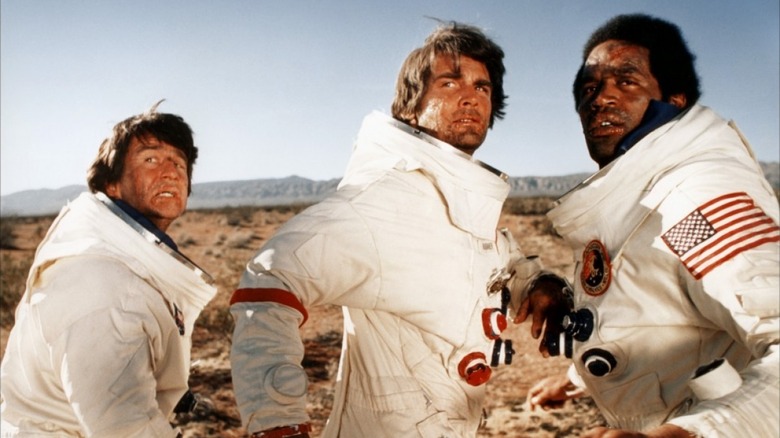
Although Star Trek Generations saw the return of the original series star William Shatner, the iconic actor wasn't joined by colleagues Leonard Nimoy and DeForrest Kelley. Instead, Shatner appeared alongside Walter Koenig and James Doohan, who reprised their roles as Chekov and Scott respectively. Paramount Studio's original plan was for the entire cast of Star Trek: The Original Series to appear in Generations in order to pass the torch to the TNG crew. However, it soon became clear that several original members were unhappy at the prospect.
Released in 1994, Star Trek Generations marked Star Trek: The Next Generation's leap to the big screen. Not only was it the first and only meeting between Shatner's Captain James T. Kirk and Patrick Stewart's Captain Jean-Luc Picard, but Star Trek Generations also climaxed with the death of Captain Kirk. As the screenplay took shape, it became clear that other TOS legends would appear in the film's prologue set in the 23rd century, with Kirk moving into the 24th century to meet Picard and heroically die fighting the film's villain, Dr. Tolian Soran (Malcolm McDowell).
As a result of this change, the challenge of finding adequate roles in the story for every member of the TOS cast proved incredibly difficult. Many of the classic Star Trek actors were disappointed that their appearances basically amounted to cameos instead of sharing equal screen time with The Next Generation's cast. However, the studio was adamant that Star Trek Generations primarily focused on TNG's actors since they would carry the Star Trek movie franchise forward. As a result, and despite the integral William Shatner signing on, both Leonard Nimoy and DeForrest Kelley decided not to appear in the film.
In The Fifty-Year Mission: The Next 25 Years oral history of Star Trek by Mark A. Altman and Edward Gross, DeForrest Kelley explained that he was disappointed that Dr. Leonard McCoy and his crewmates only appeared in one scene, commenting: "When I read the script and saw we were only in the first ten minutes, I thought it was best to pass and go out with [Star Trek] VI." At that time, Kelley didn't know that Nimoy also said no and he admits, "I certainly wouldn't have done the film without him in it." Both Kelley and Nimoy agreed that the well-received Star Trek VI: The Undiscovered Country was a rousing and satisfying farewell for the original cast.
Leonard Nimoy's issues with Star Trek Generations ran deeper than simply disliking Spock's minor role in the story. Not only was he not happy that the Vulcan had what amounts to an inconsequential cameo, but he had also been Paramount's original choice to direct the movie. However, Nimoy, who both developed the story and directed the incredibly successful Star Trek IV: The Voyage Home and Star Trek VI, hated the screenplay for Star Trek Generations. When producer Rick Berman refused to change the script, Nimoy walked away from Star Trek Generations entirely. In fact, Nimoy went on to candidly voice his disdain for Star Trek Generations in The Fifty-Year Mission, revealing: "My feeling about Generations is very negative... Generations bothered me. My God, what are they doing? Why that scene? What's this scene about? Where are they going with this? That was the reason I wasn't involved in making it."
For his part, William Shatner tried to get Leonard Nimoy and DeForrest Kelley to sign onto the film anyway, but to no avail. Instead, the only actors featured in the Star Trek Generations scene aboard the USS Enterprise-B with Captain John Harriman (Alan Ruck) were James Doohan as Scotty and Walter Koenig as Chekov. It was especially bizarre for Trekkers to see Kirk joined by Scotty and Chekov instead of Spock and Bones since Doohan and Koenig had long-standing personal issues with Shatner. Star Trek Generations ultimately delivered on its gimmicky conceit, but unfortunately, audiences never got a true Star Trek crossover movie where The Next Generation meets The Original Series casts that they, as well as Leonard Nimoy and DeForrest Kelley, hoped for.
Warning: Contains SPOILERS forVenom: Let There Be Carnage.
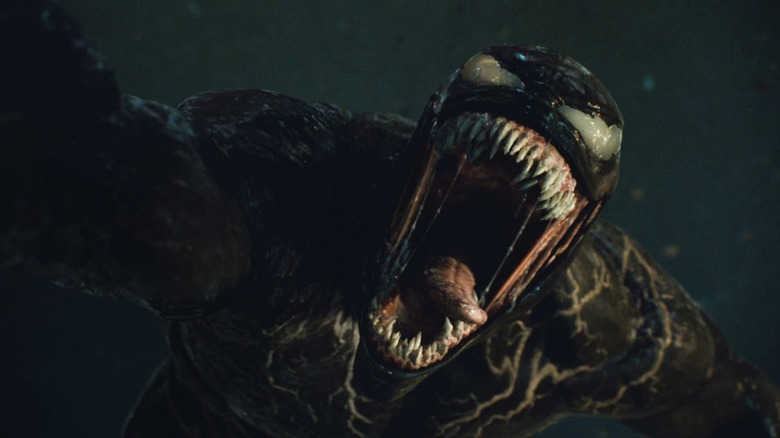
The post-credits scene in Venom: Let There Be Carnage reveals a huge twist by transporting Eddie and Venom to the MCU, but how exactly do they get there? One minute, the two are relaxing after defeating Carnage and talking about the boundless knowledge Venom has access to through the symbiote hivemind. The next, the room trembles and changes, and the TV shows the unmistakable face of Tom Holland’s Spider-Man.
Previously, it was believed that the Venom films took place in a different canon than the MCU. The Spider-Man movie rights are complicated and can be a bit confusing, but the gist is that Sony still holds the rights to the character and allows him to feature in the MCU through separate deal with Marvel. Sony is currently in the process of setting up its own cinematic universe of Spider-Man characters, which will include Morbius, Kraven the Hunter, and the Venom films. Now, it looks like Holland’s Spider-Man could be a part of that universe as well.
So, how do Eddie and Venom get from reality to the MCU? The Venom 2 post-credits scene intentionally keeps things mysterious, but the teleportation almost certainly is tied to the MCU multiverse, which has become the focal point of the story in Phase 4. The leading theory is that Eddie and Venom are brought to the MCU by the multiverse shenanigans caused by Doctor Strange's spell in Spider-Man: No Way Home. It's a fair guess seeing as how their jump to the MCU was accompanied by a singular blinding flash of light, which is the same thing that happened in the No Way Home trailer at the moment Strange cast the spell and it went awry. Another possibility is that Venom’s accessing of the symbiote hivemind through Eddie caused something to malfunction in some way. Considering how hard the characters of MCU's Phase 4 have been tampering with the multiverse, it's even possible that it was an entirely different multiverse event that brought Eddie and Venom to the MCU.
Since other major characters from past Sony Spider-Manfilms like Alfred Molina’s Doctor Octopus and Jamie Foxx’s Electro are returning in No Way Home, it wouldn’t be out of place for Hardy’s Venom to show up as well. There’s been no confirmation yet that he’ll be in the upcoming Spider-Manmovie, but because both franchises are produced by Sony Pictures, it seems most likely that Eddie’s arrival in the MCU is tied to the multiversal chaos in No Way Home.
Of course, there are still a number of things that haven’t been revealed about the MCU multiverse, any one of which could be to blame for Venom’s sudden change of reality. A powerful Scarlet Witch was messing with the Darkhold in WandaVision; Sylvie broke the timeline wide open in Loki; even Shang-Chi and the Legend of the Ten Rings touched upon alternate dimensions. The Venom 2 post-credits scene may simply be setting up a Tom Holland Peter Parker cameo in Sony’s universe rather than a Venom debut in No Way Home. Either way, the ending of Venom: Let There Be Carnage sets up a lot of exciting possibilities for the character’s future.
The Wine project has been around for years, allowing people to run (some) Windows applications on Linux, macOS, and BSD operating systems. It’s one of the best examples of open-source software development, but Wine can’t quite run on everything. Boxedwine, a newer project that builds upon Wine, aims to fix that — it can run on more operating systems, and even web browsers.
Wine isn’t an emulator — instead, it translates Windows API calls into POSIX-compatible calls. However, Boxedwine is an emulator. It uses an unmodified 32-bit version of Wine that runs in an emulated Linux environment. Boxedwine is written in C++ with an SDL interface, so it’s even more cross-platform than Wine. Mac and Linux are supported, same as regular Wine, but you can also run it on Windows. This could be helpful if you want to use older 16-bit Windows applications that won’t work in modern Windows, or if you just want an isolated environment that doesn’t involve setting up a Windows virtual machine. Boxedwine is also being ported to other platforms, including Haiku OS.
Boxedwine can also run inside of modern web browsers, thanks to WebAssembly and Emscripten. You can try out some demo Windows applications and games at boxedwine.org/demo, including Age of Empires (1997), AbiWord, and 3-D Ultra Pinball: Creep Night. Boxedwine is already at around 25% of the speed of the host system (according to the developer), and there’s likely a further decrease from running inside a browser, but basic applications like AbiWord are usable with Chromium on my PC with a Ryzen 5 1500 processor.
Even though Boxedwine in the browser isn’t practical enough yet for most situations, it’s still an impressive technical demo. The browser is running an entire Linux kernel, an unmodified copy of Wine, and the Windows application all on top — with no video streaming from a server involved.
AbiWord running inside Chromium 94 on a Ryzen 1500 PC
Boxedwine could become a fantastic tool for running Windows applications in the future, if performance can be improved. Since the x86 emulation is written in portable C++ code, it could be one solution to running x86 Windows applications on ARM devices, like Android tablets. Wine is already available on ARM Android, but it can only run Windows software compiled for ARM — there’s no emulation layer.
Here’s hoping the project continues to improve. If you want to give the desktop version a shot, pre-compiled Windows versions are available from the Boxedwine website.
SoMNst has released a new video update, showcasing an unreleased No VR Mod for Half-Life: Alyx. This new VR Mod promises to be better than anything we’ve seen to date, and will make the game perfectly playable on non-VR devices. As said, this mod is not available yet for download. Moreover, there is no ETA … Continue reading Half-Life: Alyx – No VR Mod looks bloody amazing in this latest update →
"The expiration of a key digital encryption service on Thursday sent major tech companies nationwide scrambling to deal with internet outages that affected millions of online users," reports the Washington Examiner.
The expiring certificate was issued by Let's Encrypt — though ZDNet notes there's been lots of warnings about its pending expiration:
Digital Shadows senior cyber threat analyst Sean Nikkel told ZDNet that Let's Encrypt put everyone on notice back in May about the expiration of the Root CA Thursday and offered alternatives and workarounds to ensure that devices would not be affected during the changeover. They have also kept a running forum thread open on this issue with fairly quick responses, Nikkel added.
Thursday night the Washington Examiner describes what happened when the big day arrived:
Tech giants — such as Amazon, Google, Microsoft, and Cisco, as well as many smaller tech companies — were still battling with an endless array of issues by the end of the night... At least 2 million people have seen an error message on their phones, computers, or smart gadgets in the past 24 hours detailing some internet connectivity problems due to the certificate issue, according to Scott Helme, an internet security researcher and well-known cybersecurity expert. "So many people have been affected, even if it's only the inconvenience of not being able to visit certain websites or some of their apps not working," Helme said.
"This issue has been going on for many hours, and some companies are only just getting around to fixing it, even big companies with a lot of resources. It's clearly not going smoothly," he added.
There was an expectation before the certificate expired, Helme said, that the problem would be limited to gadgets and devices bought before 2017 that use the Let's Encrypt digital certificate and haven't updated their software. However, many users faced issues on Thursday despite having the most cutting-edge devices and software on hand. Dozens of major tech products and services have been significantly affected by the certificate expiration, such as cloud computing services for Amazon, Google, and Microsoft; IT and cloud security services for Cisco; sellers unable to log in on Shopify; games on RocketLeague; and workflows on Monday.com.
Security researcher Scott Helme also told ZDNet he'd also confirmed issues at many other companies, including Guardian Firewall, Auth0, QuickBooks, and Heroku — but there might be many more beyond that:
"For the affected companies, it's not like everything is down, but they're certainly having service issues and have incidents open with staff working to resolve. In many ways, I've been talking about this for over a year since it last happened, but it's a difficult problem to identify. it's like looking for something that could cause a fire: it's really obvious when you can see the smoke...!"
Digital certificates expert Tim Callan added that the popularity of DevOps-friendly architectures like containerization, virtualization and cloud has greatly increased the number of certificates the enterprise needs while radically decreasing their average lifespan. "That means many more expiration events, much more administration time required, and greatly increased risk of a failed renewal," he said.
Not to be confused with Barbarians (the Netflix series), Barbarians at the Gate (Wall Street robber barons), or even Waiting for the Barbarians (the already forgotten adaptation of Nobel Prize-winning author J.M. Coetzee’s novel), the latest film with the word “Barbarians” in the title, simply called Barbarians, marks the feature-length debut of producer-turned-writer-director Charles Dorfman. The latest addition in the apparently burgeoning “dinner party from hell” sub-genre, Barbarians takes broad, nuance-free satirical swipes at white privilege, capitalistic excess, and, of course, toxic masculinity and its discontents with just enough verve, style, and thorny plot turns to keep the average horror fan modestly engaged. Broken up into chapters announced by black-and-white title cards, Barbarians initially focuses on Adam Davies (Iwan Rheon, Game of Thrones), a TV...
(Welcome toScariest Scene Ever, a column dedicated to the most pulse-pounding moments in horror with your tour guides, horror expertsMatt DonatoandAriel Fisher.In this edition: Matt pays homage to Satan's Slaves — one of the scariest horror movies out of Indonesia. Meanwhile, Ariel jumps several feet in the air.)
The rise of Indonesian horror cinema is predominantly thanks to three formidable filmmaking forces: Timo Tjahjanto, Kimo Stamboel, and Joko Anwar. If you're unfamiliar, I highly recommend blowing through their collective catalog of solo projects and collaborations from "Macabre" to "Impetigore."
They've adapted video games, stunned festival audiences, and solidified horror's international appeal as they present regionally resonant nightmares that still speak the universally understood language of enthusiastic scares. I could go on, but we're here to spotlight the man responsible for my favorite title from the modern era's Indonesian horror boom.
Joko Anwar's loose remake of "Satan's Slaves" is exquisite foundational horror, which I was able to catch as part of 2018's What The Fest?! program. I watched this seamless translation of James Wan's style through an Indonesian lens in bed next to a slumbering girlfriend, on my laptop, in the daylight, and still interrupted her sleep since I couldn't stop jumping (whatever that looks like in a horizontal position). It's the movie I dubbed "the scariest film of 2018 you haven't heard of yet" — because catchy headlines please the internet gods — which is a quote that remains evergreen. Anwar's haunted house thriller knows its way around shadow-dwelling horrors and the most prominent frights, so which will I choose?
The Setup
Rini's (Tara Basro) family resides on the outskirts of Jakarta, which some might consider countryside seclusion. Mother Mawarni (Ayu Laksmi) is bedridden by an unknown disease that gives her a ghoulish complexion, a bell by her bedside to communicate. Father Bahri (Bront Palarae) can barely collect enough money to pay the bills. Rini and her brother Tony (Endy Arfian) keep little siblings Bondi (Nasar Annuz) and Ian (M. Adhiyat) on the straight and narrow – Ian only communicates through sign language.
Mawarni continually rings her beckoning bell whenever she needs help, but it's not without a constant creep factor that starts to loom over the entire family. Everyone assumes Mother is sick for earthly reasons, but are there wicked puppeteers trying to crumble this already struggling household?
The Story So Far
The family plays caretaker for Mawarni, a once successful musician whose royalties have nearly run out, adding to their financial problems. Rini, Tony, and the rest take turns answering Mawarni's ringing bell that signals for aid, which sometimes brings with it the creepiness we see in many bedridden horror films. Sometimes Mawarni might be standing, unaware, other times fidgeting at random. Still, Rini ensures Mother is looked after until her untimely passing when Mawarni collapses in front of Rini after the bell's audible cue.
Bahri organizes a funeral for his beloved, which introduces the family to the area's Ustad (an honorable title bestowed sparingly) — it's a respectful ceremony before life crashes back to reality soon after. Bahri still faces mountains of financial hurdles, one of which he must dispute in person. Rini, Tony, the youngest siblings, and their wheelchair-bound grandmother, Rahma Saidah (Elly D. Luthan), are left behind, experiencing spooky encounters after Mawarni's death.
One by one, from Rini to Bondi, they start seeing their mother's apparition around the estate — sometimes summoned by the radio, others interrupting midnight bathroom breaks. Ian wakes Bondi late one night so he can safely rock a piss, which is when the latter scare makes its mark.
The Scene
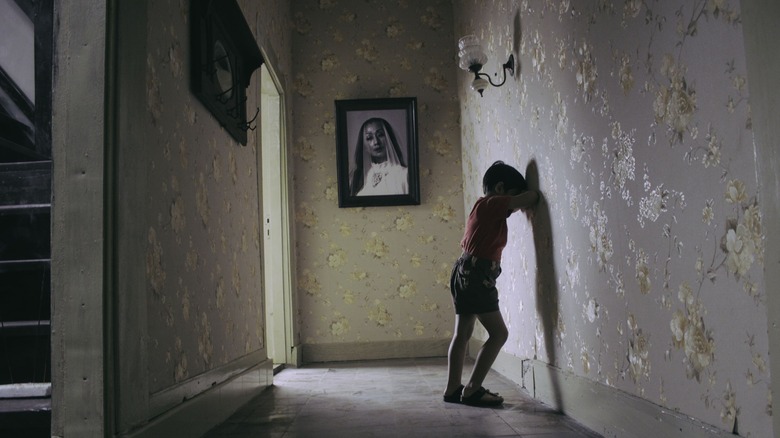
Ian gets out of bed and shakes Bondi awake. He signs "Come with me," but Bondi rolls over. Ian shrugs, realizing he's left to navigate the dimly lit house alone. Peering out their bedroom door, the first thing Ian sees is a portrait of Mawarni, gazing down the hallway. He assumes the international "I Have To Pee" position by cupping his crotch and scampers on toward the bathroom.
The tiny human gets to the rather large room where a well reverberates drip noises up its stone funnel. Ian concentrates as we hear a stream hit the ground, the camera surveying the surrounding darkness, then over Ian's shoulder into the kitchen. A faint whimper signifies something behind Ian; the camera shifts into predator mode, slowly stepping forward to the tinkling tot's back. We can only scream at our screens as the evil entity creeps right behind Ian, and– oh, good, it's only Bondi.
Better late than never when the undead are involved.
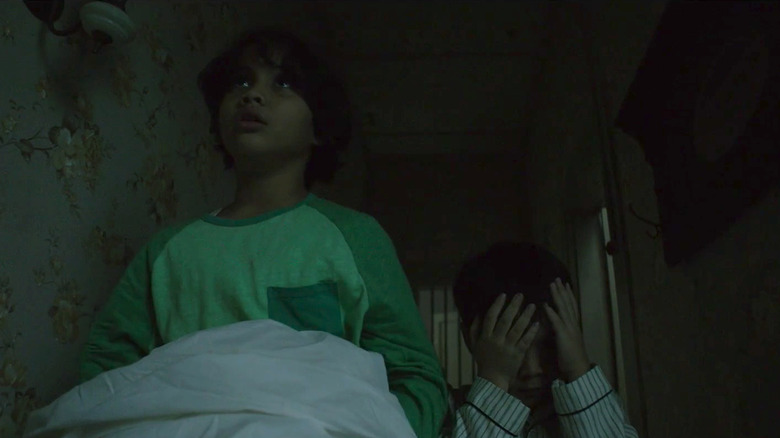
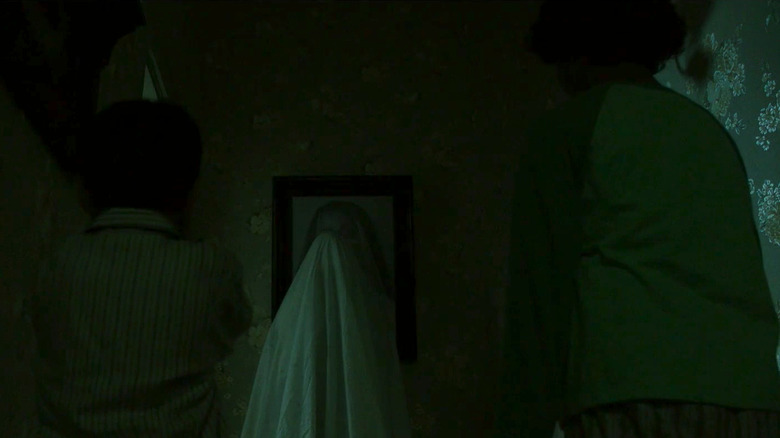
Ian finishes before Bondi — that's what you get for taking too long — and hurries back with a tad more confidence towards their bedroom. Ian disappears from view, Bondi following the same route when he's done. As he reaches the hallway with Mawarni's portrait, he curiously finds Ian standing right before the last stretch of pathway. "Scary," Ian signs, unwilling to walk the hallway alone. "Mom," he points to the artwork staring right back at the boys. Their solution? Bondi grabs a white sheet and Ian's hand, then advances at a sloth's pace.
The camera takes position like a running back behind two leading blockers as Ian and Bondi hesitantly confront their fears, hoping to cover Mawarni's face. The frame flips to the front, so we can see Ian holding both hands over his eyes and peering downward while Bondi's expression is rightfully unsettled. He chucks the blanket towards the painting in hopes of covering the portrait. Instead, it falls around an invisible figure like a no-budget Halloween costume.
Bondi freezes.
Ian won't look.
The blanket ghost doesn't budge.
Bondi prods his brother and cautiously starts turning his body for an escape.
"BWAH!"
The figure lunges towards a fleeing Ian and Bondi, who let out appropriate shrieks. Rini rushes in to find the boys huddled in the corner of the hallway, hysterically barking about ghosts, the sheet now messily draped over Mother's portrait as a final taunt.
The Impact (Ariel's Take)
I've only ever seen "Satan's Slaves" once, around when it first hit Shudder a couple of years ago. It was terrifying then, and it's still terrifying now.
Matt really hit the nail on the head with how he describes Timo Tjahjanto, Kimo Stamboel, and Joko Anwar. They're unequivocal masters of their craft, and you should absolutely watch all of their work, post haste. But in the meantime, get scared with me, won't you?
Anwar really taps into something we can all relate to with this scene. At least, I'd imagine we can all relate to it. As a little kid, going to the bathroom alone at night can be genuinely terrifying. It's a similar kind of fear to going into your basement alone. You see things in the dark, whether you want to or not. Maybe it's your imagination running away with you. Maybe it isn't. Regardless, the result is usually terrifying. I've lost count of how many times I've scared myself senseless and had to bolt from the bathroom to the bed only to hide under my covers in order to calm down.
They are, after all, the ultimate spooky repellant. Hey, I don't make the rules. That's just science.
I'd be lying if I said I don't still do it from time to time, admittedly still often scared of the dark myself. So this scene is horrifying. Pair it with the fact that, as I'm pretty sure I've said in the past, I do not handle things running at me/the screen very well, this is just awful in the best way.
You feel safer because the big brother is there, the protector. And then the sheet falls, and you're left standing in silent stillness, waiting for something, anything to happen for what feels like an eternity. You kind of relax for a second. And then it makes that noise — that "BWAH!" — and it lunges.
I screamed a little, folx. Happened when I saw it the first time. Happened this time around, too. It's a good scare. A great scare. Simple like a caprese salad, only with a side of heart palpitations for extra zing.
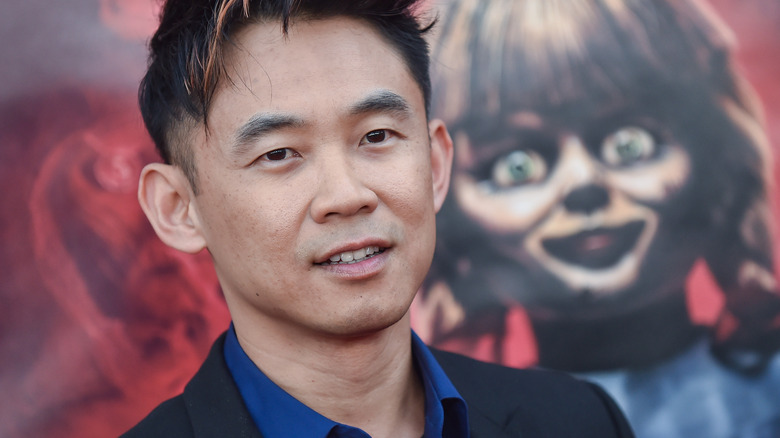
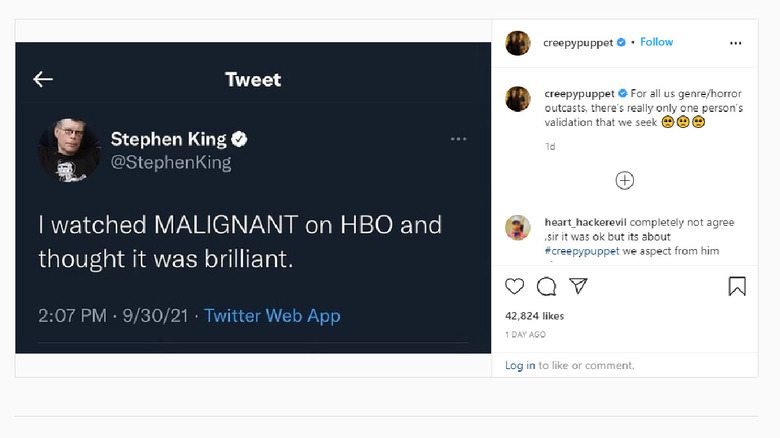
Stars -- they're just like us! They want senpai to notice them, too. "Saw" and "The Conjuring" creator James Wan, in a fit of fanboy zeal on Instagram, posted his reaction to horror novelist Stephen King's praise of his film.
Under his IG handle "creepypuppet" (Hello, Billy!), Wan shared an Instagram screenshot of the "Doctor Sleep" novelist's good tidings. King, who needs no handle other than his name, tweeted, "I watched MALIGNANT on HBO and thought it was brilliant." Wan, clearly overwhelmed by words from the genre maestro himself, captioned the screenshot with just one sentence: "For all us genre/horror outcasts, there's really only one person's validation that we seek." You can take a gander at Wan's post below.
The Only Praise That Matters
King isn't the only one spouting acclaim for the bonkers-in-Yonkers film. "Malignant" made quite the splash across theaters everywhere, and in /Film's review our own Chris Evangelista calls it "The type of nonsense you can cherish."
The giallo riff stars Annabelle Wallis ("Annabelle"), Maddie Hasson ("Mr. Mercedes"), Jake Abel ("Supernatural"), and Ingrid Bisu ("The Conjuring: The Devil Made Me Do It"). Wan directs from Akela Cooper's screenplay, based on a story by Wan, Bisu, and Cooper. The music was written by Wan's regular collaborator, Joseph Bishara, who composed the score for all seven films in the "Conjuring" Universe, and his score for "Malignant" essays his own operatic compositions for Orino Pictures' 2019 bad seed gem "The Prodigy."
King's praise is well-placed; "Malignant" truly is a work of brilliance or madness -- or both. At once a delirious riff on Frank Henenlotter's grimy 42nd street sagas (hello, "Basket Case," didn't hear you come in) and '70s femme identity crises (looking at you, Robert Altman's "Images"), Wan's opus feels like the cash-backed blank check he's deserved since he and "Saw" co-writer Leigh Whannell churned out their own "creepypuppet" feature, "Dead Silence" in 2007.
The pair have since distanced themselves from that modern cult classic, having gotten a sour taste in their mouths from the studio intrusion on their vision and story. "Malignant" is what happens when those weaned on the works of Dario Argento and video nasties get their hands on a camera and a budget -- and the rest of us better pray that there's more where that came from.
Fantasy is a wide-encompassing genre. It often contains tropes pulled from mythology or folklore. It sometimes overlaps with other genres, such as horror and science fiction -- whereas science-fiction is speculative fiction based on possible (or maybe possible) science, fantasy has no basis in reality. It's a popular genre for movies aimed at children and young adults, especially when it comes to films based on book franchises. Whether you're interested vampires, fairies, and werewolves, parallel or hidden worlds, or fantastical dystopias, the genre has something for everyone.
It should be no surprise that almost half of the titles in this list are produced by Netflix itself; the streaming platform has definitely upped the ante when it comes to producing its own content, and it seems to be very good at producing genre pieces in particular. That includes, as you'll see, a whole bunch of fantasy. If you're looking to escape to another world -- or simply want to see a more magical take on ours -- check these movies out.
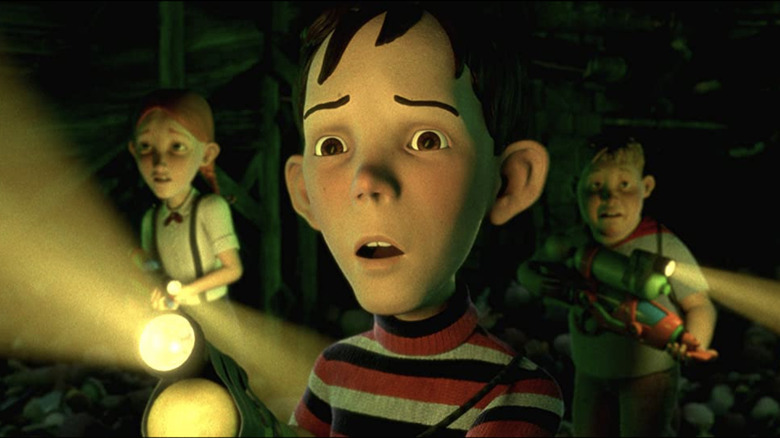
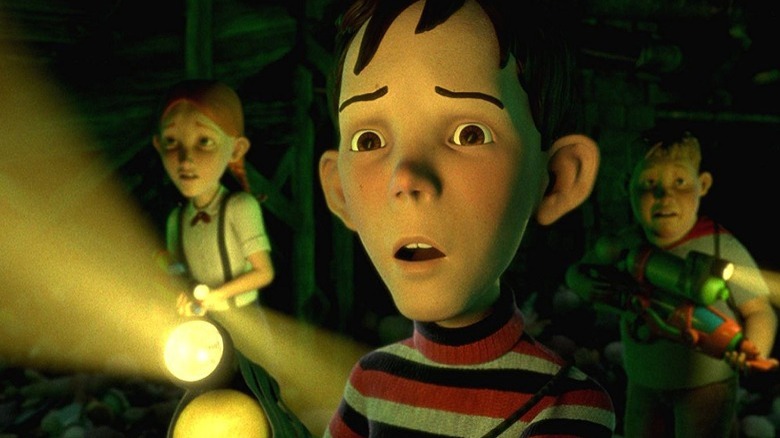
Monster House
A children's movie that mixes supernatural elements with classic horror tropes, "Monster House" is, as the title gives away, about a monstrous house. Set in sweet and innocent suburbia, the movie follows the story of weird kid D.J. (Mitchell Musso) and his friends Chowder (Sam Lerner) and Jenny (Spencer Locke) as they investigate the most cursed house in the neighborhood. After the building's owner, Nebbercracker (Steve Buscemi), suddenly passes away, the house starts acting out, snatching children's toys and eating people who happen to walk on its lawn; D.J. and Chowder save Jenny from such a fate, which is how they team up to uncover the house's secret.
"Monster House" is the debut of director Gil Kenan, who went on to direct other supernatural movies, including 2015's "Poltergeist." It was executive produced by Robert Zemeckis and Steven Spielberg, and their personal touches are easily identifiable in the final product. "Monster House" is a funny, engaging movie with a great twist, and features some amazing animated effects for the era. It was filmed using motion capture, with the same technology Zemeckis used for "The Polar Express," and the resulting animation is lively. The characters are endearing, and the actors' performances can clearly be felt through the CGI. Finally, the tween coming-of-age story makes "Monster House" a great family movie for the spooky season.
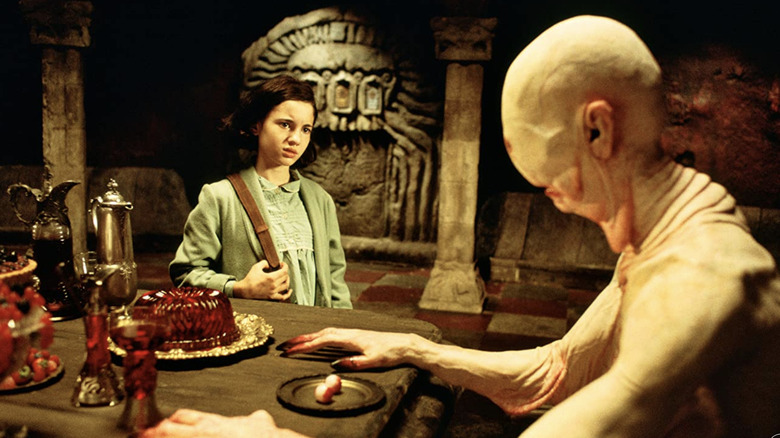
Pan's Labyrinth
In "Pan's Labyrinth," the Oscar-winning fantasy film by acclaimed Mexican director Guillermo del Toro, a child uses her imagination to escape the horrors of World War II. Set in 1944 in fascist Spain, "Pan's Labyrinth" follows the story of Ofelia (Ivana Baquero), an 11-year-old girl whose mother Carmen (Ariadna Gil) marries to a sadistic captain, Vidal (Sergi López), who hunts down the rebels who oppose Franco's regime. Ofelia is led by a fairy to the fantastical lair of the Faun, who tells her that she's the reincarnation of a fabled princess. Ofelia is destined to claim her kingdom, but her destiny comes at a heavy price: First, she must accomplish three important tasks, each more demanding than the last.
Del Toro is known for his vivid imagination, and the creatures that inhabit his movies are unlike any others. "Pan's Labyrinth" is no exception, featuring strange and gruesome creatures like the Pale Man, a giant being whose eyes are in the palms of his creepy, long-fingered hands. Del Toro juxtaposes the gritty violence of WWII with the visually stunning fairy tale world of the labyrinth and its inhabitants; "Pan's Labyrinth" features real-world consequences and horror just as much as the escapism of fantasy. The movie won three Academy Awards, including best cinematography and best makeup, and was nominated for numerous other awards around the world.
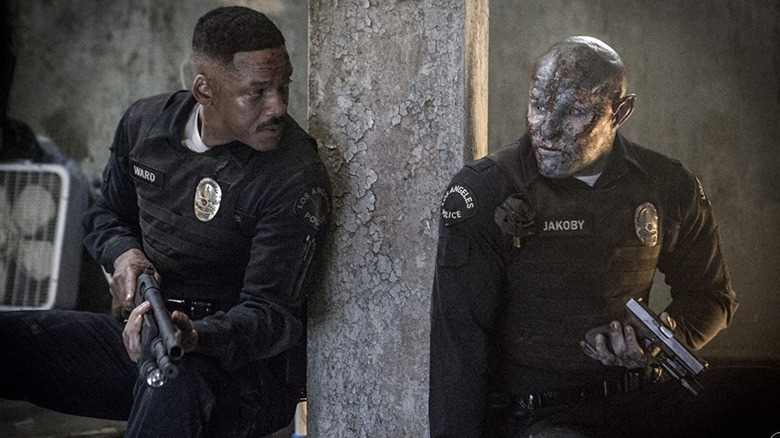
Bright
Mashing up genres to create fantasy buddy-cop action film, "Bright" is a unique offering from Netflix and director David Ayer, who previously worked on "Suicide Squad" and brought much of that movie's team along with him. Set in L.A. in a world where orcs and elves coexist with humans, a cop named Ward (Will Smith) is teamed up with the country's very first orc police officer, Jakoby (Joel Edgerton).
Racial tensions simmer between Jakoby and the rest of the squad, and the pair face intense scrutiny as they investigate a sect of renegade elves lead by Leilah (Noomi Rapace), who were in possession of a magic wand. Magic is illegal, and a wand is like a weapon of mass destruction, so it's a big deal. They're helped by Tikka (Lucy Fry), Leilah's little sister, who betrayed the sect and stole the wand.
While it's no Oscar contender, "Bright" is an entertaining movie that wants to tackle bigger questions like racism, power's corrupting influence, and policing (although how well it succeeds depends on who's watching), and with Smith, Edgerton, and Rapace on board, it has plenty of star-power. What makes "Bright" particularly rough around the edges is the dialogue, which could do with some refinement. The universe is different and worth exploring; with Ayer taking over screenwriting duties for the sequel, there is hope that it could get much better.
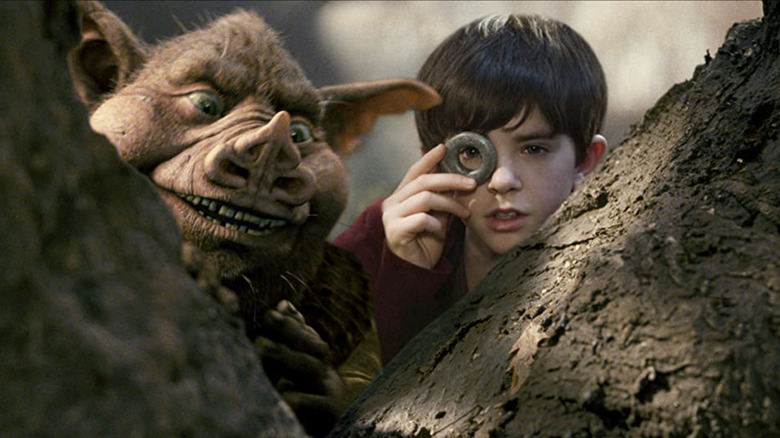
The Spiderwick Chronicles
Based on the novels by Holly Black and Tony DiTerlizzi, "The Spiderwick Chronicles" is a children's movie that's packed with spooks and weird creatures. Freddie Highmore plays the dual roles of twins Jared and Simon Grace, whose family moves into the Spiderwick estate, which their mom (Mary-Louise Parker) inherited from her great-grandfather Arthur Spiderwick (David Strathairn). Jared is very reluctant to move, and rebels against his family, while his nature-loving twin brother enjoys the Victorian estate.
As he sulks around the house, Jared stumbles into Arthur's study; there, he finds a field guide that details a slew of fantastical creatures who inhabit an unseen world. The next day, a brownie named Thimbletack (Martin Short) gives Jared a Seeing Stone so that he can see the faeries for himself. After Simon is abducted by an ogre called Mulgarath (Nick Nolte), Jared needs to convince his family to help him.
The cast also includes Seth Rogen in the role of hobgoblin Hogsqueal and Ron Perlman as the goblin Redcap. Highmore's performances are great; he's able to bring two very different and well-rounded characters to life. Director Mark Waters doesn't hold out on the horror material, and younger children might get nightmares after viewing. With that said, "The Spiderwick Chronicles" is sure to delight older kids.
Okja
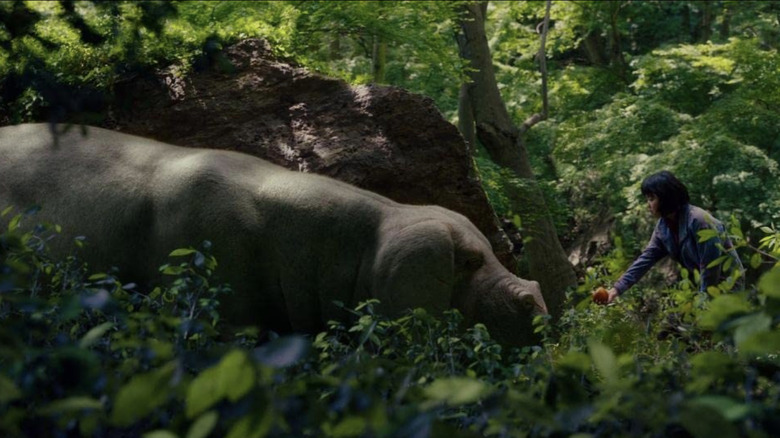
"Parasite" director Bong Joon-ho offers a unique, sometimes wonky, parable with "Okja," a fantasy movie that flirts with science fiction. Okja is the name of a creature who looks like a mix of a pig and a hippopotamus, but is somehow even larger than the latter -- she is actually a "super pig" who was genetically engineered by the Mirando Corporation as a new meat product.
Okja has been living a peaceful life in the South Korean countryside with Mija (Ahn Seo-hyun) for the last 10 years, and the two have become best friends, but their happiness is shattered when Mirando comes to take Okja away -- she is to be slaughtered in New York City, where the corporation's offices are based. Mija teams up with the Animal Liberation Front (ALF), led by Jay (Paul Dano), to save Okja.
The cast also includes Tilda Swinton as the Mirando twins, who run the corporation, as well as Jake Gyllenhaal, Giancarlo Esposito, Lily Collins, and Steven Yeun. Joon-ho takes inspiration from classic children's movies such as "E.T.," "My Neighbor Totoro," and "Babe: Pig in the City"; you'd be forgiven for thinking that "Okja" is a kid-friendly family film. However, with repeated profanity and its disturbing images of meat processing, it might be better suited for more mature viewers.
A Monster Calls
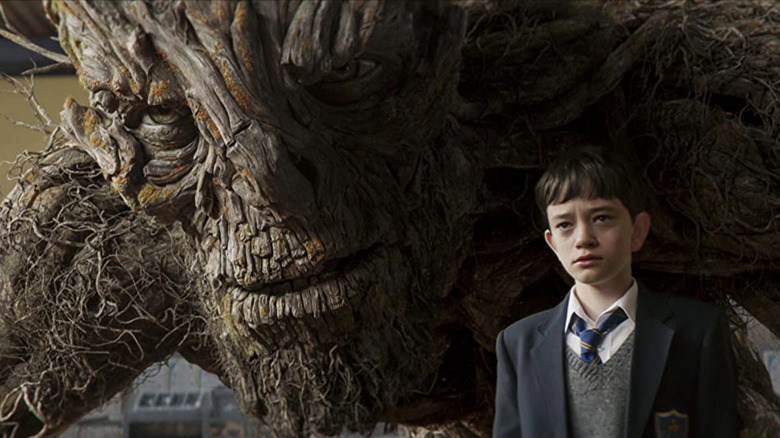
With his background directing horror films like "The Orphanage" and the natural disaster drama "The Impossible," J. A. Bayona is well-equipped to bring "A Monster Calls" to life. Based on a novel and screenplay by Patrick Ness, which were both based on an original idea by Siobhan Dowd, "A Monster Calls" is a moving parable about grief. Conor (Lewis MacDougall) is a shy 12-year-old whose single mother Lizzie (Felicity Jones) is terminally ill; on top of that, he's being bullied at school and has frequent nightmares. One night, the yew tree behind his house comes to life and, as voiced by Liam Neeson, tells him three stories, in exchange for Conor's own.
The stories told by the monster are animated in a wonderful watercolor style reminiscent of the Three Brothers segment in "Harry Potter and The Deathly Hallows." MacDougall gives a stunning performance considering his young age, and brings depth to a character who could've easily ended up a martyr. Neeson is as formidable as always, and his booming voice is a perfect match for the tree monster. The cast also includes Sigourney Weaver as Conor's grandma and Toby Kebbell as Conor's dad. Overall, "A Monster Calls" is a deeply emotional film about grief and storytelling that's sure to wrench some tears out of you.
The Old Guard
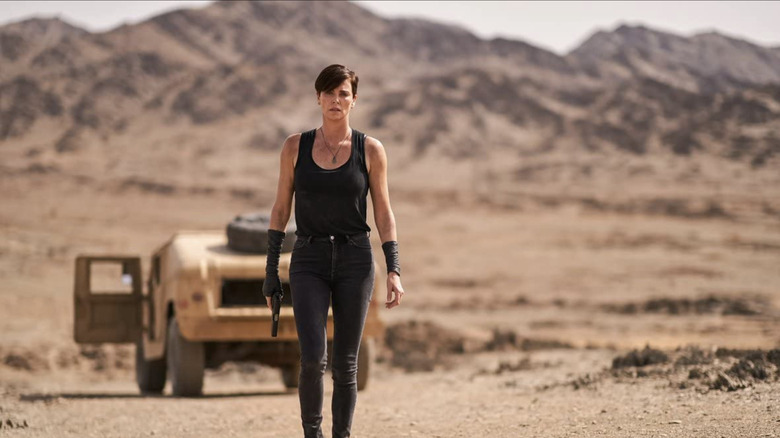
Based on the comic book of the same name by Greg Rucka, who also wrote the screenplay, and artist Leandro Fernandez, "The Old Guard" is one of Netflix's most recent blends of fantasy and action. Directed by Gina Prince-Bythewood, "The Old Guard" stars Charlize Theron as Andromache of Scythia (Andy for short), an immortal woman who leads a band of also-immortal mercenaries. As she contemplates retirement, Andy recruits Nile (KiKi Layne), a Marine who has just discovered her own immortality, to join her group. They are then ambushed by a pharmaceutical tycoon, Steven Merrick (Harry Melling), who wants to study the immortals' healing abilities, and is willing to go to extreme lengths to do so.
By now, Theron is an experienced action hero who kicks butt in movies like "Mad Max: Fury Road" and "Atomic Blonde." She demonstrates the same physicality in "The Old Guard," and director Prince-Bythewood stages some thrilling action scenes. The movie also features a diverse cast, as well as a touching romance between a homosexual couple, making for an inclusive action film.
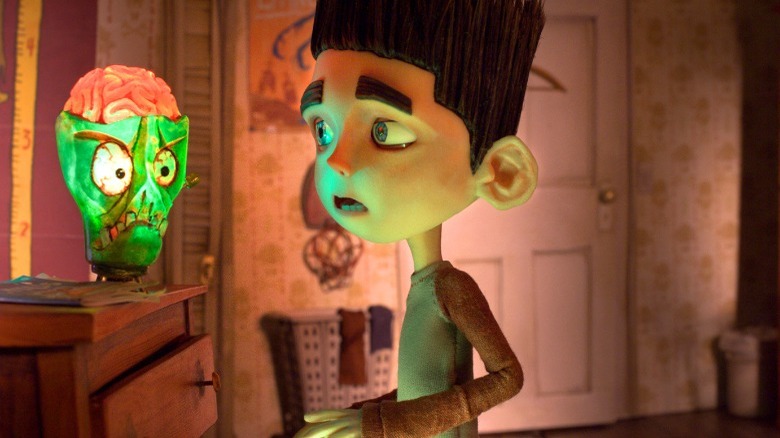
ParaNorman
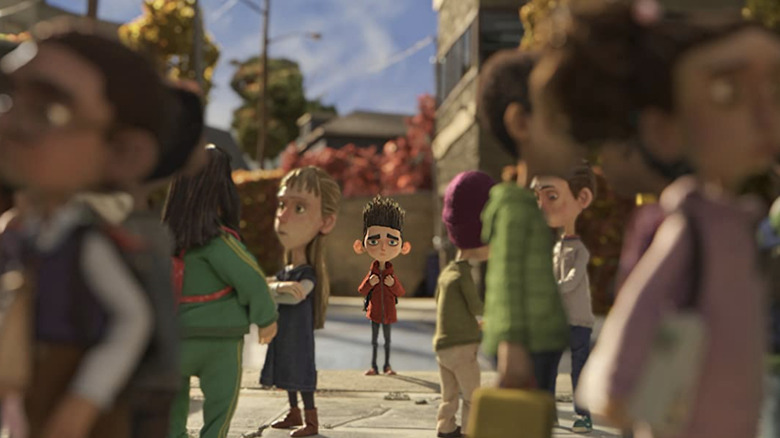
Animation is the perfect medium for fantasy stories, especially stop-motion animation, and the quirky and hilarious "ParaNorman" is great proof. From the same team that made the creepy "Coraline," "ParaNorman" is also an excellent example of what happens when fantasy meets horror. Set in a small Massachusetts town called Blithe Hollow, Norman (Kodi Smit-McPhee) is a shy kid who has trouble connecting with his family and gets bullied at school. However, he has a special power that saves him from total loneliness: He's able to see and talk with ghosts. He has one friend, Neil (Tucker Albrizzi), who's also an outcast, and with whom he shares his secret.
Norman's power comes in handy when an old relative, Mr. Prenderghast (John Goodman), gives him the task of keeping the ghost of a witch at bay, lest she awaken the dead. When she inevitably does, Norman is the only one who can perform the ritual to stop the town being invaded by zombies.
The cast also includes Christopher Mintz-Plasse, Casey Affleck, Anna Kendrick, and Leslie Mann. Creators Chris Butler and Sam Fell created an ode to classic horror movies in "ParaNorman," a family-friendly film that will spook kids and delight older watchers with its references.
About Time
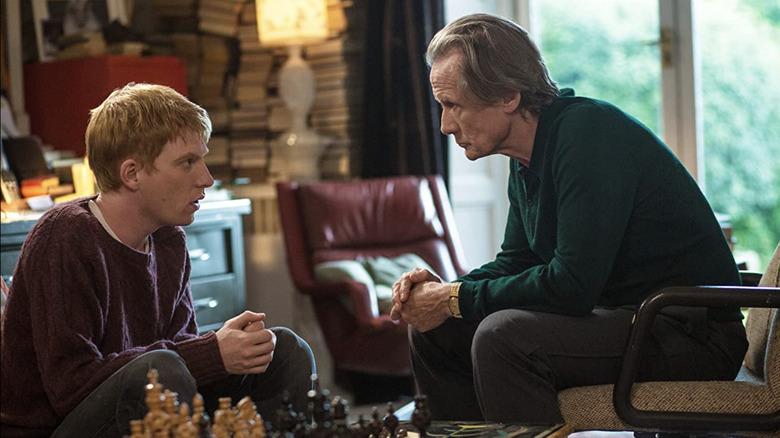
Many people would love to have the power to re-do some of the events in their lives. Such is the luck of Tim (Domhnall Gleeson), who, at 21, learns from his father James (Bill Nighy) that he has the ability to go back in time. It's a power that's been passed down through the generations to the men of in his family, and can be used only to travel on one's own timeline. That's the premise of "About Time," a fantastical romantic comedy written and directed by the master of rom-coms, Richard Curtis.
Tim decides to use his powers to improve his love life, of course, which means re-doing every important moment with Mary (Rachel McAdams) until he gets it right. Time travel has consequences, though, as Tim discovers soon enough. Things get even more complicated after he and Mary have a kid, whose existence could be threatened by his gallivanting through time. Curtis delivers a deeply emotional film about grief, loss, and the need to accept that there are some things you can't control.
The Mitchells Vs. The Machines
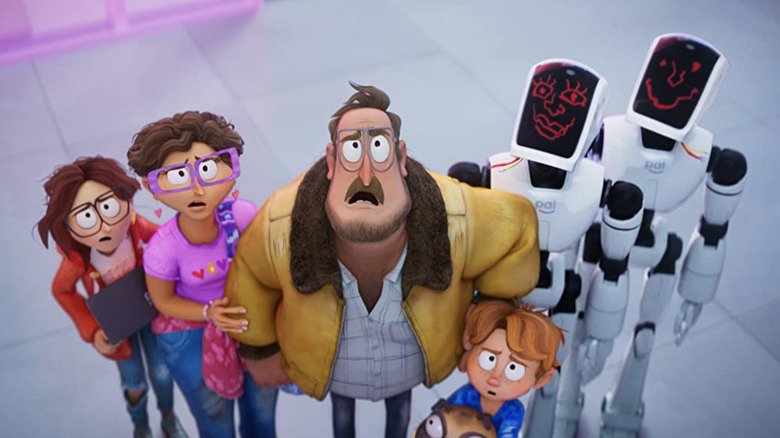
If a movie were made about memes and YouTube culture, it would probably look a lot like "The Mitchells vs. the Machines." Directed by Mike Rianda and Jeff Rowe, the film treads the line between sci-fi and fantasy as it follows Katie Mitchell (Abbi Johnson), an aspiring filmmaker who's misunderstood by her family. She's excited to go to college, where she expects to find "her people," but her father Rick (Danny McBride) throws a wrench in her plans: In an effort to bring the family closer together, he insists they all take a road trip to move Katie into her college dorm. Along for the ride are her mom Linda (Maya Rudolph), little brother Aaron (Mike Rianda), and bug-eyed pooch Monchi.
Meanwhile, the world is threatened by an artificial intelligence gone rogue -- the personal robots from technology corporation PAL Labs start rounding up humans in an effort to send them to die in space. Miraculously, the Mitchells are the only ones left free, and they'll have to set aside their differences to save humanity. The film is ridiculously funny while tackling very serious themes, and the animation is quirky and delightful.
Crimson Peak
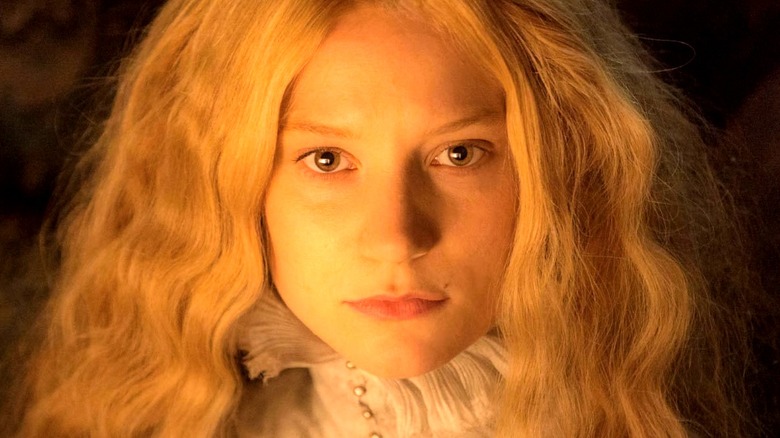
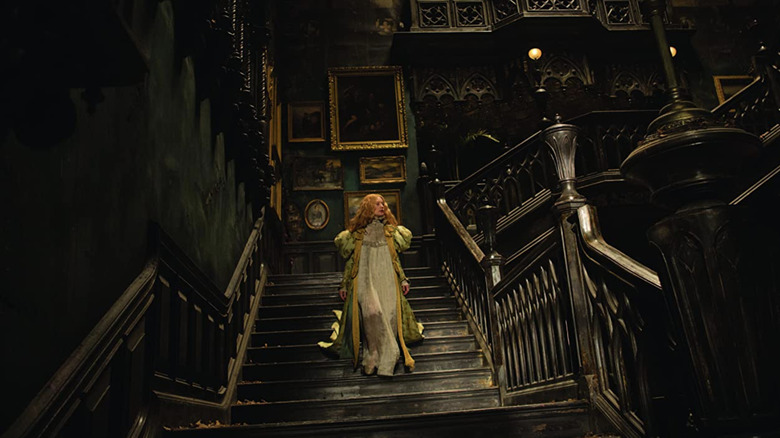
It should be no surprise that a second movie directed by Guillermo del Toro makes it on this list; he is a master of horror and fantasy, after all. "Crimson Peak" is a Gothic romance set in Victorian-era England, unfolding in a mansion that bears the film's title. After her father's mysterious death, American Edith Cushing (Mia Wasikowski) marries English baronet Thomas Sharpe (Tom Hiddleston) and moves with him and his sister Lucille (Jessica Chastain) to their mansion, where the siblings act cold towards her. She starts feeling sick, coughing blood and having nightmares. The mansion seems to be holding secrets as well.
"Crimson Peak" could be disappointing for horror fans. While the setting seems to lend itself to the genre, the movie is much more of a slow-burn fantasy mystery than an all-out horror movie. However, it does contain many references to classic horror films like "The Shining" and "The Innocents," and it's a stylistically beautiful film -- it was even praised by the king of horror himself, Stephen King, and his son Joe Hill, who wrote the comics that inspired Netflix's fantasy series "Locke & Key."
Army Of The Dead
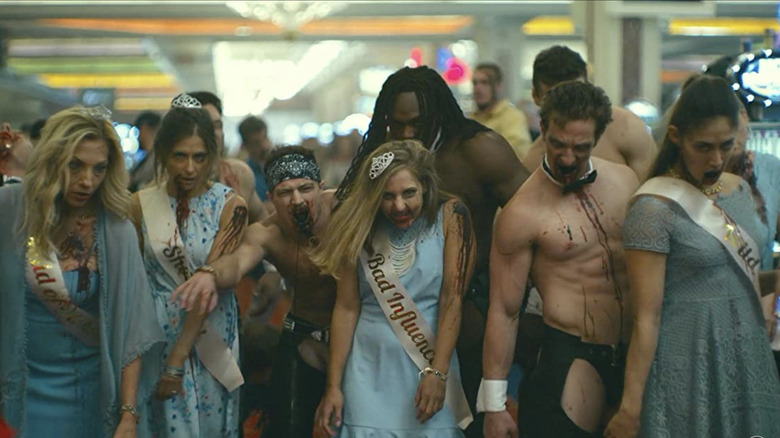
While a zombie movie might sound more like horror and sci-fi territory, Zack Snyder's "Army of the Dead" doesn't contain either scares or a proper scientific explanation for the zombie apocalypse. As a goofy zombie heist movie, it most easily falls into fantasy: Nothing about the film is grounded in reality, and Snyder has more fun making the undead explode in a thousand pieces than delivering frights or making you think.
A spiritual successor to Snyder's 2004 "Dawn of the Dead," "Army of the Dead" is set in Las Vegas after a zombie escapes from a military convoy that was travelling from Area 51. It infects the soldiers who were accompanying it, and then a new horde of zombies sets its sights on the city of sin. The government walls off the city after it's taken over by the undead, and decides to nuke it to get rid of the threat. Before it does, shady casino owner Bly Tanaka (Hiroyuki Sanada) hires a team of mercenaries to loot a casino vault containing $200 million.
The team is led by Ward (Dave Bautista) and his teammates Cruz (Ana de la Reguera) and Vanderohe (Omari Hardwick); together, they hire a bunch of other expendable teammates. Gory action scenes abound, and the film lives up to Snyder's reputation for over-the-top visuals.
Remember when there were only a handful of streaming services, and subscribing to one or two was a clever way to cut costs instead of paying for cable? We've since been so inundated with different streaming platforms that to subscribe to them all is essentially just giving yourself a curated (but not much cheaper) cable package.
That said, if there are specific things you're interested in, genre-specific streaming services like Shudder can be a great opportunity to make sure you're surrounded by content you already know you like. Shudder has a remarkable catalog of horror films, with an interesting combination of horror from the early days of Hollywood, modern classics, and lesser-known independent productions.
As a genre, horror is where some of the most interesting new filmmaking is taking place; because horror films have a long and storied history of being made on a small budget, the barrier to entry is significantly reduced. As a result, directors are given the opportunity to take chances and be innovative when working in this space, giving us creatively ambitious productions that play with conventions in intriguing ways. Shudder has plenty of movies like that, but it also has some old standbys, too. Here are 20 of the best films on the service.
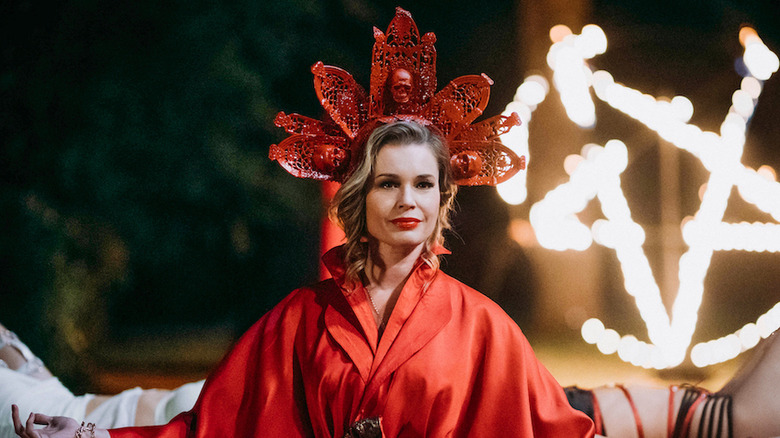
Satanic Panic
Although the idea that satanic cults corrupt the hearts and minds of the young has gone in and out of vogue over the years, it's such a ridiculous notion that the most reasonable way to make sense of it is a horror comedy that doesn't take itself too seriously. To that end, "Satanic Panic" is the perfect trashy midnight horror flick, one that stands in stark contrast to the current wave of films that feel the need to try to reinvent the genre.
Instead, "Satanic Panic" is perfectly content to follow in the illustrious footsteps of the many cheap but incredibly fun films that came before it. When a pizza delivery girl makes one last journey into an affluent neighborhood before the end of her shift, she crosses paths with a group of wealthy suburbanites who just happen to be part of a satanic cult. "Satanic Panic" satirically exposes the dark underbelly of suburban America, and is far too entertaining to resist.
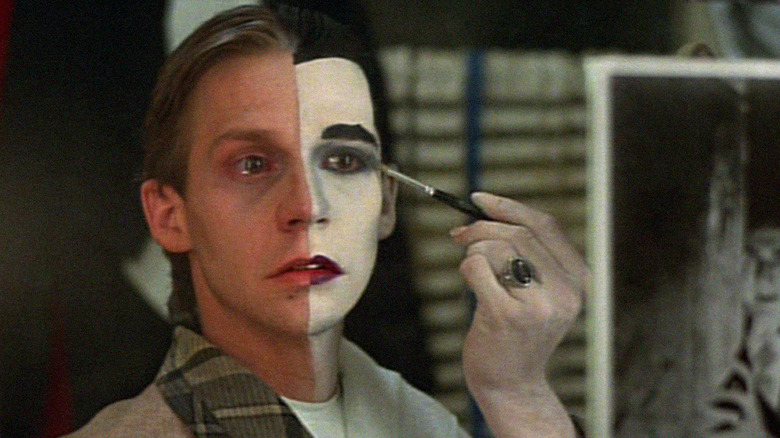
Fade To Black
Revolving around a cinephile serial killer, "Fade to Black" is an inspired choice for any movie-lover who wants to say, "See? I may be weird and obsessed, but I'm not as bad as that guy!" Dennis Christopher stars as Eric Binford, an awkward loner with an encyclopedic knowledge of old movies who goes completely off the rails when an encounter with a Marilyn Monroe lookalike brings out the sexually deviant and murderous side of his personality. Becoming the physical incarnation of his favorite movie monsters, Eric sets out on a murder spree for the ages.
"Fade to Black" is a bizarre little film, one that perplexed critics at the time. The general consensus seemed to be that its cinematic references were simultaneously too obvious and hokey for movie diehards, while potentially too obscure for casual viewers. Nonetheless, it has developed something of a passionate following over the years.
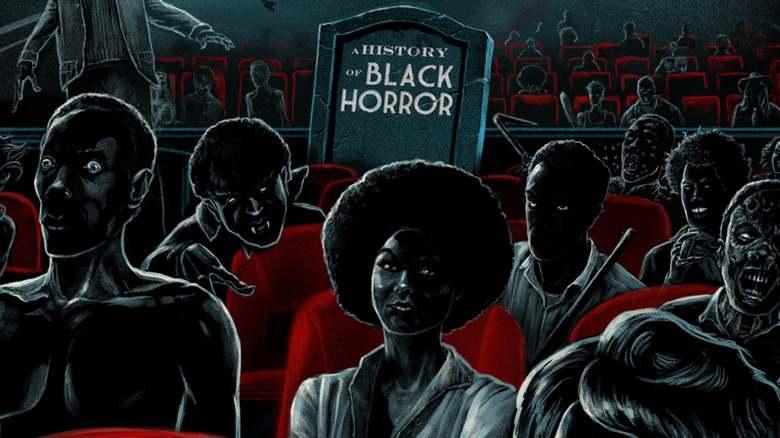
Horror Noire
"Horror Noire" is the only documentary on this list, but it definitely earns its place. As an exploration of Black identity in the horror genre, it is unmatched. Director Xavier Burgin puts together a primer of Black horror history, highlighting the role monster films played throughout the early half of the 20th century as a means of addressing white fears about the Black community, especially Black men. He then moves onto how modern horror films allow Black filmmakers and actors more agency and a sense of authorship.
"Horror Noire" features fascinating interviews from some of the most knowledgeable Black voices in horror, from film critics and writers to actors and directors. It weaves together a comprehensive overview of Black contributions to a genre that has historically been known for underutilizing the community (and, famously, for establishing the problematic trope in which Black characters are usually killed off first).
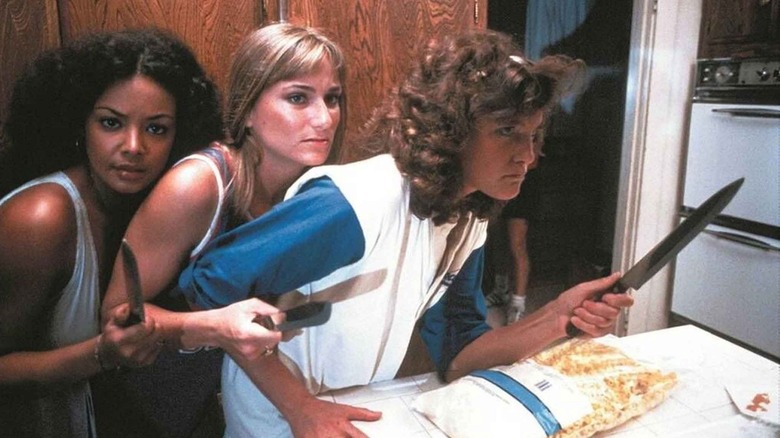
The Slumber Party Massacre
"The Slumber Party Massacre" is at once a totally typical teen slasher film, and at the same time a knowing riff on the genre. There's a certain formula to this type of movie: There's always a group of beautiful young women, often high-school or college-aged, who have a gathering that takes an unexpectedly violent turn as they are hunted down one by one by an unknown assailant. At least one of the girls, if not several of them, will end up topless or in underwear for no very particular reason. And in this generation of slashers, sex remains the ultimate indicator of whether someone will live or die -- the most promiscuous characters don't tend to last.
"The Slumber Party Massacre" manages to simultaneously subvert these tropes and embrace them wholeheartedly (allegedly, it was written as a parody, even though the final film plays everything fairly straight). This is a film that knows exactly what it's about, and relishes every minute of it. And with not one but two female filmmakers behind the camera, it has a refreshingly non-exploitative presence.
After Midnight
Every night, Hank stands guard over the entrance to his sad, empty house, protecting it from the malevolent force he believes is stalking him. No one else can see this alleged monster; they think that Hank is manifesting it out of a sense of despair that Abby, the love of his life, has vanished, leaving only a vague note for him to obsess over. In many ways, Hank is protecting a broken home, and his fixation on the monster serves as a distraction: Every minute he spends focused on it is time he doesn't have to spend examining his failed relationship.
But is the monster real, or has Hank invented it out of grief and loneliness? "After Midnight" is a quiet, folksy horror film, melancholic as much as it is scary. But it also has an irreverent sense of humor, especially as we learn more about the monster in question, that comes as a charming surprise.
Boys From County Hell
The rare Irish vampire film, "Boys from County Hell" moves away from the immortal figures of the 19th and 20th centuries and taps into something far more ancient and elemental. When a group of modern-day construction workers in a small Irish town demolish a centuries-old cairn, they accidentally unleash a force of evil (the legend of which was the inspiration for Dracula, since Bram Stoker grew up in the area) that had been trapped beneath the rock since time immemorial. If they want to survive the night, they'll have to figure out a way to get the blood-sucking nuisance back underground.
But although this is obviously life-or-death stuff going on here, "Boys from County Hell" has a playful tone, more inspired by Simon Pegg and Nick Frost's brand of horror comedy than by "Interview with a Vampire," or, heaven forfend, "Twilight."
Tigers Are Not Afraid
Directed by Issa Lopez, "Tigers Are Not Afraid" made a huge splash in the horror community for its inventive use of a monkey's paw scenario and how well it blends the realism of the Mexican drug war with more fantastic elements. After a shooting outside Estrella's (Paola Lara) school interrupts her education, she is given three pieces of chalk that her teacher tells her will grant three wishes. Estrella's life is full of tragedy that gives her a maturity beyond her years, but these wishes allow her to navigate the harsh reality of the local criminal underground with a childlike innocence.
A remarkable entry from a burgeoning talent in Mexican cinema, "Tigers Are Not Afraid" was met with an overwhelmingly positive response from audiences and critics alike, the success of which Issa Lopez has since been able to parlay into development deals with horror stalwarts Guillermo del Toro and Jason Blum.
Night Tide
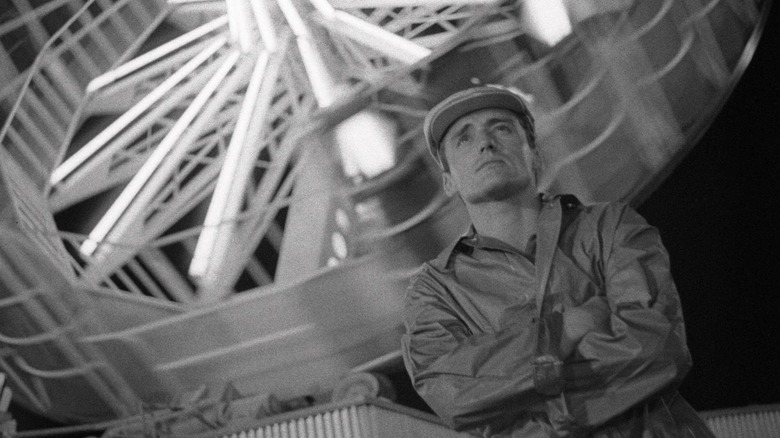
At first glance, "Night Tide" seems like an odd choice for Shudder. It's not really a horror film. It's much more of an understated dark fantasy, albeit one with the occasional murder.
"Night Tide" stars an impossibly young Dennis Hopper as a sailor who falls in love with a strange woman who performs as a mermaid in a sideshow attraction. The twist? She believes that she actually is a mermaid, one who is fated to murder men by the light of the full moon. It's an unsettling, melancholy romance, one that's doomed from the very beginning.
The production of "Night Tide" has a dreamy quality to it, almost as though the audience is viewing the entire strange business through a mist -- or, if you like, from underwater. Despite the fact that it isn't particularly scary, it is nonetheless an intriguing addition to the service, and an entirely unique take on mermaid mythology.
White Zombie
When most people think of zombies, a certain image comes to mind. Yes, we can quibble over fast-moving or slow-moving zombies, but they're generally pale and undead and have a hankering for human flesh.
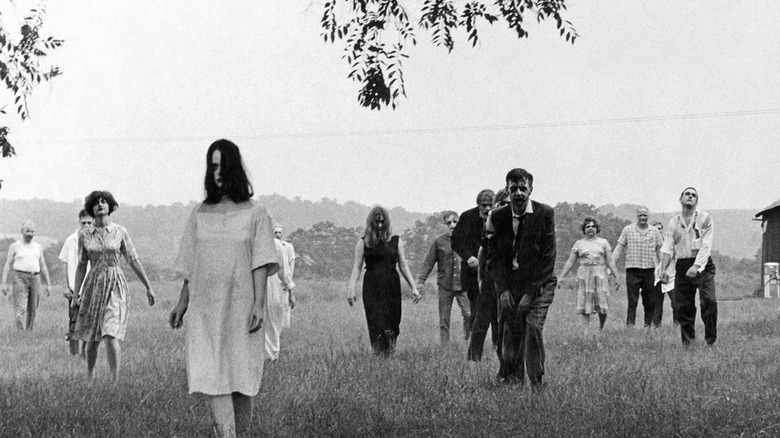
That's only part of the picture, though. Before "Night of the Living Dead," zombies in film were totally different creatures. A traditional zombie was still alive, technically, but brainwashed into doing the bidding of its master.
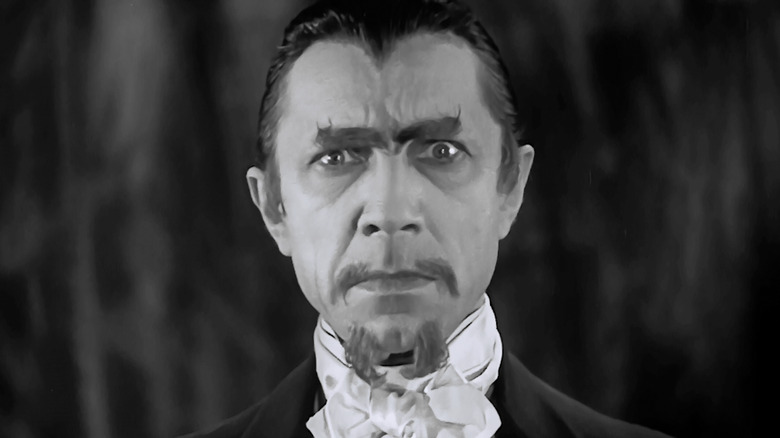
And that's what we see in "White Zombie." When Beamont (Robert Frazer) is rejected by a beautiful young woman, he conspires with the zombie master of Haiti (fittingly played by Bela Lugosi) so that she is compelled to stay with him forever. It's a quietly unsettling film, and while it has few major scares, the haunting image of the woman walking around in an unseeing, unfeeling trance is a defining moment for the genre.
Black Sunday
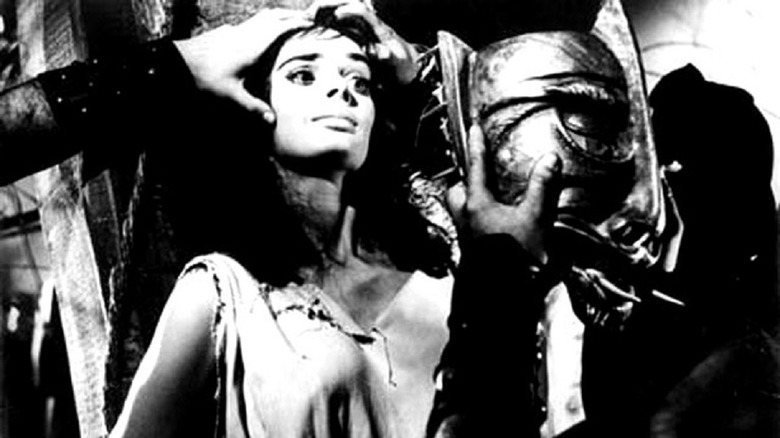
"Black Sunday" is an icon of Italian Gothic style, a treasured movement in horror cinema. Like many other films of its ilk, "Black Sunday" incorporates elements of traditional folklore into its story, juxtaposing the beautiful and the profane in its tale of a witch from centuries past who returns to seek revenge. The images it contains are as striking as they are horrifying: actress Barbara Steele's luminescent face held in close-up, only to be gruesomely marred by deep cuts from the mask that was hammered onto her face by superstitious villagers who think she's a witch.
Director Mario Babva's work here was incredibly influential on many films that would come later, both in Italy and further afield. Although "Black Sunday" was not particularly well-received in Italy upon its initial release, it would grow to typify Italian horror of the '60s, and its visual motifs stretched beyond the limits of the genre, impacting both spaghetti westerns and giallo thrillers.
House On Haunted Hill
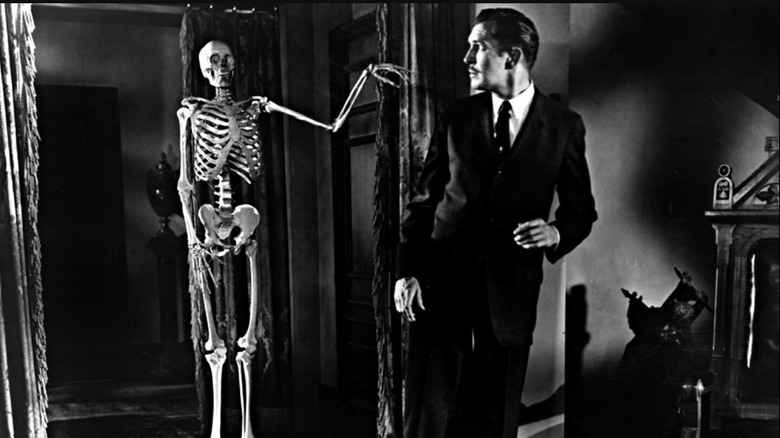
As far as horror movies on Shudder go, "House on Haunted Hill" is probably among the tamest. There's no gore, and not even much tension. But if there's one thing "House of Haunted Hill" has, it's a sense of atmosphere. If a horror film from the '50s isn't going to feel dated, that makes all the difference.
When Frederick Loren, played by a delightfully malevolent Vincent Price, brings a group of strangers together and offers them $10,000 if they can survive the night in a haunted house, it almost seems too good to be true. After all, it's just one night. You can put up with almost anything for a night if there's a huge amount of money on the line, right? But things quickly grow much more ominous than the visitors had anticipated, and the question soon becomes not whether they'll manage to stay until dawn, but whether they'll survive at all.
A Girl Walks Home Alone At Night
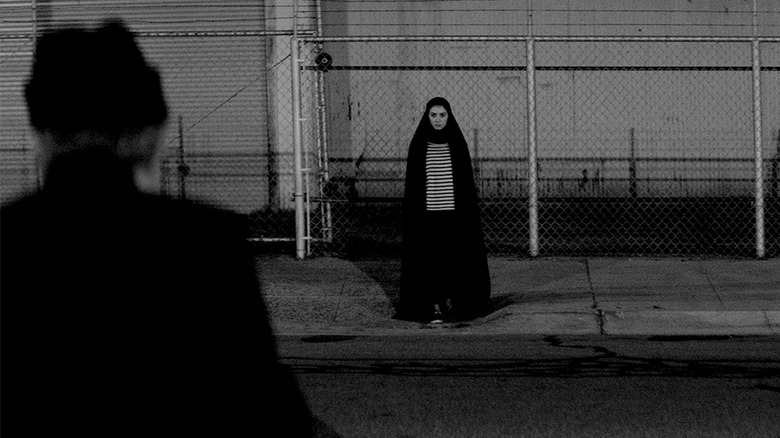
"A Girl Walks Home Alone at Night" stands out as an entirely unique take on the vampire film. Directed by Iranian-American filmmaker Ana Lily Amirpour, it stars Sheila Vand as a veiled antihero who roams the streets at night, punishing the evil men she meets along the way.
"A Girl Walks Home Alone at Night" depicts vampirism as a foil for the dangers women face in an oppressive patriarchal society. Vand wanders aimlessly in the dark, an action that women have been warned against since time immemorial, but she is in no peril. In fact, she is the predator in this scenario, a twist that is incredibly empowering from a feminist perspective: the woman avenging the sordid crimes of man. The very name of the film is a provocation, one that turns the tables on our expectations, and Amirpour's capable hands build a cityscape that is eerily unpopulated, the perfect playground in which the Girl can hunt.
Chopping Mall
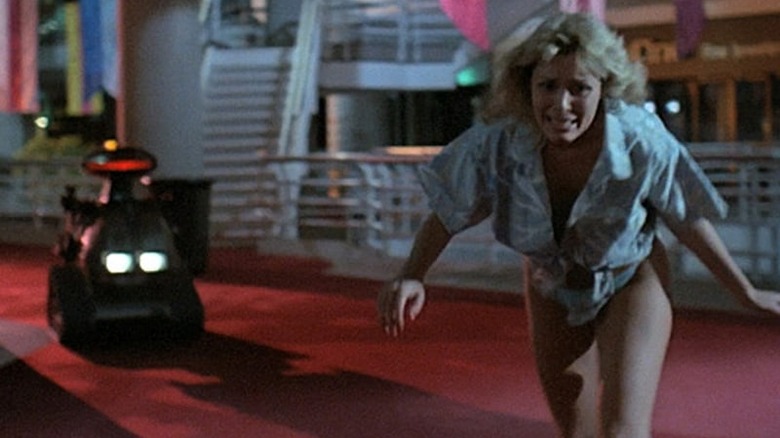
Sometimes you want ghosts and vampires and werewolves, and sometimes you just want good, old-fashioned killer robots. "Chopping Mall" is an '80s horror film that delights in its absurdity, featuring a trio of laughably clunky mall security robots as its villains.
In what amounts to perhaps the biggest example of overkill in cinematic history, the head of security of a suburban mall installs several top-of-the-line defense robots to patrol the halls after closing. One night, shortly after the machines are deployed, a lightning storm causes their circuitry to go haywire, turning them into ultraviolent killing machines that hunt the mall employees holding a party after closing.
"Chopping Mall" is silly and camp in all of the best ways, and although it didn't do particularly well at the box office, it found an enthusiastic audience when it came out on VHS and is now regarded as a cult classic.
Black Christmas
"Black Christmas" is a nightmare scenario for any group of women who live alone. Our heroines, a bunch of college students in off-campus housing, keep getting unnerving phone calls from a man. They're a little freaked out, but mostly just annoyed -- that is, until they start getting murdered, one by one.
You're supposed to be able to feel secure in your home, and the scariest part of "Black Christmas" is how thoroughly the murderer violates that safe space. The idea that your would-be attacker could be hiding where you live without you knowing it is genuinely chilling. In similar movies, creepy phone calls can come off as a little camp, but here they are genuinely disturbing. It's not much what the man says (because really, he doesn't say very much at all) but his tone and the guttural, feral, spine-tingling noises that come through the phone. "Black Christmas" sounds like it's another cheesy holiday slasher, but it has some deeply upsetting moments that really linger.
Carnival Of Souls
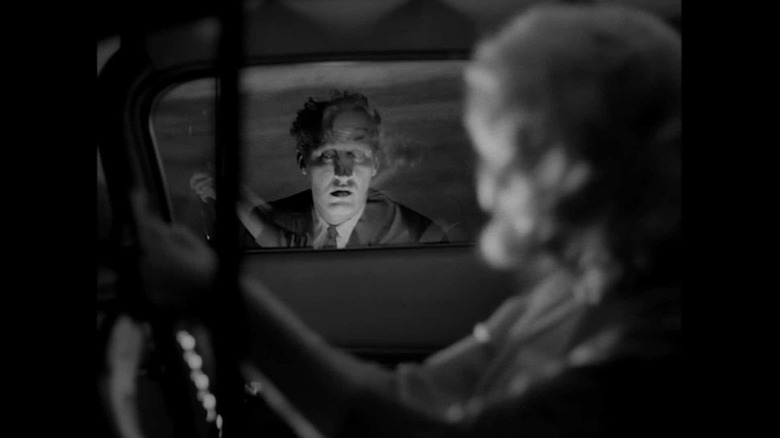
M. Night Shyamalan's "The Sixth Sense," along with many other modern horror films, owes a not-insignificant debt to the simple, low-budget "Carnival of Souls," which asks an endlessly unsettling question: What if you died and didn't even realize it?
After Mary is in a car accident that leaves every other passenger dead, she emerges from a river, apparently unharmed. But as Mary continues on her journey, she begins to feel peculiar. Everyone she meets treats her strangely, and she is plagued by the vision of a pale, dead-eyed man who appears when she least expects it.
What follows is a quietly eerie slow burn, a staggeringly effective example of what can be accomplished in horror without a massive budget. And the scene in which Mary finally arrives at the titular carnival is a piece of classic horror magic, one that stands up favorably against anything that you might see in a more modern ghost story.
One Cut Of The Dead
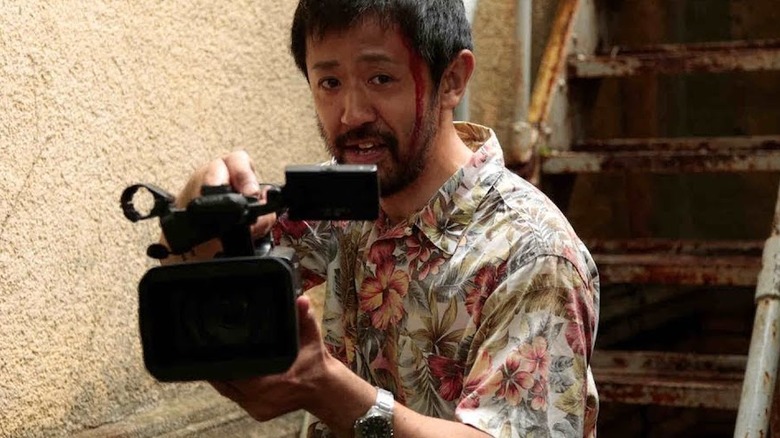
A recent zombie export out of Japan, "One Cut of the Dead" is one of the most surprisingly fun horror films in ages. Making a movie on a low budget can be really stressful, so it's understandable that the director in "One Cut of the Dead" resorts to the black arts in order to keep costs down. Rather than hire a crew of extras to perform in his zombie movie, Director Higurashi summons real zombies to his set, and uses them instead. This works exactly as well you'd expect. And that's just the beginning of the surprises.
The exhausting real-life "One Cut of the Dead" shoot lasted for eight days, and its tiny budget was largely crowdfunded (amounting to around $25,000). The crew's commitment was richly rewarded, however: "One Cut of the Dead" broke box office records in Japan, was given a celebratory international release, and made back its budget one thousand times over.
An American Werewolf In London Has Some Of The Best Physical Effects You'll Ever See
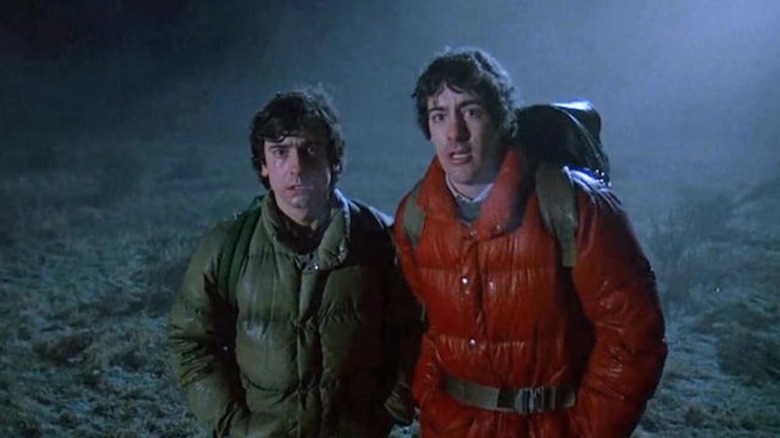
There are plenty of horror comedies out there, but many of them struggle to find a balance between those two elements; it's hard to do both humor and scares well, you know? But "An American Werewolf in London" stands out as perhaps the ultimate horror comedy. When David (David Naughton) and Jack (Griffin Dunne), two American backpackers, hear warnings about mysterious beasts roaming the moors in northern England, they pay it no mind -- just a silly local superstition, they assume.
They assume wrong. Jack is horrifically mauled to death, and after spending weeks recuperating from his wounds, David receives visits from his friend from beyond the grave, begging him to kill himself before he transforms into a werewolf. All of these years later, "An American Werewolf in London" still has some remarkable practical effects and makeup design. Jack's decomposing body as he visits David is appropriately gruesome, and David's slow change into a werewolf highlights the excruciating pain that accompanies such a transformation.
Halloween
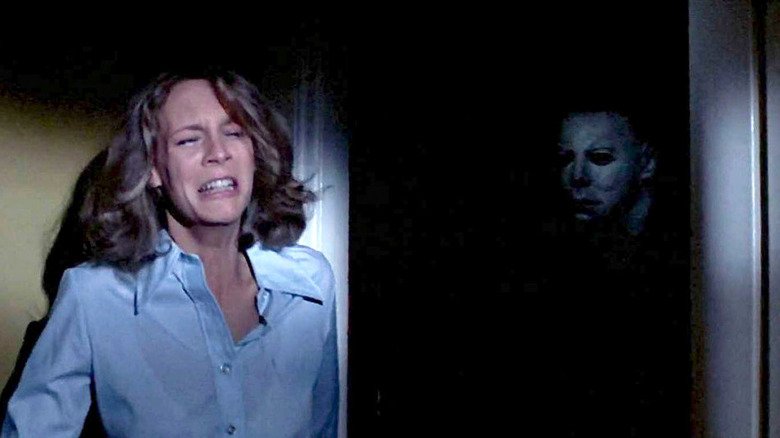
Let's be honest, recommending "Halloween" isn't exactly a bold, out-of-left-field choice. It is, after all, one of the most famous horror films in history, one that launched the career of a young Jamie Lee Curtis and made the eerie Michael Myers a household name.
But how could we even consider leaving it off a "best of" list? In "Halloween," Curtis cements her reputation as a bona fide scream queen as Laurie, a teenage babysitter whose kid-watching gig is interrupted by the homicidal machinations of Michael Myers, recently escaped from a psychiatric institution 15 years after murdering his older sister. Director John Carpenter makes a meal out of the slow build-up, as Myers stalks his prey and everyone tries to convince Laurie that she's imagining the creepy man following her around. A classic of the genre, "Halloween" is a must-watch for anyone who considers themselves a horror fan.
The Cabinet Of Dr. Caligari
Shudder has more than a few examples of early horror in its catalog, but perhaps none are more well-known than the German expressionist film "The Cabinet of Dr. Caligari."
When Francis and Alan encounter Dr. Caligari and the sleepwalker that he controls (played by a young Conrad Veidt), Alan ominously learns that he will die before morning. When this comes to pass, Francis and his fiancée are led through an unsettling hall of mirrors that brings them to the brink of insanity itself.
All exaggerated, grotesquely contorted angles, "The Cabinet of Dr. Caligari" reflects the distorted sense of reality brought forth by profound disillusionment in the wake of World War I. Within its fractured narrative lies a surprisingly sophisticated framing story and one of cinema's first twist endings, all in service of an effort to make viewers question not just existing power structures and traditional figures of authority, but their own perceptions of reality.
Night Of The Living Dead
One does not simply make a list of the best films on Shudder and leave off "Night of the Living Dead," one of the most iconic horror movies of all time. With it, George A. Romero singlehandedly redefined the cinematic zombie.
"Night of the Living Dead" begins inauspiciously, with a brother and sister laying a wreath for their long-dead father, when they are slowly approached by a man who doesn't look quite right. The notion of one lone zombie seems quaint, but in no time at all our heroes are beset by hordes of slow-moving but maddeningly persistent flesh-eaters. Taking refuge in an old, abandoned farmhouse, a group of strangers (led by, surprisingly for the late '60s, a Black man played by Duane Jones) will fight to survive the night.
The fact that "Night of the Living Dead" was reportedly produced for just over $100,000 works to its advantage: Its practical effects ground the film in a grim sort of reality that make it all the more unnerving, and highlight the film's political commentary, which still feels relevant today.
sciencehabit shares a report from Science.org: In late 1791 and early 1792, on the eve of the French Revolutionary Wars, Queen Marie Antoinette engaged in a secret correspondence with her confidant and rumored lover, Swedish Count Axel von Fersen. Nearly 50 letters from that exchange survive at the French National Archives. But certain passages in 15 of the letters were unreadable, obscured by redactions made with swirls of dark ink. Now, researchers have revealed the words beneath 45 of these alterations using x-ray technology. They have also discovered the censor's identity: von Fersen, himself. The idea that von Fersen made the redactions is "a revelation," says Catriona Seth, a professor of French literature at the University of Oxford who was not involved with the work. Historians had thought the letters were censored in the second half of the 19th century -- most likely by von Fersen's great-nephew -- to protect the writers' reputations. Now, she says, scholars will need to rethink the cover-up -- and the reasons behind it. The newly legible passages are largely sentimental, phrases like "made my heart happy," and "you that I love." Comments on politics and world events, meanwhile, remain uncensored. But even these seemingly intimate phrases don't definitively tell historians anything new about Marie Antoinette and von Fersen's relationship, Seth says. Scholars, she notes, already knew Marie Antoinette had "a very deep affection for him." Still, she adds, the letters offer "direct insight into the thoughts and feelings of Marie Antoinette." In the future, the techniques in this study could be used in combination with machine algorithms to automatically transcribe old texts, the researchers say, making it easier to understand these important documents -- and others like them. The researchers published their findings in the journal Science Advances.
Bust out the coke spoon rosaries, because "Cruel Intentions" is back, baby.
Five years ago, NBC passed on a highly-anticipated sequel to the 1999 cult favorite, "Cruel Intentions." Now, Amazon's IMDb TV is back at it with a series reboot of everyone's problematic '90s fave. The original film was a loose adaptation of the novel "Dangerous Liaisons," but the new series is set to follow two, well, cruel step-siblings who will stop at nothing to uphold their power. Set in a collegiate environment, the new series is centering on the Greek life hierarchy at an elite school in Washington D.C.
What Is Cruel Intentions About
1999's "Cruel Intentions" starred Sarah Michelle Gellar, Ryan Phillippe, Reese Witherspoon, and Selma Blair and focused on the world of petty, wealthy, and ruthless sexual conquest amongst high school elites. The film was a huge success and won multiple MTV Movie Awards and Teen Choice Awards, with the infamous kissing scene between Sarah Michelle Gellar and Selma Blair taking home "Best Kiss." The kiss also inspired an over-the-top and memorable parody scene in "Not Another Teen Movie."
The new series is taking a different approach, focusing on the aftermath of a brutal hazing incident that threatens the entire Panhellenic system. The events force the relentless step siblings to do anything they can to secure their reputations, even if that means seducing the daughter of the Vice President of the United States. No casting or additional plot information has been released at this time.
Who Is Behind The New Series?
The new series comes from Phoebe Fisher and Sara Goodman whose updated version of "I Know What You Did Last Summer" is coming soon to Amazon. Neal Moritz, one of the producers of 1999's "Cruel Intentions," is also attached to the project along with Pavun Shetty, the Head of Television for Moritz' company Original Film. Andrea Iervolino and Monica Bacardi of Iervolino & Lady Bacardi Entertainment will executive produce the IMDb TV series along with Bruce Mellon. Sony Pictures Television and Amazon Studios are producing alongside Original Film.
The original pilot from 2016 was set to be a direct follow-up to the original film, with Sarah Michelle Gellar returning in the role of Kathryn Merteuil, but the show wasn't picked up to series. Three episodes of a prequel series from Fox were assembled into a direct-to-video film "Cruel Intentions 2" in 2001, with "Cruel Intentions 3" releasing in 2004, also direct-to-video. In 2015, the film inspired a jukebox musical of '90s staples playing in Los Angeles, Off-Broadway, and at the Edinburgh Fringe Festival. The writers of the musical, Lindsey Rosin and Jordan Ross, were also involved in the original NBC pilot.
These are technically not free since you need a subscription but if you already got Prime or still have a trial for it, it can be useful (especially since this month there are three)
(Welcome to Now Stream This, a weekly column dedicated to the best movies streaming on Netflix, Amazon, Hulu, and every other streaming service out there.)
Welcome back to Now Stream This, the weekly streaming column that wants to solve the eternal question: "What the hell should I watch tonight?" Every weekend, I'm here to give you some suggestions, because I want you to enjoy the wonderful world of streaming movies. In this edition, we have a prequel to a classic TV show, a big sweeping romance from Jim Cameron, a vampire hang-out movie, a sexy blockbuster, and a movie where NASA is evil.
The Many Saints Of Newark
Now Streaming on HBO MaxRelease Date: 2021Genre: Mob DramaDirector: Alan TaylorCast: Alessandro Nivola, Leslie Odom Jr., Jon Bernthal, Corey Stoll, Michael Gandolfini, Ray Liotta, Vera Farmiga, An "r" that looks like a gun
"The Sopranos" gets the prequel treatment with "The Many Saints of Newark." This crime saga takes us back to Newark in the late '60s and early '70s, and introduces us to Dickie Moltisanti (a great Alessandro Nivola), the guy who served as a mentor and father-figure to young Tony Soprano (played by Michael Gandolfini, doing a brilliant and often eerie interpretation of the character his late father made famous). Dickie thinks of himself as a good guy who tries to do good things, but his violent temper and sociopathic tendencies keep getting in the way. This film will play well with "Sopranos" fans, but it's also a solid enough drama that it will work if you've somehow never seen the show.
For fans of: The Sopranos, GoodFellas, lots of wigs and fake noses.
Titanic
Now Streaming on NetflixRelease Date: 1997Genre: Romance, but with a big ship! (Of course, the biggest ship of all is a relationship)Director: James CameronCast: Leonardo DiCaprio, Kate Winslet, Billy Zane, Kathy Bates, Bill Paxton, That one dude who says he can "smell ice"
Hell yes, let's all admit it, "Titanic" rules. James Cameron's big sweeping romantic movie was a huge deal – it cleaned up at the box office and won tons of Oscars. However, I'll admit that I went through a period where I didn't want to admit I liked the movie. It was beneath me, somehow. Or so I thought. Then I grew the hell up and realized I was being silly, because this is a damn good movie. Not only is it a technical marvel full of still-great special effects and production design, but it's a captivating story. Is it all a bit simplistic? And is James Cameron cribbing from other works for his story? Sure, but that doesn't make "Titanic" any less enjoyable. So come aboard the film that features a lowly poor person (Leonardo DiCaprio) falling in love with a rich lady with a giant hat (Kate Winslet).
For fans of: A Night to Remember, Legends of the Fall, watching Kate Winslet spit.
Capricorn One
Now Streaming on Amazon Prime VideoRelease Date: 1978Genre: ThrillerDirector: Peter HyamsCast: Elliott Gould, James Brolin, Brenda Vaccaro, Sam Waterston, Hal Holbrook, and, uh, well, this is awkward, O.J. Simpson
This thrilling little bit of paranoia asks a very important question: what if the folks at NASA were evil? In "Capricorn One," a team of astronauts are about to blast off to Mars. However, at the last minute, a problem is detected with the life support system and the astronauts are asked to leave the ship. However, the mission still continues, with the spacecraft headed off on its own, automated. The reason: NASA thinks that if they canceled the mission, the government would cut their funding. They plan to dupe the public into thinking the mission went according to plan while the astronauts hide out on Earth. However this plan backfires in a big, big way when the spacecraft ends up exploding upon re-entry – something the entire world is very aware of. Now NASA is faced with a crisis: they can either admit that they faked the whole thing and that the astronauts are alive and well, or they can straight-up murder the astronauts and continue with the cover-up. NASA opts for the latter, deadlier option – and the astronauts flee for their lives. Also, here's the cherry on top: the real NASA helped out with this movie. That's right, the folks at NASA read a script that depicted them as murderous villains, and said, "Sure, let's do this." Anyway, what follows is a big chase movie, featuring one of the most thrilling air chases I've ever seen. One of the astronauts tries to get away in a crop-duster, leading to a sequence where helicopters chase the small plane all through several canyons. They used a real plane with a real pilot for this sequence, and the stunt work is so jaw-droppingly crazy that it made me feel like I was going to throw up. It's amazing no one got hurt.
For fans of: Three Days of the Condor, The Parallax View, the uncomfortable film roles of O.J. Simpson.
Only Lovers Left Alive
Now Streaming on The Criterion ChannelRelease Date: 2013Genre: Vampire RomanceDirector: Jim JarmuschCast: Tilda Swinton, Tom Hiddleston, Mia Wasikowska, Anton Yelchin, Jeffrey Wright, Slimane Dazi, John Hurt, Lots of long hair
A tragically hip vampire film, "Only Lovers Left Alive" features two of the most believable vampire actors ever: Tilda Swinton and Tom Hiddleston. They're ancient vampire lovers dealing with the modern world, and also dealing with Swinton's messy, bratty younger sister, another vampire, played by Mia Wasikowska. This is a Jim Jarmusch movie, which means the plot is secondary and everything is very shaggy and laid-back, and that's all part of the charm. If you're looking for traditional vampire frights here, you're out of luck. But if you're looking for very cool bloodsuckers who lounge around all day strumming guitars and sucking on blood popsicles, you're in for a good time.
For fans of: Dead Man, The Addiction, vampire hang-out movies.
The Mask Of Zorro
Now Streaming on HuluRelease Date: 1998Genre: Action-AdventureDirector: Martin CampbellCast: Antonio Banderas, Anthony Hopkins, Catherine Zeta-Jones, Stuart Wilson, Matt Letscher, Lots of sex appeal
Once upon a time, Hollywood blockbusters based on existing IP could be fun and sexy! Not anymore, though. Everything now is bland and gray and designed to sell theme park tickets. But back in the day, we got movies like "The Mask of Zorro," an incredibly entertaining adventure pic that asked, "What if we made a new Zorro movie and it was sexy as hell?" Antonio Banderas and Catherine Zeta-Jones are both hot as heck here, burning up the screen, fighting with swords, and smooching. Really, what more do you need? In this new take on Zorro, the original Zorro – played by Anthony Hopkins – gets locked away in a dungeon for years. Eventually, he busts out and decides to train a new Zorro. He finds his potential student in the form of a smelly, unshaven thief, played by Antonio Banderas. Eventually, Banderas cleans up nice and starts training to be Zorro. It's crazy fun, and it's a shame the sequel – "The Legend of Zorro" – is kind of a dud. Oh well, we'll always have this one.
For fans of: The Mummy, Indiana Jones movies, hot people using swords.
(Superhero Bitsis a collection of stories, updates, and videos about anything and everything inspired by the comics of Marvel, DC, and more. For comic book movies, TV shows, merchandise, events, and whatever catches our eye, this is the place to find anything that falls through the cracks.)
In this edition of Superhero Bits:
"Venom: Let There Be Carnage" is finally here.
Puma is teaming up with DC for "The Suicide Squad" shoes.
Marvel begins prepping audiences for "Eternals."
"Black Panther" #1 gets a trailer
All that and more!
Beware Of Venom: Let There Be Carnage Spoilers
After a year of delays, "Venom: Let There Be Carnage" has finally hit theaters. As evidenced by this post from the movie's official Twitter account, we would caution fans to be extra careful about spoilers for this one. Stay off of social media, or perhaps mute keywords. The conversation will, undoubtedly, be substantial for this one. You've been warned.
Black Panther #1 Trailer
Marvel Comics is launching a brand new "Black Panther" comic next month. This will pick up in the aftermath of Ta-Nehisi Coates wrapping up his legendary run with the character. Now, it falls to Oscar-winner John Ridley and artist Juann Cabal to usher in a new era T'Challa. The synopsis for the book reads as follows:
Secrets from T'Challa's past have come back to haunt him! Fresh from returning from his travels in space, Black Panther receives an unexpected and urgent message from a Wakandan secret agent! Now T'Challa must race the clock not only to save his agent, but also to keep his true agenda under wraps. Because if the truth comes out, it could cost T'Challa everything.
"Black Panther" #1 hits shelves on November 10.
Netflix Was Surprised At Mark Millar's Comic Plans
Netflix purchased Millarworld as its first major acquisition in 2017. The plan was to turn Mark Millar's comic books into franchises. While "Jupiter's Legacy" flamed out in a big, bad way, Netflix is making good on that promise. But, in a new interview with Comic Book Resources, Millar explained the company was surprised that he still wanted to make actual comic books following the deal.
"Netflix was surprised I was so passionate about continuing to do comics too, but I didn't get into this business to get out of it. It was never a stepping stone for me, as I love it. I asked to get a few comics written into my work contract as a Netflix exec every year and I'm now adapting the franchises I create in-house into comic form. The Magic Order was the first of these, but also Space Bandits, Sharkey, Night Club, King of Spies and Prodigy. These are all TV shows or movies I created as an in-house franchise and then worked up with character bibles to be comics too."
In turn, those new comics will be used to create franchises. Everyone is happy.
Injustice Animated Movie Gets New Images
DC's "Injustice" is getting the animated movie treatment here in just a few short weeks. Warner Bros. has released several new images teasing the adaptation ahead of its arrival on October 19, 2021. The pictures highlight Harley Quinn, Green Arrow, and more. Check them out in the tweet above.
What If...? Plot Holes Explained In New Video
The folks at ScreenCrush have released a new video explaining some things about Marvel's animated series "What If...?" Specifically, it has to do with some plot holes that fans may have been scratching their heads over. This video should help sort out some of what is going on as we rapidly approach the show's season 1 finale.
WandaVision Scarlet Witch Statue From Iron Studios
As reported by the folks at Toy Ark, Iron Studios has begun pre-orders for its "WandaVision" Scarlet Witch statue. In particular, the 1/10 scale statue captures the iconic moment from the show's post-credits scene. The item will run $210 and is expected to ship sometime between October and December 2022. So we've still got some time to wait on this one, but you can get a look at it for yourself in the image above.
The Suicide Squad Sneakers From Puma
Shoemaker Puma has teamed up with DC to release a line of sneakers inspired by this summer's "The Suicide Squad." In the video above, we get a glimpse at the footwear to come, which came to fruition thanks to artist Jen Bartel. The line includes characters Harley Quinn, Peacemaker, Bloodsport, Polka-Dot Man, and, most importantly of all, King Shark. The shoes retail for $150 and are available for pre-order right now. Fans can do so by clicking this link.
Venom: Let There Be Carnage Rotten Tomatoes Score
With the movie in theaters, "Venom: Let There Be Carnage" has had its official Rotten Tomatoes score revealed. It, as of this writing, boasts a 62% critical approval rating to go with an 85% audience rating. In contrast, the first "Venom" carries a mere 30% critic rating and an 81% audience score. While these numbers will fluctuate, the consensus is, so far, that the sequel is an improvement.
Meet The Eternals Videos Begin With Ajak
Lastly, we have a bit of promotional material for "Eternals," the next bit Marvel flick arriving in theaters. The Marvel HQ YouTube channel has begun releasing a series of videos meant to familiarize fans with the large cast of somewhat obscure characters at the center of the upcoming blockbuster. This video focuses on Ajak, who is being played by Salma Hayek in director Chloe Zhao's entry in the MCU. Check it out for yourself above.
Terry Gilliam was always the odd man out in Monty Python -- he was the only American, he wasn't Oxbridge educated, and he was an animator, not a comedy writer. He did, however, find his directing feet with the troupe, co-directing "Monty Python and the Holy Grail." He would also go on to cast Michael Palin and Eric Idle in many of his projects.
In Gilliam's first "solo" film, "Jabberwocky," the Python influence was clear, but it would become less so as he branched further into flights of fancy and dystopian sci-fi. Gilliam has always worked at his own pace, and being a controlling and demanding perfectionist means that he has not churned movies out regularly, and that each film that he makes is a passion project. As a director, Gilliam is notorious for going over-schedule and over-budget, and for having some disastrous productions, as well as a number of box office bombs.
But almost every Gilliam film bursts with creativity and originality, and is risky, visually rich, and exciting. Sure, his movies are often messy and chaotic, but they're rarely dull. Terry Gilliam's films are to be cherished for their practical sets, props, and effects -- there is a high chance we will not see their like again.
Tideland
"Tideland" is the story of a nine-year-old girl, Jeliza-Rose (Jodelle Ferland), whose drug-addicted parents (played by Jennifer Tilly and Jeff Bridges) die, resulting in her living alone in a rural shack. She befriends two strange neighbors -- Dell (Janet McTeer), and her childlike son Dickens (Brendan Fletcher) -- and copes by creating a fantasy world.
It is perhaps no coincidence that Gilliam's two worst films were both released in 2005, while he was preoccupied attempts to make "The Man Who Killed Don Quixote" with Johnny Depp. The issues with "Tideland" are too complex to go into here, but let's just say that dealing with real-world problems like drug and child abuse are not Gilliam's forte. Attempting to combine these serious subjects with the kind of fantastical landscapes that he is known for does not work. Jodelle Ferland is extraordinary, even if the experience of watching what she goes through is deeply uncomfortable to watch.
The Brothers Grimm
"The Brothers Grimm" saw Gilliam return to the kind of high fantasy he is best known for, recalling the likes of "Time Bandits" and "Baron Munchausen." The Grimm brothers are charlatans who extort money from villages against the backdrop of French-occupied Germany in the 18th century. They are then dispatched to take on a real haunted forest, with the help of Angelika (Lena Headey).
Unfortunately, one of the main issues here is the hugely miscast Matt Damon as one half of the titular brothers, with the much better-suited Heath Ledger as the other. In addition, the plot is confusing, the film is messy, and it's hard to care about anything that happens. The best aspect -- Monica Bellucci as the wicked Mirror Queen, adorned in fabulous costumes -- does not appear nearly enough. "The Brothers Grimm" doesn't have the scope or scale of Gilliam's best fantasy work, it's confined to one forest for too much of its runtime, and although there are a couple of interesting creatures who appear towards the end, we have checked out by the time they arrive.
Jabberwocky
A Terry Gilliam adaptation of Lewis Carroll's famously weird and wonderful poem starring Michael Palin sounds like the ingredients for a good time. However, apart from a brief bit of narration at the beginning and the appearance of the "monster" at the end, "Jabberwocky" has very little to do with Carroll's work. Very much a continuation of the style established in "Monty Python and the Holy Grail" and "Life of Brian," but without the whole Python ensemble and, crucially, the writing team behind them, "Jabberwocky" ends up being quite dull.
As a huge Michael Palin fan, it pains me to say this, but he can only work with what he's given. Naming the film "Jabberwocky" sets up certain expectations -- you will spend the entire runtime waiting for them to filled, but by the time the creature finally appears, it's too little, too late. Palin plays a typically naïve and optimistic character who struggles to survive in a hostile medieval world, but it's all very grim and not quite funny enough.
Fear And Loathing In Las Vegas
I will admit to being very into "Fear and Loathing in Las Vegas" (both the book and film) during my college years, but upon re-watch, the movie doesn't exactly hold up. In a feature-length drug trip that could serve as a cautionary tale, Benicio Del Toro and Johnny Depp both brilliantly convey the relentless paranoia, mania, and physical side effects that comes with a suitcase full of narcotics. This is definitely an outlier on Gilliam's filmography -- it feels more like a direct line into the mind of Hunter S. Thompson, and less the product of Gilliam's imagination.
However, some of the drugged out visual effects are Gilliam-esque, such as the carpet melting up someone's legs and the faces that stretch as they ominously lean towards our two "heroes." Christina Ricci and Ellen Barkin both cameo in uncomfortable scenes that reveal Gonzo's (Del Toro) misogyny. The scene in which the duo attend a DA convention does hold up, and an almost unrecognizable Tobey Maguire as a nervous hitchhiker is another highlight. Ultimately, this is a valiant attempt to adapt an unfilmable book, which is perhaps what gave Gilliam the hubris to think he could take on "Don Quixote."
The Zero Theorem
Like "Brazil" and "12 Monkeys" before it, "The Zero Theorem" is at the dystopian end of Gilliam's fantasies, forming the third part of the director's "Orwellian triptych" (although, really, these films feel more influenced by J. G. Ballard). Set in a bureaucratic nightmare, "The Zero Theorem" stars Christoph Waltz as Qohen, a depressed computer programmer who refers to himself as "we." There are several stars in small supporting roles, including as Matt Damon as Management, Tilda Swinton as an AI therapist, and Ben Whishaw as a doctor. David Thewlis plays Qohen's boss, and Lucas Hedges plays Management's teenage son Bob, who is assigned to help him.
The title of "The Zero Theorem" refers to Qohen's work -- he tries to prove a mathematical formula that shows that life, the universe, and everything will end in a meaningless void. Despite slipping under the radar and receiving middling-to-negative reviews, "The Zero Theorem" holds up with some of the best and most inventively creative of Gilliam's work, offering the same absurd comedy and exceedingly bleak outlook as "Brazil."
The Adventures Of Baron Munchausen
"The Adventures of Baron Munchausen" is probably the movie I would tell someone to watch if they'd never seen a Gilliam film and wanted to get a sense of who he is as a director. It's a fantasy epic stuffed to the gills with the gorgeously intricate practical props and sets that define Gilliam's aesthetic. It stars John Neville, an actor who had not appeared in a film for 18 years, as the Baron, and future director Sarah Polley as little Sally Salt, a stowaway on the Baron's adventures.
Said adventures include a trip to the moon, where the heroes encounter the head of the Moon King (Robin Williams) and a former ally of the Baron's, Berthold (Eric Idle), a supernaturally fast runner. Oliver Reed and Uma Thurman have very small supporting roles, although Thurman's Venus making her entrance in a giant clamshell is one of the film's more memorable images. Like almost all of Gilliam's work, "The Adventures of Baron Munchausen" is funny, completely chaotic, and full of visual wonder.
12 Monkeys
"12 Monkeys" may make for uncomfortable viewing at the moment, as it is set in the near-future, where almost the entire population of the planet has been wiped out by a virus. James Cole (Bruce Willis) is sent back in time, but accidentally ends up in 1990 and is placed in a psychiatric institution (which appears to be from 1890) due to no one believing he is from the future. There, he meets Jeffrey Goines (an Oscar-nominated Brad Pitt) and Dr. Kathryn Railly (Madeleine Stowe), who will both prove important later on.
The futuristic scenes, in which Cole is strapped to a chair and a team of scientists probe him for information, are the best and most typically Gilliam-esque sections. Although this was Gilliam's biggest box office hit and his most widely-seen film, it's not the movie that's most indicative of his style. It features the usual time travel tropes, such as paradoxes and the butterfly effect. Between this and 1997's "The Fifth Element," Bruce Willis starred in two of the best sci-fi films of the '90s.
The Imaginarium Of Doctor Parnassus
While still reeling from his many futile attempts to get "Don Quixote" off the ground, Gilliam started another project that would also face a huge challenge during production: the tragic death of its star, Heath Ledger. This led to a uniquely creative solution. Ledger was replaced with three other actors -- Johnny Depp, Jude Law, and Colin Farrell. It's a move that works surprisingly well, and one that only Gilliam could get away with.
"The Imaginarium of Doctor Parnassus" also stars Andrew Garfield, Lily Cole, Verne Troyer, and Christopher Plummer as Doctor Parnassus himself, who form a travelling troupe of players who lure audience members through a magic mirror into the "imaginarium." Garfield in particular is brilliant as Anton, who becomes jealous of Ledger's Tony, a man with amnesia who the performers find dangling under a bridge.
When Tony transforms into the other actors in the imaginarium, it all forms a seamless part of the weird and wonderful world that Gilliam creates. Juxtaposing the present day setting with fantasy elements worked well in "The Fisher King," and is successful here, too. Gilliam's productions are notoriously chaotic, but in this case a triumph was pulled from the jaws of tragedy.
Time Bandits
"Time Bandits" joins "Labyrinth," "Willow," and "The NeverEnding Story" in the pantheon of great family-friendly fantasy films from the '80s. It concerns a band of dwarves, including Fidgit (Kenny Baker), who have a map that identifies holes in the fabric of space-time that they use to steal treasures from different points in history. An 11-year-old boy, Kevin, gets inadvertently swept along on their adventures, plucked from his mundane suburban life and whisked away from his parents, who are obsessed with consumerism (those Ballard influences again).
While traveling through time, the thieves try to keep a step ahead of Evil (David Warner); some highlights on their trip include John Cleese as Robin Hood, Sean Connery as Agamemnon, and (especially) Ian Holm as Napoleon. The most memorable sequences are the one in which Kevin and the bandits are on a ship that is revealed to be a giant's hat, and the one in which they are they held in a cage above a bottomless pit. "Time Bandits" includes some surprisingly sharp satire, while also being a rollicking ride for kids (allegedly, there's a TV adaptation coming from Apple and Taika Waititi, too).
The Fisher King
"The Fisher King" is a very different take on the Grail myth from Gilliam, away from his fellow Pythons. It stars Jeff Bridges as Jack, a shock jock based on Howard Stern who meets Robin Williams' kind-hearted homeless man, Parry, while at a low-point in his professional and personal life. After discovering that they are connected, Jack vows to help Parry, which includes giving him the courage to track down and talk to the woman who he believes he loves.
A highlight of the film is Mercedes Ruehl as Jack's long-suffering girlfriend Anne, in an Oscar-winning performance. Parry is obsessed with finding the Grail, which he believes resides in the home of a New York millionaire, and is tormented by visions of a Red Knight -- both of these are manifestations of the trauma he experienced while witnessing his wife's murder. Williams and Bridges play off one another beautifully, and once again Gilliam successfully combines a modern-day setting (which has smatterings of a classic New York rom-com) with the fantasy elements that we know him for.
Monty Python And The Holy Grail
"Monty Python and the Holy Grail" was the first Python film to have a plot, instead of just being a connected series of skits. It was the directorial debut of the Python's two Terrys -- Jones and Gilliam -- and proved to be a big learning experience for both of them. It is, of course, the writing that proves most memorable, making "Monty Python and the Holy Grail" one of the most-quoted comedies of all time. Between the Knights who say Ni, the Black Knight who refuses to die, the insulting Frenchmen, the murderous bunny, the witch, and Dennis, poor King Arthur's quest for the Grail is not an easy one.
As in "The Life of Brian," Graham Chapman gives a charming central performance as someone put-upon by a variety of eccentric and hostile obstacles. Gilliam plays Arthur's loyal servant Patsy, who gallops behind Arthur banging coconuts together. He also appears during the animated cave sequence -- the threat is quashed because the animator (Gilliam) suffers a fatal heart attack, meaning the "cartoon peril was no more." Many of the elements that recur in Gilliam's films first appeared here.
The Man Who Killed Don Quixote
There aren't many films that have had such a tumultuous gestation period that they have had no less than two documentaries made about them, but "The Man Who Killed Don Quixote" is no ordinary movie. Production began in 2000, with Johnny Depp and Jean Rochefort in the lead roles, but on-set problems scuttled the project after just a few days of shooting. In the intervening years, a number of actors were attached to the film, including Ewan McGregor, John Hurt, and Michael Palin, but it wasn't until 2018 that this millstone around Gilliam's neck finally made it to completion with Adam Driver and Jonathan Pryce (the star of "Brazil") as the stars. To get the full experience, the documentaries "Lost in La Mancha" and "He Dreams of Giants" are essential companions.
So, after two decades, could the finished result possibly live up to the behind-the-scenes drama? The answer is actually yes! The layers involved here are mind-meltingly complex -- a film within a film, telling a story in which a man creates his own myth about himself -- but it still has all of Gilliam's surreal comedy and fantastical touches, including giants. Both Driver and Pryce are brilliantly tuned-in to Gilliam's tone, with Driver bringing hilarious physicality to his role. The only frustration is that nobody saw it. I strongly urge you to rectify that.
Brazil
There can be no denying that "Brazil" is Terry Gilliam's masterpiece. Its influence can be felt in the Ministry in "Harry Potter," the Commission in "The Umbrella Academy" and the TVA in "Loki." A dystopia that is heavy on analogue bureaucracy, in which ducts, pipes, and tubes rule over a world of blandly gray class of middle managers, pen pushers, and civil servants, "Brazil" creates a terrifying world out of the banal and mundane.
With Robert De Niro as a revolutionary hero, Michael Palin playing against type as a chilling villain, and Jim Broadbent as a plastic surgeon who gets truly transformative results, the supporting cast revolves around an extraordinary central performance from Jonathan Pryce as Sam Lowry. The set and costume design, like in most Gilliam projects, is where the richness of the world is created -- Lowry is an Icarus figure in his dreams, there's a restaurant that serves green dinner-flavored mush, and a horribly scary finale takes place in a cavernous torture chamber. The details in this movie will be unpacked for decades to come; "Brazil" will only become more relevant with age. A breathtaking achievement -- and one of the best Christmas movies!
There's something about shared fear that cultivates strength and resiliency while bonding audiences. It can be a communal experience, especially for families. So, the Halloween season is the perfect time to dim the lights, pop some corn, and cuddle up for some seasonal frights that are almost guaranteed to bring everyone closer together.
As far as horror films are concerned, this forthcoming Halloween season arrives with the promise of several heavy hitters, among them "Halloween Kills" and "Last Night in Soho," but family-friendly titles are in shorter supply. For those looking to cultivate an appreciation for the horror genre with something appropriate for the entire family, here are 16 of the best family movies to watch this spooky season. Every one of the movies on this list is fun for both adults and children, and will spark either genuine chills or gut-busting laughs -- or, in some cases, both. Let's get spooky.
Nightbooks
"Nightbooks," currently streaming on Netflix, is one of the newest entries on this list. Produced by genre heavyweight Sam Raimi and directed by David Yarovesky, "Nightbooks" is the perfect gateway for burgeoning horror fans looking for something a little scarier than most family offerings. Winslow Fegley stars as Alex Mosher, a young boy living in New York who loves nothing more than writing the scariest stories he can, which he calls his "nightbooks." When he swears to never write another, a witch name Natacha (Krysten Ritter) lures him into her otherworldly apartment and demands that he write her a new scary story every night if he wants to be kept alive. There, Alex meets Yazmin (Lidya Jewett), another young girl captured by Natacha.
Considerably scarier than most PG horror flicks, "Nightbooks" is sure to appeal to families looking for something accessible and funny, but with a little edge. The effects are dazzling, the performances are pitch-perfect, and the message of finding one's courage and voice is universal. Young audiences are sure to love it, and with any luck, might find themselves inclined to peruse more of Raimi's offerings as they get older.
Coco
Arguably Pixar's last true classic, "Coco" is a gorgeously animated adventure that broadens Disney's conventionally Euro-centric horizons with a distinctly Mexican story. Inspired by Día de los Muertos, Mexico's Day of the Dead, "Coco" follows Miguel (voiced by Anthony Gonzalez), a young boy in Santa Cecillia who dreams of becoming a musician like his father. His family is more than resistant -- they're downright antagonistic. They blame music for his father's absence, reasoning that he prioritized performing over family. On Día de los Muertos, Miguel steals the guitar of deceased superstar Ernesto de la Cruz (Benjamin Bratt) from Ernesto's mausoleum and finds himself transported to the world of the dead.
Miguel is told that he only has until sunrise to return to the world of the living, lest he remain trapped in the land of the dead forever. What follows is a deeply poignant reflection on family, memory, and the way we do (and should) honor the deceased. Children will be enchanted by the bright colors and gorgeously rendered world of the dead, while parents will be susceptible to more than a few tears as Miguel reflects on his lineage and learns the truth about where he came from.
Something Wicked This Way Comes
Though only currently available on DVD (come on, Disney+), "Something Wicked This Way Comes" is one of the scariest children's movies ever made. Written by Ray Bradbury and adapted from his novel of the same name, the plot follows two young boys in Green Town, Illinois who find themselves enveloped in a plot involving the Halloween carnival that has arrived in town. Led by the deeply sinister Mr. Dark (Jonathan Pryce), the two boys discover that the carnival has been seducing the town's adults and making them younger -- some by several years, and some reduced to infancy.
No less scary than Bradbury's gateway text, "Something Wicked This Way Comes" throws spiders, witches, and genuine menace at its audience, never jeopardizing its thrills or sense of menace by conforming to the constraints of most family horror films. Genuinely terrifying, "Something Wicked This Way Comes" is the perfect spooky season treat for families eager for a little danger alongside their candy corn.
The Halloween Tree
More than just a perennial offering -- it often airs on Cartoon Network every October -- "The Halloween Tree" is also a bona fide history lesson, as illuminating and probing as it is entertaining. Another Bradbury adaptation, "The Halloween Tree" follows a group of trick-or-treaters and their efforts to save their friend's soul when it's taken by the sinister Carapace Clavicle Moundshroud (voiced by "Star Trek" legend Leonard Nimoy).
Moundshroud promises to return their friend Pip's (voiced by Kevin Michaels) soul if the children agree to join him on a journey to learn more about the history of Halloween. The children agree and travel to Egypt, Stonehenge, and several other famous locales to learn more about Halloween traditions and their costumes' historical roots. The ending is poignant and raw -- without spoiling anything, it's realistic and deeply meaningful, and doesn't pull any punches. Ray Bradbury is the master of gateway horror for a reason.
The Adventures Of Ichabod And Mr. Toad
"The Adventures of Ichabod and Mr. Toad" was Disney's last packaged film until the release of "The Many Adventures of Winnie the Pooh" in 1977. It consists of two segments, the first of which is based on Kenneth Grahame's "The Wind in the Willows," and the second of which is based on Washington Irving's "The Legend of Sleepy Hollow."
While "The Wind in the Willows" adaptation is good, it's "The Legend of Sleepy Hollow" that truly excels. With the inimitable Bing Crosby as both narrator and protagonists Ichabod Crane and Brom Bones, the segment is an incredibly faithful adaptation of Irving's original short story. The hand-drawn animation is stellar and the music incredible -- Bing Crosby's "The Headless Horseman" is exceptional -- and when Ichabod finally makes his way into the dark woods for his trip home after a Halloween party, it becomes genuinely frightening. The sound design brings every snapped branch and whisper in the wind to life. For young genre initiates, "The Legend of Sleepy Hollow" is poised to terrify. This is classic Halloween animation at its best.
Scary Stories To Tell In The Dark
The scariest entry on this list, André Øvredal's "Scary Stories to Tell in the Dark" had the unenviable task of adapting Alvin Schwartz's perennial Scholastic text to film. While the stories in Schwartz's collection are good, it was the original illustrations by artist Stephen Gammell that cemented the series' legacy. How, then, does one go about adapting that to film? As it turns out, with the guidance of gothic maestro Guillermo del Toro.
In an overarching narrative written for the screen, Zoe Colletti stars as Stella, a young writer who comes into possession of alleged witch Sarah Bellows' collection of horror stories on Halloween. These stories are directly culled from Schwartz's collection, illustrations and all, and within hours, Stella realizes that the tales are coming to life and targeting her friends.
Genuinely frightening without ever being explicit -- "Scary Stories to Tell in the Dark" is a firm PG-13 -- it's the perfect foray into the horror for older kids and teens who want a scare that isn't going to push things too far. With dazzling production design, poignant messages about prejudice and persecution, and some gangbuster scares, "Scary Stories to Tell in the Dark" is a spooktastic contemporary classic.
ParaNorman
"ParaNorman" is stop-motion animation studio Laika's best film. Sorry, "Coraline" fans. Beyond the incredible animation on display -- in that regard, Laika never disappoints -- "ParaNorman" is a heartfelt ode to not just the horror genre, but to an entire community of people who feel like they don't belong. Bonus points must be given to Mitch's character (voiced by Casey Affleck): He's animation's first openly gay character.
Kodi Smit-McPhee voices Norman Babcock, an 11-year-old in Blithe Hollow, Massachusetts who has the curious ability to speak with the dead. Often, this includes pleasant exchanges with his late grandmother, but occasionally, another ghost will chime in, upending Norman's entire day. He feels different and unwelcome, and to the bullies in town, Norman is a freak.
However, when the ghost of the town's resident witch curses the town on Halloween and brings the dead back to life, Norman must figure how to use his gift to complete an ancient ritual to stop further destruction. "ParaNorman" is scary, fun, and funny for young audiences, but probing enough to enlighten older ones. It's a story about prejudice and persecution wrapped in a creepy Halloween bow, and it's sensational.
The House With A Clock In Its Walls
"The House with a Clock in its Walls" is another exceptional gateway entry for young horror fans. Though suitably scarier than most of the other films on this list -- it's helmed by "Hostel" creator Eli Roth -- it's still appropriate for audiences of all ages and boasts a truly heartfelt story to boot.
Roth's first film to not receive an R-rating, "The House with a Clock in its Walls" follows Lewis Barnavelt (Owen Vaccaro), a 10-year-old left orphaned after his parents are killed in a car crash. He moves in with his eccentric uncle, Jonathan Barnavelt (Jack Black), a warlock living in an old house that has, yes, a clock hidden in its walls. Jonathan and his neighbor, Florence Zimmerman (a beguiling Cate Blanchett), have been searching for the clock every night, eager to discover its purpose, especially since the clock itself was hidden by sinister warlock Isaac Izard ("Twin Peaks" alum Kyle MacLachlan).
Roth wanted to make a family-friendly horror film that didn't skimp on scares, and with "The House with a Clock in its Walls," he delivers. There are monstrous jack-o-lanterns, sentient dolls, and a delightfully menacing performance from MacLachlan. Blanchett and Black provide the requisite heart, and balance it nicely with the finely-tuned scares. Though intermittently juvenile -- it is a children's movie after all -- "The House with a Clock in its Walls" has plenty of craftsmanship and genuine thrills that should appeal to the entire family.
Goosebumps
"Goosebumps" was an unprecedented success. Though its budget is unclear -- some speculate it was somewhere around $58 million, others $84 million -- it was hugely popular, resulting in a sequel, "Goosebumps 2: Haunted Halloween," three years later. Skip "Haunted Halloween" and stream the first movie, a delightfully spooky and fitfully funny monster mash.
Jack Black stars as R.L. Stine (Black's contemporary niche appears to be frightening family flicks, and I'm not complaining), who explains to his new neighbor Zach (Dylan Minnette) that the "Goosebumps" series, though originally a method to cope with bullying, exists to imprison monsters. When Stine realized that his creations came to life, he continued writing to keep the horrors locked away in the dusty spines of his original manuscripts.
Naturally, those books are opened, and a menagerie of monsters swarm their small town. Stine can only capture them by writing a new manuscript, but (for some reason) it must be done with a magical typewriter that's held in the local high school. Series favorite Slappy the Dummy (also voiced by Jack Black) leads the monstrous charge, and he's an absolute delight. Gorgeously rendered and genuinely frightening, "Goosebumps" is the perfect way to kick off a creeptastic Halloween season.
Hubie Halloween
One's tolerance for Adam Sandler's Netflix hit hinges entirely on their predilection for Sander's silly accents. Fresh off his acclaimed role in "Uncut Gems," Sandler assembled a comedic troupe for the ages with "Hubie Halloween," a goofy, low-stakes story about Sandler's Hubie, who saves his hometown of Salem, Massachusetts from a kidnapper.
Hubie is routinely ridiculed, both for the way he talks (a riff on Sandler's "Little Nicky" voice that's never explained) and his penchant for being easily scared. He's joined by the likes of Julie Bowen as his love interest and June Squibb as his mother, along with Sandler stalwarts like Kevin James, Maya Rudolph, and several others.
For those who can get past the first five minutes, "Hubie Halloween" is a beautiful love letter to both the town of Salem, where it was filmed, and the season itself. Quite simply, there too few Halloween comedies out there. Families will also be happy to know that, while "Hubie Halloween" has its share of laugh-out-loud moments, it never gets as juvenile or off-putting as some of Sandler's earlier work. It's funny, frightening in spurts, and a grand old time.
Hocus Pocus
"Hocus Pocus" is a classic. Directed by Kenny Ortega and starring Bette Midler, Sarah Jessica Parker, and Kathy Najimy as the Sanderson sisters, "Hocus Pocus" follows a coven of witches who are summoned one Halloween after a virgin lights their black candle. The Sandersons intend to lead the children of Salem to their cabin in the woods, whereupon they plan to absorb their youth and make themselves young again.
In recent years, "Hocus Pocus" has become something of an arbitrary litmus test. As with "Harry Potter," some hang onto the nostalgia of it all, while others detest the film, stridently urging older adults to give up the shtick -- in their words, "Hocus Pocus" isn't good. Reasonable persons (myself included) can concede that, while "Hocus Pocus" isn't the masterpiece we might remember it being in our youth, it's still an incredible time. It's stacked with quintessential Disney magic, fantastic performances, and more menace than most contemporary Disney offerings. Plus, its rendition of "I Put a Spell on You" is intoxicating. "Hocus Pocus" may not be a masterpiece, but it casts a bewitching spell. Keep an eye out, too, for the long-awaited sequel.
Casper
Like "Hocus Pocus," "Casper" is a millennial Halloween classic. Just as younger adults are eager to summon the Sandersons with kids of their own, so too are they thrilled at the prospect of introducing the little ones to everyone's favorite friendly ghost. "Casper" stars '90s Gothic icon Christina Ricci and both Malachi Pearson and Devon Sawa as Casper, with Pearson providing his ghostly voice and Sawa embodying his human form. Kat has moved into Whipstaff Manor with her father (Bill Pullman), a paranormal investigator, at the behest of the Catherine Crittenden (Cathy Moriarty), a greedy old woman who's looking to rid the house of ghosts and find its hidden treasures.
What follows is an innocent and sweet, though never saccharine, tale of first love and a ghoulish coming-of-age. Ricci and Pearson have profound chemistry, united by their respective grief and inability to find stability. Though the plot gets fairly dark -- there are several deaths -- it never gets too scary, and its final message about sacrifice and familial love resonates decades later. "Casper" is a Halloween icon for a reason.
Scooby-Doo! And The Witch's Ghost
Both "Scooby-Doo! and the Witch's Ghost" and "Scooby Doo on Zombie Island" deserve a mention here. They're both animated forays into the best of what the horror genre has to offer, through the legacy of none other than Scooby-Doo. "Witch's Ghost," though, is considerably more of a Halloween movie than "Zombie Island" because, well, it takes place in Massachusetts and tracks, yes, a witch's ghost.
The Scooby Gang is invited to Oakhaven, Massachusetts by famous horror writer Ben Ravescroft (voiced by Tim Curry). There, they find a number of seasonal festivities in full swing, most of which center around the legend of Sarah Ravencroft, a witch executed centuries ago. But Ben disputes the legend, arguing instead that Sarah, a Wiccan, was unjustly persecuted -- rather than using dark magic, she used her powers for good.
Like many other '90s Scooby-Doo stories, the monsters here are genuinely supernatural. There is an actual witch's ghost haunting the town, and the crew are the only ones who can stop it. With the introduction of the Hex Girls -- a gothic punk band -- and some genuine chills, "Scooby-Doo! and the Witch's Ghost" represents the best of what Scoob and company have been up to in recent years.
Frankenweenie
"Frankenweenie" is really, really good. Unfortunately, it floundered at the box office. Despite critical acclaim, the marketing for "Frankenweenie" made it look too juvenile for adults and too scary for children. Neither of those are true. "Frankenweenie" is a love letter to director Tim Burton's Gothic roots, a gorgeously composed stop-motion film about a boy and his resurrected dog. A riff on Mary Shelley's "Frankenstein," all of the Burton hallmarks are here, including big eyes, spectacular creatures, Winona Ryder, and a poignancy that balances out the darker elements.
Resurrected dog Sparky is one of the cutest things that Burton has ever conceived, and while children with pets might recoil from his death and revival, there's a lot worth watching for. "Frankenweenie" is a horror-inspired reflection on grief and fear that celebrates our differences and encourages us to come together. The voice cast is sensational, and while watching, families are guaranteed to laugh, cry, and scream together. It's an utter delight.
The Addams Family
The internet is frequently set ablaze by speculative "Addams Family" castings. Although an animated sequel recently debuted and a television show is on the way, the internet is still doing what the internet does best -- making things up. Still, part of that desire is likely driven by nostalgia and the absolutely stellar casting from 1991's first "The Addams Family" movie. With Anjelica Huston as Morticia, Raul Julia as Gomez, Christopher Lloyd as Uncle Fester, and Christina Ricci as Wednesday, it's easy to see why audiences are eager to see history repeat itself.
More madcap and less macabre than its sequel, the similarly well-received "Addams Family Values," "The Addams Family" is an utter delight. Helmed by Barry Sonnenfield, it's zany, goofy, scary, and frequently gut-busting funny. With a climax set at Halloween and plenty of awesome effects, it has both tricks and treats in abundance, and is sure to thrill.
Monster House
"Monster House" is very scary. Directed by Gil Kenan (who would later go on to helm the "Poltergeist" remake, another worthwhile family pick), it follows a group of kids who take it upon themselves to investigate the titular monster house, a neighborhood behemoth that literally eats children but becomes inactive whenever adults are present. As more and more neighborhood kids are swallowed up, the trio, led by Mitchel Musso's D.J. Walters, must figure out how to stop the evil abode before they're eaten, too.
The central conceit alone is terrifying, as the house unfurls it carpeted tongue to swallow any child who dawdles nearby a moment too long, and the animation is stellar, with Sony employing the same animated style that made "The Polar Express" so successful (thankfully, "Monster House" spends less time in the uncanny valley). "Monster House" is so scary, in fact, that co-writer Dan Harmon once wrote to a young fan apologizing for just how frightening it was. Nonetheless, for kids who can handle it, "Monster House" is a monstrously good time.
In times like these, we all need a good laugh every now and then. And while the Netflix catalog may be lacking in some areas (people do know that movies existed before 1980, right?), the service is an absolute powerhouse in the comedy department. Not only does it have the streaming rights to some of the funniest shows that originally aired on network and cable television, but it has also established a fairly robust line-up of original comedies.
There's an impressive variety, too. When you log in to Netflix, you have an entire buffet to choose from, whether you're looking for golden oldies, modern classics, or genre-bending shows that are part comedy and part science fiction, horror, or even true crime. The only thing you really have to worry about is the inevitable day when the contracts run out and your beloved comfort show is no longer available on Netflix, leaving you bereft in its wake.
Crashing
Before "Fleabag," there was "Crashing," a short-lived British sitcom starring Phoebe Waller-Bridge and Damian Molony about a group of young adults who live in an abandoned hospital, serving as ambivalent caretakers in exchange for cheap rent. Anthony (Molony) is on the verge of marrying his long-time live-in girlfriend when his oldest friend Lulu (Waller-Bridge) turns up out of the blue. The two have undeniable chemistry, and are perpetually dancing around a relationship in a way that is both obvious and deeply infuriating to everyone around them.
"Crashing" only lasted a paltry single season comprised of six episodes, but the character development displayed over that short run is staggering -- there are shows that last for 100 episodes that forge less of an emotional connection with audiences. "Crashing" is a delightful harbinger of things to come from Waller-Bridge, who also wrote the show, and a perfect binge watch that you can wrap up in a single weekend.
GLOW
Who doesn't love an action-packed dramedy based on the true story of an all-female '80s wrestling promotion? "GLOW" -- which stands for Gorgeous Ladies of Wrestling -- is a chaotic, eccentric show about an out-of-work actress (Alison Brie) who finds her calling as part of a ragtag group of misfits poised to become the stars of a new wrestling program exclusively featuring women. They're all a bunch of amateurs who are learning the rules of wrestling as they go, and they approach the quasi-sport with a spirit of enthusiasm and inventiveness that is contagious.
The best part of "GLOW" is the dynamic between all of the wrestlers, and the sense of camaraderie as they force their way into a field that, up to this point, has traditionally not been the most welcoming towards women. Each character brings so much creativity to developing her in-ring persona, and you get the feeling that this is a valuable outlet through which the women can express themselves in bold and exciting ways that might otherwise be denied them.
Sex Education
There's an ambiguous quality to "Sex Education" that is immediately compelling. When does it take place? Where does it take place? As we explore the life of Otis (Asa Butterfield), the sexually repressed son of a sex therapist (Gillian Anderson) who ends up starting a sex clinic of his own at school, it's hard to tell if we're looking at something in England or America, or in the 2020s or the 1970s.
"Sex Education," it would seem, exists in all places at all times at once. For a show as unapologetically raunchy as this, "Sex Education" has a surprisingly massive heart, and feels like the kind of story that might actually be helpful for teens embarking on their own journeys of sexual discovery. It features some top-tier ships, with a special shout out to Eric (Ncuti Gatwa) and Adam (Connor Swindells), two sweet and pure little angels who deserve to walk off into the sunset together.
American Vandal
The question we should all be asking ourselves is, in a world packed full of mediocre true crime dramas, why are there not more true crime parodies? "American Vandal" stands out as the cream of the crop in an admittedly small subgenre, following a pair of high school documentarians who play detective in an attempt to find justice for what they believe to be the wrongly-accused purveyors of immature pranks.
In the 1st season, the teen sleuths try to clear the name of a graffiti artist who allegedly painted genitalia on a bunch of cars in the faculty parking lot. In the 2nd season, they seek out the identity of the infamous Turd Burglar. So, "American Vandal" is sort of like a cross between "Making a Murderer" and "The Olsen and Olsen Mystery Agency." The inherently absurd aspects of the crimes the kids investigate are played 100% straight, with an earnest and completely serious voiceover narration. "American Vandal" feels entirely unique, and we would happily watch another five seasons of these teens solving puerile and extremely gross high school crimes.
Big Mouth
Somewhere along the line, everyone collectively decided to ignore what total and complete perverts kids going through puberty are. "Big Mouth" says, "No longer." It explores the increasingly complicated lives of Andrew (John Mulaney), Nick (Nick Kroll), and Jessi (Jessi Klein), three middle-schoolers on the cusp of adolescence, and their various mishaps with girls, boys, periods, masturbation, and an entire busload of taboo subjects. Pretty much nothing is off limits on this show.
But weirdly, "Big Mouth" addresses some of the chaos and trauma of growing up in a genuinely healthy manner. Like, some episodes of "Big Mouth" should probably be shown to middle schoolers in health class. The way the show personifies lust, anxiety, and depression makes it easier to understand how these feelings actually affect people. And of course, "Big Mouth" features a top-notch vocal cast -- you only need to hear Maya Rudolph as the Hormone Monstress say the word "bubble bath" to know that you're dealing with something special.
Lovesick
On the long list of scenarios that would make for a funny sitcom, a man contracting a sexually transmitted illness and having to inform each of his former partners is perhaps not an obvious one. And at first, it was a hard sell for Netflix -- when the streaming service bought the show from Channel 4 in the UK and commissioned a second season, it changed its name from "Scrotal Recall" to a much more palatable "Lovesick."
"Lovesick" stars a pre-"Emma" Johnny Flynn as Dylan, a man forced to go down a very uncomfortable memory lane after being diagnosed with chlamydia. Each episode is dedicated to a different unfortunate name on his list, and we are treated to flashbacks exploring their respective relationships with Dylan. The main trio of actors (Flynn, Antonia Thomas fresh off her run on "Misfits", and Daniel Inges) have incredible chemistry with one another, and go a long way towards giving depth to what could otherwise be a one-joke sitcom.
The End Of The F***ing World
"The End of the F***ing World" is not a traditional comedy. It's about a teen who is convinced that he is a psychopath, and who devotes a tremendous amount of time to planning the perfect murder. It's pretty much as pitch black as they come. Based on a graphic novel by Charles Forsman, "The End of the F***ing World" stars Alex Lawther as James, a 17-year-old who doesn't seem to experience emotions the way that other people do. When he meets Alyssa (Jessica Barden), a rebellious female classmate, he immediately decides that she's the perfect candidate for his first human victim.
But after the two run away from home, they develop a strong bond, one that leads James to question not only whether he wants to kill Alyssa, but whether he actually wants to kill anyone. The story sounds like it could be glorifying the teen male violence that has been plaguing society for decades, but "The End of the F***ing World" is actually a very sweet, empathetic, and darkly hilarious story about two outsiders whose connection allows each to process the emotions they've been suppressing for ages.
Monty Python's Flying Circus
Look, millions of fathers around the world can't be wrong, can they? "Monty Python's Flying Circus" is perhaps the purest incarnation of classic dad humor, but when it originally came out, it was groundbreaking stuff. The Monty Python troupe's irreverent style would define sketch comedy for a generation, and there are dozens of iconic moments from the show's original run. We're talking the dead parrot sketch, the Lumberjack Song, the Spanish Inquisition, and many more. Each member of Monty Python brought their own distinct personality to the show, and they would quickly become known for different aspects of their performances.
The success of "Monty Python's Flying Circus" would lead the Pythons to create a series of films, none perhaps more famous than "Monty Python and the Holy Grail" and "Life of Brian" (both also available on Netflix). It's genuinely surprising just how much of the original show holds up -- it's just a shame that John Cleese, one of the most beloved members of Monty Python, has aged into the kind of upper-class twit that the show so gleefully skewered decades ago.
Santa Clarita Diet
Everyone needs to shut up and let Timothy Olyphant do more comedy. Sure, he's great in all the gruff, quasi-western roles he takes, but give him something light and quirky like "Santa Clarita Diet" and it's like the clouds are parting. Drew Barrymore stars as Sheila, a typical suburban mom in California who works as a real estate agent with her husband Joel (played by Olyphant). Their lives are pretty ordinary, at least until Sheila ends up as an unexpected member of the undead with a craving for human flesh.
"Santa Clarita Diet" has an appealingly surreal tone, as Sheila and Joel treat this ghoulish transformation as just another marital hurdle to overcome. Joel loves Sheila, and so he is going to help her through this, even if it means hunting down objectively bad people so that the couple don't have to feel so bad about murdering them and packing their dismembered body parts into the freezer. "Santa Clarita Diet" was unjustly cancelled by Netflix, but it still got a respectable three-season run that's perfect for viewers who like their situational comedy with a side of Nathan Fillion's disembodied head.
New Girl
"New Girl" belongs to a very specific class of early-'10s single-camera sitcoms that were all over the main cable networks, but rarely with more charm than we see here. After breaking up with her long-term boyfriend, the human embodiment of a manic pixie dream girl (played by Zooey Deschanel, obviously) moves into a Los Angeles loft with three very quirky dudes. Their relationship is initially fraught with conflict, since the menfolk don't appreciate Jess' cupcakes and sparkles invading their bro space, but they quickly settle into a friendship that would become one of the most pure and wholesome on television.
"New Girl" is one of those sitcoms that really benefits from sticking around long enough to get to know all of the characters intimately, as they develop from caricatures into flesh-and-blood people who you can't help but fall in love with. Because once you start to catch feelings for them, God help you; you're already in too deep. Also, Jessica Day and Nick Miller are one of the greatest on-screen pairings of the 20th century. No, that's not up for discussion.
Arrested Development
"Arrested Development" may be one of the most rewatchable comedy shows in television history, and that is largely due to how intricately layered its punchlines are, with frequent callbacks that the audience may only catch on a second or third viewing. There's always more to discover in "Arrested Development."
Michael Bluth (Jason Bateman) is the self-proclaimed "normal one" in a wealthy but wildly out-of-touch real estate family. Each character is a character. There's Michael's older brother Gob (Will Arnett), an aspiring magician with a massive inferiority complex; Lindsay (Portia De Rossi), Michael's wannabe socialite twin sister; Tobias (David Cross), Lindsay's husband, a disgraced therapist-turned-fledgling-actor; and baby Buster (Tony Hale), an amateur cartographer and professional mamma's boy. The series may not be consistent all the way through, but the 1st and 2nd seasons are just about perfect television comedy.
BoJack Horseman
It's an unfair fact of life that happy people just aren't funny -- all great comedy is tinged with a little bit of sadness. And in the case of "BoJack Horseman," it's considerably more than just a bit. BoJack (Will Arnett) is an official has-been in Hollywood (or Hollywoo, as it's called on the show): He had a hit sitcom in the early '90s about a horse who adopted a trio of human orphans, but his career never really went anywhere after that, thanks to a combination of depression, alcoholism, crippling self-loathing, apathy, and old-fashioned bad luck.
Now, BoJack lives in a state of arrested development, doing the same terrible things to the people around him and feeling bad about it, but not caring enough to change his behavior. Despite being animated and starring a cast of anthropomorphized animals, "BoJack Horseman" is one of the darkest television shows around, really luxuriating in a black hole of self-destruction that's interrupted by the occasional bright spark of enlightenment. But, you know, it's also really funny.
Derry Girls
Northern Ireland in the early '90s, smack dab in the middle of the Troubles that saw conflict rage between unionists and republicans, is perhaps not the most natural setting for a sitcom, but hey, sometimes dark times make for great comedy. "Derry Girls" revolves around a group of Catholic school girls who grow up amidst the repressive standards of their religious education, the perpetual threat of violence, and their own ever-increasing libidos. Their hijinks escalate from the awkward to the comically exaggerated to the near sublime, and each one of the lead actors brings their own unique brand of humor to their character.
"Derry Girls," however broad the comedy may be, always feels intensely personal, and generates laughs not merely because the scrapes the girls (and James) get themselves into are inherently funny, but because we've come to know each character so well that every line and reaction shot becomes even more hilarious.
The Good Place
"The Good Place" is not just one of the funniest shows on 21st century network television, it also manages to harness philosophy and positivity in a way that is genuinely moving. Look, "The Good Place" walked so that "Ted Lasso" could run. You don't go from decades of cynical, sarcastic sitcoms to the sheer cotton candy of Jason Sudeikis' football coach without something to bridge the gap.
When Eleanor (Kristen Bell) wakes up to learn that she's in Heaven, she should be thrilled. But there's just one problem: Eleanor was a garbage human, and it's clear that somewhere along the line, mistakes were made. She probably doesn't deserve to be in the Good Place. Luckily, Eleanor has surprisingly ripped philosophy professor Chidi (William Jackson Harper) to teach her and her fellow miscreants how to be better people. The show takes an accessible but nuanced approach to ethics, and somehow manages to stumble upon perhaps the most comforting vision of an afterlife imaginable. The fact that it's also hilarious seems kind of unfair.
Schitt's Creek
Considering how brutal the Rose family is at the very beginning of "Schitt's Creek," it is surprising that the series ended up being one of the most heartwarming shows on television. Almost everyone who watches it becomes borderline obsessed with it, as evinced by its unprecedented sweep at the 2020 Emmys.
When the Roses unceremoniously lose everything they own thanks to a business manager's tax fraud, they are left with one remaining asset: a small town called Schitt's Creek that family patriarch Johnny Rose (Eugene Levy) purchased in the early '90s as a joke. Reluctantly, the newly destitute Roses take up residence in a rundown motel, learning how to exist outside an ultra-elite bubble.
The character development in "Schitt's Creek" is a thing of utter beauty, as each member of the family grows and evolves as they adapt to their new surroundings, finding fulfillment in things that would have horrified them a few short years earlier. Underneath the veneer of snobbishness and open hostility, these are actual human beings. And although it might take a few episodes to get to know the Roses, if you aren't hooked by the time that Patrick turns up, you might just straight up not have a heart.
The White House will convene a 30-country meeting this month to try to ramp up global efforts to address the threat of ransomware to economic and national security, President Joe Biden said in a statement shared exclusively with CNN. From a report: "Cyber threats affect the lives and livelihoods of American families and businesses," national security adviser Jake Sullivan said in a statement to CNN. Sullivan said the administration would "continue to build on our whole-of-government effort to deter and disrupt cyberattacks." The goal of the alliance will be "to accelerate our cooperation in combatting cybercrime, improving law enforcement collaboration, stemming the illicit use of cryptocurrency, and engaging on these issues diplomatically," Biden is set to announce Friday, according to the statement. The announcement follows a series of ransomware attacks on US critical infrastructure firms in recent months, including one that forced major US fuel supplier Colonial Pipeline to shut down for days.
The first meeting of the multilateral initiative will be held virtually. It's part of a recurring effort to cut off revenue for ransomware groups and figure out ways to prosecute them, according to the White House. In bolstering US cybersecurity, "the Federal government needs the partnership of every American and every American company in these efforts," Biden added. Biden in June urged Russian President Vladimir Putin to crack down on cybercriminals operating from Russian soil, but US officials have been skeptical of Moscow's willingness to do so. After a brief period of quiet from some ransomware groups following the Biden-Putin meeting, hackers have claimed multiple US companies as victims in recent weeks.


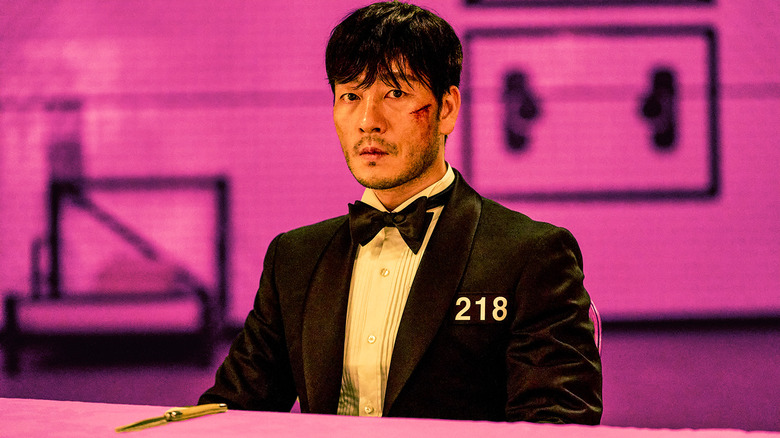


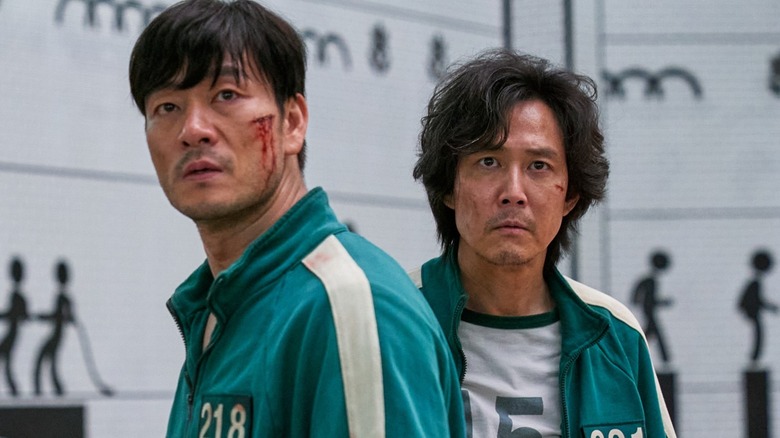
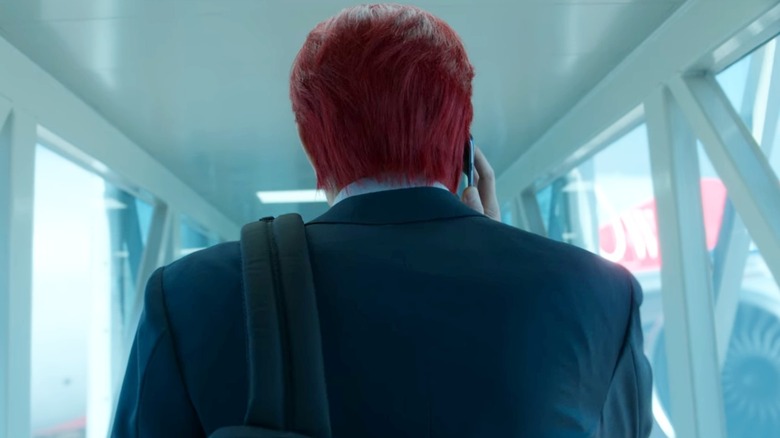
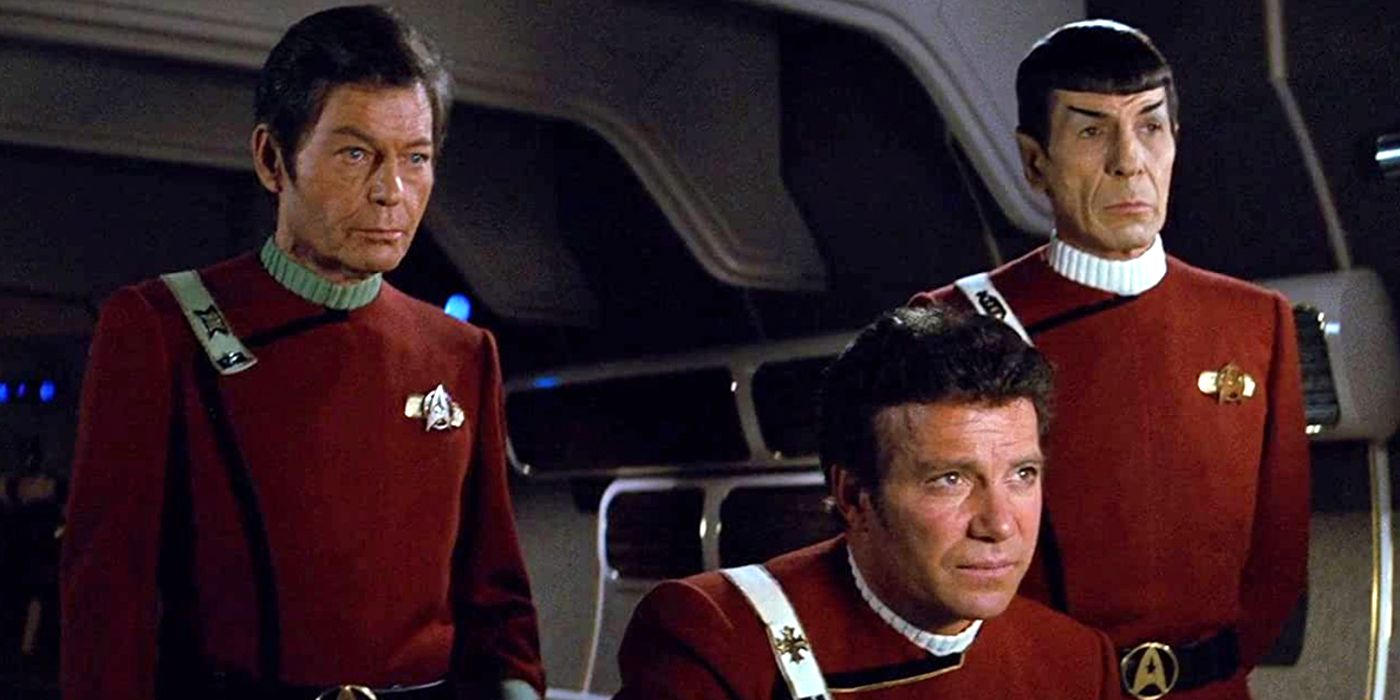
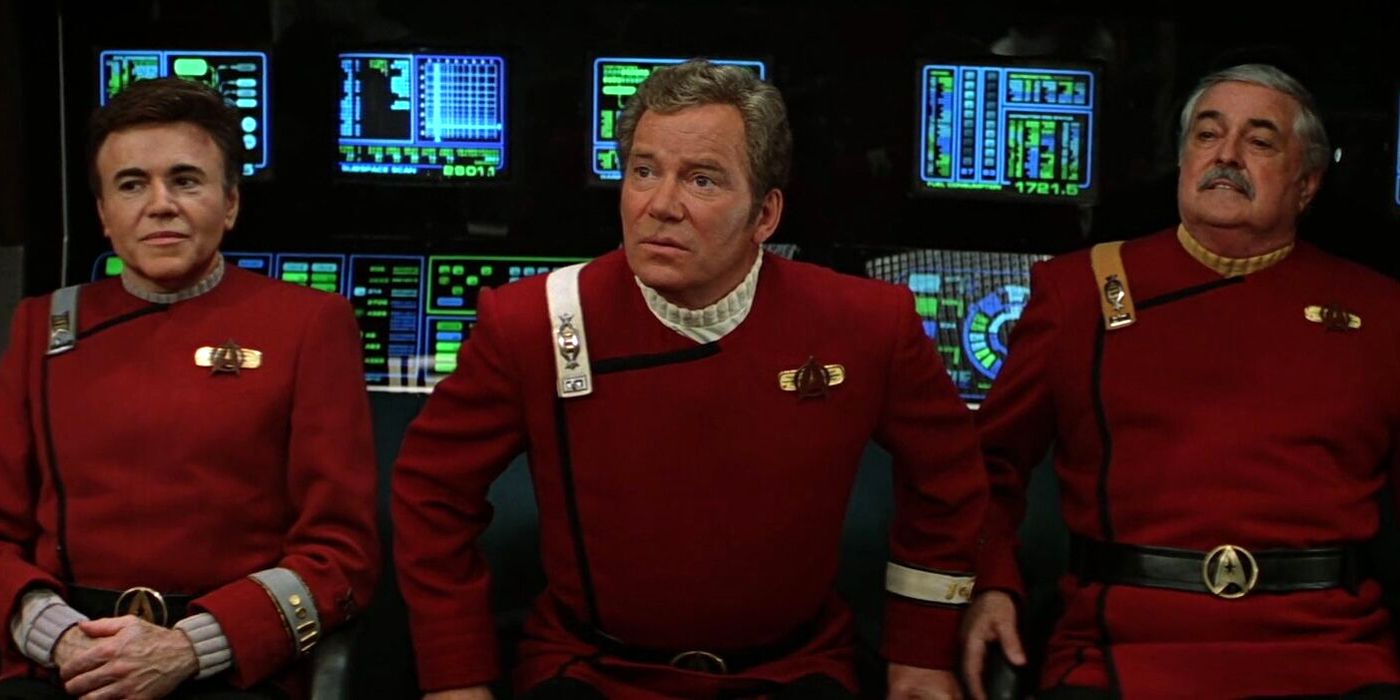
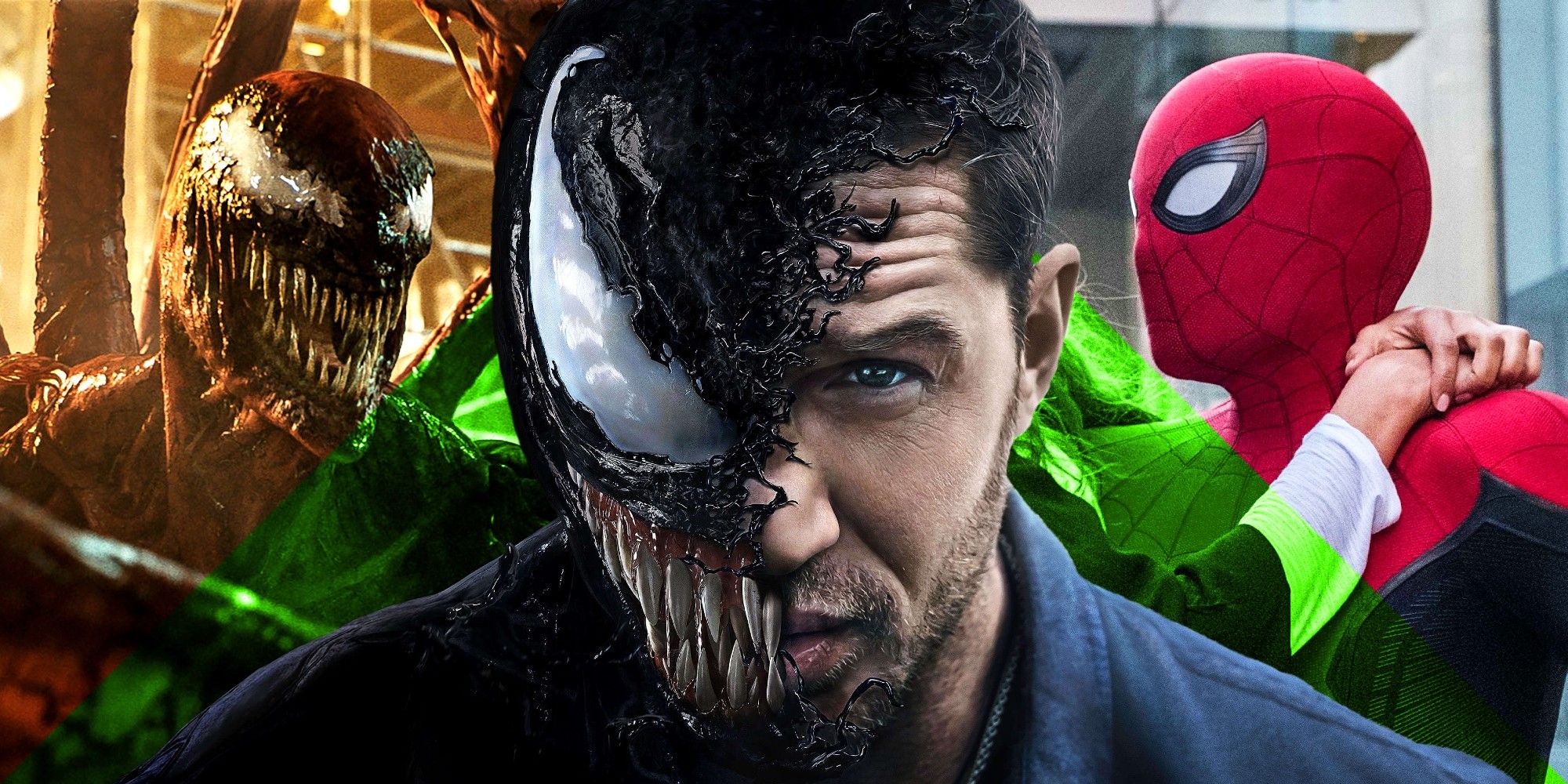
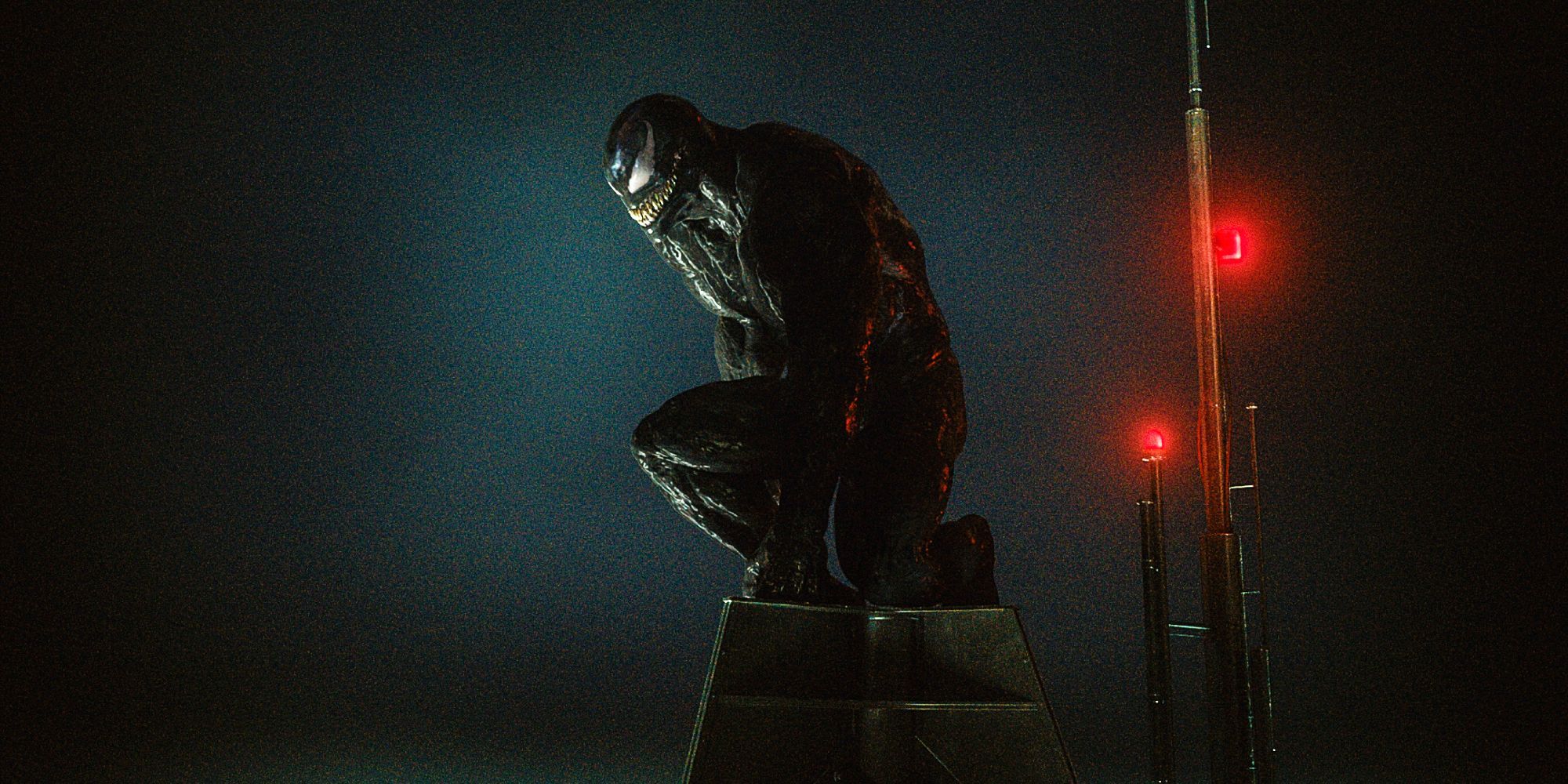





 Not to be confused with Barbarians (the Netflix series), Barbarians at the Gate (Wall Street robber barons), or even Waiting for the Barbarians (the already forgotten adaptation of Nobel Prize-winning author J.M. Coetzee’s novel), the latest film with the word “Barbarians” in the title, simply called Barbarians, marks the feature-length debut of producer-turned-writer-director Charles Dorfman. The latest addition in the apparently burgeoning “dinner party from hell” sub-genre, Barbarians takes broad, nuance-free satirical swipes at white privilege, capitalistic excess, and, of course, toxic masculinity and its discontents with just enough verve, style, and thorny plot turns to keep the average horror fan modestly engaged. Broken up into chapters announced by black-and-white title cards, Barbarians initially focuses on Adam Davies (Iwan Rheon, Game of Thrones), a TV...