Shared posts

20 Oct 17:19

The Marvels Director Nia DaCosta Blames Captain America For The Snap

by Ethan Anderton

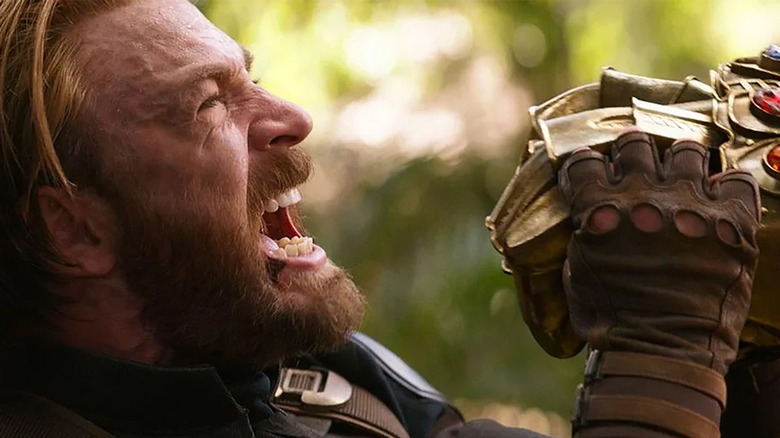
Aside from giving us two of the best back-to-back sequels in blockbuster history, "Avengers: Infinity War" and "Avengers: Endgame" stand out among superhero fare because they actually let our heroes fail, and they have to sit with the consequences for five years. Thanos is successfully able to collect all the Infinity Stones and use them to wipe out half of the population of the universe. Even though it's Thor (Chris Hemsworth) who blames himself the most for not stopping the Mad Titan, opting for a body shot with his newly forged axe called Stormbreaker instead of cutting Grimace's head clean off, "The Marvels" director Nia DaCosta thinks another member of The Avengers is to blame.

Is The Snap Captain America's Fault?

While speaking with Inverse about some of the thematic elements of "Candyman," DaCosta nonchalantly mentioned that she blames Captain America (Chris Evans) for The Snap. The filmmaker said:

"Something I like to say a bit flippantly about Captain America is that the Snap is all his fault because he was trying to do his best, trying to do the right thing. There is a world in which he's a villain because, at the end of the day, he should have just sacrificed Vision. He chose one robot's life, albeit a sentient one, over literally the entire universe. There's a sort of anti-hero in that if you want to look at it through that lens."

Honestly, DaCosta isn't wrong. After all, in "Avengers: Endgame," the motto that all our heroes stand by as they go back in time to retrieve the Infinity Stones and undo The Snap is, "Whatever it takes." But when The Avengers were faced with the prospect of Thanos succeeding the first time, they didn't do whatever it took to stop the villain by sacrificing Vision. Granted, that's because Captain America and the rest of the team thought they could stop him before Vision ultimately had to sacrifice himself in an attempt to keep the Mind Stone from falling into the hands of Thanos.

Speaking of Vision. Is there a chance that maybe it's actually his fault that The Snap happened? I can't help but think about a scene from Marvel's "What If..." animated series that featured Vision, albeit in the form of Ultron in Vision's body. In one of the episodes, Vision easily dispatches with Thanos, who was already wielding all the Infinity Stones except the Mind Stone. When Thanos showed up on a post-apocalyptic plane that Ultron/Vision had already dominated, he simply sliced the Mad Titan in half with the energy beam that emanates from the Mind Stone in his head. Why didn't he do that in "Avengers: Infinity War" instead of desperately trying to have the stone removed from his head by Black Panther's sister Shuri?

There are probably multiple superheroes who could be blamed for not taking advantage of certain key moments to defeat Thanos. Don't forget, it's not until "Avengers: Endgame" that Wanda Maximoff unleashes some impressive power upon Thanos. Maybe she couldn't have done that in "Infinity War" because she wasn't being fueled by the rage of Vision's death at the time, but there's no reason she couldn't have done that after Thanos plucked the Stone from Vision's head. 

In the end, this failure had to happen in order for "Avengers: Endgame" to give us the satisfying conclusion to "The Infinity Saga." So it doesn't really matter who's responsible. The real endgame was the friends they made along the way.

Read this next: Every MCU Post-Credits Sequence Ranked From Worst To Best

The post The Marvels Director Nia DaCosta Blames Captain America for The Snap appeared first on /Film.

20 Oct 17:05

Man keeps hearing about restaurants biatching about how they can't find workers, calls their bluff. Fills out 60 job applications in one month to everyone that complained, got exactly one interview [Obvious]

20 Oct 17:04

Best Gifts for Cyclists They'll Want to Use on Their Next Ride

by Russell Holly
Enhance the next ride for the cyclist in your life with a gift they'll actually use on the road or trail. Our list of the best gifts for cyclists was carefully curated for the most discerning bike-riders and features a selection of road-tested gear.
20 Oct 17:04

History Lessons: Metroid

by Waltorious

Other History Lessons posts can be found here. As always, you may click on images to view larger versions.

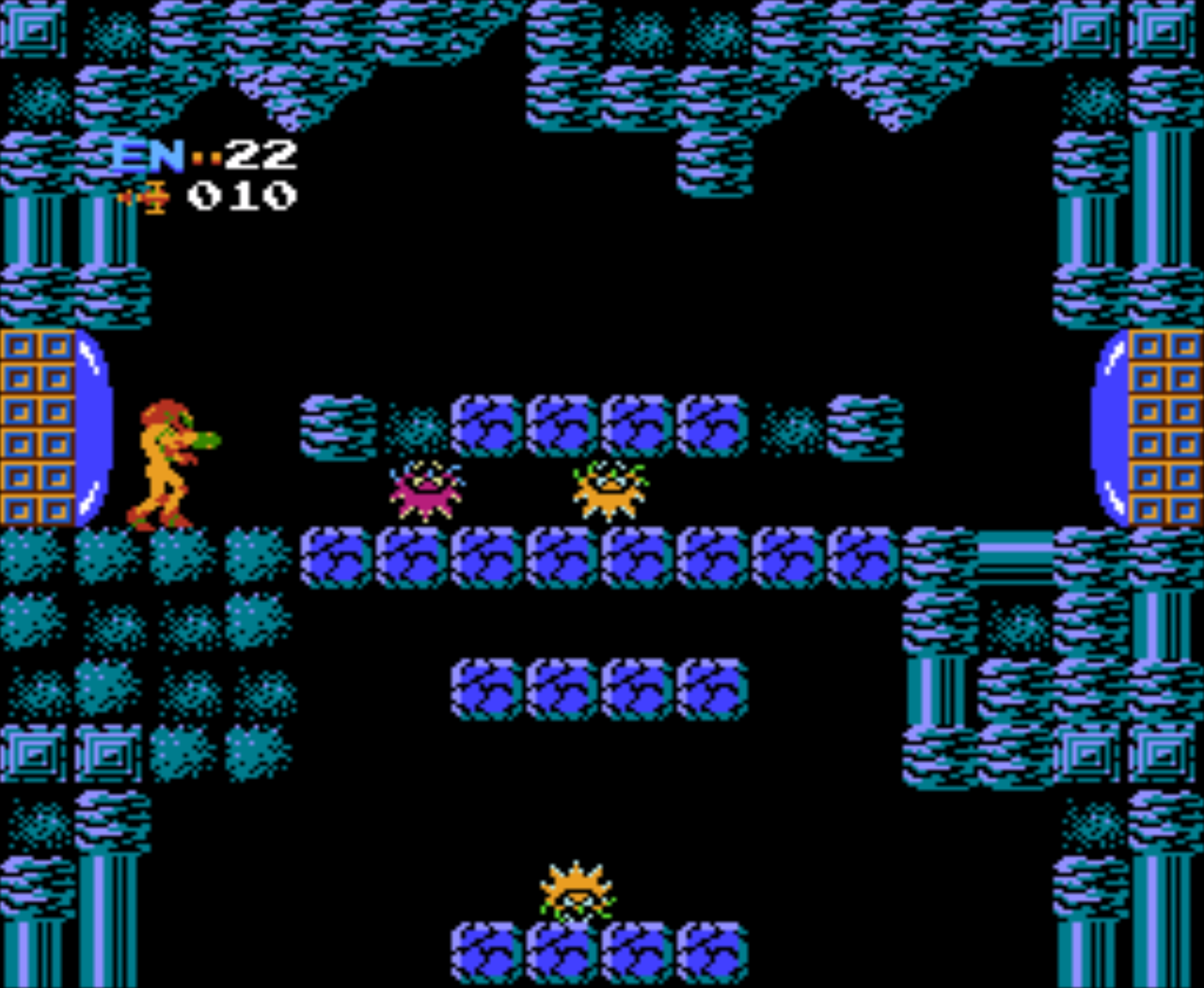
Three months ago, I wrote about The Legend of Zelda, after playing it to completion for the first time. It’s still impressive today, absolutely deserving of its classic status. It also reminded me of Metroid, which released six months later in Japan but only one month later in the United States. Both games let players loose in open worlds, to explore and find upgrades that let them reach previously inaccessible places. Metroid simply trades the top-down, screen-by-screen exploration of Zelda for side-scrolling action platforming with a science fiction theme. This combination was so influential that it spawned an entire genre: the metroidvania (named for Metroid and Castlevania, more specifically the second Castlevania game, Simon’s Quest). Unlike The Legend of Zelda, I never played much Metroid myself when I was a kid, I just saw bits and pieces of it at friends’ houses. But the third game in the Metroid series, Super Metroid, is one of my favorite games ever. So I decided to go back to the beginning and play the original Metroid.

Metroid, like The Legend of Zelda before it, originally appeared for the Famicom Disk System in Japan, in 1986. A year later, a slightly simplified version appeared in North America for the Nintendo Entertainment System, without the extra Disk System features. That’s the version I played here. It tells the story of Samus Aran, renowned intergalactic bounty hunter, as she — oh, sorry, spoiler alert. Metroid contains one of the most famous reveals in the history of video games, waiting all the way until the end to show players that Samus Aran, the badass clad in an awesome high-tech battle armor suit who single-handedly saves the galaxy from the dastardly space pirates, is a woman. This is common knowledge today, since Samus has starred in many more games that are much more famous than the original, but I’d forgotten just how committed the original game is to this secret. Samus is referred to as “he” throughout the instruction manual, although it does point out that no one knows much about “him”. It’s hardly transgressive to have a female protagonist today (nor should it be) but in 1986 it was notable, and I remember my friends all talking about this shocking surprise after finishing the game. Or, more likely, after reading about it in a games magazine like Nintendo Power.

Such magazines were almost required for anyone to play Metroid, unless they wanted to draw their own maps. Samus has been sent to the planet Zebes, to track down and eliminate the space pirates who have stolen the dangerous new lifeform known as a “metroid”. The planetary defenses repulse any attacking fleets, but a single operative may be able to slip in unnoticed and sabotage the facility. Players must therefore guide Samus through a maze of subterranean tunnels, jumping through environmental hazards and battling the dangerous local wildlife, with the ultimate goal of infiltrating and destroying the Mother Brain which controls the space pirate facility. When I first started playing, I just tried to keep an image of the planet layout in my head, but quickly abandoned this as futile. I didn’t actually draw maps, but I took extensive notes about which passages and doors led where, and was able to use these to find my way around. As a kid, I never would have been able to keep track of these things, and would have relied on maps from magazines instead.

But I had a lot of fun exploring Zebes myself this time around. I quickly discovered that Metroid has certain technical limitations compared to its successors, and indeed modern metroidvania games. Areas in Metroid either scroll horizontally or vertically, never both. This means there are no large open areas or unusually shaped locations. Further, many passages are reused many times over throughout the game. Early on, I would be surprised to find what looked like a secret passage that seemed to lead nowhere. Later, I’d find a nearly identical shaft, and this time the secret passage actually did lead to a new location. I eventually realized that the game world is built out of a limited set of pieces, presumably to save memory space on the cartridge. Even within a particular corridor or vertical shaft, the positions of platforms would repeat themselves as I proceeded. At first this made Metroid seem boring to navigate, but that feeling faded the farther I explored. Despite the constraints, the developers constructed a compelling and interesting world. The repeated parts just make it even more critical to make careful maps.

Metroid also manages a creepy atmosphere, something that Super Metroid would later embrace and embellish. The starting area of Brinstar isn’t too scary, but the threatening feeling builds when venturing deeper into the lava-filled caverns of Norfair, or the lairs of the two minibosses. The music changes, becoming less melodic and more sinister. The locations themselves get weirder. Brinstar is mostly rocky, sometimes filled with vegetation, but where I expected to find rocky outcrops to go along with the lava pits in Norfair, I instead found strange bubble-like blocks, resembling living cells or even eyeballs. I slowly realized that it’s no accident that the ultimate adversary is a biomechanical computer called the Mother Brain. The whole planet feels like a living organism, in which Samus is an intruder.

The roster of enemies reinforce this feeling. While Samus is ostensibly going up against the space pirates, it’s not clear what a space pirate actually is. Most of the enemies that Samus battles are weird creatures, more like animals or insects than anything we’d normally consider an intelligent being. Are they space pirates? Or just creatures defending their home? Perhaps even antibodies defending the living planet? Even the two minibosses fit this pattern: Kraid is a hulking dinosaur-like beast who fires spines at Samus from his belly and back. Is he a space pirate? If not, who or what is he? Ridley (named for Ridley Scott, whose film Alien was an inspiration for the game) looks more like a cross between an octopus and a dragon, spitting flames at Samus that double as a defensive barrier. The game manual explains that Ridley is a native of Zebes, now under the thrall of the Mother Brain. So he’s not a space pirate, at least not originally. So where are the pirates hiding?

This mysterious tone is not the only thing I recognized from later Metroid games. In fact, I was surprised at just how many famous elements of the series started here. Controlling Samus, for example, felt immediately familiar. If she jumped from a standstill position, she stayed upright in the air and I could control her position carefully. If she leapt from a run, she’d start somersaulting, able to cover longer distances but with less precision due to her increased momentum. The choice between an upright or somersault jump carried over to Super Metroid almost verbatim. Here, as in Super Metroid, it makes for interesting platforming challenges. Samus can jump quite high, and can find a high jump upgrade to increase her jump height even further, so aerial maneuvering is a large part of the game. Devious positioning of platforms often conspire with enemy behavior to send Samus plummeting into damaging lava or acid.

Fortunately, Samus can find a slew of upgrades to help tackle the challenge, each of which have become mainstays in the series. The first upgrade players will find is the iconic Morph Ball (here listed with its Japanese name, “Maru Mari”) that lets her transform into a small ball that can roll through narrow passages. Later, she’ll gain the ability to drop bombs while in ball form, to blast open blocks that bar her passage or just to blow up enemies. Samus also quickly acquires missiles, which have limited ammo but are much more powerful than her standard energy beam weapon. The classic color-coded doors appear throughout the game: blue doors opened with a shot from Samus’ beam weapon, red doors only opened by firing five missiles at them. I expected to use missiles mostly to open doors and fight bosses, but I was surprised to find they’re actually very useful when battling many of the standard enemies too. They can move quickly, in patterns that make them difficult to shoot, and often require many blasts from the standard beam to kill. But a single missile will save a lot of headache, even if it’s awkward to switch to missiles in the middle of the action.

Early on, before Samus has found many of these upgrades, the going is tough. Samus begins with only 30 health, although she can fill up to 99 if she collects drops from defeated enemies. Later, she’ll be able to find up to six extra energy tanks, each providing 99 health, but if she dies — still easy to do if she gets swarmed and knocked into lava or acid — she’ll respawn with only 30 health. In the Legend of Zelda, Link would respawn with low health too, but there are places he could go to refill his health to full. Not so in Metroid. Samus must recover health by defeating enemies and hoping they drop a health pickup, and most of those only restore 5 health each. With enough energy tanks, topping off health requires more than 100 health pickups. It’s a laborious process, and something no modern game could get away with today. I did find that the flying enemies which constantly emerge from pipes in the floor were ideal for this, even waiting to reappear until Samus had grabbed the health or missile pickup they’d left behind, and later upgrades made the process go a little faster, but it’s still obnoxious.

Later upgrades do make things much easier. The Wave Beam is more powerful than Samus’ standard beam and can fire through enemies and walls, and its oscillating pattern makes it much easier to hit enemies, including those pesky crawlers who aren’t tall enough to be hit by her standard beam. But even more useful is the Ice Beam, which unfortunately cannot be used at the same time as the Wave Beam. It’s no stronger than the standard beam, but it freezes enemies in place when it hits them, letting them be used as platforms. This is required to reach certain areas in the game, in fact. But freezing enemies is always useful, letting Samus stop threats in their tracks, then destroy them with missiles at her leisure or simply ignore them and move past. Once I had the Ice Beam, navigating the corridors of Zebes became so much easier, and I rarely died. Unless it was time to quit, since, like The Legend of Zelda, there’s no way to save without dying first. In fact, there’s no direct save at all, but passwords are supplied upon death to let players resume from where they left off. With only 30 health, of course.

For all the help the Ice Beam provides, what really gave me an advantage was the Screw Attack, which I was able to find surprisingly early. This upgrade transforms Samus’ somersault jump into an attack, and it quickly became my primary means of combatting enemies. The most dangerous creatures swoop down from the ceiling or leap upwards in high arcs, which is annoying until you can just jump right through them. With the Screw Attack I was free to explore with minimal resistance, and — unlike The Legend of Zelda — I was able to locate nearly all of Zebes’ hidden secrets on my own.

Metroid is absolutely packed with secrets, many of which must be found in order to progress through the game. There are so many that finding a few clued me in on what to look for, and thorough searching guided me to the rest. The limited structure that I discussed above helps. I learned to check the ceilings and floors of every vertical shaft for blocks that could be shot or bombed to reveal passages. Since doors always lead left or right, never up or down, horizontal scrolling corridors tend to have fewer secrets, but whenever one led to an apparent dead end I was always sure to thoroughly check the wall with my energy beam and bombs to be sure there wasn’t a hidden tunnel to be rolled through. Most of the time, these secret locations led to more missiles. Each missile upgrade adds 5 missiles to Samus’ maximum capacity, and she can go all the way up to 255. A lot of those are rewards for defeating the minibosses, but there are still tons of missile pickups hidden around Zebes, and I found them all without any help. On rarer occasions — like with the Screw Attack — I found a much more substantial upgrade as a reward for my diligence.

Amusingly, the only upgrade I couldn’t find on my own was the Wave Beam. I eventually succumbed and looked up its location, learning that it lay hidden in one spot I’d barely missed during my explorations. At this point I had nearly every other upgrade; the only other things I hadn’t found were two energy tanks. I didn’t even know there were more of these, since Samus can acquire a maximum of six and I’d already found six. It turns out there are two more, but hunting them down wouldn’t have helped me any. Anyway, at this point in the game the Wave Beam was underwhelming. It’s debatable whether it’s worth collecting at all, in fact, since the Ice Beam is so useful throughout the game. I quickly retrieved the Ice Beam again and headed for the game’s final area, Tourian.

Here is where the titular metroids finally make their appearance. I remembered this section from when a friend showed it to me on their copy of the game when we were kids. The metroids were terrifying foes, latching onto Samus and relentlessly draining her health. The only way to dislodge them is to curl up into the Morph Ball and drop a bunch of bombs. But that only fazes metroids for a short time. To defeat them, Samus must freeze them with the ice beam and then blast them with five missiles each. I was prepared to face many of these monstrosities as I navigated a final maze, working my way towards the Mother Brain. In practice, however, Tourian was disappointing. It abandons the labyrinthine structure of the rest of the game in favor of a short, linear path. My first time through, I dodged and battled the metroids in these passages, but I soon realized that it’s far simpler to just freeze them and run past, leaving them behind. After going through a few times, I’d lost any fear the metroids had instilled.

What was stopping me instead was the final battle with the Mother Brain, which is satisfyingly difficult. It places Samus in tight quarters where it’s hard to use her Screw Attack, and automated defenses fire from all sides. Here my high missile count came in handy, as I had to use them to destroy a series of barriers before even reaching the Mother Brain itself. It took me several tries to emerge victorious here, and I admit that I couldn’t bring myself to backtrack to heal Samus from 30 health back up to her total of (I think?) 693. This was the only time I allowed myself to use the emulator’s save state function to let me start the Tourian section over from the spawn point with full health. If I’d had to manually refill my health each time, I suspect I’d have quickly lost patience with the Mother Brain battle, but as it was I enjoyed the challenge. When I finally emerged victorious I made my daring escape from the planet and sat back for the ending credits.

Here I was in for an unpleasant surprise. I knew that the ending changed slightly based on how much time players took to complete the game, and suspected I was about to get a poor ending as a result. What I didn’t know is that in the ending I got (for taking between five and ten hours to complete the game), Samus doesn’t even remove her helmet, which means I never got the famous reveal that she is a woman. There’s no way a player could finish in under five hours on their first time through the game if they’re actually trying to map things out themselves. That means that many players may have never seen this famous reveal! That seemed crazy to me, until I thought about the time that Metroid was released. Today I have too many games to play to bother trying to play through Metroid again with a quicker time, but back in 1986/1987 it was much more likely that players would do so. I know I played my NES games many times over. Also, as was common with video games, the reveal quickly became legend, reported in games magazines and passed along with word of mouth. I saw Samus remove her helmet when I watched my friend run through Tourian back then, but I’d already heard about it before that.

There was more to this legend too: people claimed that if you finished quickly enough, Samus would remove her battle armor completely. I don’t think I believed that at the time, but I’m now able to verify that it’s true. And actually, it’s worse than that. Finishing the game in under an hour — which really would be a speedrunning feat, even for someone who knows what they’re doing — results in Samus trading her leotard for a bikini. Given how many problems games still have with sexualizing women, I suppose this shouldn’t be too surprising, but I was disappointed to learn about it all the same. I’d always viewed Samus as a protagonist who defies gender norms, stepping in to save the galaxy rather than waiting to be rescued like Zelda or countless other female characters in these early games. In my mind, Metroid was a game that (like Phantasy Star) dared to let a woman be as capable as a man (or more so), and didn’t make that big of a deal out of it. She saves the universe. She’s a woman. So what? To see her objectified in these endings tarnished the game’s image.

But it didn’t tarnish it enough to sour me on the game. Metroid is impressive, especially considering its technical limitations, and I’m not surprised that it spawned a hugely successful franchise. Later games improved upon the design in nearly every way, but much of the core is already here, and worth checking out if you’re interested to see where the series started. Unfortunately, Metroid suffers a similar fate to many early console games in that it’s hard to find an official release in its original form. An emulated version was made officially available for the GameCube, Wii, and 3DS, but those are all old hardware at this point [EDIT: the emulated version is also available for the Nintendo Switch, via a subscription to Nintendo Switch Online]. A remake entitled Metroid: Zero Mission appeared for the Game Boy Advance in 2004, for those who prefer a modernized take on the game. For this post, I ran Metroid using emulation via Retroarch with the Mesen core, as I’ve done for other old console games. This worked well but may have slowed down a bit more than the original hardware did when many enemies were present on the screen at once.

As I mentioned above, I love Super Metroid, but it’s actually the third game in the series. The second is Metroid II: Return of Samus, originally released for the Game Boy handheld console. I never owned a Game Boy, and wasn’t that impressed when I tried my friends’ Game Boys. So I never played Metroid II, although I’ve heard it’s really good and was one of the main reasons to get a Game Boy. It also fills in the story between the original Metroid and Super Metroid. So I’m looking forward to playing it. I’ve got several other games lined up first though, stay tuned for those. One day I may even make it into the 1990s!

20 Oct 17:04

Evidentially people are still going to The Ark Encounter, as September saw a rise in ticket sales, covid [Interesting]

20 Oct 17:04

Chocolate Is Not the Only Halloween Candy That Is Dangerous for Dogs

by A.A. Newton

Every dog owner knows full well that chocolate is poison, and dogs will eat it anyway, which makes Halloween an extra-challenging time of year. But chocolate is just one of many potentially hazardous candy ingredients. To keep everyone safe, you should know what else to avoid.

Read more...

20 Oct 17:04

The Marvels Director Nia DaCosta Says She Is 'Marvel Trash,' Grew Up With The Characters

by Ryan Scott

Nia DaCosta, known for her work on this year's "Candyman," is currently directing "The Marvels," the follow-up to 2019's smash hit "Captain Marvel." She's taking a big step up, directing a massive superhero sequel set within the confines of the Marvel Cinematic Universe. As it turns out, the filmmaker is prepared for the gig, as she is self-proclaimed "Marvel trash."

The director recently spoke with Inverse and she was asked about how versed she was with the Marvel Comics canon. DaCosta was not at all shy about declaring that she has been entrenched in this universe for much of her life, saying the following:

"I like to call myself Marvel trash. Actually, my friends call me that. I will go see all the movies. Even if it's bad, I'm like, 'Well, there are some good things about this.' I grew up with the comics. I grew up watching the Spider-Man cartoon and the Fantastic Four. I knew a lot about the Marvel universe in general."

Speaking further, DaCosta spoke specifically about the nature of her research for the film. It had to do with diving into the history of Carol Danvers, in addition to Monica Rambeau, who will be a big part of the sequel.

"My research was going into the history of Carol Danvers first and foremost, because it is a crazy wild ride, what they did to her in the comics in the '80s. And then with Monica, she's really fun, her origin story and her introduction in the comics. I tried to not get overwhelmed because, as with most comic book heroes, there are like seven different origin stories and there's different power sets that kind of contradict and don't really overlap well. It was really choosing what's been established already in terms of the MCU and then what's going to work, most compellingly, for our story. You read enough so you can stop reading, in a way."

Living The Research

A term like "Marvel trash" could be taken as an ugly thing at face value. However, it seems DaCosta is saying it with reverence here. She lives, eats, and breathes this stuff, and was doing so long before she ever could have dreamed of directing a sequel to a $1 billion blockbuster. It's certainly not a requirement to love Marvel stuff this much to become a good MCU director, but it can't possibly hurt. At the very least, we know she's got the passion for it.

"Captain Marvel" was directed by Ryan Fleck and Anna Boden, who did not return for the sequel. Instead, DaCosta got the gig, largely off the back of "Candyman," which hadn't even been released at the time of her hiring. She is now set to become the youngest person to direct an MCU movie. That's not small feat.

Plot details are largely being kept under wraps but it will be a team flick this time around, with Brie Larson's Carol Danvers/Captain Marvel at the center. Teyonah Parris will also return as a superpowered Monica Rambeau following her turn in "WandaVision," with Iman Vellani starring as Kamala Khan, with her "Ms. Marvel" series also on the horizon.

"The Marvels" is currently set to hit theaters on February 17, 2023.

Read this next: Every MCU Post-Credits Sequence Ranked From Worst To Best

The post The Marvels Director Nia DaCosta Says She is 'Marvel Trash,' Grew Up With the Characters appeared first on /Film.

20 Oct 17:03

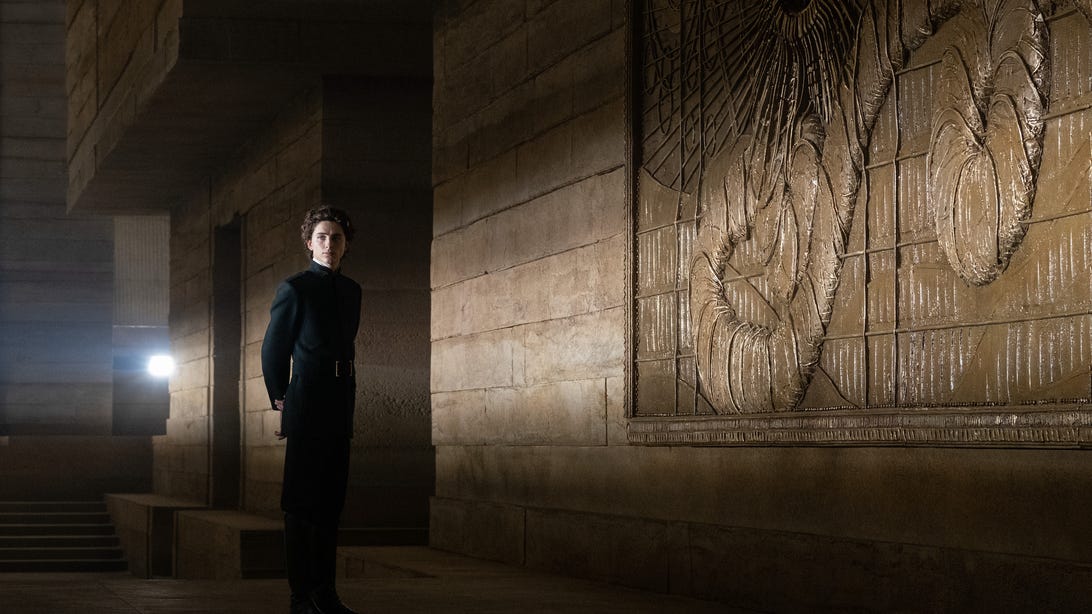
Dune ending explained, and when's the sequel coming - CNET

by Richard Trenholm
Who lives and who dies? Why is Zendaya hardly in it? And when will Dune Part 2 debut? These questions and more answered right here.
20 Oct 17:03

Apple's M1 Pro and M1 Max chips mean new trouble for Intel - CNET

by Stephen Shankland
But Intel has some time to recover its lost PC processor clout.
20 Oct 17:02

Everything You Need to Know About ControlD: A VPN Without a VPN App

by Ankush Das

With secure DNS services, you can easily enhance your online privacy. However, some DNS services provide you with extra functionalities along with controls to customize your online experience.

20 Oct 17:02

What’s on my kitchen counter? — Seth Godin

by Kevin Kelly

Sign up here to get What’s in my bag? a week early in your inbox.

Seth Godin is a 20-time bestselling author, a blogger, an internet pioneer, and a teacher. Find out more at seths.blog.


My “space” is the counter where I cook dinner every night for family and friends. And as diets diverge and time gets short, there are a few go-to items that I keep coming back to.

This is a tiny portion of the huge pile of bottles and potions and substances I reach for, but here are some unsung or little known favorites.

seth-counter

Wild Mountain Cumin ($10) and Wild Icelandic Kelp ($10)
Two are fromBurlap and Barrel. It’s hard to imagine that their spices are so dramatically better, but they are. The way they treat their suppliers is what caught my eye, but the quality of what they sell is off the charts. The cumin in particular.

All-Purpose Seasoning ”Roasted Sake” ($17)
The amber liquid is my prized secret possession. I’m not even sure exactly what it’s called. It’s hard to find but totally worth looking for. Like soy sauce, but most definitely not. And it has no soy.

Al Wadi Pomegranate Molasses ($12)
The pomegranate molasses is a miracle. It doesn’t matter so much which one you grab, as far as I can tell. Try to find one that doesn’t have white sugar added.

Lao Gan Ma Spicy Chili Crisp ($20)
The chili crisp is becoming better known, but it’s an amazing cooking hack. it never ceases to blow people away.

Priyems Lemon Pickle ($6)
And the last is fresh pickle, from Priyems. Again, the difference between this and the standard shelf-stable jarred stuff is astonishing.

[We want to hear about unusual and unusually useful items that you have in your desk, bag, closet, fridge or where ever you keep things. It can be anything really: work bag, pantry shelf, beauty drawer, toolbox, etc. Start by sending an email to claudia@cool-tools.org with a photo of the things in your chosen space (you can use your phone). If you get a reply from us, fill out the form. We’ll pay you $50 if we run your submission in our What’s in my ...? newsletter and blog.]

20 Oct 17:02

Can Your Employer Make You Dress Sexier?

by Stephen Johnson

This week, Hooters, one of America’s top owl-themed casual dining chains, revealed a new uniform policy for its food servers. Surprisingly, the new uniforms feature even skimpier shorts.

Read more...

20 Oct 17:01

6 Weird (but Harmless) Side Effects That Working Out Can Have on Your Body

by Rachel Fairbank

Our bodies are wonderful and weird, with its reaction to exercise being a mixture of both.

Read more...

20 Oct 17:00

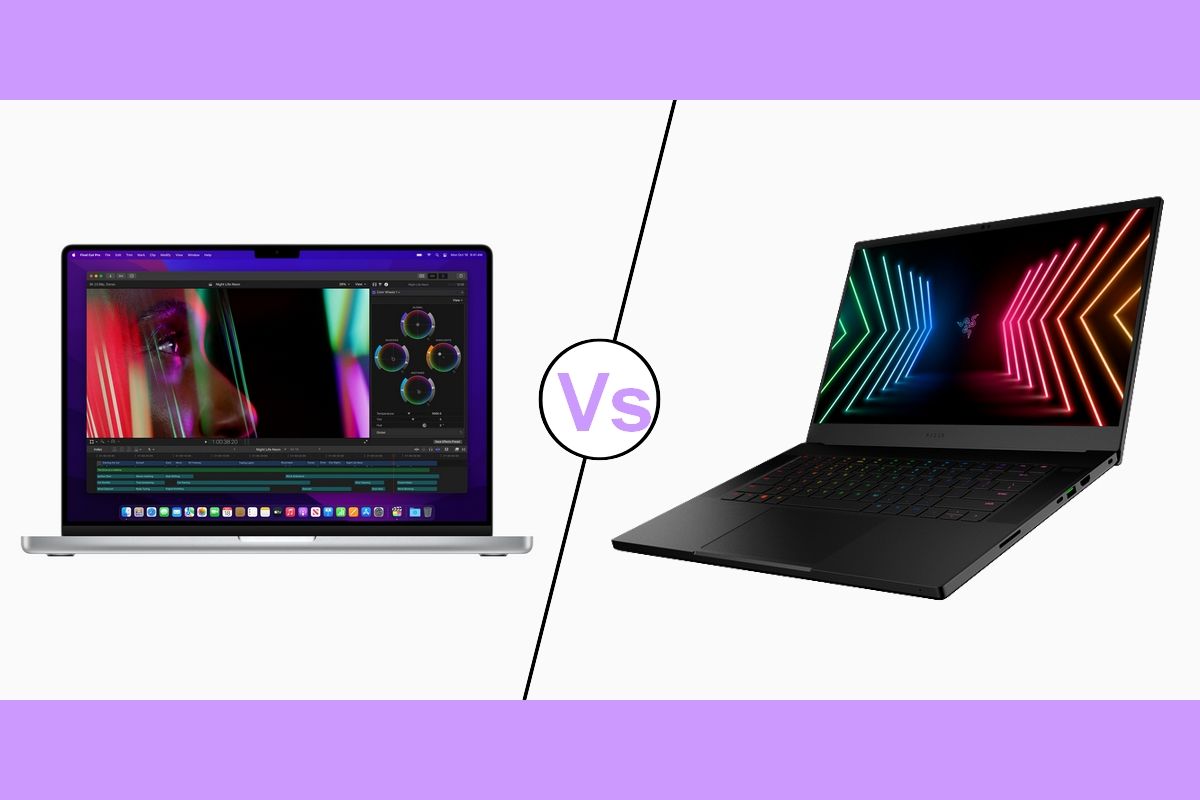
MacBook Pro 16 vs Razer Blade 15: Which one should you get?

by João Carrasqueira

Apple recently unveiled the latest MacBook Pro models to be refreshed with Apple Silicon, the company’s in-house processor family. This is one of Apple’s best Macs, so it’s big news for a lot of users. The new MacBook Pro laptops come with the new M1 Pro and M1 Max chipsets along with several other improvements. This is also the first time we saw the 16-inch MacBook Pro switch to Apple Silicon, and the first time it has received a major refresh in about two years. Because of that, it’s worth comparing Apple’s latest to its Windows competitors. In this article, we’re pitting the new MacBook Pro 16-inch versus the Razer Blade 15.

These are two powerful laptops, undoubtedly, but there are major differences between the two, and that can’t be understated. With Apple transitioning to its own processors, comparing it to Intel-based models is a bit trickier. Not only are the CPUs different, but the MacBook Pro also has whole new GPUs that aren’t the same as the NVIDIA or AMD offerings you find on Windows laptops. Let’s take a closer look, starting with the raw specs.

MacBook Pro 16 vs Razer Blade 15: Specs

MacBook Pro 16 Razer Blade 15
Processor
  • Apple M1 Pro (unknown clock speed, 10-core)
  • Apple M1 Max (unknown clock speed, 10-core)
  • Intel Core i7-11800H (up to 4.6GHz, 8-core)
  • Intel Core i9-11900H (up to 4.9GHz, 8-core)
Graphics
  • 16-core GPU (M1 Pro)
  • 24-core GPU (M1 Max)
  • 32-core GPU (M1 Max)
  • NVIDIA GeForce RTX 3060 6GB GDDR6
  • NVIDIA GeForce RTX 3070 8GB GDDR6
  • NVIDIA GeForce RTX 3080 8GB/16GB GDDR6
RAM
  • 16GB (M1 Pro only)
  • 32GB
  • 64GB (M1 Max only)
  • 16GB
  • 32GB
Storage
  • 512GB
  • 1TB
  • 2TB
  • 4TB
  • 8TB
  • 512GB
  • 1TB
Display
  • 16.2 inch, 3456 x 2234 resolution, Wide Color (P3), True Tone, 120Hz
  • Base model:
    • Full HD (1920 x 1080), 144Hz, 100% sRGB
    • Quad HD (2560 x 1440), 165Hz, 100% DCI-P3
  • Advanced model:
    • Full HD (1920 x 1080), 360Hz, 100% sRGB
    • Quad HD (2560 x 1440), 240Hz, 100% DCI-P3
    • Ultra HD (3840 x 2160) AMOLED, 60Hz, 100% DCI-P3, HDR, touch
Audio
  • Six-speaker stereo sound with force canceling woofers, Dolby Atmos
  • Dual stereo speakers, Dolby Atmos(base model), THX Spatial Audio (Advanced model)
Webcam
  • 1080p front-facing webcam
  • 720p webcam (Base model)
  • 1080p webcam (Advanced model)
Biometric security
  • Touch ID on power button
  • Windows Hello IR camera (Advanced model)
Battery
  • 99.8Wh
  • 65Wh battery (Base model)
  • 80Wh (Advanced model)
Ports
  • 3 Thunderbolt 4 ports
  • HDMI
  • MagSafe 3 charging port
  • SD card reader
  • 3.5mm headphone jack
  • 2 Thunderbolt 4 (USB Type-C) ports
  • 3 USB 3.2 Gen 2 Type-A ports
  • HDMI 2.1
  • SD card reader
  • 3.5mm headphone jack
Connectivity
  • Wi-Fi 6 + Bluetooth 5.0
  • Intel Wi-Fi 6E AX210 (2×2), Bluetooth 5.2
Colors
  • Silver
  • Space Grey
  • Black
Size (WxDxH) 14.01 x 9.77 x 0.66 in (355.7 x 248.1 x 16.8 mm)
  • Base model: 13.98 x 9.25 x 0.78 in (355 x 235 x 19.9 mm)
  • Advanced model: 13.98 x 9.25 x 0.62 in (355 x 235 x 15.8 mm)
Weight
  • 4.7lbs (M1 Pro)
  • 4.8lbs (M1 Max)
  • Base model: 4.6 lbs (2.09 kg)
  • Advanced model: 4.4lbs (2.01kg)
Starting price $2,499.99  $1,799.99

The operating system

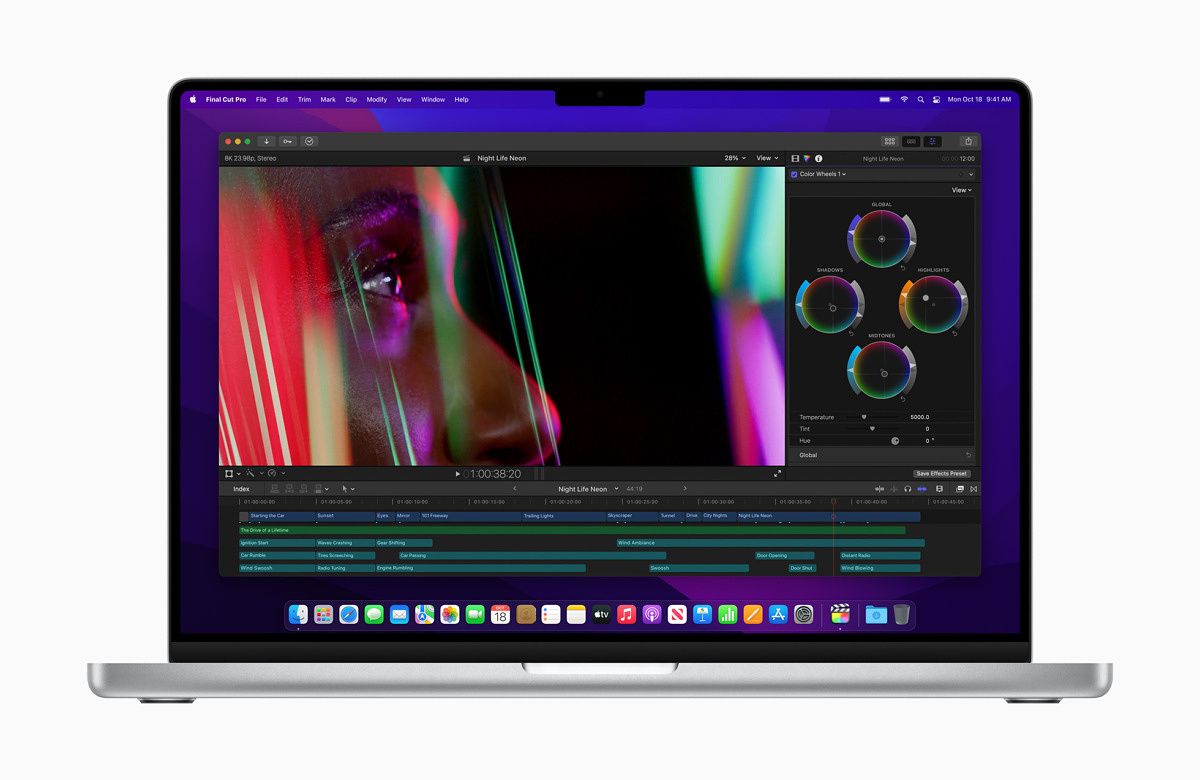
The first big difference between these two laptops is, of course, the operating system, and that’s something most people will be aware of by now. The MacBook Pro runs macOS, specifically macOS Monterey. macOS is arguably more limiting in some ways because a lot of Windows apps don’t have counterparts on Mac, specifically games. However, some popular software is exclusive to macOS, including Final Cut Pro, a video editing tool that’s very highly regarded among Mac users.

On the other hand, the Razer Blade 15 runs Windows 10 out of the box, with a free upgrade to Windows 11 already available. Windows is more widely compatible with a lot of software, but some may consider it harder to learn compared to macOS. Conversely, it may give you more options to dive deep into more advanced settings.

MacBook Pro 16 vs Razer Blade 15: Performance

With the basic specs out of the way, let’s dive into the details, starting with performance. It’s not easy to make a clear comparison at this time because since Apple uses its own processors, we can’t verify its claims about the performance on the MacBook Pro 16-inch. However, we can take a look at its claims for the M1 Pro and M1 Max.

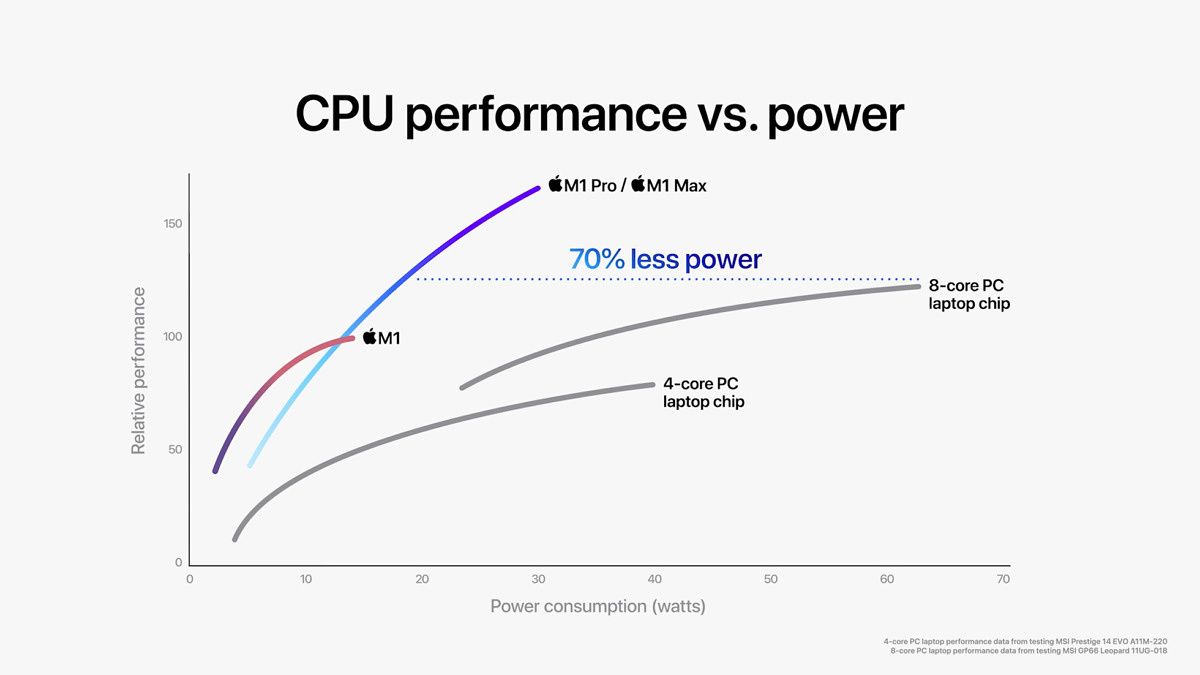
During its presentation, Apple actually compared the M1 Pro and M1 Max directly to the Intel Core i7-11800H, which is inside the Razer Blade 15. Apple touts 1.7x times the performance of Intel’s processor at the same power level, and it uses less power to get there. In fact, for the same level of performance, Apple claims its processor uses 70% less power. While we can’t validate Apple’s claims yet, we do know about the original Apple M1. Based on data from GeekBench, even the original Apple M1 already beat the Intel Core i7-11800H in single-core performance, and in multi-core scenarios, it wasn’t far behind. For reference, the Apple M1 obtained multi-core scores in the 7,400 range, while the Intel rival averages around 8,015. Considering the major upgrade compared to the M1, it seems believable that it’s much more powerful than that. Of course, the Razer Blade 15 also has a Core i9 model, which is faster than the Core i7, but not 1.7 times faster.

Apple M1 Pro and M1 Max CPU performance compared to Intel-based PCs Apple M1 Max GPU performance compared to GeForce RTX 3080 in Razer Blade 15 Advanced

Then there’s the matter of the GPU, and again, we have to look closely at Apple’s words here. The Company says the Apple M1 Max with a 32-core GPU offers performance “comparable” to a high-end compact laptop. If you read the fingerprint, this actually refers specifically to the Razer Blade 15 Advanced with an NVIDIA GeForce RTX 3080. Based on Apple’s graph, the M1 Max can reach a similar, and even slightly higher, level of power while using 40% less power. That is very impressive, and it means the MacBook Pro wins in this department too.

All of those claims also mean that the MacBook Pro 16-inch is going to have way better battery life than the Razer Blade 15. Apple touts up to 21 hours of battery life, and while Razer doesn’t offer its own metrics, you can take the above power consumption comparisons as a sign that it won’t last nearly as long on a charge.

The MacBok Pro has up to 64GB of unified memory, which is accssible to the GPU, compared to the 16GB of GPU memory you can get in the GeForce RTX 3080.

Aside from that, RAM and storage are also wins for the MacBook Pro 16-inch. It can be configured with up to 64GB of unified memory, while the Razer Blade 15 only comes with up to 32GB. The thing to note here is that the MacBook Pro’s memory is built into the processor, and it’s accessible to both the CPU and GPU. That means the MacBook Pro has way more GPU memory than any Windows laptop, but it also means the RAM can’t be replaced or upgraded. The Razer Blade 15 uses slotted memory you can upgrade later on. The MacBook Pro also comes with up to 8TB of storage out of the box, while the Razer Blade 15 only comes with 1TB, though you have a free M.2 slot and you can replace the included SSD to expand further.


MacBook Pro 16 vs Razer Blade 15: Display

As you’d probably expect from Razer, the Blade 15 is meant to be a gaming laptop, so in terms of the display, it’s better in some ways. In fact, the Razer Blade 15 definitely gives you many more options to choose what’s just right for you. It’s a 15.6-inch panel with a 16:9 aspect ratio but it has lots of different configurations.

Razer Blade 15

The Base model comes with either a Full HD (1920 x 1080) 144Hz panel or a Quad HD (2560 x 1440) 165Hz version, but the Advanced model offers some crazier options – Full HD 360Hz for extremely fast response times, Quad HD at 240HZ for super-smooth gaming with better visual fidelity, or a 4K (3840 x 2160) OLED panel if you’re more of a content creator. That last option is an absolutely stunning display, with super high contrast ratios, true blacks, and vivid colors. Plus, it’s incredibly sharp.

Meanwhile. the MacBook Pro doesn’t give you any configuration options, but the one panel you get is absolutely fantastic. Apple is using a 16.2-inch display with a resolution of 3456 x 2234 in its typical 16:10 aspect ratio. That taller screen is ideal for productivity, and at this resolution, it’s also as sharp as you could want it to be.

The MacBook Pro has a mini-LED display with a 120Hz refresh rate and nearly 4K resolution.

But that’s not all because this is a Liquid Retina XDR display. It uses mini-LED technology to offer similar benefits to OLED, though not exactly on the same level. With mini-LED, not every pixel is individually backlit, but there are numerous dimming zones that make it possible to render black areas of the screen completely black. Additionally, this is a ProMotion display with a refresh rate of up to 120Hz. so it’s also going to be very smooth, even if it’s on the level of high-end gaming displays.

A problem with the MacBook Pro 16-inch is that it has a notch in the display. In fairness to Apple, the notch makes way for a 1080p webcam and a larger sensor, so you’re bound to get great-looking images from it, but the Razer Blade 15 Advanced model also has a 1080p webcam without the need for a notch.

MacBook Pro 16-inch display with Final Cut Pro running

In short, the Razer Blade 15 definitely offers more options, and better ones for gaming, too. But the MacBook Pro includes a fantastic all-around display that’s sharp, vibrant, and smooth, and you get a great experience across the board, potentially excluding the notch for the webcam.

As for sound, the MacBook Pro continues to deliver one of the best experiences you can get on any laptop. It’s using a six-speaker setup for stereo sound, and Apple says it has improved both the woofers and tweeters for stronger bass and clearer highs. Meanwhile, the Razer Blade 15 uses a two-speaker stereo setup, which is likely going to be fine, but not as powerful as the MacBook Pro. Both laptops support Dolby Atmos, though.

Design and ports: The MacBook is Pro again

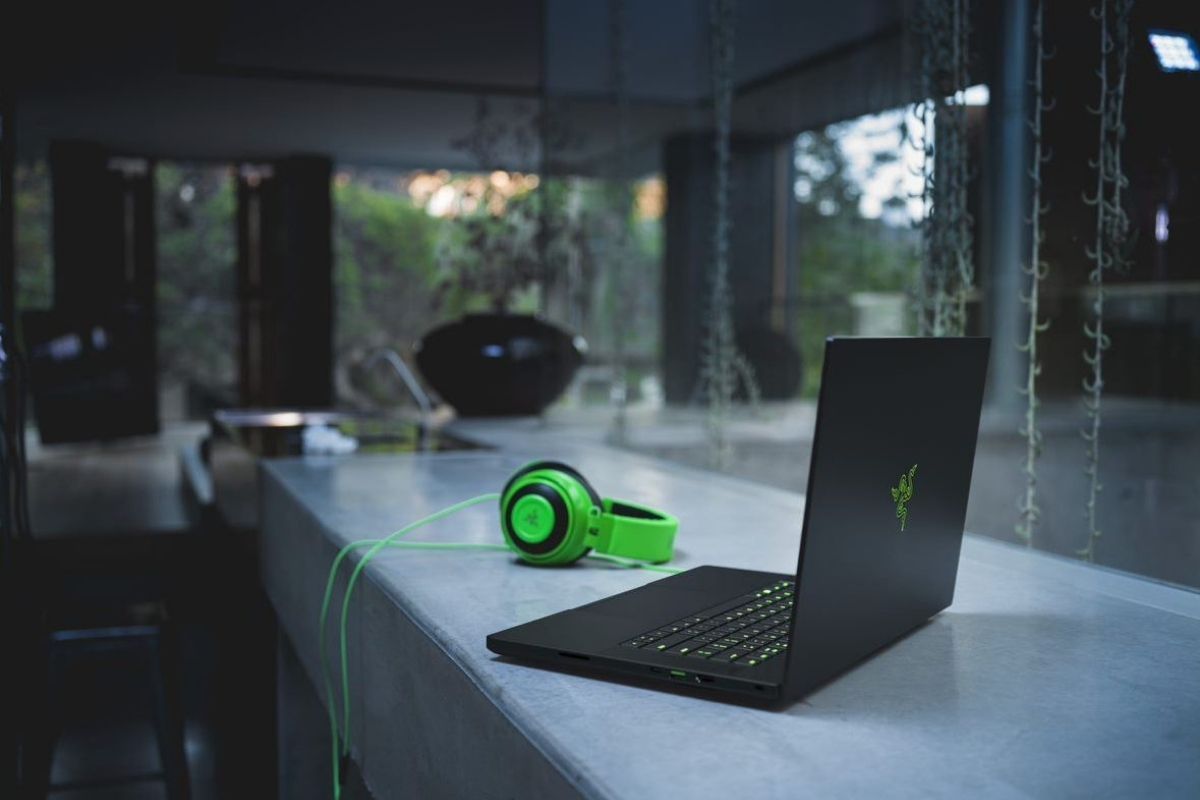
Now, in terms of design, these two laptops aren’t radically different from each other. The MacBook Pro comes in two color options, being Silver and Space Grey, which aren’t all too distinct, but at least they’ll fit nicely in any office space. The Razer Blade 15 only comes in black, and it’s a bit more flashy thanks to the backlit green Razer logo on the lid and an RGB backlit keyboard (with per-key lighting on the Advanced model). Neither laptop is particularly unique-looking, however.

And in terms of dimensions, the two laptops aren’t too far off from each other, either. The MacBook Pro is slightly wider and taller thanks to its larger display, but it’s slightly thinner than most variants of the Blade 15. However, it’s still heavier than the Razer Blade 15, likely due to those larger dimensions. Neither of these laptops is extremely portable, but they’re not too heavy to carry around every now and then, either.

Ports would have been an easy win for the Razer Blade 15 with previous MacBook Pro models, but this year, Apple brought back a lot of requested ports. The MacBook Pro 16-inch has three Thunderbolt 4 ports, HDMI, an SD card reader, a MagSafe charging port, and a headphone jack. That means you can connect a ton of peripherals much more easily out of the box, and the Thunderbolt 4 ports can now drive up to four external displays, too. It’s also worth mentioning the return of MagSafe, a magnetic charging port that helps prevent your laptop from falling to the ground if you trip on its cable.

Apple has brought back MagSafe, HDMI, and an SD card reader to the MacBook Pro. However, there’s no USB Type-A, which the Razer Blade has.

The Razer Blade 15 also has a solid variety, with two Thunderbolt 4 ports, three USB Type-A ports, HDMI, a headphone jack, an SD card reader, and a proprietary charging port. The big advantage of the Razer Blade 15 here is the inclusion of USB Type-A, which many peripherals still use, but overall, both of these offer a solid selection of ports.

The bottom line

At the end of the day, which of these laptops is better? It’s hard to deny the MacBook Pro’s technical prowess. Based on Apple’s comparisons, the Apple M1 Pro and M1 Max are incredibly powerful chipsets, and the M1 Max specifically has a faster CPU and GPU compared to the Razer Blade 15, while using a lot less power. You have to admire that it’s both powerful and power-efficient, giving you great battery life by comparison, too.

The MacBook Pro also has a fantastic well-rounded display that does just about everything very well. It’s sharp, bright, it offers high contrast levels with mini-LED, and it runs at up to 120Hz.

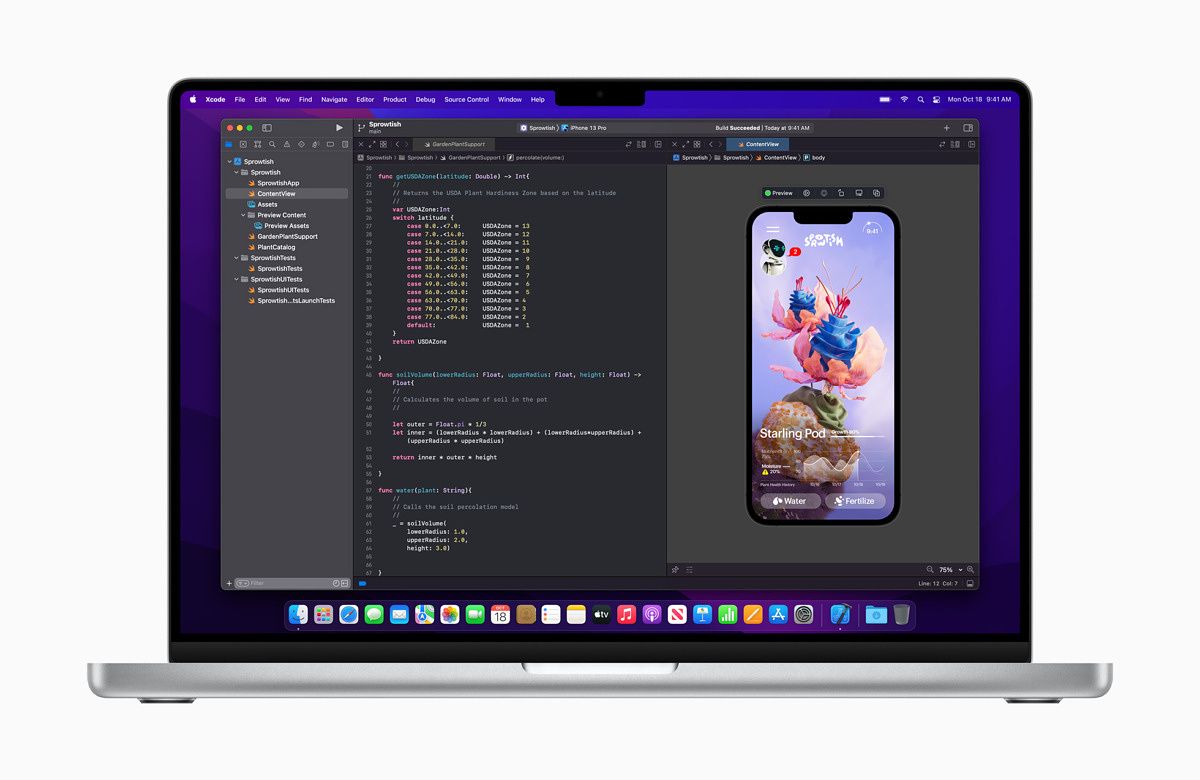
MacBook Pro 16 running Xcode

But none of that is to say that the Razer Blade 15 is slow or bad in any way. The Intel processors and NVIDIA graphics inside this laptop are still very powerful, and unless you’re running very demanding workloads, you won’t really have a reason to complain. Arguably, the biggest drawback of the Razer Blade 15 is its battery life, which has traditionally been a weak point of powerful Intel-based laptops.

The Razer Blade 15 also gives you a few different options for the display, and all of them are great for different kinds of users. It’s clearly geared towards gamers, and because of that, you have very high refresh rate options, in addition to a 4K OLED variant for creators.

No matter which one you choose, you’ll be getting a very powerful laptop that can handle just about anything you can throw at it.

And that brings us to the price. The most expensive model of the Razer Blade 15, with an Intel Core i9, GeForce RTX 3080, 32GB of RAM, a 1TB SSD, and a 4K OLED display, costs $3,399.99. The MacBook Pro is slightly more expensive for a similar configuration – an M1 Max chipset along with the same RAM and storage costs $3,499. However, if you want to max it out with all the specs we’ve mentioned, it can go as high as $6,099.

No matter which one you choose, you’ll be getting a very powerful laptop that can handle just about anything you can throw at it. You can’t really go wrong with either one, and we’d say the decision will most likely come down to battery life and the operating system you already may prefer.

You can buy your preferred laptop using the links below. If you choose the MacBook Pro and you want to protect it, check out the best cases you can buy for it right now.

    MacBook Pro 16-inch (2021)
    The MacBook Pro is an powerful laptop with Apple's M1 Max chipset, rivalling high-end Windows laptops with much lower power consumption.
    Razer Blade 15
    The Razer Blade 15 is a powerful Windows laptop with versions aimed at content creators and gamers alike.

The post MacBook Pro 16 vs Razer Blade 15: Which one should you get? appeared first on xda-developers.

20 Oct 17:00

13 Needles of Halloween #2

by noreply@blogger.com (Jason Adams)

Although I have made this clear on any and every occasion when the Saw films have come up I do want to again reiterate here -- I fucking hate the Saw movies. And it's not because they're gruesome -- I can deal with gruesome. It's not because they're mean-spirited -- I can deal with mean-spirited. And it's not because they are cheap trash -- I love plenty my share of cheap trash. But the combination of those three things added to their incoherent moralism, well this is a recipe I cannot stomach. When movies think they have things to say, and present themselves as such, but the things they're saying are at complete odss with one another, a jumble of preachy hypocrisy, I get fed up real fast. 

I suppose that's part of my problem with the just-released Halloween Kills (my review here) -- David Gordon Green's film seems to think it has a message about mob mentalities and vigilantism and trauma but when it's not being so basic it's stating its intentions in the blandest form of text ("We are all the monster now.") it's actually making a movie that undercuts its own half-baked thoughts at every turn, until nothing it's doing means anything, and yet you can sense the filmmaker leaning back in their chair, smug, expecting my mind to be blown, brah. Oh my mind is blown, David, but for not the reasons you think!

Sorry I don't know why I am talking about HK again -- besides the fact that I have spent all week seeing people who should know better trying to defend it, and yet all of their defenses are "Well there have been worse Halloween movies," or "You like some shitty movies, lighten up," and yet their defenses of the movie are all like, "Yeah it's a mess but it like thinks things... but when it doesn't it's like killing and stuff." People really want to have it both ways and yet I've not seen a single case made that states why Halloween Kills presents a coherent case for anything it's flailing around at wildly. I'm supposed to wait for he next movie, apparently. Y'all do that then, and I'm gonna talk about the movie that's here right now if that's alright.

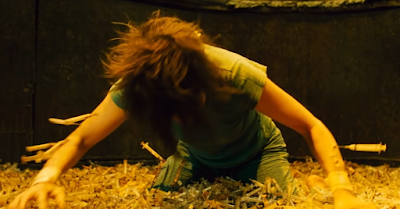
Okay so Saw! Saw 2, in particular. I don't know why I saw the second Saw movie in the theater when I thought, and continue to think, that the first Saw film is one of the steamiest piles of shit that's ever gotten big success in the history of movies, but I did. I believe I stopped seeing the films altogether after the third one -- what can I say, I was young and would go see any horror film to be part of the conversation. Then again I did see the also godawful Spiral: From the Book of Saw last year, so clearly I have learned nothing. Anyway I saw Saw 2 in the theater and the infamous "Needle Pit" sequence did admittedly stick (heh) in my brain, and when I thought of this year's "Needle" theme I knew I had to include this one, even though it's typical of the repulsive pablum that this franchise deals in, which mistakes sadism for profundity. "Get it, man? She's a recovering addict, man! Now she's on a bed of needles, and shit! Gnarly!" It's so deep, I know, I just can't possibly wrap my head around it.


Click here for all of the "13 Needles of Halloween"

20 Oct 17:00

Russia is on the verge of shutting Moscow down except for essential services, this being Russia I'm sure vodka production and delivery is considered an essential service [Fail]

20 Oct 17:00

Rain causes transformer explosions across San Francisco Bay Area, and that noise you just heard was Michael Bay orgasming into lens flares [Scary]

20 Oct 16:59

Is Apple’s M1 Max really the fastest laptop chip ever?

by Christopher Schodt

After months of rumors, Apple has revealed not one but two new processors, along with a pair of new Macbook Pro laptops. The original M1 processor paired four high-performance and four low-power cores with a 7- or 8-core GPU, and with that set up it delivered impressive results. The M1-powered 13-inch MacBook Pro bested a 16-inch MacBook Pro with an 8-core Intel i9 CPU and dedicated GPU when we tested it last year, and did so while staying impressively cool and quiet.  

The new M1 Pro and M1 Max bump the core count to eight high-performance and two low-power cores, and add 16, 24, or 32 GPU cores. With twice the high-performance CPUs, and up to four times the GPU cores as the original M1, these chips should be incredibly fast, but expect it to come at the cost of more heat and noise.

Despite a shortage of compatible games, the original M1 proved to be a remarkably adept processor for gaming, and these new chips should be even better, outpacing most Intel CPUs and maybe even besting a mobile NVIDIA RTX 3080 GPU's performance. The new 14-inch and 16-inch MacBooks also come with a 120Hz display with HDR, and improved speakers. Add that all together, and suddenly the new MacBook Pro looks like a pretty capable gaming machine, compatibility issues aside. If only Apple still supported Bootcamp.

For all the details on these new chips, check out the video above.

20 Oct 16:59

Investors Bet Big on Attempts to Solve Encryption 'Holy Grail'

by Ryan Naraine

News Analysis: Venture capital investors are pumping millions of dollars into privacy enhancing technology (PET) projects, betting that hardware and software innovation is finally coming together to solve one of the “holy grails” of encryption.

read more

20 Oct 16:58

Review: DUNE, Unquestionably Neato, Yet Feels Obligatory

Timothée Chalamet, Rebecca Ferguson and Oscar Isaac star in part one of an epic adventure, directed by Denis Villeneuve.

[Read the whole post on screenanarchy.com...]

20 Oct 16:57

Unboxing a Gorkamorka game from 1997

by Gareth Branwyn

This might be a very narrow niche post, but I'm sure many Boing Boing readers have a "grail game" or two (i.e. a rare game that you covet but can no longer find or afford). Like Guy from Midwinter Minis, one of those games for me is Games Workshop's 1997 title, Gorkamorka, designed by the great Andy Chambers). — Read the rest

20 Oct 16:56

Xbox Game Pass Subscribers Said to be Below Microsoft’s Target; 20 Million as of June 2021

by Aernout van de Velde

pc xbox game pass ultimate

Based on a recent financial filing by Microsoft, Xbox Game Pass subscribers were around 20 million as of June 2021.

Last month, Take-Two CEO Strauss Zelnick suggested that around 30 million users were subscribed to Microsoft’s gaming subscription service. In response, Xbox boss Phil Spencer referred to the 18 million figure released in January of this year. Since then, various rumors have been floating around regarding Xbox Game Pass subscriber numbers with some claiming that 30 million is accurate and some stating that Zelnick was clearly mistaking.

"Phil didn't pitch his own service, which is impressive, given he could have... but you've got around 30 million [Xbox Game Pass] subs Phil, right? Something like that?", Take-Two's CEO said during a Yahoo Finance “fireside chat” last month.

"The last public number we announced was 18 [million]", Phil Spencer replied.

Fast forward one month, and we might have some more accurate Xbox Game Pass numbers. It should be noted, however, that these numbers are already several months old and, obviously, numbers have changed since then.

Earlier this week, Microsoft released a new financial filing ahead of the company’s 2021 Annual Shareholders Meeting, which will take place next month on November 30. Interestingly, this filing contains growth numbers for Xbox Game Pass, and based on these numbers, subscribers numbers grew by 37% compared to last year. Despite annual growth, this is below the target that Microsoft set for this year – the target was 48%. Going by this growth number, reputable industry analyst Daniel Ahmad estimates that Xbox Game Pass subs were around 20 million as of June 30, 2021.

Not quite near the 30 million number that Zelnick mentioned, but as said, these numbers are already more than 3 months old and numbers have increased since then. Still, the 30 million number appears to have been rather ‘optimistic’.

What are your thoughts on these Xbox Game Pass numbers? How will Microsoft’s upcoming AAA releases, including Forza Horizon 5 and Halo Infinite, affect Game Pass subs? Hit the comments down below.

The post Xbox Game Pass Subscribers Said to be Below Microsoft’s Target; 20 Million as of June 2021 by Aernout van de Velde appeared first on Wccftech.

20 Oct 16:56

Facebook May No Longer Be Called Facebook Starting Next Week

by Furqan Shahid

Facebook May No Longer Be Called Facebook Starting Next Week

Facebook wants to change its company name as soon as next week; this is based on a report coming from The Verge. The new company name will reflect Facebook's focus on creating a metaverse, a concept that has quickly taken a massive hype in the tech world.

Facebook's Decision to Change the Company Name Could Cause an Uproar, But There is Not Much to Worry About

Mark Zuckerberg is planning to talk about the name change at the upcoming annual Connect conference on October 28th, but the name might end up being revealed earlier, as per the report. The rebrand will likely put Facebook as a separate product under a new parent company responsible for overseeing other products and services like WhatsApp, Instagram, Oculus, and more. This is not shocking, as Google also did something similar back in 2015 when it set up a parent company called Alphabet.

We will effectively transition from people seeing us as primarily being a social media company to being a metaverse company,” Mark Zuckerberg told The Verge back in July. He also previously said that the metaverse is “going to be a big focus, and I think that this is just going to be a big part of the next chapter for the way that the internet evolves after the mobile internet.”

The report also says that the new name is, at the moment, a closely guarded secret, and it is not known to even the senior Facebook leadership.

Facebook has also made strides in its efforts to build a new metaverse in the past few months. Last summer, it even set up a team dedicated to this so-called metaverse. A few days ago, Facebook announced its plans to hire 10,000 new people in Europe to work in this metaverse.

Facebook has described the metaverse as “a set of virtual spaces where you can create and explore with other people who aren’t in the same physical space as you.”

What are your thoughts about Facebook wanting to change its name? Let us know what you think.

The post Facebook May No Longer Be Called Facebook Starting Next Week by Furqan Shahid appeared first on Wccftech.

20 Oct 16:56

New Vampyr Patch Introduces Enhanced Performance on PlayStation 5, Xbox Series X|S

by Francesco De Meo

Vampyr

A new Vampyr patch has gone live today on consoles, introducing enhanced performance on current generation consoles.

The new patch improves resolution and performance on PlayStation 5 and Xbox Series X, bumping resolutions up to 1440p and framerate to 60 FPS. Resolution is also increased to 1440p on PlayStation 4 Pro and Xbox Series S, and to 1296p on Xbox One X. These three versions of the game all run at 30 FPS.

Vampyr launched back in 2018 on PC and consoles. The action role-playing game by Dontnod features great combat, setting, and story that make it enjoyable despite its flaws, according to Rosh.

Vampyr isn't without flaws, but I had a lot of fun with it. While the dialogue system feels like an unexpected misstep, the combat, setting and story all make up for that stumble. Stalking through London and inciting fear into the hearts of the overconfident hunters felt fantastic. The spooky setting is filled with short but juicy stories worth finding, places worth exploring and detail worth appreciating. With a more interesting dialogue system, it would have been marvelous. As it stands, overlooking the occasional visual bugs and graphical lapses, Vampyr is still great fun, but like all undead, you’ll have to take the negatives with the positives.

Vampyr is now available on PC, PlayStation 4, and Xbox One worldwide.

London, 1918. You are newly-turned Vampyr Dr. Jonathan Reid. As a doctor, you must find a cure to save the city’s flu-ravaged citizens. As a Vampyr, you are cursed to feed on those you vowed to heal.

Will you embrace the monster within? Survive and fight against Vampyr hunters, undead skals, and other supernatural creatures. Use your unholy powers to manipulate and delve into the lives of those around you, to decide who will be your next victim. Struggle to live with your decisions… your actions will save or doom London.

The post New Vampyr Patch Introduces Enhanced Performance on PlayStation 5, Xbox Series X|S by Francesco De Meo appeared first on Wccftech.

20 Oct 16:56

No Man’s Sky Brings Terror in the Emergence Expedition

by Chris Wray

It seems like every time I turn around, Hello Games has developed and are announcing new content for No Man's Sky. It was only one and a half months back the Frontiers update was released. Hello Games have also indicated that it's possibly their most successful update in years, with No Man's Sky finally being tipped over to Mostly Positive on Steam from user reviews.

It's a live service game that went well. While it failed to deliver promised content at the start, like so many other games, this had a happy ending. It delivered that content and has eventually gone far and above any original promises. It is, entirely and undeniably, the best live service game ever made, purely for the simple fact that all these updates above and beyond what was originally promised have been free.

But enough gushing about the game, let's talk about what's coming next. Honestly, the email sent out Hello Games stated that they've accidentally created a Halloween themed update, and it's hard not to believe them, if only because they pump out new content like they're running a sweatshop. On that note, let's have a look at how Hello Games describe this new expedition:

Across the universe, planets have been blighted by the activity of Titan Worms. These colossal sandworms plough through the desert sands, blacking out the sun as they arc overhead, and defiling the very terrain with their cursed dust.

Travellers on this Expedition will find themselves stranded on planet Wasan, a barren world ravaged by dust storms and infested with Titan Worms. It is up to you to locate the Titan Worm impact sites, destroy the wretched Hungering Tendrils, and collect the Vile Spawn that lingers behind. The vessels of the many mouths must be purged!

As travellers cleanse planets of cursed dust and hunt the titanic sandworms, they will unravel the threads of a dark narrative. Complete the expedition route to reveal the history of a dark cult, and ultimately confront the Atlas with evidence of this indelible stain upon the universe.

  • no-mans-sky-emergence-expedition-02
  • no-mans-sky-emergence-expedition-03

Hello Games also claim that this is the first expedition for No Man's Sky to contain a narrative, which should be interesting in itself. Offering a more directed experience, especially with such big wormy-boys around, ready to eat you, could certainly help to ramp up the tension.

As for if it's horror or Halloween-like, I'm not sure anything you can ride is exactly soul-breakingly terrifying. Yes, you can ride them. As for some of the other features this expedition brings, have a read:

More Varied Sandworms
The titanic worms throughout the universe have been enhanced with a variety of new biologies and types. These colossal beasts can now be found with a broader selection of more horrifying  variants.

Richer Particle Effects
Particle effects have been improved. Meteors, muzzle flashes, explosions, burrowing fauna dust, billowing smoke and laser impacts have all been revamped and can be seen throughout the game.

Rideable Sandworms
Players can now tame and grow a tremendous sandworm companion to feed, pet, ride and explore the universe with. These are both terrifying and awesome creatures when fully grown, and incredible to fly.

Feasting Casque
After discovering the secrets of an ancient Vy’keen cult, explorers can also echo their appearance with this unique, many-toothed grotesque alien.

Ghastly Trail
The Ghastly Trail customisation applies a unique organic effect to the Jetpack's exhaust nozzles, ejecting gooey fluids and tiny worms during flight.

Titanic Trophy
This eerie skull, once belonging to a large legless cousin of the titan sandworm, adds a touch of macabre decor to bases.

Flesh Launcher
Add an organic element to pyrotechnic displays with the Flesh Launcher firework. These unusual fireworks explode in a splatter of slime, plasma and wormlets.

The post No Man’s Sky Brings Terror in the Emergence Expedition by Chris Wray appeared first on Wccftech.

20 Oct 16:55

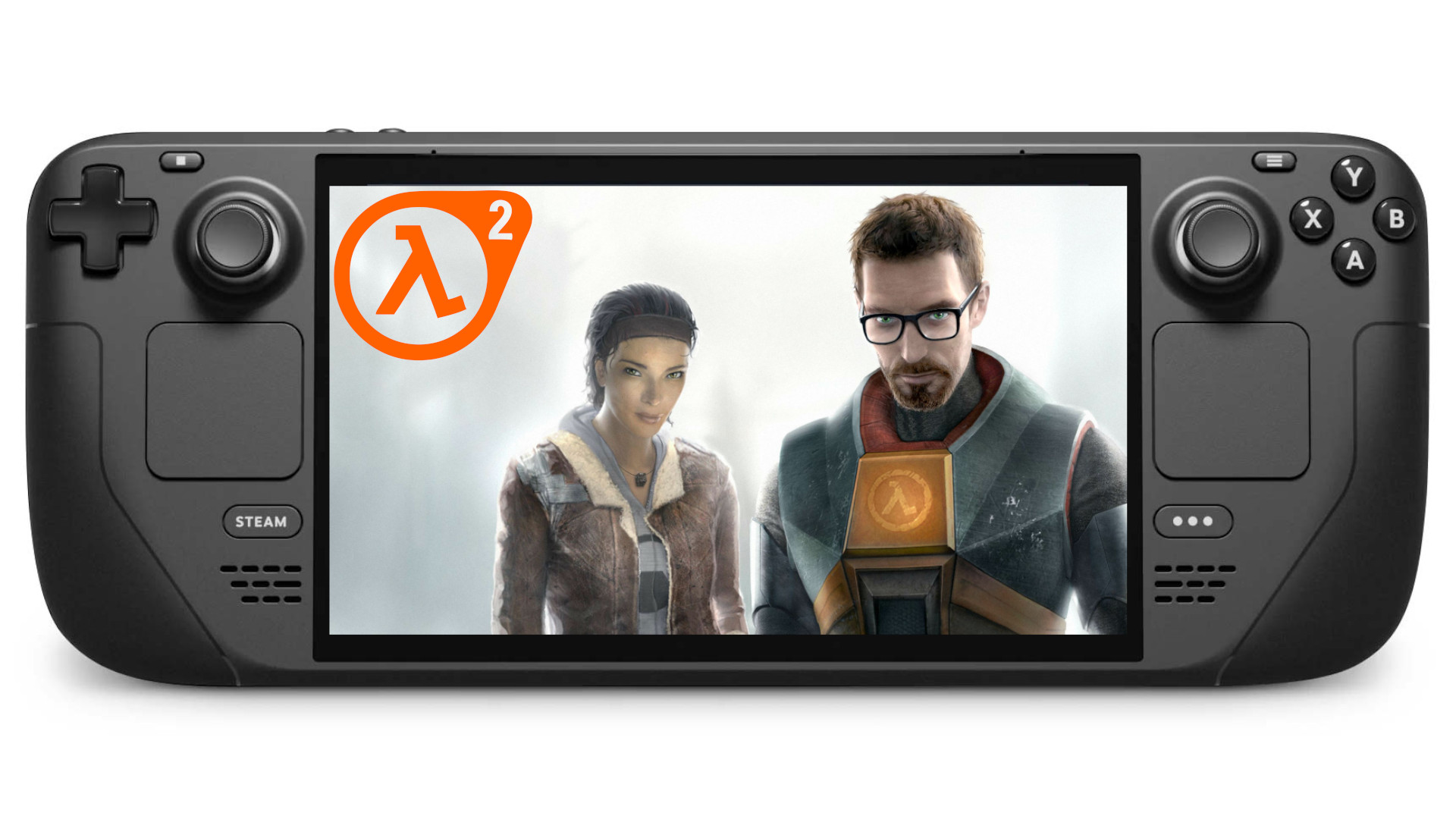
Valve prepares Half-Life 2 for the Steam Deck with its largest patch in over 10 years

by Samuel Willetts
Valve prepares Half-Life 2 for the Steam Deck with its largest patch in over 10 years

There are fewer video game series more important than Half-Life, particularly when it comes to PC gaming. While the first game challenged perceptions of the importance of narrative within FPS games, Half-Life 2 pushed the best graphics cards and best gaming CPUs of its era with never before seen heights of visual fidelity and its innovative physics engine. It also ushered in a new era of PC gaming with the Steam platform. Now, 17 years later, Valve has updated its classic title with its biggest patch in over 10 years.

As highlighted by YouTuber Tyler McVicker, a new beta branch is now available to download via the game’s beta tab in Steam. While there are currently no official patch notes for this version of Half-Life 2, numerous technical improvements have already been quickly discerned.

The game’s HUD now scales with the selected rendering resolution, having been previously locked, resulting in larger elements on aspect ratios outside 4:3. There’s also support for ultrawide resolutions, with an FOV ceiling of 110 that is enabled without having to modify DLL files.

20 Oct 16:55

All Starfield factions and how to join them

by Iain Harris
All Starfield factions and how to join them

What are the factions in Starfield? Many Starfield factions live in the Settled Systems, all with wildly different ideologies, areas of expertise, and fashion sense. While the far reaches of the blackest sea present a whole host of dangers, it’s still your fellow humans who pose the greatest threat to your survival, and we're here to help you tell between friend and foe.

When you begin your voyage in Bethesda's space game, you do so on behalf of Constellation, one of several Starfield factions. As a new Constellation recruit, it’s your mission to seek out and expose the secrets of the known galaxy. You may come face-to-face with one of the other factions during your travels, and first impressions are vitally important if you want certain Starfield companions to join your cause.

MORE FROM PCGAMESN: Starfield mods, Starfield outposts, Starfield traits
20 Oct 16:55

Intel Alder Lake could beat AMD’s top gaming CPU, but it’ll cost you 330W

by Phil Hayton
Intel Alder Lake could beat AMD’s top gaming CPU, but it’ll cost you 330W

Last month, we learned that Intel's i9-12900K Alder Lake CPU could come out swinging against AMD’s Ryzen 9 5950X. While a previous Ashes of the Singularity software leak provided us with a benchmark score, it failed to address whether the chip used overclocking during the test. Thanks to additional CPU-Z information posted by Enthusiast Citizen on BiliBili, we now have a better understanding of the chip's top speeds, and the amount of power it'll inevitably guzzle.

According to the post, the i9-12900K features performance core boost clock speeds up to 5.3 GHz, while its efficiency cores can boost to 3.9 GHz. However, overlocking the chip seems to come with huge power caveats, as the chip consumes 330W under full load. For context, the processor PL1 TDP is only 125W, meaning you'll need to invest in an extremely efficient CPU cooler if you want to overlock this power-hungry beast.

While the next-gen Intel processor previously beat AMD's top-end gaming CPU in single-core base clock speed tests, it didn't quite manage to surpass its multi-core performance. Naturally, overclocking comes with performance increases, and the i9-12900K's 5% boost over stock configuration actually nudges the chip ahead of the team red's multi-core contender by 2%.

RELATED LINKS: Intel Core i9 9900K review, Intel Core i7 9700K review, Best CPU for gaming
20 Oct 16:54

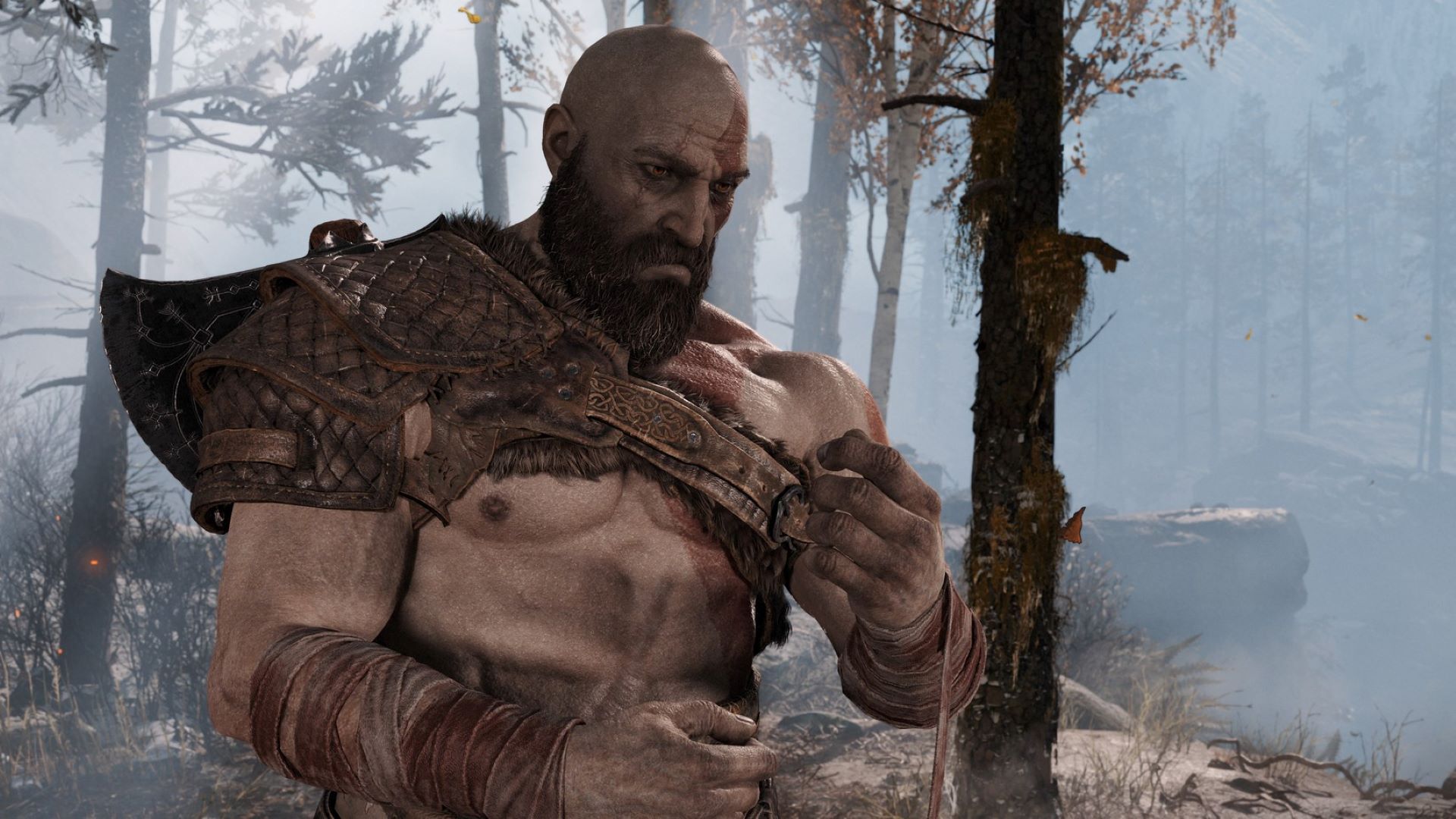
God of War system requirements

by Phil Hayton
God of War system requirements

God of War finally comes to gaming PCs on January 14, 2022, just short of four years after its release on PS4, and now developer Sony Santa Monica has revealed what your rig needs to pack in order to play it. It seems like the wait might even be worth it, too, this PC port granting you access to plenty of graphics settings and exclusive features.

We've known since its announcement that the Nordic epic will feature Nvidia DLSS and AMD FSR upscaling technology, so you can boost fps, which truly makes use of God of War's uncapped frame rate. Nvidia Reflex is also no surprise, and should make the game more responsive when you're stringing combos together. DLSS uses Tensor Cores, so you won't be able to enjoy it if you're running anything less than an RTX graphics card, but Reflex is available to anyone using a GeForce 900 series GPU or later, and FSR is ready for everyone - regardless of hardware.

There's also a wealth of PC-specific features, such as higher detail assets and rendering resolutions, enhanced Ground Truth Ambient Occlusion (GTAO), and Screen Space Directional Occlusion (SSDO) effects. Even more impressive, storage requirements are actually 10GB lower than initial estimates, at a lean 70GB.

RELATED LINKS: Best SSD for gaming, How to build a gaming PC, Best gaming CPU
20 Oct 16:54

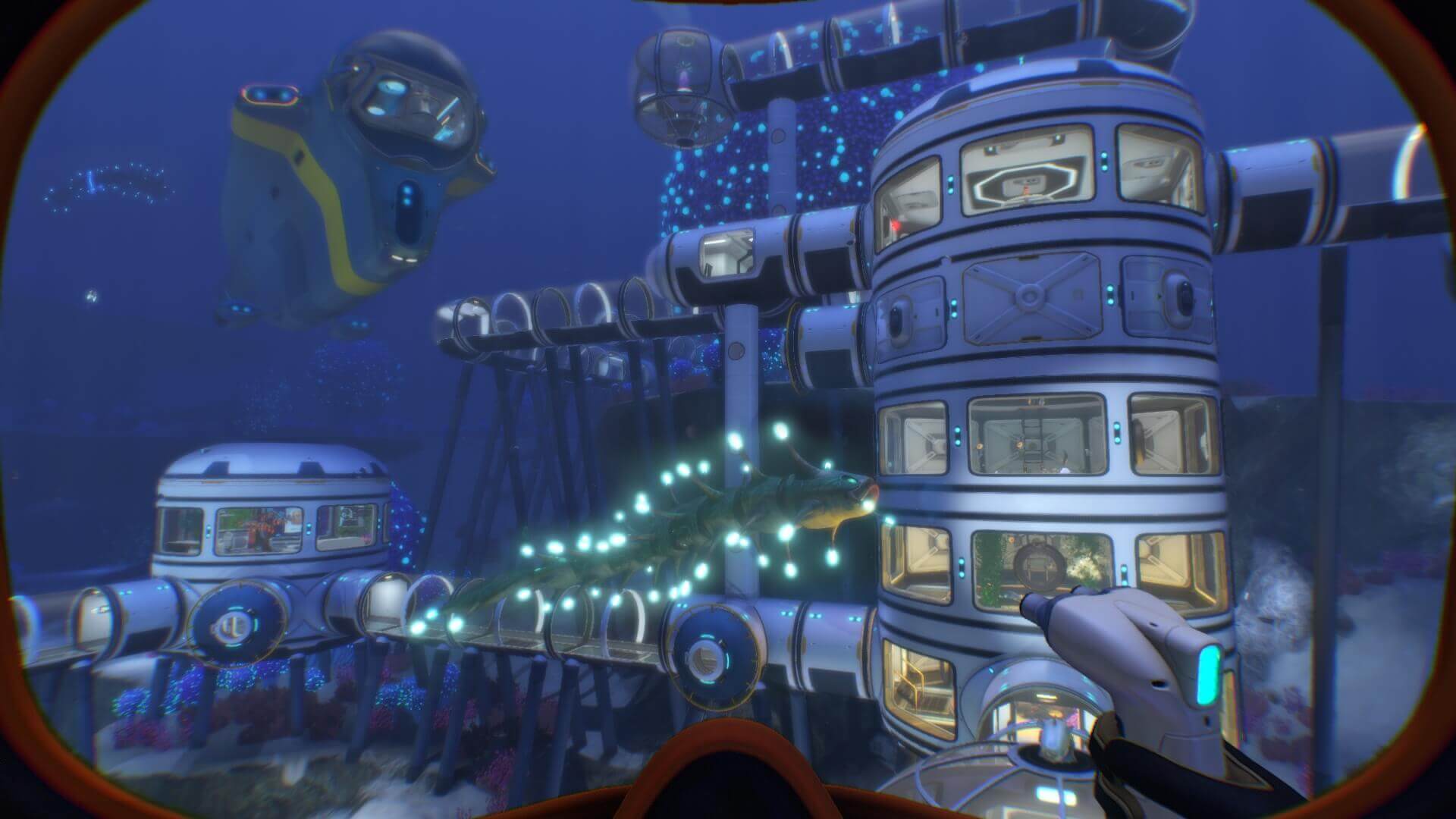
Best Subnautica mods

by Craig Pearson

Subnautica was a game I spent a lot of time just living in. It was a rare combination of survival and relaxation. I loved the base building, crafting what amounted to a reverse aquarium clinging to an underwater sea cliff. It grew from a small bulb of oxygen into a proper little sanctuary. When I picked it up, it was fairly late into its life, and a number of mods were already waiting to be installed. I quickly dialed down the game’s frustrations and made my time under the sea all the more enjoyable, so here are our picks for the best Subnautica mods available today.

Read more