Ronald.phillips
Shared posts
AMD Releases Updated Zen 3 CPU Microcode (November 2021)
North Korean Hackers Target Cybersecurity Researchers with Trojanized IDA Pro
Construction manager says male co-workers don't take her seriously because she's smoking hot [Obvious]

A look back at 20 years of Xbox ahead of today's special anniversary event
The Elder Scrolls VI “has got to be a ‘decade game'”
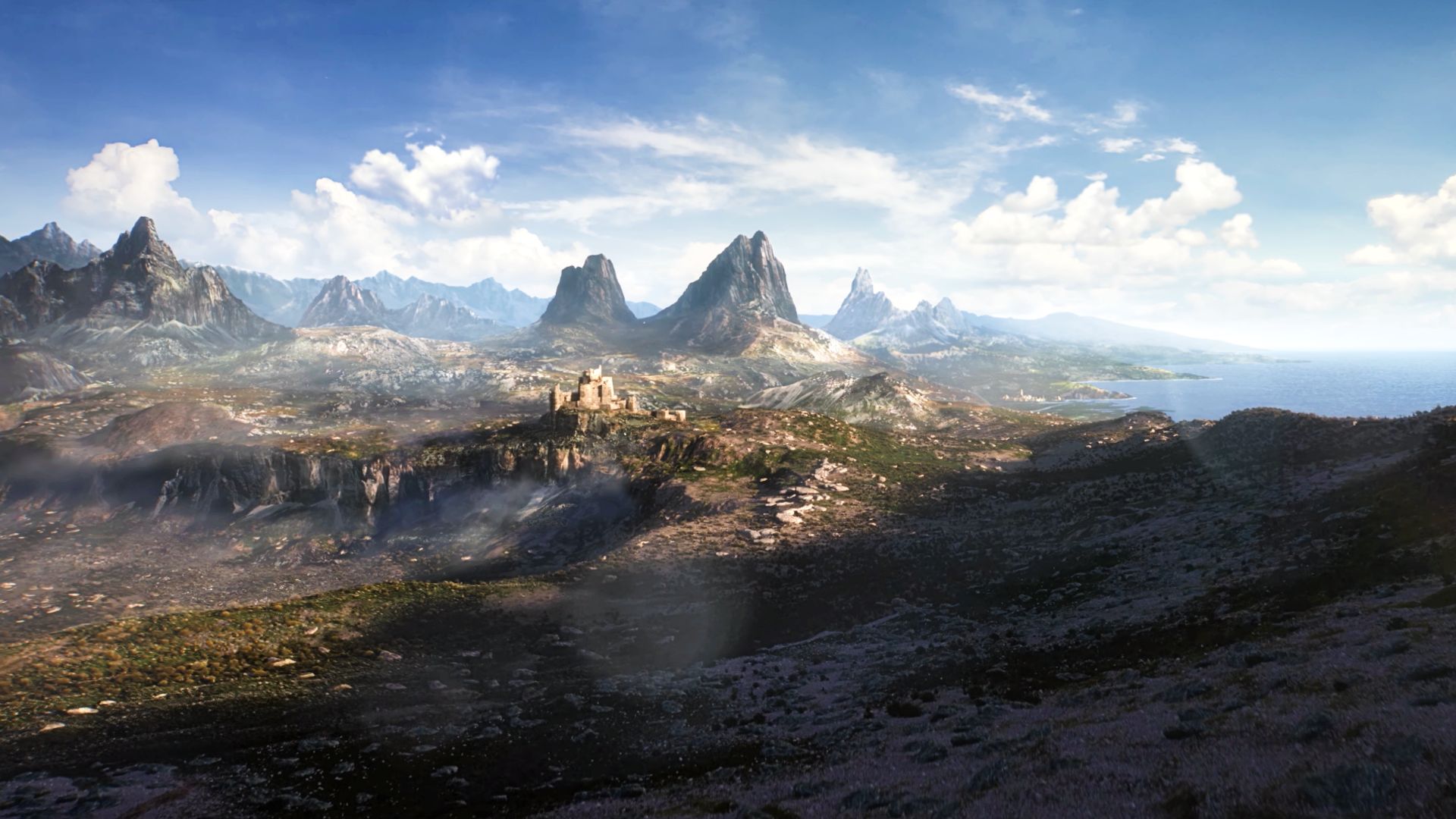
With Skyrim Anniversary Edition having just launched ten years to the day after the iconic RPG's debut, fans' attention is naturally once again turning to the prospect of The Elder Scrolls VI. Other than a very gorgeous (and very brief) teaser announcing the game, no other key information about what it'll bring has emerged yet - however, it looks like the devs definitely acknowledge that it'll need to be as enduring a game to its fans as its predecessor, Skyrim.
In an interview with GQ about how the Xbox ecosystem has grown beyond just the console itself, Bethesda Game Studios director Todd Howard touches on how TESV's long life in the hearts and minds of fans affects how the devs approach making its follow-up - and it naturally sounds like it adds some pressure. "I think that would drive me crazy to try to say, 'Okay, this is the thing you have to top,'" he tells the site, on considering Skyrim's enduringly long life.
"But then you realise, like, The Elder Scrolls VI has got to be a 'decade game'. How do you make a game where you go into it, like, 'people have to play it for a decade?'" It's a mightily tough one to answer and indicates that, while the team is well aware of the implications of Skyrim's incredible legacy, this must be a challenging thing to wrangle with in terms of player expectations.
RELATED LINKS: Elder Scrolls 6 release date, Elder Scrolls 6 setting, Fallout 5 newsSocial Security benefit increases are coming in 2022 - CNET

Grand Theft Auto: The Trilogy - The Definitive Edition Returns to PC
The Elder Scrolls VI Confirmed to be an Xbox Exclusive, Goal is to Make it a “Decade Game”

Ever since Microsoft snapped up Bethesda, there has been much speculation about which upcoming games will be PC/Xbox exclusives. We know Starfield is, and Phil Spencer and various Bethesda big wigs have strongly implied most future Bethesda games will be, but it hasn’t been directly confirmed that the studio’s biggest upcoming game, The Elder Scrolls VI, will be an Xbox exclusive. Well, it seems we can now check off that box – in a new interview with GQ, Spencer was asked again about exclusivity, and it sure sounds like The Elder Scrolls VI is on that list.
It’s not about punishing any other platform, I fundamentally believe all of the platforms can continue to grow, but in order to be on Xbox, I want us to be able to bring the full complete package of what we have. And that would be true when I think about Elder Scrolls VI. That would be true when I think about any of our franchises.
Of course, exclusive or not, we’re going to be waiting a while for The Elder Scrolls VI. As we’ve reported, Bethesda’s Todd Howard recently hinted the game won’t be coming until 2026 at least, and the new GQ article also repeats the notion that the game won’t arrive until 15 to 17 years after Skyrim (although they don’t support that figure with any quotes). On the subject of Howard and Elder Scrolls VI, he speaks a bit about expectations in the GQ article, saying he’s aiming to make ES6 another game people will play for a decade or more…
You go back and you read a review of the first Elder Scrolls. And then you read The Elder Scrolls IV: Oblivion's, then you read The Elder Scrolls V: Skyrim's. You black out a couple things. And they read the same. “You've stepped out and oh my gosh, it feels so real.” People change. Technology changes. But the ultimate goal is still to make it so that, when you boot the game up, you feel like you've been transported. […] The Elder Scrolls VI has got to be a “decade game.” How do you make a game where you go into it, like, “People have to play it for a decade?”
A release window and platforms have yet to be revealed for The Elder Scrolls VI. What do you think? Will it be Bethesda’s next “decade game” ala Skyrim?
The post The Elder Scrolls VI Confirmed to be an Xbox Exclusive, Goal is to Make it a “Decade Game” by Nathan Birch appeared first on Wccftech.

A look back at the strengths of the OG Xbox on its 20th birthday
20 years ago today, the original Xbox was released. It’s a pretty big milestone for the entire gaming industry, because it’s hard to imagine console gaming without Xbox today. But back then it was pretty risky — Microsoft was the first American firm to release a gaming system in eight years, and the company wasn’t really well-known for being a game developer or publisher outside of the Flight Simulator series and built-in Windows games like Solitaire and Minesweeper.
Admittedly, the Xbox brand didn’t really take off until the release of the 360 in 2005. But the OG Xbox made a pretty good showing for its first try, thanks to a solid lineup of games and no thanks to its enormous Duke controller. Today a few Engadget staffers would like to chime in with their cherished Xbox memories, ones that really highlight the strength of this Microsoft’s first outing in the console world.
Strength #1: System Link
Halo: Combat Evolved
A year before Xbox Live launched and redefined console gaming forever, there was the multiplayer of Halo: Combat Evolved. It sounds archaic today: there were no such things as online play, bots or centralized player accounts. But there was System Link, an Xbox feature that allowed multiple consoles to connect together for offline LAN parties. Together with Halo's four-player split-screen support, System Link allowed up to 16 players to battle it out.
In many ways, Halo's multiplayer was the logical evolution of Goldeneye, the first console shooter to enthrall a generation of gamers. And while System Link may sound like a pain to set up, it was perfectly suited to large networks, like the one at my college. That's how I found myself spending hours with my roommates, huddled in front of a basic 20-inch TV, learning the intricacies of Halo's combat. I never quite mastered the three-shot kill — two in the center, one in the head — but I got close.
I can recall one heated match as if it was a war story. My team and I were huddled in the middle of Blood Gulch, one of Halo's iconic maps featuring a long canyon with two bases at each end. The scores were neck-and-neck, never more than a few kills leading on either side. All seemed lost. We were sitting ducks in No Man's Land, with only the protection of a few hills in front of us. I had a sniper rifle, but very little ammo. In a moment of desperation, I poked my head up and, miraculously, took an enemy out in front of their base. When another person popped up, I was able to headshot them with the same clip. Game over.
I later learned that someone from the opposing team threw a chair against a wall when they lost. I can't imagine an online match with some randos provoking the same sort of visceral response. That's just Halo multiplayer, baby. No internet required. — Devindra Hardawar, Senior Editor
Strength #2: PC ports
Morrowind
I have a confession to make: I’m not much of a console gamer. Coming from the former Yugoslavia, where Nintendo products were exorbitantly expensive, the one constant in my gaming life has always been the PC. While other kids in Canada, where my family eventually settled, grew up on Super Mario Bros. and The Legend of Zelda, my favorite childhood games were Warcraft: Orcs and Humans, Dune II and The Secret of Monkey Island.
So when Microsoft released the Xbox in 2001, I wasn’t excited for it until the release of Bethesda’s The Elder Scrolls III: Morrowind in 2002. I didn’t own an Xbox, but my best friend did. At the time, neither of us had a PC capable of running Morrowind at a playable framerate. So when he bought a copy of the game, one of the first things I did was come over to watch him create his first character. Mind you, we played countless hours of Halo: Combat Evolved together, but Morrowind was the game that consistently ignited our imaginations.
To this day, we talk about some of the ways he managed to break the game. For example, he eventually became the leader of both House Hlaalu and Telvanni. And at one point, he received a quest to assassinate a Hlaalu landholder. He travelled to the estate only to find out he was its owner, so there was no way for him to finish the quest. By modern standards, that’s janky design, but it’s those quirks that made me fall in love with Morrowind and The Elder Scrolls series at large. — Igor Bonifacic, Contributing Editor
Strength #3: Exclusives
Jet Set Radio Future
My time with the original Xbox was limited, and I remember looking at games like Halo and Fable with awe. And the fact that it got a lot of games that would normally only be on PC — like Star Wars: Knights of the Old Republic — was also swoon-worthy. But then and now, there was really only one reason I wanted an Xbox, and that was to play Jet Set Radio Future.
The original game, Jet Grind Radio, was probably one of my favorite Dreamcast titles at the time. I loved the look of it, the gameplay and oh, the soundtrack. Especially the soundtrack. But when the Dreamcast was discontinued, it left some great franchises stranded. Games that Microsoft was perfectly happy to pick up for its foray into the console market, like Shenmue and my beloved Jet Grind Radio, which was switched back to its Japanese monkier for the sequel here in the US.
The gameplay remained mostly the same, with your skaters tasked with spray painting walls with their tags, battling against other gangs and avoiding the police. But Future also dispensed with time limits and enclosed stages, allowing you to skate between one section and the next. And the soundtrack, of course, was a banger. Guitar Vader, Cibo Matto and Bis. (Okay, maybe I’m the only person who cares about Bis. They wrote The Powerpuff Girls end theme! 'Social Dancing' is a great album!) — Kris Naudus, Buyer's Guide Editor
Sherlock Holmes Chapter One Review – Truth is in the Eye of the Beholder

Developer Frogwares has been doing justice to Sherlock Holmes for quite some time now with a series of adventure games that manage to faithfully represent one of the most famous detectives in literature. That said, some of these games, like The Devil's Daughter, stumbled due to design choices that didn't fit well with the rest of the experience, such as an abundance of Quick Time Events and flawed action sequences.
On paper, Sherlock Holmes Chapter One did not sound too different from its predecessor. The prospect of having combat in a Sherlock Holmes game didn't seem very exciting either and the more open-ended nature of the experience, now close to an open-world game, could have resulted in the entire experience feeling unfocused and dispersive. This time around, however, the seemingly unusual design choices did pay off, as Sherlock Holmes Chapter One is an excellent adventure game and a genuine step forward for the entire series.

Sherlock Holmes Chapter One is indeed the very first chapter in Sherlock Holmes' story. Having moved back to London after his mother's death, Sherlock journeys back to the isle of Cordona where he lived with her and his brother Mycroft seeking closure. Violet Holmes' death clearly left him traumatized, as Sherlock has trouble remembering what really happened to her before her death, so his journey back to the island is meant to finally allow him to close a chapter of his life and move forward.
Things are, obviously, not as simple as a death caused by tuberculosis, as Sherlock remembers. A quick trip to Cordona's cemetery and a chance encounter with artist Vernel Vogel, who acquired some of the items left behind by the Holmes in their manor when they went back to London, make Sherlock realize that he has to investigate further to discover the truth and finally set his mind and heart at ease.
The Sherlock Holmes Chapter One's story is definitely among the game's best features. The main case involving Violet Holmes' death is exceptionally well-written, providing new clues with each new development while keeping the player hungering for more. It has the right length, too, clocking at around 15 hours. All the other story-related cases are not only quite varied and just as well-written as the main one, but they also flow into one another quite well, making the entire tale coherent so that nothing feels out of place in the grand scheme of things. Cases that are not required to complete the story aren't as well developed, but they do their job well, allowing players to learn more about the isle of Cordona and its unique history.
Character writing in Sherlock Holmes Chapter One is as strong as the case writing is. Sherlock Holmes is fascinating in this younger form, arrogant and a little brash, but with those signs of brilliance that will let him become a peerless detective. His interactions with Jon Watson are also great, considering they provide another in-depth and sometimes surprising look at the detective, as he is not a real person but an imaginary friend that Sherlock believes has been with him his entire life. Jon's constant presence and witty remarks only add more value to the tale, and his ultimate fate results in yet another very interesting development for Sherlock Holmes as a person and as a detective.
While Sherlock Holmes, and Jon to an extent, are the true stars of the show, the other characters are just as well written and varied, ranging from eccentric artists and determined archeologists to overworked police officers and more. Some of the characters are also not what they seem at first glance, and it's only through Sherlock's excellent observational capabilities that players will be able to see through their facades. At the end of the day, all these characters contribute to the memorable story.

If the Sherlock Holmes Chapter One story, while good, doesn't exactly attempt to go beyond the boundaries set in previous entries in the series, the gameplay experience definitely does, with the introduction of a fully explorable open-world setting.
After clearing the very first introductory case, players can freely explore the isle of Cordona, moving from one part of the island to another without any limitation in search of items to find. That includes new clothes for both Sherlock and Jon, items that can be used to decorate Sherlock's mansion, a variety of collectibles, as well as optional cases and Bandit Lairs, which come with their own set of challenges. Bandit Lairs become available right after learning the basics of combat, which is the biggest new introduction to the formula seen in Sherlock Holmes Chapter One, outside of the open-world setting.
On paper, the addition of combat in a Sherlock Holmes game feels entirely out of place. Still, in reality, the addition is decently thought-out and feels coherent with the world of Sherlock Holmes, as taking down enemies requires the detective to use the environment to his advantage and analyze the enemies to highlight armor and weak spots. It is a simple system that works decently enough, although it lacks depth and essential features like a hit indicator highlighting from where Sherlock is being shot. While it does provide a pleasant diversion from all the investigation action, there isn't a whole lot of combat during the main cases and it can be turned off entirely so those who feel like it does not belong in a Sherlock Holmes game can have it their way and not shoot a single bullet for the entirety of the adventure. This option is quite welcome and a far cry from the forced action sequences and QTEs seen in The Devil's Daughter that became one of the game's biggest flaws.

Making combat optional is a sensible design choice as Sherlock Holmes Chapter One doesn't feel like it needed much diversion to begin with since the investigation mechanics are entertaining and the cases themselves rather diverse.
Sherlock Holmes Chapter One features many of the investigative gameplay mechanics seen in previous entries in the series. During the investigations, Sherlock will have to look for clues in set locations, recreate crime scenes and put facts in correlation via the Mind Palace to help him reach a conclusion that will have consequences shown to the player after the case has been closed. The difference is in how Sherlock will now have to move from one location to another in Cordona to solve cases, taking advantage of Police and Newspaper archives to gather information needed to find people of interest and learn more about past events, and even disguising himself to gain access to otherwise locked locations. While the introduction of the open-world setting could have brought a variety of issues like pacing, Frogwares did a masterful job in making the entire experience feel tight. The open-world features feel like a natural step forward for the series and not a forced addition made just for the sake of it. The collectible hunting and the Bandit Lairs, although somewhat integrated into the story, do feel a little "gamey", but, since they are optional, they do not impact the experience negatively in any major way.
The introduction of combat and open-world features in Sherlock Holmes Chapter One, while definitely made to appeal to a broader public, didn't really impact what made the series what it is in the first place. Players should expect to find only minimal handholding throughout most of the adventure. While it is possible to highlight points of interest at any time during an investigation, it is up to players to connect the dots and recreate crime scenes properly. Thankfully, the game provides all the information players need to do so correctly, so you'll hardly get stuck in a case if you read the casebook carefully. Additionally, the game features difficulty customization options for investigation and combat to make the entire experience as accessible as possible without watering down the investigative challenges.

Sherlock Holmes Chapter One also doesn't disappoint when it comes to visuals, although the game cannot compare to major AAA productions in terms of advanced tech and polish. All character models look detailed enough, and animations are decent if a little stiff. The city of Cordona looks great and lively thanks to the huge amount of NPCs walking around at any time. A competent lighting system nicely complements the day and night cycle.
Performance is decent, as the game had no trouble running at 4K@60 FPS with max settings during most sequences, including open-world exploration with multiple characters on-screen on the system used for the test (i7-10700 CPU, RTX 3070 GPU, 16 GB RAM). The game is also bug-free for the most part, as I haven't encountered anything significant in my time with the game, outside of some weird NPC behavior every now and then.
After having had the chance to play Sherlock Holmes Chapter One twice before its launch, I had a pretty good idea of what to expect out of Frogwares' latest game, but the final release exceeded my expectations with a great story and engaging gameplay. The open-world features fit the series more than I expected, resulting in an experience that feels bigger without becoming dispersive. The combat is largely inoffensive and could become one of the series best features with some tweaking and increased depth. Sherlock Holmes Chapter One is truly the first step in a new course for the entire series, and I am quite curious to see how Frogwares will build upon this solid foundation.
PC version tested. Review code provided by the publisher.
The post Sherlock Holmes Chapter One Review – Truth is in the Eye of the Beholder by Francesco De Meo appeared first on Wccftech.

Vending machines in games

The Video Game Soda Machine Project archives examples of vending machines and similar devices found in games.
"The Video Game Soda Machine Project is my attempt to catalog screenshots of every soda vending machine that has ever appeared in a video game," writes Jess Morrissette, a Professor of Political Science and an amateur game developer. — Read the rest
This man robbed a bank in 1969 and vanished. On Friday, authorities found him, just a few months too late.

On July 11, 1969, Ted Conrad left his job as a teller at Cleveland's Society National Bank carrying a paper bag stuffed with $215,000. Then he completely vanished. Apparently, Conrad had been inspired by the 1968 Steve McQueen film The Thomas Crown Affair. — Read the rest
Cowboy Bebop Review: A Jazzy, Heartfelt Adaptation With Fun To Spare
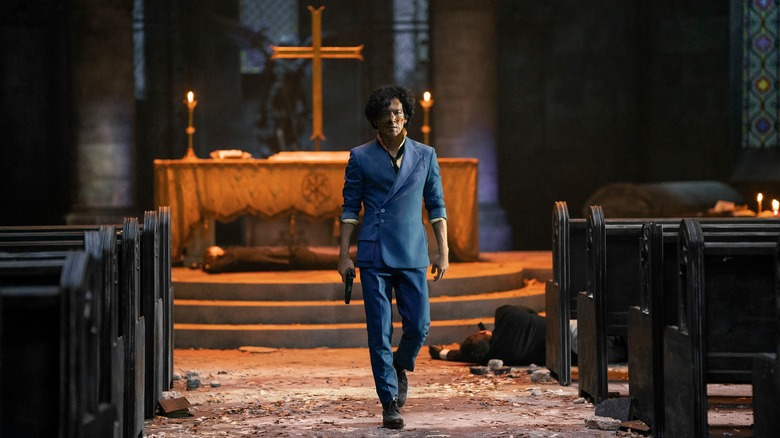
Adapting the beloved sci-fi neo-noir anime series "Cowboy Bebop" is a herculean task. The series had a rocky start after its adult themes caused early cancellation during its initial run, but it became a big hit a year later when all 26 episodes were screened on another network. In 2001, "Cowboy Bebop" became the first anime title to be broadcast on Cartoon Network's Adult Swim programming block, featuring cartoons for mature audiences. The series introduced anime to a whole new Western audience, and showed some viewers that stories full of sex, drugs, violence, and adult situations could work as an animated series. Heck, it was the first anime that I connected with as a teenager looking for something a little more complex than "Tenchi Muyo!" The jazz-inspired soundtrack, cowboys in space aesthetic, and gorgeous animation are what first caught my interest, but soon I fell in love with Spike, Jet, Faye, Ed, and Ein. There's also the Bebop itself, a ship that reminds me of Serenity from "Firefly" or the Millennium Falcon from "Star Wars" — it's something of a miracle that she flies at all but she's held together with love (and duct tape).
So how do you take the effortless cool of "Cowboy Bebop," a surprisingly deep space adventure that traverses our solar system complete with starship dogfights, and turn it into a live-action series? The creative team behind the Netflix live-action adaptation definitely had their work cut out for them. Anime series creator Shinichiro Watanabe was brought in as a consultant, and original composer Yoko Kanno returned to write the score, and their touches are felt throughout the series. The characters feel authentic to their two-dimensional versions, the world is just as deliciously weird, and when the elements line up just right, it manages to tap into the effortless cool that defined the original.
Trying to make "Cowboy Bebop" like a direct copy would have done it a huge disservice; some elements have dated poorly and others serve the narrative style of anime better than live-action. Instead, the series plays like a mash-up: all of your favorite parts are still here, but they've been mixed together and rearranged into something that's a little old, a little new, but still 100% "Cowboy Bebop."
The Crew Has Perfect Chemistry
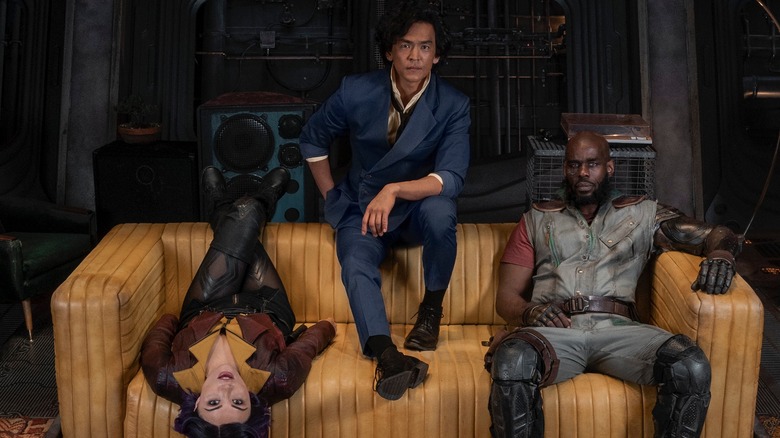
The anime series has a lot of interesting things going on, but the most important element is the dynamic of the crew. The mysterious Spike Spiegel (John Cho), disgruntled retired cop Jet Black (Mustafa Shakir), and amnesiac mischief-maker Faye Valentine (Daniella Pineda) each have serious personal demons, but they manage to come together to help each other anyway. Much like the anime, "Cowboy Bebop" starts with Spike and Jet looking for bounty hunting work to pay the bills. They eventually encounter the wily Faye, who was woken up from cryogenic freezing only two years before and has no memory of her former life. The three of them then try to survive in a ruthless, cutthroat galaxy. The three work as bounty hunters, or "cowboys," capturing wanted criminals and bringing them to justice for money, which is called woolong.
The banter between Spike, Faye, and Jet is pure joy. They frankly discuss food, personal grooming, and sex in the way old friends do, even though their friendship is only beginning. There's an authenticity to the dialogue that's refreshing, and the actors deliver it to perfection. Cho and Pineda have the same sibling-like chemistry that Faye and Spike have always had, and Shakir's Jet is their doting but exhausted father figure. The trio may bicker constantly, but there's love between them. They've found family with one another that they haven't had anywhere else. Spike longs for his lost love, Faye doesn't know her family, and Jet wants to be a bigger part in his daughter's life, but all they have at the end of the day is one another.
Cho's Performance Is Perfection
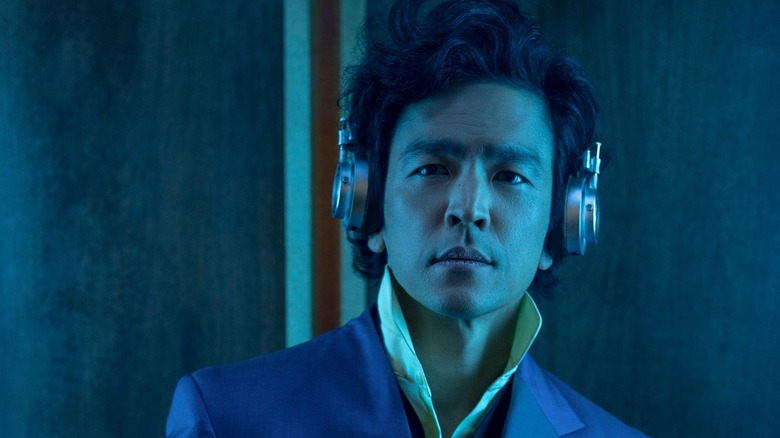
The chemistry between the crew is great in part because of the performances of the three leads. Shakir and Pineda are both great; Shakir's Jet has paternal warmth mixed with the no-nonsense retired cop attitude he needs to survive, while Pineda's Faye is a sassy and street-smart survivor who has a surprising sweet side. But I would be remiss if I didn't mention the absolutely stellar performance given by Cho.
Spike idolizes martial artist Bruce Lee, and Cho studied Lee's movements and martial arts style to prepare for the role. That effort shows, as Cho saunters and slinks his way through scenes like a lazy alley cat. When he's practicing Lee's style, Jeet Kune Do, on a Wing-Chun Dummy, he looks every bit as confident as his animated counterpart. You would think it would be impossible to completely mimic the inhumanly smooth movements of an animated character in reality, but Cho managed to do it. In action sequences, he glides and pivots like a trained dancer; in dramatic scenes he conveys worlds of emotions with just his expression and body language. He's also nailed the cadence of the way Spiegel speaks in the English dub (voiced by Steve Blum). He has a warmer tone than Blum's deep rumble, but the jazzy, almost rhythmic way of talking is dead-on.
Some Great Character Updates
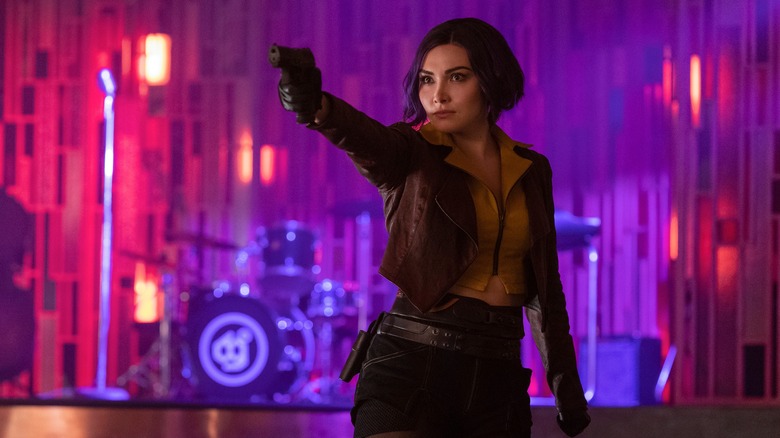
There were a few problematic elements in the animated series that were thankfully given better consideration for the live-action series. Instead of being treated like a bizarre accident, the non-binary character Gren is given a more substantial role and is played with panache by non-binary performer Mason Alexander Park. Spike's old friend Ana is no longer a convenience store owner, but instead runs a bar and jazz club. (She's played by Tamara Tunie, who also gives a pitch-perfect performance.) Women are given more agency in the live-action adaptation in general, and it's both refreshing and a load of fun.
Faye is still a sexual being, but she owns it in a way that doesn't feel like the creepy gaze of the anime. She and Spike have a great conversation about "boobs and butts" while they're both lounging around looking gorgeous. She also gets a small romantic arc with an adorable mechanic that will satisfy fans who always wondered why the anime didn't explore her implied bisexuality further. All of these elements are blended seamlessly into the world and story, and they deepen an already rich canon.
An Unsteady Track That Finds Its Groove
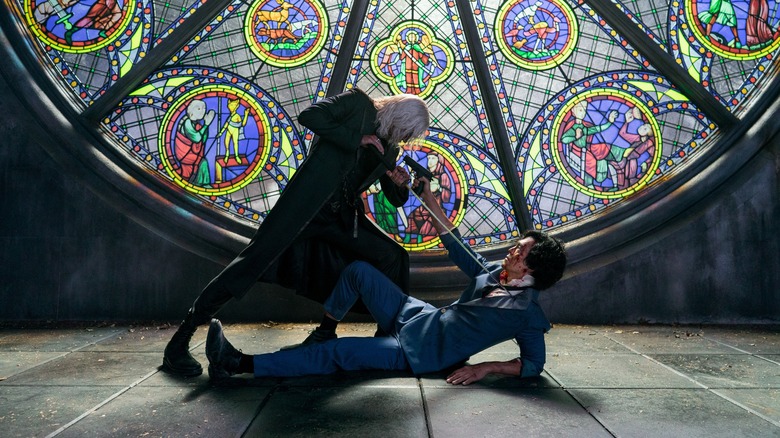
The adaptation starts a little shaky, the tonal dissonance of its high-energy silliness feeling too cartoonish for real people to be acting out. Once Faye joins the Bebop, that weirdness disappears as the interactions between the crew take center stage. It's refreshing that the adaptation is willing to be as aggressively strange as its anime roots, and Netflix's "Cowboy Bebop" does not shy away from the series more peculiar elements. It revels in its own weird world-building without any self-aware nods or meta-commentary; it's incredibly earnest in a way few series would even attempt. Sometimes that makes things feel a little corny, but overall that commitment makes the series sing.
Netflix clearly put a lot of money into the series, because it's stunning to look at. There are massive, complex sets and locations, impressive digital effects, and loads of great, weird costumes. It's shot much like the anime, and edited in a similar quick-cut style. While it can be a little jarring initially, once the series finds its groove it feels natural.
"Cowboy Bebop" is a gorgeous sci-fi neo-noir adventure with a perfect score and loads of great performances. The series is clearly not meant to be a replacement for the anime but a companion piece, and in that goal it succeeds in spades. After gaining traction with some stellar mid-season episodes, the season ends in a way that suggests there could be another season in store. That would make this space cowpoke one very happy camper.
Read this next: The 20 Best Heist Movies Of All Time
The post Cowboy Bebop Review: A Jazzy, Heartfelt Adaptation with Fun to Spare appeared first on /Film.
The 12 Best Sci-Fi Western Movies Ranked
The western and science fiction genres have always been closely intertwined. Both require signature imagery, exciting action-adventure setpieces, and instantly recognizable heroes and villains; both can be utilized to reflect on larger societal issues. If westerns look at the past from a more nuanced perspective, sci-fi projects explore the future based on the reality that currently exists.
Western heroes were highly influential in the early days of science fiction. There wouldn't be modern sci-fi without the development of the Buck Rogers character, who first debuted in 1928 comic serials before appearing in subsequent serial adaptations, graphic novels, books, stage productions, and feature films. Rogers was a brave gunslinger who explored the furthest reaches of space -- quite literally, a space cowboy. The character allowed for the development of more sci-fi heroes like Flash Gordon and Commando Cody, and later influenced Gene Roddenberry's concepts for "Star Trek" and George Lucas' development of "Star Wars."
Some science fiction westerns combine the two genres more directly. Among the most famous is 1973's "Westworld," an adaptation of Michael Crichton's acclaimed novel. The film directly contextualizes western archetypes within a sci-fi premise, as robotic gunslinger androids rebel against their creators in a futuristic theme park. Yul Brenner's terrifying performance as the fearsome gunslinger is synonymous with both genres. The film inspired the acclaimed HBO series of the same name from Jonathan Nolan and Lisa Joy that soon begins production on its fourth season.
Here are the 12 greatest sci-fi western movies, ranked.
John Carter
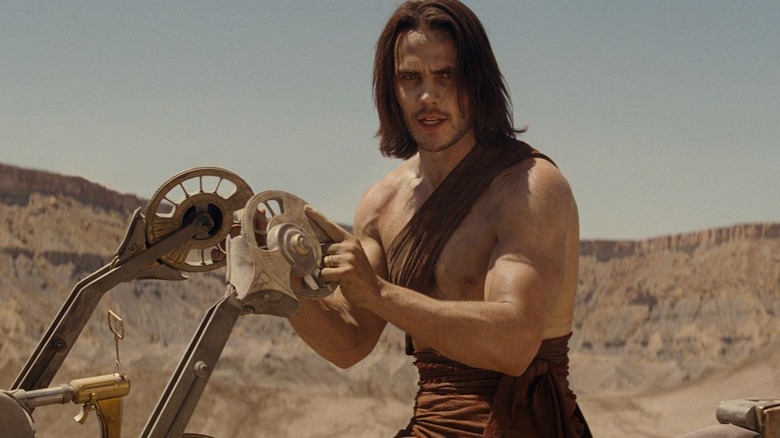
Even before "Buck Rogers," Edgar Rice Burroughs' 1912 novel "A Princess of Mars" was the original sci-fi western adventure. The first in Burroughs' long-running series of Martian adventures introduced the hero John Carter, a former Confederate soldier turned outlaw who avoids the justice of local sheriffs amidst the 1880s. Carter is transported into space through a mystical portal, only to end up employed as a gladiator on Mars for an alien race. It took a century (and years of development hell), but frequent Pixar director Andrew Stanton finally brought "John Carter" to the big screen with his 2012 adaptation.
It's an absolute shame that the film's poor box office performance resulted in the cancellation of a planned trilogy, because "John Carter" is way better than its reputation suggests. It's not just the early sequences set within the Arizona Territory that wear a western influence; seeing Taylor Kitsch's titular outlaw hero inserted into an intergalactic adventure is just as exciting.
Cowboys & Aliens
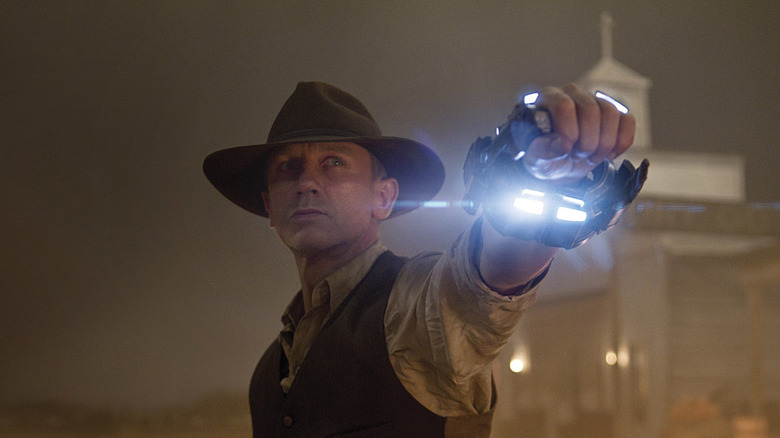
Some sci-fi westerns meld the two genres in subtle ways, but the combination is made crystal clear in a film titled "Cowboys & Aliens." Based on the beloved graphic novel by Scott Mitchell Rosenberg, Jon Favreau's 2011 adaptation is, remarkably enough, not a spoof of either genre. It's surprisingly considerate of how helpless humanity would be to an advanced technological invader, and the limited technology of the Old West makes the characters' plight more challenging. It also subverts westerns with a more sensitive depiction of the relationship between settlers and native indigenous people.
Sullen, amnesiac outlaw Jake Lonergan (Daniel Craig) wakes up in the southern town of Absolution with no memory of his past, and soon discovers a mysterious intergalactic band attached to his arm. Lonergan is brought to the mercy of the powerful local figure Colonel Woodrow Dolarhyde (Harrison Ford), who thinks there could be a connection between the outlaw and the disappearance of his son, Percy (Paul Dano). They join forces to infiltrate a nest of aliens that threaten Absolution.
The Rover
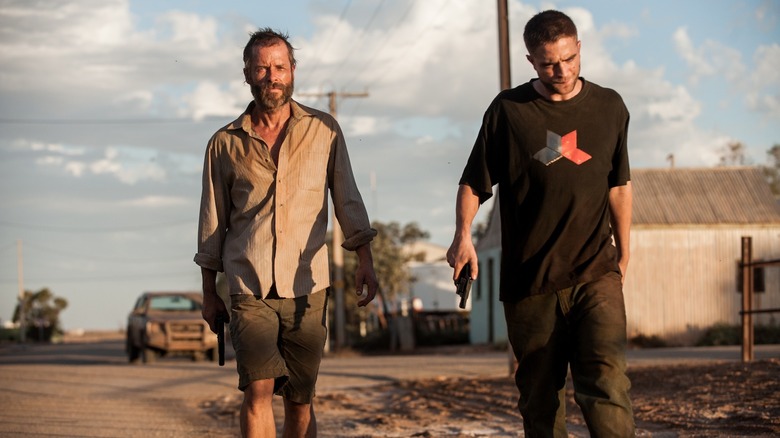
The influence of "Mad Max" launched a unique subgenre of dystopian Australian sci-fi westerns, and few imitators of George Miller's style have been able to live up to the heights of his groundbreaking original trilogy. However, David Michod's 2014 thriller "The Rover" is a rare exception (Quentin Tarantino even cited it as the best dystopian western since the original "Mad Max"). The film perfectly combines the hopeless disparity of gritty westerns within a world 10 years removed from a devastating economic collapse.
The film follows the former soldier Eric (Guy Pearce), who lives in isolation within a secluded homestead. Eric's daily life is disrupted when a gang of robbers led by the thug Henry (Scoot McNairy) breaks into his home and steals his car. Eric is unable to stop them, but he does manage to capture Henry's mentally-disabled brother Reynolds (Robert Pattinson). Eric and Reynolds form an uneasy alliance in order to track down the other criminals, and both try to influence each others' actions. Pearce has rarely been more devastating onscreen, and the film showcases one of Pattinson's best post-"Twilight" roles.
Monsters
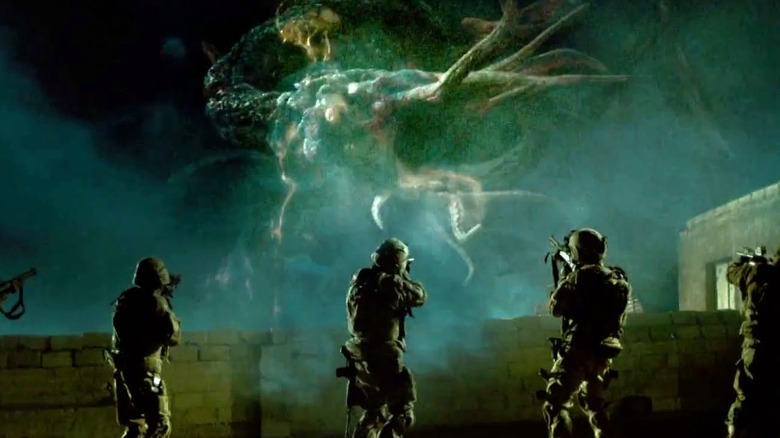
Westerns are often compelling because their environments are pre-established. There's not much detail required to explain that a story is set within the Old West, and as a result, the narrative can take place pretty much anywhere. Even if it's traditionally thought of as an American genre, Australian and Italian westerns are an integral part of the genre's history. Gareth Edwards explored this idea with his 2010 sci-fi western "Monsters;" there's little exposition explaining the post-apocalyptic premise, as the audience only learns about the mythology through the interactions between the characters.
"Monsters" follows cynical photojournalist Andrew Kaulder (Scoot McNairy), who remains reclusive as he copes with a personal tragedy. Kaulder is recruited by his boss to embark on a dangerous cross-country mission to find his daughter, Samantha Wynden (Whitney Able). Samantha is trapped behind the Mexican border (a popular setting within westerns) and needs to be covertly brought to safety in the United States. The sci-fi elements are only gradually introduced during Kaulder's travels, as he must avoid extraterrestrial creatures that landed on Earth after the crash of a NASA ship in the desert.
Westerns often explore the starkness of the natural world, and "Monsters" shows the events of the post-apocalypse away from anything catastrophic. The limited exposure to the outside world allows Edwards to focus on the relationship between Kaulder and Samantha. Kaluder is initially not forthcoming, but he gradually opens up to his new companion and explains his tragic history.
Solo: A Star Wars Story
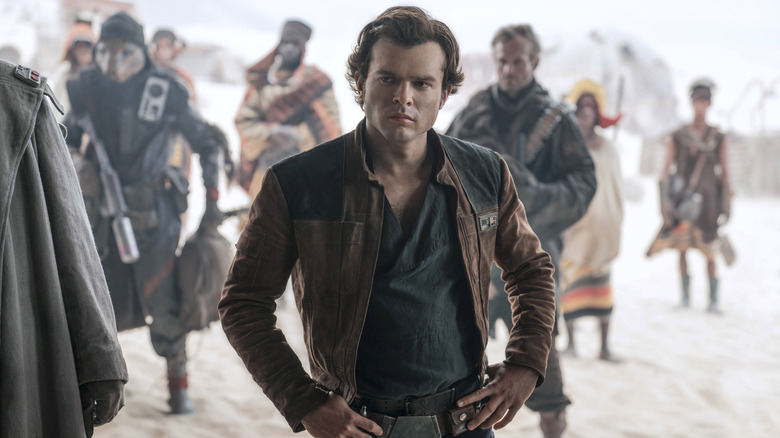
It's no secret that the "Star Wars" franchise popularized the space western. The notion of smugglers, bounty hunters, seedy bars, and run-down technology was fun to see combined with the sci-fi and fantasy elements, and the series has only continued to lean further into space western territory with the live-action Disney+ series "The Mandalorian" (which is heavily inspired by Sergio Leone's "The Man With No Name" trilogy).
When the "Star Wars" franchise was relaunched under Disney, Kathleen Kennedy decided that the spin-off anthology films would be straight-up genre vehicles. Without the burden of continuing the mythological roots of the Skywalker saga, 2016's "Rogue One: A Star Wars Story" became a war film, while 2018's "Solo: A Star Wars Story" reverted to the series' western origins. It explores the "hive of scum and villainy" within the franchise's criminal underbelly, and here the stakes are not centered around the fate of the galaxy. Rather, the film focuses its attention on a relatively small-scale heist story about competing criminal gangs that double-cross each other.
Alden Ehrenreich gives a terrific performance as the titular young smuggler, quite unlike the world-weary cynic Harrison Ford essayed years prior. "Solo" also reimagines western archetypes, like the mob boss Dryden Vos (Paul Bettany) and the shady double-crosser Tobias Beckett (Woody Harrelson).
Mad Max
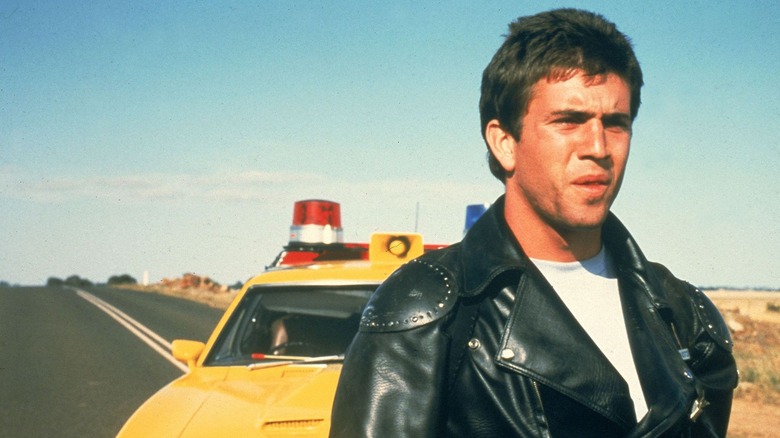
George Miller's "Mad Max" series is the definitive sci-fi western franchise. The later films explored a gritty, run-down, post-apocalyptic future where mankind had been reverted to a chaotic Old West state, but the original 1979 film was pivotal in showing how the depletion of infrastructure began. The film chronicles the societal collapse through the eyes of the police officer Max Rockatansky (Mel Gibson), who only gradually becomes "Mad" as the story continues.
Compared to the subsequent installments, which are more action-packed and over-the-top, "Mad Max" is a relatively low-key character drama. Max pursues the dangerous motorcycle biker Crawford "Nightrider" Montazano (Vincent Gil) after he kills one of his friends on the police force, but Nightrider's allies Toecutter (Hugh Keays-Byrne) and Bubba Zanetti (Geoff Parry) begin wreaking havoc throughout the city. It was Keays-Byrne's first collaboration with Miller, and he would later return to the series to play the main villain Immortan Joe in "Mad Max: Fury Road."
"Mad Max" explores the tragedy that sets the events of the franchise into motion. Max loses his wife Jessie Rockatansky (Joanne Samuel), and becomes hardened and skeptical about humanity's future. Many western heroes have traumatic origin stories, and Miller showed the sympathetic place in which these heroes earn their names. Max would become as crazy as the world that surrounded him by the time "The Road Warrior" rolled around, but here we get to see Max at his most lawful and relatable.
Back To The Future: Part III
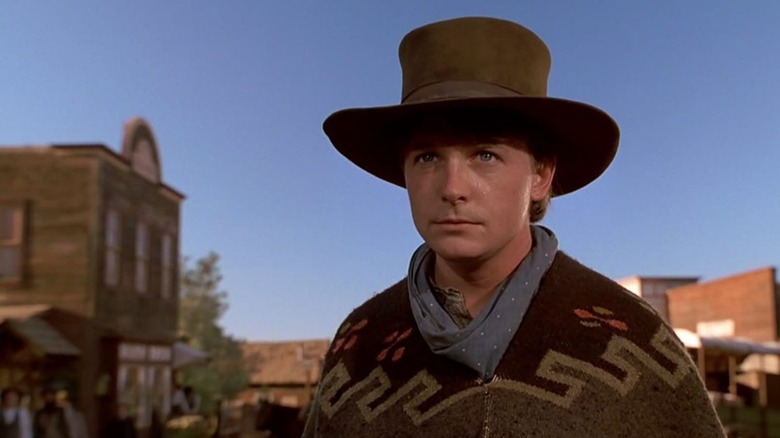
Not every science fiction franchise is inherently inspired by westerns, and "Back to the Future" certainly wasn't. Marty McFly (Michael J. Fox) isn't a gunslinging outlaw or a sheriff, but an average teenager. Robert Zemeckis' 1985 original explored the ongoing developments within technology and science, and utilized a premise that was closer to that of classic screwball comedies. 1989's "Back to the Future: Part II" took the series in a dystopian direction when Marty travels to a dark vision of the future where his parents don't end up together, and the ending teased another genre mashup for the series' third at-bat: Marty must travel even further back in time, to the Old West, in order to rescue his best friend, scientist Doc Brown (Christopher Lloyd).
"Back to the Future: Part III" is a delightful tribute to classic westerns. Marty even dons the persona of "Clint Eastwood" at one point, in dedication to his favorite western actor. Having a character who's aware of western cinema archetypes makes the story more engaging, and adds plenty of humor, as well. However, the western elements are still well handled, and in particular the villainous Buford "Mad Dog" Tannen (Thomas F. Wilson) makes for a fearsome, no-nonsense gunslinger.
Sci-fi westerns are interesting when they combine iconography, and "Back to the Future: Part III" includes steampunk elements. Doc is without the Delorean, so he must create new time travel devices utilizing the limited technology of the time period in which he has become trapped.
Flash Gordon
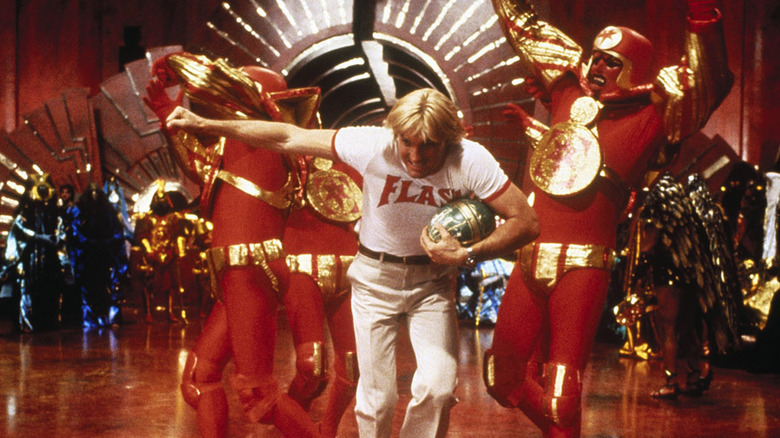
The original Flash Gordon character was introduced shortly after Buck Rogers, and was designed to directly compete with that iconic space cowboy. First appearing in comic strips in the mid-'30s, Flash Gordon was a similar cosmic adventurer with the same nobility and combat skills as a classic western hero. He would later appear in countless comic books, radio plays, serials, television shows, and cartoons, and filmmakers had tried for generations to adapt the character for the big screen. George Lucas, who had loved the character growing up, attempted to purchase the rights to an adaptation in the 1970s. When he was turned down by producers, he simply made "Star Wars" instead.
"Flash Gordon" finally made his way to the big screen in 1980, in a film directed by Mike Hodges. Hodges told the origin story of the titular New York Jets football star (Sam J. Jones) who is transported from Earth into the vast reaches of space. Flash is gifted with superhuman powers by the brilliant scientist Dr. Hans Zarkov (Topol), but he's captured by the intergalactic supervillain Ming the Merciless (Max von Sydow). Flash gathers his allies to lead a revolution against the wicked dictator.
"Flash Gordon" is gleefully campy and doesn't attempt to modernize the original serials. The depiction of good and evil is completely earnest, although there are self-aware nods to the character's history. It's the perfect translation of one of the original sci-fi westerns.
Mad Max 2: The Road Warrior
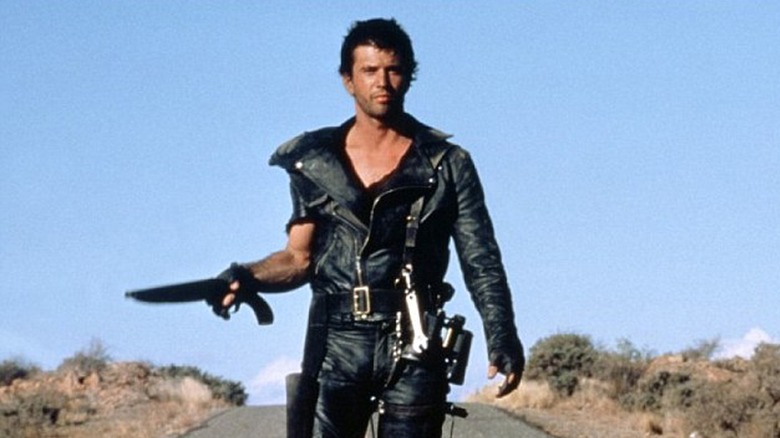
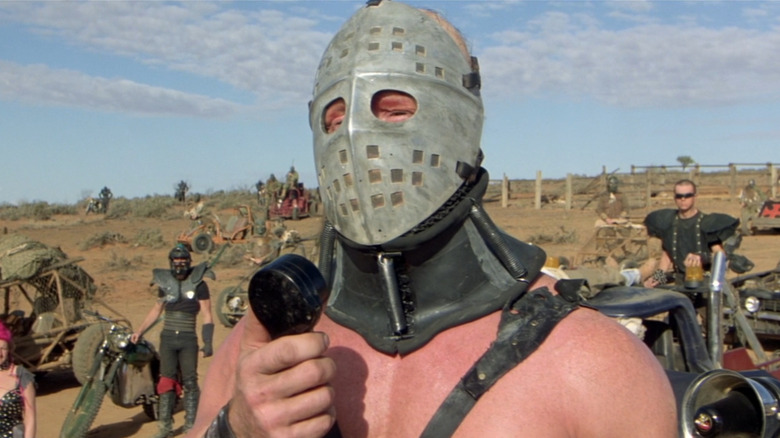
While 1979's "Mad Max" was a brilliant film, its audience was mostly limited to Australian viewers and wasn't as popular in the United States. The 1981 sequel was therefore marketed simply as "The Road Warrior," and some viewers weren't even aware of the connection to George Miller's original film. The story is essentially a standalone; like classic western heroes, "Mad" Max Rockatansky (Mel Gibson) goes on adventures that can basically be viewed as an anthology. "Mad Max 2: The Road Warrior" leaned even heavier into the western influences than its predecessor had, and as a result, it's one of the greatest sequels ever made.
While "Mad Max" explores how humanity falls into a post-apocalyptic state, "The Road Warrior" is set within a brutal desert where the world is already without hope. Like any classic western hero, Max is a drifter who prizes his own survival first -- any noble intentions are secondary to staying alive amidst the brutal environment. Max has abandoned his career in law enforcement, but is hunted by a gang of violent bikers led by Lord Humungus (Kjell Nilsson). However, he gradually accepts the pursuit of justice when the gang threatens a small village, the same plight that many classic gunfighters faced in the Old West.
George Miller is a genius at creating memorable action sequences, and he crafts thrilling chase sequences as Max battles the evil goons. Max's relationship with the young Feral Child (Emil Minty) gives the film its heart without being schmaltzy.
Logan
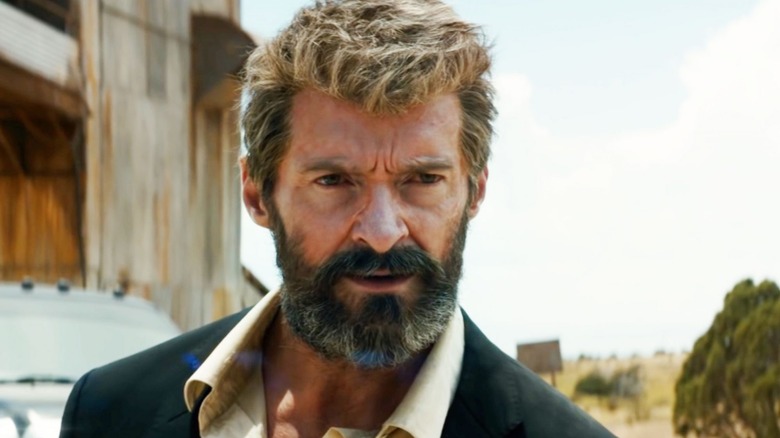
The "X-Men" franchise expertly mixes genres to create stories that tend to feel unique amidst the typical superhero content in popular media. While the films ably translate the heroic depictions of the original Marvel comics, they also incorporate elements of fantasy, coming-of-age, comedy, and political satire. The franchise went in many different directions, but the solo films focused on Wolverine (Hugh Jackman) tended to pinpoint his isolation and inability to find inner peace. 2009's "X-Men Origins: Wolverine" was an awkward blend of convoluted world-building, but James Mangold's more serious 2013 film "The Wolverine" inserted the character within a Samurai epic that felt closer in tone to the films of Akira Kurosowa than a traditional superhero story.
Mangold experimented with genres once more in 2017 with "Logan," a film so indebted to its western influences that it even includes clips from the 1953 Alan Ladd classic "Shane." Compared to the time-travel and world devastating events of the previous films, "Logan" tells a stripped-down story of Wolverine living within the outskirts of Texas. Asserting that stories of the "X-Men" are wildly exaggerated, Wolverine cares for the dying Professor Charles Xavier (Patrick Stewart) and doesn't intend to go on any more adventures. He's reluctantly called back into action when he discovers the young mutant girl Laura (Dafne Keen), who seeks his protection.
Placing Wolverine within a western was a brilliant choice, as it made his final screen appearance more emotional, and the R-Rating allowed Mangold to show the west with full brutality.
Serenity
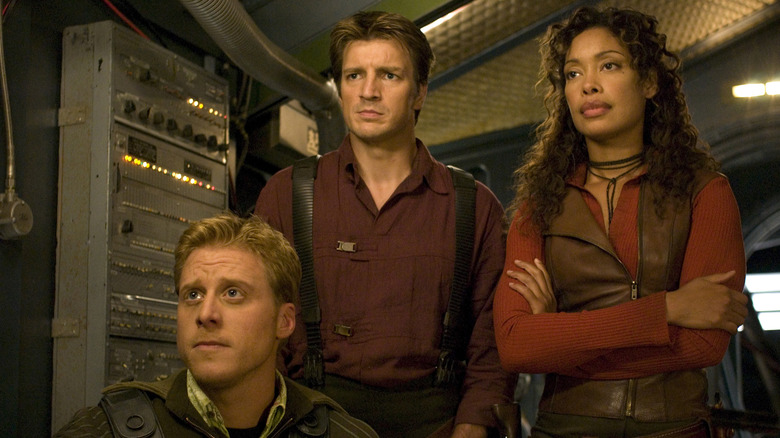
Joss Whedon's beloved science fiction western adventure series "Firefly" provided viewers with exciting stories exploring the vastness of outer space in a way that was similar to the Old West. Captain Malcolm Reynolds (Nathan Fillion) was a rough and tough gunslinger, fitting the classic western archetype of a former veteran who is haunted by his wartime experience and forced into a shady line of work. Reynolds led his crew of beloved characters, including his wartime ally Zoë Alleyne Washburne (Gina Torres), the wisecracking pilot Hoban Wash (Alan Tudyk), the humorous mercenary Jayne Cobb (Adam Baldwin), personal escort Inara Serra (Morena Baccarin), quirky mechanic Kaylee Frye (Jewel Staite), wise preacher Shepard Book (Ron Glass), and new recruits Simon (Sean Maher) and River Tam (Summer Glau). The crew leads smuggling missions across the galaxy, and against Reynolds' better judgment they're called into acts of heroism.
"Firefly" was unfortunately canceled after its first season, leaving fans with only 14 episodes and no proper conclusion. Thankfully, Whedon was able to conclude the storylines planned for subsequent seasons with his 2005 film "Serenity." The film reunited the original cast for a new adventure where they're stalked by a mysterious assassin employed by the totalitarian government military force the Alliance, known simply as "The Operative" (Chiwetel Ejiofor). The Operative fits within the mold of a classic western antagonist -- he's bound by duty, even stating that he's a "necessary evil" that the Alliance needs. Ejiofor fleshes out the archetype by showing The Operative's sympathetic side.
Mad Max: Fury Road
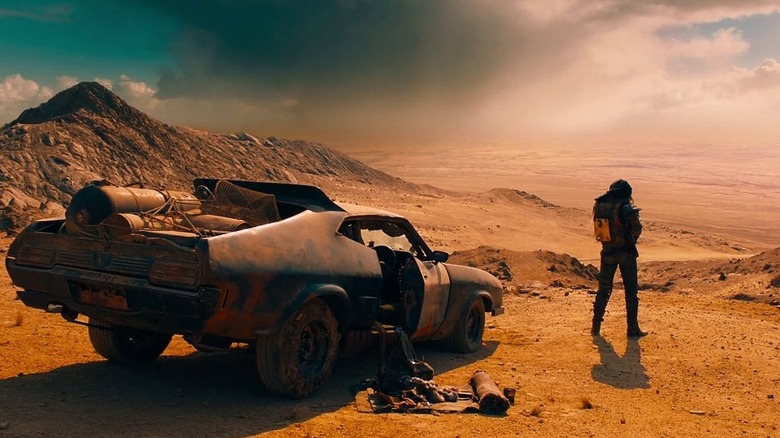
Three decades after the conclusion of the original trilogy, there were significant expectations for George Miller's fourth entry in the "Mad Max" franchise. The first two films masterfully incorporated the science fiction post-apocalyptic elements within the concept of an Australian western, but "Mad Max: Fury Road" surpassed every expectation. It explored classic western themes of an isolated society, a former law enforcement officer returning to nobility, and heist caper elements within all of its glorious, madcap action.
Tom Hardy stepped into the titular role that Gibson had made iconic, and though his grizzled bluntness fit the role perfectly, Hardy was outshined by the new protagonist Furiosa (Charlize Theron). An imperator for the warlord Immortan Joe, Furiosa rebels against her vicious boss and rescues his female breeders. Westerns are effective when they challenge traditional notions of masculinity, and having the female characters be featured so prominently here was integral.
"Mad Max: Fury Road" isn't just the best action movie since "Die Hard," but a great western. The stark imagery of the isolating desert and eccentric rogue's gallery feel lifted from the classics of western cinema, particularly with Immortan Joe's control of resources and water. Max fits the mold of a lonely gunslinger; he doesn't have a personal stake in the conflict, but he's called into acts of heroism nonetheless. Furiosa became the defining hero of a generation regardless of genre (don't worry, she'll be back).
Read this next: The 20 Best Dystopian Movies Of All Time
The post The 12 Best Sci-fi Western Movies Ranked appeared first on /Film.
NVIDIA's Cloud Gaming Service Quietly Capped Frame Rates on 12 Games


Read more of this story at Slashdot.
Apple is Sticking Taxpayers With Part of the Bill for Rollout of Tech Giant's Digital ID Card
Read more of this story at Slashdot.
Heavy Rains and Storms in Egypt's Aswan Unleash Scorpions in People's Homes
Read more of this story at Slashdot.
Rockstar are selling GTA Trilogy Def Ed again, but should bring back the originals
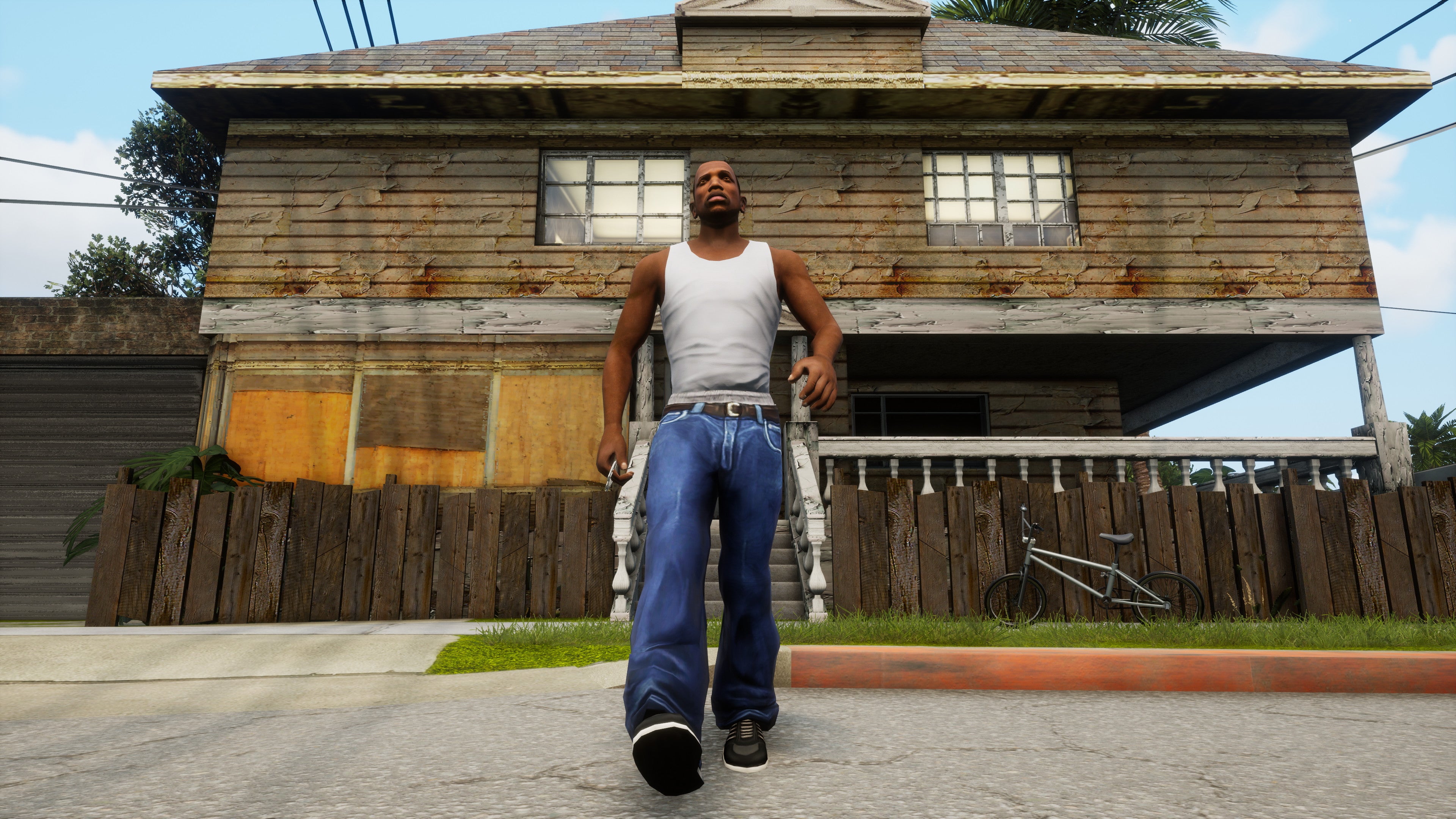
After pulling Grand Theft Auto: The Trilogy - The Definitive Edition's PC edition from sale soon after its Thursday launch, Rockstar returned it to their store overnight. The remastered collection of GTA 3, Vice City, and San Andreas looks a right mess but apparently the reason for its vanishing was they had accidentally left in files they shouldn't have, which include songs that weren't meant to be in the game. Well, it's back on sale now, and it still looks a mess. Hey Rockstar, maybe now consider putting the original versions back on sale too.
Neal Stephenson Discusses His New Climate Change Thriller - and Coining the Word 'Metaverse'
Read more of this story at Slashdot.
Hydrogen and Hybrids: Toyota CEO Defends Combustion Engines, Saying 'The Enemy Is Carbon'
Read more of this story at Slashdot.
How the Supply Chain Crisis Is Affecting DIYers
With the holiday season swiftly approaching, more and more consumers are being faced with a now familiar sight - empty shelves.

Yellowjackets: Season 1 – Series Review
The post Yellowjackets: Season 1 – Series Review appeared first on Heaven of Horror.
Kung Fury: Street Rage Gets Free and Paid DLC
QEMU 6.2 On The Way With SGX For VMs, Apple Silicon, More RISC-V
Grand Theft Auto: The Trilogy – The Definitive Edition source code leaked online
The release of Grand Theft Auto: The Trilogy – The Definitive Edition has been a train wreck. At launch, the game underperformed on PC (and consoles). Thankfully, PC gamers could force DX12 in order to resolve these performance issues. Then, Rockstar took down Rockstar launcher and removed the game from its store. And earlier yesterday, … Continue reading Grand Theft Auto: The Trilogy – The Definitive Edition source code leaked online →
The post Grand Theft Auto: The Trilogy – The Definitive Edition source code leaked online appeared first on DSOGaming.
Brutal Doom 64 Version 2.5 available for download
Modder ‘swc132994’ has released an unofficial update to Sergeant_Mark_IV’s Brutal Doom 64 v2. Brutal Doom 64 Version 2.5 contains many bug fixes as well as added monsters from Onox792’s Project Nightmare among other additions. Going into more details, version 2.5 adds new optional nightmare monster spawner and performance option. It also new player classes, as … Continue reading Brutal Doom 64 Version 2.5 available for download →
The post Brutal Doom 64 Version 2.5 available for download appeared first on DSOGaming.
Review in Progress: Grand Theft Auto: The Trilogy – The Definitive Edition
“Ah shit, here we go again.” Before I jump into each individual game, let’s discuss the high-res textured elephant in...
The post Review in Progress: Grand Theft Auto: The Trilogy – The Definitive Edition appeared first on Destructoid.
DJGPP port of Lynx 2.9.0dev.10
Juan Manuel Guerrero released this port on 12 November 2021.
Summary of ANNOUNCE: DJGPP port of Lynx 2.9.0dev.10 uploaded.
* LFN support
* default code page: cp850 (instead of iso-8859-1)
* supports HOME environment variable
* with BZIP2, ZIP and PDCURSES support
* without NLS (Native Language Support) support enabled
* with IDN (Internationalized Domain Names) support
* with OPENSSL support (requires WATT-32, which requires a DOS packet driver)
Excerpt:
   Lynx is a fully-featured World Wide Web (WWW) client for users running

   cursor-addressable, character-cell display devices such as vt100 terminals

   and vt100 emulators running on character-cell display.  It will display

   Hypertext Markup Language (HTML) documents containing links to files on the

   local system, as well as files on remote systems running http, gopher, ftp,

   wais, nntp, finger, or cso/ph/qi servers, and services accessible via logins

   to telnet, tn3270 or rlogin accounts.


   DJGPP specific changes.

   =======================

   This port is based on the current develop code of lynx (aka lynx2.9.0dev.10)

   available as:

     https://invisible-mirror.net/archives/lynx/tarballs/lynx-cur.tar.bz2


   ...


   The lynx executable itself handles http:, https:, ftp:, file:, news:, nntp:

   and gopher: protocols. You will need external programs if you want to access

   telnet:, tn3270:, or mailto: URLs.  In this case a port of kermit may be

   required.


   Please note that lynx does _NOT_ support javascr*** at all.  So nothing will

   work that requires this feature.  If you need this, look for a different

   text web browser.


   It is important to realize that this port is a _PURE_ DOS port.  If for some

   reason you want to use lynx under Windows, you should download a windows

   port of lynx.


   ...


   When connecting to a site via https, lynx will require that a file of

   trusted certificates is available.  It is your's responsability to create

   such a file and the port will _NEVER_ provide one.  This .PEM file is

   created using openssl tools.  Read the openssl documentation.  A working

   linux installation provides always one.  It may be found by the name

   "ca-bundle.pem" or similar.  In the end it must be a file in PEM format.

   Store it where you like and point to it by setting the corresponding lynx

   environment variable like this:

     set SSL_CERT_FILE=/dev/env/DJDIR/share/ssl/certs/ca-bundle.pem

   Of course the value propossed is arbitrary and reflects the way I do it

   for my own installation of lynx.  A starting point for reading about how

   to create your own PEM files is:

     https://lists.gnu.org/archive/html/lynx-dev/2002-12/msg00043.html
Henry Cavill Gives DC's Black Superman Movie His Blessing: 'Far More Than Skin Color'
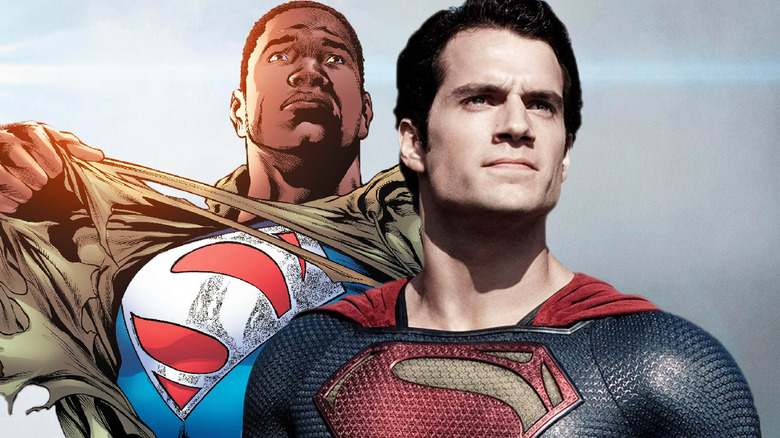
Even as Henry Cavill prepares to swing into battle in a blond wig for "The Witcher" season 2, he's still got a soft spot for another of his heroic characters: Superman. Cavill has said he'd still love to return as Clark Kent, but he's also supportive of seeing other versions of the character -- including a Black Superman.
There are actually two Black Superman projects currently in development. One is a movie, produced by J.J. Abrams' company Bad Robot and written by Ta-Nehisi Coates, which will be about Calvin Ellis, a character introduced in DC Comics as the Superman of Earth-23. The other is a HBO Max series with Michael B. Jordan ("Black Panther") attached as executive producer, which will be about Earth-2's Val-Zod, another Kryptonian hero from an alternate universe who took up the mantle of Superman after making a new home on Earth.
Given how often Hollywood projects tend to fall into development hell, especially in the delicate early stages, one or both of these projects could still end up getting canned. However, one person that's rooting for them is none other than Superman himself. In a recent profile at The Hollywood Reporter, Cavill was asked about his thoughts about the upcoming Black Superman movie. He had only positive things to say, and pointed out that there can easily be more than one Superman at the same time:
"It's exciting — Superman's far more than skin color. Superman is an ideal. Superman's an extraordinary thing that lives within our hearts. Why not have multiple Supermen going on? Joaquin Phoenix did a wonderful Joker movie; so what if it's not tied to the rest of [the franchise]? They have multiple Superman comic book storylines happening at the same time."
'Superman's Far More Than Skin Color.'
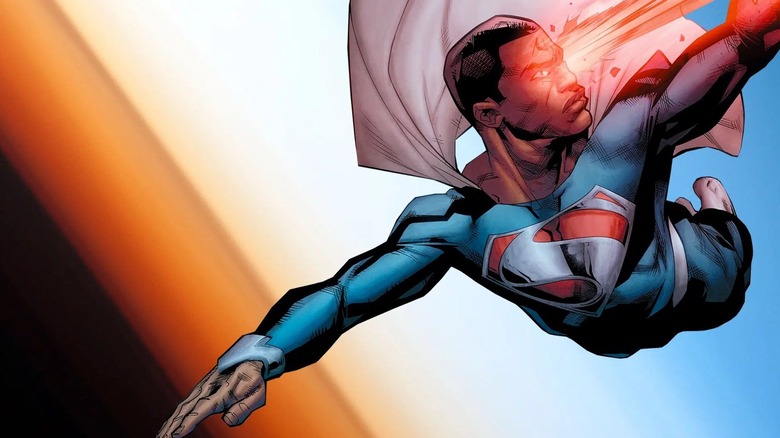
DC's parent company (currently called WarnerMedia, soon to be called Warner Bros. Discovery) was once wary of having multiple versions of the same superhero on screens at the same time. However, that's no longer the case. Grant Gustin's Barry Allen (in The CW's "The Flash" TV show) and Ezra Miller's Barry Allen (who first appeared in "Batman V Superman: Dawn of Justice" and will soon star in his own upcoming solo movie) have peacefully coexisted with ease. The CW now has its own Superman in the form of Tyler Hoechlin, introduced in "Supergirl" and now leading the cast of "Superman and Lois."
Far from diluting the appeal of superheroes, having different versions of the same character at the same time has actually become rather fashionable. "Spider-Man: Into the Spider-Verse" brought together a chaotic collection of spider-persons, ranging from an anime schoolgirl to a cartoon pig, and soon "Spider-Man: No Way Home" will also have fun smashing different Spider-Man universes together on the big screen. Meanwhile, "The Flash" will see Michael Keaton reprising his role as Batman alongside Ben Affleck's iteration of the character in its own multiverse mash-up.
As Cavill points out, having a different character taking up the mantle of "Superman" is an opportunity to explore what that name really means beyond "Clark Kent's alter ego."
Read this next: Superman Movies Ranked From Worst To Best
The post Henry Cavill Gives DC's Black Superman Movie His Blessing: 'Far More Than Skin Color' appeared first on /Film.