It’s hard to keep your company knowledge in sync across all employees when you don’t have a good way of storing and sharing information. This leads to a decline in productivity as employees spend more time searching for answers instead of working.
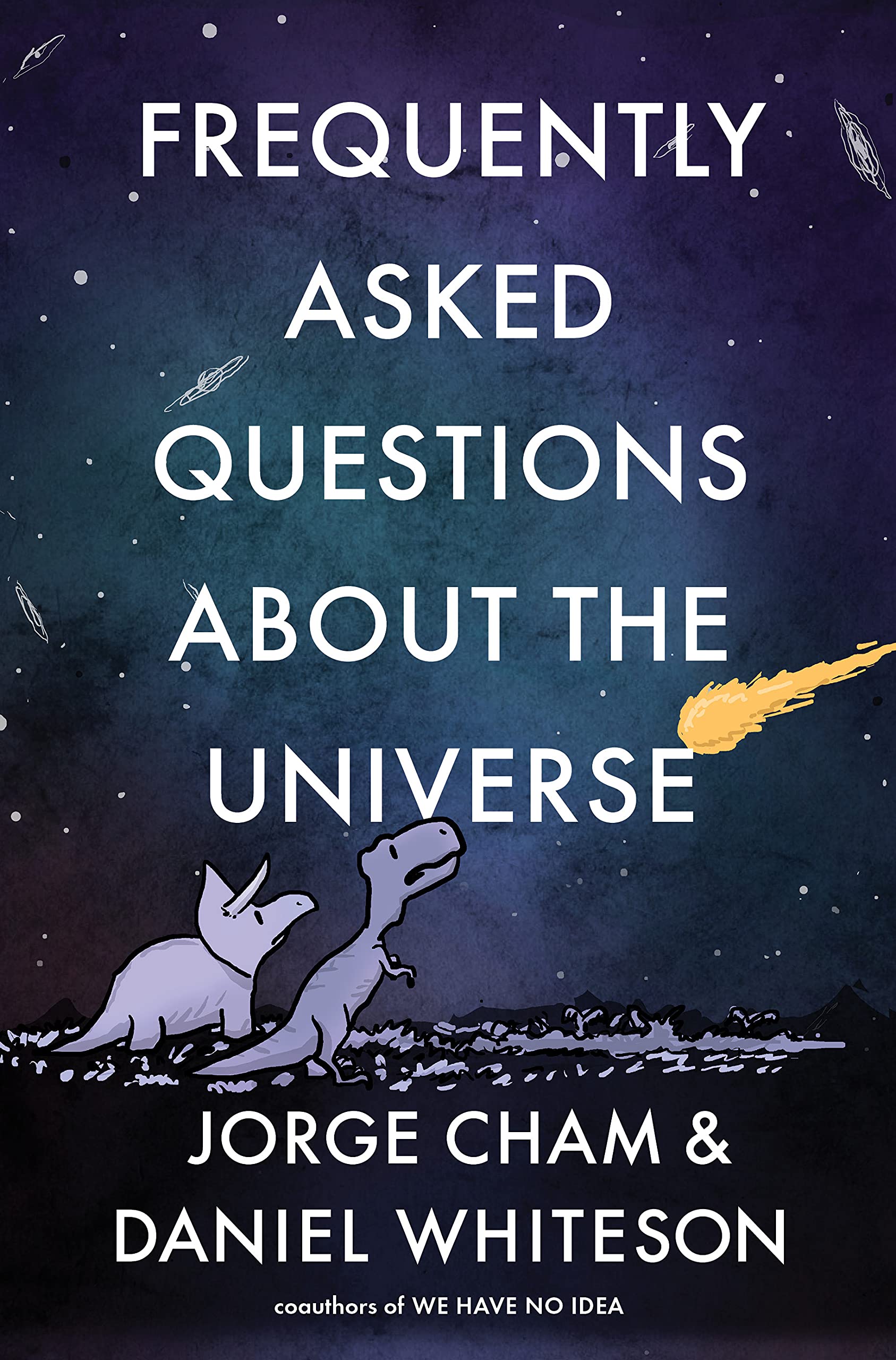
Gene Roddenberry was a man ahead of his time, accurately predicting the development of fantastical gadgets like flip phones, tablet computers, Bluetooth and bionic eyes — even tractor beams. But one technology Roddenberry called for in the 1960s has yet to make it off the screen: teleportation. It's not only that "we just don't have enough power," as Scotty would say, we also lack the fundamental knowledge base to make it a reality. For now, at least. In their latest book, Frequently Asked Questions about the Universe, Jorge Cham and Daniel Whiteson delve into this and a host of other quandaries facing humanity — from whether there's an afterlife, why aliens haven't made contact with us yet, or if our observable existence is actually a computer simulation.
If your dream of teleportation is to be here in one moment, and then be in a totally different place the next moment, then we are sad to tell you right off the bat that this is impossible. Unfortunately, physics has some pretty hard rules about anything happening instantaneously. Anything that happens (an effect) has to have a cause, which in turn requires the transmission of information. Think about it: in order for two things to be causally related to each other (like you disappearing here and you appearing somewhere else), they have to somehow talk to each other. And in this universe, everything, including information, has a speed limit.
Information has to travel through space just like everything else, and the fastest anything can travel in this universe is the speed of light. Really, the speed of light should have been called the “speed of information” or “the universe’s speed limit.” It’s baked into relativity and the very idea of cause and effect, which are at the heart of physics.
Even gravity can’t move faster than light. The Earth doesn’t feel gravity from where the Sun is right now; it feels gravity from where the Sun was eight minutes ago. That’s how long it takes information to travel the ninety-three million miles between here and there. If the Sun disappeared (teleporting off for its own vacation), the Earth would continue in its normal orbit for eight minutes before realizing that the Sun was gone.
So the idea that you can disappear in one place and reappear in another place instantly is pretty much out of the question. Something has to happen in between, and that something can’t move faster than light.
Fortunately, most of us aren’t such sticklers when it comes to the definition of “teleportation.” Most of us will take “almost instantly” or “in the blink of an eye” or even “as fast as the laws of physics will allow” for our teleportation needs. If that’s the case, then there are two options for making a teleportation machine work:
1. Your teleportation machine could transmit you to your destination at the speed of light.
2. Your teleportation machine could somehow shorten the distance between where you are and where you want to go.
Option #2 is what you might call the “portal” type of teleportation. In movies, it would be the kind of teleportation that opens up a doorway, usually through a wormhole or some kind of extradimensional subspace, that you step through to find yourself somewhere else. Wormholes are theoretical tunnels that connect points in space that are far away, and physicists have definitely proposed the existence of multiple dimensions beyond the three we are familiar with.
Sadly, both of these concepts are still very much theoretical. We haven’t actually seen a wormhole, nor do we have any idea how to open one or control where it leads. And extra dimensions aren’t really something you can move into. They only represent extra ways in which your particles might be able to wiggle.
Much more interesting to talk about is Option #1, which, as it turns out, might actually be something we can do in the near future.
Getting There at Light Speed
If we can’t appear in other places instantly, or take shortcuts through space, can we at least get there as fast as possible? The top speed of the universe, three hundred million meters per second, is plenty fast to cut your commute down to a fraction of a second and make trips to the stars take years instead of decades or millennia. Speed-of-light teleportation would still be awesome.
To do that, you might imagine a machine that somehow takes your body and then pushes it at the speed of light to your destination. Unfortunately, there’s a big problem with this idea, and it’s that you’re too heavy. The truth is that you’re too massive to ever travel at the speed of light. First, it would take an enormous amount of time and energy just to accelerate all the particles in your body (whether assembled or broken up somehow) to speeds that are close to the speed of light. And second, you would never get to the speed of light. It doesn’t matter how much you’ve been dieting or working on your CrossFit; nothing that has any mass can ever travel at the speed of light.
Particles like electrons and quarks, the building blocks of your atoms, have mass. That means that it takes energy to get them moving, a lot of energy to get them moving fast, and infinite energy to reach the speed of light. They can travel at very high speeds, but they can never achieve light speed.
That means that you, and the molecules and particles that make up who you are right now, would never actually be able to teleport. Not instantaneously, and not at the speed of light. Transporting your body somewhere that quickly is never going to happen. It’s just not possible to move all the particles in your body fast enough.
But does that mean teleportation is impossible? Not quite!
There is one way it can still happen, and that’s if we relax what “you” means. What if we didn’t transport you, your molecules or your particles? What if we just transmitted the idea of you?
You Are Information
One possible way to achieve speed-of-light teleportation is to scan you and send you as a beam of photons. Photons don’t have any mass, which means they can go as fast as the universe will allow. In fact, photons can only travel at the speed of light (there’s no such thing as a slow-moving photon).*
Here’s a basic recipe for speed-of-light teleportation:
Step #1: Scan your body and record where all your molecules and particles are.
Step #2: Transmit this information to your destination via a beam of photons.
Step #3: Receive this information and rebuild your body using new particles.
Is this possible? Humans have made incredible progress in both scanning and 3D printing technologies. These days, magnetic resonance imaging (MRI) can scan your body down to a resolution of 0.1 millimeters, which is about the size of a brain cell. And scientists have used 3D printers to print increasingly more complicated clusters of living cells (known as “organoids”) for testing cancer drugs. We’ve even made machines (using scanning tunneling microscopes) that can grab and move individual atoms. So it’s not hard to imagine that one day we might be able to scan and then print whole bodies.
The real limitation, though, might not be technological but philosophical. After all, if someone made a copy of you, would it actually be you?
Remember, there’s nothing particularly special about the particles that make up your body right now. All particles of a given type are the same. Every electron is perfectly identical to every other electron, and the same is true for quarks. Particles don’t come out of the universe factory with personalities or any sort of distinguishing features. The only difference between any two electrons or any two quarks is where each of them is and what other particles they’re hanging out with.*
But how much would a copy of you still be you? Well, it depends on two things. The first is the resolution of the technology that scans and prints you. Can it read and print your cells? Your molecules? Your atoms, or even your individual particles?
The even bigger question is how much your “you-ness” depends on the tiny details. What level of detail does it take for the copy to still be considered you? It turns out that this is an open question, and the answer might depend on how quantum your sense of self is.
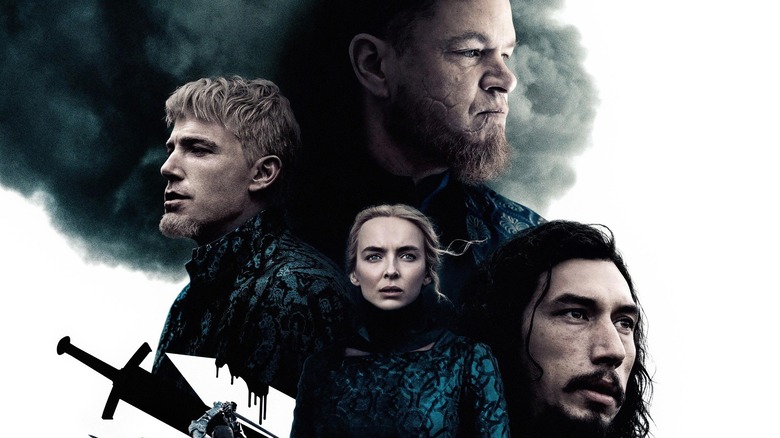
"The Last Duel" hits digital platforms later this month and is coming to physical home media in December, and there's a very good chance that most people reading this haven't seen it yet because it was a box office bomb.
The film earned strong critical notices, including a positive review from our own Marshall Shaffer. It had the added novelty, too, of offering a Matt Damon and Ben Affleck reunion, with mullets and bowl cuts and medieval garb thrown in for good measure. However, despite signs that theaters are bouncing back for some releases, that wasn't enough to lure audiences in for "The Last Duel."
Speaking to The New York Times (via Collider), director Ridley Scott addressed the commercial failure of "The Last Duel," saying:
"It was exceedingly disappointing. The fatal thing is when you think you've got it, you haven't — I thought I'd got it on 'Blade Runner' and I hadn't! I was crucified by a big critic at the time called Pauline Kael. It's why I never read critiques, ever. You have to be your own decider — if you worry about what the audience is thinking and what they may want, that's fatal. A good film will find itself, and now 'Blade Runner' is in the Library of Congress."
The Next Blade Runner Or Kingdom Of Heaven?
Scott has had his hits and misses, and sometimes the misses later became hits -- as in the case of the aforementioned "Blade Runner," which almost shut down production and was not a success upon its release. It took years to find its foothold as a cult classic and then a classic. As Scott noted, "Blade Runner" is now in the Library of Congress, and even if it weren't, time has still vindicated it as one of the greatest science fiction films of all time.
The period setting of "The Last Duel" also brings to mind "Kingdom of Heaven," Scott's 2005 historical epic, which received mixed reviews in its theatrical cut but later found renewed life as a director's cut on home media. "The Last Duel" is likewise based on real historical events, but it has a very different structure in that it employs the "Rashomon" structure of telling its story by showing different perspectives on the same events.
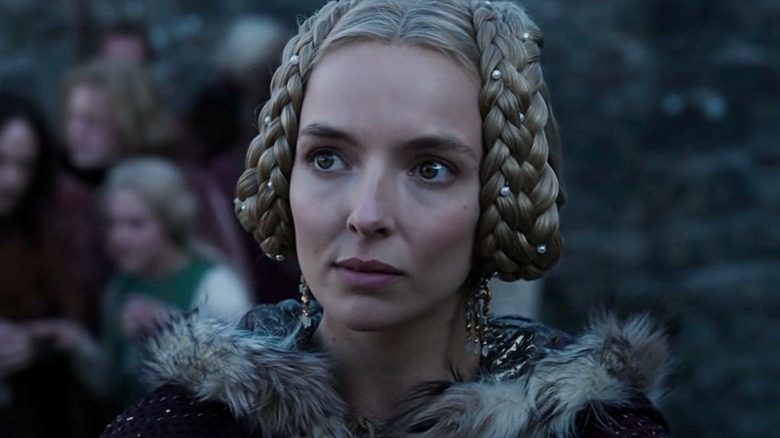
Damon's character, Jean de Carrouges, challenges Adam Driver's character, Jacques Le Gris, to a duel to the death after Le Gris rapes his wife. Jodie Comer plays Marguerite de Carrouges, who is caught in the middle of their feud in a patriarchal society where she could wind up dead if her husband loses the duel.
If nothing else, "The Last Duel" provides a break from the usual run of IP-driven films that flood the market. Hopefully, it can find more of an audience on home media, and in the meantime, Scott has "House of Gucci" and maybe even "Gladiator 2" coming.
"The Last Duel" hits digital platforms on November 30, 2021, and Blu-ray and DVD on December 14, 2021.
During the Steamworks Virtual Conference dedicated to the Steam Deck, Valve shared a lot more information on the hardware of its upcoming PC handheld system.
To begin with, we learned that the custom SoC used in the Steam Deck is codenamed Aerith. The APU block, a combination of AMD's Zen 2 and RDNA2 technologies, was specifically designed to accommodate the low target requirement for power (the TDP is 4-15W). In the dedicated Steam Deck hardware presentation, Valve engineer Yazan Aldehayyat explained:
What's truly novel about our processor is that was designed from the ground up to be optimized for the 4 to 15 watt power envelope available to us in this form factor. The one major takeaway that I'd like to leave you with today is that the level of performance per watt we were able to achieve with this processor would simply not have been possible using any off-the-shelf processor that exists today.
Still, there's no hard limit on how much power can be consumed by the Steam Deck, which is why Valve recommends that developers add a frame rate limiter to their games. Even if they don't, a global frame rate limiter is in the works so that users may eventually get to pick the optimal balance between performance and battery life that suits their needs.
The CPU and GPU clocks are relatively low because Valve expressly wants gaming performance to be consistent in all scenarios. As such, they've avoided adopting turbo boost technologies such as those used in laptops or smartphones.
Aldehayyat then proceeded to discuss the reasons for going with LPDDR5 memory.
The first one is memory bandwidth. Our APU runs at 128-bit wide memory bus at 5.5 GHZ; this combines to a total of 88 GB/s worth of bandwidth, which if you compare on a per teraflop basis, actually exceeds a lot of dedicated desktop-grade GPUs.
The other advantage to LPDDR5 is power efficiency. It offers a lot of great power-saving features that truly manifest themselves in low power scenarios like 2D games, idle, and sleep.
The 16GB of memory are unified, as expected. Aldehayyat noted that most Steam games currently run fine on 8 or 12GB, but Valve desired the Steam Deck to be future-proof, which is why the company chose to add more memory.
The presentation ended with an early comparison of the differences between the various storage options available for the Steam Deck. As you can see in the benchmark below, the cheaper 64GB eMMC predictably loads and boots slower than the 512GB NVMe SSD, but the gameplay experience shouldn't suffer too much even when picking the eMMC.
That's not all we learned about the PC handheld system. In the Q&A section of the APU deep dive with AMD, Sebastian Nussbaum (Corporate VP of Product and Technologies at AMD's Semi-Custom Business Unit) confirmed that FidelityFX Super Resolution will be introduced at an OS level in a future Steam Deck update. This means users will be able to enforce FSR in games that don't have native support for it.
The team agreed that if a game runs well on this mini-PC at 1280 x 800, it will definitely run well on Steam Deck - compared to Steam Deck, this system's GPU is weaker and there's less memory bandwidth, but the CPU is a bit stronger. It's underpowered compared to Steam Deck, but is the closest system we could find that is still generally available for purchase.
As a reminder, the Steam Deck's debut was recently delayed to February 2022 due to components failing to reach manufacturing facilities in time for the previous December 2021 launch window.
(Welcome toThe Daily Stream, an ongoing series in which the /Film team shares what they've been watching, why it's worth checking out, and where you can stream it.)
The Movie: "F.T.A."
Where You Can Watch It: Netflix
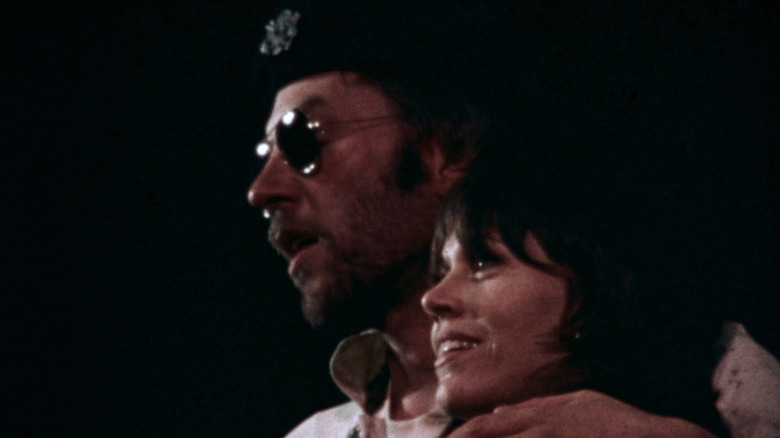
The Pitch: Want to see how a movement catalyzes and spreads without social media? Or perhaps you're old enough to remember old-school pamphlet disseminations and secret coffeehouses used for resistance planning. Either way, "F.T.A." is a fantastic, raw glimpse into the G.I. anti-war movement of the '60s and '70s. Filmed with a bare-bones production and directed by Francine Parker, the film is a concert documentary following the Pacific leg of an anti-war roadshow for American troops, with headliners Jane Fonda and Donald Sutherland (who had just made the immaculate Allan Pakula thriller "Klute" the year prior).
The movie, featuring sketches mocking the arrogance of military brass and folk songs supporting dissenters, was released in 1972, just before Fonda made the infamous trip to Hanoi that complicated her reputation for decades to come. Naturally, "F.T.A." got some heavy flack upon release, and was pulled from theaters under "mysterious circumstances," according to filmmaker David Zeiger. Zieger wrote, directed, and produced a more broad account of the G.I. resistance movement in his 2005 documentary "Sir! No Sir!," which is also streaming on Netflix for a fine double feature.
Why It's Essential Viewing
My Dad is a WWII history buff, so anytime Time Magazine put out one of their special war-centric issues, there was immediately a copy on the coffee table in our home. I remember reading about the old USO tours they'd have with The Andrews Sisters singing "Boogie Woogie Bugle Boy" for the troops, and Bob Hope would crack a joke or two for morale. But this -- this is something else.
Remember, many of the troops in Vietnam weren't thrilled to be there, they were conscripted. They were too poor to get a college deferment. They were working-class, and people of color. And during the Vietnam conflict, many of these folks faced oppression back home. So instead of The Andrews Sisters, audiences got a Murderer's Row of talent -- Fonda, Sutherland, Michael Alaimo, Len Chandler, Paul Mooney, and Peter Boyle are in the troupe, among others -- to perform songs, poetry, and skits in support of them and everything they're dealing with, while denouncing the war they've been voluntold to fight in the first place. The F.T.A. Show -- ostensibly "Free The Army," but we know what the F is really for -- aimed to show G.I.s that, according to their mission statement, "if there is to be an end to the U.S. military involvement in South East Asia — an end to the war — it is they who must end it."
Bare-bones on the production level but explosive in its energy, "F.T.A." is a fascinating peek into an era when you had to do more than retweet to spread the message.
"The Lord of the Rings" trilogy is among the most perfect movie trilogies of all time. Against all odds, Peter Jackson's meticulous adaptation of J.R.R. Tolkien's beloved trilogy of novels lived up to the significant hype, pleasing both fans of the books and complete newcomers. Tolkien spent years crafting the languages, characters, creatures, history, and mythology of Middle-earth, and Jackson showed a similar attention to detail when he brought the sprawling story to the big screen. The films were shot back-to-back in Jackson's home of New Zealand, where the incredible crew took on the challenge of bringing Middle-earth to life.
It's tough to determine which of the three films is the best. "The Fellowship of the Ring" is a wonderfully patient beginning that shows how the innocent characters are forced to adjust to the dangerous quest. "The Two Towers" is a war epic showing the human and political binds of conflict. "The Return of the King" is a jaw-dropping conclusion that wraps up all the story threads in a satisfying way. Upon release, the entire trilogy received critical acclaim and broke box office records, and remains a favorite to this day.
The success of the "The Lord of the Rings" trilogy showed that audiences' interest in fantasy films was high. Epic quests featuring brave heroes, fearsome villains, and exotic creatures are inherently cinematic, and while "The Lord of the Rings" films are the high point of the entire genre, the following movies are also definitely worth watching.
Willow
One lifelong fan of J.R.R. Tolkien's novels was George Lucas, who was inspired by Tolkien's writing when he created "Star Wars." Later, Lucas decided that he wanted to reinvent the fantasy genre for a new generation, the same way he had relaunched science fiction with "Star Wars" and adventure serials with "Indiana Jones." Drawing on a script he'd written in the '70s called "Munchkins," Lucas enlisted his former "American Graffiti" star Ron Howard to help him craft an original fantasy hero.
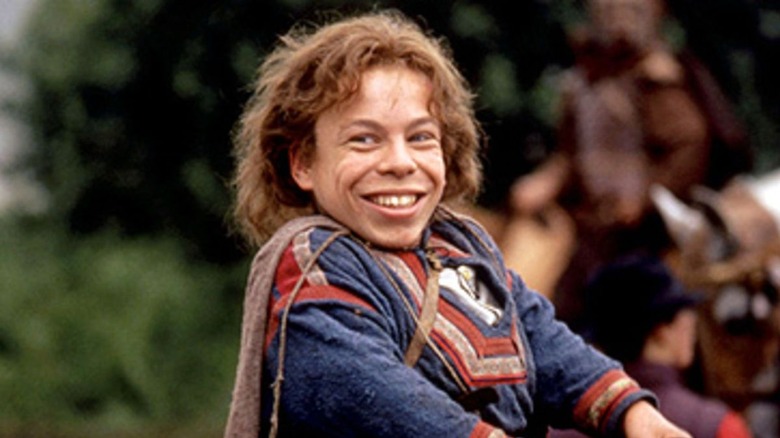
Like Jackson's WETA team committed to building a fantasy world in precise detail with "The Lord of the Rings," Lucasfilm was intent on creating a distinct mythical world from the ground up. In the film, a hobbit-like Nelwyn, Willow (Warwick Davis), is a father in a small, innocent village similar to the Shire. When the Nelwyn discover an infant child has washed up on their shores, the mercenary Madmartigan (Val Kilmer) approaches them and offers to take the baby himself. Willow refuses, and decides to return the baby home himself.
Willow learns that the child will fulfill a prophecy that will vanquish the wicked Queen Bavmorda of Nockmaar (Jean Marsh), and that the evil monarch is searching throughout the Mother World for its location. Bavmorda's daughter Sorsha (Joanne Whalley) tracks Willow down, but Madmartigan offers him protection. Willow and Madmartigan have a fun relationship, similar to that of Aragorn and the Hobbits.
Dragonslayer
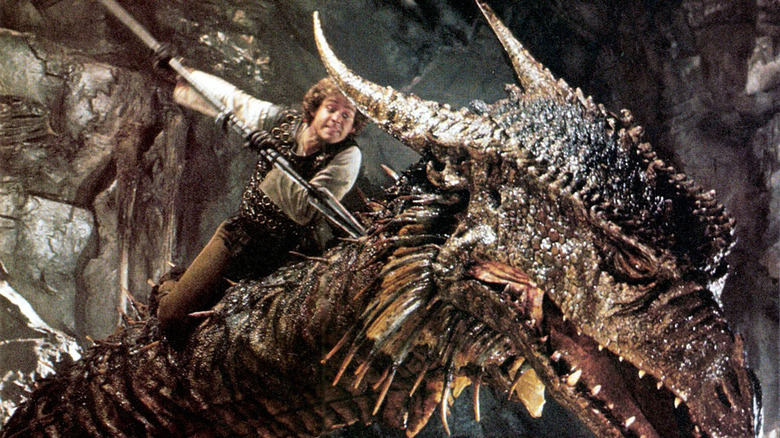
The fantasy genre was successful in the 1980s, but there were a few notable box office disappointments. Chief among them was 1981's "Dragonslayer." It's unfortunate that the film underperformed financially and failed to launch a franchise, because Matthew Robbin's sword-and-sorcery epic is a beautifully crafted visual spectacle with one of the greatest cinematic dragons of all-time, rivaling the winged creatures ridden by Tolkien's Nazgul. Like "The Lord of the Rings," "Dragonslayer" follows an unlikely hero who must contend with a cruel world that he's never been exposed to, and his innocence makes the story much more heartwarming.
In the medieval kingdom of Urland, the young magical acolyte Galen Bradwarden (Peter MacNiccol) trains under the ancient wizard Ulrich of Cragganmore (Ralph Richardson). Ulrich hones Galen's abilities as the 400-year-old dragon Vermithrax Pejorative terrorizes larger castles. In order to stop his city from being destroyed, King Casiodorus (Peter Eyre) sacrifices two young virgin girls to the dragon every year. He seeks Ulrich's help in taming the beast, and dispatches his ruthless warrior Tyrian (John Hallam) to recruit the elderly man. Tyrian murders Ulrich, leaving Galen with the responsibility of saving the entire kingdom.
Galen falls in love with the young warrior Valerian (Caitlin Clarke), who joins him on the quest to slay Vermithrax Pejorative. Valerian disguises herself as a man, but once her deceit is revealed she fears that she could be selected for sacrifice by the king. Their romance is earnest, and their duel with the dragon is one for the ages.
The Seventh Seal
"The Lord of the Rings" is a very reflective trilogy, with meditations on the ramifications of death that expose a mature side of the fantasy genre. While sagas like "The Witcher" and "Game of Thrones" frequently shock viewers with quick, surprising character deaths, each loss in "Lord of the Rings" is a pivotal moment in the story, and the films give the other characters time to mourn. It's the corruption, fall from grace, redemption, and ultimately heroic demise of Boromir (Sean Bean) that shatters the group at the end of "The Fellowship of the Ring," and the loss of the noble Gondorian warrior has major ramifications throughout the trilogy.
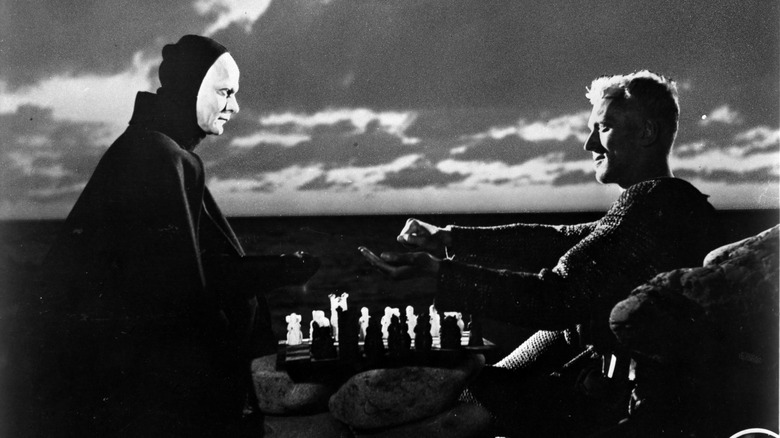
Similarly, Ingmar Bergman's classic "The Seventh Seal" explores the very nature of death in vivid detail. Few images in sword-and-sorcery cinema are quite as iconic as the chess match from Bergman's 1957 masterpiece. The film follows key conversations between the noble knight Antonius Block (Max von Sydow) and Death (Bengt Ekerot) himself as they match wits on a secluded beach.
Block returns from fighting within the Crusades, where he's seen his fair share of bloody brutality, and finds that the home that once provided comfort has been ravaged by the Great Plague. He attempts to survive his encounter with the cloaked figure for as long as possible, and their game lasts for the entirety of the film. It's a great introduction to Bergman, especially for younger film fans interested in the fantasy genre.
The Sword In The Stone
While Tolkien was outwardly dismissive of Arthurian legends, it's not hard to see links between "The Lord of the Rings" and the mythology of Camelot, and the story of King Arthur has had a profound influence on the fantasy genre as a whole. Appropriately, Arthur has been depicted countless times on screen, and some adaptations are better than others. Guy Ritchie tried his hand recently with the stylized, action-oriented Charlie Hunnam vehicle "King Arthur: Legend of the Sword," and Antonie Fuqua attempted to take a more realistic look at the legend with Clive Owen in "King Arthur." Arthur's adventures have been adapted into various genres: 1975's "Monty Python and the Holy Grail" is one of the greatest spoof movies of all time, while 1995's "First Knight" approached the fable as a '90s romantic melodrama, centering on the love triangle between Arthur (Sean Connery), Lancelot (Richard Gere), and Guinevere (Julia Ormand).
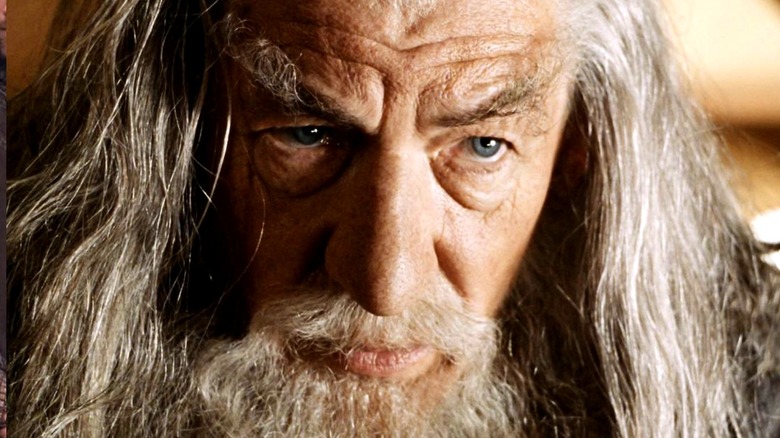
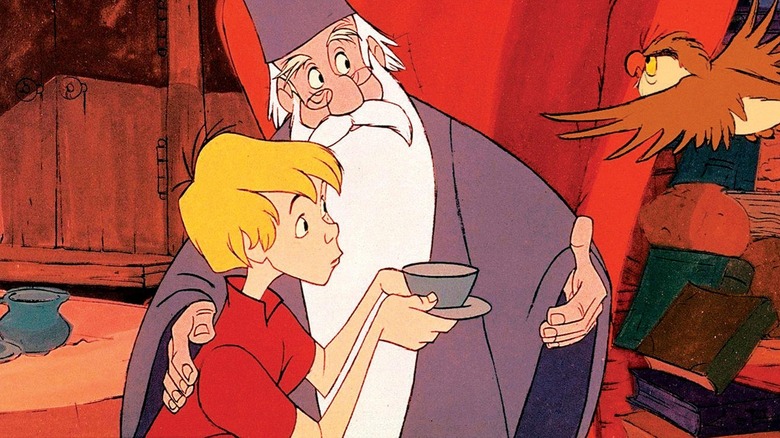
However, these adaptations all tend to center on Arthur's later exploits during the Crusades, and highlight the adventure aspects. Disney's animated classic, 1963's "The Sword in the Stone," looked at Arthur's origins, back when the future king was once a meek and innocent child similar to Frodo Baggins. Like Frodo, the young squire dreams of faraway adventures, but doesn't seek out glory or violence. His inherent goodness is what makes him worthy of lifting the sword Excalibur from the stone, similar to the reasons why Gandalf selects the naive Frodo to carry the burden of the One Ring.
The Dark Crystal
One of the reasons why "The Lord of the Rings" was so successful was the meticulous detail paid to creating the world of Middle-earth from scratch. Every location, from the welcoming and homely Shire to the epic kingdoms of Gondor and Rohan, was built from scratch in New Zealand and imbedded with latent details that pleased Tolkien enthusiasts. Anyone who's viewed the extensive collection of behind-the-scenes featurettes on the extended edition DVDs and Blu-rays knows of the breathtaking task that the crew took on; there are even small touches, like the interior linings of characters' jackets, that viewers couldn't possibly pick up on.
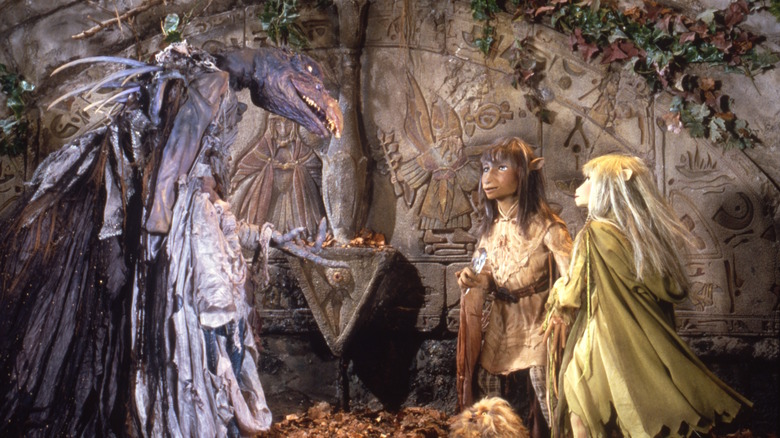
"The Muppets" creator Jim Henson showed a similar diligence with his 1982 dark fantasy epic "The Dark Crystal." Henson is one of the great pioneers of puppetry, and while the success of "The Muppet Show" proved that he could tell stories that appealed to both children and adults, Henson had more ambitious goals in mind. He wanted to create a world devoid of any humans entirely. As such, "The Dark Crystal" is set in the mythical world of Thra, where the titular crystal was shattered and the land forever divided between two races, the power-hungry Skeksis and the peaceful uRru Mystics.
The Skesis seek the Crystal in order to receive eternal life, where the Mystics only use it for good. Meanwhile, the diminutive Gelflings play a role similar to the hobbits, with an innocence that belies the great strength they exhibit when the fate of the world falls on their shoulders.
Labyrinth
Fantasy films can become so obsessed with building out their mythology that the characters become secondary. Tolkien subverted these concerns by finding a great framing device for "The Lord of the Rings" by telling the story through Frodo's perspective; ultimately, it's a coming-of-age story. The innocent hobbit characters are clearly inspired by the young British soldiers of World War I (which included Tolkien) who were forced to leave their homes and become heroes. Frodo's sensitivity to cruelty makes him an engaging hero, and he develops a more mature worldview as he's exposed to the different sides of Middle-earth.
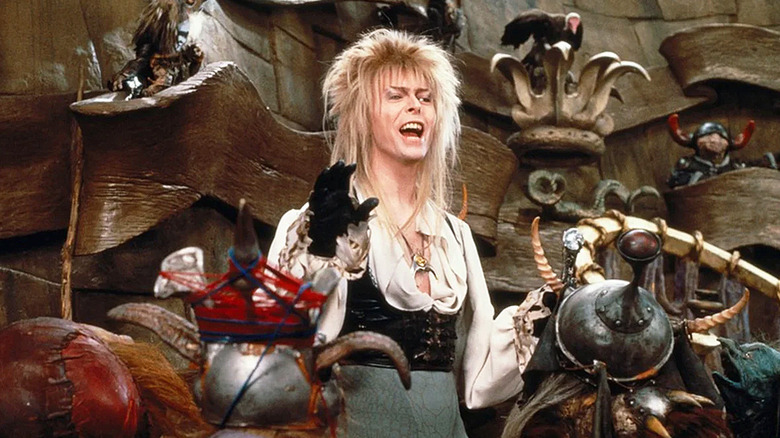
Jim Henson also focused on the coming-of-age aspect of the heroic journey with his 1986 film "Labyrinth." "Labyrinth" contains enough overt adult themes that it's hard to consider it a traditional fairy tale, despite the young protagonist. The film follows Sarah (Jennifer Connelly) as she enters a mysterious maze in search of her infant half-brother, Toby. Sarah's journey to escape the labyrinth represents her transition to adulthood, and she's riddled with guilt about her prior desires for Toby to disappear.
Like "The Dark Crystal," "Labyrinth" features the incredible puppetry of Jim Henson's Creature Shop. The film is best known for the memorable performance by David Bowie as the main villain Jareth, the Goblin King who kidnapped Toby. Bowie helped develop the film's soundtrack, and wrote the songs "Underground", "Magic Dance", "Chilly Down", "As The World Falls Down" and "Within You" exclusively for the film.
King Kong
"The Lord of the Rings" was renowned for its practical effects and real sets, but it also featured some of the most cutting-edge developments in the history of computer-generated imagery. Chief among them were the advancements in motion capture and the creation of Gollum, played by Andy Serkis in a role that brought respect to the craft. While Jar Jar Binks became the first fully CG supporting character ever in "Star Wars: Episode I — The Phantom Menace" a few years prior, Serkis' performance was unprecedented. He showed that mo-cap was a viable acting pursuit, and that it could result in a memorable character who was unique, tragic, and terrifying all at once.
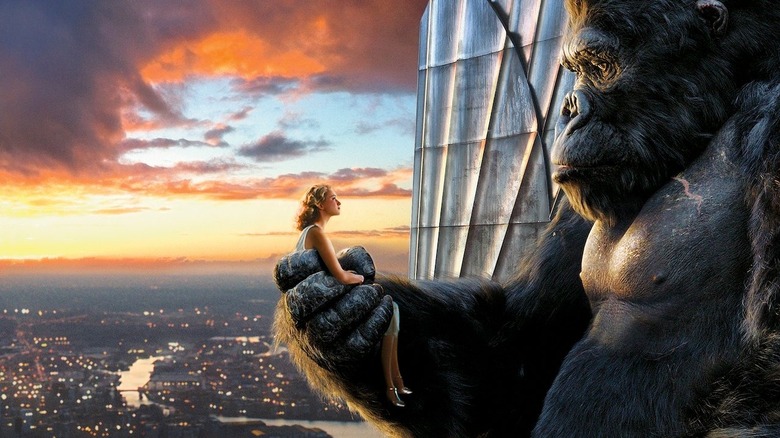
Serkis would only continue to pioneer motion capture performances, and right after "The Lord of the Rings" he re-teamed with Peter Jackson to explore one of the most famous movie monsters of all time. Jackson has often cited the original 1933 "King Kong" as his favorite film, and his 2005 remake is a sensitive reimagining that pays tribute to the groundbreaking classic. However, Jackson's film spends more time with the titular ape himself, and Serkis makes Kong a compelling character capable of expressing a variety of emotions. His unique mannerisms and expressions make the conclusion even more tragic.
Like "The Lord of the Rings," Jackson knew he was taking on material with a loyal fanbase, and he spared no expense in building detailed sets and designing a complex, fully-realized world to bring Skull Island to life.
Highlander
The pressures of immortality are ever present throughout "The Lord of the Rings." Arwen (Liv Tyler) is warned by her father Elrond (Hugo Weaving) that a marriage to Aragorn is bound to leave her heartbroken, as she must either forsake everlasting life and choose mortality or live with the knowledge that, despite his extended life, the Gondorian ranger will ultimately die and leave her to raise their child alone.
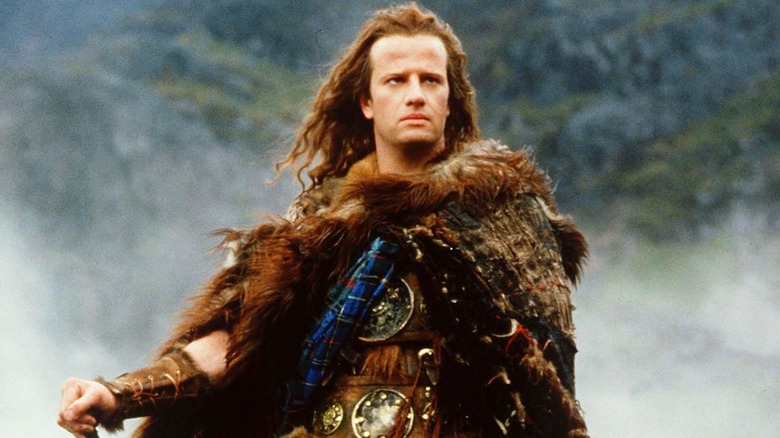
1986's fantasy-action film "Highlander" is best remembered for its fight sequences, but the film's depiction of immortality is surprisingly nuanced. The 16th-century Scottish warrior Connor MacLeod (Christopher Lambert) becomes a hero in his village thanks to his heroism fighting the wicked Fraser Clan. Connor falls in love with Heather McLeod (Beatie Edney), but his happy home life is quickly shattered when Heather is killed and the village is massacred. Connor tracks his nemesis, the Kurgan (Clancy Brown), throughout history, ultimately battling him in modern day New York. Like "The Lord of the Rings," "Highlander" uses a creative way of integrating flashbacks to make the story more emotional.
Gandalf is one of the greatest mentor characters in all of storytelling, and "Highlander" also has a great wise older figure. Sean Connery gives one of his best performances ever as the immortal Egyptian warrior, Juan Sánchez-Villalobos Ramírez.
Inkheart
In the wake of the unprecedented success of "The Lord of the Rings," many fantasy films based on beloved novels aimed to create similarly successful franchises. Unfortunately, many of these films bombed, and audiences looking to diversify their fantasy viewings ultimately turned to television shows like "Game of Thrones." Many of these botched franchise ventures weren't good enough to justify multiple entries; after the disastrous first films, no one was asking for a sequel to "Eragon," "The Dark Tower," or "The Giver." However, 2008's "Inkheart" is worthy of critical reappreciation, as, despite its financial failure, the film has a lot of merit.
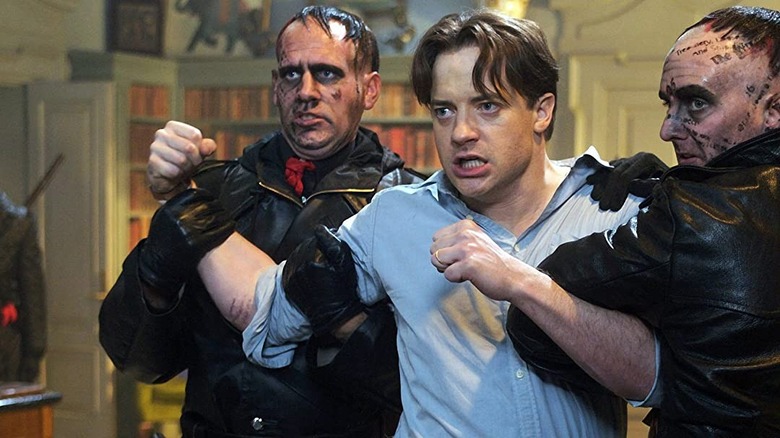
"Inkheart" is based on a trilogy of novels by Cornelia Funke. It follows book lover Mortimer Folchart (Brendan Fraser), who loves exploring fairy tales with his beloved wife, Resa (Sienna Guillory). After reading an old copy of a book called "Inkheart" out loud, Resa is transported into the fantasy world depicted in its pages, while the fire-wielding Dustfinger (Paul Bettany) appears in the real world. Both Mortimer and Dustfinger are heartbroken when the spell can't be reversed, separating them both from their true loves.
Mortimer travels the world in search of another copy of "Inkheart," and gradually reveals the magical events to his 12-year-old daughter Meggie (Eliza Bennett). Meggie is a great audience avatar, as she learns about the "Inkheart" world at the same time that viewers do.
The Green Knight
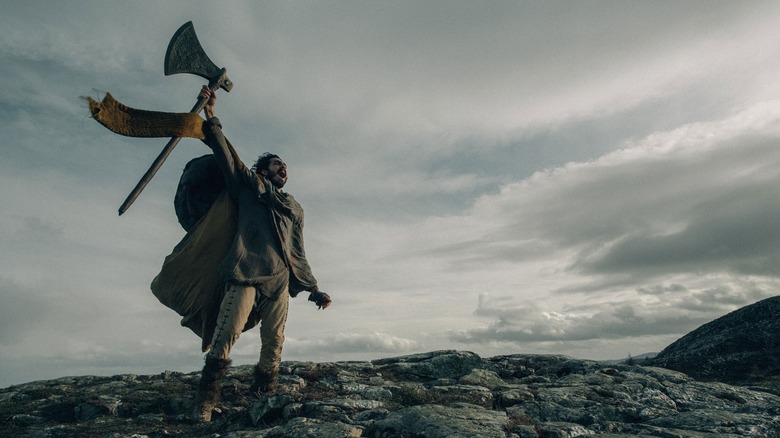
"The Lord of the Rings" isn't just one of the most sweeping, epic adventures in film history, but a visual delight. The beautiful imagery from cinematographer Andrew Lesnie illuminated the gorgeous environments in immaculate detail, and few modern fantasy films have been able to capture the same depth or luster. However, in 2021, the brilliant writer-director David Lowery created a breathtaking visual journey with his reimagining of Arthurian mythology in "The Green Knight." With themes of mortality, nobility, and the traumas of heroism, "The Green Knight" is both a thematic and visual cousin of "The Lord of the Rings."
Based on the 14th-century poem "Sir Gawain and the Green Knight," a work that Tolkien himself translated to great acclaim, the film follows the adventures of King Arthur's nephew (Dev Patel). The brash young Gawain is noble but reckless, and endangers Camelot after he attempts to slay the fearsome Green Knight (Ralph Ineson). The Green Knight survives a beheading and promises he will return to Camelot the following year if Gawain does not seek him out and offer his own head in return.
Camelot
Music is an integral part of "The Lord of the Rings." Outside of the great score by Howard Shore, the films incorporate beautiful songs with moving lyrics, including "Into the West" and "May It Be." Each kingdom has a distinct musical theme, and one of the most touching scenes in "The Return of the King" is when Pippin sings "Edge of Night" as Faramir and the Gondorian warriors ride into battle. Medieval fantasy and music go hand in hand, and no film depicts their close-knit relationship better than the 1967 adaptation of the stage musical "Camelot."
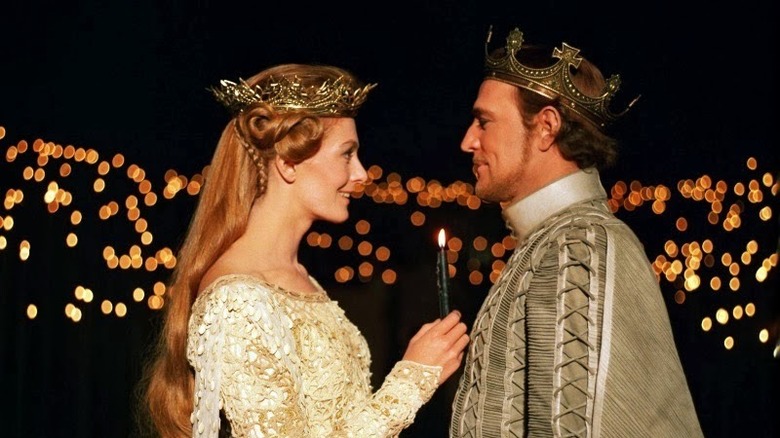
"Camelot" is among the better Arthurian adaptations, and earnestly explores the forces that cause the great kingdom to split apart and the Knights of the Round Table to fade away. Arthur (Richard Harris) is infatuated with the young Guinevere (Vanessa Redgrave), and they have a happy marriage outside the palace grounds. However, Guinevere grows charmed by the advances of Arthur's most noble knight, Lancelot (Franco Nero), while the vengeful Mordred (David Hemmings) conspires to mount a scandal.
Hook
Just because a fantasy film contains epic action doesn't mean it can't also have a good sense of humor. "The Lord of the Rings" trilogy is often quite funny, as the beloved characters engage in humorous banter in even the deadliest of circumstances. Merry and Pippin in particular add comic relief, and the competitive spirit between Legolas and Gimli spawns many great one-liners. Steven Spielberg's 1991 film "Hook" may technically be a comedy, but it boasts an ambitious scale that's in line with Jackson's. Spielberg finds the right balance between farcical fairy tales and genuine suspense.
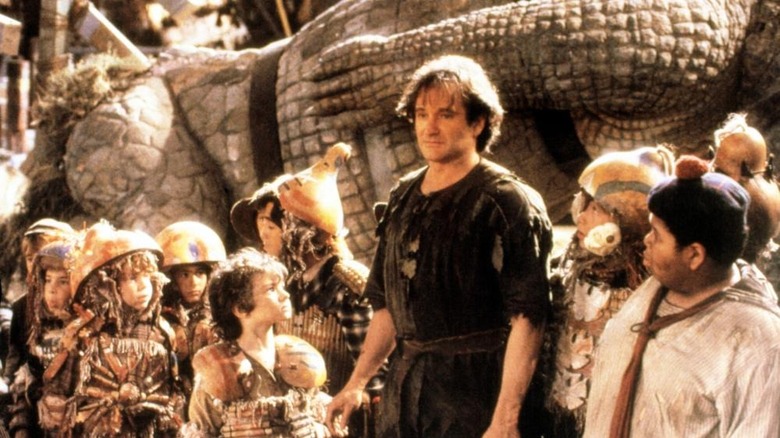
"Hook" explores the later years of Peter Pan (Robin Williams), who left Neverland years ago and now lives a boring everyday life as a lawyer. Peter is called back to his old home when his children are kidnapped by his old nemesis Captain Hook (Dustin Hoffman). Peter has now forgotten about his old adventures, but he teams up with a new generation of Lost Boys to reclaim his past and rescue his family.
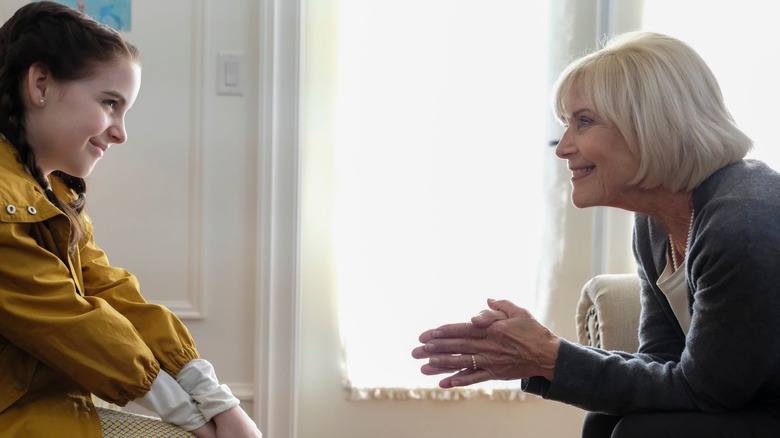
"The Bad Seed," the 2018 Lifetime remake of the '56 stage play adaptation of March's book (whew!) is getting a sequel, and Grace will be returning in the title role of Emma Grossman (an update to Rhoda Penmark of LeRoy's big-screen adaptation). According to Deadline, Mckenna Grace (Annabelle Comes Home, Ghostbusters: Afterlife) co-wrote the script with her father, Ross Burge, and the 2018 film's writer, "Wish Upon" screenwriter Barbara Marshall. Louise Archambault ("Catastrophe") is attached to direct. Grace also executive produces the film along with her parents, Crystal and Ross Burge, as well as "The Bad Seed" (2018) executive producer Mark Wolper.
The synopsis, as Deadline reports:
15-year-old Emma, a seemingly typical teenaged girl who is anything but that. Set several years after the murderous events of the first movie, which left her father (Lowe) dead, Emma is now living with her aunt Angela and navigating high school. Angela's husband begins to suspect that Emma may not be as innocent as she appears and suggests sending her off to boarding school. Meanwhile, a new girl at school seems to know Emma's secrets, leaving Emma no choice but to slip back to her old ways and take care of her enemies by any means necessary.
Censorship Kills Cinema
Let's start at the beginning, here.
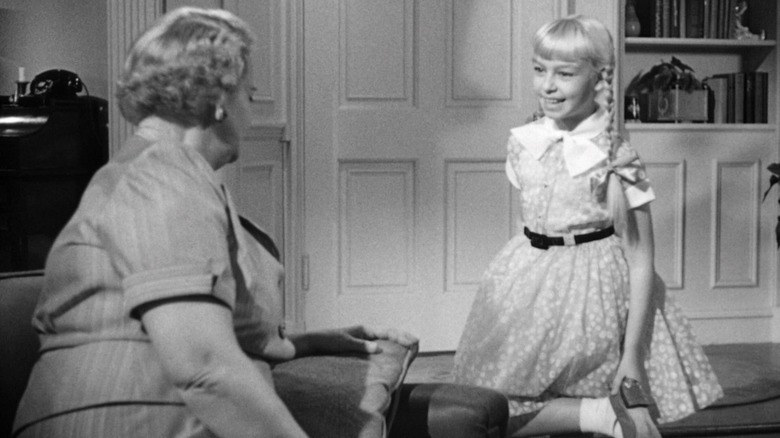
First, there was the book. William March's 1954 American novel "The Bad Seed" focuses on a mother's realization that her little girl is a cold-blooded killer -- sort of the opposite of Lynne Ramsey's "We Need To Talk About Kevin." The book then became a stage play by Maxwell Anderson, and then John Lee Mahin adapted the play into a 1956 film. This film, directed by Mervyn LeRoy and starring Nancy Kelly and Patty McCormack, is the one most folks have seen.
A made-for-tv remake, directed by Paul Wendkos, aired on ABC in 1985. In 2018, a Lifetime remake dropped, directed by Rob Lowe ("Parks & Recreation") and starring Mckenna Grace ("Ghostbusters: Afterlife") and Lowe. And this is where we are today.
The 1956 version enjoys a strong spot in the horror fandom consciousness, despite its wonky ending. Both March's novel and the stage play end with the death of Rhoda's mother, Christine, and she cunningly survives to terrorize another day. The Motion Picture Production Code had beef with this, as they decreed that crime must always be punished and the bad guys can't get away with it, otherwise, it's some kind of endorsement of their behavior (one glance at social media reviews of any horror movie, and some things never change, do they?). To appease censors, the ending was changed to Rhoda literally being struck by lightning. It marred an otherwise amazing film, but the 2018 remake course-corrected the ending, allowing young Emma to live another day. Over here, we're excited to see if they go the extra step and anger the television powers-that-be.
"The Bad Seed" sequel will premiere on Lifetime in 2022.
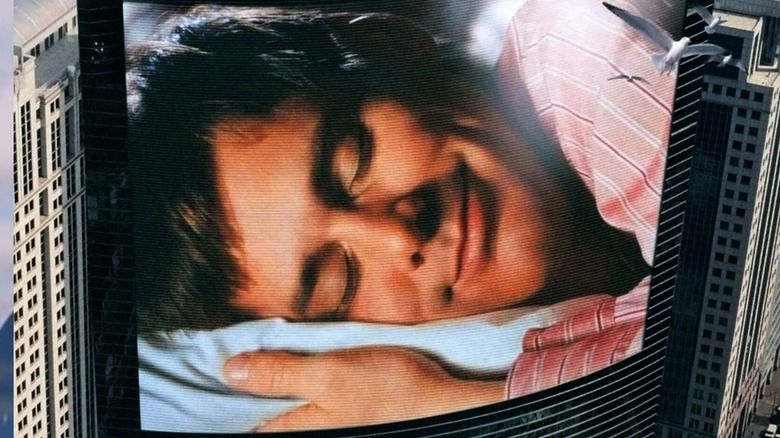
"The Truman Show" is one of the most unique films of the '90s. While the film is witty and deeply satirical of the American public's obsession with television and celebrity, it also explores dark psychological themes of paranoia, neglect, and self-sacrifice. The film's 1998 release came at the height of Jim Carrey's career, as he had appeared in a series of comedy hits that made him one of the biggest stars in Hollywood. With "The Truman Show," Carrey proved that he had a dramatic side as well, and gave a sensitive, mature performance.
Carrey stars as Truman Burbank, the unknowing star of the world's most popular television series, "The Truman Show." The show is syndicated as a 24-hour program that shows every aspect of Truman's existence with complete authenticity, as Truman is deceived into thinking that he lives a normal life. However, Truman's hometown is a giant set populated with actors who play the residents. The series' creator Christof (Ed Harris) manipulates events from afar, and controls the storyline. Truman begins to question the nature of his reality as he witnesses a series of strange occurrences and finds that he's unable to leave, despite his dreams of traveling to Fiji.
Truman's journey to break free from the show is both amusing and heartbreaking. It's humorous to see how the "Truman obsession" sweeps the nation, but Truman's sense of futility is dramatically conveyed. "The Truman Show" was ahead of its time, and its themes are still relevant today; if you loved "The Truman Show," then these other films are definitely worth watching.
Liar Liar
The dramatic weight of "The Truman Show" came as a shock to Carrey fans considering his comedy background, but Carrey's skills aren't limited to the type of one-liners that most mainstream movie stars routinely deliver. His genius is in his ability to create compelling characters trapped in extreme circumstances. Carrey's most memorable roles, both comedic and dramatic, are those where he's dealing with an impediment that can't easily be explained. Whether it's watching his memories fade in "Eternal Sunshine of the Spotless Mind," donning the persona of a wacky superhero in "The Mask," or just being a dimwit in "Dumb and Dumber," Carrey can humanize characters that an audience wouldn't normally relate to.
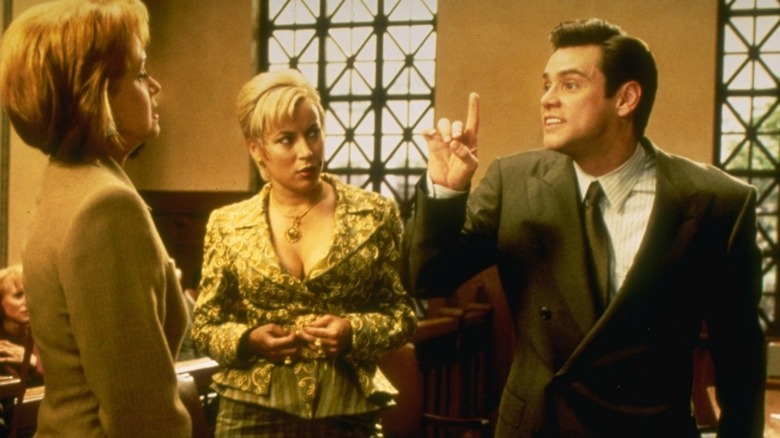
"Liar Liar" features one of Carrey's most wildly eccentric performances, and it's a case where he elevates the material; the script itself is predictable and fairly saccharine, but Carrey's complete commitment to the absurdity makes the studio comedy much more interesting than it would be otherwise. He stars as Fletcher Reede, a shady lawyer who couldn't give straight facts to save his life. Fletcher's only redeeming factor is his love for his young son Max (Justin Cooper), but the only thing Max wants is for his father to be honest.
Max gets his wish when Fletcher is cursed to only tell the truth, and his entire world changes overnight when he starts being honest with his clients. Whether it's a nasty insult or an emotional confession, Fletcher is forced to pour his heart out.
Man On The Moon
"The Truman Show" was the perfect role for Carrey because he got to merge his dramatic and comedic sensibilities. While the situation Truman is dealing with is traumatizing and leaves him paranoid, neglected, and misunderstood, many of the outrageous situations the television show forces him into are amusing. In particular, Truman is confused about the constant product placement in his daily life, as the show incorporates in-world advertising since it doesn't take commercial breaks. Truman is giving a performance and selling ads, even when he doesn't realize it.
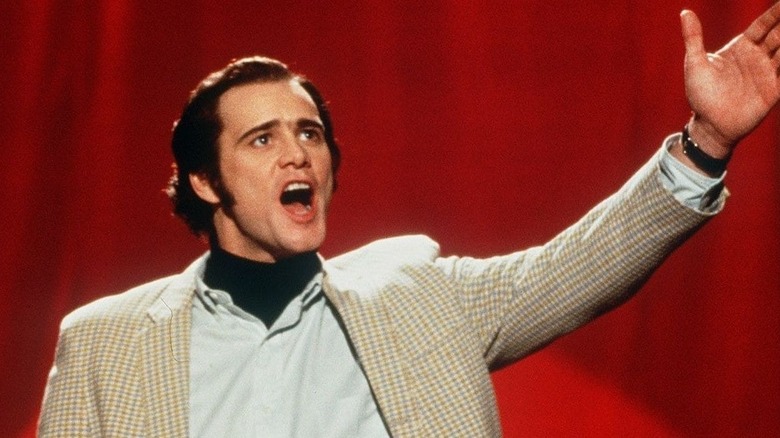
Carrey followed up "The Truman Show" with another great performance during which he also mixed genres. "Man on the Moon" sees him play the ultimate performer: experimental comedian Andy Kaufman. Kaufman was notorious for never breaking character, and kept gags running over several years without informing the audience. Unbound by the standard definitions of comedy, Kaufman felt out of place on the network sitcom "Taxi," where he was forced to deliver studio-mandated gags and one-liners. He developed a unique brand of anti-comedy and was unafraid to play the villain; his comments about women were often vile, and he maintained a recurring rivalry with WWE's Jerry Lawler.
It's a challenging part that only Carrey could have played. Truman struggles because his sincerity is witnessed by a returning audience every week, yet Kaufman has the opposite problem: When he's diagnosed with terminal cancer, he can't get anyone to take him seriously.
Network
"The Truman Show" feels relevant to this day for its sharp satire of media overconsumption from the American public. Throughout Truman's adventures and discoveries, the film cuts to various viewers who base their whole lives around watching him. Director Peter Weir depicted the over-commercialization of Truman's image in a similar fashion to the way actual '90s shows were marketed, making the film a unique time capsule. In many ways, the film's ruthless depiction of reality television feels prophetic today.
Crafting a media satire that's both specific to its time and speaks to universal themes is a challenge, but Sidney Lumet's award-winning classic "Network" is one of the greatest films ever made for that exact reason. Its depiction of extreme circumstances in 1976 wouldn't feel abnormal today, and as a result, the chilling message of "Network" is even more impactful. "Network" has a similar tone to "The Truman Show." It's consistently humorous thanks to the clever dialogue, but it's only when viewers stop to think about why they're laughing that the terror sets in.
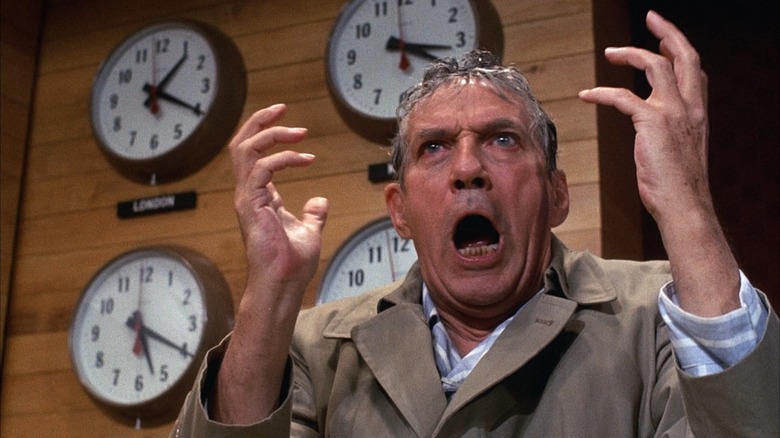
"Network" follows the crew of a broadcast news program on the fictional USB network, which is struggling with poor ratings. The lead anchor, Howard Beele (Peter Finch), has a mental breakdown live on the air, promising that he'll commit suicide on a future show. Seeing the boost in ratings, his crew decides to keep the program running.
Pleasantville
The television satire in "The Truman Show" is effective because it's shown from multiple perspectives. Truman is, of course, unaware that he's constantly being filmed, and as a result he simply accepts the strange events that occur as part of his accepted reality. However, the film is also empathetic to the actors who are forced to lie to Truman. Truman's onscreen wife Hannah Gill (Laura Linney) struggles to have an intimate relationship with a man she's forcibly married to, and Truman's best friend Louis Coltrane (Noah Emmerich) feels guilty about manipulating him. Most heartbreaking is Truman's childhood romantic fling Sylvia (Natascha McElhone); Sylvia actually loves Truman, but can't be with him because she's not part of the approved storyline.
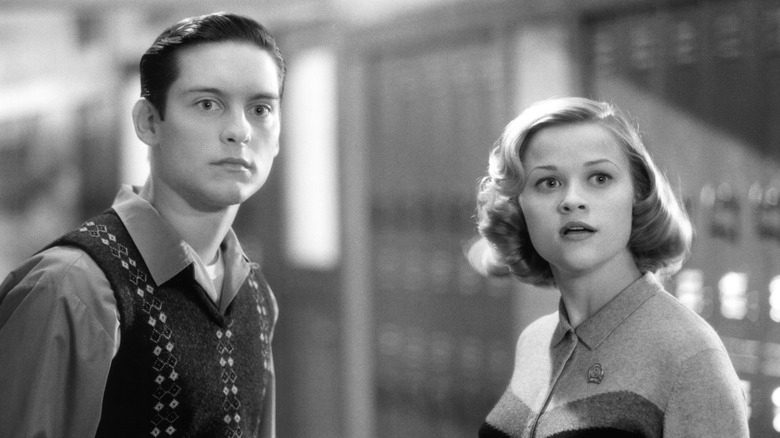
The 1998 satirical comedy "Pleasantville" examined the idealism of '50s sitcoms in a similar fashion, showing the perspectives of both the aware and the ignorant. The film follows modern day high school siblings David (Tobey Maguire) and Jennifer (Reese Witherspoon), who are constantly bickering. David is obsessed with a classic sitcom called "Pleasantville" and obsessively watches it, where Jennifer is popular at school and annoyed by her geeky brother.
A magical occurrence transports the two to the black-and-white world of "Pleasantville," where their modern beliefs are out of place in the antiquated community. "Pleasantville" examines why social standards have changed, as the constraints of the older era keep the residents from freely expressing their opinions and emotions.
UHF
The relationship between television production crews and the network that controls them is paramount in "The Truman Show." Christof controls the central narrative in Truman's life, and manipulates the actors' behavior so that they'll follow his ideas about where the story should go. Christof also creates scenarios in order to prevent Truman from leaving the set. He sets up a traumatic childhood memory in which Truman's father is killed in a boating accident, leaving Truman terrified of traveling by water. When his father is accidentally recast as a beggar and Truman is shocked to see him, Christof explains it away through an amnesia storyline. Christof is a compelling villain because he justifies all of his actions as an extension of his creative genius.
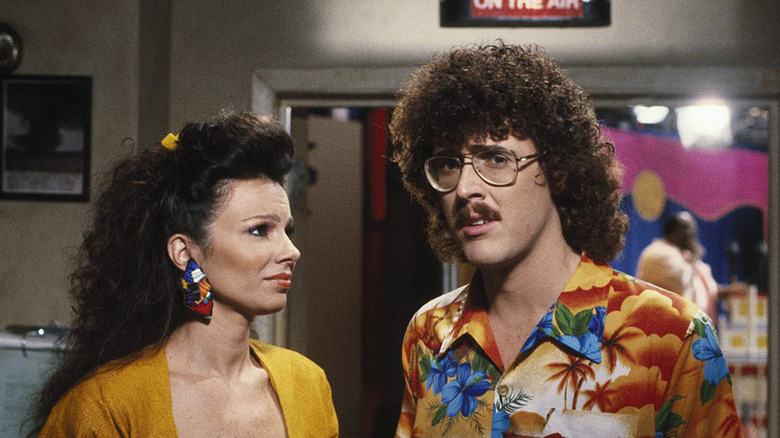
The 1989 cult comedy "UHF" explores similar themes of network pressure on individual artistry, and, like "The Truman Show," it's a routinely hilarious film that makes a larger point. The film was written, produced, and composed by star "Weird Al" Yankovic, one of the rare comedic forces as talented in concocting a persona as Carrey. Yankovic stars as George Newman, who unexpectedly earns the right to run his own television station after his uncle wins a failing network in a poker tournament. Idealistic and ambitious, George develops a unique UHF station that features bizarre variety shows and other oddball programs. George faces pressure from rivals that aim to steal his airtime, and his loyal audience isn't able to save his show from cancellation.
Vanilla Sky
One of the core themes of "The Truman Show" is how people choose to accept the reality that they're exposed to. Truman struggles because he's accepted a version of events that is obviously ludicrous, but the only contrasting viewpoints available to him come from the actors on the show, who tell him that nothing is abnormal. Truman doesn't know who he can trust, and begins to question his own sanity. It's a deeply psychological story that's sympathetic to the stigmas Truman faces.
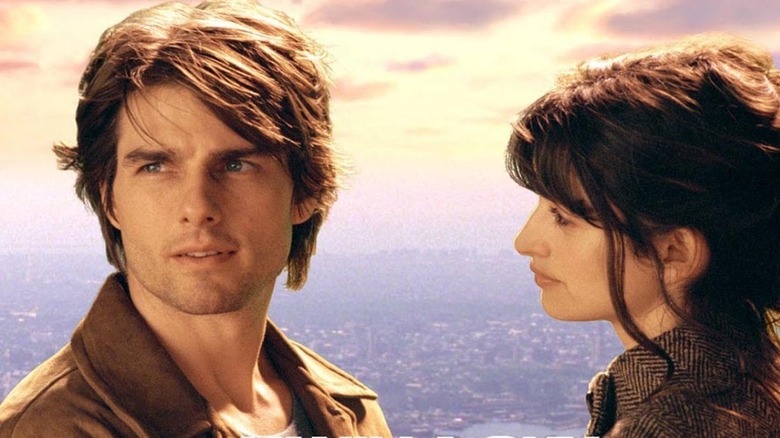
Cameron Crowe's 2001 science-fiction mystery "Vanilla Sky" explores similar concepts of illusion, reality, and perspective. The film follows haughty publishing tycoon David Aames (Tom Cruise), who recounts the strange events that left him disfigured to the prison psychologist Dr. Curtis McCabe (Kurt Russell). David explains that his girlfriend Julia Gianni (Cameron Diaz) grew jealous of his affair with the enigmatic Sofia Serrano (Penelope Cruz) and forced them into a car accident, killing herself. The events send David's life spiraling out of control, and the story is told nonlinearly to highlight his confusion. By showing the events from David's perspective, Crowe makes him more sympathetic, similar to the emotional weight that Truman's journey carries.
Both films mix genres. "Vanilla Sky" features many graphic love scenes, making it akin to a sexual thriller, but it also features body horror as David is forced to live wearing a mask. David's wisecracking best friend Brian Shelby (Jason Lee) adds a humorous element, and even more absurd comedy occurs amidst David's lucid dreaming.
Southland Tales
"The Truman Show" was instantly acclaimed for its sharp mix of comedy and drama, earnest performances, and brilliant concept. It was among the best-reviewed films of 1998 and earned Academy Award nominations for best director (Peter Weir), best adapted screenplay (Andrew Niccol), and best supporting actor (Ed Harris). However, the film's forward-thinking nature was only evident after a longer period of time.
Not every prophetic satire earned the same instant praise; Richard Kelly's brilliant sci-fi comedy-drama "Southland Tales" had a famously disastrous reputation. The film earned horrible reviews when it debuted at the 2006 Cannes Film Festival, and its release date was pushed until December 2007. Kelly was forced to significantly edit the film down. However, in the years since its release the film has gained a cult appreciation for its novel look at the intersection between celebrity culture, politics, militarization, and alternate realities.
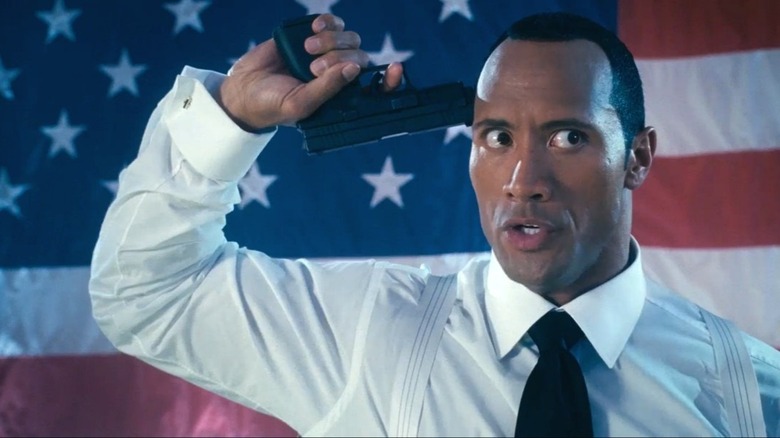
"Southland Tales" is set in an alternate version of 2008 where the United States is sharply divided by the extremist Republican Party that controls the surveillance network US-Ident and a sect of violent neo-Marxist detractors that aim to infiltrate the public through the celebrity Krysta Now (Sarah Michelle Gellar). Now has formed a relationship with Boxer Santaros (Dwayne Johnson), a prominent movie star and figure in the Republican Party who is suffering from amnesia. Now convinces Santaros that he's written a prophetic screenplay, and he researches his work with the crooked cop Roland Tavern (Sean William Scott), who discovers that he has an identical twin brother.
Bob Roberts
Among the most compelling aspects of the satire in "The Truman Show" is the depiction of the cult of personality that develops around Truman. Given the popularity of the series, Truman's fans are highly dedicated and base their entire lives on the standards that he fulfills. Truman is earnest, heartwarming, and forward-thinking, and given that he lives in an illusion, his qualities are completely authentic. As a result, he's a positive influence on his ardent followers.
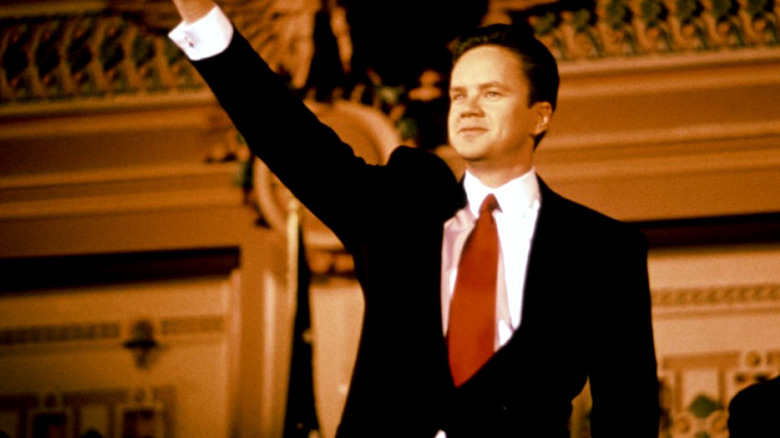
Tim Robbins's 1992 satirical mockumentary "Bob Roberts" shows a more negative side to fixating on a media icon. Robbins stars as a popular singer known for his highly conservative views. After he sees weakness in the incumbent Democratic Senator Brickley Paiste (Gore Vidal), Roberts decides to run for office himself and launches a wide-ranging political campaign. He's instantly popular among both fans who love his music and conservative voters who agree with his extreme positions.
However, Roberts is quite deceptive, and begins encouraging violence during his campaign speeches. While he claims to be completely sincere, Roberts deliberately masks his sinister intentions under the guise of being an unaware celebrity, and thwarts efforts by investigative reporter Bugs Raplin (Giancarlo Esposito) to expose the truth. At first, Roberts's deflections are amusing, but they grow more chilling when Raplin uncovers his connection to a CIA drug trafficking ring. Like Carrey, Robbins is very charismatic, and the film weaponizes his endearing personality as he inspires real violence with his hate-filled words.
Adaptation
"The Truman Show" is very blunt in dealing with mental health concerns. Truman's situation causes him to grow confused and paranoid, as he's not offered a helping hand and begins to distrust the people closest to him. Truman struggles to express himself, as even though he doesn't know why, he knows that things aren't what they seem. The pressure of living up to others' expectations also haunts Truman throughout.
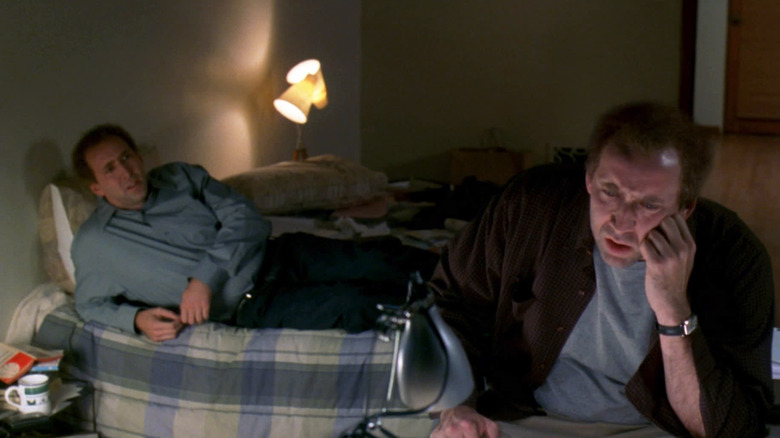
Spike Jonze's 2002 psychological dark comedy "Adaptation" shows a similar authenticity towards mental struggles, as the film's narratives stem from the personal musings of screenwriter Charlie Kaufman. A fictionalized Kaufman is portrayed by Nicolas Cage, who also appears as his hallucinatory twin brother Donald. Charlie struggles from writer's block and becomes highly reclusive, trapping himself in his own room as he tries to craft his next script. Charlie doesn't want to follow any established formulas, as he fears being labeled a hack. Donald moves in with him and freeloads in his house, which adds even more stress to his life. Like Carrey, Cage has built a career out of authentically depicting eccentric characters who suffer from inexplicable hardships.
Charlie wants to adapt the novel "The Orchid Thief" as his next project. As such, he must interview its author, Susan Orlean (Meryl Streep), but because of his anxiety he forces Donald to make the final approach. Donald discovers that, much like Charlie, Susan bases many of her stories on events from her life. The protagonist of "The Orchid Thief" is based on the real John Laroche (Chris Cooper), who Orlean is secretly in love with.
I Heart Huckabees
"The Truman Show" quickly develops beyond its initial conceit into something more existential and irreverent. Truman confronts the futility within his life, as he thinks (and later confirms) that his actions are being controlled by external forces he has no power over. It's a credit to the fluidity of Peter Weir's brilliant direction and the specificity of Andrew Niccol's writing that, even amidst Truman's darker moments, the film remains consistently engaging.
David O. Russell's highly underrated 2004 indie comedy "I Heart Huckabees" explores similar themes of existentialism, destiny, and futility through a darkly comedic premise. It's somewhat ironic that Russell is now best known for his Oscar bait films like "The Fighter," "Silver Linings Playbook," "American Hustle," and "Joy," as his early movies were much more experimental.
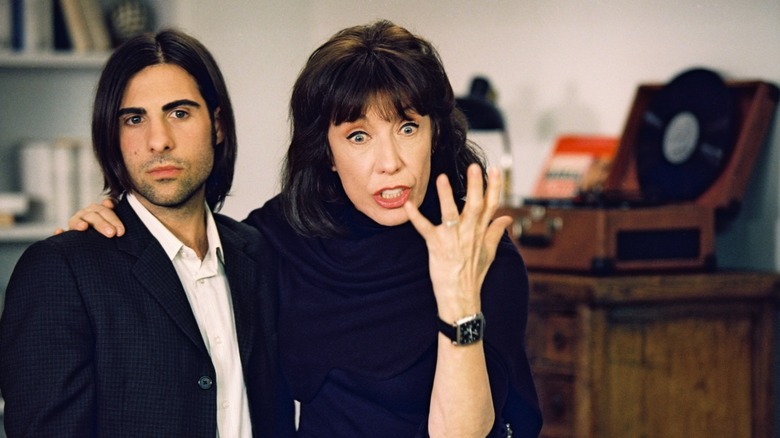
"I Heart Huckabees" follows the misadventures of untraditional detectives Bernard Jaffe (Dustin Hoffman) and Vivian Jaffe (Lily Tomlin), who are hired by wacky clients to search for the meaning of life. The incredible ensemble includes wild performances from Mark Wahlberg, Jude Law, and Naomi Watts, who shed their usual dramatic personas for roles closer to the absurdity of '90s Carrey.
The Weather Man
Despite its broad satirical elements and shocking plot twists, "The Truman Show" is earnestly emotional in its depiction of a shattering family. Truman struggles to care for his screen wife Hannah, even though he's truly in love with his college crush, Vivian, who has been kicked off the show. Hannah has her own anxieties, as she doesn't want to have a child with Truman, who is unaware of his unique situation.
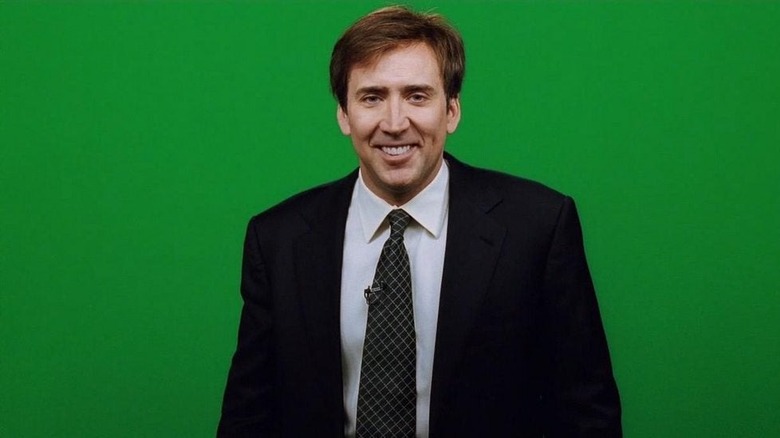
Gore Verbinski's 2005 black comedy "The Weather Man" explores the television world like "The Truman Show," and filters it through the impact that it has on one specific family. David Spritz (Nicolas Cage) is the top weather reporter in the Chicago area, but he's hated by the general population and heckled in the streets. The toll of his day job makes David absent at home, and his ex-wife Noreen (Hope Davis) doesn't communicate with him. His children both suffer from mental health disorders; his daughter Shelly (Gemmenne de la Peña) deals with body image issues, and his son Mike (Nicholas Hoult) grapples with depression.
Brazil
"The Truman Show" successfully transports viewers to a distinct, idiosyncratic world. Truman's hometown of Seahaven Island is contained within a floating obelisk and surrounded by sea water, leaving the residents cut off from the real world. The excellent production design, which emulates the ideal suburban town, helps bring Truman's living space to life.
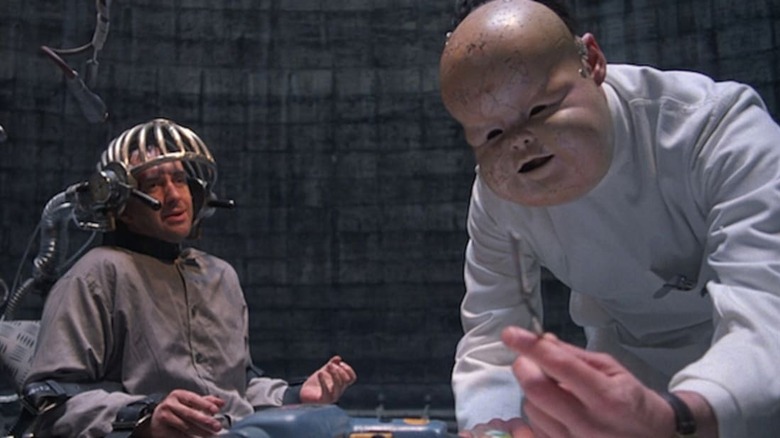
When it comes to crafting a unique environment with extravagant sets, few filmmakers are more attuned to detail than "Monty Python" alum Terry Gilliam. Gilliam's 1985 sci-fi masterpiece "Brazil" developed a dystopian future where bureaucracy reigns supreme, and the densely populated urban complexes are highly polluted. The film centers on the meek desk worker Sam Lowry (Jonathan Pryce), who learns of an impending revolution by an enigmatic resistance figure Jill Layton (Kim Griest) who haunts his dreams. Like "The Truman Show," the futurism of "Brazil" is still relevant today, and its depiction of a classist society where corporations influence social culture is painfully authentic.
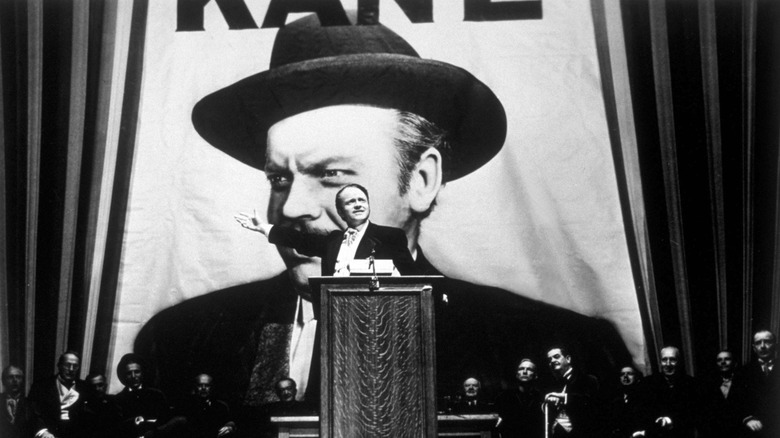
While Orson Welles' Academy Award-winning film is, as of this writing, 80 years old, there may be a small contingent of /Film readers who have not seen "Citizen Kane" and may not yet know about its famous ending. So consider these opening sentences a Spoiler Warning for one of the highest-regarded and famous movies of all time.
For many decades, "Citizen Kane" was practically a punchline in how widely acclaimed it was. Scholars have expounded deeply into its meaning, politics, technique, groundbreaking use of special effects, and Orson Welles' talent for utterly trashing a bedroom. In recent years, however, a counter-evaluation seems to be at work on "Citizen Kane," seen mostly in its loss of the #1 spot on Sight & Sound's once-a-decade poll, which it topped from 1962 up until 2012 (Alfred Hitchcock's "Vertigo" took its place). There was also the recent bombshell that -- horror of horrors -- it no longer has a 100% approval rating on Rotten Tomatoes.
But for readers who exist in that amorphous window between cinematic scholar and casual observer, here is the baggage at the ending of Orson Welles' classic, carefully unpacked.
Let's Get The Sled Out Of The Way
A brief rundown:"Citizen Kane" is a film constructed in flashbacks wherein a reporter is attempting to make sense of the titular newspaper mogul and would-be politician's life via interviews with his old friends, alienated besties, and bitter ex-wives. In one such flashback, we see little Charlie Kane as a boy, frolicking in the snow, riding a sled, and -- we'll learn later -- achieving the most profound happiness he will ever experience.
If you know anything about "Citizen Kane," you know about the sled.
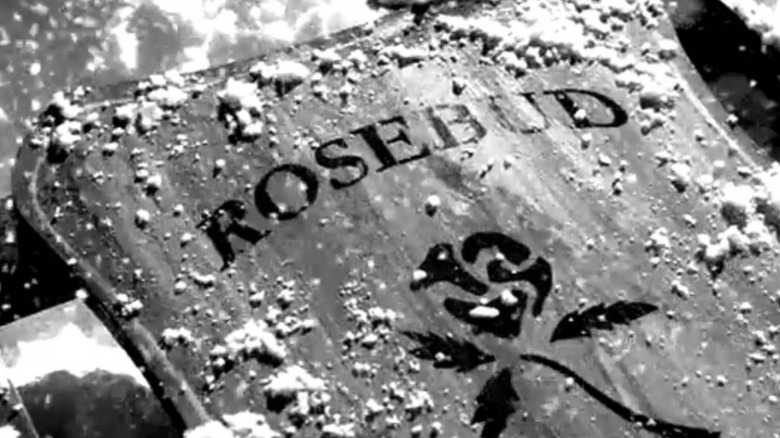
Kane was raised in an incredibly impoverished home with his stern mother (Agnes Moorehead), who will, thanks to various plot machinations, give parenting responsibilities of little Charlie -- as well as a recent discovery of mining wealth -- over to a banker. Charlie is sent away. In a tragic shot, we see little Charlie's sled gathering snow outside his home, a symbol of his happy childhood vanishing.
The sled -- in one of cinema's best-known plot twists -- will be seen again right near the film's end as it is thrown in a fire, one of the many trinkets in Kane's massive tchotchke collection being destroyed after his death. Stenciled on the sled is the word "Rosebud," which was Kane's last word! Whispered on his death bed! Generations of film students now have essays to write!
Kane's dying thought was of that sled and, by extension, the last time he was presumably happy. None of his acumen as a newspaper tycoon, nor his vast accumulated wealth was able to fill the void left in him by having to abandon a simple, impoverished childhood.
"Kane," then, is a criticism -- a comment on the soullessness of American capitalism, all carried on one little sled.
More On Rosebud
Something you should know about Orson Welles is that he was a wonderfully conceited, impish little troublemaker. He had already constructed a massive career and achieved a great deal of acclaim from his theater and radio work before he made "Citizen Kane" at the age of 26 (and if you haven't listened to old episodes of "The Shadow," by all means do). This fame, as you might well imagine, inflated his head a bit, giving him personal license to take on one of the most powerful men in America.
As such, it was pretty well-known at the time that Kane was a stand-in for real-life newspaper mogul William Randolph Hearst. Hearst had a newspaper empire of his own, and, to put it in the briefest possible terms, wasn't always operating on the up-and-up. Welles, with the ambition of a drunken college student intelligently raving about politics during a late night party, decided to stick it to The Man, man.
As such, he supposedly dropped in a very, very personal detail about Hearst's personal life as a codeword to its central mystery. At the time, Hearst was dating actress Marion Davies, a mistress much younger than he.
"Rosebud," popular rumor has it, was... well, let's call it a nickname Hearst had for Davies. So not only was "Rosebud" a symbol for lost innocence destroyed by massive wealth, but a cheeky and somewhat mean-spirited elbow in the ribs to the subject of Welles' satire.
And What About Mank?
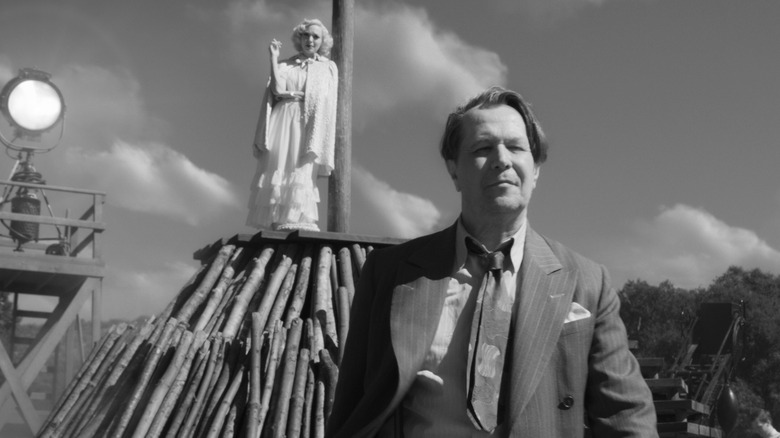
What does David Fincher's 2020 biopic "Mank" reveal about the meaning behind "Citizen Kane?" It does, after all, follow the personal life and political upheaval experienced by "Kane" screenwriter Herman J. Mankiewicz (played by Gary Oldman), who was surrounded by wealth, local revolutions, and direct access to the biggest Hollywood muckety mucks -- including Marion Davies (played by Amanda Seyfried). Surely the experiences of Mank himself would come into play in the famous ending of "Citizen Kane," which he wrote himself?
Actually, not really. "Mank" has a lot of superficial parallels, but doesn't really give any new insight into "Citizen Kane" that hadn't already been analyzed to death by generations of film scholars.
(Welcome to ...And More, our no-frills, zero B.S. guide to when and where you can watch upcoming movies and shows, and everything else you could possibly stand to know.)
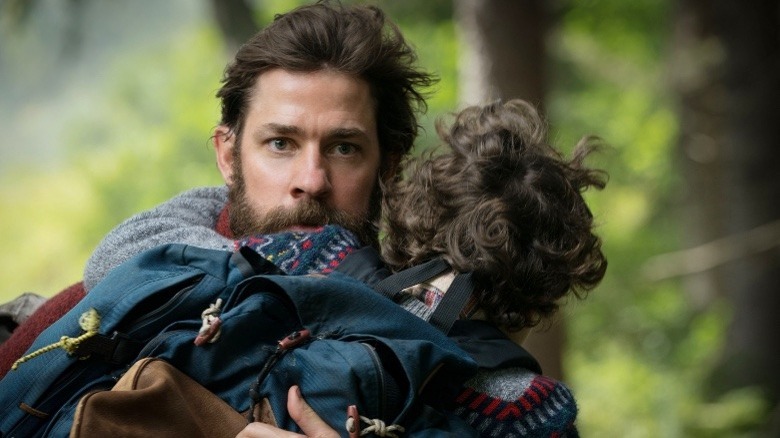
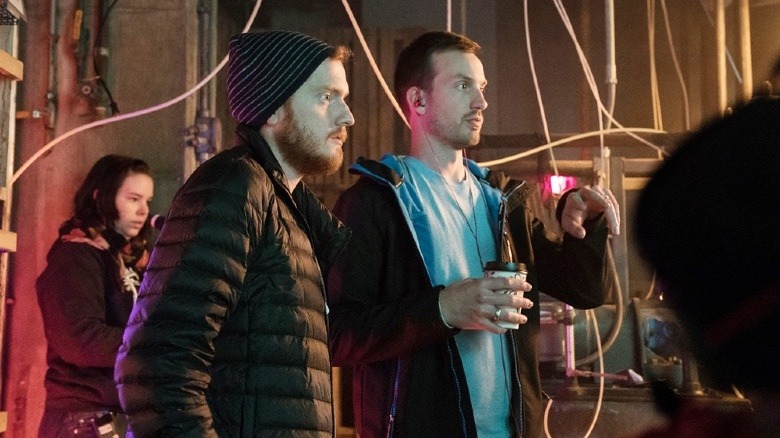
John Krasinski was deservedly showered in accolades for his efforts as the director, co-writer, and star of 2018's "A Quiet Place," a tense thriller about a family struggling to survive in a post-apocalyptic world overrun by blind alien monsters with a heightened sense of hearing. However, Scott Beck and Bryan Woods also deserve their fair share of praise for co-writing the film, drawing from a story the pair conceived based on their shared love of silent movies and growing up near farmlands in Iowa.
Whereas Krasinski has since moved on to "A Quiet Place Part II," Beck and Woods have continued to focus on original projects in the forms of the slasher horror film "Haunt" and the three-parter "Almost There (Iowa)" for the Quibi Roku horror anthology series "50 States of Fright" (all of which they both wrote and directed). Now, Beck and Woods are re-teaming with "50 States" producer Sam Raimi for a mysterious new thriller simply entitled "65." Here's what we know so far.
65 Release Date And Where You Can Watch It
Sony/Columbia Pictures is backing "65" and plans to release the film in theaters on April 22, 2022. With Sony being the only one of the five (assuming Disney hasn't swallowed up another one of them while I'm writing this) major studios that doesn't have its own streaming service, it has so far avoided debuting its movies theatrically on the same day they become available to stream at home. Instead, it has stayed afloat through the COVID-19 era by either premiering its films on the big screen only ("Venom: Let There Be Carnage") or selling them to a streaming giant like Netflix ("The Mitchells vs. the Machines").
As for the future, Sony looks to stay the course in 2022 — meaning "65" should play in theaters exclusively before hitting the home market, pending it being sold to another streamer (knock on wood). With no "Quiet Place" sequel or spinoff scheduled for next year, "65" might even thrive at the box office opening in the same spring spot that served Krasinski, Beck, and Woods' breakout hit so well in 2018.
What Is 65 About?
The logline for "65" describes its plot as follows: "An astronaut crash lands on a mysterious planet only to discover he's not alone." Additional details are under lock and key for the time being, although it's safe to assume this movie probably won't see the main character discovering the world he's landed on is home to some genial creatures that just want to help him get back to Earth. If anything, Beck and Woods' involvement suggests "65" is more likely to resemble "Cast Away" in space, except it turns out Wilson the volleyball is actually a blood-thirsty alien.
So far, Beck and Wood have gone out of their way to avoid repeating themselves. "Haunt," for example, takes place in a haunted house attraction where the masked employees are actually trying to kill the guests, which is a far cry from anything that happens in "A Quiet Place." Hopefully, then, "65" will represent yet another curveball from the filmmakers.
65 Cast
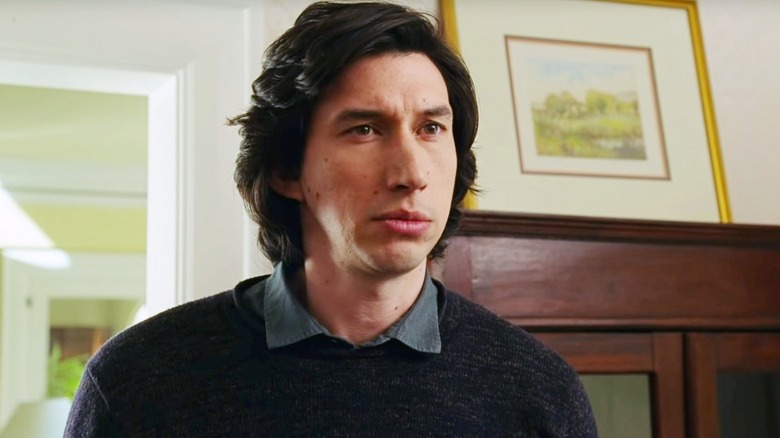
Adam Driver is starring in "65" opposite youngsters Ariana Greenblatt and Chloe Coleman. It's fresh territory for Driver, who's obviously no stranger to movies set in outer space, but has yet to headline a straight-faced thriller or horror movie. The closest he's come to that so far was with his role in Jim Jarmusch's "The Dead Don't Die," an absurdist, post-modern zombie comedy that made an extremely important contribution to cinematic history by sticking the towering, broad-shouldered actor in a smart car.
Greenblatt ("Stuck in the Middle") and Coleman ("Gunpowder Milkshake") are similarly new to the adult thriller scene, being young teens and all. It's possible one of them is playing Driver's onscreen daughter in the movie (assuming they both aren't), so there might be some overlap between "65" and "A Quiet Place" when it comes to themes about parenthood. Then again, maybe Greenblatt and Coleman are playing creatures disguised as human girls that spend the film trying to murder Driver's astronaut, which could be fun, too.
65 Directors, Writers, And More
Beck and Woods are directing, writing, and producing "65," with Raimi, Zainab Azizi, and Debbie Liebling also producing for Raimi Productions. The pair have a mixed track record of success as directors so far; where their 2015 found-footage thriller "Nighlight" earned pretty terrible reviews, "Haunt" got a warmer reception, even if critics mostly agreed it borrowed a little too much from iconic horror movies like "Saw." All the same, they seem to be improving every time they step behind the camera, so that bodes well for "65."
Beck and Woods' creative team only further inspires confidence in "65." Their ranks include cinematographer Salvatore Totino (whose visuals certainly helped elevate the "Quiet Place"-style thriller "Bird Box"), as well as "Blade Runner" costume designer Michael Kaplan (who also worked with Driver on Disney's "Star Wars" sequel trilogy). Perhaps most exciting of all, Danny Elfman is composing the score, which should no doubt help to set the film's appropriately uneasy, creepy mood.
The Disney+ original series "The Book of Boba Fett" is coming soon, premiering on the streaming service on December 29, 2021. To celebrate the wild history of one of the most mysterious and beloved "Star Wars" characters, Disney released a new featurette, "Under the Helmet: The Legacy of Boba Fett." This 21-minute mini-doc, exclusive to Disney+, shows the history of the beloved character with some new behind-the-scenes footage, interviews, and more.
While some of what's revealed in the "Under the Helmet" documentary is known by "Star Wars" fanatics, many audiences may not know the origins of the enigmatic Mandalorian bounty hunter, developed by "Star Wars" creator George Lucas with designers Joe Johnston and Ralph McQuarrie. Here are five fascinating facts we learned about Boba Fett from the featurette, with a little more background on each.
Fett's Costume Was Originally Solid White
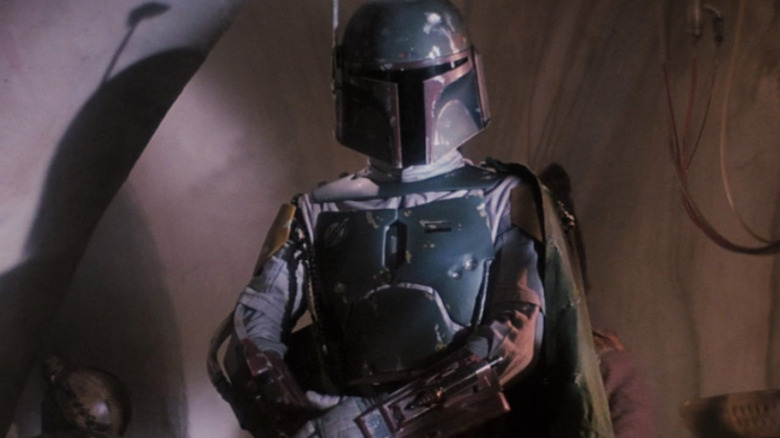
That's right, long before he was red, green, and rust-colored, Fett was supposed to wear an all-white suit. The reasoning? The Fett costume was originally designed as a special kind of elite stormtrooper with better tactical gear. Lucas allegedly wanted 100 of these troopers to appear onscreen, but budget constraints made that impossible. Instead, they decided to keep the costume and make it into a one-off character. The design was a group collaboration between Lucas, McQuarrie, and Johnston, combining futuristic space aesthetics with sword and sorcery designs and spaghetti Western accessories. Fett became something like a rogue knight, a Ronin, and The Man with No Name rolled into one, despite the fact that he was almost just another trooper.
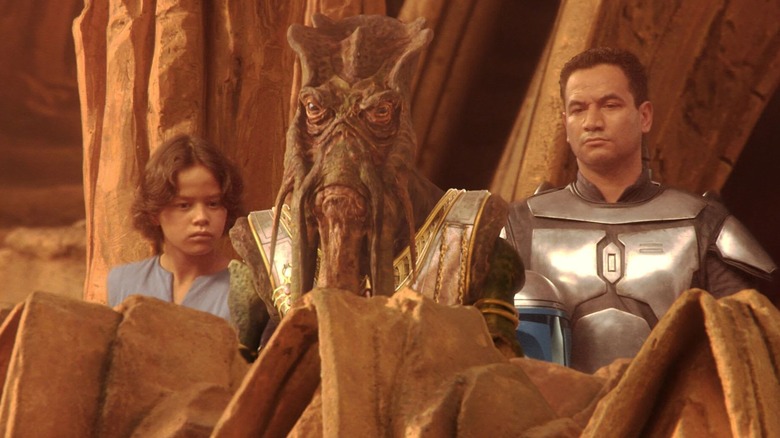
It's interesting that Fett was originally supposed to be a super trooper, given the direction Lucas took with the prequels. The clone troopers in "The Phantom Menace" and "The Attack of the Clones" are all clones of Fett's father, Jango, so things came full circle.
His First Appearances Weren't In The Movies
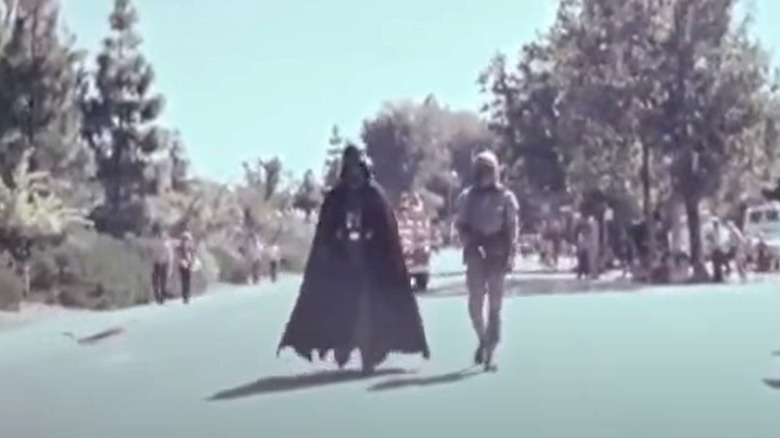
While most audiences got their first glimpse of Boba Fett in "The Empire Strikes Back" in 1980, his first public appearance was a much smaller affair. The screen-used costumes for Darth Vader and Boba Fett appeared at the Marin County Parade in 1978. Lucas lived nearby and thought it would be fun to debut the character without any explanation, to help create a bit of mystery about him.
The next time he appeared was in the infamous "Star Wars Holiday Special," which has been effectively hidden by Lucasfilm since its debut just after the parade in 1978. An animated sequence with the bounty hunter features him speaking lines of dialogue, something the character wouldn't do again until the prequel movies and "Clone Wars" television series.
A Heartwarming Bit Of Method Acting
In a new interview with Daniel Logan, who played the young Boba Fett in "Attack of the Clones" and voiced him in "The Clone Wars," the actor revealed a fun story about Temuera Morrison, who played his father, Jango Fett, in the prequels and now plays Boba Fett in "The Mandalorian" and "The Book of Boba Fett." He explained that when he first met Morrison, the actor walked up to him and offered a simple suggestion:
"'I guess I'm gonna be playing your dad and you're going to be playing my son. You call me dad and I'll call you son.' I remember being all of four foot nothing and looking up at him and I said 'alright dad,' and he looks back down at me with this big smile and goes 'alright, son.'"
The two had a great dynamic on set that led to some of the warmer moments in the prequels, and Lucas himself even shared his appreciation:
"It was good having Tem there because he really worked the character out, and they were supposed to be the same person, more or less."
The Mail-Away Action Figure Fiasco
Many of the early "Star Wars" action figures had to be mailed away for. Fans would send a proof-of-purchase from one of the action figures you could find in stores to a special address, then wait for their new figure to arrive in the mail. One of the most hyped figures was the exclusive Boba Fett figurine, complete with a rocket-firing backpack.
Unfortunately, said rocket firing mechanism proved to be a safety issue, and the toys ended up being shipped with the missile glued in place. Only a few of the operating figures still exist, because they never made it past the prototype phase. The mini-doc shows a collector who has two of the rare action figures in his massive collection of "Star Wars" memorabilia, which also includes Boba Fett guitars, Lego models, and loads and loads of toys.
Actor Jeremy Bulloch Loved The Character
While Morrison is playing Fett in the upcoming "The Book of Boba Fett" series, the character was portrayed by veteran British actor Jeremy Bulloch in "The Empire Strikes Back" and "Return of the Jedi." He almost missed out on the part because he was busy doing theater work, but his wife insisted that he go audition for a role. He ended up falling in love with the world and its fans, and the featurette shares some touching moments with Bulloch, who died last year. He was a devoted steward of the character who helped pave the way for what Fett would one day become, and he will be sorely missed.
Check out "Under the Helmet: The Legacy of Boba Fett" on Disney+ now, and make sure to catch "The Book of Boba Fett" when it debuts on Disney+ December 29, 2021.
About 10,000 enterprise servers running Palo Alto Networks' GlobalProtect VPN are vulnerable to a just-patched buffer overflow bug with a severity rating of 9.8 out of a possible 10. From a report: Security firm Randori said on Wednesday that it discovered the vulnerability 12 months ago and for most of the time since has been privately using it in its red team products, which help customers test their network defenses against real-world threats. The norm among security professionals is for researchers to privately report high-severity vulnerabilities to vendors as soon as possible rather than hoarding them in secret. CVE-2021-3064, as the vulnerability is tracked, is a buffer overflow flaw that occurs when parsing user-supplied input in a fixed-length location on the stack. A proof-of-concept exploit Randori researchers developed demonstrates the considerable damage that can result.
"Our team was able to gain a shell on the affected target, access sensitive configuration data, extract credentials, and more," researchers from Randori wrote on Wednesday. "Once an attacker has control over the firewall, they will have visibility into the internal network and can proceed to move laterally." Over the past few years, hackers have actively exploited vulnerabilities in a raft of enterprise firewalls and VPNs from the likes of Citrix, Microsoft, and Fortinet, government agencies warned earlier this year. Similar enterprise products, including those from Pulse Secure and Sonic Wall, have also come under attack. Now, Palo Alto Networks' GlobalProtect may be poised to join the list.
The attorneys worry that if law firms, traditionally the defenders of workers' rights, are turning to the programs, why wouldn't every other business? From a report: Camille Anidi, an attorney on Long Island, quickly understood the flaws of the facial recognition software her employers demanded she use when working from home. The system often failed to recognize her face or mistook the Bantu knots in her hair as unauthorized recording devices, forcing her to log back in sometimes more than 25 times a day. When she complained, she said, her bosses brushed it off as a minor technical issue, though some of her lighter-skinned colleagues told her they didn't have the same problem -- a common failing for some facial recognition systems, which have been shown to perform worse for people of color. So after each logout, Anidi gritted her teeth and did what she had to do: Re-scan her face from three angles so she could get back to a job where she was often expected to review 70 documents an hour.
"I want to be able to do the work and would love the money, but it's just that strain: I can't look left for too long, I can't look down, my dog can't walk by, or I get logged out," she said. "Then the company is looking at me like I'm the one delaying!" Facial recognition systems have become an increasingly common element of the rapid rise in work-from-home surveillance during the coronavirus pandemic. Employers argue that they offer a simple and secure way to monitor a scattered workforce. But for Anidi and other lawyers, they serve as a dehumanizing reminder that every second of their workday is rigorously probed and analyzed: After verifying their identity, the software judges their level of attention or distraction and kicks them out of their work networks if the system thinks they're not focused enough.
Contract attorneys such as Anidi have become some of America's first test subjects for this enhanced monitoring, and many are reporting frustrating results, saying the glitchy systems make them feel like a disposable cog with little workday privacy.
But the software has also become a flash point for broader questions about how companies treat their remote workforces, especially those, like contract attorneys, whose short-term gigs limit their ability to push for change. The attorneys also worry that it could become the new norm as more jobs are automated and analyzed: If the same kinds of law firms that have litigated worker protections and labor standards are doing it, why wouldn't everyone else?
As much as we love our screens—and we passionately love our screens—it’s good to remember that basically everything you watch on those screens begins with the written word, whether a screenplay or, yes, a book.
"Watch a film where everyone dresses like a Spice Girl fucked a RadioShack." The folks at Honest Trailers have fun skewering the hilariously dated Hackers (1995), starring Angelina Jolie in one her first filmic appearances.
Dive into a lightning-fast fusion of the FPS and action genres, that combines a wide variety of skills and abilities to unleash dazzling combo attacks. Bright Memory: Infinite is now available on GOG.COM!
By the way, we have good news – owners of Bright Memory will receive Bright Memory: Infinite free of charge upon its release. Note that the free update will not take place after the premiere of Bright Memory: Infinite.
Share our love for games? Subscribe to our newsletter for news, releases, and exclusive discounts. Visit the “Privacy & settings” section of your GOG account to join now!
When interviewed by ABC's Jonathan Karl, Donald Trump showed his complete lack of concern over Mike Pence's safety when looking back at the Jan. 6 Capitol insurrection. In fact, he defended the rioters who chanted "Hang Mike Pence."
In the interview, which took place last March for his upcoming book, Betrayal, Karl asked the former one-term president, "Were you worried about him during that siege? — Read the rest