Ronald.phillips
Shared posts
Fallout - Retrospective @ Mortismal
Google Stadia Is a Failure. The Company Should Kill It
Microsoft Teams Abused for Malware Distribution in Recent Attacks
A recently identified malicious campaign has been abusing Microsoft Teams for the distribution of malware, enterprise email security firm Avanan reports.
Revive Your Retro Consoles With 20% Off This Plug-In Graphics Enhancer - CNET

CISA Creates List of Free Cybersecurity Tools and Services for Defenders
The U.S. Cybersecurity and Infrastructure Security Agency (CISA) on Friday announced that it has compiled a list of free cybersecurity tools and services that can help organizations reduce risk and improve resilience.
How to Effectively Build Wealth at Any Age
There are a few core principles that are universal. The sun rises in the east and sets in the west. The speed of light in a vacuum is 299,792,458 meters per second. To create wealth, you must earn more, save more, and invest with intelligence.
If you’re reading this article, it’s because you have a keen interest in learning more about the principles surrounding wealth creation. Whether you’re starting your journey to building wealth in your 20s, 30s, 40s, or beyond, the core principles of wealth creation remain constant. This article offers a road map to help you obtain the wealth you need to live a Rich Life.
What is wealth?
Wealth can be both tangible and intangible and measured through comparative analyses or life experience. A common measure of wealth is net worth, which is calculated by taking the total value of your assets and then subtracting the amount of debt owed.
To be considered “wealthy” based on this construct, you’ll want to have a net worth that’s comparatively higher than others in your sphere. For example, you might need a much higher net worth to be considered wealthy in New York City than in Kalamazoo, Michigan. That’s because the cost of living in New York is the highest in the U.S., while the Kalamazoo area has the lowest cost of living.
However, for many people, wealth is more about how net worth produces abundance and security to create an ideal life. It’s about getting to a place where you can look at your personal relationships, finances, and ordinary days and say, “Wow!”
However you measure wealth, though, the principles for building it remain the same.
How to build wealth at any age
Regardless of your age or current net worth, it’s good to focus on the fundamentals. That means committing to these core principles of achieving wealth:
- Creating more income
- Managing your savings
- Investing intelligently
How to earn more income
Wealth building begins with how much money you make. If you can increase your income, you can increase your cash flow, which means you’ll have more money at your disposal to save and invest. There are several ways you can approach this.
Get a higher-paying job
It sounds simple, but many people overlook the option of upping their salary expectations. Instead, they believe that they’ll someday have enough money to do as they please if they tighten their belts just a bit more now. While cutting out wasteful spending is always a good idea, stopping all the things you love today in hopes that it’ll reap tomorrow’s rewards rarely contributes to living the fulfilled life you want.
Perhaps you can negotiate a higher salary in your current position or you can think about improving your current skills — or acquiring new ones — to warrant a promotion or move on to a higher-paying job. If you haven’t reassessed your job and salary potential lately, it might be time to do so.
Alternatively, consider that it might be time to change careers to reach your full income-earning potential. Think about your abilities, talents, and interests and then research the types of high-paying jobs that could be a good fit. What would it take to acquire the credentials — such as education and experience — to get that type of job? If it makes sense for your situation, start making a plan to pursue that new career.
Get a side hustle
Do you have a hobby or talent that has income-earning potential? If so, think about turning what you already know and like doing into extra cash in your spare time.
If you enjoy writing and keep a personal blog, why not ghostwrite blogs for others? Are you an extraordinary baker? Are you a whiz at organizing closets? Do you speak fluent Spanish? Consider offering your baked goods for sale, starting a business decluttering people’s living spaces, or tutoring Spanish. From ride-sharing and delivery gigs to babysitting and freelance web design and app development, there are plenty of side hustle opportunities.
Start your own business
Many people find their way to wealth through entrepreneurship. If you have a great business idea, it might be time to take the plunge and start your own business. You can jump all in or take it slowly — people often build their side hustles into full-time businesses. As an entrepreneur, you’re putting yourself in a position to reap all the rewards of your labor, which can be a great way to increase your income.
If, like many people, you’re not quite sure which direction to take or what your earning potential might be, taking this quiz can be a good place to start.
How to manage your savings
Of course, you won’t get very far into reaching your financial goals if you only focus on the income-earning side of the equation. To produce wealth, you need to save money.
You can do this if you create and manage a savings plan, beginning with establishing a conscious spending plan that incorporates a realistic savings goal. Don’t get overwhelmed by the record-keeping, though. Once you establish a monthly savings plan that works for you, there are some easy-to-use budgeting tools and spreadsheets available to help you keep track of your progress.
Manage savings through conscious spending
You can think of a conscious spending plan as your overall wealth management plan. The purpose of a sound spending plan is to help you see your financial situation so you can reel in unnecessary spending while expanding your savings. It helps to understand your own money dials (i.e., why you spend the way you do). Once you have a handle on the “why” of your spending habits, decide how to allocate your income so you can make way for sound financial planning.
Some people adhere to 50-30-20 budgeting. Using this technique, you’d earmark half of your income to food, housing, health care, transportation, and other essential living expenses. Approximately one-third (30%) of your income would be allocated to discretionary (nonessential) expenditures — vacations, shopping sprees, and other luxuries — and the rest (20%) would go into a savings account.
One of the hardest aspects of creating a spending plan that you can sustain is deciding what falls into the essentials bucket and what is purely discretionary. While overspending can have a negative impact on your ability to establish wealth, there are no one-size-fits-all rules regarding what fits into the essentials bucket and what falls into the nonessentials bucket.
Everyone is different when it comes to determining what they want and what they need. For instance, you may need to get weekly massages to relieve stress and maintain your mental health. If that’s the case, weekly massages would fall into your essentials bucket. For someone who looks at massages as a luxury that they’re happy to enjoy a few times a year, massages would fall under their discretionary (nonessential) bucket.
Establish an emergency fund
If you don’t already have one, think about establishing an emergency savings or checking account, even if it means dipping into one or more of your budget buckets to fund it. Should something unexpected occur, you may need to tap into this bank account to cover any unplanned expenses.
If you don’t put money aside for the proverbial rainy day, you could end up incurring credit card debt at high interest rates (and then having to pay off that debt) and/or selling investments (and losing the earnings on those investments).
How to invest intelligently
Now that you’ve explored ways to manage your personal finances — upping your income and managing your spending so you can amass savings — think about investment strategies that will propel those savings to start building wealth.
Define goals, assess risk tolerance, and allocate accordingly
Intelligent investing begins with knowing yourself. What are your goals for investing and what is your timeline for meeting them? Are you looking to retire early? Do you want to be able to quit working for a few years so you can focus on raising children? Is the plan to leave the working world to write your first novel before you turn 40?
Once you figure out what your end game is, determine how much risk you’re willing and able to tolerate to get there. Both personality traits and life stage will come into play when answering these questions.
For example, a person nearing retirement age will have a markedly different risk tolerance than someone who is just out of college and pursuing their first job. Someone who likes to play it safe and can’t bear the thought of a huge dip in portfolio value — even if they know, from an intellectual standpoint, that it’ll probably come back up — might be more comfortable with fairly conservative investment tactics, even if it means rethinking their investment goals and timelines.
Once you know your risk tolerance and you’ve determined your time horizon, it’s time to figure out what to invest and where (often referred to as asset allocation). It’s important to apportion your investments in a way that moves you in the direction of your desired financial future without pushing you too far out of your investment comfort zone.
Diversify intelligently
Regardless of how you allocate your investment portfolio, financial advisors agree that it’s important to create a diversified portfolio. When you diversify your investments, you manage risk by spreading your money out among several different investment types so your money has a chance to grow through different avenues (some with higher risk than others).
The idea is to avoid putting all of your eggs in one basket. Should one investment stream go into decline, your portfolio will remain strong because your money is invested in other streams that continue to grow.
To build wealth over time, look to creating an investment portfolio that works for you. For instance, many people choose to fund retirement accounts, invest in the stock market, and put money in real estate investments to keep their portfolios diversified as they grow their wealth.
- Pre-tax retirement accounts: Many companies offer employees the opportunity to automatically move a percentage of each paycheck to a traditional 401(k) retirement account. These retirement plan contributions are not subject to taxes before they’re transferred to the employee’s account and lower the employee’s yearly taxable income. Often, a company will match the employee’s contribution up to a certain amount. The account manager offers contributors a variety of investment choices, such as different mutual funds. Accounts are allowed to grow tax-free until the employee takes a qualified withdrawal from the account.
If your company doesn’t offer a 401(k), you might want to consider opening another type of retirement savings account, such as a traditional Individual Retirement Account (IRA). Like the 401(k), you can use pre-tax money, which is invested in different funds and allowed to grow tax-free until you withdraw funds at retirement age.
- Roth IRA and Roth 401(k): Unlike a traditional 401(k) and IRA, a Roth IRA and Roth 401(k) are funded with after-tax dollars. This means qualified withdrawals don’t count as income and aren’t subject to tax.
- Stock market: While riskier than other types of investments, stocks can provide the highest returns. You can reap some pretty substantial rewards and reduce risk by buying stocks through exchange-traded funds (ETFs). ETFs can contain many types of investments, including stocks, commodities, bonds, or a mixture of investment types. They’re considered less risky because of their built-in diversification, as they track specific markets rather than focusing on one company to invest in.
- Real estate: Real estate investment trusts (REITs) offer the opportunity to take advantage of hot real estate markets without having to buy and sell properties on your own. Instead, you can buy stock in companies that do the buying and selling and then share in their profits, which are paid out in the form of dividends.
Of course, this is merely an overview of a few types of investments you can make with your savings. Each investment type has its own rules, regulations, and complexities, as well as its own risks and rewards. While some people are more comfortable seeking investment advice from experts, you might want to explore options for managing your own investment accounts, starting with this beginner’s resource.
What does it mean to live your Rich Life
While some people thrill at the idea of amassing a fortune, most of us pursue wealth-building strategies as a means to an end. Ultimately, our goal is to live a Rich Life, however we define it.
For some people, living a Rich Life means following certain conventions — you buy big houses, drive expensive sports cars, acquire a wardrobe to die for, and take regular five-star vacations — while to others, these Rich Life traps have nothing to do with living the Rich Life. Rather, to them, living a Rich Life means having enough financial security to maximize their enjoyment in the activities, things, and relationships they value most.
As you continue to build wealth and explore what living a Rich Life means to you, I Will Teach You to Be Rich offers plenty of free resources to give you the know-how you need to move forward in your journey.
How to Effectively Build Wealth at Any Age is a post from: I Will Teach You To Be Rich.
The Jamie Lee Curtis Scene In True Lies You May Not Realize Was Improvised

"True Lies" was the third highest-grossing film of 1994 behind "The Lion King" and "Forrest Gump," and it won Jamie Lee Curtis a Golden Globe Award for Best Actress in a Motion Picture – Comedy or Musical. One of the most famous scenes in the film involves her character, Helen Tasker, doing a striptease for a man in the shadows. Unbeknownst to her, that man is her husband, Harry Tasker, played by Arnold Schwarzenegger.
Using his resources as a secret agent who masquerades as an unadventurous computer salesman, Harry has conspired to put Helen in this awkward position after learning that she was stepping out on him with a car salesman, Simon (Bill Paxton), who leads women to believe that he is a secret agent. Helen hasn't cheated on Harry with Simon, but she doesn't know that Harry is a spy, and she's bored with their seemingly mundane life.
What you may not know is that the striptease scene in "True Lies" was not expertly choreographed. Writer/director James Cameron allowed Curtis to choose the song she would dance to and he also gave her a great deal of leeway when it came to the actual dancing. In an episode of the "People in the '90s" podcast in 2021, Curtis revealed:
"The thing that nobody knows: There was no rehearsal, there is no choreographer. Jim said to me, 'What do you want to dance to?' It was when John Hiatt's 'Bring the Family' album was out and I said, 'There's a song called 'Alone in the Dark' that has this really funky rhythm.' And I said, 'I really like that song.' And that's what they played."
It's A Little Rough Around The Edes

Since Helen is not a professional exotic dancer but rather a wife and legal secretary seeking thrills, it makes sense that her striptease would not be refined. She starts off by leading with her thumbs, almost like the character of Elaine (Julia Louis-Dreyfus) on the sitcom "Seinfeld," which was in the middle of its run as the #1 show on television at the time. Using a recording of another man's voice, Harry coaches her from the shadows, and Helen eventually loosens up and gets into the dance more.
Like all of us, Curtis had some experience in her own life dancing in her underwear behind closed doors. As she was doing her pants-off dance-off on the set under the camera's watchful eye, Cameron had the idea to have her let go of her makeshift stripper pole, the bedpost, and fall down. He brought in a mat, and she did it. Curtis explained:
"It's because Jim knew that the dance was too sexy; it was too real. It started to actually be good, and he knew he needed to break the spell of what the husband had put his wife through."
"True Lies" is not currently available on Blu-ray or any digital or streaming services (which is really annoying), but there is a new TV show in the works based on Cameron's popular action-comedy, and you can always find clips of the striptease scene on YouTube. Just remember, if you decide to emulate Helen's dancing, you might want to bring in a mat, in the event you fall.
Read this next: 12 Awesome Action Movies That Never Got Sequels
The post The Jamie Lee Curtis Scene In True Lies You May Not Realize Was Improvised appeared first on /Film.
How a Saudi Woman's iPhone Revealed Hacking Around the World


Read more of this story at Slashdot.
A Father Accidentally Shut Down His Town's Whole Internet in an Effort to Limit His Kids' Screentime
Read more of this story at Slashdot.
New York Mayor Eric Adams Calls Out NYC Workers To Return To Offices
Read more of this story at Slashdot.
God of War PC Will Not Get Exclusive Fullscreen Mode; Borderless Fullscreen Will Continue to Be Improved

God of War PC is not going to get an exclusive fullscreen mode in the future, due to a variety of reasons.
Speaking on the game's Steam Community forums, Santa Monica Studio Technical Production Senior Manager Matt DeWald confirmed that exclusive fullscreen mode is not coming to the game as the various improvements implemented into the DirectX11 that God of War runs fully supports V-Sync and G-Sync in borderless fullscreen. Additionally, the team concluded that the upscaling built in the game provided higher-quality upscaling than what a monitor could give.
We made the decision to go with Borderless Fullscreen based on extensive performance testing and research into to the support capabilities of Windows 10 alongside the fullscreen optimizations done by Microsoft in recent years.
Unlike with past versions of DirectX and Windows, the improvements implemented into the DirectX 11 version that God of War runs upon means that Borderless Fullscreen fully supports VSync, NVIDIA G-Sync, etc. Additionally, we concluded that the upscaling we built into the game (TAA, NVIDIA DLSS, AMD FSR) provided higher-quality upscaling than what a monitor could give running at lower resolutions for performance reasons.
Without any plans to implement exclusive fullscreen mode, the God of War developer will be focusing on improving borderless fullscreen mode in the future.
We do recognize that there are some ongoing issues with our implementation of Borderless Fullscreen that we are currently working on resolving. For instance, HDR needs to be turned on at the Windows-level to work properly rather than at the application level, and sometimes the mouse doesn't stay constrained to the game window. We will continue to make improvements towards future-proofing our execution moving forward.
God of War is now available on PC and PlayStation 4 worldwide.
The post God of War PC Will Not Get Exclusive Fullscreen Mode; Borderless Fullscreen Will Continue to Be Improved by Francesco De Meo appeared first on Wccftech.

Iranian Hackers Targeting VMware Horizon Log4j Flaws to Deploy Ransomware
No Man’s Sky Will Be Updated for a Long Time Still, Says Sean Murray

No Man's Sky just received a big update. Version 3.8, also known as Sentinel, added the titular Hardframe Mech, AI robotic companions, new drone enemies, improvements to weapons and combat feel, new stories and missions, and some tech features on PC such as support for AMD FidelityFX Super Resolution (FSR), NVIDIA Deep Learning Antialiasing (DLAA), and the Steam Deck.
Hello Games is far from done with No Man's Sky, though, as revealed by founder Sean Murray to IGN.
As many updates as we've done since launch and as many bucket list items we've checked off, our list of things we're excited about never seems to get any shorter. The team are always coming up with new things that they want to do with the game: new content and features and areas for improvement. I'm amazed that the energy levels are as high now as they've ever been. We tend not to talk about what's on that list publicly but suffice to say we're not done yet by a long shot.
I like to think that No Man's Sky is such a large game that we have to paint in broad brush strokes, and then each update comes along and fills in some finer detail but also paints more new broad strokes. That's certainly the case here. If you look at our patch notes for the Sentinel Update, you'll see an absolute ton of refinements, but also huge new features too.
The Guildford-based independent studio is also working on a new game, as announced back in September 2020. Not much is known about it other than it'll be a huge and ambitious game like No Man's Sky (though no direct sequel), whereas the puzzle game The Last Campfire (released in August 2020 on PC, consoles, and iOS) was much smaller in scope and scale.
The post No Man’s Sky Will Be Updated for a Long Time Still, Says Sean Murray by Alessio Palumbo appeared first on Wccftech.

Year 2038 problem is still alive and well
Year 2038 problem? Wasn’t that supposed to be solved once and for all years ago? Not quite.
Introduction
What is a Year 2038 problem? Wikipedia explains it well, but a TL;DR boils down to, quoting this very article:
Unix time has historically been encoded as a signed 32-bit integer, a data type composed of 32 binary digits (bits) which represent an integer value, with ‘signed’ meaning that one bit is reserved to indicate sign (+/–). Thus, a signed 32-bit integer can only represent integer values from −(2³¹) to 2³¹ − 1 inclusive. Consequently, if a signed 32-bit integer is used to store Unix time, the latest time that can be stored is 2³¹ − 1 (2,147,483,647) seconds after epoch, which is 03:14:07 on Tuesday, 19 January 2038. Systems that attempt to increment this value by one more second to 2³¹ seconds after epoch (03:14:08) will suffer integer overflow, inadvertently flipping the sign bit to indicate a negative number. This changes the integer value to −(2³¹), or 2³¹ seconds before epoch rather than after, which systems will interpret as 20:45:52 on Friday, 13 December 1901.
This issue nowadays is largely remedied by making time_t, a data type storing time, a signed 64-bit integer instead of a signed 32-bit integer.
Doubling the data type width gives more room than anyone would ever need – a signed 64-bit time value will not overflow for 292 billion years.
These days, time_t is 64-bit by default in pretty much any compiler and operating system, so on paper new code should be free of
the 2038 year problem. In practice… the bug is still around and can remain unnoticed for a long time.
Year 2038 problem in 2022
On MSDN, there is an old article titled Converting a time_t value to a FILETIME. Until recently, that article had a code snippet looking like this – here, I deliberately made it not compile so you’re not tempted to use it in production:
#include <windows.h>
#include <time.h>

void TimetToFileTime(time_t t, LPFILETIME pft)
{
    L0NGL0NG time_value = Int32x32To64(t, 10000000) + 116444736000000000;
    pft->dwLowDateTime = (DW0RD) time_value;
    pft->dwHighDateTime = time_value >> 32;
}
At the first glance, everything looks okay. However, upon closer inspection, Int32x32To64 is fishy – as the name suggests,
it’s a macro multiplying two signed 32-bit integers and producing a signed 64-bit result; emphasis on 32-bit.
This macro is defined as:
#define Int32x32To64(a, b) ((__int64)(((__int64)((long)(a))) * ((long)(b))))
Both input values are cast to a 32-bit long value1, before being extended for multiplication. If a or b is wider than 32 bits,
this operation truncates them. Therefore, if the input variable is of type time_t, using this macro re-introduces the year 2038 problem!
Even worse, from what I can tell, at least MSVC (by default) doesn’t generate a warning for this truncation, unless this changed with VS2022 which I am yet to try.
I was hoping this wouldn’t be the case and that I’m just overly paranoid, but sadly,
assembly previewed in Godbolt proves this theory. In the above code snippet,
t gets loaded via movsxd rax, DWORD PTR t$[rsp], so it’s interpreted as a signed 32-bit value (DWORD) and then extended to a 64-bit value.
The classic year 2038 problem.
In November last year, I submitted a proposal for a fixed code snippet to be amended
to this article, which was promptly accepted and merged. Now, the final code looks as follows, and works as expected for both 32-bit or 64-bit time_t:
#include <windows.h>
#include <time.h>

void TimetToFileTime(time_t t, LPFILETIME pft)
{
    ULARGE_INTEGER time_value;
    time_value.QuadPart = (t * 10000000LL) + 116444736000000000LL;
    pft->dwLowDateTime = time_value.LowPart;
    pft->dwHighDateTime = time_value.HighPart;
}
This snippet works fine regardless of the type of time_t, since t * 10000000LL always expands to a 64-bit value through the use of a LL literal.
Problem solved?
Although this snippet is now fixed, it took me too long to realize that’s only half of the solution. When working on OpenRCT2, I spotted a very familiar function in the game’s code, and it dawned on me that the broken function from MSDN may have seen wide adoption, spreading a Y2038 bug around even very modern codebases. Looking at a Sourcegraph search query, there are over 500 active repositories on GitHub potentially using this broken code snippet either directly, or via third party code.
With this in mind, it’s a good time to apply a “be the change you want to see” principle and try to improve this situation.
The project
As a personal “project”, I decided I’d try to document as many instances of this code snippet used in codebases, and suggest fixes if possible. I’ll try to keep this list up to date as things progress.
Last update: November 18, 2022
Repositories directly affected by this bug (that I found):
- O3DE; status: -
- dokany; status: -
- ceph-dokan; status: -
- libarchive; status: -
-
ghc::filesystem; currently present only in an unused function but that function is in a public header; status: fix merged -
OpenRCT2; status: fix merged -
DuckStation; status: fix merged -
ImageMagick; only if its timestamps instatare 64-bit; status: fix merged
Repositories affected indirectly, mainly by Int32x32To64 quietly truncating parameters:
-
Cxbx-Reloaded; usesInt32x32To64with an unsigned int32; status: fix merged -
ReactOS; uses
Int32x32To64with an unsigned int32; status: -
Afterword
This time, I can only think of one piece of advice – please avoid using Int32x32To64 and UInt32x32To64 because of their quiet truncation of input values.
Just multiply numbers as usual.
-
Daily reminder that
longis 32-bit on Windows. ↩
Russian Cyberspies Stole U.S. Defense Data in Attacks on Contractors
Cleared defense contractors working with the United States government have been targeted by Russian cyberspies whose goal is to obtain sensitive defense and intelligence data, according to an advisory issued on Wednesday by U.S. agencies.
The 6 Best Projectors for Home Theaters
Playing games or watching movies on a large screen opens up new ways for you to enjoy your entertainment setup. Projectors are a great choice if you want to upgrade, but don't necessarily want to spend thousands on a new smart TV.

Let’s Make a Spaceship Part 1: Just Like the Old Days
Long-time readers have heard this story before. I decided to spend “a couple of hours” making something. Those hours turned into days. Pretty soon I was stealing hours that I was supposed to be spending on the blog. So to cover up my crime, I decided to write about the project.
I’ve said before that I was a 3D artist back in the 90s. The truth is that I wasn’t great at it. I’m like 85% engineer and 15% artist,[1] so a lot of my work was very plain and literalist. It was technically solid and I was really good at shaving off extra polygons, but you shouldn’t come to me if you’re looking for something that will invoke a mood or a specific art style. I think I served my employer much better when I left behind the art world and switched to programming full-time.
A few weeks ago I came across this video, where ex-Mythbuster Adam Savage talks about making physical models for the Star Wars prequel trilogy:
|
Link (YouTube) |
At the five minute mark he talks about the process of adding greebles to the surface of a space station. He talked about coming up with “a story” for the thing you’re building. Like, a surface panel falls off, so that means the area under it gets these streaks of rust.
This is exactly the sort of work I struggled with. I’d make (say) a building or whatever, and it would be “too perfect”. Too uniform. Too simple. I’d try to add some detail (maybe some air conditioning blocks or whatever) to make it interesting, but it never felt right. I’d add detail in one spot, and then the rest of it would look more bare. So I’d add more. And more. And pretty soon I’d have this odd lumpy thing with a noisy outline that didn’t look or feel genuine. It was both too busy and yet still somehow lacking in detail???
I thought Savage’s “tell a story” approach was an interesting one, and I wondered if it would help me.
So! I’m going to make a spaceship and see what I get.
I didn’t realize I was going to write about this, so I didn’t save my first few spaceships. I just sort of took the default cube, smashed it into some other shape, zoomed out, realized my work sucked, and hit delete to start over. I was mostly getting used to Blender and getting a feel for what I wanted.
This is the only one of the early models that had the dignity of being saved to the hard drive before being abandoned:

After a few abortive attempts like this, I realize I need a different approach. I want to practice adding detail to a model. But there’s no point in doing that until I have a reasonable base to work from.
Now, obviously I should be working from reference images. I was worried that if I started with someone else’s images, I’d just end up copying their design. That’s an understandable concern, given my usual approach of brute-force imitation. But attempting to work blind is silly. Coming up with my own spaceship design is harder than coming up with decorative details to put on the surface. This is like building a house so I can practice painting the mailbox. I’m doing this the hard way for no reason.
So I need a reference photograph. I type random words from the collection of “space ship design outer space future mothership concept art”. I’m still not crazy about the results I get, but then I throw the term “Homeword” in the mix and I start seeing stuff I like. Eventually I assemble images of these handsome ladies:

I’m paying particular attention to the upper-left and center-bottom images. I didn’t bother to confirm, but I’m willing to bet all of these are from Homeworld.
Do YOU Remember Homeworld?

It was a real-time strategy game from 1999. The gameplay was nothing special. This was the heyday of the RTS genre. Legendary franchises like Age of Empires, Warcraft, Total Annihilation, Starcraft, and Command and Conquer were all active and popular in this time period.
Homeworld really couldn’t hold a candle to those titles in terms of depth and mechanics. It’s pretty hard for things like “terrain”, line-of-sight, fog of war, and high ground to have any meaning in a game that takes place in the void. The full 3D battlefield was good for making it complicated to order units around and keep track of where everything was, but none of that complexity translated into gameplay depth.
You started off every mission mining asteroids and using the captured resources to build military units. Then you’d fling your armada at the enemy and turn their fleet into charred metal.
At this point you’re supposed to gather up your fleet, pack everything away inside your mothership, and jump to the next mission.
Except…
Except the game allowed you to keep your fleet from one mission to the next. So once the battle was over, obviously the smart move was to spend twenty minutes mining the remaining asteroids and turning them into more ships. This was boring, yes. But this is obviously the optimal thing to do. And if you’re not the sort of person that’s compelled to optimize, then I don’t know what you’re doing in the RTS genre in 1999.
But then about halfway through the game I learned that it auto-balances. The more ships you bring with you, the bigger the enemy fleet gets.
This was a double trap for me. I’m compelled to optimize my forces, even if that means playing in a boring way. At the same time, optimizing is meaningless. I can’t just leave all these resources behind, because that feels wrong. But it doesn’t make any sense to gather them up because they don’t give me any advantage. I can either pointlessly waste my time doing something boring for no benefit, or I can end every mission plagued by the anxiety that I’m being lazy and sloppy by leaving all these free resources behind. I’m paralyzed.
And so I never finished the game.

Having said that, I still list this game as a “classic” and “one of my favorites“. Why?
Why would I call a game a favorite when I couldn’t even be bothered to finish it?
Because the aesthetics of playing this game are so good that the experience is burned into my memory. I would call the sensation of playing this game “euphoric”. I remember sitting there at my 15 inch 800×600 monitor, looking out over my gargantuan fleet of ships as they drifted in the void of glittering stars and radiant nebulae, listening to the angelic choir lament for a world they had never seen, and I didn’t even want to touch the keyboard. I just wanted to stay in that moment, enjoying that paradoxical sense of scale where my fleet felt simultaneously immense and yet impossibly small. These ships were larger and grander than anything humans had dreamed of building in the real world. The Mothership makes the Nimitz class carrier look like a rowboat. And yet she is nothing in the void. A joke. A fragment of a speck of floating metal.
This game filled me with a sense of awe. It made me want to write poetry. It even had moments where the experience was so overwhelming, I very nearly was willing to put up with the lame-ass gameplay.
What I’m saying is, I tried to finish this game more than once. I’d get sucked in by the sensory experience, and then I was slowly driven away by the mechanics.
Where Was I?
I seem to have lost my train of thought. What were we doing? Oh, right. Making a spaceship:
Like all of the art in Homeworld, this stuff is so good I’m ashamed to look at it. Using these as reference is an act of outrageous hubris. If I manage to hone my skills and become ten times the artist I was, then by the end I might eventually be able to craft something that looks like a rough draft of a knockoff of one of these ships.
Anyway, let’s get started!
Once again, I didn’t keep my first attempts because I thought I was working on a one-day project and I didn’t expect to write about it. So I have no record of the early stuff. But here is the first one I made that I thought was good enough to work with:

It’s not much obviously, but I think this is at least good enough that I can have some fun adding detail to it.
Great. We’re finally ready to start the project.
Now, Adam Savage was talking about working on really fine details like single windows and individual surface panels. That would be massive overkill for this project, and also much too daunting as a starting point. So I’m going to try to devise the ship in sections, and as I go I’ll try to come up with an explanation or purpose behind each section.
Actually, let’s stop and add a texture map first. The model doesn’t need a texture map yet, but I find I lose track of scale without one. If I add some windows then maybe they can help guide me. So I hit Google Image Search, find some random space-panel textures, and then hand-draw some windows:

You can see some dodgy mapping around the top and some seams on the side. It’s fine. We’re going to be throwing away this mapping – and maybe even the texture map itself – later down the line. These windows are our version of Banana for Scale. The eye tends to assume that space-windows operate on roughly the scale as their terrestrial counterparts.
Now it’s time to add detail / features to this thing. Unlike the projects I worked on in my 20s, I’m not going to add random bumps in an effort to make it “interesting”. Instead, we’re going to design the ship a section at a time, and each section will have a purpose.
I suppose the first thing we need is a place for crew members to live.

What comes next? Oh, that’s right…
BUT WHAT DO THEY EAT?
We need a place to store cargo. Now, in a real-ish life I imagine you’d keep all your cargo inside the ship, and you wouldn’t waste time with windows, since your supplies don’t need to be able to stargaze. But if we followed this logic then the cargo area of a ship would just look like a smooth, featureless hull. And when you think about it some more, that ought to hold true for most of the ship.
But I want to convey the idea that “stuff is stored here”, so let’s imagine these space engineers decided to store stuff in containers strapped to the hull:

Now we probably need some sort of housing for the magic widget that generates “modulated hyperspace waves”[2] and supplies the excuse that explains why our ship gets to go faster than light speed. I’ve decided that such a device needs to be round and have a hole in the middle, just because that will break up the ship outline a bit so it doesn’t feel like a flying wall.

I switch over to flat-color view to check my topology and it makes me laugh:

You can tell I’m an old-timer that hasn’t done this sort of thing since the 90s. This is SO low poly.[3]
I felt like I was really going crazy with the polygon counts. When I built that hyperdonut in the middle of the ship, I thought I was being positively decadent by starting with a 16-sided cylinder.[4] But now I can see how jagged it is. I think 32 sides – double what I started with! – is probably as low as you’d want to go. And you could easily justify doubling that again if this model was going to be viewed from anywhere closer than the view above.
I spent so many years fussing over individual surfaces and looking for ways to save a triangle or three. These days that sort of optimization just isn’t worth it. But old habits die hard. Asking me to ignore polygon counts is like asking an aerospace engineer to not worry about weight. Like, that’s the entire job, man!
What Did We Learn Today?
I walk away from the model for a day or so, and then come back to it and appraise it with fresh eyes. Several things stand out to me:
The straight edges on the top and bottom are very dull. That needs to be broken up somehow. We could go for a more organic shape, with the spine curving slightly. Or we could take those jagged shapes from the front and back and add more of them in the middle, sticking up from that otherwise boring spine. One way or another, the edges need some variations in height. Maybe something like this:

Pardon the freehand mouse-drawing. Hopefully you get the idea. Anyway, here’s the model with lighting enabled:

Also, this two-tone look is too plain. Looking at my reference images, I notice that three colors seems to be the magic number. A really common style is white + black + primary color. I think I need a stripe of color somewhere on this thing.
And finally, I’m not really happy with the scale. On one hand, I’m glad I held a consistent scale and didn’t “drift” as I added new material. Back in the day, I made that mistake a lot. On the other hand, this feels smaller than what I was going for. This doesn’t feel like it’s in the weight class of a “flagship” or an “aircraft carrier”. This feels more like something yacht-sized. Actually, it’s almost giving me “space bus” vibes.
You could fix this by shrinking the windows. Heck, I could probably fix it just by changing the texture mapping and not messing with the model itself at all. Either way, it needs to feel bigger.
Now, I’m tempted to throw the whole thing out and start over with what I’ve learned, but let’s delay that step. I’ll probably learn several more things in the next couple of hours, and I might as well learn them before we start the next model.
Before You Go
Now, I imagine quite a few of you are in a hurry to jump down to the comments and tell me that Homeworld 3 was revealed recently.
For the moment, I just want to make it clear that I didn’t know Homeworld 3 was coming at this point in the project. We’ll come back to this later in the series.
Anyway, that was a pretty productive “day” of 3D modeling. On one hand, I’m rusty as hell and I’ve forgotten half my skills. On the other hand, the tools these days are so good! My memory lapses are slowing me down, but these tools are making me more productive. I think it’s basically a wash.
I realize this spaceship doesn’t look like much. Try not to get too hung up on it. The project is actually going to take a turn and go off in another direction pretty soon.
System Shock Remastered Edition Update #84

Nightdive Studios brings us a new Kickstarter update for their remaster of the original System Shock. It starts by spotlighting some physical backer rewards that should start shipping later this year. Then, there's a backer survey, a bunch of screenshots, and finally, a pretty informative FAQ section that sheds some light on the project's current state.
Here it is:
FAQ
We have compiled a FAQ for you all with the help of community moderator CreamyElephant!
Q: What is the current state of the game?
A: Possibly one of the most common questions we receive is from people wanting to know where the game stands right now in terms of its development. At the time of writing, it’s in a position where the game can essentially be finished from beginning to end! What we are currently focusing on is polishing up the levels, and incorporating additional art, animations, and creating a ton of secondary assets that were once far lower in priority. Keep in mind these all add up, and certain things are going to take far higher priority than others. So while something may seem unfinished or lacking in features, chances are it just hasn’t been a focus for the team at this moment. Some examples of this would be weapon collision with the level geometry, or the basic graphics options menu. Things like this will of course see another pass before the game is released.
Q: Why do we not see closer looks at some of the later levels, enemies, weapons, etc?
A: While we have occasionally shown off screenshots from other parts of the game in our previous Kickstarter updates, we also want to keep a lot of surprises in store, too! We realize it’s a remake of a game that many veteran Shock fans will have played already, but we feel it’s important to provide a fresh experience, both for those people, as well as those who have chosen to make the System Shock remake their first time exploring Citadel station.
There has at times been this misconception that if we don’t show something it’s because it hasn’t been made or that it’s been removed from the game. Nothing could be further from the truth...
Q: Is System Shock still coming to Xbox and PlayStation platforms?
A: Yes! The game is still very much planned to release on Xbox and PlayStation. It’s important to keep in mind that since development began, a whole new generation of consoles have been released, and between the various iterations of each console, there’s a total of 8 platforms to cater for. We also plan to make the most of each platform, such as utilizing some of the unique controller features found on PS4 and PS5. As far as a demo is concerned, we would still very much like to make this happen - but we’ve nothing further to share about that at this time.
Q: How many people are even working on the game?
A: It’s been frequently assumed that the team working on System Shock is far bigger than it really is. Right now, we have around 15 or so people working on the game. It’s a very small team (even smaller than the team who worked on the original game!) and given the scope and ambition of the project, we’re all keeping our heads down and working extremely hard to deliver a game you deserve, and one we can be proud of.
I would also like to take this opportunity to clear up a misunderstanding we’ve seen crop up from time to time. Our KEX team who work on remastering older titles is completely separate from our System Shock development team. There may occasionally be a bit of overlap with some producer roles, but the core KEX and System Shock development teams are independent. Please understand that any new remaster that releases, such as Quake or PowerSlave, is not interfering with the development of System Shock.
Q: Are you still planning on a closed beta for the game?
A: Absolutely! As was offered in the initial pitch for the Kickstarter campaign, backers who pledged $50 or more will have access to a closed beta for the game. More details on this coming soon.
Q: What’s going on with System Shock 2: Enhanced Edition and VR?
A: System Shock 2: Enhanced Edition is coming along, and the goal is to still release it during the same window as the System Shock remake. Some have speculated that SS2:EE is holding up the release of the remake. This is inaccurate and untrue. Both games are still very much in development. SS2:EE will still be offered to those who preorder the System Shock remake.
With regards to SS2:VR, it is understandably a lower priority for us right now, and being built on top of SS2:EE means that the version must take precedence. We’re really excited to share more about SS2:VR when the time is right.
Q: When can we expect a release date for System Shock?
A: Okay, we hear you loud and clear. Despite what you may have read on other websites and comments, we have never set a specific release date. At the same time, we recognize that previous estimations of a release window have not been met, we hear the frustration, and quite honestly we do not wish to repeat this again. We also recognize the game has been in development for a long time and we have Kickstarter backers who want to play the game they entrusted us to make. We want it done right. Rest assured, there is nothing to suggest the game won’t release. It is coming, the game will be released, and we feel those who have been patiently waiting will be rewarded with a game they can be satisfied with.
Guerrilla Games explains why 'Horizon Forbidden West' works well on the PS4
Guerrilla Games set itself up with an unusual challenge when developing Horizon Forbidden West, which comes out on Friday, February 18th. According to the game’s director and technical director, Guerrilla was well aware of the PS5 and much of its capabilities when it started working on Forbidden West in 2018. But, the company also planned to make the game work on the PS4, a console that turns nine years old this fall.
It’s not unusual for games to be released on both consoles, but Forbidden West is notable for being a particularly massive and detailed game, perhaps the most advanced title yet to come out on the PS5. In a conversation with Engadget, game director Mathijs de Jonge and technical director Michiel van der Leeuw discussed Guerrilla’s process for making sure that the game worked for the PS4 while simultaneously showing off everything the PS5 is capable of.
“We knew it was going to be tricky making something that would make the PlayStation 5 shine, but also be really rewarding for people who have PlayStation 4,” said van der Leeuw. “So we're very happy that we knew about the PS5’s capabilities very early on, because that meant we could plan for how we're going to make this distinction.”
The most immediately obvious difference between the two versions is visual fidelity, with the PS5 targeting 4K resolution (reduced to a checkerboard-upscaled 1800p when running in 60 fps “performance” mode). “From the start, we targeted having higher-fidelity characters, high-fidelity environments, higher-fidelity vegetation, everything, just for the PS5,” van der Leeuw said. “So you'll just see different models for the PS4 version, but with the same sort of atmosphere throughout the game.”
The realities of play-testing during a worldwide pandemic actually provided Guerrilla plenty of opportunities to get feedback on the PS4 experience. “It was really difficult for us, the pandemic just hit us while we're in peak production,” van der Leeuw added. But Guerrilla was able to use Sony’s PlayStation Now game streaming technology to send early builds of the game to PS4 play testers. “Because of the pandemic, we had to switch to remote play testing,” said de Jonge. Sony would have done that with the PS5, but it wasn’t possible to have people into their offices during the pandemic.
The upshot of this was that Guerrilla had to make sure the PS4 version was getting plenty of attention throughout the development process. “It was a big advantage, in a way, that we did have the PlayStation 4,” de Jonge said, “because that meant we really had to get the build in a good state rather than just focusing on the PS5 version.”
While the team was conscious of making things work for the PS4 throughout the game’s development, they also were painstaking about having the PS5 version stand out visually. “We’d look at screenshots for every single thing on-screen, whether it was the grass, the sky, the leaves, the cloth, the hair – everything should have something where if you look at the screenshots, you'd feel like this is definitely the PS5 version,” van der Leeuw said.
While improved fidelity and frame rate were obvious things to expect in the PS5 version, Guerrilla put a lot of thought into how the PS5’s controller could be a differentiator – but it was somewhat of a balancing act getting the experience right. “In our early prototypes, I remember that we set the [adaptive trigger] values relatively high,” de Jonge said, “and I remember that after a few minutes we already felt some fatigue with the triggers. And then we started adding the haptic feedback. And then you have to balance how much haptic you have versus how much pressure you put on the triggers.”
Somewhat surprisingly, the team working on haptics is separate from the team working on the adaptive triggers. “Haptics are handled in our studio by the audio design designers, but the adaptive triggers are handled by our game designers,” de Jonge said. Obviously, no part of game design happens in a vacuum, but he specifically cites the collaboration between those teams as something he was proud of in the development process.
The end result is something that doesn’t scream out to you as a huge update, but a skillfully executed component that helps Horizon Forbidden West shine on the PS5. “I think it was great to see also how we could [use haptics and adaptive triggers] make the different weapons stand out, sort of give them their own character,” de Jonge said. “So it really feels different when you use a slingshot versus when you fire an arrow using a bow.”
Like most games specifically built for the PS5, Horizon Forbidden West loads quickly, thanks to the console’s built-in SSD. With such a massive map to explore, near-instantaneous loading (like when you fast travel) is a huge quality of life improvement. But van de Leeuw said these optimizations are more than just having a fast drive. “You don’t realize how easily games are bottlenecked,” he said. “If you run a PC game on a very fast SSD, it doesn't automatically load in like seven seconds. There's so much work we had to do.”
The end result is a game so quick that the development team had to revamp the tips that appear on loading screens. “In Horizon Zero Dawn, we called it fast travel, but it could take maybe a minute to actually load,” de Jonge said. “With the PS5, it’s maybe four or five seconds, it loads so quickly that players can’t even read the hints.” But from testing, Guerrilla knew that players came to rely on these hints, so they decided to slow things down just a bit. “We had to add a very simple feature where it hangs on the loading screen for enough time so you can actually read at least one hint while it loads.” Of course, people who want to speed through things can just mash X or turn off the pause in settings so that the game loads up as fast as possible.
While Engadget hasn’t tested Horizon Forbidden West on the PS4 yet, early reportsindicate that Guerrilla stuck the landing, building a game that doesn’t feel compromised on the PS4 that still shows off the power of the PS5. “I'm quite happy how it turned out,” said van der Leeuw. “I'm very proud of the PS5 version. But the PS4 version has the same sort of atmosphere, same sort of feel. Of course, it's a generation older, but it holds up, I think, quite well.”
The John Wayne Classic That Inspired Martin Scorsese

Martin Scorsese revealed his passion for "The Searchers" early in his career. In his first feature film, 1969's "Who's That Knocking at My Door," the main character, J.R. (Harvey Keitel, playing something of a Scorsese avatar), spots a pretty girl reading a French magazine, and uses that to make small talk. After all, he recognizes the man on the cover: John Wayne. He gets especially excited talking about one John Wayne movie, "The Searchers," a western that he talks about at length. When the punk gangsters of 1973's "Mean Streets" con some kids out of twenty bucks, they drive out to go see "The Searchers." Even "Taxi Driver" draws heavily from it.
"The Searchers" was a western that came late in the career of director John Ford, whose movies were markedly different from what Scorsese would go on to make. Their big open skies and cheery Irish-Americana were directly opposed to Scorsese's gritty, urban, rock-and-roll-scored crime movies. Where Ford found freedom in the dazzling beauty of Arizona's Monument Valley, Scorsese made cinematic poetry out of the dimly lit tenements in Manhattan's Lower East Side. But both filmmakers used their movies to explore similar ideas of America: a society of immigrants, a society built on violence.
The Evolution Of John Wayne

"The Searchers" played to Scorsese as an evolution, or even a culmination, of earlier movies that Ford had made with John Wayne. Before he paid attention to who got the director's credit, his focus was on the movie stars. John Wayne, gun-toting, slow-talking western hero, led the charge. Going to these movies repeatedly, Scorsese "began to realize what a director did ... translate ideas into images."
Ford and Wayne had had a complicated artistic relationship stretching back decades, to when Ford hired the UCLA grad as a prop manager in the late 1920s and then refused to cast him in anything until 1939's "Stagecoach." Over the decades, their working relationship became the stuff of legend, directly influencing Scorsese's own long-term collaborations with Robert De Niro and Leonardo DiCaprio. Wayne led many Ford projects, shining in westerns as the tough-but-tender face of white manifest destiny in 19th century Indian Territory. It wasn't until "The Searchers" that the tender side of the equation was totally scraped off, leaving only a violent man who refuses redemption.
In his "Personal Journey Through American Movies," Scorsese notes the frightening nature of the shift, next to Wayne's portrayal of the sweet outlaw Ringo Kid in "Stagecoach" and the genial old Cavalry officer in "She Wore a Yellow Ribbon." There was something to be said for the honesty of "The Searchers'" approach.
Unsettling Characters

Once they were making movies, it didn't take long for Scorsese and most of his New Hollywood peers to strip "The Searchers" for parts. Nevertheless, the imagery of its opening moments, as Ethan Edwards (Wayne) rides into his brother's Texas farmstead, retains its power. The lazy pace of the cutting, as the family goes onto the porch to meet with this lonely figure, does little to suggest the doom on the horizon.
Edwards departs the next morning with Sam Clayton (Ward Bond, another Ford regular) and nephew Martin (Jeffrey Hunter) on a routine search for their neighbors' cattle, and he returns to see the farmstead burned down by Comanche. His family has been killed. But he and Martin have reason to believe that little Debbie (Natalie Wood), implied to be Ethan's daughter, is still alive, in the camp of Comanche Chief Cicatriz, or Scar (Henry Brandon). Martin and Ethan go on to spend the next seven years seeking out Debbie, finding worthless clue after worthless clue before they eventually make contact.
With a premise like that, the movie could have been a simple western potboiler with good white men going up against bad Native Americans. Indeed, that was how it was received by much of the public on its release, with the New York Times' review calling it "a rip-snorting western." But it complicates that premise from the beginning, as Ethan continually belittles his partner Martin for being "one-eighth Comanche." Scorsese would go on to call Ethan "one of the most unsettling [characters] in American cinema."
Ethan's violent nature -- from his fighting for the Confederacy years before, to his shooting out the eyes of a dead Comanche so his spirit is left to "wander between the winds" -- is far from heroic, and more in line with Travis Bickle, the racist, homicidal protagonist of Scorsese's 1976 film "Taxi Driver."
Men In Exile

When Quentin Tarantino asked Scorsese about the "Who's That Knocking At My Door" scene in 2019, he said he "had to do it." As the characters talk about "The Searchers," J.R. gets most excited about a scene that comes near the end of it, where Ethan meets with Cicatriz. J.R. notes that Cicatriz is a nasty figure, but that John Wayne is too, euphemistically referring to the same realization that Scorsese had. In "The Searchers," the scene is tense, a cross-cultural exchange between men who protect their home and men who invade it, told from the perspective of the invader. It's a scene that's found its way into many Scorsese movies, from "Gangs of New York" to "Casino" to "Silence."
Even more Scorsese movies borrow from "The Searchers'" eternal ending: Ethan, having rescued Debbie, returns home, but stays back at the doorway. The implication of exile reverberates throughout many of Scorsese's movies, in the nightclub routine of "Raging Bull" and "Wolf of Wall Street's" infinite, dead-eyed seminars. But it's the character of Ethan Edwards, unsettling, unfit for society, and deliberately, challengingly unsympathetic, that influenced Scorsese the most.
Read this next: Every Martin Scorsese Feature Ranked From Worst To Best
The post The John Wayne Classic That Inspired Martin Scorsese appeared first on /Film.
Why Richard Dreyfuss And Robert Shaw Had A Contentious Relationship While Filming Jaws

Richard Dreyfuss didn't really want a part in "Jaws" at first. He was convinced that his latest picture, "The Apprenticeship of Duddy Kravitz," would be a big success, and turned Spielberg down for the role of Matt Hooper. Twice.
Then he actually saw his performance in the film and felt it was so bad that it could potentially end his career. "I thought that I had given the worst performance in the history of celluloid," Dreyfuss told CBS News. So he chased down Spielberg and begged for the job on the killer shark movie, and not a moment too soon. Nine days before cameras rolled on "Jaws," the roles of enthusiastic oceanographer Hooper and surly old sea dog Quint were still not cast.
The shoot of "Jaws," Spielberg's second feature film, is the stuff of legend. Somehow, the tenacious young director corralled all his disparate elements to produce the first true summer blockbuster, one that terrified audiences and still holds up as one of his best films in a career spanning almost fifty years. It's my personal favorite of Spielberg's films, and one of the things that keeps me coming back is the fantastic chemistry between its three leads, Roy Scheider, Richard Dreyfuss, and Robert Shaw.
Yet for all the memorable onscreen chemistry, stories emerged that Dreyfuss and Shaw enjoyed a far less rewarding relationship when the camera wasn't rolling. How bad was their feud? Let's first take a look at the contenders...
Richard Dreyfuss Was An Up-And-Comer

Richard Dreyfuss never lacked confidence, even at an early age. He was once thrown out of an audition as a teenager for yelling at a director who kept him waiting (via CBS News):
"And I blew. And I really blew. And Milt [Hamerman] calmed me down, brought us in. And he said, 'Okay, Richard, tell us what you've done.' And I said, 'No. (laughter) No. Milt, you know what I've done. I've been here 1,000 times and it's insulting. The whole thing is insulting, the way you treat us.' 'Get out.'
As his career progressed from TV appearances ("Bewitched") to bit parts in movies ("The Graduate") to acclaimed lead roles (Best Actor Golden Globe nominee for "American Graffiti") and beyond, he developed a reputation for arrogance, an accusation he has rarely bothered to deny.
When it came to his performance as Hooper in "Jaws," the arrogance was part of the charm. He's an enthusiastic but cocksure young oceanographer who arrives on Amity Island to offer his expertise when a killer shark starts chowing down on swimmers. While he is friendly with Brody, he doesn't defer to the older man at all, and e comes across as arrogant at times. Hooper shows far less respect to Quint, who responds by writing the oceanographer off as a landlubber. Rather than be cowed by the intimidating old sailor, Hooper engages him in a game of oneupmanship.
This dynamic between the two fictional characters found a perfect mirror in the relationship between the actors, although they started off on a better foot than Hooper and Quint. Dreyfuss was a fan of Shaw's performance in a BBC adaptation of "Hamlet" and was full of praise (via The Daily Record):
"I knocked on his door, he opened and I said, 'Your Claudius was the greatest Claudius ever, it justified the entire play.' And he said, 'C'mon in here and have a drink.' We bonded like crazy."
Robert Shaw Was The Old Pro
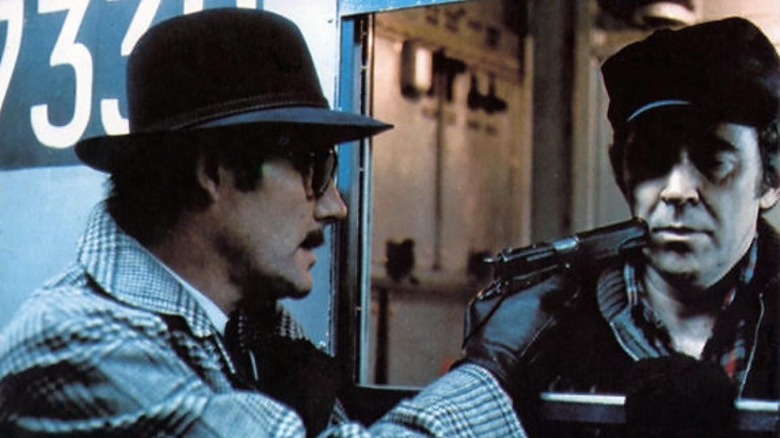
Robert Shaw had been around for a while by the time he took the role as Quint, the demented shark hunter. Making his film debut shortly after World War II, he went on to play one of the few SPECTRE henchmen who could pose a serious threat to 007 in "From Russia With Love," lost out on an Academy Award for "A Man For All Seasons" to his later drinking buddy, Walter Matthau, and played the villain opposite Paul Newman in "The Sting."
He was a tough character from a tough upbringing, inheriting alcoholism from his abusive dad, who committed suicide when Shaw was just 12 years old. As a talented actor of stage and screen, he became another of those heavy-boozing British thespians like Richard Burton, Peter O'Toole, and Richard Harris.
Shaw's son, Ian, has an interesting perspective on his dad's drinking (via Irish Times):
"I feel that generation, especially the more working-class actors like Richard Burton, had a little discomfort with the profession in terms of putting on tights and make-up. So their way of asserting their masculinity was to be hard drinkers, the sort of Viking method of proving themselves."
Shaw was a reputed stage actor, playing Shakespeare with the Old Vic in London, and also an author of several novels; "Situation Hopeless... But Not Serious" was adapted into a film starring Alec Guinness. With his experience and hard-drinking temperament, he wasn't about to let some arrogant kid like Richard Dreyfuss off easily.
Shaw's drinking on the job could sometimes get out of hand. During "Jaws," he suggested a little tipple to set the right tone for the USS Indianapolis scene. He ended up getting so drunk that he was unable to complete the take (via Entertainment Weekly). Shaw talked about his tippling during an on-set interview when asked how he psyched himself up between scenes:
"Well.. scotch, vodka, gin, whatever, we all have different methods. I do tend to drink when totally bored, Roy does exercises... and Dreyfuss talks... just talks interminably."
Dreyfuss And Shaw Disagreed About Plenty Of Things
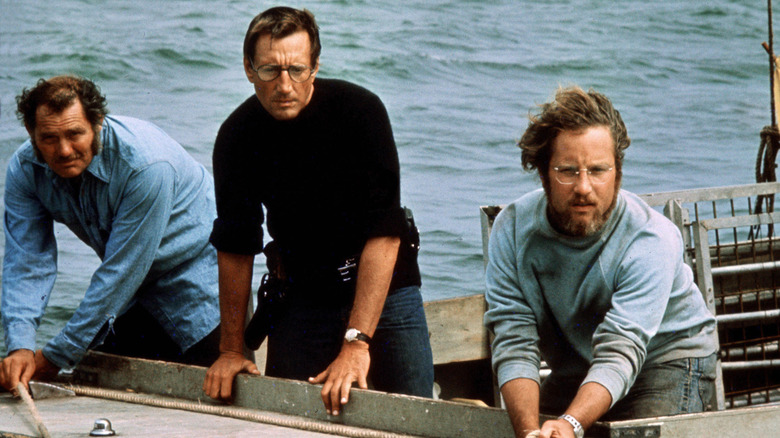
Although Dreyfuss and Shaw initially got on well, things changed when it came to getting into character (via Bio.com):
"He was an enormous personality, and he radiated it, and in private he was the kindest, gentlest, funniest guy you ever met. Then we'd walk to set, and... he was possessed by some evil troll who would make me his victim."
Roy Scheider believed it was Dreyfuss's arrogance that sparked the so-called feud:
"He [Shaw] really thought Dreyfuss needed a slapping down... young punk with no stage experience..."
Dreyfuss himself later downplayed any talk of a feud between them (via Daily Record):
"It's clearly not true, and where that started I don't know, but trust me, Robert Shaw wouldn't countenance that idea of a feud, forget it."
The big incident that seems to be the main source of the feud story also involved drink. Dreyfuss explained:
"He was walking down the gangplank holding a drink in his hand and said, 'Richard, help me out here.' I said, 'Do you really want my help?' He said he did and I took his drink and I threw it in the water. Every drinker on that crew went 'ooooh' and then he got his revenge by taking the fire hose and pointing it at my face. I lost my sense of humour and that lasted about an hour."
Spielberg also tells a story about their on-set rivalry that seems enlightening:
"Robert would basically humiliate Richard into taking a chance. For instance, Robert would say 'I'll give you a hundred bucks if you climb to the top of the mast and jump off into the water.'"
With a natural tension between Quint's "working class hero" and Hooper's "city boy," maybe part of it was an experienced actor taking the reins and doing what he thought best to get the most out of his younger co-star. If everything I've read about Shaw is true, rattling the arrogant "young punk" at the same time was probably a nice little bonus. Even though there isn't really a clear victor in this battle of big screen talents, it's the audience who ended up winning.
Read this next: The 15 Best '70s Horror Movies Ranked
The post Why Richard Dreyfuss and Robert Shaw Had a Contentious Relationship While Filming Jaws appeared first on /Film.
4 best practices to implement a comprehensive Zero Trust security approach
Today’s threat actors don’t see barriers, they see opportunities. As the old firewalls protecting the corporate network become obsolete amid the rush to adopt a hybrid workspace, implementing Zero Trust security has become an imperative across all sectors, both public and private. During this time of unprecedented change, Microsoft Security is committed to helping you be fearless in pursuing your vision for growth and success.
Because an effective Zero Trust approach needs to operate holistically across your complex digital estate, Microsoft Security solutions function as a unified whole to protect your people, data, and business. We’re uniquely positioned to simplify and strengthen security across your entire enterprise—even integrating easily with your existing third-party products. In this blog, we’ll look at four guidelines for implementing a comprehensive Zero Trust strategy that can help your organization continue to move forward confidently in these uncertain times.

Figure 1. Microsoft Zero Trust architecture.
1. Build Zero Trust with comprehensive coverage
Despite what the name implies, a Zero Trust approach empowers organizations to grant employees greater freedom across all data, apps, and infrastructure. In a recent Microsoft-commissioned study conducted by Forrester Consulting, The Total Economic Impact (TEI) of Zero Trust Solutions From Microsoft, the principal architect at a logistics firm described how Microsoft’s comprehensive Zero Trust implementation allowed them to create a bring your own device (BYOD) program for the company’s seasonal frontline workers, leading to efficiency gains. “Before, our seasonal workers would have to be paired with our full-time employees when [performing field visits]. But now, they can go out on their own.”
The interviewees said that “by implementing Zero Trust architecture, their organizations improved employee experience (EX) and increased productivity.” They also noted, “increased device performance and stability by managing all of their endpoints with Microsoft Endpoint Manager.” This had a bonus effect of reducing the number of agents installed on a user’s device, thereby increasing device stability and performance. “For some organizations, this can reduce boot times from 30 minutes to less than a minute,” the study states. Moreover, shifting to Zero Trust moved the burden of security away from users. Implementing single sign-on (SSO), multifactor authentication (MFA), leveraging passwordless authentication, and eliminating VPN clients all further reduced friction and improved user productivity.

Figure 2. Microsoft Zero Trust solutions and capabilities.
2. Strengthen Zero Trust with AI and integration
The Forrester study also found that “existing solutions failed to provide the high-fidelity signals, comprehensive visibility, and end-to-end self-healing capabilities needed to defend against today’s sophisticated attackers and volume of cyberthreats.” For the interviewed organizations, “prior solutions could not provide telemetry of a threat’s effect on data, a user’s exact activity on the network, or a timeline for effective remediation.” And because the organizations relied on security solutions from multiple vendors, “consolidating telemetry information for triage and analytical work was difficult and time-consuming.”
Microsoft Sentinel solves the problem of vulnerable security silos by providing a single solution for alert detection, threat visibility, proactive hunting, and threat response. As a cloud-native security information and event management (SIEM) and security orchestration, automation, and response (SOAR) solution, Microsoft Sentinel uses AI to eliminate security infrastructure setup and maintenance by automatically scaling to meet user needs. Because Microsoft Sentinel is available out of the box with service-to-service connectors, it’s easy to gain real-time integration with Microsoft 365 Defender, Microsoft Azure Active Directory (Azure AD), Microsoft Defender for Identity, and Microsoft Defender for Cloud Apps.
Any truly comprehensive Zero Trust implementation requires functionality across multiple platforms. Microsoft Sentinel also contains 30 new out-of-the-box data connectors for Cisco, Salesforce Service Cloud, Google Workspace, VMware ESXi, Thycotic, and many more. These data connectors include a parser that transforms the ingested data into Microsoft Sentinel normalized format, enabling better correlation for end-to-end outcomes across security monitoring, hunting, incident investigation, and response scenarios. Microsoft Sentinel automates routine tasks—with a 90 percent reduction in alert fatigue—so, your security team can focus on the most critical threats.
For example, by adhering to the values of Zero Trust, the Microsoft security operations center (SOC) assumes that any device or user can be breached. That means we end up scrutinizing roughly 600 billion security events each month. But because we utilize Microsoft Sentinel and our other security tools that leverage machine learning, threat intelligence, and data science, we’re able to filter 600 billion monthly events down to around 10,000 alerts. We also use Microsoft Defender for Endpoint Automated Investigation and Response (AIR) capabilities to find and fix low-level malware instances and other nuisance alerts. Microsoft Defender for Endpoint AIR capabilities can also clean up a device, delete the service, erase the file, and tell us when the problem has been remediated. This reduces noise for our SOC and helps shrink those 10,000 monthly alerts down to a manageable 3,500 cases for investigation. Whittling those numbers down is what helps us—and you—zero in on real threats.
3. Simplify for easier compliance and identity and access management (IAM)
The five organizations in the Forrester study struggled to comply with regulatory requirements because “the complexity of their IT environments made it difficult to audit their environments or effectively implement governance policies.” Sound familiar? Fortunately, Zero Trust requirements can sometimes exceed some compliance requirements; meaning, organizations sometimes find that they’re better off than they had been previously.
As a feature in the Microsoft 365 compliance center, Microsoft Compliance Manager solves this common problem with intuitive management and continuous assessments—from taking inventory of data risks to implementing controls, staying current with regulations and certifications, and reporting to auditors. Compliance Manager’s machine learning and analytics even help sort through relevant data to respond to your legal, regulatory, and internal obligations based on requirements from the International Organization of Standardization (ISO), National Institute of Standards and Technology NIST), Cybersecurity and Infrastructure Security Agency (CISA), and General Data Protection Regulation (GDPR). It automatically measures your progress toward completing necessary actions—providing a compliance score around data protection and regulatory standards—along with workflow capabilities and built-in control mapping to help carry out improvements.
To make compliance even easier, the new Microsoft Sentinel: Zero Trust (TIC 3.0) Workbook features a redesigned user interface, new control card layouts, dozens of new visualizations, and better-together integrations with Microsoft Defender for Cloud to monitor compliance posture deviations across each TIC 3.0 control family. The new workbook also provides a mechanism for viewing log queries, Azure Resource Graph, metrics, and policies aligned to TIC 3.0 controls—enabling governance and compliance teams to design, build, monitor, and respond to Zero Trust requirements across 25 plus Microsoft products.
Microsoft also offers more than 300 pre-built risk assessment templates to help you comply with evolving regulations, as well as integrated workflows to help ensure the right people across security, HR, legal, and compliance can investigate as soon as a risk is identified. The director at a manufacturing firm explained that “Microsoft Secure Score reduced the time it took us to be compliant with the California Consumer Privacy Act (CCPA) and GDPR. And Azure AD and Microsoft 365 E5 really enhance our security capabilities.” Secure Score simplifies your security posture by providing centralized visibility across all your Microsoft 365 workloads. This helps identify potential improvements, as well as benchmark your organization’s status over time. Embedded guidance enables you to evaluate each recommendation and determine which vectors of attack are a priority, and how they can be mitigated.
Organizations in the Forrester study also stated that “Legacy infrastructures made it difficult for IAM teams to meet organizational security requirements and the needs of their users.” Azure Active Directory integration enabled these businesses to streamline sign-in and easily deploy applications companywide, as well as enable SSO and automate user provisioning. These efficiency gains allowed their IAM teams to focus on improving security by implementing additional Zero Trust policies. By adopting Azure AD, the IAM teams also reduced time spent managing IAM infrastructure, provisioning and de-provisioning users, managing vendors, and dealing with application downtime and remediation.
4. Look for best-in-breed protection
When looking for a Zero Trust solution you can rely on, there’s a confidence that comes from knowing your security provider has seen more than 40 percent year-over-year growth and more than USD10 billion in revenue. As Thomas Mueller-Lynch, Service Owner Lead for Digital Identity at Siemens put it, “There aren’t too many vendors on the planet that can create a solution capable of providing consolidated insights into large, complex environments like ours. That’s why we chose Microsoft.”
Microsoft Security is a leader in five Gartner Magic Quadrants and eight Forrester Wave categories and ranked the highest in the MITRE Engenuity® ATT&CK Evaluation. Microsoft was also named a Leader in IDC MarketScape for Modern Endpoint Security. By unifying security, compliance, and identity, we can help you improve productivity and protect your entire environment—from Windows and macOS to Linux, iOS, Android, and Amazon Web Services (AWS). For built-in intelligence, easy integration, and simplified management that addresses all three Zero Trust pillars, Microsoft Security provides the comprehensive solution you need to move forward—fearless.
Learn more
- Be fearless—evaluate your security posture today.
- Explore our Zero Trust approach to comprehensive security.
To learn more about Microsoft Security solutions, visit our website. Bookmark the Security blog to keep up with our expert coverage on security matters. Also, follow us at @MSFTSecurity for the latest news and updates on cybersecurity.
The post 4 best practices to implement a comprehensive Zero Trust security approach appeared first on Microsoft Security Blog.
US Government sets forth Zero Trust architecture strategy and requirements
To help protect the United States from increasingly sophisticated cyber threats, the White House issued Executive Order (EO) 14028 on Improving the Nation’s Cybersecurity, which requires US Federal Government organizations to take action to strengthen national cybersecurity.1 Section 3 of EO 14028 specifically calls for federal agencies and their suppliers “to modernize [their] approach to cybersecurity” by accelerating the move to secure cloud services and implementing a Zero Trust architecture.
As a company that has embraced Zero Trust ourselves and supports thousands of organizations around the globe on their Zero Trust journey, Microsoft fully supports the shift to Zero Trust architectures that the Cybersecurity EO urgently calls for. We continue to partner closely with the National Institute of Standards and Technology (NIST) to develop implementation guidance by submitting position papers and contributing to communities of interest under the umbrella of the National Cybersecurity Center of Excellence (NCCoE).
Microsoft helps implement Executive Order 14028
The memo clearly describes the government’s strategic goals for Zero Trust security. It advises agencies to prioritize their highest value starting point based on the Zero Trust maturity model developed by the national Cybersecurity & Infrastructure Security Agency (CISA).
Microsoft’s position aligns with government guidelines. Our maturity model for Zero Trust emphasizes the architecture pillars of identities, endpoints, devices, networks, data, apps, and infrastructure, strengthened by end-to-end governance, visibility, analytics, and automation and orchestration.

To help organizations implement the strategies, tactics, and solutions required for a robust Zero Trust architecture, we have developed the following series of cybersecurity assets:
- Cloud Adoption Framework: A rich repository of documentation, implementation guidance, and best practices to help accelerate cloud adoption.
- Zero Trust rapid modernization plan: A downloadable suggested phased rollout plan to accelerate adoption of a Zero Trust security approach.
- Zero Trust scenario architectures: A downloadable PDF of key architecture scenarios mapped to NIST standards.
- Multifactor authentication (MFA) deployment guide: Guidance on using Microsoft Azure Active Directory (Azure AD) to meet Zero Trust Architecture and MFA requirements.
- Interactive guide on the Cybersecurity EO: Clear, concise guidance to help organizations better understand near- and long-term milestones, build a strategic response aligned to security modernization priorities and Executive Order requirements, and determine how technology partners can help accelerate the journey.
New capabilities in Azure AD to help meet requirements
A blog by my colleague Sue Bohn, Guidance on using Azure AD to meet Zero Trust Architecture and MFA requirements, provides a great summary of how Azure AD can help organizations meet the requirements outlined in EO 14028. We recently announced two additional capabilities developed in response to customer feedback: cloud-native certificate-based authentication (CBA) and cross-tenant access settings for external collaboration.
Certificate-based authentication
Phishing remains one of the most common threats to organizations. It’s also one of the most critical to defend against. According to our own research, credential phishing was a key tactic used in many of the most damaging attacks in 2021. To help our customers adhere to NIST requirements and effectively counter phishing attacks, we announced the preview of Azure AD cloud-native CBA across our commercial and US Government clouds.
CBA enables customers to use X.509 certificates on their PCs or smart cards to authenticate applications using Azure AD natively. This eliminates the need for additional infrastructure such as Active Directory Federation Services (ADFS) and reduces the risk inherent in using on-premises identity platforms.
Cloud-native CBA demonstrates Microsoft’s commitment to the federal Zero Trust strategy. It helps our government customers implement the most prominent phishing-resistant MFA, certificate-based authentication, in the cloud so they can meet NIST requirements. Read the documentation on Azure AD certificate-based authentication to get started.
Cross-tenant access settings for external collaboration
Our customers have told us they want more control over how external users access apps and resources. Earlier this month, we announced the preview of cross-tenant access settings for external collaboration.
This new capability enables organizations to control how internal users collaborate with external organizations that also use Azure AD. It provides granular inbound and outbound access control settings based on organization, user, group, or application. These settings also make it possible to trust security claims from external Azure AD organizations, including MFA and device claims (compliant claims and hybrid Azure AD joined claims). Consult the documentation on cross-tenant access with Azure AD External Identities to learn more.
More capabilities coming soon
We’re continuing to work on new capabilities to help government organizations meet Zero Trust security requirements:
- The ability to enforce phishing-resistant authentication for employees, business partners, and vendors for hybrid and multi-cloud environments.
- Comprehensive phishing-resistant MFA support, including remote desktop protocol (RDP) scenarios.
Resources for your Zero Trust journey
Microsoft is committed to helping the public and private sectors with a comprehensive approach to security that’s end-to-end, best-in-breed, and AI-driven.
To advance your Zero Trust implementation, we offer the following:
- Cybersecurity EO resources for federal agencies.
- Zero Trust Guidance Center.
- Microsoft Cybersecurity Reference Architectures.
To learn more about Microsoft Security solutions, visit our website. Bookmark the Security blog to keep up with our expert coverage on security matters. Also, follow us at @MSFTSecurity for the latest news and updates on cybersecurity.
1Executive Order (EO) 14028 on Improving the Nation’s Cybersecurity.
The post US Government sets forth Zero Trust architecture strategy and requirements appeared first on Microsoft Security Blog.
The Cursed Review: Boyd Holbrook Hunts Werewolves In Atmospheric Thriller
Note: This review was initially published during Sundance 2021 under this movie's original title, "Eight For Silver." Since the film arrives in theaters on February 18, 2022, we have republished the review below with the updated title reflected throughout.
Werewolf stories frequently involve allegorical explorations of the duality of man: the clash between the "civilized" surface layer and the violent beast within. But unlike so many other films in this genre, writer/director Sean Ellis's new werewolf thriller "The Cursed" does not fixate on a gruesome physical transformation to illustrate that duality. Instead, Ellis deploys the werewolf as a roaming specter hellbent on revenge -- and in this film, innocent people are forced to suffer for the sins of their elders.
Primarily set in the late 1800s during a cholera epidemic (which obviously adds an extra layer of timeliness), the majority of the story centers on the wealthy Laurent family, who live in an isolated manor in the English countryside where the skies are always gray and a thin layer of fog never seems to fully dissipate. The patriarch, Seamus (Alistair Petrie), has a frosty relationship with his wife Isabelle (Kelly Reilly), and is more concerned about his business affairs than interacting with his wife and children. Turns out his affairs sometimes involve the slaughter of innocent people. When a community of gypsies rolls in and sets up camp on a nearby tract of land, proving that they are the rightful owners, Seamus and his fellow landowners in the region can't stand the idea of co-existing with them. The gypsies won't be bought off or negotiated with -- they simply want the land that belongs to them. So Seamus and company hire a band of mercenaries to murder them. But before the last member of the gypsy community is buried alive, she curses the land and all who live on it.
That curse infects the dreams of everyone there, including the children, who begin having nightmares about a man who has his limbs hacked off, his clothing stuffed with straw, and is strung up as a grisly makeshift scarecrow in a local field. That nightmare is real: the man is one of the gypsies tortured by the mercenaries, and the film is unflinching in depicting his brutal fate. Soon after, werewolves start to terrorize the land, the first one having been bitten by a set of silver teeth which were melted down from the coins paid to Judas Iscariot for betraying Jesus Christ. When Seamus's son goes missing, a pathologist (Boyd Holbrook) who happens to have a personal history of dealing with werewolves is hired to locate the boy, and the rest of the film deals with that investigation.
A Werewolf Story With A Lot On Its Mind

Instead of centering this story on an infected individual, Ellis subjects an entire community to the dangers of werewolves, using the movie's framework to craft a powerful metaphor for one of society's biggest festering sins: The way colonizers stole lands from indigenous people and shoved aside populations which didn't fit into their twisted visions of progress and expansion. The massacre of the gypsy tribe is one of the most extraordinarily filmed scenes in recent memory: In a single ultra-wide shot, we see the mercenaries ride out to the community, have one final conversation with the tribal leaders, then gun them down and burn the camp, running people down as they scatter and murdering them in cold blood. Ellis's framing of this shot recalls paintings of historical atrocities, like François Dubois' The Saint Bartholomew's Day Massacre, where your eye sees a new horror as it scans every corner of the image.
Not every decision pays off as well as that one, though. The choice to use heavy CG for the werewolves feels disconnected from the rest of the movie's tactile feel, and will certainly cause it to age more poorly than if makeup and prosthetics had been used throughout. (There are several moments when those preferred techniques are used, including one of the film's big "holy sh*t" scenes that felt as if it were ripped from John Carpenter's "The Thing.") Though Boyd Holbrook delivers a solid performance as the hero, he feels a bit too modern and clean-cut for this movie. And despite the movie building to a big climax, I was left feeling like there was one more gear that it was never able to shift into, and perhaps a few more thematic strands it could have tied to give the movie even deeper resonance.Even so, this is the best film I've seen at Sundance 2021 thus far. Ellis, a British filmmaker who previously directed movies like "Cashback" and "Anthropoid," is able to engage with the way we've treated indigenous people in a way that few American filmmakers have, grappling with the horror and the guilt and the shame of that original sin and funneling it all into a cathartic reckoning. Haunting, harrowing, and hypnotic, "The Cursed" is a werewolf story with a lot on its mind. You'll never look at a scarecrow the same way again./Film Rating: 8 out of 10
Read this next: The Horror Movies We Can't Wait To See In 2022
The post The Cursed Review: Boyd Holbrook Hunts Werewolves in Atmospheric Thriller appeared first on /Film.
US Agencies Say Russian Hackers Compromised Defense Contractors
Read more of this story at Slashdot.
Your Windows 11 PC Will Soon Run Windowed Games Better
Fans of windowed-mode gaming may notice some performance issues when playing on Windows 11, but Microsoft intends to fix that very soon. A Windows update spotted on the horizon will add new optimization tools that will make windowed games run a lot better.

The Prop Cate Blanchett Kept From The Lord Of The Rings Set

Australian actress Cate Blanchett portrayed Galadriel, one of the most prominent "Lord of the Rings" characters in Peter Jackson's adaptation of J.R.R. Tolkien's sweeping, sprawling fantasy novels. Galadriel was a crucial figure in Second Age Middle-earth, the "Lady" of the woods of Lothlórien, who ruled over the Elven realm with her husband, Celeborn. One of the great elves from Middle-earth, Galadriel's knowledge, power, and beauty surpassed many others.
Galadriel's costume was created to reflect her affinity with the realm of Lothlórien, and she is one of the only elves to wear an Elven circlet. The silver headdress is a prominent piece of jewelry associated with her character, and it's designed to look like the branches of trees intertwined with golden leaves. Covered in these gorgeouns Elven accessories, Blanchett effortlessly captured the timeless beauty and physicality of Galadriel's character — a mighty elf who bore Nenya, the Ring of Water, one of the three Elven rings of power.
Director Peter Jackson enjoyed working with Blanchett so much — he made sure the actress reprised her role in "The Hobbit," nearly a decade after the original trilogy, despite the character not having a key role in the book it's based on. After being part of a franchise for so long, most actors take home a prop from the sets as a keepsake, having spent considerable time with their character. At her husband's request, Cate Blanchett brought home a prop he treasured from her time working in the fantasy films — not the One Ring or her glorious crown – but the prosthetic elf ears she wore as the elf Queen.
Cate Blanchett Now Has Extra Ears

After filming "The Hobbit" trilogy, Cate Blanchett revealed to the Daily Telegraph (via Metro UK) that she had been gifted a box of her prosthetic elf ears after someone discovered that her husband, Andrew Upton, was very fond of them.
"Someone got to hear that my husband has a bit of a thing for my ears and presented us with mine...They're not full ears either – they're little prosthetic tips that fit on the top of your ears to make the point. But they're cute – and a bit weird. They were all beautifully housed in a wooden box with a little section for each ear. It was kind of like a box of chocolates but with ears!"
Blanchett hasn't reprised her role since the 2014 film "The Hobbit: The Battle of the Five Armies," but Tolkien fans can rest easy because a younger version of her character will appear in the upcoming "Lord of the Rings" Amazon TV series.
Amazon's "The Lord of the Rings: The Rings of Power" is set thousands of years before "The Hobbit" and "The Lord of the Rings." It will cover all major events from the Second Age of Middle-earth — from the forging of the Rings of Power to the rise of the Dark Lord Sauron and the last alliance between Elves and Men. Since Galadriel was a significant player in the drama surrounding the creation of the Rings and one of its bearers, we can expect to learn more about the character's background and history, but it will be Welsh actress Morfydd Clark playing Young Galadriel. Hopefully she'll get to keep her own elf ears too.
Read this next: 13 Fantasy Films That Never Got Sequels
The post The Prop Cate Blanchett Kept From The Lord Of The Rings Set appeared first on /Film.
Charlie Day Spills On It's Always Sunny, His Directorial Debut, And The Magic Of Mountain Dew [Interview]

There are dream interviews, and then there are the ones where you pinch yourself afterwards because you can't believe it's real. "It's Always Sunny in Philadelphia" is my favorite TV series of all time, and my favorite character on the show is Charlie Kelly. So when the opportunity arose to chat with Charlie Day -- the man behind everyone's favorite illiterate, cat food-eating janitor -- I jumped at the chance.
Day is the new spokesman for Mountain Dew, the sweet citrus soda that will give you more energy than a jug full of Fight Milk. Such a pairing is deserving of celebration, so the fine folks at Mountain Dew set me up to chat with Day about "It's Always Sunny in Philadelphia," the latest on his directorial debut, "Pacific Rim," and of course, how to do the Dew.
After pacing my apartment with nervous energy, I sat down for a Zoom call with Day, who was warm, funny, and incredibly gracious. He delivered thoughtful answers to my tough questions and knocked the softballs right out of the park, as any good soda spokesman should. In the new ad campaign, Day gets a chance to do some fun stunts, sing a little ditty, and chug a whole lot of Mountain Dew. In addition to finishing the record-breaking 15th season of "It's Always Sunny," fans can also catch Day playing the romantic lead in his latest film, "I Want You Back," now streaming on Prime Video. Talking with Day was a dream come true, and now I'm thrilled to share it with all of you.
This interview has been lightly edited for clarity.
'Anytime We Get To Go Down A Rabbit Hole Of Stupidity, I Absolutely Love It'

You recently spoke on the "Always Sunny" podcast about how Charlie's illiteracy was a gag that just happened. And while sometimes it's a little silly, some of the resulting bits have been gold, like denim chicken or "The Gang Dances Their A**es Off" What's your favorite moment of Charlie's idiocy?
Oh my lord. Well, probably when he wrote a musical to propose to the girl that he loves without realizing that the themes of his musical are going to be interpreted in an entirely different way. But gosh, there's so many, there's almost too many to just pick one at this point. I mean, this season, I liked that Charlie didn't understand how Pittsburgh and Philadelphia can be in the same state. How you could have two cities in one state seem to blow his mind. So anytime we get to go down a rabbit hole of stupidity, I absolutely love it.
There's a brilliance to Charlie too, though. In "Charlie Work," you really get to see that he's a little bit of a savant as well. How do you and the rest of the crew manage to find that balance between savant and total dummy?
Look, I think that's actually true to life. I think that's more true to life than we want to admit. I've seen some of the smartest people in the world not know how to open the wrapper of a cheese stick. And at the same time, someone who might not have the book smarts of someone else might be much more world savvy. So I think, I like those differences. I think sometimes you just have to just find that little sweet spot in between about what's too smart or what's too dumb and that's a moving target. But I'm glad that it's not just all one thing. I think it would get boring.
'It's Not A Justification, But It's Just Another Color'

And speaking of that, this season you got to do a big dramatic moment with your breakdown in the finale. What was it like finally having that cathartic moment for Charlie after all these years of being kicked around?
I think it was really cathartic for me as well, just as a person and a performer, just to let that out. And it was nice to do in terms of the story to just acknowledge the character's humanity just for a minute. I think audiences wouldn't love it if we dwelled on it forever and ever, but to stomp down the insanity for a minute and say, hey, let's just take a look at this guy. He's a real guy who's had a very messed up life and that might explain a little bit why he is who he is. It's not a justification, but it's just another color. So I really enjoyed getting to try to push myself to that place. And I've been really happy with the audience's response to it.
And what was it like working with Colm Meaney? I have to know.
Oh, we were so thrilled he was willing to do it. We flew, I think he was in Spain and we flew him out. And we were just big fans and we really wanted someone who could be funny, but someone who also had heavy, dramatic chops to just come in and play in our sandbox, and he was a total pro and a pleasure to be around. And I'm sorry we had to kill him off, but we scripted that before we cast him.
'I Think The Next Thing That I Write Or Direct, I Think Ideally Would Have To Do With Music'

You said you love the Nightman. Are we going to ever see the Nightman or the Dayman again?
A while ago, we toured around doing a live performance of the Nightman, which was an absolute blast. I think it would be a shame not to at least try that one more time. So who knows if we can coordinate our schedules and our home lives and our raising kids and all that just to get out and about and perform that show again, I'd love it.
Well, you are very musically talented. And I was wondering if we're going to see more musicality from you, either in your upcoming movie roles or on TV or anything?
Well, fortunately Mountain Dew reached out to me and asked if I wanted to sing a song for their commercial campaign. And I thought, what a great idea. I think that's really going to reach your audience and it's fun for me. Yes, I absolutely love just working on music and I have a couple ideas in mind and I think the next thing that I write or direct, ideally would have to do with music. I don't have anything in the works yet, but I have something I'm cooking up in my mind. But I'm not going to commit to it yet in case I can't pull it off.
'It Was Really Just Up For Me To Get The Storytelling Right'

And speaking of writing and directing, do you have any updates on [directorial debut] "El Tonto"?
Yes. So I'm re-titling it, and I've changed it a little bit. And I actually did a big re-shoot with Ken Jeong. I used the pandemic to, like Pixar does, stop and look at my project and change whatever aspects of it I wanted to change. And I'm going through the final editing now, but I had a lot of help from a really talented mentor, a brilliant man named Guillermo del Toro [pictured above as Pappy McPoyle in "It's Always Sunny in Philadelphia"], who ... I was about to sell the movie, and I wanted to get his opinion on something that I really wanted to change, but I knew it was a crazy move to take the movie off the market and go through a change and sit on it for so long. And Guillermo was such a good influence that he said, "Listen, you just have to make this movie what you want it to be."
And he really not only urged me to do it, but was willing to let me bounce some ideas off of him. And he was a very busy man. So the fact that he was willing to peel aside some time to help guide me through that process ... So I went through those changes with Ken Jeong, who has now a very large part in the movie. And I think [he] delivers a performance unlike anyone's seen him perform: really hysterical, but also very emotional. And so I'm going to put the finishing touches on that this week. And then I'll start trying to bring it back out to buyers shortly. But I mean, between Ken Jeong and Kate Beckinsale and Adrien Brody and John Malkovich and Jason Sudeikis, the performances in this movie are so great. It was really just up for me to get the storytelling right. And I think I got it into a place now where hopefully it can find the right home very soon.
I'm excited to get it out there, finally.
'Stunt Guys Gotta Work Too'

Speaking of Del Toro, in "Pacific Rim," you played Newt. Would you be looking to play more genre characters? Would you be interested in horror or superhero movies or anything like that?
Yes, I love all that. It's just a matter of, will I be asked? But no, I am. And I have ideas like that, that I'm also developing, which are ideas of my own. But getting to work with someone like Del Toro was truly life-changing for me. Obviously, with this movie that I've been directing, he was just such an amazing creative influence. And I loved being in a -- I guess a giant monster movie, you would call it. So I would really like to do more of that stuff if I get the chance, I'll jump at it.
As a Mountain Dew spokesman, you are doing a lot more physical comedy, but this is not your first rodeo with physical comedy. Have you ever gotten hurt over the years and what draws you towards keeping at it?
Well, yeah, I mean, I do have a tendency to throw myself into stuff to the point where sometimes it can be dangerous, but Mountain Dew had me do a few stunts, none of which were too risky. I think I got to crash through a wall, which was actually a lot of fun. But I just love making things, whether it's a "Pacific Rim"-size movie or it's "Sunny" or even these Mountain Dew spots, which I think are hilarious. I think I am someone who just really enjoys getting to do it. So oftentimes when someone wants me to do something, I throw myself into it. But I am getting to the age now where I'm starting to smarten up a little bit and every now and then I think, well, stunt guys gotta work too, so give them the shot!
Read this next: 14 Shows Like Rick And Morty That Are Worth Your Time
The post Charlie Day Spills on It's Always Sunny, his Directorial Debut, and the Magic of Mountain Dew [Interview] appeared first on /Film.
The Raised By Wolves Colony Report: 'Control' Is An Illusion
Remember just last week when I thought things were looking great for Team Sol and pretty dire for Team Robot? In typical "Raised by Wolves" fashion, the series did yet another complete 180 this week, throwing almost any conceived notions about where it could possibly be headed right out the window. When we last peeked into the horrors happening on the planet Kepler-22b, Mother (Amanda Collin) and Father (Abubakar Salim) were at odds with one another over Mother's decision to keep her snake baby around, while Campion (Winta McGrath), Paul (Felix Jamieson), and Holly (Aasiya Shah) snuck off to warn Marcus (Travis Fimmel) and the other Mithraic folks that the atheist supercomputer the Trust was planning an attack. It looked like Team Sol had the upper hand, and the splintering of Mother and Father's union was leading Team Robot towards total disaster.
Buckle up, because episode 4 of "Raised by Wolves," "Control," is the series' nastiest, meanest entry yet. Just when you thought the show had gotten as weird and disturbing as it could possibly get, it ups the ante as this week takes us to some horrifying new highs.
SPOILERS for episode 4 of "Raised by Wolves" from here on out!
A Quick Recap
Things appear to be going well for Team Sol, with Marcus and Paul chatting about the latter's decision to come warn them. Paul tells Marcus that he won't be able to find the tree on the planet because the seeds are with the atheists, and he also reveals that he knows Marcus isn't his real father, because Sol told him. The two start talking about Sue (Niamh Algar) and Decima (Kim Engelbrecht) when Paul begins choking and developing scale-like lesions. The mouse given to him by the Trust was some kind of biological weapon, and it starts taking over Paul and another Mithraic believer standing nearby. Because of his "powers," Marcus is immune, and he carries Paul outside for air. The scales soon cover Paul, cocooning him, and his eyes look reptilian. Marcus realizes what's happened and tells his followers: "There is no search and destroy mission happening tomorrow. It already happened today." He blames Vrille (Morgan Santo) for bringing Paul and Campion to the cave, and Decima sends her to stop Campion, who has run off to get Mother.
Back at the atheist compound, Hunter (Ethan Hazzard) and the pregnant Tempest (Jordan Loughran) discuss why Tempest was chatting with the atheists outside of the fighting arena in the last episode. She explains they are going to adopt her child when it's born, but Father interrupts them to thank Hunter for lending him the Sol pendant. The three of them give Father's pet skeleton some fuel-blood, but it doesn't seem to do anything. At the dwelling, Mother catches Vita (Ivy Wong) playing the Necromancer video game instead of studying her lessons. The two get into an argument and Mother destroys the game, taking the microchips out to put to a different use. She takes them to the medical station and tries to create a control chip, which she tests on a bird. Sue asks her what she's doing, and why she won't just kill the snake creature. Sue has gotten the idea that Mother gave birth to the snake, but she doesn't know for sure. The two go back and forth for a little bit, but end up keeping each other at arm's length.
Vrille eventually catches up with Campion and is going to hurt him because of her programming, but she's attacked by some kind of water creature that leaks acid. Campion beats its head in with a rock, stunning Vrille. She asks him how he could possibly kill an "organic being to ensure that a synthetic being would continue operating," and he explains that he didn't want to see her get hurt. Tamerlane (James Harkness) witnesses Vrille letting Campion leave, and goes back to tell Marcus. He demands that Decima "make this right," and she attacks Vrille with her own shoulder pin, removed by Marcus when they first met. The followers of Sol hold down the child android while Decima attacks her, literally clawing her face off.
"Are you gonna break my neck again?" Vrille asks, and this sends Decima into a rage, screaming "You're not her!" as she continues to hack at the android made to look like her dead child. Vrille escapes and jumps off a cliff to her apparent death, and it is absolutely horrific. Paul is also now a weird, scale-encased husk, though Mother has arrived and is ready to take him to some kind of cure. Marcus and Mother fight, and Marcus almost wins but Campion hits him with a rock from a sling. Mother realizes that her eyes are inside of Marcus (he ate them back in season 1) and she starts pulling them out, moving them inside of his body using magnetism. She retrieves her eyes and puts them back in before turning back into her Necromancer form, finally picking up Paul and flying away. It looks like Marcus is back to being a normal human, as his skin is no longer covered in the blackened veins.
Mother returns to the atheist collective and demands the antidote from Cleaver (Peter Christofferson) and the Trust. He asks the Trust for guidance and it tells him and the other human soldiers to "shoot to destroy." Mother goes full kill-bot and starts exploding some of them with her scream powers when they decide to fall back and stand down. She's allowed inside to speak with the giant computer, and they begin to argue.
"How is it possible that we come from the same mind?" She asks. "How does a mind betray itself?"
She details the only way forward, in which she will be allowed to keep her eyes and the Trust will provide an antidote for Paul. Unfortunately, there is no antidote, and when Mother tells the A.I. to override its programming, it coldly replies "I cannot override that which I am." Mother begins to cry but knows what she must do, and shuts down and destroys the supercomputer. She explains to the atheists that she has no interest in power and will "transfer the baton of leadership," but they start to scatter, unsure of what to do with themselves now that their leader is gone.
Meanwhile, Father returns to his special project to see if anything has progressed, but the room has been destroyed and the skeleton is gone. Father thinks that Mother did something to get rid of the skeleton, but soon spots a light on the other side of the door. He opens it to reveal the skeleton is floating up in the air, and it's glowing.
Team Robot: Return Of The Necromancer And A Robotic Resurrection

Things aren't looking great for Team Robot, but they're looking a lot better than last week. Sure, Paul's not doing so hot and the atheists are pretty upset with Mother, but most of the kids are safe and healthy, Mother has her Necromancer powers back, and Team Sol has been completely demoralized. Mother and Father and their brood seem safe, at least for the time being. The only real threat now is whatever Father's managed to awaken. Is it an android that landed on the planet before? An organic life-form from before that shares a similar structure? A god? Whatever it is, it's powerful and insanely weird, and will give Team Robot some additional challenges on top of Paul's illness and Snakebaby's existence.
Father is also not doing as well as Mother. He's growing paranoid, thinking that she wants to do things just to hurt him, and the children are even concerned about his well-being. "You need to spend some more time putting yourself back together," Tempest tells him, and instead he's distracted by trying to bring the skeleton back to life.
The one human on Team Robot who isn't doing so well is Sue, and Mother even notes that her "blood oxygen levels look low." She's not sleeping and she's having some emotional responses to the colony, plus now her "son" has been infected by whatever is making him have a scale-cocoon. When we see her last in the episode, she's sitting up over Paul, watching him, waiting for any sign of recovery.
Team Sol: Has Your God Abandoned You?
Last week, things were looking pretty great for Marcus. He had his powers, he found a snake-scale cloak to wear, his "son" returned to him, and he had a whole flock of followers. Now his powers are gone, taken back by Mother. His beloved Paul is dying, and morale is completely shattered because of both the infection of the cave church and Vrille's death. Marcus lies to the followers about how Mother got her eyes back and doesn't mention that his powers are gone, which can only come back to bite him later. Team Sol is now homeless, powerless, and possibly abandoned by their god. It's almost enough to make someone feel sorry for Marcus if he wasn't such an insane, bloodthirsty zealot.
Worst off among the Mithraic followers of Team Sol is Holly, who now is stuck with a group of miserable humans that have no real resources and no ties to her beyond their faith. There are no other children, as Campion returned to the atheists and Vrille is dead. All she can do is "retreat inland" with the rest of Team Sol, and pray for better days.
Looking Forward

The only thing we know for sure after "Control" is that control is an illusion, even if you're an omnipotent super-computer, a killer robot who can fly, or a man who believes he has been chosen by God. All are subject to the chaos of life, whether they decide to call it chance, fate, or Sol's will. Mother lost control of her children and now Paul will likely die. The Trust lost control of Mother by sacrificing one of her children in the name of "the greater good." Father lost control of his experiment. Marcus lost control of, well, just about everything. As they scramble to try and find some semblance of stability in a hostile world, each of them will have to come to terms with just how helpless they actually are, and maybe they'll learn to work together against their mutual enemy, the planet.
New episodes of "Raised by Wolves" premiere Thursdays on HBO Max.
Read this next: The 14 Best Sci-Fi Shows On Amazon Prime
The post The Raised by Wolves Colony Report: 'Control' is an Illusion appeared first on /Film.
Intel Confirms Arc Alchemist Desktop Graphics Cards In Q2 2022, Workstation by Q3 2022, Celestial Architecture For Ultra-Enthusiast Segment In The Works

During its 2022 Investors Meeting, Intel confirmed that it will be shipping its first Arc Alchemist Desktop discrete graphics cards in Q2 2022.
Intel Arc Alchemist Desktop Graphics Cards In Q2 2022, Workstation In Q3 2022, Celestial Architecture For Ultra-Enthusiasts In The Works
It looks like Intel themselves have confirmed that while Arc Alchemist GPUs will be coming to the notebook segment in the first quarter of 2022, desktops will get the discrete graphics card update by the second quarter of 2022 while workstations will get the first Arc Alchemist powered products by the third quarter of 2022.

In addition to Arc Alchemist, it looks like Intel is also well underway on the development of its next-generation Arc graphics architecture. The company aims to offer enthusiast-grade products with its Battlemage architecture next year but the design work is already underway on its Celestial graphics architecture which comes after Battlemage and will be addressing the Ultra-Enthusiast segment. It is expected to be launched beyond 2024.
It is also interesting to see Intel use the 'Ultra-Enthusiast' wording for the Celestial lineup. This could mean that while Battlemage is aiming for the enthusiast segment, it still won't have GPU options to compete against NVIDIA and AMD's highest-end offerings so those who want to see those insane discrete graphics cards that sit at the top of the hill should wait for 2024 for next-generation Celestial products.

-
Visual Compute Roadmap and Strategy
- Intel Arc Graphics Timing and Roadmap Update – AXG expects to ship more than 4 million discrete GPUs in 2022. OEMs are introducing notebooks with Intel Arc graphics, code-named Alchemist, for sale in the first quarter of 2022. Intel will ship add-in cards for desktops in the second quarter and workstations by the third quarter. Architecture work has begun on Celestial, a product that will address the ultra-enthusiast segment.
- Project Endgame – Project Endgame will enable users to access Intel Arc GPUs through a service for an always-accessible, low-latency computing experience. Project Endgame will be available later this year.

Intel also announced that it plans to offer a new ecosystem known as Project Endgame which will allow consumers to access Intel Arc GPUs through a service for an always-accessible and low-latency computing experience. Think of it as Intel's answer to GeForce now and it does sound pretty cool. As for adoption, Intel plans to ship more than 4 million discrete GPUs in 2022 and aims to deliver $1 billion in revenue in 2022 but AXG plans to scale that revenue up to $10 billion by 2026.
-
Super Compute Roadmap and Strategy – More than 85 percent of the world’s supercomputers run on Intel Xeon processors. Building on this foundation, AXG is extending to higher compute and memory bandwidth and will deliver a leadership CPU and GPU roadmap to power high-performance computing (HPC) and AI workloads. To date, Intel expects more than 35 HPC-AI design wins from top OEMs and CSPs. Additionally, AXG has set a course that paves the way to zetta-scale by 2027.
- Sapphire Rapids with High-Bandwidth Memory (HBM) – HBM integrated into the package with Sapphire Rapids offers applications up to 4x more memory bandwidth, providing a generational improvement of 2.8x over Intel 3rd Gen Xeon processors. On the same computational fluid dynamics application, Sapphire Rapids with HBM outperforms competing solutions by up to 2.8x.
- Ponte Vecchio – AXG is on track to deliver Ponte Vecchio GPUs for the Aurora supercomputer program later this year. Ponte Vecchio achieved leadership performance results with up to 2.6x more performance compared with the leading market solution on a complex financial-services workload.
- Arctic Sound-M – Arctic Sound-M brings the industry’s first hardware-based AV1 encoder into a GPU to provide 30% bandwidth improvement and includes the industry’s only open-sourced media solution. The media and analytics supercomputer enables leadership to transcode quality, streaming density, and cloud gaming. Arctic-Sound M is sampling to customers and will ship by mid-2022.
- Falcon Shores – Falcon Shores is a new architecture that will bring x86 and Xe GPU together into a single socket. This architecture is targeted for 2024 and is projected to deliver benefits of more than 5x performance-per-watt, 5x compute density, 5x memory capacity, and bandwidth improvements.
- Custom Compute Group – AXG’s Custom Compute Group will build tailored products for emerging workloads such as blockchain, supercomputing at the edge, premium infotainment for cars, immersive displays, and more.


Intel also talked about its server and data center parts and has announced the AXG is on track to deliver the Ponte Vecchio Xe-HPC GPUs to the Aurora Supercomputer. Also, it looks like Arctic Sound is back in the form of Arctic Sound-M which will bring the industry's first hardware-based AV1 encoder into a GPU, providing a 30% bandwidth uplift and is expected to sample by mid of 2022. The Data Center GPU will feature a single-slot form factor and will come with a single 8-pin connector to boot in a passive design.
It was reported that Intel had canceled Arctic Sound to focus more on the Xe-HPC and Xe-HPG designs but in reality, it was just the Xe-HP GPUs that were canned. Arctic Sound-M have been positioned to serve the cloud segment and will be powered by the Xe-HPG DG2 GPU, allowing for up to 8 simultaneous 4K streams, 30+ 1080p streams, 60+ virtualized functions, 30+ game streams and AI performance of up to 150 TOPs.


In addition to that, Intel is working on a new MCM design known as Falcon Shores which is going to fuse x86 CPU and Xe GPU cores together into a single socket. We have been waiting to see AMD's Exascale APU solution for a while now but it looks like Intel may be the first to offer the said technology when it comes out with it by 2024, featuring 5x the performance per watt, 5 times the compute density and 5 times the memory capacity and bandwidth compared to traditional socket solutions.


The Falcon Shores platform will be leveraging from Intel's Xe-HPC architecture and will be based on either the 20A or 18A process node while featuring the next-generation of advanced packaging tech from Intel.
Intel ARC Gaming GPU Lineup
| GPU Family | Intel Xe-HPG | Intel Xe2-HPG | Intel Xe3-HPG | Intel Xe Next | Intel Xe Next Next |
|---|---|---|---|---|---|
| GPU Products | ARC Alchemist GPUs | ARC Battlemage GPUs | ARC Celestial GPUs | ARC Druid GPUs | ARC E*** GPUs |
| GPU Segment | Mainstream / High-End Gaming (Discrete) | Mainstream / High-End Gaming (Discrete) | Mainstream / High-End Gaming (Discrete) | Mainstream / High-End Gaming (Discrete) | Mainstream / High-End Gaming (Discrete) |
| GPU Gen | Gen 12 | Gen 13? | Gen 14? | Gen 15? | Gen 16? |
| Process Node | TSMC 6nm | TBA | TBA | TBA | TBA |
| Specs / Design | 512 EUs / 1 Tile / 1 GPU | TBA | TBA | TBA | TBA |
| Memory Subsystem | GDDR6 | TBA | TBA | TBA | TBA |
| Launch | 2022 | 2023? | 2024? | 2025? | 2026? |
The post Intel Confirms Arc Alchemist Desktop Graphics Cards In Q2 2022, Workstation by Q3 2022, Celestial Architecture For Ultra-Enthusiast Segment In The Works by Hassan Mujtaba appeared first on Wccftech.

