Last year AMD announced FidelityFX Super Resolution for high performance, spatial upscaling for video games across platforms. Today ahead of GDC week AMD announced FidelityFX Super Resolution 2.0...
AMD has officially announced its next-gen FSR 2.0 'FidelityFX Super Resolution' technology that will be incorporated in the latest AAA games. The new technology will be launching in Q2 2022 but we have a first look at what you can expect from the latest FSR implementation.
AMD Makes FSR 2.0 'FidelityFX Super Resolution' Technology Official: Offers Similar or Better Image Quality Than Native Resolution With Higher-Performance Across Several AAA Games
Press Release: AMD launched FSR 1.0 last year to very high levels of anticipation, and it quickly became our fastest adopted software product ever¹, giving large performance improvements compared to rendering at native resolution and keeping a high level of visual fidelity. We’ve never stopped investigating better solutions to help you make better games though, so you should not be surprised to hear we have upscaled the quality of our upscaling solution! We are genuinely excited over all we have achieved with FSR 2.0 technology, and we cannot wait to share it with you soon, here on GPUOpen.
But before we spill a bit more detail on FSR 2.0, to set the scene let’s take a look back at FSR 1.0 first.
What exactly is AMD FidelityFX Super Resolution 1.0?
FSR 1.0 is our best-in-class open source spatial upscaling solution for producing high resolution frames from lower resolution inputs. Designed for high performance and easy integration, it uses a collection of cutting-edge algorithms with a particular emphasis on creating high-quality edges.
Over 80 games and engines have already adopted or are adopting FSR 1.0 right now. The cross-platform codebase allows availability on PC across multiple vendor GPUs, as well as consoles and mobile gaming. It has also just become available in the latest Radeon Adrenalin driver as Radeon Super Resolution³ , bringing the benefits of FSR 1.0 to games which don’t natively support it.
Spatial upscalers have a lot of advantages, but they can have some limitations too.
FSR 1.0 requires a high quality anti-aliased source image, which is not always available without making further changes to code and/or the engine.
Upscaling quality is unavoidably a function of the source resolution input. So with a low resolution source, there is just not enough information with a spatial upscaler for thin detail.
This is where FSR 2.0 comes in!
Introducing AMD FidelityFX Super Resolution 2.0!
We’re very excited to announce our brand-new open source upscaling technique: FidelityFX Super Resolution 2.0!
FSR 2.0 is the result of years of research from AMD, and is developed from the ground up. It uses cutting-edge temporal algorithms to reconstruct fine geometric and texture detail in the upscaled image, along with high-quality anti-aliasing.
Here’s what else is new with FSR 2.0:
Delivers similar or better than native image quality using temporal data.
Includes high-quality anti-aliasing.
Higher image quality than FSR 1.0 at all quality presets/resolutions.
Does not require dedicated Machine Learning (ML) hardware.
Boosts framerates in supported games across a wide range of products and platforms, both AMD and select competitors.
May I have a sneak peak?
Our engineers have been working closely with engineers at Arkane to bring FSR 2.0 to DEATHLOOP.
Take a look below at the 1:1 single frame comparison comparing native 4K with FSR 2.0 Quality Mode.
Deathloop Native Resolution:
Deathloop FSR 2.0 (Quality):
It’s temporal, so I want to see it moving!
We have what you’re looking for right here, with this footage (best viewed at its full 4K resolution) from DEATHLOOP:
When is FSR 2.0 going to be available?
We will make FSR 2.0 available via GPUOpen at some point soon in the foreseeable future.
I want to know more already!
We’ll be sharing more about FSR 2.0 in due course, but don’t miss our GDC talk on March 23 10.30am PT where engineers Colin Riley and Thomas Arcila do a deep dive explaining exactly how FSR 2.0 works in great detail. You also won’t want to miss AMD’s Lou Kramer and Arkane Lyon’s Gilles Marion talk either: A Guided Tour of Blackreef: Rendering Technologies in Deathloop which starts at 9am PT just before.
Not able to do GDC? The videos for both presentations will be available here on GPUOpen shortly afterwards, along with all our other GDC sessions plus some extras, so keep a close eye out!
Want to make sure you’re the first to hear the latest developer news for AMD FidelityFX Super Resolution 2.0? Then make sure to follow us on Twitter @GPUOpen, add our RSS feed, or just keep popping back here. We can’t wait to share FSR 2.0 with you!
AMD releases the new AMD Radeon Adrenalin 22.3.1 driver, offering updated support for Radeon Super Resolution (RSR) Technology, AMD Link Play, Radeon Image Sharpening, and faster downloads. The new driver also supports notifications of changes made before jumping into their favorite games through improved Toast notifications.
AMD Adrenalin 22.3.1 launches, diminishing known issues and adding further support for new games and faster downloads.
AMD's Radeon Software Adrenalin 22.3.1 is a notebook reference graphics driver with limited support for system vendor-specific features. It is still unknown about the introduction of FSR 2.0, but it is slated during the second quarter this year.
Here are the changes that we see offered with today's update.
Radeon Image Sharpening is a convenient way to add a new level of crispness and fidelity to your favorite games, tailored to your preference.
We're adding this fan-favorite function to video content and other applications, just as easy as your games: one single click.
Radeon Super Resolution (RSR) Technology – RSR is an in-driver spatial upscaling feature built on the same algorithm as AMD FidelityFX Super Resolution technology. It delivered near-native resolution and increased performance across thousands of games in exclusive full-screen mode on AMD RDNA-based and newer discrete graphics.
AMD Link – Updated AMD Link Play feature allows up to four users to connect to an AMD Radeon graphics-powered PC from an Android- or Windows-based PC, phone, tablet, or TV to play local multiplayer games. AMD Link also introduces customizable hotkeys, allowing gamers to use their devices to control their gaming experience. AMD Link is now accessible from the Microsoft store and can be downloaded as a standalone application on non-AMD-based PCs, inviting an even more comprehensive range of users and hardware to join a personal gaming cloud.
Radeon Image Sharpening (RIS) – Bringing crispness and clarity to in-game visuals softened by upscaling and post-process. Users can now use the latest version of RIS to enhance visuals in video playback and other productivity applications with a single click.
Faster Downloads – Saves time and reduces the driver download size when updating AMD Software: Adrenalin Edition directly from the application, downloading and installing only the files that need updating on the PC.
Improved Toast Notifications – Provides users with a more precise snapshot of which key features are enabled or disabled whenever they launch a game.
Fixed Issues
Some users on Windows 10 operating system may observe the absence of the windows transparency aero effect.
On some AMD Graphics Products such as Radeon RX 6800 XT Graphics, the Tuning page within AMD Software: Adrenalin Edition may display incorrect preset selections after installing the latest AMD Software: Adrenalin Edition driver.
While playing Forza Horizon 5 on some AMD Graphics Products such as Radeon RX 6800 Graphics, longer than expected load times may be experienced when Ray Tracing is enabled and set at either Medium or High Ray Tracing Quality setting.
While playing It Takes Two on some AMD Graphics Products, such as Radeon RX 6900 XT Graphics, visual artifacts may be observed.
Enabling Radeon Chill for SteamVR may lead to inconsistent performances being experienced.
After disabling the Hotkeys feature in AMD Software: Adrenalin Edition, some hotkeys still function for some users when they restart their system.
Known Issues
Using Radeon Super Resolution on 2560×1600 resolution displays may produce a system hang. A temporary workaround is to set the display Scaling Mode to Full Panel.
While playing Cyberpunk 2077 on Graphics Products such as Radeon RX 570 Graphics, some users may observe an issue where indoor areas appear darker than expected.
Enhanced Sync may cause a black screen when enabled on some games and system configurations. Any users who may be experiencing issues with Enhanced Sync enabled should disable it as a temporary workaround.
Radeon performance metrics and logging features may report extremely high and incorrect memory clock values intermittently.
Radeon Product Compatibility
Radeon Software Adrenalin 22.3.1 is compatible with the following AMD Radeon products.
RX 6900/6800/6700/6600/6500/6400 Series Graphics
RX 5700/5600/5500/5300 Series Graphics
Radeon VII
RX Vega Series Graphics
AMD Radeon Pro Duo
RX 500 / Radeon 500X Series Graphics
RX 400 Series Graphics
Mobility Radeon Product Compatibility
Radeon Software Adrenalin 22.3.1 is a notebook reference graphics driver with limited support for system vendor-specific features.
RX 6800M Series Graphics
RX 6700M Series Graphics
RX 6600M Series Graphics
RX 6500M Series Graphics
RX 6300M Series Graphics
RX 5700M/5600M/5500M/5300M Series Graphics
600 Series Graphics
To download the new AMD Radeon Adrenalin 22.3.1 driver, you can access the download from AMD.com or the mirror located here.
Following up on our reporting about NVIDIA slashing GPU prices yesterday, a lot of other sources have started corroborating the overarching trend of declining prices. The most interesting report comes from a tweet by HardwareUnboxed (via Videocardz) which says that prices of the RTX 3080 GPU in Australia have fallen from $2299 to $1499 AUD overnight - a decline of more than 35%. Combining this with the fact that a lot of retailers are trying to thin their inventory in case a bubble bursts and you have ripe conditions for a massive freefall in global GPU prices.
Global GPU prices continue falling in March 2022, some GPUs are at their lowest-ever prices in two years
The specific GPU in question is the ASUS GeForce RTX 3080 TUF Gaming OC which declined in price by 35% overnight.
GPU pricing is falling off a cliff right now. Locally the "ASUS GeForce RTX 3080 TUF Gaming OC" was $2299 yesterday, today a few retailers have slashed it to $1499 AUD. That's 35% off over night.
(kick in the capacitors if you bought one yesterday)
A fall of 35% overnight is unheard off and likely means that retailers are trying to shed the GPUs at cost. As the prices get even more brutal, we will see some retailers trying to take losses to get rid of GPU inventory as well. With the Ethereum 2.0 merge coming up in the latter half of the year, the profitability of GPU mining is basically going to be halved. This will double the ROI (return on investment) time of a GPU and reduce the mining premium on GPUs right now. We are still in a semiconductor supply crunch situation but with miners divesting their operations, the flood of second-hand GPUs should seriously depress global prices.
GeForce RTX 3090 reaches prices less than €2000 at retailers in for the first time since last August
Some historical (best) prices: €3199 – May 16, 2021 €1999 – Aug 29 €2799 – Nov 21 €2699 – Dec 12 €2499 – Jan 2, 2022 €2320 - Feb 13 €2185 - Mar 6 €1990 – Mar 17 pic.twitter.com/vymNFbzUcn
Another tweet from 3DCenter who have been tracking GPU aggregates for a while now shows that the high end RTX 3090 is at its lowest ever price since last August as well (and slated to go down further). There is also speculation that NVIDIA will keep the RTX 30 series alive alongside RTX 40 series - which should help supply even more. The reason why this makes sense is that both series are manufactured at different foundries (Samsung vs TSMC) and by doing this, NVIDIA effectively doubles their typical wafer allocation (from a single foundry).
If you are on the market for a GPU - we would seriously advise you to wait. The overarching global trend for GPU prices is on a clear downwards trajectory and it makes a lot of sense to wait at this point. It is entirely possible that prices will actually get close to the original MSRPs in a few months as mining demand fizzles away and the accumulated influx of second-hand GPUs from mines satisfies most of the GPU demand out there. Intel is also launching its Alchemist GPU lineup this year, which will further improve GPU supply.
Apple launched its new Mac Studio with powerful internals more than a week ago and it is finally making its way to the customers. The new machines come with a new design and the company's new M1 Ultra chip with enhanced performance capabilities. Now, reviews for the Mac Studio are out and it has been very well received. Check out some of them below.
Mac Studio Receives Positive Response From Reviewers But and Overkill For Average Users
Apple's new Mac Studio comes with Apple's M1 Max and M1 Ultra chips that promise enhanced performance capabilities. The new M1 Ultra chip features a 20-core CPU and GPU with up to 64-cores with a 32-core GPU. The new machine is powerful it beats Apple's 28-core Mac Pro.
My first stop was Becca Farsace, our video director who edited the entire video review of the Mac Studio and Studio Display (which you should go watch if you haven't already) on our Studio unit. I watched her work in Premiere and Media Encoder for hours, and even to my amateur eyes, it was clear that the Studio was flying. It was miles better than our two-year-old Mac Pro (which Becca uses for most of her work) at basically everything.
Becca was able to play 4K, 10-bit 4:2:2 footage from a Sony FX3 at full resolution in Adobe Premiere Pro at 4x speed with no proxies. It was lightning fast. On any other machine, she'd have had to be in half-resolution at most. There was also no lag between hitting the spacebar and stopping playback when playing footage at 2x or 4x speed, something she finds to be a big annoyance on the Mac Pro.
The Mac Studio has some benefits that are obvious even before you turn it on: It doesn’t take up much floor or desk space; it’s easy to move around (clocking in at either 5.9 pounds for the M1 Max model or 7.9 pounds for the M1 Ultra); and its curvy aluminum case looks like something you’d find at MoMa. It’s not meant to disappear into the background like the Mac Mini. No, the Studio deserves a prominent spot on your desk, a symbol that you’ve become a true creative professional. Also, you’d definitely want it on your desk to get easy access to all of its ports. So many ports!
The Mac Studio is a good choice if you’re committed to the desktop lifestyle and have a display handy (or are buying the new Studio Display). If you’re someone who also uses a laptop, it might be worth considering that the Mac Studio with the M1 Max processor is almost identical in performance to the MacBook Pro with the M1 Max processor. If the M1 processor is powerful enough for your needs, there’s no need for a Mac Studio—a 24-inch iMac will suit, as will a Mac mini.
Both models can then be upgraded further. Tick all the boxes and you’ll end up with an Apple M1 Ultra with a 20-core CPU, 64-core GPU, and 32-core neural engine. You can also upgrade to 128GB of unified memory (let that sink in for a moment) and 8TB of SSD storage. (…) It’s a lot – like, a lot – of money. It’s also not upgradeable after the fact, so once you’ve locked in that order, that’s it, you can’t add in more memory or anything else internally.
You can check out the videos below for in-depth details on how people received the new Mac Studio.
This is all there is to it, folks. Are you looking forward to getting the new Mac Studio? Share your thoughts with us in the comments.
Alongside their spring driver update, AMD this morning is also unveiling the first nugget of information about the next generation of their FidelityFX Super Resolution (FSR) technology. Dubbed FSR 2.0, the next generation of AMD’s upscaling technology will be taking the logical leap into adding temporal data, giving FSR more data to work with, and thus improving its ability to generate details. And, while AMD is being coy with details for today’s early teaser, at a high level this technology should put AMD much closer to competing with NVIDIA’s temporal-based DLSS 2.0 upscaling technology, as well as Intel’s forthcoming XeSS upscaling tech.
Stephen Hawking's black hole information paradox has bedevilled scientists for half a century and led some to question the fundamental laws of physics. Now scientists say they may have resolved the infamous problem by showing that black holes have a property known as "quantum hair." From a report: If correct, this would mark a momentous advance in theoretical physics. Prof Xavier Calmet, of the University of Sussex, who led the work, said that after working on the mathematics behind the problem for a decade, his team made a rapid advance last year that gave them confidence that they had finally cracked it. "It was generally assumed within the scientific community that resolving this paradox would require a huge paradigm shift in physics, forcing the potential reformulation of either quantum mechanics or general relativity," said Calmet. "What we found -- and I think is particularly exciting -- is that this isn't necessary."
Hawking's paradox boils down to the following: the rules of quantum physics state that information is conserved. Black holes pose a challenge to this law because once an object enters a black hole, it is essentially gone for good -- along with any information encoded in it. Hawking identified this paradox and for decades it has continued to confound scientists. There have been innumerable proposed solutions, including a "firewall theory" in which information was assumed to burn up before entering the black hole, the "fuzzball theory" in which black holes were thought to have indistinct boundaries, and various exotic branches of string theory. But most of these proposals required rewriting of the laws of quantum mechanics or Einstein's theory of gravity, the two pillars of modern physics.
A few days ago, Apple unveiled its M1 Ultra SOC and claimed that its 64-core GPU was faster than NVIDIA's flagship GeForce RTX 3090 graphics card. Now with the first reviews out, it looks like that claim has been debunked as NVIDIA's offering simply destroys the M1 Ultra's GPU in both gaming and compute benchmarks.
According to Apple, the Apple M1 Ultra GPU comes with a 64-core unit that offers 8192 execution units for up to 21 TFLOPs of single-precision horsepower, 660 GTexels/s, and 330 GPixels/s. The media engine on the Apple M1 Ultra is composed of the latest Hardware-accelerated H.264, HEVC, ProRes & ProRes with 2 video decode engines, 4 videos encode engines and 4 ProRes encode and decode engines. The GPU is getting access to 128 GB of unified memory.
Apple claimed in its benchmark slides that the M1 Ultra GPU would offer similar performance to NVIDIA's flagship GeForce RTX 3090 graphics card while sipping in 200W less power. But that was just a claim as real benchmarks published by The Verge in their Mac Studio (Ultra) review show a totally different picture.
Apple M1 Ultra GPU vs NVIDIA GeForce RTX 3090 graphics card in gaming. (Image Credits: The Verge)
In terms of gaming, the Shadow of The Tomb Raider was used for comparison at 1080p, 1440p, and 2160p resolutions. The NVIDIA GeForce RTX 3090 Ti shows up to 32% better performance at the 4K resolution and sits at the top. In addition to that, the reviewer noticed noticeable micro stutter at all three resolutions so it looks like for gaming, the GeForce and Radeon GPUs from NVIDIA and AMD are still going to be the top choice.
Apple M1 Ultra GPU vs NVIDIA GeForce RTX 3090 graphics card in compute. (Image Credits: The Verge)
But what about Compute? The Mac Studio is designed for content creators and workstation uses, as such, the Apple M1 Ultra GPU should be pretty decent in those specific benchmarks. Well, with Geekbench 5 OpenCL benchmark, the NVIDIA GeForce RTX 3090 scores 215,034 points while the Apple M1 Ultra SOC only manages 83,121 points. That's a 2.6x gain for the GeForce graphics card on the desktop PC. Even if we used an Apple optimized API such as Metal, the RTX 3090 still ends up 2.1x faster.
Another interesting thing to note here is that while M1 Ultra is essentially twice the configuration of M1 Max, the performance doesn't scale that well across the compute and gaming benchmarks in the tests. The M1 Ultra offers around 25-30% better performance than the Max chip.
This should tell you how much confidence you should put in Apple's own numbers for their SOCs. It looks like the official benchmarks were performed under select-workloads that favor the M1 Ultra GPU and not with real-world applications. For comparison, the GeForce RTX 3090 currently can be bought for around $2000 US while the Mac Studio with the full 64-core configuration and 128 GB memory costs $5800 US so that should give you a price/perf comparison.
Even though I cover tabletop gaming professionally and spend a lot of time consuming gaming media, I am often embarrassingly late to the party on the hip, killer game du jour. Case in point: Mörk Borg.
This Swedish-based RPG (Mörk Borg is Swedish for "dark fort") has been around for a couple of years now. — Read the rest
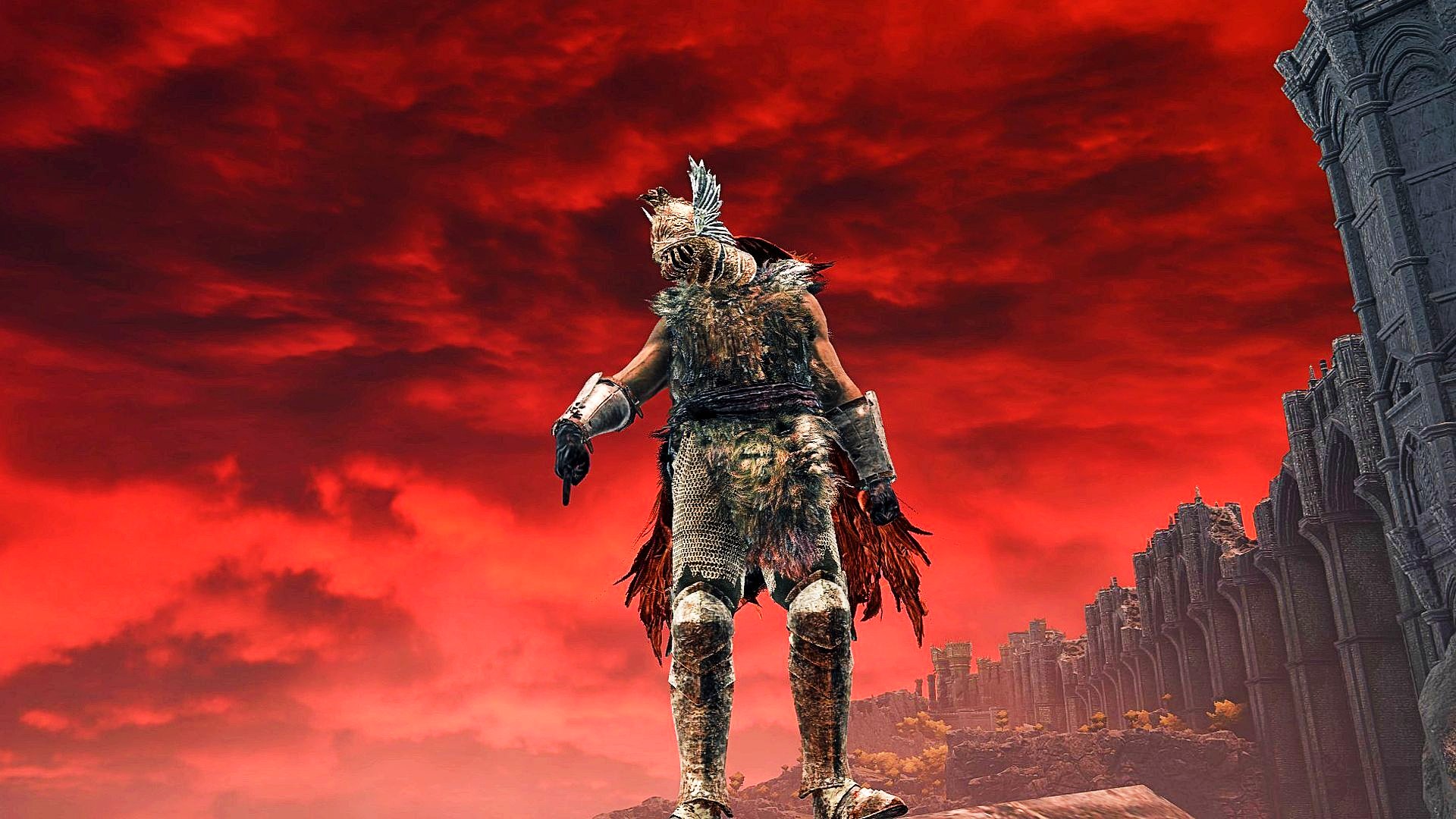
Elden Ring has got its first significant shakeup thanks to patch 1.03. Alongside some neat new additions and performance-boosting fixes, you've got some pretty sweeping balance changes. Essentially, your build might be busted if you've been using one of Elden Ring's better weapons or items.
The update decreases Ash of War, Hoarfrost Stomp's damage and increases cast time, which certainly dents a few popular Elden Ring speedrun strategies. FromSoftware has also fixed a bug with Ash of War, Determination, and Royale Knight's Resolve that applied damage buffs to other weapons without those skills. Sword of Night and Flame's weapon skill has also been lowered, which affects damage.
The Elden Ring team has also shrunk the damage spirit summons do when the Mimic Tear Item is used and changed their overall behaviour. There are "other enemy and weapon balance changes", too, though FromSoftware hasn't listed them. Looking on Reddit, a few players report that the Moonveil Katana has been cut down to size.
AMD has revealed its plans to release an updated version of its FidelityFX Super Resolution upscaling technology, unsurprisingly called FSR 2.0. The company boldly claims it “can deliver image quality that’s practically indistinguishable or perhaps even better than native.” We can expect the latest version of the tech to start appearing in games from Q2 2022, with Deathloop being the first to feature it.
FSR 2.0 remains free of any type of machine learning, unlike other competing upscaling technologies such as Nvidia DLSS or the upcoming Intel XeSS. Instead, AMD engineers have reworked the algorithm behind FidelityFX Super Resolution to include temporal data, moving away from the simpler spatial solution found in the previous version.
While AMD isn’t sharing performance metrics at this time, it will be sharing more details on FSR 2.0 at some GDC sponsored panels on March 23, which you can learn more about here. In the meantime, you get your first glimpse of this new version of FidelityFX Super Resolution in action by reading further down.
All anonymous employees quoted in this piece will be referred to with gender neutral pronouns but may identify with other pronouns in their daily lives. This is an intentional decision to protect their identities, and not an act of misgendering. All anonymous employees have given their expressed permission to be identified in this way.
When fast-food chain Chick-fil-A's history of funding anti-gay legislation and charities was made public, many LGBTQIA+ people and allies swore off the pickle-brined chicken sandwiches for good. When Spotify doubled down on the massive controversy surrounding their platforming of Joe Rogan, high-profile artists pulled their music catalogs and users suspended their premium subscriptions.
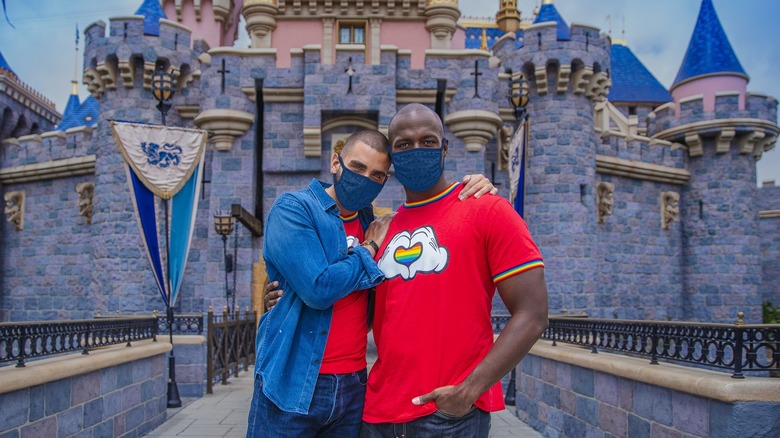
The Walt Disney Company recently came under fire for not only contributing nearly $200,000 to the Florida Republicans behind HB 1557, the hateful "Don't Say Gay" bill, but for not denouncing the bill until after it had already passed both the Florida House of Representatives and Senate. Almost immediately, there were calls for boycotts and unsubscribing from the Disney+ streamer, but as anyone who works in the industry can tell you, it's not that simple when you're dealing with the most powerful entertainment conglomerate in the world.
As a quick reminder, The Walt Disney Company also owns Lucasfilm, Marvel Studios, 20th Century Studios (including the catalog of 20th Century Fox, Searchlight Pictures, Fox 2000 Pictures), Walt Disney Animation Studios, Pixar Animation Studios, 20th Century Animation, ABC, Hulu, Freeform, FX Networks, National Geographic, The Muppets Studio, It's a Laugh Productions, 80% of ESPN, 50% of A+E Networks, and the catalogs of Buena Vista Pictures, Touchstone Pictures, Hollywood Pictures, and this is just scratching the surface. Boycotting Chick-Fil-A is as easy as driving to a different restaurant. Boycotting Disney is like trying to remove sugar 100% from your diet -- that s*** is in everything.
The Backlash Was Immediate
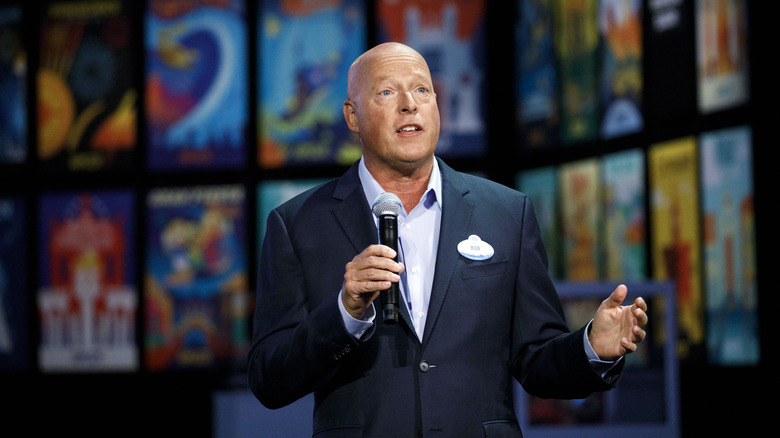
When it was made known that Disney had given financial donations to Florida Republicans who backed the "Don't Say Gay" legislation, fans and employees alike immediately took Disney to task for their silence. Disney CEO Bob Chapek sent out a company-wide email trying to defend their initial silence, bringing up previous financial donations to LGBTQ+ organizations and claiming, "The biggest impact we can have in creating a more inclusive world is through the inspiring content we produce, the welcoming culture we create here and the diverse community organizations we support, including those representing the LGBTQ+ community."
Disney animation writer Benjamin Siemon posted a series of impassioned videos on Twitter, rightfully calling out the company for their inaction. Make no mistake, Siemon's decision to speak out against Disney is an act of bravery, because making an enemy out of the House of Mouse is the entertainment equivalent of trying to pick a fight with Zeus atop Mount Olympus, and not the animated-camp version voiced by Rip Torn.
"It's really scary to work in a place where you can tell that somebody has just chosen business interests over the ethics of caring for their employees and the audience they claim to support," an employee under the Disney umbrella shares with me anonymously. "I don't believe Disney is pro-Don't Say Gay, I think they're just opportunistic," they continued. The employee spoke highly of their work environment but believes Disney funds these politicians because it's better for their bottom line. "And if those people happen to also hate gay people or trans people, that's a devil's bargain they're willing to make, and it's just really demoralizing."
What The Bill Actually Prohibits
The bill specifically notes that it bans public school districts from teaching about sexual orientation or gender identity in kindergarten through the third grade, or "in a manner that is not age-appropriate or developmentally appropriate for students." That last part is crucial, because it indicates that the ruling could extend to grade levels beyond third grade. The phrasing of "age-appropriate" or "developmentally appropriate" is also concerning, because this determination is completely subjective. During a Senate hearing on February 8, 2022, Republican Senator Travis Hutson used an example of a mathematical story problem that included the anecdote that "Sally has two moms or Johnny has two dads." Fellow Republican State Senator Dennis Baxley, who sponsors the bill in the Senate, said that is "exactly" what the bill aims to prevent.
On the literal flip side, State Rep. Joe Harding, a Republican who introduced the bill, stated the complete opposite during a Twitter conversation with Amanda Deibert, a writer for "He-Man and The Masters of The Universe" on Netflix and the comic "DC Superhero Girls." Deibert and her wife, comic book illustrator Cat Staggs have both openly spoken out against the bill, with Deibert noting, "My child and all her friends know she has two moms ... if you think it is about sex or sexually inappropriate for a child to know our family exists, the sick person is YOU." Deibert asked Rep. Harding directly if the bill limited a teacher reading a book about same-sex parents in an elementary classroom, to which Harding replied, "No ma'am." This means Florida congress members voted on a harmful piece of legislation with language so vague, supporters aren't even on the same page of what the bill can actually prohibit.
Sorry, Disney, But Art Is Political
"As we have seen time and again, corporate statements do very little to change outcomes or minds," Chapek said in the first company memo. "Instead, they are often weaponized by one side or the other to further divide and inflame." He continued, "Simply put, they can be counterproductive and undermine more effective ways to achieve change."
Siemon again took to Twitter to debunk this statement, saying, "In 2016, Disney made a very public bid against Georgia passing a hateful bathroom bill and it killed it, but we didn't do that here." Disney did the same in 2019 regarding a strict abortion law as well. Chapek's desire to not get caught up in the middle of a political controversy backfired, to put it kindly, and went against Disney's established practice of speaking out.
"What Disney makes is political ... all art is inherently political," an anonymous employee tells me. "What stories we choose to tell, what stories we don't tell, that's a political statement."
Chapek seemed to believe that staying silent would be taking the middle ground, but as Desmond Tutu so famously said, "If you are neutral in situations of injustice, you have chosen the side of the oppressor." The safety and fair treatment of the LGBTQIA+ community is not a "political issue," and treating it as such is frankly, disgusting. This alleged "middle ground" is not just a disservice to the current employees and audiences, but to the very foundation to what has allowed Disney this massive position of power in the first place.
Queer Creatives And Fans Are At The Foundation Of Disney's Success
Chapek's first memo included a laundry list of films Disney has put out, and the statement, "These and all of our diverse stories are our corporate statements — and they are more powerful than any tweet or lobbying effort." Ignoring the fact that singing a song from "Encanto" isn't going to magically make this legislation disappear, this refusal to denounce the hurtful legislation is a slap in the face to the queer creatives and fans who kept Disney from going belly-up in the years known as The Disney Renaissance. Namely, Howard Ashman, the very man Roy E. Disney described in the "Waking Sleeping Beauty" documentary as "Another Walt." Had it not been for the brilliance of Howard Ashman, an openly gay man who unfortunately died due to complications from HIV/AIDS, the Disney empire we know today would not even exist to show this level of disrespect.
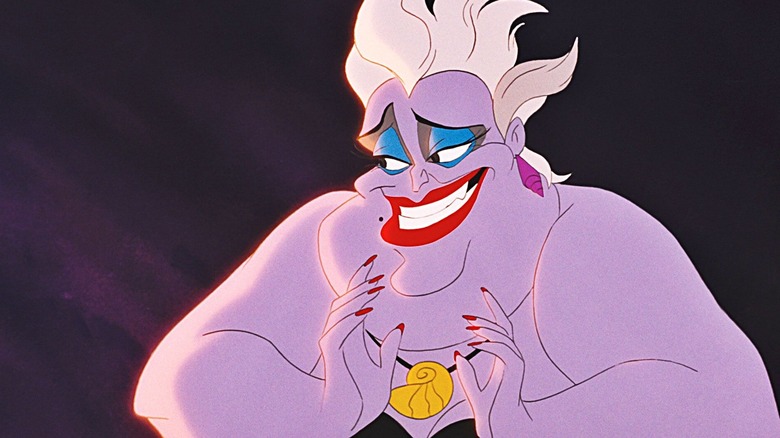
As far as fans are concerned, film critic Leigh Monson put it perfectly in their review for "Luca," which has been jokingly referred to by many as "Call Me By Your Name" for kids. "From embracing decades of queer coding in its villains as a sort of camp sub-brand marketed to the gays who identified with them growing up, to the decade-long cycle of breathless news stories about how Disney has finally included a gay character in one of their films — only to have a single effeminate man receive a blink-and-you-miss-it confirmation that they might have a male partner — Disney loves to play to a queer audience with the conviction that we will be satisfied with scraps of subtlety."
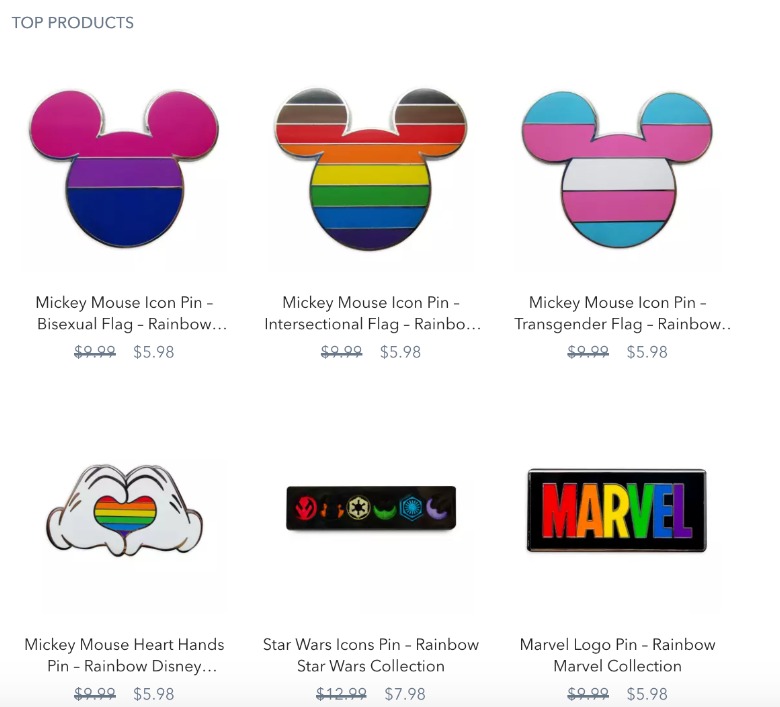
The official Disney shop has no problem selling Mickey Mouse and Marvel pins with colors of the pride flags, but it's ghoulish that those funds can be siphoned into supporting people that wish to do the LGBTQIA+ community harm.
Welcome To The Mickey-Eared Hard Place
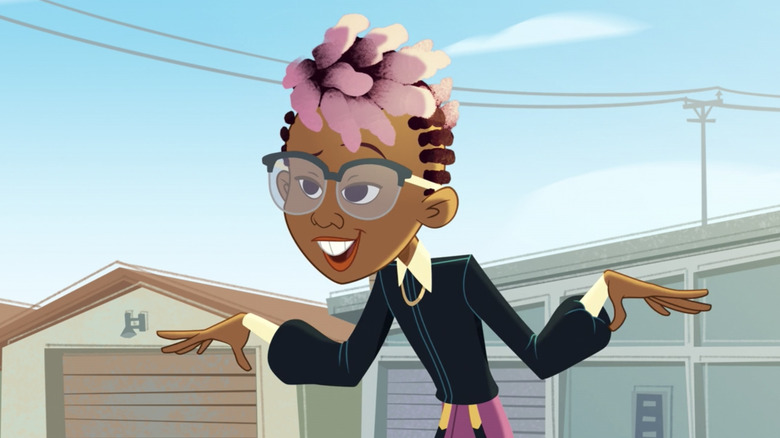
Disney is also putting out some of their most progressive work in years, despite the fact Pixar employees have made it publicly known that the company still censors much of the overt queerness out of their work. Even still, the Disney+ original "The Proud Family: Louder and Prouder" made waves when the queer-coded Michael Collins from the original series came back canonically queer and voiced by openly gay actor EJ Johnson.
"What's really hard, and this is something that I don't have the answers here and I don't think anybody does, is that we need to celebrate that work," an employee tells me. "If we don't celebrate that work, then we'll see less of that work, and if we were to boycott Disney over this, which I get the impulse to do, that's only hurting LGBTQIA+ creators who were finally making inroads."
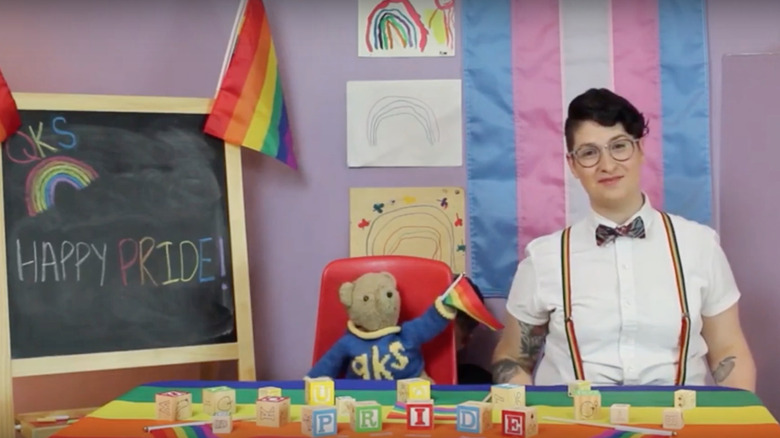
"I want to uplift the individual creators and artists who are working on those shows because those progresses, or however you want to frame it, those exist in spite of Disney as an organization at large," says Queer Kid Stuff founder Lindz Amer.
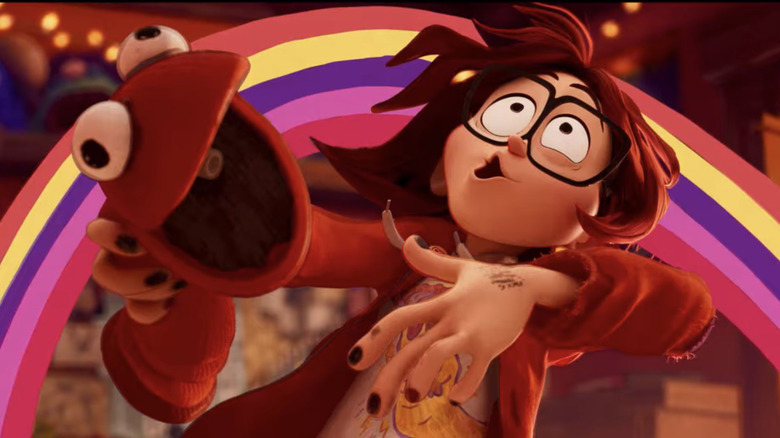
And so we are stuck between a rock and a Mickey-eared hard place. How do we continue to support the incredible strides LGBTQIA+ employees fought for from within the company, while still taking to task the higher-ups who make these horrible calls? How do we talk about the brilliance of Domee Shi's "Turning Red" knowing some of the profits made off the film's success may funnel directly into the pockets of the ghouls who accuse those against the bill of grooming children?
'I Want Real Gay And Trans People To Be Able To Live'
"If you're an artist living under capitalism, you need to find a way to pay your bills and have a place to live and support a family or do all of those things," one employee says. "If you're really lucky, you get to do that, but that means that you're making art for the way our system is set up for corporations that want to profit off of your work, but don't necessarily want to stand behind you." Telling affirming stories is an important, but it's more important to take the politicians that are making the lives of queer people and their families more dangerous. "I'm glad that we can tell a story about a gay person or a trans person," they say, "But I also want real gay and trans people to be able to live."
Disney's refusal to speak out until it was too late not only hurts the audiences that consume their work, it hurts the people who work for them. It forces LGBTQIA+ entertainment journalists to continue writing about the content the company puts out, knowing full well the publicity given will directly correlate to their profit margins, but articles on the latest Marvel movie or "Star Wars" series brings in the readership that allow the increasingly disappearing entertainment publications to stay afloat. Thanks to the stranglehold Disney has on the entertainment industry, LGBTQIA+ workers across the entire industry have been put into an unfair and impossible position. "The people who actually get hurt are the ones whose show doesn't get renewed because people weren't watching," an employee says. "I don't know ... it's complicated, it's hard, and it shouldn't be this way."
A Call For Accountability
Chapek did eventually denounce the bill, apologize for the inaction, halt all political donations, and attempted to donate $5 million to the Human Rights Campaign, but the organization has refused to accept the funds until more "meaningful action" has been taken by Disney. "While Disney took a regrettable stance by choosing to stay silent amid political attacks against LGBTQ+ families in Florida — including hardworking families employed by Disney — today they took a step in the right direction," the HRC said. "But it was merely the first step."
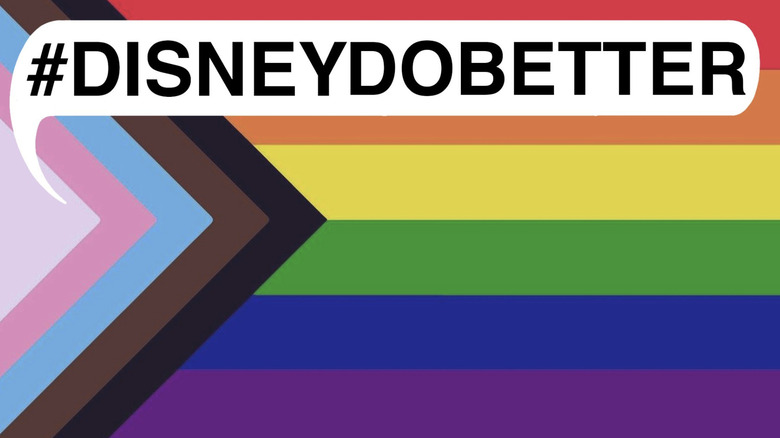
Starting March 15 until March 22, 2022, LGBTQIA+ Disney employees have scheduled in-person and virtual walkouts as well as launching the Disney Do Better Walkout website, WhereIsChapek.com. The site features a flood of anonymous employee statements as well as a list of demands including (but not limited to) the end of donating to politicians who supported the bill, ceasing Disney's efforts to move employees from California to Florida, and a guarantee that anyone who refuses to relocate to Florida will not be terminated.
As Simeon stated on Twitter, "If Disney would reverse their plans to relocate their Imagineers and some support staff to Florida, it would be an actual step to show good faith towards its LGBTQ+ employees now forced to move to a hateful state and it would also financially punish Florida for its terrible bill." As much as people like to tout America as a land of freedom, when it comes to LGBTQIA+ people, some states are infinitely safer than others. No one should have to choose between moving to a non-affirming state in order to keep their job.
The Need For Anonymity
Important to note, the website and walkout organizers are not officially associated with the business employee resource groups (BERGs) and Pride Advisory Group within Disney according to The Wrap. They also reported that the Pride Advisory Group, in a Pride Slack channel Tuesday, addressed the lockout without either endorsing or condemning the walkout. "The Pride Advisory Group would like to address the potential walkout being communicated about in the Pride Slack channels that is slated to happen starting today and, potentially, escalating into next week," the message read. "We have not organized this walkout nor the accompanying list of demands and we neither endorse nor condemn these actions."
While the grassroots campaign of WhereIsChapek may not have official ties to the Pride organizations, their efforts should not be diminished. Official organizations require membership names, and WhereIsChapek is a way for employees to speak out in anonymity. When the group shared their demands on Twitter, they were met with equal parts support and horrific harassment. "If these groomers want to make a difference, they should quit," said one hateful Twitter user. Supporters of HB 1557 have resorted to using conservative scare tactics, attempting to spark a moral panic surrounding the LGBTQIA+ community and allies. Anonymity is vital for these employees who are protecting themselves and their families by not putting themselves in the proverbial line of fire of people who believe them to be "groomers," "pedophiles," "child abusers," and "perverts."
Only A Few With Power Have Spoken Up
Amer and others like them, have noticed the excruciatingly loud silence of so many people with power. "I think they're scared, but I think it's lip service allyship," they say. It's one thing for someone without power to remain quiet in order to be able to feed their families and stay alive, "But there are people who do have power who don't speak up, and that's where the problem is," Amer continues. What adds to the frustration is that many LGBTQIA+ creators already know what it feels like to be marginalized and struggle with employment opportunities, because it's so painfully common. Corporations may not listen to the "little guys," but they'll listen to a Hollywood A-lister like perpetual good guy Mark Hamill.
"I compare my situation as a queer, trans, non-binary person, and I'm like, 'I am already at the bare minimum of what I can make to live as a freelance creator and artist,' 'I am already in that struggle of worrying about livelihood at the intersection of anti-trans and anti-queerness,' so I look at those people and them being scared s***less, and I'm like, 'You just don't want to be in the position that I'm in right now,'" says Amer.
Now is a time for supposed "allies" to speak out alongside LGBTQIA+ people, especially the cis, white, straight, wealthy superstars who could very easily say, "I'm not going to do a Marvel movie again until you get it together" and spark genuine change.
The People In Fear Are The People Disney Should Be Learning From
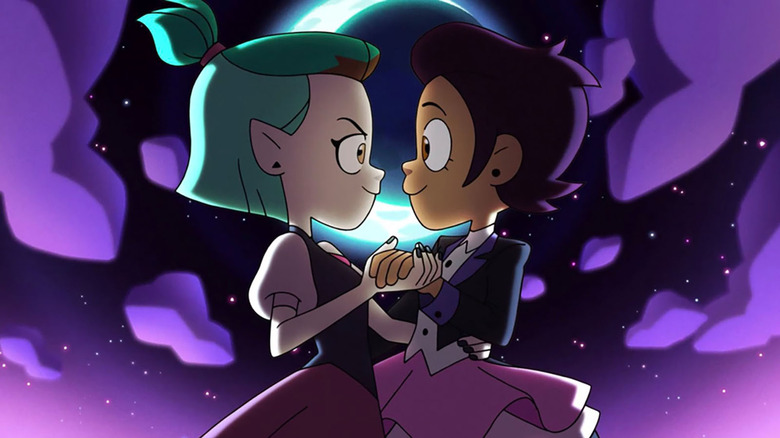
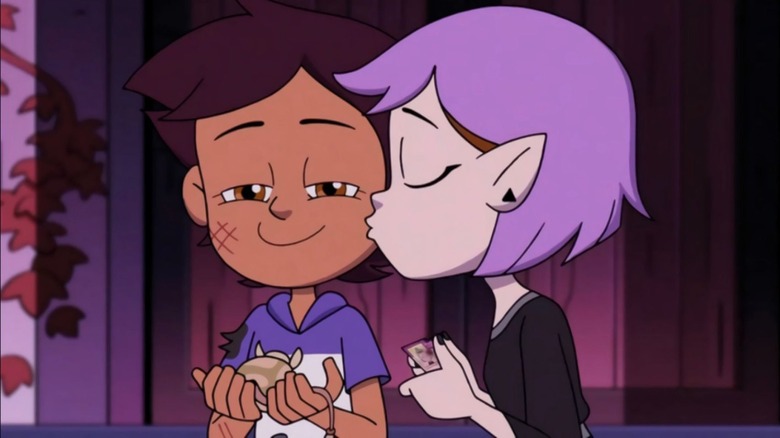
Reading through the employee testimony on the Disney Do Better website is heartbreaking. "As a mother to a trans youth, it is hard to sit back and watch as her personal rights and existence are attacked without a fight," an employee said. "It makes me saddened to think the company I show up for in so many ways would not fight for us as well." Countless members of the community, allies, and parents of queer youth have been forced into anonymity in order to continue providing for their families and pursuing their passions. I admittedly was hesitant to even write this piece, fearful that I too would be blacklisted by Disney for daring to speak out, despite defending and championing their work when they do get it right. Fortunately, some creators, like Dana Terrace of "The Owl House," have spoken out.
But we are not the ones who should be afraid and forced into anonymity — we are the ones that Disney should be seeking out and listening to. The fact that so many employees have been hesitant to speak publicly on such a personal and systemic issue should have been a sign to Disney that they have far more power than they are willing to recognize. Over and over again, employees have talked about how meaningful it has been to work for this company. People genuinely love Disney and want them to do and be better, because they don't call Disney World "The Happiest Place On Earth" for nothing. LGBTQIA+ employees, industry professionals, and audiences deserve to be heard, and Disney has a responsibility to course correct and repair the harm that they've caused with their inaction.
Disney Is A Symptom Of A Bigger Issue
"It's not just Disney, is the thing, it's the entire kids' media industry," says Amer. "It comes down to capitalism for the most part, and a lot of stigma around queerness and kids that is super, super conservative." Given the power and control Disney has, they have the chance to be trailblazers in the industry, but for some reason (capitalism), are still dragging their feet on normalizing and de-stigmatizing LGBTQIA+ content for children. "I don't think the kids media industry has any idea how much influence and power they have on kids' lives outside of their bottom line," Amer says, continuing:
Imagine a trans kid character on a kid's backpack that they take to school, and that character is a role model for that kid. Imagine the huge impact that would not only have on queer, trans, and non-binary kids themselves, but on all of their peers. That helps get rid of bullying, and of misinformation and misunderstanding around the trans experience.
"Something that comes up with kids' media that I think not a lot of people understand, especially with other content creators who are in the adult world, is that there's no indie scene in children's media," Amer adds. "Pop culture really matters when you're talking about kids."
Amer's programming for Queer Kid Stuff is as close to an "indie scene" as possible, and while there are definitely small-scale creators in the kids' media world, they don't carry as much clout or access compared to something like the independent film world. The children's entertainment sector is one of the few that requires systemic change to occur from the people at the top, which means companies like Cartoon Network, Nickelodeon, PBS, DreamWorks, Sony Animation, Illumination, and, of course, Disney.
It's Time For An Industry-Wide Change
While it's good that people have rightfully been calling out Disney, it's important to note that the entire children's/family animation industry is struggling to provide affirming LGBTQIA+ content for young audiences. Laika's "ParaNorman" featured the first openly gay character in a mainstream animated film, and that was only 10 years ago. The brilliant film "The Mitchells vs. The Machines" featured a queer protagnoist, but parental guide websites have been flagging the references to Katie Mitchell's queerness as "sexual content." For independent creators like Amer, having a history of queer content for children in their portfolio has likely contributed to employment difficulties.
When I first made Queer Kid Stuff, basically coming out of college, it blew up on the internet. I tried to get jobs the traditional route like producing and PA stuff in kids media, and I would get to final round interviews for all of these jobs– these entry-level positions–and I'd be turned away. And say whatever you will about that, competitive job market, or whatever, but I'm pretty sure it's because they didn't want someone who had a web series called 'Queer Kid Stuff' to be associated with their brand, no matter how far down the ladder I was. I think that people are being actively locked out of the industry in a lot of ways, too. I think that I've survived and gotten to where I am just by sheer willpower and fight.
I asked Amer what the next step should be for Disney, and their answer was simple: "Give money, give power to queer and trans people, especially if you're trying to tell those stories, and work through your own anti-queer, anti-trans biases if you want to be a voice for people."
Moving Forward
Disney has scheduled to have a virtual conversation among its LGBTQIA+ employees on March 22, the same day of the planned walk-out which also includes the employees of Disney parks, resorts, and cruises. On April 13, Disney will be hosting its "Reimagine Tomorrow Summit" on the topic of equity, diversity, and inclusion in the workplace, and Chapek is due to participate. In the interim, Marvel took to Twitter to denounce any and all anti-LGBTQIA+ legislation, and Lucasfilm posted a similar message on Instagram. While the sentiments are appreciated, it feels like an empty gesture in place of tangible change.
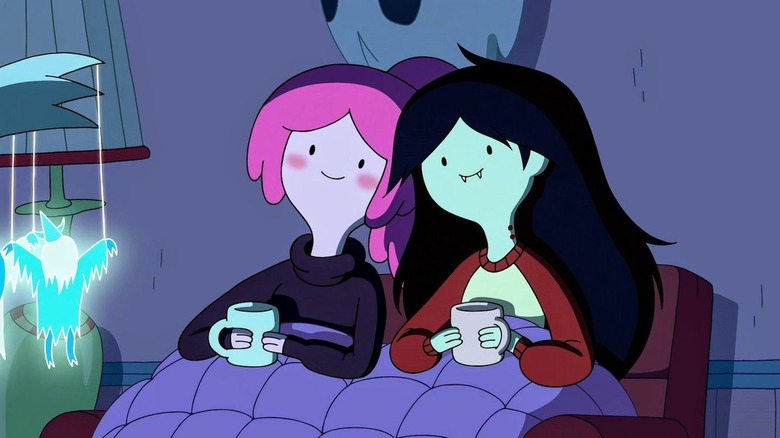
While movies still struggle to provide affirming LGBTQIA+, it is important to highlight the incredible strides being made on TV. "The Owl House," "Craig of the Creek," "She-Ra and the Princesses of Power," "Steven Universe," "Adventure Time," "Sailor Moon Crystal," "Gravity Falls," "Star vs. The Forces of Evil," "Danger & Eggs," "Cardcaptor Sakura: Clear Card," "The Loud House," "Clarence," "The Legend of Korra," "Arthur," "DuckTales," "The Proud Family: Louder & Prouder," and "SpongeBob SquarePants" all deserve their flowers for exploring queer themes in an industry that frequently tires to erase LGBTQIA+ stories from the final page.
Actions speak louder than words, and for the Disney company (and all of their subsidiaries), the ball is firmly in their court. And they better act fast, because Sony Animation and Netflix just pulled miles ahead.
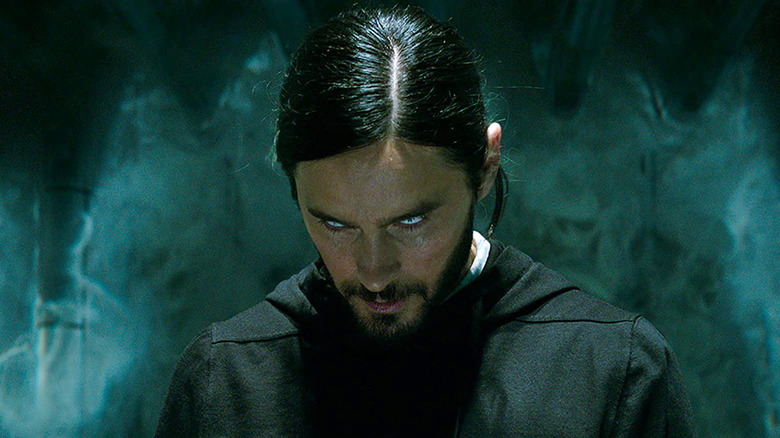
You know the drill by this point: Jared Leto has a new film coming out (in this case, Sony Pictures' "Morbius"), which means it's time for his co-workers to carry on about his method acting and how committed he was to his role during filming. This eye-rolling trend really began with the promotional tour for David Ayer's "Suicide Squad," in which Leto's co-stars went on and on about how "terrifying" he was as the Joker and how they never met him out of character on the movie's set. Leto himself lent credence to these claims until they started to backfire on him, at which point he insisted the stories about him doing flat-out uncouth things like sending his "Suicide Squad" cast-mates anal beads and used condoms were "not true."
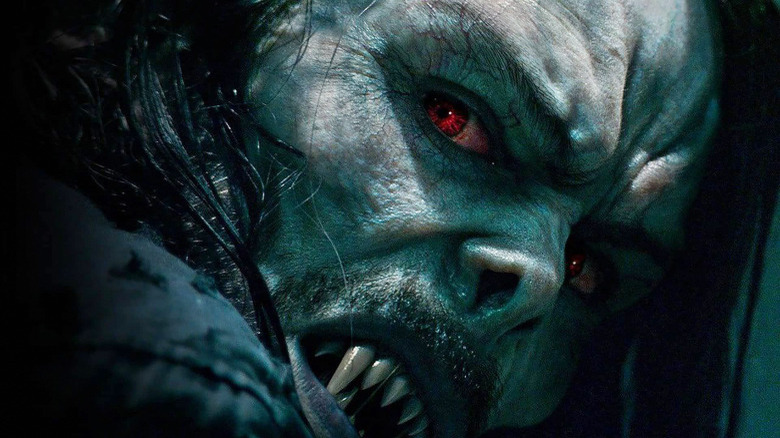
Having (maybe) learned his lesson from the blowback over "Suicide Squad," Leto was a little more coy while discussing his acting methods for "Morbius" with Variety. The actor stars in the Marvel Comics adaptation as Michael Morbius, a scientist with a rare blood disease who accidentally turns himself into a type of vampire while trying to cure his condition. Explaining his approach to portraying Dr. Morbius prior to his vampiric transformation, Leto kept it simple:
"I don't want to get too specific because I'd like to keep some of that for myself. But I leaned in — no pun unintended. I'm a sucker for a pun, but I didn't mean that. I worked with people who had this specific physical challenge and modeled it after that."
'I Got Scared For Jared'
/Film contributor Kayleigh Donaldson recently wrote an excellent piece about why we need to stop romanticizing the idea of actors torturing themselves to play Batman villains like the Joker, aptly describing Leto's behavior on the "Suicide Squad" set as "less the actions of a dedicated actor and more an example of workplace harassment." So far, though, it sounds like Leto limited his method acting on "Morbius" to his own physical self, like the way he used crutches and contorted his body to portray Dr. Morbius in his human state. "I remember fearing for this guy's spine," his co-star Adria Arjona told Variety. "There should have been a physical therapist on call."
"Morbius" director Daniel Espinosa ("Safe House," "Life") similarly mentioned being most concerned about Leto harming himself with his antics, stating, "I got scared for Jared. He really commits. You have to watch out for it." He went on to cite a specific scene where, by the sound of it, the vampiric Morbius shatters some glass while leaping or soaring about. "I could sense the crew backed off," he noted, describing Leto's acting in the scene as "a bit spooky."
Leto, for better or worse, seems to have recognized that nothing gets you more attention than doing the most acting, the actual quality of your performance aside. (See also: His use of prosthetics and an Italian accent that's one step removed from Mario in the "Super Mario" video games in the film "House of Gucci.") We'll see how that works for him this time around when "Morbius" finally arrives in theaters on April 1, 2022.
An anonymous reader quotes a report from Phys.Org: A new study in the journal Earth's Future led by the University of Massachusetts Amherst shows that, since Euro-American settlement approximately 160 years ago, agricultural fields in the midwestern U.S. have lost, on average, two millimeters of soil per year. This is nearly double the rate of erosion that the USDA considers sustainable. Furthermore, USDA estimates of erosion are between three and eight times lower than the figures reported in the study. Finally, the study's authors conclude that plowing, rather than the work of wind and water, is the major culprit.
Using an extraordinarily sensitive GPS unit that looks more like a floor lamp than a hand-held device, the team walked dozens of transects, or perpendicular routes across the escarpment, from the untouched prairie to the eroded farm field, stopping every few inches to measure the change in altitude. They did this hundreds of times throughout the summers of 2017, 2018 and 2019. Once they had their raw data, the team used historical land-use records and cutting-edge computer models to reconstruct erosion rates throughout the Midwest. What they discovered is that Midwestern topsoil is eroding at an average rate of 1.9 millimeters per year. Put another way, the authors estimate that the Midwest has lost approximately 57.6 trillion metric tons of topsoil since farmers began tilling the soil, 160 years ago. And this is despite conservation practices put in place in the wake of the Dust Bowl in the 1930s. As noted above, much of the erosion was due to tillage, or plowing. "The modeling that I do shows that tilling has a 'diffusive' effect," says Jeffrey Kwang, a postdoctoral researcher at UMass Amhers. "It melts the landscape away, flattening higher points in a field and filling in the hollows."
Furthermore, the USDA doesn't include "tillage erosion" in its own analysis, meaning it's drastically underestimated the rate of erosion that's occurred in the area. The team suggests that more sustainable practice, such as no-till farming and soil regeneration, "will likely be required to reduce soil erosion rates in the Midwest to levels that can sustain soil productivity, ecosystem services, and long-term prosperity."
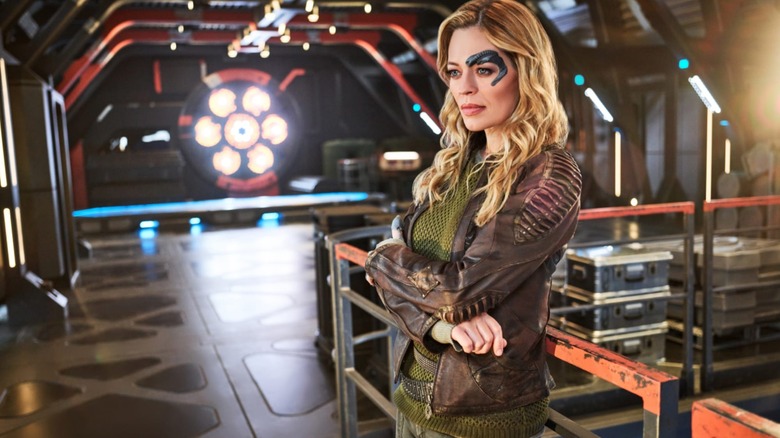
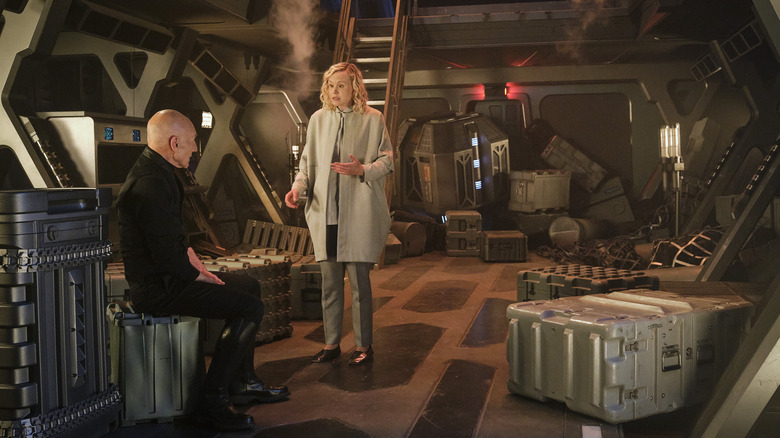
It's astonishing what a departure the second season of "Picard" is from the first. There may still be some lingering trepidation from those who recall the awfulness and the absurdity of "Picard"'s first season, but there may come a point soon where one can cease waiting for the other shoe to drop.
In the first episode of "Star Trek: Picard," Q (John de Lancie) had whisked Picard (as well as the rest of the show's cast, for reasons he didn't explain) into an alternate timeline wherein Earth was a galaxy-wide fascist dictatorship systematically committing multi-species genocide. At the end of the second episode, the cast kidnapped the Borg Queen (Annie Wersching) with the intent of using her massive intellect — as well an ineffable interdimensional sense she possesses — to pull a "Star Trek IV: The Voyage Home," and travel back in time to 2024 Los Angeles to discover the point when Earth split into the dark timeline.
Note from a Trekkie: I did appreciate the detail that the "slingshot" time travel technique used in "The Voyage Home," repeated here, requires massively complicated calculations to be made on the fly, and only rare minds can handle it. Here, it's a pan-dimensional cyborg semi-deity. In "Voyage Home," it was merely Spock, whom Dr. Jurati (Alison Pill) namechecks. And before you think "Picard" is merely deifying Spock as some sort of untouchable superbeing, the writers seem to be playing fair. There is a common danger writers have committed in nostalgia-inspired remakes and reboots to over-emphasize the importance of characters already beloved by the audience, whether or not it fits logically into the story. Recall the three "Star Wars" prequels wherein Darth Vader was blown up from an evil thug into essentially an anti-Messiah figure. For the retcon of Spock in this episode of "Picard," recall that "Voyage Home" was shortly after Spock had been resurrected from the dead, and was, at that point, more purely intellect than ever before. As such, he was able to make those complex calculations.
Fish-out-of-water
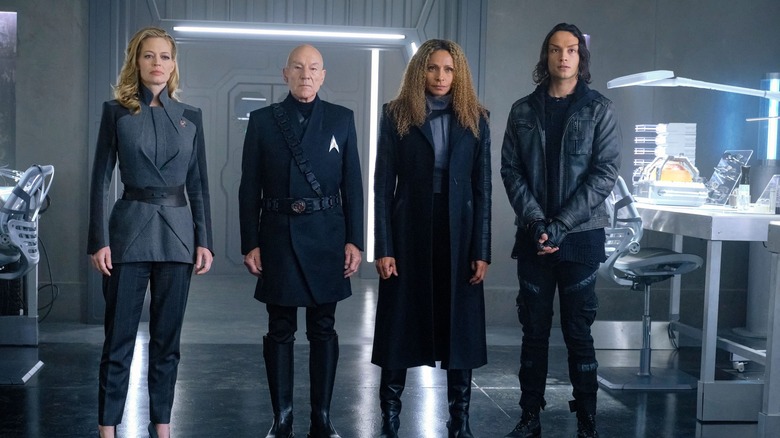
But to the task at hand: In episode three, "Assimilation," Picard's quest can begin in earnest. With only a clue as to the time and place where a timeline divergence will occur, the cast beams down to 21st-century L.A. to begin sniffing around as to what might have happened. Raffi and Seven (Michelle Hurd and Jeri Ryan) have to sneak into a skyscraper by posing as girlfriends, while Capt. Rios (Santiago Cabrera) immediately sustains an injury and falls in with a local hospital that is constantly being raided by ICE. Dr. Jurati and Picard (Patrick Stewart) remain in orbit with the Borg Queen, hoping to interrogate her and find out more about their mission. I will leave the fate of Elnor (Evan Evagora) for you to discover.
While time-travel-based, fish-out-of-water, lost-on-an-Earth-we-don't-recognize stories are commonly revisited throughout "Star Trek," it is, nonetheless, a reliable trope. How will an enlightened 24th-century character respond to the brutal and uncivilized present? It's a question that is always fun to ask. This was a story used not only in "The Voyage Home," but the episodes "City on the Edge of Forever" (Kirk and Spock during the Depression), "Time's Arrow" (Picard and co. meet Mark Twain), "Past Tense," (Sisko and crew in a dystopian near-future), "Little Green Men" (Quark at Roswell), "Future's End" (Janeway faces off against a Bill Gates-like computer whiz in 1996), "Carbon Creek" (T'pol and Vulcans watch "I Love Lucy"), and other episodes besides.
I was also — perhaps regrettably — reminded of "Inhumans," a TV show connected to the MCU which seems to have been conveniently forgotten by fans of the Avengers. The conceit of the show was that a group of superpowered Moon-dwellers (one of them played by Anson Mount, who is playing Capt. Pike on the upcoming "Star Trek: Strange New Worlds"), after a coup in their hidden Moon city, are scattered on Earth and are forced to find one another again and return home, undetected. I bring up "Inhumans" not to cast aspersions on the fish-out-of-water story idea — "Inhumans" was poorly received — but to point out how dependable it is. Watching Picard carefully traverse the past is going to be fun, and situations grow organically out of the characters' investigation.
Picard Is No Longer An Android
The episode's title comes from a scene aboard the U.S.S. Stargazer wherein Picard oversees a partial assimilation of Dr. Jurati by the Borg Queen. The Borg Queen, being impish and sinister, refuses to reveal details about Picard's mission without something in exchange, and Jurati figures that she can tap into the Borg Queen's brain directly by becoming a Borg, but then pulling herself out before the assimilation can "take," as it were. Being deliberately assimilated is also a conceit used before, as the crew of the Voyager did it on their show. Given that so many people have been un-assimilated at this point in "Star Trek's" history, it's seeming less and less threatening all the time. Needless to say, Jurati and Picard's plan works.
Perhaps this Trekkie is dense, but it only occurred to me in episode three that Picard is no longer an android. At the end of "Picard's" first season, in order to save his life, Picard's consciousness was shunted into an android body that was made to look exactly like him, and also age the way a human body would. This was a controversial conceit, and a pretty silly one, even by "Star Trek" standards. As Q had inserted the cast into the alternate versions of themselves, they now have the bodies of their counterparts. Seven of Nine no longer had Borg implants, and it's safe to assume that Picard has gone back to being 100% organic, including his notorious artificial heart.
"Star Trek" in the Paramount+ era has been a constant push-and-pull between introducing new ideas and then retracting them once the writers realized they were bad. In "Discovery," for instance, the title ship can teleport anywhere in the galaxy, effectively making starships — and trekking — obsolete. In order to fit teleportation technology into the story, the writers had to think of a way to erase the U.S.S. Discovery from Trek's own timeline so that other shows (set after "Discovery") would have an organic reason to never discuss the ship's astonishing technology. Picard's android body was a silly idea that was thrown in at the conclusion of season one, almost as an afterthought, and without any sort of meaningful thematic reason. Season two seems to be, like "Discovery" on a constant path of correction.
"Picard," however, is having an easier time of it. For the first time in a long time, I'm eager to see what happens next on a "Star Trek" show.
Bandai Namco Entertainment and FromSoftware bring us the first major patch for their recently-released action-RPG Elden Ring. On top of introducing a number of welcome balance adjustments and fixing a series of bugs, this patch actually expands several of the game's existing side quests, adds new NPCs and a neat quality of life feature that marks NPCs on your map.
Here are the patch notes:
Major Changes Included in the Latest Update
Additional Elements Added
Added a function to record an icon and the name of an NPC on the map when you encounter that NPC.
Added NPC Jar-Bairn.
Added new quest phases for the following NPCs: Diallos/ Nepheli Loux/ Kenneth Haight/ Gatekeeper Gostoc.
Added some summonable NPCs in multiple situations.
Increased the number of patterns of objects player can imitate when using Mimic’s Veil.
Added night background music for some open field area.
Bug Fixed
Fixed a bug that prevented summoned NPCs from taking damage in some boss battles.
Fixed a bug that sometime prevented the player from obtaining item after boss battle.
Fixed a bug that causes dialogue to be skipped when talking to NPCs and using custom key configurations.
Fixed a bug that causes the player to freeze when riding.
Fixed a bug that causes arcane to scale incorrectly for some weapons.
In situation where the player cannot obtain more than 2 talisman pouches, added talisman pouch to Twin Maiden Husks shop line up.
Fixed a bug that prevented the user from warping to sites of grace from the map at the end of the game.
Fixed a bug that prevented the player from moving to the next area after the battle with the Fire Giant.
Fixed a bug which causes some weapons to have incorrect scaling after strengthening.
Fixed a bug which causes some weapons to not use stat scaling.
Fixed hang-ups in certain occasions.
Fixed a bug which incorrectly displays multiplayer area boundary when playing online.
Fixed a bug that allows player to activate Erdtree Greatshield’s weapon skill without absorbing an attack using a special combination of item and incantation.
Fixed a bug which causes Fire’s Deadly Sin incantation to have different effect.
Fixed a bug with the Ash of War, Determination and Royal Knight's Resolve, where the damage buff will also apply to other weapons without that skill.
Adjusted the visual effect of Unseen Form spell.
Deleted the Ragged armor set from the game which was mistakenly obtainable in previous patch.
Fixed a bug that causes some hostile NPCs to drop Furlcalling Finger Remedy.
Fixed a bug that causes incorrect sound effect to play in some situations.
Fixed a bug which causes visual animation and hitboxes to not be displayed correctly on some maps.
Fixed bugs which causes incorrect visual and behavior for some enemies.
Fixed a bug that causes incorrect stat parameter for some armor.
Text fixes.
Other performance improvement and bug fixes.
Balance Changes
Increased the drop rate of Smithing Stone for some enemies.
Added Smithing Stone to some early game shop line up.
Increased shield’s effectiveness.
Increased the damage for all offensive cracked pot items.
Increased the damage for the following items: Spark Aromatic/Poison Spraymist.
Increased the effect duration for the following items: Uplifting Aromatic/ Ironjar Aromatic.
Increased HP healing for Torrent when using the following items: Rowa Raisin/ Sweet Raisin/ Frozen Raisin
Reduced FP consumption and increased the damage of the following sorceries: Glintstone Cometshard/ Comet/ Night Comet
Increased the damage of the following sorceries: Gravity Well/ Collapsing Stars/ Crystal Barrage
Decreased FP consumption of the following sorceries: Star Shower/ Rock Blaster/ Gavel of Haima/ Founding Rain of Stars/ Stars of Ruin/Greatblade Phalanx/Magic Downpour/ Loretta’s Greatbow/ Loretta’s Mastery/ Carian Greatsword/ Carian Piercer/ Shard Spiral
Raised projectile speed and range of Great Glintstone Shard
Decreased Ash of War, Hoarfrost Stomp's damage and increase cast time.
Increased Ash of War, Bloody Slash's self-inflict damage while slightly lowering the damage and increasing the cast time.
Decreased weapon skill, Sword of Night and Flame’s damage.
Increased FP consumption and lower duration of Ash of War, Barricade Shield.
Changed FP consumption timing of Ash of War, Prelate’s Charge.
Decreased the damage of spirit summoned when using the item Mimic Tear Ash and changed the spirit’s behavior pattern.
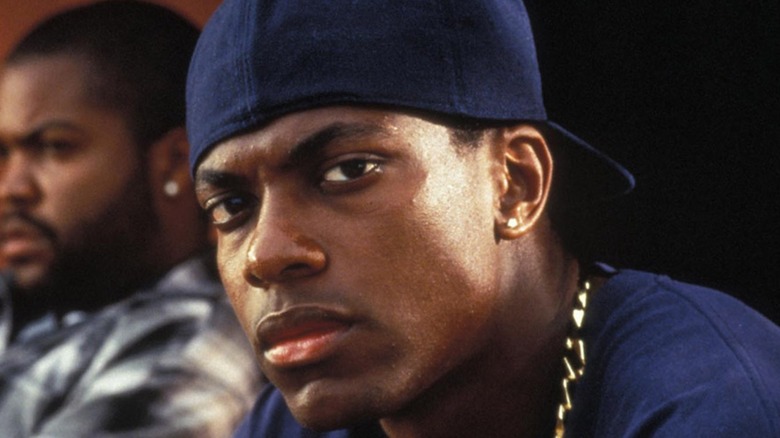
Before 1995, Ice Cube was solely a rapper, Chris Tucker was a stand-up comedian, and nobody knew who Felicia was. But all that changed when "Friday" burst onto the scene.
The movie itself is iconic and widely recognized as a cult classic. Almost 30 years later, celebrities are still reenacting scenes on social media, and a little phrase Craig utters once — "Bye, Felicia!" — is all over the internet. The low-budget movie that has become a huge hit introduced the world to actor/screenwriter Ice Cube and the improvisational genius of Chris Tucker. Cube went on to star in and produce two more "Friday" movies, but Tucker would never return to the franchise.
The young comedian's hilarious portrayal of Smokey, the chaotic stoner friend, was a huge part of the film's success and led to a fruitful acting career for Tucker. A lot of people questioned why he wouldn't want to return to the role that made him famous. He has given two reasons for this over the years, and fair warning, one of them might crush the hearts of stoners everywhere.
He Wanted To Keep Moving
"Friday" had huge potential for the struggling stand-up comedian and he knew it at the time, saying "I was so happy I got that movie because I knew how it was going to help my career," and it did. The film showed off Tucker's ability to improvise, which won him the life-changing role over guys like Tommy Davidson and Chris Rock.
Although he never returned to the franchise, Tucker still believes Smokey is "a great character," and he appreciates the low-key experience he had making the film. Unlike Hollywood blockbusters, Tucker said, "[There weren't] big distractions [on that set] ... that movie was just a camera and me and Cube on the porch and magic came out of it." And that magic still captures fans' attention today.
Tucker knows audiences continue to love the movie because "they always bring it up," and he is grateful that so many people fell in love with Smokey, but he saw the character as a stepping stone towards something bigger. He "never really wanted to do [a sequel]" because he had faith that the small movie would draw the eyes of a wide audience and bring him larger opportunities. He told The New York Times that he wanted to make the character great and "let that just live on" while he explored other roles.
At first, it makes sense that such a talented actor wouldn't want to play the same character over and over again, but then you remember he did just that in three "Rush Hour" movies. So, in the immortal words of Smokey, "What kind of s*** is that?"
It turns out, and you might want to brace yourself for this, Tucker isn't a fan of weed.
I know. I know. There, there.
The Weed
It can be hard to separate entertainers from the roles they play, especially when you grew up with their characters. It's almost impossible for me to look at Tucker and not think of him as the hyper, directionless Smokey, and if his voice raises into that familiar high-pitched tone, forget it! But, in reality, the actor and the popular character have little in common.
Along with his drive to explore other roles, Tucker admits he wasn't crazy about being the poster boy for marijuana, saying:
"I don't want everybody smoking weed. I don't want to represent [that.] That's one of the reasons I said I didn't want to keep doing that character."
I appreciate his convictions, but I wonder if they've come a little late. I haven't seen "Friday" in at least a decade, but when I hear the word "stoner," my brain dips into its '90s archive and spits out a picture of Chris Tucker. I'm not the only one who struggles to separate the actor from his past even though he has portrayed other characters in successful movies.
After "Friday," he moved on to the "Rush Hour" franchise, and by 2007, Tucker's portrayal of Carter made him the highest-paid actor in Hollywood. He expected the movies to launch his career even further, but that didn't happen this time. He told The New York Times he kept getting offers for roles that were too similar to others he'd already done, and he felt they "weren't good enough."
In the fifteen years since "Rush Hour 3," Tucker has only been in two movies. Neither of these recent roles earned much attention for the actor and we have seen zilch from him in the last five years. He dismisses theories that he has taken a break from show business, writing it off as an accidental hiatus, and insisting he's learned "to be more patient" and wait for good roles. His former co-star has a very different explanation for Tucker's absence from Hollywood blockbusters and "Friday" sequels.
He Became Religious
Ice Cube recently revealed on Twitter that Tucker was offered "$10 [to] $12 [million] to do "Next Friday," but he turned [it] down for religious reasons. He didn't want to cuss or smoke weed on camera anymore." Cube's explanation might also explain why the actor became pickier about his roles after Smokey.
Tucker became a born-again Christian after his breakout role in "Friday," which would affect his decision to return for a sequel. He felt like the swearing and drug habits of his "Friday" character no longer jived with his real-life morals, which made him lose interest in the part. In an interview with The Georgia Straight, Tucker discussed how his religious beliefs have altered his career and sense of humor.
Although he admits he never told "raunchy" jokes, he didn't always think through "what [he] was saying because [he] was young" and he thinks his faith has changed that. While he has been absent from movies, Tucker still performs stand-up comedy here and there, but he doesn't swear or talk about anything remotely dirty, which he claims makes it more interesting. He appreciates that he can't default to raunchiness and that he has "to dig deeper to find something that's still funny." This explains why a comedy like "Friday," filled with jokes about sex and drugs, would no longer draw his attention.
Tucker's devotion to his faith is admirable, and it couldn't have been easy to turn down millions of dollars, but it's hard not to miss his on-screen comedic genius. Although, for now, he's choosing to stay out of the spotlight, there is still a possibility that he might return to Hollywood with a character that aligns with his newfound beliefs, and I have no doubt he would still draw an audience.
In the meantime, Tucker has left us with plenty of characters and moments to enjoy. It will always make me laugh when Carter impersonates Michael Jackson as he directs traffic, and, much to Tucker's chagrin, when Smokey lectures me on the finer points of weed-smoking rotation.
Now that Wasteland 3 is content-complete and shouldn't be getting any more DLCs, we get a chance to check out this detailed RPG Codex review for inXile's post-apocalyptic RPG. As usual, it goes a little bit deeper than your average review, and is an overall nice read.
Here's just the conclusion, and you take it from there:
Conclusion
If "reactivity and choice" was the mantra for Wasteland 2, then Wasteland 3 adds "transparency and accessibility" as another design pillar. inXile pulled off a heavily-reactive turn-based, party-based RPG that looks and sounds slick and is largely frustration-free when it comes to starting and playing. They re-examined their systems and modified them without throwing out the baby with the bathwater, in contrast to other studios who have tried to do the same in the past. Sure, it's not the second coming of Jagged Alliance 2, and no, it's not a party-based Fallout, but it's my favorite Wasteland game. Its status as the 2020 RPG Codex Game of the Year is well-deserved.
A bipartisan group of 22 United States senators sent a letter to the Department of Homeland Security (DHS) over the weekend to inquire about its efforts to protect the US against Russian cyber and disinformation threats.
I've been looking forward to Boys From County Hell for a few years now. For one thing, I'll watch any horror movie named after a Pogues song. In this case, the film also pulled from the same obscure Irish folklore that I used in my (as-yet-unpublished) novel Pints of 'Gansett Make You Strong, so I had to know what was going on. — Read the rest
Microsoft also announces new tools to help offices be more flexible, including the Smart Camera for Surface Hub and Outlook RSVPs indicating remote or in person.
The U.S. Cybersecurity and Infrastructure Security Agency (CISA) and the Federal Bureau of Investigation (FBI) have released a joint advisory warning that Russia-backed threat actors hacked the network of an unnamed non-governmental entity by exploiting a combination of flaws.
"As early as May 2021, Russian state-sponsored cyber actors took advantage of a misconfigured account set to default [
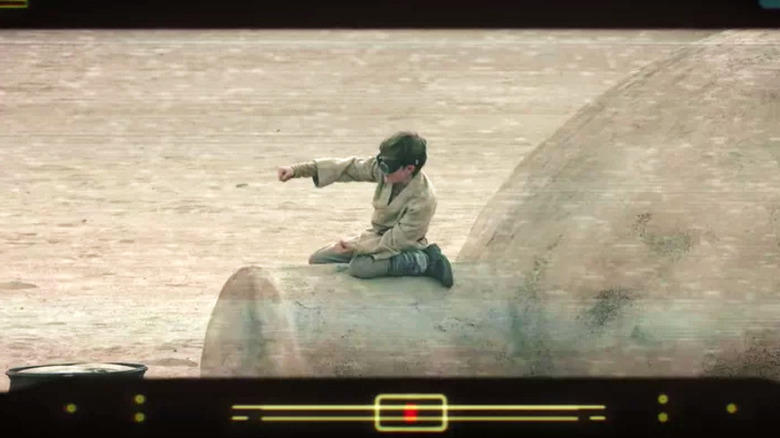
Not all heroes wear capes (but some of the Jedi do). Mark Hamill recently took to Twitter to give his blessing to child actor Grant Feely, who will play a young Luke Skywalker in the upcoming Disney+ "Star Wars" limited series, "Obi-Wan Kenobi" (via Variety). Here's what Master Skywalker had to say to the young actor:
This sweet and endearing gesture did not go unnoticed by Grant, who responded with the following:
"I am so honored to take on this role @HamillHimself! You set the bar high and I hope to make you proud. Your support means so much!"
Yeah, I'm totally not crying — you are.
The Force Is Strong With This One
The first trailer for "Obi-Wan Kenobi" features a young Luke Skywalker, who is being watched over by Jedi Master Obi-Wan Kenobi (Ewan McGregor), meaning that fans will most likely be allowed a glimpse how far Obi-Wan went to protect the boy. The show is set 10 years after the events of "Star Wars: Revenge of the Sith," and follows a disillusioned Obi-Wan and his years of exile on Tatooine. Obi-Wan's prime agenda is to protect Luke from Jedi-hunting Inquisitors and his father, Darth Vader (Hayden Christensen), who, of course, Luke does not know anything about until the events of "Star Wars: Episode IV – A New Hope."
Hamill's support for Grant is not only endearing but essential, a we all remember the hate/controversy directed towards a young Jake Lloyd, who played a young Anakin Skywalker in the prequel trilogy. Say what you will about the prequels, but the bildungsroman-esque Anakin arc was essential to portraying the circumstances of his childhood and his attachment to his mother, which ultimately culminated into his transformation into Darth Vader years along the line. As Grant's only other acting credit is an episode of "Creepshow," Hamill's support means quite a big deal, hopefully shielding him for unnecessary criticism from a generations-spanning fandom, as that can visibly take a toll on a young person's mental health.
The character of Luke Skywalker is nothing short of iconic, crafting a legacy that is still being furthered by interpretations of the character in the "Star Wars" sequel trilogy, along with shows such as "The Mandalorian" and "The Book of Boba Fett." Hamill spoke about the opportunity of playing a young Skywalker again on "The Tonight Show," calling the experience "unexpected:"
"Talk about unexpected. I had finished playing that part, and I never expected to do it again. I figured if they ever tell stories of Luke in that period, post the originals and pre-sequels, they would get an age-appropriate actor. So when [series creator] Jon Favreau and [producer] Dave Filoni told me about what they wanted to do, I was just stunned."
Now that we do have an age-appropriate actor to play a young Luke, we wish him the very best! Apart from McGregor and Christensen, who will be reprising their iconic roles, and Grant playing Luke, the cast of "Obi-Wan Kenobi" comprises Moses Ingram, Indira Varma, Kumail Nanjiani, O'Shea Jackson Jr., Simone Kessell, Benny Safdie, Maya Erskine, and Rory Ross.
"Obi-Wan Kenobi" will premiere on Disney+ on March 25, 2022.
The restrictions Microsoft placed on the configuration of devices that could run Windows 11 are well documented. Many users on older PCs see the “this PC doesn’t currently meet the minimum system requirements to run Windows 11” message.


 Super Resolution 1.0?


for the first time since last August