

Read more of this story at Slashdot.
Read more of this story at Slashdot.
Now here is something truly stunning. Kaze Emanuar has managed to increase the performance of Super Mario 64 up to six times. What’s really impressive here is that the modder has made the game run better, even on the original Nintendo 64 hardware. The modder has looked at every single variable, understood every fuction, and … Continue reading Modder has increased the performance of Super Mario 64 up to six times →
The post Modder has increased the performance of Super Mario 64 up to six times appeared first on DSOGaming.
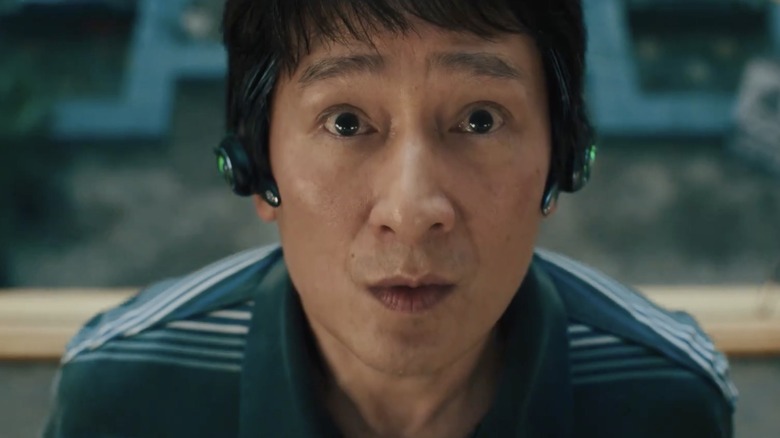
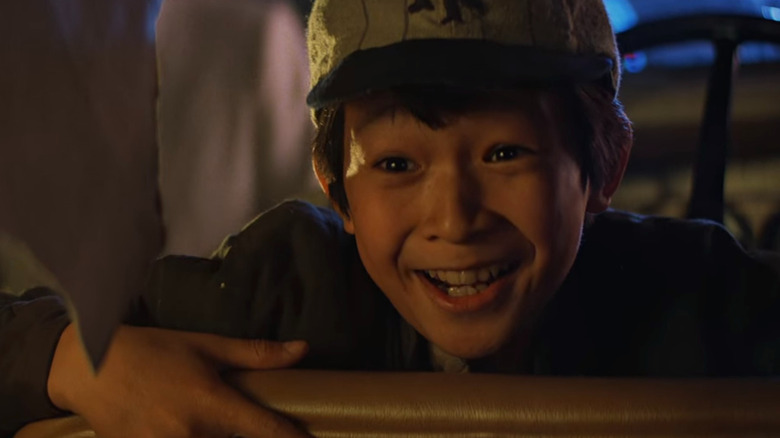
All aboard the Ke Huy Quan-aissance. It's been almost 40 years since Quan made his auspicious debut as a child actor (credited as Jonathan Ke Quan) in "Indiana Jones and the Temple of Doom." Quan was 13 years old when the movie hit theaters, and he was living the dream of any '80s kid: playing Harrison Ford's sidekick in a Steven Spielberg film.
When we first meet Quan's character, Short Round, in "Temple of Doom," he's behind the wheel of a getaway cab, but his legs aren't even long enough to reach the pedals so he has to wear elevator shoes. Now, those legs are throwing kicks at mall security guards as the 50-year-old Quan wields a fanny pack like nunchucks in Daniels' new film, "Everything Everywhere All at Once."
In "Everything Everywhere All at Once," Quan plays Waymond Wang, husband to Michelle Yeoh's protagonist, Evelyn, who finds herself jumping from the IRS office across the multiverse in what's been described as "a tax-season 'It's a Wonderful Life.'" The role is a comeback one for Quan, whose only other acting credit in the last 20 years was "Finding 'Ohana" in 2021.
Over the years, Quan has worked behind the camera as an assistant director and a fight choreographer on Asian films, but seeing him back onscreen and all grown up in "Everything Everywhere All at Once" might vindicate the inner child of anyone who grew up living vicariously through his adventures in "The Goonies" and alongside Indiana Jones. While looking back on his career, Quan recently tweeted a photo of him and Ford on the set of "Temple of Doom," writing, "Me and Harrison Ford just chilling before he said he wished there was a character like me in Star Wars."
Me and Harrison Ford just chilling before he said he wished there was a character like me in Star Wars 😂🤣 pic.twitter.com/zvtAEDlavx
— Jonathan Ke Quan (@JonathanKeQuan) April 15, 2022
"Temple of Doom" came out the year after "Return of the Jedi," the final film in the original "Star Wars" trilogy. When Ford said he wished there was a character like Quan in "Star Wars," it's possible that he just meant a nice kid. But it's also possible that he meant an Asian character, something "Star Wars" did not really have until Kelly Marie Tran played Rose Tico in "The Last Jedi."
In the Special Edition of "Return of the Jedi," Dalyn Chew, an actress of Asian descent, did get screen time as one of the dancers in Jabba the Hutt's palace. But she did not have any lines, and two years later, the first "Star Wars" prequel, "The Phantom Menace," faced criticism for ethnic stereotypes. Kelly Marie Tran also weathered the brunt of some online hate from disgruntled fans (and/or Russian trolls) after "The Last Jedi," but her character endures as part of a continuum of Asian representation in Hollywood, of which Quan and his pioneering work in "Temple of Doom" and "The Goonies" are also a part.
In an interview with GQ (via Indiewire), Quan recently discussed how the success of "Crazy Rich Asians" in 2018 gave him some "serious FOMO" and made him want to return to acting. His performance blazed a trail for other Asian actors, but some of those same actors he inspired would, in turn, inspire him. He explained:
"Over the years, I've met a lot of Asian talent now working in Hollywood. They always thank me and say, 'Man, it was so great to see you up there on the screen, because I was able to see myself. Thank you for paving the way for us to be here.' And, of course, it's really interesting because they've paved the way for my return. My return to acting is the direct result of the progress made by them."
He concluded by saying:
"It proves how important it is for not just Asian, but for all groups of people to be represented in entertainment, because like you said, until you see yourself, until you see it, visualize it, you still can't believe that it could also be you up there on the screen. So that's why I am so grateful for what has happened the last few years. It's happened gradually, but I'm very optimistic and very hopeful about where things are going."
"Everything Everywhere All at Once" is in theaters now, and you can stream "Indiana Jones and the Temple of Doom" on Disney+.
Read this next: The 15 Best Star Wars Side Characters
The post Harrison Ford Wanted a Character like Short Round in Star Wars, According to Ke Huy Quan appeared first on /Film.
Read more of this story at Slashdot.

Since her feature film debut in "V for Vendetta" in 2005, Imogen Poots has starred alongside a number of veteran actors, such as Robert Carlyle in "28 Weeks Later," Patrick Stewart in "Green Room," and Anthony Hopkins and Olivia Colman in "The Father." In the new Prime Video series, "Outer Range," Poots plays Autumn, a backpacker and would-be camper who shows up on a Wyoming ranch, owned by Josh Brolin's character, the impressively named Royal Abbott. Autumn finds a strange symbol on a rock formation on the ranch, one that she's been drawing for years, as well as a hole that opens up in the ground, threatening to suck viewers into a new mystery-box show.
Though she has no formal training as an actor, Poots has had a great deal of on-the-job training over the years and has built up a sturdy filmography that has enabled her to learn from her co-stars as she went. In an interview with The New York Times, Poots says this was "an intentional forging of a path" that enabled her "to be around people who were undeniably better" and who "offered a sort of guidance." "Outer Range" was a continuation of this; as Poots was working with Brolin, he even shared some advice for her that helped her let down her guard and center herself in her scenes more. She explained:
"On this show, Josh said to me, 'You should take up a little more space; you're still unsure about that.' I have had a tendency to flicker around the edges, rather than feeling I have a right to be here. That's maybe a symptom of having been a student for too long. [...] Thinking about what Josh said, I saw this role as a real chance to get loose, however alarming that may feel. For an English person to get loose is — whoa! Historical!"
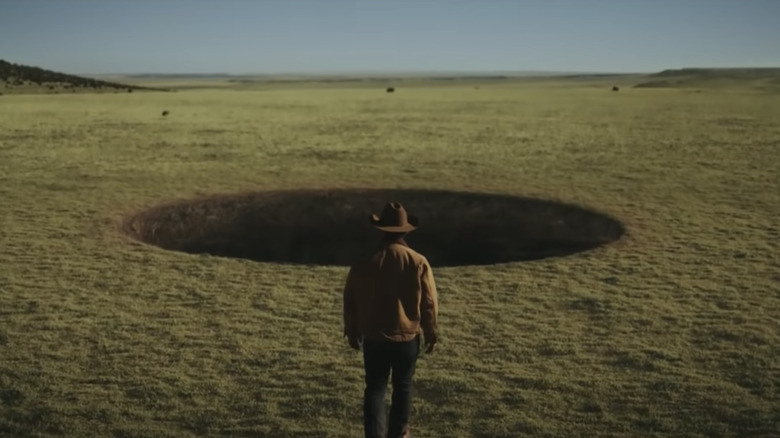
The first season of "Outer Range" is eight episodes, and later in the season, there comes a moment when Autumn lets out her own exuberant "Yeehaw!" in the vein of a "fairly unhinged" cowgirl, as the Times describes it. Poots said:
"That was an Imogen addition. We were trying to figure out how she'd react, and I nervously said [adopts an uncertain voice], 'W-w-what about "Yeehaw"?' and Josh said, 'That's great, let's try it.' I'm just happy it stayed in; that doesn't always happen."
It will all be worth it if the yee-haw Poots improvised in "Outer Range" is even half as memorable as the method ad-lib in "Gangs of New York" where Daniel Day-Lewis's character exclaims, "Whoopsie-daisy!"
Another high-pressure moment for Poots on "Outer Range" came during her kissing scene with Noah Reid, who plays Billy Tillerson, a member of rival ranching family. Poots described the filming of the scene as anything but romantic. As she put it:
"It was like an art installation — we were having conversations about whether the saliva would be viscous enough, whether it would travel the distance between Noah's mouth and mine. Larry [Trilling], our wonderful director, would be screaming off-camera [adopts an American accent]: "OK, now come apart! Oh no, it's not sticking, go back!" We had to keep realigning our tongues. And I'd just be saying, 'So how's your wife, Noah?'"
You can tune in on Prime Video to see Poots trading dialogue with Brolin, yelling, "Yee-haw!" and choreographing her tongue and saliva viscosity with Reid. The first two episodes of "Outer Range" are available to stream as of April 15, 2022, and new episodes drop each Friday hereafter.
Read this next: The 14 Best Sci-Fi Shows On Amazon Prime
The post Josh Brolin's Advice For Outer Range Helped Imogen Poots Become Unhinged appeared first on /Film.
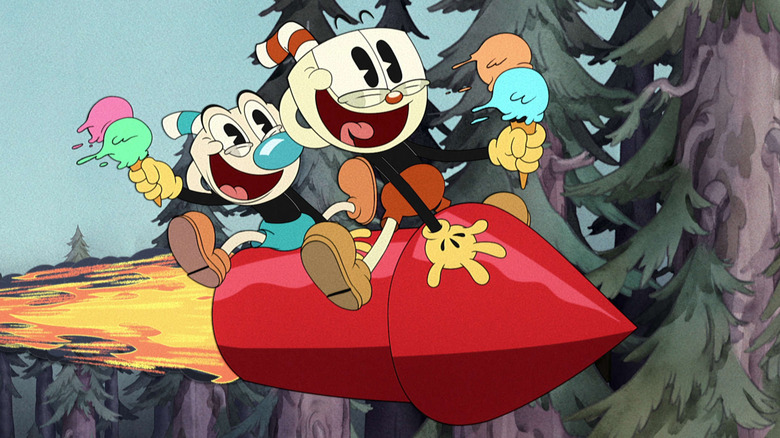
Now here's a real high-class cartoon! Based on the beloved and bestselling 2017 video game, "The Cuphead Show!" is Netflix's latest animated adaptation from the interactive medium, following previous outstanding efforts like "Castlevania'' and last year's "Arcane." But unlike those shows, the ceramic superstar's series is aimed at a much younger audience, embodying the 1930s rubber-hose art style of its source material while playing out like a modern iteration on the shows that defined Saturday mornings in decades past.
Three years after the announcement for the animated series, "The Cuphead Show!" finally arrived with a 12-episode debut season (with a second season due this summer). Despite a mixed reception from critics, the show has been widely embraced by animation aficionados and "Cuphead" connoisseurs alike. Not every episode hits, but on the whole, Netflix Animation has successfully translated Studio MDHR's passion project to the small screen. The following list ranks each Season 1 episode of "The Cuphead Show!" from weakest to strongest.
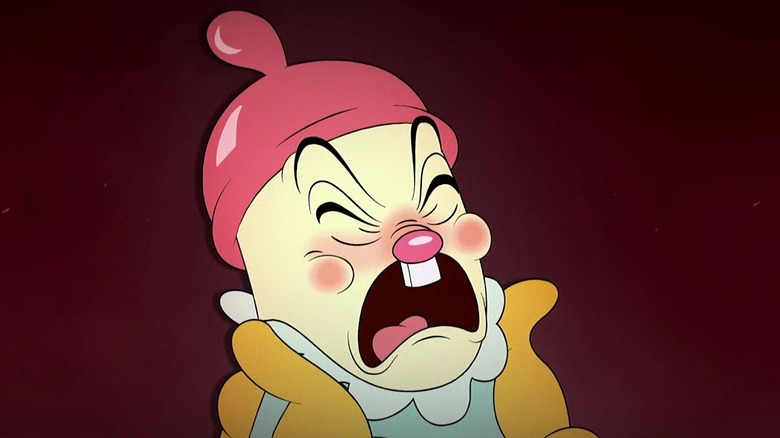
Despite what many of the show's critics imply, there's absolutely nothing wrong with "The Cuphead Show!" ignoring branching storylines in favor of 15-minute standalone hijinks (the animation of Ub Iwerks and the Fleischer Brothers were never known for sequential storytelling either, after all). However, after a solid pilot episode introducing Cuphead, Mugman, and the Devil himself, it likely didn't give critics a lot of confidence in the show when the follow-up turned out to be far-and-away the least entertaining episode of the season.
"Baby Bottle" abandons any and all continuity and features an entirely self-contained slapstick story centered around a character original to the show — in this case, an anthropomorphic baby bottle anonymously delivered to Cuphead and Mugman's house. The episode's humor is stilted, its premise is weirdly contrived, and it ends without much actual resolution. "Baby Bottle" isn't a terrible way to spend 15 minutes, but it gives the impression the show's writers had already run out of ideas by the second episode.
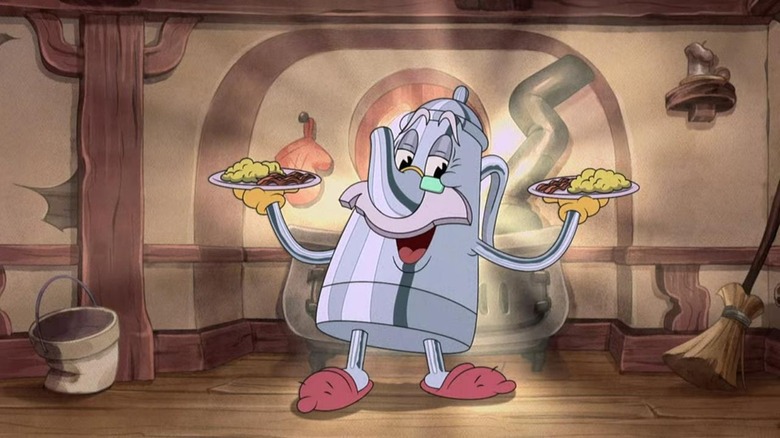
Despite his frequent attendance on "The Cuphead Show!" Elder Kettle had an extremely limited presence in the original title, bestowing Cuphead and Mugman their magical offensive abilities at the journey's outset and little else. Since the show isn't following the events of the game (for now, anyway), what's the franchise's father figure to do but adopt the most classic tropes of his cartoon-character archetype? Incidentally, his lone central episode in the show's first season also has a similar perspective: Worried he's aging into irrelevance, Elder Kettle overhears his surrogate sons "plotting" to dispose of their rusty guardian, leading Elder Kettle to spiral into a bout of extreme paranoia, even though it becomes clear something's been lost in translation.
"Dirt Nap" is a good old-fashioned sequence of literal misunderstandings and exaggerated projection, building a conflict completely out of nothing. It's a fine story, but it feels more tired than traditional, especially given that other, better episodes usually carry a unique beat to catch audiences off-guard. Joe Hanna is lovely as Elder Kettle as always, and the hints at the old can's decorated past are fascinating. Even so, "Dirt Nap" is a disposable episode that likely won't leave any lasting impressions.
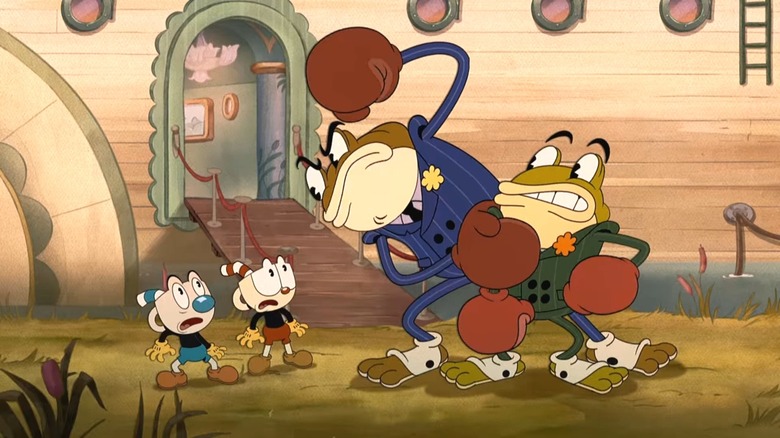
Unlike many modern adaptations of popular nerdy media, "The Cuphead Show!" demonstrates surprising restraint in its fanservice throughout its first season. Many of the game's most iconic bosses, like Grim Matchstick, Cala Maria, and Beppi the Clown, are delegated to blink-and-you'll-miss-it cameos. Two episodes do indulge in the source material's wide array of big baddies, however, and the first of the pair is dedicated to the most infamous duo on the Inkwell Isles: Ribby and Croaks, the street-fighting frogs.
Distinguished from the rest of the season's supporting cast, Ribby and Croaks are imbued with light thematic weight, as their highly combative brotherhood mirrors Cuphead and Mugman's, serving as the central internal obstacle for the boys. Unfortunately, the episode is dampened by a below-average musical number — a recurring problem throughout the season — in which the frogs lament their dearly-departed mother. Chaos does break out in their buoyant and bougie ferry, akin to the game, but the slight similarities only underscore the glaring inaccuracies (the frogs wearing actual clothes, for example). Ribby and Croaks are fun, but their debut episode is also a half-measure in the small catalog.
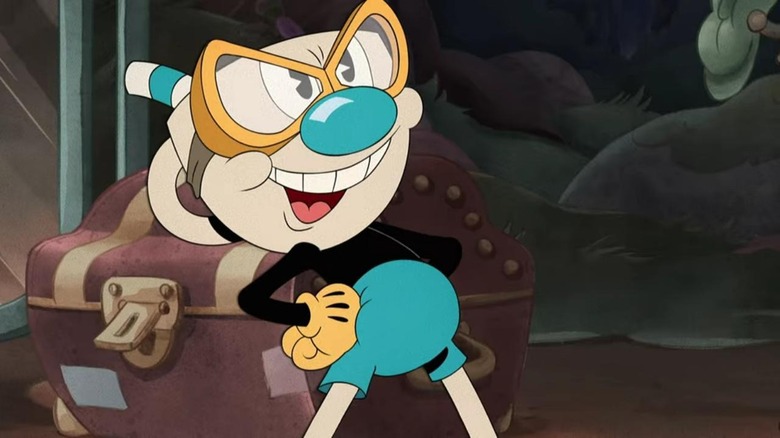
Initially designed as a humble avatar for any and all potential player 2s, Mugman's depiction in "The Cuphead Show!" matches the more cautious and timid characterization he embodies (in a single line of dialogue) in the original game, striking a chord similar to Nintendo's Luigi, the most famous brother in gaming. In that sense, it's no surprise Mugman's starring episode features a fairly standard lightweight character arc. Tasked with a certifiably dangerous errand from the irritable shopkeep, Porkrind, the blue brother finds unexpected bravery in a pair of goggles modeled after Dirk Dangerous, a Dick Tracy-esque radio drama character whom the boys idolize.
"The Cuphead Show!" is at its weakest when it reuses tired scenarios. In this case, a timid character adopts a new sense of courage upon wearing an item of clothing. The moment that elevates the episode from being a complete drag is when Cuphead consciously decides to be a supportive brother, ranking among one of the most genuine moments of the season (and it's not the only one, thankfully). Topped off with a surprise cameo at the end, "Dangerous Mugman" sits comfortably in the show's qualitative midpoint between aggressively adequate and surprisingly solid.
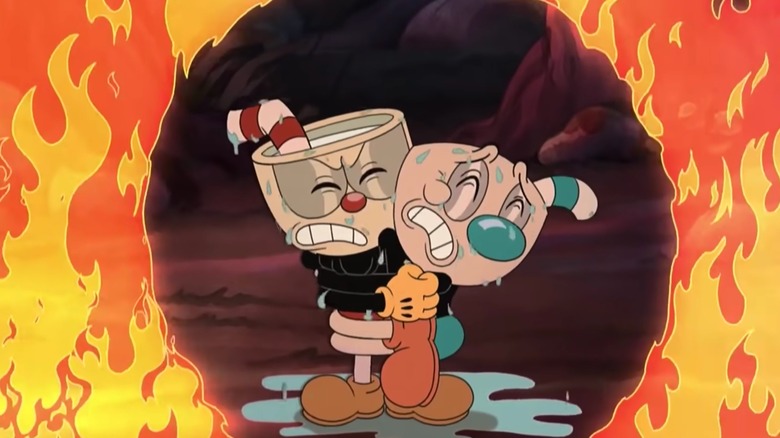
There's something unique about watching a cartoon as fun and fancy-free as "The Cuphead Show!" without fully understanding the intent behind a central story beat. Such is the case with "Sweater Off Dead," which hinges on a distractingly bizarre premise. Noticing his brother's increasing anxiety, Mugman seeks out the mystical Quadratus (who appeared in the game to inform players of their total death count) who instructs the concerned brother to knit a Devil-warding sweater ... out of invisible yarn. The sweater itself doesn't require narrative explanation, but conceptually, it provokes more external questions: Is the invisible sweater an animation in-joke? A reference to a relic of the rubber hose era? Or simply a random scenario?
This lack of context doesn't hurt the episode too badly, which features plenty of delicious devilry and climaxes with the best narrative payoff of the season. It just feels like some vital information is missing; the invisible sweater itself only inspires light confusion, which distracts from what is otherwise a good time. Though it's an experience exclusive to this lone episode, it just so happens to be the only one with a direct follow-up, exacerbating the dilemma.
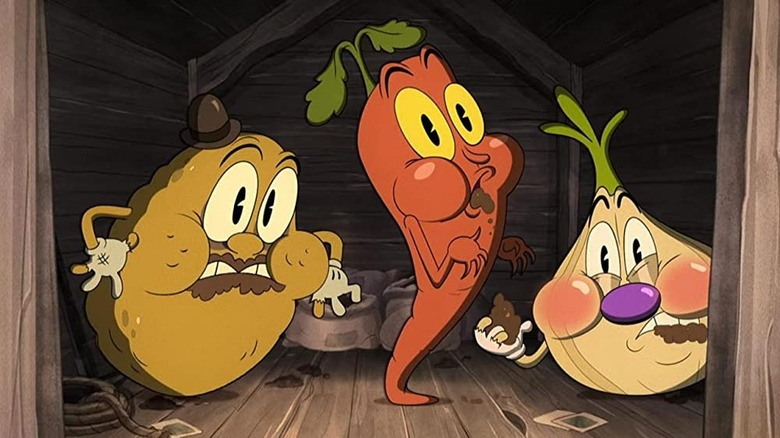
Right alongside Ribby and Croaks, The Root Pack are among the first batch of bosses Cuphead and Mugman face in the original "Cuphead," as a trio of powerful perishables loosely based on The Three Stooges. Sal, Ollie, and Chauncey may not be exact recreations, but they still embody the same troublemaking attitude as a group of freeloaders who scour the land for gardens to inhabit. In this episode's case, they take up root in Elder Kettle's garden, sucking it dry and organizing an anthropomorphic veggie celebration that would make Larry the Cucumber and Bob the Tomato from "VeggieTales" blush.
Fittingly, "Root Packed" is defined by its titular gang of nutritional transient tricksters, even if their slight redesigns mean less interesting visual charm (Chauncey's signature psychic powers are completely absent, for example). It's also one of two times in the season in which composer Ego Plum dips into Kristofer Maddigan's sensational soundtrack from the original game — the other being "Ribby & Croaks" — diegetically incorporating "Botanic Panic," The Root Pack's very own battle music, as the big band jazz piece from a group of vegetables during the party. It's a lovely tribute in a solid episode.
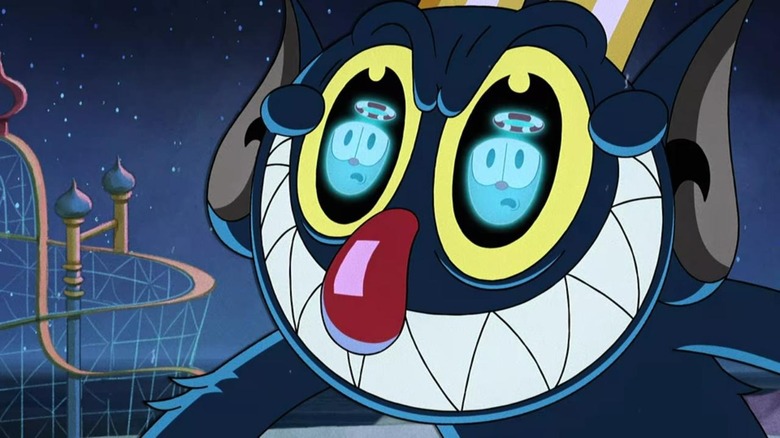
The second half of the "Sweater" arc, "Sweater Luck Next Time" uses the scenario and stakes set up in the previous episode to explore new avenues of the franchise's mythology. Instead of Cuphead and Mugman challenging the Devil in his hellish home, the complete reverse occurs, and for franchise fans, seeing the Devil at Cupsy's door might be enough to send their souls upward.
In fact, "Sweater Luck Next Time" repeatedly plays with expectations, including standout moments like the Devil performing a Fantasia-esque sequence in painting Elder Kettle's fence and the two most diametrically-opposed characters becoming friends while in line for a theme park ride. Ironically, though it's the only sequential episode of the bunch, it doesn't end with any lasting plot or character development outside of a more permanent solution to the Devil's repeated attempts at Cuphead's soul. The brief moment of friendship between the two was surprisingly refreshing. Hopefully, this isn't the last time the show kicks back and lets its cast ease up on their roles as heroes and villains.
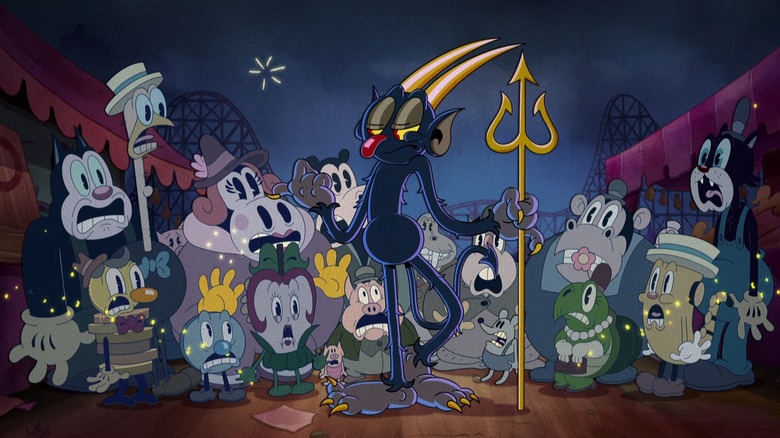
"The Cuphead Show!" starts off on a strong note, debuting its main characters and lively world with a fun premise and stunning animation. Naturally, the pilot introduces Tru Valentino, Frank Todaro, and Joe Hanna as Cuphead, Mugman, and Elder Kettle. As they prove throughout the rest of the season, the three are exceptionally cast, bringing so much life and energy into their characters. Their performances are helped by their buttery smooth and bouncy movement.
The three central voice actors (and the rest of the cast) are completely outdone, however, by Luke Millington-Drake's star-making turn as the Devil, whose soul-sucking carnival marks Cuphead a target for spiritual debt collection. Millington-Drake's preening and leering delivery is delightful, calling back to other cartoon caricatures of Old Scratch, such as Him from "The Powerpuff Girls." Even his old-timey musical number is fun, as it's one of the only songs in the season that actually sounds like a product of early 20th Century American music. Like any good TV pilot, "Carn-Evil" impresses in the present and sows the seeds of a promising future.
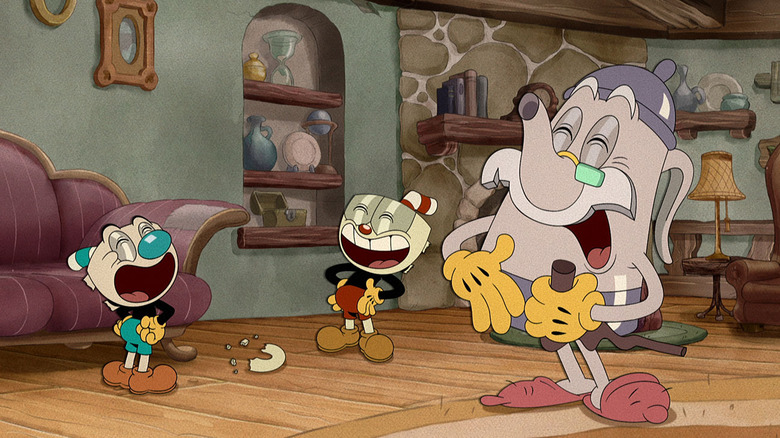
The first season of "The Cuphead Show!" features three stay-at-home episodes, in which the brothers and their watchful guardian spend the majority of the runtime in their humble abode. Given that two of them are the weakest episodes of the season, it's surprising that the third of the bunch is so strong. The difference is originality: The lower-ranking episodes are hampered by predictability, whereas "Handle with Care" is a unique offering — it's about its main characters' biology, after all! The story follows Cuphead and Mugman after the latter accidentally breaks the handle attached to the back of his head, and the pair rush to find the appropriate means to reattach it.
On its own, Mugman losing his handle reads like an existential nightmare. Does it hurt? Is it like losing a limb? Are there vital organs stored in there? Regardless, the show treats it as a light injury with huge social condemnation. The escapades culminate in a legitimately surprising resolution that feels different from how most cartoons resolve their conflicts. Instead of coincidence or simplicity, what if they already had the answer? "Handle with Care" is the perfect self-contained episode.
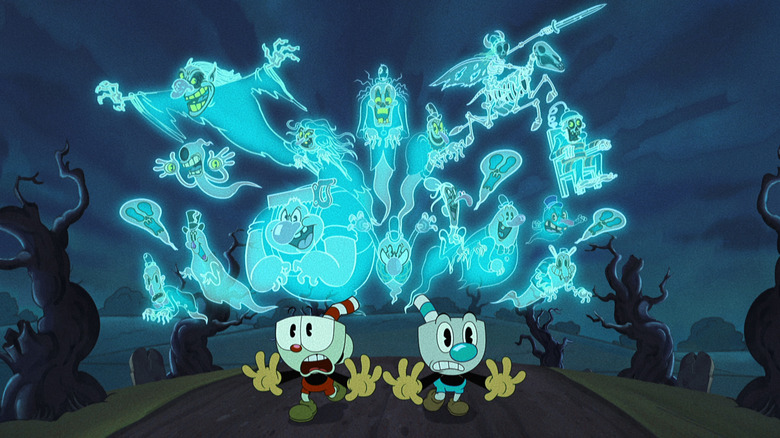
If any singular episode of "The Cuphead Show!" represents its success in simplicity, it's Cuphead and Mugman's impromptu overnight stay in a local graveyard. Featuring the dark imagery and thick shadows of '30s animation classics — including a copyright-friendly recreation of Ub Iwerks' and Walt Disney's debut Silly Symphony short, 1929's "The Skeleton Dance" — "Ghosts Ain't Real!" is nothing short of spectacular, in the most traditional use of the word. From ghoulish hallucinations to creepy background art, the most potent part of the rubber hose era is given full, unfiltered representation.
Elevating the art is the inclusion of stereoscopic radial processing, infusing the show's smooth 2D animation with gorgeous clay-model backgrounds, courtesy of studio Screen Novelties. The original game used similar techniques, but never to such an extent, making "Ghosts Ain't Real!" the only time that the "Cuphead" show outdoes the "Cuphead" game. The only thing holding back the episode from taking the top spot is the plainly forgettable musical number permeating throughout (even if it ends with one of the most emotionally arresting moments the show has to offer). Still, even the most frequent issue of the season can't hinder this spooky showstopper.
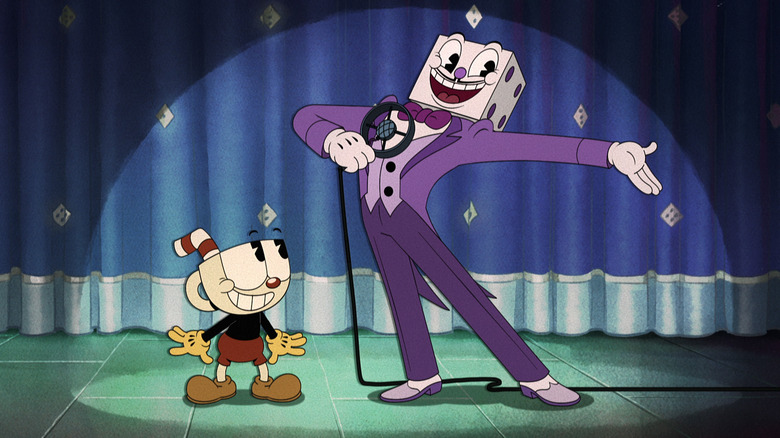
As essential to the "Cuphead" franchise as the Devil himself is, King Dice was the most recurring character in the game, keeping tabs on Cupsy and Mugsy during their debt collection across the Inkwell Isles. Despite his iconic design, theme song, and narrative importance, King Dice only appears in one episode of the show, trading out a demonic casino for a radio-based game show. However, it's likely fans of the Devil's right-hand man won't mind too much, considering it's the funniest episode of the season by far.
When Cuphead and Mugman stumble into Dice's studio, the host sees a golden opportunity to steal Cuphead's soul for his boss. What Dice doesn't realize is that his boss' impromptu nemesis is an unassuming agent of chaos, whose unregulated excitement and lack of basic intellect amount to an incredible series of blunders. The episode has small ambitions, but prevails with some of the best wordplay and slapstick of the season, all accentuated by real-life game show host legend Wayne Brady as King Dice.
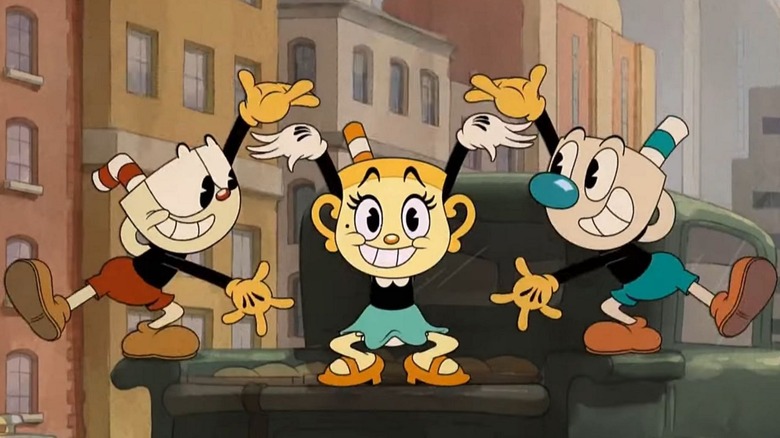
First seasons are tricky. They're built to give a positive first impression, yet almost never reflect the show's highest moments, in retrospect (with exceptions like "Stranger Things" and "Westworld"). "The Cuphead Show!" had a solid debut overall, but if the season finale is any indication, it's only going to get better from here. "In Charm's Way" introduces Ms. Chalice, a recurring side-character in "Cuphead" (and the third playable character in the game's upcoming downloadable expansion, "The Delicious Last Course"). Though the Inkwell Isles host a handy helping of memorable residents, the wayward Chalice resides in a league of her own, demonstrating unparalleled depth and dimensionality.
Upon meeting the brothers, Chalice agrees to teach them how to charm their troubles away. Though suspicious of them at first, she quickly befriends the two before an unforeseen obstacle shows the brothers where her conflicted priorities lie, ending the season on a captivating cliffhanger. It's the only episode with a musical number that benefits the experience, helped by a great performance from voice actor Grey Griffin as Chalice. "In Charm's Way" isn't just the finest episode of "Cuphead's" debut season on television — on its own merits, it's a knockout!
Read this next: The 15 Best Netflix Original Series Of 2021 Ranked
The post The Cuphead Show Season 1 Episodes Ranked appeared first on /Film.
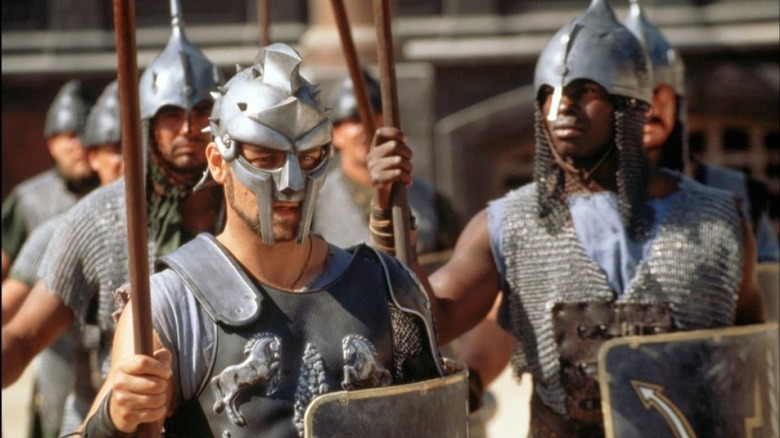
As far as historic epics go, "Gladiator" remains one colossally beautiful and bloody masterpiece. Ridley Scott's tale of revenge stars Russell Crowe as the Roman general Maximus betrayed into slavery by usurping Emperor Commodus (Joaquin Phoenix). It's definitely not a movie anyone's in danger of snoozing in, especially with its grandiose shots of the Coliseum and its brutal fight scenes. It's epic in every sense of the word, even if it is filled with historical anachronisms that make it a less than realistic portrayal of the period.
One area that fell prey to such inconsistencies was the costume department, though that doesn't make the outfits any less stunning. This is especially true of those worn by Roman nobility and various gladiators, including Maximus, who takes on the moniker "The Spaniard." Maximus' armor was actually a key piece in developing the character's gladiatorial look and backstory, and Crowe himself is responsible for suggesting to Scott that certain changes be made to his breastplate.
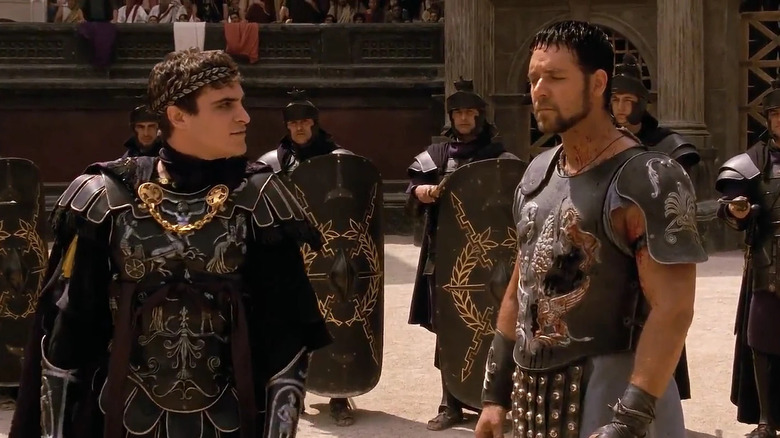
Costume designer Janty Yates is the source of this "Gladiator" trivia. In an interview on Academy Originals, she revealed there were a total of 12 sets of armor created for Maximus. Yates also explained how Crowe put his own personal touch on the armor of his character:
"As Russell, or Maximus, succeeds, fight after fight, he adds another figurine to the breastplate. The breastplate is made in hardened black leather. And then, the actual pieces are not real silver, but they're made to facsimile silver. The idea of the additions to the cuirass in silver was actually Russell's own idea, and he talked it over with Ridley. They both thought it was a wonderful thing. I hope that people will take away a feeling of strength, and the fact that Russell's character is just so muscle-rippingly strong, and noble, and honest, and true. I think that shows in this breastplate."
Even though we as the audience might not see the gladiator fights in which Maximus earns those silver additions, it's important to give them a bit of representation. They flesh out the character's servitude as a gladiator and also give his normally plain-black armor some necessary pomp. Maximus is evidently a silver kind of guy too, which points to his virtuousness. Gold being so tastelessly flashy for a gladiator, something Commodus obviously takes zero issues with given his outfit in their final confrontation. But knowing that Crowe wanted to give particular emphasis to the icons on his cuirass also points to just how much he was dedicated to his character's look. It's also not the only contribution or suggestion he made for Maximus.
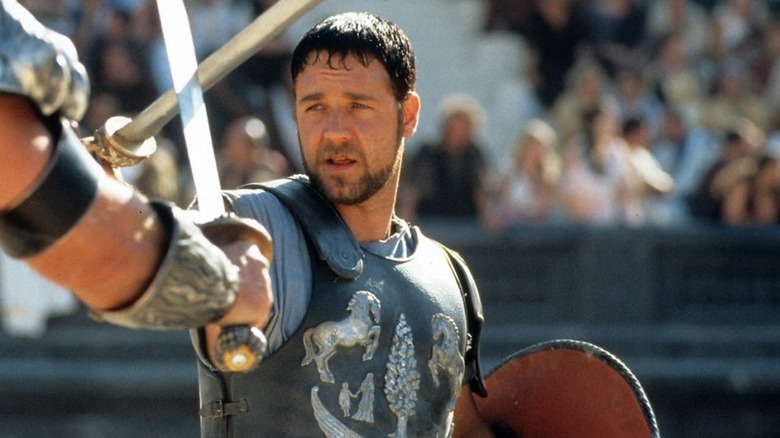
We might not know the exact reasons Crowe wanted to give his armor these silver accents, but there are plenty of reasons why it works. One of them is that at least two of the icons – the horses rearing up – are actually mentioned by Maximus himself in the film. The moment comes when he meets Lucius, son of Lucilla and nephew to Commodus, and learns he's an admirer of "The Spaniard." Maximus reveals to the boy that the horses on his armor are named after two he actually owned named "Argento" and "Scatto." But in the theatrical cut audio commentary, Scott confessed Crowe helped him come up with names:
"Was going round and round in circles about what to call the horses on his chest, so Russell said to me...'Silver and Trigger.' He said, 'You think anyone will notice?' And I said, 'If they do, it's kind of amusing.'"
Do you think anyone will notice? What is it you think we do here besides obsessively comb through films like "Gladiator" in search of kernels of trivia gold like this? Of course, someone would notice that the names of the two horses Maximus' memorializes are shared by the noble steeds ridden by "The Lone Ranger" and "Roy Rogers." This might be a tale about ancient Rome, but does that mean Maximus can't be a fan of two western heroes that wouldn't arrive for hundreds of years? Chalk it up to just one more of the film's little anachronisms.
Given that Crowe won an Oscar for Best Actor for his role as Maximus, it's clear he cared about the character's portrayal. In fact, Crowe was so passionate about the characte that, at one point during filming, the actor vehemently refused to say one of the character's most iconic lines. Still, Crowe's attempts to fine-tune Maximus are perhaps the reason he won the award at all. But with Scott vowing he's ready to return to Rome in "Gladiator 2," including plans to resurrect Maximus for it, it's safe to say the director didn't mind the actor's additions or attempted revisions.
Read this next: The 20 Best Westerns Of All Time
The post Russell Crowe Put Some Personal Touches On His Gladiator Costume appeared first on /Film.
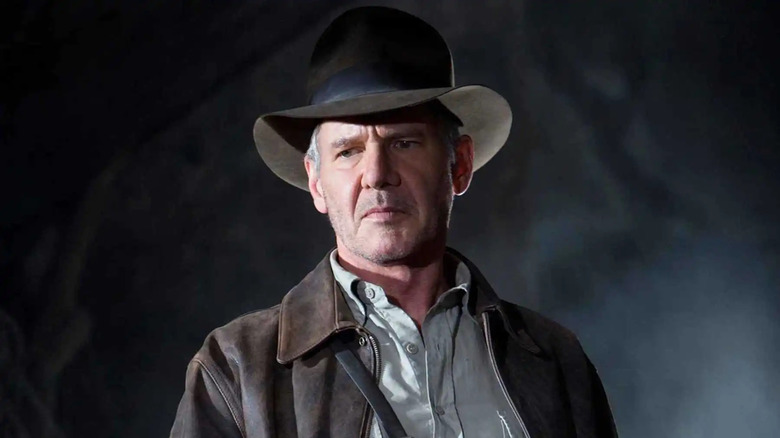
"Indiana Jones 5" wrapped filming back in late February of 2022, but it's still going to be a while before we get to see it. The film moved from a release date of July 29, 2022 to June 30, 2023, and that came after various other delays. Among the more painful delays, star Harrison Ford injured his shoulder on set, though some filming was done without him while he recovered. Ford is a difficult man to keep down, and his co-star Mads Mikkelsen was very impressed with him.
While speaking to The Hollywood Reporter about "Fantastic Beasts: The Secrets of Dumbledore," Mikkelsen praised Ford for his physicality. (That's a big deal coming from Mikkelsen, whose other professions included being a gymnast and a professional ballet dancer.) In "Fantastic Beasts," he plays villain Gellert Grindelwald, replacing Johnny Depp. For "Indiana Jones 5," we don't yet know specific details about his character, though we're assuming (based on Mikkelsen's track record of playing baddies) that he's some manner of villain.
Mikkelsen said of Ford:
"It was the first time I met him, and he's an insanely powerful person. Not just as an actor, but physically. I remember the first day we were shooting, it was a night shoot, then we stopped at 5 a.m. — and then he got on his mountain bike and went biking for 50 kilometers [31 miles]. Harrison is a monster of a man, a very nice monster."
I would like to point out here that "very nice monster" Ford is 79 years old, shooting a movie and biking 31 miles at 5 a.m. I'm feeling exceedingly lazy right now.
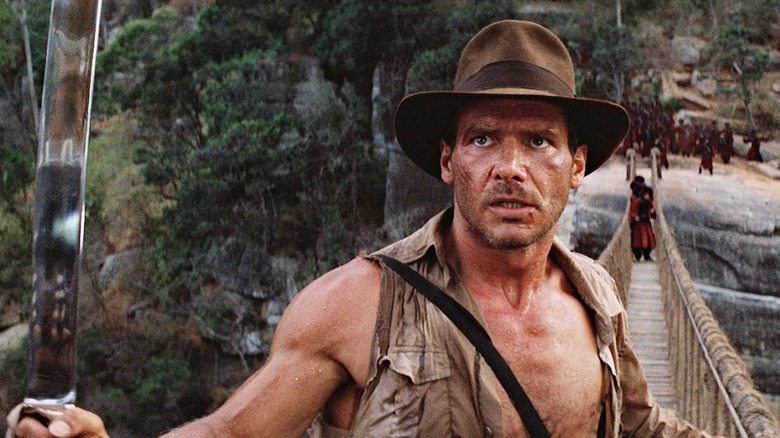
Mikkelsen shed some light on the upcoming "Indiana Jones" film as well, saying:
"[Raiders of the Lost Ark] was one of my favorite films, and it just oozed that golden period of serials from the 1940s — and that's in the fifth film as well. They're going heavily back to the first and second film and getting that original feel, the original Indy, something dense and epic."
This is a good thing, because the fourth film was ... well, it was ... not great. I do not blame Harrison here. It just didn't fit the franchise, in my opinion. It wasn't awful by any stretch, but it just didn't have the same zing to it that the first films did.
"Indiana Jones 5" is directed by James Mangold, with Steven Spielberg as an executive producer. I wish that there was more information on the plot, but we don't have much to go on right now.
Here's what we do know: It appears that Ford will get some de-aging treatment for certain scenes. It's been speculated that we'll see some WWII flashbacks, but that has not been confirmed. Mangold wrote the script with Jez and John-Henry Butterworth ("Edge of Tomorrow"). The film also stars Phoebe Waller-Bridge, Thomas Kretschmann, Boyd Holbrook, Shaunette Renée Wilson, Toby Jones, and Antonio Banderas. That's a pretty spectacular group! I don't know about you, but I'm so excited to see Ford back in his wide-brimmed fedora -- even if it involves aliens again.
"Indiana Jones 5" arrives in theaters on June 30, 2023.
Read this next: The 18 Best Action Movie Actors Ranked
The post Indiana Jones 5: Mads Mikkelsen Says Harrison Ford Is 'An Insanely Powerful Person' appeared first on /Film.
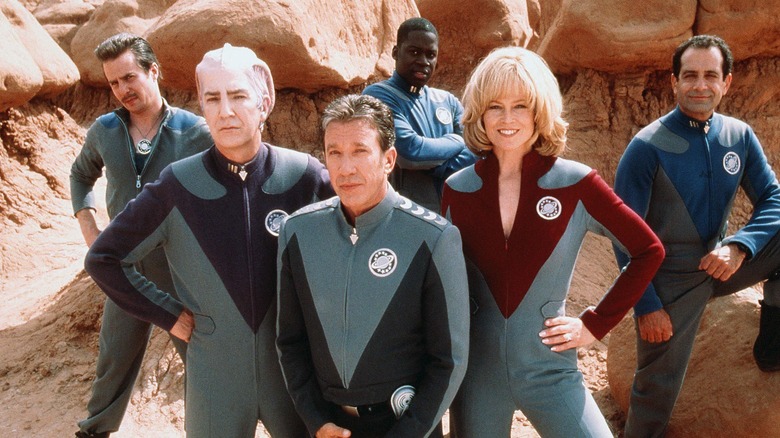
"Galaxy Quest" is a film that manages to walk the tightrope between being a perfectly crafted satire of the sci-fi genre -- particularly "Star Trek" -- and a major love letter to the sci-fi genre. "Star Trek" fans even consider it an honorary "Trek" film, which goes to show how well it struck a chord with fans as well as general audiences.
A large part of the film's appeal is its outstanding cast, which includes several actors who (either prior to "Galaxy Quest" or since) have played pivotal roles in sci-fi and fantasy franchises. Tim Allen voiced Buzz Lightyear in "Toy Story," and Alan Rickman went on to play Severus Snape in the "Harry Potter" franchise. Even Tony Shalhoub had a small role in "Men in Black."
But the crown jewel was Sigourney Weaver. Having starred as Ellen Ripley in the "Alien" movies, as well as playing Dana in the original "Ghostbusters," Weaver was the perfect fit for Gwen DeMarco/Lt. Tawny Madison. But believe it or not, her solid sci-fi credentials almost led to her not getting the part in "Galaxy Quest."
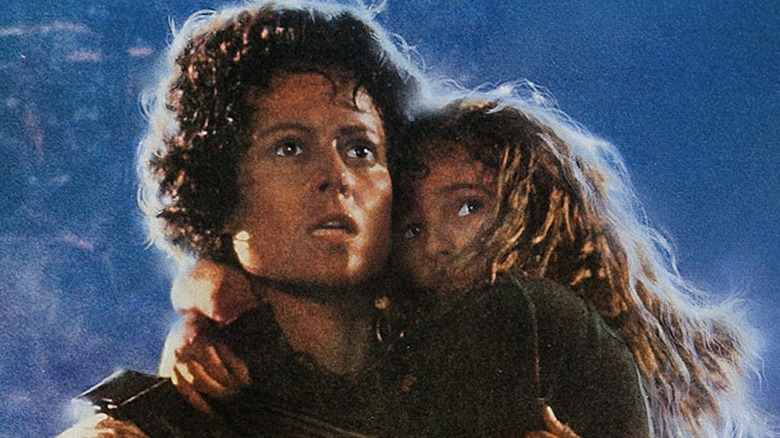
"Galaxy Quest" was originally set to be directed by Weaver's "Ghostbusters" co-star Harold Ramis, and he had more than a few requirements in mind -- including that the main cast shouldn't contain any sci-fi veterans. This was a point of contention for Weaver, as she felt that her sci-fi experience gave her the tools to make the satire sharper; she further elaborated on this during an oral history of "Galaxy Quest" with The Hollywood Reporter:
"I had heard that Harold was directing a sci-fi movie but he didn't want anyone who had done sci-fi in the film ... Frankly, it's those of us who have done science fiction movies that know what is funny about the genre."
Ramis would ultimately end up departing "Galaxy Quest," but Weaver's desire to play Gwen didn't die down. Dean Parisot took over directing duties, Weaver was finally cast, and her performance ended up being one of the best parts of the film. My favorite moment has to be when she lampshades the fact that her character basically just repeated information that the computer already spat out: "Look, I have ONE job on this lousy ship! It's stupid, but I'm going to do it, okay?!"
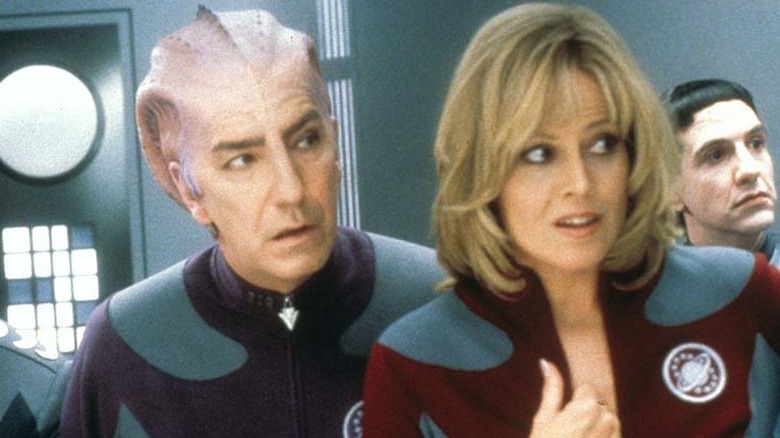
Ironically, Weaver wasn't that big of a sci-fi fan before she was cast in the "Alien" role that propelled her to sci-fi royalty. During another oral history, this time with MTV, she confessed that outside of a few shows she never really cared for the genre -- but that ultimately gave her perspective when playing Gwen.
"I liked 'The Twilight Zone,' that's as close as I ever got. I thought 'Flash Gordon' was stupid. I think 'Star Trek' happened and I missed it. I was in the theater, and then suddenly I did 'Alien.' Suddenly I was straddling two very different worlds ... But I just felt 'Galaxy Quest,' as a comedy, was such a love letter to all the insecure actors in the field who have done so many wonderful and somewhat under-appreciated projects, and even though 'Star Trek' is very popular, it was very ... specific."
Weaver has continued to be a major presence in the sci-fi genre, with appearances in "The Defenders" and "Avatar," and she's also set to reprise her role as Dr. Grace Augustine in the upcoming "Avatar" sequels. To paraphrase the words of Gwen DeMarco: she has a job to do, and even if it's not her cup of tea, she's going to do it.
Read this next: 20 Movies About Aliens That You Definitely Need To Watch
The post Sigourney Weaver's Sci-Fi Background Nearly Cost Her Galaxy Quest appeared first on /Film.
Pursuant to my recent post about finally understanding how Sega Dreamcast GD-ROM rips are structured, I was able to prepare the contents of various demo discs in a manner that makes exploration easy via the Internet Archive. This is due to the way that IA makes it easy to browse archives such as ZIP or ISO files (anything that 7zip knows how to unpack), and also presents the audio tracks for native playback directly through the web browser.
These are some of the interesting things I have found while perusing the various Dreamcast sampler discs.
Multimedia Formats
First and foremost: Multimedia-wise, SFD and ADX files abound on all the discs. SFD files are Sofdec, a middleware format used for a lot of FMV on Dreamcast games. These were little more than MPEG video files with a non-MPEG (ADPCM instead) audio codec. VLC will usually play the video portions of these files but has trouble detecting the audio. It’s not for lack of audio codec support because it can play the ADX files just fine.
It should be noted that Dreamcast Magazine Disc 11 has an actual .mpg file (as opposed to a .sfd file) that has proper MPEG audio instead instead of ADX ADPCM.
The only other multimedia format I know of that was used in any Dreamcast games was 4XM, used on Alone In The Dark: The New Nightmare. I wrote a simple C tool a long time to recover these files from a disc image I extracted myself. Rather than interpreting the ISO-9660 filesystem, the tool just crawled through the binary blob searching for ‘4XMV’ file signatures and using length data within the files for extraction.
Also, there are plentiful PVR files (in reference to the PowerVR2 GPU hardware that the DC uses) which ‘file’ dutifully identifies as “Sega PVR image”. There are probably tools to view them. It doesn’t appear to be a complicated format.
Scripting
I was fascinated to see Lua files on at least one of the discs. It turns out that MDK 2 leverages the language, as several other games do. But it was still interesting to see the .lua files show up in the Dreamcast version as well.
That Windows CE Logo
Every Sega Dreamcast is famously emblazoned with a logo mentioning Microsoft Windows CE:

It has confused many folks. It also confused me until this exploratory exercise. Many would wonder if the Dreamcast booted up into some Windows CE OS environment that then ran the game, but that certainly wasn’t it. Indeed, Dreamcast was one of the last consoles that really didn’t have any kind of hypervisor operating system managing everything.
I found a file called rt2dc.exe on one sampler disc. At first, I suspected that this was a development utility for Windows to convert some “RT” graphical format into a format more suitable for the Dreamcast. Then, ‘file’ told me that it was actually a Windows EXE but compiled for the Hitachi SH-4 CPU (the brain inside the DC). Does the conversion utility run on the Dreamcast itself? Then I analyzed the strings inside the binary and saw references to train stations. That’s when it started to click for me that this was the binary executable for the demo version of Railroad Tycoon 2: Gold Edition, hence “rt2dc.exe”. Still, this provides some insight about whether Dreamcast “runs” Windows. This binary was built against a series of Windows CE libraries. The symbols also imply DirectX compatibility.
Here is a page with more info about the WinCE/DirectX variant for the Sega Dreamcast. It seems that this was useful for closing the gap between PC and DC ports of games (i.e., being able to re-use more code between the 2 platforms). I guess this was part of what made Dreamcast a dry run for the DirectXbox (later Xbox).
Here is a list of all the Dreamcast games that are known to use Windows CE.
Suddenly, I am curious if tools such as IDA Pro or Ghidra can possibly open up Windows CE binaries that contain SH-4 code. Not that I’m particularly interested in reverse engineering any algorithms locked up in Dreamcast land.
Tomb Raider Easter Egg
The volume 6 sampler disc has a demo of Tomb Raider: The Last Revelation. While inspecting the strings, I found an Easter egg. I was far from the first person to discover it, though, as seen on this The Cutting Room Floor wiki page (look under “Developer Message”). It looks like I am the first person to notice it on the Dreamcast version. It shows up at offset 0xE3978 in the Dreamcast (demo version) binary, if anyone with permissions wants to update the page.
Web Browser
Then there’s the Web Browser for Sega Dreamcast. It seemed to be included on a lot of these sampler discs. But only mentioning the web browser undersells it– the thing also bundled an email client and an IRC client. It’s important to remember that the Dreamcast also had a keyboard peripheral.
I need to check the timeline for when the web browser first became available vs. when the MIL-CD hack became known. My thinking is that there is no way that the web browser program didn’t have some security issues– buffer overflows and the like. It seems like this would have been a good method of breaking the security of the system.
Ironically, I suddenly can think of a reason why one might want to use advanced reverse engineering tools on Dreamcast binaries, something I struggled with just a few paragraphs ago.
Odds ‘n Ends
It’s always fun to find plain text files among video game assets and speculating on the precise meaning… while also marveling how long people have been struggling to correctly spell “length”.
Internationalization via plain text files.
Another game (Slave Zero) saw fit to zip its assets. Maybe this was to save space in order to fit everything on the magazine sampler disc. Quizzically, this didn’t really save an appreciable amount of space.
Finally, all the discs have an audio track 2 that advises that the disc must be played in a Dreamcast console. Not unusual. However, volume 4 also has a Japanese lady saying the same thing on track 4. This is odd because track 4 is one of the GD area audio tracks and is not accessible with normal CD hardware. Further, she identifies the disc as a “Windows CE disc”.
The post Dreamcast Finds first appeared on Breaking Eggs And Making Omelettes.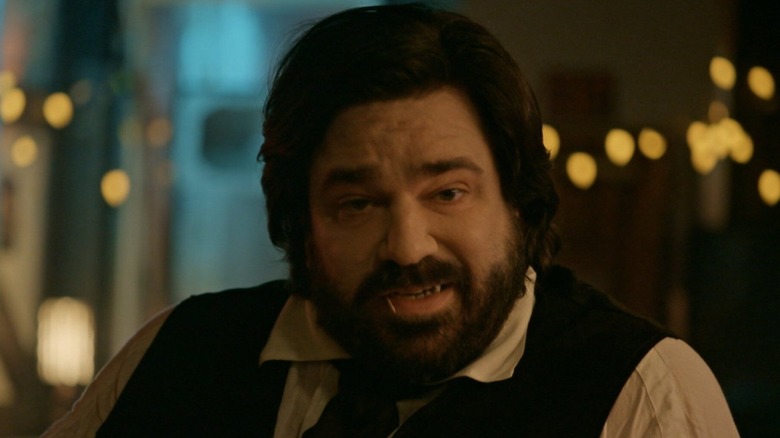
We should be so lucky that "What We Do in the Shadows" boasts one of the funniest ensembles on television. An American spinoff of Taika Waititi and Jemaine Clement's 2014 vampire mockumentary of the same name could have faltered in recapturing the same magic in a number of ways. Luckily for us, the cast of the show excels on almost every level.
Natasia Demetriou's seamless turn-on-a-dime temperament from friendly to vindictive is always hilarious. Mark Proksch's dry delivery makes me smile because I too thrive on the contempt of people who almost wish they didn't meet me once I start dropping lame jokes on them. Kayvan Novak perfectly embodies the vampire himbo who has trouble reading the room. Harvey Guillén has grown to become the show's biggest secret weapon, evolving from timid familiar to an invaluable member of the team who knows his vampire-slaying worth. The member of the illustrious cast that has grown on me the most, however, might actually be Matt Berry.
I wasn't too familiar with the "Toast of London" actor prior to "What We Do in the Shadows," but the show has made me a full-fledged fan. Akin to Leslie Nielsen, his impeccable delivery can turn just about anything he says into comedy gold. He carries this confidence even when saying the most ridiculous things. "Ah, that was my first ship. It was a piece of s***" is one of the biggest laughs I've gotten from the series thus far. Berry is a notorious ad-libber on set, and according to Waititi, he's also prone to starting nap wars.
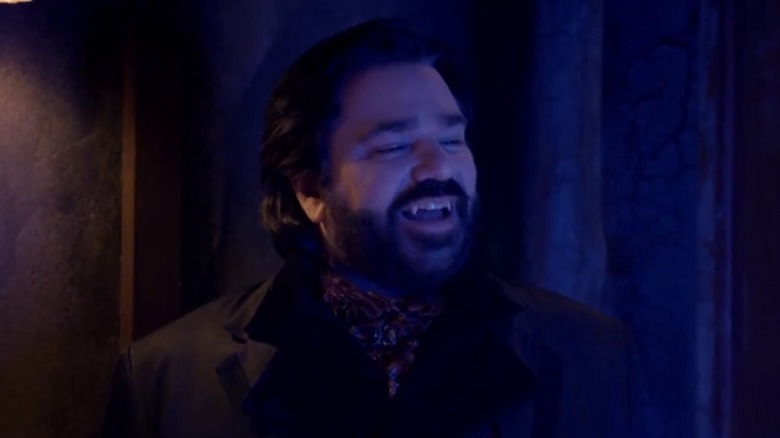
In a group interview with the New York Times, Taika Waititi recalls how Matt Berry would claim the set's most comfortable spot during a string of Toronto night shoots:
"We'd nap all the time. I'd see a couch and be like, 'There's my couch.' Matt Berry is also a huge napper. On the sets, we'd scope out the beds. And I'd be, 'Oh, that's mine.' And then I'd come in and Matt would be in it."
In this same interview, Jemaine Clement mentions how difficult it was to even find a place to rest when your set is fitted to accommodate vampires:
"Usually when you have a house set, there's bedrooms with beds. But there's no beds on this, because it's coffins. There's nowhere to sleep. So everyone's got to really search: 'Ah, now that human character has a bed.'"
I think it's fitting that this very funny show about dysfunctional vampire roommates carries the same energy behind the scenes. What makes it even funnier is that there was a sign on set that read "No sleeping," and in even smaller letters, "unless you're Taika." I have to question Clement's claim, though. Who wouldn't want to sleep in a padded coffin, especially Nandor's? Have you seen that thing? It looks comfortable as hell! Not only would I get to nap in style, but I'd get to close it off to all the noise around me. Waititi and Berry can go to war over the sole bed, while I'd claim the best sleep in the house.
Read this next: The 13 Best Comedy Shows On Amazon Prime Right Now
The post What We Do In The Shadows Kicked Off a Battle Between Matt Berry And Taika Waititi appeared first on /Film.

Karl Bode set out to buy a "dumb" TV set: one that didn't constantly try to go online, surveill him and shovel advertisements, offers and other useless crap in his face while he tried to watch some shows. They're out there, but they're not much good…
— Read the restOf course it's challenging because TV manufacturers now make more money collecting and monetizing your personal data than they do selling the actual hardware.
While we still don't have a release date for HBO Max's upcoming "Batgirl" movie, we do know just enough to be excited about the mysterious forthcoming DC property. There's little doubt that "In The Heights" standout Leslie Grace will be an impressive Barbara Gordon/Batgirl, and initial photos reveal a great, comic-accurate costume. Equally exciting is the return of Michael Keaton's iteration of Bruce Wayne/Batman, a role he made iconic in the still-beloved pair of Tim Burton-helmed "Batman" films.
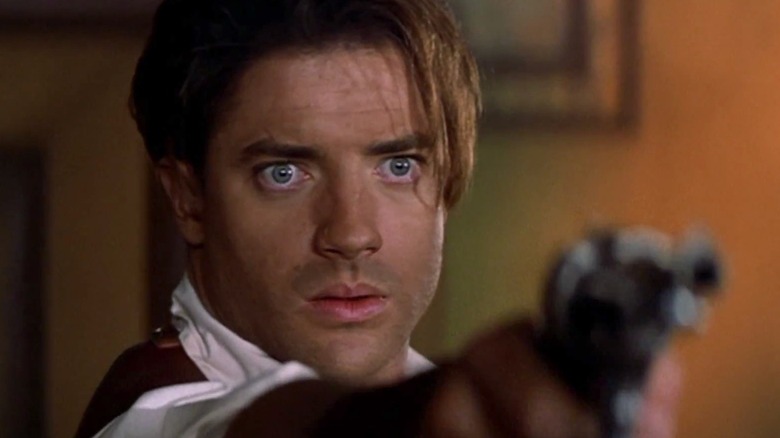
Along with Michael Keaton's return, another source of excitement is the film's choice of villain in Firefly, an airborne pyromaniac Bat-nemesis played here by Brendan Fraser. After a years-long shift from A-list action-comedy stardom into well regarded TV roles like Robotman in "Doom Patrol," Fraser's return to high-profile action features is certainly a highlight of the upcoming movie. As it turns out, no one has higher praise for "The Mummy" star's villainous turn than "Batgirl" star Leslie Grace herself.
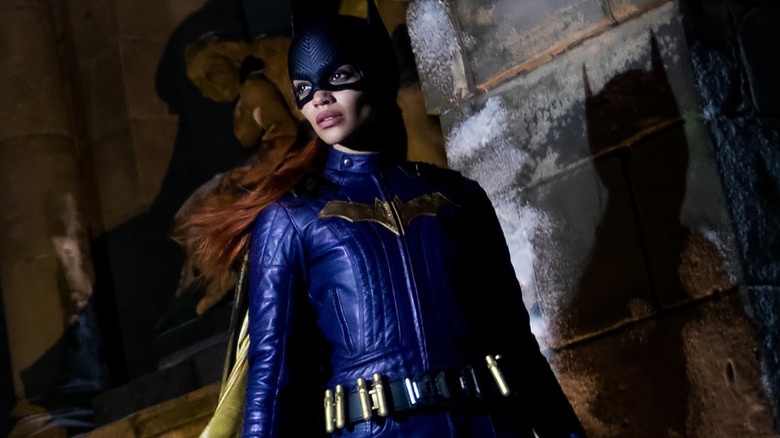
In an interview with Variety, Leslie Grace praised just about every aspect of working with Brendan Fraser, from his demeanor on-set to his skill in managing the film's tougher stunt-work. In an answer to a question about her own character's "badass" attributes, she pivots mid-answer to praise Fraser:
"She definitely exceeds what I thought. I had to summon up some things in me that I didn't even know were there. It was an incredible learning experience to be on set with also action veterans like Brendan Fraser, and soak up it all up. It was so hard because he's our villain and I'm not supposed to like him but he's such a huge teddy bear. He is one of the nicest people that I've ever met. In our fight sequences the way he would just hit marks, it came from all of his experience. You can't improvise that kind of experience. There's some crazy stuff that happens. There's lots of fire because as everyone knows by now, he plays Firefly. There's crazy fire. There's crazy stunts, crazy drops. She's a biker chick, so you're going to see her do a bunch of badassery."
Not only does Grace's description of what's in store for audiences build excitement about "Batgirl," but her comments also tease a top-form Fraser who hasn't lost a step from his well-honed action-star days.
Fraser's turn as Rick O'Connell in "The Mummy" franchise added strong comedic sensibilities to an Indiana Jones-archetype character, quickly establishing Fraser as a well-regarded action hero with loads of on-screen charisma. According to Grace, not only was he exceptional as the menacing "Batgirl" villain, but he was also a top shelf collaborator across the board. With a number of high profile features on the horizon, from "Batgirl" to Darren Aronofsky's "The Whale" and Scorsese's "Killers of the Flower Moon," Brendan Fraser fans have a lot to look forward to in the very near future.
Read this next: Joker's Wild: Ranking The Cinematic Versions Of The Clown Prince Of Crime
The post Leslie Grace Describes Working with Brendan Fraser on Batgirl, Now We Want to Work with Brendan Fraser appeared first on /Film.
Read more of this story at Slashdot.
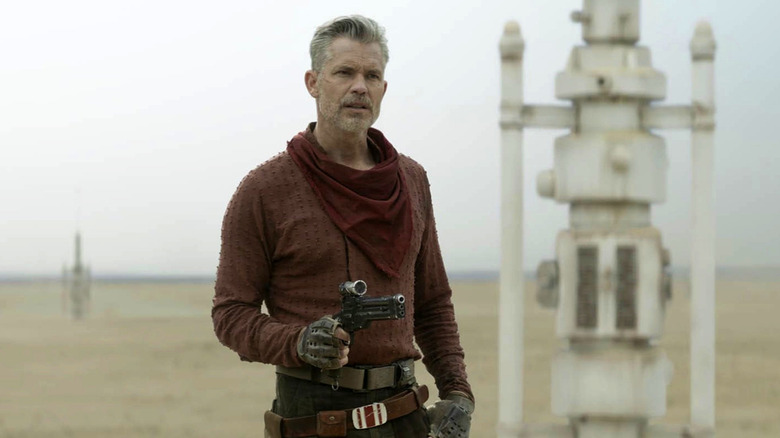
"The Mandalorian" is a fantastic melding of "Star Wars," classic Western tropes, and old-school samurai films. That strength continued into "The Book of Boba Fett," where the fan-favorite bounty hunter had the chance to show off everything he could do. The answers to that specific inquiry boiled down to "get beat up," "be a poor crime boss," and "ride a rancor."
One of the highlights of the show, outside of the return of Din Djarin and Grogu, was the return of another side character from "The Mandalorian," Cobb Vanth. The character played by Timothy Olyphant runs across the paths of The Mandalorian and Boba Fett as the self-proclaimed sheriff of Mos Pelgo, later renamed Freetown in "The Book of Boba Fett." The man once known as The Marshal came into possession of Boba Fett's Mandalorian armor, and he made a great addition to the "Star Wars" universe. In the role, Olyphant turns on his "Justified" charm, easily nailing Vanth down as a lone lawman that wanted to protect his small bit of Tatooine and the people who call it home. It's a fun spin on familiar Western concepts.
What might surprise some fans is that Vanth wasn't a creation of "The Mandalorian." Instead, Vanth first appeared in another "Star Wars" work.
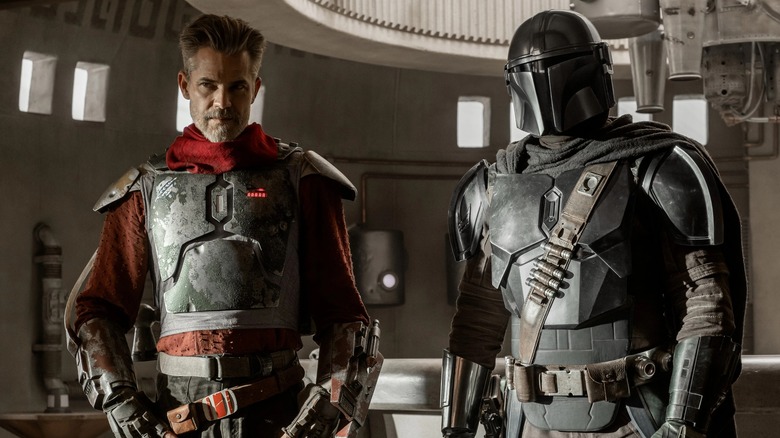
The first appearance of Cobb Vanth in "Star Wars" canon was the novel "Star Wars: Aftermath," and its subsequent sequels "Aftermath Life Debt" and "Aftermath Empire's End." All three novels were written by Chuck Wendig, who was given leeway to add to the "Star Wars" universe canon. The trilogy of books is set shortly after the end of 1983's "Return of the Jedi" and focuses on the events between that film and "The Force Awakens."
Vanth wasn't a main character in the trilogy, though. Instead, he appeared primary in interlude chapters spread out amongst the books. The tale shows Vanth as a slave who breaks free and incites a rebellion against a local mining collective backed by the fearsome Red Key Raiders. It also includes a scene where Vanth purchases Boba Fett's armor from some Jawas.
The character was one of Chuck Wendig's bigger additions to the "Star Wars" mythology, and it stands as one of the few that's made the transition to live-action. But unfortunately, fans watching Cobb Vanth on TV may not have realized this.
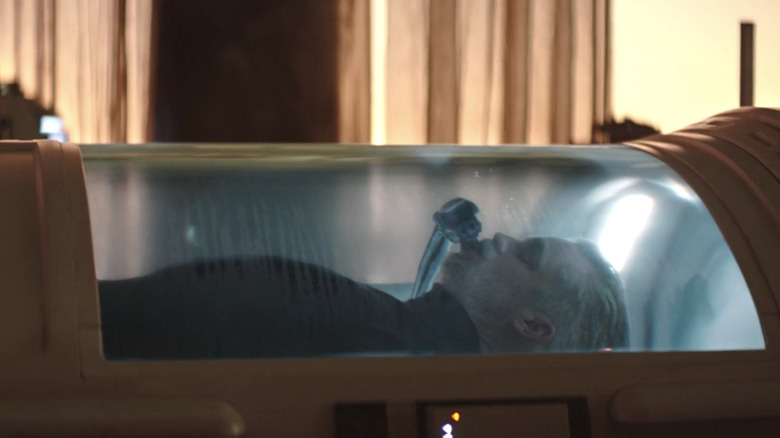
Sadly, that transition was not marked with pure joy on the part of Vanth's creator. Instead, Wendig took to Twitter to express his disappointment over the inclusion. Despite Vanth's key role in "Star Wars" television, Wendig hasn't received any credit for the character's creation. The author cheekily noted in a tweet back in February:
"I always dig it when big media properties have a special thanks for the writers and creators who contributed to their worlds and stories, and it's a bummer when they don't do that, and I bring this up for absolutely no reason at all and I will almost certainly delete this tweet."
It's not the first time that a Disney property has been under fire for not properly crediting a creator. Writer Joe Casey recently said that Marvel Studios' compensation for co-creating America Chavez, who is appearing in the upcoming "Doctor Strange in the Multiverse of Madness," was a "pittance." Previously, writer Ed Brubaker admitted that he felt "f***ed over" for his creation of the Winter Soldier, who went on to headline "The Falcon and the Winter Soldier" and has been a key part of the "Captain America" and "Avengers" franchises.
Wendig isn't asking for more money for his role in creating Vanth, simply a credit or special thanks. Even if the work is for-hire, a little acknowledgment can go a long way. Perhaps Wendig will get that credit when the Cobb Vanth Disney+ series comes out. It's gonna happen! Right, Disney?!
Read this next: Single-Season '80s Sci-Fi And Fantasy Shows That Deserve A Second Shot
The post Why Cobb Vanth Creator Chuck Wendig Was Bummed About the Character's Book of Boba Fett Appearance appeared first on /Film.
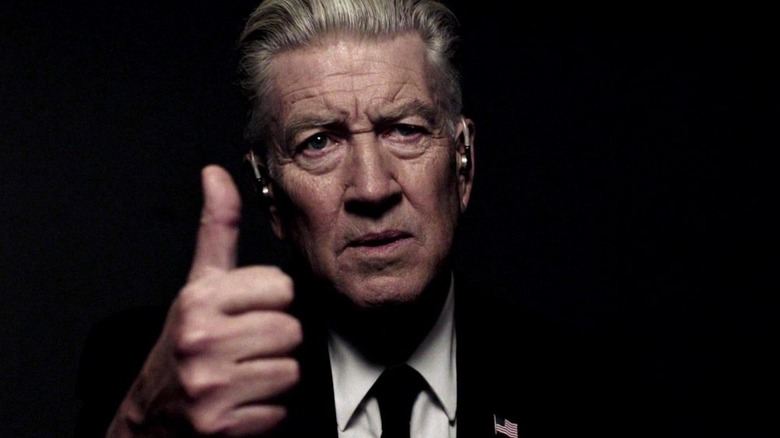
While our hearts collectively shattered after learning that David Lynch, will, in fact, not be premiering a film at Cannes this May, he certainly is busy with other (non-film-related) projects. According to IndieWire, Lynch has launched a $500 million mental health program under his David Lynch Foundation, which aims to provide training for Transcendental Meditation for 30,000 college students. The aim of this initiative is to help the target audience "become advanced peace-creating meditation experts and build a legacy of lasting global peace".
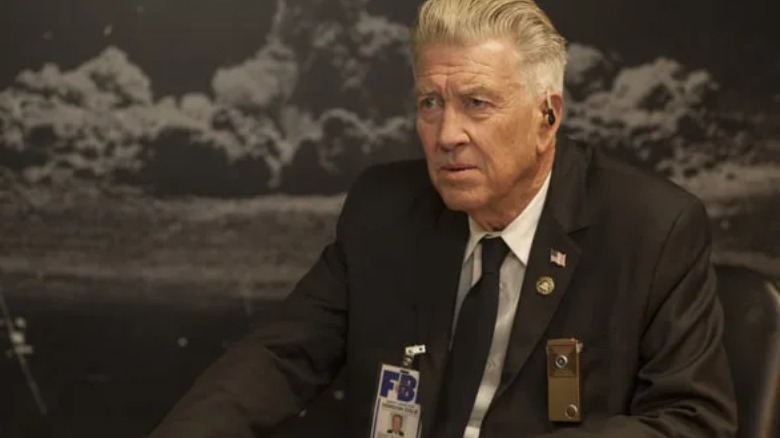
Lynch has been a proponent of Transcendental Meditation for years, practicing the method since 1973, and has described it as a daily practice that provides "effortless access to unlimited reserves of energy, creativity and happiness deep within" (via David Lynch Foundation). Lynch's current initiative will invest roughly $500 million in its first year alone, in partnership with the Global Union of Scientists for Peace, an organization that aims to promote evidence-backed, nonviolent approaches to preventing socio-political conflict.
In a promotional video for the initiative, Lynch touched upon the importance of peace in a war-torn world (via PEOPLE):
"We don't know what tomorrow's going to bring if we don't get peace on this planet. This war in Ukraine, people were saying it's not going to happen, and now it's happened. People are dying. Cities are being destroyed. Things are very, very precarious. Everybody knows it.
People do many things to help humanity, but this has been going on for a long time. Talking, marching, singing — it's not brought peace."
Proposing an alternative to resolving these issues, Lynch emphasized meditation as a means to "start lifting" emotions of stress and negativity inherent within the human experience. The director went on to credit Dr. Tony Nader for championing the transcendental meditation movement, which highlights that change should be brought about within the "collective consciousness."
The initiative details reveal the meditation training will be funded for 10,000 students at Maharishi International University in the U.S (founded by Maharishi Mahesh Yogi), 10,000 students at the sister schools across India, and 10,000 students at partner universities around the world.
Dr. Nader also expressed his sentiments about Lynch's efforts:
"David Lynch is not only a brilliant filmmaker — he believes that world peace is attainable and can be achieved. His plan will do what all the bombs cannot do: help us create actual peace in the world."
Lynch's digital film, "Inland Empire" recently returned to the big screen after undergoing a 4K remaster, carried out in association with Janus Films.
Read this next: The 35 Best Documentaries You Can Watch On Netflix Right Now (March 2022)
The post David Lynch Launches $500 Million Mental Health and Meditation Initiative for College Students appeared first on /Film.
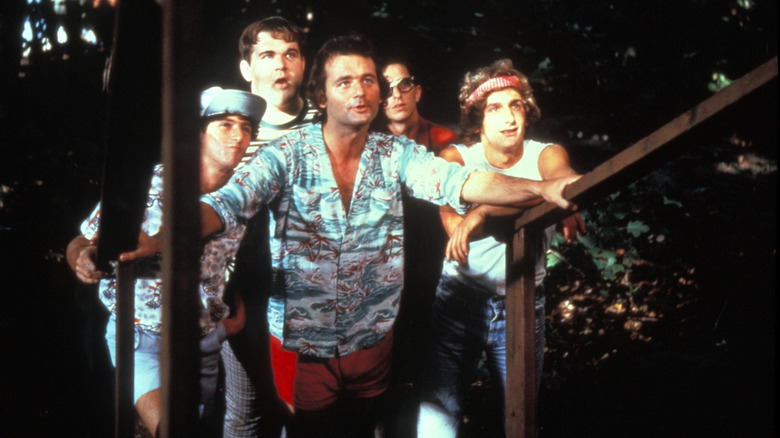
1979's "Meatballs" is part of the wave of ribald, anarchic comedies to come out of the late '70s and early '80s in the wake of shows like "NBC's Saturday Night" and movies like "National Lampoon's Animal House." These comedies would often have an anarchic air about them, seen in their transgressive humor as well as their plot structure, which typically emphasized a "slobs vs. snobs" conflict. So it's no surprise that the sets of these productions would tend to get a little out of control.
However, things didn't just get a bit out of control on the set of "Meatballs" — director Ivan Reitman and company had to contend with an actual mutiny that broke out, one that resulted in damaged equipment and a throng of (literally) unhappy campers. Like most mutinies, Reitman and his crew had ample opportunity to see the storm clouds of discontent brewing, but couldn't quell them in time.
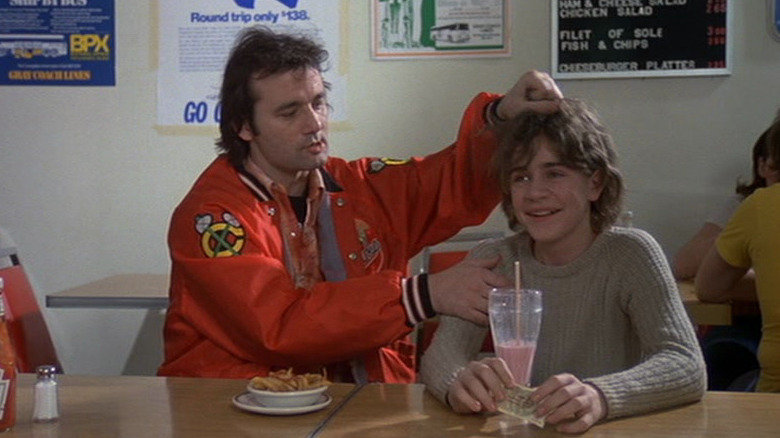
Reitman and producer Dan Goldberg found making "Meatballs" an uphill battle as they entered production, beginning with finding a location to shoot the movie. As Goldberg recalled in Vanity Fair's oral history of the film from 2017, he would "drive all around Canada, visiting various camps to see if they would let us shoot with the campers," an idea which most camps rejected given that their campers were "paying customers," of course.
Fortunately, Camp White Pine in Haliburton, Ontario said yes, allowing the production to take over their grounds in August of 1978. Reitman chose the setting and time of year deliberately to make sure "the campers were still there," both to lend a sense of reality to the movie as well as have the campers "serve as relatively inexpensive extras."
Yet Reitman's brilliant cost-saving measure ended up backfiring. As casting director Jack Blum (also the actor who played Spaz in the film) remembered, "Things got tense with the campers," with the kids being "very excited when [the cast and crew] arrived, but within a week, maybe less than that, they understood that this was not going to be fun for them." The teen campers were learning firsthand the boredom of being extras in a movie, and according to one of those campers, then-17-year-old Adam Kronick, "There was a lot of grumbling."
Location coordinator Kay Armatage recalled one particular incident that led to the mutiny, which was when Reitman asked for a scene featuring campers having a potato sack race. While the kids chosen to be in the race were made to wait for hours for the crew to prepare to film the scene, they found themselves "missing their swimming time and their naps and their crafts projects and whatever else," and "were starting to get seriously pissed off." After someone on the crew informed Armatage they wouldn't have time to get to the scene, she "blew [her] stack" in anger. The kids, however, had a different response.
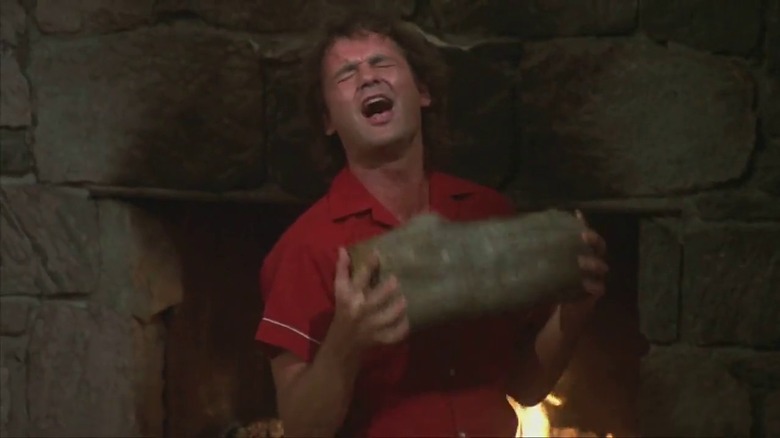
As camper Kronick observed in retrospect, the descent of the "Meatballs" production on Camp White Pine was "certainly disruptive," and the prospect of making "a film in a summer camp where there are 400 campers who have other ideas of how they want to spend their summer" was a difficult one from the jump.
As evidence, the campers at White Pine eventually had enough, and they "started to mutiny and sabotage," as Armatage recalled. One of the incidents she observed involved the campers deflating the tires on one of the production's dollies, and the tires "weren't filled with air" but rather "hydrogen or something like that," meaning that fixing them "wasn't a simple matter of just pumping up the tires again."
Kronick plead the fifth when it came to recounting any other mutinous activities. "There were some stories I can't tell you," he teased. But it seems one of the mitigating factors in the tension between the "Meatballs" production and Camp White Pine was none other than star Bill Murray himself. Kronick recalled how "the staff was kind of excited to have a real 'Saturday Night Live' cast member in their midst," and how Kronick's father, who was on the camp's staff, would call a staff meeting with the promise of Murray's attendance, a meeting which Murray would then actually show up to (which is surprising, given that he nearly didn't show up to make the movie at all).
Ultimately, "Meatballs" was completed through Reitman and company's savvy and ability to perform triage on a wild and sometimes troubled production. While the making of the movie was no picnic, it was a largely fun experience for most of those involved, and it resulted in a hit film that furthered the careers of Reitman and Murray and influenced '80s comedy in general. Without the energy the campers' mutiny brought to the film, maybe "Meatballs" would've felt a little less delightfully zany.
Read this next: 20 Underrated Comedy Movies You Need To Watch
The post There Was an Actual Mutiny On the Set of Meatballs appeared first on /Film.
Discover a fantasy reimagining of the frontier where lawmen and gunslingers must fight fantastical creatures.
Genre: Adventure
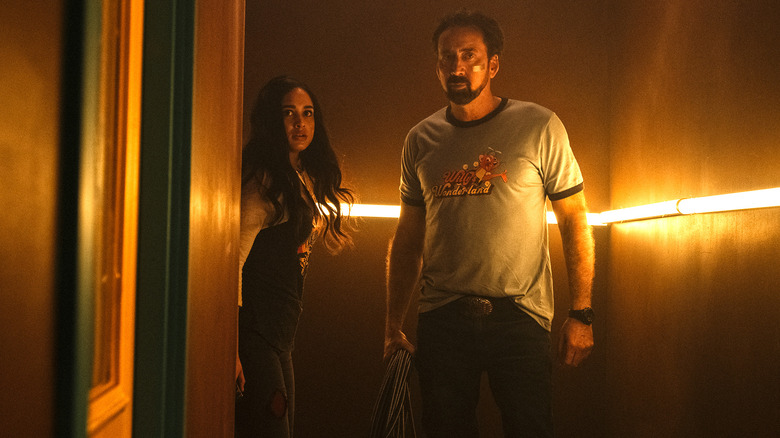
"Willy's Wonderland" is a whole damn trip. The action-horror comedy sees a lone drifter (Nicolas Cage) roll into a small town, taking up a job as temporary janitor for a local theme restaurant. What the drifter doesn't know is that the restaurant is haunted. Each night, the souls that inhabit the colorful animatronic mascots wake up and kill those who trespass, which includes a rowdy group of teenagers.
Luckily for these teens, the newly-installed Janitor is rather adept at killing monsters for some reason. What follows this premise is a two-fold slasher film, with the animatronics killing the teenagers while the Janitor kills the animatronics. "Willy's Wonderland" offers so many tantalizing questions, like, "Who taught the Janitor to kill monsters?" and "Did he mean to be trapped in the restaurant for the evening?"
We never really get the answers in the film because the Janitor himself never speaks, and that was a decision made by Cage himself.
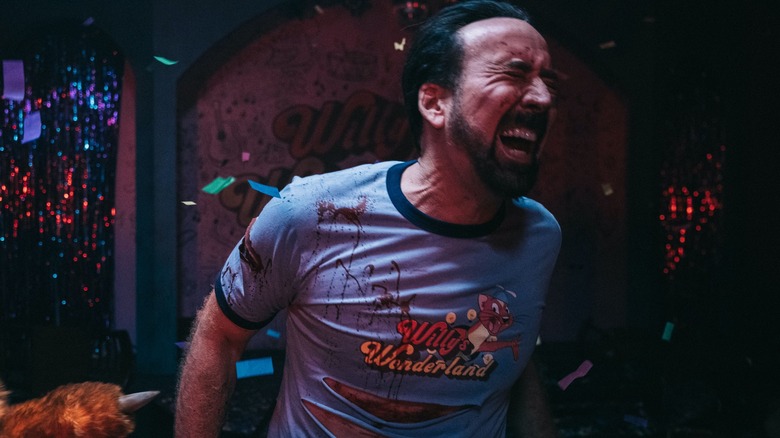
The Janitor is played with a stoic intensity by Nicolas Cage. He doesn't seem fazed by mascots infused with the souls of serial killers and treats the entire ordeal like another average day. Given the story comparisons to the video game "Five Nights at Freddy's," some wondered if the Janitor was silent on purpose to reflect a silent video game protagonist.
In a recent Reddit Ask Me Anything, Cage explained the reason behind his character's taciturn nature. The actor says the choice was made on set after he took a look at the script for the film. Cage said:
"The dialogue for my character in "Willy's Wonderland" was very sparse, so I decided with Kevin, the director, to go full Harpo Marx and take all the dialogue out because I thought that would be a fun acting challenge to see how much I could communicate without words and only with movement and facial expressions. I'm very happy with the results of "Willy's Wonderland. It was a good experiment."
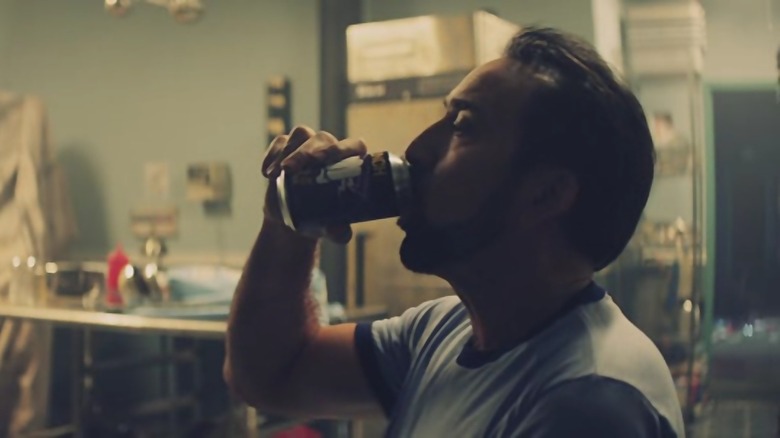
The same user that asked about the silent protagonist also wanted to know about the cans the Janitor chugs during the film when he needs a recharge. The drink is known only as "Punch," with a tagline that reads, "A fistful of caffeine to your kisser." Is Punch a soda, an energy drink, a beer, or perhaps a hard seltzer? Perhaps it's something more sinister and powerful, a libation that charges the Janitor with ancient energies for his battle with the forces of evil.
Cage prefers to leave the specifics of Punch's composition to the audience. "The can question is an interesting one, and I hesitate to answer it for you, because your relationship with the movie is far more important than my relationship with the movie, and so you as the audience member can imagine and surmise whatever you want to be in that can," said Cage. "That is a far better answer and reason for the can than anything I could tell you. I want your opinion as to what was in the can, because that was the right opinion."
Ah, that's the Nicolas Cage we know and love. That's the mix of warmth, manic energy, and intellectual confidence that makes him fun as an actor and an interviewee.
Read this next: The 95 Best Horror Movies Ever
The post Why Nicolas Cage Made The Call To Cut His Lines For Willy's Wonderland appeared first on /Film.
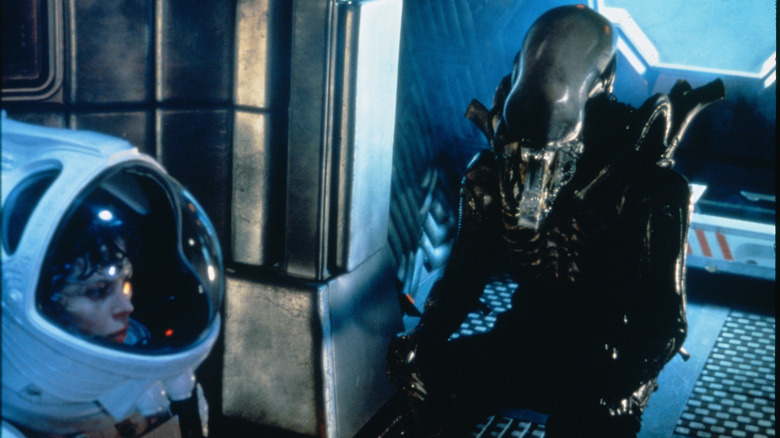
It is not uncommon for film directors to have calling cards in their movies, like personal homages or the use of a specific style. Examples include the recurring fake movie in John Landis films or James Cameron's use of the color blue. When it comes to science fiction, director Ridley Scott is considered one of the masters. He didn't invent the horror/sci-fi genre, but many believe he perfected it. His 1979 film "Alien" introduced audiences to a terrifying vision of life from other planets. And it also gave him a signature calling card.
"Alien" is iconic for multiple reasons. It perfectly blends the horror and sci-fi genres. "Alien" went against the grain with the iconic, kick-ass female protagonist Ripley (Sigourney Weaver). It introduced nightmare-inducing antagonists such as face-hugging parasites and the perfect killing machine Xenomorph, described in the film as, "structural perfection, matched only by its hostility." The film was a technical masterpiece and lauded for its visuals, winning an Academy Award for Best Visual Effects and being nominated for another in Best Art Direction.
"Alien" would launch a franchise that won /Film's Tournament of Terror, declaring it the greatest horror franchise ever. The series features five direct sequels or prequels and a total of eight films in all when you include the two "Alien vs. Predator" movies. And there's another on the way. Scott is producing a new "Alien" movie with all new characters for Hulu.
Curiously, it was while filming his 1979 masterpiece that Scott discovered one of his calling cards for future movies.
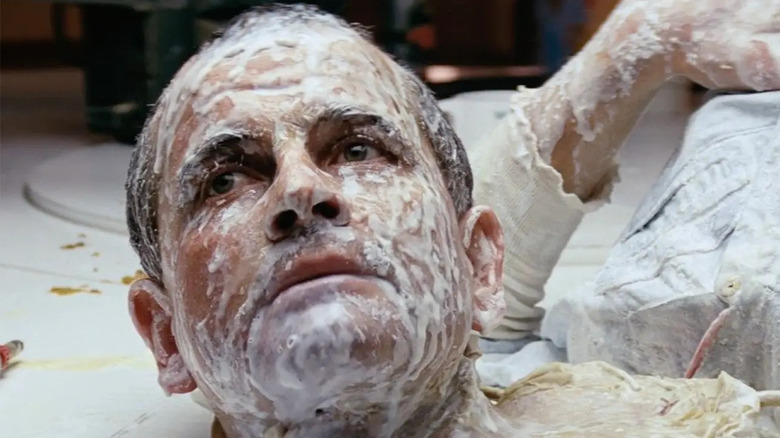
If the iconic science fiction writer Philip K. Dick can ask, "Do Androids Dream of Electric Sheep?" then Ridley Scott can ask, "Do androids all have white blood?" And he did, in fact, on the set of "Alien." The epiphany came to Scott just as happenstance while filming one of the movie's fight sequences.
The scene is poetic in the way it portrays the differences between the android Ash and the human Ripley. Ripley approaches Ash with a trickle of red blood spilling from her nose, while we see Ash's "blood" revealed for the first time as a trickle of white fluid dripping down the side of his face.
According to The New York Times, the brilliant juxtaposition wasn't planned, it was simply an impromptu experiment. Scott said:
"I was in a room with Sigourney Weaver, who was being attacked by Ian Holm as an android...his character was on the verge of completely losing it and getting violent. I said, 'Does anybody have an eyedropper full of milk?' The makeup department brought out an eyedropper, and I got the milk, and I reached out and put a drop of milk above his eye and then started rolling. As it dropped down across his eye, it freaked everybody out! And then I thought, 'Do androids all have white blood? Like milk of magnesia?' So that's why my androids are milky white inside."
Little did Scott know at the time the precedent he was setting for the franchise, and beyond.
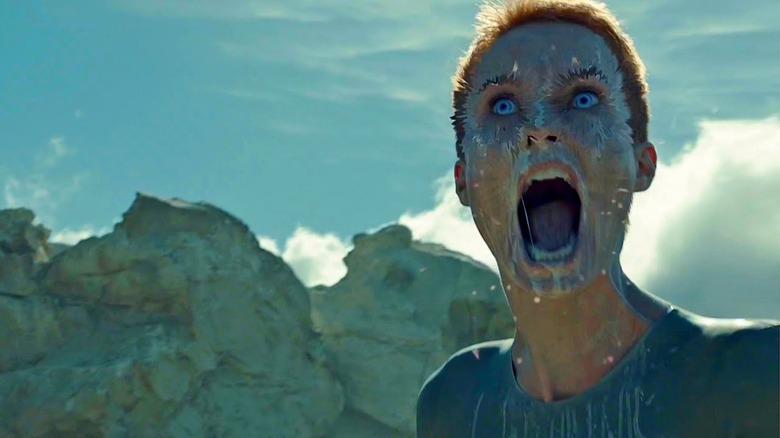
Though the introduction of the white substance in "Alien" aesthetically differentiates androids from their human crewmates, at the same time it humanizes them. Instead of damage to an android revealing very unhuman-like mechanical components, as we see in 1984's "The Terminator," in "Alien" they still bleed. Just not like us. The choice ended up being psychological as much as it was aesthetic. "I think it works great," Scott said of the white blood. "It's more uncomfortable than seeing red blood."
The white blood of androids would become a signifying visual throughout the "Alien" franchise and has reappeared in Scott's recent work. His accidental discovery has become an analogy for something much bigger in the Scott-executive produced HBO Max series "Raised by Wolves."
In "Raised by Wolves" an android named "Mother" (who of course, bleeds white, and a lot of it) is literally responsible for re-populating the human race on a barren planet, birthing human embryos, and serving as their protector. The white blood not only implicitly represents life and a mother's milk in "Raised by Wolves" but has become a trope for the lifeblood of androids in the sci-fi genre. Not a bad return for an eyedropper full of milk in 1979.
Read this next: Every Ridley Scott Movie Ranked From Worst To Best
The post How an Experiment On the Alien Set Became One of Ridley Scott's Weirdest Calling Cards appeared first on /Film.
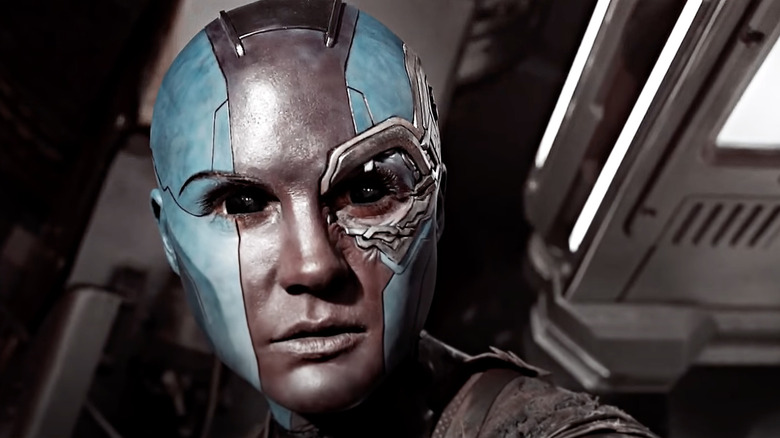
Starring in a Marvel movie can really take it out of an actor. There's the pressure of being seen by millions, the intense workouts and physicality to being a superhero or supervillain, and then for some, there's the makeup. Scottish actress Karen Gillan discovered while working on "Guardians of the Galaxy" that long hours at the gym and intense fight choreography training were a walk in the park compared to wearing one very specific part of her costume.
While the prosthetics, makeup, and contact lenses that make Gillan look like the alien mercenary Nebula are truly stunning to look at, they also require a lot of time in the makeup chair. Not only that, but the finishing touch on her Nebula costume caused her enough pain to change the way she approached special effects in later roles.
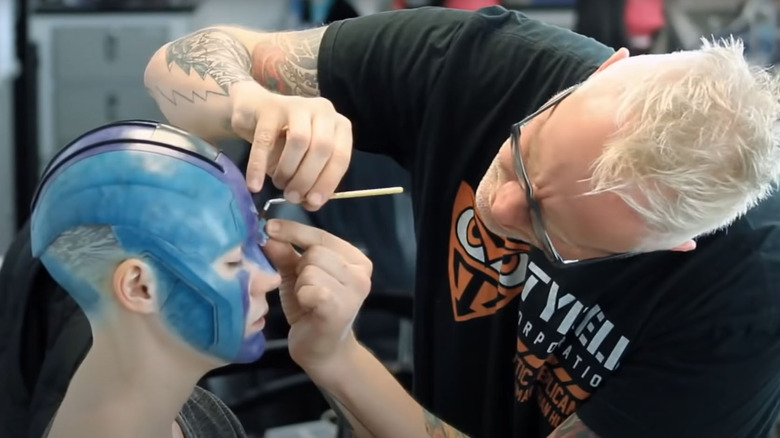
In an interview with The Hollywood Reporter, Gillan revealed that the sclera contact lenses she wore to play Nebula in the first "Guardians of the Galaxy" were so uncomfortable that she requested a digital eye color change for her role in the 2022 science fiction film, "Dual." When asked about her character's blue eyes in "Dual," Gillan said:
"I had to wear such huge contacts in the first "Guardians" that I cannot wear contacts anymore. [Laugh] I'm completely fazed by them. So the blue eyes were done in VFX. Those contacts I had in 'Guardians' were the full eye, though. The sclera lenses, I think they're called. So I don't think I can do contacts anymore after that experience."
Gillan has portrayed Nebula in both "Guardians of the Galaxy" films, plus "Avengers: Infinity War" and "Avengers: Endgame," so thankfully she's gotten used to shaving her head and sitting in a makeup chair for four hours before each day of filming. While she didn't say whether or not her Nebula eyes are now digital, the contact lenses she wore on the first film were 22 millimeter sclera lenses. The largest possible sclera lenses are 24 millimeters, so she had the almost all of her visible eye covered, which can be uncomfortable for some wearers.
Sclera lenses are also thicker than the kinds of contacts that only cover the pupil and iris, and colored cosmetic contacts can be thicker still. Combine that with makeup that Gillan described as "intense and slightly claustrophobic," and she had plenty of pain to channel in order to play her tortured character.
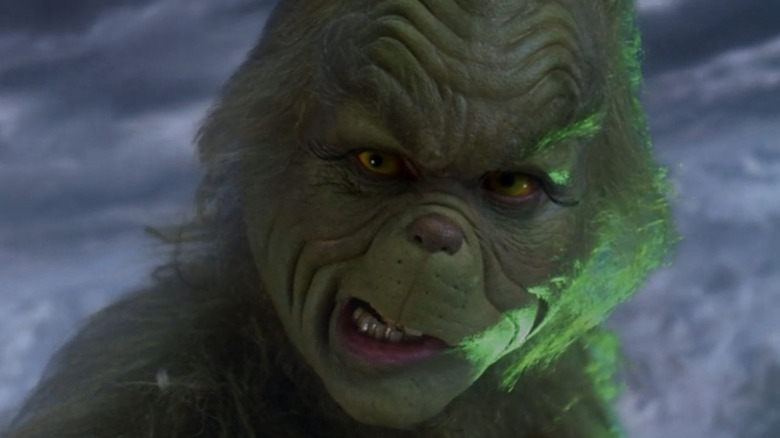
Gillan definitely isn't the first actor to have problems with cosmetic contacts. In his book "If Chins Could Kill," actor Bruce Campbell detailed the excruciating experience the cast of "The Evil Dead" went through in order to look possessed, wearing thick white sclera lenses that had to be removed every 15 minutes because they cut off oxygen to the eyes. The effect on the wearer, he said, was like putting "Tupperware" over your eyes. Thankfully for the "Evil Dead" cast, the sclera lenses were only for Deadite possession scenes, but some actors haven't been so lucky.
For the 2000 holiday movie "How the Grinch Stole Christmas," Jim Carrey wore heavy prosthetic makeup on his entire head, plus bright yellow sclera lenses that covered any white in his eyes. He described the makeup to Graham Norton as like "being buried alive," and almost quit the movie on the first day after spending eight hours in the makeup chair. He said the contact lenses were like "knives in my eyes," and the entire experience was so unpleasant that producer Brian Grazer ended up hiring a former CIA operative to train Carrey on how to endure daily torture. The training worked well enough to get the movie made, and the team won an Oscar for best makeup, but at what cost?
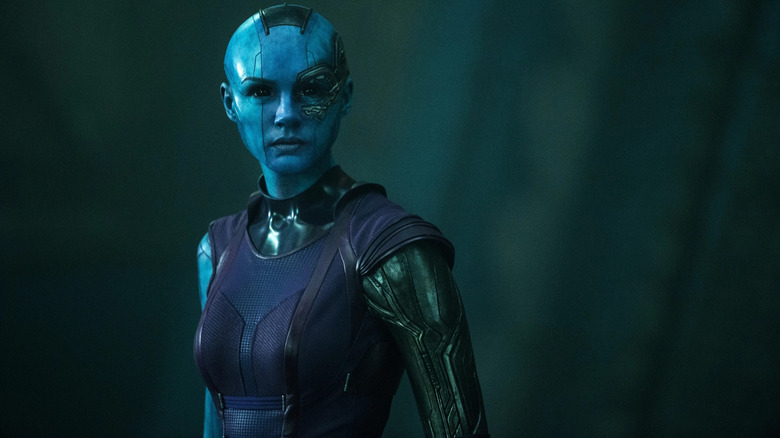
Digital effects have evolved just in the 8 years since "Guardians of the Galaxy" came out, so hopefully Gillan can enjoy VFX eyes in both the upcoming "Thor: Love and Thunder" and "Guardians of the Galaxy Vol. 3." While the makeup itself helps inform her performance and she described it as "part of her process" for getting into character, the contacts could probably be done digitally without too much fuss.
Nebula's arc in the Marvel Cinematic Universe has been a complicated but deeply affecting one, and Gillan's performance helped make her a vital part of this massive franchise. Thankfully she'll have plenty of co-stars to spend time in the makeup chair beside her on "Guardians," like Dave Batista's Drax and her on-screen sister, Zoe Saldaña as Gamora.
You can catch Gillan in action as Nebula when "Thor: Love and Thunder" hits theaters on July 8, 2022, and when "Guardians of the Galaxy Vol. 3" hits theaters on May 5, 2023.
Read this next: 11 Marvel Comics Villains We Really Want To See In The MCU
The post How Playing Nebula Affected Karen Gillan Physically appeared first on /Film.
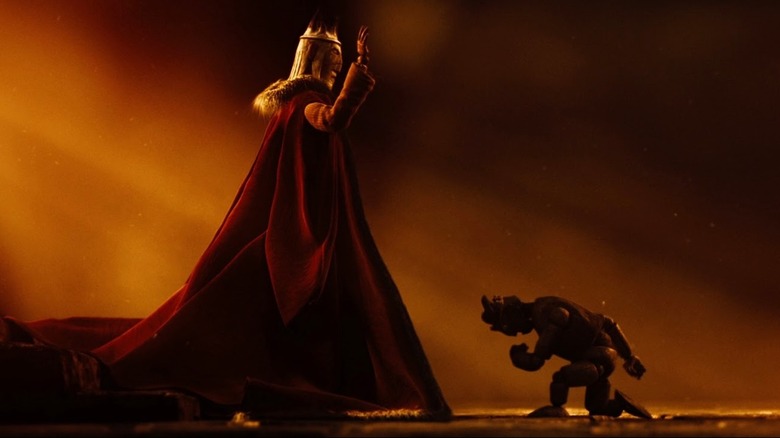
Plenty of film prologues have tried to condense entire legends into a few minutes of exposition. From "The Lord of the Rings: The Fellowship of the Ring" and "The Mummy," to any film about the Greek gods that's ever been made, a good intro can do wonders for a film's specific mythology. Guillermo del Toro had such lofty goals when it came to creating the intro segment for "Hellboy II: The Golden Army." Anyone who's seen the film can attest that the animated, puppet-like retelling of the story via a John Hurt-delivered monologue is a magical moment.
What most people don't know is that "Coraline" author Neil Gaiman had a hand in scripting the fairytale that opens the sequel. In recent years, the famed comic-book writer and novelist has become much more prominent in film and television. But the writer revealed in a documentary about "Hellboy" creator Mike Mignola that del Toro tapping him for "Hellboy II" was actually his breakthrough moment.
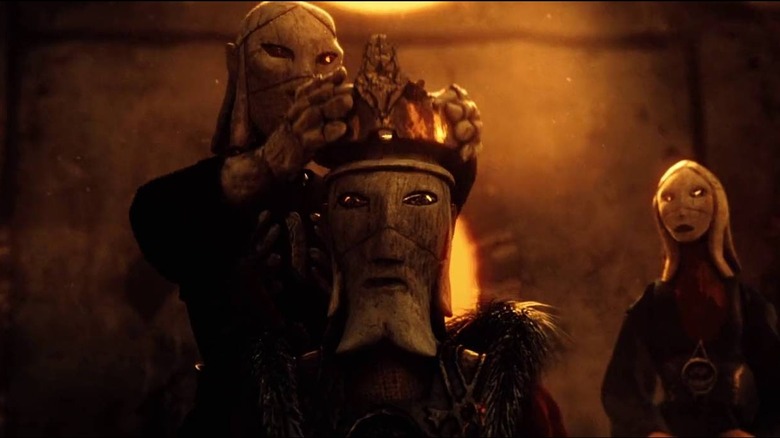
As first reported by "Entertainment Weekly," the documentary "Mike Mignola: Drawing Monsters" had a number of revelatory moments about the "Hellboy" creator's career. One of them included a little anecdote about fellow comic writer Gaiman and how he came to be involved in the sequel. Gaiman revealed:
"Not a lot of people know this, but my only little Hellboy thing, uncredited, is that back in 2007 I was in Budapest where they were filming Hellboy 2 and I got to hang out on set and just watch the filming and learn. None of which I thought at the time was incredibly useful and all of which, when I became a showrunner a decade later, became incredibly useful."
Since then, two of Gaiman's books, "American Gods" and "Good Omens," have been adapted into a series, his novella "Coraline" became a stop-motion animated movie, and his comic book "The Sandman" was greenlit on Netflix. Clearly, whatever experience he gained from del Toro's adaption of a Mignola comic paid off. But that was far from the only thing the writer got out of the experience, and the director was quick to reveal his reason for inviting Gaiman to the set. The writer recalled:
"Guillermo del Toro, at some point in there, handed me the script for 'Hellboy II' and said, 'Can you make the fairy tale that it opens up with sound more like a fairy tale? I've written a fairy tale, but can you do the language? And so, I got to do a rewrite on that opening fairy story in 'Hellboy II,' and it gives me an enormous amount of pleasure to know that I sort of cracked in. I'm in there in some way, you can hear little turns of phrase."
Del Toro might've designed the narrative, which itself was a beautiful piece of storytelling, but Gaiman's writing elevates it to being truly magical. It's the kind of poetic language that enhances the vibrant animation, and it almost steals the spotlight when eloquently delivered by Hurt. Gaiman's writing perfectly sets up the sequel's exploration of a far more fairytale-like world than the previous film. It also emphasizes the hidden nature of this very ancient world that's gone on existing under the noses of humans since the beginning. If we ever get a "Hellboy 3," I hope Gaiman will find himself invited to participate one more time by del Toro and Mignola.
Read this next: 13 Fantasy Films That Never Got Sequels
The post How Hellboy II Secretly Kickstarted Neil Gaiman's Career in Film and TV appeared first on /Film.
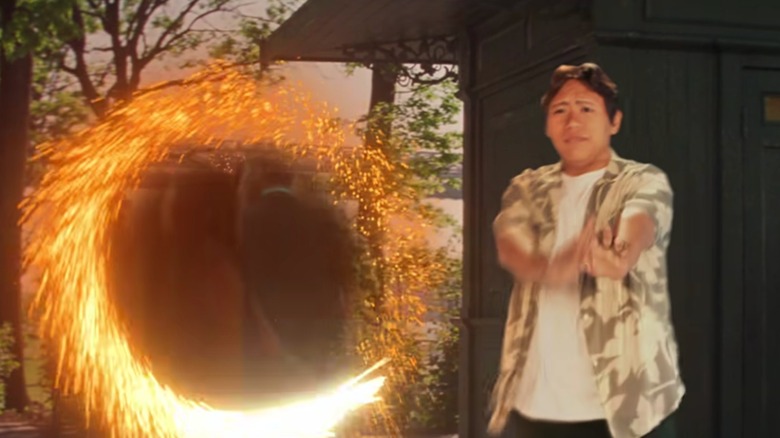
Ned Leeds (Jacob Batalon) is hands-down one of the best sidekicks in the MCU. He's enthusiastic, a great hype man for his best bro Peter (Tom Holland), and generally a super-helpful ally in times of superhero-adjacent stress. "Spider-Man: No Way Home" finally recognized his (and Batalon's) full potential by giving Ned portal-opening capabilities, leading fans to speculate about whether or not the character would headline his own series or movie soon.
Ned isn't taking center stage quite yet, but a new teaser for the "Spider-Man: No Way Home" home media release lets fans see the character dip into other Spider-Man worlds, specifically the films by Sam Raimi and Marc Webb. The clip --which seems to be a one-off teaser, as it doesn't correspond to any featurettes on the Blu-ray -- is called "Ned's Bogus Adventure," stylized in the classic "Back to the Future" font.
The not-quite-sorcerer's-apprentice isn't exactly time traveling here so much as movie hopping. We see Ned appear in the audience of the underground wrestling match where Tobey Maguire's Peter Parker debuts his Spider-Man costume for the first time. He also pops up at a high school graduation, where Andrew Garfield's Peter is kissing Gwen Stacy (Emma Stone). Finally, Ned hops over to his own timeline, where he sees his own Peter at the homecoming dance.
Oddly, this isn't really a full featurette or an in-canon short like "Peter Parker Takes His Driving Test." It's largely footage from existing Spider-Man movies, much of which is arranged like a promo for the Holland franchise, along with a few seconds of new Ned material. Batalon is clearly green-screened into these pre-existing scenes, and there's an added layer of uncanny valley strangeness thanks to the inclusion of a repurposed Stan Lee cameo.
Hopefully, we'll get to see Ned's powers in full force in the Marvel Cinematic Universe sometime soon. The character doesn't seem to be hewing particularly closely to Marvel comics plots, which see him cloned at one point, and at another, brainwashed into becoming a villain called the Hobgoblin. This might be a good thing for fans of the character, though: It's very possible Ned's abilities, which resemble those of Doctor Strange, will be needed to help set the world straight after upcoming MCU plotlines seem poised to tear the universe asunder. If this clip shows anything, it's that the guy can casually use magic which has taken others years to master.
Batalon's time as Ned has been especially meaningful for viewers who have never seen a Filipino-American hero save the day before. The dynamic, funny, and supportive character deserves a prime spot in the MCU, and hopefully "Ned's Bogus Adventure" is just the tip of the iceberg.
Read this next: Adam Sandler's 14 Best Roles Ranked
The post New Spider-Man: No Way Home Promo Sends Ned to the Raimi and Webb Universes appeared first on /Film.
Read more of this story at Slashdot.
The post Choose or Die – Netflix Review (4/5) appeared first on Heaven of Horror.

For many years now, I've lamented about how much of my time is spent attempting to disclose data breaches to impacted companies. It's by far the single most time-consuming activity in processing breaches for Have I Been Pwned (HIBP) and frankly, it's about the most thankless task I can imagine. Finding contact details is hard. Getting responses is hard. Not having an organisation just automatically assume you're trying to shake them down for cash is hard. So hard, in fact, I thought I'd record the process end-to-end and share it publicly to help demonstrate just how painful the process is.
I'd filed the (alleged) Avvo breach away in the "too hard" basket a long time ago and it was only after seeing this tweet last week that a distant bell rang in my head:
@troyhunt Looks like @avvo has had a breach of their user list -- I'm getting those "you've been hacked" scam emails on my Avvo-specific address. No passwords, so I'm guessing they're hashed.
— pḧÿzömë (@phyzome) April 4, 2022
On a hunch that this wasn't going to be an easy process, I started recording and kicked off my usual disclosure process. It failed - completely - but at least now I have a complete blow-by-blow of everything I've done, who I've contacted and who I've even engaged with yet still, to no avail. Here's the whole thing:
The Avvo data breach is now searchable in HIBP. By the time I sent out notifications, they went to 20,183 individuals monitoring their accounts and a further 9,637 people monitoring domains with impacted email addresses. I'll update this post with any further relevant information if it comes up in the future.
Read more of this story at Slashdot.